
The document discusses inhaler technique and common mistakes. It begins by outlining why proper inhaler technique is important for controlling asthma symptoms and outlines the types of inhalers. It then discusses the history of inhalers and demonstrates how to properly use different inhaler types like MDIs and DPIs. Common mistakes are described, such as not inhaling deeply enough or exhaling into the device. The document stresses the importance of checking patients' technique and providing education to use inhalers correctly.
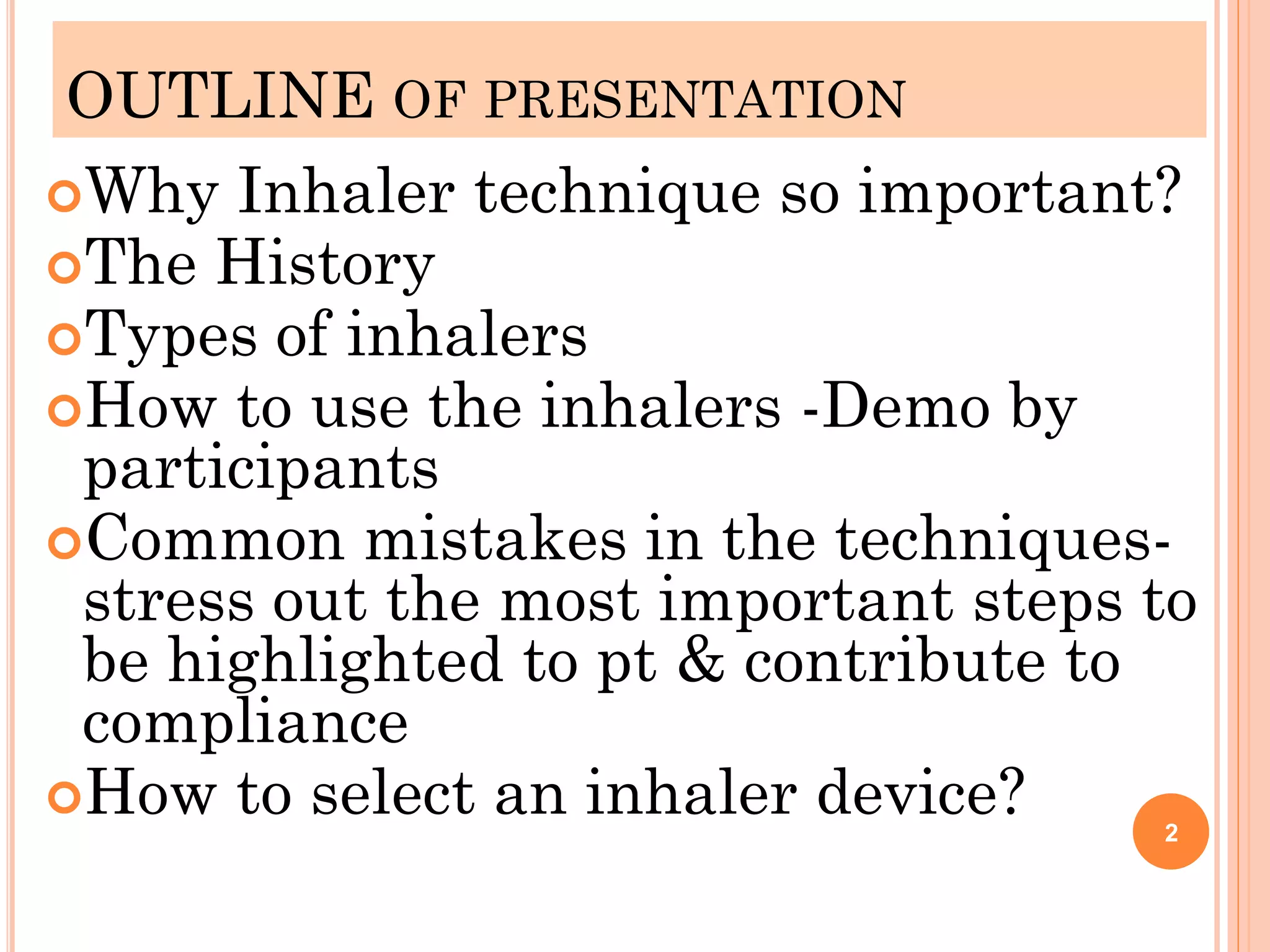
OUTLINE OF PRESENTATION
WhyInhaler technique so important?
The History
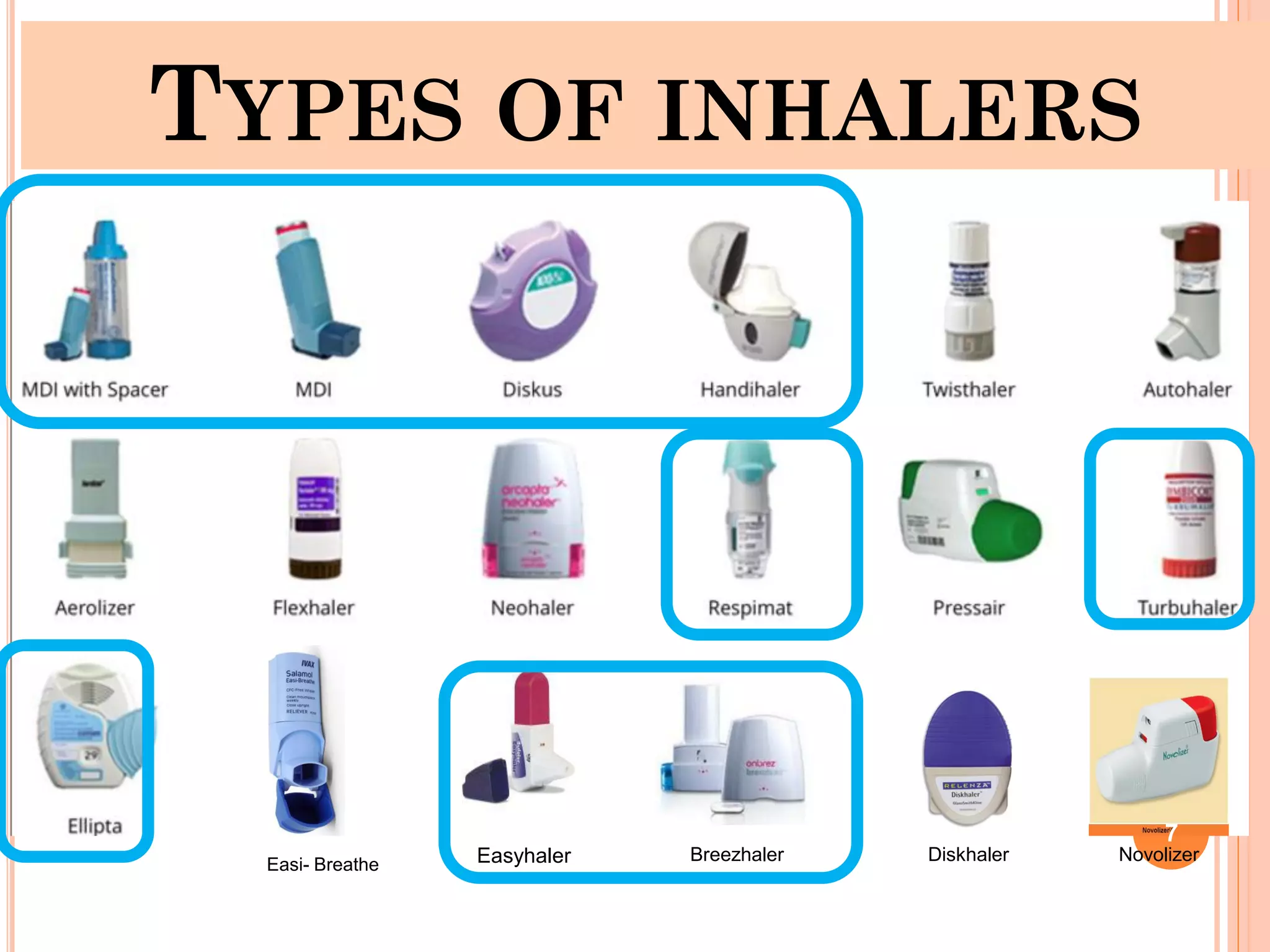
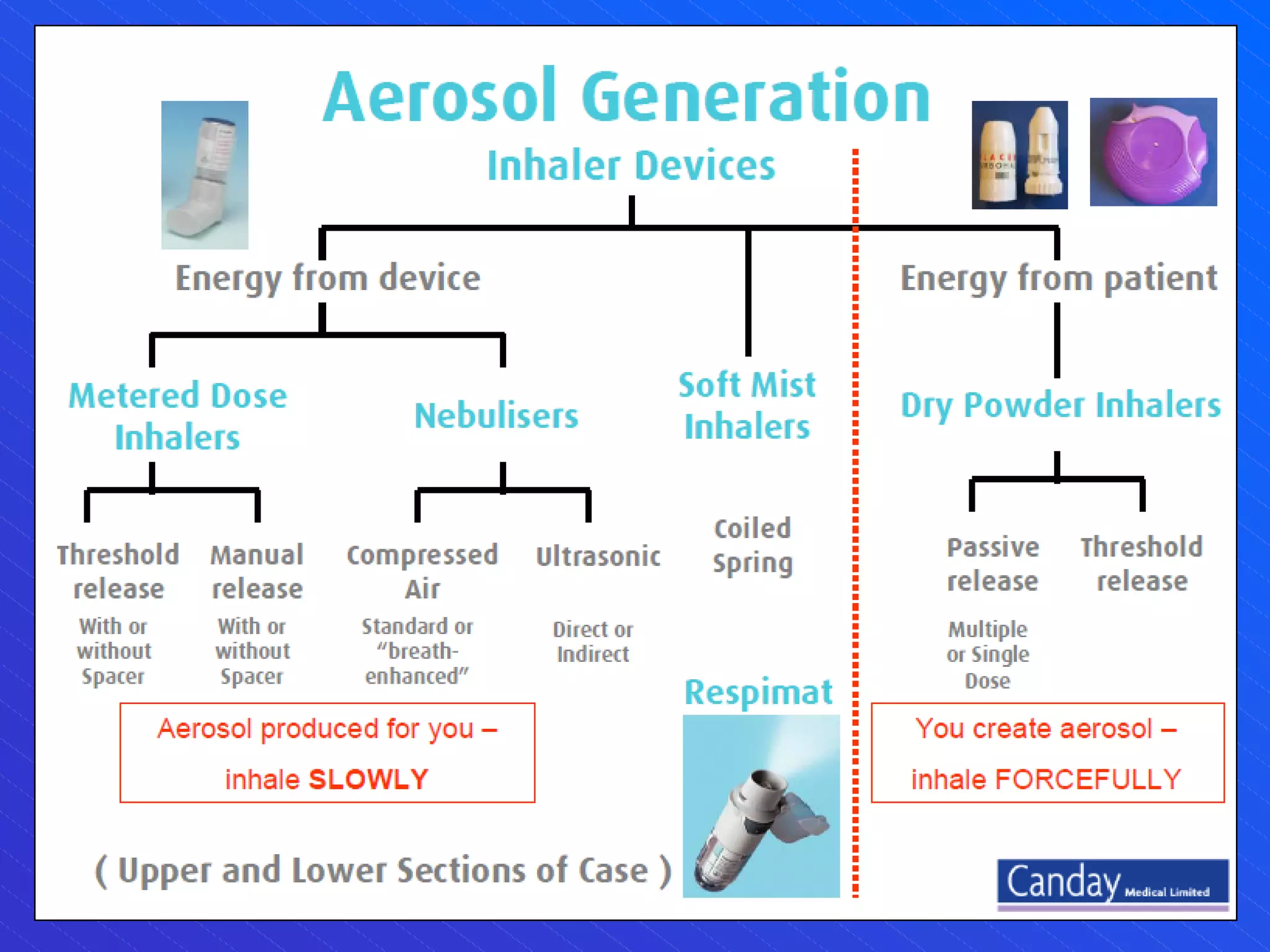
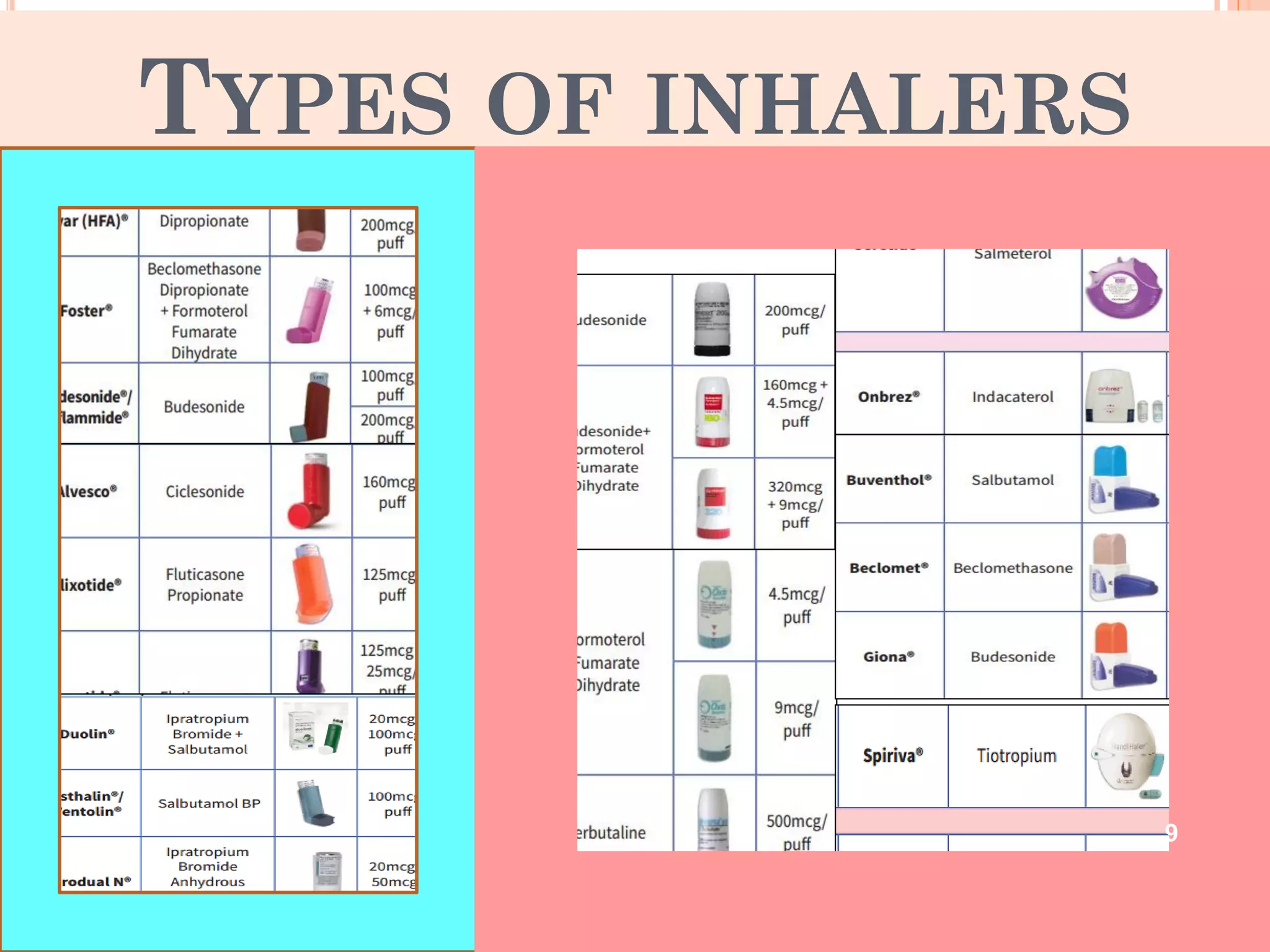
Types of inhalers
How to use the inhalers -Demo by
participants
Common mistakes in the techniques-
stress out the most important steps to
be highlighted to pt & contribute to
compliance
How to select an inhaler device? 2
3.
WHY INHALER TECHNIQUESO
IMPORTANT?
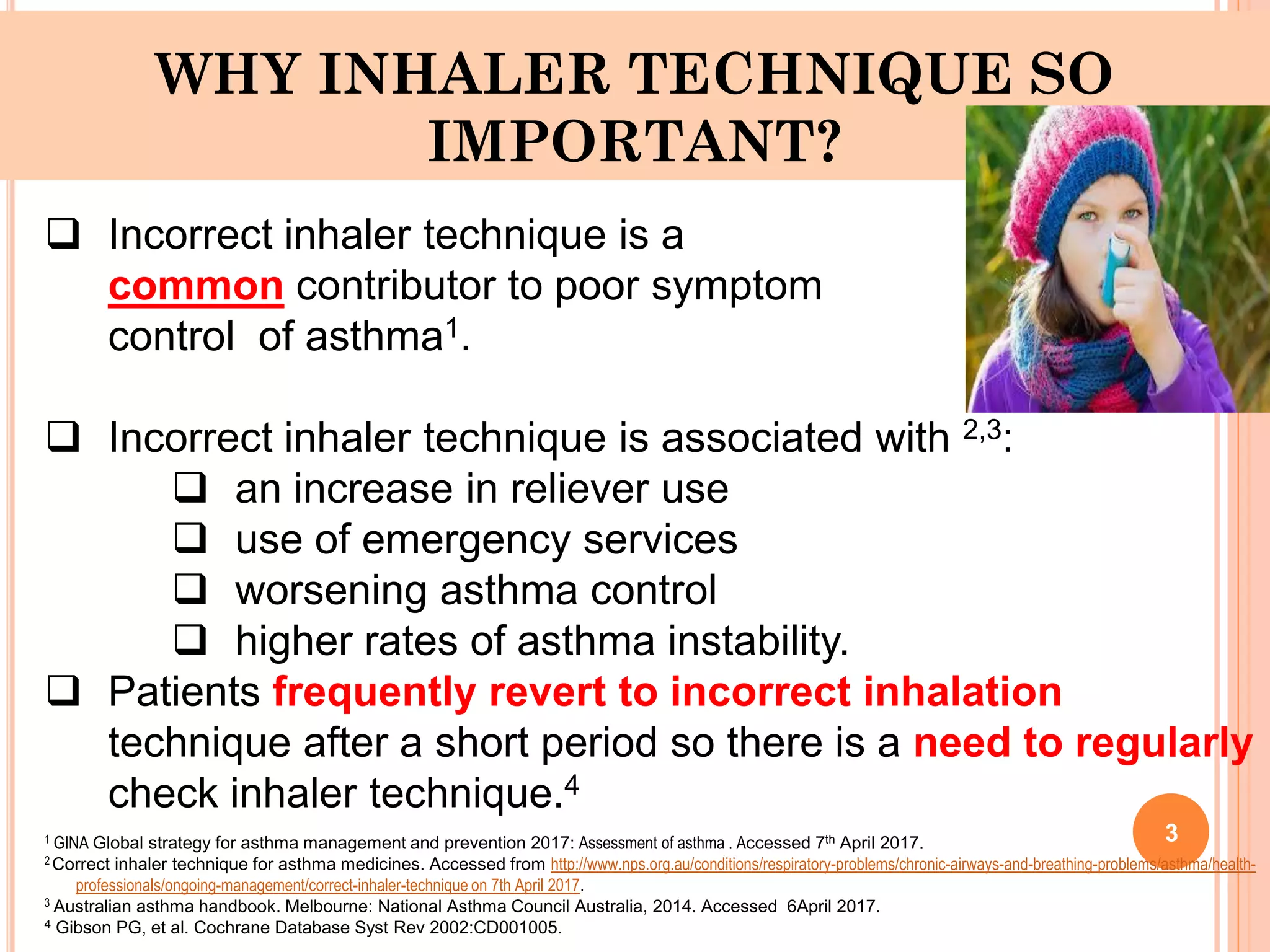
Incorrect inhaler technique is a
common contributor to poor symptom
control of asthma1.
Incorrect inhaler technique is associated with 2,3:
an increase in reliever use
use of emergency services
worsening asthma control
higher rates of asthma instability.
Patients frequently revert to incorrect inhalation
technique after a short period so there is a need to regularly
check inhaler technique.4
1 GINA Global strategy for asthma management and prevention 2017: Assessment of asthma . Accessed 7th April 2017.
2 Correct inhaler technique for asthma medicines. Accessed from http://www.nps.org.au/conditions/respiratory-problems/chronic-airways-and-breathing-problems/asthma/health-
professionals/ongoing-management/correct-inhaler-technique on 7th April 2017.
3 Australian asthma handbook. Melbourne: National Asthma Council Australia, 2014. Accessed 6April 2017.
4 Gibson PG, et al. Cochrane Database Syst Rev 2002:CD001005.
3
4.
INHALER TECHNIQUE
Inhaleddrugs are the most effective therapy
available for asthma and COPD, improvements in
inhaler technology and design in combination with
improvement in both physician and patient education
seems to be the way forward in improving asthma
management and control.5
Be aware that the risk of poor outcomes is
pronounced in patients using pressurized metered-
dose inhalers (pMDI) who have poor inspiration–
actuation coordination, but poor technique in
people using dry powder inhalers (DPIs) also leads to
poor outcomes. 2,3.
2 Correct inhaler technique for asthma medicines. Accessed from http://www.nps.org.au/conditions/respiratory-problems/chronic-airways-and-
breathing-problems/asthma/health-professionals/ongoing-management/correct-inhaler-technique on 7th April 2017.
3 Australian asthma handbook. Melbourne: National Asthma Council Australia, 2014. Accessed 6April 2017
5 Virchow, J.C. et al., Importance of inhaler devices in the management of airway disease Respiratory Medicine, Volume 102 ,
Issue 1 , 10 – 19.
4
THE HISTORY
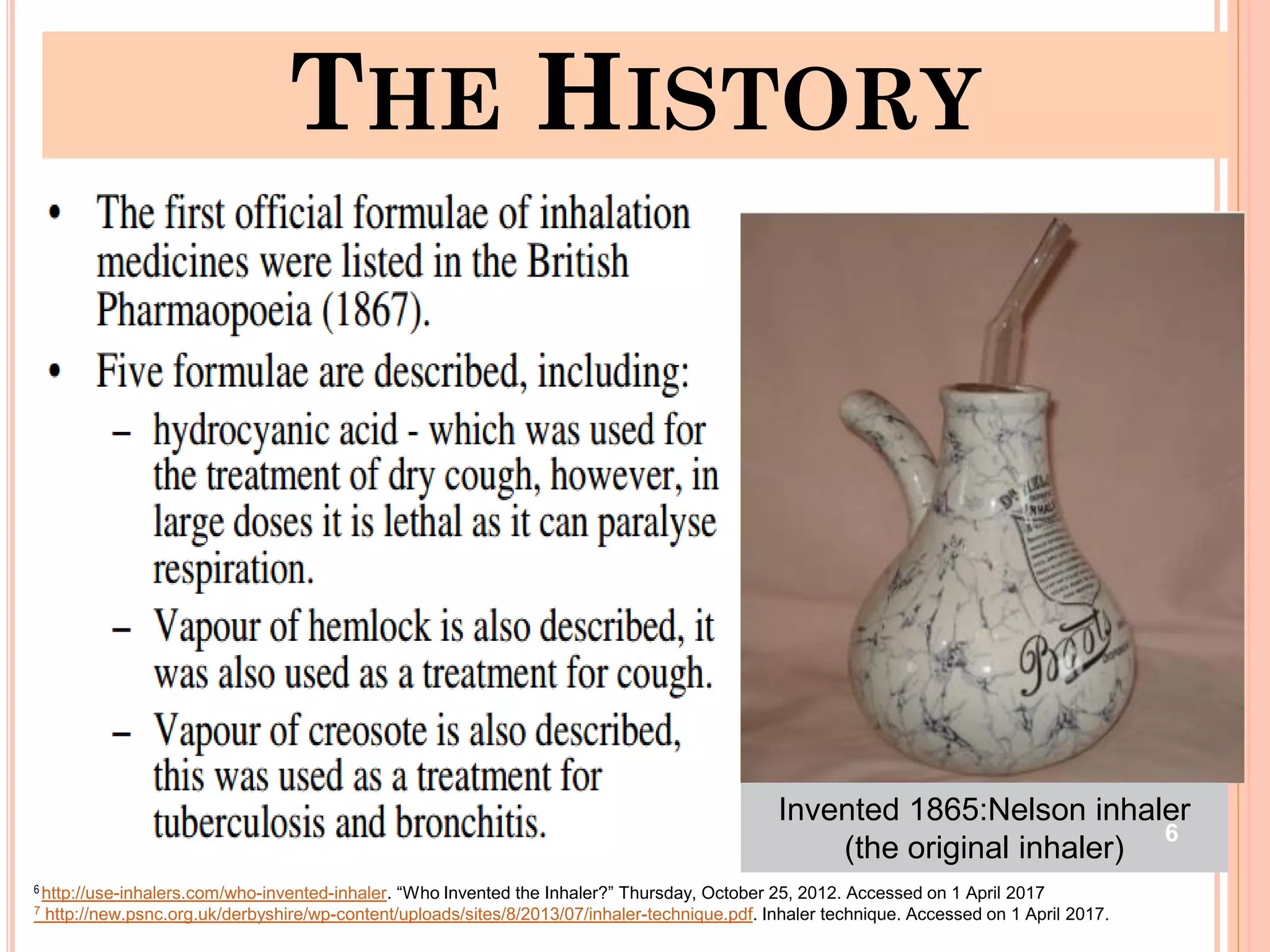
Invented 1865:Nelsoninhaler
(the original inhaler)
6
6 http://use-inhalers.com/who-invented-inhaler. “Who Invented the Inhaler?” Thursday, October 25, 2012. Accessed on 1 April 2017
7 http://new.psnc.org.uk/derbyshire/wp-content/uploads/sites/8/2013/07/inhaler-technique.pdf. Inhaler technique. Accessed on 1 April 2017.
CHECK INHALER TECHNIQUE
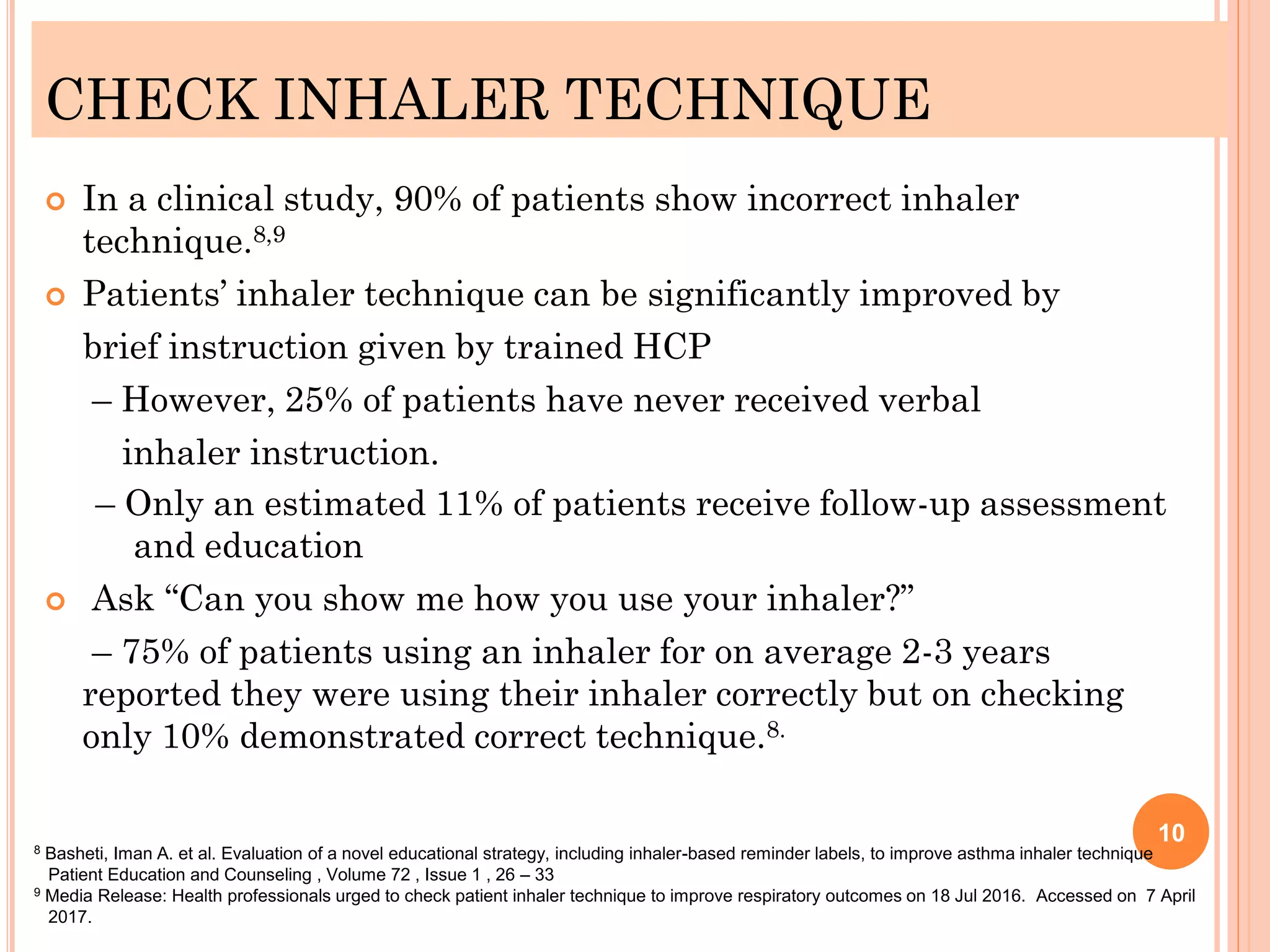
In a clinical study, 90% of patients show incorrect inhaler
technique.8,9
Patients’ inhaler technique can be significantly improved by
brief instruction given by trained HCP
– However, 25% of patients have never received verbal
inhaler instruction.
– Only an estimated 11% of patients receive follow-up assessment
and education
Ask “Can you show me how you use your inhaler?”
– 75% of patients using an inhaler for on average 2-3 years
reported they were using their inhaler correctly but on checking
only 10% demonstrated correct technique.8.
10
8 Basheti, Iman A. et al. Evaluation of a novel educational strategy, including inhaler-based reminder labels, to improve asthma inhaler technique
Patient Education and Counseling , Volume 72 , Issue 1 , 26 – 33
9 Media Release: Health professionals urged to check patient inhaler technique to improve respiratory outcomes on 18 Jul 2016. Accessed on 7 April
2017.
11.
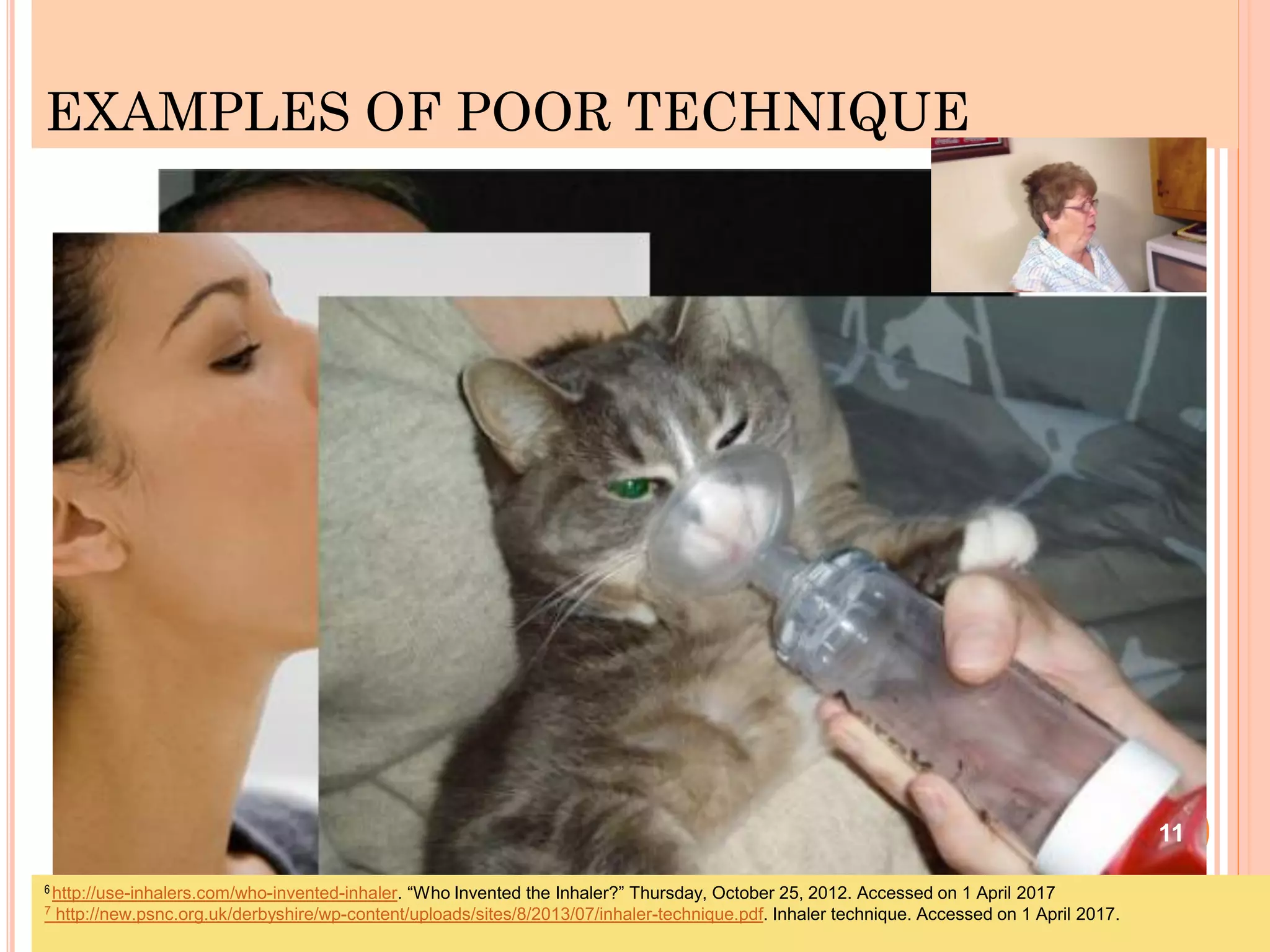
EXAMPLES OF POORTECHNIQUE
11
6 http://use-inhalers.com/who-invented-inhaler. “Who Invented the Inhaler?” Thursday, October 25, 2012. Accessed on 1 April 2017
7 http://new.psnc.org.uk/derbyshire/wp-content/uploads/sites/8/2013/07/inhaler-technique.pdf. Inhaler technique. Accessed on 1 April 2017.
12.
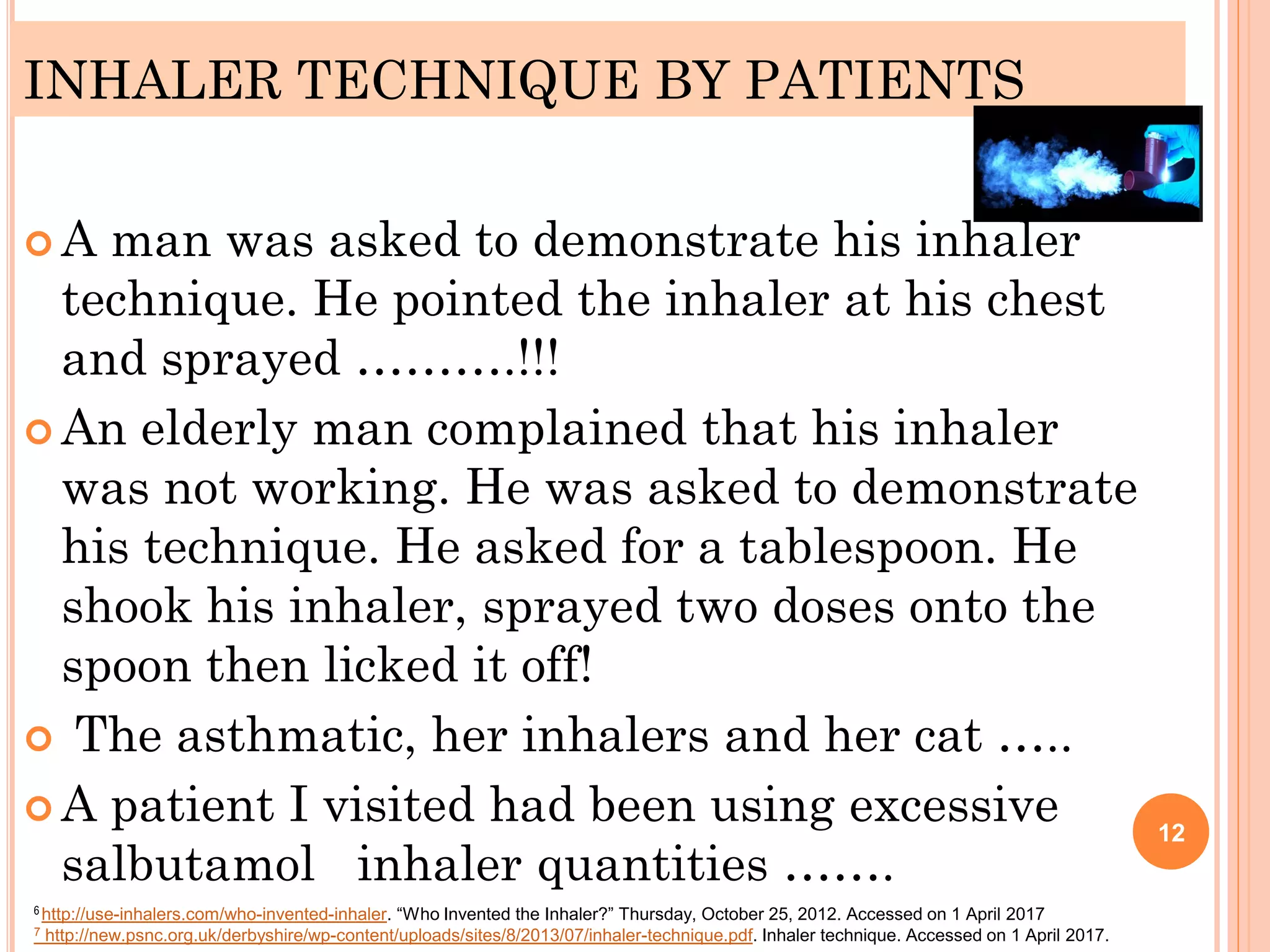
INHALER TECHNIQUE BYPATIENTS
A man was asked to demonstrate his inhaler
technique. He pointed the inhaler at his chest
and sprayed ……….!!!
An elderly man complained that his inhaler
was not working. He was asked to demonstrate
his technique. He asked for a tablespoon. He
shook his inhaler, sprayed two doses onto the
spoon then licked it off!
The asthmatic, her inhalers and her cat …..
A patient I visited had been using excessive
salbutamol inhaler quantities …….
12
6 http://use-inhalers.com/who-invented-inhaler. “Who Invented the Inhaler?” Thursday, October 25, 2012. Accessed on 1 April 2017
7 http://new.psnc.org.uk/derbyshire/wp-content/uploads/sites/8/2013/07/inhaler-technique.pdf. Inhaler technique. Accessed on 1 April 2017.
13.
LETS CHECK OURINHALER TECHNIQUE
13
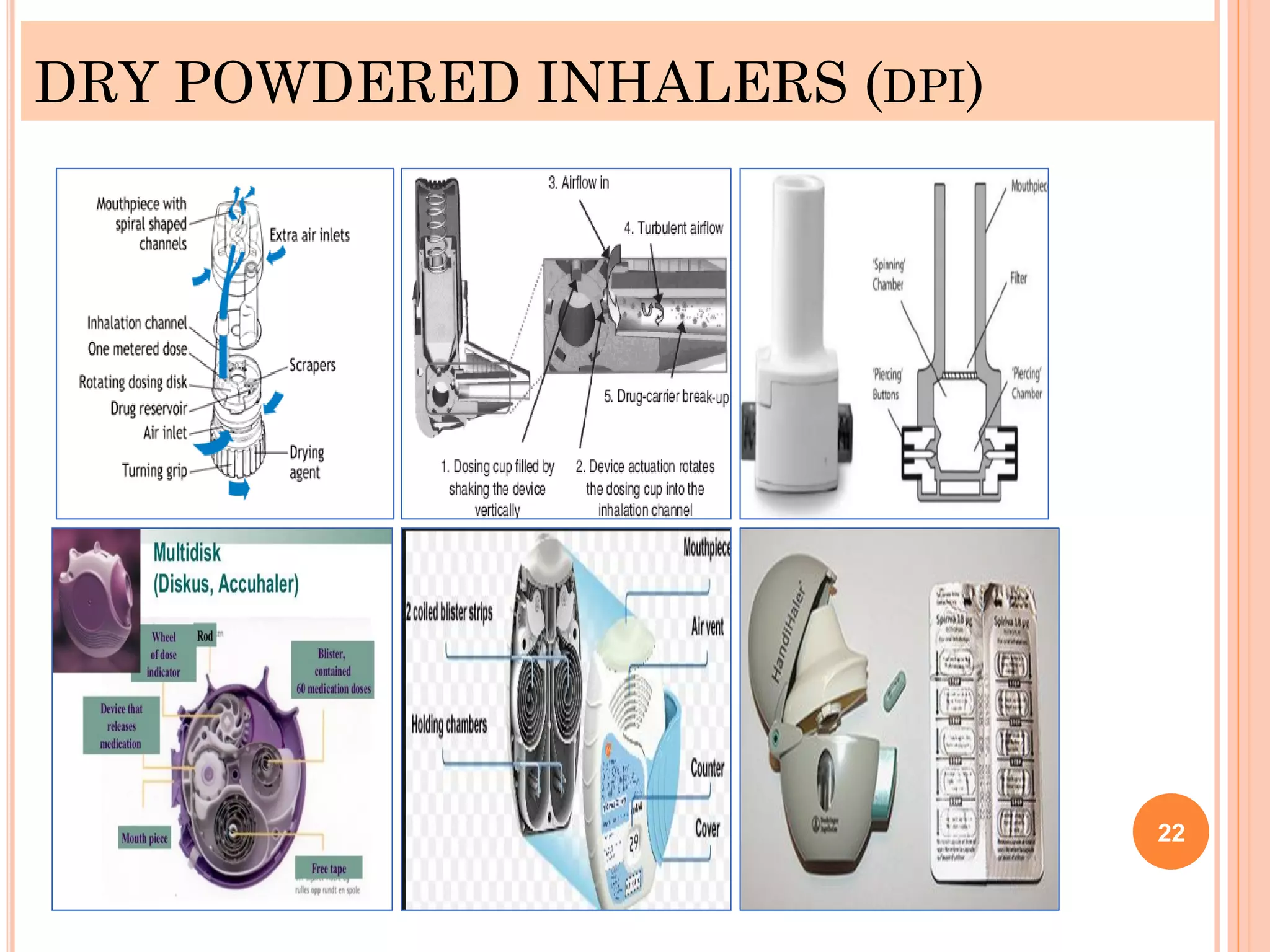
We will have 5 groups
-MDI
-Turbuhaler
-Accuhaler
-Respimat
-Handihaler/Brezhaler
14.
LETS CHECK OURINHALER TECHNIQUE
14
Activity:
Each group must
identify common
mistakes that patient
usually does during
inhalation steps
(5mins/group)
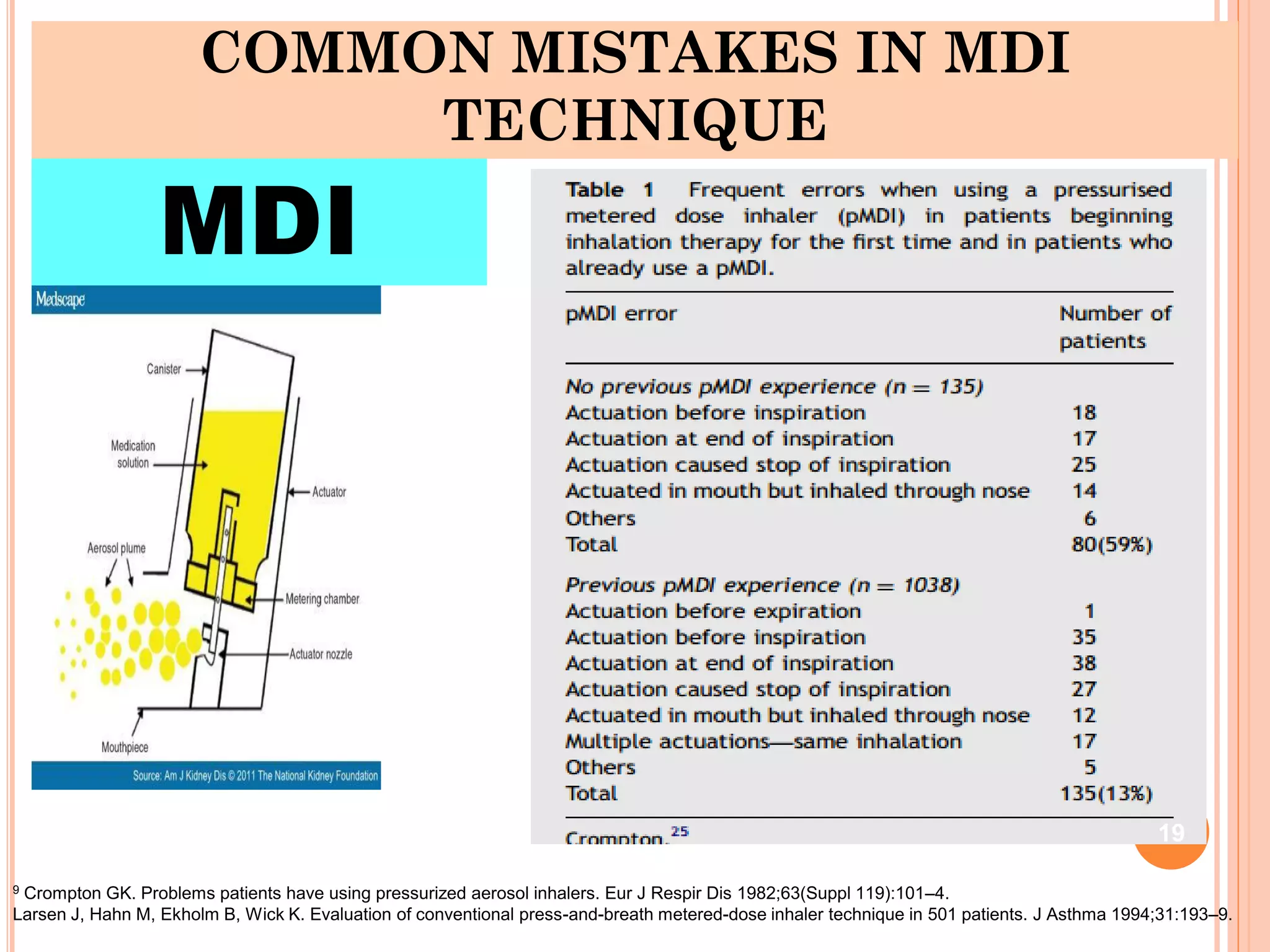
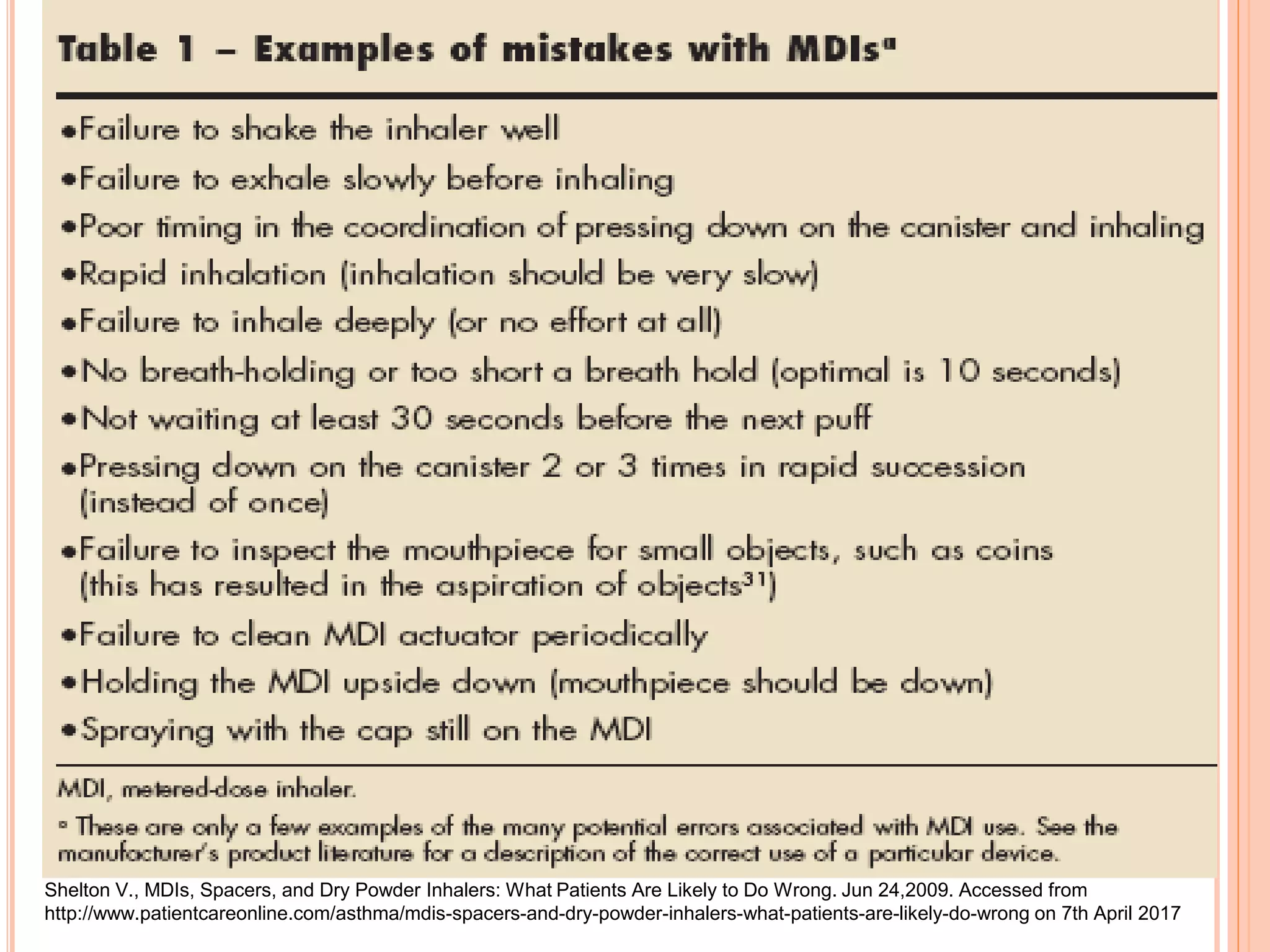
COMMON MISTAKES INMDI
TECHNIQUE
MDI
9 Crompton GK. Problems patients have using pressurized aerosol inhalers. Eur J Respir Dis 1982;63(Suppl 119):101–4.
Larsen J, Hahn M, Ekholm B, Wick K. Evaluation of conventional press-and-breath metered-dose inhaler technique in 501 patients. J Asthma 1994;31:193–9.
19
20.
20
Shelton V., MDIs,Spacers, and Dry Powder Inhalers: What Patients Are Likely to Do Wrong. Jun 24,2009. Accessed from
http://www.patientcareonline.com/asthma/mdis-spacers-and-dry-powder-inhalers-what-patients-are-likely-do-wrong on 7th April 2017
21.
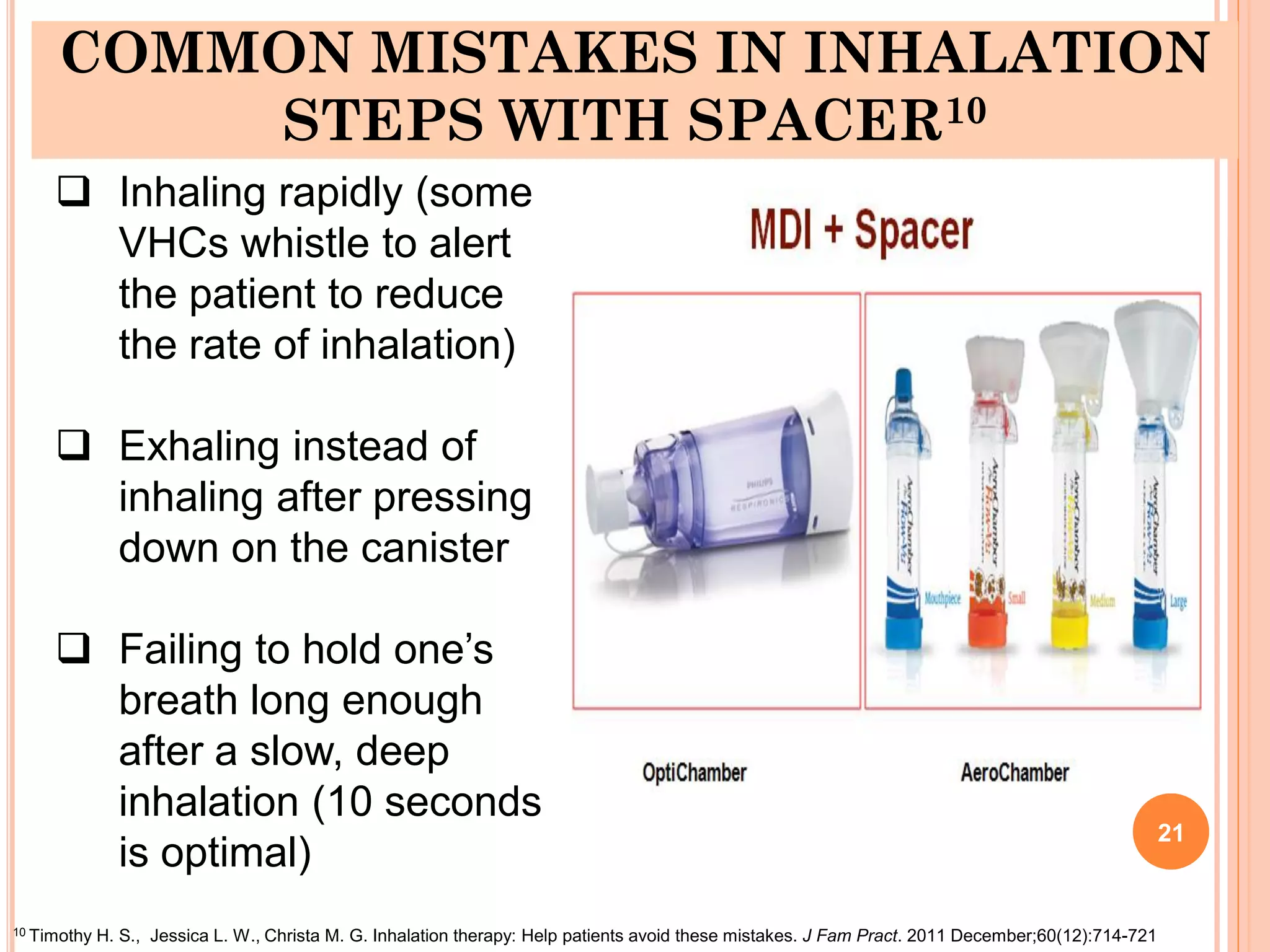
COMMON MISTAKES ININHALATION
STEPS WITH SPACER10
21
10 Timothy H. S., Jessica L. W., Christa M. G. Inhalation therapy: Help patients avoid these mistakes. J Fam Pract. 2011 December;60(12):714-721
Inhaling rapidly (some
VHCs whistle to alert
the patient to reduce
the rate of inhalation)
Exhaling instead of
inhaling after pressing
down on the canister
Failing to hold one’s
breath long enough
after a slow, deep
inhalation (10 seconds
is optimal)
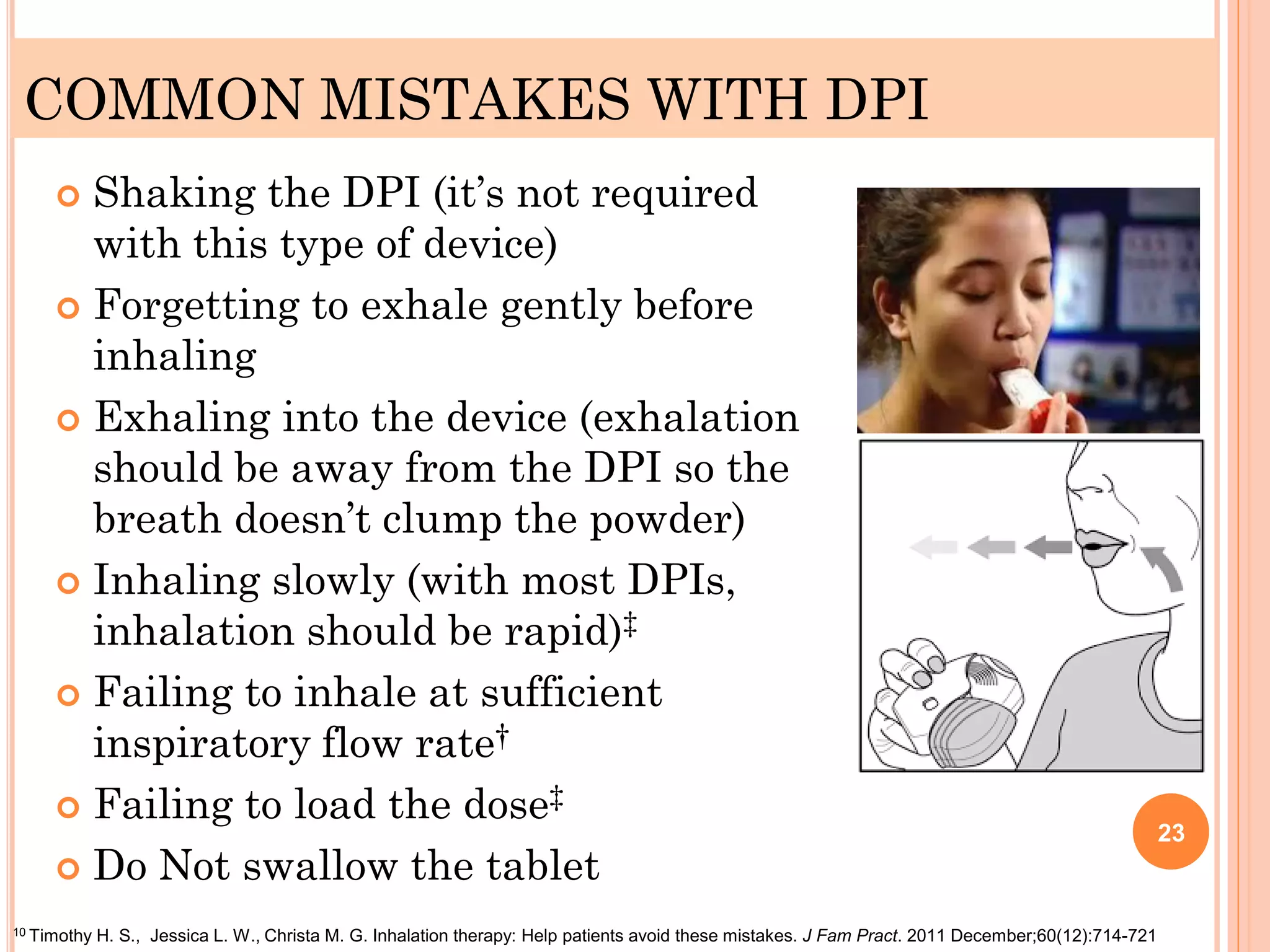
COMMON MISTAKES WITHDPI
Shaking the DPI (it’s not required
with this type of device)
Forgetting to exhale gently before
inhaling
Exhaling into the device (exhalation
should be away from the DPI so the
breath doesn’t clump the powder)
Inhaling slowly (with most DPIs,
inhalation should be rapid)‡
Failing to inhale at sufficient
inspiratory flow rate†
Failing to load the dose‡
Do Not swallow the tablet
23
10 Timothy H. S., Jessica L. W., Christa M. G. Inhalation therapy: Help patients avoid these mistakes. J Fam Pract. 2011 December;60(12):714-721
24.
USING STEROID INHALER
In patients using an ICS preventer, failure to rinse with water and spit
after each dose increases the risk of local adverse effects such as oral
candidiasis and an increased risk of dysphonia caused by medicines
being deposited in the mouth and pharynx.
1 Correct inhaler technique for asthma medicines. Accessed from http://www.nps.org.au/conditions/respiratory-problems/chronic-airways-and-breathing-
problems/asthma/health-professionals/ongoing-management/correct-inhaler-technique on 7th April 2017.
2 Australian asthma handbook. Melbourne: National Asthma Council Australia, 2014. [Online] (accessed 4 March 2014).
3 Gibson PG, et al. Cochrane Database Syst Rev 2002:CD001005. [Pubmed]
24
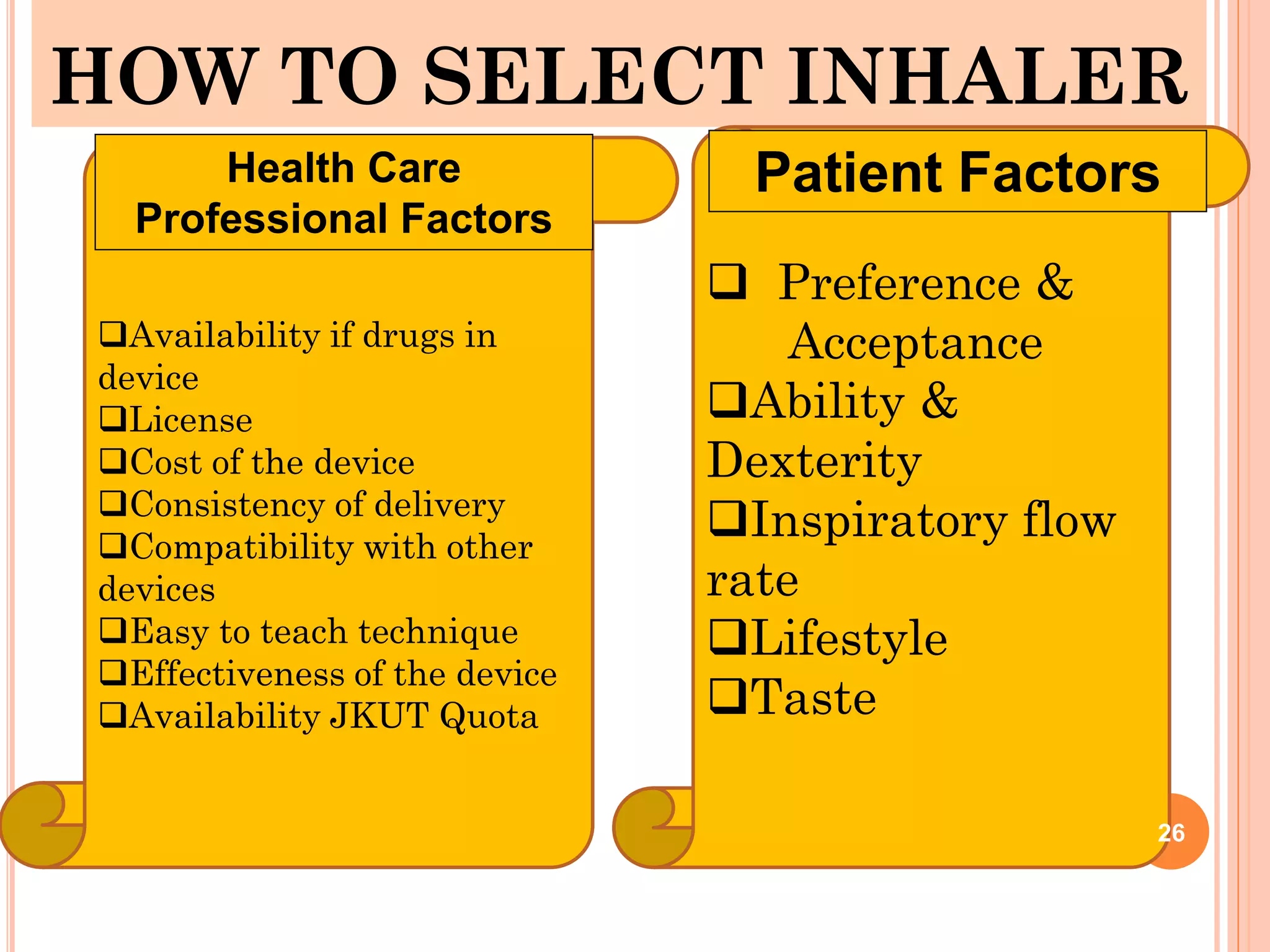
HOW TO SELECTINHALER
Availability if drugs in
device
License
Cost of the device
Consistency of delivery
Compatibility with other
devices
Easy to teach technique
Effectiveness of the device
Availability JKUT Quota
Preference &
Acceptance
Ability &
Dexterity
Inspiratory flow
rate
Lifestyle
Taste
Health Care
Professional Factors
Patient Factors
26