Palani Selvi. K
Postgraduate Student
Department of Conservative
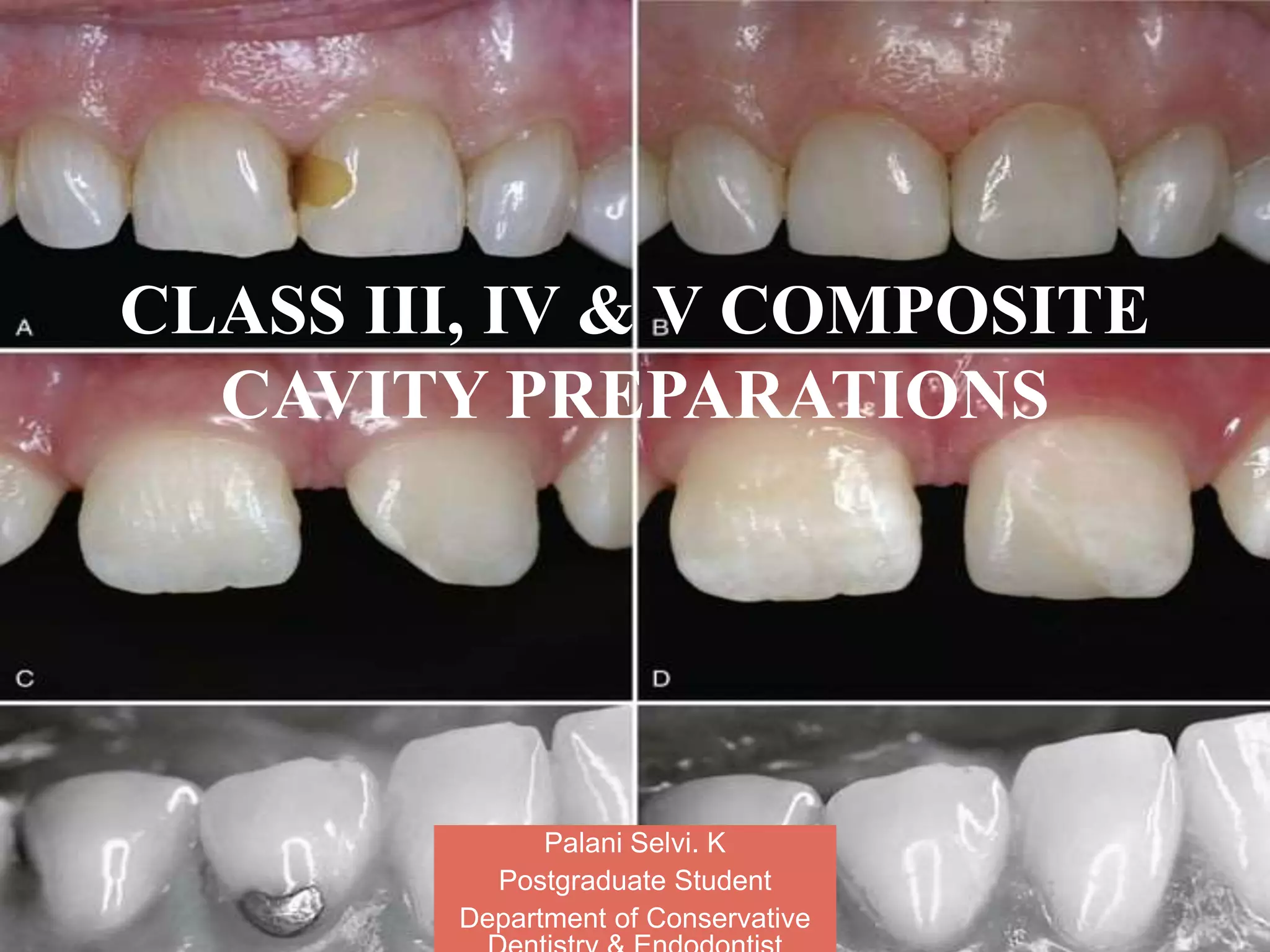
CLASS III, IV & V COMPOSITE
CAVITY PREPARATIONS
Contents
 General considerations- Indications &
Contraindications
 Clinical Technique
a. Initial clinical procedures
b. Class III cavity preparation
c. Class IV cavity preparation
d. Class V cavity preparation
 References
Indications
 Esthetic prominent areas
 Operating area can be adequately isolated to
attain an effective bond
 Tooth preparations have all-enamel margins
(Best).
Contraindications
 Operating area that cannot be adequately isolated
 Class V restorations in areas that are not
esthetically critical
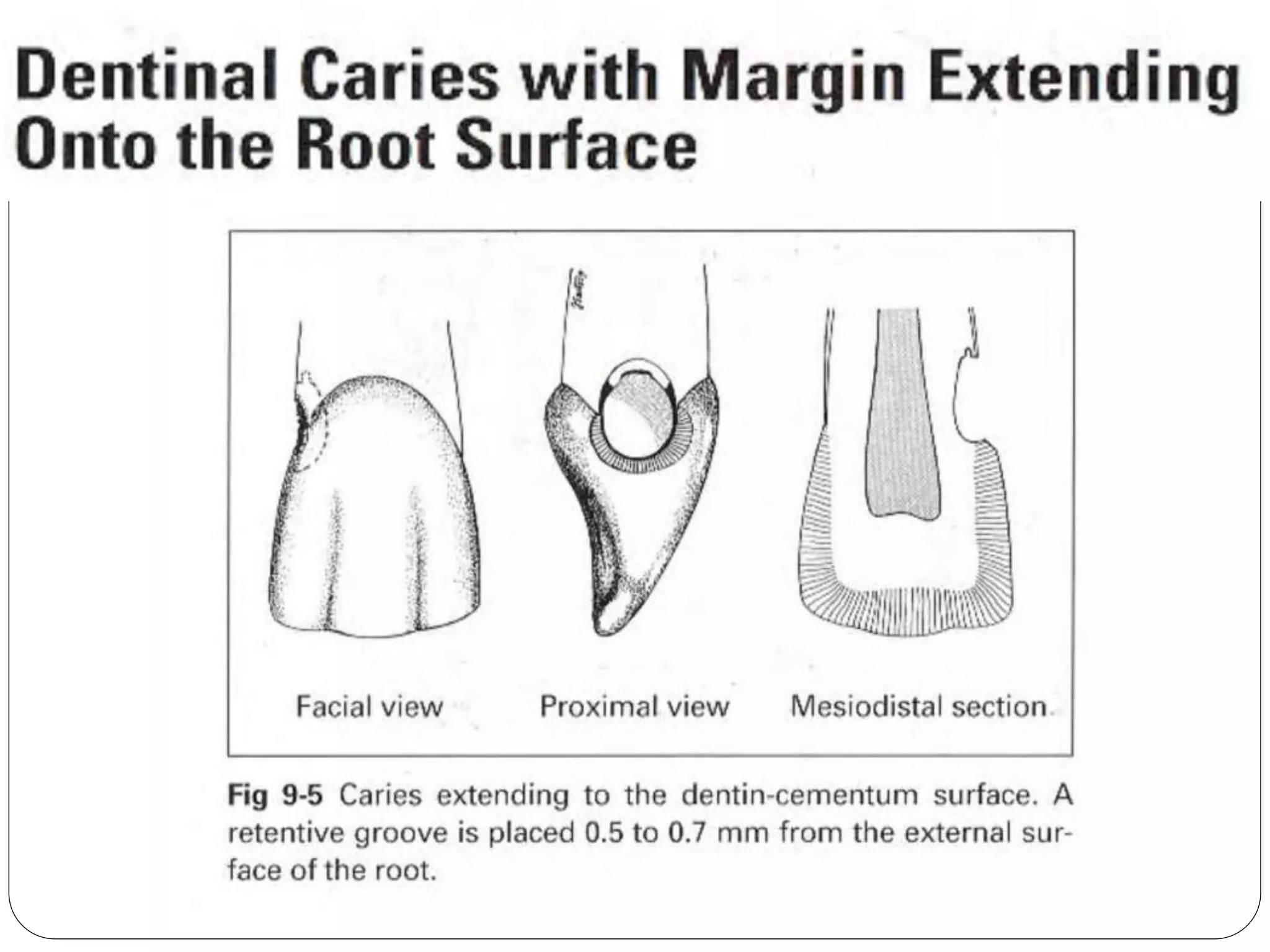
 Restorations that extend onto the root surface.
CLINICAL TECHNIQUE
INITIAL CLINICAL
PROCEDURES
 Anesthesia may be necessary for patient
comfort, and if used, will help decrease the
salivary flow during the procedure
 Occlusal assessments should be made to help
in properly adjusting the restoration's function and
in determining the tooth preparation design.
 The shade must be selected before the tooth
dehydrates
 Proper Isolation to permit effective bonding
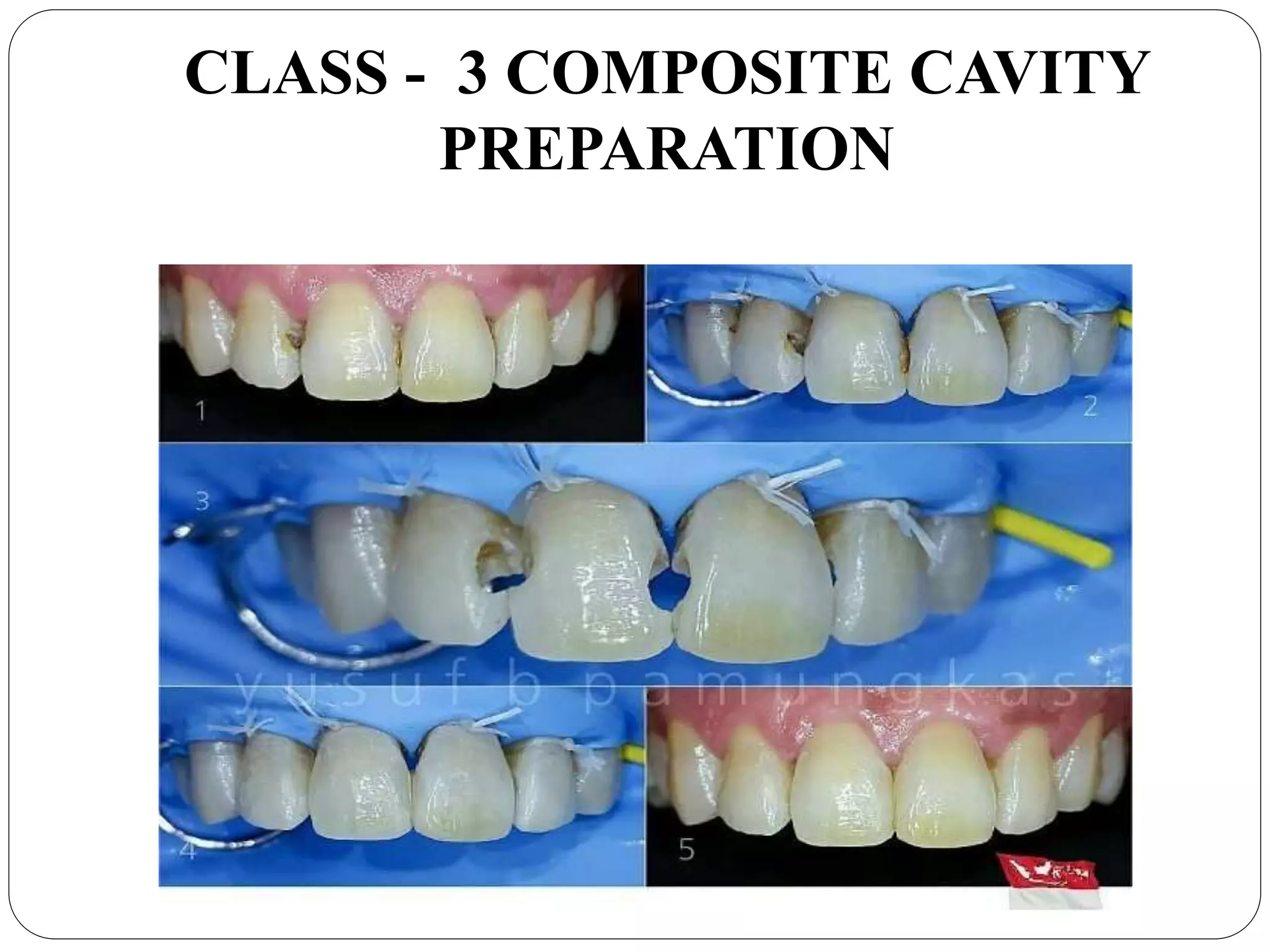
CLASS - 3 COMPOSITE CAVITY
PREPARATION
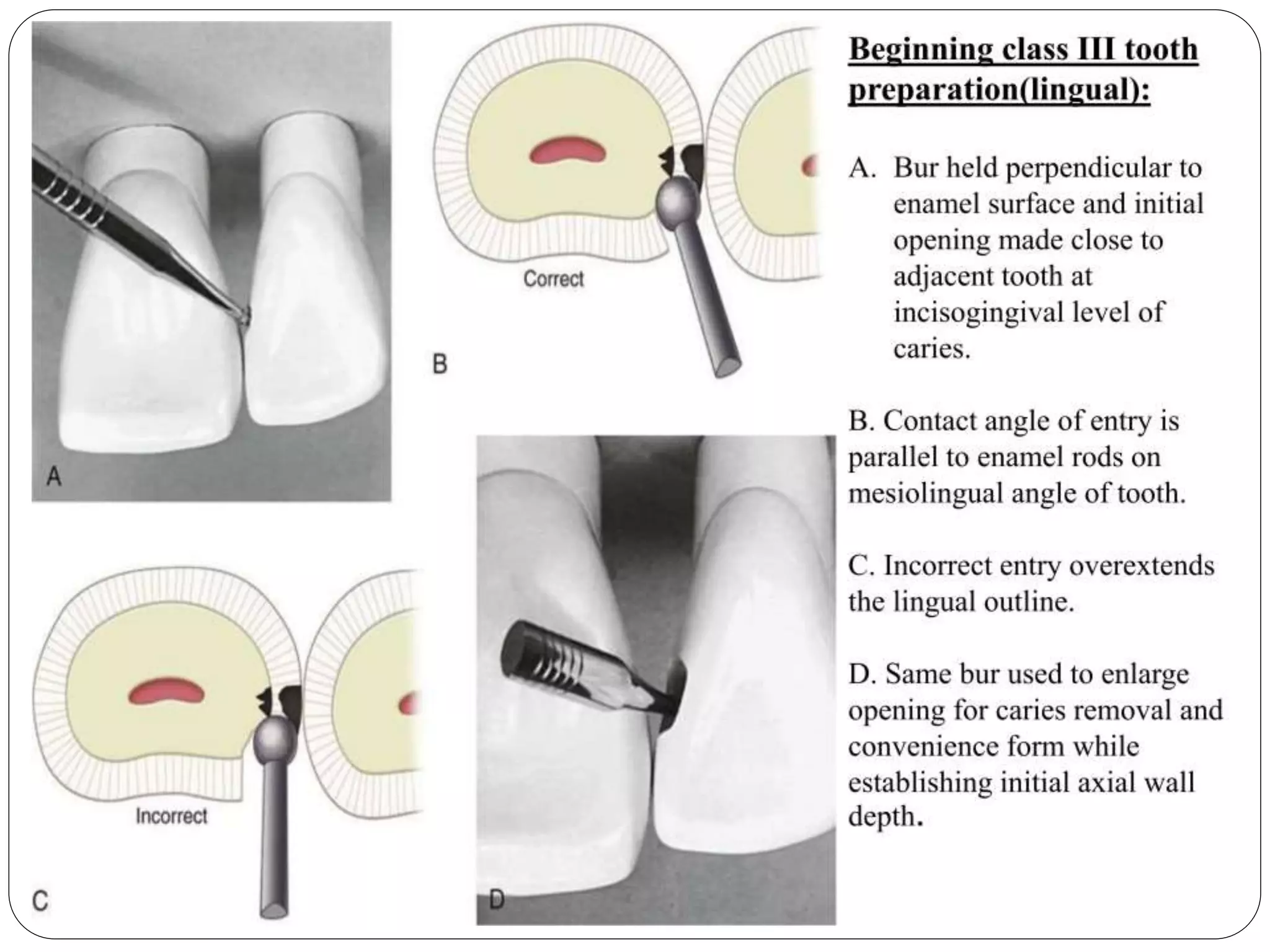
(1) Obtaining access to the defect (caries, fracture, non-carious defect)
(2) Removing faulty structures (caries, defective dentin and enamel,
defective restoration, base material),
(3) Creating the convenience form for the restoration.
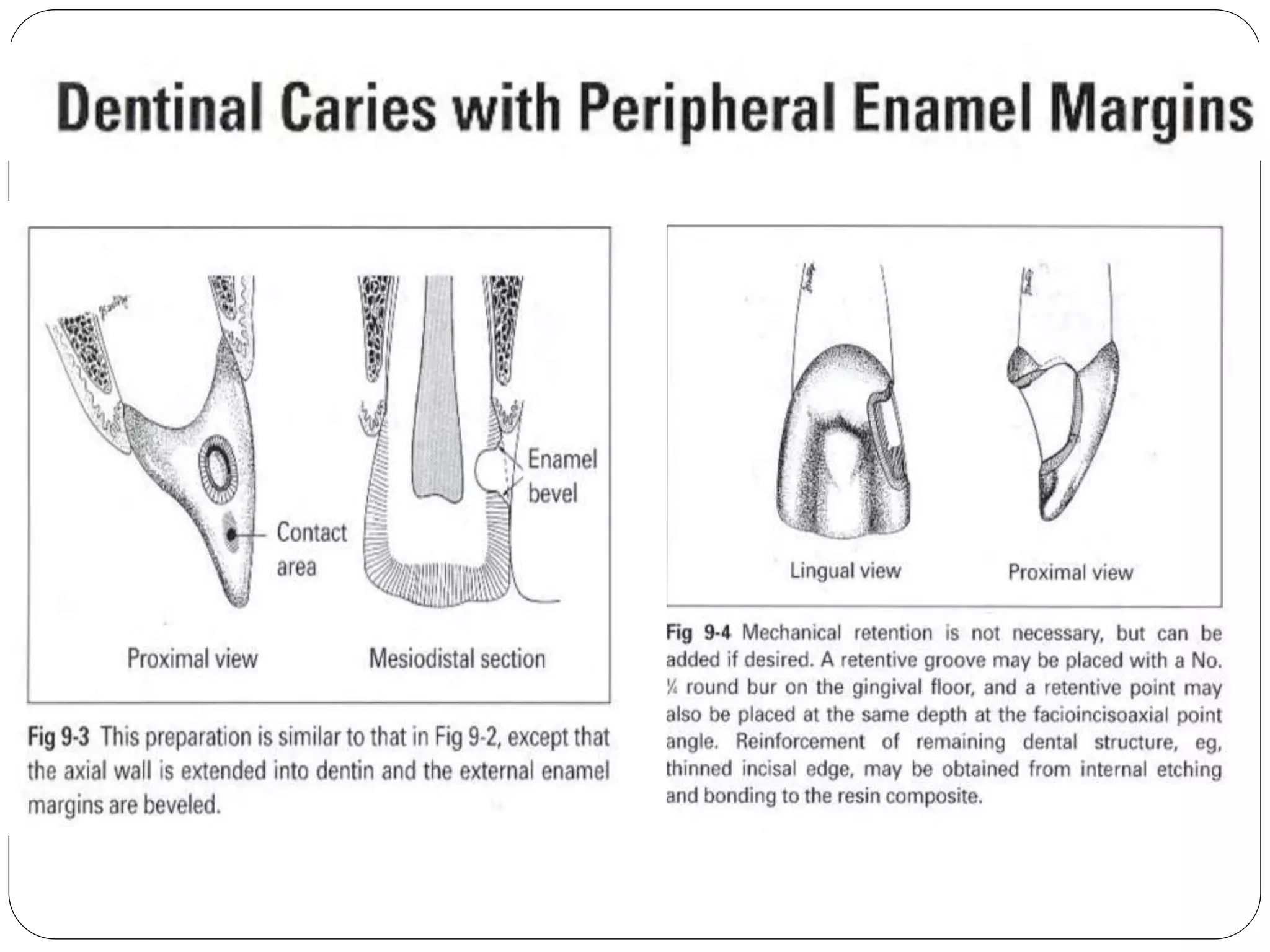
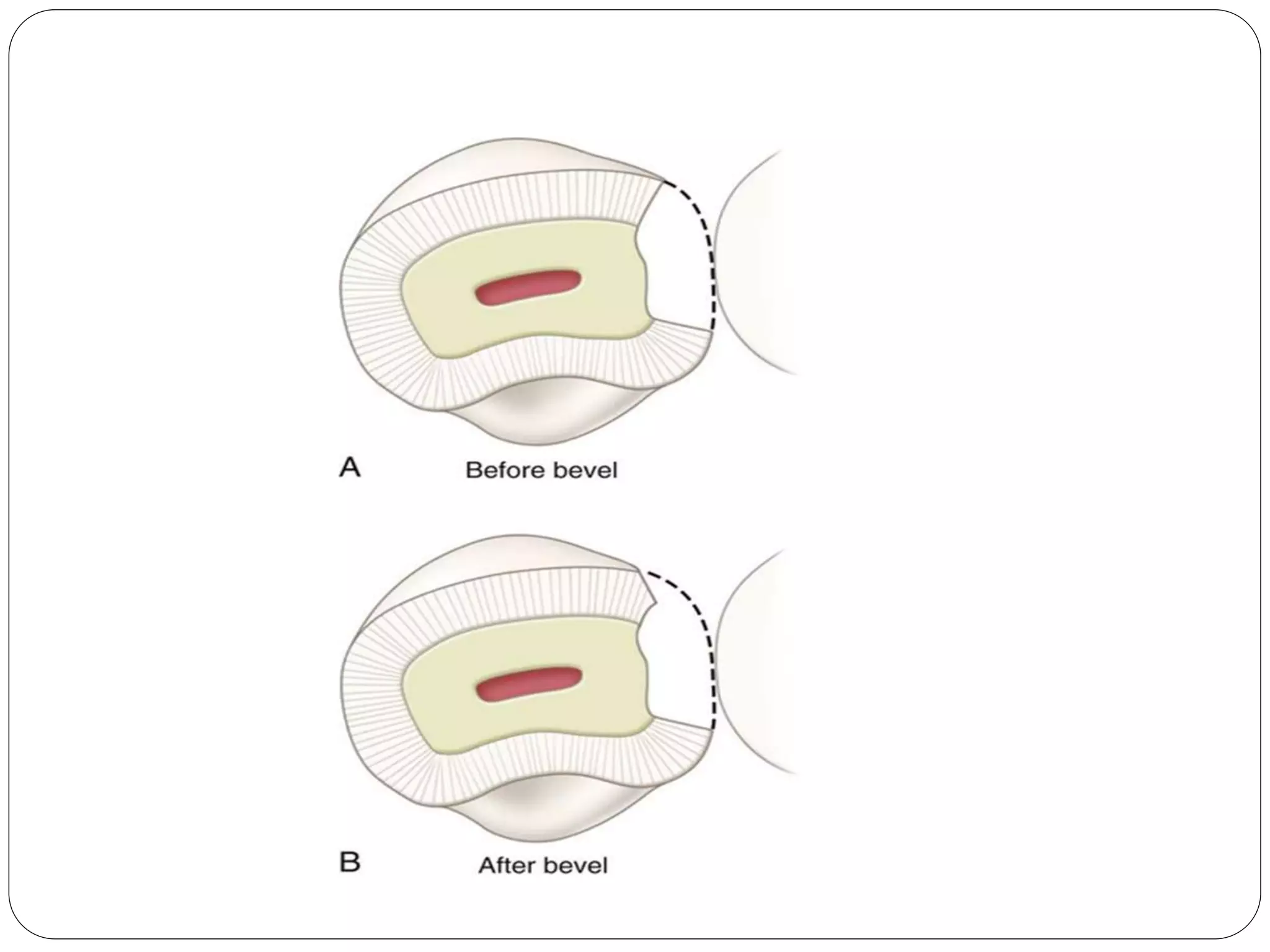
(4) In most cases, an enamel bevel is used on the facial cavosurface
margins to increase the surface area for bonding, and to provide a
gradual transition from the restoration to the surrounding tooth
structure for esthetics.
(5) Obtaining access to the defect may include removal of sound enamel
to access carious dentin.
(6) The extension of the preparation is, therefore, ultimately dictated by
the extension of the fault or defect..
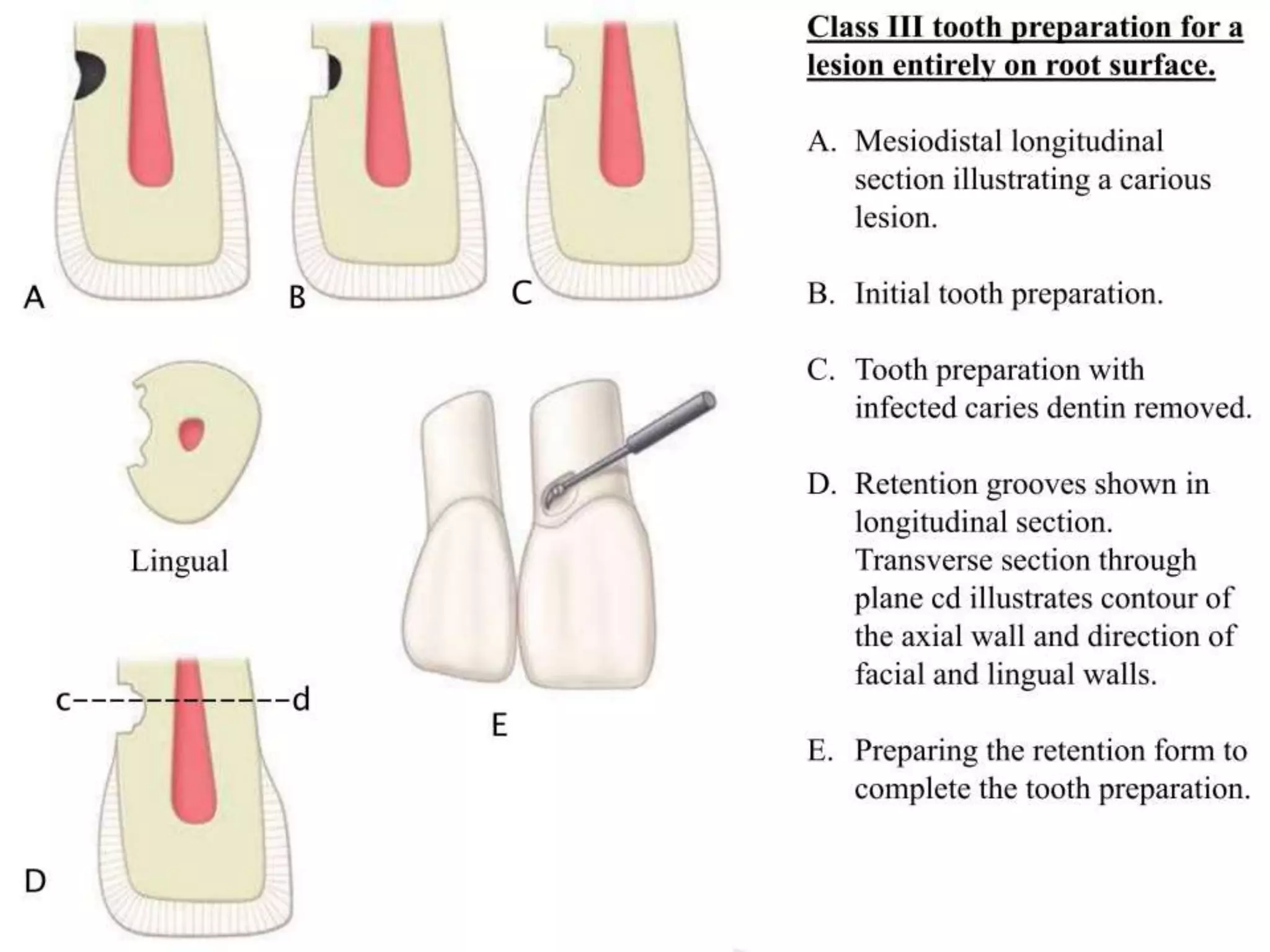
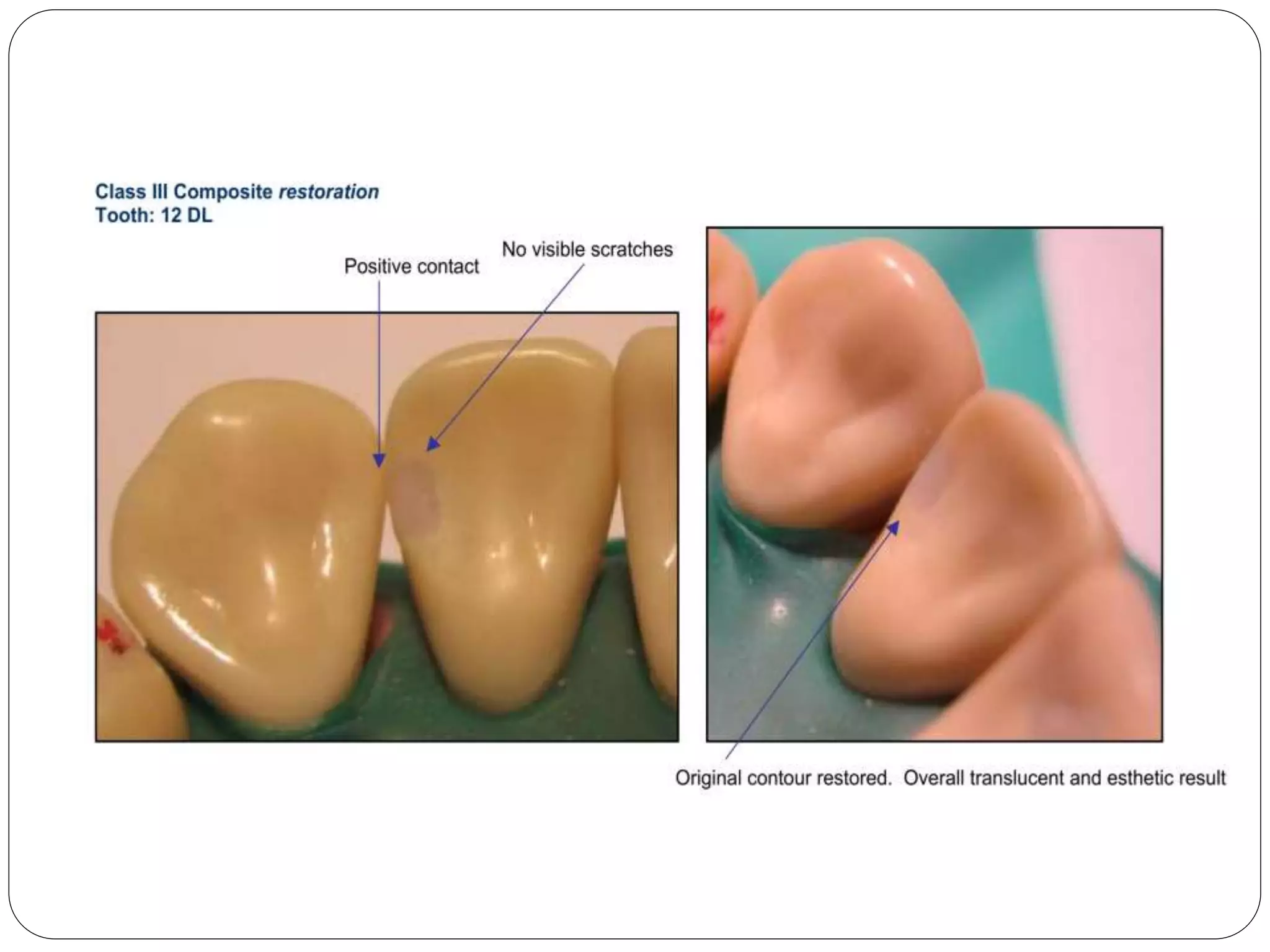
Class III Cavity preparation
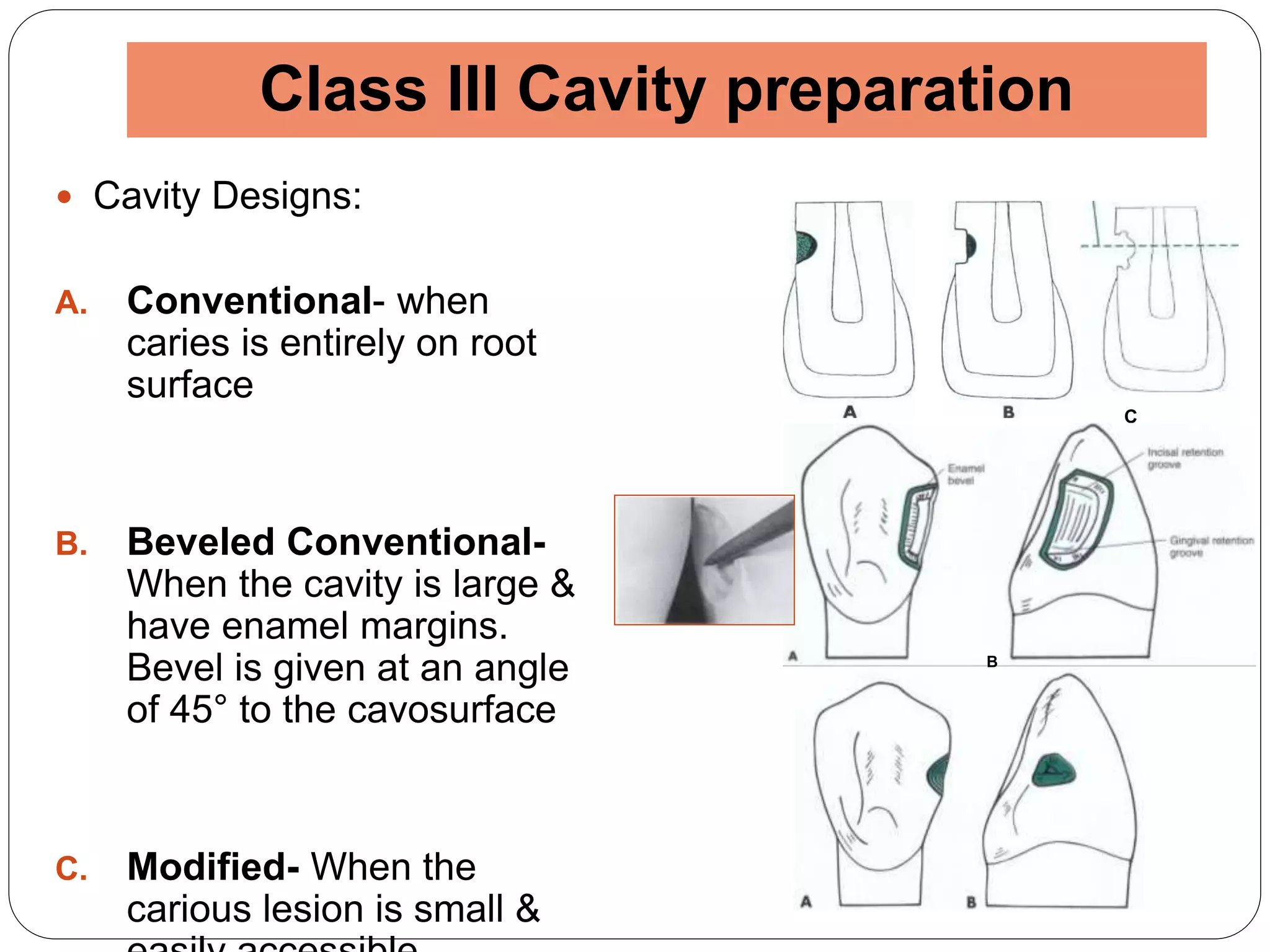
 Cavity Designs:
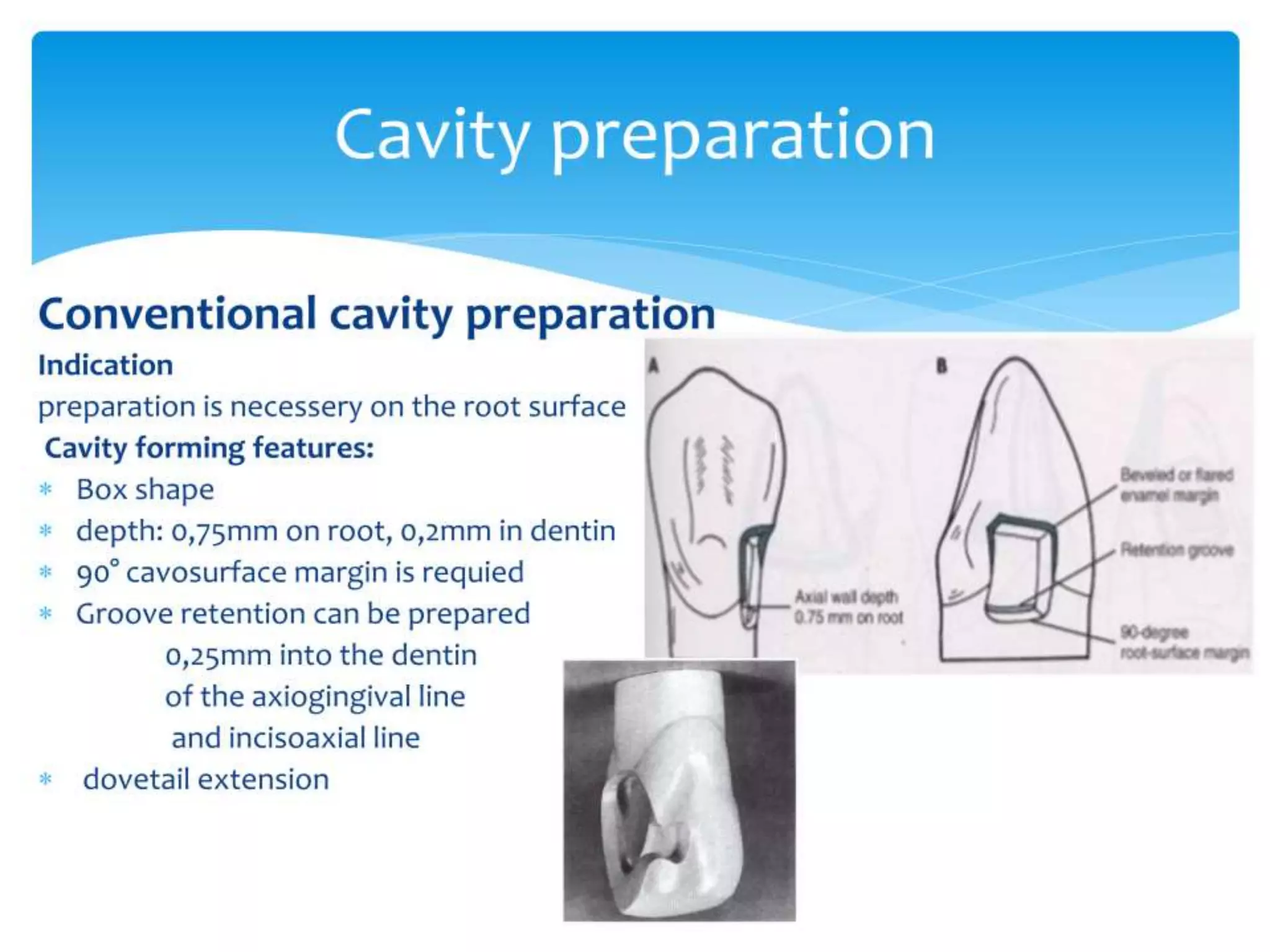
A. Conventional- when
caries is entirely on root
surface
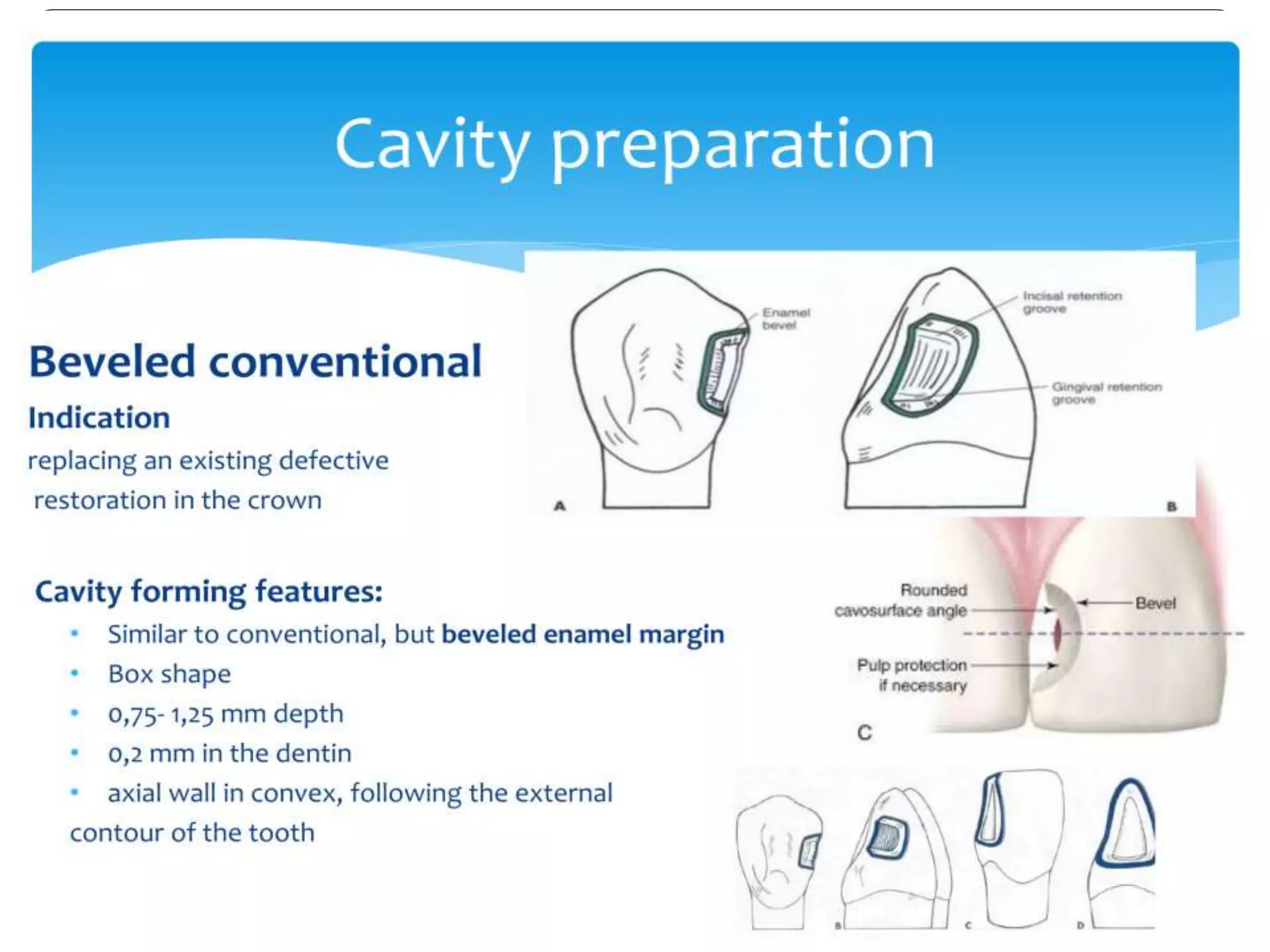
B. Beveled Conventional-
When the cavity is large &
have enamel margins.
Bevel is given at an angle
of 45° to the cavosurface
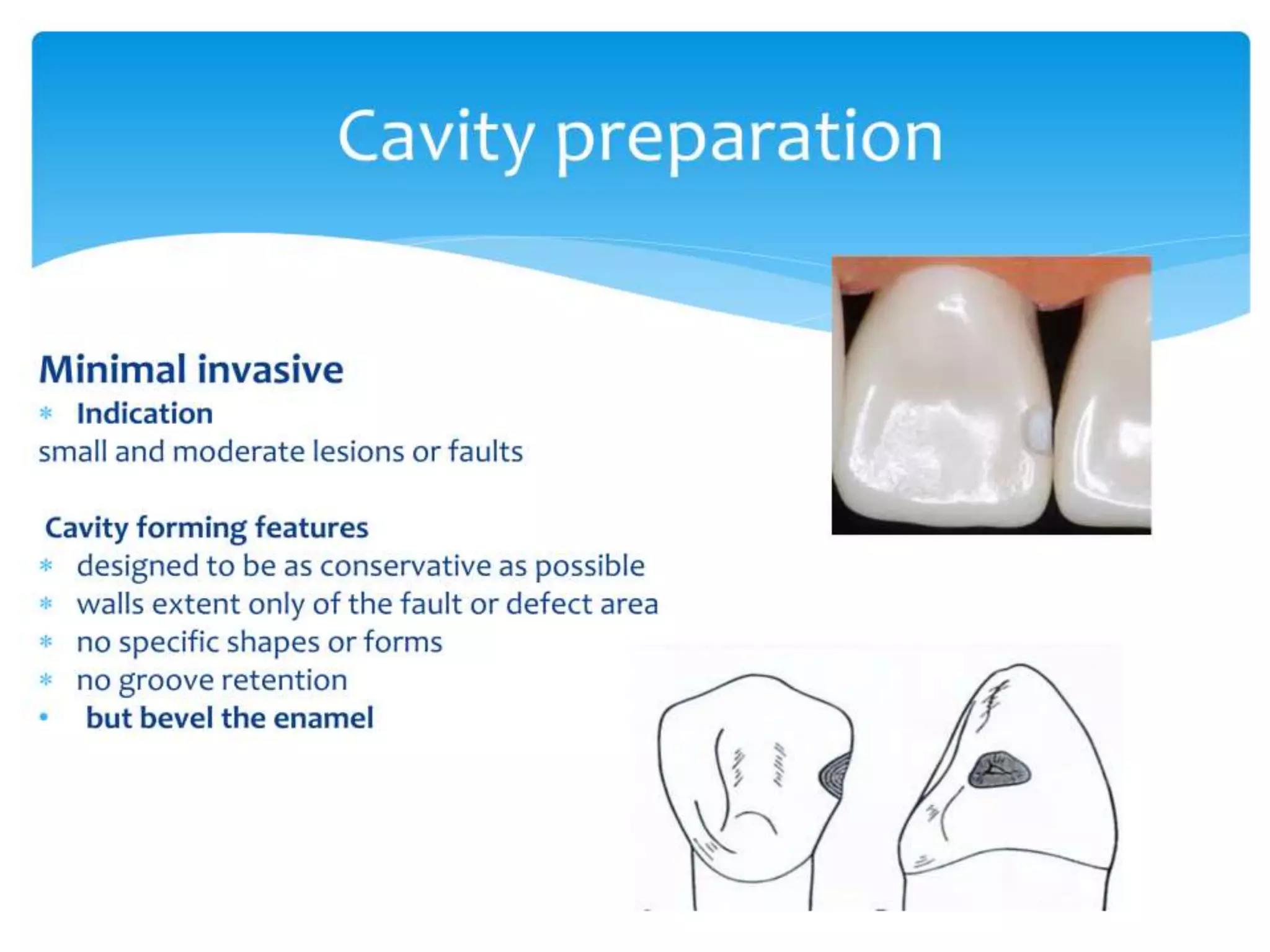
C. Modified- When the
carious lesion is small &
C
B
Class III Cavity preparation
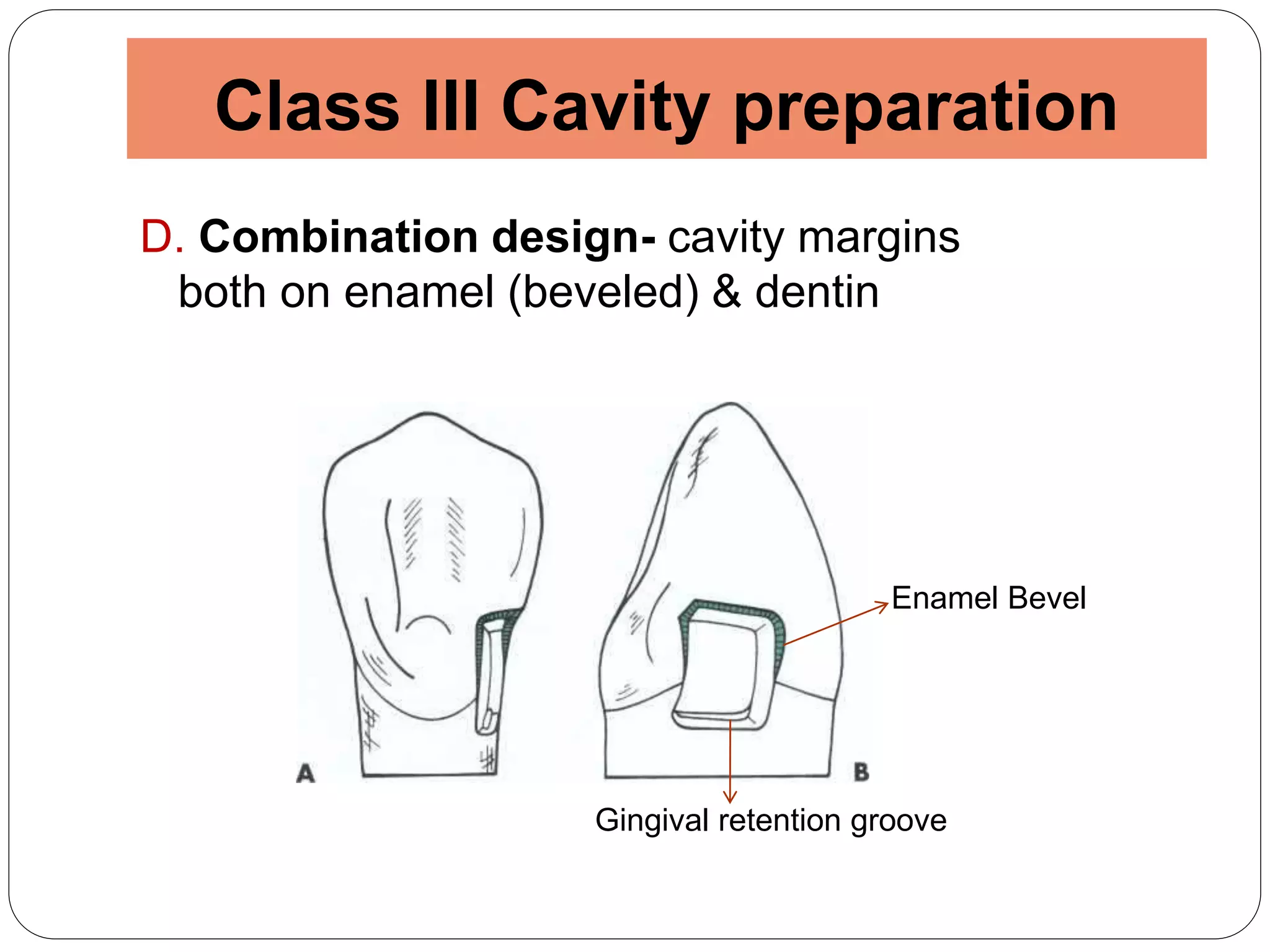
D. Combination design- cavity margins
both on enamel (beveled) & dentin
Enamel Bevel
Gingival retention groove
LINGUALAPPROACH
The advantages of restoring the proximal lesion
from the lingual approach include:
1. The facial enamel is conserved for enhanced esthetics.
2. Some unsupported, but not friable, enamel may be left on
the facial wall of a Class III or Class IV preparation.
3. Color matching of the composite is not as critical.
4. Discoloration or deterioration of the restoration is less
visible.
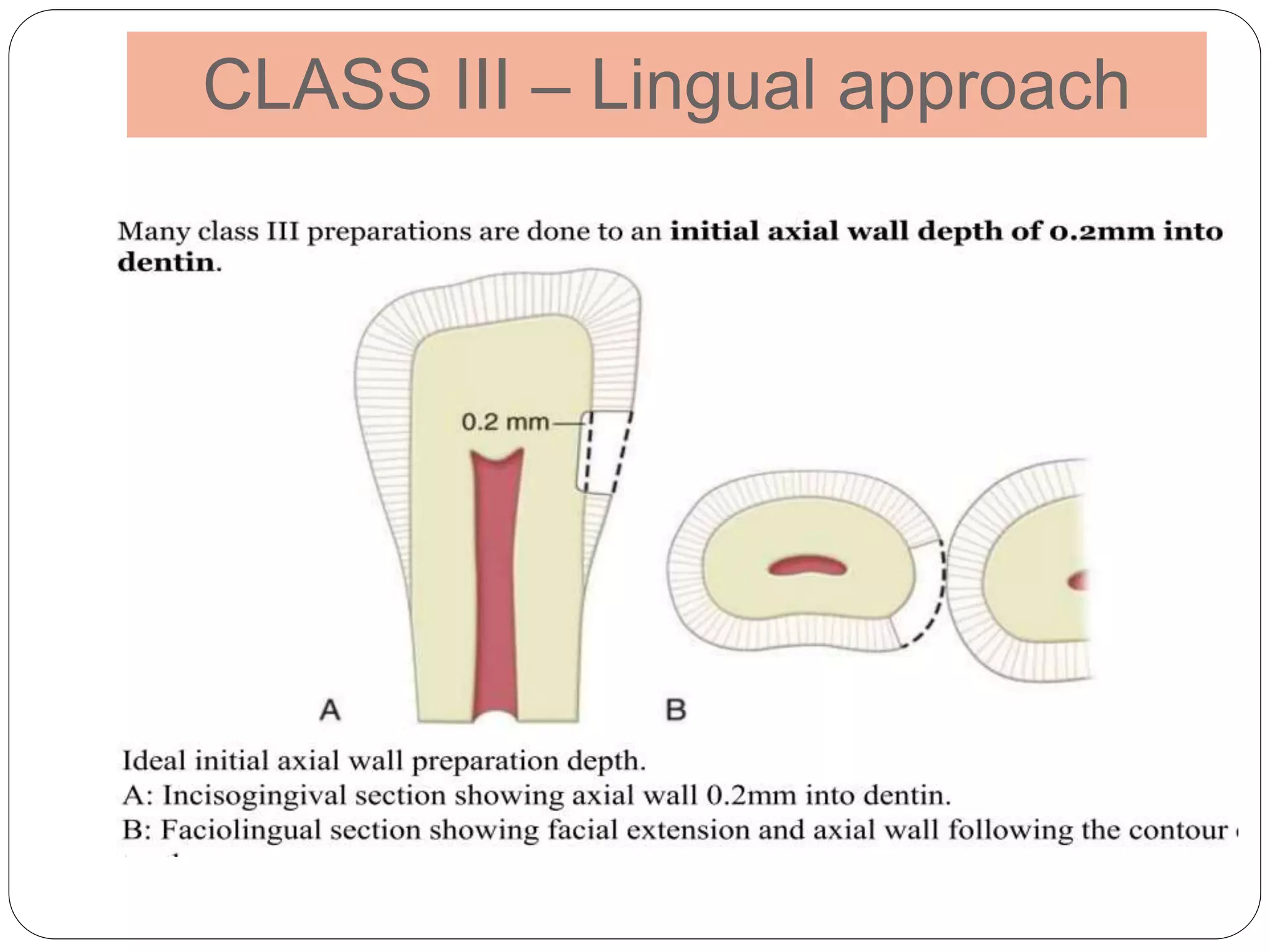
CLASS III – Lingual approach
INDICATIONS FOR FACIALAPPROACH
1. The carious lesion is positioned facially such that facial access
would significantly conserve tooth structure.
2. The teeth are irregularly aligned, making lingual access undesirable.
3. Extensive caries extend onto the facial surface.
4. A faulty restoration that was originally placed from
facial approach needs to be replaced.
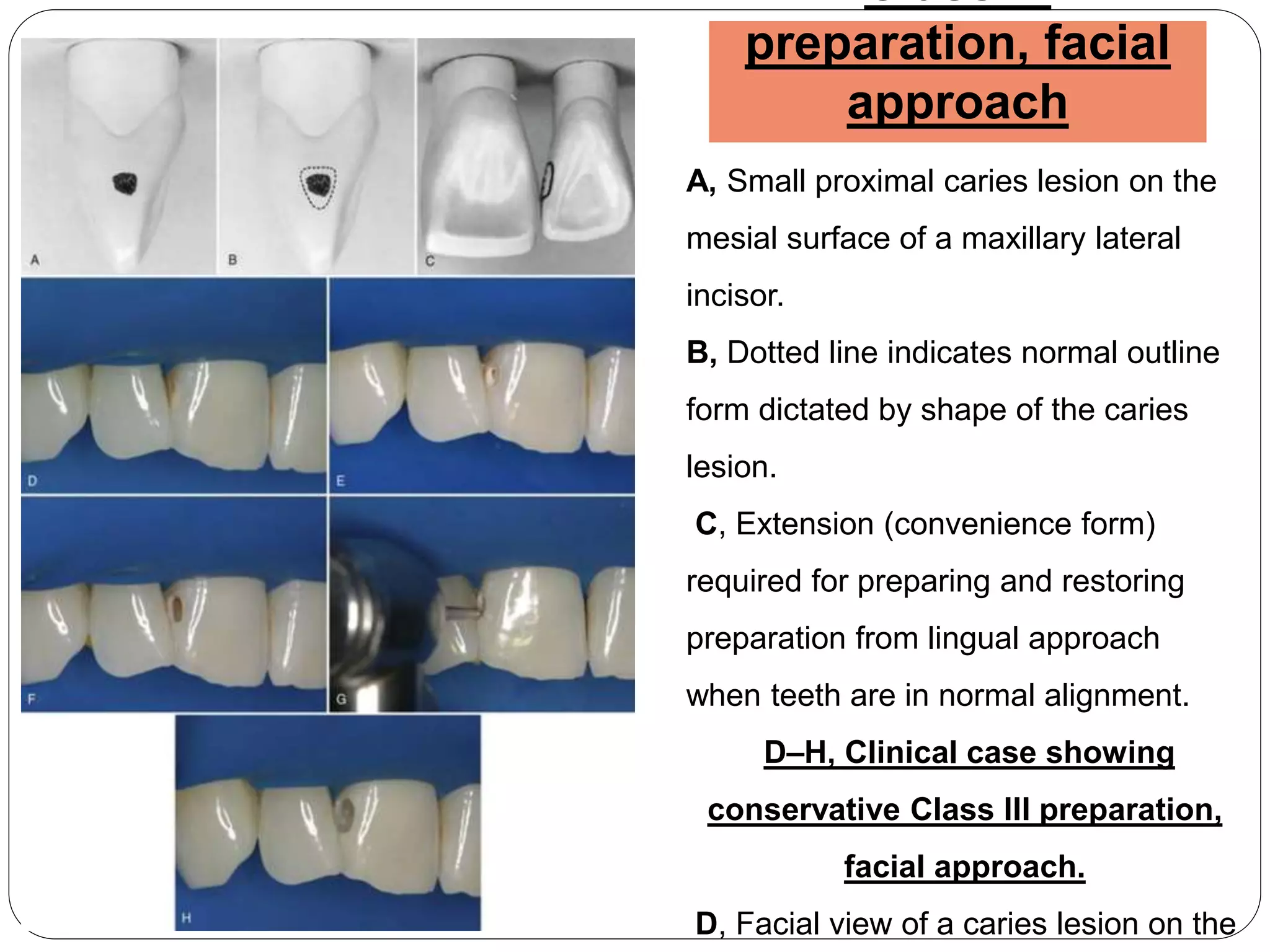
preparation, facial
approach
A, Small proximal caries lesion on the
mesial surface of a maxillary lateral
incisor.
B, Dotted line indicates normal outline
form dictated by shape of the caries
lesion.
C, Extension (convenience form)
required for preparing and restoring
preparation from lingual approach
when teeth are in normal alignment.
D–H, Clinical case showing
conservative Class III preparation,
facial approach.
D, Facial view of a caries lesion on the
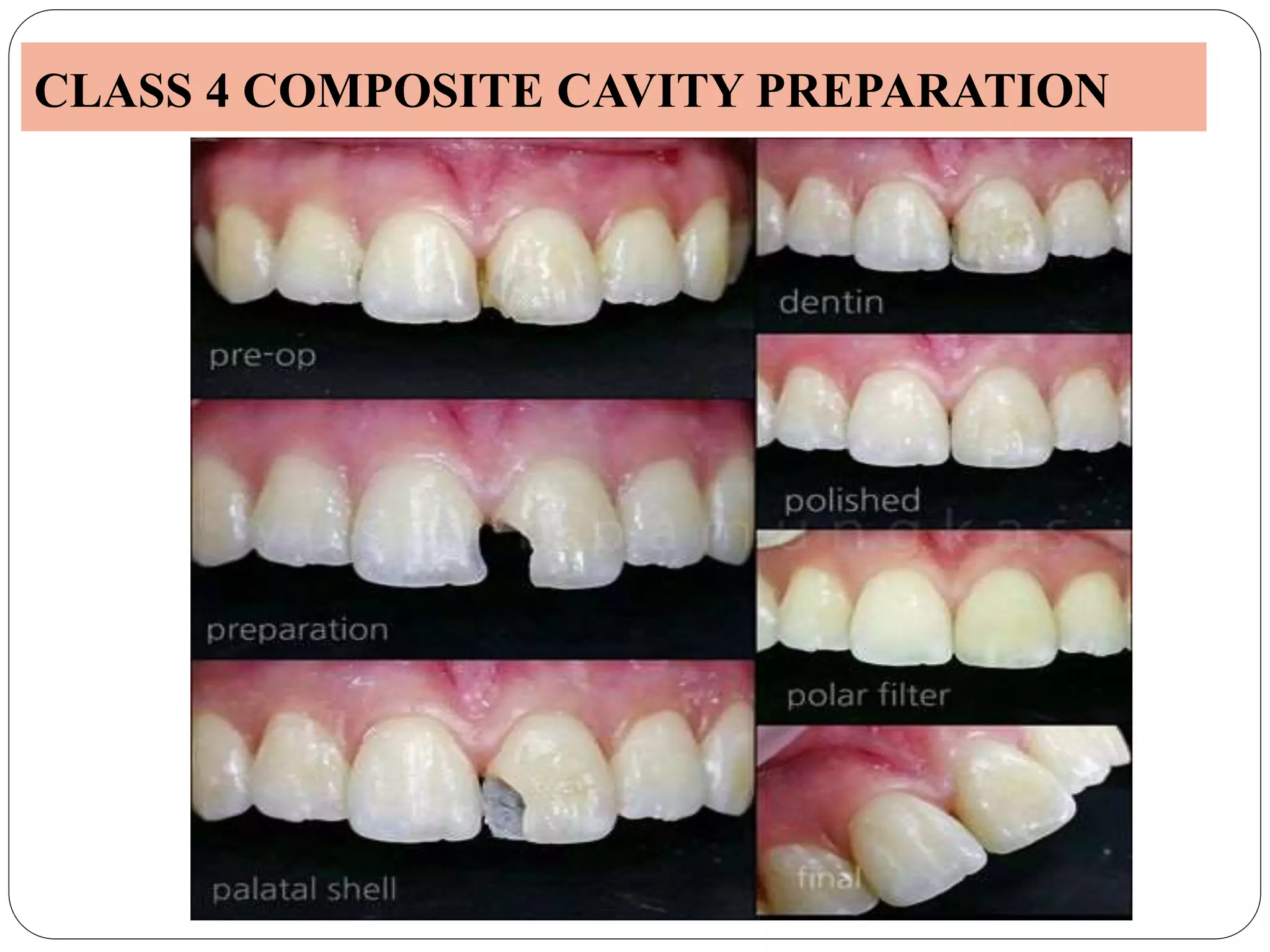
CLASS 4 COMPOSITE CAVITY PREPARATION
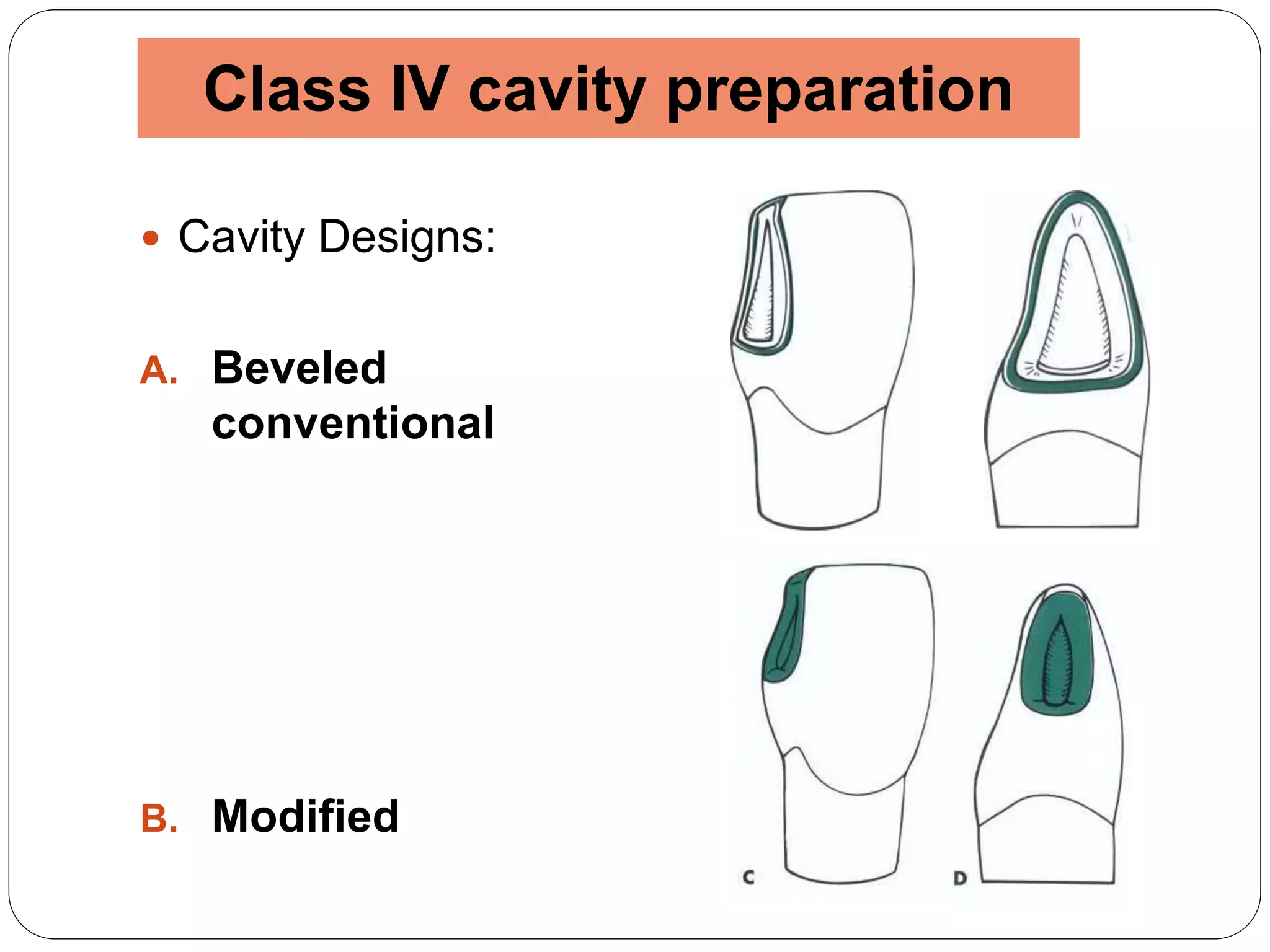
Class IV cavity preparation
 Cavity Designs:
A. Beveled
conventional
B. Modified
The outline form
 Round carbide bur or diamond instrument at high speed with air-water
coolant.
 Remove all weakened enamel and establish the initial axial wall depth at
0.5mm into dentin
 Prepare the walls as much as possible parallel and perpendicular to the long
axis of the tooth.
 Excavate any remaining infected dentin as the first step of final tooth
preparation.
 If necessary, apply a calcium hydroxide liner.
Cavosurface margin BEVEL
• 45-degree angle to the external tooth surface with a flame-shaped or
• Round diamond width of the bevel should be 0.25 to 2 mm,
Retention and resistance form
(Heavy occlusion and large Class IV requires increased retention
and resistance form).
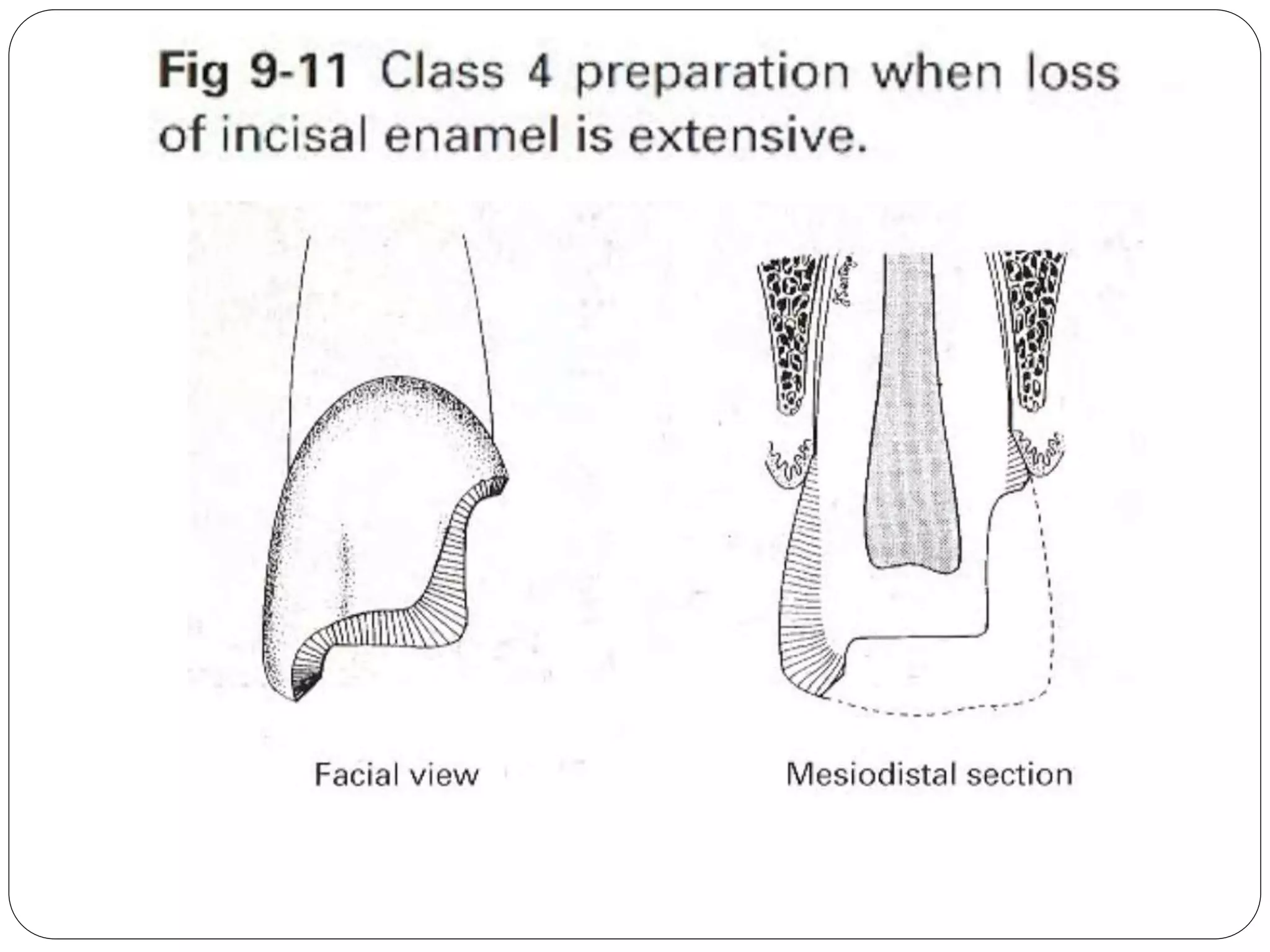
 A more conventional tooth preparation form, with
more resistance form
 Proximal facial and lingual preparation walls that
form 90-degree cavosurface angles, which are
subsequently bevelled.
 Gingival floor prepared perpendicular to the long axis
of the tooth.
 This boxlike form may provide greater resistance to
fracture of the restoration and tooth from masticatory
forces.
Retention form features
Indicated in large Class IV preparations in which rounded undercuts are placed in the dentin along line
angles and into point angles wherever possible, without undermining the enamel
 Retention of the composite restorative material in
beveled conventional Class IV tooth preparations may
be obtained by
- groove or other shaped undercuts
- dovetail extensions
- threaded pins
or a combination of these gingival and incisal retentive
undercuts.
 Prepare a gingival retention groove using a No. 1/4
round bur.
 It is prepared 0.2 mm inside the DEJ at a depth of
0.25mm (half the diameter of the No. 1/4 bur) and at an
angle bisecting the junction of the axial wall and gingival
wall.
PINS ???
 An arbitrary dovetail extension onto the lingual surface of the
tooth may enhance both the restorations strength and retention,
but it is less conservative and therefore not used often.
 Although pin retention is sometimes necessary, the use of pins in
composite restorations is discouraged for several reasons:
(1) The placement of pins in anterior teeth involves the risk of
perforation either into the pulp or through the external surface.
(2) Pins do not enhance the strength of the restorative material
(3) Some pins may corrode resulting in significant discoloration of
the tooth and restoration
Modified Class IV Tooth
Preparation
 Indicated for small or moderate Class IV lesions or
traumatic defects.
 The objective of the tooth preparation is to remove as
little tooth structure as possible, while removing the
fault and providing for appropriate retention and
resistance forms.
 Usually little or no initial tooth preparation is indicated
for fractured incisal corners, other than roughening
the fractured tooth structure.
 The cavosurface margins are prepared with a
bevelled configuration; the axial depth is dependent
on the extent of the lesion, previous restoration, or
fracture, but initially no deeper than 0.2 mm inside the
DEJ.
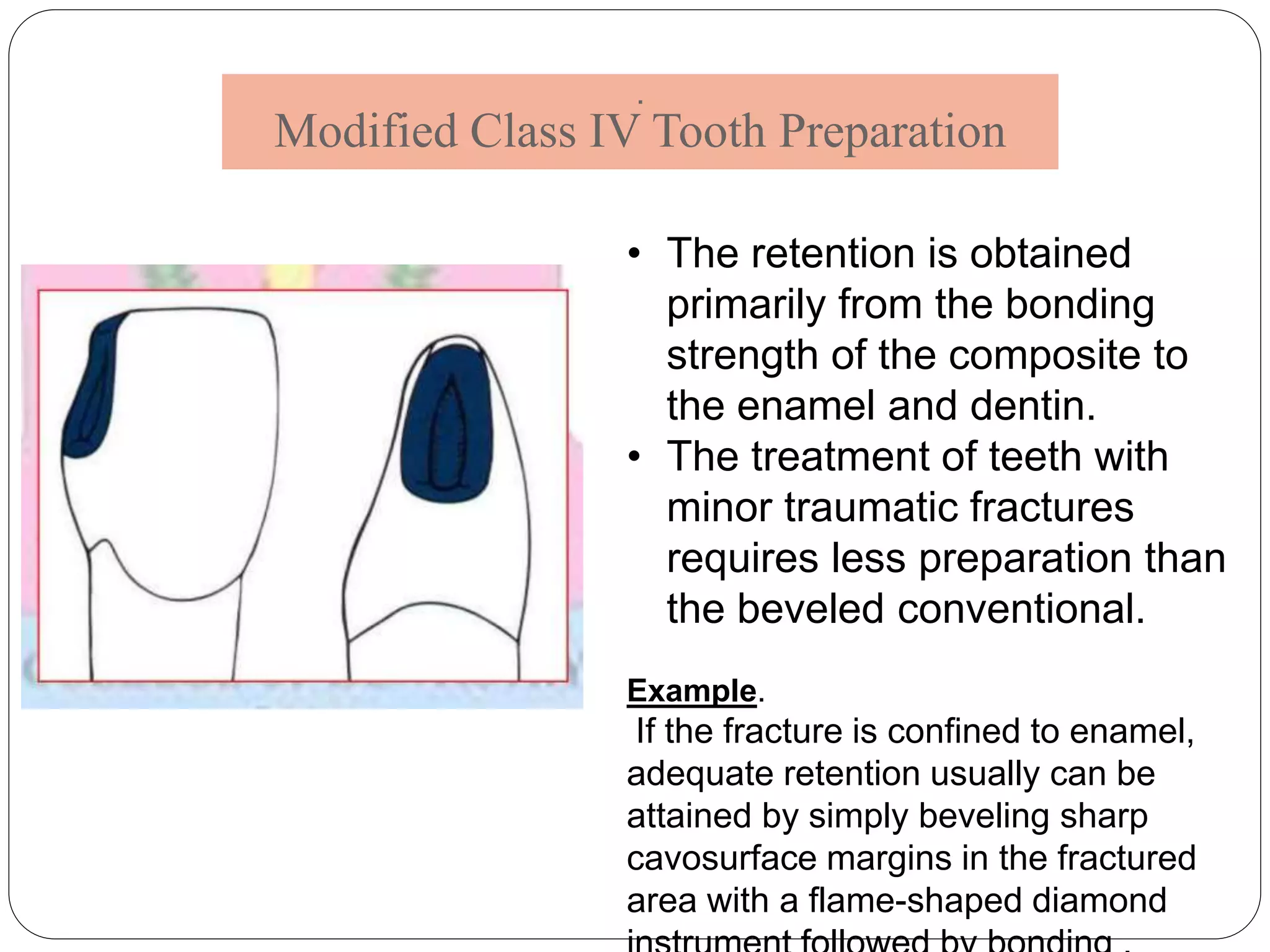
• The retention is obtained
primarily from the bonding
strength of the composite to
the enamel and dentin.
• The treatment of teeth with
minor traumatic fractures
requires less preparation than
the beveled conventional.
Example.
If the fracture is confined to enamel,
adequate retention usually can be
attained by simply beveling sharp
cavosurface margins in the fractured
area with a flame-shaped diamond
.
Modified Class IV Tooth Preparation
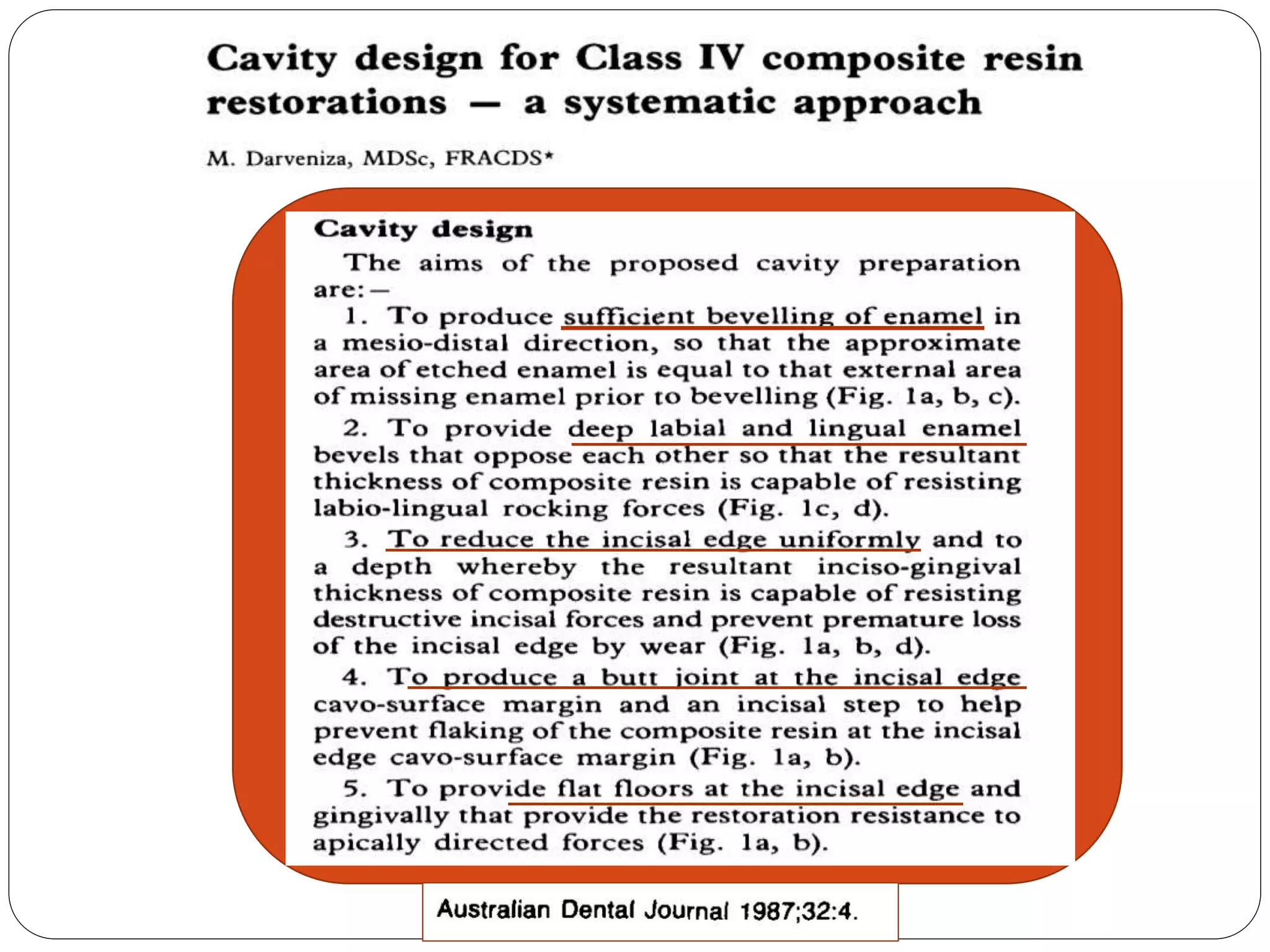
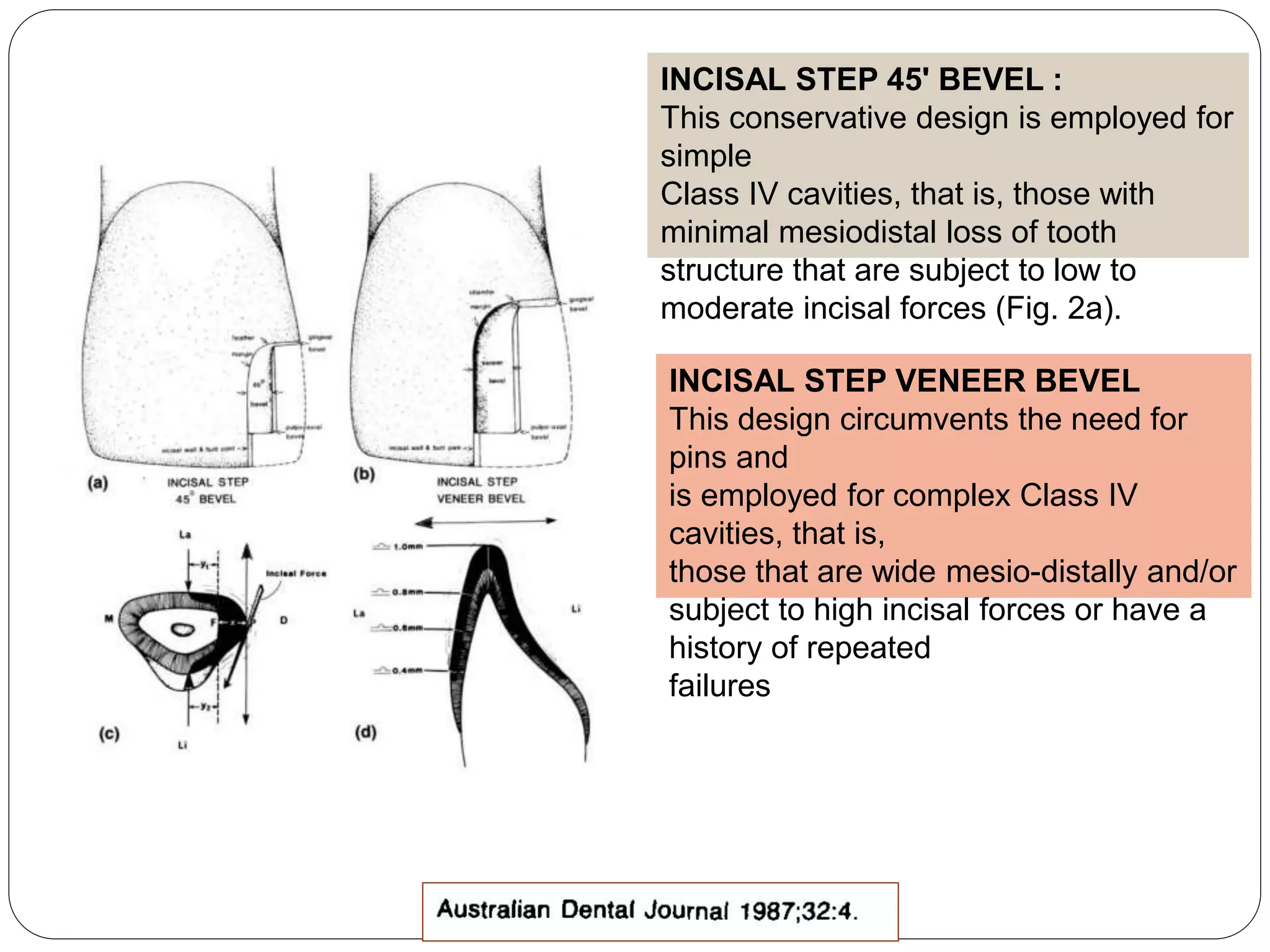
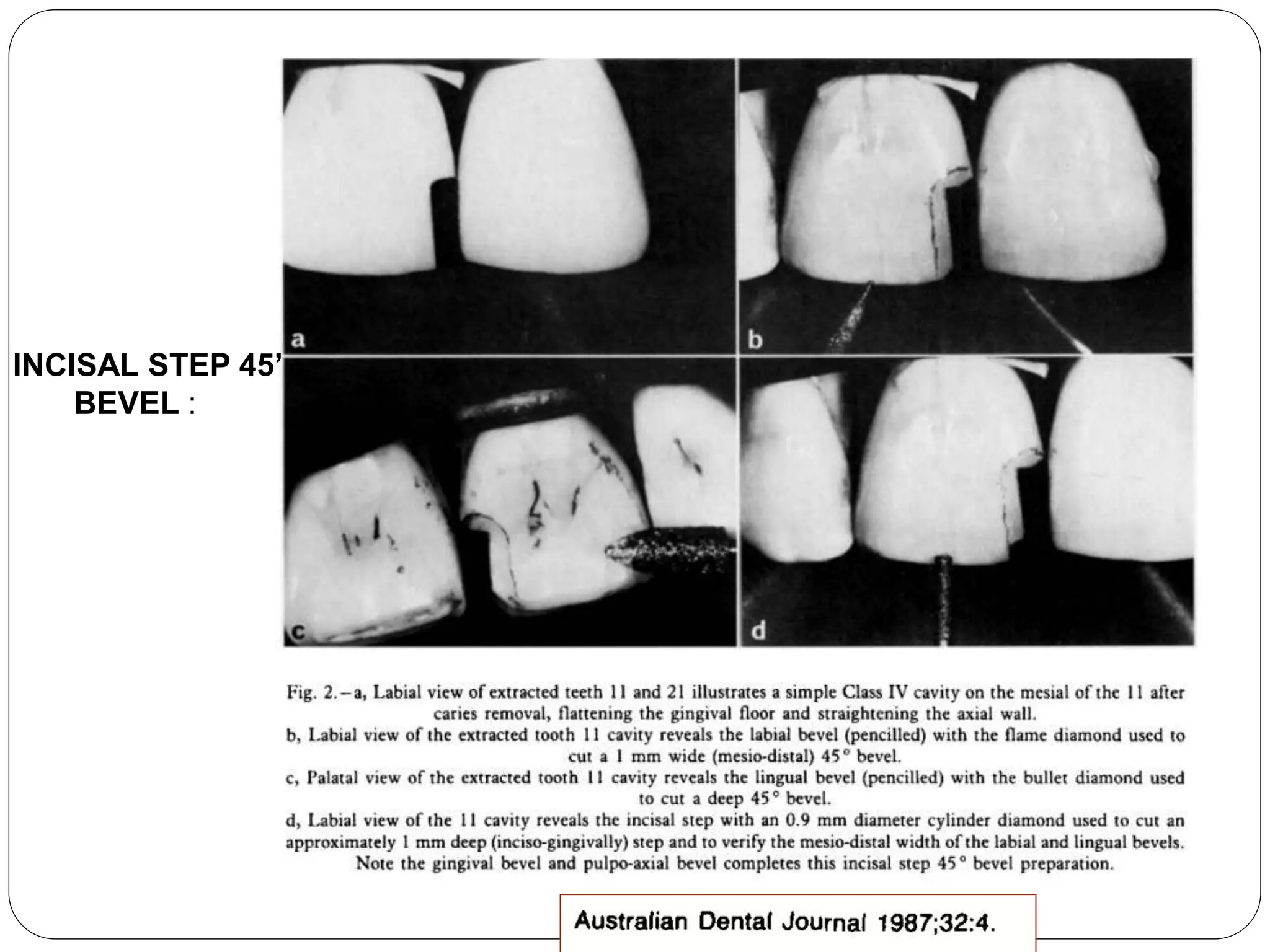
INCISAL STEP 45' BEVEL :
This conservative design is employed for
simple
Class IV cavities, that is, those with
minimal mesiodistal loss of tooth
structure that are subject to low to
moderate incisal forces (Fig. 2a).
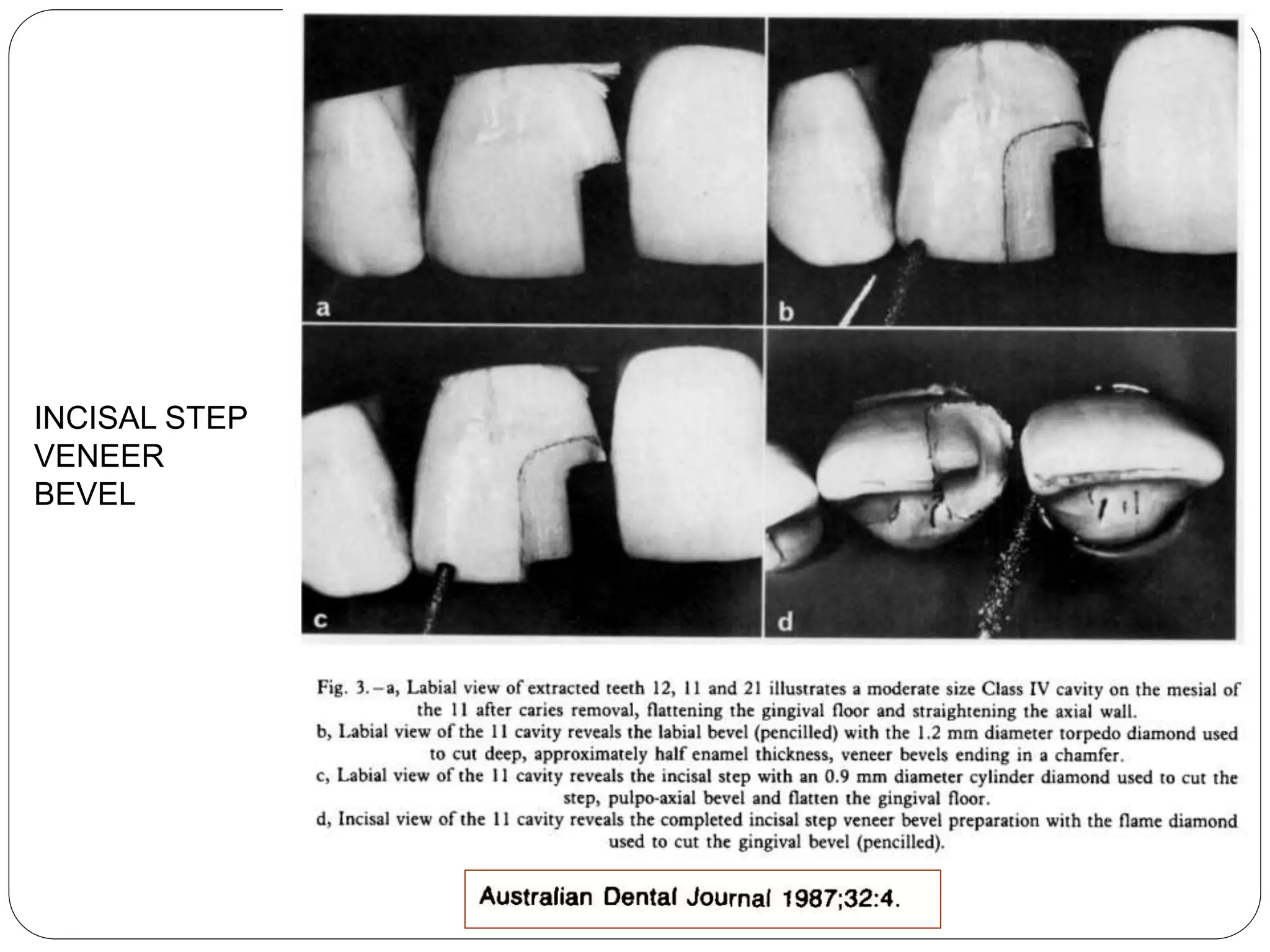
INCISAL STEP VENEER BEVEL
This design circumvents the need for
pins and
is employed for complex Class IV
cavities, that is,
those that are wide mesio-distally and/or
subject to high incisal forces or have a
history of repeated
failures
INCISAL STEP 45’
BEVEL :
INCISAL STEP
VENEER
BEVEL
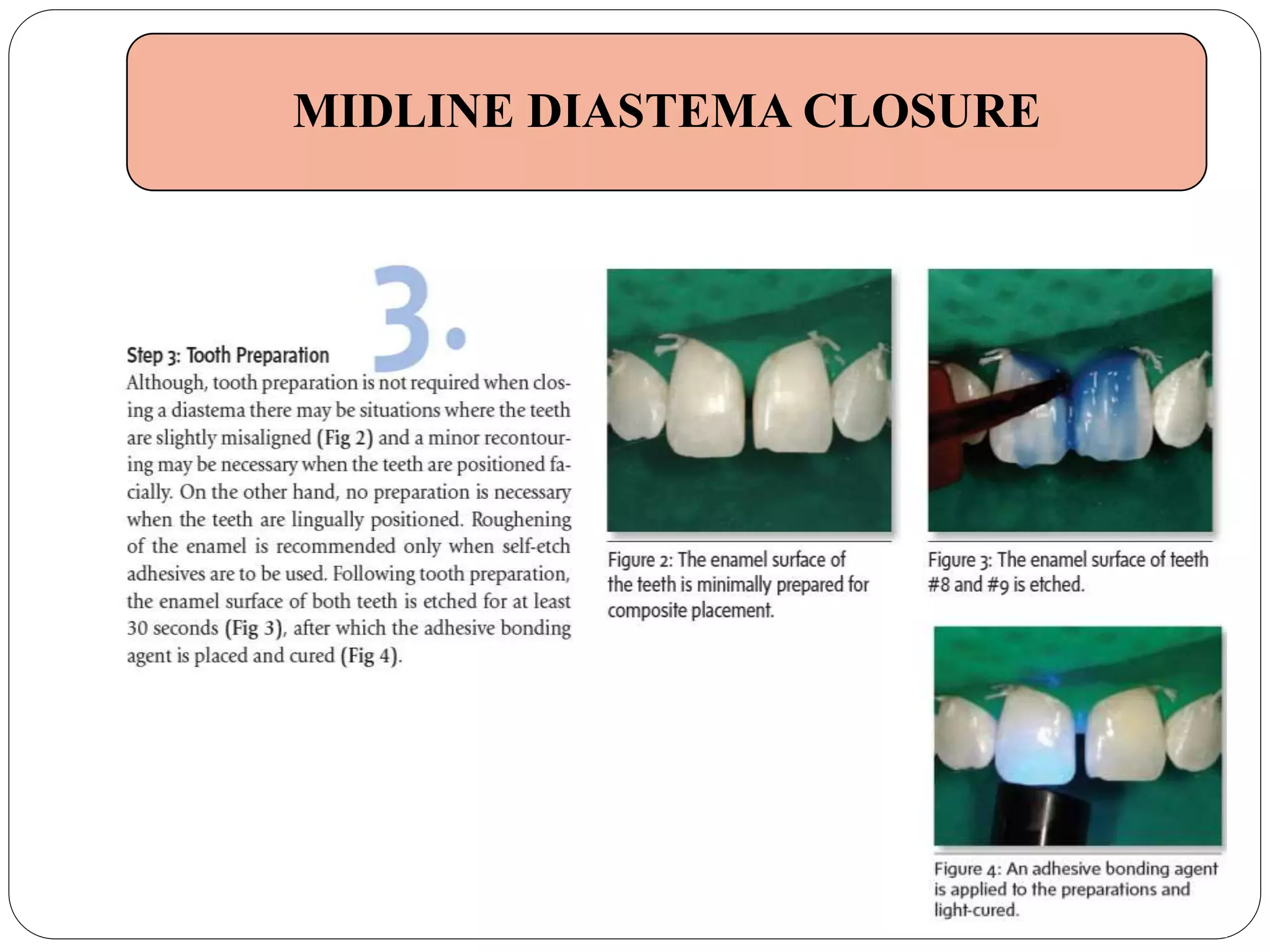
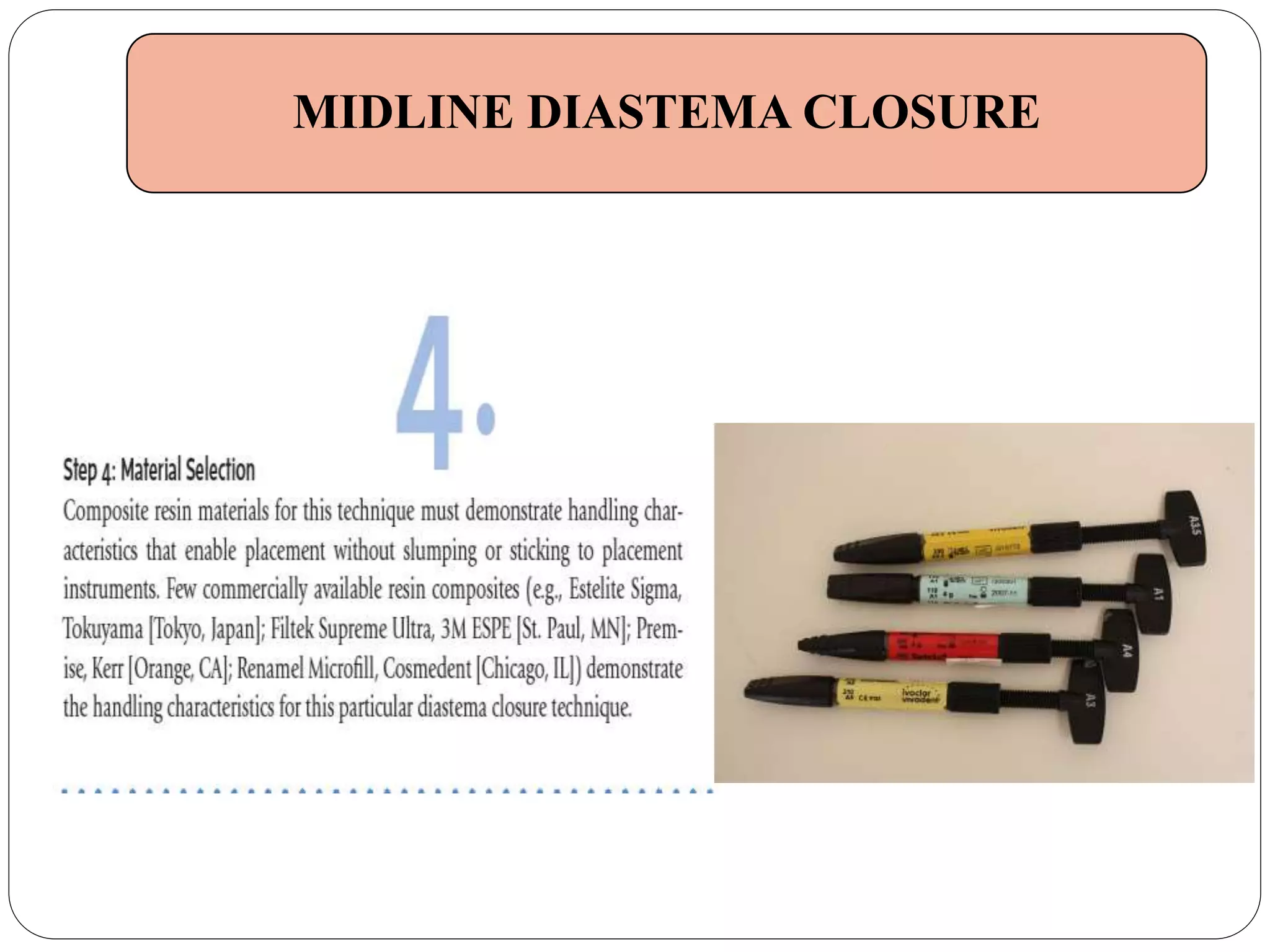
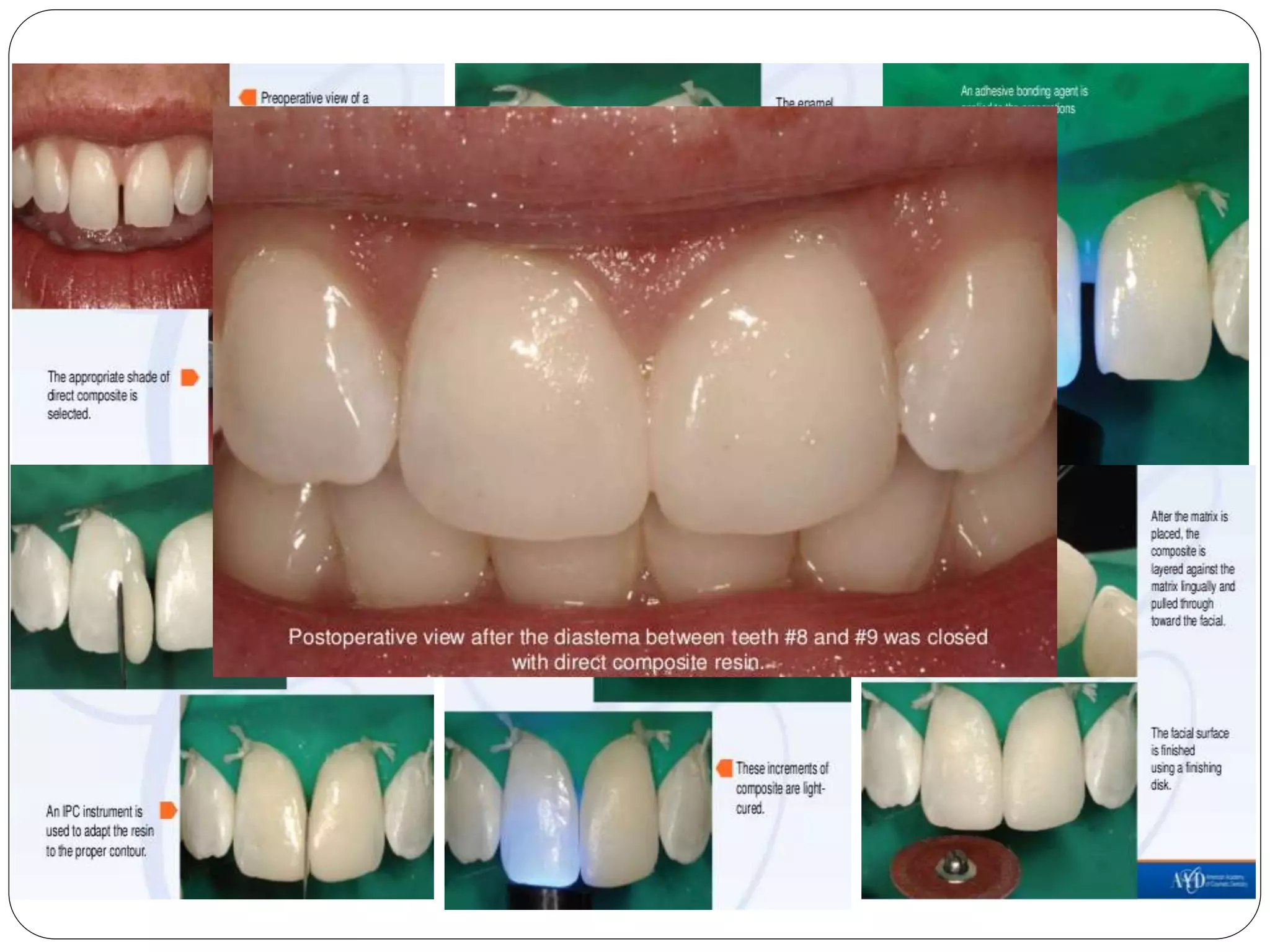
MIDLINE DIASTEMA CLOSURE
Contraindication of composites
• Poor oral hygiene
• subgingival cavities
• Root caries (outside of
enamel)
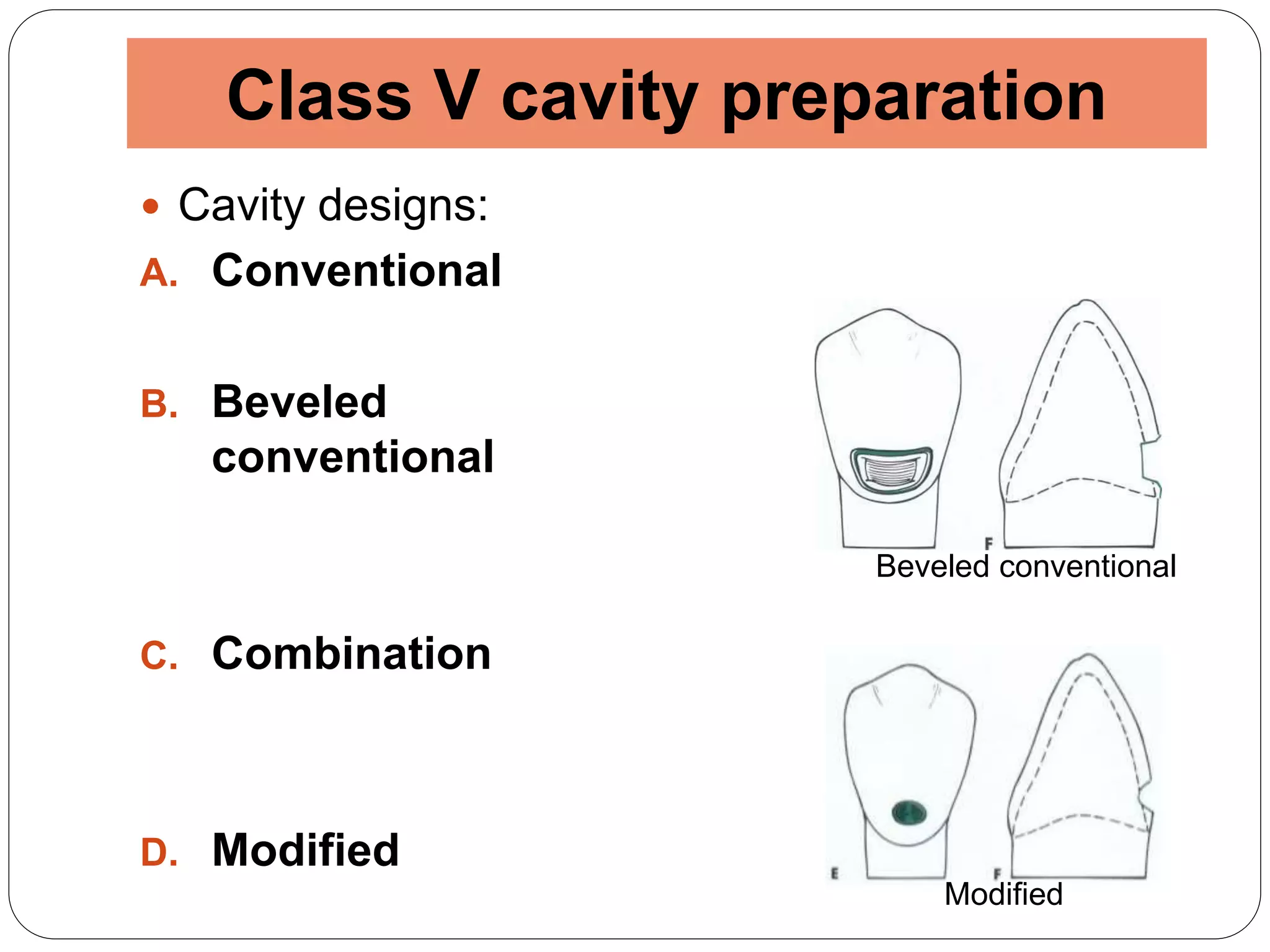
Class V cavity preparation
 Cavity designs:
A. Conventional
B. Beveled
conventional
C. Combination
D. Modified
Beveled conventional
Modified
CLASS V DIRECT COMPOSITE
RESTORATIONS
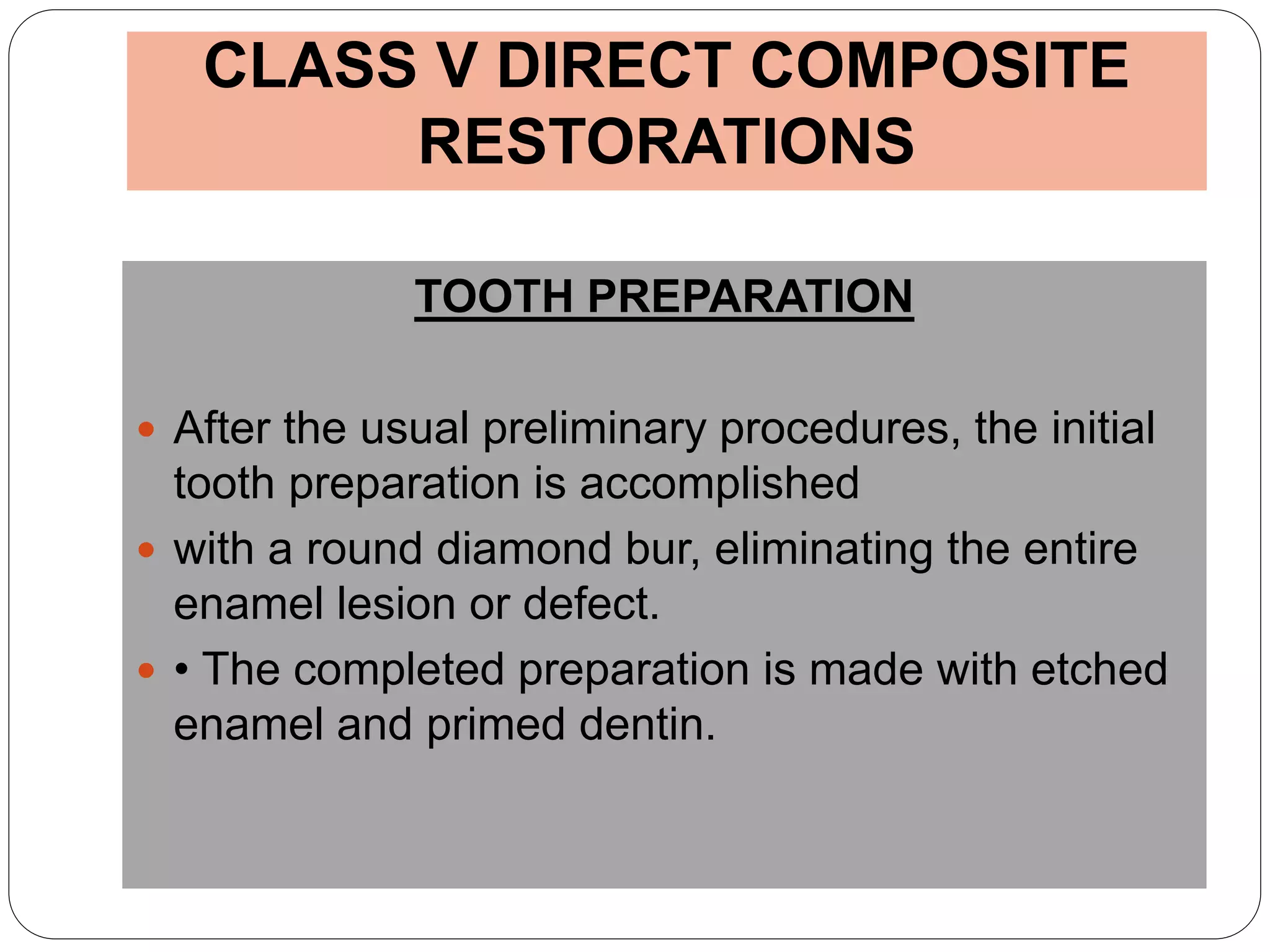
 Class V restorations are done on the gingival
third of facial and lingual surfaces of
 all teeth.
Initial clinical procedures:
 Occlusal evaluation not required for class V
restorations.
 During shade selection, it must be remembered
that tooth is darker and more
 opaque in the cervical third.
 Isolation - rubber dam
TOOTH PREPARATION
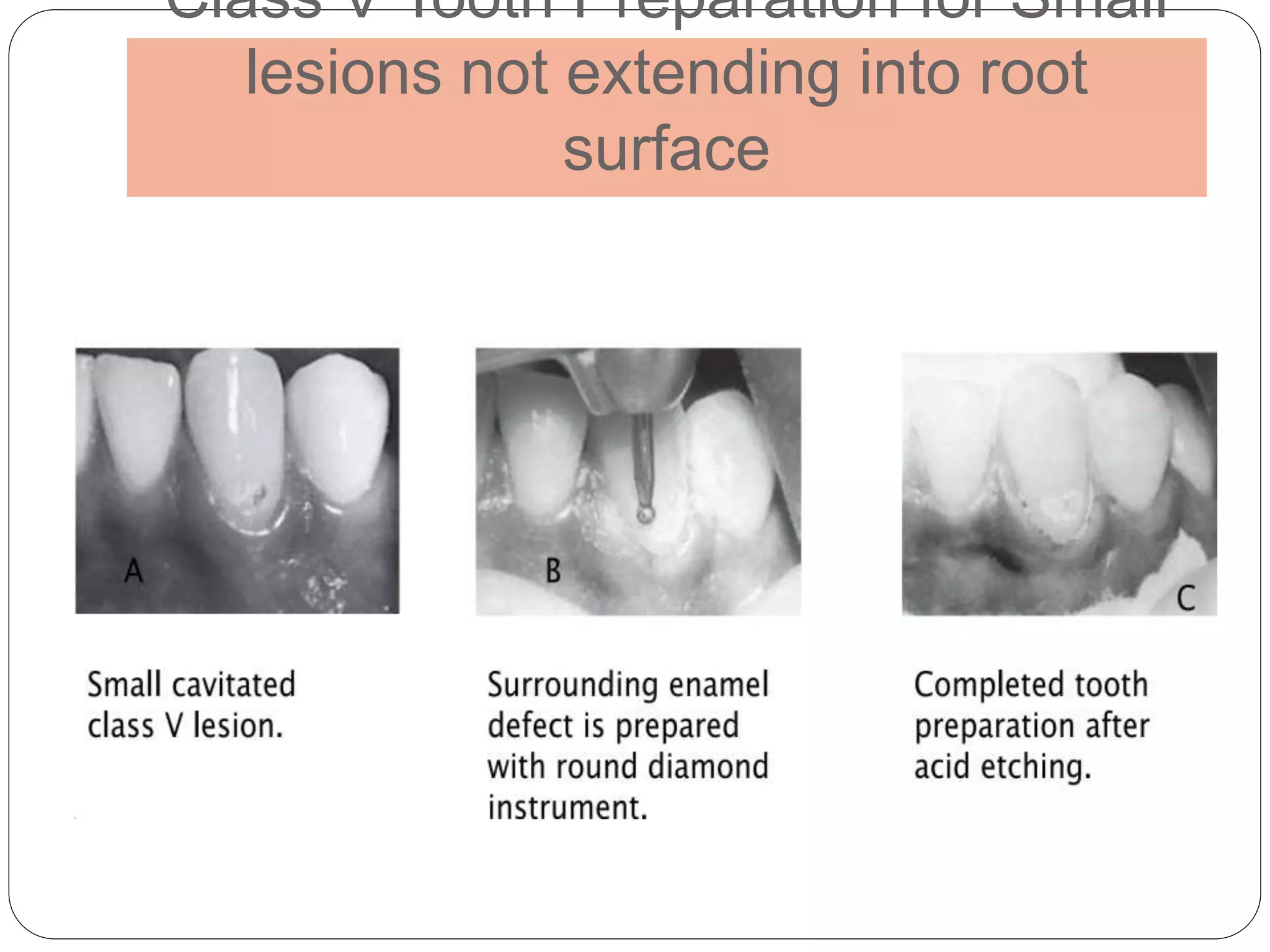
 After the usual preliminary procedures, the initial
tooth preparation is accomplished
 with a round diamond bur, eliminating the entire
enamel lesion or defect.
 • The completed preparation is made with etched
enamel and primed dentin.
CLASS V DIRECT COMPOSITE
RESTORATIONS
Class V Tooth Preparation for Small
lesions not extending into root
surface
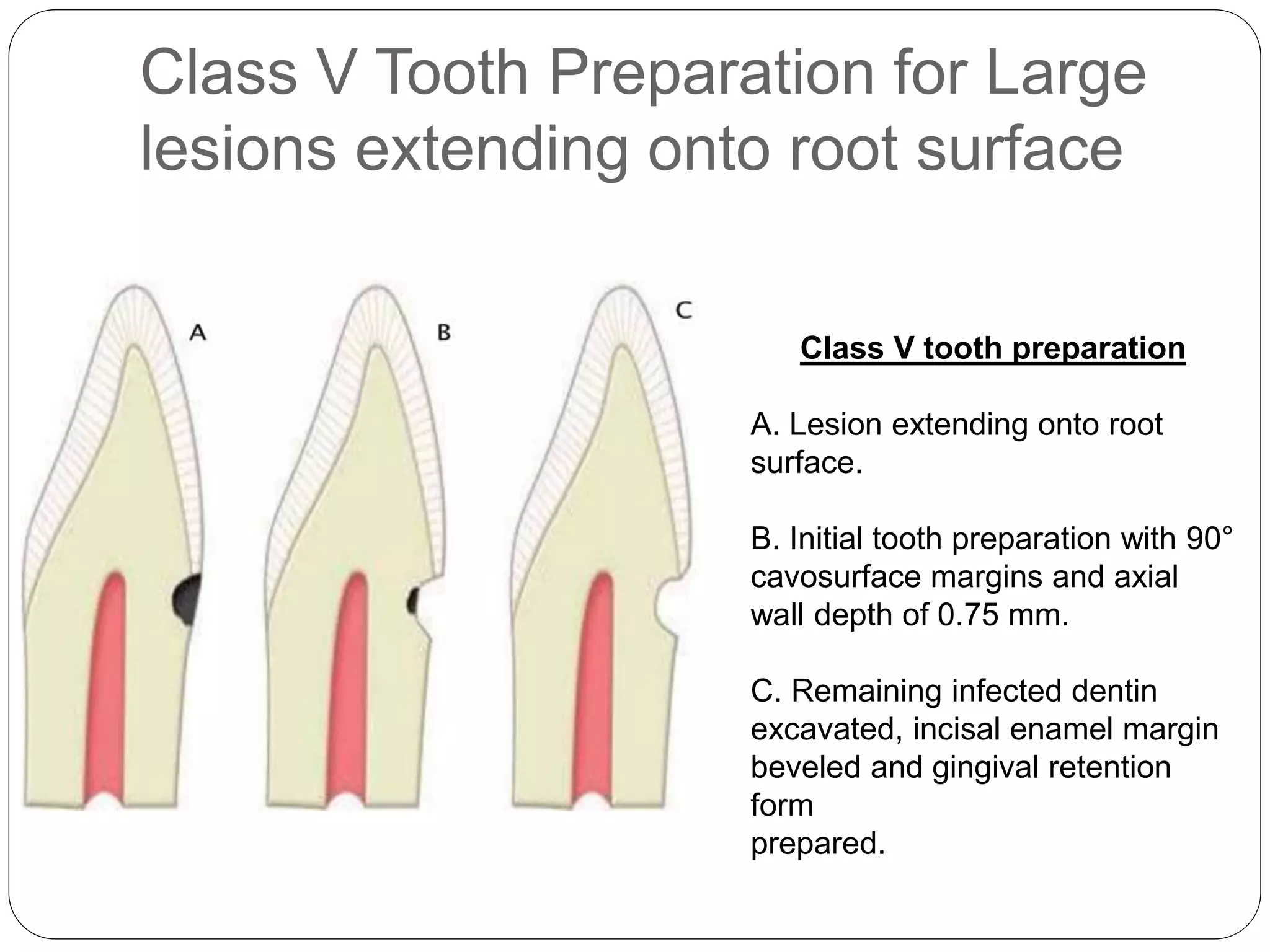
Class V Tooth Preparation for Large
lesions extending onto root surface
Class V tooth preparation
A. Lesion extending onto root
surface.
B. Initial tooth preparation with 90°
cavosurface margins and axial
wall depth of 0.75 mm.
C. Remaining infected dentin
excavated, incisal enamel margin
beveled and gingival retention
form
prepared.
References
 Sturdevant's art & science of operative dentistry-
2006- Theodore M. Roberson, Harald O. Heymann,
Edward J. Swift, Jr.
 Principles of operative dentistry (2005)- A.J.E.
Qualtrough, J.D. Satterthwaite, L.A. Morrow and
P.A. Brunton.
 Fundamentals of Operative Dentistry- 2nd Edition-
Summitt & Robbins
Class III, IV, V Cavity preparations for Composites- SELVI

Class III, IV, V Cavity preparations for Composites- SELVI

  • 1.
    Palani Selvi. K PostgraduateStudent Department of Conservative CLASS III, IV & V COMPOSITE CAVITY PREPARATIONS
  • 2.
    Contents  General considerations-Indications & Contraindications  Clinical Technique a. Initial clinical procedures b. Class III cavity preparation c. Class IV cavity preparation d. Class V cavity preparation  References
  • 3.
    Indications  Esthetic prominentareas  Operating area can be adequately isolated to attain an effective bond  Tooth preparations have all-enamel margins (Best).
  • 4.
    Contraindications  Operating areathat cannot be adequately isolated  Class V restorations in areas that are not esthetically critical  Restorations that extend onto the root surface.
  • 5.
  • 6.
    INITIAL CLINICAL PROCEDURES  Anesthesiamay be necessary for patient comfort, and if used, will help decrease the salivary flow during the procedure  Occlusal assessments should be made to help in properly adjusting the restoration's function and in determining the tooth preparation design.  The shade must be selected before the tooth dehydrates  Proper Isolation to permit effective bonding
  • 8.
    CLASS - 3COMPOSITE CAVITY PREPARATION
  • 9.
    (1) Obtaining accessto the defect (caries, fracture, non-carious defect) (2) Removing faulty structures (caries, defective dentin and enamel, defective restoration, base material), (3) Creating the convenience form for the restoration. (4) In most cases, an enamel bevel is used on the facial cavosurface margins to increase the surface area for bonding, and to provide a gradual transition from the restoration to the surrounding tooth structure for esthetics. (5) Obtaining access to the defect may include removal of sound enamel to access carious dentin. (6) The extension of the preparation is, therefore, ultimately dictated by the extension of the fault or defect.. Class III Cavity preparation
  • 10.
    Class III Cavitypreparation  Cavity Designs: A. Conventional- when caries is entirely on root surface B. Beveled Conventional- When the cavity is large & have enamel margins. Bevel is given at an angle of 45° to the cavosurface C. Modified- When the carious lesion is small & C B
  • 11.
    Class III Cavitypreparation D. Combination design- cavity margins both on enamel (beveled) & dentin Enamel Bevel Gingival retention groove
  • 16.
    LINGUALAPPROACH The advantages ofrestoring the proximal lesion from the lingual approach include: 1. The facial enamel is conserved for enhanced esthetics. 2. Some unsupported, but not friable, enamel may be left on the facial wall of a Class III or Class IV preparation. 3. Color matching of the composite is not as critical. 4. Discoloration or deterioration of the restoration is less visible.
  • 18.
    CLASS III –Lingual approach
  • 20.
    INDICATIONS FOR FACIALAPPROACH 1.The carious lesion is positioned facially such that facial access would significantly conserve tooth structure. 2. The teeth are irregularly aligned, making lingual access undesirable. 3. Extensive caries extend onto the facial surface. 4. A faulty restoration that was originally placed from facial approach needs to be replaced.
  • 21.
    preparation, facial approach A, Smallproximal caries lesion on the mesial surface of a maxillary lateral incisor. B, Dotted line indicates normal outline form dictated by shape of the caries lesion. C, Extension (convenience form) required for preparing and restoring preparation from lingual approach when teeth are in normal alignment. D–H, Clinical case showing conservative Class III preparation, facial approach. D, Facial view of a caries lesion on the
  • 29.
    CLASS 4 COMPOSITECAVITY PREPARATION
  • 30.
    Class IV cavitypreparation  Cavity Designs: A. Beveled conventional B. Modified
  • 31.
    The outline form Round carbide bur or diamond instrument at high speed with air-water coolant.  Remove all weakened enamel and establish the initial axial wall depth at 0.5mm into dentin  Prepare the walls as much as possible parallel and perpendicular to the long axis of the tooth.  Excavate any remaining infected dentin as the first step of final tooth preparation.  If necessary, apply a calcium hydroxide liner. Cavosurface margin BEVEL • 45-degree angle to the external tooth surface with a flame-shaped or • Round diamond width of the bevel should be 0.25 to 2 mm,
  • 32.
    Retention and resistanceform (Heavy occlusion and large Class IV requires increased retention and resistance form).  A more conventional tooth preparation form, with more resistance form  Proximal facial and lingual preparation walls that form 90-degree cavosurface angles, which are subsequently bevelled.  Gingival floor prepared perpendicular to the long axis of the tooth.  This boxlike form may provide greater resistance to fracture of the restoration and tooth from masticatory forces.
  • 33.
    Retention form features Indicatedin large Class IV preparations in which rounded undercuts are placed in the dentin along line angles and into point angles wherever possible, without undermining the enamel  Retention of the composite restorative material in beveled conventional Class IV tooth preparations may be obtained by - groove or other shaped undercuts - dovetail extensions - threaded pins or a combination of these gingival and incisal retentive undercuts.  Prepare a gingival retention groove using a No. 1/4 round bur.  It is prepared 0.2 mm inside the DEJ at a depth of 0.25mm (half the diameter of the No. 1/4 bur) and at an angle bisecting the junction of the axial wall and gingival wall.
  • 34.
    PINS ???  Anarbitrary dovetail extension onto the lingual surface of the tooth may enhance both the restorations strength and retention, but it is less conservative and therefore not used often.  Although pin retention is sometimes necessary, the use of pins in composite restorations is discouraged for several reasons: (1) The placement of pins in anterior teeth involves the risk of perforation either into the pulp or through the external surface. (2) Pins do not enhance the strength of the restorative material (3) Some pins may corrode resulting in significant discoloration of the tooth and restoration
  • 35.
    Modified Class IVTooth Preparation  Indicated for small or moderate Class IV lesions or traumatic defects.  The objective of the tooth preparation is to remove as little tooth structure as possible, while removing the fault and providing for appropriate retention and resistance forms.  Usually little or no initial tooth preparation is indicated for fractured incisal corners, other than roughening the fractured tooth structure.  The cavosurface margins are prepared with a bevelled configuration; the axial depth is dependent on the extent of the lesion, previous restoration, or fracture, but initially no deeper than 0.2 mm inside the DEJ.
  • 36.
    • The retentionis obtained primarily from the bonding strength of the composite to the enamel and dentin. • The treatment of teeth with minor traumatic fractures requires less preparation than the beveled conventional. Example. If the fracture is confined to enamel, adequate retention usually can be attained by simply beveling sharp cavosurface margins in the fractured area with a flame-shaped diamond . Modified Class IV Tooth Preparation
  • 40.
    INCISAL STEP 45'BEVEL : This conservative design is employed for simple Class IV cavities, that is, those with minimal mesiodistal loss of tooth structure that are subject to low to moderate incisal forces (Fig. 2a). INCISAL STEP VENEER BEVEL This design circumvents the need for pins and is employed for complex Class IV cavities, that is, those that are wide mesio-distally and/or subject to high incisal forces or have a history of repeated failures
  • 41.
  • 42.
  • 44.
  • 45.
  • 46.
  • 47.
  • 48.
  • 49.
  • 50.
  • 53.
    Contraindication of composites •Poor oral hygiene • subgingival cavities • Root caries (outside of enamel)
  • 54.
    Class V cavitypreparation  Cavity designs: A. Conventional B. Beveled conventional C. Combination D. Modified Beveled conventional Modified
  • 55.
    CLASS V DIRECTCOMPOSITE RESTORATIONS  Class V restorations are done on the gingival third of facial and lingual surfaces of  all teeth. Initial clinical procedures:  Occlusal evaluation not required for class V restorations.  During shade selection, it must be remembered that tooth is darker and more  opaque in the cervical third.  Isolation - rubber dam
  • 56.
    TOOTH PREPARATION  Afterthe usual preliminary procedures, the initial tooth preparation is accomplished  with a round diamond bur, eliminating the entire enamel lesion or defect.  • The completed preparation is made with etched enamel and primed dentin. CLASS V DIRECT COMPOSITE RESTORATIONS
  • 57.
    Class V ToothPreparation for Small lesions not extending into root surface
  • 58.
    Class V ToothPreparation for Large lesions extending onto root surface Class V tooth preparation A. Lesion extending onto root surface. B. Initial tooth preparation with 90° cavosurface margins and axial wall depth of 0.75 mm. C. Remaining infected dentin excavated, incisal enamel margin beveled and gingival retention form prepared.
  • 61.
    References  Sturdevant's art& science of operative dentistry- 2006- Theodore M. Roberson, Harald O. Heymann, Edward J. Swift, Jr.  Principles of operative dentistry (2005)- A.J.E. Qualtrough, J.D. Satterthwaite, L.A. Morrow and P.A. Brunton.  Fundamentals of Operative Dentistry- 2nd Edition- Summitt & Robbins