Trends and developments in
Reinforcement Learning
London TensorFlow Meetup
Pierre H. Richemond
Imperial College London
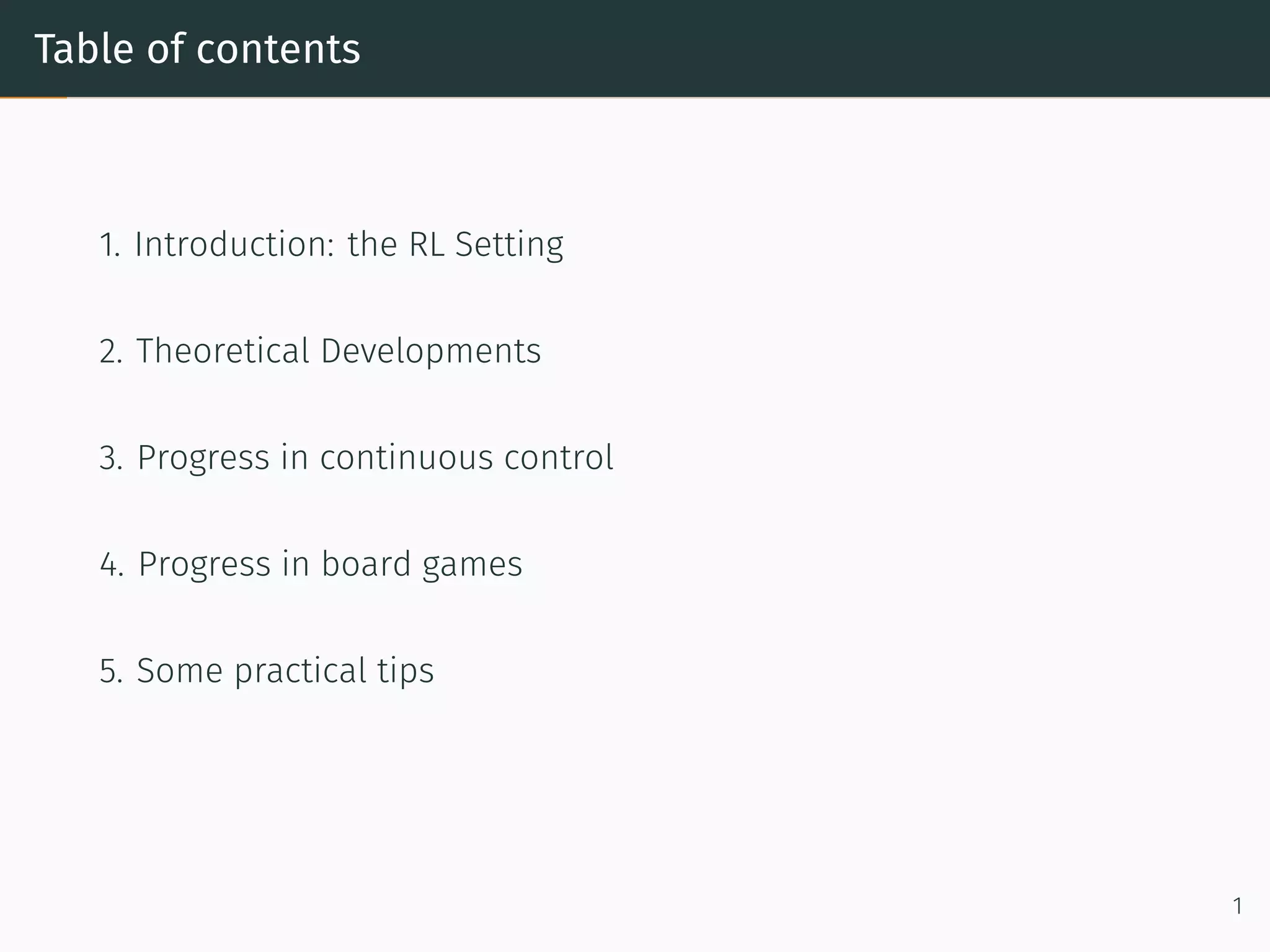
Table of contents
1. Introduction: the RL Setting
2. Theoretical Developments
3. Progress in continuous control
4. Progress in board games
5. Some practical tips
1
Introduction: the RL Setting
RL in one minute
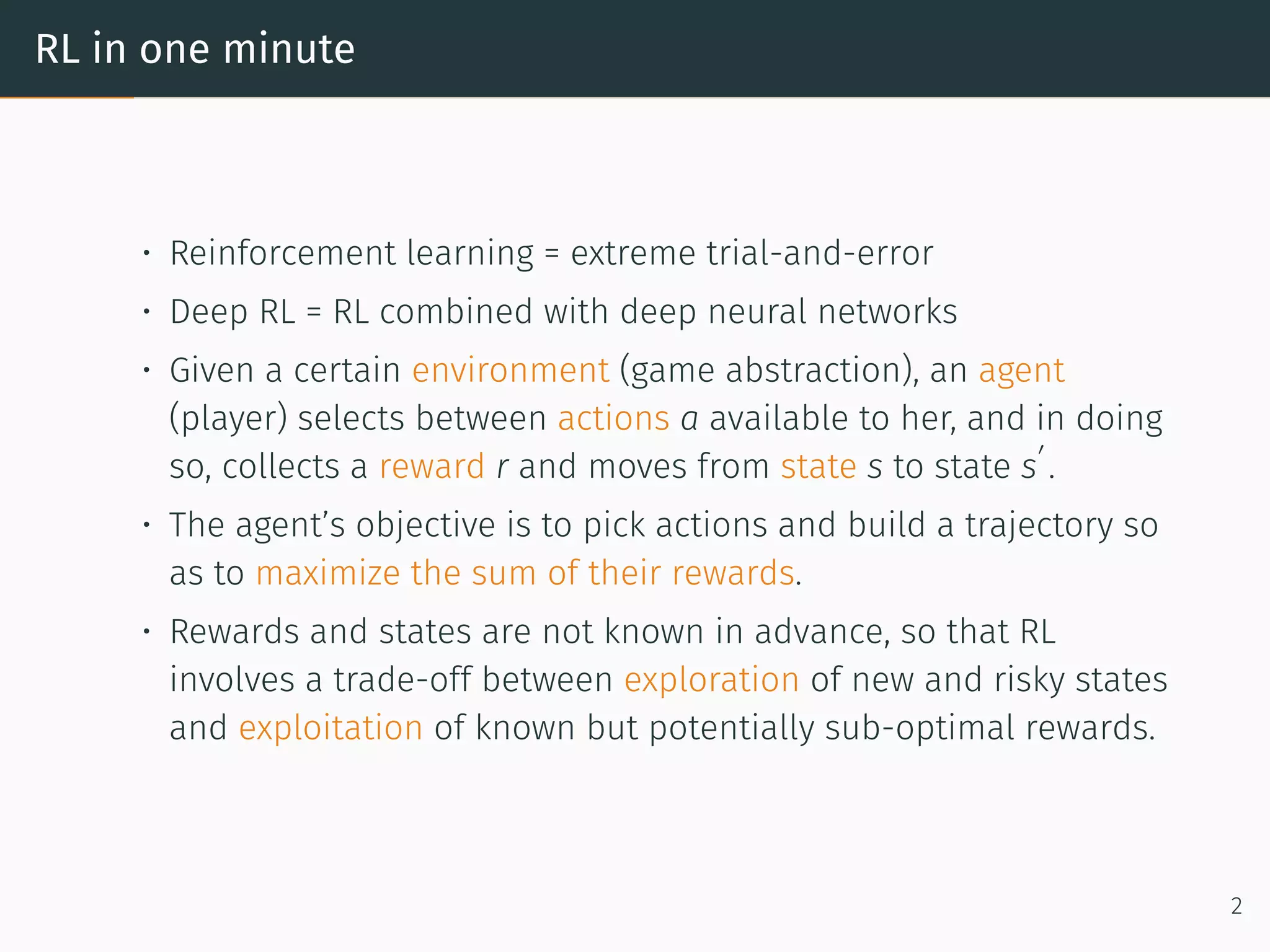
• Reinforcement learning = extreme trial-and-error
• Deep RL = RL combined with deep neural networks
• Given a certain environment (game abstraction), an agent
(player) selects between actions a available to her, and in doing
so, collects a reward r and moves from state s to state s
′
.
• The agent’s objective is to pick actions and build a trajectory so
as to maximize the sum of their rewards.
• Rewards and states are not known in advance, so that RL
involves a trade-off between exploration of new and risky states
and exploitation of known but potentially sub-optimal rewards.
2
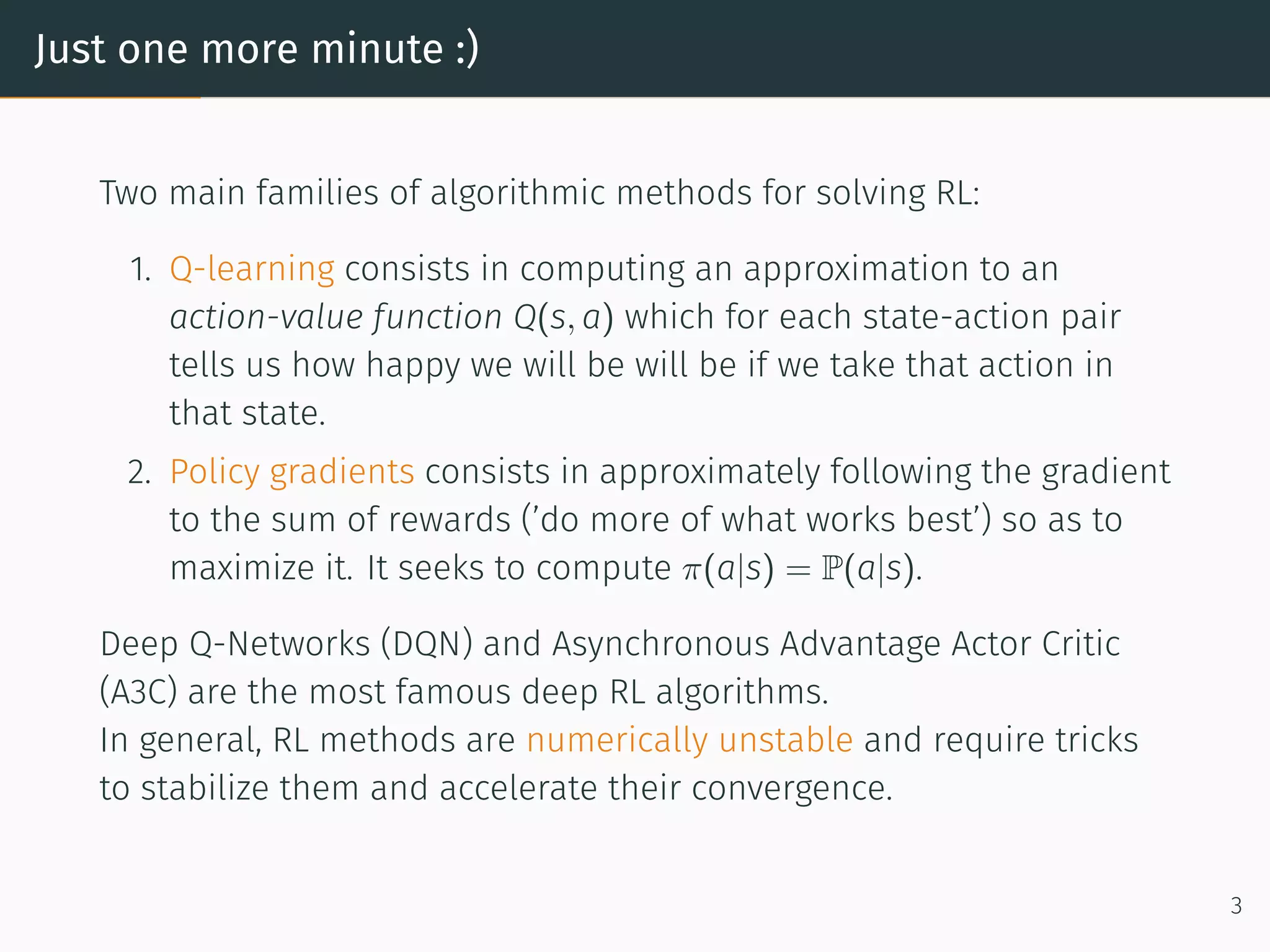
Just one more minute :)
Two main families of algorithmic methods for solving RL:
1. Q-learning consists in computing an approximation to an
action-value function Q(s, a) which for each state-action pair
tells us how happy we will be will be if we take that action in
that state.
2. Policy gradients consists in approximately following the gradient
to the sum of rewards (’do more of what works best’) so as to
maximize it. It seeks to compute π(a|s) = P(a|s).
Deep Q-Networks (DQN) and Asynchronous Advantage Actor Critic
(A3C) are the most famous deep RL algorithms.
In general, RL methods are numerically unstable and require tricks
to stabilize them and accelerate their convergence.
3
Theoretical Developments
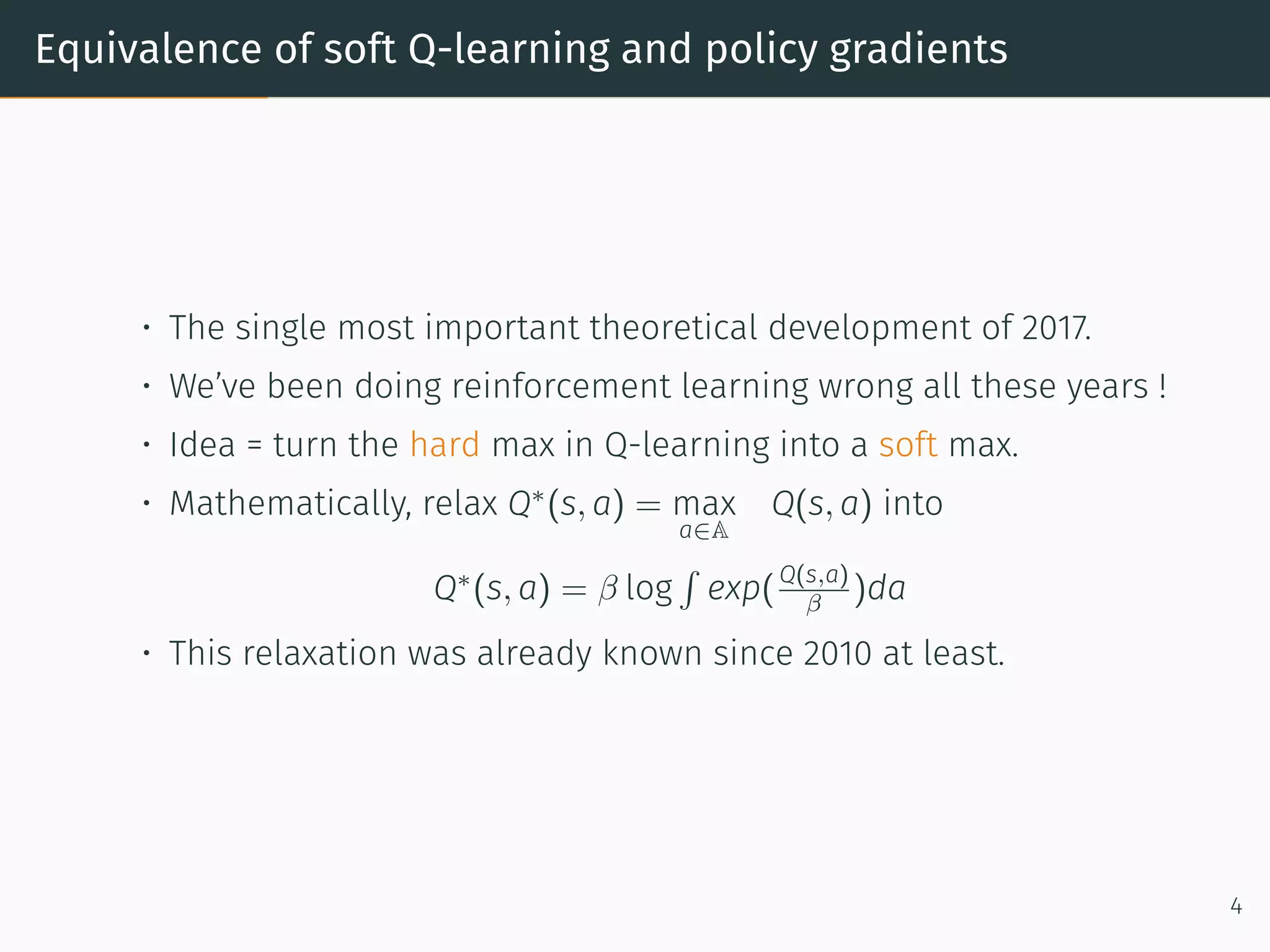
Equivalence of soft Q-learning and policy gradients
• The single most important theoretical development of 2017.
• We’ve been doing reinforcement learning wrong all these years !
• Idea = turn the hard max in Q-learning into a soft max.
• Mathematically, relax Q∗
(s, a) = max
a∈A
Q(s, a) into
Q∗
(s, a) = β log
∫
exp(Q(s,a)
β )da
• This relaxation was already known since 2010 at least.
4
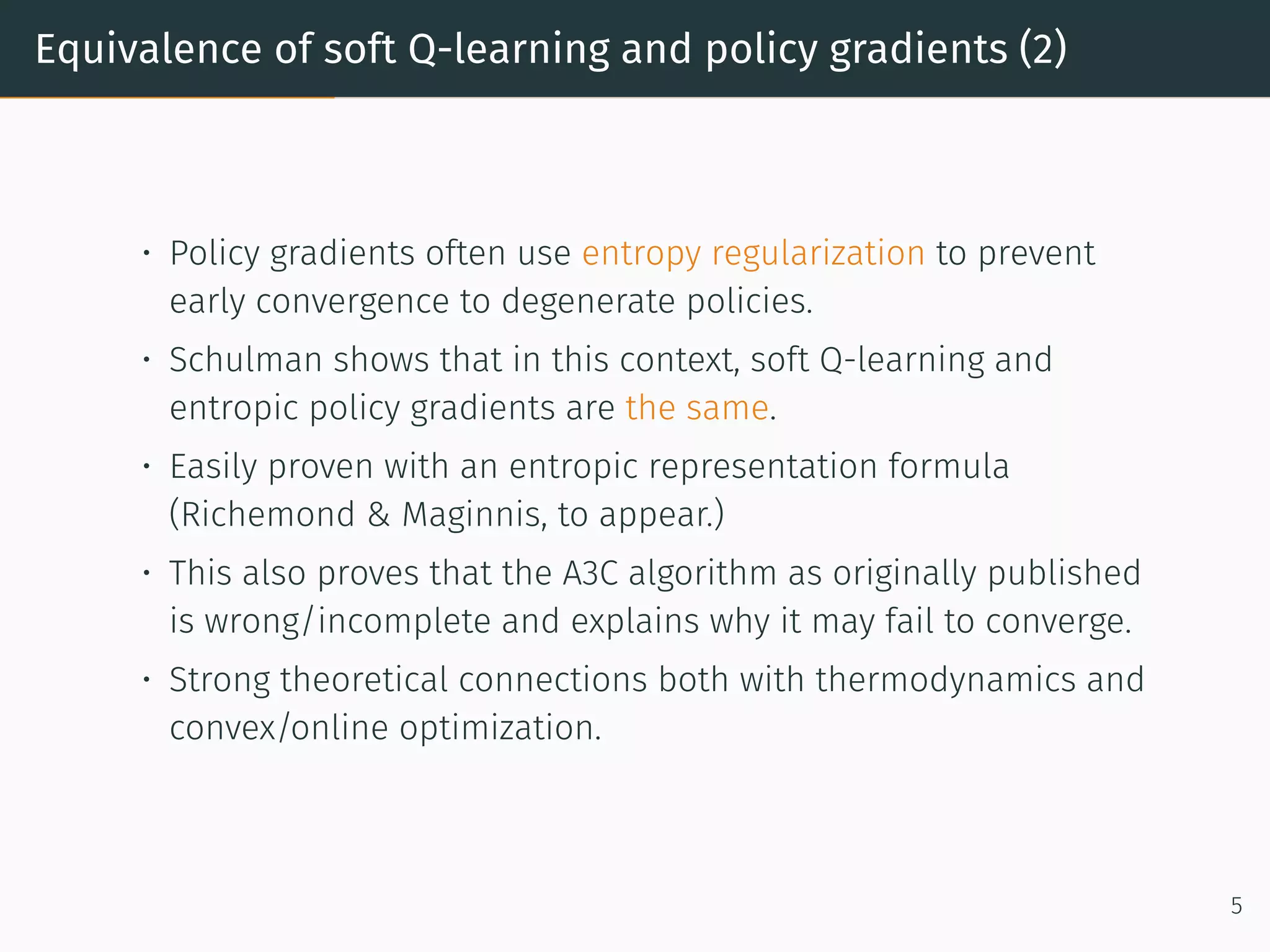
Equivalence of soft Q-learning and policy gradients (2)
• Policy gradients often use entropy regularization to prevent
early convergence to degenerate policies.
• Schulman shows that in this context, soft Q-learning and
entropic policy gradients are the same.
• Easily proven with an entropic representation formula
(Richemond & Maginnis, to appear.)
• This also proves that the A3C algorithm as originally published
is wrong/incomplete and explains why it may fail to converge.
• Strong theoretical connections both with thermodynamics and
convex/online optimization.
5
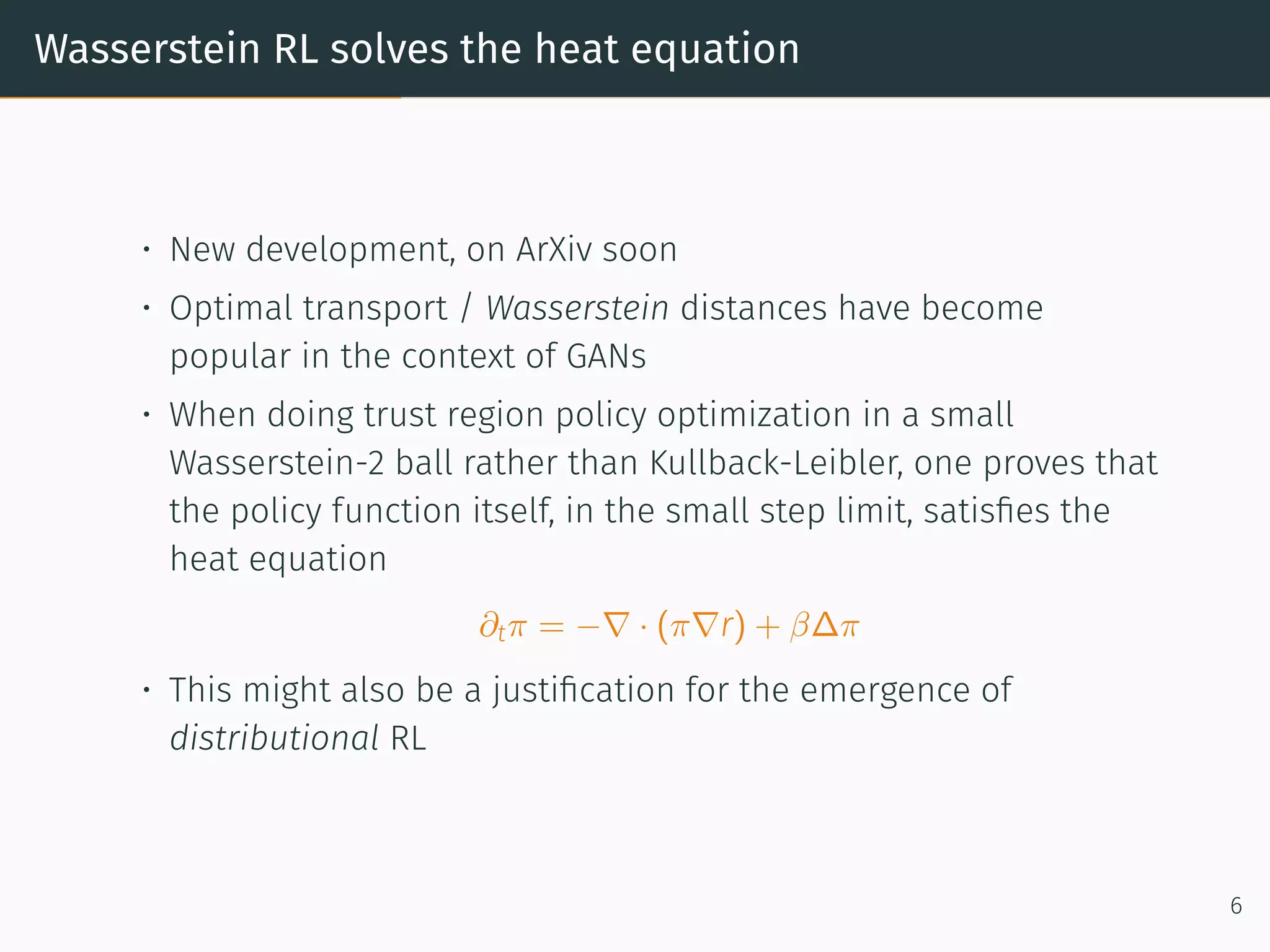
Wasserstein RL solves the heat equation
• New development, on ArXiv soon
• Optimal transport / Wasserstein distances have become
popular in the context of GANs
• When doing trust region policy optimization in a small
Wasserstein-2 ball rather than Kullback-Leibler, one proves that
the policy function itself, in the small step limit, satisfies the
heat equation
∂tπ = −∇ · (π∇r) + β∆π
• This might also be a justification for the emergence of
distributional RL
6
Progress in continuous control
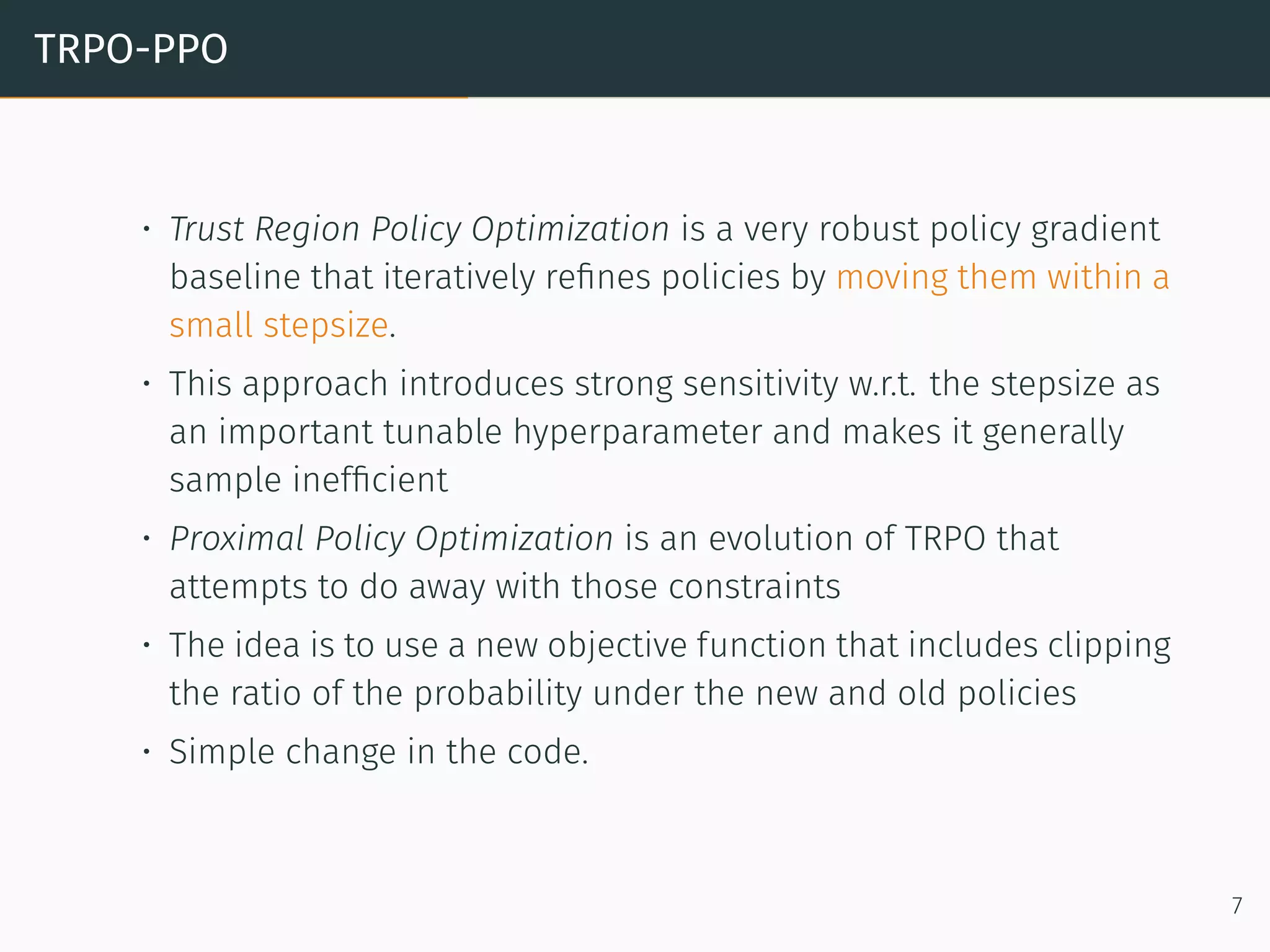
TRPO-PPO
• Trust Region Policy Optimization is a very robust policy gradient
baseline that iteratively refines policies by moving them within a
small stepsize.
• This approach introduces strong sensitivity w.r.t. the stepsize as
an important tunable hyperparameter and makes it generally
sample inefficient
• Proximal Policy Optimization is an evolution of TRPO that
attempts to do away with those constraints
• The idea is to use a new objective function that includes clipping
the ratio of the probability under the new and old policies
• Simple change in the code.
7
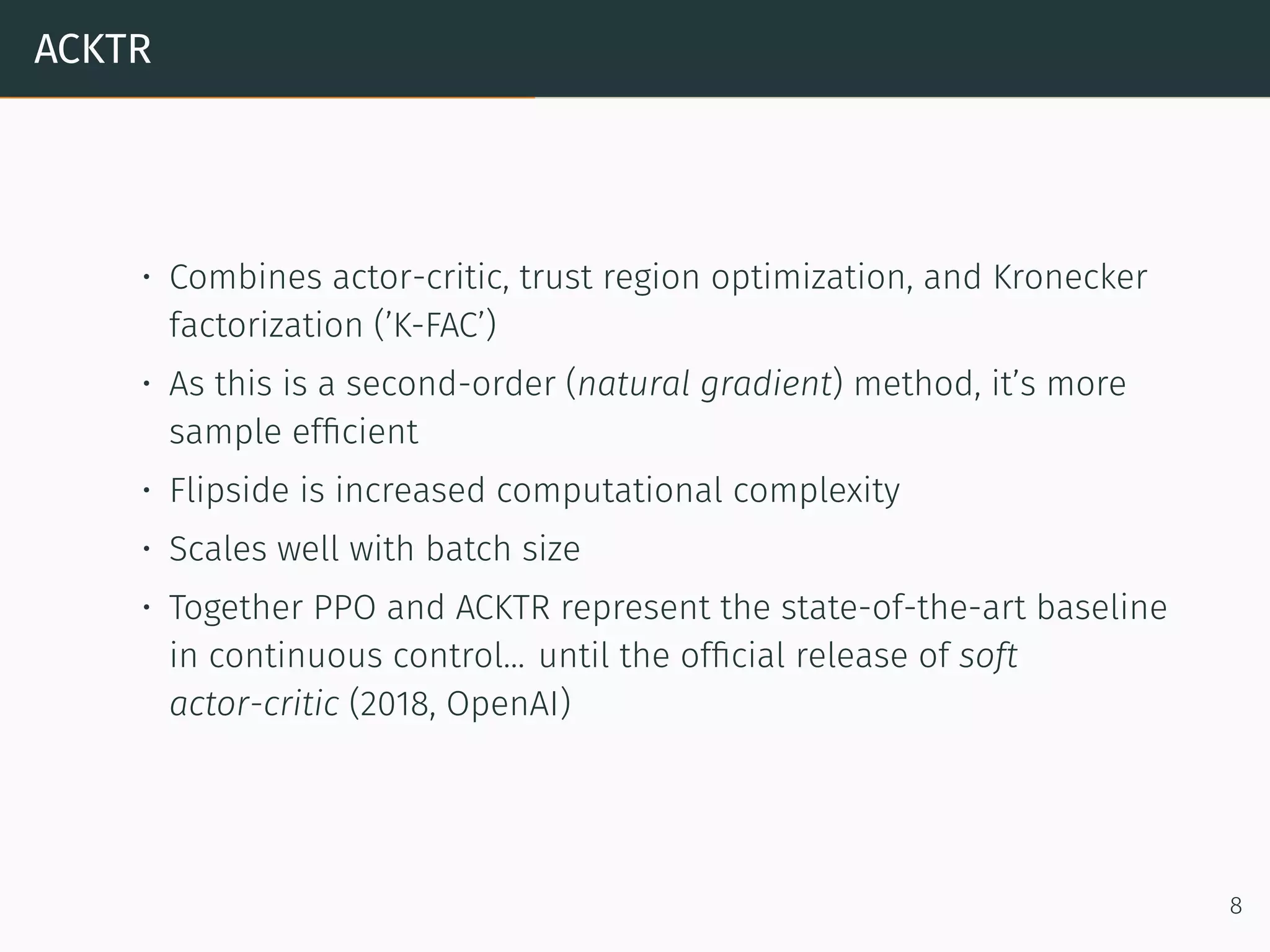
ACKTR
• Combines actor-critic, trust region optimization, and Kronecker
factorization (’K-FAC’)
• As this is a second-order (natural gradient) method, it’s more
sample efficient
• Flipside is increased computational complexity
• Scales well with batch size
• Together PPO and ACKTR represent the state-of-the-art baseline
in continuous control... until the official release of soft
actor-critic (2018, OpenAI)
8
Video examples
9
Progress in board games
AlphaGo Zero
• Arguably the landmark practical achievement of the year in
reinforcement learning !
• AlphaGo the first learned the game by analyzing 30 million Go
moves from human players (GoKiFu dataset) before refining that
supervised policy with self-play
• This illustrates the difficulty of the mathematical optimization
problem posed by RL, and the necessity to initialize close to a
good solution.
• AlphaGo Zero plays significantly better, and does away with
supervision or human knowledge completely (other than
knowledge of game rules)
10
AlphaGo Zero: Architecture (1)
• Problem with Go = large branching factor in the tree of possible
moves.
• Neural networks enable dynamic pruning of that tree - a policy
network limits the breadth of the subtree to explore, while a
value network limits the depth of that subtree. If those networks
were perfect, little exploration would be needed - in order to get
there, we can refine them iteratively.
• Merging the policy and value network enforces feature reuse
and learning efficiency
• In order to train deeper networks and enable more and more
abstract feature extraction, residual networks are used
11
AlphaGo Zero: Architecture (2)
• Monte Carlo Tree Search (MCTS) is another part of the algorithm
that, just like a neural network, dynamically expands and
compresses the tree of possibles. It averages results across
many paths of the sub-tree, and can be viewed as a form of
imagination, or slow thinking.
• The key component of AlphaGo Zero is to view MCTS as a policy
improvement mechanism: you can’t improve anymore when
your fast thinking (NN) and your slow thinking (MCTS) coincide.
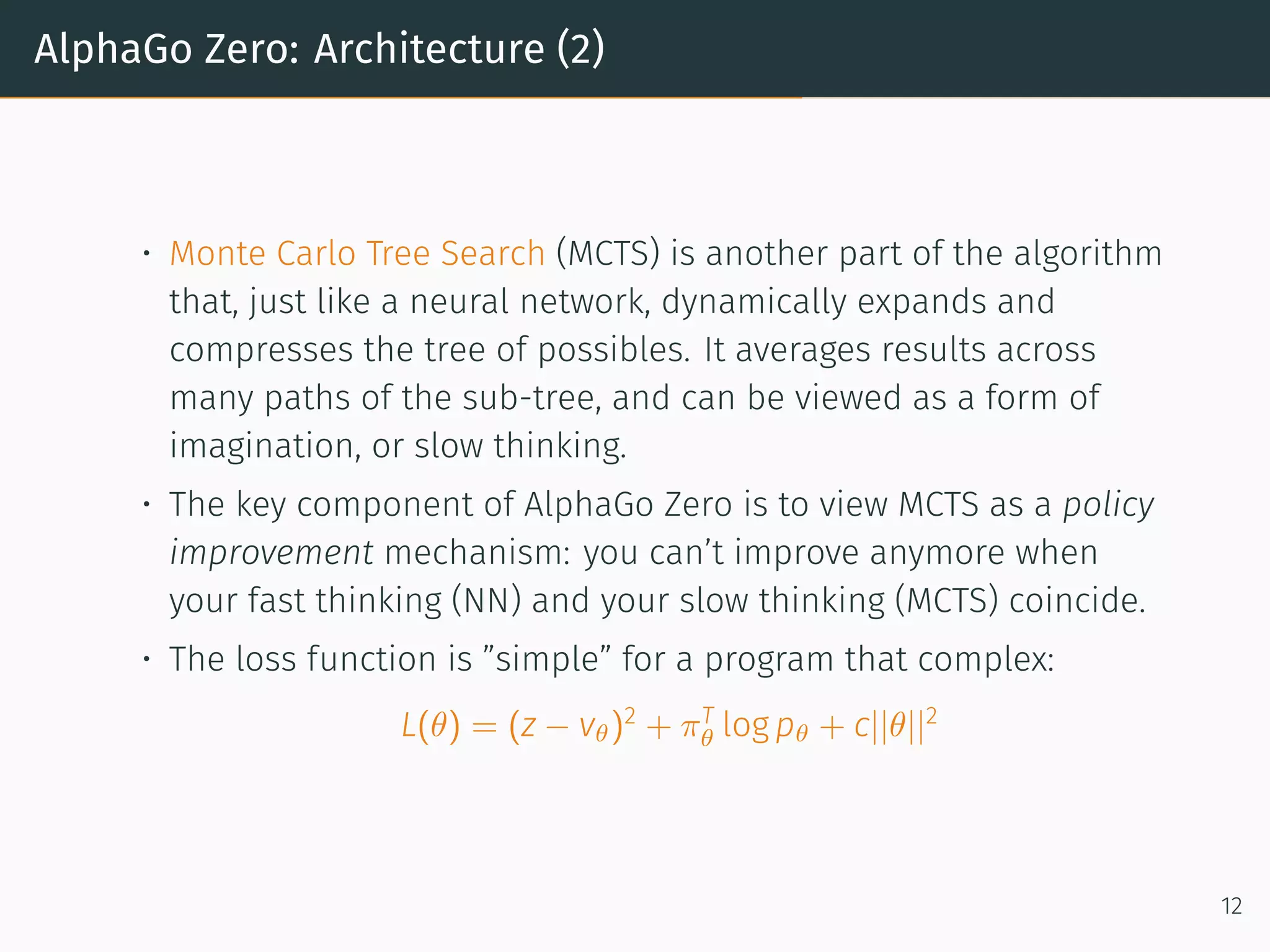
• The loss function is ”simple” for a program that complex:
L(θ) = (z − vθ)2
+ πT
θ log pθ + c||θ||2
12
AlphaGo Zero: Insights
• AlphaZero is the generic, game-agnostic version of AlphaGoZero
that also taught itself to play Chess and Shogi (Japanese chess
where you can capture your opponent’s ) at a superhuman level
using the same algorithm.
• In stark contrast with DeepBlue or Stockfish, AlphaZero ’only’
evaluates 50,000 positions per move due to MCTS, rather than
millions.
• AlphaGo has now become so strong it is used as an online
teaching tool for human players - AlphaGo Teach
https://alphagoteach.deepmind.com/
• According to David Silver, it is speculated that MCTS acts as a
large averaging mechanism, rather than the ’maximum’
operation in standard tree pruning, smoothing rather than
propagating neural network approximation error, and hence
enabling stable training of deep networks.
13
Some practical tips
Suggestions for experiment design
Factors influencing training, by order of importance:
• Fix your random seed for reproducibility !
• Softmax temperature is the single most critical factor according
to Nachum & Huarnooja, followed by...
• Reward scaling and more generally reward engineering help a
lot
• Number of steps in the calculation of returns
• Discount factor also an issue
Clip gradients to avoid NaNs, visualize them with TensorBoard, and
finally be patient waiting for convergence...
14
Key TensorFlow code repos
• As close to official as possible :
https://github.com/tensorflow/models/tree/
master/research/pcl_rl
by Ofir Nachum the author of PCL, soon to be integrated in
TensorFlow
• RLlib: A Composable and Scalable Reinforcement Learning
Library
https://github.com/ray-project/ray/tree/master/
python/ray/rllib
• Imperial’s Brendan Maginnis Atari-RL
https://github.com/brendanator/atari-rl
• OpenAI’s baselines
https://github.com/openai/baselines
15
Deep Reinforcement Learning That Matters
• Encouraging reproducibility in reinforcement learning
• ’RL algorithms have many moving parts that are hard to debug,
and they require substantial effort in tuning in order to get good
results.’
• False Discoveries everywhere ? Dependency on the random seed
• Multiple runs are necessary to give an idea of the variability.
Reporting the best returns is not enough - at the very least,
report top and bottom quantiles
• A necessary debate, as seen at NIPS 2017.
Don’t be an alchemist
16
Conclusion & perspectives
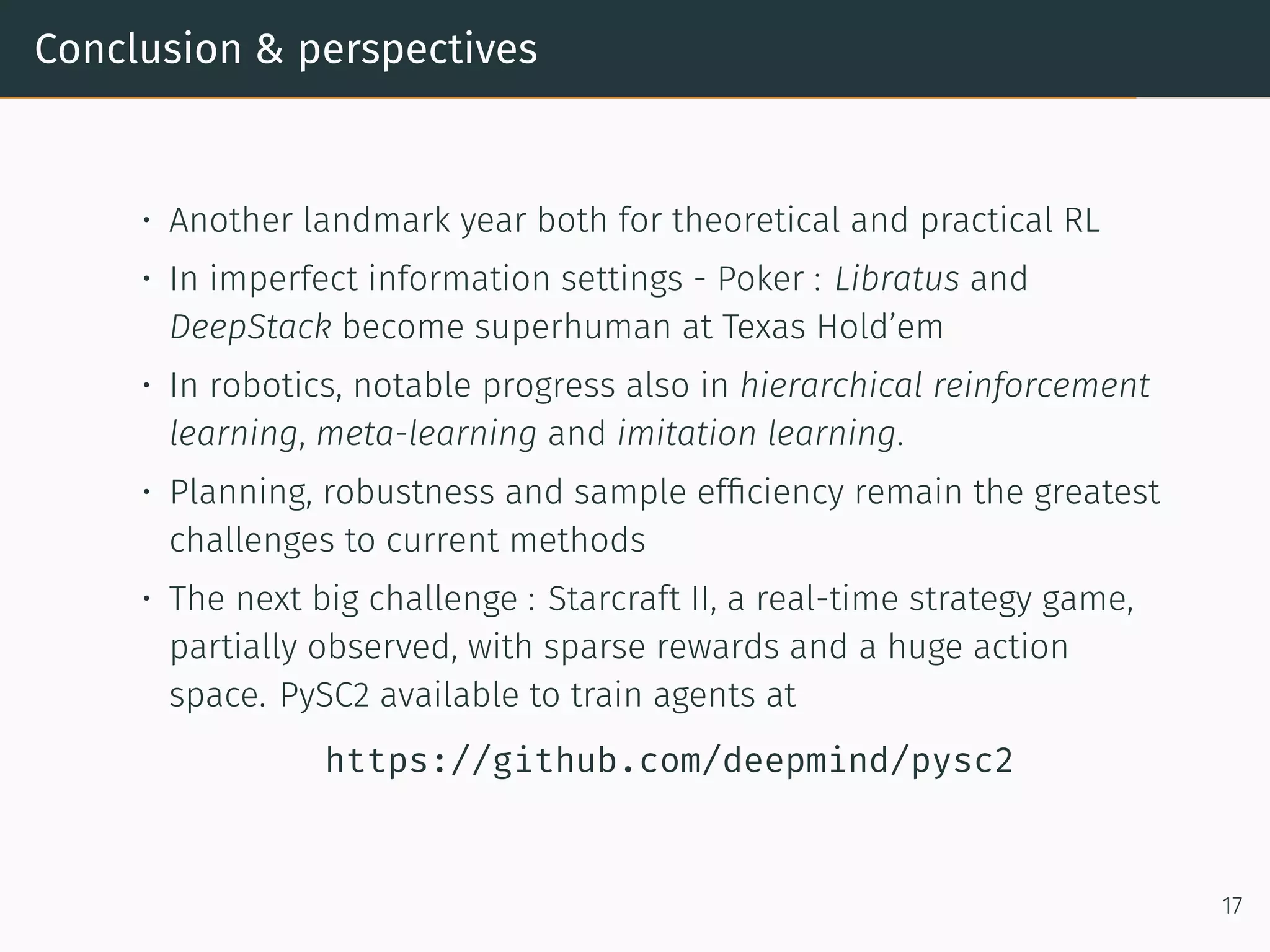
• Another landmark year both for theoretical and practical RL
• In imperfect information settings - Poker : Libratus and
DeepStack become superhuman at Texas Hold’em
• In robotics, notable progress also in hierarchical reinforcement
learning, meta-learning and imitation learning.
• Planning, robustness and sample efficiency remain the greatest
challenges to current methods
• The next big challenge : Starcraft II, a real-time strategy game,
partially observed, with sparse rewards and a huge action
space. PySC2 available to train agents at
https://github.com/deepmind/pysc2
17
Questions from the audience ?
18
Thanks for your time !
Twitter @KloudStrife
19

TensorFlow London 11: Pierre Harvey Richemond 'Trends and Developments in Reinforcement Learning'

  • 1.
    Trends and developmentsin Reinforcement Learning London TensorFlow Meetup Pierre H. Richemond Imperial College London
  • 2.
    Table of contents 1.Introduction: the RL Setting 2. Theoretical Developments 3. Progress in continuous control 4. Progress in board games 5. Some practical tips 1
  • 3.
  • 4.
    RL in oneminute • Reinforcement learning = extreme trial-and-error • Deep RL = RL combined with deep neural networks • Given a certain environment (game abstraction), an agent (player) selects between actions a available to her, and in doing so, collects a reward r and moves from state s to state s ′ . • The agent’s objective is to pick actions and build a trajectory so as to maximize the sum of their rewards. • Rewards and states are not known in advance, so that RL involves a trade-off between exploration of new and risky states and exploitation of known but potentially sub-optimal rewards. 2
  • 5.
    Just one moreminute :) Two main families of algorithmic methods for solving RL: 1. Q-learning consists in computing an approximation to an action-value function Q(s, a) which for each state-action pair tells us how happy we will be will be if we take that action in that state. 2. Policy gradients consists in approximately following the gradient to the sum of rewards (’do more of what works best’) so as to maximize it. It seeks to compute π(a|s) = P(a|s). Deep Q-Networks (DQN) and Asynchronous Advantage Actor Critic (A3C) are the most famous deep RL algorithms. In general, RL methods are numerically unstable and require tricks to stabilize them and accelerate their convergence. 3
  • 6.
  • 7.
    Equivalence of softQ-learning and policy gradients • The single most important theoretical development of 2017. • We’ve been doing reinforcement learning wrong all these years ! • Idea = turn the hard max in Q-learning into a soft max. • Mathematically, relax Q∗ (s, a) = max a∈A Q(s, a) into Q∗ (s, a) = β log ∫ exp(Q(s,a) β )da • This relaxation was already known since 2010 at least. 4
  • 8.
    Equivalence of softQ-learning and policy gradients (2) • Policy gradients often use entropy regularization to prevent early convergence to degenerate policies. • Schulman shows that in this context, soft Q-learning and entropic policy gradients are the same. • Easily proven with an entropic representation formula (Richemond & Maginnis, to appear.) • This also proves that the A3C algorithm as originally published is wrong/incomplete and explains why it may fail to converge. • Strong theoretical connections both with thermodynamics and convex/online optimization. 5
  • 9.
    Wasserstein RL solvesthe heat equation • New development, on ArXiv soon • Optimal transport / Wasserstein distances have become popular in the context of GANs • When doing trust region policy optimization in a small Wasserstein-2 ball rather than Kullback-Leibler, one proves that the policy function itself, in the small step limit, satisfies the heat equation ∂tπ = −∇ · (π∇r) + β∆π • This might also be a justification for the emergence of distributional RL 6
  • 10.
  • 11.
    TRPO-PPO • Trust RegionPolicy Optimization is a very robust policy gradient baseline that iteratively refines policies by moving them within a small stepsize. • This approach introduces strong sensitivity w.r.t. the stepsize as an important tunable hyperparameter and makes it generally sample inefficient • Proximal Policy Optimization is an evolution of TRPO that attempts to do away with those constraints • The idea is to use a new objective function that includes clipping the ratio of the probability under the new and old policies • Simple change in the code. 7
  • 12.
    ACKTR • Combines actor-critic,trust region optimization, and Kronecker factorization (’K-FAC’) • As this is a second-order (natural gradient) method, it’s more sample efficient • Flipside is increased computational complexity • Scales well with batch size • Together PPO and ACKTR represent the state-of-the-art baseline in continuous control... until the official release of soft actor-critic (2018, OpenAI) 8
  • 13.
  • 14.
  • 15.
    AlphaGo Zero • Arguablythe landmark practical achievement of the year in reinforcement learning ! • AlphaGo the first learned the game by analyzing 30 million Go moves from human players (GoKiFu dataset) before refining that supervised policy with self-play • This illustrates the difficulty of the mathematical optimization problem posed by RL, and the necessity to initialize close to a good solution. • AlphaGo Zero plays significantly better, and does away with supervision or human knowledge completely (other than knowledge of game rules) 10
  • 16.
    AlphaGo Zero: Architecture(1) • Problem with Go = large branching factor in the tree of possible moves. • Neural networks enable dynamic pruning of that tree - a policy network limits the breadth of the subtree to explore, while a value network limits the depth of that subtree. If those networks were perfect, little exploration would be needed - in order to get there, we can refine them iteratively. • Merging the policy and value network enforces feature reuse and learning efficiency • In order to train deeper networks and enable more and more abstract feature extraction, residual networks are used 11
  • 17.
    AlphaGo Zero: Architecture(2) • Monte Carlo Tree Search (MCTS) is another part of the algorithm that, just like a neural network, dynamically expands and compresses the tree of possibles. It averages results across many paths of the sub-tree, and can be viewed as a form of imagination, or slow thinking. • The key component of AlphaGo Zero is to view MCTS as a policy improvement mechanism: you can’t improve anymore when your fast thinking (NN) and your slow thinking (MCTS) coincide. • The loss function is ”simple” for a program that complex: L(θ) = (z − vθ)2 + πT θ log pθ + c||θ||2 12
  • 18.
    AlphaGo Zero: Insights •AlphaZero is the generic, game-agnostic version of AlphaGoZero that also taught itself to play Chess and Shogi (Japanese chess where you can capture your opponent’s ) at a superhuman level using the same algorithm. • In stark contrast with DeepBlue or Stockfish, AlphaZero ’only’ evaluates 50,000 positions per move due to MCTS, rather than millions. • AlphaGo has now become so strong it is used as an online teaching tool for human players - AlphaGo Teach https://alphagoteach.deepmind.com/ • According to David Silver, it is speculated that MCTS acts as a large averaging mechanism, rather than the ’maximum’ operation in standard tree pruning, smoothing rather than propagating neural network approximation error, and hence enabling stable training of deep networks. 13
  • 19.
  • 20.
    Suggestions for experimentdesign Factors influencing training, by order of importance: • Fix your random seed for reproducibility ! • Softmax temperature is the single most critical factor according to Nachum & Huarnooja, followed by... • Reward scaling and more generally reward engineering help a lot • Number of steps in the calculation of returns • Discount factor also an issue Clip gradients to avoid NaNs, visualize them with TensorBoard, and finally be patient waiting for convergence... 14
  • 21.
    Key TensorFlow coderepos • As close to official as possible : https://github.com/tensorflow/models/tree/ master/research/pcl_rl by Ofir Nachum the author of PCL, soon to be integrated in TensorFlow • RLlib: A Composable and Scalable Reinforcement Learning Library https://github.com/ray-project/ray/tree/master/ python/ray/rllib • Imperial’s Brendan Maginnis Atari-RL https://github.com/brendanator/atari-rl • OpenAI’s baselines https://github.com/openai/baselines 15
  • 22.
    Deep Reinforcement LearningThat Matters • Encouraging reproducibility in reinforcement learning • ’RL algorithms have many moving parts that are hard to debug, and they require substantial effort in tuning in order to get good results.’ • False Discoveries everywhere ? Dependency on the random seed • Multiple runs are necessary to give an idea of the variability. Reporting the best returns is not enough - at the very least, report top and bottom quantiles • A necessary debate, as seen at NIPS 2017. Don’t be an alchemist 16
  • 23.
    Conclusion & perspectives •Another landmark year both for theoretical and practical RL • In imperfect information settings - Poker : Libratus and DeepStack become superhuman at Texas Hold’em • In robotics, notable progress also in hierarchical reinforcement learning, meta-learning and imitation learning. • Planning, robustness and sample efficiency remain the greatest challenges to current methods • The next big challenge : Starcraft II, a real-time strategy game, partially observed, with sparse rewards and a huge action space. PySC2 available to train agents at https://github.com/deepmind/pysc2 17
  • 24.
    Questions from theaudience ? 18
  • 25.
    Thanks for yourtime ! Twitter @KloudStrife 19