



© Radware 2016
Ron Winward
Security Evangelist
Radware
May 12, 2016
DDoS Threat Landscape
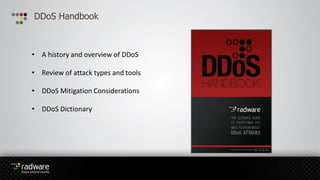
DDoS Handbook
• A history and overview of DDoS
• Review of attack types and tools
• DDoS Mitigation Considerations
• DDoS Dictionary
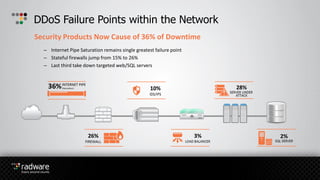
Security Products Now Cause of 36% of Downtime
DDoS Failure Points within the Network
– Internet Pipe Saturation remains single greatest failure point
– Stateful firewalls jump from 15% to 26%
– Last third take down targeted web/SQL servers
“Low & Slow” DoS
attacks (e.g.Slowloris)
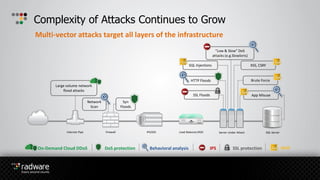
Complexity of Attacks Continues to Grow
Multi-vector attacks target all layers of the infrastructure
IPS/IDS
Large volume network
flood attacks
Syn
Floods
Network
Scan
HTTP Floods
SSL Floods App Misuse
Brute Force
On-Demand Cloud DDoS DoS protection Behavioral analysis IPS WAFSSL protection
Internet Pipe Firewall Load Balancer/ADC Server Under Attack SQL Server
XSS, CSRFSQL Injections
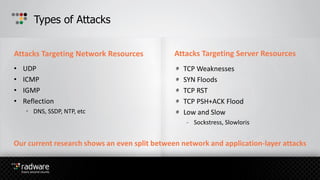
Types of Attacks
Attacks Targeting Network Resources Attacks Targeting Server Resources
• UDP
• ICMP
• IGMP
• Reflection
• DNS, SSDP, NTP, etc
TCP Weaknesses
SYN Floods
TCP RST
TCP PSH+ACK Flood
Low and Slow
- Sockstress, Slowloris
Our current research shows an even split between network and application-layer attacks
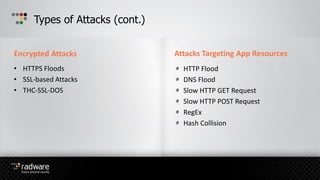
Types of Attacks (cont.)
Encrypted Attacks Attacks Targeting App Resources
• HTTPS Floods
• SSL-based Attacks
• THC-SSL-DOS
HTTP Flood
DNS Flood
Slow HTTP GET Request
Slow HTTP POST Request
RegEx
Hash Collision
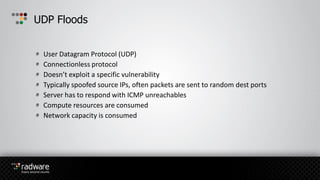
User Datagram Protocol (UDP)
Connectionless protocol
Doesn’t exploit a specific vulnerability
Typically spoofed source IPs, often packets are sent to random dest ports
Server has to respond with ICMP unreachables
Compute resources are consumed
Network capacity is consumed
UDP Floods
Internet Control Message Protocol (ICMP)
Connectionless protocol
Doesn’t exploit a specific vulnerability
Can be any type of ICMP message
Volumetric in nature
Target has to try and process all of the requests
This is why we have ICMP policers on routers 
– The premise holds true for all devices that have to respond
ICMP Floods
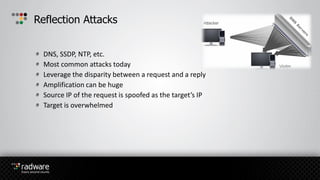
DNS, SSDP, NTP, etc.
Most common attacks today
Leverage the disparity between a request and a reply
Amplification can be huge
Source IP of the request is spoofed as the target’s IP
Target is overwhelmed
Reflection Attacks
Protocol exploits
Misuse of the six control bits, SYN, ACK, RST, PSH, FIN and URG
TCP requires a 3-way negotiation in order for a session to be established
– SYN, SYN-ACK, ACK
– Each request creates a half-open connection
Attacks will often send packets in the wrong order to consume resources on
the target while it tries to interpret what’s happening
TCP Weaknesses
One of the most common vectors
Attacker floods the target with SYN packets from spoofed source IPs
Target opens a thread and assigns buffers to prepare for each connection
Target sends a SYN-ACK back to the spoofed requestor
No response, so target sends more SYN-ACKs until it times out
Server is unable to timeout old sessions before new ones can be handled
SYN Floods
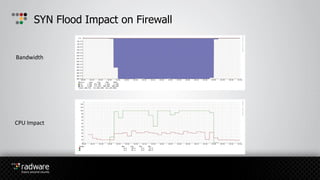
SYN Flood Impact on Firewall
Bandwidth
CPU Impact
Most common application layer attack
Multiple machines continually download the content from a target
Target server exhausts resources trying to deliver the content and handle the
connections
Slow HTTP GET attack also exists
HTTP GET Flood
Common Application Layer attack
Essentially holding open connections
Can be launched from a single machine
Slowloris
– Opens connections and sends a partial request
– Eventually sends more of the request but not complete request
– Connections stay open and max concurrent connections is exhausted
Low and Slow Attacks
Developed by hacking group The Hackers Choice (THC)
Low and Slow + Encrypted
Initiates a regular SSL handshake
Immediately requests the renegotiation of the encryption key
Continues process until exhaustion
How will you see this if it’s an encrypted attack?
– Low and slow, so difficult to distinguish from real traffic!
Single PC can take down a server
THC-SSL-DOS
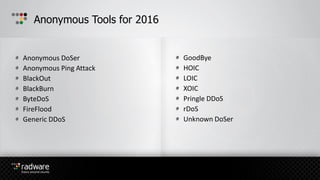
Anonymous DoSer
Anonymous Ping Attack
BlackOut
BlackBurn
ByteDoS
FireFlood
Generic DDoS
GoodBye
HOIC
LOIC
XOIC
Pringle DDoS
rDoS
Unknown DoSer
Anonymous Tools for 2016
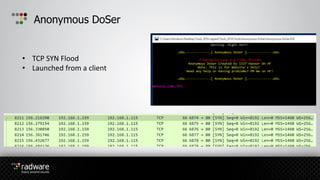
Anonymous DoSer
• TCP SYN Flood
• Launched from a client
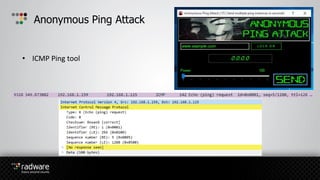
Anonymous Ping Attack
• ICMP Ping tool
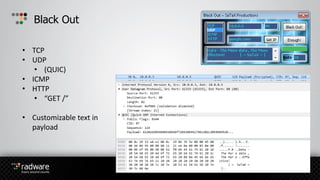
Black Out
• TCP
• UDP
• (QUIC)
• ICMP
• HTTP
• “GET /”
• Customizable text in
payload
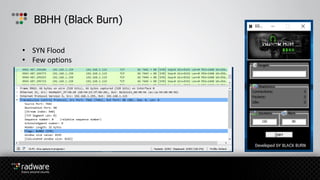
BBHH (Black Burn)
• SYN Flood
• Few options
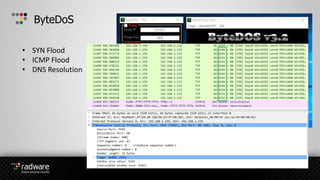
ByteDoS
• SYN Flood
• ICMP Flood
• DNS Resolution
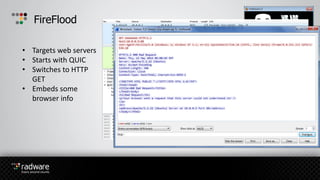
FireFlood
• Targets web servers
• Starts with QUIC
• Switches to HTTP
GET
• Embeds some
browser info
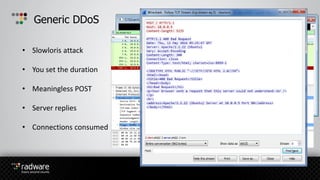
Generic DDoS
• Slowloris attack
• You set the duration
• Meaningless POST
• Server replies
• Connections consumed
HOIC
• Sends HTTP Post and
GET requests
• Allows booster scripts to
enhance attacks,
feeding source data into
attack payload
• Very common, highly
available
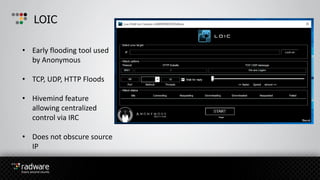
LOIC
• Early flooding tool used
by Anonymous
• TCP, UDP, HTTP Floods
• Hivemind feature
allowing centralized
control via IRC
• Does not obscure source
IP
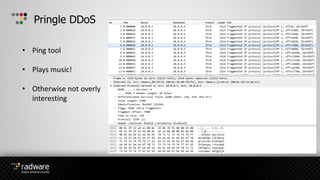
Pringle DDoS
• Ping tool
• Plays music!
• Otherwise not overly
interesting
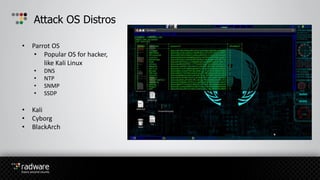
Attack OS Distros
• Parrot OS
• Popular OS for hacker,
like Kali Linux
• DNS
• NTP
• SNMP
• SSDP
• Kali
• Cyborg
• BlackArch
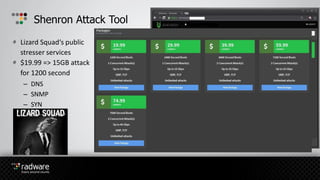
Lizard Squad‘s public
stresser services
$19.99 => 15GB attack
for 1200 second
– DNS
– SNMP
– SYN
Shenron Attack Tool
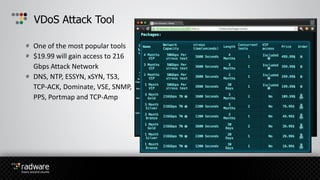
One of the most popular tools
$19.99 will gain access to 216
Gbps Attack Network
DNS, NTP, ESSYN, xSYN, TS3,
TCP-ACK, Dominate, VSE, SNMP,
PPS, Portmap and TCP-Amp
VDoS Attack Tool
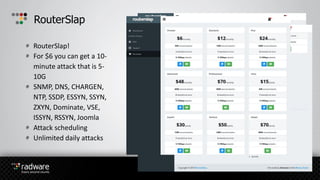
RouterSlap!
For $6 you can get a 10-
minute attack that is 5-
10G
SNMP, DNS, CHARGEN,
NTP, SSDP, ESSYN, SSYN,
ZXYN, Dominate, VSE,
ISSYN, RSSYN, Joomla
Attack scheduling
Unlimited daily attacks
RouterSlap
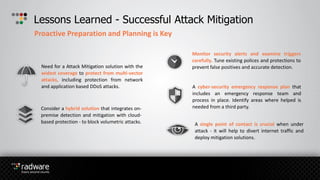
Lessons Learned - Successful Attack Mitigation
Proactive Preparation and Planning is Key
Need for a Attack Mitigation solution with the
widest coverage to protect from multi-vector
attacks, including protection from network
and application based DDoS attacks.
Monitor security alerts and examine triggers
carefully. Tune existing polices and protections to
prevent false positives and accurate detection.
Consider a hybrid solution that integrates on-
premise detection and mitigation with cloud-
based protection - to block volumetric attacks.
A cyber-security emergency response plan that
includes an emergency response team and
process in place. Identify areas where helped is
needed from a third party.
A single point of contact is crucial when under
attack - it will help to divert internet traffic and
deploy mitigation solutions.
© Radware 2016
Thank You
ron.winward@radware.com
www.radware.com
security.radware.com

DDoS Threat Landscape - Ron Winward CHINOG16

  • 1.
    © Radware 2016 RonWinward Security Evangelist Radware May 12, 2016 DDoS Threat Landscape
  • 3.
    DDoS Handbook • Ahistory and overview of DDoS • Review of attack types and tools • DDoS Mitigation Considerations • DDoS Dictionary
  • 4.
    Security Products NowCause of 36% of Downtime DDoS Failure Points within the Network – Internet Pipe Saturation remains single greatest failure point – Stateful firewalls jump from 15% to 26% – Last third take down targeted web/SQL servers
  • 5.
    “Low & Slow”DoS attacks (e.g.Slowloris) Complexity of Attacks Continues to Grow Multi-vector attacks target all layers of the infrastructure IPS/IDS Large volume network flood attacks Syn Floods Network Scan HTTP Floods SSL Floods App Misuse Brute Force On-Demand Cloud DDoS DoS protection Behavioral analysis IPS WAFSSL protection Internet Pipe Firewall Load Balancer/ADC Server Under Attack SQL Server XSS, CSRFSQL Injections
  • 7.
    Types of Attacks AttacksTargeting Network Resources Attacks Targeting Server Resources • UDP • ICMP • IGMP • Reflection • DNS, SSDP, NTP, etc TCP Weaknesses SYN Floods TCP RST TCP PSH+ACK Flood Low and Slow - Sockstress, Slowloris Our current research shows an even split between network and application-layer attacks
  • 8.
    Types of Attacks(cont.) Encrypted Attacks Attacks Targeting App Resources • HTTPS Floods • SSL-based Attacks • THC-SSL-DOS HTTP Flood DNS Flood Slow HTTP GET Request Slow HTTP POST Request RegEx Hash Collision
  • 9.
    User Datagram Protocol(UDP) Connectionless protocol Doesn’t exploit a specific vulnerability Typically spoofed source IPs, often packets are sent to random dest ports Server has to respond with ICMP unreachables Compute resources are consumed Network capacity is consumed UDP Floods
  • 10.
    Internet Control MessageProtocol (ICMP) Connectionless protocol Doesn’t exploit a specific vulnerability Can be any type of ICMP message Volumetric in nature Target has to try and process all of the requests This is why we have ICMP policers on routers  – The premise holds true for all devices that have to respond ICMP Floods
  • 11.
    DNS, SSDP, NTP,etc. Most common attacks today Leverage the disparity between a request and a reply Amplification can be huge Source IP of the request is spoofed as the target’s IP Target is overwhelmed Reflection Attacks
  • 12.
    Protocol exploits Misuse ofthe six control bits, SYN, ACK, RST, PSH, FIN and URG TCP requires a 3-way negotiation in order for a session to be established – SYN, SYN-ACK, ACK – Each request creates a half-open connection Attacks will often send packets in the wrong order to consume resources on the target while it tries to interpret what’s happening TCP Weaknesses
  • 13.
    One of themost common vectors Attacker floods the target with SYN packets from spoofed source IPs Target opens a thread and assigns buffers to prepare for each connection Target sends a SYN-ACK back to the spoofed requestor No response, so target sends more SYN-ACKs until it times out Server is unable to timeout old sessions before new ones can be handled SYN Floods
  • 14.
    SYN Flood Impacton Firewall Bandwidth CPU Impact
  • 15.
    Most common applicationlayer attack Multiple machines continually download the content from a target Target server exhausts resources trying to deliver the content and handle the connections Slow HTTP GET attack also exists HTTP GET Flood
  • 16.
    Common Application Layerattack Essentially holding open connections Can be launched from a single machine Slowloris – Opens connections and sends a partial request – Eventually sends more of the request but not complete request – Connections stay open and max concurrent connections is exhausted Low and Slow Attacks
  • 17.
    Developed by hackinggroup The Hackers Choice (THC) Low and Slow + Encrypted Initiates a regular SSL handshake Immediately requests the renegotiation of the encryption key Continues process until exhaustion How will you see this if it’s an encrypted attack? – Low and slow, so difficult to distinguish from real traffic! Single PC can take down a server THC-SSL-DOS
  • 19.
    Anonymous DoSer Anonymous PingAttack BlackOut BlackBurn ByteDoS FireFlood Generic DDoS GoodBye HOIC LOIC XOIC Pringle DDoS rDoS Unknown DoSer Anonymous Tools for 2016
  • 20.
    Anonymous DoSer • TCPSYN Flood • Launched from a client
  • 21.
  • 22.
    Black Out • TCP •UDP • (QUIC) • ICMP • HTTP • “GET /” • Customizable text in payload
  • 23.
    BBHH (Black Burn) •SYN Flood • Few options
  • 24.
    ByteDoS • SYN Flood •ICMP Flood • DNS Resolution
  • 25.
    FireFlood • Targets webservers • Starts with QUIC • Switches to HTTP GET • Embeds some browser info
  • 26.
    Generic DDoS • Slowlorisattack • You set the duration • Meaningless POST • Server replies • Connections consumed
  • 27.
    HOIC • Sends HTTPPost and GET requests • Allows booster scripts to enhance attacks, feeding source data into attack payload • Very common, highly available
  • 28.
    LOIC • Early floodingtool used by Anonymous • TCP, UDP, HTTP Floods • Hivemind feature allowing centralized control via IRC • Does not obscure source IP
  • 29.
    Pringle DDoS • Pingtool • Plays music! • Otherwise not overly interesting
  • 30.
    Attack OS Distros •Parrot OS • Popular OS for hacker, like Kali Linux • DNS • NTP • SNMP • SSDP • Kali • Cyborg • BlackArch
  • 32.
    Lizard Squad‘s public stresserservices $19.99 => 15GB attack for 1200 second – DNS – SNMP – SYN Shenron Attack Tool
  • 33.
    One of themost popular tools $19.99 will gain access to 216 Gbps Attack Network DNS, NTP, ESSYN, xSYN, TS3, TCP-ACK, Dominate, VSE, SNMP, PPS, Portmap and TCP-Amp VDoS Attack Tool
  • 34.
    RouterSlap! For $6 youcan get a 10- minute attack that is 5- 10G SNMP, DNS, CHARGEN, NTP, SSDP, ESSYN, SSYN, ZXYN, Dominate, VSE, ISSYN, RSSYN, Joomla Attack scheduling Unlimited daily attacks RouterSlap
  • 36.
    Lessons Learned -Successful Attack Mitigation Proactive Preparation and Planning is Key Need for a Attack Mitigation solution with the widest coverage to protect from multi-vector attacks, including protection from network and application based DDoS attacks. Monitor security alerts and examine triggers carefully. Tune existing polices and protections to prevent false positives and accurate detection. Consider a hybrid solution that integrates on- premise detection and mitigation with cloud- based protection - to block volumetric attacks. A cyber-security emergency response plan that includes an emergency response team and process in place. Identify areas where helped is needed from a third party. A single point of contact is crucial when under attack - it will help to divert internet traffic and deploy mitigation solutions.
  • 37.
    © Radware 2016 ThankYou ron.winward@radware.com www.radware.com security.radware.com