Tissue Fluid and Lymph Exchange across the capillaries Formation of tissue fluid Lymph
Exchange across the capillaries
Exchange across the capillaries Substances leave (and enter) capillaries through the walls
Formation of tissue fluid As blood flows through the capillaries some plasma passes into the tissues This  tissue fluid  is very similar to plasma but does not have large plasma protein molecules in it This fluid bathes every cell in the body supplying them with glucose, amino acids, fatty acids, salts and oxygen
Exchange across the capillaries
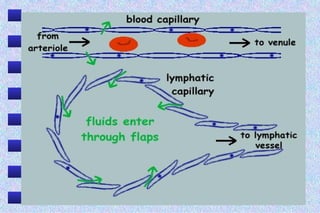
Formation of tissue fluid Tissue fluid also removes carbon dioxide an other waste material from cells As blood enters the narrow capillaries the build up of pressure forces water through the capillary walls into the cells. Other substances move out by diffusion or active transport
Formation of tissue fluid As blood leaves the capillaries into has lost a lot of its water and so is far more concentrated So water passes back into the capillary by osmosis Waste products leave the cells and enter the capillaries by diffusion
Exchange across the capillaries
Lymph Not all the fluid returns to the blood capillary 10% enters a separate system of microscopic tubes called  lymph capillaries These are part of the  lymph system Lymph vessels have valves that let fluid enter but not leave them The lymph capillaries join to form  lymph vessels
 
Lymph Fluid in the Blood is called  plasma Surrounding the cells is called  tissue fluid In the lymphatic system is called  lymph There is very little difference between these three!
Lymph
Lymph Flow of liquid through the lymph system is very slow It depends on movement of our muscles, the valves in the vessels and the negative pressure in chest when we breath in. Flow is in one direction only, from tissues towards the heart.
Lymph Most of the lymph re-enters the blood stream at the subclavian veins under the collar bones Lymph is a milky looking fluid Digested fat is absorbed into the lymph through the lacteals in the villi of the small intestine
 
 
Lymph At intervals along the lymph vessels are structures called  lymph nodes These are part of the immune system Lymphocytes  are produced in the lymph nodes
 
Lymph Lymphocytes are white blood cells that produce antibodies The lymph nodes swell up at times of infection

Tissue Fluid And Lymph

  • 1.
    Tissue Fluid andLymph Exchange across the capillaries Formation of tissue fluid Lymph
  • 2.
  • 3.
    Exchange across thecapillaries Substances leave (and enter) capillaries through the walls
  • 4.
    Exchange across thecapillaries Substances leave (and enter) capillaries through the walls
  • 5.
    Formation of tissuefluid As blood flows through the capillaries some plasma passes into the tissues This tissue fluid is very similar to plasma but does not have large plasma protein molecules in it This fluid bathes every cell in the body supplying them with glucose, amino acids, fatty acids, salts and oxygen
  • 6.
  • 7.
    Formation of tissuefluid Tissue fluid also removes carbon dioxide an other waste material from cells As blood enters the narrow capillaries the build up of pressure forces water through the capillary walls into the cells. Other substances move out by diffusion or active transport
  • 8.
    Formation of tissuefluid As blood leaves the capillaries into has lost a lot of its water and so is far more concentrated So water passes back into the capillary by osmosis Waste products leave the cells and enter the capillaries by diffusion
  • 9.
  • 10.
    Lymph Not allthe fluid returns to the blood capillary 10% enters a separate system of microscopic tubes called lymph capillaries These are part of the lymph system Lymph vessels have valves that let fluid enter but not leave them The lymph capillaries join to form lymph vessels
  • 11.
  • 12.
    Lymph Fluid inthe Blood is called plasma Surrounding the cells is called tissue fluid In the lymphatic system is called lymph There is very little difference between these three!
  • 13.
  • 14.
    Lymph Flow ofliquid through the lymph system is very slow It depends on movement of our muscles, the valves in the vessels and the negative pressure in chest when we breath in. Flow is in one direction only, from tissues towards the heart.
  • 15.
    Lymph Most ofthe lymph re-enters the blood stream at the subclavian veins under the collar bones Lymph is a milky looking fluid Digested fat is absorbed into the lymph through the lacteals in the villi of the small intestine
  • 16.
  • 17.
  • 18.
    Lymph At intervalsalong the lymph vessels are structures called lymph nodes These are part of the immune system Lymphocytes are produced in the lymph nodes
  • 19.
  • 20.
    Lymph Lymphocytes arewhite blood cells that produce antibodies The lymph nodes swell up at times of infection

Editor's Notes