WELCOME TO OUR PRESENTATION

GROUP 10
TOPIC: INTEREST RATE POLICY IN US
CONTENT
I
II
III
The federal funds rate
The discount rate
The zero interest rate policy
I. The federal funds rate (FFR)
1. Definition
2. The features of
FFR
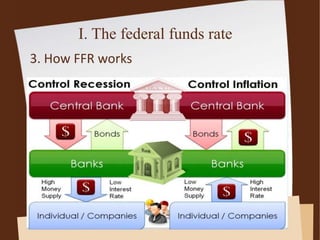
3. How FFR works
I. The federal funds rate
• The interest rate at which banks and other
depository institutions lend money to each
other, usually on an overnight basis. The law
requires banks to keep a certain percentage of
their customer's money on reserve, where the
banks earn no interest on it. Consequently,
banks try to stay as close to the reserve limit
as possible without going under it, lending
money back and forth to maintain the proper
level.
1.
Defintion
I. The federal funds rate
2. The features of FFR
 FFR is determined by market.
 FFR is an important benchmark in financial
markets.
 The higher the FFR,the more expensive it
is to borrow money.
I. The federal funds rate
3. How FFR works
II. The discount rate
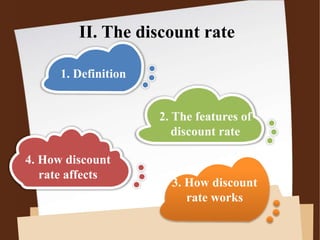
1. Definition
2. The features of
discount rate
4. How discount
rate affects
3. How discount
rate works
II. The discount rate
1. Definition
The discount rate is the interest rate charged to
commercial banks and other depository
institutions on loans they receive from their
regional Federal Reserve Bank's lending facility-
-the discount window.
2. The features of discount rate
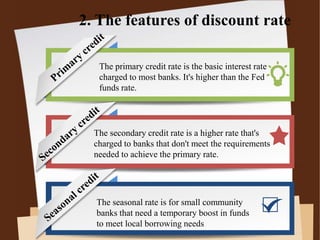
The primary credit rate is the basic interest rate
charged to most banks. It's higher than the Fed
funds rate.
The secondary credit rate is a higher rate that's
charged to banks that don't meet the requirements
needed to achieve the primary rate.
The seasonal rate is for small community
banks that need a temporary boost in funds
to meet local borrowing needs
2. The features of discount rate
3. How discount rate works
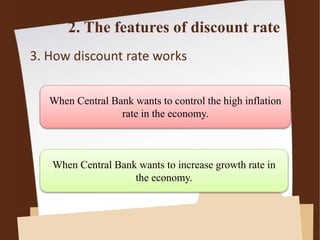
When Central Bank wants to control the high inflation
rate in the economy.
When Central Bank wants to increase growth rate in
the economy.
II. The discount rate
4. How discount rate affects
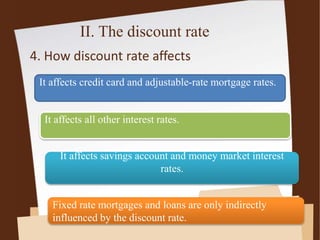
It affects credit card and adjustable-rate mortgage rates.
It affects all other interest rates.
It affects savings account and money market interest
rates.
Fixed rate mortgages and loans are only indirectly
influenced by the discount rate.
III. Zero interest rate policy (zirp)
1. Definition
2. Reality of ZIRP
3. Regular interest
rate adjustments
III. Zero interest rate policy
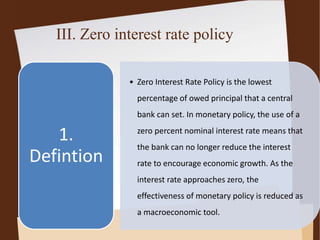
• Zero Interest Rate Policy is the lowest
percentage of owed principal that a central
bank can set. In monetary policy, the use of a
zero percent nominal interest rate means that
the bank can no longer reduce the interest
rate to encourage economic growth. As the
interest rate approaches zero, the
effectiveness of monetary policy is reduced as
a macroeconomic tool.
1.
Defintion
III. Zero interest rate policy
2. Reality of ZIRP
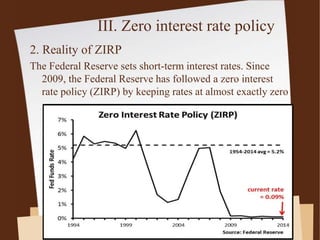
The Federal Reserve sets short-term interest rates. Since
2009, the Federal Reserve has followed a zero interest
rate policy (ZIRP) by keeping rates at almost exactly zero
III. Zero interest rate policy
2. Reality of ZIRP
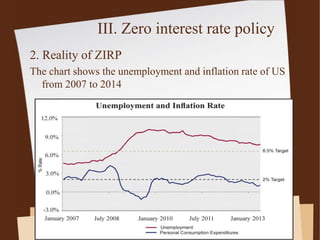
The chart shows the unemployment and inflation rate of US
from 2007 to 2014
III. Zero interest rate policy
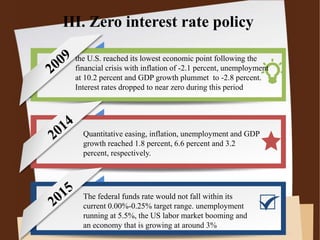
the U.S. reached its lowest economic point following the
financial crisis with inflation of -2.1 percent, unemployment
at 10.2 percent and GDP growth plummet to -2.8 percent.
Interest rates dropped to near zero during this period
Quantitative easing, inflation, unemployment and GDP
growth reached 1.8 percent, 6.6 percent and 3.2
percent, respectively.
The federal funds rate would not fall within its
current 0.00%-0.25% target range. unemployment
running at 5.5%, the US labor market booming and
an economy that is growing at around 3%
III. Zero interest rate policy
3. Regular interest rate adjustments
Short-term rates are raised to keep the economy from building too
fast and risking inflation when the economy is growing.
Lower short-term rates when the economy is contracting or
slowing.
cut short-term rates which is cutting the rate that banks charge
each other to borrow money.
www.PowerPointDep.net

zero interest rate policy in US

  • 1.
    WELCOME TO OURPRESENTATION  GROUP 10
  • 2.
  • 3.
    CONTENT I II III The federal fundsrate The discount rate The zero interest rate policy
  • 4.
    I. The federalfunds rate (FFR) 1. Definition 2. The features of FFR 3. How FFR works
  • 5.
    I. The federalfunds rate • The interest rate at which banks and other depository institutions lend money to each other, usually on an overnight basis. The law requires banks to keep a certain percentage of their customer's money on reserve, where the banks earn no interest on it. Consequently, banks try to stay as close to the reserve limit as possible without going under it, lending money back and forth to maintain the proper level. 1. Defintion
  • 6.
    I. The federalfunds rate 2. The features of FFR  FFR is determined by market.  FFR is an important benchmark in financial markets.  The higher the FFR,the more expensive it is to borrow money.
  • 7.
    I. The federalfunds rate 3. How FFR works
  • 8.
    II. The discountrate 1. Definition 2. The features of discount rate 4. How discount rate affects 3. How discount rate works
  • 9.
    II. The discountrate 1. Definition The discount rate is the interest rate charged to commercial banks and other depository institutions on loans they receive from their regional Federal Reserve Bank's lending facility- -the discount window.
  • 10.
    2. The featuresof discount rate The primary credit rate is the basic interest rate charged to most banks. It's higher than the Fed funds rate. The secondary credit rate is a higher rate that's charged to banks that don't meet the requirements needed to achieve the primary rate. The seasonal rate is for small community banks that need a temporary boost in funds to meet local borrowing needs
  • 11.
    2. The featuresof discount rate 3. How discount rate works When Central Bank wants to control the high inflation rate in the economy. When Central Bank wants to increase growth rate in the economy.
  • 12.
    II. The discountrate 4. How discount rate affects It affects credit card and adjustable-rate mortgage rates. It affects all other interest rates. It affects savings account and money market interest rates. Fixed rate mortgages and loans are only indirectly influenced by the discount rate.
  • 13.
    III. Zero interestrate policy (zirp) 1. Definition 2. Reality of ZIRP 3. Regular interest rate adjustments
  • 14.
    III. Zero interestrate policy • Zero Interest Rate Policy is the lowest percentage of owed principal that a central bank can set. In monetary policy, the use of a zero percent nominal interest rate means that the bank can no longer reduce the interest rate to encourage economic growth. As the interest rate approaches zero, the effectiveness of monetary policy is reduced as a macroeconomic tool. 1. Defintion
  • 15.
    III. Zero interestrate policy 2. Reality of ZIRP The Federal Reserve sets short-term interest rates. Since 2009, the Federal Reserve has followed a zero interest rate policy (ZIRP) by keeping rates at almost exactly zero
  • 16.
    III. Zero interestrate policy 2. Reality of ZIRP The chart shows the unemployment and inflation rate of US from 2007 to 2014
  • 17.
    III. Zero interestrate policy the U.S. reached its lowest economic point following the financial crisis with inflation of -2.1 percent, unemployment at 10.2 percent and GDP growth plummet to -2.8 percent. Interest rates dropped to near zero during this period Quantitative easing, inflation, unemployment and GDP growth reached 1.8 percent, 6.6 percent and 3.2 percent, respectively. The federal funds rate would not fall within its current 0.00%-0.25% target range. unemployment running at 5.5%, the US labor market booming and an economy that is growing at around 3%
  • 18.
    III. Zero interestrate policy 3. Regular interest rate adjustments Short-term rates are raised to keep the economy from building too fast and risking inflation when the economy is growing. Lower short-term rates when the economy is contracting or slowing. cut short-term rates which is cutting the rate that banks charge each other to borrow money.
  • 19.