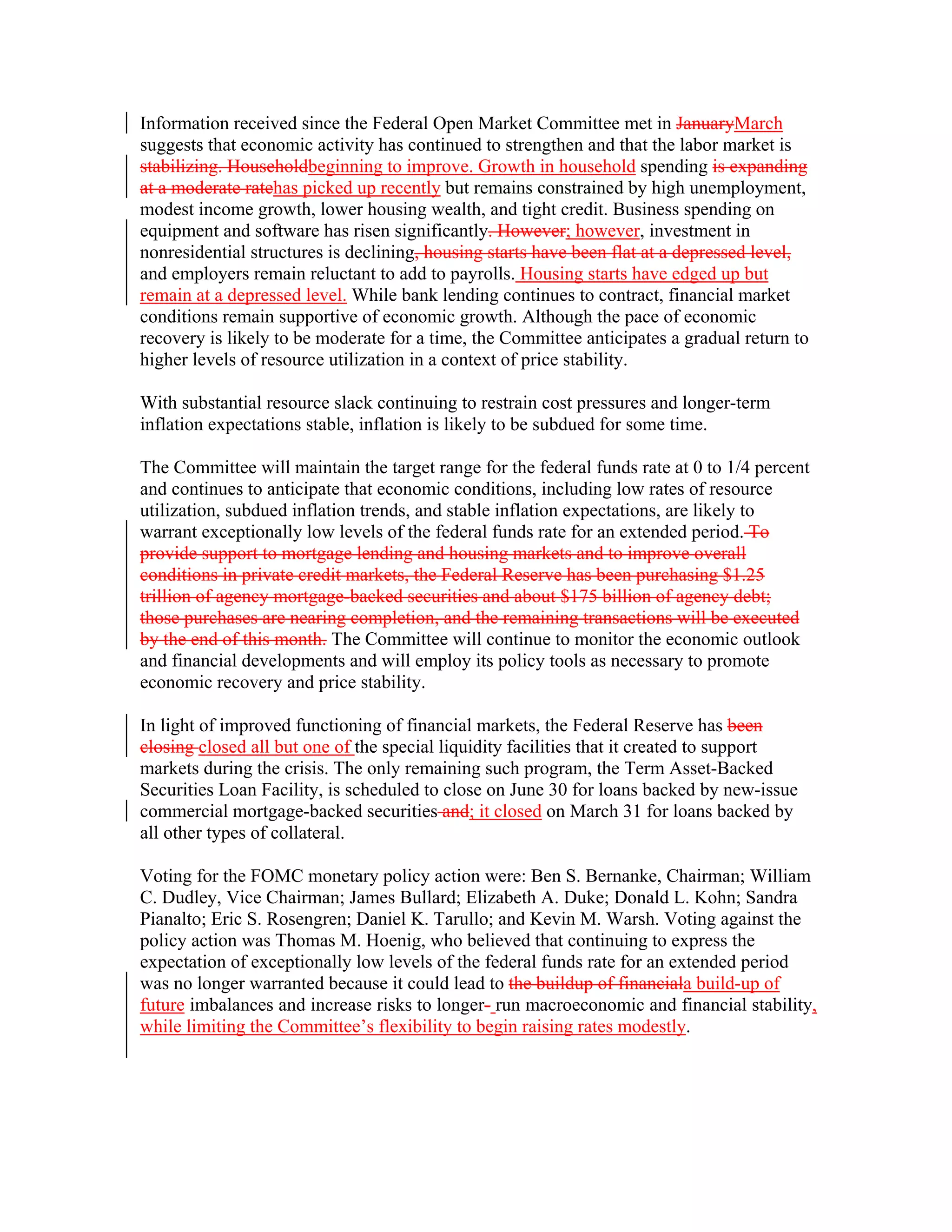
Information received since the Federal Open Market Committee met in JanuaryMarch
suggests that economic activity has continued to strengthen and that the labor market is
stabilizing. Householdbeginning to improve. Growth in household spending is expanding
at a moderate ratehas picked up recently but remains constrained by high unemployment,
modest income growth, lower housing wealth, and tight credit. Business spending on
equipment and software has risen significantly. However; however, investment in
nonresidential structures is declining, housing starts have been flat at a depressed level,
and employers remain reluctant to add to payrolls. Housing starts have edged up but
remain at a depressed level. While bank lending continues to contract, financial market
conditions remain supportive of economic growth. Although the pace of economic
recovery is likely to be moderate for a time, the Committee anticipates a gradual return to
higher levels of resource utilization in a context of price stability.

With substantial resource slack continuing to restrain cost pressures and longer-term
inflation expectations stable, inflation is likely to be subdued for some time.

The Committee will maintain the target range for the federal funds rate at 0 to 1/4 percent
and continues to anticipate that economic conditions, including low rates of resource
utilization, subdued inflation trends, and stable inflation expectations, are likely to
warrant exceptionally low levels of the federal funds rate for an extended period. To
provide support to mortgage lending and housing markets and to improve overall
conditions in private credit markets, the Federal Reserve has been purchasing $1.25
trillion of agency mortgage-backed securities and about $175 billion of agency debt;
those purchases are nearing completion, and the remaining transactions will be executed
by the end of this month. The Committee will continue to monitor the economic outlook
and financial developments and will employ its policy tools as necessary to promote
economic recovery and price stability.

In light of improved functioning of financial markets, the Federal Reserve has been
closing closed all but one of the special liquidity facilities that it created to support
markets during the crisis. The only remaining such program, the Term Asset-Backed
Securities Loan Facility, is scheduled to close on June 30 for loans backed by new-issue
commercial mortgage-backed securities and; it closed on March 31 for loans backed by
all other types of collateral.

Voting for the FOMC monetary policy action were: Ben S. Bernanke, Chairman; William
C. Dudley, Vice Chairman; James Bullard; Elizabeth A. Duke; Donald L. Kohn; Sandra
Pianalto; Eric S. Rosengren; Daniel K. Tarullo; and Kevin M. Warsh. Voting against the
policy action was Thomas M. Hoenig, who believed that continuing to express the
expectation of exceptionally low levels of the federal funds rate for an extended period
was no longer warranted because it could lead to the buildup of financiala build-up of
future imbalances and increase risks to longer- run macroeconomic and financial stability,
while limiting the Committee’s flexibility to begin raising rates modestly.

Fomc changes.doc

  • 1.
    Information received sincethe Federal Open Market Committee met in JanuaryMarch suggests that economic activity has continued to strengthen and that the labor market is stabilizing. Householdbeginning to improve. Growth in household spending is expanding at a moderate ratehas picked up recently but remains constrained by high unemployment, modest income growth, lower housing wealth, and tight credit. Business spending on equipment and software has risen significantly. However; however, investment in nonresidential structures is declining, housing starts have been flat at a depressed level, and employers remain reluctant to add to payrolls. Housing starts have edged up but remain at a depressed level. While bank lending continues to contract, financial market conditions remain supportive of economic growth. Although the pace of economic recovery is likely to be moderate for a time, the Committee anticipates a gradual return to higher levels of resource utilization in a context of price stability. With substantial resource slack continuing to restrain cost pressures and longer-term inflation expectations stable, inflation is likely to be subdued for some time. The Committee will maintain the target range for the federal funds rate at 0 to 1/4 percent and continues to anticipate that economic conditions, including low rates of resource utilization, subdued inflation trends, and stable inflation expectations, are likely to warrant exceptionally low levels of the federal funds rate for an extended period. To provide support to mortgage lending and housing markets and to improve overall conditions in private credit markets, the Federal Reserve has been purchasing $1.25 trillion of agency mortgage-backed securities and about $175 billion of agency debt; those purchases are nearing completion, and the remaining transactions will be executed by the end of this month. The Committee will continue to monitor the economic outlook and financial developments and will employ its policy tools as necessary to promote economic recovery and price stability. In light of improved functioning of financial markets, the Federal Reserve has been closing closed all but one of the special liquidity facilities that it created to support markets during the crisis. The only remaining such program, the Term Asset-Backed Securities Loan Facility, is scheduled to close on June 30 for loans backed by new-issue commercial mortgage-backed securities and; it closed on March 31 for loans backed by all other types of collateral. Voting for the FOMC monetary policy action were: Ben S. Bernanke, Chairman; William C. Dudley, Vice Chairman; James Bullard; Elizabeth A. Duke; Donald L. Kohn; Sandra Pianalto; Eric S. Rosengren; Daniel K. Tarullo; and Kevin M. Warsh. Voting against the policy action was Thomas M. Hoenig, who believed that continuing to express the expectation of exceptionally low levels of the federal funds rate for an extended period was no longer warranted because it could lead to the buildup of financiala build-up of future imbalances and increase risks to longer- run macroeconomic and financial stability, while limiting the Committee’s flexibility to begin raising rates modestly.