SAGAR INSTITUTE OF RESEARCH & TECHNOLOGY-
EXCELLENCE, BHOPAL
DIPLOMA
IN
MECHANICAL ENGINEERING
Submitted by
NEHAL AHMAD [Enroll. 16147M02071]
WASEEM AKHTAR [Enroll.
16147M02116]
SOMESH MATHORE [Enroll.
16147M02104]
"HOME MADE PVC WIND TURBINE"
INDEX
 Abstract
 Introduction
 Components
 Turbine Monitoring And Diagnostics
 Pvc Wind Turbine
 Operability
 Conclusion
 Referenced
ABSTRACT:
Growing concern for the environment degradation has led to the
world’s interest in renewable energy sources. Wind energy is
rapidly emerging as one of the most cost-effective forms of
renewable energy with very significant increases in annual
installed capacity being reported around the world. The favoured
form of turbines used for electricity generation purposes is the
Horizontal Axis Wind Turbine (HAWT) with low solidity ratio
(ratio of blade area to swept area) and high tip speed ratio, λ =
ΩR/Vwind, where R is the radius of the blades and Vwind is the
wind velocity.
INTRODUCTION
 A wind turbine, or alternatively referred to as a wind energy
converter, is a device that converts the wind's kinetic
energy into electrical energy.
 Wind turbines are manufactured in a wide range of vertical and
horizontal axis. The smallest turbines are used for applications
such as battery charging for auxiliary power for boats
or caravans or to power traffic warning signs. Larger turbines
can be used for making contributions to a domestic power
supply while selling unused power back to the utility supplier
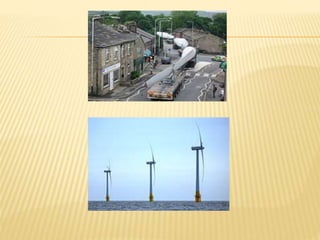
via the electrical grid. Arrays of large turbines, known as wind
farms, are becoming an increasingly important source of
intermittent renewable energy and are used by many countries
as part of a strategy to reduce their reliance on fossil fuels. One
assessment claimed that, as of 2009, wind had the "lowest
relative greenhouse gas emissions, the least water consumption
demands and... the most favourable social impacts" compared
to photovoltaic, hydro, geothermal, coal and gas.
RESOURCES
Wind Power Density (WPD) is a quantitative measure of wind energy
available at any location. It is the mean annual power available per
square meter of swept area of a turbine, and is calculated for different
heights above ground. Calculation of wind power density includes the
effect of wind velocity and air density.[13]
Wind turbines are classified by the wind speed they are designed for,
from class I to class III, with A to C referring to the turbulence intensity
of the wind. [14]
EFFICIENCY
Wind-to-rotor efficiency (including rotor blade friction and drag)
are among the factors impacting the final price of wind
power.[16] Further inefficiencies, such as gearbox losses, generator
and converter losses, reduce the power delivered by a wind
turbine. To protect components from undue wear, extracted power
is held constant above the rated operating speed as theoretical
power increases at the cube of wind speed, further reducing
theoretical efficiency. In 2001, commercial utility-connected
turbines deliver 75% to 80% of the Betz limit of power extractable
from the wind, at rated operating speed
Parallel
The parallel turbine is similar to the crossflow fan or centrifugal
fan. It uses the ground effect. Vertical axis turbines of this type
have been tried for many years: a unit producing 10 kW was built
by Israeli wind pioneer Bruce Brill in the 1980s.
COMPONENTS
Wind turbines convert wind energy to electrical energy for
distribution. Conventional horizontal axis turbines can be divided
into three components:
The rotor, which is approximately 20% of the wind turbine cost,
includes the blades for converting wind energy to low speed
rotational energy.
The generator, which is approximately 34% of the wind turbine
cost, includes the electrical generator,[43][44] the control
electronics, and most likely a gear box (e.g. planetary gear
box),[45] adjustable-speed drive or continuously variable
transmission[46] component for converting the low-speed
incoming rotation to high-speed rotation suitable for generating
electricity.
The surrounding structure, which is approximately 15% of the
wind turbine cost, includes the tower and rotor yaw
mechanism.[47]
TURBINE MONITORING AND DIAGNOSTICS
Turbine monitoring and diagnostics
Due to data transmission problems, structural health monitoring of
wind turbines is usually performed using several accelerometers
and strain gages attached to the nacelle to monitor the gearbox and
equipments. Currently, digital image correlation and
stereophotogrammetry are used to measure dynamics of wind
turbine blades. These methods usually measure displacement and
strain to identify location of defects. Dynamic characteristics of
non-rotating wind turbines have been measured using digital
image correlation and photogrammetry.[49]Three dimensional point
tracking has also been used to measure rotating dynamics of wind
turbines.[50]
NEW DESIGNS
As competition in the wind market increases, companies are seeking
ways to draw greater efficiency from their designs. One of the
predominant ways wind turbines have gained performance is by
increasing rotor diameters, and thus blade length. Retrofitting current
turbines with larger blades mitigates the need and risks associated
with a system-level redesign. As the size of the blade increases, its
tendency to deflect also increases. Thus, from a materials
Materials for blades
Some of the most common materials which are being used for turbine
blades now and will be in the future are summarized below:
PVC WIND TURBINE
PVC WIND TURBINE
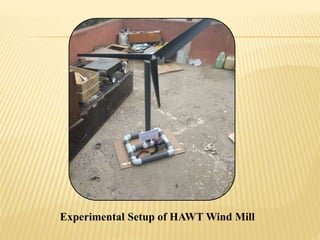
Conceptual Development of the HAWT Figure 3 shows the
experimental setup of windmill using PVC as blade materials.
PVC blades are an excellent, quick, light, cheap and very easy.
There has been some development in using large diameter PVC
pipe as blade material. By cutting a PVC pipe lengthways and
reshaping the leading and trailing edge with a file, and achieve a
near perfect blade profile, and the process is simple.
Experimental Setup of HAWT Wind Mill
OPERABILITY
Wind turbines need regular maintenance to
stay reliable and available. In the best case turbines are available to
generate energy 98% of the time.[71][72]
Modern turbines usually have a small onboard crane for hoisting
maintenance tools and minor components. However, large heavy
components like generator, gearbox, blades and so on are rarely
replaced and a heavy lift external crane is needed in those cases. If
the turbine has a difficult access road, a containerized crane can be
lifted up by the internal crane to provide heavier lifting.[73]
MAINTENANCE
Repowering
Main article: Repowering
Installation of new wind turbines can be controversial. An
alternative is repowering, where existing wind turbines are
replaced with bigger, more powerful ones, sometimes in smaller
numbers while keeping or increasing capacity.
Demolition
Older turbines were in some early cases not required to be
removed when reaching the end of their life. Some still stand,
waiting to be recycled or repowered.[74][75]
CONCLUSION
On the earth, the search of safe clean and renewable energy is lesser, so
we should use maximum renewable energy of the earth as wind. The
mechanical and electrical energy is produced by wind energy using
wind turbine at high altitude and seashore and open spaces. The present
work demonstrates that PVC blade profile gives better power capacity
with respect to increase in rotational speed of rotor. Further testing is
required to confirm these initial tests. The project has proven to provide
very successful training in wind energy for engineering undergraduate
students.
REFERENCES:
1. Patel M.R. 1999. Wind and Solar Power Systems. CRC Press,
New York.
2. Burton T., Sharpe D., Jenkins N., Bossanyi E. 2001. Wind Energy
Handbook. John Wiley & Sons, New York.
3. Spera D.A. 1994. Wind Turbine Technology: Fundamental
Concepts of Wind Turbine Engineering. Chapter 9, ASME Press,
New York
4. Jagadeesh A. 2000. Wind energy development in Tamil Nadu and
Andhra Pradesh, IndiaInstitutional dynamics and barriers - A case
study. Energy Policy, 28 (1), 157-168.
5. MNES. 2006. Annual Report: 2005-06. Ministry of
Nonconventional Energy Sources, Govt. of India, New Delhi.
THANK YOU

ppt.pptx

  • 1.
    SAGAR INSTITUTE OFRESEARCH & TECHNOLOGY- EXCELLENCE, BHOPAL DIPLOMA IN MECHANICAL ENGINEERING Submitted by NEHAL AHMAD [Enroll. 16147M02071] WASEEM AKHTAR [Enroll. 16147M02116] SOMESH MATHORE [Enroll. 16147M02104] "HOME MADE PVC WIND TURBINE"
  • 2.
    INDEX  Abstract  Introduction Components  Turbine Monitoring And Diagnostics  Pvc Wind Turbine  Operability  Conclusion  Referenced
  • 3.
    ABSTRACT: Growing concern forthe environment degradation has led to the world’s interest in renewable energy sources. Wind energy is rapidly emerging as one of the most cost-effective forms of renewable energy with very significant increases in annual installed capacity being reported around the world. The favoured form of turbines used for electricity generation purposes is the Horizontal Axis Wind Turbine (HAWT) with low solidity ratio (ratio of blade area to swept area) and high tip speed ratio, λ = ΩR/Vwind, where R is the radius of the blades and Vwind is the wind velocity.
  • 4.
  • 5.
     A windturbine, or alternatively referred to as a wind energy converter, is a device that converts the wind's kinetic energy into electrical energy.  Wind turbines are manufactured in a wide range of vertical and horizontal axis. The smallest turbines are used for applications such as battery charging for auxiliary power for boats or caravans or to power traffic warning signs. Larger turbines can be used for making contributions to a domestic power supply while selling unused power back to the utility supplier via the electrical grid. Arrays of large turbines, known as wind farms, are becoming an increasingly important source of intermittent renewable energy and are used by many countries as part of a strategy to reduce their reliance on fossil fuels. One assessment claimed that, as of 2009, wind had the "lowest relative greenhouse gas emissions, the least water consumption demands and... the most favourable social impacts" compared to photovoltaic, hydro, geothermal, coal and gas.
  • 6.
    RESOURCES Wind Power Density(WPD) is a quantitative measure of wind energy available at any location. It is the mean annual power available per square meter of swept area of a turbine, and is calculated for different heights above ground. Calculation of wind power density includes the effect of wind velocity and air density.[13] Wind turbines are classified by the wind speed they are designed for, from class I to class III, with A to C referring to the turbulence intensity of the wind. [14]
  • 7.
    EFFICIENCY Wind-to-rotor efficiency (includingrotor blade friction and drag) are among the factors impacting the final price of wind power.[16] Further inefficiencies, such as gearbox losses, generator and converter losses, reduce the power delivered by a wind turbine. To protect components from undue wear, extracted power is held constant above the rated operating speed as theoretical power increases at the cube of wind speed, further reducing theoretical efficiency. In 2001, commercial utility-connected turbines deliver 75% to 80% of the Betz limit of power extractable from the wind, at rated operating speed
  • 10.
    Parallel The parallel turbineis similar to the crossflow fan or centrifugal fan. It uses the ground effect. Vertical axis turbines of this type have been tried for many years: a unit producing 10 kW was built by Israeli wind pioneer Bruce Brill in the 1980s.
  • 11.
  • 12.
    Wind turbines convertwind energy to electrical energy for distribution. Conventional horizontal axis turbines can be divided into three components: The rotor, which is approximately 20% of the wind turbine cost, includes the blades for converting wind energy to low speed rotational energy. The generator, which is approximately 34% of the wind turbine cost, includes the electrical generator,[43][44] the control electronics, and most likely a gear box (e.g. planetary gear box),[45] adjustable-speed drive or continuously variable transmission[46] component for converting the low-speed incoming rotation to high-speed rotation suitable for generating electricity. The surrounding structure, which is approximately 15% of the wind turbine cost, includes the tower and rotor yaw mechanism.[47]
  • 13.
    TURBINE MONITORING ANDDIAGNOSTICS Turbine monitoring and diagnostics Due to data transmission problems, structural health monitoring of wind turbines is usually performed using several accelerometers and strain gages attached to the nacelle to monitor the gearbox and equipments. Currently, digital image correlation and stereophotogrammetry are used to measure dynamics of wind turbine blades. These methods usually measure displacement and strain to identify location of defects. Dynamic characteristics of non-rotating wind turbines have been measured using digital image correlation and photogrammetry.[49]Three dimensional point tracking has also been used to measure rotating dynamics of wind turbines.[50]
  • 14.
    NEW DESIGNS As competitionin the wind market increases, companies are seeking ways to draw greater efficiency from their designs. One of the predominant ways wind turbines have gained performance is by increasing rotor diameters, and thus blade length. Retrofitting current turbines with larger blades mitigates the need and risks associated with a system-level redesign. As the size of the blade increases, its tendency to deflect also increases. Thus, from a materials Materials for blades Some of the most common materials which are being used for turbine blades now and will be in the future are summarized below:
  • 15.
  • 16.
  • 17.
    Conceptual Development ofthe HAWT Figure 3 shows the experimental setup of windmill using PVC as blade materials. PVC blades are an excellent, quick, light, cheap and very easy. There has been some development in using large diameter PVC pipe as blade material. By cutting a PVC pipe lengthways and reshaping the leading and trailing edge with a file, and achieve a near perfect blade profile, and the process is simple.
  • 18.
    Experimental Setup ofHAWT Wind Mill
  • 19.
  • 20.
    Wind turbines needregular maintenance to stay reliable and available. In the best case turbines are available to generate energy 98% of the time.[71][72] Modern turbines usually have a small onboard crane for hoisting maintenance tools and minor components. However, large heavy components like generator, gearbox, blades and so on are rarely replaced and a heavy lift external crane is needed in those cases. If the turbine has a difficult access road, a containerized crane can be lifted up by the internal crane to provide heavier lifting.[73] MAINTENANCE
  • 21.
    Repowering Main article: Repowering Installationof new wind turbines can be controversial. An alternative is repowering, where existing wind turbines are replaced with bigger, more powerful ones, sometimes in smaller numbers while keeping or increasing capacity. Demolition Older turbines were in some early cases not required to be removed when reaching the end of their life. Some still stand, waiting to be recycled or repowered.[74][75]
  • 22.
    CONCLUSION On the earth,the search of safe clean and renewable energy is lesser, so we should use maximum renewable energy of the earth as wind. The mechanical and electrical energy is produced by wind energy using wind turbine at high altitude and seashore and open spaces. The present work demonstrates that PVC blade profile gives better power capacity with respect to increase in rotational speed of rotor. Further testing is required to confirm these initial tests. The project has proven to provide very successful training in wind energy for engineering undergraduate students.
  • 23.
    REFERENCES: 1. Patel M.R.1999. Wind and Solar Power Systems. CRC Press, New York. 2. Burton T., Sharpe D., Jenkins N., Bossanyi E. 2001. Wind Energy Handbook. John Wiley & Sons, New York. 3. Spera D.A. 1994. Wind Turbine Technology: Fundamental Concepts of Wind Turbine Engineering. Chapter 9, ASME Press, New York 4. Jagadeesh A. 2000. Wind energy development in Tamil Nadu and Andhra Pradesh, IndiaInstitutional dynamics and barriers - A case study. Energy Policy, 28 (1), 157-168. 5. MNES. 2006. Annual Report: 2005-06. Ministry of Nonconventional Energy Sources, Govt. of India, New Delhi.
  • 24.