A Major Project-II
Report On
AN EXPERIMENT STUDY ON MODIFICATION OF GEOTECHNICAL PROPERTIES OF EXPANSIVE SOIL THROUGH COCONUT FIBRE AND
LIME
Submitted In
Partial Fulfillment of the Requirement for the Awarded of Degree of
Bachelor of Technology in Civil Engineering
Submitted To
Rajiv Gandhi Proudyogiki Vishwavidyalaya, Bhopal (M.P.)
Submitted by
ABU SUFIYAN 0191CE191004
MD QUAMAR TANWEER 0191CE191053
ABHINAV PRIYADARSHI 0191CE191002
ANWAR KHAN 0191CE191012
RAHUL PANDEY 0191CE203D24
Under the Guidance of
Prof. Alka Patel Singh
DEPARTMENT OF CIVIL ENGINEERING
TECHNOCRATS INSTITUTE OF TECHNOLOGY (EXCELLENCE), BHOPAL (M.P.)
SESSION:2022-23
Contents
1. INTRODUCTION
2. LITERATURE REVIEW
3. MATERIALS & METHODOLOGY
4. EXPERIMENTAL WORK
5. RESULT & DISCUSSION
6. CONCLUSION
7. FUTURE SCOPES AND STUDY
8. REFERENCES
INTRODUCTION
Indian soil deposits are predominated majorly by expansive soil deposits also referred as Black cotton soil. They have
an extensive ability to swell and shrink on exposure to variation in moisture content The rate of montmorillonite being
more in black cotton soil is the major cause of this expansiveness and cracking. This property has been found to be
most troublesome particularly from construction aspect as it happens in soil without any cautioning. The black cotton
soil is being widely found in arid and semi-arid regions on earth. It is found in every state in India especially in central
and Deccan plateau between 73°80' East longitude and 15°24' north latitude, covering an area of about one-six. Thus,
most of the soil in and around Mumbai, Madras, Gwalior, Khandwa, Indore, Nagpur and even some on the river banks
is Black cotton. That means these soils are predominant in states of Andhra Pradesh, Western Madhya Pradesh,
Gujarat, Maharashtra, Northern Karnataka and Tamil Nadu Expansive soils cover nearly 20% of the landmass in India.
Following types of soil Stabilisation.
i. Mechanical Stabilization is suitable for low volume roads which involves the correct proportioning of aggregates
and soil which are adequately compacted to get mechanically stable layer.
ii. Soil Cement Stabilization is an intimate mix of soil, cement and water, compacted to form a strong base course &
to increase compressive strength of the soil layer. Soil Cement can be used as a sub-base or base course for all types
of Pavements.
iii. Soil Lime Stabilization Soil-Lime has been widely used as a modifier or a binder for a high plastic soils which
imparts binding action even for a granular soils.
iv. Soil-Bituminous Stabilization Bitumen Stabilized layer may be used as Sub-base or base course for all the roads in
which the basic principles of this stabilization are Water Proofing and Binding of soil components which enhances
its strength & the most commonly used materials are cut back & emulsion.
v. Lime Fly ash Stabilization Can be used for construction of Embankments, Rigid and semi-rigid pavements. Fly ash
properties vary widely & thus to be characterized before it is used for stabilization of soil layer. The major
constituents of fly ash are oxides of silica, aluminum, iron, calcium & magnesium which Possesses many favorable
properties for embankment & road construction, fly ash is also termed as environmentally safe material which
enhances the properties of soil.
LITERATURE REVIEW
LITERATURE REVIEW of LIME STABILIZED SOILS:
The structural distress caused by expansive soils is well documented in literature (Petry & Little 2002; Fall & Sarr
2007; Ozer et al. 2011; Tiwari et al. 2012; Li, J et al. 2014). In order to understand the swelling nature of expansive
soils, one needs to understand the mineralogy of clays. This has been discussed in the following section.
Geotechnical Properties of Lime Stabilized Soils
Addition of lime to soil results in the modification of the geotechnical properties of the soil. These modifications are
the effects of immediate and long term reactions taking place in the soil due to addition of lime.
1. Bell (1996) had studied the influence of lime on clay minerals and soils in terms of the improvement in the
properties of the materials. In this study, three commonly available clay minerals viz. montmorillonite, kaolinite
and quartz were selected and were treated with small quantities of lime. The tests selected for evaluation of the
performance of the stabilized soil were with subgrade stabilization for roads as the target application area of lime
stabilization.
Literature Review Of Coconut Fibre Stabilized Soils Coconut Fibre is the obtained from of matured coconut shells
which is obtained as a by-product of coconut oil industries. It is a clear light brown free flowing fibre. Coconut shells
free from contamination of coir pith are broken into small pieces and fed into a pulveriser. The fibre from the
pulveriser is fed into a cyclone and the parallel product is collected in bag filters. The shell fibre is then fed into a
vibrating sieving machine and packed according to mesh size requirements for various end uses.
1. Shabana et al. (2014) studied the effect of crushed coconut shells on the CBR of soil. The experimental
investigation studied the effect of variation in depth, layers, concentration and size of the crushed coconut shells.
Crushed coconut shells of size 0.5cm, 1cm and 1.5cm were used in concentrations of 25 grams, 50 grams and 75
grams per layer in layers of 1, 2 and 4 over depths of 0.2H, 0.4H, 0.6H and 0.8H where H was the height of the soil
sample taken in the mould for determination of CBR. 50 grams of 0.5cm crushed coconut shells provided at a depth
of 0.2H in one layer produced the highest CBR value. However, based on percentage improvement per unit
material consumption, the authors recommended 1 cm size of crushed coconut shells.
MATERIALS & METHODOLOGY
MATERIALS USED
Expansive soil
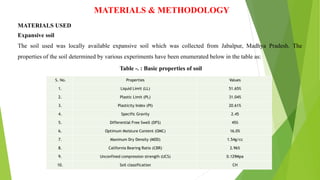
The soil used was locally available expansive soil which was collected from Jabalpur, Madhya Pradesh. The
properties of the soil determined by various experiments have been enumerated below in the table as:
Table -. : Basic properties of soil
S. No. Properties Values
1. Liquid Limit (LL) 51.65%
2. Plastic Limit (PL) 31.04%
3. Plasticity Index (PI) 20.61%
4. Specific Gravity 2.45
5. Differential Free Swell (DFS) 45%
6. Optimum Moisture Content (OMC) 16.0%
7. Maximum Dry Density (MDD) 1.54g/cc
8. California Bearing Ratio (CBR) 2.96%
9. Unconfined compression strength (UCS) 0.129Mpa
10. Soil classification CH
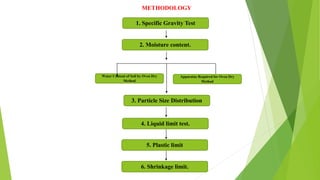
1. Specific Gravity Test
Water Content of Soil by Oven Dry
Method
2. Moisture content.
Apparatus Required for Oven Dry
Method
3. Particle Size Distribution
4. Liquid limit test.
5. Plastic limit
6. Shrinkage limit.
METHODOLOGY
EXPERIMENTAL WORK
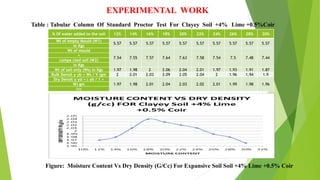
Table : Tabular Column Of Standard Proctor Test For Clayey Soil +4% Lime +0.5%Coir
% Of water added to the soil 12% 14% 16% 18% 20% 22% 24% 26% 28% 30%
Wt of empty Mould (W1)
5.57 5.57 5.57 5.57 5.57 5.57 5.57 5.57 5.57 5.57
in Kgs
Wt of mould
7.54 7.55 7.57 7.64 7.63 7.58 7.54 7.5 7.48 7.44
+
compa cted soil (W2)
in Kgs
Wt of soil only (Ws) in Kgs 1.97 1.98 2 2.06 2.04 2.01 1.97 1.93 1.91 1.87
Bulk Densit y γb = Ws / V (gm 2 2.01 2.03 2.09 2.05 2.04 2 1.96 1.94 1.9
Dry Densit y γd = ( γb / 1 +
1.97 1.98 2.01 2.04 2.03 2.02 2.01 1.99 1.98 1.96
W) gm
/cc
Figure: Moisture Content Vs Dry Density (G/Cc) For Expansive Soil Soil +4% Lime +0.5% Coir
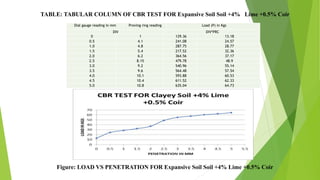
TABLE: TABULAR COLUMN OF CBR TEST FOR Expansive Soil Soil +4% Lime +0.5% Coir
Dial gauge reading in mm Proving ring reading Load (P) in Kgs
DIV DIV*PRC
0 1 129.36 13.18
0.5 4.1 241.08 24.57
1.0 4.8 287.75 28.77
1.5 5.4 217.52 32.36
2.0 6.2 364.56 37.17
2.5 8.15 479.78 48.9
3.0 9.2 540.96 55.14
3.5 9.6 564.48 57.54
4.0 10.1 593.88 60.53
4.5 10.4 611.52 62.33
5.0 10.8 635.04 64.73
Figure: LOAD VS PENETRATION FOR Expansive Soil Soil +4% Lime +0.5% Coir
RESULT & DISCUSSION
Result
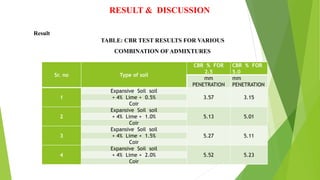
TABLE: CBR TEST RESULTS FOR VARIOUS
COMBINATION OF ADMIXTURES
Sr. no Type of soil
CBR % FOR
2.5
CBR % FOR
5.0
mm
PENETRATION
mm
PENETRATION
1
Expansive Soil soil
3.57 3.15
+ 4% Lime + 0.5%
Coir
2
Expansive Soil soil
5.13 5.01
+ 4% Lime + 1.0%
Coir
3
Expansive Soil soil
5.27 5.11
+ 4% Lime + 1.5%
Coir
4
Expansive Soil soil
5.52 5.23
+ 4% Lime + 2.0%
Coir
CONCLUSION
Based on the various laboratory tests as per IS standards for the porous concrete by varying the composition the
following conclusions are drawn:
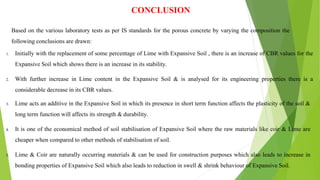
1. Initially with the replacement of some percentage of Lime with Expansive Soil , there is an increase of CBR values for the
Expansive Soil which shows there is an increase in its stability.
2. With further increase in Lime content in the Expansive Soil & is analysed for its engineering properties there is a
considerable decrease in its CBR values.
3. Lime acts an additive in the Expansive Soil in which its presence in short term function affects the plasticity of the soil &
long term function will affects its strength & durability.
4. It is one of the economical method of soil stabilisation of Expansive Soil where the raw materials like coir & Lime are
cheaper when compared to other methods of stabilisation of soil.
5. Lime & Coir are naturally occurring materials & can be used for construction purposes which also leads to increase in
bonding properties of Expansive Soil which also leads to reduction in swell & shrink behaviour of Expansive Soil.
FUTURE SCOPES AND STUDY
Based on the various laboratory tests as per IS standards for the porous concrete by varying the composition the following
scopes are :
1. Initially with the replacement of some percentage of Lime with Expansive Soil , there is an increase of CBR values
for the Expansive Soil which shows there is an increase in its stability.
2. With further increase in Lime content in the Expansive Soil & is analysed for its engineering properties there is a
considerable decrease in its CBR values.
3. Lime acts an additive in the Expansive Soil in which its presence in short term function affects the plasticity of the
soil & long term function will affects its strength & durability.
4. It is one of the economical method of soil stabilisation of Expansive Soil where the raw materials like coir & Lime
are cheaper when compared to other methods of stabilisation of soil.
5. Lime & Coir are naturally occurring materials & can be used for construction purposes which also leads to increase in
bonding properties of Expansive Soil which also leads to reduction in swell & shrink behaviour of Expansive Soil.
REFERENCES
[1]. Raja kumar (2014) “California bearing ratio of expansive Sub grade stabilized with waste materials” International
Journal of Advanced Structures and Geotechnical Engineering Vol. 03, No. 01, January 2014.
[2]. Chen, F. H. (1975) Foundations on Expansive Soils, Elsevier Scientific Pub. Co. Amsterdam. Adeniji, F. A. (1991)
“Recharge function of vertisolic vadose Zone in sub- sahelian Chad Basin”. Proceeding Ist International Conference
on Arid Zone Ideology Hydrology and water resources, Maduguri, pp. 331 – 348.
[3]. V Rama Susheel Kumar1 , J Vikranth2 “Application of Coconut Coir and Fly ash in Sub grade strengthening” The
International Journal Of Engineering And Science (IJES) || Volume|| 3 || Issue || 12 || December - 2014 || Pages || 48-
54|| ISSN (e): 2319–1813 ISSN (p): 2319 – 1805.
[4]. Choudhary A. K., Gill K. S. and Jha K.N. (2011); “Improvement in CBR values of expansive soil sub grade using
geo-synthetics”. Proc. Indian Geotechnical Conference,Kochi, pp.569-572.
[5]. Brajesh Mishra, “A Study on Engineering Behaviour of Black Cotton Soil and its Stabilization by Use of Lime”,
International Journal of Science and Research (IJSR), Volume 4 Issue 11, November 2015, pp-290-294.
Presentation1.pptx

Presentation1.pptx

  • 1.
    A Major Project-II ReportOn AN EXPERIMENT STUDY ON MODIFICATION OF GEOTECHNICAL PROPERTIES OF EXPANSIVE SOIL THROUGH COCONUT FIBRE AND LIME Submitted In Partial Fulfillment of the Requirement for the Awarded of Degree of Bachelor of Technology in Civil Engineering Submitted To Rajiv Gandhi Proudyogiki Vishwavidyalaya, Bhopal (M.P.) Submitted by ABU SUFIYAN 0191CE191004 MD QUAMAR TANWEER 0191CE191053 ABHINAV PRIYADARSHI 0191CE191002 ANWAR KHAN 0191CE191012 RAHUL PANDEY 0191CE203D24 Under the Guidance of Prof. Alka Patel Singh DEPARTMENT OF CIVIL ENGINEERING TECHNOCRATS INSTITUTE OF TECHNOLOGY (EXCELLENCE), BHOPAL (M.P.) SESSION:2022-23
  • 2.
    Contents 1. INTRODUCTION 2. LITERATUREREVIEW 3. MATERIALS & METHODOLOGY 4. EXPERIMENTAL WORK 5. RESULT & DISCUSSION 6. CONCLUSION 7. FUTURE SCOPES AND STUDY 8. REFERENCES
  • 3.
    INTRODUCTION Indian soil depositsare predominated majorly by expansive soil deposits also referred as Black cotton soil. They have an extensive ability to swell and shrink on exposure to variation in moisture content The rate of montmorillonite being more in black cotton soil is the major cause of this expansiveness and cracking. This property has been found to be most troublesome particularly from construction aspect as it happens in soil without any cautioning. The black cotton soil is being widely found in arid and semi-arid regions on earth. It is found in every state in India especially in central and Deccan plateau between 73°80' East longitude and 15°24' north latitude, covering an area of about one-six. Thus, most of the soil in and around Mumbai, Madras, Gwalior, Khandwa, Indore, Nagpur and even some on the river banks is Black cotton. That means these soils are predominant in states of Andhra Pradesh, Western Madhya Pradesh, Gujarat, Maharashtra, Northern Karnataka and Tamil Nadu Expansive soils cover nearly 20% of the landmass in India. Following types of soil Stabilisation. i. Mechanical Stabilization is suitable for low volume roads which involves the correct proportioning of aggregates and soil which are adequately compacted to get mechanically stable layer.
  • 4.
    ii. Soil CementStabilization is an intimate mix of soil, cement and water, compacted to form a strong base course & to increase compressive strength of the soil layer. Soil Cement can be used as a sub-base or base course for all types of Pavements. iii. Soil Lime Stabilization Soil-Lime has been widely used as a modifier or a binder for a high plastic soils which imparts binding action even for a granular soils. iv. Soil-Bituminous Stabilization Bitumen Stabilized layer may be used as Sub-base or base course for all the roads in which the basic principles of this stabilization are Water Proofing and Binding of soil components which enhances its strength & the most commonly used materials are cut back & emulsion. v. Lime Fly ash Stabilization Can be used for construction of Embankments, Rigid and semi-rigid pavements. Fly ash properties vary widely & thus to be characterized before it is used for stabilization of soil layer. The major constituents of fly ash are oxides of silica, aluminum, iron, calcium & magnesium which Possesses many favorable properties for embankment & road construction, fly ash is also termed as environmentally safe material which enhances the properties of soil.
  • 5.
    LITERATURE REVIEW LITERATURE REVIEWof LIME STABILIZED SOILS: The structural distress caused by expansive soils is well documented in literature (Petry & Little 2002; Fall & Sarr 2007; Ozer et al. 2011; Tiwari et al. 2012; Li, J et al. 2014). In order to understand the swelling nature of expansive soils, one needs to understand the mineralogy of clays. This has been discussed in the following section. Geotechnical Properties of Lime Stabilized Soils Addition of lime to soil results in the modification of the geotechnical properties of the soil. These modifications are the effects of immediate and long term reactions taking place in the soil due to addition of lime. 1. Bell (1996) had studied the influence of lime on clay minerals and soils in terms of the improvement in the properties of the materials. In this study, three commonly available clay minerals viz. montmorillonite, kaolinite and quartz were selected and were treated with small quantities of lime. The tests selected for evaluation of the performance of the stabilized soil were with subgrade stabilization for roads as the target application area of lime stabilization.
  • 6.
    Literature Review OfCoconut Fibre Stabilized Soils Coconut Fibre is the obtained from of matured coconut shells which is obtained as a by-product of coconut oil industries. It is a clear light brown free flowing fibre. Coconut shells free from contamination of coir pith are broken into small pieces and fed into a pulveriser. The fibre from the pulveriser is fed into a cyclone and the parallel product is collected in bag filters. The shell fibre is then fed into a vibrating sieving machine and packed according to mesh size requirements for various end uses. 1. Shabana et al. (2014) studied the effect of crushed coconut shells on the CBR of soil. The experimental investigation studied the effect of variation in depth, layers, concentration and size of the crushed coconut shells. Crushed coconut shells of size 0.5cm, 1cm and 1.5cm were used in concentrations of 25 grams, 50 grams and 75 grams per layer in layers of 1, 2 and 4 over depths of 0.2H, 0.4H, 0.6H and 0.8H where H was the height of the soil sample taken in the mould for determination of CBR. 50 grams of 0.5cm crushed coconut shells provided at a depth of 0.2H in one layer produced the highest CBR value. However, based on percentage improvement per unit material consumption, the authors recommended 1 cm size of crushed coconut shells.
  • 7.
    MATERIALS & METHODOLOGY MATERIALSUSED Expansive soil The soil used was locally available expansive soil which was collected from Jabalpur, Madhya Pradesh. The properties of the soil determined by various experiments have been enumerated below in the table as: Table -. : Basic properties of soil S. No. Properties Values 1. Liquid Limit (LL) 51.65% 2. Plastic Limit (PL) 31.04% 3. Plasticity Index (PI) 20.61% 4. Specific Gravity 2.45 5. Differential Free Swell (DFS) 45% 6. Optimum Moisture Content (OMC) 16.0% 7. Maximum Dry Density (MDD) 1.54g/cc 8. California Bearing Ratio (CBR) 2.96% 9. Unconfined compression strength (UCS) 0.129Mpa 10. Soil classification CH
  • 8.
    1. Specific GravityTest Water Content of Soil by Oven Dry Method 2. Moisture content. Apparatus Required for Oven Dry Method 3. Particle Size Distribution 4. Liquid limit test. 5. Plastic limit 6. Shrinkage limit. METHODOLOGY
  • 9.
    EXPERIMENTAL WORK Table :Tabular Column Of Standard Proctor Test For Clayey Soil +4% Lime +0.5%Coir % Of water added to the soil 12% 14% 16% 18% 20% 22% 24% 26% 28% 30% Wt of empty Mould (W1) 5.57 5.57 5.57 5.57 5.57 5.57 5.57 5.57 5.57 5.57 in Kgs Wt of mould 7.54 7.55 7.57 7.64 7.63 7.58 7.54 7.5 7.48 7.44 + compa cted soil (W2) in Kgs Wt of soil only (Ws) in Kgs 1.97 1.98 2 2.06 2.04 2.01 1.97 1.93 1.91 1.87 Bulk Densit y γb = Ws / V (gm 2 2.01 2.03 2.09 2.05 2.04 2 1.96 1.94 1.9 Dry Densit y γd = ( γb / 1 + 1.97 1.98 2.01 2.04 2.03 2.02 2.01 1.99 1.98 1.96 W) gm /cc Figure: Moisture Content Vs Dry Density (G/Cc) For Expansive Soil Soil +4% Lime +0.5% Coir
  • 10.
    TABLE: TABULAR COLUMNOF CBR TEST FOR Expansive Soil Soil +4% Lime +0.5% Coir Dial gauge reading in mm Proving ring reading Load (P) in Kgs DIV DIV*PRC 0 1 129.36 13.18 0.5 4.1 241.08 24.57 1.0 4.8 287.75 28.77 1.5 5.4 217.52 32.36 2.0 6.2 364.56 37.17 2.5 8.15 479.78 48.9 3.0 9.2 540.96 55.14 3.5 9.6 564.48 57.54 4.0 10.1 593.88 60.53 4.5 10.4 611.52 62.33 5.0 10.8 635.04 64.73 Figure: LOAD VS PENETRATION FOR Expansive Soil Soil +4% Lime +0.5% Coir
  • 11.
    RESULT & DISCUSSION Result TABLE:CBR TEST RESULTS FOR VARIOUS COMBINATION OF ADMIXTURES Sr. no Type of soil CBR % FOR 2.5 CBR % FOR 5.0 mm PENETRATION mm PENETRATION 1 Expansive Soil soil 3.57 3.15 + 4% Lime + 0.5% Coir 2 Expansive Soil soil 5.13 5.01 + 4% Lime + 1.0% Coir 3 Expansive Soil soil 5.27 5.11 + 4% Lime + 1.5% Coir 4 Expansive Soil soil 5.52 5.23 + 4% Lime + 2.0% Coir
  • 12.
    CONCLUSION Based on thevarious laboratory tests as per IS standards for the porous concrete by varying the composition the following conclusions are drawn: 1. Initially with the replacement of some percentage of Lime with Expansive Soil , there is an increase of CBR values for the Expansive Soil which shows there is an increase in its stability. 2. With further increase in Lime content in the Expansive Soil & is analysed for its engineering properties there is a considerable decrease in its CBR values. 3. Lime acts an additive in the Expansive Soil in which its presence in short term function affects the plasticity of the soil & long term function will affects its strength & durability. 4. It is one of the economical method of soil stabilisation of Expansive Soil where the raw materials like coir & Lime are cheaper when compared to other methods of stabilisation of soil. 5. Lime & Coir are naturally occurring materials & can be used for construction purposes which also leads to increase in bonding properties of Expansive Soil which also leads to reduction in swell & shrink behaviour of Expansive Soil.
  • 13.
    FUTURE SCOPES ANDSTUDY Based on the various laboratory tests as per IS standards for the porous concrete by varying the composition the following scopes are : 1. Initially with the replacement of some percentage of Lime with Expansive Soil , there is an increase of CBR values for the Expansive Soil which shows there is an increase in its stability. 2. With further increase in Lime content in the Expansive Soil & is analysed for its engineering properties there is a considerable decrease in its CBR values. 3. Lime acts an additive in the Expansive Soil in which its presence in short term function affects the plasticity of the soil & long term function will affects its strength & durability. 4. It is one of the economical method of soil stabilisation of Expansive Soil where the raw materials like coir & Lime are cheaper when compared to other methods of stabilisation of soil. 5. Lime & Coir are naturally occurring materials & can be used for construction purposes which also leads to increase in bonding properties of Expansive Soil which also leads to reduction in swell & shrink behaviour of Expansive Soil.
  • 14.
    REFERENCES [1]. Raja kumar(2014) “California bearing ratio of expansive Sub grade stabilized with waste materials” International Journal of Advanced Structures and Geotechnical Engineering Vol. 03, No. 01, January 2014. [2]. Chen, F. H. (1975) Foundations on Expansive Soils, Elsevier Scientific Pub. Co. Amsterdam. Adeniji, F. A. (1991) “Recharge function of vertisolic vadose Zone in sub- sahelian Chad Basin”. Proceeding Ist International Conference on Arid Zone Ideology Hydrology and water resources, Maduguri, pp. 331 – 348. [3]. V Rama Susheel Kumar1 , J Vikranth2 “Application of Coconut Coir and Fly ash in Sub grade strengthening” The International Journal Of Engineering And Science (IJES) || Volume|| 3 || Issue || 12 || December - 2014 || Pages || 48- 54|| ISSN (e): 2319–1813 ISSN (p): 2319 – 1805. [4]. Choudhary A. K., Gill K. S. and Jha K.N. (2011); “Improvement in CBR values of expansive soil sub grade using geo-synthetics”. Proc. Indian Geotechnical Conference,Kochi, pp.569-572. [5]. Brajesh Mishra, “A Study on Engineering Behaviour of Black Cotton Soil and its Stabilization by Use of Lime”, International Journal of Science and Research (IJSR), Volume 4 Issue 11, November 2015, pp-290-294.