Techniques in Biochemistry
 Chromatography is a physical process whereby
components of a sample mixture are separated by their
differential distribution between stationary and mobile
phases.
 The word “chroma” means “colour " and “graphie”
means writing. which can be used for testing of liquid
mixtures.
 In 1903 Mikhail Tswett was devised chromatography
technique.
 He reported that plant pigments were separated by
differential or adsorption on column of calcium
carbonate into a number of colour bands.
 Chromatography technique developed substantially as
a result of the work of MArcher John and Richard
Laurence during 1940s and 1950s for which they won
Nobel Prize in Chemistry
 Some materials appear homogenous, but are actually a
combination of substances.
 For example, green plants contain a mixture of
different pigments. In addition, the black ink in the
pens are mixture of different coloured materials.
 Chromatography is a method used by scientists for
separating organic and inorganic compounds so that
they can be analysed and studied.
 The mobile flows pass the stationary phase, the solute
may:
1. reside only on the stationary phase( no migration)
2. reside in the mobile phase(migration with mobile
phase
3.distribute between two phases(differential migration)
 Those solutes with higher affinity for stationary phase
reside in stationary phase longer than those with less
affinity, who therefore reside mostly in mobile phase.
 The lower affinity solutes travel faster .
 Strongly bounded solutes subsequently displaced from
stationary phase by changing the physical or chemical
nature of mobile phase.
 In all chromatography there is a mobile phase and a stationary
phase. The stationary phase is the phase that doesn't move and
the mobile phase is the phase that does move.
 The mobile phase moves through the stationary phase picking
up the compounds to be tested.
 As the mobile phase continues to travel through the stationary
phase it takes the compounds with it.
 At different points in the stationary phase the different
components of the compound are going to be absorbed and are
going to stop moving with the mobile phase.
 This is how the results of any chromatography are gotten, from
the point at which the different components of the compound
stop moving and separate from the other components.
 The retention factor is defines id the measure of the
time taken for a solute to pass through a
chromatography paper.
 The retention factor, Rf, is a quantitative indication of
how far a particular compound travels in a particular
solvent.
 The Rf value is a good indicator of whether an
unknown compound and a known compound are
similar, if not identical.
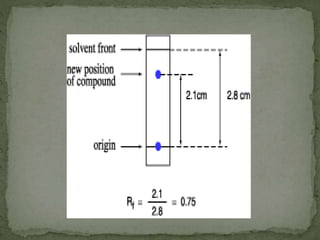
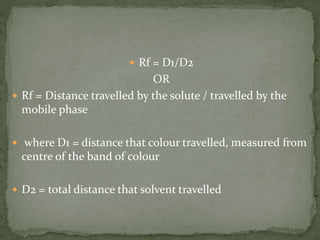
 Rf = D1/D2
OR
 Rf = Distance travelled by the solute / travelled by the
mobile phase
 where D1 = distance that colour travelled, measured from
centre of the band of colour
 D2 = total distance that solvent travelled
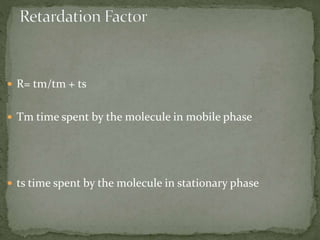
 R= tm/tm + ts
 Tm time spent by the molecule in mobile phase
 ts time spent by the molecule in stationary phase
 The Police, F.B.I., and other detectives use
chromatography when trying to solve a crime.
to determine :
 the presence of cocaine in urine
 alcohol in blood
 PCB's in fish
 lead in water.
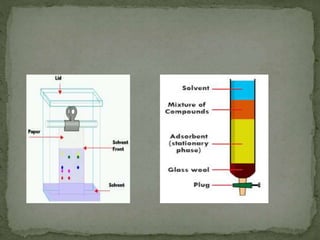
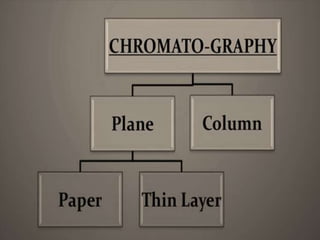
 Paper and thin-layer chromatography the mobile
phase is the solvent.
 The stationary phase in paper chromatography is the
strip or piece of paper that is placed in the solvent.
 In thin-layer chromatography the stationary phase is
the thin-layer cell.
 Both these kinds of chromatography use capillary
action to move the solvent through the stationary
phase.
 Paper chromatography is defined as technique in which the
analysis of unknown substance is carried out mainly by the
flow of solvents on specially designed filter paper .
 1961 paper chromatography was first discovered by SEHON
BEN.
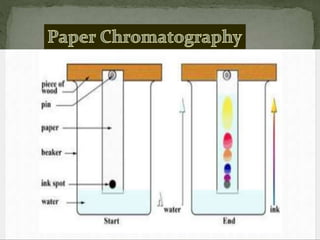
 It involves placing a small dot or line of sample solution
onto a strip of chromatography paper.
 The paper is placed in a jar containing a shallow layer of
solvent and sealed.
 As the solvent rises through the paper, it meets the sample
mixture, which starts to travel up the paper with the
solvent.
 The principle involved is partition chromatography
wherein the substances are distributed or partitioned
between liquid phases.
 One phase is the water, which is held in the pores of
the filter paper or cellulose used; and other is the
mobile phase which moves over the paper.
 The compounds in the mixture get separated due to
differences in their affinity towards water (in
stationary phase) and mobile phase solvents during
the movement of mobile phase under the capillary
action of pores in the paper.
 The principle can also be adsorption chromatography
between solid and liquid phases, wherein the
stationary phase is the solid surface of paper and the
liquid phase is of mobile phase.
 Paper impregnated with silica or alumina acts as
adsorbent (stationary phase) and solvent as mobile
phase.
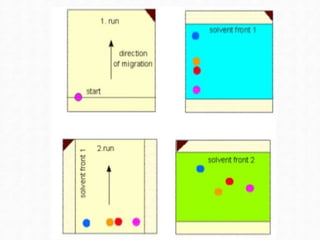
 it is difficult to separate a complex mixture of
substances by a single run with one solvent system. In
such a case, a second run is carried out by a different
solvent system, in a direction perpendicular to the first
run. This is referred to as two dimensional
chromatography.
 Two way paper chromatography gets around the
problem of separating out substances which have very
similar Rf values.
 Paper chromatography is specially used for the
separation of a mixture having polar and non-polar
compounds.
 For separation of amino acids.
 It is used to determine organic compounds, bio
chemicals in urine, etc.
 In the pharma sector it is used for the determination of
hormones, drugs, etc.
 Sometimes it is used for evaluation of inorganic
compounds like salts and complexes.
Paper chromatography- separation technique

Paper chromatography- separation technique

  • 1.
  • 2.
     Chromatography isa physical process whereby components of a sample mixture are separated by their differential distribution between stationary and mobile phases.  The word “chroma” means “colour " and “graphie” means writing. which can be used for testing of liquid mixtures.
  • 3.
     In 1903Mikhail Tswett was devised chromatography technique.  He reported that plant pigments were separated by differential or adsorption on column of calcium carbonate into a number of colour bands.  Chromatography technique developed substantially as a result of the work of MArcher John and Richard Laurence during 1940s and 1950s for which they won Nobel Prize in Chemistry
  • 4.
     Some materialsappear homogenous, but are actually a combination of substances.  For example, green plants contain a mixture of different pigments. In addition, the black ink in the pens are mixture of different coloured materials.  Chromatography is a method used by scientists for separating organic and inorganic compounds so that they can be analysed and studied.
  • 6.
     The mobileflows pass the stationary phase, the solute may: 1. reside only on the stationary phase( no migration) 2. reside in the mobile phase(migration with mobile phase 3.distribute between two phases(differential migration)
  • 7.
     Those soluteswith higher affinity for stationary phase reside in stationary phase longer than those with less affinity, who therefore reside mostly in mobile phase.  The lower affinity solutes travel faster .  Strongly bounded solutes subsequently displaced from stationary phase by changing the physical or chemical nature of mobile phase.
  • 8.
     In allchromatography there is a mobile phase and a stationary phase. The stationary phase is the phase that doesn't move and the mobile phase is the phase that does move.  The mobile phase moves through the stationary phase picking up the compounds to be tested.  As the mobile phase continues to travel through the stationary phase it takes the compounds with it.  At different points in the stationary phase the different components of the compound are going to be absorbed and are going to stop moving with the mobile phase.  This is how the results of any chromatography are gotten, from the point at which the different components of the compound stop moving and separate from the other components.
  • 10.
     The retentionfactor is defines id the measure of the time taken for a solute to pass through a chromatography paper.  The retention factor, Rf, is a quantitative indication of how far a particular compound travels in a particular solvent.  The Rf value is a good indicator of whether an unknown compound and a known compound are similar, if not identical.
  • 12.
     Rf =D1/D2 OR  Rf = Distance travelled by the solute / travelled by the mobile phase  where D1 = distance that colour travelled, measured from centre of the band of colour  D2 = total distance that solvent travelled
  • 13.
     R= tm/tm+ ts  Tm time spent by the molecule in mobile phase  ts time spent by the molecule in stationary phase
  • 14.
     The Police,F.B.I., and other detectives use chromatography when trying to solve a crime. to determine :  the presence of cocaine in urine  alcohol in blood  PCB's in fish  lead in water.
  • 17.
     Paper andthin-layer chromatography the mobile phase is the solvent.  The stationary phase in paper chromatography is the strip or piece of paper that is placed in the solvent.  In thin-layer chromatography the stationary phase is the thin-layer cell.  Both these kinds of chromatography use capillary action to move the solvent through the stationary phase.
  • 18.
     Paper chromatographyis defined as technique in which the analysis of unknown substance is carried out mainly by the flow of solvents on specially designed filter paper .  1961 paper chromatography was first discovered by SEHON BEN.  It involves placing a small dot or line of sample solution onto a strip of chromatography paper.  The paper is placed in a jar containing a shallow layer of solvent and sealed.  As the solvent rises through the paper, it meets the sample mixture, which starts to travel up the paper with the solvent.
  • 21.
     The principleinvolved is partition chromatography wherein the substances are distributed or partitioned between liquid phases.  One phase is the water, which is held in the pores of the filter paper or cellulose used; and other is the mobile phase which moves over the paper.  The compounds in the mixture get separated due to differences in their affinity towards water (in stationary phase) and mobile phase solvents during the movement of mobile phase under the capillary action of pores in the paper.
  • 22.
     The principlecan also be adsorption chromatography between solid and liquid phases, wherein the stationary phase is the solid surface of paper and the liquid phase is of mobile phase.  Paper impregnated with silica or alumina acts as adsorbent (stationary phase) and solvent as mobile phase.
  • 23.
     it isdifficult to separate a complex mixture of substances by a single run with one solvent system. In such a case, a second run is carried out by a different solvent system, in a direction perpendicular to the first run. This is referred to as two dimensional chromatography.  Two way paper chromatography gets around the problem of separating out substances which have very similar Rf values.
  • 25.
     Paper chromatographyis specially used for the separation of a mixture having polar and non-polar compounds.  For separation of amino acids.  It is used to determine organic compounds, bio chemicals in urine, etc.  In the pharma sector it is used for the determination of hormones, drugs, etc.  Sometimes it is used for evaluation of inorganic compounds like salts and complexes.

Editor's Notes

  • #25 chromatogram is made starting from a single spot of mixture placed towards one end of the base line. It is stood in a solvent as before and left until the solvent front gets close to the top of the paper. dry out completely, and then rotate it through 90°, and develop the chromatogram again in a different solvent.