What is Chromatography???
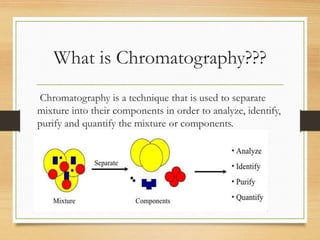
Chromatography is a technique that is used to separate
mixture into their components in order to analyze, identify,
purify and quantify the mixture or components.
History
 Mikhail Tswett invented chromatography in 1901
during his research on plant pigments.
 He used this technique to separate various plant
pigments such as chlorophylls, xanthophyll and
carotenes.
 Modern Chromatography techniques were developed by
Archer John and Richard Laurence during the 1940s and
1950s.
Terminology
 The mobile phase is the phase that moves in a definite
direction.
 An immobilized phase is a stationary phase that is
immobilized on the support particles, or on the inner wall of
the column tubing.
Retardation Factor, is the ratio of distance travelled .
Types of Chromatography
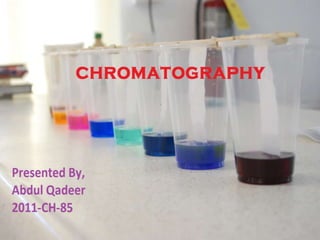
 Paper Chromatography
 Gas Chromatography
 Thin-Layer Chromatography
 Liquid Chromatography
Paper Chromatography
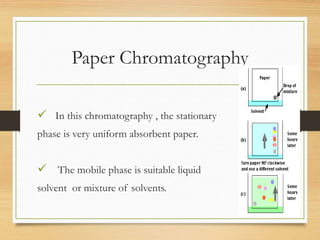
 In this chromatography , the stationary
phase is very uniform absorbent paper.
 The mobile phase is suitable liquid
solvent or mixture of solvents.
Gas Chromatography
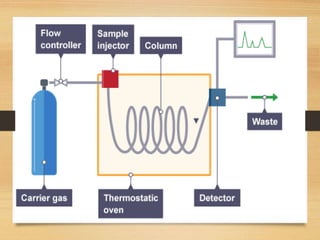
Gas Chromatography is the common type of
chromatography used in analytical chemistry for
separating and analyzing components that can be
vaporized without decomposition .
Thin-Layer Chromatography
 TLC is a simple, quick and inexpensive procedure that
gives the chemist a quick answer as to how many
components are in a mixture
 Thin-layer chromatography can be used to monitor the
progress of a reaction, identify compounds present in a
given mixture
Liquid Chromatography
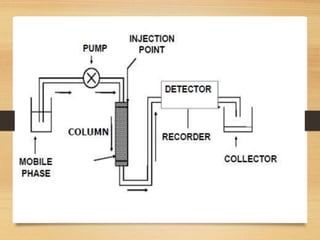
Liquid chromatography is a technique used to separate a
sample into its individual parts. This separation occurs
based on the interactions of the sample with the mobile
and stationary phases.
Real Life Examples For The Use
of Chromatography
 Pharmaceutical Company
 Hospital Uses
 Environmental Agency
 Manufacturing Plants
 Forensic Toxicolgy
 Biological application
Chromatography

Chromatography

  • 2.
    What is Chromatography??? Chromatographyis a technique that is used to separate mixture into their components in order to analyze, identify, purify and quantify the mixture or components.
  • 3.
    History  Mikhail Tswettinvented chromatography in 1901 during his research on plant pigments.  He used this technique to separate various plant pigments such as chlorophylls, xanthophyll and carotenes.  Modern Chromatography techniques were developed by Archer John and Richard Laurence during the 1940s and 1950s.
  • 4.
    Terminology  The mobilephase is the phase that moves in a definite direction.  An immobilized phase is a stationary phase that is immobilized on the support particles, or on the inner wall of the column tubing. Retardation Factor, is the ratio of distance travelled .
  • 5.
    Types of Chromatography Paper Chromatography  Gas Chromatography  Thin-Layer Chromatography  Liquid Chromatography
  • 6.
    Paper Chromatography  Inthis chromatography , the stationary phase is very uniform absorbent paper.  The mobile phase is suitable liquid solvent or mixture of solvents.
  • 7.
    Gas Chromatography Gas Chromatographyis the common type of chromatography used in analytical chemistry for separating and analyzing components that can be vaporized without decomposition .
  • 9.
    Thin-Layer Chromatography  TLCis a simple, quick and inexpensive procedure that gives the chemist a quick answer as to how many components are in a mixture  Thin-layer chromatography can be used to monitor the progress of a reaction, identify compounds present in a given mixture
  • 10.
    Liquid Chromatography Liquid chromatographyis a technique used to separate a sample into its individual parts. This separation occurs based on the interactions of the sample with the mobile and stationary phases.
  • 12.
    Real Life ExamplesFor The Use of Chromatography  Pharmaceutical Company  Hospital Uses  Environmental Agency  Manufacturing Plants  Forensic Toxicolgy  Biological application

Editor's Notes

  • #5  The mobile phase may be either a liquid or a gas, while the stationary phase is either a solid or a liquid.