CHAP#9:NEW PRODUCT
DEVELOPMENT &
PRODUCT LIFE-CYCLE
STRATEGIES
PRESENTATION
BY:saba khan
AWKUM BBA(3RD
A)
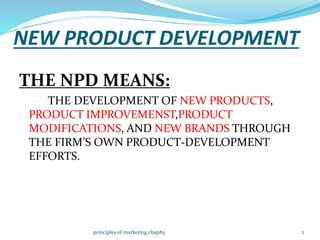
NEW PRODUCT DEVELOPMENT
THE NPD MEANS:
THE DEVELOPMENT OF NEW PRODUCTS,
PRODUCT IMPROVEMENST,PRODUCT
MODIFICATIONS, AND NEW BRANDS THROUGH
THE FIRM’S OWN PRODUCT-DEVELOPMENT
EFFORTS.
2principles of marketing chap#9
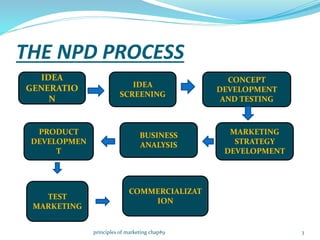
THE NPD PROCESS
IDEA
GENERATIO
N
IDEA
SCREENING
CONCEPT
DEVELOPMENT
AND TESTING
MARKETING
STRATEGY
DEVELOPMENT
BUSINESS
ANALYSIS
PRODUCT
DEVELOPMEN
T
TEST
MARKETING
COMMERCIALIZAT
ION
3principles of marketing chap#9
NPD PROCESS
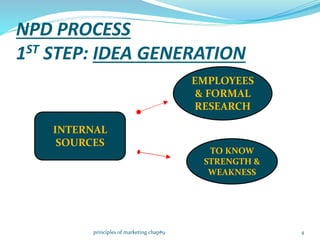
1ST STEP: IDEA GENERATION
INTERNAL
SOURCES
EMPLOYEES
& FORMAL
RESEARCH
TO KNOW
STRENGTH &
WEAKNESS
4principles of marketing chap#9
NPD PROCESS
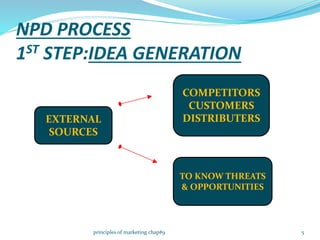
1ST STEP:IDEA GENERATION
EXTERNAL
SOURCES
COMPETITORS
CUSTOMERS
DISTRIBUTERS
TO KNOW THREATS
& OPPORTUNITIES
5principles of marketing chap#9
NPD PROCESS
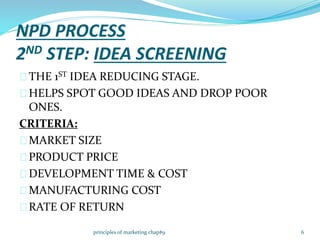
2ND STEP: IDEA SCREENING
THE 1ST IDEA REDUCING STAGE.
HELPS SPOT GOOD IDEAS AND DROP POOR
ONES.
CRITERIA:
MARKET SIZE
PRODUCT PRICE
DEVELOPMENT TIME & COST
MANUFACTURING COST
RATE OF RETURN
6principles of marketing chap#9
NPD PROCESS
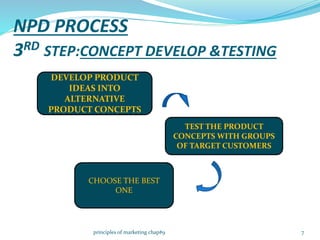
3RD STEP:CONCEPT DEVELOP &TESTING
DEVELOP PRODUCT
IDEAS INTO
ALTERNATIVE
PRODUCT CONCEPTS
TEST THE PRODUCT
CONCEPTS WITH GROUPS
OF TARGET CUSTOMERS
CHOOSE THE BEST
ONE
7principles of marketing chap#9
NPD PROCESS
4TH STEP:MARKETING STRATEGY DEVELOPMENT
Part One - Overall:
Target Market
Planned Product Positioning
Sales & Profit Goals
Market Share
Part Two - Short-Term:
Product’s Planned Price
Distribution
Marketing Budget
Part Three - Long-Term:
Sales & Profit Goals
Marketing Mix Strategy
8principles of marketing chap#9
NPD PROCESS
5TH STEP:BUSINESS ANALYSIS
REVIEW OF THE SALES, COSTS AND
PROFIT PROJECTIONS FOR A NEW
PRODUCT.
9principles of marketing chap#9
NPD PROCESS
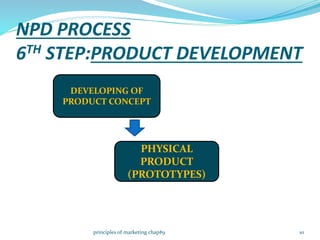
6TH STEP:PRODUCT DEVELOPMENT
DEVELOPING OF
PRODUCT CONCEPT
PHYSICAL
PRODUCT
(PROTOTYPES)
10principles of marketing chap#9
NPD PROCESS
7TH STEP:TEST MARKETING
PROTOTYPES ARE INTRODUCED INTO MARKET.
GIVES THE MARKETER EXPERIENCE WITH
MARKETING THE PRODUCT BEFORE GOING TO
THE GREAT EXPENSE OF FULL INTRODUCTION.
11principles of marketing chap#9
NPD PROCESS
8TH STEP:COMMERCIALIZATION
FINAL DECISION IS TAKEN
&
A NEW PRODUCT IS INTRODUCED
INTO THE MARKET.
12principles of marketing chap#9
MANAGING NEW PRODUCT
DEVELOPMENT
SUCCESSFUL NPD REQUIRES:
1. CUSTOMER-CENTERED NPD.
2. TEAM-BASED NPD &
3. SYSTEMATIC NPD EFFORTS.
13principles of marketing chap#9
1)CUSTOMER-CENTERED NPD:
•It describes the actions taken by a business to
support its sales & service staff in considering client
needs & satisfying their major priorities.
•It begins and ends with solving customer
problems.
14principles of marketing chap#9
2)TEAM BASED NEW PRODUCT
DEVELOPMENT:
•An approach to developing new products in which various
company departments work closely together, overlapping
the steps in the product development process to save time
and increase effectiveness.
LIMITATIONS:
TENSION AND CONFUSION.
15principles of marketing chap#9
3)SYSTEMATIC NEW PRODUCT
DEVELOPMENT:
•An innovation management system is installed by the
company to collect, review & manage new product idea.
FAVORABLE OUTCOMES:
1. It shows that top management supports, encourages &
rewards innovations.
2. Yields a large number of new ideas.
16principles of marketing chap#9
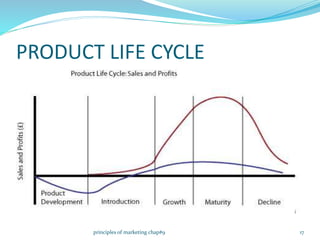
PRODUCT LIFE CYCLE
principles of marketing chap#9 17
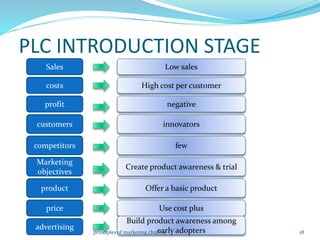
PLC INTRODUCTION STAGE
Sales
costs
profit
customers
competitors
Marketing
objectives
product
Low sales
High cost per customer
negative
innovators
few
Create product awareness & trial
Offer a basic product
Use cost plus
advertising
Build product awareness among
early adopters
price
18principles of marketing chap#9
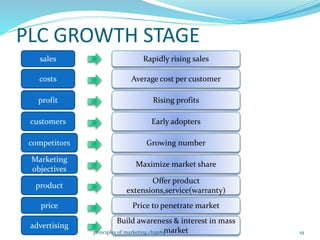
PLC GROWTH STAGE
sales
costs
profit
customers
competitors
Marketing
objectives
product
price
advertising
Rapidly rising sales
Average cost per customer
Rising profits
Early adopters
Maximize market share
Offer product
extensions,service(warranty)
Price to penetrate market
Build awareness & interest in mass
market
Growing number
19principles of marketing chap#9
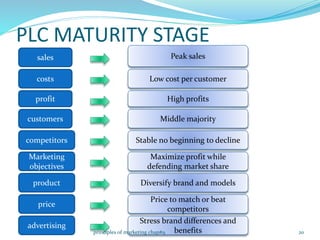
PLC MATURITY STAGE
sales
costs
profit
customers
competitors
Marketing
objectives
product
price
advertising
Peak sales
Low cost per customer
High profits
Middle majority
Stable no beginning to decline
Maximize profit while
defending market share
Diversify brand and models
Price to match or beat
competitors
Stress brand differences and
benefits 20principles of marketing chap#9
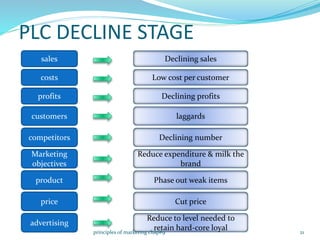
PLC DECLINE STAGE
sales
costs
profits
customers
competitors
Marketing
objectives
product
price
advertising
Declining sales
Low cost per customer
Declining profits
laggards
Declining number
Reduce expenditure & milk the
brand
Phase out weak items
Cut price
Reduce to level needed to
retain hard-core loyal 21principles of marketing chap#9
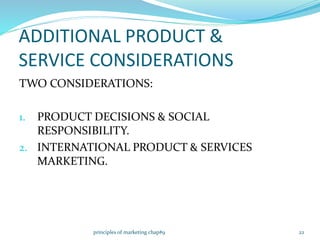
ADDITIONAL PRODUCT &
SERVICE CONSIDERATIONS
TWO CONSIDERATIONS:
1. PRODUCT DECISIONS & SOCIAL
RESPONSIBILITY.
2. INTERNATIONAL PRODUCT & SERVICES
MARKETING.
22principles of marketing chap#9
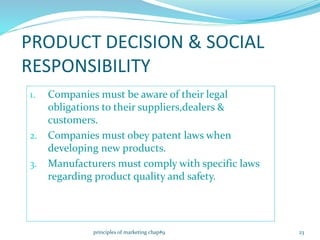
PRODUCT DECISION & SOCIAL
RESPONSIBILITY
1. Companies must be aware of their legal
obligations to their suppliers,dealers &
customers.
2. Companies must obey patent laws when
developing new products.
3. Manufacturers must comply with specific laws
regarding product quality and safety.
23principles of marketing chap#9
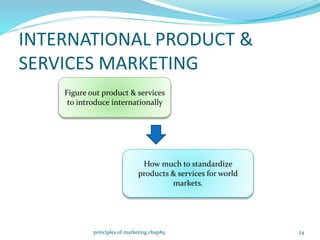
INTERNATIONAL PRODUCT &
SERVICES MARKETING
Figure out product & services
to introduce internationally
How much to standardize
products & services for world
markets.
24principles of marketing chap#9
25principles of marketing chap#9

new product development and product life-cycle strategies

  • 1.
    CHAP#9:NEW PRODUCT DEVELOPMENT & PRODUCTLIFE-CYCLE STRATEGIES PRESENTATION BY:saba khan AWKUM BBA(3RD A)
  • 2.
    NEW PRODUCT DEVELOPMENT THENPD MEANS: THE DEVELOPMENT OF NEW PRODUCTS, PRODUCT IMPROVEMENST,PRODUCT MODIFICATIONS, AND NEW BRANDS THROUGH THE FIRM’S OWN PRODUCT-DEVELOPMENT EFFORTS. 2principles of marketing chap#9
  • 3.
    THE NPD PROCESS IDEA GENERATIO N IDEA SCREENING CONCEPT DEVELOPMENT ANDTESTING MARKETING STRATEGY DEVELOPMENT BUSINESS ANALYSIS PRODUCT DEVELOPMEN T TEST MARKETING COMMERCIALIZAT ION 3principles of marketing chap#9
  • 4.
    NPD PROCESS 1ST STEP:IDEA GENERATION INTERNAL SOURCES EMPLOYEES & FORMAL RESEARCH TO KNOW STRENGTH & WEAKNESS 4principles of marketing chap#9
  • 5.
    NPD PROCESS 1ST STEP:IDEAGENERATION EXTERNAL SOURCES COMPETITORS CUSTOMERS DISTRIBUTERS TO KNOW THREATS & OPPORTUNITIES 5principles of marketing chap#9
  • 6.
    NPD PROCESS 2ND STEP:IDEA SCREENING THE 1ST IDEA REDUCING STAGE. HELPS SPOT GOOD IDEAS AND DROP POOR ONES. CRITERIA: MARKET SIZE PRODUCT PRICE DEVELOPMENT TIME & COST MANUFACTURING COST RATE OF RETURN 6principles of marketing chap#9
  • 7.
    NPD PROCESS 3RD STEP:CONCEPTDEVELOP &TESTING DEVELOP PRODUCT IDEAS INTO ALTERNATIVE PRODUCT CONCEPTS TEST THE PRODUCT CONCEPTS WITH GROUPS OF TARGET CUSTOMERS CHOOSE THE BEST ONE 7principles of marketing chap#9
  • 8.
    NPD PROCESS 4TH STEP:MARKETINGSTRATEGY DEVELOPMENT Part One - Overall: Target Market Planned Product Positioning Sales & Profit Goals Market Share Part Two - Short-Term: Product’s Planned Price Distribution Marketing Budget Part Three - Long-Term: Sales & Profit Goals Marketing Mix Strategy 8principles of marketing chap#9
  • 9.
    NPD PROCESS 5TH STEP:BUSINESSANALYSIS REVIEW OF THE SALES, COSTS AND PROFIT PROJECTIONS FOR A NEW PRODUCT. 9principles of marketing chap#9
  • 10.
    NPD PROCESS 6TH STEP:PRODUCTDEVELOPMENT DEVELOPING OF PRODUCT CONCEPT PHYSICAL PRODUCT (PROTOTYPES) 10principles of marketing chap#9
  • 11.
    NPD PROCESS 7TH STEP:TESTMARKETING PROTOTYPES ARE INTRODUCED INTO MARKET. GIVES THE MARKETER EXPERIENCE WITH MARKETING THE PRODUCT BEFORE GOING TO THE GREAT EXPENSE OF FULL INTRODUCTION. 11principles of marketing chap#9
  • 12.
    NPD PROCESS 8TH STEP:COMMERCIALIZATION FINALDECISION IS TAKEN & A NEW PRODUCT IS INTRODUCED INTO THE MARKET. 12principles of marketing chap#9
  • 13.
    MANAGING NEW PRODUCT DEVELOPMENT SUCCESSFULNPD REQUIRES: 1. CUSTOMER-CENTERED NPD. 2. TEAM-BASED NPD & 3. SYSTEMATIC NPD EFFORTS. 13principles of marketing chap#9
  • 14.
    1)CUSTOMER-CENTERED NPD: •It describesthe actions taken by a business to support its sales & service staff in considering client needs & satisfying their major priorities. •It begins and ends with solving customer problems. 14principles of marketing chap#9
  • 15.
    2)TEAM BASED NEWPRODUCT DEVELOPMENT: •An approach to developing new products in which various company departments work closely together, overlapping the steps in the product development process to save time and increase effectiveness. LIMITATIONS: TENSION AND CONFUSION. 15principles of marketing chap#9
  • 16.
    3)SYSTEMATIC NEW PRODUCT DEVELOPMENT: •Aninnovation management system is installed by the company to collect, review & manage new product idea. FAVORABLE OUTCOMES: 1. It shows that top management supports, encourages & rewards innovations. 2. Yields a large number of new ideas. 16principles of marketing chap#9
  • 17.
    PRODUCT LIFE CYCLE principlesof marketing chap#9 17
  • 18.
    PLC INTRODUCTION STAGE Sales costs profit customers competitors Marketing objectives product Lowsales High cost per customer negative innovators few Create product awareness & trial Offer a basic product Use cost plus advertising Build product awareness among early adopters price 18principles of marketing chap#9
  • 19.
    PLC GROWTH STAGE sales costs profit customers competitors Marketing objectives product price advertising Rapidlyrising sales Average cost per customer Rising profits Early adopters Maximize market share Offer product extensions,service(warranty) Price to penetrate market Build awareness & interest in mass market Growing number 19principles of marketing chap#9
  • 20.
    PLC MATURITY STAGE sales costs profit customers competitors Marketing objectives product price advertising Peaksales Low cost per customer High profits Middle majority Stable no beginning to decline Maximize profit while defending market share Diversify brand and models Price to match or beat competitors Stress brand differences and benefits 20principles of marketing chap#9
  • 21.
    PLC DECLINE STAGE sales costs profits customers competitors Marketing objectives product price advertising Decliningsales Low cost per customer Declining profits laggards Declining number Reduce expenditure & milk the brand Phase out weak items Cut price Reduce to level needed to retain hard-core loyal 21principles of marketing chap#9
  • 22.
    ADDITIONAL PRODUCT & SERVICECONSIDERATIONS TWO CONSIDERATIONS: 1. PRODUCT DECISIONS & SOCIAL RESPONSIBILITY. 2. INTERNATIONAL PRODUCT & SERVICES MARKETING. 22principles of marketing chap#9
  • 23.
    PRODUCT DECISION &SOCIAL RESPONSIBILITY 1. Companies must be aware of their legal obligations to their suppliers,dealers & customers. 2. Companies must obey patent laws when developing new products. 3. Manufacturers must comply with specific laws regarding product quality and safety. 23principles of marketing chap#9
  • 24.
    INTERNATIONAL PRODUCT & SERVICESMARKETING Figure out product & services to introduce internationally How much to standardize products & services for world markets. 24principles of marketing chap#9
  • 25.