5-1
Bismillahir Rahmanir Rahim
9-2
Chapter 9
1. New-Product Development Strategy
2. New-Product Development Process
3. Managing New-Product Development
4. Product Life-Cycle Strategies
5. Additional Product and Service
Considerations
9-3
New-Product Development
New product development refers to original
products, product improvements, product
modifications, and new brands developed
from the firm’s own research and
development.
9-4
Reasons for new product failure
1. Overestimation of market size
2. Poor design
3. Incorrect positioning
4. Wrong timing
5. Priced too high
6. Ineffective promotion
7. Management influence
8. High development costs
9. Competition
New-Product Development Strategy
9-5
New-Product Development Process
1. Idea generation
2. Idea screening
3. Concept development and testing
4. Marketing strategy development
5. Business analysis
6. Product development
7. Test marketing
8. Commercialization
9-6
New-Product Development Process
Idea Generation
• New idea generation is the systematic search for new
product ideas.
• To create a large number of ideas
• Sources of new-product ideas
– Internal sources refer to the company’s own formal
research and development, management and staff,
and intrapreneurial programs.
– External sources refer to sources outside the
company such as customers, competitors,
distributors, suppliers, and outside design firms.
9-7
New-Product Development Process
Idea Screening
• Idea screening refers to reviewing new-product ideas in order to
drop poor ones as soon as possible.
Concept Development and Testing
• Product idea is an idea for a possible product that the company
can see itself offering to the market.
• Product concept is a detailed version of the idea stated in
meaningful consumer terms.
• Product image is the way consumers perceive an actual or
potential product.
• Concept testing refers to testing new-product concepts with groups
of target consumers. To find out how attractive each concept is to
customers, and choose the best one.
9-8
New-Product Development Process
Marketing Strategy Development
• Marketing strategy development refers to the initial marketing
strategy for introducing the product to the market.
Marketing strategy statement
Part 1:
– Description of the target market
– The planning product positioning; sales, market share, and profit
goals
Part 2:
– Price distribution and budget
Part 3:
– Long-term sales, profit goals, and marketing mix strategy
9-9
New-Product Development Process
Business Analysis
• Business analysis involves a review of the sales, costs,
and profit projections to find out whether they satisfy the
company’s objectives.
Product Development
• Product development involves the creation and testing
of one or more physical versions by the R&D or
engineering departments. - Requires an increase in
investment
9-10
New-Product Development Process
Test Marketing
• Test marketing is the stage at which the product and
marketing program are introduced into more realistic
marketing settings.
• Test marketing provides the marketer with experience in testing the
product and entire marketing program before full introduction.
• When firms test market: New product with large investment;
Uncertainty about product or marketing program
• When firms may not test market: Simple line extension; Copy
of competitor product; Low costs; Management confidence
9-11
New-Product Development Process
Test Marketing
• Approaches to test marketing
– Standard test markets
– Controlled test markets
– Simulated test markets
9-12
New-Product Development Process
Test Marketing
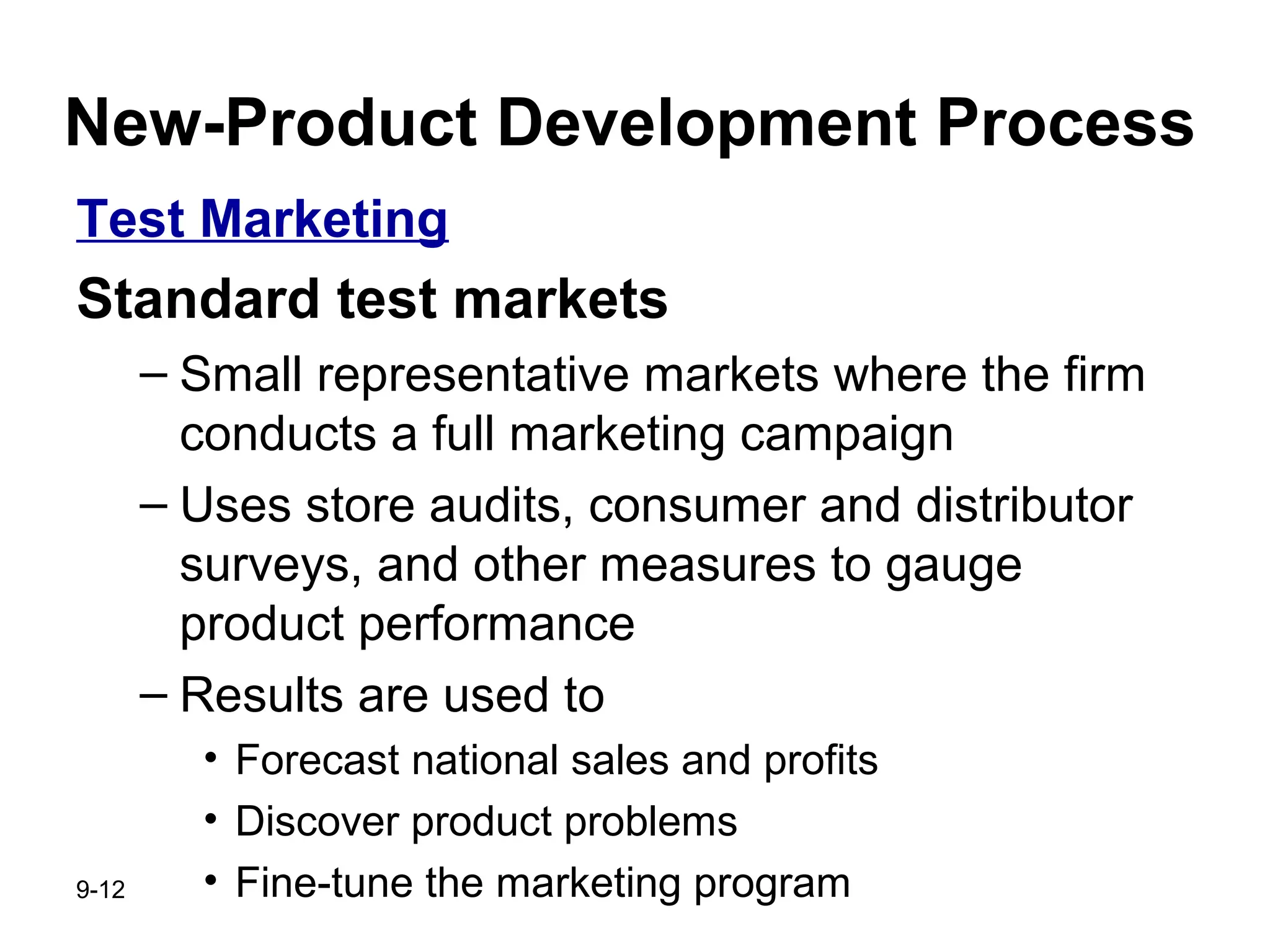
Standard test markets
– Small representative markets where the firm
conducts a full marketing campaign
– Uses store audits, consumer and distributor
surveys, and other measures to gauge
product performance
– Results are used to
• Forecast national sales and profits
• Discover product problems
• Fine-tune the marketing program
9-13
New-Product Development Process
Test Marketing
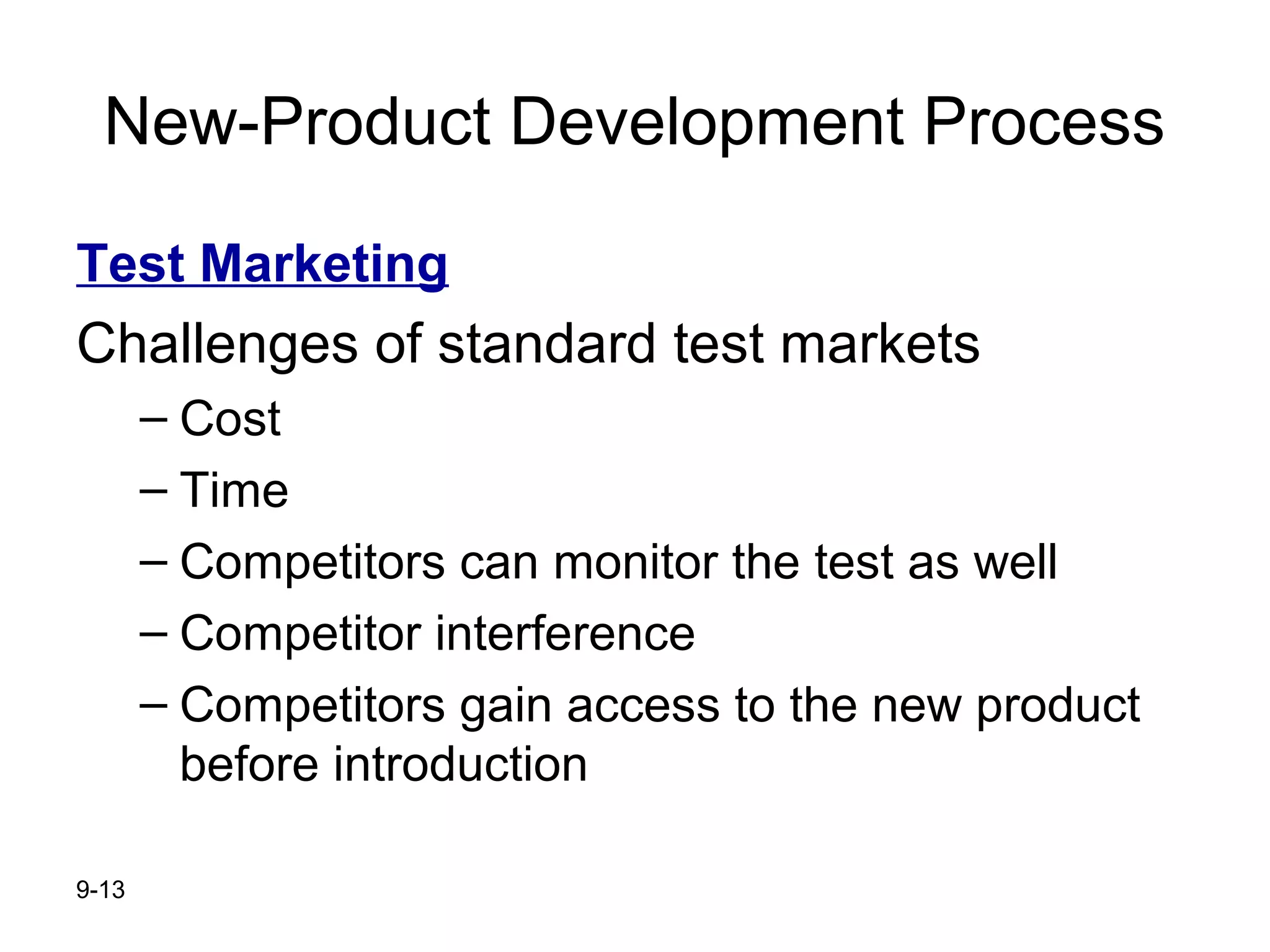
Challenges of standard test markets
– Cost
– Time
– Competitors can monitor the test as well
– Competitor interference
– Competitors gain access to the new product
before introduction
9-14
New-Product Development Process
Test Marketing
Controlled test markets
– Panels of stores that have agreed to carry
new products for a fee
– Less expensive than standard test markets
– Faster than standard test markets
– Competitors gain access to the new product
9-15
New-Product Development Process
Test Marketing
Simulated test markets
– Events where the firm will create a shopping
environment and note how many consumers
buy the new product and competing products
– Provides measure of trial and the
effectiveness of promotion
– Researchers can interview consumers
9-16
New-Product Development Process
Test Marketing
• Advantages of simulated test markets
– Less expensive than other test methods
– Faster
– Restricts access by competitors
• Disadvantages of simulated test markets
– Not considered as reliable and accurate due
to the controlled setting
9-17
New-Product Development Process
Commercialization
• Commercialization is the introduction of the
new product into the market
– When to launch
– Where to launch
– Planned market rollout (the widespread public
introduction of a new product )
9-18
Product Life-Cycle Strategies
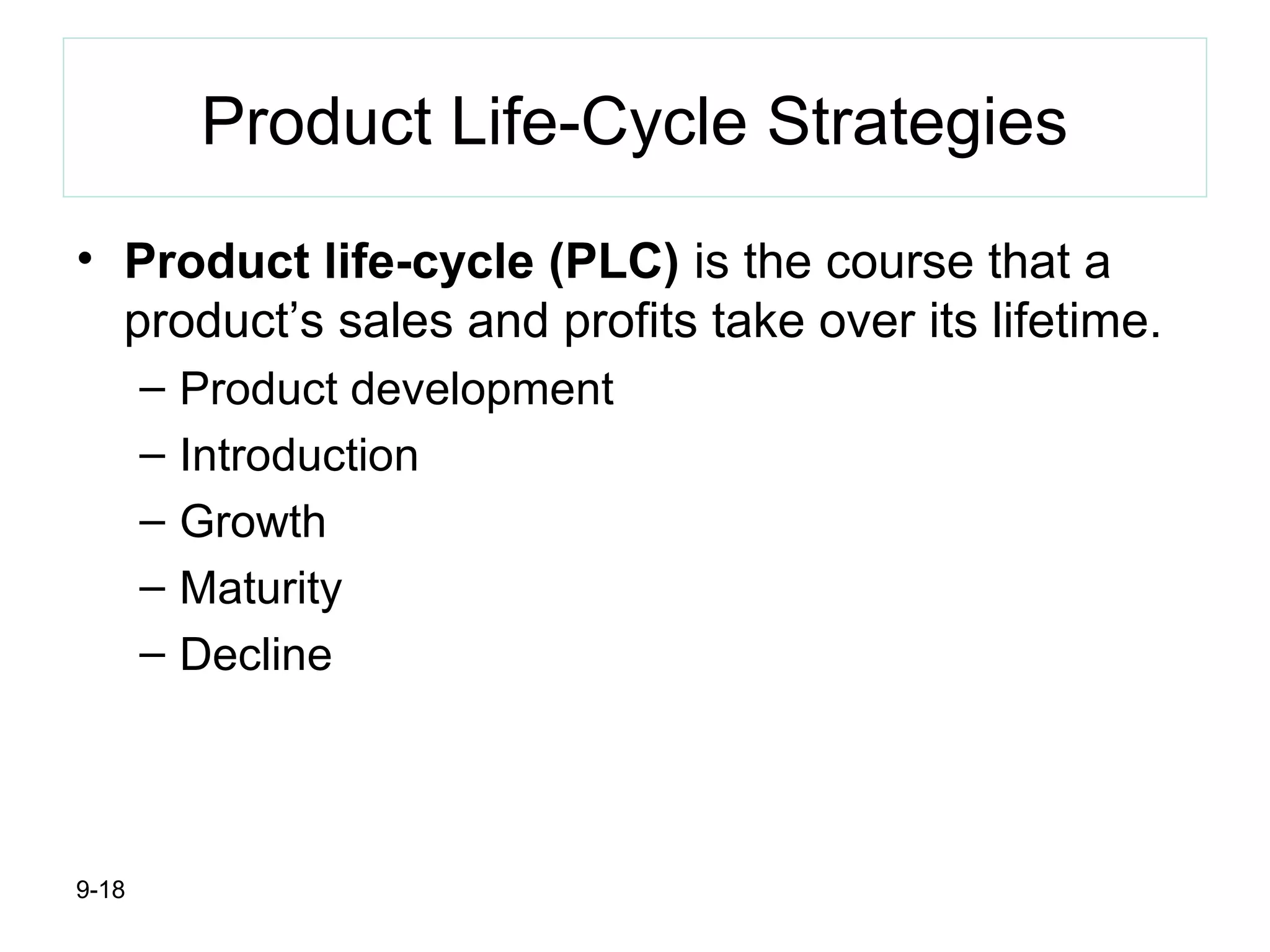
• Product life-cycle (PLC) is the course that a
product’s sales and profits take over its lifetime.
– Product development
– Introduction
– Growth
– Maturity
– Decline
9-19
Product Life-Cycle Strategies
Sales and profits over the product’s life from inception to decline
Profits
9-20
Product Life-Cycle Strategies
Introduction stage is when the new product is
first launched.
– Takes time
– Slow sales growth
– Little or no profit
– High distribution and promotion expense
9-21
Product Life-Cycle Strategies
– Sales increase
– New competitors enter
the market
– Price stability or decline
to increase volume
– Consumer education
– Profits increase
– Promotion and
manufacturing costs gain
economies of scale
– Product quality
increases
– New features
– New market segments
and distribution channels
are entered
Growth stage is when the new product satisfies
the market.
9-22
Product Life-Cycle Strategies
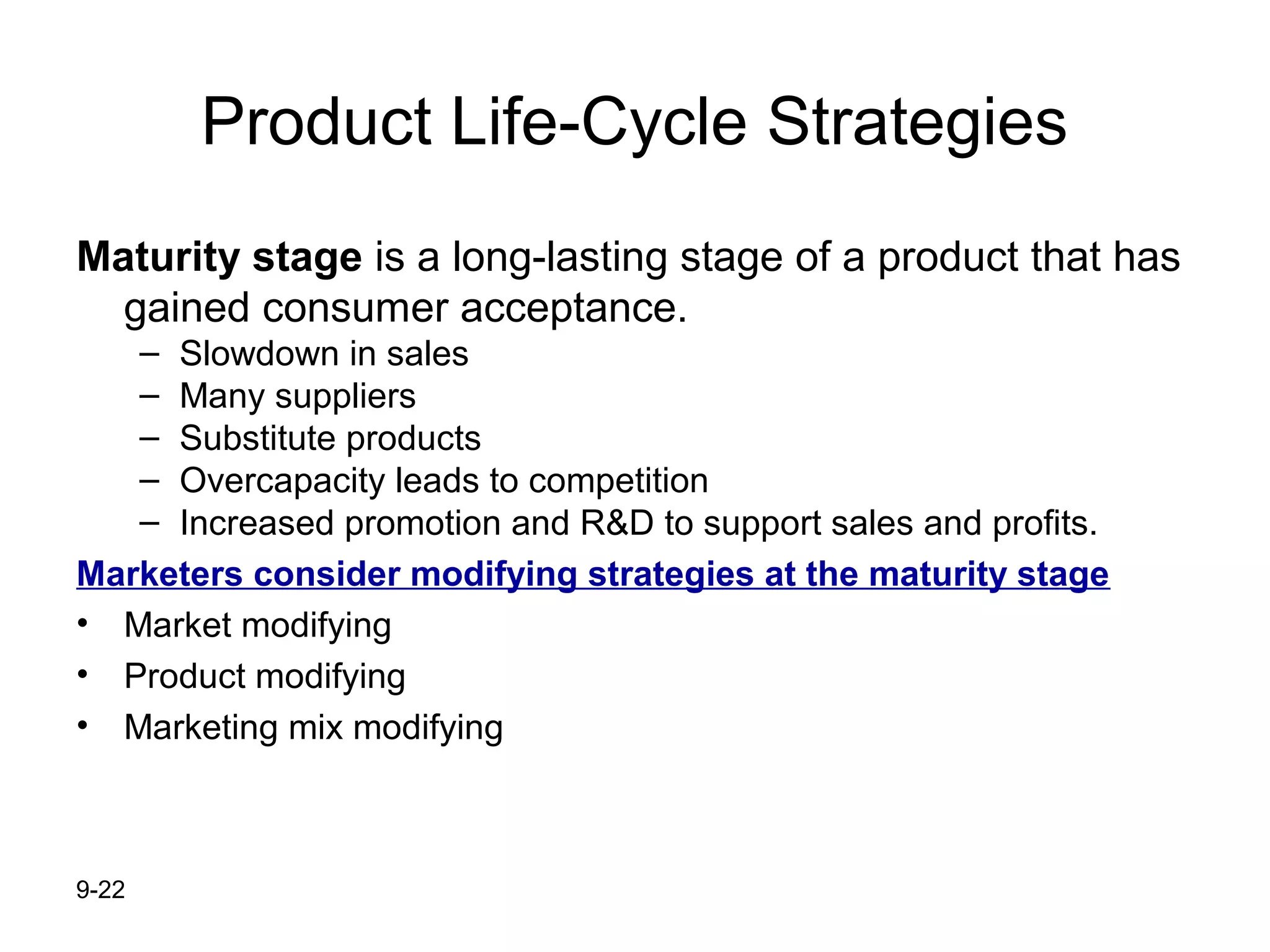
Maturity stage is a long-lasting stage of a product that has
gained consumer acceptance.
– Slowdown in sales
– Many suppliers
– Substitute products
– Overcapacity leads to competition
– Increased promotion and R&D to support sales and profits.
Marketers consider modifying strategies at the maturity stage
• Market modifying
• Product modifying
• Marketing mix modifying
9-23
Product Life-Cycle Strategies
• Market modifying is when a company tries to increase
consumption of the current product (New users; Increase
usage of existing users; New market segments)
• Product modifying is changing characteristics (quality,
features, or style) to attract new users and to inspire more
usage.
• Marketing mix modifying is when a company changes
one or more of the marketing mix elements.
– Price
– Promotion
– Distribution channels
9-24
Product Life-Cycle Strategies
• Decline stage is when sales decline or level off for an
extended time, creating a weak product.
– Maintain the product without change in the hope that
competitors leave the industry
– Reposition or reformulate the product in hopes of
moving back into the growth stage
– Harvest the product that means reducing various costs
and hoping that sales hold up
– Drop the product by selling it to another firm or simply
liquidate it at salvage value
Chapter Questions
1. What is new product development?
2. Discus the steps of new product development.
3. Define PLC.
4. Show the graph of PLC.
5. Discuss the stages of PLC.

Chapter 09

  • 1.
  • 2.
    9-2 Chapter 9 1. New-ProductDevelopment Strategy 2. New-Product Development Process 3. Managing New-Product Development 4. Product Life-Cycle Strategies 5. Additional Product and Service Considerations
  • 3.
    9-3 New-Product Development New productdevelopment refers to original products, product improvements, product modifications, and new brands developed from the firm’s own research and development.
  • 4.
    9-4 Reasons for newproduct failure 1. Overestimation of market size 2. Poor design 3. Incorrect positioning 4. Wrong timing 5. Priced too high 6. Ineffective promotion 7. Management influence 8. High development costs 9. Competition New-Product Development Strategy
  • 5.
    9-5 New-Product Development Process 1.Idea generation 2. Idea screening 3. Concept development and testing 4. Marketing strategy development 5. Business analysis 6. Product development 7. Test marketing 8. Commercialization
  • 6.
    9-6 New-Product Development Process IdeaGeneration • New idea generation is the systematic search for new product ideas. • To create a large number of ideas • Sources of new-product ideas – Internal sources refer to the company’s own formal research and development, management and staff, and intrapreneurial programs. – External sources refer to sources outside the company such as customers, competitors, distributors, suppliers, and outside design firms.
  • 7.
    9-7 New-Product Development Process IdeaScreening • Idea screening refers to reviewing new-product ideas in order to drop poor ones as soon as possible. Concept Development and Testing • Product idea is an idea for a possible product that the company can see itself offering to the market. • Product concept is a detailed version of the idea stated in meaningful consumer terms. • Product image is the way consumers perceive an actual or potential product. • Concept testing refers to testing new-product concepts with groups of target consumers. To find out how attractive each concept is to customers, and choose the best one.
  • 8.
    9-8 New-Product Development Process MarketingStrategy Development • Marketing strategy development refers to the initial marketing strategy for introducing the product to the market. Marketing strategy statement Part 1: – Description of the target market – The planning product positioning; sales, market share, and profit goals Part 2: – Price distribution and budget Part 3: – Long-term sales, profit goals, and marketing mix strategy
  • 9.
    9-9 New-Product Development Process BusinessAnalysis • Business analysis involves a review of the sales, costs, and profit projections to find out whether they satisfy the company’s objectives. Product Development • Product development involves the creation and testing of one or more physical versions by the R&D or engineering departments. - Requires an increase in investment
  • 10.
    9-10 New-Product Development Process TestMarketing • Test marketing is the stage at which the product and marketing program are introduced into more realistic marketing settings. • Test marketing provides the marketer with experience in testing the product and entire marketing program before full introduction. • When firms test market: New product with large investment; Uncertainty about product or marketing program • When firms may not test market: Simple line extension; Copy of competitor product; Low costs; Management confidence
  • 11.
    9-11 New-Product Development Process TestMarketing • Approaches to test marketing – Standard test markets – Controlled test markets – Simulated test markets
  • 12.
    9-12 New-Product Development Process TestMarketing Standard test markets – Small representative markets where the firm conducts a full marketing campaign – Uses store audits, consumer and distributor surveys, and other measures to gauge product performance – Results are used to • Forecast national sales and profits • Discover product problems • Fine-tune the marketing program
  • 13.
    9-13 New-Product Development Process TestMarketing Challenges of standard test markets – Cost – Time – Competitors can monitor the test as well – Competitor interference – Competitors gain access to the new product before introduction
  • 14.
    9-14 New-Product Development Process TestMarketing Controlled test markets – Panels of stores that have agreed to carry new products for a fee – Less expensive than standard test markets – Faster than standard test markets – Competitors gain access to the new product
  • 15.
    9-15 New-Product Development Process TestMarketing Simulated test markets – Events where the firm will create a shopping environment and note how many consumers buy the new product and competing products – Provides measure of trial and the effectiveness of promotion – Researchers can interview consumers
  • 16.
    9-16 New-Product Development Process TestMarketing • Advantages of simulated test markets – Less expensive than other test methods – Faster – Restricts access by competitors • Disadvantages of simulated test markets – Not considered as reliable and accurate due to the controlled setting
  • 17.
    9-17 New-Product Development Process Commercialization •Commercialization is the introduction of the new product into the market – When to launch – Where to launch – Planned market rollout (the widespread public introduction of a new product )
  • 18.
    9-18 Product Life-Cycle Strategies •Product life-cycle (PLC) is the course that a product’s sales and profits take over its lifetime. – Product development – Introduction – Growth – Maturity – Decline
  • 19.
    9-19 Product Life-Cycle Strategies Salesand profits over the product’s life from inception to decline Profits
  • 20.
    9-20 Product Life-Cycle Strategies Introductionstage is when the new product is first launched. – Takes time – Slow sales growth – Little or no profit – High distribution and promotion expense
  • 21.
    9-21 Product Life-Cycle Strategies –Sales increase – New competitors enter the market – Price stability or decline to increase volume – Consumer education – Profits increase – Promotion and manufacturing costs gain economies of scale – Product quality increases – New features – New market segments and distribution channels are entered Growth stage is when the new product satisfies the market.
  • 22.
    9-22 Product Life-Cycle Strategies Maturitystage is a long-lasting stage of a product that has gained consumer acceptance. – Slowdown in sales – Many suppliers – Substitute products – Overcapacity leads to competition – Increased promotion and R&D to support sales and profits. Marketers consider modifying strategies at the maturity stage • Market modifying • Product modifying • Marketing mix modifying
  • 23.
    9-23 Product Life-Cycle Strategies •Market modifying is when a company tries to increase consumption of the current product (New users; Increase usage of existing users; New market segments) • Product modifying is changing characteristics (quality, features, or style) to attract new users and to inspire more usage. • Marketing mix modifying is when a company changes one or more of the marketing mix elements. – Price – Promotion – Distribution channels
  • 24.
    9-24 Product Life-Cycle Strategies •Decline stage is when sales decline or level off for an extended time, creating a weak product. – Maintain the product without change in the hope that competitors leave the industry – Reposition or reformulate the product in hopes of moving back into the growth stage – Harvest the product that means reducing various costs and hoping that sales hold up – Drop the product by selling it to another firm or simply liquidate it at salvage value
  • 25.
    Chapter Questions 1. Whatis new product development? 2. Discus the steps of new product development. 3. Define PLC. 4. Show the graph of PLC. 5. Discuss the stages of PLC.

Editor's Notes

  • #12 May change character according to popularity of this person