BY- RITIK VARDHAN
       M.Sc.(P)
  ROLL NO.- 1366
CONTENTS
            
 INTRODUCTION
 HISTORY
 PRINCIPLE
 CONFIGURATION & TYPES
 APPLICATION
 LIMITATION
 RECENT RESEARCH
INTRODUCTION

                             
 The patch clamp technique is a laboratory technique
  in electrophysiology that allows the study of single or
  multiple ion channels in cells.

 Sakmann and Neher - develop the patch clamp technique
  in 1970s and early 1980s.

 Received the Nobel prize for this high scientificwork
  in1991 .


                                                            3
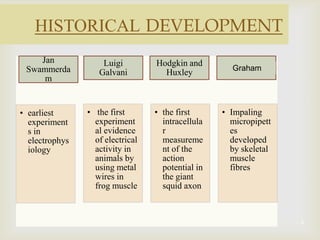
HISTORICAL DEVELOPMENT
    Jan
 Swammerda
     m
                    Luigi
                   Galvani        
                                  Hodgkin and
                                    Huxley           Graham


• earliest      • the first       • the first      • Impaling
  experiment      experiment        intracellula     micropipett
  s in            al evidence       r                es
  electrophys     of electrical     measureme        developed
  iology          activity in       nt of the        by skeletal
                  animals by        action           muscle
                  using metal       potential in     fibres
                  wires in          the giant
                  frog muscle       squid axon


                                                                   4
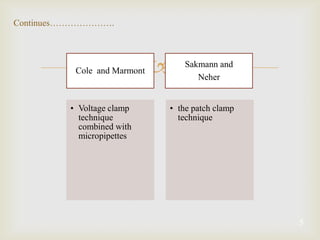
Continues………………….


          Cole and Marmont      Sakmann and
                                    Neher


         • Voltage clamp     • the patch clamp
           technique           technique
           combined with
           micropipettes


                                                 5
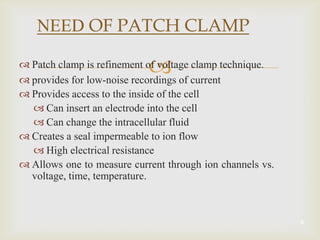
NEED OF PATCH CLAMP

                            
 Patch clamp is refinement of voltage clamp technique.
 provides for low-noise recordings of current
 Provides access to the inside of the cell
   Can insert an electrode into the cell
   Can change the intracellular fluid
 Creates a seal impermeable to ion flow
   High electrical resistance
 Allows one to measure current through ion channels vs.
  voltage, time, temperature.


                                                           6
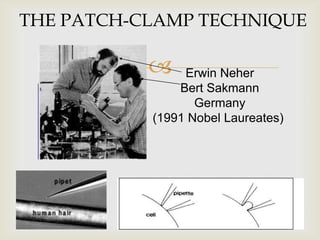
THE PATCH-CLAMP TECHNIQUE

               Erwin Neher
               Bert Sakmann
                  Germany
           (1991 Nobel Laureates)


                                    7
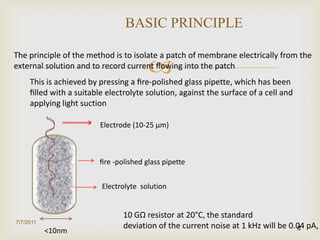
BASIC PRINCIPLE

The principle of the method is to isolate a patch of membrane electrically from the
                                        
external solution and to record current flowing into the patch
     This is achieved by pressing a fire-polished glass pipette, which has been
     filled with a suitable electrolyte solution, against the surface of a cell and
     applying light suction

                         Electrode (10-25 µm)


                         fire -polished glass pipette


                          Electrolyte solution


                                10 GΩ resistor at 20°C, the standard
7/7/2011                                                                            8
                                deviation of the current noise at 1 kHz will be 0.04 pA,
                                                                                  8
           <10nm
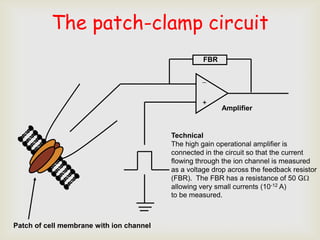
The patch-clamp circuit
                                                    FBR

                                                   _


                                                   +
                                                          Amplifier


                                          Technical
                                          The high gain operational amplifier is
                                          connected in the circuit so that the current
                                          flowing through the ion channel is measured
                                          as a voltage drop across the feedback resistor
                                          (FBR). The FBR has a resistance of 50 G
                                          allowing very small currents (10-12 A)
                                          to be measured.


Patch of cell membrane with ion channel
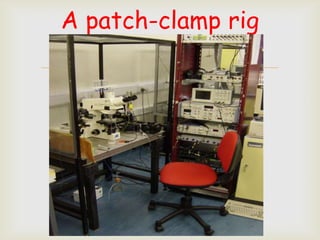
A patch-clamp rig
       
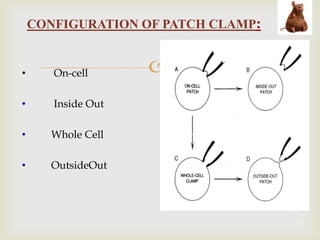
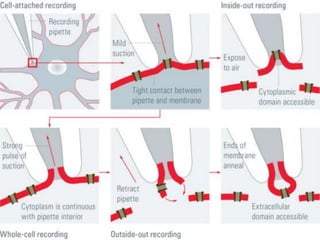
CONFIGURATION OF PATCH CLAMP:


•      On-cell      
•      Inside Out

•      Whole Cell

•      OutsideOut


                                    11

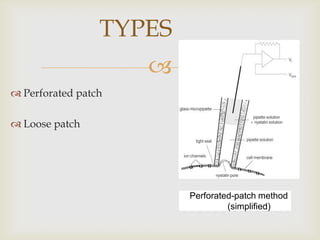
TYPES
                     
 Perforated patch

 Loose patch


                         DPerforated-patch method
                                   (simplified)ASF
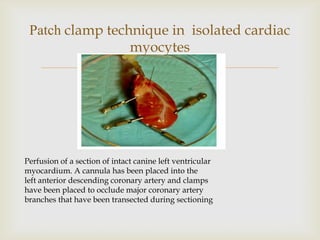
Patch clamp technique in isolated cardiac
                 myocytes
                                    


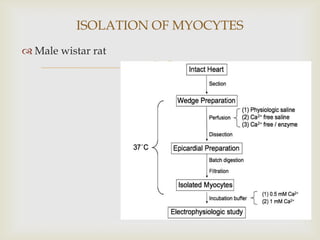
Perfusion of a section of intact canine left ventricular
myocardium. A cannula has been placed into the
left anterior descending coronary artery and clamps
have been placed to occlude major coronary artery
branches that have been transected during sectioning
ISOLATION OF MYOCYTES
 Male wistar rat
                    
PRINCIPLE &
                PROCEDURE
                              
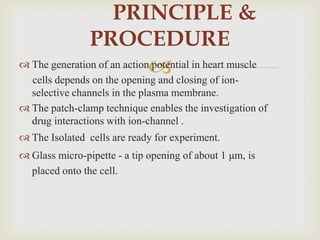
 The generation of an action potential in heart muscle
  cells depends on the opening and closing of ion-
  selective channels in the plasma membrane.
 The patch-clamp technique enables the investigation of
  drug interactions with ion-channel .
 The Isolated cells are ready for experiment.
 Glass micro-pipette - a tip opening of about 1 μm, is
  placed onto the cell.
 The patch-pipette is filled with either high NaCl or KCl


                                
   solution and is mounted on a micro manipulator.

 A chlorided silver wire connects the pipette

  solution to the head stage of an electronical amplifier.

 A second chlorided silver wire is inserted into the bath and

   serves a ground electrode.

 Whole cell patch clamping is done
This high input resistance enables the recording of small electrical

  currents in the range of Picosiemens (10–12 S), which are flowing

                                 
  through channel-forming proteins situated in the membrane patch.


The electrical current is driven by applying an electrical potential

  across the membrane patch, and/or by establishing an appropriated

  chemical gradient for the respective ion species.

To investigate the interaction of drugs with all ion channels

  involved in the functioning of the heart muscle cell (K+, Na+,

  Ca2+ and eventually Cl– channels).


 The different types of K+ channels existing in cardiomyocyte.
EVALUATION


                              
 Concentration-response curves of drugs which either

  inhibit or activate ion channels can be recorded either

  on the single channel level or by measuring the whole

  cell current. IC50 and EC50 values (50% inhibition or

  activation, respectively) can be obtained.
limitations

                             
 Imparting skillful training performance and recording
  In during single channel recordings

 Cost of process is expensive

 Time consuming

 Number of samples required is more at times

 Chance of membrane distortion
APPLICATIONS
   For the evaluation of antiarrhythmics agents.

   In kidney cells.

                                    
    Used for isolated ventricular myocytes from Guinea pigs to study a cardio

    selective inhibition of the ATP sensitive potassium channel.

   To identify multiple types of calcium channels.

   To measure the effect of potassium channel openers.

   Used in the molecular biology.

   Voltage clamp studies on sodium channels.

   Used to investigate a wide range of electrophysiological cell properties.

   Measurement of cell membrane conductance.
RECENT RESEARCH

                          amultiparametric
 Measurements are conducted in
  manner in an integrated and automated microfluidic
  chip.
 Micropippetes in traditional patch clamp technique are
  replaced by nano machine patch clamp system with
  integrated micro fluidics which aids
     Rapid Intra cellular perfusion
     Improved optical measurments
     Rapid measurment of single cell dose response curves
conclusion

                             
 It is higly modified and successful technique

 Development of this technique is being done for newer

  approaches to yield better accurate and efficient

  information which aids drug discovery process.
References
1.   Wyllie DJA (2007) Single-channel recording. In Patch-Clamp Analysis –
     Advanced Techniques 2nd Edition. pp 69-129. Ed. Walz W. Humana Press


2.
     Totowa, New Jersey USA
                                       
     Sakmann B (1992) Elementary steps in synaptic transmission revealed by
     currents through single ion channels. Neuron 8, 613-629.
     This is his 1992 Nobel Lecture and well worth a read

3.   Aidley DJ & Stanfield PR (1996) Ion Channels – Molecules in Action
     Cambridge University Press.
     This is a very good introductory textbook.
Patch clamp technique

Patch clamp technique

  • 1.
    BY- RITIK VARDHAN M.Sc.(P) ROLL NO.- 1366
  • 2.
    CONTENTS   INTRODUCTION  HISTORY  PRINCIPLE  CONFIGURATION & TYPES  APPLICATION  LIMITATION  RECENT RESEARCH
  • 3.
    INTRODUCTION   The patch clamp technique is a laboratory technique in electrophysiology that allows the study of single or multiple ion channels in cells.  Sakmann and Neher - develop the patch clamp technique in 1970s and early 1980s.  Received the Nobel prize for this high scientificwork in1991 . 3
  • 4.
    HISTORICAL DEVELOPMENT Jan Swammerda m Luigi Galvani  Hodgkin and Huxley Graham • earliest • the first • the first • Impaling experiment experiment intracellula micropipett s in al evidence r es electrophys of electrical measureme developed iology activity in nt of the by skeletal animals by action muscle using metal potential in fibres wires in the giant frog muscle squid axon 4
  • 5.
    Continues…………………. Cole and Marmont  Sakmann and Neher • Voltage clamp • the patch clamp technique technique combined with micropipettes 5
  • 6.
    NEED OF PATCHCLAMP   Patch clamp is refinement of voltage clamp technique.  provides for low-noise recordings of current  Provides access to the inside of the cell  Can insert an electrode into the cell  Can change the intracellular fluid  Creates a seal impermeable to ion flow  High electrical resistance  Allows one to measure current through ion channels vs. voltage, time, temperature. 6
  • 7.
    THE PATCH-CLAMP TECHNIQUE  Erwin Neher Bert Sakmann Germany (1991 Nobel Laureates) 7
  • 8.
    BASIC PRINCIPLE The principleof the method is to isolate a patch of membrane electrically from the  external solution and to record current flowing into the patch This is achieved by pressing a fire-polished glass pipette, which has been filled with a suitable electrolyte solution, against the surface of a cell and applying light suction Electrode (10-25 µm) fire -polished glass pipette Electrolyte solution 10 GΩ resistor at 20°C, the standard 7/7/2011 8 deviation of the current noise at 1 kHz will be 0.04 pA, 8 <10nm
  • 9.
    The patch-clamp circuit FBR _ + Amplifier Technical The high gain operational amplifier is connected in the circuit so that the current flowing through the ion channel is measured as a voltage drop across the feedback resistor (FBR). The FBR has a resistance of 50 G allowing very small currents (10-12 A) to be measured. Patch of cell membrane with ion channel
  • 10.
  • 11.
    CONFIGURATION OF PATCHCLAMP: • On-cell  • Inside Out • Whole Cell • OutsideOut 11
  • 12.
  • 13.
    TYPES   Perforated patch  Loose patch DPerforated-patch method (simplified)ASF
  • 14.
    Patch clamp techniquein isolated cardiac myocytes  Perfusion of a section of intact canine left ventricular myocardium. A cannula has been placed into the left anterior descending coronary artery and clamps have been placed to occlude major coronary artery branches that have been transected during sectioning
  • 15.
    ISOLATION OF MYOCYTES Male wistar rat 
  • 16.
    PRINCIPLE & PROCEDURE   The generation of an action potential in heart muscle cells depends on the opening and closing of ion- selective channels in the plasma membrane.  The patch-clamp technique enables the investigation of drug interactions with ion-channel .  The Isolated cells are ready for experiment.  Glass micro-pipette - a tip opening of about 1 μm, is placed onto the cell.
  • 17.
     The patch-pipetteis filled with either high NaCl or KCl  solution and is mounted on a micro manipulator.  A chlorided silver wire connects the pipette solution to the head stage of an electronical amplifier.  A second chlorided silver wire is inserted into the bath and serves a ground electrode.  Whole cell patch clamping is done
  • 18.
    This high inputresistance enables the recording of small electrical currents in the range of Picosiemens (10–12 S), which are flowing  through channel-forming proteins situated in the membrane patch. The electrical current is driven by applying an electrical potential across the membrane patch, and/or by establishing an appropriated chemical gradient for the respective ion species.
  • 19.
     To investigate theinteraction of drugs with all ion channels involved in the functioning of the heart muscle cell (K+, Na+, Ca2+ and eventually Cl– channels).  The different types of K+ channels existing in cardiomyocyte.
  • 20.
    EVALUATION   Concentration-response curves of drugs which either inhibit or activate ion channels can be recorded either on the single channel level or by measuring the whole cell current. IC50 and EC50 values (50% inhibition or activation, respectively) can be obtained.
  • 21.
    limitations   Imparting skillful training performance and recording In during single channel recordings  Cost of process is expensive  Time consuming  Number of samples required is more at times  Chance of membrane distortion
  • 22.
    APPLICATIONS  For the evaluation of antiarrhythmics agents.  In kidney cells.   Used for isolated ventricular myocytes from Guinea pigs to study a cardio selective inhibition of the ATP sensitive potassium channel.  To identify multiple types of calcium channels.  To measure the effect of potassium channel openers.  Used in the molecular biology.  Voltage clamp studies on sodium channels.  Used to investigate a wide range of electrophysiological cell properties.  Measurement of cell membrane conductance.
  • 23.
    RECENT RESEARCH amultiparametric  Measurements are conducted in manner in an integrated and automated microfluidic chip.  Micropippetes in traditional patch clamp technique are replaced by nano machine patch clamp system with integrated micro fluidics which aids Rapid Intra cellular perfusion Improved optical measurments Rapid measurment of single cell dose response curves
  • 24.
    conclusion   It is higly modified and successful technique  Development of this technique is being done for newer approaches to yield better accurate and efficient information which aids drug discovery process.
  • 25.
    References 1. Wyllie DJA (2007) Single-channel recording. In Patch-Clamp Analysis – Advanced Techniques 2nd Edition. pp 69-129. Ed. Walz W. Humana Press 2. Totowa, New Jersey USA  Sakmann B (1992) Elementary steps in synaptic transmission revealed by currents through single ion channels. Neuron 8, 613-629. This is his 1992 Nobel Lecture and well worth a read 3. Aidley DJ & Stanfield PR (1996) Ion Channels – Molecules in Action Cambridge University Press. This is a very good introductory textbook.