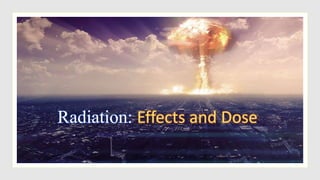
Radiation: Effects and Dose
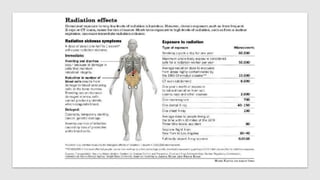
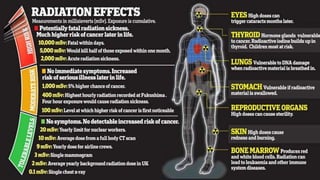
Radiation effects shows two types of Poisoning
according to the exposure obtained:
Acute Radiation Poisoning
Chronic Radiation Poisoning
*Acute radiation syndrome (ARS) also known as radiation poisoning,
radiation sickness or radiation toxicity, is a constellation of health effects
which occur within several months of exposure to high amounts of ionizing
radiation.
Relatively smaller doses
results:
*gastrointestinal effects:
-nausea and vomiting
*symptoms related to falling
blood count:
-infection and bleeding.
Relatively larger
doses can result:
*neurological effects
*rapid death.
Treatment :
*blood transfusions
*antibiotics
Chronic radiation syndrome is a constellation of health effects that occur
after months or years of chronic exposure to high amounts of ionizing
radiation.
It may manifest with low
blood cell counts and
neurological problems.
Radiation exposure can also
increase the probability of
developing some other diseases,
mainly different types of cancers.
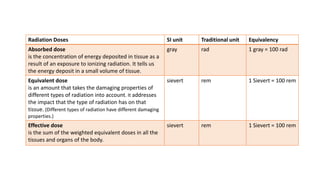
Radiation Doses SI unit Traditional unit Equivalency
Absorbed dose
is the concentration of energy deposited in tissue as a
result of an exposure to ionizing radiation. It tells us
the energy deposit in a small volume of tissue.
gray rad 1 gray = 100 rad
Equivalent dose
is an amount that takes the damaging properties of
different types of radiation into account. It addresses
the impact that the type of radiation has on that
tissue. (Different types of radiation have different damaging
properties.)
sievert rem 1 Sievert = 100 rem
Effective dose
is the sum of the weighted equivalent doses in all the
tissues and organs of the body.
sievert rem 1 Sievert = 100 rem
“RADIATION PROTECTION”
*EXTERNAL RADIATION PROTECTION
A.Time
B. Distance
C. Shielding
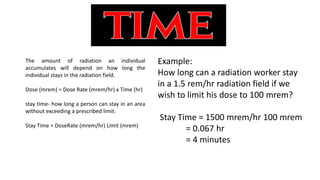
The amount of radiation an individual
accumulates will depend on how long the
individual stays in the radiation field.
Dose (mrem) = Dose Rate (mrem/hr) x Time (hr)
stay time- how long a person can stay in an area
without exceeding a prescribed limit.
Stay Time = DoseRate (mrem/hr) Limit (mrem)
Example:
How long can a radiation worker stay
in a 1.5 rem/hr radiation field if we
wish to limit his dose to 100 mrem?
Stay Time = 1500 mrem/hr 100 mrem
= 0.067 hr
= 4 minutes
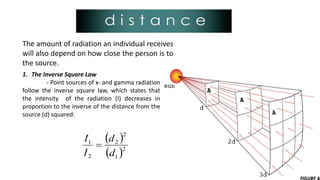
The amount of radiation an individual receives
will also depend on how close the person is to
the source.
1. The Inverse Square Law
- Point sources of x- and gamma radiation
follow the inverse square law, which states that
the intensity of the radiation (I) decreases in
proportion to the inverse of the distance from the
source (d) squared:
 
 2
1
2
2
2
1
d
d
I
I

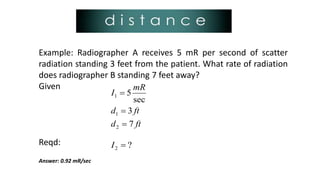
Example: Radiographer A receives 5 mR per second of scatter
radiation standing 3 feet from the patient. What rate of radiation
does radiographer B standing 7 feet away?
Given
Reqd:
Answer: 0.92 mR/sec
ftd
ftd
mR
I
7
3
sec
5
2
1
1



?2 I
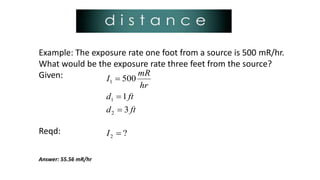
Example: The exposure rate one foot from a source is 500 mR/hr.
What would be the exposure rate three feet from the source?
Given:
Reqd:
Answer: 55.56 mR/hr
ftd
ftd
hr
mR
I
3
1
500
2
1
1



?2 I
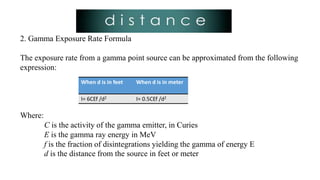
2. Gamma Exposure Rate Formula
The exposure rate from a gamma point source can be approximated from the following
expression:
Where:
C is the activity of the gamma emitter, in Curies
E is the gamma ray energy in MeV
f is the fraction of disintegrations yielding the gamma of energy E
d is the distance from the source in feet or meter
When d is in feet When d is in meter
I= 6CEf /d2 I= 0.5CEf /d2
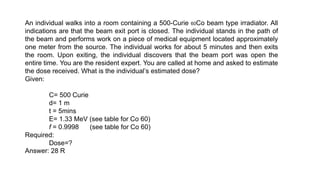
An individual walks into a room containing a 500-Curie 60Co beam type irradiator. All
indications are that the beam exit port is closed. The individual stands in the path of
the beam and performs work on a piece of medical equipment located approximately
one meter from the source. The individual works for about 5 minutes and then exits
the room. Upon exiting, the individual discovers that the beam port was open the
entire time. You are the resident expert. You are called at home and asked to estimate
the dose received. What is the individual’s estimated dose?
Given:
C= 500 Curie
d= 1 m
t = 5mins
E= 1.33 MeV (see table for Co 60)
f = 0.9998 (see table for Co 60)
Required:
Dose=?
Answer: 28 R
When reducing the time or increasing the distance may not be possible,
one can choose shielding material to reduce the external radiation hazard.
The proper material to use depends on the type of radiation and its
energy.
*Alpha and Beta Radiation
*X and Gamma Radiation
*Half Value Layer
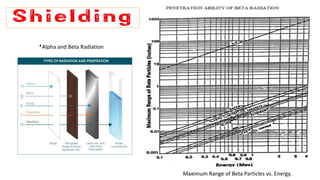
*Alpha and Beta Radiation
Maximum Range of Beta Particles vs. Energy.
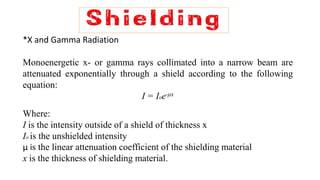
*X and Gamma Radiation
Monoenergetic x- or gamma rays collimated into a narrow beam are
attenuated exponentially through a shield according to the following
equation:
I = Ioe-μx
Where:
I is the intensity outside of a shield of thickness x
Io is the unshielded intensity
μ is the linear attenuation coefficient of the shielding material
x is the thickness of shielding material.
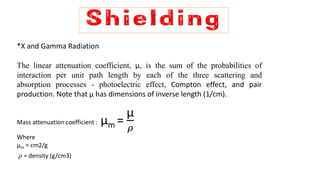
*X and Gamma Radiation
The linear attenuation coefficient, μ, is the sum of the probabilities of
interaction per unit path length by each of the three scattering and
absorption processes - photoelectric effect, Compton effect, and pair
production. Note that μ has dimensions of inverse length (1/cm).
Mass attenuation coefficient : μm =
μ
𝜌
Where
μm = cm2/g
𝜌 = density (g/cm3)
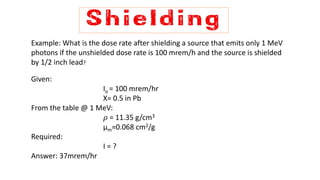
Example: What is the dose rate after shielding a source that emits only 1 MeV
photons if the unshielded dose rate is 100 mrem/h and the source is shielded
by 1/2 inch lead?
Given:
Io = 100 mrem/hr
X= 0.5 in Pb
From the table @ 1 MeV:
𝜌 = 11.35 g/cm3
μm=0.068 cm2/g
Required:
I = ?
Answer: 37mrem/hr
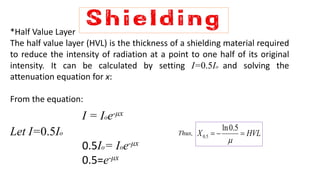
*Half Value Layer
The half value layer (HVL) is the thickness of a shielding material required
to reduce the intensity of radiation at a point to one half of its original
intensity. It can be calculated by setting I=0.5Io and solving the
attenuation equation for x:
From the equation:
I = Ioe-μx
Let I=0.5Io Thus,
0.5Io= Ioe-μx
0.5=e-μx
HVLX 

5.0ln
5.0
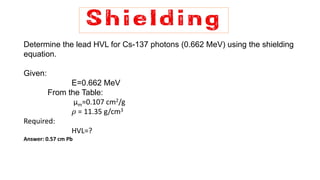
Determine the lead HVL for Cs-137 photons (0.662 MeV) using the shielding
equation.
Given:
E=0.662 MeV
From the Table:
μm=0.107 cm2/g
𝜌 = 11.35 g/cm3
Required:
HVL=?
Answer: 0.57 cm Pb

Radiation: Effects and Dose Calculations

  • 1.
  • 2.
    Radiation effects showstwo types of Poisoning according to the exposure obtained: Acute Radiation Poisoning Chronic Radiation Poisoning
  • 3.
    *Acute radiation syndrome(ARS) also known as radiation poisoning, radiation sickness or radiation toxicity, is a constellation of health effects which occur within several months of exposure to high amounts of ionizing radiation. Relatively smaller doses results: *gastrointestinal effects: -nausea and vomiting *symptoms related to falling blood count: -infection and bleeding. Relatively larger doses can result: *neurological effects *rapid death. Treatment : *blood transfusions *antibiotics
  • 4.
    Chronic radiation syndromeis a constellation of health effects that occur after months or years of chronic exposure to high amounts of ionizing radiation. It may manifest with low blood cell counts and neurological problems. Radiation exposure can also increase the probability of developing some other diseases, mainly different types of cancers.
  • 8.
    Radiation Doses SIunit Traditional unit Equivalency Absorbed dose is the concentration of energy deposited in tissue as a result of an exposure to ionizing radiation. It tells us the energy deposit in a small volume of tissue. gray rad 1 gray = 100 rad Equivalent dose is an amount that takes the damaging properties of different types of radiation into account. It addresses the impact that the type of radiation has on that tissue. (Different types of radiation have different damaging properties.) sievert rem 1 Sievert = 100 rem Effective dose is the sum of the weighted equivalent doses in all the tissues and organs of the body. sievert rem 1 Sievert = 100 rem
  • 9.
    “RADIATION PROTECTION” *EXTERNAL RADIATIONPROTECTION A.Time B. Distance C. Shielding
  • 10.
    The amount ofradiation an individual accumulates will depend on how long the individual stays in the radiation field. Dose (mrem) = Dose Rate (mrem/hr) x Time (hr) stay time- how long a person can stay in an area without exceeding a prescribed limit. Stay Time = DoseRate (mrem/hr) Limit (mrem) Example: How long can a radiation worker stay in a 1.5 rem/hr radiation field if we wish to limit his dose to 100 mrem? Stay Time = 1500 mrem/hr 100 mrem = 0.067 hr = 4 minutes
  • 11.
    The amount ofradiation an individual receives will also depend on how close the person is to the source. 1. The Inverse Square Law - Point sources of x- and gamma radiation follow the inverse square law, which states that the intensity of the radiation (I) decreases in proportion to the inverse of the distance from the source (d) squared:    2 1 2 2 2 1 d d I I 
  • 12.
    Example: Radiographer Areceives 5 mR per second of scatter radiation standing 3 feet from the patient. What rate of radiation does radiographer B standing 7 feet away? Given Reqd: Answer: 0.92 mR/sec ftd ftd mR I 7 3 sec 5 2 1 1    ?2 I
  • 13.
    Example: The exposurerate one foot from a source is 500 mR/hr. What would be the exposure rate three feet from the source? Given: Reqd: Answer: 55.56 mR/hr ftd ftd hr mR I 3 1 500 2 1 1    ?2 I
  • 14.
    2. Gamma ExposureRate Formula The exposure rate from a gamma point source can be approximated from the following expression: Where: C is the activity of the gamma emitter, in Curies E is the gamma ray energy in MeV f is the fraction of disintegrations yielding the gamma of energy E d is the distance from the source in feet or meter When d is in feet When d is in meter I= 6CEf /d2 I= 0.5CEf /d2
  • 15.
    An individual walksinto a room containing a 500-Curie 60Co beam type irradiator. All indications are that the beam exit port is closed. The individual stands in the path of the beam and performs work on a piece of medical equipment located approximately one meter from the source. The individual works for about 5 minutes and then exits the room. Upon exiting, the individual discovers that the beam port was open the entire time. You are the resident expert. You are called at home and asked to estimate the dose received. What is the individual’s estimated dose? Given: C= 500 Curie d= 1 m t = 5mins E= 1.33 MeV (see table for Co 60) f = 0.9998 (see table for Co 60) Required: Dose=? Answer: 28 R
  • 16.
    When reducing thetime or increasing the distance may not be possible, one can choose shielding material to reduce the external radiation hazard. The proper material to use depends on the type of radiation and its energy. *Alpha and Beta Radiation *X and Gamma Radiation *Half Value Layer
  • 17.
    *Alpha and BetaRadiation Maximum Range of Beta Particles vs. Energy.
  • 18.
    *X and GammaRadiation Monoenergetic x- or gamma rays collimated into a narrow beam are attenuated exponentially through a shield according to the following equation: I = Ioe-μx Where: I is the intensity outside of a shield of thickness x Io is the unshielded intensity μ is the linear attenuation coefficient of the shielding material x is the thickness of shielding material.
  • 19.
    *X and GammaRadiation The linear attenuation coefficient, μ, is the sum of the probabilities of interaction per unit path length by each of the three scattering and absorption processes - photoelectric effect, Compton effect, and pair production. Note that μ has dimensions of inverse length (1/cm). Mass attenuation coefficient : μm = μ 𝜌 Where μm = cm2/g 𝜌 = density (g/cm3)
  • 20.
    Example: What isthe dose rate after shielding a source that emits only 1 MeV photons if the unshielded dose rate is 100 mrem/h and the source is shielded by 1/2 inch lead? Given: Io = 100 mrem/hr X= 0.5 in Pb From the table @ 1 MeV: 𝜌 = 11.35 g/cm3 μm=0.068 cm2/g Required: I = ? Answer: 37mrem/hr
  • 21.
    *Half Value Layer Thehalf value layer (HVL) is the thickness of a shielding material required to reduce the intensity of radiation at a point to one half of its original intensity. It can be calculated by setting I=0.5Io and solving the attenuation equation for x: From the equation: I = Ioe-μx Let I=0.5Io Thus, 0.5Io= Ioe-μx 0.5=e-μx HVLX   5.0ln 5.0
  • 22.
    Determine the leadHVL for Cs-137 photons (0.662 MeV) using the shielding equation. Given: E=0.662 MeV From the Table: μm=0.107 cm2/g 𝜌 = 11.35 g/cm3 Required: HVL=? Answer: 0.57 cm Pb