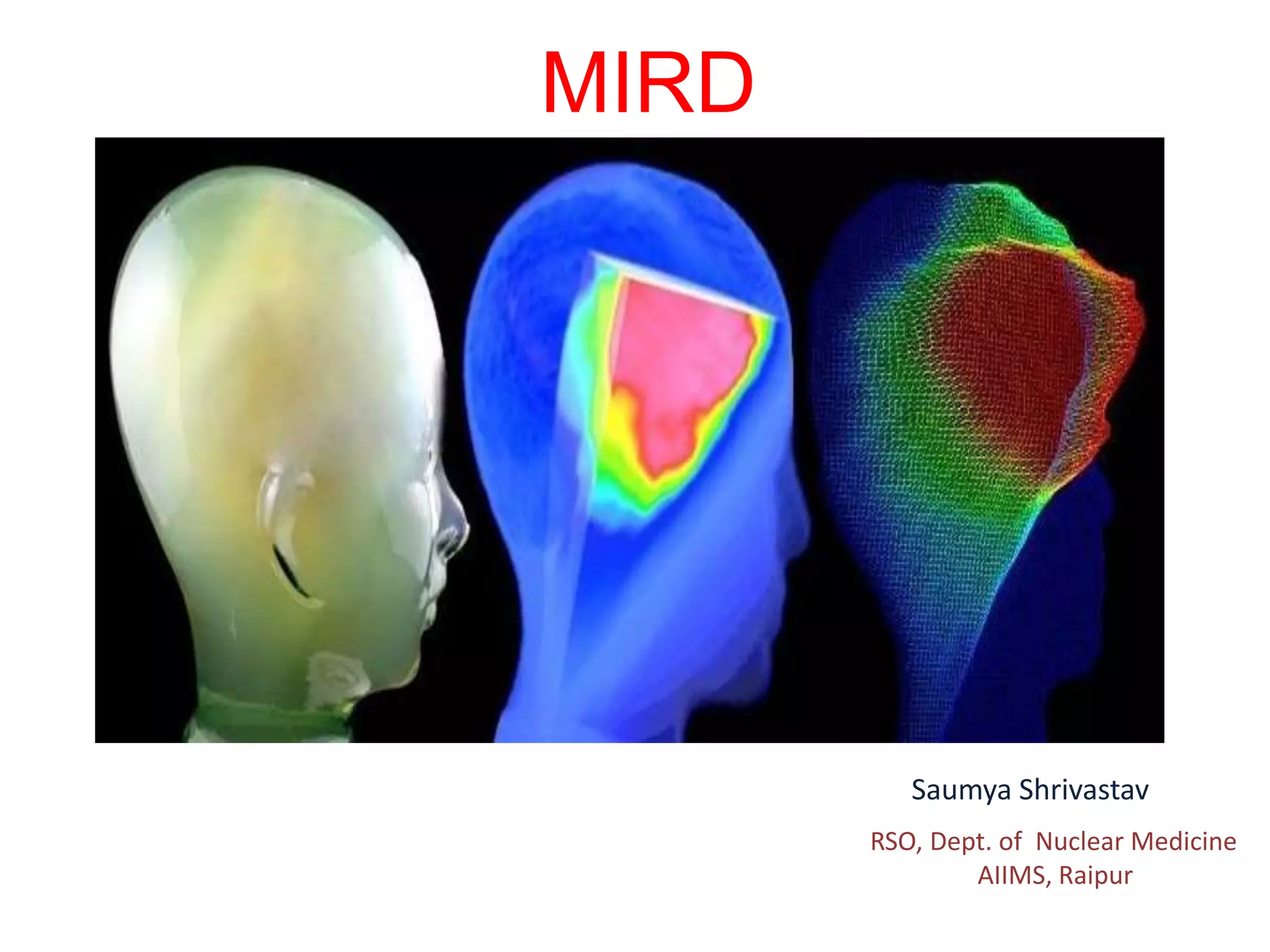
MIRD
Saumya Shrivastav
RSO, Dept. of Nuclear Medicine
AIIMS, Raipur
Internal Radiation Dosimetry
Contents :
• Basic definitions
1. Absorbed dose
2. Equivalent dose
3. Source and Target organs
• Calculation of Radiation dose (MIRD Method)
1. Basic procedure
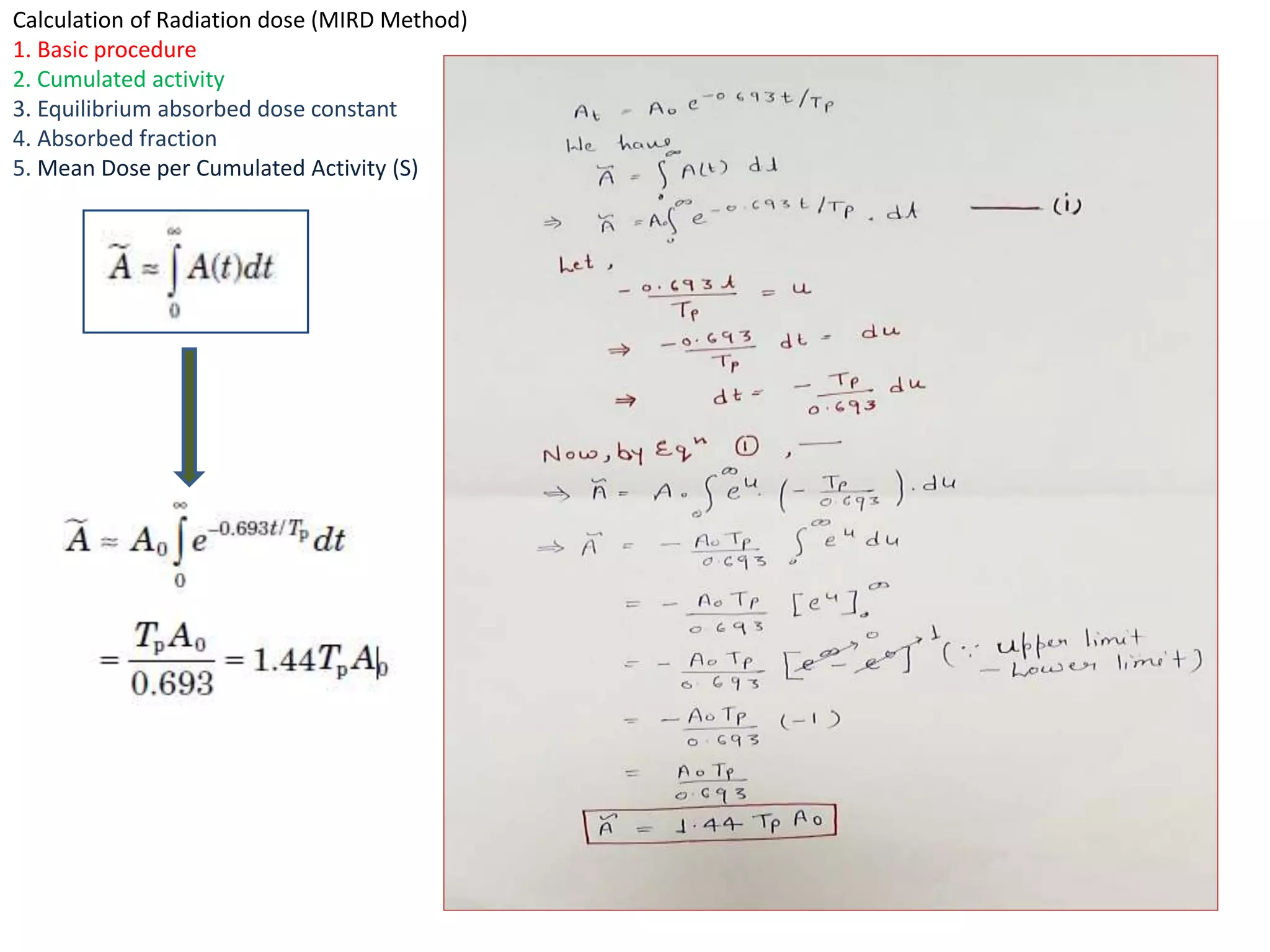
2. Cumulated activity
3. Equilibrium absorbed dose constant
4. Absorbed fraction
5. Mean Dose per Cumulated Activity (S)
Absorbed Dose
• The quantity of radiation energy deposited in an absorber per
kg of absorber material.
• SI Unit : Gray (Gy)
1 Gy = 1 j/kg
• Other unit : rad
1 Gy = 100 rad
1 rad = 100 ergs/gm
D(Gy) =
Energy deposited (joule)
Mass of absorber (Kg)
Basic definitions :
1. Absorbed dose
2. Equivalent dose
3. Source and Target organs
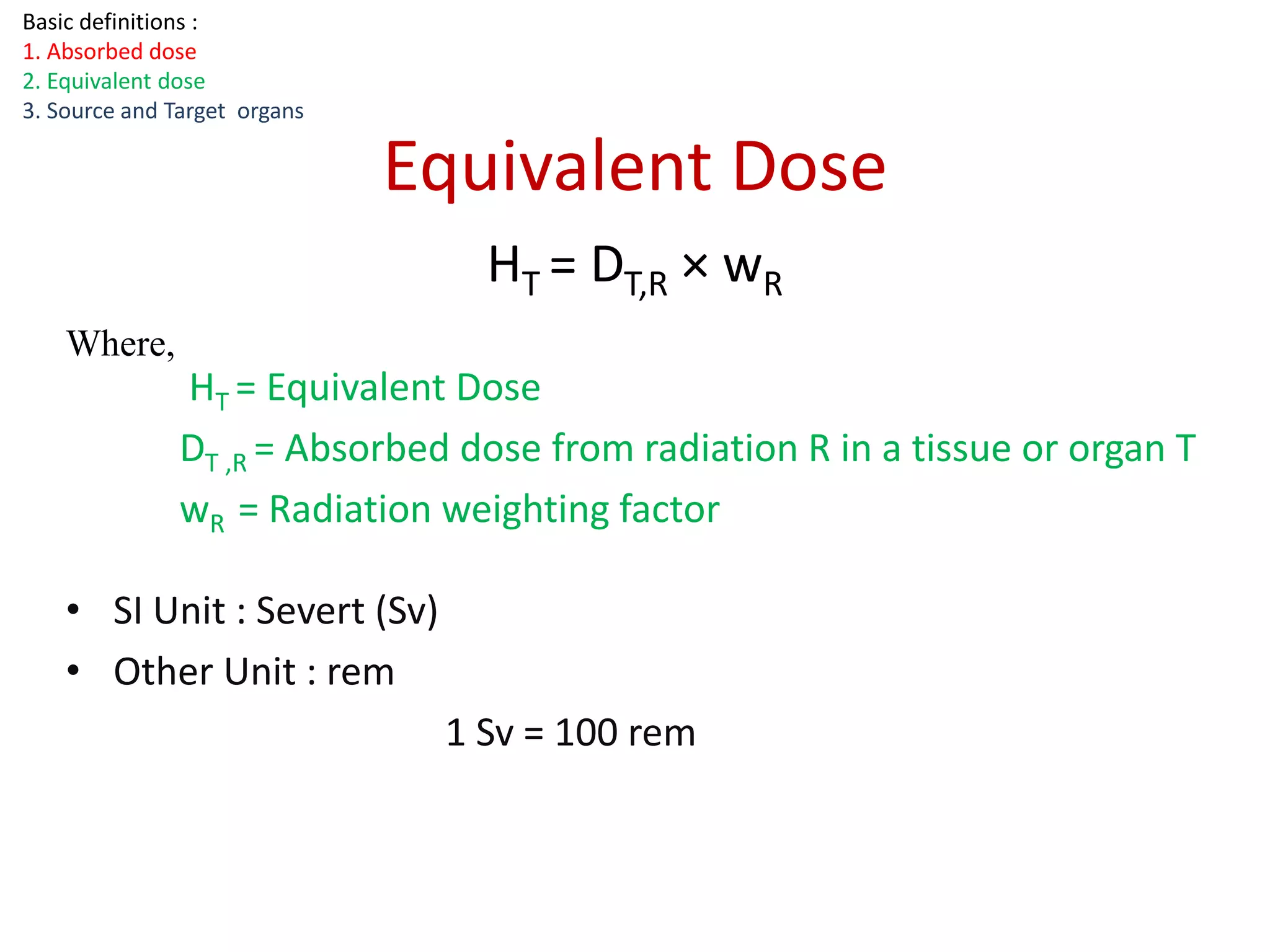
Equivalent Dose
HT = DT,R × wR
Where,
HT = Equivalent Dose
DT ,R = Absorbed dose from radiation R in a tissue or organ T
wR = Radiation weighting factor
• SI Unit : Severt (Sv)
• Other Unit : rem
1 Sv = 100 rem
Basic definitions :
1. Absorbed dose
2. Equivalent dose
3. Source and Target organs
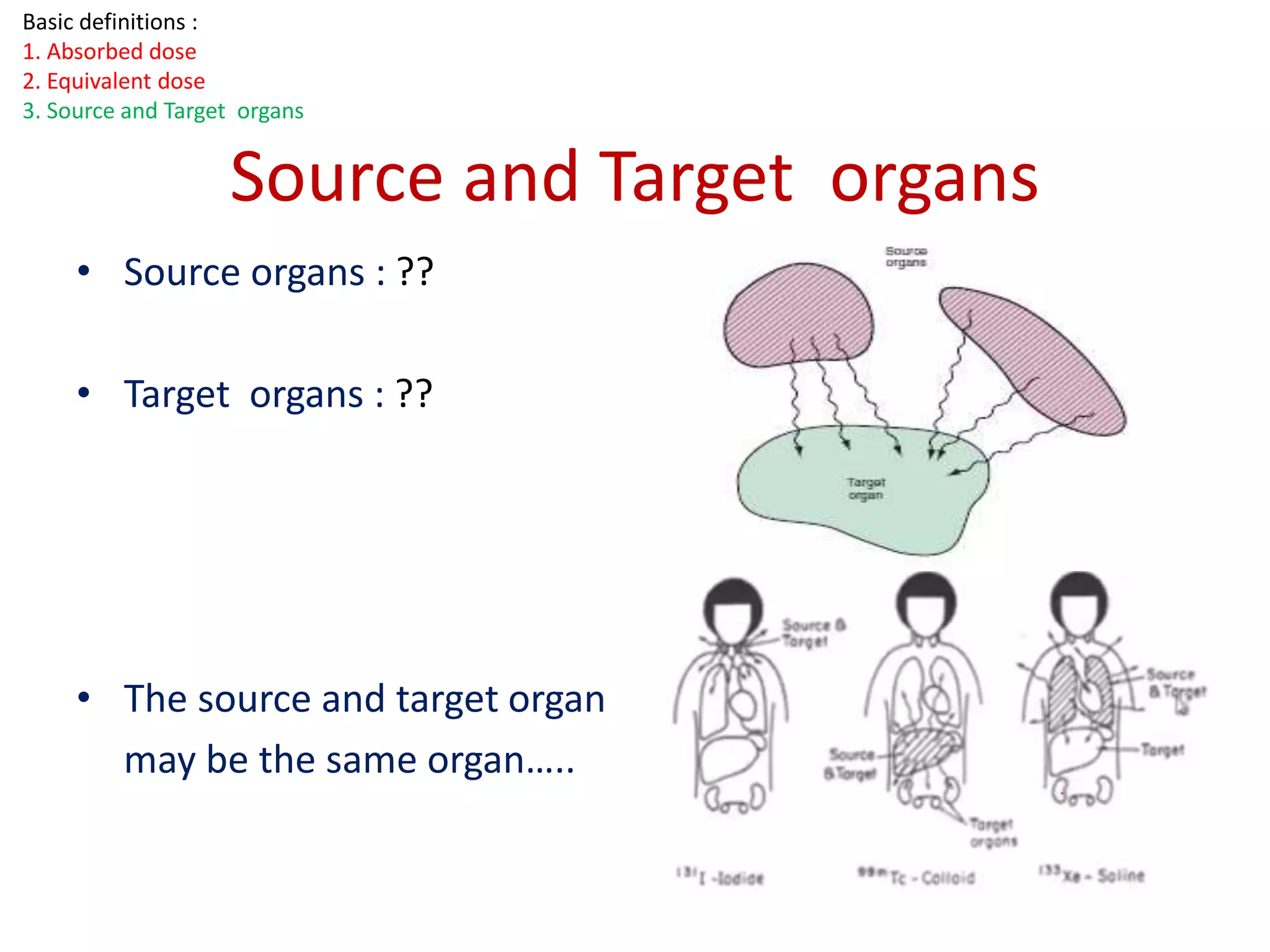
Source and Target organs
• Source organs : ??
• Target organs : ??
• The source and target organ
may be the same organ…..
Basic definitions :
1. Absorbed dose
2. Equivalent dose
3. Source and Target organs
Basic Procedure
The basic procedure for calculating the radiation dose to a
target organ from radioactivity in a source organ is a
three-step process, as follows :
1. The amount of activity and time spent by the radioactivity in the
source organ.
2. The total amount of radiation energy emitted by the radioactivity
in the source organ.
3. The fraction of energy emitted by the source organ that is
absorbed by the target organ.
Calculation of Radiation dose (MIRD Method)
1. Basic procedure
2. Cumulated activity
3. Equilibrium absorbed dose constant
4. Absorbed fraction
5. Mean Dose per Cumulated Activity (S)
Cumulated Activity
Activity in an organ depends on various factors :
1. Uptake of radiopharmaceutical
2. Excretion from the organ
3. Physical decay
Where , Ã = Cumulated activity
A(t) = A0 exp^(-0.693t /Tp)
• SI unit : Becquerel • sec (Bq • sec)
Calculation of Radiation dose (MIRD Method)
1. Basic procedure
2. Cumulated activity
3. Equilibrium absorbed dose constant
4. Absorbed fraction
5. Mean Dose per Cumulated Activity (S)
Calculation of Radiation dose (MIRD Method)
1. Basic procedure
2. Cumulated activity
3. Equilibrium absorbed dose constant
4. Absorbed fraction
5. Mean Dose per Cumulated Activity (S)
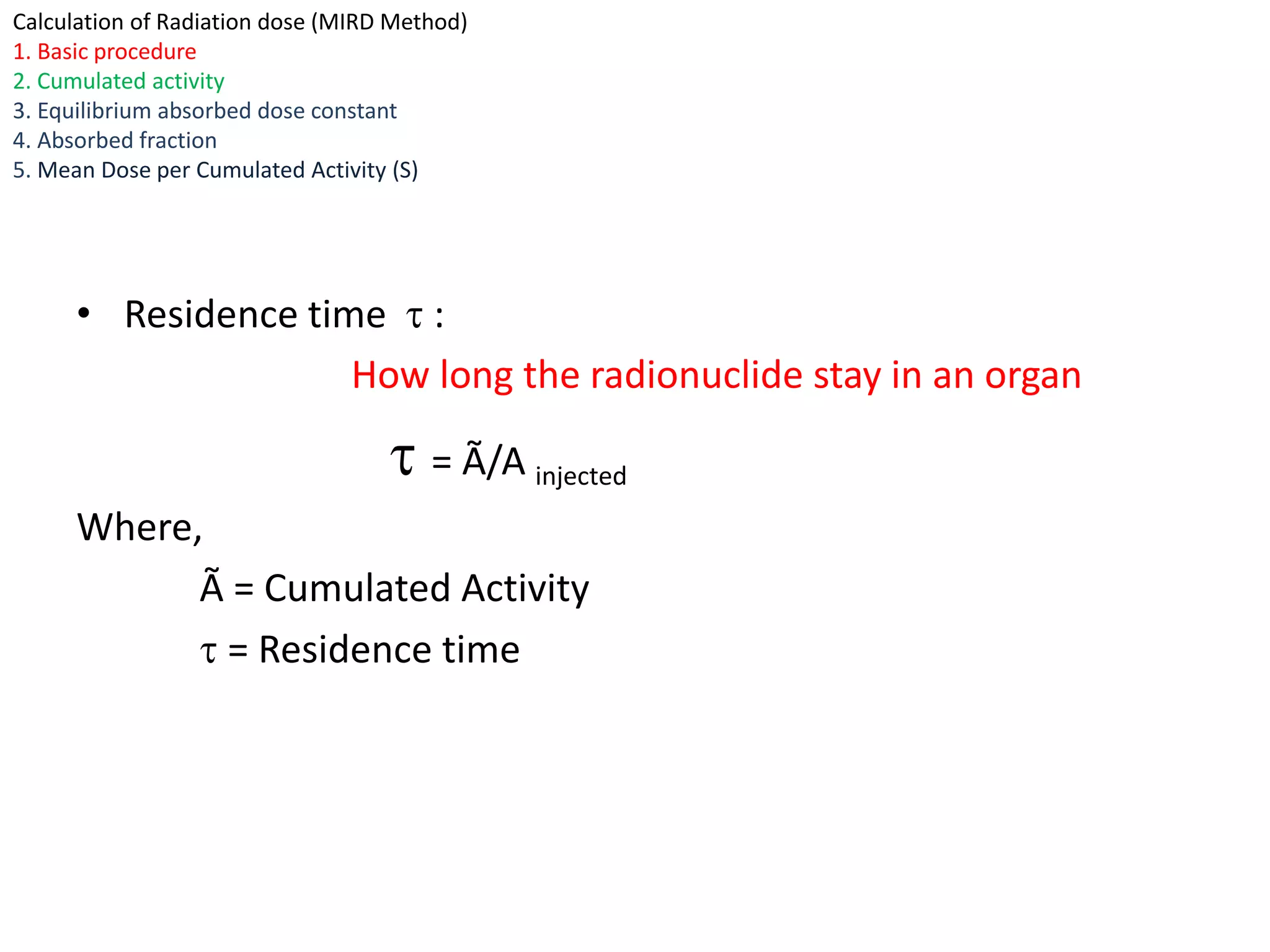
• Residence time  :
How long the radionuclide stay in an organ
 = Ã/A injected
Where,
à = Cumulated Activity
 = Residence time
Calculation of Radiation dose (MIRD Method)
1. Basic procedure
2. Cumulated activity
3. Equilibrium absorbed dose constant
4. Absorbed fraction
5. Mean Dose per Cumulated Activity (S)
Calculation : (four cases)
1. Instantaneous uptake with physical decay
2. Instantaneous uptake with clearance by biological excretion
TP  TB
3. Instantaneous uptake with clearance by biological excretion
and physical decay
4. Non-instantaneous uptake with biological and physical decay
Calculation of Radiation dose (MIRD Method)
1. Basic procedure
2. Cumulated activity
3. Equilibrium absorbed dose constant
4. Absorbed fraction
5. Mean Dose per Cumulated Activity (S)
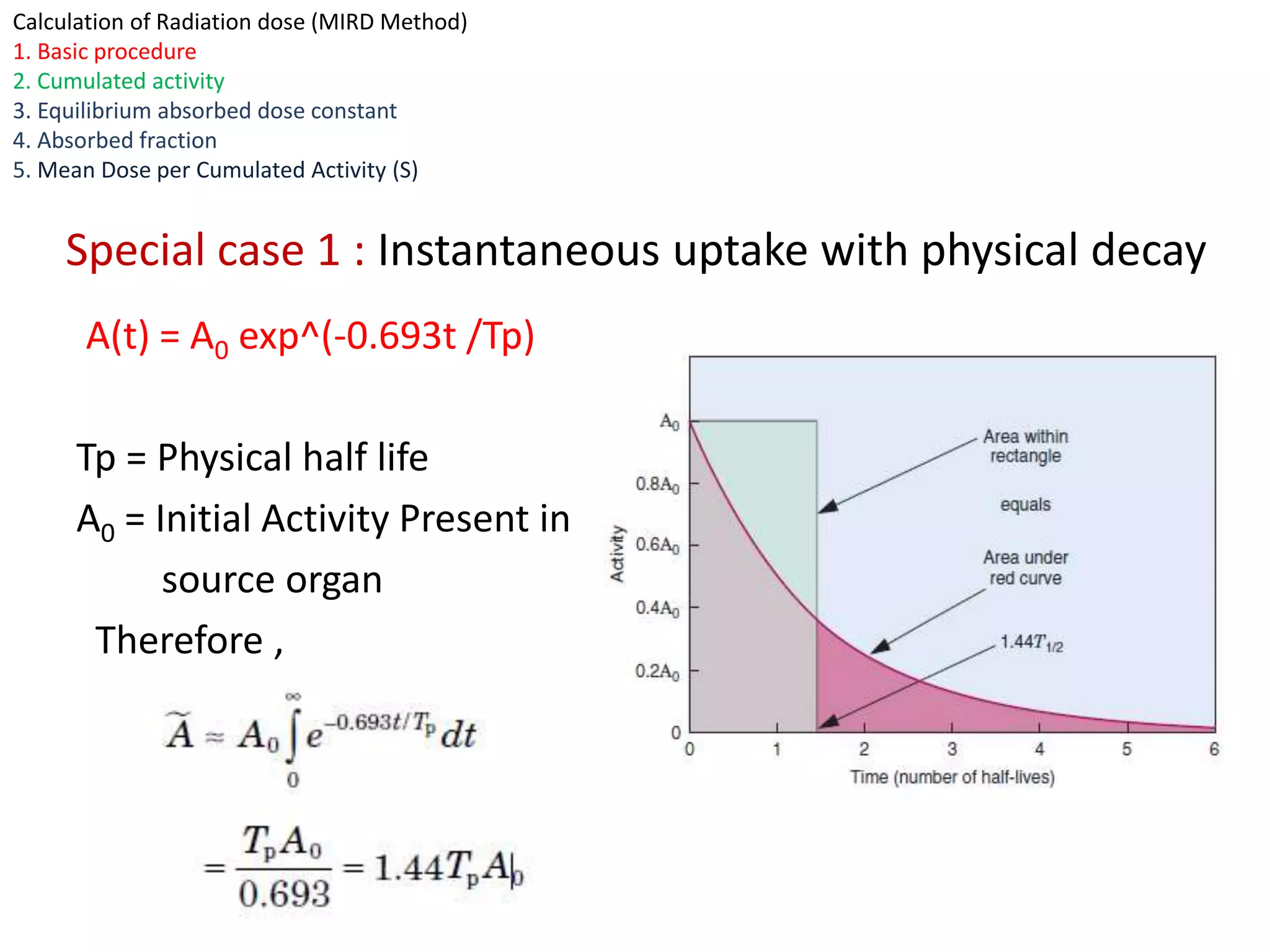
Special case 1 : Instantaneous uptake with physical decay
A(t) = A0 exp^(-0.693t /Tp)
Tp = Physical half life
A0 = Initial Activity Present in
source organ
Therefore ,
Calculation of Radiation dose (MIRD Method)
1. Basic procedure
2. Cumulated activity
3. Equilibrium absorbed dose constant
4. Absorbed fraction
5. Mean Dose per Cumulated Activity (S)
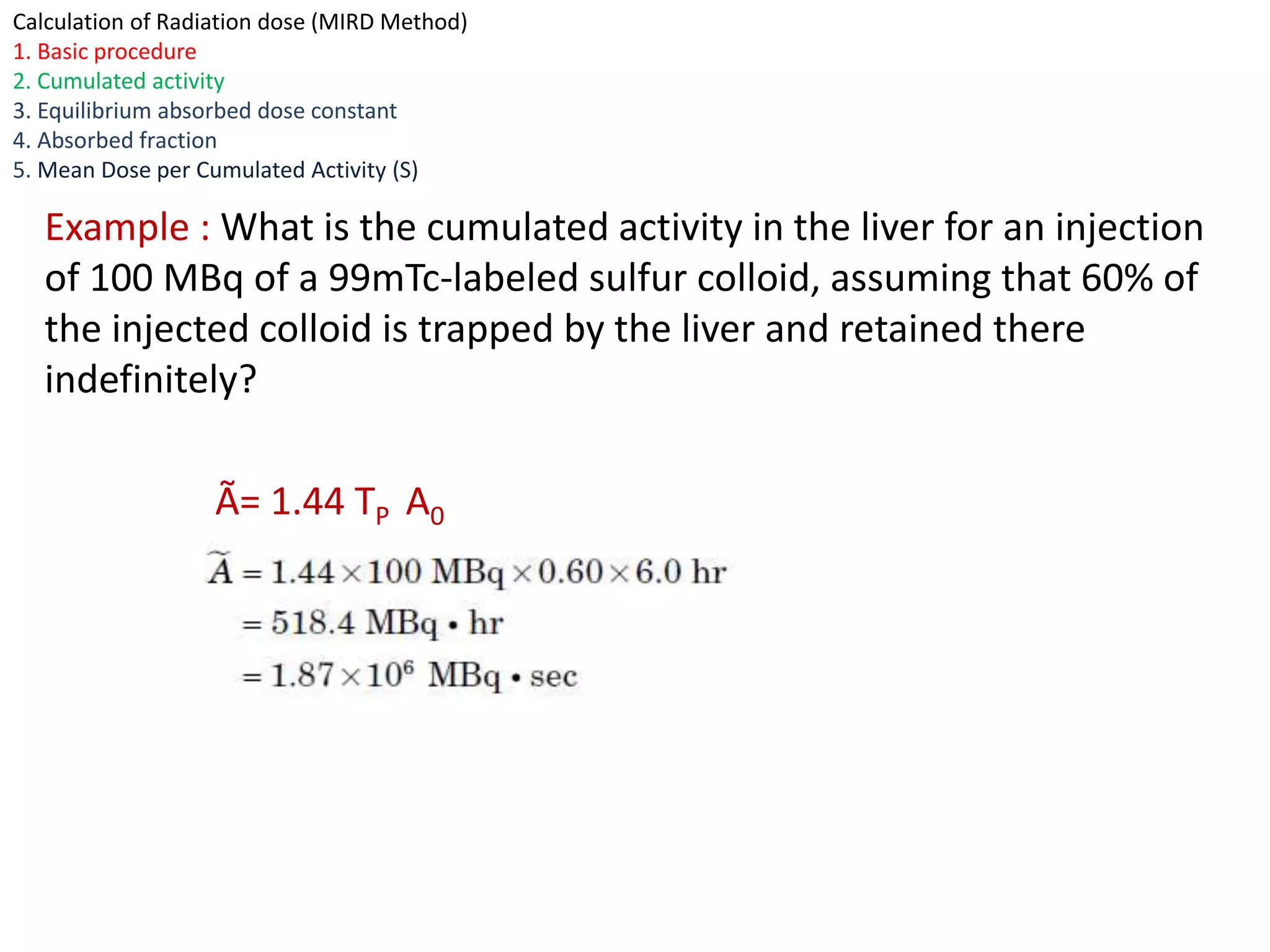
Example : What is the cumulated activity in the liver for an injection
of 100 MBq of a 99mTc-labeled sulfur colloid, assuming that 60% of
the injected colloid is trapped by the liver and retained there
indefinitely?
Ã= 1.44 TP A0
Calculation of Radiation dose (MIRD Method)
1. Basic procedure
2. Cumulated activity
3. Equilibrium absorbed dose constant
4. Absorbed fraction
5. Mean Dose per Cumulated Activity (S)
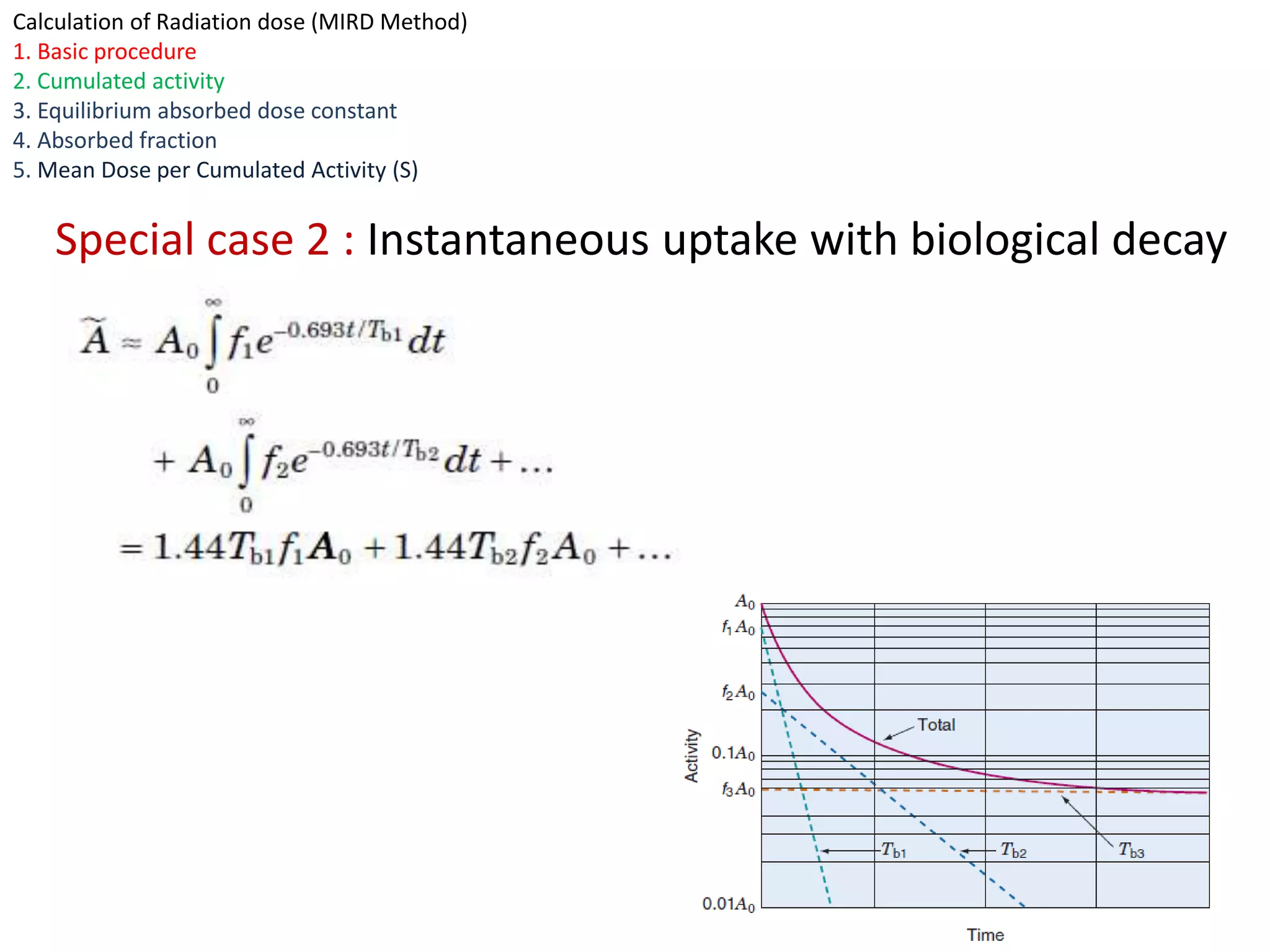
Special case 2 : Instantaneous uptake with biological decay
Calculation of Radiation dose (MIRD Method)
1. Basic procedure
2. Cumulated activity
3. Equilibrium absorbed dose constant
4. Absorbed fraction
5. Mean Dose per Cumulated Activity (S)
Example : Suppose that 100 MBq of 99mTc-labeled microspheres
are injected into a patient,
1. If 60% excreted from the lungs with a Tb of 15 mins
2. And 40% with a Tb of 30 minutes
then , Cumulated activity
Calculation of Radiation dose (MIRD Method)
1. Basic procedure
2. Cumulated activity
3. Equilibrium absorbed dose constant
4. Absorbed fraction
5. Mean Dose per Cumulated Activity (S)
Special case 3 : Instantaneous uptake with clearance by
biological excretion and physical decay
Effective half life Te
Calculation of Radiation dose (MIRD Method)
1. Basic procedure
2. Cumulated activity
3. Equilibrium absorbed dose constant
4. Absorbed fraction
5. Mean Dose per Cumulated Activity (S)
Example :100 MBq of 99mTc-labeled microspheres
are injected into a patient,
1. 60% is excreted from the lungs with a TB of 2 hours
2. and 40% with a Tb 3 hours
Calculation of Radiation dose (MIRD Method)
1. Basic procedure
2. Cumulated activity
3. Equilibrium absorbed dose constant
4. Absorbed fraction
5. Mean Dose per Cumulated Activity (S)
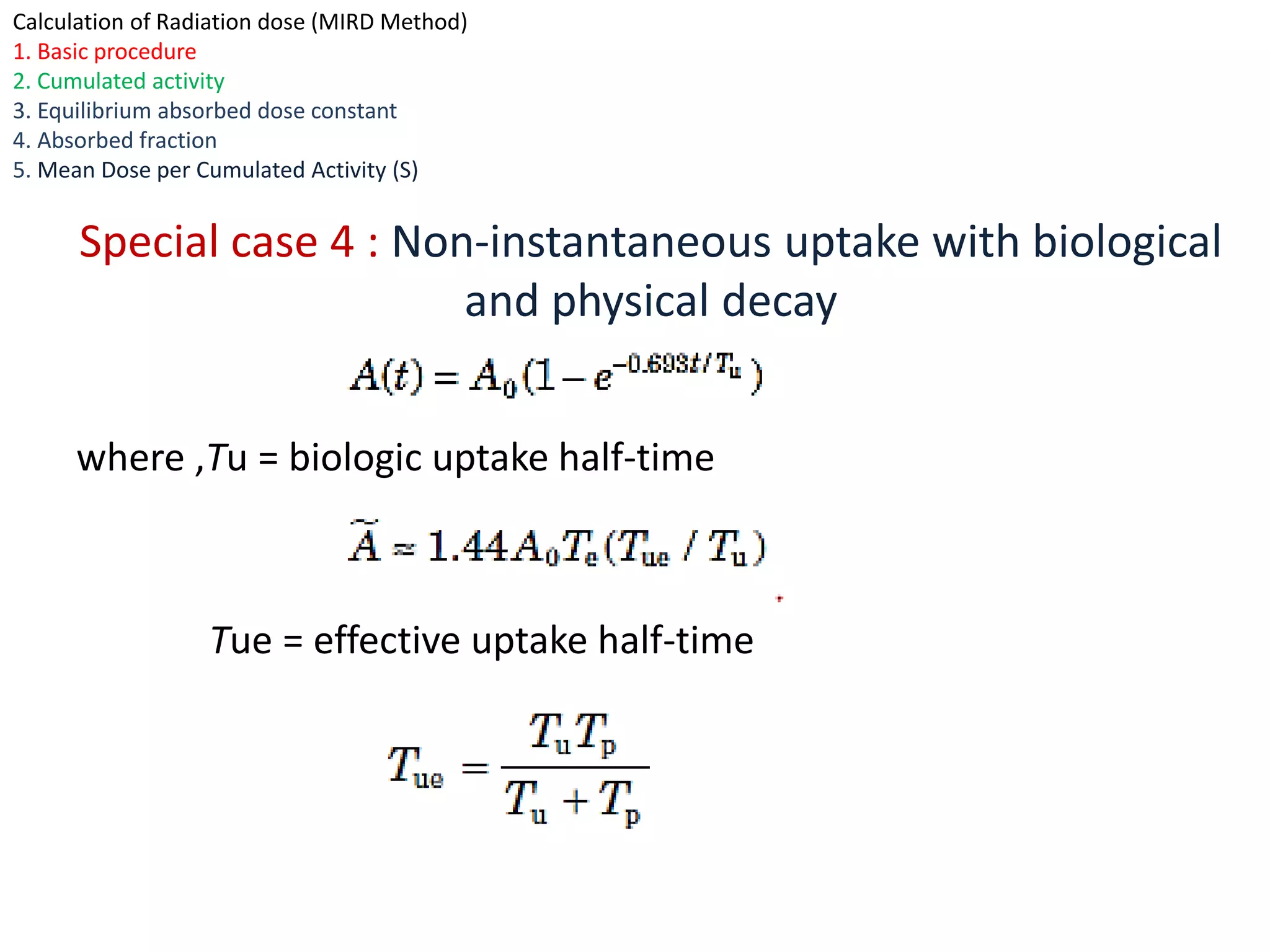
Special case 4 : Non-instantaneous uptake with biological
and physical decay
where ,Tu = biologic uptake half-time
Tue = effective uptake half-time
Calculation of Radiation dose (MIRD Method)
1. Basic procedure
2. Cumulated activity
3. Equilibrium absorbed dose constant
4. Absorbed fraction
5. Mean Dose per Cumulated Activity (S)
Equilibrium absorbed dose constant
• Energy emitted per unit of cumulated activity is given by the
equilibrium absorbed dose constant Δ
Δi = 1.6 × 10⁻¹³ NiEi (Gy • kg /Bq • sec)
(1MeV/dis = 1.6 × 10⁻¹³Gy • k/Bq • sec)
Δi = 2.13NiEi (rad • g / μCi • hr)
Where,
Ei = average energy (in MeV) of the ith emission
Ni = relative frequency of that emission
Calculation of Radiation dose (MIRD Method)
1. Basic procedure
2. Cumulated activity
3. Equilibrium absorbed dose constant
4. Absorbed fraction
5. Mean Dose per Cumulated Activity (S)
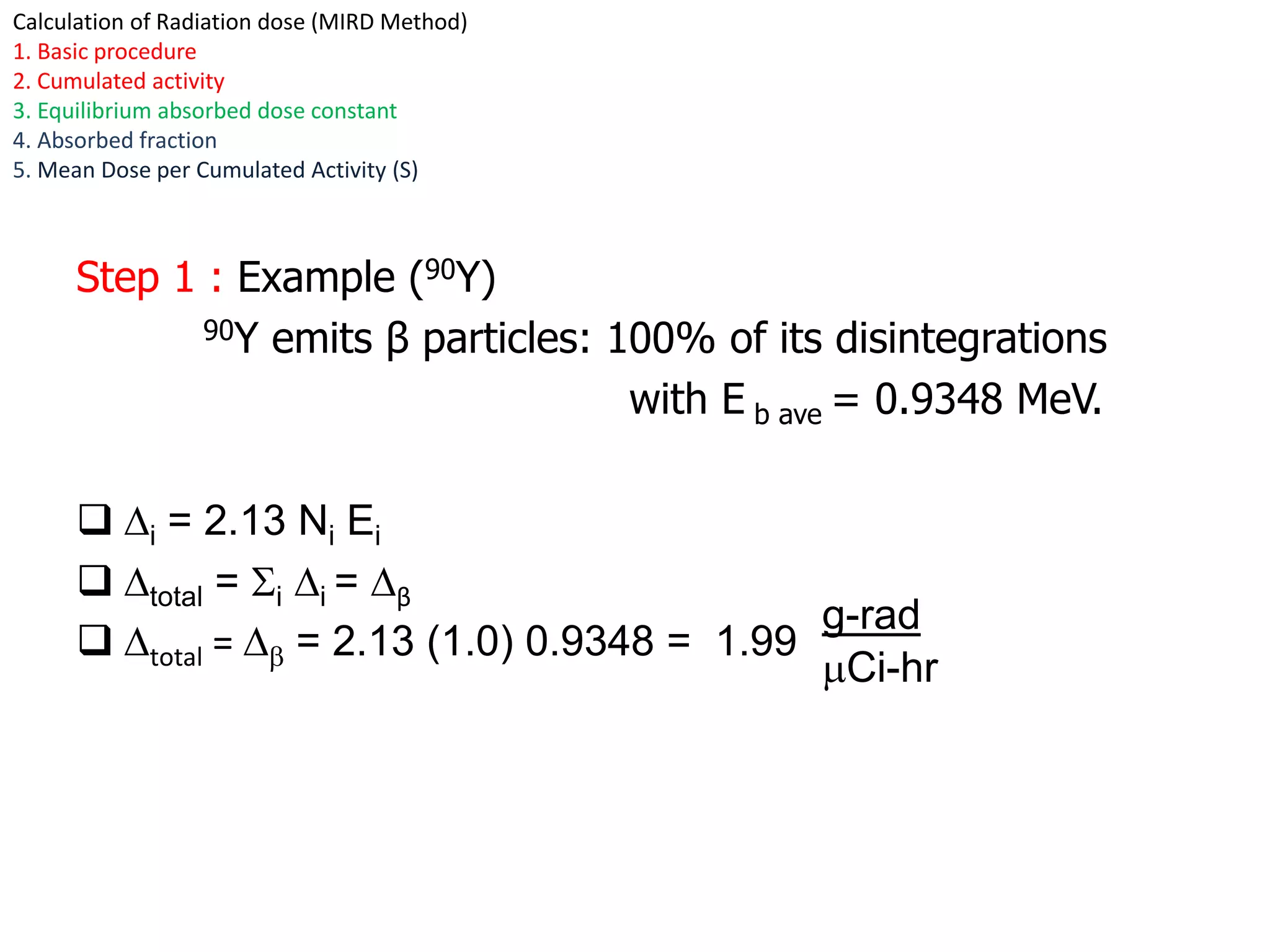
Step 1 : Example (90Y)
90Y emits β particles: 100% of its disintegrations
with E b ave = 0.9348 MeV.
 Di = 2.13 Ni Ei
 Dtotal = Si Di = Dβ
 Dtotal = Db = 2.13 (1.0) 0.9348 = 1.99
mCi-hr
g-rad
Calculation of Radiation dose (MIRD Method)
1. Basic procedure
2. Cumulated activity
3. Equilibrium absorbed dose constant
4. Absorbed fraction
5. Mean Dose per Cumulated Activity (S)
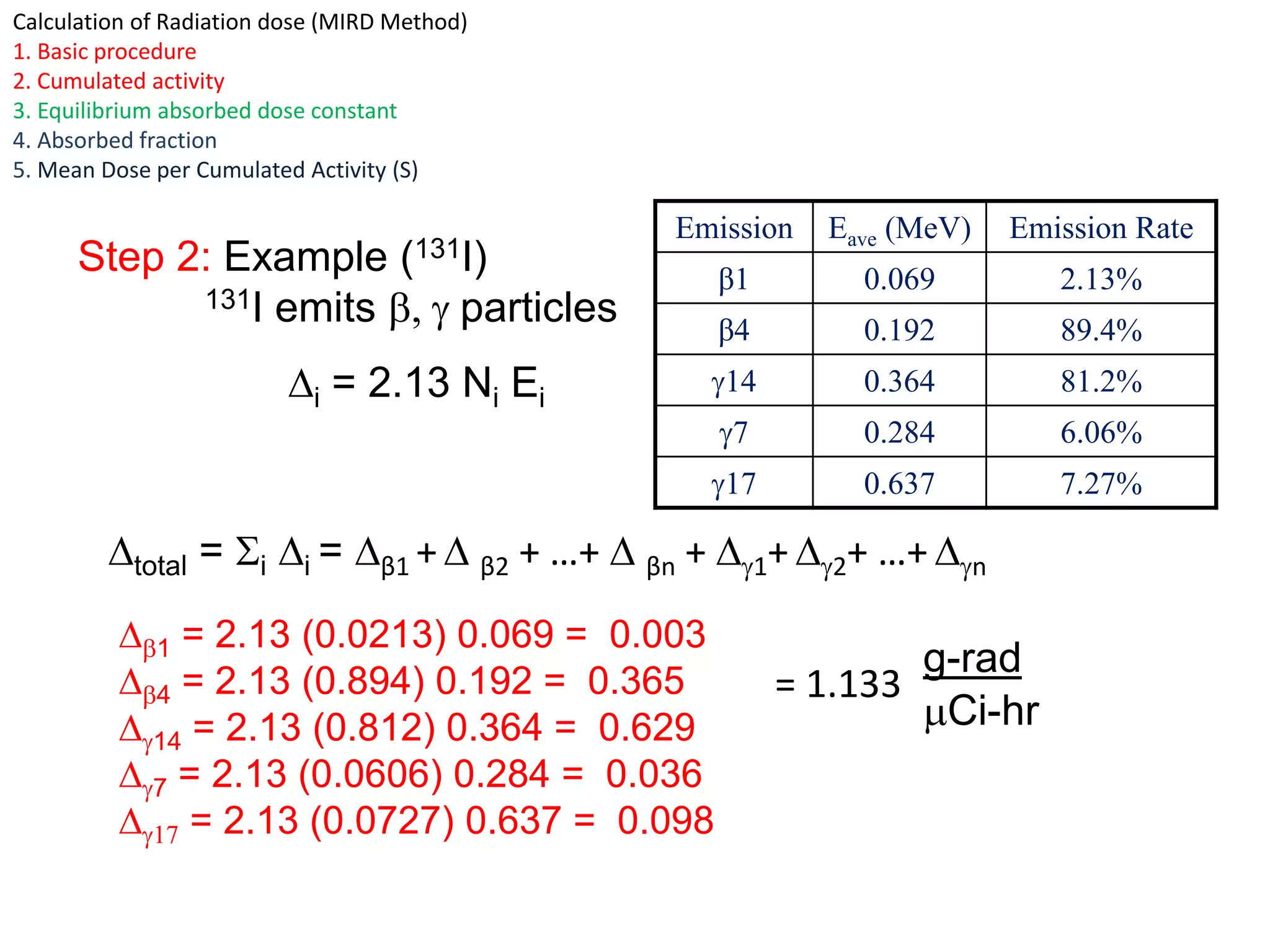
Step 2: Example (131I)
131I emits b,  particles
Di = 2.13 Ni Ei
Db1 = 2.13 (0.0213) 0.069 = 0.003
Db4 = 2.13 (0.894) 0.192 = 0.365
D14 = 2.13 (0.812) 0.364 = 0.629
D7 = 2.13 (0.0606) 0.284 = 0.036
D17 = 2.13 (0.0727) 0.637 = 0.098
mCi-hr
g-rad
Dtotal = Si Di = Dβ1 + D β2 + …+ D βn + D1+ D2+ …+ Dn
Emission Eave (MeV) Emission Rate
β1 0.069 2.13%
β4 0.192 89.4%
14 0.364 81.2%
7 0.284 6.06%
17 0.637 7.27%
= 1.133
Calculation of Radiation dose (MIRD Method)
1. Basic procedure
2. Cumulated activity
3. Equilibrium absorbed dose constant
4. Absorbed fraction
5. Mean Dose per Cumulated Activity (S)
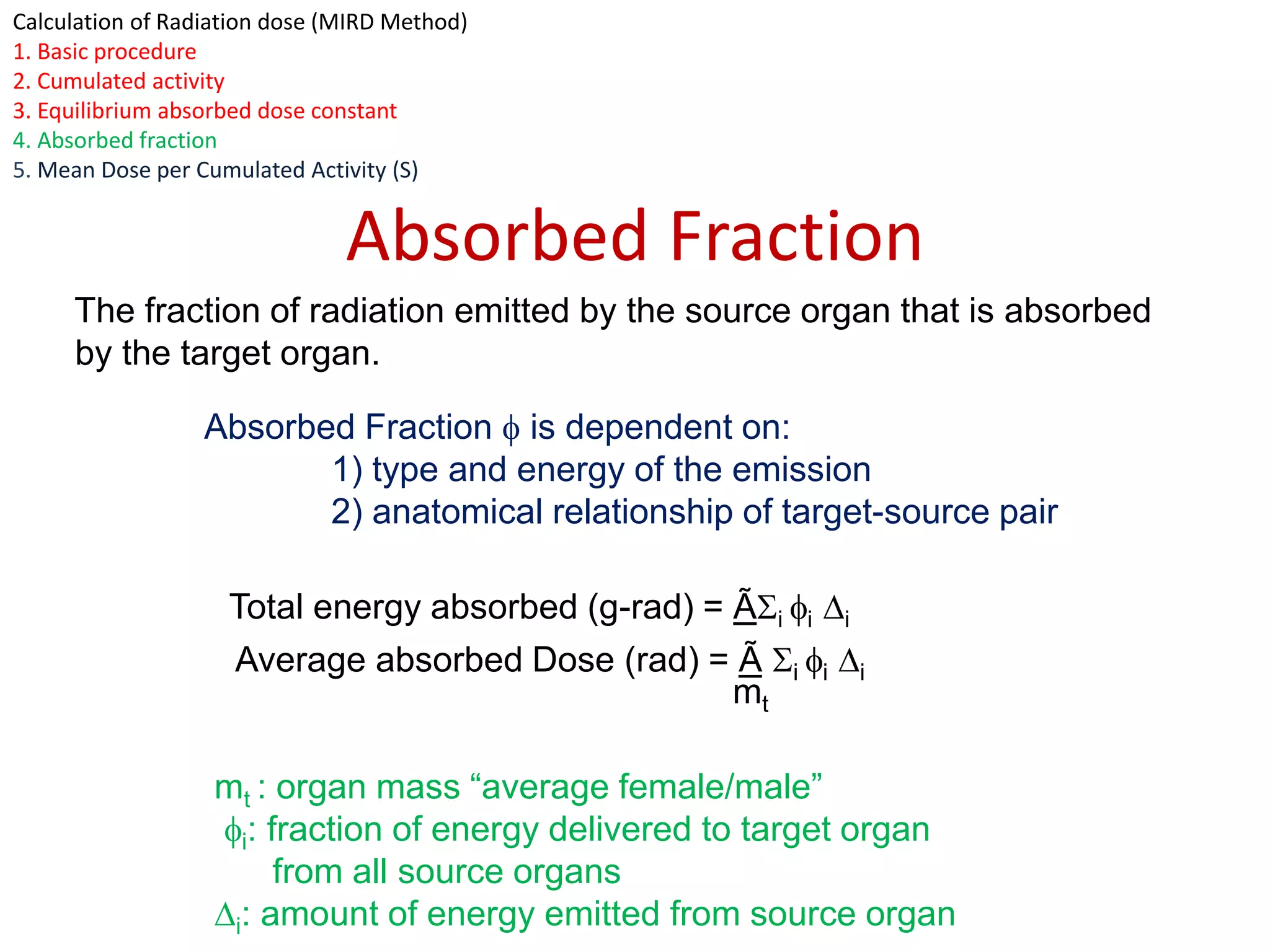
Absorbed Fraction
The fraction of radiation emitted by the source organ that is absorbed
by the target organ.
Absorbed Fraction f is dependent on:
1) type and energy of the emission
2) anatomical relationship of target-source pair
Total energy absorbed (g-rad) = ÃSi fi Di
Average absorbed Dose (rad) = Ã Si fi Di
mt
mt : organ mass “average female/male”
fi: fraction of energy delivered to target organ
from all source organs
Di: amount of energy emitted from source organ
Calculation of Radiation dose (MIRD Method)
1. Basic procedure
2. Cumulated activity
3. Equilibrium absorbed dose constant
4. Absorbed fraction
5. Mean Dose per Cumulated Activity (S)
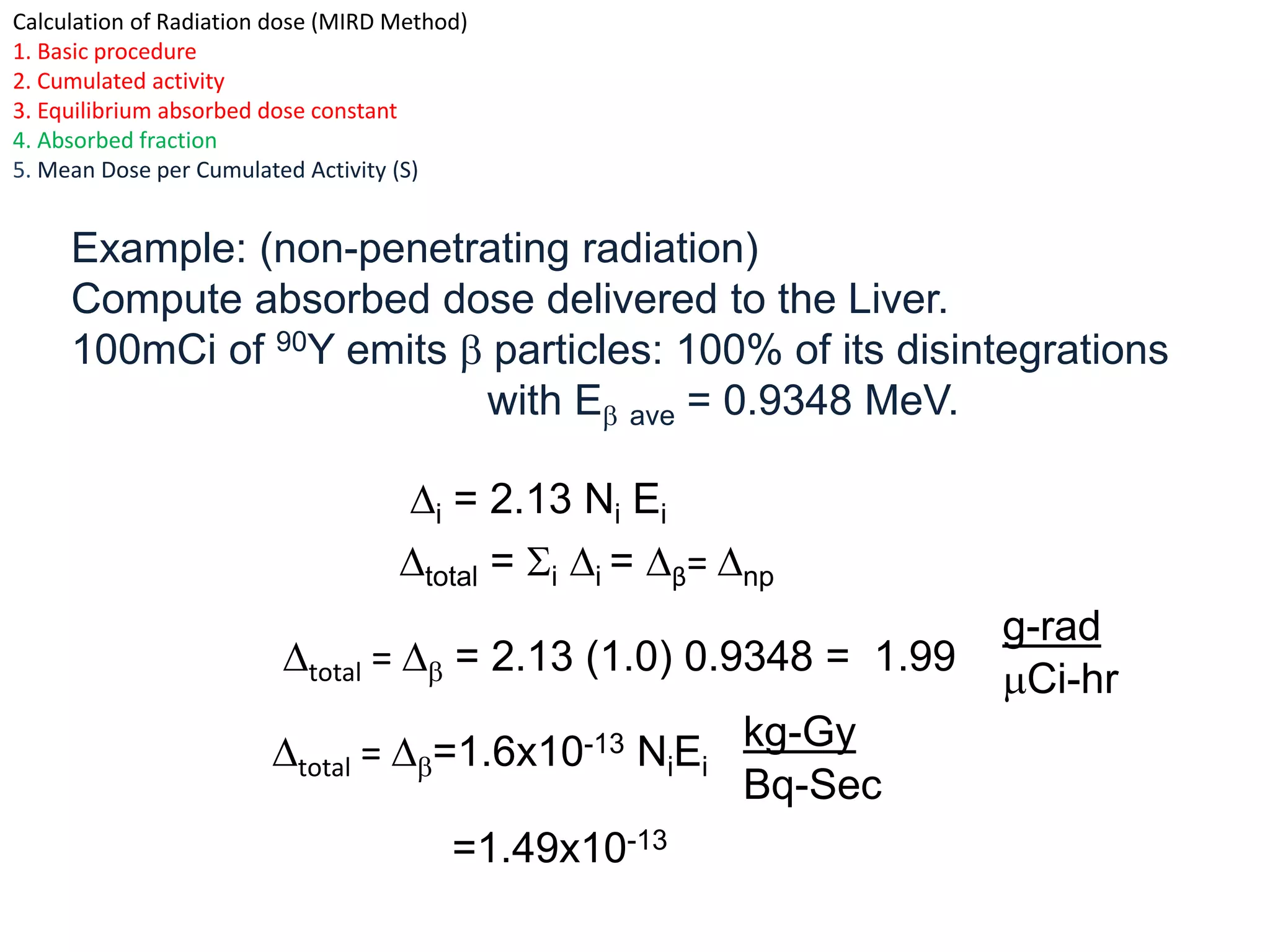
Example: (non-penetrating radiation)
Compute absorbed dose delivered to the Liver.
100mCi of 90Y emits b particles: 100% of its disintegrations
with Eb ave = 0.9348 MeV.
Di = 2.13 Ni Ei
Dtotal = Db = 2.13 (1.0) 0.9348 = 1.99
mCi-hr
g-rad
Dtotal = Si Di = Dβ= Dnp
Dtotal = Db=1.6x10⁻¹³ NiEi
Bq-Sec
kg-Gy
=1.49x10⁻¹³
Calculation of Radiation dose (MIRD Method)
1. Basic procedure
2. Cumulated activity
3. Equilibrium absorbed dose constant
4. Absorbed fraction
5. Mean Dose per Cumulated Activity (S)
Calculation of Radiation dose (MIRD Method)
1. Basic procedure
2. Cumulated activity
3. Equilibrium absorbed dose constant
4. Absorbed fraction
5. Mean Dose per Cumulated Activity (S)
GBqmCinoteGy
kg
GBq
GyD
m
FGBqA
GyD
BqGBqnote
m
FBqAx
GyD
Bq
kgGy
x
m
hr
hrFA
D
m
TFA
D
m
A
D
Liver
Liver
Liver
np
Liver
P
np
Liver
7.3100:92
809.1
)9.0)(7.3(50
)(
)1]()[(50
)(
101:
)1]([109.4
)(
)]
sec
(1049.1[
)]
min
sec
60)(
min
60)(1.64)(1)()(44.1[(
)])(1)()(44.1[(
0
90
8
13
0
0
~










D


D




f is complicated for energies > 10 keV (penetrating; g-rays)
f < 10 keV (non-penetrating radiation; b, x-rays)
)1(50
))((
)(0
F
mGyD
GBqA Liver


Mean Dose per Cumulated Activity (S)
Calculation of Radiation dose (MIRD Method)
1. Basic procedure
2. Cumulated activity
3. Equilibrium absorbed dose constant
4. Absorbed fraction
5. Mean Dose per Cumulated Activity (S)
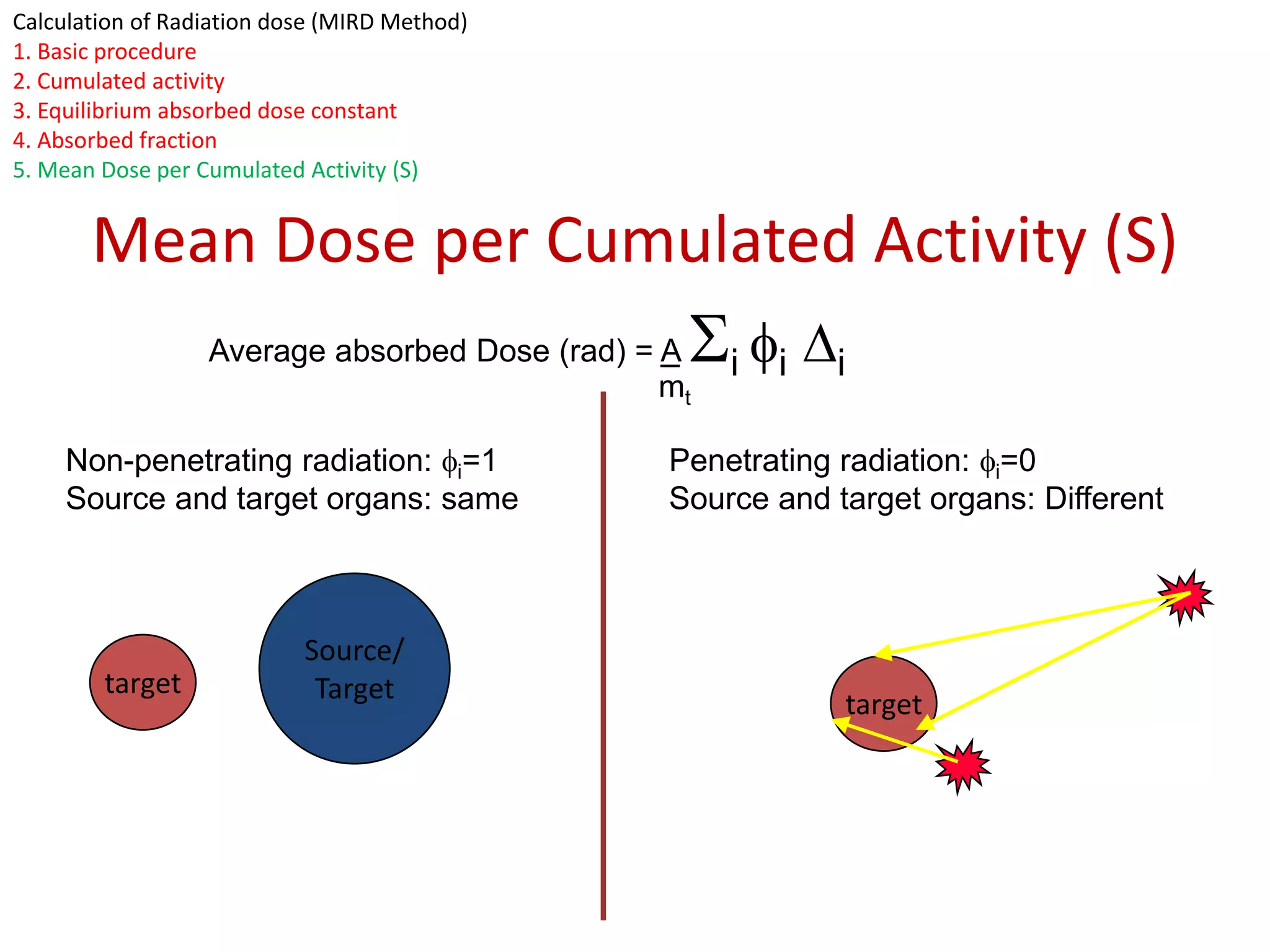
Average absorbed Dose (rad) = A Si fi Di
mt
Non-penetrating radiation: fi=1
Source and target organs: same
Source/
Targettarget
Penetrating radiation: fi=0
Source and target organs: Different
target
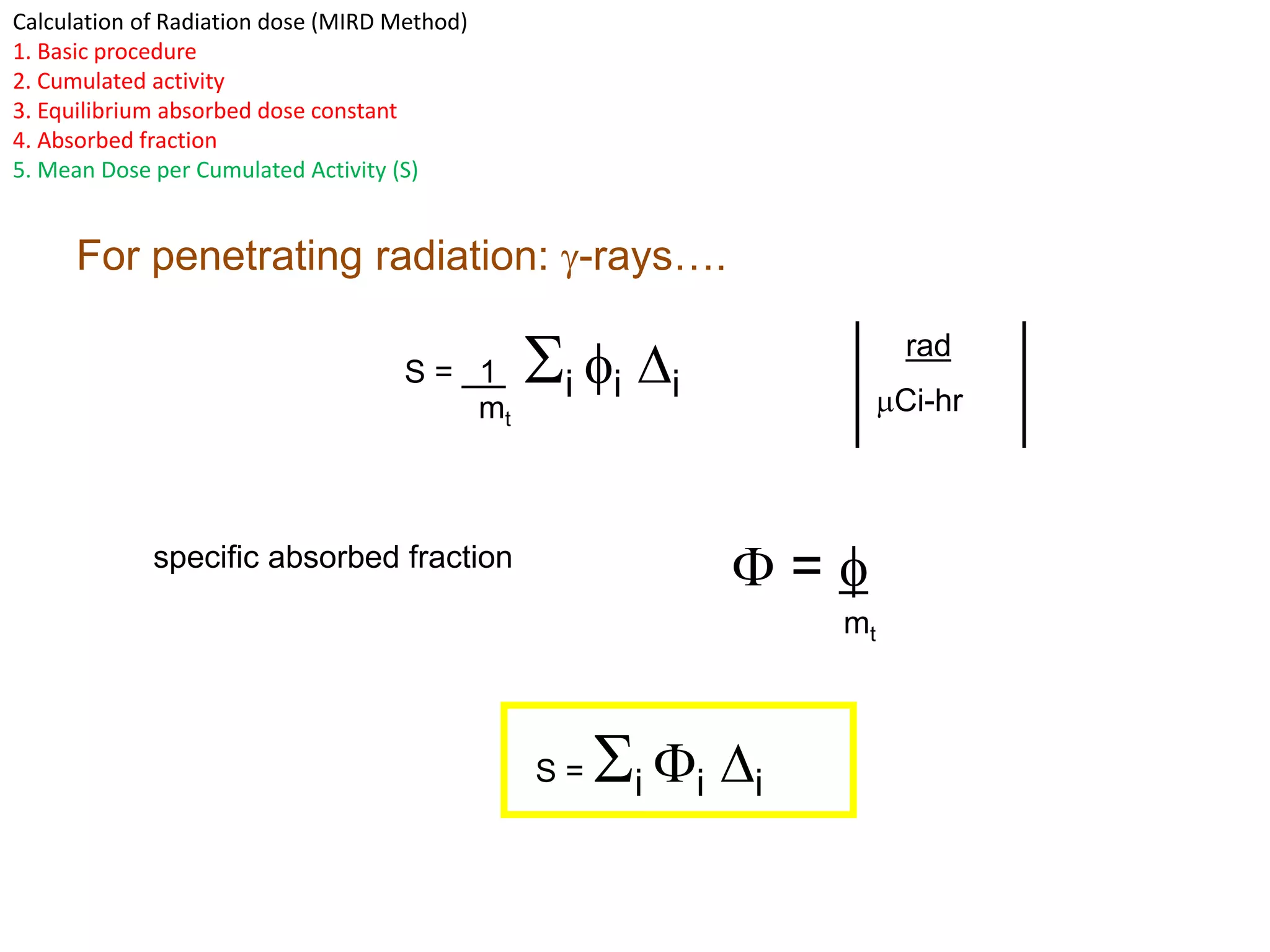
For penetrating radiation: -rays….
Calculation of Radiation dose (MIRD Method)
1. Basic procedure
2. Cumulated activity
3. Equilibrium absorbed dose constant
4. Absorbed fraction
5. Mean Dose per Cumulated Activity (S)
S = Si Fi Di
F = f
mt
specific absorbed fraction
S = 1 Si fi Di
mt
rad
mCi-hr
D = Ã x S
à : Cumulative Activity (mCi-hr)
(calculate)
S: Mean dose per cumulated Activity (rad/ mCi-hr)
(look-up table)
D: Average dose (rad)
Calculation of Radiation dose (MIRD Method)
1. Basic procedure
2. Cumulated activity
3. Equilibrium absorbed dose constant
4. Absorbed fraction
5. Mean Dose per Cumulated Activity (S)
Calculation of Radiation dose (MIRD Method)
1. Basic procedure
2. Cumulated activity
3. Equilibrium absorbed dose constant
4. Absorbed fraction
5. Mean Dose per Cumulated Activity (S)
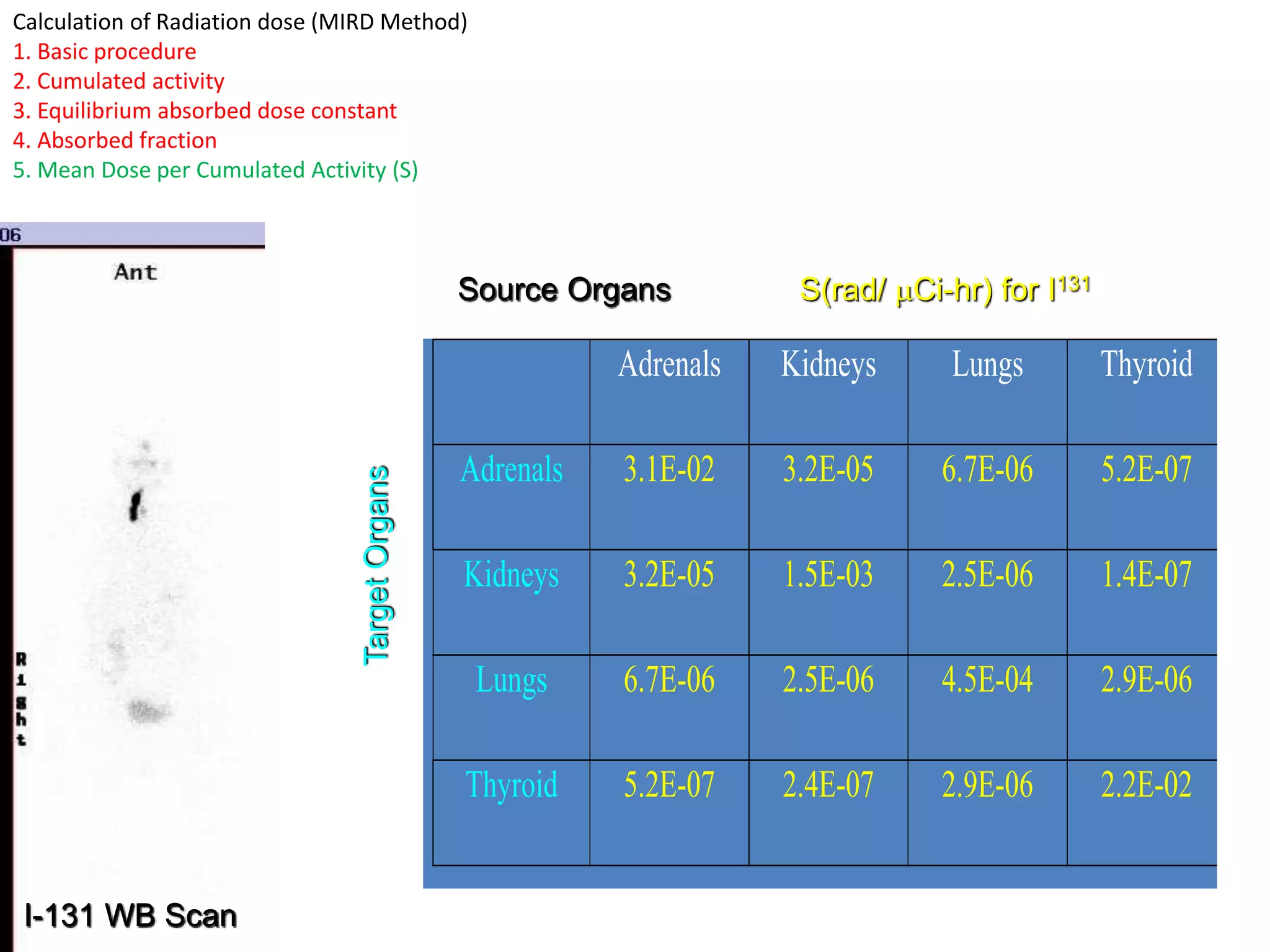
Adrenals Kidneys Lungs Thyroid
Adrenals 3.1E-02 3.2E-05 6.7E-06 5.2E-07
Kidneys 3.2E-05 1.5E-03 2.5E-06 1.4E-07
Lungs 6.7E-06 2.5E-06 4.5E-04 2.9E-06
Thyroid 5.2E-07 2.4E-07 2.9E-06 2.2E-02
Source Organs S(rad/ mCi-hr) for I131
TargetOrgans
I-131 WB Scan
Average Dose to an Organ (D)
Example:
A patient is to be treated with 131I for Hyperthyroidism. It is determined by
prior studies with a tracer dose of 131I that the thyroidal uptake is 60%, and the
effective half-life of iodine in the thyroid gland is 5 days.
Hyper-Thyroid Uptake
1
10
100
0 500 1000 1500 2000 2500 3000
Time (hr)
PercentUptake
Assume instantaneous
uptake (Tu << Tp = 8 days).
Average Dose to an Organ (D)
Te = Tp Tb
Tp + Tb
A = 1.44(Te)(A0)
~
Te = 5 days = 120 hrs
A = 1.44(120 hr)(0.6)(1,000 mCi)
~
= 103,680 mCi-hr/mCi administered
Average Dose to an Organ (D)
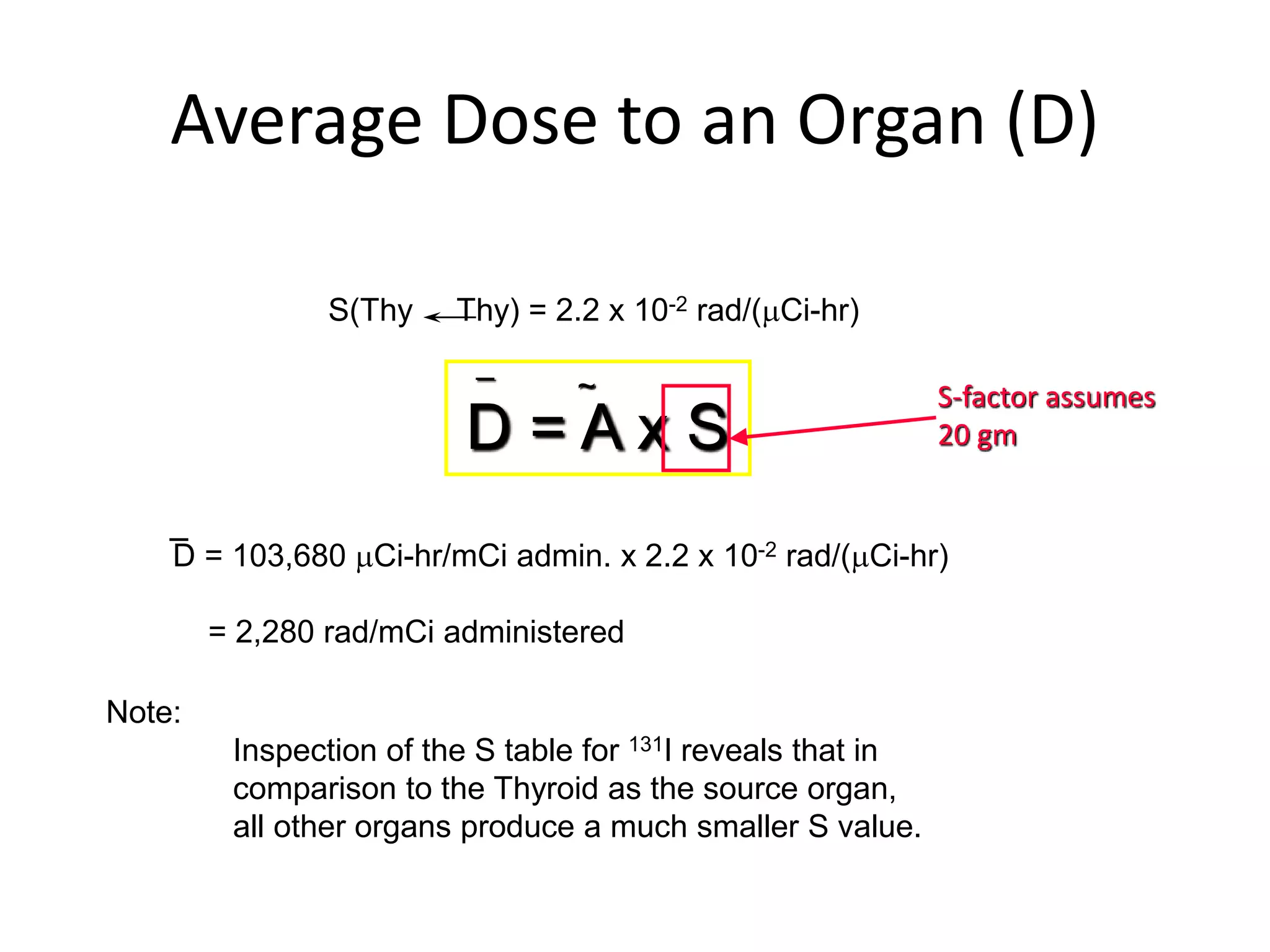
S(Thy Thy) = 2.2 x 10⁻² rad/(mCi-hr)
D = A x S
~
_
D = 103,680 mCi-hr/mCi admin. x 2.2 x 10⁻² rad/(mCi-hr)
= 2,280 rad/mCi administered
Note:
Inspection of the S table for 131I reveals that in
comparison to the Thyroid as the source organ,
all other organs produce a much smaller S value.
S-factor assumes
20 gm
Medical Internal Radiation Dosimetry

Medical Internal Radiation Dosimetry

  • 1.
    MIRD Saumya Shrivastav RSO, Dept.of Nuclear Medicine AIIMS, Raipur
  • 2.
    Internal Radiation Dosimetry Contents: • Basic definitions 1. Absorbed dose 2. Equivalent dose 3. Source and Target organs • Calculation of Radiation dose (MIRD Method) 1. Basic procedure 2. Cumulated activity 3. Equilibrium absorbed dose constant 4. Absorbed fraction 5. Mean Dose per Cumulated Activity (S)
  • 3.
    Absorbed Dose • Thequantity of radiation energy deposited in an absorber per kg of absorber material. • SI Unit : Gray (Gy) 1 Gy = 1 j/kg • Other unit : rad 1 Gy = 100 rad 1 rad = 100 ergs/gm D(Gy) = Energy deposited (joule) Mass of absorber (Kg) Basic definitions : 1. Absorbed dose 2. Equivalent dose 3. Source and Target organs
  • 4.
    Equivalent Dose HT =DT,R × wR Where, HT = Equivalent Dose DT ,R = Absorbed dose from radiation R in a tissue or organ T wR = Radiation weighting factor • SI Unit : Severt (Sv) • Other Unit : rem 1 Sv = 100 rem Basic definitions : 1. Absorbed dose 2. Equivalent dose 3. Source and Target organs
  • 5.
    Source and Targetorgans • Source organs : ?? • Target organs : ?? • The source and target organ may be the same organ….. Basic definitions : 1. Absorbed dose 2. Equivalent dose 3. Source and Target organs
  • 6.
    Basic Procedure The basicprocedure for calculating the radiation dose to a target organ from radioactivity in a source organ is a three-step process, as follows : 1. The amount of activity and time spent by the radioactivity in the source organ. 2. The total amount of radiation energy emitted by the radioactivity in the source organ. 3. The fraction of energy emitted by the source organ that is absorbed by the target organ. Calculation of Radiation dose (MIRD Method) 1. Basic procedure 2. Cumulated activity 3. Equilibrium absorbed dose constant 4. Absorbed fraction 5. Mean Dose per Cumulated Activity (S)
  • 7.
    Cumulated Activity Activity inan organ depends on various factors : 1. Uptake of radiopharmaceutical 2. Excretion from the organ 3. Physical decay Where , Ã = Cumulated activity A(t) = A0 exp^(-0.693t /Tp) • SI unit : Becquerel • sec (Bq • sec) Calculation of Radiation dose (MIRD Method) 1. Basic procedure 2. Cumulated activity 3. Equilibrium absorbed dose constant 4. Absorbed fraction 5. Mean Dose per Cumulated Activity (S)
  • 8.
    Calculation of Radiationdose (MIRD Method) 1. Basic procedure 2. Cumulated activity 3. Equilibrium absorbed dose constant 4. Absorbed fraction 5. Mean Dose per Cumulated Activity (S)
  • 9.
    • Residence time : How long the radionuclide stay in an organ  = Ã/A injected Where, Ã = Cumulated Activity  = Residence time Calculation of Radiation dose (MIRD Method) 1. Basic procedure 2. Cumulated activity 3. Equilibrium absorbed dose constant 4. Absorbed fraction 5. Mean Dose per Cumulated Activity (S)
  • 10.
    Calculation : (fourcases) 1. Instantaneous uptake with physical decay 2. Instantaneous uptake with clearance by biological excretion TP  TB 3. Instantaneous uptake with clearance by biological excretion and physical decay 4. Non-instantaneous uptake with biological and physical decay Calculation of Radiation dose (MIRD Method) 1. Basic procedure 2. Cumulated activity 3. Equilibrium absorbed dose constant 4. Absorbed fraction 5. Mean Dose per Cumulated Activity (S)
  • 11.
    Special case 1: Instantaneous uptake with physical decay A(t) = A0 exp^(-0.693t /Tp) Tp = Physical half life A0 = Initial Activity Present in source organ Therefore , Calculation of Radiation dose (MIRD Method) 1. Basic procedure 2. Cumulated activity 3. Equilibrium absorbed dose constant 4. Absorbed fraction 5. Mean Dose per Cumulated Activity (S)
  • 12.
    Example : Whatis the cumulated activity in the liver for an injection of 100 MBq of a 99mTc-labeled sulfur colloid, assuming that 60% of the injected colloid is trapped by the liver and retained there indefinitely? Ã= 1.44 TP A0 Calculation of Radiation dose (MIRD Method) 1. Basic procedure 2. Cumulated activity 3. Equilibrium absorbed dose constant 4. Absorbed fraction 5. Mean Dose per Cumulated Activity (S)
  • 13.
    Special case 2: Instantaneous uptake with biological decay Calculation of Radiation dose (MIRD Method) 1. Basic procedure 2. Cumulated activity 3. Equilibrium absorbed dose constant 4. Absorbed fraction 5. Mean Dose per Cumulated Activity (S)
  • 14.
    Example : Supposethat 100 MBq of 99mTc-labeled microspheres are injected into a patient, 1. If 60% excreted from the lungs with a Tb of 15 mins 2. And 40% with a Tb of 30 minutes then , Cumulated activity Calculation of Radiation dose (MIRD Method) 1. Basic procedure 2. Cumulated activity 3. Equilibrium absorbed dose constant 4. Absorbed fraction 5. Mean Dose per Cumulated Activity (S)
  • 15.
    Special case 3: Instantaneous uptake with clearance by biological excretion and physical decay Effective half life Te Calculation of Radiation dose (MIRD Method) 1. Basic procedure 2. Cumulated activity 3. Equilibrium absorbed dose constant 4. Absorbed fraction 5. Mean Dose per Cumulated Activity (S)
  • 16.
    Example :100 MBqof 99mTc-labeled microspheres are injected into a patient, 1. 60% is excreted from the lungs with a TB of 2 hours 2. and 40% with a Tb 3 hours Calculation of Radiation dose (MIRD Method) 1. Basic procedure 2. Cumulated activity 3. Equilibrium absorbed dose constant 4. Absorbed fraction 5. Mean Dose per Cumulated Activity (S)
  • 17.
    Special case 4: Non-instantaneous uptake with biological and physical decay where ,Tu = biologic uptake half-time Tue = effective uptake half-time Calculation of Radiation dose (MIRD Method) 1. Basic procedure 2. Cumulated activity 3. Equilibrium absorbed dose constant 4. Absorbed fraction 5. Mean Dose per Cumulated Activity (S)
  • 18.
    Equilibrium absorbed doseconstant • Energy emitted per unit of cumulated activity is given by the equilibrium absorbed dose constant Δ Δi = 1.6 × 10⁻¹³ NiEi (Gy • kg /Bq • sec) (1MeV/dis = 1.6 × 10⁻¹³Gy • k/Bq • sec) Δi = 2.13NiEi (rad • g / μCi • hr) Where, Ei = average energy (in MeV) of the ith emission Ni = relative frequency of that emission Calculation of Radiation dose (MIRD Method) 1. Basic procedure 2. Cumulated activity 3. Equilibrium absorbed dose constant 4. Absorbed fraction 5. Mean Dose per Cumulated Activity (S)
  • 19.
    Step 1 :Example (90Y) 90Y emits β particles: 100% of its disintegrations with E b ave = 0.9348 MeV.  Di = 2.13 Ni Ei  Dtotal = Si Di = Dβ  Dtotal = Db = 2.13 (1.0) 0.9348 = 1.99 mCi-hr g-rad Calculation of Radiation dose (MIRD Method) 1. Basic procedure 2. Cumulated activity 3. Equilibrium absorbed dose constant 4. Absorbed fraction 5. Mean Dose per Cumulated Activity (S)
  • 20.
    Step 2: Example(131I) 131I emits b,  particles Di = 2.13 Ni Ei Db1 = 2.13 (0.0213) 0.069 = 0.003 Db4 = 2.13 (0.894) 0.192 = 0.365 D14 = 2.13 (0.812) 0.364 = 0.629 D7 = 2.13 (0.0606) 0.284 = 0.036 D17 = 2.13 (0.0727) 0.637 = 0.098 mCi-hr g-rad Dtotal = Si Di = Dβ1 + D β2 + …+ D βn + D1+ D2+ …+ Dn Emission Eave (MeV) Emission Rate β1 0.069 2.13% β4 0.192 89.4% 14 0.364 81.2% 7 0.284 6.06% 17 0.637 7.27% = 1.133 Calculation of Radiation dose (MIRD Method) 1. Basic procedure 2. Cumulated activity 3. Equilibrium absorbed dose constant 4. Absorbed fraction 5. Mean Dose per Cumulated Activity (S)
  • 21.
    Absorbed Fraction The fractionof radiation emitted by the source organ that is absorbed by the target organ. Absorbed Fraction f is dependent on: 1) type and energy of the emission 2) anatomical relationship of target-source pair Total energy absorbed (g-rad) = ÃSi fi Di Average absorbed Dose (rad) = Ã Si fi Di mt mt : organ mass “average female/male” fi: fraction of energy delivered to target organ from all source organs Di: amount of energy emitted from source organ Calculation of Radiation dose (MIRD Method) 1. Basic procedure 2. Cumulated activity 3. Equilibrium absorbed dose constant 4. Absorbed fraction 5. Mean Dose per Cumulated Activity (S)
  • 22.
    Example: (non-penetrating radiation) Computeabsorbed dose delivered to the Liver. 100mCi of 90Y emits b particles: 100% of its disintegrations with Eb ave = 0.9348 MeV. Di = 2.13 Ni Ei Dtotal = Db = 2.13 (1.0) 0.9348 = 1.99 mCi-hr g-rad Dtotal = Si Di = Dβ= Dnp Dtotal = Db=1.6x10⁻¹³ NiEi Bq-Sec kg-Gy =1.49x10⁻¹³ Calculation of Radiation dose (MIRD Method) 1. Basic procedure 2. Cumulated activity 3. Equilibrium absorbed dose constant 4. Absorbed fraction 5. Mean Dose per Cumulated Activity (S)
  • 23.
    Calculation of Radiationdose (MIRD Method) 1. Basic procedure 2. Cumulated activity 3. Equilibrium absorbed dose constant 4. Absorbed fraction 5. Mean Dose per Cumulated Activity (S) GBqmCinoteGy kg GBq GyD m FGBqA GyD BqGBqnote m FBqAx GyD Bq kgGy x m hr hrFA D m TFA D m A D Liver Liver Liver np Liver P np Liver 7.3100:92 809.1 )9.0)(7.3(50 )( )1]()[(50 )( 101: )1]([109.4 )( )] sec (1049.1[ )] min sec 60)( min 60)(1.64)(1)()(44.1[( )])(1)()(44.1[( 0 90 8 13 0 0 ~           D   D     f is complicated for energies > 10 keV (penetrating; g-rays) f < 10 keV (non-penetrating radiation; b, x-rays) )1(50 ))(( )(0 F mGyD GBqA Liver  
  • 24.
    Mean Dose perCumulated Activity (S) Calculation of Radiation dose (MIRD Method) 1. Basic procedure 2. Cumulated activity 3. Equilibrium absorbed dose constant 4. Absorbed fraction 5. Mean Dose per Cumulated Activity (S) Average absorbed Dose (rad) = A Si fi Di mt Non-penetrating radiation: fi=1 Source and target organs: same Source/ Targettarget Penetrating radiation: fi=0 Source and target organs: Different target
  • 25.
    For penetrating radiation:-rays…. Calculation of Radiation dose (MIRD Method) 1. Basic procedure 2. Cumulated activity 3. Equilibrium absorbed dose constant 4. Absorbed fraction 5. Mean Dose per Cumulated Activity (S) S = Si Fi Di F = f mt specific absorbed fraction S = 1 Si fi Di mt rad mCi-hr
  • 26.
    D = Ãx S Ã : Cumulative Activity (mCi-hr) (calculate) S: Mean dose per cumulated Activity (rad/ mCi-hr) (look-up table) D: Average dose (rad) Calculation of Radiation dose (MIRD Method) 1. Basic procedure 2. Cumulated activity 3. Equilibrium absorbed dose constant 4. Absorbed fraction 5. Mean Dose per Cumulated Activity (S)
  • 27.
    Calculation of Radiationdose (MIRD Method) 1. Basic procedure 2. Cumulated activity 3. Equilibrium absorbed dose constant 4. Absorbed fraction 5. Mean Dose per Cumulated Activity (S) Adrenals Kidneys Lungs Thyroid Adrenals 3.1E-02 3.2E-05 6.7E-06 5.2E-07 Kidneys 3.2E-05 1.5E-03 2.5E-06 1.4E-07 Lungs 6.7E-06 2.5E-06 4.5E-04 2.9E-06 Thyroid 5.2E-07 2.4E-07 2.9E-06 2.2E-02 Source Organs S(rad/ mCi-hr) for I131 TargetOrgans I-131 WB Scan
  • 28.
    Average Dose toan Organ (D) Example: A patient is to be treated with 131I for Hyperthyroidism. It is determined by prior studies with a tracer dose of 131I that the thyroidal uptake is 60%, and the effective half-life of iodine in the thyroid gland is 5 days. Hyper-Thyroid Uptake 1 10 100 0 500 1000 1500 2000 2500 3000 Time (hr) PercentUptake Assume instantaneous uptake (Tu << Tp = 8 days).
  • 29.
    Average Dose toan Organ (D) Te = Tp Tb Tp + Tb A = 1.44(Te)(A0) ~ Te = 5 days = 120 hrs A = 1.44(120 hr)(0.6)(1,000 mCi) ~ = 103,680 mCi-hr/mCi administered
  • 30.
    Average Dose toan Organ (D) S(Thy Thy) = 2.2 x 10⁻² rad/(mCi-hr) D = A x S ~ _ D = 103,680 mCi-hr/mCi admin. x 2.2 x 10⁻² rad/(mCi-hr) = 2,280 rad/mCi administered Note: Inspection of the S table for 131I reveals that in comparison to the Thyroid as the source organ, all other organs produce a much smaller S value. S-factor assumes 20 gm

Editor's Notes