NURSING PROCESS
Rohini Pandey
1st Year M.Sc Nursing
KGMU Institute of Nursing
introduction
HISTORY
Ida Jean Orlando
1958
• 4 stage Nursing
process
DEFINITION
• Nursing Process is a critical thinking
process that professional nurses use to apply
the best available evidence to care giving
and promoting human functions and
responses to health and illness.
The nursing process is cyclical & its
components follow a logical sequence,
but more than one component may be
involved at one time. At the end of the
first cycle, care may be terminated if
goals are achieved, or cycle may
continue with reassessment or plan of
care may be modified.
Purpose of Nursing Process
• To identify Clients health status and potential
health care problems.
• To establish plans to meet identified needs.
• To deliver specific nursing interventions to
meet those need.
• To achieve continuity of care.
Components of Nursing Process
ASSESSMENT
NURSING
DIAGNOSIS
PLANNINGIMPLEMENTATION
EVALUATION
Nursing
Process
Characteristics of Nursing Process
• Cyclic.
• Dynamic Nature.
• Client Centred.
• Focus on problem solving & decision making.
• Universal applicability.
• Use of critical thinking & clinical reasoning.
• Data from each phase provide input into the
next phase.
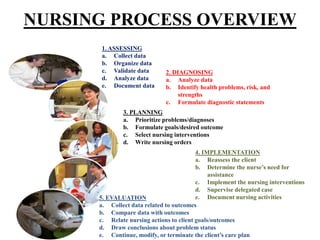
NURSING PROCESS OVERVIEW
1. ASSESSING
a. Collect data
b. Organize data
c. Validate data
d. Analyze data
e. Document data
2. DIAGNOSING
a. Analyze data
b. Identify health problems, risk, and
strengths
c. Formulate diagnostic statements
2. DIAGNOSING
a. Analyze data
b. Identify health problems, risk, and
strengths
c. Formulate diagnostic statements
3. PLANNING
a. Prioritize problems/diagnoses
b. Formulate goals/desired outcome
c. Select nursing interventions
d. Write nursing orders
4. IMPLEMENTATION
a. Reassess the client
b. Determine the nurse’s need for
assistance
c. Implement the nursing interventions
d. Supervise delegated case
e. Document nursing activities5. EVALUATION
a. Collect data related to outcomes
b. Compare data with outcomes
c. Relate nursing actions to client goals/outcomes
d. Draw conclusions about problem status
e. Continue, modify, or terminate the client’s care plan
1. ASSESSMENT
ASSESSING
•Collect Data
•Organize Data
•Validate Data
•Document Data
Nursing
Diagnosis
INTERVENTION
IMPLEMENTATION
EVALUATION
1. Assessment
• Assessment is the systematic & continuous
collection, organization, validation and
documentation of data (information).
• TYPES
i. Initial Nursing Assessment
ii. Problem focused Assessment
iii. Emergency Assessment
iv. Time-lapsed Assessment
1.1 Collection of Data
Process of gathering
information about
clients health status.
TYPES OF DATA
a. Subjective Data
b. Objective Data
SOURCES OF DATA
a. Primary source
b. Secondary source
METHOD OF DATA
COLLECTION
a. Observation
b. Interview
c. Examination
1.2 Organize Data
• The nurse uses a format that organizes the
assessment data systematically. This is often
referred to as nursing health history or
nursing assessment form.
1.3 Validate Data
• The information gathered during the
assessment is “double-checked” or verified
to confirm that it is accurate and complete.
1.4 Documentation Of Data
To complete the assessment phase, the nurse
records client data. Accurate documentation
is essential and should include all data
collected about the client’s health status.
Nursing Diagnosis
•Analyze Data
•Identify Health
problems, risks &
strengths
INTERVENTION
ASSESSMENT
EVALUATION
IMPLEMENTATION
2. NURSING DIAGNOSIS
• In this phase, nurses use critical thinking
skills to interpret assessment data to
identify client problems.
• North American Nursing Diagnosis
Association (NANDA) define or refine
nursing diagnosis.
• The status of nursing diagnosis are Actual,
Health Promotion and Risk.
1. An actual diagnosis is a client problem that is
present at the time of the nursing assessment.
• Example:
Impaired thermoregulation related to infection
as evidenced by increased body temperature.
A health promotion diagnosis relates to
clients’ preparedness to improve their
health condition.
Example:
Deficit knowledge related to disease outcome
as evidenced by frequent asking of question
by the patient.
• A risk nursing diagnosis is a clinical
judgement that a problem does not exist,
but the presence of risk factors indicates
that a problem may develop if adequate
care is not given.
Example:
Risk for infection related to prolong
hospitalization.
Components of NANDA Nursing Diagnosis
PROBLEM
ETIOLOGY
DEFINING
CHARACTERISTICS
• Acute pain related to abdominal surgery as
Problem Etiology
evidenced by patient discomfort and pain
scale
Sign & Symptoms
ASSESSMENT
NURSING
DIAGNOSIS
3. PLANNING
a. Prioritize
problems/diagnoses
b. Formulate goals/desired
outcome
c. Select nursing
interventions
d. Write nursing orders
IMPLEMENTATION
EVALUATION
3. PLANNING/INTERVENTION
• Planning involves decision making and
problem solving.
• It is the process of formulating client
goals and designing the nursing
interventions required to prevent,
reduce, or eliminate the client’s health
problems.
TYPES OF PLANNING
• Initial planning
• Ongoing planning
• Discharge planning
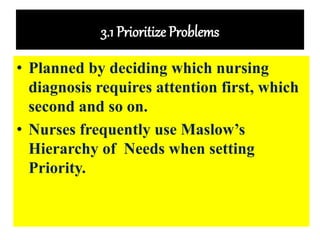
3.1 Prioritize Problems
• Planned by deciding which nursing
diagnosis requires attention first, which
second and so on.
• Nurses frequently use Maslow’s
Hierarchy of Needs when setting
Priority.
3.2 Establishing Goal
After establishing priorities, the
nurse set goals for each nursing
Diagnosis. Goals may be short
term or long term.
3.2 Nursing Intervention
A Nursing intervention is any treatment
that a nurse performs to improve
patient’s health.
Types Of Nursing Intervention:
• Independent Intervention
• Dependent Intervention
• Collaboration Intervention
3.4 Writing Intervention
• After choosing the appropriate
nursing interventions, the nurse
writes them on the care plan.
• Nursing care plan is written or
computerized information about the
client’s care.
ASSESSMENT
NURSING
DIAGNOSIS
4. IMPLEMENTATION
a. Reassess the client
b. Determine the nurse’s need
for assistance
c. Implement the nursing
interventions
d. Supervise delegated case
e. Document nursing activities
PLANNING/
INTERVENTION
EVALUATION
4. IMPLEMENTATION
• Implementation consists of doing and
documenting the activities.
• The process of implementation includes
– Implementing the nursing interventions
– Documenting nursing activities
ASSESSMENT
NURSING
DIAGNOSIS
5. EVALUATION
a. Collect data related to outcomes
b. Compare data with outcomes
c. Relate nursing actions to client
goals/outcomes
d. Draw conclusions about
problem status
e. Continue, modify, or terminate
the client’s care plan
PLANNING/
INTERVENTION
IMPLEMENTATION
5. EVALUATION
• Evaluation is a planned, ongoing, purposeful
activity in which the nurse determines
a. the client’s progress toward achievement of
goals/outcomes and
b. effectiveness of the nursing care plan.
• The evaluation includes
• Comparing the data with desired outcomes
• Continuing, modifying, or terminating the
nursing care plan.
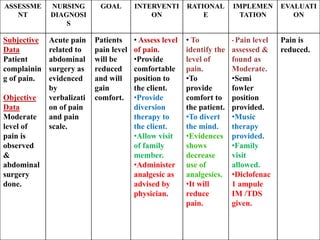
ASSESSME
NT
NURSING
DIAGNOSI
S
GOAL INTERVENTI
ON
RATIONAL
E
IMPLEMEN
TATION
EVALUATI
ON
Subjective
Data
Patient
complainin
g of pain.
Objective
Data
Moderate
level of
pain is
observed
&
abdominal
surgery
done.
Acute pain
related to
abdominal
surgery as
evidenced
by
verbalizati
on of pain
and pain
scale.
Patients
pain level
will be
reduced
and will
gain
comfort.
• Assess level
of pain.
•Provide
comfortable
position to
the client.
•Provide
diversion
therapy to
the client.
•Allow visit
of family
member.
•Administer
analgesic as
advised by
physician.
• To
identify the
level of
pain.
•To
provide
comfort to
the patient.
•To divert
the mind.
•Evidences
shows
decrease
use of
analgesics.
•It will
reduce
pain.
• Pain level
assessed &
found as
Moderate.
•Semi
fowler
position
provided.
•Music
therapy
provided.
•Family
visit
allowed.
•Diclofenac
1 ampule
IM /TDS
given.
Pain is
reduced.
ANY QUESTION?
SUMMARY
THANKYOU

Nursing process

  • 1.
    NURSING PROCESS Rohini Pandey 1stYear M.Sc Nursing KGMU Institute of Nursing
  • 2.
  • 3.
    HISTORY Ida Jean Orlando 1958 •4 stage Nursing process
  • 4.
    DEFINITION • Nursing Processis a critical thinking process that professional nurses use to apply the best available evidence to care giving and promoting human functions and responses to health and illness.
  • 5.
    The nursing processis cyclical & its components follow a logical sequence, but more than one component may be involved at one time. At the end of the first cycle, care may be terminated if goals are achieved, or cycle may continue with reassessment or plan of care may be modified.
  • 7.
    Purpose of NursingProcess • To identify Clients health status and potential health care problems. • To establish plans to meet identified needs. • To deliver specific nursing interventions to meet those need. • To achieve continuity of care.
  • 8.
    Components of NursingProcess ASSESSMENT NURSING DIAGNOSIS PLANNINGIMPLEMENTATION EVALUATION Nursing Process
  • 9.
    Characteristics of NursingProcess • Cyclic. • Dynamic Nature. • Client Centred. • Focus on problem solving & decision making. • Universal applicability. • Use of critical thinking & clinical reasoning. • Data from each phase provide input into the next phase.
  • 10.
    NURSING PROCESS OVERVIEW 1.ASSESSING a. Collect data b. Organize data c. Validate data d. Analyze data e. Document data 2. DIAGNOSING a. Analyze data b. Identify health problems, risk, and strengths c. Formulate diagnostic statements 2. DIAGNOSING a. Analyze data b. Identify health problems, risk, and strengths c. Formulate diagnostic statements 3. PLANNING a. Prioritize problems/diagnoses b. Formulate goals/desired outcome c. Select nursing interventions d. Write nursing orders 4. IMPLEMENTATION a. Reassess the client b. Determine the nurse’s need for assistance c. Implement the nursing interventions d. Supervise delegated case e. Document nursing activities5. EVALUATION a. Collect data related to outcomes b. Compare data with outcomes c. Relate nursing actions to client goals/outcomes d. Draw conclusions about problem status e. Continue, modify, or terminate the client’s care plan
  • 11.
    1. ASSESSMENT ASSESSING •Collect Data •OrganizeData •Validate Data •Document Data Nursing Diagnosis INTERVENTION IMPLEMENTATION EVALUATION
  • 12.
    1. Assessment • Assessmentis the systematic & continuous collection, organization, validation and documentation of data (information). • TYPES i. Initial Nursing Assessment ii. Problem focused Assessment iii. Emergency Assessment iv. Time-lapsed Assessment
  • 13.
    1.1 Collection ofData Process of gathering information about clients health status. TYPES OF DATA a. Subjective Data b. Objective Data SOURCES OF DATA a. Primary source b. Secondary source METHOD OF DATA COLLECTION a. Observation b. Interview c. Examination
  • 14.
    1.2 Organize Data •The nurse uses a format that organizes the assessment data systematically. This is often referred to as nursing health history or nursing assessment form.
  • 15.
    1.3 Validate Data •The information gathered during the assessment is “double-checked” or verified to confirm that it is accurate and complete.
  • 16.
    1.4 Documentation OfData To complete the assessment phase, the nurse records client data. Accurate documentation is essential and should include all data collected about the client’s health status.
  • 17.
    Nursing Diagnosis •Analyze Data •IdentifyHealth problems, risks & strengths INTERVENTION ASSESSMENT EVALUATION IMPLEMENTATION
  • 18.
    2. NURSING DIAGNOSIS •In this phase, nurses use critical thinking skills to interpret assessment data to identify client problems. • North American Nursing Diagnosis Association (NANDA) define or refine nursing diagnosis.
  • 19.
    • The statusof nursing diagnosis are Actual, Health Promotion and Risk. 1. An actual diagnosis is a client problem that is present at the time of the nursing assessment. • Example: Impaired thermoregulation related to infection as evidenced by increased body temperature.
  • 20.
    A health promotiondiagnosis relates to clients’ preparedness to improve their health condition. Example: Deficit knowledge related to disease outcome as evidenced by frequent asking of question by the patient.
  • 21.
    • A risknursing diagnosis is a clinical judgement that a problem does not exist, but the presence of risk factors indicates that a problem may develop if adequate care is not given. Example: Risk for infection related to prolong hospitalization.
  • 22.
    Components of NANDANursing Diagnosis PROBLEM ETIOLOGY DEFINING CHARACTERISTICS
  • 23.
    • Acute painrelated to abdominal surgery as Problem Etiology evidenced by patient discomfort and pain scale Sign & Symptoms
  • 29.
    ASSESSMENT NURSING DIAGNOSIS 3. PLANNING a. Prioritize problems/diagnoses b.Formulate goals/desired outcome c. Select nursing interventions d. Write nursing orders IMPLEMENTATION EVALUATION
  • 30.
    3. PLANNING/INTERVENTION • Planninginvolves decision making and problem solving. • It is the process of formulating client goals and designing the nursing interventions required to prevent, reduce, or eliminate the client’s health problems.
  • 31.
    TYPES OF PLANNING •Initial planning • Ongoing planning • Discharge planning
  • 32.
    3.1 Prioritize Problems •Planned by deciding which nursing diagnosis requires attention first, which second and so on. • Nurses frequently use Maslow’s Hierarchy of Needs when setting Priority.
  • 34.
    3.2 Establishing Goal Afterestablishing priorities, the nurse set goals for each nursing Diagnosis. Goals may be short term or long term.
  • 35.
    3.2 Nursing Intervention ANursing intervention is any treatment that a nurse performs to improve patient’s health. Types Of Nursing Intervention: • Independent Intervention • Dependent Intervention • Collaboration Intervention
  • 36.
    3.4 Writing Intervention •After choosing the appropriate nursing interventions, the nurse writes them on the care plan. • Nursing care plan is written or computerized information about the client’s care.
  • 37.
    ASSESSMENT NURSING DIAGNOSIS 4. IMPLEMENTATION a. Reassessthe client b. Determine the nurse’s need for assistance c. Implement the nursing interventions d. Supervise delegated case e. Document nursing activities PLANNING/ INTERVENTION EVALUATION
  • 38.
    4. IMPLEMENTATION • Implementationconsists of doing and documenting the activities. • The process of implementation includes – Implementing the nursing interventions – Documenting nursing activities
  • 39.
    ASSESSMENT NURSING DIAGNOSIS 5. EVALUATION a. Collectdata related to outcomes b. Compare data with outcomes c. Relate nursing actions to client goals/outcomes d. Draw conclusions about problem status e. Continue, modify, or terminate the client’s care plan PLANNING/ INTERVENTION IMPLEMENTATION
  • 40.
    5. EVALUATION • Evaluationis a planned, ongoing, purposeful activity in which the nurse determines a. the client’s progress toward achievement of goals/outcomes and b. effectiveness of the nursing care plan. • The evaluation includes • Comparing the data with desired outcomes • Continuing, modifying, or terminating the nursing care plan.
  • 41.
    ASSESSME NT NURSING DIAGNOSI S GOAL INTERVENTI ON RATIONAL E IMPLEMEN TATION EVALUATI ON Subjective Data Patient complainin g ofpain. Objective Data Moderate level of pain is observed & abdominal surgery done. Acute pain related to abdominal surgery as evidenced by verbalizati on of pain and pain scale. Patients pain level will be reduced and will gain comfort. • Assess level of pain. •Provide comfortable position to the client. •Provide diversion therapy to the client. •Allow visit of family member. •Administer analgesic as advised by physician. • To identify the level of pain. •To provide comfort to the patient. •To divert the mind. •Evidences shows decrease use of analgesics. •It will reduce pain. • Pain level assessed & found as Moderate. •Semi fowler position provided. •Music therapy provided. •Family visit allowed. •Diclofenac 1 ampule IM /TDS given. Pain is reduced.
  • 42.
  • 43.
  • 44.