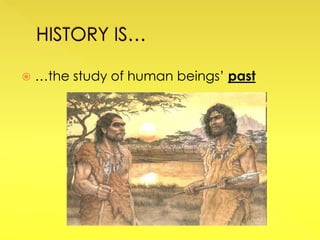
 …the study of human beings’ past
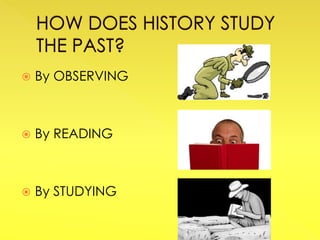
 By OBSERVING
 By READING
 By STUDYING
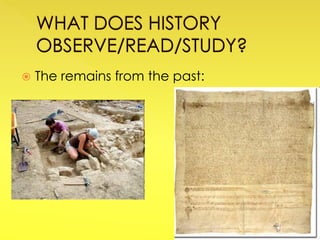
 The remains from the past:
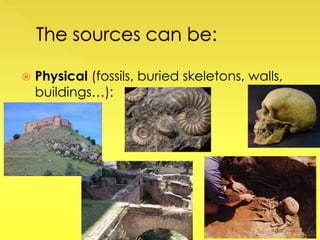
 Physical (fossils, buried skeletons, walls,
buildings…):
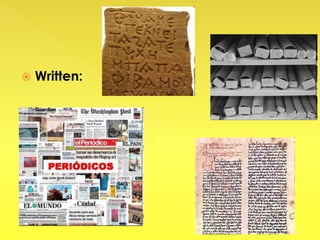
 Written:
 Oral:
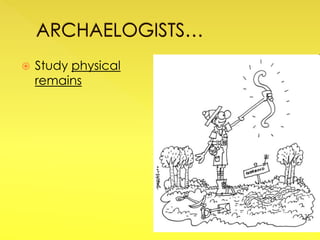
 Study physical
remains
(Well… in fact archaeology is not
always that exciting…!!! )
Yes! Just like him!
 Use different sources (physical + written +
oral)…… and they compare them in
order to understand facts better.
 They study the politics, the economy, the
society, the mentality, the art, the ways
of living, the culture…
 In chronology, we can distinguish different
periods of time:
› DECADE = 10 years
› CENTURY = 100 years:
 Ej: 20th Century: years 1901 - 2000
 Ej: 21st Century  years 2001 - 2100
› MILLENIUM = 1000 years
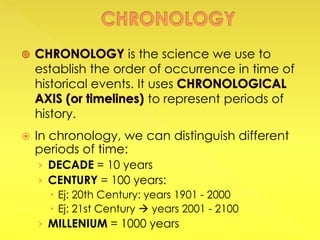
is the science we use to
establish the order of occurrence in time of
historical events. It uses
to represent periods of
history.
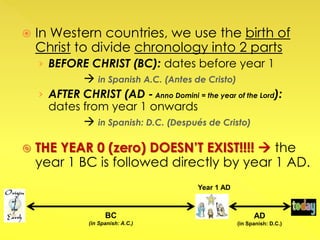
 In Western countries, we use the birth of
Christ to divide chronology into 2 parts
› BEFORE CHRIST (BC): dates before year 1
 in Spanish A.C. (Antes de Cristo)
› AFTER CHRIST (AD - Anno Domini = the year of the Lord):
dates from year 1 onwards
 in Spanish: D.C. (Después de Cristo)
 THE YEAR 0 (zero) DOESN’T EXIST!!!!  the
year 1 BC is followed directly by year 1 AD.
BC
(in Spanish: A.C.)
AD
(in Spanish: D.C.)
Year 1 AD
IN WHAT YEAR ARE WE
LIVING RIGHT NOW…?
…2013 BC OR 2013 AD?????
 Write down the centuries for these
years:
›370 BC
›84 BC
›2100 BC
›683 BC
›739
›215 BC
›181
›100
 Write down any year for these
centuries:
› s.XIX BC
› s.XX
› s.I
› s.XII
› s.VII BC
› s.XIV BC
 Which of these years is nearer to
our time: 1132 BC or 1194 BC?
 What century was 2.357 years
ago?
 How many years are there from
958 BC to 1311 AD?
 Write down the first and the last
year for these dates:
› 9th century
› 18th century
› 20th century
› 21st century
› 2nd century BC
› The second millennium AD
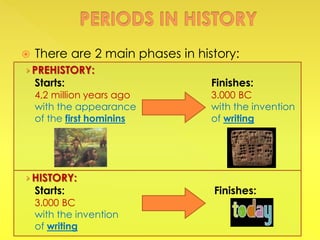
 There are 2 main phases in history:
› PREHISTORY:
Starts: Finishes:
4,2 million years ago 3.000 BC
with the appearance with the invention
of the first hominins of writing
› HISTORY:
Starts: Finishes:
3.000 BC
with the invention
of writing
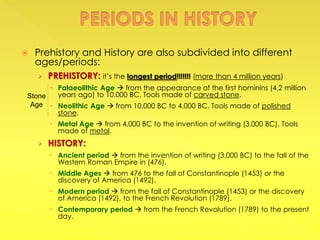
 Prehistory and History are also subdivided into different
ages/periods:
› PREHISTORY: it’s the longest period!!!!!!! (more than 4 million years)
 Palaeolithic Age  from the appearance of the first hominins (4,2 million
years ago) to 10.000 BC. Tools made of carved stone.
 Neolithic Age  from 10.000 BC to 4.000 BC. Tools made of polished
stone.
 Metal Age  from 4.000 BC to the invention of writing (3.000 BC). Tools
made of metal.
› HISTORY:
 Ancient period  from the invention of writing (3.000 BC) to the fall of the
Western Roman Empire in (476).
 Middle Ages  from 476 to the fall of Constantinople (1453) or the
discovery of America (1492).
 Modern period  from the fall of Constantinople (1453) or the discovery
of America (1492), to the French Revolution (1789).
 Contemporary period  from the French Revolution (1789) to the present
day.
Stone
Age
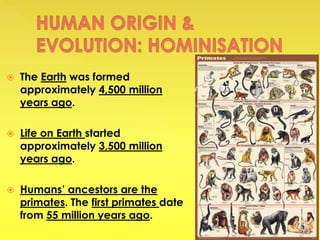
 The Earth was formed
approximately 4,500 million
years ago.
 Life on Earth started
approximately 3,500 million
years ago.
 Humans’ ancestors are the
primates. The first primates date
from 55 million years ago.
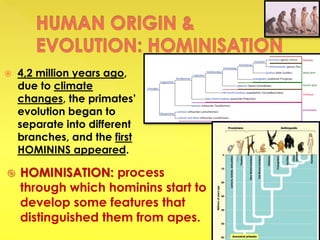
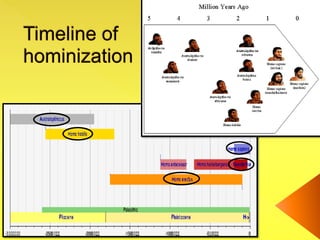
 4,2 million years ago,
due to climate
changes, the primates’
evolution began to
separate into different
branches, and the first
HOMININS appeared.
 HOMINISATION: process
through which hominins start to
develop some features that
distinguished them from apes.
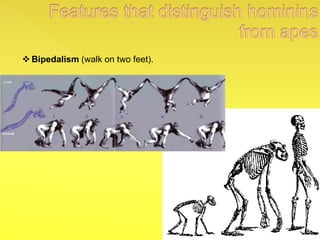
 Bipedalism (walk on two feet).
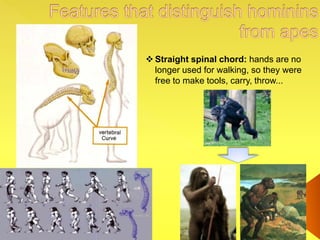
 Straight spinal chord: hands are no
longer used for walking, so they were
free to make tools, carry, throw...
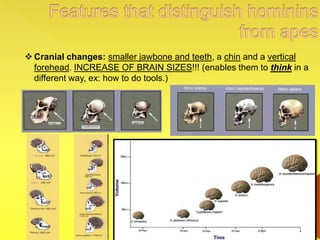
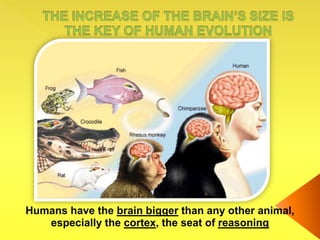
 Cranial changes: smaller jawbone and teeth, a chin and a vertical
forehead. INCREASE OF BRAIN SIZES!!! (enables them to think in a
different way, ex: how to do tools.)
Humans have the brain bigger than any other animal,
especially the cortex, the seat of reasoning
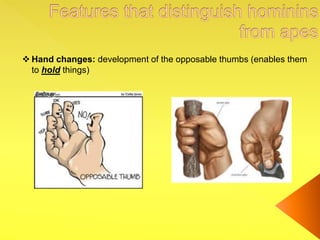
 Hand changes: development of the opposable thumbs (enables them
to hold things)
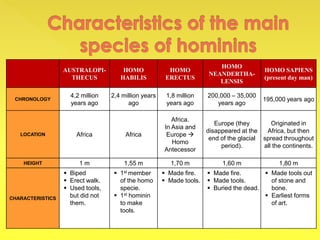
AUSTRALOPI-
THECUS
HOMO
HABILIS
HOMO
ERECTUS
HOMO
NEANDERTHA-
LENSIS
HOMO SAPIENS
(present day man)
CHRONOLOGY
4,2 million
years ago
2,4 million years
ago
1,8 million
years ago
200,000 – 35,000
years ago
195,000 years ago
LOCATION Africa Africa
Africa.
In Asia and
Europe 
Homo
Antecessor
Europe (they
disappeared at the
end of the glacial
period).
Originated in
Africa, but then
spread throughout
all the continents.
HEIGHT 1 m 1,55 m 1,70 m 1,60 m 1,80 m
CHARACTERISTICS
 Biped
 Erect walk.
 Used tools,
but did not
them.
 1st member
of the homo
specie.
 1st hominin
to make
tools.
 Made fire.
 Made tools.
 Made fire.
 Made tools.
 Buried the dead.
 Made tools out
of stone and
bone.
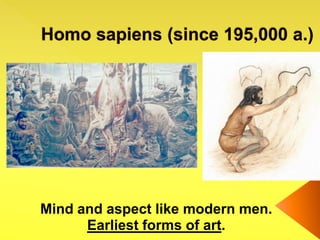
 Earliest forms
of art.
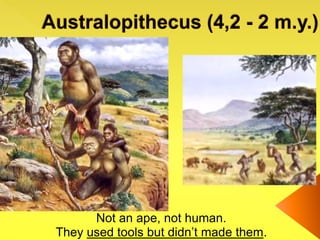
Not an ape, not human.
They used tools but didn’t made them.
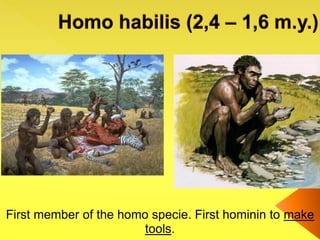
First member of the homo specie. First hominin to make
tools.
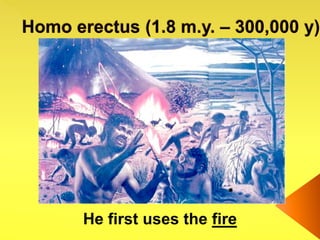
He first uses the fire
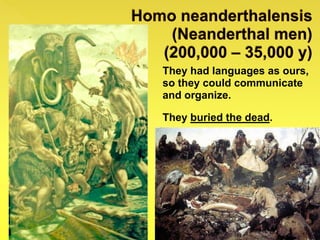
They had languages as ours,
so they could communicate
and organize.
They buried the dead.
Mind and aspect like modern men.
Earliest forms of art.
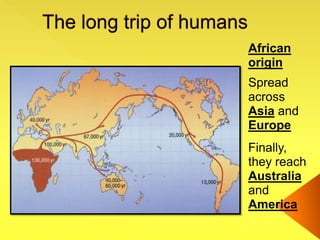
African
origin
Spread
across
Asia and
Europe
Finally,
they reach
Australia
and
America
 What would you eat?
 Would you stay in one place or move around?
 Where would you live?
 How many people would you live with?
 Would you hunt by yourself or with others?
 What tools would you need? What materials
would they be made of?
In groups of 4-6 students. You have 10 minutes to answer!!
Let’s start studying
the 1st period of
prehistory...
what’s ITS name?
And its chronology?
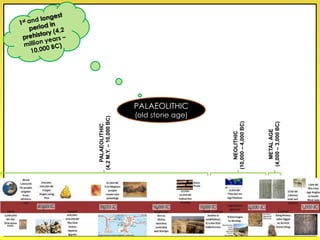
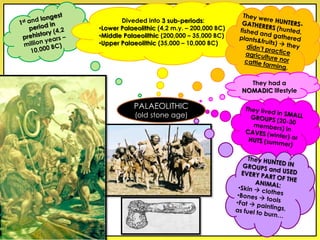
PALAEOLITHIC
(4,2M.Y.–10,000BC)
NEOLITHIC
(10,000–4,000BC)
METALAGE
(4,000–3,000BC)
PALAEOLITHIC
(old stone age)
PALAEOLITHIC
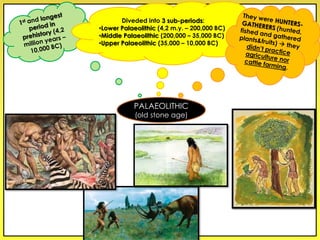
(old stone age)
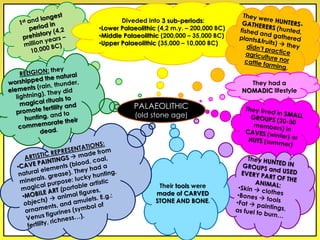
Diveded into 3 sub-periods:
•Lower Palaeolithic (4,2 m.y. – 200,000 BC)
•Middle Palaeolithic (200,000 – 35,000 BC)
•Upper Palaeolithic (35,000 – 10,000 BC)
Diveded into 3 sub-periods:
•Lower Palaeolithic (4,2 m.y. – 200,000 BC)
•Middle Palaeolithic (200,000 – 35,000 BC)
•Upper Palaeolithic (35,000 – 10,000 BC)
PALAEOLITHIC
(old stone age)
Diveded into 3 sub-periods:
•Lower Palaeolithic (4,2 m.y. – 200,000 BC)
•Middle Palaeolithic (200,000 – 35,000 BC)
•Upper Palaeolithic (35,000 – 10,000 BC)
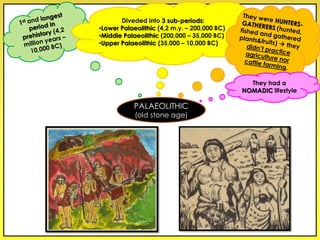
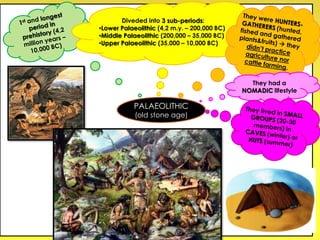
They had a
NOMADIC lifestyle
PALAEOLITHIC
(old stone age)
Diveded into 3 sub-periods:
•Lower Palaeolithic (4,2 m.y. – 200,000 BC)
•Middle Palaeolithic (200,000 – 35,000 BC)
•Upper Palaeolithic (35,000 – 10,000 BC)
They had a
NOMADIC lifestyle
PALAEOLITHIC
(old stone age)
Diveded into 3 sub-periods:
•Lower Palaeolithic (4,2 m.y. – 200,000 BC)
•Middle Palaeolithic (200,000 – 35,000 BC)
•Upper Palaeolithic (35,000 – 10,000 BC)
They had a
NOMADIC lifestyle
PALAEOLITHIC
(old stone age)
Diveded into 3 sub-periods:
•Lower Palaeolithic (4,2 m.y. – 200,000 BC)
•Middle Palaeolithic (200,000 – 35,000 BC)
•Upper Palaeolithic (35,000 – 10,000 BC)
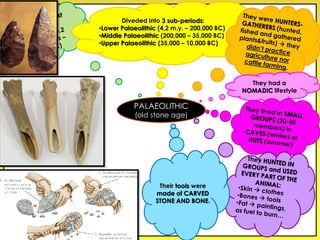
They had a
NOMADIC lifestyle
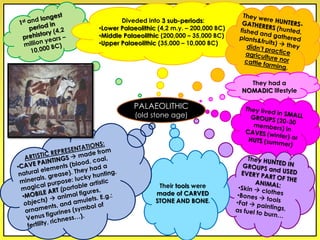
Their tools were
made of CARVED
STONE AND BONE.
PALAEOLITHIC
(old stone age)
Diveded into 3 sub-periods:
•Lower Palaeolithic (4,2 m.y. – 200,000 BC)
•Middle Palaeolithic (200,000 – 35,000 BC)
•Upper Palaeolithic (35,000 – 10,000 BC)
They had a
NOMADIC lifestyle
Their tools were
made of CARVED
STONE AND BONE.
PALAEOLITHIC
(old stone age)
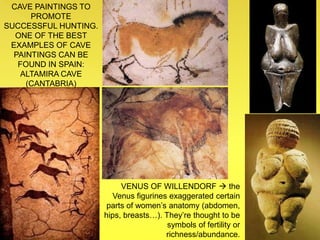
CAVE PAINTINGS TO
PROMOTE
SUCCESSFUL HUNTING.
ONE OF THE BEST
EXAMPLES OF CAVE
PAINTINGS CAN BE
FOUND IN SPAIN:
ALTAMIRA CAVE
(CANTABRIA)
VENUS OF WILLENDORF  the
Venus figurines exaggerated certain
parts of women’s anatomy (abdomen,
hips, breasts…). They’re thought to be
symbols of fertility or
richness/abundance.
Diveded into 3 sub-periods:
•Lower Palaeolithic (4,2 m.y. – 200,000 BC)
•Middle Palaeolithic (200,000 – 35,000 BC)
•Upper Palaeolithic (35,000 – 10,000 BC)
They had a
NOMADIC lifestyle
Their tools were
made of CARVED
STONE AND BONE.
PALAEOLITHIC
(old stone age)
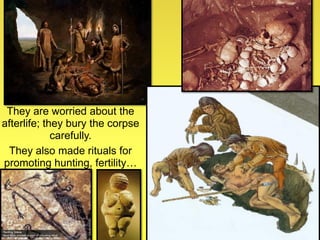
They are worried about the
afterlife; they bury the corpse
carefully.
They also made rituals for
promoting hunting, fertility…
NOW, Let’s start
studying the
2nd period of
prehistory...
what’s ITS name?
And its chronology?
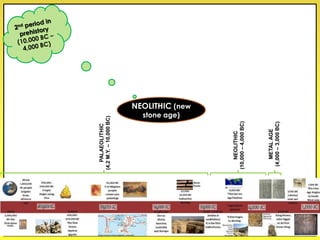
NEOLITHIC (new
stone age)
PALAEOLITHIC
(4,2M.Y.–10,000BC)
NEOLITHIC
(10,000–4,000BC)
METALAGE
(4,000–3,000BC)
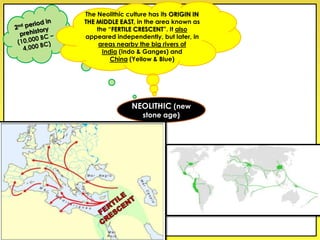
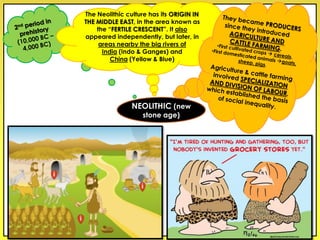
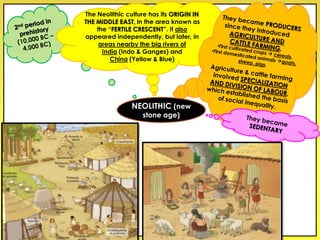
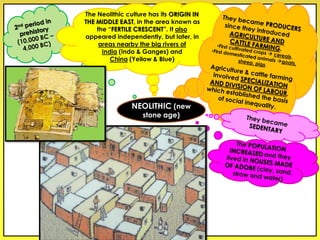
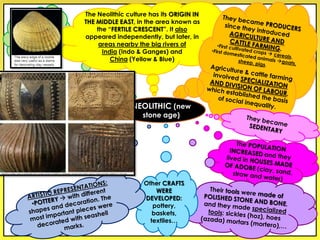
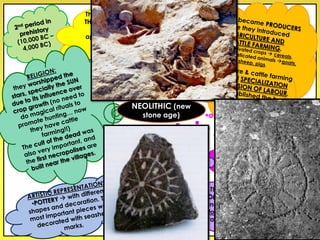
The Neolithic culture has its ORIGIN IN
THE MIDDLE EAST, in the area known as
the “FERTILE CRESCENT”. It also
appeared independently, but later, in
areas nearby the big rivers of
India (Indo & Ganges) and
China (Yellow & Blue)
NEOLITHIC (new
stone age)
The Neolithic culture has its ORIGIN IN
THE MIDDLE EAST, in the area known as
the “FERTILE CRESCENT”. It also
appeared independently, but later, in
areas nearby the big rivers of
India (Indo & Ganges) and
China (Yellow & Blue)
NEOLITHIC (new
stone age)
The Neolithic culture has its ORIGIN IN
THE MIDDLE EAST, in the area known as
the “FERTILE CRESCENT”. It also
appeared independently, but later, in
areas nearby the big rivers of
India (Indo & Ganges) and
China (Yellow & Blue)
NEOLITHIC (new
stone age)
The Neolithic culture has its ORIGIN IN
THE MIDDLE EAST, in the area known as
the “FERTILE CRESCENT”. It also
appeared independently, but later, in
areas nearby the big rivers of
India (Indo & Ganges) and
China (Yellow & Blue)
NEOLITHIC (new
stone age)
The Neolithic culture has its ORIGIN IN
THE MIDDLE EAST, in the area known as
the “FERTILE CRESCENT”. It also
appeared independently, but later, in
areas nearby the big rivers of
India (Indo & Ganges) and
China (Yellow & Blue)
NEOLITHIC (new
stone age)
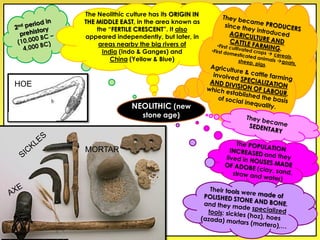
HOE
MORTAR
The Neolithic culture has its ORIGIN IN
THE MIDDLE EAST, in the area known as
the “FERTILE CRESCENT”. It also
appeared independently, but later, in
areas nearby the big rivers of
India (Indo & Ganges) and
China (Yellow & Blue)
Other CRAFTS
WERE
DEVELOPED:
pottery,
baskets,
textiles…
NEOLITHIC (new
stone age)
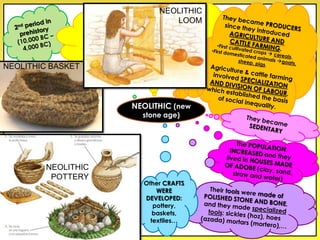
NEOLITHIC
LOOM
NEOLITHIC BASKET
NEOLITHIC
POTTERY
The Neolithic culture has its ORIGIN IN
THE MIDDLE EAST, in the area known as
the “FERTILE CRESCENT”. It also
appeared independently, but later, in
areas nearby the big rivers of
India (Indo & Ganges) and
China (Yellow & Blue)
Other CRAFTS
WERE
DEVELOPED:
pottery,
baskets,
textiles…
NEOLITHIC (new
stone age)
The Neolithic culture has its ORIGIN IN
THE MIDDLE EAST, in the area known as
the “FERTILE CRESCENT”. It also
appeared independently, but later, in
areas nearby the big rivers of
India (Indo & Ganges) and
China (Yellow & Blue)
Other CRAFTS
WERE
DEVELOPED:
pottery,
baskets,
textiles…
NEOLITHIC (new
stone age)
The Neolithic culture has its ORIGIN IN
THE MIDDLE EAST, in the area known as
the “FERTILE CRESCENT”. It also
appeared independently, but later, in
areas nearby the big rivers of
India (Indo & Ganges) and
China (Yellow & Blue)
Other CRAFTS
WERE
DEVELOPED:
pottery,
baskets,
textiles…
NEOLITHIC (new
stone age)
NOW, Let’s start
studying the
3rd period of
prehistory...
what’s ITS name?
And its chronology?
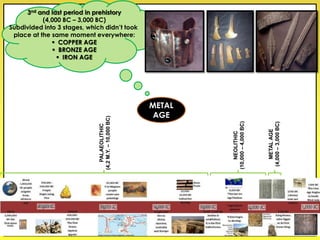
3nd and last period in prehistory
(4,000 BC – 3,000 BC)
Subdivided into 3 stages, which didn’t took
place at the same moment everywhere:
 COPPER AGE
 BRONZE AGE
 IRON AGE
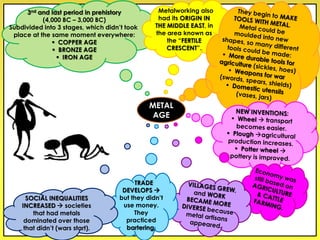
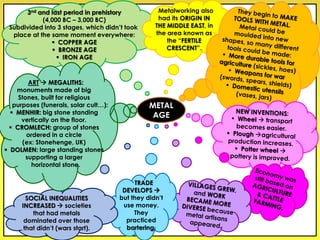
METAL
AGE
PALAEOLITHIC
(4,2M.Y.–10,000BC)
NEOLITHIC
(10,000–4,000BC)
METALAGE
(4,000–3,000BC)
3nd and last period in prehistory
(4,000 BC – 3,000 BC)
Subdivided into 3 stages, which didn’t took
place at the same moment everywhere:
 COPPER AGE
 BRONZE AGE
 IRON AGE
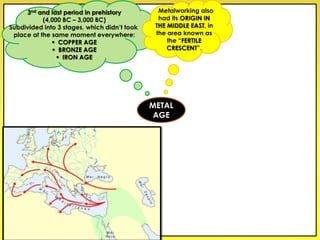
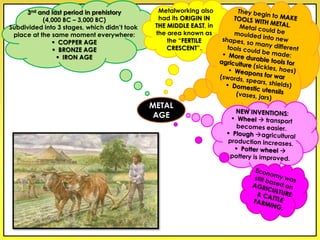
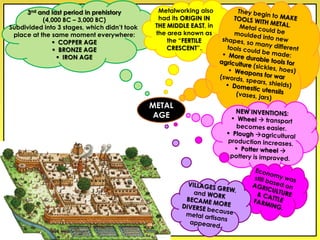
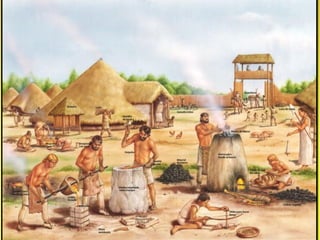
Metalworking also
had its ORIGIN IN
THE MIDDLE EAST, in
the area known as
the “FERTILE
CRESCENT”.
METAL
AGE
3nd and last period in prehistory
(4,000 BC – 3,000 BC)
Subdivided into 3 stages, which didn’t took
place at the same moment everywhere:
 COPPER AGE
 BRONZE AGE
 IRON AGE
Metalworking also
had its ORIGIN IN
THE MIDDLE EAST, in
the area known as
the “FERTILE
CRESCENT”.
METAL
AGE
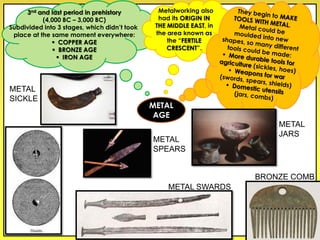
METAL
SICKLE
BRONZE COMB
METAL SWARDS
METAL
SPEARS
METAL
JARS
3nd and last period in prehistory
(4,000 BC – 3,000 BC)
Subdivided into 3 stages, which didn’t took
place at the same moment everywhere:
 COPPER AGE
 BRONZE AGE
 IRON AGE
Metalworking also
had its ORIGIN IN
THE MIDDLE EAST, in
the area known as
the “FERTILE
CRESCENT”.
METAL
AGE
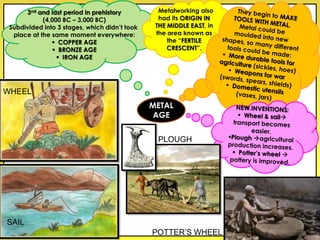
PLOUGH
WHEEL
SAIL
POTTER’S WHEEL
3nd and last period in prehistory
(4,000 BC – 3,000 BC)
Subdivided into 3 stages, which didn’t took
place at the same moment everywhere:
 COPPER AGE
 BRONZE AGE
 IRON AGE
Metalworking also
had its ORIGIN IN
THE MIDDLE EAST, in
the area known as
the “FERTILE
CRESCENT”.
METAL
AGE
3nd and last period in prehistory
(4,000 BC – 3,000 BC)
Subdivided into 3 stages, which didn’t took
place at the same moment everywhere:
 COPPER AGE
 BRONZE AGE
 IRON AGE
Metalworking also
had its ORIGIN IN
THE MIDDLE EAST, in
the area known as
the “FERTILE
CRESCENT”.
METAL
AGE
3nd and last period in prehistory
(4,000 BC – 3,000 BC)
Subdivided into 3 stages, which didn’t took
place at the same moment everywhere:
 COPPER AGE
 BRONZE AGE
 IRON AGE
Metalworking also
had its ORIGIN IN
THE MIDDLE EAST, in
the area known as
the “FERTILE
CRESCENT”.
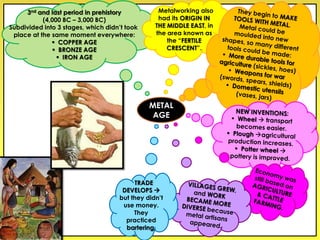
TRADE
DEVELOPS 
but they didn’t
use money.
They
practiced
bartering.
METAL
AGE
3nd and last period in prehistory
(4,000 BC – 3,000 BC)
Subdivided into 3 stages, which didn’t took
place at the same moment everywhere:
 COPPER AGE
 BRONZE AGE
 IRON AGE
Metalworking also
had its ORIGIN IN
THE MIDDLE EAST, in
the area known as
the “FERTILE
CRESCENT”.
TRADE
DEVELOPS 
but they didn’t
use money.
They
practiced
bartering.
SOCIAL INEQUALITIES
INCREASED  societies
that had metals
dominated over those
that didn’t (wars start).
METAL
AGE
3nd and last period in prehistory
(4,000 BC – 3,000 BC)
Subdivided into 3 stages, which didn’t took
place at the same moment everywhere:
 COPPER AGE
 BRONZE AGE
 IRON AGE
Metalworking also
had its ORIGIN IN
THE MIDDLE EAST, in
the area known as
the “FERTILE
CRESCENT”.
TRADE
DEVELOPS 
but they didn’t
use money.
They
practiced
bartering.
SOCIAL INEQUALITIES
INCREASED  societies
that had metals
dominated over those
that didn’t (wars start).

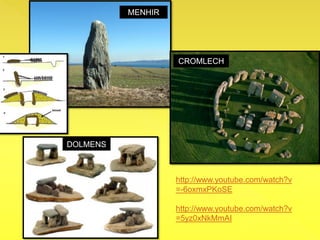
ART  MEGALITHS:
monuments made of big
Stones, built for religious
purposes (funerals, solar cult…):
 MENHIR: big stone standing
vertically on the floor.
 CROMLECH: group of stones
ordered in a circle
(ex: Stonehenge, UK)
 DOLMEN: large standing stones
supporting a larger
horizontal stone.
METAL
AGE
MENHIR
DOLMENS
CROMLECH
http://www.youtube.com/watch?v
=-6oxmxPKoSE
http://www.youtube.com/watch?v
=5yz0xNkMmAI

U9. prehistory

  • 4.
     …the studyof human beings’ past
  • 7.
     By OBSERVING By READING  By STUDYING
  • 8.
     The remainsfrom the past:
  • 9.
     Physical (fossils,buried skeletons, walls, buildings…):
  • 10.
  • 11.
  • 13.
  • 14.
    (Well… in factarchaeology is not always that exciting…!!! ) Yes! Just like him!
  • 15.
     Use differentsources (physical + written + oral)…… and they compare them in order to understand facts better.  They study the politics, the economy, the society, the mentality, the art, the ways of living, the culture…
  • 16.
     In chronology,we can distinguish different periods of time: › DECADE = 10 years › CENTURY = 100 years:  Ej: 20th Century: years 1901 - 2000  Ej: 21st Century  years 2001 - 2100 › MILLENIUM = 1000 years is the science we use to establish the order of occurrence in time of historical events. It uses to represent periods of history.
  • 17.
     In Westerncountries, we use the birth of Christ to divide chronology into 2 parts › BEFORE CHRIST (BC): dates before year 1  in Spanish A.C. (Antes de Cristo) › AFTER CHRIST (AD - Anno Domini = the year of the Lord): dates from year 1 onwards  in Spanish: D.C. (Después de Cristo)  THE YEAR 0 (zero) DOESN’T EXIST!!!!  the year 1 BC is followed directly by year 1 AD. BC (in Spanish: A.C.) AD (in Spanish: D.C.) Year 1 AD
  • 18.
    IN WHAT YEARARE WE LIVING RIGHT NOW…? …2013 BC OR 2013 AD?????
  • 19.
     Write downthe centuries for these years: ›370 BC ›84 BC ›2100 BC ›683 BC ›739 ›215 BC ›181 ›100  Write down any year for these centuries: › s.XIX BC › s.XX › s.I › s.XII › s.VII BC › s.XIV BC  Which of these years is nearer to our time: 1132 BC or 1194 BC?  What century was 2.357 years ago?  How many years are there from 958 BC to 1311 AD?  Write down the first and the last year for these dates: › 9th century › 18th century › 20th century › 21st century › 2nd century BC › The second millennium AD
  • 20.
     There are2 main phases in history: › PREHISTORY: Starts: Finishes: 4,2 million years ago 3.000 BC with the appearance with the invention of the first hominins of writing › HISTORY: Starts: Finishes: 3.000 BC with the invention of writing
  • 21.
     Prehistory andHistory are also subdivided into different ages/periods: › PREHISTORY: it’s the longest period!!!!!!! (more than 4 million years)  Palaeolithic Age  from the appearance of the first hominins (4,2 million years ago) to 10.000 BC. Tools made of carved stone.  Neolithic Age  from 10.000 BC to 4.000 BC. Tools made of polished stone.  Metal Age  from 4.000 BC to the invention of writing (3.000 BC). Tools made of metal. › HISTORY:  Ancient period  from the invention of writing (3.000 BC) to the fall of the Western Roman Empire in (476).  Middle Ages  from 476 to the fall of Constantinople (1453) or the discovery of America (1492).  Modern period  from the fall of Constantinople (1453) or the discovery of America (1492), to the French Revolution (1789).  Contemporary period  from the French Revolution (1789) to the present day. Stone Age
  • 22.
     The Earthwas formed approximately 4,500 million years ago.  Life on Earth started approximately 3,500 million years ago.  Humans’ ancestors are the primates. The first primates date from 55 million years ago.
  • 23.
     4,2 millionyears ago, due to climate changes, the primates’ evolution began to separate into different branches, and the first HOMININS appeared.  HOMINISATION: process through which hominins start to develop some features that distinguished them from apes.
  • 25.
     Bipedalism (walkon two feet).
  • 26.
     Straight spinalchord: hands are no longer used for walking, so they were free to make tools, carry, throw...
  • 27.
     Cranial changes:smaller jawbone and teeth, a chin and a vertical forehead. INCREASE OF BRAIN SIZES!!! (enables them to think in a different way, ex: how to do tools.)
  • 28.
    Humans have thebrain bigger than any other animal, especially the cortex, the seat of reasoning
  • 29.
     Hand changes:development of the opposable thumbs (enables them to hold things)
  • 30.
    AUSTRALOPI- THECUS HOMO HABILIS HOMO ERECTUS HOMO NEANDERTHA- LENSIS HOMO SAPIENS (present dayman) CHRONOLOGY 4,2 million years ago 2,4 million years ago 1,8 million years ago 200,000 – 35,000 years ago 195,000 years ago LOCATION Africa Africa Africa. In Asia and Europe  Homo Antecessor Europe (they disappeared at the end of the glacial period). Originated in Africa, but then spread throughout all the continents. HEIGHT 1 m 1,55 m 1,70 m 1,60 m 1,80 m CHARACTERISTICS  Biped  Erect walk.  Used tools, but did not them.  1st member of the homo specie.  1st hominin to make tools.  Made fire.  Made tools.  Made fire.  Made tools.  Buried the dead.  Made tools out of stone and bone.  Earliest forms of art.
  • 31.
    Not an ape,not human. They used tools but didn’t made them.
  • 32.
    First member ofthe homo specie. First hominin to make tools.
  • 33.
    He first usesthe fire
  • 34.
    They had languagesas ours, so they could communicate and organize. They buried the dead.
  • 35.
    Mind and aspectlike modern men. Earliest forms of art.
  • 36.
  • 37.
     What wouldyou eat?  Would you stay in one place or move around?  Where would you live?  How many people would you live with?  Would you hunt by yourself or with others?  What tools would you need? What materials would they be made of? In groups of 4-6 students. You have 10 minutes to answer!!
  • 38.
    Let’s start studying the1st period of prehistory... what’s ITS name? And its chronology?
  • 39.
  • 40.
    PALAEOLITHIC (old stone age) Divededinto 3 sub-periods: •Lower Palaeolithic (4,2 m.y. – 200,000 BC) •Middle Palaeolithic (200,000 – 35,000 BC) •Upper Palaeolithic (35,000 – 10,000 BC)
  • 41.
    Diveded into 3sub-periods: •Lower Palaeolithic (4,2 m.y. – 200,000 BC) •Middle Palaeolithic (200,000 – 35,000 BC) •Upper Palaeolithic (35,000 – 10,000 BC) PALAEOLITHIC (old stone age)
  • 42.
    Diveded into 3sub-periods: •Lower Palaeolithic (4,2 m.y. – 200,000 BC) •Middle Palaeolithic (200,000 – 35,000 BC) •Upper Palaeolithic (35,000 – 10,000 BC) They had a NOMADIC lifestyle PALAEOLITHIC (old stone age)
  • 43.
    Diveded into 3sub-periods: •Lower Palaeolithic (4,2 m.y. – 200,000 BC) •Middle Palaeolithic (200,000 – 35,000 BC) •Upper Palaeolithic (35,000 – 10,000 BC) They had a NOMADIC lifestyle PALAEOLITHIC (old stone age)
  • 44.
    Diveded into 3sub-periods: •Lower Palaeolithic (4,2 m.y. – 200,000 BC) •Middle Palaeolithic (200,000 – 35,000 BC) •Upper Palaeolithic (35,000 – 10,000 BC) They had a NOMADIC lifestyle PALAEOLITHIC (old stone age)
  • 45.
    Diveded into 3sub-periods: •Lower Palaeolithic (4,2 m.y. – 200,000 BC) •Middle Palaeolithic (200,000 – 35,000 BC) •Upper Palaeolithic (35,000 – 10,000 BC) They had a NOMADIC lifestyle Their tools were made of CARVED STONE AND BONE. PALAEOLITHIC (old stone age)
  • 46.
    Diveded into 3sub-periods: •Lower Palaeolithic (4,2 m.y. – 200,000 BC) •Middle Palaeolithic (200,000 – 35,000 BC) •Upper Palaeolithic (35,000 – 10,000 BC) They had a NOMADIC lifestyle Their tools were made of CARVED STONE AND BONE. PALAEOLITHIC (old stone age)
  • 47.
    CAVE PAINTINGS TO PROMOTE SUCCESSFULHUNTING. ONE OF THE BEST EXAMPLES OF CAVE PAINTINGS CAN BE FOUND IN SPAIN: ALTAMIRA CAVE (CANTABRIA) VENUS OF WILLENDORF  the Venus figurines exaggerated certain parts of women’s anatomy (abdomen, hips, breasts…). They’re thought to be symbols of fertility or richness/abundance.
  • 48.
    Diveded into 3sub-periods: •Lower Palaeolithic (4,2 m.y. – 200,000 BC) •Middle Palaeolithic (200,000 – 35,000 BC) •Upper Palaeolithic (35,000 – 10,000 BC) They had a NOMADIC lifestyle Their tools were made of CARVED STONE AND BONE. PALAEOLITHIC (old stone age)
  • 49.
    They are worriedabout the afterlife; they bury the corpse carefully. They also made rituals for promoting hunting, fertility…
  • 50.
    NOW, Let’s start studyingthe 2nd period of prehistory... what’s ITS name? And its chronology?
  • 51.
  • 52.
    The Neolithic culturehas its ORIGIN IN THE MIDDLE EAST, in the area known as the “FERTILE CRESCENT”. It also appeared independently, but later, in areas nearby the big rivers of India (Indo & Ganges) and China (Yellow & Blue) NEOLITHIC (new stone age)
  • 53.
    The Neolithic culturehas its ORIGIN IN THE MIDDLE EAST, in the area known as the “FERTILE CRESCENT”. It also appeared independently, but later, in areas nearby the big rivers of India (Indo & Ganges) and China (Yellow & Blue) NEOLITHIC (new stone age)
  • 54.
    The Neolithic culturehas its ORIGIN IN THE MIDDLE EAST, in the area known as the “FERTILE CRESCENT”. It also appeared independently, but later, in areas nearby the big rivers of India (Indo & Ganges) and China (Yellow & Blue) NEOLITHIC (new stone age)
  • 55.
    The Neolithic culturehas its ORIGIN IN THE MIDDLE EAST, in the area known as the “FERTILE CRESCENT”. It also appeared independently, but later, in areas nearby the big rivers of India (Indo & Ganges) and China (Yellow & Blue) NEOLITHIC (new stone age)
  • 56.
    The Neolithic culturehas its ORIGIN IN THE MIDDLE EAST, in the area known as the “FERTILE CRESCENT”. It also appeared independently, but later, in areas nearby the big rivers of India (Indo & Ganges) and China (Yellow & Blue) NEOLITHIC (new stone age) HOE MORTAR
  • 57.
    The Neolithic culturehas its ORIGIN IN THE MIDDLE EAST, in the area known as the “FERTILE CRESCENT”. It also appeared independently, but later, in areas nearby the big rivers of India (Indo & Ganges) and China (Yellow & Blue) Other CRAFTS WERE DEVELOPED: pottery, baskets, textiles… NEOLITHIC (new stone age) NEOLITHIC LOOM NEOLITHIC BASKET NEOLITHIC POTTERY
  • 58.
    The Neolithic culturehas its ORIGIN IN THE MIDDLE EAST, in the area known as the “FERTILE CRESCENT”. It also appeared independently, but later, in areas nearby the big rivers of India (Indo & Ganges) and China (Yellow & Blue) Other CRAFTS WERE DEVELOPED: pottery, baskets, textiles… NEOLITHIC (new stone age)
  • 59.
    The Neolithic culturehas its ORIGIN IN THE MIDDLE EAST, in the area known as the “FERTILE CRESCENT”. It also appeared independently, but later, in areas nearby the big rivers of India (Indo & Ganges) and China (Yellow & Blue) Other CRAFTS WERE DEVELOPED: pottery, baskets, textiles… NEOLITHIC (new stone age)
  • 60.
    The Neolithic culturehas its ORIGIN IN THE MIDDLE EAST, in the area known as the “FERTILE CRESCENT”. It also appeared independently, but later, in areas nearby the big rivers of India (Indo & Ganges) and China (Yellow & Blue) Other CRAFTS WERE DEVELOPED: pottery, baskets, textiles… NEOLITHIC (new stone age)
  • 61.
    NOW, Let’s start studyingthe 3rd period of prehistory... what’s ITS name? And its chronology?
  • 62.
    3nd and lastperiod in prehistory (4,000 BC – 3,000 BC) Subdivided into 3 stages, which didn’t took place at the same moment everywhere:  COPPER AGE  BRONZE AGE  IRON AGE METAL AGE PALAEOLITHIC (4,2M.Y.–10,000BC) NEOLITHIC (10,000–4,000BC) METALAGE (4,000–3,000BC)
  • 63.
    3nd and lastperiod in prehistory (4,000 BC – 3,000 BC) Subdivided into 3 stages, which didn’t took place at the same moment everywhere:  COPPER AGE  BRONZE AGE  IRON AGE Metalworking also had its ORIGIN IN THE MIDDLE EAST, in the area known as the “FERTILE CRESCENT”. METAL AGE
  • 64.
    3nd and lastperiod in prehistory (4,000 BC – 3,000 BC) Subdivided into 3 stages, which didn’t took place at the same moment everywhere:  COPPER AGE  BRONZE AGE  IRON AGE Metalworking also had its ORIGIN IN THE MIDDLE EAST, in the area known as the “FERTILE CRESCENT”. METAL AGE METAL SICKLE BRONZE COMB METAL SWARDS METAL SPEARS METAL JARS
  • 65.
    3nd and lastperiod in prehistory (4,000 BC – 3,000 BC) Subdivided into 3 stages, which didn’t took place at the same moment everywhere:  COPPER AGE  BRONZE AGE  IRON AGE Metalworking also had its ORIGIN IN THE MIDDLE EAST, in the area known as the “FERTILE CRESCENT”. METAL AGE PLOUGH WHEEL SAIL POTTER’S WHEEL
  • 66.
    3nd and lastperiod in prehistory (4,000 BC – 3,000 BC) Subdivided into 3 stages, which didn’t took place at the same moment everywhere:  COPPER AGE  BRONZE AGE  IRON AGE Metalworking also had its ORIGIN IN THE MIDDLE EAST, in the area known as the “FERTILE CRESCENT”. METAL AGE
  • 67.
    3nd and lastperiod in prehistory (4,000 BC – 3,000 BC) Subdivided into 3 stages, which didn’t took place at the same moment everywhere:  COPPER AGE  BRONZE AGE  IRON AGE Metalworking also had its ORIGIN IN THE MIDDLE EAST, in the area known as the “FERTILE CRESCENT”. METAL AGE
  • 69.
    3nd and lastperiod in prehistory (4,000 BC – 3,000 BC) Subdivided into 3 stages, which didn’t took place at the same moment everywhere:  COPPER AGE  BRONZE AGE  IRON AGE Metalworking also had its ORIGIN IN THE MIDDLE EAST, in the area known as the “FERTILE CRESCENT”. TRADE DEVELOPS  but they didn’t use money. They practiced bartering. METAL AGE
  • 70.
    3nd and lastperiod in prehistory (4,000 BC – 3,000 BC) Subdivided into 3 stages, which didn’t took place at the same moment everywhere:  COPPER AGE  BRONZE AGE  IRON AGE Metalworking also had its ORIGIN IN THE MIDDLE EAST, in the area known as the “FERTILE CRESCENT”. TRADE DEVELOPS  but they didn’t use money. They practiced bartering. SOCIAL INEQUALITIES INCREASED  societies that had metals dominated over those that didn’t (wars start). METAL AGE
  • 71.
    3nd and lastperiod in prehistory (4,000 BC – 3,000 BC) Subdivided into 3 stages, which didn’t took place at the same moment everywhere:  COPPER AGE  BRONZE AGE  IRON AGE Metalworking also had its ORIGIN IN THE MIDDLE EAST, in the area known as the “FERTILE CRESCENT”. TRADE DEVELOPS  but they didn’t use money. They practiced bartering. SOCIAL INEQUALITIES INCREASED  societies that had metals dominated over those that didn’t (wars start). ART  MEGALITHS: monuments made of big Stones, built for religious purposes (funerals, solar cult…):  MENHIR: big stone standing vertically on the floor.  CROMLECH: group of stones ordered in a circle (ex: Stonehenge, UK)  DOLMEN: large standing stones supporting a larger horizontal stone. METAL AGE
  • 72.