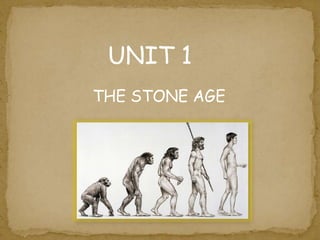
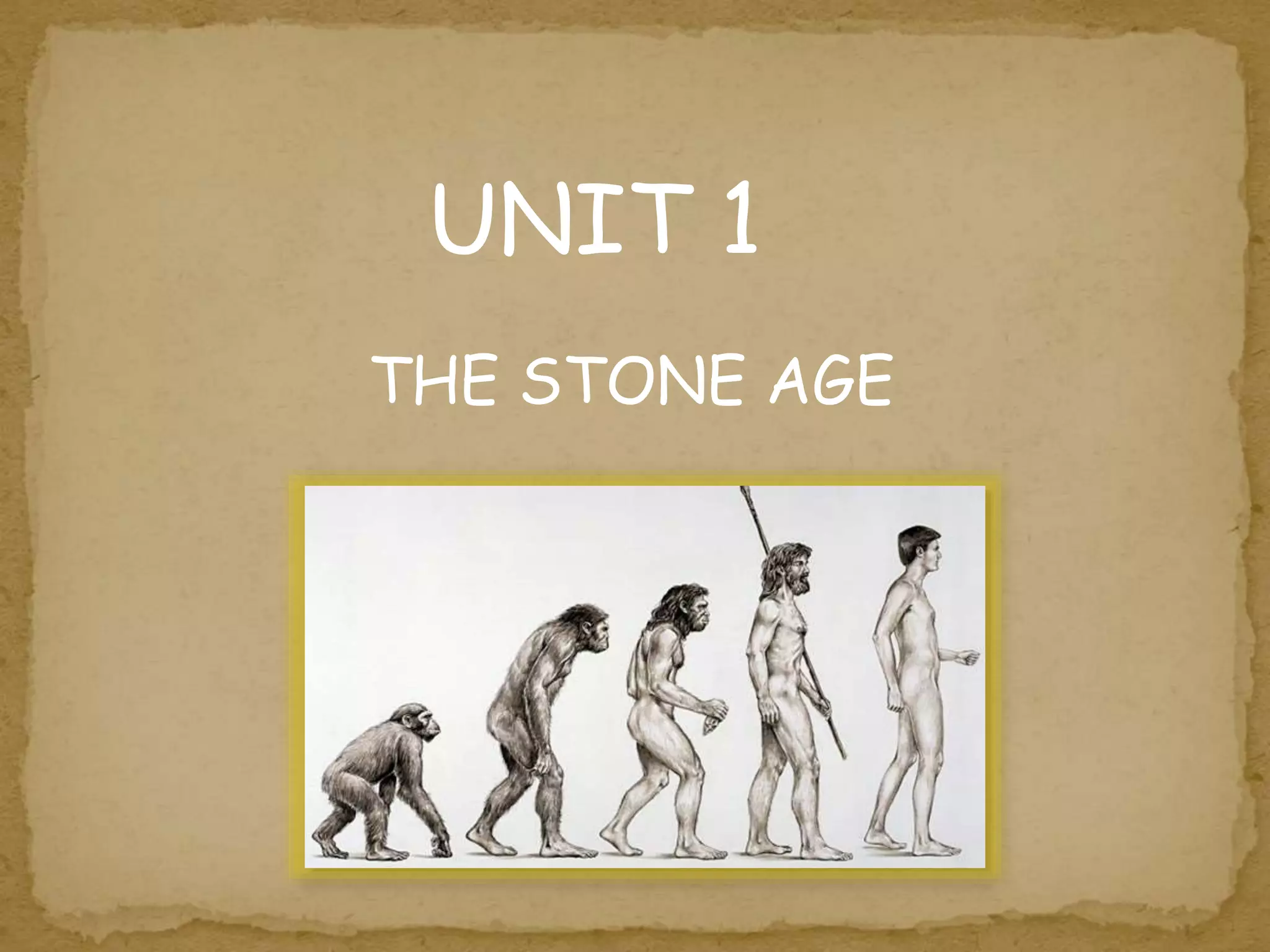
UNIT 1 
THE STONE AGE
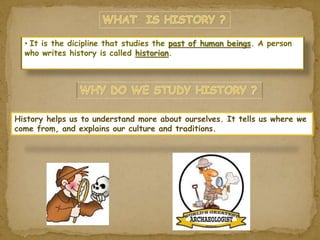
• It is the dicipline that studies the past of human beings. A person 
who writes history is called historian. 
History helps us to understand more about ourselves. It tells us where we 
come from, and explains our culture and traditions.
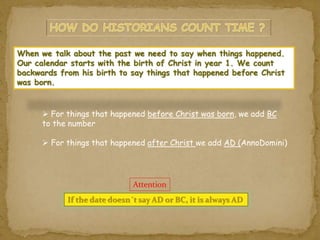
When we talk about the past we need to say when things happened. 
Our calendar starts with the birth of Christ in year 1. We count 
backwards from his birth to say things that happened before Christ 
was born. 
 For things that happened before Christ was born, we add BC 
to the number 
 For things that happened after Christ we add AD (AnnoDomini) 
Attention 
If the date doesn´t say AD or BC, it is always AD
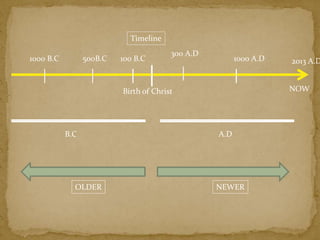
NOW 
Timeline 
| 
500B.C 
| | | | 
Birth of Christ 
B.C A.D 
1000 A.D 2013 A.D 
300 A.D 
1000 B.C 100 B.C 
| 
OLDER NEWER
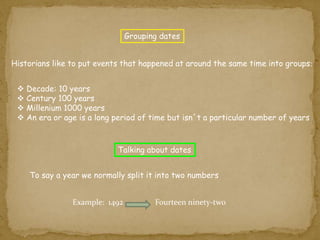
Grouping dates 
Historians like to put events that happened at around the same time into groups: 
 Decade: 10 years 
 Century 100 years 
 Millenium 1000 years 
 An era or age is a long period of time but isn´t a particular number of years 
Talking about dates 
To say a year we normally split it into two numbers 
Example: 1492 Fourteen ninety-two
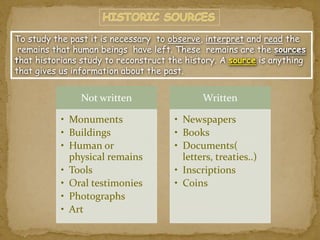
To study the past it is necessary to observe, interpret and read the 
remains that human beings have left. These remains are the sources 
that historians study to reconstruct the history. A source is anything 
that gives us information about the past. 
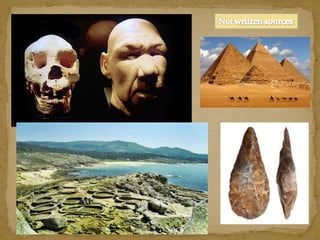
Not written 
• Monuments 
• Buildings 
• Human or 
physical remains 
• Tools 
• Oral testimonies 
• Photographs 
• Art 
Written 
• Newspapers 
• Books 
• Documents( 
letters, treaties..) 
• Inscriptions 
• Coins
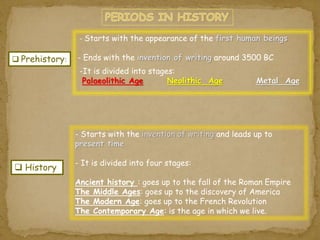
 Prehistory: 
- Starts with the appearance of the first human beings 
- Ends with the invention of writing around 3500 BC 
-It is divided into stages: 
Palaeolithic Age Neolithic Age Metal Age 
 History 
- Starts with the invention of writing and leads up to 
present time 
- It is divided into four stages: 
Ancient history : goes up to the fall of the Roman Empire 
The Middle Ages: goes up to the discovery of America 
The Modern Age: goes up to the French Revolution 
The Contemporary Age: is the age in which we live.
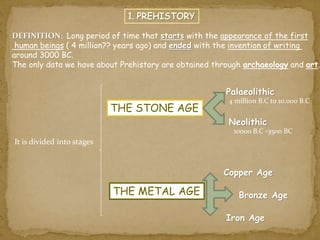
DEFINITION: Long period of time that starts with the appearance of the first 
human beings ( 4 million?? years ago) and ended with the invention of writing 
around 3000 BC. 
The only data we have about Prehistory are obtained through archaeology and art. 
It is divided into stages 
THE STONE AGE 
Palaeolithic 
4 million B.C to 10.000 B.C 
Neolithic 
THE METAL AGE 
10ooo B.C -3500 BC 
Copper Age 
Bronze Age 
Iron Age
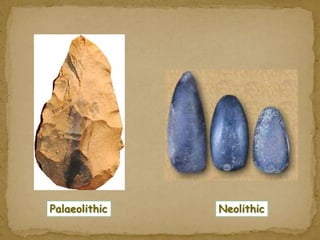
Palaeolithic Neolithic
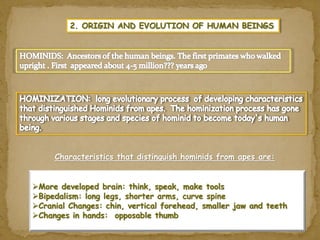
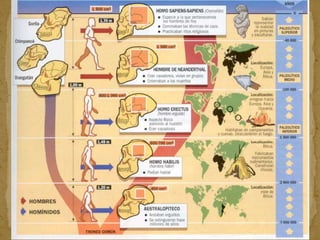
2. ORIGIN AND EVOLUTION OF HUMAN BEINGS 
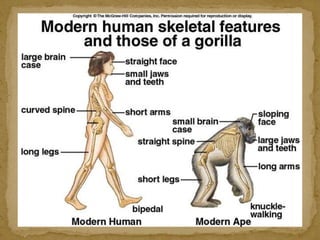
Characteristics that distinguish hominids from apes are: 
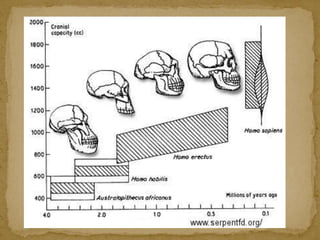
More developed brain: think, speak, make tools 
Bipedalism: long legs, shorter arms, curve spine 
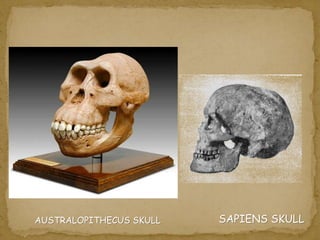
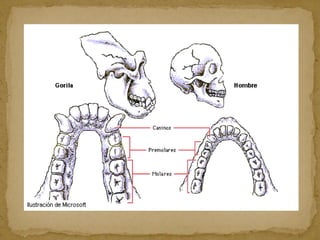
Cranial Changes: chin, vertical forehead, smaller jaw and teeth 
Changes in hands: opposable thumb
AUSTRALOPITHECUS SKULL SAPIENS SKULL
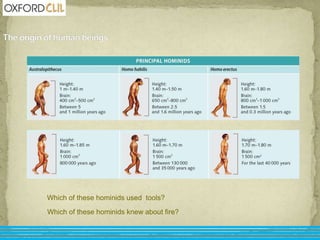
Which of these hominids used tools? 
Which of these hominids knew about fire?
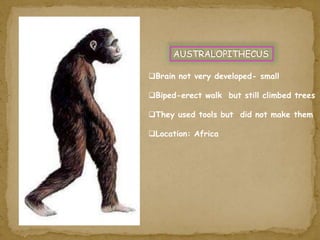
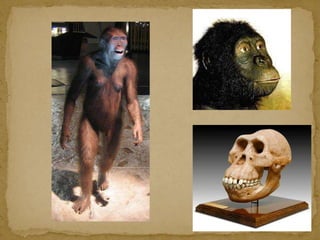
AUSTRALOPITHECUS 
Brain not very developed- small 
Biped-erect walk but still climbed trees 
They used tools but did not make them 
Location: Africa
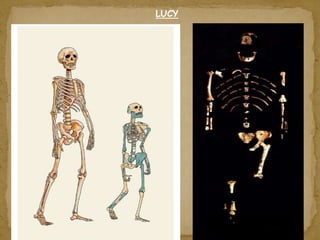
LUCY
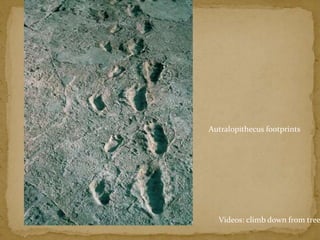
Autralopithecus footprints 
Videos: climb down from trees
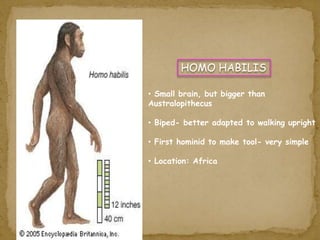
HOMO HABILIS 
• Small brain, but bigger than 
Australopithecus 
• Biped- better adapted to walking upright 
• First hominid to make tool- very simple 
• Location: Africa
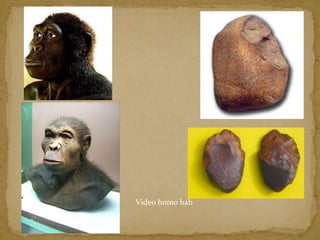
Video homo hab
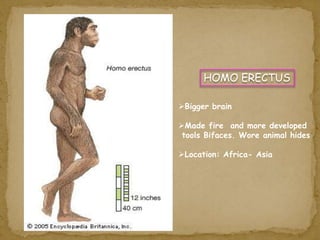
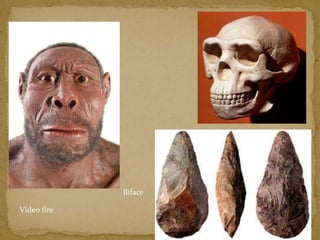
HOMO ERECTUS 
Bigger brain 
Made fire and more developed 
tools Bifaces. Wore animal hides 
Location: Africa- Asia
Biface 
Video fire
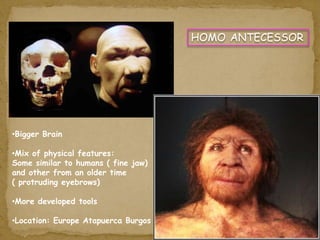
•Bigger Brain 
•Mix of physical features: 
Some similar to humans ( fine jaw) 
and other from an older time 
( protruding eyebrows) 
•More developed tools 
•Location: Europe Atapuerca Burgos 
HOMO ANTECESSOR
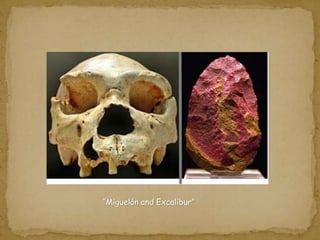
“Miguelón and Excalibur”
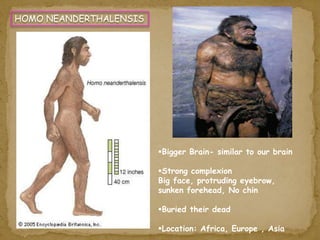
Bigger Brain- similar to our brain 
Strong complexion 
Big face, protruding eyebrow, 
sunken forehead, No chin 
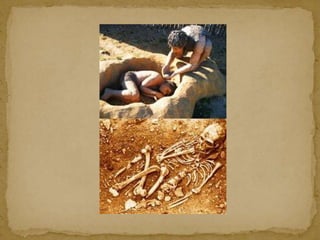
Buried their dead 
Location: Africa, Europe , Asia 
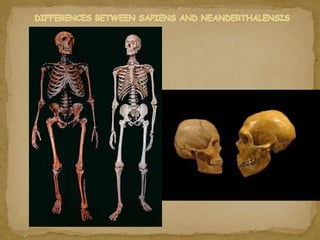
HOMO NEANDERTHALENSIS
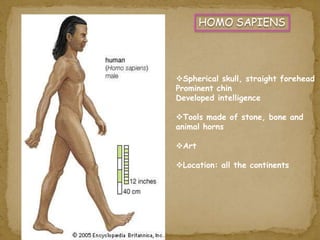
HOMO SAPIENS 
Spherical skull, straight forehead 
Prominent chin 
Developed intelligence 
Tools made of stone, bone and 
animal horns 
Art 
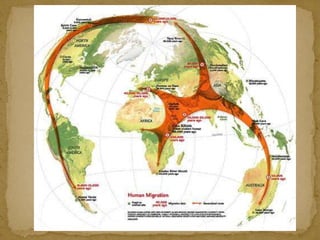
Location: all the continents
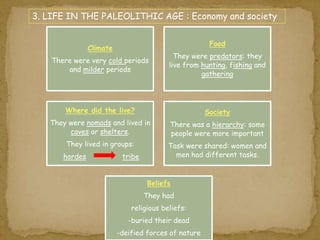
3. LIFE IN THE PALEOLITHIC AGE : Economy and society 
Climate 
There were very cold periods 
and milder periods 
Food 
They were predators: they 
live from hunting, fishing and 
gathering 
Where did the live? 
They were nomads and lived in 
caves or shelters. 
They lived in groups: 
hordes tribe 
Society 
There was a hierarchy: some 
people were more important 
Task were shared: women and 
men had different tasks. 
Beliefs 
They had 
religious beliefs: 
-buried their dead 
-deified forces of nature
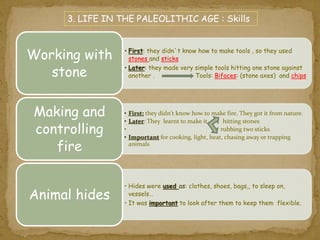
3. LIFE IN THE PALEOLITHIC AGE : Skills 
• First: they didn´t know how to make tools , so they used 
stones and sticks 
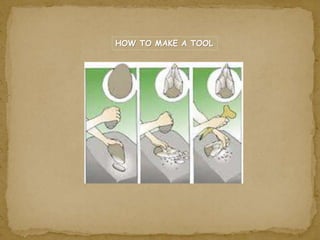
• Later: they made very simple tools hitting one stone against 
another . Tools: Bifaces: (stone axes) and chips 
Working with 
stone 
• First: they didn't know how to make fire. They got it from nature. 
• Later: They learnt to make it hitting stones 
• rubbing two sticks 
• Important for cooking, light, heat, chasing away or trapping 
animals 
Making and 
controlling 
fire 
• Hides were used as: clothes, shoes, bags,, to sleep on, 
vessels… 
• It was important to look after them to keep them flexible. 
Animal hides
HOW TO MAKE A TOOL
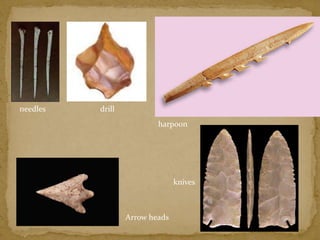
harpoon 
needles 
Arrow heads 
knives 
drill
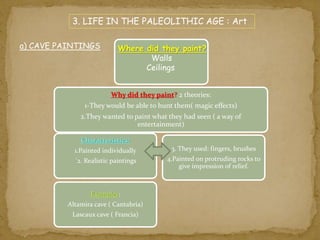
3. LIFE IN THE PALEOLITHIC AGE : Art 
Where did they paint? 
Why did they paint? 2 theories: 
1-They would be able to hunt them( magic effects) 
2.They wanted to paint what they had seen ( a way of 
entertainment) 
Characteristics: 
1.Painted individually 
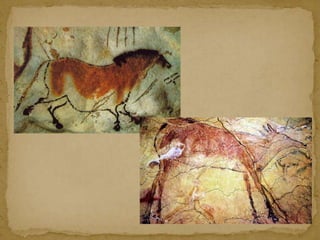
´2. Realistic paintings 
Examples: 
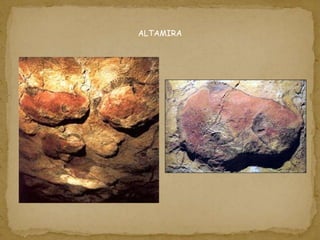
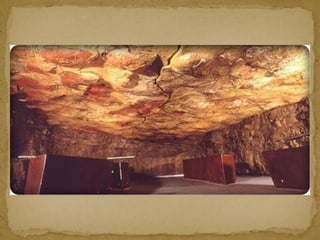
Altamira cave ( Cantabria) 
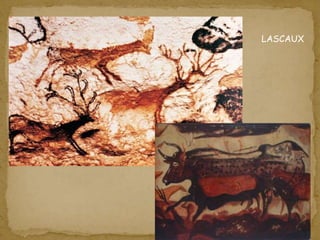
Lascaux cave ( Francia) 
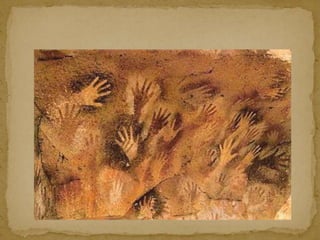
3. They used: fingers, brushes 
4.Painted on protruding rocks to 
give impression of relief. 
Walls 
Ceilings 
a) CAVE PAINTINGS
ALTAMIRA
LASCAUX
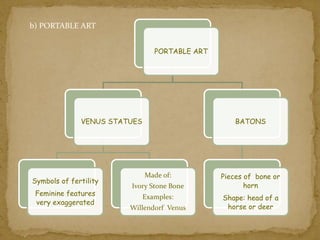
b) PORTABLE ART 
PORTABLE ART 
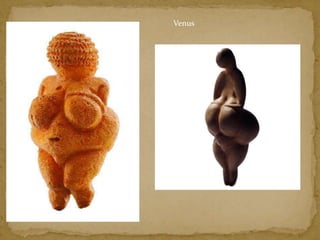
VENUS STATUES 
Symbols of fertility 
Feminine features 
very exaggerated 
Made of: 
Ivory Stone Bone 
Examples: 
Willendorf Venus 
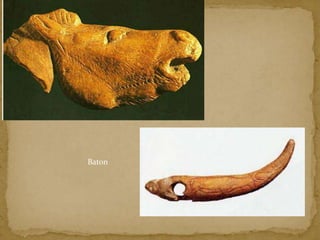
BATONS 
Pieces of bone or 
horn 
Shape: head of a 
horse or deer
Venus
Baton

Unidad 1 parte 1

  • 1.
    UNIT 1 THESTONE AGE
  • 2.
    • It isthe dicipline that studies the past of human beings. A person who writes history is called historian. History helps us to understand more about ourselves. It tells us where we come from, and explains our culture and traditions.
  • 3.
    When we talkabout the past we need to say when things happened. Our calendar starts with the birth of Christ in year 1. We count backwards from his birth to say things that happened before Christ was born.  For things that happened before Christ was born, we add BC to the number  For things that happened after Christ we add AD (AnnoDomini) Attention If the date doesn´t say AD or BC, it is always AD
  • 4.
    NOW Timeline | 500B.C | | | | Birth of Christ B.C A.D 1000 A.D 2013 A.D 300 A.D 1000 B.C 100 B.C | OLDER NEWER
  • 5.
    Grouping dates Historianslike to put events that happened at around the same time into groups:  Decade: 10 years  Century 100 years  Millenium 1000 years  An era or age is a long period of time but isn´t a particular number of years Talking about dates To say a year we normally split it into two numbers Example: 1492 Fourteen ninety-two
  • 6.
    To study thepast it is necessary to observe, interpret and read the remains that human beings have left. These remains are the sources that historians study to reconstruct the history. A source is anything that gives us information about the past. Not written • Monuments • Buildings • Human or physical remains • Tools • Oral testimonies • Photographs • Art Written • Newspapers • Books • Documents( letters, treaties..) • Inscriptions • Coins
  • 9.
     Prehistory: -Starts with the appearance of the first human beings - Ends with the invention of writing around 3500 BC -It is divided into stages: Palaeolithic Age Neolithic Age Metal Age  History - Starts with the invention of writing and leads up to present time - It is divided into four stages: Ancient history : goes up to the fall of the Roman Empire The Middle Ages: goes up to the discovery of America The Modern Age: goes up to the French Revolution The Contemporary Age: is the age in which we live.
  • 10.
    DEFINITION: Long periodof time that starts with the appearance of the first human beings ( 4 million?? years ago) and ended with the invention of writing around 3000 BC. The only data we have about Prehistory are obtained through archaeology and art. It is divided into stages THE STONE AGE Palaeolithic 4 million B.C to 10.000 B.C Neolithic THE METAL AGE 10ooo B.C -3500 BC Copper Age Bronze Age Iron Age
  • 11.
  • 12.
    2. ORIGIN ANDEVOLUTION OF HUMAN BEINGS Characteristics that distinguish hominids from apes are: More developed brain: think, speak, make tools Bipedalism: long legs, shorter arms, curve spine Cranial Changes: chin, vertical forehead, smaller jaw and teeth Changes in hands: opposable thumb
  • 14.
  • 17.
    Which of thesehominids used tools? Which of these hominids knew about fire?
  • 18.
    AUSTRALOPITHECUS Brain notvery developed- small Biped-erect walk but still climbed trees They used tools but did not make them Location: Africa
  • 20.
  • 21.
  • 22.
    HOMO HABILIS •Small brain, but bigger than Australopithecus • Biped- better adapted to walking upright • First hominid to make tool- very simple • Location: Africa
  • 23.
  • 24.
    HOMO ERECTUS Biggerbrain Made fire and more developed tools Bifaces. Wore animal hides Location: Africa- Asia
  • 25.
  • 26.
    •Bigger Brain •Mixof physical features: Some similar to humans ( fine jaw) and other from an older time ( protruding eyebrows) •More developed tools •Location: Europe Atapuerca Burgos HOMO ANTECESSOR
  • 27.
  • 28.
    Bigger Brain- similarto our brain Strong complexion Big face, protruding eyebrow, sunken forehead, No chin Buried their dead Location: Africa, Europe , Asia HOMO NEANDERTHALENSIS
  • 31.
    HOMO SAPIENS Sphericalskull, straight forehead Prominent chin Developed intelligence Tools made of stone, bone and animal horns Art Location: all the continents
  • 34.
    3. LIFE INTHE PALEOLITHIC AGE : Economy and society Climate There were very cold periods and milder periods Food They were predators: they live from hunting, fishing and gathering Where did the live? They were nomads and lived in caves or shelters. They lived in groups: hordes tribe Society There was a hierarchy: some people were more important Task were shared: women and men had different tasks. Beliefs They had religious beliefs: -buried their dead -deified forces of nature
  • 35.
    3. LIFE INTHE PALEOLITHIC AGE : Skills • First: they didn´t know how to make tools , so they used stones and sticks • Later: they made very simple tools hitting one stone against another . Tools: Bifaces: (stone axes) and chips Working with stone • First: they didn't know how to make fire. They got it from nature. • Later: They learnt to make it hitting stones • rubbing two sticks • Important for cooking, light, heat, chasing away or trapping animals Making and controlling fire • Hides were used as: clothes, shoes, bags,, to sleep on, vessels… • It was important to look after them to keep them flexible. Animal hides
  • 36.
  • 37.
    harpoon needles Arrowheads knives drill
  • 38.
    3. LIFE INTHE PALEOLITHIC AGE : Art Where did they paint? Why did they paint? 2 theories: 1-They would be able to hunt them( magic effects) 2.They wanted to paint what they had seen ( a way of entertainment) Characteristics: 1.Painted individually ´2. Realistic paintings Examples: Altamira cave ( Cantabria) Lascaux cave ( Francia) 3. They used: fingers, brushes 4.Painted on protruding rocks to give impression of relief. Walls Ceilings a) CAVE PAINTINGS
  • 39.
  • 43.
  • 44.
    b) PORTABLE ART PORTABLE ART VENUS STATUES Symbols of fertility Feminine features very exaggerated Made of: Ivory Stone Bone Examples: Willendorf Venus BATONS Pieces of bone or horn Shape: head of a horse or deer
  • 45.
  • 46.