PREHISTORY
María Jesús Campos
historyandgeography.org
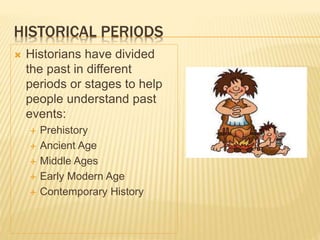
HISTORICAL PERIODS
 Historians have divided
the past in different
periods or stages to help
people understand past
events:
 Prehistory
 Ancient Age
 Middle Ages
 Early Modern Age
 Contemporary History
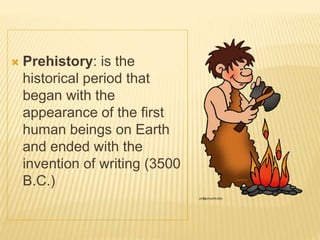
 Prehistory: is the
historical period that
began with the
appearance of the first
human beings on Earth
and ended with the
invention of writing (3500
B.C.)
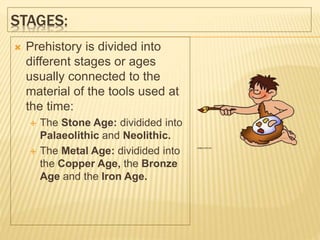
STAGES:
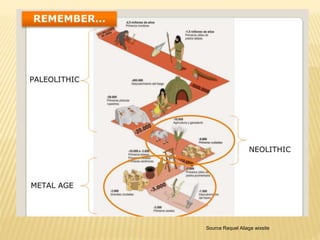
 Prehistory is divided into
different stages or ages
usually connected to the
material of the tools used at
the time:
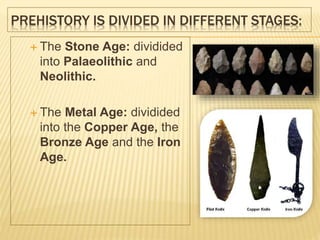
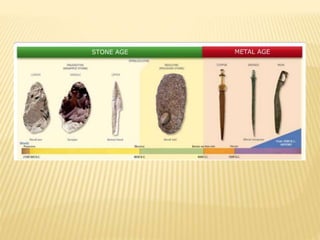
 The Stone Age: dividided into
Palaeolithic and Neolithic.
 The Metal Age: dividided into
the Copper Age, the Bronze
Age and the Iron Age.
THE PROCESS OF HOMINISATION
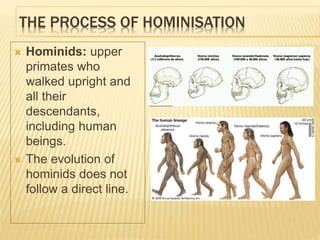
 Hominids: upper
primates who
walked upright and
all their
descendants,
including human
beings.
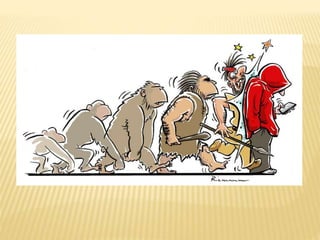
 The evolution of
hominids does not
follow a direct line.
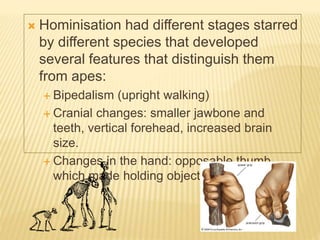
 Hominisation had different stages starred
by different species that developed
several features that distinguish them
from apes:
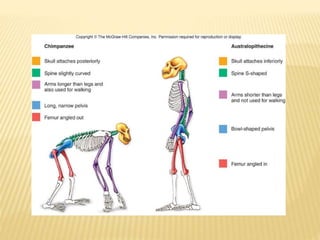
 Bipedalism (upright walking)
 Cranial changes: smaller jawbone and
teeth, vertical forehead, increased brain
size.
 Changes in the hand: opposable thumb
which made holding objects easier.
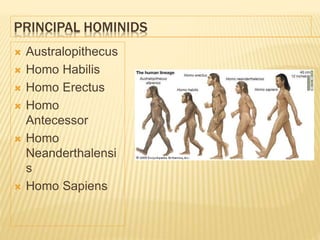
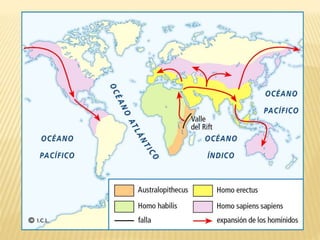
PRINCIPAL HOMINIDS
 Australopithecus
 Homo Habilis
 Homo Erectus
 Homo
Antecessor
 Homo
Neanderthalensi
s
 Homo Sapiens
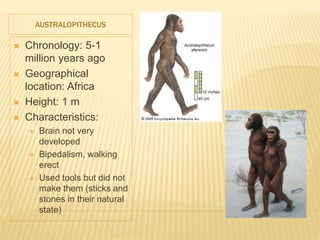
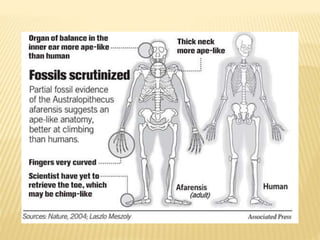
AUSTRALOPITHECUS
 Chronology: 5-1
million years ago
 Geographical
location: Africa
 Height: 1 m
 Characteristics:
 Brain not very
developed
 Bipedalism, walking
erect
 Used tools but did not
make them (sticks and
stones in their natural
state)
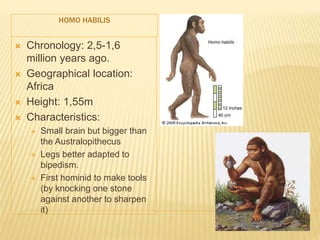
HOMO HABILIS
 Chronology: 2,5-1,6
million years ago.
 Geographical location:
Africa
 Height: 1,55m
 Characteristics:
 Small brain but bigger than
the Australopithecus
 Legs better adapted to
bipedism.
 First hominid to make tools
(by knocking one stone
against another to sharpen
it)
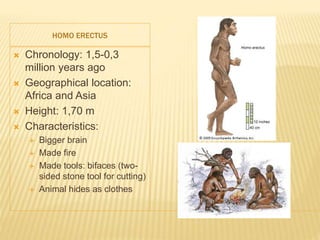
HOMO ERECTUS
 Chronology: 1,5-0,3
million years ago
 Geographical location:
Africa and Asia
 Height: 1,70 m
 Characteristics:
 Bigger brain
 Made fire
 Made tools: bifaces (two-
sided stone tool for cutting)
 Animal hides as clothes
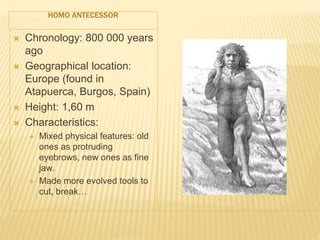
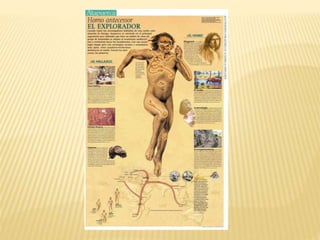
HOMO ANTECESSOR
 Chronology: 800 000 years
ago
 Geographical location:
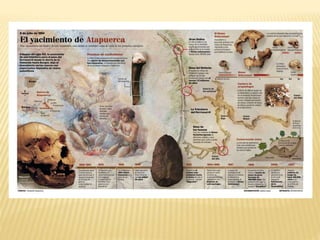
Europe (found in
Atapuerca, Burgos, Spain)
 Height: 1,60 m
 Characteristics:
 Mixed physical features: old
ones as protruding
eyebrows, new ones as fine
jaw.
 Made more evolved tools to
cut, break…
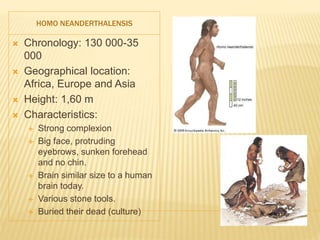
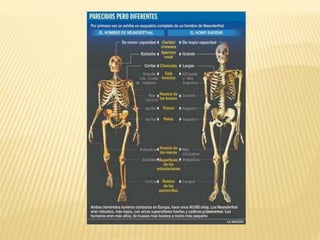
HOMO NEANDERTHALENSIS
 Chronology: 130 000-35
000
 Geographical location:
Africa, Europe and Asia
 Height: 1,60 m
 Characteristics:
 Strong complexion
 Big face, protruding
eyebrows, sunken forehead
and no chin.
 Brain similar size to a human
brain today.
 Various stone tools.
 Buried their dead (culture)
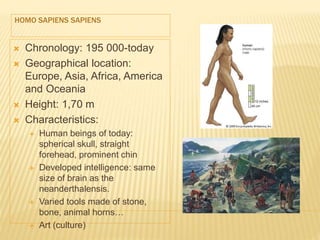
HOMO SAPIENS SAPIENS
 Chronology: 195 000-today
 Geographical location:
Europe, Asia, Africa, America
and Oceania
 Height: 1,70 m
 Characteristics:
 Human beings of today:
spherical skull, straight
forehead, prominent chin
 Developed intelligence: same
size of brain as the
neanderthalensis.
 Varied tools made of stone,
bone, animal horns…
 Art (culture)
PREHISTORY IS DIVIDED IN DIFFERENT STAGES:
 The Stone Age: dividided
into Palaeolithic and
Neolithic.
 The Metal Age: dividided
into the Copper Age, the
Bronze Age and the Iron
Age.
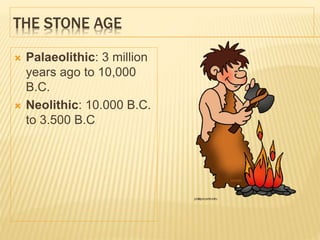
THE STONE AGE
 Palaeolithic: 3 million
years ago to 10,000
B.C.
 Neolithic: 10.000 B.C.
to 3.500 B.C
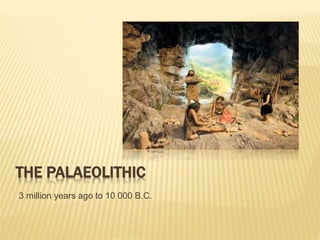
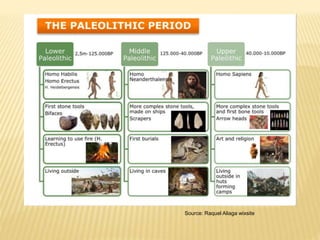
THE PALAEOLITHIC
3 million years ago to 10 000 B.C.
Source: Raquel Aliaga wixsite
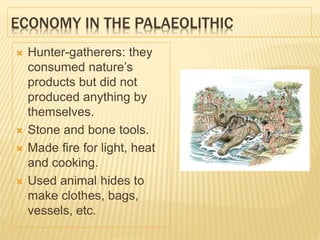
ECONOMY IN THE PALAEOLITHIC
 Hunter-gatherers: they
consumed nature’s
products but did not
produced anything by
themselves.
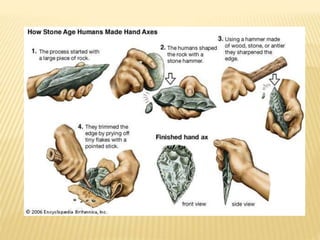
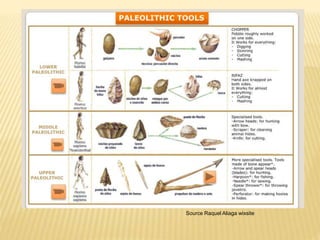
 Stone and bone tools.
 Made fire for light, heat
and cooking.
 Used animal hides to
make clothes, bags,
vessels, etc.
Source Raquel Aliaga wixsite
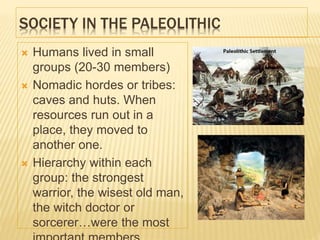
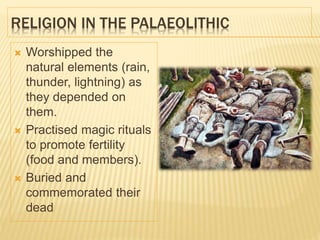
SOCIETY IN THE PALEOLITHIC
 Humans lived in small
groups (20-30 members)
 Nomadic hordes or tribes:
caves and huts. When
resources run out in a
place, they moved to
another one.
 Hierarchy within each
group: the strongest
warrior, the wisest old man,
the witch doctor or
sorcerer…were the most
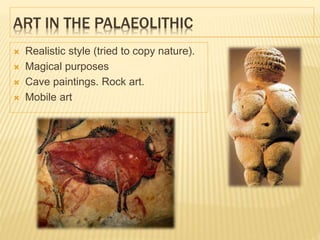
RELIGION IN THE PALAEOLITHIC
 Worshipped the
natural elements (rain,
thunder, lightning) as
they depended on
them.
 Practised magic rituals
to promote fertility
(food and members).
 Buried and
commemorated their
dead
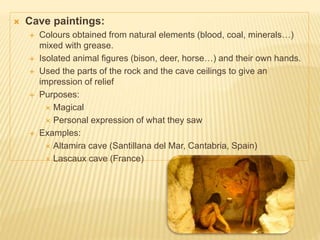
ART IN THE PALAEOLITHIC
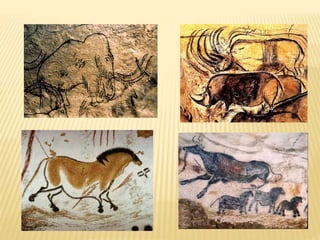
 Realistic style (tried to copy nature).
 Magical purposes
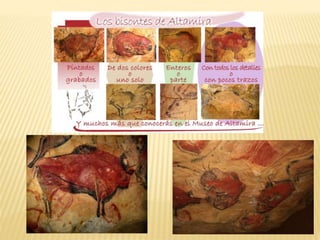
 Cave paintings. Rock art.
 Mobile art
 Cave paintings:
 Colours obtained from natural elements (blood, coal, minerals…)
mixed with grease.
 Isolated animal figures (bison, deer, horse…) and their own hands.
 Used the parts of the rock and the cave ceilings to give an
impression of relief
 Purposes:
 Magical
 Personal expression of what they saw
 Examples:
 Altamira cave (Santillana del Mar, Cantabria, Spain)
 Lascaux cave (France)
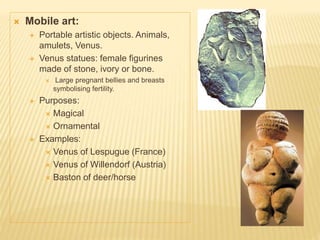
 Mobile art:
 Portable artistic objects. Animals,
amulets, Venus.
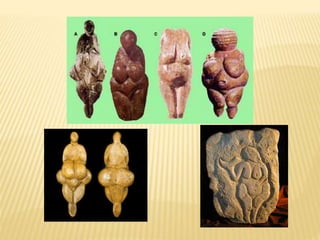
 Venus statues: female figurines
made of stone, ivory or bone.
 Large pregnant bellies and breasts
symbolising fertility.
 Purposes:
 Magical
 Ornamental
 Examples:
 Venus of Lespugue (France)
 Venus of Willendorf (Austria)
 Baston of deer/horse
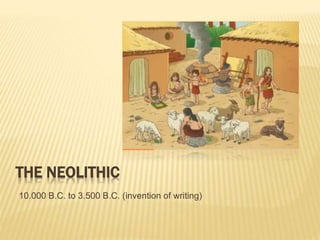
THE NEOLITHIC
10.000 B.C. to 3.500 B.C. (invention of writing)
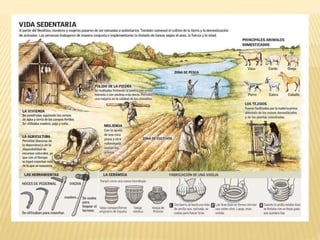
ECONOMY IN THE NEOLITHIC: THE NEOLITHIC
REVOLUTION
 Around 10.000 BC the Ice Age
finished. The Earth’s
temperature increased and
some areas dried up.
 Draughts affected the Near East
and only vegetation close to
rivers and oasis were able to
survive. Human beings and
animals moved to those areas.
 Human beings observed how
plants and animals behaved and
they learnt how to use water to
cultivate.
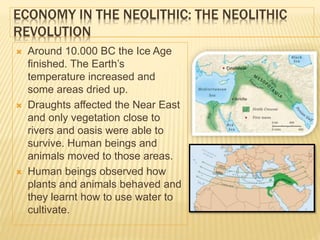
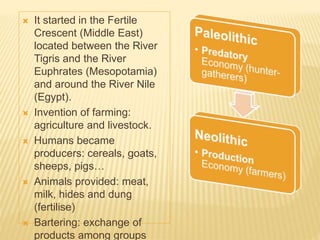
 It started in the Fertile
Crescent (Middle East)
located between the River
Tigris and the River
Euphrates (Mesopotamia)
and around the River Nile
(Egypt).
 Invention of farming:
agriculture and livestock.
 Humans became
producers: cereals, goats,
sheeps, pigs…
 Animals provided: meat,
milk, hides and dung
(fertilise)
 Bartering: exchange of
products among groups
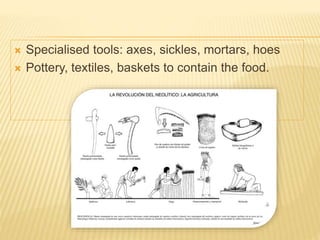
 Specialised tools: axes, sickles, mortars, hoes
 Pottery, textiles, baskets to contain the food.
SOCIETY IN THE NEOLITHIC
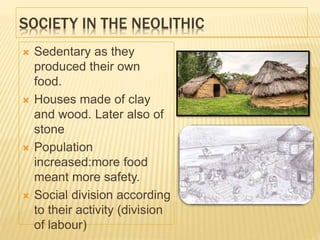
 Sedentary as they
produced their own
food.
 Houses made of clay
and wood. Later also of
stone
 Population
increased:more food
meant more safety.
 Social division according
to their activity (division
of labour)
RELIGION IN THE NEOLITHIC
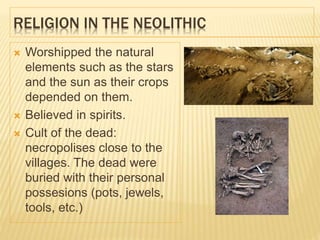
 Worshipped the natural
elements such as the stars
and the sun as their crops
depended on them.
 Believed in spirits.
 Cult of the dead:
necropolises close to the
villages. The dead were
buried with their personal
possesions (pots, jewels,
tools, etc.)
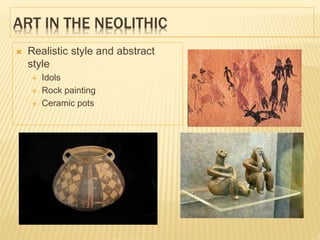
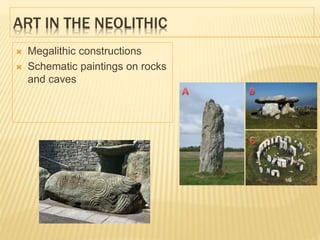
ART IN THE NEOLITHIC
 Realistic style and abstract
style
 Idols
 Rock painting
 Ceramic pots
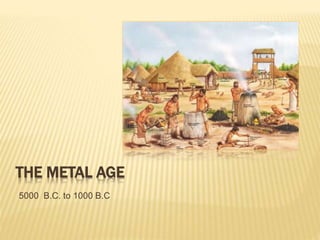
THE METAL AGE
5000 B.C. to 1000 B.C
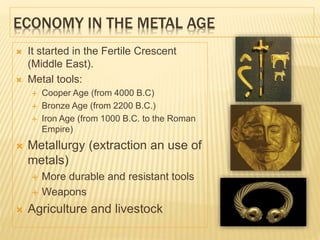
ECONOMY IN THE METAL AGE
 It started in the Fertile Crescent
(Middle East).
 Metal tools:
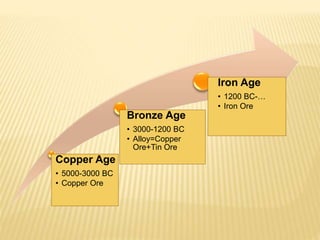
 Cooper Age (from 4000 B.C)
 Bronze Age (from 2200 B.C.)
 Iron Age (from 1000 B.C. to the Roman
Empire)
 Metallurgy (extraction an use of
metals)
 More durable and resistant tools
 Weapons
 Agriculture and livestock
 Specialised tools: axes,
sickles, mortars, hoes
 Pottery, textiles, baskets to
contain the food.
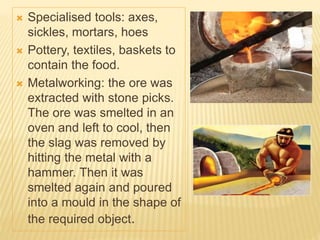
 Metalworking: the ore was
extracted with stone picks.
The ore was smelted in an
oven and left to cool, then
the slag was removed by
hitting the metal with a
hammer. Then it was
smelted again and poured
into a mould in the shape of
the required object.
Copper Age
• 5000-3000 BC
• Copper Ore
Bronze Age
• 3000-1200 BC
• Alloy=Copper
Ore+Tin Ore
Iron Age
• 1200 BC-…
• Iron Ore
SOCIETY IN THE METAL AGE
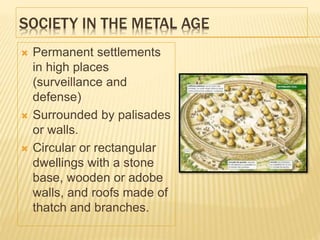
 Permanent settlements
in high places
(surveillance and
defense)
 Surrounded by palisades
or walls.
 Circular or rectangular
dwellings with a stone
base, wooden or adobe
walls, and roofs made of
thatch and branches.
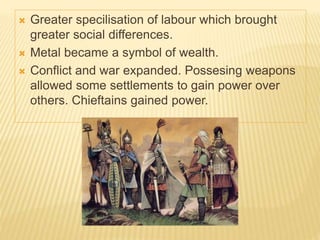
 Greater specilisation of labour which brought
greater social differences.
 Metal became a symbol of wealth.
 Conflict and war expanded. Possesing weapons
allowed some settlements to gain power over
others. Chieftains gained power.
RELIGION IN THE METAL AGE
 Worshipped the forces of nature
such as the stars and the sun as
their crops depended on them.
 Believed in spirits.
 Ceremonies in caves and sacred
places where they offered metal
objects to their gods.
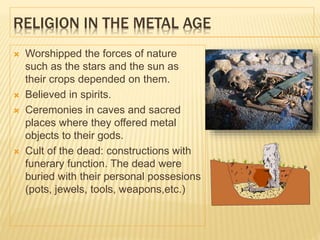
 Cult of the dead: constructions with
funerary function. The dead were
buried with their personal possesions
(pots, jewels, tools, weapons,etc.)
ART IN THE NEOLITHIC
 Megalithic constructions
 Schematic paintings on rocks
and caves
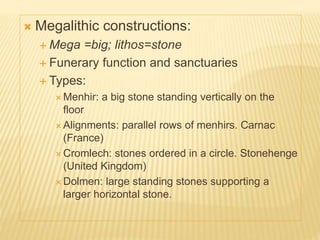
 Megalithic constructions:
 Mega =big; lithos=stone
 Funerary function and sanctuaries
 Types:
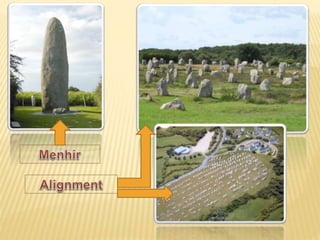
 Menhir: a big stone standing vertically on the
floor
 Alignments: parallel rows of menhirs. Carnac
(France)
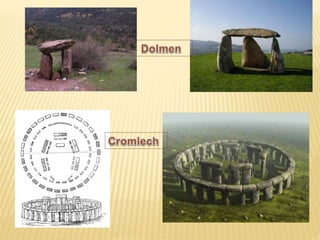
 Cromlech: stones ordered in a circle. Stonehenge
(United Kingdom)
 Dolmen: large standing stones supporting a
larger horizontal stone.
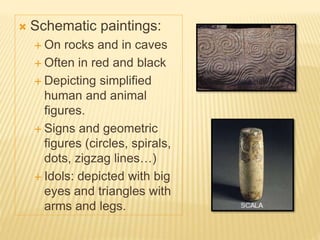
 Schematic paintings:
 On rocks and in caves
 Often in red and black
 Depicting simplified
human and animal
figures.
 Signs and geometric
figures (circles, spirals,
dots, zigzag lines…)
 Idols: depicted with big
eyes and triangles with
arms and legs.
Source Raquel Aliaga wixsite
Developed by María Jesús Campos
Chusteacher
wikiteacher

Prehistory

  • 1.
  • 2.
    HISTORICAL PERIODS  Historianshave divided the past in different periods or stages to help people understand past events:  Prehistory  Ancient Age  Middle Ages  Early Modern Age  Contemporary History
  • 3.
     Prehistory: isthe historical period that began with the appearance of the first human beings on Earth and ended with the invention of writing (3500 B.C.)
  • 4.
    STAGES:  Prehistory isdivided into different stages or ages usually connected to the material of the tools used at the time:  The Stone Age: dividided into Palaeolithic and Neolithic.  The Metal Age: dividided into the Copper Age, the Bronze Age and the Iron Age.
  • 5.
    THE PROCESS OFHOMINISATION  Hominids: upper primates who walked upright and all their descendants, including human beings.  The evolution of hominids does not follow a direct line.
  • 6.
     Hominisation haddifferent stages starred by different species that developed several features that distinguish them from apes:  Bipedalism (upright walking)  Cranial changes: smaller jawbone and teeth, vertical forehead, increased brain size.  Changes in the hand: opposable thumb which made holding objects easier.
  • 8.
    PRINCIPAL HOMINIDS  Australopithecus Homo Habilis  Homo Erectus  Homo Antecessor  Homo Neanderthalensi s  Homo Sapiens
  • 9.
    AUSTRALOPITHECUS  Chronology: 5-1 millionyears ago  Geographical location: Africa  Height: 1 m  Characteristics:  Brain not very developed  Bipedalism, walking erect  Used tools but did not make them (sticks and stones in their natural state)
  • 11.
    HOMO HABILIS  Chronology:2,5-1,6 million years ago.  Geographical location: Africa  Height: 1,55m  Characteristics:  Small brain but bigger than the Australopithecus  Legs better adapted to bipedism.  First hominid to make tools (by knocking one stone against another to sharpen it)
  • 12.
    HOMO ERECTUS  Chronology:1,5-0,3 million years ago  Geographical location: Africa and Asia  Height: 1,70 m  Characteristics:  Bigger brain  Made fire  Made tools: bifaces (two- sided stone tool for cutting)  Animal hides as clothes
  • 13.
    HOMO ANTECESSOR  Chronology:800 000 years ago  Geographical location: Europe (found in Atapuerca, Burgos, Spain)  Height: 1,60 m  Characteristics:  Mixed physical features: old ones as protruding eyebrows, new ones as fine jaw.  Made more evolved tools to cut, break…
  • 16.
    HOMO NEANDERTHALENSIS  Chronology:130 000-35 000  Geographical location: Africa, Europe and Asia  Height: 1,60 m  Characteristics:  Strong complexion  Big face, protruding eyebrows, sunken forehead and no chin.  Brain similar size to a human brain today.  Various stone tools.  Buried their dead (culture)
  • 18.
    HOMO SAPIENS SAPIENS Chronology: 195 000-today  Geographical location: Europe, Asia, Africa, America and Oceania  Height: 1,70 m  Characteristics:  Human beings of today: spherical skull, straight forehead, prominent chin  Developed intelligence: same size of brain as the neanderthalensis.  Varied tools made of stone, bone, animal horns…  Art (culture)
  • 21.
    PREHISTORY IS DIVIDEDIN DIFFERENT STAGES:  The Stone Age: dividided into Palaeolithic and Neolithic.  The Metal Age: dividided into the Copper Age, the Bronze Age and the Iron Age.
  • 23.
    THE STONE AGE Palaeolithic: 3 million years ago to 10,000 B.C.  Neolithic: 10.000 B.C. to 3.500 B.C
  • 24.
    THE PALAEOLITHIC 3 millionyears ago to 10 000 B.C.
  • 25.
  • 26.
    ECONOMY IN THEPALAEOLITHIC  Hunter-gatherers: they consumed nature’s products but did not produced anything by themselves.  Stone and bone tools.  Made fire for light, heat and cooking.  Used animal hides to make clothes, bags, vessels, etc.
  • 28.
  • 29.
    SOCIETY IN THEPALEOLITHIC  Humans lived in small groups (20-30 members)  Nomadic hordes or tribes: caves and huts. When resources run out in a place, they moved to another one.  Hierarchy within each group: the strongest warrior, the wisest old man, the witch doctor or sorcerer…were the most
  • 30.
    RELIGION IN THEPALAEOLITHIC  Worshipped the natural elements (rain, thunder, lightning) as they depended on them.  Practised magic rituals to promote fertility (food and members).  Buried and commemorated their dead
  • 31.
    ART IN THEPALAEOLITHIC  Realistic style (tried to copy nature).  Magical purposes  Cave paintings. Rock art.  Mobile art
  • 32.
     Cave paintings: Colours obtained from natural elements (blood, coal, minerals…) mixed with grease.  Isolated animal figures (bison, deer, horse…) and their own hands.  Used the parts of the rock and the cave ceilings to give an impression of relief  Purposes:  Magical  Personal expression of what they saw  Examples:  Altamira cave (Santillana del Mar, Cantabria, Spain)  Lascaux cave (France)
  • 35.
     Mobile art: Portable artistic objects. Animals, amulets, Venus.  Venus statues: female figurines made of stone, ivory or bone.  Large pregnant bellies and breasts symbolising fertility.  Purposes:  Magical  Ornamental  Examples:  Venus of Lespugue (France)  Venus of Willendorf (Austria)  Baston of deer/horse
  • 37.
    THE NEOLITHIC 10.000 B.C.to 3.500 B.C. (invention of writing)
  • 38.
    ECONOMY IN THENEOLITHIC: THE NEOLITHIC REVOLUTION  Around 10.000 BC the Ice Age finished. The Earth’s temperature increased and some areas dried up.  Draughts affected the Near East and only vegetation close to rivers and oasis were able to survive. Human beings and animals moved to those areas.  Human beings observed how plants and animals behaved and they learnt how to use water to cultivate.
  • 39.
     It startedin the Fertile Crescent (Middle East) located between the River Tigris and the River Euphrates (Mesopotamia) and around the River Nile (Egypt).  Invention of farming: agriculture and livestock.  Humans became producers: cereals, goats, sheeps, pigs…  Animals provided: meat, milk, hides and dung (fertilise)  Bartering: exchange of products among groups
  • 41.
     Specialised tools:axes, sickles, mortars, hoes  Pottery, textiles, baskets to contain the food.
  • 42.
    SOCIETY IN THENEOLITHIC  Sedentary as they produced their own food.  Houses made of clay and wood. Later also of stone  Population increased:more food meant more safety.  Social division according to their activity (division of labour)
  • 43.
    RELIGION IN THENEOLITHIC  Worshipped the natural elements such as the stars and the sun as their crops depended on them.  Believed in spirits.  Cult of the dead: necropolises close to the villages. The dead were buried with their personal possesions (pots, jewels, tools, etc.)
  • 44.
    ART IN THENEOLITHIC  Realistic style and abstract style  Idols  Rock painting  Ceramic pots
  • 45.
    THE METAL AGE 5000B.C. to 1000 B.C
  • 46.
    ECONOMY IN THEMETAL AGE  It started in the Fertile Crescent (Middle East).  Metal tools:  Cooper Age (from 4000 B.C)  Bronze Age (from 2200 B.C.)  Iron Age (from 1000 B.C. to the Roman Empire)  Metallurgy (extraction an use of metals)  More durable and resistant tools  Weapons  Agriculture and livestock
  • 47.
     Specialised tools:axes, sickles, mortars, hoes  Pottery, textiles, baskets to contain the food.  Metalworking: the ore was extracted with stone picks. The ore was smelted in an oven and left to cool, then the slag was removed by hitting the metal with a hammer. Then it was smelted again and poured into a mould in the shape of the required object.
  • 48.
    Copper Age • 5000-3000BC • Copper Ore Bronze Age • 3000-1200 BC • Alloy=Copper Ore+Tin Ore Iron Age • 1200 BC-… • Iron Ore
  • 49.
    SOCIETY IN THEMETAL AGE  Permanent settlements in high places (surveillance and defense)  Surrounded by palisades or walls.  Circular or rectangular dwellings with a stone base, wooden or adobe walls, and roofs made of thatch and branches.
  • 50.
     Greater specilisationof labour which brought greater social differences.  Metal became a symbol of wealth.  Conflict and war expanded. Possesing weapons allowed some settlements to gain power over others. Chieftains gained power.
  • 51.
    RELIGION IN THEMETAL AGE  Worshipped the forces of nature such as the stars and the sun as their crops depended on them.  Believed in spirits.  Ceremonies in caves and sacred places where they offered metal objects to their gods.  Cult of the dead: constructions with funerary function. The dead were buried with their personal possesions (pots, jewels, tools, weapons,etc.)
  • 52.
    ART IN THENEOLITHIC  Megalithic constructions  Schematic paintings on rocks and caves
  • 53.
     Megalithic constructions: Mega =big; lithos=stone  Funerary function and sanctuaries  Types:  Menhir: a big stone standing vertically on the floor  Alignments: parallel rows of menhirs. Carnac (France)  Cromlech: stones ordered in a circle. Stonehenge (United Kingdom)  Dolmen: large standing stones supporting a larger horizontal stone.
  • 56.
     Schematic paintings: On rocks and in caves  Often in red and black  Depicting simplified human and animal figures.  Signs and geometric figures (circles, spirals, dots, zigzag lines…)  Idols: depicted with big eyes and triangles with arms and legs.
  • 57.
  • 58.
    Developed by MaríaJesús Campos Chusteacher wikiteacher