Teacher as a
Research
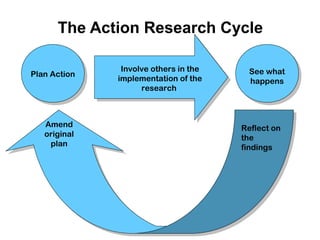
Plan Action
Involve others in the
implementation of the
research
See what
happens
Reflect on
the
findings
Amend
original
plan
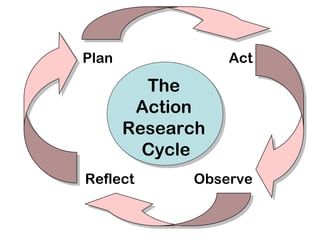
The Action Research Cycle
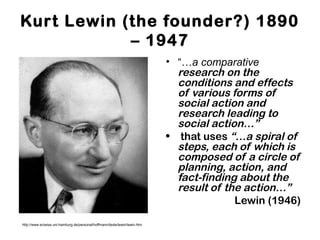
Kurt Lewin (the founder?) 1890
– 1947
• “…a comparative
research on the
conditions and effects
of various forms of
social action and
research leading to
social action…”
• that uses “…a spiral of
steps, each of which is
composed of a circle of
planning, action, and
fact-finding about the
result of the action…”
Lewin (1946)
http://www.erzwiss.uni-hamburg.de/personal/hoffmann/texte/lewin/lewin.htm
• Small scale involvement in the world, using
research methods to study the effects of
actions and making changes based on the
results
• In most cases it is practitioner research, that
is, it is done by people investigating their
own professional practices, and the methods
used are often qualitative in character
Action Research Defined
Action research can be conceptualised
within two broad perspectives
(Walker, 2001)
1. It may be concerned with
professional development
2. Or used as an emancipatory method
concerned with social justice
What is Action Research?
The
Action
Research
Cycle
Plan Act
ObserveReflect
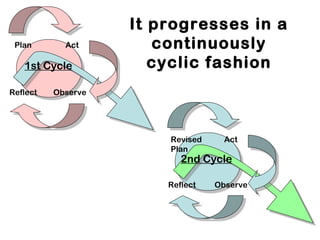
Plan Act
ObserveReflect
ObserveReflect
ActRevised
Plan
1st Cycle
2nd Cycle
It progresses in a
continuously
cyclic fashion
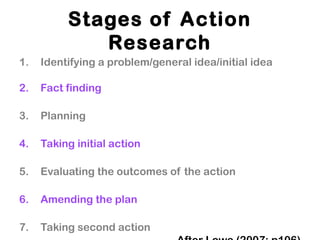
Stages of Action
Research
1. Identifying a problem/general idea/initial idea
2. Fact finding
3. Planning
4. Taking initial action
5. Evaluating the outcomes of the action
6. Amending the plan
7. Taking second action
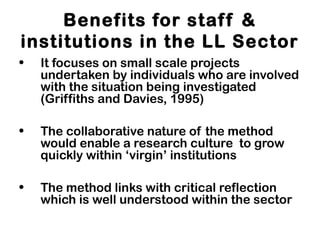
Benefits for staff &
institutions in the LL Sector
• It focuses on small scale projects
undertaken by individuals who are involved
with the situation being investigated
(Griffiths and Davies, 1995)
• The collaborative nature of the method
would enable a research culture to grow
quickly within ‘virgin’ institutions
• The method links with critical reflection
which is well understood within the sector
Advantages
• Hoyle & John (1995) suggested
professionality could be extended by
involvement with small scale research
projects and action research is well suited
for this type of investigation
• Noffke (1994) claimed that action research
would support the professionalisation
process of teachers
Problems
• It does not allow for the inference of causal
relationships (McNiff & Whitehead, 2006)
• Because it is carried out by individuals with a
vested interest in the research its validity has been
questioned.
• It is seen by some researchers as anecdotal,
subjective and biased (Greenwood & Levin, 1999)
• Within the positivist tradition it has been dismissed
as unscientific
To summarise…
Key Features:
1. Insider professional research
2. Powerful & liberating potential
3. Transformational
4. Morally committed
5. Collaborative
To summarise…
Key Purposes:
1. Aims to improve workplace practices
through improving learning
2. Aims to promote the ongoing
democratic evaluation of learning and
practices
3. Aims to create good social orders by
influencing the education of social
formations
In class activities
Benefits of Action
Research:
What are they?
Discuss…
a)For you, the professional
b)For your team
c)For your employing organisation
d)For the sector as a whole
So, what’s the down-
side?
Discuss and then share…
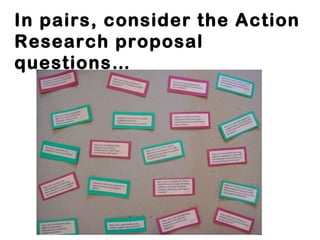
In pairs, consider the Action
Research proposal
questions…
What’s your
idea?
Text your
revised
question to:
Start you message with b6rn and your name
send to:
07537 402 400
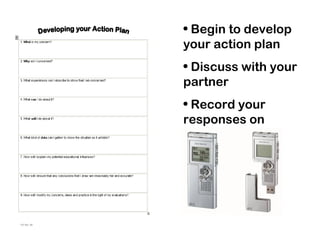
• Begin to develop
your action plan
• Discuss with your
partner
• Record your
responses on

Action research introduction

  • 1.
  • 2.
    Plan Action Involve othersin the implementation of the research See what happens Reflect on the findings Amend original plan The Action Research Cycle
  • 3.
    Kurt Lewin (thefounder?) 1890 – 1947 • “…a comparative research on the conditions and effects of various forms of social action and research leading to social action…” • that uses “…a spiral of steps, each of which is composed of a circle of planning, action, and fact-finding about the result of the action…” Lewin (1946) http://www.erzwiss.uni-hamburg.de/personal/hoffmann/texte/lewin/lewin.htm
  • 4.
    • Small scaleinvolvement in the world, using research methods to study the effects of actions and making changes based on the results • In most cases it is practitioner research, that is, it is done by people investigating their own professional practices, and the methods used are often qualitative in character Action Research Defined
  • 5.
    Action research canbe conceptualised within two broad perspectives (Walker, 2001) 1. It may be concerned with professional development 2. Or used as an emancipatory method concerned with social justice What is Action Research?
  • 6.
  • 7.
    Plan Act ObserveReflect ObserveReflect ActRevised Plan 1st Cycle 2ndCycle It progresses in a continuously cyclic fashion
  • 8.
    Stages of Action Research 1.Identifying a problem/general idea/initial idea 2. Fact finding 3. Planning 4. Taking initial action 5. Evaluating the outcomes of the action 6. Amending the plan 7. Taking second action
  • 9.
    Benefits for staff& institutions in the LL Sector • It focuses on small scale projects undertaken by individuals who are involved with the situation being investigated (Griffiths and Davies, 1995) • The collaborative nature of the method would enable a research culture to grow quickly within ‘virgin’ institutions • The method links with critical reflection which is well understood within the sector
  • 10.
    Advantages • Hoyle &John (1995) suggested professionality could be extended by involvement with small scale research projects and action research is well suited for this type of investigation • Noffke (1994) claimed that action research would support the professionalisation process of teachers
  • 11.
    Problems • It doesnot allow for the inference of causal relationships (McNiff & Whitehead, 2006) • Because it is carried out by individuals with a vested interest in the research its validity has been questioned. • It is seen by some researchers as anecdotal, subjective and biased (Greenwood & Levin, 1999) • Within the positivist tradition it has been dismissed as unscientific
  • 12.
    To summarise… Key Features: 1.Insider professional research 2. Powerful & liberating potential 3. Transformational 4. Morally committed 5. Collaborative
  • 13.
    To summarise… Key Purposes: 1.Aims to improve workplace practices through improving learning 2. Aims to promote the ongoing democratic evaluation of learning and practices 3. Aims to create good social orders by influencing the education of social formations
  • 14.
  • 15.
    Benefits of Action Research: Whatare they? Discuss… a)For you, the professional b)For your team c)For your employing organisation d)For the sector as a whole
  • 16.
    So, what’s thedown- side? Discuss and then share…
  • 17.
    In pairs, considerthe Action Research proposal questions…
  • 18.
    What’s your idea? Text your revised questionto: Start you message with b6rn and your name send to: 07537 402 400
  • 19.
    • Begin todevelop your action plan • Discuss with your partner • Record your responses on