Ed. M. 607 / 1st Sem. AY 2015-2016
Curriculum
Development
Cycle
Presenter:
REXTER JUAREZ ANDA
Ph.D. Educational Management
"If you
always do
what you've
always done,
you'll always
get what
you've
always got."
-Henry Ford (1863-1947)
American founder of the Ford Motor Company
Objectives:
At the end of this session,
you are expected to:
Differentiate and employ the major
components which comprises the
Curriculum Development Cycle and their
interrelated functions
Gain knowledge about Curriculum
Development Cycle and the rationale
of delivering a systematic curriculum
development
Curriculum Development Cycle
Introduction
Schools exist for the purpose of
teaching and learning. Too often
School District personnel plan for the
issues that support teaching and
learning-such as facilities,
transportation, technology, and staff
development-without developing a
specific plan for creating the
necessary foundation of curriculum.
Curriculum Development Cycle
Knowledge and skills must
students have to be successful in both
an educational setting and the “real
world” in which they live outside the
school.
This is revisited in a timely and
systematic fashion so that
administrators’ teachers, and librarians
can provide the best learning
opportunities for the students in their
care.
1. What is a curriculum development
cycle?
A curriculum development cycle is a
systematic schedule or calendar for
addressing the design, delivery, and
review of curriculum in all content areas.
The timeline for the cycle includes
both core and elective areas and is
manageable within a district’s human and
financial resources.
The components of the cycle
include needs assessment, curriculum
development or revision, material
selection, assessment development, and
curriculum implementation.
Implementation should include staff
development and program evaluation for
each content area.
2. Why is a curriculum development cycle
important?
Planning for curriculum development
within a cycle allows district personnel to
address ongoing curricular and instructional
needs in a timely manner.
The cycle provides for systematic
allocation of resources so that financial
resources can be budgeted wisely, and the
capacity of district staff members to
assimilate and perform required tasks will not
be overloaded.
Long-range budget planning can then
anticipate and address all aspects of the
curriculum development cycle.
3.Who establishes a curriculum
development cycle?
This task is ideally completed by
personnel with knowledge of and
responsibility for budget, resources, and
curriculum.
In larger districts, this would be a
small committee comprised of central office
personnel and representatives from the
curriculum and instruction department,
including media specialists. In smaller
districts this might fall to a designated
person with ancillary responsibilities in the
curriculum area (e.g. assistant principal,
lead teacher).
Some districts choose to involve one
or two representative parents or community
members.
4. When does a curriculum development
cycle begin and end?
A complete cycle for all content areas
covers a time period sufficiently long to
include all core and elective subjects.
A typical cycle for a given content
area may cover a five to seven year span.
In some states, a cycle might be
determined by a state-mandated process
for selecting new textbooks in a particular
content area.
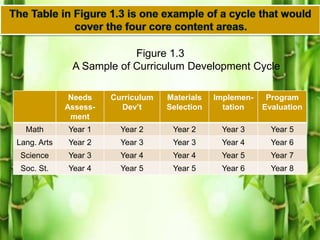
Needs
Assess-
ment
Curriculum
Dev’t
Materials
Selection
Implemen-
tation
Program
Evaluation
Math Year 1 Year 2 Year 2 Year 3 Year 5
Lang. Arts Year 2 Year 3 Year 3 Year 4 Year 6
Science Year 3 Year 4 Year 4 Year 5 Year 7
Soc. St. Year 4 Year 5 Year 5 Year 6 Year 8
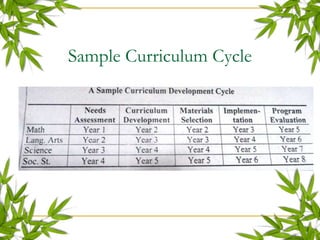
Figure 1.3
A Sample of Curriculum Development Cycle
A cycle like the one shown in
figure 1.3 would spread major textbook
purchases across time, lessening the
impact on budgets. Elementary school
teachers who teach all subjects would
not be expected to implement more than
one new core curriculum in a given year.
Elective areas could be incorporated into
the schedule above without a major effect on
personnel or budgets; for example,
mathematics and music could be done in one
year, while science and physical education
could be done in another.
Development or revision of curriculum
used by school librarians could occur
simultaneously with work in language arts.
A “rule of thumb” has historically
been that the number of curriculum
groupings determines the length of the
cycle.
An eight-year cycle can have
eight groupings. All subject areas must
be included in the cycle. However,
modification of this “rule of thumb” has
become necessary in order for districts
to establish cycles that correspond with
the state assessment, using the data for
curriculum modification.
Where state textbook
adoptions have an established
cycle that impacts local curriculum
decisions, that schedule is also a
guide to determining local cycles.
The textbook is not the
curriculum, but local planning
must coincide with state adoptions
in some instances.
Curriculum development includes
building a scope and sequence and
writing curriculum guides.
Because work in other stages has
an impact on the content of final
curriculum documents, work does not
move through the steps in a linear
fashion.
If an eight-year cycle were to be
instituted for each subject area, there
would be some “down time” between
program evaluation and needs
assessment;
however, data from the program
evaluation would be a major
component of the needs assessment at
the beginning of a new cycle, as a
student performance data would be.
5. How is the cycle developed?
Initial development of the cycle
will be influenced by several factors,
such as existing state cycles for
revision or textbooks adoption, national
standards revision, available financial
resources, student assessment
performance, and capacity of district
personnel to do the work.
Once the initial cycle is
developed, it is revisited periodically so
that the plans can be adjusted to meet
changing circumstances.
Checkpoint for Curriculum
Development Cycle
1. What are the factors that
influence a district’s determination of
a curriculum development cycle?
Initial development of the
cycle will be influenced by several
factors.
These include existing state
cycles for revision or textbooks
adoption, national standards
revision, available financial
resources, student assessment
performance, capacity of district
personnel to do the work.
2. When does a cycle begin and
end-with what actions or
products?
A complete cycle for all content
areas covers a time period sufficiently
long to include all core and elective
subjects.
A typical cycle for a given
content area may cover a five to
seven year span.
In some states, a cycle might
be determined by a state-mandated
process for selecting new textbooks
in a particular content area.
How To: Curriculum
Development Cycle
A curriculum development
cycle is a systematic schedule or
calendar for addressing the
design, delivery, and review of
curriculum in all content areas.
The components of the
cycle include needs assessment,
curriculum development or
revision, materials selection,
assessment development,
curriculum implementation-
including staff development, and
program evaluation for each
content area.
Planning for curriculum
development within a cycle
allows district personnel to
address ongoing curricular
and instructional needs in a
timely manner.
1. Determine district
personnel who will establish
the cycle. These individuals
should have knowledge of and
responsibility for budget,
resources, and curriculum.
2.Establish the time
period that the curriculum
cycle will encompass.
The period should be
long enough to include all core
and elective subjects. A typical
cycle for a given content area
may cover a five to seven year
span. In some states, a cycle
might be determined by a
state-mandated process for
selecting new textbooks in a
particular content area.
Additional References:
Curriculum Development
Process
The Board is committed to
a process of curriculum
development in each learning area
that:
• Provides opportunities for
consultation
• Establishes achievable timelines
• Ensures high quality curriculum
documents
The proposed process involves
four phases:
I. Curriculum Shaping
II. Curriculum Writing
III. Implementation
IV. Curriculum evaluation and
review
Major features of the process
are as follows.
• Advice is sought at key points from
teachers, professional associations and
curriculum experts as well as from the
broader educational community.
• The curriculum documents are
benchmarked against existing state
and territory curriculum as well as
international examples.
• Project managers and project officers
manage the curriculum development
process in each subject, including
establishing consultative networks,
managing consultation, and managing
the work of the writers appointed to
draft and revise curriculum documents.
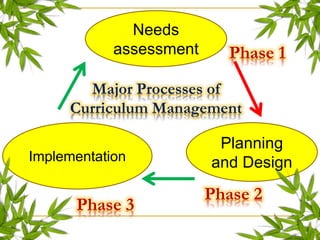
Major Processes of
Curriculum Management
Planning
and Design
Needs
assessment
Implementation
Phase 1
Phase 2
Phase 3
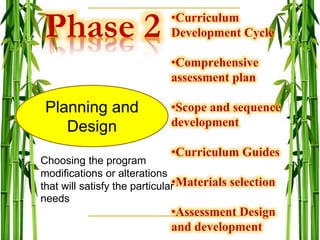
Phase 2
Planning and
Design
•Curriculum
Development Cycle
•Comprehensive
assessment plan
•Scope and sequence
development
•Curriculum Guides
•Materials selection
•Assessment Design
and development
Choosing the program
modifications or alterations
that will satisfy the particular
needs
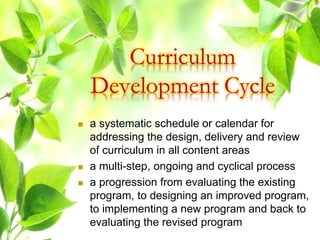
 a systematic schedule or calendar for
addressing the design, delivery and review
of curriculum in all content areas
 a multi-step, ongoing and cyclical process
 a progression from evaluating the existing
program, to designing an improved program,
to implementing a new program and back to
evaluating the revised program
Curriculum
Development Cycle
How?
What?
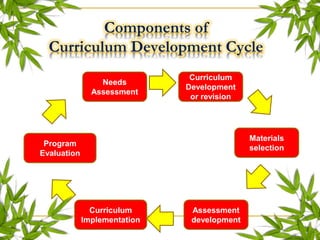
Components of
Curriculum Development Cycle
Needs
Assessment
Curriculum
Development
or revision
Materials
selection
Assessment
development
Curriculum
Implementation
Program
Evaluation
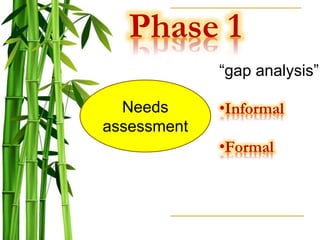
Phase 1
Needs
assessment
“gap analysis”
•Informal
•Formal
Phase 2
Revision
•Curriculum Development
•systematic schedule for
addressing the design,
delivery and review of
curriculum
Phase 3
Material
Selection
•includes review,
evaluation, selection,
piloting and adoption
of IMs to support
implementation of the
curriculum
Phase 4
Assessment
development
•high-quality assessment
design that provide valid
and reliable information
about student achievement
Phase 5
Curriculum
implementation
•Curriculum Delivery
•various activities
undertaken to observe
curriculum
implementation
•Staff development
•designed for teachers prior to
use of the new curriculum and
IMs which are the foundation
for successful curriculum
Phase 6
Program
Evaluation
•attention is given to the types of
measures or instruments for
evaluating the outcomes of change
Planning for curriculum
development within a
cycle allows district
personnel to address
ongoing curricular and
instructional needs in a
timely manner.
•Determine district personnel who
will establish the cycle.
•Establish the time period that the
curriculum cycle will encompass.
Factors which affect the Initial
Development of the CDC
•Existing state cycles for revision or textbook
adoption
•National standards revision
•Available financial resources
•Student assessment performance
•Capacity of district personnel to do the work
Sample Curriculum Cycle
Thank You!

Curriculum Development Cycle

  • 1.
    Ed. M. 607/ 1st Sem. AY 2015-2016 Curriculum Development Cycle Presenter: REXTER JUAREZ ANDA Ph.D. Educational Management
  • 2.
    "If you always do whatyou've always done, you'll always get what you've always got." -Henry Ford (1863-1947) American founder of the Ford Motor Company
  • 3.
    Objectives: At the endof this session, you are expected to: Differentiate and employ the major components which comprises the Curriculum Development Cycle and their interrelated functions Gain knowledge about Curriculum Development Cycle and the rationale of delivering a systematic curriculum development
  • 4.
    Curriculum Development Cycle Introduction Schoolsexist for the purpose of teaching and learning. Too often School District personnel plan for the issues that support teaching and learning-such as facilities, transportation, technology, and staff development-without developing a specific plan for creating the necessary foundation of curriculum.
  • 5.
    Curriculum Development Cycle Knowledgeand skills must students have to be successful in both an educational setting and the “real world” in which they live outside the school. This is revisited in a timely and systematic fashion so that administrators’ teachers, and librarians can provide the best learning opportunities for the students in their care.
  • 6.
    1. What isa curriculum development cycle? A curriculum development cycle is a systematic schedule or calendar for addressing the design, delivery, and review of curriculum in all content areas. The timeline for the cycle includes both core and elective areas and is manageable within a district’s human and financial resources.
  • 7.
    The components ofthe cycle include needs assessment, curriculum development or revision, material selection, assessment development, and curriculum implementation. Implementation should include staff development and program evaluation for each content area.
  • 8.
    2. Why isa curriculum development cycle important? Planning for curriculum development within a cycle allows district personnel to address ongoing curricular and instructional needs in a timely manner. The cycle provides for systematic allocation of resources so that financial resources can be budgeted wisely, and the capacity of district staff members to assimilate and perform required tasks will not be overloaded. Long-range budget planning can then anticipate and address all aspects of the curriculum development cycle.
  • 9.
    3.Who establishes acurriculum development cycle? This task is ideally completed by personnel with knowledge of and responsibility for budget, resources, and curriculum. In larger districts, this would be a small committee comprised of central office personnel and representatives from the curriculum and instruction department, including media specialists. In smaller districts this might fall to a designated person with ancillary responsibilities in the curriculum area (e.g. assistant principal, lead teacher). Some districts choose to involve one or two representative parents or community members.
  • 10.
    4. When doesa curriculum development cycle begin and end? A complete cycle for all content areas covers a time period sufficiently long to include all core and elective subjects. A typical cycle for a given content area may cover a five to seven year span. In some states, a cycle might be determined by a state-mandated process for selecting new textbooks in a particular content area.
  • 11.
    Needs Assess- ment Curriculum Dev’t Materials Selection Implemen- tation Program Evaluation Math Year 1Year 2 Year 2 Year 3 Year 5 Lang. Arts Year 2 Year 3 Year 3 Year 4 Year 6 Science Year 3 Year 4 Year 4 Year 5 Year 7 Soc. St. Year 4 Year 5 Year 5 Year 6 Year 8 Figure 1.3 A Sample of Curriculum Development Cycle
  • 12.
    A cycle likethe one shown in figure 1.3 would spread major textbook purchases across time, lessening the impact on budgets. Elementary school teachers who teach all subjects would not be expected to implement more than one new core curriculum in a given year.
  • 13.
    Elective areas couldbe incorporated into the schedule above without a major effect on personnel or budgets; for example, mathematics and music could be done in one year, while science and physical education could be done in another. Development or revision of curriculum used by school librarians could occur simultaneously with work in language arts.
  • 14.
    A “rule ofthumb” has historically been that the number of curriculum groupings determines the length of the cycle. An eight-year cycle can have eight groupings. All subject areas must be included in the cycle. However, modification of this “rule of thumb” has become necessary in order for districts to establish cycles that correspond with the state assessment, using the data for curriculum modification.
  • 15.
    Where state textbook adoptionshave an established cycle that impacts local curriculum decisions, that schedule is also a guide to determining local cycles. The textbook is not the curriculum, but local planning must coincide with state adoptions in some instances.
  • 16.
    Curriculum development includes buildinga scope and sequence and writing curriculum guides. Because work in other stages has an impact on the content of final curriculum documents, work does not move through the steps in a linear fashion.
  • 17.
    If an eight-yearcycle were to be instituted for each subject area, there would be some “down time” between program evaluation and needs assessment; however, data from the program evaluation would be a major component of the needs assessment at the beginning of a new cycle, as a student performance data would be.
  • 18.
    5. How isthe cycle developed? Initial development of the cycle will be influenced by several factors, such as existing state cycles for revision or textbooks adoption, national standards revision, available financial resources, student assessment performance, and capacity of district personnel to do the work. Once the initial cycle is developed, it is revisited periodically so that the plans can be adjusted to meet changing circumstances.
  • 19.
    Checkpoint for Curriculum DevelopmentCycle 1. What are the factors that influence a district’s determination of a curriculum development cycle? Initial development of the cycle will be influenced by several factors. These include existing state cycles for revision or textbooks adoption, national standards revision, available financial resources, student assessment performance, capacity of district personnel to do the work.
  • 20.
    2. When doesa cycle begin and end-with what actions or products? A complete cycle for all content areas covers a time period sufficiently long to include all core and elective subjects. A typical cycle for a given content area may cover a five to seven year span. In some states, a cycle might be determined by a state-mandated process for selecting new textbooks in a particular content area.
  • 21.
    How To: Curriculum DevelopmentCycle A curriculum development cycle is a systematic schedule or calendar for addressing the design, delivery, and review of curriculum in all content areas. The components of the cycle include needs assessment, curriculum development or revision, materials selection, assessment development, curriculum implementation- including staff development, and program evaluation for each content area.
  • 22.
    Planning for curriculum developmentwithin a cycle allows district personnel to address ongoing curricular and instructional needs in a timely manner. 1. Determine district personnel who will establish the cycle. These individuals should have knowledge of and responsibility for budget, resources, and curriculum.
  • 23.
    2.Establish the time periodthat the curriculum cycle will encompass. The period should be long enough to include all core and elective subjects. A typical cycle for a given content area may cover a five to seven year span. In some states, a cycle might be determined by a state-mandated process for selecting new textbooks in a particular content area.
  • 24.
    Additional References: Curriculum Development Process TheBoard is committed to a process of curriculum development in each learning area that: • Provides opportunities for consultation • Establishes achievable timelines • Ensures high quality curriculum documents The proposed process involves four phases: I. Curriculum Shaping II. Curriculum Writing III. Implementation IV. Curriculum evaluation and review
  • 25.
    Major features ofthe process are as follows. • Advice is sought at key points from teachers, professional associations and curriculum experts as well as from the broader educational community. • The curriculum documents are benchmarked against existing state and territory curriculum as well as international examples.
  • 26.
    • Project managersand project officers manage the curriculum development process in each subject, including establishing consultative networks, managing consultation, and managing the work of the writers appointed to draft and revise curriculum documents.
  • 27.
    Major Processes of CurriculumManagement Planning and Design Needs assessment Implementation Phase 1 Phase 2 Phase 3
  • 28.
    Phase 2 Planning and Design •Curriculum DevelopmentCycle •Comprehensive assessment plan •Scope and sequence development •Curriculum Guides •Materials selection •Assessment Design and development Choosing the program modifications or alterations that will satisfy the particular needs
  • 29.
     a systematicschedule or calendar for addressing the design, delivery and review of curriculum in all content areas  a multi-step, ongoing and cyclical process  a progression from evaluating the existing program, to designing an improved program, to implementing a new program and back to evaluating the revised program Curriculum Development Cycle
  • 30.
  • 31.
    Components of Curriculum DevelopmentCycle Needs Assessment Curriculum Development or revision Materials selection Assessment development Curriculum Implementation Program Evaluation
  • 32.
  • 33.
    Phase 2 Revision •Curriculum Development •systematicschedule for addressing the design, delivery and review of curriculum
  • 34.
    Phase 3 Material Selection •includes review, evaluation,selection, piloting and adoption of IMs to support implementation of the curriculum
  • 35.
    Phase 4 Assessment development •high-quality assessment designthat provide valid and reliable information about student achievement
  • 36.
    Phase 5 Curriculum implementation •Curriculum Delivery •variousactivities undertaken to observe curriculum implementation •Staff development •designed for teachers prior to use of the new curriculum and IMs which are the foundation for successful curriculum
  • 37.
    Phase 6 Program Evaluation •attention isgiven to the types of measures or instruments for evaluating the outcomes of change
  • 38.
    Planning for curriculum developmentwithin a cycle allows district personnel to address ongoing curricular and instructional needs in a timely manner. •Determine district personnel who will establish the cycle. •Establish the time period that the curriculum cycle will encompass.
  • 39.
    Factors which affectthe Initial Development of the CDC •Existing state cycles for revision or textbook adoption •National standards revision •Available financial resources •Student assessment performance •Capacity of district personnel to do the work
  • 40.
  • 41.

Editor's Notes