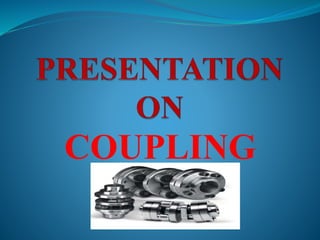
COUPLING
PRESENTED BY
RAVI RANJAN KUMAR
(12000714144)
SLIDE PLAN
1. Introduction
2. Types of Shafts Couplings
3. Couplings uses
4. Requirements of a good shaft
coupling
5. Coupling maintenance and
failure
Couplings are mechanical
elements that ‘couples’ two
drive elements (shafts) which
enables motion to be
transferred from one element to
another.
TYPES
Shaft couplings are divided into two main
groups.
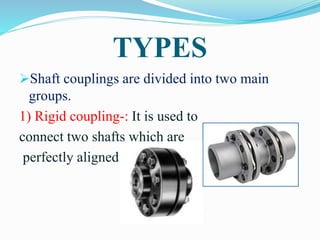
1) Rigid coupling-: It is used to
connect two shafts which are
perfectly aligned.
There are many types of couplings that
fall under the rigid couplings category.
They are
a)Sleeve or muff coupling
b)Clamp or split-muff or
compression coupling, and
c) Flange coupling
Sleeve or muff coupling
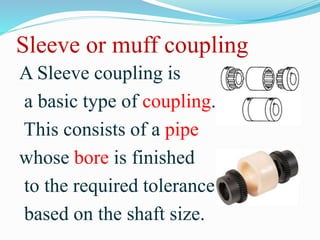
A Sleeve coupling is
a basic type of coupling.
This consists of a pipe
whose bore is finished
to the required tolerance
based on the shaft size.
Clamp or split-muff or compression
coupling
The clamp coupling is
also called compression coupling
or split muff coupling. It a
rigid type of coupling,
the sleeve is made of two
halves, which are split along a
plane passing through the axes of shafts.
Flange coupling
This coupling has two
separate cast iron flanges.
Each flange is mounted on
the shaft end and keyed to it.
The two flanges are
Coupled together with
the help of bolts and nuts.
2) Flexible coupling
Flexible couplings are
used to transmit
torque from one shaft
to another when the
two shafts having
both lateral and
angular misalignment.
There are many types of couplings that
fall under the flexible couplings
category. They are
a)Bushed pin type coupling
b)Universal coupling and
c)Oldham coupling
Bushed pin type coupling
This is modified form of the
protected type flange coupling.
This type of coupling has a pins
and it work as a coupling bolts.
The rubber or leather bushes
are used over the pins. The
coupling is having two half
dissimilar in construction.
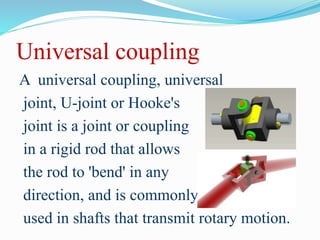
Universal coupling
A universal coupling, universal
joint, U-joint or Hooke's
joint is a joint or coupling
in a rigid rod that allows
the rod to 'bend' in any
direction, and is commonly
used in shafts that transmit rotary motion.
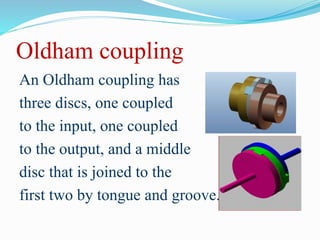
Oldham coupling
An Oldham coupling has
three discs, one coupled
to the input, one coupled
to the output, and a middle
disc that is joined to the
first two by tongue and groove.
COUPLINGS USES
 To provide for misalignment of the shafts or to
introduce mechanical flexibility.
 To reduce the transmission of shock loads from
one shaft to another.
 To introduce protection against overloads.
 To alter the vibration characteristics of rotating
units.
 To connect driving and the driven part.
REQUIREMENTS OF A GOOD
SHAFT COUPLING
It should be easy to connect or disconnect.
It should transmit the full power form one
shaft to the other shaft without losses.
It should hold the shafts in perfect alignment.
It should reduce the transmission of shock
loads from one shaft to another shaft.
It should have no projecting parts.
COUPLING MAINTENANCE AND
FAILURE
COUPLING MAINTENANCE -:
Performing visual inspections, checking for
signs of wear and cleaning couplings
regularly.
Checking and changing lubricant regularly
if the coupling is lubricated.
Documenting the maintenance performed
on each coupling, along with the date.
COUPLING FAILURE -:
Improper installation.
Poor coupling selection.
Operation beyond design capabilities.
Abnormal noise, such as screeching,
squealing or chattering.
Excessive vibration or wobble.
Failed seals indicated by lubricant leakage or
contamination.
REFERENCES
Print Citation
• A Textbook Of Machine Design
By R.S.KHURMI AND J.K.GUPTA
Web Citation
• http://en.wikipedia.org/wiki/Coupling
• www.brighthubengineering.com/.../43237-shaft-
couplings-types/
• books.google.co.in/books?isbn=1259006360
• en.wikipedia.org/wiki/Universal_joint
THANK
YOU

coupling

  • 1.
  • 2.
    PRESENTED BY RAVI RANJANKUMAR (12000714144)
  • 3.
    SLIDE PLAN 1. Introduction 2.Types of Shafts Couplings 3. Couplings uses 4. Requirements of a good shaft coupling 5. Coupling maintenance and failure
  • 4.
    Couplings are mechanical elementsthat ‘couples’ two drive elements (shafts) which enables motion to be transferred from one element to another.
  • 5.
    TYPES Shaft couplings aredivided into two main groups. 1) Rigid coupling-: It is used to connect two shafts which are perfectly aligned.
  • 6.
    There are manytypes of couplings that fall under the rigid couplings category. They are a)Sleeve or muff coupling b)Clamp or split-muff or compression coupling, and c) Flange coupling
  • 7.
    Sleeve or muffcoupling A Sleeve coupling is a basic type of coupling. This consists of a pipe whose bore is finished to the required tolerance based on the shaft size.
  • 8.
    Clamp or split-muffor compression coupling The clamp coupling is also called compression coupling or split muff coupling. It a rigid type of coupling, the sleeve is made of two halves, which are split along a plane passing through the axes of shafts.
  • 9.
    Flange coupling This couplinghas two separate cast iron flanges. Each flange is mounted on the shaft end and keyed to it. The two flanges are Coupled together with the help of bolts and nuts.
  • 10.
    2) Flexible coupling Flexiblecouplings are used to transmit torque from one shaft to another when the two shafts having both lateral and angular misalignment.
  • 11.
    There are manytypes of couplings that fall under the flexible couplings category. They are a)Bushed pin type coupling b)Universal coupling and c)Oldham coupling
  • 12.
    Bushed pin typecoupling This is modified form of the protected type flange coupling. This type of coupling has a pins and it work as a coupling bolts. The rubber or leather bushes are used over the pins. The coupling is having two half dissimilar in construction.
  • 13.
    Universal coupling A universalcoupling, universal joint, U-joint or Hooke's joint is a joint or coupling in a rigid rod that allows the rod to 'bend' in any direction, and is commonly used in shafts that transmit rotary motion.
  • 14.
    Oldham coupling An Oldhamcoupling has three discs, one coupled to the input, one coupled to the output, and a middle disc that is joined to the first two by tongue and groove.
  • 15.
    COUPLINGS USES  Toprovide for misalignment of the shafts or to introduce mechanical flexibility.  To reduce the transmission of shock loads from one shaft to another.  To introduce protection against overloads.  To alter the vibration characteristics of rotating units.  To connect driving and the driven part.
  • 16.
    REQUIREMENTS OF AGOOD SHAFT COUPLING It should be easy to connect or disconnect. It should transmit the full power form one shaft to the other shaft without losses. It should hold the shafts in perfect alignment. It should reduce the transmission of shock loads from one shaft to another shaft. It should have no projecting parts.
  • 17.
    COUPLING MAINTENANCE AND FAILURE COUPLINGMAINTENANCE -: Performing visual inspections, checking for signs of wear and cleaning couplings regularly. Checking and changing lubricant regularly if the coupling is lubricated. Documenting the maintenance performed on each coupling, along with the date.
  • 18.
    COUPLING FAILURE -: Improperinstallation. Poor coupling selection. Operation beyond design capabilities. Abnormal noise, such as screeching, squealing or chattering. Excessive vibration or wobble. Failed seals indicated by lubricant leakage or contamination.
  • 19.
    REFERENCES Print Citation • ATextbook Of Machine Design By R.S.KHURMI AND J.K.GUPTA Web Citation • http://en.wikipedia.org/wiki/Coupling • www.brighthubengineering.com/.../43237-shaft- couplings-types/ • books.google.co.in/books?isbn=1259006360 • en.wikipedia.org/wiki/Universal_joint
  • 20.