Contents
1 Geography

2 Demographics

3 Area Profile of Jawalamukhi Town

4 Jwalamukhi Devi Temple

5 The Jwalamukhi shrine as a Shakti Peeth

6 References

7 QUESTION AND ANSWER
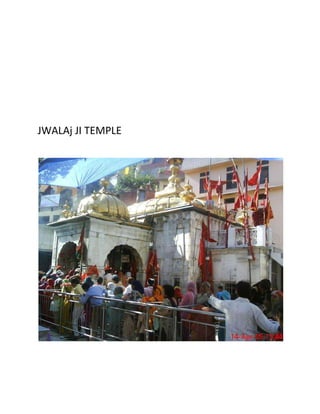
JWALAj JI TEMPLE
Jawalamukhi
Location in Himachal Pradesh, India
Coordinates: 31.88°N 76.32°ECoordinates: 31.88°N 76.32°E
Country India
State

Himachal Pradesh

District

Kangra

Elevation 610 m (2,000 ft)
Population (2011)
• Total 4,931
Languages
• Official

Hindi

Time zone

IST (UTC+5:30)

Jawalamukhi is a town and a nagar panchayat in Kangra district in the Indian state of Himachal Pradesh.

Geography

Jawalamukhi is located at 31.88°N 76.32°E.[1] It has an average elevation of 610 metres (2,001 feet).
Demographics

At the 2011 India census, Jawalamukhi had a population of 4931. Males constitute 52% of the
population and females 48%.
Area Profile of Jawalamukhi Town

As of 2011 India census,
Number of Households - 1,012
Average Household Size(per Household) - 5.0
Population-Total - 4,931
Population-Urban - 4,931
Proportion of Urban Population (%) - 100
Population-Rural - 0
Sex Ratio - 906
Population(0-6Years) - 608
Sex Ratio(0-6 Year) - 961
SC Population - 812
ST Population - 0
Sex Ratio (ST) - 0
Proportion of ST (%) - 0
Literates - 3,777
Illiterates - 1,154
Literacy Rate (%) - 87.0

Design of Jwalaji Temple(Architecture)
The building of the temple is adorned by the beautiful folding doors of silver plates, presented by Sikh
Emperor Raja Kharak Singh,.The dome of the temple is beautified by the gold plated material. The
interior of the temple is built in the form of a square pit about 3 feet deep with a pathway all around.
Amidst the temple premises, nestles a hollow rock which is considered as the fiery mouth of Mahakali
and claims to be the major attraction of the temple.
Myth behind the Temple
The story of Jwalamukhi Temple relates to Sati, a goddess born when gods concentrated their individual
energy on the ground. These gods were looking for a respite or the protection from the atrocities of the
demons. The girl named Adishakti or the first Shakti (Sati or Parvati). She was brought up in childhood by
Prajapati Daksha and married Lord Shiva later by sati performing penance. The belief reveals that
Prajapati Daksha once organised a yajna and invited everyone except Lord Shiva. Sati felt immensely
humiliated and insulted at this act of her father and immolated her in the fire of the havankund which
was organized by her father. With this action Lord Shiva became so furious that he carried Sati's burnt
body and moved around the three worlds.
The gods could not foresee a calamity approaching them so they assembled before Lord Vishnu and
asked him to do something to control anger of lord Shiva. As a remedy to this problem Lord Vishnu cut
apart Sati's body into several pieces with the help of his Sudharshan Chakra. Wherever on earth the
pieces of Sati's body fell, a shaktipeeth came up with different temples. These are the spot that are
regarded as the power centre of the goddess. Jwalamukhi temple one of the form of Maa Durga is the
place where the tongue of Sati fell. Here the goddess is manifested like tiny flames that burn through
the fissures in the age old rock.

Shiva carrying the corpse of Sati Devi
The shrine is regarded as a Maha Shakti Peetham. It is believed that Sati Devi's tongue fell here.Shakti
Peethas are shrines of Devi, the primodial Mother Goddess. Each Shakti Peetha has a shrine for the
Shakti and Bhairava. Siddhida (Ambika)is the Shakti and Unmatta Bhairava is the Kalabhairava. The
mythology of Daksha yaga and Sati's self immolation had immense significance in shaping the ancient
Sanskrit literature and even had impact on the culture of India. It lead to the development of the
concept of Shakti Peethas and there by strengthening Shaktism. Enormous mythological stories in
puranas took the Daksha yaga as the reason for its origin. It is an important incident in Shaivism
resulting in the emergence of Shree Parvati in the place of Sati Devi and making Shiva a
Who build the Temple
The temple is believed and supposed to be first built by a king who, on the complaint of a cowherd, tried
to find out the place w from where a female emerged and drank the milk of the cow in those times.
Since, the king was aware of the legend of Sati, as well he continued his search for the place and finally
succeeded. Kind began construction of the temple there and employed priests to perform pujas.

Later in times the great Pandavas came and carried out some renovation work in the temple.

LATER
The temple was looted and destroyed by Mahmud of Ghazni in 1009.
The Mughal Emperor Akbar, learning about the legends of Jwalamukhi tried to douse the flames with a
stream of water. However, the great power of the Goddess, still kept the flames burning. Realizing the
power of Jwala Devi, Akbar came with his army to this temple. He brought a Gold umbrella (Chatra) for
the Goddess, but on offering, the umbrella turned into an unknown metal suggesting that the Goddess
did not accept his offering.

grihastashrami(house holder)
Maharaja Ranjit Singh paid a visit to the temple in the year 1809. His son, Kharak Singh gifted a pair of
silver plated folding doors to the temple while Maharaja Ranjit Singh paid a visit to the temple in 1815
and the dome of the temple was gold-plated by him. Just a few feet above the Jwalamukhi temple there
is a six-feet deep pit with a circumference of about three-feet. At the bottom of this pit there is another
small pit about one and a half feet deep with hot water bubbling all the time.
The temple is identified as one among the 52 Shakti Peethas . It is also one of the most renowned
temples of Goddess Durga .
The Jwalamukhi shrine as a Shakti Peeth
Moreover, in the princely era, the work of the temple was managed by the Raja of Naduan. He himself
appointed the temple priest. After independence, things changed a lot. The pujaris are now appointed
and paid by the government. A part of the money collected by the temple is used to improve the
facilities for the visiting pilgrims.
Different ways of worshipping Mata Jwala Devi
There are mainly 3 ways of doing Mata Jwala Devi's Pooja Archana, i.e. Panchopchal, Dashopchal and
Sholshobchal. Similarly there are 5 different Jwalaji Aartis done of Mata Jwala Ji
Shringar Aarti- Shringar Arti is done early mornings at Brahma Mahurat time. In this aarti, Malpua,
Khoya and Mishri are offered to Maa Jwala.
Mangal Aarti- This aarti is done after around half an hour difference to the first one. In this aarti, yellow
rice and curd is offered to Maa Bhagwati.
Madhyayan Kaal Aarti- This is performed in the afternoon(Madhyayan Kaal). In this, rice, Shatras Dal and
sweet/ desert is offered to Maa.
Sayan Kaal Aarti- This is, as the name suggests, performed in the evenings. In this aarti, Poori, Chana and
Halwa is offered to the Jagad Janani.
Shaiyya Aarti- As the name suggests, it is the bedtime aarti of Maa, before the pandits offer the last
prayers in the late evening of the day and prepare Maa's bed to sleep. This aarti starts around 9:00 PM
in the evening. Milk, Malai and seasonal fruits are offered to Maa Jwala.

Significance of the temple
The temple of Jwalamukhi does not have an idol to worship too. The building of the temple has a gilt
dome and silver plated folding doors. Inside the Jwalamukhi Temple there is a 3 feet square pit with
pathway all around and in the centre, there is a hollowed rock over a primary fissure of flame. This one
is regarded as the mouth of the Mahakali.
The Flames emit out from several other point in the pit. They are nine in total which represent the
different form of the goddess - Saraswati, Annapurna, Chandi, Hing Laj, Vindhya Vasini, Mahalakshmi,
Mahakali, Ambika and Anjana. There are two lions in front of the temple. The Jwalamukhi temple is
dedicated to the Goddess of Light. The temple is made up of a dome and peak like pinnacles. The flame
is believed to represent the Goddess.
Rules and Rituals of the temples
In Jwalamukhi Temple during the whole day, there are about five aartis conducted in the temple. The
first aarti is performed early at 5am in the morning called as the Mangal aarti. The next aarti is done at
the time of sunrise called Panjupchaar Pujan. At around midnoon, it is time for yet another aarti which is
named as the Bhog Ki Aarti. The evening aarti at around 7 pm is simply called aarti while the last one at
around 10 pm is known as the Shaiyan ki aarti.

The last aarti of the day in the Jwalamukhi Temple is very much unique since it is only here that such an
aarti is conducted. During the aarti, the bed of the Maa Jwala goddess is decorated with beautiful
dresses and jewellery. The aarti is performed in two parts firstly the one is in the main temple while the
second one is performed in the sejabhavan. Slokas from 'Sondarya Lahri' by Shri Shakracharya are
through the day recited throughout the aarti for the auspicious and scared shrine of Maa Jwalamukhi.
Havan is also performed once a day and parts of Durga Saptarshi are recited during it. Offerings made
before the goddess in puja include bhog of rabri or thickened milk, misri or candy, seasonal fruits and
milk.
The deity is offered Bhog of Rabri or thickened milk, Misri or candy, seasonal fruits, milk and arti is done.
Devotees coming to the Jwalamukhi temple can either buy prashad from any of the nearby shops of the
temple or bring in their own prasad from home. Usually, the prasad that is offered to the deity include
pan, supari, dhawaza, narela, loung and elaichi.
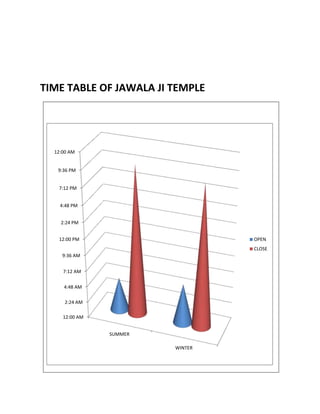
TIME TABLE OF JAWALA JI TEMPLE

12:00 AM

9:36 PM
7:12 PM
4:48 PM
2:24 PM
12:00 PM

OPEN
CLOSE

9:36 AM
7:12 AM
4:48 AM
2:24 AM
12:00 AM
SUMMER
WINTER
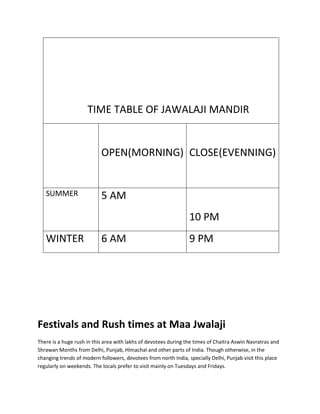
TIME TABLE OF JAWALAJI MANDIR

OPEN(MORNING) CLOSE(EVENNING)

SUMMER

5 AM
10 PM

WINTER

6 AM

9 PM

Festivals and Rush times at Maa Jwalaji
There is a huge rush in this area with lakhs of devotees during the times of Chaitra Aswin Navratras and
Shrawan Months from Delhi, Punjab, Himachal and other parts of India. Though otherwise, in the
changing trends of modern followers, devotees from north India, specially Delhi, Punjab visit this place
regularly on weekends. The locals prefer to visit mainly on Tuesdays and Fridays.
Climate
In winter, the climate is cold but pleasant when woollens are required. During summer the temperature
is hot and cottons are recommended.

Transport Facilities at the Temple
For tourists the closest airport is at Gaggal which is around 50 km away
The nearest railhead is a narrow gauge one at Ranital, 20 km away. The Chandigarh airport and railway
station are at the distance of about around 200 km. Trains from Pathankot to Joginder Nagar leave at
2.15 h, 4.50 h, 8.50 h, 9.35 h, 13.10 h, 16.00 h and reach Jwalamukhi road in 3 h and from there by bus
to visit Jwalaji.
The Jwalamukhi temple is also well connected by road. State transport buses from cities of Punjab and
Haryana are available.
Taxis are also there to take you to the Jwalamukhi temple. Frequent buses pass through Kangra,
distance 54 km and takes 2 hour. Kangra is 36 km away from Jwalamukhi. Buses are also coming from
Pathankot (123 km), Mandi (171 km), Manali (281 km). Simla (321 km), Palampur, Joginder Nagar and
from several places of North India.

QUESTION AND ANSWER
Jawalaji temple provide employment
both private as well as government sector.
in the temple by selling the flower, toys and home made thing. The people are earning money and it
gives big result in increasing in the money and a great improvement in their daily life style pay of a
person in normal day 500 to 100rs per day. There are many campany plays a great role in this area like
tour and travel company, tourist company ,hotel and transport companies etc.
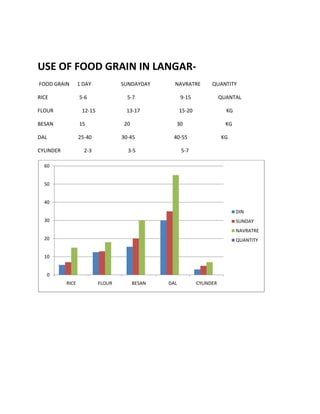
USE OF FOOD GRAIN IN LANGARFOOD GRAIN
RICE

1 DAY

SUNDAYDAY

5-6

FLOUR

9-15

QUANTAL

13-17

15

DAL

15-20

KG

20

30

25-40

30-45

40-55

2-3

CYLINDER

QUANTITY

5-7

12-15

BESAN

NAVRATRE

3-5

KG

5-7

KG

60
50
40
DIN
30

SUNDAY
NAVRATRE

20

QUANTITY

10
0
RICE

FLOUR

BESAN

DAL

CYLINDER
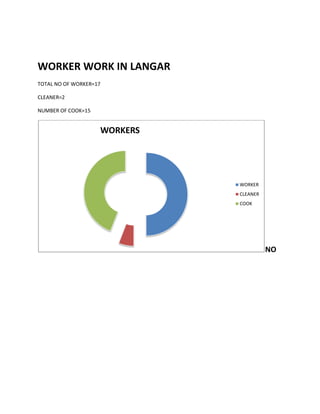
WORKER WORK IN LANGAR
TOTAL NO OF WORKER=17
CLEANER=2
NUMBER OF COOK=15

WORKERS

WORKER
CLEANER
COOK

NO
NO OF PEOPLE EATING FOOD IN ONE DAY=4000-10000
NO OF PEOPLE EATING FOOD IN NAVRATRE=12000-15000
FOOD CHARITY=5000 RS PER DAY
IN 30 DAYS = 16000 RS
IN NAVRATRE= 20-25000 RS

CROCKERY
PLATE= 300-400
TUMBLER=150-250
CAULDRON=6-7
BUCKETS-4
SPOON= 150-200
SECURITY GUARD
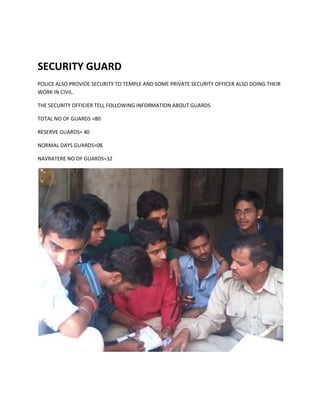
POLICE ALSO PROVIDE SECURITY TO TEMPLE AND SOME PRIVATE SECURITY OFFICER ALSO DOING THEIR
WORK IN CIVIL.
THE SECURITY OFFICIER TELL FOLLOWING INFORMATION ABOUT GUARDS
TOTAL NO OF GUARDS =80
RESERVE GUARDS= 40
NORMAL DAYS GUARDS=08
NAVRATERE NO OF GUARDS=32
CHARITY GIVEN BY FOLLOWERS
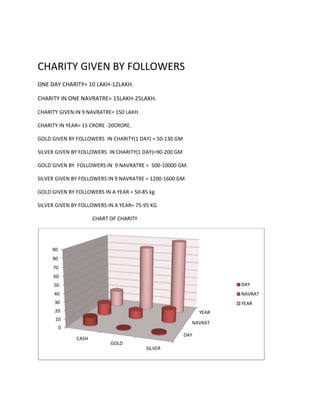
ONE DAY CHARITY= 10 LAKH-12LAKH.
CHARITY IN ONE NAVRATRE= 15LAKH-25LAKH.
CHARITY GIVEN IN 9 NAVRATRE= 150 LAKH.
CHARITY IN YEAR= 15 CRORE -20CRORE.
GOLD GIVEN BY FOLLOWERS IN CHARITY(1 DAY) = 50-130 GM
SILVER GIVEN BY FOLLOWERS IN CHARITY(1 DAY)=90-200 GM
GOLD GIVEN BY FOLLOWERS IN 9 NAVRATRE = 500-10000 GM.
SILVER GIVEN BY FOLLOWERS IN 9 NAVRATRE = 1200-1600 GM
GOLD GIVEN BY FOLLOWERS IN A YEAR = 50-85 kg
SILVER GIVEN BY FOLLOWERS IN A YEAR= 75-95 KG
CHART OF CHARITY

90
80
70
60
50

DAY

40

NAVRAT

30

YEAR

20

YEAR

10

NAVRAT

0
CASH

DAY
GOLD

SILVER
Jawalamuki project

Jawalamuki project

  • 3.
    Contents 1 Geography 2 Demographics 3Area Profile of Jawalamukhi Town 4 Jwalamukhi Devi Temple 5 The Jwalamukhi shrine as a Shakti Peeth 6 References 7 QUESTION AND ANSWER
  • 4.
  • 5.
    Jawalamukhi Location in HimachalPradesh, India Coordinates: 31.88°N 76.32°ECoordinates: 31.88°N 76.32°E Country India State Himachal Pradesh District Kangra Elevation 610 m (2,000 ft) Population (2011) • Total 4,931 Languages • Official Hindi Time zone IST (UTC+5:30) Jawalamukhi is a town and a nagar panchayat in Kangra district in the Indian state of Himachal Pradesh. Geography Jawalamukhi is located at 31.88°N 76.32°E.[1] It has an average elevation of 610 metres (2,001 feet). Demographics At the 2011 India census, Jawalamukhi had a population of 4931. Males constitute 52% of the population and females 48%. Area Profile of Jawalamukhi Town As of 2011 India census, Number of Households - 1,012
  • 6.
    Average Household Size(perHousehold) - 5.0 Population-Total - 4,931 Population-Urban - 4,931 Proportion of Urban Population (%) - 100 Population-Rural - 0 Sex Ratio - 906 Population(0-6Years) - 608 Sex Ratio(0-6 Year) - 961 SC Population - 812 ST Population - 0 Sex Ratio (ST) - 0 Proportion of ST (%) - 0 Literates - 3,777 Illiterates - 1,154 Literacy Rate (%) - 87.0 Design of Jwalaji Temple(Architecture) The building of the temple is adorned by the beautiful folding doors of silver plates, presented by Sikh Emperor Raja Kharak Singh,.The dome of the temple is beautified by the gold plated material. The interior of the temple is built in the form of a square pit about 3 feet deep with a pathway all around. Amidst the temple premises, nestles a hollow rock which is considered as the fiery mouth of Mahakali and claims to be the major attraction of the temple.
  • 7.
    Myth behind theTemple The story of Jwalamukhi Temple relates to Sati, a goddess born when gods concentrated their individual energy on the ground. These gods were looking for a respite or the protection from the atrocities of the demons. The girl named Adishakti or the first Shakti (Sati or Parvati). She was brought up in childhood by Prajapati Daksha and married Lord Shiva later by sati performing penance. The belief reveals that Prajapati Daksha once organised a yajna and invited everyone except Lord Shiva. Sati felt immensely humiliated and insulted at this act of her father and immolated her in the fire of the havankund which was organized by her father. With this action Lord Shiva became so furious that he carried Sati's burnt body and moved around the three worlds. The gods could not foresee a calamity approaching them so they assembled before Lord Vishnu and asked him to do something to control anger of lord Shiva. As a remedy to this problem Lord Vishnu cut apart Sati's body into several pieces with the help of his Sudharshan Chakra. Wherever on earth the pieces of Sati's body fell, a shaktipeeth came up with different temples. These are the spot that are regarded as the power centre of the goddess. Jwalamukhi temple one of the form of Maa Durga is the place where the tongue of Sati fell. Here the goddess is manifested like tiny flames that burn through the fissures in the age old rock. Shiva carrying the corpse of Sati Devi The shrine is regarded as a Maha Shakti Peetham. It is believed that Sati Devi's tongue fell here.Shakti Peethas are shrines of Devi, the primodial Mother Goddess. Each Shakti Peetha has a shrine for the Shakti and Bhairava. Siddhida (Ambika)is the Shakti and Unmatta Bhairava is the Kalabhairava. The mythology of Daksha yaga and Sati's self immolation had immense significance in shaping the ancient Sanskrit literature and even had impact on the culture of India. It lead to the development of the concept of Shakti Peethas and there by strengthening Shaktism. Enormous mythological stories in puranas took the Daksha yaga as the reason for its origin. It is an important incident in Shaivism resulting in the emergence of Shree Parvati in the place of Sati Devi and making Shiva a
  • 8.
    Who build theTemple The temple is believed and supposed to be first built by a king who, on the complaint of a cowherd, tried to find out the place w from where a female emerged and drank the milk of the cow in those times. Since, the king was aware of the legend of Sati, as well he continued his search for the place and finally succeeded. Kind began construction of the temple there and employed priests to perform pujas. Later in times the great Pandavas came and carried out some renovation work in the temple. LATER The temple was looted and destroyed by Mahmud of Ghazni in 1009. The Mughal Emperor Akbar, learning about the legends of Jwalamukhi tried to douse the flames with a stream of water. However, the great power of the Goddess, still kept the flames burning. Realizing the power of Jwala Devi, Akbar came with his army to this temple. He brought a Gold umbrella (Chatra) for the Goddess, but on offering, the umbrella turned into an unknown metal suggesting that the Goddess did not accept his offering. grihastashrami(house holder) Maharaja Ranjit Singh paid a visit to the temple in the year 1809. His son, Kharak Singh gifted a pair of silver plated folding doors to the temple while Maharaja Ranjit Singh paid a visit to the temple in 1815 and the dome of the temple was gold-plated by him. Just a few feet above the Jwalamukhi temple there is a six-feet deep pit with a circumference of about three-feet. At the bottom of this pit there is another small pit about one and a half feet deep with hot water bubbling all the time. The temple is identified as one among the 52 Shakti Peethas . It is also one of the most renowned temples of Goddess Durga . The Jwalamukhi shrine as a Shakti Peeth Moreover, in the princely era, the work of the temple was managed by the Raja of Naduan. He himself appointed the temple priest. After independence, things changed a lot. The pujaris are now appointed and paid by the government. A part of the money collected by the temple is used to improve the facilities for the visiting pilgrims.
  • 9.
    Different ways ofworshipping Mata Jwala Devi There are mainly 3 ways of doing Mata Jwala Devi's Pooja Archana, i.e. Panchopchal, Dashopchal and Sholshobchal. Similarly there are 5 different Jwalaji Aartis done of Mata Jwala Ji Shringar Aarti- Shringar Arti is done early mornings at Brahma Mahurat time. In this aarti, Malpua, Khoya and Mishri are offered to Maa Jwala. Mangal Aarti- This aarti is done after around half an hour difference to the first one. In this aarti, yellow rice and curd is offered to Maa Bhagwati. Madhyayan Kaal Aarti- This is performed in the afternoon(Madhyayan Kaal). In this, rice, Shatras Dal and sweet/ desert is offered to Maa. Sayan Kaal Aarti- This is, as the name suggests, performed in the evenings. In this aarti, Poori, Chana and Halwa is offered to the Jagad Janani. Shaiyya Aarti- As the name suggests, it is the bedtime aarti of Maa, before the pandits offer the last prayers in the late evening of the day and prepare Maa's bed to sleep. This aarti starts around 9:00 PM in the evening. Milk, Malai and seasonal fruits are offered to Maa Jwala. Significance of the temple The temple of Jwalamukhi does not have an idol to worship too. The building of the temple has a gilt dome and silver plated folding doors. Inside the Jwalamukhi Temple there is a 3 feet square pit with pathway all around and in the centre, there is a hollowed rock over a primary fissure of flame. This one is regarded as the mouth of the Mahakali. The Flames emit out from several other point in the pit. They are nine in total which represent the different form of the goddess - Saraswati, Annapurna, Chandi, Hing Laj, Vindhya Vasini, Mahalakshmi, Mahakali, Ambika and Anjana. There are two lions in front of the temple. The Jwalamukhi temple is dedicated to the Goddess of Light. The temple is made up of a dome and peak like pinnacles. The flame is believed to represent the Goddess.
  • 10.
    Rules and Ritualsof the temples In Jwalamukhi Temple during the whole day, there are about five aartis conducted in the temple. The first aarti is performed early at 5am in the morning called as the Mangal aarti. The next aarti is done at the time of sunrise called Panjupchaar Pujan. At around midnoon, it is time for yet another aarti which is named as the Bhog Ki Aarti. The evening aarti at around 7 pm is simply called aarti while the last one at around 10 pm is known as the Shaiyan ki aarti. The last aarti of the day in the Jwalamukhi Temple is very much unique since it is only here that such an aarti is conducted. During the aarti, the bed of the Maa Jwala goddess is decorated with beautiful dresses and jewellery. The aarti is performed in two parts firstly the one is in the main temple while the second one is performed in the sejabhavan. Slokas from 'Sondarya Lahri' by Shri Shakracharya are through the day recited throughout the aarti for the auspicious and scared shrine of Maa Jwalamukhi. Havan is also performed once a day and parts of Durga Saptarshi are recited during it. Offerings made before the goddess in puja include bhog of rabri or thickened milk, misri or candy, seasonal fruits and milk. The deity is offered Bhog of Rabri or thickened milk, Misri or candy, seasonal fruits, milk and arti is done. Devotees coming to the Jwalamukhi temple can either buy prashad from any of the nearby shops of the temple or bring in their own prasad from home. Usually, the prasad that is offered to the deity include pan, supari, dhawaza, narela, loung and elaichi.
  • 11.
    TIME TABLE OFJAWALA JI TEMPLE 12:00 AM 9:36 PM 7:12 PM 4:48 PM 2:24 PM 12:00 PM OPEN CLOSE 9:36 AM 7:12 AM 4:48 AM 2:24 AM 12:00 AM SUMMER WINTER
  • 12.
    TIME TABLE OFJAWALAJI MANDIR OPEN(MORNING) CLOSE(EVENNING) SUMMER 5 AM 10 PM WINTER 6 AM 9 PM Festivals and Rush times at Maa Jwalaji There is a huge rush in this area with lakhs of devotees during the times of Chaitra Aswin Navratras and Shrawan Months from Delhi, Punjab, Himachal and other parts of India. Though otherwise, in the changing trends of modern followers, devotees from north India, specially Delhi, Punjab visit this place regularly on weekends. The locals prefer to visit mainly on Tuesdays and Fridays.
  • 13.
    Climate In winter, theclimate is cold but pleasant when woollens are required. During summer the temperature is hot and cottons are recommended. Transport Facilities at the Temple For tourists the closest airport is at Gaggal which is around 50 km away The nearest railhead is a narrow gauge one at Ranital, 20 km away. The Chandigarh airport and railway station are at the distance of about around 200 km. Trains from Pathankot to Joginder Nagar leave at 2.15 h, 4.50 h, 8.50 h, 9.35 h, 13.10 h, 16.00 h and reach Jwalamukhi road in 3 h and from there by bus to visit Jwalaji. The Jwalamukhi temple is also well connected by road. State transport buses from cities of Punjab and Haryana are available. Taxis are also there to take you to the Jwalamukhi temple. Frequent buses pass through Kangra, distance 54 km and takes 2 hour. Kangra is 36 km away from Jwalamukhi. Buses are also coming from Pathankot (123 km), Mandi (171 km), Manali (281 km). Simla (321 km), Palampur, Joginder Nagar and from several places of North India. QUESTION AND ANSWER Jawalaji temple provide employment both private as well as government sector. in the temple by selling the flower, toys and home made thing. The people are earning money and it gives big result in increasing in the money and a great improvement in their daily life style pay of a person in normal day 500 to 100rs per day. There are many campany plays a great role in this area like tour and travel company, tourist company ,hotel and transport companies etc.
  • 14.
    USE OF FOODGRAIN IN LANGARFOOD GRAIN RICE 1 DAY SUNDAYDAY 5-6 FLOUR 9-15 QUANTAL 13-17 15 DAL 15-20 KG 20 30 25-40 30-45 40-55 2-3 CYLINDER QUANTITY 5-7 12-15 BESAN NAVRATRE 3-5 KG 5-7 KG 60 50 40 DIN 30 SUNDAY NAVRATRE 20 QUANTITY 10 0 RICE FLOUR BESAN DAL CYLINDER
  • 15.
    WORKER WORK INLANGAR TOTAL NO OF WORKER=17 CLEANER=2 NUMBER OF COOK=15 WORKERS WORKER CLEANER COOK NO
  • 16.
    NO OF PEOPLEEATING FOOD IN ONE DAY=4000-10000 NO OF PEOPLE EATING FOOD IN NAVRATRE=12000-15000 FOOD CHARITY=5000 RS PER DAY IN 30 DAYS = 16000 RS IN NAVRATRE= 20-25000 RS CROCKERY PLATE= 300-400 TUMBLER=150-250 CAULDRON=6-7 BUCKETS-4 SPOON= 150-200
  • 17.
    SECURITY GUARD POLICE ALSOPROVIDE SECURITY TO TEMPLE AND SOME PRIVATE SECURITY OFFICER ALSO DOING THEIR WORK IN CIVIL. THE SECURITY OFFICIER TELL FOLLOWING INFORMATION ABOUT GUARDS TOTAL NO OF GUARDS =80 RESERVE GUARDS= 40 NORMAL DAYS GUARDS=08 NAVRATERE NO OF GUARDS=32
  • 18.
    CHARITY GIVEN BYFOLLOWERS ONE DAY CHARITY= 10 LAKH-12LAKH. CHARITY IN ONE NAVRATRE= 15LAKH-25LAKH. CHARITY GIVEN IN 9 NAVRATRE= 150 LAKH. CHARITY IN YEAR= 15 CRORE -20CRORE. GOLD GIVEN BY FOLLOWERS IN CHARITY(1 DAY) = 50-130 GM SILVER GIVEN BY FOLLOWERS IN CHARITY(1 DAY)=90-200 GM GOLD GIVEN BY FOLLOWERS IN 9 NAVRATRE = 500-10000 GM. SILVER GIVEN BY FOLLOWERS IN 9 NAVRATRE = 1200-1600 GM GOLD GIVEN BY FOLLOWERS IN A YEAR = 50-85 kg SILVER GIVEN BY FOLLOWERS IN A YEAR= 75-95 KG CHART OF CHARITY 90 80 70 60 50 DAY 40 NAVRAT 30 YEAR 20 YEAR 10 NAVRAT 0 CASH DAY GOLD SILVER