Writing Skills
Basics

•   Good writing is writing that works
    -    It is clear at first reading
    -    It demands no further explanation
    -    Always a result of hard work: there is no help from tone or
         gesture; with the force of your personality
•   Anything we write must act on our behalf
•   Words on paper can be fixed and unchangeable
    -    The written word can have an objectivity that can be
    threatening
Basics

•   “I do not know what to include or what to leave out.”
•   This problem usually arises because:
    -    We have not thought clearly about the message we want to
         send
    -    We are not thinking about the reader; only the information
         we want to put down
    -    We may be more concerned about what will look
    impressive
    -    We may not be able to concentrate on the job in hand
•   The result of all this is:
    -    muddled thinking; a muddled structure; language that goes
         out of control.
Basics

•   Two golden rules to bear in mind:
    -     Think of the reader (all writing should focus on the reader
          before the material is included)
    -     Separate thinking from writing ( put thoughts in order
    before beginning, and take time afterwards to think about
    what was written)
•   “I know what I want to say, but I can’t put it down”
    -     Write as you speak
    -     Your text can be improved later
•   We must allow time to prepare, and time to check: that way our
    text will be right the first time the reader sees it.
Basics

• A systematic approach to writing has three basic
  stages:
- Preparation and planning
- Writing
- Checking
Preparation

•   Ask a series of basic questions: What, When, Where, Why,
    Who, How
•   What is the purpose of the document
•   Never write without a reader in mind
•   Take responsibility for the writing
•   Location, to write with few distractions
•   Establish clear guidelines
•   Write when mind is the clearest
•   Gather material, compile and fit
Writing

•   Produce first draft:
    -    Don’t think hard; try to let the words flow on to the page
•   Write fast, stick to plan
•   Write as you speak
Checking

•   Good writing comes from re-writing:
    -    Analyze thoroughly what we have written and create a test
         that is correct, clear and appropriate – for our purpose and
         the reader
•   Develop skill to read own writing, critically, as if someone else
    has written it
•   Try to allow some time between finishing the draft and beginning
    check
    -    The longer the better; provides objectivity
•   No final version; endless process limited by time; however don’t
    lose the original thoughts by too many corrections
•   A systematic approach will help
A 10 point writing plan

•   Rewriting is often a matter of changing lots of little things than a few big
    ones:
-   Paragraphs
-   Long sentences
-   Subject & verb
-   Sentence landscape
-   Passive and active verbs
-   Adjectives and Adverbs
-   Accuracy
-   Brevity
-   Clarity
-   Spelling and punctuation
Paragraphs

•   They may have more than one sentence, however only one
    theme
•   Each page of the document must have more than 2 paragraphs;
    the more the better
•   Break long paragraphs into shorter sections using sub-
    headings, numbers or lists – be consistent in layout
•   Open each paragraph with a short, summarizing topic sentence
    – possible to take the gist and speed read the rest
•   Use link words and phrases to guide the reader between one
    paragraph and the next: e.g. however …, moreover….’ as a
    result…., in addition…., in contrast…., and so on
Long sentences

•   A sentence is a group of words that make sense by itself –
    begins with a capital letter and ends with a full stop.
•   Short sentences are easier to read – a sentence of more than
    25 words will probably not be understood at first reading
•   Sentences tend to grow out of control because we try to cram
    too many ideas into them – separate thought from writing
•   Use shortest sentences in the most prominent position – bigger
    the idea, shorter the sentence to express it
•   Search long sentences. Rewrite it:
    list the ideas; use separate sentence to each idea; connect into
    prose, use link words; check language of rewritten text
Subject & Verb
•   Every sentence must have a subject (noun).
•   It must have a main verb, which describes what the subject is or
    does
•   The verb must agree with the subject (singular or plural)
•   And, it must be finite, having tense (past, present, future)
•   If in doubt ask:
-   What do you want the sentence to be about? Put this at the
    beginning as a subject.
-   What is the subject doing? Put this second
-   Put nothing between the subject and the verb
•   Now rewrite the sentence from here.
Sentence Landscape

•   We normally don’t read one word at a time
•   Eye scans in groups of about five words, searching through the
    sentence for the full stop which tells it to pause.
•   Put most important matter in the beginning and end of a
    sentence where the attention is the greatest – ideas buried in
    the middle will get lost.
•   Try to break long sentences into manageable ‘chunks’ of 5 to 10
    words.
Passive & Active verbs

•   Beware of writing impersonally:
    e.g. Passive: Arrangements have been made ….
         Active: I have made arrangements …..
         Passive: Measurements have been taken ….
         Active: The team took measurements …..
•   Passive voice lacks the personal tone, the mark of good
    personal relations
    -    Can fail to allocate responsibility for action taken
Adjectives & Adverbs

•   Adjectives describes nouns – quick, yellow, round,etc.
•   Adverbs describe verbs – quickly, brightly, early, etc.
    -    sometimes describe adjectives – quite fast, rather hot
•   Go through text, identify adjectives and adverbs
    -    Take them out and see what are absolutely necessary
Accuracy
•   Use the right word for the right job -- synonyms
•   Use jargon in its rightful place:
    -    between experts
    -    or give an explanation
Brevity

•   Use short words rather than long ones
•   Eliminate meaningless cliches – as such, by and large,
    needless to say, etc.
•   Watch out for toutology: Why say the same thing twice?
    e.g. enclosed herewith, the true facts are, he declined to accept
    the offer
Clarity

•  Remember, we are not there to explain what we have written
   -     the text must leave no room for ambiguity
• Vague phrases can arouse suspicion – in the region of; in the
   area of; around about
   -     are we covering up something unpleasant, or hiding our
   ignorance?
• Big threat to clarity are abstract nouns – can be replaced by the
   verbs from which they derive.
e.g. 1. There are regulations for the avoidance of accidents;
   replace by: The rules help us avoid accidents
     2. Your entitlement to a refund is unaffected; replace by: You
   are entitled to a refund
Spelling

•   Spelling matters, contributes to our public and professional
    image
•   There are ways of improving – if you are determined
•   Think before you write. Clear thoughts make for clear writing
•   Use the simpler, shorter word rather than the longer,
    complicated one. Always.
•   Don’t use any words unfamiliar to you – more likely to spell
    correctly words familiar to you
•   Make a point of looking up new words in a dictionary and
    becoming acquainted with them.
•   If in doubt: write it down quickly – first guess are often correct;
    dictionary on WP not adequate; spell checker cannot distinguish
    between ‘there’ and ‘their’
Punctuation

•   Punctuations do for the written word what gesture, pausing and
    tone of voice do for speech.
    -    It signals to the reader how to read the passage
•   Keep it simple – the less punctuations the better
•   Read your text aloud, checking that the punctuation does what it
    should.
    -    Remove any unnecessary punctuation; add only when you
    are convinced you should
•   Never use any punctuation without being sure of its use
•   Check the finer points of punctuation in a guide to usage
Letter Writing

•   A letter is a piece of conversation by post:
-   It expresses a relationship: between friends, colleagues,
    strangers
-   The nature of the relationship dictates the nature of the letter
•   A business letter is: precise, straightforward, relevant to reader’s
    needs and action oriented
•   It shows respect for the reader and points the way ahead –
    clearly saying what happens next.
•   Preparation: time spent now, before putting pen to paper, is time
    saved later – both for the writer and the reader
Letter Writing

•   The letter purpose:
-   To sell or persuade
-   To make an enquiry
-   To answer a question
-   To complain
-   To answer a complaint
-   To get something done
-   To create a good impression of you and the organization
•   If there is more than one purpose, pick the most important and
    stick to it
•   A letter which tries to do too much will fail to do anything
•   Every letter is a free advertisement
Reader

•   What we put in and leave out will depend on our relationship
    with our reader
•   Exact name! Find out
•   Right person? Take action
•   Needs and wants
•   Situation story and history
•   Knowledge about subject matter
•   Letter has more than one reader?
Who? When? Where?

•   Am I the right person to write?
•   Writer has authority to sign: or collaborate on style with the
    signatory
•   Realistic time for delivery and reply
•   Reader’s schedule and deadlines important
•   Make sure the address is accurate complete and up to date
Planning

•   The action point of the letter is whatever needs to be done to
    fulfill the letter’s purpose
-   What action is required? By whom? When?
-   What information is relevant to action point?
-   What does the reader already know?
-   What do I know? What else do I need to know?
-   Plan for getting the information – each group of items will form
    the basis for a paragraph
Letter Structure

•   Salutation: name if known
•   Heading: from the statement of purpose – make it short
•   Introduction:
-   Acknowledge of previous communication
-   Who the writer is – job title
-   Why you are writing
•   Body:
-   Ensure all material is relevant and logically ordered
-   Use bullet points for listing
•   Action point – indicate and put into its own paragraph
•   Concluding remarks – polite and genuine
•   The complimentary close and signature
Layout

• However well written, a letter with a poor layout will
  fail at the first hurdle
Writing

•   Once the purpose and structure is clear, the writing itself
    becomes much easier
•   There is no “Business English” – only good English
•   Formality of a letter lies in its structure and a few basic
    conventions
•   Language should be close to the spoken word
•   Your letter, if read aloud, should have the sound of your voice
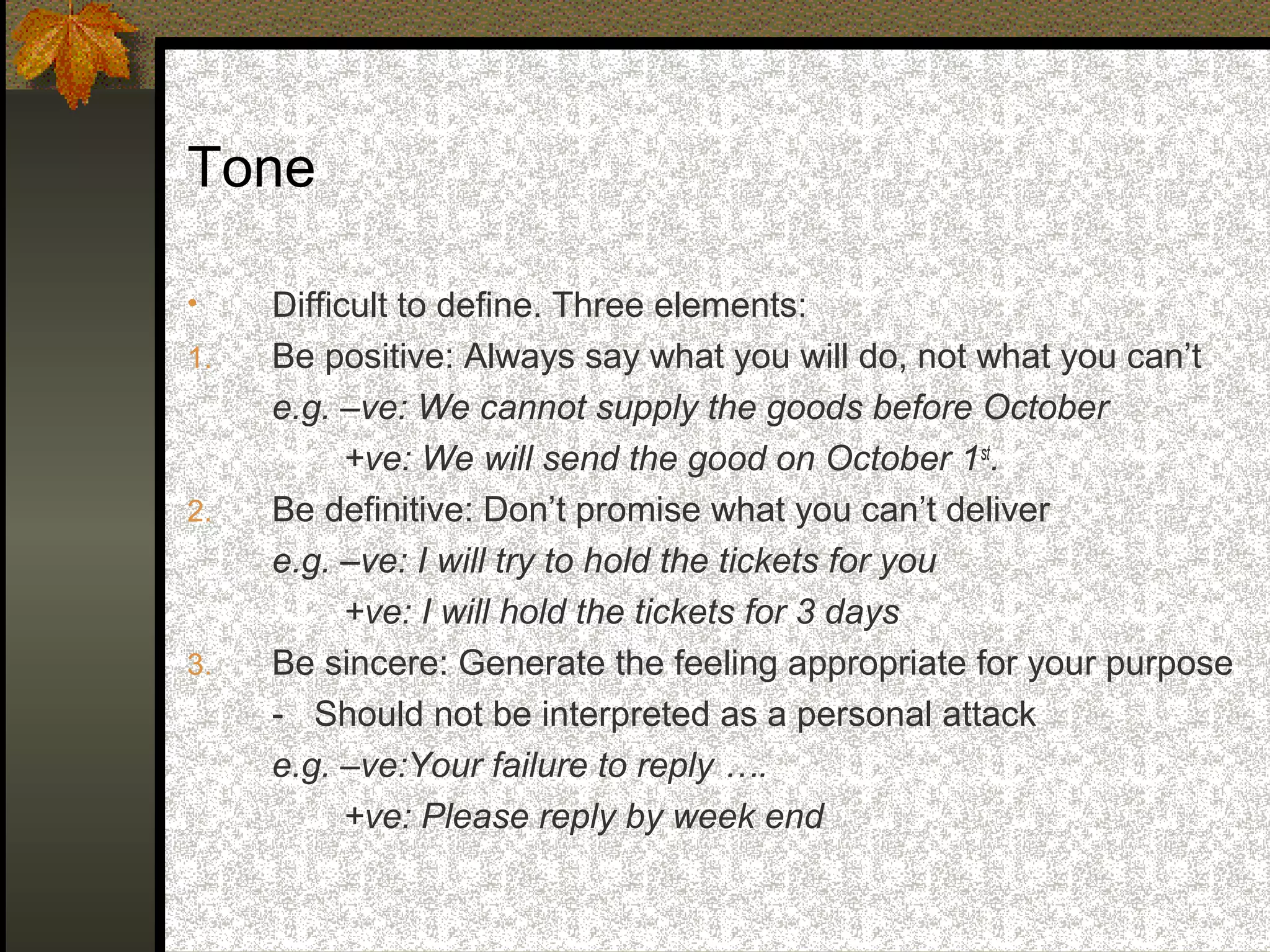
Tone

•    Difficult to define. Three elements:
1.   Be positive: Always say what you will do, not what you can’t
     e.g. –ve: We cannot supply the goods before October
           +ve: We will send the good on October 1st.
2.   Be definitive: Don’t promise what you can’t deliver
     e.g. –ve: I will try to hold the tickets for you
           +ve: I will hold the tickets for 3 days
3.   Be sincere: Generate the feeling appropriate for your purpose
     - Should not be interpreted as a personal attack
     e.g. –ve:Your failure to reply ….
           +ve: Please reply by week end
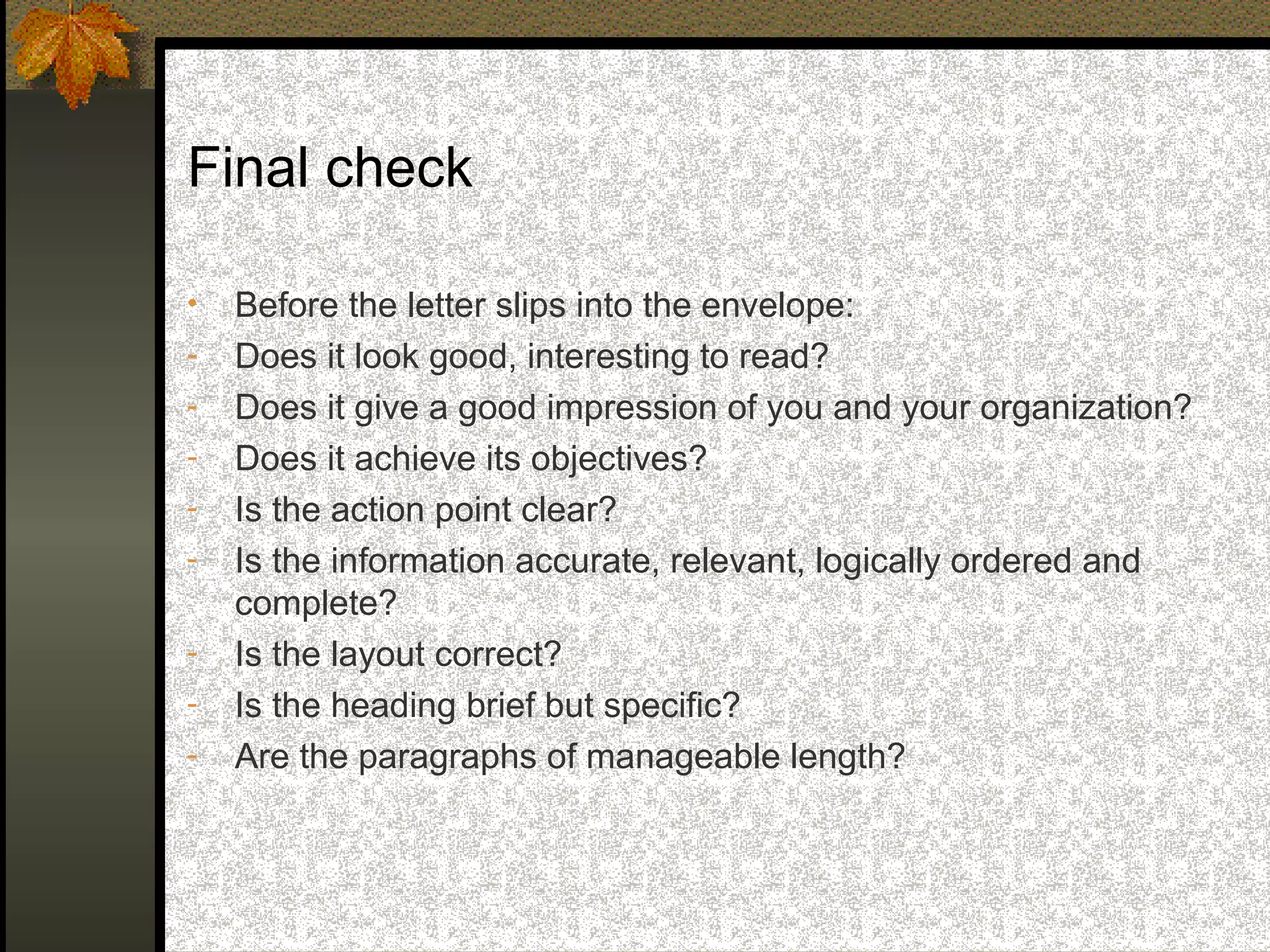
Final check

•   Before the letter slips into the envelope:
-   Does it look good, interesting to read?
-   Does it give a good impression of you and your organization?
-   Does it achieve its objectives?
-   Is the action point clear?
-   Is the information accurate, relevant, logically ordered and
    complete?
-   Is the layout correct?
-   Is the heading brief but specific?
-   Are the paragraphs of manageable length?
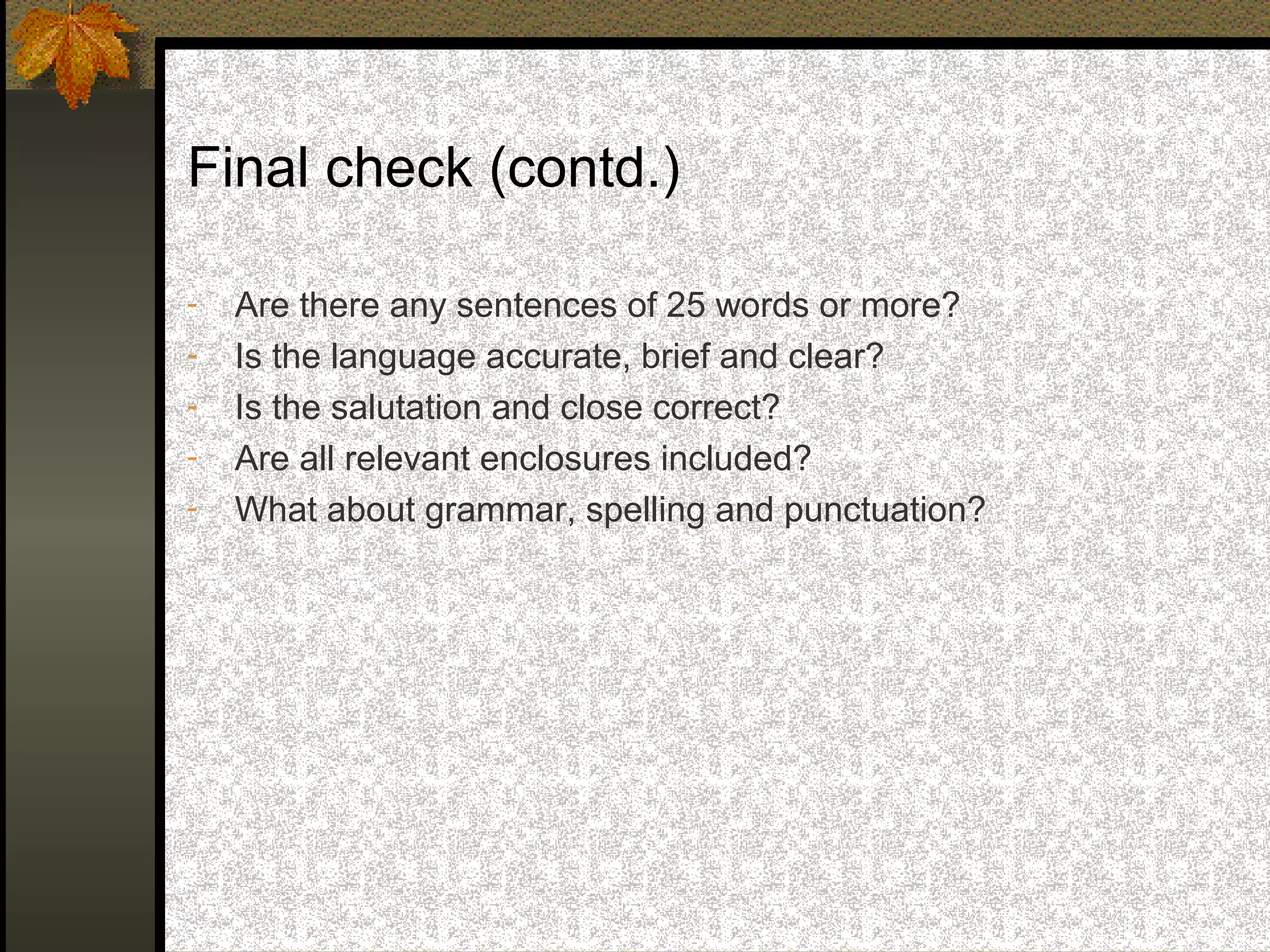
Final check (contd.)

-   Are there any sentences of 25 words or more?
-   Is the language accurate, brief and clear?
-   Is the salutation and close correct?
-   Are all relevant enclosures included?
-   What about grammar, spelling and punctuation?
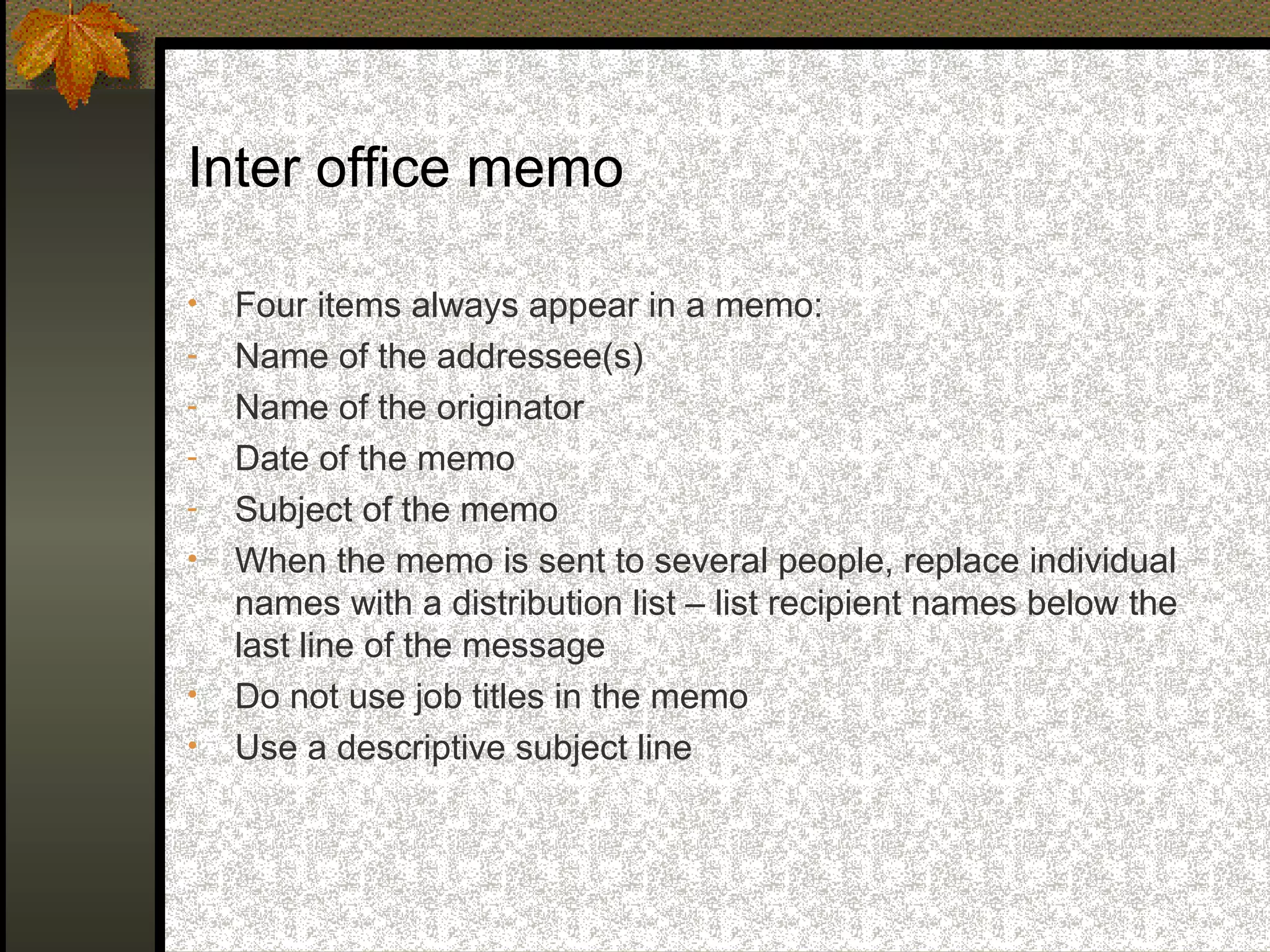
Inter office memo

•   Four items always appear in a memo:
-   Name of the addressee(s)
-   Name of the originator
-   Date of the memo
-   Subject of the memo
•   When the memo is sent to several people, replace individual
    names with a distribution list – list recipient names below the
    last line of the message
•   Do not use job titles in the memo
•   Use a descriptive subject line
Writing the memo

•   Determine the purpose
•   Prepare a writing plan
•   Write the first draft
•   Write the final copy.
•   The opening: most imp part of the memo, incl conclusions and
    recommendations, belong in the first sentence of the paragraph
•   The main message: the succeeding paragraphs support the imp
    info already conveyed in the first paragraph
    -     only pertinent info is incl; no nice-to-know info
    -     Use listing if appropriate, is more readable
•   The closing: the best memo closing may be none; eliminate
    unnecessary closings
Easy Reading

•   Make it easy for the reader to read – or the dust bin
•   Use white space creatively – more inviting to the eye
•   People skim read – no time or patience
•   Double indent lists
•   Have space between paragraphs
•   Use bold face type for emphasis; use them sparingly
•   Use bullets liberally: easily read and not missed
•   Use an appendix for support information
•   Good penmanship is a quality job skill:
-   gives a human feeling
-   Should be legible: people may not come back for clarification
Writing Tips

Terrible writing is easy to spot; usually based on:
- Foggy ideas no one can understand
- Big words, even though little ones will do
- Long twisted sentences covering may subjects
- Using jargons, slangs, abbreviations known only to the writer
- Vague words and statements that sound impressive but mean
   nothing
- Arrogant style
- Boring content
- Complete disregard for the reader
• When writing, no feedback to obtain correct answer. What you
   write has to stand on its own
Guidelines for good writing

•   Writing is not a God given talent, demands hard work
•   Write with the reader in mind: be considerate, friendly,
    interested, clear – “would I want to read this?”
•   Focus your work: Decide topic in advance, what you want to
    happen, and ensure that everything you write supports your
    message.
•   Be simple and short and very direct
•   Use headings and sub-headings in long reports
•   Use bullets to indicate points; however be consistent; if starting
    with action verbs continue till end.
•   Take out every ‘that’ and ‘which’ you can
•   Avoid boring, overused words -- cliches
Good Writing (contd.)

•   If you have trouble writing in simple words, explain to your co-
    worker / spouse and write what you spoke
•   If you get tangled in the middle of a sentence, break it into two
•   If a paragraph is bigger than a quarter of a page, break it into
    two – visually short paragraphs easier to wade through
•   Get the message in the first paragraph – helps the reader
    understand your point quickly
•   Don’t waste time on the perfect opening, or perfect way to say
    something: for the first draft write what comes in your mind.
    -     point is to get started, act of writing generates ideas
•   Break a long report into sections
•   Just write, practice, read other good writers has written

Writing skills

  • 1.
  • 2.
    Basics • Good writing is writing that works - It is clear at first reading - It demands no further explanation - Always a result of hard work: there is no help from tone or gesture; with the force of your personality • Anything we write must act on our behalf • Words on paper can be fixed and unchangeable - The written word can have an objectivity that can be threatening
  • 3.
    Basics • “I do not know what to include or what to leave out.” • This problem usually arises because: - We have not thought clearly about the message we want to send - We are not thinking about the reader; only the information we want to put down - We may be more concerned about what will look impressive - We may not be able to concentrate on the job in hand • The result of all this is: - muddled thinking; a muddled structure; language that goes out of control.
  • 4.
    Basics • Two golden rules to bear in mind: - Think of the reader (all writing should focus on the reader before the material is included) - Separate thinking from writing ( put thoughts in order before beginning, and take time afterwards to think about what was written) • “I know what I want to say, but I can’t put it down” - Write as you speak - Your text can be improved later • We must allow time to prepare, and time to check: that way our text will be right the first time the reader sees it.
  • 5.
    Basics • A systematicapproach to writing has three basic stages: - Preparation and planning - Writing - Checking
  • 6.
    Preparation • Ask a series of basic questions: What, When, Where, Why, Who, How • What is the purpose of the document • Never write without a reader in mind • Take responsibility for the writing • Location, to write with few distractions • Establish clear guidelines • Write when mind is the clearest • Gather material, compile and fit
  • 7.
    Writing • Produce first draft: - Don’t think hard; try to let the words flow on to the page • Write fast, stick to plan • Write as you speak
  • 8.
    Checking • Good writing comes from re-writing: - Analyze thoroughly what we have written and create a test that is correct, clear and appropriate – for our purpose and the reader • Develop skill to read own writing, critically, as if someone else has written it • Try to allow some time between finishing the draft and beginning check - The longer the better; provides objectivity • No final version; endless process limited by time; however don’t lose the original thoughts by too many corrections • A systematic approach will help
  • 9.
    A 10 pointwriting plan • Rewriting is often a matter of changing lots of little things than a few big ones: - Paragraphs - Long sentences - Subject & verb - Sentence landscape - Passive and active verbs - Adjectives and Adverbs - Accuracy - Brevity - Clarity - Spelling and punctuation
  • 10.
    Paragraphs • They may have more than one sentence, however only one theme • Each page of the document must have more than 2 paragraphs; the more the better • Break long paragraphs into shorter sections using sub- headings, numbers or lists – be consistent in layout • Open each paragraph with a short, summarizing topic sentence – possible to take the gist and speed read the rest • Use link words and phrases to guide the reader between one paragraph and the next: e.g. however …, moreover….’ as a result…., in addition…., in contrast…., and so on
  • 11.
    Long sentences • A sentence is a group of words that make sense by itself – begins with a capital letter and ends with a full stop. • Short sentences are easier to read – a sentence of more than 25 words will probably not be understood at first reading • Sentences tend to grow out of control because we try to cram too many ideas into them – separate thought from writing • Use shortest sentences in the most prominent position – bigger the idea, shorter the sentence to express it • Search long sentences. Rewrite it: list the ideas; use separate sentence to each idea; connect into prose, use link words; check language of rewritten text
  • 12.
    Subject & Verb • Every sentence must have a subject (noun). • It must have a main verb, which describes what the subject is or does • The verb must agree with the subject (singular or plural) • And, it must be finite, having tense (past, present, future) • If in doubt ask: - What do you want the sentence to be about? Put this at the beginning as a subject. - What is the subject doing? Put this second - Put nothing between the subject and the verb • Now rewrite the sentence from here.
  • 13.
    Sentence Landscape • We normally don’t read one word at a time • Eye scans in groups of about five words, searching through the sentence for the full stop which tells it to pause. • Put most important matter in the beginning and end of a sentence where the attention is the greatest – ideas buried in the middle will get lost. • Try to break long sentences into manageable ‘chunks’ of 5 to 10 words.
  • 14.
    Passive & Activeverbs • Beware of writing impersonally: e.g. Passive: Arrangements have been made …. Active: I have made arrangements ….. Passive: Measurements have been taken …. Active: The team took measurements ….. • Passive voice lacks the personal tone, the mark of good personal relations - Can fail to allocate responsibility for action taken
  • 15.
    Adjectives & Adverbs • Adjectives describes nouns – quick, yellow, round,etc. • Adverbs describe verbs – quickly, brightly, early, etc. - sometimes describe adjectives – quite fast, rather hot • Go through text, identify adjectives and adverbs - Take them out and see what are absolutely necessary
  • 16.
    Accuracy • Use the right word for the right job -- synonyms • Use jargon in its rightful place: - between experts - or give an explanation
  • 17.
    Brevity • Use short words rather than long ones • Eliminate meaningless cliches – as such, by and large, needless to say, etc. • Watch out for toutology: Why say the same thing twice? e.g. enclosed herewith, the true facts are, he declined to accept the offer
  • 18.
    Clarity • Remember,we are not there to explain what we have written - the text must leave no room for ambiguity • Vague phrases can arouse suspicion – in the region of; in the area of; around about - are we covering up something unpleasant, or hiding our ignorance? • Big threat to clarity are abstract nouns – can be replaced by the verbs from which they derive. e.g. 1. There are regulations for the avoidance of accidents; replace by: The rules help us avoid accidents 2. Your entitlement to a refund is unaffected; replace by: You are entitled to a refund
  • 19.
    Spelling • Spelling matters, contributes to our public and professional image • There are ways of improving – if you are determined • Think before you write. Clear thoughts make for clear writing • Use the simpler, shorter word rather than the longer, complicated one. Always. • Don’t use any words unfamiliar to you – more likely to spell correctly words familiar to you • Make a point of looking up new words in a dictionary and becoming acquainted with them. • If in doubt: write it down quickly – first guess are often correct; dictionary on WP not adequate; spell checker cannot distinguish between ‘there’ and ‘their’
  • 20.
    Punctuation • Punctuations do for the written word what gesture, pausing and tone of voice do for speech. - It signals to the reader how to read the passage • Keep it simple – the less punctuations the better • Read your text aloud, checking that the punctuation does what it should. - Remove any unnecessary punctuation; add only when you are convinced you should • Never use any punctuation without being sure of its use • Check the finer points of punctuation in a guide to usage
  • 21.
    Letter Writing • A letter is a piece of conversation by post: - It expresses a relationship: between friends, colleagues, strangers - The nature of the relationship dictates the nature of the letter • A business letter is: precise, straightforward, relevant to reader’s needs and action oriented • It shows respect for the reader and points the way ahead – clearly saying what happens next. • Preparation: time spent now, before putting pen to paper, is time saved later – both for the writer and the reader
  • 22.
    Letter Writing • The letter purpose: - To sell or persuade - To make an enquiry - To answer a question - To complain - To answer a complaint - To get something done - To create a good impression of you and the organization • If there is more than one purpose, pick the most important and stick to it • A letter which tries to do too much will fail to do anything • Every letter is a free advertisement
  • 23.
    Reader • What we put in and leave out will depend on our relationship with our reader • Exact name! Find out • Right person? Take action • Needs and wants • Situation story and history • Knowledge about subject matter • Letter has more than one reader?
  • 24.
    Who? When? Where? • Am I the right person to write? • Writer has authority to sign: or collaborate on style with the signatory • Realistic time for delivery and reply • Reader’s schedule and deadlines important • Make sure the address is accurate complete and up to date
  • 25.
    Planning • The action point of the letter is whatever needs to be done to fulfill the letter’s purpose - What action is required? By whom? When? - What information is relevant to action point? - What does the reader already know? - What do I know? What else do I need to know? - Plan for getting the information – each group of items will form the basis for a paragraph
  • 26.
    Letter Structure • Salutation: name if known • Heading: from the statement of purpose – make it short • Introduction: - Acknowledge of previous communication - Who the writer is – job title - Why you are writing • Body: - Ensure all material is relevant and logically ordered - Use bullet points for listing • Action point – indicate and put into its own paragraph • Concluding remarks – polite and genuine • The complimentary close and signature
  • 27.
    Layout • However wellwritten, a letter with a poor layout will fail at the first hurdle
  • 28.
    Writing • Once the purpose and structure is clear, the writing itself becomes much easier • There is no “Business English” – only good English • Formality of a letter lies in its structure and a few basic conventions • Language should be close to the spoken word • Your letter, if read aloud, should have the sound of your voice
  • 29.
    Tone • Difficult to define. Three elements: 1. Be positive: Always say what you will do, not what you can’t e.g. –ve: We cannot supply the goods before October +ve: We will send the good on October 1st. 2. Be definitive: Don’t promise what you can’t deliver e.g. –ve: I will try to hold the tickets for you +ve: I will hold the tickets for 3 days 3. Be sincere: Generate the feeling appropriate for your purpose - Should not be interpreted as a personal attack e.g. –ve:Your failure to reply …. +ve: Please reply by week end
  • 30.
    Final check • Before the letter slips into the envelope: - Does it look good, interesting to read? - Does it give a good impression of you and your organization? - Does it achieve its objectives? - Is the action point clear? - Is the information accurate, relevant, logically ordered and complete? - Is the layout correct? - Is the heading brief but specific? - Are the paragraphs of manageable length?
  • 31.
    Final check (contd.) - Are there any sentences of 25 words or more? - Is the language accurate, brief and clear? - Is the salutation and close correct? - Are all relevant enclosures included? - What about grammar, spelling and punctuation?
  • 32.
    Inter office memo • Four items always appear in a memo: - Name of the addressee(s) - Name of the originator - Date of the memo - Subject of the memo • When the memo is sent to several people, replace individual names with a distribution list – list recipient names below the last line of the message • Do not use job titles in the memo • Use a descriptive subject line
  • 33.
    Writing the memo • Determine the purpose • Prepare a writing plan • Write the first draft • Write the final copy. • The opening: most imp part of the memo, incl conclusions and recommendations, belong in the first sentence of the paragraph • The main message: the succeeding paragraphs support the imp info already conveyed in the first paragraph - only pertinent info is incl; no nice-to-know info - Use listing if appropriate, is more readable • The closing: the best memo closing may be none; eliminate unnecessary closings
  • 34.
    Easy Reading • Make it easy for the reader to read – or the dust bin • Use white space creatively – more inviting to the eye • People skim read – no time or patience • Double indent lists • Have space between paragraphs • Use bold face type for emphasis; use them sparingly • Use bullets liberally: easily read and not missed • Use an appendix for support information • Good penmanship is a quality job skill: - gives a human feeling - Should be legible: people may not come back for clarification
  • 35.
    Writing Tips Terrible writingis easy to spot; usually based on: - Foggy ideas no one can understand - Big words, even though little ones will do - Long twisted sentences covering may subjects - Using jargons, slangs, abbreviations known only to the writer - Vague words and statements that sound impressive but mean nothing - Arrogant style - Boring content - Complete disregard for the reader • When writing, no feedback to obtain correct answer. What you write has to stand on its own
  • 36.
    Guidelines for goodwriting • Writing is not a God given talent, demands hard work • Write with the reader in mind: be considerate, friendly, interested, clear – “would I want to read this?” • Focus your work: Decide topic in advance, what you want to happen, and ensure that everything you write supports your message. • Be simple and short and very direct • Use headings and sub-headings in long reports • Use bullets to indicate points; however be consistent; if starting with action verbs continue till end. • Take out every ‘that’ and ‘which’ you can • Avoid boring, overused words -- cliches
  • 37.
    Good Writing (contd.) • If you have trouble writing in simple words, explain to your co- worker / spouse and write what you spoke • If you get tangled in the middle of a sentence, break it into two • If a paragraph is bigger than a quarter of a page, break it into two – visually short paragraphs easier to wade through • Get the message in the first paragraph – helps the reader understand your point quickly • Don’t waste time on the perfect opening, or perfect way to say something: for the first draft write what comes in your mind. - point is to get started, act of writing generates ideas • Break a long report into sections • Just write, practice, read other good writers has written