Financial Management


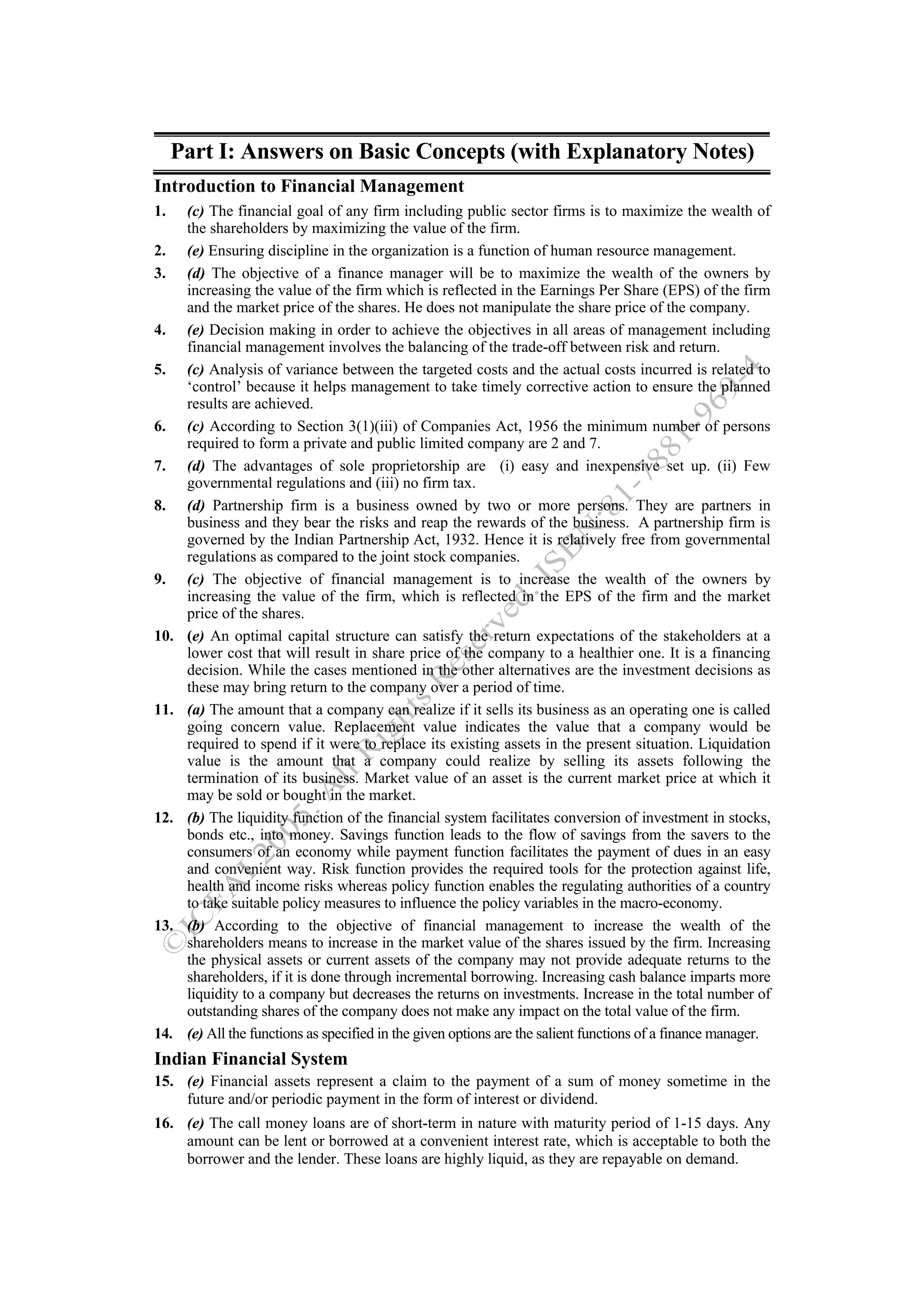
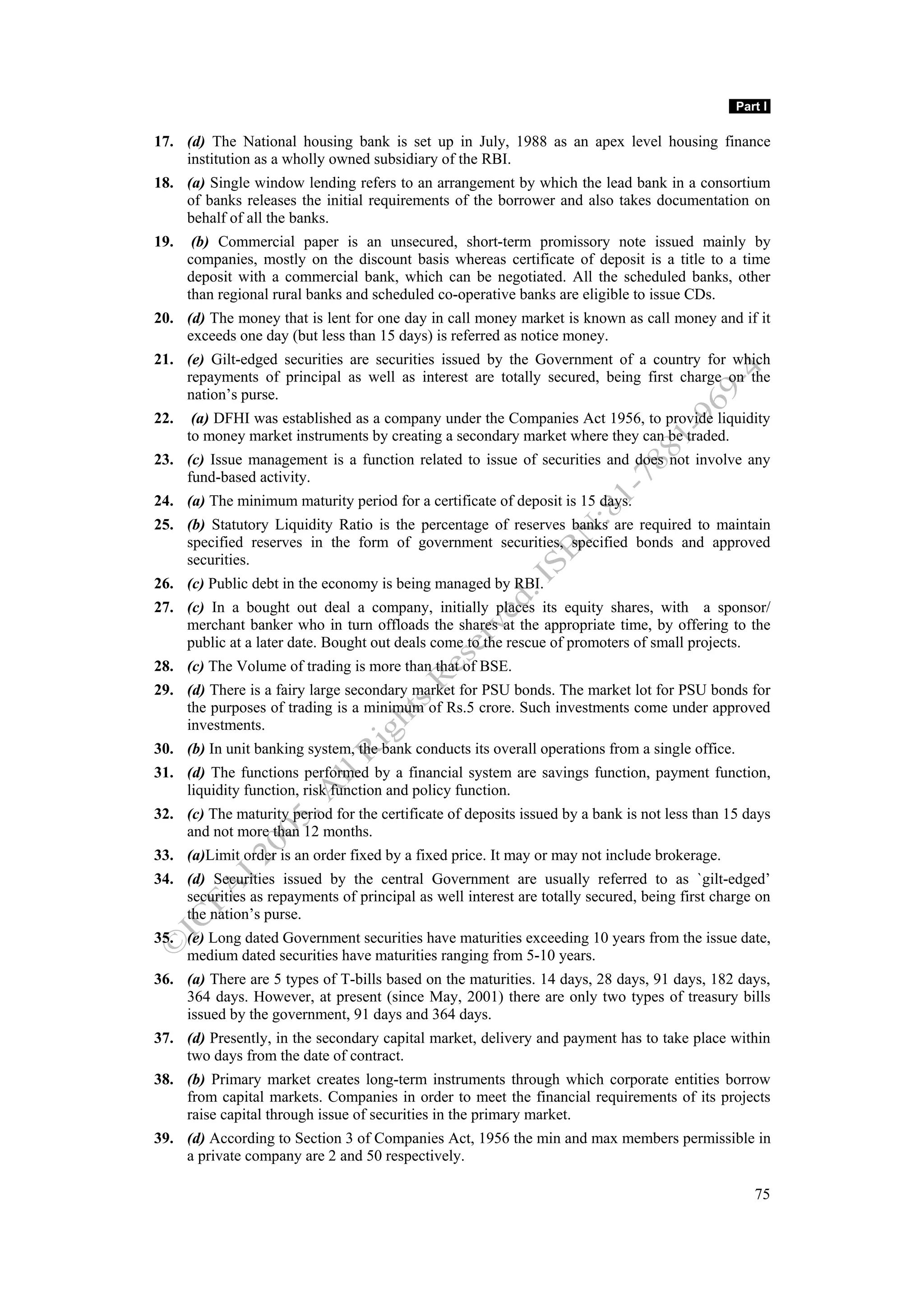
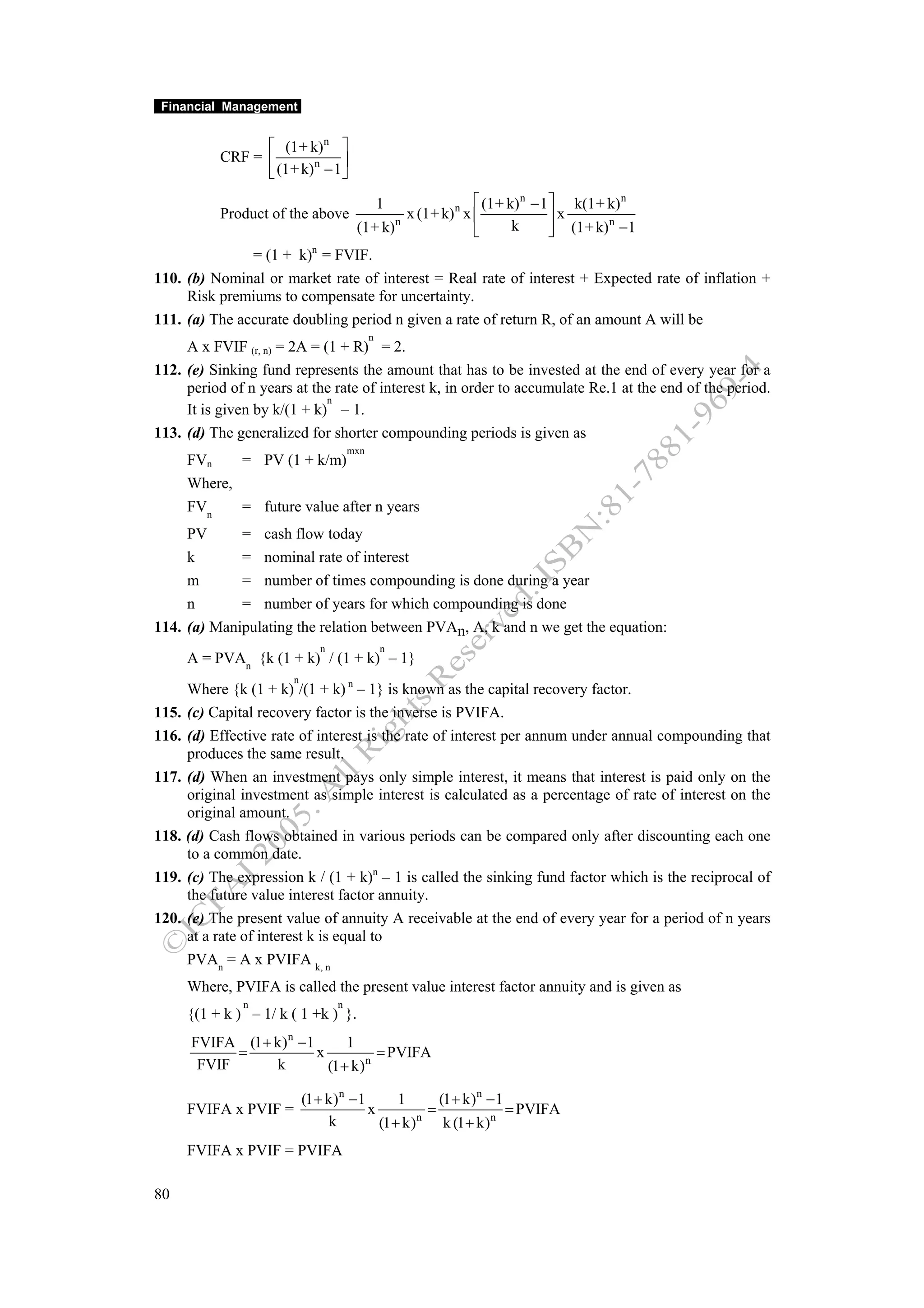
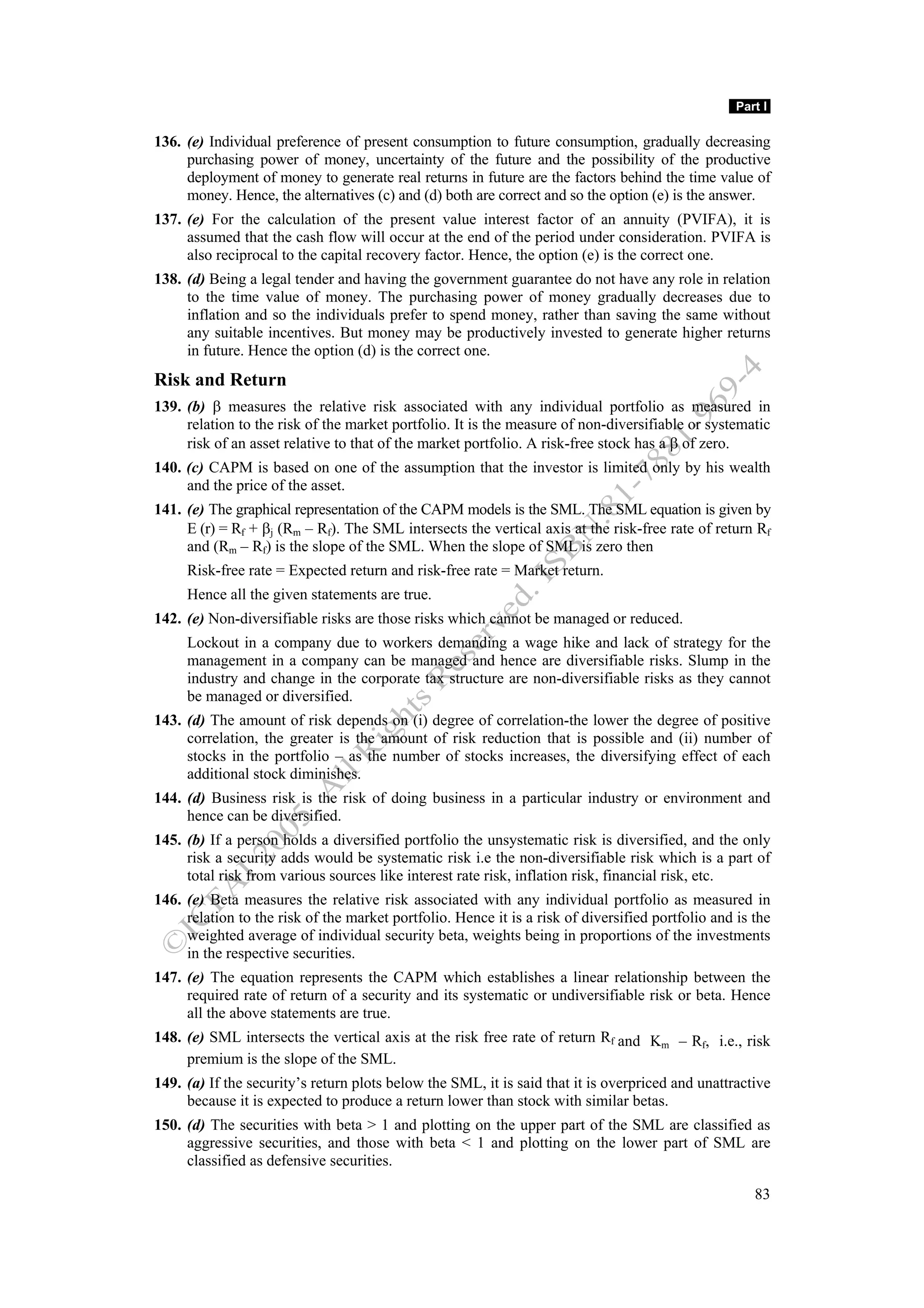
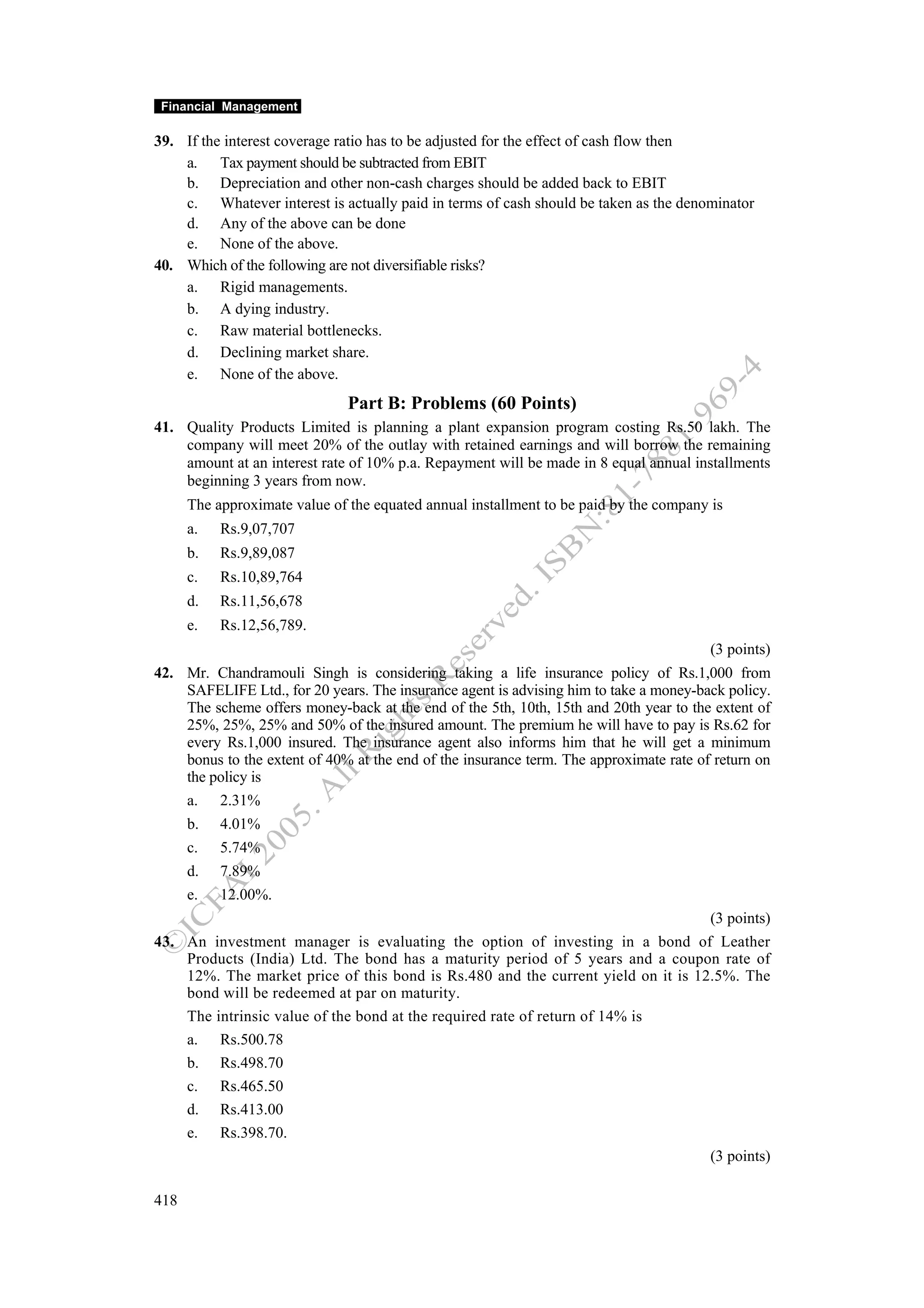
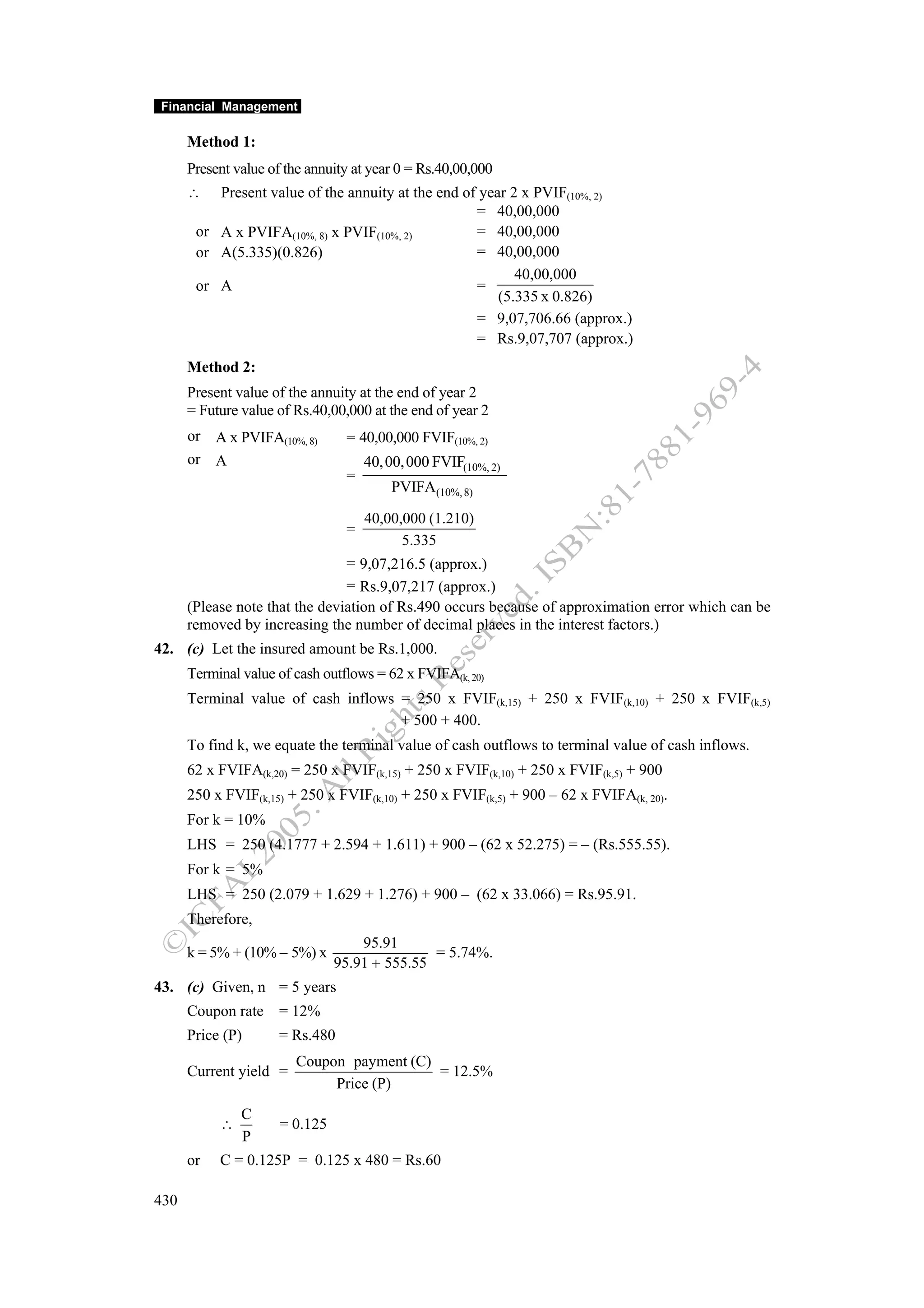
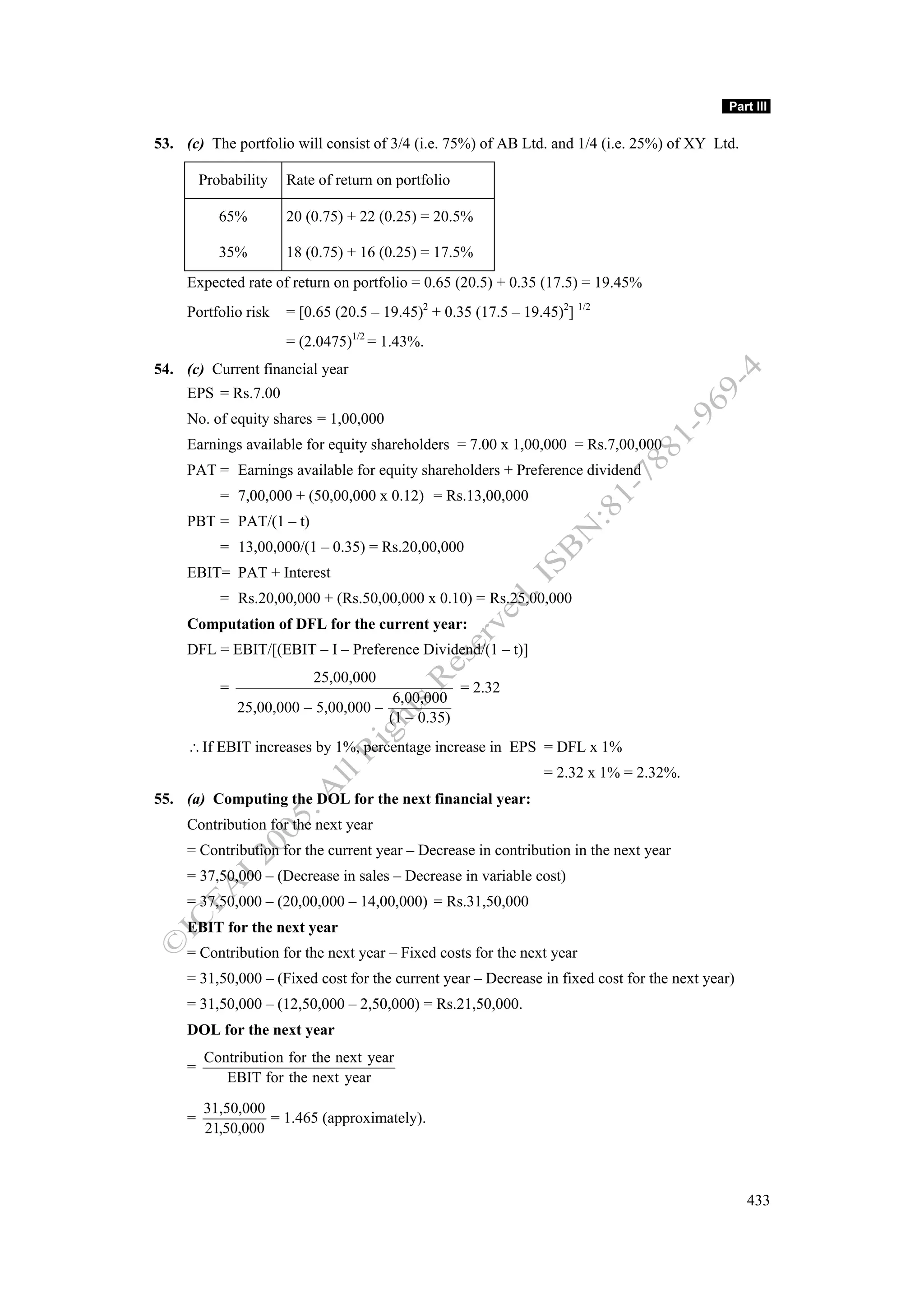
           WORKBOOK


       The ICFAI University
 # 52, Nagarjuna Hills, Hyderabad - 500 082
© 2005 The Icfai University Press. All rights reserved.

No part of this publication may be reproduced, stored in a retrieval
system, used in a spreadsheet, or transmitted in any form or by any
means – electronic, mechanical, photocopying or otherwise – without
prior permission in writing from The Icfai University Press.


ISBN : 81-7881-969-4
Ref. No. FMWB 11200502
For any clarification regarding this book, the students may please write to us giving the above
reference number of this book specifying chapter and page number.

While every possible care has been taken in type-setting and printing this book, we welcome
suggestions from students for improvement in future editions.
Preface

The ICFAI University has been upgrading its study material to make it more beneficial to the
students for self-study through the Distance Learning mode.

We are delighted to publish a workbook for the benefit of the students preparing for the
examinations. The workbook is divided into three parts.

Effective from April, 2003, the examinations for all the subjects of DBF/CFA (Level-I) consist of
only multiple choice questions.

Brief Summaries of Chapters
A brief summary for each of the chapters in the textbook is given for easy recollection of the
topics studied.

Part I: Questions on Basic Concepts and Answers (with Explanatory Notes)

Students are advised to go through the relevant textbook carefully and understand the subject
thoroughly before attempting Part I. In no circumstances should the students attempt Part I without
fully grasping the subject material provided in the textbook.

Frequently used Formulae
Similarly the formulae used in the various topics have been given here for easy recollection while
working out the problems.

Part II: Problems and Solutions

The students should attempt Part II only after carefully going through all the solved examples in
the textbook. A few repetitive problems are provided for the students to have sufficient practice.

Part III: Model Question Papers (with Suggested Answers)

The Model Question Papers are included in Part III of this workbook. The students should attempt
all model question papers under simulated examination environment. They should self score their
answers by comparing them with the model answers. Each paper consists of Part A and Part B.
Part A is intended to test the conceptual understanding of the students. It contains 40 questions
carrying one point each. Part B contains problems with an aggregate weightage of 60 points.

Please remember that the ICFAI University examinations follow high standards that demand
rigorous preparation. Students have to prepare well to meet these standards. There are no short-
cuts to success. We hope that the students will find this workbook useful in preparing for the
ICFAI University examinations.

Work Hard. Work Smart. Work Regularly. You have every chance to succeed. All the best.
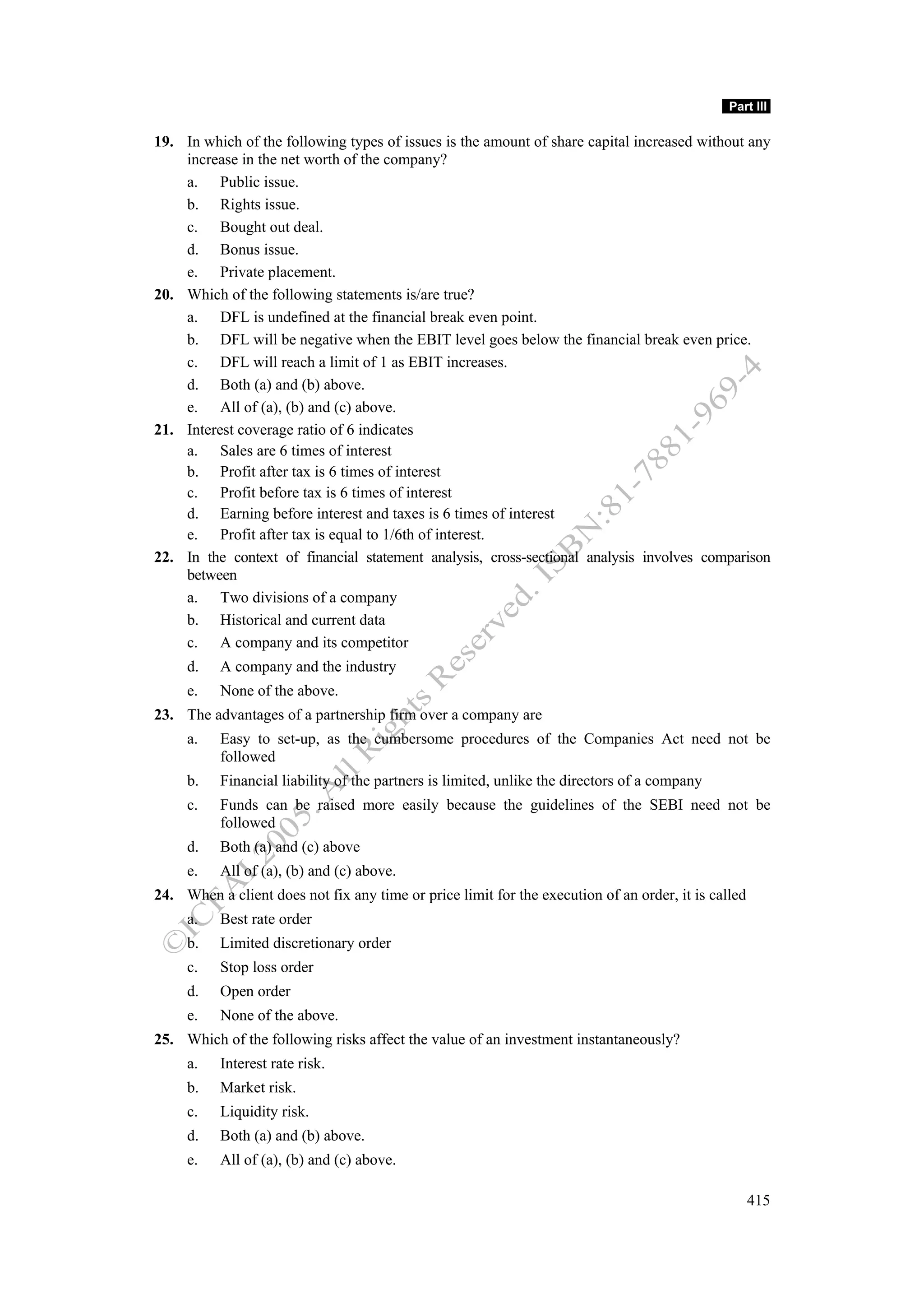
Contents


PAPER I


Brief Summaries of Chapters                                                 1


Part I: Questions on Basic Concepts and Answers (with Explanatory Notes)   10


Frequently Used Formulae                                                   101


Part II: Problems and Solutions                                            108


Part III: Model Question Papers (with Suggested Answers)                   333


PAPER II


Brief Summaries of Chapters                                                467


Part I: Questions on Basic Concepts and Answers (with Explanatory Notes)   480


Frequently Used Formulae                                                   560


Part II: Problems and Solutions                                            570


Part III: Model Question Papers (with Suggested Answers)                   749
Detailed Curriculum
                                         Paper I
Introduction to Financial Management: Objectives, Functions and Scope, Evolution, Interface of
Financial Management with Other Functional Areas, Environment of Corporate Finance.
Indian Financial System:
a. Financial Markets: Money Market, Forex Market, Government Securities Market, Capital
     Market, Derivatives Market, International Capital Markets.
b. Participants:
     i.    Financial Institutions: IDBI, IFCI, ICICI, IIBI, EXIM Bank, SFCs, SIDCs
     ii. Insurance Companies: LIC, GIC
     iii. Investment Institutions: UTI, Mutual Funds, Commercial Banks; Non-Banking
           Financial Companies; Housing Finance Companies; Foreign Institutional Investors.
c. Regulatory Authorities: RBI, SEBI, IRA.
Time Value of Money: Introduction; Future Value of a Single Cash Flow, Multiple Flows and
Annuity, Present Value of a Single Cash Flow, Multiple Flows and Annuity.
Risk and Return: Risk and Return Concepts, Risk in a Portfolio Context, Relationship between
Risk and Return.
Leverage: Concept of Leverage, Operating Leverage, Financial Leverage, Total Leverage.
Valuation of Securities: Concept of Valuation, Bond Valuation, Equity Valuation: Dividend
Capitalization Approach and Ratio Approach, Valuation of Warrants and Convertibles.
Financial Statement Analysis: Ratio Analysis, Time Series Analysis, Common Size Analysis, Du
Pont Analysis, Funds Flow Analysis, Difficulties associated with Financial Statement Analysis.
Financial Forecasting: Sales Forecast, Preparation of Pro forma Income Statement and Balance
Sheet, Growth and External Funds Requirement.
                                           Paper II
Sources of Long-Term Finance: Equity Capital and Preference Capital, Debenture Capital, Term
Loans and Deferred Credit, Government Subsidies, Sales Tax Deferments and Exceptions, Leasing
and Hire Purchase.
Cost of Capital and Capital Structure Theories: Cost of Debentures, Term Loans, Equity
Capital and Retained Earnings, Weighted Average Cost of Capital, Systems of Weighting,
Introduction to Capital Structure, Factors affecting Capital Structure, Features of an Optimal
Capital Structure, Capital Structure Theories: Traditional Position, MM Position and its Critique
Imperfections.
Dividend Policy: Traditional Position, Walter Model, Gordon Model, Miller & Modigliani
Position, Rational Expectations Model.
Estimation of Working Capital Needs: Objectives of Working Capital (Conservative vs.
Aggressive Policies), Static vs. Dynamic View of Working Capital, Factors affecting the
Composition of Working Capital, Interdependence among Components of Working Capital,
Operating Cycle Approach to Working Capital.
Financing Current Assets: Behavior of Current Assets and Pattern of Financing, Accruals, Trade
Credit, Provisions, Short-Term Bank Finance, Public Deposits, Commercial Paper, Factoring,
Regulation of Bank Credit.
Management of Working Capital:
a. Inventory Management: Nature of Inventory and its Role in Working Capital, Purpose of
     Inventories, Types and Costs of Inventory, Inventory Management Techniques, Pricing of
     Investments, Inventory Planning and Control;
b. Receivables Management: Purpose of Receivables, Cost of Maintaining Receivables, Credit
     Policy Variables (Credit Standard, Credit Period, Cash Discount, Collection Program), Credit
     Evaluation, Monitoring Receivables;
c. Treasury Management and Control;
d. Cash Management: Meaning of Cash, Need for and Objectives of Cash Management, Cash
     Forecasting and Budgets, Cash Reports, Factors and Efficient Cash Management.
Capital Expenditure Decisions: The Process of Capital Budgeting, Basic Principles in Estimating
Costs and Benefits of Investments, Appraisal Criteria: Payback Period, Average Rate of Return,
Net Present Value, Benefit-Cost Ratio, Internal Rate of Return, Annual Capital Charge,
Infrastructure Decisions and Financing.
Current Developments.
Brief Summaries of Chapters
Introduction to Financial Management
•   The financial goal of any firm including public sector firms is to maximize the wealth of the
    shareholders by maximizing the value of the firm.
•   The objective of financial manager is to increase or maximize the wealth of owners by
    increasing the value of the firm which is reflected in its earning per share and market value of
    the firm.
•   Function of finance manager includes mobilization of funds, deployment of funds, control
    over the use of fund, and balancing the trade-off between risk and return.
•   The advantages of sole proprietorship are (i) easy and inexpensive set up. (ii) few
    governmental regulations and (iii) no firm tax. Partnership firm is a business owned by two
    or more persons. They are partners in business and they bear the risks and reap the rewards of
    the business. A partnership firm is governed by the Indian Partnership Act, 1932. Hence
    it is relatively free from governmental regulations as compared to the joint stock
    companies. A group of persons working towards a common objective is a company. It
    represents different kinds of associations, be it business or non-business.
•   Corporate investment and financing decisions are circumscribed by a government regulatory
    framework. The important elements of these framework are: (i) Industrials policy
    (ii) Industrial licensing provisions and procedure (iii) Regulation of Foreign Collaborations
    and Investment (iv) Foreign Exchange Management Act (v) Companies Act and (vi) SEBI.
Indian Financial System
•   The economic development of a country depends on the progress of its various economic
    units, namely the Corporate Sector, Government Sector and the Household Sector.
•   The role of the financial sector can be broadly classified into the savings function, policy
    function and credit function.
•   The main types of financial markets are: money market, capital market, forex market and
    credit market.
•   The financial markets are further sub-divided into the Primary market and the Secondary market.
•   A market is considered perfect if all the players are price takers, there are no significant
    regulations on the transfer of funds and transaction costs, if any, are very low.
•   The accounting equation: Assets = Liabilities, can be altered as
    Financial Assets + Real Assets = Financial Liabilities + Savings.
•   The main types of financial assets are deposits, stocks and debt.
•   While designing a financial instrument, the issuer must keep the following in mind: cash
    flows required, taxation rules, leverage expected, dilution of control facts, transaction costs to
    be incurred, quantum of funds sought, maturity of plan required, prevalent market conditions,
    investor profile targeted, past performance of issues, cost of funds to be borne, regulatory
    aspects to abide by.
•   While investing in a financial instrument, the investor must keep the following in mind: risk
    involved, liquidity of the instrument, returns expected, possible tax planning, cash flows
    required and simplicity of investment.
•   Various financial intermediaries came into existence to facilitate a proper channel for
    investment. The main ones are: stock exchanges, investment bankers, underwriters,
    registrars, depositories, custodians, primary dealers, satellite dealers and forex dealers.
Time Value of Money
•   Additional compensation required for parting with say Rs.1,000 now is called ‘interest’.
•   There are two methods by which the time value of money can be taken care of compounding
    and discounting.
•   Under the method of compounding, we find the Future Values (FV) of all the cash flows at
    the end of the time horizon at a particular rate of interest.
•   Under the method of discounting, we reckon the time value of money now i.e. at time zero on
    the time line. So, we will be comparing the initial outflow with the sum of the Present Values
    (PV) of the future inflows at a given rate of interest.
•   To determine the accumulation of multiple flows as at the end of a specified time horizon, we
    have to find out the accumulations of each of these flows using the appropriate FVIF and sum
    up these accumulations.
•   Annuity is the term used to describe a series of periodic flows of equal amounts.
•   To determine the present value, we have to first define the relevant rate of interest.
Risk and Return
•   The risk associated with a common stock is interpreted in terms of the variability of its
    return. The most common measures of riskiness of security are standard deviation and
    variance of returns.
•   Unsystematic risk is the extent of the variability in the security’s return on account of the
    firm specific risk factors. This is also called diversifiable or avoidable risk factors.
•   Systematic risk refers to factors which affect the entire market and hence the firm too. This is
    also called non-diversifiable risk.
•   If a portfolio is well diversified, the unsystematic risk gets almost eliminated. The
    non-diversifiable risk arising from the wide movements of security prices in the market is
    very important to an investor. The modern portfolio theory defines the riskiness of a security
    as its vulnerability to market risk. This vulnerability is measured by the sensitivity of the
    return of the security vis-á-vis the market return and is called beta.
•   The concept of security market line is developed by the modern portfolio theory. SML
    represents the average or normal trade-off between risk and return for a group of securities.
    Here the risk is measured typically in terms of the beta values.
    Application of Security Market Lines:
    The ex post SML is used to evaluate the performance of portfolio manager; tests of
    asset-pricing theories, such as the CAPM and to conduct tests of market efficiency.
    The ex ante SML is used to identify undervalued securities and determine the consensus,
    price of risk implicit in the current market prices.
    Depending upon the value of alpha, using SML it is possible to estimate whether the scrip is
    underpriced (it is then eligible to be purchased) or overpriced (it is then eligible to be sold).
Valuation of Securities
•   Value of any security can be defined as the present value of the future cash streams i.e., the
    intrinsic value of an asset should be equated to the present value of the benefits associated
    with it.
•   Book value is an accounting concept. Assets are recorded at historical costs and they are
    depreciated over years. Book value includes intangible assets at acquisition cost minus
    amortized value. The book value of debt is stated at the outstanding amount. The difference
    between the book value of assets and liabilities is equal to shareholder’s funds or net worth
    (which is equal to paid-up equity capital plus reserves and surplus).
•   Replacement Value is the amount that a company would be required to spend if it were to
    replace its existing assets in the current condition.


2
•   Liquidation Value is the amount that a company could realize if it sells its assets after having
    terminated its business. It is generally a minimum value which a company might accept if it
    sells its business.
•   Going Concern Value is the amount that a company could realize if it sells its business as an
    operating one. Its value would always be higher than the liquidation value, the difference
    accounting for the usefulness of assets and value of intangibles.
•   Market Value of an asset or security is the current price at which the asset or the security is
    being sold or bought in the market.
•   Face Value: This is the value stated on the face of the bond and is also known as par value. It
    represents the amount of borrowing by the firm which it specifies to repay after a specific
    period of time i.e., at the time of maturity. A bond is generally issued at face value or par
    value which is usually Rs.100 and may sometimes be Rs.1,000.
•   Coupon Rate or Interest: A bond carries a specific rate of interest which is also called as the
    coupon rate. The interest payable is simply the par value of the bond × Coupon Rate. Interest
    paid on a bond is tax deductible for the issuer.
•   Maturity: A bond is issued for a specific period of time. It is repaid on maturity. Typically
    corporate bonds have a maturity period of 7-10 years whereas government bonds have a
    maturity period up to 20-25 years.
•   Redemption Value: The value which a bondholder gets on maturity is called redemption
    value. A bond may be redeemed at par, at premium (more than par value) or at discount (less
    than par value).
•   Market Value: A bond may be traded in a stock exchange. Market value is the price at which
    the bond is usually bought or sold in the market. Market value may be different from Par
    Value or redemption value.
•   One Period Rate of Return: If a bond is purchased and then sold one year later, its rate of
    return over this single holding period can be defined as rate of return.
•   Current Yield measures the rate of return earned on a bond if it is purchased at its current
    market price and if the coupon interest is received.
•   Coupon rate and current yield are two different measures. Coupon rate and current yield will
    be equal if the bond’s market price equals its face value.
•   Yield-to-Maturity (YTM): It is the rate of return earned by an investor who purchases a bond
    and holds it till maturity. The YTM is the discount rate which equals the present value of
    promised cash flows to the current market price/purchase price.
•   Based on the bond valuation model, several bond value theorems have been derived which
    state the effect of the following factors on bond values:
    I.     Relationship between the required rate of return and the coupon rate.
    II. Number of years to maturity.
    III. Yield-to-maturity.
•   When the required rate of return (kd) is equal to the coupon rate, the value of the bond is
    equal to its Par Value.
    i.e., If kd = Coupon Rate;
    then value of a bond = Par Value.
•   When the required rate of return (kd) is greater than the coupon rate, the value of the bond is
    less than its par value.
    If kd > coupon rate; then value of a bond < par value.
•   When the required rate of return (kd) is less than the coupon rate, the value of the bond is
    greater than its par value.
    i.e., if kd < coupon rate; then value of a bond > par value.


                                                                                                  3
•   When the required rate of return (kd) is greater than the coupon rate, the discount on the bond
    declines as maturity approaches.
•   When the required rate of return (kd) is less than the coupon rate, the premium on the bond
    declines as maturity approaches.
•   A bond’s price is inversely proportional to its yield to maturity.
•   For a given difference between YTM and coupon rate of the bonds, the longer the term to
    maturity, the greater will be the change in price with change in YTM.
•   Given the maturity, the change in bond price will be greater with a decrease in the bond’s
    YTM than the change in bond price with an equal increase in the bond’s YTM. That is, for
    equal sized increases and decreases in the YTM, price movements are not symmetrical.
•   For any given change in YTM, the percentage price change in case of bonds of high coupon
    rate will be smaller than in the case of bonds of low coupon rate, other things remaining the
    same.
•   A change in the YTM affects the bonds with a higher YTM more than its does bonds with a
    lower YTM. A warrant is a call option to buy a stated number of shares.
•   The exercise price of a warrant is what the holder must pay to purchase the stated number of
    shares.
•   A convertible debenture, as the name indicates, is a debenture which is convertible partly or fully,
    into equity shares. If it is partially converted, it is referred to as ‘partly convertible debenture’ and if
    the debentures are converted into equity shares at the end of maturity fully, it is referred to as ‘fully
    convertible debentures’. The option of conversion is either at the discretion of the investor, i.e.,
    (optional) or compulsory (if it is specified).
•   The conversion ratio gives the number of shares of stock received for each convertible
    security. If only the conversion ratio is given, the par conversion price can be obtained by
    dividing the conversion ratio multiplied by the face or par value of the convertible security.
•   The conversion value represents the market value of the convertible if it were converted into
    stock; this is the minimum value of the convertible based on the current price of the issuer’s
    stock.
•   Intrinsic value is the value of a stock which is justified by assets, earnings, dividends, definite
    prospects and the factor of the management of the issuing company.
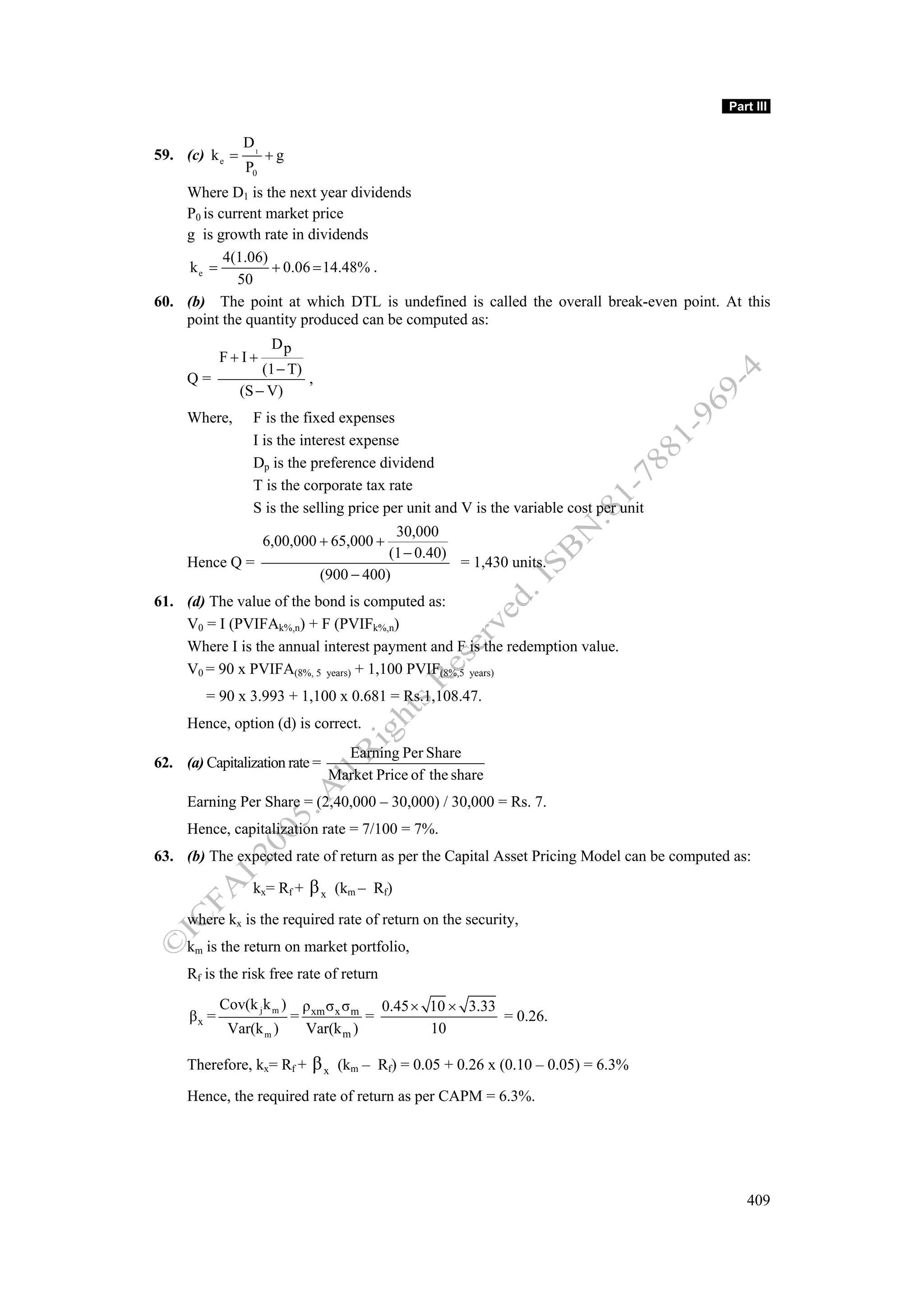
•   According to the dividend capitalization approach, which is a conceptually sound approach,
    the value of an equity share is the discounted present value of dividends received plus the
    present value of the resale price expected when the equity share is sold.
•   The E(P/E) ratio is formed by dividing the present value of the share by the expected
    earnings per share denoted by E(EPS).
Financial Statement Analysis
•   A financial statement is a compilation of data, which is logically and consistently organized
    according to accounting principles.
•   Financial Statement Analysis consists of the application of analytical tools and techniques to
    the data in financial statements in order to derive from them measurements and relationships
    that are significant and useful for decision making.
•   The financial data needed in the financial analysis come from many sources.
•   The important tools of analysis:
    1.    Ratio Analysis
          – Comparative Analysis
          – Du Pont Analysis
    2.    Funds flow Analysis.


4
•   The analysis of a ratio can disclose relationships as well as bases of comparison that reveal
    conditions and trends that cannot be detected by going through the individual components of
    the ratio. The usefulness of ratios is ultimately dependent on their intelligent and skillful
    interpretation.
•   Financial ratios fall into three groups:
    1.     Liquidity Ratios
    2.     Profitability or Efficiency Ratios
    3.     Ownership Ratios
           –   Earnings Ratios
           –   Dividend Ratios
           –   Leverage Ratios
               a. Capital Structure Ratios
               b. Coverage Ratios.
•   Liquidity implies a firm’s ability to pay its debts in the short run.
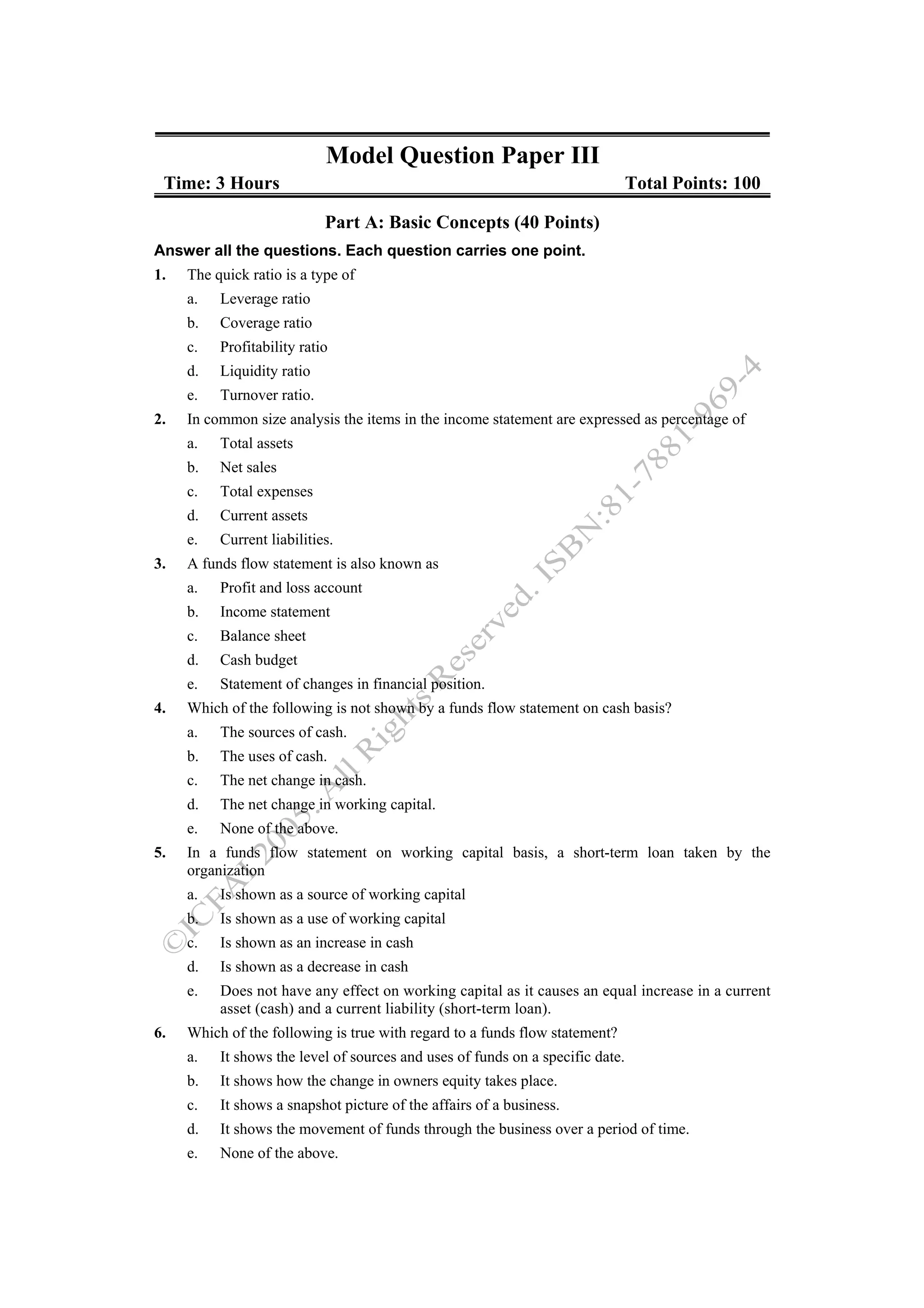
•   Current Ratio:
                                          Current Assets
    The liquidity ratio is defined as:
                                         Current Liabilities
    Current assets include cash, marketable securities, debtors, inventories, loans and advances,
    and pre-paid expenses. Current liabilities include loans and advances taken, trade creditors,
    accrued expenses and provisions.
•   Quick Ratio Quick-test (also acid-test ratio) is defined as:
           Quick Assets        Quick Assets − Inventories
    =                        =
         Current Liabilities      Current Liabilities
                                                        Short − term bank borrowings
•   Bank Finance to Working Capital Gap Ratio =
                                                            Working capital gap
    where Working capital gap is equal to current assets less current liabilities other than bank
    borrowings.
                                                    Net credit sales
•   Accounts receivable turnover ratio =
                                               Average accounts receivable
                                                     360
•   Average collection period =
                                      Average accounts receivable turnover
                                      Average accounts receivable
                                  =
                                          Average daily sales
                              Cost of goods sold
•   Inventory turnover =
                              Average inventory
                                                               Gross Pr ofit
•   The Gross Profit Margin Ratio (GPM) is defined as:
                                                                Net Sales
    Where net sales = Sales – Excise duty.
                                                            Net Pr ofit
•   The Net Profit Margin ratio (NPM) is defined as:
                                                            Net Sales
                                               Sales
•   Asset turnover ratio is defined as:
                                           Average assets


                                                                                               5
•   Earning power is a measure of operating profitability and it is defined as:
         Earning before interest and taxes
                Average total assets
•   Return on Equity
    The Return on Equity (ROE) is an important profit indicator to shareholders of the firm. It is
                                Net income
    calculated by the formula:
                               Average equity
•   Ownership ratios are divided into three main groups. They are:
    1.    Earnings Ratios
    2.    Leverage Ratios
          –     Capital Structure Ratios
          –     Coverage Ratios
    3. Dividend Ratios.
•   The earnings ratios are Earnings Per Share (EPS), price-earnings ratio (P/E ratio), and
    capitalization ratio. From earnings ratios we can get information on earnings of the firm and
    their effect on price of common stock.
                                         Net income (PAT)
•   Earning Per Share (EPS) =
                                     Number of outstanding shares
                                    Market price of theshare
•   Price earnings multiple =
                                      Earnings per share
                                Earnings per share
•   Capitalization rate =
                              Market price of the share
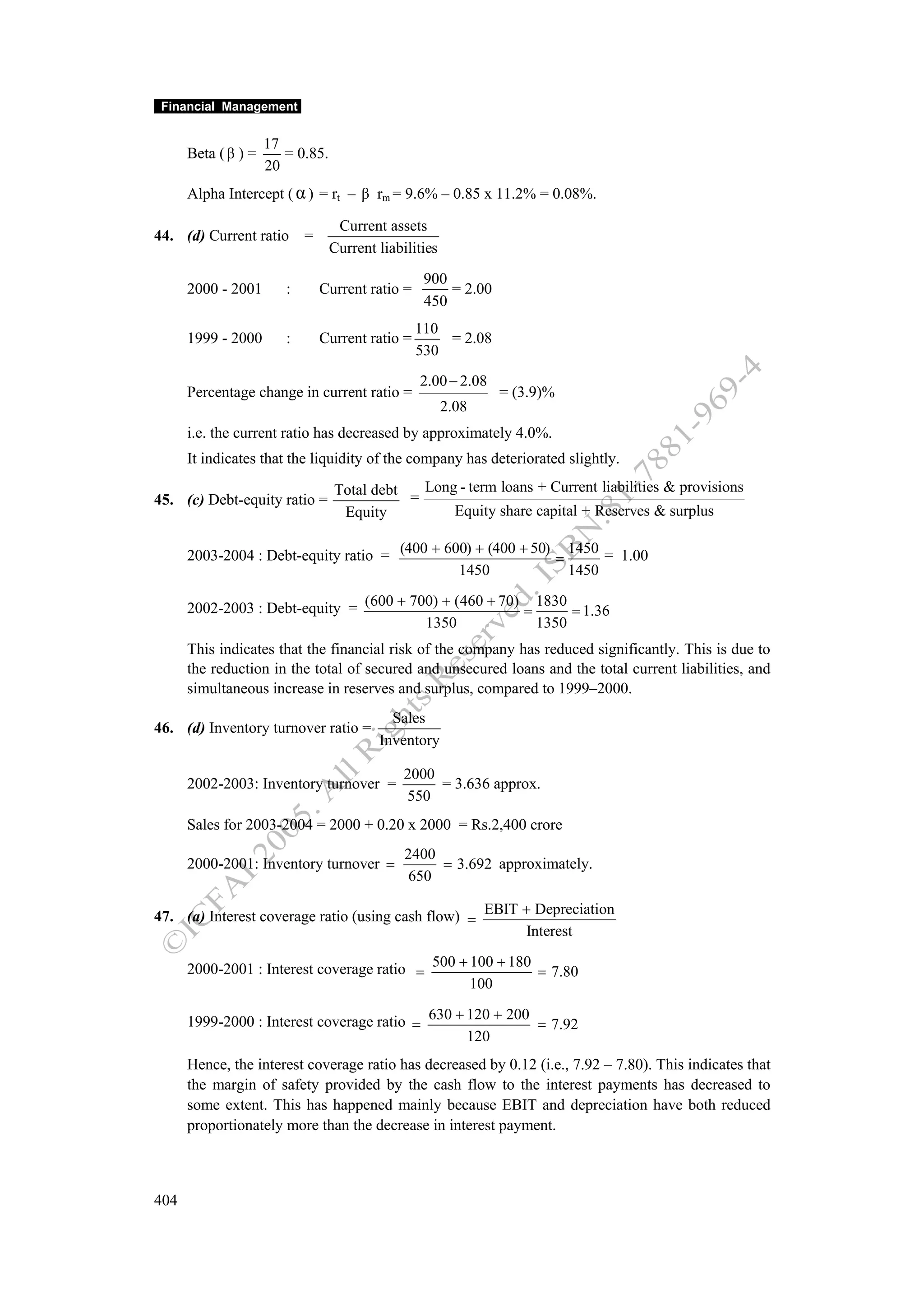
                            Debt
•   Debt equity ratio =
                           Equity
                           Debt
•   Debt-Asset ratio =
                           Assets
                                      EBIT
•   Interest coverage ratio =
                                Interest expense
•   Fixed charges coverage ratio
               Earning     before depreciation, debt interest   and lease rentals and taxes
        =
            Debt interest + Lease rentals + Loan repayment installment + Preference dividends
                                                    (1− tax rate)             (1− tax rate)
•   Debt Service Coverage Ratio
            PAT + Depreciation + Other non − cash charges + Interest on term loan
    =
                    Interest on term loan + Repayment of the term loan
•   Dividend Pay-out Ratio
    This is the ratio of Dividend Per Share (DPS) to Earnings Per Share (EPS)
                           Dividend per share
•   Divident yield =
                         Market price of theshare
•   Different types of comparative analysis are:
    1.      Cross-sectional analysis
    2.      Time-series analysis
            a. Year-to-year change
            b. Index analysis
    3.      Common-size analysis.

6
•   Cross-sectional analysis is used to assess whether the financial ratios are within the limits,
    they are compared with the industry averages or with a good player in normal business
    conditions if an organized industry is not there.
•   A comparison of financial statements over two to three years can be undertaken by
    computing the year-to-year change in absolute amounts and in terms of percentage changes.
•   When a comparison of financial statements covering more than three years is undertaken, the
    year-to-year method of comparison may become too cumbersome.
•   In the analysis of financial statements, it is often instructive to find out the proportion that a
    single item represents of a total group or subgroup. In a balance sheet, the assets, the
    liabilities and the capital are each expressed as 100%, and each item in these categories is
    expressed as a percentage of the respective totals. Similarly, in the income statement, net
    sales are set at 100% and every other item in the statement is expressed as a percentage of net
    sales.
•   Analyzing return ratios in terms of profit margin and turnover ratios, referred to as the
    Du Pont System.


Funds Flow Analysis
•   A funds flow statement is a statement which explains the various sources from which funds
    are raised and the uses to which these funds are put.
•   The major difference, however, between a true funds flow statement and a balance sheet lies
    in the fact that the former captures the movements in funds, while the latter merely presents a
    static picture of the sources and uses of funds.
•   A funds flow statement would enable one to see how the business financed its fixed assets,
    built up the inventory, discharged its liabilities, paid its dividends and taxes and so on.
    Similarly, it would enable one to see how the business managed to meet the above capital
    or revenue expenditure.
•   The simplest funds flow statement for a period is the difference between the corresponding
    balance sheet items at the beginning and the end of the period, such that all increases in
    liabilities and decreases in assets are shown as sources of funds and all decreases in liabilities
    and increases in assets are shown as applications of funds.
•   FFS can also be prepared with the help of the two balance sheets (opening and closing) and
    the profit and loss statement of the intervening period. Such a funds flow statement defines
    funds as “total resources” and the sources of funds will always be equal to the uses of funds.

                                                                                                    7
•   A funds flow statement may be so prepared as to explain only the change in the working
    capital (current assets and current liabilities) from the beginning of a period to the end of the
    period.
•   Sources of funds that increase cash are:
    –    A net decrease in any asset other than cash or fixed assets.
    –    A gross decrease in fixed assets.
    –    A net increase in any liability.
    –    Proceeds from the sale of equity or preference stock.
    –    Funds from operations.
•   Uses of funds which decrease cash include:
    –    A net increase in any asset other than cash or fixed assets.
    –    A gross increase in fixed assets.
    –    A net decrease in any liability.
    –    A retirement or purchase of stock.
    –    Cash dividends.
•   Gross changes in fixed assets is calculated by adding depreciation for the period to net fixed
    assets at the ending financial statement date. From this figure, the net fixed assets at the
    beginning of financial statement date is deducted.
•   An increase in a current asset results in an increase in working capital.
•   A decrease in a current asset results in a decrease in working capital.
•   An increase in a current liability results in a decrease in working capital.
•   A decrease in a current liability results in an increase in working capital.
Leverage
•   Leverage is the influence which an independent financial variable has over a dependent/
    related financial variable.
•   Operating leverage examines the effect of the change in the quantity produced on the EBIT
    of the company and is measured by calculating the Degree of Operating Leverage (DOL).
•   A large DOL indicates that small fluctuations in the level of output will produce large
    fluctuations in the level of operating income.
•   DOL is a measure of the firm’s business risk. Business risk refers to the uncertainty or
    variability of the firm’s EBIT. So, every thing else being equal, a higher DOL means higher
    business risk and vice-versa.
•   The financial leverage measures the effect of the change in EBIT on the EPS of the company.
    Financial leverage refers to the mix of debt and equity in the capital structure of the
    company. The measure of financial leverage is the Degree of Financial Leverage (DFL)
•   If the management decides to finance a part of the total investment required of through debt
    financing, the following two factors are important: The proportion of total investment which
    the management decides to finance through debt (Debt Equity Ratio the firm aspires to) and
    the interest rate on borrowed funds.
•   The greater the tax rate, the more is the tax shield available to a company which is financially
    leveraged.
•   As the company becomes more financially leveraged, it becomes riskier, i.e., increased use of
    debt financing will lead to increased financial risk which leads to: Increased fluctuations in
    the return on equity and increase in the interest rate on debts.
•   The greater the use of financial leverage, the greater the potential fluctuation in return
    on equity.


8
•   As the interest rate increases, the return on equity decreases. Even though the rate of return
    diminishes, it might still exceed the rate of return obtained when no debt was used, in which
    case financial leverage would still be favorable.
•   A combination of the operating and financial leverages is the total or combined leverage.
    Thus, the Degree of Total Leverage (DTL) is the measure of the output and EPS of the
    company. DTL is the product of DOL and DFL
•   There is a unique DTL for every level of output. At the overall break-even point of output the
    DTL is undefined. If the level of output is less than the overall break-even point, then the
    DTL will be negative. If the level of output is greater than the overall break-even point, then
    the DTL will be positive. DTL decreases as the quantity of sales increases and reaches a
    limit of one.
•   DTL measures the changes in EPS to a percentage change in quantity of sales.
•   DTL measures the total risk of the company since it is a measure of both operating risk and
    total risk.
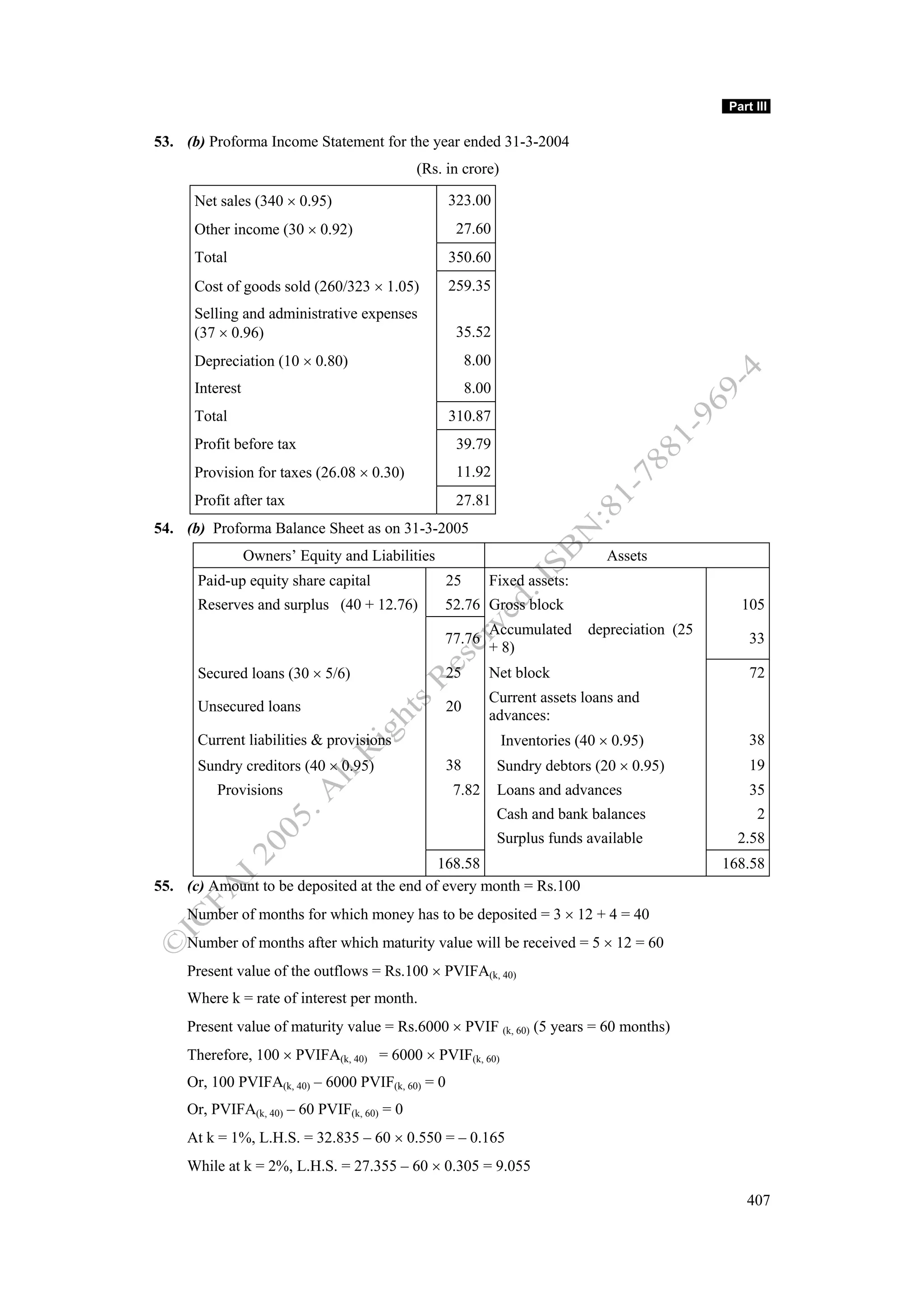
Financial Forecasting
•   Financial forecasting is a planning process with which the company’s management positions
    the firm’s future activities relative to the expected economic, technical, competitive and
    social environment.
•   There are three main techniques of financial projections. They are proforma financial
    statements, cash budgets and operating budgets.
•   Proforma statements are projected financial statements embodying a set of assumptions about
    a company’s future performance and funding requirements.
•   Cash budgets are detailed projections of the specific incidence of cash moving in and out of
    the business.
•   Operating budgets are detailed projections of departmental revenue and/or expense patterns,
    and they are subsidiary to both proforma statements and cash flow statements.
•   Sales Budget can be prepared by making a sales forecast, sales forecast can be made from
    subjective and objective methods.
•   Subjective methods use the judgments or opinions of knowledgeable individuals within
    the company, ranging from sales representatives to executives.
•   Objective methods are statistical methods which range in sophistication from relatively
    simple trend extrapolations to the use of complicated mathematical models. More and more
    companies are relying on computers to predict causal relationships.


                                                                                                 9
Part I: Questions on Basic Concepts
Introduction to Financial Management
1.   The financial goal of a public sector firm fully owned by the government is to
     a     Maximize the book value per share
     b. Maximize the profits earned by the firm
     c. Maximize the present value of stream of equity returns
     d. Maximize the return on equity
     e. Both (a) and (d) above.
2.   Which of the following is not an objective of financial management?
     a. Maximization of wealth of shareholders.
     b. Maximization of profits.
     c. Mobilization of funds at an acceptable cost.
     d. Efficient allocation of funds.
     e. Ensuring discipline in the organization.
3.   Which of the following is not a function of a finance manager?
     a. Mobilization of funds.
     b. Deployment of funds.
     c. Control over use of funds.
     d. Manipulate share price of the company.
     e. Maintain a balance between risk and return.
4.   The market value of the firm is the result of
     a.    Dividend decisions
     b. Working capital decisions
     c. Capital budgeting decisions
     d. Trade-off between cost and risk
     e. Trade-off between risk and return.
5.   Which of the following is related to the control function of the financial manager?
     a. Interaction with the bankers for arranging a short-term loan.
     b. Comparing the costs and benefits of different sources of finance.
     c. Analysis of variance between the targeted costs and actual costs incurred.
     d. Assessing the costs and benefits of a project under consideration.
     e. Deciding the optimum quantity of raw materials to be ordered for procurement.
6.   The minimum number of persons required to form a private limited company and a public
     limited company respectively are
     a. 2 and 5
     b. 5 and 7
     c. 2 and 7
     d. 7 and 2
     e. None of the above.
7.   Which of the following is an advantage of a sole proprietorship?
     a. Life of a firm is limited to the life of the owner.
     b. Fund raising from outside is easy.
     c. Limited personal liabilities.
     d. Easy and inexpensive to set-up.
     e. Expansion of Business is possible.
Part I

 8. Which of the following is an advantage of partnership firms?
     a.   The life of the firm is perpetual.
     b.   Personal liabilities of the partners are limited.
     c.   Its ability to raise funds is virtually unlimited.
     d.   It is relatively free from Governmental regulations as compared to joint stock
          companies.
     e.   None of the above.
 9. The objective of financial management is to
     a.   Generate the maximum net profit
     b.   Generate the maximum retained earnings
     c.   Generate the maximum wealth for its shareholders
     d.   Generate maximum funds for the firm at the least cost
     e.   All of the above.
10. Which of the following statements represents the financing decision of a company?
     a.   Procuring new machineries for the R&D activities.
     b.   Spending heavily for the advertisement of the product of the company.
     c.   Adopting state of the art technology to reduce the cost of production.
     d.   Purchasing a new building at Delhi to open a regional office.
     e.   Designing an optimal capital structure by using suitable financial instruments.
11. The amount that can be realized by a company when it sells its business as an operating one
    is termed as
     a.   Going concern value
     b.   Market value
     c.   Book value
     d.   Replacement value
    e. Liquidation value.
12. Which of the following functions of the financial system facilitates conversion of investments
    in stocks, bonds, debentures etc., into money?
    a. Savings function.
    b. Liquidity function.
    c. Payment function.
    d. Risk function.
    e. Policy function.
13. The objective of financial management to increase the wealth of the shareholders means to
    a. Increase the physical assets owned by the firm
    b. Increase the market value of the shares of the firm
    c. Increase the current assets of the firm
    d. Increase the cash balance of the company
    e. Increase the total number of outstanding shares of the company.
14. Which of the following is a function of the finance manager?
    a. Mobilizing funds.
    b. Risk return trade off.
    c. Deployment of funds.
    d. Control over the uses of funds.
    e. All of the above.
                                                                                                11
Financial Management


Indian Financial System
15. A financial asset should necessarily have
     a.   A claim to a payment in the form of an instrument
     b.   An underlying asset, with a charge over it
     c.   Parting of money today with an expectation that it will be returned in future with some
          addition to it
     d.   Both (a) and (c) above
     e.   All of (a), (b) and (c) above.
16. Which is/are the essential feature(s) of a Call Money Market?
     a.   Maturity periods of 1-15 days.
     b.   Market determined interest rates.
     c.   Low liquidity.
     d.   High agency costs.
     e.   Both (a) and (b) above.
17. The apex financial institution in India that promotes housing finance is
     a.   Housing & Urban Development Corporation (HUDCO)
     b.   Housing Development Finance Corporation Ltd. (HDFC)
     c.   Cooperative Housing Finance Society
     d.   National Housing Bank (NHB)
     e.   LIC Housing Finance Limited.
18. “Single Window Lending” refers to
     a.   An arrangement by which the lead bank in a consortium of banks releases the initial
          requirements of the borrower
     b.   Loans given by commercial banks to the agricultural sector, which are subject to
          efinance from NABARD
     c.   A specialized cell set up in scheduled banks exclusively for the purpose of industrial
          loans
     d.   Priority sector lending by nationalized banks
     e.   Loans given by NBFCs to some sectors to which nationalized banks are not allowed to
          give.
19. The difference(s) between Commercial Paper (CP) and Certificate of Deposit (CD) is/are
     a.   CP is secured while CD is unsecured
     b.   CPs can be issued by private sector companies while CDs can be issued by scheduled
          banks
     c.   CP is sold at a discount and redeemed at face value whereas for CD the principal and
          interest are payable upon maturity
     d.   Both (b) and (c) above
     e.   All of (a), (b) and (c) above.
20. The money lent in money market for a period of 2 to 15 days is referred to as
     a.   Call money
     b.   Demand loan
     c.   Term loan
     d.   Notice money
     e.   None of the above.


12
Part I

21. Which of the following are feature(s) of Gilt-edged securities?
     a.   Only repayment of principal is secured.
     b.   They are issued by non-governmental service organizations.
     c.   They are issued by government entities.
     d.   The repayments of both principal and interest are secured.
     e.   Both (c) and (d) above.
22. Which of the following provides liquidity to money market instruments by creating a
    secondary market where they can be traded?
     a.   Discount and Finance House of India.
     b.   National Securities Depository Limited.
     c.   State Bank of India.
     d.   Reserve Bank of India.
     e.   Over the Counter Exchange of India.
23. Which of the following is an example of non-fund based activity of an NBFC?
     a.   Bill discounting.
     b.   Leasing.
     c.   Issue management.
     d.   Hire purchase.
     e.   Inter-corporate loans.
24. The minimum maturity period for a Certificate of Deposit is
     a.   Fifteen days
     b.   One month
     c.   Three months
     d.   Six months
     e.   No specific time limit is prescribed.
25. Statutory Liquidity Ratio (SLR) refers to the
     a.   Percentage of secret reserves which acts as a cushion for nationalized banks
     b.   Percentage of reserves banks are required to park with instruments approved by RBI
     c.   Ratio between current account and fixed account deposits of banks
     d.   Percentage of reserves banks are required to utilize only for forex transactions
     e.   Percentage of reserves meant for priority sector lending.
26. Public debt in the Indian economy is being managed by
     a.   SBI on behalf of Government of India
     b.   Ministry of Finance
     c.   RBI
     d.   All nationalized banks and term lending institutions
     e.   Ministry of Commerce and Trade.
27. In which of the following instances bought-out deal is more appropriate?
     a.   Companies do not wish to disclose information by way of public issue.
     b.   Promoters do not want to dilute their stake by going public.
     c.   Small projects require funds but costs of public issue are substantially high.
     d.   Foreign Institutional Investors offload their shares when market is down.
     e.   Board for Industrial and Financial Reconstruction (BIFR) offers a sick unit to existing
          blue chips in that industry.
                                                                                                 13
Financial Management

28. Which of the following is/are not a feature(s) of National Stock Exchange?
     a.   NSE was promoted by FIs at the bentest of GOI.
     b.   The trading is on-line in national network.
     c.   The volume of trading in it is less than that of BSE.
     d.   It has a debt market segment.
     e.   The weights to the stocks on NIFTY are based on total share holding.
29. Which of the following is/are not true in respect of PSU bonds?
     a.   There is no secondary market.
     b.   Market lot for trading purposes is minimum of Rs.10 crore.
     c.   They come under “approved investments” by RBI.
     d.   Both (a) and (b) above.
     e.   All of (a), (b) and (c) above.
30. Unit banking refers to the system
     a.   With a single bank having units at different places
     b.   With the overall operations of a bank conducted from a single office
     c.   Which deals with the units of UTI
     d.   Which deals with the units in small-scale sector
     e.   Either (a) or (b) above.
31. Which of the following is not a function performed by a financial system?
     a.   Savings function.
     b.   Liquidity function.
     c.   Risk function.
     d.   Social function.
     e.   Policy function.
32. The maturity period of a Certificate of Deposit (CD) issued by a bank is
     a.   Not less than 1 month and not more than 6 months
     b.   Not less than 2 months and not more than 9 months
     c.   Not less than 15 days and not more than 12 months
     d.   Not less than 4 months and not more than 12 months
     e.   Not less than 1 month and not more than 12 months
33. If in an order to buy/sell shares from a stock exchange is limited by a fixed price it is called
     a.   Limit order
     b.   Limited discretionary order
     c.   Stop loss order
     d.   Best rate order
     e.   None of the above.
34. ‘Gilt edged’ securities are the bonds issued by
     a.   Big corporates
     b.   Multinational corporates
     c.   Global corporations
     d.   Central government
     e.   Financial institutions.

14
Part I

35. Medium dated government securities have maturities ranging from
     a.   1 to 3 years
     b.   1 to 5 years
     c.   3 to 5 years
     d.   3 to 10 years
     e.   5 to 10 years.
36. Which of the following maturity of T-Bills does not have a provision?
     a.   30-day.
     b.   91-day.
     c.   182-day.
     d.   364-day.
     e.   None of the above.
37. In secondary spot capital market, the delivery and payment is completed
     a.   On the same day of the date of contract
     b.   On the next day of the date of contract
     c.   Within four days from the date of contract
     d.   Within 2 days from the date of contract
     e.   Beyond fourteen days from the date of contract.
38. The primary capital market
     a.   Imparts liquidity and marketability to long-term financial instruments
     b.   Helps companies to raise funds to finance their projects
     c.   Provides an auction market for long-term securities
     d.   Operates through the medium of stock exchanges
     e.   Both (a) and (c) above.
39. In a private company maximum number of members permissible is
     a.   5
     b.   10
     c.   25
     d.   50
     e.   100.
40. Banks borrow in call money market to
     a.   Give loans
     b.   Invest in high yielding securities
     c.   Meet the Cash Reserve Ratio (CRR)
     d.   Meet sudden demand for funds arising due to large payments and remittances
     e.   Both (c) and (d) above.
41. Which of the following is not a feature of Commercial Paper (CP)?
     a.   Purely secured instrument.
     b.   Maturity varies between 15 days and a year.
     c.   Buy-back facilities are available.
     d.   Negotiable by endorsement and delivery.
     e.   None of the above.

                                                                                           15
Financial Management

42. Which of the following is not a money market instrument?
     a.   Treasury bills.
     b.   Certificate of deposits.
     c.   Debentures.
     d.   Call money.
     e.   None of the above.
43. Private placement of shares can be made out of
     a.   Mutual funds quota
     b.   Promoters quota
     c.   Public quota
     d.   Financial institutions quota
     e.   All of the above.
44. An order to sell shares, where brokers are given a particular limit for sustenance of loss is
    known as
     a.   Limited discretionary order
     b.   Limit order
     c.   Cancel order
     d.   Stop loss order
     e.   Best rate order.
45. Which of the following is not true with regard to commercial paper?
    a. It is issued in multiples of Rs.5 lakhs.
    b. The minimum amount to be invested by a single investor is Rs.20 lakhs.
    c. The maturity period cannot exceed 1 year.
    d. These are unsecured promissory notes.
    e. The issuing company must have a high credit rating.
46. Which of the following enables a company to increase its paid-up share capital without
    receiving any payment from the recipients of the shares?
    a. Public issue.
    b. Bonus issue.
    c. Private placement.
    d. Bought-out deal.
    e. Rights issue.
47. In which of the following types of orders the members of stock exchange are not given any
    price or time limit by the client for execution of order?
    a. Limit order.
    b. Best rate order.
    c. Immediate or cancel order.
    d. Limited discretionary order.
    e. Open order.
48. Which of the following statements is false?
    a. All scheduled banks except co-operative banks and regional rural banks are eligible to
          issue CDs.
    b. CDs can be issued to individuals.
    c. CDs are issued at a discount to face value.
    d. The maturity period of CDs issued by banks varies from 15 days to one year.
    e. CDs are issued in multiples of one lakh subject to the minimum size of each issue of
          Rs.50 lakh.

16
Part I

49. Which of the following methods of issuing additional shares does not result in an increase in
    the net worth of the company?
     a.   Public issue.
     b.   Rights issue.
     c.   Bonus issue.
     d.   Private placement.
     e.   Bought-Out Deal.
50. The major categories of investors in primary market of government securities include
     a.   Reserve Bank of India
     b.   Financial institutions
     c.   Foreign financial institutions
     d.   Commercial banks
     e.   All of the above.
51. Which of the following is an asset of a bank?
    a. Balances with other banks.
    b. Savings deposits.
    c. Demand and time deposits from other banks.
    d. Refinance from NABARD.
    e. None of the above.
52. The National Housing Bank extends refinance on housing loans to
    a. Scheduled commercial banks
    b. Co-operative banks
    c. Housing finance companies
    d. Apex cooperative housing finance societies
    e. All of the above.
53. According to the guidelines of Money Market Mutual Funds, the minimum lock in period of
    an investor’s investment is
    a. Nil
    b. 15 days
    c. 30 days
    d. 45 days
    e. 60 days.
54. One of the important functions of a well developed money market is to channel savings into
    productive investments like working capital. Which of the following is not a money market
    instrument?
    a. Corporate debentures.
    b. Call money.
    c. Treasury bills.
    d. Commercial paper.
    e. Certificate of deposits.
55. Which of the following is not a feature of a commercial paper?
    a. They are transferable by endorsement and delivery.
    b. They are issued in multiples of one lakh.
    c. Their maturity varies from 15 days to one year.
    d. They are unsecured in nature.
    e. They normally have buy-back facility.

                                                                                               17
Financial Management

56. Which of the following is not an advantage of a bought out deal?
     a.   The promoters are assured of immediate funds.
     b.   The time consuming and costly public issue can be avoided.
     c.   It is easier to convince the wholesale investor rather than the general public.
     d.   The shares issued via bought out deal can be bought back by the company at any time.
     e.   It is the cheapest and quickest source of finance for small to medium sized companies.
57. If a company wants to raise funds through commercial paper market, the minimum fund
    based working capital limit should be
    a. Rs.1 crore
    b. Rs.2 crore
    c. Rs.3 crore
    d. Rs.4 crore
    e. Rs.5 crore.
58. In a Bought-Out Deal
    a. Companies issue shares to the public
    b. Companies issue shares to the existing shareholders
    c. Mutual funds buy out a part of promoter’s share
    d. A part of the equity of an unlisted company is bought by a sponsor/merchant banker
    e. Financial institutions buy out a significant portion of share capital of a listed company.
59. Which of the following is not a financial asset?
    a. Secured premium notes.
    b. National defence gold bond.
    c. Capital investment bond.
    d. Bullion.
    e. Special bearer bond.
60. Bills rediscounting facility is offered by
    a. All public sector banks
    b. Some co-operative banks
    c. IDBI
    d. All SFCs
    e. Both (c) and (d) above.
61. Which of the following statements is/are true?
    i.    A cash credit is a running account.
    ii. Cash credits may become long-term loans due to repeated roll-overs.
    iii. Overdrafts are allowed only against the security of inventories.
    a. Only (i) above.
    b. Only (ii) above.
    c. Only (iii) above.
    d. Both (i) and (ii) above.
    e. All of (i), (ii) and (iii) above.
62. Which of the following is not a money market instrument?
    a. Treasury bill.
    b. Commercial paper.
    c. Convertible debenture.
    d. Certificate of deposit.
    e. Both (b) and (c) above.

18
Part I

63. Which of the following statements is true regarding issuance of Commercial Paper (CP)?
     a.   Corporates need prior approval of RBI for CP issue.
     b.   Underwriting of a CP issue is not mandatory.
     c.   Minimum size of a CP issue is Rs.10 lakhs.
     d.   CPs have to be backed by a bank guarantee.
     e.   CPs are issued in multiples of Rs.1 lakh.
64. Which of the following statements is/are true regarding the call money market?
     a.   Surplus funds of banks constitute a major component.
     b.   Major corporates participate as lenders.
     c.   Banks often borrow from it for maintenance of SLR and CRR.
     d.   Both (a) and (b) above.
     e.   All of (a), (b) and (c) above.
65. Which of the following statements is/are true regarding 91-day Treasury Bills?
     a.   They are also referred to as PSU bonds.
     b.   They are issued through auctions conducted by RBI.
     c.   They are risky instruments as their interest rates fluctuate widely.
     d.   They cannot be rediscounted with RBI.
     e.   None of the above.
66. CRISIL
     a.   Rates, Debentures and fixed deposits.
     b.   Was set up by the Industrial Development Bank of India.
     c.   Gives the highest rating of “P1” to short-term instruments.
     d.   Does not consider non-financial factors while valuing a company’s securities.
     e.   None of the above.
67. Which of the following is not a money market instrument?
     a.   Call Loans.
     b.   Commercial Papers.
     c.   Certificates of Deposit.
     d.   Treasury Bills.
     e.   None of the above.
68. Which of the following is a form of direct assistance by All India Financial Institutions?
     a.   Underwriting.
     b.   Subscribing to a company’s shares.
     c.   Bills Rediscounting.
     d.   All of the above.
     e.   Both (a) and (b) above.
69. Which of the following statements is not true?
    a. The Industrial Credit and Investment Corporation of India has merged with ICICI bank.
    b. The Industrial Development Bank of India is the apex term lending financial institution.
    c. The Industrial Finance Corporation of India is an All India term lending financial
        institution.
    d. The Industrial Reconstruction Bank of India is the central agency for rehabilitation of
        Industrial units declared sick by BIFR only.
    e. None of the above.

                                                                                                 19
Financial Management

70. Which one of the following was not an objective of               Nationalization and greater
    governmental control over major banks?
     a.   Achieving wider spread of bank credit.
     b.   Preventing misuse of resources of banks.
     c.   Reducing the influence of business houses on banks.
     d.   Bringing larger income to the government.
     e.   None of the above.
71. Private Banks
     a.   Should not be registered as public limited companies
     b.   Need not adhere to capital adequacy norms determined by RBI
     c.   Are covered by the Banking Regulation Act, 1949
     d.   Should not be listed on any stock exchanges
     e.   Both (a) and (d) above.
72. Which of the following are the reasons for low profitability of the Commercial Banks?
     a.   High incidence of bad debt.
     b.   Inefficient procedures.
     c.   Overstaffing.
     d.   Priority sector lending.
     e.   All of the above.
73. Gilt-edged securities
    a. Have fairly active secondary market
    b. Have low interest rates
    c. Are subscribed mainly by commercial banks, provident funds and other institutional
          investors
    d. Are held by banks to satisfy their SLR requirements
    e. All of the above.
74. Which of the following is not true?
    a. There has been a general down trend in the nominal interest rates in the past few years.
    b. Term finance rates have been higher than the working capital finance rates.
    c. Interest rates in the organized sector in India are fixed by the government.
    d. Interest rate policy of the government is designed to mobilize substantial savings.
    e. Interest rate policy of the government is designed to facilitate government borrowing
          cheaply.
75. Certificates of Deposits (CDs)
    a. Are freely transferable by endorsement and delivery
    b. Are issued at a discount stipulated by RBI
    c. Are issued by RRBs
    d. Have no fixed maturity
    e. Have an active secondary market.
76. Which of the following statements is true?
    a. IDBI’s deep discount bonds are zero coupon bonds.
    b. When a company wants to raise a given amount of capital through a rights issue, the
          subscription price should ideally be higher than the current market price.
    c. Regional stock exchanges are unrecognized.
    d. The rupee is convertible on the capital account.
     e.   The alpha (α) of a security measures the return on the market portfolio.
20
Part I

77. The changes in the banking structure through nationalization has resulted in
     a.   Deeper penetration into rural areas
     b.   Increase in deposits
     c.   Channelization of bank credit
     d.   Lower operational autonomy for banks
     e.   All of the above.
78. The following indirect financial assistance is extended by the financial institutions to help the
    industrial units
    a. Underwriting
    b. Guarantee for foreign currency loans
    c. Deferred payment guarantee
    d. All of the above
    e. None of the above.
79. Money market deals with
    a. Mortgage loans
    b. Certificate of deposits
    c. Deposits with RBI under CRR
    d. Fixed Deposit Receipts
    e. Both (a) and (b) above.
80. In a well-functioning capital market, shareholders will vote for the goal of
    a. Modifying the investment plan of the firm to help shareholders achieve a particular time
          pattern of investment
    b. Making shareholders as wealthy as possible by investing in real assets with positive net
          present values
    c. Inviting shareholders and giving them costly articles in annual general meetings
    d. Having employees as shareholders
    e. Choosing high or low risk projects to match shareholders risk preferences.
81. Capital markets differ from money market in that
    a. Capital markets are regulated while money markets are not
    b. The maturity of securities in the capital are long-term while in the money market it is
          short-term
    c. Limited companies which operate in capital markets cannot operate in money markets
    d. Unorganized money markets are larger than unorganized capital market
    e. Both (a) and (d) above.
82. Which of the following members would you not find in the secondary stock market?
    a. Investors.
    b. Stock Exchanges.
    c. Stock Brokers.
    d. Companies.
    e. Underwriters.
83. In terms of the maturity of assets issued, which of the following markets have the shortest
    maturity period?
    a. Call Money Market.
    b. Commercial Paper Market.
    c. Treasury Bills Market.
    d. Certificates of Deposit Market.
    e. All of the above.
                                                                                                  21
Financial Management

84. Which of the following is true regarding the issuance of commercial paper?
     a.     The minimum net worth of Rs.10 crore is required.
     b.     The maximum discount rate is 16%.
     c.     The minimum credit rating required is P1.
     d.     Prior approval of RBI for the issue is required.
     e.     Minimum investment by an individual is Rs.5 lakh.
85. The minimum maturity of treasury bills is
     a.     14 days
     b.     28 days
     c.     45 days
     d.     60 days
     e.     90 days.
86. Which of the following statements is/are true regarding call money market?
     i.     Financial institutions and mutual funds can participate only as lenders in this market.
     ii.    The interest on call loan is regulated by Reserve Bank of India.
     iii.   The maximum maturity of notice money is 3 days.
     a.     Only (i) above
     b.     Only (ii) above
     c.     Both (i) and (ii) above
     d.     Both (i) and (iii) above
     e.     Both (ii) and (iii) above.
87. Which of the following is true regarding a Bought-Out Deal?
     a.     It involves direct selling of securities to a limited number of institutional or high net
            worth individuals.
     b.     The costs involved in a bought-out deal are generally higher than the costs of a public
            issue.
     c.     The company proposing to place its securities through this route can price its securities
            to reflect the intrinsic value.
     d.     The procedural complexities are very high.
     e.     New companies cannot make bought-out deals.
88. The maximum number of persons in a private limited company is
     a.     1
     b.     2
     c.     3
     d.     7
     e.     50.
89. The service of which of the following entities is generally not useful to the retail investors for
    raising funds?
     a.     Merchant Banks.
     b.     Commercial banks.
     c.     Hire purchase finance companies.
     d.     Housing finance companies.
     e.     Nidhis.

22
Part I

90. Which of the following is not traded in the money market?
     a.   Commercial papers.
     b.   Certificate of deposits.
     c.   Treasury bills.
     d.   6 months term deposits.
     e.   None of the above.
91. Which of the following is a function of the primary capital market?
    a. To allow the Foreign Institutional Investors (FIIs) to invest in the Indian capital markets.
    b. To allow the companies to raise funds to meet their short term funds requirements
         through new securities.
    c. To provide a market for trading with the outstanding long term securities.
    d. To provide a market for trading with the existing short term securities.
    e. None of the above.
92. In which of the following types of issue, new securities are offered to the existing
    shareholders of the company on a pro rata basis?
    a. Public issue
    b. Rights issue
    c. Bonus issue
    d. Private placement
    e. Both (b) and (c) above.
93. Which of the following is a disadvantage of Bought-Out Deals?
     a.   It is difficult to convince a wholesale investor.
     b.   The promoters of the company do not get the funds immediately.
     c.   It is a very time consuming procedure.
     d.   The issue expenses are more than that of a public issue.
     e.   Sponsor may exploit the situation.
94. Which of the following companies generally provide risk capital to the technology oriented
    and high-risk business entities?
    a. Lease finance companies.
    b. Venture capital funding companies .
    c. Commercial banks.
    d. Hire purchase finance companies.
    e. Insurance companies.
95. Which of the following is/are the characteristics of the money market instruments?
    a. Long term maturity.
    b. High liquidity.
    c. Highly secured.
    d. Issued by the Governments only.
    e. Both (b) and (d) above.
96. Which of the following situations leads to the greatest increase in volatility in the call money
    market?
    a. Reduction in cash reserve ratio
    b. Prepayment of term loans by a large number of borrowers
    c. Entry of the financial institutions (FIs) into the market
    d. Payment of large amount of advance taxes by the banks and FIs
    e. Decrease in the demand for loanable funds in the economy.

                                                                                                 23
Financial Management

97. Which of the following is/are correct with respect to the act(s) of the arbitrageurs in the
    derivatives market?
     a.   To protect one’s position in the spot by taking suitable instrument(s) in the derivatives
          market.
     b.   To protect one’s anticipated position in the spot by taking suitable instrument(s) in the
          derivatives market.
     c.   To make profit from the subsequent price movements of any particular instrument in the
          derivatives market.
     d.   To make risk free profits by simultaneously buying and selling different instruments in
          different markets.
     e.   Both (a) and (b) above.
98. Which of the following results in a public limited company to have a significant advantage
    over a proprietorship firm?
     a.   Limited liability.
     b.   Difficulty of transfer of ownership interest.
     c.   Limited life.
     d.   Inability to mobilize a lot of funds.
     e.   None of the above.
99. Which of the following is not a marketable instrument?
     a.   Commercial Paper.
     b.   Certificate of Deposit.
     c.   Inter Corporate Deposit.
     d.   Preference Shares.
     e.   Treasury Bills.
100. Which of the following functions is/are served by the primary capital market of an economy?
     a.   It allows the corporate houses to raise the long term capital by issuing new securities.
     b.   It offers a market to trade for the outstanding long term securities.
     c.   It offers a market to trade for the outstanding short term securities.
     d.   It offers an excellent exit route for the venture capital funding companies.
     e.   Both (a) and (d) above.
101. Which of the following functions of the financial system channelises the savings from the
     savers to the producers in the economy?
     a.   Financial Intermediation function.
     b.   Liquidity function.
     c.   Payment function.
     d.   Risk function.
     e.   Policy function.
102. In which of the following markets, are the outstanding long-term financial instruments
     traded?
     a.   Money market.
     b.   Forex market.
     c.   Primary capital market.
     d.   Secondary capital market.
     e.   Call money market.

24
Part I

103. Corporate investment and financing decisions are limited by a governmental regulatory
     framework which seeks to
     a. define avenues of investment available to business enterprises in different categories,
          ownership and size-wise
     b. Induce investment along certain lines by providing incentives, concessions and reliefs
     c. Specify the procedures for raising funds from financial markets
     d. Both (a) and (c) above
     e. All of (a), (b) and (c) above
104. Which of the following entities issues the “Gilt edged” securities?
     a. Multinational companies.
     b. Reputed domestic companies.
     c. Private sector enterprises.
     d. Small scale companies.
     e. Central and state governments.
105. Long dated government securities have maturities ranging from
     a. Up to 1 year
     b. 1 to 5 years
     c. 5 to 8 years
     d. 8 to 10 years
     e. 10 to 30 years.
106. What is the maximum limit on the number of members in a private limited company?
     a. 5.
     b. 8.
     c. 15.
     d. 50.
     e. Unlimited.
107. Which of the following regulations no more relevant in today’s business environment?
     a. Foreign Exchange Regulation Act, 1973.
     b. Monopolies and Restrictive Trade Practices Act, 1969.
     c. Companies Act, 1956.
     d. Income Tax Act, 1961.
     e. SEBI Act, 1992.
Time Value of Money
108. Which of the following statement(s) is/are true for given values of ‘i’ and ‘n’?
     a. Present Value Interest Factor is the reciprocal of Future Value Interest Factor.
     b. Future Value Interest Factor Annuity is the reciprocal of Present Value Interest Factor
          Annuity.
     c. Capital recovery factor is a product of Future Value Interest Factor and reciprocal of
          Future Value Annuity Factor.
     d. Both (a) and (c) above.
     e. Both (b) and (c) above.
109. The product of PVIF, FVIF, FVIFA and Capital Recovery Factor is
     a. FVIF
     b. PVIFA
     c. PVIF
     d. FVIFA
     e. None of the above.

                                                                                             25
Financial Management

110. The nominal rate of interest is equal to
     a.    Real Rate + Risk Premium – Inflation
     b.    Real Rate + Risk Premium + Inflation
     c.    Real Rate – Risk Premium + Inflation
     d.    Real Rate – Risk Premium – Inflation
     e.    Real Rate.
111. The accurate doubling period n given a rate of return R can be calculated by
     a. (1 + R)n = 2
     b. 72/R
     c. 0.35 + 69/R
     d. All of the above
     e. None of the above
112. The inverse of sinking fund factor is given by
           1 − (1+ k) n
     a.
                k
           1
     b.      − (1+ k) n
           k
           (1+ k) n 1
     c.            −
              k      k
               k
     d.
           (1+ k) n − 1

           (1+ k) n − 1
     e.                 .
               k
113. If P = principal amount, i = interest rate per annum, m = frequency of compounding per year,
     n = number of years and A = accumulation at the end of the year n, then which of the
     following expressions is correct?
                            mn
     a.    A = P(1 + i/n)
                             mn
     b.    P = A(1 + i/m)
                             m n
     c.    A = [P(1 + i/m) ]
                             mn
     d. A = P(1 + i/m)
     e. None of the above.
114. If ‘k’ is the rate of interest and ‘n’ the number of years, then the capital recovery factor is
     given as
            k(1+ k) n
     a.
           (1+ k) n − 1
           (1+ k) n (k)
     b.
           (1+ k) n +1
           (1+ k) n − 1
      c.
            k(1+ k) n
           (1+ k) n (1+ k)
      d.
             (1+ k) n (k)
           (1+ k) k (n)
     e.                 .
           (1+ k) n − 1

26
Part I

115. Which of the following statements is not true?
       a.   The more frequent the compounding, the higher the future value, other things being equal.
       b.   For a given amount, the greater the discount rate, the less is the present value.
       c.   Capital recovery is the inverse of FVIFA.
                        (1+ k) n − 1
       d.   PVIFA =
                         k(1+ k) n
       e. All of the above.
116.   An interest rate that has been annualized using compound interest is termed as
       a. Simple interest rate
       b. Annual interest rate
       c. Discounted interest rate
       d. Effective annual interest rate
       e. Compounded interest rate.
117.   When an investment pays only simple interest rate, this means
       a. The interest rate is lower than on comparable investments
       b. The future value of investment will be low
       c. The interest earned is non-taxable to the investor
       d. Interest is earned only on the original investment
       e. Interest is earned on previously earned interest.
118.   Cash flows occurring in different periods should not be compared unless
       a. Interest rates are expected to be stable
       b. The flows occur no more than one year from each other
       c. High rates of interest can be earned on the flows
       d. The flows have been discounted to a common date
       e. Interest rates are expected to increase over a period of time.
119.   Sinking fund factor is the reciprocal of
       a. Future value interest factor
       b. Present value interest factor
       c. Future value interest factor of annuity
       d. Present value interest factor of annuity
       e. Capital recovery factor.
120.   The present value interest factor of annuity is equal to
            (1 + k) n − 1
       a.
             k(1+ k) n
            FVIFA (k, n)
       b.
             FVIF (k, n)
     c. FVIFA(k,n) x PVIF(k,n)
     d. Reciprocal of sinking fund factor for k% and n years x PVIF (k,n)
     e. All of the above.
121. Which of the following statements is true?
     a. Increased frequency of compounding reduces the effective rate of interest.
     b. According to Rule of 72, the period within which the amount will be doubled can be
         obtained by dividing 72 by the interest rate and adding 0.35 to the value arrived at.
     c. Effective interest rate is always more than or equal to the nominal interest rate.
     d. An annuity is a lump sum payment.
     e. A project is financially viable if the present value of the future cash inflows is positive.

                                                                                                        27
Financial Management

122. Money has time value because
     a. The individuals prefer future consumption to present consumption
     b. A rupee today is worth more than a rupee tomorrow in terms of its purchasing power.
     c. A rupee today can be productively deployed to generate real returns tomorrow
     d. The nominal returns on investments are always more than inflation thereby ensuring
         real returns to the investors
     e. Both (b) and (c) above.
123. Which of the following equations is correct?
     a. PV = FVn x FVIF(k, n)
                              n
     b.   PV = FVn ÷ (1 + k)
     c.   PV = FVn × PVIF(k, n)
                                  n
     d.   FVn = PV × (1 + k)
     e.   FVA = {(1 + k)n – 1} ÷ k.
               n

124. Which of the following statements is not true?
     a. The Present Value Interest Factor for an Annuity (PVIFA) is equal to the product of the
          future value interest factor for annuity and the present value interest factor.
     b. The inverse of PVIFA factor is called the capital recovery factor.
     c. The nominal rate of interest is equal to the effective rate of interest when the interest is
          compounded annually.
     d. The present value of cash flow stream of any periodicity can be calculated using FVIFA
          tables.
     e. The sinking fund factor is used to determine the amount that must be deposited
          periodically to accumulate a specified sum at the end of a given time period.
125. Which of the following is not true?
     a. The inverse of PVIFA factor is called the capital recovery factor.
     b. The nominal rate of interest is equal to the effective rate of interest when the interest is
          compounded annually.
     c. The present value of interest factor for annuity is equal to the product of the inverse of
          future value interest factor for annuity and the present value interest factor.
     d. The present value of any cash flow stream can be calculated using PVIFA tables.
     e. The sinking fund factor is used to determine the amount that must be deposited
          periodically to accumulate a specified sum at the end of a given period at a given rate of
          interest.
126. With an increase in the frequency of compounding
     a. The nominal rate of interest becomes greater than the effective rate
     b. The effective rate of interest increases at an increasing rate
     c. The nominal rate of interest becomes equal to the effective rate of interest
     d. The effective rate of interest increases at a decreasing rate
     e. Both (a) and (d) above.
127. Sinking fund explains
     a. The maturity value in year ‘t’ for an amount deposited in year ‘1’
     b. The amount to be deposited annually to accumulate a predetermined sum in year ‘t’
     c. The discounted value in year zero for an uneven series occurring in several years in future
     d. The amount to be deposited in year zero for a periodical withdrawal in future for a
          specified period
     e. The effective rate of interest.

28
Part I


128. Which of the following statements is/are true?
       i.     The inverse of the PVIFA factor is sinking fund factor.
       ii.    The product of PVIF and FVIFA factors is PVIFA factor.
       iii.   The present value of a perpetuity is infinity.
       a.     All (i), (ii) and (iii) of the above.
       b.     Both (i) and (ii) of the above.
       c.     Only (i) of the above.
       d.     Only (ii) of the above.
       e. Only (iii) of the above.
129.   The nominal rate of interest
       a. Is lesser than the effective rate of interest under inflationary conditions
       b. Is equal to the effective rate of interest minus inflation
       c. Does not consider risk premium
       d. Is the real rate of interest plus inflation plus risk premium
       e. Is also referred to as the prime lending rate.
130.   When compounding of interests is done at intervals which are less than a year
       a. The effective rate of interest will be the same as the nominal rate of interest
       b. The effective rate of interest will be lesser than the nominal rate
       c. The nominal rate of interest will be lesser than the effective rate
       d. There is no difference between the effective and nominal rates in the first year
       e. It cannot be ascertained as to which rate is more unless the frequency of compounding
             is known.
131.   If any investment (P) has to be doubled at an interest rate of k, then the doubling period ‘n’ is
       exactly equal to
       a. 72/k
       b. 0.35 + 69/k
       c. Log2/log (1 + k)
       d. 2
       e. Both (a) and (b) above.
132.   Which of the following is/are true?
       a. Inverse of FVIF is PVIF.
       b. Inverse of FVIFA is PVIFA.
       c. Inverse of capital recovery factor is FVIFA.
       d. PVIFA is the product of inverse of FVIFA and PVIF
       e. Both (a) and (d) above.
133.   The relationship between effective rate of interest (r) and nominal rate of interest (i) is best
       represented by
                             m
                  ⎛  r ⎞
       a.     i = ⎜1+ ⎟ − 1
                  ⎝ m⎠
                             m
                  ⎛  i ⎞
       b.     r = ⎜1+ ⎟ − 1
                  ⎝  m⎠
                         n
                  ⎛   r⎞
       c.     i = ⎜ 1+ ⎟ − 1
                  ⎝ n⎠
       d.     r = (1+m)i – 1
       e.     i = (1+r)m – 1.

                                                                                                     29
Financial Management

134. If compounding is done twice in a year, the effective rate of interest is equal to
     a.     2 × nominal rate of interest
     b.     Nominal rate of interest/2
     c.     (1 + nominal rate of interest/2)2 –1
                                               2
     d.     ((1 + nominal rate of interest)/2)
     e.     (1 + nominal rate of interest/2) × 2.
135. Which of the following is/are true?
     a.     FVIF is the reciprocal of PVIF.
     b.     Product of FVIF and PVIFA is equal to FVIFA.
     c.     FVIFA is the reciprocal of PVIFA.
     d.     Both (a) and (b) above.
     e.     Both (a) and (c) above.
136. Time value of money considers
     a.     The preference of the individuals for future consumption to present consumption
     b.     Increase in purchasing power of rupee with the passage of time
     c.     The uncertainty of the future
     d.     The productivity of money to earn real returns over time
     e.     Both (c) and (d) above.
137. Which of the following statements is/are true with respect to Present Value Interest Factor of
     Annuity (PVIFA)?
     i.     The cash flow is assumed to occur at the end of the period under consideration
     ii.    The cash flow is assumed to occur at the start of the period under consideration
     iii.   It is reciprocal to capital recovery factor.
     a.     Only (i) above.
     b.     Only (ii) above.
     c.     Only (iii) above.
     d.     Both (ii) and (iii) above.
     e.     Both (i) and (iii) above.
138. Which of the following may be considered as the correct reason for money having time
     value?
     a.     It is the legal tender for carrying out any type of transaction.
     b.     In India, it is guaranteed by the union government.
     c.     Its purchasing power increases with the passage of time due to inflation.
     d.     Money can be productively invested to generate real returns over a period of time.
     e.     None of the above.
Risk and Return
139. A risk-free stock has a beta of
     a.     –1
     b.     Zero
     c.     0.5
     d.     1
     e.     Infinity.

30
Part I

140. Which of the following is not an assumption under CAPM?
     a.   Investors make their investment decisions on a single period horizon.
     b.   If the perceived risk is high, a risk-averse investor expects higher return.
     c.   The investor is not limited by his wealth and price of the asset.
     d.   Assets can be bought at the going market price.
     e.   CAPM is based on all the above assumptions.
141. If the slope of the Security Market Line is zero, which of the following is/are true?
     a.   Risk-free return = Market return.
     b.   Market return = Expected return.
     c.   Expected return = Risk-free return.
     d.   Both (a) and (c) above.
     e.   All of (a), (b) and (c) above.
142. Which of the following is not a non-diversifiable risk?
     a.   Lock-out in a company due to workers demanding a wage hike.
     b.   Slump in the industry.
     c.   Lack of strategy for the management in a company.
     d.   A change in the tax-structure for corporates in the Union Budget.
     e.   Both (a) and (c) above.
143. The amount of risk reduction depends on
     a.   Degree of correlation
     b.   Number of stocks in the portfolio
     c.   The market index movement
     d.   Both (a) and (b) above
     e.   All of (a), (b) and (c) above.
144. Which of the following is diversifiable risk?
     a.   Inflation risk.
     b.   Interest-rate risk.
     c.   Market risk.
     d.   Business risk .
     e.   Both (b) and (d) above.
145. If a person holds a diversified portfolio the risk a security adds would be
     a.   Specific risk
     b.   Systematic risk
     c.   Portfolio risk
     d.   Liquidity risk
     e.   Diversifiable risk.
146. Portfolio Beta
     a.   Is the risk of a diversified portfolio
     b.   Is the weighted average of individual security betas, weights being the proportions of
          individual returns
     c.   Is the weighted average of individual security beta, weights being the proportions of the
          investments in the respective securities
     d.   Both (a) and (b) above
     e.   Both (a) and (c) above.
                                                                                                 31
Financial Management

147. Which is true regarding kj=rf + β (km – rf)?
     a.   rf can be the rate of return earned on gilt-edged securities.
     b.    β will be > 1 if the security is volatile.
     c.   Lower β would give a low risk premium.
     d.   There is a possibility that a zero beta exists.
     e.   All of the above.
148. The slope of the security market line denotes
     a.   The expected return by the investors
     b.   The market volatility
     c.   Beta of the security
     d.   The influence of unsystematic risk
     e.   The risk premium required.
149. If the security’s return plots below the SML, then, it can be said that
     a.   It is overpriced
     b.   The required rate of return is much lower than the actual rate of return
     c.   The investors would try to buy more of the security
     d.   It is a defensive security
     e.   Both (a) and (b) above.
150. A security is said to be aggressive when it
     a.   Has a beta of > 1
     b.   Plots on the upper part of SML
     c.   Gives below average returns
     d.   Both (a) and (b) above
     e.   Both (b) and (c) above.
151. Which of the following is not a non-diversifiable risk?
     a.   Interest rate risk.
     b.   Purchasing power risk.
     c.   Operating risk.
     d.   Market risk.
     e.   Political risk.
152. Risk-return trade-off implies
     a.   Increasing the profit of the firm through increased production
     b.   Not taking any loans which increases the risk of the firm
     c.   Not granting credit to risky customers
     d.   Taking decisions in such a way which optimizes the balance between risk and return
     e.   Minimizing all risks.
153. Which of the following is a specific risk factor?
     a.   Market risk.
     b.   Inflation risk.
     c.   Interest rate risk.
     d.   Financial risk.
     e.   None of the above.

32
Part I

154. Security Risk premium in the Capital Asset Pricing Model (CAPM) is given by
     a.   Rf
     b.   km – Rf
     c.   β (km – Rf)
     d.   βKm
     e.   β( Rf – km ).
155. The risk arising due to uncertainty about the time element and the price concession in selling
     a security is called
     a.   Price risk
     b.   Market risk
     c.   Trading risk
     d.   Liquidity risk
     e.   Financial risk.
156. Standard deviation as a measure of risk is preferred because
     a.   Standard deviation considers every possible event and assigns each event equal weight
     b.   Standard deviation is a measure of dispersion around the median value
     c.   Standard deviation is a familiar concept and many calculators and computers are
          programmed to calculate it
     d.   Standard deviation considers every possible event and assigns each event a weight equal
          to its probability
     e.   Both (c) and (d) above.
157. Which of the following is not a diversifiable or specific risk factor?
     a.   Company strike.
     b.   Bankruptcy of a major supplier.
     c.   Death of a key company officer.
     d.   Unexpected entry of new competitor into the market.
     e.   Industrial recession.
158. Which of the following statements is true of beta?
     a.   Beta of a security is the slope of the Security Market Line (SML).
     b.   Beta of a security is a measure of the diversifiable risk of a security.
     c.   High beta of a security assures high return.
     d.   Beta of a security can never be negative.
     e.   Beta of a security is a measure of systematic risk of a security.
159. Which of the following is not an assumption of Capital Asset pricing Model (CAPM)?
     a.   Investors are risk-averse and use the expected rate of return and standard deviation of
          return as appropriate measures of return and risk respectively.
     b.   Investors make their investment decisions based on a single period horizon i.e. the next
          immediate time period.
     c.   Transaction costs in financial markets are low enough to ignore and assets can be
          bought and sold in any unit desired.
     d.   Taxes do not affect the choice of buying assets.
     e.   Investors make their investment decisions based on multi-period horizon.


                                                                                                33
Financial Management


160. Ceteris Paribus, a security is to be bought if.
     a.    The required rate of return is less than expected rate of return
     b.    The required rate of return is greater than the expected rate of return
     c.    Security has a beta greater than one
     d.    The security has beta of less than one
     e.    The security has a large amount of floating stocks in the market.
161. Which of the following statements is true?
     a.    If one portfolio’s variance exceeds that of another portfolio, its standard deviation will
           also be greater than that of the other portfolio.
     b.    For investment horizons greater than 20 years, long-term corporate bonds will
           outperform common stocks.
     c.    Due to their short maturity, the average real rate of return for treasury bills
           approximately equals their average nominal rate of return.
     d.    When inflation is expected to be low, the nominal risk premium on common stocks is
           expected to be low.
     e.    Market risk can be eliminated in a stock portfolio through diversification.
162. Real rates of return are typically less than nominal rates of return due to
     a.    Inflation
     b.    Capital gains
     c.    Dividend payments
     d.    Deflation
     e.    Recession.
163. Real rates of return will be positive as long as
     a.    The nominal return is positive
     b.    The inflation rate is positive
     c.    The nominal return exceeds inflation rate
     d.    Inflation rate exceeds the real return
     e.    None of the above.
164. The major benefit of diversification is to
     a.    Increase the expected return
     b.    Increase the size of the investment portfolio
     c.    Reduce brokerage commissions
     d.    Reduce the expected risk
     e.    Increase the expected return over and above the risk-free rate of return.
165. Which of the following is not true?
     a.    Interest rate risk is the variability in a security’s return resulting from changes in interest
           rates.
     b.    Market risk refers to the variability of returns due to a wide range of factors exogenous
           to the securities themselves.
     c.    Inflation risk is the loss of purchasing power due to inflation.
     d.    As inflation rate increases the interest rate risk decreases.
     e.    Business risk is the risk of doing business in a particular industry.

34
Part I

166. What is the cost of a debenture if it is issued at face value of Rs.100. The coupon is 13%, the
     maturity is 6 years, redemption is at 6% premium and realizable amount is Rs.97.50 and
     Tax = Rs.38%.
     a.   9.25%
     b.   9.56%
     c.   9.13%
     d.   9.31%
     e.   9.49%
167. Which of the following statements is true?
     a.   Interest rate risk refers to the variability of returns due to fluctuations in the securities
          market.
     b.   Market risk refers to the reduction in purchasing power.
     c.   The interest rates on securities tend to go up with inflation.
     d.   Business risk refers to the risk due to debt financing.
     e.   Financial risk is associated with the secondary market in which a particular security is
          traded.
168. Financial risk arises due to the
     a.    Reduction in purchasing power of the assets employed by the firm
     b.    Variability of returns due to fluctuations in the securities market
     c.   Changes in prevailing interest rates in the market
     d.   Leverage used by the company
     e.    Liquidity of the assets of the company.
169. The diversifiable risk includes the risk due to
     a.    Inflation
     b.    Industrial recession or slow down
     c.   Natural calamities
     d.   Strike in the company
     e.    Changes in economic policy.
170. Which of the following would reduce the applicability of Capital Asset Pricing Model
     (CAPM)?
     a.    Investors having different time horizons for investments.
     b.    The presence of high transaction costs in the market.
     c.    The influence of taxes on the choice of assets.
     d.    The different expectations of the investors regarding the risk and return associated with
           various securities.
     e.   All of the above.
171. Which of the following is a diversifiable risk factor?
     a.   An increase in inflation rate.
     b.    Unexpected entry of a new competitor in the market.
     c.    A change in economic policy of government.
     d.    Industrial recession.
     e.   Increase in international oil prices.

                                                                                                    35
Financial Management

172. If a security is less risky than the market portfolio, then its beta would be
     a.    Negative
     b.    More than market beta
     c.    Equal to Zero
     d.    Less than 1
     e.    More than 1.
173. Which of the following statements is true?
     a.    Expected returns and ex post returns are same.
     b.    There are only two types of returns i.e., realized returns and historical returns.
     c.    Risk is a motivating force for an investor.
     d.    The objective of any investor is to maximize his returns as well as risk.
     e.    The investor compensates for the uncertainty in returns by requiring an expected return
           that is sufficiently high to offset the risk or uncertainty.
174. Which of the following types of risks is/are not systematic risk?
     a.    Credit risk.
     b.    Interest rate risk.
     c.    Purchasing power risk.
     d.    Market risk.
     e.    Both (a) and (d) above.
175. The security market line shows the relationship between the
     a.    Expected rate of return and diversifiable risk
     b.    Realized rate of return and beta
     c.    Required rate of return and unsystematic risk
     d.    Expected rate of return and beta
     e.    Realized rate of return and systematic risk.
176. The risk that arises due to change in the purchasing power is called
     a.    Financial risk
     b.    Interest rate risk
     c.    Business risk
     d.    Market risk
     e.    Inflation risk
177. The risk aversion of an investor can be measured by
     a.    Risk-free rate of return
     b.    Market rate of return
     c.    Variance of the return from a security
     d.    The difference between the market rate of return and the risk-free rate of return
     e.    None of the above.
178. The risk of a portfolio of two securities increases if there is _______ between their returns.
     a.    Perfect positive correlation.
     b.    Perfect negative correlation.
     c.    Moderate positive correlation.
     d.    Moderate negative correlation.
     e.    Both (a) and (c) of the above.


36
Part I

179. Which of the following types of risk is not a diversifiable risk?
     a.   Business risk.
     b.   Financial risk.
     c.   Credit risk.
     d.   Purchasing power risk.
     e.   Technology risk.
180. Market portfolio contains
     a.   Frequently traded securities in the stock market
     b.   All the securities in proportion to their market capitalization
     c.   All securities listed in the specified group of a stock exchange
     d.   The securities having large volumes in terms of number of transactions and market
          capitalization
     e.   None of the above.
181. Security market line shows the relationship between return on the stock and
     a.   Return on market portfolio
     b.   Risk-free rate of return
     c.   Standard deviation of the stock returns
     d.   Beta of the stock
     e.   Variance of the stock returns.
182. If a security’s return plots above the Security Market Line (SML), it means
     a.   Security is overpriced
     b.   Security is underpriced
     c.   Security’s beta is more than one
     d.   Security’s beta is less than one
     e.   Security’s beta is equal to zero.
183. Which of the following statements is true?
     a.   The Capital Asset Pricing Model (CAPM) establishes the relationship between an
          asset’s return and its systematic risk.
     b.   The above relationship can be graphically plotted as the Security Market Line.
     c.   An undervalued security is a very desirable asset to own.
     d.   All of the above.
     e.   Both (a) and (b) above.
184. Characteristic line is the relationship between return on stock and
     a.   Return on market portfolio
     b.   Risk-free rate of return
     c.   Return on Government bond
     d.   Both (b) and (c) above
     e.   None of the above.
185. In booming (share) market, the companies are to be selected with Beta (β)
     a.   β=0
     b.   β>1
     c.   β<1
     d.   β=1
     e.   Beta is not relevant.

                                                                                               37
Financial Management

186. Which of the following is not an assumption of CAPM?
     a.   Capital markets are perfect.
     b.   Lending rate is more than borrowing rate.
     c.   No individual is capable of affecting market.
     d.   Homogenous expectations.
     e.   All the above are assumptions.
187. Systematic Risk Factor(s) involved in investing in bonds
     a.   Purchase-Power risk
     b.   Interest rate risk
     c.   Yield risk
     d.   Both (a) and (b) above
     e.   Both (b) and (c) above.
188. The slope of the Security Market Line (SML) changes with
     a.   Change in risk-free rate of return
     b.   Change in risk attitude of investors
     c.   Change in inflation
     d.   All of the above
     e.   Both (a) and (c) above.
189. The relationship between β of a security and required rate of return is represented by
     a.   Characteristic line
     b.   Security market line
     c.   Capital market line
     d.   All of the above
     e.   None of the above.
190. If investors expect the inflation rate to fall in future and they expect themselves to become
     less risk-averse then
     a.   SML shifts up and the slope increases
     b.   SML shifts up and the slope decreases
     c.   SML shifts down and the slope increases
     d.   SML shifts down and the slope decreases
     e.   SML does not change as the above changes offset each other.
191. The return from an investment is calculated by using the formula
           d t + (Pt − Pt − 1 )
     a.                   where dt = dividend in year t; Pt–1 and dt = prices in the years t and t–1
               Pt − 1
          respectively
            n
     b.     ∑ k j pi where ki = ith possible rate of return; pi = Probability associated with the
          i =1
          occurrence of the ith rate of return
     c.   Rf + β (Rm – Rf) where Rf = Risk-free rate of return; β = Beta coefficient of the
          security; Rm = Return from the market portfolio
     d.   Both (a) and (b) above
     e.   All of (a), (b), and (c) above.


38
Part I

192. The required rate of return calculated as per Capital Asset Pricing Model (CAPM)
     a.    Is the minimum return required by the investor
     b.    Is the same as expected rate of return under equilibrium conditions
     c.    Depends on returns of market portfolio and risk-free rate of return
     d.    All of the above
     e.    CAPM does not define required rate of return.
193. Which of the following does not contribute to systematic risk?
     a.    Change in the interest rates.
     b.    Change in the level of government spending.
     c.    Emergence of a new competitor.
     d.    Change in the industrial policy.
     e.    Both (b) and (d) above.
194. Security Market Line (SML) cuts the Y-axis at
     a.    Expected rate of return on the market portfolio
     b.    Expected rate of return on individual security
     c.    Expected rate of inflation
     d.    Real rate of return on risk-free securities
     e.    Nominal rate of return on risk-free securities.
195. An equity share with beta greater than unity would be called
     a.    A defensive stock, because it is expected to decrease more than the market increases
     b.    An aggressive stock, because it is expected to increase more than the market increases
     c.    A defensive stock, because it is expected to increase more than the market decreases
     d.    An aggressive stock, because it is expected to decrease more than the market increases
     e.    A stock moving against the market.
196. Riskiness of a portfolio is a function of
     a.    Proportions invested in the components
     b.    Riskiness of the components
     c.    Correlation of the returns on the component securities
     d.    All of the above
     e.    Only (b) and (c) of the above.
197. Which of the following will cause an increase in the required rate of return?
     a.    Decrease in inflation.
     b.    Decrease in risk-free rate.
     c.    Increase in interest rate.
     d.    Decrease in risk aversion.
     e.    All of (a), (b) and (c) above.
198. The Security Market Line
     a.    Is also referred to as the Characteristic Line
     b.    Is a graphical representation of the Capital Asset Pricing Model
     c.    Has beta as its slope
     d.    Manifests the relationship between returns on the market and returns on the security
     e.    Measures the behavior of returns overtime.


                                                                                                  39
Financial Management

199. If the slope of Security Market Line (SML) = 0, which of the following is/are true?
     a.    Expected rate of return is more than the market return.
     b.    Expected return is equal to risk-free rate of return.
     c.    Risk-free rate of return is equal to zero.
     d.    Expected return shall be beta times of the risk aversion.
     e.    Both (a) and (b) of the above.
200. Diversification can eliminate risk if the securities of a portfolio are
     a.    Perfectly positively correlated
     b.    Perfectly negatively correlated
     c     Weakly positively correlated
     d.    Weakly negatively correlated
     e.    Not correlated.
201. Systematic risk of a security is measured by
     a.    Standard deviation
     b.    Variance
     c.    Covariance
     d.    Beta
     e.    Correlation coefficient.
202. Which of the following instances relating to ABC Ltd., do not represent unsystematic risk?
     a.    An open offer for takeover of the company.
     b.    Workers declare strike in the company.
     c.    Company makes a breakthrough in process innovation.
     d.    Introduction of Minimum Alternative Tax.
     e.    Raid on the company for tax evasion.
203. If there is zero correlation among the securities in a portfolio, the resulting graph will be a(n)
     a.    Straight line with a slope of 45 degrees
     b.    Straight line with a negative slope of 45 degrees
     c.    Scattered
     d.    Ellipse
     e.    Hyperbola.
204. Which of the following is an example of systematic risk?
     a.    Risk of non-availability of a major raw material to a company making aluminium bars.
     b.    Death of the finance manager of a company providing financial services.
     c.    Unexpected entry of a multi-national company in the tea industry.
     d.    Reduction of tax rate by the government.
     e.    Sudden strike called by the workers of a jute manufacturing company demanding for the
           wage revision.
205. Which of the following statements does not involve risk-return trade-off decision?
     a.    To increase the sales revenue through an aggressive advertisement campaign.
     b.    To improve the paying habit of the customers by framing an attractive credit terms.
     c.    To maximize profits by ensuring the maximum usage of the production facilities.
     d.    To maximize the profit by resorting to debt financing.
     e.    None of the above.

40
Part I

206. If a security’s return is plotted above the security market line, then
     a.    The risk free rate is equal to the required rate of return on the security
     b.    The security’s rate of return is more than the return on the market portfolio
     c.    The security’s beta is less than one and hence a conservative security
     d.    The security is said to be overvalued
     e.    The security is to be bought immediately.
207. Which of the following is/are an assumption(s) of CAPM?
     a.    Investors use the expected return and standard deviation of returns as the appropriate
           measures of return and risk of the portfolios.
     b.    Investors are risk averse.
     c.    Investors agree with each other on the nature of return and the risk associated with each
           instrument where investment may be made.
     d.    The assets can be bought and sold in any unit as desired by the investors.
     e.    All of the above.
208. If the rates of return from a security move perfectly in tandem with respect to the market
     returns, then the beta for that security will be
     a.    Equal to 1
     b.    0
     c.    Between 0 and 1
     d.    Greater than 1
     e.    Less than –1.
209. Which of the following is an example of non-systematic risk to a firm?
     a.    Volatility of interest rates.
     b.    Sudden increase in the rate of inflation.
     c.    The possibility of the imposition of surcharges by the government to reduce fiscal
           deficit.
     d.    Sudden scarcity of cement in the market.
     e.    Non-availability of sufficient power supply to overall business sector.
210. If the return on a security lies below the security market line, then
     a.    The security is conservative security
     b.    The security is aggressive security
     c.    The risk free rate of return is more than the expected return from that security
     d.    The security is over priced
     e.    The security is under priced.
211. Which of the following relationships is represented by the Characteristic Regression Line
     (CRL)?
     a.    The return from an equity share and the variance of its returns.
     b.    The return from an equity share and the return from the market index.
     c.    The return from an equity share and its beta.
     d.    The return from an equity share and the risk free rate of return.
     e.    The return from an equity share and the market risk premium.

                                                                                                  41
Financial Management

212. What is the significance of the beta coefficient with respect to the risk of a security?
     a.    It indicates the unsystematic risk of the security.
     b.    It indicates the systematic risk of the security.
     c.    It indicates the total risk of the security.
     d.    It indicates the operating risk of the company that has issued the security.
     e.    It indicates the financial risk of the company that has issued the security.
213. Which of the following is an assumption of CAPM?
     a.    The investors are risk lovers.
     b.    The assets can be sold or bought in the lots of 100 units.
     c.    Transaction costs and taxes are of a significant amount.
     d.    Expectations of one investor is not same as that of the another in relation to the
           expected returns from a security and the risks associated with it.
     e.    The investors considers the expected return and the standard deviation of returns as the
           criteria for making investment.
Valuation of Securities
214. Which of the following is/are not feature(s) of bonds issued by a government agency?
     a.    They are secured.
     b.    They are issued at discount and redeemed at the face value.
     c.    The interest rate can be changed before the maturity of the bond if government wishes so.
     d.    Both (a) and (c) above.
     e.    Both (b) and (c) above.
215. If a 2-year redeemable bond is purchased and held till maturity, the rate of return earned is called
     a.    Coupon rate
     b.    Required rate of return
     c.    Yield to maturity
     d.    Current yield
     e.    Either (b) or (d) above.
216. When the required rate of return is equal to the coupon rate, value of the redeemable bond is
     equal to its
     a.    Market value
     b.    Face value
     c.    Present value of the stream of interest inflows
     d.    Average of par value and maturity value
     e.    None of the above.
217. When the coupon rate is less than the required rate of return the discount on the bond ____ as
     maturity approaches.
     a.    Decreases
     b.    Increases
     c.    Does not change
     d.    First decreases and then increases
     e.    First increases and then decreases.

42
Part I

218. Given the maturity, an increase in bond’s yield causes a price decrease that is ___ the price
     increase caused by an equal size decrease in yield.
     a. Higher than
     b. Smaller than
     c. Equal to
     d. Greater than or equal to
     e. Smaller than or equal to.
219. A change in YTM affects those bonds with a higher YTM ____ it affects bonds with a lower
     YTM.
     a. Less than
     b. More than
     c. Same as
     d. Either of (a) or (c) above
     e. Either of (b) or (c) above.
220. An investor would buy a bond if
     a. The intrinsic value is lower than the market value
     b. The intrinsic value is higher than the market value
     c. The current market value is lower than the redemption value
     d. The current market value is less than the face value
     e. The required rate of return is equal to coupon rate of interest.
221. Nadir Shah purchases a bond today and sells 6 months before its maturity. The yield realized
     is known as
     a. Holding period return
     b. Current yield if coupon interest is received
     c. Yield to maturity
     d. Both (a) and (b) above
     e. All of (a), (b) and (c) above.
222. For abond held to maturity, YTM is not affected by
     a. Annual interest payment
     b. Discount rate
     c. Redemption value
     d. Number of years to maturity
     e. Current market price of the bond.
223. Which of the following statements is false?
     a. The required rate of return determines the premium or discount on the bond value.
     b. If the YTM increases the bond’s market price decreases.
     c. The coupon rate affects the YTM.
     d. If the market price and face value are equal then coupon rate is more than YTM.
     e. All of the above.
224. If the coupon rate of bond X is greater than bond Y with the same YTM and maturity
     a. The bond X’s price will change more than Y for a change in YTM
     b. The market price of bond Y is more than that of X
     c. The current yield of both the bonds would be same
     d. The bond Y’s price would change more than that of X for a change in YTM
     e. Both (b) and (d) above.

                                                                                               43
Financial Management

225. The price of the share will increase if
     a. The dividend decreases
     b. The required rate of return increases
     c. The growth rate increases
     d. Both (b) and (c) above
     e. All of (a), (b) and (c) above.
226. Prabhasa Constructions Ltd., is showing a low dividend yield and high price earnings ratio.
     Then,
     a. Price of its share is high
     b. There is growth in the company
     c. The investors in this share can expect capital gains
     d. Both (a) and (b) above
     e. All of (a), (b) and (c) above.
227. The book value approach is criticized because
     a. It can be established easily
     b. It values the firm’s share without any future projections
     c. It is based on accounting figures which can be manipulated
     d. Both (a) and (b) above
     e. Both (b) and (c) above.
228. The factor(s) which affect(s) P/E ratio is/are
     a. Growth rate
     b. Debt proportion
     c. Retention ratio
     d. Quality of management
     e. All of (a), (c) and (d) above.
229. The coupon rate on a bond is set equal to
     a. Its yield to maturity
     b. A percentage of its market price
     c. A percentage of its maturity value
     d. A percentage of its par value
     e. A percentage of its issue price.
230. The amount a company can realize if it sold its business as an operating one is called
     a. Market value
     b. Book value
     c. Replacement value
     d. Liquidation value
     e. Going concern value.
231. Which of the following statements is not true?
     a. Ceteris Paribus, as the expected growth in dividend increases, the expected return
          depends more on the capital gain yields, and less on dividend yield.
     b. Ceteris Paribus, the price-earnings ratio increases as the expected growth rate in
          dividend increases.
     c. High dividend yield and low price-earnings ratio imply limited growth prospects.
     d. Low dividend yield and high price-earnings ratio imply low growth prospects.
     e. Low dividend yield and high price-earnings ratio imply considerable growth prospects.

44
Part I

232. Which of the following statements is false?
     a.   When required rate of return (kd) is equal to coupon rate (kc), the value of bond (V) is
          equal to its par value (F).
     b.   When kd is greater than kc, V is less than F.
     c.   When kd is greater than kc, the discount on bond declines as maturity increases.
     d.   When kd is less than kc, the premium on the bond declines as maturity approaches.
     e.   None of the above.
233. Which of the following statements is false?
     a.   Market value is the amount that a company could realize if it sold its assets after
          terminating its business.
     b.   Replacement value is the amount required to replace its existing assets in the current
          condition.
     c.   Going concern value is the amount that a company could realize if it sold its business as
          an operating one.
     d.   Book value is an accounting concept.
     e.   The difference between the book value of assets and liabilities is equal to shareholder’s
          funds.
234. Which of the following is true?
     a.   The book value of a company is equal to the historic value of its assets.
     b.   Intangible assets cannot form part of the book value of a company.
     c.   The book value of debt is equal to the outstanding amount of debt.
     d.   The difference between book value of shareholders funds and the liabilities is equal to
          the book value of the firm.
     e.   Book value is also known as liquidation value.
235. Which of the following statements is false?
     a.   A change in YTM affects a bond with a higher YTM more than a bond with lower YTM.
     b.   For a given difference between YTM and coupon rate, bonds with longer term to
          maturity will have greater price change.
     c.   A bond’s price moves inversely proportional to YTM.
     d.   For any changes in YTM, the percentage price change in case of bonds of high coupon
          rate will be smaller than bonds with low coupon rate.
     e.   None of the above.
236. If the maturity of a bond increases, the
     a.   Volatility of the bond decreases
     b.   Volatility of the bond increases
     c.   Volatility remains unaffected
     d.   Change in volatility depends on the required rate of return
     e.   None of the above.
237. When the required rate of return on a bond is less than the coupon rate, then
     a.   The value of the bond is equal to its par value
     b.   The discount on the bond declines as maturity approaches
     c.   The premium on the bond increases as maturity approaches
     d.   The value of the bond is greater than its par value
     e.   The value of the bond is less than its par value.

                                                                                                  45
Financial Management

238. Which of the following statements is true?
     a.   The intrinsic value of a stock is equal to the discounted value of the stream of future
          earnings per share.
     b.   The intrinsic value of a stock is equal to the present value of earnings per share plus the
          net present value of future growth opportunities.
     c.   The intrinsic value of a stock is equal to the present market price per share less the
          purchase price per share.
     d.   The intrinsic value of a stock is equal to the discounted value of the stream of future
          dividends per share.
     e.   The intrinsic value of a stock is equal to the market capitalization divided by the number
          of outstanding shares.
239. Which of the following statements is/are true regarding changes in bond prices?
     a.   The shorter the term to maturity the greater would be the price change with change in
          yield to maturity.
     b.   With a change in YTM the percentage change in bond prices would be lower in case of
          high coupon bonds than in the case of low coupon bonds.
     c.   The changes in bond prices move inversely to change in yield to maturity.
     d.   Both (b) and (c) above.
     e.   All of (a), (b) and (c) above.
240. If maturity of bond lengthens, what happens to the volatility of bond?
     a.   Volatility increases.
     b.   Volatility decreases.
     c.   Volatility sometimes increases, sometimes decreases.
     d.   Volatility remains unchanged.
     e.   None of the above.
241. Which of the following is true?
     a.   When the expected price earnings ratio exceeds the actual price earnings ratio of a
          stock, the stock is overpriced.
     b.   When the expected rate of return is equal to the required rate of return, the stock is
          correctly priced.
     c.   An overpriced stock should be purchased as it is undervalued.
     d.   All of the above.
     e.   Both (a) and (b) above.
242. When the required rate of return on a bond is greater than the coupon rate
     a.   The premium on the bond declines as maturity approaches
     b.   The discount on the bond declines as maturity approaches
     c.   The value of the bond is greater than its par value
     d.   The greater is its price change, in response to a given change in the required rate of return
     e.   None of the above.
243. In an ever changing scenario of interest rates in the bond market, if discount bonds and
     premium bonds are sold at the same price, it indicates that
     a.   The bonds have approached maturity
     b.   The YTM = Coupon rate
     c.   The bonds are having the same coupon rate, same maturity value and same face value
     d.   The investors cost of funds are approximately equal
     e.   All of the above.

46
Part I

244. Coupon yield is equal to current yield, if and only if
     a. The market interest rates are regulated
     b. The market price of the bond is equal to the face value of the bond
     c. The bonds are highly volatile
     d. The market price is more than the par value
     e. The face value is more than the market value.
245. What is the value of Beta when the required rate of return is 21.4%, the risk free rate is 6%
     and the market return is 17%?
     a. 1.2.
     b. 0.8.
     c. 1.3.
     d. 1.4.
     e. 1.5.
246. Which of the following is true regarding the value of a share?
     a. The value of a share equals the discounted stream of future earnings per share.
     b. The value of a share equals the present value of earnings per share plus the net present
          value of future growth opportunities.
     c. The value of a share is equal to the present market price per share less the purchase
          price per share.
     d. The value of a share equals the discounted stream of future dividends per share.
     e. The value of a share equals the market capitalization divided by the number of
          outstanding shares.
247. Which of the following is false regarding the value of a bond?
     a. The value of a bond varies inversely with the interest rate.
     b. Bonds of short maturity have less interest rate risk compared to the bonds of long maturity.
     c. Bonds of high coupon have high interest rate risk compared to small coupon bonds.
     d. The value of the bond will be equal to face value if the coupon rate is equal to the YTM.
     e. The discount on the bond decreases as maturity approaches if the coupon rate is less
          than the interest rate.
248. Yield to maturity of a perpetual bond is equal to
     a. Interest/Face value
     b. Interest/Market price
     c. Interest/Average of face value and market price
     d. Interest rate
     e. (Interest + Annual Redemption)/Average Investment.
249. Which of the following statements is/are true regarding bond value theorems?
     i.     When the required rate of return is greater than the coupon rate, the premium on the
            bond increases as maturity approaches.
     ii.    For a given difference between yield to maturity and coupon rate, the longer the term to
            maturity, greater will be the change in price with the change in yield to maturity.
     iii.   The effect of a change in yield to maturity on the price of the bond is more in case of
            lower yield bonds than in bonds with higher yields.
     a.     Only (i) above.
     b.     Only (ii) above.
     c.     Both (i) and (ii) above.
     d.     Both (ii) and (iii) above.
     e.     Both (i) and (iii) above.

                                                                                                 47
Financial Management

250. Which of the following is most likely to result in a higher P/E ratio for a firm, other things
     being equal?
     a.     Lower growth rate in dividends.
     b.     Reduction in the stock’s required rate of return.
     c.     Lower dividend yield.
     d.     Lower stock price.
     e.     Higher cost of insolvency.
251. Which of the following statements is correct regarding cash dividends on common stocks?
     a.     Dividend payments are guaranteed.
     b.     Dividends are the only form of return on investment.
     c.     Low dividend yields indicate out of favor stocks.
     d.     Dividend yields are based on current stock price.
     e.     None of the above.
252. The value of common stock is likely to decrease if
     a.     Investment horizon decreases
     b.     The growth rate of dividends increases
     c.     The discount rate increases
     d.     Dividends are discounted back to present
     e.     Dividends pay-out ratio remains constant.
253. The “g” in the constant-growth dividend discount model refers to
     i.     The annual growth rate of dividends
     ii.    The annual growth rate of stock price
     iii.   The annual growth rate of earnings per share
     a.     Only (i) above.
     b.     Only (ii) above.
     c.     Both (i) and (ii) above.
     d.     Both (i) and (iii) above.
     e.     All of (i), (ii) and (iii) above.
254. Which risk is associated with a particular security traded on the secondary market?
     a.     Interest rate risk.
     b.     Market risk.
     c.     Liquidity risk.
     d.     Financial risk.
     e.     Both (b) and (c) above.
255. Given the difference between YTM and coupon rate
     a.     The longer the term to maturity the lesser will be the change in price with change in
            YTM.
     b.     The shorter the term to maturity the greater will be the change in price with change in
            YTM.
     c.     The longer the term to maturity the greater will be the change in price with change in
            YTM.
     d.     The term to maturity does not influence the change in price for any change in YTM.
     e.     The term to maturity influences the change in price for any change in YTM in an
            unpredictable manner.


48
Part I

256. Which of the following is an external factor that influences the intrinsic value of a stock?
     a.     Earning power and profitability of the operations.
     b.     Dividends paid and payable in future.
     c.     Growth in earnings over time and expectations of the same in future.
     d.     Quality of management.
     e.     Growth rate of the industry to which the company belongs.
257. Current yield of a bond equals
     a.     Coupon rate when the price of the bond is greater than the face value of the bond
     b.     Coupon rate when the price of the bond is less than the face value of the bond
     c.     Coupon rate when price of the bond is equal to the face value of the bond
     d.     Yield to maturity (ytm) when the price of the bond equals the face value of the bond
     e.     Both (c) and (d) above.
258. Other things being equal, which of the following will cause an increase in the value of a
     bond?
     a.     Decrease in the term to maturity.
     b.     Increase in the required rate of return on maturity.
     c.     Decrease in the discount on the bond on issue.
     d.     Increase in the premium on maturity of the bond.
     e.     Decrease in the coupon rate of the bond.
259. Which of the following is/are false when the required rate of return on a bond is more than
     the coupon rate?
     i.     The discount on the bond decreases as the maturity approaches
     ii.    The market value of the bond is less than its par value
     iii.   The premium on the bond decreases as the maturity approaches
     a.     Only (i) above
     b.     Only (ii) above
     c.     Only (iii) above
     d.     Both (i) and (ii) above
     e.     Both (ii) and (iii) above.
260. Which of the following is not true with regard to the warrants issued by a company?
     a.     It is a call option to buy certain number of shares of the company that issued the same.
     b.     The warrant holder is entitled to receive dividends.
     c.     The warrant holder may sell the warrant at any point of time prior to the exercise date.
     d.     Warrants are generally issued with an objective to sweeten the public offer.
     e.     All are the above.
261. Which of the following is not true with regard to the multi period valuation model of equity
     shares?
     a.     There is a pre-specified maturity period.
     b.     The value of an equity share is equal to the present value of its entire dividend stream.
     c.     The model can be applied to the instances of constant dividends and constant growth in
            dividends.
     d.     The model can also be applied in case of variable growth in dividends.
     e.     The cost of equity of the company can vary from time to time.

                                                                                                     49
Financial Management

262. Which of the following factors, other things remaining the same, will decrease the bond
     value?
     a.    Increase in coupon rate.
     b.    Decrease in the yield of the bond.
     c.    Increase in maturity premium.
     d.    Increasing the term of the bond.
     e.    Increase in the yield of the bond.
263. The amount that a company may realize if it sells its business after having terminated the
     same is called
     a.    Going concern value
     b.    Book value
     c.    Market value
     d.    Liquidation value
     e.    Replacement value.
264. Which of the following statements is true, if the required rate of return from a bond is more
     than the coupon rate?
     a.    The intrinsic value of the bond is more than the par value of the bond.
     b.    The intrinsic value of the bond is less than the par value of the bond.
     c.    The discount on the bond increases as the maturity approaches.
     d.    The discount on the bond decreases as the term to maturity increases.
     e.    The premium on the bond decreases as the maturity approaches.
265. Which of the following factors are to be considered in the valuation of the equity shares of a
     company through price-earning ratio approach?
     a.    Book value of the assets of the company.
     b.    Liquidation value of the assets of the company.
     c.    Growth rate of the earnings.
     d.    Number of equity shareholders.
     e.    Whether preference shares have been issued by the company.
Financial Statement Analysis
266. Long-term solvency is indicated by
     a.    Liquidity Ratio
     b.    Debt-equity Ratio
     c.    Interest Coverage Ratio
     d.    Return on Capital Employed
     e.    Both (b) and (d) above.
267. Current ratio is chiefly used to assess the
     a.    Effective utilization of capital
     b.    Application of debt
     c.    Liquidity position
     d.    Levels of inventory piled up in different forms
     e.    Prompt payment of long-term liabilities.

50
Part I

268. Which of the following indicates the Debt-Service Coverage Ratio (DSCR) of 1.5 of a firm?
     a. The total obligations (i.e. interest plus repayment on the long-term loan) of the firm are
            1.5 times its PBDIT.
     b. The total obligations are 1.5 times its PAT.
     c. The post-tax cash earnings are 1.5 times its total obligations.
     d. The post-tax earnings after depreciation are 1.5 times its total obligations.
     e. The total obligations are 1.5 times the equity earnings.
269. Which of the following is/are false statement(s) regarding common-size analysis?
     a. It is used for comparing performance of a company in one year with that of another year.
     b. The industry average is compared with the performance of a company.
     c. All items in the financial statements are expressed as percentages of the respective totals.
     d. Both (a) and (c) above.
     e. Both (b) and (c) above.
270. A fixed charges coverage ratio of 4 signifies
     a. Pre-tax operating income is 4 times all fixed financial obligations
     b. Post-tax income plus depreciation is 4 times all financial obligations
     c. Pre-tax income before lease rentals is 4 times all fixed financial obligations
     d. Post-tax income less preference dividends is 4 times all fixed financial obligations
     e. Post-tax income plus debt interest and lease rentals is 4 times all fixed financial
            obligations.
271. Which of the following statement(s) is/are true?
     a. Average collection period evaluates all aspects of credit policy.
     b. All other things remaining the same, issue of new shares for cash will improve the
            current ratio.
     c. Ratio analysis is technique of planning and control.
     d. Both (a) and (c) above.
     e. All of (a), (b) and (c) above.
272. If a firm has realized its debtors and has paid-off its creditors to the same extent then
     a. The current ratio will increase if it was less than 1 previously
     b. The current ratio will decrease if it was more than 1 previously
     c. The current ratio will increase if it was equal to 1 previously
     d. Both (a) and (c) above
     e. All of (a), (b) and (c) above.
273. Receivables turnover ratio of 10 means
     a. The net credit sales for the year are 10 times the average receivables
     b. Receivables are generated 10 times during the year
     c. It takes 36 days to collect credit sales on an average
     d. Both (a) and (c) above
     e. All of (a), (b) and (c) above.
274. If the realized collection period is more than the terms of trade, it can be said that
     a. The collection job is poor
     b. The quality of debtors is poor
     c. The average daily sales are low
     d. Both (a) and (b) above
     e. All of (a), (b) and (c) above.

                                                                                                 51
Financial Management

275. Low assets turnover may indicate
     a.   Low assets
     b.   High costs of maintenance
     c.   Idle assets
     d.   Higher sales
     e.   Both (b) and (c) above.
276. A gross profit margin ratio may not indicate
     a.   Earning power
     b.   The efficiency of production
     c.   The efficiency of pricing
     d.   The gap between net sales and cost of goods sold
     e.   The balance left to meet the administration and financing expenses.
277. The long-term solvency positions are measured by
     a.   Coverage ratios
     b.   Earnings ratios
     c.   Structural ratios
     d.   Both (a) and (c) above
     e.   Both (a) and (b) above.
278. Dividend Pay-out Ratio is
     a.   A ratio between dividend paid and the number of equity shares
     b.   DPS divided by EPS
     c.   A ratio between PAT and the dividend paid
     d.   The percentage of equity earnings over EBIT
     e.   EPS divided by DPS.
279. Which of the following would affect the dividend yield directly?
     a.   Retention ratio.
     b.   Book value per share.
     c.   Face value of a share.
     d.   The cost of equity capital.
     e.   Debt-equity ratio.
280. While doing the time series analysis you found that the ROE is decreasing. Which of the
     following may be a probable reason?
     a.   The net profit margin is increasing.
     b.   Assets turnover is decreasing.
     c.   The debt assets ratio is decreasing.
     d.   Both (a) and (b) above.
     e.   Both (b) and (c) above.
281. Which of the following is/are the problem(s) encountered in financial statement analysis?
     a.   Development of benchmarks.
     b.   Window dressing.
     c.   Price level changes.
     d.   Interpretation of results.
     e.   All of the above.


52
Part I

282. Equity multiplier is defined in Du Pont Analysis as
     a.    EPS/Market price of shares
     b.    EPS/Book value of shares
     c.    PAT/Net worth
     d.    Average assets/Average equity
     e.    None of the above.
283. Which of the following statements is true?
     a.    The income statement of a firm shows the value of its assets and liabilities over a
           specified period of time.
     b.    The difference between the current and quick ratio is that inventory has been subtracted
           from current liabilities.
     c.    The net working capital of a firm will increase when accrued wages are paid with cash.
     d.    The lower the times interest coverage ratio, the lower is the interest expense.
     e.    Other things being equal, a decrease in average accounts receivable will increase the
           firm’s return on assets.
284. A common size balance sheet portrays the firm’s accounts as a percent of the
     a.    Industry’s assets
     b.    Firm’s net income
     c.    Firm’s total assets
     d.    Strongest competitor’s assets
     e.    Current assets.
285. An asset’s liquidity measures
     a.    Its potential for generating a profit
     b.    Its usefulness to the corporation
     c.    Its ease and cost of being converted into cash
     d.    Its proportion of equity financing
     e.    Its proportion of debt financing.
286. The current ratio is the ratio of
     a.    Current assets to total assets
     b.    Current liabilities to total liabilities
     c.    Current assets to current liabilities
     d.    Current liabilities to equity
     e.    Current assets to fixed assets.
287. If the current ratio is less than 1 then it can be definitely said that
     a.    The net working capital is negative
     b.    The net working capital is positive
     c.    The inventories are inadequate
     d.    The current assets other than inventories are inadequate
     e.    Cash in hand is inadequate.


                                                                                                 53
Financial Management


                                            Average Receivable x 365
288. 1 year = 365 days. The expression                               is known as
                                              Annual Credit Sales
     a.   Receivables turnover ratio
     b.   Average collection period
     c.   Quick ratio
     d.   Current ratio
     e.   Leverage ratio.
289. If the debt-equity ratio of a company is 2:1 then it can be understood that for every
     a.   2 rupees of equity there is 1 rupee of debt
     b.   2 rupees of total assets there is 1 rupee of equity
     c.   3 rupees of total assets there is 1 rupee of debt
     d.   3 rupees of total assets there are 2 rupees of debt
     e.   3 rupees of debt there are 2 rupees of equity.
290. Which of the following statements is true?
     a.   Liquidity implies a firm’s ability to pay its debt in the long run.
     b.   Working capital gap is equal to current assets plus total current liabilities.
     c.   The number of days it takes to collect accounts receivables is known as average
          collection period.
     d.   Lesser the inventory turnover ratio, higher the efficiency of inventory management.
     e.   PE ratio is one of the most important profitability ratios.
291. How does financial statement analysis help in understanding financial statements?
     a.   Window dressing.
     b.   Price level changes.
     c.   Correlation among ratios.
     d.   Differences in accounting policies.
     e.   None of the above.
292. Working capital gap
     a.   Shows the degree of the firm’s reliance on long-term bank finance
     b.   Shows the degree of the firm’s reliance on shareholders funds
     c.   Is equal to current assets less current liabilities other than bank borrowings
     d.   Is equal to the total current assets
     e.   Is equal to current assets less current liabilities plus bank borrowings.
293. Which of the following is an efficiency ratio?
     a.   Asset turnover ratio.
     b.   Fixed charges coverage ratio.
     c.   Accounts receivable turnover.
     d.   Price-earnings ratio.
     e.   Debt-service coverage ratio.
294. Capitalization rate is calculated as
     a.   Total assets-to-debt ratio
     b.   Market price of the share to earnings per share
     c.   Earning per share to book value of the shares
     d.   Earning per share to market price of the shares
     e.   Total assets-to-equity ratio.

54
Part I

295. An interest coverage ratio of 2.25 indicates that
     a.    EBIT is 2.25 times the interest payable
     b.    EBT is 2.25 times the interest payable
     c.    EAT is 2.25 times the interest payable
     d.    Retained earnings are 2.25 times the interest payable
     e.    None of the above.
296. Which of the following is a liquidity ratio?
     a.    Debt-equity ratio.
     b.    Dividend pay-out ratio.
     c.    Net profit margin.
     d.    Interest coverage ratio.
     e.    Acid test ratio.
297. Which of the following is/are not a liquidity ratio?
     a.    Current ratio.
     b.    Quick ratio.
     c.    Average collection period.
     d.    Bank finance to working capital gap ratio.
     e.    Both (c) and (d) of the above.
298. Earnings Per Share (EPS) is equal to
     a.    Profit before tax/No. of outstanding shares
     b.    Profit after tax/No. of outstanding shares
     c.    Profit after tax/Amount of equity share capital
     d.    Profit after tax/Net worth
     e.    Profit after tax less equity dividends/No. of outstanding shares.
299. Current ratio indicates
     a.    Amount of cash with the company
     b.    Amount of current assets out of total assets of the company
     c.    Capacity to meet current liabilities
     d.    Ability to repay debt installments
     e.    None of the above.
300. Which of the following is not considered while determining the appropriate P/E ratio for a firm?
     a.    Industry growth rate.
     b.    Book value to earnings per share ratio.
     c.    Stability of earnings.
     d.    Size of the company.
     e.    Dividend pay-out ratio.
301. Which of the following is/are true regarding common size analysis?
     a.    It states items in the balance sheet as percentages of total assets.
     b.    It expresses items in balance sheet as an index relative to the base year.
     c.    It is the same as time series analysis.
     d.    It is done to find the intrinsic value of the company’s stock.
     e.    Both (a) and (c) above.

                                                                                                    55
Financial Management

302. Days’ Sales Outstanding
     a.    Is the ratio of receivables outstanding to average daily sales
     b.    Is similar to the Average Collection Period
     c.    If higher, indicates an efficient credit policy
     d.    Both (a) and (b) above
     e.    Both (a) and (c) above.
303. A high inventory turnover ratio
     a.    Could mean that inventory could have increased even when net sales remained constant
     b.    Is generally an indicator of efficient inventory management
     c.    Could also be an indicator of over trading
     d.    All of the above
     e.    Only (b) and (c) above.
304. When current assets and current liabilities increase by the same amount
     a.    The current ratio remains the same
     b.    The current ratio increases, if it is greater than 1
     c.    The current ratio decreases, if it is greater than 1
     d.    The current ratio becomes 1:1
     e.    None of the above.
305. The basic ratio for measuring the firm’s ability to meet its interest charges is the
     a.    Cash flow coverage ratio
     b.    Interest coverage ratio
     c.    Debt service coverage ratio
     d.    Acid test ratio
     e.    None of the above.
306. The starting point of Du Pont chart is
     a.    Return on equity
     b.    Return on investment
     c.    Return on total assets
     d.    Return on fixed assets
     e.    None of the above.
307. Return On Investment (ROI) and Return On Equity (ROE) are exactly 0.25. This indicates that
     a.    ROE has been calculated wrongly
     b.    ROI pertains to the previous year
     c.    The firm has no debt in their capital structure
     d.    The firm does not pay income taxes
     e.    Both (c) and (d) of the above.
308. The market value to book value ratio is 2. This indicates that
     a.    The book value is understated
     b.    There is heavy speculation in the market
     c.    The firm has doubled the wealth of the shareholder
     d.    The net wealth of shareholder is reduced to half
     e.    Accounts are not being maintained properly.

56
Part I

309. In the Du Pont chart the left apex term is
     a.   Earnings Per Share (EPS)
     b.   Return on equity
     c.   Net profit to total assets
     d.   Operating profit before interest and taxes to total assets
     e.   Net profit margin.
310. The use of debt in a project increases ROE if the firm
     a.   Has more outside liabilities than equity
     b.   Has more assets than equity
     c.   Pays more taxes than interest
     d.   Has an asset turnover more than 2
     e.   Earns higher return than the rate of interest on debt.
311. Interest coverage ratio of 6 indicates
     a.   Sales are 6 times of interest
     b.   Profit after tax is 6 times of interest
     c.   Profit before tax is 6 times of interest
     d.   Earning before interest and taxes is 6 times of interest
     e.   Profit after tax is equal to 1/6 th of interest.
312. In the context of financial statements analysis, cross-sectional analysis involves comparison
     between
     a.   Two divisions of a company
     b.   Historical and current data
     c.   A company and its competitor
     d.   A company and the industry
     e.   None of the above.
313. Earning Power measures the
     a.   Profitability of equity funds invested in the firm
     b.   Operating performance of the firm
     c.   Efficiency of production as well as pricing
     d.   Efficiency of fixed assets employed
     e.   Efficiency of total assets employed.
314. The current ratio and quick ratio of BCC Ltd. are nearly the same. This suggests that
     a.   The company has got a sizeable investment in inventory
     b.   The liquidity position of the company is unclear
     c.   The company has got a low investment in inventory
     d.   The quick assets of the company are low
     e.   The company is a highly profitable one.
315. The leverage ratio used in ROE analysis is
     a.   Sales ratio
     b.   Profit margin
     c.   Total assets to net worth
     d.   Tangible net worth to total assets
     e.   Long-term debt to equity ratio.

                                                                                                 57
Financial Management

316. Which of the following is/are true with respect to earning power?
     a.   It measures operating profitability of the firm.
     b.   It measures the efficiency of the capital employed.
     c.   It is not influenced by the financial structure of the firm.
     d.   All of (a), (b) and (c) above.
     e.   Both (a) and (c) above.
317. Earnings per share divided by book value is equal to
     a.   Net worth
     b.   Return on equity
     c.   Net profit
     d.   Net worth/Net profit
     e.   Reciprocal of return on equity.
318. For assessing the future market value of a company, it is best to depend on
     a.   Turnover ratios
     b.   Earnings ratios
     c.   Efficiency ratios
     d.   Profitability ratios
     e.   Liquidity ratios.
319. Dividend yield is equal to
     a.   Dividend Rate
     b.   Dividend per share/Face value of the share
     c.   Dividend per share/Earnings per share
     d.   Dividend per share/Retained earnings per share
     e.   Dividend per share/Market value per share.
320. Which of the following is a liquidity ratio?
     a.   Return on equity.
     b.   Return on investment.
     c.   Acid-test ratio.
     d.   Debt-equity ratio.
     e.   Debt-asset ratio.
321. In common size analysis the items in the income statement are expressed as percentage of
     a.   Total assets.
     b.   Net sales.
     c.   Total expenses.
     d.   Gross sales.
     e.   Total fixed assets.
322. Which of the following ratios indicates the capital structure?
     a.   Debt-assets ratio
     b.   Inventory turnover ratio
     c.   Total asset turnover ratio
     d.   Return on equity
     e.   Return on assets.

58
Part I

323. Which of the following ratios indicates the ability of a firm to service the financial charges?
     a.   Dividend pay-out ratio.
     b.   Fixed charges coverage ratio.
     c.   Net profit margin ratio.
     d.   Inventory turnover ratio.
     e.   Acid test ratio.
324. In which of the following situations, price earnings ratio is applied?
     a. To determine the financial risk of a business entity.
     b. To determine the expected market value of the shares of a company.
     c. To assess the earning potential of a company in the near future.
     d. To examine the operational efficiency of a company.
     e. To check how efficiently the assets are utilized by a firm.
325. How can a company lower its debt-to-total assets ratio in its capital structure?
     a. Borrowing more funds from the market by issuing debentures.
     b. Using short-term funds against the fixed assets of longer life.
     c. Using long-term funds against the current assets of the company.
     d. Planning for a rights issue.
     e. Borrowing more funds from the financial institutions.
326. The reserves and surplus at the base year is set at 100 percent whereas for the subsequent
     years, it may be less than or more than 100 percent. Which types of analysis is supposed to be
     carried out?
     a. Cross-sectional analysis.
     b. Year-to-year change analysis.
     c. Index number trend analysis.
     d. Common size analysis.
     e. Expected annual income analysis.
327. A cement manufacturing company has a debt-to-equity ratio of 1.6 compared with the
     industry average of 1.4. This means that the company:
     a. Will never experience any difficulty with its creditors
     b. Has more borrowing capacity than the other companies in the industry
     c. Will be viewed as having high creditworthiness
     d. Has greater than average financial risk when compared to companies in the same
           industry
     e. Has a better ability to meet its financial commitments towards its stakeholders.
328. High asset turnover ratio indicates
     a. Large amount of investment in the fixed assets
     b. Large amount of investment in the current assets
     c. Large amount of sales value in comparison to total assets
     d. Inefficient utilization of the assets
     e. High debt-equity ratio.
329. A 15% debenture of face value Rs.100 of 8 years to maturity is trading at a premium of 9%.
     Realized amount Rs.95 and tax rate is 40%. What is the yield?
     a. 10.21%.
     b.   10.44%.
     c.   10.76%.
     d.   10.54%.
     e.   10.12%.
                                                                                                   59
Financial Management

330. Which of the following methods of financial statement analysis is based on the inter-
     relationships among various components of the financial statements?
     a. Common size analysis.
     b. Time series analysis.
     c. Index analysis.
     d. Du Pont analysis.
     e. Cross-sectional analysis.
331. In which of the following methods of financial statement analysis, the items in the income
     statement are expressed as percentages of total sales?
     a. Common size analysis.
     b. Time series analysis.
     c. Index number trend analysis.
     d. Du Pont analysis.
     e. Cross-sectional analysis.
Funds Flow Analysis
332. The meaning of “fund” in funds flow statement is
     a. Cash
     b. Net working capital
     c. Gross working capital
     d. Profit
     e. Either (a) or (b) above.
333. Which of the following change(s) does/do not appear in a Cash Flow Statement?
     a. Issue of equity shares.
     b. Conversion of all FCDs into equity shares.
     c. Bonus issue of equity shares.
     d. Both (b) and (c) above.
     e. All of (a), (b) and (c) above.
334. Which of the following is true with respect to sources and uses of funds?
     a.   Depreciation and decrease in NWC are sources of funds.
     b.   Depreciation and decrease in NWC are uses of funds.
     c.   Depreciation is a source of fund but decrease in NWC is a use of fund.
     d.   Depreciation is a use of fund but decrease in NWC is a source of fund.
     e.   Depreciation and increase in NWC are uses of funds.
335. Which of the following is true?
     a.   Depreciation is a use of funds.
     b.   Increase in liability is a source.
     c.   Decrease in an asset, other than cash is a use.
     d.   Increase in bills payable is a use.
     e.   Increase in equity is a use.
336. Which of the following items represent potential use of funds?
     a.   Sale of land and building at loss.
     b.   Dividend proposed and not yet declared.
     c.   Sale of trade marks and patent rights.
     d.   Net loss from operations.
     e.   Amortization of goodwill.

60
Part I

337. Which of the following represents cash from operations?
     a.   Net profit + non-cash expenses.
     b.   Net profit + decrease in current liabilities.
     c.   Net profit + increase in current assets.
     d.   Net profit.
     e.   Earnings before interest, depreciation and tax + decrease in current assets.
338. Which of the following is/are true regarding funds flow statement?
     a.   Amortization of preliminary expenses is a use of funds.
     b.   Increase in provision for taxation decreases working capital.
     c.   Cash or credit sales at a profit increases the working capital.
     d.   Both (a) and (b) above.
     e.   Both (b) and (c) above.
339. Which of the following is a source of fund?
     a.   Increase in cash.
     b.   Increase in accrued expenses.
     c.   Decrease in reserve.
     d.   Dividend payment.
     e.   All of the above.
340. Which of the following is not a use of funds?
     a.   Increase in Fixed Assets.
     b.   Buy-back of shares.
     c.   Decrease in working capital.
     d.   Increase in depreciation.
     e.   Both (c) & (d) only.
341. Which of the following is not a benefit of funds flow statement analysis for an organization?
     a.   Detection of imbalances.
     b.   Divisional performance appraisal.
     c.   Evaluation of firm’s financing.
     d.   Evaluation of the quality of firm’s top management.
     e.   Planning of future financing.
342. Which of the following is not a method of sales forecasting?
     a.   Jury of Executive Opinion.
     b.   Sales force estimate.
     c.   Trend analysis via extrapolation.
     d.   Ratio analysis.
     e.   Regression analysis.
343. Which of the following assumptions is true while calculating the external funds requirements?
     a.   The assets of the firm will increase proportionately to cost of goods sold.
     b.   Net profit margin will increase at a constant rate.
     c.   Dividend pay-out ratio and debt-equity ratio will remain constant.
     d.   External issue of equity will be resorted to.
     e.   Net profit margin will increase at an increasing rate.

                                                                                                 61
Financial Management

344. Which of the following is a source of working capital in a funds flow statement drawn on
     working capital basis?
     a.   Net Income.
     b.   Dividends.
     c.   Taxes.
     d.   Increase in short-term loans.
     e.   Decrease in receivables.
345. Which of the following is a source of cash in a funds flow statement drawn on cash basis?
     a.   Dividend payment.
     b.   Increase in fixed assets.
     c.   Increase in receivables.
     d.   Repayment of short-term bank loan.
     e.   Depreciation.
346. Which of the following is not an item of current liabilities?
     a.   Sundry creditors.
     b.   Hire purchase dues.
     c.   Fixed deposit made for 18 months.
     d.   Unclaimed dividends.
     e.   Advances from customers.
347. Which of the following is not a source of funds?
     a.   Increase in owner’s equity.
     b.   Decrease in plant and machinery.
     c.   Payment of dividends.
     d.   Decrease in debtors.
     e.   Sale of investments.
348. Which of the following will not result in an increase in net working capital?
     a.   Increase in cash.
     b.   Decrease in creditors.
     c.   Decrease in bank borrowings.
     d.   Decrease in inventory.
     e.   Decrease in bills payable.
349. Which of the following is not a source of fund?
     a.   Increase in share capital.
     b.   Increase in working capital.
     c.   Increase in a long-term liability.
     d.   Increase in profits.
     e.   Increase in depreciation.
350. An increase in which of the following is considered as a source of funds while preparing
     funds flow statement on a working capital basis?
     a.   Issue of share capital.
     b.   Increase in working capital.
     c.   Repayment of a term loan.
     d.   Purchase of fixed assets.
     e.   None of the above.
62
Part I

351. Which of the following appears as a use in a funds flow statement?
     a.   Taxes.
     b.   Increase in equity.
     c.   Increase in long-term loans.
     d.   Decrease in fixed assets.
     e.   Decrease in working capital.
352. Which of the following is a use of funds?
     a.   Decrease in current liabilities.
     b.   Increase in current assets.
     c.   Increase in cash.
     d.   All of the above.
     e.   Both (a) and (c) of the above.
353. Which of the following is not a source of fund?
     a.   Increase in profits.
     b.   Increase in liabilities.
     c.   Increase in share capital.
     d.   Increase in assets.
     e.   Increase in depreciation.
354. Which of the following sources/uses of funds is not considered while preparing funds flow
     statement on a working capital basis?
     a.   Issue of share capital.
     b.   Payment of dividend.
     c.   Depreciation.
     d.   Purchase of fixed assets.
     e.   Purchase of raw materials.
355. Which of the following increases the cash flow from operations?
     a.   Increase in debtors.
     b.   Increase in inventory.
     c.   Decrease in prepaid expenses.
     d.   Decrease in income tax paid in advance.
     e.   Both (c) and (d) above.
356. Which of the following alternatives result(s) in an increase in working capital?
     a.   Issue of bonus shares.
     b.   Issue of equity shares.
     c.   Conversion of debentures to equity.
     d.   Both (a) and (c) above.
     e.   All of (a), (b) and (c) above.
357. Which of the following can be considered as a use of cash?
     a.   Increase in provisions.
     b.   Increase in prepaid expenses.
     c.   Increase in taxes due, but not paid.
     d.   Decrease in investments.
     e.   Decrease in current assets.


                                                                                            63
Financial Management

358. Which of the following is not shown by a funds flow statement on cash basis?
     a.   The sources of cash.
     b.   The uses of cash.
     c.   Decrease in cash .
     d.   The net change in working capital.
     e.   Increase in cash.
359. Which of the following is true with respect to funds flow statement of a company?
     a.   It helps to judge the quality of management.
     b.   It shows whether the ownership pattern of the business entity has been changed.
     c.   It cannot be manipulated by the unscrupulous promoters.
     d.   It fails to identify the operational ineffectiveness in a business entity.
     e.   It identifies whether short-term fund is used for the procurement of long-term asset.
360. Which of the following statements shows the source of funds while making funds flow
     analysis on total resources basis?
     a.   Retirement of high cost debt.
     b.   Installation of a capital asset.
     c.   Conversion of debentures into equity shares.
     d.   Selling an old car today in order to buy a new one after three months.
     e.   Buying back the equity shares.
361. Which of the following is not a source of fund in a funds flow statement on cash basis?
     a.   A gross decrease in fixed assets.
     b.   A gross increase in fixed assets.
     c.   A net increase in current liabilities.
     d.   Sale of any fixed asset.
     e.   Funds from the operations.
362. Which of the following is not a use of funds flow analysis for an organization?
     a.   Planning for the future financing strategy.
     b.   Identification of imbalances with respect to the sources and uses of funds.
     c.   Divisional performance appraisal.
     d.   Assessment of the firm’s financing.
     e.   Assessment of the market leadership for the products of the company.
363. Which of the following statements is/are true with respect to funds flow statement?
     a.   It shows the changes in the ownership patterns of the company.
     b.   It shows the sources and uses of funds at any particular date in a year.
     c.   It can be considered as a snapshot picture for the operations of the business.
     d.   It cannot be manipulated by means of window dressing.
     e.   It indicates how the business financed its fixed assets.
364. A funds flow statement is also known as
     a.   Balance sheet
     b.   Profit and loss statement
     c.   Income statement
     d.   Proforma statement
     e.   Statement for the changes in financial position.


64
Part I


Leverage
365. Degree of total leverage can be applied in measuring change in
     a. EBIT to a percentage change in quantity
     b. EPS to a percentage change in EBIT
     c. EPS to a percentage change in quantity
     d. DFL to a percentage change in DOL
     e. Quantity to a percentage change in EBIT.
366. DFL becomes zero when
     a. The firm does not have to pay any tax
     b. EBIT is just equal to the sum of interest and dividend components
     c. The firm does not earn any operating profit
     d. The interest component equals the preferred dividend
     e. DFL will never become zero.
367. The firm is now operating at the BEP. Then
     a.   The DTL will increase if the quantity produced increases
     b.   The DTL will be negative if the quantity increases
     c.   The DTL will start decreasing as the quantity increases
     d.   The DTL will not be affected by quantity unless the fixed costs also change
     e.   The DTL at the BEP is undefined.
368. The measure of business risk is
     a.   Operating leverage
     b.   Financial leverage
     c.   Total leverage
     d.   Working capital leverage
     e.   Debt-equity ratio.
369. The value of EBIT at which EPS is equal to zero is known as
     a.   Break even point
     b.   Financial break even point
     c.   Operating break even point
     d.   Overall break even point
     e.   None of the above.
370. Which of the following is not a leverage ratio?
     a.   Debt-asset ratio.
     b.   Debt-equity ratio.
     c.   Debt service coverage ratio.
     d.   Fixed charges coverage ratio.
     e.   Bank finance to working capital gap ratio.
371. Degree of financial leverage is a measure of relationship between
     a.   EPS and EBIT
     b.   EBIT and quantity produced
     c.   EPS and quantity produced
     d.   EPS and sales
     e.   EPS and interest payment.


                                                                                            65
Financial Management

372. Operating leverage examines
     a. The effect of the change in the quantity on EBIT
     b. The effect of the change in EBIT on the EPS of the company
     c. The effect of the change in output to the EPS of the company
     d. The effect of change in EPS on the output of the company
     e. The effect of change in EPS on the EBIT of the company.
373. Which of the following statements is not true?
     a. Each level of EBIT has a distinct DFL.
     b. DFL is undefined at financial breakeven point.
     c. DFL will be negative when the EBIT level goes below the financial breakeven point.
     d. DFL will be positive for all values of EBIT that are above the financial breakeven point.
     e. DOL (Degree of Operating Leverage) is undefined at level of output below the financial
           breakeven point.
374. Which of the following is the expression for operating leverage?
     a. Contribution/EBIT.
     b. EBT/Contribution.
     c. Contribution/EAT.
     d. Quantity/EBIT.
     e. Contribution/Quantity.
375. Which of the following statements regarding Degree of Financial Leverage is false?
     a. Each level of EBIT has a distinct DFL.
     b. DFL is undefined at financial break-even point.
     c. DFL is negative when EBIT is below financial break-even point.
     d. DFL starts declining as EBIT increases.
     e. With the help of DFL one can understand the impact of the change in output on EBIT of
           the company.
376. Which of the following statements is true?
     a. Degree of Total Leverage (DTL) measures the changes in EPS to a unit percentage
           change in EBIT.
     b. DTL measures the total risk of the company.
     c. DTL measures the variability of EBIT for a given error in forecasting the total quantity sold.
     d. The sum of operating and financial leverage is called total leverage.
     e. The DTL is equal to one at the overall break-even point of output.
377. If the degree of operating leverage is 2 and the degree of financial leverage is 1.5, it means that
     a. 1% change in sales will result in 1.5 percent change in EBIT
     b. 1% change in EBIT will result in 2% change in EPS
     c. 1% change in EPS will be caused by 3.5% change in sales
     d. 1% change in EPS will be caused by 3% change in EBIT
     e. 1% change in sales will result in 3% change in EPS.
378. If DOL represents degree of operating leverage and DFL represents degree of financial
     leverage, degree of total leverage can be defined as
     a. DOL + DFL
     b. DOL – DFL
     c. DOL × DFL
     d. DOL/DFL
     e. None of the above.

66
Part I

379. Which of the following statements is false about financial leverage?
     a.   It measures the effect of change in EBIT on the EPS.
     b.   Each level of EBIT has a distinct DFL.
     c.   At financial break even point DFL is zero.
     d.   If EBIT is less than the financial break even point, DFL will be negative.
     e.   If EBIT is more than the financial break even point, DFL will be positive.
380. Which of the following statements is true if the Degree of Financial Leverage (DFL) of a firm
     is zero?
     a.   The firm does not pay preference dividend.
     b.   The firm does not pay taxes.
     c.   The firm does not pay interest.
     d.   The EBIT of the firm is zero.
     e.   None of the above.
381. Which of the following is/are true regarding the Degree of Operating Leverage (DOL)?
     a.   Each level of output has a unique DOL.
     b.   DOL is undefined at operating break even point.
     c.   DOL is positive beyond the operating break even point.
     d.   Both (a) and (b) above.
     e.   All of (a), (b) and (c) above.
382. If we observe the behavior of DOL, in general, we find the following
     a.   Unique DOL for each level of output.
     b.   DOL is well defined at operating break even point.
     c.   DOL is positive beyond the operating break even point.
     d.   Both (a) and (b) above.
     e.   Both (a) and (c) above.
383. Operating Leverage is the response of changes in
     a.   EBIT to the changes in sales
     b.   EBIT to the changes in selling price
     c.   EPS to the changes in EBIT
     d.   Production to the changes in sales
     e.   None of the above.
384. Operating Leverage
     a.   Exists because of the presence of fixed expenses like interest payments
     b.   Measures the responsiveness of earnings per share to variability in earnings before
          interest and taxes
     c.   Is undefined at the operating break even point
     d.   All of the above
     e.   None of the above.
385. The operating break even point
     a.   Is that point below which the degree of financial leverage is negative
     b.   Is that quantity produced and sold at which the profit after tax is zero
     c.   Is that value of earnings before interest and taxes at which earnings per share is zero
     d.   Is that quantity produced and sold at which the profit before interest and taxes is zero
     e.   Both (a) and (d) above.

                                                                                                     67
Financial Management

386. The use of preference share capital as against debt finance
     a.   Reduces DFL
     b.   Increases DFL
     c.   Increases financial risk
     d.   Has no effect on either financial risk or financial leverage
     e.   Both (a) and (c) above.
387. Which of the following is true of the Degree of Operating Leverage (DOL)?
     a.   DOL is negative beyond the operating break even point, implying that an increase in the
          quantity sold leads to a decrease in EBIT.
     b.   DOL is positive beyond the operating break even point and as the level of quantity
          increases, DOL will also increase.
     c.   DOL is undefined at the operating break even point.
     d.   All of the above.
     e.   Both (b) and (c) above.
388. When the firm changes the technology leading to increase in fixed costs, it
     a.   Increases DOL
     b.   Decreases DOL
     c.   Decrease operating break even point
     d.   Loses all abandonment value
     e.   Decreases DFL.
389. The Degree of Financial Leverage (DFL)
     a.   Measures financial risk of the firm
     b.   Is zero at financial break even point
     c.   Increases as EBIT increases
     d.   Is undefined below financial break even point level
     e.   Both (a) and (d) above.
390. Operating leverage measures the sensitivity of the ____________ to changes in quantity.
     a.   Earnings per share
     b.   Profit after tax
     c.   Earnings before interest and taxes
     d.   Profit before tax
     e.   Dividend per share.
391. If Degree of Financial Leverage (DFL) becomes zero, then
     a.   The firm does not pay preference dividend
     b.   The firm does not pay taxes
     c.   The firm does not pay interest
     d.   The firm does not earn any operating profit
     e.   Both (b) and (d) above.
392. The degree of operating leverage below the operating break even point will be
     a.   1
     b.   0
     c.   Less than zero
     d.   Either (b) or (c)
     e.   Undefined.
68
Part I

393. If the output is less than the operating break-even point, then the degree of operating leverage
     will be
     a.   Greater than 1
     b.   Less than –1
     c.   Equal to Zero
     d.   Less than Zero
     e.   None of the above.
394. Which of the following is true with regard to the Degree of Operating Leverage (DOL) for a
     company?
     a.   Irrespective of the level of output, DOL of a company remains same.
     b.   DOL of a company is positive above the operating break-even point.
     c.   DOL of a company is positive below the operating break-even point.
     d.   DOL of a company is negative above the operating break-even point.
     e.   DOL is zero at the operating break-even point.
395. Which of the following is true with regard to the Degree of Financial Leverage (DFL)?
     a.   DFL helps to measure the business risk of any corporate entity.
     b.   DFL can be used to analyze the implications of retiring debts by using the proceeds of
          preference capital.
     c.   DFL is applied by a corporate house for its production and sales planning.
     d.   DFL is used to estimate the revised EPS following a change in sales volume.
     e.   DFL is used assess the change in EBIT owing to any change in sales volume.
396. At operating break-even point, which of the following is true?
     a.   Sales revenue just covers the fixed cost.
     b.   Sales revenue is just equal to the variable cost.
     c.   Fixed cost is same as that of the variable cost.
     d.   EBIT is zero.
     e.   EBIT is positive.
397. Other things remain the same, what will be the impact on the Degree of Operating Leverage
     (DOL) of a firm, if it issues equity shares in lieu of debentures?
     a.   DOL will increase.
     b.   DOL will decrease.
     c.   DOL will remain the same.
     d.   DOL will become zero.
     e.   Cannot be predicted.
398. Which of the following results from the early repayment of the debenture capital by a firm?
     a.   The degree of operating leverage increases.
     b.   The degree of operating leverage decreases.
     c.   The degree of financial leverage increases.
     d.   The degree of financial leverage decreases.
     e.   The degree of total leverage remains unchanged.

                                                                                                  69
Financial Management

399. If the degree of total leverage of a firm is zero, then which of the following statements will
     always be valid?
     a.    The firm does not produce and sale any output.
     b.    The firm does not have any interest burden in a strict sense.
     c.    The firm has never issued any preference share.
     d.    The firm does not bear any fixed cost burden.
     e.    The contribution is zero.
400. Which of the following is true with respect to the Degree of Operating Leverage (DOL)?
     a.    DOL is same for any level of output of the firm.
     b.    DOL is well defined at the operating break-even point.
     c.    DOL measures the business risk of a company.
     d.    DOL assesses the impact on the profitability of the company against the changes in the
           interest rate.
     e.    Using the concept of DOL, one may judge the possibility of committing default by a
           company with respect to the payment of interest.
401. If a company appoints a number of skilled managers with a very high amount of
     compensation package, which of the following conditions may occur immediately after the
     appointment?
     a.    The operating break-even point of the company will come down.
     b.    The company will be able to reach the financial break-even point easily.
     c.    The degree of operating leverage will be zero.
     d.    The degree of total leverage will reduce to zero.
     e.    The degree of total leverage will increase.
402. What will be impact on the operating leverage of a firm, if it proceeds for additional borrowings?
     a.    It will increase.
     b.    It will decrease.
     c.    It will remain unchanged.
     d.    It will increase or decrease depends on the cost of borrowings.
     e.    Cannot be analyzed.
Financial Forecasting
403. The major assumption in trend analysis via extrapolation is
     a.    The erratic movements which occurred in the previous years will reoccur in the coming years
     b.    Sales for the coming period will increase by the average growth rate of the concerned
           industry
     c.    Sales for the coming period will change to the same degree as sales changed from the
           prior period to the current period
     d.    Sales in the coming period will increase by the general economic growth rate, after
           adjusting for the erratic events
     e.    Both (a) and (c) above.
404. Sustainable growth rate refers to the rate
     a.    Which can be maintained without resorting to external finance
     b.    The firm uses for its internal purposes like project appraisal, etc.
     c.    Which can be maintained only with external borrowing
     d.    By which the firm expects its sales to increase in the coming years
     e.    By which the assets of the firm have been increasing in the past several years.

70
Part I

405. The credit extended by the suppliers of goods and services is
     a.    Long-term sources of finance
     b.    Short-term sources of finance
     c.    Spontaneous source of finance
     d.    Both (a) and (c) above
     e.    Both (b) and (c) above.
406. The starting point of the financial forecasting exercise is the
     a.    Sales forecast
     b.    Forecast of labor cost
     c.    Forecast of material cost
     d.    Forecast of operating expenses
     e.    Cash flow statement.
407. The percent of sales method of financial forecasting assumes that
     a.    The future relationship between the manufacturing costs only and sales will be similar
           to their historical relationship
     b.    The future relationship between the selling and administrative costs only and sales will
           be similar to their historical relationships
     c.    All the cost elements change by the same percentage as the change in sales
     d.    All the cost elements will bear the same relationship with sales as in the past
     e.    Only the variable cost elements will bear the same relationship with sales as in the past.
408. The starting point in the preparation of pro forma income statement is the projection of
     a.    The amount of sales for the next year
     b.    The amount of raw material to be purchased in the next year
     c.    The quantum of product to be manufactured in the next year
     d.    Anticipated EPS for the next year
     e.    None of the above.
409. Which of the following is not an objective method of sales forecasting?
     a.    Sales force estimates.
     b.    Extrapolation and trend analysis.
     c.    Regression analysis.
     d.    Sustainable growth rate.
     e.    None of the above.
410. Which of the following is/are objective method(s) of sales forecasting?
     a.    Jury of executive opinion.
     b.    Sales force estimate.
     c.    Market survey.
     d.    Regression analysis.
     e.    Both (b) and (d) above.
411. Given that all the other factors are constant, the external funds requirement is
     a.    Directly related to growth rate of sales
     b.    Inversely related to growth rate of sales
     c.    Inversely related to dividend pay-out ratio
     d.    Directly related to net profit margin ratio
     e.    Cannot be determined with certainty.

                                                                                                    71
Financial Management

412. The basic assumption in percent of sales method for preparation of pro forma income statement is
     a.   Similar relationship between future costs and sales to their historical relationship exists
     b.   Cost elements are unchanged
     c.   Sales increase by ten percent
     d.   Both (a) and (b) above
     e.   Both (b) and (c) above.
413. Which of the following methods is preferred to prepare pro forma income statement?
     a.   Percent of sales method.
     b.   Budgeted expense method.
     c.   Combination of above two methods.
     d.   Time series projection method.
     e.   None of the above.
414. Which of the following is not a subjective model of sales forecasting?
     a.   Trend analysis.
     b.   Sales force estimates.
     c.   Regression analysis.
     d.   (a) and (c) only.
     e.   All of (a), (b) and (c) above.
415. Growth with internal equity will increase with the
     a.   Increase in debt ratio
     b.   Decrease in dividend pay-out ratio
     c.   Decrease in profit margin
     d.   Increase in assets to sales ratio
     e.   Both (a) and (d) above.
416. The growth rate of sales that can be sustained by a firm without raising external equity
     increases with
     a.   An increase in net profit margin
     b.   A decrease in the debt to equity ratio
     c.   A decrease in the retention ratio
     d.   An increase in the assets to sales ratio
     e.   Both (a) and (d) above.
417. Which of the following is not an assumption for estimating the sustainable growth rate?
     a.   The assets of the firm will increase proportionately with the increase in sales .
     b.   The company will maintain the same capital structure.
     c.   The profitability of the company will remain same.
     d.   The company will pay the same amount of dividend.
     e.   None of the above.
418. While preparing proforma financial statement by using budgeted expense method,
     a.   The method of extrapolation is applied to assess the total expenses of the company in
          proportion to increase in sales
     b.   The items related to various expenses are projected on the basis of the anticipated changes
     c.   The future cost-sales ratio is assumed to be prevailed as per historical relationship
     d.   A regression equation may be framed to project the costs during the future years
     e.   All the expenses are increased by a fixed percentage.

72
Part I

419. Which of the following is/are subjective method(s) of sales forecasting?
     a. Jury of executive opinion.
     b. Sales force estimate.
     c. Regression Method.
     d. Time Series Projection Method.
     e. Both (a) and (b) above.
420. Calculate the DTIL from the following information
     Quantity sold         = 6,000 Units
     S.P/Unit              = Rs.500
     Variable Cost/unit = Rs.200
     Fixed Expenses        = Rs.8,00,000
     Interest              = Rs.80,000
     Preference Dividend = Rs.60,000
     Tax rate              = 40%
     a. 2.119
     b. 3.416
     c. 2.195
     d. 2.519
     e. 2.159.
421. In relation to the preparation of the proforma income statement by using budgeted expense
     method,
     a. The future relationship between various costs to sales is assumed to follow historical
           relationship
     b. The estimation of the various items are made on the basis of the expected developments
     c. A extrapolation using trend analysis is always made to assess the total expenses of the
           company
     d. A regression equation is always modeled to project the amount of future expenses
     e. None of the above.


                                                                                             73
Part I: Answers on Basic Concepts (with Explanatory Notes)
Introduction to Financial Management
1.    (c) The financial goal of any firm including public sector firms is to maximize the wealth of
      the shareholders by maximizing the value of the firm.
2.    (e) Ensuring discipline in the organization is a function of human resource management.
3.    (d) The objective of a finance manager will be to maximize the wealth of the owners by
      increasing the value of the firm which is reflected in the Earnings Per Share (EPS) of the firm
      and the market price of the shares. He does not manipulate the share price of the company.
4.    (e) Decision making in order to achieve the objectives in all areas of management including
      financial management involves the balancing of the trade-off between risk and return.
5.    (c) Analysis of variance between the targeted costs and the actual costs incurred is related to
      ‘control’ because it helps management to take timely corrective action to ensure the planned
      results are achieved.
6.    (c) According to Section 3(1)(iii) of Companies Act, 1956 the minimum number of persons
      required to form a private and public limited company are 2 and 7.
7.    (d) The advantages of sole proprietorship are (i) easy and inexpensive set up. (ii) Few
      governmental regulations and (iii) no firm tax.
8.    (d) Partnership firm is a business owned by two or more persons. They are partners in
      business and they bear the risks and reap the rewards of the business. A partnership firm is
      governed by the Indian Partnership Act, 1932. Hence it is relatively free from governmental
      regulations as compared to the joint stock companies.
9.    (c) The objective of financial management is to increase the wealth of the owners by
      increasing the value of the firm, which is reflected in the EPS of the firm and the market
      price of the shares.
10.   (e) An optimal capital structure can satisfy the return expectations of the stakeholders at a
      lower cost that will result in share price of the company to a healthier one. It is a financing
      decision. While the cases mentioned in the other alternatives are the investment decisions as
      these may bring return to the company over a period of time.
11.   (a) The amount that a company can realize if it sells its business as an operating one is called
      going concern value. Replacement value indicates the value that a company would be
      required to spend if it were to replace its existing assets in the present situation. Liquidation
      value is the amount that a company could realize by selling its assets following the
      termination of its business. Market value of an asset is the current market price at which it
      may be sold or bought in the market.
12.   (b) The liquidity function of the financial system facilitates conversion of investment in stocks,
      bonds etc., into money. Savings function leads to the flow of savings from the savers to the
      consumers of an economy while payment function facilitates the payment of dues in an easy
      and convenient way. Risk function provides the required tools for the protection against life,
      health and income risks whereas policy function enables the regulating authorities of a country
      to take suitable policy measures to influence the policy variables in the macro-economy.
13.   (b) According to the objective of financial management to increase the wealth of the
      shareholders means to increase in the market value of the shares issued by the firm. Increasing
      the physical assets or current assets of the company may not provide adequate returns to the
      shareholders, if it is done through incremental borrowing. Increasing cash balance imparts more
      liquidity to a company but decreases the returns on investments. Increase in the total number of
      outstanding shares of the company does not make any impact on the total value of the firm.
14.   (e) All the functions as specified in the given options are the salient functions of a finance manager.
Indian Financial System
15. (e) Financial assets represent a claim to the payment of a sum of money sometime in the
    future and/or periodic payment in the form of interest or dividend.
16. (e) The call money loans are of short-term in nature with maturity period of 1-15 days. Any
    amount can be lent or borrowed at a convenient interest rate, which is acceptable to both the
    borrower and the lender. These loans are highly liquid, as they are repayable on demand.
Part I

17. (d) The National housing bank is set up in July, 1988 as an apex level housing finance
    institution as a wholly owned subsidiary of the RBI.
18. (a) Single window lending refers to an arrangement by which the lead bank in a consortium
    of banks releases the initial requirements of the borrower and also takes documentation on
    behalf of all the banks.
19.    (b) Commercial paper is an unsecured, short-term promissory note issued mainly by
      companies, mostly on the discount basis whereas certificate of deposit is a title to a time
      deposit with a commercial bank, which can be negotiated. All the scheduled banks, other
      than regional rural banks and scheduled co-operative banks are eligible to issue CDs.
20. (d) The money that is lent for one day in call money market is known as call money and if it
    exceeds one day (but less than 15 days) is referred as notice money.
21. (e) Gilt-edged securities are securities issued by the Government of a country for which
    repayments of principal as well as interest are totally secured, being first charge on the
    nation’s purse.
22.    (a) DFHI was established as a company under the Companies Act 1956, to provide liquidity
      to money market instruments by creating a secondary market where they can be traded.
23. (c) Issue management is a function related to issue of securities and does not involve any
    fund-based activity.
24. (a) The minimum maturity period for a certificate of deposit is 15 days.
25. (b) Statutory Liquidity Ratio is the percentage of reserves banks are required to maintain
    specified reserves in the form of government securities, specified bonds and approved
    securities.
26. (c) Public debt in the economy is being managed by RBI.
27. (c) In a bought out deal a company, initially places its equity shares, with a sponsor/
    merchant banker who in turn offloads the shares at the appropriate time, by offering to the
    public at a later date. Bought out deals come to the rescue of promoters of small projects.
28. (c) The Volume of trading is more than that of BSE.
29. (d) There is a fairy large secondary market for PSU bonds. The market lot for PSU bonds for
    the purposes of trading is a minimum of Rs.5 crore. Such investments come under approved
    investments.
30. (b) In unit banking system, the bank conducts its overall operations from a single office.
31. (d) The functions performed by a financial system are savings function, payment function,
    liquidity function, risk function and policy function.
32. (c) The maturity period for the certificate of deposits issued by a bank is not less than 15 days
    and not more than 12 months.
33. (a)Limit order is an order fixed by a fixed price. It may or may not include brokerage.
34. (d) Securities issued by the central Government are usually referred to as `gilt-edged’
    securities as repayments of principal as well interest are totally secured, being first charge on
    the nation’s purse.
35. (e) Long dated Government securities have maturities exceeding 10 years from the issue date,
    medium dated securities have maturities ranging from 5-10 years.
36. (a) There are 5 types of T-bills based on the maturities. 14 days, 28 days, 91 days, 182 days,
    364 days. However, at present (since May, 2001) there are only two types of treasury bills
    issued by the government, 91 days and 364 days.
37. (d) Presently, in the secondary capital market, delivery and payment has to take place within
    two days from the date of contract.
38. (b) Primary market creates long-term instruments through which corporate entities borrow
    from capital markets. Companies in order to meet the financial requirements of its projects
    raise capital through issue of securities in the primary market.
39. (d) According to Section 3 of Companies Act, 1956 the min and max members permissible in
    a private company are 2 and 50 respectively.

                                                                                                    75
Financial Management

40. (e) Banks borrow in call money market to:
         i.     Fill the temporary gaps, or mismatches that arise, as the banks normally lend out
                the deposits they mobilize.
         ii.    Meet the cash reserve ratio requirements, which they should maintain with the RBI.
          iii. Meet sudden demand for funds, which may arise due to large payments and
                remittances.
41. (a) Commercial papers are short-term, unsecured promissory notes issued at a discount to
    face value by well-known companies that are financially strong and carry a high credit rating.
42. (c) Debentures are long-term instruments which are issued in the capital markets.
43. (b) Private placement market financing is a direct sale by a public limited company or a
    private limited company of its securities to a limited number of sophisticated investors like
    UTI, LIC, GIC, etc., through investment bankers. Private placement can be made out of
    promoter’s quota but it cannot be made with unrelated investors.
44. (d) In stop loss order a particular limit is given for sustenance of loss. If the price falls below
    that, broker is authorized to sell immediately to stop further occurrence of losses.
45. (b) The minimum amount to be invested by a single investor is Rs.5 lakh in a commercial paper.
46. (b) Bonus shares are shares issued by companies to their existing shareholders in the ratio of
    existing shares from profits in lieu of dividends. The shareholders do not have to make any
    additional payment for these shares.
47. (e) When the client does not fix any time or price limit for execution of order, it is called an
    open order.
48. (e) CDs are issued in multiples of 1 lakh subject to the minimum size of each issue of
    Rs.5 lakh.
49. (c) Bonus shares are shares issued by companies to their existing shareholders in the ratio of
    existing shares from profits in lieu of dividends. The shareholders do not have to make any
    additional payment for these shares.
50. (e) All the given alternatives are major categories of investors in primary market of
    government securities.
51. (a) Savings deposits, demand and time deposits from other banks and refinance from
    NABARD liabilities of a bank as the bank owes to somebody.
52. (e) The National housing bank is set up in July, 1988 as an apex level housing finance
    institution as a wholly owned subsidiary of the RBI. It extends refinance to all the above.
53. (a) As per the new guidelines on money market mutual funds, the minimum lock-in period is
    reduced to nil from 15 days (earlier 30 days).
54. (a) Call money, Treasury bills, Commercial paper, Certificates of deposits are all money market
    instruments where the function of money markets is to channel savings into short-term productive
    investments like working capital. A corporate debenture is a capital market instrument.
55. (b) Commercial papers are issued in multiples of 5 lakh.
56. (d) In a bought out deal a company, initially places its equity shares, which are offered to the
    public at a later date to a sponsor/ merchant banker who in turn offloads the shares at the
    appropriate time. Bought out deals come to the rescue of promoters of small projects. They
    cannot be bought back by the company.
57. (d) As per the latest guidelines, if any private or public sector company wants to raise money
    through CP market, its fund based working capital limit should not be less than 4 crore, and
    tangible net worth not less than 4 crore as the latest audited statement.
58. (d) In a bought out deal a company, initially places its equity shares, which are offered to the
    public at a later date to a sponsor/ merchant banker who in turn offloads the shares at the
    appropriate time. Bought out deals come to the rescue of promoters of small projects.
59. (d) Financial asset represents a claim to the payment of a sum of money sometime in the
    future/or periodic payment in the form of interest. Bullion is not a financial asset as it does
    not meet the above requirements.
60. (c) IDBI finances industries directly and also support State Financial Corporations and State
    Industrial Development corporations by providing refinance and through the bills
    rediscounting scheme.

76
Part I

61. (d) Cash credits and overdrafts are running accounts, from which the borrower can withdraw
    funds as and when needed up to a credit limit sanctioned by his banker. Cash credit is given
    against the security of commodity stocks, OD’s are allowed on personal or on joint current
    accounts.
62. (c) Convertible debenture is a capital market instrument.
63. (b) No prior approval of RBI is needed for CP issues; minimum size of CP issue is 5 lakh.
    CP’s are purely unsecured as they are backed by the credit of the issuing company; they are
    issued in multiples of 5 lakhs. Underwriting of CP is not mandatory.
64. (e) The call money market forms a part of the national money market, where day-to-day
    surplus funds, mostly of banks are traded.
65. (b) Treasury bills are short-term instruments issued by the government to tide over short-term
    liquidity shortfalls. The RBI acts as an agent for issuing the T-bills and it issues them either
    by tender or by tap.
66. (a) CRISIL is a rating agency, which rates equity, debentures and fixed deposits. Equity
    rating has not picked up in India.
67. (e) Call loans, Commercial papers, Certificates of deposits, Treasury bills are all short-term
    money market instruments.
68. (b) Direct assistance is provided All India financial institutions by subscribing to the
    company’s shares.
69. (b) The Industrial Development bank of India is an apex financial institution to coordinate the
    functioning of all other financial institutions.
70. (d) Options (a) to (c) were objectives of Nationalization of Banks but not option (d).
71. (c) As per the guidelines laid by the RBI a private bank will be governed by the provisions of
    RBI Act, 1934, and the banking regulation Act, 1949 and other relevant statutes.
72. (e) All the given alternatives are reasons for low profitability of commercial banks.
73. (e) Securities issued by the Central Government are called Gilt-edged securities.
74. (c) The RBI fixes interest rates in the organized sector, based on the market.
75. (a) CDs are freely transferable by endorsement on delivery, they are issued at discount rate
    freely determined by the issuing bank and the market, or carry a coupon rate, they are issued
    by scheduled banks excluding RRB’s, they have fixed maturity ranging from 15 days to
    1 year for banks 1-3 years for financial institutions and they have no secondary market.
76. (a) A deep discount bond does not carry any coupon rate but is issued at a steep discount over
    its face value. It is also referred to zero coupon bond. The Industrial Development Bank of
    India issued deep discount bonds in 1996 which have a face value of Rs.2 lakh and a maturity
    period of 25 years. The bonds were issued at Rs.5,300.
77. (e) The changes in the banking structure through nationalization has resulted in all the above.
78. (d) The financial institution provides indirect financial assistance to industrial units by
    providing underwriting facility, guarantee for foreign currency loans, guarantee for deferred
    payment, etc.
79. (b) Money market deals with short-term instruments with the objective of meeting the
    working capital requirements. Certificate of deposit is a money market instrument.
80. (b) Investing in real assets with positive net present values is an optimum decision in well
    developed capital markets.
81. (b) Money market deals with all transactions in short-term instruments with a period of
    maturity of one year or less whereas capital markets deal market deals with transactions
    related to long-term instruments with a period of maturity of above one year.
82. (e) The role of underwriters is restricted to only the primary market.
83. (a) Call money market is a very short-term market with maturity period ranging from 1-15 days.
84. (e) As per the latest audited statement corporates, primary dealers, satellite dealers and all
    India Financial Institutions are eligible to issue commercial paper. The minimum net worth
    required is Rs.4 crore, the minimum credit rating is P-2 and there is no maximum discount
    rate prescribed.

                                                                                                 77
Financial Management

85. (a) There are 5 types of T-bills based on the maturities. 14 days, 28 days, 91 days, 182 days, 364
    days. However, only 91 days and 364 days treasury bills are issued in India since May, 2001.
86. (c) The interest rate on call loan is largely subjected to be influenced by the forces of supply
    and demand for funds. The money that is lent for one day in call money market but not for
    more than 15 days is referred as notice money.
87. (c) In a bought out deal a company initially places its equity shares, which are to be offered
    to the public at a later date, to the sponsor / merchant banker, who in turn offloads the shares
    at the appropriate time. A company proposing to place its securities through this route can
    price its securities to reflect the intrinsic value.
88. (e) The maximum number of persons can form a private limited company are 50.
89. (a) Merchant banks are generally engaged in several services like, management, underwriting
    and marketing of new issues; project promotion services and project finance; syndication of
    credit and other facilities; leasing including project leasing; corporate advisory services; etc.
    These services are generally not useful for the retail investors. While the other entities as
    mentioned in the other alternatives generally deal with the retail investors for raising funds
    from them as well as for lending to them.
90. (d) A term deposit made by a depositor is held for a specific term or maturity with a bank as
    mutually agreed by both the parties; it is not marketable. All other instruments as mentioned
    in the other alternatives are marketable instruments in the money market.
91. (a) Primary capital markets help in the creation of new long term securities. These long term
    securities are issued by the companies to raises funds for meet their long term financing
    requirements. It neither helps for trading with the outstanding long term as well as the short
    term securities. But it allows the FII to invest in the Indian capital markets.
92. (e) In rights issue as well as bonus issue, new securities are offered to the existing
    shareholders of the company on the ratio of existing shares held by the investors i.e. on a pro
    rata basis. But in public issue, the shares are directly issued to the general public while in
    private placement; the securities are issued to few selected entities as decided by the
    management of the company.
93. (e) Since, in a bought-out-deal, the shares are initially offered to the sponsor and the sponsor
    has the discretion to offload the shares to the public at an appropriate time in future as per the
    discretion of the sponsor. The sponsor may exploit the situation where the promoter of the
    company may be in the dire need for funds by offering a substantially low price and may also
    misuse its discretion to divest the shares in favor of the public. All these facts may affect the
    interests of the promoters of the company. The points as stated in the other options are not
    correct with respect to bought out deals.
94. (b) Venture capital funding companies generally provide risk capital to the technology
    oriented and high risk business entities. Lease finance companies allows their customers to
    use the capital as per the terms of the leases while hire purchase companies allows their
    clients to procure the capital assets against the payment of the regular hire rentals.
    Commercial banks are engaged in the business of raising funds mainly through deposits and
    lending the same while insurance companies undertake the pure risks of their clients against
    the payment of the upfront premium.
95. (b) The characteristics of the money market instruments are the short term maturity and easy
    liquidity. These are generally issued by the government – union as well as the state, Public sector
    enterprises, banks and financial institutions, reputed corporate entities from the public sector as
    well as the private sector, etc. The CPs issued by the private companies are not at all secure one.
96. (d) The volatility in the call money market increases with the reduction of the liquidity in the
    market. It generally comes down with the following reasons:
    •     Increase in Cash Reserve Ratio (CRR)
    •     Larger amount borrowed by several borrowers following an increase in demand for the
          loanable funds
    •     Withdrawal of funds by the banks and financial institutions suddenly to meet their
          respective corporate requirements
    Payment of a large amount of advance taxes by the banks and FIs will lead to the reduction in
    liquidity in the system thereby increases the volatility in the call money market. Hence, the
    option (d) is the answer.

78
Part I

97. (d) The options (a) and (b) represent the acts of hedgers who are interested to minimize their
     risk in a volatile market. The option (c) represents the act of the speculators who wants to
     make profits from the price movements in a volatile market through speculation. The option
     (d) represents the act of the arbitrageurs who take the opportunity of improper pricing in
     different markets and imparts a better efficiency in the system.
98. (a) A public limited company is said to be in a significant advantage owing to its limited
     liability. If the company turned to an insolvent one, the members don’t have any further
     liability to bail out whereas in a proprietorship firm, the liability of the owner is unlimited.
     However, for a public limited company, the ownership can be easily transferred and
     resources can be mobilized with a unlimited life. But for a proprietorship company, these
     advantages are not available to a proprietorship company
99. (c) Inter Corporate deposits are not traded in the market. The instruments as mentioned in the
     other options are traded in the respective financial markets.
100. (a) Primary market allows the corporate houses to raise long term funds by issuing new
     securities like, shares – equity and preference as well as debentures. The venture capital
     funding companies generally dilute their stakes in a company by selling their holdings in any
     company to the investors through secondary capital market route.
101. (a) Financial Intermediation function encourages the household sector to save money through
     the various channels in the financial system like, banks, insurance companies, capital
     markets, etc. These funds are ultimately channelised to the productive sector that needs
     money. The other functions do not play any role in this context.
102. (d) The long term financial instruments – equity shares, preference shares and debts - are
     traded in the secondary market that have been issued earlier. Primary capital market allows
     the corporate houses to raise the long term capital by issuing new securities. Money market
     and forex market deal with the short term debt instruments and the transactions related to the
     foreign exchange respectively. So, the option (d) is the answer.
103. (e) All of (a), (b) and (c) are included in the regulatory framework.
104. (e) The word “Gilt edged securities” signifies the government securities that can be issued
     only by the government – central as well as state.
105. (e) Long dated government securities have maturities ranging from 10 to 30 years
106. (d) In a private limited company, the maximum number of members is limited to 50 only.
107. (a) Foreign Exchange Regulation Act, 1973 has been replaced by Foreign Exchange Management
     Act, 2000 in order to facilitate the external trade and payments as well as to promote an orderly
     maintenance of the foreign exchange market in India. So, the option (a) is correct.
Time Value of Money
108. (d) The future value of a single cash flow compounded annually is given as FV = PV (1 + k)n
     and the present value of a sum (FVn) receivable after n years at a rate of interest k is given as
     PV = FVn/(1+ k)n . Hence present value interest factor is the reciprocal of future value
     interest factor.
     Capital recovers factor
                1                    k           k (1+ k) n      1
     FVIF x         = (1 + k)n x              =              =
              PVIFA              (1+ k) n − 1   (1+ k) n − 1   PVIFA
109. (a)
                       1
           PVIF =
                    (1+ k) n
           FVIF = (1 + k)n
                   ⎡ (1+ k) n − 1 ⎤
           FVIFA = ⎢              ⎥
                   ⎣      k       ⎦


                                                                                                   79
Financial Management


                  ⎡ (1+ k)n ⎤
            CRF = ⎢            ⎥
                  ⎣ (1+ k) − 1 ⎦
                          n


                                                 1            ⎡ (1+ k) n − 1 ⎤ k(1 + k) n
            Product of the above                 x (1+ k) n x ⎢              ⎥x
                                        (1+ k) n                             ⎦ (1+ k) −1
                                                                                     n
                                                              ⎣      k
               = (1 + k)n = FVIF.
110. (b) Nominal or market rate of interest = Real rate of interest + Expected rate of inflation +
     Risk premiums to compensate for uncertainty.
111. (a) The accurate doubling period n given a rate of return R, of an amount A will be
                                             n
     A x FVIF (r, n) = 2A = (1 + R) = 2.
112. (e) Sinking fund represents the amount that has to be invested at the end of every year for a
     period of n years at the rate of interest k, in order to accumulate Re.1 at the end of the period.
                             n
     It is given by k/(1 + k) – 1.
113. (d) The generalized for shorter compounding periods is given as
                                       mxn
       FVn    = PV (1 + k/m)
       Where,
       FVn    = future value after n years
     PV      = cash flow today
     k       = nominal rate of interest
     m       = number of times compounding is done during a year
     n       = number of years for which compounding is done
114. (a) Manipulating the relation between PVAn, A, k and n we get the equation:
                               n                 n
       A = PVAn {k (1 + k) / (1 + k) – 1}
                        n
       Where {k (1 + k) /(1 + k) n – 1} is known as the capital recovery factor.
115.   (c) Capital recovery factor is the inverse is PVIFA.
116.   (d) Effective rate of interest is the rate of interest per annum under annual compounding that
       produces the same result.
117.   (d) When an investment pays only simple interest, it means that interest is paid only on the
       original investment as simple interest is calculated as a percentage of rate of interest on the
       original amount.
118.   (d) Cash flows obtained in various periods can be compared only after discounting each one
       to a common date.
119.   (c) The expression k / (1 + k)n – 1 is called the sinking fund factor which is the reciprocal of
       the future value interest factor annuity.
120.   (e) The present value of annuity A receivable at the end of every year for a period of n years
       at a rate of interest k is equal to
       PVAn = A x PVIFA k, n
       Where, PVIFA is called the present value interest factor annuity and is given as
                n                  n
       {(1 + k ) – 1/ k ( 1 +k ) }.
       FVIFA (1 + k) n −1       1
             =            x           = PVIFA
        FVIF      k         (1 + k) n

                            (1 + k) n − 1       1     (1 + k) n − 1
       FVIFA x PVIF =                     x         =               = PVIFA
                                 k          (1 + k)n k (1 + k)n
       FVIFA x PVIF = PVIFA

80
Part I

121. (c) The general relationship between effective and nominal rate of interest is given by
                      m
     r = (1 + k/m)        –1
     Where,
     r = effective rate of interest
     k = nominal rate of interest
     m = frequency of compounding per year
     Hence effective interest rate is always more than or equal to nominal interest rate.
122. (e) Money has time value because in an inflationary period, a rupee today has a higher
     purchasing power than a rupee in the future, money can be employed productively to
     generate real returns and since future is characterized by uncertainty, individuals prefer
     current consumption to future consumption.
123. (e) Only ‘e’ is correct. For alternatives (b), (c) and (d), the effective result is ‘a’, where ‘a’ is
     the amount.
124. (d) The present value of cash flow stream of any periodicity can be calculated by using
     PVIFA tables.
125. (c) The present value interest factor for annuity is equal to the product of the future value
     interest factor for annuity and the present value interest factor.
126 (d) The general relationship between effective and nominal rate of interest is given by
                     m
     r = (1 + k/m)        –1
     Where,
     r      = effective rate of interest
     k      = nominal rate of interest
     m      = frequency of compounding per year
     With an increase in m the effective rate of interest increases but at a decreasing rate.
127. (b) Sinking fund represents the amount that has to be invested at the end of every year for a
     period of n years at the rate of interest k, in order to accumulate Re.1 at the end of the period.
128. (d) (i) The inverse of FVIFA is sinking fund factor.
           Therefore (i) is false
              1       (1+ k) n − 1
       =            x
           (1+ k) n       k
           (1+ k) n − 1
       =                = PVIFA
            k(1+ k) n
     Therefore (ii) is true.
                                     value of perpetuity
     (iii) PV of perpetuity =                            .
                                         interest rate
     Hence it is not infinity. Therefore (iii) is false.
129. (d) Nominal or market rate of interest = Real rate of interest + Expected rate of inflation + Risk
     premiums to compensate for uncertainty.
130. (c) When compounding is done more than once in a year the effective rate of interest is
     greater than the nominal rate of interest.
131. (e) The doubling period is the time taken for the amount invested to be doubled for a given
     rate of interest. The doubling period can be calculated approximately by using rule of 72
     according to which doubling period is 72/rate of interest or by using rule of 69 according to
     which doubling period is 0.35 + 69/rate of interest.


                                                                                                       81
Financial Management

132. (a)
                     1        1
     PVIF =              n
                           =
                  (1+ k)     FVIF

                   (1+ k) n − 1
     FVIFA =
                       k
                     1
         PVIF =
                  (1+ k)n

        1                k
            x PVIF =           x (1+ k) n
      FVIFA          (1+ k) −1
                           n


            k(1+ k) n       1
      =                 =
           (1+ k) n − 1   PVIFA

                   (1+ k) n − 1      1
     PVIFA =                    ×
                       k          (1+ k) n

     PVIFA is product of FVIFA and PVIF.
     Inverse of capital recovery factor is PVIFA, and inverse of IVIFA is sinking fund.
     Therefore only (b), (c) and (d) are false. (a) is true.
133. (b) The general relationship between effective and nominal rate of interest is given by
                    m
     r = (1+ i/m) – 1
     where,
     r      = effective rate of interest
     i       = nominal rate of interest
     m      = frequency of compounding per year.
134. (c) The general relationship between effective and nominal rate of interest is given by
                      m
     r = (1 + k/m) – 1
     where,
     r      =      effective rate of interest
     k       =     nominal rate of interest
     m       =     frequency of compounding per year
     When compounding is done twice a year
                          2
     r      = (1 + k/2) – 1.
                                      1
135. (d) FVIF = (1 + k)n =
                                     PVF
                      (1+ k) n − 1
          PVIFA =
                       k(1+ k) n

                                  (1+ k) n − 1
          FVIF x PVIFA =                       = FVIFA
                                      k
          only (a) and (b) are true.

82
Part I

136. (e) Individual preference of present consumption to future consumption, gradually decreasing
     purchasing power of money, uncertainty of the future and the possibility of the productive
     deployment of money to generate real returns in future are the factors behind the time value of
     money. Hence, the alternatives (c) and (d) both are correct and so the option (e) is the answer.
137. (e) For the calculation of the present value interest factor of an annuity (PVIFA), it is
     assumed that the cash flow will occur at the end of the period under consideration. PVIFA is
     also reciprocal to the capital recovery factor. Hence, the option (e) is the correct one.
138. (d) Being a legal tender and having the government guarantee do not have any role in relation
     to the time value of money. The purchasing power of money gradually decreases due to
     inflation and so the individuals prefer to spend money, rather than saving the same without
     any suitable incentives. But money may be productively invested to generate higher returns
     in future. Hence the option (d) is the correct one.
Risk and Return
139. (b) β measures the relative risk associated with any individual portfolio as measured in
     relation to the risk of the market portfolio. It is the measure of non-diversifiable or systematic
     risk of an asset relative to that of the market portfolio. A risk-free stock has a β of zero.
140. (c) CAPM is based on one of the assumption that the investor is limited only by his wealth
     and the price of the asset.
141. (e) The graphical representation of the CAPM models is the SML. The SML equation is given by
     E (r) = Rf + βj (Rm – Rf). The SML intersects the vertical axis at the risk-free rate of return Rf
     and (Rm – Rf) is the slope of the SML. When the slope of SML is zero then
     Risk-free rate = Expected return and risk-free rate = Market return.
     Hence all the given statements are true.
142. (e) Non-diversifiable risks are those risks which cannot be managed or reduced.
     Lockout in a company due to workers demanding a wage hike and lack of strategy for the
     management in a company can be managed and hence are diversifiable risks. Slump in the
     industry and change in the corporate tax structure are non-diversifiable risks as they cannot
     be managed or diversified.
143. (d) The amount of risk depends on (i) degree of correlation-the lower the degree of positive
     correlation, the greater is the amount of risk reduction that is possible and (ii) number of
     stocks in the portfolio – as the number of stocks increases, the diversifying effect of each
     additional stock diminishes.
144. (d) Business risk is the risk of doing business in a particular industry or environment and
     hence can be diversified.
145. (b) If a person holds a diversified portfolio the unsystematic risk is diversified, and the only
     risk a security adds would be systematic risk i.e the non-diversifiable risk which is a part of
     total risk from various sources like interest rate risk, inflation risk, financial risk, etc.
146. (e) Beta measures the relative risk associated with any individual portfolio as measured in
     relation to the risk of the market portfolio. Hence it is a risk of diversified portfolio and is the
     weighted average of individual security beta, weights being in proportions of the investments
     in the respective securities.
147. (e) The equation represents the CAPM which establishes a linear relationship between the
     required rate of return of a security and its systematic or undiversifiable risk or beta. Hence
     all the above statements are true.
148. (e) SML intersects the vertical axis at the risk free rate of return Rf and Km – Rf, i.e., risk
     premium is the slope of the SML.
149. (a) If the security’s return plots below the SML, it is said that it is overpriced and unattractive
     because it is expected to produce a return lower than stock with similar betas.
150. (d) The securities with beta > 1 and plotting on the upper part of the SML are classified as
     aggressive securities, and those with beta < 1 and plotting on the lower part of SML are
     classified as defensive securities.

                                                                                                      83
Financial Management

151. (c) Operating risk is the risk of doing business in a particular industry or environment and it
     gets transferred to the investors who invest in that business. Hence it is a diversifiable risk.
152. (d) Trade off between risk and return implies taking decisions in such a way which optimizes
     the balance between risk and return.
153. (d) Financial risk is the risk arising from the use of debt capital and hence a specific risk factor.
154. (c) The CAPM is represented by
     kj = Rf + βj (km – Rf)
     Explicit measures of security risk premium is the product of beta for a particular security j
     and the market risk premium Km – Rf.
     Hence risk premium = β j (Km – Rf)
155. (d) A security which can be bought or sold quickly without significant price concession is
     considered liquid. Hence the risk arising due to uncertainty about the time element and the
     price concession in selling a security is called liquidity risk.
156. (e) Standard deviation considers every possible event and assigns each event a weight equal
     to its probability. It is a very familiar concept and many calculators and computers are
     programmed to calculate it. It is a measure of dispersion around the expected (or average)
     value. Standard deviation is obtained as a square root of the sum of squared differences
     multiplied by their probabilities. This facilitates comparison of risk as measured by standard
     deviation and expected returns as both are measured in the same costs. This is why standard
     deviation is preferred as a measure of risk.
157. (e) Industrial recession cannot be attributed to a specific risk factor. It is related to the general
     economy. Hence is a non-diversifiable risk.
158. (e) Beta measures the relative risk associated with any individual portfolio as measured in
     relation to the risk of the market portfolio. Hence it is a measure of systematic risk of a security.
159. (e) CAPM assumes that investors make their investments based on single period horizon, i.e.
     the next immediate time period.
160. (a) To gain from a security it has to be bought only when the required rate of return is less
     than the expected rate of return.
                                            2
161. (a) Variance = (Standard deviation)
     Hence if one portfolio’s variance exceeds another portfolio, its standard deviation will also be
     greater than that of the other portfolio.
162. (a) Nominal rate of return = Real rate of return + Inflation
     Hence real rates of return are typically less than nominal rates of return due to inflation.
163. (c) Nominal rate of return = Real rate of return + Inflation.
     Hence when nominal rate of return is more than inflation, real rate of return is positive and when
     nominal rate of return is less than inflation, real rate of return will be negative.
164. (d) Through diversification the loss arising from one security is compensated by a gain
     arising from some other security. Hence the expected risk can be reduced.
165. (d) Interest rates go up with inflation as inflation is directly related to interest rates.
                              (106 − 97.50)
                13(1 − 0.38) +
166. (d) Kd =                       6       = 0.0931
                        106 + 97.50
                             2
     ∴ Kd% = 9.31%.
167. (c) Interest rate is directly related to inflation hence interest rates of securities tend to go up
     with inflation.
168. (d) Financial risk arises from the use of debt capital or leverage used by the company. The
     more the company resorts to debt financing, the greater is the financial risk.


84
Part I

169. (d) Strike in the company is specific to the company and can be diversified.
170. (e) The CAPM model assumes that investors have single period time horizon, low transaction
     costs in the market, taxes do not affect the choice of buying assets and that all investors agree
     on the nature of return and risk associated with each investment. Hence all the statements
     would reduce the applicability of CAPM.
171. (b) Unexpected entry of a new competitor in the market is risk specific to a particular
     industry and hence diversifiable.
172. (d) Beta measures the relative risk associated with any individual portfolio as measured in
     relation to the risk of the market portfolio. Hence, if a security is less than the market
     portfolio, then its beta would be less than 1.
173. (e) Realized return is ex-post return, the two types of returns are realized or historical return
     and expected return, the objective of any investor is to maximize his returns and minimize
     risk, return is the motivating factor for an investor. The investor compensates for the
     uncertainty in returns by requiring an expected return that is sufficiently high to offset the
     risk or uncertainty.
174. (a) Systematic risk is non-diversifiable risk. Credit risk is diversifiable.
175. (d) The SML equation is
     E(r) = Rf + βj (km – Rf)
     It shows the relationship between the expected rate of return and beta.
176. (e) With rise in inflation there is reduction of purchasing power, hence inflation risk is also
     referred to as purchasing power risk and affects all securities.
177. (d) Because investors are risk averse they will expect a risk premium to compensate them for
     the additional risk assumed in investing in a risky asset.
     Risk premium = Required rate of return – Risk-free rate.
178. (a) When there is perfect positive correlation the loss in one security cannot be compensated
     by a gain in another. Hence, the risk of a portfolio of two securities increases if there is
     perfect positive correlation.
179. (d) With a rise in inflation there is reduction of purchasing power, this is referred as
     purchasing power risk. It is related to the general economy and cannot be diversified.
180. (b) Market portfolio contains all the securities in proportion to the market capitalization.
181. (d) The graphical representation of the CAPM model is the SML. The SML equation is given
     by E(r) = Rf + βj (km – Rf)
     Hence it shows the relationship between return on the stock and beta of the stock.
182. (b) When a security plots above the SML it means the security is undervalued or priced too
     low because its average rate of return is inappropriately high for the level of risk it bears.
183. (d) All the given alternatives are true.
184. (a) The CRL i.e. the characteristic regression line is a graphic representation of the market
     model. It is given as kj = αj + βj km + ej. This explains the relationship between return on
     stock kj and return on market portfolio.
185. (b) Beta measures the relative risk associated with any individual portfolio as measured in
     relation to the risk of the market portfolio. In a booming market the share prices tend to be on
     a rise. Hence those companies whose β>1 are to be selected.
186. (b) CAPM assumes that individuals can borrow and lend freely at a risk less rate of interest.
187. (d) Systematic risks are risks which cannot be diversified. Purchasing power risk and interest
     rate risk are undersifiable risk whereas yield risk can be diversified.
188. (a) The graphical representation of the CAPM model is the SML. The SML equation is given
     by E(r) = Rf + βj (km – Rf).
     Where (km – Rf) is the slope of the SML. Hence it changes with change in the risk-free rate of
     return.

                                                                                                   85
Financial Management

189. (b) The graphical representation of the CAPM model is the SML. The SML equation is given
     by E(r) = Rf + βj (km – Rf). Hence the relationship between beta of the security and the
     required rate of return is represented by the security market line.
190. (d) If investors expect the inflation rate to fall in future and they expect themselves to become
     less risk averse then SML shifts down and the slope decreases.
191. (e) All the given alternatives are used to calculate the return from an investment.
192. (d) As per CAPM model the required rate of return = Risk-free rate + Risk premium.
     Hence all the above statements are true.
193. (c) Emergence of a new competitor is a un- systematic risk which can be diversified as it can
     be attributable to that particular industry. Hence it does not contribute to systematic risk.
194. (e) As per the CAPM assumptions, any individual security’s expected return and beta
     statistics should lie on the SML. The SML intersects the vertical axis at the risk-free rate of
     return Rf = 236.
195. (b) As per the CAPM assumptions, any individual security’s expected return and beta
     statistics should lie on the SML. Those with beta greater than one and plotting on the upper
     part of the SML are classified as aggressive securities as they earn above average returns with
     higher risks.
196. (d) Riskiness of a portfolio is the function of all the above factors.
197. (c) Prices of security move inversely with the interest rates. Hence, increase in interest rate
     will cause an increase in the required rate of return.
198. (b) The graphical representation of the CAPM model is the SML. The SML equation is given
     by E(r) = Rf+ βj (km – Rf).
     It shows the relationship between return on the stock and beta of the stock.
199. (b) The graphical representation of the CAPM model is the SML. The SML equation is given
     by E(r) = Rf + βj (km – Rf).
     The SML intersects the vertical axis at the risk free rate of return Rf and (km – Rf) is the slope of
     the SML. Hence when SML = 0, the expected rate of return is equal risk-free rate of return.
200. (b) When the securities in the portfolio are negatively correlated the loss in one security can
     be offset by a gain in another security. Hence by diversification we can eliminate risk.
201. (d) Beta measures the relative risk associated with any individual portfolio as measured in
     relation to the risk of the market portfolio. It is a measure of systematic risk of a security.
202. (d) Introduction of minimum alternative tax cannot be diversified. Hence it does not represent
     unsystematic risk.
203. (c) When there is zero correlation between the securities in a portfolio it means that there is
     no relationship among the different securities. Hence the graph will be scattered.
204. (d) Reduction of tax rate by the government will affect all the companies in the market and so
     can be considered as a systematic risk. While the factors mentioned in the other options will
     affect a particular company or the companies belonging to a particular industry. Hence, these
     factors may be termed as non-systematic risk.
205. (c) A finance manager is required to examine whether the opportunity is worth more than the
     cost thereafter he must take a decision by duly balancing the risk and return associated with
     that decision. An aggressive advertisement campaign may increase the sales revenue but
     improper appeal may cost a company too for the advertisement cost. An attractive credit term
     may improve the sales turnover but may inability to implement the same may cost the
     company in some other way. A borrowing firm enjoys tax shield against the payment of
     interest to its lenders but a risk of failure to make such payment may result in the risk of
     insolvency. But to maximize profit through maximum usage of the production facilities is not
     a risk, as it leads to the reduction in cost per unit of production, to the finance manager of any
     manufacturing company.

86
Part I

206. (e) If a security’s return plots above the Security Market Line (SML) then the return on the
     security is more than the required rate of return on the security according to the SML. A
     greater return means a lesser price of the security than its intrinsic value that implies the
     security is under priced and hence that should be bought immediately to book profit in future
     as its price increases.
207. (e) The assumptions of CAPM are as follows:
     •     Investors use the expected return and standard deviation of returns as the appropriate
           measures of return and risk of the portfolios
     •     Investors are risk averse
     •     Investors agree with each other on the nature of return and the risk associated with each
           instrument where investment may be made
     •     The assets can be bought and sold in any unit as desired by the investors
     Hence, the option (e) is the correct choice.
208. (a) Beta of security represents the relationship between the rates of return from a security as
     well as from the market. It shows the responsiveness of the security to the general market and
     indicates how extensively the return of the security will vary with the changes in the market
     return. As the rates of return from a security move perfectly in tandem with respect to the
     market returns, then the beta for that security will be equal to unity.
209. (d) Volatility of interest rates, sudden increase in the rate of inflation, the imposition of
     surcharge and the non-availability of electricity affect the profitability of all the companies in
     the market almost in the same manner. But a sudden scarcity of cement affects only those
     companies, which use cement as one of their inputs like; construction companies, housing
     sector, etc.
210. (d) As the return on a security lies below the security market line, the security is over priced
     as the expected return is less than the required return. The statements as stated in the options
     (a), (b) and (c) are not related to the security market line.
211. (b) The equation for the Characteristic Regression Line (CRL) is given as:
      K j = α j + β jk m + e j
     The CRL is plotted by plotting Kj along the Y-axis and Km along X-axis.
212. (b) The beta coefficient of a security indicates the systematic risk of a security while the
     unsystematic risk is estimated by deducting it from total risk i.e. variance of returns from that
     security. The total risk and financial risk of a company, not for a security, is measured by the
     total leverage and financial leverage of the company at a certain level of operations. There is
     no measurement called the operating risk of a company.
213. (e) The salient features for the assumptions of CAPM are:
     •     The investors are risk averse
     •     The assets can be sold or bought in any small number of units
     •     Transaction costs and taxes are negligible
     •     Expectations of one investor is same as that of the another in relation to the expected
           returns from a security and the risks associated with that
     •     The investors consider the expected return and the standard deviation of returns as the
           criteria of investment. Hence, the option (e) is correct.
Valuation of Securities
214. (c) The bonds issued by the government are secured. T-Bills are issued at a discount and
     redeemed at a face value and Government buy term bonds carry a coupon rate of interest.
     Interest rate cannot be changed before the maturity of the bond.
215. (c) The rate of return earned by an investor, who purchases a bond and holds it till maturity,
     is called the yield to maturity.


                                                                                                    87
Financial Management

216. (b) This is the theorem showing the effect on the bond values influenced by the relationship
     between the required rate of return and the coupon rate. When the required rate of return is
     equal to the coupon rate, the value of the bond is equal to its par value.
217. (a) This is a bond theorem showing the effect of the number of years to maturity on the bond
     values. When the coupon rate is less than the required rate of return the discount on the bond
     decreases as maturity increases.
218. (b) This is the theorem showing how YTM determines a bonds market price and vice versa,
     as bond’s price will fluctuate in response to the change in market interest rates. For equal
     sized increases and decreases in the YTM, the price movements are not symmetrical.
219. (b) This is the bond theorem showing how YTM determines a bond’s market price. A change in
     YTM affects those bonds with a higher YTM more than it affects bonds with a lower YTM.
220. (b) When the intrinsic value or the present value of a bond is higher than the market value, it
     implies that the bond is under priced. Hence, an investor would buy a bond.
221. (a) The rate of return earned by an investor who purchases a bond and does not hold till
     maturity is called the holding period return.
222. (e) For a bond held to maturity YTM is the discount rate which equals the present value of
     promised cash flows, and hence is not affected by the current market price of the bond.
223. (d) Bond’s price moves inversely proportional to its yield to maturity. When market price and
     face value are equal, the coupon rate is equal to the YTM.
224. (d) Since coupon rate of bond Y is relatively less, the bond Y’s price would change more
     than that of X for a change in YTM.
225. (c) The price of the share is given by P = D/k – g. Other things being equal as the expected growth in
     dividends increases, the expected return increases.
226. (e) Low dividend yield and high price earnings ratio imply considerable growth prospects.
     High dividend yield and low price earning ratio imply limited growth prospects.
227. (e) The book value per share is the net worth of the company (paid-up equity capital plus
     reserves and surplus) divided by the number of outstanding equity shares. This approach is
     criticized because it values the firm’s share without any future projections and it is based on
     accounting figures which can be manipulated.
228. (e) The factors which effect the P/E ratio are growth rate, stability of earnings, size of the
     company, quality of management, dividend pay-out ratio and debt preperation.
229. (d) The interest rate payable on a bond = Par value x Coupon rate. Hence the coupon rate is
     set on equal to a percentage of its par value.
230. (e) The amount a company can realize if it sold its business as an operating one is called
     going concern value.
231. (d) Low dividend yield and high price earnings ratio imply considerable growth prospects.
     Hence the statement given is not true.
232. (e) All the given statements are true.
233. (a) Market value of an asset or security is current price at which the asset or the security is
     being sold or bought in the market. The amount that a company could realize if it sold its
     assets after terminating its business is liquidation value.
234. (c) Assets are recorded at historical costs and they are depreciated over years, book value
     may indicate intangible assets at acquisition cost minus amortized value. It is stated as
     outstanding amount. The difference between the book value of assets and liabilities is equal
     to shareholder’s funds or net worth.
235. (a) This is a bond theorem showing how YTM determines a bond’s market price. A change in
     the YTM affects the bond with a lower YTM more than it does bonds with higher YTM.
     Hence statement (a) is false.
236. (b) Longer the maturity of the bond , the greater its price change in response to a given
     change in the required rate of return. Hence if the maturity of the bond increases, the
     volatility of the bond increases.
237. (d) This is the bond theorem showing the effect on the bond values influenced by the relationship
     between the required rate of return and the coupon rate. When the required rate of return on a
     bond is less than the coupon rate then the value of the bond is less than the face value.

88
Part I

238. (d) The intrinsic value of a stock is equal to the discounted value of the stream of future
     dividends per share. It is given by
     P0 = D1/(1 + g) + P1/(1 + ke)
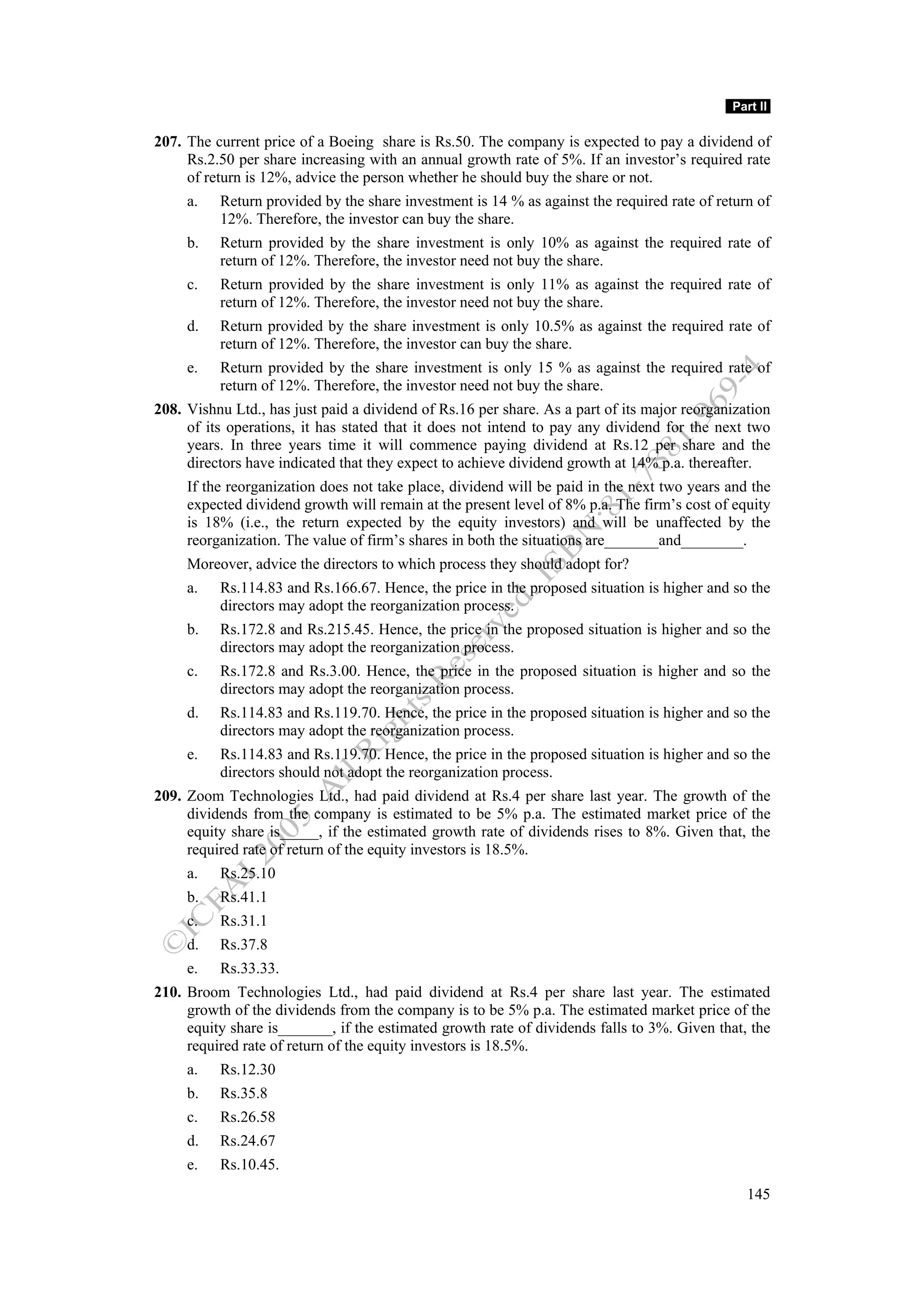
     Where,
     D1 is the expected dividend a year hence,
     P1 is the expected price of the share
     Ke is the required rate of return.
239. (d) All the statements are related to the bond value theorem showing the how YTM
     determines the prices of the bonds. Statement (d) is false because the longer the term to
     maturity, the greater will be the change in price with change in YTM.
240. (a) Longer the maturity of the bond, the greater its price change in response to a given change
     in the required rate of return. Hence if the maturity of the bond increases, the volatility of the
     bond increases.
241. (b) When the expected rate of return is equal to the required rate of return the value of the
     bond is equal its par value. Hence it is rightly priced.
242. (b) When the required rate of return on a bond is greater than the coupon rate the discount
     then the value of the bond is less than the par value. This discount on the bond declines as
     maturity approaches.
243. (a) The discount or premium on a bond declines as maturity approaches. Hence if discount
     bonds and premium bonds are sold at the same price, it indicates that the bonds have
     approached maturity.
244. (b) When the required rate of return is equal to the coupon rate, the value of the bond is equal
     to its par value.
245. (d) ke = Rf + β (Rm – Rf)
              ke − R e   21.4 − 6
     ∴β=               =          = 1.40.
              Rm − Rf     17 − 6
246. (d) The value of a share is its economic value as a going concern, taking into account its
     characteristics, the nature of its business and the investment environment. The value of the
     share equals the present value of earnings per share plus the net present value of future
     growth opportunities.
247. (c) Interest rate risk is the variability in a security’s return resulting from changes in the level
     of interest rates. Bonds with low coupon rate have high interest rate risk as the return on the
     bond is less than the actual interest at that period.
248. (b) Yield to maturity of a perpetual bond i.e., bonds with no maturity is equal to the interest
     divided by the market price.
249. (b) When the required rate of return on a bond is greater than the coupon rate the discount then
     the value of the bond is less than the par value. This discount on the bond declines as maturity
     approaches. For a change in YTM, the percentage price change in case of bonds of high coupon
     rate will be smaller than in the case of bonds of low coupon rate. Hence only (ii) is true.
250. (c)   P/E = MPS/EPS.
     When there is low dividend yield the EPS decrease and hence the
     P/E ratio tend to increase.
251. (d) Dividend yield = Dividend paid/Current market price. Thus, we can conclude that
     dividend yield is based on current stock price.
252. (c) The value of common stock increases with increase in growth rate of dividend. The value
     of common stock decreases with increase in investment horizon. If dividend pay-out ratio
     remains constant the value of the stock would also remain the same. The value of common
     stock, other thing remaining same, decreases with the increase of discount rate.


                                                                                                      89
Financial Management

253. (a) The value of a share when dividend increase at a constant, compound rate is given by
     P0 = D1/k – g
     Where,
     P0   is the current market price of the equity share
     D1   is the expected dividend a year hence
     D1   = D0 (1 + g) where D0 is the last paid dividend
     k is the expected rate of return or the required rate of return
     g = annual growth rate.
254. (e) A security traded in the secondary market in subject to market risk and liquidity risk.
255. (c) For a given difference between YTM and coupon rate of the bonds, the longer the term to
     maturity, the greater will be the change in the price with change in YTM. This is because, in
     case of long maturity bonds, a change in YTM is cumulatively applied to the entire series of
     the coupon payments and the principal payment is discounted at the new rate for the entire
     number of years to maturity; whereas in case of short-term maturity bonds, the new YTM is
     applied to comparatively few coupon payments and also the principal payment is discounted
     for only a short period of time.
256. (e) Growth rate of the industry to which the company belongs is an external factor that
     influences the intrinsic value of a stock.
257. (e) Current yield measures the rate of return earned on a bond if it is purchased at its current
     market price and if the coupon interest is received. Coupon rate and current yield will be
     equal if the bond’s market price equals its face value. Yield to maturity and current yield will
     be equal when price of the bond equals the face value.
258. (d) Intrinsic value of bond = C x PVIFA(k,n) + F x PVIF(k,n)
     where, C is the coupon payment on the bond, F is the amount payable at maturity, k is the
     discount rate or the required rate of return and n is the number of years of maturity to the bond.
     From the above expression of the intrinsic value of a bond, we can see that other things being
     equal if the amount payable at maturity (F) increases, the value of bond also increases
     correspondingly. While decreasing the term to maturity and the coupon rate of the bond as
     well as increasing the required rate of return on the bond will decrease the intrinsic value of
     the bond. The discount on the bond at the time of issue does not have any role to play in this
     context. Hence, the alternative (d) is correct.
259. (d) When the required rate of return on a bond is more than the coupon rate the intrinsic value
     of the bond is less than its par value; hence the bonds are sold at a discounts on its par value.
     The amount of discount on the bond decreases as the maturity approaches. The question of
     premium on the bond price does not arise in this case. Hence, the alternative (c) is true.
260. (b) The warrant holder is not at all entitled to receive any dividend from the company that
     issued the same. While the features as stated in the other alternatives are the regular features
     of the warrants generally issued by the companies. Hence, the option (b) is the correct choice.
261. (a) The salient features of the multi-period valuation model are as follows:
     •    Cash flows to the investors in the form of dividends over an infinite duration are considered.
     •    The value of an equity share is equal to the present value of its entire dividend stream
          over an infinite duration
     •    The model can be applied to the instances of constant dividends and constant growth in
          dividends
     •    The model can also be applied in case of variable growth in dividends
     •    It assumes that the cost of equity of the company will remain constant.
     Hence, the option (a) is the answer.

90
Part I

262. (e) If the market interest rate increases, the value of the bond will also be adjusting itself in
     such a way that the yield of the bond matches with the market interest rate. Hence as the
     interest rate increases, the value of the bond will also decreases correspondingly in order to
     keep in pace with that of the new rate of interest. The factors as mentioned in the other
     options increase the value of the bonds
263. (d) In going concern value, the assets of the company are sold as the operating assets and
     their values are generally higher than any other criterion of measurement. Book value is an
     accounting concept that is historical cost minus depreciation. Market value of any asset is the
     value at which that is generally bought and sold in the market. Replacement value is the
     amount that a company is required to spend if it decides to replace the existing assets by new
     one. But liquidation value is the amount that a company may realize by selling the assets on
     terminating its business.
264. (b) If the required rate of return from a bond is more than the coupon rate the value of the
     bond will be less than the par value of the bond as the bond value adjusts itself against the
     movement of the interest rates. The discount rate on the bond decreases as maturity
     approaches, if the required rate of return from a bond is more than the coupon rate. The
     premium on the bond decreases as the maturity approaches, if the required rate of return is
     less than the coupon rate.
265. (c) In the valuation of the equity shares of the company through price-earning ratio approach,
     the growth rate of the company is considered only. Book value and the liquidation value of
     the company do not have any role in this context. Maturity of the debentures and issue of
     preference shares do not affect the valuation process for the company under this method.
Financial Statement Analysis
266. (b) Debt equity ratio indicates the relative contributions of creditors and owners, which
     indicate the long-term solvency.
267. (c) Liquidity implies a firm’s ability to pay its debts in the short run. This ability can be
     measured by the use of current ratio.
268. (c) Debt service coverage ratio = PAT + Depreciation + Other non-cash charges + Interest on
     term loan/Interest on term loan + Repayment of the term loan 1.5 indicates that the firm has
     post-tax earnings which are 1.5 times the total obligation (interest and loan repayment) in the
     particular year to the financial institution.
269. (d) The common size analysis is used for inter company comparison because the financial
     statements of a variety of companies can be recast into the uniform common size format
     regardless of the size of individual companies. In the balance sheet, the assets as well as the
     liabilities and capital are each expressed as 100 percent and each item in these categories is
     expressed as a percentage of the respective totals.
270. (a) Fixed charges coverage ratio measures debt servicing ability comprehensively. The fixed
     charges coverage ratio of 4 signifies that its pre-tax operating income is 4 times all fixed
     financial obligation.
271. (b) The current assets increase as a result of increase in cash balance, hence the current ratio
     increases.
272. (c) Current ratio = Current assets/Current liabilities
     The firm’s current assets are converted into cash to provide funds for the payment of current
     liabilities. So CA will not change while CL will decrease.
273. (e) The receivable turnover ratio shows how many times accounts receivable (debtors) turn
     over during a year. It is defined as Net credit sales/Average accounts receivable.
274. (d) If the realized collection period is more than the average collection period it would reflect
     that collection job is poor, customers are facing financial problems, and in spite of careful
     collection efforts there is difficulty in obtaining prompt payments.
275. (c) Assets turnover ratio highlights the amount of assets that the firm used to produce its total
     sales. Low ratio indicates idle or improperly used assets.
276. (a) Gross profit margin = Gross profit/Net sales
     This shows the profit relative to sales. It may be used as an indicator of the efficiency of the
     production operation and the relation between production costs and selling prices.

                                                                                                   91
Financial Management

277. (d) Coverage ratios give the relationship between the financial charges of a firm and its
     ability to serve them. Structural ratios measure the long term solvency of a firm.
278. (b) Dividend pay out ratio is the ratio of DPS to EPS. It indicates what percentage of total
     earnings is paid to the shareholders.
279. (a) Dividend yield exists for only those firms which declare dividends. Hence the retained
     earnings directly affect the dividend yield.
280. (e) ROE = Net income/Average equity.
281. (e) All the given alternatives are problems encountered in financial statement analysis.
282. (d) According to the Du Pont Analysis
     Equity multiplier = (Average assets/Average equity) = 1/1 – (Debt to assets ratio).
283. (e) The accounts receivable is used in the evaluation of liquidity of receivables. Other things being
     equal, a decrease in the average accounts receivable will increase the firm’s return on assets.
284. (c) A common size balance sheet portrays the firm’s accounts as a percent of the firm’s total assets.
285. (c) Liquidity of an asset implies the speed at which it can be converted into cash. It measures
     the ease and cost of being converted into cash.
286. (c) Current ratio = Current assets/Current liabilities. It is a measure of a firm’s liquidity.
287. (a) The net working capital = Current assets – Current liabilities.
     A current ratio of less than 1 implies that the firm’s current liabilities are more than the current
     assets. Hence, a current ratio of less than 1 implies that the net working capital is negative.
288. (b) Average collection period = Average accounts receivable/Average daily sales
                                        = Average accounts receivable x 365/Average credit sales
     Average collection period indicates the speed of collections.
289. (d) The total assets comprises of debt and equity. If the debt equity ratio is 2:1 then the total
     assets will be 3. Hence, for every 3 rupees of total assets there is 2 rupees of debt and 1 rupee
     of equity.
290. (c) Liquidity implies a firm’s ability to pay its debt in the short run. Working capital gap is
     equal to current assets less total current liabilities other than bank borrowings. Higher the
     inventory turnover ratio higher the efficiency of inventory management. PE ratio is one of the
     most important ownership ratios. Only statement (c) is true.
291. (c) Financial statement analysis helps to know the correlation among ratios.
292. (c) Working capital gap is equal to the current assets less current liabilities other than bank
     borrowings.
293. (a) Asset turnover ratio highlights the amount of assets that the firm used, to produce its total
     assets. It measures the efficiency of the firm’s activities and its ability to generate profits.
294. (d) Capitalization rate = Earning per share/Market price of the share
295. (a) Interest coverage ratio = EBIT/Interest expense
     It is the measure of a firm’s ability to handle financial burdens. An interest coverage ratio of
     2.25 indicates that the EBIT is 2.25 times the interest payable.
296. (e) Acid test ratio or quick ratio = Quick assets/Current liabilities
     It is a measure of liquidity of a firm.
297. (c) Average collection period is a turnover ratio Average collection period is defined as the
     number of days it takes to collect accounts receivable.
298. (b) Earnings per share = Profit after tax/Number of outstanding shares
299. (c) Current ratio = Current assets/Current liabilities. It is a measure of a firm’s liquidity, i.e.,
     the ability to pay its debts.
300. (b) In determining the appropriate PE ratio for a firm the factors to be considered are growth rate,
     stability of earnings, size of the company, quality of management and dividend pay-out ratio.
301. (a) In common size analysis, each item in the balance sheet is expressed as a percentage of
     their respective totals.
302. (a) Days sales outstanding is the ratio of receivables outstanding to average daily sales.

92
Part I

303. (e) Higher the inventory turnover ratio, greater the efficiency of inventory management. Since
     inventory turnover ratio is a measure of the adequacy of goods available to sell in comparison to
     the actual sales orders a high inventory turnover ratio may indicate over trading.
304. (c) When current ratio is greater than one, a similar increase in current assets and current
     liabilities will result in the decrease in current ratio.
305. (b) Interest coverage ratio measures the firm’s ability to handle financial burdens. This ratio
     tells how many times the firm can cover or meet the interest payments associated with debt.
     Interest coverage ratio = EBIT/Interest expense.
306 (c) Analyzing return ratios in terms of profit margin and turnover ratios, referred to as the
     Du Pont system. The starting point of Du Pont chart is return on total assets.
307. (e) Return on equity = Net income/Average equity
     Return on investments = EBIT/Total assets
     Hence it means that the firm does not have any debt in its capital structure as average
     equity = Total assets and that the firm does not pay taxes as EBIT = Net income.
308. (c) The ratio of market value to book value indicates the contribution of a firm to the wealth
     of the society. Hence Market value = 2 x Book value, indicates that the firm has doubled the
     wealth of the shareholder.
309. (e) Analyzing return ratios in terms of profit margin and turnover ratios, is referred to as the
     Du Pont system. In the Du Pont chart the left apex term is net profit margin.
310. (e) Debt is used in the capital structure only when the interest paid on such debt is less than
     the return. Such use of debt increase. Return on equity if the firm earns higher return than the
     rate of interest on debt.
     Return on equity = Net income/Average equity
311. (d) Interest coverage ratio measures the firm’s ability to handle financial burdens. This ratio
     tells how many times the firm can cover or meet the interest payments associated with debt.
     Interest coverage ratio = EBIT/Interest expense. Hence interest coverage ratio of 6 indicates
     EBIT is 6 times of interest.
312. (d) In the context of financial statement analysis, cross sectional analysis involves
     comparison between a company and an industry. The industry averages or the standard
     player’s averages are used as benchmarks.
313. (b) Earning power = EBIT/Average total assets
     It is a measure of the operating business performance which is not affected by interest
     charges and tax payments.
314. (c) Current ratio = Current assets/Current liabilities
     Quick ratio = Current assets – Stock/Current liabilities
     Hence when the current ratio and quick ratio are nearly the same it means that the company
     has got low investment in inventory.
315. (c) According to the Du Pont analysis
     Return on Equity = Net profit margin x Asset turnover ratio x Asset – Equity ratio
     Leverage ratios measure the long-term solvency of a firm. Total assets to net worth is the
     leverage ratio used in ROE analysis.
316. (d) Earning power is a measure of operating profitability and it is defined as Earnings before
     interest and tax/Average total assets. It does not consider the effect of financial structure and
     tax rate.
317. (b) ROE = Net income/Average equity or ROE = EPS/ Book value.
318. (b) Earning ratios helps in getting the information on earnings of the firm and their effect on
     price of common stock. Hence for assessing the future market value of the company, it is best
     to depend on earnings ratio.
319. (e) Dividend Yield = dividend per share/Market price per share. It gives current return on
     investment.

                                                                                                   93
Financial Management

320. (c) Debt-equity ratio and debt-asset ratio are leverage ratios for a company. Return on equity
     and return on investment represents the profitability ratios of a business entity. Acid test ratio
     indicates the liquidity status of a company.
321. (b) In common size analysis the items in the income statement are expressed as percentage of
     net sales.
322. (a) Debt asset ratio indicates the capital structure of a company. Inventory turnover ratio and
     total asset turnover ratio are the turnover ratios that indicate how efficiently the assets are
     utilized by a company. While return on equity and return on assets are the profitability ratios
     of a business entity.
323. (b) Dividend pay out ratio indicates the amount of dividend paid out of net profit earned by
     the company. Net profit margin represents the amount of profit as a percentage of total sales.
     Inventory turnover ratio implies how efficiently the inventories are used by a company while
     acid test ratio shows the liquidity status for a company. But fixed chares coverage ratio
     represents the ability of a firm to meet its financial obligations to make service the debts as
     well as to pay the lease rentals.
324. (b) The financial risk of a firm may be estimated by using the leverage and coverage ratios
     while the earning potential of a company may be evaluated through the profitability ratios.
     The operational and the level of efficiency in utilizing the assets may measured by using the
     turnover ratios. But price-earnings ratio is used to determine the expected market price per
     share of the company. One may project the EPS of a company for the next few years and
     thereafter by assuming the continuity of the same P/E multiple, the future market price per
     share may be calculated.
325. (d) If the company resorts to external borrowings by issuing debentures or from the financial
     institutions, the debt-to-total assets will go up. Using short-term funds for the long-term
     purposes and vice-versa does not serve the purpose and may lead to the liquidity mismatch.
     However, further issue of the equity shares through rights issue will increase the share capital
     that may be used to retire the old debt – partially or wholly – thereby reducing the debt-
     equity ratio.
326. (c) In index number trend analysis, every figure for the first year is considered as 100 percent
     while the corresponding figures for the subsequent years are mentioned as a percentage of the
     first year figure. In cross-sectional analysis, the relevant figures are presented for more than
     one companies while in year-to-year change analysis, the respective ratios or data as
     required, are presented without making any change. In commonsize analysis, every element
     in the balance sheet is presented as a percentage of the total asset or total liabilities whereas
     the figures of the income statement are presented as a percentage of the sales value. There is
     no analysis called as expected annual income analysis.
327. (d) As the debt-equity ratio of the company is higher than the other companies in the same
     industry, the company can be termed to have a higher than average financial risk in
     comparison to the other companies in the same industry for the higher debt burdens. So, its
     borrowing capacity is less compared to its peers. It has the higher probability to experience
     some difficulties with its creditors in future. The creditworthiness of the company is at low
     level owing to the higher interest burden and also its ability to meet the financial
     commitments towards its stakeholders.
328. (c) Asset turnover of a company is defined as the ratio between the sales value and total
     assets. High asset turnover is possible only when a company can generate a high sales
     volume in comparison to the amount invested in the fixed assets and current assets.
                              109 − 95
                15 (1 − 0.40) +
329. (d) Kd =                    8     = 0.1054
                       109 + 95
                          2
     ∴Kd = 10.54%
330. (d) In Du Pont analysis, the return on equity (ROE) is expressed as the product among net
     profit margin (NPM), total assets turnover ratio (TATR) and the equity multiplier (EM). But
     in the other cases, the interrelationships among three ratios are not observed.

94
Part I

331. (a) In commonsize analysis, the income statement is expressed as a percentage of total sales.
     In index number trend analysis, every figure for the first year is considered as 100 percent
     while the corresponding figures for the subsequent years are mentioned as a percentage of the
     first year figure. In cross-sectional analysis, the relevant figures are presented for more than
     one company while in year-to-year change analysis, the respective ratios or data as required,
     are presented without making any change. In Du Pont analysis, the return on equity of the
     company is analyzed.
Funds Flow Analysis
332. (e) Funds in funds flow statement represent either net working capital or cash.
333. (d) Conversion of all FCDs into equity shares, and bonus issue of equity shares does not
     result in any inflow or outflow of cash. Hence they do not appear in the cash flow statement.
334. (a) Depreciation is an appropriation of profits hence it is a source of funds. Decrease in net
     working capital may be because of the increase in current liabilities; hence it is a source of fund.
335. (b) Increase in liability results in inflow of cash through loan or credit. Hence it is a source of
     fund.
336. (d) Net income from operations is a source of funds whereas net loss from operations is a use
     of funds.
337. (a) Cash from operations is obtained by adding all non-cash expenses like depreciation the
     profit after tax or the net profit.
338. (e) Increase in provision for taxation results in increase in current liabilities and cash or credit
     sales at a profit increase the current assets.
339. (b) Increase in accrued expenses result in increase in current liabilities which is a decrease in
     working capital, hence a source.
340. (e) Decrease in working capital is a source of fund. Increase indepreciation is also a source of
     fund.
341. (d) Funds flow statement is a statement which explains the various sources from which funds
     were raised and the uses to which these funds were put. Hence evaluation of the quality of
     firm’s top management is not a benefit of funds flow statement analysis.
342. (d) Ratio analysis is a tool for financial analysis.
343. (c) The following assumptions are made will calculating the external fund requirement
     –     The assets of a firm will increase proportionately to sales.
     –     Net profit margin is constant.
     –     Dividend pay-out ratio and debt equity ratio will remain constant.
     –     External issue of equity ratio will remain constant.
344. (a) The net income increases the cash balance, and hence is a source of working capital as an
     increase in current asset increases the working capital or vice versa.
345. (e) Depreciation is an appropriation made to profits. It is a non-fund expenditure, and it is a
     source of internal finance.
346. (c) Current liabilities includes liquid items of duration less than a year. Hence fixed deposit
     made for 18 months is not an item of current liabilities.
347. (c) Payment of dividend is a use of fund.
348. (d) Decrease in inventory result in decrease in current assets and hence will not result in an
     increase in net working capital.
349. (b) Increase in working capital is a use of fund.
350. (a) Issue of share capital results in inflow of cash or funds in the form of capital, hence it is a
     source of funds.
351. (a) Taxes result in outflow of cash. Hence it is a use of fund.

                                                                                                      95
Financial Management

352. (b) Decrease in current liabilities is a source of funds and increase in current assets is an
     applications of funds.
353. (d) Increase in asset is because of use of some source to purchase then asset, hence it is a use
     of fund.
354. (c) Depreciation is a source of long-term internal finance which can be used for purchase of a
     new asset. It is not considered while preparing funds flow statement on a working capital basis.
355. (d) Decrease in prepaid expenses result in decrease of Current Assets and decrease in income
     tax paid in advance result in increase of in cash available for business operations.
356. (b) Issue of equity shares result in inflow of capital in the form cash and the current assets
     increase resulting in an increase of net working capital.
357. (b) Increase in prepaid expenses is an application of cash.
358. (d) A funds flow statement on cash basis does not show the net change in working capital.
359. (e) Funds flow statements are not helpful for the judgements of the following matters:
     The quality of management
     The ownership pattern of the company
     The operational efficiency of the company
     It also may be manipulated by the unscrupulous managers of any corporate entity. However, it
     may be used to detect whether short-term fund is used for the procurement of the long term asset.
360. (d) Retirement of high cost debt, the installation of a capital asset and buy back of the equity
     shares – are the examples of the uses of funds by a business entity. Conversion of debentures
     into equity shares is a matter of capital restructuring that does not lead to any financial
     transaction. But selling an old car today to buy a new one after three months leads to the
     inflow of cash to a company that may be used for the next quarter which may be considered
     as a source of funds to the company.
361. (b) A gross increase in fixed assets is not considered as a source of fund, but as an use of
     funds while making funds flow analysis on cash basis. The conditions mentioned in the other
     options increase cash balance of a company and hence can be termed as the source of funds
     for the company.
362. (e) Funds flow analysis can be studied in order to detect the imbalances in regards to the
     sources and uses of funds as well as for the planning for the future financing strategies. But
     the assessment of the market leadership for the products of the company are not reflected in
     the funds flow statements.
363. (e) The features related to the funds flow statements are as follows:
     •     It does not show the changes in the ownership patterns of the company
     •     It does not show the sources and uses of funds at any particular date in a year, that is
           shown in the balance sheet of the company
     •     It cannot be considered as a snapshot picture for the operations of the business
     •    It can also be manipulated by means of window dressing. Hence, the option (e) is correct.
364. (e) A funds flow statement is known through different terms one of them is mentioned in the
     given option (e). A balance sheet states the financial position of a company as on a particular
     date while profit and loss statement or income statement shows the financial performance of
     a company during a year or a particular time period. Proforma statements are prepared to
     project the financial position (proforma balance sheet) of a company and the financial
     performance (proforma income statement) of a company in future.
Leverage
365. (c) Degree of total leverage is a combination of the operating and financial leverages. Thus, it is a
     measure of the output and EPS of the company.
     DOL = % Change in EBIT / % Change in output
     DFL = % Change in EPS / % Change in EBIT
     Hence DTL = DOL x DFL = % Change in EPS / % Change in output.

96
Part I

366. (c) DFL is use to know the impact of a change in EBIT on EPS of the company. DFL is zero
     when the firm does not earn any operating profits.
367. (e) When the firm is operating at BEP, DTL is undefined.
368. (a) Greater the DOL, the more sensitive is EBIT to a given change in unit sales, i.e. the
     greater is the risk of exception losses if sales become depressed. DOL is therefore a measure
     of the firm’s business risk.
369. (b) Financial Break Even Point is the level of EBIT at which EPS of the company is zero and
     DFL is undefined.
370. (e) Leverage ratios measure the long-term solvency of a firm. Bank finance to working
     capital gap ratio shows the degree of firm’s reliance on short-term bank finance for financing
     the working capital gap. It is a liquidity ratio.
371. (a) DFL = % Change in EPS/% Change in EBIT.
372. (a) Operating leverage examines the effect of the change in the quantity produced on the
     EBIT of the company.
              Δ EBIT
     DOL =
              Δ Output
373. (e) DOL is negative at the level of output below the operating breakeven point.
374. (a) Operating leverage examines the effect of the change in the quantity produced on the
     EBIT of the company. Operating leverage = Contribution/EBIT
375. (e) With the help of DFL one can understand the impact of the change in EBIT on EPS of the
     company.
376. (b) DTL is the product of DOL and DFL and hence measures the total risk of the company.
377. (e) DTL = DOL x DFL or % Change in EPS/% Change in output = 1.5 x 2 = 3.
     i.e., one percent change in output will lead to 3% change in EPS.
378. (c) The combination of operating and financial leverages is the total or combined leverage.
     The degree of total leverage is the measure of output and EPS of the company.
379. (c) At financial break even point DFL is undefined, i.e., it is equal to infinity.
380. (d) EBIT
                    EBIT
     DFL =
              EBIT − I − DP (I − t)

     EBIT – I – Dp/(1 – t) x DFL = 0
     If DFL is zero then EBIT must be zero.
381. (e) Operating leverage examines the effect of the change in the quantity produced on the
     EBIT of the company. All the above are true regarding the degree of operating leverage.
382. (e) By calculating the DOL for various levels of output we find that there is unique DOL for
     each level of output, DOL is positive beyond the operating break even point, DOL is
     undefined at the operating break even point.
383. (a) DOL = % Change in EBIT/% Change in output.
384. (c) By calculating the DOL for various levels of output we find that there is unique DOL for
     each level of output, DOL is positive beyond the operating break even point, DOL is
     undefined at the operating break even point.
385. (d) The operating BEP is that quantity which is produced and sold at which EBIT is zero.
386. (b) EBIT
                      EBIT
     DFL =
              EBIT − I − (DP ) /(1 − t)
     If preference share capital increases then the Dp increases, which in turn increases the DFL.


                                                                                                 97
Financial Management

387. (c) By calculating the DOL for various levels of output we find that there is unique DOL for
     each level of output, DOL is positive beyond the operating break even point, DOL is
     undefined at the operating break even point.
388. (a) Q (S – V) = contribution
                Q(S − V)
     DOL =
               Q(S − V) − F
     Increase in fixed costs then DOL increases.
389. (a) Financial leverage refers to the mix of debt and equity in the capital structure of the
     company. As the company becomes more financially leveraged, it becomes riskier, i.e
     increased use of debt financing will lead to increased financial risk.
390. (c) DOL = % Change in EBIT/% Change in quantity
     Operating leverage measures the sensitivity of the earnings before interest and tax to change
     in quantity.
391. (e)
                        EBIT
     DFL =
                EBIT − I − (DP ) /(1 − t)

     When DFL is zero EBIT is also zero. Hence the firm does not earn profits, so tax liability is
     zero.
392. (c) The degree of operating leverage below the operational break even point will be negative.
393. (d) If the output is less than the operating break even point, then DOL will be negative.
394. (b) The following statements are correct with respect to the Degree of Operating Leverage
     (DOL) for the operations of a company:
     •      Each level of output has a distinct DOL
     •      DOL is always negative below the operating break even point
     •      DOL is always positive above the operating break even point
     •      DOL is undefined at the operating break even point.
     Hence, the option (b) is the answer.
395. (b) The following points are true with respect to the DFL of a company:
     •      DFL helps to measure the financial risk of any corporate entity
     •      DFL can be used to analyze the implications of retiring debts against the proceeds of the
            issue of the preference capital.
     •      DOL is applied by a corporate entity for its production and sales planning
     •      DFL is used to relate the percentage change in EPS against every percentage change in
            EBIT.
           Hence, the option (b) is the correct choice.
396. (d) At the operating break even point, the EBIT is zero i.e. the sales revenue of the company
     just covers the fixed and variable costs incurred by the company. Hence, the operating break
     even point can be expressed in quantity of sales or value of sales.
397. (c) The DOL of a company depends on the contribution margin, sales quantity and the fixed
     costs. It is not at all related to the interest expenses of the company. Hence, the issue of
     equity shares in lieu of debentures will not affect the DOL of a company.
398. (d) If a firm retires its debentures prematurely, its interest burden will come down that will
     decrease the financial leverage and total leverage of the company. It does not have any
     impact on the operating leverage of the company. So, the option (d) is correct.


98
Part I

399. (e) As the degree of total leverage for the firm is zero, the contribution received by the firm
     by selling its product will also be zero or the EBIT for the firm is zero. So the option (e) is
     the answer. The conditions mentioned in the other options are not true, as any of such
     conditions cannot make the DTL to zero.
400. (c) DOL measures the business risk of the company by assessing the change in EBIT owing
     to a change in the level of production and sales volume. DOL has a distinct value at every
     level of output of a firm while it is undefined at the operating breakeven point. The concept
     of the degree of financial leverage is used to assess the conditions as mentioned in the option
     (d) and (e). So, the option (c) is correct.
401. (e) Appointment of the managers at a very high compensation package will increase the fixed
     cost of the company thereby decreasing the denominator of the DOL, DFL and DTL. As a
     result of this, these leverages will go up. So, the operating break-even point and the financial
     breakeven point will increase. So, the option (e) is correct
402. (c) If a firm goes for additional borrowings, its operating leverage will not be changed as the
     degree of operating leverage does not depend on interest expenses.
Financial Forecasting
403. (c) In the trend analysis via extrapolation, the past trend in sales is identified and this trend is
     projected into the future. Hence, it is assumed that sales for the coming period will change to
     the same degree as sales changed from the prior period to the current period.
404. (a) Sustainable growth is the rate which can be maintained without resorting to external
     finance.
405. (e) The credit extended by the suppliers of goods and services is short-term source of finance
     or spontaneous source of finance.
406. (a) Financial forecasting is a planning process with which the company’s management
     positions the firm’s future activities relative to the expected economic, technical, competitive,
     and social environment. Sales forecast provides the basis around which the firm’s planning
     process is centered.
407. (d) The percent of sales method assumes that the future relationship between various
     elements of costs to sales will be similar to their historical relationship.
408. (a) The starting point in the preparation of pro forma operating statement is a projection of
     the unit and rupee volume of sales.
409. (a) Objective methods are statistical methods which range in sophistication from relatively
     simple trend extrapolations to the use of complicated mathematical models. Sales force
     estimates is not based on the above. It is a subjective model.
410. (d) Objective methods are statistical methods which range in sophistication from relatively
     simple trend extrapolations to the use of complicated mathematical models. Regression
     analysis is more objective than any other model.
411. (a) EFR = A/S (S) – L/S (S) – mS (1 – d)
     This equation highlights that the amount of external financing depends on the firm’s
     projected growth in sales.
412. (d) The percent of sales method assumes that the future relationship between various
     elements of costs to sales will be similar to their historical relationship and the cost elements
     remain unchanged.
413. (c) To prepare the pro forma income statement the percent of sales method is used in the
     estimation of cost of goods sold and budgeted expense method is used for estimating the
     value of various items on the basis of expected developments in the future period.
414. (d) The methods which use the judgments or opinions of knowledgeable individuals within
     the company are called the subjective methods. Regression analysis and trend analysis are
     objective methods of financial forecasting.


                                                                                                      99
Financial Management


                  m(1 − d) A/E
415. (b) g =
               A/SO − m (1 − d) A/E
      The above equation depicts the rate of growth without resorting to external financing. When
      there is decrease in the dividend payout ratio then the growth increases.
                  m(1 − d) A/E
416. (a) g =
               A/SO − m (1 − d) A/E
      The above equation depicts the rate of growth without resorting to external financing.
      When the net profit margin increases the growth rate also increase.
417. (d) The assumptions for the sustainable growth rate are as follows:
      •    The assets of the firm will increase proportionately to sales
      •    Net profit margin is constant
      •    Dividend pay-out ratio, not the amount of dividend and debt-equity ratio will remain
           constant
      •    External issue of equity will not be resorted to
      Therefore, the alternative (d) is the correct choice.
418. (b) The trend analysis, through the method of extrapolation and regression analysis are used
     for the projection of sales volume of the company. The future relationship between various
     costs to sales is assumed to follow historical relationship in case of percent of sales method.
     But in budgeted expense method, the estimation of the various items is considered on the
     basis of the expected changes to be happened in the market for the preparation of the
     proforma income statement. Hence, the option (b) is the answer.
419. (e) In Jury of Executive opinion method, the personal judgements of many senior executives
     from different fields are taken into account while in sales force estimates method, the
     personal judgement of the sales personnel operating at the ground level are considered. But
     mathematical tools and techniques are applied in the methods mentioned in the options (c)
     and (d). Hence, the option (e) is answer.
                             Q (S − V)
420. (c) DTL =
                                            Dp
                     Q (S − V) − F − I −
                                           (1 − t )
                                      6000 (500 - 200)
                 =                                                         = 2.195.
                                                               60,000
                     6000 (500 - 200) − 8,00,000 − 80,000 −
                                                              (1- 0.40 )
421. (b) The future relationship between various costs to sales is assumed to follow historical
     relationship in case of percent of sales method. But in budgeted expense method, the
     estimation of the various items are considered on the basis of the expected developments in
     the context of the preparation of the proforma income statement. Trend analysis and
     regression analysis are used for the projection of sales volume of the company. Hence, the
     option (b) is the answer.


100
Frequently Used Formulae
Time Value of Money
1.   Nominal interest rate = Real rate of interest or return + Expected rate of inflation + Risk
                             premiums to compensate for uncertainty.
2.   Future Value of a single cash flow = FVn = PV(1 + k)n
     Where FVn – Future Value of the initial flow ‘n’ years hence
     PV – Initial cash flow
     K – Annual rate of interest
     n – Life of investment.
3.   Doubling Period
     (i)    Rule of 72: 72/number of years
                                     69
     (ii) Rule of 69: 0.35 +
                                interest rate
4.   Future value for shorter compounding periods
                         mxn
              ⎛   k⎞
     FVn = PV ⎜1 + ⎟
              ⎝ m⎠
     m – number of times compounding is done during a year
     n – number of years for which compounding is done.
5.   Relationship between Effective and Nominal rates of interest:
                     m
         ⎛   k⎞
     r = ⎜1 + ⎟ – 1
         ⎝ m⎠
     r – Effective rate of interest
     k – Nominal rate of interest
     m – Frequency of compounding per year.
                                      ⎡ (1 + k) n − 1 ⎤
6.   Future value of Annuity FVAn = A ⎢               ⎥
                                      ⎣      k        ⎦
     A = Amount deposited/invested at the end of every year for ‘n’ years.
     K = Rate of interest
     n = Time horizon
     FVAn = Accumulation at the end of ‘n’ years.
                                      k
7.   Sinking Fund Factor =
                               (1 + k) n − 1
8.   Present Value of a single flow
               FVn
     PV =
             (1 + k) n
9.   Present value of an annuity
                ⎡ (1 + k) n − 1 ⎤
     PVAn = A × ⎢           n ⎥
                ⎣ k(1 + k) ⎦
K(1 + k) n
10. Capital Recovery Factor =
                                                   (1 + k) n − 1
11. Present value of Perpetuity
      P∞ = A x PVIFA k,∞ .

Risk and Return
                                                                                      1
                               ⎡ 1         n            ⎤2
1.    Standard deviation = σ = ⎢         ∑ (rit − ri )2 ⎥
                               ⎣ (n − 1) t =1           ⎦
2.    Variance = σ 2
                                      Σ(x1 − x1 )(x 2 − x 2 )
3.    Covariance = σ12 =
                                            (n − 1)
                                                                   σ12
4.    Coefficient of correlation = ρ12 =
                                                                 σ1 x σ 2
                                                          n                 n
5.    Variance of portfolio = σ 2 =
                                p                     ∑ σi2 Wi2 +           ∑ σ2j Wj2 +2 ∑ Covij Wi Wj
                                                       i=t                  j=t

6.    Systematic risk of a security = βi2 σ m
                                            2


            σ im
7.    β =
            σ2
             m

8.    Unsystematic risk = σi2 (1 − ρim ).
                                    2


Valuation of Securities
                                                                                           n
                            C1                 C2                        Cn                      C
1.    V0 (or P0) =
                       (1 + k)   1
                                      +
                                          (1 + k)     2
                                                              + .. +
                                                                       (1 + k)    n
                                                                                      =   ∑ (1 + k)t
                                                                                                 t

                                                                                          t =1

      Where,
            V0     =          Value of the asset at time zero
            P0     =          Present value of the asset
            Ct     =          Expected cash flow at the end of period t
            k      =          Discount rate or required rate of return on the cash flows
            n      =          Expected life of an asset.
2.    Instrinsic value or the present value of a bond:
                        n
                                  1                       F
      V0 (or P0) =     ∑ (1 + k            t
                                               +
                                                   (1 + k d )n
                       t =1           d)

      V0           = I (PVIFA(k d ,n) ) + F (PVIF(k d ,n) )

      Where,
            V0     =          Intrinsic value of the bond
            P0     =          Present value of the bond
            I      =          Annual interest payable on the bond
            F      =          Principal amount (par value) repayable at the maturity time
            n      =          Maturity period of the bond
            kd     =          Cost of Capital.

102
3.   The bond values with semi-annual interest
                      2n
                                     I/2                          F
     V0       =      ∑ (1 + k                / 2)   t
                                                        +
                                                            (1 + k d / 2)2n
                                                                              = I/2 (PVIFA(k d / 2,2n) ) + F(PVIFA(k d / 2,2n) )
                     t =1                d

     Where,
     V0       =      Value of the bond
     I/2      =      Semi-annual interest payment
     F        =      Par value of the bond payable at maturity
     kd/2 =          Required rate of return for the half-year period
     2n       =      Maturity period expressed in half-yearly periods.

4.   One period rate of return
       ⎛ Pr ice gain or loss ⎞ ⎛ Coupon int erest ⎞
       ⎜ during holding period ⎟ + ⎜    (if paid) ⎟
     = ⎝                       ⎠ ⎝                ⎠
           ⎛ Purchase price at the beginning of ⎞
           ⎜         the holding period         ⎟
           ⎝                                    ⎠

                                           Coupon interest
5.   ∴ Current Yield =
                                         Current Market Price
               n
                      1                         F
6.   P0 =     ∑ (1 + k           t
                                     +
                                         (1 + k d )n
              t =1          d)

7.   As trial and error method calculations are too tedious the following approximation formula
     can be employed to find out the approximate YTM on a bond.
                     I + (F − P) / n    I + (F − P) / n
     YTM                             or
                      0.4F + 0.6P         (F + P) / 2

     Where,
     YTM = Yield to maturity
     I = Annual interest payment
     F = Par value or redemption value of the bond
     P = Current market price of the bond
     n = Years to maturity.
8.   Conversion value = Conversion Ratio x Stock’s Current Market Price.

9.   The value of convertible is determined as follows:
         n
               C       (Pn ) x Conversion ratio
     ∑ (1 + r)t +                            (1 + r)n
     t =1

     Where,
     C = Coupon
     r       = Required rate of return
     Pn = Expected price of equity share on conversion
     n       = Number of years to maturity.


                                                                                                                                   103
10. According to single period valuation model
                D1         P1
      P0 =             +
             (1 + k e ) (1 + k e )
      Where,
           P0           =         Current market price of the share
           D1           =         Expected dividend a year hence
           P1           =         Expected price of the share a year hence
           ke           =         Required rate of return on the equity share.
11. According to multi-period valuation model
                                                                                         ∞
                        D1                  D2                           D∞                     D
      P0     =
                     (1 + k e ) 1
                                    +
                                        (1 + k e )    2
                                                          + ... +
                                                                    (1 + k e )   ∞
                                                                                     =   ∑ (1 + kt        t
                                                                                         t =1        e)

      Where,
          P0                      =       Current market price of the equity share
          D1                      =       Expected dividend a year hence
          D2                      =       Expected dividend two years hence
          D∞                      =       Expected dividend at infinite duration
                ke                =       Expected rate of return or required rate of return.
12. Valuation with Constant Dividends
      Assume that the dividend per share is constant year after year, whose value is D, then value
      of share is determined as follows:
                      D                 D                            D
      P0 =                      +                    + ... +
                (1 + k e )  1
                                    (1 + k e )   2
                                                               (1 + k e )∞
      The above on simplification becomes
             D
      P=
             ke
13. Valuation with Constant Growth in Dividends
      It is assumed that dividends tend to increase over time because business firms usually grow
      over time. Therefore, if the growth of the dividends is at a constant compound rate than:
             Dt         =         D0(1 + g)t
      Where,
             Dt         =         Dividend for year t
             D0         =         Dividend for year 0
             g          =         Constant compound growth rate.
      The valuation of the share where dividend increases at a constant, compound rate becomes
                   D1      D (1 + g) D1 (1 + g) 2
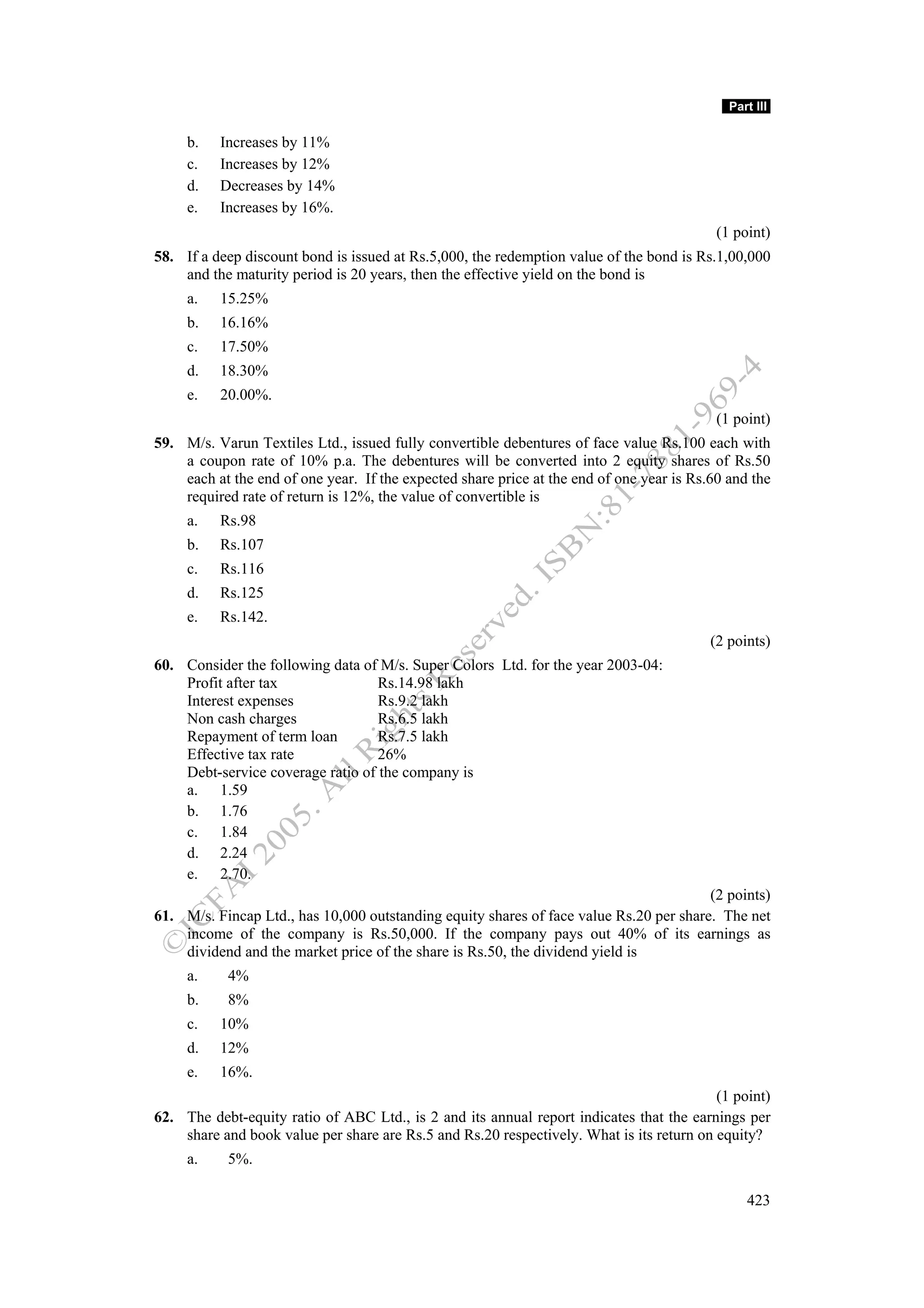
      P0 =                + 1           +             + .....
                (1 + k e ) (1 + k e ) 2   (1 + k e )3
      On simplification
                 D1
      P0 =
                ke − g
14. Valuation with Variable Growth in Dividends
      Some firms have a super normal growth rate followed by a normal growth rate. If the
      dividends move in line with the growth rate, the price of the equity share of such firm would be


104
D1      D (1 + g a ) D1 (1 + g e ) n −1 D n (1 + g n ) n −1 D n (1 + g n ) 2
     P0 =             + 1          +                  +                   +                  + .....
            (1 + k e ) (1 + k e )2    (1 + k e ) n      (1 + k e ) n +1     (1 + k e ) n + 2
     Where,
            P0   =      Price of the equity share
            D1   =      Expected dividend a year hence
            ga   =      Super normal growth rate of dividends
            gn   =      Normal growth rate of dividends.
15. Book Value = Net worth (Paid-up equity capital + Reserves + Surplus)
                     ÷ Number of outstanding equity shares.
16. Liquidation value per share is equal to:
     ⎛ Value realized from liquidating ⎞ ⎛ Amount to be paid to all the           ⎞
     ⎜                                 ⎟−⎜                                        ⎟
     ⎝ all the assets of the firm      ⎠ ⎝  Creditors and preference shareholders ⎠
                           Number of outs tan ding equity shares
17. P/E Ratio = Expected earnings per share x Appropriate price – Earnings ratio
     The expected earnings per share is:
      Expected PAT − Pr eference dividend
      Number of outs tan ding equity shares
                 PV per share
18. E(P/E) =
                   E(EPS)
                   D     1       D / E(EPS)
19. E(P/E) =          ×       or
                 k − g E(EPS)      (k − g)

Financial Statement Analysis
                        Ratios                                     Definition
                 LIQUIDITY
                                                               Current Assets
                 Current Ratio
                                                              Current Liabilities
                                                          Current Assets − Inventor
                 Quick Ratio
                                                             Current Liabilities
                                                        Cost of GoodsSold or Sales
                 Inventory Turnover
                                                             Average Inventory
                 LEVERAGE
                                                                   Total Debt
                 Debt-equity Ratio
                                                                   Net worth
                                                                   Total Debt
                 Debt-asset Ratio
                                                                  Total Assets
                                                                      EBIT
                 Interest Coverage Ratio
                                                                     Interest
                 PROFITABILITY
                                                                 Gross Pr ofit
                 Gross Profit Margin
                                                                  Net Sales


                                                                                                       105
Net Pr ofit
                 Net Profit Margin
                                                           Net Sales
                                                         Net Income
                 Return on Equity
                                                        Average Equity
                                                             EBIT
                 Earning Power
                                                      Average Total Assets
                                                            Sales
                 Assets Turnover
                                                        Average Assets

Leverage
                 ΔY / X
1.    LY/LX =
                 ΔX / X
      Where,
      LY/LX      –    Measure of the leverage which dependent Y has with independent X
      ΔX         –    Change in X
      ΔY         –    Change in Y
      ΔX
                 –    Percentage change in X
       X
      ΔY
                 –    Percentage change in Y.
       Y
2.    Total Revenue = Quantity Sold(Q) x Selling Price (S)
      Hence,
      EBIT       =    Q x S – Q x V – F = Q(S – V) – F

                                                      [Q(S − V) − F − I] (1 − T) − D P
      EPS        =    [(EBIT – I) (1 – T) – DP]/N =
                                                                    N

      Where,
      N      =   Number of Equity Shareholders.

3.    DOL =      Percentage change in EBIT / Percentage change in Output
                 ΔEBIT / EBIT
             =
                   ΔQ / Q
      EBIT = Q(S – V) – F
      Substituting for EBIT, we get
      DOL =      [Q(S – V)] / [Q(S – V) – F].
4.    DFL =      (Percentage change in EPS) / (Percentage change in EBIT)
      DFL =      ( Δ EPS/EPS) / ( Δ EBIT/EBIT)
      Substituting Eq.(ii) for EPS we get
                          EBIT
      DFL =
                                   DP
                 EBIT − 1 −
                                 (1 − T)


106
5.   DTL =       % change in EPS / % change in output
          =      ( Δ EPS / EPS) ( Δ Q/Q)
     DTL =       DOL x DFL
          =      {[Q(S – V)]/[Q(S – V) – F]} x {[Q(S – V) – F]/ Q(S – V) – F – I – [Dp/1–T)]}
                          Q(S − V)
          =
                                        DP
                 Q(S − V) − F − I −
                                      (1 − T)
6.   The overall break even point is that level of output at which the DTL will be underfined and
     EPS is equal to zero. This level of output can be calculated as follows:
                       DP
               F +1+
                     (1 − T)
     Q    =
                 (S − V)

Financial Forecasting
                 A       L
1.   EFR =         (ΔS) − (ΔS) − mS1 (1 − d)
                 S       S
     Where,
          EFR =        External financing requirement
          A/S =        Current assets and Fixed assets as proportion of sales
           ΔS =        Expected increase in sales
          L/S =        Spontaneous liabilities as proportion of sales
          m      =     Net profit margin
          S1     =     Projected sales for next year
          d      =     Dividend pay-out ratio.
               m(1 − d)A / E
2.   g=                          .
          A / S0 − m(1 − d)A / E


                                                                                                107
Part II: Problems
Indian Financial System
1.   If 182-day T-Bills are issued at a discounted price of Rs.96.52, then the yield is
     a. 6.98%
     b. 7.13%
     c. 7.23%
     d. 7.58%
     e. 8.05%.
2.   If 364-day T-bills of face value Rs.100 are issued at a yield of 11.50%, then the issue price is
     a. Rs.88.50
     b. Rs.89.69
     c. Rs.89.71
     d. Rs.89.78
     e. Rs.89.88.
3.   If the bid received by RBI from a bank for a 364-day T-Bill having a face value of Rs.100 is
     Rs.88.24, and the bank calculates yield based on 365-day year, the yield to the bank will be
     a. 11.760%
     b. 11.792%
     c. 13.291%
     d. 13.327%
     e. 13.364%.
4.   Mr. B purchases a 91-day T-bill on 12.06.99 at Rs.98.12. The bill has a maturity of 61 days.
     The yield realized by Mr. B by holding the bill till maturity is
     a. 5.87%
     b. 6.10%
     c. 7.54%
     d. 7.69%
     e. 11.46%.
Time Value of Money
5.   X deposited Rs.1,00,000 on retirement in a bank which can be withdrawn Rs.16,274 annually
     for a period for 10 years. What is the interest rate?
     a.   14%.
     b.   20%
     c.   10%
     d.   8%.
     e.   18%.
6.   Vision Ltd., an NBFC offers car loans with two schemes. Scheme A offers 10% discount on
     cash payment. Scheme B asks for a down payment of Rs.18,000 and Rs.4,100 per month for
     5 years.
     If the cost of the car is Rs.2.5 lakhs and the required rate of return is 9%, which of the
     following represents the present value of cash inflows of both the Schemes?
     a.   Rs.2,50,000; Rs.2,17,000.
     b.   Rs.2,25,000; Rs.2,17,000.
     c.   Rs.2,25,00;Rs.2,17,182.
     d.   Rs.2,25,0000; Rs.2,17,582.
     e.   Rs.2,35,000; Rs.2,17,500.
Part II

7.  Mr. Rohit is considering two options for investing Rs.5,000 for 4 years. In the first option, he
    will get an assured return of Rs.7,000 plus percentage gain on the sensex at the end of 4th
    year over today’s closing index. The second option assures him an interest rate of 15% p.a.
    compounded annually. Today’s closing index = 4000, Sensex at the end of 4th year = 5000.
    What amount will Rohit receive at he end of 4th year, if he is considering, the two options
    independently?
    a. Rs.8,250; Rs.8,545.
    b. Rs.8,250; Rs.8,745.
    c. Rs.8,545; Rs.8,745.
    d. Rs.8,645; Rs.8,845.
    e. Rs.8,745; Rs.8,845.
8. Which of the following alternatives gives the highest return assuming an interest of 14% per
    annum?
    a. Rs.1,00,000 now.
    b. Rs.2,00,000 after 6 years.
    c. Rs.15,000 p.a. in perpetuity
    d. Rs.1,000 per month for a year and Rs.95,000 at the end of the year.
    e. Rs.18,000 per year for the next 10 years.
9. How much amount should be deposited today in order to receive Rs.5,000 next year, and
    which grows at the rate of 4% forever? Assume that the discount rate is 14% per annum.
    a. Rs.50
    b. Rs.500
    c. Rs.5,000
    d. Rs.50,000
    e. Rs.5,00,000.
10. Hi-tech Ltd., offers a scheme under which an investor has to deposit Rs.1,500 per year for a
    period of 10 years. After he can get back Rs.23,905 at the end of 10th year. What is the
    irrelevant interest rate.
    a. 10%
    b. 12%
    c. 13%
    d. 14%
    e. 20%
11. Ms. Sunita needs Rs.1,00,000 after 10 years. She can receive the required amount at the
    desired time under two schemes. Under scheme A, she has to invest Rs.10,000 at the end of
    every year for the first four years. Under scheme B, she has to invest Rs.5,000 at the end of
    every year for the first 8 years. What are the implied interest rates in both the schemes?
    a. 12.69%, 16.87%.
    b. 12.85%, 16.79%.
    c. 12.36%, 16.61%.
    d. 12.69%, 16.97%.
    e. 12.41%, 16.54%.
12. Ms. Kusum has retired recently. She received Rs.5 lakh as her retirement benefits, which she
    had invested in a bank at 15% rate of interest. If she expects to live independently for another
    15 years, how much money she can withdraw at the end of every year so as to leave a nil
    balance in her account at the end of maturity?
    a. Rs.40,65,040.
    b. Rs.85,514.
    c. Rs.61,448.
    d. Rs.10,509.
    e. Rs.4,064.

                                                                                                109
Financial Management

13. Mr. Amol wants to have an annual income of Rs.60,000 starting from the 11th year, which
    should increase to Rs.90,000 from the 16th year and should continue till perpetuity. At 15% rate
    of interest, how much should he invest amount annually for 10 years to get the desired returns?
      a.    Rs.24,592.
      b.    Rs.99,486.
      c.    Rs.14,687.
      d.    Rs.5941.4.
      e.    Rs.1,23,411.
14. Mr. Rajan Lal requires a sum of Rs.10 lakh at the end of 5 years from now for his son’s
    education. He is considering the following alternatives to accumulate the funds required:
      i.    Deposit a fixed sum in bank at the beginning of every year for five years, which will
            fetch him on maturity an amount equal to Rs.10 lakh. Bank pays him interest at the rate
            of 12% p.a.
      ii.   Buy a plot now by borrowing the amount required to buy it and sell it after 5 years so
            that it realizes Rs.10 lakh. He has identified an area in which the market price is expected
            to grow at the rate of 24% per annum. The purchase price is repayable in 5 equal
            installments at the beginning of each year, the first installment being paid now. The loan
            carries interest at the rate of 18% p.a.
      What is the outflow of funds required for Mr. Rajan Lal under both the options?
      a.    1.00 lakh; 0.90 lakh.
      b.    1.41 lakh; 0.92 lakh.
      c.    1.42 lakh; 0.95 lakh.
      d.    1.45 lakh; 0.95 lakh.
      e.    1.47 lakh; 0.97 lakh.
15. Mr. Chandramouli Singh is considering to take a life insurance policy of LIC for 20 years.
    The insurance agent is advising him to take a money back policy. The scheme offers money
    back at the end of 5th, 10th, 15th and 20th year to the extent of 25%, 25%, 25% and 25% of
    the insured amount. The premium he will have to pay is Rs.62 annually for every Rs.1,000
    insured. The insurance agent also, informs him that he will get a minimum bonus to the
    extent of 40% at the end of the insurance term. Mr. Singh is of the opinion that the premium
    for the money back policy is on the higher side. If the banks are offering a rate of 11% on the
    long-term deposits, what is the effective return (K) on the policy and advise Mr. Singh.
      a.    K = –2.56% and it is advisable for Mr. Singh to go for policy
      b.    K = 2.56% and it is advisable for Mr. Singh to go for policy
      c.    K = 2.56 % and it is not advisable for Mr. Singh to go for policy
      d.    K = –2.56% and it is not advisable for Mr. Singh to go for policy
      e.    None of the above.
16. Mr. Farooq is considering to purchase a commercial complex that will generate a net cash
    flow of Rs.4,00,000 at the end of one year. The future cash flows are expected to grow at the
    rate of 4% per annum. Mr. Farooq’s required rate of return is 12%. How much sould Mr. Farooq
    pay for the complex if it produces cash flows forever.
      a.    Rs.20,00,000
      b.    Rs.50,000
      c.    Rs.5,00,000
      d.    Rs.50,00,000
      e.    Rs.2,00,000.

110
Part II

17. Mr. Prasad is considering to purchase a commercial complex that will generate a net cash
    flow of Rs.4,00,000 at the end of one year. The future cash flows are expected to grow at the
    rate of 4% per annum. Mr. Prasad’s required rate of return is 12%. Mr. Prasad would be
    willing to pay the amount of ________ for the complex if he wishes to sell it at the end of
    four years at Rs.40 lakh, net of transaction costs.
    a. Rs.49,58,921
    b. Rs.38,26,958
    c. Rs.1,56,13,927
    d. Rs.1,61,51,256
    e. Rs.1,82,77,509.
18. Modern Textiles Ltd., has to redeem debentures worth Rs.1 crore by paying Rs.30 lakh at the
    end of 8th year, Rs.30 lakh at the end of 9th year and Rs.40 lakh at the end of 10th year
    from now. How much amount should the firm deposit in a sinking fund account at the
    end of every year for 7 years in order to meet the aforementioned payments? (Assume that
    the interest rate earned on the deposit account is 8% per annum).
    a. Rs.49,73,803
    b. Rs.4,97,380
    c. Rs.9,55,410
    d. Rs.95,541
    e. Rs.9,550.
19. The present value of cash flows of Rs.950 per year forever at an interest rate of 8% and 10%
    are _________ and _____________ respectively.
    a. Rs.9,375 and Rs.7,500
    b. Rs.8,500 and Rs.9,670
    c. Rs.11,875 and Rs.9,500
    d. Rs.7,345 and Rs.9,450
    e. Rs.9,150 and Rs.8,965.
20. The present value of Rs.4,500 receivable in 7 years at a discount rate of 15% is __________.
    a. Rs.975
    b. Rs.1150
    c. Rs.1692
    d. Rs.1890
    e. Rs.1555.
21. The present value of an annuity of Rs.8,000 starting in 7 years time lasting for 7 years at a
    discount rate of 10% is ______
    a. Rs.16,000
    b. Rs.21,964
    c. Rs.24,750
    d. Rs.16,875
    e. Rs.15,700.
22. The present value of an annuity of Rs.550 starting after 1 year for 6 years at an interest rate of
    12% is ______.
    a. Rs.5,435
    b. Rs.4,712
    c. Rs.2,261
    d. Rs.2,795
    e. Rs.5,195.

                                                                                                  111
Financial Management

23. The present value of an annuity of Rs.1,300 starting immediately and lasting until 9th year at
    a discount rate of 20% is _______
    a. Rs.5,755
    b. Rs.4,586
    c. Rs.6,798
    d. Rs.6,288
    e. Rs.5,915.
24. The present value of a perpetuity of Rs.800 starting in the beginning of year 3 at a discount
    rate of 18% is ___
      a.   Rs.24,160
      b.   Rs.2,796
      c.   Rs.3,191
      d.   Rs.2,831
      e.   Rs.1,794.
25. _____ is the present worth of operating expenditures of Rs.4,00,000 per year which are
    assumed to be incurred continuously throughout in 8 year period if the effective annual rate
    of interest is 12%.
      a.   Rs.15,75,000
      b.   Rs.19,87,200
      c.   Rs.14,27,995
      d.   Rs.15,67,813
      e.   Rs.18,27,500.
26. Kiran Automobiles purchases a machinery for Rs.8,00,000 by making a down payment of
    Rs.1,50,000 and remainder in equal installments of Rs.1,50,000 for six years. The rate of
    interest to the firm is ______.
    a. 10% approximately
    b. 11% approximately
    c. 8% approximately
    d. 14% approximately
    e. 6% approximately.
27. Ten years from now Mr. X will start receiving a pension of Rs.8,000 a year. The payment will
    continue for sixteen years. If his interest rate is 10%, now the worth of pension is ______.
      a.   Rs.24,160
      b.   Rs.18,760
      c.   Rs.21,365
      d.   Rs.23,414
      e.   Rs.20,775.
28. Assume that a deposit is to be made at year zero into an account that will earn 8%
    compounded annually. It is desired to withdraw Rs.6,000 after three years from now and
    Rs.7,000 after six years from now. The size of the year zero deposit that will produce these
    future payments is _______.
    a. Rs.8,400
    b. Rs.9,650
    c. Rs.11,000
    d. Rs.9,174
      e.   Rs.8,120.

112
Part II

29. _______is the minimum amount which a person should be ready to accept today from a
    debtor who otherwise has to pay a sum of Rs.4,000 today Rs.5,000, Rs.7,000 and Rs.8,000
    and Rs.10,000 at the end of year 1, 2, 3 and 4 respectively from today. The rate of interest
    may be taken at 14%.
    a. Rs. 29,540
    b. Rs. 28,409
    c. Rs. 25,000
    d. Rs. 18,750
    e. Rs. 25,088.
30. The present value of the investment Rs.7,500 due in 10 years discounted @10 percent annual
    rate is _______.
    a. Rs.1,009.10
    b. Rs.2,038.95
    c. Rs.2,891.57
    d. Rs.3,195.80
    e. Rs.6,610.75.
31. The fixed deposit scheme of ICICI Bank offers the following interest rates.
                        Period of deposit         Rate per annum
                        58 days to 187 days       12.0%
                        188 days to < 1 year      12.5%
                        I year and above          13.0%
    An amount of Rs.1,00,000 invested today will grow in 3 years to __________
    a. Rs.1,55,000
    b. Rs.1,44,200
    c. Rs.1,67,500
    d. Rs.1,52,000
    e. Rs.1,45,000.
32. What is the doubling period according to the ‘Rule of 69’ if the interest rate is 18%?
    a. 4.45 yrs.
    b. 4.90 yrs.
    c. 5.67 yrs
    d. 5.28 yrs.
    e. 4.18 yrs.
33. If you deposit Rs.10,000 today at 12% rate of interest, in how many years does this amount
    grow to Rs.80,000 (Use ‘Rule of 72’)?
    a. 6 years
    b. 12 years
    c. 18 years
    d. 14 years
    e. 24 years.
34. What is the future value of Rs.20,000 invested now for a period of 5 years at an interest rate
    of 8%?
    a. Rs.29,380.
    b. Rs.41,350.
    c. Rs.30,710.
    d. Rs.20,700.
    e. Rs.28,000.
                                                                                              113
Financial Management

35. What is the future value of the following series of payments @ 5% rate of interest at the end
    of 5 years?
    At the end of 1st year = Rs.2,000
                    2nd year = Rs.3,000
                    3rd year = Rs.4,000
                    4th year = Rs.5,000
                    5th year = Rs.6,000
    a. Rs.14,750.
    b. Rs.12,516.
    c. Rs.21,559.
    d. Rs.16,041.
    e. Rs.15,000.
36. The present value of Rs.20,000 to be received after five years from now assuming 6% time
    preference for money is ______.
    a. Rs.14,940
    b. Rs.16,776
    c. Rs.12,551
    d. Rs.11,500
    e. Rs.20,740.
37. The present value of the following cash flows assuming a discount rate of 8% is _______
                                   Year                   Cash flows
                                     1                    Rs.30,000
                                     2                    Rs.20,000
                                     3                    Rs.10,000
                                     4                    Rs.10,000
    a. Rs.60,210
    b. Rs.35,165
    c. Rs.41,210
    d. Rs.50,500
    e. Rs.46,785.
38. Mr. A has to receive Rs.9,000 per year for 6 years. The present value of the annuity is
    ______, assuming that he can earn interest on his investment @12% p.a.
    a. Rs.22,750
    b. Rs.15,650
    c. Rs.36,999
    d. Rs.18,975
    e. Rs.32,515.
39. The amount of equal annual payment to be made for a loan of Rs.4,00,000, taken for a period
    of 4 years @10% rate of interest is _________.
    a. Rs.64,009.60
    b. Rs.63,091.48
    c. Rs.71,568.10
    d. Rs.1,26,183
    e. Rs.1,76,000.
40. A company offers to pay you Rs.4,025 annually for 8 years if you deposit Rs.20,000 today with
    the company. The interest rate earned will be ______.
    a. 13%
    b. 16%
    c. 18%
    d. 12%
    e. 22%.

114
Part II

41. An investment company offers to pay Rs.25,959 at the end of 10 years to investors who
    deposit annually Rs.1,000. The implied interest rate is __
     a.    12%
     b.    14%
     c.    16%
     d.    18%
     e.    20%
42. If you deposit Rs.20,000 today at 12% rate of interest, in how many years will this amount
    grow to Rs.80,000 using rule of 72.
     a.    10 years
     b.    12 years
     c.    14 years
     d.    16 years
     e.    18 years.
43. Payment of a 9-years annuity of Rs.10,000 will begin 7 years hence. The value of this
    annuity now if the discount rate is 12%?
     a.    Rs.44,315.
     b.    Rs.27,000.
     c.    Rs.35,675.
     d.    Rs.13,400.
     e.    Rs.22,975.
44. X deposits Rs.1,00,000 on retirement in a bank which pays 10% annual interest. How much
    can be draw annually for a period of ten years if PVIFA @10% is 6.145.
     a.    Rs.16,273.79
     b.    Rs.18,797.10
     c.    Rs.20,000
     d.    Rs.11,567.15
     e.    Rs.15,850.
45. At the time of his retirement Mr. Swamy is given a choice between two alternatives.
     i.    An annual pension of Rs.20,000 as long as he lives.
     ii.   A lump sum payment of Rs.1,50,000. If Mr. X expects to live for 15 years and rate of
           interest is 15%, which alternative should he select.
     a.    Option (i) only.
     b.    Option (ii) only.
     c.    Both (a) and (b) above
     d.    Either (a) or (b)
     e.    None of the above.
46. A person can save Rs. ________ annually to accumulate Rs.4,00,000 by the end of 10 years,
    if the saving earns an interest of 12 percent.
     a.    22,795
     b.    18,500
     c.    25,700
     d.    21,350
     e.    19,475.


                                                                                            115
Financial Management

47. Ram expects to receive Rs.1,000 annually for 3 years, each receipt occurring at the end of the
    year. What is the present value of this stream of benefits if the discount rate is 10%?
    a. Rs.3,568.50.
    b. Rs.2,486.85.
    c. Rs.3,541.19.
    d. Rs.2,796.71.
    e. Rs.3,119.18.
48. Andhra Bank has opened a scheme to all individuals/firms. A lump sum deposit is remitted
    and the principal is received with interest at the rate of 12 percent p.a. in 12 monthly
    installments. The interest is compounded at quarterly intervals. The amount of initial deposit
    to receive a monthly installment of Rs.1000 for 12 months is _________.
    a. Rs.19,709
    b. Rs.21,756
    c. Rs.18,494
    d. Rs.11,256
    e. Rs.10,764.
49. A intends to invest Rs.600 at the end of each of the next eight years at an interest rate of 11
    percent. Determine the amount A will have at the end.
    a. Rs.7,384
    b. Rs.7,304
    c. Rs.7,117
    d. Rs.6,957
    e. Rs.6,845.
50. On a contract, there are two options.
    Option 1: Receiving Rs.25,000 six years from now
    Option 2: Receiving Rs.50,000 twelve years hence.
    What is the implied discount rate that equates these two amounts?
    a. 10.3%.
    b. 11.3%.
    c. 12.25%.
    d. 13.52%.
    e. 13.75%.
51. The present value of the wages receivable for the next thirty years for C is Rs.400000. If C
    saves 10% of his salary and invests the same at an interest rate of 12% what is the value of
    the savings after 30 years.
    a. Rs.11,18,375
    b. Rs.12,00,020
    c. Rs. 9,85,645
    d. Rs.11,98,400
    e. Rs. 9,69,725.
52. An asset appreciating at 10 percent approximately doubles in 7 years. Calculate the
    approximate present value of an asset that pays Rs.1 a year in perpetuity beginning from year 8.
    a. Rs.6
    b. Rs.7
    c. Rs.5
    d. Rs.8
    e. Rs.4.

116
Part II

53. If an insurance firm X uses an interest rate of 5% in its calculations, what must Mr.Cohen
    pay at the outset for an annuity providing him Rs.10,000 per year? (Assume annual payments
    are at the end of each of the 15 years). What would be the purchase price if the interest rate
    were 10%?
    a. Rs.1,10,679; Rs.76,050.
    b. Rs.1,10,967; Rs.75,060.
    c. Rs.1,03,800; Rs.76,061.
    d. Rs.1,03,880; Rs.75,071.
    e. Rs.1,04,760; Rs.76,070.
54. Mr. X wants to buy a house which would cost him Rs..8, 00,000. SFCL has offered to
    provide 90% finance for a period of 8 years. Mr. X has to bring in 10% of the cost of the
    house at the time of purchase. He will borrow the amount of his contribution from one of his
    relatives and will pay back his relative Rs.40,000 and Rs.50,000 (which include the amount
    borrowed and the interest) at the end of the first year and the second year respectively. The
    amount borrowed from SFCL has to be repaid along with interest in equated monthly
    installments of Rs.12,800 each, payable at the end of every month over a period of 8 years. If
    Mr. X borrows 90% of the purchase price from SFCL Ltd., and the rest from his relative, the
    effective rate of interest per annum involved is
    a. 15.36%
    b. 16.75%
    c. 17.89%
    d. 18.00%
    e. 18.75%.
55. If the interest rate is 10 percent calculate the present value of an asset that pays Rs.10 a year
    in perpetuity, and the approximate present value of an asset paying Rs.1 every year for each
    of the next seven years.
    a. Rs.100 and Rs.5
    b. Rs.100 and Rs.50
    c. Rs.10 and Rs.50
    d. Rs.10 and Rs.5
    e. Rs.100 and Rs.7.
56. Mr. Prakash deposits Rs.100 at the beginning of every month in the recurring deposit scheme
    of Hyderabad Bank for five years. If the bank offers an interest rate of 12 percent per annum
    compounded monthly, the amount accumulated by the end of five years is (round off your
    answer to the nearest integer)
    a. Rs.7,624
    b. Rs.6,121
    c. Rs.8,167
    d. Rs.8,249
    e. Rs.8,538.
57. In order to buy a car woth Rs.5,00,000, you are planning to take loan of Rs.400,000 from a
    Commercial Bank. The loan is to be repaid along with interest in equated monthly
    installments of Rs.9,000 within a period of 5 years, payable at the end of every month.
    However, the margin money of Rs.100,000 is to be borrowed from a local money lender that
    is to be repaid with interest at a rate of 20 percent by the end of the year. What is the implicit
    cost of your borrowed funds?
    a. 12.41%.
    b. 12.91%.
    c. 13.31%.
    d. 13.71%.
    e. 14.11%.

                                                                                                  117
Financial Management

58. The money invested in Kisan Vikas Patra today doubles in eight years and six months. What
    is the approximate rate of interest per annum as per the “Rule of 69”?
    a. 8.08%.
    b. 8.23%.
    c. 8.47%.
    d. 8.53%.
    e. 8.68%.
59. Setwin Corp Ltd., has taken a loan of Rs.5 lakh from Sec’bad Bank at 12 percent per annum
    compounded annually. If the loan is to be repaid along with interest in 5 equated annual
    installments (where the first installment is to be paid after one year from today and the
    interest is calculated on the diminishing balances), what should be the amount of installment?
    (Round off your answer to the nearest Rs.100).
    a. Rs.1,47,400
    b. Rs.1,38,700
    c. Rs.1,55,300
    d. Rs.1,23,800
    e. Rs.1,25,300.
60. In order to buy a car, on January 1, 2007, presently available at a price of Rs.2,50,000, you
    started to deposit your money in the monthly recurring deposit scheme of a bank from January
    31, 2004. The bank offers a rate of interest of 12 percent per annum compounded monthly. If
    the car price is expected to go up by 4 percent per annum, how much amount should you
    deposit every month in that scheme? (Round off your answer to the nearest integer)
    a. Rs.5,828
    b. Rs.6,178
    c. Rs.6,528
    d. Rs.6,670
    e. Rs.7,028.
61. If the rate of return from a security is 6 percent per annum, what is the doubling period under
    the ‘Rule of 72’?
    a. 11.85 years.
    b. 11.87 years.
    c. 12 years.
    d. 13 years.
    e. 15 years.
62. The nominal rate of interest is 6 percent per annum. What is the effective rate of interest, if it
    is compounded quarterly?
    a. 6.00%.
    b. 6.06%.
    c. 6.14%.
    d. 6.24%.
    e. 6.36%.
63. If long term rate of interest offered by a bank is 6.19 percent per annum. What is the doubling
    period under the “Rule of 69”?
    a. 11.15 years.
    b. 11.50 years.
    c. 11.85 years.
    d. 12.15 years.
    e. 12.50 years.

118
Part II

64. You are planning to buy a car after 5 years that is presently available at a price of
    Rs.2,50,000. If the price is expected to go up by 20 percent by that time, how much amount
    should you deposit at the beginning of every year at a rate of 6 percent per annum in order to
    make your plan a success?
    a. Rs.71,225.
    b. Rs.67,193.
    c. Rs.53,220.
    d. Rs.50,207.
    e. Rs.45,038.
65. Hyderabad Finance Ltd., offers a deposit scheme where the investor is required to deposit
    Rs.100 at the end of every month for a period of 4 years 2 months in order to get an amount
    of Rs.7,500 at the end of 5 years. What is the effective rate of interest?
    a. 11.30%.
    b. 12.30%.
    c. 13.30%.
    d. 14.30%.
    e. 15.30%.
66. Mr. Sadhu plans to buy a house for a price of Rs.5 lakh. State Bank of India offers loan at a
    rate of 9 percent per annum quarterly compounded for 80 percent of the purchase price of the
    house. How much will be the equated monthly installments, if Mr. Sadhu plans to repay the
    loan with interest in the next ten years?
    a. Rs.5,041.
    b. Rs.5,142.
    c. Rs.5,242.
    d. Rs.5,342.
    e. Rs.5,442.
67. If a loan of Rs.3,00,000 is to be repaid in 6 annual installments with a coupon rate of 12% p.a.
    then the equated annual installment will be
    a. Rs.71,967
    b. Rs.72,975
    c. Rs.74,005
    d. Rs.75,995
    e. Rs.76,004.
68. A person took a loan of Rs.10,000 on January 1, 2003. At the end of every month he has to
    pay Rs.1,000 for 12 months so that his loan will be totally repaid by December 31, 2003. The
    implied interest rate per annum is (approximately)
    a. 20%
    b. 25%
    c. 28%
    d. 30%
    e. 35.1%.
69. The difference between the effective rate of return of a bond with a coupon rate of 12%
    when compounded monthly and quarterly is
    a. 0.03%
    b. 0.10%
    c. 0.13%
    d. 0.19%
    e. 0.45%.

                                                                                                119
Financial Management

70. If the annual cash inflow for a bond is Rs.200, the present value of the bond, if the inflows
    continue for 5 years at a required rate of 11%, is
      a.   Rs.639
      b.   Rs.739
      c.   Rs.839
      d.   Rs.869
      e.   Rs.939.
71. The fixed deposit scheme of Nagarjuna Bank offers 10% interest for a three-year deposit. If
    the compounding is done semi-annually, then effective annual interest rate is
      a.   10.00%
      b.   10.25%
      c.   10.38%
      d.   10.50%
      e.   None of the above.
72. An income stream provides Rs.2000 for first three years and Rs.3000 for next three years, if
    interest rate is 14%, then the present value of income stream is
      a.   Rs.8650.85
      b.   Rs.8860.50
      c.   Rs.9403.20
      d.   Rs.9624.25
      e.   Rs.9345.00.
73. Mr. Naresh deposited Rs.1000 every month in a bank for five years, if the interest rate is 12%
    p.a. compounded monthly, then the accumulated amount he will get after 5 years is
      a.   Rs.44,955
      b.   Rs.67,200
      c.   Rs.81,600
      d.   Rs.83,264
      e.   Rs.96,000.
74. Tripti Foods Ltd., had taken a loan of Rs.500 lakh from a bank. The loan is to be repaid in ten
    equal annual installments. If the annual interest rate is 16%, then each installment is
      a.   Rs.102.78 lakh
      b.   Rs.103.46 lakh
      c.   Rs.111.43 lakh
      d.   Rs.113.50 lakh
      e.   Rs.132.13 lakh.
75. Mr. Pandit expects to receive from his friend an amount of Rs.2000 per annum for 10 years.
    If his required rate of return is 12% p.a. what is the present value of these cash inflows?
      a.   Rs.20,000.
      b.   Rs.15,000.
      c.   Rs.11,300.
      d.   Rs.10,500.
      e.   Rs.10,000.

120
Part II

76. If a bank agrees to pay 9 percent per annum for a certain sum of money deposited with it, and
    if the interests are paid semi-annually, then the effective rate of interest is
     a.    18.00% p.a.
     b.    9.00% p.a.
     c.    9.20% p.a.
     d.    10.00% p.a.
     e.    12.00% p.a.
77. A loan of Rs.5,00,000 is to be repaid in 10 equal annual installments. If the loan carries a rate of
    interest of 12% p.a., the equated annual installment is
     a.    Rs.75,000
     b.    Rs.80,000
     c.    Rs.88,496
     d.    Rs.95,496
     e.    Rs.1,00,000.
78. If the effective annual rate of interest is 17.87%, then on a debt that has quarterly payments,
    what is the nominal annual rate?
     a.    16.78%.
     b.    18.92%.
     c.    20.93%.
     d.    21.00%.
     e.    22.36%.
79. If a share of a stock provided a 19.5% nominal rate of return while the real rate of return was
    14%, then the inflation rate was
     a.    4.83%
     b.    7.18%
     c.    8.54%
     d.    10.12%
     e.    26.24%.
80. If a borrower promises to pay Rs.20,000 eight years from now in return for a loan of
    Rs.12,550 today, what effective annual interest rate is being offered?
     a.    1.59%.
     b.    5.00%.
     c.    6.00%.
     d.    7.00%.
     e.    7.42%.
81. Rs.10,000 is borrowed to be repaid in four equal annual payments with 8% interest.
    Approximately, how much principal is amortized with the first payment?
     a.    Rs.800.
     b.    Rs.2219.
     c.    Rs.2500.
     d.    Rs.3281.
     e.    Rs.3300.


                                                                                                    121
Financial Management

82. If the nominal rate of interest is 10% p.a. and the frequency of compounding is 4 times a year
    then the effective interest rate is
    a. 10.38%
    b. 10.40%
    c. 10.42%
    d. 10.44%
    e. 10.46%.
83. The future value of a regular annuity of Re.1.00 earning a rate of interest of 12% p.a. for
    5 years is equal to
    a. Rs.6.250
    b. Rs.6.353
    c. Rs.6.425
    d. Rs.6.538
    e. Rs.6.625.
84. Rs.100, 180-day T-bills is currently selling at Rs.95. The yield on the bills, assuming 365-day
    year is
    a. 10.00%
    b. 10.50%
    c. 10.67%
    d. 10.88%
    e. 11.25%.
85. What real rate of return is earned by a one year investor in a bond that was purchased for
    Rs.1000, has a 12% coupon and was sold for 980 when the inflation rate was 6%?
    a. 2%.
    b. 4%.
    c. 6%.
    d. 10%.
    e. 16%.
86. The amount that has to be invested at the end of every year for a period of 6 years at a rate of
    interest of 15% in order to accumulate Rs.1000 at the end of 6 years is equal to
    a. Rs.112.42
    b. Rs.114.24
    c. Rs.114.42
    d. Rs.112.44
    e. Rs.112.24.
87. If rate of interest is 16% and maturity period of a loan is 15 years, the sinking fund factor will
    be equal to
    a. 0.01558
    b. 0.01935
    c. 0.9735
    d. 1.0667
    e. 1.9357.
88. If the nominal rate of interest compounded quarterly is 18%, then the effective rate of interest
    will be equal to
    a. 16.6%
    b. 16.7%
    c. 16.8%
    d. 16.9%
    e. 19.25%.

122
Part II

89. The present value of Rs.10,00,000 receivable after 60 years, at a discount rate of 10% is
    a. Rs.3,284
    b. Rs.6,898
    c. Rs.18,649
    d. Rs.39,440
    e. Rs.48,376.
90. If the interest rate on a loan is 1.5% per month, the effective annual rate of interest is
    a. 18%
    b. 18.63%
    c. 18.79%
    d. 19.15%
    e. 19.56%.
91. According to the ‘Rule of 69’, doubling period of an investment at an interest rate of 16% is
    a. 4.2 years
    b. 4.5 years
    c. 4.7 years
    d. 5.0 years
    e. 5.2 years.
92. If the return on a security is 6%, then what is the doubling period according to the Rule of 69
    for investments in that security?
    a. 5.75 years.
    b. 11.50 years.
    c. 11.58 years.
    d. 11.85 years.
    e. None of the above.
93. If the interest rate is 12% p.a., the amount to be invested today to earn an annuity of Rs.1,000
    for five years commencing from the end of first year is
    a. Rs.6,353
    b. Rs.5,672
    c. Rs.4,037
    d     Rs.3,605
    e. Rs.3,037.
94. If the rate of interest is 10%, the amount that should be deposited now so that a constant
    annual income of Rs.10,000 can be withdrawn indefinitely is
    a. Rs.9,00,909
    b. Rs.1,10,000
    c. Rs.1,00,000
    d. Rs.90,000
    e. Cannot be determined.
95. If the nominal rate of interest is 16% and compounding is done quarterly, the effective rate of
    interest will be
    a. 17.52%
    b. 16.99%
    c. 16.00%
    d. 15.12%
    e. 12.49%.

                                                                                                123
Financial Management

96. M/s. Lee Ltd., has Rs.10,00,000 worth of debentures to be redeemed after five years from
    now. If the interest rate is 14% p.a., the amount that has to be invested every year in a sinking
    fund to retire the above bonds is
      a.   Rs.6,61,010
      b.   Rs.3,43,308
      c.   Rs.2,91,284
      d.   Rs.1,51,284
      e.   Rs.1,34,330.
97. ICI Ltd., promises to double your investment in 4 years 9 months. The rate of interest
    promised by ICI according to the ‘Rule of 69’ is
      a.   13.14%
      b.   13.53%
      c.   14.53%
      d.   15.16%
      e.   15.68%.
98. As per the ‘Rule of 72’, in how many years will the amount deposited today at an interest rate
    of 16% double?
      a.   4.50 years.
      b.   4.60 years.
      c.   4.62 years.
      d.   4.95 years.
      e.   None of the above.
99. The amount that should be deposited now so that a constant monthly income of Rs.1,000 can
    be withdrawn indefinitely, if the rate of interest is 12% p.a. is
      a.   Rs.90,000
      b.   Rs.1,00,000
      c.   Rs.1,15,000
      d.   Rs.9,00,900
      e.   Insufficient information.
100. The amount to be invested today to earn an annuity of Rs.1000 for five years commencing
     from the end of two years from today if the interest rate is 12% per annum is
      a.   Rs.3,219
      b.   Rs.5,993
      c.   Rs.2,874
      d.   Rs.3,873
      e.   Rs.4,873.
101. How much is a Rupee worth today, if you can expect to receive it a year from now, with no
     risk of default?
      a.   Less than Re.1.
      b.   Re.1.
      c.   More than Re.1.
      d.   Zero.
      e.   Data insufficient.

124
Part II

102. As per ‘Rule of 69’ in how many years will the amount deposited today at an interest rate of
     15% become double?
     a.   4.62 years.
     b.   4.60 years.
     c.   4.95 years.
     d.   4.49 years.
     e.   None of the above.
103. The IDBI deep discount bond offers investors Rs.2,00,000 after 25 years, for an initial
     investment of Rs.5,500. The interest rate implied in the offer is
     a.   14.8%
     b.   15%
     c.   15.5%
     d.   16.5%
     e.   Not possible to determine from the given data.
104. Mr.Dhanasekhar borrows from Sind Bank Limited Rs.5,00,000 to be repaid within five years
     at an interest rate of 15% per annum on the opening balances of every year. The equated
     annual payment to be made by him, so that by the end of five years the entire amount of
     principal and interest would be repaid, is
     a.   Rs.1,25,000
     b.   Rs.1,75,000
     c.   Rs.1,49,165
     d.   Rs.1,00,000
     e.   Rs.2,48,633.
105. Ms. D Positor has placed a deposit of Rs.5000 with Acceptor Ltd., at 15% p.a. interest
     compounded semi-annually. In three years her investment will grow to
     a.   Rs.7,250
     b.   Rs.7,344
     c.   Rs.7,500
     d.   Rs.7,604
     e.   Rs.7,716.
106. How much should a company invest at the beginning of each year at 14% so that it can
     redeem debentures of Rs.10 lakhs at the end of year 10?
     a.   Rs.45,363.
     b.   Rs.48,195.
     c.   Rs.51,714.
     d.   Rs.65,236.
     e.   Rs.71,535.
107. The probability that stock X will rise by 25% is 30% and the chance that it declines by 5% is
     70%. The expected return and standard deviation of stock X are ________ and ________,
     assuming return on X and Y is 1% currently.
     a.   Expected return = 4%, standard deviation = 13.75%
     b.   Expected return = 4%, standard deviation = –13.75%
     c.   Expected return = – 4%, standard deviation = 13.75%
     d.   Expected return = 11%, standard deviation = 93.1%
     e.   Expected return = –11%, standard deviation = 93.1%.


                                                                                              125
Financial Management

108. There is a 40% chance that stock A will rise by 20% and the probability for it decline by 8%
     is 60%. The expected return and standard deviation of stock X are ________ and ________,
     assuming return on X and Y is 1% currently.
      a.   Expected return = 4%, standard deviation = –13.75%
      b.   Expected return = 3.0%, standard deviation = 19.02%
      c.   Expected return = 3.2%, standard deviation = 13.72%
      d.   Expected return = –3.0%, standard deviation = –19.02%
      e.   Expected return = 4%, standard deviation = 19.02%.
109. The standard deviation of stock X and Y are 13% and 13% respectively. If the correlation
     coefficient between X and Y is 0.5% then the covariance is ________.
      a.   0.0084
      b.   0.0090
      c.   0.0087
      d.   0.0088
      e.   0.01.
110. For XYZ Ltd., if the market and stock returns are – 0.5 and 6.83, with beta value as 0.584
     then value of alpha from the equation of characteristic line is _____.
      a.   7.22
      b.   7.02
      c.   –7.02
      d.   –7.22
      e.   7.12.
111. Given the risk-free rate is 12% and the expected return on the market portfolio is 18%. The
     following are the expected returns for three stocks with their betas:
                                    Expected return (%)        Expected beta
       Stock I                       19                              1.5
       Stock II                      18.5                            0.75
       Stock III                     22                              1.4
      Based on these expectations, which of the following statements is true?
      a.   Stock I and II are overvalued whereas stock III is undervalued.
      b.   Stock I is overvalued whereas stock II and III are undervalued.
      c.   Stock I and II are undervalued whereas stock III is overvalued.
      d.   Stock I and III are undervalued whereas stock II is overvalued.
      e.   Stock I, II and III are undervalued.
112. The standard deviation of Greaves Ltd. stock is 24% and its correlation coefficient with the
     market portfolio is 0.5. The expected return on the market is 16% with a standard deviation
     of 20%. If the risk-free return is 6%, the required rate of return on Greaves Ltd., scrip is
     ________.
      a.   12%
      b.   –12%
      c.   11%
      d.   11.5%
      e.   –11%.

126
Part II

113. Mr. Ramesh has the following scrips in his portfolio:
       Industries                                       Beta         Proportion (%) of investment
       Ballarpur Industries                              0.95                      15
       GE Shipping                                       1.1                       20
       SBI                                               1.25                      30
       Ahmedabad Electric Co.                            0.8                         5
       BSES                                              1.05                      20
       Bombay Dyeing                                     0.7                       10
     The required rate of return (%) on his portfolio is ______, if risk-free return is 4% and return
     on market is 14%.
     a. 14.575
     b. 14.570
     c. –14.575
     d. 14.757
     e. 14.857.
114. The risk-free return is 10% and the market return is 15%. Stock A has a beta of 1.2 and is
     currently selling for Rs.30. If the expected dividend on the stock is Rs.4, then the growth
     rate of the company is ______.
     a. 2.16
     b. 2.11
     c. 2.33
     d. 2.67
     e. 2.70.
115. The shares of Sumanta Ltd. are expected to provide the following returns in different scenarios:
       Scenario                                  Probability           Expected Return
       Recession                                    0.3                      –10%
       Low growth                                   0.4                         5%
       High growth                                  0.3                        20%
     The standard deviation is:
     a. 11.0%
     b. –11.0%
     c. 11.62%
     d. –11.62%
     e. 12.0%.
116. Consider stock P and Q. The expected return on stock P and stock Q are 10% and 20%
     respectively. If standard deviation of stock P is 2% and stock Q is 5%, the expected return
     and standard deviation of a portfolio combining these two stocks in equal proportion are
     _____ if their correlation coefficient is 0.4.
     a. E(r) = 15% and standard deviation is 3.04%
     b. E(r) = 11% and standard deviation is 2.76%
     c. E(r) = 18.5% and standard deviation is 5.31%
     d. E(r) = 16.0% and standard deviation is 4.75%
     e. E(r) = 14.8% and standard deviation is 2.98%.
117. ______ is the equilibrium price of a share for which beta is 1, current dividend is Rs.2.5 per
     share, growth rate is 6%, risk free return is 9% and return on market is 18%.
     a. Rs.22
     b. Rs.21.01
     c. Rs.22.08
     d. Rs.44
     e. Rs.44.02.
                                                                                                 127
Financial Management

118. ABC Ltd., has following dividend per share and the market price per share for the period
     2002 and 2003.
                          Year                 DPS        Market Price
                          2002                 1.53          Rs.37.25
                          2003                 1.53             28.75
     The annual rate of return for year 2003 is _____.
     a.    18.7%
     b. –18.7%
     c.    28.7%
     d. –28.7%
     e. –27.1%.
119. Surana Industries has following dividend per share and the market price per share.
                           Year             DPS          Market Price
                           2002             2.00         200.00
                           2003             2.00         280.00
     The annual rate of return for the year 2003 is ___.
     a.     58%
     b. –41%
     c. –58%
     d. –56%
     e.     41%.
120. The following information of Ram and Co. Ltd., is available in respect of the return from
     security X under different economic conditions:
                      Condition Economic       Return           Probability
                      Good                     18%              0.1
                      Average                  15%              0.4
                      Bad                      12%              0.3
                      Poor                      5%              0.2
     The expected return of the security and the risk associated with that are ______ and
     _________.
     a. 18% and 7.8%
     b. 14% and 8.6%
     c. 15% and 7.9%
     d. 19% and 6.4%
     e. 12.4% and 4.1%.
121. The market price of the share of ABC Ltd., and XYZ Ltd., are Rs.200 each. The total annual
     return expected under different economic condition are as follows:
         Condition            Probability      ABC Ltd         XYZLtd
         Economic                                    Rs.            Rs.
     Good                        0.3             200             250
     Average                     0.4             210             230
     Bad                         0.2             220              190
     Poor                        0.1             240              160
     Using the above data the expected return and standard deviation are _________ and ______
     in case of 10 shares of ABC Ltd.
     a. Rs.2200 and120.35%
     b. Rs.2120 and 116.62%
     c. Rs.2050 and 89.75%
     d. Rs.2100 and 110%
     e. Rs.2360 and 135.45%.

128
Part II

122. Using the data of problem 121, the expected return and standard deviation are _______ and
     __________, in case of 10 shares of XYZ Ltd.
     a. Rs.2365 and 136.98%
     b. Rs.2200 and 128.71%
     c. Rs.2210 and 291.38%
     d. Rs.2400 and 250.41%
     e. Rs.2760 and 215.75%.
123. Assume Rf is 7%, Km is 16% for a security X and has a beta factor of 1.4, the required return
     of the security is _________.
     a. 21.6%
     b. 20.0%
     c. 17.4%
     d. 19.6%
     e. 23.2%.
124. A security Y has a beta factor of 1.0 and Rf is 9% and Km is 15%, then the required return of
     the security is __________.
     a. 17%
     b. 16%
     c. 18%
     d. 14%
     e. 15%.
125. If a security Z has a beta factor of 2.3 and Rf is 11% and Km is 17%, then the required return
     of the security is _________.
     a. 33.12%
     b. 20.61%
     c. 24.80%
     d. 25.8%
     e. 27.6%.
126. The risk-free rate is 8% and the required return on the market portfolio is 18% of security A.
     The required return of security A is ________ if the Beta is 2.6.
     a. 39.2%
     b. 28.76%
     c. 34.0%
     d. 41.3%
     e. 25.55%.
127. The standard deviation of return of security Y is 15 and of market portfolio is 10. The beta of
     Y is _________ if Corym = –0.25.
     a.     0.375
     b. –0.375
     c.     0.295
     d. –0.295
     e. –0.475.
128. From the following data beta of security x is ___.
     σx = 15, σm = 12 and Corxm = + 0.72.
     a. 1.00
     b. 0.88
     c. 0.73
     d. 0.90
     e. 1.06.

                                                                                                129
Financial Management

129. An investor is seeking the price to pay for a security, whose standard deviation is 4.00
     percent. The correlation coefficient for the security with the market is 0.8 and the market
     standard deviation is 3.2 percent. The return from the government securities is 6.2 percent
     and from the market portfolio is 9.8 percent. The investor knows that, by calculating the
     required return, he can then determine the price to pay for the security The required return on
     security is _________.
     a. 11.57%
     b. 10.21%
     c. 12.31%
     d. 9.8%
     e. 12.56%.
Based on the following information, Answer Questions 130 to 133.
     The expected return on the market portfolio and the risk-free rate of return are estimated to be
     15% and 11% respectively. XYZ Ltd., has just paid a dividend of Rs.3 per share with annual
     growth rate of 9%. The sensitivity index β of XYZ Ltd., has been found to be 1.2.
130. The equilibrium price for the shares of XYZ Ltd., is Rs.__________.
     a. 31.47
     b. 48.08
     c. 26.39
     d. 39.41
     e. 34.57.
131. If the risk Premium further increases by 2%, then the change in price is Rs.________.
     a. 25.00
     b. 29.50
     c. 35.54
     d. 24.32
     e. 26.00.
132. If the expected growth rate in dividends increases to 12%, then the new price is Rs._______.
     a. 61.50
     b. 88.42
     c. 57.90
     d. 62.35
     e. 60.15.
133. The change in price is Rs._____ if market sensitivity index of XYZ Ltd., becomes 1.5.
     a. 31.57
     b. 48.72
     c. 35.44
     d. 29.72
     e. 40.87.
134. The following data relate to two securities, A and B
                                A              B
        Expected return       32%            27%
        Beta factor (β)        1.5            0.7
      Assume: Rf = 20% and Km = 28%.
      Find out whether the securities, A and B are correctly priced?
      a. Only security A is not correctly priced.
      b. Only security B is not correctly priced.
      c. Both security A and B are not correctly priced.
      d. Both Security A and B are correctly priced.
      e. Data provided is insufficient.

130
Part II

Based on the following information Answer Questions 135 to 137.
    Following information is provided concerning the returns on the shares of Zeenath Ltd., and
    on the market portfolio, according to the various conditions of the economy.
              Condition of       Prob. of condition         Return on         Return on market
               economy               occurring             Zeenath Ltd.
                 (1.)                   0.2                   10%                    5%
                 (2.)                   0.4                   15%                   16%
                 (3.)                   0.4                   20%                   18%
135. The current risk-free interest rate is 9 percent. The coefficient of correlation between the
     returns on Zeenath Ltd., is __________.
     a.   1.02
     b.   0.86
     c.   0.65
     d.   0.89
     e. 0.31.
136. The beta factor for Zeenath Ltd., is _________.
     a. 0.81
     b. 0.75
     c. 0.94
     d. 0.69
     e. 1.02.
137. Is Zeenath Ltd., efficiently priced according to the CAPM and the information given above?
     a. Share price is lower and not efficiently priced.
     b. Share price is higher and efficiently priced.
     c. Share price is equal to expected return.
     d. Share price is higher and not efficiently priced.
     e. Share price is lower and efficiently priced.
Based on the following information Answer Questions 138 to 139.
     The following are the different state of economy, the probability of occurrence of that state
     and the expected rate of return from security M and N in these different states:
      State                    Probability                 Rate of return
                                                   Security M         Security N
      Recession                    0.20               –0.25              0.30
      Normal                       0.50                0.30              0.40
      Boom                         0.30                0.70              0.50
138. The expected returns for these two securities are ___________ and _____________
     a. 31%, 41%
     b. 27%, 35%
     c. 35%, 27%
     d. 30%, 32%
     e. 24%, 29%.
139. The standard deviations for Security M and Security N are ________ and ________.
     a. 28%, 10%
     b. 22.4%, 9%
     c. 32.92%, 7%
     d. 25.1%, 8%
     e. 23.2%, 7.5%.

                                                                                              131
Financial Management

140. The following in available in respect of securities X and Y.
       Security              β        Expected return
       X                    2.8              42.00%
       Y                    2.6              40.40%
      Are these securities correctly priced?
      a.   Both securities are not correctly priced.
      b.   Both Securities are correctly priced.
      c.   Security X is correctly priced.
      d.   Security Y is correctly priced.
      e.   Data provided above is insufficient.
141. A certain equity stock consists of following information:
      Price at the beginning of the year       Rs.60.00
      Dividend paid at the end of the year Rs. 2.40
      Price at the end of the year             Rs. 69.00
      Then, the rate of return on this stock is _______
      a.   15%
      b.   16%
      c.   17%
      d.   18%
      e.   19%.
142. The following information in provided for security A Rf = 8%, β = 1.4, Km = 14%, if last paid
     dividend is Rs.2.00, current purchase price is Rs.14 and growth rate is 9% then the
     equilibrium price is __________
      a.   27.11%
      b.   29.46%
      c.   30.93%
      d.   19.21%
      e.   32.77%.
143. Security X expects an income of Rs.18.5 when market purchase price is Rs.64. What is the
     expected return is?
      a.   28.9%.
      b.   26.4%.
      c.   25.2%.
      d.   21.8%.
      e.   19.7%.
144. If Correlation coefficient between X and Y is 0.9, standard deviation of X and Y are 0.17 and
     0.18 respectively, then the covariance between stocks X and Y is ___________
      a.   0.021
      b.   0.027
      c.   0.015
      d.   0.017
      e.   0.020.

132
Part II

145. Ms. Annie has the following scrips in his portfolio
                        Beta        Proportion of investment (%)
      Reliance            0.75                   20
      Satyam               0.9                   25
      GE                   1.2                   30
      Raymonds             1.1                   25
     The expected return on his portfolio is _____ if risk free return is 6% and return on market is 15%.
     a. 13.5%
     b. 12.9%
     c. 15.09%
     d. 12.4%
     e. 13.9%.
146. The risk-free return is 20% and market return is 25%. Stock A has a beta of 1.4 and is
     currently selling for Rs.40. If the expected dividend on the stock is Rs.10, the growth rate of
     the company is _______.
     a.     0.02%
     b.     0.2%
     c.     2%
     d.     20%
     e.     1.2%.
147. There are two stocks A and B, about which the following information is given:
     Expected return on stock A          = 15%
     Expected return on Stock B          = 25%
     Standard deviation of Stock A = 3%
     Standard deviation of Stock B = 6%
     The expected return and standard deviation of a portfolio combining these stocks in equal
     proportion are _________ and ___________, if their correlation coefficient is 0.6.
     a.     20% and 4.08%
     b.     19% and 5%
     c.     23% and 7%
     d.     16.5 and 3%
     e.     18.9 and 5.55%.
148. __________ is the equilibrium price of a share for which:
     Beta                      =2
     Current dividend          = Rs.4.5 per share
     Growth rate               = 9%
     Risk free return          = 13%
     Return on market          = 16%
     a.     Rs.42.75
     b.     Rs.37.95
     c.     Rs.36.95
     d.     Rs.49.05
     e.     Rs.35.07.

                                                                                                     133
Financial Management

149. If an investor is contemplating an investment in a security X which has the following
     probability distribution of possible return then find
      i.    The expected value of return
      ii.   Standard deviation of return
                    Probability            0.1     0.2      0.4      0.2      0.1
                 Possible Return           −10%    5%       20%      35%     50%
      a.    18% ; 15.33%
      b.    20% ; 16.43%
      c.    21% ; 15.43%
      d.    21% ; 16.43%
      e.    22% ; 16.34%.
150. The beta of a security of SK Ltd., is 1.77. The variance of the security’s returns is 23.43(%)2.
     The market return has the following probability distribution:
         Projected Market Return         Probability
                   15%                      30%
                   12%                      40%
                    8%                      30%
     The value of the correlation coefficient between market return and the security’s return is
     a. 0.996
     b. 0.812
     c. 0.723
     d. –0.123
     e. –0.191.
151. Portfolio Z has an expected return of 15 percent and a standard deviation of 16 percent.
     Treasury bills are risk free offering an interest of 5%. If you borrow at the treasury bill rate
     an amount equal to your initial wealth and invest everything in portfolio Z, calculate the
     expected return and the standard deviation of the investment.
     a. 10% and 8%
     b. 25% and 32%
     c. 20% and 30%
     d. 20% and 16%
     e. 22% and 28%.
152. If the following pairs are the only available alternatives to a rational investor which one will
     he choose in each pair for investing purposes?
                     Rate of return Standard deviation
                A          18               20
                B          14               20
                C          15               18
                D          13               8
                E        14                 16
                F        14                 10
      a.    A, D and E
      b.    A, C and F
      c.    A, Can’t say and F
      d.    A, C and Can’t say
      e.    A, Can’t say Can’t say.
134
Part II

153. There are two firms S and T in the stock exchange each accounting for half of the market
     portfolio having an expected rate of return of 23% and 13% respectively. Likewise the
     standard deviations of returns on their stocks are 40% and 24% with a correlation of 0.80.
     Calculate the expected rate of return and the standard deviation of the return on the market
     portfolio.
     a.   17% and 29.5%
     b.   20% and 32%
     c.   18% and 30.5%
     d.   19% and 32.5%
     e.   17% and 31.5%.
154. For the current year, Alpha entertainment Inc. paid a dividend of 19 percent on its equity
     shares which have a face value of Rs.10 and are being quoted for Rs.20. The risk free rate of
     return is 8 percent, return on market portfolio is 10 percent and beta of the stock of the
     company is 1.2. What is the return required by equity holders?
     a.   12.00%.
     b.   9.60%.
     c.   10.40%.
     d.   12.40%.
     e.   13.20%.
155. What is the expected yield on the market portfolio at a time when treasury bills yield 5% and
     a stock with a beta of 1.25 is expected to yield 14%?
     a.   7.2%
     b.   9.0%.
     c.   10.8%
     d.   12.2%
     e.   17.5%.
156. An investor is supposed to get Rs.40,000 as maturity proceeds after nine years from now
     against an investment of Rs.20,000 made today. What is the effective annual interest yield?
     a.   5.00%.
     b.   6.00%.
     c.   7.00%.
     d.   8.00%.
     e.   9.00%.
157. The net worth and total debt (carrying an average interest rate of 8 percent) of Subsonic
     Industries Ltd. amount to Rs.150 lakh and Rs.250 lakh respectively. The net profit of the
     company after deducting a marginal tax rate of 20 percent is 24 lakh. The return on
     investment of Subsonic Industries is
     a.   3.00%.
     b.   5.00%.
     c.   12.50%.
     d.   20.00%.
     e.   33.33%.

                                                                                              135
Financial Management

158. The stocks of Suburban Travellers’ Ltd., are currently trading at Rs.50 per share and are
     expected to pay a dividend of Rs.2.00 per share in this year. The stock price expected one
     year hence has the following probability distribution:
                        Probability               0.35         0.40         0.25
                        Price (Rs.)                52           56           62
      Ignoring the time value of the dividend income, the expected return from that stock for a
      holding period of one year is (round off your answer to the nearest integer)
      a.   12%.
      b.   13%.
      c.   14%.
      d.   15%.
      e.   16%.
159. The projected returns from the equity shares of Suburban Traders Ltd. for the next one year
     are as follows:
              Probability                 0.30                0.45                0.25
              Projected Returns           10 percent          16 percent          20 percent
      What is the expected risk (in terms of standard of deviation) for the equity shares of
      Suburban Traders Ltd.?
      a.   3.16%.
      b.   3.36%.
      c.   3.56%.
      d.   3.76%.
      e.   3.96%.
160. The correlation coefficient between the returns on the equity shares of Surya Rashmi Ltd.,
     and the market return is 0.90. The variance of return on equity shares of the company is 49%2
     and the same for the market is 36%2. Presently the government securities are traded at a
     return of 5.5 percent while the market return is 12 percent. What is required rate of return
     from the equity shares of the above company?
      a.   5.50%.
      b.   6.50%.
      c.   6.83%.
      d.   12.00%.
      e.   12.33 %.
161. The expected returns for the next one year from the shares of Eastern Sugars Ltd. (ESL) vis-à-
     vis the returns from the market portfolio under different situations are projected as follows:
                            Probability                0.20     0.50       0.30
                            ESL Share                  12       16         22
                            Market Portfolio           10       12         20
      What should be the Beta coefficient for the equity shares of ESL?
      a.   0.875
      b.   1.000
      c.   1.125
      d.   1.250
      e.   1.375.

136
Part II

162. If the risk-free rate of return is 6 percent, the beta of a share is 1.25 and the difference
     between the return on market portfolio and the risk free rate is 8 percent, then according to
     the CAPM approach, the required rate of return on the share is
     a. 8%.
     b. 10%.
     c. 15%.
     d. 16%.
     e. 20%.
163. For a company, the net profit margin is 12 percent, debt-equity ratio is 2.00 and the total asset
     turnover is 1.67. What is the return on equity for that company?
     a. 3.34%.
     b. 20%.
     c. 24%.
     d. 30%.
     e. 60%.
164. If the retention ratio is 40% and the P/E ratio is 10, the dividend yield for the company is
     a. 4%.
     b. 6%.
     c. 10%.
     d. 12%.
     e. 15%.
165. The price of the equity shares of Nectar Systems is expected to appreciate from Rs.25 to
     Rs.28 during the coming year. The dividend expected by the end of the year is Rs.3 per share.
     The expected return from that stock is:
     a. 12.00%.
     b. 15.00%.
     c. 20.00%.
     d. 24.00%.
     e. 28.00%.
166. If the beta of a stock is 1.50 while the standard deviation of the return on the market index is
     12 percent, then the covariance of returns of the stock and the returns on the market index is
     a. 144%2
     b. 180%2
     c. 216%2
     d. 252%2
     e. 288%2.
167. The shares of SMS Ltd., are presently trading at a price of Rs.20 per share. The expected
     dividend by the end of the year is Rs.1.00 per share while the price appreciation is projected
     by the analysts as follows:
                    Price (Rs.)                 21          23          25
                    Probability                 0.3         0.4         0.3
     What is the expected return from the shares of SMS Ltd.?
     a.   10%.
     b.   15%.
     c.   20%.
     d.   25%.
     e.   30%.

                                                                                                  137
Financial Management

168. On September 30, 2003, the BSE sensex was at 3700 points. With the expectation of a bullish
     trend in the near future, an analyst projected the expected value of sensex by the end of next
     six months as:
                  Sensex                  3978            4163          4348
                  Probability              0.3             0.4            0.3
     What is the expected annualized return from the market? (Round off your answer)
     a. 15%.
     b. 20%.
     c. 25%.
     d. 30%.
     e. 35%.
169. The shares of Saboo Ltd., are presently trading at a price of Rs.30 per share. The expected
     dividend by the end of the year is Rs.1.00 per share while the price appreciation is projected
     by the analysts as follows:
                    Price (Rs.)               32            35            38
                    Probability               0.3           0.4           0.3
     What is the standard deviation of return from the shares of Saboo Ltd.?
     a. 5.75%.
     b. 7.75%.
     c. 9.75%.
     d. 11.75%.
     e. 13.75%.
170. The shares of SMS Ltd., is presently trading at a price of Rs.10 per share. The expected
     dividend by the end of the year is Rs.1.00 per share while the appreciations of the share price
     of SMS vis-à-vis the BSE sensex (Presently at 3800) are projected by the analysts as follows:
                      Price (Rs.)         10               11           12
                      Sensex              4370             4750         5130
                      Probability         0.3              0.4          0.3
     What is the beta value for the shares of SMS Ltd.?
     a. 0.50.
     b. 1.00.
     c. 1.25.
     d. 1.50.
     e. 1.75.
171. The present market price of a security which paid a dividend of Rs.5 is Rs.50. If the required
     rate of return is 15% the price expected after one year is
     a. Rs.52.50
     b. Rs.55.00
     c. Rs.57.50
     d. Rs.62.50
     e. Rs.67.50.
172. If the expected rate of return on a portfolio consisting of two securities is 18.8% and the return on
     one security, which constitutes 30% of the portfolio is 16%, the return on the other security is
     a. 17%
     b. 18%
     c. 19%
     d. 19.8%
     e. 20%.

138
Part II

173. If the coefficient correlation between x and y is 0.4, the covariance between them is 0.8 and
     standard deviation of y is 0.2, variance of x would be
     a. 0.01
     b. 0.1
     c. 1
     d. 10
     e. 100.
174. The stock of Golden Technologies Ltd., is currently quoting at Rs.80 per share in the market.
     The expected stock price for the next year is as follows:
      Probability          0.20     0.50 0.20       0.10
      Price                120      140      160    180
     The expected return from investing in the stock is
     a. 50%
     b. 60%
     c. 70%
     d. 80%
     e. 100%.
175. If the covariance of returns of a stock and market is 514.92(%)2 and standard deviation of the
     return on the market is 16.25%, then the Beta of the stock is
     a. 0.80
     b. 1.00
     c. 1.25
     d. 1.63
     e. 1.95.
176. If a share of Reliance is purchased for Rs.5,000 at the beginning of the year and company
     paid a dividend of Rs.15 per share for the year, and it is sold at the end of the year at
     Rs.6,000, the yield on such an investment is
     a. 20.30%
     b. 21.30%
     c. 21.89%
     d. 21.95%
     e. 22.30%.
                                                                              2
177. The covariance of returns of security A and market is (+) 177.85(%) and the variance of
     market returns is 121(%)2, then the beta of A is
     a. 1.30
     b. 1.41
     c. 1.47
     d. 1.53
     e. 1.60.
178. Study the following table:
       Probability             0.25        0.35          0.25        0.15
       Return on ABC%           15          18            20          13
     The expected return from ABC stock is
     a. 17.00%
     b. 18.00%
     c. 19.00%
     d. 19.76%
     e. 20.15%.

                                                                                               139
Financial Management

179. Mr. Anil purchased 100 stocks of Futura Informatics Ltd., for Rs.21 on March 15, and sold
     for Rs.35 on March 14 next year. If the company paid a dividend of Rs.2.50 per share, then
     Anil’s holding period return is
      a.   11.90%
      b.   45.40%
      c.   66.70%
      d.   78.60%
      e.   None of the above.
180. The 182-day annualized T bills rate is 9% p.a., the return on market is 15% p.a. and the beta
     of stock B is 1.5. The required rate of return from investment in stock B is
      a.   17% p.a.
      b.   18% p.a.
      c.   19% p.a.
      d.   20% p.a.
      e.   24% p.a.
181. If a stock is purchased for Rs.120 per share and held for one year, during which time Rs.15
     per share dividend is paid and the price decreases to Rs.115, the nominal rate of return is
      a.   6.33%
      b.   8.33%
      c.   9.33%
      d.   10.33%
      e.   11.00%.
182. Consider the following data:
      Probability     0.25     0.35 0.20 0.1     0.1
      Return (%)      19       12   18     20    24
      The expected return is
      a.   15.00%
      b.   15.15%
      c.   16.00%
      d.   16.15%
      e.   16.95%.
183. The risk-free rate of return is 8%; the expected rate of return on market portfolio is 15%. The
     beta of Ecoboard’s equity stock is 1.4. The required rate of return on Ecoboard’s equity is
      a.   15.4%
      b.   16.8%
      c.   17.2%
      d.   17.8%
      e.   23.0%.
184. If the covariance of return from a stock and the market is (+)221(%)2 and the variance of
     return from market is 121(%)2, the beta of the stock is
      a.   1.62
      b.   1.82
      c.   1.92
      d.   2.00
      e.   2.10.

140
Part II

185. If a security generates a cash flow of Rs.6.25 at the end of a holding period of 1 year, the
     price of the security at the beginning of 1 year was Rs.125 and the price of security at the end
     of 1 year is Rs.150 then the rate of return from the security is
     a. 10%
     b. 15%
     c. 20%
     d. 25%
     e. 30%.
186. Following is the probability distribution of rates of return of a stock:
      Return (%)         10     15        20    25
      Probability        0.20 0.10 0.50 0.20
     The expected rate of return from the stock is
     a. 12.5%
     b. 15.8%
     c. 16.6%
     d. 18.5%
     e. 19.2%.
187. If the risk-free rate of return, market return and the required rate of return by investor are 8%,
     15%, 18% respectively, the beta of the corresponding security will be
     a. Less than one
     b. One
     c. 1.429
     d. More than one
     e. Cannot be determined with the above data.
188. The probability distribution and corresponding rates of return for a company are given below:
      Probability             0.2 0.25         0.25   0.3
      Rate of Return (%)      10     12        15     18
     The expected return is equal to
     a. 13.41%
     b. 13.70%
     c. 13.75%
     d. 14.15%
     e. 14.25%.
189. If the expected return on a stock is 18%, risk-free rate is 6% and return on the market
     portfolio is 12%, then the beta of the stock is
     a. 0.5
     b. 1.0
     c. 1.2
     d. 1.5
     e. 2.0.
190. The covariance of the return from a stock with the return from the market is 7.40 and the
     variance of the market portfolio is 4.80. What is the beta of the stock?
     a. 1.54.
     b. 3.40.
     c. 4.80.
     d. 6.10.
     e. None of the above.
                                                                                                   141
Financial Management

191. If Rf = 8%, β = 1.5, Rm = 12%, then the expected rate of return E(r) according to CAPM is
     equal to
      a.   10%
      b.   14%
      c.   18%
      d.   24%
      e.   26%.
192. If the return on a stock increases by 8% when the return on market increases by 12%
     increases, then the beta of the stock is
      a.   1.50
      b.   1.20
      c.   0.80
      d.   0.75
      e.   0.67.
193. If risk-free rate of return is 10%, return on market portfolio is 14% and return on a stock is
     16%, then the beta of the stock is
      a.   0.80
      b.   1.00
      c.   1.20
      d.   1.30
      e.   1.50.
194. If the covariance between the market return and the return on the stock is 225(%)2 and the
                                               2
     variance of return on the market is 200(%) , then the beta of the stock is
      a.   0.89
      b.   0.98
      c.   1.125
      d.   1.215
      e.   1.521.
195. The return on a share varies by 20% when the return on market portfolio varies by 10%. The
     beta (β) of the share is
      a.   β = 0.2
      b.   β = 0.1
      c.   β = 0.5
      d.   β = 2.0
      e.   Cannot be determined. More information is required.
196. The current market price of a security is Rs.75. If the probability that the market price a year
     hence would be Rs.85 is twice the probability that it would be Rs.90, what is the expected
     rate of return on the security? (Ignore dividends)
      a.   12.55%
      b.   15.53%
      c.   20%
      d.   20.55%
      e.   17.55%.

142
Part II


Valuation of Securities
197. A financial institution issues two types of bonds with one and three years’ maturity
     respectively. The first, which pays Rs.10,000 a year hence, is now selling for Rs.8,929. The
     second, which pays Rs.100 next year, Rs.100 after two years and Rs.1,100 at the end of third
     year is now offered at Rs.997.18. The implied interest rates of these two bonds are _______
     and _______.
     a.   12.0%, 10.1%
     b.   10.1%, 12.0%
     c.   12.1%, 10.0%
     d.   10.0%, 12.1%
     e.   10.0%, 12.0%.
198. SPIC Ltd., currently pays a dividend of Rs.3 per share which is expected to grow at an annual
     rate of 14% for 3 years and 11% p.a. for next 3 years after which it will grow at 4% p.a.
     forever. What amount should be paid for the stock, if the rate of return required by the equity
     investors is 16%?
     a.   Rs.16.51.
     b.   Rs.52.58.
     c.   Rs.21.56.
     d.   Rs.38.09.
     e.   Rs.6.31.
199. The profit after tax for a firm is Rs.20,000. The dividend pay-out ratio is 50%. If the growth
     rate of the earnings is 4% and the scrip trades at 2.5 times its EPS in the market, the required
     rate of return by equity shareholders is ________, if the number of outstanding shares is
     5000.
     a.   26.0%
     b.   24.8%
     c.   24.0%
     d.   45.6%
     e.   45%.
200. A bond with a face value of Rs.100 provides 12% annual return and pays Rs.105 at the time
     of maturity, which is 10 years from now. If the investors required rate of return is 13%, at
     what price should the company issue the bond?
     a.   Rs.634.84.
     b.   Rs.34.55.
     c.   Rs.96.087.
     d.   Rs.573.27.
     e.   Rs.130.63.
201. The shares of Zenith Ltd., are currently priced at Rs.25. The risk-free rate of return is 8%,
     while the market return is 20%. With the company having paid Rs.2 as the current dividend
     and the company having a growth rate of 8%, then what is value of the share ________, if its
     beta is 0.7.
     a.   Rs.25.71
     b.   Rs.22.0
     c.   Rs.25.77
     d.   Rs.19.5
     e.   Rs.43.1.

                                                                                                 143
Financial Management

202. A company is offering a bond with the issue price Rs.100, coupon rate (annual payment) of
     12% with maturity period 5 years. If the bond is to be redeemed at par and the investor faces
     a 30% tax on income and a 10% capital gains tax, the effective yield to maturity for the
     investor is ________.
      a.   8.22%
      b.   8.40%
      c.   8.0%
      d.   8.11%
      e.   6.70%.
203. A company has paid Rs.3 as the current dividend. The growth rate of dividend paid by the
     company is 8%, if the cost of equity is 12%, the price of the company’s share three years
     hence, is _______.
      a.   Rs.100
      b.   Rs.118.01
      c.   Rs.110.01
      d.   Rs.102.04
      e.   Rs.120.
204. Mr. Ramchandran is thinking of investing in the equity shares of Duplex Pharma Ltd. The
     face value of the shares is Rs.10. He requires a return of 25% on his investment. Duplex
     Pharma Ltd., declared a dividend of Rs.5.00 per share for the current year and it is expected
     that the dividends of the company will grow at the rate of 30% for the next five years and
     after that at 20% forever. The maximum price at which Mr. Ramachandran may buy the
     shares of the company is _______.
     a. 117.04
     b. 98.88
     c. 159.23
     d. 102.44
     e. 174.17.
205. An AAA rated bond of face value Rs.1,000 is currently quoting in the market at Rs.1,062.
     The coupon rate of the bond is 14% payable semi annually. The remaining maturity of the
     bond is five years and the principal is repayable at two equal installments at the end of the 4th
     and 5th year from now. The yield to maturity of the bond is ________.
      a.   10%
      b.   12.16%
      c.   16.08%
      d.   6.08%
      e.   14.20%.
206. Mr. Rajan Tiwari is planning to invest in the equity stocks of Xerox India Limited. The
     current share price is Rs.150 per share. Xerox has declared a dividend of Rs.10 per share for
     the current year. Mr. Tiwari is of the opinion that the dividend per share will remain at the
     same level for the next two years, after which it will grow at the rate of 25% per annum in the
     third and fourth years. From the fifth year onwards, dividends are expected to grow at a
     normal rate of 12% per annum. If the required rate of return of Mr. Tiwari is 14% per annum,
     do you suggest him to purchase the share at the current price.
      a.   Intrinsic value of the stock is Rs.551.98 and it is recommended to purchase the share
      b.   Intrinsic value of the stock is Rs.551.98 and it is not recommended to purchase the share
      c.   Intrinsic value of the stock is Rs.517.83 and it is recommended to purchase the share
      d.   Intrinsic value of the stock is Rs.517.83 and it is not recommended to purchase the share
      e.   Intrinsic value of the stock is Rs.150 and it is recommended to purchase the share.
144
Part II

207. The current price of a Boeing share is Rs.50. The company is expected to pay a dividend of
     Rs.2.50 per share increasing with an annual growth rate of 5%. If an investor’s required rate
     of return is 12%, advice the person whether he should buy the share or not.
     a.   Return provided by the share investment is 14 % as against the required rate of return of
          12%. Therefore, the investor can buy the share.
     b.   Return provided by the share investment is only 10% as against the required rate of
          return of 12%. Therefore, the investor need not buy the share.
     c.   Return provided by the share investment is only 11% as against the required rate of
          return of 12%. Therefore, the investor need not buy the share.
     d.   Return provided by the share investment is only 10.5% as against the required rate of
          return of 12%. Therefore, the investor can buy the share.
     e.   Return provided by the share investment is only 15 % as against the required rate of
          return of 12%. Therefore, the investor need not buy the share.
208. Vishnu Ltd., has just paid a dividend of Rs.16 per share. As a part of its major reorganization
     of its operations, it has stated that it does not intend to pay any dividend for the next two
     years. In three years time it will commence paying dividend at Rs.12 per share and the
     directors have indicated that they expect to achieve dividend growth at 14% p.a. thereafter.
     If the reorganization does not take place, dividend will be paid in the next two years and the
     expected dividend growth will remain at the present level of 8% p.a. The firm’s cost of equity
     is 18% (i.e., the return expected by the equity investors) and will be unaffected by the
     reorganization. The value of firm’s shares in both the situations are_______and________.
     Moreover, advice the directors to which process they should adopt for?
     a.   Rs.114.83 and Rs.166.67. Hence, the price in the proposed situation is higher and so the
          directors may adopt the reorganization process.
     b.   Rs.172.8 and Rs.215.45. Hence, the price in the proposed situation is higher and so the
          directors may adopt the reorganization process.
     c.   Rs.172.8 and Rs.3.00. Hence, the price in the proposed situation is higher and so the
          directors may adopt the reorganization process.
     d.   Rs.114.83 and Rs.119.70. Hence, the price in the proposed situation is higher and so the
          directors may adopt the reorganization process.
     e.   Rs.114.83 and Rs.119.70. Hence, the price in the proposed situation is higher and so the
          directors should not adopt the reorganization process.
209. Zoom Technologies Ltd., had paid dividend at Rs.4 per share last year. The growth of the
     dividends from the company is estimated to be 5% p.a. The estimated market price of the
     equity share is_____, if the estimated growth rate of dividends rises to 8%. Given that, the
     required rate of return of the equity investors is 18.5%.
     a.   Rs.25.10
     b.   Rs.41.1
     c.   Rs.31.1
     d.   Rs.37.8
     e.   Rs.33.33.
210. Broom Technologies Ltd., had paid dividend at Rs.4 per share last year. The estimated
     growth of the dividends from the company is to be 5% p.a. The estimated market price of the
     equity share is_______, if the estimated growth rate of dividends falls to 3%. Given that, the
     required rate of return of the equity investors is 18.5%.
     a.   Rs.12.30
     b.   Rs.35.8
     c.   Rs.26.58
     d.   Rs.24.67
     e.   Rs.10.45.
                                                                                                145
Financial Management


211. Kotak Ltd., has provided following information.
                        Equity share capital (Rs.20 each)      Rs.80,00,000
                        Reserves and Surplus                   Rs.15,00,000
                        15% Secured loans                      Rs.45,00,000
                        12.5% Unsecured loans                  Rs.20,00,000
                        Fixed assets                           Rs.50,00,000
                        Investments                            Rs.15,00,000
                        Operating profit                       Rs.35,00,000
                        Tax rate                                        50%
                        P/E ratio                                        17.5

      The value of equity shares from the above information is __________.
      a.   Rs.5
      b.   Rs.55.1
      c.   Rs.45.87
      d.   Rs.56.35
      e.   Rs.25.48.
212. Vishaka Mining Company’s iron ore reserves are being depleted and its cost of recovering a
     declining quantity of iron ore are raising each year. As sequel to it, the company’s earnings and
     dividends are declining, at a rate of 6% per year. If the previous year’s dividend (D0) was Rs.10
     and the required rate of return is 7.5%, the current price of the equity share of the company
     is_________.
      a.   Rs.57.5
      b.   Rs.45.41
      c.   Rs.69.6
      d.   Rs.40.55
      e.   Rs.44.21.
213. Septuple Ltd., has been growing @20% per year and this trend is expected to continue for 5
     more years. Thereafter, it is likely to grow @10%. The investors expect a return of 12%. The
     dividend paid by the firm per share for the last year (D0) corresponding to period 0 (T0) is
     Rs.5. The price at which an investor may be ready to buy the shares of the company at the
     end of period T0 (i.e., now) is_______.
      a.   Rs.361.86
      b.   Rs.394.30

      c.   Rs.418.84
      d.   Rs.428.22
      e.   Rs.464.16.


146
Part II

Based on the following information, Answer Questions 214 and 215.
Sundaram Finance Ltd. has an investment opportunity available which will involve a capital outlay
in each of the next 2 years and which will produce benefits during the following 3 years. A
summary of the financial implications of this investment is given below:
                                   Year          Cash flow
                                                  (Rs. ’000)
                                    1                  (2,000)
                                    2                  (2,000)
                                    3                      200
                                    4                    2,300
                                    5                    4,100
Sundaram Ltd., currently has 1,00,000 shares in issue. The dividend just paid was Rs.25 per share.
In the absence of the above investment, dividends are expected at this level for the next 3 years,
but will then demonstrate perpetual growth of 15 percent p.a. Sundaram Finance Ltd. is currently
all equity financed and the required rate of return of the equity investor is estimated to be 18
percent. The only possible way of financing the investment is, therefore, to reduce the dividend
payments made in the next 2 years. Cash received form the new investment is therefore, to reduce
the dividend payments made in the 10% will also be maintained because of other operations.
214. The present market price is _________.
      a. Rs.909.33
      b. Rs.731.22
      c. Rs.797.95
      d. Rs.506.25
      e. Rs.637.95.
215. The market price after the investment has been accepted is______, assuming the market knows
      the dividend changes that will result from the investment using a dividend valuation model.
      a. Rs.156.21
      b. Rs.109.25
      c. Rs.117.06
      d. Rs.637.14
      e. Rs.125.61.
216. A software company is currently paying a dividend of Rs.5.00 per share. The dividend is
      expected to grow at a 16% annual rate for three years, then at 11% rate for the next three
      years, after which is expected to grow at a 6% rate forever. The present value of the share
      is______if the capitalization rate is 9%.
      a. Rs.260.2
      b. Rs.243.5
      c. Rs.211.89
      d. Rs.200.67
      e. Rs.254.45.
217. Vimta Labs, a chemical company has been expected to grow at 12% per year for the next 4
     years and then to grow indefinitely @6%. The required rate of return on the equity shares is
     12%. Assume that the company paid a dividend of Rs.2 per share last year (D0 = 2). The
     market price of the shares today is_______.
     a. Rs.62.10
     b. Rs.34.56
     c. Rs.43.18
     d. Rs.58.21
     e. Rs.39.54.

                                                                                              147
Financial Management


218. A Pharmaceutical company has been growing at a rate of 15% per year in recent years. This
     abnormal growth is expected to continue for another 4 years; then it is likely to grow at the
     normal rate (gn) of 8%. The required rate of return on the shares of the investment community is
     12%, and the dividend paid per share last year was Rs.6 (D0 = Rs.6). At –––– price as an
     investor, be ready to buy the shares of this company now (t = 0).
      a.   Rs.205.95
      b.   Rs.120.11
      c.   Rs.177.77
      d.   Rs.200.05
      e.   Rs.210.89.
219. An automobile company recently paid a dividend of Rs.3.00 per share and it is a fairly risky
     company with a cost of equity of 25%. A summary of dividends and earnings per share is
     given below:
                               Years         Dividends       Earnings
                               2002            Rs.3.00         Rs.5.50
                               2001                2.80           4.50
                               2000                2.70           5.00
                               1999                2.40           4.00
                              1998                 2.30           3.50
      Any new investment by XYZ Ltd., is expected to yield a return comparable to the cost of
      equity. The estimation of growth rate g based on dividends is________.
      a.   6.00%
      b.   6.86%
      c.   6.20%
      d.   6.26%
      e.   6.36%.
220. An automobile company recently paid a dividend of Rs.3.00 per share and it is a fairly risky
     company with a cost of equity of 45%. A summary of dividends and earnings per share is
     given below:
                               Years         Dividends      Earnings
                               2003            Rs. 3.00      Rs. 5.50
                               2002                2.80          4.50
                               2001                2.70          5.00
                               2000                2.40          4.00
                               1999                2.30          3.50
      Any new investment by XYZ Ltd. is expected to yield a return comparable to the cost of equity.
      The estimation of growth rate g and share price based on earnings are_______and_______.
      a.   10%, Rs.12.90
      b.   13.2%, Rs.15.35
      c.   20.45%, Rs.14.72
      d.   12.8%, Rs.24.01
      e.   14.21%, Rs.21.55.

148
Part II

221. Ms. Sheetal has invested her savings in a company from whom dividends are expected to
     grow @20% for 15 years and thereafter @7% forever. The value of the equity share
     is____. Given that the current dividend per share is Re.1 and present value during next
     15 years @9% required rate of return is Rs.34.96.
     a.   Rs.250.78
     b.   Rs.261.70
     c.   Rs.233.33
     d.   Rs.167.54
     e.   Rs.189.31.
222. If Gemini Ltd., is foreseeing a growth rate of 12% per annum in the next 2 years. The growth
     rate is likely to 10% for the third and fourth year. After that, the growth rate is expected to
     stabilize at 8% per annum. Given that, the present value of dividend stream for first 2 years
     is Rs.3.08 and for next 2 years is Rs.3.11. If the last dividend paid was Rs.1.50 per share and
     the investor’s required rate of return is 10%, the intrinsic value per share of Gemini Ltd., as
     of date________.
     a.   Rs.90.20
     b.   Rs.20.89
     c.   Rs.16.87
     d.   Rs.28.70
     e.   Rs.15.77.
223. The Star Company is contemplating a debenture issue on the following terms:
     Face value = Rs. 100 per debenture
     Term to maturity = 7 years
     Coupon rate of interest:
     Years 1-2 = 5% p.a.
            3-4 = 13% p.a.
            5-7 = 16% p.a.
     The current market rate of interest on similar debentures is 15% p.a. The company proposes
     to price the issue so as to yield a (compounded) return of 16% p.a. to the investors. The issue
     price is_______. Assume the redemption on debenture at a premium of 10%.
     a.   Rs.82.3
     b.   Rs.115.67
     c.   Rs.108.21
     d.   Rs.69.06
     e.   Rs.78.23.
224. A Rs.5000 bond matures in 20 years and offers a 10% coupon rate. The required rate of
     return is 11%. The bond’s value is________.
     a.   Rs.4601.5
     b.   Rs.4000.21
     c.   Rs.5655.45
     d.   Rs.3897.25
     e.   Rs.5675.4.

                                                                                                149
Financial Management

225. A bond of Rs.15,000 with a 20% coupon rate matures in 8 years and currently sells at 75%. Is
     this bond a desirable investment for an investor whose required rate of return is 11%?
      a.   Bond is available at a price higher than its present value of returns, the investment in
           bond is not desirable.
      b.   Bond is available at a price lower than its present value of returns, the investment in
           bond is desirable.
      c.   Bond is available at a price higher than its present value of returns, the investment in
           bond is desirable.
      d.   Bond is available at a price lower than its present value of returns, the investment in
           bond is not desirable.
      e.   None of the above.
226. A Bharat company’s iron ore reserves are being depleted and its cost of recovering a
     declining quantity of iron ore are raising each year. As sequel to it, the company’s earnings
     and dividends are declining, at a rate of 6% per year. If the previous year’s dividend (D0) was
     Rs.14 and the required rate of return is 18%, the current price of the equity share of the
     company is____.
      a.   Rs.51.09
      b.   Rs.54.83
      c.   Rs.53.61
      d.   Rs.57.55
      e.   Rs.54.21.
227. The profit after tax for a firm is Rs.10,000. The dividend pay-out ratio is 25%. If the growth
     rate of the earnings is 2% and the scrip trades at 1.5 times its EPS in the market share. The
     required rate of return by equity shareholders is ____________, is the number of outstanding
     shares in 2500.
      a.   18.0
      b.   18.5
      c.   19.0
      d.   19.5
      e.   20.0.
228. A bond with a face value of Rs.50 provides 8% annual return and pays Rs.75 at the time of
     maturity, which is 10 years from now. If the investors required rate of return is 12%, at
     ______ price should the company issue the bond.
      a.   Rs.39.43
      b.   Rs.46.75
      c.   Rs.40.37
      d.   Rs.31.41
      e.   Rs.48.29.
229. The shares of Enron Ltd., are currently priced at Rs.50. The risk free rate of return is 10%,
     while the market return is 15%. With the company having paid Rs.2 as the current dividend
     and the company having a growth rate of 10%, then the share value is______, if its beta is 0.7
      a.   Rs.55.54
      b.   Rs.51.24
      c.   Rs.46.09
      d.   Rs.48.89
      e.   Rs.62.85.

150
Part II

230. A textile company is offering a bond with the following features:
     Issue Price = _______________
     Coupon rate (annual payment) = 15%
     Maturity = 5 years
     If the bond is to be redeemed at par and the investor faces a 45% tax on income and a 11%
     capital gains tax, 11% is the effective yield to maturity for the investor.
     a.   Rs.89.79
     b.   Rs.85.00
     c.   Rs.85.70
     d.   Rs.86.00
     e.   Rs.87.25.
231. A company has paid Rs.5 as the current dividend the growth rate of the company is 10%. If
     the cost of equity is 15%,_______will be the price of the company’s share three years hence.
     a.   Rs.146.4
     b.   Rs.155.06
     c.   Rs.187.44
     d.   Rs.208.09
     e.   Rs.171.05.
232. A company’s share 5 years hence is Rs.157.45. It has paid Rs.2 as the current dividend. The
     growth rate of the company is 16%. The cost of equity is___________.
     a.   19.75%
     b.   27.03%
     c.   18.75%
     d.   25.54%
     e.   19.09%.
233. Ms. Meena Gupta is planning to invest in the equity stocks of Reliance India Limited. The
     Current share price is Rs.250 per share. Reliance has declared a dividend of Rs.20 per share
     for the current year. Ms. Meena is of the opinion that the dividend per share will remain at
     the same level for the next two years, after which it will grow at rate of 25% per annum in the
     third and fourth years. From the fifth year onwards dividends are expected to grow at a
     normal rate of 14% per annum. If the required rate of return of Ms. Meena is 16% per annum,
     do you suggest her to purchase the share at the current price?
     a.   Rs.1048.62 per share and recommended.
     b.   Rs.1100 per share and not recommended.
     c.   Rs.986.97 per share and not recommended.
     d.   Rs.587.54 per share and not recommended.
     e.   Rs.698.31 per share and recommended.
234. A bond of face value Rs.1,000 is currently quoting in the market at Rs.1062. The coupon rate
     of the bond is 14% payable semi-annually. The remaining maturity of the bond is five years
     and the principal is repayable at two equal installments at the end of the 4th and 5th year
     from now. The yield to maturity of the bond is 12.16%. what would be the new price of the
     bond, if the YTM for similar type of bonds increases by 2% .
     a.   Rs.1,000
     b.   Rs.1,015.67
     c.   Rs.995.29
     d.   Rs.1,078.52
     e.   Rs.955.54.

                                                                                                151
Financial Management

235. Beta Company has provided following information
     Earning per share = Rs.6.5
     Dividend payout ratio (D/P) = 25%
     No. of outstanding shares = 1000
     Then the Dividend per share for the Beta Company is___________.
     a. Rs.2.015
     b. Rs.2.530
     c. Rs.1.451
     d. Rs.1.625
     e. Rs.1.110.
236. _________ is the value of an asset if the annual cash inflow is Rs.1,000 per year for the next
     5 years and the discount rate is 15%
     a. Rs.2,500
     b. Rs.3,500
     c. Rs.3,352
     d. Rs.2,481
     e. Rs.3,705.
237. Mr. Rajath Sharma purchased Rs.1,000 per value bond for Rs.950. The coupon payment on
     this bond is Rs.90 i.e., 9% one year later be sells the bond for Rs.900. The rate of return of
     Mr. Rajath for this one year period is______________.
     a. 4.21%
     b. Rs.–4.21%
     c. 3.48%
     d. –3.48%
     e. 14.7%.
238. XYZ Company has provided following information
     Annual interest payment         = Rs.60
     Par value of the bond           = Rs.995
     Current market price            = Rs.700
     Years to maturity               = 5 years
     The approximate YTM on a bond is ________
     a. 13%
     b. 13.5%
     c. 14%
     d. 14.5%
     e. 15%.
239. Mahindra Company Ltd., is expected to grow at the rate of 8.9% per annum and dividend
     expected a year hence is Rs.4.00. If the rate of return is 15%, the share price of today is_____
     a. Rs.60.49
     b. Rs.67.86
     c. Rs.65.57
     d. Rs.71.23
     e. Rs.54.37.
240. A pharmaceutical company has provided the following information:
     No. of outstanding shares       = 10,000
     Preference dividend             = 7,500
     Present value per share         = Rs.27.85
     Growth rate                     = 10%
     Expected PAT                    = Rs.25,500
152
Part II

       The expected price earning ratio is ________
       a. 15.47
       b. 20.18
       c. 18.24
       d. 25.56
       e. 15.89.
241.   Mr. X is planning to buy an equity share, hold it for 2 years and then sell it. The expected
       dividend at the end of year 1 is Rs.8 and Rs.9 at the end of year 2. The expected selling price
       of the share at the end of year 2 is Rs.180. The value of the share today taking 10% discount
       rate is ______________.
       a. Rs.189.11
       b. Rs.170.12
       c. Rs.124.55
       d. Rs.163.470
       e. Rs.175.24.
242.   A company is presently paying dividend of Rs.9 per share and is expected not to deviate from
       this in future. The value of the share is _______, if the required rate of return is 15%.
       a. Rs.6
       b. Rs.60
       c. Rs.600
       d. Rs.0.6
       e. Rs.0.06.
243.   A Firm X presently pays a dividend of Rs.1.6 per share and the market price per share is
       Rs.30. The company expects the dividend to increase at a 20% annual rate the first 4 years, at
       a 13% rate the next 4 years and then grow the dividend at a 7% rate there after. This phased
       growth pattern is in keeping with the expected life cycle of earnings. What is the stock's
       expected return on investment?
       a. 13.22%.
       b. 14.44%.
       c. 15.28%.
       d. 15.48%.
       e. 16.95%.
244.   Delphi Products Corporation currently pays a dividend of Rs.2 per share and this dividend is
       expected to grow at a 15% annual rate for 3 years then at a 10% for the next 3 years, after
       which it is expected to grow at a 5% rate forever.
       (i) What value would you place on the stock if an 18% rate of return were required?
       a. Rs.32.52.
       b. Rs.22.02.
       c. Rs.32.70.
       d. Rs.22.64.
       e. Rs.35.00.
245.   A firm is currently all financed by common stock, but intends to issue 5% risk free debt
       substituting half of the existing equity. The expected return is 10 percent with P/E of 10 and a
       Beta of 1.0. If the operating profit of the company is expected to remain constant what is the
       increase (percentage) in EPS and the revised P/E ratio?
       a. 25% and 10.
       b. 50% and 10.
       c. 40% and 3.3.
       d. 50% and 6.67.
       e. 75% and 3.3.

                                                                                                   153
Financial Management

246. The market price of a share is Rs.10 per share and the total outstanding shares are 2,50,00,000.
     Common stock is to repurchased through the issue of Rs.160 million debt. What is the
     increase/decrease in the market price of the stock and what is the market value of the firm?
      a.   Increase by Rs.2 and Rs.410 million.
      b.   Decrease by Rs.3 and Rs.160 million.
      c.   Unchanged and Rs.410 million.
      d.   Unchanged and Rs.250 million.
      e.   Increase by Rs.5 and Rs.250 million.
247. For K Inc., dividends are estimated to grow by 5% every year up to and including year 4.
     From the fifth year onwards all of its earnings will be paid out as dividends. Calculate the
     existing stock price if the market capitalization rate is 8% and the succeeding year’s dividend
     is Rs.10. Assume EPS of Rs.15.
      a.   223.05
      b.   227.91
      c.   213.12
      d.   203.05
      e.   232.91.
248. A multinational corporation is expected to pay a dividend of Rs.20 per share at the end of the
     year. Consequently if the stock is expected to sell at Rs.125, determine the current share price
     with the capitalization rate being 10%
      a.   145.92
      b.   131.82
      c.   128.72
      d    135.92
      e.   133.82.
249. For F Inc., dividends are estimated to grow by 5% every year. If it were to distribute all of its
     earnings as dividends, it can maintain a dividend stream of Rs.18 per share. Calculate what is
     the market paying per share for growth opportunities if the market cap rates is 8% and the
     succeeding year's dividend is Rs.10.
      a.   109.63
      b.   145.83
      c.   122.93
      d.   102.73
      e.   333.33.
250. Silicon Wafer Company presently pays a dividend of Re.1. This dividend is expected to
    grow at a 20% rate for 5 years and at 10% per annum thereafter. The present market price per
    share is Rs.20. Using a dividend discount model approach to estimate capital costs, what is
    the company's expected, or required, return on equity?
      a.   17.56%.
      b.   18.10%.
      c.   18.59%.
      d.   19.00%.
      e.   19.38%.

154
Part II

251. A financial analyst tracking an MNC manufacturing white goods has developed the following
     estimates:
     Dividend in the current year        Rs.6
     Dividend Growth Rate
     First Four years                    20%
     Next Four Years                     13%
     Afterwards                          7%
     Current Market Price                Rs.30
     What is the expected return on the stock?
     a.   12.85%.
     b.   20.00%.
     c.   32.57%.
     d.   38.97%.
     e.   None of the above.
252. The following information is given with respect to Foren Kapital Services Ltd.
     Current dividend                                 = Rs.2.00 per share
     Constant rate of growth in dividends             = 5 percent
     Expected return from the market index            = 12 percent
     Beta of the stock                                = 1.50
     Risk free rate of return                         = 6 percent
     The present market price per share will be approximately equal to
     a. Rs.14
     b. Rs.16
     c. Rs.20
     d. Rs.21
     e. Rs.30.
253. The salient features of the bonds of Saranya Capital Services Ltd., are as follows:
     Face value                     Rs.100
     Current market price           Rs.114
     Coupon rate                    12 percent
     Maturity period                5 years
     The current yield of the bonds is
     a. 10.53%.
     b. 10.83%.
     c. 11.33%.
     d. 13.68%.
     e. 12.00%.
254. If the dividend payout ratio is 0.30 and capitalization rate is 8.00 percent, then the dividend
     yield is
     a.   2.40%.
     b.   2.67%.
     c.   3.75%.
     d.   5.00%.
     e.   26.67%.

                                                                                                155
Financial Management

255. Consider the following data for the deep discount bonds issued by a financial institution:
      Face value and maturity value            =         Rs.1,00,000
      Maturity Period                          =         20 years
      The approximate yield to maturity        =         8 percent.
      The issue price of the bond is
      a.   Rs.21,455
      b.   Rs.22,565
      c.   Rs.23,675
      d.   Rs.24,785
      e.   Rs.25,945.
256. If 91-day T-bills (Face value Rs.100) are issued at a price of Rs.98.48, then the percentage
     yield is
      a.   5.2%.
      b.   5.6%.
      c.   6.0%.
      d.   6.2%.
      e.   6.5%.
257. Bright Metals Ltd., issued fully convertible debentures with a face value of Rs.100 each. The
     coupon rate is 9 percent and the interest is payable half yearly over a period of three years. After
     three years, each bond will be converted into 10 equity shares of face value Rs.10 per share
     which is expected to fetch a dividend of Rs.1.00 per share every year. Presently, the yield on
     the risk-free securities is 5 percent per annum. The bondholders of the company need 3
     percent more as the risk premium while the expected return to the equity shareholders will go
     up by an additional risk premium of 4 percent. The intrinsic value of these fully convertible
     debentures is: (Round off your answer to the nearest integer).
      a.   Rs.83
      b.   Rs.98
      c.   Rs.118
      d.   Rs.129
      e.   Rs.136.
258. The bonds of Charity Company are presently selling at a premium of 8 percent against its
     face value as well as the maturity value of Rs.100. The current yield on these bonds is 8.33%.
     The coupons are paid semi-annually. If the bonds are to mature 3 years hence, what should be
     the annualized yield to an investor of today by the approximation method?
      a.   5.58%.
      b.   5.88%.
      c.   6.18%.
      d.   6.48%.
      e.   6.78%.
259. AG Corporation recently paid a dividend of Rs.2.00 per share that is expected to grow at a rate
     of 15 percent per annum for the next three years and thereafter, the dividend amount is expected
     to remain constant. If your expected rate of return is 10 percent, how much amount are you
     ready to pay to buy a share of this company? (Round off your answer to the nearest integer)
     a. Rs.17
     b. Rs.22
     c. Rs.26
     d. Rs.29
     e. Rs.35.
156
Part II

260. The following figures are collected from the annual report of Mardin Clothes Ltd.:
     Return on investment                               =        12 percent
     Number of outstanding equity shares                =        1,00,000
     Net worth                                          =        Rs.25 lakh
     Total debt                                         =        Rs.40 lakh
     Average cost of debt                               =        9 percent
     Applicable tax rate                                =        40 percent
     The earning per share for Mardin Cloths Ltd., is
     a. Rs.2.00
     b. Rs.2.26
     c. Rs.2.52
     d. Rs.2.73
     e. Rs.2.99.
261. The issue price of the savings bonds of a bank, is Rs.5000 and the maturity value is Rs.7,000
     after a period of 5 years and 4 months. What is the effective yield from those bonds?
     a. 6.01%.
     b. 6.31%.
     c. 6.51%.
     d. 6.71%.
     e. 6.91%.
262. Round Table Ltd., recently paid a dividend of Rs.2.50 per share that is expected to grow by a
     constant rate of 8 percent in each year. If the investor needs a return of 16 percent, what is the
     intrinsic value of the equity share?
     a. Rs.15.63.
     b. Rs.31.25.
     c. Rs.33.75.
     d. Rs.40.00.
     e. Data Insufficient.
263. Super Cement Ltd., issued debentures at a coupon rate of 12 percent per annum that are
     presently selling at 8 percent premium on the face value. What is the current yield of these
     debentures?
     a. 8.00%.
     b. 11.11%.
     c. 12.00 %.
     d. 13.34%.
     e. 15.00%.
264. RBI sold a 91day T-bill of face value Rs.100 at a yield of 6 percent. What was the issue price?
     a. Rs.94.34.
     b. Rs.96.15.
     c. Rs.97.46.
     d. Rs.98.53.
     e. Rs.100.00.
265. The perpetual preference shares of Magnum Ltd., were issued at a coupon rate of 10 percent
     that is presently selling at 25 percent premium to the face value. If the required yield
     increases by one percent, at what premium or discount to the face value will the preference
     shares be traded? (Round off your answer)
     a. Premium of 43%.
     b. Premium of 25%.
     c. Premium of 11%.
     d. Discount of 5%.
     e. Discount of 11%.

                                                                                                   157
Financial Management

266. Supersonic Industries Ltd. recently paid Rs.4.00 per share as dividend for the last year. Its
     dividend is expected to grow by 15 percent every year for the next three years, thereafter it
     will continue a normal growth rate of 6 percent per annum. If the required rate of return is
     16 percent, what is the intrinsic value of the equity share of Supersonic Industries Ltd.?
     a. Rs.35.
     b. Rs.41.
     c. Rs.47.
     d. Rs.53.
     e. Rs.59.
267. The bonds of Supreme Industries Ltd. (issued at a coupon rate of 10 percent) are presently
     selling at 5 percent discount on the face value. These bonds will be redeemed after a period
     of five years and six years in two equal installments. SIL has an effective tax rate of 40
     percent. What is the realized yield to an investor as of now?
     a. 10.73%.
     b. 11.00%.
     c. 11.28%.
     d. 11.54%.
     e. 11.81%.
268. Khadi Group issued bonds having a maturity premium of 10 percent and a coupon rate
     of 9 percent. The bonds are presently trading at par. The yield to maturity of the bond
     to an investor as of now, by approximation method, is 12 percent, what will be the
     approximate maturity period for the bonds?
     a. 2.78 years.
     b. 3.78 years.
     c. 4.78 years.
     d. 5.78 years.
     e. Data insufficient.
269. If the expected price earnings ratio and earnings per share are 33.3 and Rs.7.5 respectively
     and the required rate of return and current dividend are 15% and Rs.20 respectively, the
     growth rate of the stock is
     a. 3.75%
     b. 4.25%
     c. 6.47%
     d. 8%
     e. 8.2%.
270. If the current yield on a bond is 9% and its face value is Rs.1,000 with a coupon rate of 7%
     its current market price is
     a. Rs.700
     b. Rs.778
     c. Rs.845
     d. Rs.1,175
     e. Rs.1,285.
271. Price of a 10% debenture of face value Rs.1000 with five years to maturity if the market
     interest for similar type of debenture is 12% is
     a. Rs.927.50
     b. Rs.981.50
     c. Rs.1,000.00
     d. Rs.1,075.50
     e. None of the above.

158
Part II

272. A Rs.100 par value bond quoting at the market at Rs.87.52 will mature after 7 years. If the
     discount rate is 15%, the coupon rate on the bond is
     a.   10%
     b.   10.5%
     c.   11.5%
     d.   12%
     e.   12.5%.
273. The equity stock of X Ltd., is currently selling for Rs.20. The next expected dividend is
     Rs.2.00. The investors’ required rate of return on the stock is 14%. The expected dividend
     growth rate for X Ltd., is
     a.   3.25%
     b.   4.00%
     c.   5.00%
     d.   5.75%
     e.   25.00%.
274. A Rs.1000 face value bond bearing a coupon rate of 12% will mature after 3 years. If the
     discount rate is 10%, the value of the bond is
     a.   Rs.948.23
     b.   Rs.984.56
     c.   Rs.1,049.44
     d.   Rs.1,072.21
     e.   None of the above.
275. If the stock of Fasttrack Ltd., is trading at the market at Rs.70, the next expected dividend is
     Rs.3.50 and required rate of return on the stock is 20%, then the expected growth rate in
     dividend is
     a.   8%
     b.   10%
     c.   12%
     d.   15%
     e.   20%.
276. Stock of XYZ company has declared a dividend of Rs.10 per share. Its dividends are
     expected to grow at 10% per annum, if the required rate of return is 15%, the intrinsic value
     of XYZ company shares is
     a.   Rs.180.00
     b.   Rs.73.33
     c.   Rs.220.00
     d.   Rs.230.00
     e.   Rs.400.00.
277. The coupon rate on a bond of face value Rs.1,000, presently trading at Rs.900, is 15%. The
     current yield on the bond is
     a.   15.00%
     b.   15.79%
     c.   16.67%
     d.   17.89%
     e.   None of the above.
                                                                                                 159
Financial Management

278. If the current dividend for a security is Rs.3.00 per share, current price is Rs.41.25 per share
     and the rate of return required by the shareholders is 18%, then the expected growth rate of
     the security will be equal to
      a.   8.00%
      b.   9.25%
      c.   10.00%
      d.   10.50%
      e.   10.73%.
279. An investor purchases a 8% bond having a face value of Rs.1000, and maturity of 5 years
     for Rs.900. An year later he sells it for Rs.960 in the market. The holding period gain of the
     investor is
      a.   6.67%
      b.   8.88%
      c.   14.00%
      d.   14.58%
      e.   15.55%.
280. A perpetual preference share pays an annual dividend of Rs.15.00 on a face value of Rs.100
     and the rate of return required by investors on such investments is 20%. What should be the
     market price of the preference share?
      a.   Rs.15.00.
      b.   Rs.20.00.
      c.   Rs.47.50.
      d.   Rs.75.00.
      e.   None of the above.
281. If the next year’s expected dividend is Rs.2.60, growth rate of dividend is 10% and required
     return on the stock is 18%, then the intrinsic value of the stock will be
      a.   Rs.24.00
      b.   Rs.30.50
      c.   Rs.32.50
      d.   Rs.36.00
      e.   Rs.52.50.
282. A bond of face value Rs.1000 and remaining maturity 3 years pays 15% interest annually. If
     the yield to maturity is also 15%, then the market price of the bond should be
      a.   Rs.977.90
      b.   Rs.1,000.00
      c.   Rs.1,023.30
      d.   Rs.1,072.30
      e.   None of the above.
283. If current year’s dividend is Rs.2.40, growth rate for the company is 10% and the required
     return on the stock is 16%, then the intrinsic value of the stock will be
      a.   Rs.44.00
      b.   Rs.40.00
      c.   Rs.24.00
      d.   Rs.16.50
      e.   Rs.15.00.

160
Part II

284. The issue price of a deep discount bond having a face value of Rs.1,00,000 and maturity of
     25 years at an effective yield of 15% p.a. is, approximately
     a.   Rs.2,500
     b.   Rs.2,700
     c.   Rs.3,000
     d.   Rs.3,200
     e.   Rs.3,300.
285. If the current dividend ( D0 ) of ABC’s share is Rs.2.00 and the growth rate of dividends is
     8%, then the value of ABC’s share at the required rate of return of 15% is
     a.   Rs.16.00
     b.   Rs.26.80
     c.   Rs.28.57
     d.   Rs.30.86
     e.   Rs.40.00.
286. If the current yield of a bond bearing interest at 12.00% is 15.00%, the price is
     a.   Rs.80
     b.   Rs.85
     c.   Rs.97
     d.   Rs.112
     e.   Rs.115.
287. A bond has face value of Rs.100, maturity period of 4 years, coupon rate of 15% payable
     annually, and redemption at 5% premium on maturity. At a required rate of return of 18%,
     what would be the market price of the bond?
     a.   Rs.94.53.
     b.   Rs.96.75.
     c.   Rs.98.35.
     d.   Rs.94.60.
     e.   Rs.94.45.
288. What is the price of stock of company XYZ Ltd., that pays Rs.10 as annual dividends, having
     a required rate of return of 20% and zero growth rate in dividends?
     a.   Rs.10.
     b.   Rs.15.
     c.   Rs.50.
     d.   Rs.200.
     e.   Rs.250.
289. How much should be paid for a Rs.1000 bond with 10% coupon per annum and five years to
     maturity if the current interest rate is 12%?
     a.   Rs.927.50.
     b.   Rs.981.40.
     c.   Rs.1000.00.
     d.   Rs.1075.82.
     e.   Rs.1100.00.

                                                                                             161
Financial Management

290. What constant growth rate in dividends is expected for a stock valued at Rs.32 if the next
     year’s dividend is forecast at Rs.2.00 per share and the appropriate discount rate is 13%?
     a. 5.00%.
     b. 6.25%.
     c. 6.75%.
     d. 7.25%.
     e. 15.38%.
291. If a Rs.1000 par value bond with a coupon of 12% p.a. is currently yielding 14%, with five
     years to maturity, the price of the bond is
     a. Rs.920.00
     b. Rs.930.50
     c. Rs.931.00
     d. Rs.1,000.00
     e. Rs.1,120.00
292. The following information pertains to the shares of Sky Lark International Ltd.:
     Dividend expected a year hence = Rs.3.20
     Expected rate of return on the equity shares = 12%
     Growth rate in dividends = 4%
     The current market price of the shares is
     a. Rs.36
     b. Rs.38
     c. Rs.40
     d. Rs.42
     e. Rs.44.
293. For a bond which is now trading at 10% discount to its face value of Rs.1000, with a coupon
     of 10% p.a., the current yield is
     a. 11.11%
     b. 12.00%
     c. 9.00%
     d. 10.00%
     e. 13.00%.
294. If the current stock price is Rs.154, the dividend last declared is Rs.15 and the growth rate in
     dividend is 10%, the required rate of return is (assume the stock is correctly priced)
     a. 18.76%
     b. 19.02%
     c. 20.71%
     d. 21.00%
     e. 22.00%.
Financial Statement Analysis
Based on the following information, Answer Questions 295 and 296.
295. Sigma Ltd., has equity of Rs.8,40,000 and retained earnings of Rs.12,60,000. The face value
     of its shares is Rs.10 and the current market price is Rs.20. It has preference share capital of
     Rs.6,00,000 at 15%. If it had a profit after tax of Rs.9,00,000 this year and paid Rs.3,36,000
     by way of equity dividends, which of the following represents the dividend yield and
     return on equity respectively for Sigma Ltd.?
     a. 0.05%, 2.65%.
     b. 20%, 38.6%.
     c. 4%, 40%.
     d. 10.5%, 32.1%
     e. 0.25%, 1.11%.

162
Part II

296. In the above question, consider that, if a person has bought the share of Sigma Ltd. last year
     at Rs.18, the one-year holding period yield on this stock is _______ .
     a.      100%
     b.      11%
     c.      33.3%
     d.      18%
     e.      20%.
297. Siekay Ltd., provided the following information:
     Net credit sales =        Rs.2,00,000     Net profit margin                 =   10%
     Collection           =    180 days        Gross profit margin               =   25%
     period
     Stock turnover =          1.25            Net profit to investment          =   4%
     ratio
     Receivables    =          2
     Turnover ratio
     Fixed     assets =        0.9             Debt assets ratio                 =   0.5
     turnover ratio
     Face value of =           Rs.10
     each share
     Additional information:
     Long-term debt = 2,00,000
     Short-term debt = 50,000
     Using the above information of Siekay Ltd. What is earning per share of the company?
     a.      Rs.0.75.
     b.      Rs.0.80.
     c.      Rs.0.85.
     d.      Rs.0.90.
     e.      Rs.1.00.
298. The following details are given of a manufacturing organization:
          Capital turnover (cost of goods sold to equity)          =   2 times
          Debtors collection period                                =   2 months
          Inventory turnover                                       =   6 times
          Creditors payment period                                 =   73 days
          Fixed assets turnover                                    =   4 times
          Gross profit margin @20%                                 =   Rs.60,000
          Reserves and surplus                                     =   Rs.20,000
          Long-term liabilities                                    =   Rs.60,000
          Other current assets                                     =   Rs.81,500
          Opening stock is Rs.5,000 less than closing stock
     What are the current assets of this firm? (Assume that all sales are credit sales)
     a.      Rs.80,000.
     b.      Rs.81,000.
     c.      Rs.1,74,000.
     d.      Rs.82,000.
     e.      Rs.82,500.

                                                                                               163
Financial Management

299. In response to complaints about high prices, a supermarket runs the following advertisement
     campaign: “If you pay your child Rs.7.50 for a milk chocolate and cajole him to buy Rs.25
     worth of groceries, your child makes twice as much on the trip as we do”. You have collected
     the following information about the supermarket for latest financial year:
       Sales                    Rs.225.00 lakh
       Net income               Rs.33.75 lakh
       Total assets             Rs.40,00 lakh
       Total debt               Rs.17.00 lakh
     Which of the following statements is true?
     a. The claim is incorrect.
     b. The claim is correct.
     c. Data is insufficient.
     d. Depends on different individual perceptions.
     e. False complaint.
300. The summarized financial statements of Max Value Co. Ltd., for year 1 and year 2 are given
     below:
                                       Profit & Loss A/c
                                                           Year 1                   Year 2
                                                      (Rs.)       (Rs.)        (Rs.)       (Rs.)
      Sales:     Cash                                   50,000                   40,000
                 Credit                              4,10,000 4,60,000         5,54,000 5,94,000
      Cost of Sales                                              3,54,000                4,50,000
      Gross Profit Margin                                        1,06,000                1,44,000
      Expenses: Administration                          32,050                   40,000
           Selling                                      20,000                   22,500
           Interest                                     17,500                   25,000
           Taxes                                        10,950     80,500        15,800 1,03,300
      Net Profit                                                   25,500                   40,700
                                          Balance Sheet
                                                   Year 1                           Year 2
                                           (Rs.)            (Rs.)           (Rs.)            (Rs.)
      Fixed Assets (Net)                                     1,49,300                        2,15,000
      Current Assets:
           Stock                              95,000                         1,25,000
           Debtors                            70,000                           97,000
           Cash                               12,000                           14,000
                                            1,77,000                         2,36,000
      Less: Current Liabilities               67,000                           96,000
      Net Current assets                                     1,10,000                     1,40,000
      Total Assets                                           2,59,300                     3,55,000
      Share Capital                                            80,000                       80,000
      Reserve & Surplus                                        31,300                       72,000
      Long-term Debt                                         1,48,000                     2,03,000
      Total Liabilities                                      2,59,300                     3,55,000
      You are required to comment on the liquidity and profitability position of the company.
      a. Liquidity and profitability performance of the company are poor.
      b. Liquidity position is increasing greatly and profitability is constant.
      c. Liquidity of the company is being adversely affected and profitability position indicates
           improving performance.
      d. Liquidity and profitability performance of the company are improving.
      e. Liquidity of the company indicates improving performance and profitability position is
           being adversely affected.

164
Part II

301. Following are the financial highlights of ABC Industries Ltd.
                                                                                     (Amount in Rs.)
     Particulars                                                         Year 3     Year 2 Year 1
     Sales                                                               14,553     13,404    8,730
     Total income                                                        15,161     13,740    9,020
     Earnings Before Depreciation Interest and Tax (EBDIT)                3,318      2,887    2,233
     Depreciation                                                           855        667      410
     Interest                                                               728        503      300
     Profit after tax                                                     1,704      1,653    1,323
     Equity dividend (%)                                                   37.5         35       65
     Dividend pay-out                                                       350        327      299
     Equity share capital (par value Rs.10)                                 933        932      458
     Long-term debt                                                      10,577      8,311    7,413
     Net worth                                                           12,369     11,983    8,471
     Gross fixed assets                                                  22,088     19,918 14,665
     Net fixed assets                                                    15,396     14,973 11,173
     Total assets                                                        28,156     24,388 19,536
     Market capitalization                                               12,176     16,518 14,395
     Number of employees                                                 16,640     17,375 16,778
     Based on the data given above, identify the correct statement.
     a.   The reducing interest coverage ratio during 2nd and 3rd year indicates that financial
          burden has been increased whereas return on net worth remains unchanged in second
          and third year.
     b.   The increasing interest coverage ratio during 2nd and 3rd year indicates that financial
          burden has been increased whereas return on net worth remains unchanged in second
          and third year.
     c.   The reducing interest coverage ratio during 2nd and 3rd year indicates that financial
          burden has been increased whereas return on net worth is also increasing in second and
          third year.
     d.   The reducing interest coverage ratio during 2nd and 3rd year indicates that financial
          burden has been decreased whereas return on net worth remains unchanged in second
          and third year.
     e.   The increasing interest coverage ratio during 2nd and 3rd year indicates that financial burden
          has been increased where as return on net worth is also increasing in second and third year.
302. Consider the data given below and advice, if it is profitable for the company to issue 16%
     debentures of Rs.2,00,000 with a ten year maturity.
      Year                        1                  2
      EBIT                     53,950            81,500
      Interest                 17,500            25,000
      Debt                   1,48,000          2,03,000
      Equity                 1,11,300          1,52,000
     a.   Considered risky to invest in the debentures of the company
     b.   Considered highly profitable to invest in the debentures of the company
     c.   Considered less profitable to invest in the debentures of the company
     d.   Neither profitable nor risky to invest in the debentures of the company
     e.   Risky and profitable.

                                                                                                   165
Financial Management

303. Universal Bank Ltd., provided the following information:
                                                     (Amount in Rs.)
        Net profit                                           80.13 Cr
        Proposed dividend                                    18.72 Cr.
        Tax on dividend                                       3.43 Cr.
        Number of equity shares outstanding                10.4 crore
        Current market price                                 Rs.28.00
        Industry PE ratio                                        4.60
        Expected growth rate of dividend                         22%
        Rate of return expected by equity investors              24%
        Reserves and surplus                                   137.73
     Calculate the intrinsic value of the bank shares using:
     i.    Dividend capitalization approach
     ii. PE ratio approach.
     a. 129.70, Rs.54.22
     b. 109.79, Rs.34.12
     c. 111.89, Rs.16.33
     d. 100.79, Rs.21.61
     e. 94.67, Rs.19.50.
304. Consider the following balance sheet and income statement of Sarkar & Sarkar Company.
                                            Balance sheet
     Liabilities                      Amount Assets                                     Amount
                                                                                      (Rs.’000)
     Share Capital                      1,400 Net Fixed Assets                             3,320
     Reserves and Surplus               2,040
     Long-term Debt @10%                2,000
     Current Liabilities:                     Current Assets:
     Accounts payable            320          Cash                             400
     Accruals                    260          Accounts Receivable            1,300
     Short-term Loans         1,100     1,680 Inventories                    2,100         3,800
                                        7,120                                              7,120
                                         Income Statement
                                                                            (Rs.’000)
              Net sales:
              Cash Sales                                            2,540
              Credit Sales                                         10,140      12,680
              Cost of Goods Sold                                                8,450
              Gross Profit                                                      4,230
              Depreciation                                                        480
              Selling, General and Administrative expenses                      2,230
              Interest Expenses                                                   460
              Profit before Taxes                                               1,060
              Taxes                                                               318
              Profit after Taxes                                                  742
     Which of the following represents the (i) Acid test ratio, (ii) Earning power and (iii) Debt
     service coverage ratio, of the company? A loan repayment of Rs.200,000 is to be made.
     a. 1.12, 21.0% and 2.95.
     b. 1.112, 11.35% and 5.55.
     c. 1.010, 23.35% and 5.05.
     d. 0.012, 2.31% and 4.55.
     e. 1.012, 21.35% and 2.55.

166
Part II

Based on the following information, Answer Questions 305 and 306.
     The Balance sheet and the income statement for Liberty shoes Ltd., for the years 2003 and
     2004 are given below. Answer question 305 and 306 based on the given data.
                                                                                      Rs.
                                                            2003                    2004
                 Cash                                   2,00,000                 1,60,000
                 Sundry debtors                         3,20,000                 4,00,000
                 Temporary investments                  2,00,000                 3,20,000
                 Stock                                 18,40,000            21,60,000
                 Prepaid expenses                         28,000                  12,000
                 Total current assets                  25,88,000            30,52,000
                 Total assets                          56,00,000            64,00,000
                 Current liabilities                    6,40,000                 8,00,000
                 Loans                                 16,00,000            16,00,000
                 Capital                               20,00,000            20,00,000
                 Retained earnings                      4,68,000                 8,12,000
                                Statement of Profit for the Current Year
                                                                           Rs.
                           Sales                                   40,00,000
                           Less cost of goods sold                 28,00,000
                           Less interest                            1,60,000
                           Net Profit                              10,40,000
                           Less taxes @ 50%                         5,20,000
                           Profit after taxes                       5,20,000
                           Profit distributed                       2,20,000
305. From the above information the return on total assets, return on capital employed, return on
     equity funds for the year 2004 are ___________, __________ and _____________
     respectively.
     a.   8.12%, 27.20%, 18.5%
     b.   13.6%, 8.12%, 18.5%
     c.   18.5%, 8.12%, 13.6%
     d.   8.12%, 18.5%, 13.6%
     e.   8.12%, 18.6%, 18.5%.
306. Current ratio, acid test ratio of Liberty Shoes Ltd., for the year 2004 are ___________ and
     ____________ respectively.
     a.   4.20, 1.0
     b.   3.56, 1.4
     c.   4.01, 1.2
     d.   3.81, 1.1
     e.   3.14, 1.5.

                                                                                              167
Financial Management

307. The Aditya Textiles provides the following information:
           Long-term debts                 Rs.16,00,000
           Equity funds                    Rs.28,12,000
           EBIT                            Rs.12,00,000
           Interest charge                 Rs. 1,60,000
           Temporary investments           Rs. 2,00,000
      The debt equity ratio and interest coverage ratio are________ and _______.
      a.       0.57, 7.5 times
      b.       0.42, 6.7 times
      c.       0.67, 8.6 times
      d.       0.33, 7.1 times
      e.       0.71, 5.9 times.
308. The following information is extracted from Kotari Ltd., financial statements:
           Cost of goods sold                Rs.28,00,000
           Sales                             Rs.40,00,000
           Average Debtors                   Rs. 3,60,000
           Average Stock                     Rs.20,00,000
           Average assets                    Rs.60,00,000
           Net profit                        Rs.10,40,000
      Activity ratios such as debtors turnover, stock turnover and total assets turnover are
      _________, ___________ and ___________ respectively.
      a.       12.0 times, 1.3 times, 0.67 times
      b.       11.1 times, 1.4 times, 0.67 times
      c.       11.1 times, 1.2 times, 0.63 times
      d.       12.0 times, 1.3 times, 0.74 times
      e.       12.5 times, 2.2 times, 0.12 times.
Based on the following information, Answer Questions 309 and 310.
    The balance sheet of Aditi Enterprises company is given below.
     Liabilities                 Amount         Assets                                       Amount
                                 (Rs. in lakh)                                             (Rs. in lakh)
           Equity share capital              250        Fixed assets                           400
           General reserve                   280        Investment                               50
           P&L A/c (current year)             30        Stock                                  460
           Secured loans- long term          300        Debtors                                460
           Secured loans-short term          360        Cash in hand                             10
           Creditors                         150        Misc. expenditure                        20
                                                        (not written off)
           Other liabilities                  30
                                           1400                                               1400
      Additional information:
      i.       From Profit and Loss Account Rs.90 lakh was transferred to general reserve during the year.
      ii.      Interest cost amounted to Rs.120 lakh.
      iii.     Taxation @40%.


168
Part II

309. The debt equity ratio and interest coverage ratio of the XYZ company are _______ and ____.
     Consider long-term loans are the only constituent of debt.
     a.   0.22, 2.10
     b.   0.54, 2.66
     c.   0.67, 2.12
     d.   0.12, 2.08
     e.   0.11, 3.00.
310. The current ratio of the company is __________.
     a.   1.45
     b.   1.89
     c.   1.76
     d.   1.54
     e.   1.67.
311. From the following information of XYZ company, the P/E ratio is ________________.
                                                                  Rs.
                         Equity share capital               50,00,000
                         ( Rs.20 each)
                         Reserves and surplus                5,00,000
                         Secured loans at 15%               25,00,000
                         Unsecured loans at 12.5%           10,00,000
                         Fixed assets                       30,00,000
                         Investments                         5,00,000
                         Operating profit                   25,00,000
                         Income tax rate                         50%
                       Market price/share                      50
     a. 0.08
     b. 12.5
     c. 12.0
     d. 11.0
     e. 11.5.
312. From the following information the market price of share of Mahati Film distributors
     is ____________.
      Profit after tax     =   1,50,000
      Number of shares     =     50,000
      P/E ratio            =             8
      Current ratio        =            1.5
     a.   Rs.21
     b.   Rs.20
     c.   Rs.12
     d.   Rs.24
     e.   Rs.14.


                                                                                           169
Financial Management

Based on the following information, Answer Questions 313 and 314.
    Sahiti Enterprise’s capital structure is as follows:
   7% Preference shares, Re.1 each            Rs. 6,00,000
   Ordinary shares, Re.1 each                Rs. 16,00,000
                                               Rs. 22,00,000
     The following information is relevant as to its financial year just ended:
     Profit after taxation at 50% Rs.5,00,000;
     Ordinary dividend paid 20%;
     Depreciation Rs.1,20,000;
     Market price of ordinary shares Rs.4;
     Capital commitments Rs.2,40,000.
313. What are the earning yield and net cash flow of the company?
     a. 7.16%, Rs.2,58,000.
     b. 8.7%, Rs.6,42,000.
     c. 6.8%, Rs.3,42,000.
     d. 4.97%, Rs.3,00,000.
     e. 5.7%, Rs.6,42,000.
314. What are the dividend yield on the ordinary shares and price/earnings ratio?
      a.   5%, 12.0.
      b.   5%, 13.97.
      c.   4%, 19.3.
      d.   4%, 13.7.
      e.   5%, 14.5.
315. What are the long-term debt and total assets of Vishwa Fabricators Ltd., based on the
     following data?
                       Owners equity                           Rs.1,00,000
                       Current debt to total debt              0.40
                       Total debt to owners equity             0.60
                       Fixed assets to owners equity           0.60
                       Total assets turnover                   2 times
                       Inventory turnover                      8 times
      a.   1,00,000, 1,60,000
      b.   84,000, 1,60,000
      c.   32,000, 1,84,000
      d.   40,000, 1,50,000
      e.   36,000, 1,60,000.
316. The net sales of Apex Co., are Rs.15 crore. The EBIT of the company as a percentage of
     sales is 12%. The capital employed of the company comprises of Rs.5 crore of equity, Rs.1
     crore of 13% preference shares and Rs.3 crore of 15% debt capital. The company’s profit is
     subject to tax at 40%. The return on equity for the company is __________________.
      a.   13.0%
      b.   12.0%
      c.   12.6%
      d.   13.6%
      e.   12.4%.

170
Part II

317. Mayuri Distributors has made plans for the next year. The sales are expected to be
     Rs.7,20,000It is estimated that the company will employ total assets of Rs.8,00,000, 50% of
     the assets being financed by borrowed capital at an interest rate of 16% per year. The direct
     costs for the year are estimated at Rs.4,80,000 and all other operating expenses are estimated
     at Rs.80,000. The profit after tax is Rs.48,000. The goods will be sold to customers at 150%
     of the direct costs. Income tax rate is assumed to be 50%. The net profit margin and assets
     turnover are __________ and ________________:
     a.   6.0 %, 0.7 times
     b.   6.7%, 0.9 times
     c.   5.4%, 1.0 times
     d.   4.9%, 0.7 times
     e.   6.2%, 0.5 times.
318. The return on assets and return on owner’s equity are ___________ and _______________.
     a.   6%, 12%
     b.   3%, 12%
     c.   4%, 10%
     d.   5%, 25%
     e.   6%, 20%.
319. Kashyap Electricals has furnished the following details:
      Current ratio                                   1.80
      Liquid ratio                                    0.60
      Fixed assets to proprietary fund                0.80
      Bank overdraft                        Rs.1,20,000
      Working capital                       Rs.2,40,000
     There was no long-term loan or intangible asset.
     What are other current Assets and Other Current liabilities of this firm?
     a.   Rs.1,40,000; Rs.1,80,000.
     b.   Rs.1,80,000; Rs.1,80,000.
     c.   Rs.1,80,000; Rs.3,00,000.
     d.   Rs.1,80,000; Rs.1,20,000.
     e.   Rs.1,20,000; Rs.1,80,000.
320. A company is presently working with Earnings Before Interest and Taxes (EBIT) of Rs.15
     lakh. Its present borrowings are
                                                 Rs. in Lakh
     15% term loan                               50
     Borrowing form bank @20%                    33
     Public deposit @14%                         15
     The sales of the company are growing and to support this the company proposes to obtain
     additional borrowings of Rs.25 lakh. The increase in EBIT is expected to be 20%. Which of
     the following statements is true?
     a.   The interest coverage ratio will fall and hence revised proposal is not desirable.
     b.   The interest coverage ratio will rise and hence revised proposal is not desirable.
     c.   The interest coverage ratio will rise and hence revised proposal is desirable.
     d.   The interest coverage ratio will fall and hence revised proposal is desirable.
     e.   There is no change in interest coverage ratio and hence revised proposal is not desirable.

                                                                                                       171
Financial Management

Based on the following information, Answer Questions 321 and 322.
      The capital of Growfast Co. Ltd. is as follows:
      10% preference shares of           Rs.50,00,000
          Rs.10 each
      Equity shares of Rs.100 each           70,00,000
                                           1,20,00,000
      Additional information:
      Profit after tax (at 50%)              15,00,000
      Depreciation                            6,00,000
      Equity dividend paid                         10%
      Market price per equity share                200
321. Using the above information the earning per share and price earnings ratio of Growfast Co. Ltd.
     are ___ and_____.
      a.   Rs.13.50, 15 times
      b.   Rs.14.50, 12 times
      c.   Rs.14.29, 14 times
      d.   Rs.13.50, 15 times
      e.   Rs.12.00, 12 times.
322. Using the information in above question find the following:
     i.   Cover for the preference and equity dividends, and
     ii. Net funds flow of Growfast Co. Ltd., are______and________ respectively.
     a. (i). 1.20 times (ii). Rs.20 lakh
     b. (i). 1.05 times (ii). Rs.11 lakh
     c. (i). 1.21 times ii. Rs.21 lakh
     d. (i). 1.25 times ii. Rs.21 lakh
     e. (i). 1.14 times ii. Rs.14 lakh.
323. Following is the information relating to movement of inventory in three firms. Which of the
     following is true regarding the Inventory Turnover Ratio (ITR)?
                                         Firm A          Firm B      Firm C
      Average inventory                10,00,000    15,00,000      20,00,000
      Cost of goods sold               60,00,000    75,00,000      80,00,000
      Expenses of management            5,00,000        7,50,000   10,00,000
      a.   ITR indicates that Firm A is having highest inventory turnover ratio. This Firm A able
           to make relatively higher sales with lower inventories and thus making efficient use of
           its working capital.
      b.   ITR indicates that Firm B is having highest inventory turnover ratio. This Firm B able
           to make relatively higher sales with lower inventories and thus making efficient use of
           its working capital.
      c.   ITR indicates that Firm C is having highest inventory turnover ratio. This Firm C able
           to make relatively higher sales with lower inventories and thus making efficient use of
           its working capital.
      d.   ITR indicates that both Firm A and C are having highest inventory turnover ratio. They
           are able to make relatively higher sales with lower inventories and thus making efficient
           use of their working capital.
      e.   ITR indicates that both Firm B and C are having highest inventory turnover ratio. They
           are able to make relatively higher sales with lower inventories and thus making efficient
           use of their working capital.

172
Part II

324. Following is the information relating to movement of inventory in three firms. Which of the
     following is true regarding the average collection period?
                                                                        (Rs.)
                                   Firm A           Firm B         Firm C
      Credit sales                66,00,000         83,25,000       89,60,000
      Average receivables         13,20,000         24,97,500       35,84,000
      Expenses of management 5,00,000            7,50,000      10,00,000
     a. Firm C is following a relatively sound credit policy whereas Firm B and C are following
         a liberal credit policy.
     b.   Firm B is following a relatively sound credit policy whereas Firm A and C are
          following a liberal credit policy.
     c.   Firm A is following a relatively sound credit policy whereas Firm B and C are
          following a liberal credit policy.
     d.   Firm A and B are following a relatively sound credit policy whereas Firm C is
          following a liberal credit policy.
     e.   Firm B and C are following a relatively sound credit policy whereas Firm A is
          following a liberal credit policy.
325. The profitability ratios of company X are given in comparison with the industry norms.
     Which of the following statements are true?
                                                Industry Standard            Company X
      Net Profit Ratio                                           3.3%               2.1%
      Net Profit on Total Assets Ratio                           6.6%               3.0 %
      Net Profit on Net Worth                                   10.7%               4.8%
     a.   Profitability ratios indicate higher cost of production, assets are not properly managed
          of the firm and the firm is not a leveraged firm.
     b.   Profitability ratios indicate lower cost of production, assets are properly managed of the
          firm and the firm is a leveraged firm.
     c.   Profitability ratios indicate average cost of production, assets are not properly managed
          of the firm and the firm is a leveraged firm.
     d.   Profitability ratios indicate no cost of production, assets are not properly managed of the
          firm and the firm is a leveraged firm.
     e.   Profitability ratios indicate lower cost of production, assets are not properly managed of
          the firm and the firm is not a leveraged firm.
326. Liquidity ratios of company X are given below. Comparison with the industry norms. Which
     of the following statements are true?
                                      Industry Standard            Company X
      Current ratio                           2.4                            2.67
      Debtors turnover ratio                  8.0                           10.00
     a.   The ratios indicate that the firm is in worst liquidity position and is following stringent
          credit policy.
     b.   The ratios indicate that the firm is in better liquidity position and is following liberal
          credit policy.
     c.   The ratios indicate that the firm is in better liquidity position and is following stringent
          credit policy.
     d.   The ratios indicate that the firm is in worst liquidity position and is following liberal
          credit policy.
     e.   The ratios indicate that the firm has a very good liquidity position.
                                                                                                  173
Financial Management

327. The activity ratios of the Firm ABC are given below in comparison with the industry norms.
     Which of the following statements is true?
                                     Industry Standard        Company X
       Stock turnover ratio                  9.80               3.33
       Assets turnover ratio                 2.00               1.43

      a.   Ratios are indicating higher utilization of fixed assets.
      b.   Ratios are indicating under utilization of fixed assets.
      c.   Ratios are indicating average utilization of fixed assets.
      d.   Ratios are indicating no utilization of fixed assets.
      e.   None of the above.
328. The capital of XYZ Ltd., is as follows:
      9% preference shares of Rs.10 each Rs.3,00,000
      Equity shares of Rs.10 each             Rs.8,00,000
      The following further information is available:
      Profit after tax Rs.2,70,000
      Equity dividend paid 20%
      Market price of equity shares Rs.40 each.
      From the above information, the EPS and PE ratio are_________and__________.
      a.   Rs.4.77, 12.00
      b.   Rs.3.12, 10.80
      c.   Rs.3.33, 10.34
      d.   Rs.4.51, 12.56
      e.   Rs.3.04, 13.16.
329. JB Ltd., financial statements has furnished the information:

       Cost of goods sold                =          11 lakh
       Administrative expenses           =      0.35 lakh
       Selling expenses                  =      0.25 lakh
       Depreciation                      =      0.50 lakh
       Sales                             =          15 lakh
       Interest                          =      0.47 lakh
       Income tax                     =           1.26
      The operating ratio of the JB Ltd., is ________.
      a.   71.26%
      b.   80.67%
      c.   77.33%
      d.   67.54%
      e.   51.90%.


174
Part II

330. JB Ltd., financial statements has following information:
       Equity share capital                  3,50,000
       Preference share capital              2,00,000
       Reserves and surplus                  2,00,000
       Long-term loan (12%)                  1,00,000
       Debentures (14%)                      2,50,000
       PBDIT                                 3,15,000
       Interest                                47,000
       Sales                                12,00,000
       Deprecation                             16,000
     The Interest coverage ratio and return on capital employed are ________and __________.
     a. 6.36 times, 27.18%
     b. 3.67 times, 18.34%
     c. 5.98 times, 24.06%
     d. 4.90 times, 20.06%
     e. 5.09 times, 19.18%.
331. From the following information, the Inventory is __________.
     Current ratio          = 2.6:1
     Liquid ratio           = 1.5:1
     Current liabilities    = Rs.40,000
     a. Rs.55,000
     b. Rs.44,000
     c. Rs.22,000
     d. Rs.1,64,000
     e. Rs.1,04,000.
332. From the following information, the Inventory is __________.
     Current ratio          = 2.8
     Liquid ratio           = 1.5
     Working capital        = Rs.90,000
     a. Rs.55,000
     b. Rs.60,000
     c. Rs.65,000
     d. Rs.70,000
     e. Rs.75,000.
333. Rama Industries has furnished the following details:
     Inventory              Rs.80,000,
     Prepaid expenses       Rs.2,000,
     Quick ratio            2.5 to 1
     Current liabilities    Rs.50,000.
     The current ratio is _____________.
     a. 4.14
     b. 4.10
     c. 3.16
     d. 5.20
     e. 3.88.

                                                                                          175
Financial Management

334. Current liabilities of a company is Rs.30,000. If current ratio is 3:1 and quick ratio is 1:1, the
     value of stock in trade is ____________.
     a. Rs.20,000
     b. Rs.30,000
     c. Rs.40,000
     d. Rs.50,000
     e. Rs.60,000.
Based on the following information, Answer Questions 335 and 336.
     Rajan & Co., supplies you the following information regarding the year ending 31st Dec, 2000.
      Cash sales                    Rs.80,000
      Credit sales                 Rs.2,00,000
      Returns inward                Rs.10,000
      Opening stock                 Rs.25,000
      Closing stock                 Rs.30,000,
335. Gross profit ratio is 25%. The inventory turnover ratio is_________.
     a. 6.54 times
     b. 7.36 times
     c. 6.98 times
     d. 5.55 times
     e. 7.56 times.
336. If current ratio is 2.6:1 and current liabilities are Rs.40,000, the current assets are _________.
     a. Rs.1,09,000
     b. Rs.2,32,000
     c. Rs.1,54,000
     d. Rs.1,04,000
     e. Rs.2,12,000.
337. When current assets are Rs.50,000, current ratio is 3:1.5 and quick ratio is 1.5:1.0, the current
     liabilities and inventory are _____and ____.
     a. Rs.37,500, Rs.12,500
     b. Rs.45,000, Rs.11,000
     c. Rs.47,000, Rs.13,000
     d. Rs.25,000, Rs.12,500
     e. Rs.23,500, Rs.14,500.
338. A trader purchases goods both on cash as well as on credit terms. The following particulars
     are obtained from the books:
                        Total purchases                            8,00,000
                        Cash purchases                             2,80,000
                        Purchase returns                           1,61,000
                        Creditors at the end                       1,85,000
                        Bills payable at the end                     60,000
                        Reserve for discount on creditors             8,000
      The average payment period is _________.
      a. 249 days
      b. 256 days
      c. 195 days
      d. 245 days
      e. 268 days.

176
Part II

339. Kalidas Electronics sells goods on cash as well as on credit. The following particulars are
     extracted from their books of accounts:
                            Gross total sales                         6,00,000
                            Cash sales                                1,10,000
                            Sales returns                             1,20,000
                            Debtors at the end                        1,86,000
                            Bills receivable at the end                48,000
                            Provision for doubtful debts                3,000
                            Total creditors at the end                 25,000
     The average collection period is ________.
     a.   210 days
     b.   175 days
     c.   115 days
     d.   200 days
     e.   231 days.
340. From the following information gross profit margin and net profit margin are _______.
                                         Rs.                                     Rs.
     Sales                       25,20,000      Fixed assets            14,40,000
     Cost of sales               19,20,000      Net worth               15,00,000
     Net profit                   3,60,000      Debt                     9,00,000
     Inventory                    8,00,000      Current liabilities      6,00,000
     Other current assets         7,60,000
     a.   23.81% and 14.29%
     b.   25.56% and 18.90%
     c.   20.34% and 12.45%
     d.   22.75% and 20.01%
     e.   19.06% and 15.33%.
341. Watson Ltd., provides the following information:
                                                                        (Rs.)
                       Cash sales during the year                     1,50,000
                       Credit sales during the year                   2,70,000
                       Returns inward                                  20,000
                       Total debtors in the beginning                  55,000
                       Total debtors at the end                        45,000
                       Provision for bad and doubtful debts             5,000
     The debtors turnover ratio and average collection period are _________and ________.
     Assume 365 days in a year.
     a.   3 times, 56 days
     b.   4 times, 70 days
     c.   5 times, 67 days
     d.   5 times, 73days
     e.   4 times, 90 days.

                                                                                               177
Financial Management

342. Sita Ltd., and Gita Ltd., are two firms operating in the same industry and maintain the
     inventory at the same level in the beginning of the year. From the following details of these
     firms relating to year 2002-03, comment on the average collection period comparing with the
     industry norm of 80 days.
                           Sita Ltd.       Gita Ltd.,
      Sales                     550             500
      Debtors               182.60            88.88
      Creditors                 115              48
      Gross profit              100             120
     a. Gita Ltd., is not performing as good as Sita Ltd., since the collection period of Gita Ltd.,
          is longer than the industry norm.
     b. Sita Ltd., is not performing as good as Gita Ltd., since the collection period of Sita Ltd.,
          is longer than the industry norm.
     c. Sita Ltd., is not performing as good as Gita Ltd., since the collection period of Sita Ltd.,
          is shorter than the industry norm.
     d. Gita Ltd., is not performing as good as Sita Ltd., since the collection period of Sita Ltd.,
          is longer than the industry norm.
     e. Gita Ltd., is not performing as good as Sita Ltd., since the collection period of Sita Ltd.,
          is shorter than the industry norm.
343. Sita Ltd., and Gita Ltd., are two firms operating in the same industry and maintain the
     inventory at the same level in the beginning of the year. From the following details of these
     firms relating to year 2002-03, comment on the average payment period comparing with the
     industry norm of 75 days.
                                       Sita Ltd.     Gita Ltd.
      Credit purchases                     400          300
      Debtors                           182.60        88.88
      Creditors                            115            48
      Gross profit                         100          120
     a. Gita Ltd. is able to pay its creditors in 53 days as against the industry norm of 75 days
          whereas Sita Ltd. is taking 79 days to pay its creditors.
     b. Gita Ltd. is able to pay its creditors in 79 days as against the industry norm of 75 days
          whereas Sita Ltd. is taking 69 days to pay its creditors.
     c. Gita Ltd. is able to pay its creditors in 80 days as against the industry norm of 75 days
          whereas Sita Ltd. is taking 119 days to pay its creditors.
     d. Gita Ltd. is able to pay its creditors in 73 days as against the industry norm of 75 days
          whereas Sita Ltd. is taking 59 days to pay its creditors.
     e. Gita Ltd. is able to pay its creditors in 58 days as against the industry norm of 75 days
          whereas Sita Ltd. is taking 105 days to pay its creditors.
344. Sheetal Industries Ltd., has the following capital structure:
     5% preference share of Rs.100 each Rs.10,00,000
     Ordinary shares of Rs.10 each         Rs.30,00,000
     The following information are available for financial year just concluded:
     Profit after taxation                 Rs.15,00,000
     Market price of Ordinary share               Rs.40
     Dividend paid on equity shares               Rs. 2
     The dividend yield on the ordinary shares and the earnings yield are _______ and _______.
     a. 11%, 12.8 times
     b. 7.9%, 21 times
     c. 12%, 18.9 times
     d. 5%, 12.08 times
     e. 12%, 25.1 times.

178
Part II

Based on the following information, Answer Questions 345 and 346.
     The following information relative to the Alpha Pneumatic Ltd.:
      Current ratio                                                    4.0
      Acid-test ratio                                                  2.80
      Gross Profit Margin                                              30%
      Tax                                                              40%
      Average collection period                                        75 days
      EPS                                                              Rs.2.52
      Net worth to long-term debt ratio                                3.975
      Inventory turnover ratio                                         6.452
      Current liability                                                Rs.15.5 lakh
      Financial expenses                                               Rs.3 lakh
      Interest on long-term debt                                       15%
      Selling and administrative expenses as a percentage of sales     10%
345. The profit after tax of Alpha Pneumatic Ltd., is –––––.
     a. Rs.21 lakh
     b. Rs.18.77 lakh
     c. Rs.24.0 lakh
     d. Rs.12.0 lakh
     e. Rs.20.0 lakh.
346. In the above question, consider the following new information
     What are the fixed assets of Alpha Pneumatic Ltd.?
     a. Rs.50 lakh.
     b. Rs.51 lakh.
     c. Rs.53 lakh.
     d. Rs.54 lakh.
     e. Rs.55 crore.
347. In 2003 W Inc., raised a fresh capital of Rs.200 million and invested on an average over a
     period of six months. The total assets as at the beginning of 2003 was Rs.12,000. As at the
     end of 2003 the fixed assets were Rs.10000, current assets were Rs.4,000 and other assets
     were Rs.2,500. If the EBIT is Rs.1200, interest is Rs.400, depreciation is Rs.750 and the tax
     payable is Rs.280 @35%. Compute the Return on Assets with the above data if the firm were
     all equity financed. All figures in millions.
     a. 6.35
     b. 6.48
     c. 6.41
     d. 6.45
     e. 6.54.
348. The Income Statement of A for the year ended 2004 is;
     Sales         Rs.5000
     Costs         Rs.4000
     Net income Rs.1000
                                Balance sheet for the years 2003 and 2004;
                               2003      2004              2003       2004
                     Assets Rs.2500 Rs.3500       Debt    Rs.1000 Rs.1400
                                                    Equity Rs.1500 Rs.2100
     If the sales increases by 10 percent in and all other items including debt correspondingly
     increase, what is the value of the balancing item?
     a. 1,190.
     b. 890.
     c. 1,490.
     d. 1,290.
     e. 1,250.
                                                                                              179
Financial Management

349. M maintains a profit margin of 4 percent and a sales to assets ratio of 3. The debt equity ratio
     is 1.0, the interest payments and taxes being Rs.10,000 each and the EBIT being Rs.40,000.
     Compute the Return on equity and the Return on the assets.
     a. 24% and 12%
     b. 13% and 15%
     c. 15% and 13%
     d. 12% and 15%
     e. 11% and 12%.
350. Z Inc., in its latest balance sheet reveals a cash balance of Rs.300, inventories Rs.2,000,
     accounts receivables Rs.2,400, plant and property worth Rs.15,000, long term debt Rs.4,000,
     short term debt Rs.2,000, accounts payables Rs.1,500, capital leases Rs.500 and common equity
     Rs.6,500 among others. Determine the Net working capital, the Current ratio and the Debt ratio.
     a. 1300, 1.38 and 0.41
     b. 1200, 1.34 and 0.41
     c. 1400, 1.36 and 0.43
     d. 1250, 1.35 and 0.43
     e. 1300, 1.36 and 0.43.
351. An US firm has sales of Rs.6 million, an asset turnover ratio of 5 for the year and net profits
     of Rs.150,000.
     i.    Find the firm's return on assets/earning power.
     ii. New equipment which the firm is planning to install will increase the investment in
           assets by 18% and is expected to increase the net profit margin from 2.5% now to 3.5%
           there will not be any change in sales. What I will be the return on assets after the
           installation of the new equipment?
     a. 12%; 13.5%.
     b. 12.2%; 13.7%.
     c. 12.5%; 14.2%.
     d. 12.5%; 14.8%.
     e. 12.8%; 14.5%.
352. The operating income of a firm is Rs.1500. The number of shares outstanding are 1000 at a
     market price of Rs.10 per share. The firm plans to issue debt for Rs.2500 and buy back with
     the proceeds 250 shares. The cost of debt is 10 percent. As the debt holders are of the opinion
     that the fresh issue is not without risk they demand a return of 2.5% over and above the risk
     free rate. Determine the return on assets and the return on equity.
     a. 12.5% and 12.5%
     b. 15.0% and 16.67%
     c. 17.5% and 12.5%
     d. 15.5% and 10.0%
     e. 17.5% and 10.0%.
353. Troma Ltd., has achieved sales of Rs..40 million and a net profit of Rs..5 million in the
     current year. The following figures are obtained from the current year’s Balance Sheet:
     Paid-up equity share capital        Rs.5 million
     Reserves and surplus                Rs.3 million
     Long-term loans                     Rs.8 million
     Current liabilities and provisions Rs.4 million
     If the company wants to increase the return on equity by 7.5 percentage points next year then
     by how much should the net profit margin change, other ratios remaining the same?
     a. Increase by 1.5%.
     b. Decrease by 2.0%.
     c. Increase by 2.0%.
     d. Decrease by 1.5%.
     e. Increase by 3.2%.
180
Part II

354. The Profit After Tax for a toy manufacturing company is Rs.140 million. The company has a
     paid-up equity capital of Rs.250 million and reserves and surplus worth Rs.150 million. The
     tax paid by the firm is Rs.60 million. The total assets base of the firm is Rs.600 million. If the
     firm is not having any interest expense, the return on equity and the return on investment for
     the firm are
     a.    20.10% and 33.33%
     b.    25.00% and 32.00%
     c.    35.00% and 33.33%
     d.    33.33% and 40.00%
     e.    30.09% and 40.33%.
355. Using the following information, complete the balance sheet. Assume 360 days in a year
     Long-term debt to net worth 0.4
     Total asset turnover            3.5
     Average collection period       15 days
     Inventory turnover              6
     Gross profit margin             15%
     Acid test ratio                 1:1
      Cash (vii) –                    Notes and Payables 75,000
      Accounts receivable (vi) – Long term debt (i) –
      Inventory (v) –                Common Stock 150,000
      Plant and Equipment (iv) – Retained earnings 75,000
      Total Assets (iii) –           Total liabilities and equity (ii) –
     a. Rs.90,000; Rs.370,000; Rs.370,000; Rs.122,625; Rs.192,750; 56,800; Rs.18,250
     b. Rs.90,000; Rs.390,000; Rs.390,000; Rs.121,245; Rs.193,375; Rs.56,875; Rs.18,125
     c. Rs.90,000;Rs.360,000;Rs.360,000; Rs.122,245; Rs.139,375; 55,750; Rs.18,125
     d. Rs.75,000; Rs.350,000; Rs.350,000; Rs.121,750; Rs.193,425; 55,750; Rs.18,125
     e. Rs.78,200; Rs.370,000; Rs.370,000; Rs.121,570; Rs.193,425; 55,750; Rs.18,520.
356. Given as at the end of 2003: Sales Rs.1000, Costs Rs.750, Interest Rs.25 and Tax Rs.90.
     Total assets are Rs.2600, Debt being Rs.500 and equity at Rs.2100. The finance manager
     forecasts a 10 percent increase in sales and costs in the next year. The ratio of sales to
     average assets remains at 0.40 and interest is expected to be at 5 percent of debt at the start of
     the year. If the company pays out 50 percent of net income as dividends, compute the debt
     ratio if the company is unwilling to make an issue of common stock.
     a. 0.38
     b. 0.27
     c. 0.25
     d. 0.28
     e. 0.29.
357. M Inc., in its latest balance sheet reveals a cash balance of Rs.1000, inventories Rs.400,
     accounts receivables Rs.350, plant and property worth Rs.20000, long term debt Rs.7000, short
     term debt Rs.200, accounts payables Rs.350, capital leases Rs.1500 and common equity
     Rs.8000 among others. Determine the Net working capital, the Current ratio and the Debt ratio.
     a. 1300, 3.38 and 0.58
     b. 1200, 3.18 and 0.52
     c. 2400, 3.36 and 0.43
     d. 2250, 3.35 and 0.63
     e. 2500, 3.36 and 0.49.

                                                                                                   181
Financial Management

358. The market value of Z’s shares is Rs.100000 at Rs.10 per share. The firm plans to issue debt
     for Rs.3000 and buy back with the proceeds 300 shares. The cost of debt is 10 percent and
     the number of shares outstanding are 1000. Calculate the EPS and the return on shares if the
     operating income is Rs.1500 and Rs.2000.
     a. 2.43, 2.43, and 19.1%, 24.3%
     b. 1.67, 2.33, and 16.7%, 23.3%
     c. 1.50, 1.50, and 20%, 20%
     d. 2.33, 1.67, and 10%, 10.67%
     e. 1.71, 2.43, and 17.1%, 24.3%.
359. If the dividend yield for a firm is 0.3, whose P/E multiple and EPS are 3 and Rs.6
     respectively, the dividend per share of the firm is
     a. 18.5
     b. 6
     c. 5.4
     d. 0.6
     e. 0.16.
360. If the return on equity is 25%, dividend pay-out ratio is 60% and dividend per share is Rs.3,
     the EPS of the company is
     a. Rs.15
     b. Rs.10
     c. Rs.5
     d. Rs.3
     e. Rs.1.5.
361. If the earning power of a firm is 0.3, the average of total assets are Rs.20,000 and interest
     expense is Rs.1,500 then the interest coverage ratio will be
     a. 1.2
     b. 1.5
     c. 3.0
     d. 4.0
     e. 4.5.
362. Which of the following is correct for a firm with EPS of Rs.1per share and a 30% pay-out ratio?
     a. 30% of earnings will be ploughed back into the firm.
     b. Dividends will equal Rs.0.7 per share.
     c. Book value per share of equity will increase by Rs.0.7.
     d. Retained earnings will be unchanged.
     e. Book value per share of equity will decrease by Rs.0.3.
363. If the price earnings ratio is 12, asset turnover ratio is 0.9 and the dividend pay-out ratio is
     0.6, then the dividend yield would be
     a. 5.0%
     b. 7.2%
     c. 7.5%
     d. 10.8%
     e. Cannot be determined from the given data.
364. The capitalization rate of a company whose market price per share is Rs.28, net income is
     Rs.2million and the number of outstanding shares is 0.56million is
     a. 0.039
     b. 0.078
     c. 0.127
     d. 0.156
     e. 0.254.

182
Part II

365. The total debt-equity ratio of Indian Online Corp Ltd., is 4:3. Its total asset is Rs.3500 lakh
     and its short-term debt is Rs.500 lakh. If total debt consists of long-term debt as well as short-
     term debt, the amount of long-term debt is
     a.    Rs.500 lakh
     b.    Rs. 700 lakh
     c.    Rs.1000 lakh
     d.    Rs.1500 lakh
     e.    Rs.1600 lakh.
366. For Sandal Ltd., net profit margin is 7.50 percent while total assets turnover ratio is 1.20. If
     return on equity for the company is worked out as 12 percent, then the debt-asset ratio is
     a.    0.25
     b.    0.33
     c.    0.75
     d.    1.33
     e.    1.75.
367. The following information is related to Padmaja Industries Ltd.
                   Current liabilities and provisions          Rs.70 lakh
                   Net sales                                   Rs.350 lakh
                   Inventory turnover ratio                    7
                   Current ratio                               1.40
                   Receivables/Quick Assets Ratio              0.75
     What is the amount of cash and bank balance? (Assume 360 days in a year)
     a.    Rs.8 lakh
     b.    Rs.10 lakh
     c.    Rs.12 lakh
     d.    Rs.15 lakh
     e.    Rs.17 lakh.
368. Garodia Textiles Ltd., sells its goods on credit only. The average collection period of the
     company is 30 days. Its balance sheet shows debtors balances of Rs.20 lakh as on 01.04.2002
     and of Rs.30 lakh as on 31.03.2003. What was its annual sales turnover for the year 2002-03?
     (Assume 360 days in a year.)
     a.    Rs.250 lakh
     b.    Rs.300 lakh
     c.    Rs.360 lakh
     d.    Rs.450 lakh
     e.    Rs.750 lakh.
369. Madhav Organics Ltd., raised money from the debt market at a rate of 8 percent per annum
     to achieve a total debt-equity ratio of 0.5. In the last year, if its Return On Investment (ROI)
     is 14 percent, what will be its return on equity? (Assume the applicable tax rate as 40 percent)
     a.    9.20 percent
     b.    10.20 percent
     c.    11.20 percent
     d.    12.20 percent
     e.    14.00 percent.

                                                                                                   183
Financial Management

370. For Signus Jute, the current ratio is 2.75 while the acid test ratio is 2.00. What is the
     percentage of inventories with respect to the current liabilities?
      a.   20.00%.
      b.   27.50%.
      c.   40.00%.
      d.   55.00%.
      e.   75.00 %.
371. The sales turnover of a company is Rs.120 lakh while the amount of credit sales is 80 percent
     of total sales. If the amount of receivables increases from Rs.8.50 lakh and Rs.11.50 lakh
     during the year, what is its average collection period from its debtors?
      a.   22.5 days.
      b.   27.5 days.
      c.   32.5 days.
      d.   37.5 days.
      e.   42.5 days.
372. Following figures are taken from the annual report of M/s TDG Ltd.:
       Term Loan at a rate of 12 percent per annum to be repaid in 5 equal            Rs.10 lakh
       annual installments during the coming years
       Debentures at a rate of 14 percent per annum to be repaid in 6 equal           Rs.24 lakh
       annual installments during the coming years
       Perpetual Preference Shares at a rate of 15 percent p.a.                      Rs.20 lakh
       Net Worth                                                                     Rs.40 lakh
       Applicable tax rate                                                           40 percent
       Depreciation                                                                 Rs.5.44 lakh
       Dividend per shares                                                               Rs.1.50
       Number of outstanding shares                                                     600,000
       Dividend pay out ratio                                                       100 percent
     What is the fixed charges coverage ratio for TDG Ltd.?
     a. 1.534.
     b. 2.534.
     c. 3.534.
     d. 4.534.
     e. 5.534.
373. The following information is related to Fast Track Hotels Ltd.:
                     Gross profit                                 Rs.45 lakh
                     Gross profit margin                          20 percent
                     Total assets turnover ratio                  3
                     Total debt to equity ratio                   1.50
                     Current assets                               Rs.35 lakh
                     Current ratio                                2.50
      What is outstanding amount of term loan in its balance sheet? (Assume term loan is the only
      interest bearing borrowings made by the company)
      a. Rs.22 lakh
      b. Rs.25 lakh
      c. Rs.28 lakh
      d. Rs.31 lakh
      e. Rs.34 lakh.

184
Part II

374. The capitalization rate of a company whose market price per share is Rs.28, net income is
     Rs.20 lakhs and the number of outstanding shares is 5.6 lakhs is
     a.    0.0390
     b.    0.0780
     c.    0.1275
     d.    0.1565
     e.    0.2545.
375. Given the equity-multiplier as 4.55, the debt-asset ratio of a firm, according to Du Pont
     analysis is
     a.    0.22
     b.    0.78
     c.    1.28
     d.    1.56
     e.    Data insufficient.
376. If the dividend yield for a firm is 0.3, whose P/E multiple and EPS are 3 and Rs.6
     respectively, the dividend per share of the firm is
     a.    18.5
     b.    6
     c.    5.4
     d.    0.6
     e.    0.16.
377. If the earning power of a firm is 0.3, the average of total assets are Rs.20,000 and interest
     expense is Rs.1,500 then the interest coverage ratio will be
     a.    1.2
     b.    1.5
     c.    3.0
     d.    4.0
     e.    4.5.
378. If the stock velocity is 6, cost of goods sold is Rs.54,000 and closing stock is Rs.10,000, the
     opening stock is
     a.    Rs.8,000
     b.    Rs.9,000
     c.    Rs.10,000
     d.    Rs.12,000
     e.    Rs.18,000.
379. If net profit margin is 7.50%, asset turnover ratio is 0.90 and debt-asset ratio is 0.75, then the
     return on net worth is
     a.    18%
     b.    24%
     c.    27%
     d.    30%
     e.    36%.


                                                                                                   185
Financial Management

380. If the total asset turnover ratio is 1.5, the net profit margin is 20% and the total assets to net
     worth ratio is 2, then the Return On Equity (ROE) is
      a.     60% p.a.
      b.     45% p.a.
      c.     25% p.a.
      d.     15% p.a.
      e.     8% p.a.
381. Given debt-equity ratio = 3:2; total assets = 1500; short-term debt = 300. Assuming that total
     debt consists only of long-term debt and short-term debt, the long-term debt is
      a.     200
      b.     300
      c.     400
      d.     500
      e.     600.
382. If the interest coverage ratio is 3.5 the interest payment is Rs.12,000 then profit before tax is
      a.     Rs.10,000
      b.     Rs.20,000
      c.     Rs.30,000
      d.     Rs.42,000
      e.     Rs.50,000.
383. The current assets of ABC Ltd., are Rs.10 lakhs and its current liabilities are Rs.5 lakhs. The
     composition of current assets is as follows:
      Inventory                      Rs.5 lakh
      Receivables                    Rs.3 lakh
      Marketable securities          Rs.1 lakh
      Cash                           Rs.l lakh
      The quick ratio for the company is
      a.     2.00
      b.     1.00
      c.     0.50
      d.     0.40
      e.     None of the above.
384. Suppose the net profit margin, total asset turnover ratio and debt/equity ratio are 5%, 2 and
     1.5 respectively. The return on equity will be equal to
      a.     6.66%
      b.     7.50%
      c.     10.0%
      d.     15.0%
      e.     25.0%.


186
Part II

385. Consider the following information relating to ABC Marketing (P) Ltd.
     Inventory          Rs.5.00 lakh
     Debtors            Rs.3.00 lakh
     Cash               Rs.0.20 lakh
     Creditors          Rs.2.00 lakh
     What is the quick ratio of the company?
     a.      1.60.
     b.      2.50.
     c.      2.20.
     d.      4.10.
     e.      None of the above.
386. If net profit margin is 6%, asset turnover ratio is 3.0 and total asset to equity ratio is 1.5, then
     return on equity is
     a.      18%
     b.      24%
     c.      27%
     d.      30%
     e.      36%.
387. Consider the following information relating to NK Enterprises Ltd.:
                                                                         Rs.
          Dividend per share for year 2003-04                          25.00
          Face value per share                                       100.00
          Price per share on April 04, 2003                            80.00
          Price per share on March 31, 2004                          120.00
     What is the dividend yield to an investor of NK Enterprises Ltd., who bought the company’s
     share on April 04, 2003?
     a.      20.83%.
     b.      22.73%.
     c.      25.00%.
     d.      31.25%.
     e.      None of the above.
388. If the earnings per share is Rs.3.50 and return on equity is 30%, the book value per share is
     a.      Rs.11.67
     b.      Rs.10.50
     c.      Rs.1.05
     d.      Rs.0.12
     e.      Cannot be determined with the given data.
389. If ABC’s earnings before interest and taxes is 14.7% of net sales and total assets turnover
     ratio is 2, then earnings power is
     a.      9.80%
     b.      22.05%
     c.      29.40%
     d.      39.20%
     e.      Insufficient data.

                                                                                                     187
Financial Management

390. If the price earnings ratio is 12, and dividend pay-out ratio is 0.6, the dividend yield would be
      a.   5.0%
      b.   7.2%
      c.   7.5%
      d.   10.8%
      e.   None of the above.
391. In Du Pont analysis if equity multiplier is 4, then the debt to assets ratio is
      a.   1.00
      b.   0.80
      c.   0.75
      d.   0.60
      e.   0.33.
392. Consider the following information on Magnets India Limited:
      Number of shares outstanding                               1,00,000
      EBIT (Rs. lakhs)                                                 20
      PAT (Rs. lakhs) (before paying preference dividends)             10
      P/E ratio                                                         5
      Current market price (Rs.)                                       20
     The amount of preference dividend paid is
     a. Rs.4.00 lakh
     b. Rs.5.00 lakh
     c. Rs.6.00 lakh
     d. Rs.6.66 lakh
     e. None of the above.
393. If a firm’s current ratio is 1.20, acid test ratio is 1.0, current liabilities are Rs.2,000 and
     inventory turnover ratio is 6, then its cost of goods sold are _____
     a. Rs.3,120
     b. Rs.2,560
     c. Rs.2,460
     d. Rs.2,400
     e. Rs.2,280.
394. The market value of Tata Steel share is Rs.150 (face value Rs.10), the company announces a
     dividend of 40%, the dividend yield is
     a. 40%
     b. 4%
     c. 8%
     d. 2.67%
     e. 26.67%.
395. Suppose the current assets and inventory are 140% and 20% of current liabilities, an increase
     of 10% in current assets (without any increase in inventory) will increase the quick ratio by
     a. 10%
     b. 11.67%
     c. 28.33%
     d. 34.10%
     e. None of the above.

188
Part II

396. Following is the balance sheet of Super Star Industries Ltd.
                                                                    (Rs. in lakh)
                     Liabilities                 Assets
                     Equity capital         25   Land and Building           20
                     Long-term debt         15   Finished goods              30
                     Sundry creditors       10   Sundry debtors              10
                     Bills payable          10   Cash and Bank balance       10
                     Outstanding            10
                     payments
                                            70                                70
     The quick ratio of the company is
     a. 0.33
     b. 0.67
     c. 1.00
     d. 1.33
     e. 2.00.
397. If the current assets are 160% of current liabilities, an increase of 10% in current assets will
     increase the current ratio by
     a.    10%
     b.    11.67%
     c.    28.33%
     d.    34.10%
     e.    None of the above.
398. If the net profit margin is reduced from 8% to 4% and the asset-equity ratio increases from
     1.2 to 1.5, to leave the ROE unchanged from its original 14%, the asset turnover ratio must
     a.    Remain constant
     b.    Increase from 1.46 to 2.33
     c.    Decrease from 14.58 to 2.33
     d.    Increase from 4.76 to 9.60
     e.    None of the above.
399. Find ROI of a company given that the net operating profit margin is 5%, dividend pay-out
     ratio is 40% and total assets turnover ratio is 2.
     a.    5%
     b.    40%
     c.    20%
     d.    10%
     e.    15%.
400. The receivables of firm A constitute 60% of current assets. The current ratio of the firm
     stands at 1.3, total assets turnover ratio is 1.2 and total assets are 2.5 times current assets. If
     current liabilities of the firm are Rs.16 lakhs, the average collection period (in days) is
     a.    72
     b.    60
     c.    54
     d.    36
     e.    80.


                                                                                                    189
Financial Management


401. If the return on equity is 25%, dividend pay-out ratio is 60% and dividend per share is Rs.3,
     the EPS of the company is
      a.   Rs.15
      b.   Rs.10
      c.   Rs.5
      d.   Rs.3
      e.   Rs.1.5.
402. If the average collection period of receivable varies between 20 days and 30 days for a
     company whose sales are Rs.900 lakh, the level of receivable (Rs. in lakhs) varies between
      a.   30 and 45
      b.   30 and 50
      c.   45 and 75
      d.   50 and 75
      e.   None of the above.
403. If the ROE of a firm is 20%, cost of debt is 10%, debt-equity ratio is 1.5, what is the ROI, at
     a tax rate of 35%?
      a.   16.31%.
      b.   18.31%.
      c.   18.61%.
      d.   16.81%.
      e.   17.5%.
404. If net profit margin of a firm is 7%, asset turnover ratio is 2.5, and total assets to equity ratio
     is 1.2, then the ROE for the firm is
      a.   17.5%
      b.   18%
      c.   21%
      d.   18.5%
      e.   21.25%.
405. Exotica Ltd., requires Rs.10 crore for expansion. Internally generated funds that can be
     utilized are Rs.1 crore. The balance amount is to be financed by issue of equity shares of
     Rs.10 each at a premium of Rs.5. If issue costs are ignored, the number of shares to be
     issued is
      a.   Rs.120.00 lakh
      b.   Rs.100.00 lakh
      c.   Rs.90.00 lakh
      d.   Rs.66.66 lakh
      e.   Rs.60.00 lakh.


190
Part II

Funds Flow Analysis
406. Balance sheet of Delta Ltd. is given below:
                                                           As on 31st March
                                                         Year 2         Year 1
                                                         (Rs.)          (Rs.)
          Assets
          Current Assets:
               Cash                                          6,200          4,800
               Inventory                                     8,400          6,200
               Accounts Receivable                           4,700          5,800
          Fixed Assets (Gross):
               Land                                         15,000         15,000
               Building                                     11,000         11,000
               Machinery                                    14,000         13,000
                                                            59,300         55,800
          Liabilities:
          Creditors                                          7,100          8,300
          Accounts Payable                                   5,800          5,600
          Provision for Doubtful Debts                       1,700          2,500
          Capital                                           12,000         10,000
          Reserves and Surplus                              18,000         18,200
          Sinking Fund                                       6,600          5,400
          Accumulated Depreciation:
               Building                                      4,200          3,000
               Machinery                                     3,900          2,800
                                                            59,300         55,800
     Notes:
     Net profit for the year 2: Rs.5,000
     Dividends paid during the year 2: Rs.4,000
     Which of the following represents the change in working capital and total working capital
     generated through funds flow analysis?
     a.     Rs.4,500, 9,500.
     b.     Rs.4,300, 9,500.
     c.     Rs.4,300, 9,300.
     d.     Rs.4,500, 9,300.
     e.     Rs.700, 9,500.


                                                                                          191
Financial Management

407. Given the following information about Rhombus Ltd., what would be the profit from
     operations of the company?
      i.    Net profit for the last year was 1,24,000 after charging depreciation on fixed assets to
            the tune of 1,40,000 and provision of tax Rs.20,000.
      ii.   Fixed assets worth Rs.20,000 were sold for Rs.24,000 and the profit is included in P&L
            Account.
      a.    Rs.2,80,000
      b.    Rs.2,68,000
      c.    Rs.20,000
      d.    Rs.12,000
      e.    Rs.2,40,000.
408. The following are the extracts from the balance sheets of Thermo Pack Ltd. for the two
     consecutive years ending:
                                                                  Rs. in 000’s
                                                   200x        Previous Year
      Liabilities:
      Share Capital                                    7,500            7,500
      Reserves and Surplus                            21,950           15,210
      Unsecured Loans                                      –            1,425
      Provision for depreciation                       1,199            1,029
      Creditors                                       88,642           33,720
      Other Liabilities                               47,527           13,298
      Provisions                                      27,847           17,805
                                                    1,94,665           89,987
      Assets:
      Gross Fixed Assets                              11,056            9,362
      Investments                                         25               25
      Inventories                                     29,535           12,711
      Sundry Debtors                                  71,950           32,904
      Cash and Bank                                   44,222           16,062
      Other Current Assets                             1,440              611
      Loans and Advances                              36,437           18,312
                                                    1,94,665           89,987
      Additional Information:
      i.    Net profit for the year end 200x is Rs.1,49,90,000.
      ii.   Cash dividends paid during the year are Rs.75,00,000 and dividend tax paid is
            Rs.7,50,000.
      Which of the following represents the funds from operations and change in working capital,
      when computed on working capital basis?
      a.    Rs.15,160, 3,791.
      b.    Rs.10,710, 4,097.
      c.    Rs.18,981, 2,590.
      d.    Rs.11,027, 3,654.
      e.    Rs.27,189, 2,070.

192
Part II


409. Consider the following financial statements of Brew Company Ltd. for the year ending
     March 31, 200 x and the previous year:
                                                               (Amount in Rs.)
                                                 Previous Year March 31, 200x
   Assets:
   Net fixed Assets                                     11,13,000     13,98,000
   Current Assets:
         Cash                                            1,40,000         81,000
         Accounts Receivable                             3,46,000       5,28,000
         Inventories                                     4,32,000       3,83,000
   Total                                                20,31,000     23,90,000
   Liabilities:
   Equity Capital                                        1,00,000       2,00,000
   Retained Earnings                                     4,92,000       5,64,000
   Long-term Debt                                        7,00,000       8,00,000
   Current Liabilities:
         Accounts Payable                                4,13,000       5,27,000
         Accruals                                        2,26,000       1,14,000
   Bank Borrowings                                       1,00,000       1,85,000
   Total                                                20,31,000     23,90,000
    During the current year, depreciation was Rs.1,89,000 and dividends paid were nil. The net
    change in cash position on cash basis is –––––.
    a. Rs.61,000
    b. Rs.27,500
    c. Rs.1,05,000
    d. Rs.59,000
    e. Rs.44,300.
Based on the following information Answer Questions 410 to 412.
    Given below are the Balance sheets of Dynamic Ltd.
                                            As at 31st March 2003    As at 31st March 2004
                                                      Rs.        Rs.          Rs.        Rs.
      Fixed assets at cost                        73,000                  80,000
      Addition during the year                      7,000                 17,000
                                                  80,000                  97,000
      Depreciation                                35,000     45,000       46,000      51,000

      Current Assets: Cash                      12,000                    16,000
      Stock at cost                           1,79,000                  1,89,000
      Trade debtors                           1,31,500                  1,38,700
                                              3,22,500                  3,43,700
      Less current liabilities
      Bank Overdraft                          1,06,000                    45,000
      Trade creditors and provision           1,09,800                  1,29,200
      Proposed dividend                         16,000                    24,000
                                              2,31,800     90,700       1,98,200    1,45,500
                                                         1,35,700                   1,96,500
      Represented by
      Ordinary share capital                               85,000                   1,10,000
      General reserve                                      15,500                     27,500
      Profit and loss A/c                                  35,200                     48,500
      8% Debenture                                              –                     10,500
                                                         1,35,700                   1,96,500

                                                                                          193
Financial Management

410. The funds from operations is __________.
      a.   Rs.77,000
      b.   Rs.60,300
      c.   Rs.65,600
      d.   Rs.76,300
      e.   Rs.57,700.
411. The statement of change in working capital is ____________.
      a.   Increase in working capital of Rs.3,700
      b.   Decrease in working capital of Rs.3,700
      c.   Increase in working capital of Rs.3,900
      d.   Decrease in working capital of Rs.2,200
      e.   No change in working capital.
412. The total Amount of Sources is ________.
      a.   Rs.1,00,000
      b.   Rs.1,10,000
      c.   Rs.1,19,000
      d.   Rs.98,000
   e. Rs.75,000.
Based on the following information Answer Questions 413 to 415.
   Two divisions of Amazon Ltd., start the year 2003 with identical Balance sheets but the
   position changed by the end of the year as shown below:
                                                 Division A                Division B
                                           Beginning        Ending    Beginning       Ending
       Current assets                       5,75,000       5,50,000    5,25,000      5,25,000
       Current liabilities                  2,75,000       2,75,000    2,75,000      4,00,000
       Working capital                      3,00,000       2,75,000    2,50,000      1,25,000
       Fixed assets (net)                   2,00,000       6,00,000    2,50,000      5,00,000
       Capital employed                     5,00,000       8,75,000    5,00,000      6,25,000
       Financed by:
       Long-term debt                           –        2,50,000              –              –
       Equity capital and reserve        5,00,000        6,25,000       5,00,000       6,25,000
     You have the following additional information:
     a. Both the divisions have identical earning power.
     b. Each division earns a net profit of Rs.60,000 after taxation @ 50%.
     c. Depreciation amounts to Rs.40,000.
413. From the above information funds from operations are and for Division A and Division B.
     a. Rs.1,00,000 and 1,00,000
     b. Rs.1,60,000 and 1,90,000
     c. Rs.1,90,000 and 1,90,000
     d. Rs.95,000 and 95,000
     e. Rs.3,15,000 and 1,60,000.
414. From the above information what are the amount of funds procured from the long-term
     sources of Division A and Division B respectively?
     a. Rs.2,50,000 and 65,000
     b. Rs.65,000 and 65,000
     c. Rs.2,50,000 and 2,50,000
     d. Rs.3,15,000 and 65,000
     e. Rs.3,15,000 and 2,50,000.

194
Part II

415. From the above information what are the changes in working capital of Division A and
     Division B are respectively?
                                                                                (Amount in Rs.)
                                             Division A                     Division B
                                       Beginning        Ending         Beginning        Ending
      Current assets                    5,75,000       5,50,000         5,25,000       5,25,000
      Current liabilities               2,75,000       2,75,000         2,75,000       4,00,000
      Working capital                   3,00,000       2,75,000         2,50,000       1,25,000
      Fixed assets (net)                2,00,000       6,00,000         2,50,000       5,00,000
      Capital employed                  5,00,000       8,75,000         5,00,000       6,25,000
      Financed by:
      Long-term debt                            –        2,50,000               –             –
      Equity capital and reserve         5,00,000        6,25,000        5,00,000      6,25,000
     a.   Decrease in working capital for division A Rs.25,000 and working capital of Division B
          has decreased by Rs.1,25,000.
     b.   Decrease in working capital of Rs.1,25,000 for Division A and increase in working
          capital of Rs.1,25,000 for Division A.
     c.   No change in working capital for Both Division A and Division B.
     d.   Increase in working capital of Rs.1,25,000 for both Division A and Division B.
     e.   Decrease in working capital of Rs.1,25,000 for both Division A and Division B.
416. The following changes were noted in the financial statement of Orient Ltd during the
     financial year 2003-04.
                                        Rs. In Lakh
          Increase in inventories             15
          Decrease in debtors                 25
          Increase in cash                     5
          Decrease in other assets             5
          Decrease in short-term              15
          borrowings
          Increase in creditors                5
          Decrease in provisions              10
     What is the proportion of total resources that are used to increase the assets of the firm?
     a.   77.4%.
     b.   45.6%.
     c.   44.44%.
     d.   41.56%.
     e.   40.74%.
417. The summarized balance sheet of Symphony. as on 31.12.2003 and 31.12.2004 are as follows:
                                      31.12.2003          31.12.2004
      Assets                                    Rs.                  Rs.
      Fixed assets at cost                 7,50,000             8,50,000
      – Depreciation                       2,00,000             2,00,000
      Net fixed assets                     5,50,000             6,50,000
      Investments                            80,000               60,000
      Preliminary expenses                   20,000               10,000
      Current assets                       2,50,000             3,00,000
                                           9,00,000            10,20,000

                                                                                             195
Financial Management


                                      31.12.2003          31.12.2004
      Liabilities                               Rs.                 Rs.
      Share capital                        2,50,000            3,70,000
      Capital reserve                             –              10,000
      General reserve                      1,70,000            2,00,000
      P&L account                            85,000            1,00,000
      Debentures                           2,00,000            1,40,000
      Sundry creditors                     1,00,000            1,10,000
      Tax provision                          65,000              50,000
      Proposed dividend                      30,000              36,000
      Unpaid dividend                             –               4,000
                                           9,00,000           10,20,000
   During 2003, the company –
   1. Sold one machinery for Rs.25,000, the cost of the machine was Rs.64,000 and
        depreciation provided for it amounted to Rs.35,000.
   2. Provided Rs.95,000 as depreciation.
   3. Redeemed 30% of debentures at Rs.103.
   4. Sold investment at profit and credited it to capital reserve.
   5. Decided to value the stock at cost, where as earlier the practice was to value stock at
        cost less 10%. The stock according to books on 31.12.2003 was Rs.54,000 and stock on
        31.12.2004 was Rs.75,000 which was correctly valued at cost.
   From the above information given, the funds from operations of the company are ______
   a. Rs.2,30,800
   b. Rs.2,35,800
   c. Rs.2,70,800
   d. Rs.3,26,800
   e. Rs.3,36,800.
Based on the following information Answer Questions 418 to 419.
   The following are the balance sheets of ABC Ltd., for the year 2003 and 2004.
                                       Balance Sheet
      Liabilities              31.12.03 31.12.04 Assets                    31.12.03     31.12.04
      Share capital                 300          400 Fixed assets               575          630
      General reserve               125          190 Investments                105          175
      P & L A/c                      50           85 Debtors                    125          200
      Term loans                    200          140 Stock                      170          200
      Sundry creditors               60           80 Bank balance                 5           20
      Bank Overdraft                230          280 Other Advances              25           30
      Other Liabilities              40           80
      Total                       1,005        1,255                          1,005        1,255
     Additional Information
     1. Dividend has been proposed @25% of the share capital additional capital of Rs.100
          lakh was brought in during the year 2004 and is eligible for dividend for the full year.
          For 2004 the proposed dividend is included in other liabilities.
     2. Depreciation on fixed assets has been provided to the extent of Rs.90 lakh.
418. The net increase in working capital is ________
     a. Rs.20 lakh
     b. Rs.15 lakh
     c. Rs.30 lakh
     d. Rs.35 lakh
     e. Rs.23 lakh.

196
Part II

419. The funds from operations is ___________
     a. Rs.250 lakh
     b. Rs.255 lakh
     c. Rs.260 lakh
     d. Rs.270 lakh
     e. Rs.265 lakh.
420. The following changes were noted in the financial statements of X Ltd.
                                               Rs. in ’000
       Increase in debtors                             100
       Decrease in bank                                  7
       Decrease in stock                                28
       Increase in bills receivable                     20
       Decrease in creditors                            28
       Increase in bills payable                         4
     The proportion of total resources has been generated by an increase in liabilities is ______
     a. 10.25%
     b. 19.70%
     c. 25.25%
     d. 15.75%
     e.     8.95%.
Based on the following information, Answer Questions 421 and 422.
The following are the balance sheets of Cod Ltd. for the years 2003 and 2004.
                                         Balance Sheets
                                                                        (Amount in Thousands)
     Liabilities              31.12.03    31.12.04 Assets                 31.12.03 31.12.04
     Share capital                  400        640 Goodwill                    200        160
     8% preference capital          200        180 Land and Building           400        340
     General reserve                 80        140 Plant and Machinery         160        400
     P & L A/c                       60         96 Debtors                     300        500
     Debentures                     300        180 Stock                       174        118
     Sundry creditors               110        166 Bank balance                 50         36
     Bills payable                   40         32 Bills receivable             40         60
     Proposed dividend               84        100 Preliminary expenses         30         20
     Provision for tax               80        100
     Total                       1,354       1,634                           1,354      1,634
     Additional Information:
     1. Rs.70,000 income tax was paid during the year.
     2. Final dividend of Rs.50,000 was paid during the year.
     3. During the year assets of another company were purchased for a consideration of
          Rs.100,000 payable in shares. The assets purchased were stock Rs.40,000 and
          Machinery Rs.50,000.
     4. Rs.120,000, 8% preference share capital was redeemed at a premium of 5%.
     5. A part of plant costing of Rs.50,000 was sold for Rs.40,000. Depreciation on plant
          Rs.40,000 for the current year has been provided.
     6. The company depreciates land and building by Rs.20,000. Land costing Rs.40,000 was
          sold for Rs.1,00,000.
     7. Equity shares of Rs.20,000 were issued as bonus shares.
     8. Rs.20,000, 10% debentures were redeemed by purchase in the open market @ Rs.95.
     9. The company also made a right issue of equity shares during the years.

                                                                                                197
Financial Management

421. The funds from operations of the company is ______.
      a.   Rs.2,78,500
      b.   Rs.3,00,000
      c.   Rs.3,15,000
      d.   Rs.3,50,000
      e.   Rs.3,48,000.
422. The Net change in Working Capital (WC) is _________
      a.   Net increase in WC of Rs.1,02,000
      b.   Net decrease in WC of Rs.1,02,000
      c.   Net increase in WC of Rs.1,50,000
      d.   Net decrease in WC of Rs.1,50,000
      e.   No change in WC.
423. The changes in the Working Capital from the Balance sheet data given below is _______.
                                   March.31, 2003       March. 31, 2004
                                        Rs.                  Rs.
       Capital and liabilities
       Share capital                       6,00,000                7,50,000
       Trade creditors                     2,12,000                1,40,000
       P& L A/c                                28,000               62,000
       Total                               8,40,000                9,52,000
       Assets
       Machinery                            140,000                2,00,000
       Stock in trade                      2,42,000                2,72,000
       Debtors                             3,62,000                3,40,000
       Cash                                    96,000              1,40,000
       Total                               8,40,000                9,52,000
      a.   Net decrease in Working Capital of Rs.1,24,000
     b. Net increase in Working Capital of Rs.1,24,000
     c. No change in Working Capital
     d. Net decrease in Working Capital of Rs.1,46,000
     e. Net increase in Working Capital of Rs.1,46,000.
424. Given below is the balance sheet for the years 2003 and 2004 for Rajivi Fabricators Ltd.,
                                                  31 Dec. 2004       31 Dec. 2003
                                                        (Rs.)              (Rs.)
                  Assets
                  Good will                               10,000            20,000
                  Cash                                  1,40,000            50,000
                  Debtors                               1,80,000          1,96,000
                  Closing stock                         2,40,000          1,74,000
                  Long term investments                   20,000            30,000
                  Land                                    54,000            30,000
                  Preliminary expenses                     6,000            10,000
                                                        6,50,000          5,10,000

198
Part II


                                               31 Dec. 2004     31 Dec. 2003
                                                     (Rs.)            (Rs.)
                Liabilities
                Trade creditors                          90,000        1,00,000
                Bills payable                            70,000          40,000
                Loans (Payable during 2003)              40,000                –
                Share capital                          3,00,000        2,50,000
                P & L A/c                              1,50,000        1,20,000
                                                       6,50,000       51,00,000
     From the above Balance sheet, what is the net increase in Working Capital?
     a. Rs.66,000.
     b. Rs.80,000.
     c. Rs.88,000.
     d. Rs.1,66,000.
     e. Rs.1,75,000.
425. Given below is the profit and loss a/c of M/s. Ram Kumar and Co., for the year ended
     March 31, 2004 what is the funds from operations?
                                      Profit and Loss A/c
                                                 (Rs.)                                   (Rs.)
     To Salaries                               20,000 By Gross profit                 4,00,000
     To rent                                     6,000 By profit on sale of Machine    10,000
     To commission                               4,000 By Refund of tax                 6,000
     To Discount allowed                         2,000 By dividend received             4,000
     To provision for depreciation              28,000
     To transfer to General reserves            40,000
     To provision for tax                       20,000
     To loss on sale of investments             10,000
     To discount on issue of debentures          4,000
     To preliminary expenses                     6,000
     To selling expenses                        40,000
     To net profit                            2,40,000
                                              4,20,000                                4,20,000
     a. Rs.3,00,000
     b. Rs.3,28,000
     c. Rs.3,48,000
     d. Rs.3,50,000
     e. Rs.3,58,000.
426. The following is an extract taken from M/s. Agarwal Movers & Packers.
                                                               (Amount in Rs.)
                                                 31st Dec 2003 31st Dec 2004
     Balance of profit and loss A/c                   2,00,000      3,00,000
     Additional information:
     i. Depreciation charged on assets                                   20,000
     ii. Preliminary expenses written off                                10,000
     iii. Amount transferred to dividend                                 30,000
          equalization fund
     iv. A plant having a book value of                                 1,30,000
          Rs.1,20,000 was sold for
     v. Interim dividend paid Rs.20,000

                                                                                          199
Financial Management

     The funds from operations are Rs._______
     a. 1,50,000
     b. 1,70,000
     c. 1,75,000
     d. 2,00,000
     e. 3,80,000.
Based on the following information, Answer Questions 427 and 428.
     Given below are the Balance sheet of M/s. Padmaja Diary Products Ltd.,
                                                        2003        2004
                                                          Rs.        Rs.
                       Building                      2,00,000 3,00,000
                       Provision for depreciation      50,000     60,000
                       P & L A/c                       80,000 1,60,000
     Additional Information:
     i.   An additional building costing Rs.2,00,000 was purchased during the year.
     ii. A part of building costing Rs.1,00,000 was sold for Rs.1,20,000; depreciation provided
          on it was Rs.20,000.
427. The funds from operations of the company
      a.   Rs.30,000
      b.   Rs.2,00,000
      c.   Rs.70,000
      d.   Rs.1,20,000
      e.   Rs.80,000.
428. What are the sources of funds for the firm?
      a.   Purchase of building for Rs.2,00,000 and funds from operations of Rs.70,000.
      b.   Sale of building for Rs.1,20,000 and funds from operations of Rs.70,000.
      c.   Purchase of building for Rs.2,00,000 and sale of building for Rs.1,20,000.
      d.   Only funds from operations of Rs.70,000.
      e.   Purchase of building for Rs.2,00,000, sale of building for Rs.1,20,000 and funds from
           operations of Rs.70,000.
Based on the following information, Answer Questions 429 and 430.
      Extracts from balance sheets:
                                          As on 31.3.03      As on 31.3.04
                                                      Rs.               Rs.
       Equity share capital                     4,00,000          6,00,000
       Share premium A/c                           40,000           60,000
       9% debentures                            2,00,000          3,00,000
     Additional Information:
     9% debentures worth Rs.60,000 were redeemed during the year.
429. The total sources of funds of above balance sheet is Rs.________
     a. 1,60,000
     b. 1,90,000
     c. 2,00,000
     d. 2,50,000
     e. 3,80,000.


200
Part II

430. Which of the following is the application of funds?
     a. Rs.1,10,000 of equity shares
     b.      Rs.1,80,000 of cash
     c.      Rs.60,000of redemption of debentures
     d.      Rs.1,00,000 of redemption of debentures
     e.      Rs.40,000 of equity shares.
Based on the following information, Answer Questions 431 and 432.
     Extracts of Balance sheet of M/s Vijaya Enterprises.
                                      2003        2004
                                       Rs.         Rs.
          Trade investments         1,00,000     1,40,000
     Additional Information:
     i.      Rs.10,000 by way of dividend has been received during the year including Rs.4,000
             from pre-acquisition profits which have been credited to Investments A/c.
     ii.     Investments costing Rs.20,000 have been sold during the year for Rs.20,000.
431. The source of funds is an Rs._________ realized from sale of trade investments.
     a.      1,000
     b.      20,000
     c.      1,00,000
     d.      1,10,000
     e.      11,000.
432. The investments purchased during the year is __________.
     a.      Rs.50,000
     b.      Rs.40,000
     c.      Rs.12,000
     d.      Rs.64,000
     e.      Rs.70,000.
Based on the following information, Answer Questions 433 and 434.
     Extract from the balance sheets:
                                                    31.3.03     31.3.04
                                                      Rs.         Rs.
          Provision for taxation (Non-current)       1,00,000   1,50,000
      Profit and Loss A/c (cr.)                      4,00,000   6,00,000
     Additional Information:
     Tax paid during the year is Rs.60,000
433. Funds from operations of Rs._______ is a source of funds.
     a.      2,00,000
     b.      2,55,000
     c.      3,00,000
     d.      3,10,000
     e.      4,60,000.

                                                                                             201
Financial Management

434. In which of the following is an application of funds?
      a.   Tax paid Rs.60,000.
      b.   Provision of taxation Rs.50,000.
      c.   Provision for taxation Rs.75,000.
      d.   Tax paid Rs.85,000.
      e.   Tax paid Rs.55,000.
435. Extracts from balance sheets of Mr. Raj and Co. Ltd.
                                        2003                 2004
                                         Rs.                 Rs.
       Proposed dividend              1,60,000           2,00,000
       Retained earnings              6,00,000           8,00,000
      Additional information:
      Dividend proposed during the year and debited to Retained earnings A/c is Rs.2,00,000.
      The funds from operations is Rs.__________.
      a.   1,00,000
      b.   1,80,000
      c.   2,00,000
      d.   2,80,000
      e.   4,00,000.
436. From the following Balance sheet of Surana Industries, the total sources from funds flow
     statement is ________.
                                                 Dec. 31,           Dec. 31,
                                                   2003               2004
       Assets
       Land and Building                         1,00,000           1,00,000
       Plant                                      48,000             68,000
       Stock                                      18,000             14,000
       Debtors                                    33,000             39,000
       Cash at bank                                 8,000            18,000
       Capital and liabilities
       Capital                                   1,60,000           1,70,000
       P&L appropriation A/c                      29,000             49,000
       Creditors                                  18,000             10,000
        Mortgage                                        –            10,000
      a. Rs.10,000
      b.   Rs.20,000
      c.   Rs.30,000
      d.   Rs.25,000
      e.   Rs.40,000.

202
Part II

Based on the following information, Answer Questions 437 and 438.
     Following is the balance sheet of Indian XL Ltd.
                                                                                  (Rs. in lakh)
          Liabilities               2004
                                       2003 Assets                             2004       2003
          Share capital             1090
                                       1090 Fixed Assets                       9,866      7984
          Reserves                  4918
                                       3320 Less: depreciation                 3854       3300
          Loan Funds                5538
                                       4590
                                   11546
                                       9000                                    6012      4684
                                             Investments (long-term)            126       126
       Current liabilities   2482      3066 Inventories                        4150      3608
       Provisions              924       654 Debtors                           2314      1374
                                             Cash and bank balance             1024      1688
                                             Loan and advances                 1326      1240
                            14952 12720                                       14952     12720
437. The Net change in working capital is ________.
     a.      Net increase in working capital of Rs.1218 lakh.
     b.      Net increase in working capital of Rs.1076 lakh.
     c.      Net decrease in working capital of Rs.2152 lakh.
     d.      Net decrease in working capital of Rs.1076 lakh.
     e.      No change in working capital.
438. The funds from operations are _________.
     a.      Rs.1,075 lakh
     b.      Rs.2,152 lakh
     c.      Rs.2,200 lakh
     d.      Rs.2,255 lakh
     e.      Rs.2,260 lakh.
Based on the following information, Answer Questions 439 and 440.
     The following are the balance sheets of Pasachim Corporation Ltd as on 31st March, 2003
     and 2004.
          Liabilities                      2003       2004 Assets                     2003         2004
                                             Rs.        Rs.                             Rs.           Rs.
          Share capital: (paid-up)                            Land and Buildings    30,000        25,000
          11% cumulative                      –     15,000 Plant and Machinery      15,000        25,000
          Preference shares
          Equity shares                55,000       60,000 Sundry debtors           20,000        24,000
          General Reserves                 2,000     2,000 Stock                    30,000        35,000
          P & L A/c                        1,000     1,200 Bank                       1,200        3,500
          9% debentures                    6,000     7,000 Cash                        300           500
          Provision for taxation           3,000     4,200
          Proposed dividend                5,000     5,800
          Current liabilities          24,500       17,800
                                       96,500      1,13,000                         96,500 1,13,000

                                                                                                     203
Financial Management

439. Net increase in working capital is ______.
      a.    Rs.19,100
      b.    Rs.13,350
      c.    Rs.23,900
      d.    Rs.22,250
      e.    Rs.18,200.
440. What is the funds from operations generated?
      a.    Rs.10,200
      b.    Rs.18,000
      c.    Rs.27,100
      d.    Rs.16,950
      e.    Rs.25,850.
Based on the following information, Answer Questions 441 and 443.
      Given below are the following balance sheets of Kamakshi Combines Ltd.,
                 Liabilities           31.3.03    31.3.04        Assets   31.3.03    31.3.04
                                         Rs.       Rs.                      Rs.       Rs.
       Share capital                    70,000     74,000 Cash              9,000       7,800
       Debentures                       12,000      6,000 Debtors          14,900      17,700
       Reserve for doubtful debts          700        800 Stock            49,200      42,700
                                                            Land           20,000      30,000
       Trade creditors                  10,360     11,840 Good will        10,000       5,000
       Profit and loss A/c              10040      10560
                                      1,03,100 1,03,200                   1,03,100   1,03,200
      Additional Information:
      i.    Dividend paid Rs.3,500
      ii.   During the year, land was purchased for Rs.10,000.
441. What is the change in working capital is ______.
      a.    Net increase in working capital of Rs.7,000
      b.    Net decrease in working capital of Rs.7,500
      c.    Net increase in working capital of Rs.6,900
      d.    Net decrease in working capital of Rs.6,480
      e.    Net increase in working capital of Rs.7,250.
442. What are the the funds from operations?
      a.    Rs.10,700.
      b.    Rs.11,920.
      c.    Rs.9,020.
      d.    Rs.8,780.
      e.    Rs.9,180.

204
Part II

443. What are the total sources of funds with funds for Kamakshi Combines for the year 2003-
     2004?
     a. Rs.20,000.
     b. Rs.20,500.
     c. Rs.21,000.
     d. Rs.19,500.
     e. Rs.19,000.
444. The data on the current assets and current liabilities of Best Flavur Ltd., for the financial year
     2004-05 are given below (in terms of Rs. lakh):
                         Debtors      Cash balance          Inventory     Current liabilities
      Beginning          100          70                    30            60
      Ending             120          60                    45            55
     The change in net working capital of the company is
     a. Rs.15 lakh
     b. Rs.20 lakh
     c. Rs.25 lakh
     d. Rs.30 lakh
     e. Rs.50 lakh.
445. Current assets and current liabilities of Metals and Steel Ltd., are Rs.36 lakh and Rs.23 lakh
     respectively. If the company purchased raw materials worth of Rs.2.00 lakh on credit, took a
     long-term loan of Rs.25 lakh from a financial institution and purchased capital equipment,
     and converted preferential shares (having face value of Rs.7 lakh) into equity, what would be
     the new Net Working Capital (NWC)?
     a. Rs.13 lakh
     b. Rs.15 lakh
     c. Rs.11 lakh
     d. Rs.9 lakh
     e. Rs.7 lakh.
446. For M/s Tubes and Cap Ltd., the total current assets is Rs.6 lakh and the current ratio is 1.5.
     The company repaid its outstanding debentures worth of Rs.30 lakh prematurely after making
     a rights issue and sold its products on credit for an amount of Rs.2.50 lakh. What is the
     impact on its net working capital?
     a. Rs.2.00 lakh.
     b. Rs.2.50 lakh.
     c. Rs.5.00 lakh.
     d. Rs.6.00 lakh.
     e. No Change.
447. For the years 2004 and 2005, the following figures have been arrived at:
     Increase in notes payable               =    Rs.28,000
     Decrease in provision for taxes         =     Rs.2,500
     Increase in creditors                   =    Rs.76,500
     Decrease in provision for dividends =        Rs.40,000
     The change in NWC (NWC = Net Working Capital) is
     a.    Decrease by Rs.86,000
     b.    Decrease by Rs.62,000
     c.    Decrease by Rs.11,000
     d.    Increase by Rs.11,000
     e.    Increase by Rs.62,000.

                                                                                                   205
Financial Management

448. Current liabilities are Rs.10,000 and current assets are Rs.15,000. If debtors realized Rs.3,000
     and Rs.6,000 worth preference shares got converted into equity, the impact on Working
     Capital (WC) would be
      a.   Decrease of Rs.3,000 in WC
      b.   Increase of Rs.3,000 in WC
      c.   No change in WC
      d.   Increase of Rs.9,000 in WC
      e.   Decrease of Rs.9,000 in WC.
449. The provisions made by YSR Manufacturing Co. Ltd., have increased by Rs.30,000 during
     the last year and the trade loans have decreased by Rs.50,000. Ignoring changes in all other
     assets and liabilities, the net change in the funds flow of the company will be
      a.   Increase of Rs.20,000
      b.   Increase of Rs.30,000
      c.   Increase of Rs.50,000
      d.   Decrease of Rs.20,000
      e.   None of the above.
450. If the outstanding wages payable of PNB Financial Services Ltd. decreased by Rs.55,000 and
     inventories increased by Rs.40,000, the amount of net working capital of PNB Financials will
      a.   Increase by Rs.15,000
      b.   Decrease by Rs.15,000
      c.   Increase by Rs.95,000
      d.   Decrease by Rs.95,000
      e.   Increase by Rs.40,000.
451. In an analysis it has been found that receivables realized are Rs.10,000, debentures converted
     into equity are Rs.10 lakhs and the current ratio before the above changes is 1.51. The net
     working capital after the above changes
      a.   Increases by Rs.1,00,000
      b.   Reduces by Rs.1,00,000
      c.   Increases by Rs.11,00,000
      d.   Reduces by Rs.11,00,000
      e.   Does not change.
Leverage
Based on the following information, Answer Questions 452 and 454.
    Use the following data given and solve the following question:
       Total sales                    1,45,000 units
       Selling price                   Rs.23
       Fixed cost                      Rs.2,80,000
       Variable cost                   Rs.17
       Debt                           Rs.10,00,000 @11% interest rate
       Equity                          Rs.20,00,000
       Face value of each share        Rs.10
       Tax rate applicable             45%

206
Part II

452. The firm’s sales have to come down by what so that the earnings before taxes is equal to zero?
     If EBIT doubles, what is the new level of EBT amount?
     a.    Rs.16,36,000, Rs.11,80,000.
     b.    Rs.18,40,000, Rs.10,70,000.
     c.    Rs.22,68,000, Rs.1,10,000.
     d.    Rs.20,35,300, Rs.5,90,000.
     e.    Rs.14,95,000, Rs.6,00,000.
453. The operating and combined leverages are –––– and –––––.
     a.    1.475, 1.814
     b.    0.412, 1.119
     c.    1.675, 2.098
     d.    1.086, 1.475
     e.    1.230, 0.097.
454. If the asset turnover of the industry is 0.75, does the firm have a high or low degree of asset leverage?
     a.    0.99 and the firm is considered to have a low degree of asset leverage.
     b.    1.00 and the firm is considered to have a high degree of asset leverage.
     c.    1.11 and the firm is considered to have a high degree of asset leverage.
     d.    1.10 and the firm is considered to have a high degree of asset leverage.
     e.    0.65 and the firm is considered to have a low degree of asset leverage.
455. Use the following data given and solve the following question:
      EBIT                              Rs.5,90,000
      Interest @ 11%                    Rs.1,10,000
      No. of shares outstanding         2,00,000
      Tax rate applicable               45%

     If another firm has the same ROI, same total assets as this firm and no debt, what is the
     difference between EPS of the two firms and which one has the higher EPS?
     a.    Rs.0.09 and firm I has a higher EPS.
     b.    Rs.1.00 and firm II has a higher EPS.
     c.    Rs.0.01 and firm II has a higher EPS.
     d.    Rs.0.24 and firm I has a higher EPS.
     e.    Rs.0.06 and firm I has a higher EPS.
Based on the following information, Answer Questions 456 and 457.
456. The share capital of a company is Rs.8,00,000 with shares of face value Rs.10. It has a debt
     capital of Rs.5,00,000 at 12% interest rate. The sales of firm are 2,50,000 units per annum at
     a selling price of Rs.5 per unit and the variable cost per unit is Rs.3. The fixed costs amount
     to Rs.1,00,000 and the company pays tax @50%. If the sales increase by 20%, the degree of
     operating leverage at the two levels is.
     a.    1.20 in old level and 1.15 in new level
     b.    1.25 in old level and 1.20 in new level
     c.    1.30 in old level and 1.35 in new level
     d.    1.25 in old level and 1.30 in new level
     e.    1.00 in old level and 1.15 in new level.


                                                                                                         207
Financial Management

457. What is the degree of financial leverage at the two levels for the firm mentioned in the above
     question?
      a.   1.076 in old level and 1.036 in new level.
      b.   1.076 in old level and 1.136 in new level.
      c.   1.176 in old level and 1.036 in new level.
      d.   1.176 in old level and 1.116 in new level.
      e.   1.176 in old level and 1.136 in new level.
458. Using the following information, the percentage change in earning per share of the two levels
     of ABC Ltd. is ––––––.
                                   Old level New level
      Net profit (Rs.)              1,70,000     2,20,000
      Number of shares                80,000       80,000
      Sales                        2, 00,000     2,50,000
                                        units          units
      a.   29.4% increase
      b.   29.4% decrease
      c.   0.77% increase
      d.   0.77% decrease
      e.   27.7% increase.
459. Consider three different firms given below:
                                                       A         B           C
       Operating leverage                              1.14      1.23        1.33
       Financial leverage                              1.27      1.3         1.33
      Which one of the combinations should be chosen for the combined leverage to be maximum
      and what are your inferences?
      a.   The combined leverage is highest for the firm C and indicates that this firm is working
           under high risky situation.
      b.   The combined leverage is highest for the firm B and indicates that this firm is working
           under lesser risky situation.
      c.   The combined leverage is highest for the firm C and indicates that this firm is working
           under lesser risky situation.
      d.   The combined leverage is maximum for A and indicates that this firm is working under
           lower risky situation.
      e.   The combined leverage is highest for the firm C and indicates that this firm is working
           under no risky situation.
460. The DOL for Mainstar Ltd., is ––––– for the following information:
       Number of units produced                                50,000
       Selling price per unit                                   Rs.50
       Variable cost per unit                                   Rs.20
       Fixed cost per unit at current level of sales            Rs.15


208
Part II

     The new DOL is ––––– if the variable cost were Rs.30 per unit.
     a.   DOL = 4, New DOL = 2
     b.   DOL = 3, New DOL = 3
     c.   DOL = 2, New DOL = 4
     d.   DOL = 1, New DOL = 5
     e.   DOL = 5, New DOL = 1.
461. The degree of operating leverage is 1.2 and sales revenue is Rs.144 lakh of a company. The
     annual interest burden is Rs.10 lakh and preference dividend payable is Rs.4.2 lakh. The total
     variable costs to sales ratio is 60%. The fixed expenses of the company is –––––.
     a.   Rs.9.6 lakh
     b.   Rs.0.96 lakh
     c.   Rs.96 lakh
     d.   Rs.0.09 lakh
     e.   Rs.1.96 lakh.
462. The High Gear Company and the Low Gear Company have provided you with the following
     information:

                                HG Ltd.      LG Ltd.

     Sales (in units)              20,000      20,000

     Price per unit                     50          50

     Variable cost per unit             20          25

     Fixed financing cost         1,00,000     50,000

     Fixed operating cost         4,00,000    3,00,000
     Which firm do you consider to be more risky and why?
     a.   LG Ltd. is riskier as both DOL and DFL are higher.
     b.   HG Ltd. is riskier as both DOL and DFL are higher.
     c.   LG Ltd. is riskier as both DOL and DFL are lower.
     d.   HG Ltd. is riskier as both DOL and DFL are lower.
     e.   Both HG Ltd. and LG Ltd. are riskier.
463. The degree of operating leverage is 2.5 and degree of financial leverage is 1.6 of a firm then
     the percentage change in EPS is ––––– if quantity increases by 5%.
     a.   2%
     b.   0.20%
     c.   0.02%
     d.   20%
     e.   0.002%.


                                                                                               209
Financial Management

Based on the following information, Answer Questions 464 and 465.
      The following information is available regarding Nagarjuna Fertilizers Ltd.
      PBDIT                                       Rs.825.26 cr.
      Depreciation                                 Rs.5.96 cr.
      Effective tax rate                          30%
      EPS                                         Rs.3.647
      Book value                                  Rs.28.74 per share
      Number of outstanding shares                Rs.33.146 cr.
     D/E ratio                                 1.4:1
464. The degree of financial leverage of the company is –––––––.
      a.     47.4
      b.     4.74
      c.     7.44
      d.     4.77
      e.     74.4.
465. What is the financial break even point of Nagarjuna Fertilizers Ltd. and its significance?
      a.     Rs.646.61cr. and it is the level of EBIT, which recovers the total interest burden
      b.     Rs.64.66 cr. and it is the level of EBIT, which will not recover the interest burden
      c.     Rs.64.66 cr. and it is the level of PBDIT
      d.     Rs.646.6 cr. and it is the level of PBDIT
      e.     Rs.6,466 cr. and it is the level of PAT.
466. Alex Distilleries Ltd., have a financial leverage of 4 and operating leverage of 5. The interest
     payment on borrowings during the year was Rs.300 lakh. The variable cost of production as a
     percentage of sales is 75%. The tax rate applicable for the company is 45%. The variable
     cost and fixed cost are –––––––––––.
      a.     Rs.6,000 lakh and Rs.1,600 lakh
      b.     Rs.600 lakh and Rs.160 lakh
      c.     Rs.60 lakh and Rs.16 lakh
      d.     Rs.6 lakh and Rs.1.6 lakh
      e.     Rs.0.6 lakh and Rs.0.16 lakh.
467. The following estimates are made of ELXI India Ltd. for the year 2000-01:
      i.     The degree of operating leverage is expected to be 1.30.
      ii.    Fixed costs are estimated to be Rs.2.50 lakh.
      iii.   Interest on Rs.30 lakh debt will be paid @15% p.a.
      iv.    The EPS of the company is expected to be Rs.2.
      The degree of total leverage for the company is ––––––––.
      a.     5.62
      b.     3.71
      c.     2.54
      d.     4.70
      e.     2.83.

210
Part II

468. What would be the percentage decline in sales, which would wipe out profit before tax is, if
     the degree of total leverage is 3 and the EPS of the company is expected to be Rs.2.
     a.   33.33%
     b.   41.33%
     c.   55.35%
     d.   12.09%
     e.   47.87%.
469. The following figures relate to ABHI Ltd.,
                                       (in Rs. lakh)
                                            AB Ltd.
       Sales                               7,000
       Variable cost                         600
       Contribution                        2500
       Fixed costs                         1400
       EBIT                                  800
       - Interest                            200
       Profit before tax                     300
     The combined leverage of the company is _____.
     a. 8.33
     b. 7.52
     c. 6.88
     d. 5.43
     e. 7.17.
470. The Zee Ltd. Provided following information:
                         Output (units)                       1,20,000
                         Fixed costs                            14,000
                         Variable cost per unit (Rs.)             0.40
                         Interest on borrowed funds (Rs.)        8,000
                         Selling price per unit (Rs.)             1.20
     The Degree of Operating Leverage (DOL) of the firm is _____________.
     a. 1.17
     b. 1.31
     c. 1.21
     d. 1.11
     e. 1.01.
471. The XYZ Ltd., provided following information:
                         Output (units)                       30,000
                         Fixed costs                          28,000
                         Variable cost per unit (Rs.)           2.50
                         Interest on borrowed funds (Rs.)     16,000
                         Selling price per unit (Rs.)           7.00
     The Degree of Financial Leverage (DFL) of the firm is __________.
     a. 0.895
     b. 1.055
     c. 1.176
     d. 1.145
     e. 1.705.

                                                                                             211
Financial Management

472. The LMN Ltd., provided following information:
                        Output (units)                       2,00,000
                        Fixed costs                             3,500
                        Variable cost per unit (Rs.)             0.04
                        Interest on borrowed funds (Rs.)            –
                        Selling price per unit (Rs.)             0.11
      The Degree of Combined Leverage (DCL) of the firm is ____________.
      a. 1.00
      b. 1.72
      c. 1.85
      d. 1.33
      e. 1.36.
473. A Zenith Corporation Ltd., has sales of Rs.5,00,000, variable cost of Rs.3,00,000 and fixed cost
     Rs.1,50,000 and long term loan 1,50,000 at 10% rate of interest. The operating, financial and
     combined leverages are ___________, _________ and ___________ respectively.
     a. 3.00, 1.24. 3.72
     b. 4.00, 1.24. 4.96
     c. 4.00,1,42, 5.68
     d. 4.00, 1.50, 6.00
     e. 4.20, 1.42, 5.96.
474. Kumar Corporation has estimated that for a new product its break-even point is 3,000 units if
     the item is sold for Rs.12 per unit; the cost accounting department has currently identified
     variable cost of Rs.8 per unit. The degree of operating leverage for sales volume of 4,500
     units and 5,000 units are ________ and _______.
     a. 4, 4
     b. 3, 2.5
     c. 3, 5
     d. 7, 1
     e. 6, 2.
475. The following information is available in respect of two firms Tata Ltd. and Gemini Ltd.:
                                                              (Rs. in lakh)
                                                 Tata Ltd.    Gemini Ltd.
                       Sales                       1000            2000
                       – Variable cost              300             800
                       Contribution                 700            1200
                       – Fixed cost                 150             400
                       EBIT                         550             800
                       – Interest                    50             100
                       Profit before tax            500             700
      Comment on their relative risk position through operating leverage for both the firms.
      a.   Operating leverage is lower in case of Gemini Ltd. and hence it has higher degree of
           operating or business risk.
      b.   Operating leverage is lower in case of Tata Ltd. and hence it has higher degree of
           operating or business risk.
      c.   Operating leverage is same for both the companies and hence no business risk.
      d.   Operating leverage is higher in case of Tata Ltd. and hence it has higher degree of
           operating or business risk.
      e.   Operating leverage is higher in case of Gemini Ltd. and hence it has higher degree of
           operating or business risk.

212
Part II

476. The following information is available in respect of two firms Maruthi Ltd. and Ford Ltd.:
                                                       (Rs. in lakh)
                                               Maruthi Ltd.       Ford Ltd.
                        Sales                      3500               7000
                        – Variable cost            1200               2300
                        Contribution               2300               4700
                        – Fixed cost               1150               2400
                        EBIT                       1150               2300
                        – Interest                  150                300
                        Profit before tax          1000               2000
     Comment on their relative risk position through financial leverage for both the firms.
     a. Financial leverage is lower in case of Ford Ltd. and hence it has higher degree of
          financial risk.
     b. Financial leverage is lower in case of Maruthi Ltd. and hence it has higher degree of
          financial risk.
     c. Financial leverage is same for both the companies and hence both firms have same
          financial risk.
     d. Financial leverage is higher in case of Maruthi Ltd. and hence it has higher degree of
          financial risk.
     e. Financial leverage is higher in case of Ford Ltd. and hence it has higher degree of
          financial risk.
477. The following information is available for Navkar and Co.
                                                                      Rs.
                           EBIT                                20,20,000
                           Profit before tax                   13,20,000
                           Fixed costs                           7,00,000
     The percentage change in EPS is _______, if the sales are expected to increase by 5%.
     a. 16.02%
     b. 24.87%
     c. 25.50%
     d. 10.25%
     e. 14.09%.
478. The combined leverage and operating leverage of a company are 3.5 and 2.25 respectively.
     The financial leverage is ___________.
     a. 1.56
     b. 2.56
     c. 3.00
     d. 3.50
     e. 4.00
479. The combined leverage and operating leverage of a company are 4.5 and 2.75 respectively.
     The PV ratio is __________.
     Additional information:
     •    Equity dividend is Rs.2 per share
     •    Interest payable is Rs.63,000
     •    Sales is Rs.20,00,000
     a.   10%
     b.   15.87%
     c.   21.6%
     d.   22.41%
     e.   30%.

                                                                                           213
Financial Management

Based on the following information, Answer Questions 480 and 481.
     A simplified income statement of Nile Ltd. is given below.
           Income Statement of the Nile Ltd. for the year ending 31st March, 2003
                                                                       Rs.
                           Sales                                   50,000
                           Variable cost                            7,000
                           Fixed cost                               5,000
                           EBIT                                    38,000
                           Interest                                10,000
                           Taxes (30%)                              9,400
                           Net income                               8,600
480. The operating leverage is___________.
     a. 1.13
     b. 1.36
     c. 0.87
     d. 0.66
     e. 0.51.
481. Use the data in the above problem and find the financial leverage of Nile Ltd?
     a. 1.36.
     b. 1.87.
     c. 2.25.
     d. 1.08.
     e. 3.50.
482. The operating leverage from the following data is ___________.
                                  Sales                Rs.50,000
                                  Variable cost             60%
                                  Fixed costs          Rs.12,000
     a. 2.65
     b. 2.21
     c. 2.50
     d. 1.45
     e. 2.08.
483. The financial leverage from the following data is _______.
                                                              Rs.
                                    Net worth           25,00,000
                                    Debt/Equity                3:1
                                    Interest rate            12%
                                    Operating profit Rs.2,00,000
     a. 2.43
     b. 2.16
     c. 1.82
     d. 1.56
     e. 2.11.
484. Sheetal Ltd., has an average selling price of Rs.10 per unit. Its variable unit costs are Rs.4
     and fixed costs amount to Rs.1,10,000. If finances all its assets by equity funds. It pays 40%
     tax on its income. Arc Ltd., is identical to Sheetal Ltd., except in respect of the pattern of
     financing. The latter finances its assets 40% by equity and 60% by debt, the interest on which
     amounts to Rs.5,000. The combined leverage at Rs.2,00,000 sales for both the firms are
     _______ and _______.
     a. 9, 18
     b. 12, 24
     c. 10, 20
     d. 8, 16
     e. 4, 16.
214
Part II


Based on the following information, Answer Questions 485 and 486.
     Following data under situations I and II and financial plans P and Q are provided.

                          Installed Capacity                 2,000 units
                          Actual production and sales        55% of the capacity
                          Selling price                      Rs.20 per unit
                          Variable cost                      Rs.10 per unit

     Fixed cost: Under Situation I – Rs.5,000; Under Situation II – Rs.8,000.
     Capital Structure:

                            Financial Plan                       P         Q
                            Equity                              5,000      7,000
                            Debt (Rate of interest at 20%)      6,000      3,000
                            Total                             11,000 10,000
485. The operating leverages of situation I and situation II from the above information are ______
     and _______.
     a.   1.83 and 3.67
     b.   1.2 and 1.3
     c.   1.8 and 1.5
     d.   1.8 and 1.3
     e.   1.2 and 1.5.
486. The financial leverages of Plan P and Plan Q under situation II are:
     a.   1.02 and 1.65
     b.   1.21 and 1.43
     c.   1.67 and 1.25
     d.   1.04 and 1.09
     e.   l1.65 and 1.02.
487. You are a Finance Manager in ICICI Ltd., The degree of operating leverage of your
     Company is 4.0 and the degree of financial leverage is 2.0. Your Managing Director has
     found that the degree of operating leverage and the degree of financial leverage of your
     nearest competitor HDFC Ltd., are 5.0 and 3.0 respectively. In his opinion, the HDFC Ltd., is
     better than that of ICICI Ltd., because of higher value of degree of leverages. Do you agree
     with the opinion of your Managing Director.
     a.   The Managing Director’s opinion about HDFC Ltd., is wrong. Therefore, ICICI Ltd.,
          carries more business risk and financial risk as compared to HDFC Ltd.
     b.   The Managing Director’s opinion about HDFC Ltd., is correct. Therefore, ICICI Ltd.,
          carries less business risk and financial risk as compared to HDFC Ltd.
     c.   The Managing Director’s opinion about HDFC Ltd., is wrong. Therefore, ICICI Ltd.,
          carries less business risk and financial risk as compared to HDFC Ltd.
     d.   The Managing Director’s opinion about HDFC Ltd., is correct. Therefore, ICICI Ltd.,
          carries no business risk and financial risk as compared to HDFC Ltd.
     e.   The Managing Director’s opinion about HDFC Ltd., is wrong. Therefore, ICICI Ltd.,
          carries no business risk and financial risk as compared to HDFC Ltd.

                                                                                              215
Financial Management

488. The following figures are available for Radhika & Co.,:
      Net Sales: Rs.15 crores
      EBIT as percentage of Net Sales: 12%
      Capital employed:
      •       Equity: Rs.5 crores
      •       Preference shares of Rs.1 crore bearing 13% Rate of Dividends
      •       Debt @ 15% : Rs.3 crores
      The applicable Income Tax to be taken as 40%.
      Operating Leverage of the company is______.
      Given that its combined leverage is 3.
      a.      2.07
      b.      2.56
      c.      1.54
      d.      1.89
      e.      2.89.
489. The net sales of B Ltd., is Rs.30 crores. An earnings before interest and tax of the company
     as a percentage of net sales is 12%. The capital employed comprises Rs.10 crores of equity,
     Rs.2 crores of 13% Cumulative Preference Share capital and 15% debentures of Rs.6 crores.
     Income tax rate is 40%. The operating leverage of the company is_________, given that
     combined leverage is 3.
      a.      2.56
      b.      2.03
      c.      1.889
      d.      1.12
      e.      2.78.
490. The Balance sheet of Beta Numeric Company is given below:
          Liabilities                        Rs.        Assets          Rs.
          Equity capital (Rs.10 per share)    90,000 Net Fixed Assets   2,25,000
          10% Long-term debt                 1,20,000 Current assets     75,000
          Retained earnings                   30,000
          Current liabilities                 60,000
                                             3,00,000                   3,00,000
      Company’s total assets turnover ratio is 3, its fixed operating cost is Rs.1,50,000 and its
      variable operating cost ratio is 50%. The Income tax rate is 50%. The combined leverage of
      the company is __________.
      a.      1.00
      b.      2.00
      c.      3.00
      d.      2.56
      e.      1.56.

216
Part II

491. _________is the degree of operating leverage for XYZ Company Ltd, given the following
     information:
     Quantity produced          = 15,000
     Variable cost per unit = Rs.350
     Selling price per unit = Rs.500
     Fixed cost        =        Rs.9,00,000.
     a. 1.78
     b. 1.67
     c. 1.09
     d. 1.88
     e. 2.06.
Based on the following information, Answer Questions 492 and 493.
     The Supreme & Co. Ltd., given the following information:
                     Equity earnings                                   2,30,000
                     Quantity produced (Q)                            7500 units
                     Variable cost per unit (V)                          Rs.300
                     Selling price per unit (S)                          Rs.600
                     Number of equity share holders (N)                7,00,000
                     Fixed expenses (F)                            Rs.10,00,000
                     Interest (I)                                     Rs.95,000
                     Preference dividend (Dp)                         Rs.35,000
                     Corporate tax (T)                                     40%
492. The Degree of total or combined leverage is_____
     a. 1.45
     b. 2.05
     c. 1.09
     d. 2.83
     e. 1.22.
493. If degree of combined leverage for quantity of 5000 units is 9 and there is a 5% increase in
     quantity. The affect on EPS is________.
     a. 60%
     b. 25%
     c. 75%
     d. 45%
     e. 40%.
494. The following is the income statement of Dell Ltd. for the year 2000:
                                                            (Rs. in lakh)
                           Sales                                 30
                           – Variable cost                       10
                           – Fixed cost                          10
                           EBIT                                  10
                           – Interest                             5
                           Profit before tax                      5
                           – Tax at 40%                           2
                           Profit after tax                       3
                           – Preference dividend                  1
                           Profit for equity share holder         2
     The company has one lakh equity shares issued to the shareholders. The DCL is________
     and if the sales level increases by 10% then the EPS is _________.
     a. DCL is 1.0 and the new EPS would be 1.40
     b. DCL is 2.2 and the new EPS would be 2.82
     c. DCL is 4.06 and the new EPS would be 3.60
     d. DCL is 6.0 and the new EPS would be 3.20
     e. DCL is 2.60 and the new EPS would be 4.85.

                                                                                             217
Financial Management

495. If the degree of operating leverage of a company is increased by 30 percent while the degree
     of financial leverage is decreased by 20 percent. What will be the change in the degree of
     total leverage?
     a. 2 percent increase.
     b. 3 percent increase.
     c. 4 percent increase.
     d. 2 percent decrease.
     e. 4 percent decrease.
496. The following information have been collected from the Annual Report of Garden
     Restaurant, selling biriyanis in parcel packets:
     Total sales                     =        Rs.1400,000
     Contribution ratio              =        25 percent
     Fixed expenses                  =        Rs.150,000
     Outstanding bank loan           =        Rs.400,000 @ 12.50 percent
     Preference Share Capital        =        Rs.200,000 @ 15.00 percent
     Applicable Tax rate             =        40 percent
     The Degree of Financial Leverage (DFL) for Garden Restaurant?
     a. 1.33
     b. 1.50
     c. 1.67
     d. 2.00
     e. 2.33.
497. The degree of operating leverage (DOL) for the specific level of operations of a firm is 2.25.
     If the sales turnover increases by 6 percent, what is the percentage change in EBIT?
     a. 4.50 % increase
     b. 9.00 % decrease
     c. 13.50 % increase
     d. 18.00 % decrease
     e. Cannot be determined.
498. For ABC Corporation, the degree of operating leverage (DOL) is 3 and the degree of
     financial leverage is 1.67. If the management targets to increase the EPS by 10 percent, by
     how much percentage should the sales volume be increased? (Round off your answer to the
     nearest value)
     a. 1.67%
     b. 2.00%
     c. 3.00%
     d. 5.00%
     e. 10.00%.
499. Hyderabad Chemicals has never issued any preference share since its incorporation. Its
     contribution margin is 20 percent against a selling price of Rs.500 per unit. The fixed
     expenses for its operations is Rs.90,000 and the interest on term loan is Rs.75,000. What is its
     overall break-even point?
     a. 500 units.
     b. 750 units.
     c. 1,250 units.
     d. 1,400 units.
     e. 1,650 units.

218
Part II

500. For Phonetic Ltd., the selling price of the sandals is Rs.40 and contribution to sales ratio is 25
     percent. Its income statement reveals its fixed costs as Rs.80 lakh, interest payment as Rs.30
     lakh and preference dividend payment as Rs.12 lakh. If the applicable tax rate is 40 percent,
     what is the output level at its overall break even point?
     a. 9 lakh units.
     b. 10 lakh units.
     c. 11 lakh units.
     d. 12 lakh units.
     e. 13 lakh units.
501. If DFL of a firm is 1.61, EBIT is Rs.25,000 and the interest component is Rs.7,000, the
     dividend on preference shares that the firm paid assuming a tax rate of 30% is
     a. Rs.1,663
     b. Rs.2,013
     c. Rs.2,595
     d. Rs.6,631
     e. Rs.9,945.
502. The DTL of a firm whose total contribution is Rs.60,000 and fixed cost is Rs.30,000 and
     pays an interest of Rs.10,000 assuming it does not pay any preferred dividend, is
     a. 1
     b. 1.5
     c. 3
     d. 3.25
     e. 4.
503. A firm has a Degree of Total Leverage (DTL) of 3. If the sales increases by 10%, then the
     EPS will increase by
     a.    3.33%
     b.    10%
     c.    15%
     d.    30%
     e.    Insufficient information.
504. If the percentage change in EBIT is 30% and percentage change in sales is 18%, then
     a.    DOL is 1.67
     b.    DFL is 1.67
     c.    DOL is 5.40
     d.    DFL is 0.60
     e.    DTL is 1.11.
505. What is the Degree of Operating Leverage (DOL) of Telco Ltd., given the following
     information?
     Quantity produced                 – 5000 units
     Variable cost per unit            – Rs.1,80,000
     Selling Price per unit            – Rs.3,25,000
     Fixed cost                        – Rs.3cr.
     a.    1.04
     b.    2.50
     c.    3.00
     d.    1.85
     e.    1.96.

                                                                                                   219
Financial Management

506. If the DOL is 2.5 and DFL is 3.5, then DTL is
     a. 1.40
     b. 8.75
     c. 9.25
     d. 8.25
     e. 8.65.
507. If Degree of Operating Leverage (DOL) and Degree of Financial Leverage (DFL) for a firm
     are 3.5 and 1.20 respectively it means that a one percent change in output will lead to ______
     percent change in EPS.
     a. 4.20
     b. 3.50
     c. 2.92
     d. 1.20
     e. 0.34.
508. X Ltd., achieves a sales of Rs.20 lakhs for the year ended 2003-04. The variable cost ratio is
     70% and fixed cost is Rs.5 lakhs. The company’s capital structure consists of 25,000 equity
     shares, 2000 15% preference shares of face value Rs.100. If the corporate tax rate is 40%, the
     financial break-even point for X Ltd., is
     a. Rs.1.75 lakh
     b. Rs.1.50 lakh
     c. Rs.1.25 lakh
     d. Rs.1.00 lakh
     e. Rs.0.50 lakh.
509. If the current EPS is Rs.2.50, the DTL is 3.5 and the sales are expected to increase by 25%,
     then the forecasted EPS for the next year is
     a. Rs.2.50
     b. Rs.3.13
     c. Rs.3.86
     d. Rs.4.69
     e. Rs.7.00.
510. The total contribution earned by a company is Rs.100 lakhs and the EBIT is Rs.50 lakhs. The
     Degree of Operating Leverage (DOL) of the company is
     a. 0.50
     b. 1.50
     c. 2.00
     d. 2.25
     e. 3.30
511. Consider the following information relating to K R Marketing Ltd.:
     Quantity produced :             5000 units
     Total variable cost :           Rs.10 lakh
     Total sales revenue :           Rs.25 lakh
     What is the contribution per unit?
     a. Rs.200.
     b. Rs.300.
     c. Rs.500.
     d. Rs.700.
     e. None of the above.

220
Part II

512. The financial analyst of MKJ Products Ltd., estimates that the EPS of the company increases
     by 20% if the output is increased by 10%. The degree of total leverage of the company is
     a. 1.0
     b. 1.5
     c. 2.0
     d. 3.0
     e. None of the above.
513. The contribution from a project is Rs.100 lakhs and EBIT is Rs.50 lakhs. What is Degree of
     Operating Leverage?
     a. 2.
     b. 3.
     c. 1.5.
     d. 2.25.
     e. None of the above.
514. If the contribution per unit is Rs.7 and fixed expenses are Rs.50,000, DOL at 50,000 units of
     output is
     a. 7.26
     b. 2.26
     c. 1.17
     d. 1.26
     e. 1.12.
515. The contribution from a project is Rs.100 lakhs and EBIT is Rs.50 lakhs. Degree of
     Operating Leverage (DOL) is
     a. 1.50
     b. 2.00
     c. 2.25
     d. 3.00
     e. Cannot be determined.
516. Given the fixed cost = Rs.20,000, the operating BEP in units = 2,500 and financial
     BEP = Rs.4,000, the overall BEP in units is
     a. 3,000
     b. 4,000
     c. 5,000
     d. 6,000
     e. 8,000.
Financial Forecasting
517. Using the following information, find out the external funds requirement for the firm to
     maintain expected growth rate in sales is.
                  Sales                                         Rs.28,00,000
                  Assets                                        Rs.18,75,000
                  Liabilities                                   Rs.2,50,000
                  Expected increase in sales                    25% of sales
                  Net profit margin                             12.5%
                  Dividend pay-out ratio                        50%
                  Next year sales                               Rs.35,00,000
     a.   Rs.3,50,000
     b.   Rs.8,00,000
     c.   Rs.1,87,500
     d.   Rs.4,06,250
     e.   Rs.2,18,750.

                                                                                              221
Financial Management

518. The balance sheet of Performance Ltd. is given below:
      Share capital                               1,000 Fixed assets                           2,500
      Retained earnings                           2,000 Inventories                            1,000
      Term loans                                  1,000 Receivables                              750
      Accounts payable                              500 Cash                                     500
      Provisions                                    250
                                                  4,750                                        4,750
      The sales for the year were Rs.6,000. The company’s net profit margin was 7% and the company
      pays-out 50% of its profits as dividends. If the next year’s sales are expected to be Rs.7,500. The
      external funds requirement is –––––––.
      a.     Rs.800
      b.     Rs.775
      c.     Rs.745
      d.     Rs.738
      e.     Rs.770.
519. M.S.Shaw & Co., adopts a liberal pay-out ratio of 60%. Its sales during year 1 are Rs.60 lakh
     and are expected to grow by 40% in year 2. During year 1, its asset turnover ratio is 3
     and spontaneous liabilities are Rs.9 lakh. If the company expects to have excess funds
     of Rs.1.50 lakh by the end of year 2, the net profit margin of the company during the
     year 2 is –––––.
      a.     17%
      b.     17.53%
      c.     0.17%
      d.     –17%
      e.     17.93%.
520. Sayodhya Ltd., has provided the following information of the company:
      •      Sales for the year is Rs.45 lakh.
      •      Growth rate in sales for the next year is 25%.
      •      Dividend pay-out ratio is twice the growth rate in sales.
      •      Profit margin is 40% of growth rate in sales.
      •      Spontaneous liabilities are Rs.2.25 lakh Total assets are Rs.18 lakh.
      The External Funds Required (EFR) for the company is ––––––.
      a.     Rs.1 lakh
      b.     Rs.1.125 lakh
      c.     Rs.0.11 lakh
      d.     Rs.0.012 lakh
      e.     Rs.2.5 lakh.
521. The balance sheet of a high growth company for the current year is as follows:
           Equity capital                                50.0 Fixed Assets                       115.0
           Reserves & Surplus                            40.0 Inventories                          50.0
           Long-term loans                             160.0 Debtors                             150.0
           Short-term bank borrowings                    60.0 Cash                                 25.0
           Provisions and other current liabilities      30.0
                                                       340.0                                     340.0


222
Part II


     The sales and profit after tax for the current year are Rs.320 lakh and Rs.48 lakh
     respectively. The company expects its sales to grow by 25% during the next year. 40% of
     the incremental sales is expected to be financed by external funds. The maximum
     dividends that can be declared assuming that the current net profit margin is maintained is
     –––––––.
     a.   Rs.14.50 lakh
     b.   Rs.15.00 lakh
     c.   Rs.15.50 lakh
     d.   Rs.14.00 lakh
     e.   Rs.0.145 lakh.
Based on the following information, Answer Questions 522 and 523.
Answer the following questions from the following balance sheet of Parameshwar Printing Works
Ltd., for the last year:
                                                                                       Rs. lakh
     Liabilities                               Assets
     Share Capital                         165 Net Fixed Assets                         300
     Reserves and Surplus                   90 Current Assets:
     Secured Loans                         120 Inventories                              140
     Current Liabilities and Provisions:        Sundry Debtors                          120
       Sundry Creditors                     75 Cash and Bank Balances                    10
      Bank Finance for WC                   90
     Provisions                             30
                                           570                                          570
522. The turnover of the company for the last year was Rs.60 crore. The company earns a net
     profit of 5% and pays-out 80% of profits as dividends. The maximum growth rate in sales
     that can be achieved by the company without raising external equity is –––––.
     a.   30.05%
     b.   0.035%
     c.   30.77%
     d.   28.75%
     e.   31.75%.
523. The amount of external funds to be raised by the company to achieve sales of Rs.75 crore in
     the current year is –––––––.
     a. 40
     b. 37.2
     c. 21.11
     d. 26.25
     e. 41.25.
Based on the following information, Answer Questions 524 and 525.
     Mylavaram Manufacturers Ltd., Company had sales during last year of Rs.10 crore. For the
     current year projections of the company
     •    Growth in sales by 25%.
     •    Profit margin of 8%.
     •    Dividend pay-out ratio of 50%.
     •    Equity share capital of Rs.200 lakh.
     •    Total assets and current liabilities worth Rs.650 lakh and Rs.150 lakh respectively.

                                                                                            223
Financial Management

524. The external funds required for the current year is –––––––.
     a. Rs.75 lakh
     b. Rs.1 crore
     c. Rs.75 crore
     d. Rs.0.75 lakh
     e. Rs.1.75 lakh.
525. In the above question, what would be the sustainable growth rate without raising any external
     finance, if the profit margin is 5%?
     a. 8.67.
     b. 14.29.
     c. 11.09.
     d. 34.39.
     e. 21.63.
526. The following is the balance sheet of Laxmi Textiles Ltd.:
                                                                             Rs. lakh
        Liabilities:                             Assets:
        Equity Capital                        700Fixed Assets                    1,800
        Retained Earnings                     500Inventories                       800
        Term Loan                          1,000 Accounts Receivable               800
        Short-term Bank Borrowing             400Cash and Bank                     400
        Accounts Payable                      600
        Provisions                            600
                                           3,800                                 3,800
      Net sales for the current year are Rs.25 crore and projected sales for the next year are Rs.28
      crore. The net profit margin is 8% and the dividend pay-out ratio is 30%. The applicable tax
      rate for the company is 40%. The company is planning to raise the additional external fund
      requirement for the next year equally from term loan and short-term bank borrowings are –––.
      a.    Rs.77.6 lakh and Rs.77.6 lakh
      b.    Rs.77.6 lakh and 155.2 lakh
      c.    Rs.155.2 lakh and Rs.77.6 lakh
      d.    Rs.155.2 lakh and 155.2 lakh
      e.    Rs.0.155 lakh and 0.388 lakh.
527. The following is the balance sheet of Biswal & Co. Pvt. Ltd. for the year:
       Liabilities:               Rs. Thousand Assets:                 Rs. Thousand
       Share Capital                         750 Fixed Assets                    2,200
       Reserve and Surplus                   850 Inventories                       900
       Long-term Loan                      1,000 Sundry Debtors                  1,250
       Short-term Borrowing                  700 Cash and Bank                     200
       Sundry Creditors                      950
       Provisions                            300
                                           4,550                                 4,550
      Sales for the last year were Rs.64,00,000. The sales for the current year are expected to
      go up by 25%. The net profit margin of 5% and dividend pay-out ratio of 60% for the
      last year are expected to remain the same in this year. The external funds requirement for
      the current year is –––––––.
      a.    6.65 thousands
      b.    6.65 lakh
      c.    0.665 lakh
      d.    665 lakh
      e.    66.5 lakh.
224
Part II

528. From the following information, the sustainable growth rate of the BOC India Ltd., is ––––.
                                       (Amount in Rs.)
      Profit & loss A/c                        61,409
      Income                               2,401,484
      Dividend Pay-out                             Nil
       Total Assets                          5,024,716
       Net Worth                             2,628,869
       Current Sales                         2,401,484
       Sales                                 2,365,596
       Depreciation                            127,552
     a. 3.09%
     b. 2.39%
     c. 2.24%
     d. 1.19%
     e. 3.22%.
529. The balance sheet of Excel Ltd., is given below:
                                                                   (Amount in Rs.)
                  Share capital               2,000 Fixed assets             4,000
                  Retained earnings           3,000 Inventories              2,000
                  Term loans                  2,000 Receivables              1,500
                  Accounts payable            1,000 Cash                     1,000
                  Provisions                    500
                                              8,500                          8,500
     The sales for the year were Rs.12,000. The company’s net profit margin was 14% and the
     company’s pays out 50% of its profits as dividends. If the next years sales are expected to be
     Rs.15,000, the external funds requirement is ________.
     a. Rs.525
     b. Rs.550
     c. Rs.575
     d. Rs.675
     e. Rs.625.
530. The Balance sheet of Dell Ltd., for the current year is as follows:
                                                                           Rs. in lakh
              Equity capital                          75.00 Fixed Assets       250.00
              Reserves and surplus                    60.00 Inventories         50.00
              Long term loans                        200.00 Debtors            125.00
              Short-term bank borrowings              80.00 Cash                50.00
              Provisions and other current            60.00
              liabilities
                                                     475.00                    475.00
     The sales and profit after tax for the current year are Rs.510 lakh and Rs.72 lakh respectively.
     Dell expects its sales to grow by 30% during the next year. 50% of the incremental sales is
     expected to be financed by external funds. The maximum dividends that can be declared is
     ______ assuming that the current net profit margin is maintained.
     a. Rs.48.9 lakh
     b. Rs.45.67 lakh
     c. Rs.50.91 lakh
     d. Rs.49.10 lakh
     e. Rs.52.73 lakh.

                                                                                                 225
Financial Management

531. Raj and Co., adopts a liberal payout ratio of 70%. Its sales during year 1 are Rs.75 lakh and is
     expected to grow by 45% in year 2. During year 1 its asset turnover ratio is 4 and
     spontaneous liabilities are Rs.12 lakh. If the company expects to have excess funds of
     Rs.2.50 lakh by the end of year 2, the net profit margin of the company during year 2 is
     ______.
     a. 15.10%
     b. 18.75%
     c. 16.54%
     d. 13.29%
     e. 16.95%.
532. Balance sheet of Raman Printing Works Ltd. for the last year:
                                                                        (Rs. in lakhs)
                Liabilities                 Amount Assets                     Amount
                Share capital                    200 Net fixed assets             400
                Reserves and surplus             100 Current assets
                Secured loans                    150 Inventories                  150
                Current liabilities and               Sundry debtors              110
                provisions
                Sundry creditors                  90 Cash and bank                 40
                                                      balances
                Bank finance for                 110
                working capital
                Provisions                        50
                                                 700                              700
     The turnover of the company for the last year was Rs.85 crore. The company earns a net
     profit of 7% and pay out 90% of profits as dividends. The maximum growth rate in sales that
     can be achieved by the company without raising external equity is ________.
     a. 13.68%
     b. 24.24%
     c. 18.71%
     d. 30.79%
     e. 28.11%.
533. For the data in above problem, the amount of external funds to be raised by the company is
     _______ to achieve sales of Rs.100 crore in the current year.
      a.   –21.76
      b.   –0.67
      c.   28.82
      d.   20.55
      e.   18.79.
534. Firm XYZ. has total assets worth Rs..800 million and spontaneous liabilities of Rs..250
     million. Its sales, at present, are Rs..1,000 million. The net profit margin is 10% and the
     dividend pay-out ratio is 40%. The sales are growing and, in the forthcoming period the
     consequent growth in its assets will be financed entirely by an increase in its spontaneous
     liabilities and an increase in its retained earnings without resorting to any external financing
     in any form.
      The growth rate that can be financed by the company without resorting to external finance is ____.
      a.   13.45%
      b.   12.25%
      c.   11.34%
      d.   10.89%
      e.   9.56%

226
Part II

535. The following information is taken from the book of accounts of ABC Inc.

          Equity capital at the beginning                   Rs. 100,000

          Debt at the beginning                             Rs. 40,000

          Sales in the previous year                        Rs. 500,000

          Target earning retention rate                              0.50

          Target net profit margin                                   0.03

          Target debt equity ratio                                   0.90

          Target assets to sales                                     0.80
     The sustainable growth rate is___________
       a. 1.5%
       b. 2.8%
       c. 3.7%
       d. 0.10%
       e. 0.40%.
536. The assets to sales ratio of H Co., Inc. is 0.8 and the ratio of spontaneous liabilities to sales is
     0.6 for the present year. Existing sales revenue is Rs.1,000. The company follows a retention
     ratio of 0.4. If the company plans a 10% increase in sales without taking recourse to external
     funds, what will be the profit margin?
     a.      2.96.
     b.      3.48.
     c.      4.54.
     d.      5.82.
     e.      6.75.
537.The following information is available about Nirvan Inc.
       Sales for the current year                     20,000
       Expected sales increase next year                15 %
       Profit after tax this year                        500
       Dividend pay-out ratio                             0.5
       External funds requirement for the next year      500
       Present level of spontaneous current liabilities 5000
     What is the level of total assets of Nirvan now?
     a.      14,000.
     b.      12,250.
     c.      11,250.
     d.      10,450.
     e.      10,250.


                                                                                                     227
Financial Management

538. The balance sheet of Exotica Inc. as on December 31, 2002 is given below:
                                                                 (Rs. in million)
        Assets                      Liabilities                               Rs.
        Fixed Assets          250 Share Capital                              100
        Inventories           150 Retained Earnings                            70
        Receivables           120 Long-term loans                            180
        Cash                   30 Short-term Borrowings                      100
                                    Payables                                   60
                                    Provisions                                 40
        Total                 550 Total                                      550
      Sales for the year 1993 were Rs.600 million. For the year 2000 sales are expected to increase
      by 20%. The profit margin and dividend payout ratio are expected to be 5% and 60%
      respectively.
      The external fund requirement for the year 2000 is __________.
      a.   7.56 million
      b.   16.54 million
      c.   32.52 million
      d.   75.6 million
      e.   142.72 million.
539. Calculate the maximum sales growth that can be attained without additional external
     financing when the following parameters are given for Alpha Enterprises:
        Assets to sales ratio                              0.75
        Spontaneous liabilities to sales ratio               0.6
        Profit margin                                       6%
        Dividend pay-out ratio                             0.55
        Previous sales                                 Rs.1,600
      a. 12.9%
      b.   15.6%
      c.   18.2%
      d.   20.2%
      e.   21.9%.
540. The following information is taken from the book of accounts of Man Power Ltd.
       Equity capital at the beginning             Rs. 2,00,000
       Debt at the beginning                       Rs. 20,000
       Sales in the previous year                  Rs. 700,000
       Earning retention rate                      0.50
       Net profit margin                           0.07
       Debt equity ratio                           0.70
       Assets to sales                             0.65
      The sustainable growth rate is__________
      a.   10.08%
      b.   12.67%
      c.   8.71%
      d.   0.109%
      e.   1.090%.

228
Part II

541. The following information is available from the book of accounts of Gayathri Electrical Ltd.
    Sales for the current year                                        100,000
    Expected sales increase next year                                    25 %
    Profit after tax this year                                            1500
    Dividend pay-out ratio                                                  0.5
    External funds requirement for the next year                           800
    Present level of spontaneous current liabilities                      7500
     The level of total assets of the company now is __________.
     a. 14,000
     b. 14,450
     c. 21,250
     d. 17,050
     e. 18,200.
542. __________is the maximum sales growth that can be attained without additional external
     financing when the following information is provided by the Seven Hills Ltd., are:
      Assets to sales ratio                                      0.60
      Spontaneous liabilities to sales ratio                     0.40
      Profit margin                                               2%
      Dividend pay-out ratio                                     0.50
      Previous sales                                          Rs. 900
     a. 9.00%
     b. 10.1%
     c. 5.2%
     d. 7.2%
     e. 6.9%.
543. Tuff Cement finances its assets by taking debt as high as 66.67 percent of the value of the
     assets. If the company plans to acquire a machine at a cost price of Rs.69 lakh, then the
     minimum amount of retained earnings that can be used for this procurement is
     a. Rs.69 lakh
     b. Rs.46 lakh
     c. Rs.23 lakh
     d. Rs.13 lakh
     e. Data insufficient.
544. Superlative Industries Ltd., has made the following projections:
            Expected increase in Spontaneous Liabilities                   Rs.500 lakh
            Expected increase in Assets                                    Rs.1200 lakh
            Expected net profit by the end of the year                     Rs.500 lakh
            Expected pay-out ratio                                         40 percent
     The amount of external funds required by the firm is
     a. Rs.200 lakh
     b. Rs.400 lakh
     c. Rs.500 lakh
     d. Rs.1200 lakh
     e. Data insufficient.
545. The net profit margin for CompuSys is 10 percent at a sales level of Rs.120 lakh. It paid Rs.7.20
     lakh as dividend. Both its total assets turnover ratio and debt-equity ratio are 1.5. The sustainable
     growth rate by using internal equity will be (round off your answer to the nearest integer)
     a. 4 percent
     b. 18 percent
     c. 29 percent
     d. 33 percent
     e. 61 percent.
                                                                                                     229
Financial Management

546. For the year 2003-04, Bagaria Industrial Corporation Ltd., targeted to increase its sales
     turnover to Rs.1560 lakh which is 30 percent more than the year 2002 – 03. The fixed assets
     as well as the spontaneous liabilities of the company are expected to increase proportionately
     with the increase in sales. The fixed assets are 66.67 percent of the total assets and 40 percent
     of the current assets are financed by spontaneous liabilities. The annual report for the year
     2002-03 indicates that the company maintained a total assets turnover ratio of 1.6 and
     recorded a net profit margin of 8 percent while retained 40 percent of its total earnings. How
     much amount of external funds should be required by the company in order to achieve the
     targeted growth rate? (Round off your answer to the nearest integer.)
      a.   Rs.145 lakh
      b.   Rs.165 lakh
      c.   Rs.180 lakh
      d.   Rs.200 lakh
      e.   Rs.225 lakh.
547. For Mumbai Automobiles Ltd. (MAL), the total assets turnover ratio is 2 and the spontaneous
     liabilities amount to 20 percent of total sales. MAL wants to maintain 100 percent dividend
     pay-out ratio on its net profit. If it targets to increase the sales volumes by Rs.70 lakh, what
     will be the amount of external funds requirements?
      a.   Rs.14 lakh.
      b.   Rs.21 lakh.
      c.   Rs.35 lakh.
      d.   Rs.49 lakh.
      e.   Rs.56 lakh.
548. For Chennai Automobiles Ltd. (CAL), the total assets turnover ratio is 2 and the debt-equity
     ratio is 0.5. CAL uses to maintain 100 percent retention ratio. If its net profit margin is 8
     percent, what is its sustainable growth rate without using any external funds?
      a.   22.58%.
      b.   25.58%.
      c.   28.58%.
      d.   31.58%.
      e.   34.58%.
549. For Khazana Infocomm Ltd., (KIL), the net fixed assets at the end of the years 1 and 2 are
     Rs. 4729 crore and Rs.4006 respectively. If the depreciation of KIL during the year 2 was
     Rs.884 crore, what is its gross change in fixed assets?
     a. Rs.161 crore.
     b. – Rs.161 crore.
     c. No Change.
     d. Rs. 1285 crore.
     e. – Rs.1285 crore.
550. The sales turnover of M/s Garodia Rubber is Rs.500 lakh. They are planning to increase it by
     20 percent by the next year. Total assets of the company are Rs.320 lakh out of which
     Rs. 120 lakh is financed by the spontaneous liabilities. Its net profit for the last year was
     Rs.37.50 lakh while dividend paid was Rs.3. per share. If the number of outstanding shares is
     500,000, what will be the amount of external funds requirements? (Assume net profit margin
     and dividend pay-out ratio will be same)
     a. Rs.5.00 lakh
     b. Rs.7.00 lakh
     c. Rs.9.00 lakh
     d. Rs.11.00 lakh
     e. Rs.13.00 lakh.
230
Part II

551. The following information is available for Super Growth Ltd.
     Asset/Sales                               =       0.8
     Spontaneous liabilities/sales             =       0.3
     Net profit margin                         =       8%
     Dividend pay-out ratio                    =       20%
     Last year’s sales                         =       Rs.1500 lakh
     The maximum sales growth that can be financed without raising external funds is
     a. 12.2%
     b. 13.5%
     c. 14.7%
     d. 15.3%
     e. None of the above.
552. Carewell Products Ltd., provides the following information for the next year:
      Expected increase in assets                      = Rs.8 lakh
      Expected increase in spontaneous liabilities     = Rs.3 lakh
      Expected retained earnings                       = Rs.3 lakh
     The external funds required for the firm is
     a. Rs.2 lakh
     b. Rs.3 lakh
     c. Rs.5 lakh
     d. Rs.8 lakh
     e. Insufficient data.
553. If the expected increase in retained earnings is Rs.4.2 lakhs, D/E ratio is 1.5 and current level
     of assets is Rs.5 crore, then the sustainable growth rate is
     a. 2.1%
     b. 5.4%
     c. 7.5%
     d. 9.0%
     e. Cannot be determined.
554. Ikon International Ltd., expects its sales to increase by Rs.1,00,000 to Rs.11,00,000. If the net
     profit margin is to be maintained at 6% and dividend pay-out ratio at 60% and A/S and L/S
     are 0.8 and 0.4 respectively, the external fund requirement is
     a.   Rs.13,600
     b.   Rs.15,600
     c.   Rs.20,800
     d.   Zero
     e.   None of the above.
555. If net profit margin is 5%, the dividend pay-out ratio is 30%, asset to equity ratio is 1.5 and
     asset to sales is 1.3, the rate of sustainable growth with internal equity will be
     a.   4.21%
     b.   4.28%
     c.   5.26%
     d.   5.30%
     e.   6.31%.

                                                                                                  231
Part II: Solutions
Indian Financial System
1.   (c) Yield on a treasury bills is given as
           (F − P) 365
     k=           x
              P     d
     Where
     K = yield
     F = face value
     P = price
     D = maturity period in days.
           100 − 96.52 365
     K =              x
             96.52      182
     Hence we get yield = 7.23%.
                                                    (F − P) 365
2.   (c) Yield on a treasury bill is given as k =          x
                                                       P     d
     Where
     K = yield
     F = face value
     P = price
     D = maturity period in days.
                   100 − P 365
     0.1150    =          x
                     P      364
     Hence P = Rs.89.71
                                  (F − P) 365 (100 − 88.24) 365
3.   (e) Yield is given by k =           x   =             x
                                     P     d     88.24       364
                                  11.76 365
                             =         x    = 0.13327 x 1.0027 = 13.3636 or 13.364%.
                                  88.24 364
                      (F − P) 365 100 − 98.12 365
4.   (e) Yield, k =          x   =           x    ⇒ 11.46%.
                         P     d     98.12     61
Time Value of Money
5.   (c) PVO = R(PVIFAkn)
     1,00,000 = 16,274(PVIFAk10)
     Approximate k = 10%.
6.   (c) PV of cash inflows in case of scheme A
     = (Rs.2.5 lakh – 2.5 lakh x 10%) = Rs.2.25 lakh
     PV of cash flows in case of Scheme B
     = 18,000 + PVIFA(K,60) x 4,100
     = [Where, K= (1.09)1/12 – 1 = 0.0072 i.e., 0.72%]
     = Rs.18,000 + (48.581 x Rs.4,100)
     = Rs.18,000 + Rs.19,9182.10 = Rs.2,17,182.10
     Hence (c) is the answer.
Part II

7.   (b) Option 1:
     At the end of 4th year, he would get

                             ⎛ 5, 000 − 4, 000 ⎞
     = Rs.7,000 + Rs.5,000 x ⎜                 ⎟ = (Rs.7,000 + 1,250) = Rs.8,250
                             ⎝      4, 000     ⎠
     Option 2:
     At the end of 4th year he would get = Rs.5,000 x FVIF(15%,4)
                                   4
                ⎛     15 ⎞
     = Rs.5,000 ⎜1 +     ⎟ = Rs.5,000 x 1.749 = Rs.8,745.
                ⎝    100 ⎠
8.   (c) (a) Present Value = Rs.1,00,000
     (b) Present Value = Rs.2,00,000 x PVIF (14,6)
                           = Rs.2,00,000 ÷ (1.14)6 = Rs.91,117
                                       15, 000
     (c) Present Value = Rs.                   = Rs.1,07,143
                                        0.14
     (d) Present Value = Rs.(PVIFA(K,12) x 1,000) + (PVIF(14%,1) x 95,000)
     [Where, K = (1.14)1/12 – 1]
                   = Rs.[(11.186 x 1,000) + 83,333] = Rs. 94,51945edfc
     (e) Present Value = Rs.(PVIFA(14%,10) x 18,000) = 5.216 x 18,000 = Rs.93,888
     Therefore, choice (c) gives the highest return.
9.   (d) Let X be the amount to be deposited today
     Then,
                                                                   2
     X = Rs. 5, 000 + 5, 000(1.04) + 5, 000(1.04) + .....α
                               2              3
                 (1.14)        (1.14)                (1.14)

     => Rs. ⎛ 5, 000 1
            ⎜                  +
                                    1.04
                                             +
                                                 (1.04)2                ⎞
                                                           + .........α ⎟
             ⎜        (1.14)       (1.14)2       (1.14)3                ⎟
             ⎝                                                          ⎠

     The terms in the brackets represent a geometric progression of infinite terms with
                          1                        1.04
     initial term ‘a’ =      and decreasing by r =
                        1.14                       1.14
                                                                                                  a
     Hence, it is in the form of a, ar, ar2 ……..α terms and the sum of this series is given by        .
                                                                                                 1− r
     Where, r < 1
                     1
     Hence, Sum =  1.14 = 10
                     1.04
                  1−
                     1.14
     Therefore, X = Rs.5,000 x 10 = Rs.50,000.
     Hence, Rs.50,000 is to be deposited today to receive a sum of Rs.5,000 next year which
     grows at the rate of 4% per year forever.
10. (a) 23,905 = 1500(FVIFAi,10)

     ∴ i = 10%

                                                                                                      233
Financial Management

11. (b) The implied interest rate in the two schemes can be calculated as follows:
      Scheme A:
      [10,000 x FVIFA(i,4)] FVIF(i,6) = 1,00,000
      If 13%, LHS = 100970.43
      At 12%, LHS = 94335.46
                  100, 000 − 94335.46
      i = 12 +                         x1 = 12.85%
                 100,970.43 − 94335.46
      Scheme B:
      [5,000 x FVIFA(i,8)] FVIF(i,2)     = 1,00,000
      At i= 17%.         LHS = 1,01,115.54
      At i = 16%         LHS = 95807.35
                               1,00,000 − 95807.35
                         i=                         × 1 = 16.79%
                              10,1115.54 − 95807.35

      Hence, answer is (b).
12. (b) Let the amount which she can withdraw annually be ‘X’. Then,
      5,00,000 = X x PVIFA(15%, 15)
                         5,00,000
           X       =                  = 85,514.
                       PVIFA (15%,15)

13. (a) Let ‘X’ be the annual investment. Then,
                                                    ⎡ 90, 000               ⎤
      X x FVIFA(15%,10) = [60,000 x PVIFA(15%,5)] + ⎢         x PVIF(15%,5) ⎥
                                                    ⎣ 0.15                  ⎦
      20.304X = 4,99,320 = Rs.24,592.
14. (b)
      a.   X x 1.12 x FVIFA(12,5) = 10
                       10
           X=                  = 1.41
                  1.12 x 6.353
      b.   Amount to be borrowed = 10 x PVIF(24,5) = 10 x 0.341 = Rs.3.41 lakh
           Installment to be paid is X.
           X x 1.18 x PVIFA(18,5) = Rs.3.41
                      3.41
           X=                  = 0.92
                  1.18 x 3.127
      Hence (b) is the answer.
15. (c) Let the insured amount be Rs.1,000. Terminal value of cash outflows
      = 62 x FVIFA(K,20)
      Terminal value of cash inflows
      = 250 x FVIF(K,15) + 250 x FVIF(K,10) + 250 x FVIF(K,5) + 250 + 400
      Equating above two equations, we get
      62 x FVIF(K,20) = 250 x FVIF(K,15) + 250 x FVIF(K,10) + 250 x FVIF(K,5) + 650
      250 [FVIF(K,15) + FVIF(K,10) + FVIF(K,5)] + 650 – 62 x FVIFA(K,20) = 0

234
Part II

     For K = 10%,
     LHS = 250 [4.177 + 2.594 + 1.611] + 650 – 62 (57.275)
           = 2,095.5 + 650 – 3551.05 = –805.55
     For K = 2%,
     LHS = 250[1.104 +1.219 + 1.346] + 650 – 62 x 24.297 = 60.836
                                            60.836           60.834
     Therefore, K = 2% + (10 – 2) % x                  =2+8x        = 2.56%
                                        60.836 +805.55       656.46
    Therefore, the return from the policy is only 2.56%, whereas bank interest rate is 11%. So, it
    is not advisable for Mr. Singh to go for the money back policy.
16. (d) If cash flows are expected for grow @ 4% p.a. forever, the present value of the cash flows
         Cash flow at the end of one year
     =
                      k − g
     Where,
     K = Mr. Farooq’s required rate of return = 12% p.a.
     g = Annual growth rate in cash flows = 4% p.a.
                                                          4,00,000      4,00,000
     Therefore, the amount to be paid by Mr. Farooq =                =            = Rs.50,00,000.
                                                        0.12 − 0.04       0.08
17. (b) If the complex is sold at the end of four years at Rs.40 lakh, then the present value of the
    future cash flows will be:
                      Year Cash flow Rs. PVIF @ 12%                PV (Rs. )
                      1              4,00,000       0.893          3,57,200
                      2              4,16,000       0.797          3,31,552
                      3              4,32,640       0.712          3,08,040
                      4              4,49,946       0.636          2,86,166
                      4             40,00,000       0.636         25,44,000
                                                                  38,26,958
    Hence, Mr. Farooq would be willing to pay Rs.38,26,958.
18. (c) The company has to accumulate a sum ‘S’ by the end of 7 years from now so that the
    present value of the payment made at the end of 8th, 9th and 10th year is equal to S. Let X
    be the amount saved per year
                                                                (Rs. in lakh)
                                                           30    30      40
     0
          Year      1 2        3 4 5 6 7                   8     9      10
     ∴ X. FVIFA(8%, 7) = S
              30        30        40
     and S =      +         2
                              +         = 85.251
             1.08    (1.08)     (1.08)3
     X (8.923) = 85.251
               85.251
     or, X =          = 9.5541 lakh (approximately) per year, i.e., Rs.9,55,410(approx) per year.
               8.923
19. (c) The present value of perpetual stream of cash flows may be found by dividing the annual
    cash flow by the discount rate i.e., annual cash flow ÷ r
     So, the present value of stream of Rs.950 per annum @8% is = Rs.950/0.08 = Rs.11,875
     The present value of stream of Rs.950 per annum @10% is = Rs.950/0.10 = Rs.9,500
20. (c) Present Value of Rs.4,500 receivable in 7 years @15% is
     PV = Rs.4,500 x PVIF(15%, 7y) = Rs.4,500 x 0.376 = Rs.1692.

                                                                                                235
Financial Management

21. (b) Present Value of annuity of Rs.8,000 starting in 7 years time for 7 years @10%
      Present Value = 8,000 x PVIFA (10%,7) x PVIF(10%, 6)
                    = 8,000 x 4.868 x 0.564 = Rs.21,964.
22. (c) Present Value of annuity of Rs.550 starting after 1 year for 6 year @12%
      PV = 550 x PVIFA(12%, 6) = 550x 4.111 = Rs.2261.
23. (d) In this case Rs.1,300 would occur at present and annuity of Rs.1,300 would occur in the
    beginning of each of next 8 years. So,
      PV = Rs.1,300 + Rs.1,300 x PVIFA(20%, 8)
           = Rs.1,300 + Rs.1,300 x 3.837 = Rs.6,288.
24. (c) Present Value of perpetuity of Rs.800 starting in year 3 @18%.

           ⎡ Rs.800 ⎤
      PV = ⎢        ⎥ x PVIF(18%, 2) = 4444.44 x 0.718 = Rs.3,191.
           ⎣ 0.18 ⎦
25. (b) The present value of a future annuity can be found with the help of PVAF. In the given
    situation, amount of Rs.4,00,000 is incurred in each of 8 years @12%. The present worth is
      PV = Rs.4,00,000 x PVIFA(12%, 8) = 4,00,000 x 4.968 = Rs.19,87,200.
26. (a) In this case, the firm pays Rs.1,50,000 out of total cost of Rs.8,00,000 immediately. So
    the amount of Rs.6,50,000 remains outstanding which is paid by way of annuity of
    Rs.1,50,000 for 6 years. This can be presented as follows:
      Rs.6,50,000      = 1,50,000 x PVIFA(r, 6y)
                           6,50, 000
      PVAF (r,6y)      =             PVIFA (r.6y) = 4.333.
                           1,50, 000
      In this PVIFA table, value of 4.355 for 6 years is found in 10% column. So, the effective rate
      of interest is 10%, approximately.
27. (a) In this case, Mr. X shall receive first payment after 10 years from now and thereafter he
    will receive 15 more payments. This annuity of Rs.8,000 (total 16 payments) can be
    discounted by PVIFA(10%, 26y) to find out the present value of the annuity. But this present
    value will be located in the beginning of year 11 from now or at the end of year 10 from now
    this value can be further discounted by PVIF(10%, 10) to find out the present value as follows:
      PV = Rs.8000 x PVAF(10%, 26) – Rs.8000 x PVAF(10%, 10)
           = Rs.8000 x 9.16 – Rs.8000 x 6.14 = 73,280 – 49,120
           = 24,160.
28. (d) Let the initial deposit be sum of the present values of the two later withdrawals by using
    the present value table.
      PV = FV x PVIF(r,n)
      PV = Rs.6,000 x PVIF(8%,3) + Rs. 7,000 x PVIF(8%,6)
      PV = Rs.6,000(0.794) + Rs.7,000(0.630)
      PV = Rs.4,764 + Rs.4,410
      PV = Rs.9,174
      The amount of Rs.9,174 grows to a value of Rs.11,557 in three years; Rs.5,000 is with drawn
      then, leaving Rs.6,557. This amount is left for another three years to compound to enabling
      withdrawing the desired amount of Rs.7,000. Therefore, an amount of Rs.9174 deposited
      today will result in the desired withdrawals.

236
Part II

29. (e) The minimum amount in this case is the Present Value of the series of amount due
    discounted @14% as follows:
                    Year            Amount due                PVIF(14%, n)        PV (Rs.)
                         0                    4,000               1,000              4,000
                         1                    5,000               0.877              4,385
                         2                    7,000               0.769              5,383
                         3                    8,000               0.675              5,400
                         4                10,000                  0.592              5,920
                                                                                    25,088
      The minimum acceptable amount is Rs.25,088.
                                FV              7,500
30. (c) Present Value =               n
                                          =                = Rs.2,891.57.
                              (1+k)           (1+0.10)10
31. (b) FVn       = PV(1 + k)n
                  = 1,00,000(1 + 0.13)3 = 1,00,000 (1.13)3
                  = 1,00,000 (1.442) = Rs.1,44,200.
32. (e) Rate of interest = 18%
                                                 69                69
      Doubling period        = 0.35 +                     = 0.35 +    = 0.35 + 3.83 = 4.18 years.
                                            Interest rate          18
33. (c) According to Rule of 72:
                                   72           72
      Doubling period =                       =    = 6 years.
                             Rate of interest   12
      Hence, Rs.10,000 will double to Rs.20,000 in first 6 years; Rs.20,000 will double to
      Rs.40,000 in the next 6 years i.e., 12 years, and Rs.40,000 will double to Rs.80,000 in next 6
      years i.e., 18 years.
34. (a) FV = PV(1 + k)n = 20,000 (1 + 0.08)5 = 20,000 (1.08)5 = Rs.29,380.
35. (c) FVAn = A(1 + k)n – 1 + A(1 + k)n – 2 + A(1+ k)n – 3 + …
                = 2,000 (1.05)4 + 3,000(1.05)3 + 4,000(1.05)2 + 5,000(1.05) + 6,000 = Rs.21,559.
36. (a) PV = FV x PVIF(6%, 5y) = 20,000 x 0.747 = Rs.14,940.
37. (a) Calculation of Present Value
                   Year        Flows Cash               PV factor @ 8%        Flows PV of cash
                    (1)               (2)                       (3)              (4 = 2 x 3)
                     1          Rs. 30,000                   0.926                  27780
                     2                20,000                 0.857                  17,140
                     3                10,000                 0.794                   7,940
                     4                10,000                 0.735                   7,350
                                                                      Total      Rs.60,210
38. (c) PV        = FV x PVIFA(k, n)
                  = 9,000 x PVIFA(12%, 6y) = 9,000 x 4.111 = Rs.36,999.
39. (d) PV        = A x PVIFA(k, n)
               PV          4,00,000
      A=                 =                     = Rs.1,26,183.
            PVIFA (k, n)    3.170


                                                                                                      237
Financial Management

40. (d) PV = A x PVIFA(k, n)
      20,000 = 4025 (PVIFA(i, n))
                      20,000
      PVIFA(i, n) =          = 4.968
                       4,025
      From the Annuity discount tables, we find that for annuity discount factor 4.968 for a period
      of 8 years, the rate of interest is 12%. Hence, the rate of interest earned on deposit is 12% p.a.
41. (e) PV = A x FVIFA(k, n)
      25959 = 1,000(FVIFA(k,n))
                      25,959
      FVIFA(k, n) =          = 25.959
                      1,000
    From the Annuity discount tables, we find that for annuity discount factor 25,959 for a
    period of 10 years, the rate of interest is 20%. Hence, the rate of interest implied in the
    offer is 20% p.a.
42. (b) According to ‘Rule of 72’
                                       72               72
      Doubling period        =                      =      = 6 years
                                 Rate of interest       12
    Therefore Rs.20,000 will double to 40,000 in first 6 years and further Rs.40,000 will
    double to Rs.80,000 in another 6 years. We can say that Rs.20,000 will grow to Rs.80,000
    in 12 years at 12% p.a.
43. (b) The first payment shall be received at the end of 7 years, and the last payment at the end
    of 15 years to make 9 payments in all. This can be shown as:
    Year
             0                7                 15

              First payment              Last payment
    The present value discount factor for an annuity of 15 years @12% is 6.811. But as no
    payment will be received for 6 years. We substract the present value discount factor for 6
    years i.e., 4.111. Thus, the relevant present value factor of the annuity is:
    PVIFA = 6.811 – 4.111 = 2.7.
    Now we can calculate the present value of the annual payment of Rs.10,000 for 9 years
    beginning 7 years hence @12% as below:
    PV = 10,000 x 2.7 = Rs.27,000.
             1,00,000                                 1, 00, 000
44. (a) R =             Since PV0 = R (PVIFAk, n) =              = Rs.16,273.79.
              PVIFA                                      6.145
45. (b)
    i.    Present Value of Rs.20,000 received annually for 15 years at 15% per annum rate of
          interest.
          PV = 20,000 x 5.847 = Rs.1,16,940
    ii. Present Value of lumpsum payment of Rs.1,50,000 is 1,50,000.
          As, the present value of Rs.20,000 received annually for 15 years at 15% rate of interest
          (Rs.1,16,940) is less than the present value of lumpsum (Rs.1,50,000) Mr. X should
          select the second alternative.
                          1                          1
46. (a) A        =                  x 4,00,000 =           x 4,00,000 = Rs.22,795.
                    FVIFA (12%, 10)               17.548
                         A       A         A           A
47. (b) PVAn =               +         +         +…
                      (1 + k) (1 + k) 2 (1 + k)3    (1 + k) n
                      1,000 1,000       1,000
                 =         +         +          = Rs.2486.85.
                      1.10 (1.10 ) 2
                                       (1.10 )3

238
Part II

48. (d) The effective interest rate per annum has to be calculated
                     m                     4
               ⎛  k⎞      ⎛ 0.12 ⎞
     r       = ⎜1+ ⎟ −1 = ⎜1+      −1 = 12.55%
               ⎝ m⎠       ⎝   4 ⎟⎠
     The effective rate of interest per month is calculated as below:
     = (1 + 0.1255)1/12 – 1 = (1.1255)1/12 – 1 = 0.00990. ⇒ 0.99%
     The initial deposit can now be calculated as below:
              ⎡ (1+ k) n −1 ⎤         ⎡ (1+ 0.00990)12 − 1 ⎤
     PVAn = A ⎢          n  ⎥ = 1,000 ⎢                    12 ⎥
              ⎢ k(1+ k) ⎥
              ⎣             ⎦         ⎢ 0.00990(1+ 0.00990) ⎥
                                      ⎣                       ⎦
                      ⎡ 0.1254 ⎤
              = 1,000 ⎢         ⎥ = 1,000 x 11.256 = Rs.11,256.
                      ⎣ 0.01114 ⎦
49. (c) Amount receive at the end = 600 FVIFA(11%, 8 ) = Rs.7,117.
50. (c) Let the amount be P then and discount rate = K
         P (1+K)6 = 25,000
         P (1+K)12 = 50,000
         So (1+K) 6 = 2      i.e., K = 12.25%.
51. (d) FV = 4,00,000 × 0.1 (1.12) 30 = 40,000 x 29.96 = Rs.11,98,400.
52. (c) present value of perpetuity = 1/.10 =10
     so amount at the beginning of the year = 10/2 =Rs.5.
53. (c) Interest rate = 5%
     Annuity per year = Rs.10,000
     Initial payment = 10,000 × (PVIFA5%, 15) = 10,000 × 10.38 = Rs.1,03,800
     at 10% it becomes 76,061
     Similarly for other it will be Rs.2,890 and Rs.3,944.
54. (a) Financing by SFCL and relative of Mr. X
    Let the interest rate be ‘r’.
     Amount of finance from SFCL = 8,00,000 × 0.90 = Rs..7,20,000
     Amount of finance from relative = Rs.80,000
     Total amount of financing             = Rs.7,20,000 + Rs..80,000 = Rs.8,00,000
     Amount payable at the end of every month to SFCL = Rs.12,800
     Number of months for which payments have to be made to SFCL = 8 × 12 = 96 months
     Amount payable to relative:
     At the end of one year (i.e., 12 months)             = Rs.40,000
     At the end of two years (i.e., 24 months) = Rs.50,000
                                                40,000 50,000
     ∴ 8,00,000 = 12,800 PVIFA(r, 96) +                 +
                                                (1+ r)12 (1+ r) 24
     Let r = 1.2%,
                                           96
                                 (1.012)        −1         40000          50000
     ∴ RHS =         12800×                      96
                                                      +         12
                                                                     +
                               0.012(1.012)               (1.012)        (1.012) 24
                 =   12800 × 56.818 + 34665.2 + 37552.4 = Rs.7,99,488
     Let r       =   1.1%


                                                                                          239
Financial Management


                                        (1.011)96 − 1           40000              50000
      ∴     RHS = 12800 ×                             96
                                                           +         12
                                                                              +
                                       0.011(1.011)            (1.011)            (1.011) 24
                  = 12,800 × 59.104 + 35,078.9 + 38,454.1 = Rs..8,30,064.2
                                   (1.2 −1.1)
      ∴     r     = 1.1+                          x (830064.2 − 800000) = 1.198%
                              (830064.2 − 799488)
      ∴    Effective interest rate per annum
                  = (1 + r)12 – 1 = (1.01198)12 – 1 = 0.1536 i.e. 15.36%.
55. (a) Present value of perpetuity = 10/0.10 = Rs.100
      Present value of cash flow = Rs.1 × PVIFA(7, 10%) = 4.86 approx Rs.5.
56. (d) Monthly rate of interest is 12/12 = 1.0 percent = 0.01 = r (say)
      Tenure of the scheme = 5 years = 60 months.
      The maturity value of this recurring deposit plan will be

                   (1 + r )                                     (1.01)
                              n                                          60
                                  −1                                          −1
      = Rs.100 ×                       × (1 + r ) = Rs.100 ×                       × 1.01
                         r                                          0.01
      = Rs.8248.67 ≈ Rs.8249 (approximately).
57. (e) Let the cost of funds be k.
                                                                                     (1 + k ) − 1 Rs.1, 20, 000
                                                                                               60

      So, from the terms of the question, we get, Rs.9,000 ×                                        +
                                                                                      k (1 + k )      (1 + k )
                                                                                                 60           12


      At, k = 1%, the RHS = Rs.9000 × 44.955 + Rs.1,20,000 × 0.887 = Rs.5,11,035
      At, k = 2 percent, the RHS = Rs.9000 × 34.761 + Rs.1,20,000 × 0.788 = Rs.4,07,409
      By interpolation, we get k = 1.106%
      So, the annualized cost of funds will be = {(1.01106)12 – 1} x 100 = 14.109 = 14.11 percent
      (approximately).
58. (c) Eight years and six months = 8.5 years
      According to the “Rule of 69”,
                                                 69
      Doubling period = 0.35 +
                                            Interest Rate
                                        69
      Or, 8.5     = 0.35 +
                                   Interest Rate
                          69
      Or, 8.15 =
                     Interest Rate
                                   69
      Or, Interest rate =              = 8.4663% ~ 8.47%
                                  8.15
      Therefore, Interest rate = 8.47 percent.
59. (b) The amount of equated half yearly installment will be
           Rs.5, 00, 000        Rs.5, 00, 000
      =                       =               = Rs.1,38, 696 ≈ 1,38, 700 (approximately).
          PVIFA (12%,5 years)      3.605

60. (c) The maturity value of the deposit should be Rs.250,000 × (1.04)3 = Rs.281,216
      Here, the installments are being deposited at the end of every month and the concept of
      FVIFA may be applied in this case.
      Now, the number of installments to be paid = 3 × 12 = 36 and so.

240
Part II


                               (1.01)
                                        36
                                             −1
     FVIFA (1 percent, 36) =                      = 43.077
                                   0.01
                                                                    Rs.281, 216
     Hence, the amount of each installment will be =                            = Rs.6528.24 ≈ Rs.6528
                                                                      43.077
     (approximately).
                                                                      72          72
61. (c) The doubling period as per the “rule of 72” is                          =    = 12 years .
                                                                Rate of Interest 6
62. (c) Nominal rate of interest is 6 percent p.a. compounded quarterly. So, the effective rate of
    interest is:
         ⎧⎛
         ⎪        6 ⎞
                         4  ⎫
                            ⎪
     r = ⎨⎜1 +         ⎟ − 1⎬ × 100 percent = 6.14 percent (approx.).
         ⎩⎝
         ⎪     4 × 100 ⎠    ⎪
                            ⎭
63. (b) Under the ‘rule of 69’, the doubling period is
                         69
     D = 0.35 +                     . Here the rate of interest is 6.19 percent.
                   Rate of Interest
                                                              69
     Hence, the doubling period is D = 0.35 +                     = 0.35 + 11.147 = 11.497 = 11.5 years
                                                             6.19
     (approx.).
64. (d) Value of the car by the end of 5 years will be = Rs.2,50,000 × 1.20 = Rs.3,00,000
                                                                                    Rs.3, 00, 000
     So, the amount to be deposited at the beginning of every year is =
                                                                              (1 + K ) x FVIFA ( 6%,5 years)
                                                                              Rs.3, 00, 000
                                                                          =                 = Rs.50,207.
                                                                              5.637 × 1.06
65. (e) Let, the required rate of return be r per month
     The present value of all the payments = Rs.100 × PVIFA (r, 50)
     So, by the condition,
     100 × PVIFA (r, 50) = 7,500 PVIF (r, 60)
     or,   PVIFA (r, 50) – 75 PVIF (r, 60) = 0
     If r = 1.00 percent, left hand side = 39.196 – 75 × 0.550 = – 2.054 and at
     r =2, left hand side = 31.424 – 75 × 0.305 = 8.549
                                        r −1    0 + 2.054
     By interpolation, we get,               =              or, r = 1.1937
                                        2 − 1 8.549 + 2.054
                                                 ⎧⎛ 1.1937 ⎞12 ⎫
                                                 ⎪               ⎪
     So, the effective annual rate of interest = ⎨⎜1 +        − 1⎬ × 100 = 15.30 percent.
                                                 ⎪⎝
                                                 ⎩     100 ⎟
                                                           ⎠     ⎪
                                                                 ⎭
66. (a) Cost of the house = Rs.5,00,000 and the amount of loan = Rs.4,00,000
                                                ⎧⎛
                                                ⎪     9 ⎞
                                                             4  ⎫
                                                                ⎪
     The effective rate of interest per annum = ⎨⎜1 +      ⎟ − 1⎬ × 100 = 9.31 percent.
                                                ⎪⎝ 4 × 100 ⎠
                                                ⎩               ⎪
                                                                ⎭
     And so the effective rate of interest per month is

     =     {(1.0931)  1/12
                               }
                             − 1 × 100 = 0.74 percent


                                                                                                               241
Financial Management


                                       (1.0074)120 − 1                 1.422
      Now, PVIFA(0.0074%, 120) =                               =                  = 79.348
                                    (0.0074) × (1.0074)  120       0.0074 × 2.422
      Hence, the required amount of monthly installment is
            Rs.400, 000
      =                 = Rs.5041.10 or Rs.5041 (approx.).
              79.348
67. (b) The present value of annuity A receivable at the end of every year for a period of n years
    at a rate of interest k is equal to PVA n = A x PVIFA k, n
           3,00,000 = A x PVIFA (12%, 6)
                          3, 00, 000
                 A    =              = 72,975 .
                            4.111
68. (e)    10,000 = 1,000 x PVIFA(12year, r)
           10 = PVIFA (12year, r)
                                                 [10.575 − 10]       0.575
           By interpolation we get = 2 +                        =2 +       = 2.925% p.m
                                               (10.575 − 9.954)      0.621
            Hence interest rate per annum = 2.925 x 12 = 35.1%.
69. (c)    The general relationship between the effective and nominal rate of interest is as follows:
           r = (1 + k/m) m – 1
           Where
           r = effective rate of interest
           k = nominal rate of interest
           m = frequency of compounding per year.
           r = (1 + 0.12/12)12 – 1= 12.68%
                                                  4
                                 ⎛ 0.12 ⎞
      For quarterly compounding, ⎜1 +   ⎟ −1 = 12.55%
                                 ⎝    4 ⎠
      ∴ The difference between the monthly and quarterly compounding = 0.13%.
70. (b) The present value of an annuity A receivable at the end of every year for a period of n
    years at a rate of interest k is given as PV = A x PVIFA (11%, 5 years)
      PV = 200 x 3.696 = 739.2.
71. (b) The general relationship between the effective and nominal rate of interest is as follows:
           = (1 + k/m)m – 1
      Where,
      r     = effective rate of interest
      k     = nominal rate of interest
      m    = frequency of compounding per year.
      r    = (1 + 0.01/2)2 – 1 = 0.1025 or 10.25%.
72. (e)
               Year    Amount          PVIFA          PV
               1-3        2000         2.322          4644
               4-6        3000         1.567          4701
                                    (3.889–2.32)
                                                      9345


242
Part II

                                       12
                             ⎛ 0.12 ⎞
73. (d) Effective Interest = ⎜1 +    ⎟ = 1.1268 ~ 12.68%
                             ⎝    12 ⎠
                                     0.1268
     Applicable monthly interest =          = 0.0106
                                       12
                 ⎡ (1.0106 )12 x 5 −1 ⎤
     FV = 1000 x ⎢                    ⎥ = 83263.98 ~ Rs.83,264
                 ⎢     0.0106         ⎥
                 ⎣                    ⎦
74. (b) The present value of annuity A receivable at the end of every year for a period of n years
    at a rate of interest k is equal to
    PVAn = A x PVIFAk,n
        A = 500/PVIFA(16%,)10 = 500/4.833 = Rs.103.46 lakh.
75. (c) The present value of annuity A receivable at the end of every year for a period of n years
    at a rate of interest k is equal to PVAn = A x PVIFAk – ,n
     = 2,000 x PVIFA12%,10 = 20,00 x 5.65 = Rs.11,300.
                      m
76. (c) r = (1 + k/m) – 1
    where,
    r = effective rate of interest
    k = nominal rate of interest
    m = frequency of compounding per year
    r = – 0.092 or 9.2%.
77. (c) The present value of annuity A receivable at the end of every year for a period of n years
    at a rate of interest k is equal to
    PVAn = A x PVIFAk,n
       A = 5,00,000/PVIFA12%,10 = 5,00,000/5.65 = 88,495.57.
78. (a) r = (1 + k/m)m – 1
    where,
    r      = effective rate of interest
    k      = nominal rate of interest
    m      = frequency of compounding per year
                       4
    .1787 = (1 + k/4) – 1
    k      = 0.1678 or 16.78%.
79. (a) (1 + r) = (1 + R) (1 + a)
    where,
    r = nominal rate of interest,
    R = real rate of interest and a is the rate of inflation.
    Using the above formula we get inflation rate to be 4.83%.
80. (c) The present value (PV) of a sum (FVn) receivable after n years at a rate of interest (k) is
    given by the expression PVn = FVn / FVIF(k,n)
                     12,550         = 20,000/FVIF(8,r)
                     FVIF(8, r)     = 20,000/12,550 = 1.594. This factor is equal to
                          r         = 6%.
81. (b) The future value of a regular annuity for a period of n years at a rate of interest of k is
    given as
    PVn = A x PVIFA(k,n)
                10, 000
     A    =                = 3019.21 ~ 3019 interest for 1st year = 800
              PVIFA (8%,4)
     The amount of principal amortized at the end of first year is Rs.2,219. ( 3019 – 800).

                                                                                                243
Financial Management

82. (a) r = (1 + k/m)m – 1
      where,
      r   = effective rate of interest
      k   = nominal rate of interest
      m = frequency of compounding per year
                               4
    r    = (1 + 0.10/4) – 1 = 0.1038 or 10.38%.
83. (b) The future value of a regular annuity for a period of n years at a rate of interest of k is
    given as FVAn = A x FVIFA(k, n)= 1 x FVIFA 12 %, 5 = Rs.6,353.
                                          (F − P) 365
84. (c) The yield on treasury bills k =          ×
                                             P     d
    where,
    F    =    face value,
    P    =    price
    K =       yield and
    D =       maturity period in days.
    Hence yield on T-bill to be 10.67%.
85. (b) Coupon = Rs.120; Loss in value = 1000 – 980 = 20
                 170 − 20
      Return =            = 10%
                  1000
    Real rate of interest = 10% – 6% = 4%.
86. (b) The future value of a regular annuity for a period of n years at a rate of interest of k is
    given as
    FVAn       = A x FVIFA(k, n)
           A     = 1000/ FVIFA(15%, 6) = Rs.114.24.
                                                         n
87. (b) The sinking fund factor is given as k/(1 + k) – 1
                                                               15
    By using the above formula we get 0.16/(1 + 0.16) – 1
    Hence sinking fund factor = 0.01935.
88. (d) r = (1 + k/m)m –1
    where,
    r    = effective rate of interest
    k    = nominal rate of interest
    m = frequency of compounding per year
                        4
    r    = (1 + 0.18/4) – 1 = 0.169 or 16.9%.
89. (a) The Present Value (PV) of a sum (FVn) receivable after n years at a rate of interest k is
    given by the expression
                           n
      PV = FVn /(1 + k )
                                                    60
    Hence present value is 10,00,000/(1 + 0.10) = 3,284.
90. (e) The general relationship between effective and nominal rate of interest is given by
                   m
      r = (1 + k/m) – 1
      where,
      r     = effective rate of interest
      k     = nominal rate of interest
      m = frequency of compounding per year
      When the interest rate on loan is 1.5% p.m, then it will be 1.5 x 12 = 18% p.a. compounded
      monthly.
                                                               12
      Hence the effective rate of interest = (1 + 0.18 / 12)        – 1 = 19.56%.

244
Part II

91. (c) According to the ‘Rule of 69’ doubling period = 0.35 + 69/interest rate
     Hence, the doubling period = 0.35 + 69/16 = 4.7 years.
92. (d) According to the ‘Rule of 69’ doubling period = 0.35 + 69/interest rate
     Hence, the doubling period = 0.35 + 69/6 = 11.85 years.
93. (d) The present value of annuity is given
     PVA n = A x PVIFA (k, n)
     Hence the amount to be invested today to earn annuity of Rs.1000 will be
     1,000 x PVIFA (12%, 5) = Rs.3,605.
94. (c) An annuity of infinite duration is known as perpetuity. The PV of such perpetuity can be
    expressed as Pa = A x PVIFA(k, a) = A x 1/k
     The amount to be deposited now to earn a constant annual income for an indefinite period
     will be 10,000 x 1 / 0.10 = 1,00,000.
95. (b) The general relationship between effective and nominal rate of interest is given by
     r = (1 + k/m)m – 1
     r = (1 + 0.16/4)4 – 1 = 0.1699 or 16.99%.
96. (d) The future value of a regular annuity for a period of n years at a rate of interest is given
    by the formula
               A[(1+ k)n − 1]
    FVAn =
                     K
     where,
     A        = Amount deposited/invested at the end of every year for n years
     k        = Rate of interest (expressed in decimals)
     n        = Time horizon
     FVAn = Accumulation at the end of n years
     This can be rewritten as A = FVAn {k/(1+ k)n – 1}
     Therefore, the amount to be invested every year will be A = 10,00,000{0.14/(1+ 0.14)5 – 1}
     = 1,51,283.55     Rs.1,51,284.
97. (e) The doubling period according to ‘Rule of 69’ is given by 0.35 + 69/interest rate
          = 0.35 + 69/r = 4.75
     The rate of interest will be r = 15.68%.
98. (a) The doubling period as per Rule 72 is given as 72/interest rate. Hence the doubling period
    here will be 72/16 = 4.5 years.
99. (b) An annuity of infinite duration is known as perpetuity. The PV of such perpetuity can be
    expressed as = A x 1/k = 1,000 x 12 x 1/0.12 = 1,00,000.
100. (a) Amount to be earned today to earn an annuity of Rs.1,000 for five years commencing
     from the end of two years
     1000 x PVIF (12%, 2) + 1,000 x PVIF (12%, 3) + 1000 x PVIF (12%, 4) + 1,000 x PVIF (12%, 5)
     + 1000 x PVIF (12%, 6)
     = 797 + 712 + 636 + 567 + 507 = 3,219.
101. (a) A rupee expected to be received one year from now with no risk of default would be
     discounted at a lower rate and would be worth less than Re 1.
102. (c)The doubling period according to the rule of 69 is given as 0.35 + 69/interest rate
     0.35 + 69/15.
     Hence the doubling period will be r = 4.95 years.


                                                                                                     245
Financial Management

103. (c) The future value of a single cash flow is given as FV = PV (1 + k)n
                 25
      (1 + k) = 2,00,000/5500
      k = 15.45% 15.5%.
104. (c) The present value of annuity is given
     PVA n = A x PVIFA(k, n)
      5,00,000 = A x PVIFA (15%, 5)
     The equated annual payment A = 5,00,000/3.352 = 1,49,164.60 Rs.1,49,165.
105. (e) The generalized formula for shorter compounding periods is given as
                               mxn
      FVn = PV (1 + k/m)
      Where,
      FV = future value for n years
      PV = cash flow today
      k   = nominal interest rate per annum
      m = number of times compounding is done during a year
      n   = number of years for which compounding is done
      FVn = 5,000 (1 + 0.15/2)2x3 = 7,716.
106. (a) The future value of a regular annuity for a period of n years at a rate of interest is given
     by FVAn = A x FVIFA(k, n)
      A = 10,00,000 / FVIFA(14%, 10)
      By using the future value interest factor annuity tables we get A = 10,00,000/19.337
                                                                        = 51,714
Risk and Return
107. (a) Stock x = Rise by 25% means, return is 25%. Decline by 5% means return is –5%.
        Return        Probability    Expected return on X
        25%           30% = 0.30      rx = 25 % (0.3) + ( − 5)(0.70)
        –5%           70% = 0.70     = 4%
       ∴ σX = (25 − 4) (0.30) + ( − 5 − 4)2 (0.70) = 189
             2             2


       ∴ σX = 189 = 13.75% .
108. (c) Stock A
            Return             Probability                    Expected return on Y
             20%               40% = 0.40                  20(0.40) + (–8)(0.60) = 3.2%
             –8%               60% = 0.60
       ∴ σ y 2 = (20 − 3.2) 2 (0.40) + ( − 8 − 3.2) 2 (0.60) = 188.16

       ∴ σ y = 188.16 = 13.72% .
109. (a) Co-variance between stocks x and y
      = ρ xy σ x σ y .
      Where,
       ρ xy = Correlation coefficient between x and y.

       σ x = Standard deviation of x
       σ y = Standard deviation of y
      Co-variance = 0.5 x 0.13 x 0.13 = 0.0084.

246
Part II

110. (e) The characteristic line for XYZ Ltd. will be in the form of
     Rxyz = α + βR m
     Where, Rxyz = Average stock return = K x
     and Rm = Average market return = K m
     Therefore,
     α = 6.83 – (0.584 x – 0.5)
           = 6.83 + 0.292 = 7.122.
111. (b) Required return on a stock
     (Ri) = Rf + β (Rm – Rf)
     Where, Rf = Risk-free return
              Rm = Market return
     Stock I:
     RI      = Required return
             = 12 + 1.5 (18 – 12) = 21%
     Since, the expected return is only 19%, this stock has been overvalued.
     Stock II:
     RII     = Required return
             = 12 + 0.75 (18 – 12) =16.5%
     Since, the expected return is 18.5%, the stock has been undervalued.
     Stock III:
     RIII = Required return = 12 + 1.4 (18 – 12) = 20.4%
     Since, the expected return is 22%, this stock has been undervalued.
112. (a) We have from CAPM,
     Return on a stock (Rj) = Rf + β(Rm – Rf)
     Where, Rf = Risk-free return
               Rm = Market return
                             Covariance R j , R m
     Also, we have β =
                                  Variance R m
                       ρ jm , σ j σ m
                   =
                           σm 2
     Where,       ρ jm = correlation coefficient of the scrip with market portfolio.

                  σj     = Standard deviation of the stock.

                  σ m = Standard deviation of the market portfolio

                  σ2 m = Variance of the market portfolio
     Given,
     ρ jm = 0.5

     σj      = 0.24

     σ m = 0.20

     σ2 m = (0.20)2 = 0.04

                                                                                         247
Financial Management


                         0.5 x 0.24 x 0.20
      Hence, β =                           = 0.6
                               0.04
      Given,
      rf      = 6%
      rm      = 16%
      Hence,
      rj      = 6 + 0.6 (16 – 6) = 12%
      Therefore, the return on Greaves Ltd. = 12%.
113. (a) The beta of Mr. Ramesh’s portfolio is the weighted average of the betas of individual
     stocks in his portfolio.
      Hence, β portfolio = 0.95 x 0.15 + 1.1 x 0.2 + 1.25 x 0.3 + 0.8 x 0.05 + 1.05 x 0.2 + 0.7 x 0.1
                                  = 1.0575
      Using CAPM Rf = 4% + 1.0575 (14 – 4)%
      Return on portfolio = 14.575%.
114. (d) Using dividend capitalization model,
                              D1
      We have, P =
                             Ke − g
      Where,
      Ke is the required rate of return on the stock A
      Ke can be found out using CAPM, as
      Ke = Rf + β(Rm – Rf)
      Substituting the values of Rf, β and Rm
      Ke = 10 + 1.2 (15 – 10) = 16%
      Therefore, plugging the values of Ke, Po and D1

      30 =            4
                   0.16 − g
     ∴ g = 2.67%.
115. (c)
           Scenario                ri (%)       P         [ri – E (r)]2       [ri – E(r)]2 P
           Recession                   –10          0.3             225                   67.5
           Low growth                       5       0.4                   0                    0
           High growth                  20          0.3             225                   67.5
      Expected return = –10(0.3) + 5(0.4) + 20(0.3) = 5%
                        σ     =       135 = 11.62% .
116. (a) E(rp)           = (10 x 0.5) + (20 x 0.5) = 15%
              σp   2
                         = (2)2 (0.5)2 + (5)2 (0.5)2 + (2 x 0.4 x 2 x 5 x 0.5 x 0.5) = 9.25

              σP         =   9.25 = 3.04%.
117. (c) Ke = rf + β(rm – rf ) = 9 + 1(18 – 9) = 18%
                       2.5 (1.06)
            Po =                   = Rs. 22.08.
                       0.18 − 0.06


248
Part II

                   D t + (Pt − Pt -1 )
118. (b) k =
                          Pt-1
                   1.53+ (28.75 − 37.25)
           k   =                         = –18.7%.
                           37.25
                   D t + (Pt − Pt -1 )
119. (e) k =
                          Pt-1
                   2.00 + (280.00 − 200.00)   2.00 + 80
      k        =                            =           = 41%.
                            200.00              100
120. (e)
      Eco. cond.                  Ki                 Pi        k=    ki x pi     Pi (Ki –   k   )2+
      Good                       18%                0.1          0.018           0.1(0.18 – 0.124)2            = 0.00031
                                                                                                        2
      Average                    15%                0.4          0.060           0.4(0.15 – 0.124)             = 0.00036
                                                                                                        2
      Bad                        12%                0.3          0.036           0.3(0.12 – 0.124)             =   0.0000
                                                                                                        2
      Poor                        5%                0.2          0.010           0.2(0.05 – 0.124)             = 0.00098
                                                                 0.124                                             0.0017
     The average expected return                    = 0.124 or 12.4% (app)
                                          σ         = (0.00168)1/2 = 0.041 or 4.1%
     The expected return and risk associated are12.4% and 4.1% respectively.
121. (b) 10 shares of ABC Ltd can be purchased for Rs.2000. The expected return and the
     standard deviation may be found as follows.
                   Return (ki)           Prob (Pi)         k = Pi x ki         (ki – k )        Pi(ki – k )2
                   10 x 200                    0.3             600             –120                    4320
                   10 x 210                    0.4             840              –20                     160
                   10 x 220                    0.2             440                80                   1280
                   10 x 240                    0.1             240              280                    7840
                                                              k =2,120                                13,600

     σ=        Pi (k i − k) 2 =     13, 600 = 116.62
     Expected return is Rs.2120.
     Standard deviation is 116.62.
122. (c) 10 shares of XYZ Ltd. can be purchased for Rs.1000. The expected return and the
     standard deviation may be found as follows:
                   Return (ki)           Prob (Pi)         k = Pi x ki         (ki – k )        Pi(ki – k )2
                   10 x 250                   0.3            750                 290               25,230
                   10 x 230                   0.4            920                   90                3,240
                   10 x 190                   0.2            380                –310               19,220
                   10 x 160                   0.1            160                –610               37,210
                                                          k =2,210                                 84,900

     σ=        Pi (k i − k) 2 =     84,900 = 291.38%.

123. (d) Kj        =    Rf + βj (km – Rf) = 7% + 1.4(16% – 7%) = 19.6%.
124. (e) Kj        =    Rf + βj (km – Rf) = 9% + 1.0 (15% – 9%) = 15%.
125. (c) Kj        =    Rf + βj (km – Rf) = 11% + 2.3 (17% – 11%) = 24.8%.

                                                                                                                      249
Financial Management


126. (c) Kj          =     Rf + βj (km – Rf) = 8 + 2.6 (18 – 8) =         34%.
127. (b) σy          =     15
           σm        =     10
      Corym          =     –0.25
                           σ y σ m Corym         15 x 10 x ( − 0.25)
           β         =                       =                       = –0.375.
                                  σ2
                                   m
                                                        100

128. (d) The beta factor may be computed as follows:
                         σ x σ m Corxm       15 x 12 x 0.72
           β         =                   =                  = 0.90
                              σ2
                               m                  144

129. (d) In order to calculate the required rate of return on the security i.e., Rs; its beta factor
     should also be calculated
               σs σ m Corsm         4 x 3.2 x 0.8         10.24
      β=                        =                     =         = 1.00.
                     σ2
                      m                  (3.2)   2
                                                          10.24

      Now, the required rate of return, Rs can be calculated with the help of CAPM equation as
      follows:
      Rs        = Rf + βj (km – Rf) = 6.2% + 1.00 (9.8% – 6.2%) = 9.8%
130. (b) Equilibrium price of shares of XYZ Ltd:
      The required rate of return of XYZ Ltd may be found with the help of CAPM as follows:
      Kj        = Rf + βj (km – Rf) = 0.11 + 1.2 (0.15 – 0.11) = 0.158 or 15.8%
      Now Ke             = 15.8%
                Do       = Rs.3
                g        = 9%
                                          D1        3(1.09)      3.27
      Equilibrium price Po =                    =              =       = Rs.48.08.
                                         Ke − g   0.158 − 0.09   0.068

131. (c) Here the risk premium is (Rm – Rf). If it further increases 2%,
      New Ke = 0.11 + 1.2 (0.06) = 18.2%
                                           D1         3(1.09)
      Equilibrium price, Po =                    =              = Rs.35.54.
                                          Ke − g   0.182 − 0.09

132. (b) If expected growth in dividends increases to 12%
      New g = 12%
                                           D1       3(1.12)
      Equilibrium Price, Po =                    =             = Rs.88.42.
                                          K e − g 0.158 − 0.12

133. (e) If market sensitivity index, β, becomes 1.5, then
      Kj        = Rf + βj (km – Rf) = 0.11 + 1.5 (0.15 – 0.11) = 17%
                                           D1
      Now equilibrium price,
                                          Ke − g

                  3(1.09)
      Po =                  = Rs.40.87.
                0.17 − 0.09

250
Part II

134. (b) If the two securities A and B are correctly priced then the return required, based on their
     levels of systematic risk and that calculated from the CAPM, will be the same as their
     expected returns given above.
     So, the required return can be ascertained with the help of CAPM equation as follows:
     Security A:
     KA = Rf + βA (km – Rf) = 20% + 1.5 (28% – 20%) = 32%
     This is equal to the expected return of Security A.
     Therefore, Security A is correctly priced.
     Security B:
     KB = Rf + βB (km – Rf) = 20% + 0.7 (28% – 20%) = 25.6%.
     This return of 25.6% is less than the expected return of 27%. Therefore, Security B is not
     correctly priced.
135. (d) The coefficient correlation between the returns on Zeenath Ltd can be ascertained as
     follows:
                 Cov(s, m)
     Cor(s, m) =
                  σs x σ m
     Where Cov(s, m) = ∑ P(K s − K s ) (K m − K m )
     The expected return on the Zeenath Ltd. Ks and Km are as follows:
     K s = (0.2 x 10%) + (0.4 x 15%) + (0.4 x 20%) = 16%
     K m = (0.2 x 5%) + (0.4 x 16%) + (0.4 x 18%) = 14.6%
     Calculation of Standard Deviation and Correlation Coefficient
      Probability (Km – k )            (K5 – ks )   P(K5 – ks )2   P((Km – k m )2   P(1)(2)
                         m

                     (1)               (2)
          0.2              –9.6              –6   7.2         18.43                 11.52
          0.4               1.4              –1   0.4         0.784                 –0.56
          0.4               3.4               4   6.4         4.624                 5.44
                                                 14.0         23.83                 16.4
     Therefore, the standard deviation of the market portfolio,
     σm is (23.83)1/2 = 4.88, σs is (14.0)1/2 = 3.74
                   Cov(s, m)          16.4
     Cor(s, m) =               =               = 0.89.
                   σs x σ m        3.74 x 4.88
136. (d) From the above solution we get
          Cov(s;m)
     β=
             σ2
              m

                                      16.4
     beta factor (β) = Cov(s,m)             = 0.68.
                                      23.83
137. (a) From the above, we get
     Rm = 14.6%, β = 0.68 and given that Rf = 9%
     Ks = Rf + β(km – Rf) = 9% + 0.68 (14.6% – 9%) = 12.80%
     The expected return on share of C Ltd. is 16% and is greater than the required rate of return
     for its level of risk i.e., 12.8%. Therefore, the share price is lower as indicated by the CAPM
     and is not efficiently priced.


                                                                                                251
Financial Management

138. (a) The expected returns RM and RN are just the possible returns multiplied by the associated
     probabilities as follows:
      RM = (0.20 x –0.25) + (0.50 x 0.30) + (0.30 x 0.70) = 31%
      RN = (0.20 x 0.30) + (0.50 x 0.40) + (0.30 x 0.50) = 41%.
139. (c) The expected returns are first to be calculated:
     RM = (0.20 x –0.25) + (0.50 x 0.30) + (0.30 x 0.70) = 31%
     RN = (0.20 x 0.30) + (0.50 x 0.40) + (0.30 x 0.50) = 41%.
     The standard deviation can now be calculated as follows:

      σM =        0.20( − 0.25 − 0.31)2 + 0.50(0.30 − 0.31) 2 + 0.30(0.70 − 0.31) 2 =      0.1084 = 32.92%

      σN    =     0.20(0.30 − 0.41) 2 + 0.50(0.40 − 0.41) 2 + 0.30(0.50 − 0.41) 2 =   0.0049 = 7%.
140. (e) Since Risk free rate and expected return of market portfolio (RM) are not given, it is not
     possible to find out whether both securities are correctly priced or not. Hence, data provided
     was insufficient.
                 D t + (P1 − Pt −1 )
141. (e) K =
                       Pt −1

                 2.40 + (69.00 − 60.00)
           K=                           = 0.19 or 19%
                         60.00
      The rate of return on stock is 19%.
142. (b) Required rate of return = Rf + βx(km – Rf) = 8 + 1.4 (14 – 8) = 16.4%
     Expected rate of return a year hence
           D0 (1+ g)      2 (1+ 0.09)
      =              +g =             + 0.09 = 24.57%
              P0              14
      Since at equilibrium, the required rate is equal to the expected rate, this can be solved as
      follows:
                  2.18
      0.164 =          + 0.09
                   P0
                  2.18
      ∴ P0 =           = Rs.29.46
                 0.074
                                        Expected income        Rs.18.5
143. (a) Expected return =                                   =         = 0.289 or 28.9%.
                                       Market purchase price    Rs.64
144. (b) Covariance between stocks X and Y = ρxyσxσy
      where ρxy = 0.9
            σx      = 0.17
            σy      = 0.18
      Covxy         = 0.9 x 0.17 x 0.18 = 0.027.
145. (c) β portfolio = 0.75 x .20 + 0.9 x .25 + 1.2 x .30 + 1.1 x .25
                           = 0.15 + 0.225 + 0.36 + 0.275 = 1.01
      Using CAPM = 6% + 1.01 (15 – 6)%
      Return on portfolio = 15.09%.
146. (c) Using dividend capitalization model,
               D1
      P0 =
              ke − g


252
Part II

     ke = Rf + β (Rm – Rf) = 20 + 1.4 (25 – 20) = 27%.
     Substituting the values ke, P0 and D1
               10
     40 =             ⇒ 10.8 – 40g = 10 ⇒ 10.8 – 10 = 40g ⇒ 0.8 = 40g
             0.27 − g
     g = 0.02 or 2%.
147. (a) E(rp) = (15 x 0.5) + (25 x 0.5) = 7.5 + 12.5 = 20%
             σ 2 = (3)2 (0.5)2 + (6)2(0.5)2 + (2 x 0.6 x 3 x 6 x 0.5 x 0.5) = 2.25 + 9 + 5.4 = 16.65
               p

             σp =       16.65 = 4.08%.
148. (d) ke = 13 + 2(16 – 13) = 19%
                   4.5 (1.09)
           P0 =               = Rs.49.05.
                  0.19 − 0.09
149. (b)
           Return          Probability          RXP          R – 20    (R – 20)2 x P
           –10                 0.1               –1          –30              90
             5                 0.2                1          –15              45
            20                 0.4                8             0              0
            35                 0.2                7           15              45
            50                 0.1                5           30              90
                                                 20                          270
            S.D                  270           16.43
150. (a)
            Cov(i,m)       ρσ i σ m
     β=           2
                       =
              σ   m         σ2 m


     Expected return from the market = Σpikm = 0.30 (15) + 0.40 (12) + 0.30 (8) = 11.70%
     Risk for the market, σm = [Σpi (k m − k m ) 2 ]1/2
     =       [(15 – 11.70)2 (0.30) + (12 – 11.70)2 (0.40) + (8 – 11.70)2 (0.30)]1/2
     =       [3.267 + 0.036 + 4.107]1/2 = (7.41)1/2 = 2.72%.
     Given σi2 = 23.43(%)2

     ∴ σi = 23.43 = 4.84%
                      ρ (4.84)(2.72)
     i.e. 1.77 =
                           7.41
                            1.77 × 7.41
     Therefore, ρ =                     = 0.996.
                            4.84 × 2.72
151. (b) Expected. Return = (2 x expected return on portfolio Z ) – (1 x Interest rate on treasury bils)
                                      = (2 x 15) – 5 = 25%
     Standard deviation = (2 x standard deviation of Z ) – (1 x standard deviation of T. Bills)
                                 = (2 x 16) – 0 = 32
152. (c) In portfolio A and B - A as higher return for same risk
     In portfolio C and D - can’t say depend on investor attitude
     In portfolio E and F - F as lower risk for same return


                                                                                                       253
Financial Management

153. (c) Expected Return = 0.5 x 23 + 0.5 x 13 =18%
      Standard deviation = (w12σ12 + w2σ22 + 2 w1w2ρ12 σ1 σ2)1/2
      = {(0.5)2(0.40) 2+(0.5)2 (0.24) 2 + 2 x 0.5 x 0.5 x 0.80 x 0.40 x 0.24}1/2 = 30.5%.
154. (c) Ke = Rf + β(Rm – Rf ) = 8 + 1.2(10 – 8) = 10.4%.
155. (d) Given Rf = Risk Free rate of return = 5%, Expected Yield = 14%, and β = 1.25
      Expected Yield = Rf + β (Rm – Rf )
                 0.14 = 0.05 + 1.25 (Rm – 0.05)
                 Rm      = 12.20%.
156. (d) Let, the effective annual rate of interest be r.
      So, Rs. 20,000 × (1 + r)9 = Rs.40,000
      Or, (1 + r)9 = 2
      Or, r = 8.006 ≈ 8 percent (approximately).
      Therefore, the effective annual rate of interest will be = 8 percent.
157. (c) Total asset of a company is financed by equity capital and total debt. So, the total asset of
     Subsonic Industries = Rs.150 lakh + Rs.250 lakh = Rs.400 lakh.
      The return on investment (ROI) of a company is defined as:
              Earnings before Interest and Taxes 50
      ROI =                                     =     = 0.125 = 12.50 percent.
                        Total Assets              400
      Here, post-tax income = Rs.24 lakh and so the pre-tax earnings = Rs.30 lakh as the tax rate
      = 20 percent.
      Interest expenses = Rs.250 lakh × 8 percent = Rs.20 lakh.
      Hence, the amount of earnings before interest and taxes = Rs.30 lakh + Rs.20 lakh = Rs.50 lakh.
158. (e) The expected return from a stock may be calculated as:
                     Dividend Income + Increase in price
                 =
                               Purchase price
      Expected stock price after 1 yr              = 0.35 x 52 + 0.4 x 56 + 0.25 x 62
                                                   = 56.1
                          56.1 − 50 + 2
      expected return =                 = 16.2% ~ 16%
                               50


                                                                        = 16 percent (approximately).
159. (d) Expected return from that equity share = 0.3 × 10 + 0.45 × 16 + 0.25 × 20
                                                         = 3 + 7.20 + 5.0 = 15.20 percent.

      Expected risk may be calculated as: σ =            ∑ P (R i   i   − R)

      σ =     {0.3 × (10 − 15.20)   2
                                        + 0.45 (16 − 15.20 ) + 0.25 ( 20 − 15.20 )
                                                            2                        2
                                                                                         }
         =    ( 0.3 × 27.04 + 0.45 × 0.64 + 0.25 × 23.04 )
         =    (8.112 + 0.288 + 5.76 ) =         14.160 = 3.76 (approximately)

      So, the required expected risk = 3.76.


254
Part II

160. (e) The expected rate of return from any security as per the Capital Asset Pricing Model can
     be computed as:
     kx= Rf + β x (km – Rf)
     Now, the beta of a security may be computed as:
             Cov(k j k m )       ρ jm σ j σ m       0.9 × 7 × 6
     βx =                    =                  =               = 1.05
              Var(k m )          Var(k m )              36

     Therefore, kx= Rf + β x (km – Rf) = 0.055 + 1.05 x (0.12-0.055) = 12.325
     Hence, the required rate of return as per CAPM = 12.33 percent.
161. (a) The expected return from the shares of ESL is kj = 12 × 0.20 + 16 × 0.50 + 22 × 0.30
                                                                            = 2.40 + 8.00 + 6.60 = 17 percent
     The expected return from the market portfolio is km = 10 × 0.20 + 12 × 0.50 + 20 × 0.30
                                                                            = 2.00 + 6.00 + 6.00 = 14 percent.
     Now, the variance of returns from the market portfolio is :
     σ2 m = {0.20 (10 – 14)2 + 0.50 (12 – 14)2 + 0.30 (20 – 14)2}
            = 0.20 × 16 + 0.50 × 4 + 0.30 × 36 = 3.2 + 2.0 + 10.8 = 16
     The covariance of returns between the shares of ESL and the market portfolio is:
     COV(kj,km) = {0.20(10 – 14)(12 – 17) + 0.50(12 – 14)(16 – 17) +0.30(20 – 14)(22 – 17)}
                      = {0.20 × (–4) × (–5) + 0.5 × (–2) × (–1) + 0.30 (20 – 14)(22 – 17)}
                      = (0.20 × 20 + 0.50 × 2 + 0.30 × 30) = 4 + 1 + 9 = 14
                                                              Cov (k j , k m )       14
     Now, beta is defined as the ratio between                          2
                                                                                 =      = 0.875
                                                                   σm                16
     Hence, the required value of beta = 0.875.
162. (d) According to the CAPM approach, the required rate of return on a share is
     ke=Rf + β ( R m − R f ) = 6 + 1.25 × 8 = 6 + 10 = 16 percent.
163. (e) The Return on Equity (ROE) for a company may be stated as:
                Net profit Net profit     Sales       Total Assets
     ROE =                =           ×             ×
                Networth     sales      Total assets Net worth

                                                                 ⎛    Debt ⎞
            = Net profit margin × total assets turn over ratio × ⎜1 +      ⎟
                                                                 ⎝ Equity ⎠
            = 12 × 1.67 × 3 = 60 percent.
164. (b) Retention ratio = 40% so, the dividend payout ratio is 60 percent.
                                      D E × 0.6    0.6    0.6
     Now, dividend yield =               =      =       =     = 0.06 = 6 percent.
                                      Po   Po     Po / E 10
                                                                                                  D1 + (P1 − P0 )
165. (d) The expected return from the equity shares of Nectar systems is Ke =
                                                                                                        P0
     Here,         D1 = Rs.3.00
                   P1 = Rs.28.00
                   P0 = Rs.25.00
                                                                   3 + (28 − 25)
     Therefore, the expected return on equity Ke =                               × 100% = 24 percent.
                                                                         25

                                                                                                                      255
Financial Management

166. (c) Beta of a stock =
       Covariance between the return on the stodk and the return from the market
                        Variance of returns from the market.
      Here, the standard deviation of the returns from the market is
      = 12 percent and so, the variance
      = 144 percent2
      But the beta coefficient is = 1.5
      So, the required covariance is = 144 × 1.5 = 216 percent2.
167. (c) Return from each of the given scenarios may be obtained as
      Price (Rs.)                   21                            23                            25

      Return                         1 + ( 21 − 20 )              1 + ( 23 − 20 )               1 + ( 25 − 20 )
                                                       × 100                        × 100                         × 100
                                           20                              20                           20
                                    = 10 percent                  = 20 percent                  = 30 percent

      Probability                   0.3                           0.40                          0.3

      So, the expected return is 10 × 0.30 + 20 × 0.40 + 30 × 0.30 = 3 + 8 + 9=20 percent.
168. (c) Returns from the market under various scenarios can be estimated as
      Sensex                    3978                            4163                                  4348
                    3978 − 3700
                                 × 2 × 100            ⎛ 4163 − 3700 ⎞                    ( 4348 − 3700 ) × 2 ×100
 Return                 3700                          ⎜    3700     ⎟ × 2 × 100
                                                      ⎝             ⎠                            3700
                    = 15 percent                      = 25 percent                      = 35 percent
 Probability        0.3                                0.4                              0.3
      Hence, the required expected return = 15 × 0.3 + 25 × 0.4 + 35 × 0.3 = 25 percent.
169. (b) Return from each of the given scenarios may be obtained as
      Price (Rs.)                   32                            35                            38

      Return                         1 + ( 32 − 30 )              1 + ( 35 − 30 )               1 + ( 38 − 30 )
                                                       × 100                        × 100                         × 100
                                           30                              30                           30
                                    = 10 percent                  = 20 percent                  = 30 percent

      Probability                   0.3                           0.40                          0.3

      So, the expected return is 10 × 0.30 + 20 × 0.40 + 30 × 0.30 = 3 + 8 + 9=20 percent.
      The expected return from the share of Saboo Ltd. is = 20 percent. So, the standard deviation
      of returns from the shares of Saboo Ltd

      =   {0.3( 20 − 10)   2
                               + 0.4 ( 20 − 20 ) + 0.30 (30 − 20) 2 =
                                                2
                                                                       }        2 × 0.3 × 100 = 7.75.

170. (b) Return from each of the given scenarios may be obtained as
      Price (Rs.)                   10                            11                            12

      Return                         1 + (10 − 10 )               1 + (11 − 10 )                1 + (12 − 10 )
                                                       × 100                       × 100                          × 100
                                          10                               10                           10
                                    = 10 percent                  = 20 percent                  = 30 percent

      Probability                   0.3                           0.40                          0.3


256
Part II

     So, the expected return is 10 × 0.30 + 20 × 0.40 + 30 × 0.30 = 3 + 8 + 9=20 percent.
     Expected return from the shares of SMS Ltd is = 20 percent
     Returns from the market under various scenarios can be estimated as
         Sensex        4370                            4750                       5130
                       4370 − 3800
                                    × 100              ⎛ 4750 − 3800 ⎞            ( 5130 − 3800 ) × 100
         Return            3800                        ⎜    3800     ⎟ × 100
                                                       ⎝             ⎠                   3800
                       = 15 percent                    = 25 percent               = 35 percent
         Probability   0.3                             0.4                        0.3
     Hence, the expected return = 15 × 0.3 + 25 × 0.4 + 35 × 0.3 = 25 percent.
     And the expected return from sensex is = 25 percent
     So, the variance on the market return can be calculated as
              {
      σ m 2 = 0.3 × (15 − 25 ) + 0.3 ( 25 − 25 ) + 0.3 ( 35 − 25 )
                                 2              2                    2
                                                                         } = 60
     Now, the covariance between the return from the share and return form the market can be
     calculated as
     = 0.30 ×(10 – 20)(15 – 25) + 0.4 × (20-20)(25 – 25) + 0.3(30 – 20)(35 – 25)
     = 0.3 × 100 + 0.3 × 100 = 60
     Hence, the beta value for the shares of SMS Ltd is
          covariancr brtween the returns from the shares and market 60
     =                                                             =    = 1.00.
                        var iance on the market returns              60
171. (a) The general equation to calculate the rate of return k= [D1 + (P1 – Pt – 1)]/Pt – 1
     where,
     k      = rate of return
     P1     = price of the security at the time t
              i.e., at the end of the holding period
     Pt –1 = price of the security at time t – 1,
              i.e., at beginning of the holding period or purchase price
     Dt     = income or each cash flows receivable from the security at the time
     0.15 = [5 + (Pt – 50)]/50
     Pt     = 52.5.
172. (e) Expected rate of return         K = Σ Pi Ki.
     The expected rate of return for any asset is the weighted average return using the probability
     of each rate of return as the weight.
     0.188 = 0.30 x 0.16 + 0.70 x r
     r       = 0.14/0.7 = 0.2 or 20%.
173. (e)
     rxy = Covariancexy /σx σy
     0.4 = 0.8 / σx × 0.2
     σx = 0.8/0.08 = 10
                 2           2
     Variance = σ = 10 = 100.


                                                                                                          257
Financial Management

                                                n
174. (d) Expected rate of return K = ∑ Pi K i
                                               t =1

       Probability                    0.20       0.50          0.20      0.10
       Price                             120        140         160      180
       Rate of return                    0.5     0.75          1.00      1.25
      K = Pt – Pt –1 / Pt-1
      Rate of return
      = 0.20 x 0.5 + 0.50 x 0.75 + 0.20 x 1 + 0.10 x 1.25
      = 0.1 + 0.375 + 0.2 + 0.125 = 0.80 or 80%.
175. (e)
                    Convariance (K j K m )
      Beta =
                       Variance (K m )
      Variance = (Standard deviation)2
                    β = 514.92/264.06 = 1.95.
176. (a) The general equation to calculate the rate of return k = [Dt + (Pt – Pt–1)]/Pt–1
      Where k =             Rate of return
               Pt      =    Price of the security at the time t i.e. at the end of the holding period
               Pt-1 =       Price of the security at time t –1 i.e. at beginning of the holding period or
                            purchase price
               Dt      =    Income or each cash flows receivable from the security at the time t
               K       =    [15 + (1,000)]/ 5,000 = 20.30%.
                             Convariance (K J, K m )          177.85
177. (c) Beta          =                                  =          = 1.469 .
                                 Variance (K m )               121
                                                 n
178. (a) Expected rate of return K = ∑ Pi K i
                                               t =1

      = 0.25 x 0.15 + 0.35 x 0.18 + 0.25 x 0.20 + 0.15 x 0.13 = 0.17 or 17%.
179. (d) The general equation to calculate the rate of return k = [Dt + (Pt – Pt-1 )]/Pt-1
      Where,
      k             = Rate of return
      Pt            = Price of the security at the time t i.e. at the end of the holding period
      Pt – 1        = Price of the security at time t–1 i.e. at beginning of the holding period or purchase price
      Dt            = Income or each cash flows receivable from the security at the time t
      K             = [2.5 + (35 – 21)]/21 = 78.57.
180. (b) The CAPM is represented by
      kj = Rf + βj (km – Rf)
      Where,
      kj = expected or required rate of return on security j
      Rf = risk-free rate of return
      βj = beta coefficient of security j
      km = return on market portfolio
      Required rate of return = 0.09 + 1.5 (0.15 – 0.09) = 0.18 or 18%.

258
Part II

181. (b) The general equation to calculate the rate of return k = Dt + (Pt – Pt-1)/Pt–1
     k = [15 + (115 – 120)]/120 = 8.33%.
                                          n
182. (e) Expected rate of return K = ∑ PiKi
                                         t =1

     k = 0.25 x 0.19 + 0.35 x 0.12 + 0.20 x 0.18 + 0.10 x 0.20 + 0.1 x 0.24
       = 0.1695 or 16.95%.
183. (d) The CAPM is represented by
     kj = Rf + βj (km – Rf)
     Where,
     kj = expected or required rate of return on security j
     Rf = risk-free rate of return
     βj = beta coefficient of security j
     km = return on market portfolio
     Require rate of return = 0.08 + 1.4 (0.15 – 0.08) = 0.178 or 17.8%.
184. (b)
               Convariance (K J, K m )
     Beta =
                  Variance (K m )

               221
     β     =       = 1.82 .
               121
185. (d) The general equation to calculate the rate of return k = Dt + (Pt – Pt-1 )/Pt
                              6.25 + (150 − 125)
     The rate of return =                        = 0.25 or 25%.
                                      125
                                          n
186. (d) Expected rate of return K = ∑ Pi K i
                                         t =1

     k = 0.10 x 0.20 + 0.15 x 0.10 + 0.20 x 0.5 + 0.25 x 0.20 = 0.185 or 18.5%.
187. (c) The CAPM is represented by
     kj = Rf +βj (km – Rf)
     0.18 = 0.08 + βj (0.15 – 0.08)
     Beta = 1.429.
                                          n
188. (d) Expected rate of return K = ∑ Pi K i
                                         t =1

     = 0.2 x 0.10 + 0.25 x 0.12 + 0.25 x 0.15 + 0.3 x 0.18
     = 0.1415 or 14.15%.
189. (e) The CAPM is represented by
     kj    = Rf +βj (km – Rf)
     0.18 = 0.06 + βj (0.12 – 0.06)
     β     =2
                   Convariance (K J, K m )
190. (a) Beta =
                       Variance (K m )
           β = 7.4/4.8 = 1.54


                                                                                            259
Financial Management

191. (b) The CAPM is represented by
      kj = Rf + βj (k m – R f)
        = 0.08 + 1.5 (0.12 – 0.08) = 0.14 or 14%.
192. (e) βj = Non-diversifiable risk of asset or portfolio/Risk of market portfolio

                  0.08
              =         = 0.67.
                   0.12
193. (e) The CAPM is represented by
      kj = Rf +βj (km – Rf)

      0.16 = 0.10 + βj (0.14 – 0.10)

      βj = 1.5.

                     Convariance (K J, K m )
194. (c) Beta =
                         Variance (K m )
      β = 225/200 = 1.125.
195. (d) βj = Non-diversifiable risk of asset or portfolio/Risk of market portfolio

                   0.20
              =         = 2.
                   0.10
                                     n
196. (b) Expected Price = ∑ Pi K i = 0.67 x 85 + 0.33 x 90 = 86.65
                                    t =1

      Rate of return k = Dt + (Pt – Pt-1)/Pt = 15.54%.

Valuation of Securities
197. (a) Assume K1 and K2 are the implied interest rates on Bonds I and II
      Bond I:
      Rs.10,000 PVIF(k ,1) = Rs.8,929
                            1


      Rs.10,000
                = Rs.8,929
       1 + k1

      (or )
      Rs.8,929(1 + k1) = Rs.10,000
      k1 = 12%
      Hence, implied interest rate is 12%.
      Bond II:
      Rs.997.18 = Rs.100 PVIF(K 2 ,1) + Rs.100 PVIF(K 2 ,2) + Rs.1100 PVIF(K 2 ,3)

      Rs.997.18 = Rs.100 + Rs.100 + Rs.1,100
                       (1 + K 2 )2         3
                                           (1 + K 2 )   (1 + K 2 )

      Solving, we get K2 = 10.1%.
      Hence, implied interest rate on Bond II = 10.1%.
      Hence answer is (a).

260
Part II

198. (d) Present value or intrinsic value of the stock
     = PV of future dividend stream + PV of stock price at the end of the above normal growth period.
     PV of future dividend stream is calculated as follows:
     End of                   Dividend    PV at 16%
      Year                                  (Rs. )
     1         3(1.14)      = 3.42          2.95
     2         3(1.14)2     = 3.9           2.90
     3         3(1.14)3     = 4.44          2.85
     4         4.44(1.11) = 4.93            2.72
     5         4.44(1.11)2 = 5.47           2.60
     6         4.44(1.11)3 = 6.07           2.49
                                           16.51
     PV of stock price at the end of above normal growth period, i.e., at the end the year 6.
            1               D7
     =                 ×        where, K is the return required, by equity investors and g is the growth rate.
         (1 + K)   6
                           K −g
     Dividend for the year 7 = Rs.6.07 (1.04) = Rs.6.31.
                                                          Rs.6.31
     Market price at the end of year 6              =               = Rs.52.58
                                                        0.16 − 0.04
                                                        Rs.52.58
     Present value of Rs.52.58 @16%                 =              = Rs.21.58
                                                        (1.16 )6
     Hence, total value of the stock    = Rs.(16.51 + 21.58) = Rs.38.09.
     Therefore, Rs.38.09 can be paid now to acquire the stock.
                            Profit after tax
199. (b) EPS =
                       No. of outstanding shares
                Rs.20,000
     EPS =                = Rs.4
                  5,000
     Hence, market price per share = P0
     = Rs.4 x 2.5 = Rs.10
     Since, dividend pay-out ratio = 50%
     DPS = 50% x Rs.4 = Rs.2 = D0
     Given, growth rate of earnings = g = 0.04
     Required rate of return by equity share holders
            D1
     Ke =      + g
            P0
     Where, D1 = Dividend at the end of the year = D0 (1 + g)
                                                 = Rs.2 (1 + 0.04) = Rs.2.08
            Rs.2.08
     Ke =           + 0.04 = 0.248 or 24.8%.
             Rs.10
200. (c) P0 = 12 x PVIFA(13%,10) + 105 x PVIF(13%,10) = Rs.96.087.
201. (a) Ke = 8 + 0.7 (20 – 8) = 16.4
     Using CAPM
               2(1.08)
     P0 =                = Rs.25.71
            0.164 − 0.08
     As the share is currently valued at Rs.25, it is marginally underpriced.

                                                                                                           261
Financial Management

202. (b) Let the yield to maturity be ‘i’. Then,
      100 = 12 x 0.7 x PVIFA(i,5) + 100 x PVIF(i,5)
      Solving, we get i = 8.40%.
                   D4     D (1 + g) 4   3(1+0.08) 4
203. (d) P3 =            = 0          =             = Rs.102.04.
                  Ke − g   Ke − g       0.12 − 0.08
204. (e) The maximum price at which the share can be bought = The intrinsic value of the share.
      ⇒ PV of dividend share till 5th year + The PV of the price at the end of the 5th year

          5x1.30 5x1.302 5x1.303 5x1.304 5x1.305 ⎧5x1.305 x1.2⎫    1
      =         +       +       +       +       +⎨            ⎬x
           1.25   1.252   1.253   1.254   1.255 ⎩ 0.25 - 0.20 ⎭ (1.25)5

      = 28.17 + 146.00 = 174.17.
205. (b) The required YTM is given by r in the following equation:
      1,062 = 70 x PVIFAr,8 + 500 x PVIFr,8 + 35 x PVIFr,9 + 535 x PVIFr,10
      For r = 6%,
      RHS = 70 x (6.210) + 500 x (0.627) + 35 x (0.592) + 535 x 0.558 =         Rs.1,067.45
      For r = 7%
      RHS = 70 x (5.971) + 500 x (0.582) + 35 x (0.544) + 535 x (0.508) = Rs.999.79
                                  1,067.45 − 1,062         5.45
      ∴ r = 6% + (7 – 6)% x                         =6+1x       = 6.08%
                                  1,067.45 − 999.79       67.66
      ∴ Required rate = 6.08 x 2 = 12.16%
206. (a)
       Year      Dividend        PV @ 14%    PV (Div)
       1         10.00           0.877       8.77
       2         10.00           0.769       7.69
       3         12.50           0.675       8.44
       4         15.62           0.592       9.25
                                             Σ = 34.15
                 D 4 (1+g)       15.62 (1.12) 17.4944
      P4     =               =               =        = 874.72
                 Ke − g          0.14 − 0.12    0.02
      PV(P4) = 874.72 x 0.592 = 517.83
      PV of CF = 34.15 + 517.83 = Rs.551.98 per share.
      Since the intrinsic value of the stock is greater than the market price of Rs.150 per share
      investment at current price is recommended.
207. (b) The investor may buy the share only if the rate of return provided by the share investment
     is at least equal to the required rate of return.
      The required rate of return of the investor is given as 12% and the rate of return from the
      share investment may be calculated as follows:
             D1      2.50
      Ke =      +g =      + 0.05 = 0.10 or 10%
             P0       50
      As the rate of return provided by the share investment is only 10% as against the required
      rate of return of 12%, the investor need not buy the share.


262
Part II

208. (b) Situation I (Present Position):
                               D0 (1+g)   Rs.16 (1.08) 17.28
     The share price is P0 =            =             =      = Rs.172.8
                                Ke − g    0.18 − 0.08   0.10

     Situation II (Proposed Position):
     The share price after announcing the reorganization (assuming that the market believes the
     Director’s Forecast of growth in dividends) is:
     Share price at the end of year 2:
                                 D3              Rs.12
     The share price is P2 =               =               = 300
                                Ke − g         0.18 − 0.14

     The present value of this price is = Rs.300 x (1/1.18)2 = Rs.215.45
     Therefore, the price in the proposed situation is higher and so the directors may adopt the
     reorganization process.
209. (b) In this case, the company has paid a dividend of Rs.4 during the last year. The growth
     rate, g, is 5%. Then, the current year dividend (D1) with the expected growth rate of 5% will
                                           D1
     be Rs.4.20 the share price is Po =
                                         Ke − g

                                               Rs.4.20
                                         =                = Rs.31.1.
                                             0.185 − 0.05

     In case the growth rate rises to 8% then the dividend for the current year (D1) would be
     Rs.4.32 and the market price would be:
                             D1       Rs.4.32
     The share price P0 =          =             = Rs.41.1.
                            K e − g 0.185 − 0.08

210. (c) If the growth rate falls to 3% then the dividend for the current year (D1) would be Rs.4.12
     and the market price would be:
                                D1       Rs.4.12
     The share price is P0 =          =             = Rs.26.58
                               K e − g 0.185 − 0.03

211. (d) In the given situation, the value of the share can be ascertained on the basis of earnings of
     the firm and the price-earning multiple as follows:
     Value = EPS x P/E ratio.
     The P/E ratio is given and the EPS may be ascertained as follows:
       Operating profit i.e., EBIT                        35,00,000
       Less: Interest on 15% secured loans                6,75,000
       Interest on 12.5% unsecured loans                  2,50,000
       Profit before tax (PBT)                            25,75,000
       Tax @50%                                           12,87,500
       Profit after tax (PAT)                             12,87,500
       No. of equity shares (Rs.80,00,000/20)             4,00,000
     Therefore, EPS (Rs.12,87,500/4,00,000) = 3.22
     P/E ratio (given)
     Therefore, value = EPS x P/E ratio = 3.21 x 17.5 = Rs.56.35


                                                                                                  263
Financial Management

212. (c) In this case, the earnings and dividends are declining at a rate of 6% p.a. So, the growth
     rate, g, may be taken as g = – 0.06
      The dividend for the previous year was Rs.10 and taking growth rate, g as –0.06, the value of
      D1 comes to Rs.10 (1 – 0.06) = Rs.9.40
                                                                       D1
      The value of the share as per constant growth model is P0 =
                                                                      Ke − g

                                                                          9.40         9.40
                                                                 =                   =      = 69.6.
                                                                     0.075 − ( −0.06) 0.135
213. (c) Basic information:
      Growth rate, g, for first 5 year             20%
      Growth rate, g, for 6th year onwards         10%
      Ke i.e., required rate of return             12%
      Now, the value of share at different point of time can be ascertained as follows:
           Present value of dividends for first 5 years
           Year        Dividend (Rs.) (g=20%)             PVF @ 12%            Present value (Rs.)
       1                           6                        0.893              5.358
       2                           7.2                      0.797              5.738
       3                          8.64                      0.712              6.15
       4                         10.37                      0.636              6.59
       5                         12.44                      0.567              7.05
                                                                    Total   30.88
      Now the price at the end of year 5 (T5) :
                                D5 (1+g) Rs.12.44 (1+0.10)
      The share price is P5 =           =                  = Rs.684.2
                                 Ke − g     0.12 − 0.10
      Price at T0 (now) = PV of Rs.684.2 for 5 year + PV of all dividends
                         = (684.2 x 0.567) + (Rs.30.88) = Rs.418.84.
214. (e) The current market price of the share is the present value of expected future dividends
     discounted at the required rate of return i.e., 18%. Since the company is expected to pay a
     dividend of Rs.15 for the next three years and thereafter, the dividend will grow @10%. The
     present market price with these parameters can be ascertained as follows:
      The present value of the dividend for the three years:
      Dividend per year                  = Rs.25
      PVAIF (@18% 3 years)               = 2.174
      Therefore, PV of dividends = Rs.54.35
      Price of share at the end of year 3:
                                 D4      Rs.25(1+0.15)
      The share price is P3 =          =               = Rs.958.3
                                Ke − g    0.18 − 0.15

      Present value of this amount at 18% for 3 years:
      = Rs.958.3.25 x PVF(18%, 3y) = Rs.958.3 x 0.609 = Rs.583.60
      Present market price is (Rs.583.60 + Rs.54.35) = Rs.637.95.

264
Part II

215. (d) If the investment proposal is accepted then the present value of dividend will be as
     follows:
      Year         Old div.       Change in dividend.           Net div.          PVT @18%      PV (Rs.)
      1            25             –20                           5                       0.847     4.24
      2            25             –20                           5                       0.718     3.59
      3            25             2                             27                      0.609    16.44
      4            28.75          23                            51.75                   0.516    26.70
      5            33.06          41                            74.06                   0.437    32.36
                                                                                        Total    83.33
    Price of share at the end of year 5:
                                         D6      Rs.33.06 (1+0.15)
    The share price is P5 =                    =                   = Rs.1267.3
                                        Ke − g      0.18 − 0.15

    Present value of this amount @18% for 5 years:
    = Rs.1267.3 x PVF(18%, 5y) = Rs.1267.3 x 0.437 = Rs.553.81
    Therefore, market price under situation II when the investment proposal is accepted is Rs. Is
    (553.81 + Rs.83.33) = Rs.637.14.
216. (a) The present value of the share may be found by using the varying growth in dividends
     model. The current dividend, Do, is Rs.5.00. This is expected to grow @16% for 3 years,
     @11% for next 3 years and then @ 6% forever. This may be presented as follows:
          3     Do (1+0.16)i       6   D3 (1+0.11)i − 3          1     ⎛ D6 (1+0.06) ⎞
     Po Σ                        +Σ                i −3
                                                          +            ⎜               ⎟
          i=1    (1+0.09)   i
                                        (1+0.09)              (1+0.09) ⎝ (0.09 − 0.06) ⎠

    The equation may be solved as follow:
      Year         Dividend                                         PVF (9%)     PV
      1            5.00 (1.16) = 5.8                                0.917        Rs.5.31
      2            5.8 (1.16) = 6.72                                0.842        5.65
      3            6.72 (1.16) = 7.79                               0.772        6.01
      4            7.79 (1.11) = 8.65                               0.708        6.12
      5            8.65 (1.11) = 9.60                               0.650        6.24
      6            9.60 (1.11) = 10.66                              0.596        6.35
                                                                                 35.68
    The value of the share at the end of 6 years may be found by using the constant growth model
    as follows:
          D6 (1+0.06) 10.66 (1.06)
     P6               =            = Rs.376.65
          0.09 − 0.06     0.03

    This value should be discounted @ 9% for six years to find out Po as follows:
                 376.65
     P0 =                       = 376.65 x PVF(9%,6) = 376.65 x 0.596 = 224.5
                (1+0.09)6

    The current price of the share would be Rs.35.68 + 224.5= Rs.260.2.


                                                                                                             265
Financial Management

217. (c) Current Dividend, D0 = Rs.2
      Expected to grow @12% for 4 years and there after @15% infinitely.
                      Year      Dividend                   PVF(12%,n)     PV
                      1         2 (1.12) = 2.24              0.893          Rs.2.00
                      2         2.24 (1.12) = 2.50           0.797             1.99
                      3         2.50 (1.12) = 2.80           0.712             1.99
                      4         2.80 (1.12) = 3.13           0.636             1.99
                                                                               7.97
      The price at the end of year 4, P4, may be as follows:
             D 4 (1+0.06) 3.13 (1.06)
      P4 =               =            = Rs.55.29
             0.12 − 0.06     0.06
      This may be discounted @12% for 4 years to find out Po as follows:
      P0 = P4 x PVF(12%, 4y) = 55.29 x 0.637 = Rs.35.21
      The current market price of the share would be Rs.7.97 + 35.21 = Rs.43.18.
218. (a) Growth rate for 4 years 15%
      Growth rate for 5 onwards 8%
      Ke i.e., required rate of return 12%
      Now, the value of shares are different point of time can be ascertained as follows:
      Present value of dividends for first years:
        Year      Dividend                          PVF(14%, n)         PV (Rs.)
         1        D1 = 6 x (1.15) = 6.9               0.893                 6.16
         2        D2 = 6.9 (1.15) = 7.93              0.797                 6.32
         3        D3 = 7.93 (1.15) = 9.12             0.712                 6.49
         4        D4 = 9.12 (1.15) = 10.5             0.636                 6.67
                                                                           25.64
                                               D 4 (1+0.08) 10.5 (1.08)
      Price at the end of year 4, T4 is P4 =               =            = Rs.283.5
                                               0.12 − 0.08     0.04
     Current market price of the share: = PV of P4 for 4 years + PV of D1 to D4
                                         = (283.5 x 0.636 + 25.64) = Rs.205.95.
219. (b) Estimation of growth rate, g, based on dividends:
     The dividend for the year 1998 was Rs.2.30 and has grown to Rs.3 for 2002. So, dividends
     have increased by Rs.0.70 over 4 years on the base value of Rs. 2.30. The growth rate, g, can
     be calculated as follows:
     2.30 x CVF(r, 4) = 3
     CVF(r,4) = 1.304
     In the CVF table, the values close to 1.304 for 4 years may be found in 6% (1.262) and 7%
     (1.311). By interpolation, the exact rate comes to 6.16%. So, the value of growth rate, g is
     6.86%.
220. (c) Estimation of g, based on earnings:
     In the earnings basis, the ‘g’ is defined as b × r. The value of r is given as 45% and b is the
                               3.00
     retention ratio i.e., 1 –      = 0.545.
                               5.50
      Now, g = 0.4545 x 0.45 = 20.45%
                          3.00 x1.2045)
      Share price: Po =                 = 14.72
                          0.45 − 0.2045


266
Part II

221. (b) The value of the equity share at the end of 15th year depends upon the dividend for the
     16th year (D16), Ke and growth rate, g as follows:
     D16 = D15 (1+g) = Rs.16.49
                                   D16      Rs.16.49
     The share price P15 =               =             = Rs.824.50
                                  Ke − g   0.09 − 0.07
     This amount of Rs.824.50 is realizable after 15 years. Therefore, the present value of this
     amount @ 9% is Rs.226.74 (i.e., Rs.824.50 x 0.275).
     Now, the value of the share is the sum of the (i) present value of future dividend and (ii)
     present value of expected price at the end of year 15 i.e.,
     Value           = Rs.34.96 + Rs.226.74 = Rs.261.70
                     D5
222. (a) P4 =
                    Ke − g
     Where D5 is dividend in the fifth year, g is the growth rate and Ke is required rate of return.
     Now D5          = D4 (1+g)
     ∴         D5    = Rs.2.28 (1+0.08) = Rs.2.46
                  2.46
     P4 =                  = Rs.123
               0.10 − 0.08
     Present market value of P4 = 123 x PVIF(10%,4) = Rs.84.01
     Hence the intrinsic value per share of Gemini Ltd. would be: (A+B+C) i.e.,
     = Rs.3.08 + 3.11 + 84.01 = Rs.90.20
223. (a)
      Year          Coupon (Rs.)         PVF@16%           PV (Rs.)
           1             5                  0.862                    4.31
           2             5                  0.743                    3.71
           3             13                 0.641                    8.33
           4             13                 0.552                    7.17
           5             16                 0.476                    7.61
           6             16                 0.410                    6.56
           7             16                 0.354                    5.66
                                                           43.35
     The present value of the redemption amount of Rs.110 (i.e., Rs.100+Rs.10) @16% p.a. is
     Rs.110 x 0.354 = Rs.38.94
     Therefore, the present value of the debenture is Rs.43.35+Rs.38.94= Rs.82.29. The company
     should issue the debentures at this value in order to yield a return of 16% to the investors.
224. (a) The annual interest payment is Rs.500. At the end of the year 20, the bondholder receives
     Rs.500 interest payment and Rs.5000 per value.
     The present value of the interest payments is obtained by using PVIFA @11% and 20
     payments.
     PV = Interest x PVIFA(11%,20y) = Rs.500 (7.963) = Rs.3981.5
     The PV of the Rs.5,000 principal repayment is obtained by using the PV, single-payment
     factor for 11% and 20 years.
     PV = Amount x PVF (11%, 20y) = Rs.5000 (0.124) =620
     Therefore, the bond’s value is Rs.4601.5
     i.e., (Rs.3981.5 + 620.00).

                                                                                                  267
Financial Management

225. (b) PV of bond = Interest x PVIFA(11%, 8y) + Face value x PVIF (11%, 8y)
                      = Rs.3,000 (5.146) + Rs.15,000(0.434) = Rs.21,948
     Current price = Rs.15,000 x 75% = 11,250
     Since, the bond is available at a price lower than its present value of returns, the investment
     in bond is desirable.
226. (b) Earnings and dividends are declining of a rate of 6% p.a. So, the growth rate, g, may be
     taken as g = –0.06.
     The dividend for the previous year was Rs.14 and taking growth rate g, as –0.06, the value of
     D1 comes to Rs.14(1–0.06) = Rs.13.16.
             D1         13.16        13.16
     P0 =         =                =       =Rs.54.833.
          K e − g 0.18 − ( − 0.06) 0.24
                       Profit after tax
227. (c) EPS =
                   No.of outstanding shares
                 Rs.10,000
         EPS =              = Rs.4
                   2,500
      Hence market price per share = P0 = Rs.4 x 1.5 = Rs.6
      Since dividend pay out ratio = 25%
      DPS = 25% x Rs.4 = Rs.1 = D0
      Given, growth rate of earnings = g = 0.02
                                                               D1
      Required rate of return by equity shareholders = Ke =       +g
                                                               P0
      where, D1 = Dividend at the end of the year.
                = D0 (1+g) = Rs.1 (1+0.02) = 1.02
                 1.02
      Ke = Rs.        + 0.02 = 0.19 or 19%.
                   6
228. (b) P0       = 4 x PVIFA(12%, 10) + 75 x PVIF (12%, 10)
                  = 4 x 5.650 + 75 x 0.322 = 22.60 + 24.15 = Rs.46.75.
229. (e) Ke       = 10 + 0.7 (15 – 10) = 13.5, using CAPM
                       2 (1.10)       2.2
           P0     =               =        = Rs.62.85.
                    0.135 − 0.10    0.035
230. (a) P0 = 15 x 0.55 x PVIFA(11, 5) + 100 x PVIF(11, 5)
            = 8.25 x PVIFA(11, 5) + 100 x PVIF(11,5)
            = 8.25 x 3.696 + 100 x 0.593 = Rs.89.79.
                  D4     D (1+g) 4 5(1+0.10) 4 7.32
231. (a) P3 =           = o       =             =      = Rs.146.4.
                 Ke − g   Ke − g    0.15 − 0.10   0.05
                  D6
232. (e) P5 =
                 Ke − g
                     D0 (1+g)6   2 (1+0.16)6
      Rs.157.45 =              =
                      Ke − g      K e − 0.16
                        4.87
      Rs.157.45 =
                     K e − 0.16
      157.45 (Ke – 0.16) = 4.87
      157.45 Ke – 25.192 = 4.87
      157.45 Ke = 4.87 + 25.192
                     30.062
              Ke =          = 0.1909.
                     157.45
268
Part II

233. (a)
                      Year          Dividend               PV@16%                     PV(Div)
                      1             20                     0.862                      17.24
                      2             20                     0.743                      14.86
                      3             25                     0.641                      16.025
                      4             31.25                  0.552                      17.25
                                                                                       Σ =65.375
              D 4 (1+g)   31.25(1+0.14) 35.625
     P4 =               =               =      = Rs.1781.25
               Ke − g       0.16 − 0.14   0.02
     PV(P4) = 1781.25 x 0.552 = 983.25
     PV of CF = 65.375 + 983.25 = Rs.1048.625 per share.
     Since the intrinsic value of the stock is greater than the market price of Rs.250 per share,
     investment at current price is recommended.
234. (c) The market interest rate increases by 2%, then the interest rate for similar type of bonds
     will be (12.16% + 2%) 14.16%
     Price of bond =          70 x PVIFA(7.08,8) + 500 x PVIF(7.08,8)+ 35 x PVIF(7.08,9) + 535 x PVIF(7.08,10)
                          =   70 x 5.953 + 500 x 0.579 + 35 x 0.540 + 535 x 0.505 =Rs.995.29.
                                                     Dividend per share (DPS)
235. (d) Dividend pay-out ratio (D/P) =
                                                     Earnings per share (EPS)
     Hence, DPS        = D/P x EPS = 0.25 x Rs.6.5 = Rs.1.625.
                      n  Ct      5    1,000       5 1,000
236. (c) Vo      = Σ         t
                               =Σ            t
                                               = Σ           = 1,000 (PVIFA15%,5y )
                   t=1 (1+k)    t=1 (1+0.15)     t=1 (1+k) t

               = 1000 x 3.352 = Rs.3,352.
                                 (900 − 950) + 90 −50 + 90
237. (a) Holding period return =                 =         = 4.21% .
                                       990          950
                     I + (F − P) / n   60 + (995 − 700) / 5   60 + 59                           119
238. (d) YTM                         =                      =                               =       = 0.145 (or) =14.5% .
                     0.4 F + 0.6 P 0.4 (995) + 0.6 (700) 398 + 420                              818
                      D1         4.00       4.00
239. (c) P0      =          =             =       = Rs.65.57.
                     K e − g 0.15 − 0.089   0.061
240. (a) The expected price-earning ratio (E(P/E)) ratio is formed by dividing the present value of
     the share by the expected earnings per share denoted by E (EPS)
                     PV per share
     ∴E (P/E) =
                       E (EPS)

                     Expected PAT − Preference devidend 25,500 − 7,500
     E (EPS) =                                         =               = 1.8
                          No.of outstanding shares         10, 000

                     27.85
     E (P/E) =             = 15.47 .
                      1.8
                  D1        D2         P2
241. (d) P0 =           +          +
                (1+K e ) (1+K e ) 2 (1+K e ) 2

           8     9       180      8   9    180
     =       +        +        =    +    +     = 7.272 + 7.438 + 148.760 = Rs.163.470.
         1.10 (1.10) 2 (1.10) 2 1.10 1.21 1.21


                                                                                                                      269
Financial Management


                   D     9
242. (b) P0 =         =      = Rs.60.
                   Ke   0.15
243. (e)
           YEAR                Dividend
               1       1.6X1.20=1.92
               2       1.92X1.20 =2.304
               3       2.304X1.20 = 2.76
               4       2.76X1.20 =3.317
               5       3.317 X1.13=3.749
               6       3.749 X1.13 = 4.236
               7       4.236X1.13=4.78
               8       4.78 X1.13=5.409
               9       5.409 X1.07 = 5.78
      Price at the end of 8 years = D9/K–g
      Present value of dividend stream:
                1.92    2.304     2.76    3.317    3.749    4.236     4.78    5.409         5.78
      30 =            +        +        +        +        +        +        +        +
               (1 + k) (1 + k)2 (1 + k)3 (1 + k)4 (1 + k)5 (1 + k)6 (1 + k)7 (1 + k)8 (1 + k)9 (k − g)

      At K = 16% present value of cash flow = 33.42
      At K = 17 % present value of cash flow = 29.82
                       33.42 − 30
      So, K = 16 +                  x1 = 16.95 %.
                      33.42 − 29.82
244. (d)
        Year           Dividend            18%
           1           2.3000000              0.847        1.948100
           2           2.6450000              0.718        1.899110
           3           3.0417500              0.609        1.852426
           4           3.3459250              0.516        1.726497
           5           3.6805175              0.437        1.608386
           6           4.0485693              0.370        1.497971
           7           4.2509977
                                     PV of dividends           10.53
                                                            4.2509977
      Price of the share = PV of dividends @18% +                                = 10.53 + 12.11 = Rs.22.64.
                                                       (1.18)6 x (0.18 − 0.05)
245. (d) EPS of the firm will increase by 50% as the market price will remains same
      P/E ratio for unleveled firm x EPS = P/E ratio of levered firm x increased EPS
      10 x EPS = = P/E ratio of levered firm x 1.5EPS
      P/E ratio of levered firm =10/1.5 =6.67
246. (d) Debt of 160 million has been replaced with the equity so the market value of the firm
     will be Rs.250 million and market price remains unchanged.


270
Part II

247. (d)
                                                     1       2          3        4             5
     Dividend                                       10    10.5     11.025 11.57625
     EPS                                            15   15.75    16.5375    17.36          18.23
     Price at the year 4 = EPS5/ 0.8                                         187.5
     PVIF                                  0.926 0.857              0.794    0.735
     PV                                     9.26 8.9985           8.75385   176.02
     Existing stock Price                                            203.02
248. (b) Current share price = 20/1.10+125/1.10 = Rs.131.82
249. (e) Market Price = 10/(0.08 – 0.05) = Rs.333.33
250. (b) Given dividend for year 0 D0 = 1
     D1 = 1.20 D2 = 1.20(1.20) = 1.44, D3 = 1.44(1.20) = 1.728,
     D4 = 1.728(1.20) = 2.0736, D5 = 2.0736(1.20) = 2.48 D6 = 2.48 x 1.10 = 2.73
     Price at the end of 5 years = D6 / K – g
     Required rate of return is the value of K in the following equation
     P0 = 1.20 x PVIF (K, 1) + 1.44 x PVIF (K, 2) + 1.728 x PVIF (K, 3) + 2.0736 x PVIF (K, 4) + 2.48
          PVIF (K, 5) +2.73/(K–0.10) x PVIF (K, 5)
     By solving we can get
     K = 18% L.H.S of the equation becomes 20.20 and K = 19% L.H.S = 17.83
     So K= 18.10% (approx).
251. (d)
     YEAR                        Dividend                   PVIF(36%)           PVIF(40%)
     1              6 x1.20=7.20                           5.29            5.14
     2              7.20 x1.20 =8.64                       4.67            4.41
     3              8.64 x1.20 = 10.37                     4.12            3.78
     4              10.37 x1.20 =12.44                     3.64            3.24
     5              12.44 x1.13=14.05                      3.02            2.61
     6              14.05 x1.13 = 15.88                    2.51            2.11
     7              15.88 x1.13=17.94                      2.08            1.70
     8              17.94 x 1.13=20.28                     1.73            1.37
     9              20.68 x 1.07 = 21.70
     Price at the end of 8 years = D9/K – g
     At K = 36% P8 = 74.82 and present value of cash flow = 33.41
     At K = 40 % P8 = 65.75 and present value of cash flow = 28.83
     By Interpolation,
                  33.41 − 30
     K = 36 +                  × 4 = 38.97%.
                 33.41 − 28.83
252. (d) The required rate of return from that stock is ke = Rf + β (Rm – Rf)
     = 6 + 1.50 × (12 – 6) = 15 percent
     The growth rate of dividend is 5%
     So, the price of the share can be calculated as:
           D0 (1 + g )         2 × 1.05
     P=                  =               = Rs.21.
             ke − g          0.15 − 0.05

                                                                                                    271
Financial Management

253. (a) The face value of these bonds is = Rs.100 while the amount of coupon payment is
      = Rs.100 ×12 percent = Rs.12.
                                                 12
      Current yield of the bond will be =            ×100 = 0.10526 = 10.53 percent (approx).
                                                 114
                                                    Dividend per share (DPS)     DPS EPS
254. (a) We know that dividend yield =                                         =    ×
                                                   Market price per share (MPS) EPS MPS
     =    Dividend pay out ratio × capitalization rate = 0.3 × 8 = 2.4 percent.
255. (a) Let the issue price of the bond be P
      P × (1.08)20 = Rs.1,00,000
           Rs.1, 00, 000
      P=                 = Rs.21,455.
             4.66096
256. (d) Yield on the T-bills may be calculated as:
           F − P 365
      k=        ×
             P    d
      where, F = Rs.100, P = Rs.98.48 and d = 91 days
                   100 − 98.48 365 1.52 365
      Hence, k =              ×   =     ×
                     98.48      91 98.48 91
                1.52 365
      Or, k =        ×
                98.48 91
      Or, k = 0.0619 (approximately)
      Hence, the required yield on the T – bills will be = 6.19 percent = 6.2 percent
      (approximately).
257. (a) Discount rate before conversion = 5 + 3 = 8 percent and the same after conversion will be
     = 8 + 4 = 12 percent.
      The expected cash flows from that instrument will be as follows:
       Year               1           2           3             4              5         6
       Cash flows         9           9           9            10             10        10
      Here, the cash flows for the first three years will occur half-yearly where each installment is
      of Rs.4.50 and it has been assumed that the holder of the instrument will hold all the shares
      and will get the dividends. The intrinsic value of the debentures is = Present value of all the
      above cash flows = Rs.4.50 × PVIFA (4%,6) +10 × {PVIF (12%,4) + PVIF (12%,5) + PVIF (12%,6)
      + ….}
                                      ⎧        ⎫
                              10      ⎪ 1 ⎪
                                      ⎪        ⎪                       10        1
      = Rs.4.50 × 5.242 +            ×⎨        ⎬ = Rs.4.5 × 5.24 +            ×
                            (1.12 ) ⎪1 − 1 ⎪                         (1.12 ) 0.12
                                   4                                        3

                                      ⎪ 1.12 ⎪
                                      ⎩        ⎭
     Hence, the required intrinsic value = Rs.82.90 = Rs.83 (approximately).
258. (c) Present market value of the bond is Rs.108 and the amount of coupon interest to be
     received annually = Rs.108 × 8.33 percent = Rs.8.9964 = Rs.9
     Hence, the amount of coupon payments to be received half-yearly = Rs.4.50 and the number
     of coupons n = 2× 3 = 6.
     So, the approximate half-yearly realized yield to an investor will be
           I + (F − P) / n       Rs.4.50 + (100 − 108 ) / 6
      r=                     =                                = 0.03045 = 3.045%
            (F + p) / 2               (100 + 108 ) / 2
      So, the approximate annualized yield to an investor will be =         {(1.03045) − 1} ×100
                                                                                      2


                                                                         = 6.18 percent.
272
Part II

259. (d) The present value of the dividend stream to an investor is given as:
                                                    2                  3
                                                                           (1.15)3             (1.15)3
     = Rs.2.00 ×1.15 + Rs.2.00 × ⎛ 1.15 ⎞ + Rs.2.00 × ⎛ 1.15 ⎞ + Rs.2.00 ×
                                 ⎜      ⎟             ⎜      ⎟                   4
                                                                                   + Rs.2.00 ×       5
                                                                                                       + ...
            1.10                         ⎝ 1.10 ⎠           ⎝ 1.10 ⎠         (1.10)             (1.10)

                                            ⎛ 1 ⎞
     = Rs.2.091 + Rs.2.186 + Rs.2.285 × ⎜               = Rs.29.41 = Rs.29 (approximately).
                                                  1 ⎟
                                            ⎜1−      ⎟
                                            ⎝ 1.10 ⎠
260. (c) Total assets of the company = Rs.25 lakh + Rs.40 lakh = Rs.65 lakh and so the amount of
     EBIT registered by the company = Rs.65 lakh × 12 percent = Rs.7.80 lakh.
     Now, interest paid by the company against the debt capital = Rs.40 lakh × 9 percent =
     Rs.3.60 lakh. Hence, the earnings before taxes is = Rs.7.80 lakh – Rs.3.60 lakh = Rs.4.20
     lakh and the net profit for the company = Rs.4.20 lakh × 0.60 = Rs.2.52 lakh.
     Therefore, the earnings per share will be = Rs.2.52.
261. (c) Let, the effective yield from those bonds be r . So, by the condition,
                                1
     Rs.5,000 × (1 + r )
                            5
                                3   = Rs.7, 000
                16
     Or, (1 + r ) 3 = 1.4
     Or, r = 6.51 percent (approximately).
                                                                                   D1
262. (c) The intrinsic value of the equity share of the company is = P0 =
                                                                                  k−g
     Here, D1 = Rs.2.50 × 1.08 = Rs.2.70
     K = 16 percent and of = 8 percent.
                                                        2.50 × 1.08 2.7
     So, the required intrinsic value is P0 =                      =    = Rs.33.75
                                                        0.6 − 0.08 0.08
263. (b) Let the face value of the debentures be Rs.100
     So, the annual interest from each of these debentures is = Rs.12
     Present selling price of these debentures is = Rs.100 × (1.08) = Rs.108.
                                                                           12          100
     Therefore, the current yield from each of these debentures =              × 100 =     = 11.11.
                                                                           108          9
264. (d) Let the issue price be x
     By the terms of the issue of the T-bills,
                     100 − x 365
     6 percent =            ×    × 100
                        x     91
            6 × 91× x
     or,              = (100–x)
             36, 500
     or,   0.01496 x = 100 – x
                  100
     or,   x=           = Rs.98.53.
                1.01496
265. (c) Let the face value be Rs.100 and the amount of dividend per annum = 100 × 10% = Rs.10
                                       Rs.10
     So, the current yield =                  × 100 = 8 percent
                                       Rs.125
     Now, if the required yield increases by one percent, the market value will be
         Rs.10
     =         = Rs.111.11
         0.09
     So, the premium on the price of the preference shares will be = 11.11 percent.

                                                                                                           273
Financial Management

266. (d) Dividends for the next three years are as follows:
          Year                   1                 2                         3
          Dividend (Rs.)         4 × 1.15 = 4.60   4 × 1.15 × 1.15 = 5.29    4 × (1.15)3 = 6.084
      So, the required intrinsic value of the share is
             4.60     5.29      6.084     6.084 × 1.06   1
      =           +          +          +              ×
             1.16   (1.16) 2
                               (1.16) 3   0.16 − 0.06 (1.16)3
      =      3.97 + 3.93 + 3.90 + 41.32 = 53.12 ≈ Rs.53 (approx.).
267. (c) Let the face value of the bond be Rs.100 and the interest on the bond is Rs.10 per annum.
      The present market price of the bond = Rs.95.
      Let k be the effective yield on the bond.
      So, from the condition of the present values of the cash inflows and outflows
      Rs.95 = Rs.10 × PVIFA (k, 5) + Rs.50 PVIF (k, 5) + Rs.55 PVIF (k, 6)
      At     k      = 11%, the right hand side
                    = 10 × 3.696 + 50 × 0.593 + 55 × 0.535 = 36.96 + 29.65 + 29.425 = 96.035
      and at k      = 12%, the right hand side
                    = 10 × 3.60 5 + 50 × 0.567 + 55 × 0.507 = 36.05 + 28.35 + 27.885 = 92.285
                                      k − 11   95 − 96.035
      By interpolation, we get               =
                                     12 − 11 92.285 − 96.035
                        1.035
      or,    k = 11 +
                         3.75
      or,    k = 11.28.
      So, the required effective yield to the investor = 11.28 percent.
268. (a) Let the approximate maturity period for the bonds be n years and the face value of the
     bonds be Rs.100.
      The yield to maturity of the bonds is defined as, through approximation method
                  I + (F − P) / n
      YTM =
                   (F + P) / 2
      Here, we have, I = Rs.9.00, P = Rs.100 F = Rs.110 and YTM = 12 percent.
                   9 + (110 − 100 ) / n
      ⇒ 0.12 =
                     (110 + 100 ) / 2
                   9 + 10 / n               10
      ⇒ 0.12 =                or 12.6 – 9 =
                      105                    n
                 10
      or, n =        = 2.78 years.
                 3.6
269. (c)
                    D1      1
      E(P/E) =          x
                   k − g E(EPS)
      D1     = D0 (1 + g)
                 20 (1 + g) 1
      33.3 =               x
                 0.15 − g 7.5
      g      = 6.47%.

274
Part II


                                  Coupon interest
270. (b) Current Yield      =
                                Current market price
                                 Current yield     70
     Current market price =                     =      = 777.77 or Rs.778.
                                Coupon interest   0.09
271. (a) The intrinsic value or the present value of the bond is given by
     V0   = I (PVIFk d ,n ) + F (PVIFk d ,n )
     Where,
     V    = Intrinsic vale of the bond
     I    = annual interest payable on the bond
     F    = Principal amount (par value) repayable at the maturity time.
     N    = maturity period of the bond
     Kd   = cost of capital
     Vo   = 100 (PVIFA12%, 5) + 1000 (PVIF12%, 5) = 100 x 3.605 + 1000 x 0.567 = 927.5.
272. (d) The intrinsic value or the present value of the bond is given by
     V0 = I (PVIFk d ,n ) + F (PVIFk d ,n )

     87.52 = I (PVIFA15%, 7) + 100 (PVIF15%, 7)
     I = 12% .
273. (b) The value of a share when dividend increase at a constant, compound rate is given by
     P0 = D1/k – g
     Where,
     P0 = the current market price of the equity share
     D1 = the expected dividend a year hence
     D1 = D0 (1 + g) where D0 is the last paid dividend
     k is the expected rate of return or the required rate of return
     g = growth rate
     By substituting the values in the above formula we get 20 = 2/0.14 – g
     g = 0.04 or 4%.
274. (c) The intrinsic value or the present value of the bond is given by
     V0 = I (PVIFk d ,n ) + F (PVIFk d ,n )

     Value of the bond = 120 x PVIFA10%,3 + 1000 x PVIF10%, 3 = 1049.44.
275. (d) The value of a share when dividend increase at a constant, compound rate is given by
     P0 = D1/k – g
     Where,
     P0 is the current market price of the equity share
     D1 is the expected dividend a year hence
     D1 = D0 (1 + g) where D0 is the last paid dividend
     k is the expected rate of return or the required rate of return
     g = growth rate
     By substituting the values in the above formula we get 70 = 3.5/0.20 – g
     g = 0.15 or 15%.

                                                                                                275
Financial Management

276. (c) The value of a share when dividend increase at a constant, compound rate is given by
           P0 = D1/k – g
      Where,
      P0 is the current market price of the equity share
      D1 is the expected dividend a year hence
      D1 = D0 (1 + g) where D0 is the last paid dividend
      k is the expected rate of return or the required rate of return
      g = growth rate
      P = 10 (1 + 0.10)/0.15 – 0.10 = 220.
                               Coupon interest      150
277. (c)   Current yield =                        =     = 16.67%.
                             Current market price   900
278. (c)   The value of a share when dividend increase at a constant, compound rate is given by
      P0 = D1/k – g
      Where,
      P0 is the current market price of the equity share
      D1 is the expected dividend a year hence
      D1 = D0 (1 + g) where D0 is the last paid dividend
      k is the expected rate of return or the required rate of return
      g     = growth rate
      41.25 = 3 (1 + g)/ 0.18 – g
      g     = 0.1 or 10%.
279. (e) If a bond is purchased and then sold one year later, its rate of return over this single period
     can be defined as
                      Price gain or loss during the peiod + Coupon Interest (if paid)
      Rate Return =
                           Purchase Price at the beginning of the holding period

      Price gain = 960 – 900 = 60
      Rate of return = (60 + 80) / 900 = 0.1555 or 15.55%.

                                  Expected income
280. (d) Expected yield      =
                                 Current market price

                                  Expected yield   15
      Current market price =                     =    = 75.
                                 Expected income 0.20
281. (c) The value of a share when dividend increase at a constant, compound rate is given by
      P0 = D1/k – g
      P = 2.6/0.18 – 0.10 = 32.5.
282. (b) The intrinsic value or the present value of the bond is given by
      V0 = I (PVIFk d ,n ) + F (PVIFk d ,n )

      Value of the bond = 150 x PVIFA15%, 3 + 1000 x PVIF 15%, 3 = 1000.45
      When the required rate is equal to its coupon rate, the value of the bond is equal to its par
      value.

276
Part II

283. (a) The value of a share when dividend increases at a constant, compound rate is given by
     P0 = D1/k – g
     Where,
     P0 is the current market price of the equity share
     D1 is the expected dividend a year hence
     D1 = D0 (1 + g) where D0 is the last paid dividend
     k is the expected rate of return or the required rate of return
     g = growth rate
     The intrinsic value or the current market price = 2.4 (1 + 0.10)/ 0.16 – 0.10 = 2.64/0.06 = 44.
284. (c) Issue price = F (PVIFk d ,n )

     1,00,000 x PVIF15%, 25 = 3,000.
285. (d) The value of a share when dividend increase at a constant, compound rate is given by
     P0 = D1/k – g
     D1 = D0 (1 + g)
     Intrinsic value of the share = 2 (1 + 0.08)/0.15 – 0.08 = 30.857.
286. (a) Current yield = Coupon interest/Current market price
     0.15 = 12/Current market price
     Current market price = 80.
287. (a) The intrinsic value or the present value of the bond is given by
     Vo    = I (PVIFk d ,n ) + F (PVIFk d ,n )

     Value of the bond = 15 x PVIFA18%,4 + 105 x PVIF18%,4 = 94.53.

288. (c) P0 = D1/k–g when g = 0, P0 = D1/k
     P = 10/0.20 = 50.
289. (a) The intrinsic value or the present value of the bond is given by
     Vo = I (PVIFk d ,n ) + F (PVIFk d ,n )

     Value of the bond = 100 x PVIFA 10%,5 + 1,000 x PVIF10%, 5 = 360.5 + 567 = 927.50
290. (c)   Po = D1/k–g
     32 = 2 / 0.13 – g
     g = 6.75%.
291. (c) The intrinsic value or the present value of the bond is given by
     Vo = I (PVIFk d ,n ) + F (PVIFk d ,n )

     Value of the bond = 120 x PVIFA14%,5 + 1,000 x PVIF14%, 5 = 930.96 or 931.
292. (c)   Po = D1 / k – g = 3.2/ 0.12 – 0.04 = 40.
                               Coupon interest      100
293. (a) Current yield =                          =     = 11.11%.
                             Current market price   900
294. (c)   Po = D1 / k – g
     D1    = D0 (1 + g)
     154 = 15 (1 + 0.1)/k – 0.1
      k    = 20.71%.

                                                                                                 277
Financial Management


Financial Statement Analysis
                                                               Rs.8,40,000
295. (b) Number of equity shares of the company =                          = Rs.84,000
                                                                  Rs.10
                                       15
      Preference dividend paid =          x Rs.6,00,000 = Rs.90,000
                                      100
                                    Dividend per share (DPS)
      i.    Dividend yield =
                                   Market Price per share (MPS)
                             Rs.3,36,000
            Where, DPS =                 = Rs.4
                              Rs.84,000
                                          Rs.4
            Hence, Dividend yield =             = 20%
                                          Rs.20
                                    Net profit after preference dividend
      ii.   Return on equity =
                                                 Net worth
                                     Rs.(9,00,000 − 90,000)    Rs.8,10,000
                               =                             =             = 0.386 = 38.6%.
                                    Rs.(8,40,000 + 12,60,000) Rs.21,00,000
                              D t + (Pt − Pt −1 )
296. (c) Yield on stock =
                                    Pt −1
      Where,
      Dt    = Dividend received during the year ‘t’
      Pt–1 = Share price during ‘t–1’ year
      Pt    = Share price during year ‘t’
                                       Rs.4 + (Rs.20 − 18)
      Therefore, yield on stock =                          = 33.3% .
                                             Rs.18
297. (b) Given collection period = 180 days
      Receivables turnover = 2
      Therefore,
                                     Net credit sales    Rs.2,00,000
      Accounts receivable =                            =             = Rs.1,00,000
                                   Receivable turnover        2
                       Net credit sales Rs.2,00,000
      Stock        =                   =            = Rs.1,60,000
                       Stock turnover      1.25
      Net profit = Rs.2,00,000 x 10% = Rs.20,000
      Given net profit to investment = 4%
                                                    Rs.20,000
      Total investment (or total assets) =                    = Rs.5,00,000
                                                      0.04
                                 Sales           Rs.2,00,000
      Fixed assets =                           =             = Rs.2,22,222
                         Fixed assets turnover       0.9
      Hence, other current assets                   = Rs.5,00,000 – Rs.2,22,222 = Rs.2,77,778
      Total liabilities including capital           = Rs.5,00,000
      Given, Debt Assets ratio                      = 0.5
      Total Debt                                    = Rs.2,50,000
      Given, short–term debt                        = Rs.50,000
      Long–term debt                                = Rs.2,00,000
278
Part II

     Share capital (Liabilities – total debt) = Rs.2,50,000
     Number of shares                          = 25,000 [2,50,000/10]
     Gross profit                              = Total sales × Gross profit margin
                                               = Rs.50,000
     Cost of goods sold                        = Total sales – Gross profit
                                               = Rs.1,50,000
                  PAT        Rs.20, 000
     EPS =                 =                   = Rs. 0.80 or 80 paise.
              No. of Share   Rs.25, 000
298. (c)
                          Gross profit           Rs. 60,000
     i.     Sales =                        =                = Rs. 3,00,000
                       Gross profit margin          20%
     ii.    Cost of goods sold = Rs.(3,00,000 – 60,000) = Rs.2,40,000
                              Cost of goods sold   Rs.2,40,000
     iii.   Average stock =                      =             = Rs.40,000
                              Inventory turnover        6
     iv.    Total stock    = Rs.40,000 x 2 = Rs.80,000
            Given, opening stock is Rs.5,000 less than closing stock.
            Let opening stock = x
            Closing stock = x + 5000
            ∴ x + x + 5000= 80,000
            2x = 75000
            x = 37,500
            ∴ Opening stock = Rs.37,500
            Closing stock = 80,000 – 37,500 = 42,500
            Closing stock = Rs.42,500
            Opening stock = Rs.37,500
                                     Rs.3,00,000 x 2
     v.     Accounts receivable =                     = Rs.50,000
                                            12
            (Assuming all sales are credit sales)
                                     Sales           Rs.3,00,000
     vi.    Fixed assets =                         =             = Rs.75,000
                             Fixed assets turnover        4
            Since, it is a manufacturing company.
            Purchases on credit = Cost of goods sold + Increase in inventory
            (Assuming all purchases are credit sales) = Rs.2,40,000 + Rs.5,000 = Rs.2,45,000.
                          Purchases x Creditors payment period
            Creditors =                                        = Rs.49,000
                                           365
                          Cost of goods sold Rs.2,40,000
            Equity    =                     =            = Rs.1,20,000.
                           Capital turnover       2
                                           Balance Sheet
     Liabilities                          Amount Assets                                  Amount
     Equity                               1,20,000 Fixed Assets                           75,000
     Reserves & Surplus                    20,000 Inventory                               42,500
     Long-term Liabilities                 60,000 Current Assets (balancing figure)       81,500
     Creditors                             49,000 Accounts Receivable                     50,000
                                          2,49,000                                      2,49,000

                                                                                                  279
Financial Management

299. (b) The appropriate measure to be used is net profit margin as Rs.25 worth of groceries
     represent the sales of the company.

                            33.75
      Net profit margin =         = 15%
                             225

      The profit that the company makes on a sales Rs.25 = 25 x 0.15 = Rs.3.75
      As the child earns Rs.7.50, i.e., double of what the company earns, the claim is correct.
300. (c) To assess the liquidity position we need to calculate the current ratio and quick ratio.
                         Current assets
      Current ratio =
                        Current liabilities

                                     1,77,000
      Current ratio (for year 1) =            = 2.64
                                      67,000

                                     2,36,000
      Current ratio (for year 2) =            = 2.46
                                      96,000

                      Current assets − Inventories
      Quick ratio =
                           Current liabilities

                                   82,000
      Quick ratio (for year 1) =          = 1.22
                                   67,000

                                   1,11,000
      Quick ratio (for year 2) =            = 1.16
                                    96,000
      Comment: The CR and QR for the two years can be considered healthy as CR is more than 2
      and QR is more than 1. But as the ratios are decreasing, we can say that the liquidity of the
      company is being adversely affected.
      To assess the profitability position we need to calculate the gross profit margin and net profit
      margin.
                                              Gross profit
      Gross profit margin                =                 x 100
                                                 Sales
                                              1,06,000
      Gross profit margin (for year 1)=                x 100 = 23%
                                              4,60,000

                                              1,44,000
      Gross profit margin (for year 2)=                x 100 = 24%
                                              5,94,000

                                              Net profit
      Net profit margin                  =               x 100
                                               Sales
                                               25,500
      Net profit margin (for year 1) =                 x 100 = 5.5%
                                              4,60,000

                                               40,700
      Net profit margin (for year 2) =                 x 100 = 6.9%
                                              5,94,000
      Comment: Though GPM for the two years is high, NPM is too low for the two years which
      indicates very high operating expenses. Both the ratios are following an increasing trend
      which indicates improving performance.


280
Part II

301. (a)
     1. Interest Coverage Ratio
                           EBIT
          (ICR)       =
                          Interest
          EBIT        = Earnings before interest and tax = EBDIT – Depreciation
          Year 3      = 3,318 – 855 = 2,463
          Year 2      = 2,887 – 667 = 2,220
          Year 1      = 2,233 – 410 = 1,823
                                  EBIT
          ICR                =
                                 Interest
                                 2,463
          ICR Year 3         =         = 3.38
                                  728
                                 2,220
          ICR Year 2         =         = 4.41
                                  503
                                 1,823
          ICR Year 1         =         = 6.07
                                  300
                                       PAT Profit after tax
     2.   Return on Net Worth =           =
                                       NW    Net worth
                            1,704
          RON Year 3 =             = 0.1378 = 13.78%
                            12,369
                            1,653
          RON Year 2 =             = 0.1379 = 13.79%
                            11,983
                            1,323
          RON Year 1 =            = 0.1561 = 15.61%
                            8,471
          Comment 1: Financial risk was covered significantly during year 1, whereas, during
          year 2 and year 3 it has declined. The reducing interest coverage ratio indicates that
          financial burden has been increased.
          Comment 2: From data, net worth increased significantly (by Rs.3,512 crore) i.e., by
          41.46% from year 1 to year 2 whereas PAT has increased by only 24.9% and hence
          RONW has decreased from 15.62% to 13.79%. Similarly, from year 2 to year 3 net
          worth increased by 3.2% and PAT also increased by 3.08% and hence RONW remain
          almost unchanged.
302. (a) The investors would be interested in the D/E ratio and the interest coverage ratio of Max
     Value Co. under pre and post debenture issue.
                   Long-term debt
     D/E ratio =
                     Net worth
                                 1,48,000
     D/E ratio (for year 1) =             = 1.33
                                 1,11,300
                                 2,03,000
     D/E ratio (for year 2) =             = 1.34
                                 1,52,000
                          4,03,000
     New D/E ratio =               = 2.65
                          1,52,000
     (With issue of debentures)
                                             EBIT
     Interest Coverage Ratio (ICR) =                 (Net profit + interest + taxes)
                                            Interest

                                                                                              281
Financial Management


                             53,950
      ICR (for year 1) =            = 3.08
                             17,500
                             81,500
      ICR (for year 2) =            = 3.26
                             25,000
                                             81,500
      New ICR(with EBIT of year 2) =                = 1.43
                                             57,000
      The D/E ratio of the firm is low initially with the issue of debentures and without any change
      in net worth D/E would increase to 2.65 which indicates high financial risk. The interest
      coverage ratio is above 3 times in the two years but with the issue of debentures ICR will
      decline to 1.43. Hence, it can be considered risky to invest in the debentures of the company.
                                Net profit             Rs.80.13
303. (b) EPS        =                                =          = Rs.7.705
                        Number of outstanding shares    10.4
      i.     Dividend Capitalization Approach:
                               18.72
             Pay–out ratio =         = 23.36% = b
                               80.13
                    b x EPS(1+ g)
             P0 =
                        Ke − g
                                                   Rs.0.2336 x 7.705 x 1.22
             Given, Ke = 24% and g = 22% =                                  = Rs.109.79
                                                         0.24 − 0.22
      ii.    PE Ratio Approach
                              28
             P/E ratio =          = 3.63
                            7.705
             Expected EPS = Rs.7.705 x 1.22 = Rs.9.40
             P0 = 9.4 x 3.63 = Rs.34.12.
304. (e)
                                  CA − Inventories   3,800 − 2,100
      i.     Acid Test Ratio =                     =               = 1.012
                                        CL               1,680
                                   EBIT        PBT + I       1,060 + 460
      ii.    Earning Power =                 =             =             = 0.2135 i.e., 21.35%
                                 Total assets Total assets      7,120
                                                         PAT + Depreciation + Interest
      iii.   Debt – Service Coverage ratio =
                                                   Interest + Loan repayment during the year
                                                   742 + 480 + 460 1,682
                                               =                  =      = 2.55(approx.)
                                                      460 + 200     660
305. (a)
                                               Profit after tax        Rs.5, 20, 000
      i.     Return on total assets (2004) =                    x100 =               x100 = 8.12%
                                                Total assets            64, 00, 000
                                                                   EBIT
      ii.    Return on capital employed (2004) =                                 x 100
                                                          Total Capital Employed
                                                          Rs.12,00,000
                                                      =                x 100 = 27.20%
                                                          Rs.44,12,000
                                                      PAT              Rs.5, 20, 000
      iii.   Return on equity funds (2004) =                    x100 =               x100 = 18.5%.
                                                   Equity funds        Rs.28,12, 000

282
Part II


                                               Current Assets      Rs.30,52,000
306. (d) i.         Current ratio (2004) =                       =              = 3.81
                                              Current liabilities Rs.8,00,000
                                                  Liquid assets       Rs.30,52,000 − 21,72,000
             ii.    Acid test ratio (2004) =                        =                          = 1.1.
                                                Current liabilities         Rs.8,00,000
                                          Long − term debts Rs.16,00,000
307. (a) i.         Debt equity ratio =                    =              = 0.57
                                            Equity funds     Rs.28,12,000
                                                      EBIT         Rs.12,00,000
             ii.    Interest coverage ratio =                    =              = 7.5 times.
                                                 Interest charge   Rs.1,60,000
                                                 Sales             Rs.40,00,000
308. (b) i.         Debtors Turnover =                      =                   = 11.1 times
                                            Average debtors        Rs.3,60,000
                                       Cost of goods sold Rs.28,00,000
             ii.    Stock Turnover =                     =              = 1.4 times
                                        Average stock      Rs.20,00,000
                                                   Sales       Rs.40,00,000
             iii.   Total assets turnover =                  =              = 0.67 times.
                                               Average assets Rs.60,00,000
                                           Debt Rs.300 lakh
309. (b)     i.     Debt equity ratio =         =            = 0.54
                                          Equity Rs.560 lakh
                                                 EBIT     Rs.320 lakh
             ii.    Interest coverage ratio =           =             = 2.66
                                                Interest Rs.120 lakh
     Working notes:
     Debt:
          Long-term loan = Rs.300 lakh + Short-term loan (360) = Rs.660 lakh
     Equity:
       Capital      Rs.250 lakh
       Reserve      Rs.280 lakh
       P&L A/c      Rs.30 lakh
                    Rs.560 lakh
     EBIT:
                                                   Rs.
           Profit for the year (30 + 90)           120 lakh
           Interest                                120 lakh
                         120 × 40                  80 lakh
           Tax@ 40%
                           60
                                                   320 lakh

                             Current assets      Rs.950 lakh
310. (c) Current ratio =                       =             = 1.76.
                            Current liabilities Rs.540 lakh
     Working notes:
                                                                               (Rs. In lakh)
                    Current Assets                       Current Liabilities
                    Stock                         460    Short term loan                360
                    Debtors                       460    Trade Credit                   150
                    Cash                           10    Other Liabilities               30
                                                  930                                   540

                                                                                                        283
Financial Management

311. (b)
                                                                                           (Rs.)
                  Operating profit                                                  25,00,000
                  Less: Interest on
                        Secured loans @ 15%                       3,75,000
                        Unsecured loans                           1,25,000              5,00,000
                  Profit Before Tax (PBT)                                           20,00,000
                  Less: Income Tax @ 50%                                            10,00,000
                  Profit After Tax (PAT)                                            10,00,000
                  No. of equity shares                                                  2,50,000
                   Profit after tax    Rs.10,00,000
      EPS =                          =              = Rs.4
                 No.of equity shares   Rs.2,50,000
      P/E ratio = Market price per share/EPS = Rs.50/Rs.4 = 12.50.
312. (d) EPS       = PAT/No. of shares = 1,50,000/50,000 = 3.00.
      Price = (EPS) x (P/E) = (3.00 x 8) = Rs.24.
                                                               Rs.5,00,000 − 42,000/Rs.16,00,000
313. (a) i.        Earning yield = EPS/Market price =                                            = 7.16%.
                                                                              Rs.4
           ii.     Net cash flow
                                                               (Rs.)
                     Profit after tax                          5,00,000
                     + Depreciation                            1,20,000
                     – Dividend on pref. shares                   42,000
                     – Dividend on equity shares               3,20,000
                     Net cash flow                          Rs.2,58,000
314. (b) i.        Dividend yield on ordinary shares:
                   Dividend per share = 20% of paid-up value = Rs.0.20/20ps
                   Therefore, Dividend yield = (DPS/Market Price) x 100 = (0.20/4) x 100 = 5%
           ii.     Price/Earnings ratio = Market price/EPS = 4/0.2863 = 13.97.
315. (e)
                               Balance Sheet of XYZ Ltd.
       Liabilities                           Rs.   Assets                         Rs.
       Owners equity                    1,00,000   Fixed assets               60,000
       Current debt.                     24,000    Cash                       60,000
       Long-term debt.                   36,000    Inventory                  40,000
                                        1,60,000                             1,60,000
      Working notes:
      1.   Total debt is 60% of owner equity and is therefore, Rs.60,000
      2.   Current debt is 40% of total debt and is therefore, Rs.24,000
      3.   Long-term debt is therefore, Rs.60,000 – 24,000 = Rs.36,000
      4.   Fixed assets are 60% of owners equity and are therefore, Rs.60,000.

284
Part II

     5.    Total Assets = Owners equity + Total debt
                           = Rs.(1,00,000 + 60,000) = Rs.1,60,000
     6.    Current Assets = Total assets – Fixed assets = Rs.(1,60,000 – 60,000) = Rs.1,00,000
     7.    Inventory:
           Asset turnover         = (Sales/Assets) = 2
           Therefore, Sales       = Rs.3,20,000
           Inventory turnover = Sales/Inventory
           Therefore, Inventory = Rs.40,000.
316. (d) The EBIT of the firm is 12% of sales i.e., 12% of Rs.15 crore and is therefore Rs.1.8
     crore.
                                           Amount
      EBIT                                 1,80,00,000
      Less: Interest                       45,00,000
      Profit before tax                    1,35,00,000
      Less: Tax @ 40%                      54,00,000
      Profit after tax                     81,00,000
      Less: Pref. Dividend                 13,00,000
      Returns for equity                   68,00,000
                            PAT − Pref.Dividend         Rs.68,00,000
     Return on equity =                         x100 =                x100 = 13.6%.
                                  Equity               Rs.5,00,00,000
                                           PAT            48,000
317. (b) i.      Net Profit Margin     =         x 100 =          x 100 = 6.7%
                                           Sales         7,20,000
                                             Sales       7, 20, 000
           ii.   Assets Turnover       =               =            = 0.9 times.
                                           Total assets 8, 00, 000
                                              PAT                48,000
318. (a)   i.    Return on assets      =                x 100 =          x 100 = 6%
                                           Total assets         8,00,000
                                                PAT           48,000
           ii.   Return on owner’s equity =           x100 =          x 100 = 12%.
                                               Equity        4,00,000
           CA
319. (b)      =1.8 ⇒ CA =1.8CL
           CL
     CA – CL = 2,40,000
     1.8 CL – CL = 2,40,000
           0.8CL = 2,40,000
           CL = 3,00,000
     ⇒ CA =1.8 × 3,00,000
              = 5,40,000
     CA − Stock         5, 40, 000 − Stock
                = 0.6 ⇒                    = 0.6
        CL                  3, 00, 000

                 ⇒ Stock = 3,60,000


                                                                                                 285
Financial Management

      Total CA = 5,40,000
      Stock      = 3,60,000
      ∴ Other current assets = 1,80,000
      Total CL = 3,00,000
      Bank OD (given) = 1,20,000
      ⇒ Other CL = 1,80,000.
320. (a)
                                                                                        (Rs. in lakh)
                                                         Existing                   Proposed
      Earning Before Interest and Tax                     15.00                      18.00
      Less: Interest
      Term loan (15%)                                     7.50                        7.50
      Bank borrowing (20%)                                6.60                       11.60
      Public deposit (14%)                                2.10                        2.10
      Total interest                                      16.20                      21.20
      Loss after interest                                 (1.20)                     (3.20)
                                                 Rs.15 lakh                   Rs.18 lakh
      Interest coverage ratio                                 = 0.925                      = 0.849
                                                Rs.16.20 lakh                Rs.21.20 lakh
      So, it appears that the interest coverage ratio will fall and hence revised proposal is not
      desirable.
                                             Net profit after preference dividend
321. (c)   i.    Earnings per share      =
                                                  Number of equity shares

                                             Rs.15,00,000 − Rs.5,00,000
                                         =                              = Rs.14.29
                                                     Rs.70,000
                                             Market price per share Rs.200
           ii.   Price earnings ratio =                            =       = 14 times.
                                              Earning per share      14.29
322. (d) i.      The cover for the preference and equity dividends:
                                  Profit after tax                 Rs.15,00,000
                 =                                          =                          = 1.25 times
                       Preference dividend + Equity dividend Rs.5,00,000 + Rs.7,00,000
           ii.   The net funds flow:
                     Profit after tax        = Rs.15,00,000
                     Add. Depreciation       = Rs. 6,00,000
                                                Rs.21,00,000
323. (a) Inventory turnover ratio:
                                Firm A          Firm B              Firm C
       Cost of goods sold           60,00,000         75,00,000         80,00,000
       Average inventory            10,00,000         15,00,000         20,00,000
                                    = 6 times          = 5 times         = 4 times
      The Inventory Turnover Ratio (ITR) indicates that firm A is having highest inventory
      turnover of 6 times. So, this firm is able to make relatively higher sales with lower level of
      inventories and thus is making an efficient use of its working capital.

286
Part II

324. (c) Average Collection Period:
                                             Firm A                 Firm B                Firm C
         Average receivables             13, 20, 000            24,97,500              35,84,000
                             ×360     = 66, 00, 000 ×360      =           ×360       =           ×360
            Credit sales                                        83,25,000              89,60,000
                                     = 72 days              = 108 days             = 144 days
     The above calculations show that the number of days credit allowed by Firm A is 72 days, by
     Firm B is 108 days and by Firm C is 144 days. It indicates that the Firm A is following a
     relatively sound credit policy whereas B and C are following a liberal credit policy.
325. (a) The net profit ratio of the firm is lower than the industry standard and thus indicates
     higher cost of production/higher operating expenses of the firm. The net profit to total assets
     ratio is also less than the industry standard indicating that the total assets are
     disproportionately higher and not properly managed. The ratio of net profit to Net worth is
     also less than the industry standard indicating that the firm is not a leveraged firm.
326. (c) The current ratio of the firm is slightly higher than the industry standard indicating a
     better position of the firm. However, the current assets may be proportionately higher due to
     excessive stock maintained by the firm as reflected in the low stock turnover ratio. The firm
     has Debtors turnover of 10 (i.e., the collection period is 36 days) as against the industry
     average of 8 times (i.e., credit period of 45 days.) This indicates that the firm is following a
     stringent credit policy. There may be a scope for making the credit policy more liberal so as
     to attract more customers. So, there is a need for review of credit policy of the firm.
327. (b) The stock turnover ratio indicates that the firm is maintaining higher level of stock of 3.6
     months (i.e.,12 ÷ 3.33) as against the stock of 1.22 months (12 ÷ 9.8) standard of the industry.
     The assets turnover ratio of the firm also indicates that the assets of the firm are
     comparatively higher indicating under utilization of fixed assets.
                                                 Profit after tax − preference dividend
328. (e)    i.    Earning Per Share (EPS) =
                                                          No.of equity shares
                                                 2,70,000 − 27,000
                                             =                     = Rs.3.04
                                                      80,000
                                                         Market price    40
            ii.   PE ratio (or) Price earnings ratio =                =      = 13.16.
                                                            EPS         3.04
                              Operating expenses
329. (b) Operating ratio =                       x 100
                                    Sales
                                                            Rs.25,000 + Rs.50,000
                          = Rs.11,00,000 + Rs.35,000 +                            x 100
                                                                Rs.15,00,000
                              Rs.12,10,000
                          =                x 100 = 80.67%.
                              Rs.15,00,000
330. (a) Interest Coverage Ratio
         Profit before interest + Tax   Rs.2,99,000
     =                                =             = 6.36 times.
                   Interest              Rs.47,000
     Return on capital employed (ROCE):
     Capital employed:                  Rs.
     Equity share capital                   3,50,000
     Preference share capital               2,00,000
     Reserves and surplus                   2,00,000
     Long-term loan (2%)                    1,00,000
     Debentures (14%)                       2,50,000
                                          11,00,000
            Net profit before interest and tax        Rs.2,99,000
     ROCE =                                    x100 =              x100 = 27.18%.
                   Capital employed                   Rs.11,00,000

                                                                                                   287
Financial Management


                              Curretn assets
331. (b) Current ratio =
                             Current liabilities

                            Current Assets
                   2.6 =
                               40,000
      Current assets = 40,000 x 2.6 = Rs.1,04,000
      Liquid assets     = 40,000 x 1.5 = Rs.60,000
      Inventory         = Current assets – liquid assets = Rs.1,04,000 – 60,000 = Rs.44,000.
332. (c) Working capital = Current assets – Current liabilities
      Let current liabilities be X So, current assets will be 2.8X
           90,000 = 2.8X – X
           90,000 = 1.8X
                  90,000
           X=            = Rs.50,000
                   1.8
      So, current liabilities = Rs.50,000
      Current assets = Rs.50,000 x 2.8 = Rs.1,40,000
      Liquid assets = Rs.50,000 x 1.5 = Rs.75,000
      Inventory       = Rs.1,40,000 – 75,000 = Rs.65,000.
                            Quick (liquid) assets
333. (a) Quick Ratio =
                             Current liabilities

                            Liquid assets
                  2.5 =
                               50,000
      Liquid assets = Rs.50,000 x 2.5 = Rs.1,25,000
      Current assets = Liquid assets + Inventory + Prepaid expenses
                       = Rs.1,25,000 + 80,000 + 2,000 = Rs.2,07,000
                             Current assets       2,07,000
      Current ratio     =                       =          = 4.14.
                            Current liabilities    50,000

                             Current assets
334. (e) Current ratio =
                            Current liabilities

                            Current assets
                      3 =
                               30,000
      ∴ Current assets = Rs.30,000 x 3 = Rs.90,000
                       Liquid assets
      Quick ratio =
                      Current liabilities

                      Liquid assets
              1 =
                         30,000
      ∴    Liquid assets = Rs.30,000
      Current assets – Liquid assets = Stock-in-trade
      (As there are no prepaid expenses)
      or, Rs.90,000 – 30,000 = Stock-in-trade
      Stock-in-trade = Rs.60,000

288
Part II


                                    Cost of goods sold
335. (b) Inventory turnover =
                                  Averageinventory at cost
     Net sales = 80,000 + 2,00,000 – 10,000 = Rs.2,70,000
     Cost of goods sold = Sales – Gross profit
                           = 2,70,000 – (25% of 2,70,000)
                           = 2,70,000 – 67,500 = Rs.2,02,500
                               25,000 + 30,000
     Avg. Inventory        =                   = Rs.27,500
                                      2
                               Rs.2,02,500
     Inventory turnover =                  = 7.36 times.
                                Rs.27,500
                             Current assets
336. (d) Current ratio =
                            Current liabilities

                           Current assets
                 2.6   =
                              40,000
     Current assets = 2.6 x 40,000 = Rs.1,04,000.
337. (d) Current assets        = Rs.50,000
                            Current assets
     Current ratio     =
                           Current liabilities

               3                50,000           50,000 x 1.5
                       =                       =              = Rs.25,000
              1.5          Current liabilities        3
     Quick assets      = 25,000 x 1.5 = Rs.37,500
     Inventory         = Current assets – Quick assets
                       = 50,000 – 37,500 = Rs.12,500.
                                         Trade creditors (Creditors + Bills payable)
338. (a) Average payment period =
                                                   Avg.daily purchases
     Average daily purchases
         Annual credit purchases (total purchases − cash purchases − purchase returns)
     =
                                 No.of working days in a year

         359,000
     =           = 983.56
           365
                                     1,85,000 + 60,000
     Average payment period =                          = 249.09 ~ 249
                                           983.56
                                          Trade debtors (Debtors + Bills receivable)
339. (e) Average collection period =
                                                         Sales per day

                         Net credit sales
     Sales per day =
                       No. of working days

                                       Trade debtors x No.of working days
     or, Avg. collection period =
                                                 Net Credit sales

                (1,86,000 + 48,000)
     =                                     x 365 = 231 days.
         (6,00,000 − 1,10,000 − 1, 20,000)

                                                                                           289
Financial Management

340. (a) Gross profit ratio:
     Gross profit       = Sales – Cost of sales
                        = Rs.25,20,000 – Rs.19,20,000 = Rs.6,00,000
                               Rs.6,00,000
      Gross profit ratio =                  x 100 = 23.81%
                               Rs.25,20,000
      Net profit ratio:
                              Net profit         Rs.3,60,000
      Net profit ratio =                 x 100 =              x 100 = 14.29%.
                               Sales             Rs.25,20,000
                                              Net credit annualsales
341. (d) i.        Debtors turnover ratio =
                                              Average trade debtors
                   Net credit annual sales = Rs.2,70,000 – Rs.20,000 = Rs.2,50,000
                                             Rs.55,000 + Rs.45,000
                   Average trade debtors =                         = Rs.50,000
                                                       2
                                              Rs.2,50,000
                   Debtors turnover ratio =               = 5 times.
                                               Rs.50,000
            ii.    Average collection period
                       Average trade debtors x No.of days in a year Rs.50,000 x 365
                   =                                               =                = 73 days.
                                  Net credit annualsales              Rs.2,50,000
342. (b) Average collection period:
         365
                   x Avg. debtors
      Credit sales
                    Sita                      Gita                     Ind. norm.
         365                          365
       =      x 182.60                     x 88.88
         550                          500
       = 121 days                     = 65 days              80 days
      Hence, in debtors collections, Sita Ltd. is not performing as good as Gita Ltd. as the
      collection period is longer than the industry norm.
343. (e) Average payment period :
            365
                       x Avg. creditors
      Credit purchases
                  Sita Ltd.                 Gita Ltd.                  Ind. norm.
           365                         365
       =       x 115                       x 48
           400                         300
       = 105 days                     = 58 days              75 days
      Gita Ltd. is able to pay its creditors in 58 days as against the industry average of 75 days,
      whereas Sita Ltd. is taking 105 days to pay its creditors.

                                                          Dividend            2
344. (d) i.        Dividend yield on ordinary shares =                x 100 =    x 100 = 5%
                                                         Market price         40
                                              EPS
            ii.    The earnings yield =                 x 100
                                           Market price
                                           (15,00,000 − 50,000) ÷ 3,00,000
                                       =                                   x 100 = 12.08 times.
                                                          40
290
Part II


                           CA
345. (b) Current ratio =      =4
                           CL
                                                                CA − Inventory
     or CA = 4CL = 4 x 15.5 = 62 lakh = Acid test ratio     =                  = 2.80
                                                                      CL
     (or) CA – Inventory = 2.80 x 15.5 = Rs.43.4 lakh
           Inventory         = 62 – 43.4 = Rs.18.6 lakh
                                     COGS
     Inventory turnover ratio =              = 6.452
                                   Inventory
     ∴ COGS = Rs.120.01 lakh
               120.01
     Sales =          = Rs.171.44 lakh
                0.7
     Sales = 6.452 x 18.6 = Rs.120 lakh
                               Gross profit
     Gross profit margin =                  = 0.30
                                  Sales
     ∴ Gross profit = 171.44 x 0.30 = Rs.51.43 lakh
     Selling and administration expenses = 171.44 x 0.10 = Rs.17.14 lakh
                                          Income Statement
                                                              (Rs. in lakh)
                          Sales                                        171.44
                          Cost of Goods Sold                           120.01
                          Gross profit                                  57.43
                          Selling and Administration expenses           17.14
                          EBIT                                          34.29
                          Financial expenses                             3.00
                          EBT                                           31.29
                          Tax @ 40%                                     12.52
                          PAT                                           18.77
                         CA
346. (c) Current ratio =      =4
                         CL
     or CA = 4CL       = 4 x 15.5 = 62 lakh
                           CA − Inventory
     Acid test ratio =                    = 2.80
                                 CL
     (or) CA – Inventory = 2.80 x 15.5 = Rs.43.3 lakh
     (or Inventory)          = 62 – 43.4 = Rs.18.6 lakh
                                     COGS
     Inventory turnover ratio =              = 6.452
                                   Inventory
     or, COGS = 6.452 x 18.6 = Rs.120.01 lakh
                 120.01
     ∴ Sales =          = 171.44
                   0.7
               Accounts receivable x 365
     ACP =                               = 75
                         Sales
                                          Sales        171.44
     Or, Accounts receivable = ACP x            = 75 x        = Rs.35.23 lakh
                                           365          365

                                                                                          291
Financial Management

      Cash = C.A – Inventory – Accounts Receivable = 62 – 18.6 – 35.23 = 8.17
                                   3                  Interest paid
      Long-term debt         =        = Rs.20 lakh =
                                 0.15                Rate of interest
         Net worth
                             = 3.975
       Long-term debt
      ∴ Net worth            = 3.975 x 20 = Rs.79.5 lakh
                                             Balance Sheet
         Liabilities                    Amount     Assets                         Amount
         Net Worth                        79.50    Fixed Assets                      53.00
                                                   Inventory                         18.60
         Long term Debt               20.00        Accounts Receivable               35.23
         Current Liability            15.50        Cash                               8.17
                                     115.00                                         115.00
                             EBIT − Tax        1200 − 280
347. (d) Return on Assets =               =                    =0.0645.
                            Average Assets (12000 + 16500) / 2
348. (b) Net income for year 2005 = 1000 x 1.10 =Rs.1,100
      Assets = 3500 x 1.10 =Rs.3850
      Debt = 1400 x 1.10 = Rs.1540
      Equity = 2100 + 1100 =Rs.3200
      Balance = 3200 + 1540 –3850 =Rs.890.
349. (a) According to the Du Pont analysis
      Return on equity = (Net profit/Sales) x (Sales/Average assets) x
                           (Average assets/Average equity).
      Assets/equity = 1+D/E =1+1 =2
      Return on equity = 4 x 3 x2 = 24% p.a.
      PAT = 40000 –10000 =Rs.30000
      Sales = 30000/0.04 = Rs.7,50,000
      Average Assets = sales /3 = 2,50,000
      Return on Assets = EBIT – Tax/ Average Assets = 40,000 – 14,000/2,50,000 = 12%.
350. (b) Net Working Capital = Total of Current Assets –Total of Current Liabilities
                                  = (300+2000+2400)-(2000+1500)=Rs.1200
      Current Ratio = Current Assets / Current Liabilities = 4700 / 3500 = 1.34
      Debt Ratio = Total Debt / Total Liabilities = (4000+2000)/(4000+2000+1500+500+6500) = 0.41.
351. (d) Sales = Rs.6 m
      Asset turnover = 5
      Asset = sales / asset turnover = 6 / 5 = Rs.1.2m
      Net Profits = Rs.0.15m
      Return on assets = Net Profit / Assets = .15/1.2 = 0.125 = 12.5%
      New Assets = 1.2 x 1.18 = Rs.1.416m; New Net profit = Rs.0.21 mm
                                                                0.21
      Return on assets after installation of new equipment =         = 14.8%.
                                                               1.416


292
Part II

352. (b) After issue of debt
     Equity = Rs.7500 debt = Rs.2500, EBIT =1500
     PAT = 1500 –2500X0.10 =Rs.1250
     ROA = EBIT /TA = 1500/10000 =15%
     ROE = PAT / Equity = 1250/7500 =16.67%.
                                                  Net profit    5
353. (a) At present Return on Equity (ROE) =                 =      = 0.625 i.e. 62.5%
                                                   Equity      5+ 3
     Return on equity (ROE) can also be computed as:
      Net profit     Sales        Total assets
                 x              x
       Sales       Total assets     Equity
     Given:
     Net profit        =   Rs.5 million
     Sales             =   Rs.40 million
     Total liabilities =   Total debt + Net worth
                       =   Long-term loans + Current liabilities & provisions + Paid-up equity
                           share capital + Reserves & surplus
                       =   (8 + 4) + (5 + 3) = Rs.20 million
                                      Net profit   5
     Existing net profit margin =                =    = 0.125 i.e. 12.5%
                                       Sales       40
     Total assets     =    Total liabilities = Rs.20 million.
                                  Sales       40
     Total asset turnover =                 =    = 2.00
                               Total assets   20
                                     Total assets     20
     Total asset to equity ratio =                =         = 2.50
                                      Net worth     (5 + 3)
     Existing ROE =        62.5%
     Required ROE =        62.5% + 7.5% = 70%
                                                    ROE                   70
     ∴ Required net profit margin =                                 =             = 14%
                                           Sales       Total assets   2.00 x 2.50
                                                     x
                                         Total assets Net worth
     ∴ Change in net profit margin = 14% – 12.5% = 1.5% (increase).
                                       EBIT*       200 1
354. (c) Return on investment =                  =    = = 0.3333 i.e. 33.33%
                                     Total assets 600 3
                            PAT        140       140
     Return on equity =           =            =     = 0.35 = 35%
                           Equity   (250 + 150) 400
     *    Since there is no interest expense, EBIT = Profit before tax = Profit after tax + tax
          = 140 + 60 = Rs.200 lakh.
355. (b) Net worth = 1,50,000+75,000 =Rs.2,25,000
     Long term debt/net worth = 0.4, long term debt = 2,25,000X0.4 =Rs.90,000
     Total Liabilities = 3,90,000 so total assets = Rs.3,90,000
     Sales/Total Assets =3.5, so Sales = 3.5 x 3,90,000 =Rs.13,65,000
     GP/Sales =0.15 so Cost of goods sold = 13,65,000 X 0.85 = Rs.11,60,250
     Cost of goods sold / Inventory = 6, Inventory = 11,60,250/6 = Rs.1,93,375
     Account receivable = Sales /360/15 = 56,875
     Quick ratio = 1, (Cash + Account receivable)/ (Notes and payable) =1
     So cash = 18,125.

                                                                                            293
Financial Management

356. (c)
                                  2003         2004

       Sales                     1,000.00        1100
       Cost                        750.00         825
       PBIT                        250.00         275
       Interest                     25.00          25
       PBT                         225.00         250
       Tax                          90.00         100
       PAT                         135.00         150
       Dividend                         –          75
       Retained earning                 –          75
      Assets at the beginning = 2600 average assets = 1100/0.40=2750
      So total assets = 2750 x 2 =5500
      Assets at 2000 = 5500 – 2600 =2900
      Equity = 2100+75 =2175
      Debt = 2900 –2175 = 725
      Debt ratio = debt / assets = 725/2900 = 0.25
357. (b) CA = 1000 + 400+350 = Rs.1750
     CL = 200+350 =Rs. 550
      Net working capital = Rs.1,200 (1,750 – 550)
      Current ratio = CA/CL = 1750/550 =3.18
      Debt ratio = (Long term debt + lease payment) / (Long term debt + lease payment +Equity)
      = (7,000+1,500)/(7,000+1,500+8,000)
      = 8,500/16,500 =0.52.
358. (e)
                                                    1                  2
       Operating Income                            1500             2000
       Interest on debt @10%                         300              300
       Net income                                  1200             1700
       No. of outstanding share after Buyback        700              700
       EPS = net Income /no of share                1.71             2.43
       Return on share = EPS / face value         17.1%             24.3%
359. (c) P/E ratio = 3, EPS =6 P = P/E X EPS = 18
      Dividend Yield = dividend per share / Market price
      So, Dividend per share = Dividend yield X market price = 0.3X18 = Rs.5.4.
360. (c) Dividend pay out ratio = DPS/EPS
      DPS = Rs.3, Dividend pay out ratio = 0.60, EPS = DPS / Dividend payout =3/0.60 = Rs.5.
361. (d) EBIT = Total assets X Earning power = 20,000 X0.3 =6000 , Interest = Rs.1500
      Interest coverage ratio = EBIT / Interest = 6000/1500 = 4.
362. (c) EPS = Rs.1 and dividend payout ratio = 30% retail earning ratio = 70% . So the Book
     value per share will increase by Rs.0.7.
363. (a) Given P/E ratio = 12 , dividend payout ratio = 0.6 i.e. DPS/EPS = 0.6
      Price per share = 12 X EPS = 12 X DPS/0.6
      DPS/P i.e dividend Yield = 0.6/12 = 5%.
364. (c) Capitalization rate = Net Income /( price per share x No. of outstanding share)
                              = 2/(28 X 0.56) = 0.127.


294
Part II

365. (d) Here, the total debt-equity ratio is = 4:3 and the amount of total assets is Rs.3500 lakh.
                                                         4
     So, the total amount of debt is = Rs.3500 lakh ×      = Rs.2000 lakh.
                                                         7
     But the amount of short term debt is Rs.500 lakh.
     Hence, the amount of long term debt = 2000 – 500 = Rs.1500 lakh.
366. (a) From Du Pont Analysis,
                           Net Profit      Sales      Total Assets
     Return on Equity =               ×             ×
                            Sales       Total Assets Total Equity
                                              Total Assets
     Or, 12 percent = 7.5 percent × 1.20 ×
                                              Total Equity
                                    Total Assets
     Or, 12 percent = 9 percent ×
                                    Total Equity
           Total Equity
     Or,                = 0.75
           Total Assets
     Hence, the debt-asset ratio for the company is 1 – 0.75 = 0.25.
                                   Sales             Rs.350 lakh
367. (c) Inventory    =                            =                 = Rs.50 lakh
                          Inventory turnover ratio        7
     Current assets = Current liabilities × current ratio = Rs.70 × 1.4 = Rs.98 lakh.
     Quick assets     = Current assets – Inventories = Rs.98 lakh – Rs.50 lakh = Rs.48 lakh
     Receivables      = Rs.48 lakh × 0.75 = Rs.36 lakh
     So, the amount of cash and bank balance will be = Rs.98 lakh – Rs.50 lakh – Rs.36 lakh
                                                         = Rs.12 lakh.
                                        Average accounts receivable
368. (b) Average collection period =
                                            Average daily sales
                                                                                                   S
     Let the annual sales of the company is = S and so the amount of average daily sales =
                                                                                                  360
                                      Average accounts receivable
     So, the average daily sales =
                                       Average collection period
     The average amount of account receivables for the company is : {20 + 30}/ 2 = Rs.25 lakh.
     Hence,
       S    Rs.25 lakh
          =                 Or, S = Rs.300 lakh.
      360       30
369. (b) Let total amount of asset be = Rs.300 lakh where the amount of debt is Rs.100 lakh.
     The amount of PBIT = Rs.300 × 14 percent           = Rs.42 lakh
     Interest expenses = Rs.100 lakh × 0.08             = Rs.8 lakh
     Hence, PBT = Rs.34 lakh and PAT                    = Rs.34 × 0.6 = Rs.20.40 lakh
                                   20.40
     So, the return on equity =          = 10.20 percent.
                                    200
370. (e) For any company, current ratio is the ratio between the current assets and current
     liabilities while the acid test ratio is the ratio between the current assets less inventories and
     current liabilities. So, if the current ratio is 2.75 and the acid test ratio is 2.00, then it can be
     said that the inventories constitute for 75 percent of the current liabilities.


                                                                                                     295
Financial Management

371. (d) Sales turnover = Rs.120 lakh and so credit sales = Rs.120 × 0.8
                                                               = Rs.96 lakh
                                             96
      So, the average daily credit sales =       = Rs.0.267 lakhs
                                             360
      And the average account receivables = ( 8.50 + 11.50 ) / 2 = Rs.10 lakh
                                                          Average accounts receivable
      So, the required average collection period is =
                                                           Average daily credit sales
                                                           10
                                                      =         = 37.5 days .
                                                          0.267
372. (a) Fixed charges coverage ratio =
                Earnings before depreciation, interest and taxes
                      Loan repayment installemnt Pr eference dividends
      Debt interest +                              +
                              1-tax rate                  l − tax rate
      Here interest on term loan and debentures = 10 × 12% + 24 X 14% = Rs.4.56 lakhs.
                                       10 24
      Loan repayment installments =       +   = 2 + 4 = Rs.6 lakhs.
                                        5   6
      Preference dividends = 20 × 0.15 = Rs.3.00 lakhs.
      The amount of dividend paid by the company = Rs.1.50 × 600,000 = Rs.9.00 lakh and so the net
      profit of the company is = 9 + 3 = Rs.12 lakh. So, profit before tax = 12/(1 - 0.4 ) = Rs.20 lakh
      Hence, the profit before interest, depreciation and taxes was = 20 + 5.44 + 4.56 = Rs.30 lakh
      So, the required fixed charges coverage ratio is
                 30               30         30
      =                    =              =       = 1.534.
                    6+3      4.56 + 15.00   19.56
            4.56 +
                   1 − 0.4
373. (d) Gross profit = Rs.45 lakhs and gross profit margin = 0.2
                               45
     So, the sales turnover =       = Rs.225 lakhs
                               0.2
                                Sales              225
     Total assets =                              =     = Rs.75 lakhs.
                     Total assets turnover ratio    3
      But, total assets = Total liabilities = Total Debt + Total equity
      and the total debt equity ratio = 1.50
                               3
      So, total debt = 75 ×         = Rs.45 lakhs.
                             2+3
                                  2
      and total equity = 75 ×          = Rs.30 lakhs
                               2+3
                                                  Current Assets     35
      Now, the amount of current liabilities =                    =      = Rs.14 lakhs
                                                   Current Ratio     2.5
      So, the amount of term loan in its balance sheet = 45 – 14 = Rs.31 lakhs.
                                 Earnings per share
374. (c) Capitalization rate =
                                   Market price
                      Net income             20
      EPS =                                =    = 3.57
               Number of outstanding shares 5.6
                              3.57
      Capitalization rate =        = 0.1275.
                               28

296
Part II

375. (b) Equity multiplier = 1/(1 – Debt to assets ratio)
     4.55 = 1/(1 – Debt to assets ratio)
     Debt to assets ratio = 0.78.
376. (c) Dividend yield = Dividend per share/Market price
     Dividend yield = 0.3, EPS = 6, P/E = 3
     MPS       = EPS x P/E = 6 x 3 = 18
     0.3       = DPS / 18
     DPS = 0.3 x 18 = 5.4.
                                           EBIT
377. (d) Interest coverage ratio =
                                     Interest expense
     EBIT = 0.3 x 20,000 = 6,000
     Interest coverage ratio = 6,000/1,500 = 4.
378. (a) Stock velocity or inventory turnover ratio = Cost of goods sold/Average inventory.
     6 = 54,000/(Opening stock + 10,000)/2
     Opening stock = 8,000.
379. (c) According to the Du Pont Analysis Return on assets
     = (Net profit/Sales) x (Sales/Average assets) x (Average assets/Average equity)
    Equity multiplier = (Average assets/Average equity) = 1/(1– Debt to assets ratio)
     Return on net worth = 7.5 x 0.9 x (1/1 – 0.75) = 27%.
380. (a) According to the Du Pont analysis Return on assets
                           Net profit       Sales       Average assets
                       =              x               x
                            Sales       Average assets Average equity
     Return on equity = 0.2 x 1.5 x 2 = 60% p.a.
381. (e) Total assets = 1,500. The total assets comprises of debt and equity
     Debt – 3 implies 900 i.e. 1,500 x 3/5
     Equity – 2 implies 600 i.e. 1,500 x 2/5
     If the short-term debt is 300 then long-term debt would be 900 – 300 = 600.
382. (c) Interest coverage ratio = EBIT/interest expense
     3.5    = EBIT/12,000
     EBIT = 42,000
     EBT = EBIT – Interest
     EBT = 42,000 – 12,000 = 30,000.
383. (b) Quick ratio = (Current assets – Inventory)/ Current liabilities
     Current assets = Inventories + Receivables + Marketable securities + Cash
     Quick ratio = (10 – 5)/5 = 1.
384. (e) According to the Du Pont Analysis Return on equity = (Net profit/Sales) x (Sales/Average
                                                              assets) x (Average assets/Average
                                                              equity).
     ROE = 5 x 2 x 2.5 = 25%
     Debt/equity = 1.5 (3/2) implies total assets of 5. Debt/assets = 3/5 or 0.6
     Equity multiplier = (Average assets/Average equity) = 1 / (1 – debt to assets ratio) = 2.5.
385. (a) Quick ratio = (Current assets – Inventory)/ Current liabilities = 3 + 0.2/2 = 1.6.


                                                                                                   297
Financial Management

386. (c) According to the Du Pont Analysis Return on equity = (Net profit/Sales) x (Sales/Average
                                                              assets) x (Average assets/Average
                                                              equity)
     ROE = 6 x 3 x 1.5 = 27%.
387. (d) Dividend yield = Dividend per share/Market price of the share = 25/80 = 31.25%.
388. (a) ROE = EPS/Book value of the share
      Book value = 3.5/ 0.3 = Rs.11.67.
389. (c) Earning power = EBIT/Average total assets
      Asset turnover = Sales/Average assets
      (Assume sales to be 100)
      2 = 100/Average assets
      Average assets = 50
      Earning power = 14.7/50 = 0.294 or 29.4%.
390. (a) PE ratio = Market price/Earnings per share
     Dividend pay-out ratio = Dividend per share/ Earnings per share
     Dividend yield = Dividend per share/ Market price per share
     Dividend yield = Dividend pay-out ratio x 1/PE ratio = 0.6 x 1/12 = 0.05 or 5%.
391. (c) Equity multiplier = 1/(1 – Debt to assets ratio)
     4 = 1/(1 – Debt to assets ratio)
     Debt to assets ratio = 0.75.
392. (c) Intrinsic value of a share = Expected EPS x PE ratio
     20 = EPS x 5
     EPS = 4
     Expected EPS = (Expected PAT – Preference dividend)/Number of shares
     4 = (10, 00,000 – Preference dividend)/1,00,000
     Preference dividend = 6,00,000.
393. (d) As current liabilities is 2,000,
      Quick assets = 2,000
     1.2     = 2,000 + stock / 2,000
     Stock = 400
     Inventory turnover = Cost of goods sold/Average inventory
                6        = COGS/40
     Cost of goods sold = 2,400.
394. (d) Dividend yield = Dividend per share / Market price of the share
      Dividend per share = 4% of 10
      Dividend yield = 4/150 = 2.666%.
395. (b) Let the current liabilities be 100
     Then the current assets will be 140 and the stock will be 20
     Quick ratio = 120/100 = 1.2
     After an increase of 10% in current assets the figure changes to 154 i.e .(140 + 14)
     Quick ratio = 134 / 100 = 1.34
     Increase in Quick ratio = (1.34 – 1.2)/1.2 = 11.67%.
396. (b) Quick ratio = Current assets – Stock/Current liabilities = (50 – 30)/30 = 20/30 = 0.67.


298
Part II

397. (a) Current ratio = Current assets/Current liabilities = 160/100 = 1.6.
     After an increase of 10% in current assets the figure changes to 176, i.e. (160 + 16).
     Current ratio = 176 / 100 = 1.76
     Increase in current ratio = (1.76 – 1.6) / 1.6 = 10%.
398. (b) Return on equity = Net profit margin x Asset turnover ratio x Asset – Equity ratio
     0.14 = 0.08 x Asset turnover ratio x 1.2
     Asset turnover ratio = 1.46
     When the net profit margin and asset-equity ratio are changed and ROE remains unchanged
     then 0.14 = 0.04 x Asset turnover ratio x 1.5
     Asset turnover ratio = 2.33.
399. (d) Return on investments = EBIT/Total assets
     Net profit margin = Net profit / Sales,
     Total assets turnover = Sales/Average total assets
     Return on investments = Net profit margin x Total assets turnover = 0.05 x 2 = 0.1 or 10%.
400. (a) Average collection period = Average accounts receivable/Average daily sales
     Current ratio = CA/CL
     CA = 1.3 x 16,00,000 = 20,80,000.
     Average accounts receivable = 60% of 20,80,000 = 12,48,000.
     Asset turnover ratio = Sales/Average assets
     Sales = 1.2 x 52,00,000 = 62,40,000
     Average daily sales = 62,40,000/360 = 17,333
     Average collection period = 12,48,000/17,333 = 72 days.
401. (c) Dividend pay-out ratio = Dividend per share/Earnings per share
     0.6 = 3/Earnings per share
     Earnings per share = 3/0.6 = 5.
402. (d) Average collection period = Average accounts receivable/Average daily sales
     Average daily sales = 9,00,000/360 = 2,50,000
     When the average collection period is 20 days Average accounts receivable will be
     2,50,000 x 20 = 50,00,000
     When the average collection period is 30 days Average accounts receivable will be
     2,50,000 x 30 = 75,00,000.

403. (b) ROE = [(ROI + (ROI – r ) D/E)] (1 – t)
     0.2 = [(ROI + (ROI – 0.1) 1.5)] (1 – 0.35)
     ROI = 18.304 or 18.31%.
404. (c) Return on equity = Net profit margin x Asset turnover ratio x Asset to Equity ratio
     ROE = 0.07 x 2.5 x 1.2 = 0.21 or 21%.
405. (e) Number of shares = Capital required/Issue price = 9 crore/15 = 60 lakh.
     Capital required = Total requirement – Funds generated internally.


                                                                                                 299
Financial Management


Funds Flow Analysis
406. (c)
      i.      Schedule of Changes in the Working Capital:
                                              Working Capital Charge
                                                         Year 2 Year 1      Increase   Decrease
                Current Assets :
                Cash                                     6,200      4,800     1,400           –
                Inventory                                8,400      6,200     2,200           –
                Accounts receivable                      4,700      5,800         –       1,100
                (A)                                     19,300     16,800

                Current Liabilities:
                Creditors                                7,100      8,300     1,200              –
                Accounts Payable                         5,800      5,600         –            200
                Provisions for Doubtful Debts            1,700      2,500       800              –
                (B)                                     14,600     16,400

                Working Capital (A–B)                    4,700        400
                Change in Working Capital                                                 4,300
                                                                              5,600       5,600
      ii.     Sources and applications of working capital:
                                                                                         Rs.
              Sources of funds:
              Profit from operations (see Note 1: PAT + depreciation during year 2)    7,300
              Issue of capital                                                         2,000
              Total working capital generated                                          9,300

              Applications:
              Purchase of machinery                                                    1,000
              Payment of dividend                                                      4,000
              Total working capital used                                               5,000
              Net change in working capital                                            4,300
                                                                                       9,300
              Note: 1
              Profit from operations:
              Net profit                                                               5,000
              Depreciation on buildings                                                1,200
              Depreciation on machinery                                                1,100
                                                                                       7,300
              Hence the change in working capital is Rs.4,300
              and total working capital generated is Rs.9,300.

 407. (a)                                                        Rs.
      Net profit for the year                                   1,24,000
      Add: Depreciation                                         1,40,000
      Add: Provision for Taxation                                 20,000
                                                                2,84,000
           Less: profit on sale of fixed assets                    4,000
           Profit form operations                               2,80,000

300
Part II

408. (a) Provision for depreciation for 200 x = 1,199 – 1,029 = 170
                                                     Rs.
     Net profit                                   = 14,990
     Add: Provision for depreciation for 200 x    =      170
     Funds from operation                         = 15,160
     Sources and uses of funds statement on working capital basis:
     Sources:                                  Rs.
     Funds from operation              =    15,160
                                            15,160
     Uses :
     Increase in fixed asset           =     1,694
     Cash dividend                     =     7,500
     Tax on dividend                   =       750
     Repayment of loan fully           =     1,425
                                           11,369
     Increase in working capital      =      3,791
                                           15,160
     Hence, funds from operations is 15,160 and increase in working capital is 3,791.
409. (d) Cash Basis
                                                                      Amount Rs. Amount Rs.
     Sources of cash:
     Increase in equity capital operations:                                             1,00,000
     Net profit (Increase in retained earnings + dividend paid)           72,000
     Depreciation                                                       1,89,000        2,61,000
     Increase in long-term debt                                                         1,00,000
     Increase in current liabilities
          Accounts payable                                              1,14,000
          Bank borrowings                                                 85,000        1,99,000
     Decrease in current assets other than cash
          Inventories                                                                     49,000
     Total cash generated                                                               7,09,000
     Uses of Cash:
     Increase in gross fixed assets (Increase in net fixed assets +
     depreciation for the year)                                                         4,74,000
     Increase in current assets other than cash
          Accounts receivable                                                           1,82,000
     Decrease in current liabilities
          Accruals                                                                      1,12,000
     Total cash used                                                                    7,68,000
     Net change in cash position = 7,68,000 – 7,09,000 = 59,000.
410. (b)
                                                                 Amount (Rs.)
      Increase in P&L A/c (48,500 – 35,200)                          13,300
      +    Transfer to general reserve                                12,000
      +    Proposed dividend                                          24,000
      +    Depreciation for current year (46,000 – 35,000)            11,000
           Funds from operations                                      60,300

                                                                                                   301
Financial Management

411. (d)
                                     Schedule of change in working capital
                                               2003           2004           Inc in W.C      Dec in W.C
           I. Current Assets
           Stock                               1,79,000       1,89,000           10,000                 –
           Debtors                             1,31,500       1,38,700            7,200                 –
           II. Current Liabilities
           Creditors                           1,09,800       1,29,200                –            19,400
                                                                                 17,200            19,400
           Net decrease in working capital                                                          2,200

412. (d) From solution 63 and 64. We get
      Funds from operations               = Rs.60,300
      Decrease in working capital = Rs.2,200
                                Funds flow statement – March 31st, 2004.
           Sources                               Amount       Application                          Amount
           Funds from operation                   60,300      Purchase of fixed assets             17,000
           Issue of share capital                 25,000      Repayment of bank overdraft          61,000
           Issue of Debentures                    10,500      Purchase of investment                4,000
           Decrease in working capital                2,200   Payment of dividend                  16,000
                                                  98,000                                           98,000

413. (a) Funds from operations:
                                                               Div. A (Rs.)       Div. B (Rs.)
                   Profit after tax                                 60,000            60,000
                   +     Depreciation                               40,000            40,000
                                                                1,00,000            1,00,000

414. (d)
                                                                 Div. A (Rs.)       Div. B (Rs.)
                   Increase in capital & Reserves                   1,25,000         1,25,000
                   Less current year profit                          60,000               60,000
                   Issue of share capital                            65,000               65,000
                   + long term debt                                 2,50,000                   –
                   Funds procured                                   3,15,000              65,000

415. (a) Change in Working Capital:
       Working capital                Div. A (Rs.)       Div. B (Rs.)
       Increase                       –                  –
       Decrease                       25,000             1,25,000

302
Part II

416. (c) Total Uses:
                                                                     Rs. In lakhs
                       Decrease in liabilities                              25
                       Decrease in provisions                               10
                       Decrease in short term borrowings                    15
                       Increase in Assets:                                  20
                       Increase in Inventories                              15
                       Increase n cash                                        5
                       Total uses (Total sources)                           45
                                                                20
     Proportion of resources used in increasing the assets =       = 44.44%.
                                                                45
417. (b) Funds form operations:
                                 Profit and loss adjustment account
        To loss on sale of Fixed Assets           4,000    By balance b/d                 85,000
        Depreciation                             95,000    Open stock adjustment           6,000
        Premium on          redemption   of        1800    ⎡          10 ⎤
        debentures                                         ⎢54, 000 × 90 ⎥
                                                           ⎣             ⎦
        Preliminary expenses                     10,000    Funds from operation          2,35,800
        Provision for tax                        50,000    (Balancing figure)
        Proposed dividend                        36,000
        Transfer to general reserve              30,000
        Balance c/d                            1,00,000
                                               3,26,800                                  3,26,800
418. (b) Schedule of change in working capital
                                                                                       Amount in lakh
                                    31.12.03              31.12.04          Inc. in WC   Dec. in WC
          I. Current Assets
            Bank                            5                   20                  15              –
            Debtors                       125                  200                  75              –
            Stock                         170                  200                  30              –
            Others                         25                   30                   5              –
          II. Current Liabilities
            Creditors                      60                   80                –              20
            Bank Overdraft                230                  280                –              50
            Other liabilities              40                   80                –              40
          Total                                                                 125             110
          Net increase in Working Capital                                       15
419. (e) Funds from operations:
                                 Profit and loss adjustment account
        Particulars                           Amount    Particulars                      Amount
                                               (Rs.)                                      (Rs.)
        To proposed dividend                       75   By balance b/d                        50
        To depreciation                            90   By funds from operations             265
        To transfer to General reserve             65   (Balancing figure)
        To balance c/d                             85
                                                 315                                         315
                                                                                                        303
Financial Management

420. (a) Sources of funds:
                                                                Rs. in lakh
                              Increase in liabilities:
                              Increase in bills payable         4
                              Decrease in assets:
                              Bank                              7
                              Stock                             28
                              Total sources                     39
                                                                  4
      Proportion of sources arising due to increase in liabilities = = 0.1025 or 10.25%.
                                                                 39
421. (e) Funds from operations obtained from the profit and loss adjustment a/c.
        Particulars                    Amount Particulars                 Amount
        To preliminary expenses          10,000 By balance b/d              60,000
        To depreciation on plant         40,000 By profit on sale of land   60,000
                                                and building
        To depreciation on land & 20,000
        building
        To loss on sale of plant         10,000 By funds from operations  3,48,000
        To goodwill return off           40,000 (Balancing figure)
        To premium paid on preference     6,000
        shares
        To transfer to general reserve   80,000
        To provision for tax             90,000
        To preference dividend           16,000
        To dividend                      50,000
        To balance c/d                   96,000
                                       4,68,000                           4,68,000
422. (a) Schedule of change in Working Capital
                                        31.12.03     31.12.04        Inc. WC       Dec. WC
           I. Current Assets:
             Bank                           50          36               –              14
             Debtors                       300         500             200               –
             Stock                         174         118               –              56
             Bills receivable               40          60              20               –
           II Current Liabilities:
             Creditors                     110         166               –              56
             Bills payable                  40          32               8               –
           Total                                                       228             126
           Net inc. in W.C                                             102
423. (b)
                              Schedule of changers in working capital
                                      2003          2004          Increase in           Decrease in
                                                                 working capital       working capital
                                           Rs.            Rs.
       Current Assets:
        Cash                           96,000      1,40,000                   44,000                 –
        Debtors                      3,62,000      3,40,000                        –            22,000
        Stock in trade               2,42,000      2,72,000                   30,000
                                     7,00,000      7,52,000

304
Part II


                                   2003          2004           Increase in            Decrease in
                                                               working capital        working capital
                                          Rs.           Rs.
       Current liabilities:
       Trade creditors            2,12,000       1,40,000                72,000
                                  2,12,000       1,40,000
       Working capital (CA –      4,88,000       6,12,000
       CL)
       Net increase in W.C        1,24,000                                                   1,24,000
                                  6,12,000       6,12,000              1,46,000              1,46,000

424. (b) Statement showing changes in working capital
                                    2003         2004          Increase in             Decrease in
                                                              working capital         working capital
                                          Rs.          Rs.
       Current Assets:
        Cash                         50,000     1,40,000                90,000
        Debtors                    1,96,000     1,80,000                                       16,000
        Closing stock              1,74,000     2,40,000                66,000
                                   4,20,000     5,60,000
       Current liabilities:
        Trade creditors            1,00,000      90,000                 10,000
        Bills payable                40,000      70,000                                        30,000
        Loans (payable during             –      40,000                                        40,000
       2003)
                                   1,40,000     2,00,000
       W.C (CA – CL)               2,80,000     3,60,000
       Net increase in W.C           80,000                                                    80,000
                                   3,60,000     3,60,000              1,66,000               1,66,000

425. (b) Calculation of Funds from operations
                                       Adjusted P & L A/c
       To provision for depreciation        28,000     By opening balance                     –
       To transfers to general reserves     40,000     By profit on sale of machine      10,000
       To provision for tax                 20,000     By refund of tax                   6,000
       To loss on sale of investment        10,000     By dividends received              4,000
       To discount on issue of debentures    4,000     By funds from operations        3,28,000
       To preliminary expenses               6,000     (balancing figure)
       To closing balance                 2,40,000
                                          3,48,000                                     3,48,000

426. (b)   Adjusted profit and loss A/c
       To depreciation                        20,000   By opening balance              2,00,000
       To preliminary expenses                10,000   By profit on sale of plant        10,000
       To dividend equalization fund          30,000   By funds from operations        1,70,000
       To interim dividend                    20,000   (balancing figure)
       To closing balance                   3,00,000
                                            3,80,000                                   3,80,000


                                                                                                    305
Financial Management

427. (c) Provision for depreciation A/c
                                           Rs.                                                  Rs.
      To Building A/c                20,000         By balance b/d                         50,000
      To balance c/d                 60,000         By adjusted p/L A/c                    30,000
                                     80,000                                                80,000
                                            Building A/c
      To balance b/d               2,00,000         By cash (sales)                      1,20,000
      To cash purchases            2,00,000         By provision for depreciation          20,000
      To adjusted p/l A/c            40,000         By balance c/d                       3,00,000
      (profit on sale)
                                   4,40,000                                              4,40,000
                                   Adjusted profit and loss A/c
      To provision for                30,000        By balance b/d                         80,000
      depreciation A/c
      To balance c/d                1,60,000        By building A/c (profit on sale)       40,000
                                                    By funds form operations
                                                    (balancing figure)                     70,000
                                    1,90,000                                             1,90,000

428. (b) Sale of building for Rs.1,20,000 and funds from operations of Rs.70,000 are sources of funds.
429. (e)                                 Equity Share Capital A/c
                                       Rs.                                                     Rs.
      To balance c/d              6,00,000        By balance b/d                          4,00,000
                                                  By cash issue (balancing figure)        2,00,000
                                  6,00,000                                                6,00,000
                                           Share Premium A/c
                                      Rs.                                                 Rs.
      To balance c/d               60,000        By balance b/d                        40,000
                                                 By cash issue of shares               20,000
                                                 (balancing figure)
                                   60,000                                              60,000
                                           9% debentures A/c
                                              Rs.                                         Rs.
      To debenture redemption             60,000      By balance b/d                2,00,000
      To balance c/d                     3,00,000     By cash issue                 1,60,000
                                         3,60,000                                   3,60,000
      Sources of funds:
                                                     Rs.
      Issue of equity share          –            2,00,000
      Share premium                  –            20,000
      Issue of debentures            –            1,60,000
                                                  3,80,000
430. (c) Redemption of debentures Rs.60,000 is an application of funds.

306
Part II

431. (b) Trade Investments A/c
                                            Rs.                                           Rs.
      To balance b/d                   1,00,000    By dividend (Pre-acquisition)       4,000
      To cash purchases                 64,000     By cash sale                       20,000
      (balancing figure)                           By balance c/d                    1,40,000
                                       1,64,000                                      1,64,000

     Rs.20,000 realized from sale of trade investments is a source of funds.

432. (d) Investments purchased during the year for Rs.64,000 is an application of funds.

433. (d) Provision for taxation A/c

                                                   Rs.                                   Rs.
           To cash (tax paid)                 60,000 By balance b/d                 1,00,000
           To balance c/d                    1,50,000 By adjusted P/L A/c           1,10,000
                                                         (balancing figure)
                                             2,10,000                               2,10,000

                                      Adjusted Profit and Loss A/c

                                                   Rs.                                   Rs.
           To cash provision for tax        1,10,000     By opening balance         4,00,000
           To Closing Balance               6,00,000     By funds from operations   3,10,000
                                                         (balancing figure)
                                            7,10,000                                7,10,000
     Funds from operations of Rs.3,10,000 is a source of funds.
434. (a) Tax paid Rs.60,000 is an application of funds.
435. (e)                                Proposed Dividend A/c
                                             Rs.                                         Rs.
           To cash dividend paid        1,60,000     By balance b/d                 1,60,000
           (balancing figure)
           To balance c/d               2,00,000     By adjusted P/L A/c            2,00,000
                                        3,60,000                                    3,60,000

                                           Adjusted P/L A/c

                                             Rs.                                         Rs.

           To proposed dividend A/c     2,00,000     By opening balance             6,00,000

           To closing balance           8,00,000     By funds from operations       4,00,000
                                                     (balancing figure)

                                        9,60,000                                    9,60,000

                                                                                                  307
Financial Management

436. (e)
                                  Schedule of changes in working capital
                                              2003        2004      Increase in     Decrease in
                                                                       W.C             W.C
                                                  Rs.        Rs.            Rs.             Rs.
           Current Assets:
           Cash at bank                        8,000     18,000           10,000              –
            Debtors                           33,000     39,000            6,000              –
           Stock                              18,000     14,000                –          4,000
                                              59,000     71,000
           Current liabilities:
           Creditors                    18,000 10,000                      8,000
                                        18,000 10,000
           Working capital (CA – CL)    41,000 61,000
           Net increase in W.C          20,000                                           20,000
                                        67,000 61,000                     24,000         24,000
                                     Funds flow statement
        Sources                                 Rs. Applications                              Rs.
        Issue of capital                              Purchase of plant
        (1,70,000 – 1,60,000)                10,000 (68,000 – 48,000)                     20,000
        Mortgage                             10,000 Net increase in W.C                   20,000
        Funds from operations                20,000
                                             40,000                                       40,000
      The total sources of funds from funds flow statement is Rs.40,000.
437. (a) Schedule of changes in working capital (W.C)
                                                                                     (Rs. in lakh)
                                                2003         2004     Increase in   Decrease in
                                                                         W.C           W.C
       Current assets:
           Inventories                          3608        4150           542
           Debtors                              1374        2314           940
           Cash and bank balances               1688        1024                          664
       Loans and advances
       (Assumed to be short- term)              1240        1326            86
                                                7910        8814
       Current liabilities:
       Current liabilities                      3066        2482           584
       Provisions (Assumed to be                  654        924                          270
       current liabilities)
                                                3720        3406
       Working capital (CA – CL)                4190        5408                         1218
       Net increase in W.C                      1218
                                                5408        5408          2152           2152


308
Part II

438. (b) Calculation of funds from operations
                                                 Rs.
     Reserves in the beginning of 2003          3320
     Reserves at the end of 2004                4918
     Profit for the year (4918– 3320)          1598
     Add: Depreciation (3854– 3300)              554
                      (or)
     Funds From Operates                       2,152
439. (e) Schedule of changes in working capital:
                                           2003          2004      Increase     Decrease
                                                                    in W.C       in W.C
            Currents Assets:                  Rs.           Rs.          Rs.         Rs.
             Sundry debtors                20,000        24,000        4,000
             Stock                         30,000        35,000        5,000
             Bank                           1,200         3,500        2,300
             Cash                             300           500          200
                                           51,500        63,000
            Current liabilities
            Current liabilities            24,500        17,800       6,700
            Working capital (CA – CL)      27,000        45,200
            Net increase in W.C            18,200                                  18,200
                                           45,200        45,200      18,200        18,200
440. (a) Calculation of funds from operations:
     Closing balance of P/L Account in 2004                                1,200
     Add: Non-fund and Non-operating items debited to P/L A/c:
     Provision for taxation                                                4,200
                                                                           5,400
     Proposed dividend                                                     5,800
     Less: Opening balance of P/L A/c                                      1,000
     Funds from operations                                                10,200
     Alternatively:
                                        Adjusted P & L A/c
                                           Rs.                                        Rs.
             To provision for taxation   4,200 By balance b/d                       1,000
             To proposed dividend        5,800 By funds from operations
             To balance c/d              1,200 (balancing figure)                  10,200
                                       11,200                                      11,200
     Funds from operations are Rs.10,200 from above calculations.
441. (d) Schedule of changes in working capital
                                   2003         2004      Increase in WC       Decrease in WC
     Current Assets:               Rs.          Rs.                 Rs.                  Rs.
      Cash                         9,000        7,800                 –               1,200
      Debtors                      14,900       17,700           2,800                     –
     Stock                         49,200       42,700                –               6,500
                                   73,100       68,200
     Current liabilities
      Trade creditors              10,360       11,840               –                 1,480
      Reserve for doubtful debts   700          800                  –                   100
                                   11,060       12,640
     Working capital (CA – CL)     62,040       55,560
     Net decrease in WC            –            6,480             6,480
                                   62,040       62,040            9,280                9,280

                                                                                                  309
Financial Management

442. (c) Calculation of funds from operations:
      Closing balance of P/L A/c (2004)                        10,560
      Add: Non fund and non-operating items which have
      already been debited to p/l A/c:
             Good will written off                                 5,000
             Dividend paid                                         3,500
                                                               19,060
      Less: Opening balance of P/L A/c (2003)                  10,040
      Funds from operations                                        9,020
      (or)
      Alternatively:
                                            Adjusted P&L A/c
              To dividend paid                    3,500   By balance b/d           10,040
              To good will written off            5,000   By funds from             9,020
              (10,000 – 5,000)                            operations
              To balance c/d                     10,560
                                                 19,060                            19,060
443. (d) Net change in W.C and funds from operations.
      Sources                              Rs. Applications                            Rs.
      Issue of share capital             4,000 Redemption of Debentures              6,000
      (74,000 – 70,000)                        (12,000 – 6,000)
      Funds from operations              9,020 Purchase of land                    10,000
                                               (30,000 – 20,000)
      Net decrease in W.C                6,480 Payment of dividend                   3,500
                                     19,500                                        19,500
      So total sources of funds with funds from operations are Rs.19,500.
444. (d) Change is net working capital can be calculated as:
      (120 + 60 + 45 – 55) –(100 + 70 +30 – 60) = 170 – 140 = Rs.30 lakh.
445. (a) In this case, purchase of capital equipment (a long-term asset) by taking loan (a long-term
     liability) does not have any impact on the net working capital. Purchases of raw materials
     will increase raw material but simultaneously there is an equal increase in current liability as
     that was purchased on credit. Hence there is no impact on net working capital. Conversion of
     preferential shares into equity only changes the capital structure of the company. Therefore,
     the net working capital of the company will be Rs.36 lakh – Rs.23 lakh = Rs.13 lakh. Hence,
     the answer is (a).
446. (e) Here, the repayment of the debentures prematurely by using the proceeds of the rights
     issue does not make any impact on the net working capital as neither of the facts is related to
     the working capital. Selling products on credit reduces the amount of inventory in the
     company but also simultaneously increases the volume of debtors in the balance sheet of the
     company. Therefore, it makes a resultant impact of zero.
447. (b) Change in net working capital = Increase in current assets – Increase in current liabilities
      Increase in current assets = 2,500 + 40,000 = 42,500
      Increase in current liabilities = 28,000 + 76,500 = 1,04,500
      Hence change in working capital = (62,000) or decrease by 62,000.
448. (c) When the debtor’s receivable decreases, the cash balance increase the net effect being
     zero. When preference shares get converted into equity there is no effect on the net working
     capital.

310
Part II

449. (a)                                    Rs.
     Decrease in current liabilities     = 50,000
     Increase in Provisions              = 30,000
     Net decrease in current liabilities = 20,000
     Net change in funds flow statement decrease of 20,000
450. (c)                                     Rs.
      Decrease in current liabilities    = 55,000
     Increase in current assets          = 40,000
     Change in working capital = Current assets – Current liabilities
     Hence the increase in working capital = 95,000
451. (e) Receivables realized has no effect on the current asset position as receivables balance
     decrease and the cash balance increase. Debentures converted into equity will not result in any
     inflow or outflow of funds. Hence there will be no change in the working capital position.
Leverage
452. (b) Turnover of the firm = Rs.23 x 1,45,000 = Rs.33,35,000
      Total cost                 = Rs.17 x 1,45,000 + Rs.2,80,000 = Rs.27,45,000
      EBIT                       = Rs.(33,35,000 – 27,45,000) = Rs.5,90,000
      Interest charges           = Rs.10,00,000 x 0.11= 1,10,000
     If the earning before taxes is equal to zero.
     EBIT should be equal to the interest charges.
     Let this happen at a sales level of X units.
     Profit function π = (SP – VC)Q – FC;
     Where, π stands for EBIT.
     Then, (Rs.23 – Rs.17) X – Rs.2,80,000 = Rs.1,10,000
                  Rs.3,90,000
          X =                   = 65,000 units
                      Rs.6
                           or
                        Re quired EBIT + Fixed cos t    1,10, 000 + 2,80, 000
     Sales required =                                 =                       = 65,000 units
                            Contribution per unit                 6
     Therefore, the sales should come down by 80,000 units, i.e., (1,45,000 – 65,000) or 80,000 x
     Rs.23 = Rs.18,40,000, so that EBIT is equal to zero.
     If EBIT doubles, the new level of EBIT would be equal to Rs.2 x 5,90,000 = Rs.11,80,000.
     New level of EBT      = EBIT – I = Rs.11,80,000 – Rs.1,10,000 = Rs.10,70,000.
453. (a) Turnover of the firm = Rs.(23 x 1,45,000) = Rs.33,35,000
     Total cost       = Rs.(17 x 1,45,000) + Rs.2,80,000 = Rs.27,45,000
     EBIT             = Rs.(33,35,000 – 27,45,000) = Rs.5,90,000
     Interest charges = Rs.10,00,000 x 0.11 = Rs.1,10,000
                                        Q(P − V)             1, 45, 000(23 − 17)
     Degree of operating leverage =                 =                                = 1.475
                                       Q(P − V) − F   1, 45, 000(23 −17) − 2,80, 000
                                            EBIT
     The degree of financial leverage is            since preferred dividend is zero.
                                           EBIT − I
                           5,90,000
     Hence, DFL =                        = 1.23
                     5,90,000 − 1,10,000
     Combined leverage = DOL x DFL = 1.475 x 1.23 = 1.814
     Hence, degree of operating leverage and combined leverage are 1.475 and 1.814.
                                                                                                 311
Financial Management

454. (c) Turnover of the firm    = Rs.23 x 1,45,000 = Rs.3,35,000
                                         Total sales           Rs.33,35,000
      The asset turnover of the firm is              *
                                                       =                            = 1.11
                                        Total assets     Rs.(10,00,000 + 20,00,000)
     Since, the asset turnover of the industry is 0.75, the firm is considered to have a high degree
     of asset leverage.
     *(Assuming that the firm has no other liabilities Debt + Equity = Total Assets)
455. (d)
     Firm I:
     EBIT             =    Rs.5,90,000
     Less: Interest =      Rs.1,10,000
           EBT        =    Rs.4,80,000
     Tax rate         =    45%
     Net earnings =        Rs.4,80,000(1 – 0.45) = Rs.2,64,000
     No. of shares outstanding = 2,00,000
             2,64,000
     EPS =              = Rs.1.32
             2, 00, 000
      Firm II:
      EBIT                   = Rs.5,90,000
      Less: Interest charges = 0
      EBT                    = Rs.5,90,000
      Tax rate               = 45%
      Net earnings = Rs.5,90,000(1 – 0.45) = Rs.3,24,500
      Since both firms have the same total assets and firm II has no debt, equity of firm I would be
      Rs.30,00,000. Therefore, the number of shares outstanding would be 3,00,000.
              3, 24,500
      EPS =              = Rs.1.08
              3, 00, 000
     Difference in EPS = Rs.1.32 – 1.08 = Rs.0.24.
     Firm I which has a levered capital structure has a higher EPS because of the tax shield benefit
     associated with interest on debt.
456. (b)
                                                         Old level               New level
       A        Sales (at Rs.5/unit)                  2,50,000 units     2,50,000 + 0.2 x 2,50,000
                                                      = Rs.12,50,000     = 3,00,000 units
                                                                         = Rs.15,00,000
       B.       Variable cost (Rs.3/unit)             Rs.7,50,000        Rs.9,00,000
       C.       Contribution (A –B)                   Rs.5,00,000        Rs.6,00,000
       D.       Fixed Cost                            Rs.1,00,000        Rs.1,00,000
       E.       Operating Profit (EBIT) = (C – D)     Rs.4,00,000        Rs.5,00,000
       F.       Less: Interest(at 12%)                Rs.60,000          Rs.60,000
       G.       Less: Tax @ 50%                       Rs.1,70,000        Rs.2,20,000
       H.       Net profit                            Rs.1,70,000        Rs.2,20,000
       I.       EPS
                   Net Profit                         Rs.1,70,000        Rs.2,20,000
                =
                  No.of Shares                           80,000             80,000
                                                      = Rs.2.125         = Rs.2.75
       J.       Operating Leverage
                   Contribution                         Rs.5, 00, 000      Rs.6, 00, 000
                =
                  Operating profit                      Rs.4, 00, 000      Rs.5, 00, 000
                                                          = 1.25               = 1.2
      Operating leverages at the two levels are 1.25 in old level and 1.2 in new level.

312
Part II

457. (e)
                                                     Old level                      New level
     A. Sales (at Rs.5/unit)                          2,50,000 units         2,50,000 + 0.2 x 2,50,000
                                                     = Rs.12,50,000 = 3,00,000 units =Rs.15,00,000
     B. Variable cost (Rs.3/unit)                       Rs.7,50,000                         Rs.9,00,000
     C. Contribution (A – B)                            Rs.5,00,000                         Rs.6,00,000
     D. Fixed Cost                                      Rs.1,00,000                         Rs.1,00,000
     E. Operating profit (EBIT) = (C – D)               Rs.4,00,000                         Rs.5,00,000
     F.    Less: interest (at 12%)                         Rs.60,000                            Rs.60,000
     G. EBT                                             Rs.3,40,000                         Rs.4,00,000
     H. Less: Tax @ 50%                                 Rs.1,70,000                         Rs.2,20,000
     I.    Net profit                                   Rs.1,70,000                         Rs.2,20,000
     J.    EPS
                Net profit                             Rs.1, 70, 000                       Rs.2, 20, 000
           =
               No.of Shares                              80, 000                             80, 000

     K. Financial leverage
               Operating profit                        Rs.4, 00, 000                       Rs.5, 00, 000
           =
               Profit before tax                       Rs.3, 40, 000                       Rs.4, 40, 000
                                                             = 1.176                              = 1.136
     The financial leverage at old level in 1.176 and new level is 1.136.
                                    Net Profit
458. (a) Earning per share =
                                   No.of Shares
                        Rs.1,70,000
     At old level =                 = Rs.2.125
                          80,000
                        Rs.2,20,000
     At new level =                 = Rs.2.75
                          80,000
                                         2.75
     Percentage increase in EPS =             x 100 = 129.4 = 129.4 – 100 = 29.4% increase.
                                        2.125
459. (a)
                                                       A               B              C
     Combined leverage                                 1.14 x 1.27     1.23 x 1.3     1.33 x 1.33
     = Operating leverage x Financial leverage         = 1.4478        = 1.599        = 1.7689
     The combined leverage is highest for firm C and a high degree of leverage indicates that the
     firm is working under high risky situation.
                      Q(S − V)         50,000(50 − 20)          15,00,000
460. (c) DOL =                   =                            =           =2
                     Q(S − V) − F 50,000(50 − 20) − 7,50,000*
                                                                 7,50,000

     Note: *15 x 50,000 = 7,50,000
                          50,000(50 − 30)         10, 00, 000
     New DOL =                                  =             = 4.
                     50,000(50 − 30) − 7,50,000    2,50, 000


                                                                                                      313
Financial Management

461. (a) Degree of Operating Leverage (DOL) = 1.2
       Q(P − V)
                   = 1.2
      Q(P − V) − F
      Where,
                                                                        144(0.4)
      Q(P – V) = Sales (1 – Variable costs to sales ratio) =                        = 1.2
                                                                       144(0.4) − F
                  57.6 = 69.12 –1.2F
                  1.2F = 69.12 – 57.6
                  1.2F = 11.52
                              11.52
                  F       =         = 9.6.
                               1.2
      Fixed expenses of the company = Rs.9.6 lakh.
462. (b) Riskiness of the firms, given the information can be assessed by calculating financial,
     operating and total leverage.
                       Q(P − V)
      DOL      =
                      Q(P − V) − F
                            20, 000(50 − 25)
      LG Ltd. =                                     = 2.5
                      20, 000(50 − 25) − 3, 00, 000
                            20, 000(50 − 20)
      HG Ltd. =                                     =3
                      20, 000(50 − 20) − 4, 00, 000
                          EBIT
      DFL      =
                                   DP
                      EBIT − I −
                                   1− t
                      (20, 000 x 25) − 3, 00, 000
      LG Ltd. =                                   = 1.33
                         2, 00, 000 − 50, 000
                      (20, 000 x 30) − 4, 00, 000
      HG Ltd. =                                   =2
                        2, 00, 000 − 1, 00, 000
      DTL      = DOL x DFL
      LG Ltd. = 3.325
      HG Ltd. = 6
      Hence, for the same level of expectations, HG Ltd. is riskier as both DOL and DFL are higher.
463. (d) DOL = 2.5
      DFL = 1.6
      DTL = 2.5 x 1.6 = 4
      ∴ Increase in EPS         = DTL x Change in Q = 4 x 5% = 20%.
464. (b)
                                                              Rs in crore
      PBDIT                                                       825.26
      (–) Depreciation                                               5.96
      Profit Before Interest and Tax (PBIT)                       819.30
      Profit After Tax (PAT)              = EPS x Number of shares
                                          = Rs.3.647 x 33.146 cr. = Rs.120.88 cr.

314
Part II


            PAT Rs.120.88 cr.
     PBT =        =               = Rs.172.69 cr.
            1− T       1 − 0.30
     ∴ Interest charges = PBIT – PBT = Rs.646.61cr.
              EBIT              Rs.819.3 cr.           Rs.819.3 cr.
     DFL =            =                              =              = 4.74.
            EBIT − I     Rs.819.3 cr. − Rs.646.61 cr. Rs.172.69 cr.
465. (a)
     PBDIT                                     Rs.825.26 cr.
     (–) Depreciation                          Rs.5.96 cr.
     Profit Before Interest and Tax (PBIT)     Rs.819.30 cr.
     Profit After Tax (PAT) = EPS x Number of shares = Rs.3.647 x 33.146 cr. = Rs.120.88 cr.
             PAT Rs.120.88 cr.
     PBT =        =            = Rs.172.69 cr.
             1− T   1 − 0.30
     ∴ Interest charges = PBIT – PBT = Rs.646.61 cr.
     Financial break even point is that level of EBIT at which EPS = 0.
     Therefore,
           EBIT – I = 0
           EBIT – 646.61 = 0
           EBIT = Rs.646.61 cr.
     Significance: It is the level of EBIT which recovers the total interest burden.
                    EBIT
466. (a) DFL =              =4
                   EBIT − I
     or    EBIT = 4(EBIT – 300)
                  1,200
     or    EBIT =       = Rs.400 lakh
                    3
                    Contribution
           DOL =                 =5
                       EBIT
     Contribution = 5 x 400 = Rs.2,000 lakh
     ∴ Contribution = 25% sales
                2,000
     or Sales =        = Rs.8,000 lakh
                 0.25
     ∴ Variable cost = 8,000 – 2,000 = Rs.6,000 lakh
     Fixed Cost = Contribution – EBIT
                  = 2000 – 400 = Rs.1,600 lakh.
                               Contribution
467. (e) DOL = 1.30 =
                        Contribution − Fixed cost
     (or) 1.30 (Contribution – 2.50) = Contribution
     (or) 1.30 Contribution – 1.30 x 2.50 = Contribution
     (or) (1.30 –1.00) Contribution = 1.30 x 2.50
                          1.30 x 2.50
     (or) Contribution =              = Rs.10.83 lakh
                             0.30
     EBIT = Contribution – Fixed Cost = 10.83 – 2.50 = Rs.8.33 lakh
               EBIT            8.33
     DFL =             =                  = 2.175
              EBIT − I   8.33 − 30 x 0.15
     DTL = DOL x DFL = 1.30 x 2.175 = 2.83.
                                                                                           315
Financial Management

468. (a) If a decline in sales causes the profit before tax to be zero then profit after tax and EPS
     will also be zero.
                 ΔEPS/EPS    ΔS   ΔEPS/EPS
      DTL =               or    =
                   ΔS/S      S      DTL
      If such a situation arises then,
      ΔEPS = 0 – 2.0 = –2.0
           ΔEPS      −2.00
      ∴            =         = –1.00
            EPS       2.00
           ΔS     −1.00
      ∴        =          = – 0.3333
            S      3.00
      i.e., a decline in sales by 33.33%.
                                         Contribution   Rs.2,500 lakh
469. (a) Operating Leverage (OL) =                    =               = 3.125
                                            EBIT         Rs.800 lakh
                                     EBIT Rs.800 lakh
      Financial Leverage (FL) =          =             = 2.66
                                     PBT   Rs.300 lakh
      Combined Leverage of AB Ltd. = OL x FL = 3.125 x 2.66 = 8.33.
                                                     Q(S − V)
470. (a) Degree of Operating Leverage (DOL) =
                                                    Q(S − V) − F
                1,20,000 (1.20 − 0.40)      96,000
      =                                   =        = 1.17
           1,20,000 (1.20 − 0.40) − 14,000 82,000
                         (or)
                                                 Contribution
      Degree of Operating Leverage (DOL) =
                                                    EBIT
                                               Zee Ltd.
          Output (units)                       1,20,000
          Selling price per unit (Rs.)             1.20
          Variable cost per unit                   0.40
                                                   0.80
          Total contribution                  Rs.96,000
          – Fixed costs                          14,000
          EBIT                                   82,000
          – Interest                              8,000
                                                 74,000
                 96, 000
      DOL =              = 1.17.
                 82, 000
471. (c)
                                                                    XYZ Ltd.
                      Output (units)                                   30,000
                      Selling price per unit (Rs.)                       7.00
                      Variable cost per unit                             2.50
                      Contribution per unit (Rs.)                        4.50
                      Total contribution (Rs.)                       1,35,000
                      – Fixed costs                                    28,000
                      EBIT                                           1,07,000
                      – Interest                                       16,000
                      Profit Before Tax (PBT)                          91,000
                                              EBIT 1,07,000
      Degree of Financial Leverage (DFL) =         =        = 1.176.
                                               PBT   91,000

316
Part II

472. (d)
                                         LMN Ltd.
      Output (units)                        2,00,000
      Selling price per unit (Rs.)               0.11
      Variable cost per unit                     0.04
      Contribution per unit (Rs.)                0.07
      Total contribution (Rs.)               14,000
      – Fixed costs                             3,500
      EBIT                                   10,500
      – Interest                                     –
      Profit Before Tax (PBT)                10,500
                  Contribution   14,000
     DOL      =                =        = 1.33
                     EBIT        10,500

                  EBIT 10,500
     DFL      =       =       = 1.00
                  PBT 10,500
     DCL      = DOL x DFL = 1.33 x 1.00 = 1.33
473. (c)
                                                 Rs.
      Sales                                 5,00,000
      – Variable cost                       3,00,000
      Contribution                          2,00,000
      – Fixed cost                          1,50,000
      EBIT                                   50,000
      – Interest @ 10% on 1,50,000           15,000
      PBT                                    35,000
                            Contribution 2,00,000
     Operating leverage =               =         =4
                               EBIT       50,000
                            EBIT 50,000
     Financial leverage =       =       =1.42
                            PBT 35,000
     Combined leverage = 4 x 1.42 = 5.68.
474. (b) Statement of Operating Leverage
      Particulars                       4500 units       5000 units
      Sales @ Rs.12 per unit            54,000           60,000
      Variable cost @ 8 per unit        36,000           40,000
      Contribution                      18,000           20,000
      Fixed cost: 3000 x (Rs.12 – 8)    12,000           12,000
      EBIT                              6,000            8,000
                            Contribution   18,000 20, 000
     Operating leverage =                =       ;        = 3; 2.5
                               EBIT         6000   8, 000


                                                                        317
Financial Management


                                               Contribution Rs.700 lakh
475. (e) Operating leverage of Tata Ltd. =                 =             = 1.27
                                                  EBIT       Rs.550 lakh

                                              Contribution Rs.1200 lakh
      Operating leverage of Gemini Ltd. =                 =             = 1.5
                                                 EBIT       Rs.800 lakh

      The operating leverage is higher in case of Gemini Ltd. and hence it has higher degree of
      operating or business risk.
                                                 EBIT Rs.1150 lakh
476. (c) Financial leverage of Maruthi Ltd. =        =             = 1.15
                                                 PBT Rs.1000 lakh

                                            EBIT Rs.2,300 lakh
      Financial leverage of Ford Ltd. =         =              = 1.15
                                            PBT Rs.2,000 lakh

      Both the companies have same degree of financial leverage. Hence, both the firms have same
      financial risk.
477. (d) In order to find out the % change in EPS as a result of % change in sales, the combined
     leverage should be calculated as follows:
                                                     Rs.20,20,000 + Rs.7,00,000
      Operating leverage = Contribution/EBIT =                                  = 1.34
                                                             20,20,000

                                                          Rs.20,20,000
      Financial leverage     = EBIT/Profit before tax =                = 1.53
                                                          Rs.13,20,000

                                Contribution
      Combined leverage =                        = OL x FL = 1.34 x 1.53 = 2.05
                               Profit before tax

      The combined leverage of 2.05 implies that for 1% change in sales level, the % change in
      EPS would be 2.05%. So, if the sales are expected to increase by 5%, then the % increase in
      EPS = 5 x 2.05 = 10.25%.
478. (a) Combined leverage = 3.50
      Operating leverage = 2.25
      Combined leverage = Financial leverage x Operating leverage

      Hence, Financial Leverage = Combined leverage
                                     Operating leverage

                             3.50
      Financial leverage =        = 1.56.
                             2.25
                                Combined leverage 4.50
479. (d) Financial leverage =                     =     = 1.63
                                Operating leverage 2.75
                             EBT + Interest
      Financial leverage =
                                EBT
             EBT + 63,000
      1.63 =
                 EBT
      1.63 EBT = EBT + 63,000
      1.63EBT – EBT = 63,000
      EBT           = 1,00,000
      EBIT          = EBT + Interest
                    = 1,00,000 + 63,000 = 1,63,000

318
Part II


                          Contribution
     Operating leverage =
                              EBIT
     Contribution = Operating leverage x EBIT = 2.75 x 1,63,000 = 4,48,250
                      Contribution         4,48,250
     P/V ratio    =                x 100 =           x 100 = 22.41% .
                         Sales             20,00,000
                                             Contribution
480. (a) Operating leverage =
                                Earnings Before Interest and Tax (EBIT)
     Contribution = Sales – Variable Cost = Rs.50,000 – Rs.7,000 = Rs.43,000
          EBIT = Sales – Variable Cost – Fixed Cost = 38,000
                            Rs.43,000
     Operating leverage =             = 1.13
                            Rs.38,000
                            EBIT
481. (a) Financial leverage =
                             EBT
     EBT = EBIT – Interest = Rs.38,000 + 10,000 = Rs.28,000
                            Rs.38,000
     Financial leverage =             = 1.36.
                            Rs.28,000
482. (c)                                         Rs.
      Sales                                     50,000
      –Variable cost @ 60%                      30,000
      Contribution                              20,000
      –Fixed cost                               12,000
      Operating profit                           8,000
                               Contribution      20,000
     Operating leverage =                      =        = 2.50 .
                              Operating profit   8,000
483. (c)
      Net worth                            Rs.25,00,000
      Debt/Equity                          3:1
      Hence, Debt                          Rs.75,00,000
      EBIT                                 20,00,000
      –Interest @12% on 75,00,000          9,00,000
      PBT                                  11,00,000
                            EBIT 20,00,000
     Financial leverage =       =           = 1.82.
                            PBT   11,00,000

484. (b) Operating statements of 2 firms
                                    Sheetal Ltd.   Arc Ltd.
     Sales                             2,00,000    2,00,000
     – Variable cost @ 4/-               80,000      80,000
     Contribution                      1,20,000    1,20,000
     – Fixed cost                      1,10,000    1,10,000
     EBIT                                10,000      10,000
     – Interest                               –       5,000
     Profit before tax                   10,000       5,000
     – Tax @40%                           4,000       2,000
     Profit after tax                     6,000       3,000

                                                                                 319
Financial Management

      Calculation of leverages:
                             Sheetal Ltd.         Arc Ltd.
                              1, 20, 000          1, 20, 000
      Operating leverage =               = 12                = 12
                               10, 000             10, 000
                             10, 000              10, 000
      Financial leverage =             = 1                     = 2
                             10, 000               5, 000
      Combined leverage = 12 x 1= 12              12 x 2       = 24.
                                                Contribution
485. (a) Calculation of operating leverage =
                                                   EBIT
                                                                             Rs.         Rs.
                                                                       Situation I   Situation II
       Sales (2000 units @Rs.20 per unit) x 0.55                        22,000          22,000
       Less: Variable Cost (2000 units @Rs.10 per unit) x 0.55          11,000          11,000
       Contribution                                                     11,000          11,000
       Less: Fixed costs                                                    5,000        8,000
       EBIT                                                                 6,000        3,000
                         11,000         11,000
      Operating leverage         =1.83;         = 3.67.
                          6,000          3,000
                                             EBIT
486. (c) Calculation of financial leverage =
                                              PBT
                                    Rs.        Rs.
      Financial Plan                     A          B
      EBIT in situation II           3,000      3,000
      Less: Interest on debt         1,200        600
      PBT                            1,800      2,400
                           3, 000        3, 000
      Financial leverage          = 1.67        = 1.25.
                           1,800         2, 400
487. (c)
      Particulars                                  ICICI Ltd.     HDFC Ltd.
                               Contribution            4             5
       1. Operating leverage =
                                  EBIT
                               EBIT                       2             3
       2. Financial leverage =
                               EBT
                               Contribution               8             15
       3. Combined leverage =
                                   EBT
      1.   The operating leverage of ICICI Ltd. is 4 and of HDFC Ltd. is 5. It means change in the
           level of sales will have more impact on EBIT of HDFC Ltd. than that of ICICI Ltd. The
           volume of fixed cost may be higher in case of HDFC Ltd. than that of ICICI Ltd. The
           business risk of HDFC Ltd. is also more as compared to ICICI Ltd.
      2.   The financial leverage of ICICI Ltd. is 2, and of HDFC Ltd. is 3. It means the interest
           burden of HDFC Ltd. is higher than ICICI Ltd. Financial risk of HDFC Ltd. is higher as
           compared to ICICI Ltd.
      3.   The degree of combined leverage of ICICI Ltd. is 8 and that of HDFC Ltd. is 15. It
           means any change in sales will show more impact on EPS in case of HDFC Ltd.
           In view of the above, the Managing Director’s opinion about HDFC Ltd. is wrong.
           Therefore, ICICI Ltd. carries less business risk and financial risk as compared to HDFC Ltd.

320
Part II

488. (d)
                                                                                     Rs. in lakh
                  Net Sales                                                               1500
                  EBIT (12% of net sales)                                                   180
                  Less: Interest (Rs.300 lakh x 15/100)                                      45
                  EBT                                                                       135
                  Less: Tax @40%                                                             54
                  EAT                                                                        81
                  Less: Preference dividend (Rs.100 lakh x 13/100)                           13
                Earnings available to equity share holder                                    68
     Calculation of operating leverage:
                                 EBIT              180
     Financial leverage =                   =                   = 1.588
                                    ⎛ Dp ⎞          ⎛ 13 ⎞
                              EBT − ⎜     ⎟   135 − ⎜         ⎟
                                    ⎝1− T ⎠         ⎝ 1 − 0.4 ⎠
     Combined leverage = 3 (given)
     Combined leverage = Operating leverage x Financial leverage
     3 = Operating leverage x 1.588
     Operating leverage = 3/1.588 = 1.89.
489. (c)
                                                                                       Rs. in crore
               Net sales                                                                     30.00
               EBIT (12% of Net Sales)                                                         3.60
                                                                        15
               Less: Interest on 15% debentures (Rs.6 crores x             )                   0.90
                                                                       100
               EBT                                                                             2.70
               Less: Tax @ 40%                                                                 1.08
               EAT                                                                             1.62
               Less: Preference dividend (Rs.2 crore x 13/100)                                 0.26
               Earnings available to equity share holders                                      1.36
     Calculation of operating leverage:
                                       EBIT                      3.6                 3.60
     Financial leverage       =                      =                           =         = 1.588
                                             D                         0.26          2.267
                                  EBIT − I − P           3.6 − 0.9 −
                                            (1- T)                   (1 − 0.4)

     Combined leverage = 3 (given).
     Combined leverage = Operating leverage x Financial leverage
     3 = Operating leverage x 1.588
     Operating leverage = 3/1.588 = 1.889.
490. (e) Calculation of Sales:
                 Sales                                 Sales
           =                = Sales turnover ratio =          =3
               Total assets                          3,00,000

     Sales = 3 x 3,00,000 = Rs.9,00,000

                                                                                                        321
Financial Management

      Calculation of leverages:
                                                        Rs.
       Sales                                            9,00,000
       Less: Variable Cost (50% of sales)               4,50,000
       Contribution                                     4,50,000
       Less: Fixed operating cost                       1,50,000
       EBIT                                             3,00,000
       Less: Interest (1,20,000x10/100)                 12,000
       EBT                                              2,88,000
       Less: Tax @ 50%                                  1,44,000
       EAT                                              1,44,000
                                Contribution 4,50,000
      1.   Operating leverage =             =          =1.50
                                   EBIT       3,00,000

                                          EBIT 3,00,000
      2.   Financial leverage       =         =          =1.04
                                          EBT   2,88,000
      3.   Combined leverage = operating leverage x financial leverage = 1.50 x 1.04 = 1.56
                     Q(S − V)         15,000 (500 − 350)
491. (b) DOL =                  =
                    Q(S − V) − F 15,000 (500 − 350) − 9,00,000

                         22,50, 000          22,50, 000
                =                          =            = 1.67.
                    22,50, 000 − 9, 00, 000 13,50, 000

                            Q (S − V)                                   7500 (600 − 300)
492. (b) DTL =                                      =
                                             Dp                                                       35, 000
                    Q (S − V) − F − I −                 7500 (600 − 300) − 10, 00, 000 − 95, 000 −
                                          (1 − T)                                                    (1 − 0.4)

                                22,50, 000
               =                                       = 2.05
                    22,50, 000 − 10,95, 000 − 58,333.3
493. (d) Percentage change in EPS = DTL x Percentage change in Q. = 9 x 5% = 45%.
                    Contribution   20, 00, 000
494. (d) DOL =                   =             =2
                       EBIT        10, 00, 000

                         EBIT                                  10, 00, 000
      DFL =                                  =                                              = 3.
                                    Dp                                         1, 00, 000
               EBIT − Interest −                  10, 00, 000 − 5, 00, 000 −
                                   (1 − t)                                         0.6

      DCL = DOL x DFL = 2 x 3 = 6
      If the sales level increases by 10%, then the EPS would increase by 10% x DCL i.e., 10% x 6
      = 60% and the new EPS would be 60% higher than the existing EPS. The existing EPS is
      Rs.2 (i.e., Rs.2,00,000 ÷ 1,00,000). The new EPS would be Rs.2 + 60% i.e., Rs.3.20.
495. (c) The Degree of Total Leverage (DTL) is defined as the product between the Degree of
     Operating Leverage (DOL) and the Degree of Financial Leverage (DFL).
      The resultant DTL’ will be = 1.3 DOL × 0.8 DFL = 1.04 DTL
      Hence DTL’ = 1.04 DTL Hence the DTL will increase by 4 percent.


322
Part II


496. (d) For Garden Restaurant, the amount of contribution = Rs.14,00,000 × 25 percent
                                                                       = Rs.350,000.
     EBIT = Rs.350,000 – Rs.150,000 = Rs.200,000
     Interest on bank loan = Rs.400,000 × 12.50 percent = Rs.50,000
     Preference Dividends = Rs.200,000 × 15 percent = Rs.30,000.
     So, the degree of financial leverage (DFL) will be:
                     EBIT                        200, 000                       200, 000
     DFL =                          =                                  =                       = 2.00
                             Dp                              30, 000       200, 000 − 100, 000
               EBIT − I −               200, 000 − 50, 000 −
                             1− T                            1 − 0.4
     The required degree of financial leverage (DFL) = 2.00.
497. (c) According to the concept of the operating leverage, the percentage change in EBIT is
     equal to the degree of operating leverage multiplied by the percentage increase in sales
     turnover = 6 × 2.25 = 13.50 percent.
498. (b) The Degree of Total Leverage (DTL) is the product between the Degree of Operating
     Leverage (DOL) and the degree of financial leverage. So, the DTL = 3 × 1.67 = 5.00.
     Therefore, as per the concept of DTL, in order to increase the EPS by 10 percent, the sales
     volume should be increased by 10/5 = 2.00 percent.
                                                                                  DP
                                                                       F+I+
499. (e) The overall break-even point for any company is Q =                     1− t
                                                                            (S − V)
     For Hyderabad chemicals, S–V = Rs.500 × 20% = Rs.100,
     F = Rs.90,000 and I = Rs.75,000 while DP = 0.
                    90, 000 + 75, 000
     Hence, Q =                       = 1,650.
                          100
500. (e) The overall break even point of any company is defined as:
             F + I + D P /(1 − T)
     Q* =
                   (S − V)
     Here, F       = Rs.80 lakh, I = Rs.30 lakh, DP = Rs.12 lakh, T = 40 percent and
           (S–V) = Rs.40 × 25% = Rs.10.
                              12
                 80 + 30 +
     So, Q* =               1 − 0.4 = 80 + 30 + 20 = 13 lakh units.
                         10                10
501. (a) EBIT
                    EBIT
     DFL =
               EBIT − I − D (I − t)

                        25, 000
     1.6 =
             25, 000 − 7, 000 − D p /(1 − 03)

     Dp = 1663.
502. (c)   Q (S – V)
                            Q(S- V)
     DTL =
                  Q(S − V) − F − I − D p /(1 − 0.3)

     DTL =       (60,000)/(60,000) – 30,000 – 10,000 = 3


                                                                                                          323
Financial Management

503. (d) DTL = % change in EPS/% change in output
      3 = % change in EPS / 0.10
      Change in EPS = 30%.
504. (a) DOL = % Change in EBIT/% Change in Quantity = 0.3/0.18 = 1.67.
505. (a) Q (S – V)/Q(S – V) – F
      DOL = [5,000(3,25,000 – 1,80,000)]/ [5,000(3,25,000 – 1,80,000)] – 3 crore = 1.043.
506. (b) DTL = DOL x DFL = 2.5 x 3.5 = 8.75.
507. (a) DTL = DOL x DFL or % Change in EPS/% Change in output = 3.5 x 1.2 = 4.2
      i.e. one percent change in output will lead to 4.2 % change in EPS.
508. (e) Financial BEP = Dp/1– t = 2000 x 100 x 0.15/(1– 0.4) = 50,000.
509. (d) DTL = % Change in EPS / % Change in output
      3.5 = Change in EPS/0.25
      Change in EPS = 87.5%.
      EPS next year = 2.5 + 87.5% of 2.5 = 2.5 + 2.187 = 4.687       4.69
510. (c) DOL = Contribution/EBIT = 100/50 = 2.
511. (b) Contribution = S – V
      Sales per unit = 500
      Variable cost per unit = 200
      Contribution per unit = S – V = 500 – 200 = 300.
512. (c) DTL = % Change in EPS/% Change in output = 0.20/0.10 = 2.
513. (a) DOL = Contribution/EBIT = 100/50 = 2.
514. (c) Q (S – V)

               Q(S − V) − A
      DOL =                 = 50,000 x 7/50,000 x 7 – 50,000 = 1.166 or 1.67% 1.17%.
               Q(S − V) − F

515. (b) DOL = Total contribution/EBIT
      Contribution = Q (S – V)

              100
      DOL =       =2
               50

                               F + I + D p /(1 − t)
516. (a) Overall BEP (Q) =
                                     S− V

      Financial BEP = Dp/ 1– t + I

      Operating BEP= F/S–V
      S–V= 20,000/2,500 = 8
      Overall BEP = (20,000 + 4,000)/8 = 3,000.


324
Part II


Financial Forecasting
                                             ⎡A L⎤
517. (c) External Fund Requirement (EFR) = ⎢ − ⎥ ΔS – MS1(1 – d)
                                             ⎣ S S⎦
              A     L
     Where,     and are assets and current liabilities as a percentage of sales respectively.
              S     S
     ΔS = Expected increase in sales
     M     = Net profit margin
     S1    = Next year sales
     d     = Dividend pay-out ratio
     Substituting the value

                 ⎡ Rs.18,75,000 Rs.2,50,000 ⎤
     EFR =       ⎢ Rs.28,00,000 − Rs.28,00,000 ⎥ 0.25 x 28,00,000 – 0.125 x Rs.35,00,000 x 0.5
                 ⎣                             ⎦
           =     Rs.(4,06,250 – 2,18,750) = Rs.1,87,500.
518. (d)   M     =     0.07
     d     =     0.5
     Total assets =    4,750
               4,750
     A/S =           = 0.792
               6,000
     L     = 750(Spontaneous liabilities)
                750
     L/S =           = 0.125
               6,000
     S1    = 7,500
     ΔS = 1,500
           ⎛A L⎞
     EFR = ⎜ − ⎟ (ΔS) – mS1(1 – d) = (0.79 x 1,500 – 0.125 x 1,500) – (0.07 x 7500 x 0.5)
           ⎝ S S⎠
           = Rs.738.
519. (b) Projected Sales = 60 x 1.4 = Rs.84 lakh
              NS
     Given         =3
              TA
          TA
     ∴         = 0.333
          NS
     d = 0.6 and
      SL       9
           =       = 0.15
      NS      60
     EFR = – Rs.1.5 lakh, as the company can generate its own excess funds.
           ⎡ TA SL ⎤
     i.e., ⎢     −     ⎥ ΔS – mS1(1 – d) = EFR
           ⎣ NS NS ⎦
     4.392 – 33.6m = –1.5
     33.6
     M = 5.892
     m = 0.1753 or 17.53%.


                                                                                                   325
Financial Management


               ⎡A L⎤
520. (b) EFR = ⎢ − ⎥ ΔS – mS1(1 – d)
               ⎣ S S⎦
      Where,
      A = Total Assets                  = Rs.18 lakh
      L   = Spontaneous liabilities     = Rs.2.25 lakh
      S   = Sales in the current year   = Rs.45 lakh
      S1 = Projected sales              = Rs.45 x 1.25 = Rs.56.25
      M = Profit margin                 = 0.4 x 0.25 = 0.1
      D = Dividend pay out              = 2 x 0.25 = 0.5
            ⎡ 18 2.25 ⎤
      EFR = ⎢ −       ⎥ 45 x 0.25 – 0.10 x 56.25 x (1– 0.5) = 3.9375 – 2.8125 = Rs.1.125 lakh.
            ⎣ 45 45 ⎦
521. (a) Increment in Sales = 0.25 x 320 = Rs.80 lakh
     External funds required = 80 x 0.4 = Rs.32 lakh
     S1 = 320 + 80 = 400
              A       L
      EFR =     ΔS – ΔS – mS1(1 – d)
              S       S
              340        30           48
      32 =        x 80 –      x 80 –     x 400(1 – d)
              320        320         320
      32 = 85 – 7.5 – 60(1 – d)
      60(1 – d) = 45.5
              45.5
      1–d =        = 0.758
               60
      d = 1 – 0.758 = 0.2416
      ∴Maximum dividend payable = d x Net profit
                                    48
      Total dividends = 0.2416 x       x 400 = Rs.14.50 lakh.
                                   320
                                                      570
                                     0.05(1 − 0.80) x
                m(1 − d)A/E                           255      0.0224
522. (c) g =                    =                            =        = 0.3077 or 30.77%.
             A/S0 − m(1 − d)A/E    570                   570 0.0726
                                        − 0.05(1 − 0.80)
                                  6,000                  255
523. (e) S0 = 6,000, S1 = 7,500 and L = 75 + 30 = 105
             A         L
      EFR =     (ΔS) – (ΔS) – mS1(1 – d)
             S         S
              570             105
           =       x 1,500 –        (1500) – 0.05 x 7,500 x 0.20
             6,000           6,000
           = 142.50 – 26.25 – 75.0 = 41.25.
               ⎡A L⎤
524. (a) EFR = ⎢ − ⎥ ΔS – mS1(1 – d)
               ⎣S S⎦
      A
           = 650/1,000 = 0.65
       S
      L
           = 150/1,000 = 0.15
      S
      L    = Sundry Creditors + Provisions
      ΔS = 250
      m = 8%, S1 = 1,250 lakh and d = 50%
      EFR = (0.65 – 0.15)250 – 1,250 x 0.08 x 0.5) = Rs.75 lakh.
326
Part II


                   m(1 − d)A/E
525. (b) g =
                A/S0 − m(1 − d)A/E
                                    650
                    0.05(1 − 0.5)
                                    200            0.08125       0.08125
            =                               =                  =         = 1429 i.e. 14.29%.
                 650                  650       0.65 − 0.08125   0.56875
                     − 0.05(1 − 0.50)
                1000                  200
526. (a) Given
     A      =
           Rs.3,800 lakh
     S      =
           Rs.2,500 lakh
     L      =
           600 + 600 = 1,200 lakh
     S1     =
           Rs.12,800 lakh
     m      =
           0.08
     d      =
           0.3
           ⎡A L⎤
     EFR = ⎢ − ⎥ ΔS – mS1(1 – d)
           ⎣ S S⎦
             ⎡ 3,800 1,200 ⎤
          = ⎢       −       ⎥ x 300 – 0.08 x 2,800 x (1 – 0.30)
             ⎣ 2,500 2,500 ⎦
          = (1.52 – 0.48) x 300 – 0.08 x 2,800 x 0.70
          = 312 – 156.8 = Rs.155.2 lakh
     EFR is to be raised equally from term loan and short-term bank borrowings.
                                               155.2
     Amount to be raised through term loan =          = Rs.77.6
                                                 2
     Amount to be raised through short-term bank borrowings = Rs.77.6 lakh.
527. (b) Given,
     m      = 0.05
     d      = 0.6
     S0     = 6,400
     S1     = 6,400(1.25) = 8,000
     L      = 950 + 300 = 1,250
     A      = 4,550
              ⎡A L⎤                      ⎡ 4,550 1,250 ⎤
     EFR = ⎢ − ⎥ ΔS – mS1(1 – d) = ⎢             −       ⎥ 1,600 – 0.05 x 8,000(1 – 0.60)
              ⎣S S⎦                      ⎣ 6,400 6,400 ⎦
            = 825 – 160 = 665
     i.e., Rs.6,65,000 or Rs.6.65 lakh.
528. (b) The sustainable growth rate can be calculated as follows:
                                                      61, 409
     Net profit margin (m)                      =                = 0.02557
                                                     24, 01, 484
     Dividend pay-out (d)                       =   0
     Total Assets (A)                           =   50,24,716
     Net Worth                                  =   26,28,869
     Current Sales (S0)*                        =   24,01,484
     Sustainable Growth Rate (g)
           m(1 − d) A/E
     =
       A/S0 − m(1 − d)A/E
                      0.02557 (1- 0) 50, 24, 716/26, 28, 869
     =
          (50, 24, 716/24, 01, 484) - 0.02557.1.(50, 24, 716/26, 28, 869)
               0.04887       0.04887
     =                     =         = 0.0239 or 2.39%.
          2.09234 − 0.04887 2.04347

                                                                                                 327
Financial Management

529. (d) m = 0.14
     d = 0.5
     Total Assets = 8,500
               8,500
     A/S =             = 0.70
              12, 000
     L     = 1500 (spontaneous liabilities)
               1,500
     L/S =             = 0.125
              12, 000
     S1 = 15,000
     ΔS = 15,000 – 12,000 = 3,000
              A      L
     EFR =        – (ΔS) – m.S1(1 – d)
              S      S
           = (0.70 – 0.125)3000 – (0.14 x 15,000 x 0.5) = 1725 – 1050 = Rs.675.
530. (b) Increment in sales = 0.30 x 510 lakhs = 153 lakhs
     External fund required = 153 x 0.50 = 76.5 lakhs
     S1 = 510 + 153 = 663
              A         L
     EFR =       ΔS – (ΔS) – m.S1(1 – d)
              S         S
              475            60           72
     76.5 =         x 153 –      x 153 –     x 663(1 – d)
              510           510          510
     76.5 = 142.5 – 18 – 93.6(1 – D)
     93.6(1 – d)       = 48.
                48
     1–d=              = 0.512
              93.6
     ∴ Maximum dividend payable = d x net profit
                                  72
     Total dividends = 0.488 x         x 663 = Rs.45.67 lakh.
                                 510
531. (e) S1 = Projected sales = 75 x 1.45 = Rs.108.75 lakhs.
             NS
     Given         =4
             TA
         TA
     ∴        = 0.25
         NS
     d = 0.7
      SL      12
           =       = 0.16, ΔS = 108.75 – 75 = 33.75.
      NS      75
     EFR = –Rs.2.5 lakh, as the company can generate is own excess funds
            ⎡ TA SL ⎤
      i.e., ⎢   −     ⎥ ΔS – mS1(1 – d) = EFR
            ⎣ NS NS ⎦
      = (0.25 – 0.16)33.75 – m x 108.75(1 – 0.7) = –2.5
      = 3.03 – m32.62 = –2.5
      3.03 + 2.5 = m32.62
      5.53 = m32.62 = 0.1695 or 16.95%.
                                                         700
                                        0.07(1 − 0.90) ×
                 m(1 − d)A/E                             300
532. (b)   g=                   =
              A/S0 − m(1 − d)A/E 700/8,500 − 0.07(1 − 0.90)700/300
                    0.016       0.016
            =                 =       = 0.2424 or 24.24%.
                0.082 − 0.016   0.066


328
Part II

533. (c) S0 = 8,500
     S1 = 10,000
     L = 90 + 50 = 140
                A     L
     EFR =        ΔS – (ΔS) – m.S1(1 – d)
                S     S
                 700             140
           =          x 1,500 –       x 1500 – 0.07 x 10,000 (1– 0.90) =123.52 – 24.70 – 70
                8,500           8,500
     EFR =       28.82.
534. (b) We know,
               A         L
     EFR =         (ΔS) − (ΔS) – mS1 (1 – d)
                S         S
     S1 = S + ΔS
                   A        L
     ∴ EFR =         (ΔS) − (ΔS) – m (S + ΔS) (1 – d)
                   S        S
     Given:
     Sales (S)                     = Rs.1000 million
     Total Assets (A)              = Rs.800 million
     Spontaneous liabilities (L) = Rs.250 million
     Net profit margin (m)         = 0.10
     Dividend pay-out ratio (d) = 0.40
     EFR = 0 (by the problem)
                800           250
     ∴0 =             (ΔS) −        (ΔS)
               1, 000        1, 000
             – (0.10) (1000 + ΔS) (1 – 0.40)
     or 0 = 0.80 ΔS – 0.25 ΔS – (0.10)(0.60) (1000 + ΔS)
     or 0 = (0.80 – 0.25) ΔS – 0.06 (1000 + ΔS)
     or 0 = 0.55 ΔS – 0.06 ΔS – 60
     or      0.49 ΔS = 60
              60
     or ΔS =        = 122.45 i.e. Rs.122.45 million
             0.49
     ∴ Growth rate in sales that can be achieved without raising external funds
        ΔS 122.45
     =     =         = 0.1225 i.e. 12.25%.
         S   1, 000
                   m(1 − d) A / E
535. (c) g =
               A / S − m(1 − d) A / E
     Here m =0.03, d = 1–0.5 = 0.5, D/E = 0.9 so A/E = 1+D/E = 1+0. 90 = 1.90, A/S0= 0.80
             0.03(1 − 0.5)(1.90)
     g=                             ; So, g =3.7%
          0.80 − 0.03(1 − 0.5)(1.90
536. (c) The external financing requirement can be found out with the help of the equation
      E F R A L m(1 + g)(1 − d)
           = − −
        S    S S            g
     If EFR = 0
                  (A / S − L / S)g
     Then, m =
                   1 + g)(1 − d)
               (0.8 − 0.6) x 0.10
     So m =                       = 4.54%
                  (1.10) (0.4)


                                                                                               329
Financial Management


                   (A − L)
537. (e) EFR =             x ΔS − mS1 (1 − d)
                      S
      Where A = total assets, L = spontaneous liabilities, m = profit margin ratio,
      d = dividend payout ratio, S = sales, S       1   is increased sales and Δ S= change in sales
      Here L = 5000, m = 500/20000 = 0.025 and EFR = 500
      S = 20000, S     1   = 23000 and Δ S= 3000
      By putting the values in the equation,
      we get A i.e. total assets = 10,250.
                   (A − L)
538. (d) EFR =             x ΔS − mS1 (1 − d)
                      S
      Here L = 100, m = 0.05, d = 0.60 so= Rs.600million, A = Rs.550 million ΔS =Rs. 120
      million
                  (550 − 100)
      So EFR =                x120 − 0.05(1 − 0.6) = Rs. 75.6 million.
                     600
                      (A − L)
539. (e) EFR =                x ΔS − mS1 (1 − d)
                         S
      So, 0 = (0.75–0.60) S0g – 0.06X S0(1+g)(1–.55)
      0.15Sog = 0.027So(1 + g)
      0.15g = 0.027 + 0.027g
      So, g = 21.9.
                    m(1 − d) A / E
540. (a) g =
               A / So − m(1 − d) A / E
      Here m = 0.07, d = 1–0.5 = 0.5, D/E = 0.7 so A/E = 1+D/E = 1+0.70 = 1.70, A/S0 = 0.65
        ⎡ 0.07 (1 − 0.5) (1.70)         0.0595 ⎤
      g=⎢                             =        ⎥ = 0.1008 or 10.08%
        ⎣ 0.65 − 0.07 (1 − 0.5) (1.70) 0.5835 ⎦
      So g =10.08%.
                 (A − L)
541. (b) EFR =           x Δ S − mS1 (1 − D)
                    S
      Where A = total assets, L = spontaneous liabilities, m = profit margin ratio,
      d = dividend payout ratio, S = sales, S       1   is increased sales and Δ S= change in sales

      Here L = 7500, m = 1500/100,000 = 0.015 and EFR = 800
      S = 100,000, S       1   = 1,25,000 and   Δ S= 25000
      By putting the values in the equation,
      We get A i.e. total assets = 14,450.
                  (A − L)
542. (c) EFR =            x Δ S − mS1 (1 − D)
                     S
     So 0 = (0.60–0.40) S0g – 0.02 x S0(1+g)(1–0.50)
     So, g = 5.2%
543. (c) The amount of debt used to finance the cost of any asset is equal to 66.67 percent of the
                                                       66.67 2
     value of the asset. So, the debt asset ratio is =      = .
                                                        100  3

330
Part II

544. (b) The amount of external funds required by a company is given by : Expected increase in
     assets – Expected increase in spontaneous liabilities – Expected retained earnings.
     Here, the expected retained earnings of the company is Rs.500 lakh × 60 percent = Rs.300
     lakh. Hence, the required figure is Rs.1200 lakh – Rs.500 lakh – Rs.300 lakh = Rs.400 lakh.
                                                          A
                                             m (1 − d )
545. (b) Sustainable growth rate g =                      E
                                         A                 A
                                            − m (1 − d ) .
                                         So                E

                          12
     Here, net profit =       × 100 = 10 percent
                          120
                                    7.2
     Dividend pay-out ratio d =         = 0.6
                                    12
                                                                              A        D+E      D
     Debt-equity ratio = 60:40 = 1.50 and so the asset-equity ratio =              =       = 1 + = 2.50
                                                                              E         E       E
                                    S          A   1
     Total asset turnover ratio =     = 1.5 so   =    = 0.67
                                    A          S 1.50
                   0.1× 0.4 × 2.5        0.10      0.10
     So, g =                         =           =      = 0.1754 (approximately) = 17.54 percent.
                0.67 − 0.1× 0.4 × 2.5 0.67 − 0.10 0.57
     Therefore, the required sustainable growth rate = 17.54 percent = 18 percent (approximately).
                                                              1, 560
546. (a) The amount of sales in the year 2002-03 was                   = Rs.1, 200 lakh
                                                              1.30

                                           1, 200
     Total assets in the last year was =            = Rs.750 lakh and the amount of current assets
                                            1.60
     = Rs.750 lakh × 33.33 percent = Rs.249.975 lakh          ≈ Rs.250 lakh.
     The amount of spontaneous liabilities = Rs.250 lakh × 40 percent = Rs.100.
     The amount of External Funds Requirements (EFR) is given by:
               A        L
     EFR =       ( ΔS) − ( ΔS) − mS1 (1 − d )
               S        S
              1           100
     EFR=        × 360 −        × 360 − 0.08 × 1560 × 0.4
             1.6         1, 200
            A     1
     Here,     =     = A/S = 1/1.6, L/S = 100/1200 ΔS = Rs.1560 lakh – Rs.1200 lakh = Rs.360
            S 1.6
     lakh, S1 = Rs.1560 lakh, m = 8 percent and (1 – d) = 0.4
     So, EFR = 225 – 30 – 49.92 = Rs.145.08 lakh = Rs.145 lakh (approximately)
     Therefore, the required amount of external funds requirements = Rs.145 lakh.
547. (b) The external funds requirements is given by
           ⎛A L⎞
     EFR = ⎜ − ⎟ × ΔS − S1 m (1 − d)
           ⎝ S S⎠
                   A 1      L
     For MAL,       = = 0.5, = 0.20 d = 100% and Δs = Rs.70 lakh
                   S 2      S
     So, EFR = (0.50 – 0.20 ) × Rs.70 lakh = Rs.21 lakh.
                                                                                                     331
Financial Management


                                                            A
                                               m (1 − d )
548. (d) Substainable growth rate of =                      E
                                            A               A
                                               − m (1 − d )
                                            So              E

                                                    d
      For CAL, m = 8 percent, d = 0, A/E = 1 +        = 1 + 0.5 = 1.5
                                                    E
      A/So = 0.5
                                                               0.08 × 1× 1.5
      So, the required sustainable grow the rate of =
                                                            0.50 − 0.08 × 1× 1.5
                                                               0.12
                                                       =               = 0.3158 = 31.58 percent
                                                            0.5 − 0.12
549. (a) Gross change in fixed assets = Rs.4006 crore + Rs.884 crore – Rs.4729 crore = Rs.161 crore
550. (e) External funds requirements (EFR) of any firm is given by
            ⎛A L ⎞
      EFR = ⎜   − ⎟ × ΔS − MS, ×(1 − d)
            ⎝ So So ⎠
      Here, A= Rs.320 lakhs, L= Rs.120 lakhs, So = Rs.500 lakhs, ΔS = 500 × 20% = Rs.100
      lakhs, S, (500+100) = Rs.600 lakhs.
      The net profit margin of Garodia Rubber is m = 37.50/500 = 7.5 percent = 0.075
      The amount of dividend paid was = Rs.3.00 × 500,000 = Rs.15 lakh. Hence, the dividend pay
                         15
      out ratio was d =       = 0.40 or 40 percent.
                        37.50

                             ⎛ 320 120 ⎞
      So, the required EFR = ⎜    −    ⎟ × 100 − 0.075 × 600 × (1 − 0.4)
                             ⎝ 500 500 ⎠
                                 200
                             =       × 100 − 45 × (1 − 0.4) = 40 − 27 = Rs.13 lakhs.
                                 500
551. (c) The external financing requirement can be found out with the help of the equation
      EFR A L m(1+ g) (1 − d)
         = − −
       S  S S       g
                      0.08 (1+ g) (0.8)               0.08 (1+ g) (0.8)
      = 0.8 – 0.3 –                     = 0.8 – 0.3 –
                             g                               g
      g = 14.67%.
552. (a) The external financing requirement can be found out with the help of the equation
           EFT A L m(1+ g) (1 − d)
      =       = − −                = 8 – 3 – 3 = 2 lakh.
            S  S S       g
553. (e) As the net profit margin “m” is not given the growth rate cannot be determined.
554. (a) EFR = A/S (ΔS) – L/S Δ S) – m S1 (1–d)
      = 0.8 x 1,00,000 – 0.4 x 1,00,000 – 0.06 x 11,00,000 x 0.4 = 13,600.
555. (a)
               m(1 − d) A/E
      g=                         = 1.3 – 0.05 (1– 0.3) (15) = 4.21%.
            A/SO − m (1 − d) A/E


332
Part III: Model Question Papers (with Suggested Answers)

 The model question paper consists of two parts – A and B. Part A is intended to test the
 conceptual understanding of the students. It contains 40 multiple-choice questions carrying one
 point each. Part B contains problems with an aggregate weightage of 60 points. Students are
 requested to note that this is an indicative format of the question paper in general and that the
 ICFAI University reserves the right to change, at any time, the format and the pattern without any
 notice. Hence, the students are advised to use the model question papers for practice purposes
 only and not to develop any exam-related patterns out of these model question papers.
 The suggested answers given herein do not constitute the basis of evaluation of the students’
 answers in the examination. These answers have been prepared by the faculty members of the
 ICFAI University with a view to assist the students in their studies. And, they may not be taken as
 the only answers for the questions given.


                               Model Question Paper I
 Time: 3 Hours                                                                    Total Points: 100
                             Part A: Basic Concepts (40 Points)
Answer all the questions. Each question carries one point.
1.    Which of the following is not a systematic risk?
      a.   Fluctuation in interest rates.
      b.   Decline in the purchasing power of money.
      c.   Risk of the government increasing the tax rates.
      d.   Risk of non-availability of major raw materials of a company.
      e.   Industrial recession.
2.    Which of the following is not a marketable instrument?
      a.   Commercial paper.
      b.   Certificate of deposit.
      c.   Term deposit.
      d.   Corporate debentures.
      e.   Treasury bills.
3.    Security market line shows the relationship between required rates of return on the securities and
      a.   Variance of the security returns
      b.   Beta of the securities
      c.   Risk-free rate of return
      d.   Standard deviation of security returns
      e.   Returns on the market index.
4.    If a security’s return plots above the security market line, then
      a.   The security’s beta is less than one
      b.   The security’s rate of return is more than the return on the market portfolio
      c.   The risk-free rate is equal to the return on the market portfolio
      d.   The security is underpriced
      e.   The security is overpriced.
Financial Management

5.    Which of the following is a function of the primary capital market?
      a.   Providing a market for trading outstanding long-term securities.
      b.   Providing a market for trading outstanding short-term securities.
      c.   Helping companies to raise funds for long-term uses by creating new securities.
      d.   Imparting liquidity to existing long-term securities held by investors.
      e.   All of the above.
6.    Which of the following is not a use of funds?
      a.   Increase in fixed assets.
      b.   Increase in accrued expenses.
      c.   Decrease in provisions.
      d.   Payment of taxes.
      e.   None of the above.
7.    Which of the following is a source of cash?
      a.   Increase in fixed assets.
      b.   Increase in depreciation.
      c.   Increase in inventory.
      d.   Decrease in term loans.
      e.   Decrease in bank borrowings.
8.    Other things being equal, which of the following will cause an increase in bond value?
      a.   Decrease in coupon rate.
      b.   Increase in yield to maturity.
      c.   Decrease in the amount repayable at maturity.
      d.   Increase in the amount repayable at maturity.
      e.   None of the above.
9.    The amount that a company can realize if it sells its business as an operating one is called
      a.   Going concern value
      b.   Replacement value
      c.   Market value
      d.   Book value
      e.   Liquidation value.
10. Which of the following is true when the required rate of return on a bond is less than the coupon
    rate?
      a.   The discount on the bond decreases as the maturity approaches.
      b.   The premium on the bond decreases as the maturity approaches.
      c.   The value of the bond is equal to its par value.
      d.   The value of the bond is less than its par value.
      e.   The discount on the bond increases as the maturity approaches.
11. If the degree of financial leverage of a firm is zero, then which of the following statements is
    true?
      a.   The firm has no interest expense.
      b.   No preference dividend is payable by the firm.
      c.   The EBIT of the firm is zero.
      d.   No tax is payable by the firm.
      e.   None of the above.

334
Part III

12. Which of the following is false with regard to the Degree of Operating Leverage (DOL)?
    a. Each level of output has a distinct DOL.
     b.   DOL is negative above the operating break even point.
     c.   DOL is negative below the operating break even point.
     d.   DOL is positive above the operating break even point.
     e.   DOL is undefined at the operating break even point.
13. Which of the following is/are the objective method(s) of sales forecasting?
     a.   Jury of executive opinion.
     b.   Sales force estimate.
     c.   Trend analysis.
     d.   Both (a) and (b) above.
     e.   None of the above.
14. Which of the following is a liquidity ratio?
     a.   Debt-equity ratio.
     b.   Debt-asset ratio.
     c.   Acid-test ratio.
     d.   Return on equity.
     e.   Return on investment.
15. Current ratio indicates the
     a.   Capacity to meet the long-term obligations
     b.   Percentage of current assets in total assets
     c.   Percentage of cash in the current assets
     d.   Capacity to meet the current obligations
     e.   Percentage of current liabilities in total liabilities.
16. According to the dividend discount model, the current value of a stock is equal to the
     a.   Present value of all expected future dividends
     b.   Sum of all future expected dividends
     c.   Next expected dividend, discounted to the present
     d.   Discounted value of all dividends growing at a constant rate
     e.   Future value of all past declared dividends.
17. Which of the following equity concepts would you expect to be least important to a financial
    analyst?
     a.   Par value per share.
     b.   Additional paid-up capital.
     c.   Retained earnings.
     d.   Net common equity.
     e.   Cost of equity.
18. Financial risk refers to the
     a.   Risk of owning equity securities
     b.   Risk faced by equity holders when debt is used
     c.   General business risk of the firm
     d.   Possibility that interest rates will increase
     e.   Possibility that interest rates will decrease.


                                                                                                335
Financial Management

19. A DOL of + 2 would mean
    a. If there is an increase of 10% in quantity EBIT will increase by 20%
    b. If there is an increase of 10% in fixed costs the EBIT will increase by 20%
    c. The business risk of the firm is –2%
    d. The effect on EBIT will be very great for a given % change in quantity
    e. None of the above.
20. Which is false w.r.t External Fund Requirement?
    a. If the NP margin increases EFR decreases.
    b. If the Dividend Pay-out Ratio increases EFR increases.
    c. If the A/S increases EFR increases.
    d. If the growth rate increases EFR increases.
    e. The growth rate is the growth rate of the earnings.
21. Which of the following statements is true?
      a.   Risk-return trade-off means minimizing the risks of a firm and increasing returns.
      b.   The profit maximization goal takes into account the variability associated with risk.
      c.   Every decision involving finance should balance between risk and return necessarily.
      d.   The goal of both Financial Management and that of the firm is wealth minimization only.
      e.   The profit maximization principle serves as a good measure to compare two firms.
22. The kj in kj = Rf + βj (km – Rf) is
      a.   The expected rate of return
      b.   The required rate of return
      c.   The rate which induces the investor to purchase the security
      d.   Both (a) and (b) above
      e.   All of (a), (b) and (c) above.
23. Funds from operation is
      a.   EBIT
      b.   PAT + DEP
      c.   EBDIT
           PAT + Non-cash charges
      d.
                1 − Tax rate
      e.   PAT + INT(1 – Tax Rate).
24. Which of the following risks can be diversified away?
      a.   Interest rate risk.
      b.   Market risk.
      c.   Business risk.
      d.   Inflation risk.
      e.   None of the above.
25. What is the maximum maturity period for which companies can accept deposits?
      a.   1 year.
      b.   2 years.
      c.   3 years.
      d.   4 years.
      e.   5 years.


336
Part III

26. The yield curve depicts the current relationship between
     a.   Bond yields and default risk
     b.   Bond maturity and bond ratings
     c.   Bond yields and maturity
     d.   Promised yields and default premiums
     e.   Bond yields and bond duration.
27. The value of common stock is likely to decrease if
     a.   The investment horizon decreases
     b.   The growth rate of dividends increases
     c.   The discount rate increases
     d.   Dividends are discounted back to the present
     e.   Discount rate decreases.
28. Increases in the risk-free rate will
     a.   Reduce the market risk premium
     b.   Increase the stock’s risk premium
     c.   Reduce the stock’s beta
     d.   Increase the stock’s expected return when beta <1
     e.   Increase the stock’s beta.
29. When the firm is operating at overall BEP
     a.   It cannot meet its fixed costs
     b.   The DTL is ∞
     c.   The EPS will be 1
     d.   The DFL will be –ve
     e.   The DTL is 0.
30. The techniques of financial forecasting are
     a.   Pro forma statements
     b.   Delphi technique
     c.   Operating budgets
     d.   Both (a) and (c) above
     e.   All of the above.
31. Technical insolvency is a position when
    a. The current assets are not equal to current liabilities
    b. The firm cannot honor current liabilities including short-term bank borrowings in spite
         of earning profits
    c. The firm cannot make interest payments to the debt holders
    d. The firm defaults for two accounting periods consecutively in paying its current liabilities
    e. The firm cannot declare dividends in spite of good profits.
32. The leverage is measured as a
     a.   % change of an independent variable for a unit change in the dependent variable
     b.   % change of a dependent variable as a ratio to the percentage change in the independent
          variable
     c.   Ratio between the changes in two variables
     d.   Ratio between the percentage change of the independent variable over that of dependent
          variable
     e.   None of the above.

                                                                                               337
Financial Management

33. Your CEO feels that the company’s short-term bank borrowings are increasing disproportionately,
    whereas you think otherwise. Which of the following ratios would you like to use along with debt
    equity ratio to present your view?
      a.   Current ratio.
      b.   Fixed charges coverage ratio.
      c.   Interest coverage ratio.
      d.   Both (a) and (b) above.
      e.   All of (a), (b) and (c) above.
34. The numerator of receivables turnover ratio can be
      a.   Gross sales
      b.   Net credit sales
      c.   Net sales
      d.   All of the above
      e.   None of (a), (b) and (c) above.
35. Which of the following is true regarding valuation of securities?
      The basic concept involved in the valuation of any security is
      a.   The FV of future cash flow streams
      b.   The yearly returns in the form of dividend/interest alone are taken for
           calculating the PV.
      c.   The PV of future cash flow streams discounted at the required rate of return.
      d.   The PV of future cash flow streams discounted at the firm’s cost of capital.
      e.   Both (c) and (d) above.
36. Commercial Paper is
      a.   A demand promissory note
      b.   Issued for fixed maturities
      c.   Issued at discount to face value
      d.   Both (b) and (c) above
      e.   All of (a), (b) and (c) above.
37. Forecasting inconsistencies can be minimized by
      a.   Allowing managers to establish their own forecasts
      b.   Establishing a standardized economic forecast to be used by the firm, year in, year out
      c.   Generating current economic forecasts that are used throughout the firm
      d.   Following economic forecasts given by the finance ministry
      e.   None of the above.
38. The stability of a firm’s operating income is the focus of
      a.   Financial leverage
      b.   Weighted average cost of capital
      c.   Capital structure
      d.   Business risk
      e.   Individual components of cost of capital.


338
Part III

39. Sinking Fund Factor is equal to
            1
    a.
          FVIFA
            1
     b.
           FVIF
            PVIF
     c.
           PVIFA
     d.   Both (b) and (c) above
     e.   Both (a) and (c) above.
40. Which of the following is a disadvantage of bought-out deals?
    a. It is more expensive than public issue.
    b. It involves a time consuming procedure.
    c. It is difficult to convince a wholesale investor.
    d. Promoters are not assured of immediate funds.
    e. Sponsors may misuse their power.

                               Part B: Problems (60 Points)
Solve all the problems. Points are indicated against each problem.
41. Mr. Anand Suman is considering investment in the shares of ATCO Ltd. He has the
    following expectations of return on the stock. The variance of the market returns is 42.2 (%)2
    approximately.
                                                    Return (%)
                               Probability
                                                ATCO       Market
                                  0.35           30          25
                                  0.30           25          20
                                  0.15           40          30
                                  0.20           20          10
     The yield on 182-day T-bills is 10% p.a.
     Which of the following statements is true?
     a. The risk associated with shares of ATCO Ltd. is more than the market risk.
     b. The standard deviation of the returns on the shares of ATCO Ltd., is greater than the
          standard deviation for the market returns by 0.30% (approximately).
     c. The probability distribution of the market returns is wider than the probability
          distribution of ATCO Ltd.
     d. Both (a) and (b) above.
     e. Both (b) and (c) above.
                                                                                   (3 points)
42. The beta of a security of SK Ltd., is 1.77. The variance of the security’s returns is 23.43(%)2.
    The market return has the following probability distribution:
      Projected Market Return          Probability
                 15%                       30%
                 12%                       40%
                 8%                        30%
    The value of the correlation coefficient between market return and the security’s return is
    a. 0.996
    b. 0.812
    c. 0.723
    d. – 0.123
    e. – 0.191.
                                                                                           (3 points)


                                                                                                 339
Financial Management

43. The current risk-free rate is 10% and the expected return on the market portfolio is 15%. The
    expected returns for four scrips are listed together with their expected betas.
                                 Scrip         Expected        Expected
                                              return (%)          beta
                         1. AB Ltd.              17.0              1.3
                         2. CD Ltd.              14.5              0.8
                         3. EF Ltd.              15.5              1.1
                         4. GH Ltd.              18.0              1.7
    Based on the above data, in which of the securities will a rational investor not invest in?
    a. AB Ltd.
    b. CD Ltd.
    c. EF Ltd.
    d. GH Ltd.
    e. Both AB Ltd. and GH Ltd.
                                                                                           (2 points)
44. Using the following information determine the increase in the EPS of the firm if the EBIT of
    the firm increases by 2%?
                            Sales                       Rs.120 lakh
                            Variable cost               70%
                            Fixed cost                  Rs.12 lakh
                            Net worth                   Rs.10 lakh
                            Debt-Equity ratio           2:1
                            Interest rate               16%
                            Tax rate                    35%
      a.   0.897%
      b.   1.154%
      c.   2.001%
      d.   2.308%
      e.   3.897%.
                                                                                             (2 points)
45. The following data is available about Brooke Ltd.
      Sales                              Rs.30 lakh
      Selling price per unit             Rs.150
      Variable cost per unit             Rs.80
      Fixed operating costs              Rs.10,00,000
      The company has the following capital structure:
      Equity capital (Shares of Rs.10 each) Rs.2,00,000
      Debt                                  Rs.5,00,000
      The interest on debt is paid at the rate of 15%. The degree of total leverage for the firm is
      a. 4.31
      b. 3.81
      c. 3.53
      d. 2.92
      e. 1.23.
                                                                                              (2 points)

340
Part III

46. The DFL of Mountaintop Ltd. is 3. The company pays an annual interest of Rs.1,50,000 to its
    debenture holders and does not have any preference shares on its books. The tax rate
    applicable to the firm is 45%. If the company’s EBIT falls by Rs.22,500, the percentage fall
    in its EPS will be
     a.   20%
     b.   25%
     c.   30%
     d.   39%
     e.   40%.
                                                                                           (2 points)
47. The following information is related to Tip Top Traders Pvt. Ltd.
                                                               (Rs. in lakh)
                            Sales for the year (2000-2001)          80
                         Purchases for the year (2000-2001)         50
                         Inventory as on 31-03-2001                 15
                         Inventory as on 31-03-2000                 10
     The gross profit margin for the company is
     a.   34.56%
     b.   43.75%
     c.   55.67%
     d.   57.34%
     e.   59.78%.
                                                                                           (2 points)
48. The following information is available about Vectra Ltd.

      Current liabilities                   Rs.49,000
      Stock                                 Rs.42,500
      Average Collection Period             2 months

     The gross profit for the company is Rs.60,000 and the gross profit margin is 20%. Cash in hand is
     63% of debtors. The entire sales are on credit basis. The current ratio of the company is
     a.   1.50
     b.   1.98
     c.   2.03
     d.   2.53
     e.   3.33.
                                                                                      (3 points)
49. Mr. Srinivas is considering investment in Bond X which has a coupon rate of 12%, maturity
    period of 5 years and a par value of Rs.100. The bond is presently traded in the market at a
    price of Rs.95 and it is redeemable at par on maturity. The approximate YTM of the bond is
    a. 12.4%
    b. 13.3%
    c. 14.6%
    d. 15.1%
    e. 16.3%.
                                                                                      (2 points)


                                                                                                  341
Financial Management


50. Imperial Industries Ltd., has total assets worth Rs.800 lakh and spontaneous liabilities of
    Rs.250 lakh. Its sales, at present, are Rs.1,000 lakh. The net profit margin is 10% and the
    dividend pay-out ratio is 40%. The sales are growing and, in the forthcoming period the
    consequent growth in its assets will be financed entirely by an increase in its spontaneous
    liabilities and an increase in its retained earnings without resorting to any external financing in
    any form.
      The growth rate that can be financed by the company without resorting to external finance is
      a.      13.45%
      b.      12.25%
      c.      11.34%
      d.      10.89%
      e.      9.56%.
                                                                                                       (3 points)
51. The balance sheet and profit and loss account of India Infotech Ltd. for the financial year
    April 01, 2003 to March 31, 2004 are given below.
                               Balance Sheet for India Infotech Ltd. as on
                                            March 31, 2004
                                                                                                        (Rs. in lakh)
                 Liabilities     March 2004   March 2003             Assets               March 2004    March 2003
      Shareholders’ Fund            3307        3307       Fixed Assets
      Reserves & Surplus           80185       54136       Gross block                    28403         16892
      Current liabilities           8414        4283       Depreciation                   13632          8309
      Provisions                    8183        4213       Net block                      14771          8583
                                                           Capital work-in-progress        5696          1488
                                                           Investments
                                                           Investment in subsidiary           1383         75
                                                           Current assets
                                                           Sundry debtors                 13618          8452
                                                           Cash & Bank balances           43608         40505
                                                           Loan & advances                21013          6836
      Total                       100089       65939       Total                         100089         65939

                               Profit & Loss Account for the year ended
                                           March 31, 2004
                                                                              (Rs. in lakh)
           Income
           Software development products                                              88232
           Other Income                                                                3914
                                                                                      92146
           Expenditure
           Software development & others                                              54258
           Profit before interest, depreciation and tax                               37888
           Interest                                                                      —
           Depreciation                                                                5323
           Profit before tax                                                          32565
           Provision for tax                                                           3970
           Profit after tax                                                           28595
           Extraordinary income                                                         757
           Profit after tax & extraordinary income                                    29352
           Dividend                                                                    2976
           Dividend tax                                                                 327
           Amount transferred to reserves                                             26049

342
Part III

     The total cash used during the period April 2003-March 2004 is
     a.   Rs.12,116
     b.   Rs.32,776
     c.   Rs.34,560
     d.   Rs.39,673
     e.   Rs.42,776.
                                                                                         (3 points)
52. Knit Fabric India Ltd. (KFIL) is a leading producer of cotton textiles. KFIL has over 200
    employees on its rolls. The management of the company is planning to launch a pension
    scheme for its employees with 15 years of service left. It has been proposed that KFIL would
    create a fund for the purpose and each employee will be required to contribute to this fund a
    fixed sum of Rs.10,000 per annum at the end of each year for 15 years. The contributions to
    the fund will earn a 9% rate of interest per annum compounded annually. After retirement
    each employee will get Rs.60,000 at the end of every year for 20 years which is paid from
    this fund. As the employee’s annual contribution is not adequate for the planned payment,
    KFIL will contribute a lump sum amount per employee to the fund at the time of retirement
    of the employee.
     The contribution to be made by each employee is
     a.   Rs.2,93,609
     b.   Rs.2,54,101
     c.   Rs.5,47,710
     d.   Rs.60,000
     e.   Rs.4,87,710.
                                                                                         (2 points)
53. In the above problem, the lump sum amount per employee to be contributed by KFIL at the
    time of retirement of the employee is
    a. Rs.60,000
    b. Rs.1,50,000
    c. Rs.2,54,101
    d. Rs.2,93,609
    e. Rs.3,12,000.
                                                                                         (2 points)
54. National Electricals Ltd. has achieved sales of Rs.40 crore and a net profit of Rs.5 crore in
    the current year. The following figures are obtained from the current year’s balance sheet:
      Paid-up equity share capital       Rs.5 crore
      Reserves and surplus               Rs.3 crore
      Long-term loans                    Rs.8 crore
      Current liabilities and            Rs.4 crore
      provisions
     If the company wants to increase the return on equity by 7.5 percentage points next year then
     by how much should the net profit margin change, other ratios remaining the same?
     a. Increase by 1.5%.
     b. Decrease by 2.0%.
     c. Increase by 2.0%.
     d. Decrease by 1.5%.
     e. Increase by 3.2%.
                                                                                        (3 points)


                                                                                               343
Financial Management

55. Suraj lent Rs.30,000 to his friend Akash. Akash will repay the loan in five equal annual
    installments of Rs.10,000 each, with the first installment to be received at the end of one year
    from now. The approximate rate of return that Suraj will receive on the loan is
      a.   10%
      b.   12%
      c.   14%
      d.   20%
      e.   22%.
                                                                                            (2 points)
56. The degree of operating leverage at a specific level of operations of a firm is 2.50. If the sales
    increase by 4% then the percentage change in EBIT will be
      a.   –10.0%
      b.   2.5%
      c.   4.0%
      d.   5.0%
      e.   10.0%.
                                                                                             (1 point)
57. If the effective rate of interest is 10.25% per annum and the nominal rate of interest is
    compounded twice a year, then the nominal rate of interest per annum is
      a.   9.00%
      b.   10.00%
      c.   10.50%
      d.   11.00%
      e.   12.00%.
                                                                                            (2 points)
58. If the approximate doubling period according to the rule of 69 is 6.1 years, then the interest
    rate is
      a.   7%
      b.   9%
      c.   11%
      d.   12%
      e.   14%.
                                                                                           (1 point)
59. Given Total debt-equity ratio = 5:4; total assets = Rs.4,500; short-term debt = Rs.600 and
    total debt consists only of long-term debt and short-term debt, the long-term debt is equal to
      a.   Rs.1,567
      b.   Rs.1,900
      c.   Rs.2,167
      d.   Rs.2,500
      e.   Rs.2,833.
                                                                                            (2 points)


344
Part III

60. Mr.Rajsinha is 70 years old and he is expecting that he will live for another ten years. His
    total savings are Rs.1,00,000, which he has deposited in a bank. He wants to spend his
    savings equally over these ten years. If the interest earned on these deposits is 10% per
    annum, the annual withdrawal made over the defined period such that the account balance
    becomes zero at the end of 10 years is
     a.   Rs.38,550
     b.   Rs.20,000
     c.   Rs.18,550
     d.   Rs.16,273
     e.   Rs.6,275.
                                                                                           (1 point)
61. Consider the following data regarding the bonds issued by Zeta Ltd. on July 15, 2001 to be
    redeemed on July 15, 2008:
     Face value of the bond                     Rs.100
     Issued at a discount of                    10%
     Redeemable at a premium of                 10%
     Interest payable semi-annually             8% p.a.
     Current market price as on July 15, 2003   Rs.95
     The yield to maturity of the bond to a prospective investor is
     a.    9.27%
     b.   10.80%
     c.   12.24%
     d.   12.66%
     e.   13.55%.
                                                                                          (2 points)
62. A Ltd., and B Ltd., are two companies that manufacture computer hardware. The most recent
    dividend paid by these two companies is Rs.1.80 per share and the required rate of return for
    both the companies is 11%. The intrinsic value of the share of A Ltd., is Rs.34.12. The
    dividends of B Ltd., are expected to grow at a rate of 8% annually for 3 years, followed by
    “x%” annual growth rate from year 4 to infinity. The price of the security of A Ltd., is greater
    than the price of the share of company B by Rs. 7.60. The value of “x” is
     a.   1%
     b.   2%
     c.   3%
     d.   4%
     e.   5%.
                                                                                          (3 points)
63. The networth of M/s. Ashok Ltd. is Rs.10,00,000. The company has the policy of retaining
    50% of its earnings. If the company earns 10% on its net worth the growth rate in dividends is
     a.   8%
     b.   7%
     c.   6%
     d.   5%
     e.   4%.
                                                                                          (2 points)

                                                                                                345
Financial Management

64. The following data pertain to Mehta & Co.:
      Cost of goods sold     =   Rs.80 lakh
      Inventory turnover =       4
      Closing stock          =   Rs.25 lakh
      The opening stock is
      a.   Rs.5 lakh
      b.   Rs.10 lakh
      c.   Rs.15 lakh
      d.   Rs.20 lakh
      e.   Rs.25 lakh.
                                                                                         (1 point)
65. Mr.Shyam plans to send his son abroad for higher education 15 years hence. Presently the
    expenditure on the same is Rs.5,00,000 and this is growing at a rate of 3 percent per annum.
    If the rate of interest is 8 percent per anum then, how much should Mr. Shyam invest at the
    end of each year for the next 15 years in order to finance the expenditure on his son’s higher
    education after 15 years?
      a.   Rs.28,690.
      b.   Rs.76,187.
      c.   Rs.7,34,426.
      d.   Rs.8,50,755.
      e.   Rs.9,50,825.
                                                                                        (2 points)
66. Asita borrowed an amount of Rs.41,000 from a bank to be repaid in five equal annual
    installments. If the rate of interest is 7% p.a. on the reducing balances, the amount of
    principal amortized in the first payment is
      a.   Rs.2,870
      b.   Rs.7,130
      c.   Rs.10,000
      d.   Rs.12,345
      e.   Rs.13,130.
                                                                                        (2 points)
67. Consider the following data regarding M/s. X Ltd.:
      Operating profit           Rs.1,00,000
      Profit after tax           Rs.50,000
      10% Preference shares      Rs.1,00,000
      Degree of total leverage 4
      Tax rate                   20%
      If EBIT has to increase by 10%, sales have to be increased by
      a.   10%
      b.   8%
      c.   5%
      d.   4%
      e.   2.5%.
                                                                                        (2 points)

346
Part III

68. The stock of Titan Housing Ltd., a housing finance company, sells for Rs.50 per share. The
    dividend it is likely to pay after one year is Rs.2.50 per share and the price of the share after
    one year is likely to be Rs.55. The return at the end of one year on the basis of the likely
    dividend and price per share, will be
     a.   5%
     b.   10%
     c.   15%
     d.   20%
     e.   25%.
                                                                                            (1 point)
69. The net worth and total debt of Modern Threads Ltd. are Rs.300 lakh and Rs.500 lakh
    respectively. The EBIT of the company is Rs.160 lakh. The earning power of the company is
     a.   12%
     b.   15%
     c.   18%
     d.   20%
     e.   24%.
                                                                                            (1 point)
70. The doubling period of the Kisan Vikas Patra is 7 years and 8 months. What is the rate of
    interest according to the Rule of 69?
     a.   9.28 %.
     b.   9.43 %.
     c.   9.58%.
     d.   9.73%.
     e.   9.88%.
                                                                                            (1 point)


                                                                                                 347
Financial Management


                              Model Question Paper I
                                     Suggested Answers
                                    Part A: Basic Concepts
 1. (d) Systematic risks affect the overall economy. Hence all companies are affected by it. Any
    risk which is company specific is not a systematic risk. All alternatives other than (d) are
    systematic risks.
 2. (c) A term deposit is held for a specific term or maturity with a bank; it is not marketable. All
    other alternatives except (c) represent marketable instruments.
 3. (b) The security market line shows the relationship between required rates of return on the
    securities and beta of the securities.
 4. (d) If a security’s return plots above the Security Market Line (SML) then the return on the
    security is more than the required rate of return on the security according to the SML. A
    greater return means a lesser price of the security than its intrinsic value. Hence the security
    is underpriced.
 5. (c) Primary capital markets help in the creation of new long-term securities. These long-term
    securities are issued by the companies to raises funds for fulfilling their long-term
    requirements.
 6. (b) A decrease in a liability or an increase in asset is a use of fund. Alternative (b) represents an
    increase in a liability, which is a source of fund.
 7. (b) Depreciation is a non cash expense. All other alternatives involve the use of cash. Hence
    for understanding the funds flow as flow of cash, depreciation represents a source of cash.
 8. (d) Intrinsic value of bond = C PVIFA(k,n) + F PVIF(k,n)
      Where,     C     = coupon payment on the bond
                 F     = amount payable at maturity
                 k     = discount rate
                 n     = number of years to maturity.
      From the expression of intrinsic value of bond we can see that other things being equal if the
      amount payable at maturity increases then the value of bond increases.
 9.   (a) The amount that a company can realize if it sells its business as an operating one is called
      going concern value.
10. (b) When the required rate of return on a bond is less than the coupon rate, the intrinsic value
    of the bond is more than its par value, hence there exists a premium above its par value. This
    premium on the bond decreases as the maturity approaches. All other alternatives except (b)
    are false.
                                                           EBIT
11. (c) Degree of Financial Leverage (DFL) =
                                                                    Dp
                                                       EBIT − I −
                                                                    1− t

                                 EBIT
      When,      DFL = 0,                       =0
                                         Dp
                            EBIT − I −
                                         1− t
      or   EBIT = 0
      ∴ All other alternatives except (c) are false.
Part III

12. (b) The following are true with regard to the Degree of Operating Leverage (DOL)
     –    Each level of output has a distinct DOL.
     –    DOL is negative below the operating break even point.
     –    DOL is positive above the operating break even point.
     –    DOL is undefined at the operating break even point.
13. (c) Trend analysis is an objective method of sales forecasting.
14. (c) Debt-equity ratio and debt-asset ratio are leverage ratios. Return on equity and return on
    investment are profitability ratios. Acid-test ratio is a liquidity ratio.
15. (d) Current ratio indicates the capacity to meet current obligations.
16. (a) According to the dividend discount model, the value of an equity share is the discounted
    present value of dividends received plus the present value of resale price expected when the
    equity share is sold.
17. (a) The value stated on the face of the share is called the face value or the par value. The par
    value of the share is least important to a financial analyst because no corporate benefits are
    calculated on the par value.
18. (b) Financial risk arises when companies resort to financial leverage or use of debt financing.
    The more the company resorts to debt financing, the greater is the financial risk.
19. (a) DOL=Percentage change in EBIT/Percentage change in quantity.
     Hence a DOL of +2 indicates that a 10% increase in quantity will lead to a 20% increase
     in EBIT.
20. (e) External financing requirement can be found out with the help of the following equation:
     EFR = (A/S) (∆S) – (L/S) (∆S) – m S1 (1 – d)
     The equation highlights that the amount of external financing depends on the firm’s
     projected growth in sales and not on growth rate in earnings.
21. (c) Decision-making in all areas of management including financial management involves
    the balancing of the trade off between risk and return. A finance manager has to decide
    whether any opportunity is worth more than its cost and whether additional burden of debt
    can be safely borne.
22. (d) The CAPM is represented by kj = Rf + βj (km – Rf)
     Where,
          kj    =    expected or required rate of return on security j
          Rf    =    risk-free rate of return
          βj    =    beta coefficient of security j
          km    =    return on market portfolio
23. (b) Funds from operations are not expressed directly in the income statement. In order to get
    funds from operations, depreciation has to be added back to the profit after taxes.
24. (c) Business risk refers to the risk of doing business in a particular industry or environment
    and it gets transferred to the investors who invest in the business or company. Since this risk
    is specific to a company it can be diversified.
25. (e) At present the maximum maturity period for which companies can accept deposits is 60
    months or 5 years. Earlier it used to be 36 months.
26. (c) The yield curve depicts the current relationship between yield of the bond and the term to
    maturity of the bond.
27. (c) The value of common stock decreases with the increase of discount rate, other things
    remaining the same.

                                                                                                349
Financial Management

28. (d) The CAPM is represented by kj = Rf + βj (km – Rf)
      Where,
           kj    =     expected or required rate of return on security j
           Rf    =     risk-free rate of return
           βj    =     beta coefficient of security j
           km    =     return on market portfolio
      The expected rate of return has a direct relationship to the risk-free rate of return. Hence if there
      is an increase in the risk-free rate and β < 1 then the stock’s expected return also increases.
29. (b) When DTL is calculated for various levels of output then we find that at the overall break
    even point of output the degree of total leverage is undefined.
30. (e) All the given techniques are used for financial forecasting.
31. (b) A situation in which a firm can no longer honor its financial obligations. Although its
    assets may exceed its total liabilities, thereby indicating a positive net worth, the company
    simply does not have sufficient liquidity to pay its debts.
32. (b) Leverage is the influence which an independent financial variable has over a
    dependent/related financial variable. When leverage is measured between two financial
    variables it explains how the dependent variable responds to a particular change in the
    independent variable.
33. (a) Liquidity implies a firm’s ability to pay its debts in the short run. Here the firm’s short-
    term liquidity has to be found out. Hence current ratio can be used which is commonly used
    to measure the liquidity.
34. (b) Receivables turnover ratio measures the speed with which inventory is converted into sales
    and accounts receivable converted into cash. It is given as Net credit sales/Average accounts
    receivable.
35. (c) The basic concept involved in the valuation of any security is that the value of a security
    is the present value of future cash streams discounted at the required rate of return i.e. the
    intrinsic value of an asset is equal to the present value of the benefits associated with it.
36. (d) Commercial papers are short-term, unsecured promissory notes issued at a discount to
    face value by well-known companies that are financially strong and carry a high credit rating.
37. (c) Inconsistencies in forecasting can be minimized by generating current economic forecasts
    that are used throughout the firm.
38. (d) Business risk refers to the uncertainty or variability of the firm’s EBIT or the operating
    income. So, everything else being equal, a higher degree of operating leverage DOL means
    higher business risk and vice versa.
                                           k
39. (e) Sinking Fund Factor =
                                      (1 + k) n − 1
                                       (1 + k)n − 1
                       FVIFA      =
                                            k
                                                  1
           Hence Sinking Fund Factor =
                                                FVIFA
             PVIF     1      k (1 + k) n     k
                  =        x             =            = Sinking Fund Factor.
            PVIFA (1 + k) (1 + k) n − 1 (1 + k) n − 1
                         n


    Hence, both (a) and (c) are correct. Therefore, option (e) is the answer.
40. (e) Since in a bought-out deal, the shares are initially offered to the sponsor and the sponsor
    has the discretion to offload the shares to the public at an appropriate time, it may misuse its
    discretion to disinvest the shares in favor of the public; this may affect the interests of the
    promoters of the company.


350
Part III


                                          Part B: Problems
41. (c)
     Expected return for ATCO
                   = 30(0.35) + 25(0.30) + 40(0.15) + 20(0.20) = 28%
     Variance of returns for ATCO Ltd.
                   = (30 – 28)2 (0.35) + (25 – 28)2 (0.30) + (40 – 28)2 (0.15) + (20 – 28)2 (0.20)
               = 38.50 (%)2.
     The variance of market returns is given to be 42.2 (%)2.
     Hence, the variance of market returns is more than the variance of returns on a security of
     ATCO Ltd.
     In other words, risk associated with market returns is more than the risk associated with
     ATCO Ltd. Hence option (a) is wrong.
     Standard deviation (ATCO) Ltd.=           38.50 = 6.20%

     Standard deviation for market returns =        42.20 = 6.50% (approximately)
     Hence the standard deviation of the returns on the shares of ATCO Ltd. is lesser than the
     standard deviation for the market returns by 0.30% (approximately).
     The market returns have a wider probability distribution than the returns on the shares of
     ATCO Ltd. (as clearly indicated by the higher standard deviation of the market returns).
42. (a)
                Cov(i,m) ρσi σ m
           β=           =
                  σ2
                   m      σ2m

     Expected return from the market = Σpikm
          =        0.30 (15) + 0.40 (12) + 0.30 (8) = 11.70%
     Risk for the market, σm = [Σpi (k m − k m ) 2 ]1/2
          =        [(15 – 11.70)2 (0.30) + (12 – 11.70)2 (0.40) + (8 – 11.70)2 (0.30)]1/2
          =        [3.267 + 0.036 + 4.107]1/2 = (7.41)1/2 = 2.72%.
     Given σi2 = 23.43(%)2

     ∴ σi = 23.43 = 4.84%
                   ρ (4.84)(2.72)
     i.e. 1.77 =
                        7.41
                        1.77 × 7.41
     Therefore, ρ =                 = 0.996.
                        4.84 × 2.72
43. (d) Risk-free rate (rf) = 10%,
     Market return (rm)       = 15%
           Scrip              Expected Return (%)         Required return (%) = rf + β j (rm − rf )

          AB Ltd.                      17.0               10 + 1.3(15 – 10) = 16.5
          CD Ltd.                      14.5               10 + 0.8(15 – 10) = 14.0
          EF Ltd.                      15.5               10 + 1.1(15 – 10) = 15.5
          GH Ltd.                      18.0               10 + 1.7(15 – 10) = 18.5
     On the basis of the above information, we find that the expected return in case of GH Ltd. is
     less than the required rate of return. Hence it is not advisable to buy the security of GH Ltd.

                                                                                                         351
Financial Management

44. (d) Total debt = Debt-equity ratio x Net worth = 2 x 10 = Rs.20 lakh.
      Interest = 20 x 0.16 = Rs.3.20 lakh.
      Preference dividend = 0.
      EBIT = Sales – variable costs – fixed costs
            = 120 – 120 (0.70) – 12 = Rs.24 lakh.
                         EBIT                          24
      DFL =                                   =                 = 1.154.
                                  DP              24 − 3.20 − 0
                EBIT− Interest −
                                 (1 − t)
      Hence, if EBIT increases by 2%, EPS will increase by 2.308%.
                       Sales            30 lakh
45. (a) Q =                           =         = 20,000 units.
               Selling price per unit    150
                       Q(S − V)
      DTL =
                                     Dp
               Q(S − V) − F − I −
                                    (1 − t)
                           20, 000(150 − 80)
           =                                                 = 4.31.
               20, 000(150 − 80) − 10, 00, 000 − 75, 000 − 0
46. (c) It is given that DFL = 3.
                      EBIT        EBIT
      Also, DFL =            =
                     EBIT − I EBIT − 1,50,000
      3 EBIT – 4,50,000 = EBIT
      EBIT = Rs.2,25,000.
                                        22,500
      Fall in EBIT (percentage) =               = 10%.
                                       2,25,000
      Hence, the EPS will fall by (10 x 3) = 30%.
47. (b) Gross Profit margin
               Sales − Cost of goods sold
           =
                         Sales
      Cost of goods sold
           = Opening stock + Purchases – Closing stock
           = 10 + 50 – 15 = Rs.45 lakh.
                                80 − 45
      Gross Profit Margin =             = 0.4375 = 43.75%.
                                  80
                                    Gross Profit
48. (d) Gross Profit margin =
                                       Sales
                              Gross Profit       60000
      Therefore, Sales =                       =       = Rs.3,00,000.
                           Gross Profit Margin    0.20

                                            Debtors
      Average Collection Period =
                                        Daily credit sales


352
Part III

    Debtors = Daily credit sales x Average collection period
                    3, 00, 000      3, 00, 000
               =               x 2=            = Rs.50,000.
                        12               6
    Cash in hand = 0.63 x 50,000 = Rs.31,500.
    Current assets = Debtors + Stock + Cash in hand
           = 50,000 + 42,500 + 31,500 = Rs.1,24,000.
                             Current assets       1,24,000
    Current Ratio =                             =          = 2.53.
                            Current liabilities    49,000
49. (b) Interest payment on the bond, C = Rs.12.00
    Maturity period, n = 5 years
    Market price, P = Rs.95
    Redemption value, F = Rs.100
    Approximate YTM, r
                          F−P        100 − 95
                       C+       12 +
                   =        n =         5     = 0.1333 i.e. 13.33%.
                         F+ P     100 + 95
                          2           2
    Alternative Method:
    95     =       12 PVIFA(r,5) + 100 PVIF(r,5)
    r = 13%        RHS = 12 PVIFA(13%,5) + 100 PVIF(13%,5)
                            = 12 (3.517) + 100 (0.543)
                            = 96.504
    r = 14%        RHS = 12 PVIFA(14%,5) + 100 PVIF(14%,5)
                            = 12 (3.433) + 100 (0.519)
                            = 93.096
                         (14 − 13)
    ∴ r = 13 +                        × (96.504 – 95.000) = 13.44%.
                    (96.504 − 93.096)

50. (b) We know,
                       A        L
     EFR        =        ( ∆S) − (∆S) – mS1 (1 – d)
                       S        S
    S1          = S + ∆S
                       A       L
    ∴ EFR =              (∆S) − (∆S) – m (S + ∆S) (1 – d)
                       S       S
    Given:
    Sales (S)               = Rs.1000 lakh
    Total Assets (A) = Rs.800 lakh
    Spontaneous liabilities (L) = Rs.250 lakh
    Net profit margin (m)              = 0.10
    Dividend pay-out ratio (d) = 0.40
    EFR = 0 (by the problem)

                                                                         353
Financial Management


                   800           250
      ∴0 =               (∆S) −        (∆S) – (0.10) (1000 + ∆S) (1 – 0.40)
                  1, 000        1, 000

      or 0 =      0.80 ∆S – 0.25 ∆S – (0.10)(0.60) (1000 + ∆S)
      or 0 =      (0.80 – 0.25) ∆S – 0.06 (1000 + ∆S)
      or 0 =      0.55 ∆S – 0.06 ∆S – 60
      or          0.49 ∆S = 60
                 60
      or ∆S =        = 122.45 i.e. Rs.122.45 lakh
                0.49
      ∴ Growth rate in sales that can be achieved without raising external funds
           ∆S 122.45
      =      =        = 0.1225 i.e. 12.25%.
           S   1, 000
51. (d) Funds Flow Analysis – Cash Basis
              Uses of Cash
       Payment of dividend tax                                           327
       Payment of dividend                                             2,976
       Increases in non-current assets:
              Fixed assets (gross block)                   11,511
              Capital work-in-progress                      4,208
              Investment in subsidiary                      1,308     17,027
       Increases in current assets other than cash:
              Sundry debtors                                5,166
              Loans & Advances                             14,177     19,343
       Total cash used                                                39,673

52. (c) Future value of contributions at the end of 15 years (per employee)
      1.     Amount contributed per annum = Rs.10,000
      2.     FVIFA (9%, 15 years) = 29.3609
      3.     Accumulated sum at the end of 15 years (FV of Annuity) = 1 × 2 = Rs.2,93,609.
      Sum required at the end of 15 years to pay pension in the years 16 through 35
      4.     Pension per annum for 20 years (from year 16 to 35) = Rs.60,000
      5.     PVIFA (9%, 20 years) = 9.1285
      6.     Sum required at the end of the 15th year is      the required contribution to be made by
             each employee = 4 × 5 = Rs.5,47,710.
53. (c)
      7.     Sum accumulated at the end of 15 years from employee’s contribution
             = Rs.2,93,609
      8.     Amount to be contributed by the company (6 – 7) = Rs.2,54,101.


354
Part III


                                                    Net profit    5
54. (a) At present Return on Equity (ROE) =                    =      = 0.625 i.e. 62.5%
                                                     Equity      5+ 3
                                                          Net profit     Sales        Total assets
    Return on Equity (ROE) can also be computed as:                  x              x
                                                           Sales       Total assets     Equity
    Given:
    Net profit            =   Rs.5 crore
    Sales                 =   Rs.40 crore
    Total liabilities =       Total debt + Net worth
     =      Long-term loans + Current liabilities & provisions + Paid-up equity share capital +
            Reserves & surplus
    =       (8 + 4) + (5 + 3) = Rs.20 crore
                                  Net profit    5
    Existing net profit margin =              =     = 0.125 i.e. 12.5%
                                    Sales       40
    Total assets = Total liabilities = Rs.20 crore.
                               Sales         40
    Total asset turnover =                =     = 2.00
                            Total assets     20
                                      Total assets     20
    Total asset to equity ratio =                  =         = 2.50
                                       Net worth     (5 + 3)
    Existing ROE          =   62.5%
    Required ROE =            62.5% + 7.5% = 70%
                                                       ROE                 70
    ∴ Required net profit margin =                                    =            = 14%
                                              Sales       Total assets 2.00 x 2.50
                                                        x
                                            Total assets Net worth
    ∴ Change in net profit margin = 14% – 12.5% = 1.5% (increase).
55. (d)
    10000 x PVIFA(k,5) = 30,000
    PVIFA(k,5)                = 3.
    Looking at PVIFA tables
    PVIFA(18,5)               = 3.127
    PVIFA(20,5)               = 2.991
    By interpolation,
                           3.127 − 3
    k       = 18 + 2 x                 = 19.87% or approximately 20%.
                         3.127 − 2.991

                   Percentage change in EBIT
56. (e) DOL =
                   Percentage change in sales

            or   Percentage change in EBIT = DOL × Percentage change in sales
                 = 2.50 × 4 = 10%.
                      m
            ⎛   r ⎞
57. (b) e = ⎜1 + ⎟ − 1
            ⎝ m⎠
    Where,       e = effective rate of interest
                 r = nominal rate of interest
                 m = number of times compounding is done in a year.

                                                                                                        355
Financial Management

      ∴     Given: e =         10.25% and m = 2
                                        2
                               ⎛ r⎞
      ∴     0.1025       =     ⎜1 + ⎟ −1
                               ⎝ 2⎠
                                        2
                               ⎛ r⎞
      or    1.1025       =     ⎜1 + ⎟
                               ⎝ 2⎠
                  r              1.1025
      ∴     1+           =
                  2
            or     r     =     ( 1.1025 – 1)2 = 0.10 i.e. 10%.
58. (d) Rule of 69:
                                          69
      Doubling period = 0.35 +
                                    Interest rate (i)

      Given: Doubling period = 6.1 years.
                             69
      Therefore, 0.35 +         = 6.1
                              i
           69
      or      = 5.75
            i
                  69
      or i =          = 12%.
                 5.75
           Total debt 5
59. (b)              =
            Equity     4

      Adding 1 to both sides of the equation we get:
      Total debt     5
                 + 1= + 1
       Equity        4

           Total debt + Equity 5 + 4
      or                      =
                 Equity          4

           Total assets 9
      or               =
             Equity      4

                       4                 4
      ∴ Equity =         x total assets = x 4,500 = Rs.2,000.
                       9                 9
      Now, total assets       = Total debt + Equity = Rs.4,500
      Total debt + 2,000 = 4,500
      Total debt = 2,500
      Long-term debt = Total debt – Short-term debt = 2,500 – 600 = Rs.1,900.
60. (d) Let Equated annual withdrawal be ‘X’
      X. PVIFA(10,10%) = Rs.1,00,000
           X × 6.145 = 1,00,000
                   CIF    = 1,00,000/6.145 = Rs.16,273.393.


356
Part III

61. (b) The YTM is the value of ‘i’ in the following:
     95   = 4PVIFAi,10 + 110PVIFi,10
     At i = 5%, RHS = 98.428
     At i = 6%, RHS = 90.82
                  98.428 − 95
     i    = 5+                  = 5.4 = 10.8% (approximately).
                 98.428 − 90.82
62. (c) IV of A Ltd. = Rs.34.12
     Price of B Ltd. = 34.12 – 7.60 = Rs.26.52
     Price = PV of dividends + PV of IV

              1.8(1.08) 1.8(1.08)2 1.8(1.08)3 1.8(1.08)3 (1+ x)
          =            +          +          +                  = 26.52
                 1.11     (1.11)2    (1.11)3    (k − g)(1.11)3

                                        1.658(1 + x)
          = 1.751 + 1.704 + 1.658 +                  = 26.52
                                          0.11 − x
                             1.658(1 + x)
                                          = 21.407
                               0.11 − x
     1.658 + 1.658x        = 2.355 – 21.407x
     23.065x = 0.6968x = 0.03 = 3%.
63. (d) Let net worth = Rs.10,00,000
     Year 1

                                                        Rs.

     Total earnings                             =    1,00,000
     (10% of Rs.10, 00, 000)

     Less: Retained earnings (50%)              =      50,000

     Dividends distributed                      =      50,000
     Year 2

                                                        Rs.

     Earnings on net worth                      =    1,05,000

     (Rs.1,00, 000 + 10 % of Rs.50, 000)

     Less: Retained earnings (50%)              =     52,500

     Dividends distributed                      =      52,500

     Growth in dividends
     (Dividends in 2nd year – Dividends in 1st year/ Dividends in 1st year) x 100
          =      (Rs.52, 500 – Rs.50, 000) / Rs.50, 000
          =      Rs.2, 500/Rs.50, 000
          =      5%.

                                                                                       357
Financial Management


                                     Cost of Goods sold
64. (c) Inventory turnover =                            =4
                                     Average Inventory
      Now,
      COGS = Rs.80 lakh, hence average inventory will be = Rs.20 lakh
      But the amount of closing stock = Rs.25 lakh
      Therefore the amount of opening stock will be = (20 x 2) – 25 = Rs.15 lakh.
65. (a) At the end of 15 years, the amount of expenditure will be = Rs, 5,00,000 x (1.03)15
                                                                          = Rs.7,78,983.71
                                                                   7, 78, 983.71
      So the required amount of annual installment will be =
                                                                FVIFA (8%,15 years)
                              7, 78,983.71
                          =                = 28,689.74 = Rs.28,690.
                                 27.152
66. (b) Let the equal annual installment be A.
      41,000 = A x PVIFA(7%,5)
                         41, 000
      Therefore A =              = Rs.10, 000 .
                           4.1
      Every installment comprises an interest component and a principal component.
      The interest component in the first installment of Rs. 10,000 = 0.07 x 41,000 = Rs. 2,870.
      Hence the amount of principal amortized by the first installment = 10,000 – 2,870 = Rs. 7,130.
67. (c) Change in EBIT with respect to change in sales is known by Degree of operating
    leverage.
                                            Degree of Total leverage
      Degree of operating leverage =
                                           Degree of Financial leverage
                     EBIT
      DFL =
                               Dp
                EBIT − I −
                              1− T
      PAT = Rs.50,000
      Given tax rate = 20%,
                50, 000
      PBT =             = Rs.62, 500
                  0.8
      Given EBIT = Rs.1,00,000,
      Interest = 1,00,000 – 62,500 = Rs.37,500
                            1, 00, 000              1,00,000
      DFL =                                       =          =2
                                     0.1x1,00,000    50,000
                1,00,000 − 37,500 −
                                         1 − .2
            4
      DOL =   =2
            2
    Hence, if EBIT has to increase by 10%, sales have to be increased by 5%.
68. (c) Holding period return is given as
                Pt − Pt −1 + D t
           r=
                     Pt −1
      Here Pt = Rs.55, Pt–1 = Rs.50, Dt = Rs. 2.50
                55 − 50 + 2.50
      So, r =                  × 100 = 15 percent .
                      50

358
Part III


                             EBIT        160       160
69. (d) Earning power =               =          =     = 0.2
                          Total Assets 300 + 500   800
    Hence, earning power of the company = 20%.
                                    8
70. (b) 7 years and 8 months = 7      = 7.67 years
                                   12
                                                                  69
    According to the Rule of 69, Doubling period = 0.35 +
                                                            Rate of Interest
                69               69
    Or, 0.35 +     = 7.67 or,       =7.32
                 k                k
    Or, k = 9.426 ≈ 9.43
    Hence, the required rate of interest = 9.43 percent.


                                                                                  359
Model Question Paper II
 Time: 3 Hours                                                              Total Points: 100

                             Part A: Basic Concepts (40 Points)
Answer all the questions. Each question carries one point.
1.   Which of the following is not the reason for money having time value?
     a.   Money can be productively deployed to generate real returns over time.
     b.   In an inflationary period the purchasing power of money declines over time.
     c.   Future is uncertain and individuals prefer to have the money today than sometime in
          future.
     d.   Money in the form of currency is a legal tender guaranteed by the government.
     e.   None of the above.
2.   The minimum number of persons required to form a public limited company is
     a.   2
     b.   4
     c.   6
     d.   7
     e.   8.
3.   The objective of financial management to increase the wealth of the shareholders means an
     a.   Increase in the physical assets owned by the shareholders due to any reason whatsoever
     b.   Increase in the cash in hand of the shareholders due to any reason whatsoever
     c.   Increase in the bank account balance of the shareholders due to any reason whatsoever
     d.   Increase in the market value of the shares of the firm held by the shareholders
     e.   Increase in the total number of shares of various companies held by the shareholders.
4.   Which of the following is not a function of the finance manager?
     a.   Deployment of funds.
     b.   Risk-return trade off.
     c.   Giving proposals for investment in various technical projects.
     d.   Mobilization of funds.
     e.   Control over the use of funds.
5.   Which of the following is not true with regard to the sole proprietorship firm?
     a.   It is easy and inexpensive to establish the firm.
     b.   There is no tax on the income of the firm.
     c.   Life of the firm is perpetual.
     d.   Raising funds from the public is not possible.
     e.   The personal liabilities of the proprietor are unlimited.
 6. Which of the following functions of the financial system facilitates conversion of investments
    in stocks, bonds, debentures, etc. into money?
     a.   Savings function.
     b.   Liquidity function.
     c.   Payment function.
     d.   Risk function.
     e.   Policy function.
Part III

 7. In which of the following markets short-term financial instruments are traded?
     a.   Primary market.
     b.   Secondary market.
     c.   Capital market.
     d.   Money market.
     e.   None of the above.
 8. In which of the following types of issue, new securities are offered to the existing
    shareholders of the company on a pro rata basis?
     a.   Public issue.
     b.   Rights issue.
     c.   Bonus issue.
     d.   Private placement.
     e.   None of the above.
 9. Which of the following is not a diversifiable risk in the context of investment in stocks?
     a.   Company strike.
     b.   Bankruptcy of major supplier.
     c.   Bankruptcy of major customer.
     d.   Unexpected entry of new competitors into the market.
     e.   Industrial recession.
10. Which of the following is not an assumption in the CAPM?
     a.   Investors use the expected return and standard deviation of returns as the appropriate
          measures of return and risk of the portfolios.
     b.   Investors are risk averse.
     c.   Investors do not agree with each other on the nature of return and the risk associated
          with each investment.
     d.   The assets can be bought and sold in any unit desired.
     e.   Transaction costs are low.
11. Which of the following represents the amount that can be realized by a company if it
    terminates its business and sells all its assets?
     a.   Book value.
     b.   Liquidation value.
     c.   Replacement value.
     d.   Going concern value.
     e.   Market value.
12. When the required rate of return on a bond is greater than its coupon rate the
     a.   Premium on the bond increases as the maturity approaches
     b.   Premium on the bond declines as the maturity approaches
     c.   Discount on the bond increases as the maturity approaches
     d.   Discount on the bond declines as the maturity approaches
     e.   Discount on the bond remains constant till the maturity.

                                                                                                 361
Financial Management

13. Which of the following ratios indicates the capital structure?
    a. Debt-assets ratio.
    b. Price-earnings ratio.
    c. Total asset turnover ratio.
    d. Return on equity.
    e. None of the above.
14. At the time of the bond being sold, the bond price has fallen by an amount exceeding the
    coupon payment. Then
    a. It earns a holding period return
    b. Current yield can be measured
    c. The holding period return will be negative
    d. Both (b) and (c) above
    e. None of the above.
15. Which of the following ratios does not affect the ROE in Du Pont analysis?
      a.   Debt assets ratio.
      b.   Assets turnover ratio.
      c.   Return on assets ratio.
      d.   Net profit margin.
      e.   Assets to equity ratio.
16. As per Funds Flow Statement prepared on cash flow basis
      a.   The increase in prepaid expenses is a source
      b.   The increase or decrease in cash balance will be equal to the difference between the
           opening and closing cash balance
      c.   The figures w.r.t. increase or decrease in assets include cash
      d.   Funds from operations is equal to the PAT + DEP
      e.   The total of sources and uses of funds is the same as that of total resources basis.
17. DOL will be equal to
      a.   ΔContribution/ΔProfit or Loss before tax
      b.   ΔEBIT/ΔPAT
      c.   ΔEBIT/ΔQTY
      d.   ΔSales/ΔEBIT
      e.   None of the above.
18. Which of the following is true with reference to funds flow statement?
      a.   It is the same as balance sheet.
      b.   It only represents how the firm is meeting its revenue expenditure.
      c.   It is also called statement of financial expansion and replacement.
      d.   It is more concerned with depicting cash flow position.
      e.   It is prepared on the basis of B/S and P&L a/c.
19. The numerator of Inventory turnover ratio can be
      a.   Total assets
      b.   Current assets
      c.   Cost of goods sold
      d.   Either (a) or (c) above
      e.   None of the above.

362
Part III

20. Which of the following statements is true?
     a.   The face value of a bond is the amount realized by the firm on its issue.
     b.   The coupon rate of the bond varies with the interest rate fluctuations in the economy.
     c.   The amount the bondholder gets on maturity is the redemption value.
     d.   The bond is generally redeemed at market value at that time.
     e.   The redemption value of a bond represents the amount borrowed by the firm.
21. Which of the following is true if the effective rate of interest = r, nominal rate = k and
    frequency of compounding = m?
     a.   ((1 + r)   −   1)m = k .
     b.   r = (1 + k/m)          −   1.
                         m
     c.   (1 + k/m)          −   1 = r.
                         m
     d.   r = (1 + k) .
     e.   None of the above.
22. The variance of a stock’s returns can be calculated as the
    a. Average value of deviations from the mean
    b. Average value of squared deviations from the mean
    c. Square root of average value of deviations from the mean
    d. Sum of the deviations from the mean
    e. Square root of the sum of the deviations from the mean.
23. Which of the following would not be considered a money market instrument?
    a. Treasury bill with 91 days until maturity.
    b. Commercial paper with 180 days until maturity.
    c. Certificate of deposit with 365 days until maturity.
    d. A repurchase agreement, backed by government securities, with less than one week
         until maturity.
    e. None of the above.
24. Which of the following risks can be classified as a non-diversifiable risk?
    a. Industrial disputes in a company.
    b. Bankruptcy of the customers of a company.
    c. Unexpected entry of a new competitor to a company.
    d. Major changes in tax rates.
    e. Resignation of a key officer of a company.
25. Which of the following will not permit a higher internal growth rate, other things being
    equal?
    a. A higher plowback ratio.
    b. A higher spontaneous liabilities-to-assets ratio.
    c. A higher return on equity.
    d. A higher return on assets.
    e. None of the above.
26. Some part of the total risk is non-diversifiable because
    a. Certain macro level factors like economy, politics affect all the securities
    b. Securities will all be more or less similar in business and finance risks
    c. Securities are perfectly positively correlated
    d. Certain amount of risk is inherent in every investment because return is uncertain
    e. Securities are selected from certain industries which are highly risky.

                                                                                               363
Financial Management

27. Interest coverage ratio takes EBIT as the numerator because
    a. After tax the funds may not be sufficient to pay interest
    b. Interest payment is not affected by tax
    c. The firm has to earn the interest to be paid also, before tax
    d. To facilitate inter-firm comparison
    e. None of the above.
28. Which of the following analysis can be helpful in inter-firm comparison?
    a. Index analysis.
    b. Common size analysis.
    c. Cross-sectional analysis.
    d. Time series analysis.
    e. Comparative analysis.
29. Which of the following statements is/are false?
      i.     The coupon rate remaining the same, the current yield will increase with increase in the
             market price of the bond.
      ii.    Current yield is equal to the coupon rate if the market price is equal to the face value of
             the bond.
      iii.   Current yield is equal to the coupon rate if the bond is trading at its face value.
      a.     Only (i) above.
      b.     Both (i) and (ii) above.
      c.     Both (i) and (iii) above.
      d.     Both (ii) and (iii) above.
      e.     All of (i), (ii) and (iii) above.
30. Which of the following statements is false?
      a.     Spontaneous sources of finance can finance unlimited current assets.
      b.     Spontaneous sources are created in the normal course of business.
      c.     Provision for taxes is a spontaneous source of finance.
      d.     Spontaneous sources of finance are literally cost-free.
      e.     Spontaneous sources do not mean immediate drain of cash resources, that is why
             they are treated as a source of finance.
31. If the fixed costs of the firm are increased, then
      a.     DOL will increase while DTL will decrease
      b.     DOL will decrease while DTL will increase
      c.     DOL and DTL will decrease
      d.     DOL and DTL will increase
      e.     None of the above.
32. Funds Flow Statement shows
      a.     Changes in working capital
      b.     Changes in cash position
      c.     Changes in capital structure
      d.     Both (a) and (b) above
      e.     All of (a), (b) and (c) above.

364
Part III

33. Which of the following is the most significant ratios to the owners of the company?
      a. Earnings per share.
      b. Dividend pay-out ratio.
      c. Debt-equity ratio.
      d. Interest coverage ratio.
      e. All of the above.
34.   Which of the following assumptions is/are true while calculating the external funds
      requirement?
      a. The assets of the firm will increase proportionately to cost of goods sold.
      b. Net profit margin will increase at a constant rate.
      c. Dividend pay-out ratio will remain constant.
      d. Fixed assets will increase proportionately to sales while current assets remain constant.
      e. The current liabilities will increase proportionately to sales.
35.   The FVIFA tables are constructed to give the values of
      a. Deferred annuities
      b. Annuity dues
      c. Capital recovery factors
      d. Both (a) and (b) above
      e. Both (a) and (c) above.
36.   Which of the following will increase the present value of an annuity, other things being
      equal?
      a. Increasing the interest rate.
      b. Decreasing the interest rate.
      c. Decreasing the number of payments.
      d. Decreasing the amount of the payment.
      e. None of the above.
37.   A times interest earned ratio of 3.5 indicates that the firm
                   1
      a. Pays 3 times its earnings in interest expense
                   2
      b. Earns notably more than its interest obligations
      c. Has defaulted on its debt obligations
      d. Has low tax liability
      e. Does not earn more than its interest obligations.
38.   Which of the following is most likely to result in a higher P/E ratio for a firm, other things
      being equal?
      a. Lower growth rate in dividends.
      b. Reduction in the stock’s required rate of return.
      c. Lower dividend yield.
      d. Lower stock price.
      e. Higher EPS.
39.   If the slope of the line measuring a stock’s historic returns against the market’s historic
      returns is positive, then the stock
      a. Has a beta greater than 1.0
      b. Has no unique risk
      c. Is a good investment
      d. Has a positive beta
      e. Has a negative beta.

                                                                                                365
Financial Management

40. Standard Deviation is a superior measure of risk because
    a. It takes into account the negative deviations from mean only
    b. It is often used by statisticians to measure variability
    c. It measures the dispersion around the expected value
    d. It is a square root of the squared deviations from the mean which ensures that the effect
         of major deviations is more
    e. Both (c) and (d) above.
                                Part B: Problems (60 Points)
Solve all the problems. Points are indicated against each problem.
41. A money lender has borrowed Rs.3,00,000 at an interest rate of 10% per annum compounded
    annually to be repaid in 5 equated annual installments (each annual installment will be paid at
    the end of the year). He has also borrowed Rs.5,00,000 at an interest rate of 12% per annum
    compounded annually to be repaid in 5 equated annual installments (each annual installment
    will be paid at the end of the year). He lends the total funds borrowed at an interest rate of 15%
    per annum compounded annually which will be repaid by the borrower in 5 equated annual
    installments (each annual installment will be paid by the borrower at the end of the year). The
    surplus cash flow that will be left with the money lender at the end of every year for a period of
    5 years is
    a. Rs.10,000
    b. Rs.13,456
    c. Rs.16,456
    d. Rs.20,832
    e. Rs.23,456.
                                                                                             (3 points)
42. The dividends on the equity shares of Sun Industries Ltd. (SIL) have been experiencing a
    growth rate of 12% per annum in the recent years, which is considered to be above normal. The
    above normal growth rate in dividends is expected to continue for four years after which the
    growth rate will reduce to 5% per annum which will continue indefinitely. The company has
    recently announced a dividend of Rs.2.00 per share. The required rate of return on the equity
    shares is 15%.
      The present value of the dividend stream payable during the period of above-normal growth
      rate is
      a.   Rs.7.49
      b.   Rs.8.90
      c.   Rs.9.08
      d.   Rs.10.56
      e.   Rs.11.00.
                                                                                            (2 points)
43. ACE Ltd., paid a dividend of Rs.2 per share last year. The estimated growth rate of the
    dividends is 5% p.a. The required rate of return of the equity investors is 15.5%. The
    percentage change in the intrinsic value of the share if the estimated growth rate in dividends
    rises to 8% is
      a.   32%
      b.   33%
      c.   35%
      d.   44%
      e.   46%.
                                                                                            (2 points)


366
Part III

44. Western Industries Ltd., has total assets worth Rs.900 lakh and spontaneous liabilities
    amounting to Rs.300 lakh. Presently, it has a sales level of Rs.1,200 lakh. The company has a
    net profit margin of 4% and has dividend pay-out ratio of 50%. It is anticipating a growth in
    sales. The growth in its assets will be financed by an increase in its spontaneous liabilities
    and retained earnings. The increase in sales that the company can achieve without resorting
    to any external finance is
     a.   Rs.169 lakh
     b.   Rs.156 lakh
     c.   Rs.150 lakh
     d.   Rs.94 lakh
     e.   Rs.50 lakh.
                                                                                           (2 points)
45. Modi Enterprises Ltd., is in the trading business. The projected sales of the company for the
    next financial year is Rs.195 lakh which is 20% more than the sales in the current financial
    year. The assets of the company entirely consist of fixed assets and current assets, and these
    will change in direct proportion with sales. The ratio of fixed assets to current liabilities is
    2.5. The current liabilities entirely consist of spontaneous liabilities and these will change in
    direct proportion with sales. The current ratio of the company is 1.50, the total asset turnover
    is 1.30, the net profit margin is 4% and the dividend pay-out ratio is 65%. The external funds
    required by the company are equal to
     a.   Rs.16.02 lakh
     b.   Rs.12.10 lakh
     c.   Rs.10.19 lakh
     d.   Rs.9.87 lakh
     e.   Rs.8.76 lakh.
                                                                                           (3 points)
46. The gross profit of the MICA Ltd., is Rs.36 lakh. The gross profit margin ratio of the firm is
    20%. If the inventory turnover ratio for the firm is 5, the amount of inventories maintained
    by the firm is
     a.   Rs.36 lakh
     b.   Rs.23 lakh
     c.   Rs.20 lakh
     d.   Rs.19 lakh
     e.   Rs.15 lakh.
                                                                                           (2 points)
47. The sales for a company are Rs.180 lakh and the asset turnover ratio is 2. The current ratio
    for the firm is 2.20 and the amount of current liabilities and provisions is Rs.30 lakh. The net
    fixed assets for the company are
     a.   Rs.14 lakh
     b.   Rs.18 lakh
     c.   Rs.24 lakh
     d.   Rs.26 lakh
     e.   Rs.28 lakh.
                                                                                           (2 points)


                                                                                                 367
Financial Management

48. The total debt of Rama Ltd., consists of term loan from SBI and current liabilities. The total
    debt equity ratio for Rama Ltd., is 2:1. The company has a net worth of Rs.30 lakh. The
    current ratio for the firm is 2.20 and the current assets of the firm are Rs.66 lakh. The amount
    of term-loan borrowed by the company is
      a.   Rs.60 lakh
      b.   Rs.40 lakh
      c.   Rs.35 lakh
      d.   Rs.30 lakh
      e.   Rs.15 lakh.
                                                                                          (2 points)
49. The long-term capital structure of United Enterprises Ltd. (UEL) consists of net worth, term
    loan and preference shares. The net worth amounts to Rs.150 lakh, term loan amounts to
    Rs.100 lakh and preference shares amount to Rs.100 lakh. The term loan carries an interest
    rate of 13% and the preference shares carry a dividend rate of 12%. The tax rate applicable to
    the company is 40%.
      The level of EBIT at which EPS is zero is
      a.   Rs.23 lakh
      b.   Rs.30 lakh
      c.   Rs.33 lakh
      d.   Rs.45 lakh
      e.   Rs.47 lakh.
                                                                                           (1 point)
50. The operating break even point and financial break even point of a company are 50,000 units
    and Rs.1,50,000 respectively. The contribution per unit is Rs.10. The sales quantity at which
    the EPS of the firm will be zero is
      a.   65,000 units
      b.   69,000 units
      c.   70,000 units
      d.   72,000 units
      e.   75,000 units.
                                                                                          (2 points)
51. The variable cost per unit and selling price per unit for JET Ltd., is Rs.30 and Rs.50
    respectively. The present sales of the company are Rs.900 lakh and the company has fixed
    costs of Rs.300 lakh. The percentage change in sales quantity required to increase EBIT by
    30% is
      a.   5%
      b.   6%
      c.   7%
      d.   5%
      e.   12%.
                                                                                          (2 points)


368
Part III

52. Toss Ltd., is presently selling 1,00,000 units of its product. The selling price per unit is Rs.25
    and the variable cost per unit is Rs.15. The fixed costs for the company are Rs.5,00,000. The
    financial break even point for the company is Rs.1,50,000. The percentage change in EBIT
    required to increase EPS by 20% is
     a.   10%
     b.   12%
     c.   14%
     d.   20%
     e.   21%.
                                                                                            (3 points)
53. The contribution per unit for Can Ltd., is Rs.20. The fixed costs for the company amount to
    Rs.300 lakh. The long-term capital structure of UEL consists of net worth, term loan and
    preference shares. The company has an interest obligation of Rs.13,00,000 on the term loan.
    It has preference shares worth Rs.100 lakh which carry a dividend rate of 12%. Currently the
    firm is selling 18 lakh units. The tax rate applicable to the company is 40%. The percentage
    change in sales quantity required to increase EPS by 40% is
     a.   3%
     b.   4%
     c.   3%
     d.   2%
     e.   1.5%.
                                                                                            (2 points)
54. An investor is seeking a price to pay for a security, whose standard deviation is 3.00%. The
    correlation coefficient for the security with the market is 0.8 and the market standard
    deviation is 2.2%. The return from government securities is 5.2% and from the market
    portfolio is 9.8%. The required rate of return on the security as per CAPM is
     a.   9.87%
     b.   10.21%
     c.   11.23%
     d.   12.10%
     e.   15.09%.
                                                                                            (2 points)
55. The risk-free rate of return is 8%. The shares of Eastern Pharmaceuticals Ltd. (EPL) have a
    beta of 1.5 and the return on the market portfolio is 16%. The company has recently paid a
    dividend of Rs.3.00 per share and the dividends are expected to grow at the rate of 5%. The
    current market price of the equity share of EPL is Rs.15.75 per share. Assume that the
    CAPM is applicable. Currently the share price is not at equilibrium. If the market adjusts
    in such a way that the share is valued at its equilibrium price then what will be the change
    in the market value of an investment in 1000 shares of the company?
     a.   Rs.4,321.
     b.   Rs.5,250.
     c.   Rs.6,567.
     d.   Rs.6,600.
     e.   Rs.6,989.
                                                                                            (2 points)


                                                                                                  369
Financial Management

56. The gross profit margin for the company is 23%. The current sales of the company are
    Rs.40,00,000. The operating expenses for the company are Rs.6,80,000 and the tax rate
    applicable to the firm is 46%. If the EPS for the company is Rs.12.96, the number of
    outstanding equity shares for the company are
      a.    5,000
      b.    10,000
      c.    13,000
      d.    14,000
      e.    15,000.
                                                                                          (2 points)
57. Vijay Finance, is offering a pension scheme for people who are at the age of 40 years.
    According to the scheme the individuals who subscribe will have to deposit Rs.15,000 per
    year for 20 years. At the end of 20 years, every subscriber will receive a specific sum plus an
    annuity of Rs.75,000 for a period of 25 years. If the depositors wish to earn 11% rate of
    return, the minimum amount to be paid by Vijay finance at the end of 20 years is
      a.    Rs.1,18,007
      b.    Rs.3,31,395
      c.    Rs.6,31,650
      d.    Rs.9,63,045
      d.    Rs.15,94,695.
                                                                                          (2 points)
58. Chandra Textiles presently pays a dividend of Rs.3 per share. The dividend is expected to
    grow at the rate of 4% for the next four years then at 3% for next three years, after that if it
    expected to grow at a rate of 1% forever. If the required rate is 10% the value one can pay
    now if the holding period is (a) infinite and (b) 3 years respectively is
      a.    Rs.55.58, Rs.55.58
      b.    Rs.38.54, Rs.38.54
      c.    Rs.46.75, Rs.46.75
      d.    Rs.38.75, Rs.30.75
      e.    Rs.38.75, Rs.46.75.
                                                                                          (2 points)
59. Pacific Ltd., is a toy manufacturing company. The Degree of Operating Leverage and the
    Degree of Financial Leverage for the company are 1.1 and 1.5 respectively. The company has
    a debt of Rs. 6 crore on which interest is paid at 10% p.a. It has a preference capital of Rs. 4
    crore on which preference dividend is payable at 10 % p.a. The variable cost to sales ratio is
    40%. The tax rate applicable to the firm is 50%.
      The sales revenue and the fixed costs of the firm are
      a.    Rs.7.7 crore and Rs.40 lakh
      b.    Rs.7.0 crore and Rs.42 lakh
      c.    Rs.7.7 crore and Rs.42 lakh
      d.    Rs.8.0 crore and Rs.50 lakh
      e.    Rs.9.6 crore and Rs.40 lakh.
                                                                                          (3 points)


370
Part III

60. Consider the following data regarding the companies M/s. X Ltd. and M/s. Y Ltd.
                           Particulars              X Ltd.(Rs.)        Y Ltd.(Rs.)
                   Sales                                32,00,000        30,00,000
                   Net profit after tax                  1,23,000         1,58,000
                   Equity capital (Rs.10
                                                        10,00,000         8,00,000
                   share)
                   General reserves                      2,32,000         6,42,000
                   Long-term debt                        8,00,000         6,60,000
                   Creditors                             3,82,000         5,49,000
                   Bank credit (short term)                60,000         2,00,000
                   Fixed assets                         15,99,000        15,90,000
                   Inventories                           3,31,000         8,09,000
                   Other current assets                  5,44,000         4,52,000
    The management of company X declared a dividend of 6% and company Y declared a
    dividend of 8% for the current year.
    Which of the following statements is/are false?
     i.    Asset utilization of company X is more than company Y.
     ii. Company Y retains larger proportion of its income in the business than Company X.
     iii. Company X is using the shareholders money more profitable than Company Y.
     a. Only (i) above
     b. Only (ii) above
     c. Only (iii) above
     d. Both (i) and (ii) above
     e. All (i), (ii) and (iii) above.
                                                                                              (3 points)
61. The probability distributions of returns of Micorsun Ltd. and the market returns are given below:
                         Probability              0.40 0.25 0.15 0.20
                         Microsun Ltd. (in %)        3       4        5       7
                         Market return (in %)        6       9        8       7
    The covariance of market returns and returns from Microsun Ltd., is 0.4625(%)2. If the
    market return is zero, the return earned by Microsun Ltd., will be
    a.    1.595%
    b. 1.900%
    c.    2.103%
    d. 5.695%
    e.    6.598%.
                                                                                              (2 points)
62. Mr. Jaswant has planned to purchase a flat, whose present cost is Rs.15 lakhs. He has
     approached City Home Finance, which has agreed to finance 80% of the cost of the flat. As
     he, presently, has Rs.1 lakh only which is not sufficient to purchase the flat, he deferred his
     plan of purchase for three years and deposited the amount he had in a bank. Mr. Jaswant
     planned to save annually at the start of the year for the next three years and purchase the flat
     with the bank finance of 80%, at the end of three years. The rate of interest that can be earned
     on the bank deposits is 8% p.a. and the cost of the flat is expected to escalate by 5% p.a. The
     amount that Mr. Jaswant has to save annually, the first deposit being made today, is
    a.    Rs.0.630 lakh
    b.    Rs.0.795 lakh
    c.    Rs.0.859 lakh
    d.    Rs.1.248 lakh
    e.    Rs.1.348 lakh.
                                                                                             (3 points)


                                                                                                    371
Financial Management

63. If the return on assets is 10% and the debt to assets ratio is 1:3, the return on equity is
    a.    16.19 %
      b.   15.89 %
      c.   15.00 %
      d.   14.02 %
      e.   13.26 %.
                                                                                              (2 points)
64. If the interest rate is 9% per annum, how much should Mr. Ashish invest today in a bank
    scheme that would fetch him an annuity of Rs.2,000 for a period of 6 years commencing
    from the beginning of fourth year?
      a.   Rs.6,352.18.
      b.   Rs.6,926.38.
      c.   Rs.7,554.42.
      d.   Rs.8,232.32.
      e.   Rs.10,655.50.
                                                                                              (2 points)
65. Presently the current assets and current liabilities of BSN Ltd. are Rs.10 lakh and Rs.5 lakh
    respectively. In the current year fixed assets worth Rs.2 lakh were purchased, new shares are
    issued for Rs.5 lakh, bills receivable worth Rs.10,000 were dishonored and Rs.10,000 cash is
    collected from customers. The current ratio will
      a.   Increase by 0.60
      b.   Decrease by 0.60
      c.   Increase by 0.25
      d.   Increase by 0.75
      e.   Have no change.
                                                                                                  (1 point)
66. Consider the following:
      Provision for contingencies       = Rs.30,000
      Loans and advances (given)        = Rs.20,00,000
      Stipulated amount for
      provident fund                    = Rs.10,00,000
      Short-term investments        = Rs.30,00,000
      The following changes have occurred during the year:
      Increase in provision for contingencies = Rs.20,000
      Increase in the stipulated amount for provident fund = Rs.10,00,000
      Loan and advances (taken)          = Rs.10,00,000
      Decrease in short-term investments = Rs.20,00,000
      After considering the above changes, the new net working capital will be
      a.   – Rs.50,000
      b.   Rs.9,50,000
      c.   Rs.19,70,000
      d.   Rs.39,70,000
      e.   Rs.49,50,000.
                                                                                              (2 points)


372
Part III

67. ABBA Ltd., has issued fully convertible debentures of face value Rs.100 each with a coupon
    rate of 10% p.a. The debentures will be converted into 2 equity shares at a price of Rs.50
    each at the end of four years from the date of issue. After two years the share price decreased
    to Rs.40. The value of the convertible after two years from the date of issue at the required
    rate of return of 12% is
    a. Rs.80.68
    b. Rs.81.25
    c. Rs.93.97
    d. Rs.96.60
    e. Rs.111.62.
                                                                                           (1 point)
68. Consider the following data regarding M/s. Amar Labs Ltd., for the year 2002-2003:
                                              Rs. lakh
    Retained earnings                         20
    Interest earned on investments            6
    Amortization of copy rights written off 5
    Depreciation                              4
    Dividends                                 10
    Preliminary expenses written off          5
    Funds from operations of M/s. Amar Labs Ltd., during the year was
    a. Rs.50 lakh
    b. Rs.41 lakh
    c. Rs.38 lakh
    d. Rs.21 lakh
    e. Rs.20 lakh.
                                                                                           (1 point)
69. Consider the following data:
                                             Rs. lakh
    Closing balance of accounts receivables 25
    Operating balance of accounts receivables 15
    Average collection period (days)              25
    Credit sales are 80% of sales
    Assuming 365 days in year, the total sales amount to
    a. Rs.234 lakh
    b. Rs.243 lakh
    c. Rs.292 lakh
    d. Rs.365 lakh
    e. Rs.456 lakh.
                                                                                           (1 point)
70. Bank A pays interest at 10 percent p.a. compounded semi-annually. Bank B compounds
    interest on monthly basis. If Bank B wishes to pay the same effective rate of interest as that
    of A, the annual rate of interest it should quote is
    a.     9.80%
    b. 10.00%
    c. 10.25%
    d. 10.75%
    e. 11.00%.
                                                                                           (1 point)


                                                                                                373
Financial Management


                             Model Question Paper II
                                     Suggested Answers
                                    Part A: Basic Concepts
 1. (d) The fact that money in the form of currency is a legal tender guaranteed by the
    government does not justify its time value. All other alternatives than (d) justify its time
    value.
 2. (d) The minimum number of persons required to form a public company is 7.
 3. (d) According to the objective of financial management to increase the wealth of the
    shareholders means increase in the market value of the shares of the firm held by the
    shareholders.
 4. (c) Giving investment proposals on technical projects is not the function of a finance
    manager. All other alternatives relate with functions of a finance manager.
 5. (c) Life of a sole proprietorship firm is not perpetual; it is limited to the life of the proprietor.
 6. (b) The liquidity function of the financial system facilitates conversion of investment in
    stocks, bonds, etc. into money.
 7. (d) Short-term financial instruments are traded in money market.
 8. (b) In rights issue, new securities are offered to the existing shareholders of the company on a
    pro rata basis.
 9. (e) Industrial recession is not a diversifiable risk in the context of investment in stocks
    because it affects all companies in general. All other alternatives state those risks which are
    company specific and which can be diversified away.
10. (c) CAPM assumes that the investors agree on the nature of return and risk associated with
    each investment.
11. (b) The amount that can be realized by a company if it terminates its business and sells all its
    assets (i.e. liquidation) is called liquidation value.
12. (d) When the required rate of return on the bond is greater than the coupon rate, the discount
    on the bond declines as the maturity approaches.
13. (a) Debt-assets ratio indicates capital structure.
14. (c) Current yield = Coupon interest/Market price of the bond. Since we do not know the
    market price of the share and coupon payment, we cannot determine the current yield of the
    bond. Holding period return = (Profit or loss + Current interest)/Purchase price. Since the
    numerator is less than zero, the holding period return will be negative.
15. (c) According to the Du Pont Analysis,
     ROE = Net profit margin x Assets turnover ratio x Equity multiplier
     Where Equity multiplier = Average assets/ Average equity (or) 1/(1 – Debt to Assets ratio).
     Hence return on assets ratio will not affect the ROE in Du Pont analysis.
16. (b) The simplest funds flow statement for a period, may merely be the difference between the
    corresponding cash balance at the beginning and at the end of the period. Here, all increases
    and decreases are classified as sources and uses of funds and if sources exceed uses there is
    an increase in cash to that extent, if uses exceed sources there is a decrease in cash to that
    extent.
17. (c) Operating leverage examines the effect of change in the quantity produced on the EBIT of
    the company and is measured as Percentage change in EBIT/Percentage change in output.
18. (e) A funds flow statement can be prepared with the help of the two balance sheets (opening
    and closing) and the profit and loss statement of the intervening period. Such a funds flow
    statement defines funds as total resources and the sources of funds will always be equal to the
    uses of funds.
19. (c) The inventory turnover ratio measures how fast the inventory is moving through the firm
    and generating sales. It is given as Cost of goods sold/Average inventory.
Part III

20. (c) The value which the bondholder gets on redemption is called the redemption value.
    The value that is stated on the face of the bond is known as the face value or the par value.
    The coupon rate on the bond is fixed. Market value is the price at which the bond is usually
    bought or sold. The face value represents the amount of borrowing of the firm.
21. (c) The general relationship between effective and nominal rate of interest is given by
    r = (1 + k/m)m – 1
    where,
    r     = effective rate of interest
    k     = nominal rate of interest
    m = frequency of compounding per year.
22. (b) The variance of an asset’s rate of return can be found as the sum of the squared deviation
    of each possible rate of return from the expected rate of return multiplied by the probability
    that the rate of return occurs.
23. (e) Money market deals with all transactions in short-term instruments with a period of
    maturity of one year or less. All the above are money market instruments.
24. (d) Major changes in the tax rates cannot be diversified as it is related to the general economy
    as a whole.
25. (b) Higher spontaneous liabilities to assets ratio mean that the liabilities are more than the assets
    and the assets cannot meet the liability requirements. This does not permit higher internal growth
    rate.
26. (a) Non-diversifiable risk is that part of total risk (from various sources like interest rate risk,
    inflation risk, financial risk, etc.) that is related to the general economy or the stock market as a
    whole and hence cannot be eliminated by diversification.
27. (c) Interest coverage ratio is a measure of a firm’s ability to handle financial burdens. This
    ratio tells how many times the firm can cover or meet the interest payments associated with
    debt.
    Interest coverage ratio = EBIT/Interest expense
    EBIT is the source of interest payments.
28. (b) Common size statements are very helpful for inter-firm comparison because the financial
    statements of a variety of companies can be recast into the uniform common size format
    regardless of the size of individual accounts.
                                Coupon amount
29. (a) Current yield       =
                                 Market price
                                Coupon amount
           Coupon rate      =
                                  Face value
       ∴ Current yield = Coupon rate implies that market price = face value. Further this means that
          the bond is trading at its face value.
          Hence both (ii) and (iii) are true.
          The coupon rate remaining the same, current yield will decrease if the market price
          increases. So statement (i) is incorrect. Hence (a) is the answer.
30. (a) The sources of finance which arise from the normal course of business operations are
    referred to as spontaneous sources of finance. These sources can be used to finance current
    assets to some extent.
                     Q (S − V)
31. (d) DOL =
                    Q (S − V) − F
                             Q (S − V)
     DTL        =
                    Q (S − V) − F − I − Dp / (1 − T)
     Increase in fixed assets reduces the value of the denominators in both the equations and
     hence it increases both DOL and DTL.


                                                                                                    375
Financial Management

32. (e) A funds flow statement is a statement which explains the various sources from which
    funds were raised and the uses to which these funds were put. Hence it shows changes in all
    the above.
33. (e) All the given alternatives are ownership ratios which will help the shareholders (owners)
    in analyzing his present and future investment in a firm.
34. (c) External funds requirement is equal to
         A         L
            (ΔS) − ( ΔS) − mS1 (1 − d )
          S        S
         Where,
         EFR      = External financing requirement.
         A/S       = Current assets and fixed assets as
                     a proportion of sales.
         ΔS        = Expected increase in sales.
         L/S       = Spontaneous liabilities as a
                     proportion of sales.
         m         = Net profit margin.
         S1        = Projected sales for the next year.
         d         = Dividend pay-out ratio.
      The above equation assumes that the dividend pay-out ratio remains constant. Hence, the answer
      is (c).
      In the above equation the assets of the firm are assumed to increase proportionately to sales
      and not cost of goods sold. Hence, (a) is not true. Similarly, net profit margin is assumed to
      be constant. Hence, (b) is also not true. Fixed assets, current assets and spontaneous liabilities
      are assumed to increase proportionately to sales. Hence, (d) and (e) are also not true.
35. (a) If the equal amounts of cash flow occur at the end of each period over the specified time
    horizon, then this stream of cash flows is defined as regular annuity or deferred annuity. The
    FVIFA tables are constructed to give the values of deferred annuities.
                     (1+ k)n − 1
36. (b) PVIFA =
                      k (1+k)n
      Hence a drop in interest rate increases the PVIFA.
37. (b) Interest coverage ratio or the times interest earned ratio is a measure of a firm’s ability to
    handle financial burdens. This ratio tells how many times the firm can cover or meet the
    interest payments associated with debt.
      Interest coverage ratio = EBIT/Interest expense
      A ratio of 3.5 indicates that the firm earns more than its interest obligations.
38. (b) The price earnings ratio is calculated by taking the market price of the stock and dividing
    it by earnings per share. When there is a reduction in the stock’s required rate of return then
    the market price of the share increases and as a result the P/E ratio also increases.
39. (d) When the slope of the line measuring the stock’s historic returns against the market’s
    historic return is positive, then the stock must have a positive beta. A positive slope of the
    line shows positive relationship between stock and market returns.
40. (d) Standard deviation is obtained as a square root of the sum of squared differences
    multiplied by their probabilities. This facilitates comparison of risk as measured by standard
    deviation and expected returns as both are measured in the same costs. This is why standard
    deviation is preferred to variance as a measure of risk.


376
Part III


                                           Part B: Problems
41. (d) Equated annual installment to be paid by the money lender on the borrowing of
    Rs.3,00,000
          3,00,000       3,00,000
     =                 =          = Rs.79,135 (approx.)
         PVIFA (10%,5)     3.791

     Equated annual installment to be paid by the money lender on the borrowing of Rs.5,00,000
          5,00,000       5,00,000
     =                 =          = Rs.1,38,696 (approx.)
         PVIFA (12%,5)    3.605

     Equated annual installment to be received by the money lender on the amount lent by him
          (3,00,000 + 5,00,000)   8,00,000
     =                          =          = Rs.2,38,663 (approx.)
              PVIFA (15%,5)        3.352

     Excess cashflow receivable by the money lender every year
     =      Annual cash inflow – Annual cash outflow
     =      2,38,663 – (79,135 + 1,38,696) = Rs.20,832.
     ∴ The surplus cash flow receivable by the money lender at the end of every year for 5 years
     = Rs.20,832.
42. (a) Dividend stream during the period of abnormal growth:
     D1     =     2.00 (1.12)
     D2     =     2.00 (1.12)2
     D3     =     2.00 (1.12)3
     D4     =     2.00 (1.12)4
     Present value of the dividends payable during the period of above-normal growth
          2(1.12) 2(1.12)2 2(1.12)3 2(1.12)4
     =           +         +         +         = Rs.7.49.
           1.15    (1.15)2   (1.15)3   (1.15)4
                           D0 (1 + g) 2 × (1 + 0.05)
43. (d) Share Price =                =               = Rs.20.
                            ke − g     0.155 − 0.05
     When the growth rate rises to 8%, share price will be
          D0 (1 + g) 2 × (1 + 0.08)
     =              =               = Rs.28.80.
           ke − g     0.155 − 0.08

     Percentage change in the share price when the growth rate increases to 8%
             28.80 − 20
     =                  = 0.44 i.e. 44%.
                 20
                      A     L
44. (e) EFR =           ΔS − ΔS – mS1 (1 – d)
                      S     S
     S1     =     Projected sales = S + ΔS
     EFR =        0

     ∴0 = ⎛ 900 ⎞ ΔS – ⎛ 300 ⎞ ΔS
           ⎜      ⎟      ⎜      ⎟
           ⎝ 1200 ⎠      ⎝ 1200 ⎠
     – (0.04) (S + ΔS)(1 – 0.50)

     or, 0 = 3 ΔS – 1 ΔS – (0.04)(0.50)(1200 + ΔS)
             4      4

                                                                                               377
Financial Management


      or, 0 = 1 ΔS – 0.02 (1200 + ΔS)
              2
      or, 0.02 (1200 + ΔS) = 0.5ΔS
      or, 24 + 0.02 ΔS          = 0.5ΔS
      or, 24     = 0.48ΔS
                          24
      or, ΔS     =            = 50
                         0.48
      ∴ The company can increase sales by Rs.50 lakh without using any external financing.
45. (a) External funds requirement is given by

      EFR = A (ΔS) – L (ΔS) – m (S + ΔS) (1 – d)
            S        S
      Net profit margin (m)              = 4% = 0.04
      Dividend pay-out ratio (d) = 65% = 0.65

         Sales (S)     = 1.30
      Total assets (A)

      A= 1 = 1
      S S/A 1.30
                 Current assets                     Fixed assets
      Given:                        = 1.50; Also,                     = 2.5
                Current liabilities               Current liabilities

      FA + CA             = 2.50 +1.50
      CL   CL
           FA + CA           A
      or           = 4.00 or    = 4.00
             CL              CL
               S
                 = 1.30 (given)
               A

      S   A                   S
        x   = 1.30 × 4.00 or    = 5.20
      A CL                   CL
           CL    1
      ∴       =
            S   5.20
      The current liabilities entirely consist of spontaneous liabilities (L).

      ∴ L= 1
        S 5.20
                                Projected Sales   195
      Present Sales (S) =                       =      = Rs.162.50 lakh
                                     1+ g         1.20

      Growth in sales (ΔS) = Projected sales – Present sales
                                = 195 – 162.50 = Rs.32.50 lakh.
      Putting the values computed above in the formula for EFR, we get
                             1             1
      EFR            =          (32.50) –      (32.50)– (0.04) (195) (1 – 0.65)
                           1.30           5.20

                     =     Rs.16.02 lakh.


378
Part III

                                  Gross Profit
46. (a) Gross Profit Margin =
                                     Sales
                               Gross Profit       36,00,000
     Therefore, Sales =                         =           = Rs.180 lakh.
                            Gross Profit Margin      0.20
                                      Sales
     Inventory Turnover Ratio =
                                    Inventory

                               Sales            180 lakh
     Inventory =                              =          = Rs.36 lakh.
                     Inventory Turnover Ratio      5
                                 Sales           180
47. (c) Total assets =                         =     = Rs.90 lakh
                         Assets Turnover Ratio    2
     Current assets = Current ratio x Current liabilities
                       = 2.20 × 30 = Rs.66 lakh
     Net fixed assets = Total assets – Current assets
                       = 90 – 66 = Rs.24 lakh.
48. (d) Total debt-equity ratio = 2 x Net worth
                                = 2 x 30 lakh = 60 lakh.
                        Current Assets
     Current ratio =
                       Current Liabilities
                                        Current assets
     Therefore, current liabilities =
                                        Current ratio
                              66
     Current liabilities =        = Rs.30 lakh.
                             2.20
     Term Loan = Total Debt – Current Liabilities
              = 60 – 30 = Rs.30 lakh.
49. (c) At the financial break even point, EPS = 0.
     The amount of EBIT at the financial break even point
                      Dp
           =    I+
                     1− t
                                100(0.12)
           =    100 (0.13) +              = Rs.33 lakh.
                                 1 − 0.40
50. (a) At the overall break even point, EPS = 0,
                                                                      Dp
                                                            F+I+
                                                                    (1− T)
     Sales quantity at the overall break even point = Q =
                                                                (S − V)
                                                   Dp
     Given, Financial break even point = I +
                                                  (1 − T)
                = Rs.1,50,000.
                                        F
     Operating break even point =            = 50,000.
                                     (S − V)
     Also given that contribution per unit (i.e. S – V) = 10.
     Therefore, fixed costs (F) = 10 x 50,000 = Rs.5,00,000.
                                                               5,00,000 + 1,50,000
     Hence, Sales quantity at the overall break even point =
                                                                       10
                                                            = 65,000 units.


                                                                                        379
Financial Management


                                                Q(P − V)
51. (d) Degree of operating leverage =
                                               Q(P − V) − F

                                 900
      Present sales quantity =       = 18 lakh units
                                  50
                            18 (50 − 30)
      ∴ DOL        =                       =6
                         18(50 − 30) − 300

      DOL = Percentage change required in EBIT
                Percentage change in sales
      ∴ Percentage change in quantity sold required to increase EBIT by 30%
          Percentage change required in EBIT   30
      =                                      =    = 5% increase.
                        DOL                     6
                           EBIT
52. (c) DFL =
                            ⎛     DP ⎞
                     EBIT − ⎜ I +
                            ⎜ (1 − T) ⎟
                                      ⎟
                            ⎝         ⎠
                                              Dp
      Financial breakeven point = I +               = 1,50,000 (given).
                                          (1 − T)
      EBIT = Q (S – V) – F = 1,00,000 (25 – 15) – 5,00,000 = Rs.5,00,000.
      DFL =        5,00,000        = 1.43.
             5,00,000 −1,50,000
                 Required change in EPS
      DFL =
                    Change in EBIT

      i.e., 1.43 =       20%
                     Change in EBIT
      Therefore, the percentage change in EBIT required to increase EPS by 20% is
      20%
            = 13.99% i.e., 14% approximately.
      1.43

53. (c) Degree of Total Leverage (DTL)              =          Q(P − V)
                                                                              Dp
                                                        Q(P − V) − F − I −
                                                                             1− t

                       18×20                         360            40
      =                                   =                       =
                            100 (0.12)        360 − 300 − 13 − 20   3
          18×20 − 300 −13 −
                             1− 0.40

                          Percentage changein EPS
      DTL          =
                         Percentage change in quantity
      or, Percentage change in quantity required
                 Percentage change required in EPS
             =
                               DTL
      ∴ Percentage change in sales quantity required to increase EPS by 40%
                   40           3
            =           = 40 x    = 3% increase.
                 ⎛ 40 ⎞        40
                 ⎜ ⎟
                 ⎝ 3⎠


380
Part III


             Cov(i,m) ρσi σm
54. (b) β =          =       where ρ is the correlation coefficient between the security and the
                σ2
                 m     σm2


     market returns.
           0.80 × 2.2 × 3 5.28
     β=                  =        = 1.09.
              (2.2)2       4.84
     As per CAPM, required rate of return
     = rf + β j (rm − rf ) = 5.2% + (9.8% – 5.2%)1.09 = 10.21%.
55. (b) According to CAPM
     kj = Rf + βi (km – Rf)
     Given: Rf = 8%, βi = 1.5, km = 16%
     ∴ Required rate of return of the share of EPL is = 8 + 1.5(16 – 8) = 20%
     Current market price per share = Rs.15.75
     It is given that presently the market price of the share is not at equilibrium.
     The market will adjust itself in such a way that the share is valued at its equilibrium price.
     Let the equilibrium price be P0.
                     3(1.05)
     ∴     0.20 =            + 0.05
                       P0

     or,   0.15 = 3.15
                   P0
                       3.15
     or,   P0    = −          = Rs.21
                       0.15
     ∴ The market price will increase from Rs.15.75 per share to Rs.21 per share. For an investment
     in 1000 shares of the company the change in market value = 1000 (21 – 15.75) = Rs.5,250
     (increase).
                                  Gross Profit
56. (b) Gross Profit Margin =                  .
                                     Sales
     Therefore, Gross profit = Gross profit margin x Sales = 0.23 x 40,00,000 = Rs.9,20,000.
     Profit before tax = Gross profit – Operating Expenses
                          = 9,20,000 – 6,80,000 = Rs.2,40,000.
     Profit after tax = Profit before tax – taxes
                      = 2,40,000 – 0.46 x 2,40,000 = Rs.1,29,600.
     EPS =            Profit after tax
             Number of outstanding shares
                              1,29,600
     i.e., 12.96 =
                     Number of outstanding shares
    Therefore, Number of outstanding shares = 10,000.
57. (b) According to the given information subscribers will deposit Rs.15,000 for 20 years and
    after 20 years scheme will pay Rs.75,000 at the end of every year for 25 years plus Rs. ‘X’ at
    the end of 20 years from now.
    The discount rate is 11%.
    Therefore the data can be fit into a equation as
    15,000 × FVIFA(11%, 20) = X + 75,000 PVIFA(11%, 25)
    15,000 × 64.203 = X + 75,000(8.422)
    9,63,045 = X + 6,31,650
     X = The amount which will be returned = Rs.3,31,395.

                                                                                               381
Financial Management

58. (b)
                                                                              (Amount in Rs.)
         End of year         Dividend                 Present value of dividends at 10 %
                 1           3(1.04)                        3.12    × 0.909 = 2.84
                                     2
                 2           3(1.04)                        3.24    × 0.826 = 2.68
                                     3
                 3           3(1.04)                        3.37    × 0.751 = 2.53
                                     4
                 4           3(1.04)                        3.50    × 0.683 = 2.39
                 5           3.50(1.03)                     3.605 × 0.621 = 2.24
                                          2
                 6           3.50(1.03)                     3.713 × 0.564 = 2.09
                                          3
                 7           3.50(1.03)                     3.824 × 0.513 = 1.96
                                                                                16.73
      Year 8 dividend = Rs.3.824 (1.01) = Rs.3.862
                                                                       3.862
      Therefore Market price at the end of year seven =                         = Rs.42.51
                                                                     0.1 − 0.01
      Present value of Rs.42.91 at 10% discount rate = Rs.42.51 × 0.513 = Rs.21.81
      Intrinsic value if the holding period is infinite            = Rs.21.81 + Rs.16.73 = Rs.38.54
      Market value at the end of year 3
                                    3.5 3.605 3.713 3.824 + 42.51
                                =      +       +       +
                                    1.1 (1.1) 2 (1.1)3   (1.1) 4
                                = 3.182 + 2.978 + 2.788 + 31.646 = Rs.40.594
      PV of MP = 40.594 x 0.751 = Rs.30.49
      PV of dividends to be received at the end of year
      1, 2 and 3 is Rs.(2.84 + 2.68 + 2.53) = Rs.8.05
      Total value = 30.49 + 8.05 = Rs.38.54.
59. (c) Let S represent Sales,
     V represent Variable costs,
    and F represent Fixed costs.
                                                          Sales − Variable Costs
      Degree of Operating Leverage =                                                    = 1.1
                                                 (Sales − Variable Costs) − Fixed Costs
                S − 0.4S
      i.e.                  = 1.1
             (S − 0.4S) − F
      i.e. 0.6 S = 0.66S –1.1F
      i.e. 0.06 S – 1.1F = 0.                                                      ---- (Equation 1)
      Degree of Financial Leverage =
      ⎛                                                                                 ⎞
      ⎜                     (Sales − Variable Costs) − Fixed Costs                      ⎟
      ⎜                                                                                 ⎟ = 1.5.
      ⎜ (Sales − Variable Costs) − Fixed Costs − Interest payment − Preference dividend ⎟
      ⎜                                                                  1- tax rate    ⎟
      ⎝                                                                                 ⎠
                         (S − 0.4S) − F
      i.e.                                                = 1.5
                                              40,00,000
             (S − 0.4S) − F − 60,00,000 −
                                               1 − 0.50


382
Part III

                   0.6S − F
                                       = 1.5
      0.6S − F − 60,00,000 − 80,00,000
     i.e. 0.6S – F = 0.9S – 1.5 F – 210,00,000
     i.e. 0.3S – 0.5F = 210,00,000.                                        -------(Equation 2)
     Multiplying equation 1 by 0.3 and multiplying equation 2 by 0.06, and solving the resultant
     equations, we get
     0.018 S – 0.33 F = 0
     0.018 S – 0.03 F = 12,60,000.
             – 0.30 F = –12,60,000
     i.e. F = Rs. 42,00,000.
                                                         1.1 × 42,00,000
     Putting the value of F in equation 1, we get S =                    = Rs. 770,00,000.
                                                               0.06
60. (c) Efficiency in the utilization of assets is measured by asset turnover ratio.
     Asset turnover ratio = sales/total assets
     Asset turnover ratio (company X) = Rs.32,00,000/Rs.24,74,000 = 1.29 times
     Asset turnover ratio (company Y) = Rs.30,00,000/Rs.28,51,000 = 1.05 times
     So asset utilization of company X is greater than company Y.
     Hence statement (i) is correct.
     Payout ratio determines the amount that is paid-out by the company and (1 – paid-out) gives
     the amount retained.
                                                                   (Amount in Rs.)
                                           X                         Y
      Dividends declared         0.06 × 10 × 1,00,000    0.08 × 10 × 80,000
                                 = Rs.60,000             = Rs.64,000
      Net profit                 Rs.1,23,000             Rs.1,58,000
      Retained earnings          Rs.63,000               Rs.94,000
      R E as % of N P            51.2%                   59.5%
     Hence company Y retains larger proportion of its income & statement ii is also true.
     Utilization of shareholders money is determined by return on net worth.
                                       (Amount in Rs.)
                                X                Y
       Net worth          12,32,000       14,42,000
       Net profit         1,23,000        1,58,000
       RONW               9.98%           10.96%
     Hence, company Y utilizes shareholders funds more profitably than company X.
61. (c)
     k a = 0.40 x 3 + 0.25 x 4 + 0.15 x 5 + 0.20 x 7 = 4.35%.

     k m = 0.40 x 6 + 0.25 x 9 + 0.15 x 8 + 0.20 x 7 = 7.25%.
          COVsm
     β=
            σ2
             m

     σ 2 = (6 – 7.25)2 0.4 + (9 – 7.25)2 0.25 + (8 – 7.25)2 0.15 + (7 – 7.25)2 0.2
       m

          = 0.625 + 0.766 + 0.084 + 0.0125 = 1.4875


                                                                                                    383
Financial Management


           0.4625
      β=          = 0.31
           1.4875
      The alpha factor helps us in computing the rate of return that the security will earn when
      market return is zero.
      α = k A − β A k m =4.35% – (0.31) 7.25% = 2.1025 %.
      Hence, the security will earn a return of 2.1025% when the market return is zero.
62. (a) 1(1.08)3 + X FVIFA8%,3 (1.08) = 15(1.05)3 × 0.2
           3.473 − 1.260
      X=                 = Rs.0.630 lakh
               3.506
      Hence, statement (iii) is not true and the answer is (c). Hence the sales revenue for the firm is
      Rs.7,70,00,000 and the fixed costs are Rs.42,00,000.
63. (c) According to Du Pont Analysis
      Return on Equity (ROE) = Return on assets×Equity multiplier

                                               1                1
      Where, Equity Multiplier =                            =        = 3/2.
                                    1 − Debt to assets ratio 1 − 1/3
      Hence, Return On Equity = 0.10 x 3/2 = 0.15
      or 15%.
64. (c) Amount that Ashish should invest = Rs 2,000 x PVIFA(9%,6 years) x PVIF(9%,2 years)
      = 2,000 x 4.486 x 0.842 = Rs. 7,554.42.
65.   (a) Present current ratio = Rs.10lakh/Rs.5lakh = 2.
      Fixed assets purchases of Rs.2 lakh will decrease the current assets to Rs.8 lakh. Issue of
      new shares for Rs.5 lakh will increase cash at bank, and the current assets to Rs.13 lakh.
      Bills receivables dishonored will increase debtors (one form of current assets) and decrease
      bills receivables. As a result there will be no change in the amount of current assets. Cash
      worth Rs.10,000 collection from customers will increase one constituent of current assets,
      and i.e., debtors (decrease another constituent of current assets) and, hence, will have no
      change.
      So the new current ratio = Rs.13lakh/Rs.5lakh = 2.60.
66. (a) Change in WC = (current assets + increase in current assets)
                     – (current liabilities + increase in current liabilities)
    Increased provision for contingencies (CL) = 30,000 + 20,000 = Rs.50,000
    Loans and advances (given) (CA) = 20,00,000
    Stipulation for provident fund (CL) = 10,00,000 + 10,00,000 = Rs.20,00,000
    Short-term investments (CA) = 30,00,000 – 20,00,000 = Rs,10,00,000
    New loans and advances taken (CL) = Rs.10,00,000
    New net WC = 20,00,000 + 10,00,000 – 50,000 – 20,00,000 – 10,00,000
                  = – Rs.50,000.
67. (a) Value of the convertible = PV of cash inflow
                                     10 10 + 40 × 2
                                 =        +              = 8.929 + 71.747 = Rs.80.68.
                                    1.12      (1.12) 2
68. (c) Funds from operations = Retained earnings – interest earned + amortization
                                  + depreciation + dividends + P/E W. off
                                  = 20 – 6 + 5 + 4 + 10 +5 = Rs.38 lakh.


384
Part III


                                          Receivables balance
69. (d) Average collection period =
                                        Average daily credit sales

                                    Sales
     Average daily credit sales =
                                     365
                                        Receivables balance
     ∴ Average collection period =                          x 365
                                           Credit sales

     Average collection period=25 days (given)
                                        25 + 15
     Average Receivables balance =              = Rs.20 lakh.
                                           2
                 20
     ∴ 25=                x 365
             Credit sales
                         20 x 365
     or Credit sales =            = Rs.292 lakh.
                            25
                       292
     ∴ Total sales =       = Rs.365 lakh.
                       0.8
                                                     (1.10)2
70. (a) Effective rate of interest of Bank A = 1 +           = 10.25%
                                                        2
     Nominal rate of interest of Bank B = [(1.1025)]1/12 − 1] × 12 = 9.80.


                                                                                385
Financial Management


                            Model Question Paper III
 Time: 3 Hours                                                                  Total Points: 100

                            Part A: Basic Concepts (40 Points)
Answer all the questions. Each question carries one point.
1.   The quick ratio is a type of
     a.   Leverage ratio
     b.   Coverage ratio
     c.   Profitability ratio
     d.   Liquidity ratio
     e.   Turnover ratio.
2.   In common size analysis the items in the income statement are expressed as percentage of
     a.   Total assets
     b.   Net sales
     c.   Total expenses
     d.   Current assets
     e.   Current liabilities.
3.   A funds flow statement is also known as
     a.   Profit and loss account
     b.   Income statement
     c.   Balance sheet
     d.   Cash budget
     e.   Statement of changes in financial position.
4.   Which of the following is not shown by a funds flow statement on cash basis?
     a.   The sources of cash.
     b.   The uses of cash.
     c.   The net change in cash.
     d.   The net change in working capital.
     e.   None of the above.
5.   In a funds flow statement on working capital basis, a short-term loan taken by the
     organization
     a.   Is shown as a source of working capital
     b.   Is shown as a use of working capital
     c.   Is shown as an increase in cash
     d.   Is shown as a decrease in cash
     e.   Does not have any effect on working capital as it causes an equal increase in a current
          asset (cash) and a current liability (short-term loan).
6.   Which of the following is true with regard to a funds flow statement?
     a.   It shows the level of sources and uses of funds on a specific date.
     b.   It shows how the change in owners equity takes place.
     c.   It shows a snapshot picture of the affairs of a business.
     d.   It shows the movement of funds through the business over a period of time.
     e.   None of the above.
Part III

 7. The operating break even point represents the quantity produced and sold for which the
     a.   Sales revenue is equal to the variable cost
     b.   Sales revenue is equal to the fixed cost
     c.   Fixed cost is equal to the variable cost
     d.   EBIT is zero
     e.   EBIT is negative.
 8. Which of the following is not true with regard to the Degree of Financial Leverage (DFL)?
     a.   Each level of EBIT has a distinct DFL.
     b.   DFL is zero at the financial break even point.
     c.   DFL is negative below the financial break even point.
     d.   DFL is positive above the financial break even point.
     e.   None of the above.
 9. Which of the following is/are statistical method(s) of sales forecasting?
     a.   Jury of executive opinion.
     b.   Sales force estimates.
     c.   Regression analysis.
     d.   Both (a) and (b) above.
     e.   None of the above.
10. Which of the following is not true with regard to a private company?
     a.   The minimum number of persons required to form a private company is 2.
     b.   The minimum number of directors required in a private company is 2.
     c.   A private company cannot issue shares for subscription to public.
     d.   There is no limit on the number of members in a private company.
     e.   None of the above.
11. Which of the following is not traded in the money market?
     a.   Treasury bills.
     b.   Certificates of deposit.
     c.   Commercial paper.
     d.   Debentures.
     e.   None of the above.
12. Which of the following players can act as a borrower as well as a lender in the call money
    market?
     a.   LIC.
     b.   SBI Mutual Fund.
     c.   State Bank of India.
     d.   PFC (Power Finance Corporation)
     e.   NABARD.
13. The objective of financial management is to
     a.   Maximize the revenues
     b.   Minimize the expenses
     c.   Maximize the return on investment
     d.   Minimize the risk
     e.   Maximize the wealth of the owners by increasing the value of the firm.


                                                                                             387
Financial Management

14. Which of the following is a part of the control function of the finance manager?
      a.     Negotiating with the banks and financial institutions for loans.
      b.     Negotiating with the merchant banks for issue of shares and debentures.
      c.     Reporting on the performance of individual departments within the organization.
      d.     Appraisal of investment proposals given by various departments.
      e.     Deciding on the manner of deployment of funds in various assets.
15. Which of the following is not true with regard to valuation of bonds?
      a.     An increase in the required rate of return, other things remaining the same, will decrease
             the bond value.
      b.     An increase in the number of years to maturity, other things remaining the same, will
             increase the present value of the face value of the bond payable at maturity.
      c.     An increase in the coupon rate, other things remaining the same, will increase the bond value.
      d.     An increase in the face value of the bond payable at maturity, other things remaining the
             same, will increase the bond value.
      e.     An increase in yield to maturity will occur if the amount payable at maturity increases,
             other things remaining the same.
16. If the beta of a stock is equal to zero, which of the following is/are true according to CAPM?
      i.     Slope of SML is zero.
      ii.    Risk-free rate of return is equal to the required rate of return of the given stock.
      iii.   Stock will lie on the SML.
      a.     Only (i) above.
      b.     Only (ii) above.
      c.     Both (i) and (ii) above.
      d.     Both (ii) and (iii) above.
      e.     All of (i), (ii) and (iii) above.
17. The intrinsic value of a share of a firm
      a.     Is its economic value
      b.     Is arrived at, treating the firm as a going concern
      c.     Is based on the nature of business
      d.     Is based on the investment environment
      e.     All of the above.
18. The capital structure ratios measure the
      a.     Financial risk
      b.     Business risk
      c.     Market risk
      d.     Operating risk
      e.     Firm’s total risk.
19. Supraja Chemicals is a company in which a major percentage of shareholders consist of
    people who have invested their retirement benefits in the shares. Then which of the ratios
    would make the investors happy?
      a      High interest coverage ratio.
      b.     High dividend pay-out ratio.
      c.     High dividend yield.
      d.     Both (b) or (c) above.
      e.     Both (a) and (b) above.

388
Part III

20. DTL is not affected by
    a. Tax Rate
    b. EBIT
    c. Number of Equity Shares
    d. Debt Proportion
    e. None of the above.
21. The difference between hypothecation and pledge is
     a.   Pledge of assets is made for long-term borrowings while hypothecation is for short-term
          borrowings
     b.   Goods are in the possession of the borrower in hypothecation and of the lender in pledge
     c.   Hypothecation is for short-term borrowings and pledge is for long-term borrowings
     d.   Both (a) and (c) above
     e.   None of (a), (b) and (c) above.
22. The percent of sales method of financial forecasting assumes that
     a.   The future relationship between the manufacturing costs only and sales will be similar
          to their historical relationship
     b.   The future relationship between the selling and administrative costs only and sales will
          be similar to their historical relationships
     c.   All the cost elements change by the same percentage as the change in sales
     d.   All the cost elements will bear the same relationship with sales as in the past
     e.   Only the variable cost elements will bear the same relationship with sales as in the past.
23. Which of the following is true with regard to the basis used for preparing a funds flow
    statement?
     a.   It can be prepared on total resources basis.
     b.   It can be prepared on cash basis.
     c.   It can be prepared on working capital basis.
     d.   Both (b) and (c) above.
     e.   All of (a), (b) and (c) above.
24. The dividend capitalization approach assumes
     a.   That the first dividend is to be paid a year hence
     b.   100% dividend pay-out ratio
     c.   Dividends are paid every year
     d.   Both (a) and (c) above
     e.   All of (a), (b) and (c) above.
25. Which of the following is/are not true?
     a.   The probability of death, sometime in future, of a human being is 1.
     b.   Boom, Depression and Normal periods
Financial management work book

Financial management work book

  • 1.
    Financial Management WORKBOOK The ICFAI University # 52, Nagarjuna Hills, Hyderabad - 500 082
  • 2.
    © 2005 TheIcfai University Press. All rights reserved. No part of this publication may be reproduced, stored in a retrieval system, used in a spreadsheet, or transmitted in any form or by any means – electronic, mechanical, photocopying or otherwise – without prior permission in writing from The Icfai University Press. ISBN : 81-7881-969-4 Ref. No. FMWB 11200502 For any clarification regarding this book, the students may please write to us giving the above reference number of this book specifying chapter and page number. While every possible care has been taken in type-setting and printing this book, we welcome suggestions from students for improvement in future editions.
  • 3.
    Preface The ICFAI Universityhas been upgrading its study material to make it more beneficial to the students for self-study through the Distance Learning mode. We are delighted to publish a workbook for the benefit of the students preparing for the examinations. The workbook is divided into three parts. Effective from April, 2003, the examinations for all the subjects of DBF/CFA (Level-I) consist of only multiple choice questions. Brief Summaries of Chapters A brief summary for each of the chapters in the textbook is given for easy recollection of the topics studied. Part I: Questions on Basic Concepts and Answers (with Explanatory Notes) Students are advised to go through the relevant textbook carefully and understand the subject thoroughly before attempting Part I. In no circumstances should the students attempt Part I without fully grasping the subject material provided in the textbook. Frequently used Formulae Similarly the formulae used in the various topics have been given here for easy recollection while working out the problems. Part II: Problems and Solutions The students should attempt Part II only after carefully going through all the solved examples in the textbook. A few repetitive problems are provided for the students to have sufficient practice. Part III: Model Question Papers (with Suggested Answers) The Model Question Papers are included in Part III of this workbook. The students should attempt all model question papers under simulated examination environment. They should self score their answers by comparing them with the model answers. Each paper consists of Part A and Part B. Part A is intended to test the conceptual understanding of the students. It contains 40 questions carrying one point each. Part B contains problems with an aggregate weightage of 60 points. Please remember that the ICFAI University examinations follow high standards that demand rigorous preparation. Students have to prepare well to meet these standards. There are no short- cuts to success. We hope that the students will find this workbook useful in preparing for the ICFAI University examinations. Work Hard. Work Smart. Work Regularly. You have every chance to succeed. All the best.
  • 4.
    Contents PAPER I Brief Summariesof Chapters 1 Part I: Questions on Basic Concepts and Answers (with Explanatory Notes) 10 Frequently Used Formulae 101 Part II: Problems and Solutions 108 Part III: Model Question Papers (with Suggested Answers) 333 PAPER II Brief Summaries of Chapters 467 Part I: Questions on Basic Concepts and Answers (with Explanatory Notes) 480 Frequently Used Formulae 560 Part II: Problems and Solutions 570 Part III: Model Question Papers (with Suggested Answers) 749
  • 5.
    Detailed Curriculum Paper I Introduction to Financial Management: Objectives, Functions and Scope, Evolution, Interface of Financial Management with Other Functional Areas, Environment of Corporate Finance. Indian Financial System: a. Financial Markets: Money Market, Forex Market, Government Securities Market, Capital Market, Derivatives Market, International Capital Markets. b. Participants: i. Financial Institutions: IDBI, IFCI, ICICI, IIBI, EXIM Bank, SFCs, SIDCs ii. Insurance Companies: LIC, GIC iii. Investment Institutions: UTI, Mutual Funds, Commercial Banks; Non-Banking Financial Companies; Housing Finance Companies; Foreign Institutional Investors. c. Regulatory Authorities: RBI, SEBI, IRA. Time Value of Money: Introduction; Future Value of a Single Cash Flow, Multiple Flows and Annuity, Present Value of a Single Cash Flow, Multiple Flows and Annuity. Risk and Return: Risk and Return Concepts, Risk in a Portfolio Context, Relationship between Risk and Return. Leverage: Concept of Leverage, Operating Leverage, Financial Leverage, Total Leverage. Valuation of Securities: Concept of Valuation, Bond Valuation, Equity Valuation: Dividend Capitalization Approach and Ratio Approach, Valuation of Warrants and Convertibles. Financial Statement Analysis: Ratio Analysis, Time Series Analysis, Common Size Analysis, Du Pont Analysis, Funds Flow Analysis, Difficulties associated with Financial Statement Analysis. Financial Forecasting: Sales Forecast, Preparation of Pro forma Income Statement and Balance Sheet, Growth and External Funds Requirement. Paper II Sources of Long-Term Finance: Equity Capital and Preference Capital, Debenture Capital, Term Loans and Deferred Credit, Government Subsidies, Sales Tax Deferments and Exceptions, Leasing and Hire Purchase. Cost of Capital and Capital Structure Theories: Cost of Debentures, Term Loans, Equity Capital and Retained Earnings, Weighted Average Cost of Capital, Systems of Weighting, Introduction to Capital Structure, Factors affecting Capital Structure, Features of an Optimal Capital Structure, Capital Structure Theories: Traditional Position, MM Position and its Critique Imperfections. Dividend Policy: Traditional Position, Walter Model, Gordon Model, Miller & Modigliani Position, Rational Expectations Model. Estimation of Working Capital Needs: Objectives of Working Capital (Conservative vs. Aggressive Policies), Static vs. Dynamic View of Working Capital, Factors affecting the Composition of Working Capital, Interdependence among Components of Working Capital, Operating Cycle Approach to Working Capital. Financing Current Assets: Behavior of Current Assets and Pattern of Financing, Accruals, Trade Credit, Provisions, Short-Term Bank Finance, Public Deposits, Commercial Paper, Factoring, Regulation of Bank Credit. Management of Working Capital: a. Inventory Management: Nature of Inventory and its Role in Working Capital, Purpose of Inventories, Types and Costs of Inventory, Inventory Management Techniques, Pricing of Investments, Inventory Planning and Control; b. Receivables Management: Purpose of Receivables, Cost of Maintaining Receivables, Credit Policy Variables (Credit Standard, Credit Period, Cash Discount, Collection Program), Credit Evaluation, Monitoring Receivables; c. Treasury Management and Control; d. Cash Management: Meaning of Cash, Need for and Objectives of Cash Management, Cash Forecasting and Budgets, Cash Reports, Factors and Efficient Cash Management. Capital Expenditure Decisions: The Process of Capital Budgeting, Basic Principles in Estimating Costs and Benefits of Investments, Appraisal Criteria: Payback Period, Average Rate of Return, Net Present Value, Benefit-Cost Ratio, Internal Rate of Return, Annual Capital Charge, Infrastructure Decisions and Financing. Current Developments.
  • 6.
    Brief Summaries ofChapters Introduction to Financial Management • The financial goal of any firm including public sector firms is to maximize the wealth of the shareholders by maximizing the value of the firm. • The objective of financial manager is to increase or maximize the wealth of owners by increasing the value of the firm which is reflected in its earning per share and market value of the firm. • Function of finance manager includes mobilization of funds, deployment of funds, control over the use of fund, and balancing the trade-off between risk and return. • The advantages of sole proprietorship are (i) easy and inexpensive set up. (ii) few governmental regulations and (iii) no firm tax. Partnership firm is a business owned by two or more persons. They are partners in business and they bear the risks and reap the rewards of the business. A partnership firm is governed by the Indian Partnership Act, 1932. Hence it is relatively free from governmental regulations as compared to the joint stock companies. A group of persons working towards a common objective is a company. It represents different kinds of associations, be it business or non-business. • Corporate investment and financing decisions are circumscribed by a government regulatory framework. The important elements of these framework are: (i) Industrials policy (ii) Industrial licensing provisions and procedure (iii) Regulation of Foreign Collaborations and Investment (iv) Foreign Exchange Management Act (v) Companies Act and (vi) SEBI. Indian Financial System • The economic development of a country depends on the progress of its various economic units, namely the Corporate Sector, Government Sector and the Household Sector. • The role of the financial sector can be broadly classified into the savings function, policy function and credit function. • The main types of financial markets are: money market, capital market, forex market and credit market. • The financial markets are further sub-divided into the Primary market and the Secondary market. • A market is considered perfect if all the players are price takers, there are no significant regulations on the transfer of funds and transaction costs, if any, are very low. • The accounting equation: Assets = Liabilities, can be altered as Financial Assets + Real Assets = Financial Liabilities + Savings. • The main types of financial assets are deposits, stocks and debt. • While designing a financial instrument, the issuer must keep the following in mind: cash flows required, taxation rules, leverage expected, dilution of control facts, transaction costs to be incurred, quantum of funds sought, maturity of plan required, prevalent market conditions, investor profile targeted, past performance of issues, cost of funds to be borne, regulatory aspects to abide by. • While investing in a financial instrument, the investor must keep the following in mind: risk involved, liquidity of the instrument, returns expected, possible tax planning, cash flows required and simplicity of investment. • Various financial intermediaries came into existence to facilitate a proper channel for investment. The main ones are: stock exchanges, investment bankers, underwriters, registrars, depositories, custodians, primary dealers, satellite dealers and forex dealers.
  • 7.
    Time Value ofMoney • Additional compensation required for parting with say Rs.1,000 now is called ‘interest’. • There are two methods by which the time value of money can be taken care of compounding and discounting. • Under the method of compounding, we find the Future Values (FV) of all the cash flows at the end of the time horizon at a particular rate of interest. • Under the method of discounting, we reckon the time value of money now i.e. at time zero on the time line. So, we will be comparing the initial outflow with the sum of the Present Values (PV) of the future inflows at a given rate of interest. • To determine the accumulation of multiple flows as at the end of a specified time horizon, we have to find out the accumulations of each of these flows using the appropriate FVIF and sum up these accumulations. • Annuity is the term used to describe a series of periodic flows of equal amounts. • To determine the present value, we have to first define the relevant rate of interest. Risk and Return • The risk associated with a common stock is interpreted in terms of the variability of its return. The most common measures of riskiness of security are standard deviation and variance of returns. • Unsystematic risk is the extent of the variability in the security’s return on account of the firm specific risk factors. This is also called diversifiable or avoidable risk factors. • Systematic risk refers to factors which affect the entire market and hence the firm too. This is also called non-diversifiable risk. • If a portfolio is well diversified, the unsystematic risk gets almost eliminated. The non-diversifiable risk arising from the wide movements of security prices in the market is very important to an investor. The modern portfolio theory defines the riskiness of a security as its vulnerability to market risk. This vulnerability is measured by the sensitivity of the return of the security vis-á-vis the market return and is called beta. • The concept of security market line is developed by the modern portfolio theory. SML represents the average or normal trade-off between risk and return for a group of securities. Here the risk is measured typically in terms of the beta values. Application of Security Market Lines: The ex post SML is used to evaluate the performance of portfolio manager; tests of asset-pricing theories, such as the CAPM and to conduct tests of market efficiency. The ex ante SML is used to identify undervalued securities and determine the consensus, price of risk implicit in the current market prices. Depending upon the value of alpha, using SML it is possible to estimate whether the scrip is underpriced (it is then eligible to be purchased) or overpriced (it is then eligible to be sold). Valuation of Securities • Value of any security can be defined as the present value of the future cash streams i.e., the intrinsic value of an asset should be equated to the present value of the benefits associated with it. • Book value is an accounting concept. Assets are recorded at historical costs and they are depreciated over years. Book value includes intangible assets at acquisition cost minus amortized value. The book value of debt is stated at the outstanding amount. The difference between the book value of assets and liabilities is equal to shareholder’s funds or net worth (which is equal to paid-up equity capital plus reserves and surplus). • Replacement Value is the amount that a company would be required to spend if it were to replace its existing assets in the current condition. 2
  • 8.
    Liquidation Value is the amount that a company could realize if it sells its assets after having terminated its business. It is generally a minimum value which a company might accept if it sells its business. • Going Concern Value is the amount that a company could realize if it sells its business as an operating one. Its value would always be higher than the liquidation value, the difference accounting for the usefulness of assets and value of intangibles. • Market Value of an asset or security is the current price at which the asset or the security is being sold or bought in the market. • Face Value: This is the value stated on the face of the bond and is also known as par value. It represents the amount of borrowing by the firm which it specifies to repay after a specific period of time i.e., at the time of maturity. A bond is generally issued at face value or par value which is usually Rs.100 and may sometimes be Rs.1,000. • Coupon Rate or Interest: A bond carries a specific rate of interest which is also called as the coupon rate. The interest payable is simply the par value of the bond × Coupon Rate. Interest paid on a bond is tax deductible for the issuer. • Maturity: A bond is issued for a specific period of time. It is repaid on maturity. Typically corporate bonds have a maturity period of 7-10 years whereas government bonds have a maturity period up to 20-25 years. • Redemption Value: The value which a bondholder gets on maturity is called redemption value. A bond may be redeemed at par, at premium (more than par value) or at discount (less than par value). • Market Value: A bond may be traded in a stock exchange. Market value is the price at which the bond is usually bought or sold in the market. Market value may be different from Par Value or redemption value. • One Period Rate of Return: If a bond is purchased and then sold one year later, its rate of return over this single holding period can be defined as rate of return. • Current Yield measures the rate of return earned on a bond if it is purchased at its current market price and if the coupon interest is received. • Coupon rate and current yield are two different measures. Coupon rate and current yield will be equal if the bond’s market price equals its face value. • Yield-to-Maturity (YTM): It is the rate of return earned by an investor who purchases a bond and holds it till maturity. The YTM is the discount rate which equals the present value of promised cash flows to the current market price/purchase price. • Based on the bond valuation model, several bond value theorems have been derived which state the effect of the following factors on bond values: I. Relationship between the required rate of return and the coupon rate. II. Number of years to maturity. III. Yield-to-maturity. • When the required rate of return (kd) is equal to the coupon rate, the value of the bond is equal to its Par Value. i.e., If kd = Coupon Rate; then value of a bond = Par Value. • When the required rate of return (kd) is greater than the coupon rate, the value of the bond is less than its par value. If kd > coupon rate; then value of a bond < par value. • When the required rate of return (kd) is less than the coupon rate, the value of the bond is greater than its par value. i.e., if kd < coupon rate; then value of a bond > par value. 3
  • 9.
    When the required rate of return (kd) is greater than the coupon rate, the discount on the bond declines as maturity approaches. • When the required rate of return (kd) is less than the coupon rate, the premium on the bond declines as maturity approaches. • A bond’s price is inversely proportional to its yield to maturity. • For a given difference between YTM and coupon rate of the bonds, the longer the term to maturity, the greater will be the change in price with change in YTM. • Given the maturity, the change in bond price will be greater with a decrease in the bond’s YTM than the change in bond price with an equal increase in the bond’s YTM. That is, for equal sized increases and decreases in the YTM, price movements are not symmetrical. • For any given change in YTM, the percentage price change in case of bonds of high coupon rate will be smaller than in the case of bonds of low coupon rate, other things remaining the same. • A change in the YTM affects the bonds with a higher YTM more than its does bonds with a lower YTM. A warrant is a call option to buy a stated number of shares. • The exercise price of a warrant is what the holder must pay to purchase the stated number of shares. • A convertible debenture, as the name indicates, is a debenture which is convertible partly or fully, into equity shares. If it is partially converted, it is referred to as ‘partly convertible debenture’ and if the debentures are converted into equity shares at the end of maturity fully, it is referred to as ‘fully convertible debentures’. The option of conversion is either at the discretion of the investor, i.e., (optional) or compulsory (if it is specified). • The conversion ratio gives the number of shares of stock received for each convertible security. If only the conversion ratio is given, the par conversion price can be obtained by dividing the conversion ratio multiplied by the face or par value of the convertible security. • The conversion value represents the market value of the convertible if it were converted into stock; this is the minimum value of the convertible based on the current price of the issuer’s stock. • Intrinsic value is the value of a stock which is justified by assets, earnings, dividends, definite prospects and the factor of the management of the issuing company. • According to the dividend capitalization approach, which is a conceptually sound approach, the value of an equity share is the discounted present value of dividends received plus the present value of the resale price expected when the equity share is sold. • The E(P/E) ratio is formed by dividing the present value of the share by the expected earnings per share denoted by E(EPS). Financial Statement Analysis • A financial statement is a compilation of data, which is logically and consistently organized according to accounting principles. • Financial Statement Analysis consists of the application of analytical tools and techniques to the data in financial statements in order to derive from them measurements and relationships that are significant and useful for decision making. • The financial data needed in the financial analysis come from many sources. • The important tools of analysis: 1. Ratio Analysis – Comparative Analysis – Du Pont Analysis 2. Funds flow Analysis. 4
  • 10.
    The analysis of a ratio can disclose relationships as well as bases of comparison that reveal conditions and trends that cannot be detected by going through the individual components of the ratio. The usefulness of ratios is ultimately dependent on their intelligent and skillful interpretation. • Financial ratios fall into three groups: 1. Liquidity Ratios 2. Profitability or Efficiency Ratios 3. Ownership Ratios – Earnings Ratios – Dividend Ratios – Leverage Ratios a. Capital Structure Ratios b. Coverage Ratios. • Liquidity implies a firm’s ability to pay its debts in the short run. • Current Ratio: Current Assets The liquidity ratio is defined as: Current Liabilities Current assets include cash, marketable securities, debtors, inventories, loans and advances, and pre-paid expenses. Current liabilities include loans and advances taken, trade creditors, accrued expenses and provisions. • Quick Ratio Quick-test (also acid-test ratio) is defined as: Quick Assets Quick Assets − Inventories = = Current Liabilities Current Liabilities Short − term bank borrowings • Bank Finance to Working Capital Gap Ratio = Working capital gap where Working capital gap is equal to current assets less current liabilities other than bank borrowings. Net credit sales • Accounts receivable turnover ratio = Average accounts receivable 360 • Average collection period = Average accounts receivable turnover Average accounts receivable = Average daily sales Cost of goods sold • Inventory turnover = Average inventory Gross Pr ofit • The Gross Profit Margin Ratio (GPM) is defined as: Net Sales Where net sales = Sales – Excise duty. Net Pr ofit • The Net Profit Margin ratio (NPM) is defined as: Net Sales Sales • Asset turnover ratio is defined as: Average assets 5
  • 11.
    Earning power is a measure of operating profitability and it is defined as: Earning before interest and taxes Average total assets • Return on Equity The Return on Equity (ROE) is an important profit indicator to shareholders of the firm. It is Net income calculated by the formula: Average equity • Ownership ratios are divided into three main groups. They are: 1. Earnings Ratios 2. Leverage Ratios – Capital Structure Ratios – Coverage Ratios 3. Dividend Ratios. • The earnings ratios are Earnings Per Share (EPS), price-earnings ratio (P/E ratio), and capitalization ratio. From earnings ratios we can get information on earnings of the firm and their effect on price of common stock. Net income (PAT) • Earning Per Share (EPS) = Number of outstanding shares Market price of theshare • Price earnings multiple = Earnings per share Earnings per share • Capitalization rate = Market price of the share Debt • Debt equity ratio = Equity Debt • Debt-Asset ratio = Assets EBIT • Interest coverage ratio = Interest expense • Fixed charges coverage ratio Earning before depreciation, debt interest and lease rentals and taxes = Debt interest + Lease rentals + Loan repayment installment + Preference dividends (1− tax rate) (1− tax rate) • Debt Service Coverage Ratio PAT + Depreciation + Other non − cash charges + Interest on term loan = Interest on term loan + Repayment of the term loan • Dividend Pay-out Ratio This is the ratio of Dividend Per Share (DPS) to Earnings Per Share (EPS) Dividend per share • Divident yield = Market price of theshare • Different types of comparative analysis are: 1. Cross-sectional analysis 2. Time-series analysis a. Year-to-year change b. Index analysis 3. Common-size analysis. 6
  • 12.
    Cross-sectional analysis is used to assess whether the financial ratios are within the limits, they are compared with the industry averages or with a good player in normal business conditions if an organized industry is not there. • A comparison of financial statements over two to three years can be undertaken by computing the year-to-year change in absolute amounts and in terms of percentage changes. • When a comparison of financial statements covering more than three years is undertaken, the year-to-year method of comparison may become too cumbersome. • In the analysis of financial statements, it is often instructive to find out the proportion that a single item represents of a total group or subgroup. In a balance sheet, the assets, the liabilities and the capital are each expressed as 100%, and each item in these categories is expressed as a percentage of the respective totals. Similarly, in the income statement, net sales are set at 100% and every other item in the statement is expressed as a percentage of net sales. • Analyzing return ratios in terms of profit margin and turnover ratios, referred to as the Du Pont System. Funds Flow Analysis • A funds flow statement is a statement which explains the various sources from which funds are raised and the uses to which these funds are put. • The major difference, however, between a true funds flow statement and a balance sheet lies in the fact that the former captures the movements in funds, while the latter merely presents a static picture of the sources and uses of funds. • A funds flow statement would enable one to see how the business financed its fixed assets, built up the inventory, discharged its liabilities, paid its dividends and taxes and so on. Similarly, it would enable one to see how the business managed to meet the above capital or revenue expenditure. • The simplest funds flow statement for a period is the difference between the corresponding balance sheet items at the beginning and the end of the period, such that all increases in liabilities and decreases in assets are shown as sources of funds and all decreases in liabilities and increases in assets are shown as applications of funds. • FFS can also be prepared with the help of the two balance sheets (opening and closing) and the profit and loss statement of the intervening period. Such a funds flow statement defines funds as “total resources” and the sources of funds will always be equal to the uses of funds. 7
  • 13.
    A funds flow statement may be so prepared as to explain only the change in the working capital (current assets and current liabilities) from the beginning of a period to the end of the period. • Sources of funds that increase cash are: – A net decrease in any asset other than cash or fixed assets. – A gross decrease in fixed assets. – A net increase in any liability. – Proceeds from the sale of equity or preference stock. – Funds from operations. • Uses of funds which decrease cash include: – A net increase in any asset other than cash or fixed assets. – A gross increase in fixed assets. – A net decrease in any liability. – A retirement or purchase of stock. – Cash dividends. • Gross changes in fixed assets is calculated by adding depreciation for the period to net fixed assets at the ending financial statement date. From this figure, the net fixed assets at the beginning of financial statement date is deducted. • An increase in a current asset results in an increase in working capital. • A decrease in a current asset results in a decrease in working capital. • An increase in a current liability results in a decrease in working capital. • A decrease in a current liability results in an increase in working capital. Leverage • Leverage is the influence which an independent financial variable has over a dependent/ related financial variable. • Operating leverage examines the effect of the change in the quantity produced on the EBIT of the company and is measured by calculating the Degree of Operating Leverage (DOL). • A large DOL indicates that small fluctuations in the level of output will produce large fluctuations in the level of operating income. • DOL is a measure of the firm’s business risk. Business risk refers to the uncertainty or variability of the firm’s EBIT. So, every thing else being equal, a higher DOL means higher business risk and vice-versa. • The financial leverage measures the effect of the change in EBIT on the EPS of the company. Financial leverage refers to the mix of debt and equity in the capital structure of the company. The measure of financial leverage is the Degree of Financial Leverage (DFL) • If the management decides to finance a part of the total investment required of through debt financing, the following two factors are important: The proportion of total investment which the management decides to finance through debt (Debt Equity Ratio the firm aspires to) and the interest rate on borrowed funds. • The greater the tax rate, the more is the tax shield available to a company which is financially leveraged. • As the company becomes more financially leveraged, it becomes riskier, i.e., increased use of debt financing will lead to increased financial risk which leads to: Increased fluctuations in the return on equity and increase in the interest rate on debts. • The greater the use of financial leverage, the greater the potential fluctuation in return on equity. 8
  • 14.
    As the interest rate increases, the return on equity decreases. Even though the rate of return diminishes, it might still exceed the rate of return obtained when no debt was used, in which case financial leverage would still be favorable. • A combination of the operating and financial leverages is the total or combined leverage. Thus, the Degree of Total Leverage (DTL) is the measure of the output and EPS of the company. DTL is the product of DOL and DFL • There is a unique DTL for every level of output. At the overall break-even point of output the DTL is undefined. If the level of output is less than the overall break-even point, then the DTL will be negative. If the level of output is greater than the overall break-even point, then the DTL will be positive. DTL decreases as the quantity of sales increases and reaches a limit of one. • DTL measures the changes in EPS to a percentage change in quantity of sales. • DTL measures the total risk of the company since it is a measure of both operating risk and total risk. Financial Forecasting • Financial forecasting is a planning process with which the company’s management positions the firm’s future activities relative to the expected economic, technical, competitive and social environment. • There are three main techniques of financial projections. They are proforma financial statements, cash budgets and operating budgets. • Proforma statements are projected financial statements embodying a set of assumptions about a company’s future performance and funding requirements. • Cash budgets are detailed projections of the specific incidence of cash moving in and out of the business. • Operating budgets are detailed projections of departmental revenue and/or expense patterns, and they are subsidiary to both proforma statements and cash flow statements. • Sales Budget can be prepared by making a sales forecast, sales forecast can be made from subjective and objective methods. • Subjective methods use the judgments or opinions of knowledgeable individuals within the company, ranging from sales representatives to executives. • Objective methods are statistical methods which range in sophistication from relatively simple trend extrapolations to the use of complicated mathematical models. More and more companies are relying on computers to predict causal relationships. 9
  • 15.
    Part I: Questionson Basic Concepts Introduction to Financial Management 1. The financial goal of a public sector firm fully owned by the government is to a Maximize the book value per share b. Maximize the profits earned by the firm c. Maximize the present value of stream of equity returns d. Maximize the return on equity e. Both (a) and (d) above. 2. Which of the following is not an objective of financial management? a. Maximization of wealth of shareholders. b. Maximization of profits. c. Mobilization of funds at an acceptable cost. d. Efficient allocation of funds. e. Ensuring discipline in the organization. 3. Which of the following is not a function of a finance manager? a. Mobilization of funds. b. Deployment of funds. c. Control over use of funds. d. Manipulate share price of the company. e. Maintain a balance between risk and return. 4. The market value of the firm is the result of a. Dividend decisions b. Working capital decisions c. Capital budgeting decisions d. Trade-off between cost and risk e. Trade-off between risk and return. 5. Which of the following is related to the control function of the financial manager? a. Interaction with the bankers for arranging a short-term loan. b. Comparing the costs and benefits of different sources of finance. c. Analysis of variance between the targeted costs and actual costs incurred. d. Assessing the costs and benefits of a project under consideration. e. Deciding the optimum quantity of raw materials to be ordered for procurement. 6. The minimum number of persons required to form a private limited company and a public limited company respectively are a. 2 and 5 b. 5 and 7 c. 2 and 7 d. 7 and 2 e. None of the above. 7. Which of the following is an advantage of a sole proprietorship? a. Life of a firm is limited to the life of the owner. b. Fund raising from outside is easy. c. Limited personal liabilities. d. Easy and inexpensive to set-up. e. Expansion of Business is possible.
  • 16.
    Part I 8.Which of the following is an advantage of partnership firms? a. The life of the firm is perpetual. b. Personal liabilities of the partners are limited. c. Its ability to raise funds is virtually unlimited. d. It is relatively free from Governmental regulations as compared to joint stock companies. e. None of the above. 9. The objective of financial management is to a. Generate the maximum net profit b. Generate the maximum retained earnings c. Generate the maximum wealth for its shareholders d. Generate maximum funds for the firm at the least cost e. All of the above. 10. Which of the following statements represents the financing decision of a company? a. Procuring new machineries for the R&D activities. b. Spending heavily for the advertisement of the product of the company. c. Adopting state of the art technology to reduce the cost of production. d. Purchasing a new building at Delhi to open a regional office. e. Designing an optimal capital structure by using suitable financial instruments. 11. The amount that can be realized by a company when it sells its business as an operating one is termed as a. Going concern value b. Market value c. Book value d. Replacement value e. Liquidation value. 12. Which of the following functions of the financial system facilitates conversion of investments in stocks, bonds, debentures etc., into money? a. Savings function. b. Liquidity function. c. Payment function. d. Risk function. e. Policy function. 13. The objective of financial management to increase the wealth of the shareholders means to a. Increase the physical assets owned by the firm b. Increase the market value of the shares of the firm c. Increase the current assets of the firm d. Increase the cash balance of the company e. Increase the total number of outstanding shares of the company. 14. Which of the following is a function of the finance manager? a. Mobilizing funds. b. Risk return trade off. c. Deployment of funds. d. Control over the uses of funds. e. All of the above. 11
  • 17.
    Financial Management Indian FinancialSystem 15. A financial asset should necessarily have a. A claim to a payment in the form of an instrument b. An underlying asset, with a charge over it c. Parting of money today with an expectation that it will be returned in future with some addition to it d. Both (a) and (c) above e. All of (a), (b) and (c) above. 16. Which is/are the essential feature(s) of a Call Money Market? a. Maturity periods of 1-15 days. b. Market determined interest rates. c. Low liquidity. d. High agency costs. e. Both (a) and (b) above. 17. The apex financial institution in India that promotes housing finance is a. Housing & Urban Development Corporation (HUDCO) b. Housing Development Finance Corporation Ltd. (HDFC) c. Cooperative Housing Finance Society d. National Housing Bank (NHB) e. LIC Housing Finance Limited. 18. “Single Window Lending” refers to a. An arrangement by which the lead bank in a consortium of banks releases the initial requirements of the borrower b. Loans given by commercial banks to the agricultural sector, which are subject to efinance from NABARD c. A specialized cell set up in scheduled banks exclusively for the purpose of industrial loans d. Priority sector lending by nationalized banks e. Loans given by NBFCs to some sectors to which nationalized banks are not allowed to give. 19. The difference(s) between Commercial Paper (CP) and Certificate of Deposit (CD) is/are a. CP is secured while CD is unsecured b. CPs can be issued by private sector companies while CDs can be issued by scheduled banks c. CP is sold at a discount and redeemed at face value whereas for CD the principal and interest are payable upon maturity d. Both (b) and (c) above e. All of (a), (b) and (c) above. 20. The money lent in money market for a period of 2 to 15 days is referred to as a. Call money b. Demand loan c. Term loan d. Notice money e. None of the above. 12
  • 18.
    Part I 21. Whichof the following are feature(s) of Gilt-edged securities? a. Only repayment of principal is secured. b. They are issued by non-governmental service organizations. c. They are issued by government entities. d. The repayments of both principal and interest are secured. e. Both (c) and (d) above. 22. Which of the following provides liquidity to money market instruments by creating a secondary market where they can be traded? a. Discount and Finance House of India. b. National Securities Depository Limited. c. State Bank of India. d. Reserve Bank of India. e. Over the Counter Exchange of India. 23. Which of the following is an example of non-fund based activity of an NBFC? a. Bill discounting. b. Leasing. c. Issue management. d. Hire purchase. e. Inter-corporate loans. 24. The minimum maturity period for a Certificate of Deposit is a. Fifteen days b. One month c. Three months d. Six months e. No specific time limit is prescribed. 25. Statutory Liquidity Ratio (SLR) refers to the a. Percentage of secret reserves which acts as a cushion for nationalized banks b. Percentage of reserves banks are required to park with instruments approved by RBI c. Ratio between current account and fixed account deposits of banks d. Percentage of reserves banks are required to utilize only for forex transactions e. Percentage of reserves meant for priority sector lending. 26. Public debt in the Indian economy is being managed by a. SBI on behalf of Government of India b. Ministry of Finance c. RBI d. All nationalized banks and term lending institutions e. Ministry of Commerce and Trade. 27. In which of the following instances bought-out deal is more appropriate? a. Companies do not wish to disclose information by way of public issue. b. Promoters do not want to dilute their stake by going public. c. Small projects require funds but costs of public issue are substantially high. d. Foreign Institutional Investors offload their shares when market is down. e. Board for Industrial and Financial Reconstruction (BIFR) offers a sick unit to existing blue chips in that industry. 13
  • 19.
    Financial Management 28. Whichof the following is/are not a feature(s) of National Stock Exchange? a. NSE was promoted by FIs at the bentest of GOI. b. The trading is on-line in national network. c. The volume of trading in it is less than that of BSE. d. It has a debt market segment. e. The weights to the stocks on NIFTY are based on total share holding. 29. Which of the following is/are not true in respect of PSU bonds? a. There is no secondary market. b. Market lot for trading purposes is minimum of Rs.10 crore. c. They come under “approved investments” by RBI. d. Both (a) and (b) above. e. All of (a), (b) and (c) above. 30. Unit banking refers to the system a. With a single bank having units at different places b. With the overall operations of a bank conducted from a single office c. Which deals with the units of UTI d. Which deals with the units in small-scale sector e. Either (a) or (b) above. 31. Which of the following is not a function performed by a financial system? a. Savings function. b. Liquidity function. c. Risk function. d. Social function. e. Policy function. 32. The maturity period of a Certificate of Deposit (CD) issued by a bank is a. Not less than 1 month and not more than 6 months b. Not less than 2 months and not more than 9 months c. Not less than 15 days and not more than 12 months d. Not less than 4 months and not more than 12 months e. Not less than 1 month and not more than 12 months 33. If in an order to buy/sell shares from a stock exchange is limited by a fixed price it is called a. Limit order b. Limited discretionary order c. Stop loss order d. Best rate order e. None of the above. 34. ‘Gilt edged’ securities are the bonds issued by a. Big corporates b. Multinational corporates c. Global corporations d. Central government e. Financial institutions. 14
  • 20.
    Part I 35. Mediumdated government securities have maturities ranging from a. 1 to 3 years b. 1 to 5 years c. 3 to 5 years d. 3 to 10 years e. 5 to 10 years. 36. Which of the following maturity of T-Bills does not have a provision? a. 30-day. b. 91-day. c. 182-day. d. 364-day. e. None of the above. 37. In secondary spot capital market, the delivery and payment is completed a. On the same day of the date of contract b. On the next day of the date of contract c. Within four days from the date of contract d. Within 2 days from the date of contract e. Beyond fourteen days from the date of contract. 38. The primary capital market a. Imparts liquidity and marketability to long-term financial instruments b. Helps companies to raise funds to finance their projects c. Provides an auction market for long-term securities d. Operates through the medium of stock exchanges e. Both (a) and (c) above. 39. In a private company maximum number of members permissible is a. 5 b. 10 c. 25 d. 50 e. 100. 40. Banks borrow in call money market to a. Give loans b. Invest in high yielding securities c. Meet the Cash Reserve Ratio (CRR) d. Meet sudden demand for funds arising due to large payments and remittances e. Both (c) and (d) above. 41. Which of the following is not a feature of Commercial Paper (CP)? a. Purely secured instrument. b. Maturity varies between 15 days and a year. c. Buy-back facilities are available. d. Negotiable by endorsement and delivery. e. None of the above. 15
  • 21.
    Financial Management 42. Whichof the following is not a money market instrument? a. Treasury bills. b. Certificate of deposits. c. Debentures. d. Call money. e. None of the above. 43. Private placement of shares can be made out of a. Mutual funds quota b. Promoters quota c. Public quota d. Financial institutions quota e. All of the above. 44. An order to sell shares, where brokers are given a particular limit for sustenance of loss is known as a. Limited discretionary order b. Limit order c. Cancel order d. Stop loss order e. Best rate order. 45. Which of the following is not true with regard to commercial paper? a. It is issued in multiples of Rs.5 lakhs. b. The minimum amount to be invested by a single investor is Rs.20 lakhs. c. The maturity period cannot exceed 1 year. d. These are unsecured promissory notes. e. The issuing company must have a high credit rating. 46. Which of the following enables a company to increase its paid-up share capital without receiving any payment from the recipients of the shares? a. Public issue. b. Bonus issue. c. Private placement. d. Bought-out deal. e. Rights issue. 47. In which of the following types of orders the members of stock exchange are not given any price or time limit by the client for execution of order? a. Limit order. b. Best rate order. c. Immediate or cancel order. d. Limited discretionary order. e. Open order. 48. Which of the following statements is false? a. All scheduled banks except co-operative banks and regional rural banks are eligible to issue CDs. b. CDs can be issued to individuals. c. CDs are issued at a discount to face value. d. The maturity period of CDs issued by banks varies from 15 days to one year. e. CDs are issued in multiples of one lakh subject to the minimum size of each issue of Rs.50 lakh. 16
  • 22.
    Part I 49. Whichof the following methods of issuing additional shares does not result in an increase in the net worth of the company? a. Public issue. b. Rights issue. c. Bonus issue. d. Private placement. e. Bought-Out Deal. 50. The major categories of investors in primary market of government securities include a. Reserve Bank of India b. Financial institutions c. Foreign financial institutions d. Commercial banks e. All of the above. 51. Which of the following is an asset of a bank? a. Balances with other banks. b. Savings deposits. c. Demand and time deposits from other banks. d. Refinance from NABARD. e. None of the above. 52. The National Housing Bank extends refinance on housing loans to a. Scheduled commercial banks b. Co-operative banks c. Housing finance companies d. Apex cooperative housing finance societies e. All of the above. 53. According to the guidelines of Money Market Mutual Funds, the minimum lock in period of an investor’s investment is a. Nil b. 15 days c. 30 days d. 45 days e. 60 days. 54. One of the important functions of a well developed money market is to channel savings into productive investments like working capital. Which of the following is not a money market instrument? a. Corporate debentures. b. Call money. c. Treasury bills. d. Commercial paper. e. Certificate of deposits. 55. Which of the following is not a feature of a commercial paper? a. They are transferable by endorsement and delivery. b. They are issued in multiples of one lakh. c. Their maturity varies from 15 days to one year. d. They are unsecured in nature. e. They normally have buy-back facility. 17
  • 23.
    Financial Management 56. Whichof the following is not an advantage of a bought out deal? a. The promoters are assured of immediate funds. b. The time consuming and costly public issue can be avoided. c. It is easier to convince the wholesale investor rather than the general public. d. The shares issued via bought out deal can be bought back by the company at any time. e. It is the cheapest and quickest source of finance for small to medium sized companies. 57. If a company wants to raise funds through commercial paper market, the minimum fund based working capital limit should be a. Rs.1 crore b. Rs.2 crore c. Rs.3 crore d. Rs.4 crore e. Rs.5 crore. 58. In a Bought-Out Deal a. Companies issue shares to the public b. Companies issue shares to the existing shareholders c. Mutual funds buy out a part of promoter’s share d. A part of the equity of an unlisted company is bought by a sponsor/merchant banker e. Financial institutions buy out a significant portion of share capital of a listed company. 59. Which of the following is not a financial asset? a. Secured premium notes. b. National defence gold bond. c. Capital investment bond. d. Bullion. e. Special bearer bond. 60. Bills rediscounting facility is offered by a. All public sector banks b. Some co-operative banks c. IDBI d. All SFCs e. Both (c) and (d) above. 61. Which of the following statements is/are true? i. A cash credit is a running account. ii. Cash credits may become long-term loans due to repeated roll-overs. iii. Overdrafts are allowed only against the security of inventories. a. Only (i) above. b. Only (ii) above. c. Only (iii) above. d. Both (i) and (ii) above. e. All of (i), (ii) and (iii) above. 62. Which of the following is not a money market instrument? a. Treasury bill. b. Commercial paper. c. Convertible debenture. d. Certificate of deposit. e. Both (b) and (c) above. 18
  • 24.
    Part I 63. Whichof the following statements is true regarding issuance of Commercial Paper (CP)? a. Corporates need prior approval of RBI for CP issue. b. Underwriting of a CP issue is not mandatory. c. Minimum size of a CP issue is Rs.10 lakhs. d. CPs have to be backed by a bank guarantee. e. CPs are issued in multiples of Rs.1 lakh. 64. Which of the following statements is/are true regarding the call money market? a. Surplus funds of banks constitute a major component. b. Major corporates participate as lenders. c. Banks often borrow from it for maintenance of SLR and CRR. d. Both (a) and (b) above. e. All of (a), (b) and (c) above. 65. Which of the following statements is/are true regarding 91-day Treasury Bills? a. They are also referred to as PSU bonds. b. They are issued through auctions conducted by RBI. c. They are risky instruments as their interest rates fluctuate widely. d. They cannot be rediscounted with RBI. e. None of the above. 66. CRISIL a. Rates, Debentures and fixed deposits. b. Was set up by the Industrial Development Bank of India. c. Gives the highest rating of “P1” to short-term instruments. d. Does not consider non-financial factors while valuing a company’s securities. e. None of the above. 67. Which of the following is not a money market instrument? a. Call Loans. b. Commercial Papers. c. Certificates of Deposit. d. Treasury Bills. e. None of the above. 68. Which of the following is a form of direct assistance by All India Financial Institutions? a. Underwriting. b. Subscribing to a company’s shares. c. Bills Rediscounting. d. All of the above. e. Both (a) and (b) above. 69. Which of the following statements is not true? a. The Industrial Credit and Investment Corporation of India has merged with ICICI bank. b. The Industrial Development Bank of India is the apex term lending financial institution. c. The Industrial Finance Corporation of India is an All India term lending financial institution. d. The Industrial Reconstruction Bank of India is the central agency for rehabilitation of Industrial units declared sick by BIFR only. e. None of the above. 19
  • 25.
    Financial Management 70. Whichone of the following was not an objective of Nationalization and greater governmental control over major banks? a. Achieving wider spread of bank credit. b. Preventing misuse of resources of banks. c. Reducing the influence of business houses on banks. d. Bringing larger income to the government. e. None of the above. 71. Private Banks a. Should not be registered as public limited companies b. Need not adhere to capital adequacy norms determined by RBI c. Are covered by the Banking Regulation Act, 1949 d. Should not be listed on any stock exchanges e. Both (a) and (d) above. 72. Which of the following are the reasons for low profitability of the Commercial Banks? a. High incidence of bad debt. b. Inefficient procedures. c. Overstaffing. d. Priority sector lending. e. All of the above. 73. Gilt-edged securities a. Have fairly active secondary market b. Have low interest rates c. Are subscribed mainly by commercial banks, provident funds and other institutional investors d. Are held by banks to satisfy their SLR requirements e. All of the above. 74. Which of the following is not true? a. There has been a general down trend in the nominal interest rates in the past few years. b. Term finance rates have been higher than the working capital finance rates. c. Interest rates in the organized sector in India are fixed by the government. d. Interest rate policy of the government is designed to mobilize substantial savings. e. Interest rate policy of the government is designed to facilitate government borrowing cheaply. 75. Certificates of Deposits (CDs) a. Are freely transferable by endorsement and delivery b. Are issued at a discount stipulated by RBI c. Are issued by RRBs d. Have no fixed maturity e. Have an active secondary market. 76. Which of the following statements is true? a. IDBI’s deep discount bonds are zero coupon bonds. b. When a company wants to raise a given amount of capital through a rights issue, the subscription price should ideally be higher than the current market price. c. Regional stock exchanges are unrecognized. d. The rupee is convertible on the capital account. e. The alpha (α) of a security measures the return on the market portfolio. 20
  • 26.
    Part I 77. Thechanges in the banking structure through nationalization has resulted in a. Deeper penetration into rural areas b. Increase in deposits c. Channelization of bank credit d. Lower operational autonomy for banks e. All of the above. 78. The following indirect financial assistance is extended by the financial institutions to help the industrial units a. Underwriting b. Guarantee for foreign currency loans c. Deferred payment guarantee d. All of the above e. None of the above. 79. Money market deals with a. Mortgage loans b. Certificate of deposits c. Deposits with RBI under CRR d. Fixed Deposit Receipts e. Both (a) and (b) above. 80. In a well-functioning capital market, shareholders will vote for the goal of a. Modifying the investment plan of the firm to help shareholders achieve a particular time pattern of investment b. Making shareholders as wealthy as possible by investing in real assets with positive net present values c. Inviting shareholders and giving them costly articles in annual general meetings d. Having employees as shareholders e. Choosing high or low risk projects to match shareholders risk preferences. 81. Capital markets differ from money market in that a. Capital markets are regulated while money markets are not b. The maturity of securities in the capital are long-term while in the money market it is short-term c. Limited companies which operate in capital markets cannot operate in money markets d. Unorganized money markets are larger than unorganized capital market e. Both (a) and (d) above. 82. Which of the following members would you not find in the secondary stock market? a. Investors. b. Stock Exchanges. c. Stock Brokers. d. Companies. e. Underwriters. 83. In terms of the maturity of assets issued, which of the following markets have the shortest maturity period? a. Call Money Market. b. Commercial Paper Market. c. Treasury Bills Market. d. Certificates of Deposit Market. e. All of the above. 21
  • 27.
    Financial Management 84. Whichof the following is true regarding the issuance of commercial paper? a. The minimum net worth of Rs.10 crore is required. b. The maximum discount rate is 16%. c. The minimum credit rating required is P1. d. Prior approval of RBI for the issue is required. e. Minimum investment by an individual is Rs.5 lakh. 85. The minimum maturity of treasury bills is a. 14 days b. 28 days c. 45 days d. 60 days e. 90 days. 86. Which of the following statements is/are true regarding call money market? i. Financial institutions and mutual funds can participate only as lenders in this market. ii. The interest on call loan is regulated by Reserve Bank of India. iii. The maximum maturity of notice money is 3 days. a. Only (i) above b. Only (ii) above c. Both (i) and (ii) above d. Both (i) and (iii) above e. Both (ii) and (iii) above. 87. Which of the following is true regarding a Bought-Out Deal? a. It involves direct selling of securities to a limited number of institutional or high net worth individuals. b. The costs involved in a bought-out deal are generally higher than the costs of a public issue. c. The company proposing to place its securities through this route can price its securities to reflect the intrinsic value. d. The procedural complexities are very high. e. New companies cannot make bought-out deals. 88. The maximum number of persons in a private limited company is a. 1 b. 2 c. 3 d. 7 e. 50. 89. The service of which of the following entities is generally not useful to the retail investors for raising funds? a. Merchant Banks. b. Commercial banks. c. Hire purchase finance companies. d. Housing finance companies. e. Nidhis. 22
  • 28.
    Part I 90. Whichof the following is not traded in the money market? a. Commercial papers. b. Certificate of deposits. c. Treasury bills. d. 6 months term deposits. e. None of the above. 91. Which of the following is a function of the primary capital market? a. To allow the Foreign Institutional Investors (FIIs) to invest in the Indian capital markets. b. To allow the companies to raise funds to meet their short term funds requirements through new securities. c. To provide a market for trading with the outstanding long term securities. d. To provide a market for trading with the existing short term securities. e. None of the above. 92. In which of the following types of issue, new securities are offered to the existing shareholders of the company on a pro rata basis? a. Public issue b. Rights issue c. Bonus issue d. Private placement e. Both (b) and (c) above. 93. Which of the following is a disadvantage of Bought-Out Deals? a. It is difficult to convince a wholesale investor. b. The promoters of the company do not get the funds immediately. c. It is a very time consuming procedure. d. The issue expenses are more than that of a public issue. e. Sponsor may exploit the situation. 94. Which of the following companies generally provide risk capital to the technology oriented and high-risk business entities? a. Lease finance companies. b. Venture capital funding companies . c. Commercial banks. d. Hire purchase finance companies. e. Insurance companies. 95. Which of the following is/are the characteristics of the money market instruments? a. Long term maturity. b. High liquidity. c. Highly secured. d. Issued by the Governments only. e. Both (b) and (d) above. 96. Which of the following situations leads to the greatest increase in volatility in the call money market? a. Reduction in cash reserve ratio b. Prepayment of term loans by a large number of borrowers c. Entry of the financial institutions (FIs) into the market d. Payment of large amount of advance taxes by the banks and FIs e. Decrease in the demand for loanable funds in the economy. 23
  • 29.
    Financial Management 97. Whichof the following is/are correct with respect to the act(s) of the arbitrageurs in the derivatives market? a. To protect one’s position in the spot by taking suitable instrument(s) in the derivatives market. b. To protect one’s anticipated position in the spot by taking suitable instrument(s) in the derivatives market. c. To make profit from the subsequent price movements of any particular instrument in the derivatives market. d. To make risk free profits by simultaneously buying and selling different instruments in different markets. e. Both (a) and (b) above. 98. Which of the following results in a public limited company to have a significant advantage over a proprietorship firm? a. Limited liability. b. Difficulty of transfer of ownership interest. c. Limited life. d. Inability to mobilize a lot of funds. e. None of the above. 99. Which of the following is not a marketable instrument? a. Commercial Paper. b. Certificate of Deposit. c. Inter Corporate Deposit. d. Preference Shares. e. Treasury Bills. 100. Which of the following functions is/are served by the primary capital market of an economy? a. It allows the corporate houses to raise the long term capital by issuing new securities. b. It offers a market to trade for the outstanding long term securities. c. It offers a market to trade for the outstanding short term securities. d. It offers an excellent exit route for the venture capital funding companies. e. Both (a) and (d) above. 101. Which of the following functions of the financial system channelises the savings from the savers to the producers in the economy? a. Financial Intermediation function. b. Liquidity function. c. Payment function. d. Risk function. e. Policy function. 102. In which of the following markets, are the outstanding long-term financial instruments traded? a. Money market. b. Forex market. c. Primary capital market. d. Secondary capital market. e. Call money market. 24
  • 30.
    Part I 103. Corporateinvestment and financing decisions are limited by a governmental regulatory framework which seeks to a. define avenues of investment available to business enterprises in different categories, ownership and size-wise b. Induce investment along certain lines by providing incentives, concessions and reliefs c. Specify the procedures for raising funds from financial markets d. Both (a) and (c) above e. All of (a), (b) and (c) above 104. Which of the following entities issues the “Gilt edged” securities? a. Multinational companies. b. Reputed domestic companies. c. Private sector enterprises. d. Small scale companies. e. Central and state governments. 105. Long dated government securities have maturities ranging from a. Up to 1 year b. 1 to 5 years c. 5 to 8 years d. 8 to 10 years e. 10 to 30 years. 106. What is the maximum limit on the number of members in a private limited company? a. 5. b. 8. c. 15. d. 50. e. Unlimited. 107. Which of the following regulations no more relevant in today’s business environment? a. Foreign Exchange Regulation Act, 1973. b. Monopolies and Restrictive Trade Practices Act, 1969. c. Companies Act, 1956. d. Income Tax Act, 1961. e. SEBI Act, 1992. Time Value of Money 108. Which of the following statement(s) is/are true for given values of ‘i’ and ‘n’? a. Present Value Interest Factor is the reciprocal of Future Value Interest Factor. b. Future Value Interest Factor Annuity is the reciprocal of Present Value Interest Factor Annuity. c. Capital recovery factor is a product of Future Value Interest Factor and reciprocal of Future Value Annuity Factor. d. Both (a) and (c) above. e. Both (b) and (c) above. 109. The product of PVIF, FVIF, FVIFA and Capital Recovery Factor is a. FVIF b. PVIFA c. PVIF d. FVIFA e. None of the above. 25
  • 31.
    Financial Management 110. Thenominal rate of interest is equal to a. Real Rate + Risk Premium – Inflation b. Real Rate + Risk Premium + Inflation c. Real Rate – Risk Premium + Inflation d. Real Rate – Risk Premium – Inflation e. Real Rate. 111. The accurate doubling period n given a rate of return R can be calculated by a. (1 + R)n = 2 b. 72/R c. 0.35 + 69/R d. All of the above e. None of the above 112. The inverse of sinking fund factor is given by 1 − (1+ k) n a. k 1 b. − (1+ k) n k (1+ k) n 1 c. − k k k d. (1+ k) n − 1 (1+ k) n − 1 e. . k 113. If P = principal amount, i = interest rate per annum, m = frequency of compounding per year, n = number of years and A = accumulation at the end of the year n, then which of the following expressions is correct? mn a. A = P(1 + i/n) mn b. P = A(1 + i/m) m n c. A = [P(1 + i/m) ] mn d. A = P(1 + i/m) e. None of the above. 114. If ‘k’ is the rate of interest and ‘n’ the number of years, then the capital recovery factor is given as k(1+ k) n a. (1+ k) n − 1 (1+ k) n (k) b. (1+ k) n +1 (1+ k) n − 1 c. k(1+ k) n (1+ k) n (1+ k) d. (1+ k) n (k) (1+ k) k (n) e. . (1+ k) n − 1 26
  • 32.
    Part I 115. Whichof the following statements is not true? a. The more frequent the compounding, the higher the future value, other things being equal. b. For a given amount, the greater the discount rate, the less is the present value. c. Capital recovery is the inverse of FVIFA. (1+ k) n − 1 d. PVIFA = k(1+ k) n e. All of the above. 116. An interest rate that has been annualized using compound interest is termed as a. Simple interest rate b. Annual interest rate c. Discounted interest rate d. Effective annual interest rate e. Compounded interest rate. 117. When an investment pays only simple interest rate, this means a. The interest rate is lower than on comparable investments b. The future value of investment will be low c. The interest earned is non-taxable to the investor d. Interest is earned only on the original investment e. Interest is earned on previously earned interest. 118. Cash flows occurring in different periods should not be compared unless a. Interest rates are expected to be stable b. The flows occur no more than one year from each other c. High rates of interest can be earned on the flows d. The flows have been discounted to a common date e. Interest rates are expected to increase over a period of time. 119. Sinking fund factor is the reciprocal of a. Future value interest factor b. Present value interest factor c. Future value interest factor of annuity d. Present value interest factor of annuity e. Capital recovery factor. 120. The present value interest factor of annuity is equal to (1 + k) n − 1 a. k(1+ k) n FVIFA (k, n) b. FVIF (k, n) c. FVIFA(k,n) x PVIF(k,n) d. Reciprocal of sinking fund factor for k% and n years x PVIF (k,n) e. All of the above. 121. Which of the following statements is true? a. Increased frequency of compounding reduces the effective rate of interest. b. According to Rule of 72, the period within which the amount will be doubled can be obtained by dividing 72 by the interest rate and adding 0.35 to the value arrived at. c. Effective interest rate is always more than or equal to the nominal interest rate. d. An annuity is a lump sum payment. e. A project is financially viable if the present value of the future cash inflows is positive. 27
  • 33.
    Financial Management 122. Moneyhas time value because a. The individuals prefer future consumption to present consumption b. A rupee today is worth more than a rupee tomorrow in terms of its purchasing power. c. A rupee today can be productively deployed to generate real returns tomorrow d. The nominal returns on investments are always more than inflation thereby ensuring real returns to the investors e. Both (b) and (c) above. 123. Which of the following equations is correct? a. PV = FVn x FVIF(k, n) n b. PV = FVn ÷ (1 + k) c. PV = FVn × PVIF(k, n) n d. FVn = PV × (1 + k) e. FVA = {(1 + k)n – 1} ÷ k. n 124. Which of the following statements is not true? a. The Present Value Interest Factor for an Annuity (PVIFA) is equal to the product of the future value interest factor for annuity and the present value interest factor. b. The inverse of PVIFA factor is called the capital recovery factor. c. The nominal rate of interest is equal to the effective rate of interest when the interest is compounded annually. d. The present value of cash flow stream of any periodicity can be calculated using FVIFA tables. e. The sinking fund factor is used to determine the amount that must be deposited periodically to accumulate a specified sum at the end of a given time period. 125. Which of the following is not true? a. The inverse of PVIFA factor is called the capital recovery factor. b. The nominal rate of interest is equal to the effective rate of interest when the interest is compounded annually. c. The present value of interest factor for annuity is equal to the product of the inverse of future value interest factor for annuity and the present value interest factor. d. The present value of any cash flow stream can be calculated using PVIFA tables. e. The sinking fund factor is used to determine the amount that must be deposited periodically to accumulate a specified sum at the end of a given period at a given rate of interest. 126. With an increase in the frequency of compounding a. The nominal rate of interest becomes greater than the effective rate b. The effective rate of interest increases at an increasing rate c. The nominal rate of interest becomes equal to the effective rate of interest d. The effective rate of interest increases at a decreasing rate e. Both (a) and (d) above. 127. Sinking fund explains a. The maturity value in year ‘t’ for an amount deposited in year ‘1’ b. The amount to be deposited annually to accumulate a predetermined sum in year ‘t’ c. The discounted value in year zero for an uneven series occurring in several years in future d. The amount to be deposited in year zero for a periodical withdrawal in future for a specified period e. The effective rate of interest. 28
  • 34.
    Part I 128. Whichof the following statements is/are true? i. The inverse of the PVIFA factor is sinking fund factor. ii. The product of PVIF and FVIFA factors is PVIFA factor. iii. The present value of a perpetuity is infinity. a. All (i), (ii) and (iii) of the above. b. Both (i) and (ii) of the above. c. Only (i) of the above. d. Only (ii) of the above. e. Only (iii) of the above. 129. The nominal rate of interest a. Is lesser than the effective rate of interest under inflationary conditions b. Is equal to the effective rate of interest minus inflation c. Does not consider risk premium d. Is the real rate of interest plus inflation plus risk premium e. Is also referred to as the prime lending rate. 130. When compounding of interests is done at intervals which are less than a year a. The effective rate of interest will be the same as the nominal rate of interest b. The effective rate of interest will be lesser than the nominal rate c. The nominal rate of interest will be lesser than the effective rate d. There is no difference between the effective and nominal rates in the first year e. It cannot be ascertained as to which rate is more unless the frequency of compounding is known. 131. If any investment (P) has to be doubled at an interest rate of k, then the doubling period ‘n’ is exactly equal to a. 72/k b. 0.35 + 69/k c. Log2/log (1 + k) d. 2 e. Both (a) and (b) above. 132. Which of the following is/are true? a. Inverse of FVIF is PVIF. b. Inverse of FVIFA is PVIFA. c. Inverse of capital recovery factor is FVIFA. d. PVIFA is the product of inverse of FVIFA and PVIF e. Both (a) and (d) above. 133. The relationship between effective rate of interest (r) and nominal rate of interest (i) is best represented by m ⎛ r ⎞ a. i = ⎜1+ ⎟ − 1 ⎝ m⎠ m ⎛ i ⎞ b. r = ⎜1+ ⎟ − 1 ⎝ m⎠ n ⎛ r⎞ c. i = ⎜ 1+ ⎟ − 1 ⎝ n⎠ d. r = (1+m)i – 1 e. i = (1+r)m – 1. 29
  • 35.
    Financial Management 134. Ifcompounding is done twice in a year, the effective rate of interest is equal to a. 2 × nominal rate of interest b. Nominal rate of interest/2 c. (1 + nominal rate of interest/2)2 –1 2 d. ((1 + nominal rate of interest)/2) e. (1 + nominal rate of interest/2) × 2. 135. Which of the following is/are true? a. FVIF is the reciprocal of PVIF. b. Product of FVIF and PVIFA is equal to FVIFA. c. FVIFA is the reciprocal of PVIFA. d. Both (a) and (b) above. e. Both (a) and (c) above. 136. Time value of money considers a. The preference of the individuals for future consumption to present consumption b. Increase in purchasing power of rupee with the passage of time c. The uncertainty of the future d. The productivity of money to earn real returns over time e. Both (c) and (d) above. 137. Which of the following statements is/are true with respect to Present Value Interest Factor of Annuity (PVIFA)? i. The cash flow is assumed to occur at the end of the period under consideration ii. The cash flow is assumed to occur at the start of the period under consideration iii. It is reciprocal to capital recovery factor. a. Only (i) above. b. Only (ii) above. c. Only (iii) above. d. Both (ii) and (iii) above. e. Both (i) and (iii) above. 138. Which of the following may be considered as the correct reason for money having time value? a. It is the legal tender for carrying out any type of transaction. b. In India, it is guaranteed by the union government. c. Its purchasing power increases with the passage of time due to inflation. d. Money can be productively invested to generate real returns over a period of time. e. None of the above. Risk and Return 139. A risk-free stock has a beta of a. –1 b. Zero c. 0.5 d. 1 e. Infinity. 30
  • 36.
    Part I 140. Whichof the following is not an assumption under CAPM? a. Investors make their investment decisions on a single period horizon. b. If the perceived risk is high, a risk-averse investor expects higher return. c. The investor is not limited by his wealth and price of the asset. d. Assets can be bought at the going market price. e. CAPM is based on all the above assumptions. 141. If the slope of the Security Market Line is zero, which of the following is/are true? a. Risk-free return = Market return. b. Market return = Expected return. c. Expected return = Risk-free return. d. Both (a) and (c) above. e. All of (a), (b) and (c) above. 142. Which of the following is not a non-diversifiable risk? a. Lock-out in a company due to workers demanding a wage hike. b. Slump in the industry. c. Lack of strategy for the management in a company. d. A change in the tax-structure for corporates in the Union Budget. e. Both (a) and (c) above. 143. The amount of risk reduction depends on a. Degree of correlation b. Number of stocks in the portfolio c. The market index movement d. Both (a) and (b) above e. All of (a), (b) and (c) above. 144. Which of the following is diversifiable risk? a. Inflation risk. b. Interest-rate risk. c. Market risk. d. Business risk . e. Both (b) and (d) above. 145. If a person holds a diversified portfolio the risk a security adds would be a. Specific risk b. Systematic risk c. Portfolio risk d. Liquidity risk e. Diversifiable risk. 146. Portfolio Beta a. Is the risk of a diversified portfolio b. Is the weighted average of individual security betas, weights being the proportions of individual returns c. Is the weighted average of individual security beta, weights being the proportions of the investments in the respective securities d. Both (a) and (b) above e. Both (a) and (c) above. 31
  • 37.
    Financial Management 147. Whichis true regarding kj=rf + β (km – rf)? a. rf can be the rate of return earned on gilt-edged securities. b. β will be > 1 if the security is volatile. c. Lower β would give a low risk premium. d. There is a possibility that a zero beta exists. e. All of the above. 148. The slope of the security market line denotes a. The expected return by the investors b. The market volatility c. Beta of the security d. The influence of unsystematic risk e. The risk premium required. 149. If the security’s return plots below the SML, then, it can be said that a. It is overpriced b. The required rate of return is much lower than the actual rate of return c. The investors would try to buy more of the security d. It is a defensive security e. Both (a) and (b) above. 150. A security is said to be aggressive when it a. Has a beta of > 1 b. Plots on the upper part of SML c. Gives below average returns d. Both (a) and (b) above e. Both (b) and (c) above. 151. Which of the following is not a non-diversifiable risk? a. Interest rate risk. b. Purchasing power risk. c. Operating risk. d. Market risk. e. Political risk. 152. Risk-return trade-off implies a. Increasing the profit of the firm through increased production b. Not taking any loans which increases the risk of the firm c. Not granting credit to risky customers d. Taking decisions in such a way which optimizes the balance between risk and return e. Minimizing all risks. 153. Which of the following is a specific risk factor? a. Market risk. b. Inflation risk. c. Interest rate risk. d. Financial risk. e. None of the above. 32
  • 38.
    Part I 154. SecurityRisk premium in the Capital Asset Pricing Model (CAPM) is given by a. Rf b. km – Rf c. β (km – Rf) d. βKm e. β( Rf – km ). 155. The risk arising due to uncertainty about the time element and the price concession in selling a security is called a. Price risk b. Market risk c. Trading risk d. Liquidity risk e. Financial risk. 156. Standard deviation as a measure of risk is preferred because a. Standard deviation considers every possible event and assigns each event equal weight b. Standard deviation is a measure of dispersion around the median value c. Standard deviation is a familiar concept and many calculators and computers are programmed to calculate it d. Standard deviation considers every possible event and assigns each event a weight equal to its probability e. Both (c) and (d) above. 157. Which of the following is not a diversifiable or specific risk factor? a. Company strike. b. Bankruptcy of a major supplier. c. Death of a key company officer. d. Unexpected entry of new competitor into the market. e. Industrial recession. 158. Which of the following statements is true of beta? a. Beta of a security is the slope of the Security Market Line (SML). b. Beta of a security is a measure of the diversifiable risk of a security. c. High beta of a security assures high return. d. Beta of a security can never be negative. e. Beta of a security is a measure of systematic risk of a security. 159. Which of the following is not an assumption of Capital Asset pricing Model (CAPM)? a. Investors are risk-averse and use the expected rate of return and standard deviation of return as appropriate measures of return and risk respectively. b. Investors make their investment decisions based on a single period horizon i.e. the next immediate time period. c. Transaction costs in financial markets are low enough to ignore and assets can be bought and sold in any unit desired. d. Taxes do not affect the choice of buying assets. e. Investors make their investment decisions based on multi-period horizon. 33
  • 39.
    Financial Management 160. CeterisParibus, a security is to be bought if. a. The required rate of return is less than expected rate of return b. The required rate of return is greater than the expected rate of return c. Security has a beta greater than one d. The security has beta of less than one e. The security has a large amount of floating stocks in the market. 161. Which of the following statements is true? a. If one portfolio’s variance exceeds that of another portfolio, its standard deviation will also be greater than that of the other portfolio. b. For investment horizons greater than 20 years, long-term corporate bonds will outperform common stocks. c. Due to their short maturity, the average real rate of return for treasury bills approximately equals their average nominal rate of return. d. When inflation is expected to be low, the nominal risk premium on common stocks is expected to be low. e. Market risk can be eliminated in a stock portfolio through diversification. 162. Real rates of return are typically less than nominal rates of return due to a. Inflation b. Capital gains c. Dividend payments d. Deflation e. Recession. 163. Real rates of return will be positive as long as a. The nominal return is positive b. The inflation rate is positive c. The nominal return exceeds inflation rate d. Inflation rate exceeds the real return e. None of the above. 164. The major benefit of diversification is to a. Increase the expected return b. Increase the size of the investment portfolio c. Reduce brokerage commissions d. Reduce the expected risk e. Increase the expected return over and above the risk-free rate of return. 165. Which of the following is not true? a. Interest rate risk is the variability in a security’s return resulting from changes in interest rates. b. Market risk refers to the variability of returns due to a wide range of factors exogenous to the securities themselves. c. Inflation risk is the loss of purchasing power due to inflation. d. As inflation rate increases the interest rate risk decreases. e. Business risk is the risk of doing business in a particular industry. 34
  • 40.
    Part I 166. Whatis the cost of a debenture if it is issued at face value of Rs.100. The coupon is 13%, the maturity is 6 years, redemption is at 6% premium and realizable amount is Rs.97.50 and Tax = Rs.38%. a. 9.25% b. 9.56% c. 9.13% d. 9.31% e. 9.49% 167. Which of the following statements is true? a. Interest rate risk refers to the variability of returns due to fluctuations in the securities market. b. Market risk refers to the reduction in purchasing power. c. The interest rates on securities tend to go up with inflation. d. Business risk refers to the risk due to debt financing. e. Financial risk is associated with the secondary market in which a particular security is traded. 168. Financial risk arises due to the a. Reduction in purchasing power of the assets employed by the firm b. Variability of returns due to fluctuations in the securities market c. Changes in prevailing interest rates in the market d. Leverage used by the company e. Liquidity of the assets of the company. 169. The diversifiable risk includes the risk due to a. Inflation b. Industrial recession or slow down c. Natural calamities d. Strike in the company e. Changes in economic policy. 170. Which of the following would reduce the applicability of Capital Asset Pricing Model (CAPM)? a. Investors having different time horizons for investments. b. The presence of high transaction costs in the market. c. The influence of taxes on the choice of assets. d. The different expectations of the investors regarding the risk and return associated with various securities. e. All of the above. 171. Which of the following is a diversifiable risk factor? a. An increase in inflation rate. b. Unexpected entry of a new competitor in the market. c. A change in economic policy of government. d. Industrial recession. e. Increase in international oil prices. 35
  • 41.
    Financial Management 172. Ifa security is less risky than the market portfolio, then its beta would be a. Negative b. More than market beta c. Equal to Zero d. Less than 1 e. More than 1. 173. Which of the following statements is true? a. Expected returns and ex post returns are same. b. There are only two types of returns i.e., realized returns and historical returns. c. Risk is a motivating force for an investor. d. The objective of any investor is to maximize his returns as well as risk. e. The investor compensates for the uncertainty in returns by requiring an expected return that is sufficiently high to offset the risk or uncertainty. 174. Which of the following types of risks is/are not systematic risk? a. Credit risk. b. Interest rate risk. c. Purchasing power risk. d. Market risk. e. Both (a) and (d) above. 175. The security market line shows the relationship between the a. Expected rate of return and diversifiable risk b. Realized rate of return and beta c. Required rate of return and unsystematic risk d. Expected rate of return and beta e. Realized rate of return and systematic risk. 176. The risk that arises due to change in the purchasing power is called a. Financial risk b. Interest rate risk c. Business risk d. Market risk e. Inflation risk 177. The risk aversion of an investor can be measured by a. Risk-free rate of return b. Market rate of return c. Variance of the return from a security d. The difference between the market rate of return and the risk-free rate of return e. None of the above. 178. The risk of a portfolio of two securities increases if there is _______ between their returns. a. Perfect positive correlation. b. Perfect negative correlation. c. Moderate positive correlation. d. Moderate negative correlation. e. Both (a) and (c) of the above. 36
  • 42.
    Part I 179. Whichof the following types of risk is not a diversifiable risk? a. Business risk. b. Financial risk. c. Credit risk. d. Purchasing power risk. e. Technology risk. 180. Market portfolio contains a. Frequently traded securities in the stock market b. All the securities in proportion to their market capitalization c. All securities listed in the specified group of a stock exchange d. The securities having large volumes in terms of number of transactions and market capitalization e. None of the above. 181. Security market line shows the relationship between return on the stock and a. Return on market portfolio b. Risk-free rate of return c. Standard deviation of the stock returns d. Beta of the stock e. Variance of the stock returns. 182. If a security’s return plots above the Security Market Line (SML), it means a. Security is overpriced b. Security is underpriced c. Security’s beta is more than one d. Security’s beta is less than one e. Security’s beta is equal to zero. 183. Which of the following statements is true? a. The Capital Asset Pricing Model (CAPM) establishes the relationship between an asset’s return and its systematic risk. b. The above relationship can be graphically plotted as the Security Market Line. c. An undervalued security is a very desirable asset to own. d. All of the above. e. Both (a) and (b) above. 184. Characteristic line is the relationship between return on stock and a. Return on market portfolio b. Risk-free rate of return c. Return on Government bond d. Both (b) and (c) above e. None of the above. 185. In booming (share) market, the companies are to be selected with Beta (β) a. β=0 b. β>1 c. β<1 d. β=1 e. Beta is not relevant. 37
  • 43.
    Financial Management 186. Whichof the following is not an assumption of CAPM? a. Capital markets are perfect. b. Lending rate is more than borrowing rate. c. No individual is capable of affecting market. d. Homogenous expectations. e. All the above are assumptions. 187. Systematic Risk Factor(s) involved in investing in bonds a. Purchase-Power risk b. Interest rate risk c. Yield risk d. Both (a) and (b) above e. Both (b) and (c) above. 188. The slope of the Security Market Line (SML) changes with a. Change in risk-free rate of return b. Change in risk attitude of investors c. Change in inflation d. All of the above e. Both (a) and (c) above. 189. The relationship between β of a security and required rate of return is represented by a. Characteristic line b. Security market line c. Capital market line d. All of the above e. None of the above. 190. If investors expect the inflation rate to fall in future and they expect themselves to become less risk-averse then a. SML shifts up and the slope increases b. SML shifts up and the slope decreases c. SML shifts down and the slope increases d. SML shifts down and the slope decreases e. SML does not change as the above changes offset each other. 191. The return from an investment is calculated by using the formula d t + (Pt − Pt − 1 ) a. where dt = dividend in year t; Pt–1 and dt = prices in the years t and t–1 Pt − 1 respectively n b. ∑ k j pi where ki = ith possible rate of return; pi = Probability associated with the i =1 occurrence of the ith rate of return c. Rf + β (Rm – Rf) where Rf = Risk-free rate of return; β = Beta coefficient of the security; Rm = Return from the market portfolio d. Both (a) and (b) above e. All of (a), (b), and (c) above. 38
  • 44.
    Part I 192. Therequired rate of return calculated as per Capital Asset Pricing Model (CAPM) a. Is the minimum return required by the investor b. Is the same as expected rate of return under equilibrium conditions c. Depends on returns of market portfolio and risk-free rate of return d. All of the above e. CAPM does not define required rate of return. 193. Which of the following does not contribute to systematic risk? a. Change in the interest rates. b. Change in the level of government spending. c. Emergence of a new competitor. d. Change in the industrial policy. e. Both (b) and (d) above. 194. Security Market Line (SML) cuts the Y-axis at a. Expected rate of return on the market portfolio b. Expected rate of return on individual security c. Expected rate of inflation d. Real rate of return on risk-free securities e. Nominal rate of return on risk-free securities. 195. An equity share with beta greater than unity would be called a. A defensive stock, because it is expected to decrease more than the market increases b. An aggressive stock, because it is expected to increase more than the market increases c. A defensive stock, because it is expected to increase more than the market decreases d. An aggressive stock, because it is expected to decrease more than the market increases e. A stock moving against the market. 196. Riskiness of a portfolio is a function of a. Proportions invested in the components b. Riskiness of the components c. Correlation of the returns on the component securities d. All of the above e. Only (b) and (c) of the above. 197. Which of the following will cause an increase in the required rate of return? a. Decrease in inflation. b. Decrease in risk-free rate. c. Increase in interest rate. d. Decrease in risk aversion. e. All of (a), (b) and (c) above. 198. The Security Market Line a. Is also referred to as the Characteristic Line b. Is a graphical representation of the Capital Asset Pricing Model c. Has beta as its slope d. Manifests the relationship between returns on the market and returns on the security e. Measures the behavior of returns overtime. 39
  • 45.
    Financial Management 199. Ifthe slope of Security Market Line (SML) = 0, which of the following is/are true? a. Expected rate of return is more than the market return. b. Expected return is equal to risk-free rate of return. c. Risk-free rate of return is equal to zero. d. Expected return shall be beta times of the risk aversion. e. Both (a) and (b) of the above. 200. Diversification can eliminate risk if the securities of a portfolio are a. Perfectly positively correlated b. Perfectly negatively correlated c Weakly positively correlated d. Weakly negatively correlated e. Not correlated. 201. Systematic risk of a security is measured by a. Standard deviation b. Variance c. Covariance d. Beta e. Correlation coefficient. 202. Which of the following instances relating to ABC Ltd., do not represent unsystematic risk? a. An open offer for takeover of the company. b. Workers declare strike in the company. c. Company makes a breakthrough in process innovation. d. Introduction of Minimum Alternative Tax. e. Raid on the company for tax evasion. 203. If there is zero correlation among the securities in a portfolio, the resulting graph will be a(n) a. Straight line with a slope of 45 degrees b. Straight line with a negative slope of 45 degrees c. Scattered d. Ellipse e. Hyperbola. 204. Which of the following is an example of systematic risk? a. Risk of non-availability of a major raw material to a company making aluminium bars. b. Death of the finance manager of a company providing financial services. c. Unexpected entry of a multi-national company in the tea industry. d. Reduction of tax rate by the government. e. Sudden strike called by the workers of a jute manufacturing company demanding for the wage revision. 205. Which of the following statements does not involve risk-return trade-off decision? a. To increase the sales revenue through an aggressive advertisement campaign. b. To improve the paying habit of the customers by framing an attractive credit terms. c. To maximize profits by ensuring the maximum usage of the production facilities. d. To maximize the profit by resorting to debt financing. e. None of the above. 40
  • 46.
    Part I 206. Ifa security’s return is plotted above the security market line, then a. The risk free rate is equal to the required rate of return on the security b. The security’s rate of return is more than the return on the market portfolio c. The security’s beta is less than one and hence a conservative security d. The security is said to be overvalued e. The security is to be bought immediately. 207. Which of the following is/are an assumption(s) of CAPM? a. Investors use the expected return and standard deviation of returns as the appropriate measures of return and risk of the portfolios. b. Investors are risk averse. c. Investors agree with each other on the nature of return and the risk associated with each instrument where investment may be made. d. The assets can be bought and sold in any unit as desired by the investors. e. All of the above. 208. If the rates of return from a security move perfectly in tandem with respect to the market returns, then the beta for that security will be a. Equal to 1 b. 0 c. Between 0 and 1 d. Greater than 1 e. Less than –1. 209. Which of the following is an example of non-systematic risk to a firm? a. Volatility of interest rates. b. Sudden increase in the rate of inflation. c. The possibility of the imposition of surcharges by the government to reduce fiscal deficit. d. Sudden scarcity of cement in the market. e. Non-availability of sufficient power supply to overall business sector. 210. If the return on a security lies below the security market line, then a. The security is conservative security b. The security is aggressive security c. The risk free rate of return is more than the expected return from that security d. The security is over priced e. The security is under priced. 211. Which of the following relationships is represented by the Characteristic Regression Line (CRL)? a. The return from an equity share and the variance of its returns. b. The return from an equity share and the return from the market index. c. The return from an equity share and its beta. d. The return from an equity share and the risk free rate of return. e. The return from an equity share and the market risk premium. 41
  • 47.
    Financial Management 212. Whatis the significance of the beta coefficient with respect to the risk of a security? a. It indicates the unsystematic risk of the security. b. It indicates the systematic risk of the security. c. It indicates the total risk of the security. d. It indicates the operating risk of the company that has issued the security. e. It indicates the financial risk of the company that has issued the security. 213. Which of the following is an assumption of CAPM? a. The investors are risk lovers. b. The assets can be sold or bought in the lots of 100 units. c. Transaction costs and taxes are of a significant amount. d. Expectations of one investor is not same as that of the another in relation to the expected returns from a security and the risks associated with it. e. The investors considers the expected return and the standard deviation of returns as the criteria for making investment. Valuation of Securities 214. Which of the following is/are not feature(s) of bonds issued by a government agency? a. They are secured. b. They are issued at discount and redeemed at the face value. c. The interest rate can be changed before the maturity of the bond if government wishes so. d. Both (a) and (c) above. e. Both (b) and (c) above. 215. If a 2-year redeemable bond is purchased and held till maturity, the rate of return earned is called a. Coupon rate b. Required rate of return c. Yield to maturity d. Current yield e. Either (b) or (d) above. 216. When the required rate of return is equal to the coupon rate, value of the redeemable bond is equal to its a. Market value b. Face value c. Present value of the stream of interest inflows d. Average of par value and maturity value e. None of the above. 217. When the coupon rate is less than the required rate of return the discount on the bond ____ as maturity approaches. a. Decreases b. Increases c. Does not change d. First decreases and then increases e. First increases and then decreases. 42
  • 48.
    Part I 218. Giventhe maturity, an increase in bond’s yield causes a price decrease that is ___ the price increase caused by an equal size decrease in yield. a. Higher than b. Smaller than c. Equal to d. Greater than or equal to e. Smaller than or equal to. 219. A change in YTM affects those bonds with a higher YTM ____ it affects bonds with a lower YTM. a. Less than b. More than c. Same as d. Either of (a) or (c) above e. Either of (b) or (c) above. 220. An investor would buy a bond if a. The intrinsic value is lower than the market value b. The intrinsic value is higher than the market value c. The current market value is lower than the redemption value d. The current market value is less than the face value e. The required rate of return is equal to coupon rate of interest. 221. Nadir Shah purchases a bond today and sells 6 months before its maturity. The yield realized is known as a. Holding period return b. Current yield if coupon interest is received c. Yield to maturity d. Both (a) and (b) above e. All of (a), (b) and (c) above. 222. For abond held to maturity, YTM is not affected by a. Annual interest payment b. Discount rate c. Redemption value d. Number of years to maturity e. Current market price of the bond. 223. Which of the following statements is false? a. The required rate of return determines the premium or discount on the bond value. b. If the YTM increases the bond’s market price decreases. c. The coupon rate affects the YTM. d. If the market price and face value are equal then coupon rate is more than YTM. e. All of the above. 224. If the coupon rate of bond X is greater than bond Y with the same YTM and maturity a. The bond X’s price will change more than Y for a change in YTM b. The market price of bond Y is more than that of X c. The current yield of both the bonds would be same d. The bond Y’s price would change more than that of X for a change in YTM e. Both (b) and (d) above. 43
  • 49.
    Financial Management 225. Theprice of the share will increase if a. The dividend decreases b. The required rate of return increases c. The growth rate increases d. Both (b) and (c) above e. All of (a), (b) and (c) above. 226. Prabhasa Constructions Ltd., is showing a low dividend yield and high price earnings ratio. Then, a. Price of its share is high b. There is growth in the company c. The investors in this share can expect capital gains d. Both (a) and (b) above e. All of (a), (b) and (c) above. 227. The book value approach is criticized because a. It can be established easily b. It values the firm’s share without any future projections c. It is based on accounting figures which can be manipulated d. Both (a) and (b) above e. Both (b) and (c) above. 228. The factor(s) which affect(s) P/E ratio is/are a. Growth rate b. Debt proportion c. Retention ratio d. Quality of management e. All of (a), (c) and (d) above. 229. The coupon rate on a bond is set equal to a. Its yield to maturity b. A percentage of its market price c. A percentage of its maturity value d. A percentage of its par value e. A percentage of its issue price. 230. The amount a company can realize if it sold its business as an operating one is called a. Market value b. Book value c. Replacement value d. Liquidation value e. Going concern value. 231. Which of the following statements is not true? a. Ceteris Paribus, as the expected growth in dividend increases, the expected return depends more on the capital gain yields, and less on dividend yield. b. Ceteris Paribus, the price-earnings ratio increases as the expected growth rate in dividend increases. c. High dividend yield and low price-earnings ratio imply limited growth prospects. d. Low dividend yield and high price-earnings ratio imply low growth prospects. e. Low dividend yield and high price-earnings ratio imply considerable growth prospects. 44
  • 50.
    Part I 232. Whichof the following statements is false? a. When required rate of return (kd) is equal to coupon rate (kc), the value of bond (V) is equal to its par value (F). b. When kd is greater than kc, V is less than F. c. When kd is greater than kc, the discount on bond declines as maturity increases. d. When kd is less than kc, the premium on the bond declines as maturity approaches. e. None of the above. 233. Which of the following statements is false? a. Market value is the amount that a company could realize if it sold its assets after terminating its business. b. Replacement value is the amount required to replace its existing assets in the current condition. c. Going concern value is the amount that a company could realize if it sold its business as an operating one. d. Book value is an accounting concept. e. The difference between the book value of assets and liabilities is equal to shareholder’s funds. 234. Which of the following is true? a. The book value of a company is equal to the historic value of its assets. b. Intangible assets cannot form part of the book value of a company. c. The book value of debt is equal to the outstanding amount of debt. d. The difference between book value of shareholders funds and the liabilities is equal to the book value of the firm. e. Book value is also known as liquidation value. 235. Which of the following statements is false? a. A change in YTM affects a bond with a higher YTM more than a bond with lower YTM. b. For a given difference between YTM and coupon rate, bonds with longer term to maturity will have greater price change. c. A bond’s price moves inversely proportional to YTM. d. For any changes in YTM, the percentage price change in case of bonds of high coupon rate will be smaller than bonds with low coupon rate. e. None of the above. 236. If the maturity of a bond increases, the a. Volatility of the bond decreases b. Volatility of the bond increases c. Volatility remains unaffected d. Change in volatility depends on the required rate of return e. None of the above. 237. When the required rate of return on a bond is less than the coupon rate, then a. The value of the bond is equal to its par value b. The discount on the bond declines as maturity approaches c. The premium on the bond increases as maturity approaches d. The value of the bond is greater than its par value e. The value of the bond is less than its par value. 45
  • 51.
    Financial Management 238. Whichof the following statements is true? a. The intrinsic value of a stock is equal to the discounted value of the stream of future earnings per share. b. The intrinsic value of a stock is equal to the present value of earnings per share plus the net present value of future growth opportunities. c. The intrinsic value of a stock is equal to the present market price per share less the purchase price per share. d. The intrinsic value of a stock is equal to the discounted value of the stream of future dividends per share. e. The intrinsic value of a stock is equal to the market capitalization divided by the number of outstanding shares. 239. Which of the following statements is/are true regarding changes in bond prices? a. The shorter the term to maturity the greater would be the price change with change in yield to maturity. b. With a change in YTM the percentage change in bond prices would be lower in case of high coupon bonds than in the case of low coupon bonds. c. The changes in bond prices move inversely to change in yield to maturity. d. Both (b) and (c) above. e. All of (a), (b) and (c) above. 240. If maturity of bond lengthens, what happens to the volatility of bond? a. Volatility increases. b. Volatility decreases. c. Volatility sometimes increases, sometimes decreases. d. Volatility remains unchanged. e. None of the above. 241. Which of the following is true? a. When the expected price earnings ratio exceeds the actual price earnings ratio of a stock, the stock is overpriced. b. When the expected rate of return is equal to the required rate of return, the stock is correctly priced. c. An overpriced stock should be purchased as it is undervalued. d. All of the above. e. Both (a) and (b) above. 242. When the required rate of return on a bond is greater than the coupon rate a. The premium on the bond declines as maturity approaches b. The discount on the bond declines as maturity approaches c. The value of the bond is greater than its par value d. The greater is its price change, in response to a given change in the required rate of return e. None of the above. 243. In an ever changing scenario of interest rates in the bond market, if discount bonds and premium bonds are sold at the same price, it indicates that a. The bonds have approached maturity b. The YTM = Coupon rate c. The bonds are having the same coupon rate, same maturity value and same face value d. The investors cost of funds are approximately equal e. All of the above. 46
  • 52.
    Part I 244. Couponyield is equal to current yield, if and only if a. The market interest rates are regulated b. The market price of the bond is equal to the face value of the bond c. The bonds are highly volatile d. The market price is more than the par value e. The face value is more than the market value. 245. What is the value of Beta when the required rate of return is 21.4%, the risk free rate is 6% and the market return is 17%? a. 1.2. b. 0.8. c. 1.3. d. 1.4. e. 1.5. 246. Which of the following is true regarding the value of a share? a. The value of a share equals the discounted stream of future earnings per share. b. The value of a share equals the present value of earnings per share plus the net present value of future growth opportunities. c. The value of a share is equal to the present market price per share less the purchase price per share. d. The value of a share equals the discounted stream of future dividends per share. e. The value of a share equals the market capitalization divided by the number of outstanding shares. 247. Which of the following is false regarding the value of a bond? a. The value of a bond varies inversely with the interest rate. b. Bonds of short maturity have less interest rate risk compared to the bonds of long maturity. c. Bonds of high coupon have high interest rate risk compared to small coupon bonds. d. The value of the bond will be equal to face value if the coupon rate is equal to the YTM. e. The discount on the bond decreases as maturity approaches if the coupon rate is less than the interest rate. 248. Yield to maturity of a perpetual bond is equal to a. Interest/Face value b. Interest/Market price c. Interest/Average of face value and market price d. Interest rate e. (Interest + Annual Redemption)/Average Investment. 249. Which of the following statements is/are true regarding bond value theorems? i. When the required rate of return is greater than the coupon rate, the premium on the bond increases as maturity approaches. ii. For a given difference between yield to maturity and coupon rate, the longer the term to maturity, greater will be the change in price with the change in yield to maturity. iii. The effect of a change in yield to maturity on the price of the bond is more in case of lower yield bonds than in bonds with higher yields. a. Only (i) above. b. Only (ii) above. c. Both (i) and (ii) above. d. Both (ii) and (iii) above. e. Both (i) and (iii) above. 47
  • 53.
    Financial Management 250. Whichof the following is most likely to result in a higher P/E ratio for a firm, other things being equal? a. Lower growth rate in dividends. b. Reduction in the stock’s required rate of return. c. Lower dividend yield. d. Lower stock price. e. Higher cost of insolvency. 251. Which of the following statements is correct regarding cash dividends on common stocks? a. Dividend payments are guaranteed. b. Dividends are the only form of return on investment. c. Low dividend yields indicate out of favor stocks. d. Dividend yields are based on current stock price. e. None of the above. 252. The value of common stock is likely to decrease if a. Investment horizon decreases b. The growth rate of dividends increases c. The discount rate increases d. Dividends are discounted back to present e. Dividends pay-out ratio remains constant. 253. The “g” in the constant-growth dividend discount model refers to i. The annual growth rate of dividends ii. The annual growth rate of stock price iii. The annual growth rate of earnings per share a. Only (i) above. b. Only (ii) above. c. Both (i) and (ii) above. d. Both (i) and (iii) above. e. All of (i), (ii) and (iii) above. 254. Which risk is associated with a particular security traded on the secondary market? a. Interest rate risk. b. Market risk. c. Liquidity risk. d. Financial risk. e. Both (b) and (c) above. 255. Given the difference between YTM and coupon rate a. The longer the term to maturity the lesser will be the change in price with change in YTM. b. The shorter the term to maturity the greater will be the change in price with change in YTM. c. The longer the term to maturity the greater will be the change in price with change in YTM. d. The term to maturity does not influence the change in price for any change in YTM. e. The term to maturity influences the change in price for any change in YTM in an unpredictable manner. 48
  • 54.
    Part I 256. Whichof the following is an external factor that influences the intrinsic value of a stock? a. Earning power and profitability of the operations. b. Dividends paid and payable in future. c. Growth in earnings over time and expectations of the same in future. d. Quality of management. e. Growth rate of the industry to which the company belongs. 257. Current yield of a bond equals a. Coupon rate when the price of the bond is greater than the face value of the bond b. Coupon rate when the price of the bond is less than the face value of the bond c. Coupon rate when price of the bond is equal to the face value of the bond d. Yield to maturity (ytm) when the price of the bond equals the face value of the bond e. Both (c) and (d) above. 258. Other things being equal, which of the following will cause an increase in the value of a bond? a. Decrease in the term to maturity. b. Increase in the required rate of return on maturity. c. Decrease in the discount on the bond on issue. d. Increase in the premium on maturity of the bond. e. Decrease in the coupon rate of the bond. 259. Which of the following is/are false when the required rate of return on a bond is more than the coupon rate? i. The discount on the bond decreases as the maturity approaches ii. The market value of the bond is less than its par value iii. The premium on the bond decreases as the maturity approaches a. Only (i) above b. Only (ii) above c. Only (iii) above d. Both (i) and (ii) above e. Both (ii) and (iii) above. 260. Which of the following is not true with regard to the warrants issued by a company? a. It is a call option to buy certain number of shares of the company that issued the same. b. The warrant holder is entitled to receive dividends. c. The warrant holder may sell the warrant at any point of time prior to the exercise date. d. Warrants are generally issued with an objective to sweeten the public offer. e. All are the above. 261. Which of the following is not true with regard to the multi period valuation model of equity shares? a. There is a pre-specified maturity period. b. The value of an equity share is equal to the present value of its entire dividend stream. c. The model can be applied to the instances of constant dividends and constant growth in dividends. d. The model can also be applied in case of variable growth in dividends. e. The cost of equity of the company can vary from time to time. 49
  • 55.
    Financial Management 262. Whichof the following factors, other things remaining the same, will decrease the bond value? a. Increase in coupon rate. b. Decrease in the yield of the bond. c. Increase in maturity premium. d. Increasing the term of the bond. e. Increase in the yield of the bond. 263. The amount that a company may realize if it sells its business after having terminated the same is called a. Going concern value b. Book value c. Market value d. Liquidation value e. Replacement value. 264. Which of the following statements is true, if the required rate of return from a bond is more than the coupon rate? a. The intrinsic value of the bond is more than the par value of the bond. b. The intrinsic value of the bond is less than the par value of the bond. c. The discount on the bond increases as the maturity approaches. d. The discount on the bond decreases as the term to maturity increases. e. The premium on the bond decreases as the maturity approaches. 265. Which of the following factors are to be considered in the valuation of the equity shares of a company through price-earning ratio approach? a. Book value of the assets of the company. b. Liquidation value of the assets of the company. c. Growth rate of the earnings. d. Number of equity shareholders. e. Whether preference shares have been issued by the company. Financial Statement Analysis 266. Long-term solvency is indicated by a. Liquidity Ratio b. Debt-equity Ratio c. Interest Coverage Ratio d. Return on Capital Employed e. Both (b) and (d) above. 267. Current ratio is chiefly used to assess the a. Effective utilization of capital b. Application of debt c. Liquidity position d. Levels of inventory piled up in different forms e. Prompt payment of long-term liabilities. 50
  • 56.
    Part I 268. Whichof the following indicates the Debt-Service Coverage Ratio (DSCR) of 1.5 of a firm? a. The total obligations (i.e. interest plus repayment on the long-term loan) of the firm are 1.5 times its PBDIT. b. The total obligations are 1.5 times its PAT. c. The post-tax cash earnings are 1.5 times its total obligations. d. The post-tax earnings after depreciation are 1.5 times its total obligations. e. The total obligations are 1.5 times the equity earnings. 269. Which of the following is/are false statement(s) regarding common-size analysis? a. It is used for comparing performance of a company in one year with that of another year. b. The industry average is compared with the performance of a company. c. All items in the financial statements are expressed as percentages of the respective totals. d. Both (a) and (c) above. e. Both (b) and (c) above. 270. A fixed charges coverage ratio of 4 signifies a. Pre-tax operating income is 4 times all fixed financial obligations b. Post-tax income plus depreciation is 4 times all financial obligations c. Pre-tax income before lease rentals is 4 times all fixed financial obligations d. Post-tax income less preference dividends is 4 times all fixed financial obligations e. Post-tax income plus debt interest and lease rentals is 4 times all fixed financial obligations. 271. Which of the following statement(s) is/are true? a. Average collection period evaluates all aspects of credit policy. b. All other things remaining the same, issue of new shares for cash will improve the current ratio. c. Ratio analysis is technique of planning and control. d. Both (a) and (c) above. e. All of (a), (b) and (c) above. 272. If a firm has realized its debtors and has paid-off its creditors to the same extent then a. The current ratio will increase if it was less than 1 previously b. The current ratio will decrease if it was more than 1 previously c. The current ratio will increase if it was equal to 1 previously d. Both (a) and (c) above e. All of (a), (b) and (c) above. 273. Receivables turnover ratio of 10 means a. The net credit sales for the year are 10 times the average receivables b. Receivables are generated 10 times during the year c. It takes 36 days to collect credit sales on an average d. Both (a) and (c) above e. All of (a), (b) and (c) above. 274. If the realized collection period is more than the terms of trade, it can be said that a. The collection job is poor b. The quality of debtors is poor c. The average daily sales are low d. Both (a) and (b) above e. All of (a), (b) and (c) above. 51
  • 57.
    Financial Management 275. Lowassets turnover may indicate a. Low assets b. High costs of maintenance c. Idle assets d. Higher sales e. Both (b) and (c) above. 276. A gross profit margin ratio may not indicate a. Earning power b. The efficiency of production c. The efficiency of pricing d. The gap between net sales and cost of goods sold e. The balance left to meet the administration and financing expenses. 277. The long-term solvency positions are measured by a. Coverage ratios b. Earnings ratios c. Structural ratios d. Both (a) and (c) above e. Both (a) and (b) above. 278. Dividend Pay-out Ratio is a. A ratio between dividend paid and the number of equity shares b. DPS divided by EPS c. A ratio between PAT and the dividend paid d. The percentage of equity earnings over EBIT e. EPS divided by DPS. 279. Which of the following would affect the dividend yield directly? a. Retention ratio. b. Book value per share. c. Face value of a share. d. The cost of equity capital. e. Debt-equity ratio. 280. While doing the time series analysis you found that the ROE is decreasing. Which of the following may be a probable reason? a. The net profit margin is increasing. b. Assets turnover is decreasing. c. The debt assets ratio is decreasing. d. Both (a) and (b) above. e. Both (b) and (c) above. 281. Which of the following is/are the problem(s) encountered in financial statement analysis? a. Development of benchmarks. b. Window dressing. c. Price level changes. d. Interpretation of results. e. All of the above. 52
  • 58.
    Part I 282. Equitymultiplier is defined in Du Pont Analysis as a. EPS/Market price of shares b. EPS/Book value of shares c. PAT/Net worth d. Average assets/Average equity e. None of the above. 283. Which of the following statements is true? a. The income statement of a firm shows the value of its assets and liabilities over a specified period of time. b. The difference between the current and quick ratio is that inventory has been subtracted from current liabilities. c. The net working capital of a firm will increase when accrued wages are paid with cash. d. The lower the times interest coverage ratio, the lower is the interest expense. e. Other things being equal, a decrease in average accounts receivable will increase the firm’s return on assets. 284. A common size balance sheet portrays the firm’s accounts as a percent of the a. Industry’s assets b. Firm’s net income c. Firm’s total assets d. Strongest competitor’s assets e. Current assets. 285. An asset’s liquidity measures a. Its potential for generating a profit b. Its usefulness to the corporation c. Its ease and cost of being converted into cash d. Its proportion of equity financing e. Its proportion of debt financing. 286. The current ratio is the ratio of a. Current assets to total assets b. Current liabilities to total liabilities c. Current assets to current liabilities d. Current liabilities to equity e. Current assets to fixed assets. 287. If the current ratio is less than 1 then it can be definitely said that a. The net working capital is negative b. The net working capital is positive c. The inventories are inadequate d. The current assets other than inventories are inadequate e. Cash in hand is inadequate. 53
  • 59.
    Financial Management Average Receivable x 365 288. 1 year = 365 days. The expression is known as Annual Credit Sales a. Receivables turnover ratio b. Average collection period c. Quick ratio d. Current ratio e. Leverage ratio. 289. If the debt-equity ratio of a company is 2:1 then it can be understood that for every a. 2 rupees of equity there is 1 rupee of debt b. 2 rupees of total assets there is 1 rupee of equity c. 3 rupees of total assets there is 1 rupee of debt d. 3 rupees of total assets there are 2 rupees of debt e. 3 rupees of debt there are 2 rupees of equity. 290. Which of the following statements is true? a. Liquidity implies a firm’s ability to pay its debt in the long run. b. Working capital gap is equal to current assets plus total current liabilities. c. The number of days it takes to collect accounts receivables is known as average collection period. d. Lesser the inventory turnover ratio, higher the efficiency of inventory management. e. PE ratio is one of the most important profitability ratios. 291. How does financial statement analysis help in understanding financial statements? a. Window dressing. b. Price level changes. c. Correlation among ratios. d. Differences in accounting policies. e. None of the above. 292. Working capital gap a. Shows the degree of the firm’s reliance on long-term bank finance b. Shows the degree of the firm’s reliance on shareholders funds c. Is equal to current assets less current liabilities other than bank borrowings d. Is equal to the total current assets e. Is equal to current assets less current liabilities plus bank borrowings. 293. Which of the following is an efficiency ratio? a. Asset turnover ratio. b. Fixed charges coverage ratio. c. Accounts receivable turnover. d. Price-earnings ratio. e. Debt-service coverage ratio. 294. Capitalization rate is calculated as a. Total assets-to-debt ratio b. Market price of the share to earnings per share c. Earning per share to book value of the shares d. Earning per share to market price of the shares e. Total assets-to-equity ratio. 54
  • 60.
    Part I 295. Aninterest coverage ratio of 2.25 indicates that a. EBIT is 2.25 times the interest payable b. EBT is 2.25 times the interest payable c. EAT is 2.25 times the interest payable d. Retained earnings are 2.25 times the interest payable e. None of the above. 296. Which of the following is a liquidity ratio? a. Debt-equity ratio. b. Dividend pay-out ratio. c. Net profit margin. d. Interest coverage ratio. e. Acid test ratio. 297. Which of the following is/are not a liquidity ratio? a. Current ratio. b. Quick ratio. c. Average collection period. d. Bank finance to working capital gap ratio. e. Both (c) and (d) of the above. 298. Earnings Per Share (EPS) is equal to a. Profit before tax/No. of outstanding shares b. Profit after tax/No. of outstanding shares c. Profit after tax/Amount of equity share capital d. Profit after tax/Net worth e. Profit after tax less equity dividends/No. of outstanding shares. 299. Current ratio indicates a. Amount of cash with the company b. Amount of current assets out of total assets of the company c. Capacity to meet current liabilities d. Ability to repay debt installments e. None of the above. 300. Which of the following is not considered while determining the appropriate P/E ratio for a firm? a. Industry growth rate. b. Book value to earnings per share ratio. c. Stability of earnings. d. Size of the company. e. Dividend pay-out ratio. 301. Which of the following is/are true regarding common size analysis? a. It states items in the balance sheet as percentages of total assets. b. It expresses items in balance sheet as an index relative to the base year. c. It is the same as time series analysis. d. It is done to find the intrinsic value of the company’s stock. e. Both (a) and (c) above. 55
  • 61.
    Financial Management 302. Days’Sales Outstanding a. Is the ratio of receivables outstanding to average daily sales b. Is similar to the Average Collection Period c. If higher, indicates an efficient credit policy d. Both (a) and (b) above e. Both (a) and (c) above. 303. A high inventory turnover ratio a. Could mean that inventory could have increased even when net sales remained constant b. Is generally an indicator of efficient inventory management c. Could also be an indicator of over trading d. All of the above e. Only (b) and (c) above. 304. When current assets and current liabilities increase by the same amount a. The current ratio remains the same b. The current ratio increases, if it is greater than 1 c. The current ratio decreases, if it is greater than 1 d. The current ratio becomes 1:1 e. None of the above. 305. The basic ratio for measuring the firm’s ability to meet its interest charges is the a. Cash flow coverage ratio b. Interest coverage ratio c. Debt service coverage ratio d. Acid test ratio e. None of the above. 306. The starting point of Du Pont chart is a. Return on equity b. Return on investment c. Return on total assets d. Return on fixed assets e. None of the above. 307. Return On Investment (ROI) and Return On Equity (ROE) are exactly 0.25. This indicates that a. ROE has been calculated wrongly b. ROI pertains to the previous year c. The firm has no debt in their capital structure d. The firm does not pay income taxes e. Both (c) and (d) of the above. 308. The market value to book value ratio is 2. This indicates that a. The book value is understated b. There is heavy speculation in the market c. The firm has doubled the wealth of the shareholder d. The net wealth of shareholder is reduced to half e. Accounts are not being maintained properly. 56
  • 62.
    Part I 309. Inthe Du Pont chart the left apex term is a. Earnings Per Share (EPS) b. Return on equity c. Net profit to total assets d. Operating profit before interest and taxes to total assets e. Net profit margin. 310. The use of debt in a project increases ROE if the firm a. Has more outside liabilities than equity b. Has more assets than equity c. Pays more taxes than interest d. Has an asset turnover more than 2 e. Earns higher return than the rate of interest on debt. 311. Interest coverage ratio of 6 indicates a. Sales are 6 times of interest b. Profit after tax is 6 times of interest c. Profit before tax is 6 times of interest d. Earning before interest and taxes is 6 times of interest e. Profit after tax is equal to 1/6 th of interest. 312. In the context of financial statements analysis, cross-sectional analysis involves comparison between a. Two divisions of a company b. Historical and current data c. A company and its competitor d. A company and the industry e. None of the above. 313. Earning Power measures the a. Profitability of equity funds invested in the firm b. Operating performance of the firm c. Efficiency of production as well as pricing d. Efficiency of fixed assets employed e. Efficiency of total assets employed. 314. The current ratio and quick ratio of BCC Ltd. are nearly the same. This suggests that a. The company has got a sizeable investment in inventory b. The liquidity position of the company is unclear c. The company has got a low investment in inventory d. The quick assets of the company are low e. The company is a highly profitable one. 315. The leverage ratio used in ROE analysis is a. Sales ratio b. Profit margin c. Total assets to net worth d. Tangible net worth to total assets e. Long-term debt to equity ratio. 57
  • 63.
    Financial Management 316. Whichof the following is/are true with respect to earning power? a. It measures operating profitability of the firm. b. It measures the efficiency of the capital employed. c. It is not influenced by the financial structure of the firm. d. All of (a), (b) and (c) above. e. Both (a) and (c) above. 317. Earnings per share divided by book value is equal to a. Net worth b. Return on equity c. Net profit d. Net worth/Net profit e. Reciprocal of return on equity. 318. For assessing the future market value of a company, it is best to depend on a. Turnover ratios b. Earnings ratios c. Efficiency ratios d. Profitability ratios e. Liquidity ratios. 319. Dividend yield is equal to a. Dividend Rate b. Dividend per share/Face value of the share c. Dividend per share/Earnings per share d. Dividend per share/Retained earnings per share e. Dividend per share/Market value per share. 320. Which of the following is a liquidity ratio? a. Return on equity. b. Return on investment. c. Acid-test ratio. d. Debt-equity ratio. e. Debt-asset ratio. 321. In common size analysis the items in the income statement are expressed as percentage of a. Total assets. b. Net sales. c. Total expenses. d. Gross sales. e. Total fixed assets. 322. Which of the following ratios indicates the capital structure? a. Debt-assets ratio b. Inventory turnover ratio c. Total asset turnover ratio d. Return on equity e. Return on assets. 58
  • 64.
    Part I 323. Whichof the following ratios indicates the ability of a firm to service the financial charges? a. Dividend pay-out ratio. b. Fixed charges coverage ratio. c. Net profit margin ratio. d. Inventory turnover ratio. e. Acid test ratio. 324. In which of the following situations, price earnings ratio is applied? a. To determine the financial risk of a business entity. b. To determine the expected market value of the shares of a company. c. To assess the earning potential of a company in the near future. d. To examine the operational efficiency of a company. e. To check how efficiently the assets are utilized by a firm. 325. How can a company lower its debt-to-total assets ratio in its capital structure? a. Borrowing more funds from the market by issuing debentures. b. Using short-term funds against the fixed assets of longer life. c. Using long-term funds against the current assets of the company. d. Planning for a rights issue. e. Borrowing more funds from the financial institutions. 326. The reserves and surplus at the base year is set at 100 percent whereas for the subsequent years, it may be less than or more than 100 percent. Which types of analysis is supposed to be carried out? a. Cross-sectional analysis. b. Year-to-year change analysis. c. Index number trend analysis. d. Common size analysis. e. Expected annual income analysis. 327. A cement manufacturing company has a debt-to-equity ratio of 1.6 compared with the industry average of 1.4. This means that the company: a. Will never experience any difficulty with its creditors b. Has more borrowing capacity than the other companies in the industry c. Will be viewed as having high creditworthiness d. Has greater than average financial risk when compared to companies in the same industry e. Has a better ability to meet its financial commitments towards its stakeholders. 328. High asset turnover ratio indicates a. Large amount of investment in the fixed assets b. Large amount of investment in the current assets c. Large amount of sales value in comparison to total assets d. Inefficient utilization of the assets e. High debt-equity ratio. 329. A 15% debenture of face value Rs.100 of 8 years to maturity is trading at a premium of 9%. Realized amount Rs.95 and tax rate is 40%. What is the yield? a. 10.21%. b. 10.44%. c. 10.76%. d. 10.54%. e. 10.12%. 59
  • 65.
    Financial Management 330. Whichof the following methods of financial statement analysis is based on the inter- relationships among various components of the financial statements? a. Common size analysis. b. Time series analysis. c. Index analysis. d. Du Pont analysis. e. Cross-sectional analysis. 331. In which of the following methods of financial statement analysis, the items in the income statement are expressed as percentages of total sales? a. Common size analysis. b. Time series analysis. c. Index number trend analysis. d. Du Pont analysis. e. Cross-sectional analysis. Funds Flow Analysis 332. The meaning of “fund” in funds flow statement is a. Cash b. Net working capital c. Gross working capital d. Profit e. Either (a) or (b) above. 333. Which of the following change(s) does/do not appear in a Cash Flow Statement? a. Issue of equity shares. b. Conversion of all FCDs into equity shares. c. Bonus issue of equity shares. d. Both (b) and (c) above. e. All of (a), (b) and (c) above. 334. Which of the following is true with respect to sources and uses of funds? a. Depreciation and decrease in NWC are sources of funds. b. Depreciation and decrease in NWC are uses of funds. c. Depreciation is a source of fund but decrease in NWC is a use of fund. d. Depreciation is a use of fund but decrease in NWC is a source of fund. e. Depreciation and increase in NWC are uses of funds. 335. Which of the following is true? a. Depreciation is a use of funds. b. Increase in liability is a source. c. Decrease in an asset, other than cash is a use. d. Increase in bills payable is a use. e. Increase in equity is a use. 336. Which of the following items represent potential use of funds? a. Sale of land and building at loss. b. Dividend proposed and not yet declared. c. Sale of trade marks and patent rights. d. Net loss from operations. e. Amortization of goodwill. 60
  • 66.
    Part I 337. Whichof the following represents cash from operations? a. Net profit + non-cash expenses. b. Net profit + decrease in current liabilities. c. Net profit + increase in current assets. d. Net profit. e. Earnings before interest, depreciation and tax + decrease in current assets. 338. Which of the following is/are true regarding funds flow statement? a. Amortization of preliminary expenses is a use of funds. b. Increase in provision for taxation decreases working capital. c. Cash or credit sales at a profit increases the working capital. d. Both (a) and (b) above. e. Both (b) and (c) above. 339. Which of the following is a source of fund? a. Increase in cash. b. Increase in accrued expenses. c. Decrease in reserve. d. Dividend payment. e. All of the above. 340. Which of the following is not a use of funds? a. Increase in Fixed Assets. b. Buy-back of shares. c. Decrease in working capital. d. Increase in depreciation. e. Both (c) & (d) only. 341. Which of the following is not a benefit of funds flow statement analysis for an organization? a. Detection of imbalances. b. Divisional performance appraisal. c. Evaluation of firm’s financing. d. Evaluation of the quality of firm’s top management. e. Planning of future financing. 342. Which of the following is not a method of sales forecasting? a. Jury of Executive Opinion. b. Sales force estimate. c. Trend analysis via extrapolation. d. Ratio analysis. e. Regression analysis. 343. Which of the following assumptions is true while calculating the external funds requirements? a. The assets of the firm will increase proportionately to cost of goods sold. b. Net profit margin will increase at a constant rate. c. Dividend pay-out ratio and debt-equity ratio will remain constant. d. External issue of equity will be resorted to. e. Net profit margin will increase at an increasing rate. 61
  • 67.
    Financial Management 344. Whichof the following is a source of working capital in a funds flow statement drawn on working capital basis? a. Net Income. b. Dividends. c. Taxes. d. Increase in short-term loans. e. Decrease in receivables. 345. Which of the following is a source of cash in a funds flow statement drawn on cash basis? a. Dividend payment. b. Increase in fixed assets. c. Increase in receivables. d. Repayment of short-term bank loan. e. Depreciation. 346. Which of the following is not an item of current liabilities? a. Sundry creditors. b. Hire purchase dues. c. Fixed deposit made for 18 months. d. Unclaimed dividends. e. Advances from customers. 347. Which of the following is not a source of funds? a. Increase in owner’s equity. b. Decrease in plant and machinery. c. Payment of dividends. d. Decrease in debtors. e. Sale of investments. 348. Which of the following will not result in an increase in net working capital? a. Increase in cash. b. Decrease in creditors. c. Decrease in bank borrowings. d. Decrease in inventory. e. Decrease in bills payable. 349. Which of the following is not a source of fund? a. Increase in share capital. b. Increase in working capital. c. Increase in a long-term liability. d. Increase in profits. e. Increase in depreciation. 350. An increase in which of the following is considered as a source of funds while preparing funds flow statement on a working capital basis? a. Issue of share capital. b. Increase in working capital. c. Repayment of a term loan. d. Purchase of fixed assets. e. None of the above. 62
  • 68.
    Part I 351. Whichof the following appears as a use in a funds flow statement? a. Taxes. b. Increase in equity. c. Increase in long-term loans. d. Decrease in fixed assets. e. Decrease in working capital. 352. Which of the following is a use of funds? a. Decrease in current liabilities. b. Increase in current assets. c. Increase in cash. d. All of the above. e. Both (a) and (c) of the above. 353. Which of the following is not a source of fund? a. Increase in profits. b. Increase in liabilities. c. Increase in share capital. d. Increase in assets. e. Increase in depreciation. 354. Which of the following sources/uses of funds is not considered while preparing funds flow statement on a working capital basis? a. Issue of share capital. b. Payment of dividend. c. Depreciation. d. Purchase of fixed assets. e. Purchase of raw materials. 355. Which of the following increases the cash flow from operations? a. Increase in debtors. b. Increase in inventory. c. Decrease in prepaid expenses. d. Decrease in income tax paid in advance. e. Both (c) and (d) above. 356. Which of the following alternatives result(s) in an increase in working capital? a. Issue of bonus shares. b. Issue of equity shares. c. Conversion of debentures to equity. d. Both (a) and (c) above. e. All of (a), (b) and (c) above. 357. Which of the following can be considered as a use of cash? a. Increase in provisions. b. Increase in prepaid expenses. c. Increase in taxes due, but not paid. d. Decrease in investments. e. Decrease in current assets. 63
  • 69.
    Financial Management 358. Whichof the following is not shown by a funds flow statement on cash basis? a. The sources of cash. b. The uses of cash. c. Decrease in cash . d. The net change in working capital. e. Increase in cash. 359. Which of the following is true with respect to funds flow statement of a company? a. It helps to judge the quality of management. b. It shows whether the ownership pattern of the business entity has been changed. c. It cannot be manipulated by the unscrupulous promoters. d. It fails to identify the operational ineffectiveness in a business entity. e. It identifies whether short-term fund is used for the procurement of long-term asset. 360. Which of the following statements shows the source of funds while making funds flow analysis on total resources basis? a. Retirement of high cost debt. b. Installation of a capital asset. c. Conversion of debentures into equity shares. d. Selling an old car today in order to buy a new one after three months. e. Buying back the equity shares. 361. Which of the following is not a source of fund in a funds flow statement on cash basis? a. A gross decrease in fixed assets. b. A gross increase in fixed assets. c. A net increase in current liabilities. d. Sale of any fixed asset. e. Funds from the operations. 362. Which of the following is not a use of funds flow analysis for an organization? a. Planning for the future financing strategy. b. Identification of imbalances with respect to the sources and uses of funds. c. Divisional performance appraisal. d. Assessment of the firm’s financing. e. Assessment of the market leadership for the products of the company. 363. Which of the following statements is/are true with respect to funds flow statement? a. It shows the changes in the ownership patterns of the company. b. It shows the sources and uses of funds at any particular date in a year. c. It can be considered as a snapshot picture for the operations of the business. d. It cannot be manipulated by means of window dressing. e. It indicates how the business financed its fixed assets. 364. A funds flow statement is also known as a. Balance sheet b. Profit and loss statement c. Income statement d. Proforma statement e. Statement for the changes in financial position. 64
  • 70.
    Part I Leverage 365. Degreeof total leverage can be applied in measuring change in a. EBIT to a percentage change in quantity b. EPS to a percentage change in EBIT c. EPS to a percentage change in quantity d. DFL to a percentage change in DOL e. Quantity to a percentage change in EBIT. 366. DFL becomes zero when a. The firm does not have to pay any tax b. EBIT is just equal to the sum of interest and dividend components c. The firm does not earn any operating profit d. The interest component equals the preferred dividend e. DFL will never become zero. 367. The firm is now operating at the BEP. Then a. The DTL will increase if the quantity produced increases b. The DTL will be negative if the quantity increases c. The DTL will start decreasing as the quantity increases d. The DTL will not be affected by quantity unless the fixed costs also change e. The DTL at the BEP is undefined. 368. The measure of business risk is a. Operating leverage b. Financial leverage c. Total leverage d. Working capital leverage e. Debt-equity ratio. 369. The value of EBIT at which EPS is equal to zero is known as a. Break even point b. Financial break even point c. Operating break even point d. Overall break even point e. None of the above. 370. Which of the following is not a leverage ratio? a. Debt-asset ratio. b. Debt-equity ratio. c. Debt service coverage ratio. d. Fixed charges coverage ratio. e. Bank finance to working capital gap ratio. 371. Degree of financial leverage is a measure of relationship between a. EPS and EBIT b. EBIT and quantity produced c. EPS and quantity produced d. EPS and sales e. EPS and interest payment. 65
  • 71.
    Financial Management 372. Operatingleverage examines a. The effect of the change in the quantity on EBIT b. The effect of the change in EBIT on the EPS of the company c. The effect of the change in output to the EPS of the company d. The effect of change in EPS on the output of the company e. The effect of change in EPS on the EBIT of the company. 373. Which of the following statements is not true? a. Each level of EBIT has a distinct DFL. b. DFL is undefined at financial breakeven point. c. DFL will be negative when the EBIT level goes below the financial breakeven point. d. DFL will be positive for all values of EBIT that are above the financial breakeven point. e. DOL (Degree of Operating Leverage) is undefined at level of output below the financial breakeven point. 374. Which of the following is the expression for operating leverage? a. Contribution/EBIT. b. EBT/Contribution. c. Contribution/EAT. d. Quantity/EBIT. e. Contribution/Quantity. 375. Which of the following statements regarding Degree of Financial Leverage is false? a. Each level of EBIT has a distinct DFL. b. DFL is undefined at financial break-even point. c. DFL is negative when EBIT is below financial break-even point. d. DFL starts declining as EBIT increases. e. With the help of DFL one can understand the impact of the change in output on EBIT of the company. 376. Which of the following statements is true? a. Degree of Total Leverage (DTL) measures the changes in EPS to a unit percentage change in EBIT. b. DTL measures the total risk of the company. c. DTL measures the variability of EBIT for a given error in forecasting the total quantity sold. d. The sum of operating and financial leverage is called total leverage. e. The DTL is equal to one at the overall break-even point of output. 377. If the degree of operating leverage is 2 and the degree of financial leverage is 1.5, it means that a. 1% change in sales will result in 1.5 percent change in EBIT b. 1% change in EBIT will result in 2% change in EPS c. 1% change in EPS will be caused by 3.5% change in sales d. 1% change in EPS will be caused by 3% change in EBIT e. 1% change in sales will result in 3% change in EPS. 378. If DOL represents degree of operating leverage and DFL represents degree of financial leverage, degree of total leverage can be defined as a. DOL + DFL b. DOL – DFL c. DOL × DFL d. DOL/DFL e. None of the above. 66
  • 72.
    Part I 379. Whichof the following statements is false about financial leverage? a. It measures the effect of change in EBIT on the EPS. b. Each level of EBIT has a distinct DFL. c. At financial break even point DFL is zero. d. If EBIT is less than the financial break even point, DFL will be negative. e. If EBIT is more than the financial break even point, DFL will be positive. 380. Which of the following statements is true if the Degree of Financial Leverage (DFL) of a firm is zero? a. The firm does not pay preference dividend. b. The firm does not pay taxes. c. The firm does not pay interest. d. The EBIT of the firm is zero. e. None of the above. 381. Which of the following is/are true regarding the Degree of Operating Leverage (DOL)? a. Each level of output has a unique DOL. b. DOL is undefined at operating break even point. c. DOL is positive beyond the operating break even point. d. Both (a) and (b) above. e. All of (a), (b) and (c) above. 382. If we observe the behavior of DOL, in general, we find the following a. Unique DOL for each level of output. b. DOL is well defined at operating break even point. c. DOL is positive beyond the operating break even point. d. Both (a) and (b) above. e. Both (a) and (c) above. 383. Operating Leverage is the response of changes in a. EBIT to the changes in sales b. EBIT to the changes in selling price c. EPS to the changes in EBIT d. Production to the changes in sales e. None of the above. 384. Operating Leverage a. Exists because of the presence of fixed expenses like interest payments b. Measures the responsiveness of earnings per share to variability in earnings before interest and taxes c. Is undefined at the operating break even point d. All of the above e. None of the above. 385. The operating break even point a. Is that point below which the degree of financial leverage is negative b. Is that quantity produced and sold at which the profit after tax is zero c. Is that value of earnings before interest and taxes at which earnings per share is zero d. Is that quantity produced and sold at which the profit before interest and taxes is zero e. Both (a) and (d) above. 67
  • 73.
    Financial Management 386. Theuse of preference share capital as against debt finance a. Reduces DFL b. Increases DFL c. Increases financial risk d. Has no effect on either financial risk or financial leverage e. Both (a) and (c) above. 387. Which of the following is true of the Degree of Operating Leverage (DOL)? a. DOL is negative beyond the operating break even point, implying that an increase in the quantity sold leads to a decrease in EBIT. b. DOL is positive beyond the operating break even point and as the level of quantity increases, DOL will also increase. c. DOL is undefined at the operating break even point. d. All of the above. e. Both (b) and (c) above. 388. When the firm changes the technology leading to increase in fixed costs, it a. Increases DOL b. Decreases DOL c. Decrease operating break even point d. Loses all abandonment value e. Decreases DFL. 389. The Degree of Financial Leverage (DFL) a. Measures financial risk of the firm b. Is zero at financial break even point c. Increases as EBIT increases d. Is undefined below financial break even point level e. Both (a) and (d) above. 390. Operating leverage measures the sensitivity of the ____________ to changes in quantity. a. Earnings per share b. Profit after tax c. Earnings before interest and taxes d. Profit before tax e. Dividend per share. 391. If Degree of Financial Leverage (DFL) becomes zero, then a. The firm does not pay preference dividend b. The firm does not pay taxes c. The firm does not pay interest d. The firm does not earn any operating profit e. Both (b) and (d) above. 392. The degree of operating leverage below the operating break even point will be a. 1 b. 0 c. Less than zero d. Either (b) or (c) e. Undefined. 68
  • 74.
    Part I 393. Ifthe output is less than the operating break-even point, then the degree of operating leverage will be a. Greater than 1 b. Less than –1 c. Equal to Zero d. Less than Zero e. None of the above. 394. Which of the following is true with regard to the Degree of Operating Leverage (DOL) for a company? a. Irrespective of the level of output, DOL of a company remains same. b. DOL of a company is positive above the operating break-even point. c. DOL of a company is positive below the operating break-even point. d. DOL of a company is negative above the operating break-even point. e. DOL is zero at the operating break-even point. 395. Which of the following is true with regard to the Degree of Financial Leverage (DFL)? a. DFL helps to measure the business risk of any corporate entity. b. DFL can be used to analyze the implications of retiring debts by using the proceeds of preference capital. c. DFL is applied by a corporate house for its production and sales planning. d. DFL is used to estimate the revised EPS following a change in sales volume. e. DFL is used assess the change in EBIT owing to any change in sales volume. 396. At operating break-even point, which of the following is true? a. Sales revenue just covers the fixed cost. b. Sales revenue is just equal to the variable cost. c. Fixed cost is same as that of the variable cost. d. EBIT is zero. e. EBIT is positive. 397. Other things remain the same, what will be the impact on the Degree of Operating Leverage (DOL) of a firm, if it issues equity shares in lieu of debentures? a. DOL will increase. b. DOL will decrease. c. DOL will remain the same. d. DOL will become zero. e. Cannot be predicted. 398. Which of the following results from the early repayment of the debenture capital by a firm? a. The degree of operating leverage increases. b. The degree of operating leverage decreases. c. The degree of financial leverage increases. d. The degree of financial leverage decreases. e. The degree of total leverage remains unchanged. 69
  • 75.
    Financial Management 399. Ifthe degree of total leverage of a firm is zero, then which of the following statements will always be valid? a. The firm does not produce and sale any output. b. The firm does not have any interest burden in a strict sense. c. The firm has never issued any preference share. d. The firm does not bear any fixed cost burden. e. The contribution is zero. 400. Which of the following is true with respect to the Degree of Operating Leverage (DOL)? a. DOL is same for any level of output of the firm. b. DOL is well defined at the operating break-even point. c. DOL measures the business risk of a company. d. DOL assesses the impact on the profitability of the company against the changes in the interest rate. e. Using the concept of DOL, one may judge the possibility of committing default by a company with respect to the payment of interest. 401. If a company appoints a number of skilled managers with a very high amount of compensation package, which of the following conditions may occur immediately after the appointment? a. The operating break-even point of the company will come down. b. The company will be able to reach the financial break-even point easily. c. The degree of operating leverage will be zero. d. The degree of total leverage will reduce to zero. e. The degree of total leverage will increase. 402. What will be impact on the operating leverage of a firm, if it proceeds for additional borrowings? a. It will increase. b. It will decrease. c. It will remain unchanged. d. It will increase or decrease depends on the cost of borrowings. e. Cannot be analyzed. Financial Forecasting 403. The major assumption in trend analysis via extrapolation is a. The erratic movements which occurred in the previous years will reoccur in the coming years b. Sales for the coming period will increase by the average growth rate of the concerned industry c. Sales for the coming period will change to the same degree as sales changed from the prior period to the current period d. Sales in the coming period will increase by the general economic growth rate, after adjusting for the erratic events e. Both (a) and (c) above. 404. Sustainable growth rate refers to the rate a. Which can be maintained without resorting to external finance b. The firm uses for its internal purposes like project appraisal, etc. c. Which can be maintained only with external borrowing d. By which the firm expects its sales to increase in the coming years e. By which the assets of the firm have been increasing in the past several years. 70
  • 76.
    Part I 405. Thecredit extended by the suppliers of goods and services is a. Long-term sources of finance b. Short-term sources of finance c. Spontaneous source of finance d. Both (a) and (c) above e. Both (b) and (c) above. 406. The starting point of the financial forecasting exercise is the a. Sales forecast b. Forecast of labor cost c. Forecast of material cost d. Forecast of operating expenses e. Cash flow statement. 407. The percent of sales method of financial forecasting assumes that a. The future relationship between the manufacturing costs only and sales will be similar to their historical relationship b. The future relationship between the selling and administrative costs only and sales will be similar to their historical relationships c. All the cost elements change by the same percentage as the change in sales d. All the cost elements will bear the same relationship with sales as in the past e. Only the variable cost elements will bear the same relationship with sales as in the past. 408. The starting point in the preparation of pro forma income statement is the projection of a. The amount of sales for the next year b. The amount of raw material to be purchased in the next year c. The quantum of product to be manufactured in the next year d. Anticipated EPS for the next year e. None of the above. 409. Which of the following is not an objective method of sales forecasting? a. Sales force estimates. b. Extrapolation and trend analysis. c. Regression analysis. d. Sustainable growth rate. e. None of the above. 410. Which of the following is/are objective method(s) of sales forecasting? a. Jury of executive opinion. b. Sales force estimate. c. Market survey. d. Regression analysis. e. Both (b) and (d) above. 411. Given that all the other factors are constant, the external funds requirement is a. Directly related to growth rate of sales b. Inversely related to growth rate of sales c. Inversely related to dividend pay-out ratio d. Directly related to net profit margin ratio e. Cannot be determined with certainty. 71
  • 77.
    Financial Management 412. Thebasic assumption in percent of sales method for preparation of pro forma income statement is a. Similar relationship between future costs and sales to their historical relationship exists b. Cost elements are unchanged c. Sales increase by ten percent d. Both (a) and (b) above e. Both (b) and (c) above. 413. Which of the following methods is preferred to prepare pro forma income statement? a. Percent of sales method. b. Budgeted expense method. c. Combination of above two methods. d. Time series projection method. e. None of the above. 414. Which of the following is not a subjective model of sales forecasting? a. Trend analysis. b. Sales force estimates. c. Regression analysis. d. (a) and (c) only. e. All of (a), (b) and (c) above. 415. Growth with internal equity will increase with the a. Increase in debt ratio b. Decrease in dividend pay-out ratio c. Decrease in profit margin d. Increase in assets to sales ratio e. Both (a) and (d) above. 416. The growth rate of sales that can be sustained by a firm without raising external equity increases with a. An increase in net profit margin b. A decrease in the debt to equity ratio c. A decrease in the retention ratio d. An increase in the assets to sales ratio e. Both (a) and (d) above. 417. Which of the following is not an assumption for estimating the sustainable growth rate? a. The assets of the firm will increase proportionately with the increase in sales . b. The company will maintain the same capital structure. c. The profitability of the company will remain same. d. The company will pay the same amount of dividend. e. None of the above. 418. While preparing proforma financial statement by using budgeted expense method, a. The method of extrapolation is applied to assess the total expenses of the company in proportion to increase in sales b. The items related to various expenses are projected on the basis of the anticipated changes c. The future cost-sales ratio is assumed to be prevailed as per historical relationship d. A regression equation may be framed to project the costs during the future years e. All the expenses are increased by a fixed percentage. 72
  • 78.
    Part I 419. Whichof the following is/are subjective method(s) of sales forecasting? a. Jury of executive opinion. b. Sales force estimate. c. Regression Method. d. Time Series Projection Method. e. Both (a) and (b) above. 420. Calculate the DTIL from the following information Quantity sold = 6,000 Units S.P/Unit = Rs.500 Variable Cost/unit = Rs.200 Fixed Expenses = Rs.8,00,000 Interest = Rs.80,000 Preference Dividend = Rs.60,000 Tax rate = 40% a. 2.119 b. 3.416 c. 2.195 d. 2.519 e. 2.159. 421. In relation to the preparation of the proforma income statement by using budgeted expense method, a. The future relationship between various costs to sales is assumed to follow historical relationship b. The estimation of the various items are made on the basis of the expected developments c. A extrapolation using trend analysis is always made to assess the total expenses of the company d. A regression equation is always modeled to project the amount of future expenses e. None of the above. 73
  • 79.
    Part I: Answerson Basic Concepts (with Explanatory Notes) Introduction to Financial Management 1. (c) The financial goal of any firm including public sector firms is to maximize the wealth of the shareholders by maximizing the value of the firm. 2. (e) Ensuring discipline in the organization is a function of human resource management. 3. (d) The objective of a finance manager will be to maximize the wealth of the owners by increasing the value of the firm which is reflected in the Earnings Per Share (EPS) of the firm and the market price of the shares. He does not manipulate the share price of the company. 4. (e) Decision making in order to achieve the objectives in all areas of management including financial management involves the balancing of the trade-off between risk and return. 5. (c) Analysis of variance between the targeted costs and the actual costs incurred is related to ‘control’ because it helps management to take timely corrective action to ensure the planned results are achieved. 6. (c) According to Section 3(1)(iii) of Companies Act, 1956 the minimum number of persons required to form a private and public limited company are 2 and 7. 7. (d) The advantages of sole proprietorship are (i) easy and inexpensive set up. (ii) Few governmental regulations and (iii) no firm tax. 8. (d) Partnership firm is a business owned by two or more persons. They are partners in business and they bear the risks and reap the rewards of the business. A partnership firm is governed by the Indian Partnership Act, 1932. Hence it is relatively free from governmental regulations as compared to the joint stock companies. 9. (c) The objective of financial management is to increase the wealth of the owners by increasing the value of the firm, which is reflected in the EPS of the firm and the market price of the shares. 10. (e) An optimal capital structure can satisfy the return expectations of the stakeholders at a lower cost that will result in share price of the company to a healthier one. It is a financing decision. While the cases mentioned in the other alternatives are the investment decisions as these may bring return to the company over a period of time. 11. (a) The amount that a company can realize if it sells its business as an operating one is called going concern value. Replacement value indicates the value that a company would be required to spend if it were to replace its existing assets in the present situation. Liquidation value is the amount that a company could realize by selling its assets following the termination of its business. Market value of an asset is the current market price at which it may be sold or bought in the market. 12. (b) The liquidity function of the financial system facilitates conversion of investment in stocks, bonds etc., into money. Savings function leads to the flow of savings from the savers to the consumers of an economy while payment function facilitates the payment of dues in an easy and convenient way. Risk function provides the required tools for the protection against life, health and income risks whereas policy function enables the regulating authorities of a country to take suitable policy measures to influence the policy variables in the macro-economy. 13. (b) According to the objective of financial management to increase the wealth of the shareholders means to increase in the market value of the shares issued by the firm. Increasing the physical assets or current assets of the company may not provide adequate returns to the shareholders, if it is done through incremental borrowing. Increasing cash balance imparts more liquidity to a company but decreases the returns on investments. Increase in the total number of outstanding shares of the company does not make any impact on the total value of the firm. 14. (e) All the functions as specified in the given options are the salient functions of a finance manager. Indian Financial System 15. (e) Financial assets represent a claim to the payment of a sum of money sometime in the future and/or periodic payment in the form of interest or dividend. 16. (e) The call money loans are of short-term in nature with maturity period of 1-15 days. Any amount can be lent or borrowed at a convenient interest rate, which is acceptable to both the borrower and the lender. These loans are highly liquid, as they are repayable on demand.
  • 80.
    Part I 17. (d)The National housing bank is set up in July, 1988 as an apex level housing finance institution as a wholly owned subsidiary of the RBI. 18. (a) Single window lending refers to an arrangement by which the lead bank in a consortium of banks releases the initial requirements of the borrower and also takes documentation on behalf of all the banks. 19. (b) Commercial paper is an unsecured, short-term promissory note issued mainly by companies, mostly on the discount basis whereas certificate of deposit is a title to a time deposit with a commercial bank, which can be negotiated. All the scheduled banks, other than regional rural banks and scheduled co-operative banks are eligible to issue CDs. 20. (d) The money that is lent for one day in call money market is known as call money and if it exceeds one day (but less than 15 days) is referred as notice money. 21. (e) Gilt-edged securities are securities issued by the Government of a country for which repayments of principal as well as interest are totally secured, being first charge on the nation’s purse. 22. (a) DFHI was established as a company under the Companies Act 1956, to provide liquidity to money market instruments by creating a secondary market where they can be traded. 23. (c) Issue management is a function related to issue of securities and does not involve any fund-based activity. 24. (a) The minimum maturity period for a certificate of deposit is 15 days. 25. (b) Statutory Liquidity Ratio is the percentage of reserves banks are required to maintain specified reserves in the form of government securities, specified bonds and approved securities. 26. (c) Public debt in the economy is being managed by RBI. 27. (c) In a bought out deal a company, initially places its equity shares, with a sponsor/ merchant banker who in turn offloads the shares at the appropriate time, by offering to the public at a later date. Bought out deals come to the rescue of promoters of small projects. 28. (c) The Volume of trading is more than that of BSE. 29. (d) There is a fairy large secondary market for PSU bonds. The market lot for PSU bonds for the purposes of trading is a minimum of Rs.5 crore. Such investments come under approved investments. 30. (b) In unit banking system, the bank conducts its overall operations from a single office. 31. (d) The functions performed by a financial system are savings function, payment function, liquidity function, risk function and policy function. 32. (c) The maturity period for the certificate of deposits issued by a bank is not less than 15 days and not more than 12 months. 33. (a)Limit order is an order fixed by a fixed price. It may or may not include brokerage. 34. (d) Securities issued by the central Government are usually referred to as `gilt-edged’ securities as repayments of principal as well interest are totally secured, being first charge on the nation’s purse. 35. (e) Long dated Government securities have maturities exceeding 10 years from the issue date, medium dated securities have maturities ranging from 5-10 years. 36. (a) There are 5 types of T-bills based on the maturities. 14 days, 28 days, 91 days, 182 days, 364 days. However, at present (since May, 2001) there are only two types of treasury bills issued by the government, 91 days and 364 days. 37. (d) Presently, in the secondary capital market, delivery and payment has to take place within two days from the date of contract. 38. (b) Primary market creates long-term instruments through which corporate entities borrow from capital markets. Companies in order to meet the financial requirements of its projects raise capital through issue of securities in the primary market. 39. (d) According to Section 3 of Companies Act, 1956 the min and max members permissible in a private company are 2 and 50 respectively. 75
  • 81.
    Financial Management 40. (e)Banks borrow in call money market to: i. Fill the temporary gaps, or mismatches that arise, as the banks normally lend out the deposits they mobilize. ii. Meet the cash reserve ratio requirements, which they should maintain with the RBI. iii. Meet sudden demand for funds, which may arise due to large payments and remittances. 41. (a) Commercial papers are short-term, unsecured promissory notes issued at a discount to face value by well-known companies that are financially strong and carry a high credit rating. 42. (c) Debentures are long-term instruments which are issued in the capital markets. 43. (b) Private placement market financing is a direct sale by a public limited company or a private limited company of its securities to a limited number of sophisticated investors like UTI, LIC, GIC, etc., through investment bankers. Private placement can be made out of promoter’s quota but it cannot be made with unrelated investors. 44. (d) In stop loss order a particular limit is given for sustenance of loss. If the price falls below that, broker is authorized to sell immediately to stop further occurrence of losses. 45. (b) The minimum amount to be invested by a single investor is Rs.5 lakh in a commercial paper. 46. (b) Bonus shares are shares issued by companies to their existing shareholders in the ratio of existing shares from profits in lieu of dividends. The shareholders do not have to make any additional payment for these shares. 47. (e) When the client does not fix any time or price limit for execution of order, it is called an open order. 48. (e) CDs are issued in multiples of 1 lakh subject to the minimum size of each issue of Rs.5 lakh. 49. (c) Bonus shares are shares issued by companies to their existing shareholders in the ratio of existing shares from profits in lieu of dividends. The shareholders do not have to make any additional payment for these shares. 50. (e) All the given alternatives are major categories of investors in primary market of government securities. 51. (a) Savings deposits, demand and time deposits from other banks and refinance from NABARD liabilities of a bank as the bank owes to somebody. 52. (e) The National housing bank is set up in July, 1988 as an apex level housing finance institution as a wholly owned subsidiary of the RBI. It extends refinance to all the above. 53. (a) As per the new guidelines on money market mutual funds, the minimum lock-in period is reduced to nil from 15 days (earlier 30 days). 54. (a) Call money, Treasury bills, Commercial paper, Certificates of deposits are all money market instruments where the function of money markets is to channel savings into short-term productive investments like working capital. A corporate debenture is a capital market instrument. 55. (b) Commercial papers are issued in multiples of 5 lakh. 56. (d) In a bought out deal a company, initially places its equity shares, which are offered to the public at a later date to a sponsor/ merchant banker who in turn offloads the shares at the appropriate time. Bought out deals come to the rescue of promoters of small projects. They cannot be bought back by the company. 57. (d) As per the latest guidelines, if any private or public sector company wants to raise money through CP market, its fund based working capital limit should not be less than 4 crore, and tangible net worth not less than 4 crore as the latest audited statement. 58. (d) In a bought out deal a company, initially places its equity shares, which are offered to the public at a later date to a sponsor/ merchant banker who in turn offloads the shares at the appropriate time. Bought out deals come to the rescue of promoters of small projects. 59. (d) Financial asset represents a claim to the payment of a sum of money sometime in the future/or periodic payment in the form of interest. Bullion is not a financial asset as it does not meet the above requirements. 60. (c) IDBI finances industries directly and also support State Financial Corporations and State Industrial Development corporations by providing refinance and through the bills rediscounting scheme. 76
  • 82.
    Part I 61. (d)Cash credits and overdrafts are running accounts, from which the borrower can withdraw funds as and when needed up to a credit limit sanctioned by his banker. Cash credit is given against the security of commodity stocks, OD’s are allowed on personal or on joint current accounts. 62. (c) Convertible debenture is a capital market instrument. 63. (b) No prior approval of RBI is needed for CP issues; minimum size of CP issue is 5 lakh. CP’s are purely unsecured as they are backed by the credit of the issuing company; they are issued in multiples of 5 lakhs. Underwriting of CP is not mandatory. 64. (e) The call money market forms a part of the national money market, where day-to-day surplus funds, mostly of banks are traded. 65. (b) Treasury bills are short-term instruments issued by the government to tide over short-term liquidity shortfalls. The RBI acts as an agent for issuing the T-bills and it issues them either by tender or by tap. 66. (a) CRISIL is a rating agency, which rates equity, debentures and fixed deposits. Equity rating has not picked up in India. 67. (e) Call loans, Commercial papers, Certificates of deposits, Treasury bills are all short-term money market instruments. 68. (b) Direct assistance is provided All India financial institutions by subscribing to the company’s shares. 69. (b) The Industrial Development bank of India is an apex financial institution to coordinate the functioning of all other financial institutions. 70. (d) Options (a) to (c) were objectives of Nationalization of Banks but not option (d). 71. (c) As per the guidelines laid by the RBI a private bank will be governed by the provisions of RBI Act, 1934, and the banking regulation Act, 1949 and other relevant statutes. 72. (e) All the given alternatives are reasons for low profitability of commercial banks. 73. (e) Securities issued by the Central Government are called Gilt-edged securities. 74. (c) The RBI fixes interest rates in the organized sector, based on the market. 75. (a) CDs are freely transferable by endorsement on delivery, they are issued at discount rate freely determined by the issuing bank and the market, or carry a coupon rate, they are issued by scheduled banks excluding RRB’s, they have fixed maturity ranging from 15 days to 1 year for banks 1-3 years for financial institutions and they have no secondary market. 76. (a) A deep discount bond does not carry any coupon rate but is issued at a steep discount over its face value. It is also referred to zero coupon bond. The Industrial Development Bank of India issued deep discount bonds in 1996 which have a face value of Rs.2 lakh and a maturity period of 25 years. The bonds were issued at Rs.5,300. 77. (e) The changes in the banking structure through nationalization has resulted in all the above. 78. (d) The financial institution provides indirect financial assistance to industrial units by providing underwriting facility, guarantee for foreign currency loans, guarantee for deferred payment, etc. 79. (b) Money market deals with short-term instruments with the objective of meeting the working capital requirements. Certificate of deposit is a money market instrument. 80. (b) Investing in real assets with positive net present values is an optimum decision in well developed capital markets. 81. (b) Money market deals with all transactions in short-term instruments with a period of maturity of one year or less whereas capital markets deal market deals with transactions related to long-term instruments with a period of maturity of above one year. 82. (e) The role of underwriters is restricted to only the primary market. 83. (a) Call money market is a very short-term market with maturity period ranging from 1-15 days. 84. (e) As per the latest audited statement corporates, primary dealers, satellite dealers and all India Financial Institutions are eligible to issue commercial paper. The minimum net worth required is Rs.4 crore, the minimum credit rating is P-2 and there is no maximum discount rate prescribed. 77
  • 83.
    Financial Management 85. (a)There are 5 types of T-bills based on the maturities. 14 days, 28 days, 91 days, 182 days, 364 days. However, only 91 days and 364 days treasury bills are issued in India since May, 2001. 86. (c) The interest rate on call loan is largely subjected to be influenced by the forces of supply and demand for funds. The money that is lent for one day in call money market but not for more than 15 days is referred as notice money. 87. (c) In a bought out deal a company initially places its equity shares, which are to be offered to the public at a later date, to the sponsor / merchant banker, who in turn offloads the shares at the appropriate time. A company proposing to place its securities through this route can price its securities to reflect the intrinsic value. 88. (e) The maximum number of persons can form a private limited company are 50. 89. (a) Merchant banks are generally engaged in several services like, management, underwriting and marketing of new issues; project promotion services and project finance; syndication of credit and other facilities; leasing including project leasing; corporate advisory services; etc. These services are generally not useful for the retail investors. While the other entities as mentioned in the other alternatives generally deal with the retail investors for raising funds from them as well as for lending to them. 90. (d) A term deposit made by a depositor is held for a specific term or maturity with a bank as mutually agreed by both the parties; it is not marketable. All other instruments as mentioned in the other alternatives are marketable instruments in the money market. 91. (a) Primary capital markets help in the creation of new long term securities. These long term securities are issued by the companies to raises funds for meet their long term financing requirements. It neither helps for trading with the outstanding long term as well as the short term securities. But it allows the FII to invest in the Indian capital markets. 92. (e) In rights issue as well as bonus issue, new securities are offered to the existing shareholders of the company on the ratio of existing shares held by the investors i.e. on a pro rata basis. But in public issue, the shares are directly issued to the general public while in private placement; the securities are issued to few selected entities as decided by the management of the company. 93. (e) Since, in a bought-out-deal, the shares are initially offered to the sponsor and the sponsor has the discretion to offload the shares to the public at an appropriate time in future as per the discretion of the sponsor. The sponsor may exploit the situation where the promoter of the company may be in the dire need for funds by offering a substantially low price and may also misuse its discretion to divest the shares in favor of the public. All these facts may affect the interests of the promoters of the company. The points as stated in the other options are not correct with respect to bought out deals. 94. (b) Venture capital funding companies generally provide risk capital to the technology oriented and high risk business entities. Lease finance companies allows their customers to use the capital as per the terms of the leases while hire purchase companies allows their clients to procure the capital assets against the payment of the regular hire rentals. Commercial banks are engaged in the business of raising funds mainly through deposits and lending the same while insurance companies undertake the pure risks of their clients against the payment of the upfront premium. 95. (b) The characteristics of the money market instruments are the short term maturity and easy liquidity. These are generally issued by the government – union as well as the state, Public sector enterprises, banks and financial institutions, reputed corporate entities from the public sector as well as the private sector, etc. The CPs issued by the private companies are not at all secure one. 96. (d) The volatility in the call money market increases with the reduction of the liquidity in the market. It generally comes down with the following reasons: • Increase in Cash Reserve Ratio (CRR) • Larger amount borrowed by several borrowers following an increase in demand for the loanable funds • Withdrawal of funds by the banks and financial institutions suddenly to meet their respective corporate requirements Payment of a large amount of advance taxes by the banks and FIs will lead to the reduction in liquidity in the system thereby increases the volatility in the call money market. Hence, the option (d) is the answer. 78
  • 84.
    Part I 97. (d)The options (a) and (b) represent the acts of hedgers who are interested to minimize their risk in a volatile market. The option (c) represents the act of the speculators who wants to make profits from the price movements in a volatile market through speculation. The option (d) represents the act of the arbitrageurs who take the opportunity of improper pricing in different markets and imparts a better efficiency in the system. 98. (a) A public limited company is said to be in a significant advantage owing to its limited liability. If the company turned to an insolvent one, the members don’t have any further liability to bail out whereas in a proprietorship firm, the liability of the owner is unlimited. However, for a public limited company, the ownership can be easily transferred and resources can be mobilized with a unlimited life. But for a proprietorship company, these advantages are not available to a proprietorship company 99. (c) Inter Corporate deposits are not traded in the market. The instruments as mentioned in the other options are traded in the respective financial markets. 100. (a) Primary market allows the corporate houses to raise long term funds by issuing new securities like, shares – equity and preference as well as debentures. The venture capital funding companies generally dilute their stakes in a company by selling their holdings in any company to the investors through secondary capital market route. 101. (a) Financial Intermediation function encourages the household sector to save money through the various channels in the financial system like, banks, insurance companies, capital markets, etc. These funds are ultimately channelised to the productive sector that needs money. The other functions do not play any role in this context. 102. (d) The long term financial instruments – equity shares, preference shares and debts - are traded in the secondary market that have been issued earlier. Primary capital market allows the corporate houses to raise the long term capital by issuing new securities. Money market and forex market deal with the short term debt instruments and the transactions related to the foreign exchange respectively. So, the option (d) is the answer. 103. (e) All of (a), (b) and (c) are included in the regulatory framework. 104. (e) The word “Gilt edged securities” signifies the government securities that can be issued only by the government – central as well as state. 105. (e) Long dated government securities have maturities ranging from 10 to 30 years 106. (d) In a private limited company, the maximum number of members is limited to 50 only. 107. (a) Foreign Exchange Regulation Act, 1973 has been replaced by Foreign Exchange Management Act, 2000 in order to facilitate the external trade and payments as well as to promote an orderly maintenance of the foreign exchange market in India. So, the option (a) is correct. Time Value of Money 108. (d) The future value of a single cash flow compounded annually is given as FV = PV (1 + k)n and the present value of a sum (FVn) receivable after n years at a rate of interest k is given as PV = FVn/(1+ k)n . Hence present value interest factor is the reciprocal of future value interest factor. Capital recovers factor 1 k k (1+ k) n 1 FVIF x = (1 + k)n x = = PVIFA (1+ k) n − 1 (1+ k) n − 1 PVIFA 109. (a) 1 PVIF = (1+ k) n FVIF = (1 + k)n ⎡ (1+ k) n − 1 ⎤ FVIFA = ⎢ ⎥ ⎣ k ⎦ 79
  • 85.
    Financial Management ⎡ (1+ k)n ⎤ CRF = ⎢ ⎥ ⎣ (1+ k) − 1 ⎦ n 1 ⎡ (1+ k) n − 1 ⎤ k(1 + k) n Product of the above x (1+ k) n x ⎢ ⎥x (1+ k) n ⎦ (1+ k) −1 n ⎣ k = (1 + k)n = FVIF. 110. (b) Nominal or market rate of interest = Real rate of interest + Expected rate of inflation + Risk premiums to compensate for uncertainty. 111. (a) The accurate doubling period n given a rate of return R, of an amount A will be n A x FVIF (r, n) = 2A = (1 + R) = 2. 112. (e) Sinking fund represents the amount that has to be invested at the end of every year for a period of n years at the rate of interest k, in order to accumulate Re.1 at the end of the period. n It is given by k/(1 + k) – 1. 113. (d) The generalized for shorter compounding periods is given as mxn FVn = PV (1 + k/m) Where, FVn = future value after n years PV = cash flow today k = nominal rate of interest m = number of times compounding is done during a year n = number of years for which compounding is done 114. (a) Manipulating the relation between PVAn, A, k and n we get the equation: n n A = PVAn {k (1 + k) / (1 + k) – 1} n Where {k (1 + k) /(1 + k) n – 1} is known as the capital recovery factor. 115. (c) Capital recovery factor is the inverse is PVIFA. 116. (d) Effective rate of interest is the rate of interest per annum under annual compounding that produces the same result. 117. (d) When an investment pays only simple interest, it means that interest is paid only on the original investment as simple interest is calculated as a percentage of rate of interest on the original amount. 118. (d) Cash flows obtained in various periods can be compared only after discounting each one to a common date. 119. (c) The expression k / (1 + k)n – 1 is called the sinking fund factor which is the reciprocal of the future value interest factor annuity. 120. (e) The present value of annuity A receivable at the end of every year for a period of n years at a rate of interest k is equal to PVAn = A x PVIFA k, n Where, PVIFA is called the present value interest factor annuity and is given as n n {(1 + k ) – 1/ k ( 1 +k ) }. FVIFA (1 + k) n −1 1 = x = PVIFA FVIF k (1 + k) n (1 + k) n − 1 1 (1 + k) n − 1 FVIFA x PVIF = x = = PVIFA k (1 + k)n k (1 + k)n FVIFA x PVIF = PVIFA 80
  • 86.
    Part I 121. (c)The general relationship between effective and nominal rate of interest is given by m r = (1 + k/m) –1 Where, r = effective rate of interest k = nominal rate of interest m = frequency of compounding per year Hence effective interest rate is always more than or equal to nominal interest rate. 122. (e) Money has time value because in an inflationary period, a rupee today has a higher purchasing power than a rupee in the future, money can be employed productively to generate real returns and since future is characterized by uncertainty, individuals prefer current consumption to future consumption. 123. (e) Only ‘e’ is correct. For alternatives (b), (c) and (d), the effective result is ‘a’, where ‘a’ is the amount. 124. (d) The present value of cash flow stream of any periodicity can be calculated by using PVIFA tables. 125. (c) The present value interest factor for annuity is equal to the product of the future value interest factor for annuity and the present value interest factor. 126 (d) The general relationship between effective and nominal rate of interest is given by m r = (1 + k/m) –1 Where, r = effective rate of interest k = nominal rate of interest m = frequency of compounding per year With an increase in m the effective rate of interest increases but at a decreasing rate. 127. (b) Sinking fund represents the amount that has to be invested at the end of every year for a period of n years at the rate of interest k, in order to accumulate Re.1 at the end of the period. 128. (d) (i) The inverse of FVIFA is sinking fund factor. Therefore (i) is false 1 (1+ k) n − 1 = x (1+ k) n k (1+ k) n − 1 = = PVIFA k(1+ k) n Therefore (ii) is true. value of perpetuity (iii) PV of perpetuity = . interest rate Hence it is not infinity. Therefore (iii) is false. 129. (d) Nominal or market rate of interest = Real rate of interest + Expected rate of inflation + Risk premiums to compensate for uncertainty. 130. (c) When compounding is done more than once in a year the effective rate of interest is greater than the nominal rate of interest. 131. (e) The doubling period is the time taken for the amount invested to be doubled for a given rate of interest. The doubling period can be calculated approximately by using rule of 72 according to which doubling period is 72/rate of interest or by using rule of 69 according to which doubling period is 0.35 + 69/rate of interest. 81
  • 87.
    Financial Management 132. (a) 1 1 PVIF = n = (1+ k) FVIF (1+ k) n − 1 FVIFA = k 1 PVIF = (1+ k)n 1 k x PVIF = x (1+ k) n FVIFA (1+ k) −1 n k(1+ k) n 1 = = (1+ k) n − 1 PVIFA (1+ k) n − 1 1 PVIFA = × k (1+ k) n PVIFA is product of FVIFA and PVIF. Inverse of capital recovery factor is PVIFA, and inverse of IVIFA is sinking fund. Therefore only (b), (c) and (d) are false. (a) is true. 133. (b) The general relationship between effective and nominal rate of interest is given by m r = (1+ i/m) – 1 where, r = effective rate of interest i = nominal rate of interest m = frequency of compounding per year. 134. (c) The general relationship between effective and nominal rate of interest is given by m r = (1 + k/m) – 1 where, r = effective rate of interest k = nominal rate of interest m = frequency of compounding per year When compounding is done twice a year 2 r = (1 + k/2) – 1. 1 135. (d) FVIF = (1 + k)n = PVF (1+ k) n − 1 PVIFA = k(1+ k) n (1+ k) n − 1 FVIF x PVIFA = = FVIFA k only (a) and (b) are true. 82
  • 88.
    Part I 136. (e)Individual preference of present consumption to future consumption, gradually decreasing purchasing power of money, uncertainty of the future and the possibility of the productive deployment of money to generate real returns in future are the factors behind the time value of money. Hence, the alternatives (c) and (d) both are correct and so the option (e) is the answer. 137. (e) For the calculation of the present value interest factor of an annuity (PVIFA), it is assumed that the cash flow will occur at the end of the period under consideration. PVIFA is also reciprocal to the capital recovery factor. Hence, the option (e) is the correct one. 138. (d) Being a legal tender and having the government guarantee do not have any role in relation to the time value of money. The purchasing power of money gradually decreases due to inflation and so the individuals prefer to spend money, rather than saving the same without any suitable incentives. But money may be productively invested to generate higher returns in future. Hence the option (d) is the correct one. Risk and Return 139. (b) β measures the relative risk associated with any individual portfolio as measured in relation to the risk of the market portfolio. It is the measure of non-diversifiable or systematic risk of an asset relative to that of the market portfolio. A risk-free stock has a β of zero. 140. (c) CAPM is based on one of the assumption that the investor is limited only by his wealth and the price of the asset. 141. (e) The graphical representation of the CAPM models is the SML. The SML equation is given by E (r) = Rf + βj (Rm – Rf). The SML intersects the vertical axis at the risk-free rate of return Rf and (Rm – Rf) is the slope of the SML. When the slope of SML is zero then Risk-free rate = Expected return and risk-free rate = Market return. Hence all the given statements are true. 142. (e) Non-diversifiable risks are those risks which cannot be managed or reduced. Lockout in a company due to workers demanding a wage hike and lack of strategy for the management in a company can be managed and hence are diversifiable risks. Slump in the industry and change in the corporate tax structure are non-diversifiable risks as they cannot be managed or diversified. 143. (d) The amount of risk depends on (i) degree of correlation-the lower the degree of positive correlation, the greater is the amount of risk reduction that is possible and (ii) number of stocks in the portfolio – as the number of stocks increases, the diversifying effect of each additional stock diminishes. 144. (d) Business risk is the risk of doing business in a particular industry or environment and hence can be diversified. 145. (b) If a person holds a diversified portfolio the unsystematic risk is diversified, and the only risk a security adds would be systematic risk i.e the non-diversifiable risk which is a part of total risk from various sources like interest rate risk, inflation risk, financial risk, etc. 146. (e) Beta measures the relative risk associated with any individual portfolio as measured in relation to the risk of the market portfolio. Hence it is a risk of diversified portfolio and is the weighted average of individual security beta, weights being in proportions of the investments in the respective securities. 147. (e) The equation represents the CAPM which establishes a linear relationship between the required rate of return of a security and its systematic or undiversifiable risk or beta. Hence all the above statements are true. 148. (e) SML intersects the vertical axis at the risk free rate of return Rf and Km – Rf, i.e., risk premium is the slope of the SML. 149. (a) If the security’s return plots below the SML, it is said that it is overpriced and unattractive because it is expected to produce a return lower than stock with similar betas. 150. (d) The securities with beta > 1 and plotting on the upper part of the SML are classified as aggressive securities, and those with beta < 1 and plotting on the lower part of SML are classified as defensive securities. 83
  • 89.
    Financial Management 151. (c)Operating risk is the risk of doing business in a particular industry or environment and it gets transferred to the investors who invest in that business. Hence it is a diversifiable risk. 152. (d) Trade off between risk and return implies taking decisions in such a way which optimizes the balance between risk and return. 153. (d) Financial risk is the risk arising from the use of debt capital and hence a specific risk factor. 154. (c) The CAPM is represented by kj = Rf + βj (km – Rf) Explicit measures of security risk premium is the product of beta for a particular security j and the market risk premium Km – Rf. Hence risk premium = β j (Km – Rf) 155. (d) A security which can be bought or sold quickly without significant price concession is considered liquid. Hence the risk arising due to uncertainty about the time element and the price concession in selling a security is called liquidity risk. 156. (e) Standard deviation considers every possible event and assigns each event a weight equal to its probability. It is a very familiar concept and many calculators and computers are programmed to calculate it. It is a measure of dispersion around the expected (or average) value. Standard deviation is obtained as a square root of the sum of squared differences multiplied by their probabilities. This facilitates comparison of risk as measured by standard deviation and expected returns as both are measured in the same costs. This is why standard deviation is preferred as a measure of risk. 157. (e) Industrial recession cannot be attributed to a specific risk factor. It is related to the general economy. Hence is a non-diversifiable risk. 158. (e) Beta measures the relative risk associated with any individual portfolio as measured in relation to the risk of the market portfolio. Hence it is a measure of systematic risk of a security. 159. (e) CAPM assumes that investors make their investments based on single period horizon, i.e. the next immediate time period. 160. (a) To gain from a security it has to be bought only when the required rate of return is less than the expected rate of return. 2 161. (a) Variance = (Standard deviation) Hence if one portfolio’s variance exceeds another portfolio, its standard deviation will also be greater than that of the other portfolio. 162. (a) Nominal rate of return = Real rate of return + Inflation Hence real rates of return are typically less than nominal rates of return due to inflation. 163. (c) Nominal rate of return = Real rate of return + Inflation. Hence when nominal rate of return is more than inflation, real rate of return is positive and when nominal rate of return is less than inflation, real rate of return will be negative. 164. (d) Through diversification the loss arising from one security is compensated by a gain arising from some other security. Hence the expected risk can be reduced. 165. (d) Interest rates go up with inflation as inflation is directly related to interest rates. (106 − 97.50) 13(1 − 0.38) + 166. (d) Kd = 6 = 0.0931 106 + 97.50 2 ∴ Kd% = 9.31%. 167. (c) Interest rate is directly related to inflation hence interest rates of securities tend to go up with inflation. 168. (d) Financial risk arises from the use of debt capital or leverage used by the company. The more the company resorts to debt financing, the greater is the financial risk. 84
  • 90.
    Part I 169. (d)Strike in the company is specific to the company and can be diversified. 170. (e) The CAPM model assumes that investors have single period time horizon, low transaction costs in the market, taxes do not affect the choice of buying assets and that all investors agree on the nature of return and risk associated with each investment. Hence all the statements would reduce the applicability of CAPM. 171. (b) Unexpected entry of a new competitor in the market is risk specific to a particular industry and hence diversifiable. 172. (d) Beta measures the relative risk associated with any individual portfolio as measured in relation to the risk of the market portfolio. Hence, if a security is less than the market portfolio, then its beta would be less than 1. 173. (e) Realized return is ex-post return, the two types of returns are realized or historical return and expected return, the objective of any investor is to maximize his returns and minimize risk, return is the motivating factor for an investor. The investor compensates for the uncertainty in returns by requiring an expected return that is sufficiently high to offset the risk or uncertainty. 174. (a) Systematic risk is non-diversifiable risk. Credit risk is diversifiable. 175. (d) The SML equation is E(r) = Rf + βj (km – Rf) It shows the relationship between the expected rate of return and beta. 176. (e) With rise in inflation there is reduction of purchasing power, hence inflation risk is also referred to as purchasing power risk and affects all securities. 177. (d) Because investors are risk averse they will expect a risk premium to compensate them for the additional risk assumed in investing in a risky asset. Risk premium = Required rate of return – Risk-free rate. 178. (a) When there is perfect positive correlation the loss in one security cannot be compensated by a gain in another. Hence, the risk of a portfolio of two securities increases if there is perfect positive correlation. 179. (d) With a rise in inflation there is reduction of purchasing power, this is referred as purchasing power risk. It is related to the general economy and cannot be diversified. 180. (b) Market portfolio contains all the securities in proportion to the market capitalization. 181. (d) The graphical representation of the CAPM model is the SML. The SML equation is given by E(r) = Rf + βj (km – Rf) Hence it shows the relationship between return on the stock and beta of the stock. 182. (b) When a security plots above the SML it means the security is undervalued or priced too low because its average rate of return is inappropriately high for the level of risk it bears. 183. (d) All the given alternatives are true. 184. (a) The CRL i.e. the characteristic regression line is a graphic representation of the market model. It is given as kj = αj + βj km + ej. This explains the relationship between return on stock kj and return on market portfolio. 185. (b) Beta measures the relative risk associated with any individual portfolio as measured in relation to the risk of the market portfolio. In a booming market the share prices tend to be on a rise. Hence those companies whose β>1 are to be selected. 186. (b) CAPM assumes that individuals can borrow and lend freely at a risk less rate of interest. 187. (d) Systematic risks are risks which cannot be diversified. Purchasing power risk and interest rate risk are undersifiable risk whereas yield risk can be diversified. 188. (a) The graphical representation of the CAPM model is the SML. The SML equation is given by E(r) = Rf + βj (km – Rf). Where (km – Rf) is the slope of the SML. Hence it changes with change in the risk-free rate of return. 85
  • 91.
    Financial Management 189. (b)The graphical representation of the CAPM model is the SML. The SML equation is given by E(r) = Rf + βj (km – Rf). Hence the relationship between beta of the security and the required rate of return is represented by the security market line. 190. (d) If investors expect the inflation rate to fall in future and they expect themselves to become less risk averse then SML shifts down and the slope decreases. 191. (e) All the given alternatives are used to calculate the return from an investment. 192. (d) As per CAPM model the required rate of return = Risk-free rate + Risk premium. Hence all the above statements are true. 193. (c) Emergence of a new competitor is a un- systematic risk which can be diversified as it can be attributable to that particular industry. Hence it does not contribute to systematic risk. 194. (e) As per the CAPM assumptions, any individual security’s expected return and beta statistics should lie on the SML. The SML intersects the vertical axis at the risk-free rate of return Rf = 236. 195. (b) As per the CAPM assumptions, any individual security’s expected return and beta statistics should lie on the SML. Those with beta greater than one and plotting on the upper part of the SML are classified as aggressive securities as they earn above average returns with higher risks. 196. (d) Riskiness of a portfolio is the function of all the above factors. 197. (c) Prices of security move inversely with the interest rates. Hence, increase in interest rate will cause an increase in the required rate of return. 198. (b) The graphical representation of the CAPM model is the SML. The SML equation is given by E(r) = Rf+ βj (km – Rf). It shows the relationship between return on the stock and beta of the stock. 199. (b) The graphical representation of the CAPM model is the SML. The SML equation is given by E(r) = Rf + βj (km – Rf). The SML intersects the vertical axis at the risk free rate of return Rf and (km – Rf) is the slope of the SML. Hence when SML = 0, the expected rate of return is equal risk-free rate of return. 200. (b) When the securities in the portfolio are negatively correlated the loss in one security can be offset by a gain in another security. Hence by diversification we can eliminate risk. 201. (d) Beta measures the relative risk associated with any individual portfolio as measured in relation to the risk of the market portfolio. It is a measure of systematic risk of a security. 202. (d) Introduction of minimum alternative tax cannot be diversified. Hence it does not represent unsystematic risk. 203. (c) When there is zero correlation between the securities in a portfolio it means that there is no relationship among the different securities. Hence the graph will be scattered. 204. (d) Reduction of tax rate by the government will affect all the companies in the market and so can be considered as a systematic risk. While the factors mentioned in the other options will affect a particular company or the companies belonging to a particular industry. Hence, these factors may be termed as non-systematic risk. 205. (c) A finance manager is required to examine whether the opportunity is worth more than the cost thereafter he must take a decision by duly balancing the risk and return associated with that decision. An aggressive advertisement campaign may increase the sales revenue but improper appeal may cost a company too for the advertisement cost. An attractive credit term may improve the sales turnover but may inability to implement the same may cost the company in some other way. A borrowing firm enjoys tax shield against the payment of interest to its lenders but a risk of failure to make such payment may result in the risk of insolvency. But to maximize profit through maximum usage of the production facilities is not a risk, as it leads to the reduction in cost per unit of production, to the finance manager of any manufacturing company. 86
  • 92.
    Part I 206. (e)If a security’s return plots above the Security Market Line (SML) then the return on the security is more than the required rate of return on the security according to the SML. A greater return means a lesser price of the security than its intrinsic value that implies the security is under priced and hence that should be bought immediately to book profit in future as its price increases. 207. (e) The assumptions of CAPM are as follows: • Investors use the expected return and standard deviation of returns as the appropriate measures of return and risk of the portfolios • Investors are risk averse • Investors agree with each other on the nature of return and the risk associated with each instrument where investment may be made • The assets can be bought and sold in any unit as desired by the investors Hence, the option (e) is the correct choice. 208. (a) Beta of security represents the relationship between the rates of return from a security as well as from the market. It shows the responsiveness of the security to the general market and indicates how extensively the return of the security will vary with the changes in the market return. As the rates of return from a security move perfectly in tandem with respect to the market returns, then the beta for that security will be equal to unity. 209. (d) Volatility of interest rates, sudden increase in the rate of inflation, the imposition of surcharge and the non-availability of electricity affect the profitability of all the companies in the market almost in the same manner. But a sudden scarcity of cement affects only those companies, which use cement as one of their inputs like; construction companies, housing sector, etc. 210. (d) As the return on a security lies below the security market line, the security is over priced as the expected return is less than the required return. The statements as stated in the options (a), (b) and (c) are not related to the security market line. 211. (b) The equation for the Characteristic Regression Line (CRL) is given as: K j = α j + β jk m + e j The CRL is plotted by plotting Kj along the Y-axis and Km along X-axis. 212. (b) The beta coefficient of a security indicates the systematic risk of a security while the unsystematic risk is estimated by deducting it from total risk i.e. variance of returns from that security. The total risk and financial risk of a company, not for a security, is measured by the total leverage and financial leverage of the company at a certain level of operations. There is no measurement called the operating risk of a company. 213. (e) The salient features for the assumptions of CAPM are: • The investors are risk averse • The assets can be sold or bought in any small number of units • Transaction costs and taxes are negligible • Expectations of one investor is same as that of the another in relation to the expected returns from a security and the risks associated with that • The investors consider the expected return and the standard deviation of returns as the criteria of investment. Hence, the option (e) is correct. Valuation of Securities 214. (c) The bonds issued by the government are secured. T-Bills are issued at a discount and redeemed at a face value and Government buy term bonds carry a coupon rate of interest. Interest rate cannot be changed before the maturity of the bond. 215. (c) The rate of return earned by an investor, who purchases a bond and holds it till maturity, is called the yield to maturity. 87
  • 93.
    Financial Management 216. (b)This is the theorem showing the effect on the bond values influenced by the relationship between the required rate of return and the coupon rate. When the required rate of return is equal to the coupon rate, the value of the bond is equal to its par value. 217. (a) This is a bond theorem showing the effect of the number of years to maturity on the bond values. When the coupon rate is less than the required rate of return the discount on the bond decreases as maturity increases. 218. (b) This is the theorem showing how YTM determines a bonds market price and vice versa, as bond’s price will fluctuate in response to the change in market interest rates. For equal sized increases and decreases in the YTM, the price movements are not symmetrical. 219. (b) This is the bond theorem showing how YTM determines a bond’s market price. A change in YTM affects those bonds with a higher YTM more than it affects bonds with a lower YTM. 220. (b) When the intrinsic value or the present value of a bond is higher than the market value, it implies that the bond is under priced. Hence, an investor would buy a bond. 221. (a) The rate of return earned by an investor who purchases a bond and does not hold till maturity is called the holding period return. 222. (e) For a bond held to maturity YTM is the discount rate which equals the present value of promised cash flows, and hence is not affected by the current market price of the bond. 223. (d) Bond’s price moves inversely proportional to its yield to maturity. When market price and face value are equal, the coupon rate is equal to the YTM. 224. (d) Since coupon rate of bond Y is relatively less, the bond Y’s price would change more than that of X for a change in YTM. 225. (c) The price of the share is given by P = D/k – g. Other things being equal as the expected growth in dividends increases, the expected return increases. 226. (e) Low dividend yield and high price earnings ratio imply considerable growth prospects. High dividend yield and low price earning ratio imply limited growth prospects. 227. (e) The book value per share is the net worth of the company (paid-up equity capital plus reserves and surplus) divided by the number of outstanding equity shares. This approach is criticized because it values the firm’s share without any future projections and it is based on accounting figures which can be manipulated. 228. (e) The factors which effect the P/E ratio are growth rate, stability of earnings, size of the company, quality of management, dividend pay-out ratio and debt preperation. 229. (d) The interest rate payable on a bond = Par value x Coupon rate. Hence the coupon rate is set on equal to a percentage of its par value. 230. (e) The amount a company can realize if it sold its business as an operating one is called going concern value. 231. (d) Low dividend yield and high price earnings ratio imply considerable growth prospects. Hence the statement given is not true. 232. (e) All the given statements are true. 233. (a) Market value of an asset or security is current price at which the asset or the security is being sold or bought in the market. The amount that a company could realize if it sold its assets after terminating its business is liquidation value. 234. (c) Assets are recorded at historical costs and they are depreciated over years, book value may indicate intangible assets at acquisition cost minus amortized value. It is stated as outstanding amount. The difference between the book value of assets and liabilities is equal to shareholder’s funds or net worth. 235. (a) This is a bond theorem showing how YTM determines a bond’s market price. A change in the YTM affects the bond with a lower YTM more than it does bonds with higher YTM. Hence statement (a) is false. 236. (b) Longer the maturity of the bond , the greater its price change in response to a given change in the required rate of return. Hence if the maturity of the bond increases, the volatility of the bond increases. 237. (d) This is the bond theorem showing the effect on the bond values influenced by the relationship between the required rate of return and the coupon rate. When the required rate of return on a bond is less than the coupon rate then the value of the bond is less than the face value. 88
  • 94.
    Part I 238. (d)The intrinsic value of a stock is equal to the discounted value of the stream of future dividends per share. It is given by P0 = D1/(1 + g) + P1/(1 + ke) Where, D1 is the expected dividend a year hence, P1 is the expected price of the share Ke is the required rate of return. 239. (d) All the statements are related to the bond value theorem showing the how YTM determines the prices of the bonds. Statement (d) is false because the longer the term to maturity, the greater will be the change in price with change in YTM. 240. (a) Longer the maturity of the bond, the greater its price change in response to a given change in the required rate of return. Hence if the maturity of the bond increases, the volatility of the bond increases. 241. (b) When the expected rate of return is equal to the required rate of return the value of the bond is equal its par value. Hence it is rightly priced. 242. (b) When the required rate of return on a bond is greater than the coupon rate the discount then the value of the bond is less than the par value. This discount on the bond declines as maturity approaches. 243. (a) The discount or premium on a bond declines as maturity approaches. Hence if discount bonds and premium bonds are sold at the same price, it indicates that the bonds have approached maturity. 244. (b) When the required rate of return is equal to the coupon rate, the value of the bond is equal to its par value. 245. (d) ke = Rf + β (Rm – Rf) ke − R e 21.4 − 6 ∴β= = = 1.40. Rm − Rf 17 − 6 246. (d) The value of a share is its economic value as a going concern, taking into account its characteristics, the nature of its business and the investment environment. The value of the share equals the present value of earnings per share plus the net present value of future growth opportunities. 247. (c) Interest rate risk is the variability in a security’s return resulting from changes in the level of interest rates. Bonds with low coupon rate have high interest rate risk as the return on the bond is less than the actual interest at that period. 248. (b) Yield to maturity of a perpetual bond i.e., bonds with no maturity is equal to the interest divided by the market price. 249. (b) When the required rate of return on a bond is greater than the coupon rate the discount then the value of the bond is less than the par value. This discount on the bond declines as maturity approaches. For a change in YTM, the percentage price change in case of bonds of high coupon rate will be smaller than in the case of bonds of low coupon rate. Hence only (ii) is true. 250. (c) P/E = MPS/EPS. When there is low dividend yield the EPS decrease and hence the P/E ratio tend to increase. 251. (d) Dividend yield = Dividend paid/Current market price. Thus, we can conclude that dividend yield is based on current stock price. 252. (c) The value of common stock increases with increase in growth rate of dividend. The value of common stock decreases with increase in investment horizon. If dividend pay-out ratio remains constant the value of the stock would also remain the same. The value of common stock, other thing remaining same, decreases with the increase of discount rate. 89
  • 95.
    Financial Management 253. (a)The value of a share when dividend increase at a constant, compound rate is given by P0 = D1/k – g Where, P0 is the current market price of the equity share D1 is the expected dividend a year hence D1 = D0 (1 + g) where D0 is the last paid dividend k is the expected rate of return or the required rate of return g = annual growth rate. 254. (e) A security traded in the secondary market in subject to market risk and liquidity risk. 255. (c) For a given difference between YTM and coupon rate of the bonds, the longer the term to maturity, the greater will be the change in the price with change in YTM. This is because, in case of long maturity bonds, a change in YTM is cumulatively applied to the entire series of the coupon payments and the principal payment is discounted at the new rate for the entire number of years to maturity; whereas in case of short-term maturity bonds, the new YTM is applied to comparatively few coupon payments and also the principal payment is discounted for only a short period of time. 256. (e) Growth rate of the industry to which the company belongs is an external factor that influences the intrinsic value of a stock. 257. (e) Current yield measures the rate of return earned on a bond if it is purchased at its current market price and if the coupon interest is received. Coupon rate and current yield will be equal if the bond’s market price equals its face value. Yield to maturity and current yield will be equal when price of the bond equals the face value. 258. (d) Intrinsic value of bond = C x PVIFA(k,n) + F x PVIF(k,n) where, C is the coupon payment on the bond, F is the amount payable at maturity, k is the discount rate or the required rate of return and n is the number of years of maturity to the bond. From the above expression of the intrinsic value of a bond, we can see that other things being equal if the amount payable at maturity (F) increases, the value of bond also increases correspondingly. While decreasing the term to maturity and the coupon rate of the bond as well as increasing the required rate of return on the bond will decrease the intrinsic value of the bond. The discount on the bond at the time of issue does not have any role to play in this context. Hence, the alternative (d) is correct. 259. (d) When the required rate of return on a bond is more than the coupon rate the intrinsic value of the bond is less than its par value; hence the bonds are sold at a discounts on its par value. The amount of discount on the bond decreases as the maturity approaches. The question of premium on the bond price does not arise in this case. Hence, the alternative (c) is true. 260. (b) The warrant holder is not at all entitled to receive any dividend from the company that issued the same. While the features as stated in the other alternatives are the regular features of the warrants generally issued by the companies. Hence, the option (b) is the correct choice. 261. (a) The salient features of the multi-period valuation model are as follows: • Cash flows to the investors in the form of dividends over an infinite duration are considered. • The value of an equity share is equal to the present value of its entire dividend stream over an infinite duration • The model can be applied to the instances of constant dividends and constant growth in dividends • The model can also be applied in case of variable growth in dividends • It assumes that the cost of equity of the company will remain constant. Hence, the option (a) is the answer. 90
  • 96.
    Part I 262. (e)If the market interest rate increases, the value of the bond will also be adjusting itself in such a way that the yield of the bond matches with the market interest rate. Hence as the interest rate increases, the value of the bond will also decreases correspondingly in order to keep in pace with that of the new rate of interest. The factors as mentioned in the other options increase the value of the bonds 263. (d) In going concern value, the assets of the company are sold as the operating assets and their values are generally higher than any other criterion of measurement. Book value is an accounting concept that is historical cost minus depreciation. Market value of any asset is the value at which that is generally bought and sold in the market. Replacement value is the amount that a company is required to spend if it decides to replace the existing assets by new one. But liquidation value is the amount that a company may realize by selling the assets on terminating its business. 264. (b) If the required rate of return from a bond is more than the coupon rate the value of the bond will be less than the par value of the bond as the bond value adjusts itself against the movement of the interest rates. The discount rate on the bond decreases as maturity approaches, if the required rate of return from a bond is more than the coupon rate. The premium on the bond decreases as the maturity approaches, if the required rate of return is less than the coupon rate. 265. (c) In the valuation of the equity shares of the company through price-earning ratio approach, the growth rate of the company is considered only. Book value and the liquidation value of the company do not have any role in this context. Maturity of the debentures and issue of preference shares do not affect the valuation process for the company under this method. Financial Statement Analysis 266. (b) Debt equity ratio indicates the relative contributions of creditors and owners, which indicate the long-term solvency. 267. (c) Liquidity implies a firm’s ability to pay its debts in the short run. This ability can be measured by the use of current ratio. 268. (c) Debt service coverage ratio = PAT + Depreciation + Other non-cash charges + Interest on term loan/Interest on term loan + Repayment of the term loan 1.5 indicates that the firm has post-tax earnings which are 1.5 times the total obligation (interest and loan repayment) in the particular year to the financial institution. 269. (d) The common size analysis is used for inter company comparison because the financial statements of a variety of companies can be recast into the uniform common size format regardless of the size of individual companies. In the balance sheet, the assets as well as the liabilities and capital are each expressed as 100 percent and each item in these categories is expressed as a percentage of the respective totals. 270. (a) Fixed charges coverage ratio measures debt servicing ability comprehensively. The fixed charges coverage ratio of 4 signifies that its pre-tax operating income is 4 times all fixed financial obligation. 271. (b) The current assets increase as a result of increase in cash balance, hence the current ratio increases. 272. (c) Current ratio = Current assets/Current liabilities The firm’s current assets are converted into cash to provide funds for the payment of current liabilities. So CA will not change while CL will decrease. 273. (e) The receivable turnover ratio shows how many times accounts receivable (debtors) turn over during a year. It is defined as Net credit sales/Average accounts receivable. 274. (d) If the realized collection period is more than the average collection period it would reflect that collection job is poor, customers are facing financial problems, and in spite of careful collection efforts there is difficulty in obtaining prompt payments. 275. (c) Assets turnover ratio highlights the amount of assets that the firm used to produce its total sales. Low ratio indicates idle or improperly used assets. 276. (a) Gross profit margin = Gross profit/Net sales This shows the profit relative to sales. It may be used as an indicator of the efficiency of the production operation and the relation between production costs and selling prices. 91
  • 97.
    Financial Management 277. (d)Coverage ratios give the relationship between the financial charges of a firm and its ability to serve them. Structural ratios measure the long term solvency of a firm. 278. (b) Dividend pay out ratio is the ratio of DPS to EPS. It indicates what percentage of total earnings is paid to the shareholders. 279. (a) Dividend yield exists for only those firms which declare dividends. Hence the retained earnings directly affect the dividend yield. 280. (e) ROE = Net income/Average equity. 281. (e) All the given alternatives are problems encountered in financial statement analysis. 282. (d) According to the Du Pont Analysis Equity multiplier = (Average assets/Average equity) = 1/1 – (Debt to assets ratio). 283. (e) The accounts receivable is used in the evaluation of liquidity of receivables. Other things being equal, a decrease in the average accounts receivable will increase the firm’s return on assets. 284. (c) A common size balance sheet portrays the firm’s accounts as a percent of the firm’s total assets. 285. (c) Liquidity of an asset implies the speed at which it can be converted into cash. It measures the ease and cost of being converted into cash. 286. (c) Current ratio = Current assets/Current liabilities. It is a measure of a firm’s liquidity. 287. (a) The net working capital = Current assets – Current liabilities. A current ratio of less than 1 implies that the firm’s current liabilities are more than the current assets. Hence, a current ratio of less than 1 implies that the net working capital is negative. 288. (b) Average collection period = Average accounts receivable/Average daily sales = Average accounts receivable x 365/Average credit sales Average collection period indicates the speed of collections. 289. (d) The total assets comprises of debt and equity. If the debt equity ratio is 2:1 then the total assets will be 3. Hence, for every 3 rupees of total assets there is 2 rupees of debt and 1 rupee of equity. 290. (c) Liquidity implies a firm’s ability to pay its debt in the short run. Working capital gap is equal to current assets less total current liabilities other than bank borrowings. Higher the inventory turnover ratio higher the efficiency of inventory management. PE ratio is one of the most important ownership ratios. Only statement (c) is true. 291. (c) Financial statement analysis helps to know the correlation among ratios. 292. (c) Working capital gap is equal to the current assets less current liabilities other than bank borrowings. 293. (a) Asset turnover ratio highlights the amount of assets that the firm used, to produce its total assets. It measures the efficiency of the firm’s activities and its ability to generate profits. 294. (d) Capitalization rate = Earning per share/Market price of the share 295. (a) Interest coverage ratio = EBIT/Interest expense It is the measure of a firm’s ability to handle financial burdens. An interest coverage ratio of 2.25 indicates that the EBIT is 2.25 times the interest payable. 296. (e) Acid test ratio or quick ratio = Quick assets/Current liabilities It is a measure of liquidity of a firm. 297. (c) Average collection period is a turnover ratio Average collection period is defined as the number of days it takes to collect accounts receivable. 298. (b) Earnings per share = Profit after tax/Number of outstanding shares 299. (c) Current ratio = Current assets/Current liabilities. It is a measure of a firm’s liquidity, i.e., the ability to pay its debts. 300. (b) In determining the appropriate PE ratio for a firm the factors to be considered are growth rate, stability of earnings, size of the company, quality of management and dividend pay-out ratio. 301. (a) In common size analysis, each item in the balance sheet is expressed as a percentage of their respective totals. 302. (a) Days sales outstanding is the ratio of receivables outstanding to average daily sales. 92
  • 98.
    Part I 303. (e)Higher the inventory turnover ratio, greater the efficiency of inventory management. Since inventory turnover ratio is a measure of the adequacy of goods available to sell in comparison to the actual sales orders a high inventory turnover ratio may indicate over trading. 304. (c) When current ratio is greater than one, a similar increase in current assets and current liabilities will result in the decrease in current ratio. 305. (b) Interest coverage ratio measures the firm’s ability to handle financial burdens. This ratio tells how many times the firm can cover or meet the interest payments associated with debt. Interest coverage ratio = EBIT/Interest expense. 306 (c) Analyzing return ratios in terms of profit margin and turnover ratios, referred to as the Du Pont system. The starting point of Du Pont chart is return on total assets. 307. (e) Return on equity = Net income/Average equity Return on investments = EBIT/Total assets Hence it means that the firm does not have any debt in its capital structure as average equity = Total assets and that the firm does not pay taxes as EBIT = Net income. 308. (c) The ratio of market value to book value indicates the contribution of a firm to the wealth of the society. Hence Market value = 2 x Book value, indicates that the firm has doubled the wealth of the shareholder. 309. (e) Analyzing return ratios in terms of profit margin and turnover ratios, is referred to as the Du Pont system. In the Du Pont chart the left apex term is net profit margin. 310. (e) Debt is used in the capital structure only when the interest paid on such debt is less than the return. Such use of debt increase. Return on equity if the firm earns higher return than the rate of interest on debt. Return on equity = Net income/Average equity 311. (d) Interest coverage ratio measures the firm’s ability to handle financial burdens. This ratio tells how many times the firm can cover or meet the interest payments associated with debt. Interest coverage ratio = EBIT/Interest expense. Hence interest coverage ratio of 6 indicates EBIT is 6 times of interest. 312. (d) In the context of financial statement analysis, cross sectional analysis involves comparison between a company and an industry. The industry averages or the standard player’s averages are used as benchmarks. 313. (b) Earning power = EBIT/Average total assets It is a measure of the operating business performance which is not affected by interest charges and tax payments. 314. (c) Current ratio = Current assets/Current liabilities Quick ratio = Current assets – Stock/Current liabilities Hence when the current ratio and quick ratio are nearly the same it means that the company has got low investment in inventory. 315. (c) According to the Du Pont analysis Return on Equity = Net profit margin x Asset turnover ratio x Asset – Equity ratio Leverage ratios measure the long-term solvency of a firm. Total assets to net worth is the leverage ratio used in ROE analysis. 316. (d) Earning power is a measure of operating profitability and it is defined as Earnings before interest and tax/Average total assets. It does not consider the effect of financial structure and tax rate. 317. (b) ROE = Net income/Average equity or ROE = EPS/ Book value. 318. (b) Earning ratios helps in getting the information on earnings of the firm and their effect on price of common stock. Hence for assessing the future market value of the company, it is best to depend on earnings ratio. 319. (e) Dividend Yield = dividend per share/Market price per share. It gives current return on investment. 93
  • 99.
    Financial Management 320. (c)Debt-equity ratio and debt-asset ratio are leverage ratios for a company. Return on equity and return on investment represents the profitability ratios of a business entity. Acid test ratio indicates the liquidity status of a company. 321. (b) In common size analysis the items in the income statement are expressed as percentage of net sales. 322. (a) Debt asset ratio indicates the capital structure of a company. Inventory turnover ratio and total asset turnover ratio are the turnover ratios that indicate how efficiently the assets are utilized by a company. While return on equity and return on assets are the profitability ratios of a business entity. 323. (b) Dividend pay out ratio indicates the amount of dividend paid out of net profit earned by the company. Net profit margin represents the amount of profit as a percentage of total sales. Inventory turnover ratio implies how efficiently the inventories are used by a company while acid test ratio shows the liquidity status for a company. But fixed chares coverage ratio represents the ability of a firm to meet its financial obligations to make service the debts as well as to pay the lease rentals. 324. (b) The financial risk of a firm may be estimated by using the leverage and coverage ratios while the earning potential of a company may be evaluated through the profitability ratios. The operational and the level of efficiency in utilizing the assets may measured by using the turnover ratios. But price-earnings ratio is used to determine the expected market price per share of the company. One may project the EPS of a company for the next few years and thereafter by assuming the continuity of the same P/E multiple, the future market price per share may be calculated. 325. (d) If the company resorts to external borrowings by issuing debentures or from the financial institutions, the debt-to-total assets will go up. Using short-term funds for the long-term purposes and vice-versa does not serve the purpose and may lead to the liquidity mismatch. However, further issue of the equity shares through rights issue will increase the share capital that may be used to retire the old debt – partially or wholly – thereby reducing the debt- equity ratio. 326. (c) In index number trend analysis, every figure for the first year is considered as 100 percent while the corresponding figures for the subsequent years are mentioned as a percentage of the first year figure. In cross-sectional analysis, the relevant figures are presented for more than one companies while in year-to-year change analysis, the respective ratios or data as required, are presented without making any change. In commonsize analysis, every element in the balance sheet is presented as a percentage of the total asset or total liabilities whereas the figures of the income statement are presented as a percentage of the sales value. There is no analysis called as expected annual income analysis. 327. (d) As the debt-equity ratio of the company is higher than the other companies in the same industry, the company can be termed to have a higher than average financial risk in comparison to the other companies in the same industry for the higher debt burdens. So, its borrowing capacity is less compared to its peers. It has the higher probability to experience some difficulties with its creditors in future. The creditworthiness of the company is at low level owing to the higher interest burden and also its ability to meet the financial commitments towards its stakeholders. 328. (c) Asset turnover of a company is defined as the ratio between the sales value and total assets. High asset turnover is possible only when a company can generate a high sales volume in comparison to the amount invested in the fixed assets and current assets. 109 − 95 15 (1 − 0.40) + 329. (d) Kd = 8 = 0.1054 109 + 95 2 ∴Kd = 10.54% 330. (d) In Du Pont analysis, the return on equity (ROE) is expressed as the product among net profit margin (NPM), total assets turnover ratio (TATR) and the equity multiplier (EM). But in the other cases, the interrelationships among three ratios are not observed. 94
  • 100.
    Part I 331. (a)In commonsize analysis, the income statement is expressed as a percentage of total sales. In index number trend analysis, every figure for the first year is considered as 100 percent while the corresponding figures for the subsequent years are mentioned as a percentage of the first year figure. In cross-sectional analysis, the relevant figures are presented for more than one company while in year-to-year change analysis, the respective ratios or data as required, are presented without making any change. In Du Pont analysis, the return on equity of the company is analyzed. Funds Flow Analysis 332. (e) Funds in funds flow statement represent either net working capital or cash. 333. (d) Conversion of all FCDs into equity shares, and bonus issue of equity shares does not result in any inflow or outflow of cash. Hence they do not appear in the cash flow statement. 334. (a) Depreciation is an appropriation of profits hence it is a source of funds. Decrease in net working capital may be because of the increase in current liabilities; hence it is a source of fund. 335. (b) Increase in liability results in inflow of cash through loan or credit. Hence it is a source of fund. 336. (d) Net income from operations is a source of funds whereas net loss from operations is a use of funds. 337. (a) Cash from operations is obtained by adding all non-cash expenses like depreciation the profit after tax or the net profit. 338. (e) Increase in provision for taxation results in increase in current liabilities and cash or credit sales at a profit increase the current assets. 339. (b) Increase in accrued expenses result in increase in current liabilities which is a decrease in working capital, hence a source. 340. (e) Decrease in working capital is a source of fund. Increase indepreciation is also a source of fund. 341. (d) Funds flow statement is a statement which explains the various sources from which funds were raised and the uses to which these funds were put. Hence evaluation of the quality of firm’s top management is not a benefit of funds flow statement analysis. 342. (d) Ratio analysis is a tool for financial analysis. 343. (c) The following assumptions are made will calculating the external fund requirement – The assets of a firm will increase proportionately to sales. – Net profit margin is constant. – Dividend pay-out ratio and debt equity ratio will remain constant. – External issue of equity ratio will remain constant. 344. (a) The net income increases the cash balance, and hence is a source of working capital as an increase in current asset increases the working capital or vice versa. 345. (e) Depreciation is an appropriation made to profits. It is a non-fund expenditure, and it is a source of internal finance. 346. (c) Current liabilities includes liquid items of duration less than a year. Hence fixed deposit made for 18 months is not an item of current liabilities. 347. (c) Payment of dividend is a use of fund. 348. (d) Decrease in inventory result in decrease in current assets and hence will not result in an increase in net working capital. 349. (b) Increase in working capital is a use of fund. 350. (a) Issue of share capital results in inflow of cash or funds in the form of capital, hence it is a source of funds. 351. (a) Taxes result in outflow of cash. Hence it is a use of fund. 95
  • 101.
    Financial Management 352. (b)Decrease in current liabilities is a source of funds and increase in current assets is an applications of funds. 353. (d) Increase in asset is because of use of some source to purchase then asset, hence it is a use of fund. 354. (c) Depreciation is a source of long-term internal finance which can be used for purchase of a new asset. It is not considered while preparing funds flow statement on a working capital basis. 355. (d) Decrease in prepaid expenses result in decrease of Current Assets and decrease in income tax paid in advance result in increase of in cash available for business operations. 356. (b) Issue of equity shares result in inflow of capital in the form cash and the current assets increase resulting in an increase of net working capital. 357. (b) Increase in prepaid expenses is an application of cash. 358. (d) A funds flow statement on cash basis does not show the net change in working capital. 359. (e) Funds flow statements are not helpful for the judgements of the following matters: The quality of management The ownership pattern of the company The operational efficiency of the company It also may be manipulated by the unscrupulous managers of any corporate entity. However, it may be used to detect whether short-term fund is used for the procurement of the long term asset. 360. (d) Retirement of high cost debt, the installation of a capital asset and buy back of the equity shares – are the examples of the uses of funds by a business entity. Conversion of debentures into equity shares is a matter of capital restructuring that does not lead to any financial transaction. But selling an old car today to buy a new one after three months leads to the inflow of cash to a company that may be used for the next quarter which may be considered as a source of funds to the company. 361. (b) A gross increase in fixed assets is not considered as a source of fund, but as an use of funds while making funds flow analysis on cash basis. The conditions mentioned in the other options increase cash balance of a company and hence can be termed as the source of funds for the company. 362. (e) Funds flow analysis can be studied in order to detect the imbalances in regards to the sources and uses of funds as well as for the planning for the future financing strategies. But the assessment of the market leadership for the products of the company are not reflected in the funds flow statements. 363. (e) The features related to the funds flow statements are as follows: • It does not show the changes in the ownership patterns of the company • It does not show the sources and uses of funds at any particular date in a year, that is shown in the balance sheet of the company • It cannot be considered as a snapshot picture for the operations of the business • It can also be manipulated by means of window dressing. Hence, the option (e) is correct. 364. (e) A funds flow statement is known through different terms one of them is mentioned in the given option (e). A balance sheet states the financial position of a company as on a particular date while profit and loss statement or income statement shows the financial performance of a company during a year or a particular time period. Proforma statements are prepared to project the financial position (proforma balance sheet) of a company and the financial performance (proforma income statement) of a company in future. Leverage 365. (c) Degree of total leverage is a combination of the operating and financial leverages. Thus, it is a measure of the output and EPS of the company. DOL = % Change in EBIT / % Change in output DFL = % Change in EPS / % Change in EBIT Hence DTL = DOL x DFL = % Change in EPS / % Change in output. 96
  • 102.
    Part I 366. (c)DFL is use to know the impact of a change in EBIT on EPS of the company. DFL is zero when the firm does not earn any operating profits. 367. (e) When the firm is operating at BEP, DTL is undefined. 368. (a) Greater the DOL, the more sensitive is EBIT to a given change in unit sales, i.e. the greater is the risk of exception losses if sales become depressed. DOL is therefore a measure of the firm’s business risk. 369. (b) Financial Break Even Point is the level of EBIT at which EPS of the company is zero and DFL is undefined. 370. (e) Leverage ratios measure the long-term solvency of a firm. Bank finance to working capital gap ratio shows the degree of firm’s reliance on short-term bank finance for financing the working capital gap. It is a liquidity ratio. 371. (a) DFL = % Change in EPS/% Change in EBIT. 372. (a) Operating leverage examines the effect of the change in the quantity produced on the EBIT of the company. Δ EBIT DOL = Δ Output 373. (e) DOL is negative at the level of output below the operating breakeven point. 374. (a) Operating leverage examines the effect of the change in the quantity produced on the EBIT of the company. Operating leverage = Contribution/EBIT 375. (e) With the help of DFL one can understand the impact of the change in EBIT on EPS of the company. 376. (b) DTL is the product of DOL and DFL and hence measures the total risk of the company. 377. (e) DTL = DOL x DFL or % Change in EPS/% Change in output = 1.5 x 2 = 3. i.e., one percent change in output will lead to 3% change in EPS. 378. (c) The combination of operating and financial leverages is the total or combined leverage. The degree of total leverage is the measure of output and EPS of the company. 379. (c) At financial break even point DFL is undefined, i.e., it is equal to infinity. 380. (d) EBIT EBIT DFL = EBIT − I − DP (I − t) EBIT – I – Dp/(1 – t) x DFL = 0 If DFL is zero then EBIT must be zero. 381. (e) Operating leverage examines the effect of the change in the quantity produced on the EBIT of the company. All the above are true regarding the degree of operating leverage. 382. (e) By calculating the DOL for various levels of output we find that there is unique DOL for each level of output, DOL is positive beyond the operating break even point, DOL is undefined at the operating break even point. 383. (a) DOL = % Change in EBIT/% Change in output. 384. (c) By calculating the DOL for various levels of output we find that there is unique DOL for each level of output, DOL is positive beyond the operating break even point, DOL is undefined at the operating break even point. 385. (d) The operating BEP is that quantity which is produced and sold at which EBIT is zero. 386. (b) EBIT EBIT DFL = EBIT − I − (DP ) /(1 − t) If preference share capital increases then the Dp increases, which in turn increases the DFL. 97
  • 103.
    Financial Management 387. (c)By calculating the DOL for various levels of output we find that there is unique DOL for each level of output, DOL is positive beyond the operating break even point, DOL is undefined at the operating break even point. 388. (a) Q (S – V) = contribution Q(S − V) DOL = Q(S − V) − F Increase in fixed costs then DOL increases. 389. (a) Financial leverage refers to the mix of debt and equity in the capital structure of the company. As the company becomes more financially leveraged, it becomes riskier, i.e increased use of debt financing will lead to increased financial risk. 390. (c) DOL = % Change in EBIT/% Change in quantity Operating leverage measures the sensitivity of the earnings before interest and tax to change in quantity. 391. (e) EBIT DFL = EBIT − I − (DP ) /(1 − t) When DFL is zero EBIT is also zero. Hence the firm does not earn profits, so tax liability is zero. 392. (c) The degree of operating leverage below the operational break even point will be negative. 393. (d) If the output is less than the operating break even point, then DOL will be negative. 394. (b) The following statements are correct with respect to the Degree of Operating Leverage (DOL) for the operations of a company: • Each level of output has a distinct DOL • DOL is always negative below the operating break even point • DOL is always positive above the operating break even point • DOL is undefined at the operating break even point. Hence, the option (b) is the answer. 395. (b) The following points are true with respect to the DFL of a company: • DFL helps to measure the financial risk of any corporate entity • DFL can be used to analyze the implications of retiring debts against the proceeds of the issue of the preference capital. • DOL is applied by a corporate entity for its production and sales planning • DFL is used to relate the percentage change in EPS against every percentage change in EBIT. Hence, the option (b) is the correct choice. 396. (d) At the operating break even point, the EBIT is zero i.e. the sales revenue of the company just covers the fixed and variable costs incurred by the company. Hence, the operating break even point can be expressed in quantity of sales or value of sales. 397. (c) The DOL of a company depends on the contribution margin, sales quantity and the fixed costs. It is not at all related to the interest expenses of the company. Hence, the issue of equity shares in lieu of debentures will not affect the DOL of a company. 398. (d) If a firm retires its debentures prematurely, its interest burden will come down that will decrease the financial leverage and total leverage of the company. It does not have any impact on the operating leverage of the company. So, the option (d) is correct. 98
  • 104.
    Part I 399. (e)As the degree of total leverage for the firm is zero, the contribution received by the firm by selling its product will also be zero or the EBIT for the firm is zero. So the option (e) is the answer. The conditions mentioned in the other options are not true, as any of such conditions cannot make the DTL to zero. 400. (c) DOL measures the business risk of the company by assessing the change in EBIT owing to a change in the level of production and sales volume. DOL has a distinct value at every level of output of a firm while it is undefined at the operating breakeven point. The concept of the degree of financial leverage is used to assess the conditions as mentioned in the option (d) and (e). So, the option (c) is correct. 401. (e) Appointment of the managers at a very high compensation package will increase the fixed cost of the company thereby decreasing the denominator of the DOL, DFL and DTL. As a result of this, these leverages will go up. So, the operating break-even point and the financial breakeven point will increase. So, the option (e) is correct 402. (c) If a firm goes for additional borrowings, its operating leverage will not be changed as the degree of operating leverage does not depend on interest expenses. Financial Forecasting 403. (c) In the trend analysis via extrapolation, the past trend in sales is identified and this trend is projected into the future. Hence, it is assumed that sales for the coming period will change to the same degree as sales changed from the prior period to the current period. 404. (a) Sustainable growth is the rate which can be maintained without resorting to external finance. 405. (e) The credit extended by the suppliers of goods and services is short-term source of finance or spontaneous source of finance. 406. (a) Financial forecasting is a planning process with which the company’s management positions the firm’s future activities relative to the expected economic, technical, competitive, and social environment. Sales forecast provides the basis around which the firm’s planning process is centered. 407. (d) The percent of sales method assumes that the future relationship between various elements of costs to sales will be similar to their historical relationship. 408. (a) The starting point in the preparation of pro forma operating statement is a projection of the unit and rupee volume of sales. 409. (a) Objective methods are statistical methods which range in sophistication from relatively simple trend extrapolations to the use of complicated mathematical models. Sales force estimates is not based on the above. It is a subjective model. 410. (d) Objective methods are statistical methods which range in sophistication from relatively simple trend extrapolations to the use of complicated mathematical models. Regression analysis is more objective than any other model. 411. (a) EFR = A/S (S) – L/S (S) – mS (1 – d) This equation highlights that the amount of external financing depends on the firm’s projected growth in sales. 412. (d) The percent of sales method assumes that the future relationship between various elements of costs to sales will be similar to their historical relationship and the cost elements remain unchanged. 413. (c) To prepare the pro forma income statement the percent of sales method is used in the estimation of cost of goods sold and budgeted expense method is used for estimating the value of various items on the basis of expected developments in the future period. 414. (d) The methods which use the judgments or opinions of knowledgeable individuals within the company are called the subjective methods. Regression analysis and trend analysis are objective methods of financial forecasting. 99
  • 105.
    Financial Management m(1 − d) A/E 415. (b) g = A/SO − m (1 − d) A/E The above equation depicts the rate of growth without resorting to external financing. When there is decrease in the dividend payout ratio then the growth increases. m(1 − d) A/E 416. (a) g = A/SO − m (1 − d) A/E The above equation depicts the rate of growth without resorting to external financing. When the net profit margin increases the growth rate also increase. 417. (d) The assumptions for the sustainable growth rate are as follows: • The assets of the firm will increase proportionately to sales • Net profit margin is constant • Dividend pay-out ratio, not the amount of dividend and debt-equity ratio will remain constant • External issue of equity will not be resorted to Therefore, the alternative (d) is the correct choice. 418. (b) The trend analysis, through the method of extrapolation and regression analysis are used for the projection of sales volume of the company. The future relationship between various costs to sales is assumed to follow historical relationship in case of percent of sales method. But in budgeted expense method, the estimation of the various items is considered on the basis of the expected changes to be happened in the market for the preparation of the proforma income statement. Hence, the option (b) is the answer. 419. (e) In Jury of Executive opinion method, the personal judgements of many senior executives from different fields are taken into account while in sales force estimates method, the personal judgement of the sales personnel operating at the ground level are considered. But mathematical tools and techniques are applied in the methods mentioned in the options (c) and (d). Hence, the option (e) is answer. Q (S − V) 420. (c) DTL = Dp Q (S − V) − F − I − (1 − t ) 6000 (500 - 200) = = 2.195. 60,000 6000 (500 - 200) − 8,00,000 − 80,000 − (1- 0.40 ) 421. (b) The future relationship between various costs to sales is assumed to follow historical relationship in case of percent of sales method. But in budgeted expense method, the estimation of the various items are considered on the basis of the expected developments in the context of the preparation of the proforma income statement. Trend analysis and regression analysis are used for the projection of sales volume of the company. Hence, the option (b) is the answer. 100
  • 106.
    Frequently Used Formulae TimeValue of Money 1. Nominal interest rate = Real rate of interest or return + Expected rate of inflation + Risk premiums to compensate for uncertainty. 2. Future Value of a single cash flow = FVn = PV(1 + k)n Where FVn – Future Value of the initial flow ‘n’ years hence PV – Initial cash flow K – Annual rate of interest n – Life of investment. 3. Doubling Period (i) Rule of 72: 72/number of years 69 (ii) Rule of 69: 0.35 + interest rate 4. Future value for shorter compounding periods mxn ⎛ k⎞ FVn = PV ⎜1 + ⎟ ⎝ m⎠ m – number of times compounding is done during a year n – number of years for which compounding is done. 5. Relationship between Effective and Nominal rates of interest: m ⎛ k⎞ r = ⎜1 + ⎟ – 1 ⎝ m⎠ r – Effective rate of interest k – Nominal rate of interest m – Frequency of compounding per year. ⎡ (1 + k) n − 1 ⎤ 6. Future value of Annuity FVAn = A ⎢ ⎥ ⎣ k ⎦ A = Amount deposited/invested at the end of every year for ‘n’ years. K = Rate of interest n = Time horizon FVAn = Accumulation at the end of ‘n’ years. k 7. Sinking Fund Factor = (1 + k) n − 1 8. Present Value of a single flow FVn PV = (1 + k) n 9. Present value of an annuity ⎡ (1 + k) n − 1 ⎤ PVAn = A × ⎢ n ⎥ ⎣ k(1 + k) ⎦
  • 107.
    K(1 + k)n 10. Capital Recovery Factor = (1 + k) n − 1 11. Present value of Perpetuity P∞ = A x PVIFA k,∞ . Risk and Return 1 ⎡ 1 n ⎤2 1. Standard deviation = σ = ⎢ ∑ (rit − ri )2 ⎥ ⎣ (n − 1) t =1 ⎦ 2. Variance = σ 2 Σ(x1 − x1 )(x 2 − x 2 ) 3. Covariance = σ12 = (n − 1) σ12 4. Coefficient of correlation = ρ12 = σ1 x σ 2 n n 5. Variance of portfolio = σ 2 = p ∑ σi2 Wi2 + ∑ σ2j Wj2 +2 ∑ Covij Wi Wj i=t j=t 6. Systematic risk of a security = βi2 σ m 2 σ im 7. β = σ2 m 8. Unsystematic risk = σi2 (1 − ρim ). 2 Valuation of Securities n C1 C2 Cn C 1. V0 (or P0) = (1 + k) 1 + (1 + k) 2 + .. + (1 + k) n = ∑ (1 + k)t t t =1 Where, V0 = Value of the asset at time zero P0 = Present value of the asset Ct = Expected cash flow at the end of period t k = Discount rate or required rate of return on the cash flows n = Expected life of an asset. 2. Instrinsic value or the present value of a bond: n 1 F V0 (or P0) = ∑ (1 + k t + (1 + k d )n t =1 d) V0 = I (PVIFA(k d ,n) ) + F (PVIF(k d ,n) ) Where, V0 = Intrinsic value of the bond P0 = Present value of the bond I = Annual interest payable on the bond F = Principal amount (par value) repayable at the maturity time n = Maturity period of the bond kd = Cost of Capital. 102
  • 108.
    3. The bond values with semi-annual interest 2n I/2 F V0 = ∑ (1 + k / 2) t + (1 + k d / 2)2n = I/2 (PVIFA(k d / 2,2n) ) + F(PVIFA(k d / 2,2n) ) t =1 d Where, V0 = Value of the bond I/2 = Semi-annual interest payment F = Par value of the bond payable at maturity kd/2 = Required rate of return for the half-year period 2n = Maturity period expressed in half-yearly periods. 4. One period rate of return ⎛ Pr ice gain or loss ⎞ ⎛ Coupon int erest ⎞ ⎜ during holding period ⎟ + ⎜ (if paid) ⎟ = ⎝ ⎠ ⎝ ⎠ ⎛ Purchase price at the beginning of ⎞ ⎜ the holding period ⎟ ⎝ ⎠ Coupon interest 5. ∴ Current Yield = Current Market Price n 1 F 6. P0 = ∑ (1 + k t + (1 + k d )n t =1 d) 7. As trial and error method calculations are too tedious the following approximation formula can be employed to find out the approximate YTM on a bond. I + (F − P) / n I + (F − P) / n YTM or 0.4F + 0.6P (F + P) / 2 Where, YTM = Yield to maturity I = Annual interest payment F = Par value or redemption value of the bond P = Current market price of the bond n = Years to maturity. 8. Conversion value = Conversion Ratio x Stock’s Current Market Price. 9. The value of convertible is determined as follows: n C (Pn ) x Conversion ratio ∑ (1 + r)t + (1 + r)n t =1 Where, C = Coupon r = Required rate of return Pn = Expected price of equity share on conversion n = Number of years to maturity. 103
  • 109.
    10. According tosingle period valuation model D1 P1 P0 = + (1 + k e ) (1 + k e ) Where, P0 = Current market price of the share D1 = Expected dividend a year hence P1 = Expected price of the share a year hence ke = Required rate of return on the equity share. 11. According to multi-period valuation model ∞ D1 D2 D∞ D P0 = (1 + k e ) 1 + (1 + k e ) 2 + ... + (1 + k e ) ∞ = ∑ (1 + kt t t =1 e) Where, P0 = Current market price of the equity share D1 = Expected dividend a year hence D2 = Expected dividend two years hence D∞ = Expected dividend at infinite duration ke = Expected rate of return or required rate of return. 12. Valuation with Constant Dividends Assume that the dividend per share is constant year after year, whose value is D, then value of share is determined as follows: D D D P0 = + + ... + (1 + k e ) 1 (1 + k e ) 2 (1 + k e )∞ The above on simplification becomes D P= ke 13. Valuation with Constant Growth in Dividends It is assumed that dividends tend to increase over time because business firms usually grow over time. Therefore, if the growth of the dividends is at a constant compound rate than: Dt = D0(1 + g)t Where, Dt = Dividend for year t D0 = Dividend for year 0 g = Constant compound growth rate. The valuation of the share where dividend increases at a constant, compound rate becomes D1 D (1 + g) D1 (1 + g) 2 P0 = + 1 + + ..... (1 + k e ) (1 + k e ) 2 (1 + k e )3 On simplification D1 P0 = ke − g 14. Valuation with Variable Growth in Dividends Some firms have a super normal growth rate followed by a normal growth rate. If the dividends move in line with the growth rate, the price of the equity share of such firm would be 104
  • 110.
    D1 D (1 + g a ) D1 (1 + g e ) n −1 D n (1 + g n ) n −1 D n (1 + g n ) 2 P0 = + 1 + + + + ..... (1 + k e ) (1 + k e )2 (1 + k e ) n (1 + k e ) n +1 (1 + k e ) n + 2 Where, P0 = Price of the equity share D1 = Expected dividend a year hence ga = Super normal growth rate of dividends gn = Normal growth rate of dividends. 15. Book Value = Net worth (Paid-up equity capital + Reserves + Surplus) ÷ Number of outstanding equity shares. 16. Liquidation value per share is equal to: ⎛ Value realized from liquidating ⎞ ⎛ Amount to be paid to all the ⎞ ⎜ ⎟−⎜ ⎟ ⎝ all the assets of the firm ⎠ ⎝ Creditors and preference shareholders ⎠ Number of outs tan ding equity shares 17. P/E Ratio = Expected earnings per share x Appropriate price – Earnings ratio The expected earnings per share is: Expected PAT − Pr eference dividend Number of outs tan ding equity shares PV per share 18. E(P/E) = E(EPS) D 1 D / E(EPS) 19. E(P/E) = × or k − g E(EPS) (k − g) Financial Statement Analysis Ratios Definition LIQUIDITY Current Assets Current Ratio Current Liabilities Current Assets − Inventor Quick Ratio Current Liabilities Cost of GoodsSold or Sales Inventory Turnover Average Inventory LEVERAGE Total Debt Debt-equity Ratio Net worth Total Debt Debt-asset Ratio Total Assets EBIT Interest Coverage Ratio Interest PROFITABILITY Gross Pr ofit Gross Profit Margin Net Sales 105
  • 111.
    Net Pr ofit Net Profit Margin Net Sales Net Income Return on Equity Average Equity EBIT Earning Power Average Total Assets Sales Assets Turnover Average Assets Leverage ΔY / X 1. LY/LX = ΔX / X Where, LY/LX – Measure of the leverage which dependent Y has with independent X ΔX – Change in X ΔY – Change in Y ΔX – Percentage change in X X ΔY – Percentage change in Y. Y 2. Total Revenue = Quantity Sold(Q) x Selling Price (S) Hence, EBIT = Q x S – Q x V – F = Q(S – V) – F [Q(S − V) − F − I] (1 − T) − D P EPS = [(EBIT – I) (1 – T) – DP]/N = N Where, N = Number of Equity Shareholders. 3. DOL = Percentage change in EBIT / Percentage change in Output ΔEBIT / EBIT = ΔQ / Q EBIT = Q(S – V) – F Substituting for EBIT, we get DOL = [Q(S – V)] / [Q(S – V) – F]. 4. DFL = (Percentage change in EPS) / (Percentage change in EBIT) DFL = ( Δ EPS/EPS) / ( Δ EBIT/EBIT) Substituting Eq.(ii) for EPS we get EBIT DFL = DP EBIT − 1 − (1 − T) 106
  • 112.
    5. DTL = % change in EPS / % change in output = ( Δ EPS / EPS) ( Δ Q/Q) DTL = DOL x DFL = {[Q(S – V)]/[Q(S – V) – F]} x {[Q(S – V) – F]/ Q(S – V) – F – I – [Dp/1–T)]} Q(S − V) = DP Q(S − V) − F − I − (1 − T) 6. The overall break even point is that level of output at which the DTL will be underfined and EPS is equal to zero. This level of output can be calculated as follows: DP F +1+ (1 − T) Q = (S − V) Financial Forecasting A L 1. EFR = (ΔS) − (ΔS) − mS1 (1 − d) S S Where, EFR = External financing requirement A/S = Current assets and Fixed assets as proportion of sales ΔS = Expected increase in sales L/S = Spontaneous liabilities as proportion of sales m = Net profit margin S1 = Projected sales for next year d = Dividend pay-out ratio. m(1 − d)A / E 2. g= . A / S0 − m(1 − d)A / E 107
  • 113.
    Part II: Problems IndianFinancial System 1. If 182-day T-Bills are issued at a discounted price of Rs.96.52, then the yield is a. 6.98% b. 7.13% c. 7.23% d. 7.58% e. 8.05%. 2. If 364-day T-bills of face value Rs.100 are issued at a yield of 11.50%, then the issue price is a. Rs.88.50 b. Rs.89.69 c. Rs.89.71 d. Rs.89.78 e. Rs.89.88. 3. If the bid received by RBI from a bank for a 364-day T-Bill having a face value of Rs.100 is Rs.88.24, and the bank calculates yield based on 365-day year, the yield to the bank will be a. 11.760% b. 11.792% c. 13.291% d. 13.327% e. 13.364%. 4. Mr. B purchases a 91-day T-bill on 12.06.99 at Rs.98.12. The bill has a maturity of 61 days. The yield realized by Mr. B by holding the bill till maturity is a. 5.87% b. 6.10% c. 7.54% d. 7.69% e. 11.46%. Time Value of Money 5. X deposited Rs.1,00,000 on retirement in a bank which can be withdrawn Rs.16,274 annually for a period for 10 years. What is the interest rate? a. 14%. b. 20% c. 10% d. 8%. e. 18%. 6. Vision Ltd., an NBFC offers car loans with two schemes. Scheme A offers 10% discount on cash payment. Scheme B asks for a down payment of Rs.18,000 and Rs.4,100 per month for 5 years. If the cost of the car is Rs.2.5 lakhs and the required rate of return is 9%, which of the following represents the present value of cash inflows of both the Schemes? a. Rs.2,50,000; Rs.2,17,000. b. Rs.2,25,000; Rs.2,17,000. c. Rs.2,25,00;Rs.2,17,182. d. Rs.2,25,0000; Rs.2,17,582. e. Rs.2,35,000; Rs.2,17,500.
  • 114.
    Part II 7. Mr. Rohit is considering two options for investing Rs.5,000 for 4 years. In the first option, he will get an assured return of Rs.7,000 plus percentage gain on the sensex at the end of 4th year over today’s closing index. The second option assures him an interest rate of 15% p.a. compounded annually. Today’s closing index = 4000, Sensex at the end of 4th year = 5000. What amount will Rohit receive at he end of 4th year, if he is considering, the two options independently? a. Rs.8,250; Rs.8,545. b. Rs.8,250; Rs.8,745. c. Rs.8,545; Rs.8,745. d. Rs.8,645; Rs.8,845. e. Rs.8,745; Rs.8,845. 8. Which of the following alternatives gives the highest return assuming an interest of 14% per annum? a. Rs.1,00,000 now. b. Rs.2,00,000 after 6 years. c. Rs.15,000 p.a. in perpetuity d. Rs.1,000 per month for a year and Rs.95,000 at the end of the year. e. Rs.18,000 per year for the next 10 years. 9. How much amount should be deposited today in order to receive Rs.5,000 next year, and which grows at the rate of 4% forever? Assume that the discount rate is 14% per annum. a. Rs.50 b. Rs.500 c. Rs.5,000 d. Rs.50,000 e. Rs.5,00,000. 10. Hi-tech Ltd., offers a scheme under which an investor has to deposit Rs.1,500 per year for a period of 10 years. After he can get back Rs.23,905 at the end of 10th year. What is the irrelevant interest rate. a. 10% b. 12% c. 13% d. 14% e. 20% 11. Ms. Sunita needs Rs.1,00,000 after 10 years. She can receive the required amount at the desired time under two schemes. Under scheme A, she has to invest Rs.10,000 at the end of every year for the first four years. Under scheme B, she has to invest Rs.5,000 at the end of every year for the first 8 years. What are the implied interest rates in both the schemes? a. 12.69%, 16.87%. b. 12.85%, 16.79%. c. 12.36%, 16.61%. d. 12.69%, 16.97%. e. 12.41%, 16.54%. 12. Ms. Kusum has retired recently. She received Rs.5 lakh as her retirement benefits, which she had invested in a bank at 15% rate of interest. If she expects to live independently for another 15 years, how much money she can withdraw at the end of every year so as to leave a nil balance in her account at the end of maturity? a. Rs.40,65,040. b. Rs.85,514. c. Rs.61,448. d. Rs.10,509. e. Rs.4,064. 109
  • 115.
    Financial Management 13. Mr.Amol wants to have an annual income of Rs.60,000 starting from the 11th year, which should increase to Rs.90,000 from the 16th year and should continue till perpetuity. At 15% rate of interest, how much should he invest amount annually for 10 years to get the desired returns? a. Rs.24,592. b. Rs.99,486. c. Rs.14,687. d. Rs.5941.4. e. Rs.1,23,411. 14. Mr. Rajan Lal requires a sum of Rs.10 lakh at the end of 5 years from now for his son’s education. He is considering the following alternatives to accumulate the funds required: i. Deposit a fixed sum in bank at the beginning of every year for five years, which will fetch him on maturity an amount equal to Rs.10 lakh. Bank pays him interest at the rate of 12% p.a. ii. Buy a plot now by borrowing the amount required to buy it and sell it after 5 years so that it realizes Rs.10 lakh. He has identified an area in which the market price is expected to grow at the rate of 24% per annum. The purchase price is repayable in 5 equal installments at the beginning of each year, the first installment being paid now. The loan carries interest at the rate of 18% p.a. What is the outflow of funds required for Mr. Rajan Lal under both the options? a. 1.00 lakh; 0.90 lakh. b. 1.41 lakh; 0.92 lakh. c. 1.42 lakh; 0.95 lakh. d. 1.45 lakh; 0.95 lakh. e. 1.47 lakh; 0.97 lakh. 15. Mr. Chandramouli Singh is considering to take a life insurance policy of LIC for 20 years. The insurance agent is advising him to take a money back policy. The scheme offers money back at the end of 5th, 10th, 15th and 20th year to the extent of 25%, 25%, 25% and 25% of the insured amount. The premium he will have to pay is Rs.62 annually for every Rs.1,000 insured. The insurance agent also, informs him that he will get a minimum bonus to the extent of 40% at the end of the insurance term. Mr. Singh is of the opinion that the premium for the money back policy is on the higher side. If the banks are offering a rate of 11% on the long-term deposits, what is the effective return (K) on the policy and advise Mr. Singh. a. K = –2.56% and it is advisable for Mr. Singh to go for policy b. K = 2.56% and it is advisable for Mr. Singh to go for policy c. K = 2.56 % and it is not advisable for Mr. Singh to go for policy d. K = –2.56% and it is not advisable for Mr. Singh to go for policy e. None of the above. 16. Mr. Farooq is considering to purchase a commercial complex that will generate a net cash flow of Rs.4,00,000 at the end of one year. The future cash flows are expected to grow at the rate of 4% per annum. Mr. Farooq’s required rate of return is 12%. How much sould Mr. Farooq pay for the complex if it produces cash flows forever. a. Rs.20,00,000 b. Rs.50,000 c. Rs.5,00,000 d. Rs.50,00,000 e. Rs.2,00,000. 110
  • 116.
    Part II 17. Mr.Prasad is considering to purchase a commercial complex that will generate a net cash flow of Rs.4,00,000 at the end of one year. The future cash flows are expected to grow at the rate of 4% per annum. Mr. Prasad’s required rate of return is 12%. Mr. Prasad would be willing to pay the amount of ________ for the complex if he wishes to sell it at the end of four years at Rs.40 lakh, net of transaction costs. a. Rs.49,58,921 b. Rs.38,26,958 c. Rs.1,56,13,927 d. Rs.1,61,51,256 e. Rs.1,82,77,509. 18. Modern Textiles Ltd., has to redeem debentures worth Rs.1 crore by paying Rs.30 lakh at the end of 8th year, Rs.30 lakh at the end of 9th year and Rs.40 lakh at the end of 10th year from now. How much amount should the firm deposit in a sinking fund account at the end of every year for 7 years in order to meet the aforementioned payments? (Assume that the interest rate earned on the deposit account is 8% per annum). a. Rs.49,73,803 b. Rs.4,97,380 c. Rs.9,55,410 d. Rs.95,541 e. Rs.9,550. 19. The present value of cash flows of Rs.950 per year forever at an interest rate of 8% and 10% are _________ and _____________ respectively. a. Rs.9,375 and Rs.7,500 b. Rs.8,500 and Rs.9,670 c. Rs.11,875 and Rs.9,500 d. Rs.7,345 and Rs.9,450 e. Rs.9,150 and Rs.8,965. 20. The present value of Rs.4,500 receivable in 7 years at a discount rate of 15% is __________. a. Rs.975 b. Rs.1150 c. Rs.1692 d. Rs.1890 e. Rs.1555. 21. The present value of an annuity of Rs.8,000 starting in 7 years time lasting for 7 years at a discount rate of 10% is ______ a. Rs.16,000 b. Rs.21,964 c. Rs.24,750 d. Rs.16,875 e. Rs.15,700. 22. The present value of an annuity of Rs.550 starting after 1 year for 6 years at an interest rate of 12% is ______. a. Rs.5,435 b. Rs.4,712 c. Rs.2,261 d. Rs.2,795 e. Rs.5,195. 111
  • 117.
    Financial Management 23. Thepresent value of an annuity of Rs.1,300 starting immediately and lasting until 9th year at a discount rate of 20% is _______ a. Rs.5,755 b. Rs.4,586 c. Rs.6,798 d. Rs.6,288 e. Rs.5,915. 24. The present value of a perpetuity of Rs.800 starting in the beginning of year 3 at a discount rate of 18% is ___ a. Rs.24,160 b. Rs.2,796 c. Rs.3,191 d. Rs.2,831 e. Rs.1,794. 25. _____ is the present worth of operating expenditures of Rs.4,00,000 per year which are assumed to be incurred continuously throughout in 8 year period if the effective annual rate of interest is 12%. a. Rs.15,75,000 b. Rs.19,87,200 c. Rs.14,27,995 d. Rs.15,67,813 e. Rs.18,27,500. 26. Kiran Automobiles purchases a machinery for Rs.8,00,000 by making a down payment of Rs.1,50,000 and remainder in equal installments of Rs.1,50,000 for six years. The rate of interest to the firm is ______. a. 10% approximately b. 11% approximately c. 8% approximately d. 14% approximately e. 6% approximately. 27. Ten years from now Mr. X will start receiving a pension of Rs.8,000 a year. The payment will continue for sixteen years. If his interest rate is 10%, now the worth of pension is ______. a. Rs.24,160 b. Rs.18,760 c. Rs.21,365 d. Rs.23,414 e. Rs.20,775. 28. Assume that a deposit is to be made at year zero into an account that will earn 8% compounded annually. It is desired to withdraw Rs.6,000 after three years from now and Rs.7,000 after six years from now. The size of the year zero deposit that will produce these future payments is _______. a. Rs.8,400 b. Rs.9,650 c. Rs.11,000 d. Rs.9,174 e. Rs.8,120. 112
  • 118.
    Part II 29. _______isthe minimum amount which a person should be ready to accept today from a debtor who otherwise has to pay a sum of Rs.4,000 today Rs.5,000, Rs.7,000 and Rs.8,000 and Rs.10,000 at the end of year 1, 2, 3 and 4 respectively from today. The rate of interest may be taken at 14%. a. Rs. 29,540 b. Rs. 28,409 c. Rs. 25,000 d. Rs. 18,750 e. Rs. 25,088. 30. The present value of the investment Rs.7,500 due in 10 years discounted @10 percent annual rate is _______. a. Rs.1,009.10 b. Rs.2,038.95 c. Rs.2,891.57 d. Rs.3,195.80 e. Rs.6,610.75. 31. The fixed deposit scheme of ICICI Bank offers the following interest rates. Period of deposit Rate per annum 58 days to 187 days 12.0% 188 days to < 1 year 12.5% I year and above 13.0% An amount of Rs.1,00,000 invested today will grow in 3 years to __________ a. Rs.1,55,000 b. Rs.1,44,200 c. Rs.1,67,500 d. Rs.1,52,000 e. Rs.1,45,000. 32. What is the doubling period according to the ‘Rule of 69’ if the interest rate is 18%? a. 4.45 yrs. b. 4.90 yrs. c. 5.67 yrs d. 5.28 yrs. e. 4.18 yrs. 33. If you deposit Rs.10,000 today at 12% rate of interest, in how many years does this amount grow to Rs.80,000 (Use ‘Rule of 72’)? a. 6 years b. 12 years c. 18 years d. 14 years e. 24 years. 34. What is the future value of Rs.20,000 invested now for a period of 5 years at an interest rate of 8%? a. Rs.29,380. b. Rs.41,350. c. Rs.30,710. d. Rs.20,700. e. Rs.28,000. 113
  • 119.
    Financial Management 35. Whatis the future value of the following series of payments @ 5% rate of interest at the end of 5 years? At the end of 1st year = Rs.2,000 2nd year = Rs.3,000 3rd year = Rs.4,000 4th year = Rs.5,000 5th year = Rs.6,000 a. Rs.14,750. b. Rs.12,516. c. Rs.21,559. d. Rs.16,041. e. Rs.15,000. 36. The present value of Rs.20,000 to be received after five years from now assuming 6% time preference for money is ______. a. Rs.14,940 b. Rs.16,776 c. Rs.12,551 d. Rs.11,500 e. Rs.20,740. 37. The present value of the following cash flows assuming a discount rate of 8% is _______ Year Cash flows 1 Rs.30,000 2 Rs.20,000 3 Rs.10,000 4 Rs.10,000 a. Rs.60,210 b. Rs.35,165 c. Rs.41,210 d. Rs.50,500 e. Rs.46,785. 38. Mr. A has to receive Rs.9,000 per year for 6 years. The present value of the annuity is ______, assuming that he can earn interest on his investment @12% p.a. a. Rs.22,750 b. Rs.15,650 c. Rs.36,999 d. Rs.18,975 e. Rs.32,515. 39. The amount of equal annual payment to be made for a loan of Rs.4,00,000, taken for a period of 4 years @10% rate of interest is _________. a. Rs.64,009.60 b. Rs.63,091.48 c. Rs.71,568.10 d. Rs.1,26,183 e. Rs.1,76,000. 40. A company offers to pay you Rs.4,025 annually for 8 years if you deposit Rs.20,000 today with the company. The interest rate earned will be ______. a. 13% b. 16% c. 18% d. 12% e. 22%. 114
  • 120.
    Part II 41. Aninvestment company offers to pay Rs.25,959 at the end of 10 years to investors who deposit annually Rs.1,000. The implied interest rate is __ a. 12% b. 14% c. 16% d. 18% e. 20% 42. If you deposit Rs.20,000 today at 12% rate of interest, in how many years will this amount grow to Rs.80,000 using rule of 72. a. 10 years b. 12 years c. 14 years d. 16 years e. 18 years. 43. Payment of a 9-years annuity of Rs.10,000 will begin 7 years hence. The value of this annuity now if the discount rate is 12%? a. Rs.44,315. b. Rs.27,000. c. Rs.35,675. d. Rs.13,400. e. Rs.22,975. 44. X deposits Rs.1,00,000 on retirement in a bank which pays 10% annual interest. How much can be draw annually for a period of ten years if PVIFA @10% is 6.145. a. Rs.16,273.79 b. Rs.18,797.10 c. Rs.20,000 d. Rs.11,567.15 e. Rs.15,850. 45. At the time of his retirement Mr. Swamy is given a choice between two alternatives. i. An annual pension of Rs.20,000 as long as he lives. ii. A lump sum payment of Rs.1,50,000. If Mr. X expects to live for 15 years and rate of interest is 15%, which alternative should he select. a. Option (i) only. b. Option (ii) only. c. Both (a) and (b) above d. Either (a) or (b) e. None of the above. 46. A person can save Rs. ________ annually to accumulate Rs.4,00,000 by the end of 10 years, if the saving earns an interest of 12 percent. a. 22,795 b. 18,500 c. 25,700 d. 21,350 e. 19,475. 115
  • 121.
    Financial Management 47. Ramexpects to receive Rs.1,000 annually for 3 years, each receipt occurring at the end of the year. What is the present value of this stream of benefits if the discount rate is 10%? a. Rs.3,568.50. b. Rs.2,486.85. c. Rs.3,541.19. d. Rs.2,796.71. e. Rs.3,119.18. 48. Andhra Bank has opened a scheme to all individuals/firms. A lump sum deposit is remitted and the principal is received with interest at the rate of 12 percent p.a. in 12 monthly installments. The interest is compounded at quarterly intervals. The amount of initial deposit to receive a monthly installment of Rs.1000 for 12 months is _________. a. Rs.19,709 b. Rs.21,756 c. Rs.18,494 d. Rs.11,256 e. Rs.10,764. 49. A intends to invest Rs.600 at the end of each of the next eight years at an interest rate of 11 percent. Determine the amount A will have at the end. a. Rs.7,384 b. Rs.7,304 c. Rs.7,117 d. Rs.6,957 e. Rs.6,845. 50. On a contract, there are two options. Option 1: Receiving Rs.25,000 six years from now Option 2: Receiving Rs.50,000 twelve years hence. What is the implied discount rate that equates these two amounts? a. 10.3%. b. 11.3%. c. 12.25%. d. 13.52%. e. 13.75%. 51. The present value of the wages receivable for the next thirty years for C is Rs.400000. If C saves 10% of his salary and invests the same at an interest rate of 12% what is the value of the savings after 30 years. a. Rs.11,18,375 b. Rs.12,00,020 c. Rs. 9,85,645 d. Rs.11,98,400 e. Rs. 9,69,725. 52. An asset appreciating at 10 percent approximately doubles in 7 years. Calculate the approximate present value of an asset that pays Rs.1 a year in perpetuity beginning from year 8. a. Rs.6 b. Rs.7 c. Rs.5 d. Rs.8 e. Rs.4. 116
  • 122.
    Part II 53. Ifan insurance firm X uses an interest rate of 5% in its calculations, what must Mr.Cohen pay at the outset for an annuity providing him Rs.10,000 per year? (Assume annual payments are at the end of each of the 15 years). What would be the purchase price if the interest rate were 10%? a. Rs.1,10,679; Rs.76,050. b. Rs.1,10,967; Rs.75,060. c. Rs.1,03,800; Rs.76,061. d. Rs.1,03,880; Rs.75,071. e. Rs.1,04,760; Rs.76,070. 54. Mr. X wants to buy a house which would cost him Rs..8, 00,000. SFCL has offered to provide 90% finance for a period of 8 years. Mr. X has to bring in 10% of the cost of the house at the time of purchase. He will borrow the amount of his contribution from one of his relatives and will pay back his relative Rs.40,000 and Rs.50,000 (which include the amount borrowed and the interest) at the end of the first year and the second year respectively. The amount borrowed from SFCL has to be repaid along with interest in equated monthly installments of Rs.12,800 each, payable at the end of every month over a period of 8 years. If Mr. X borrows 90% of the purchase price from SFCL Ltd., and the rest from his relative, the effective rate of interest per annum involved is a. 15.36% b. 16.75% c. 17.89% d. 18.00% e. 18.75%. 55. If the interest rate is 10 percent calculate the present value of an asset that pays Rs.10 a year in perpetuity, and the approximate present value of an asset paying Rs.1 every year for each of the next seven years. a. Rs.100 and Rs.5 b. Rs.100 and Rs.50 c. Rs.10 and Rs.50 d. Rs.10 and Rs.5 e. Rs.100 and Rs.7. 56. Mr. Prakash deposits Rs.100 at the beginning of every month in the recurring deposit scheme of Hyderabad Bank for five years. If the bank offers an interest rate of 12 percent per annum compounded monthly, the amount accumulated by the end of five years is (round off your answer to the nearest integer) a. Rs.7,624 b. Rs.6,121 c. Rs.8,167 d. Rs.8,249 e. Rs.8,538. 57. In order to buy a car woth Rs.5,00,000, you are planning to take loan of Rs.400,000 from a Commercial Bank. The loan is to be repaid along with interest in equated monthly installments of Rs.9,000 within a period of 5 years, payable at the end of every month. However, the margin money of Rs.100,000 is to be borrowed from a local money lender that is to be repaid with interest at a rate of 20 percent by the end of the year. What is the implicit cost of your borrowed funds? a. 12.41%. b. 12.91%. c. 13.31%. d. 13.71%. e. 14.11%. 117
  • 123.
    Financial Management 58. Themoney invested in Kisan Vikas Patra today doubles in eight years and six months. What is the approximate rate of interest per annum as per the “Rule of 69”? a. 8.08%. b. 8.23%. c. 8.47%. d. 8.53%. e. 8.68%. 59. Setwin Corp Ltd., has taken a loan of Rs.5 lakh from Sec’bad Bank at 12 percent per annum compounded annually. If the loan is to be repaid along with interest in 5 equated annual installments (where the first installment is to be paid after one year from today and the interest is calculated on the diminishing balances), what should be the amount of installment? (Round off your answer to the nearest Rs.100). a. Rs.1,47,400 b. Rs.1,38,700 c. Rs.1,55,300 d. Rs.1,23,800 e. Rs.1,25,300. 60. In order to buy a car, on January 1, 2007, presently available at a price of Rs.2,50,000, you started to deposit your money in the monthly recurring deposit scheme of a bank from January 31, 2004. The bank offers a rate of interest of 12 percent per annum compounded monthly. If the car price is expected to go up by 4 percent per annum, how much amount should you deposit every month in that scheme? (Round off your answer to the nearest integer) a. Rs.5,828 b. Rs.6,178 c. Rs.6,528 d. Rs.6,670 e. Rs.7,028. 61. If the rate of return from a security is 6 percent per annum, what is the doubling period under the ‘Rule of 72’? a. 11.85 years. b. 11.87 years. c. 12 years. d. 13 years. e. 15 years. 62. The nominal rate of interest is 6 percent per annum. What is the effective rate of interest, if it is compounded quarterly? a. 6.00%. b. 6.06%. c. 6.14%. d. 6.24%. e. 6.36%. 63. If long term rate of interest offered by a bank is 6.19 percent per annum. What is the doubling period under the “Rule of 69”? a. 11.15 years. b. 11.50 years. c. 11.85 years. d. 12.15 years. e. 12.50 years. 118
  • 124.
    Part II 64. Youare planning to buy a car after 5 years that is presently available at a price of Rs.2,50,000. If the price is expected to go up by 20 percent by that time, how much amount should you deposit at the beginning of every year at a rate of 6 percent per annum in order to make your plan a success? a. Rs.71,225. b. Rs.67,193. c. Rs.53,220. d. Rs.50,207. e. Rs.45,038. 65. Hyderabad Finance Ltd., offers a deposit scheme where the investor is required to deposit Rs.100 at the end of every month for a period of 4 years 2 months in order to get an amount of Rs.7,500 at the end of 5 years. What is the effective rate of interest? a. 11.30%. b. 12.30%. c. 13.30%. d. 14.30%. e. 15.30%. 66. Mr. Sadhu plans to buy a house for a price of Rs.5 lakh. State Bank of India offers loan at a rate of 9 percent per annum quarterly compounded for 80 percent of the purchase price of the house. How much will be the equated monthly installments, if Mr. Sadhu plans to repay the loan with interest in the next ten years? a. Rs.5,041. b. Rs.5,142. c. Rs.5,242. d. Rs.5,342. e. Rs.5,442. 67. If a loan of Rs.3,00,000 is to be repaid in 6 annual installments with a coupon rate of 12% p.a. then the equated annual installment will be a. Rs.71,967 b. Rs.72,975 c. Rs.74,005 d. Rs.75,995 e. Rs.76,004. 68. A person took a loan of Rs.10,000 on January 1, 2003. At the end of every month he has to pay Rs.1,000 for 12 months so that his loan will be totally repaid by December 31, 2003. The implied interest rate per annum is (approximately) a. 20% b. 25% c. 28% d. 30% e. 35.1%. 69. The difference between the effective rate of return of a bond with a coupon rate of 12% when compounded monthly and quarterly is a. 0.03% b. 0.10% c. 0.13% d. 0.19% e. 0.45%. 119
  • 125.
    Financial Management 70. Ifthe annual cash inflow for a bond is Rs.200, the present value of the bond, if the inflows continue for 5 years at a required rate of 11%, is a. Rs.639 b. Rs.739 c. Rs.839 d. Rs.869 e. Rs.939. 71. The fixed deposit scheme of Nagarjuna Bank offers 10% interest for a three-year deposit. If the compounding is done semi-annually, then effective annual interest rate is a. 10.00% b. 10.25% c. 10.38% d. 10.50% e. None of the above. 72. An income stream provides Rs.2000 for first three years and Rs.3000 for next three years, if interest rate is 14%, then the present value of income stream is a. Rs.8650.85 b. Rs.8860.50 c. Rs.9403.20 d. Rs.9624.25 e. Rs.9345.00. 73. Mr. Naresh deposited Rs.1000 every month in a bank for five years, if the interest rate is 12% p.a. compounded monthly, then the accumulated amount he will get after 5 years is a. Rs.44,955 b. Rs.67,200 c. Rs.81,600 d. Rs.83,264 e. Rs.96,000. 74. Tripti Foods Ltd., had taken a loan of Rs.500 lakh from a bank. The loan is to be repaid in ten equal annual installments. If the annual interest rate is 16%, then each installment is a. Rs.102.78 lakh b. Rs.103.46 lakh c. Rs.111.43 lakh d. Rs.113.50 lakh e. Rs.132.13 lakh. 75. Mr. Pandit expects to receive from his friend an amount of Rs.2000 per annum for 10 years. If his required rate of return is 12% p.a. what is the present value of these cash inflows? a. Rs.20,000. b. Rs.15,000. c. Rs.11,300. d. Rs.10,500. e. Rs.10,000. 120
  • 126.
    Part II 76. Ifa bank agrees to pay 9 percent per annum for a certain sum of money deposited with it, and if the interests are paid semi-annually, then the effective rate of interest is a. 18.00% p.a. b. 9.00% p.a. c. 9.20% p.a. d. 10.00% p.a. e. 12.00% p.a. 77. A loan of Rs.5,00,000 is to be repaid in 10 equal annual installments. If the loan carries a rate of interest of 12% p.a., the equated annual installment is a. Rs.75,000 b. Rs.80,000 c. Rs.88,496 d. Rs.95,496 e. Rs.1,00,000. 78. If the effective annual rate of interest is 17.87%, then on a debt that has quarterly payments, what is the nominal annual rate? a. 16.78%. b. 18.92%. c. 20.93%. d. 21.00%. e. 22.36%. 79. If a share of a stock provided a 19.5% nominal rate of return while the real rate of return was 14%, then the inflation rate was a. 4.83% b. 7.18% c. 8.54% d. 10.12% e. 26.24%. 80. If a borrower promises to pay Rs.20,000 eight years from now in return for a loan of Rs.12,550 today, what effective annual interest rate is being offered? a. 1.59%. b. 5.00%. c. 6.00%. d. 7.00%. e. 7.42%. 81. Rs.10,000 is borrowed to be repaid in four equal annual payments with 8% interest. Approximately, how much principal is amortized with the first payment? a. Rs.800. b. Rs.2219. c. Rs.2500. d. Rs.3281. e. Rs.3300. 121
  • 127.
    Financial Management 82. Ifthe nominal rate of interest is 10% p.a. and the frequency of compounding is 4 times a year then the effective interest rate is a. 10.38% b. 10.40% c. 10.42% d. 10.44% e. 10.46%. 83. The future value of a regular annuity of Re.1.00 earning a rate of interest of 12% p.a. for 5 years is equal to a. Rs.6.250 b. Rs.6.353 c. Rs.6.425 d. Rs.6.538 e. Rs.6.625. 84. Rs.100, 180-day T-bills is currently selling at Rs.95. The yield on the bills, assuming 365-day year is a. 10.00% b. 10.50% c. 10.67% d. 10.88% e. 11.25%. 85. What real rate of return is earned by a one year investor in a bond that was purchased for Rs.1000, has a 12% coupon and was sold for 980 when the inflation rate was 6%? a. 2%. b. 4%. c. 6%. d. 10%. e. 16%. 86. The amount that has to be invested at the end of every year for a period of 6 years at a rate of interest of 15% in order to accumulate Rs.1000 at the end of 6 years is equal to a. Rs.112.42 b. Rs.114.24 c. Rs.114.42 d. Rs.112.44 e. Rs.112.24. 87. If rate of interest is 16% and maturity period of a loan is 15 years, the sinking fund factor will be equal to a. 0.01558 b. 0.01935 c. 0.9735 d. 1.0667 e. 1.9357. 88. If the nominal rate of interest compounded quarterly is 18%, then the effective rate of interest will be equal to a. 16.6% b. 16.7% c. 16.8% d. 16.9% e. 19.25%. 122
  • 128.
    Part II 89. Thepresent value of Rs.10,00,000 receivable after 60 years, at a discount rate of 10% is a. Rs.3,284 b. Rs.6,898 c. Rs.18,649 d. Rs.39,440 e. Rs.48,376. 90. If the interest rate on a loan is 1.5% per month, the effective annual rate of interest is a. 18% b. 18.63% c. 18.79% d. 19.15% e. 19.56%. 91. According to the ‘Rule of 69’, doubling period of an investment at an interest rate of 16% is a. 4.2 years b. 4.5 years c. 4.7 years d. 5.0 years e. 5.2 years. 92. If the return on a security is 6%, then what is the doubling period according to the Rule of 69 for investments in that security? a. 5.75 years. b. 11.50 years. c. 11.58 years. d. 11.85 years. e. None of the above. 93. If the interest rate is 12% p.a., the amount to be invested today to earn an annuity of Rs.1,000 for five years commencing from the end of first year is a. Rs.6,353 b. Rs.5,672 c. Rs.4,037 d Rs.3,605 e. Rs.3,037. 94. If the rate of interest is 10%, the amount that should be deposited now so that a constant annual income of Rs.10,000 can be withdrawn indefinitely is a. Rs.9,00,909 b. Rs.1,10,000 c. Rs.1,00,000 d. Rs.90,000 e. Cannot be determined. 95. If the nominal rate of interest is 16% and compounding is done quarterly, the effective rate of interest will be a. 17.52% b. 16.99% c. 16.00% d. 15.12% e. 12.49%. 123
  • 129.
    Financial Management 96. M/s.Lee Ltd., has Rs.10,00,000 worth of debentures to be redeemed after five years from now. If the interest rate is 14% p.a., the amount that has to be invested every year in a sinking fund to retire the above bonds is a. Rs.6,61,010 b. Rs.3,43,308 c. Rs.2,91,284 d. Rs.1,51,284 e. Rs.1,34,330. 97. ICI Ltd., promises to double your investment in 4 years 9 months. The rate of interest promised by ICI according to the ‘Rule of 69’ is a. 13.14% b. 13.53% c. 14.53% d. 15.16% e. 15.68%. 98. As per the ‘Rule of 72’, in how many years will the amount deposited today at an interest rate of 16% double? a. 4.50 years. b. 4.60 years. c. 4.62 years. d. 4.95 years. e. None of the above. 99. The amount that should be deposited now so that a constant monthly income of Rs.1,000 can be withdrawn indefinitely, if the rate of interest is 12% p.a. is a. Rs.90,000 b. Rs.1,00,000 c. Rs.1,15,000 d. Rs.9,00,900 e. Insufficient information. 100. The amount to be invested today to earn an annuity of Rs.1000 for five years commencing from the end of two years from today if the interest rate is 12% per annum is a. Rs.3,219 b. Rs.5,993 c. Rs.2,874 d. Rs.3,873 e. Rs.4,873. 101. How much is a Rupee worth today, if you can expect to receive it a year from now, with no risk of default? a. Less than Re.1. b. Re.1. c. More than Re.1. d. Zero. e. Data insufficient. 124
  • 130.
    Part II 102. Asper ‘Rule of 69’ in how many years will the amount deposited today at an interest rate of 15% become double? a. 4.62 years. b. 4.60 years. c. 4.95 years. d. 4.49 years. e. None of the above. 103. The IDBI deep discount bond offers investors Rs.2,00,000 after 25 years, for an initial investment of Rs.5,500. The interest rate implied in the offer is a. 14.8% b. 15% c. 15.5% d. 16.5% e. Not possible to determine from the given data. 104. Mr.Dhanasekhar borrows from Sind Bank Limited Rs.5,00,000 to be repaid within five years at an interest rate of 15% per annum on the opening balances of every year. The equated annual payment to be made by him, so that by the end of five years the entire amount of principal and interest would be repaid, is a. Rs.1,25,000 b. Rs.1,75,000 c. Rs.1,49,165 d. Rs.1,00,000 e. Rs.2,48,633. 105. Ms. D Positor has placed a deposit of Rs.5000 with Acceptor Ltd., at 15% p.a. interest compounded semi-annually. In three years her investment will grow to a. Rs.7,250 b. Rs.7,344 c. Rs.7,500 d. Rs.7,604 e. Rs.7,716. 106. How much should a company invest at the beginning of each year at 14% so that it can redeem debentures of Rs.10 lakhs at the end of year 10? a. Rs.45,363. b. Rs.48,195. c. Rs.51,714. d. Rs.65,236. e. Rs.71,535. 107. The probability that stock X will rise by 25% is 30% and the chance that it declines by 5% is 70%. The expected return and standard deviation of stock X are ________ and ________, assuming return on X and Y is 1% currently. a. Expected return = 4%, standard deviation = 13.75% b. Expected return = 4%, standard deviation = –13.75% c. Expected return = – 4%, standard deviation = 13.75% d. Expected return = 11%, standard deviation = 93.1% e. Expected return = –11%, standard deviation = 93.1%. 125
  • 131.
    Financial Management 108. Thereis a 40% chance that stock A will rise by 20% and the probability for it decline by 8% is 60%. The expected return and standard deviation of stock X are ________ and ________, assuming return on X and Y is 1% currently. a. Expected return = 4%, standard deviation = –13.75% b. Expected return = 3.0%, standard deviation = 19.02% c. Expected return = 3.2%, standard deviation = 13.72% d. Expected return = –3.0%, standard deviation = –19.02% e. Expected return = 4%, standard deviation = 19.02%. 109. The standard deviation of stock X and Y are 13% and 13% respectively. If the correlation coefficient between X and Y is 0.5% then the covariance is ________. a. 0.0084 b. 0.0090 c. 0.0087 d. 0.0088 e. 0.01. 110. For XYZ Ltd., if the market and stock returns are – 0.5 and 6.83, with beta value as 0.584 then value of alpha from the equation of characteristic line is _____. a. 7.22 b. 7.02 c. –7.02 d. –7.22 e. 7.12. 111. Given the risk-free rate is 12% and the expected return on the market portfolio is 18%. The following are the expected returns for three stocks with their betas: Expected return (%) Expected beta Stock I 19 1.5 Stock II 18.5 0.75 Stock III 22 1.4 Based on these expectations, which of the following statements is true? a. Stock I and II are overvalued whereas stock III is undervalued. b. Stock I is overvalued whereas stock II and III are undervalued. c. Stock I and II are undervalued whereas stock III is overvalued. d. Stock I and III are undervalued whereas stock II is overvalued. e. Stock I, II and III are undervalued. 112. The standard deviation of Greaves Ltd. stock is 24% and its correlation coefficient with the market portfolio is 0.5. The expected return on the market is 16% with a standard deviation of 20%. If the risk-free return is 6%, the required rate of return on Greaves Ltd., scrip is ________. a. 12% b. –12% c. 11% d. 11.5% e. –11%. 126
  • 132.
    Part II 113. Mr.Ramesh has the following scrips in his portfolio: Industries Beta Proportion (%) of investment Ballarpur Industries 0.95 15 GE Shipping 1.1 20 SBI 1.25 30 Ahmedabad Electric Co. 0.8 5 BSES 1.05 20 Bombay Dyeing 0.7 10 The required rate of return (%) on his portfolio is ______, if risk-free return is 4% and return on market is 14%. a. 14.575 b. 14.570 c. –14.575 d. 14.757 e. 14.857. 114. The risk-free return is 10% and the market return is 15%. Stock A has a beta of 1.2 and is currently selling for Rs.30. If the expected dividend on the stock is Rs.4, then the growth rate of the company is ______. a. 2.16 b. 2.11 c. 2.33 d. 2.67 e. 2.70. 115. The shares of Sumanta Ltd. are expected to provide the following returns in different scenarios: Scenario Probability Expected Return Recession 0.3 –10% Low growth 0.4 5% High growth 0.3 20% The standard deviation is: a. 11.0% b. –11.0% c. 11.62% d. –11.62% e. 12.0%. 116. Consider stock P and Q. The expected return on stock P and stock Q are 10% and 20% respectively. If standard deviation of stock P is 2% and stock Q is 5%, the expected return and standard deviation of a portfolio combining these two stocks in equal proportion are _____ if their correlation coefficient is 0.4. a. E(r) = 15% and standard deviation is 3.04% b. E(r) = 11% and standard deviation is 2.76% c. E(r) = 18.5% and standard deviation is 5.31% d. E(r) = 16.0% and standard deviation is 4.75% e. E(r) = 14.8% and standard deviation is 2.98%. 117. ______ is the equilibrium price of a share for which beta is 1, current dividend is Rs.2.5 per share, growth rate is 6%, risk free return is 9% and return on market is 18%. a. Rs.22 b. Rs.21.01 c. Rs.22.08 d. Rs.44 e. Rs.44.02. 127
  • 133.
    Financial Management 118. ABCLtd., has following dividend per share and the market price per share for the period 2002 and 2003. Year DPS Market Price 2002 1.53 Rs.37.25 2003 1.53 28.75 The annual rate of return for year 2003 is _____. a. 18.7% b. –18.7% c. 28.7% d. –28.7% e. –27.1%. 119. Surana Industries has following dividend per share and the market price per share. Year DPS Market Price 2002 2.00 200.00 2003 2.00 280.00 The annual rate of return for the year 2003 is ___. a. 58% b. –41% c. –58% d. –56% e. 41%. 120. The following information of Ram and Co. Ltd., is available in respect of the return from security X under different economic conditions: Condition Economic Return Probability Good 18% 0.1 Average 15% 0.4 Bad 12% 0.3 Poor 5% 0.2 The expected return of the security and the risk associated with that are ______ and _________. a. 18% and 7.8% b. 14% and 8.6% c. 15% and 7.9% d. 19% and 6.4% e. 12.4% and 4.1%. 121. The market price of the share of ABC Ltd., and XYZ Ltd., are Rs.200 each. The total annual return expected under different economic condition are as follows: Condition Probability ABC Ltd XYZLtd Economic Rs. Rs. Good 0.3 200 250 Average 0.4 210 230 Bad 0.2 220 190 Poor 0.1 240 160 Using the above data the expected return and standard deviation are _________ and ______ in case of 10 shares of ABC Ltd. a. Rs.2200 and120.35% b. Rs.2120 and 116.62% c. Rs.2050 and 89.75% d. Rs.2100 and 110% e. Rs.2360 and 135.45%. 128
  • 134.
    Part II 122. Usingthe data of problem 121, the expected return and standard deviation are _______ and __________, in case of 10 shares of XYZ Ltd. a. Rs.2365 and 136.98% b. Rs.2200 and 128.71% c. Rs.2210 and 291.38% d. Rs.2400 and 250.41% e. Rs.2760 and 215.75%. 123. Assume Rf is 7%, Km is 16% for a security X and has a beta factor of 1.4, the required return of the security is _________. a. 21.6% b. 20.0% c. 17.4% d. 19.6% e. 23.2%. 124. A security Y has a beta factor of 1.0 and Rf is 9% and Km is 15%, then the required return of the security is __________. a. 17% b. 16% c. 18% d. 14% e. 15%. 125. If a security Z has a beta factor of 2.3 and Rf is 11% and Km is 17%, then the required return of the security is _________. a. 33.12% b. 20.61% c. 24.80% d. 25.8% e. 27.6%. 126. The risk-free rate is 8% and the required return on the market portfolio is 18% of security A. The required return of security A is ________ if the Beta is 2.6. a. 39.2% b. 28.76% c. 34.0% d. 41.3% e. 25.55%. 127. The standard deviation of return of security Y is 15 and of market portfolio is 10. The beta of Y is _________ if Corym = –0.25. a. 0.375 b. –0.375 c. 0.295 d. –0.295 e. –0.475. 128. From the following data beta of security x is ___. σx = 15, σm = 12 and Corxm = + 0.72. a. 1.00 b. 0.88 c. 0.73 d. 0.90 e. 1.06. 129
  • 135.
    Financial Management 129. Aninvestor is seeking the price to pay for a security, whose standard deviation is 4.00 percent. The correlation coefficient for the security with the market is 0.8 and the market standard deviation is 3.2 percent. The return from the government securities is 6.2 percent and from the market portfolio is 9.8 percent. The investor knows that, by calculating the required return, he can then determine the price to pay for the security The required return on security is _________. a. 11.57% b. 10.21% c. 12.31% d. 9.8% e. 12.56%. Based on the following information, Answer Questions 130 to 133. The expected return on the market portfolio and the risk-free rate of return are estimated to be 15% and 11% respectively. XYZ Ltd., has just paid a dividend of Rs.3 per share with annual growth rate of 9%. The sensitivity index β of XYZ Ltd., has been found to be 1.2. 130. The equilibrium price for the shares of XYZ Ltd., is Rs.__________. a. 31.47 b. 48.08 c. 26.39 d. 39.41 e. 34.57. 131. If the risk Premium further increases by 2%, then the change in price is Rs.________. a. 25.00 b. 29.50 c. 35.54 d. 24.32 e. 26.00. 132. If the expected growth rate in dividends increases to 12%, then the new price is Rs._______. a. 61.50 b. 88.42 c. 57.90 d. 62.35 e. 60.15. 133. The change in price is Rs._____ if market sensitivity index of XYZ Ltd., becomes 1.5. a. 31.57 b. 48.72 c. 35.44 d. 29.72 e. 40.87. 134. The following data relate to two securities, A and B A B Expected return 32% 27% Beta factor (β) 1.5 0.7 Assume: Rf = 20% and Km = 28%. Find out whether the securities, A and B are correctly priced? a. Only security A is not correctly priced. b. Only security B is not correctly priced. c. Both security A and B are not correctly priced. d. Both Security A and B are correctly priced. e. Data provided is insufficient. 130
  • 136.
    Part II Based onthe following information Answer Questions 135 to 137. Following information is provided concerning the returns on the shares of Zeenath Ltd., and on the market portfolio, according to the various conditions of the economy. Condition of Prob. of condition Return on Return on market economy occurring Zeenath Ltd. (1.) 0.2 10% 5% (2.) 0.4 15% 16% (3.) 0.4 20% 18% 135. The current risk-free interest rate is 9 percent. The coefficient of correlation between the returns on Zeenath Ltd., is __________. a. 1.02 b. 0.86 c. 0.65 d. 0.89 e. 0.31. 136. The beta factor for Zeenath Ltd., is _________. a. 0.81 b. 0.75 c. 0.94 d. 0.69 e. 1.02. 137. Is Zeenath Ltd., efficiently priced according to the CAPM and the information given above? a. Share price is lower and not efficiently priced. b. Share price is higher and efficiently priced. c. Share price is equal to expected return. d. Share price is higher and not efficiently priced. e. Share price is lower and efficiently priced. Based on the following information Answer Questions 138 to 139. The following are the different state of economy, the probability of occurrence of that state and the expected rate of return from security M and N in these different states: State Probability Rate of return Security M Security N Recession 0.20 –0.25 0.30 Normal 0.50 0.30 0.40 Boom 0.30 0.70 0.50 138. The expected returns for these two securities are ___________ and _____________ a. 31%, 41% b. 27%, 35% c. 35%, 27% d. 30%, 32% e. 24%, 29%. 139. The standard deviations for Security M and Security N are ________ and ________. a. 28%, 10% b. 22.4%, 9% c. 32.92%, 7% d. 25.1%, 8% e. 23.2%, 7.5%. 131
  • 137.
    Financial Management 140. Thefollowing in available in respect of securities X and Y. Security β Expected return X 2.8 42.00% Y 2.6 40.40% Are these securities correctly priced? a. Both securities are not correctly priced. b. Both Securities are correctly priced. c. Security X is correctly priced. d. Security Y is correctly priced. e. Data provided above is insufficient. 141. A certain equity stock consists of following information: Price at the beginning of the year Rs.60.00 Dividend paid at the end of the year Rs. 2.40 Price at the end of the year Rs. 69.00 Then, the rate of return on this stock is _______ a. 15% b. 16% c. 17% d. 18% e. 19%. 142. The following information in provided for security A Rf = 8%, β = 1.4, Km = 14%, if last paid dividend is Rs.2.00, current purchase price is Rs.14 and growth rate is 9% then the equilibrium price is __________ a. 27.11% b. 29.46% c. 30.93% d. 19.21% e. 32.77%. 143. Security X expects an income of Rs.18.5 when market purchase price is Rs.64. What is the expected return is? a. 28.9%. b. 26.4%. c. 25.2%. d. 21.8%. e. 19.7%. 144. If Correlation coefficient between X and Y is 0.9, standard deviation of X and Y are 0.17 and 0.18 respectively, then the covariance between stocks X and Y is ___________ a. 0.021 b. 0.027 c. 0.015 d. 0.017 e. 0.020. 132
  • 138.
    Part II 145. Ms.Annie has the following scrips in his portfolio Beta Proportion of investment (%) Reliance 0.75 20 Satyam 0.9 25 GE 1.2 30 Raymonds 1.1 25 The expected return on his portfolio is _____ if risk free return is 6% and return on market is 15%. a. 13.5% b. 12.9% c. 15.09% d. 12.4% e. 13.9%. 146. The risk-free return is 20% and market return is 25%. Stock A has a beta of 1.4 and is currently selling for Rs.40. If the expected dividend on the stock is Rs.10, the growth rate of the company is _______. a. 0.02% b. 0.2% c. 2% d. 20% e. 1.2%. 147. There are two stocks A and B, about which the following information is given: Expected return on stock A = 15% Expected return on Stock B = 25% Standard deviation of Stock A = 3% Standard deviation of Stock B = 6% The expected return and standard deviation of a portfolio combining these stocks in equal proportion are _________ and ___________, if their correlation coefficient is 0.6. a. 20% and 4.08% b. 19% and 5% c. 23% and 7% d. 16.5 and 3% e. 18.9 and 5.55%. 148. __________ is the equilibrium price of a share for which: Beta =2 Current dividend = Rs.4.5 per share Growth rate = 9% Risk free return = 13% Return on market = 16% a. Rs.42.75 b. Rs.37.95 c. Rs.36.95 d. Rs.49.05 e. Rs.35.07. 133
  • 139.
    Financial Management 149. Ifan investor is contemplating an investment in a security X which has the following probability distribution of possible return then find i. The expected value of return ii. Standard deviation of return Probability 0.1 0.2 0.4 0.2 0.1 Possible Return −10% 5% 20% 35% 50% a. 18% ; 15.33% b. 20% ; 16.43% c. 21% ; 15.43% d. 21% ; 16.43% e. 22% ; 16.34%. 150. The beta of a security of SK Ltd., is 1.77. The variance of the security’s returns is 23.43(%)2. The market return has the following probability distribution: Projected Market Return Probability 15% 30% 12% 40% 8% 30% The value of the correlation coefficient between market return and the security’s return is a. 0.996 b. 0.812 c. 0.723 d. –0.123 e. –0.191. 151. Portfolio Z has an expected return of 15 percent and a standard deviation of 16 percent. Treasury bills are risk free offering an interest of 5%. If you borrow at the treasury bill rate an amount equal to your initial wealth and invest everything in portfolio Z, calculate the expected return and the standard deviation of the investment. a. 10% and 8% b. 25% and 32% c. 20% and 30% d. 20% and 16% e. 22% and 28%. 152. If the following pairs are the only available alternatives to a rational investor which one will he choose in each pair for investing purposes? Rate of return Standard deviation A 18 20 B 14 20 C 15 18 D 13 8 E 14 16 F 14 10 a. A, D and E b. A, C and F c. A, Can’t say and F d. A, C and Can’t say e. A, Can’t say Can’t say. 134
  • 140.
    Part II 153. Thereare two firms S and T in the stock exchange each accounting for half of the market portfolio having an expected rate of return of 23% and 13% respectively. Likewise the standard deviations of returns on their stocks are 40% and 24% with a correlation of 0.80. Calculate the expected rate of return and the standard deviation of the return on the market portfolio. a. 17% and 29.5% b. 20% and 32% c. 18% and 30.5% d. 19% and 32.5% e. 17% and 31.5%. 154. For the current year, Alpha entertainment Inc. paid a dividend of 19 percent on its equity shares which have a face value of Rs.10 and are being quoted for Rs.20. The risk free rate of return is 8 percent, return on market portfolio is 10 percent and beta of the stock of the company is 1.2. What is the return required by equity holders? a. 12.00%. b. 9.60%. c. 10.40%. d. 12.40%. e. 13.20%. 155. What is the expected yield on the market portfolio at a time when treasury bills yield 5% and a stock with a beta of 1.25 is expected to yield 14%? a. 7.2% b. 9.0%. c. 10.8% d. 12.2% e. 17.5%. 156. An investor is supposed to get Rs.40,000 as maturity proceeds after nine years from now against an investment of Rs.20,000 made today. What is the effective annual interest yield? a. 5.00%. b. 6.00%. c. 7.00%. d. 8.00%. e. 9.00%. 157. The net worth and total debt (carrying an average interest rate of 8 percent) of Subsonic Industries Ltd. amount to Rs.150 lakh and Rs.250 lakh respectively. The net profit of the company after deducting a marginal tax rate of 20 percent is 24 lakh. The return on investment of Subsonic Industries is a. 3.00%. b. 5.00%. c. 12.50%. d. 20.00%. e. 33.33%. 135
  • 141.
    Financial Management 158. Thestocks of Suburban Travellers’ Ltd., are currently trading at Rs.50 per share and are expected to pay a dividend of Rs.2.00 per share in this year. The stock price expected one year hence has the following probability distribution: Probability 0.35 0.40 0.25 Price (Rs.) 52 56 62 Ignoring the time value of the dividend income, the expected return from that stock for a holding period of one year is (round off your answer to the nearest integer) a. 12%. b. 13%. c. 14%. d. 15%. e. 16%. 159. The projected returns from the equity shares of Suburban Traders Ltd. for the next one year are as follows: Probability 0.30 0.45 0.25 Projected Returns 10 percent 16 percent 20 percent What is the expected risk (in terms of standard of deviation) for the equity shares of Suburban Traders Ltd.? a. 3.16%. b. 3.36%. c. 3.56%. d. 3.76%. e. 3.96%. 160. The correlation coefficient between the returns on the equity shares of Surya Rashmi Ltd., and the market return is 0.90. The variance of return on equity shares of the company is 49%2 and the same for the market is 36%2. Presently the government securities are traded at a return of 5.5 percent while the market return is 12 percent. What is required rate of return from the equity shares of the above company? a. 5.50%. b. 6.50%. c. 6.83%. d. 12.00%. e. 12.33 %. 161. The expected returns for the next one year from the shares of Eastern Sugars Ltd. (ESL) vis-à- vis the returns from the market portfolio under different situations are projected as follows: Probability 0.20 0.50 0.30 ESL Share 12 16 22 Market Portfolio 10 12 20 What should be the Beta coefficient for the equity shares of ESL? a. 0.875 b. 1.000 c. 1.125 d. 1.250 e. 1.375. 136
  • 142.
    Part II 162. Ifthe risk-free rate of return is 6 percent, the beta of a share is 1.25 and the difference between the return on market portfolio and the risk free rate is 8 percent, then according to the CAPM approach, the required rate of return on the share is a. 8%. b. 10%. c. 15%. d. 16%. e. 20%. 163. For a company, the net profit margin is 12 percent, debt-equity ratio is 2.00 and the total asset turnover is 1.67. What is the return on equity for that company? a. 3.34%. b. 20%. c. 24%. d. 30%. e. 60%. 164. If the retention ratio is 40% and the P/E ratio is 10, the dividend yield for the company is a. 4%. b. 6%. c. 10%. d. 12%. e. 15%. 165. The price of the equity shares of Nectar Systems is expected to appreciate from Rs.25 to Rs.28 during the coming year. The dividend expected by the end of the year is Rs.3 per share. The expected return from that stock is: a. 12.00%. b. 15.00%. c. 20.00%. d. 24.00%. e. 28.00%. 166. If the beta of a stock is 1.50 while the standard deviation of the return on the market index is 12 percent, then the covariance of returns of the stock and the returns on the market index is a. 144%2 b. 180%2 c. 216%2 d. 252%2 e. 288%2. 167. The shares of SMS Ltd., are presently trading at a price of Rs.20 per share. The expected dividend by the end of the year is Rs.1.00 per share while the price appreciation is projected by the analysts as follows: Price (Rs.) 21 23 25 Probability 0.3 0.4 0.3 What is the expected return from the shares of SMS Ltd.? a. 10%. b. 15%. c. 20%. d. 25%. e. 30%. 137
  • 143.
    Financial Management 168. OnSeptember 30, 2003, the BSE sensex was at 3700 points. With the expectation of a bullish trend in the near future, an analyst projected the expected value of sensex by the end of next six months as: Sensex 3978 4163 4348 Probability 0.3 0.4 0.3 What is the expected annualized return from the market? (Round off your answer) a. 15%. b. 20%. c. 25%. d. 30%. e. 35%. 169. The shares of Saboo Ltd., are presently trading at a price of Rs.30 per share. The expected dividend by the end of the year is Rs.1.00 per share while the price appreciation is projected by the analysts as follows: Price (Rs.) 32 35 38 Probability 0.3 0.4 0.3 What is the standard deviation of return from the shares of Saboo Ltd.? a. 5.75%. b. 7.75%. c. 9.75%. d. 11.75%. e. 13.75%. 170. The shares of SMS Ltd., is presently trading at a price of Rs.10 per share. The expected dividend by the end of the year is Rs.1.00 per share while the appreciations of the share price of SMS vis-à-vis the BSE sensex (Presently at 3800) are projected by the analysts as follows: Price (Rs.) 10 11 12 Sensex 4370 4750 5130 Probability 0.3 0.4 0.3 What is the beta value for the shares of SMS Ltd.? a. 0.50. b. 1.00. c. 1.25. d. 1.50. e. 1.75. 171. The present market price of a security which paid a dividend of Rs.5 is Rs.50. If the required rate of return is 15% the price expected after one year is a. Rs.52.50 b. Rs.55.00 c. Rs.57.50 d. Rs.62.50 e. Rs.67.50. 172. If the expected rate of return on a portfolio consisting of two securities is 18.8% and the return on one security, which constitutes 30% of the portfolio is 16%, the return on the other security is a. 17% b. 18% c. 19% d. 19.8% e. 20%. 138
  • 144.
    Part II 173. Ifthe coefficient correlation between x and y is 0.4, the covariance between them is 0.8 and standard deviation of y is 0.2, variance of x would be a. 0.01 b. 0.1 c. 1 d. 10 e. 100. 174. The stock of Golden Technologies Ltd., is currently quoting at Rs.80 per share in the market. The expected stock price for the next year is as follows: Probability 0.20 0.50 0.20 0.10 Price 120 140 160 180 The expected return from investing in the stock is a. 50% b. 60% c. 70% d. 80% e. 100%. 175. If the covariance of returns of a stock and market is 514.92(%)2 and standard deviation of the return on the market is 16.25%, then the Beta of the stock is a. 0.80 b. 1.00 c. 1.25 d. 1.63 e. 1.95. 176. If a share of Reliance is purchased for Rs.5,000 at the beginning of the year and company paid a dividend of Rs.15 per share for the year, and it is sold at the end of the year at Rs.6,000, the yield on such an investment is a. 20.30% b. 21.30% c. 21.89% d. 21.95% e. 22.30%. 2 177. The covariance of returns of security A and market is (+) 177.85(%) and the variance of market returns is 121(%)2, then the beta of A is a. 1.30 b. 1.41 c. 1.47 d. 1.53 e. 1.60. 178. Study the following table: Probability 0.25 0.35 0.25 0.15 Return on ABC% 15 18 20 13 The expected return from ABC stock is a. 17.00% b. 18.00% c. 19.00% d. 19.76% e. 20.15%. 139
  • 145.
    Financial Management 179. Mr.Anil purchased 100 stocks of Futura Informatics Ltd., for Rs.21 on March 15, and sold for Rs.35 on March 14 next year. If the company paid a dividend of Rs.2.50 per share, then Anil’s holding period return is a. 11.90% b. 45.40% c. 66.70% d. 78.60% e. None of the above. 180. The 182-day annualized T bills rate is 9% p.a., the return on market is 15% p.a. and the beta of stock B is 1.5. The required rate of return from investment in stock B is a. 17% p.a. b. 18% p.a. c. 19% p.a. d. 20% p.a. e. 24% p.a. 181. If a stock is purchased for Rs.120 per share and held for one year, during which time Rs.15 per share dividend is paid and the price decreases to Rs.115, the nominal rate of return is a. 6.33% b. 8.33% c. 9.33% d. 10.33% e. 11.00%. 182. Consider the following data: Probability 0.25 0.35 0.20 0.1 0.1 Return (%) 19 12 18 20 24 The expected return is a. 15.00% b. 15.15% c. 16.00% d. 16.15% e. 16.95%. 183. The risk-free rate of return is 8%; the expected rate of return on market portfolio is 15%. The beta of Ecoboard’s equity stock is 1.4. The required rate of return on Ecoboard’s equity is a. 15.4% b. 16.8% c. 17.2% d. 17.8% e. 23.0%. 184. If the covariance of return from a stock and the market is (+)221(%)2 and the variance of return from market is 121(%)2, the beta of the stock is a. 1.62 b. 1.82 c. 1.92 d. 2.00 e. 2.10. 140
  • 146.
    Part II 185. Ifa security generates a cash flow of Rs.6.25 at the end of a holding period of 1 year, the price of the security at the beginning of 1 year was Rs.125 and the price of security at the end of 1 year is Rs.150 then the rate of return from the security is a. 10% b. 15% c. 20% d. 25% e. 30%. 186. Following is the probability distribution of rates of return of a stock: Return (%) 10 15 20 25 Probability 0.20 0.10 0.50 0.20 The expected rate of return from the stock is a. 12.5% b. 15.8% c. 16.6% d. 18.5% e. 19.2%. 187. If the risk-free rate of return, market return and the required rate of return by investor are 8%, 15%, 18% respectively, the beta of the corresponding security will be a. Less than one b. One c. 1.429 d. More than one e. Cannot be determined with the above data. 188. The probability distribution and corresponding rates of return for a company are given below: Probability 0.2 0.25 0.25 0.3 Rate of Return (%) 10 12 15 18 The expected return is equal to a. 13.41% b. 13.70% c. 13.75% d. 14.15% e. 14.25%. 189. If the expected return on a stock is 18%, risk-free rate is 6% and return on the market portfolio is 12%, then the beta of the stock is a. 0.5 b. 1.0 c. 1.2 d. 1.5 e. 2.0. 190. The covariance of the return from a stock with the return from the market is 7.40 and the variance of the market portfolio is 4.80. What is the beta of the stock? a. 1.54. b. 3.40. c. 4.80. d. 6.10. e. None of the above. 141
  • 147.
    Financial Management 191. IfRf = 8%, β = 1.5, Rm = 12%, then the expected rate of return E(r) according to CAPM is equal to a. 10% b. 14% c. 18% d. 24% e. 26%. 192. If the return on a stock increases by 8% when the return on market increases by 12% increases, then the beta of the stock is a. 1.50 b. 1.20 c. 0.80 d. 0.75 e. 0.67. 193. If risk-free rate of return is 10%, return on market portfolio is 14% and return on a stock is 16%, then the beta of the stock is a. 0.80 b. 1.00 c. 1.20 d. 1.30 e. 1.50. 194. If the covariance between the market return and the return on the stock is 225(%)2 and the 2 variance of return on the market is 200(%) , then the beta of the stock is a. 0.89 b. 0.98 c. 1.125 d. 1.215 e. 1.521. 195. The return on a share varies by 20% when the return on market portfolio varies by 10%. The beta (β) of the share is a. β = 0.2 b. β = 0.1 c. β = 0.5 d. β = 2.0 e. Cannot be determined. More information is required. 196. The current market price of a security is Rs.75. If the probability that the market price a year hence would be Rs.85 is twice the probability that it would be Rs.90, what is the expected rate of return on the security? (Ignore dividends) a. 12.55% b. 15.53% c. 20% d. 20.55% e. 17.55%. 142
  • 148.
    Part II Valuation ofSecurities 197. A financial institution issues two types of bonds with one and three years’ maturity respectively. The first, which pays Rs.10,000 a year hence, is now selling for Rs.8,929. The second, which pays Rs.100 next year, Rs.100 after two years and Rs.1,100 at the end of third year is now offered at Rs.997.18. The implied interest rates of these two bonds are _______ and _______. a. 12.0%, 10.1% b. 10.1%, 12.0% c. 12.1%, 10.0% d. 10.0%, 12.1% e. 10.0%, 12.0%. 198. SPIC Ltd., currently pays a dividend of Rs.3 per share which is expected to grow at an annual rate of 14% for 3 years and 11% p.a. for next 3 years after which it will grow at 4% p.a. forever. What amount should be paid for the stock, if the rate of return required by the equity investors is 16%? a. Rs.16.51. b. Rs.52.58. c. Rs.21.56. d. Rs.38.09. e. Rs.6.31. 199. The profit after tax for a firm is Rs.20,000. The dividend pay-out ratio is 50%. If the growth rate of the earnings is 4% and the scrip trades at 2.5 times its EPS in the market, the required rate of return by equity shareholders is ________, if the number of outstanding shares is 5000. a. 26.0% b. 24.8% c. 24.0% d. 45.6% e. 45%. 200. A bond with a face value of Rs.100 provides 12% annual return and pays Rs.105 at the time of maturity, which is 10 years from now. If the investors required rate of return is 13%, at what price should the company issue the bond? a. Rs.634.84. b. Rs.34.55. c. Rs.96.087. d. Rs.573.27. e. Rs.130.63. 201. The shares of Zenith Ltd., are currently priced at Rs.25. The risk-free rate of return is 8%, while the market return is 20%. With the company having paid Rs.2 as the current dividend and the company having a growth rate of 8%, then what is value of the share ________, if its beta is 0.7. a. Rs.25.71 b. Rs.22.0 c. Rs.25.77 d. Rs.19.5 e. Rs.43.1. 143
  • 149.
    Financial Management 202. Acompany is offering a bond with the issue price Rs.100, coupon rate (annual payment) of 12% with maturity period 5 years. If the bond is to be redeemed at par and the investor faces a 30% tax on income and a 10% capital gains tax, the effective yield to maturity for the investor is ________. a. 8.22% b. 8.40% c. 8.0% d. 8.11% e. 6.70%. 203. A company has paid Rs.3 as the current dividend. The growth rate of dividend paid by the company is 8%, if the cost of equity is 12%, the price of the company’s share three years hence, is _______. a. Rs.100 b. Rs.118.01 c. Rs.110.01 d. Rs.102.04 e. Rs.120. 204. Mr. Ramchandran is thinking of investing in the equity shares of Duplex Pharma Ltd. The face value of the shares is Rs.10. He requires a return of 25% on his investment. Duplex Pharma Ltd., declared a dividend of Rs.5.00 per share for the current year and it is expected that the dividends of the company will grow at the rate of 30% for the next five years and after that at 20% forever. The maximum price at which Mr. Ramachandran may buy the shares of the company is _______. a. 117.04 b. 98.88 c. 159.23 d. 102.44 e. 174.17. 205. An AAA rated bond of face value Rs.1,000 is currently quoting in the market at Rs.1,062. The coupon rate of the bond is 14% payable semi annually. The remaining maturity of the bond is five years and the principal is repayable at two equal installments at the end of the 4th and 5th year from now. The yield to maturity of the bond is ________. a. 10% b. 12.16% c. 16.08% d. 6.08% e. 14.20%. 206. Mr. Rajan Tiwari is planning to invest in the equity stocks of Xerox India Limited. The current share price is Rs.150 per share. Xerox has declared a dividend of Rs.10 per share for the current year. Mr. Tiwari is of the opinion that the dividend per share will remain at the same level for the next two years, after which it will grow at the rate of 25% per annum in the third and fourth years. From the fifth year onwards, dividends are expected to grow at a normal rate of 12% per annum. If the required rate of return of Mr. Tiwari is 14% per annum, do you suggest him to purchase the share at the current price. a. Intrinsic value of the stock is Rs.551.98 and it is recommended to purchase the share b. Intrinsic value of the stock is Rs.551.98 and it is not recommended to purchase the share c. Intrinsic value of the stock is Rs.517.83 and it is recommended to purchase the share d. Intrinsic value of the stock is Rs.517.83 and it is not recommended to purchase the share e. Intrinsic value of the stock is Rs.150 and it is recommended to purchase the share. 144
  • 150.
    Part II 207. Thecurrent price of a Boeing share is Rs.50. The company is expected to pay a dividend of Rs.2.50 per share increasing with an annual growth rate of 5%. If an investor’s required rate of return is 12%, advice the person whether he should buy the share or not. a. Return provided by the share investment is 14 % as against the required rate of return of 12%. Therefore, the investor can buy the share. b. Return provided by the share investment is only 10% as against the required rate of return of 12%. Therefore, the investor need not buy the share. c. Return provided by the share investment is only 11% as against the required rate of return of 12%. Therefore, the investor need not buy the share. d. Return provided by the share investment is only 10.5% as against the required rate of return of 12%. Therefore, the investor can buy the share. e. Return provided by the share investment is only 15 % as against the required rate of return of 12%. Therefore, the investor need not buy the share. 208. Vishnu Ltd., has just paid a dividend of Rs.16 per share. As a part of its major reorganization of its operations, it has stated that it does not intend to pay any dividend for the next two years. In three years time it will commence paying dividend at Rs.12 per share and the directors have indicated that they expect to achieve dividend growth at 14% p.a. thereafter. If the reorganization does not take place, dividend will be paid in the next two years and the expected dividend growth will remain at the present level of 8% p.a. The firm’s cost of equity is 18% (i.e., the return expected by the equity investors) and will be unaffected by the reorganization. The value of firm’s shares in both the situations are_______and________. Moreover, advice the directors to which process they should adopt for? a. Rs.114.83 and Rs.166.67. Hence, the price in the proposed situation is higher and so the directors may adopt the reorganization process. b. Rs.172.8 and Rs.215.45. Hence, the price in the proposed situation is higher and so the directors may adopt the reorganization process. c. Rs.172.8 and Rs.3.00. Hence, the price in the proposed situation is higher and so the directors may adopt the reorganization process. d. Rs.114.83 and Rs.119.70. Hence, the price in the proposed situation is higher and so the directors may adopt the reorganization process. e. Rs.114.83 and Rs.119.70. Hence, the price in the proposed situation is higher and so the directors should not adopt the reorganization process. 209. Zoom Technologies Ltd., had paid dividend at Rs.4 per share last year. The growth of the dividends from the company is estimated to be 5% p.a. The estimated market price of the equity share is_____, if the estimated growth rate of dividends rises to 8%. Given that, the required rate of return of the equity investors is 18.5%. a. Rs.25.10 b. Rs.41.1 c. Rs.31.1 d. Rs.37.8 e. Rs.33.33. 210. Broom Technologies Ltd., had paid dividend at Rs.4 per share last year. The estimated growth of the dividends from the company is to be 5% p.a. The estimated market price of the equity share is_______, if the estimated growth rate of dividends falls to 3%. Given that, the required rate of return of the equity investors is 18.5%. a. Rs.12.30 b. Rs.35.8 c. Rs.26.58 d. Rs.24.67 e. Rs.10.45. 145
  • 151.
    Financial Management 211. KotakLtd., has provided following information. Equity share capital (Rs.20 each) Rs.80,00,000 Reserves and Surplus Rs.15,00,000 15% Secured loans Rs.45,00,000 12.5% Unsecured loans Rs.20,00,000 Fixed assets Rs.50,00,000 Investments Rs.15,00,000 Operating profit Rs.35,00,000 Tax rate 50% P/E ratio 17.5 The value of equity shares from the above information is __________. a. Rs.5 b. Rs.55.1 c. Rs.45.87 d. Rs.56.35 e. Rs.25.48. 212. Vishaka Mining Company’s iron ore reserves are being depleted and its cost of recovering a declining quantity of iron ore are raising each year. As sequel to it, the company’s earnings and dividends are declining, at a rate of 6% per year. If the previous year’s dividend (D0) was Rs.10 and the required rate of return is 7.5%, the current price of the equity share of the company is_________. a. Rs.57.5 b. Rs.45.41 c. Rs.69.6 d. Rs.40.55 e. Rs.44.21. 213. Septuple Ltd., has been growing @20% per year and this trend is expected to continue for 5 more years. Thereafter, it is likely to grow @10%. The investors expect a return of 12%. The dividend paid by the firm per share for the last year (D0) corresponding to period 0 (T0) is Rs.5. The price at which an investor may be ready to buy the shares of the company at the end of period T0 (i.e., now) is_______. a. Rs.361.86 b. Rs.394.30 c. Rs.418.84 d. Rs.428.22 e. Rs.464.16. 146
  • 152.
    Part II Based onthe following information, Answer Questions 214 and 215. Sundaram Finance Ltd. has an investment opportunity available which will involve a capital outlay in each of the next 2 years and which will produce benefits during the following 3 years. A summary of the financial implications of this investment is given below: Year Cash flow (Rs. ’000) 1 (2,000) 2 (2,000) 3 200 4 2,300 5 4,100 Sundaram Ltd., currently has 1,00,000 shares in issue. The dividend just paid was Rs.25 per share. In the absence of the above investment, dividends are expected at this level for the next 3 years, but will then demonstrate perpetual growth of 15 percent p.a. Sundaram Finance Ltd. is currently all equity financed and the required rate of return of the equity investor is estimated to be 18 percent. The only possible way of financing the investment is, therefore, to reduce the dividend payments made in the next 2 years. Cash received form the new investment is therefore, to reduce the dividend payments made in the 10% will also be maintained because of other operations. 214. The present market price is _________. a. Rs.909.33 b. Rs.731.22 c. Rs.797.95 d. Rs.506.25 e. Rs.637.95. 215. The market price after the investment has been accepted is______, assuming the market knows the dividend changes that will result from the investment using a dividend valuation model. a. Rs.156.21 b. Rs.109.25 c. Rs.117.06 d. Rs.637.14 e. Rs.125.61. 216. A software company is currently paying a dividend of Rs.5.00 per share. The dividend is expected to grow at a 16% annual rate for three years, then at 11% rate for the next three years, after which is expected to grow at a 6% rate forever. The present value of the share is______if the capitalization rate is 9%. a. Rs.260.2 b. Rs.243.5 c. Rs.211.89 d. Rs.200.67 e. Rs.254.45. 217. Vimta Labs, a chemical company has been expected to grow at 12% per year for the next 4 years and then to grow indefinitely @6%. The required rate of return on the equity shares is 12%. Assume that the company paid a dividend of Rs.2 per share last year (D0 = 2). The market price of the shares today is_______. a. Rs.62.10 b. Rs.34.56 c. Rs.43.18 d. Rs.58.21 e. Rs.39.54. 147
  • 153.
    Financial Management 218. APharmaceutical company has been growing at a rate of 15% per year in recent years. This abnormal growth is expected to continue for another 4 years; then it is likely to grow at the normal rate (gn) of 8%. The required rate of return on the shares of the investment community is 12%, and the dividend paid per share last year was Rs.6 (D0 = Rs.6). At –––– price as an investor, be ready to buy the shares of this company now (t = 0). a. Rs.205.95 b. Rs.120.11 c. Rs.177.77 d. Rs.200.05 e. Rs.210.89. 219. An automobile company recently paid a dividend of Rs.3.00 per share and it is a fairly risky company with a cost of equity of 25%. A summary of dividends and earnings per share is given below: Years Dividends Earnings 2002 Rs.3.00 Rs.5.50 2001 2.80 4.50 2000 2.70 5.00 1999 2.40 4.00 1998 2.30 3.50 Any new investment by XYZ Ltd., is expected to yield a return comparable to the cost of equity. The estimation of growth rate g based on dividends is________. a. 6.00% b. 6.86% c. 6.20% d. 6.26% e. 6.36%. 220. An automobile company recently paid a dividend of Rs.3.00 per share and it is a fairly risky company with a cost of equity of 45%. A summary of dividends and earnings per share is given below: Years Dividends Earnings 2003 Rs. 3.00 Rs. 5.50 2002 2.80 4.50 2001 2.70 5.00 2000 2.40 4.00 1999 2.30 3.50 Any new investment by XYZ Ltd. is expected to yield a return comparable to the cost of equity. The estimation of growth rate g and share price based on earnings are_______and_______. a. 10%, Rs.12.90 b. 13.2%, Rs.15.35 c. 20.45%, Rs.14.72 d. 12.8%, Rs.24.01 e. 14.21%, Rs.21.55. 148
  • 154.
    Part II 221. Ms.Sheetal has invested her savings in a company from whom dividends are expected to grow @20% for 15 years and thereafter @7% forever. The value of the equity share is____. Given that the current dividend per share is Re.1 and present value during next 15 years @9% required rate of return is Rs.34.96. a. Rs.250.78 b. Rs.261.70 c. Rs.233.33 d. Rs.167.54 e. Rs.189.31. 222. If Gemini Ltd., is foreseeing a growth rate of 12% per annum in the next 2 years. The growth rate is likely to 10% for the third and fourth year. After that, the growth rate is expected to stabilize at 8% per annum. Given that, the present value of dividend stream for first 2 years is Rs.3.08 and for next 2 years is Rs.3.11. If the last dividend paid was Rs.1.50 per share and the investor’s required rate of return is 10%, the intrinsic value per share of Gemini Ltd., as of date________. a. Rs.90.20 b. Rs.20.89 c. Rs.16.87 d. Rs.28.70 e. Rs.15.77. 223. The Star Company is contemplating a debenture issue on the following terms: Face value = Rs. 100 per debenture Term to maturity = 7 years Coupon rate of interest: Years 1-2 = 5% p.a. 3-4 = 13% p.a. 5-7 = 16% p.a. The current market rate of interest on similar debentures is 15% p.a. The company proposes to price the issue so as to yield a (compounded) return of 16% p.a. to the investors. The issue price is_______. Assume the redemption on debenture at a premium of 10%. a. Rs.82.3 b. Rs.115.67 c. Rs.108.21 d. Rs.69.06 e. Rs.78.23. 224. A Rs.5000 bond matures in 20 years and offers a 10% coupon rate. The required rate of return is 11%. The bond’s value is________. a. Rs.4601.5 b. Rs.4000.21 c. Rs.5655.45 d. Rs.3897.25 e. Rs.5675.4. 149
  • 155.
    Financial Management 225. Abond of Rs.15,000 with a 20% coupon rate matures in 8 years and currently sells at 75%. Is this bond a desirable investment for an investor whose required rate of return is 11%? a. Bond is available at a price higher than its present value of returns, the investment in bond is not desirable. b. Bond is available at a price lower than its present value of returns, the investment in bond is desirable. c. Bond is available at a price higher than its present value of returns, the investment in bond is desirable. d. Bond is available at a price lower than its present value of returns, the investment in bond is not desirable. e. None of the above. 226. A Bharat company’s iron ore reserves are being depleted and its cost of recovering a declining quantity of iron ore are raising each year. As sequel to it, the company’s earnings and dividends are declining, at a rate of 6% per year. If the previous year’s dividend (D0) was Rs.14 and the required rate of return is 18%, the current price of the equity share of the company is____. a. Rs.51.09 b. Rs.54.83 c. Rs.53.61 d. Rs.57.55 e. Rs.54.21. 227. The profit after tax for a firm is Rs.10,000. The dividend pay-out ratio is 25%. If the growth rate of the earnings is 2% and the scrip trades at 1.5 times its EPS in the market share. The required rate of return by equity shareholders is ____________, is the number of outstanding shares in 2500. a. 18.0 b. 18.5 c. 19.0 d. 19.5 e. 20.0. 228. A bond with a face value of Rs.50 provides 8% annual return and pays Rs.75 at the time of maturity, which is 10 years from now. If the investors required rate of return is 12%, at ______ price should the company issue the bond. a. Rs.39.43 b. Rs.46.75 c. Rs.40.37 d. Rs.31.41 e. Rs.48.29. 229. The shares of Enron Ltd., are currently priced at Rs.50. The risk free rate of return is 10%, while the market return is 15%. With the company having paid Rs.2 as the current dividend and the company having a growth rate of 10%, then the share value is______, if its beta is 0.7 a. Rs.55.54 b. Rs.51.24 c. Rs.46.09 d. Rs.48.89 e. Rs.62.85. 150
  • 156.
    Part II 230. Atextile company is offering a bond with the following features: Issue Price = _______________ Coupon rate (annual payment) = 15% Maturity = 5 years If the bond is to be redeemed at par and the investor faces a 45% tax on income and a 11% capital gains tax, 11% is the effective yield to maturity for the investor. a. Rs.89.79 b. Rs.85.00 c. Rs.85.70 d. Rs.86.00 e. Rs.87.25. 231. A company has paid Rs.5 as the current dividend the growth rate of the company is 10%. If the cost of equity is 15%,_______will be the price of the company’s share three years hence. a. Rs.146.4 b. Rs.155.06 c. Rs.187.44 d. Rs.208.09 e. Rs.171.05. 232. A company’s share 5 years hence is Rs.157.45. It has paid Rs.2 as the current dividend. The growth rate of the company is 16%. The cost of equity is___________. a. 19.75% b. 27.03% c. 18.75% d. 25.54% e. 19.09%. 233. Ms. Meena Gupta is planning to invest in the equity stocks of Reliance India Limited. The Current share price is Rs.250 per share. Reliance has declared a dividend of Rs.20 per share for the current year. Ms. Meena is of the opinion that the dividend per share will remain at the same level for the next two years, after which it will grow at rate of 25% per annum in the third and fourth years. From the fifth year onwards dividends are expected to grow at a normal rate of 14% per annum. If the required rate of return of Ms. Meena is 16% per annum, do you suggest her to purchase the share at the current price? a. Rs.1048.62 per share and recommended. b. Rs.1100 per share and not recommended. c. Rs.986.97 per share and not recommended. d. Rs.587.54 per share and not recommended. e. Rs.698.31 per share and recommended. 234. A bond of face value Rs.1,000 is currently quoting in the market at Rs.1062. The coupon rate of the bond is 14% payable semi-annually. The remaining maturity of the bond is five years and the principal is repayable at two equal installments at the end of the 4th and 5th year from now. The yield to maturity of the bond is 12.16%. what would be the new price of the bond, if the YTM for similar type of bonds increases by 2% . a. Rs.1,000 b. Rs.1,015.67 c. Rs.995.29 d. Rs.1,078.52 e. Rs.955.54. 151
  • 157.
    Financial Management 235. BetaCompany has provided following information Earning per share = Rs.6.5 Dividend payout ratio (D/P) = 25% No. of outstanding shares = 1000 Then the Dividend per share for the Beta Company is___________. a. Rs.2.015 b. Rs.2.530 c. Rs.1.451 d. Rs.1.625 e. Rs.1.110. 236. _________ is the value of an asset if the annual cash inflow is Rs.1,000 per year for the next 5 years and the discount rate is 15% a. Rs.2,500 b. Rs.3,500 c. Rs.3,352 d. Rs.2,481 e. Rs.3,705. 237. Mr. Rajath Sharma purchased Rs.1,000 per value bond for Rs.950. The coupon payment on this bond is Rs.90 i.e., 9% one year later be sells the bond for Rs.900. The rate of return of Mr. Rajath for this one year period is______________. a. 4.21% b. Rs.–4.21% c. 3.48% d. –3.48% e. 14.7%. 238. XYZ Company has provided following information Annual interest payment = Rs.60 Par value of the bond = Rs.995 Current market price = Rs.700 Years to maturity = 5 years The approximate YTM on a bond is ________ a. 13% b. 13.5% c. 14% d. 14.5% e. 15%. 239. Mahindra Company Ltd., is expected to grow at the rate of 8.9% per annum and dividend expected a year hence is Rs.4.00. If the rate of return is 15%, the share price of today is_____ a. Rs.60.49 b. Rs.67.86 c. Rs.65.57 d. Rs.71.23 e. Rs.54.37. 240. A pharmaceutical company has provided the following information: No. of outstanding shares = 10,000 Preference dividend = 7,500 Present value per share = Rs.27.85 Growth rate = 10% Expected PAT = Rs.25,500 152
  • 158.
    Part II The expected price earning ratio is ________ a. 15.47 b. 20.18 c. 18.24 d. 25.56 e. 15.89. 241. Mr. X is planning to buy an equity share, hold it for 2 years and then sell it. The expected dividend at the end of year 1 is Rs.8 and Rs.9 at the end of year 2. The expected selling price of the share at the end of year 2 is Rs.180. The value of the share today taking 10% discount rate is ______________. a. Rs.189.11 b. Rs.170.12 c. Rs.124.55 d. Rs.163.470 e. Rs.175.24. 242. A company is presently paying dividend of Rs.9 per share and is expected not to deviate from this in future. The value of the share is _______, if the required rate of return is 15%. a. Rs.6 b. Rs.60 c. Rs.600 d. Rs.0.6 e. Rs.0.06. 243. A Firm X presently pays a dividend of Rs.1.6 per share and the market price per share is Rs.30. The company expects the dividend to increase at a 20% annual rate the first 4 years, at a 13% rate the next 4 years and then grow the dividend at a 7% rate there after. This phased growth pattern is in keeping with the expected life cycle of earnings. What is the stock's expected return on investment? a. 13.22%. b. 14.44%. c. 15.28%. d. 15.48%. e. 16.95%. 244. Delphi Products Corporation currently pays a dividend of Rs.2 per share and this dividend is expected to grow at a 15% annual rate for 3 years then at a 10% for the next 3 years, after which it is expected to grow at a 5% rate forever. (i) What value would you place on the stock if an 18% rate of return were required? a. Rs.32.52. b. Rs.22.02. c. Rs.32.70. d. Rs.22.64. e. Rs.35.00. 245. A firm is currently all financed by common stock, but intends to issue 5% risk free debt substituting half of the existing equity. The expected return is 10 percent with P/E of 10 and a Beta of 1.0. If the operating profit of the company is expected to remain constant what is the increase (percentage) in EPS and the revised P/E ratio? a. 25% and 10. b. 50% and 10. c. 40% and 3.3. d. 50% and 6.67. e. 75% and 3.3. 153
  • 159.
    Financial Management 246. Themarket price of a share is Rs.10 per share and the total outstanding shares are 2,50,00,000. Common stock is to repurchased through the issue of Rs.160 million debt. What is the increase/decrease in the market price of the stock and what is the market value of the firm? a. Increase by Rs.2 and Rs.410 million. b. Decrease by Rs.3 and Rs.160 million. c. Unchanged and Rs.410 million. d. Unchanged and Rs.250 million. e. Increase by Rs.5 and Rs.250 million. 247. For K Inc., dividends are estimated to grow by 5% every year up to and including year 4. From the fifth year onwards all of its earnings will be paid out as dividends. Calculate the existing stock price if the market capitalization rate is 8% and the succeeding year’s dividend is Rs.10. Assume EPS of Rs.15. a. 223.05 b. 227.91 c. 213.12 d. 203.05 e. 232.91. 248. A multinational corporation is expected to pay a dividend of Rs.20 per share at the end of the year. Consequently if the stock is expected to sell at Rs.125, determine the current share price with the capitalization rate being 10% a. 145.92 b. 131.82 c. 128.72 d 135.92 e. 133.82. 249. For F Inc., dividends are estimated to grow by 5% every year. If it were to distribute all of its earnings as dividends, it can maintain a dividend stream of Rs.18 per share. Calculate what is the market paying per share for growth opportunities if the market cap rates is 8% and the succeeding year's dividend is Rs.10. a. 109.63 b. 145.83 c. 122.93 d. 102.73 e. 333.33. 250. Silicon Wafer Company presently pays a dividend of Re.1. This dividend is expected to grow at a 20% rate for 5 years and at 10% per annum thereafter. The present market price per share is Rs.20. Using a dividend discount model approach to estimate capital costs, what is the company's expected, or required, return on equity? a. 17.56%. b. 18.10%. c. 18.59%. d. 19.00%. e. 19.38%. 154
  • 160.
    Part II 251. Afinancial analyst tracking an MNC manufacturing white goods has developed the following estimates: Dividend in the current year Rs.6 Dividend Growth Rate First Four years 20% Next Four Years 13% Afterwards 7% Current Market Price Rs.30 What is the expected return on the stock? a. 12.85%. b. 20.00%. c. 32.57%. d. 38.97%. e. None of the above. 252. The following information is given with respect to Foren Kapital Services Ltd. Current dividend = Rs.2.00 per share Constant rate of growth in dividends = 5 percent Expected return from the market index = 12 percent Beta of the stock = 1.50 Risk free rate of return = 6 percent The present market price per share will be approximately equal to a. Rs.14 b. Rs.16 c. Rs.20 d. Rs.21 e. Rs.30. 253. The salient features of the bonds of Saranya Capital Services Ltd., are as follows: Face value Rs.100 Current market price Rs.114 Coupon rate 12 percent Maturity period 5 years The current yield of the bonds is a. 10.53%. b. 10.83%. c. 11.33%. d. 13.68%. e. 12.00%. 254. If the dividend payout ratio is 0.30 and capitalization rate is 8.00 percent, then the dividend yield is a. 2.40%. b. 2.67%. c. 3.75%. d. 5.00%. e. 26.67%. 155
  • 161.
    Financial Management 255. Considerthe following data for the deep discount bonds issued by a financial institution: Face value and maturity value = Rs.1,00,000 Maturity Period = 20 years The approximate yield to maturity = 8 percent. The issue price of the bond is a. Rs.21,455 b. Rs.22,565 c. Rs.23,675 d. Rs.24,785 e. Rs.25,945. 256. If 91-day T-bills (Face value Rs.100) are issued at a price of Rs.98.48, then the percentage yield is a. 5.2%. b. 5.6%. c. 6.0%. d. 6.2%. e. 6.5%. 257. Bright Metals Ltd., issued fully convertible debentures with a face value of Rs.100 each. The coupon rate is 9 percent and the interest is payable half yearly over a period of three years. After three years, each bond will be converted into 10 equity shares of face value Rs.10 per share which is expected to fetch a dividend of Rs.1.00 per share every year. Presently, the yield on the risk-free securities is 5 percent per annum. The bondholders of the company need 3 percent more as the risk premium while the expected return to the equity shareholders will go up by an additional risk premium of 4 percent. The intrinsic value of these fully convertible debentures is: (Round off your answer to the nearest integer). a. Rs.83 b. Rs.98 c. Rs.118 d. Rs.129 e. Rs.136. 258. The bonds of Charity Company are presently selling at a premium of 8 percent against its face value as well as the maturity value of Rs.100. The current yield on these bonds is 8.33%. The coupons are paid semi-annually. If the bonds are to mature 3 years hence, what should be the annualized yield to an investor of today by the approximation method? a. 5.58%. b. 5.88%. c. 6.18%. d. 6.48%. e. 6.78%. 259. AG Corporation recently paid a dividend of Rs.2.00 per share that is expected to grow at a rate of 15 percent per annum for the next three years and thereafter, the dividend amount is expected to remain constant. If your expected rate of return is 10 percent, how much amount are you ready to pay to buy a share of this company? (Round off your answer to the nearest integer) a. Rs.17 b. Rs.22 c. Rs.26 d. Rs.29 e. Rs.35. 156
  • 162.
    Part II 260. Thefollowing figures are collected from the annual report of Mardin Clothes Ltd.: Return on investment = 12 percent Number of outstanding equity shares = 1,00,000 Net worth = Rs.25 lakh Total debt = Rs.40 lakh Average cost of debt = 9 percent Applicable tax rate = 40 percent The earning per share for Mardin Cloths Ltd., is a. Rs.2.00 b. Rs.2.26 c. Rs.2.52 d. Rs.2.73 e. Rs.2.99. 261. The issue price of the savings bonds of a bank, is Rs.5000 and the maturity value is Rs.7,000 after a period of 5 years and 4 months. What is the effective yield from those bonds? a. 6.01%. b. 6.31%. c. 6.51%. d. 6.71%. e. 6.91%. 262. Round Table Ltd., recently paid a dividend of Rs.2.50 per share that is expected to grow by a constant rate of 8 percent in each year. If the investor needs a return of 16 percent, what is the intrinsic value of the equity share? a. Rs.15.63. b. Rs.31.25. c. Rs.33.75. d. Rs.40.00. e. Data Insufficient. 263. Super Cement Ltd., issued debentures at a coupon rate of 12 percent per annum that are presently selling at 8 percent premium on the face value. What is the current yield of these debentures? a. 8.00%. b. 11.11%. c. 12.00 %. d. 13.34%. e. 15.00%. 264. RBI sold a 91day T-bill of face value Rs.100 at a yield of 6 percent. What was the issue price? a. Rs.94.34. b. Rs.96.15. c. Rs.97.46. d. Rs.98.53. e. Rs.100.00. 265. The perpetual preference shares of Magnum Ltd., were issued at a coupon rate of 10 percent that is presently selling at 25 percent premium to the face value. If the required yield increases by one percent, at what premium or discount to the face value will the preference shares be traded? (Round off your answer) a. Premium of 43%. b. Premium of 25%. c. Premium of 11%. d. Discount of 5%. e. Discount of 11%. 157
  • 163.
    Financial Management 266. SupersonicIndustries Ltd. recently paid Rs.4.00 per share as dividend for the last year. Its dividend is expected to grow by 15 percent every year for the next three years, thereafter it will continue a normal growth rate of 6 percent per annum. If the required rate of return is 16 percent, what is the intrinsic value of the equity share of Supersonic Industries Ltd.? a. Rs.35. b. Rs.41. c. Rs.47. d. Rs.53. e. Rs.59. 267. The bonds of Supreme Industries Ltd. (issued at a coupon rate of 10 percent) are presently selling at 5 percent discount on the face value. These bonds will be redeemed after a period of five years and six years in two equal installments. SIL has an effective tax rate of 40 percent. What is the realized yield to an investor as of now? a. 10.73%. b. 11.00%. c. 11.28%. d. 11.54%. e. 11.81%. 268. Khadi Group issued bonds having a maturity premium of 10 percent and a coupon rate of 9 percent. The bonds are presently trading at par. The yield to maturity of the bond to an investor as of now, by approximation method, is 12 percent, what will be the approximate maturity period for the bonds? a. 2.78 years. b. 3.78 years. c. 4.78 years. d. 5.78 years. e. Data insufficient. 269. If the expected price earnings ratio and earnings per share are 33.3 and Rs.7.5 respectively and the required rate of return and current dividend are 15% and Rs.20 respectively, the growth rate of the stock is a. 3.75% b. 4.25% c. 6.47% d. 8% e. 8.2%. 270. If the current yield on a bond is 9% and its face value is Rs.1,000 with a coupon rate of 7% its current market price is a. Rs.700 b. Rs.778 c. Rs.845 d. Rs.1,175 e. Rs.1,285. 271. Price of a 10% debenture of face value Rs.1000 with five years to maturity if the market interest for similar type of debenture is 12% is a. Rs.927.50 b. Rs.981.50 c. Rs.1,000.00 d. Rs.1,075.50 e. None of the above. 158
  • 164.
    Part II 272. ARs.100 par value bond quoting at the market at Rs.87.52 will mature after 7 years. If the discount rate is 15%, the coupon rate on the bond is a. 10% b. 10.5% c. 11.5% d. 12% e. 12.5%. 273. The equity stock of X Ltd., is currently selling for Rs.20. The next expected dividend is Rs.2.00. The investors’ required rate of return on the stock is 14%. The expected dividend growth rate for X Ltd., is a. 3.25% b. 4.00% c. 5.00% d. 5.75% e. 25.00%. 274. A Rs.1000 face value bond bearing a coupon rate of 12% will mature after 3 years. If the discount rate is 10%, the value of the bond is a. Rs.948.23 b. Rs.984.56 c. Rs.1,049.44 d. Rs.1,072.21 e. None of the above. 275. If the stock of Fasttrack Ltd., is trading at the market at Rs.70, the next expected dividend is Rs.3.50 and required rate of return on the stock is 20%, then the expected growth rate in dividend is a. 8% b. 10% c. 12% d. 15% e. 20%. 276. Stock of XYZ company has declared a dividend of Rs.10 per share. Its dividends are expected to grow at 10% per annum, if the required rate of return is 15%, the intrinsic value of XYZ company shares is a. Rs.180.00 b. Rs.73.33 c. Rs.220.00 d. Rs.230.00 e. Rs.400.00. 277. The coupon rate on a bond of face value Rs.1,000, presently trading at Rs.900, is 15%. The current yield on the bond is a. 15.00% b. 15.79% c. 16.67% d. 17.89% e. None of the above. 159
  • 165.
    Financial Management 278. Ifthe current dividend for a security is Rs.3.00 per share, current price is Rs.41.25 per share and the rate of return required by the shareholders is 18%, then the expected growth rate of the security will be equal to a. 8.00% b. 9.25% c. 10.00% d. 10.50% e. 10.73%. 279. An investor purchases a 8% bond having a face value of Rs.1000, and maturity of 5 years for Rs.900. An year later he sells it for Rs.960 in the market. The holding period gain of the investor is a. 6.67% b. 8.88% c. 14.00% d. 14.58% e. 15.55%. 280. A perpetual preference share pays an annual dividend of Rs.15.00 on a face value of Rs.100 and the rate of return required by investors on such investments is 20%. What should be the market price of the preference share? a. Rs.15.00. b. Rs.20.00. c. Rs.47.50. d. Rs.75.00. e. None of the above. 281. If the next year’s expected dividend is Rs.2.60, growth rate of dividend is 10% and required return on the stock is 18%, then the intrinsic value of the stock will be a. Rs.24.00 b. Rs.30.50 c. Rs.32.50 d. Rs.36.00 e. Rs.52.50. 282. A bond of face value Rs.1000 and remaining maturity 3 years pays 15% interest annually. If the yield to maturity is also 15%, then the market price of the bond should be a. Rs.977.90 b. Rs.1,000.00 c. Rs.1,023.30 d. Rs.1,072.30 e. None of the above. 283. If current year’s dividend is Rs.2.40, growth rate for the company is 10% and the required return on the stock is 16%, then the intrinsic value of the stock will be a. Rs.44.00 b. Rs.40.00 c. Rs.24.00 d. Rs.16.50 e. Rs.15.00. 160
  • 166.
    Part II 284. Theissue price of a deep discount bond having a face value of Rs.1,00,000 and maturity of 25 years at an effective yield of 15% p.a. is, approximately a. Rs.2,500 b. Rs.2,700 c. Rs.3,000 d. Rs.3,200 e. Rs.3,300. 285. If the current dividend ( D0 ) of ABC’s share is Rs.2.00 and the growth rate of dividends is 8%, then the value of ABC’s share at the required rate of return of 15% is a. Rs.16.00 b. Rs.26.80 c. Rs.28.57 d. Rs.30.86 e. Rs.40.00. 286. If the current yield of a bond bearing interest at 12.00% is 15.00%, the price is a. Rs.80 b. Rs.85 c. Rs.97 d. Rs.112 e. Rs.115. 287. A bond has face value of Rs.100, maturity period of 4 years, coupon rate of 15% payable annually, and redemption at 5% premium on maturity. At a required rate of return of 18%, what would be the market price of the bond? a. Rs.94.53. b. Rs.96.75. c. Rs.98.35. d. Rs.94.60. e. Rs.94.45. 288. What is the price of stock of company XYZ Ltd., that pays Rs.10 as annual dividends, having a required rate of return of 20% and zero growth rate in dividends? a. Rs.10. b. Rs.15. c. Rs.50. d. Rs.200. e. Rs.250. 289. How much should be paid for a Rs.1000 bond with 10% coupon per annum and five years to maturity if the current interest rate is 12%? a. Rs.927.50. b. Rs.981.40. c. Rs.1000.00. d. Rs.1075.82. e. Rs.1100.00. 161
  • 167.
    Financial Management 290. Whatconstant growth rate in dividends is expected for a stock valued at Rs.32 if the next year’s dividend is forecast at Rs.2.00 per share and the appropriate discount rate is 13%? a. 5.00%. b. 6.25%. c. 6.75%. d. 7.25%. e. 15.38%. 291. If a Rs.1000 par value bond with a coupon of 12% p.a. is currently yielding 14%, with five years to maturity, the price of the bond is a. Rs.920.00 b. Rs.930.50 c. Rs.931.00 d. Rs.1,000.00 e. Rs.1,120.00 292. The following information pertains to the shares of Sky Lark International Ltd.: Dividend expected a year hence = Rs.3.20 Expected rate of return on the equity shares = 12% Growth rate in dividends = 4% The current market price of the shares is a. Rs.36 b. Rs.38 c. Rs.40 d. Rs.42 e. Rs.44. 293. For a bond which is now trading at 10% discount to its face value of Rs.1000, with a coupon of 10% p.a., the current yield is a. 11.11% b. 12.00% c. 9.00% d. 10.00% e. 13.00%. 294. If the current stock price is Rs.154, the dividend last declared is Rs.15 and the growth rate in dividend is 10%, the required rate of return is (assume the stock is correctly priced) a. 18.76% b. 19.02% c. 20.71% d. 21.00% e. 22.00%. Financial Statement Analysis Based on the following information, Answer Questions 295 and 296. 295. Sigma Ltd., has equity of Rs.8,40,000 and retained earnings of Rs.12,60,000. The face value of its shares is Rs.10 and the current market price is Rs.20. It has preference share capital of Rs.6,00,000 at 15%. If it had a profit after tax of Rs.9,00,000 this year and paid Rs.3,36,000 by way of equity dividends, which of the following represents the dividend yield and return on equity respectively for Sigma Ltd.? a. 0.05%, 2.65%. b. 20%, 38.6%. c. 4%, 40%. d. 10.5%, 32.1% e. 0.25%, 1.11%. 162
  • 168.
    Part II 296. Inthe above question, consider that, if a person has bought the share of Sigma Ltd. last year at Rs.18, the one-year holding period yield on this stock is _______ . a. 100% b. 11% c. 33.3% d. 18% e. 20%. 297. Siekay Ltd., provided the following information: Net credit sales = Rs.2,00,000 Net profit margin = 10% Collection = 180 days Gross profit margin = 25% period Stock turnover = 1.25 Net profit to investment = 4% ratio Receivables = 2 Turnover ratio Fixed assets = 0.9 Debt assets ratio = 0.5 turnover ratio Face value of = Rs.10 each share Additional information: Long-term debt = 2,00,000 Short-term debt = 50,000 Using the above information of Siekay Ltd. What is earning per share of the company? a. Rs.0.75. b. Rs.0.80. c. Rs.0.85. d. Rs.0.90. e. Rs.1.00. 298. The following details are given of a manufacturing organization: Capital turnover (cost of goods sold to equity) = 2 times Debtors collection period = 2 months Inventory turnover = 6 times Creditors payment period = 73 days Fixed assets turnover = 4 times Gross profit margin @20% = Rs.60,000 Reserves and surplus = Rs.20,000 Long-term liabilities = Rs.60,000 Other current assets = Rs.81,500 Opening stock is Rs.5,000 less than closing stock What are the current assets of this firm? (Assume that all sales are credit sales) a. Rs.80,000. b. Rs.81,000. c. Rs.1,74,000. d. Rs.82,000. e. Rs.82,500. 163
  • 169.
    Financial Management 299. Inresponse to complaints about high prices, a supermarket runs the following advertisement campaign: “If you pay your child Rs.7.50 for a milk chocolate and cajole him to buy Rs.25 worth of groceries, your child makes twice as much on the trip as we do”. You have collected the following information about the supermarket for latest financial year: Sales Rs.225.00 lakh Net income Rs.33.75 lakh Total assets Rs.40,00 lakh Total debt Rs.17.00 lakh Which of the following statements is true? a. The claim is incorrect. b. The claim is correct. c. Data is insufficient. d. Depends on different individual perceptions. e. False complaint. 300. The summarized financial statements of Max Value Co. Ltd., for year 1 and year 2 are given below: Profit & Loss A/c Year 1 Year 2 (Rs.) (Rs.) (Rs.) (Rs.) Sales: Cash 50,000 40,000 Credit 4,10,000 4,60,000 5,54,000 5,94,000 Cost of Sales 3,54,000 4,50,000 Gross Profit Margin 1,06,000 1,44,000 Expenses: Administration 32,050 40,000 Selling 20,000 22,500 Interest 17,500 25,000 Taxes 10,950 80,500 15,800 1,03,300 Net Profit 25,500 40,700 Balance Sheet Year 1 Year 2 (Rs.) (Rs.) (Rs.) (Rs.) Fixed Assets (Net) 1,49,300 2,15,000 Current Assets: Stock 95,000 1,25,000 Debtors 70,000 97,000 Cash 12,000 14,000 1,77,000 2,36,000 Less: Current Liabilities 67,000 96,000 Net Current assets 1,10,000 1,40,000 Total Assets 2,59,300 3,55,000 Share Capital 80,000 80,000 Reserve & Surplus 31,300 72,000 Long-term Debt 1,48,000 2,03,000 Total Liabilities 2,59,300 3,55,000 You are required to comment on the liquidity and profitability position of the company. a. Liquidity and profitability performance of the company are poor. b. Liquidity position is increasing greatly and profitability is constant. c. Liquidity of the company is being adversely affected and profitability position indicates improving performance. d. Liquidity and profitability performance of the company are improving. e. Liquidity of the company indicates improving performance and profitability position is being adversely affected. 164
  • 170.
    Part II 301. Followingare the financial highlights of ABC Industries Ltd. (Amount in Rs.) Particulars Year 3 Year 2 Year 1 Sales 14,553 13,404 8,730 Total income 15,161 13,740 9,020 Earnings Before Depreciation Interest and Tax (EBDIT) 3,318 2,887 2,233 Depreciation 855 667 410 Interest 728 503 300 Profit after tax 1,704 1,653 1,323 Equity dividend (%) 37.5 35 65 Dividend pay-out 350 327 299 Equity share capital (par value Rs.10) 933 932 458 Long-term debt 10,577 8,311 7,413 Net worth 12,369 11,983 8,471 Gross fixed assets 22,088 19,918 14,665 Net fixed assets 15,396 14,973 11,173 Total assets 28,156 24,388 19,536 Market capitalization 12,176 16,518 14,395 Number of employees 16,640 17,375 16,778 Based on the data given above, identify the correct statement. a. The reducing interest coverage ratio during 2nd and 3rd year indicates that financial burden has been increased whereas return on net worth remains unchanged in second and third year. b. The increasing interest coverage ratio during 2nd and 3rd year indicates that financial burden has been increased whereas return on net worth remains unchanged in second and third year. c. The reducing interest coverage ratio during 2nd and 3rd year indicates that financial burden has been increased whereas return on net worth is also increasing in second and third year. d. The reducing interest coverage ratio during 2nd and 3rd year indicates that financial burden has been decreased whereas return on net worth remains unchanged in second and third year. e. The increasing interest coverage ratio during 2nd and 3rd year indicates that financial burden has been increased where as return on net worth is also increasing in second and third year. 302. Consider the data given below and advice, if it is profitable for the company to issue 16% debentures of Rs.2,00,000 with a ten year maturity. Year 1 2 EBIT 53,950 81,500 Interest 17,500 25,000 Debt 1,48,000 2,03,000 Equity 1,11,300 1,52,000 a. Considered risky to invest in the debentures of the company b. Considered highly profitable to invest in the debentures of the company c. Considered less profitable to invest in the debentures of the company d. Neither profitable nor risky to invest in the debentures of the company e. Risky and profitable. 165
  • 171.
    Financial Management 303. UniversalBank Ltd., provided the following information: (Amount in Rs.) Net profit 80.13 Cr Proposed dividend 18.72 Cr. Tax on dividend 3.43 Cr. Number of equity shares outstanding 10.4 crore Current market price Rs.28.00 Industry PE ratio 4.60 Expected growth rate of dividend 22% Rate of return expected by equity investors 24% Reserves and surplus 137.73 Calculate the intrinsic value of the bank shares using: i. Dividend capitalization approach ii. PE ratio approach. a. 129.70, Rs.54.22 b. 109.79, Rs.34.12 c. 111.89, Rs.16.33 d. 100.79, Rs.21.61 e. 94.67, Rs.19.50. 304. Consider the following balance sheet and income statement of Sarkar & Sarkar Company. Balance sheet Liabilities Amount Assets Amount (Rs.’000) Share Capital 1,400 Net Fixed Assets 3,320 Reserves and Surplus 2,040 Long-term Debt @10% 2,000 Current Liabilities: Current Assets: Accounts payable 320 Cash 400 Accruals 260 Accounts Receivable 1,300 Short-term Loans 1,100 1,680 Inventories 2,100 3,800 7,120 7,120 Income Statement (Rs.’000) Net sales: Cash Sales 2,540 Credit Sales 10,140 12,680 Cost of Goods Sold 8,450 Gross Profit 4,230 Depreciation 480 Selling, General and Administrative expenses 2,230 Interest Expenses 460 Profit before Taxes 1,060 Taxes 318 Profit after Taxes 742 Which of the following represents the (i) Acid test ratio, (ii) Earning power and (iii) Debt service coverage ratio, of the company? A loan repayment of Rs.200,000 is to be made. a. 1.12, 21.0% and 2.95. b. 1.112, 11.35% and 5.55. c. 1.010, 23.35% and 5.05. d. 0.012, 2.31% and 4.55. e. 1.012, 21.35% and 2.55. 166
  • 172.
    Part II Based onthe following information, Answer Questions 305 and 306. The Balance sheet and the income statement for Liberty shoes Ltd., for the years 2003 and 2004 are given below. Answer question 305 and 306 based on the given data. Rs. 2003 2004 Cash 2,00,000 1,60,000 Sundry debtors 3,20,000 4,00,000 Temporary investments 2,00,000 3,20,000 Stock 18,40,000 21,60,000 Prepaid expenses 28,000 12,000 Total current assets 25,88,000 30,52,000 Total assets 56,00,000 64,00,000 Current liabilities 6,40,000 8,00,000 Loans 16,00,000 16,00,000 Capital 20,00,000 20,00,000 Retained earnings 4,68,000 8,12,000 Statement of Profit for the Current Year Rs. Sales 40,00,000 Less cost of goods sold 28,00,000 Less interest 1,60,000 Net Profit 10,40,000 Less taxes @ 50% 5,20,000 Profit after taxes 5,20,000 Profit distributed 2,20,000 305. From the above information the return on total assets, return on capital employed, return on equity funds for the year 2004 are ___________, __________ and _____________ respectively. a. 8.12%, 27.20%, 18.5% b. 13.6%, 8.12%, 18.5% c. 18.5%, 8.12%, 13.6% d. 8.12%, 18.5%, 13.6% e. 8.12%, 18.6%, 18.5%. 306. Current ratio, acid test ratio of Liberty Shoes Ltd., for the year 2004 are ___________ and ____________ respectively. a. 4.20, 1.0 b. 3.56, 1.4 c. 4.01, 1.2 d. 3.81, 1.1 e. 3.14, 1.5. 167
  • 173.
    Financial Management 307. TheAditya Textiles provides the following information: Long-term debts Rs.16,00,000 Equity funds Rs.28,12,000 EBIT Rs.12,00,000 Interest charge Rs. 1,60,000 Temporary investments Rs. 2,00,000 The debt equity ratio and interest coverage ratio are________ and _______. a. 0.57, 7.5 times b. 0.42, 6.7 times c. 0.67, 8.6 times d. 0.33, 7.1 times e. 0.71, 5.9 times. 308. The following information is extracted from Kotari Ltd., financial statements: Cost of goods sold Rs.28,00,000 Sales Rs.40,00,000 Average Debtors Rs. 3,60,000 Average Stock Rs.20,00,000 Average assets Rs.60,00,000 Net profit Rs.10,40,000 Activity ratios such as debtors turnover, stock turnover and total assets turnover are _________, ___________ and ___________ respectively. a. 12.0 times, 1.3 times, 0.67 times b. 11.1 times, 1.4 times, 0.67 times c. 11.1 times, 1.2 times, 0.63 times d. 12.0 times, 1.3 times, 0.74 times e. 12.5 times, 2.2 times, 0.12 times. Based on the following information, Answer Questions 309 and 310. The balance sheet of Aditi Enterprises company is given below. Liabilities Amount Assets Amount (Rs. in lakh) (Rs. in lakh) Equity share capital 250 Fixed assets 400 General reserve 280 Investment 50 P&L A/c (current year) 30 Stock 460 Secured loans- long term 300 Debtors 460 Secured loans-short term 360 Cash in hand 10 Creditors 150 Misc. expenditure 20 (not written off) Other liabilities 30 1400 1400 Additional information: i. From Profit and Loss Account Rs.90 lakh was transferred to general reserve during the year. ii. Interest cost amounted to Rs.120 lakh. iii. Taxation @40%. 168
  • 174.
    Part II 309. Thedebt equity ratio and interest coverage ratio of the XYZ company are _______ and ____. Consider long-term loans are the only constituent of debt. a. 0.22, 2.10 b. 0.54, 2.66 c. 0.67, 2.12 d. 0.12, 2.08 e. 0.11, 3.00. 310. The current ratio of the company is __________. a. 1.45 b. 1.89 c. 1.76 d. 1.54 e. 1.67. 311. From the following information of XYZ company, the P/E ratio is ________________. Rs. Equity share capital 50,00,000 ( Rs.20 each) Reserves and surplus 5,00,000 Secured loans at 15% 25,00,000 Unsecured loans at 12.5% 10,00,000 Fixed assets 30,00,000 Investments 5,00,000 Operating profit 25,00,000 Income tax rate 50% Market price/share 50 a. 0.08 b. 12.5 c. 12.0 d. 11.0 e. 11.5. 312. From the following information the market price of share of Mahati Film distributors is ____________. Profit after tax = 1,50,000 Number of shares = 50,000 P/E ratio = 8 Current ratio = 1.5 a. Rs.21 b. Rs.20 c. Rs.12 d. Rs.24 e. Rs.14. 169
  • 175.
    Financial Management Based onthe following information, Answer Questions 313 and 314. Sahiti Enterprise’s capital structure is as follows: 7% Preference shares, Re.1 each Rs. 6,00,000 Ordinary shares, Re.1 each Rs. 16,00,000 Rs. 22,00,000 The following information is relevant as to its financial year just ended: Profit after taxation at 50% Rs.5,00,000; Ordinary dividend paid 20%; Depreciation Rs.1,20,000; Market price of ordinary shares Rs.4; Capital commitments Rs.2,40,000. 313. What are the earning yield and net cash flow of the company? a. 7.16%, Rs.2,58,000. b. 8.7%, Rs.6,42,000. c. 6.8%, Rs.3,42,000. d. 4.97%, Rs.3,00,000. e. 5.7%, Rs.6,42,000. 314. What are the dividend yield on the ordinary shares and price/earnings ratio? a. 5%, 12.0. b. 5%, 13.97. c. 4%, 19.3. d. 4%, 13.7. e. 5%, 14.5. 315. What are the long-term debt and total assets of Vishwa Fabricators Ltd., based on the following data? Owners equity Rs.1,00,000 Current debt to total debt 0.40 Total debt to owners equity 0.60 Fixed assets to owners equity 0.60 Total assets turnover 2 times Inventory turnover 8 times a. 1,00,000, 1,60,000 b. 84,000, 1,60,000 c. 32,000, 1,84,000 d. 40,000, 1,50,000 e. 36,000, 1,60,000. 316. The net sales of Apex Co., are Rs.15 crore. The EBIT of the company as a percentage of sales is 12%. The capital employed of the company comprises of Rs.5 crore of equity, Rs.1 crore of 13% preference shares and Rs.3 crore of 15% debt capital. The company’s profit is subject to tax at 40%. The return on equity for the company is __________________. a. 13.0% b. 12.0% c. 12.6% d. 13.6% e. 12.4%. 170
  • 176.
    Part II 317. MayuriDistributors has made plans for the next year. The sales are expected to be Rs.7,20,000It is estimated that the company will employ total assets of Rs.8,00,000, 50% of the assets being financed by borrowed capital at an interest rate of 16% per year. The direct costs for the year are estimated at Rs.4,80,000 and all other operating expenses are estimated at Rs.80,000. The profit after tax is Rs.48,000. The goods will be sold to customers at 150% of the direct costs. Income tax rate is assumed to be 50%. The net profit margin and assets turnover are __________ and ________________: a. 6.0 %, 0.7 times b. 6.7%, 0.9 times c. 5.4%, 1.0 times d. 4.9%, 0.7 times e. 6.2%, 0.5 times. 318. The return on assets and return on owner’s equity are ___________ and _______________. a. 6%, 12% b. 3%, 12% c. 4%, 10% d. 5%, 25% e. 6%, 20%. 319. Kashyap Electricals has furnished the following details: Current ratio 1.80 Liquid ratio 0.60 Fixed assets to proprietary fund 0.80 Bank overdraft Rs.1,20,000 Working capital Rs.2,40,000 There was no long-term loan or intangible asset. What are other current Assets and Other Current liabilities of this firm? a. Rs.1,40,000; Rs.1,80,000. b. Rs.1,80,000; Rs.1,80,000. c. Rs.1,80,000; Rs.3,00,000. d. Rs.1,80,000; Rs.1,20,000. e. Rs.1,20,000; Rs.1,80,000. 320. A company is presently working with Earnings Before Interest and Taxes (EBIT) of Rs.15 lakh. Its present borrowings are Rs. in Lakh 15% term loan 50 Borrowing form bank @20% 33 Public deposit @14% 15 The sales of the company are growing and to support this the company proposes to obtain additional borrowings of Rs.25 lakh. The increase in EBIT is expected to be 20%. Which of the following statements is true? a. The interest coverage ratio will fall and hence revised proposal is not desirable. b. The interest coverage ratio will rise and hence revised proposal is not desirable. c. The interest coverage ratio will rise and hence revised proposal is desirable. d. The interest coverage ratio will fall and hence revised proposal is desirable. e. There is no change in interest coverage ratio and hence revised proposal is not desirable. 171
  • 177.
    Financial Management Based onthe following information, Answer Questions 321 and 322. The capital of Growfast Co. Ltd. is as follows: 10% preference shares of Rs.50,00,000 Rs.10 each Equity shares of Rs.100 each 70,00,000 1,20,00,000 Additional information: Profit after tax (at 50%) 15,00,000 Depreciation 6,00,000 Equity dividend paid 10% Market price per equity share 200 321. Using the above information the earning per share and price earnings ratio of Growfast Co. Ltd. are ___ and_____. a. Rs.13.50, 15 times b. Rs.14.50, 12 times c. Rs.14.29, 14 times d. Rs.13.50, 15 times e. Rs.12.00, 12 times. 322. Using the information in above question find the following: i. Cover for the preference and equity dividends, and ii. Net funds flow of Growfast Co. Ltd., are______and________ respectively. a. (i). 1.20 times (ii). Rs.20 lakh b. (i). 1.05 times (ii). Rs.11 lakh c. (i). 1.21 times ii. Rs.21 lakh d. (i). 1.25 times ii. Rs.21 lakh e. (i). 1.14 times ii. Rs.14 lakh. 323. Following is the information relating to movement of inventory in three firms. Which of the following is true regarding the Inventory Turnover Ratio (ITR)? Firm A Firm B Firm C Average inventory 10,00,000 15,00,000 20,00,000 Cost of goods sold 60,00,000 75,00,000 80,00,000 Expenses of management 5,00,000 7,50,000 10,00,000 a. ITR indicates that Firm A is having highest inventory turnover ratio. This Firm A able to make relatively higher sales with lower inventories and thus making efficient use of its working capital. b. ITR indicates that Firm B is having highest inventory turnover ratio. This Firm B able to make relatively higher sales with lower inventories and thus making efficient use of its working capital. c. ITR indicates that Firm C is having highest inventory turnover ratio. This Firm C able to make relatively higher sales with lower inventories and thus making efficient use of its working capital. d. ITR indicates that both Firm A and C are having highest inventory turnover ratio. They are able to make relatively higher sales with lower inventories and thus making efficient use of their working capital. e. ITR indicates that both Firm B and C are having highest inventory turnover ratio. They are able to make relatively higher sales with lower inventories and thus making efficient use of their working capital. 172
  • 178.
    Part II 324. Followingis the information relating to movement of inventory in three firms. Which of the following is true regarding the average collection period? (Rs.) Firm A Firm B Firm C Credit sales 66,00,000 83,25,000 89,60,000 Average receivables 13,20,000 24,97,500 35,84,000 Expenses of management 5,00,000 7,50,000 10,00,000 a. Firm C is following a relatively sound credit policy whereas Firm B and C are following a liberal credit policy. b. Firm B is following a relatively sound credit policy whereas Firm A and C are following a liberal credit policy. c. Firm A is following a relatively sound credit policy whereas Firm B and C are following a liberal credit policy. d. Firm A and B are following a relatively sound credit policy whereas Firm C is following a liberal credit policy. e. Firm B and C are following a relatively sound credit policy whereas Firm A is following a liberal credit policy. 325. The profitability ratios of company X are given in comparison with the industry norms. Which of the following statements are true? Industry Standard Company X Net Profit Ratio 3.3% 2.1% Net Profit on Total Assets Ratio 6.6% 3.0 % Net Profit on Net Worth 10.7% 4.8% a. Profitability ratios indicate higher cost of production, assets are not properly managed of the firm and the firm is not a leveraged firm. b. Profitability ratios indicate lower cost of production, assets are properly managed of the firm and the firm is a leveraged firm. c. Profitability ratios indicate average cost of production, assets are not properly managed of the firm and the firm is a leveraged firm. d. Profitability ratios indicate no cost of production, assets are not properly managed of the firm and the firm is a leveraged firm. e. Profitability ratios indicate lower cost of production, assets are not properly managed of the firm and the firm is not a leveraged firm. 326. Liquidity ratios of company X are given below. Comparison with the industry norms. Which of the following statements are true? Industry Standard Company X Current ratio 2.4 2.67 Debtors turnover ratio 8.0 10.00 a. The ratios indicate that the firm is in worst liquidity position and is following stringent credit policy. b. The ratios indicate that the firm is in better liquidity position and is following liberal credit policy. c. The ratios indicate that the firm is in better liquidity position and is following stringent credit policy. d. The ratios indicate that the firm is in worst liquidity position and is following liberal credit policy. e. The ratios indicate that the firm has a very good liquidity position. 173
  • 179.
    Financial Management 327. Theactivity ratios of the Firm ABC are given below in comparison with the industry norms. Which of the following statements is true? Industry Standard Company X Stock turnover ratio 9.80 3.33 Assets turnover ratio 2.00 1.43 a. Ratios are indicating higher utilization of fixed assets. b. Ratios are indicating under utilization of fixed assets. c. Ratios are indicating average utilization of fixed assets. d. Ratios are indicating no utilization of fixed assets. e. None of the above. 328. The capital of XYZ Ltd., is as follows: 9% preference shares of Rs.10 each Rs.3,00,000 Equity shares of Rs.10 each Rs.8,00,000 The following further information is available: Profit after tax Rs.2,70,000 Equity dividend paid 20% Market price of equity shares Rs.40 each. From the above information, the EPS and PE ratio are_________and__________. a. Rs.4.77, 12.00 b. Rs.3.12, 10.80 c. Rs.3.33, 10.34 d. Rs.4.51, 12.56 e. Rs.3.04, 13.16. 329. JB Ltd., financial statements has furnished the information: Cost of goods sold = 11 lakh Administrative expenses = 0.35 lakh Selling expenses = 0.25 lakh Depreciation = 0.50 lakh Sales = 15 lakh Interest = 0.47 lakh Income tax = 1.26 The operating ratio of the JB Ltd., is ________. a. 71.26% b. 80.67% c. 77.33% d. 67.54% e. 51.90%. 174
  • 180.
    Part II 330. JBLtd., financial statements has following information: Equity share capital 3,50,000 Preference share capital 2,00,000 Reserves and surplus 2,00,000 Long-term loan (12%) 1,00,000 Debentures (14%) 2,50,000 PBDIT 3,15,000 Interest 47,000 Sales 12,00,000 Deprecation 16,000 The Interest coverage ratio and return on capital employed are ________and __________. a. 6.36 times, 27.18% b. 3.67 times, 18.34% c. 5.98 times, 24.06% d. 4.90 times, 20.06% e. 5.09 times, 19.18%. 331. From the following information, the Inventory is __________. Current ratio = 2.6:1 Liquid ratio = 1.5:1 Current liabilities = Rs.40,000 a. Rs.55,000 b. Rs.44,000 c. Rs.22,000 d. Rs.1,64,000 e. Rs.1,04,000. 332. From the following information, the Inventory is __________. Current ratio = 2.8 Liquid ratio = 1.5 Working capital = Rs.90,000 a. Rs.55,000 b. Rs.60,000 c. Rs.65,000 d. Rs.70,000 e. Rs.75,000. 333. Rama Industries has furnished the following details: Inventory Rs.80,000, Prepaid expenses Rs.2,000, Quick ratio 2.5 to 1 Current liabilities Rs.50,000. The current ratio is _____________. a. 4.14 b. 4.10 c. 3.16 d. 5.20 e. 3.88. 175
  • 181.
    Financial Management 334. Currentliabilities of a company is Rs.30,000. If current ratio is 3:1 and quick ratio is 1:1, the value of stock in trade is ____________. a. Rs.20,000 b. Rs.30,000 c. Rs.40,000 d. Rs.50,000 e. Rs.60,000. Based on the following information, Answer Questions 335 and 336. Rajan & Co., supplies you the following information regarding the year ending 31st Dec, 2000. Cash sales Rs.80,000 Credit sales Rs.2,00,000 Returns inward Rs.10,000 Opening stock Rs.25,000 Closing stock Rs.30,000, 335. Gross profit ratio is 25%. The inventory turnover ratio is_________. a. 6.54 times b. 7.36 times c. 6.98 times d. 5.55 times e. 7.56 times. 336. If current ratio is 2.6:1 and current liabilities are Rs.40,000, the current assets are _________. a. Rs.1,09,000 b. Rs.2,32,000 c. Rs.1,54,000 d. Rs.1,04,000 e. Rs.2,12,000. 337. When current assets are Rs.50,000, current ratio is 3:1.5 and quick ratio is 1.5:1.0, the current liabilities and inventory are _____and ____. a. Rs.37,500, Rs.12,500 b. Rs.45,000, Rs.11,000 c. Rs.47,000, Rs.13,000 d. Rs.25,000, Rs.12,500 e. Rs.23,500, Rs.14,500. 338. A trader purchases goods both on cash as well as on credit terms. The following particulars are obtained from the books: Total purchases 8,00,000 Cash purchases 2,80,000 Purchase returns 1,61,000 Creditors at the end 1,85,000 Bills payable at the end 60,000 Reserve for discount on creditors 8,000 The average payment period is _________. a. 249 days b. 256 days c. 195 days d. 245 days e. 268 days. 176
  • 182.
    Part II 339. KalidasElectronics sells goods on cash as well as on credit. The following particulars are extracted from their books of accounts: Gross total sales 6,00,000 Cash sales 1,10,000 Sales returns 1,20,000 Debtors at the end 1,86,000 Bills receivable at the end 48,000 Provision for doubtful debts 3,000 Total creditors at the end 25,000 The average collection period is ________. a. 210 days b. 175 days c. 115 days d. 200 days e. 231 days. 340. From the following information gross profit margin and net profit margin are _______. Rs. Rs. Sales 25,20,000 Fixed assets 14,40,000 Cost of sales 19,20,000 Net worth 15,00,000 Net profit 3,60,000 Debt 9,00,000 Inventory 8,00,000 Current liabilities 6,00,000 Other current assets 7,60,000 a. 23.81% and 14.29% b. 25.56% and 18.90% c. 20.34% and 12.45% d. 22.75% and 20.01% e. 19.06% and 15.33%. 341. Watson Ltd., provides the following information: (Rs.) Cash sales during the year 1,50,000 Credit sales during the year 2,70,000 Returns inward 20,000 Total debtors in the beginning 55,000 Total debtors at the end 45,000 Provision for bad and doubtful debts 5,000 The debtors turnover ratio and average collection period are _________and ________. Assume 365 days in a year. a. 3 times, 56 days b. 4 times, 70 days c. 5 times, 67 days d. 5 times, 73days e. 4 times, 90 days. 177
  • 183.
    Financial Management 342. SitaLtd., and Gita Ltd., are two firms operating in the same industry and maintain the inventory at the same level in the beginning of the year. From the following details of these firms relating to year 2002-03, comment on the average collection period comparing with the industry norm of 80 days. Sita Ltd. Gita Ltd., Sales 550 500 Debtors 182.60 88.88 Creditors 115 48 Gross profit 100 120 a. Gita Ltd., is not performing as good as Sita Ltd., since the collection period of Gita Ltd., is longer than the industry norm. b. Sita Ltd., is not performing as good as Gita Ltd., since the collection period of Sita Ltd., is longer than the industry norm. c. Sita Ltd., is not performing as good as Gita Ltd., since the collection period of Sita Ltd., is shorter than the industry norm. d. Gita Ltd., is not performing as good as Sita Ltd., since the collection period of Sita Ltd., is longer than the industry norm. e. Gita Ltd., is not performing as good as Sita Ltd., since the collection period of Sita Ltd., is shorter than the industry norm. 343. Sita Ltd., and Gita Ltd., are two firms operating in the same industry and maintain the inventory at the same level in the beginning of the year. From the following details of these firms relating to year 2002-03, comment on the average payment period comparing with the industry norm of 75 days. Sita Ltd. Gita Ltd. Credit purchases 400 300 Debtors 182.60 88.88 Creditors 115 48 Gross profit 100 120 a. Gita Ltd. is able to pay its creditors in 53 days as against the industry norm of 75 days whereas Sita Ltd. is taking 79 days to pay its creditors. b. Gita Ltd. is able to pay its creditors in 79 days as against the industry norm of 75 days whereas Sita Ltd. is taking 69 days to pay its creditors. c. Gita Ltd. is able to pay its creditors in 80 days as against the industry norm of 75 days whereas Sita Ltd. is taking 119 days to pay its creditors. d. Gita Ltd. is able to pay its creditors in 73 days as against the industry norm of 75 days whereas Sita Ltd. is taking 59 days to pay its creditors. e. Gita Ltd. is able to pay its creditors in 58 days as against the industry norm of 75 days whereas Sita Ltd. is taking 105 days to pay its creditors. 344. Sheetal Industries Ltd., has the following capital structure: 5% preference share of Rs.100 each Rs.10,00,000 Ordinary shares of Rs.10 each Rs.30,00,000 The following information are available for financial year just concluded: Profit after taxation Rs.15,00,000 Market price of Ordinary share Rs.40 Dividend paid on equity shares Rs. 2 The dividend yield on the ordinary shares and the earnings yield are _______ and _______. a. 11%, 12.8 times b. 7.9%, 21 times c. 12%, 18.9 times d. 5%, 12.08 times e. 12%, 25.1 times. 178
  • 184.
    Part II Based onthe following information, Answer Questions 345 and 346. The following information relative to the Alpha Pneumatic Ltd.: Current ratio 4.0 Acid-test ratio 2.80 Gross Profit Margin 30% Tax 40% Average collection period 75 days EPS Rs.2.52 Net worth to long-term debt ratio 3.975 Inventory turnover ratio 6.452 Current liability Rs.15.5 lakh Financial expenses Rs.3 lakh Interest on long-term debt 15% Selling and administrative expenses as a percentage of sales 10% 345. The profit after tax of Alpha Pneumatic Ltd., is –––––. a. Rs.21 lakh b. Rs.18.77 lakh c. Rs.24.0 lakh d. Rs.12.0 lakh e. Rs.20.0 lakh. 346. In the above question, consider the following new information What are the fixed assets of Alpha Pneumatic Ltd.? a. Rs.50 lakh. b. Rs.51 lakh. c. Rs.53 lakh. d. Rs.54 lakh. e. Rs.55 crore. 347. In 2003 W Inc., raised a fresh capital of Rs.200 million and invested on an average over a period of six months. The total assets as at the beginning of 2003 was Rs.12,000. As at the end of 2003 the fixed assets were Rs.10000, current assets were Rs.4,000 and other assets were Rs.2,500. If the EBIT is Rs.1200, interest is Rs.400, depreciation is Rs.750 and the tax payable is Rs.280 @35%. Compute the Return on Assets with the above data if the firm were all equity financed. All figures in millions. a. 6.35 b. 6.48 c. 6.41 d. 6.45 e. 6.54. 348. The Income Statement of A for the year ended 2004 is; Sales Rs.5000 Costs Rs.4000 Net income Rs.1000 Balance sheet for the years 2003 and 2004; 2003 2004 2003 2004 Assets Rs.2500 Rs.3500 Debt Rs.1000 Rs.1400 Equity Rs.1500 Rs.2100 If the sales increases by 10 percent in and all other items including debt correspondingly increase, what is the value of the balancing item? a. 1,190. b. 890. c. 1,490. d. 1,290. e. 1,250. 179
  • 185.
    Financial Management 349. Mmaintains a profit margin of 4 percent and a sales to assets ratio of 3. The debt equity ratio is 1.0, the interest payments and taxes being Rs.10,000 each and the EBIT being Rs.40,000. Compute the Return on equity and the Return on the assets. a. 24% and 12% b. 13% and 15% c. 15% and 13% d. 12% and 15% e. 11% and 12%. 350. Z Inc., in its latest balance sheet reveals a cash balance of Rs.300, inventories Rs.2,000, accounts receivables Rs.2,400, plant and property worth Rs.15,000, long term debt Rs.4,000, short term debt Rs.2,000, accounts payables Rs.1,500, capital leases Rs.500 and common equity Rs.6,500 among others. Determine the Net working capital, the Current ratio and the Debt ratio. a. 1300, 1.38 and 0.41 b. 1200, 1.34 and 0.41 c. 1400, 1.36 and 0.43 d. 1250, 1.35 and 0.43 e. 1300, 1.36 and 0.43. 351. An US firm has sales of Rs.6 million, an asset turnover ratio of 5 for the year and net profits of Rs.150,000. i. Find the firm's return on assets/earning power. ii. New equipment which the firm is planning to install will increase the investment in assets by 18% and is expected to increase the net profit margin from 2.5% now to 3.5% there will not be any change in sales. What I will be the return on assets after the installation of the new equipment? a. 12%; 13.5%. b. 12.2%; 13.7%. c. 12.5%; 14.2%. d. 12.5%; 14.8%. e. 12.8%; 14.5%. 352. The operating income of a firm is Rs.1500. The number of shares outstanding are 1000 at a market price of Rs.10 per share. The firm plans to issue debt for Rs.2500 and buy back with the proceeds 250 shares. The cost of debt is 10 percent. As the debt holders are of the opinion that the fresh issue is not without risk they demand a return of 2.5% over and above the risk free rate. Determine the return on assets and the return on equity. a. 12.5% and 12.5% b. 15.0% and 16.67% c. 17.5% and 12.5% d. 15.5% and 10.0% e. 17.5% and 10.0%. 353. Troma Ltd., has achieved sales of Rs..40 million and a net profit of Rs..5 million in the current year. The following figures are obtained from the current year’s Balance Sheet: Paid-up equity share capital Rs.5 million Reserves and surplus Rs.3 million Long-term loans Rs.8 million Current liabilities and provisions Rs.4 million If the company wants to increase the return on equity by 7.5 percentage points next year then by how much should the net profit margin change, other ratios remaining the same? a. Increase by 1.5%. b. Decrease by 2.0%. c. Increase by 2.0%. d. Decrease by 1.5%. e. Increase by 3.2%. 180
  • 186.
    Part II 354. TheProfit After Tax for a toy manufacturing company is Rs.140 million. The company has a paid-up equity capital of Rs.250 million and reserves and surplus worth Rs.150 million. The tax paid by the firm is Rs.60 million. The total assets base of the firm is Rs.600 million. If the firm is not having any interest expense, the return on equity and the return on investment for the firm are a. 20.10% and 33.33% b. 25.00% and 32.00% c. 35.00% and 33.33% d. 33.33% and 40.00% e. 30.09% and 40.33%. 355. Using the following information, complete the balance sheet. Assume 360 days in a year Long-term debt to net worth 0.4 Total asset turnover 3.5 Average collection period 15 days Inventory turnover 6 Gross profit margin 15% Acid test ratio 1:1 Cash (vii) – Notes and Payables 75,000 Accounts receivable (vi) – Long term debt (i) – Inventory (v) – Common Stock 150,000 Plant and Equipment (iv) – Retained earnings 75,000 Total Assets (iii) – Total liabilities and equity (ii) – a. Rs.90,000; Rs.370,000; Rs.370,000; Rs.122,625; Rs.192,750; 56,800; Rs.18,250 b. Rs.90,000; Rs.390,000; Rs.390,000; Rs.121,245; Rs.193,375; Rs.56,875; Rs.18,125 c. Rs.90,000;Rs.360,000;Rs.360,000; Rs.122,245; Rs.139,375; 55,750; Rs.18,125 d. Rs.75,000; Rs.350,000; Rs.350,000; Rs.121,750; Rs.193,425; 55,750; Rs.18,125 e. Rs.78,200; Rs.370,000; Rs.370,000; Rs.121,570; Rs.193,425; 55,750; Rs.18,520. 356. Given as at the end of 2003: Sales Rs.1000, Costs Rs.750, Interest Rs.25 and Tax Rs.90. Total assets are Rs.2600, Debt being Rs.500 and equity at Rs.2100. The finance manager forecasts a 10 percent increase in sales and costs in the next year. The ratio of sales to average assets remains at 0.40 and interest is expected to be at 5 percent of debt at the start of the year. If the company pays out 50 percent of net income as dividends, compute the debt ratio if the company is unwilling to make an issue of common stock. a. 0.38 b. 0.27 c. 0.25 d. 0.28 e. 0.29. 357. M Inc., in its latest balance sheet reveals a cash balance of Rs.1000, inventories Rs.400, accounts receivables Rs.350, plant and property worth Rs.20000, long term debt Rs.7000, short term debt Rs.200, accounts payables Rs.350, capital leases Rs.1500 and common equity Rs.8000 among others. Determine the Net working capital, the Current ratio and the Debt ratio. a. 1300, 3.38 and 0.58 b. 1200, 3.18 and 0.52 c. 2400, 3.36 and 0.43 d. 2250, 3.35 and 0.63 e. 2500, 3.36 and 0.49. 181
  • 187.
    Financial Management 358. Themarket value of Z’s shares is Rs.100000 at Rs.10 per share. The firm plans to issue debt for Rs.3000 and buy back with the proceeds 300 shares. The cost of debt is 10 percent and the number of shares outstanding are 1000. Calculate the EPS and the return on shares if the operating income is Rs.1500 and Rs.2000. a. 2.43, 2.43, and 19.1%, 24.3% b. 1.67, 2.33, and 16.7%, 23.3% c. 1.50, 1.50, and 20%, 20% d. 2.33, 1.67, and 10%, 10.67% e. 1.71, 2.43, and 17.1%, 24.3%. 359. If the dividend yield for a firm is 0.3, whose P/E multiple and EPS are 3 and Rs.6 respectively, the dividend per share of the firm is a. 18.5 b. 6 c. 5.4 d. 0.6 e. 0.16. 360. If the return on equity is 25%, dividend pay-out ratio is 60% and dividend per share is Rs.3, the EPS of the company is a. Rs.15 b. Rs.10 c. Rs.5 d. Rs.3 e. Rs.1.5. 361. If the earning power of a firm is 0.3, the average of total assets are Rs.20,000 and interest expense is Rs.1,500 then the interest coverage ratio will be a. 1.2 b. 1.5 c. 3.0 d. 4.0 e. 4.5. 362. Which of the following is correct for a firm with EPS of Rs.1per share and a 30% pay-out ratio? a. 30% of earnings will be ploughed back into the firm. b. Dividends will equal Rs.0.7 per share. c. Book value per share of equity will increase by Rs.0.7. d. Retained earnings will be unchanged. e. Book value per share of equity will decrease by Rs.0.3. 363. If the price earnings ratio is 12, asset turnover ratio is 0.9 and the dividend pay-out ratio is 0.6, then the dividend yield would be a. 5.0% b. 7.2% c. 7.5% d. 10.8% e. Cannot be determined from the given data. 364. The capitalization rate of a company whose market price per share is Rs.28, net income is Rs.2million and the number of outstanding shares is 0.56million is a. 0.039 b. 0.078 c. 0.127 d. 0.156 e. 0.254. 182
  • 188.
    Part II 365. Thetotal debt-equity ratio of Indian Online Corp Ltd., is 4:3. Its total asset is Rs.3500 lakh and its short-term debt is Rs.500 lakh. If total debt consists of long-term debt as well as short- term debt, the amount of long-term debt is a. Rs.500 lakh b. Rs. 700 lakh c. Rs.1000 lakh d. Rs.1500 lakh e. Rs.1600 lakh. 366. For Sandal Ltd., net profit margin is 7.50 percent while total assets turnover ratio is 1.20. If return on equity for the company is worked out as 12 percent, then the debt-asset ratio is a. 0.25 b. 0.33 c. 0.75 d. 1.33 e. 1.75. 367. The following information is related to Padmaja Industries Ltd. Current liabilities and provisions Rs.70 lakh Net sales Rs.350 lakh Inventory turnover ratio 7 Current ratio 1.40 Receivables/Quick Assets Ratio 0.75 What is the amount of cash and bank balance? (Assume 360 days in a year) a. Rs.8 lakh b. Rs.10 lakh c. Rs.12 lakh d. Rs.15 lakh e. Rs.17 lakh. 368. Garodia Textiles Ltd., sells its goods on credit only. The average collection period of the company is 30 days. Its balance sheet shows debtors balances of Rs.20 lakh as on 01.04.2002 and of Rs.30 lakh as on 31.03.2003. What was its annual sales turnover for the year 2002-03? (Assume 360 days in a year.) a. Rs.250 lakh b. Rs.300 lakh c. Rs.360 lakh d. Rs.450 lakh e. Rs.750 lakh. 369. Madhav Organics Ltd., raised money from the debt market at a rate of 8 percent per annum to achieve a total debt-equity ratio of 0.5. In the last year, if its Return On Investment (ROI) is 14 percent, what will be its return on equity? (Assume the applicable tax rate as 40 percent) a. 9.20 percent b. 10.20 percent c. 11.20 percent d. 12.20 percent e. 14.00 percent. 183
  • 189.
    Financial Management 370. ForSignus Jute, the current ratio is 2.75 while the acid test ratio is 2.00. What is the percentage of inventories with respect to the current liabilities? a. 20.00%. b. 27.50%. c. 40.00%. d. 55.00%. e. 75.00 %. 371. The sales turnover of a company is Rs.120 lakh while the amount of credit sales is 80 percent of total sales. If the amount of receivables increases from Rs.8.50 lakh and Rs.11.50 lakh during the year, what is its average collection period from its debtors? a. 22.5 days. b. 27.5 days. c. 32.5 days. d. 37.5 days. e. 42.5 days. 372. Following figures are taken from the annual report of M/s TDG Ltd.: Term Loan at a rate of 12 percent per annum to be repaid in 5 equal Rs.10 lakh annual installments during the coming years Debentures at a rate of 14 percent per annum to be repaid in 6 equal Rs.24 lakh annual installments during the coming years Perpetual Preference Shares at a rate of 15 percent p.a. Rs.20 lakh Net Worth Rs.40 lakh Applicable tax rate 40 percent Depreciation Rs.5.44 lakh Dividend per shares Rs.1.50 Number of outstanding shares 600,000 Dividend pay out ratio 100 percent What is the fixed charges coverage ratio for TDG Ltd.? a. 1.534. b. 2.534. c. 3.534. d. 4.534. e. 5.534. 373. The following information is related to Fast Track Hotels Ltd.: Gross profit Rs.45 lakh Gross profit margin 20 percent Total assets turnover ratio 3 Total debt to equity ratio 1.50 Current assets Rs.35 lakh Current ratio 2.50 What is outstanding amount of term loan in its balance sheet? (Assume term loan is the only interest bearing borrowings made by the company) a. Rs.22 lakh b. Rs.25 lakh c. Rs.28 lakh d. Rs.31 lakh e. Rs.34 lakh. 184
  • 190.
    Part II 374. Thecapitalization rate of a company whose market price per share is Rs.28, net income is Rs.20 lakhs and the number of outstanding shares is 5.6 lakhs is a. 0.0390 b. 0.0780 c. 0.1275 d. 0.1565 e. 0.2545. 375. Given the equity-multiplier as 4.55, the debt-asset ratio of a firm, according to Du Pont analysis is a. 0.22 b. 0.78 c. 1.28 d. 1.56 e. Data insufficient. 376. If the dividend yield for a firm is 0.3, whose P/E multiple and EPS are 3 and Rs.6 respectively, the dividend per share of the firm is a. 18.5 b. 6 c. 5.4 d. 0.6 e. 0.16. 377. If the earning power of a firm is 0.3, the average of total assets are Rs.20,000 and interest expense is Rs.1,500 then the interest coverage ratio will be a. 1.2 b. 1.5 c. 3.0 d. 4.0 e. 4.5. 378. If the stock velocity is 6, cost of goods sold is Rs.54,000 and closing stock is Rs.10,000, the opening stock is a. Rs.8,000 b. Rs.9,000 c. Rs.10,000 d. Rs.12,000 e. Rs.18,000. 379. If net profit margin is 7.50%, asset turnover ratio is 0.90 and debt-asset ratio is 0.75, then the return on net worth is a. 18% b. 24% c. 27% d. 30% e. 36%. 185
  • 191.
    Financial Management 380. Ifthe total asset turnover ratio is 1.5, the net profit margin is 20% and the total assets to net worth ratio is 2, then the Return On Equity (ROE) is a. 60% p.a. b. 45% p.a. c. 25% p.a. d. 15% p.a. e. 8% p.a. 381. Given debt-equity ratio = 3:2; total assets = 1500; short-term debt = 300. Assuming that total debt consists only of long-term debt and short-term debt, the long-term debt is a. 200 b. 300 c. 400 d. 500 e. 600. 382. If the interest coverage ratio is 3.5 the interest payment is Rs.12,000 then profit before tax is a. Rs.10,000 b. Rs.20,000 c. Rs.30,000 d. Rs.42,000 e. Rs.50,000. 383. The current assets of ABC Ltd., are Rs.10 lakhs and its current liabilities are Rs.5 lakhs. The composition of current assets is as follows: Inventory Rs.5 lakh Receivables Rs.3 lakh Marketable securities Rs.1 lakh Cash Rs.l lakh The quick ratio for the company is a. 2.00 b. 1.00 c. 0.50 d. 0.40 e. None of the above. 384. Suppose the net profit margin, total asset turnover ratio and debt/equity ratio are 5%, 2 and 1.5 respectively. The return on equity will be equal to a. 6.66% b. 7.50% c. 10.0% d. 15.0% e. 25.0%. 186
  • 192.
    Part II 385. Considerthe following information relating to ABC Marketing (P) Ltd. Inventory Rs.5.00 lakh Debtors Rs.3.00 lakh Cash Rs.0.20 lakh Creditors Rs.2.00 lakh What is the quick ratio of the company? a. 1.60. b. 2.50. c. 2.20. d. 4.10. e. None of the above. 386. If net profit margin is 6%, asset turnover ratio is 3.0 and total asset to equity ratio is 1.5, then return on equity is a. 18% b. 24% c. 27% d. 30% e. 36%. 387. Consider the following information relating to NK Enterprises Ltd.: Rs. Dividend per share for year 2003-04 25.00 Face value per share 100.00 Price per share on April 04, 2003 80.00 Price per share on March 31, 2004 120.00 What is the dividend yield to an investor of NK Enterprises Ltd., who bought the company’s share on April 04, 2003? a. 20.83%. b. 22.73%. c. 25.00%. d. 31.25%. e. None of the above. 388. If the earnings per share is Rs.3.50 and return on equity is 30%, the book value per share is a. Rs.11.67 b. Rs.10.50 c. Rs.1.05 d. Rs.0.12 e. Cannot be determined with the given data. 389. If ABC’s earnings before interest and taxes is 14.7% of net sales and total assets turnover ratio is 2, then earnings power is a. 9.80% b. 22.05% c. 29.40% d. 39.20% e. Insufficient data. 187
  • 193.
    Financial Management 390. Ifthe price earnings ratio is 12, and dividend pay-out ratio is 0.6, the dividend yield would be a. 5.0% b. 7.2% c. 7.5% d. 10.8% e. None of the above. 391. In Du Pont analysis if equity multiplier is 4, then the debt to assets ratio is a. 1.00 b. 0.80 c. 0.75 d. 0.60 e. 0.33. 392. Consider the following information on Magnets India Limited: Number of shares outstanding 1,00,000 EBIT (Rs. lakhs) 20 PAT (Rs. lakhs) (before paying preference dividends) 10 P/E ratio 5 Current market price (Rs.) 20 The amount of preference dividend paid is a. Rs.4.00 lakh b. Rs.5.00 lakh c. Rs.6.00 lakh d. Rs.6.66 lakh e. None of the above. 393. If a firm’s current ratio is 1.20, acid test ratio is 1.0, current liabilities are Rs.2,000 and inventory turnover ratio is 6, then its cost of goods sold are _____ a. Rs.3,120 b. Rs.2,560 c. Rs.2,460 d. Rs.2,400 e. Rs.2,280. 394. The market value of Tata Steel share is Rs.150 (face value Rs.10), the company announces a dividend of 40%, the dividend yield is a. 40% b. 4% c. 8% d. 2.67% e. 26.67%. 395. Suppose the current assets and inventory are 140% and 20% of current liabilities, an increase of 10% in current assets (without any increase in inventory) will increase the quick ratio by a. 10% b. 11.67% c. 28.33% d. 34.10% e. None of the above. 188
  • 194.
    Part II 396. Followingis the balance sheet of Super Star Industries Ltd. (Rs. in lakh) Liabilities Assets Equity capital 25 Land and Building 20 Long-term debt 15 Finished goods 30 Sundry creditors 10 Sundry debtors 10 Bills payable 10 Cash and Bank balance 10 Outstanding 10 payments 70 70 The quick ratio of the company is a. 0.33 b. 0.67 c. 1.00 d. 1.33 e. 2.00. 397. If the current assets are 160% of current liabilities, an increase of 10% in current assets will increase the current ratio by a. 10% b. 11.67% c. 28.33% d. 34.10% e. None of the above. 398. If the net profit margin is reduced from 8% to 4% and the asset-equity ratio increases from 1.2 to 1.5, to leave the ROE unchanged from its original 14%, the asset turnover ratio must a. Remain constant b. Increase from 1.46 to 2.33 c. Decrease from 14.58 to 2.33 d. Increase from 4.76 to 9.60 e. None of the above. 399. Find ROI of a company given that the net operating profit margin is 5%, dividend pay-out ratio is 40% and total assets turnover ratio is 2. a. 5% b. 40% c. 20% d. 10% e. 15%. 400. The receivables of firm A constitute 60% of current assets. The current ratio of the firm stands at 1.3, total assets turnover ratio is 1.2 and total assets are 2.5 times current assets. If current liabilities of the firm are Rs.16 lakhs, the average collection period (in days) is a. 72 b. 60 c. 54 d. 36 e. 80. 189
  • 195.
    Financial Management 401. Ifthe return on equity is 25%, dividend pay-out ratio is 60% and dividend per share is Rs.3, the EPS of the company is a. Rs.15 b. Rs.10 c. Rs.5 d. Rs.3 e. Rs.1.5. 402. If the average collection period of receivable varies between 20 days and 30 days for a company whose sales are Rs.900 lakh, the level of receivable (Rs. in lakhs) varies between a. 30 and 45 b. 30 and 50 c. 45 and 75 d. 50 and 75 e. None of the above. 403. If the ROE of a firm is 20%, cost of debt is 10%, debt-equity ratio is 1.5, what is the ROI, at a tax rate of 35%? a. 16.31%. b. 18.31%. c. 18.61%. d. 16.81%. e. 17.5%. 404. If net profit margin of a firm is 7%, asset turnover ratio is 2.5, and total assets to equity ratio is 1.2, then the ROE for the firm is a. 17.5% b. 18% c. 21% d. 18.5% e. 21.25%. 405. Exotica Ltd., requires Rs.10 crore for expansion. Internally generated funds that can be utilized are Rs.1 crore. The balance amount is to be financed by issue of equity shares of Rs.10 each at a premium of Rs.5. If issue costs are ignored, the number of shares to be issued is a. Rs.120.00 lakh b. Rs.100.00 lakh c. Rs.90.00 lakh d. Rs.66.66 lakh e. Rs.60.00 lakh. 190
  • 196.
    Part II Funds FlowAnalysis 406. Balance sheet of Delta Ltd. is given below: As on 31st March Year 2 Year 1 (Rs.) (Rs.) Assets Current Assets: Cash 6,200 4,800 Inventory 8,400 6,200 Accounts Receivable 4,700 5,800 Fixed Assets (Gross): Land 15,000 15,000 Building 11,000 11,000 Machinery 14,000 13,000 59,300 55,800 Liabilities: Creditors 7,100 8,300 Accounts Payable 5,800 5,600 Provision for Doubtful Debts 1,700 2,500 Capital 12,000 10,000 Reserves and Surplus 18,000 18,200 Sinking Fund 6,600 5,400 Accumulated Depreciation: Building 4,200 3,000 Machinery 3,900 2,800 59,300 55,800 Notes: Net profit for the year 2: Rs.5,000 Dividends paid during the year 2: Rs.4,000 Which of the following represents the change in working capital and total working capital generated through funds flow analysis? a. Rs.4,500, 9,500. b. Rs.4,300, 9,500. c. Rs.4,300, 9,300. d. Rs.4,500, 9,300. e. Rs.700, 9,500. 191
  • 197.
    Financial Management 407. Giventhe following information about Rhombus Ltd., what would be the profit from operations of the company? i. Net profit for the last year was 1,24,000 after charging depreciation on fixed assets to the tune of 1,40,000 and provision of tax Rs.20,000. ii. Fixed assets worth Rs.20,000 were sold for Rs.24,000 and the profit is included in P&L Account. a. Rs.2,80,000 b. Rs.2,68,000 c. Rs.20,000 d. Rs.12,000 e. Rs.2,40,000. 408. The following are the extracts from the balance sheets of Thermo Pack Ltd. for the two consecutive years ending: Rs. in 000’s 200x Previous Year Liabilities: Share Capital 7,500 7,500 Reserves and Surplus 21,950 15,210 Unsecured Loans – 1,425 Provision for depreciation 1,199 1,029 Creditors 88,642 33,720 Other Liabilities 47,527 13,298 Provisions 27,847 17,805 1,94,665 89,987 Assets: Gross Fixed Assets 11,056 9,362 Investments 25 25 Inventories 29,535 12,711 Sundry Debtors 71,950 32,904 Cash and Bank 44,222 16,062 Other Current Assets 1,440 611 Loans and Advances 36,437 18,312 1,94,665 89,987 Additional Information: i. Net profit for the year end 200x is Rs.1,49,90,000. ii. Cash dividends paid during the year are Rs.75,00,000 and dividend tax paid is Rs.7,50,000. Which of the following represents the funds from operations and change in working capital, when computed on working capital basis? a. Rs.15,160, 3,791. b. Rs.10,710, 4,097. c. Rs.18,981, 2,590. d. Rs.11,027, 3,654. e. Rs.27,189, 2,070. 192
  • 198.
    Part II 409. Considerthe following financial statements of Brew Company Ltd. for the year ending March 31, 200 x and the previous year: (Amount in Rs.) Previous Year March 31, 200x Assets: Net fixed Assets 11,13,000 13,98,000 Current Assets: Cash 1,40,000 81,000 Accounts Receivable 3,46,000 5,28,000 Inventories 4,32,000 3,83,000 Total 20,31,000 23,90,000 Liabilities: Equity Capital 1,00,000 2,00,000 Retained Earnings 4,92,000 5,64,000 Long-term Debt 7,00,000 8,00,000 Current Liabilities: Accounts Payable 4,13,000 5,27,000 Accruals 2,26,000 1,14,000 Bank Borrowings 1,00,000 1,85,000 Total 20,31,000 23,90,000 During the current year, depreciation was Rs.1,89,000 and dividends paid were nil. The net change in cash position on cash basis is –––––. a. Rs.61,000 b. Rs.27,500 c. Rs.1,05,000 d. Rs.59,000 e. Rs.44,300. Based on the following information Answer Questions 410 to 412. Given below are the Balance sheets of Dynamic Ltd. As at 31st March 2003 As at 31st March 2004 Rs. Rs. Rs. Rs. Fixed assets at cost 73,000 80,000 Addition during the year 7,000 17,000 80,000 97,000 Depreciation 35,000 45,000 46,000 51,000 Current Assets: Cash 12,000 16,000 Stock at cost 1,79,000 1,89,000 Trade debtors 1,31,500 1,38,700 3,22,500 3,43,700 Less current liabilities Bank Overdraft 1,06,000 45,000 Trade creditors and provision 1,09,800 1,29,200 Proposed dividend 16,000 24,000 2,31,800 90,700 1,98,200 1,45,500 1,35,700 1,96,500 Represented by Ordinary share capital 85,000 1,10,000 General reserve 15,500 27,500 Profit and loss A/c 35,200 48,500 8% Debenture – 10,500 1,35,700 1,96,500 193
  • 199.
    Financial Management 410. Thefunds from operations is __________. a. Rs.77,000 b. Rs.60,300 c. Rs.65,600 d. Rs.76,300 e. Rs.57,700. 411. The statement of change in working capital is ____________. a. Increase in working capital of Rs.3,700 b. Decrease in working capital of Rs.3,700 c. Increase in working capital of Rs.3,900 d. Decrease in working capital of Rs.2,200 e. No change in working capital. 412. The total Amount of Sources is ________. a. Rs.1,00,000 b. Rs.1,10,000 c. Rs.1,19,000 d. Rs.98,000 e. Rs.75,000. Based on the following information Answer Questions 413 to 415. Two divisions of Amazon Ltd., start the year 2003 with identical Balance sheets but the position changed by the end of the year as shown below: Division A Division B Beginning Ending Beginning Ending Current assets 5,75,000 5,50,000 5,25,000 5,25,000 Current liabilities 2,75,000 2,75,000 2,75,000 4,00,000 Working capital 3,00,000 2,75,000 2,50,000 1,25,000 Fixed assets (net) 2,00,000 6,00,000 2,50,000 5,00,000 Capital employed 5,00,000 8,75,000 5,00,000 6,25,000 Financed by: Long-term debt – 2,50,000 – – Equity capital and reserve 5,00,000 6,25,000 5,00,000 6,25,000 You have the following additional information: a. Both the divisions have identical earning power. b. Each division earns a net profit of Rs.60,000 after taxation @ 50%. c. Depreciation amounts to Rs.40,000. 413. From the above information funds from operations are and for Division A and Division B. a. Rs.1,00,000 and 1,00,000 b. Rs.1,60,000 and 1,90,000 c. Rs.1,90,000 and 1,90,000 d. Rs.95,000 and 95,000 e. Rs.3,15,000 and 1,60,000. 414. From the above information what are the amount of funds procured from the long-term sources of Division A and Division B respectively? a. Rs.2,50,000 and 65,000 b. Rs.65,000 and 65,000 c. Rs.2,50,000 and 2,50,000 d. Rs.3,15,000 and 65,000 e. Rs.3,15,000 and 2,50,000. 194
  • 200.
    Part II 415. Fromthe above information what are the changes in working capital of Division A and Division B are respectively? (Amount in Rs.) Division A Division B Beginning Ending Beginning Ending Current assets 5,75,000 5,50,000 5,25,000 5,25,000 Current liabilities 2,75,000 2,75,000 2,75,000 4,00,000 Working capital 3,00,000 2,75,000 2,50,000 1,25,000 Fixed assets (net) 2,00,000 6,00,000 2,50,000 5,00,000 Capital employed 5,00,000 8,75,000 5,00,000 6,25,000 Financed by: Long-term debt – 2,50,000 – – Equity capital and reserve 5,00,000 6,25,000 5,00,000 6,25,000 a. Decrease in working capital for division A Rs.25,000 and working capital of Division B has decreased by Rs.1,25,000. b. Decrease in working capital of Rs.1,25,000 for Division A and increase in working capital of Rs.1,25,000 for Division A. c. No change in working capital for Both Division A and Division B. d. Increase in working capital of Rs.1,25,000 for both Division A and Division B. e. Decrease in working capital of Rs.1,25,000 for both Division A and Division B. 416. The following changes were noted in the financial statement of Orient Ltd during the financial year 2003-04. Rs. In Lakh Increase in inventories 15 Decrease in debtors 25 Increase in cash 5 Decrease in other assets 5 Decrease in short-term 15 borrowings Increase in creditors 5 Decrease in provisions 10 What is the proportion of total resources that are used to increase the assets of the firm? a. 77.4%. b. 45.6%. c. 44.44%. d. 41.56%. e. 40.74%. 417. The summarized balance sheet of Symphony. as on 31.12.2003 and 31.12.2004 are as follows: 31.12.2003 31.12.2004 Assets Rs. Rs. Fixed assets at cost 7,50,000 8,50,000 – Depreciation 2,00,000 2,00,000 Net fixed assets 5,50,000 6,50,000 Investments 80,000 60,000 Preliminary expenses 20,000 10,000 Current assets 2,50,000 3,00,000 9,00,000 10,20,000 195
  • 201.
    Financial Management 31.12.2003 31.12.2004 Liabilities Rs. Rs. Share capital 2,50,000 3,70,000 Capital reserve – 10,000 General reserve 1,70,000 2,00,000 P&L account 85,000 1,00,000 Debentures 2,00,000 1,40,000 Sundry creditors 1,00,000 1,10,000 Tax provision 65,000 50,000 Proposed dividend 30,000 36,000 Unpaid dividend – 4,000 9,00,000 10,20,000 During 2003, the company – 1. Sold one machinery for Rs.25,000, the cost of the machine was Rs.64,000 and depreciation provided for it amounted to Rs.35,000. 2. Provided Rs.95,000 as depreciation. 3. Redeemed 30% of debentures at Rs.103. 4. Sold investment at profit and credited it to capital reserve. 5. Decided to value the stock at cost, where as earlier the practice was to value stock at cost less 10%. The stock according to books on 31.12.2003 was Rs.54,000 and stock on 31.12.2004 was Rs.75,000 which was correctly valued at cost. From the above information given, the funds from operations of the company are ______ a. Rs.2,30,800 b. Rs.2,35,800 c. Rs.2,70,800 d. Rs.3,26,800 e. Rs.3,36,800. Based on the following information Answer Questions 418 to 419. The following are the balance sheets of ABC Ltd., for the year 2003 and 2004. Balance Sheet Liabilities 31.12.03 31.12.04 Assets 31.12.03 31.12.04 Share capital 300 400 Fixed assets 575 630 General reserve 125 190 Investments 105 175 P & L A/c 50 85 Debtors 125 200 Term loans 200 140 Stock 170 200 Sundry creditors 60 80 Bank balance 5 20 Bank Overdraft 230 280 Other Advances 25 30 Other Liabilities 40 80 Total 1,005 1,255 1,005 1,255 Additional Information 1. Dividend has been proposed @25% of the share capital additional capital of Rs.100 lakh was brought in during the year 2004 and is eligible for dividend for the full year. For 2004 the proposed dividend is included in other liabilities. 2. Depreciation on fixed assets has been provided to the extent of Rs.90 lakh. 418. The net increase in working capital is ________ a. Rs.20 lakh b. Rs.15 lakh c. Rs.30 lakh d. Rs.35 lakh e. Rs.23 lakh. 196
  • 202.
    Part II 419. Thefunds from operations is ___________ a. Rs.250 lakh b. Rs.255 lakh c. Rs.260 lakh d. Rs.270 lakh e. Rs.265 lakh. 420. The following changes were noted in the financial statements of X Ltd. Rs. in ’000 Increase in debtors 100 Decrease in bank 7 Decrease in stock 28 Increase in bills receivable 20 Decrease in creditors 28 Increase in bills payable 4 The proportion of total resources has been generated by an increase in liabilities is ______ a. 10.25% b. 19.70% c. 25.25% d. 15.75% e. 8.95%. Based on the following information, Answer Questions 421 and 422. The following are the balance sheets of Cod Ltd. for the years 2003 and 2004. Balance Sheets (Amount in Thousands) Liabilities 31.12.03 31.12.04 Assets 31.12.03 31.12.04 Share capital 400 640 Goodwill 200 160 8% preference capital 200 180 Land and Building 400 340 General reserve 80 140 Plant and Machinery 160 400 P & L A/c 60 96 Debtors 300 500 Debentures 300 180 Stock 174 118 Sundry creditors 110 166 Bank balance 50 36 Bills payable 40 32 Bills receivable 40 60 Proposed dividend 84 100 Preliminary expenses 30 20 Provision for tax 80 100 Total 1,354 1,634 1,354 1,634 Additional Information: 1. Rs.70,000 income tax was paid during the year. 2. Final dividend of Rs.50,000 was paid during the year. 3. During the year assets of another company were purchased for a consideration of Rs.100,000 payable in shares. The assets purchased were stock Rs.40,000 and Machinery Rs.50,000. 4. Rs.120,000, 8% preference share capital was redeemed at a premium of 5%. 5. A part of plant costing of Rs.50,000 was sold for Rs.40,000. Depreciation on plant Rs.40,000 for the current year has been provided. 6. The company depreciates land and building by Rs.20,000. Land costing Rs.40,000 was sold for Rs.1,00,000. 7. Equity shares of Rs.20,000 were issued as bonus shares. 8. Rs.20,000, 10% debentures were redeemed by purchase in the open market @ Rs.95. 9. The company also made a right issue of equity shares during the years. 197
  • 203.
    Financial Management 421. Thefunds from operations of the company is ______. a. Rs.2,78,500 b. Rs.3,00,000 c. Rs.3,15,000 d. Rs.3,50,000 e. Rs.3,48,000. 422. The Net change in Working Capital (WC) is _________ a. Net increase in WC of Rs.1,02,000 b. Net decrease in WC of Rs.1,02,000 c. Net increase in WC of Rs.1,50,000 d. Net decrease in WC of Rs.1,50,000 e. No change in WC. 423. The changes in the Working Capital from the Balance sheet data given below is _______. March.31, 2003 March. 31, 2004 Rs. Rs. Capital and liabilities Share capital 6,00,000 7,50,000 Trade creditors 2,12,000 1,40,000 P& L A/c 28,000 62,000 Total 8,40,000 9,52,000 Assets Machinery 140,000 2,00,000 Stock in trade 2,42,000 2,72,000 Debtors 3,62,000 3,40,000 Cash 96,000 1,40,000 Total 8,40,000 9,52,000 a. Net decrease in Working Capital of Rs.1,24,000 b. Net increase in Working Capital of Rs.1,24,000 c. No change in Working Capital d. Net decrease in Working Capital of Rs.1,46,000 e. Net increase in Working Capital of Rs.1,46,000. 424. Given below is the balance sheet for the years 2003 and 2004 for Rajivi Fabricators Ltd., 31 Dec. 2004 31 Dec. 2003 (Rs.) (Rs.) Assets Good will 10,000 20,000 Cash 1,40,000 50,000 Debtors 1,80,000 1,96,000 Closing stock 2,40,000 1,74,000 Long term investments 20,000 30,000 Land 54,000 30,000 Preliminary expenses 6,000 10,000 6,50,000 5,10,000 198
  • 204.
    Part II 31 Dec. 2004 31 Dec. 2003 (Rs.) (Rs.) Liabilities Trade creditors 90,000 1,00,000 Bills payable 70,000 40,000 Loans (Payable during 2003) 40,000 – Share capital 3,00,000 2,50,000 P & L A/c 1,50,000 1,20,000 6,50,000 51,00,000 From the above Balance sheet, what is the net increase in Working Capital? a. Rs.66,000. b. Rs.80,000. c. Rs.88,000. d. Rs.1,66,000. e. Rs.1,75,000. 425. Given below is the profit and loss a/c of M/s. Ram Kumar and Co., for the year ended March 31, 2004 what is the funds from operations? Profit and Loss A/c (Rs.) (Rs.) To Salaries 20,000 By Gross profit 4,00,000 To rent 6,000 By profit on sale of Machine 10,000 To commission 4,000 By Refund of tax 6,000 To Discount allowed 2,000 By dividend received 4,000 To provision for depreciation 28,000 To transfer to General reserves 40,000 To provision for tax 20,000 To loss on sale of investments 10,000 To discount on issue of debentures 4,000 To preliminary expenses 6,000 To selling expenses 40,000 To net profit 2,40,000 4,20,000 4,20,000 a. Rs.3,00,000 b. Rs.3,28,000 c. Rs.3,48,000 d. Rs.3,50,000 e. Rs.3,58,000. 426. The following is an extract taken from M/s. Agarwal Movers & Packers. (Amount in Rs.) 31st Dec 2003 31st Dec 2004 Balance of profit and loss A/c 2,00,000 3,00,000 Additional information: i. Depreciation charged on assets 20,000 ii. Preliminary expenses written off 10,000 iii. Amount transferred to dividend 30,000 equalization fund iv. A plant having a book value of 1,30,000 Rs.1,20,000 was sold for v. Interim dividend paid Rs.20,000 199
  • 205.
    Financial Management The funds from operations are Rs._______ a. 1,50,000 b. 1,70,000 c. 1,75,000 d. 2,00,000 e. 3,80,000. Based on the following information, Answer Questions 427 and 428. Given below are the Balance sheet of M/s. Padmaja Diary Products Ltd., 2003 2004 Rs. Rs. Building 2,00,000 3,00,000 Provision for depreciation 50,000 60,000 P & L A/c 80,000 1,60,000 Additional Information: i. An additional building costing Rs.2,00,000 was purchased during the year. ii. A part of building costing Rs.1,00,000 was sold for Rs.1,20,000; depreciation provided on it was Rs.20,000. 427. The funds from operations of the company a. Rs.30,000 b. Rs.2,00,000 c. Rs.70,000 d. Rs.1,20,000 e. Rs.80,000. 428. What are the sources of funds for the firm? a. Purchase of building for Rs.2,00,000 and funds from operations of Rs.70,000. b. Sale of building for Rs.1,20,000 and funds from operations of Rs.70,000. c. Purchase of building for Rs.2,00,000 and sale of building for Rs.1,20,000. d. Only funds from operations of Rs.70,000. e. Purchase of building for Rs.2,00,000, sale of building for Rs.1,20,000 and funds from operations of Rs.70,000. Based on the following information, Answer Questions 429 and 430. Extracts from balance sheets: As on 31.3.03 As on 31.3.04 Rs. Rs. Equity share capital 4,00,000 6,00,000 Share premium A/c 40,000 60,000 9% debentures 2,00,000 3,00,000 Additional Information: 9% debentures worth Rs.60,000 were redeemed during the year. 429. The total sources of funds of above balance sheet is Rs.________ a. 1,60,000 b. 1,90,000 c. 2,00,000 d. 2,50,000 e. 3,80,000. 200
  • 206.
    Part II 430. Whichof the following is the application of funds? a. Rs.1,10,000 of equity shares b. Rs.1,80,000 of cash c. Rs.60,000of redemption of debentures d. Rs.1,00,000 of redemption of debentures e. Rs.40,000 of equity shares. Based on the following information, Answer Questions 431 and 432. Extracts of Balance sheet of M/s Vijaya Enterprises. 2003 2004 Rs. Rs. Trade investments 1,00,000 1,40,000 Additional Information: i. Rs.10,000 by way of dividend has been received during the year including Rs.4,000 from pre-acquisition profits which have been credited to Investments A/c. ii. Investments costing Rs.20,000 have been sold during the year for Rs.20,000. 431. The source of funds is an Rs._________ realized from sale of trade investments. a. 1,000 b. 20,000 c. 1,00,000 d. 1,10,000 e. 11,000. 432. The investments purchased during the year is __________. a. Rs.50,000 b. Rs.40,000 c. Rs.12,000 d. Rs.64,000 e. Rs.70,000. Based on the following information, Answer Questions 433 and 434. Extract from the balance sheets: 31.3.03 31.3.04 Rs. Rs. Provision for taxation (Non-current) 1,00,000 1,50,000 Profit and Loss A/c (cr.) 4,00,000 6,00,000 Additional Information: Tax paid during the year is Rs.60,000 433. Funds from operations of Rs._______ is a source of funds. a. 2,00,000 b. 2,55,000 c. 3,00,000 d. 3,10,000 e. 4,60,000. 201
  • 207.
    Financial Management 434. Inwhich of the following is an application of funds? a. Tax paid Rs.60,000. b. Provision of taxation Rs.50,000. c. Provision for taxation Rs.75,000. d. Tax paid Rs.85,000. e. Tax paid Rs.55,000. 435. Extracts from balance sheets of Mr. Raj and Co. Ltd. 2003 2004 Rs. Rs. Proposed dividend 1,60,000 2,00,000 Retained earnings 6,00,000 8,00,000 Additional information: Dividend proposed during the year and debited to Retained earnings A/c is Rs.2,00,000. The funds from operations is Rs.__________. a. 1,00,000 b. 1,80,000 c. 2,00,000 d. 2,80,000 e. 4,00,000. 436. From the following Balance sheet of Surana Industries, the total sources from funds flow statement is ________. Dec. 31, Dec. 31, 2003 2004 Assets Land and Building 1,00,000 1,00,000 Plant 48,000 68,000 Stock 18,000 14,000 Debtors 33,000 39,000 Cash at bank 8,000 18,000 Capital and liabilities Capital 1,60,000 1,70,000 P&L appropriation A/c 29,000 49,000 Creditors 18,000 10,000 Mortgage – 10,000 a. Rs.10,000 b. Rs.20,000 c. Rs.30,000 d. Rs.25,000 e. Rs.40,000. 202
  • 208.
    Part II Based onthe following information, Answer Questions 437 and 438. Following is the balance sheet of Indian XL Ltd. (Rs. in lakh) Liabilities 2004 2003 Assets 2004 2003 Share capital 1090 1090 Fixed Assets 9,866 7984 Reserves 4918 3320 Less: depreciation 3854 3300 Loan Funds 5538 4590 11546 9000 6012 4684 Investments (long-term) 126 126 Current liabilities 2482 3066 Inventories 4150 3608 Provisions 924 654 Debtors 2314 1374 Cash and bank balance 1024 1688 Loan and advances 1326 1240 14952 12720 14952 12720 437. The Net change in working capital is ________. a. Net increase in working capital of Rs.1218 lakh. b. Net increase in working capital of Rs.1076 lakh. c. Net decrease in working capital of Rs.2152 lakh. d. Net decrease in working capital of Rs.1076 lakh. e. No change in working capital. 438. The funds from operations are _________. a. Rs.1,075 lakh b. Rs.2,152 lakh c. Rs.2,200 lakh d. Rs.2,255 lakh e. Rs.2,260 lakh. Based on the following information, Answer Questions 439 and 440. The following are the balance sheets of Pasachim Corporation Ltd as on 31st March, 2003 and 2004. Liabilities 2003 2004 Assets 2003 2004 Rs. Rs. Rs. Rs. Share capital: (paid-up) Land and Buildings 30,000 25,000 11% cumulative – 15,000 Plant and Machinery 15,000 25,000 Preference shares Equity shares 55,000 60,000 Sundry debtors 20,000 24,000 General Reserves 2,000 2,000 Stock 30,000 35,000 P & L A/c 1,000 1,200 Bank 1,200 3,500 9% debentures 6,000 7,000 Cash 300 500 Provision for taxation 3,000 4,200 Proposed dividend 5,000 5,800 Current liabilities 24,500 17,800 96,500 1,13,000 96,500 1,13,000 203
  • 209.
    Financial Management 439. Netincrease in working capital is ______. a. Rs.19,100 b. Rs.13,350 c. Rs.23,900 d. Rs.22,250 e. Rs.18,200. 440. What is the funds from operations generated? a. Rs.10,200 b. Rs.18,000 c. Rs.27,100 d. Rs.16,950 e. Rs.25,850. Based on the following information, Answer Questions 441 and 443. Given below are the following balance sheets of Kamakshi Combines Ltd., Liabilities 31.3.03 31.3.04 Assets 31.3.03 31.3.04 Rs. Rs. Rs. Rs. Share capital 70,000 74,000 Cash 9,000 7,800 Debentures 12,000 6,000 Debtors 14,900 17,700 Reserve for doubtful debts 700 800 Stock 49,200 42,700 Land 20,000 30,000 Trade creditors 10,360 11,840 Good will 10,000 5,000 Profit and loss A/c 10040 10560 1,03,100 1,03,200 1,03,100 1,03,200 Additional Information: i. Dividend paid Rs.3,500 ii. During the year, land was purchased for Rs.10,000. 441. What is the change in working capital is ______. a. Net increase in working capital of Rs.7,000 b. Net decrease in working capital of Rs.7,500 c. Net increase in working capital of Rs.6,900 d. Net decrease in working capital of Rs.6,480 e. Net increase in working capital of Rs.7,250. 442. What are the the funds from operations? a. Rs.10,700. b. Rs.11,920. c. Rs.9,020. d. Rs.8,780. e. Rs.9,180. 204
  • 210.
    Part II 443. Whatare the total sources of funds with funds for Kamakshi Combines for the year 2003- 2004? a. Rs.20,000. b. Rs.20,500. c. Rs.21,000. d. Rs.19,500. e. Rs.19,000. 444. The data on the current assets and current liabilities of Best Flavur Ltd., for the financial year 2004-05 are given below (in terms of Rs. lakh): Debtors Cash balance Inventory Current liabilities Beginning 100 70 30 60 Ending 120 60 45 55 The change in net working capital of the company is a. Rs.15 lakh b. Rs.20 lakh c. Rs.25 lakh d. Rs.30 lakh e. Rs.50 lakh. 445. Current assets and current liabilities of Metals and Steel Ltd., are Rs.36 lakh and Rs.23 lakh respectively. If the company purchased raw materials worth of Rs.2.00 lakh on credit, took a long-term loan of Rs.25 lakh from a financial institution and purchased capital equipment, and converted preferential shares (having face value of Rs.7 lakh) into equity, what would be the new Net Working Capital (NWC)? a. Rs.13 lakh b. Rs.15 lakh c. Rs.11 lakh d. Rs.9 lakh e. Rs.7 lakh. 446. For M/s Tubes and Cap Ltd., the total current assets is Rs.6 lakh and the current ratio is 1.5. The company repaid its outstanding debentures worth of Rs.30 lakh prematurely after making a rights issue and sold its products on credit for an amount of Rs.2.50 lakh. What is the impact on its net working capital? a. Rs.2.00 lakh. b. Rs.2.50 lakh. c. Rs.5.00 lakh. d. Rs.6.00 lakh. e. No Change. 447. For the years 2004 and 2005, the following figures have been arrived at: Increase in notes payable = Rs.28,000 Decrease in provision for taxes = Rs.2,500 Increase in creditors = Rs.76,500 Decrease in provision for dividends = Rs.40,000 The change in NWC (NWC = Net Working Capital) is a. Decrease by Rs.86,000 b. Decrease by Rs.62,000 c. Decrease by Rs.11,000 d. Increase by Rs.11,000 e. Increase by Rs.62,000. 205
  • 211.
    Financial Management 448. Currentliabilities are Rs.10,000 and current assets are Rs.15,000. If debtors realized Rs.3,000 and Rs.6,000 worth preference shares got converted into equity, the impact on Working Capital (WC) would be a. Decrease of Rs.3,000 in WC b. Increase of Rs.3,000 in WC c. No change in WC d. Increase of Rs.9,000 in WC e. Decrease of Rs.9,000 in WC. 449. The provisions made by YSR Manufacturing Co. Ltd., have increased by Rs.30,000 during the last year and the trade loans have decreased by Rs.50,000. Ignoring changes in all other assets and liabilities, the net change in the funds flow of the company will be a. Increase of Rs.20,000 b. Increase of Rs.30,000 c. Increase of Rs.50,000 d. Decrease of Rs.20,000 e. None of the above. 450. If the outstanding wages payable of PNB Financial Services Ltd. decreased by Rs.55,000 and inventories increased by Rs.40,000, the amount of net working capital of PNB Financials will a. Increase by Rs.15,000 b. Decrease by Rs.15,000 c. Increase by Rs.95,000 d. Decrease by Rs.95,000 e. Increase by Rs.40,000. 451. In an analysis it has been found that receivables realized are Rs.10,000, debentures converted into equity are Rs.10 lakhs and the current ratio before the above changes is 1.51. The net working capital after the above changes a. Increases by Rs.1,00,000 b. Reduces by Rs.1,00,000 c. Increases by Rs.11,00,000 d. Reduces by Rs.11,00,000 e. Does not change. Leverage Based on the following information, Answer Questions 452 and 454. Use the following data given and solve the following question: Total sales 1,45,000 units Selling price Rs.23 Fixed cost Rs.2,80,000 Variable cost Rs.17 Debt Rs.10,00,000 @11% interest rate Equity Rs.20,00,000 Face value of each share Rs.10 Tax rate applicable 45% 206
  • 212.
    Part II 452. Thefirm’s sales have to come down by what so that the earnings before taxes is equal to zero? If EBIT doubles, what is the new level of EBT amount? a. Rs.16,36,000, Rs.11,80,000. b. Rs.18,40,000, Rs.10,70,000. c. Rs.22,68,000, Rs.1,10,000. d. Rs.20,35,300, Rs.5,90,000. e. Rs.14,95,000, Rs.6,00,000. 453. The operating and combined leverages are –––– and –––––. a. 1.475, 1.814 b. 0.412, 1.119 c. 1.675, 2.098 d. 1.086, 1.475 e. 1.230, 0.097. 454. If the asset turnover of the industry is 0.75, does the firm have a high or low degree of asset leverage? a. 0.99 and the firm is considered to have a low degree of asset leverage. b. 1.00 and the firm is considered to have a high degree of asset leverage. c. 1.11 and the firm is considered to have a high degree of asset leverage. d. 1.10 and the firm is considered to have a high degree of asset leverage. e. 0.65 and the firm is considered to have a low degree of asset leverage. 455. Use the following data given and solve the following question: EBIT Rs.5,90,000 Interest @ 11% Rs.1,10,000 No. of shares outstanding 2,00,000 Tax rate applicable 45% If another firm has the same ROI, same total assets as this firm and no debt, what is the difference between EPS of the two firms and which one has the higher EPS? a. Rs.0.09 and firm I has a higher EPS. b. Rs.1.00 and firm II has a higher EPS. c. Rs.0.01 and firm II has a higher EPS. d. Rs.0.24 and firm I has a higher EPS. e. Rs.0.06 and firm I has a higher EPS. Based on the following information, Answer Questions 456 and 457. 456. The share capital of a company is Rs.8,00,000 with shares of face value Rs.10. It has a debt capital of Rs.5,00,000 at 12% interest rate. The sales of firm are 2,50,000 units per annum at a selling price of Rs.5 per unit and the variable cost per unit is Rs.3. The fixed costs amount to Rs.1,00,000 and the company pays tax @50%. If the sales increase by 20%, the degree of operating leverage at the two levels is. a. 1.20 in old level and 1.15 in new level b. 1.25 in old level and 1.20 in new level c. 1.30 in old level and 1.35 in new level d. 1.25 in old level and 1.30 in new level e. 1.00 in old level and 1.15 in new level. 207
  • 213.
    Financial Management 457. Whatis the degree of financial leverage at the two levels for the firm mentioned in the above question? a. 1.076 in old level and 1.036 in new level. b. 1.076 in old level and 1.136 in new level. c. 1.176 in old level and 1.036 in new level. d. 1.176 in old level and 1.116 in new level. e. 1.176 in old level and 1.136 in new level. 458. Using the following information, the percentage change in earning per share of the two levels of ABC Ltd. is ––––––. Old level New level Net profit (Rs.) 1,70,000 2,20,000 Number of shares 80,000 80,000 Sales 2, 00,000 2,50,000 units units a. 29.4% increase b. 29.4% decrease c. 0.77% increase d. 0.77% decrease e. 27.7% increase. 459. Consider three different firms given below: A B C Operating leverage 1.14 1.23 1.33 Financial leverage 1.27 1.3 1.33 Which one of the combinations should be chosen for the combined leverage to be maximum and what are your inferences? a. The combined leverage is highest for the firm C and indicates that this firm is working under high risky situation. b. The combined leverage is highest for the firm B and indicates that this firm is working under lesser risky situation. c. The combined leverage is highest for the firm C and indicates that this firm is working under lesser risky situation. d. The combined leverage is maximum for A and indicates that this firm is working under lower risky situation. e. The combined leverage is highest for the firm C and indicates that this firm is working under no risky situation. 460. The DOL for Mainstar Ltd., is ––––– for the following information: Number of units produced 50,000 Selling price per unit Rs.50 Variable cost per unit Rs.20 Fixed cost per unit at current level of sales Rs.15 208
  • 214.
    Part II The new DOL is ––––– if the variable cost were Rs.30 per unit. a. DOL = 4, New DOL = 2 b. DOL = 3, New DOL = 3 c. DOL = 2, New DOL = 4 d. DOL = 1, New DOL = 5 e. DOL = 5, New DOL = 1. 461. The degree of operating leverage is 1.2 and sales revenue is Rs.144 lakh of a company. The annual interest burden is Rs.10 lakh and preference dividend payable is Rs.4.2 lakh. The total variable costs to sales ratio is 60%. The fixed expenses of the company is –––––. a. Rs.9.6 lakh b. Rs.0.96 lakh c. Rs.96 lakh d. Rs.0.09 lakh e. Rs.1.96 lakh. 462. The High Gear Company and the Low Gear Company have provided you with the following information: HG Ltd. LG Ltd. Sales (in units) 20,000 20,000 Price per unit 50 50 Variable cost per unit 20 25 Fixed financing cost 1,00,000 50,000 Fixed operating cost 4,00,000 3,00,000 Which firm do you consider to be more risky and why? a. LG Ltd. is riskier as both DOL and DFL are higher. b. HG Ltd. is riskier as both DOL and DFL are higher. c. LG Ltd. is riskier as both DOL and DFL are lower. d. HG Ltd. is riskier as both DOL and DFL are lower. e. Both HG Ltd. and LG Ltd. are riskier. 463. The degree of operating leverage is 2.5 and degree of financial leverage is 1.6 of a firm then the percentage change in EPS is ––––– if quantity increases by 5%. a. 2% b. 0.20% c. 0.02% d. 20% e. 0.002%. 209
  • 215.
    Financial Management Based onthe following information, Answer Questions 464 and 465. The following information is available regarding Nagarjuna Fertilizers Ltd. PBDIT Rs.825.26 cr. Depreciation Rs.5.96 cr. Effective tax rate 30% EPS Rs.3.647 Book value Rs.28.74 per share Number of outstanding shares Rs.33.146 cr. D/E ratio 1.4:1 464. The degree of financial leverage of the company is –––––––. a. 47.4 b. 4.74 c. 7.44 d. 4.77 e. 74.4. 465. What is the financial break even point of Nagarjuna Fertilizers Ltd. and its significance? a. Rs.646.61cr. and it is the level of EBIT, which recovers the total interest burden b. Rs.64.66 cr. and it is the level of EBIT, which will not recover the interest burden c. Rs.64.66 cr. and it is the level of PBDIT d. Rs.646.6 cr. and it is the level of PBDIT e. Rs.6,466 cr. and it is the level of PAT. 466. Alex Distilleries Ltd., have a financial leverage of 4 and operating leverage of 5. The interest payment on borrowings during the year was Rs.300 lakh. The variable cost of production as a percentage of sales is 75%. The tax rate applicable for the company is 45%. The variable cost and fixed cost are –––––––––––. a. Rs.6,000 lakh and Rs.1,600 lakh b. Rs.600 lakh and Rs.160 lakh c. Rs.60 lakh and Rs.16 lakh d. Rs.6 lakh and Rs.1.6 lakh e. Rs.0.6 lakh and Rs.0.16 lakh. 467. The following estimates are made of ELXI India Ltd. for the year 2000-01: i. The degree of operating leverage is expected to be 1.30. ii. Fixed costs are estimated to be Rs.2.50 lakh. iii. Interest on Rs.30 lakh debt will be paid @15% p.a. iv. The EPS of the company is expected to be Rs.2. The degree of total leverage for the company is ––––––––. a. 5.62 b. 3.71 c. 2.54 d. 4.70 e. 2.83. 210
  • 216.
    Part II 468. Whatwould be the percentage decline in sales, which would wipe out profit before tax is, if the degree of total leverage is 3 and the EPS of the company is expected to be Rs.2. a. 33.33% b. 41.33% c. 55.35% d. 12.09% e. 47.87%. 469. The following figures relate to ABHI Ltd., (in Rs. lakh) AB Ltd. Sales 7,000 Variable cost 600 Contribution 2500 Fixed costs 1400 EBIT 800 - Interest 200 Profit before tax 300 The combined leverage of the company is _____. a. 8.33 b. 7.52 c. 6.88 d. 5.43 e. 7.17. 470. The Zee Ltd. Provided following information: Output (units) 1,20,000 Fixed costs 14,000 Variable cost per unit (Rs.) 0.40 Interest on borrowed funds (Rs.) 8,000 Selling price per unit (Rs.) 1.20 The Degree of Operating Leverage (DOL) of the firm is _____________. a. 1.17 b. 1.31 c. 1.21 d. 1.11 e. 1.01. 471. The XYZ Ltd., provided following information: Output (units) 30,000 Fixed costs 28,000 Variable cost per unit (Rs.) 2.50 Interest on borrowed funds (Rs.) 16,000 Selling price per unit (Rs.) 7.00 The Degree of Financial Leverage (DFL) of the firm is __________. a. 0.895 b. 1.055 c. 1.176 d. 1.145 e. 1.705. 211
  • 217.
    Financial Management 472. TheLMN Ltd., provided following information: Output (units) 2,00,000 Fixed costs 3,500 Variable cost per unit (Rs.) 0.04 Interest on borrowed funds (Rs.) – Selling price per unit (Rs.) 0.11 The Degree of Combined Leverage (DCL) of the firm is ____________. a. 1.00 b. 1.72 c. 1.85 d. 1.33 e. 1.36. 473. A Zenith Corporation Ltd., has sales of Rs.5,00,000, variable cost of Rs.3,00,000 and fixed cost Rs.1,50,000 and long term loan 1,50,000 at 10% rate of interest. The operating, financial and combined leverages are ___________, _________ and ___________ respectively. a. 3.00, 1.24. 3.72 b. 4.00, 1.24. 4.96 c. 4.00,1,42, 5.68 d. 4.00, 1.50, 6.00 e. 4.20, 1.42, 5.96. 474. Kumar Corporation has estimated that for a new product its break-even point is 3,000 units if the item is sold for Rs.12 per unit; the cost accounting department has currently identified variable cost of Rs.8 per unit. The degree of operating leverage for sales volume of 4,500 units and 5,000 units are ________ and _______. a. 4, 4 b. 3, 2.5 c. 3, 5 d. 7, 1 e. 6, 2. 475. The following information is available in respect of two firms Tata Ltd. and Gemini Ltd.: (Rs. in lakh) Tata Ltd. Gemini Ltd. Sales 1000 2000 – Variable cost 300 800 Contribution 700 1200 – Fixed cost 150 400 EBIT 550 800 – Interest 50 100 Profit before tax 500 700 Comment on their relative risk position through operating leverage for both the firms. a. Operating leverage is lower in case of Gemini Ltd. and hence it has higher degree of operating or business risk. b. Operating leverage is lower in case of Tata Ltd. and hence it has higher degree of operating or business risk. c. Operating leverage is same for both the companies and hence no business risk. d. Operating leverage is higher in case of Tata Ltd. and hence it has higher degree of operating or business risk. e. Operating leverage is higher in case of Gemini Ltd. and hence it has higher degree of operating or business risk. 212
  • 218.
    Part II 476. Thefollowing information is available in respect of two firms Maruthi Ltd. and Ford Ltd.: (Rs. in lakh) Maruthi Ltd. Ford Ltd. Sales 3500 7000 – Variable cost 1200 2300 Contribution 2300 4700 – Fixed cost 1150 2400 EBIT 1150 2300 – Interest 150 300 Profit before tax 1000 2000 Comment on their relative risk position through financial leverage for both the firms. a. Financial leverage is lower in case of Ford Ltd. and hence it has higher degree of financial risk. b. Financial leverage is lower in case of Maruthi Ltd. and hence it has higher degree of financial risk. c. Financial leverage is same for both the companies and hence both firms have same financial risk. d. Financial leverage is higher in case of Maruthi Ltd. and hence it has higher degree of financial risk. e. Financial leverage is higher in case of Ford Ltd. and hence it has higher degree of financial risk. 477. The following information is available for Navkar and Co. Rs. EBIT 20,20,000 Profit before tax 13,20,000 Fixed costs 7,00,000 The percentage change in EPS is _______, if the sales are expected to increase by 5%. a. 16.02% b. 24.87% c. 25.50% d. 10.25% e. 14.09%. 478. The combined leverage and operating leverage of a company are 3.5 and 2.25 respectively. The financial leverage is ___________. a. 1.56 b. 2.56 c. 3.00 d. 3.50 e. 4.00 479. The combined leverage and operating leverage of a company are 4.5 and 2.75 respectively. The PV ratio is __________. Additional information: • Equity dividend is Rs.2 per share • Interest payable is Rs.63,000 • Sales is Rs.20,00,000 a. 10% b. 15.87% c. 21.6% d. 22.41% e. 30%. 213
  • 219.
    Financial Management Based onthe following information, Answer Questions 480 and 481. A simplified income statement of Nile Ltd. is given below. Income Statement of the Nile Ltd. for the year ending 31st March, 2003 Rs. Sales 50,000 Variable cost 7,000 Fixed cost 5,000 EBIT 38,000 Interest 10,000 Taxes (30%) 9,400 Net income 8,600 480. The operating leverage is___________. a. 1.13 b. 1.36 c. 0.87 d. 0.66 e. 0.51. 481. Use the data in the above problem and find the financial leverage of Nile Ltd? a. 1.36. b. 1.87. c. 2.25. d. 1.08. e. 3.50. 482. The operating leverage from the following data is ___________. Sales Rs.50,000 Variable cost 60% Fixed costs Rs.12,000 a. 2.65 b. 2.21 c. 2.50 d. 1.45 e. 2.08. 483. The financial leverage from the following data is _______. Rs. Net worth 25,00,000 Debt/Equity 3:1 Interest rate 12% Operating profit Rs.2,00,000 a. 2.43 b. 2.16 c. 1.82 d. 1.56 e. 2.11. 484. Sheetal Ltd., has an average selling price of Rs.10 per unit. Its variable unit costs are Rs.4 and fixed costs amount to Rs.1,10,000. If finances all its assets by equity funds. It pays 40% tax on its income. Arc Ltd., is identical to Sheetal Ltd., except in respect of the pattern of financing. The latter finances its assets 40% by equity and 60% by debt, the interest on which amounts to Rs.5,000. The combined leverage at Rs.2,00,000 sales for both the firms are _______ and _______. a. 9, 18 b. 12, 24 c. 10, 20 d. 8, 16 e. 4, 16. 214
  • 220.
    Part II Based onthe following information, Answer Questions 485 and 486. Following data under situations I and II and financial plans P and Q are provided. Installed Capacity 2,000 units Actual production and sales 55% of the capacity Selling price Rs.20 per unit Variable cost Rs.10 per unit Fixed cost: Under Situation I – Rs.5,000; Under Situation II – Rs.8,000. Capital Structure: Financial Plan P Q Equity 5,000 7,000 Debt (Rate of interest at 20%) 6,000 3,000 Total 11,000 10,000 485. The operating leverages of situation I and situation II from the above information are ______ and _______. a. 1.83 and 3.67 b. 1.2 and 1.3 c. 1.8 and 1.5 d. 1.8 and 1.3 e. 1.2 and 1.5. 486. The financial leverages of Plan P and Plan Q under situation II are: a. 1.02 and 1.65 b. 1.21 and 1.43 c. 1.67 and 1.25 d. 1.04 and 1.09 e. l1.65 and 1.02. 487. You are a Finance Manager in ICICI Ltd., The degree of operating leverage of your Company is 4.0 and the degree of financial leverage is 2.0. Your Managing Director has found that the degree of operating leverage and the degree of financial leverage of your nearest competitor HDFC Ltd., are 5.0 and 3.0 respectively. In his opinion, the HDFC Ltd., is better than that of ICICI Ltd., because of higher value of degree of leverages. Do you agree with the opinion of your Managing Director. a. The Managing Director’s opinion about HDFC Ltd., is wrong. Therefore, ICICI Ltd., carries more business risk and financial risk as compared to HDFC Ltd. b. The Managing Director’s opinion about HDFC Ltd., is correct. Therefore, ICICI Ltd., carries less business risk and financial risk as compared to HDFC Ltd. c. The Managing Director’s opinion about HDFC Ltd., is wrong. Therefore, ICICI Ltd., carries less business risk and financial risk as compared to HDFC Ltd. d. The Managing Director’s opinion about HDFC Ltd., is correct. Therefore, ICICI Ltd., carries no business risk and financial risk as compared to HDFC Ltd. e. The Managing Director’s opinion about HDFC Ltd., is wrong. Therefore, ICICI Ltd., carries no business risk and financial risk as compared to HDFC Ltd. 215
  • 221.
    Financial Management 488. Thefollowing figures are available for Radhika & Co.,: Net Sales: Rs.15 crores EBIT as percentage of Net Sales: 12% Capital employed: • Equity: Rs.5 crores • Preference shares of Rs.1 crore bearing 13% Rate of Dividends • Debt @ 15% : Rs.3 crores The applicable Income Tax to be taken as 40%. Operating Leverage of the company is______. Given that its combined leverage is 3. a. 2.07 b. 2.56 c. 1.54 d. 1.89 e. 2.89. 489. The net sales of B Ltd., is Rs.30 crores. An earnings before interest and tax of the company as a percentage of net sales is 12%. The capital employed comprises Rs.10 crores of equity, Rs.2 crores of 13% Cumulative Preference Share capital and 15% debentures of Rs.6 crores. Income tax rate is 40%. The operating leverage of the company is_________, given that combined leverage is 3. a. 2.56 b. 2.03 c. 1.889 d. 1.12 e. 2.78. 490. The Balance sheet of Beta Numeric Company is given below: Liabilities Rs. Assets Rs. Equity capital (Rs.10 per share) 90,000 Net Fixed Assets 2,25,000 10% Long-term debt 1,20,000 Current assets 75,000 Retained earnings 30,000 Current liabilities 60,000 3,00,000 3,00,000 Company’s total assets turnover ratio is 3, its fixed operating cost is Rs.1,50,000 and its variable operating cost ratio is 50%. The Income tax rate is 50%. The combined leverage of the company is __________. a. 1.00 b. 2.00 c. 3.00 d. 2.56 e. 1.56. 216
  • 222.
    Part II 491. _________isthe degree of operating leverage for XYZ Company Ltd, given the following information: Quantity produced = 15,000 Variable cost per unit = Rs.350 Selling price per unit = Rs.500 Fixed cost = Rs.9,00,000. a. 1.78 b. 1.67 c. 1.09 d. 1.88 e. 2.06. Based on the following information, Answer Questions 492 and 493. The Supreme & Co. Ltd., given the following information: Equity earnings 2,30,000 Quantity produced (Q) 7500 units Variable cost per unit (V) Rs.300 Selling price per unit (S) Rs.600 Number of equity share holders (N) 7,00,000 Fixed expenses (F) Rs.10,00,000 Interest (I) Rs.95,000 Preference dividend (Dp) Rs.35,000 Corporate tax (T) 40% 492. The Degree of total or combined leverage is_____ a. 1.45 b. 2.05 c. 1.09 d. 2.83 e. 1.22. 493. If degree of combined leverage for quantity of 5000 units is 9 and there is a 5% increase in quantity. The affect on EPS is________. a. 60% b. 25% c. 75% d. 45% e. 40%. 494. The following is the income statement of Dell Ltd. for the year 2000: (Rs. in lakh) Sales 30 – Variable cost 10 – Fixed cost 10 EBIT 10 – Interest 5 Profit before tax 5 – Tax at 40% 2 Profit after tax 3 – Preference dividend 1 Profit for equity share holder 2 The company has one lakh equity shares issued to the shareholders. The DCL is________ and if the sales level increases by 10% then the EPS is _________. a. DCL is 1.0 and the new EPS would be 1.40 b. DCL is 2.2 and the new EPS would be 2.82 c. DCL is 4.06 and the new EPS would be 3.60 d. DCL is 6.0 and the new EPS would be 3.20 e. DCL is 2.60 and the new EPS would be 4.85. 217
  • 223.
    Financial Management 495. Ifthe degree of operating leverage of a company is increased by 30 percent while the degree of financial leverage is decreased by 20 percent. What will be the change in the degree of total leverage? a. 2 percent increase. b. 3 percent increase. c. 4 percent increase. d. 2 percent decrease. e. 4 percent decrease. 496. The following information have been collected from the Annual Report of Garden Restaurant, selling biriyanis in parcel packets: Total sales = Rs.1400,000 Contribution ratio = 25 percent Fixed expenses = Rs.150,000 Outstanding bank loan = Rs.400,000 @ 12.50 percent Preference Share Capital = Rs.200,000 @ 15.00 percent Applicable Tax rate = 40 percent The Degree of Financial Leverage (DFL) for Garden Restaurant? a. 1.33 b. 1.50 c. 1.67 d. 2.00 e. 2.33. 497. The degree of operating leverage (DOL) for the specific level of operations of a firm is 2.25. If the sales turnover increases by 6 percent, what is the percentage change in EBIT? a. 4.50 % increase b. 9.00 % decrease c. 13.50 % increase d. 18.00 % decrease e. Cannot be determined. 498. For ABC Corporation, the degree of operating leverage (DOL) is 3 and the degree of financial leverage is 1.67. If the management targets to increase the EPS by 10 percent, by how much percentage should the sales volume be increased? (Round off your answer to the nearest value) a. 1.67% b. 2.00% c. 3.00% d. 5.00% e. 10.00%. 499. Hyderabad Chemicals has never issued any preference share since its incorporation. Its contribution margin is 20 percent against a selling price of Rs.500 per unit. The fixed expenses for its operations is Rs.90,000 and the interest on term loan is Rs.75,000. What is its overall break-even point? a. 500 units. b. 750 units. c. 1,250 units. d. 1,400 units. e. 1,650 units. 218
  • 224.
    Part II 500. ForPhonetic Ltd., the selling price of the sandals is Rs.40 and contribution to sales ratio is 25 percent. Its income statement reveals its fixed costs as Rs.80 lakh, interest payment as Rs.30 lakh and preference dividend payment as Rs.12 lakh. If the applicable tax rate is 40 percent, what is the output level at its overall break even point? a. 9 lakh units. b. 10 lakh units. c. 11 lakh units. d. 12 lakh units. e. 13 lakh units. 501. If DFL of a firm is 1.61, EBIT is Rs.25,000 and the interest component is Rs.7,000, the dividend on preference shares that the firm paid assuming a tax rate of 30% is a. Rs.1,663 b. Rs.2,013 c. Rs.2,595 d. Rs.6,631 e. Rs.9,945. 502. The DTL of a firm whose total contribution is Rs.60,000 and fixed cost is Rs.30,000 and pays an interest of Rs.10,000 assuming it does not pay any preferred dividend, is a. 1 b. 1.5 c. 3 d. 3.25 e. 4. 503. A firm has a Degree of Total Leverage (DTL) of 3. If the sales increases by 10%, then the EPS will increase by a. 3.33% b. 10% c. 15% d. 30% e. Insufficient information. 504. If the percentage change in EBIT is 30% and percentage change in sales is 18%, then a. DOL is 1.67 b. DFL is 1.67 c. DOL is 5.40 d. DFL is 0.60 e. DTL is 1.11. 505. What is the Degree of Operating Leverage (DOL) of Telco Ltd., given the following information? Quantity produced – 5000 units Variable cost per unit – Rs.1,80,000 Selling Price per unit – Rs.3,25,000 Fixed cost – Rs.3cr. a. 1.04 b. 2.50 c. 3.00 d. 1.85 e. 1.96. 219
  • 225.
    Financial Management 506. Ifthe DOL is 2.5 and DFL is 3.5, then DTL is a. 1.40 b. 8.75 c. 9.25 d. 8.25 e. 8.65. 507. If Degree of Operating Leverage (DOL) and Degree of Financial Leverage (DFL) for a firm are 3.5 and 1.20 respectively it means that a one percent change in output will lead to ______ percent change in EPS. a. 4.20 b. 3.50 c. 2.92 d. 1.20 e. 0.34. 508. X Ltd., achieves a sales of Rs.20 lakhs for the year ended 2003-04. The variable cost ratio is 70% and fixed cost is Rs.5 lakhs. The company’s capital structure consists of 25,000 equity shares, 2000 15% preference shares of face value Rs.100. If the corporate tax rate is 40%, the financial break-even point for X Ltd., is a. Rs.1.75 lakh b. Rs.1.50 lakh c. Rs.1.25 lakh d. Rs.1.00 lakh e. Rs.0.50 lakh. 509. If the current EPS is Rs.2.50, the DTL is 3.5 and the sales are expected to increase by 25%, then the forecasted EPS for the next year is a. Rs.2.50 b. Rs.3.13 c. Rs.3.86 d. Rs.4.69 e. Rs.7.00. 510. The total contribution earned by a company is Rs.100 lakhs and the EBIT is Rs.50 lakhs. The Degree of Operating Leverage (DOL) of the company is a. 0.50 b. 1.50 c. 2.00 d. 2.25 e. 3.30 511. Consider the following information relating to K R Marketing Ltd.: Quantity produced : 5000 units Total variable cost : Rs.10 lakh Total sales revenue : Rs.25 lakh What is the contribution per unit? a. Rs.200. b. Rs.300. c. Rs.500. d. Rs.700. e. None of the above. 220
  • 226.
    Part II 512. Thefinancial analyst of MKJ Products Ltd., estimates that the EPS of the company increases by 20% if the output is increased by 10%. The degree of total leverage of the company is a. 1.0 b. 1.5 c. 2.0 d. 3.0 e. None of the above. 513. The contribution from a project is Rs.100 lakhs and EBIT is Rs.50 lakhs. What is Degree of Operating Leverage? a. 2. b. 3. c. 1.5. d. 2.25. e. None of the above. 514. If the contribution per unit is Rs.7 and fixed expenses are Rs.50,000, DOL at 50,000 units of output is a. 7.26 b. 2.26 c. 1.17 d. 1.26 e. 1.12. 515. The contribution from a project is Rs.100 lakhs and EBIT is Rs.50 lakhs. Degree of Operating Leverage (DOL) is a. 1.50 b. 2.00 c. 2.25 d. 3.00 e. Cannot be determined. 516. Given the fixed cost = Rs.20,000, the operating BEP in units = 2,500 and financial BEP = Rs.4,000, the overall BEP in units is a. 3,000 b. 4,000 c. 5,000 d. 6,000 e. 8,000. Financial Forecasting 517. Using the following information, find out the external funds requirement for the firm to maintain expected growth rate in sales is. Sales Rs.28,00,000 Assets Rs.18,75,000 Liabilities Rs.2,50,000 Expected increase in sales 25% of sales Net profit margin 12.5% Dividend pay-out ratio 50% Next year sales Rs.35,00,000 a. Rs.3,50,000 b. Rs.8,00,000 c. Rs.1,87,500 d. Rs.4,06,250 e. Rs.2,18,750. 221
  • 227.
    Financial Management 518. Thebalance sheet of Performance Ltd. is given below: Share capital 1,000 Fixed assets 2,500 Retained earnings 2,000 Inventories 1,000 Term loans 1,000 Receivables 750 Accounts payable 500 Cash 500 Provisions 250 4,750 4,750 The sales for the year were Rs.6,000. The company’s net profit margin was 7% and the company pays-out 50% of its profits as dividends. If the next year’s sales are expected to be Rs.7,500. The external funds requirement is –––––––. a. Rs.800 b. Rs.775 c. Rs.745 d. Rs.738 e. Rs.770. 519. M.S.Shaw & Co., adopts a liberal pay-out ratio of 60%. Its sales during year 1 are Rs.60 lakh and are expected to grow by 40% in year 2. During year 1, its asset turnover ratio is 3 and spontaneous liabilities are Rs.9 lakh. If the company expects to have excess funds of Rs.1.50 lakh by the end of year 2, the net profit margin of the company during the year 2 is –––––. a. 17% b. 17.53% c. 0.17% d. –17% e. 17.93%. 520. Sayodhya Ltd., has provided the following information of the company: • Sales for the year is Rs.45 lakh. • Growth rate in sales for the next year is 25%. • Dividend pay-out ratio is twice the growth rate in sales. • Profit margin is 40% of growth rate in sales. • Spontaneous liabilities are Rs.2.25 lakh Total assets are Rs.18 lakh. The External Funds Required (EFR) for the company is ––––––. a. Rs.1 lakh b. Rs.1.125 lakh c. Rs.0.11 lakh d. Rs.0.012 lakh e. Rs.2.5 lakh. 521. The balance sheet of a high growth company for the current year is as follows: Equity capital 50.0 Fixed Assets 115.0 Reserves & Surplus 40.0 Inventories 50.0 Long-term loans 160.0 Debtors 150.0 Short-term bank borrowings 60.0 Cash 25.0 Provisions and other current liabilities 30.0 340.0 340.0 222
  • 228.
    Part II The sales and profit after tax for the current year are Rs.320 lakh and Rs.48 lakh respectively. The company expects its sales to grow by 25% during the next year. 40% of the incremental sales is expected to be financed by external funds. The maximum dividends that can be declared assuming that the current net profit margin is maintained is –––––––. a. Rs.14.50 lakh b. Rs.15.00 lakh c. Rs.15.50 lakh d. Rs.14.00 lakh e. Rs.0.145 lakh. Based on the following information, Answer Questions 522 and 523. Answer the following questions from the following balance sheet of Parameshwar Printing Works Ltd., for the last year: Rs. lakh Liabilities Assets Share Capital 165 Net Fixed Assets 300 Reserves and Surplus 90 Current Assets: Secured Loans 120 Inventories 140 Current Liabilities and Provisions: Sundry Debtors 120 Sundry Creditors 75 Cash and Bank Balances 10 Bank Finance for WC 90 Provisions 30 570 570 522. The turnover of the company for the last year was Rs.60 crore. The company earns a net profit of 5% and pays-out 80% of profits as dividends. The maximum growth rate in sales that can be achieved by the company without raising external equity is –––––. a. 30.05% b. 0.035% c. 30.77% d. 28.75% e. 31.75%. 523. The amount of external funds to be raised by the company to achieve sales of Rs.75 crore in the current year is –––––––. a. 40 b. 37.2 c. 21.11 d. 26.25 e. 41.25. Based on the following information, Answer Questions 524 and 525. Mylavaram Manufacturers Ltd., Company had sales during last year of Rs.10 crore. For the current year projections of the company • Growth in sales by 25%. • Profit margin of 8%. • Dividend pay-out ratio of 50%. • Equity share capital of Rs.200 lakh. • Total assets and current liabilities worth Rs.650 lakh and Rs.150 lakh respectively. 223
  • 229.
    Financial Management 524. Theexternal funds required for the current year is –––––––. a. Rs.75 lakh b. Rs.1 crore c. Rs.75 crore d. Rs.0.75 lakh e. Rs.1.75 lakh. 525. In the above question, what would be the sustainable growth rate without raising any external finance, if the profit margin is 5%? a. 8.67. b. 14.29. c. 11.09. d. 34.39. e. 21.63. 526. The following is the balance sheet of Laxmi Textiles Ltd.: Rs. lakh Liabilities: Assets: Equity Capital 700Fixed Assets 1,800 Retained Earnings 500Inventories 800 Term Loan 1,000 Accounts Receivable 800 Short-term Bank Borrowing 400Cash and Bank 400 Accounts Payable 600 Provisions 600 3,800 3,800 Net sales for the current year are Rs.25 crore and projected sales for the next year are Rs.28 crore. The net profit margin is 8% and the dividend pay-out ratio is 30%. The applicable tax rate for the company is 40%. The company is planning to raise the additional external fund requirement for the next year equally from term loan and short-term bank borrowings are –––. a. Rs.77.6 lakh and Rs.77.6 lakh b. Rs.77.6 lakh and 155.2 lakh c. Rs.155.2 lakh and Rs.77.6 lakh d. Rs.155.2 lakh and 155.2 lakh e. Rs.0.155 lakh and 0.388 lakh. 527. The following is the balance sheet of Biswal & Co. Pvt. Ltd. for the year: Liabilities: Rs. Thousand Assets: Rs. Thousand Share Capital 750 Fixed Assets 2,200 Reserve and Surplus 850 Inventories 900 Long-term Loan 1,000 Sundry Debtors 1,250 Short-term Borrowing 700 Cash and Bank 200 Sundry Creditors 950 Provisions 300 4,550 4,550 Sales for the last year were Rs.64,00,000. The sales for the current year are expected to go up by 25%. The net profit margin of 5% and dividend pay-out ratio of 60% for the last year are expected to remain the same in this year. The external funds requirement for the current year is –––––––. a. 6.65 thousands b. 6.65 lakh c. 0.665 lakh d. 665 lakh e. 66.5 lakh. 224
  • 230.
    Part II 528. Fromthe following information, the sustainable growth rate of the BOC India Ltd., is ––––. (Amount in Rs.) Profit & loss A/c 61,409 Income 2,401,484 Dividend Pay-out Nil Total Assets 5,024,716 Net Worth 2,628,869 Current Sales 2,401,484 Sales 2,365,596 Depreciation 127,552 a. 3.09% b. 2.39% c. 2.24% d. 1.19% e. 3.22%. 529. The balance sheet of Excel Ltd., is given below: (Amount in Rs.) Share capital 2,000 Fixed assets 4,000 Retained earnings 3,000 Inventories 2,000 Term loans 2,000 Receivables 1,500 Accounts payable 1,000 Cash 1,000 Provisions 500 8,500 8,500 The sales for the year were Rs.12,000. The company’s net profit margin was 14% and the company’s pays out 50% of its profits as dividends. If the next years sales are expected to be Rs.15,000, the external funds requirement is ________. a. Rs.525 b. Rs.550 c. Rs.575 d. Rs.675 e. Rs.625. 530. The Balance sheet of Dell Ltd., for the current year is as follows: Rs. in lakh Equity capital 75.00 Fixed Assets 250.00 Reserves and surplus 60.00 Inventories 50.00 Long term loans 200.00 Debtors 125.00 Short-term bank borrowings 80.00 Cash 50.00 Provisions and other current 60.00 liabilities 475.00 475.00 The sales and profit after tax for the current year are Rs.510 lakh and Rs.72 lakh respectively. Dell expects its sales to grow by 30% during the next year. 50% of the incremental sales is expected to be financed by external funds. The maximum dividends that can be declared is ______ assuming that the current net profit margin is maintained. a. Rs.48.9 lakh b. Rs.45.67 lakh c. Rs.50.91 lakh d. Rs.49.10 lakh e. Rs.52.73 lakh. 225
  • 231.
    Financial Management 531. Rajand Co., adopts a liberal payout ratio of 70%. Its sales during year 1 are Rs.75 lakh and is expected to grow by 45% in year 2. During year 1 its asset turnover ratio is 4 and spontaneous liabilities are Rs.12 lakh. If the company expects to have excess funds of Rs.2.50 lakh by the end of year 2, the net profit margin of the company during year 2 is ______. a. 15.10% b. 18.75% c. 16.54% d. 13.29% e. 16.95%. 532. Balance sheet of Raman Printing Works Ltd. for the last year: (Rs. in lakhs) Liabilities Amount Assets Amount Share capital 200 Net fixed assets 400 Reserves and surplus 100 Current assets Secured loans 150 Inventories 150 Current liabilities and Sundry debtors 110 provisions Sundry creditors 90 Cash and bank 40 balances Bank finance for 110 working capital Provisions 50 700 700 The turnover of the company for the last year was Rs.85 crore. The company earns a net profit of 7% and pay out 90% of profits as dividends. The maximum growth rate in sales that can be achieved by the company without raising external equity is ________. a. 13.68% b. 24.24% c. 18.71% d. 30.79% e. 28.11%. 533. For the data in above problem, the amount of external funds to be raised by the company is _______ to achieve sales of Rs.100 crore in the current year. a. –21.76 b. –0.67 c. 28.82 d. 20.55 e. 18.79. 534. Firm XYZ. has total assets worth Rs..800 million and spontaneous liabilities of Rs..250 million. Its sales, at present, are Rs..1,000 million. The net profit margin is 10% and the dividend pay-out ratio is 40%. The sales are growing and, in the forthcoming period the consequent growth in its assets will be financed entirely by an increase in its spontaneous liabilities and an increase in its retained earnings without resorting to any external financing in any form. The growth rate that can be financed by the company without resorting to external finance is ____. a. 13.45% b. 12.25% c. 11.34% d. 10.89% e. 9.56% 226
  • 232.
    Part II 535. Thefollowing information is taken from the book of accounts of ABC Inc. Equity capital at the beginning Rs. 100,000 Debt at the beginning Rs. 40,000 Sales in the previous year Rs. 500,000 Target earning retention rate 0.50 Target net profit margin 0.03 Target debt equity ratio 0.90 Target assets to sales 0.80 The sustainable growth rate is___________ a. 1.5% b. 2.8% c. 3.7% d. 0.10% e. 0.40%. 536. The assets to sales ratio of H Co., Inc. is 0.8 and the ratio of spontaneous liabilities to sales is 0.6 for the present year. Existing sales revenue is Rs.1,000. The company follows a retention ratio of 0.4. If the company plans a 10% increase in sales without taking recourse to external funds, what will be the profit margin? a. 2.96. b. 3.48. c. 4.54. d. 5.82. e. 6.75. 537.The following information is available about Nirvan Inc. Sales for the current year 20,000 Expected sales increase next year 15 % Profit after tax this year 500 Dividend pay-out ratio 0.5 External funds requirement for the next year 500 Present level of spontaneous current liabilities 5000 What is the level of total assets of Nirvan now? a. 14,000. b. 12,250. c. 11,250. d. 10,450. e. 10,250. 227
  • 233.
    Financial Management 538. Thebalance sheet of Exotica Inc. as on December 31, 2002 is given below: (Rs. in million) Assets Liabilities Rs. Fixed Assets 250 Share Capital 100 Inventories 150 Retained Earnings 70 Receivables 120 Long-term loans 180 Cash 30 Short-term Borrowings 100 Payables 60 Provisions 40 Total 550 Total 550 Sales for the year 1993 were Rs.600 million. For the year 2000 sales are expected to increase by 20%. The profit margin and dividend payout ratio are expected to be 5% and 60% respectively. The external fund requirement for the year 2000 is __________. a. 7.56 million b. 16.54 million c. 32.52 million d. 75.6 million e. 142.72 million. 539. Calculate the maximum sales growth that can be attained without additional external financing when the following parameters are given for Alpha Enterprises: Assets to sales ratio 0.75 Spontaneous liabilities to sales ratio 0.6 Profit margin 6% Dividend pay-out ratio 0.55 Previous sales Rs.1,600 a. 12.9% b. 15.6% c. 18.2% d. 20.2% e. 21.9%. 540. The following information is taken from the book of accounts of Man Power Ltd. Equity capital at the beginning Rs. 2,00,000 Debt at the beginning Rs. 20,000 Sales in the previous year Rs. 700,000 Earning retention rate 0.50 Net profit margin 0.07 Debt equity ratio 0.70 Assets to sales 0.65 The sustainable growth rate is__________ a. 10.08% b. 12.67% c. 8.71% d. 0.109% e. 1.090%. 228
  • 234.
    Part II 541. Thefollowing information is available from the book of accounts of Gayathri Electrical Ltd. Sales for the current year 100,000 Expected sales increase next year 25 % Profit after tax this year 1500 Dividend pay-out ratio 0.5 External funds requirement for the next year 800 Present level of spontaneous current liabilities 7500 The level of total assets of the company now is __________. a. 14,000 b. 14,450 c. 21,250 d. 17,050 e. 18,200. 542. __________is the maximum sales growth that can be attained without additional external financing when the following information is provided by the Seven Hills Ltd., are: Assets to sales ratio 0.60 Spontaneous liabilities to sales ratio 0.40 Profit margin 2% Dividend pay-out ratio 0.50 Previous sales Rs. 900 a. 9.00% b. 10.1% c. 5.2% d. 7.2% e. 6.9%. 543. Tuff Cement finances its assets by taking debt as high as 66.67 percent of the value of the assets. If the company plans to acquire a machine at a cost price of Rs.69 lakh, then the minimum amount of retained earnings that can be used for this procurement is a. Rs.69 lakh b. Rs.46 lakh c. Rs.23 lakh d. Rs.13 lakh e. Data insufficient. 544. Superlative Industries Ltd., has made the following projections: Expected increase in Spontaneous Liabilities Rs.500 lakh Expected increase in Assets Rs.1200 lakh Expected net profit by the end of the year Rs.500 lakh Expected pay-out ratio 40 percent The amount of external funds required by the firm is a. Rs.200 lakh b. Rs.400 lakh c. Rs.500 lakh d. Rs.1200 lakh e. Data insufficient. 545. The net profit margin for CompuSys is 10 percent at a sales level of Rs.120 lakh. It paid Rs.7.20 lakh as dividend. Both its total assets turnover ratio and debt-equity ratio are 1.5. The sustainable growth rate by using internal equity will be (round off your answer to the nearest integer) a. 4 percent b. 18 percent c. 29 percent d. 33 percent e. 61 percent. 229
  • 235.
    Financial Management 546. Forthe year 2003-04, Bagaria Industrial Corporation Ltd., targeted to increase its sales turnover to Rs.1560 lakh which is 30 percent more than the year 2002 – 03. The fixed assets as well as the spontaneous liabilities of the company are expected to increase proportionately with the increase in sales. The fixed assets are 66.67 percent of the total assets and 40 percent of the current assets are financed by spontaneous liabilities. The annual report for the year 2002-03 indicates that the company maintained a total assets turnover ratio of 1.6 and recorded a net profit margin of 8 percent while retained 40 percent of its total earnings. How much amount of external funds should be required by the company in order to achieve the targeted growth rate? (Round off your answer to the nearest integer.) a. Rs.145 lakh b. Rs.165 lakh c. Rs.180 lakh d. Rs.200 lakh e. Rs.225 lakh. 547. For Mumbai Automobiles Ltd. (MAL), the total assets turnover ratio is 2 and the spontaneous liabilities amount to 20 percent of total sales. MAL wants to maintain 100 percent dividend pay-out ratio on its net profit. If it targets to increase the sales volumes by Rs.70 lakh, what will be the amount of external funds requirements? a. Rs.14 lakh. b. Rs.21 lakh. c. Rs.35 lakh. d. Rs.49 lakh. e. Rs.56 lakh. 548. For Chennai Automobiles Ltd. (CAL), the total assets turnover ratio is 2 and the debt-equity ratio is 0.5. CAL uses to maintain 100 percent retention ratio. If its net profit margin is 8 percent, what is its sustainable growth rate without using any external funds? a. 22.58%. b. 25.58%. c. 28.58%. d. 31.58%. e. 34.58%. 549. For Khazana Infocomm Ltd., (KIL), the net fixed assets at the end of the years 1 and 2 are Rs. 4729 crore and Rs.4006 respectively. If the depreciation of KIL during the year 2 was Rs.884 crore, what is its gross change in fixed assets? a. Rs.161 crore. b. – Rs.161 crore. c. No Change. d. Rs. 1285 crore. e. – Rs.1285 crore. 550. The sales turnover of M/s Garodia Rubber is Rs.500 lakh. They are planning to increase it by 20 percent by the next year. Total assets of the company are Rs.320 lakh out of which Rs. 120 lakh is financed by the spontaneous liabilities. Its net profit for the last year was Rs.37.50 lakh while dividend paid was Rs.3. per share. If the number of outstanding shares is 500,000, what will be the amount of external funds requirements? (Assume net profit margin and dividend pay-out ratio will be same) a. Rs.5.00 lakh b. Rs.7.00 lakh c. Rs.9.00 lakh d. Rs.11.00 lakh e. Rs.13.00 lakh. 230
  • 236.
    Part II 551. Thefollowing information is available for Super Growth Ltd. Asset/Sales = 0.8 Spontaneous liabilities/sales = 0.3 Net profit margin = 8% Dividend pay-out ratio = 20% Last year’s sales = Rs.1500 lakh The maximum sales growth that can be financed without raising external funds is a. 12.2% b. 13.5% c. 14.7% d. 15.3% e. None of the above. 552. Carewell Products Ltd., provides the following information for the next year: Expected increase in assets = Rs.8 lakh Expected increase in spontaneous liabilities = Rs.3 lakh Expected retained earnings = Rs.3 lakh The external funds required for the firm is a. Rs.2 lakh b. Rs.3 lakh c. Rs.5 lakh d. Rs.8 lakh e. Insufficient data. 553. If the expected increase in retained earnings is Rs.4.2 lakhs, D/E ratio is 1.5 and current level of assets is Rs.5 crore, then the sustainable growth rate is a. 2.1% b. 5.4% c. 7.5% d. 9.0% e. Cannot be determined. 554. Ikon International Ltd., expects its sales to increase by Rs.1,00,000 to Rs.11,00,000. If the net profit margin is to be maintained at 6% and dividend pay-out ratio at 60% and A/S and L/S are 0.8 and 0.4 respectively, the external fund requirement is a. Rs.13,600 b. Rs.15,600 c. Rs.20,800 d. Zero e. None of the above. 555. If net profit margin is 5%, the dividend pay-out ratio is 30%, asset to equity ratio is 1.5 and asset to sales is 1.3, the rate of sustainable growth with internal equity will be a. 4.21% b. 4.28% c. 5.26% d. 5.30% e. 6.31%. 231
  • 237.
    Part II: Solutions IndianFinancial System 1. (c) Yield on a treasury bills is given as (F − P) 365 k= x P d Where K = yield F = face value P = price D = maturity period in days. 100 − 96.52 365 K = x 96.52 182 Hence we get yield = 7.23%. (F − P) 365 2. (c) Yield on a treasury bill is given as k = x P d Where K = yield F = face value P = price D = maturity period in days. 100 − P 365 0.1150 = x P 364 Hence P = Rs.89.71 (F − P) 365 (100 − 88.24) 365 3. (e) Yield is given by k = x = x P d 88.24 364 11.76 365 = x = 0.13327 x 1.0027 = 13.3636 or 13.364%. 88.24 364 (F − P) 365 100 − 98.12 365 4. (e) Yield, k = x = x ⇒ 11.46%. P d 98.12 61 Time Value of Money 5. (c) PVO = R(PVIFAkn) 1,00,000 = 16,274(PVIFAk10) Approximate k = 10%. 6. (c) PV of cash inflows in case of scheme A = (Rs.2.5 lakh – 2.5 lakh x 10%) = Rs.2.25 lakh PV of cash flows in case of Scheme B = 18,000 + PVIFA(K,60) x 4,100 = [Where, K= (1.09)1/12 – 1 = 0.0072 i.e., 0.72%] = Rs.18,000 + (48.581 x Rs.4,100) = Rs.18,000 + Rs.19,9182.10 = Rs.2,17,182.10 Hence (c) is the answer.
  • 238.
    Part II 7. (b) Option 1: At the end of 4th year, he would get ⎛ 5, 000 − 4, 000 ⎞ = Rs.7,000 + Rs.5,000 x ⎜ ⎟ = (Rs.7,000 + 1,250) = Rs.8,250 ⎝ 4, 000 ⎠ Option 2: At the end of 4th year he would get = Rs.5,000 x FVIF(15%,4) 4 ⎛ 15 ⎞ = Rs.5,000 ⎜1 + ⎟ = Rs.5,000 x 1.749 = Rs.8,745. ⎝ 100 ⎠ 8. (c) (a) Present Value = Rs.1,00,000 (b) Present Value = Rs.2,00,000 x PVIF (14,6) = Rs.2,00,000 ÷ (1.14)6 = Rs.91,117 15, 000 (c) Present Value = Rs. = Rs.1,07,143 0.14 (d) Present Value = Rs.(PVIFA(K,12) x 1,000) + (PVIF(14%,1) x 95,000) [Where, K = (1.14)1/12 – 1] = Rs.[(11.186 x 1,000) + 83,333] = Rs. 94,51945edfc (e) Present Value = Rs.(PVIFA(14%,10) x 18,000) = 5.216 x 18,000 = Rs.93,888 Therefore, choice (c) gives the highest return. 9. (d) Let X be the amount to be deposited today Then, 2 X = Rs. 5, 000 + 5, 000(1.04) + 5, 000(1.04) + .....α 2 3 (1.14) (1.14) (1.14) => Rs. ⎛ 5, 000 1 ⎜ + 1.04 + (1.04)2 ⎞ + .........α ⎟ ⎜ (1.14) (1.14)2 (1.14)3 ⎟ ⎝ ⎠ The terms in the brackets represent a geometric progression of infinite terms with 1 1.04 initial term ‘a’ = and decreasing by r = 1.14 1.14 a Hence, it is in the form of a, ar, ar2 ……..α terms and the sum of this series is given by . 1− r Where, r < 1 1 Hence, Sum = 1.14 = 10 1.04 1− 1.14 Therefore, X = Rs.5,000 x 10 = Rs.50,000. Hence, Rs.50,000 is to be deposited today to receive a sum of Rs.5,000 next year which grows at the rate of 4% per year forever. 10. (a) 23,905 = 1500(FVIFAi,10) ∴ i = 10% 233
  • 239.
    Financial Management 11. (b)The implied interest rate in the two schemes can be calculated as follows: Scheme A: [10,000 x FVIFA(i,4)] FVIF(i,6) = 1,00,000 If 13%, LHS = 100970.43 At 12%, LHS = 94335.46 100, 000 − 94335.46 i = 12 + x1 = 12.85% 100,970.43 − 94335.46 Scheme B: [5,000 x FVIFA(i,8)] FVIF(i,2) = 1,00,000 At i= 17%. LHS = 1,01,115.54 At i = 16% LHS = 95807.35 1,00,000 − 95807.35 i= × 1 = 16.79% 10,1115.54 − 95807.35 Hence, answer is (b). 12. (b) Let the amount which she can withdraw annually be ‘X’. Then, 5,00,000 = X x PVIFA(15%, 15) 5,00,000 X = = 85,514. PVIFA (15%,15) 13. (a) Let ‘X’ be the annual investment. Then, ⎡ 90, 000 ⎤ X x FVIFA(15%,10) = [60,000 x PVIFA(15%,5)] + ⎢ x PVIF(15%,5) ⎥ ⎣ 0.15 ⎦ 20.304X = 4,99,320 = Rs.24,592. 14. (b) a. X x 1.12 x FVIFA(12,5) = 10 10 X= = 1.41 1.12 x 6.353 b. Amount to be borrowed = 10 x PVIF(24,5) = 10 x 0.341 = Rs.3.41 lakh Installment to be paid is X. X x 1.18 x PVIFA(18,5) = Rs.3.41 3.41 X= = 0.92 1.18 x 3.127 Hence (b) is the answer. 15. (c) Let the insured amount be Rs.1,000. Terminal value of cash outflows = 62 x FVIFA(K,20) Terminal value of cash inflows = 250 x FVIF(K,15) + 250 x FVIF(K,10) + 250 x FVIF(K,5) + 250 + 400 Equating above two equations, we get 62 x FVIF(K,20) = 250 x FVIF(K,15) + 250 x FVIF(K,10) + 250 x FVIF(K,5) + 650 250 [FVIF(K,15) + FVIF(K,10) + FVIF(K,5)] + 650 – 62 x FVIFA(K,20) = 0 234
  • 240.
    Part II For K = 10%, LHS = 250 [4.177 + 2.594 + 1.611] + 650 – 62 (57.275) = 2,095.5 + 650 – 3551.05 = –805.55 For K = 2%, LHS = 250[1.104 +1.219 + 1.346] + 650 – 62 x 24.297 = 60.836 60.836 60.834 Therefore, K = 2% + (10 – 2) % x =2+8x = 2.56% 60.836 +805.55 656.46 Therefore, the return from the policy is only 2.56%, whereas bank interest rate is 11%. So, it is not advisable for Mr. Singh to go for the money back policy. 16. (d) If cash flows are expected for grow @ 4% p.a. forever, the present value of the cash flows Cash flow at the end of one year = k − g Where, K = Mr. Farooq’s required rate of return = 12% p.a. g = Annual growth rate in cash flows = 4% p.a. 4,00,000 4,00,000 Therefore, the amount to be paid by Mr. Farooq = = = Rs.50,00,000. 0.12 − 0.04 0.08 17. (b) If the complex is sold at the end of four years at Rs.40 lakh, then the present value of the future cash flows will be: Year Cash flow Rs. PVIF @ 12% PV (Rs. ) 1 4,00,000 0.893 3,57,200 2 4,16,000 0.797 3,31,552 3 4,32,640 0.712 3,08,040 4 4,49,946 0.636 2,86,166 4 40,00,000 0.636 25,44,000 38,26,958 Hence, Mr. Farooq would be willing to pay Rs.38,26,958. 18. (c) The company has to accumulate a sum ‘S’ by the end of 7 years from now so that the present value of the payment made at the end of 8th, 9th and 10th year is equal to S. Let X be the amount saved per year (Rs. in lakh) 30 30 40 0 Year 1 2 3 4 5 6 7 8 9 10 ∴ X. FVIFA(8%, 7) = S 30 30 40 and S = + 2 + = 85.251 1.08 (1.08) (1.08)3 X (8.923) = 85.251 85.251 or, X = = 9.5541 lakh (approximately) per year, i.e., Rs.9,55,410(approx) per year. 8.923 19. (c) The present value of perpetual stream of cash flows may be found by dividing the annual cash flow by the discount rate i.e., annual cash flow ÷ r So, the present value of stream of Rs.950 per annum @8% is = Rs.950/0.08 = Rs.11,875 The present value of stream of Rs.950 per annum @10% is = Rs.950/0.10 = Rs.9,500 20. (c) Present Value of Rs.4,500 receivable in 7 years @15% is PV = Rs.4,500 x PVIF(15%, 7y) = Rs.4,500 x 0.376 = Rs.1692. 235
  • 241.
    Financial Management 21. (b)Present Value of annuity of Rs.8,000 starting in 7 years time for 7 years @10% Present Value = 8,000 x PVIFA (10%,7) x PVIF(10%, 6) = 8,000 x 4.868 x 0.564 = Rs.21,964. 22. (c) Present Value of annuity of Rs.550 starting after 1 year for 6 year @12% PV = 550 x PVIFA(12%, 6) = 550x 4.111 = Rs.2261. 23. (d) In this case Rs.1,300 would occur at present and annuity of Rs.1,300 would occur in the beginning of each of next 8 years. So, PV = Rs.1,300 + Rs.1,300 x PVIFA(20%, 8) = Rs.1,300 + Rs.1,300 x 3.837 = Rs.6,288. 24. (c) Present Value of perpetuity of Rs.800 starting in year 3 @18%. ⎡ Rs.800 ⎤ PV = ⎢ ⎥ x PVIF(18%, 2) = 4444.44 x 0.718 = Rs.3,191. ⎣ 0.18 ⎦ 25. (b) The present value of a future annuity can be found with the help of PVAF. In the given situation, amount of Rs.4,00,000 is incurred in each of 8 years @12%. The present worth is PV = Rs.4,00,000 x PVIFA(12%, 8) = 4,00,000 x 4.968 = Rs.19,87,200. 26. (a) In this case, the firm pays Rs.1,50,000 out of total cost of Rs.8,00,000 immediately. So the amount of Rs.6,50,000 remains outstanding which is paid by way of annuity of Rs.1,50,000 for 6 years. This can be presented as follows: Rs.6,50,000 = 1,50,000 x PVIFA(r, 6y) 6,50, 000 PVAF (r,6y) = PVIFA (r.6y) = 4.333. 1,50, 000 In this PVIFA table, value of 4.355 for 6 years is found in 10% column. So, the effective rate of interest is 10%, approximately. 27. (a) In this case, Mr. X shall receive first payment after 10 years from now and thereafter he will receive 15 more payments. This annuity of Rs.8,000 (total 16 payments) can be discounted by PVIFA(10%, 26y) to find out the present value of the annuity. But this present value will be located in the beginning of year 11 from now or at the end of year 10 from now this value can be further discounted by PVIF(10%, 10) to find out the present value as follows: PV = Rs.8000 x PVAF(10%, 26) – Rs.8000 x PVAF(10%, 10) = Rs.8000 x 9.16 – Rs.8000 x 6.14 = 73,280 – 49,120 = 24,160. 28. (d) Let the initial deposit be sum of the present values of the two later withdrawals by using the present value table. PV = FV x PVIF(r,n) PV = Rs.6,000 x PVIF(8%,3) + Rs. 7,000 x PVIF(8%,6) PV = Rs.6,000(0.794) + Rs.7,000(0.630) PV = Rs.4,764 + Rs.4,410 PV = Rs.9,174 The amount of Rs.9,174 grows to a value of Rs.11,557 in three years; Rs.5,000 is with drawn then, leaving Rs.6,557. This amount is left for another three years to compound to enabling withdrawing the desired amount of Rs.7,000. Therefore, an amount of Rs.9174 deposited today will result in the desired withdrawals. 236
  • 242.
    Part II 29. (e)The minimum amount in this case is the Present Value of the series of amount due discounted @14% as follows: Year Amount due PVIF(14%, n) PV (Rs.) 0 4,000 1,000 4,000 1 5,000 0.877 4,385 2 7,000 0.769 5,383 3 8,000 0.675 5,400 4 10,000 0.592 5,920 25,088 The minimum acceptable amount is Rs.25,088. FV 7,500 30. (c) Present Value = n = = Rs.2,891.57. (1+k) (1+0.10)10 31. (b) FVn = PV(1 + k)n = 1,00,000(1 + 0.13)3 = 1,00,000 (1.13)3 = 1,00,000 (1.442) = Rs.1,44,200. 32. (e) Rate of interest = 18% 69 69 Doubling period = 0.35 + = 0.35 + = 0.35 + 3.83 = 4.18 years. Interest rate 18 33. (c) According to Rule of 72: 72 72 Doubling period = = = 6 years. Rate of interest 12 Hence, Rs.10,000 will double to Rs.20,000 in first 6 years; Rs.20,000 will double to Rs.40,000 in the next 6 years i.e., 12 years, and Rs.40,000 will double to Rs.80,000 in next 6 years i.e., 18 years. 34. (a) FV = PV(1 + k)n = 20,000 (1 + 0.08)5 = 20,000 (1.08)5 = Rs.29,380. 35. (c) FVAn = A(1 + k)n – 1 + A(1 + k)n – 2 + A(1+ k)n – 3 + … = 2,000 (1.05)4 + 3,000(1.05)3 + 4,000(1.05)2 + 5,000(1.05) + 6,000 = Rs.21,559. 36. (a) PV = FV x PVIF(6%, 5y) = 20,000 x 0.747 = Rs.14,940. 37. (a) Calculation of Present Value Year Flows Cash PV factor @ 8% Flows PV of cash (1) (2) (3) (4 = 2 x 3) 1 Rs. 30,000 0.926 27780 2 20,000 0.857 17,140 3 10,000 0.794 7,940 4 10,000 0.735 7,350 Total Rs.60,210 38. (c) PV = FV x PVIFA(k, n) = 9,000 x PVIFA(12%, 6y) = 9,000 x 4.111 = Rs.36,999. 39. (d) PV = A x PVIFA(k, n) PV 4,00,000 A= = = Rs.1,26,183. PVIFA (k, n) 3.170 237
  • 243.
    Financial Management 40. (d)PV = A x PVIFA(k, n) 20,000 = 4025 (PVIFA(i, n)) 20,000 PVIFA(i, n) = = 4.968 4,025 From the Annuity discount tables, we find that for annuity discount factor 4.968 for a period of 8 years, the rate of interest is 12%. Hence, the rate of interest earned on deposit is 12% p.a. 41. (e) PV = A x FVIFA(k, n) 25959 = 1,000(FVIFA(k,n)) 25,959 FVIFA(k, n) = = 25.959 1,000 From the Annuity discount tables, we find that for annuity discount factor 25,959 for a period of 10 years, the rate of interest is 20%. Hence, the rate of interest implied in the offer is 20% p.a. 42. (b) According to ‘Rule of 72’ 72 72 Doubling period = = = 6 years Rate of interest 12 Therefore Rs.20,000 will double to 40,000 in first 6 years and further Rs.40,000 will double to Rs.80,000 in another 6 years. We can say that Rs.20,000 will grow to Rs.80,000 in 12 years at 12% p.a. 43. (b) The first payment shall be received at the end of 7 years, and the last payment at the end of 15 years to make 9 payments in all. This can be shown as: Year 0 7 15 First payment Last payment The present value discount factor for an annuity of 15 years @12% is 6.811. But as no payment will be received for 6 years. We substract the present value discount factor for 6 years i.e., 4.111. Thus, the relevant present value factor of the annuity is: PVIFA = 6.811 – 4.111 = 2.7. Now we can calculate the present value of the annual payment of Rs.10,000 for 9 years beginning 7 years hence @12% as below: PV = 10,000 x 2.7 = Rs.27,000. 1,00,000 1, 00, 000 44. (a) R = Since PV0 = R (PVIFAk, n) = = Rs.16,273.79. PVIFA 6.145 45. (b) i. Present Value of Rs.20,000 received annually for 15 years at 15% per annum rate of interest. PV = 20,000 x 5.847 = Rs.1,16,940 ii. Present Value of lumpsum payment of Rs.1,50,000 is 1,50,000. As, the present value of Rs.20,000 received annually for 15 years at 15% rate of interest (Rs.1,16,940) is less than the present value of lumpsum (Rs.1,50,000) Mr. X should select the second alternative. 1 1 46. (a) A = x 4,00,000 = x 4,00,000 = Rs.22,795. FVIFA (12%, 10) 17.548 A A A A 47. (b) PVAn = + + +… (1 + k) (1 + k) 2 (1 + k)3 (1 + k) n 1,000 1,000 1,000 = + + = Rs.2486.85. 1.10 (1.10 ) 2 (1.10 )3 238
  • 244.
    Part II 48. (d)The effective interest rate per annum has to be calculated m 4 ⎛ k⎞ ⎛ 0.12 ⎞ r = ⎜1+ ⎟ −1 = ⎜1+ −1 = 12.55% ⎝ m⎠ ⎝ 4 ⎟⎠ The effective rate of interest per month is calculated as below: = (1 + 0.1255)1/12 – 1 = (1.1255)1/12 – 1 = 0.00990. ⇒ 0.99% The initial deposit can now be calculated as below: ⎡ (1+ k) n −1 ⎤ ⎡ (1+ 0.00990)12 − 1 ⎤ PVAn = A ⎢ n ⎥ = 1,000 ⎢ 12 ⎥ ⎢ k(1+ k) ⎥ ⎣ ⎦ ⎢ 0.00990(1+ 0.00990) ⎥ ⎣ ⎦ ⎡ 0.1254 ⎤ = 1,000 ⎢ ⎥ = 1,000 x 11.256 = Rs.11,256. ⎣ 0.01114 ⎦ 49. (c) Amount receive at the end = 600 FVIFA(11%, 8 ) = Rs.7,117. 50. (c) Let the amount be P then and discount rate = K P (1+K)6 = 25,000 P (1+K)12 = 50,000 So (1+K) 6 = 2 i.e., K = 12.25%. 51. (d) FV = 4,00,000 × 0.1 (1.12) 30 = 40,000 x 29.96 = Rs.11,98,400. 52. (c) present value of perpetuity = 1/.10 =10 so amount at the beginning of the year = 10/2 =Rs.5. 53. (c) Interest rate = 5% Annuity per year = Rs.10,000 Initial payment = 10,000 × (PVIFA5%, 15) = 10,000 × 10.38 = Rs.1,03,800 at 10% it becomes 76,061 Similarly for other it will be Rs.2,890 and Rs.3,944. 54. (a) Financing by SFCL and relative of Mr. X Let the interest rate be ‘r’. Amount of finance from SFCL = 8,00,000 × 0.90 = Rs..7,20,000 Amount of finance from relative = Rs.80,000 Total amount of financing = Rs.7,20,000 + Rs..80,000 = Rs.8,00,000 Amount payable at the end of every month to SFCL = Rs.12,800 Number of months for which payments have to be made to SFCL = 8 × 12 = 96 months Amount payable to relative: At the end of one year (i.e., 12 months) = Rs.40,000 At the end of two years (i.e., 24 months) = Rs.50,000 40,000 50,000 ∴ 8,00,000 = 12,800 PVIFA(r, 96) + + (1+ r)12 (1+ r) 24 Let r = 1.2%, 96 (1.012) −1 40000 50000 ∴ RHS = 12800× 96 + 12 + 0.012(1.012) (1.012) (1.012) 24 = 12800 × 56.818 + 34665.2 + 37552.4 = Rs.7,99,488 Let r = 1.1% 239
  • 245.
    Financial Management (1.011)96 − 1 40000 50000 ∴ RHS = 12800 × 96 + 12 + 0.011(1.011) (1.011) (1.011) 24 = 12,800 × 59.104 + 35,078.9 + 38,454.1 = Rs..8,30,064.2 (1.2 −1.1) ∴ r = 1.1+ x (830064.2 − 800000) = 1.198% (830064.2 − 799488) ∴ Effective interest rate per annum = (1 + r)12 – 1 = (1.01198)12 – 1 = 0.1536 i.e. 15.36%. 55. (a) Present value of perpetuity = 10/0.10 = Rs.100 Present value of cash flow = Rs.1 × PVIFA(7, 10%) = 4.86 approx Rs.5. 56. (d) Monthly rate of interest is 12/12 = 1.0 percent = 0.01 = r (say) Tenure of the scheme = 5 years = 60 months. The maturity value of this recurring deposit plan will be (1 + r ) (1.01) n 60 −1 −1 = Rs.100 × × (1 + r ) = Rs.100 × × 1.01 r 0.01 = Rs.8248.67 ≈ Rs.8249 (approximately). 57. (e) Let the cost of funds be k. (1 + k ) − 1 Rs.1, 20, 000 60 So, from the terms of the question, we get, Rs.9,000 × + k (1 + k ) (1 + k ) 60 12 At, k = 1%, the RHS = Rs.9000 × 44.955 + Rs.1,20,000 × 0.887 = Rs.5,11,035 At, k = 2 percent, the RHS = Rs.9000 × 34.761 + Rs.1,20,000 × 0.788 = Rs.4,07,409 By interpolation, we get k = 1.106% So, the annualized cost of funds will be = {(1.01106)12 – 1} x 100 = 14.109 = 14.11 percent (approximately). 58. (c) Eight years and six months = 8.5 years According to the “Rule of 69”, 69 Doubling period = 0.35 + Interest Rate 69 Or, 8.5 = 0.35 + Interest Rate 69 Or, 8.15 = Interest Rate 69 Or, Interest rate = = 8.4663% ~ 8.47% 8.15 Therefore, Interest rate = 8.47 percent. 59. (b) The amount of equated half yearly installment will be Rs.5, 00, 000 Rs.5, 00, 000 = = = Rs.1,38, 696 ≈ 1,38, 700 (approximately). PVIFA (12%,5 years) 3.605 60. (c) The maturity value of the deposit should be Rs.250,000 × (1.04)3 = Rs.281,216 Here, the installments are being deposited at the end of every month and the concept of FVIFA may be applied in this case. Now, the number of installments to be paid = 3 × 12 = 36 and so. 240
  • 246.
    Part II (1.01) 36 −1 FVIFA (1 percent, 36) = = 43.077 0.01 Rs.281, 216 Hence, the amount of each installment will be = = Rs.6528.24 ≈ Rs.6528 43.077 (approximately). 72 72 61. (c) The doubling period as per the “rule of 72” is = = 12 years . Rate of Interest 6 62. (c) Nominal rate of interest is 6 percent p.a. compounded quarterly. So, the effective rate of interest is: ⎧⎛ ⎪ 6 ⎞ 4 ⎫ ⎪ r = ⎨⎜1 + ⎟ − 1⎬ × 100 percent = 6.14 percent (approx.). ⎩⎝ ⎪ 4 × 100 ⎠ ⎪ ⎭ 63. (b) Under the ‘rule of 69’, the doubling period is 69 D = 0.35 + . Here the rate of interest is 6.19 percent. Rate of Interest 69 Hence, the doubling period is D = 0.35 + = 0.35 + 11.147 = 11.497 = 11.5 years 6.19 (approx.). 64. (d) Value of the car by the end of 5 years will be = Rs.2,50,000 × 1.20 = Rs.3,00,000 Rs.3, 00, 000 So, the amount to be deposited at the beginning of every year is = (1 + K ) x FVIFA ( 6%,5 years) Rs.3, 00, 000 = = Rs.50,207. 5.637 × 1.06 65. (e) Let, the required rate of return be r per month The present value of all the payments = Rs.100 × PVIFA (r, 50) So, by the condition, 100 × PVIFA (r, 50) = 7,500 PVIF (r, 60) or, PVIFA (r, 50) – 75 PVIF (r, 60) = 0 If r = 1.00 percent, left hand side = 39.196 – 75 × 0.550 = – 2.054 and at r =2, left hand side = 31.424 – 75 × 0.305 = 8.549 r −1 0 + 2.054 By interpolation, we get, = or, r = 1.1937 2 − 1 8.549 + 2.054 ⎧⎛ 1.1937 ⎞12 ⎫ ⎪ ⎪ So, the effective annual rate of interest = ⎨⎜1 + − 1⎬ × 100 = 15.30 percent. ⎪⎝ ⎩ 100 ⎟ ⎠ ⎪ ⎭ 66. (a) Cost of the house = Rs.5,00,000 and the amount of loan = Rs.4,00,000 ⎧⎛ ⎪ 9 ⎞ 4 ⎫ ⎪ The effective rate of interest per annum = ⎨⎜1 + ⎟ − 1⎬ × 100 = 9.31 percent. ⎪⎝ 4 × 100 ⎠ ⎩ ⎪ ⎭ And so the effective rate of interest per month is = {(1.0931) 1/12 } − 1 × 100 = 0.74 percent 241
  • 247.
    Financial Management (1.0074)120 − 1 1.422 Now, PVIFA(0.0074%, 120) = = = 79.348 (0.0074) × (1.0074) 120 0.0074 × 2.422 Hence, the required amount of monthly installment is Rs.400, 000 = = Rs.5041.10 or Rs.5041 (approx.). 79.348 67. (b) The present value of annuity A receivable at the end of every year for a period of n years at a rate of interest k is equal to PVA n = A x PVIFA k, n 3,00,000 = A x PVIFA (12%, 6) 3, 00, 000 A = = 72,975 . 4.111 68. (e) 10,000 = 1,000 x PVIFA(12year, r) 10 = PVIFA (12year, r) [10.575 − 10] 0.575 By interpolation we get = 2 + =2 + = 2.925% p.m (10.575 − 9.954) 0.621 Hence interest rate per annum = 2.925 x 12 = 35.1%. 69. (c) The general relationship between the effective and nominal rate of interest is as follows: r = (1 + k/m) m – 1 Where r = effective rate of interest k = nominal rate of interest m = frequency of compounding per year. r = (1 + 0.12/12)12 – 1= 12.68% 4 ⎛ 0.12 ⎞ For quarterly compounding, ⎜1 + ⎟ −1 = 12.55% ⎝ 4 ⎠ ∴ The difference between the monthly and quarterly compounding = 0.13%. 70. (b) The present value of an annuity A receivable at the end of every year for a period of n years at a rate of interest k is given as PV = A x PVIFA (11%, 5 years) PV = 200 x 3.696 = 739.2. 71. (b) The general relationship between the effective and nominal rate of interest is as follows: = (1 + k/m)m – 1 Where, r = effective rate of interest k = nominal rate of interest m = frequency of compounding per year. r = (1 + 0.01/2)2 – 1 = 0.1025 or 10.25%. 72. (e) Year Amount PVIFA PV 1-3 2000 2.322 4644 4-6 3000 1.567 4701 (3.889–2.32) 9345 242
  • 248.
    Part II 12 ⎛ 0.12 ⎞ 73. (d) Effective Interest = ⎜1 + ⎟ = 1.1268 ~ 12.68% ⎝ 12 ⎠ 0.1268 Applicable monthly interest = = 0.0106 12 ⎡ (1.0106 )12 x 5 −1 ⎤ FV = 1000 x ⎢ ⎥ = 83263.98 ~ Rs.83,264 ⎢ 0.0106 ⎥ ⎣ ⎦ 74. (b) The present value of annuity A receivable at the end of every year for a period of n years at a rate of interest k is equal to PVAn = A x PVIFAk,n A = 500/PVIFA(16%,)10 = 500/4.833 = Rs.103.46 lakh. 75. (c) The present value of annuity A receivable at the end of every year for a period of n years at a rate of interest k is equal to PVAn = A x PVIFAk – ,n = 2,000 x PVIFA12%,10 = 20,00 x 5.65 = Rs.11,300. m 76. (c) r = (1 + k/m) – 1 where, r = effective rate of interest k = nominal rate of interest m = frequency of compounding per year r = – 0.092 or 9.2%. 77. (c) The present value of annuity A receivable at the end of every year for a period of n years at a rate of interest k is equal to PVAn = A x PVIFAk,n A = 5,00,000/PVIFA12%,10 = 5,00,000/5.65 = 88,495.57. 78. (a) r = (1 + k/m)m – 1 where, r = effective rate of interest k = nominal rate of interest m = frequency of compounding per year 4 .1787 = (1 + k/4) – 1 k = 0.1678 or 16.78%. 79. (a) (1 + r) = (1 + R) (1 + a) where, r = nominal rate of interest, R = real rate of interest and a is the rate of inflation. Using the above formula we get inflation rate to be 4.83%. 80. (c) The present value (PV) of a sum (FVn) receivable after n years at a rate of interest (k) is given by the expression PVn = FVn / FVIF(k,n) 12,550 = 20,000/FVIF(8,r) FVIF(8, r) = 20,000/12,550 = 1.594. This factor is equal to r = 6%. 81. (b) The future value of a regular annuity for a period of n years at a rate of interest of k is given as PVn = A x PVIFA(k,n) 10, 000 A = = 3019.21 ~ 3019 interest for 1st year = 800 PVIFA (8%,4) The amount of principal amortized at the end of first year is Rs.2,219. ( 3019 – 800). 243
  • 249.
    Financial Management 82. (a)r = (1 + k/m)m – 1 where, r = effective rate of interest k = nominal rate of interest m = frequency of compounding per year 4 r = (1 + 0.10/4) – 1 = 0.1038 or 10.38%. 83. (b) The future value of a regular annuity for a period of n years at a rate of interest of k is given as FVAn = A x FVIFA(k, n)= 1 x FVIFA 12 %, 5 = Rs.6,353. (F − P) 365 84. (c) The yield on treasury bills k = × P d where, F = face value, P = price K = yield and D = maturity period in days. Hence yield on T-bill to be 10.67%. 85. (b) Coupon = Rs.120; Loss in value = 1000 – 980 = 20 170 − 20 Return = = 10% 1000 Real rate of interest = 10% – 6% = 4%. 86. (b) The future value of a regular annuity for a period of n years at a rate of interest of k is given as FVAn = A x FVIFA(k, n) A = 1000/ FVIFA(15%, 6) = Rs.114.24. n 87. (b) The sinking fund factor is given as k/(1 + k) – 1 15 By using the above formula we get 0.16/(1 + 0.16) – 1 Hence sinking fund factor = 0.01935. 88. (d) r = (1 + k/m)m –1 where, r = effective rate of interest k = nominal rate of interest m = frequency of compounding per year 4 r = (1 + 0.18/4) – 1 = 0.169 or 16.9%. 89. (a) The Present Value (PV) of a sum (FVn) receivable after n years at a rate of interest k is given by the expression n PV = FVn /(1 + k ) 60 Hence present value is 10,00,000/(1 + 0.10) = 3,284. 90. (e) The general relationship between effective and nominal rate of interest is given by m r = (1 + k/m) – 1 where, r = effective rate of interest k = nominal rate of interest m = frequency of compounding per year When the interest rate on loan is 1.5% p.m, then it will be 1.5 x 12 = 18% p.a. compounded monthly. 12 Hence the effective rate of interest = (1 + 0.18 / 12) – 1 = 19.56%. 244
  • 250.
    Part II 91. (c)According to the ‘Rule of 69’ doubling period = 0.35 + 69/interest rate Hence, the doubling period = 0.35 + 69/16 = 4.7 years. 92. (d) According to the ‘Rule of 69’ doubling period = 0.35 + 69/interest rate Hence, the doubling period = 0.35 + 69/6 = 11.85 years. 93. (d) The present value of annuity is given PVA n = A x PVIFA (k, n) Hence the amount to be invested today to earn annuity of Rs.1000 will be 1,000 x PVIFA (12%, 5) = Rs.3,605. 94. (c) An annuity of infinite duration is known as perpetuity. The PV of such perpetuity can be expressed as Pa = A x PVIFA(k, a) = A x 1/k The amount to be deposited now to earn a constant annual income for an indefinite period will be 10,000 x 1 / 0.10 = 1,00,000. 95. (b) The general relationship between effective and nominal rate of interest is given by r = (1 + k/m)m – 1 r = (1 + 0.16/4)4 – 1 = 0.1699 or 16.99%. 96. (d) The future value of a regular annuity for a period of n years at a rate of interest is given by the formula A[(1+ k)n − 1] FVAn = K where, A = Amount deposited/invested at the end of every year for n years k = Rate of interest (expressed in decimals) n = Time horizon FVAn = Accumulation at the end of n years This can be rewritten as A = FVAn {k/(1+ k)n – 1} Therefore, the amount to be invested every year will be A = 10,00,000{0.14/(1+ 0.14)5 – 1} = 1,51,283.55 Rs.1,51,284. 97. (e) The doubling period according to ‘Rule of 69’ is given by 0.35 + 69/interest rate = 0.35 + 69/r = 4.75 The rate of interest will be r = 15.68%. 98. (a) The doubling period as per Rule 72 is given as 72/interest rate. Hence the doubling period here will be 72/16 = 4.5 years. 99. (b) An annuity of infinite duration is known as perpetuity. The PV of such perpetuity can be expressed as = A x 1/k = 1,000 x 12 x 1/0.12 = 1,00,000. 100. (a) Amount to be earned today to earn an annuity of Rs.1,000 for five years commencing from the end of two years 1000 x PVIF (12%, 2) + 1,000 x PVIF (12%, 3) + 1000 x PVIF (12%, 4) + 1,000 x PVIF (12%, 5) + 1000 x PVIF (12%, 6) = 797 + 712 + 636 + 567 + 507 = 3,219. 101. (a) A rupee expected to be received one year from now with no risk of default would be discounted at a lower rate and would be worth less than Re 1. 102. (c)The doubling period according to the rule of 69 is given as 0.35 + 69/interest rate 0.35 + 69/15. Hence the doubling period will be r = 4.95 years. 245
  • 251.
    Financial Management 103. (c)The future value of a single cash flow is given as FV = PV (1 + k)n 25 (1 + k) = 2,00,000/5500 k = 15.45% 15.5%. 104. (c) The present value of annuity is given PVA n = A x PVIFA(k, n) 5,00,000 = A x PVIFA (15%, 5) The equated annual payment A = 5,00,000/3.352 = 1,49,164.60 Rs.1,49,165. 105. (e) The generalized formula for shorter compounding periods is given as mxn FVn = PV (1 + k/m) Where, FV = future value for n years PV = cash flow today k = nominal interest rate per annum m = number of times compounding is done during a year n = number of years for which compounding is done FVn = 5,000 (1 + 0.15/2)2x3 = 7,716. 106. (a) The future value of a regular annuity for a period of n years at a rate of interest is given by FVAn = A x FVIFA(k, n) A = 10,00,000 / FVIFA(14%, 10) By using the future value interest factor annuity tables we get A = 10,00,000/19.337 = 51,714 Risk and Return 107. (a) Stock x = Rise by 25% means, return is 25%. Decline by 5% means return is –5%. Return Probability Expected return on X 25% 30% = 0.30 rx = 25 % (0.3) + ( − 5)(0.70) –5% 70% = 0.70 = 4% ∴ σX = (25 − 4) (0.30) + ( − 5 − 4)2 (0.70) = 189 2 2 ∴ σX = 189 = 13.75% . 108. (c) Stock A Return Probability Expected return on Y 20% 40% = 0.40 20(0.40) + (–8)(0.60) = 3.2% –8% 60% = 0.60 ∴ σ y 2 = (20 − 3.2) 2 (0.40) + ( − 8 − 3.2) 2 (0.60) = 188.16 ∴ σ y = 188.16 = 13.72% . 109. (a) Co-variance between stocks x and y = ρ xy σ x σ y . Where, ρ xy = Correlation coefficient between x and y. σ x = Standard deviation of x σ y = Standard deviation of y Co-variance = 0.5 x 0.13 x 0.13 = 0.0084. 246
  • 252.
    Part II 110. (e)The characteristic line for XYZ Ltd. will be in the form of Rxyz = α + βR m Where, Rxyz = Average stock return = K x and Rm = Average market return = K m Therefore, α = 6.83 – (0.584 x – 0.5) = 6.83 + 0.292 = 7.122. 111. (b) Required return on a stock (Ri) = Rf + β (Rm – Rf) Where, Rf = Risk-free return Rm = Market return Stock I: RI = Required return = 12 + 1.5 (18 – 12) = 21% Since, the expected return is only 19%, this stock has been overvalued. Stock II: RII = Required return = 12 + 0.75 (18 – 12) =16.5% Since, the expected return is 18.5%, the stock has been undervalued. Stock III: RIII = Required return = 12 + 1.4 (18 – 12) = 20.4% Since, the expected return is 22%, this stock has been undervalued. 112. (a) We have from CAPM, Return on a stock (Rj) = Rf + β(Rm – Rf) Where, Rf = Risk-free return Rm = Market return Covariance R j , R m Also, we have β = Variance R m ρ jm , σ j σ m = σm 2 Where, ρ jm = correlation coefficient of the scrip with market portfolio. σj = Standard deviation of the stock. σ m = Standard deviation of the market portfolio σ2 m = Variance of the market portfolio Given, ρ jm = 0.5 σj = 0.24 σ m = 0.20 σ2 m = (0.20)2 = 0.04 247
  • 253.
    Financial Management 0.5 x 0.24 x 0.20 Hence, β = = 0.6 0.04 Given, rf = 6% rm = 16% Hence, rj = 6 + 0.6 (16 – 6) = 12% Therefore, the return on Greaves Ltd. = 12%. 113. (a) The beta of Mr. Ramesh’s portfolio is the weighted average of the betas of individual stocks in his portfolio. Hence, β portfolio = 0.95 x 0.15 + 1.1 x 0.2 + 1.25 x 0.3 + 0.8 x 0.05 + 1.05 x 0.2 + 0.7 x 0.1 = 1.0575 Using CAPM Rf = 4% + 1.0575 (14 – 4)% Return on portfolio = 14.575%. 114. (d) Using dividend capitalization model, D1 We have, P = Ke − g Where, Ke is the required rate of return on the stock A Ke can be found out using CAPM, as Ke = Rf + β(Rm – Rf) Substituting the values of Rf, β and Rm Ke = 10 + 1.2 (15 – 10) = 16% Therefore, plugging the values of Ke, Po and D1 30 = 4 0.16 − g ∴ g = 2.67%. 115. (c) Scenario ri (%) P [ri – E (r)]2 [ri – E(r)]2 P Recession –10 0.3 225 67.5 Low growth 5 0.4 0 0 High growth 20 0.3 225 67.5 Expected return = –10(0.3) + 5(0.4) + 20(0.3) = 5% σ = 135 = 11.62% . 116. (a) E(rp) = (10 x 0.5) + (20 x 0.5) = 15% σp 2 = (2)2 (0.5)2 + (5)2 (0.5)2 + (2 x 0.4 x 2 x 5 x 0.5 x 0.5) = 9.25 σP = 9.25 = 3.04%. 117. (c) Ke = rf + β(rm – rf ) = 9 + 1(18 – 9) = 18% 2.5 (1.06) Po = = Rs. 22.08. 0.18 − 0.06 248
  • 254.
    Part II D t + (Pt − Pt -1 ) 118. (b) k = Pt-1 1.53+ (28.75 − 37.25) k = = –18.7%. 37.25 D t + (Pt − Pt -1 ) 119. (e) k = Pt-1 2.00 + (280.00 − 200.00) 2.00 + 80 k = = = 41%. 200.00 100 120. (e) Eco. cond. Ki Pi k= ki x pi Pi (Ki – k )2+ Good 18% 0.1 0.018 0.1(0.18 – 0.124)2 = 0.00031 2 Average 15% 0.4 0.060 0.4(0.15 – 0.124) = 0.00036 2 Bad 12% 0.3 0.036 0.3(0.12 – 0.124) = 0.0000 2 Poor 5% 0.2 0.010 0.2(0.05 – 0.124) = 0.00098 0.124 0.0017 The average expected return = 0.124 or 12.4% (app) σ = (0.00168)1/2 = 0.041 or 4.1% The expected return and risk associated are12.4% and 4.1% respectively. 121. (b) 10 shares of ABC Ltd can be purchased for Rs.2000. The expected return and the standard deviation may be found as follows. Return (ki) Prob (Pi) k = Pi x ki (ki – k ) Pi(ki – k )2 10 x 200 0.3 600 –120 4320 10 x 210 0.4 840 –20 160 10 x 220 0.2 440 80 1280 10 x 240 0.1 240 280 7840 k =2,120 13,600 σ= Pi (k i − k) 2 = 13, 600 = 116.62 Expected return is Rs.2120. Standard deviation is 116.62. 122. (c) 10 shares of XYZ Ltd. can be purchased for Rs.1000. The expected return and the standard deviation may be found as follows: Return (ki) Prob (Pi) k = Pi x ki (ki – k ) Pi(ki – k )2 10 x 250 0.3 750 290 25,230 10 x 230 0.4 920 90 3,240 10 x 190 0.2 380 –310 19,220 10 x 160 0.1 160 –610 37,210 k =2,210 84,900 σ= Pi (k i − k) 2 = 84,900 = 291.38%. 123. (d) Kj = Rf + βj (km – Rf) = 7% + 1.4(16% – 7%) = 19.6%. 124. (e) Kj = Rf + βj (km – Rf) = 9% + 1.0 (15% – 9%) = 15%. 125. (c) Kj = Rf + βj (km – Rf) = 11% + 2.3 (17% – 11%) = 24.8%. 249
  • 255.
    Financial Management 126. (c)Kj = Rf + βj (km – Rf) = 8 + 2.6 (18 – 8) = 34%. 127. (b) σy = 15 σm = 10 Corym = –0.25 σ y σ m Corym 15 x 10 x ( − 0.25) β = = = –0.375. σ2 m 100 128. (d) The beta factor may be computed as follows: σ x σ m Corxm 15 x 12 x 0.72 β = = = 0.90 σ2 m 144 129. (d) In order to calculate the required rate of return on the security i.e., Rs; its beta factor should also be calculated σs σ m Corsm 4 x 3.2 x 0.8 10.24 β= = = = 1.00. σ2 m (3.2) 2 10.24 Now, the required rate of return, Rs can be calculated with the help of CAPM equation as follows: Rs = Rf + βj (km – Rf) = 6.2% + 1.00 (9.8% – 6.2%) = 9.8% 130. (b) Equilibrium price of shares of XYZ Ltd: The required rate of return of XYZ Ltd may be found with the help of CAPM as follows: Kj = Rf + βj (km – Rf) = 0.11 + 1.2 (0.15 – 0.11) = 0.158 or 15.8% Now Ke = 15.8% Do = Rs.3 g = 9% D1 3(1.09) 3.27 Equilibrium price Po = = = = Rs.48.08. Ke − g 0.158 − 0.09 0.068 131. (c) Here the risk premium is (Rm – Rf). If it further increases 2%, New Ke = 0.11 + 1.2 (0.06) = 18.2% D1 3(1.09) Equilibrium price, Po = = = Rs.35.54. Ke − g 0.182 − 0.09 132. (b) If expected growth in dividends increases to 12% New g = 12% D1 3(1.12) Equilibrium Price, Po = = = Rs.88.42. K e − g 0.158 − 0.12 133. (e) If market sensitivity index, β, becomes 1.5, then Kj = Rf + βj (km – Rf) = 0.11 + 1.5 (0.15 – 0.11) = 17% D1 Now equilibrium price, Ke − g 3(1.09) Po = = Rs.40.87. 0.17 − 0.09 250
  • 256.
    Part II 134. (b)If the two securities A and B are correctly priced then the return required, based on their levels of systematic risk and that calculated from the CAPM, will be the same as their expected returns given above. So, the required return can be ascertained with the help of CAPM equation as follows: Security A: KA = Rf + βA (km – Rf) = 20% + 1.5 (28% – 20%) = 32% This is equal to the expected return of Security A. Therefore, Security A is correctly priced. Security B: KB = Rf + βB (km – Rf) = 20% + 0.7 (28% – 20%) = 25.6%. This return of 25.6% is less than the expected return of 27%. Therefore, Security B is not correctly priced. 135. (d) The coefficient correlation between the returns on Zeenath Ltd can be ascertained as follows: Cov(s, m) Cor(s, m) = σs x σ m Where Cov(s, m) = ∑ P(K s − K s ) (K m − K m ) The expected return on the Zeenath Ltd. Ks and Km are as follows: K s = (0.2 x 10%) + (0.4 x 15%) + (0.4 x 20%) = 16% K m = (0.2 x 5%) + (0.4 x 16%) + (0.4 x 18%) = 14.6% Calculation of Standard Deviation and Correlation Coefficient Probability (Km – k ) (K5 – ks ) P(K5 – ks )2 P((Km – k m )2 P(1)(2) m (1) (2) 0.2 –9.6 –6 7.2 18.43 11.52 0.4 1.4 –1 0.4 0.784 –0.56 0.4 3.4 4 6.4 4.624 5.44 14.0 23.83 16.4 Therefore, the standard deviation of the market portfolio, σm is (23.83)1/2 = 4.88, σs is (14.0)1/2 = 3.74 Cov(s, m) 16.4 Cor(s, m) = = = 0.89. σs x σ m 3.74 x 4.88 136. (d) From the above solution we get Cov(s;m) β= σ2 m 16.4 beta factor (β) = Cov(s,m) = 0.68. 23.83 137. (a) From the above, we get Rm = 14.6%, β = 0.68 and given that Rf = 9% Ks = Rf + β(km – Rf) = 9% + 0.68 (14.6% – 9%) = 12.80% The expected return on share of C Ltd. is 16% and is greater than the required rate of return for its level of risk i.e., 12.8%. Therefore, the share price is lower as indicated by the CAPM and is not efficiently priced. 251
  • 257.
    Financial Management 138. (a)The expected returns RM and RN are just the possible returns multiplied by the associated probabilities as follows: RM = (0.20 x –0.25) + (0.50 x 0.30) + (0.30 x 0.70) = 31% RN = (0.20 x 0.30) + (0.50 x 0.40) + (0.30 x 0.50) = 41%. 139. (c) The expected returns are first to be calculated: RM = (0.20 x –0.25) + (0.50 x 0.30) + (0.30 x 0.70) = 31% RN = (0.20 x 0.30) + (0.50 x 0.40) + (0.30 x 0.50) = 41%. The standard deviation can now be calculated as follows: σM = 0.20( − 0.25 − 0.31)2 + 0.50(0.30 − 0.31) 2 + 0.30(0.70 − 0.31) 2 = 0.1084 = 32.92% σN = 0.20(0.30 − 0.41) 2 + 0.50(0.40 − 0.41) 2 + 0.30(0.50 − 0.41) 2 = 0.0049 = 7%. 140. (e) Since Risk free rate and expected return of market portfolio (RM) are not given, it is not possible to find out whether both securities are correctly priced or not. Hence, data provided was insufficient. D t + (P1 − Pt −1 ) 141. (e) K = Pt −1 2.40 + (69.00 − 60.00) K= = 0.19 or 19% 60.00 The rate of return on stock is 19%. 142. (b) Required rate of return = Rf + βx(km – Rf) = 8 + 1.4 (14 – 8) = 16.4% Expected rate of return a year hence D0 (1+ g) 2 (1+ 0.09) = +g = + 0.09 = 24.57% P0 14 Since at equilibrium, the required rate is equal to the expected rate, this can be solved as follows: 2.18 0.164 = + 0.09 P0 2.18 ∴ P0 = = Rs.29.46 0.074 Expected income Rs.18.5 143. (a) Expected return = = = 0.289 or 28.9%. Market purchase price Rs.64 144. (b) Covariance between stocks X and Y = ρxyσxσy where ρxy = 0.9 σx = 0.17 σy = 0.18 Covxy = 0.9 x 0.17 x 0.18 = 0.027. 145. (c) β portfolio = 0.75 x .20 + 0.9 x .25 + 1.2 x .30 + 1.1 x .25 = 0.15 + 0.225 + 0.36 + 0.275 = 1.01 Using CAPM = 6% + 1.01 (15 – 6)% Return on portfolio = 15.09%. 146. (c) Using dividend capitalization model, D1 P0 = ke − g 252
  • 258.
    Part II ke = Rf + β (Rm – Rf) = 20 + 1.4 (25 – 20) = 27%. Substituting the values ke, P0 and D1 10 40 = ⇒ 10.8 – 40g = 10 ⇒ 10.8 – 10 = 40g ⇒ 0.8 = 40g 0.27 − g g = 0.02 or 2%. 147. (a) E(rp) = (15 x 0.5) + (25 x 0.5) = 7.5 + 12.5 = 20% σ 2 = (3)2 (0.5)2 + (6)2(0.5)2 + (2 x 0.6 x 3 x 6 x 0.5 x 0.5) = 2.25 + 9 + 5.4 = 16.65 p σp = 16.65 = 4.08%. 148. (d) ke = 13 + 2(16 – 13) = 19% 4.5 (1.09) P0 = = Rs.49.05. 0.19 − 0.09 149. (b) Return Probability RXP R – 20 (R – 20)2 x P –10 0.1 –1 –30 90 5 0.2 1 –15 45 20 0.4 8 0 0 35 0.2 7 15 45 50 0.1 5 30 90 20 270 S.D 270 16.43 150. (a) Cov(i,m) ρσ i σ m β= 2 = σ m σ2 m Expected return from the market = Σpikm = 0.30 (15) + 0.40 (12) + 0.30 (8) = 11.70% Risk for the market, σm = [Σpi (k m − k m ) 2 ]1/2 = [(15 – 11.70)2 (0.30) + (12 – 11.70)2 (0.40) + (8 – 11.70)2 (0.30)]1/2 = [3.267 + 0.036 + 4.107]1/2 = (7.41)1/2 = 2.72%. Given σi2 = 23.43(%)2 ∴ σi = 23.43 = 4.84% ρ (4.84)(2.72) i.e. 1.77 = 7.41 1.77 × 7.41 Therefore, ρ = = 0.996. 4.84 × 2.72 151. (b) Expected. Return = (2 x expected return on portfolio Z ) – (1 x Interest rate on treasury bils) = (2 x 15) – 5 = 25% Standard deviation = (2 x standard deviation of Z ) – (1 x standard deviation of T. Bills) = (2 x 16) – 0 = 32 152. (c) In portfolio A and B - A as higher return for same risk In portfolio C and D - can’t say depend on investor attitude In portfolio E and F - F as lower risk for same return 253
  • 259.
    Financial Management 153. (c)Expected Return = 0.5 x 23 + 0.5 x 13 =18% Standard deviation = (w12σ12 + w2σ22 + 2 w1w2ρ12 σ1 σ2)1/2 = {(0.5)2(0.40) 2+(0.5)2 (0.24) 2 + 2 x 0.5 x 0.5 x 0.80 x 0.40 x 0.24}1/2 = 30.5%. 154. (c) Ke = Rf + β(Rm – Rf ) = 8 + 1.2(10 – 8) = 10.4%. 155. (d) Given Rf = Risk Free rate of return = 5%, Expected Yield = 14%, and β = 1.25 Expected Yield = Rf + β (Rm – Rf ) 0.14 = 0.05 + 1.25 (Rm – 0.05) Rm = 12.20%. 156. (d) Let, the effective annual rate of interest be r. So, Rs. 20,000 × (1 + r)9 = Rs.40,000 Or, (1 + r)9 = 2 Or, r = 8.006 ≈ 8 percent (approximately). Therefore, the effective annual rate of interest will be = 8 percent. 157. (c) Total asset of a company is financed by equity capital and total debt. So, the total asset of Subsonic Industries = Rs.150 lakh + Rs.250 lakh = Rs.400 lakh. The return on investment (ROI) of a company is defined as: Earnings before Interest and Taxes 50 ROI = = = 0.125 = 12.50 percent. Total Assets 400 Here, post-tax income = Rs.24 lakh and so the pre-tax earnings = Rs.30 lakh as the tax rate = 20 percent. Interest expenses = Rs.250 lakh × 8 percent = Rs.20 lakh. Hence, the amount of earnings before interest and taxes = Rs.30 lakh + Rs.20 lakh = Rs.50 lakh. 158. (e) The expected return from a stock may be calculated as: Dividend Income + Increase in price = Purchase price Expected stock price after 1 yr = 0.35 x 52 + 0.4 x 56 + 0.25 x 62 = 56.1 56.1 − 50 + 2 expected return = = 16.2% ~ 16% 50 = 16 percent (approximately). 159. (d) Expected return from that equity share = 0.3 × 10 + 0.45 × 16 + 0.25 × 20 = 3 + 7.20 + 5.0 = 15.20 percent. Expected risk may be calculated as: σ = ∑ P (R i i − R) σ = {0.3 × (10 − 15.20) 2 + 0.45 (16 − 15.20 ) + 0.25 ( 20 − 15.20 ) 2 2 } = ( 0.3 × 27.04 + 0.45 × 0.64 + 0.25 × 23.04 ) = (8.112 + 0.288 + 5.76 ) = 14.160 = 3.76 (approximately) So, the required expected risk = 3.76. 254
  • 260.
    Part II 160. (e)The expected rate of return from any security as per the Capital Asset Pricing Model can be computed as: kx= Rf + β x (km – Rf) Now, the beta of a security may be computed as: Cov(k j k m ) ρ jm σ j σ m 0.9 × 7 × 6 βx = = = = 1.05 Var(k m ) Var(k m ) 36 Therefore, kx= Rf + β x (km – Rf) = 0.055 + 1.05 x (0.12-0.055) = 12.325 Hence, the required rate of return as per CAPM = 12.33 percent. 161. (a) The expected return from the shares of ESL is kj = 12 × 0.20 + 16 × 0.50 + 22 × 0.30 = 2.40 + 8.00 + 6.60 = 17 percent The expected return from the market portfolio is km = 10 × 0.20 + 12 × 0.50 + 20 × 0.30 = 2.00 + 6.00 + 6.00 = 14 percent. Now, the variance of returns from the market portfolio is : σ2 m = {0.20 (10 – 14)2 + 0.50 (12 – 14)2 + 0.30 (20 – 14)2} = 0.20 × 16 + 0.50 × 4 + 0.30 × 36 = 3.2 + 2.0 + 10.8 = 16 The covariance of returns between the shares of ESL and the market portfolio is: COV(kj,km) = {0.20(10 – 14)(12 – 17) + 0.50(12 – 14)(16 – 17) +0.30(20 – 14)(22 – 17)} = {0.20 × (–4) × (–5) + 0.5 × (–2) × (–1) + 0.30 (20 – 14)(22 – 17)} = (0.20 × 20 + 0.50 × 2 + 0.30 × 30) = 4 + 1 + 9 = 14 Cov (k j , k m ) 14 Now, beta is defined as the ratio between 2 = = 0.875 σm 16 Hence, the required value of beta = 0.875. 162. (d) According to the CAPM approach, the required rate of return on a share is ke=Rf + β ( R m − R f ) = 6 + 1.25 × 8 = 6 + 10 = 16 percent. 163. (e) The Return on Equity (ROE) for a company may be stated as: Net profit Net profit Sales Total Assets ROE = = × × Networth sales Total assets Net worth ⎛ Debt ⎞ = Net profit margin × total assets turn over ratio × ⎜1 + ⎟ ⎝ Equity ⎠ = 12 × 1.67 × 3 = 60 percent. 164. (b) Retention ratio = 40% so, the dividend payout ratio is 60 percent. D E × 0.6 0.6 0.6 Now, dividend yield = = = = = 0.06 = 6 percent. Po Po Po / E 10 D1 + (P1 − P0 ) 165. (d) The expected return from the equity shares of Nectar systems is Ke = P0 Here, D1 = Rs.3.00 P1 = Rs.28.00 P0 = Rs.25.00 3 + (28 − 25) Therefore, the expected return on equity Ke = × 100% = 24 percent. 25 255
  • 261.
    Financial Management 166. (c)Beta of a stock = Covariance between the return on the stodk and the return from the market Variance of returns from the market. Here, the standard deviation of the returns from the market is = 12 percent and so, the variance = 144 percent2 But the beta coefficient is = 1.5 So, the required covariance is = 144 × 1.5 = 216 percent2. 167. (c) Return from each of the given scenarios may be obtained as Price (Rs.) 21 23 25 Return 1 + ( 21 − 20 ) 1 + ( 23 − 20 ) 1 + ( 25 − 20 ) × 100 × 100 × 100 20 20 20 = 10 percent = 20 percent = 30 percent Probability 0.3 0.40 0.3 So, the expected return is 10 × 0.30 + 20 × 0.40 + 30 × 0.30 = 3 + 8 + 9=20 percent. 168. (c) Returns from the market under various scenarios can be estimated as Sensex 3978 4163 4348 3978 − 3700 × 2 × 100 ⎛ 4163 − 3700 ⎞ ( 4348 − 3700 ) × 2 ×100 Return 3700 ⎜ 3700 ⎟ × 2 × 100 ⎝ ⎠ 3700 = 15 percent = 25 percent = 35 percent Probability 0.3 0.4 0.3 Hence, the required expected return = 15 × 0.3 + 25 × 0.4 + 35 × 0.3 = 25 percent. 169. (b) Return from each of the given scenarios may be obtained as Price (Rs.) 32 35 38 Return 1 + ( 32 − 30 ) 1 + ( 35 − 30 ) 1 + ( 38 − 30 ) × 100 × 100 × 100 30 30 30 = 10 percent = 20 percent = 30 percent Probability 0.3 0.40 0.3 So, the expected return is 10 × 0.30 + 20 × 0.40 + 30 × 0.30 = 3 + 8 + 9=20 percent. The expected return from the share of Saboo Ltd. is = 20 percent. So, the standard deviation of returns from the shares of Saboo Ltd = {0.3( 20 − 10) 2 + 0.4 ( 20 − 20 ) + 0.30 (30 − 20) 2 = 2 } 2 × 0.3 × 100 = 7.75. 170. (b) Return from each of the given scenarios may be obtained as Price (Rs.) 10 11 12 Return 1 + (10 − 10 ) 1 + (11 − 10 ) 1 + (12 − 10 ) × 100 × 100 × 100 10 10 10 = 10 percent = 20 percent = 30 percent Probability 0.3 0.40 0.3 256
  • 262.
    Part II So, the expected return is 10 × 0.30 + 20 × 0.40 + 30 × 0.30 = 3 + 8 + 9=20 percent. Expected return from the shares of SMS Ltd is = 20 percent Returns from the market under various scenarios can be estimated as Sensex 4370 4750 5130 4370 − 3800 × 100 ⎛ 4750 − 3800 ⎞ ( 5130 − 3800 ) × 100 Return 3800 ⎜ 3800 ⎟ × 100 ⎝ ⎠ 3800 = 15 percent = 25 percent = 35 percent Probability 0.3 0.4 0.3 Hence, the expected return = 15 × 0.3 + 25 × 0.4 + 35 × 0.3 = 25 percent. And the expected return from sensex is = 25 percent So, the variance on the market return can be calculated as { σ m 2 = 0.3 × (15 − 25 ) + 0.3 ( 25 − 25 ) + 0.3 ( 35 − 25 ) 2 2 2 } = 60 Now, the covariance between the return from the share and return form the market can be calculated as = 0.30 ×(10 – 20)(15 – 25) + 0.4 × (20-20)(25 – 25) + 0.3(30 – 20)(35 – 25) = 0.3 × 100 + 0.3 × 100 = 60 Hence, the beta value for the shares of SMS Ltd is covariancr brtween the returns from the shares and market 60 = = = 1.00. var iance on the market returns 60 171. (a) The general equation to calculate the rate of return k= [D1 + (P1 – Pt – 1)]/Pt – 1 where, k = rate of return P1 = price of the security at the time t i.e., at the end of the holding period Pt –1 = price of the security at time t – 1, i.e., at beginning of the holding period or purchase price Dt = income or each cash flows receivable from the security at the time 0.15 = [5 + (Pt – 50)]/50 Pt = 52.5. 172. (e) Expected rate of return K = Σ Pi Ki. The expected rate of return for any asset is the weighted average return using the probability of each rate of return as the weight. 0.188 = 0.30 x 0.16 + 0.70 x r r = 0.14/0.7 = 0.2 or 20%. 173. (e) rxy = Covariancexy /σx σy 0.4 = 0.8 / σx × 0.2 σx = 0.8/0.08 = 10 2 2 Variance = σ = 10 = 100. 257
  • 263.
    Financial Management n 174. (d) Expected rate of return K = ∑ Pi K i t =1 Probability 0.20 0.50 0.20 0.10 Price 120 140 160 180 Rate of return 0.5 0.75 1.00 1.25 K = Pt – Pt –1 / Pt-1 Rate of return = 0.20 x 0.5 + 0.50 x 0.75 + 0.20 x 1 + 0.10 x 1.25 = 0.1 + 0.375 + 0.2 + 0.125 = 0.80 or 80%. 175. (e) Convariance (K j K m ) Beta = Variance (K m ) Variance = (Standard deviation)2 β = 514.92/264.06 = 1.95. 176. (a) The general equation to calculate the rate of return k = [Dt + (Pt – Pt–1)]/Pt–1 Where k = Rate of return Pt = Price of the security at the time t i.e. at the end of the holding period Pt-1 = Price of the security at time t –1 i.e. at beginning of the holding period or purchase price Dt = Income or each cash flows receivable from the security at the time t K = [15 + (1,000)]/ 5,000 = 20.30%. Convariance (K J, K m ) 177.85 177. (c) Beta = = = 1.469 . Variance (K m ) 121 n 178. (a) Expected rate of return K = ∑ Pi K i t =1 = 0.25 x 0.15 + 0.35 x 0.18 + 0.25 x 0.20 + 0.15 x 0.13 = 0.17 or 17%. 179. (d) The general equation to calculate the rate of return k = [Dt + (Pt – Pt-1 )]/Pt-1 Where, k = Rate of return Pt = Price of the security at the time t i.e. at the end of the holding period Pt – 1 = Price of the security at time t–1 i.e. at beginning of the holding period or purchase price Dt = Income or each cash flows receivable from the security at the time t K = [2.5 + (35 – 21)]/21 = 78.57. 180. (b) The CAPM is represented by kj = Rf + βj (km – Rf) Where, kj = expected or required rate of return on security j Rf = risk-free rate of return βj = beta coefficient of security j km = return on market portfolio Required rate of return = 0.09 + 1.5 (0.15 – 0.09) = 0.18 or 18%. 258
  • 264.
    Part II 181. (b)The general equation to calculate the rate of return k = Dt + (Pt – Pt-1)/Pt–1 k = [15 + (115 – 120)]/120 = 8.33%. n 182. (e) Expected rate of return K = ∑ PiKi t =1 k = 0.25 x 0.19 + 0.35 x 0.12 + 0.20 x 0.18 + 0.10 x 0.20 + 0.1 x 0.24 = 0.1695 or 16.95%. 183. (d) The CAPM is represented by kj = Rf + βj (km – Rf) Where, kj = expected or required rate of return on security j Rf = risk-free rate of return βj = beta coefficient of security j km = return on market portfolio Require rate of return = 0.08 + 1.4 (0.15 – 0.08) = 0.178 or 17.8%. 184. (b) Convariance (K J, K m ) Beta = Variance (K m ) 221 β = = 1.82 . 121 185. (d) The general equation to calculate the rate of return k = Dt + (Pt – Pt-1 )/Pt 6.25 + (150 − 125) The rate of return = = 0.25 or 25%. 125 n 186. (d) Expected rate of return K = ∑ Pi K i t =1 k = 0.10 x 0.20 + 0.15 x 0.10 + 0.20 x 0.5 + 0.25 x 0.20 = 0.185 or 18.5%. 187. (c) The CAPM is represented by kj = Rf +βj (km – Rf) 0.18 = 0.08 + βj (0.15 – 0.08) Beta = 1.429. n 188. (d) Expected rate of return K = ∑ Pi K i t =1 = 0.2 x 0.10 + 0.25 x 0.12 + 0.25 x 0.15 + 0.3 x 0.18 = 0.1415 or 14.15%. 189. (e) The CAPM is represented by kj = Rf +βj (km – Rf) 0.18 = 0.06 + βj (0.12 – 0.06) β =2 Convariance (K J, K m ) 190. (a) Beta = Variance (K m ) β = 7.4/4.8 = 1.54 259
  • 265.
    Financial Management 191. (b)The CAPM is represented by kj = Rf + βj (k m – R f) = 0.08 + 1.5 (0.12 – 0.08) = 0.14 or 14%. 192. (e) βj = Non-diversifiable risk of asset or portfolio/Risk of market portfolio 0.08 = = 0.67. 0.12 193. (e) The CAPM is represented by kj = Rf +βj (km – Rf) 0.16 = 0.10 + βj (0.14 – 0.10) βj = 1.5. Convariance (K J, K m ) 194. (c) Beta = Variance (K m ) β = 225/200 = 1.125. 195. (d) βj = Non-diversifiable risk of asset or portfolio/Risk of market portfolio 0.20 = = 2. 0.10 n 196. (b) Expected Price = ∑ Pi K i = 0.67 x 85 + 0.33 x 90 = 86.65 t =1 Rate of return k = Dt + (Pt – Pt-1)/Pt = 15.54%. Valuation of Securities 197. (a) Assume K1 and K2 are the implied interest rates on Bonds I and II Bond I: Rs.10,000 PVIF(k ,1) = Rs.8,929 1 Rs.10,000 = Rs.8,929 1 + k1 (or ) Rs.8,929(1 + k1) = Rs.10,000 k1 = 12% Hence, implied interest rate is 12%. Bond II: Rs.997.18 = Rs.100 PVIF(K 2 ,1) + Rs.100 PVIF(K 2 ,2) + Rs.1100 PVIF(K 2 ,3) Rs.997.18 = Rs.100 + Rs.100 + Rs.1,100 (1 + K 2 )2 3 (1 + K 2 ) (1 + K 2 ) Solving, we get K2 = 10.1%. Hence, implied interest rate on Bond II = 10.1%. Hence answer is (a). 260
  • 266.
    Part II 198. (d)Present value or intrinsic value of the stock = PV of future dividend stream + PV of stock price at the end of the above normal growth period. PV of future dividend stream is calculated as follows: End of Dividend PV at 16% Year (Rs. ) 1 3(1.14) = 3.42 2.95 2 3(1.14)2 = 3.9 2.90 3 3(1.14)3 = 4.44 2.85 4 4.44(1.11) = 4.93 2.72 5 4.44(1.11)2 = 5.47 2.60 6 4.44(1.11)3 = 6.07 2.49 16.51 PV of stock price at the end of above normal growth period, i.e., at the end the year 6. 1 D7 = × where, K is the return required, by equity investors and g is the growth rate. (1 + K) 6 K −g Dividend for the year 7 = Rs.6.07 (1.04) = Rs.6.31. Rs.6.31 Market price at the end of year 6 = = Rs.52.58 0.16 − 0.04 Rs.52.58 Present value of Rs.52.58 @16% = = Rs.21.58 (1.16 )6 Hence, total value of the stock = Rs.(16.51 + 21.58) = Rs.38.09. Therefore, Rs.38.09 can be paid now to acquire the stock. Profit after tax 199. (b) EPS = No. of outstanding shares Rs.20,000 EPS = = Rs.4 5,000 Hence, market price per share = P0 = Rs.4 x 2.5 = Rs.10 Since, dividend pay-out ratio = 50% DPS = 50% x Rs.4 = Rs.2 = D0 Given, growth rate of earnings = g = 0.04 Required rate of return by equity share holders D1 Ke = + g P0 Where, D1 = Dividend at the end of the year = D0 (1 + g) = Rs.2 (1 + 0.04) = Rs.2.08 Rs.2.08 Ke = + 0.04 = 0.248 or 24.8%. Rs.10 200. (c) P0 = 12 x PVIFA(13%,10) + 105 x PVIF(13%,10) = Rs.96.087. 201. (a) Ke = 8 + 0.7 (20 – 8) = 16.4 Using CAPM 2(1.08) P0 = = Rs.25.71 0.164 − 0.08 As the share is currently valued at Rs.25, it is marginally underpriced. 261
  • 267.
    Financial Management 202. (b)Let the yield to maturity be ‘i’. Then, 100 = 12 x 0.7 x PVIFA(i,5) + 100 x PVIF(i,5) Solving, we get i = 8.40%. D4 D (1 + g) 4 3(1+0.08) 4 203. (d) P3 = = 0 = = Rs.102.04. Ke − g Ke − g 0.12 − 0.08 204. (e) The maximum price at which the share can be bought = The intrinsic value of the share. ⇒ PV of dividend share till 5th year + The PV of the price at the end of the 5th year 5x1.30 5x1.302 5x1.303 5x1.304 5x1.305 ⎧5x1.305 x1.2⎫ 1 = + + + + +⎨ ⎬x 1.25 1.252 1.253 1.254 1.255 ⎩ 0.25 - 0.20 ⎭ (1.25)5 = 28.17 + 146.00 = 174.17. 205. (b) The required YTM is given by r in the following equation: 1,062 = 70 x PVIFAr,8 + 500 x PVIFr,8 + 35 x PVIFr,9 + 535 x PVIFr,10 For r = 6%, RHS = 70 x (6.210) + 500 x (0.627) + 35 x (0.592) + 535 x 0.558 = Rs.1,067.45 For r = 7% RHS = 70 x (5.971) + 500 x (0.582) + 35 x (0.544) + 535 x (0.508) = Rs.999.79 1,067.45 − 1,062 5.45 ∴ r = 6% + (7 – 6)% x =6+1x = 6.08% 1,067.45 − 999.79 67.66 ∴ Required rate = 6.08 x 2 = 12.16% 206. (a) Year Dividend PV @ 14% PV (Div) 1 10.00 0.877 8.77 2 10.00 0.769 7.69 3 12.50 0.675 8.44 4 15.62 0.592 9.25 Σ = 34.15 D 4 (1+g) 15.62 (1.12) 17.4944 P4 = = = = 874.72 Ke − g 0.14 − 0.12 0.02 PV(P4) = 874.72 x 0.592 = 517.83 PV of CF = 34.15 + 517.83 = Rs.551.98 per share. Since the intrinsic value of the stock is greater than the market price of Rs.150 per share investment at current price is recommended. 207. (b) The investor may buy the share only if the rate of return provided by the share investment is at least equal to the required rate of return. The required rate of return of the investor is given as 12% and the rate of return from the share investment may be calculated as follows: D1 2.50 Ke = +g = + 0.05 = 0.10 or 10% P0 50 As the rate of return provided by the share investment is only 10% as against the required rate of return of 12%, the investor need not buy the share. 262
  • 268.
    Part II 208. (b)Situation I (Present Position): D0 (1+g) Rs.16 (1.08) 17.28 The share price is P0 = = = = Rs.172.8 Ke − g 0.18 − 0.08 0.10 Situation II (Proposed Position): The share price after announcing the reorganization (assuming that the market believes the Director’s Forecast of growth in dividends) is: Share price at the end of year 2: D3 Rs.12 The share price is P2 = = = 300 Ke − g 0.18 − 0.14 The present value of this price is = Rs.300 x (1/1.18)2 = Rs.215.45 Therefore, the price in the proposed situation is higher and so the directors may adopt the reorganization process. 209. (b) In this case, the company has paid a dividend of Rs.4 during the last year. The growth rate, g, is 5%. Then, the current year dividend (D1) with the expected growth rate of 5% will D1 be Rs.4.20 the share price is Po = Ke − g Rs.4.20 = = Rs.31.1. 0.185 − 0.05 In case the growth rate rises to 8% then the dividend for the current year (D1) would be Rs.4.32 and the market price would be: D1 Rs.4.32 The share price P0 = = = Rs.41.1. K e − g 0.185 − 0.08 210. (c) If the growth rate falls to 3% then the dividend for the current year (D1) would be Rs.4.12 and the market price would be: D1 Rs.4.12 The share price is P0 = = = Rs.26.58 K e − g 0.185 − 0.03 211. (d) In the given situation, the value of the share can be ascertained on the basis of earnings of the firm and the price-earning multiple as follows: Value = EPS x P/E ratio. The P/E ratio is given and the EPS may be ascertained as follows: Operating profit i.e., EBIT 35,00,000 Less: Interest on 15% secured loans 6,75,000 Interest on 12.5% unsecured loans 2,50,000 Profit before tax (PBT) 25,75,000 Tax @50% 12,87,500 Profit after tax (PAT) 12,87,500 No. of equity shares (Rs.80,00,000/20) 4,00,000 Therefore, EPS (Rs.12,87,500/4,00,000) = 3.22 P/E ratio (given) Therefore, value = EPS x P/E ratio = 3.21 x 17.5 = Rs.56.35 263
  • 269.
    Financial Management 212. (c)In this case, the earnings and dividends are declining at a rate of 6% p.a. So, the growth rate, g, may be taken as g = – 0.06 The dividend for the previous year was Rs.10 and taking growth rate, g as –0.06, the value of D1 comes to Rs.10 (1 – 0.06) = Rs.9.40 D1 The value of the share as per constant growth model is P0 = Ke − g 9.40 9.40 = = = 69.6. 0.075 − ( −0.06) 0.135 213. (c) Basic information: Growth rate, g, for first 5 year 20% Growth rate, g, for 6th year onwards 10% Ke i.e., required rate of return 12% Now, the value of share at different point of time can be ascertained as follows: Present value of dividends for first 5 years Year Dividend (Rs.) (g=20%) PVF @ 12% Present value (Rs.) 1 6 0.893 5.358 2 7.2 0.797 5.738 3 8.64 0.712 6.15 4 10.37 0.636 6.59 5 12.44 0.567 7.05 Total 30.88 Now the price at the end of year 5 (T5) : D5 (1+g) Rs.12.44 (1+0.10) The share price is P5 = = = Rs.684.2 Ke − g 0.12 − 0.10 Price at T0 (now) = PV of Rs.684.2 for 5 year + PV of all dividends = (684.2 x 0.567) + (Rs.30.88) = Rs.418.84. 214. (e) The current market price of the share is the present value of expected future dividends discounted at the required rate of return i.e., 18%. Since the company is expected to pay a dividend of Rs.15 for the next three years and thereafter, the dividend will grow @10%. The present market price with these parameters can be ascertained as follows: The present value of the dividend for the three years: Dividend per year = Rs.25 PVAIF (@18% 3 years) = 2.174 Therefore, PV of dividends = Rs.54.35 Price of share at the end of year 3: D4 Rs.25(1+0.15) The share price is P3 = = = Rs.958.3 Ke − g 0.18 − 0.15 Present value of this amount at 18% for 3 years: = Rs.958.3.25 x PVF(18%, 3y) = Rs.958.3 x 0.609 = Rs.583.60 Present market price is (Rs.583.60 + Rs.54.35) = Rs.637.95. 264
  • 270.
    Part II 215. (d)If the investment proposal is accepted then the present value of dividend will be as follows: Year Old div. Change in dividend. Net div. PVT @18% PV (Rs.) 1 25 –20 5 0.847 4.24 2 25 –20 5 0.718 3.59 3 25 2 27 0.609 16.44 4 28.75 23 51.75 0.516 26.70 5 33.06 41 74.06 0.437 32.36 Total 83.33 Price of share at the end of year 5: D6 Rs.33.06 (1+0.15) The share price is P5 = = = Rs.1267.3 Ke − g 0.18 − 0.15 Present value of this amount @18% for 5 years: = Rs.1267.3 x PVF(18%, 5y) = Rs.1267.3 x 0.437 = Rs.553.81 Therefore, market price under situation II when the investment proposal is accepted is Rs. Is (553.81 + Rs.83.33) = Rs.637.14. 216. (a) The present value of the share may be found by using the varying growth in dividends model. The current dividend, Do, is Rs.5.00. This is expected to grow @16% for 3 years, @11% for next 3 years and then @ 6% forever. This may be presented as follows: 3 Do (1+0.16)i 6 D3 (1+0.11)i − 3 1 ⎛ D6 (1+0.06) ⎞ Po Σ +Σ i −3 + ⎜ ⎟ i=1 (1+0.09) i (1+0.09) (1+0.09) ⎝ (0.09 − 0.06) ⎠ The equation may be solved as follow: Year Dividend PVF (9%) PV 1 5.00 (1.16) = 5.8 0.917 Rs.5.31 2 5.8 (1.16) = 6.72 0.842 5.65 3 6.72 (1.16) = 7.79 0.772 6.01 4 7.79 (1.11) = 8.65 0.708 6.12 5 8.65 (1.11) = 9.60 0.650 6.24 6 9.60 (1.11) = 10.66 0.596 6.35 35.68 The value of the share at the end of 6 years may be found by using the constant growth model as follows: D6 (1+0.06) 10.66 (1.06) P6 = = Rs.376.65 0.09 − 0.06 0.03 This value should be discounted @ 9% for six years to find out Po as follows: 376.65 P0 = = 376.65 x PVF(9%,6) = 376.65 x 0.596 = 224.5 (1+0.09)6 The current price of the share would be Rs.35.68 + 224.5= Rs.260.2. 265
  • 271.
    Financial Management 217. (c)Current Dividend, D0 = Rs.2 Expected to grow @12% for 4 years and there after @15% infinitely. Year Dividend PVF(12%,n) PV 1 2 (1.12) = 2.24 0.893 Rs.2.00 2 2.24 (1.12) = 2.50 0.797 1.99 3 2.50 (1.12) = 2.80 0.712 1.99 4 2.80 (1.12) = 3.13 0.636 1.99 7.97 The price at the end of year 4, P4, may be as follows: D 4 (1+0.06) 3.13 (1.06) P4 = = = Rs.55.29 0.12 − 0.06 0.06 This may be discounted @12% for 4 years to find out Po as follows: P0 = P4 x PVF(12%, 4y) = 55.29 x 0.637 = Rs.35.21 The current market price of the share would be Rs.7.97 + 35.21 = Rs.43.18. 218. (a) Growth rate for 4 years 15% Growth rate for 5 onwards 8% Ke i.e., required rate of return 12% Now, the value of shares are different point of time can be ascertained as follows: Present value of dividends for first years: Year Dividend PVF(14%, n) PV (Rs.) 1 D1 = 6 x (1.15) = 6.9 0.893 6.16 2 D2 = 6.9 (1.15) = 7.93 0.797 6.32 3 D3 = 7.93 (1.15) = 9.12 0.712 6.49 4 D4 = 9.12 (1.15) = 10.5 0.636 6.67 25.64 D 4 (1+0.08) 10.5 (1.08) Price at the end of year 4, T4 is P4 = = = Rs.283.5 0.12 − 0.08 0.04 Current market price of the share: = PV of P4 for 4 years + PV of D1 to D4 = (283.5 x 0.636 + 25.64) = Rs.205.95. 219. (b) Estimation of growth rate, g, based on dividends: The dividend for the year 1998 was Rs.2.30 and has grown to Rs.3 for 2002. So, dividends have increased by Rs.0.70 over 4 years on the base value of Rs. 2.30. The growth rate, g, can be calculated as follows: 2.30 x CVF(r, 4) = 3 CVF(r,4) = 1.304 In the CVF table, the values close to 1.304 for 4 years may be found in 6% (1.262) and 7% (1.311). By interpolation, the exact rate comes to 6.16%. So, the value of growth rate, g is 6.86%. 220. (c) Estimation of g, based on earnings: In the earnings basis, the ‘g’ is defined as b × r. The value of r is given as 45% and b is the 3.00 retention ratio i.e., 1 – = 0.545. 5.50 Now, g = 0.4545 x 0.45 = 20.45% 3.00 x1.2045) Share price: Po = = 14.72 0.45 − 0.2045 266
  • 272.
    Part II 221. (b)The value of the equity share at the end of 15th year depends upon the dividend for the 16th year (D16), Ke and growth rate, g as follows: D16 = D15 (1+g) = Rs.16.49 D16 Rs.16.49 The share price P15 = = = Rs.824.50 Ke − g 0.09 − 0.07 This amount of Rs.824.50 is realizable after 15 years. Therefore, the present value of this amount @ 9% is Rs.226.74 (i.e., Rs.824.50 x 0.275). Now, the value of the share is the sum of the (i) present value of future dividend and (ii) present value of expected price at the end of year 15 i.e., Value = Rs.34.96 + Rs.226.74 = Rs.261.70 D5 222. (a) P4 = Ke − g Where D5 is dividend in the fifth year, g is the growth rate and Ke is required rate of return. Now D5 = D4 (1+g) ∴ D5 = Rs.2.28 (1+0.08) = Rs.2.46 2.46 P4 = = Rs.123 0.10 − 0.08 Present market value of P4 = 123 x PVIF(10%,4) = Rs.84.01 Hence the intrinsic value per share of Gemini Ltd. would be: (A+B+C) i.e., = Rs.3.08 + 3.11 + 84.01 = Rs.90.20 223. (a) Year Coupon (Rs.) PVF@16% PV (Rs.) 1 5 0.862 4.31 2 5 0.743 3.71 3 13 0.641 8.33 4 13 0.552 7.17 5 16 0.476 7.61 6 16 0.410 6.56 7 16 0.354 5.66 43.35 The present value of the redemption amount of Rs.110 (i.e., Rs.100+Rs.10) @16% p.a. is Rs.110 x 0.354 = Rs.38.94 Therefore, the present value of the debenture is Rs.43.35+Rs.38.94= Rs.82.29. The company should issue the debentures at this value in order to yield a return of 16% to the investors. 224. (a) The annual interest payment is Rs.500. At the end of the year 20, the bondholder receives Rs.500 interest payment and Rs.5000 per value. The present value of the interest payments is obtained by using PVIFA @11% and 20 payments. PV = Interest x PVIFA(11%,20y) = Rs.500 (7.963) = Rs.3981.5 The PV of the Rs.5,000 principal repayment is obtained by using the PV, single-payment factor for 11% and 20 years. PV = Amount x PVF (11%, 20y) = Rs.5000 (0.124) =620 Therefore, the bond’s value is Rs.4601.5 i.e., (Rs.3981.5 + 620.00). 267
  • 273.
    Financial Management 225. (b)PV of bond = Interest x PVIFA(11%, 8y) + Face value x PVIF (11%, 8y) = Rs.3,000 (5.146) + Rs.15,000(0.434) = Rs.21,948 Current price = Rs.15,000 x 75% = 11,250 Since, the bond is available at a price lower than its present value of returns, the investment in bond is desirable. 226. (b) Earnings and dividends are declining of a rate of 6% p.a. So, the growth rate, g, may be taken as g = –0.06. The dividend for the previous year was Rs.14 and taking growth rate g, as –0.06, the value of D1 comes to Rs.14(1–0.06) = Rs.13.16. D1 13.16 13.16 P0 = = = =Rs.54.833. K e − g 0.18 − ( − 0.06) 0.24 Profit after tax 227. (c) EPS = No.of outstanding shares Rs.10,000 EPS = = Rs.4 2,500 Hence market price per share = P0 = Rs.4 x 1.5 = Rs.6 Since dividend pay out ratio = 25% DPS = 25% x Rs.4 = Rs.1 = D0 Given, growth rate of earnings = g = 0.02 D1 Required rate of return by equity shareholders = Ke = +g P0 where, D1 = Dividend at the end of the year. = D0 (1+g) = Rs.1 (1+0.02) = 1.02 1.02 Ke = Rs. + 0.02 = 0.19 or 19%. 6 228. (b) P0 = 4 x PVIFA(12%, 10) + 75 x PVIF (12%, 10) = 4 x 5.650 + 75 x 0.322 = 22.60 + 24.15 = Rs.46.75. 229. (e) Ke = 10 + 0.7 (15 – 10) = 13.5, using CAPM 2 (1.10) 2.2 P0 = = = Rs.62.85. 0.135 − 0.10 0.035 230. (a) P0 = 15 x 0.55 x PVIFA(11, 5) + 100 x PVIF(11, 5) = 8.25 x PVIFA(11, 5) + 100 x PVIF(11,5) = 8.25 x 3.696 + 100 x 0.593 = Rs.89.79. D4 D (1+g) 4 5(1+0.10) 4 7.32 231. (a) P3 = = o = = = Rs.146.4. Ke − g Ke − g 0.15 − 0.10 0.05 D6 232. (e) P5 = Ke − g D0 (1+g)6 2 (1+0.16)6 Rs.157.45 = = Ke − g K e − 0.16 4.87 Rs.157.45 = K e − 0.16 157.45 (Ke – 0.16) = 4.87 157.45 Ke – 25.192 = 4.87 157.45 Ke = 4.87 + 25.192 30.062 Ke = = 0.1909. 157.45 268
  • 274.
    Part II 233. (a) Year Dividend PV@16% PV(Div) 1 20 0.862 17.24 2 20 0.743 14.86 3 25 0.641 16.025 4 31.25 0.552 17.25 Σ =65.375 D 4 (1+g) 31.25(1+0.14) 35.625 P4 = = = = Rs.1781.25 Ke − g 0.16 − 0.14 0.02 PV(P4) = 1781.25 x 0.552 = 983.25 PV of CF = 65.375 + 983.25 = Rs.1048.625 per share. Since the intrinsic value of the stock is greater than the market price of Rs.250 per share, investment at current price is recommended. 234. (c) The market interest rate increases by 2%, then the interest rate for similar type of bonds will be (12.16% + 2%) 14.16% Price of bond = 70 x PVIFA(7.08,8) + 500 x PVIF(7.08,8)+ 35 x PVIF(7.08,9) + 535 x PVIF(7.08,10) = 70 x 5.953 + 500 x 0.579 + 35 x 0.540 + 535 x 0.505 =Rs.995.29. Dividend per share (DPS) 235. (d) Dividend pay-out ratio (D/P) = Earnings per share (EPS) Hence, DPS = D/P x EPS = 0.25 x Rs.6.5 = Rs.1.625. n Ct 5 1,000 5 1,000 236. (c) Vo = Σ t =Σ t = Σ = 1,000 (PVIFA15%,5y ) t=1 (1+k) t=1 (1+0.15) t=1 (1+k) t = 1000 x 3.352 = Rs.3,352. (900 − 950) + 90 −50 + 90 237. (a) Holding period return = = = 4.21% . 990 950 I + (F − P) / n 60 + (995 − 700) / 5 60 + 59 119 238. (d) YTM = = = = 0.145 (or) =14.5% . 0.4 F + 0.6 P 0.4 (995) + 0.6 (700) 398 + 420 818 D1 4.00 4.00 239. (c) P0 = = = = Rs.65.57. K e − g 0.15 − 0.089 0.061 240. (a) The expected price-earning ratio (E(P/E)) ratio is formed by dividing the present value of the share by the expected earnings per share denoted by E (EPS) PV per share ∴E (P/E) = E (EPS) Expected PAT − Preference devidend 25,500 − 7,500 E (EPS) = = = 1.8 No.of outstanding shares 10, 000 27.85 E (P/E) = = 15.47 . 1.8 D1 D2 P2 241. (d) P0 = + + (1+K e ) (1+K e ) 2 (1+K e ) 2 8 9 180 8 9 180 = + + = + + = 7.272 + 7.438 + 148.760 = Rs.163.470. 1.10 (1.10) 2 (1.10) 2 1.10 1.21 1.21 269
  • 275.
    Financial Management D 9 242. (b) P0 = = = Rs.60. Ke 0.15 243. (e) YEAR Dividend 1 1.6X1.20=1.92 2 1.92X1.20 =2.304 3 2.304X1.20 = 2.76 4 2.76X1.20 =3.317 5 3.317 X1.13=3.749 6 3.749 X1.13 = 4.236 7 4.236X1.13=4.78 8 4.78 X1.13=5.409 9 5.409 X1.07 = 5.78 Price at the end of 8 years = D9/K–g Present value of dividend stream: 1.92 2.304 2.76 3.317 3.749 4.236 4.78 5.409 5.78 30 = + + + + + + + + (1 + k) (1 + k)2 (1 + k)3 (1 + k)4 (1 + k)5 (1 + k)6 (1 + k)7 (1 + k)8 (1 + k)9 (k − g) At K = 16% present value of cash flow = 33.42 At K = 17 % present value of cash flow = 29.82 33.42 − 30 So, K = 16 + x1 = 16.95 %. 33.42 − 29.82 244. (d) Year Dividend 18% 1 2.3000000 0.847 1.948100 2 2.6450000 0.718 1.899110 3 3.0417500 0.609 1.852426 4 3.3459250 0.516 1.726497 5 3.6805175 0.437 1.608386 6 4.0485693 0.370 1.497971 7 4.2509977 PV of dividends 10.53 4.2509977 Price of the share = PV of dividends @18% + = 10.53 + 12.11 = Rs.22.64. (1.18)6 x (0.18 − 0.05) 245. (d) EPS of the firm will increase by 50% as the market price will remains same P/E ratio for unleveled firm x EPS = P/E ratio of levered firm x increased EPS 10 x EPS = = P/E ratio of levered firm x 1.5EPS P/E ratio of levered firm =10/1.5 =6.67 246. (d) Debt of 160 million has been replaced with the equity so the market value of the firm will be Rs.250 million and market price remains unchanged. 270
  • 276.
    Part II 247. (d) 1 2 3 4 5 Dividend 10 10.5 11.025 11.57625 EPS 15 15.75 16.5375 17.36 18.23 Price at the year 4 = EPS5/ 0.8 187.5 PVIF 0.926 0.857 0.794 0.735 PV 9.26 8.9985 8.75385 176.02 Existing stock Price 203.02 248. (b) Current share price = 20/1.10+125/1.10 = Rs.131.82 249. (e) Market Price = 10/(0.08 – 0.05) = Rs.333.33 250. (b) Given dividend for year 0 D0 = 1 D1 = 1.20 D2 = 1.20(1.20) = 1.44, D3 = 1.44(1.20) = 1.728, D4 = 1.728(1.20) = 2.0736, D5 = 2.0736(1.20) = 2.48 D6 = 2.48 x 1.10 = 2.73 Price at the end of 5 years = D6 / K – g Required rate of return is the value of K in the following equation P0 = 1.20 x PVIF (K, 1) + 1.44 x PVIF (K, 2) + 1.728 x PVIF (K, 3) + 2.0736 x PVIF (K, 4) + 2.48 PVIF (K, 5) +2.73/(K–0.10) x PVIF (K, 5) By solving we can get K = 18% L.H.S of the equation becomes 20.20 and K = 19% L.H.S = 17.83 So K= 18.10% (approx). 251. (d) YEAR Dividend PVIF(36%) PVIF(40%) 1 6 x1.20=7.20 5.29 5.14 2 7.20 x1.20 =8.64 4.67 4.41 3 8.64 x1.20 = 10.37 4.12 3.78 4 10.37 x1.20 =12.44 3.64 3.24 5 12.44 x1.13=14.05 3.02 2.61 6 14.05 x1.13 = 15.88 2.51 2.11 7 15.88 x1.13=17.94 2.08 1.70 8 17.94 x 1.13=20.28 1.73 1.37 9 20.68 x 1.07 = 21.70 Price at the end of 8 years = D9/K – g At K = 36% P8 = 74.82 and present value of cash flow = 33.41 At K = 40 % P8 = 65.75 and present value of cash flow = 28.83 By Interpolation, 33.41 − 30 K = 36 + × 4 = 38.97%. 33.41 − 28.83 252. (d) The required rate of return from that stock is ke = Rf + β (Rm – Rf) = 6 + 1.50 × (12 – 6) = 15 percent The growth rate of dividend is 5% So, the price of the share can be calculated as: D0 (1 + g ) 2 × 1.05 P= = = Rs.21. ke − g 0.15 − 0.05 271
  • 277.
    Financial Management 253. (a)The face value of these bonds is = Rs.100 while the amount of coupon payment is = Rs.100 ×12 percent = Rs.12. 12 Current yield of the bond will be = ×100 = 0.10526 = 10.53 percent (approx). 114 Dividend per share (DPS) DPS EPS 254. (a) We know that dividend yield = = × Market price per share (MPS) EPS MPS = Dividend pay out ratio × capitalization rate = 0.3 × 8 = 2.4 percent. 255. (a) Let the issue price of the bond be P P × (1.08)20 = Rs.1,00,000 Rs.1, 00, 000 P= = Rs.21,455. 4.66096 256. (d) Yield on the T-bills may be calculated as: F − P 365 k= × P d where, F = Rs.100, P = Rs.98.48 and d = 91 days 100 − 98.48 365 1.52 365 Hence, k = × = × 98.48 91 98.48 91 1.52 365 Or, k = × 98.48 91 Or, k = 0.0619 (approximately) Hence, the required yield on the T – bills will be = 6.19 percent = 6.2 percent (approximately). 257. (a) Discount rate before conversion = 5 + 3 = 8 percent and the same after conversion will be = 8 + 4 = 12 percent. The expected cash flows from that instrument will be as follows: Year 1 2 3 4 5 6 Cash flows 9 9 9 10 10 10 Here, the cash flows for the first three years will occur half-yearly where each installment is of Rs.4.50 and it has been assumed that the holder of the instrument will hold all the shares and will get the dividends. The intrinsic value of the debentures is = Present value of all the above cash flows = Rs.4.50 × PVIFA (4%,6) +10 × {PVIF (12%,4) + PVIF (12%,5) + PVIF (12%,6) + ….} ⎧ ⎫ 10 ⎪ 1 ⎪ ⎪ ⎪ 10 1 = Rs.4.50 × 5.242 + ×⎨ ⎬ = Rs.4.5 × 5.24 + × (1.12 ) ⎪1 − 1 ⎪ (1.12 ) 0.12 4 3 ⎪ 1.12 ⎪ ⎩ ⎭ Hence, the required intrinsic value = Rs.82.90 = Rs.83 (approximately). 258. (c) Present market value of the bond is Rs.108 and the amount of coupon interest to be received annually = Rs.108 × 8.33 percent = Rs.8.9964 = Rs.9 Hence, the amount of coupon payments to be received half-yearly = Rs.4.50 and the number of coupons n = 2× 3 = 6. So, the approximate half-yearly realized yield to an investor will be I + (F − P) / n Rs.4.50 + (100 − 108 ) / 6 r= = = 0.03045 = 3.045% (F + p) / 2 (100 + 108 ) / 2 So, the approximate annualized yield to an investor will be = {(1.03045) − 1} ×100 2 = 6.18 percent. 272
  • 278.
    Part II 259. (d)The present value of the dividend stream to an investor is given as: 2 3 (1.15)3 (1.15)3 = Rs.2.00 ×1.15 + Rs.2.00 × ⎛ 1.15 ⎞ + Rs.2.00 × ⎛ 1.15 ⎞ + Rs.2.00 × ⎜ ⎟ ⎜ ⎟ 4 + Rs.2.00 × 5 + ... 1.10 ⎝ 1.10 ⎠ ⎝ 1.10 ⎠ (1.10) (1.10) ⎛ 1 ⎞ = Rs.2.091 + Rs.2.186 + Rs.2.285 × ⎜ = Rs.29.41 = Rs.29 (approximately). 1 ⎟ ⎜1− ⎟ ⎝ 1.10 ⎠ 260. (c) Total assets of the company = Rs.25 lakh + Rs.40 lakh = Rs.65 lakh and so the amount of EBIT registered by the company = Rs.65 lakh × 12 percent = Rs.7.80 lakh. Now, interest paid by the company against the debt capital = Rs.40 lakh × 9 percent = Rs.3.60 lakh. Hence, the earnings before taxes is = Rs.7.80 lakh – Rs.3.60 lakh = Rs.4.20 lakh and the net profit for the company = Rs.4.20 lakh × 0.60 = Rs.2.52 lakh. Therefore, the earnings per share will be = Rs.2.52. 261. (c) Let, the effective yield from those bonds be r . So, by the condition, 1 Rs.5,000 × (1 + r ) 5 3 = Rs.7, 000 16 Or, (1 + r ) 3 = 1.4 Or, r = 6.51 percent (approximately). D1 262. (c) The intrinsic value of the equity share of the company is = P0 = k−g Here, D1 = Rs.2.50 × 1.08 = Rs.2.70 K = 16 percent and of = 8 percent. 2.50 × 1.08 2.7 So, the required intrinsic value is P0 = = = Rs.33.75 0.6 − 0.08 0.08 263. (b) Let the face value of the debentures be Rs.100 So, the annual interest from each of these debentures is = Rs.12 Present selling price of these debentures is = Rs.100 × (1.08) = Rs.108. 12 100 Therefore, the current yield from each of these debentures = × 100 = = 11.11. 108 9 264. (d) Let the issue price be x By the terms of the issue of the T-bills, 100 − x 365 6 percent = × × 100 x 91 6 × 91× x or, = (100–x) 36, 500 or, 0.01496 x = 100 – x 100 or, x= = Rs.98.53. 1.01496 265. (c) Let the face value be Rs.100 and the amount of dividend per annum = 100 × 10% = Rs.10 Rs.10 So, the current yield = × 100 = 8 percent Rs.125 Now, if the required yield increases by one percent, the market value will be Rs.10 = = Rs.111.11 0.09 So, the premium on the price of the preference shares will be = 11.11 percent. 273
  • 279.
    Financial Management 266. (d)Dividends for the next three years are as follows: Year 1 2 3 Dividend (Rs.) 4 × 1.15 = 4.60 4 × 1.15 × 1.15 = 5.29 4 × (1.15)3 = 6.084 So, the required intrinsic value of the share is 4.60 5.29 6.084 6.084 × 1.06 1 = + + + × 1.16 (1.16) 2 (1.16) 3 0.16 − 0.06 (1.16)3 = 3.97 + 3.93 + 3.90 + 41.32 = 53.12 ≈ Rs.53 (approx.). 267. (c) Let the face value of the bond be Rs.100 and the interest on the bond is Rs.10 per annum. The present market price of the bond = Rs.95. Let k be the effective yield on the bond. So, from the condition of the present values of the cash inflows and outflows Rs.95 = Rs.10 × PVIFA (k, 5) + Rs.50 PVIF (k, 5) + Rs.55 PVIF (k, 6) At k = 11%, the right hand side = 10 × 3.696 + 50 × 0.593 + 55 × 0.535 = 36.96 + 29.65 + 29.425 = 96.035 and at k = 12%, the right hand side = 10 × 3.60 5 + 50 × 0.567 + 55 × 0.507 = 36.05 + 28.35 + 27.885 = 92.285 k − 11 95 − 96.035 By interpolation, we get = 12 − 11 92.285 − 96.035 1.035 or, k = 11 + 3.75 or, k = 11.28. So, the required effective yield to the investor = 11.28 percent. 268. (a) Let the approximate maturity period for the bonds be n years and the face value of the bonds be Rs.100. The yield to maturity of the bonds is defined as, through approximation method I + (F − P) / n YTM = (F + P) / 2 Here, we have, I = Rs.9.00, P = Rs.100 F = Rs.110 and YTM = 12 percent. 9 + (110 − 100 ) / n ⇒ 0.12 = (110 + 100 ) / 2 9 + 10 / n 10 ⇒ 0.12 = or 12.6 – 9 = 105 n 10 or, n = = 2.78 years. 3.6 269. (c) D1 1 E(P/E) = x k − g E(EPS) D1 = D0 (1 + g) 20 (1 + g) 1 33.3 = x 0.15 − g 7.5 g = 6.47%. 274
  • 280.
    Part II Coupon interest 270. (b) Current Yield = Current market price Current yield 70 Current market price = = = 777.77 or Rs.778. Coupon interest 0.09 271. (a) The intrinsic value or the present value of the bond is given by V0 = I (PVIFk d ,n ) + F (PVIFk d ,n ) Where, V = Intrinsic vale of the bond I = annual interest payable on the bond F = Principal amount (par value) repayable at the maturity time. N = maturity period of the bond Kd = cost of capital Vo = 100 (PVIFA12%, 5) + 1000 (PVIF12%, 5) = 100 x 3.605 + 1000 x 0.567 = 927.5. 272. (d) The intrinsic value or the present value of the bond is given by V0 = I (PVIFk d ,n ) + F (PVIFk d ,n ) 87.52 = I (PVIFA15%, 7) + 100 (PVIF15%, 7) I = 12% . 273. (b) The value of a share when dividend increase at a constant, compound rate is given by P0 = D1/k – g Where, P0 = the current market price of the equity share D1 = the expected dividend a year hence D1 = D0 (1 + g) where D0 is the last paid dividend k is the expected rate of return or the required rate of return g = growth rate By substituting the values in the above formula we get 20 = 2/0.14 – g g = 0.04 or 4%. 274. (c) The intrinsic value or the present value of the bond is given by V0 = I (PVIFk d ,n ) + F (PVIFk d ,n ) Value of the bond = 120 x PVIFA10%,3 + 1000 x PVIF10%, 3 = 1049.44. 275. (d) The value of a share when dividend increase at a constant, compound rate is given by P0 = D1/k – g Where, P0 is the current market price of the equity share D1 is the expected dividend a year hence D1 = D0 (1 + g) where D0 is the last paid dividend k is the expected rate of return or the required rate of return g = growth rate By substituting the values in the above formula we get 70 = 3.5/0.20 – g g = 0.15 or 15%. 275
  • 281.
    Financial Management 276. (c)The value of a share when dividend increase at a constant, compound rate is given by P0 = D1/k – g Where, P0 is the current market price of the equity share D1 is the expected dividend a year hence D1 = D0 (1 + g) where D0 is the last paid dividend k is the expected rate of return or the required rate of return g = growth rate P = 10 (1 + 0.10)/0.15 – 0.10 = 220. Coupon interest 150 277. (c) Current yield = = = 16.67%. Current market price 900 278. (c) The value of a share when dividend increase at a constant, compound rate is given by P0 = D1/k – g Where, P0 is the current market price of the equity share D1 is the expected dividend a year hence D1 = D0 (1 + g) where D0 is the last paid dividend k is the expected rate of return or the required rate of return g = growth rate 41.25 = 3 (1 + g)/ 0.18 – g g = 0.1 or 10%. 279. (e) If a bond is purchased and then sold one year later, its rate of return over this single period can be defined as Price gain or loss during the peiod + Coupon Interest (if paid) Rate Return = Purchase Price at the beginning of the holding period Price gain = 960 – 900 = 60 Rate of return = (60 + 80) / 900 = 0.1555 or 15.55%. Expected income 280. (d) Expected yield = Current market price Expected yield 15 Current market price = = = 75. Expected income 0.20 281. (c) The value of a share when dividend increase at a constant, compound rate is given by P0 = D1/k – g P = 2.6/0.18 – 0.10 = 32.5. 282. (b) The intrinsic value or the present value of the bond is given by V0 = I (PVIFk d ,n ) + F (PVIFk d ,n ) Value of the bond = 150 x PVIFA15%, 3 + 1000 x PVIF 15%, 3 = 1000.45 When the required rate is equal to its coupon rate, the value of the bond is equal to its par value. 276
  • 282.
    Part II 283. (a)The value of a share when dividend increases at a constant, compound rate is given by P0 = D1/k – g Where, P0 is the current market price of the equity share D1 is the expected dividend a year hence D1 = D0 (1 + g) where D0 is the last paid dividend k is the expected rate of return or the required rate of return g = growth rate The intrinsic value or the current market price = 2.4 (1 + 0.10)/ 0.16 – 0.10 = 2.64/0.06 = 44. 284. (c) Issue price = F (PVIFk d ,n ) 1,00,000 x PVIF15%, 25 = 3,000. 285. (d) The value of a share when dividend increase at a constant, compound rate is given by P0 = D1/k – g D1 = D0 (1 + g) Intrinsic value of the share = 2 (1 + 0.08)/0.15 – 0.08 = 30.857. 286. (a) Current yield = Coupon interest/Current market price 0.15 = 12/Current market price Current market price = 80. 287. (a) The intrinsic value or the present value of the bond is given by Vo = I (PVIFk d ,n ) + F (PVIFk d ,n ) Value of the bond = 15 x PVIFA18%,4 + 105 x PVIF18%,4 = 94.53. 288. (c) P0 = D1/k–g when g = 0, P0 = D1/k P = 10/0.20 = 50. 289. (a) The intrinsic value or the present value of the bond is given by Vo = I (PVIFk d ,n ) + F (PVIFk d ,n ) Value of the bond = 100 x PVIFA 10%,5 + 1,000 x PVIF10%, 5 = 360.5 + 567 = 927.50 290. (c) Po = D1/k–g 32 = 2 / 0.13 – g g = 6.75%. 291. (c) The intrinsic value or the present value of the bond is given by Vo = I (PVIFk d ,n ) + F (PVIFk d ,n ) Value of the bond = 120 x PVIFA14%,5 + 1,000 x PVIF14%, 5 = 930.96 or 931. 292. (c) Po = D1 / k – g = 3.2/ 0.12 – 0.04 = 40. Coupon interest 100 293. (a) Current yield = = = 11.11%. Current market price 900 294. (c) Po = D1 / k – g D1 = D0 (1 + g) 154 = 15 (1 + 0.1)/k – 0.1 k = 20.71%. 277
  • 283.
    Financial Management Financial StatementAnalysis Rs.8,40,000 295. (b) Number of equity shares of the company = = Rs.84,000 Rs.10 15 Preference dividend paid = x Rs.6,00,000 = Rs.90,000 100 Dividend per share (DPS) i. Dividend yield = Market Price per share (MPS) Rs.3,36,000 Where, DPS = = Rs.4 Rs.84,000 Rs.4 Hence, Dividend yield = = 20% Rs.20 Net profit after preference dividend ii. Return on equity = Net worth Rs.(9,00,000 − 90,000) Rs.8,10,000 = = = 0.386 = 38.6%. Rs.(8,40,000 + 12,60,000) Rs.21,00,000 D t + (Pt − Pt −1 ) 296. (c) Yield on stock = Pt −1 Where, Dt = Dividend received during the year ‘t’ Pt–1 = Share price during ‘t–1’ year Pt = Share price during year ‘t’ Rs.4 + (Rs.20 − 18) Therefore, yield on stock = = 33.3% . Rs.18 297. (b) Given collection period = 180 days Receivables turnover = 2 Therefore, Net credit sales Rs.2,00,000 Accounts receivable = = = Rs.1,00,000 Receivable turnover 2 Net credit sales Rs.2,00,000 Stock = = = Rs.1,60,000 Stock turnover 1.25 Net profit = Rs.2,00,000 x 10% = Rs.20,000 Given net profit to investment = 4% Rs.20,000 Total investment (or total assets) = = Rs.5,00,000 0.04 Sales Rs.2,00,000 Fixed assets = = = Rs.2,22,222 Fixed assets turnover 0.9 Hence, other current assets = Rs.5,00,000 – Rs.2,22,222 = Rs.2,77,778 Total liabilities including capital = Rs.5,00,000 Given, Debt Assets ratio = 0.5 Total Debt = Rs.2,50,000 Given, short–term debt = Rs.50,000 Long–term debt = Rs.2,00,000 278
  • 284.
    Part II Share capital (Liabilities – total debt) = Rs.2,50,000 Number of shares = 25,000 [2,50,000/10] Gross profit = Total sales × Gross profit margin = Rs.50,000 Cost of goods sold = Total sales – Gross profit = Rs.1,50,000 PAT Rs.20, 000 EPS = = = Rs. 0.80 or 80 paise. No. of Share Rs.25, 000 298. (c) Gross profit Rs. 60,000 i. Sales = = = Rs. 3,00,000 Gross profit margin 20% ii. Cost of goods sold = Rs.(3,00,000 – 60,000) = Rs.2,40,000 Cost of goods sold Rs.2,40,000 iii. Average stock = = = Rs.40,000 Inventory turnover 6 iv. Total stock = Rs.40,000 x 2 = Rs.80,000 Given, opening stock is Rs.5,000 less than closing stock. Let opening stock = x Closing stock = x + 5000 ∴ x + x + 5000= 80,000 2x = 75000 x = 37,500 ∴ Opening stock = Rs.37,500 Closing stock = 80,000 – 37,500 = 42,500 Closing stock = Rs.42,500 Opening stock = Rs.37,500 Rs.3,00,000 x 2 v. Accounts receivable = = Rs.50,000 12 (Assuming all sales are credit sales) Sales Rs.3,00,000 vi. Fixed assets = = = Rs.75,000 Fixed assets turnover 4 Since, it is a manufacturing company. Purchases on credit = Cost of goods sold + Increase in inventory (Assuming all purchases are credit sales) = Rs.2,40,000 + Rs.5,000 = Rs.2,45,000. Purchases x Creditors payment period Creditors = = Rs.49,000 365 Cost of goods sold Rs.2,40,000 Equity = = = Rs.1,20,000. Capital turnover 2 Balance Sheet Liabilities Amount Assets Amount Equity 1,20,000 Fixed Assets 75,000 Reserves & Surplus 20,000 Inventory 42,500 Long-term Liabilities 60,000 Current Assets (balancing figure) 81,500 Creditors 49,000 Accounts Receivable 50,000 2,49,000 2,49,000 279
  • 285.
    Financial Management 299. (b)The appropriate measure to be used is net profit margin as Rs.25 worth of groceries represent the sales of the company. 33.75 Net profit margin = = 15% 225 The profit that the company makes on a sales Rs.25 = 25 x 0.15 = Rs.3.75 As the child earns Rs.7.50, i.e., double of what the company earns, the claim is correct. 300. (c) To assess the liquidity position we need to calculate the current ratio and quick ratio. Current assets Current ratio = Current liabilities 1,77,000 Current ratio (for year 1) = = 2.64 67,000 2,36,000 Current ratio (for year 2) = = 2.46 96,000 Current assets − Inventories Quick ratio = Current liabilities 82,000 Quick ratio (for year 1) = = 1.22 67,000 1,11,000 Quick ratio (for year 2) = = 1.16 96,000 Comment: The CR and QR for the two years can be considered healthy as CR is more than 2 and QR is more than 1. But as the ratios are decreasing, we can say that the liquidity of the company is being adversely affected. To assess the profitability position we need to calculate the gross profit margin and net profit margin. Gross profit Gross profit margin = x 100 Sales 1,06,000 Gross profit margin (for year 1)= x 100 = 23% 4,60,000 1,44,000 Gross profit margin (for year 2)= x 100 = 24% 5,94,000 Net profit Net profit margin = x 100 Sales 25,500 Net profit margin (for year 1) = x 100 = 5.5% 4,60,000 40,700 Net profit margin (for year 2) = x 100 = 6.9% 5,94,000 Comment: Though GPM for the two years is high, NPM is too low for the two years which indicates very high operating expenses. Both the ratios are following an increasing trend which indicates improving performance. 280
  • 286.
    Part II 301. (a) 1. Interest Coverage Ratio EBIT (ICR) = Interest EBIT = Earnings before interest and tax = EBDIT – Depreciation Year 3 = 3,318 – 855 = 2,463 Year 2 = 2,887 – 667 = 2,220 Year 1 = 2,233 – 410 = 1,823 EBIT ICR = Interest 2,463 ICR Year 3 = = 3.38 728 2,220 ICR Year 2 = = 4.41 503 1,823 ICR Year 1 = = 6.07 300 PAT Profit after tax 2. Return on Net Worth = = NW Net worth 1,704 RON Year 3 = = 0.1378 = 13.78% 12,369 1,653 RON Year 2 = = 0.1379 = 13.79% 11,983 1,323 RON Year 1 = = 0.1561 = 15.61% 8,471 Comment 1: Financial risk was covered significantly during year 1, whereas, during year 2 and year 3 it has declined. The reducing interest coverage ratio indicates that financial burden has been increased. Comment 2: From data, net worth increased significantly (by Rs.3,512 crore) i.e., by 41.46% from year 1 to year 2 whereas PAT has increased by only 24.9% and hence RONW has decreased from 15.62% to 13.79%. Similarly, from year 2 to year 3 net worth increased by 3.2% and PAT also increased by 3.08% and hence RONW remain almost unchanged. 302. (a) The investors would be interested in the D/E ratio and the interest coverage ratio of Max Value Co. under pre and post debenture issue. Long-term debt D/E ratio = Net worth 1,48,000 D/E ratio (for year 1) = = 1.33 1,11,300 2,03,000 D/E ratio (for year 2) = = 1.34 1,52,000 4,03,000 New D/E ratio = = 2.65 1,52,000 (With issue of debentures) EBIT Interest Coverage Ratio (ICR) = (Net profit + interest + taxes) Interest 281
  • 287.
    Financial Management 53,950 ICR (for year 1) = = 3.08 17,500 81,500 ICR (for year 2) = = 3.26 25,000 81,500 New ICR(with EBIT of year 2) = = 1.43 57,000 The D/E ratio of the firm is low initially with the issue of debentures and without any change in net worth D/E would increase to 2.65 which indicates high financial risk. The interest coverage ratio is above 3 times in the two years but with the issue of debentures ICR will decline to 1.43. Hence, it can be considered risky to invest in the debentures of the company. Net profit Rs.80.13 303. (b) EPS = = = Rs.7.705 Number of outstanding shares 10.4 i. Dividend Capitalization Approach: 18.72 Pay–out ratio = = 23.36% = b 80.13 b x EPS(1+ g) P0 = Ke − g Rs.0.2336 x 7.705 x 1.22 Given, Ke = 24% and g = 22% = = Rs.109.79 0.24 − 0.22 ii. PE Ratio Approach 28 P/E ratio = = 3.63 7.705 Expected EPS = Rs.7.705 x 1.22 = Rs.9.40 P0 = 9.4 x 3.63 = Rs.34.12. 304. (e) CA − Inventories 3,800 − 2,100 i. Acid Test Ratio = = = 1.012 CL 1,680 EBIT PBT + I 1,060 + 460 ii. Earning Power = = = = 0.2135 i.e., 21.35% Total assets Total assets 7,120 PAT + Depreciation + Interest iii. Debt – Service Coverage ratio = Interest + Loan repayment during the year 742 + 480 + 460 1,682 = = = 2.55(approx.) 460 + 200 660 305. (a) Profit after tax Rs.5, 20, 000 i. Return on total assets (2004) = x100 = x100 = 8.12% Total assets 64, 00, 000 EBIT ii. Return on capital employed (2004) = x 100 Total Capital Employed Rs.12,00,000 = x 100 = 27.20% Rs.44,12,000 PAT Rs.5, 20, 000 iii. Return on equity funds (2004) = x100 = x100 = 18.5%. Equity funds Rs.28,12, 000 282
  • 288.
    Part II Current Assets Rs.30,52,000 306. (d) i. Current ratio (2004) = = = 3.81 Current liabilities Rs.8,00,000 Liquid assets Rs.30,52,000 − 21,72,000 ii. Acid test ratio (2004) = = = 1.1. Current liabilities Rs.8,00,000 Long − term debts Rs.16,00,000 307. (a) i. Debt equity ratio = = = 0.57 Equity funds Rs.28,12,000 EBIT Rs.12,00,000 ii. Interest coverage ratio = = = 7.5 times. Interest charge Rs.1,60,000 Sales Rs.40,00,000 308. (b) i. Debtors Turnover = = = 11.1 times Average debtors Rs.3,60,000 Cost of goods sold Rs.28,00,000 ii. Stock Turnover = = = 1.4 times Average stock Rs.20,00,000 Sales Rs.40,00,000 iii. Total assets turnover = = = 0.67 times. Average assets Rs.60,00,000 Debt Rs.300 lakh 309. (b) i. Debt equity ratio = = = 0.54 Equity Rs.560 lakh EBIT Rs.320 lakh ii. Interest coverage ratio = = = 2.66 Interest Rs.120 lakh Working notes: Debt: Long-term loan = Rs.300 lakh + Short-term loan (360) = Rs.660 lakh Equity: Capital Rs.250 lakh Reserve Rs.280 lakh P&L A/c Rs.30 lakh Rs.560 lakh EBIT: Rs. Profit for the year (30 + 90) 120 lakh Interest 120 lakh 120 × 40 80 lakh Tax@ 40% 60 320 lakh Current assets Rs.950 lakh 310. (c) Current ratio = = = 1.76. Current liabilities Rs.540 lakh Working notes: (Rs. In lakh) Current Assets Current Liabilities Stock 460 Short term loan 360 Debtors 460 Trade Credit 150 Cash 10 Other Liabilities 30 930 540 283
  • 289.
    Financial Management 311. (b) (Rs.) Operating profit 25,00,000 Less: Interest on Secured loans @ 15% 3,75,000 Unsecured loans 1,25,000 5,00,000 Profit Before Tax (PBT) 20,00,000 Less: Income Tax @ 50% 10,00,000 Profit After Tax (PAT) 10,00,000 No. of equity shares 2,50,000 Profit after tax Rs.10,00,000 EPS = = = Rs.4 No.of equity shares Rs.2,50,000 P/E ratio = Market price per share/EPS = Rs.50/Rs.4 = 12.50. 312. (d) EPS = PAT/No. of shares = 1,50,000/50,000 = 3.00. Price = (EPS) x (P/E) = (3.00 x 8) = Rs.24. Rs.5,00,000 − 42,000/Rs.16,00,000 313. (a) i. Earning yield = EPS/Market price = = 7.16%. Rs.4 ii. Net cash flow (Rs.) Profit after tax 5,00,000 + Depreciation 1,20,000 – Dividend on pref. shares 42,000 – Dividend on equity shares 3,20,000 Net cash flow Rs.2,58,000 314. (b) i. Dividend yield on ordinary shares: Dividend per share = 20% of paid-up value = Rs.0.20/20ps Therefore, Dividend yield = (DPS/Market Price) x 100 = (0.20/4) x 100 = 5% ii. Price/Earnings ratio = Market price/EPS = 4/0.2863 = 13.97. 315. (e) Balance Sheet of XYZ Ltd. Liabilities Rs. Assets Rs. Owners equity 1,00,000 Fixed assets 60,000 Current debt. 24,000 Cash 60,000 Long-term debt. 36,000 Inventory 40,000 1,60,000 1,60,000 Working notes: 1. Total debt is 60% of owner equity and is therefore, Rs.60,000 2. Current debt is 40% of total debt and is therefore, Rs.24,000 3. Long-term debt is therefore, Rs.60,000 – 24,000 = Rs.36,000 4. Fixed assets are 60% of owners equity and are therefore, Rs.60,000. 284
  • 290.
    Part II 5. Total Assets = Owners equity + Total debt = Rs.(1,00,000 + 60,000) = Rs.1,60,000 6. Current Assets = Total assets – Fixed assets = Rs.(1,60,000 – 60,000) = Rs.1,00,000 7. Inventory: Asset turnover = (Sales/Assets) = 2 Therefore, Sales = Rs.3,20,000 Inventory turnover = Sales/Inventory Therefore, Inventory = Rs.40,000. 316. (d) The EBIT of the firm is 12% of sales i.e., 12% of Rs.15 crore and is therefore Rs.1.8 crore. Amount EBIT 1,80,00,000 Less: Interest 45,00,000 Profit before tax 1,35,00,000 Less: Tax @ 40% 54,00,000 Profit after tax 81,00,000 Less: Pref. Dividend 13,00,000 Returns for equity 68,00,000 PAT − Pref.Dividend Rs.68,00,000 Return on equity = x100 = x100 = 13.6%. Equity Rs.5,00,00,000 PAT 48,000 317. (b) i. Net Profit Margin = x 100 = x 100 = 6.7% Sales 7,20,000 Sales 7, 20, 000 ii. Assets Turnover = = = 0.9 times. Total assets 8, 00, 000 PAT 48,000 318. (a) i. Return on assets = x 100 = x 100 = 6% Total assets 8,00,000 PAT 48,000 ii. Return on owner’s equity = x100 = x 100 = 12%. Equity 4,00,000 CA 319. (b) =1.8 ⇒ CA =1.8CL CL CA – CL = 2,40,000 1.8 CL – CL = 2,40,000 0.8CL = 2,40,000 CL = 3,00,000 ⇒ CA =1.8 × 3,00,000 = 5,40,000 CA − Stock 5, 40, 000 − Stock = 0.6 ⇒ = 0.6 CL 3, 00, 000 ⇒ Stock = 3,60,000 285
  • 291.
    Financial Management Total CA = 5,40,000 Stock = 3,60,000 ∴ Other current assets = 1,80,000 Total CL = 3,00,000 Bank OD (given) = 1,20,000 ⇒ Other CL = 1,80,000. 320. (a) (Rs. in lakh) Existing Proposed Earning Before Interest and Tax 15.00 18.00 Less: Interest Term loan (15%) 7.50 7.50 Bank borrowing (20%) 6.60 11.60 Public deposit (14%) 2.10 2.10 Total interest 16.20 21.20 Loss after interest (1.20) (3.20) Rs.15 lakh Rs.18 lakh Interest coverage ratio = 0.925 = 0.849 Rs.16.20 lakh Rs.21.20 lakh So, it appears that the interest coverage ratio will fall and hence revised proposal is not desirable. Net profit after preference dividend 321. (c) i. Earnings per share = Number of equity shares Rs.15,00,000 − Rs.5,00,000 = = Rs.14.29 Rs.70,000 Market price per share Rs.200 ii. Price earnings ratio = = = 14 times. Earning per share 14.29 322. (d) i. The cover for the preference and equity dividends: Profit after tax Rs.15,00,000 = = = 1.25 times Preference dividend + Equity dividend Rs.5,00,000 + Rs.7,00,000 ii. The net funds flow: Profit after tax = Rs.15,00,000 Add. Depreciation = Rs. 6,00,000 Rs.21,00,000 323. (a) Inventory turnover ratio: Firm A Firm B Firm C Cost of goods sold 60,00,000 75,00,000 80,00,000 Average inventory 10,00,000 15,00,000 20,00,000 = 6 times = 5 times = 4 times The Inventory Turnover Ratio (ITR) indicates that firm A is having highest inventory turnover of 6 times. So, this firm is able to make relatively higher sales with lower level of inventories and thus is making an efficient use of its working capital. 286
  • 292.
    Part II 324. (c)Average Collection Period: Firm A Firm B Firm C Average receivables 13, 20, 000 24,97,500 35,84,000 ×360 = 66, 00, 000 ×360 = ×360 = ×360 Credit sales 83,25,000 89,60,000 = 72 days = 108 days = 144 days The above calculations show that the number of days credit allowed by Firm A is 72 days, by Firm B is 108 days and by Firm C is 144 days. It indicates that the Firm A is following a relatively sound credit policy whereas B and C are following a liberal credit policy. 325. (a) The net profit ratio of the firm is lower than the industry standard and thus indicates higher cost of production/higher operating expenses of the firm. The net profit to total assets ratio is also less than the industry standard indicating that the total assets are disproportionately higher and not properly managed. The ratio of net profit to Net worth is also less than the industry standard indicating that the firm is not a leveraged firm. 326. (c) The current ratio of the firm is slightly higher than the industry standard indicating a better position of the firm. However, the current assets may be proportionately higher due to excessive stock maintained by the firm as reflected in the low stock turnover ratio. The firm has Debtors turnover of 10 (i.e., the collection period is 36 days) as against the industry average of 8 times (i.e., credit period of 45 days.) This indicates that the firm is following a stringent credit policy. There may be a scope for making the credit policy more liberal so as to attract more customers. So, there is a need for review of credit policy of the firm. 327. (b) The stock turnover ratio indicates that the firm is maintaining higher level of stock of 3.6 months (i.e.,12 ÷ 3.33) as against the stock of 1.22 months (12 ÷ 9.8) standard of the industry. The assets turnover ratio of the firm also indicates that the assets of the firm are comparatively higher indicating under utilization of fixed assets. Profit after tax − preference dividend 328. (e) i. Earning Per Share (EPS) = No.of equity shares 2,70,000 − 27,000 = = Rs.3.04 80,000 Market price 40 ii. PE ratio (or) Price earnings ratio = = = 13.16. EPS 3.04 Operating expenses 329. (b) Operating ratio = x 100 Sales Rs.25,000 + Rs.50,000 = Rs.11,00,000 + Rs.35,000 + x 100 Rs.15,00,000 Rs.12,10,000 = x 100 = 80.67%. Rs.15,00,000 330. (a) Interest Coverage Ratio Profit before interest + Tax Rs.2,99,000 = = = 6.36 times. Interest Rs.47,000 Return on capital employed (ROCE): Capital employed: Rs. Equity share capital 3,50,000 Preference share capital 2,00,000 Reserves and surplus 2,00,000 Long-term loan (2%) 1,00,000 Debentures (14%) 2,50,000 11,00,000 Net profit before interest and tax Rs.2,99,000 ROCE = x100 = x100 = 27.18%. Capital employed Rs.11,00,000 287
  • 293.
    Financial Management Curretn assets 331. (b) Current ratio = Current liabilities Current Assets 2.6 = 40,000 Current assets = 40,000 x 2.6 = Rs.1,04,000 Liquid assets = 40,000 x 1.5 = Rs.60,000 Inventory = Current assets – liquid assets = Rs.1,04,000 – 60,000 = Rs.44,000. 332. (c) Working capital = Current assets – Current liabilities Let current liabilities be X So, current assets will be 2.8X 90,000 = 2.8X – X 90,000 = 1.8X 90,000 X= = Rs.50,000 1.8 So, current liabilities = Rs.50,000 Current assets = Rs.50,000 x 2.8 = Rs.1,40,000 Liquid assets = Rs.50,000 x 1.5 = Rs.75,000 Inventory = Rs.1,40,000 – 75,000 = Rs.65,000. Quick (liquid) assets 333. (a) Quick Ratio = Current liabilities Liquid assets 2.5 = 50,000 Liquid assets = Rs.50,000 x 2.5 = Rs.1,25,000 Current assets = Liquid assets + Inventory + Prepaid expenses = Rs.1,25,000 + 80,000 + 2,000 = Rs.2,07,000 Current assets 2,07,000 Current ratio = = = 4.14. Current liabilities 50,000 Current assets 334. (e) Current ratio = Current liabilities Current assets 3 = 30,000 ∴ Current assets = Rs.30,000 x 3 = Rs.90,000 Liquid assets Quick ratio = Current liabilities Liquid assets 1 = 30,000 ∴ Liquid assets = Rs.30,000 Current assets – Liquid assets = Stock-in-trade (As there are no prepaid expenses) or, Rs.90,000 – 30,000 = Stock-in-trade Stock-in-trade = Rs.60,000 288
  • 294.
    Part II Cost of goods sold 335. (b) Inventory turnover = Averageinventory at cost Net sales = 80,000 + 2,00,000 – 10,000 = Rs.2,70,000 Cost of goods sold = Sales – Gross profit = 2,70,000 – (25% of 2,70,000) = 2,70,000 – 67,500 = Rs.2,02,500 25,000 + 30,000 Avg. Inventory = = Rs.27,500 2 Rs.2,02,500 Inventory turnover = = 7.36 times. Rs.27,500 Current assets 336. (d) Current ratio = Current liabilities Current assets 2.6 = 40,000 Current assets = 2.6 x 40,000 = Rs.1,04,000. 337. (d) Current assets = Rs.50,000 Current assets Current ratio = Current liabilities 3 50,000 50,000 x 1.5 = = = Rs.25,000 1.5 Current liabilities 3 Quick assets = 25,000 x 1.5 = Rs.37,500 Inventory = Current assets – Quick assets = 50,000 – 37,500 = Rs.12,500. Trade creditors (Creditors + Bills payable) 338. (a) Average payment period = Avg.daily purchases Average daily purchases Annual credit purchases (total purchases − cash purchases − purchase returns) = No.of working days in a year 359,000 = = 983.56 365 1,85,000 + 60,000 Average payment period = = 249.09 ~ 249 983.56 Trade debtors (Debtors + Bills receivable) 339. (e) Average collection period = Sales per day Net credit sales Sales per day = No. of working days Trade debtors x No.of working days or, Avg. collection period = Net Credit sales (1,86,000 + 48,000) = x 365 = 231 days. (6,00,000 − 1,10,000 − 1, 20,000) 289
  • 295.
    Financial Management 340. (a)Gross profit ratio: Gross profit = Sales – Cost of sales = Rs.25,20,000 – Rs.19,20,000 = Rs.6,00,000 Rs.6,00,000 Gross profit ratio = x 100 = 23.81% Rs.25,20,000 Net profit ratio: Net profit Rs.3,60,000 Net profit ratio = x 100 = x 100 = 14.29%. Sales Rs.25,20,000 Net credit annualsales 341. (d) i. Debtors turnover ratio = Average trade debtors Net credit annual sales = Rs.2,70,000 – Rs.20,000 = Rs.2,50,000 Rs.55,000 + Rs.45,000 Average trade debtors = = Rs.50,000 2 Rs.2,50,000 Debtors turnover ratio = = 5 times. Rs.50,000 ii. Average collection period Average trade debtors x No.of days in a year Rs.50,000 x 365 = = = 73 days. Net credit annualsales Rs.2,50,000 342. (b) Average collection period: 365 x Avg. debtors Credit sales Sita Gita Ind. norm. 365 365 = x 182.60 x 88.88 550 500 = 121 days = 65 days 80 days Hence, in debtors collections, Sita Ltd. is not performing as good as Gita Ltd. as the collection period is longer than the industry norm. 343. (e) Average payment period : 365 x Avg. creditors Credit purchases Sita Ltd. Gita Ltd. Ind. norm. 365 365 = x 115 x 48 400 300 = 105 days = 58 days 75 days Gita Ltd. is able to pay its creditors in 58 days as against the industry average of 75 days, whereas Sita Ltd. is taking 105 days to pay its creditors. Dividend 2 344. (d) i. Dividend yield on ordinary shares = x 100 = x 100 = 5% Market price 40 EPS ii. The earnings yield = x 100 Market price (15,00,000 − 50,000) ÷ 3,00,000 = x 100 = 12.08 times. 40 290
  • 296.
    Part II CA 345. (b) Current ratio = =4 CL CA − Inventory or CA = 4CL = 4 x 15.5 = 62 lakh = Acid test ratio = = 2.80 CL (or) CA – Inventory = 2.80 x 15.5 = Rs.43.4 lakh Inventory = 62 – 43.4 = Rs.18.6 lakh COGS Inventory turnover ratio = = 6.452 Inventory ∴ COGS = Rs.120.01 lakh 120.01 Sales = = Rs.171.44 lakh 0.7 Sales = 6.452 x 18.6 = Rs.120 lakh Gross profit Gross profit margin = = 0.30 Sales ∴ Gross profit = 171.44 x 0.30 = Rs.51.43 lakh Selling and administration expenses = 171.44 x 0.10 = Rs.17.14 lakh Income Statement (Rs. in lakh) Sales 171.44 Cost of Goods Sold 120.01 Gross profit 57.43 Selling and Administration expenses 17.14 EBIT 34.29 Financial expenses 3.00 EBT 31.29 Tax @ 40% 12.52 PAT 18.77 CA 346. (c) Current ratio = =4 CL or CA = 4CL = 4 x 15.5 = 62 lakh CA − Inventory Acid test ratio = = 2.80 CL (or) CA – Inventory = 2.80 x 15.5 = Rs.43.3 lakh (or Inventory) = 62 – 43.4 = Rs.18.6 lakh COGS Inventory turnover ratio = = 6.452 Inventory or, COGS = 6.452 x 18.6 = Rs.120.01 lakh 120.01 ∴ Sales = = 171.44 0.7 Accounts receivable x 365 ACP = = 75 Sales Sales 171.44 Or, Accounts receivable = ACP x = 75 x = Rs.35.23 lakh 365 365 291
  • 297.
    Financial Management Cash = C.A – Inventory – Accounts Receivable = 62 – 18.6 – 35.23 = 8.17 3 Interest paid Long-term debt = = Rs.20 lakh = 0.15 Rate of interest Net worth = 3.975 Long-term debt ∴ Net worth = 3.975 x 20 = Rs.79.5 lakh Balance Sheet Liabilities Amount Assets Amount Net Worth 79.50 Fixed Assets 53.00 Inventory 18.60 Long term Debt 20.00 Accounts Receivable 35.23 Current Liability 15.50 Cash 8.17 115.00 115.00 EBIT − Tax 1200 − 280 347. (d) Return on Assets = = =0.0645. Average Assets (12000 + 16500) / 2 348. (b) Net income for year 2005 = 1000 x 1.10 =Rs.1,100 Assets = 3500 x 1.10 =Rs.3850 Debt = 1400 x 1.10 = Rs.1540 Equity = 2100 + 1100 =Rs.3200 Balance = 3200 + 1540 –3850 =Rs.890. 349. (a) According to the Du Pont analysis Return on equity = (Net profit/Sales) x (Sales/Average assets) x (Average assets/Average equity). Assets/equity = 1+D/E =1+1 =2 Return on equity = 4 x 3 x2 = 24% p.a. PAT = 40000 –10000 =Rs.30000 Sales = 30000/0.04 = Rs.7,50,000 Average Assets = sales /3 = 2,50,000 Return on Assets = EBIT – Tax/ Average Assets = 40,000 – 14,000/2,50,000 = 12%. 350. (b) Net Working Capital = Total of Current Assets –Total of Current Liabilities = (300+2000+2400)-(2000+1500)=Rs.1200 Current Ratio = Current Assets / Current Liabilities = 4700 / 3500 = 1.34 Debt Ratio = Total Debt / Total Liabilities = (4000+2000)/(4000+2000+1500+500+6500) = 0.41. 351. (d) Sales = Rs.6 m Asset turnover = 5 Asset = sales / asset turnover = 6 / 5 = Rs.1.2m Net Profits = Rs.0.15m Return on assets = Net Profit / Assets = .15/1.2 = 0.125 = 12.5% New Assets = 1.2 x 1.18 = Rs.1.416m; New Net profit = Rs.0.21 mm 0.21 Return on assets after installation of new equipment = = 14.8%. 1.416 292
  • 298.
    Part II 352. (b)After issue of debt Equity = Rs.7500 debt = Rs.2500, EBIT =1500 PAT = 1500 –2500X0.10 =Rs.1250 ROA = EBIT /TA = 1500/10000 =15% ROE = PAT / Equity = 1250/7500 =16.67%. Net profit 5 353. (a) At present Return on Equity (ROE) = = = 0.625 i.e. 62.5% Equity 5+ 3 Return on equity (ROE) can also be computed as: Net profit Sales Total assets x x Sales Total assets Equity Given: Net profit = Rs.5 million Sales = Rs.40 million Total liabilities = Total debt + Net worth = Long-term loans + Current liabilities & provisions + Paid-up equity share capital + Reserves & surplus = (8 + 4) + (5 + 3) = Rs.20 million Net profit 5 Existing net profit margin = = = 0.125 i.e. 12.5% Sales 40 Total assets = Total liabilities = Rs.20 million. Sales 40 Total asset turnover = = = 2.00 Total assets 20 Total assets 20 Total asset to equity ratio = = = 2.50 Net worth (5 + 3) Existing ROE = 62.5% Required ROE = 62.5% + 7.5% = 70% ROE 70 ∴ Required net profit margin = = = 14% Sales Total assets 2.00 x 2.50 x Total assets Net worth ∴ Change in net profit margin = 14% – 12.5% = 1.5% (increase). EBIT* 200 1 354. (c) Return on investment = = = = 0.3333 i.e. 33.33% Total assets 600 3 PAT 140 140 Return on equity = = = = 0.35 = 35% Equity (250 + 150) 400 * Since there is no interest expense, EBIT = Profit before tax = Profit after tax + tax = 140 + 60 = Rs.200 lakh. 355. (b) Net worth = 1,50,000+75,000 =Rs.2,25,000 Long term debt/net worth = 0.4, long term debt = 2,25,000X0.4 =Rs.90,000 Total Liabilities = 3,90,000 so total assets = Rs.3,90,000 Sales/Total Assets =3.5, so Sales = 3.5 x 3,90,000 =Rs.13,65,000 GP/Sales =0.15 so Cost of goods sold = 13,65,000 X 0.85 = Rs.11,60,250 Cost of goods sold / Inventory = 6, Inventory = 11,60,250/6 = Rs.1,93,375 Account receivable = Sales /360/15 = 56,875 Quick ratio = 1, (Cash + Account receivable)/ (Notes and payable) =1 So cash = 18,125. 293
  • 299.
    Financial Management 356. (c) 2003 2004 Sales 1,000.00 1100 Cost 750.00 825 PBIT 250.00 275 Interest 25.00 25 PBT 225.00 250 Tax 90.00 100 PAT 135.00 150 Dividend – 75 Retained earning – 75 Assets at the beginning = 2600 average assets = 1100/0.40=2750 So total assets = 2750 x 2 =5500 Assets at 2000 = 5500 – 2600 =2900 Equity = 2100+75 =2175 Debt = 2900 –2175 = 725 Debt ratio = debt / assets = 725/2900 = 0.25 357. (b) CA = 1000 + 400+350 = Rs.1750 CL = 200+350 =Rs. 550 Net working capital = Rs.1,200 (1,750 – 550) Current ratio = CA/CL = 1750/550 =3.18 Debt ratio = (Long term debt + lease payment) / (Long term debt + lease payment +Equity) = (7,000+1,500)/(7,000+1,500+8,000) = 8,500/16,500 =0.52. 358. (e) 1 2 Operating Income 1500 2000 Interest on debt @10% 300 300 Net income 1200 1700 No. of outstanding share after Buyback 700 700 EPS = net Income /no of share 1.71 2.43 Return on share = EPS / face value 17.1% 24.3% 359. (c) P/E ratio = 3, EPS =6 P = P/E X EPS = 18 Dividend Yield = dividend per share / Market price So, Dividend per share = Dividend yield X market price = 0.3X18 = Rs.5.4. 360. (c) Dividend pay out ratio = DPS/EPS DPS = Rs.3, Dividend pay out ratio = 0.60, EPS = DPS / Dividend payout =3/0.60 = Rs.5. 361. (d) EBIT = Total assets X Earning power = 20,000 X0.3 =6000 , Interest = Rs.1500 Interest coverage ratio = EBIT / Interest = 6000/1500 = 4. 362. (c) EPS = Rs.1 and dividend payout ratio = 30% retail earning ratio = 70% . So the Book value per share will increase by Rs.0.7. 363. (a) Given P/E ratio = 12 , dividend payout ratio = 0.6 i.e. DPS/EPS = 0.6 Price per share = 12 X EPS = 12 X DPS/0.6 DPS/P i.e dividend Yield = 0.6/12 = 5%. 364. (c) Capitalization rate = Net Income /( price per share x No. of outstanding share) = 2/(28 X 0.56) = 0.127. 294
  • 300.
    Part II 365. (d)Here, the total debt-equity ratio is = 4:3 and the amount of total assets is Rs.3500 lakh. 4 So, the total amount of debt is = Rs.3500 lakh × = Rs.2000 lakh. 7 But the amount of short term debt is Rs.500 lakh. Hence, the amount of long term debt = 2000 – 500 = Rs.1500 lakh. 366. (a) From Du Pont Analysis, Net Profit Sales Total Assets Return on Equity = × × Sales Total Assets Total Equity Total Assets Or, 12 percent = 7.5 percent × 1.20 × Total Equity Total Assets Or, 12 percent = 9 percent × Total Equity Total Equity Or, = 0.75 Total Assets Hence, the debt-asset ratio for the company is 1 – 0.75 = 0.25. Sales Rs.350 lakh 367. (c) Inventory = = = Rs.50 lakh Inventory turnover ratio 7 Current assets = Current liabilities × current ratio = Rs.70 × 1.4 = Rs.98 lakh. Quick assets = Current assets – Inventories = Rs.98 lakh – Rs.50 lakh = Rs.48 lakh Receivables = Rs.48 lakh × 0.75 = Rs.36 lakh So, the amount of cash and bank balance will be = Rs.98 lakh – Rs.50 lakh – Rs.36 lakh = Rs.12 lakh. Average accounts receivable 368. (b) Average collection period = Average daily sales S Let the annual sales of the company is = S and so the amount of average daily sales = 360 Average accounts receivable So, the average daily sales = Average collection period The average amount of account receivables for the company is : {20 + 30}/ 2 = Rs.25 lakh. Hence, S Rs.25 lakh = Or, S = Rs.300 lakh. 360 30 369. (b) Let total amount of asset be = Rs.300 lakh where the amount of debt is Rs.100 lakh. The amount of PBIT = Rs.300 × 14 percent = Rs.42 lakh Interest expenses = Rs.100 lakh × 0.08 = Rs.8 lakh Hence, PBT = Rs.34 lakh and PAT = Rs.34 × 0.6 = Rs.20.40 lakh 20.40 So, the return on equity = = 10.20 percent. 200 370. (e) For any company, current ratio is the ratio between the current assets and current liabilities while the acid test ratio is the ratio between the current assets less inventories and current liabilities. So, if the current ratio is 2.75 and the acid test ratio is 2.00, then it can be said that the inventories constitute for 75 percent of the current liabilities. 295
  • 301.
    Financial Management 371. (d)Sales turnover = Rs.120 lakh and so credit sales = Rs.120 × 0.8 = Rs.96 lakh 96 So, the average daily credit sales = = Rs.0.267 lakhs 360 And the average account receivables = ( 8.50 + 11.50 ) / 2 = Rs.10 lakh Average accounts receivable So, the required average collection period is = Average daily credit sales 10 = = 37.5 days . 0.267 372. (a) Fixed charges coverage ratio = Earnings before depreciation, interest and taxes Loan repayment installemnt Pr eference dividends Debt interest + + 1-tax rate l − tax rate Here interest on term loan and debentures = 10 × 12% + 24 X 14% = Rs.4.56 lakhs. 10 24 Loan repayment installments = + = 2 + 4 = Rs.6 lakhs. 5 6 Preference dividends = 20 × 0.15 = Rs.3.00 lakhs. The amount of dividend paid by the company = Rs.1.50 × 600,000 = Rs.9.00 lakh and so the net profit of the company is = 9 + 3 = Rs.12 lakh. So, profit before tax = 12/(1 - 0.4 ) = Rs.20 lakh Hence, the profit before interest, depreciation and taxes was = 20 + 5.44 + 4.56 = Rs.30 lakh So, the required fixed charges coverage ratio is 30 30 30 = = = = 1.534. 6+3 4.56 + 15.00 19.56 4.56 + 1 − 0.4 373. (d) Gross profit = Rs.45 lakhs and gross profit margin = 0.2 45 So, the sales turnover = = Rs.225 lakhs 0.2 Sales 225 Total assets = = = Rs.75 lakhs. Total assets turnover ratio 3 But, total assets = Total liabilities = Total Debt + Total equity and the total debt equity ratio = 1.50 3 So, total debt = 75 × = Rs.45 lakhs. 2+3 2 and total equity = 75 × = Rs.30 lakhs 2+3 Current Assets 35 Now, the amount of current liabilities = = = Rs.14 lakhs Current Ratio 2.5 So, the amount of term loan in its balance sheet = 45 – 14 = Rs.31 lakhs. Earnings per share 374. (c) Capitalization rate = Market price Net income 20 EPS = = = 3.57 Number of outstanding shares 5.6 3.57 Capitalization rate = = 0.1275. 28 296
  • 302.
    Part II 375. (b)Equity multiplier = 1/(1 – Debt to assets ratio) 4.55 = 1/(1 – Debt to assets ratio) Debt to assets ratio = 0.78. 376. (c) Dividend yield = Dividend per share/Market price Dividend yield = 0.3, EPS = 6, P/E = 3 MPS = EPS x P/E = 6 x 3 = 18 0.3 = DPS / 18 DPS = 0.3 x 18 = 5.4. EBIT 377. (d) Interest coverage ratio = Interest expense EBIT = 0.3 x 20,000 = 6,000 Interest coverage ratio = 6,000/1,500 = 4. 378. (a) Stock velocity or inventory turnover ratio = Cost of goods sold/Average inventory. 6 = 54,000/(Opening stock + 10,000)/2 Opening stock = 8,000. 379. (c) According to the Du Pont Analysis Return on assets = (Net profit/Sales) x (Sales/Average assets) x (Average assets/Average equity) Equity multiplier = (Average assets/Average equity) = 1/(1– Debt to assets ratio) Return on net worth = 7.5 x 0.9 x (1/1 – 0.75) = 27%. 380. (a) According to the Du Pont analysis Return on assets Net profit Sales Average assets = x x Sales Average assets Average equity Return on equity = 0.2 x 1.5 x 2 = 60% p.a. 381. (e) Total assets = 1,500. The total assets comprises of debt and equity Debt – 3 implies 900 i.e. 1,500 x 3/5 Equity – 2 implies 600 i.e. 1,500 x 2/5 If the short-term debt is 300 then long-term debt would be 900 – 300 = 600. 382. (c) Interest coverage ratio = EBIT/interest expense 3.5 = EBIT/12,000 EBIT = 42,000 EBT = EBIT – Interest EBT = 42,000 – 12,000 = 30,000. 383. (b) Quick ratio = (Current assets – Inventory)/ Current liabilities Current assets = Inventories + Receivables + Marketable securities + Cash Quick ratio = (10 – 5)/5 = 1. 384. (e) According to the Du Pont Analysis Return on equity = (Net profit/Sales) x (Sales/Average assets) x (Average assets/Average equity). ROE = 5 x 2 x 2.5 = 25% Debt/equity = 1.5 (3/2) implies total assets of 5. Debt/assets = 3/5 or 0.6 Equity multiplier = (Average assets/Average equity) = 1 / (1 – debt to assets ratio) = 2.5. 385. (a) Quick ratio = (Current assets – Inventory)/ Current liabilities = 3 + 0.2/2 = 1.6. 297
  • 303.
    Financial Management 386. (c)According to the Du Pont Analysis Return on equity = (Net profit/Sales) x (Sales/Average assets) x (Average assets/Average equity) ROE = 6 x 3 x 1.5 = 27%. 387. (d) Dividend yield = Dividend per share/Market price of the share = 25/80 = 31.25%. 388. (a) ROE = EPS/Book value of the share Book value = 3.5/ 0.3 = Rs.11.67. 389. (c) Earning power = EBIT/Average total assets Asset turnover = Sales/Average assets (Assume sales to be 100) 2 = 100/Average assets Average assets = 50 Earning power = 14.7/50 = 0.294 or 29.4%. 390. (a) PE ratio = Market price/Earnings per share Dividend pay-out ratio = Dividend per share/ Earnings per share Dividend yield = Dividend per share/ Market price per share Dividend yield = Dividend pay-out ratio x 1/PE ratio = 0.6 x 1/12 = 0.05 or 5%. 391. (c) Equity multiplier = 1/(1 – Debt to assets ratio) 4 = 1/(1 – Debt to assets ratio) Debt to assets ratio = 0.75. 392. (c) Intrinsic value of a share = Expected EPS x PE ratio 20 = EPS x 5 EPS = 4 Expected EPS = (Expected PAT – Preference dividend)/Number of shares 4 = (10, 00,000 – Preference dividend)/1,00,000 Preference dividend = 6,00,000. 393. (d) As current liabilities is 2,000, Quick assets = 2,000 1.2 = 2,000 + stock / 2,000 Stock = 400 Inventory turnover = Cost of goods sold/Average inventory 6 = COGS/40 Cost of goods sold = 2,400. 394. (d) Dividend yield = Dividend per share / Market price of the share Dividend per share = 4% of 10 Dividend yield = 4/150 = 2.666%. 395. (b) Let the current liabilities be 100 Then the current assets will be 140 and the stock will be 20 Quick ratio = 120/100 = 1.2 After an increase of 10% in current assets the figure changes to 154 i.e .(140 + 14) Quick ratio = 134 / 100 = 1.34 Increase in Quick ratio = (1.34 – 1.2)/1.2 = 11.67%. 396. (b) Quick ratio = Current assets – Stock/Current liabilities = (50 – 30)/30 = 20/30 = 0.67. 298
  • 304.
    Part II 397. (a)Current ratio = Current assets/Current liabilities = 160/100 = 1.6. After an increase of 10% in current assets the figure changes to 176, i.e. (160 + 16). Current ratio = 176 / 100 = 1.76 Increase in current ratio = (1.76 – 1.6) / 1.6 = 10%. 398. (b) Return on equity = Net profit margin x Asset turnover ratio x Asset – Equity ratio 0.14 = 0.08 x Asset turnover ratio x 1.2 Asset turnover ratio = 1.46 When the net profit margin and asset-equity ratio are changed and ROE remains unchanged then 0.14 = 0.04 x Asset turnover ratio x 1.5 Asset turnover ratio = 2.33. 399. (d) Return on investments = EBIT/Total assets Net profit margin = Net profit / Sales, Total assets turnover = Sales/Average total assets Return on investments = Net profit margin x Total assets turnover = 0.05 x 2 = 0.1 or 10%. 400. (a) Average collection period = Average accounts receivable/Average daily sales Current ratio = CA/CL CA = 1.3 x 16,00,000 = 20,80,000. Average accounts receivable = 60% of 20,80,000 = 12,48,000. Asset turnover ratio = Sales/Average assets Sales = 1.2 x 52,00,000 = 62,40,000 Average daily sales = 62,40,000/360 = 17,333 Average collection period = 12,48,000/17,333 = 72 days. 401. (c) Dividend pay-out ratio = Dividend per share/Earnings per share 0.6 = 3/Earnings per share Earnings per share = 3/0.6 = 5. 402. (d) Average collection period = Average accounts receivable/Average daily sales Average daily sales = 9,00,000/360 = 2,50,000 When the average collection period is 20 days Average accounts receivable will be 2,50,000 x 20 = 50,00,000 When the average collection period is 30 days Average accounts receivable will be 2,50,000 x 30 = 75,00,000. 403. (b) ROE = [(ROI + (ROI – r ) D/E)] (1 – t) 0.2 = [(ROI + (ROI – 0.1) 1.5)] (1 – 0.35) ROI = 18.304 or 18.31%. 404. (c) Return on equity = Net profit margin x Asset turnover ratio x Asset to Equity ratio ROE = 0.07 x 2.5 x 1.2 = 0.21 or 21%. 405. (e) Number of shares = Capital required/Issue price = 9 crore/15 = 60 lakh. Capital required = Total requirement – Funds generated internally. 299
  • 305.
    Financial Management Funds FlowAnalysis 406. (c) i. Schedule of Changes in the Working Capital: Working Capital Charge Year 2 Year 1 Increase Decrease Current Assets : Cash 6,200 4,800 1,400 – Inventory 8,400 6,200 2,200 – Accounts receivable 4,700 5,800 – 1,100 (A) 19,300 16,800 Current Liabilities: Creditors 7,100 8,300 1,200 – Accounts Payable 5,800 5,600 – 200 Provisions for Doubtful Debts 1,700 2,500 800 – (B) 14,600 16,400 Working Capital (A–B) 4,700 400 Change in Working Capital 4,300 5,600 5,600 ii. Sources and applications of working capital: Rs. Sources of funds: Profit from operations (see Note 1: PAT + depreciation during year 2) 7,300 Issue of capital 2,000 Total working capital generated 9,300 Applications: Purchase of machinery 1,000 Payment of dividend 4,000 Total working capital used 5,000 Net change in working capital 4,300 9,300 Note: 1 Profit from operations: Net profit 5,000 Depreciation on buildings 1,200 Depreciation on machinery 1,100 7,300 Hence the change in working capital is Rs.4,300 and total working capital generated is Rs.9,300. 407. (a) Rs. Net profit for the year 1,24,000 Add: Depreciation 1,40,000 Add: Provision for Taxation 20,000 2,84,000 Less: profit on sale of fixed assets 4,000 Profit form operations 2,80,000 300
  • 306.
    Part II 408. (a)Provision for depreciation for 200 x = 1,199 – 1,029 = 170 Rs. Net profit = 14,990 Add: Provision for depreciation for 200 x = 170 Funds from operation = 15,160 Sources and uses of funds statement on working capital basis: Sources: Rs. Funds from operation = 15,160 15,160 Uses : Increase in fixed asset = 1,694 Cash dividend = 7,500 Tax on dividend = 750 Repayment of loan fully = 1,425 11,369 Increase in working capital = 3,791 15,160 Hence, funds from operations is 15,160 and increase in working capital is 3,791. 409. (d) Cash Basis Amount Rs. Amount Rs. Sources of cash: Increase in equity capital operations: 1,00,000 Net profit (Increase in retained earnings + dividend paid) 72,000 Depreciation 1,89,000 2,61,000 Increase in long-term debt 1,00,000 Increase in current liabilities Accounts payable 1,14,000 Bank borrowings 85,000 1,99,000 Decrease in current assets other than cash Inventories 49,000 Total cash generated 7,09,000 Uses of Cash: Increase in gross fixed assets (Increase in net fixed assets + depreciation for the year) 4,74,000 Increase in current assets other than cash Accounts receivable 1,82,000 Decrease in current liabilities Accruals 1,12,000 Total cash used 7,68,000 Net change in cash position = 7,68,000 – 7,09,000 = 59,000. 410. (b) Amount (Rs.) Increase in P&L A/c (48,500 – 35,200) 13,300 + Transfer to general reserve 12,000 + Proposed dividend 24,000 + Depreciation for current year (46,000 – 35,000) 11,000 Funds from operations 60,300 301
  • 307.
    Financial Management 411. (d) Schedule of change in working capital 2003 2004 Inc in W.C Dec in W.C I. Current Assets Stock 1,79,000 1,89,000 10,000 – Debtors 1,31,500 1,38,700 7,200 – II. Current Liabilities Creditors 1,09,800 1,29,200 – 19,400 17,200 19,400 Net decrease in working capital 2,200 412. (d) From solution 63 and 64. We get Funds from operations = Rs.60,300 Decrease in working capital = Rs.2,200 Funds flow statement – March 31st, 2004. Sources Amount Application Amount Funds from operation 60,300 Purchase of fixed assets 17,000 Issue of share capital 25,000 Repayment of bank overdraft 61,000 Issue of Debentures 10,500 Purchase of investment 4,000 Decrease in working capital 2,200 Payment of dividend 16,000 98,000 98,000 413. (a) Funds from operations: Div. A (Rs.) Div. B (Rs.) Profit after tax 60,000 60,000 + Depreciation 40,000 40,000 1,00,000 1,00,000 414. (d) Div. A (Rs.) Div. B (Rs.) Increase in capital & Reserves 1,25,000 1,25,000 Less current year profit 60,000 60,000 Issue of share capital 65,000 65,000 + long term debt 2,50,000 – Funds procured 3,15,000 65,000 415. (a) Change in Working Capital: Working capital Div. A (Rs.) Div. B (Rs.) Increase – – Decrease 25,000 1,25,000 302
  • 308.
    Part II 416. (c)Total Uses: Rs. In lakhs Decrease in liabilities 25 Decrease in provisions 10 Decrease in short term borrowings 15 Increase in Assets: 20 Increase in Inventories 15 Increase n cash 5 Total uses (Total sources) 45 20 Proportion of resources used in increasing the assets = = 44.44%. 45 417. (b) Funds form operations: Profit and loss adjustment account To loss on sale of Fixed Assets 4,000 By balance b/d 85,000 Depreciation 95,000 Open stock adjustment 6,000 Premium on redemption of 1800 ⎡ 10 ⎤ debentures ⎢54, 000 × 90 ⎥ ⎣ ⎦ Preliminary expenses 10,000 Funds from operation 2,35,800 Provision for tax 50,000 (Balancing figure) Proposed dividend 36,000 Transfer to general reserve 30,000 Balance c/d 1,00,000 3,26,800 3,26,800 418. (b) Schedule of change in working capital Amount in lakh 31.12.03 31.12.04 Inc. in WC Dec. in WC I. Current Assets Bank 5 20 15 – Debtors 125 200 75 – Stock 170 200 30 – Others 25 30 5 – II. Current Liabilities Creditors 60 80 – 20 Bank Overdraft 230 280 – 50 Other liabilities 40 80 – 40 Total 125 110 Net increase in Working Capital 15 419. (e) Funds from operations: Profit and loss adjustment account Particulars Amount Particulars Amount (Rs.) (Rs.) To proposed dividend 75 By balance b/d 50 To depreciation 90 By funds from operations 265 To transfer to General reserve 65 (Balancing figure) To balance c/d 85 315 315 303
  • 309.
    Financial Management 420. (a)Sources of funds: Rs. in lakh Increase in liabilities: Increase in bills payable 4 Decrease in assets: Bank 7 Stock 28 Total sources 39 4 Proportion of sources arising due to increase in liabilities = = 0.1025 or 10.25%. 39 421. (e) Funds from operations obtained from the profit and loss adjustment a/c. Particulars Amount Particulars Amount To preliminary expenses 10,000 By balance b/d 60,000 To depreciation on plant 40,000 By profit on sale of land 60,000 and building To depreciation on land & 20,000 building To loss on sale of plant 10,000 By funds from operations 3,48,000 To goodwill return off 40,000 (Balancing figure) To premium paid on preference 6,000 shares To transfer to general reserve 80,000 To provision for tax 90,000 To preference dividend 16,000 To dividend 50,000 To balance c/d 96,000 4,68,000 4,68,000 422. (a) Schedule of change in Working Capital 31.12.03 31.12.04 Inc. WC Dec. WC I. Current Assets: Bank 50 36 – 14 Debtors 300 500 200 – Stock 174 118 – 56 Bills receivable 40 60 20 – II Current Liabilities: Creditors 110 166 – 56 Bills payable 40 32 8 – Total 228 126 Net inc. in W.C 102 423. (b) Schedule of changers in working capital 2003 2004 Increase in Decrease in working capital working capital Rs. Rs. Current Assets: Cash 96,000 1,40,000 44,000 – Debtors 3,62,000 3,40,000 – 22,000 Stock in trade 2,42,000 2,72,000 30,000 7,00,000 7,52,000 304
  • 310.
    Part II 2003 2004 Increase in Decrease in working capital working capital Rs. Rs. Current liabilities: Trade creditors 2,12,000 1,40,000 72,000 2,12,000 1,40,000 Working capital (CA – 4,88,000 6,12,000 CL) Net increase in W.C 1,24,000 1,24,000 6,12,000 6,12,000 1,46,000 1,46,000 424. (b) Statement showing changes in working capital 2003 2004 Increase in Decrease in working capital working capital Rs. Rs. Current Assets: Cash 50,000 1,40,000 90,000 Debtors 1,96,000 1,80,000 16,000 Closing stock 1,74,000 2,40,000 66,000 4,20,000 5,60,000 Current liabilities: Trade creditors 1,00,000 90,000 10,000 Bills payable 40,000 70,000 30,000 Loans (payable during – 40,000 40,000 2003) 1,40,000 2,00,000 W.C (CA – CL) 2,80,000 3,60,000 Net increase in W.C 80,000 80,000 3,60,000 3,60,000 1,66,000 1,66,000 425. (b) Calculation of Funds from operations Adjusted P & L A/c To provision for depreciation 28,000 By opening balance – To transfers to general reserves 40,000 By profit on sale of machine 10,000 To provision for tax 20,000 By refund of tax 6,000 To loss on sale of investment 10,000 By dividends received 4,000 To discount on issue of debentures 4,000 By funds from operations 3,28,000 To preliminary expenses 6,000 (balancing figure) To closing balance 2,40,000 3,48,000 3,48,000 426. (b) Adjusted profit and loss A/c To depreciation 20,000 By opening balance 2,00,000 To preliminary expenses 10,000 By profit on sale of plant 10,000 To dividend equalization fund 30,000 By funds from operations 1,70,000 To interim dividend 20,000 (balancing figure) To closing balance 3,00,000 3,80,000 3,80,000 305
  • 311.
    Financial Management 427. (c)Provision for depreciation A/c Rs. Rs. To Building A/c 20,000 By balance b/d 50,000 To balance c/d 60,000 By adjusted p/L A/c 30,000 80,000 80,000 Building A/c To balance b/d 2,00,000 By cash (sales) 1,20,000 To cash purchases 2,00,000 By provision for depreciation 20,000 To adjusted p/l A/c 40,000 By balance c/d 3,00,000 (profit on sale) 4,40,000 4,40,000 Adjusted profit and loss A/c To provision for 30,000 By balance b/d 80,000 depreciation A/c To balance c/d 1,60,000 By building A/c (profit on sale) 40,000 By funds form operations (balancing figure) 70,000 1,90,000 1,90,000 428. (b) Sale of building for Rs.1,20,000 and funds from operations of Rs.70,000 are sources of funds. 429. (e) Equity Share Capital A/c Rs. Rs. To balance c/d 6,00,000 By balance b/d 4,00,000 By cash issue (balancing figure) 2,00,000 6,00,000 6,00,000 Share Premium A/c Rs. Rs. To balance c/d 60,000 By balance b/d 40,000 By cash issue of shares 20,000 (balancing figure) 60,000 60,000 9% debentures A/c Rs. Rs. To debenture redemption 60,000 By balance b/d 2,00,000 To balance c/d 3,00,000 By cash issue 1,60,000 3,60,000 3,60,000 Sources of funds: Rs. Issue of equity share – 2,00,000 Share premium – 20,000 Issue of debentures – 1,60,000 3,80,000 430. (c) Redemption of debentures Rs.60,000 is an application of funds. 306
  • 312.
    Part II 431. (b)Trade Investments A/c Rs. Rs. To balance b/d 1,00,000 By dividend (Pre-acquisition) 4,000 To cash purchases 64,000 By cash sale 20,000 (balancing figure) By balance c/d 1,40,000 1,64,000 1,64,000 Rs.20,000 realized from sale of trade investments is a source of funds. 432. (d) Investments purchased during the year for Rs.64,000 is an application of funds. 433. (d) Provision for taxation A/c Rs. Rs. To cash (tax paid) 60,000 By balance b/d 1,00,000 To balance c/d 1,50,000 By adjusted P/L A/c 1,10,000 (balancing figure) 2,10,000 2,10,000 Adjusted Profit and Loss A/c Rs. Rs. To cash provision for tax 1,10,000 By opening balance 4,00,000 To Closing Balance 6,00,000 By funds from operations 3,10,000 (balancing figure) 7,10,000 7,10,000 Funds from operations of Rs.3,10,000 is a source of funds. 434. (a) Tax paid Rs.60,000 is an application of funds. 435. (e) Proposed Dividend A/c Rs. Rs. To cash dividend paid 1,60,000 By balance b/d 1,60,000 (balancing figure) To balance c/d 2,00,000 By adjusted P/L A/c 2,00,000 3,60,000 3,60,000 Adjusted P/L A/c Rs. Rs. To proposed dividend A/c 2,00,000 By opening balance 6,00,000 To closing balance 8,00,000 By funds from operations 4,00,000 (balancing figure) 9,60,000 9,60,000 307
  • 313.
    Financial Management 436. (e) Schedule of changes in working capital 2003 2004 Increase in Decrease in W.C W.C Rs. Rs. Rs. Rs. Current Assets: Cash at bank 8,000 18,000 10,000 – Debtors 33,000 39,000 6,000 – Stock 18,000 14,000 – 4,000 59,000 71,000 Current liabilities: Creditors 18,000 10,000 8,000 18,000 10,000 Working capital (CA – CL) 41,000 61,000 Net increase in W.C 20,000 20,000 67,000 61,000 24,000 24,000 Funds flow statement Sources Rs. Applications Rs. Issue of capital Purchase of plant (1,70,000 – 1,60,000) 10,000 (68,000 – 48,000) 20,000 Mortgage 10,000 Net increase in W.C 20,000 Funds from operations 20,000 40,000 40,000 The total sources of funds from funds flow statement is Rs.40,000. 437. (a) Schedule of changes in working capital (W.C) (Rs. in lakh) 2003 2004 Increase in Decrease in W.C W.C Current assets: Inventories 3608 4150 542 Debtors 1374 2314 940 Cash and bank balances 1688 1024 664 Loans and advances (Assumed to be short- term) 1240 1326 86 7910 8814 Current liabilities: Current liabilities 3066 2482 584 Provisions (Assumed to be 654 924 270 current liabilities) 3720 3406 Working capital (CA – CL) 4190 5408 1218 Net increase in W.C 1218 5408 5408 2152 2152 308
  • 314.
    Part II 438. (b)Calculation of funds from operations Rs. Reserves in the beginning of 2003 3320 Reserves at the end of 2004 4918 Profit for the year (4918– 3320) 1598 Add: Depreciation (3854– 3300) 554 (or) Funds From Operates 2,152 439. (e) Schedule of changes in working capital: 2003 2004 Increase Decrease in W.C in W.C Currents Assets: Rs. Rs. Rs. Rs. Sundry debtors 20,000 24,000 4,000 Stock 30,000 35,000 5,000 Bank 1,200 3,500 2,300 Cash 300 500 200 51,500 63,000 Current liabilities Current liabilities 24,500 17,800 6,700 Working capital (CA – CL) 27,000 45,200 Net increase in W.C 18,200 18,200 45,200 45,200 18,200 18,200 440. (a) Calculation of funds from operations: Closing balance of P/L Account in 2004 1,200 Add: Non-fund and Non-operating items debited to P/L A/c: Provision for taxation 4,200 5,400 Proposed dividend 5,800 Less: Opening balance of P/L A/c 1,000 Funds from operations 10,200 Alternatively: Adjusted P & L A/c Rs. Rs. To provision for taxation 4,200 By balance b/d 1,000 To proposed dividend 5,800 By funds from operations To balance c/d 1,200 (balancing figure) 10,200 11,200 11,200 Funds from operations are Rs.10,200 from above calculations. 441. (d) Schedule of changes in working capital 2003 2004 Increase in WC Decrease in WC Current Assets: Rs. Rs. Rs. Rs. Cash 9,000 7,800 – 1,200 Debtors 14,900 17,700 2,800 – Stock 49,200 42,700 – 6,500 73,100 68,200 Current liabilities Trade creditors 10,360 11,840 – 1,480 Reserve for doubtful debts 700 800 – 100 11,060 12,640 Working capital (CA – CL) 62,040 55,560 Net decrease in WC – 6,480 6,480 62,040 62,040 9,280 9,280 309
  • 315.
    Financial Management 442. (c)Calculation of funds from operations: Closing balance of P/L A/c (2004) 10,560 Add: Non fund and non-operating items which have already been debited to p/l A/c: Good will written off 5,000 Dividend paid 3,500 19,060 Less: Opening balance of P/L A/c (2003) 10,040 Funds from operations 9,020 (or) Alternatively: Adjusted P&L A/c To dividend paid 3,500 By balance b/d 10,040 To good will written off 5,000 By funds from 9,020 (10,000 – 5,000) operations To balance c/d 10,560 19,060 19,060 443. (d) Net change in W.C and funds from operations. Sources Rs. Applications Rs. Issue of share capital 4,000 Redemption of Debentures 6,000 (74,000 – 70,000) (12,000 – 6,000) Funds from operations 9,020 Purchase of land 10,000 (30,000 – 20,000) Net decrease in W.C 6,480 Payment of dividend 3,500 19,500 19,500 So total sources of funds with funds from operations are Rs.19,500. 444. (d) Change is net working capital can be calculated as: (120 + 60 + 45 – 55) –(100 + 70 +30 – 60) = 170 – 140 = Rs.30 lakh. 445. (a) In this case, purchase of capital equipment (a long-term asset) by taking loan (a long-term liability) does not have any impact on the net working capital. Purchases of raw materials will increase raw material but simultaneously there is an equal increase in current liability as that was purchased on credit. Hence there is no impact on net working capital. Conversion of preferential shares into equity only changes the capital structure of the company. Therefore, the net working capital of the company will be Rs.36 lakh – Rs.23 lakh = Rs.13 lakh. Hence, the answer is (a). 446. (e) Here, the repayment of the debentures prematurely by using the proceeds of the rights issue does not make any impact on the net working capital as neither of the facts is related to the working capital. Selling products on credit reduces the amount of inventory in the company but also simultaneously increases the volume of debtors in the balance sheet of the company. Therefore, it makes a resultant impact of zero. 447. (b) Change in net working capital = Increase in current assets – Increase in current liabilities Increase in current assets = 2,500 + 40,000 = 42,500 Increase in current liabilities = 28,000 + 76,500 = 1,04,500 Hence change in working capital = (62,000) or decrease by 62,000. 448. (c) When the debtor’s receivable decreases, the cash balance increase the net effect being zero. When preference shares get converted into equity there is no effect on the net working capital. 310
  • 316.
    Part II 449. (a) Rs. Decrease in current liabilities = 50,000 Increase in Provisions = 30,000 Net decrease in current liabilities = 20,000 Net change in funds flow statement decrease of 20,000 450. (c) Rs. Decrease in current liabilities = 55,000 Increase in current assets = 40,000 Change in working capital = Current assets – Current liabilities Hence the increase in working capital = 95,000 451. (e) Receivables realized has no effect on the current asset position as receivables balance decrease and the cash balance increase. Debentures converted into equity will not result in any inflow or outflow of funds. Hence there will be no change in the working capital position. Leverage 452. (b) Turnover of the firm = Rs.23 x 1,45,000 = Rs.33,35,000 Total cost = Rs.17 x 1,45,000 + Rs.2,80,000 = Rs.27,45,000 EBIT = Rs.(33,35,000 – 27,45,000) = Rs.5,90,000 Interest charges = Rs.10,00,000 x 0.11= 1,10,000 If the earning before taxes is equal to zero. EBIT should be equal to the interest charges. Let this happen at a sales level of X units. Profit function π = (SP – VC)Q – FC; Where, π stands for EBIT. Then, (Rs.23 – Rs.17) X – Rs.2,80,000 = Rs.1,10,000 Rs.3,90,000 X = = 65,000 units Rs.6 or Re quired EBIT + Fixed cos t 1,10, 000 + 2,80, 000 Sales required = = = 65,000 units Contribution per unit 6 Therefore, the sales should come down by 80,000 units, i.e., (1,45,000 – 65,000) or 80,000 x Rs.23 = Rs.18,40,000, so that EBIT is equal to zero. If EBIT doubles, the new level of EBIT would be equal to Rs.2 x 5,90,000 = Rs.11,80,000. New level of EBT = EBIT – I = Rs.11,80,000 – Rs.1,10,000 = Rs.10,70,000. 453. (a) Turnover of the firm = Rs.(23 x 1,45,000) = Rs.33,35,000 Total cost = Rs.(17 x 1,45,000) + Rs.2,80,000 = Rs.27,45,000 EBIT = Rs.(33,35,000 – 27,45,000) = Rs.5,90,000 Interest charges = Rs.10,00,000 x 0.11 = Rs.1,10,000 Q(P − V) 1, 45, 000(23 − 17) Degree of operating leverage = = = 1.475 Q(P − V) − F 1, 45, 000(23 −17) − 2,80, 000 EBIT The degree of financial leverage is since preferred dividend is zero. EBIT − I 5,90,000 Hence, DFL = = 1.23 5,90,000 − 1,10,000 Combined leverage = DOL x DFL = 1.475 x 1.23 = 1.814 Hence, degree of operating leverage and combined leverage are 1.475 and 1.814. 311
  • 317.
    Financial Management 454. (c)Turnover of the firm = Rs.23 x 1,45,000 = Rs.3,35,000 Total sales Rs.33,35,000 The asset turnover of the firm is * = = 1.11 Total assets Rs.(10,00,000 + 20,00,000) Since, the asset turnover of the industry is 0.75, the firm is considered to have a high degree of asset leverage. *(Assuming that the firm has no other liabilities Debt + Equity = Total Assets) 455. (d) Firm I: EBIT = Rs.5,90,000 Less: Interest = Rs.1,10,000 EBT = Rs.4,80,000 Tax rate = 45% Net earnings = Rs.4,80,000(1 – 0.45) = Rs.2,64,000 No. of shares outstanding = 2,00,000 2,64,000 EPS = = Rs.1.32 2, 00, 000 Firm II: EBIT = Rs.5,90,000 Less: Interest charges = 0 EBT = Rs.5,90,000 Tax rate = 45% Net earnings = Rs.5,90,000(1 – 0.45) = Rs.3,24,500 Since both firms have the same total assets and firm II has no debt, equity of firm I would be Rs.30,00,000. Therefore, the number of shares outstanding would be 3,00,000. 3, 24,500 EPS = = Rs.1.08 3, 00, 000 Difference in EPS = Rs.1.32 – 1.08 = Rs.0.24. Firm I which has a levered capital structure has a higher EPS because of the tax shield benefit associated with interest on debt. 456. (b) Old level New level A Sales (at Rs.5/unit) 2,50,000 units 2,50,000 + 0.2 x 2,50,000 = Rs.12,50,000 = 3,00,000 units = Rs.15,00,000 B. Variable cost (Rs.3/unit) Rs.7,50,000 Rs.9,00,000 C. Contribution (A –B) Rs.5,00,000 Rs.6,00,000 D. Fixed Cost Rs.1,00,000 Rs.1,00,000 E. Operating Profit (EBIT) = (C – D) Rs.4,00,000 Rs.5,00,000 F. Less: Interest(at 12%) Rs.60,000 Rs.60,000 G. Less: Tax @ 50% Rs.1,70,000 Rs.2,20,000 H. Net profit Rs.1,70,000 Rs.2,20,000 I. EPS Net Profit Rs.1,70,000 Rs.2,20,000 = No.of Shares 80,000 80,000 = Rs.2.125 = Rs.2.75 J. Operating Leverage Contribution Rs.5, 00, 000 Rs.6, 00, 000 = Operating profit Rs.4, 00, 000 Rs.5, 00, 000 = 1.25 = 1.2 Operating leverages at the two levels are 1.25 in old level and 1.2 in new level. 312
  • 318.
    Part II 457. (e) Old level New level A. Sales (at Rs.5/unit) 2,50,000 units 2,50,000 + 0.2 x 2,50,000 = Rs.12,50,000 = 3,00,000 units =Rs.15,00,000 B. Variable cost (Rs.3/unit) Rs.7,50,000 Rs.9,00,000 C. Contribution (A – B) Rs.5,00,000 Rs.6,00,000 D. Fixed Cost Rs.1,00,000 Rs.1,00,000 E. Operating profit (EBIT) = (C – D) Rs.4,00,000 Rs.5,00,000 F. Less: interest (at 12%) Rs.60,000 Rs.60,000 G. EBT Rs.3,40,000 Rs.4,00,000 H. Less: Tax @ 50% Rs.1,70,000 Rs.2,20,000 I. Net profit Rs.1,70,000 Rs.2,20,000 J. EPS Net profit Rs.1, 70, 000 Rs.2, 20, 000 = No.of Shares 80, 000 80, 000 K. Financial leverage Operating profit Rs.4, 00, 000 Rs.5, 00, 000 = Profit before tax Rs.3, 40, 000 Rs.4, 40, 000 = 1.176 = 1.136 The financial leverage at old level in 1.176 and new level is 1.136. Net Profit 458. (a) Earning per share = No.of Shares Rs.1,70,000 At old level = = Rs.2.125 80,000 Rs.2,20,000 At new level = = Rs.2.75 80,000 2.75 Percentage increase in EPS = x 100 = 129.4 = 129.4 – 100 = 29.4% increase. 2.125 459. (a) A B C Combined leverage 1.14 x 1.27 1.23 x 1.3 1.33 x 1.33 = Operating leverage x Financial leverage = 1.4478 = 1.599 = 1.7689 The combined leverage is highest for firm C and a high degree of leverage indicates that the firm is working under high risky situation. Q(S − V) 50,000(50 − 20) 15,00,000 460. (c) DOL = = = =2 Q(S − V) − F 50,000(50 − 20) − 7,50,000* 7,50,000 Note: *15 x 50,000 = 7,50,000 50,000(50 − 30) 10, 00, 000 New DOL = = = 4. 50,000(50 − 30) − 7,50,000 2,50, 000 313
  • 319.
    Financial Management 461. (a)Degree of Operating Leverage (DOL) = 1.2 Q(P − V) = 1.2 Q(P − V) − F Where, 144(0.4) Q(P – V) = Sales (1 – Variable costs to sales ratio) = = 1.2 144(0.4) − F 57.6 = 69.12 –1.2F 1.2F = 69.12 – 57.6 1.2F = 11.52 11.52 F = = 9.6. 1.2 Fixed expenses of the company = Rs.9.6 lakh. 462. (b) Riskiness of the firms, given the information can be assessed by calculating financial, operating and total leverage. Q(P − V) DOL = Q(P − V) − F 20, 000(50 − 25) LG Ltd. = = 2.5 20, 000(50 − 25) − 3, 00, 000 20, 000(50 − 20) HG Ltd. = =3 20, 000(50 − 20) − 4, 00, 000 EBIT DFL = DP EBIT − I − 1− t (20, 000 x 25) − 3, 00, 000 LG Ltd. = = 1.33 2, 00, 000 − 50, 000 (20, 000 x 30) − 4, 00, 000 HG Ltd. = =2 2, 00, 000 − 1, 00, 000 DTL = DOL x DFL LG Ltd. = 3.325 HG Ltd. = 6 Hence, for the same level of expectations, HG Ltd. is riskier as both DOL and DFL are higher. 463. (d) DOL = 2.5 DFL = 1.6 DTL = 2.5 x 1.6 = 4 ∴ Increase in EPS = DTL x Change in Q = 4 x 5% = 20%. 464. (b) Rs in crore PBDIT 825.26 (–) Depreciation 5.96 Profit Before Interest and Tax (PBIT) 819.30 Profit After Tax (PAT) = EPS x Number of shares = Rs.3.647 x 33.146 cr. = Rs.120.88 cr. 314
  • 320.
    Part II PAT Rs.120.88 cr. PBT = = = Rs.172.69 cr. 1− T 1 − 0.30 ∴ Interest charges = PBIT – PBT = Rs.646.61cr. EBIT Rs.819.3 cr. Rs.819.3 cr. DFL = = = = 4.74. EBIT − I Rs.819.3 cr. − Rs.646.61 cr. Rs.172.69 cr. 465. (a) PBDIT Rs.825.26 cr. (–) Depreciation Rs.5.96 cr. Profit Before Interest and Tax (PBIT) Rs.819.30 cr. Profit After Tax (PAT) = EPS x Number of shares = Rs.3.647 x 33.146 cr. = Rs.120.88 cr. PAT Rs.120.88 cr. PBT = = = Rs.172.69 cr. 1− T 1 − 0.30 ∴ Interest charges = PBIT – PBT = Rs.646.61 cr. Financial break even point is that level of EBIT at which EPS = 0. Therefore, EBIT – I = 0 EBIT – 646.61 = 0 EBIT = Rs.646.61 cr. Significance: It is the level of EBIT which recovers the total interest burden. EBIT 466. (a) DFL = =4 EBIT − I or EBIT = 4(EBIT – 300) 1,200 or EBIT = = Rs.400 lakh 3 Contribution DOL = =5 EBIT Contribution = 5 x 400 = Rs.2,000 lakh ∴ Contribution = 25% sales 2,000 or Sales = = Rs.8,000 lakh 0.25 ∴ Variable cost = 8,000 – 2,000 = Rs.6,000 lakh Fixed Cost = Contribution – EBIT = 2000 – 400 = Rs.1,600 lakh. Contribution 467. (e) DOL = 1.30 = Contribution − Fixed cost (or) 1.30 (Contribution – 2.50) = Contribution (or) 1.30 Contribution – 1.30 x 2.50 = Contribution (or) (1.30 –1.00) Contribution = 1.30 x 2.50 1.30 x 2.50 (or) Contribution = = Rs.10.83 lakh 0.30 EBIT = Contribution – Fixed Cost = 10.83 – 2.50 = Rs.8.33 lakh EBIT 8.33 DFL = = = 2.175 EBIT − I 8.33 − 30 x 0.15 DTL = DOL x DFL = 1.30 x 2.175 = 2.83. 315
  • 321.
    Financial Management 468. (a)If a decline in sales causes the profit before tax to be zero then profit after tax and EPS will also be zero. ΔEPS/EPS ΔS ΔEPS/EPS DTL = or = ΔS/S S DTL If such a situation arises then, ΔEPS = 0 – 2.0 = –2.0 ΔEPS −2.00 ∴ = = –1.00 EPS 2.00 ΔS −1.00 ∴ = = – 0.3333 S 3.00 i.e., a decline in sales by 33.33%. Contribution Rs.2,500 lakh 469. (a) Operating Leverage (OL) = = = 3.125 EBIT Rs.800 lakh EBIT Rs.800 lakh Financial Leverage (FL) = = = 2.66 PBT Rs.300 lakh Combined Leverage of AB Ltd. = OL x FL = 3.125 x 2.66 = 8.33. Q(S − V) 470. (a) Degree of Operating Leverage (DOL) = Q(S − V) − F 1,20,000 (1.20 − 0.40) 96,000 = = = 1.17 1,20,000 (1.20 − 0.40) − 14,000 82,000 (or) Contribution Degree of Operating Leverage (DOL) = EBIT Zee Ltd. Output (units) 1,20,000 Selling price per unit (Rs.) 1.20 Variable cost per unit 0.40 0.80 Total contribution Rs.96,000 – Fixed costs 14,000 EBIT 82,000 – Interest 8,000 74,000 96, 000 DOL = = 1.17. 82, 000 471. (c) XYZ Ltd. Output (units) 30,000 Selling price per unit (Rs.) 7.00 Variable cost per unit 2.50 Contribution per unit (Rs.) 4.50 Total contribution (Rs.) 1,35,000 – Fixed costs 28,000 EBIT 1,07,000 – Interest 16,000 Profit Before Tax (PBT) 91,000 EBIT 1,07,000 Degree of Financial Leverage (DFL) = = = 1.176. PBT 91,000 316
  • 322.
    Part II 472. (d) LMN Ltd. Output (units) 2,00,000 Selling price per unit (Rs.) 0.11 Variable cost per unit 0.04 Contribution per unit (Rs.) 0.07 Total contribution (Rs.) 14,000 – Fixed costs 3,500 EBIT 10,500 – Interest – Profit Before Tax (PBT) 10,500 Contribution 14,000 DOL = = = 1.33 EBIT 10,500 EBIT 10,500 DFL = = = 1.00 PBT 10,500 DCL = DOL x DFL = 1.33 x 1.00 = 1.33 473. (c) Rs. Sales 5,00,000 – Variable cost 3,00,000 Contribution 2,00,000 – Fixed cost 1,50,000 EBIT 50,000 – Interest @ 10% on 1,50,000 15,000 PBT 35,000 Contribution 2,00,000 Operating leverage = = =4 EBIT 50,000 EBIT 50,000 Financial leverage = = =1.42 PBT 35,000 Combined leverage = 4 x 1.42 = 5.68. 474. (b) Statement of Operating Leverage Particulars 4500 units 5000 units Sales @ Rs.12 per unit 54,000 60,000 Variable cost @ 8 per unit 36,000 40,000 Contribution 18,000 20,000 Fixed cost: 3000 x (Rs.12 – 8) 12,000 12,000 EBIT 6,000 8,000 Contribution 18,000 20, 000 Operating leverage = = ; = 3; 2.5 EBIT 6000 8, 000 317
  • 323.
    Financial Management Contribution Rs.700 lakh 475. (e) Operating leverage of Tata Ltd. = = = 1.27 EBIT Rs.550 lakh Contribution Rs.1200 lakh Operating leverage of Gemini Ltd. = = = 1.5 EBIT Rs.800 lakh The operating leverage is higher in case of Gemini Ltd. and hence it has higher degree of operating or business risk. EBIT Rs.1150 lakh 476. (c) Financial leverage of Maruthi Ltd. = = = 1.15 PBT Rs.1000 lakh EBIT Rs.2,300 lakh Financial leverage of Ford Ltd. = = = 1.15 PBT Rs.2,000 lakh Both the companies have same degree of financial leverage. Hence, both the firms have same financial risk. 477. (d) In order to find out the % change in EPS as a result of % change in sales, the combined leverage should be calculated as follows: Rs.20,20,000 + Rs.7,00,000 Operating leverage = Contribution/EBIT = = 1.34 20,20,000 Rs.20,20,000 Financial leverage = EBIT/Profit before tax = = 1.53 Rs.13,20,000 Contribution Combined leverage = = OL x FL = 1.34 x 1.53 = 2.05 Profit before tax The combined leverage of 2.05 implies that for 1% change in sales level, the % change in EPS would be 2.05%. So, if the sales are expected to increase by 5%, then the % increase in EPS = 5 x 2.05 = 10.25%. 478. (a) Combined leverage = 3.50 Operating leverage = 2.25 Combined leverage = Financial leverage x Operating leverage Hence, Financial Leverage = Combined leverage Operating leverage 3.50 Financial leverage = = 1.56. 2.25 Combined leverage 4.50 479. (d) Financial leverage = = = 1.63 Operating leverage 2.75 EBT + Interest Financial leverage = EBT EBT + 63,000 1.63 = EBT 1.63 EBT = EBT + 63,000 1.63EBT – EBT = 63,000 EBT = 1,00,000 EBIT = EBT + Interest = 1,00,000 + 63,000 = 1,63,000 318
  • 324.
    Part II Contribution Operating leverage = EBIT Contribution = Operating leverage x EBIT = 2.75 x 1,63,000 = 4,48,250 Contribution 4,48,250 P/V ratio = x 100 = x 100 = 22.41% . Sales 20,00,000 Contribution 480. (a) Operating leverage = Earnings Before Interest and Tax (EBIT) Contribution = Sales – Variable Cost = Rs.50,000 – Rs.7,000 = Rs.43,000 EBIT = Sales – Variable Cost – Fixed Cost = 38,000 Rs.43,000 Operating leverage = = 1.13 Rs.38,000 EBIT 481. (a) Financial leverage = EBT EBT = EBIT – Interest = Rs.38,000 + 10,000 = Rs.28,000 Rs.38,000 Financial leverage = = 1.36. Rs.28,000 482. (c) Rs. Sales 50,000 –Variable cost @ 60% 30,000 Contribution 20,000 –Fixed cost 12,000 Operating profit 8,000 Contribution 20,000 Operating leverage = = = 2.50 . Operating profit 8,000 483. (c) Net worth Rs.25,00,000 Debt/Equity 3:1 Hence, Debt Rs.75,00,000 EBIT 20,00,000 –Interest @12% on 75,00,000 9,00,000 PBT 11,00,000 EBIT 20,00,000 Financial leverage = = = 1.82. PBT 11,00,000 484. (b) Operating statements of 2 firms Sheetal Ltd. Arc Ltd. Sales 2,00,000 2,00,000 – Variable cost @ 4/- 80,000 80,000 Contribution 1,20,000 1,20,000 – Fixed cost 1,10,000 1,10,000 EBIT 10,000 10,000 – Interest – 5,000 Profit before tax 10,000 5,000 – Tax @40% 4,000 2,000 Profit after tax 6,000 3,000 319
  • 325.
    Financial Management Calculation of leverages: Sheetal Ltd. Arc Ltd. 1, 20, 000 1, 20, 000 Operating leverage = = 12 = 12 10, 000 10, 000 10, 000 10, 000 Financial leverage = = 1 = 2 10, 000 5, 000 Combined leverage = 12 x 1= 12 12 x 2 = 24. Contribution 485. (a) Calculation of operating leverage = EBIT Rs. Rs. Situation I Situation II Sales (2000 units @Rs.20 per unit) x 0.55 22,000 22,000 Less: Variable Cost (2000 units @Rs.10 per unit) x 0.55 11,000 11,000 Contribution 11,000 11,000 Less: Fixed costs 5,000 8,000 EBIT 6,000 3,000 11,000 11,000 Operating leverage =1.83; = 3.67. 6,000 3,000 EBIT 486. (c) Calculation of financial leverage = PBT Rs. Rs. Financial Plan A B EBIT in situation II 3,000 3,000 Less: Interest on debt 1,200 600 PBT 1,800 2,400 3, 000 3, 000 Financial leverage = 1.67 = 1.25. 1,800 2, 400 487. (c) Particulars ICICI Ltd. HDFC Ltd. Contribution 4 5 1. Operating leverage = EBIT EBIT 2 3 2. Financial leverage = EBT Contribution 8 15 3. Combined leverage = EBT 1. The operating leverage of ICICI Ltd. is 4 and of HDFC Ltd. is 5. It means change in the level of sales will have more impact on EBIT of HDFC Ltd. than that of ICICI Ltd. The volume of fixed cost may be higher in case of HDFC Ltd. than that of ICICI Ltd. The business risk of HDFC Ltd. is also more as compared to ICICI Ltd. 2. The financial leverage of ICICI Ltd. is 2, and of HDFC Ltd. is 3. It means the interest burden of HDFC Ltd. is higher than ICICI Ltd. Financial risk of HDFC Ltd. is higher as compared to ICICI Ltd. 3. The degree of combined leverage of ICICI Ltd. is 8 and that of HDFC Ltd. is 15. It means any change in sales will show more impact on EPS in case of HDFC Ltd. In view of the above, the Managing Director’s opinion about HDFC Ltd. is wrong. Therefore, ICICI Ltd. carries less business risk and financial risk as compared to HDFC Ltd. 320
  • 326.
    Part II 488. (d) Rs. in lakh Net Sales 1500 EBIT (12% of net sales) 180 Less: Interest (Rs.300 lakh x 15/100) 45 EBT 135 Less: Tax @40% 54 EAT 81 Less: Preference dividend (Rs.100 lakh x 13/100) 13 Earnings available to equity share holder 68 Calculation of operating leverage: EBIT 180 Financial leverage = = = 1.588 ⎛ Dp ⎞ ⎛ 13 ⎞ EBT − ⎜ ⎟ 135 − ⎜ ⎟ ⎝1− T ⎠ ⎝ 1 − 0.4 ⎠ Combined leverage = 3 (given) Combined leverage = Operating leverage x Financial leverage 3 = Operating leverage x 1.588 Operating leverage = 3/1.588 = 1.89. 489. (c) Rs. in crore Net sales 30.00 EBIT (12% of Net Sales) 3.60 15 Less: Interest on 15% debentures (Rs.6 crores x ) 0.90 100 EBT 2.70 Less: Tax @ 40% 1.08 EAT 1.62 Less: Preference dividend (Rs.2 crore x 13/100) 0.26 Earnings available to equity share holders 1.36 Calculation of operating leverage: EBIT 3.6 3.60 Financial leverage = = = = 1.588 D 0.26 2.267 EBIT − I − P 3.6 − 0.9 − (1- T) (1 − 0.4) Combined leverage = 3 (given). Combined leverage = Operating leverage x Financial leverage 3 = Operating leverage x 1.588 Operating leverage = 3/1.588 = 1.889. 490. (e) Calculation of Sales: Sales Sales = = Sales turnover ratio = =3 Total assets 3,00,000 Sales = 3 x 3,00,000 = Rs.9,00,000 321
  • 327.
    Financial Management Calculation of leverages: Rs. Sales 9,00,000 Less: Variable Cost (50% of sales) 4,50,000 Contribution 4,50,000 Less: Fixed operating cost 1,50,000 EBIT 3,00,000 Less: Interest (1,20,000x10/100) 12,000 EBT 2,88,000 Less: Tax @ 50% 1,44,000 EAT 1,44,000 Contribution 4,50,000 1. Operating leverage = = =1.50 EBIT 3,00,000 EBIT 3,00,000 2. Financial leverage = = =1.04 EBT 2,88,000 3. Combined leverage = operating leverage x financial leverage = 1.50 x 1.04 = 1.56 Q(S − V) 15,000 (500 − 350) 491. (b) DOL = = Q(S − V) − F 15,000 (500 − 350) − 9,00,000 22,50, 000 22,50, 000 = = = 1.67. 22,50, 000 − 9, 00, 000 13,50, 000 Q (S − V) 7500 (600 − 300) 492. (b) DTL = = Dp 35, 000 Q (S − V) − F − I − 7500 (600 − 300) − 10, 00, 000 − 95, 000 − (1 − T) (1 − 0.4) 22,50, 000 = = 2.05 22,50, 000 − 10,95, 000 − 58,333.3 493. (d) Percentage change in EPS = DTL x Percentage change in Q. = 9 x 5% = 45%. Contribution 20, 00, 000 494. (d) DOL = = =2 EBIT 10, 00, 000 EBIT 10, 00, 000 DFL = = = 3. Dp 1, 00, 000 EBIT − Interest − 10, 00, 000 − 5, 00, 000 − (1 − t) 0.6 DCL = DOL x DFL = 2 x 3 = 6 If the sales level increases by 10%, then the EPS would increase by 10% x DCL i.e., 10% x 6 = 60% and the new EPS would be 60% higher than the existing EPS. The existing EPS is Rs.2 (i.e., Rs.2,00,000 ÷ 1,00,000). The new EPS would be Rs.2 + 60% i.e., Rs.3.20. 495. (c) The Degree of Total Leverage (DTL) is defined as the product between the Degree of Operating Leverage (DOL) and the Degree of Financial Leverage (DFL). The resultant DTL’ will be = 1.3 DOL × 0.8 DFL = 1.04 DTL Hence DTL’ = 1.04 DTL Hence the DTL will increase by 4 percent. 322
  • 328.
    Part II 496. (d)For Garden Restaurant, the amount of contribution = Rs.14,00,000 × 25 percent = Rs.350,000. EBIT = Rs.350,000 – Rs.150,000 = Rs.200,000 Interest on bank loan = Rs.400,000 × 12.50 percent = Rs.50,000 Preference Dividends = Rs.200,000 × 15 percent = Rs.30,000. So, the degree of financial leverage (DFL) will be: EBIT 200, 000 200, 000 DFL = = = = 2.00 Dp 30, 000 200, 000 − 100, 000 EBIT − I − 200, 000 − 50, 000 − 1− T 1 − 0.4 The required degree of financial leverage (DFL) = 2.00. 497. (c) According to the concept of the operating leverage, the percentage change in EBIT is equal to the degree of operating leverage multiplied by the percentage increase in sales turnover = 6 × 2.25 = 13.50 percent. 498. (b) The Degree of Total Leverage (DTL) is the product between the Degree of Operating Leverage (DOL) and the degree of financial leverage. So, the DTL = 3 × 1.67 = 5.00. Therefore, as per the concept of DTL, in order to increase the EPS by 10 percent, the sales volume should be increased by 10/5 = 2.00 percent. DP F+I+ 499. (e) The overall break-even point for any company is Q = 1− t (S − V) For Hyderabad chemicals, S–V = Rs.500 × 20% = Rs.100, F = Rs.90,000 and I = Rs.75,000 while DP = 0. 90, 000 + 75, 000 Hence, Q = = 1,650. 100 500. (e) The overall break even point of any company is defined as: F + I + D P /(1 − T) Q* = (S − V) Here, F = Rs.80 lakh, I = Rs.30 lakh, DP = Rs.12 lakh, T = 40 percent and (S–V) = Rs.40 × 25% = Rs.10. 12 80 + 30 + So, Q* = 1 − 0.4 = 80 + 30 + 20 = 13 lakh units. 10 10 501. (a) EBIT EBIT DFL = EBIT − I − D (I − t) 25, 000 1.6 = 25, 000 − 7, 000 − D p /(1 − 03) Dp = 1663. 502. (c) Q (S – V) Q(S- V) DTL = Q(S − V) − F − I − D p /(1 − 0.3) DTL = (60,000)/(60,000) – 30,000 – 10,000 = 3 323
  • 329.
    Financial Management 503. (d)DTL = % change in EPS/% change in output 3 = % change in EPS / 0.10 Change in EPS = 30%. 504. (a) DOL = % Change in EBIT/% Change in Quantity = 0.3/0.18 = 1.67. 505. (a) Q (S – V)/Q(S – V) – F DOL = [5,000(3,25,000 – 1,80,000)]/ [5,000(3,25,000 – 1,80,000)] – 3 crore = 1.043. 506. (b) DTL = DOL x DFL = 2.5 x 3.5 = 8.75. 507. (a) DTL = DOL x DFL or % Change in EPS/% Change in output = 3.5 x 1.2 = 4.2 i.e. one percent change in output will lead to 4.2 % change in EPS. 508. (e) Financial BEP = Dp/1– t = 2000 x 100 x 0.15/(1– 0.4) = 50,000. 509. (d) DTL = % Change in EPS / % Change in output 3.5 = Change in EPS/0.25 Change in EPS = 87.5%. EPS next year = 2.5 + 87.5% of 2.5 = 2.5 + 2.187 = 4.687 4.69 510. (c) DOL = Contribution/EBIT = 100/50 = 2. 511. (b) Contribution = S – V Sales per unit = 500 Variable cost per unit = 200 Contribution per unit = S – V = 500 – 200 = 300. 512. (c) DTL = % Change in EPS/% Change in output = 0.20/0.10 = 2. 513. (a) DOL = Contribution/EBIT = 100/50 = 2. 514. (c) Q (S – V) Q(S − V) − A DOL = = 50,000 x 7/50,000 x 7 – 50,000 = 1.166 or 1.67% 1.17%. Q(S − V) − F 515. (b) DOL = Total contribution/EBIT Contribution = Q (S – V) 100 DOL = =2 50 F + I + D p /(1 − t) 516. (a) Overall BEP (Q) = S− V Financial BEP = Dp/ 1– t + I Operating BEP= F/S–V S–V= 20,000/2,500 = 8 Overall BEP = (20,000 + 4,000)/8 = 3,000. 324
  • 330.
    Part II Financial Forecasting ⎡A L⎤ 517. (c) External Fund Requirement (EFR) = ⎢ − ⎥ ΔS – MS1(1 – d) ⎣ S S⎦ A L Where, and are assets and current liabilities as a percentage of sales respectively. S S ΔS = Expected increase in sales M = Net profit margin S1 = Next year sales d = Dividend pay-out ratio Substituting the value ⎡ Rs.18,75,000 Rs.2,50,000 ⎤ EFR = ⎢ Rs.28,00,000 − Rs.28,00,000 ⎥ 0.25 x 28,00,000 – 0.125 x Rs.35,00,000 x 0.5 ⎣ ⎦ = Rs.(4,06,250 – 2,18,750) = Rs.1,87,500. 518. (d) M = 0.07 d = 0.5 Total assets = 4,750 4,750 A/S = = 0.792 6,000 L = 750(Spontaneous liabilities) 750 L/S = = 0.125 6,000 S1 = 7,500 ΔS = 1,500 ⎛A L⎞ EFR = ⎜ − ⎟ (ΔS) – mS1(1 – d) = (0.79 x 1,500 – 0.125 x 1,500) – (0.07 x 7500 x 0.5) ⎝ S S⎠ = Rs.738. 519. (b) Projected Sales = 60 x 1.4 = Rs.84 lakh NS Given =3 TA TA ∴ = 0.333 NS d = 0.6 and SL 9 = = 0.15 NS 60 EFR = – Rs.1.5 lakh, as the company can generate its own excess funds. ⎡ TA SL ⎤ i.e., ⎢ − ⎥ ΔS – mS1(1 – d) = EFR ⎣ NS NS ⎦ 4.392 – 33.6m = –1.5 33.6 M = 5.892 m = 0.1753 or 17.53%. 325
  • 331.
    Financial Management ⎡A L⎤ 520. (b) EFR = ⎢ − ⎥ ΔS – mS1(1 – d) ⎣ S S⎦ Where, A = Total Assets = Rs.18 lakh L = Spontaneous liabilities = Rs.2.25 lakh S = Sales in the current year = Rs.45 lakh S1 = Projected sales = Rs.45 x 1.25 = Rs.56.25 M = Profit margin = 0.4 x 0.25 = 0.1 D = Dividend pay out = 2 x 0.25 = 0.5 ⎡ 18 2.25 ⎤ EFR = ⎢ − ⎥ 45 x 0.25 – 0.10 x 56.25 x (1– 0.5) = 3.9375 – 2.8125 = Rs.1.125 lakh. ⎣ 45 45 ⎦ 521. (a) Increment in Sales = 0.25 x 320 = Rs.80 lakh External funds required = 80 x 0.4 = Rs.32 lakh S1 = 320 + 80 = 400 A L EFR = ΔS – ΔS – mS1(1 – d) S S 340 30 48 32 = x 80 – x 80 – x 400(1 – d) 320 320 320 32 = 85 – 7.5 – 60(1 – d) 60(1 – d) = 45.5 45.5 1–d = = 0.758 60 d = 1 – 0.758 = 0.2416 ∴Maximum dividend payable = d x Net profit 48 Total dividends = 0.2416 x x 400 = Rs.14.50 lakh. 320 570 0.05(1 − 0.80) x m(1 − d)A/E 255 0.0224 522. (c) g = = = = 0.3077 or 30.77%. A/S0 − m(1 − d)A/E 570 570 0.0726 − 0.05(1 − 0.80) 6,000 255 523. (e) S0 = 6,000, S1 = 7,500 and L = 75 + 30 = 105 A L EFR = (ΔS) – (ΔS) – mS1(1 – d) S S 570 105 = x 1,500 – (1500) – 0.05 x 7,500 x 0.20 6,000 6,000 = 142.50 – 26.25 – 75.0 = 41.25. ⎡A L⎤ 524. (a) EFR = ⎢ − ⎥ ΔS – mS1(1 – d) ⎣S S⎦ A = 650/1,000 = 0.65 S L = 150/1,000 = 0.15 S L = Sundry Creditors + Provisions ΔS = 250 m = 8%, S1 = 1,250 lakh and d = 50% EFR = (0.65 – 0.15)250 – 1,250 x 0.08 x 0.5) = Rs.75 lakh. 326
  • 332.
    Part II m(1 − d)A/E 525. (b) g = A/S0 − m(1 − d)A/E 650 0.05(1 − 0.5) 200 0.08125 0.08125 = = = = 1429 i.e. 14.29%. 650 650 0.65 − 0.08125 0.56875 − 0.05(1 − 0.50) 1000 200 526. (a) Given A = Rs.3,800 lakh S = Rs.2,500 lakh L = 600 + 600 = 1,200 lakh S1 = Rs.12,800 lakh m = 0.08 d = 0.3 ⎡A L⎤ EFR = ⎢ − ⎥ ΔS – mS1(1 – d) ⎣ S S⎦ ⎡ 3,800 1,200 ⎤ = ⎢ − ⎥ x 300 – 0.08 x 2,800 x (1 – 0.30) ⎣ 2,500 2,500 ⎦ = (1.52 – 0.48) x 300 – 0.08 x 2,800 x 0.70 = 312 – 156.8 = Rs.155.2 lakh EFR is to be raised equally from term loan and short-term bank borrowings. 155.2 Amount to be raised through term loan = = Rs.77.6 2 Amount to be raised through short-term bank borrowings = Rs.77.6 lakh. 527. (b) Given, m = 0.05 d = 0.6 S0 = 6,400 S1 = 6,400(1.25) = 8,000 L = 950 + 300 = 1,250 A = 4,550 ⎡A L⎤ ⎡ 4,550 1,250 ⎤ EFR = ⎢ − ⎥ ΔS – mS1(1 – d) = ⎢ − ⎥ 1,600 – 0.05 x 8,000(1 – 0.60) ⎣S S⎦ ⎣ 6,400 6,400 ⎦ = 825 – 160 = 665 i.e., Rs.6,65,000 or Rs.6.65 lakh. 528. (b) The sustainable growth rate can be calculated as follows: 61, 409 Net profit margin (m) = = 0.02557 24, 01, 484 Dividend pay-out (d) = 0 Total Assets (A) = 50,24,716 Net Worth = 26,28,869 Current Sales (S0)* = 24,01,484 Sustainable Growth Rate (g) m(1 − d) A/E = A/S0 − m(1 − d)A/E 0.02557 (1- 0) 50, 24, 716/26, 28, 869 = (50, 24, 716/24, 01, 484) - 0.02557.1.(50, 24, 716/26, 28, 869) 0.04887 0.04887 = = = 0.0239 or 2.39%. 2.09234 − 0.04887 2.04347 327
  • 333.
    Financial Management 529. (d)m = 0.14 d = 0.5 Total Assets = 8,500 8,500 A/S = = 0.70 12, 000 L = 1500 (spontaneous liabilities) 1,500 L/S = = 0.125 12, 000 S1 = 15,000 ΔS = 15,000 – 12,000 = 3,000 A L EFR = – (ΔS) – m.S1(1 – d) S S = (0.70 – 0.125)3000 – (0.14 x 15,000 x 0.5) = 1725 – 1050 = Rs.675. 530. (b) Increment in sales = 0.30 x 510 lakhs = 153 lakhs External fund required = 153 x 0.50 = 76.5 lakhs S1 = 510 + 153 = 663 A L EFR = ΔS – (ΔS) – m.S1(1 – d) S S 475 60 72 76.5 = x 153 – x 153 – x 663(1 – d) 510 510 510 76.5 = 142.5 – 18 – 93.6(1 – D) 93.6(1 – d) = 48. 48 1–d= = 0.512 93.6 ∴ Maximum dividend payable = d x net profit 72 Total dividends = 0.488 x x 663 = Rs.45.67 lakh. 510 531. (e) S1 = Projected sales = 75 x 1.45 = Rs.108.75 lakhs. NS Given =4 TA TA ∴ = 0.25 NS d = 0.7 SL 12 = = 0.16, ΔS = 108.75 – 75 = 33.75. NS 75 EFR = –Rs.2.5 lakh, as the company can generate is own excess funds ⎡ TA SL ⎤ i.e., ⎢ − ⎥ ΔS – mS1(1 – d) = EFR ⎣ NS NS ⎦ = (0.25 – 0.16)33.75 – m x 108.75(1 – 0.7) = –2.5 = 3.03 – m32.62 = –2.5 3.03 + 2.5 = m32.62 5.53 = m32.62 = 0.1695 or 16.95%. 700 0.07(1 − 0.90) × m(1 − d)A/E 300 532. (b) g= = A/S0 − m(1 − d)A/E 700/8,500 − 0.07(1 − 0.90)700/300 0.016 0.016 = = = 0.2424 or 24.24%. 0.082 − 0.016 0.066 328
  • 334.
    Part II 533. (c)S0 = 8,500 S1 = 10,000 L = 90 + 50 = 140 A L EFR = ΔS – (ΔS) – m.S1(1 – d) S S 700 140 = x 1,500 – x 1500 – 0.07 x 10,000 (1– 0.90) =123.52 – 24.70 – 70 8,500 8,500 EFR = 28.82. 534. (b) We know, A L EFR = (ΔS) − (ΔS) – mS1 (1 – d) S S S1 = S + ΔS A L ∴ EFR = (ΔS) − (ΔS) – m (S + ΔS) (1 – d) S S Given: Sales (S) = Rs.1000 million Total Assets (A) = Rs.800 million Spontaneous liabilities (L) = Rs.250 million Net profit margin (m) = 0.10 Dividend pay-out ratio (d) = 0.40 EFR = 0 (by the problem) 800 250 ∴0 = (ΔS) − (ΔS) 1, 000 1, 000 – (0.10) (1000 + ΔS) (1 – 0.40) or 0 = 0.80 ΔS – 0.25 ΔS – (0.10)(0.60) (1000 + ΔS) or 0 = (0.80 – 0.25) ΔS – 0.06 (1000 + ΔS) or 0 = 0.55 ΔS – 0.06 ΔS – 60 or 0.49 ΔS = 60 60 or ΔS = = 122.45 i.e. Rs.122.45 million 0.49 ∴ Growth rate in sales that can be achieved without raising external funds ΔS 122.45 = = = 0.1225 i.e. 12.25%. S 1, 000 m(1 − d) A / E 535. (c) g = A / S − m(1 − d) A / E Here m =0.03, d = 1–0.5 = 0.5, D/E = 0.9 so A/E = 1+D/E = 1+0. 90 = 1.90, A/S0= 0.80 0.03(1 − 0.5)(1.90) g= ; So, g =3.7% 0.80 − 0.03(1 − 0.5)(1.90 536. (c) The external financing requirement can be found out with the help of the equation E F R A L m(1 + g)(1 − d) = − − S S S g If EFR = 0 (A / S − L / S)g Then, m = 1 + g)(1 − d) (0.8 − 0.6) x 0.10 So m = = 4.54% (1.10) (0.4) 329
  • 335.
    Financial Management (A − L) 537. (e) EFR = x ΔS − mS1 (1 − d) S Where A = total assets, L = spontaneous liabilities, m = profit margin ratio, d = dividend payout ratio, S = sales, S 1 is increased sales and Δ S= change in sales Here L = 5000, m = 500/20000 = 0.025 and EFR = 500 S = 20000, S 1 = 23000 and Δ S= 3000 By putting the values in the equation, we get A i.e. total assets = 10,250. (A − L) 538. (d) EFR = x ΔS − mS1 (1 − d) S Here L = 100, m = 0.05, d = 0.60 so= Rs.600million, A = Rs.550 million ΔS =Rs. 120 million (550 − 100) So EFR = x120 − 0.05(1 − 0.6) = Rs. 75.6 million. 600 (A − L) 539. (e) EFR = x ΔS − mS1 (1 − d) S So, 0 = (0.75–0.60) S0g – 0.06X S0(1+g)(1–.55) 0.15Sog = 0.027So(1 + g) 0.15g = 0.027 + 0.027g So, g = 21.9. m(1 − d) A / E 540. (a) g = A / So − m(1 − d) A / E Here m = 0.07, d = 1–0.5 = 0.5, D/E = 0.7 so A/E = 1+D/E = 1+0.70 = 1.70, A/S0 = 0.65 ⎡ 0.07 (1 − 0.5) (1.70) 0.0595 ⎤ g=⎢ = ⎥ = 0.1008 or 10.08% ⎣ 0.65 − 0.07 (1 − 0.5) (1.70) 0.5835 ⎦ So g =10.08%. (A − L) 541. (b) EFR = x Δ S − mS1 (1 − D) S Where A = total assets, L = spontaneous liabilities, m = profit margin ratio, d = dividend payout ratio, S = sales, S 1 is increased sales and Δ S= change in sales Here L = 7500, m = 1500/100,000 = 0.015 and EFR = 800 S = 100,000, S 1 = 1,25,000 and Δ S= 25000 By putting the values in the equation, We get A i.e. total assets = 14,450. (A − L) 542. (c) EFR = x Δ S − mS1 (1 − D) S So 0 = (0.60–0.40) S0g – 0.02 x S0(1+g)(1–0.50) So, g = 5.2% 543. (c) The amount of debt used to finance the cost of any asset is equal to 66.67 percent of the 66.67 2 value of the asset. So, the debt asset ratio is = = . 100 3 330
  • 336.
    Part II 544. (b)The amount of external funds required by a company is given by : Expected increase in assets – Expected increase in spontaneous liabilities – Expected retained earnings. Here, the expected retained earnings of the company is Rs.500 lakh × 60 percent = Rs.300 lakh. Hence, the required figure is Rs.1200 lakh – Rs.500 lakh – Rs.300 lakh = Rs.400 lakh. A m (1 − d ) 545. (b) Sustainable growth rate g = E A A − m (1 − d ) . So E 12 Here, net profit = × 100 = 10 percent 120 7.2 Dividend pay-out ratio d = = 0.6 12 A D+E D Debt-equity ratio = 60:40 = 1.50 and so the asset-equity ratio = = = 1 + = 2.50 E E E S A 1 Total asset turnover ratio = = 1.5 so = = 0.67 A S 1.50 0.1× 0.4 × 2.5 0.10 0.10 So, g = = = = 0.1754 (approximately) = 17.54 percent. 0.67 − 0.1× 0.4 × 2.5 0.67 − 0.10 0.57 Therefore, the required sustainable growth rate = 17.54 percent = 18 percent (approximately). 1, 560 546. (a) The amount of sales in the year 2002-03 was = Rs.1, 200 lakh 1.30 1, 200 Total assets in the last year was = = Rs.750 lakh and the amount of current assets 1.60 = Rs.750 lakh × 33.33 percent = Rs.249.975 lakh ≈ Rs.250 lakh. The amount of spontaneous liabilities = Rs.250 lakh × 40 percent = Rs.100. The amount of External Funds Requirements (EFR) is given by: A L EFR = ( ΔS) − ( ΔS) − mS1 (1 − d ) S S 1 100 EFR= × 360 − × 360 − 0.08 × 1560 × 0.4 1.6 1, 200 A 1 Here, = = A/S = 1/1.6, L/S = 100/1200 ΔS = Rs.1560 lakh – Rs.1200 lakh = Rs.360 S 1.6 lakh, S1 = Rs.1560 lakh, m = 8 percent and (1 – d) = 0.4 So, EFR = 225 – 30 – 49.92 = Rs.145.08 lakh = Rs.145 lakh (approximately) Therefore, the required amount of external funds requirements = Rs.145 lakh. 547. (b) The external funds requirements is given by ⎛A L⎞ EFR = ⎜ − ⎟ × ΔS − S1 m (1 − d) ⎝ S S⎠ A 1 L For MAL, = = 0.5, = 0.20 d = 100% and Δs = Rs.70 lakh S 2 S So, EFR = (0.50 – 0.20 ) × Rs.70 lakh = Rs.21 lakh. 331
  • 337.
    Financial Management A m (1 − d ) 548. (d) Substainable growth rate of = E A A − m (1 − d ) So E d For CAL, m = 8 percent, d = 0, A/E = 1 + = 1 + 0.5 = 1.5 E A/So = 0.5 0.08 × 1× 1.5 So, the required sustainable grow the rate of = 0.50 − 0.08 × 1× 1.5 0.12 = = 0.3158 = 31.58 percent 0.5 − 0.12 549. (a) Gross change in fixed assets = Rs.4006 crore + Rs.884 crore – Rs.4729 crore = Rs.161 crore 550. (e) External funds requirements (EFR) of any firm is given by ⎛A L ⎞ EFR = ⎜ − ⎟ × ΔS − MS, ×(1 − d) ⎝ So So ⎠ Here, A= Rs.320 lakhs, L= Rs.120 lakhs, So = Rs.500 lakhs, ΔS = 500 × 20% = Rs.100 lakhs, S, (500+100) = Rs.600 lakhs. The net profit margin of Garodia Rubber is m = 37.50/500 = 7.5 percent = 0.075 The amount of dividend paid was = Rs.3.00 × 500,000 = Rs.15 lakh. Hence, the dividend pay 15 out ratio was d = = 0.40 or 40 percent. 37.50 ⎛ 320 120 ⎞ So, the required EFR = ⎜ − ⎟ × 100 − 0.075 × 600 × (1 − 0.4) ⎝ 500 500 ⎠ 200 = × 100 − 45 × (1 − 0.4) = 40 − 27 = Rs.13 lakhs. 500 551. (c) The external financing requirement can be found out with the help of the equation EFR A L m(1+ g) (1 − d) = − − S S S g 0.08 (1+ g) (0.8) 0.08 (1+ g) (0.8) = 0.8 – 0.3 – = 0.8 – 0.3 – g g g = 14.67%. 552. (a) The external financing requirement can be found out with the help of the equation EFT A L m(1+ g) (1 − d) = = − − = 8 – 3 – 3 = 2 lakh. S S S g 553. (e) As the net profit margin “m” is not given the growth rate cannot be determined. 554. (a) EFR = A/S (ΔS) – L/S Δ S) – m S1 (1–d) = 0.8 x 1,00,000 – 0.4 x 1,00,000 – 0.06 x 11,00,000 x 0.4 = 13,600. 555. (a) m(1 − d) A/E g= = 1.3 – 0.05 (1– 0.3) (15) = 4.21%. A/SO − m (1 − d) A/E 332
  • 338.
    Part III: ModelQuestion Papers (with Suggested Answers) The model question paper consists of two parts – A and B. Part A is intended to test the conceptual understanding of the students. It contains 40 multiple-choice questions carrying one point each. Part B contains problems with an aggregate weightage of 60 points. Students are requested to note that this is an indicative format of the question paper in general and that the ICFAI University reserves the right to change, at any time, the format and the pattern without any notice. Hence, the students are advised to use the model question papers for practice purposes only and not to develop any exam-related patterns out of these model question papers. The suggested answers given herein do not constitute the basis of evaluation of the students’ answers in the examination. These answers have been prepared by the faculty members of the ICFAI University with a view to assist the students in their studies. And, they may not be taken as the only answers for the questions given. Model Question Paper I Time: 3 Hours Total Points: 100 Part A: Basic Concepts (40 Points) Answer all the questions. Each question carries one point. 1. Which of the following is not a systematic risk? a. Fluctuation in interest rates. b. Decline in the purchasing power of money. c. Risk of the government increasing the tax rates. d. Risk of non-availability of major raw materials of a company. e. Industrial recession. 2. Which of the following is not a marketable instrument? a. Commercial paper. b. Certificate of deposit. c. Term deposit. d. Corporate debentures. e. Treasury bills. 3. Security market line shows the relationship between required rates of return on the securities and a. Variance of the security returns b. Beta of the securities c. Risk-free rate of return d. Standard deviation of security returns e. Returns on the market index. 4. If a security’s return plots above the security market line, then a. The security’s beta is less than one b. The security’s rate of return is more than the return on the market portfolio c. The risk-free rate is equal to the return on the market portfolio d. The security is underpriced e. The security is overpriced.
  • 339.
    Financial Management 5. Which of the following is a function of the primary capital market? a. Providing a market for trading outstanding long-term securities. b. Providing a market for trading outstanding short-term securities. c. Helping companies to raise funds for long-term uses by creating new securities. d. Imparting liquidity to existing long-term securities held by investors. e. All of the above. 6. Which of the following is not a use of funds? a. Increase in fixed assets. b. Increase in accrued expenses. c. Decrease in provisions. d. Payment of taxes. e. None of the above. 7. Which of the following is a source of cash? a. Increase in fixed assets. b. Increase in depreciation. c. Increase in inventory. d. Decrease in term loans. e. Decrease in bank borrowings. 8. Other things being equal, which of the following will cause an increase in bond value? a. Decrease in coupon rate. b. Increase in yield to maturity. c. Decrease in the amount repayable at maturity. d. Increase in the amount repayable at maturity. e. None of the above. 9. The amount that a company can realize if it sells its business as an operating one is called a. Going concern value b. Replacement value c. Market value d. Book value e. Liquidation value. 10. Which of the following is true when the required rate of return on a bond is less than the coupon rate? a. The discount on the bond decreases as the maturity approaches. b. The premium on the bond decreases as the maturity approaches. c. The value of the bond is equal to its par value. d. The value of the bond is less than its par value. e. The discount on the bond increases as the maturity approaches. 11. If the degree of financial leverage of a firm is zero, then which of the following statements is true? a. The firm has no interest expense. b. No preference dividend is payable by the firm. c. The EBIT of the firm is zero. d. No tax is payable by the firm. e. None of the above. 334
  • 340.
    Part III 12. Whichof the following is false with regard to the Degree of Operating Leverage (DOL)? a. Each level of output has a distinct DOL. b. DOL is negative above the operating break even point. c. DOL is negative below the operating break even point. d. DOL is positive above the operating break even point. e. DOL is undefined at the operating break even point. 13. Which of the following is/are the objective method(s) of sales forecasting? a. Jury of executive opinion. b. Sales force estimate. c. Trend analysis. d. Both (a) and (b) above. e. None of the above. 14. Which of the following is a liquidity ratio? a. Debt-equity ratio. b. Debt-asset ratio. c. Acid-test ratio. d. Return on equity. e. Return on investment. 15. Current ratio indicates the a. Capacity to meet the long-term obligations b. Percentage of current assets in total assets c. Percentage of cash in the current assets d. Capacity to meet the current obligations e. Percentage of current liabilities in total liabilities. 16. According to the dividend discount model, the current value of a stock is equal to the a. Present value of all expected future dividends b. Sum of all future expected dividends c. Next expected dividend, discounted to the present d. Discounted value of all dividends growing at a constant rate e. Future value of all past declared dividends. 17. Which of the following equity concepts would you expect to be least important to a financial analyst? a. Par value per share. b. Additional paid-up capital. c. Retained earnings. d. Net common equity. e. Cost of equity. 18. Financial risk refers to the a. Risk of owning equity securities b. Risk faced by equity holders when debt is used c. General business risk of the firm d. Possibility that interest rates will increase e. Possibility that interest rates will decrease. 335
  • 341.
    Financial Management 19. ADOL of + 2 would mean a. If there is an increase of 10% in quantity EBIT will increase by 20% b. If there is an increase of 10% in fixed costs the EBIT will increase by 20% c. The business risk of the firm is –2% d. The effect on EBIT will be very great for a given % change in quantity e. None of the above. 20. Which is false w.r.t External Fund Requirement? a. If the NP margin increases EFR decreases. b. If the Dividend Pay-out Ratio increases EFR increases. c. If the A/S increases EFR increases. d. If the growth rate increases EFR increases. e. The growth rate is the growth rate of the earnings. 21. Which of the following statements is true? a. Risk-return trade-off means minimizing the risks of a firm and increasing returns. b. The profit maximization goal takes into account the variability associated with risk. c. Every decision involving finance should balance between risk and return necessarily. d. The goal of both Financial Management and that of the firm is wealth minimization only. e. The profit maximization principle serves as a good measure to compare two firms. 22. The kj in kj = Rf + βj (km – Rf) is a. The expected rate of return b. The required rate of return c. The rate which induces the investor to purchase the security d. Both (a) and (b) above e. All of (a), (b) and (c) above. 23. Funds from operation is a. EBIT b. PAT + DEP c. EBDIT PAT + Non-cash charges d. 1 − Tax rate e. PAT + INT(1 – Tax Rate). 24. Which of the following risks can be diversified away? a. Interest rate risk. b. Market risk. c. Business risk. d. Inflation risk. e. None of the above. 25. What is the maximum maturity period for which companies can accept deposits? a. 1 year. b. 2 years. c. 3 years. d. 4 years. e. 5 years. 336
  • 342.
    Part III 26. Theyield curve depicts the current relationship between a. Bond yields and default risk b. Bond maturity and bond ratings c. Bond yields and maturity d. Promised yields and default premiums e. Bond yields and bond duration. 27. The value of common stock is likely to decrease if a. The investment horizon decreases b. The growth rate of dividends increases c. The discount rate increases d. Dividends are discounted back to the present e. Discount rate decreases. 28. Increases in the risk-free rate will a. Reduce the market risk premium b. Increase the stock’s risk premium c. Reduce the stock’s beta d. Increase the stock’s expected return when beta <1 e. Increase the stock’s beta. 29. When the firm is operating at overall BEP a. It cannot meet its fixed costs b. The DTL is ∞ c. The EPS will be 1 d. The DFL will be –ve e. The DTL is 0. 30. The techniques of financial forecasting are a. Pro forma statements b. Delphi technique c. Operating budgets d. Both (a) and (c) above e. All of the above. 31. Technical insolvency is a position when a. The current assets are not equal to current liabilities b. The firm cannot honor current liabilities including short-term bank borrowings in spite of earning profits c. The firm cannot make interest payments to the debt holders d. The firm defaults for two accounting periods consecutively in paying its current liabilities e. The firm cannot declare dividends in spite of good profits. 32. The leverage is measured as a a. % change of an independent variable for a unit change in the dependent variable b. % change of a dependent variable as a ratio to the percentage change in the independent variable c. Ratio between the changes in two variables d. Ratio between the percentage change of the independent variable over that of dependent variable e. None of the above. 337
  • 343.
    Financial Management 33. YourCEO feels that the company’s short-term bank borrowings are increasing disproportionately, whereas you think otherwise. Which of the following ratios would you like to use along with debt equity ratio to present your view? a. Current ratio. b. Fixed charges coverage ratio. c. Interest coverage ratio. d. Both (a) and (b) above. e. All of (a), (b) and (c) above. 34. The numerator of receivables turnover ratio can be a. Gross sales b. Net credit sales c. Net sales d. All of the above e. None of (a), (b) and (c) above. 35. Which of the following is true regarding valuation of securities? The basic concept involved in the valuation of any security is a. The FV of future cash flow streams b. The yearly returns in the form of dividend/interest alone are taken for calculating the PV. c. The PV of future cash flow streams discounted at the required rate of return. d. The PV of future cash flow streams discounted at the firm’s cost of capital. e. Both (c) and (d) above. 36. Commercial Paper is a. A demand promissory note b. Issued for fixed maturities c. Issued at discount to face value d. Both (b) and (c) above e. All of (a), (b) and (c) above. 37. Forecasting inconsistencies can be minimized by a. Allowing managers to establish their own forecasts b. Establishing a standardized economic forecast to be used by the firm, year in, year out c. Generating current economic forecasts that are used throughout the firm d. Following economic forecasts given by the finance ministry e. None of the above. 38. The stability of a firm’s operating income is the focus of a. Financial leverage b. Weighted average cost of capital c. Capital structure d. Business risk e. Individual components of cost of capital. 338
  • 344.
    Part III 39. SinkingFund Factor is equal to 1 a. FVIFA 1 b. FVIF PVIF c. PVIFA d. Both (b) and (c) above e. Both (a) and (c) above. 40. Which of the following is a disadvantage of bought-out deals? a. It is more expensive than public issue. b. It involves a time consuming procedure. c. It is difficult to convince a wholesale investor. d. Promoters are not assured of immediate funds. e. Sponsors may misuse their power. Part B: Problems (60 Points) Solve all the problems. Points are indicated against each problem. 41. Mr. Anand Suman is considering investment in the shares of ATCO Ltd. He has the following expectations of return on the stock. The variance of the market returns is 42.2 (%)2 approximately. Return (%) Probability ATCO Market 0.35 30 25 0.30 25 20 0.15 40 30 0.20 20 10 The yield on 182-day T-bills is 10% p.a. Which of the following statements is true? a. The risk associated with shares of ATCO Ltd. is more than the market risk. b. The standard deviation of the returns on the shares of ATCO Ltd., is greater than the standard deviation for the market returns by 0.30% (approximately). c. The probability distribution of the market returns is wider than the probability distribution of ATCO Ltd. d. Both (a) and (b) above. e. Both (b) and (c) above. (3 points) 42. The beta of a security of SK Ltd., is 1.77. The variance of the security’s returns is 23.43(%)2. The market return has the following probability distribution: Projected Market Return Probability 15% 30% 12% 40% 8% 30% The value of the correlation coefficient between market return and the security’s return is a. 0.996 b. 0.812 c. 0.723 d. – 0.123 e. – 0.191. (3 points) 339
  • 345.
    Financial Management 43. Thecurrent risk-free rate is 10% and the expected return on the market portfolio is 15%. The expected returns for four scrips are listed together with their expected betas. Scrip Expected Expected return (%) beta 1. AB Ltd. 17.0 1.3 2. CD Ltd. 14.5 0.8 3. EF Ltd. 15.5 1.1 4. GH Ltd. 18.0 1.7 Based on the above data, in which of the securities will a rational investor not invest in? a. AB Ltd. b. CD Ltd. c. EF Ltd. d. GH Ltd. e. Both AB Ltd. and GH Ltd. (2 points) 44. Using the following information determine the increase in the EPS of the firm if the EBIT of the firm increases by 2%? Sales Rs.120 lakh Variable cost 70% Fixed cost Rs.12 lakh Net worth Rs.10 lakh Debt-Equity ratio 2:1 Interest rate 16% Tax rate 35% a. 0.897% b. 1.154% c. 2.001% d. 2.308% e. 3.897%. (2 points) 45. The following data is available about Brooke Ltd. Sales Rs.30 lakh Selling price per unit Rs.150 Variable cost per unit Rs.80 Fixed operating costs Rs.10,00,000 The company has the following capital structure: Equity capital (Shares of Rs.10 each) Rs.2,00,000 Debt Rs.5,00,000 The interest on debt is paid at the rate of 15%. The degree of total leverage for the firm is a. 4.31 b. 3.81 c. 3.53 d. 2.92 e. 1.23. (2 points) 340
  • 346.
    Part III 46. TheDFL of Mountaintop Ltd. is 3. The company pays an annual interest of Rs.1,50,000 to its debenture holders and does not have any preference shares on its books. The tax rate applicable to the firm is 45%. If the company’s EBIT falls by Rs.22,500, the percentage fall in its EPS will be a. 20% b. 25% c. 30% d. 39% e. 40%. (2 points) 47. The following information is related to Tip Top Traders Pvt. Ltd. (Rs. in lakh) Sales for the year (2000-2001) 80 Purchases for the year (2000-2001) 50 Inventory as on 31-03-2001 15 Inventory as on 31-03-2000 10 The gross profit margin for the company is a. 34.56% b. 43.75% c. 55.67% d. 57.34% e. 59.78%. (2 points) 48. The following information is available about Vectra Ltd. Current liabilities Rs.49,000 Stock Rs.42,500 Average Collection Period 2 months The gross profit for the company is Rs.60,000 and the gross profit margin is 20%. Cash in hand is 63% of debtors. The entire sales are on credit basis. The current ratio of the company is a. 1.50 b. 1.98 c. 2.03 d. 2.53 e. 3.33. (3 points) 49. Mr. Srinivas is considering investment in Bond X which has a coupon rate of 12%, maturity period of 5 years and a par value of Rs.100. The bond is presently traded in the market at a price of Rs.95 and it is redeemable at par on maturity. The approximate YTM of the bond is a. 12.4% b. 13.3% c. 14.6% d. 15.1% e. 16.3%. (2 points) 341
  • 347.
    Financial Management 50. ImperialIndustries Ltd., has total assets worth Rs.800 lakh and spontaneous liabilities of Rs.250 lakh. Its sales, at present, are Rs.1,000 lakh. The net profit margin is 10% and the dividend pay-out ratio is 40%. The sales are growing and, in the forthcoming period the consequent growth in its assets will be financed entirely by an increase in its spontaneous liabilities and an increase in its retained earnings without resorting to any external financing in any form. The growth rate that can be financed by the company without resorting to external finance is a. 13.45% b. 12.25% c. 11.34% d. 10.89% e. 9.56%. (3 points) 51. The balance sheet and profit and loss account of India Infotech Ltd. for the financial year April 01, 2003 to March 31, 2004 are given below. Balance Sheet for India Infotech Ltd. as on March 31, 2004 (Rs. in lakh) Liabilities March 2004 March 2003 Assets March 2004 March 2003 Shareholders’ Fund 3307 3307 Fixed Assets Reserves & Surplus 80185 54136 Gross block 28403 16892 Current liabilities 8414 4283 Depreciation 13632 8309 Provisions 8183 4213 Net block 14771 8583 Capital work-in-progress 5696 1488 Investments Investment in subsidiary 1383 75 Current assets Sundry debtors 13618 8452 Cash & Bank balances 43608 40505 Loan & advances 21013 6836 Total 100089 65939 Total 100089 65939 Profit & Loss Account for the year ended March 31, 2004 (Rs. in lakh) Income Software development products 88232 Other Income 3914 92146 Expenditure Software development & others 54258 Profit before interest, depreciation and tax 37888 Interest — Depreciation 5323 Profit before tax 32565 Provision for tax 3970 Profit after tax 28595 Extraordinary income 757 Profit after tax & extraordinary income 29352 Dividend 2976 Dividend tax 327 Amount transferred to reserves 26049 342
  • 348.
    Part III The total cash used during the period April 2003-March 2004 is a. Rs.12,116 b. Rs.32,776 c. Rs.34,560 d. Rs.39,673 e. Rs.42,776. (3 points) 52. Knit Fabric India Ltd. (KFIL) is a leading producer of cotton textiles. KFIL has over 200 employees on its rolls. The management of the company is planning to launch a pension scheme for its employees with 15 years of service left. It has been proposed that KFIL would create a fund for the purpose and each employee will be required to contribute to this fund a fixed sum of Rs.10,000 per annum at the end of each year for 15 years. The contributions to the fund will earn a 9% rate of interest per annum compounded annually. After retirement each employee will get Rs.60,000 at the end of every year for 20 years which is paid from this fund. As the employee’s annual contribution is not adequate for the planned payment, KFIL will contribute a lump sum amount per employee to the fund at the time of retirement of the employee. The contribution to be made by each employee is a. Rs.2,93,609 b. Rs.2,54,101 c. Rs.5,47,710 d. Rs.60,000 e. Rs.4,87,710. (2 points) 53. In the above problem, the lump sum amount per employee to be contributed by KFIL at the time of retirement of the employee is a. Rs.60,000 b. Rs.1,50,000 c. Rs.2,54,101 d. Rs.2,93,609 e. Rs.3,12,000. (2 points) 54. National Electricals Ltd. has achieved sales of Rs.40 crore and a net profit of Rs.5 crore in the current year. The following figures are obtained from the current year’s balance sheet: Paid-up equity share capital Rs.5 crore Reserves and surplus Rs.3 crore Long-term loans Rs.8 crore Current liabilities and Rs.4 crore provisions If the company wants to increase the return on equity by 7.5 percentage points next year then by how much should the net profit margin change, other ratios remaining the same? a. Increase by 1.5%. b. Decrease by 2.0%. c. Increase by 2.0%. d. Decrease by 1.5%. e. Increase by 3.2%. (3 points) 343
  • 349.
    Financial Management 55. Surajlent Rs.30,000 to his friend Akash. Akash will repay the loan in five equal annual installments of Rs.10,000 each, with the first installment to be received at the end of one year from now. The approximate rate of return that Suraj will receive on the loan is a. 10% b. 12% c. 14% d. 20% e. 22%. (2 points) 56. The degree of operating leverage at a specific level of operations of a firm is 2.50. If the sales increase by 4% then the percentage change in EBIT will be a. –10.0% b. 2.5% c. 4.0% d. 5.0% e. 10.0%. (1 point) 57. If the effective rate of interest is 10.25% per annum and the nominal rate of interest is compounded twice a year, then the nominal rate of interest per annum is a. 9.00% b. 10.00% c. 10.50% d. 11.00% e. 12.00%. (2 points) 58. If the approximate doubling period according to the rule of 69 is 6.1 years, then the interest rate is a. 7% b. 9% c. 11% d. 12% e. 14%. (1 point) 59. Given Total debt-equity ratio = 5:4; total assets = Rs.4,500; short-term debt = Rs.600 and total debt consists only of long-term debt and short-term debt, the long-term debt is equal to a. Rs.1,567 b. Rs.1,900 c. Rs.2,167 d. Rs.2,500 e. Rs.2,833. (2 points) 344
  • 350.
    Part III 60. Mr.Rajsinhais 70 years old and he is expecting that he will live for another ten years. His total savings are Rs.1,00,000, which he has deposited in a bank. He wants to spend his savings equally over these ten years. If the interest earned on these deposits is 10% per annum, the annual withdrawal made over the defined period such that the account balance becomes zero at the end of 10 years is a. Rs.38,550 b. Rs.20,000 c. Rs.18,550 d. Rs.16,273 e. Rs.6,275. (1 point) 61. Consider the following data regarding the bonds issued by Zeta Ltd. on July 15, 2001 to be redeemed on July 15, 2008: Face value of the bond Rs.100 Issued at a discount of 10% Redeemable at a premium of 10% Interest payable semi-annually 8% p.a. Current market price as on July 15, 2003 Rs.95 The yield to maturity of the bond to a prospective investor is a. 9.27% b. 10.80% c. 12.24% d. 12.66% e. 13.55%. (2 points) 62. A Ltd., and B Ltd., are two companies that manufacture computer hardware. The most recent dividend paid by these two companies is Rs.1.80 per share and the required rate of return for both the companies is 11%. The intrinsic value of the share of A Ltd., is Rs.34.12. The dividends of B Ltd., are expected to grow at a rate of 8% annually for 3 years, followed by “x%” annual growth rate from year 4 to infinity. The price of the security of A Ltd., is greater than the price of the share of company B by Rs. 7.60. The value of “x” is a. 1% b. 2% c. 3% d. 4% e. 5%. (3 points) 63. The networth of M/s. Ashok Ltd. is Rs.10,00,000. The company has the policy of retaining 50% of its earnings. If the company earns 10% on its net worth the growth rate in dividends is a. 8% b. 7% c. 6% d. 5% e. 4%. (2 points) 345
  • 351.
    Financial Management 64. Thefollowing data pertain to Mehta & Co.: Cost of goods sold = Rs.80 lakh Inventory turnover = 4 Closing stock = Rs.25 lakh The opening stock is a. Rs.5 lakh b. Rs.10 lakh c. Rs.15 lakh d. Rs.20 lakh e. Rs.25 lakh. (1 point) 65. Mr.Shyam plans to send his son abroad for higher education 15 years hence. Presently the expenditure on the same is Rs.5,00,000 and this is growing at a rate of 3 percent per annum. If the rate of interest is 8 percent per anum then, how much should Mr. Shyam invest at the end of each year for the next 15 years in order to finance the expenditure on his son’s higher education after 15 years? a. Rs.28,690. b. Rs.76,187. c. Rs.7,34,426. d. Rs.8,50,755. e. Rs.9,50,825. (2 points) 66. Asita borrowed an amount of Rs.41,000 from a bank to be repaid in five equal annual installments. If the rate of interest is 7% p.a. on the reducing balances, the amount of principal amortized in the first payment is a. Rs.2,870 b. Rs.7,130 c. Rs.10,000 d. Rs.12,345 e. Rs.13,130. (2 points) 67. Consider the following data regarding M/s. X Ltd.: Operating profit Rs.1,00,000 Profit after tax Rs.50,000 10% Preference shares Rs.1,00,000 Degree of total leverage 4 Tax rate 20% If EBIT has to increase by 10%, sales have to be increased by a. 10% b. 8% c. 5% d. 4% e. 2.5%. (2 points) 346
  • 352.
    Part III 68. Thestock of Titan Housing Ltd., a housing finance company, sells for Rs.50 per share. The dividend it is likely to pay after one year is Rs.2.50 per share and the price of the share after one year is likely to be Rs.55. The return at the end of one year on the basis of the likely dividend and price per share, will be a. 5% b. 10% c. 15% d. 20% e. 25%. (1 point) 69. The net worth and total debt of Modern Threads Ltd. are Rs.300 lakh and Rs.500 lakh respectively. The EBIT of the company is Rs.160 lakh. The earning power of the company is a. 12% b. 15% c. 18% d. 20% e. 24%. (1 point) 70. The doubling period of the Kisan Vikas Patra is 7 years and 8 months. What is the rate of interest according to the Rule of 69? a. 9.28 %. b. 9.43 %. c. 9.58%. d. 9.73%. e. 9.88%. (1 point) 347
  • 353.
    Financial Management Model Question Paper I Suggested Answers Part A: Basic Concepts 1. (d) Systematic risks affect the overall economy. Hence all companies are affected by it. Any risk which is company specific is not a systematic risk. All alternatives other than (d) are systematic risks. 2. (c) A term deposit is held for a specific term or maturity with a bank; it is not marketable. All other alternatives except (c) represent marketable instruments. 3. (b) The security market line shows the relationship between required rates of return on the securities and beta of the securities. 4. (d) If a security’s return plots above the Security Market Line (SML) then the return on the security is more than the required rate of return on the security according to the SML. A greater return means a lesser price of the security than its intrinsic value. Hence the security is underpriced. 5. (c) Primary capital markets help in the creation of new long-term securities. These long-term securities are issued by the companies to raises funds for fulfilling their long-term requirements. 6. (b) A decrease in a liability or an increase in asset is a use of fund. Alternative (b) represents an increase in a liability, which is a source of fund. 7. (b) Depreciation is a non cash expense. All other alternatives involve the use of cash. Hence for understanding the funds flow as flow of cash, depreciation represents a source of cash. 8. (d) Intrinsic value of bond = C PVIFA(k,n) + F PVIF(k,n) Where, C = coupon payment on the bond F = amount payable at maturity k = discount rate n = number of years to maturity. From the expression of intrinsic value of bond we can see that other things being equal if the amount payable at maturity increases then the value of bond increases. 9. (a) The amount that a company can realize if it sells its business as an operating one is called going concern value. 10. (b) When the required rate of return on a bond is less than the coupon rate, the intrinsic value of the bond is more than its par value, hence there exists a premium above its par value. This premium on the bond decreases as the maturity approaches. All other alternatives except (b) are false. EBIT 11. (c) Degree of Financial Leverage (DFL) = Dp EBIT − I − 1− t EBIT When, DFL = 0, =0 Dp EBIT − I − 1− t or EBIT = 0 ∴ All other alternatives except (c) are false.
  • 354.
    Part III 12. (b)The following are true with regard to the Degree of Operating Leverage (DOL) – Each level of output has a distinct DOL. – DOL is negative below the operating break even point. – DOL is positive above the operating break even point. – DOL is undefined at the operating break even point. 13. (c) Trend analysis is an objective method of sales forecasting. 14. (c) Debt-equity ratio and debt-asset ratio are leverage ratios. Return on equity and return on investment are profitability ratios. Acid-test ratio is a liquidity ratio. 15. (d) Current ratio indicates the capacity to meet current obligations. 16. (a) According to the dividend discount model, the value of an equity share is the discounted present value of dividends received plus the present value of resale price expected when the equity share is sold. 17. (a) The value stated on the face of the share is called the face value or the par value. The par value of the share is least important to a financial analyst because no corporate benefits are calculated on the par value. 18. (b) Financial risk arises when companies resort to financial leverage or use of debt financing. The more the company resorts to debt financing, the greater is the financial risk. 19. (a) DOL=Percentage change in EBIT/Percentage change in quantity. Hence a DOL of +2 indicates that a 10% increase in quantity will lead to a 20% increase in EBIT. 20. (e) External financing requirement can be found out with the help of the following equation: EFR = (A/S) (∆S) – (L/S) (∆S) – m S1 (1 – d) The equation highlights that the amount of external financing depends on the firm’s projected growth in sales and not on growth rate in earnings. 21. (c) Decision-making in all areas of management including financial management involves the balancing of the trade off between risk and return. A finance manager has to decide whether any opportunity is worth more than its cost and whether additional burden of debt can be safely borne. 22. (d) The CAPM is represented by kj = Rf + βj (km – Rf) Where, kj = expected or required rate of return on security j Rf = risk-free rate of return βj = beta coefficient of security j km = return on market portfolio 23. (b) Funds from operations are not expressed directly in the income statement. In order to get funds from operations, depreciation has to be added back to the profit after taxes. 24. (c) Business risk refers to the risk of doing business in a particular industry or environment and it gets transferred to the investors who invest in the business or company. Since this risk is specific to a company it can be diversified. 25. (e) At present the maximum maturity period for which companies can accept deposits is 60 months or 5 years. Earlier it used to be 36 months. 26. (c) The yield curve depicts the current relationship between yield of the bond and the term to maturity of the bond. 27. (c) The value of common stock decreases with the increase of discount rate, other things remaining the same. 349
  • 355.
    Financial Management 28. (d)The CAPM is represented by kj = Rf + βj (km – Rf) Where, kj = expected or required rate of return on security j Rf = risk-free rate of return βj = beta coefficient of security j km = return on market portfolio The expected rate of return has a direct relationship to the risk-free rate of return. Hence if there is an increase in the risk-free rate and β < 1 then the stock’s expected return also increases. 29. (b) When DTL is calculated for various levels of output then we find that at the overall break even point of output the degree of total leverage is undefined. 30. (e) All the given techniques are used for financial forecasting. 31. (b) A situation in which a firm can no longer honor its financial obligations. Although its assets may exceed its total liabilities, thereby indicating a positive net worth, the company simply does not have sufficient liquidity to pay its debts. 32. (b) Leverage is the influence which an independent financial variable has over a dependent/related financial variable. When leverage is measured between two financial variables it explains how the dependent variable responds to a particular change in the independent variable. 33. (a) Liquidity implies a firm’s ability to pay its debts in the short run. Here the firm’s short- term liquidity has to be found out. Hence current ratio can be used which is commonly used to measure the liquidity. 34. (b) Receivables turnover ratio measures the speed with which inventory is converted into sales and accounts receivable converted into cash. It is given as Net credit sales/Average accounts receivable. 35. (c) The basic concept involved in the valuation of any security is that the value of a security is the present value of future cash streams discounted at the required rate of return i.e. the intrinsic value of an asset is equal to the present value of the benefits associated with it. 36. (d) Commercial papers are short-term, unsecured promissory notes issued at a discount to face value by well-known companies that are financially strong and carry a high credit rating. 37. (c) Inconsistencies in forecasting can be minimized by generating current economic forecasts that are used throughout the firm. 38. (d) Business risk refers to the uncertainty or variability of the firm’s EBIT or the operating income. So, everything else being equal, a higher degree of operating leverage DOL means higher business risk and vice versa. k 39. (e) Sinking Fund Factor = (1 + k) n − 1 (1 + k)n − 1 FVIFA = k 1 Hence Sinking Fund Factor = FVIFA PVIF 1 k (1 + k) n k = x = = Sinking Fund Factor. PVIFA (1 + k) (1 + k) n − 1 (1 + k) n − 1 n Hence, both (a) and (c) are correct. Therefore, option (e) is the answer. 40. (e) Since in a bought-out deal, the shares are initially offered to the sponsor and the sponsor has the discretion to offload the shares to the public at an appropriate time, it may misuse its discretion to disinvest the shares in favor of the public; this may affect the interests of the promoters of the company. 350
  • 356.
    Part III Part B: Problems 41. (c) Expected return for ATCO = 30(0.35) + 25(0.30) + 40(0.15) + 20(0.20) = 28% Variance of returns for ATCO Ltd. = (30 – 28)2 (0.35) + (25 – 28)2 (0.30) + (40 – 28)2 (0.15) + (20 – 28)2 (0.20) = 38.50 (%)2. The variance of market returns is given to be 42.2 (%)2. Hence, the variance of market returns is more than the variance of returns on a security of ATCO Ltd. In other words, risk associated with market returns is more than the risk associated with ATCO Ltd. Hence option (a) is wrong. Standard deviation (ATCO) Ltd.= 38.50 = 6.20% Standard deviation for market returns = 42.20 = 6.50% (approximately) Hence the standard deviation of the returns on the shares of ATCO Ltd. is lesser than the standard deviation for the market returns by 0.30% (approximately). The market returns have a wider probability distribution than the returns on the shares of ATCO Ltd. (as clearly indicated by the higher standard deviation of the market returns). 42. (a) Cov(i,m) ρσi σ m β= = σ2 m σ2m Expected return from the market = Σpikm = 0.30 (15) + 0.40 (12) + 0.30 (8) = 11.70% Risk for the market, σm = [Σpi (k m − k m ) 2 ]1/2 = [(15 – 11.70)2 (0.30) + (12 – 11.70)2 (0.40) + (8 – 11.70)2 (0.30)]1/2 = [3.267 + 0.036 + 4.107]1/2 = (7.41)1/2 = 2.72%. Given σi2 = 23.43(%)2 ∴ σi = 23.43 = 4.84% ρ (4.84)(2.72) i.e. 1.77 = 7.41 1.77 × 7.41 Therefore, ρ = = 0.996. 4.84 × 2.72 43. (d) Risk-free rate (rf) = 10%, Market return (rm) = 15% Scrip Expected Return (%) Required return (%) = rf + β j (rm − rf ) AB Ltd. 17.0 10 + 1.3(15 – 10) = 16.5 CD Ltd. 14.5 10 + 0.8(15 – 10) = 14.0 EF Ltd. 15.5 10 + 1.1(15 – 10) = 15.5 GH Ltd. 18.0 10 + 1.7(15 – 10) = 18.5 On the basis of the above information, we find that the expected return in case of GH Ltd. is less than the required rate of return. Hence it is not advisable to buy the security of GH Ltd. 351
  • 357.
    Financial Management 44. (d)Total debt = Debt-equity ratio x Net worth = 2 x 10 = Rs.20 lakh. Interest = 20 x 0.16 = Rs.3.20 lakh. Preference dividend = 0. EBIT = Sales – variable costs – fixed costs = 120 – 120 (0.70) – 12 = Rs.24 lakh. EBIT 24 DFL = = = 1.154. DP 24 − 3.20 − 0 EBIT− Interest − (1 − t) Hence, if EBIT increases by 2%, EPS will increase by 2.308%. Sales 30 lakh 45. (a) Q = = = 20,000 units. Selling price per unit 150 Q(S − V) DTL = Dp Q(S − V) − F − I − (1 − t) 20, 000(150 − 80) = = 4.31. 20, 000(150 − 80) − 10, 00, 000 − 75, 000 − 0 46. (c) It is given that DFL = 3. EBIT EBIT Also, DFL = = EBIT − I EBIT − 1,50,000 3 EBIT – 4,50,000 = EBIT EBIT = Rs.2,25,000. 22,500 Fall in EBIT (percentage) = = 10%. 2,25,000 Hence, the EPS will fall by (10 x 3) = 30%. 47. (b) Gross Profit margin Sales − Cost of goods sold = Sales Cost of goods sold = Opening stock + Purchases – Closing stock = 10 + 50 – 15 = Rs.45 lakh. 80 − 45 Gross Profit Margin = = 0.4375 = 43.75%. 80 Gross Profit 48. (d) Gross Profit margin = Sales Gross Profit 60000 Therefore, Sales = = = Rs.3,00,000. Gross Profit Margin 0.20 Debtors Average Collection Period = Daily credit sales 352
  • 358.
    Part III Debtors = Daily credit sales x Average collection period 3, 00, 000 3, 00, 000 = x 2= = Rs.50,000. 12 6 Cash in hand = 0.63 x 50,000 = Rs.31,500. Current assets = Debtors + Stock + Cash in hand = 50,000 + 42,500 + 31,500 = Rs.1,24,000. Current assets 1,24,000 Current Ratio = = = 2.53. Current liabilities 49,000 49. (b) Interest payment on the bond, C = Rs.12.00 Maturity period, n = 5 years Market price, P = Rs.95 Redemption value, F = Rs.100 Approximate YTM, r F−P 100 − 95 C+ 12 + = n = 5 = 0.1333 i.e. 13.33%. F+ P 100 + 95 2 2 Alternative Method: 95 = 12 PVIFA(r,5) + 100 PVIF(r,5) r = 13% RHS = 12 PVIFA(13%,5) + 100 PVIF(13%,5) = 12 (3.517) + 100 (0.543) = 96.504 r = 14% RHS = 12 PVIFA(14%,5) + 100 PVIF(14%,5) = 12 (3.433) + 100 (0.519) = 93.096 (14 − 13) ∴ r = 13 + × (96.504 – 95.000) = 13.44%. (96.504 − 93.096) 50. (b) We know, A L EFR = ( ∆S) − (∆S) – mS1 (1 – d) S S S1 = S + ∆S A L ∴ EFR = (∆S) − (∆S) – m (S + ∆S) (1 – d) S S Given: Sales (S) = Rs.1000 lakh Total Assets (A) = Rs.800 lakh Spontaneous liabilities (L) = Rs.250 lakh Net profit margin (m) = 0.10 Dividend pay-out ratio (d) = 0.40 EFR = 0 (by the problem) 353
  • 359.
    Financial Management 800 250 ∴0 = (∆S) − (∆S) – (0.10) (1000 + ∆S) (1 – 0.40) 1, 000 1, 000 or 0 = 0.80 ∆S – 0.25 ∆S – (0.10)(0.60) (1000 + ∆S) or 0 = (0.80 – 0.25) ∆S – 0.06 (1000 + ∆S) or 0 = 0.55 ∆S – 0.06 ∆S – 60 or 0.49 ∆S = 60 60 or ∆S = = 122.45 i.e. Rs.122.45 lakh 0.49 ∴ Growth rate in sales that can be achieved without raising external funds ∆S 122.45 = = = 0.1225 i.e. 12.25%. S 1, 000 51. (d) Funds Flow Analysis – Cash Basis Uses of Cash Payment of dividend tax 327 Payment of dividend 2,976 Increases in non-current assets: Fixed assets (gross block) 11,511 Capital work-in-progress 4,208 Investment in subsidiary 1,308 17,027 Increases in current assets other than cash: Sundry debtors 5,166 Loans & Advances 14,177 19,343 Total cash used 39,673 52. (c) Future value of contributions at the end of 15 years (per employee) 1. Amount contributed per annum = Rs.10,000 2. FVIFA (9%, 15 years) = 29.3609 3. Accumulated sum at the end of 15 years (FV of Annuity) = 1 × 2 = Rs.2,93,609. Sum required at the end of 15 years to pay pension in the years 16 through 35 4. Pension per annum for 20 years (from year 16 to 35) = Rs.60,000 5. PVIFA (9%, 20 years) = 9.1285 6. Sum required at the end of the 15th year is the required contribution to be made by each employee = 4 × 5 = Rs.5,47,710. 53. (c) 7. Sum accumulated at the end of 15 years from employee’s contribution = Rs.2,93,609 8. Amount to be contributed by the company (6 – 7) = Rs.2,54,101. 354
  • 360.
    Part III Net profit 5 54. (a) At present Return on Equity (ROE) = = = 0.625 i.e. 62.5% Equity 5+ 3 Net profit Sales Total assets Return on Equity (ROE) can also be computed as: x x Sales Total assets Equity Given: Net profit = Rs.5 crore Sales = Rs.40 crore Total liabilities = Total debt + Net worth = Long-term loans + Current liabilities & provisions + Paid-up equity share capital + Reserves & surplus = (8 + 4) + (5 + 3) = Rs.20 crore Net profit 5 Existing net profit margin = = = 0.125 i.e. 12.5% Sales 40 Total assets = Total liabilities = Rs.20 crore. Sales 40 Total asset turnover = = = 2.00 Total assets 20 Total assets 20 Total asset to equity ratio = = = 2.50 Net worth (5 + 3) Existing ROE = 62.5% Required ROE = 62.5% + 7.5% = 70% ROE 70 ∴ Required net profit margin = = = 14% Sales Total assets 2.00 x 2.50 x Total assets Net worth ∴ Change in net profit margin = 14% – 12.5% = 1.5% (increase). 55. (d) 10000 x PVIFA(k,5) = 30,000 PVIFA(k,5) = 3. Looking at PVIFA tables PVIFA(18,5) = 3.127 PVIFA(20,5) = 2.991 By interpolation, 3.127 − 3 k = 18 + 2 x = 19.87% or approximately 20%. 3.127 − 2.991 Percentage change in EBIT 56. (e) DOL = Percentage change in sales or Percentage change in EBIT = DOL × Percentage change in sales = 2.50 × 4 = 10%. m ⎛ r ⎞ 57. (b) e = ⎜1 + ⎟ − 1 ⎝ m⎠ Where, e = effective rate of interest r = nominal rate of interest m = number of times compounding is done in a year. 355
  • 361.
    Financial Management ∴ Given: e = 10.25% and m = 2 2 ⎛ r⎞ ∴ 0.1025 = ⎜1 + ⎟ −1 ⎝ 2⎠ 2 ⎛ r⎞ or 1.1025 = ⎜1 + ⎟ ⎝ 2⎠ r 1.1025 ∴ 1+ = 2 or r = ( 1.1025 – 1)2 = 0.10 i.e. 10%. 58. (d) Rule of 69: 69 Doubling period = 0.35 + Interest rate (i) Given: Doubling period = 6.1 years. 69 Therefore, 0.35 + = 6.1 i 69 or = 5.75 i 69 or i = = 12%. 5.75 Total debt 5 59. (b) = Equity 4 Adding 1 to both sides of the equation we get: Total debt 5 + 1= + 1 Equity 4 Total debt + Equity 5 + 4 or = Equity 4 Total assets 9 or = Equity 4 4 4 ∴ Equity = x total assets = x 4,500 = Rs.2,000. 9 9 Now, total assets = Total debt + Equity = Rs.4,500 Total debt + 2,000 = 4,500 Total debt = 2,500 Long-term debt = Total debt – Short-term debt = 2,500 – 600 = Rs.1,900. 60. (d) Let Equated annual withdrawal be ‘X’ X. PVIFA(10,10%) = Rs.1,00,000 X × 6.145 = 1,00,000 CIF = 1,00,000/6.145 = Rs.16,273.393. 356
  • 362.
    Part III 61. (b)The YTM is the value of ‘i’ in the following: 95 = 4PVIFAi,10 + 110PVIFi,10 At i = 5%, RHS = 98.428 At i = 6%, RHS = 90.82 98.428 − 95 i = 5+ = 5.4 = 10.8% (approximately). 98.428 − 90.82 62. (c) IV of A Ltd. = Rs.34.12 Price of B Ltd. = 34.12 – 7.60 = Rs.26.52 Price = PV of dividends + PV of IV 1.8(1.08) 1.8(1.08)2 1.8(1.08)3 1.8(1.08)3 (1+ x) = + + + = 26.52 1.11 (1.11)2 (1.11)3 (k − g)(1.11)3 1.658(1 + x) = 1.751 + 1.704 + 1.658 + = 26.52 0.11 − x 1.658(1 + x) = 21.407 0.11 − x 1.658 + 1.658x = 2.355 – 21.407x 23.065x = 0.6968x = 0.03 = 3%. 63. (d) Let net worth = Rs.10,00,000 Year 1 Rs. Total earnings = 1,00,000 (10% of Rs.10, 00, 000) Less: Retained earnings (50%) = 50,000 Dividends distributed = 50,000 Year 2 Rs. Earnings on net worth = 1,05,000 (Rs.1,00, 000 + 10 % of Rs.50, 000) Less: Retained earnings (50%) = 52,500 Dividends distributed = 52,500 Growth in dividends (Dividends in 2nd year – Dividends in 1st year/ Dividends in 1st year) x 100 = (Rs.52, 500 – Rs.50, 000) / Rs.50, 000 = Rs.2, 500/Rs.50, 000 = 5%. 357
  • 363.
    Financial Management Cost of Goods sold 64. (c) Inventory turnover = =4 Average Inventory Now, COGS = Rs.80 lakh, hence average inventory will be = Rs.20 lakh But the amount of closing stock = Rs.25 lakh Therefore the amount of opening stock will be = (20 x 2) – 25 = Rs.15 lakh. 65. (a) At the end of 15 years, the amount of expenditure will be = Rs, 5,00,000 x (1.03)15 = Rs.7,78,983.71 7, 78, 983.71 So the required amount of annual installment will be = FVIFA (8%,15 years) 7, 78,983.71 = = 28,689.74 = Rs.28,690. 27.152 66. (b) Let the equal annual installment be A. 41,000 = A x PVIFA(7%,5) 41, 000 Therefore A = = Rs.10, 000 . 4.1 Every installment comprises an interest component and a principal component. The interest component in the first installment of Rs. 10,000 = 0.07 x 41,000 = Rs. 2,870. Hence the amount of principal amortized by the first installment = 10,000 – 2,870 = Rs. 7,130. 67. (c) Change in EBIT with respect to change in sales is known by Degree of operating leverage. Degree of Total leverage Degree of operating leverage = Degree of Financial leverage EBIT DFL = Dp EBIT − I − 1− T PAT = Rs.50,000 Given tax rate = 20%, 50, 000 PBT = = Rs.62, 500 0.8 Given EBIT = Rs.1,00,000, Interest = 1,00,000 – 62,500 = Rs.37,500 1, 00, 000 1,00,000 DFL = = =2 0.1x1,00,000 50,000 1,00,000 − 37,500 − 1 − .2 4 DOL = =2 2 Hence, if EBIT has to increase by 10%, sales have to be increased by 5%. 68. (c) Holding period return is given as Pt − Pt −1 + D t r= Pt −1 Here Pt = Rs.55, Pt–1 = Rs.50, Dt = Rs. 2.50 55 − 50 + 2.50 So, r = × 100 = 15 percent . 50 358
  • 364.
    Part III EBIT 160 160 69. (d) Earning power = = = = 0.2 Total Assets 300 + 500 800 Hence, earning power of the company = 20%. 8 70. (b) 7 years and 8 months = 7 = 7.67 years 12 69 According to the Rule of 69, Doubling period = 0.35 + Rate of Interest 69 69 Or, 0.35 + = 7.67 or, =7.32 k k Or, k = 9.426 ≈ 9.43 Hence, the required rate of interest = 9.43 percent. 359
  • 365.
    Model Question PaperII Time: 3 Hours Total Points: 100 Part A: Basic Concepts (40 Points) Answer all the questions. Each question carries one point. 1. Which of the following is not the reason for money having time value? a. Money can be productively deployed to generate real returns over time. b. In an inflationary period the purchasing power of money declines over time. c. Future is uncertain and individuals prefer to have the money today than sometime in future. d. Money in the form of currency is a legal tender guaranteed by the government. e. None of the above. 2. The minimum number of persons required to form a public limited company is a. 2 b. 4 c. 6 d. 7 e. 8. 3. The objective of financial management to increase the wealth of the shareholders means an a. Increase in the physical assets owned by the shareholders due to any reason whatsoever b. Increase in the cash in hand of the shareholders due to any reason whatsoever c. Increase in the bank account balance of the shareholders due to any reason whatsoever d. Increase in the market value of the shares of the firm held by the shareholders e. Increase in the total number of shares of various companies held by the shareholders. 4. Which of the following is not a function of the finance manager? a. Deployment of funds. b. Risk-return trade off. c. Giving proposals for investment in various technical projects. d. Mobilization of funds. e. Control over the use of funds. 5. Which of the following is not true with regard to the sole proprietorship firm? a. It is easy and inexpensive to establish the firm. b. There is no tax on the income of the firm. c. Life of the firm is perpetual. d. Raising funds from the public is not possible. e. The personal liabilities of the proprietor are unlimited. 6. Which of the following functions of the financial system facilitates conversion of investments in stocks, bonds, debentures, etc. into money? a. Savings function. b. Liquidity function. c. Payment function. d. Risk function. e. Policy function.
  • 366.
    Part III 7.In which of the following markets short-term financial instruments are traded? a. Primary market. b. Secondary market. c. Capital market. d. Money market. e. None of the above. 8. In which of the following types of issue, new securities are offered to the existing shareholders of the company on a pro rata basis? a. Public issue. b. Rights issue. c. Bonus issue. d. Private placement. e. None of the above. 9. Which of the following is not a diversifiable risk in the context of investment in stocks? a. Company strike. b. Bankruptcy of major supplier. c. Bankruptcy of major customer. d. Unexpected entry of new competitors into the market. e. Industrial recession. 10. Which of the following is not an assumption in the CAPM? a. Investors use the expected return and standard deviation of returns as the appropriate measures of return and risk of the portfolios. b. Investors are risk averse. c. Investors do not agree with each other on the nature of return and the risk associated with each investment. d. The assets can be bought and sold in any unit desired. e. Transaction costs are low. 11. Which of the following represents the amount that can be realized by a company if it terminates its business and sells all its assets? a. Book value. b. Liquidation value. c. Replacement value. d. Going concern value. e. Market value. 12. When the required rate of return on a bond is greater than its coupon rate the a. Premium on the bond increases as the maturity approaches b. Premium on the bond declines as the maturity approaches c. Discount on the bond increases as the maturity approaches d. Discount on the bond declines as the maturity approaches e. Discount on the bond remains constant till the maturity. 361
  • 367.
    Financial Management 13. Whichof the following ratios indicates the capital structure? a. Debt-assets ratio. b. Price-earnings ratio. c. Total asset turnover ratio. d. Return on equity. e. None of the above. 14. At the time of the bond being sold, the bond price has fallen by an amount exceeding the coupon payment. Then a. It earns a holding period return b. Current yield can be measured c. The holding period return will be negative d. Both (b) and (c) above e. None of the above. 15. Which of the following ratios does not affect the ROE in Du Pont analysis? a. Debt assets ratio. b. Assets turnover ratio. c. Return on assets ratio. d. Net profit margin. e. Assets to equity ratio. 16. As per Funds Flow Statement prepared on cash flow basis a. The increase in prepaid expenses is a source b. The increase or decrease in cash balance will be equal to the difference between the opening and closing cash balance c. The figures w.r.t. increase or decrease in assets include cash d. Funds from operations is equal to the PAT + DEP e. The total of sources and uses of funds is the same as that of total resources basis. 17. DOL will be equal to a. ΔContribution/ΔProfit or Loss before tax b. ΔEBIT/ΔPAT c. ΔEBIT/ΔQTY d. ΔSales/ΔEBIT e. None of the above. 18. Which of the following is true with reference to funds flow statement? a. It is the same as balance sheet. b. It only represents how the firm is meeting its revenue expenditure. c. It is also called statement of financial expansion and replacement. d. It is more concerned with depicting cash flow position. e. It is prepared on the basis of B/S and P&L a/c. 19. The numerator of Inventory turnover ratio can be a. Total assets b. Current assets c. Cost of goods sold d. Either (a) or (c) above e. None of the above. 362
  • 368.
    Part III 20. Whichof the following statements is true? a. The face value of a bond is the amount realized by the firm on its issue. b. The coupon rate of the bond varies with the interest rate fluctuations in the economy. c. The amount the bondholder gets on maturity is the redemption value. d. The bond is generally redeemed at market value at that time. e. The redemption value of a bond represents the amount borrowed by the firm. 21. Which of the following is true if the effective rate of interest = r, nominal rate = k and frequency of compounding = m? a. ((1 + r) − 1)m = k . b. r = (1 + k/m) − 1. m c. (1 + k/m) − 1 = r. m d. r = (1 + k) . e. None of the above. 22. The variance of a stock’s returns can be calculated as the a. Average value of deviations from the mean b. Average value of squared deviations from the mean c. Square root of average value of deviations from the mean d. Sum of the deviations from the mean e. Square root of the sum of the deviations from the mean. 23. Which of the following would not be considered a money market instrument? a. Treasury bill with 91 days until maturity. b. Commercial paper with 180 days until maturity. c. Certificate of deposit with 365 days until maturity. d. A repurchase agreement, backed by government securities, with less than one week until maturity. e. None of the above. 24. Which of the following risks can be classified as a non-diversifiable risk? a. Industrial disputes in a company. b. Bankruptcy of the customers of a company. c. Unexpected entry of a new competitor to a company. d. Major changes in tax rates. e. Resignation of a key officer of a company. 25. Which of the following will not permit a higher internal growth rate, other things being equal? a. A higher plowback ratio. b. A higher spontaneous liabilities-to-assets ratio. c. A higher return on equity. d. A higher return on assets. e. None of the above. 26. Some part of the total risk is non-diversifiable because a. Certain macro level factors like economy, politics affect all the securities b. Securities will all be more or less similar in business and finance risks c. Securities are perfectly positively correlated d. Certain amount of risk is inherent in every investment because return is uncertain e. Securities are selected from certain industries which are highly risky. 363
  • 369.
    Financial Management 27. Interestcoverage ratio takes EBIT as the numerator because a. After tax the funds may not be sufficient to pay interest b. Interest payment is not affected by tax c. The firm has to earn the interest to be paid also, before tax d. To facilitate inter-firm comparison e. None of the above. 28. Which of the following analysis can be helpful in inter-firm comparison? a. Index analysis. b. Common size analysis. c. Cross-sectional analysis. d. Time series analysis. e. Comparative analysis. 29. Which of the following statements is/are false? i. The coupon rate remaining the same, the current yield will increase with increase in the market price of the bond. ii. Current yield is equal to the coupon rate if the market price is equal to the face value of the bond. iii. Current yield is equal to the coupon rate if the bond is trading at its face value. a. Only (i) above. b. Both (i) and (ii) above. c. Both (i) and (iii) above. d. Both (ii) and (iii) above. e. All of (i), (ii) and (iii) above. 30. Which of the following statements is false? a. Spontaneous sources of finance can finance unlimited current assets. b. Spontaneous sources are created in the normal course of business. c. Provision for taxes is a spontaneous source of finance. d. Spontaneous sources of finance are literally cost-free. e. Spontaneous sources do not mean immediate drain of cash resources, that is why they are treated as a source of finance. 31. If the fixed costs of the firm are increased, then a. DOL will increase while DTL will decrease b. DOL will decrease while DTL will increase c. DOL and DTL will decrease d. DOL and DTL will increase e. None of the above. 32. Funds Flow Statement shows a. Changes in working capital b. Changes in cash position c. Changes in capital structure d. Both (a) and (b) above e. All of (a), (b) and (c) above. 364
  • 370.
    Part III 33. Whichof the following is the most significant ratios to the owners of the company? a. Earnings per share. b. Dividend pay-out ratio. c. Debt-equity ratio. d. Interest coverage ratio. e. All of the above. 34. Which of the following assumptions is/are true while calculating the external funds requirement? a. The assets of the firm will increase proportionately to cost of goods sold. b. Net profit margin will increase at a constant rate. c. Dividend pay-out ratio will remain constant. d. Fixed assets will increase proportionately to sales while current assets remain constant. e. The current liabilities will increase proportionately to sales. 35. The FVIFA tables are constructed to give the values of a. Deferred annuities b. Annuity dues c. Capital recovery factors d. Both (a) and (b) above e. Both (a) and (c) above. 36. Which of the following will increase the present value of an annuity, other things being equal? a. Increasing the interest rate. b. Decreasing the interest rate. c. Decreasing the number of payments. d. Decreasing the amount of the payment. e. None of the above. 37. A times interest earned ratio of 3.5 indicates that the firm 1 a. Pays 3 times its earnings in interest expense 2 b. Earns notably more than its interest obligations c. Has defaulted on its debt obligations d. Has low tax liability e. Does not earn more than its interest obligations. 38. Which of the following is most likely to result in a higher P/E ratio for a firm, other things being equal? a. Lower growth rate in dividends. b. Reduction in the stock’s required rate of return. c. Lower dividend yield. d. Lower stock price. e. Higher EPS. 39. If the slope of the line measuring a stock’s historic returns against the market’s historic returns is positive, then the stock a. Has a beta greater than 1.0 b. Has no unique risk c. Is a good investment d. Has a positive beta e. Has a negative beta. 365
  • 371.
    Financial Management 40. StandardDeviation is a superior measure of risk because a. It takes into account the negative deviations from mean only b. It is often used by statisticians to measure variability c. It measures the dispersion around the expected value d. It is a square root of the squared deviations from the mean which ensures that the effect of major deviations is more e. Both (c) and (d) above. Part B: Problems (60 Points) Solve all the problems. Points are indicated against each problem. 41. A money lender has borrowed Rs.3,00,000 at an interest rate of 10% per annum compounded annually to be repaid in 5 equated annual installments (each annual installment will be paid at the end of the year). He has also borrowed Rs.5,00,000 at an interest rate of 12% per annum compounded annually to be repaid in 5 equated annual installments (each annual installment will be paid at the end of the year). He lends the total funds borrowed at an interest rate of 15% per annum compounded annually which will be repaid by the borrower in 5 equated annual installments (each annual installment will be paid by the borrower at the end of the year). The surplus cash flow that will be left with the money lender at the end of every year for a period of 5 years is a. Rs.10,000 b. Rs.13,456 c. Rs.16,456 d. Rs.20,832 e. Rs.23,456. (3 points) 42. The dividends on the equity shares of Sun Industries Ltd. (SIL) have been experiencing a growth rate of 12% per annum in the recent years, which is considered to be above normal. The above normal growth rate in dividends is expected to continue for four years after which the growth rate will reduce to 5% per annum which will continue indefinitely. The company has recently announced a dividend of Rs.2.00 per share. The required rate of return on the equity shares is 15%. The present value of the dividend stream payable during the period of above-normal growth rate is a. Rs.7.49 b. Rs.8.90 c. Rs.9.08 d. Rs.10.56 e. Rs.11.00. (2 points) 43. ACE Ltd., paid a dividend of Rs.2 per share last year. The estimated growth rate of the dividends is 5% p.a. The required rate of return of the equity investors is 15.5%. The percentage change in the intrinsic value of the share if the estimated growth rate in dividends rises to 8% is a. 32% b. 33% c. 35% d. 44% e. 46%. (2 points) 366
  • 372.
    Part III 44. WesternIndustries Ltd., has total assets worth Rs.900 lakh and spontaneous liabilities amounting to Rs.300 lakh. Presently, it has a sales level of Rs.1,200 lakh. The company has a net profit margin of 4% and has dividend pay-out ratio of 50%. It is anticipating a growth in sales. The growth in its assets will be financed by an increase in its spontaneous liabilities and retained earnings. The increase in sales that the company can achieve without resorting to any external finance is a. Rs.169 lakh b. Rs.156 lakh c. Rs.150 lakh d. Rs.94 lakh e. Rs.50 lakh. (2 points) 45. Modi Enterprises Ltd., is in the trading business. The projected sales of the company for the next financial year is Rs.195 lakh which is 20% more than the sales in the current financial year. The assets of the company entirely consist of fixed assets and current assets, and these will change in direct proportion with sales. The ratio of fixed assets to current liabilities is 2.5. The current liabilities entirely consist of spontaneous liabilities and these will change in direct proportion with sales. The current ratio of the company is 1.50, the total asset turnover is 1.30, the net profit margin is 4% and the dividend pay-out ratio is 65%. The external funds required by the company are equal to a. Rs.16.02 lakh b. Rs.12.10 lakh c. Rs.10.19 lakh d. Rs.9.87 lakh e. Rs.8.76 lakh. (3 points) 46. The gross profit of the MICA Ltd., is Rs.36 lakh. The gross profit margin ratio of the firm is 20%. If the inventory turnover ratio for the firm is 5, the amount of inventories maintained by the firm is a. Rs.36 lakh b. Rs.23 lakh c. Rs.20 lakh d. Rs.19 lakh e. Rs.15 lakh. (2 points) 47. The sales for a company are Rs.180 lakh and the asset turnover ratio is 2. The current ratio for the firm is 2.20 and the amount of current liabilities and provisions is Rs.30 lakh. The net fixed assets for the company are a. Rs.14 lakh b. Rs.18 lakh c. Rs.24 lakh d. Rs.26 lakh e. Rs.28 lakh. (2 points) 367
  • 373.
    Financial Management 48. Thetotal debt of Rama Ltd., consists of term loan from SBI and current liabilities. The total debt equity ratio for Rama Ltd., is 2:1. The company has a net worth of Rs.30 lakh. The current ratio for the firm is 2.20 and the current assets of the firm are Rs.66 lakh. The amount of term-loan borrowed by the company is a. Rs.60 lakh b. Rs.40 lakh c. Rs.35 lakh d. Rs.30 lakh e. Rs.15 lakh. (2 points) 49. The long-term capital structure of United Enterprises Ltd. (UEL) consists of net worth, term loan and preference shares. The net worth amounts to Rs.150 lakh, term loan amounts to Rs.100 lakh and preference shares amount to Rs.100 lakh. The term loan carries an interest rate of 13% and the preference shares carry a dividend rate of 12%. The tax rate applicable to the company is 40%. The level of EBIT at which EPS is zero is a. Rs.23 lakh b. Rs.30 lakh c. Rs.33 lakh d. Rs.45 lakh e. Rs.47 lakh. (1 point) 50. The operating break even point and financial break even point of a company are 50,000 units and Rs.1,50,000 respectively. The contribution per unit is Rs.10. The sales quantity at which the EPS of the firm will be zero is a. 65,000 units b. 69,000 units c. 70,000 units d. 72,000 units e. 75,000 units. (2 points) 51. The variable cost per unit and selling price per unit for JET Ltd., is Rs.30 and Rs.50 respectively. The present sales of the company are Rs.900 lakh and the company has fixed costs of Rs.300 lakh. The percentage change in sales quantity required to increase EBIT by 30% is a. 5% b. 6% c. 7% d. 5% e. 12%. (2 points) 368
  • 374.
    Part III 52. TossLtd., is presently selling 1,00,000 units of its product. The selling price per unit is Rs.25 and the variable cost per unit is Rs.15. The fixed costs for the company are Rs.5,00,000. The financial break even point for the company is Rs.1,50,000. The percentage change in EBIT required to increase EPS by 20% is a. 10% b. 12% c. 14% d. 20% e. 21%. (3 points) 53. The contribution per unit for Can Ltd., is Rs.20. The fixed costs for the company amount to Rs.300 lakh. The long-term capital structure of UEL consists of net worth, term loan and preference shares. The company has an interest obligation of Rs.13,00,000 on the term loan. It has preference shares worth Rs.100 lakh which carry a dividend rate of 12%. Currently the firm is selling 18 lakh units. The tax rate applicable to the company is 40%. The percentage change in sales quantity required to increase EPS by 40% is a. 3% b. 4% c. 3% d. 2% e. 1.5%. (2 points) 54. An investor is seeking a price to pay for a security, whose standard deviation is 3.00%. The correlation coefficient for the security with the market is 0.8 and the market standard deviation is 2.2%. The return from government securities is 5.2% and from the market portfolio is 9.8%. The required rate of return on the security as per CAPM is a. 9.87% b. 10.21% c. 11.23% d. 12.10% e. 15.09%. (2 points) 55. The risk-free rate of return is 8%. The shares of Eastern Pharmaceuticals Ltd. (EPL) have a beta of 1.5 and the return on the market portfolio is 16%. The company has recently paid a dividend of Rs.3.00 per share and the dividends are expected to grow at the rate of 5%. The current market price of the equity share of EPL is Rs.15.75 per share. Assume that the CAPM is applicable. Currently the share price is not at equilibrium. If the market adjusts in such a way that the share is valued at its equilibrium price then what will be the change in the market value of an investment in 1000 shares of the company? a. Rs.4,321. b. Rs.5,250. c. Rs.6,567. d. Rs.6,600. e. Rs.6,989. (2 points) 369
  • 375.
    Financial Management 56. Thegross profit margin for the company is 23%. The current sales of the company are Rs.40,00,000. The operating expenses for the company are Rs.6,80,000 and the tax rate applicable to the firm is 46%. If the EPS for the company is Rs.12.96, the number of outstanding equity shares for the company are a. 5,000 b. 10,000 c. 13,000 d. 14,000 e. 15,000. (2 points) 57. Vijay Finance, is offering a pension scheme for people who are at the age of 40 years. According to the scheme the individuals who subscribe will have to deposit Rs.15,000 per year for 20 years. At the end of 20 years, every subscriber will receive a specific sum plus an annuity of Rs.75,000 for a period of 25 years. If the depositors wish to earn 11% rate of return, the minimum amount to be paid by Vijay finance at the end of 20 years is a. Rs.1,18,007 b. Rs.3,31,395 c. Rs.6,31,650 d. Rs.9,63,045 d. Rs.15,94,695. (2 points) 58. Chandra Textiles presently pays a dividend of Rs.3 per share. The dividend is expected to grow at the rate of 4% for the next four years then at 3% for next three years, after that if it expected to grow at a rate of 1% forever. If the required rate is 10% the value one can pay now if the holding period is (a) infinite and (b) 3 years respectively is a. Rs.55.58, Rs.55.58 b. Rs.38.54, Rs.38.54 c. Rs.46.75, Rs.46.75 d. Rs.38.75, Rs.30.75 e. Rs.38.75, Rs.46.75. (2 points) 59. Pacific Ltd., is a toy manufacturing company. The Degree of Operating Leverage and the Degree of Financial Leverage for the company are 1.1 and 1.5 respectively. The company has a debt of Rs. 6 crore on which interest is paid at 10% p.a. It has a preference capital of Rs. 4 crore on which preference dividend is payable at 10 % p.a. The variable cost to sales ratio is 40%. The tax rate applicable to the firm is 50%. The sales revenue and the fixed costs of the firm are a. Rs.7.7 crore and Rs.40 lakh b. Rs.7.0 crore and Rs.42 lakh c. Rs.7.7 crore and Rs.42 lakh d. Rs.8.0 crore and Rs.50 lakh e. Rs.9.6 crore and Rs.40 lakh. (3 points) 370
  • 376.
    Part III 60. Considerthe following data regarding the companies M/s. X Ltd. and M/s. Y Ltd. Particulars X Ltd.(Rs.) Y Ltd.(Rs.) Sales 32,00,000 30,00,000 Net profit after tax 1,23,000 1,58,000 Equity capital (Rs.10 10,00,000 8,00,000 share) General reserves 2,32,000 6,42,000 Long-term debt 8,00,000 6,60,000 Creditors 3,82,000 5,49,000 Bank credit (short term) 60,000 2,00,000 Fixed assets 15,99,000 15,90,000 Inventories 3,31,000 8,09,000 Other current assets 5,44,000 4,52,000 The management of company X declared a dividend of 6% and company Y declared a dividend of 8% for the current year. Which of the following statements is/are false? i. Asset utilization of company X is more than company Y. ii. Company Y retains larger proportion of its income in the business than Company X. iii. Company X is using the shareholders money more profitable than Company Y. a. Only (i) above b. Only (ii) above c. Only (iii) above d. Both (i) and (ii) above e. All (i), (ii) and (iii) above. (3 points) 61. The probability distributions of returns of Micorsun Ltd. and the market returns are given below: Probability 0.40 0.25 0.15 0.20 Microsun Ltd. (in %) 3 4 5 7 Market return (in %) 6 9 8 7 The covariance of market returns and returns from Microsun Ltd., is 0.4625(%)2. If the market return is zero, the return earned by Microsun Ltd., will be a. 1.595% b. 1.900% c. 2.103% d. 5.695% e. 6.598%. (2 points) 62. Mr. Jaswant has planned to purchase a flat, whose present cost is Rs.15 lakhs. He has approached City Home Finance, which has agreed to finance 80% of the cost of the flat. As he, presently, has Rs.1 lakh only which is not sufficient to purchase the flat, he deferred his plan of purchase for three years and deposited the amount he had in a bank. Mr. Jaswant planned to save annually at the start of the year for the next three years and purchase the flat with the bank finance of 80%, at the end of three years. The rate of interest that can be earned on the bank deposits is 8% p.a. and the cost of the flat is expected to escalate by 5% p.a. The amount that Mr. Jaswant has to save annually, the first deposit being made today, is a. Rs.0.630 lakh b. Rs.0.795 lakh c. Rs.0.859 lakh d. Rs.1.248 lakh e. Rs.1.348 lakh. (3 points) 371
  • 377.
    Financial Management 63. Ifthe return on assets is 10% and the debt to assets ratio is 1:3, the return on equity is a. 16.19 % b. 15.89 % c. 15.00 % d. 14.02 % e. 13.26 %. (2 points) 64. If the interest rate is 9% per annum, how much should Mr. Ashish invest today in a bank scheme that would fetch him an annuity of Rs.2,000 for a period of 6 years commencing from the beginning of fourth year? a. Rs.6,352.18. b. Rs.6,926.38. c. Rs.7,554.42. d. Rs.8,232.32. e. Rs.10,655.50. (2 points) 65. Presently the current assets and current liabilities of BSN Ltd. are Rs.10 lakh and Rs.5 lakh respectively. In the current year fixed assets worth Rs.2 lakh were purchased, new shares are issued for Rs.5 lakh, bills receivable worth Rs.10,000 were dishonored and Rs.10,000 cash is collected from customers. The current ratio will a. Increase by 0.60 b. Decrease by 0.60 c. Increase by 0.25 d. Increase by 0.75 e. Have no change. (1 point) 66. Consider the following: Provision for contingencies = Rs.30,000 Loans and advances (given) = Rs.20,00,000 Stipulated amount for provident fund = Rs.10,00,000 Short-term investments = Rs.30,00,000 The following changes have occurred during the year: Increase in provision for contingencies = Rs.20,000 Increase in the stipulated amount for provident fund = Rs.10,00,000 Loan and advances (taken) = Rs.10,00,000 Decrease in short-term investments = Rs.20,00,000 After considering the above changes, the new net working capital will be a. – Rs.50,000 b. Rs.9,50,000 c. Rs.19,70,000 d. Rs.39,70,000 e. Rs.49,50,000. (2 points) 372
  • 378.
    Part III 67. ABBALtd., has issued fully convertible debentures of face value Rs.100 each with a coupon rate of 10% p.a. The debentures will be converted into 2 equity shares at a price of Rs.50 each at the end of four years from the date of issue. After two years the share price decreased to Rs.40. The value of the convertible after two years from the date of issue at the required rate of return of 12% is a. Rs.80.68 b. Rs.81.25 c. Rs.93.97 d. Rs.96.60 e. Rs.111.62. (1 point) 68. Consider the following data regarding M/s. Amar Labs Ltd., for the year 2002-2003: Rs. lakh Retained earnings 20 Interest earned on investments 6 Amortization of copy rights written off 5 Depreciation 4 Dividends 10 Preliminary expenses written off 5 Funds from operations of M/s. Amar Labs Ltd., during the year was a. Rs.50 lakh b. Rs.41 lakh c. Rs.38 lakh d. Rs.21 lakh e. Rs.20 lakh. (1 point) 69. Consider the following data: Rs. lakh Closing balance of accounts receivables 25 Operating balance of accounts receivables 15 Average collection period (days) 25 Credit sales are 80% of sales Assuming 365 days in year, the total sales amount to a. Rs.234 lakh b. Rs.243 lakh c. Rs.292 lakh d. Rs.365 lakh e. Rs.456 lakh. (1 point) 70. Bank A pays interest at 10 percent p.a. compounded semi-annually. Bank B compounds interest on monthly basis. If Bank B wishes to pay the same effective rate of interest as that of A, the annual rate of interest it should quote is a. 9.80% b. 10.00% c. 10.25% d. 10.75% e. 11.00%. (1 point) 373
  • 379.
    Financial Management Model Question Paper II Suggested Answers Part A: Basic Concepts 1. (d) The fact that money in the form of currency is a legal tender guaranteed by the government does not justify its time value. All other alternatives than (d) justify its time value. 2. (d) The minimum number of persons required to form a public company is 7. 3. (d) According to the objective of financial management to increase the wealth of the shareholders means increase in the market value of the shares of the firm held by the shareholders. 4. (c) Giving investment proposals on technical projects is not the function of a finance manager. All other alternatives relate with functions of a finance manager. 5. (c) Life of a sole proprietorship firm is not perpetual; it is limited to the life of the proprietor. 6. (b) The liquidity function of the financial system facilitates conversion of investment in stocks, bonds, etc. into money. 7. (d) Short-term financial instruments are traded in money market. 8. (b) In rights issue, new securities are offered to the existing shareholders of the company on a pro rata basis. 9. (e) Industrial recession is not a diversifiable risk in the context of investment in stocks because it affects all companies in general. All other alternatives state those risks which are company specific and which can be diversified away. 10. (c) CAPM assumes that the investors agree on the nature of return and risk associated with each investment. 11. (b) The amount that can be realized by a company if it terminates its business and sells all its assets (i.e. liquidation) is called liquidation value. 12. (d) When the required rate of return on the bond is greater than the coupon rate, the discount on the bond declines as the maturity approaches. 13. (a) Debt-assets ratio indicates capital structure. 14. (c) Current yield = Coupon interest/Market price of the bond. Since we do not know the market price of the share and coupon payment, we cannot determine the current yield of the bond. Holding period return = (Profit or loss + Current interest)/Purchase price. Since the numerator is less than zero, the holding period return will be negative. 15. (c) According to the Du Pont Analysis, ROE = Net profit margin x Assets turnover ratio x Equity multiplier Where Equity multiplier = Average assets/ Average equity (or) 1/(1 – Debt to Assets ratio). Hence return on assets ratio will not affect the ROE in Du Pont analysis. 16. (b) The simplest funds flow statement for a period, may merely be the difference between the corresponding cash balance at the beginning and at the end of the period. Here, all increases and decreases are classified as sources and uses of funds and if sources exceed uses there is an increase in cash to that extent, if uses exceed sources there is a decrease in cash to that extent. 17. (c) Operating leverage examines the effect of change in the quantity produced on the EBIT of the company and is measured as Percentage change in EBIT/Percentage change in output. 18. (e) A funds flow statement can be prepared with the help of the two balance sheets (opening and closing) and the profit and loss statement of the intervening period. Such a funds flow statement defines funds as total resources and the sources of funds will always be equal to the uses of funds. 19. (c) The inventory turnover ratio measures how fast the inventory is moving through the firm and generating sales. It is given as Cost of goods sold/Average inventory.
  • 380.
    Part III 20. (c)The value which the bondholder gets on redemption is called the redemption value. The value that is stated on the face of the bond is known as the face value or the par value. The coupon rate on the bond is fixed. Market value is the price at which the bond is usually bought or sold. The face value represents the amount of borrowing of the firm. 21. (c) The general relationship between effective and nominal rate of interest is given by r = (1 + k/m)m – 1 where, r = effective rate of interest k = nominal rate of interest m = frequency of compounding per year. 22. (b) The variance of an asset’s rate of return can be found as the sum of the squared deviation of each possible rate of return from the expected rate of return multiplied by the probability that the rate of return occurs. 23. (e) Money market deals with all transactions in short-term instruments with a period of maturity of one year or less. All the above are money market instruments. 24. (d) Major changes in the tax rates cannot be diversified as it is related to the general economy as a whole. 25. (b) Higher spontaneous liabilities to assets ratio mean that the liabilities are more than the assets and the assets cannot meet the liability requirements. This does not permit higher internal growth rate. 26. (a) Non-diversifiable risk is that part of total risk (from various sources like interest rate risk, inflation risk, financial risk, etc.) that is related to the general economy or the stock market as a whole and hence cannot be eliminated by diversification. 27. (c) Interest coverage ratio is a measure of a firm’s ability to handle financial burdens. This ratio tells how many times the firm can cover or meet the interest payments associated with debt. Interest coverage ratio = EBIT/Interest expense EBIT is the source of interest payments. 28. (b) Common size statements are very helpful for inter-firm comparison because the financial statements of a variety of companies can be recast into the uniform common size format regardless of the size of individual accounts. Coupon amount 29. (a) Current yield = Market price Coupon amount Coupon rate = Face value ∴ Current yield = Coupon rate implies that market price = face value. Further this means that the bond is trading at its face value. Hence both (ii) and (iii) are true. The coupon rate remaining the same, current yield will decrease if the market price increases. So statement (i) is incorrect. Hence (a) is the answer. 30. (a) The sources of finance which arise from the normal course of business operations are referred to as spontaneous sources of finance. These sources can be used to finance current assets to some extent. Q (S − V) 31. (d) DOL = Q (S − V) − F Q (S − V) DTL = Q (S − V) − F − I − Dp / (1 − T) Increase in fixed assets reduces the value of the denominators in both the equations and hence it increases both DOL and DTL. 375
  • 381.
    Financial Management 32. (e)A funds flow statement is a statement which explains the various sources from which funds were raised and the uses to which these funds were put. Hence it shows changes in all the above. 33. (e) All the given alternatives are ownership ratios which will help the shareholders (owners) in analyzing his present and future investment in a firm. 34. (c) External funds requirement is equal to A L (ΔS) − ( ΔS) − mS1 (1 − d ) S S Where, EFR = External financing requirement. A/S = Current assets and fixed assets as a proportion of sales. ΔS = Expected increase in sales. L/S = Spontaneous liabilities as a proportion of sales. m = Net profit margin. S1 = Projected sales for the next year. d = Dividend pay-out ratio. The above equation assumes that the dividend pay-out ratio remains constant. Hence, the answer is (c). In the above equation the assets of the firm are assumed to increase proportionately to sales and not cost of goods sold. Hence, (a) is not true. Similarly, net profit margin is assumed to be constant. Hence, (b) is also not true. Fixed assets, current assets and spontaneous liabilities are assumed to increase proportionately to sales. Hence, (d) and (e) are also not true. 35. (a) If the equal amounts of cash flow occur at the end of each period over the specified time horizon, then this stream of cash flows is defined as regular annuity or deferred annuity. The FVIFA tables are constructed to give the values of deferred annuities. (1+ k)n − 1 36. (b) PVIFA = k (1+k)n Hence a drop in interest rate increases the PVIFA. 37. (b) Interest coverage ratio or the times interest earned ratio is a measure of a firm’s ability to handle financial burdens. This ratio tells how many times the firm can cover or meet the interest payments associated with debt. Interest coverage ratio = EBIT/Interest expense A ratio of 3.5 indicates that the firm earns more than its interest obligations. 38. (b) The price earnings ratio is calculated by taking the market price of the stock and dividing it by earnings per share. When there is a reduction in the stock’s required rate of return then the market price of the share increases and as a result the P/E ratio also increases. 39. (d) When the slope of the line measuring the stock’s historic returns against the market’s historic return is positive, then the stock must have a positive beta. A positive slope of the line shows positive relationship between stock and market returns. 40. (d) Standard deviation is obtained as a square root of the sum of squared differences multiplied by their probabilities. This facilitates comparison of risk as measured by standard deviation and expected returns as both are measured in the same costs. This is why standard deviation is preferred to variance as a measure of risk. 376
  • 382.
    Part III Part B: Problems 41. (d) Equated annual installment to be paid by the money lender on the borrowing of Rs.3,00,000 3,00,000 3,00,000 = = = Rs.79,135 (approx.) PVIFA (10%,5) 3.791 Equated annual installment to be paid by the money lender on the borrowing of Rs.5,00,000 5,00,000 5,00,000 = = = Rs.1,38,696 (approx.) PVIFA (12%,5) 3.605 Equated annual installment to be received by the money lender on the amount lent by him (3,00,000 + 5,00,000) 8,00,000 = = = Rs.2,38,663 (approx.) PVIFA (15%,5) 3.352 Excess cashflow receivable by the money lender every year = Annual cash inflow – Annual cash outflow = 2,38,663 – (79,135 + 1,38,696) = Rs.20,832. ∴ The surplus cash flow receivable by the money lender at the end of every year for 5 years = Rs.20,832. 42. (a) Dividend stream during the period of abnormal growth: D1 = 2.00 (1.12) D2 = 2.00 (1.12)2 D3 = 2.00 (1.12)3 D4 = 2.00 (1.12)4 Present value of the dividends payable during the period of above-normal growth 2(1.12) 2(1.12)2 2(1.12)3 2(1.12)4 = + + + = Rs.7.49. 1.15 (1.15)2 (1.15)3 (1.15)4 D0 (1 + g) 2 × (1 + 0.05) 43. (d) Share Price = = = Rs.20. ke − g 0.155 − 0.05 When the growth rate rises to 8%, share price will be D0 (1 + g) 2 × (1 + 0.08) = = = Rs.28.80. ke − g 0.155 − 0.08 Percentage change in the share price when the growth rate increases to 8% 28.80 − 20 = = 0.44 i.e. 44%. 20 A L 44. (e) EFR = ΔS − ΔS – mS1 (1 – d) S S S1 = Projected sales = S + ΔS EFR = 0 ∴0 = ⎛ 900 ⎞ ΔS – ⎛ 300 ⎞ ΔS ⎜ ⎟ ⎜ ⎟ ⎝ 1200 ⎠ ⎝ 1200 ⎠ – (0.04) (S + ΔS)(1 – 0.50) or, 0 = 3 ΔS – 1 ΔS – (0.04)(0.50)(1200 + ΔS) 4 4 377
  • 383.
    Financial Management or, 0 = 1 ΔS – 0.02 (1200 + ΔS) 2 or, 0.02 (1200 + ΔS) = 0.5ΔS or, 24 + 0.02 ΔS = 0.5ΔS or, 24 = 0.48ΔS 24 or, ΔS = = 50 0.48 ∴ The company can increase sales by Rs.50 lakh without using any external financing. 45. (a) External funds requirement is given by EFR = A (ΔS) – L (ΔS) – m (S + ΔS) (1 – d) S S Net profit margin (m) = 4% = 0.04 Dividend pay-out ratio (d) = 65% = 0.65 Sales (S) = 1.30 Total assets (A) A= 1 = 1 S S/A 1.30 Current assets Fixed assets Given: = 1.50; Also, = 2.5 Current liabilities Current liabilities FA + CA = 2.50 +1.50 CL CL FA + CA A or = 4.00 or = 4.00 CL CL S = 1.30 (given) A S A S x = 1.30 × 4.00 or = 5.20 A CL CL CL 1 ∴ = S 5.20 The current liabilities entirely consist of spontaneous liabilities (L). ∴ L= 1 S 5.20 Projected Sales 195 Present Sales (S) = = = Rs.162.50 lakh 1+ g 1.20 Growth in sales (ΔS) = Projected sales – Present sales = 195 – 162.50 = Rs.32.50 lakh. Putting the values computed above in the formula for EFR, we get 1 1 EFR = (32.50) – (32.50)– (0.04) (195) (1 – 0.65) 1.30 5.20 = Rs.16.02 lakh. 378
  • 384.
    Part III Gross Profit 46. (a) Gross Profit Margin = Sales Gross Profit 36,00,000 Therefore, Sales = = = Rs.180 lakh. Gross Profit Margin 0.20 Sales Inventory Turnover Ratio = Inventory Sales 180 lakh Inventory = = = Rs.36 lakh. Inventory Turnover Ratio 5 Sales 180 47. (c) Total assets = = = Rs.90 lakh Assets Turnover Ratio 2 Current assets = Current ratio x Current liabilities = 2.20 × 30 = Rs.66 lakh Net fixed assets = Total assets – Current assets = 90 – 66 = Rs.24 lakh. 48. (d) Total debt-equity ratio = 2 x Net worth = 2 x 30 lakh = 60 lakh. Current Assets Current ratio = Current Liabilities Current assets Therefore, current liabilities = Current ratio 66 Current liabilities = = Rs.30 lakh. 2.20 Term Loan = Total Debt – Current Liabilities = 60 – 30 = Rs.30 lakh. 49. (c) At the financial break even point, EPS = 0. The amount of EBIT at the financial break even point Dp = I+ 1− t 100(0.12) = 100 (0.13) + = Rs.33 lakh. 1 − 0.40 50. (a) At the overall break even point, EPS = 0, Dp F+I+ (1− T) Sales quantity at the overall break even point = Q = (S − V) Dp Given, Financial break even point = I + (1 − T) = Rs.1,50,000. F Operating break even point = = 50,000. (S − V) Also given that contribution per unit (i.e. S – V) = 10. Therefore, fixed costs (F) = 10 x 50,000 = Rs.5,00,000. 5,00,000 + 1,50,000 Hence, Sales quantity at the overall break even point = 10 = 65,000 units. 379
  • 385.
    Financial Management Q(P − V) 51. (d) Degree of operating leverage = Q(P − V) − F 900 Present sales quantity = = 18 lakh units 50 18 (50 − 30) ∴ DOL = =6 18(50 − 30) − 300 DOL = Percentage change required in EBIT Percentage change in sales ∴ Percentage change in quantity sold required to increase EBIT by 30% Percentage change required in EBIT 30 = = = 5% increase. DOL 6 EBIT 52. (c) DFL = ⎛ DP ⎞ EBIT − ⎜ I + ⎜ (1 − T) ⎟ ⎟ ⎝ ⎠ Dp Financial breakeven point = I + = 1,50,000 (given). (1 − T) EBIT = Q (S – V) – F = 1,00,000 (25 – 15) – 5,00,000 = Rs.5,00,000. DFL = 5,00,000 = 1.43. 5,00,000 −1,50,000 Required change in EPS DFL = Change in EBIT i.e., 1.43 = 20% Change in EBIT Therefore, the percentage change in EBIT required to increase EPS by 20% is 20% = 13.99% i.e., 14% approximately. 1.43 53. (c) Degree of Total Leverage (DTL) = Q(P − V) Dp Q(P − V) − F − I − 1− t 18×20 360 40 = = = 100 (0.12) 360 − 300 − 13 − 20 3 18×20 − 300 −13 − 1− 0.40 Percentage changein EPS DTL = Percentage change in quantity or, Percentage change in quantity required Percentage change required in EPS = DTL ∴ Percentage change in sales quantity required to increase EPS by 40% 40 3 = = 40 x = 3% increase. ⎛ 40 ⎞ 40 ⎜ ⎟ ⎝ 3⎠ 380
  • 386.
    Part III Cov(i,m) ρσi σm 54. (b) β = = where ρ is the correlation coefficient between the security and the σ2 m σm2 market returns. 0.80 × 2.2 × 3 5.28 β= = = 1.09. (2.2)2 4.84 As per CAPM, required rate of return = rf + β j (rm − rf ) = 5.2% + (9.8% – 5.2%)1.09 = 10.21%. 55. (b) According to CAPM kj = Rf + βi (km – Rf) Given: Rf = 8%, βi = 1.5, km = 16% ∴ Required rate of return of the share of EPL is = 8 + 1.5(16 – 8) = 20% Current market price per share = Rs.15.75 It is given that presently the market price of the share is not at equilibrium. The market will adjust itself in such a way that the share is valued at its equilibrium price. Let the equilibrium price be P0. 3(1.05) ∴ 0.20 = + 0.05 P0 or, 0.15 = 3.15 P0 3.15 or, P0 = − = Rs.21 0.15 ∴ The market price will increase from Rs.15.75 per share to Rs.21 per share. For an investment in 1000 shares of the company the change in market value = 1000 (21 – 15.75) = Rs.5,250 (increase). Gross Profit 56. (b) Gross Profit Margin = . Sales Therefore, Gross profit = Gross profit margin x Sales = 0.23 x 40,00,000 = Rs.9,20,000. Profit before tax = Gross profit – Operating Expenses = 9,20,000 – 6,80,000 = Rs.2,40,000. Profit after tax = Profit before tax – taxes = 2,40,000 – 0.46 x 2,40,000 = Rs.1,29,600. EPS = Profit after tax Number of outstanding shares 1,29,600 i.e., 12.96 = Number of outstanding shares Therefore, Number of outstanding shares = 10,000. 57. (b) According to the given information subscribers will deposit Rs.15,000 for 20 years and after 20 years scheme will pay Rs.75,000 at the end of every year for 25 years plus Rs. ‘X’ at the end of 20 years from now. The discount rate is 11%. Therefore the data can be fit into a equation as 15,000 × FVIFA(11%, 20) = X + 75,000 PVIFA(11%, 25) 15,000 × 64.203 = X + 75,000(8.422) 9,63,045 = X + 6,31,650 X = The amount which will be returned = Rs.3,31,395. 381
  • 387.
    Financial Management 58. (b) (Amount in Rs.) End of year Dividend Present value of dividends at 10 % 1 3(1.04) 3.12 × 0.909 = 2.84 2 2 3(1.04) 3.24 × 0.826 = 2.68 3 3 3(1.04) 3.37 × 0.751 = 2.53 4 4 3(1.04) 3.50 × 0.683 = 2.39 5 3.50(1.03) 3.605 × 0.621 = 2.24 2 6 3.50(1.03) 3.713 × 0.564 = 2.09 3 7 3.50(1.03) 3.824 × 0.513 = 1.96 16.73 Year 8 dividend = Rs.3.824 (1.01) = Rs.3.862 3.862 Therefore Market price at the end of year seven = = Rs.42.51 0.1 − 0.01 Present value of Rs.42.91 at 10% discount rate = Rs.42.51 × 0.513 = Rs.21.81 Intrinsic value if the holding period is infinite = Rs.21.81 + Rs.16.73 = Rs.38.54 Market value at the end of year 3 3.5 3.605 3.713 3.824 + 42.51 = + + + 1.1 (1.1) 2 (1.1)3 (1.1) 4 = 3.182 + 2.978 + 2.788 + 31.646 = Rs.40.594 PV of MP = 40.594 x 0.751 = Rs.30.49 PV of dividends to be received at the end of year 1, 2 and 3 is Rs.(2.84 + 2.68 + 2.53) = Rs.8.05 Total value = 30.49 + 8.05 = Rs.38.54. 59. (c) Let S represent Sales, V represent Variable costs, and F represent Fixed costs. Sales − Variable Costs Degree of Operating Leverage = = 1.1 (Sales − Variable Costs) − Fixed Costs S − 0.4S i.e. = 1.1 (S − 0.4S) − F i.e. 0.6 S = 0.66S –1.1F i.e. 0.06 S – 1.1F = 0. ---- (Equation 1) Degree of Financial Leverage = ⎛ ⎞ ⎜ (Sales − Variable Costs) − Fixed Costs ⎟ ⎜ ⎟ = 1.5. ⎜ (Sales − Variable Costs) − Fixed Costs − Interest payment − Preference dividend ⎟ ⎜ 1- tax rate ⎟ ⎝ ⎠ (S − 0.4S) − F i.e. = 1.5 40,00,000 (S − 0.4S) − F − 60,00,000 − 1 − 0.50 382
  • 388.
    Part III 0.6S − F = 1.5 0.6S − F − 60,00,000 − 80,00,000 i.e. 0.6S – F = 0.9S – 1.5 F – 210,00,000 i.e. 0.3S – 0.5F = 210,00,000. -------(Equation 2) Multiplying equation 1 by 0.3 and multiplying equation 2 by 0.06, and solving the resultant equations, we get 0.018 S – 0.33 F = 0 0.018 S – 0.03 F = 12,60,000. – 0.30 F = –12,60,000 i.e. F = Rs. 42,00,000. 1.1 × 42,00,000 Putting the value of F in equation 1, we get S = = Rs. 770,00,000. 0.06 60. (c) Efficiency in the utilization of assets is measured by asset turnover ratio. Asset turnover ratio = sales/total assets Asset turnover ratio (company X) = Rs.32,00,000/Rs.24,74,000 = 1.29 times Asset turnover ratio (company Y) = Rs.30,00,000/Rs.28,51,000 = 1.05 times So asset utilization of company X is greater than company Y. Hence statement (i) is correct. Payout ratio determines the amount that is paid-out by the company and (1 – paid-out) gives the amount retained. (Amount in Rs.) X Y Dividends declared 0.06 × 10 × 1,00,000 0.08 × 10 × 80,000 = Rs.60,000 = Rs.64,000 Net profit Rs.1,23,000 Rs.1,58,000 Retained earnings Rs.63,000 Rs.94,000 R E as % of N P 51.2% 59.5% Hence company Y retains larger proportion of its income & statement ii is also true. Utilization of shareholders money is determined by return on net worth. (Amount in Rs.) X Y Net worth 12,32,000 14,42,000 Net profit 1,23,000 1,58,000 RONW 9.98% 10.96% Hence, company Y utilizes shareholders funds more profitably than company X. 61. (c) k a = 0.40 x 3 + 0.25 x 4 + 0.15 x 5 + 0.20 x 7 = 4.35%. k m = 0.40 x 6 + 0.25 x 9 + 0.15 x 8 + 0.20 x 7 = 7.25%. COVsm β= σ2 m σ 2 = (6 – 7.25)2 0.4 + (9 – 7.25)2 0.25 + (8 – 7.25)2 0.15 + (7 – 7.25)2 0.2 m = 0.625 + 0.766 + 0.084 + 0.0125 = 1.4875 383
  • 389.
    Financial Management 0.4625 β= = 0.31 1.4875 The alpha factor helps us in computing the rate of return that the security will earn when market return is zero. α = k A − β A k m =4.35% – (0.31) 7.25% = 2.1025 %. Hence, the security will earn a return of 2.1025% when the market return is zero. 62. (a) 1(1.08)3 + X FVIFA8%,3 (1.08) = 15(1.05)3 × 0.2 3.473 − 1.260 X= = Rs.0.630 lakh 3.506 Hence, statement (iii) is not true and the answer is (c). Hence the sales revenue for the firm is Rs.7,70,00,000 and the fixed costs are Rs.42,00,000. 63. (c) According to Du Pont Analysis Return on Equity (ROE) = Return on assets×Equity multiplier 1 1 Where, Equity Multiplier = = = 3/2. 1 − Debt to assets ratio 1 − 1/3 Hence, Return On Equity = 0.10 x 3/2 = 0.15 or 15%. 64. (c) Amount that Ashish should invest = Rs 2,000 x PVIFA(9%,6 years) x PVIF(9%,2 years) = 2,000 x 4.486 x 0.842 = Rs. 7,554.42. 65. (a) Present current ratio = Rs.10lakh/Rs.5lakh = 2. Fixed assets purchases of Rs.2 lakh will decrease the current assets to Rs.8 lakh. Issue of new shares for Rs.5 lakh will increase cash at bank, and the current assets to Rs.13 lakh. Bills receivables dishonored will increase debtors (one form of current assets) and decrease bills receivables. As a result there will be no change in the amount of current assets. Cash worth Rs.10,000 collection from customers will increase one constituent of current assets, and i.e., debtors (decrease another constituent of current assets) and, hence, will have no change. So the new current ratio = Rs.13lakh/Rs.5lakh = 2.60. 66. (a) Change in WC = (current assets + increase in current assets) – (current liabilities + increase in current liabilities) Increased provision for contingencies (CL) = 30,000 + 20,000 = Rs.50,000 Loans and advances (given) (CA) = 20,00,000 Stipulation for provident fund (CL) = 10,00,000 + 10,00,000 = Rs.20,00,000 Short-term investments (CA) = 30,00,000 – 20,00,000 = Rs,10,00,000 New loans and advances taken (CL) = Rs.10,00,000 New net WC = 20,00,000 + 10,00,000 – 50,000 – 20,00,000 – 10,00,000 = – Rs.50,000. 67. (a) Value of the convertible = PV of cash inflow 10 10 + 40 × 2 = + = 8.929 + 71.747 = Rs.80.68. 1.12 (1.12) 2 68. (c) Funds from operations = Retained earnings – interest earned + amortization + depreciation + dividends + P/E W. off = 20 – 6 + 5 + 4 + 10 +5 = Rs.38 lakh. 384
  • 390.
    Part III Receivables balance 69. (d) Average collection period = Average daily credit sales Sales Average daily credit sales = 365 Receivables balance ∴ Average collection period = x 365 Credit sales Average collection period=25 days (given) 25 + 15 Average Receivables balance = = Rs.20 lakh. 2 20 ∴ 25= x 365 Credit sales 20 x 365 or Credit sales = = Rs.292 lakh. 25 292 ∴ Total sales = = Rs.365 lakh. 0.8 (1.10)2 70. (a) Effective rate of interest of Bank A = 1 + = 10.25% 2 Nominal rate of interest of Bank B = [(1.1025)]1/12 − 1] × 12 = 9.80. 385
  • 391.
    Financial Management Model Question Paper III Time: 3 Hours Total Points: 100 Part A: Basic Concepts (40 Points) Answer all the questions. Each question carries one point. 1. The quick ratio is a type of a. Leverage ratio b. Coverage ratio c. Profitability ratio d. Liquidity ratio e. Turnover ratio. 2. In common size analysis the items in the income statement are expressed as percentage of a. Total assets b. Net sales c. Total expenses d. Current assets e. Current liabilities. 3. A funds flow statement is also known as a. Profit and loss account b. Income statement c. Balance sheet d. Cash budget e. Statement of changes in financial position. 4. Which of the following is not shown by a funds flow statement on cash basis? a. The sources of cash. b. The uses of cash. c. The net change in cash. d. The net change in working capital. e. None of the above. 5. In a funds flow statement on working capital basis, a short-term loan taken by the organization a. Is shown as a source of working capital b. Is shown as a use of working capital c. Is shown as an increase in cash d. Is shown as a decrease in cash e. Does not have any effect on working capital as it causes an equal increase in a current asset (cash) and a current liability (short-term loan). 6. Which of the following is true with regard to a funds flow statement? a. It shows the level of sources and uses of funds on a specific date. b. It shows how the change in owners equity takes place. c. It shows a snapshot picture of the affairs of a business. d. It shows the movement of funds through the business over a period of time. e. None of the above.
  • 392.
    Part III 7.The operating break even point represents the quantity produced and sold for which the a. Sales revenue is equal to the variable cost b. Sales revenue is equal to the fixed cost c. Fixed cost is equal to the variable cost d. EBIT is zero e. EBIT is negative. 8. Which of the following is not true with regard to the Degree of Financial Leverage (DFL)? a. Each level of EBIT has a distinct DFL. b. DFL is zero at the financial break even point. c. DFL is negative below the financial break even point. d. DFL is positive above the financial break even point. e. None of the above. 9. Which of the following is/are statistical method(s) of sales forecasting? a. Jury of executive opinion. b. Sales force estimates. c. Regression analysis. d. Both (a) and (b) above. e. None of the above. 10. Which of the following is not true with regard to a private company? a. The minimum number of persons required to form a private company is 2. b. The minimum number of directors required in a private company is 2. c. A private company cannot issue shares for subscription to public. d. There is no limit on the number of members in a private company. e. None of the above. 11. Which of the following is not traded in the money market? a. Treasury bills. b. Certificates of deposit. c. Commercial paper. d. Debentures. e. None of the above. 12. Which of the following players can act as a borrower as well as a lender in the call money market? a. LIC. b. SBI Mutual Fund. c. State Bank of India. d. PFC (Power Finance Corporation) e. NABARD. 13. The objective of financial management is to a. Maximize the revenues b. Minimize the expenses c. Maximize the return on investment d. Minimize the risk e. Maximize the wealth of the owners by increasing the value of the firm. 387
  • 393.
    Financial Management 14. Whichof the following is a part of the control function of the finance manager? a. Negotiating with the banks and financial institutions for loans. b. Negotiating with the merchant banks for issue of shares and debentures. c. Reporting on the performance of individual departments within the organization. d. Appraisal of investment proposals given by various departments. e. Deciding on the manner of deployment of funds in various assets. 15. Which of the following is not true with regard to valuation of bonds? a. An increase in the required rate of return, other things remaining the same, will decrease the bond value. b. An increase in the number of years to maturity, other things remaining the same, will increase the present value of the face value of the bond payable at maturity. c. An increase in the coupon rate, other things remaining the same, will increase the bond value. d. An increase in the face value of the bond payable at maturity, other things remaining the same, will increase the bond value. e. An increase in yield to maturity will occur if the amount payable at maturity increases, other things remaining the same. 16. If the beta of a stock is equal to zero, which of the following is/are true according to CAPM? i. Slope of SML is zero. ii. Risk-free rate of return is equal to the required rate of return of the given stock. iii. Stock will lie on the SML. a. Only (i) above. b. Only (ii) above. c. Both (i) and (ii) above. d. Both (ii) and (iii) above. e. All of (i), (ii) and (iii) above. 17. The intrinsic value of a share of a firm a. Is its economic value b. Is arrived at, treating the firm as a going concern c. Is based on the nature of business d. Is based on the investment environment e. All of the above. 18. The capital structure ratios measure the a. Financial risk b. Business risk c. Market risk d. Operating risk e. Firm’s total risk. 19. Supraja Chemicals is a company in which a major percentage of shareholders consist of people who have invested their retirement benefits in the shares. Then which of the ratios would make the investors happy? a High interest coverage ratio. b. High dividend pay-out ratio. c. High dividend yield. d. Both (b) or (c) above. e. Both (a) and (b) above. 388
  • 394.
    Part III 20. DTLis not affected by a. Tax Rate b. EBIT c. Number of Equity Shares d. Debt Proportion e. None of the above. 21. The difference between hypothecation and pledge is a. Pledge of assets is made for long-term borrowings while hypothecation is for short-term borrowings b. Goods are in the possession of the borrower in hypothecation and of the lender in pledge c. Hypothecation is for short-term borrowings and pledge is for long-term borrowings d. Both (a) and (c) above e. None of (a), (b) and (c) above. 22. The percent of sales method of financial forecasting assumes that a. The future relationship between the manufacturing costs only and sales will be similar to their historical relationship b. The future relationship between the selling and administrative costs only and sales will be similar to their historical relationships c. All the cost elements change by the same percentage as the change in sales d. All the cost elements will bear the same relationship with sales as in the past e. Only the variable cost elements will bear the same relationship with sales as in the past. 23. Which of the following is true with regard to the basis used for preparing a funds flow statement? a. It can be prepared on total resources basis. b. It can be prepared on cash basis. c. It can be prepared on working capital basis. d. Both (b) and (c) above. e. All of (a), (b) and (c) above. 24. The dividend capitalization approach assumes a. That the first dividend is to be paid a year hence b. 100% dividend pay-out ratio c. Dividends are paid every year d. Both (a) and (c) above e. All of (a), (b) and (c) above. 25. Which of the following is/are not true? a. The probability of death, sometime in future, of a human being is 1. b. Boom, Depression and Normal periods