1
Polygon Mesh
2
• We need smooth curves and surfaces in
many applications:
– model real world objects
– computer-aided design (CAD)
– high quality fonts
– data plots
– artists sketches
3
Introduction
• Most common representation for surfaces:
– polygon mesh
– parametric surfaces
– quadric surfaces
• Solid modeling
– don’t miss the next episode...
4
Introduction
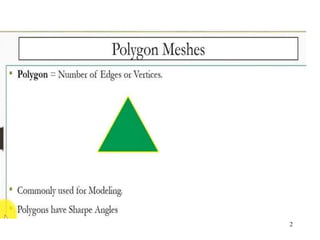
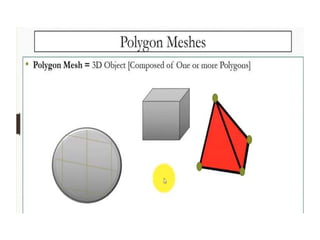
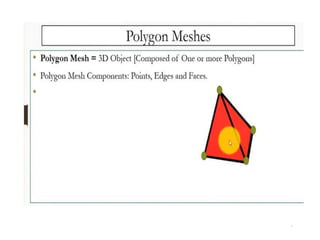
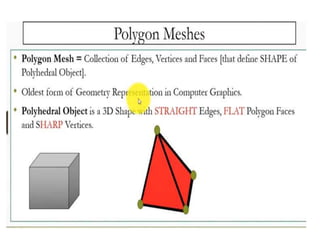
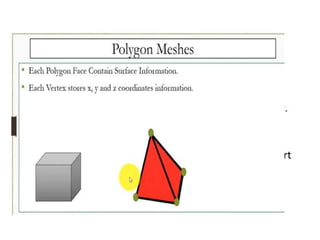
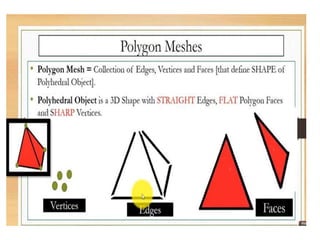
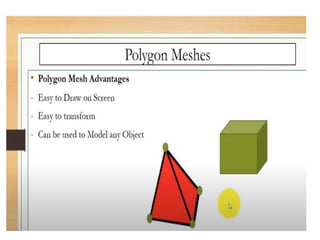
• Polygon mesh:
– set of connected planar surfaces bounded by
polygons
– good for boxes, cabinets, building exteriors
– bad for curved surfaces
– errors can be made arbitrarily small at the cost
of space and execution time
– enlarged images show geometric aliasing
5
Introduction
• Parametric polynomial curves:
– point on 3D curve = (x(t), y(t), z(t))
– x(t), y(t), and z(t) are polynomials
– usually cubic: cubic curves
6
Introduction
• Parametric bivariate (two-variable)
polynomial surface patches:
– point on 3D surface = (x(u,v), y(u,v), z(u,v))
– boundaries of the patches are parametric
polynomial curves
– many fewer parametric patches than
polynomial patches are needed to approximate
a curved surface to a given accuracy
– more complex algorithms though
7
Parametric cubic curves
• Polylines and polygons:
– large amounts of data to achieve good accuracy
– interactive manipulation of the data is tedious
• Higher-order curves:
– more compact (use less storage)
– easier to manipulate interactively
• Possible representations of curves:
– explicit, implicit, and parametric
8
Parametric cubic curves
• Polylines and polygons:
– large amounts of data to achieve good accuracy
– interactive manipulation of the data is tedious
• Higher-order curves:
– more compact (use less storage)
– easier to manipulate interactively
• Possible representations of curves:
– explicit, implicit, and parametric

Polygon Mesh.ppt

  • 1.
  • 2.
    2 • We needsmooth curves and surfaces in many applications: – model real world objects – computer-aided design (CAD) – high quality fonts – data plots – artists sketches
  • 3.
    3 Introduction • Most commonrepresentation for surfaces: – polygon mesh – parametric surfaces – quadric surfaces • Solid modeling – don’t miss the next episode...
  • 4.
    4 Introduction • Polygon mesh: –set of connected planar surfaces bounded by polygons – good for boxes, cabinets, building exteriors – bad for curved surfaces – errors can be made arbitrarily small at the cost of space and execution time – enlarged images show geometric aliasing
  • 5.
    5 Introduction • Parametric polynomialcurves: – point on 3D curve = (x(t), y(t), z(t)) – x(t), y(t), and z(t) are polynomials – usually cubic: cubic curves
  • 6.
    6 Introduction • Parametric bivariate(two-variable) polynomial surface patches: – point on 3D surface = (x(u,v), y(u,v), z(u,v)) – boundaries of the patches are parametric polynomial curves – many fewer parametric patches than polynomial patches are needed to approximate a curved surface to a given accuracy – more complex algorithms though
  • 7.
    7 Parametric cubic curves •Polylines and polygons: – large amounts of data to achieve good accuracy – interactive manipulation of the data is tedious • Higher-order curves: – more compact (use less storage) – easier to manipulate interactively • Possible representations of curves: – explicit, implicit, and parametric
  • 8.
    8 Parametric cubic curves •Polylines and polygons: – large amounts of data to achieve good accuracy – interactive manipulation of the data is tedious • Higher-order curves: – more compact (use less storage) – easier to manipulate interactively • Possible representations of curves: – explicit, implicit, and parametric