SINTHIA SARKER
Dept. of CSE
GREEN UNIVERSITY OF BANGLADESH
7/21/20201
o Curve and Surface
o Parametric cubic curves
o Types
o Mathematical complexity
7/21/20202
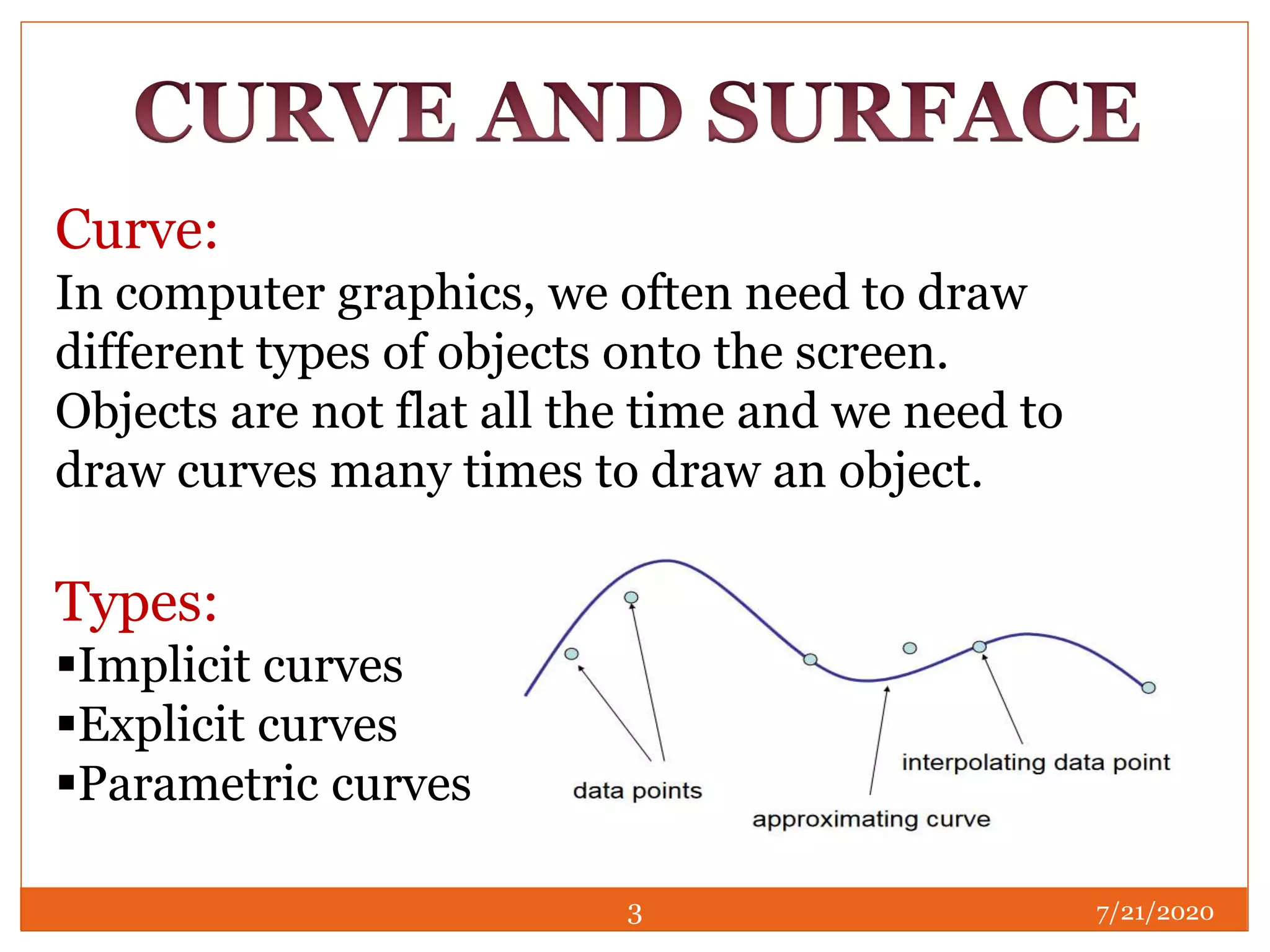
Curve:
In computer graphics, we often need to draw
different types of objects onto the screen.
Objects are not flat all the time and we need to
draw curves many times to draw an object.
Types:
Implicit curves
Explicit curves
Parametric curves
7/21/20203
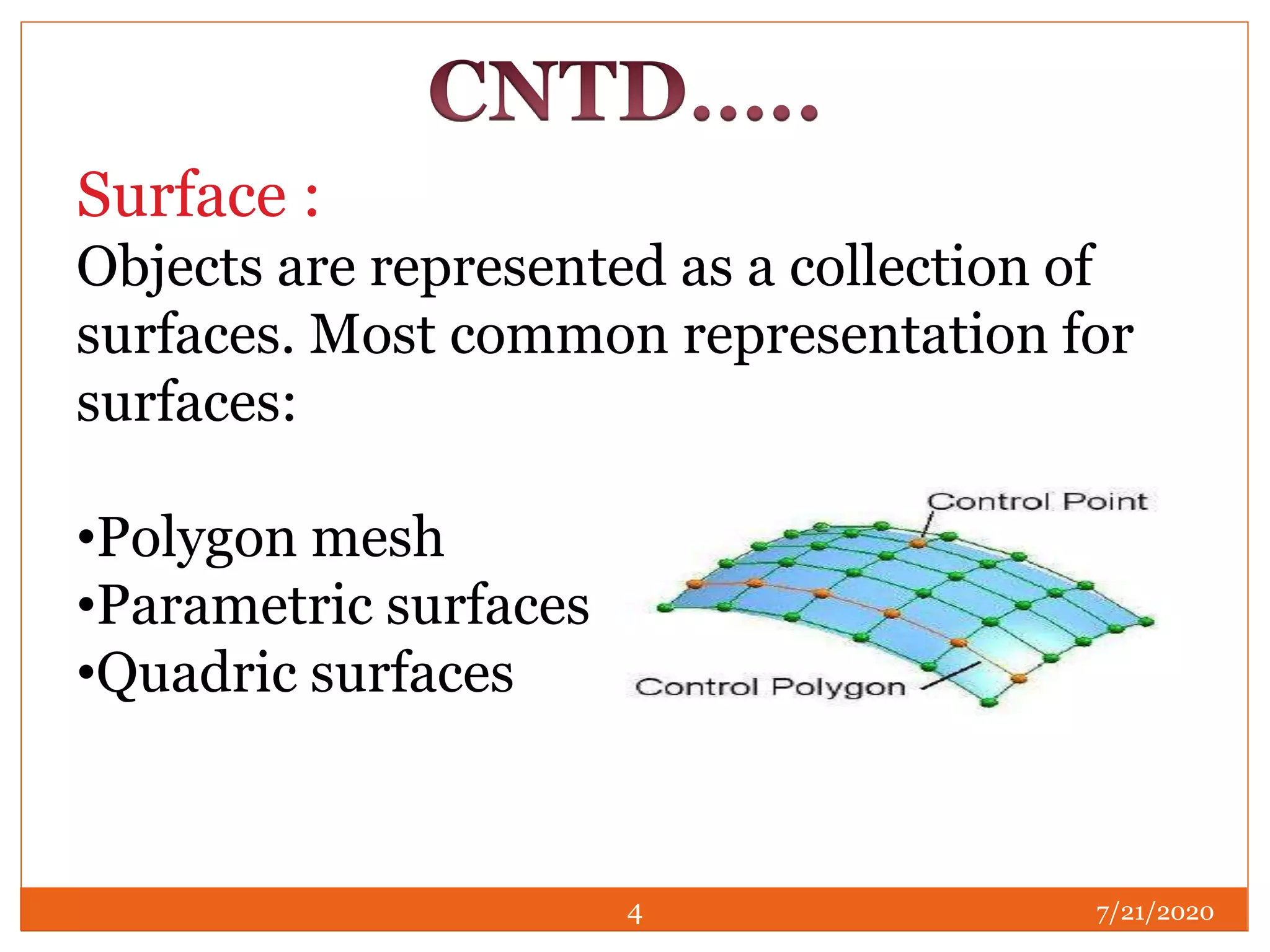
Surface :
Objects are represented as a collection of
surfaces. Most common representation for
surfaces:
•Polygon mesh
•Parametric surfaces
•Quadric surfaces
7/21/20204
There are many ways to represent curves
and surfaces . We want a representation that is
- Stable
- Smooth
- Easy to evaluate
7/21/20205
We need smooth curves and surfaces in
many applications:
- Model real world objects
- Computer-aided design (CAD)
- High quality fonts
- Data plots
- Artists sketches
7/21/20206
Polylines and polygons:
• Large amounts of data to achieve good accuracy.
• Interactive manipulation of the data is tedious.
Higher-order curves:
•More compact (use less storage).
•Easier to manipulate interactively.
Possible representations of curves:
•explicit, implicit, and parametric
7/21/20207
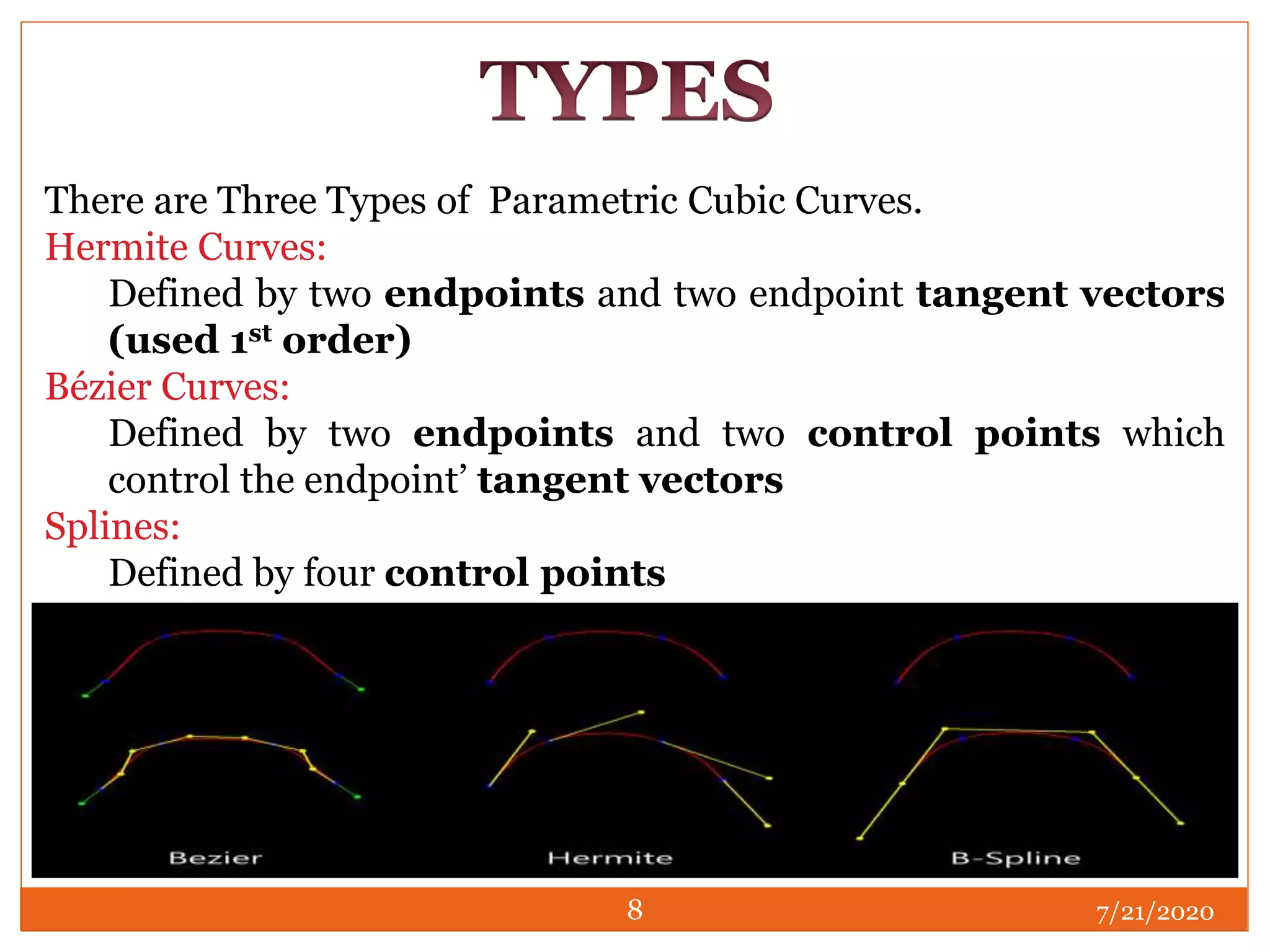
There are Three Types of Parametric Cubic Curves.
Hermite Curves:
Defined by two endpoints and two endpoint tangent vectors
(used 1st order)
Bézier Curves:
Defined by two endpoints and two control points which
control the endpoint’ tangent vectors
Splines:
Defined by four control points
7/21/20208
General form:
c= coefficient matrix
T= parameter matrix
GMTCTtztytxtQ
tttT
ddd
ccc
bbb
aaa
C
dtctbtatz
dtctbtaty
dtctbtatx
zyx
zyx
zyx
zyx
zzzz
yyyy
xxxx




















)]()()([)(
]1[
)(
)(
)(
23
23
23
23
7/21/20209
GMTCTtztytxtQ  )]()()([)(
If cubic the derivation….
7/21/202010
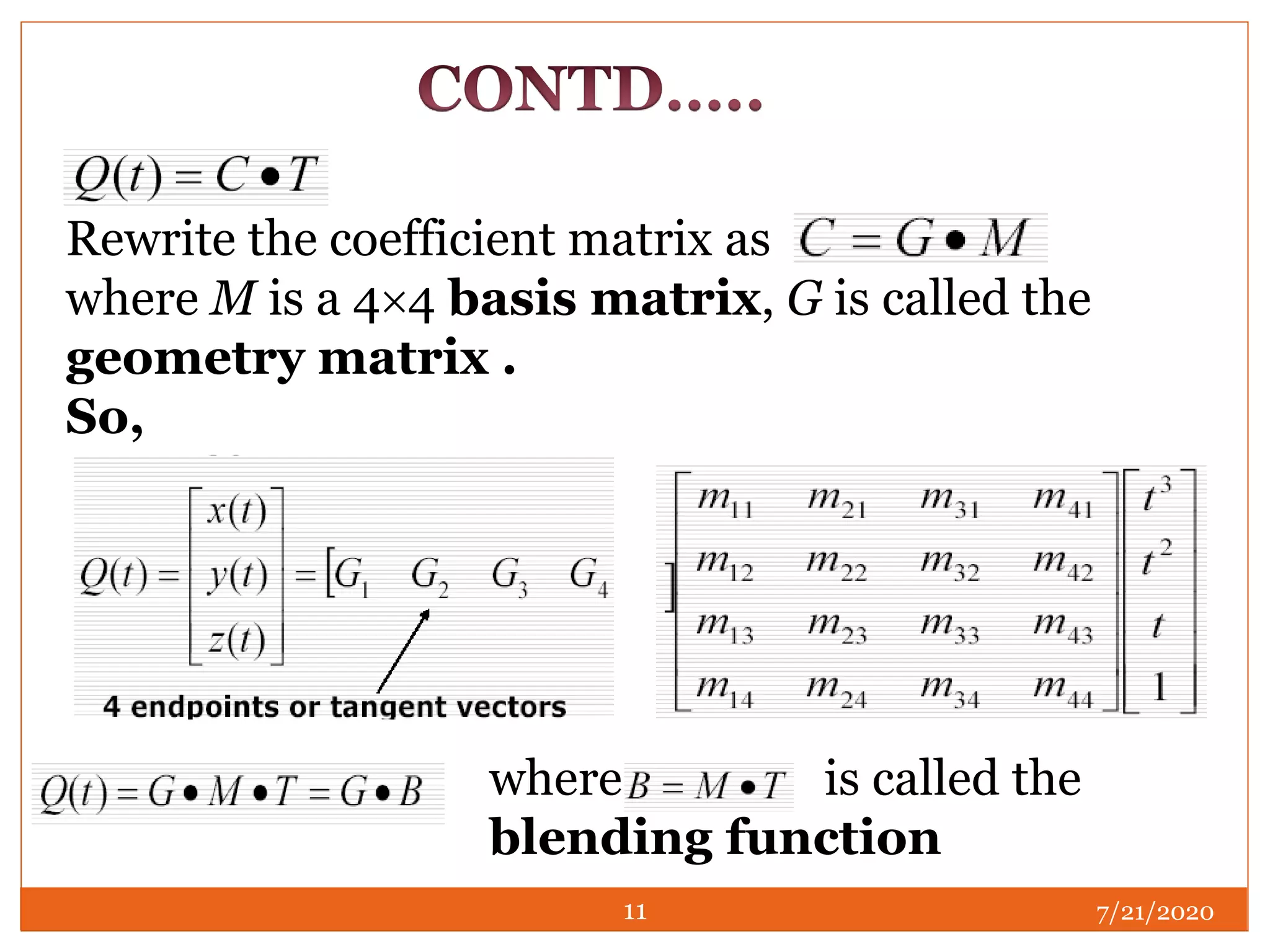
Rewrite the coefficient matrix as
where M is a 44 basis matrix, G is called the
geometry matrix .
So,
where is called the
blending function
7/21/202011
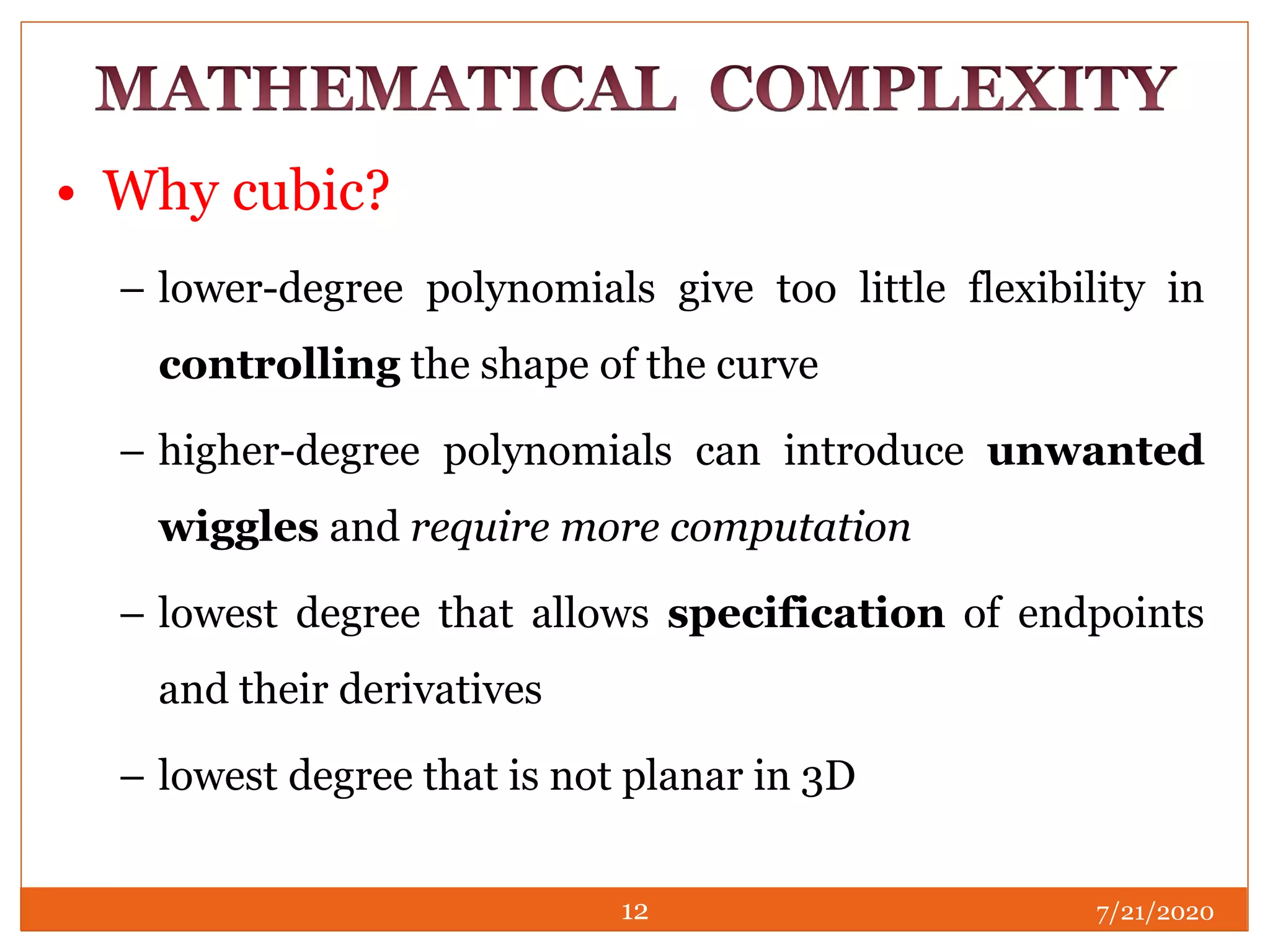
• Why cubic?
– lower-degree polynomials give too little flexibility in
controlling the shape of the curve
– higher-degree polynomials can introduce unwanted
wiggles and require more computation
– lowest degree that allows specification of endpoints
and their derivatives
– lowest degree that is not planar in 3D
7/21/202012
7/21/202013

Computer graphics(parametric cubic curves)

  • 1.
    SINTHIA SARKER Dept. ofCSE GREEN UNIVERSITY OF BANGLADESH 7/21/20201
  • 2.
    o Curve andSurface o Parametric cubic curves o Types o Mathematical complexity 7/21/20202
  • 3.
    Curve: In computer graphics,we often need to draw different types of objects onto the screen. Objects are not flat all the time and we need to draw curves many times to draw an object. Types: Implicit curves Explicit curves Parametric curves 7/21/20203
  • 4.
    Surface : Objects arerepresented as a collection of surfaces. Most common representation for surfaces: •Polygon mesh •Parametric surfaces •Quadric surfaces 7/21/20204
  • 5.
    There are manyways to represent curves and surfaces . We want a representation that is - Stable - Smooth - Easy to evaluate 7/21/20205
  • 6.
    We need smoothcurves and surfaces in many applications: - Model real world objects - Computer-aided design (CAD) - High quality fonts - Data plots - Artists sketches 7/21/20206
  • 7.
    Polylines and polygons: •Large amounts of data to achieve good accuracy. • Interactive manipulation of the data is tedious. Higher-order curves: •More compact (use less storage). •Easier to manipulate interactively. Possible representations of curves: •explicit, implicit, and parametric 7/21/20207
  • 8.
    There are ThreeTypes of Parametric Cubic Curves. Hermite Curves: Defined by two endpoints and two endpoint tangent vectors (used 1st order) Bézier Curves: Defined by two endpoints and two control points which control the endpoint’ tangent vectors Splines: Defined by four control points 7/21/20208
  • 9.
    General form: c= coefficientmatrix T= parameter matrix GMTCTtztytxtQ tttT ddd ccc bbb aaa C dtctbtatz dtctbtaty dtctbtatx zyx zyx zyx zyx zzzz yyyy xxxx                     )]()()([)( ]1[ )( )( )( 23 23 23 23 7/21/20209
  • 10.
    GMTCTtztytxtQ  )]()()([)( Ifcubic the derivation…. 7/21/202010
  • 11.
    Rewrite the coefficientmatrix as where M is a 44 basis matrix, G is called the geometry matrix . So, where is called the blending function 7/21/202011
  • 12.
    • Why cubic? –lower-degree polynomials give too little flexibility in controlling the shape of the curve – higher-degree polynomials can introduce unwanted wiggles and require more computation – lowest degree that allows specification of endpoints and their derivatives – lowest degree that is not planar in 3D 7/21/202012
  • 13.