WELCOME
Presented by
Reshma C
2015-06-019
1/22/2020HPP
1
WHY HPP
•Non thermal pasteurization
• Since 19th century and most prominent from 2000.
•Not only inactivation of micro organisms but also
value addition.
•Retension of natural colour ,flavour and texture
without no loss of vitamins and minerals.
1/22/2020HPP
2
CONTENTS
1/22/2020
HPP
3
1.Introduction
2.HPP : Principles/Mechanism
3.Techniques & Equipment
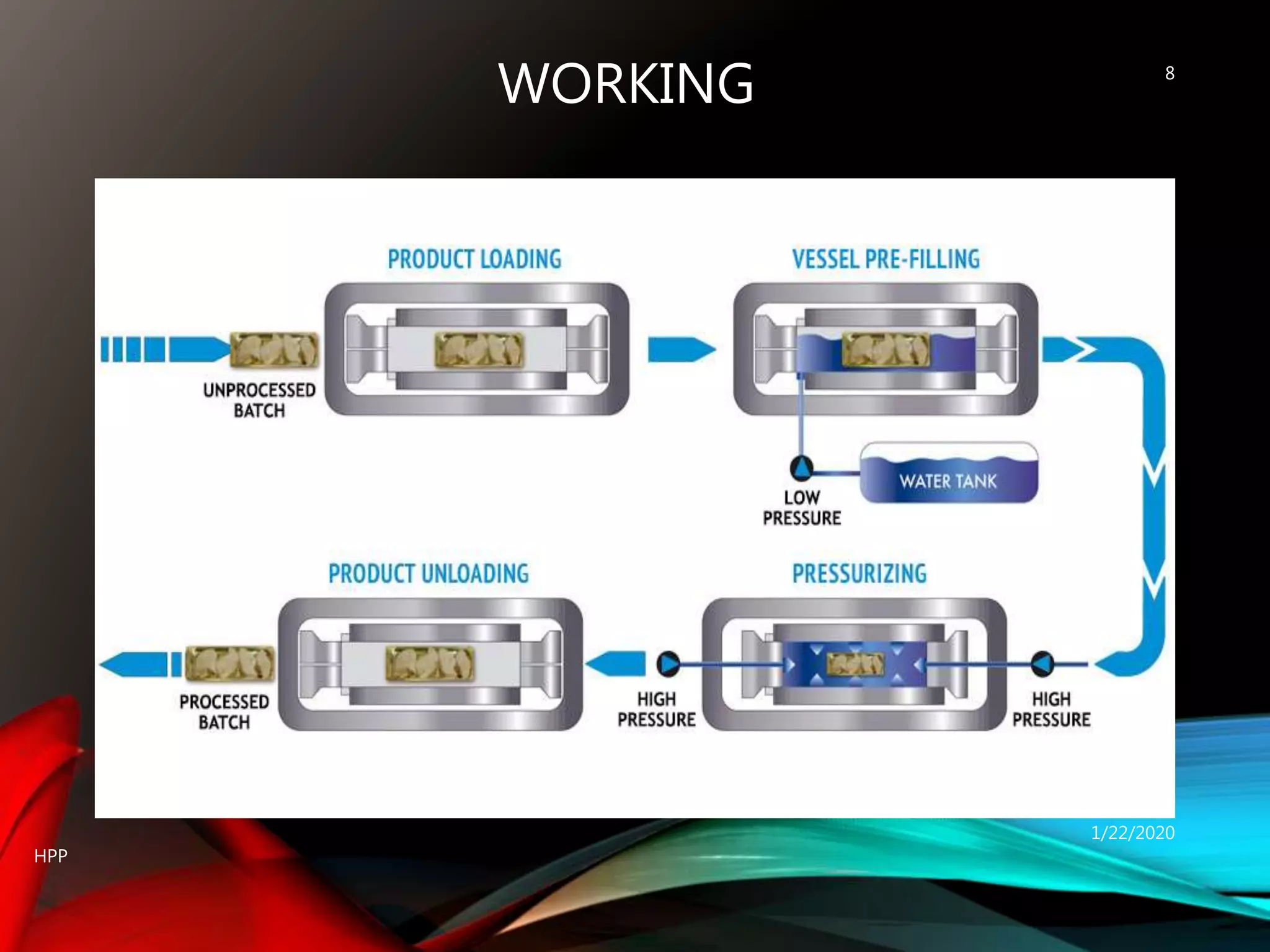
4.Working of HPP
5.Effect on micro organisms
6.Applications
7.Advantages
8.Limitations
9.Case studies
10.Summary
INTRODUCTION
• 1895 –killing bacteria
• Kimura Ketal :450Pa or more improve milk quality
• HPP=HPT=UHP
• 100-800Mpa for second to minutes
• Little effect on covalent bonds
• 21st century used to separate shell from shell fishes
1/22/2020HPP
4
HPP PRINCIPLES
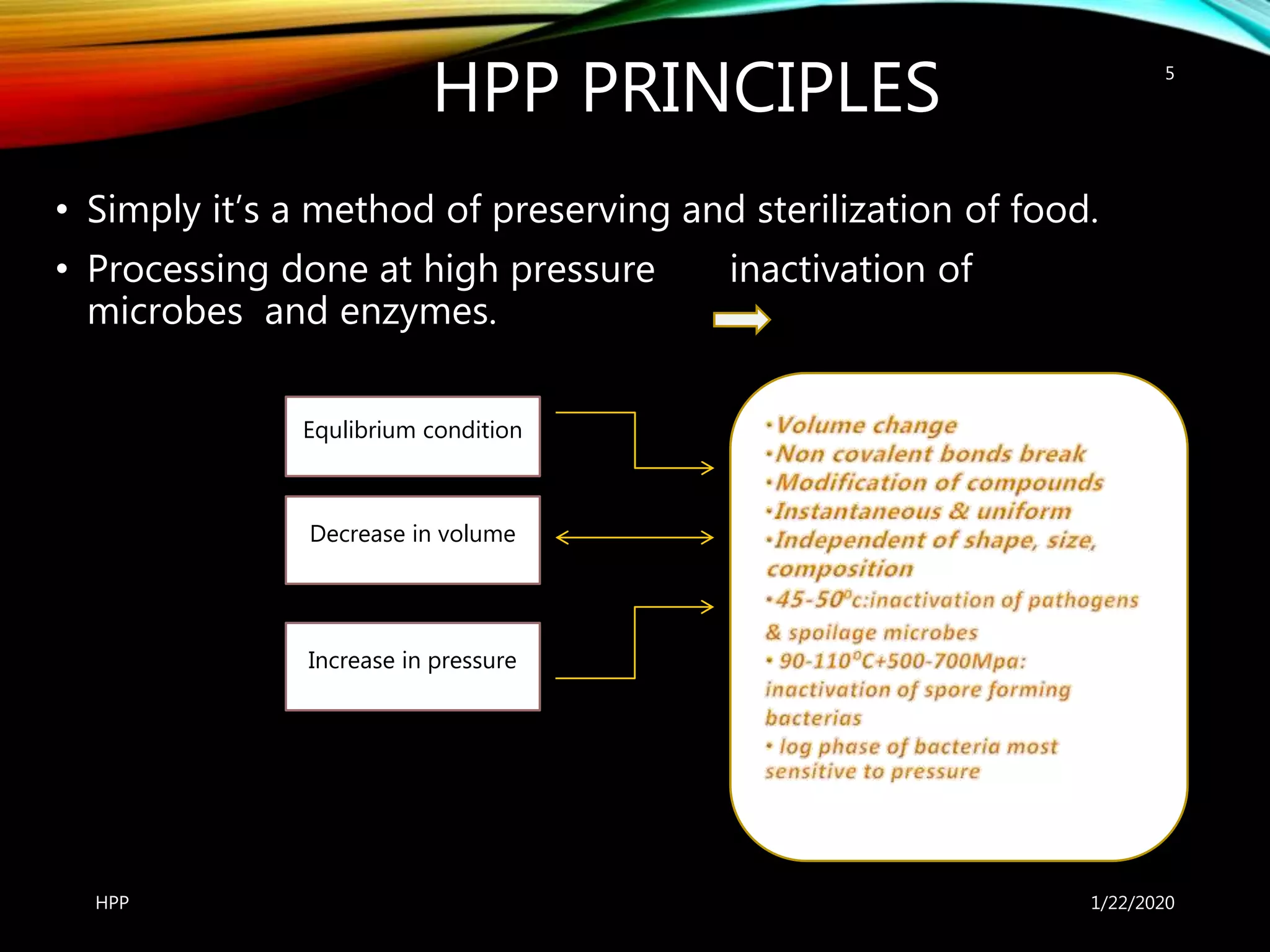
• Simply it’s a method of preserving and sterilization of food.
• Processing done at high pressure inactivation of
microbes and enzymes.
1/22/2020HPP
5
Equlibrium condition
Decrease in volume
Increase in pressure
Cntd……
1. Le-Chatelier principle
Relationship between pressure
and volume
2. Iso static principle
• Compression in uniform
pressure
• Mass & time dependence
• Moisture content
1/22/2020HPP
6
TECHNIQUES AND
EQUIPMENT
• Similar to conventional batch heat processing
• It requires:
1. Pressure vessel
2. Pressure generating valve
3. Pressure medium: soluble oil (bottom)
• Iso static process
• Pressure : (300-700Mpa) for 15 min 10,000 fold reduction in
food poisoning bacteria
1/22/2020HPP
7
WORKING
1/22/2020
HPP
8
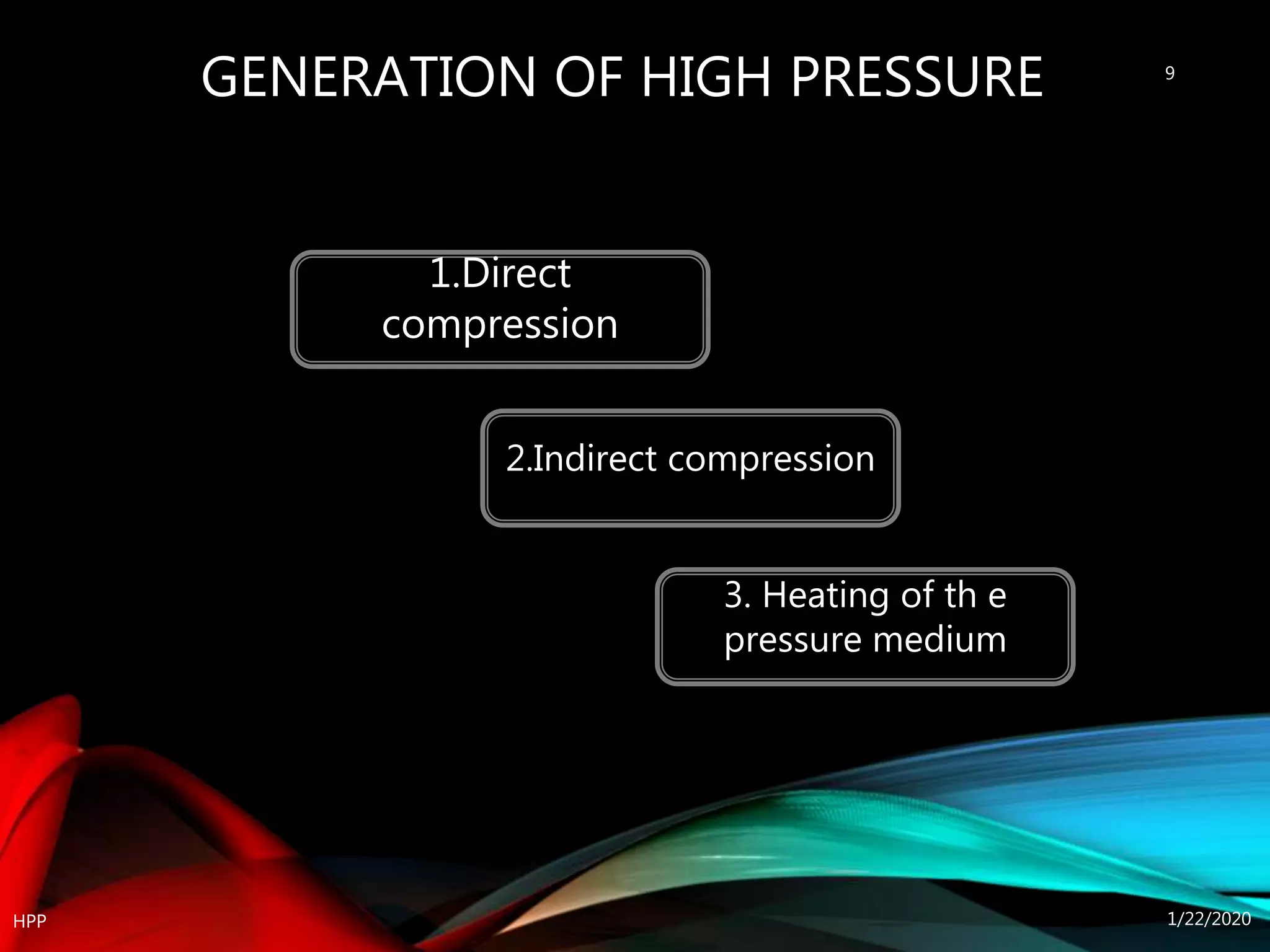
GENERATION OF HIGH PRESSURE
1/22/2020HPP
9
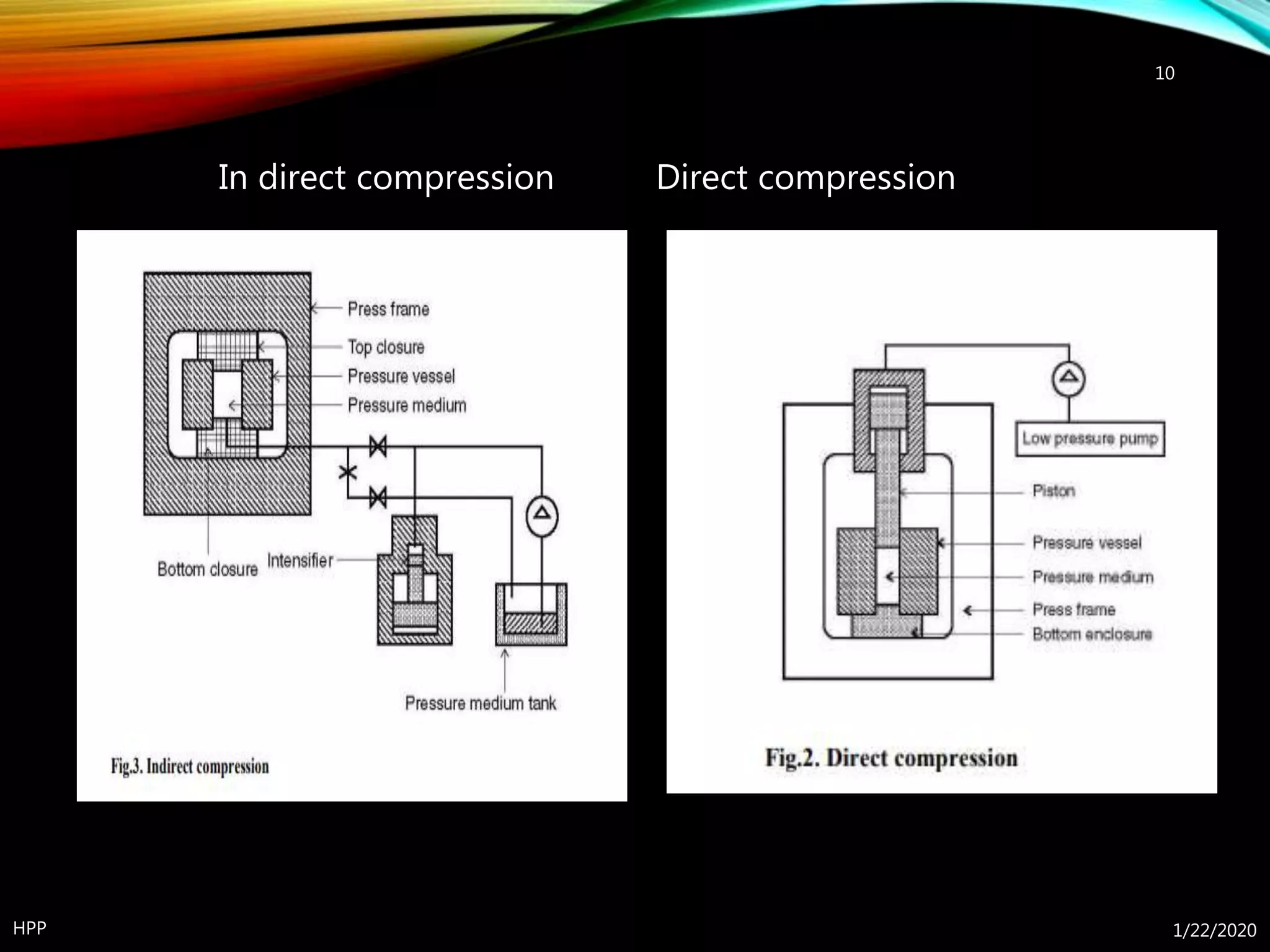
2.Indirect compression
3. Heating of th e
pressure medium
1.Direct
compression
In direct compression Direct compression
1/22/2020HPP
10
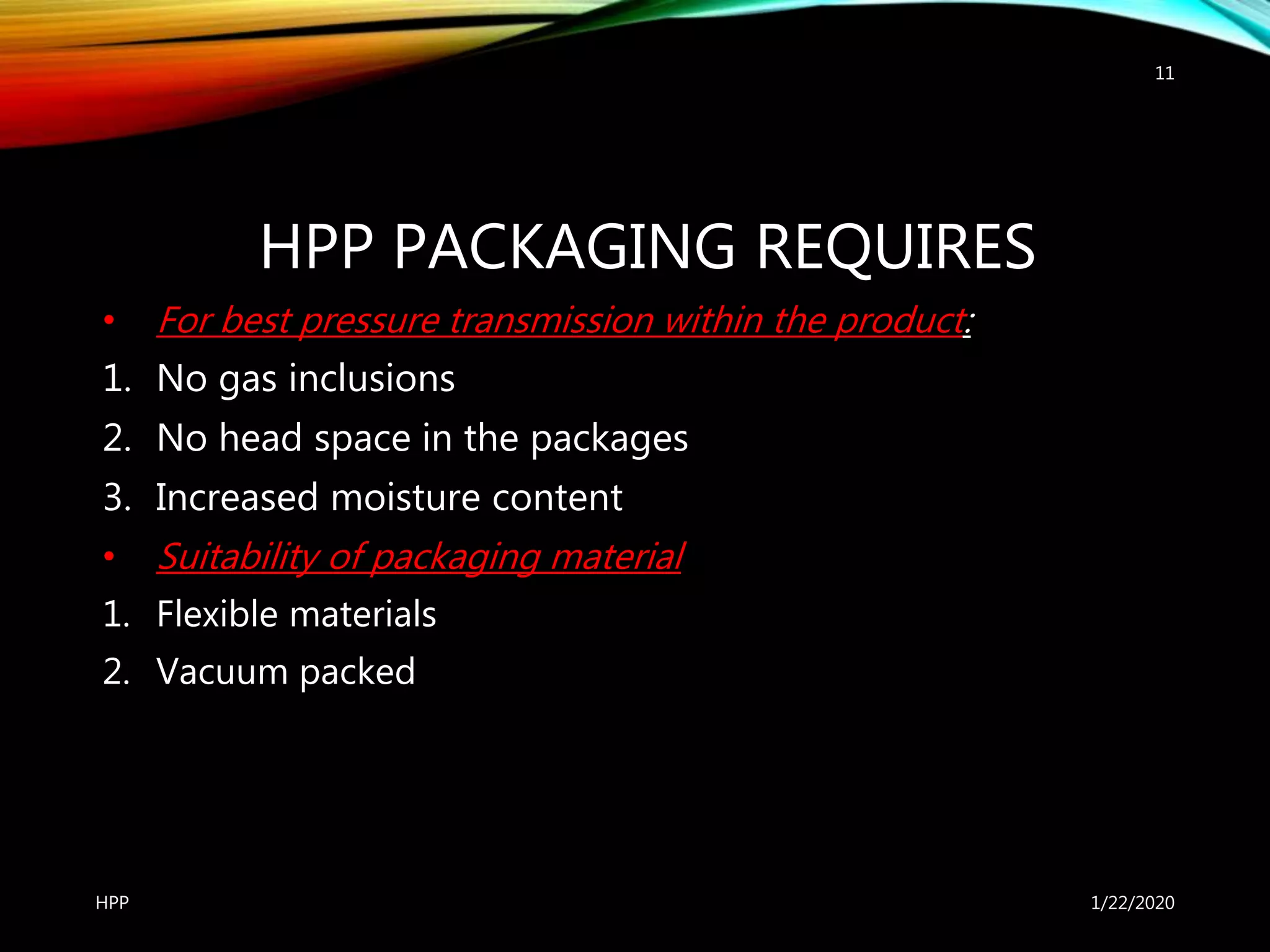
HPP PACKAGING REQUIRES
• For best pressure transmission within the product:
1. No gas inclusions
2. No head space in the packages
3. Increased moisture content
• Suitability of packaging material
1. Flexible materials
2. Vacuum packed
1/22/2020HPP
11
Ctnd………..
• Packaging materials: Stomacher bags ,sterile tubes,
polyester tubes, pouches ,flexible systems.
• They should have the ability to prevent deterioration
• Small head space
1/22/2020HPP
12
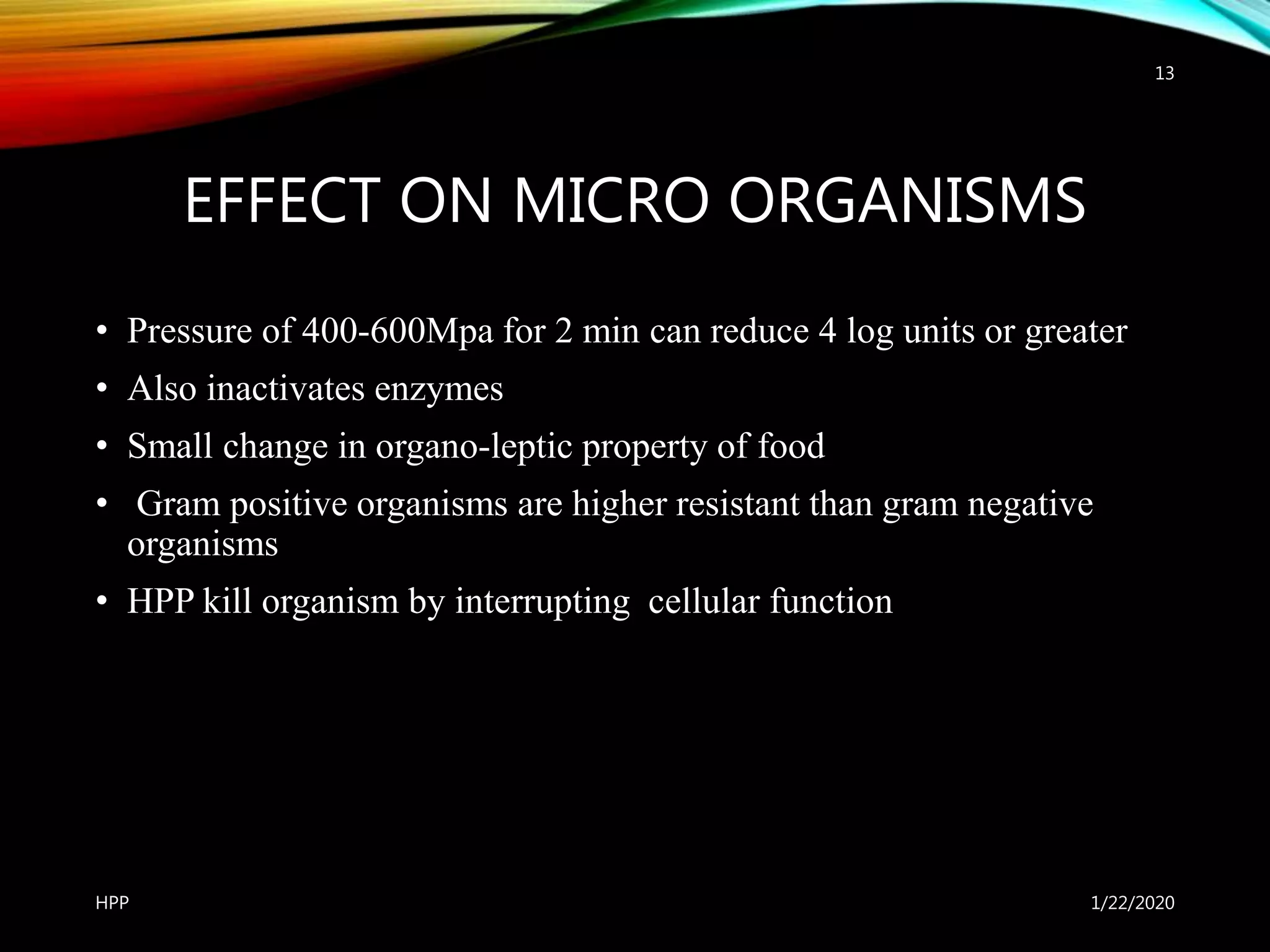
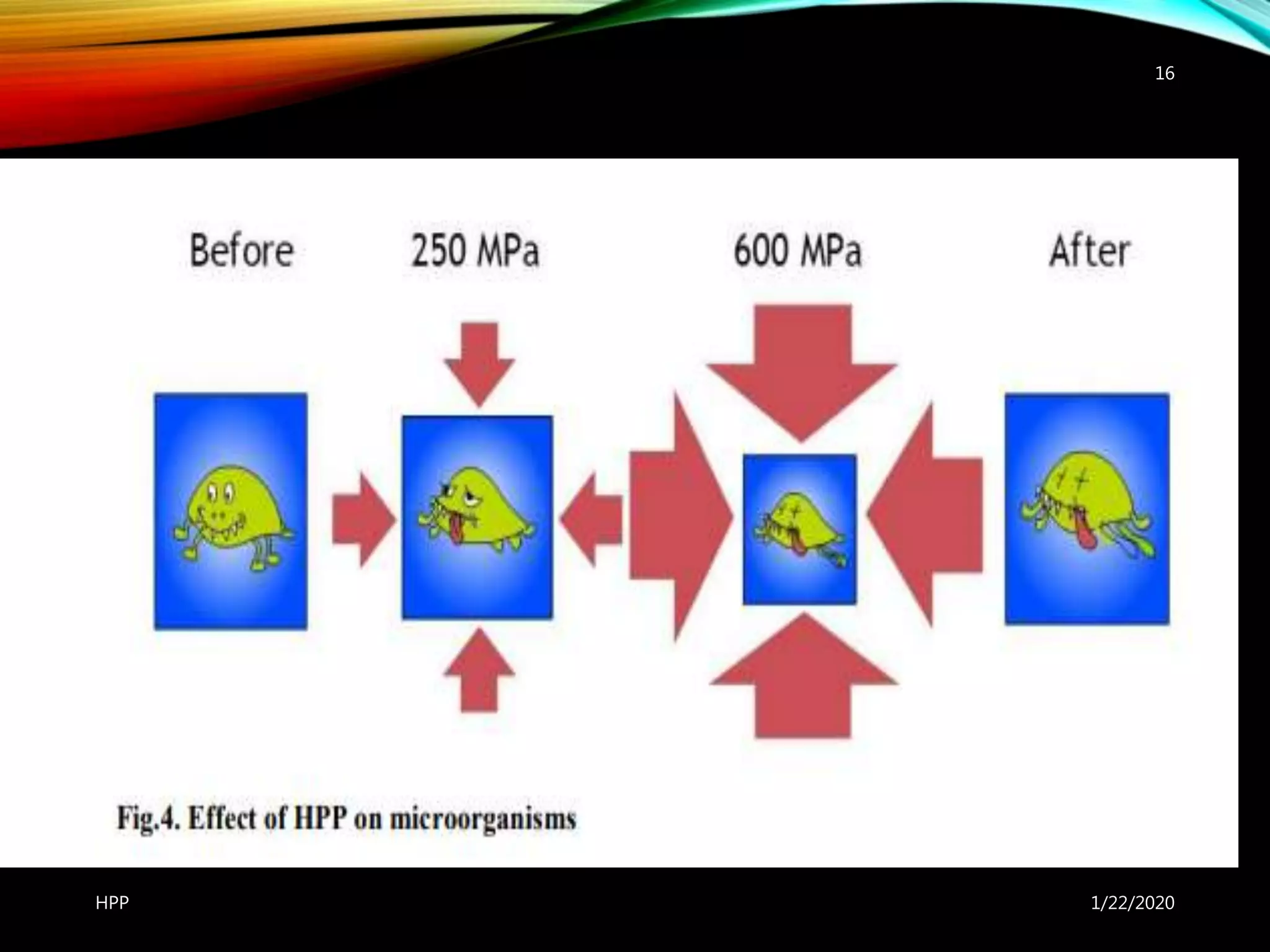
EFFECT ON MICRO ORGANISMS
• Pressure of 400-600Mpa for 2 min can reduce 4 log units or greater
• Also inactivates enzymes
• Small change in organo-leptic property of food
• Gram positive organisms are higher resistant than gram negative
organisms
• HPP kill organism by interrupting cellular function
1/22/2020HPP
13
Cntd….
• Effectiveness depends on:
• 1.Pressure applied
• 2.Holding time
• 3.Temperature
• 4. Type of food matrix
• 5.Target organism
1/22/2020HPP
14
MICROBIAL INACTIVATION
• Its by increasing permeability of cell membrane
• Inhibition of enzymes vital for bacterial survival and
reproduction of bacterial cells
• Also dependent on organism
• Water activity and pH
1/22/2020HPP
15
1/22/2020HPP
16
APPLICATIONS OF HPP
1/22/2020HPP
17
1.Fruits and vegetable
industry
2.Meat and fish industry
3. Dairy and egg industry
FRUITS AND VEGETABLE INDUSTRY
• Does not depreciate the nutritional & sensory characteristics
• Maintains shelf life
• Potassium leaching is reduced 20%
• Ascorbic acid retained 90%
1/22/2020HPP
18
MEAT & FISH INDUSTRY
• Inactivation of micro organisms
• Pressure range:200-400Mpa
• Total inhibition @400-500Mpa
• Pseudomonas species not by HPP ,HPP plus other technology
needed
• Meat dis-colouration at HPP : whitening effect by globin
denaturation , heam displacement or release or oxidation
1/22/2020HPP
19
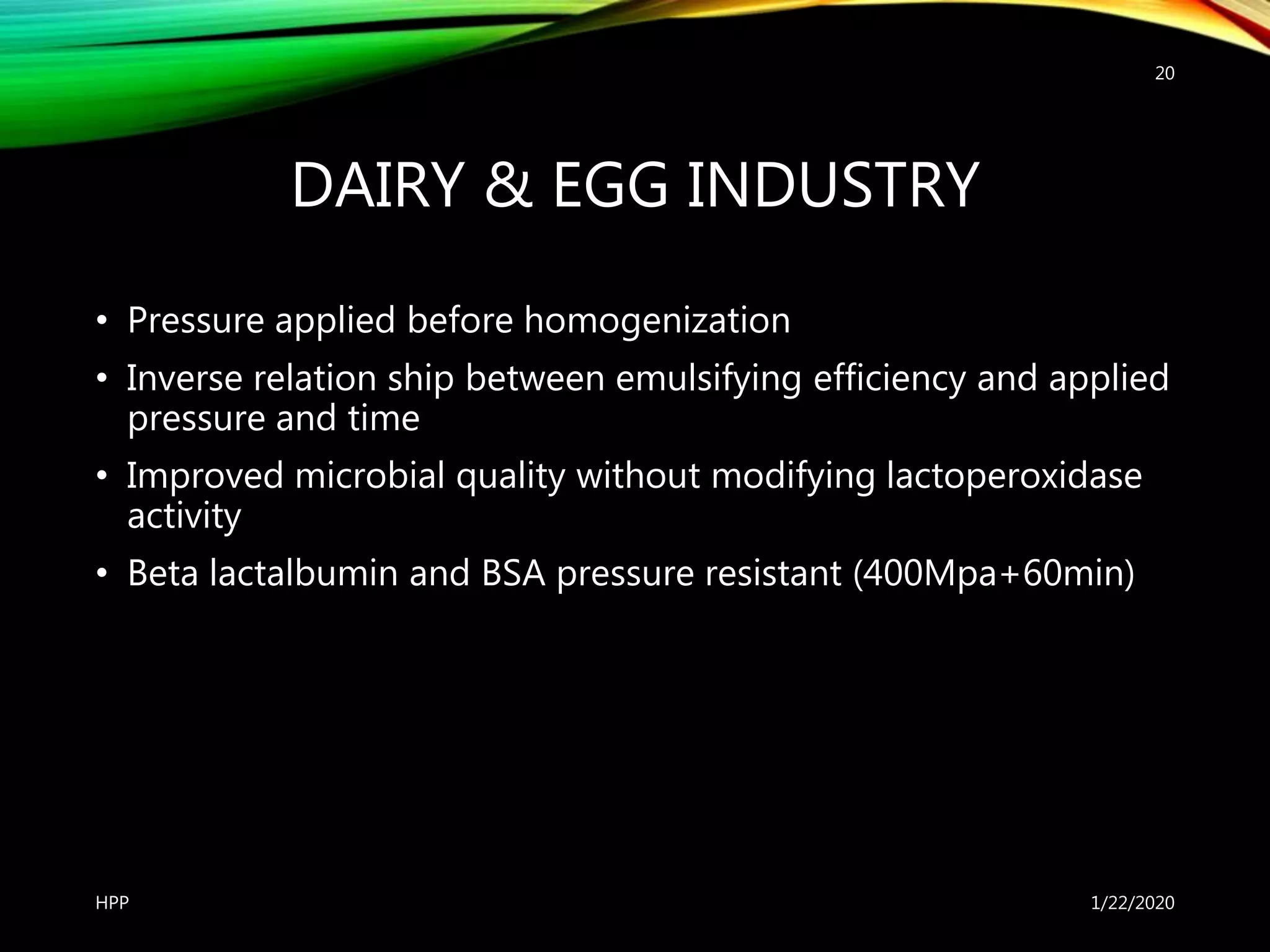
DAIRY & EGG INDUSTRY
• Pressure applied before homogenization
• Inverse relation ship between emulsifying efficiency and applied
pressure and time
• Improved microbial quality without modifying lactoperoxidase
activity
• Beta lactalbumin and BSA pressure resistant (400Mpa+60min)
1/22/2020HPP
20
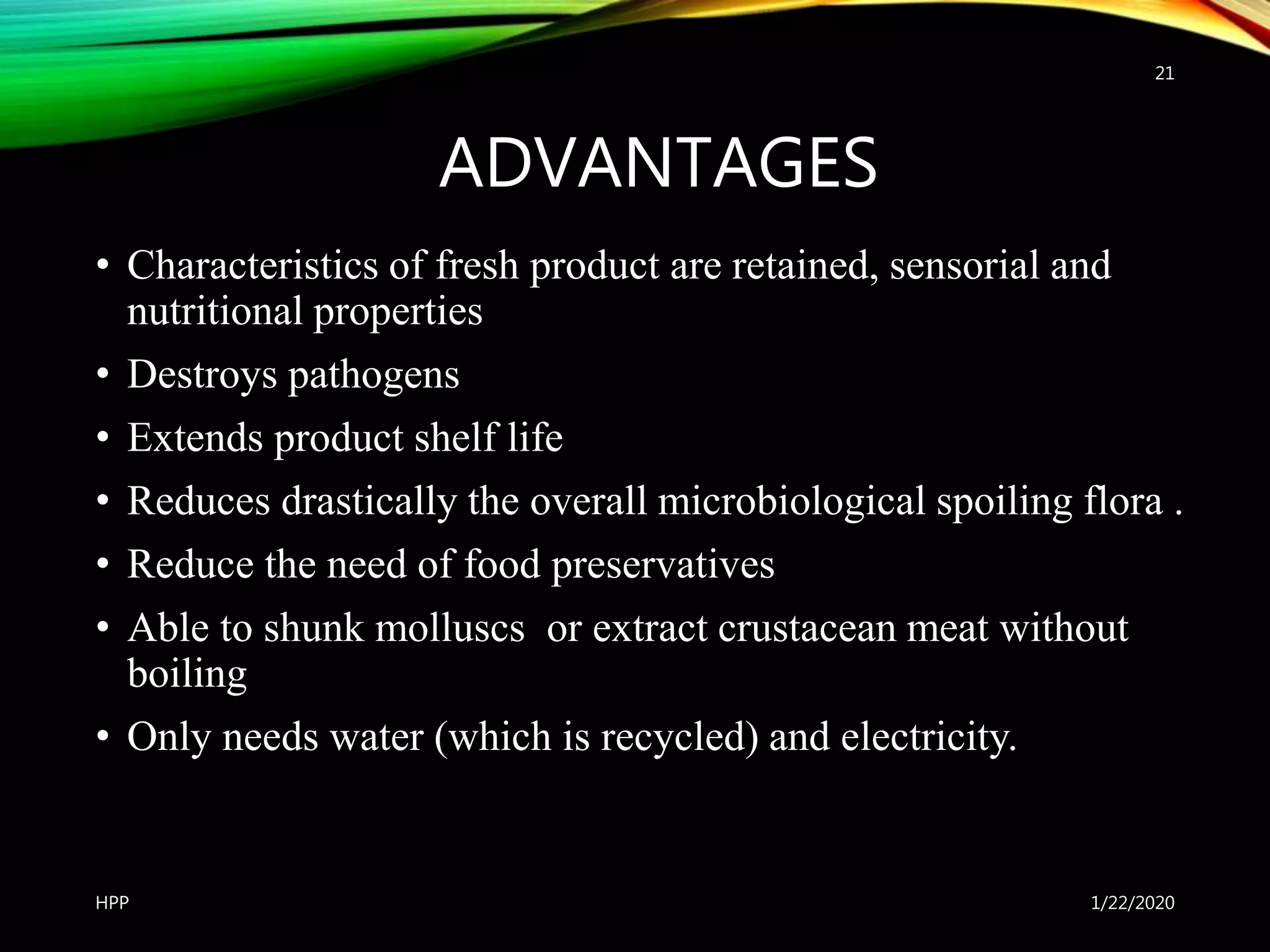
ADVANTAGES
• Characteristics of fresh product are retained, sensorial and
nutritional properties
• Destroys pathogens
• Extends product shelf life
• Reduces drastically the overall microbiological spoiling flora .
• Reduce the need of food preservatives
• Able to shunk molluscs or extract crustacean meat without
boiling
• Only needs water (which is recycled) and electricity.
1/22/2020HPP
21
LIMITATIONS
• Capital cost for commercial scale
• Substantial economic losses
• Complex machinery is needed.
1/22/2020HPP
22
1/22/2020HPP
23
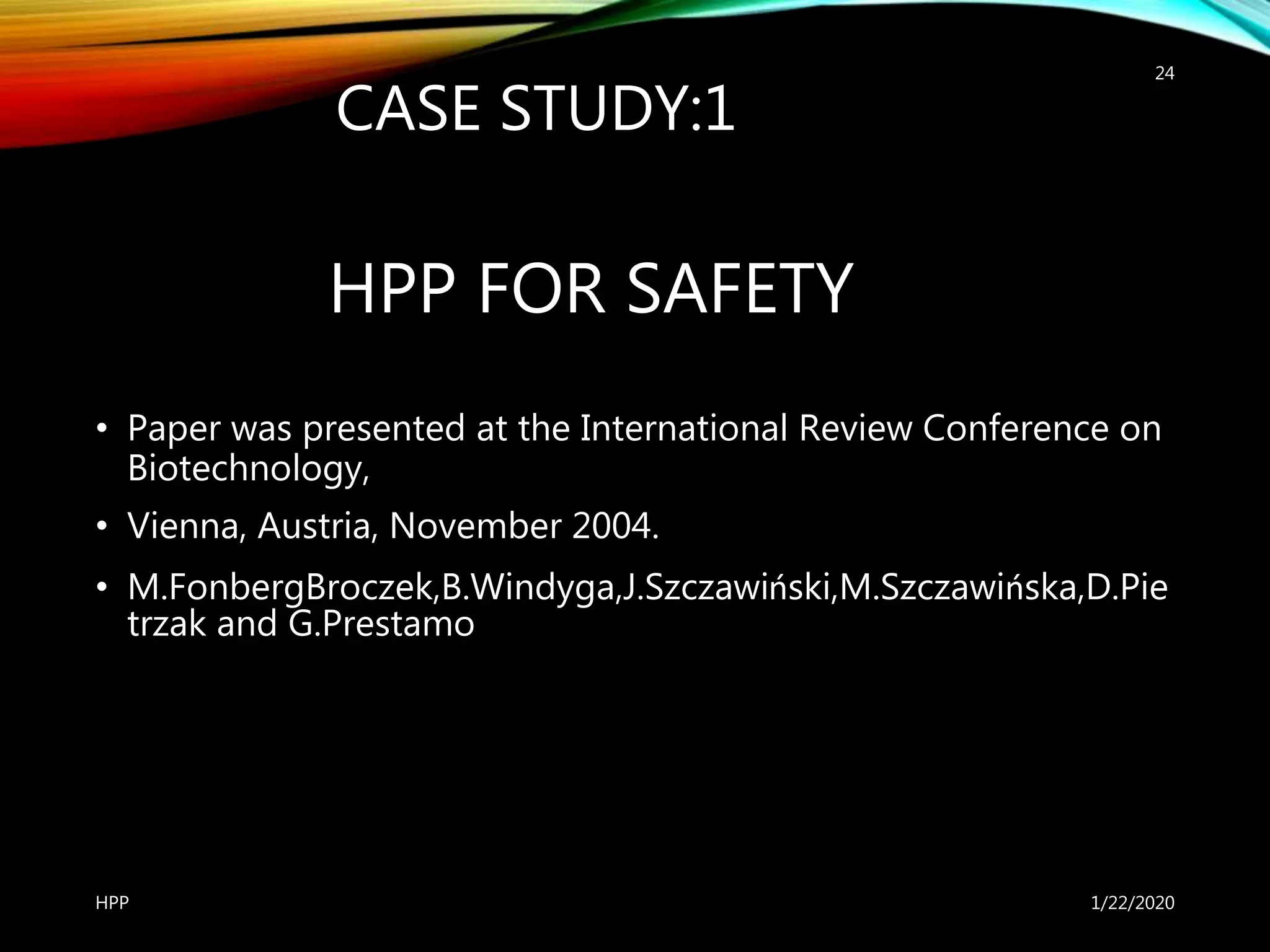
HPP FOR SAFETY
• Paper was presented at the International Review Conference on
Biotechnology,
• Vienna, Austria, November 2004.
• M.FonbergBroczek,B.Windyga,J.Szczawiński,M.Szczawińska,D.Pie
trzak and G.Prestamo
1/22/2020HPP
24
CASE STUDY:1
• Aim:
1. Inactivation of L.monocytogens, A.hydeophilae, E.hirae
in artifically contaminated ham, cheese, and fruit
juices all containing 10‸6 microbes/gram.
2. Influence of HPP treatment on microbial quality & shelf
life prolongation of pork ham & loin
1/22/2020HPP
25
• Materials Required:
• Different stains of L.monocytogens, A.hydeophilae, E.hirae
• Sample preparation:
• L.monocytogens: contaminated the apple and pork ham
• A.hydeophilae, E.hirae: contaminated ripened hard cheese
1/22/2020HPP
26
RESULTS AND DISCUSSIONS
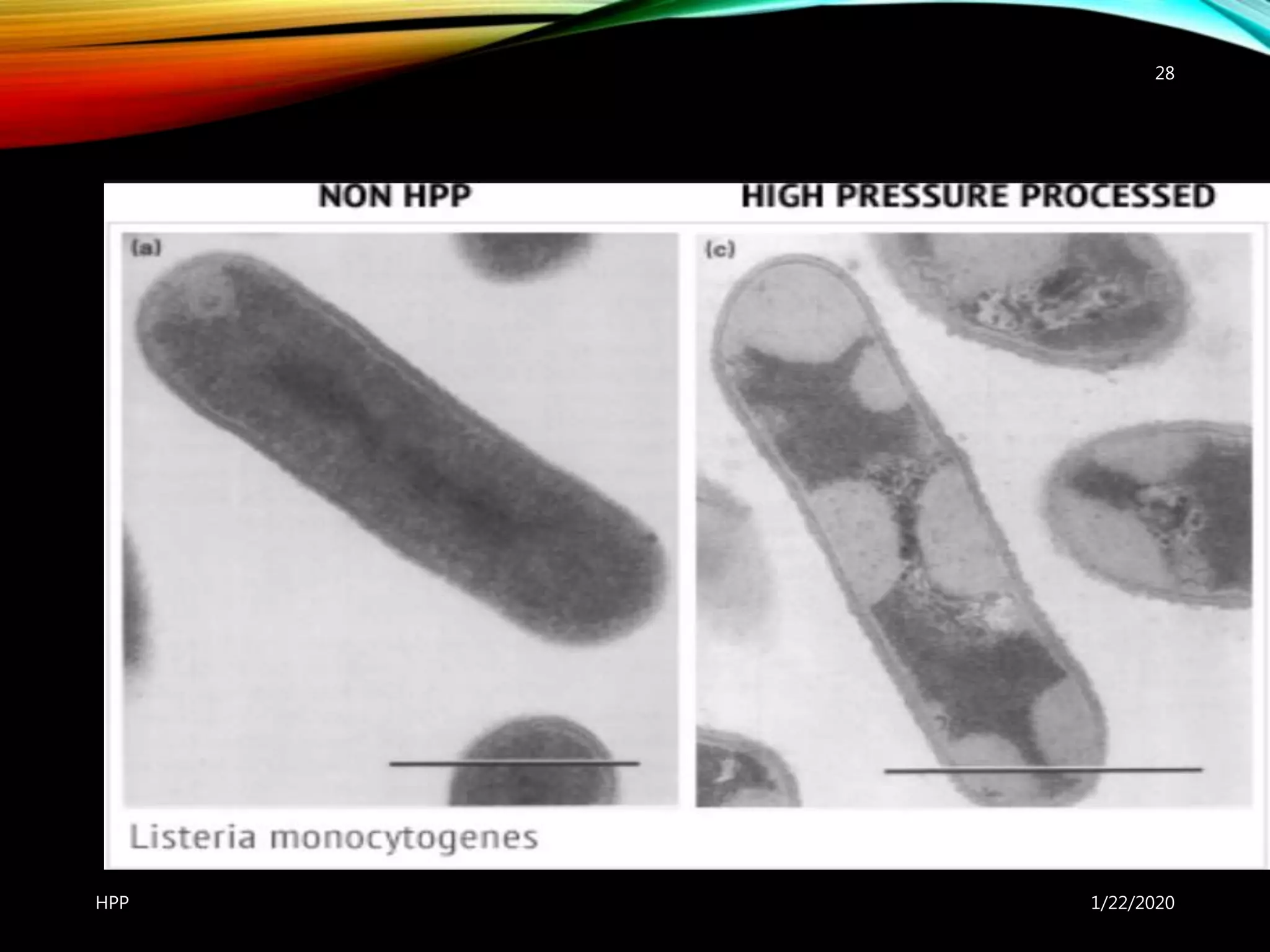
• L.monocytogens –
• causative organism of listeriosis
• Dairy products, raw meat, cheese
• A.hydrophila –
• Rapid growth @5⁰C
• Lack of thermal treatment(or inadequate cooling)
• Prolonged storage under refrigeration
• Ready to eat foods
• E.hirae-
• Indicator of GMP
• Growth range :7-45⁰C(thermo vegetative bacteria)
• Salt tolerant
• Excessive growth in increased content of histamine and thyramine
1/22/2020HPP
27
1/22/2020HPP
28
Cntd…………
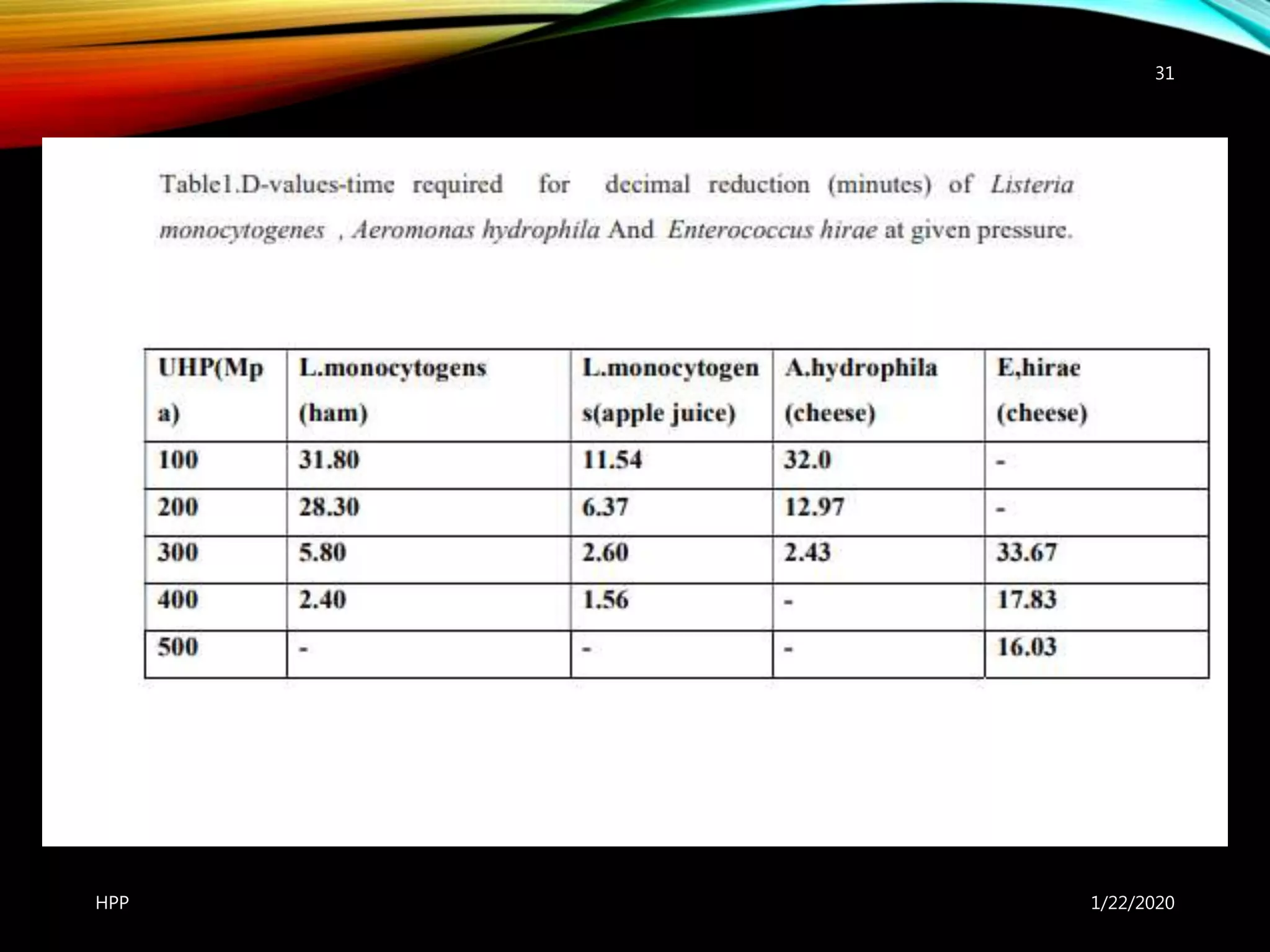
• Number of bacteria decreased proportionally with
pressure and time
• E.hirae is more resistant than L.monocytogens and
A.hydrophila.
• A.hydrphila is more sensitive to HPP
• E.hirae 6 log reduction
• Samples are investigated :
• Decreased bacterial count
• HPP increased shelflife
1/22/2020HPP
29
1/22/2020HPP
30
1/22/2020HPP
31
CASE STUDY 2:
A predictive modelling study for using high
hydrostatic pressure, a food
processing technology, for protein extraction
Done by : Ergin Murat ALTUNER
1/22/2020
HPP
32
• HPP 100-800Mpa or 1000Mpa is used.
• Cold isostatic
• Super high pressure
• Also used for extraction of active ingredients bio materials
• Solubility increases on increasing pressure and increasing
solvent
1/22/2020HPP
33
AIM
• Fit a response model to one response , extracted protein
concentration by using HPP , as function of two particular
controllable factors of extension procedure.
• Procedure:
• Solvents: PBS , Tris HCl,TCA-acetone
• Factors used: Pressure and extraction solvent
• Pressure:100MPa-300Mpa centre pressure 200MPa
1/22/2020HPP
34
PREDICTIVE ANALYSIS
• According to the analysis, protein concentration response
can be defined by the equation given below:
• U= 0.008442>Pressure@ 0.85425>Extraction Solvent@
34.29753
1/22/2020HPP
35
1/22/2020HPP
36
SUMMARY
• HPP is a promising technique
• Only predictable changes in proteins , complex carbohydrates
• Pressure , time & temperature : parameters
• Time is mainly seconds
• More dependent up on food to be processed
• Packaging material also have a role
• After processing product should be vacuum packed
1/22/2020HPP
37
REFERENCES
1. Lopez FR, Carrascosa AV, Olano A (1996) The effect of high pressure
whey protein denaturation and cheese making properties of raw milk. J Dairy
Sci 79: 929-936.
2. Lopez FR, Carrascosa AV, Olano A (1996) The effect of high pressure
whey protein denaturation and cheese making properties of raw milk. J Dairy
Sci 79: 929-936.
3. Tauscher BK (1999) High pressure and chemical reactions effects on
nutrients and pigments. Emerging food Sci Tech Tempere Finland 58: 22-24.
4. Cheftel JC (1995) Review: High pressure microbial inactivation and food
preservation. Food SciTechnolInt 1: 75-90.
5.Erkmen O, Karatas S (1997) Effects of high hydrostatics pressure on
Staphylococcus aureusin milk. J Food Eng 33: 257-262.
1/22/2020HPP
38
1/22/2020HPP
39
1/22/2020
HPP
40

Hpp

  • 1.
  • 2.
    WHY HPP •Non thermalpasteurization • Since 19th century and most prominent from 2000. •Not only inactivation of micro organisms but also value addition. •Retension of natural colour ,flavour and texture without no loss of vitamins and minerals. 1/22/2020HPP 2
  • 3.
    CONTENTS 1/22/2020 HPP 3 1.Introduction 2.HPP : Principles/Mechanism 3.Techniques& Equipment 4.Working of HPP 5.Effect on micro organisms 6.Applications 7.Advantages 8.Limitations 9.Case studies 10.Summary
  • 4.
    INTRODUCTION • 1895 –killingbacteria • Kimura Ketal :450Pa or more improve milk quality • HPP=HPT=UHP • 100-800Mpa for second to minutes • Little effect on covalent bonds • 21st century used to separate shell from shell fishes 1/22/2020HPP 4
  • 5.
    HPP PRINCIPLES • Simplyit’s a method of preserving and sterilization of food. • Processing done at high pressure inactivation of microbes and enzymes. 1/22/2020HPP 5 Equlibrium condition Decrease in volume Increase in pressure
  • 6.
    Cntd…… 1. Le-Chatelier principle Relationshipbetween pressure and volume 2. Iso static principle • Compression in uniform pressure • Mass & time dependence • Moisture content 1/22/2020HPP 6
  • 7.
    TECHNIQUES AND EQUIPMENT • Similarto conventional batch heat processing • It requires: 1. Pressure vessel 2. Pressure generating valve 3. Pressure medium: soluble oil (bottom) • Iso static process • Pressure : (300-700Mpa) for 15 min 10,000 fold reduction in food poisoning bacteria 1/22/2020HPP 7
  • 8.
  • 9.
    GENERATION OF HIGHPRESSURE 1/22/2020HPP 9 2.Indirect compression 3. Heating of th e pressure medium 1.Direct compression
  • 10.
    In direct compressionDirect compression 1/22/2020HPP 10
  • 11.
    HPP PACKAGING REQUIRES •For best pressure transmission within the product: 1. No gas inclusions 2. No head space in the packages 3. Increased moisture content • Suitability of packaging material 1. Flexible materials 2. Vacuum packed 1/22/2020HPP 11
  • 12.
    Ctnd……….. • Packaging materials:Stomacher bags ,sterile tubes, polyester tubes, pouches ,flexible systems. • They should have the ability to prevent deterioration • Small head space 1/22/2020HPP 12
  • 13.
    EFFECT ON MICROORGANISMS • Pressure of 400-600Mpa for 2 min can reduce 4 log units or greater • Also inactivates enzymes • Small change in organo-leptic property of food • Gram positive organisms are higher resistant than gram negative organisms • HPP kill organism by interrupting cellular function 1/22/2020HPP 13
  • 14.
    Cntd…. • Effectiveness dependson: • 1.Pressure applied • 2.Holding time • 3.Temperature • 4. Type of food matrix • 5.Target organism 1/22/2020HPP 14
  • 15.
    MICROBIAL INACTIVATION • Itsby increasing permeability of cell membrane • Inhibition of enzymes vital for bacterial survival and reproduction of bacterial cells • Also dependent on organism • Water activity and pH 1/22/2020HPP 15
  • 16.
  • 17.
    APPLICATIONS OF HPP 1/22/2020HPP 17 1.Fruitsand vegetable industry 2.Meat and fish industry 3. Dairy and egg industry
  • 18.
    FRUITS AND VEGETABLEINDUSTRY • Does not depreciate the nutritional & sensory characteristics • Maintains shelf life • Potassium leaching is reduced 20% • Ascorbic acid retained 90% 1/22/2020HPP 18
  • 19.
    MEAT & FISHINDUSTRY • Inactivation of micro organisms • Pressure range:200-400Mpa • Total inhibition @400-500Mpa • Pseudomonas species not by HPP ,HPP plus other technology needed • Meat dis-colouration at HPP : whitening effect by globin denaturation , heam displacement or release or oxidation 1/22/2020HPP 19
  • 20.
    DAIRY & EGGINDUSTRY • Pressure applied before homogenization • Inverse relation ship between emulsifying efficiency and applied pressure and time • Improved microbial quality without modifying lactoperoxidase activity • Beta lactalbumin and BSA pressure resistant (400Mpa+60min) 1/22/2020HPP 20
  • 21.
    ADVANTAGES • Characteristics offresh product are retained, sensorial and nutritional properties • Destroys pathogens • Extends product shelf life • Reduces drastically the overall microbiological spoiling flora . • Reduce the need of food preservatives • Able to shunk molluscs or extract crustacean meat without boiling • Only needs water (which is recycled) and electricity. 1/22/2020HPP 21
  • 22.
    LIMITATIONS • Capital costfor commercial scale • Substantial economic losses • Complex machinery is needed. 1/22/2020HPP 22
  • 23.
  • 24.
    HPP FOR SAFETY •Paper was presented at the International Review Conference on Biotechnology, • Vienna, Austria, November 2004. • M.FonbergBroczek,B.Windyga,J.Szczawiński,M.Szczawińska,D.Pie trzak and G.Prestamo 1/22/2020HPP 24 CASE STUDY:1
  • 25.
    • Aim: 1. Inactivationof L.monocytogens, A.hydeophilae, E.hirae in artifically contaminated ham, cheese, and fruit juices all containing 10‸6 microbes/gram. 2. Influence of HPP treatment on microbial quality & shelf life prolongation of pork ham & loin 1/22/2020HPP 25
  • 26.
    • Materials Required: •Different stains of L.monocytogens, A.hydeophilae, E.hirae • Sample preparation: • L.monocytogens: contaminated the apple and pork ham • A.hydeophilae, E.hirae: contaminated ripened hard cheese 1/22/2020HPP 26
  • 27.
    RESULTS AND DISCUSSIONS •L.monocytogens – • causative organism of listeriosis • Dairy products, raw meat, cheese • A.hydrophila – • Rapid growth @5⁰C • Lack of thermal treatment(or inadequate cooling) • Prolonged storage under refrigeration • Ready to eat foods • E.hirae- • Indicator of GMP • Growth range :7-45⁰C(thermo vegetative bacteria) • Salt tolerant • Excessive growth in increased content of histamine and thyramine 1/22/2020HPP 27
  • 28.
  • 29.
    Cntd………… • Number ofbacteria decreased proportionally with pressure and time • E.hirae is more resistant than L.monocytogens and A.hydrophila. • A.hydrphila is more sensitive to HPP • E.hirae 6 log reduction • Samples are investigated : • Decreased bacterial count • HPP increased shelflife 1/22/2020HPP 29
  • 30.
  • 31.
  • 32.
    CASE STUDY 2: Apredictive modelling study for using high hydrostatic pressure, a food processing technology, for protein extraction Done by : Ergin Murat ALTUNER 1/22/2020 HPP 32
  • 33.
    • HPP 100-800Mpaor 1000Mpa is used. • Cold isostatic • Super high pressure • Also used for extraction of active ingredients bio materials • Solubility increases on increasing pressure and increasing solvent 1/22/2020HPP 33
  • 34.
    AIM • Fit aresponse model to one response , extracted protein concentration by using HPP , as function of two particular controllable factors of extension procedure. • Procedure: • Solvents: PBS , Tris HCl,TCA-acetone • Factors used: Pressure and extraction solvent • Pressure:100MPa-300Mpa centre pressure 200MPa 1/22/2020HPP 34
  • 35.
    PREDICTIVE ANALYSIS • Accordingto the analysis, protein concentration response can be defined by the equation given below: • U= 0.008442>Pressure@ 0.85425>Extraction Solvent@ 34.29753 1/22/2020HPP 35
  • 36.
  • 37.
    SUMMARY • HPP isa promising technique • Only predictable changes in proteins , complex carbohydrates • Pressure , time & temperature : parameters • Time is mainly seconds • More dependent up on food to be processed • Packaging material also have a role • After processing product should be vacuum packed 1/22/2020HPP 37
  • 38.
    REFERENCES 1. Lopez FR,Carrascosa AV, Olano A (1996) The effect of high pressure whey protein denaturation and cheese making properties of raw milk. J Dairy Sci 79: 929-936. 2. Lopez FR, Carrascosa AV, Olano A (1996) The effect of high pressure whey protein denaturation and cheese making properties of raw milk. J Dairy Sci 79: 929-936. 3. Tauscher BK (1999) High pressure and chemical reactions effects on nutrients and pigments. Emerging food Sci Tech Tempere Finland 58: 22-24. 4. Cheftel JC (1995) Review: High pressure microbial inactivation and food preservation. Food SciTechnolInt 1: 75-90. 5.Erkmen O, Karatas S (1997) Effects of high hydrostatics pressure on Staphylococcus aureusin milk. J Food Eng 33: 257-262. 1/22/2020HPP 38
  • 39.
  • 40.

Editor's Notes

  • #3 Total inhibition @400-800 Mpa Commercially viable tool for food manufacturers Protects bioactive molecules Total PPO inhibition at 20
  • #5 Little effect on covalent bonds No much chemical transformation in roomtemperature so no loss of fresh taste Interesting effects
  • #6 Method of preserving and sterilising food,in which a product is processed under very high pressure leading to the inactivation of microbes and enzymes 400mpa/58000psi pascalization
  • #7 If a food product contains moisture, pressure willnot damage the product at the macroscopic levels as long as the pressure is applied