


Presented By: GHULAM QAMBAR
PhD Education (Scholar)
E.Mail.: qambareducator@gmail.com
Contact: +923454702209
Outline
1. Code, category, theme
2. Text analysis process (A brief overview)
3. Where do themes come from
4. Themes identification techniques
5. Selecting among themes (considerations)
6. Validity and relability
Codes
 A code is a word phrase or a sentence that represents
aspect of a data or captures the essence of features of a
data
 Priori codes: can be identified from a range of source
 Previous research or theory
 Research questions
 Questions and topics from your interview
 Your gut feelings about the data
 Grounded cades: emerge from the data
What can be coded?
 Behaviors
 Events
 Activities
 Strategies
 Stages
 Meanings
 Symbols
 Participations
 Relationships/interactions
 conditions./constraints
 Consequences
 Settings
 Norms, values etc.
Category
 Grouping of codes
 Purpose is to reduce numbers
 For example people in public life covering codes as
politicians, celebrities, sports people etc.
 Should be conceptual
Themes
 A higher level of categorization
 Usually used to identify a major element of your entire
text analysis
 Usually research questions, hypotheses and objectives
form the main themes of the study
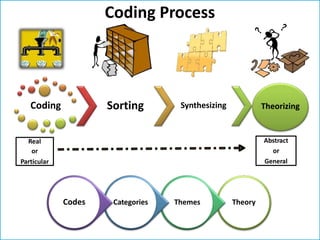
Coding Process
SortingCoding Synthesizing Theorizing
Codes Categories Themes Theory
Real
or
Particular
Abstract
or
General
Text Analysis Involves:
1. Discovering themes and subthemes
2. Describing the core and peripheral elements of
themes
3. Building hierarchies and codebooks
4. Applying themes ( Attaching to the chunks of actual
data)
5. Linking themes into theoretical model
Different terms for themes
 Categories
 Codes
 Labels
 Expressions
 Incidents
 Segments
 Thematic units
 Data-bits
 Chunks
 Units concepts
Where do themes come from
 From data (an inductive
approach)
 From priori theoretical
understanding which
comes from
a) Characteristics of
phenomenon under study
b) Already agreed upon
professional definitions
Theme identifying techniques in
qualitative data
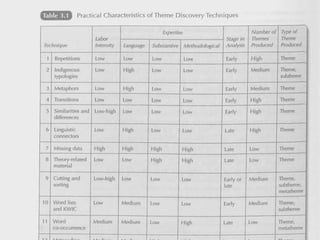
 Widely used 12 techniques can be classified under four
categories
1. Analysis of words
1. Word repetition
2. Indigenous categories
3. KWIC
2. A careful reading of large blocks of text
4. Compare and contras
5. Social science queries
6. Missing information
Theme identifying techniques in
qualitative data (cont.)
3. An intentional analysis of linguistic features
7. Metaphors
8. Transitions
9. connectors
4. The physical manipulation of the text
10. Un marked text
11. Pawing (Handling)
12. Cutting and sorting
Words repetitions
 Words that occurs a lot are consider relevant in the
mind of respondent
 Formal mode: counting frequency of words
 Informal mode: synonyms, ideas behind words (love,
greed, money etc.)
Indigenous categories
 Local terms
 Terms with a particular meaning in respondents
setting (specialized vocabulary)
KWIC
 Search key words then corpus of text for further
illustration
 Search range of sentences in which key words occure
Compare and contrast
 Constant comparison to find similarities and
differences in the text.
 What are similarities and differences?
 How is similar?
 How is different?
 Compare answers to questions across people space and
time.
Social science queries
 How textual data illuminate questions of importance
to social science.
 Search specific social and cultural themes.
 Explain conditions, actions, interactions and
consequences of phenomenon
Missing information
 Get an idea of what is not being done or talked about
 Searching for themes that are missing
 Reasons:
 Avoid sensitive issues
 Assume that researcher already knows
 May not speak in the presence of others
 Do not understand the question
Metaphors
 The way people feel about things
 Metaphors
 Similes
 analogies
Transitions
 Look for naturally occurring shifts in thematic
content.
 Oral speech: pause, change in tune, particular phrase
(then, now then, now again)
 Written speech: therefore, however, similarly, lastly,
next, in brief, in short, conclusion etc.
Connectors
 Indicate relationship
 Causal (because, since, as a result)
 Conditional (if, then, rather than, as a result)
 Time oriented (before, after, next)
 Logical (implies, mean, is one of)
 Negative (not, no, none)
 Attribute (X is Y)
Connectors (cont.)
 Contingencies (if X then Y)
 Function (X is a mean of affecting Y)
 Spatial (X is close to Y)
 Operational (X is a tool for doing Y)
 Comparison (X resembles Y)
 Class (X is a member of Y)
 Provenience ( X is source of Y) etc.
Un marked text
 Examine for the text which has not been coded before
for themes.
 Require multiple reading
 Initially mark obvious themes with colored pencils
 Secondly search for new less obvious themes
Pawing
 Marking the text and eyeballing the text.
 Circle words, underline, use color highlighters, run
lines down to the margin indicate meaning and
coding.
 Then look for patterns and significance
Cutting and sorting
 Traditional techniques of cutting up transcripts
 Coded them into piles, envelops or folders
 Or past them on cards
 Finally read and process
Selection among techniques
 Required following considerations.
1. Kind of data you have
2. How much skill is required
3. How much labor is required ( cost, time, effort)
4. Number and types of themes to be generated
5. Reliability and validity of the theme
Kinds of data
 Lengthy narratives: All techniques
 Audio and video: Repetitions, similarities and
differences, missing data
 Shorter and less complex data: transitions,
metaphors and connectors are inappropriate
 Short response to open ended questions: missing
information is not appropriate
Skills
 Language skills: metaphors, connectors, indigenous
typologies, missing data
 Other language: repetitions, transitions, similarities
and differences, world list, co-occurance, metacoding
 With less Computational skills: cutting and sorting,
world list, KWIC
labor
 Use of computer software is easy in word count and co-
occurance. Learning software require time and effort.
 Observation based techniques are more labor oriented
Number and kinds of themes
 More is better. All themes are not equally important
 More themes are generated by repetitions,
similarities and differences, transitions, connectors,
cutting and sorting, world lists and KWIC
 Less themes generated by metaphors, indigenous
categories and missing data.
Validity and Reliability
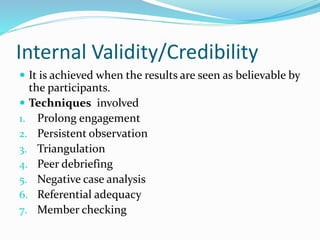
Internal Validity/Credibility
 It is achieved when the results are seen as believable by
the participants.
 Techniques involved
1. Prolong engagement
2. Persistent observation
3. Triangulation
4. Peer debriefing
5. Negative case analysis
6. Referential adequacy
7. Member checking
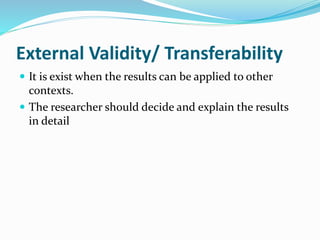
External Validity/ Transferability
 It is exist when the results can be applied to other
contexts.
 The researcher should decide and explain the results
in detail
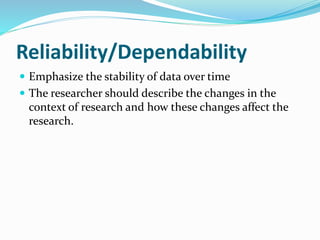
Reliability/Dependability
 Emphasize the stability of data over time
 The researcher should describe the changes in the
context of research and how these changes affect the
research.
Objectivity/Conformity
 Demonstrates that enquiry is free of bias, Values and
prejudice.
 Research results should not be the imagination of
researcher.
 Procedures should be documented for other researchers to
verify.
 Techniques involve:
1. Prolong engagement
2. Persistent observation
3. Triangulation
4. Peer debriefing
5. Negative case analysis

Themes identification techniques in qualitative research

  • 1.
    Presented By: GHULAMQAMBAR PhD Education (Scholar) E.Mail.: qambareducator@gmail.com Contact: +923454702209
  • 2.
    Outline 1. Code, category,theme 2. Text analysis process (A brief overview) 3. Where do themes come from 4. Themes identification techniques 5. Selecting among themes (considerations) 6. Validity and relability
  • 3.
    Codes  A codeis a word phrase or a sentence that represents aspect of a data or captures the essence of features of a data  Priori codes: can be identified from a range of source  Previous research or theory  Research questions  Questions and topics from your interview  Your gut feelings about the data  Grounded cades: emerge from the data
  • 4.
    What can becoded?  Behaviors  Events  Activities  Strategies  Stages  Meanings  Symbols  Participations  Relationships/interactions  conditions./constraints  Consequences  Settings  Norms, values etc.
  • 5.
    Category  Grouping ofcodes  Purpose is to reduce numbers  For example people in public life covering codes as politicians, celebrities, sports people etc.  Should be conceptual
  • 6.
    Themes  A higherlevel of categorization  Usually used to identify a major element of your entire text analysis  Usually research questions, hypotheses and objectives form the main themes of the study
  • 7.
    Coding Process SortingCoding SynthesizingTheorizing Codes Categories Themes Theory Real or Particular Abstract or General
  • 8.
    Text Analysis Involves: 1.Discovering themes and subthemes 2. Describing the core and peripheral elements of themes 3. Building hierarchies and codebooks 4. Applying themes ( Attaching to the chunks of actual data) 5. Linking themes into theoretical model
  • 9.
    Different terms forthemes  Categories  Codes  Labels  Expressions  Incidents  Segments  Thematic units  Data-bits  Chunks  Units concepts
  • 10.
    Where do themescome from  From data (an inductive approach)  From priori theoretical understanding which comes from a) Characteristics of phenomenon under study b) Already agreed upon professional definitions
  • 11.
    Theme identifying techniquesin qualitative data  Widely used 12 techniques can be classified under four categories 1. Analysis of words 1. Word repetition 2. Indigenous categories 3. KWIC 2. A careful reading of large blocks of text 4. Compare and contras 5. Social science queries 6. Missing information
  • 12.
    Theme identifying techniquesin qualitative data (cont.) 3. An intentional analysis of linguistic features 7. Metaphors 8. Transitions 9. connectors 4. The physical manipulation of the text 10. Un marked text 11. Pawing (Handling) 12. Cutting and sorting
  • 13.
    Words repetitions  Wordsthat occurs a lot are consider relevant in the mind of respondent  Formal mode: counting frequency of words  Informal mode: synonyms, ideas behind words (love, greed, money etc.)
  • 14.
    Indigenous categories  Localterms  Terms with a particular meaning in respondents setting (specialized vocabulary)
  • 15.
    KWIC  Search keywords then corpus of text for further illustration  Search range of sentences in which key words occure
  • 16.
    Compare and contrast Constant comparison to find similarities and differences in the text.  What are similarities and differences?  How is similar?  How is different?  Compare answers to questions across people space and time.
  • 17.
    Social science queries How textual data illuminate questions of importance to social science.  Search specific social and cultural themes.  Explain conditions, actions, interactions and consequences of phenomenon
  • 18.
    Missing information  Getan idea of what is not being done or talked about  Searching for themes that are missing  Reasons:  Avoid sensitive issues  Assume that researcher already knows  May not speak in the presence of others  Do not understand the question
  • 19.
    Metaphors  The waypeople feel about things  Metaphors  Similes  analogies
  • 20.
    Transitions  Look fornaturally occurring shifts in thematic content.  Oral speech: pause, change in tune, particular phrase (then, now then, now again)  Written speech: therefore, however, similarly, lastly, next, in brief, in short, conclusion etc.
  • 21.
    Connectors  Indicate relationship Causal (because, since, as a result)  Conditional (if, then, rather than, as a result)  Time oriented (before, after, next)  Logical (implies, mean, is one of)  Negative (not, no, none)  Attribute (X is Y)
  • 22.
    Connectors (cont.)  Contingencies(if X then Y)  Function (X is a mean of affecting Y)  Spatial (X is close to Y)  Operational (X is a tool for doing Y)  Comparison (X resembles Y)  Class (X is a member of Y)  Provenience ( X is source of Y) etc.
  • 23.
    Un marked text Examine for the text which has not been coded before for themes.  Require multiple reading  Initially mark obvious themes with colored pencils  Secondly search for new less obvious themes
  • 24.
    Pawing  Marking thetext and eyeballing the text.  Circle words, underline, use color highlighters, run lines down to the margin indicate meaning and coding.  Then look for patterns and significance
  • 25.
    Cutting and sorting Traditional techniques of cutting up transcripts  Coded them into piles, envelops or folders  Or past them on cards  Finally read and process
  • 26.
    Selection among techniques Required following considerations. 1. Kind of data you have 2. How much skill is required 3. How much labor is required ( cost, time, effort) 4. Number and types of themes to be generated 5. Reliability and validity of the theme
  • 27.
    Kinds of data Lengthy narratives: All techniques  Audio and video: Repetitions, similarities and differences, missing data  Shorter and less complex data: transitions, metaphors and connectors are inappropriate  Short response to open ended questions: missing information is not appropriate
  • 28.
    Skills  Language skills:metaphors, connectors, indigenous typologies, missing data  Other language: repetitions, transitions, similarities and differences, world list, co-occurance, metacoding  With less Computational skills: cutting and sorting, world list, KWIC
  • 29.
    labor  Use ofcomputer software is easy in word count and co- occurance. Learning software require time and effort.  Observation based techniques are more labor oriented
  • 30.
    Number and kindsof themes  More is better. All themes are not equally important  More themes are generated by repetitions, similarities and differences, transitions, connectors, cutting and sorting, world lists and KWIC  Less themes generated by metaphors, indigenous categories and missing data.
  • 32.
  • 33.
    Internal Validity/Credibility  Itis achieved when the results are seen as believable by the participants.  Techniques involved 1. Prolong engagement 2. Persistent observation 3. Triangulation 4. Peer debriefing 5. Negative case analysis 6. Referential adequacy 7. Member checking
  • 34.
    External Validity/ Transferability It is exist when the results can be applied to other contexts.  The researcher should decide and explain the results in detail
  • 35.
    Reliability/Dependability  Emphasize thestability of data over time  The researcher should describe the changes in the context of research and how these changes affect the research.
  • 36.
    Objectivity/Conformity  Demonstrates thatenquiry is free of bias, Values and prejudice.  Research results should not be the imagination of researcher.  Procedures should be documented for other researchers to verify.  Techniques involve: 1. Prolong engagement 2. Persistent observation 3. Triangulation 4. Peer debriefing 5. Negative case analysis