







Pushing PHP to the Limit: 
Web Server PHP Performance Comparisons 
LiteSpeed vs. Apache vs. NGINX
Breakdown of the presentation 
1. Overview of technology discussed 
2. Benchmarks 
3. Different PHP setups in LiteSpeed Web 
Server (LSAPI) 
4. Questions
Web Servers
Web servers (discussed) 
● Apache (httpd) 
● NGINX 
● LiteSpeed Web Server (LSWS) 
● OpenLiteSpeed
Differences between 
OpenLiteSpeed and LSWS 
OpenLiteSpeed: 
● Uses OpenLiteSpeed-native configs exclusively 
● Free and open source 
LiteSpeed Web Server: 
● Can use Apache configs (control panel compatible) 
● Paid license system
Web servers (not discussed) 
● Microsoft IIS 
● Tomcat 
● Lighty (lighttpd) 
● Cherokee 
● Others 
Why not? 
IIS is only for Windows and nobody uses the rest of these. 
(Less than 0.5% of sites.)
PHP
Why PHP? 
Because it is far and away the most used 
scripting language on the Internet. 
(82% of sites according to the latest 
W3Techs survey.)
Web server-PHP interaction 
● PHP is a scripting language 
● Web servers do not process PHP directly 
● PHP is processed by a PHP engine on the 
backend 
● Web servers use a variety of SAPIs to 
communicate with the PHP engine
SAPIs 
Server Application Programming Interfaces
What is an SAPI? 
An interface for communicating with an 
application (like the PHP engine).
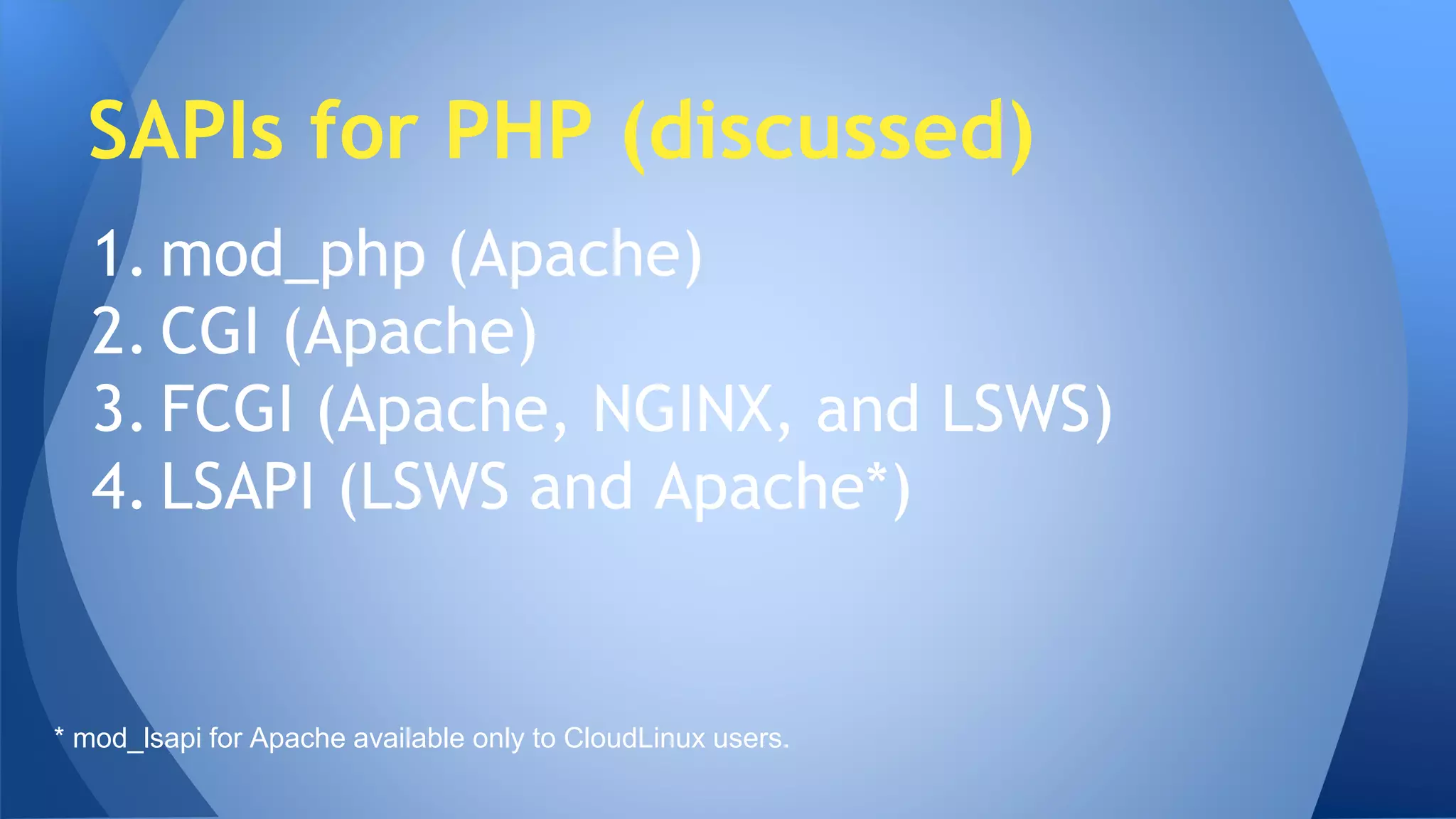
SAPIs for PHP (discussed) 
1. mod_php (Apache) 
2. CGI (Apache) 
3. FCGI (Apache, NGINX, and LSWS) 
4. LSAPI (LSWS and Apache*) 
* mod_lsapi for Apache available only to CloudLinux users.
suEXEC? 
Running scripts as a separate user (often 
one user per virtual host).
mod_php (DSO) 
● Runs PHP as a module embedded in 
Apache processes 
● Requires no interprocess communication 
● Can use persistent processes 
● Fastest Apache implementation of PHP 
● All scripts run as nobody 
● Requires Apache prefork
CGI 
● Used by Apache 
● PHP run through external CGI module 
● Creates a new process for each request 
(lots of overhead) 
● Slow and unscalable 
● Can run suEXEC
FCGI (FastCGI) 
● Used by Apache and NGINX 
● Runs PHP as an external instance 
● Created to be faster than CGI (less overhead) 
● Persistent processes handle many requests 
instead of creating a new process each time 
● Saves CPU, but persistent processes can waste 
RAM 
● Can run suEXEC
LSAPI (LiteSpeed SAPI) 
● Created because none of the previous 
SAPIs gave the performance and control 
we wanted 
● External instance 
● Similar layout to FCGI, but optimized 
● Can run suEXEC
LSAPI Optimizations 
● Utilizes web server request parsing results 
for less overhead 
● Persistent processes dynamically forked to 
save resources 
● Different modes of process handling for 
different needs 
● Allows per-directory configuration overrides
The Benchmarks
Three benchmarks 
1. LSWS vs. NGINX for small PHP scripts (new and 
unreleased) 
1. LSWS vs. OpenLiteSpeed vs. Apache vs. NGINX for 
small PHP scripts (previously published) 
1. LSWS vs. Apache for WordPress (presented by 
cPanel at cPanel Conference 2014, measured 
speed and resource usage)
Benchmark 1 
LSWS vs. NGINX for small PHP scripts (new)
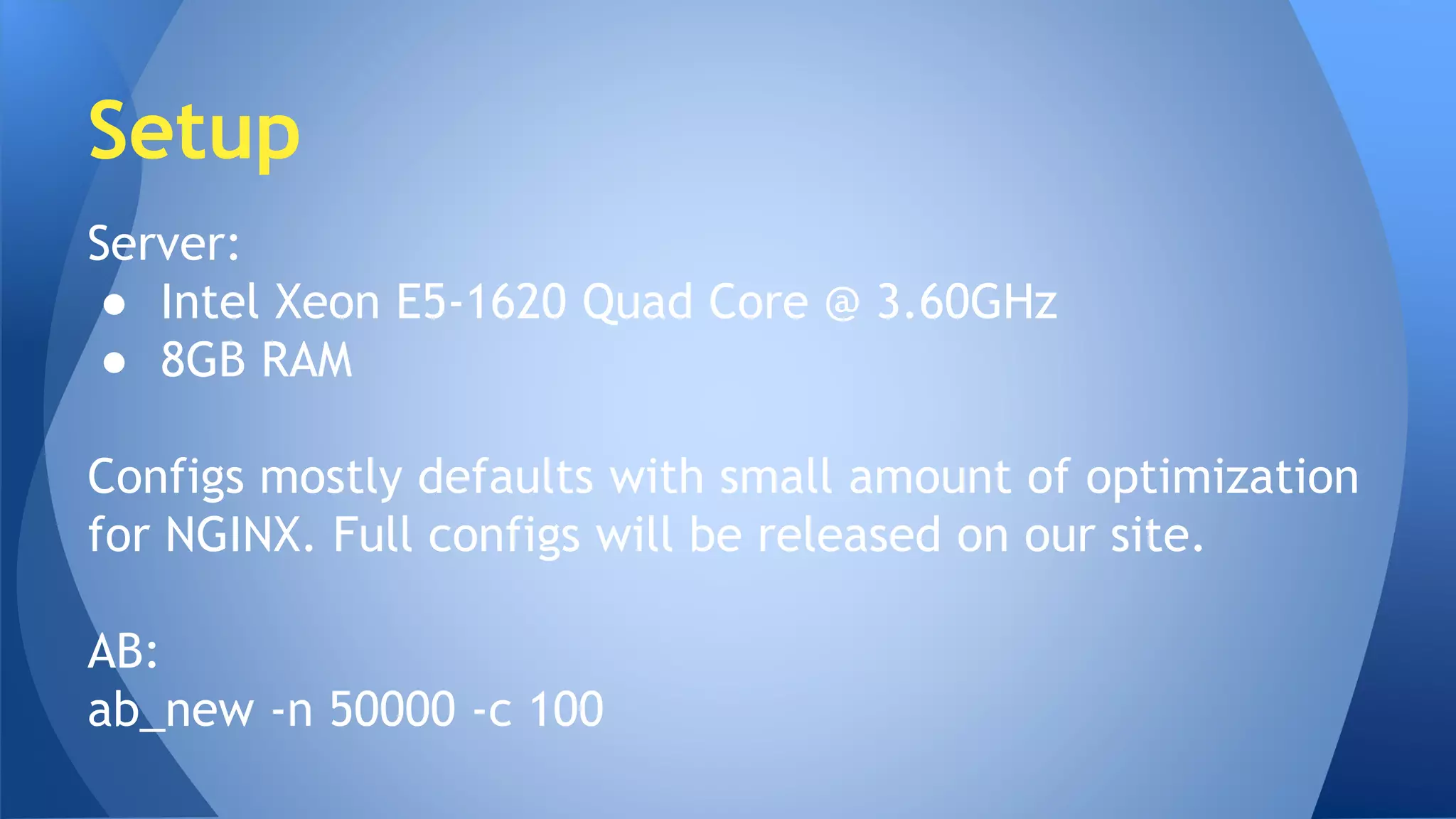
Setup 
Server: 
● Intel Xeon E5-1620 Quad Core @ 3.60GHz 
● 8GB RAM 
Configs mostly defaults with small amount of optimization 
for NGINX. Full configs will be released on our site. 
AB: 
ab_new -n 50000 -c 100
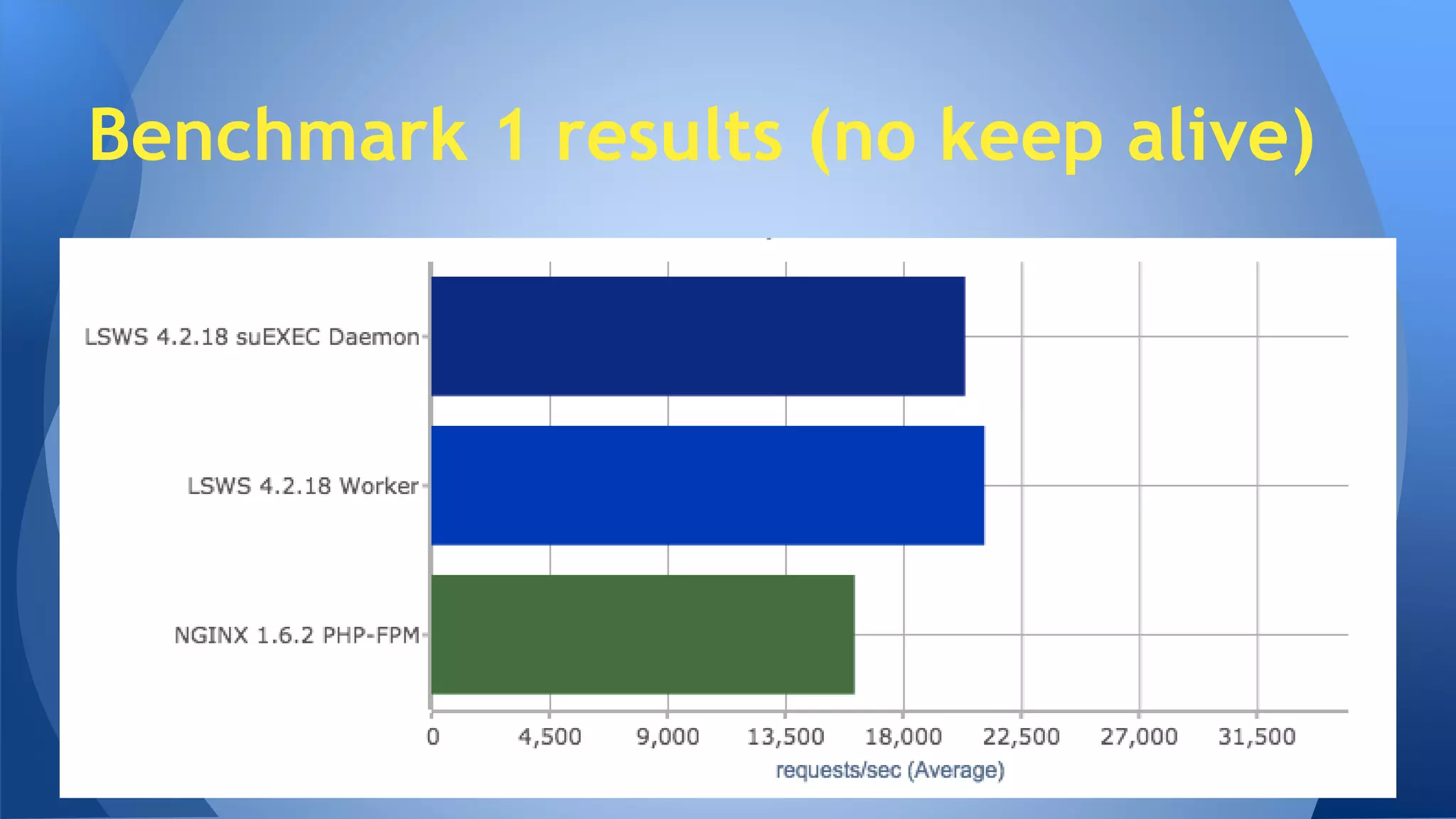
Benchmark 1 results (no keep alive)
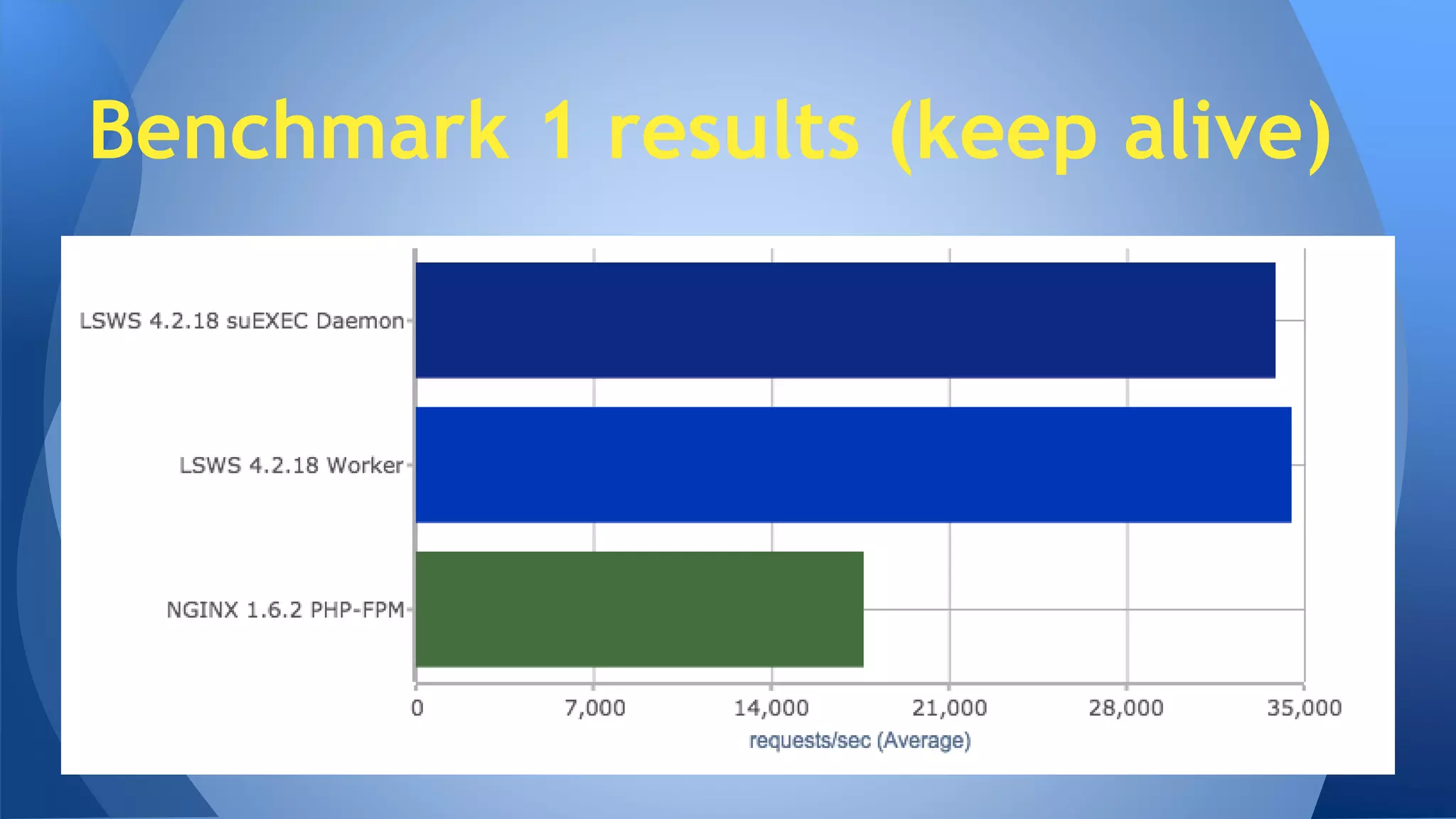
Benchmark 1 results (keep alive)
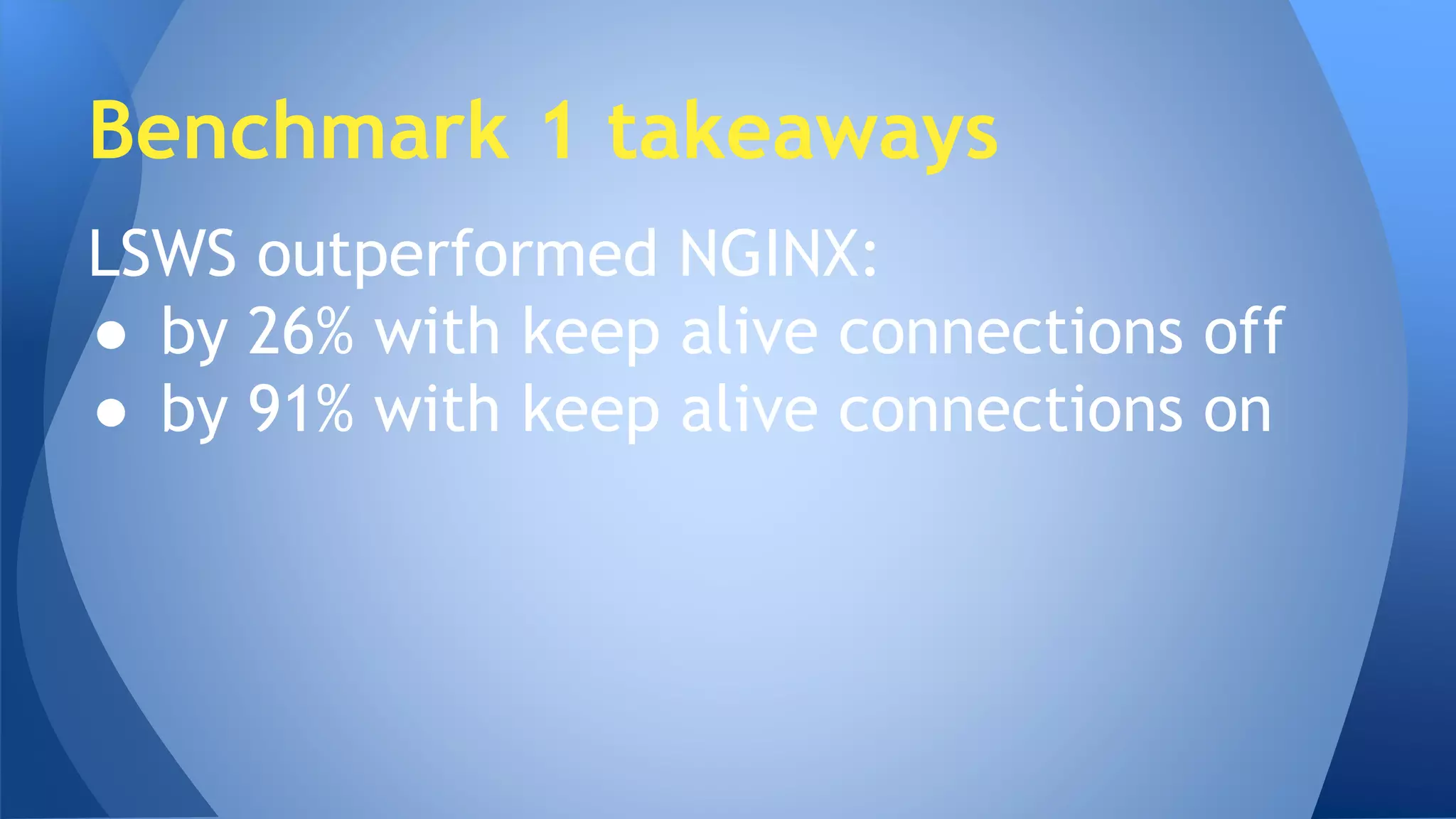
Benchmark 1 takeaways 
LSWS outperformed NGINX: 
● by 26% with keep alive connections off 
● by 91% with keep alive connections on
Benchmark 2 
LSWS vs. OpenLiteSpeed vs. Apache vs. NGINX for 
small PHP scripts (previously published)
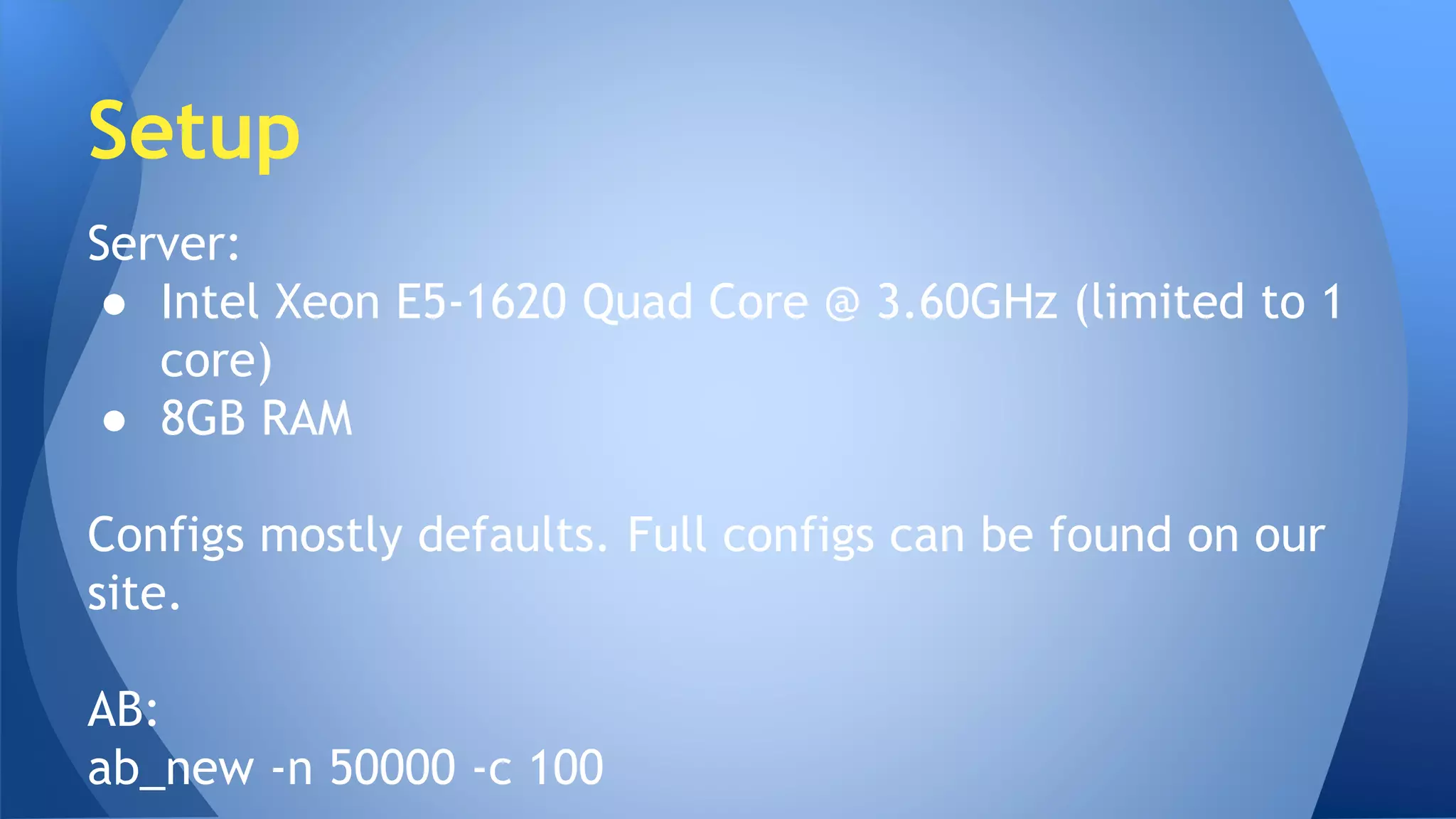
Setup 
Server: 
● Intel Xeon E5-1620 Quad Core @ 3.60GHz (limited to 1 
core) 
● 8GB RAM 
Configs mostly defaults. Full configs can be found on our 
site. 
AB: 
ab_new -n 50000 -c 100
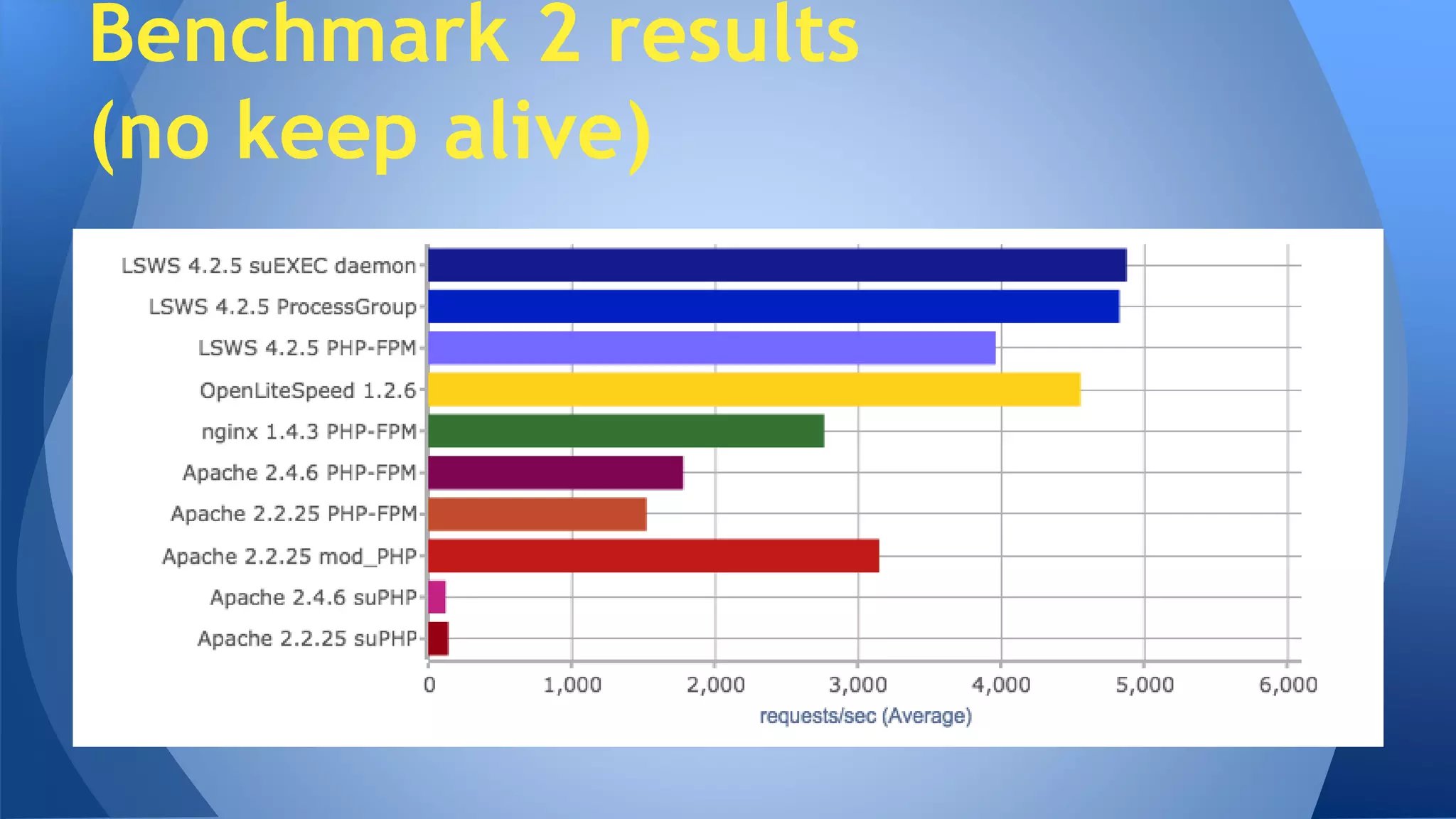
Benchmark 2 results 
(no keep alive)
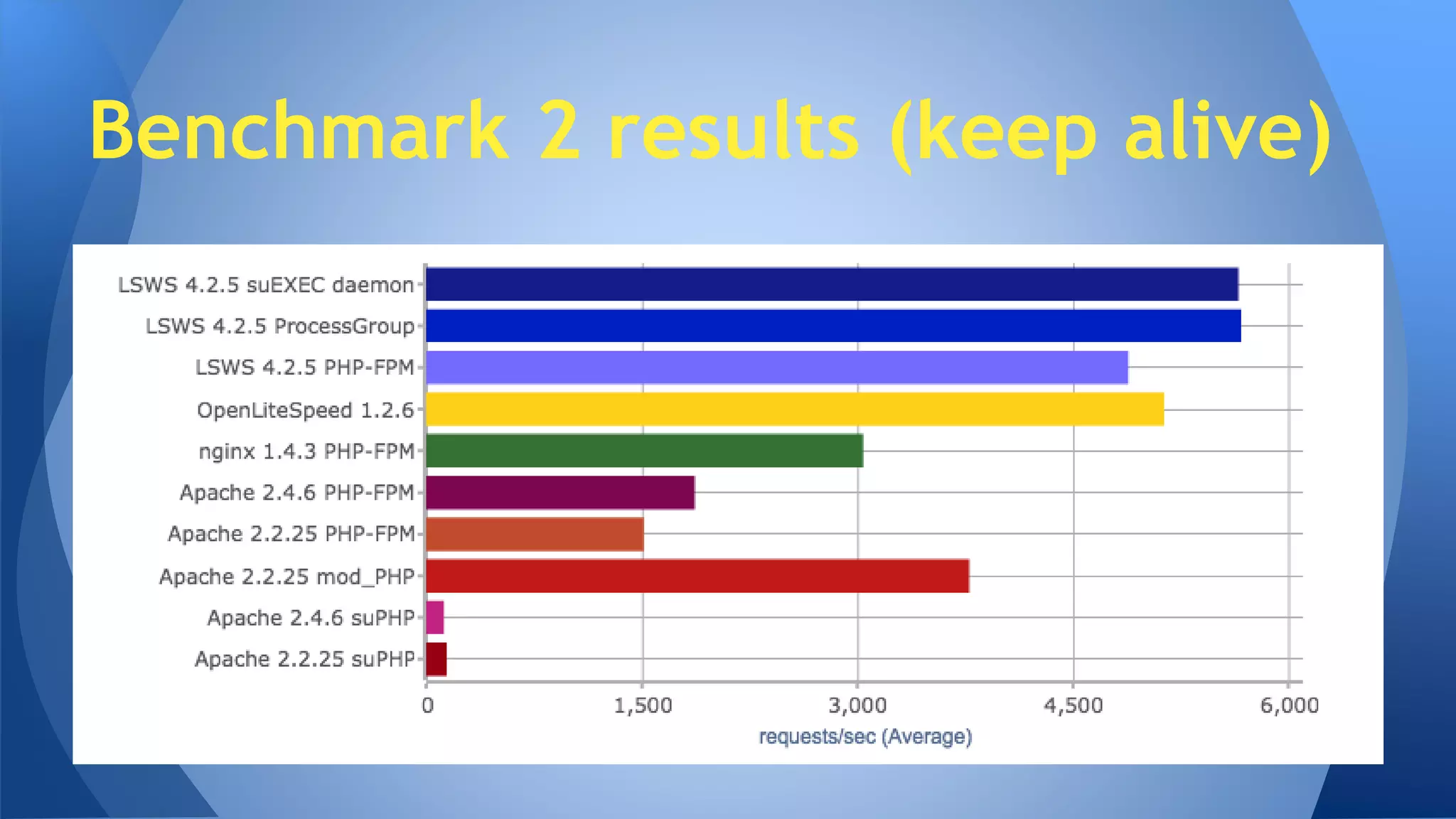
Benchmark 2 results (keep alive)
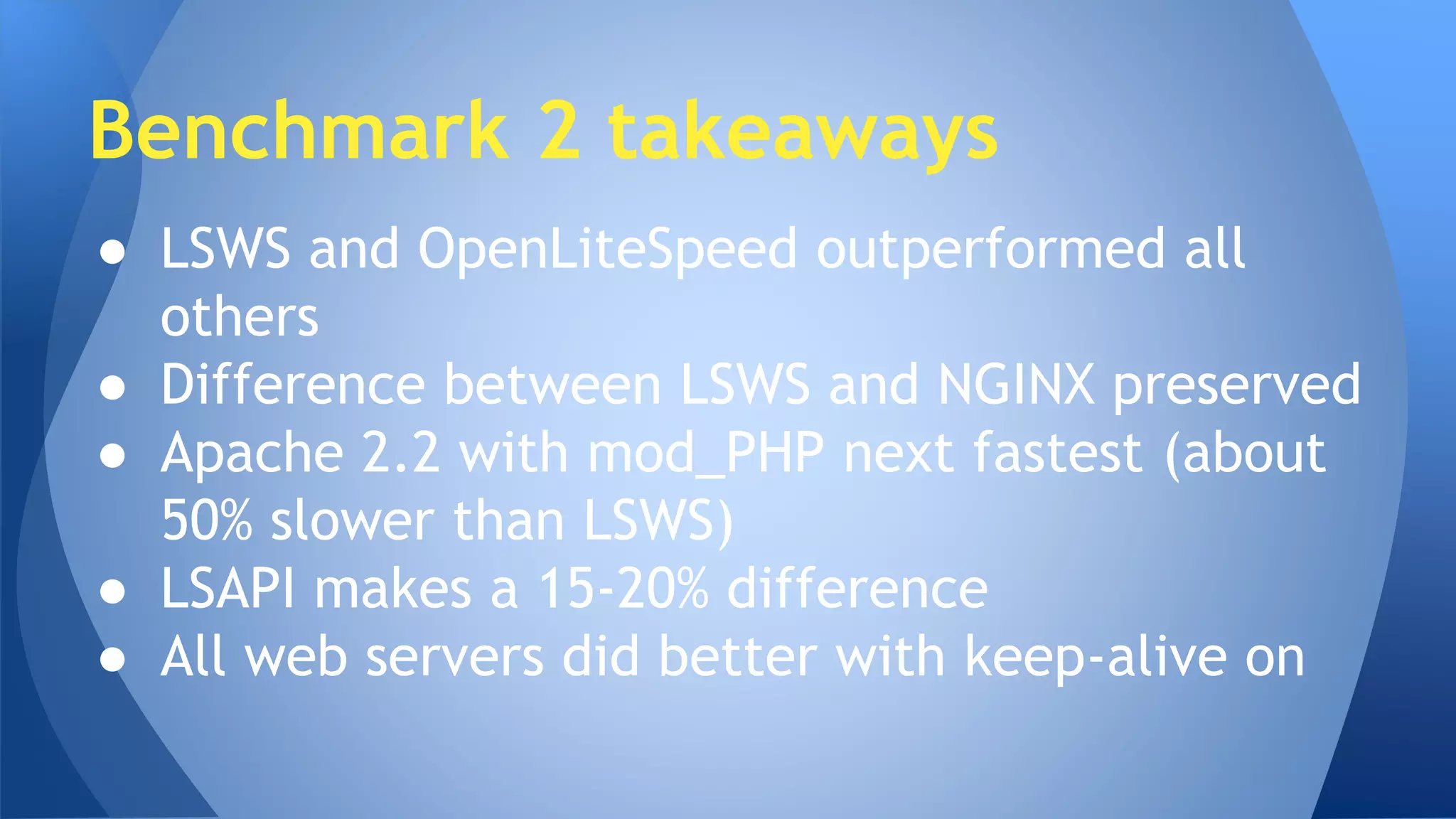
Benchmark 2 takeaways 
● LSWS and OpenLiteSpeed outperformed all 
others 
● Difference between LSWS and NGINX preserved 
● Apache 2.2 with mod_PHP next fastest (about 
50% slower than LSWS) 
● LSAPI makes a 15-20% difference 
● All web servers did better with keep-alive on
Benchmark 3 
LSWS vs. Apache for WordPress 
(courtesy of Tristan Wallace, cPanel)
Setup 
VPS: 
● 1 core 
● 1GB RAM 
Dedicated server: 
● 4 cores 
● 8GB RAM
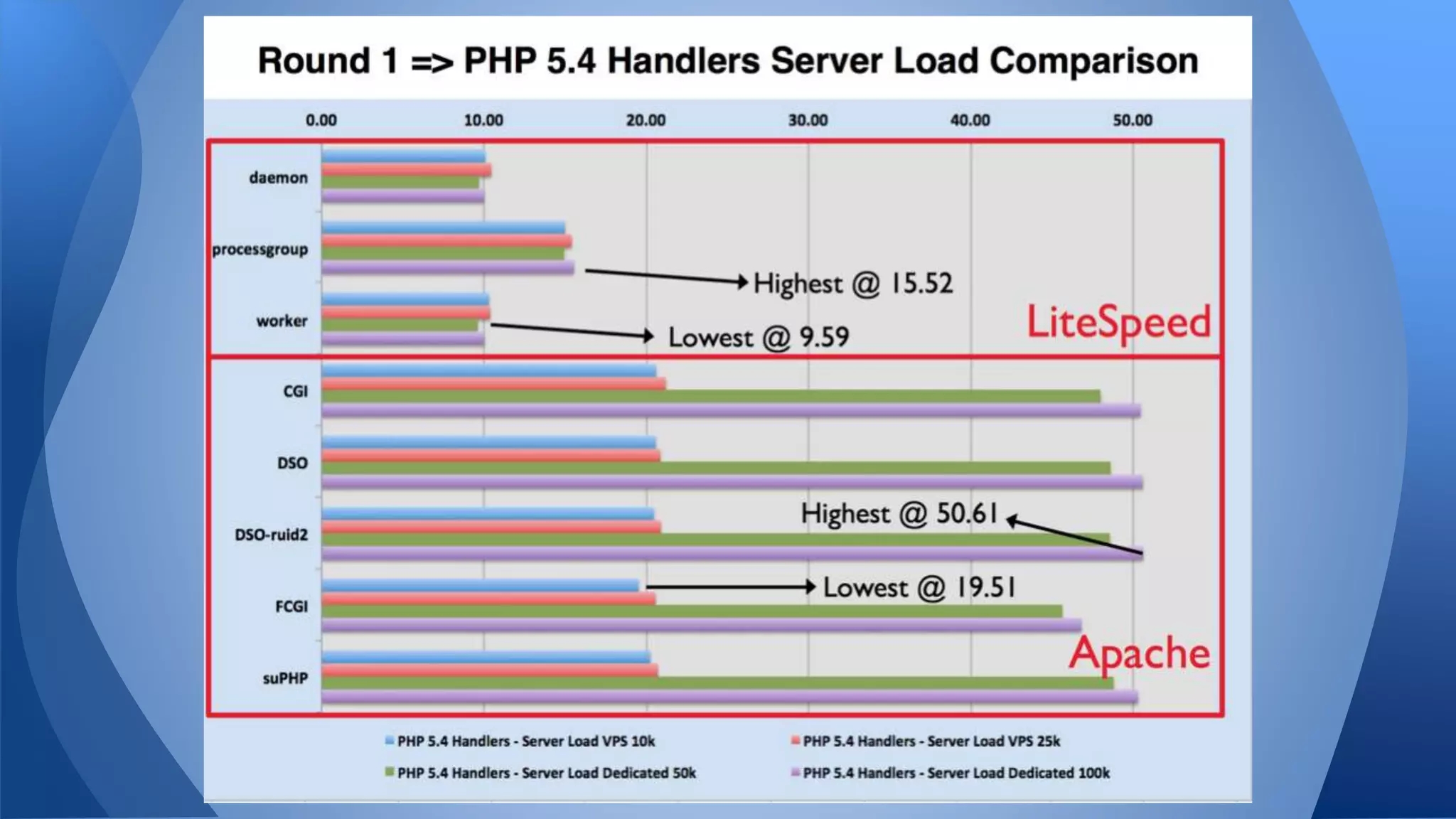
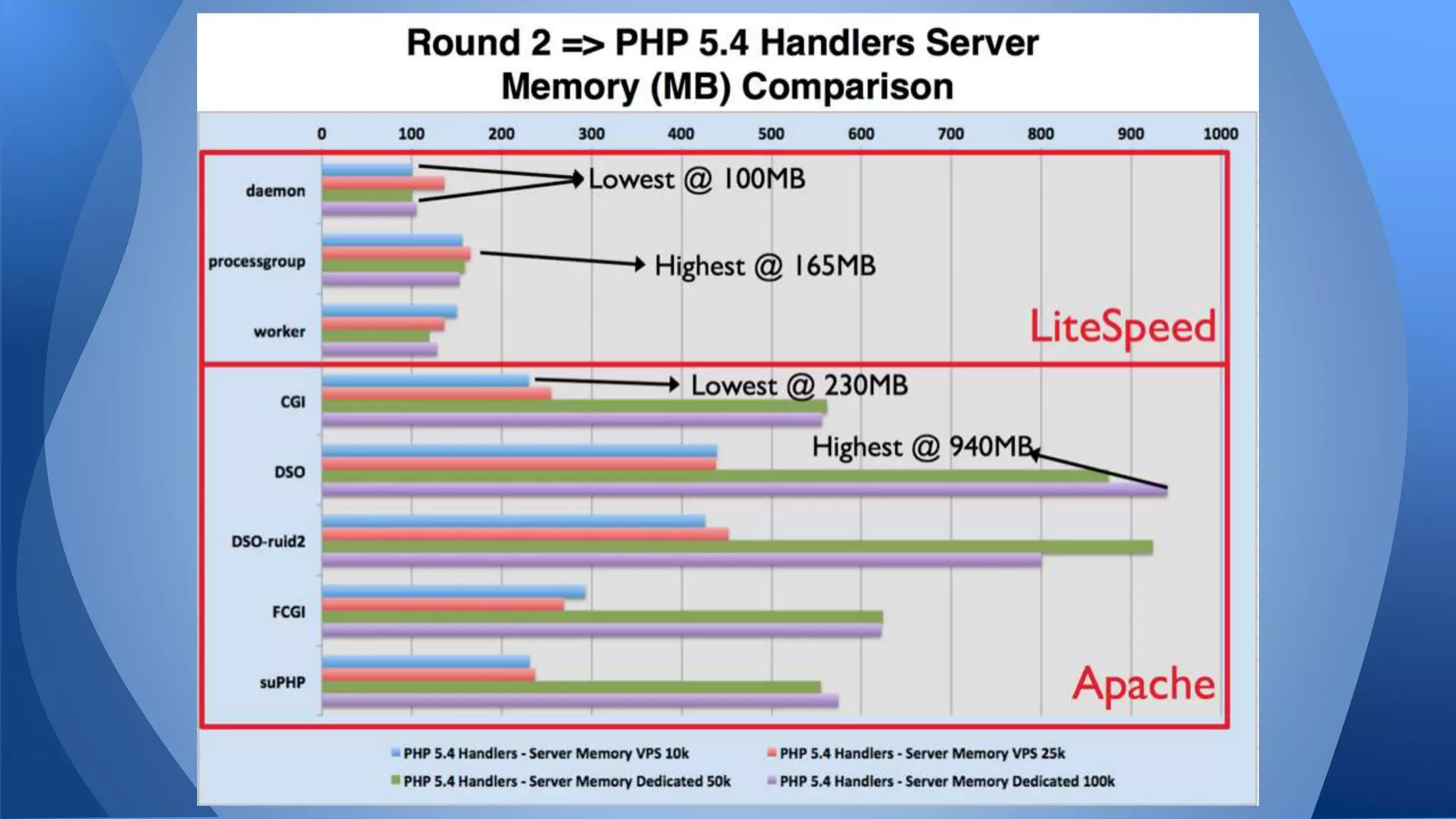
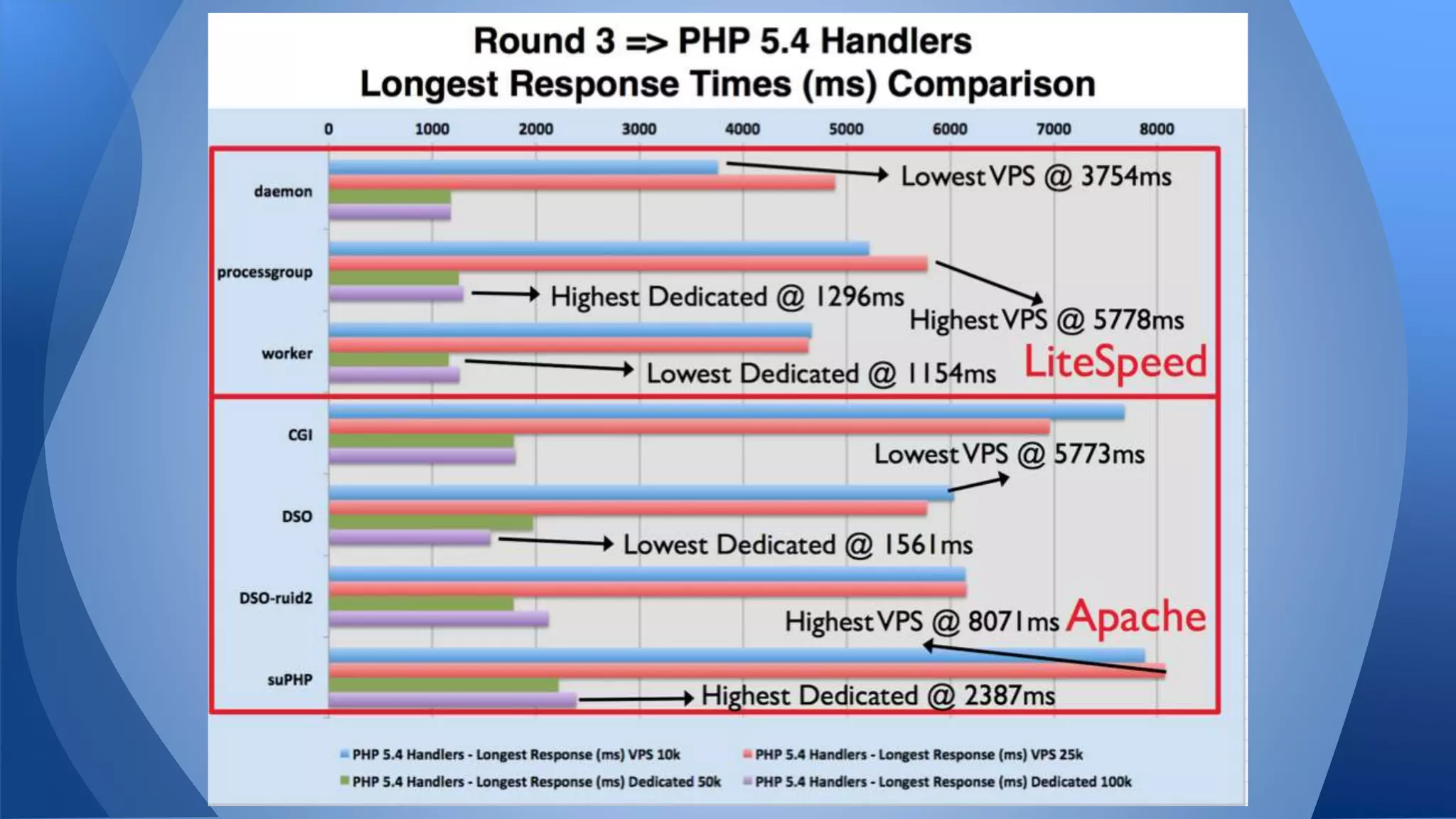
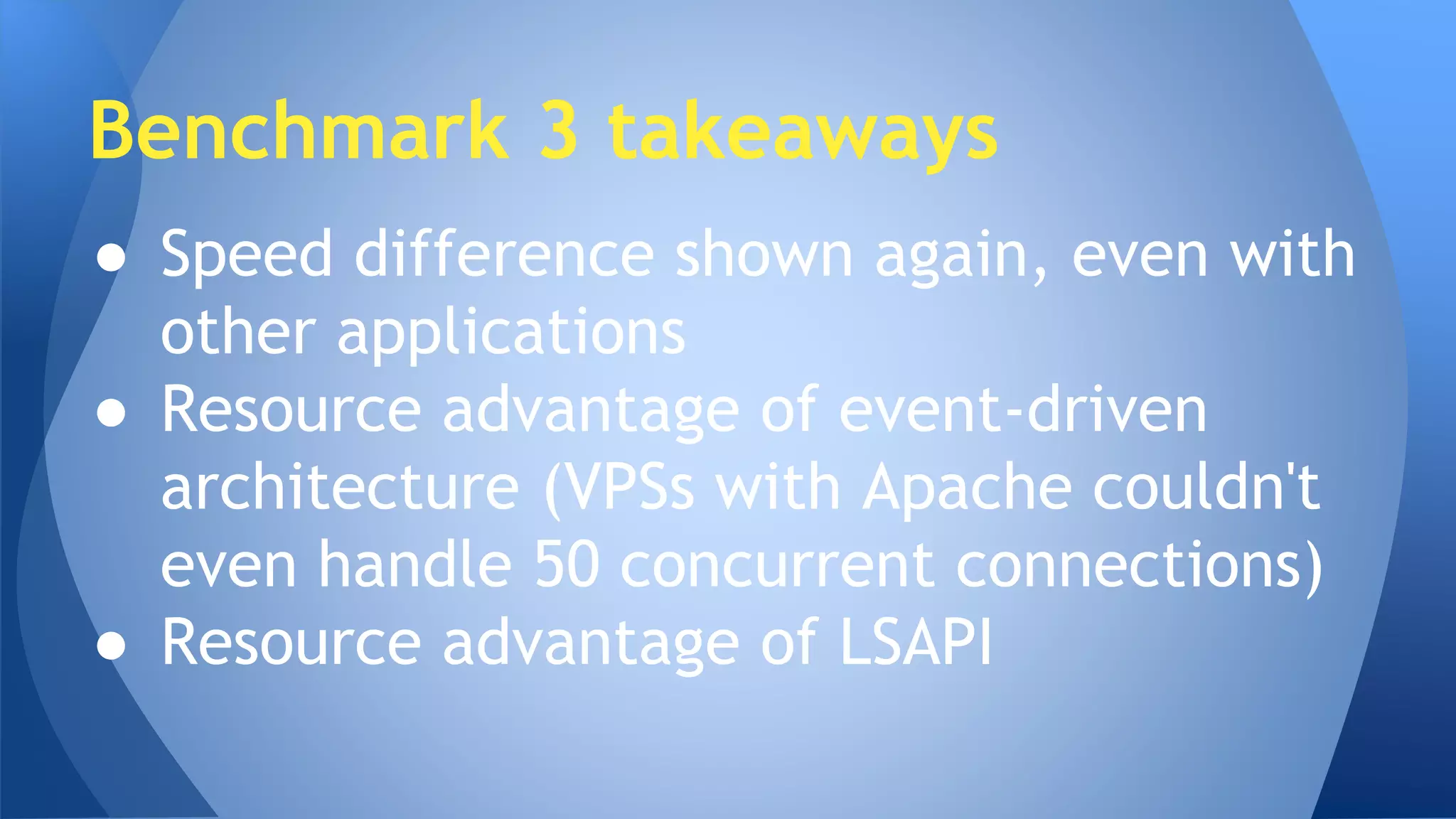
Benchmark 3 takeaways 
● Speed difference shown again, even with 
other applications 
● Resource advantage of event-driven 
architecture (VPSs with Apache couldn't 
even handle 50 concurrent connections) 
● Resource advantage of LSAPI
Benchmark Wrapup 
What have we learned?
What happened? 
● Basically, LSWS and OpenLiteSpeed beat 
all comers by at least 25% 
● The difference was most pronounced vs. 
Apache setups that use suEXEC
Why? 
● LSAPI is optimized 
● LSWS is built for performance and geared 
especially for performance with LSAPI
Debate? 
If you wish to debate these benchmarks, please contact 
me or post to our forum. We are happy to try different 
settings if there is good reason to believe they will make 
a difference. 
Forum: http://www.litespeedtech.com/support/forum/ 
Me: marmstrong@litespeedtech.com
LSAPI 
What can you do with it?
LiteSpeed Server API 
● API for communication with an application backend 
● Open source 
● Designed specifically for LSWS (for better integration) 
● Highly optimized by default 
● Offers three different modes of handling PHP 
processes for different needs 
● Allows for high-performance suEXEC setups 
● Available for PHP, Ruby, and Python 
http://www.litespeedtech.com/products/litespeed-sapi/php
LSAPI PHP Modes 
1.Worker 
2. Daemon 
3. ProcessGroup 
All can be suEXEC
Worker Mode 
● Default mode 
● Similar to PHP with CGI 
● New process each time PHP is needed 
● Creating new processes has overhead 
● Can save resources because there are no 
more processes than needed 
● No effective suEXEC opcode caching
Daemon Mode 
● Forks all processes from a persistent 
parent process (even in suEXEC) 
● Spawning child processes is faster than 
creating new processes 
● Allows for somewhat more effective 
suEXEC opcode caching
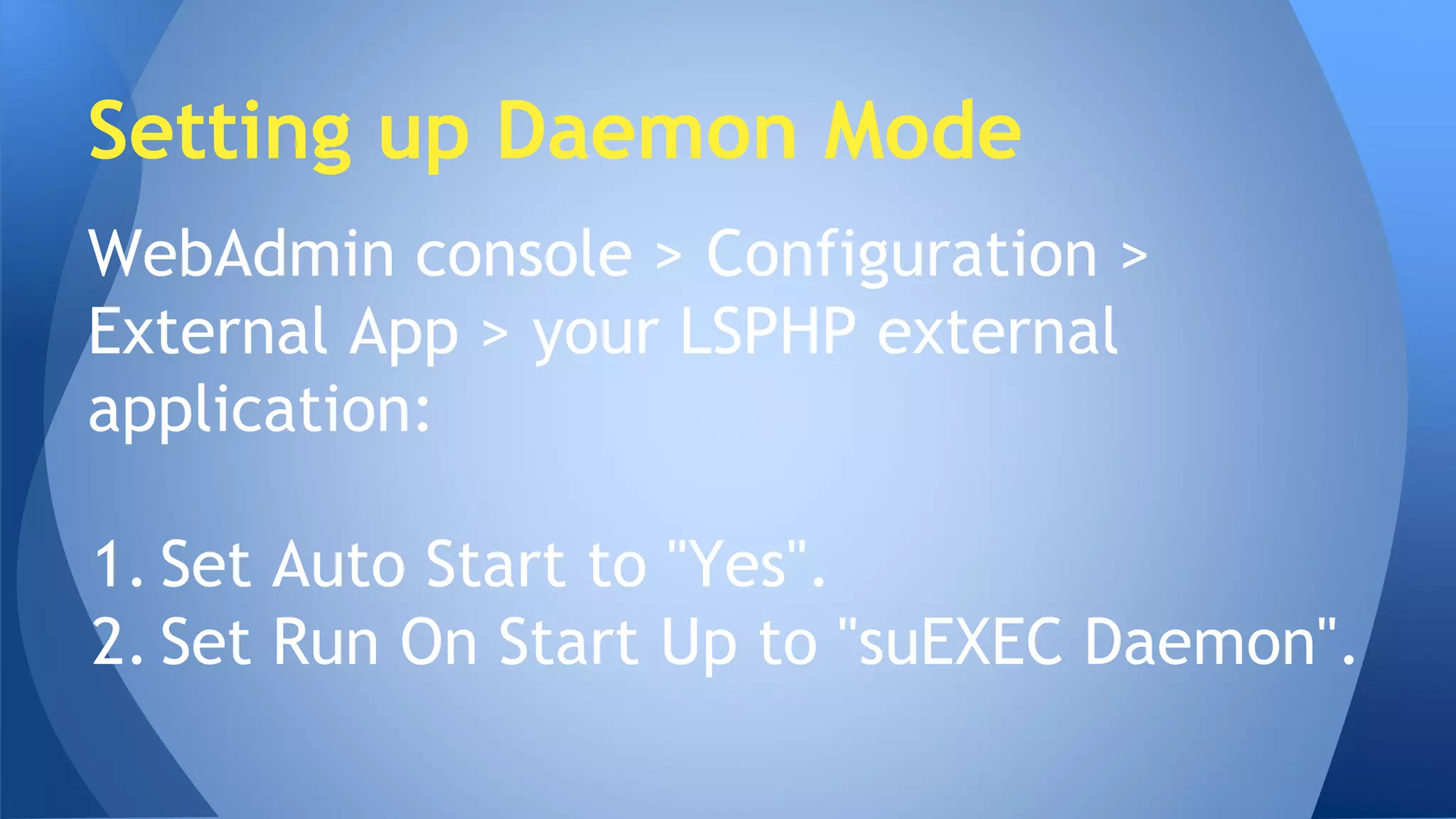
Setting up Daemon Mode 
WebAdmin console > Configuration > 
External App > your LSPHP external 
application: 
1. Set Auto Start to "Yes". 
2. Set Run On Start Up to "suEXEC Daemon".
ProcessGroup Mode 
● Similar to PHP-FPM pools (except easy to set up) 
● Really only for suEXEC settings 
● One parent process for each user 
● Parent process spawns child processes on demand 
● Spawning child processes is faster than creating new 
processes 
● Allows for per-user opcode caching in a suEXEC setting 
● Extra parent processes consume extra resources 
● Not available for OpenLiteSpeed
Setting up PHP ProcessGroup 
Add the following to an Apache 
configuration file: 
<IfModule LiteSpeed> 
LSPHP_ProcessGroup on 
LSPHP_Workers 15 
</IfModule>
Future improvements to LSAPI 
● Event-driven PHP processing 
● HHVM integration
Conclusions
Conclusions 
● LSWS and OpenLiteSpeed serve PHP 25- 
100% faster than other major web 
servers 
● Partly due to LSAPI's optimization 
● Partly due to LSWS and OpenLiteSpeed's 
optimized integration with LSAPI
Conclusions (LSAPI) 
● LSAPI = faster PHP 
● LSAPI's suEXEC implementation allows for 
speed and security 
● LSAPI modes and config overrides allow 
easy configuration for different uses 
● Opcode caching even with suEXEC

Подталкиваем PHP к пределу возможностей, Michael Armstrong (lite speed technologies)

  • 1.
    Pushing PHP tothe Limit: Web Server PHP Performance Comparisons LiteSpeed vs. Apache vs. NGINX
  • 2.
    Breakdown of thepresentation 1. Overview of technology discussed 2. Benchmarks 3. Different PHP setups in LiteSpeed Web Server (LSAPI) 4. Questions
  • 3.
  • 4.
    Web servers (discussed) ● Apache (httpd) ● NGINX ● LiteSpeed Web Server (LSWS) ● OpenLiteSpeed
  • 5.
    Differences between OpenLiteSpeedand LSWS OpenLiteSpeed: ● Uses OpenLiteSpeed-native configs exclusively ● Free and open source LiteSpeed Web Server: ● Can use Apache configs (control panel compatible) ● Paid license system
  • 6.
    Web servers (notdiscussed) ● Microsoft IIS ● Tomcat ● Lighty (lighttpd) ● Cherokee ● Others Why not? IIS is only for Windows and nobody uses the rest of these. (Less than 0.5% of sites.)
  • 7.
  • 8.
    Why PHP? Becauseit is far and away the most used scripting language on the Internet. (82% of sites according to the latest W3Techs survey.)
  • 9.
    Web server-PHP interaction ● PHP is a scripting language ● Web servers do not process PHP directly ● PHP is processed by a PHP engine on the backend ● Web servers use a variety of SAPIs to communicate with the PHP engine
  • 10.
    SAPIs Server ApplicationProgramming Interfaces
  • 11.
    What is anSAPI? An interface for communicating with an application (like the PHP engine).
  • 12.
    SAPIs for PHP(discussed) 1. mod_php (Apache) 2. CGI (Apache) 3. FCGI (Apache, NGINX, and LSWS) 4. LSAPI (LSWS and Apache*) * mod_lsapi for Apache available only to CloudLinux users.
  • 13.
    suEXEC? Running scriptsas a separate user (often one user per virtual host).
  • 14.
    mod_php (DSO) ●Runs PHP as a module embedded in Apache processes ● Requires no interprocess communication ● Can use persistent processes ● Fastest Apache implementation of PHP ● All scripts run as nobody ● Requires Apache prefork
  • 15.
    CGI ● Usedby Apache ● PHP run through external CGI module ● Creates a new process for each request (lots of overhead) ● Slow and unscalable ● Can run suEXEC
  • 16.
    FCGI (FastCGI) ●Used by Apache and NGINX ● Runs PHP as an external instance ● Created to be faster than CGI (less overhead) ● Persistent processes handle many requests instead of creating a new process each time ● Saves CPU, but persistent processes can waste RAM ● Can run suEXEC
  • 17.
    LSAPI (LiteSpeed SAPI) ● Created because none of the previous SAPIs gave the performance and control we wanted ● External instance ● Similar layout to FCGI, but optimized ● Can run suEXEC
  • 18.
    LSAPI Optimizations ●Utilizes web server request parsing results for less overhead ● Persistent processes dynamically forked to save resources ● Different modes of process handling for different needs ● Allows per-directory configuration overrides
  • 19.
  • 20.
    Three benchmarks 1.LSWS vs. NGINX for small PHP scripts (new and unreleased) 1. LSWS vs. OpenLiteSpeed vs. Apache vs. NGINX for small PHP scripts (previously published) 1. LSWS vs. Apache for WordPress (presented by cPanel at cPanel Conference 2014, measured speed and resource usage)
  • 21.
    Benchmark 1 LSWSvs. NGINX for small PHP scripts (new)
  • 22.
    Setup Server: ●Intel Xeon E5-1620 Quad Core @ 3.60GHz ● 8GB RAM Configs mostly defaults with small amount of optimization for NGINX. Full configs will be released on our site. AB: ab_new -n 50000 -c 100
  • 23.
    Benchmark 1 results(no keep alive)
  • 24.
    Benchmark 1 results(keep alive)
  • 25.
    Benchmark 1 takeaways LSWS outperformed NGINX: ● by 26% with keep alive connections off ● by 91% with keep alive connections on
  • 26.
    Benchmark 2 LSWSvs. OpenLiteSpeed vs. Apache vs. NGINX for small PHP scripts (previously published)
  • 27.
    Setup Server: ●Intel Xeon E5-1620 Quad Core @ 3.60GHz (limited to 1 core) ● 8GB RAM Configs mostly defaults. Full configs can be found on our site. AB: ab_new -n 50000 -c 100
  • 28.
    Benchmark 2 results (no keep alive)
  • 29.
    Benchmark 2 results(keep alive)
  • 30.
    Benchmark 2 takeaways ● LSWS and OpenLiteSpeed outperformed all others ● Difference between LSWS and NGINX preserved ● Apache 2.2 with mod_PHP next fastest (about 50% slower than LSWS) ● LSAPI makes a 15-20% difference ● All web servers did better with keep-alive on
  • 31.
    Benchmark 3 LSWSvs. Apache for WordPress (courtesy of Tristan Wallace, cPanel)
  • 32.
    Setup VPS: ●1 core ● 1GB RAM Dedicated server: ● 4 cores ● 8GB RAM
  • 36.
    Benchmark 3 takeaways ● Speed difference shown again, even with other applications ● Resource advantage of event-driven architecture (VPSs with Apache couldn't even handle 50 concurrent connections) ● Resource advantage of LSAPI
  • 37.
    Benchmark Wrapup Whathave we learned?
  • 38.
    What happened? ●Basically, LSWS and OpenLiteSpeed beat all comers by at least 25% ● The difference was most pronounced vs. Apache setups that use suEXEC
  • 39.
    Why? ● LSAPIis optimized ● LSWS is built for performance and geared especially for performance with LSAPI
  • 40.
    Debate? If youwish to debate these benchmarks, please contact me or post to our forum. We are happy to try different settings if there is good reason to believe they will make a difference. Forum: http://www.litespeedtech.com/support/forum/ Me: marmstrong@litespeedtech.com
  • 41.
    LSAPI What canyou do with it?
  • 42.
    LiteSpeed Server API ● API for communication with an application backend ● Open source ● Designed specifically for LSWS (for better integration) ● Highly optimized by default ● Offers three different modes of handling PHP processes for different needs ● Allows for high-performance suEXEC setups ● Available for PHP, Ruby, and Python http://www.litespeedtech.com/products/litespeed-sapi/php
  • 43.
    LSAPI PHP Modes 1.Worker 2. Daemon 3. ProcessGroup All can be suEXEC
  • 44.
    Worker Mode ●Default mode ● Similar to PHP with CGI ● New process each time PHP is needed ● Creating new processes has overhead ● Can save resources because there are no more processes than needed ● No effective suEXEC opcode caching
  • 45.
    Daemon Mode ●Forks all processes from a persistent parent process (even in suEXEC) ● Spawning child processes is faster than creating new processes ● Allows for somewhat more effective suEXEC opcode caching
  • 46.
    Setting up DaemonMode WebAdmin console > Configuration > External App > your LSPHP external application: 1. Set Auto Start to "Yes". 2. Set Run On Start Up to "suEXEC Daemon".
  • 47.
    ProcessGroup Mode ●Similar to PHP-FPM pools (except easy to set up) ● Really only for suEXEC settings ● One parent process for each user ● Parent process spawns child processes on demand ● Spawning child processes is faster than creating new processes ● Allows for per-user opcode caching in a suEXEC setting ● Extra parent processes consume extra resources ● Not available for OpenLiteSpeed
  • 48.
    Setting up PHPProcessGroup Add the following to an Apache configuration file: <IfModule LiteSpeed> LSPHP_ProcessGroup on LSPHP_Workers 15 </IfModule>
  • 49.
    Future improvements toLSAPI ● Event-driven PHP processing ● HHVM integration
  • 50.
  • 51.
    Conclusions ● LSWSand OpenLiteSpeed serve PHP 25- 100% faster than other major web servers ● Partly due to LSAPI's optimization ● Partly due to LSWS and OpenLiteSpeed's optimized integration with LSAPI
  • 52.
    Conclusions (LSAPI) ●LSAPI = faster PHP ● LSAPI's suEXEC implementation allows for speed and security ● LSAPI modes and config overrides allow easy configuration for different uses ● Opcode caching even with suEXEC