DERMODERMO
EPIDERMALEPIDERMAL
JUNCTIONJUNCTION
•Largest epithelial
mesenchymal junction
•Attachment between the
epidermis and papillary
dermis
•Consist of collagenous
and non collagenous
macro molecule
Functions of basement
membrane
- Firm attachment of
dermis to epidermis
– Selective permeability
barrier
– Structural foundation for
the secure attachment
and polarity of epidermal
basement membrane
–Barrier function
separating the
epidermis and dermis
–Modifications of cellular
function
–Wound healing
• Visualisation
–Light Microscope –
Magenta colored linear
band
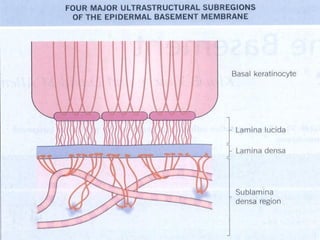
Components of DEJ
1.Basal plasma membrane
and hemi desmosome
2.Basement membrane
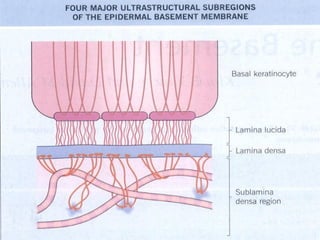
• Lamina lucida
• Lamina densa
• Lamina fibro reticularis
•Hemidesmosomes
–Focal thickening of plasma
membrane of keratinocytes
–High magnification
•Inner plaque
•Outer plaque
•Subbasal dense plaque
• Lamina Lucida
–Anchoring filaments [fine
structure, oriented –
perpenticularly] max
corresponding to HD
–Weakest part of DEJ
• Lamina densa
–Electron dense layer
–Made up of collagen IV
• Lamina fibro reticularis
–Anchoring fibrils [ curved structure]
•Can extend to upper part of
dermis/ lamina densa
•Also inserted to anchoring plaque
•Strongest tie for securing
epidermis to dermis
–Elastic micro fibrils [ fibrilin]
Ultrastructure ofUltrastructure of
epidermal basementepidermal basement
membranemembrane
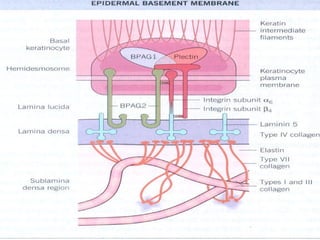
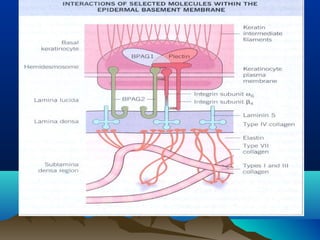
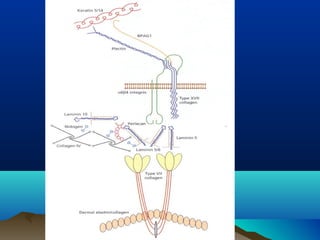
•Intermediate filament
component
–Keratin 5 and Keratin
14
•Hemidesmosomal
plaque components
–BPAG1 [BP 230]
–Plectin
•Transmembrane
component
–BPAG2
α6 β4 integrin
α3 β1 integrin
–Type XIII collagen
•Lamina lucida,
lamina densa
component
–Laminin – 5
–Laminin – 6
–Laminin – 2
–Laminin - 1
• Lamina densa component
–Type IV collagen
–Nidogen [ entactin]
–Perlecan
• Anchoring fibril
components
–Type VIII collagen
• Plectin
–500 Kda protein
–Carboxy terminal and amino
terminal
–Promoting adhesion
–Mutation – EBS associated
with limb girdle muscular
dystrophy
BPAG1
•Non collagenous protein
•Carboxy and
aminoterminal
•Auto antibodies - BP
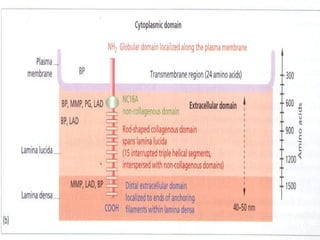
BPAG2 [ 180Kda
• transmembrane collagen[17]
• Intracellular / extracellular part
• Collagenous / non collagenous
domain
• NC-16A – immunodominant
epitope
Autoantibodies
–Bullous pemphigoid
–Cicatricial pemphigoid
–Pemphigoid gestationis
–Linear IgA bullous dermatosis
Mutation –
– Junctional epidermolysis bullosa [
Non- Herlitz type]
•Integrin
–Heterodimeric transmembrane
glycoprotein [α , β]
–Promote cell – cell and cell
matrix interaction
–Mutation – junctional EB with
pyloric atresia
–Auto antibody – ocular CP
• Laminins
–Hetero trimeric glycoprotein [αβγ]
–Structural component of extra
cellular matrix stabilized by
interchain disulphide bonds
–Laminin 1 - α1β1γ1
–Laminin 5 - α 3 β3 γ2
–Auto antibody – anti epiligrin CP
–Mutation - Junctional EB herlitz
type
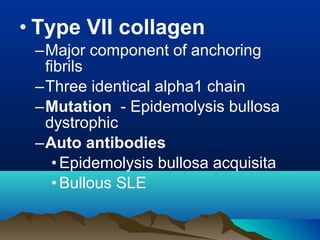
• Type VII collagen
–Major component of anchoring
fibrils
–Three identical alpha1 chain
–Mutation - Epidemolysis bullosa
dystrophic
–Auto antibodies
•Epidemolysis bullosa acquisita
•Bullous SLE
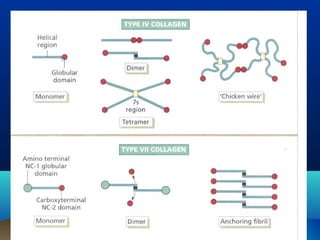
•Collagen IV
–Main constituent of lamina densa
–2 polypeptide [α1 and α2]
–Large C terminal globular domain
–Aminoterminal at the other end
–Bind covalently at amino terminal to
form tetramers or spiders
–Point of overlap is referred to as 7s
domain
•Nidogen
–150 Kda glycoprotein
–Stabilizer of basement membrane,
binding to Type IV collagen, perlecan
and laminin
• Perlecan [ Heparan sulphate
proteoglycan]
–Stabilizer of basement membrane
–Help for turn over and synthesis of
basement membrane
Target common to autoimmune andTarget common to autoimmune and
inherited blistering diseasesinherited blistering diseases
Protein
target
Auto immune
disease
Genetic disease
1 Plectin EB asso. Muscle
dystrophy
2 BPAG1 BP EB [Non-Herlitz]
3 BPAG2 BP, PG, CP, LABD
4 Laminin – 5 Antiepiligrin CP Junctional EB [ Herlitz]
5 α6 β4 integrin Ocular CP Junctional EB with
pyloric atresia
6 Type VII
collagen
EB acquisita
Bullous SLE
Dystrophic EB
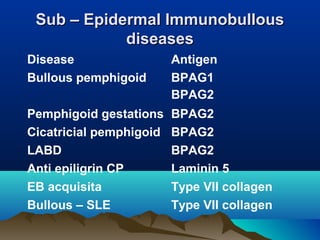
Sub – Epidermal ImmunobullousSub – Epidermal Immunobullous
diseasesdiseases
Disease Antigen
Bullous pemphigoid BPAG1
BPAG2
Pemphigoid gestations BPAG2
Cicatricial pemphigoid BPAG2
LABD BPAG2
Anti epiligrin CP Laminin 5
EB acquisita Type VII collagen
Bullous – SLE Type VII collagen
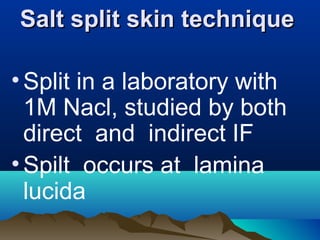
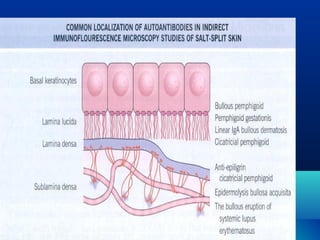
Salt split skin techniqueSalt split skin technique
•Split in a laboratory with
1M Nacl, studied by both
direct and indirect IF
•Spilt occurs at lamina
lucida
Dermo epidermal junction

Dermo epidermal junction

  • 1.
  • 2.
    •Largest epithelial mesenchymal junction •Attachmentbetween the epidermis and papillary dermis •Consist of collagenous and non collagenous macro molecule
  • 3.
    Functions of basement membrane -Firm attachment of dermis to epidermis – Selective permeability barrier – Structural foundation for the secure attachment and polarity of epidermal basement membrane
  • 4.
    –Barrier function separating the epidermisand dermis –Modifications of cellular function –Wound healing
  • 5.
    • Visualisation –Light Microscope– Magenta colored linear band
  • 6.
    Components of DEJ 1.Basalplasma membrane and hemi desmosome 2.Basement membrane • Lamina lucida • Lamina densa • Lamina fibro reticularis
  • 8.
    •Hemidesmosomes –Focal thickening ofplasma membrane of keratinocytes –High magnification •Inner plaque •Outer plaque •Subbasal dense plaque
  • 10.
    • Lamina Lucida –Anchoringfilaments [fine structure, oriented – perpenticularly] max corresponding to HD –Weakest part of DEJ • Lamina densa –Electron dense layer –Made up of collagen IV
  • 11.
    • Lamina fibroreticularis –Anchoring fibrils [ curved structure] •Can extend to upper part of dermis/ lamina densa •Also inserted to anchoring plaque •Strongest tie for securing epidermis to dermis –Elastic micro fibrils [ fibrilin]
  • 13.
    Ultrastructure ofUltrastructure of epidermalbasementepidermal basement membranemembrane
  • 14.
    •Intermediate filament component –Keratin 5and Keratin 14 •Hemidesmosomal plaque components –BPAG1 [BP 230] –Plectin
  • 15.
  • 16.
    •Lamina lucida, lamina densa component –Laminin– 5 –Laminin – 6 –Laminin – 2 –Laminin - 1
  • 17.
    • Lamina densacomponent –Type IV collagen –Nidogen [ entactin] –Perlecan • Anchoring fibril components –Type VIII collagen
  • 19.
    • Plectin –500 Kdaprotein –Carboxy terminal and amino terminal –Promoting adhesion –Mutation – EBS associated with limb girdle muscular dystrophy
  • 20.
    BPAG1 •Non collagenous protein •Carboxyand aminoterminal •Auto antibodies - BP
  • 21.
    BPAG2 [ 180Kda •transmembrane collagen[17] • Intracellular / extracellular part • Collagenous / non collagenous domain • NC-16A – immunodominant epitope
  • 23.
    Autoantibodies –Bullous pemphigoid –Cicatricial pemphigoid –Pemphigoidgestationis –Linear IgA bullous dermatosis Mutation – – Junctional epidermolysis bullosa [ Non- Herlitz type]
  • 24.
    •Integrin –Heterodimeric transmembrane glycoprotein [α, β] –Promote cell – cell and cell matrix interaction –Mutation – junctional EB with pyloric atresia –Auto antibody – ocular CP
  • 26.
    • Laminins –Hetero trimericglycoprotein [αβγ] –Structural component of extra cellular matrix stabilized by interchain disulphide bonds –Laminin 1 - α1β1γ1 –Laminin 5 - α 3 β3 γ2 –Auto antibody – anti epiligrin CP –Mutation - Junctional EB herlitz type
  • 27.
    • Type VIIcollagen –Major component of anchoring fibrils –Three identical alpha1 chain –Mutation - Epidemolysis bullosa dystrophic –Auto antibodies •Epidemolysis bullosa acquisita •Bullous SLE
  • 28.
    •Collagen IV –Main constituentof lamina densa –2 polypeptide [α1 and α2] –Large C terminal globular domain –Aminoterminal at the other end –Bind covalently at amino terminal to form tetramers or spiders –Point of overlap is referred to as 7s domain
  • 30.
    •Nidogen –150 Kda glycoprotein –Stabilizerof basement membrane, binding to Type IV collagen, perlecan and laminin • Perlecan [ Heparan sulphate proteoglycan] –Stabilizer of basement membrane –Help for turn over and synthesis of basement membrane
  • 32.
    Target common toautoimmune andTarget common to autoimmune and inherited blistering diseasesinherited blistering diseases Protein target Auto immune disease Genetic disease 1 Plectin EB asso. Muscle dystrophy 2 BPAG1 BP EB [Non-Herlitz] 3 BPAG2 BP, PG, CP, LABD 4 Laminin – 5 Antiepiligrin CP Junctional EB [ Herlitz] 5 α6 β4 integrin Ocular CP Junctional EB with pyloric atresia 6 Type VII collagen EB acquisita Bullous SLE Dystrophic EB
  • 33.
    Sub – EpidermalImmunobullousSub – Epidermal Immunobullous diseasesdiseases Disease Antigen Bullous pemphigoid BPAG1 BPAG2 Pemphigoid gestations BPAG2 Cicatricial pemphigoid BPAG2 LABD BPAG2 Anti epiligrin CP Laminin 5 EB acquisita Type VII collagen Bullous – SLE Type VII collagen
  • 34.
    Salt split skintechniqueSalt split skin technique •Split in a laboratory with 1M Nacl, studied by both direct and indirect IF •Spilt occurs at lamina lucida