CRYOTHERAPY
Cryotherapy
• Indications
• Contraindications
• Techniques
• Post procedure care
• Complications
• Advantages & disadvantages
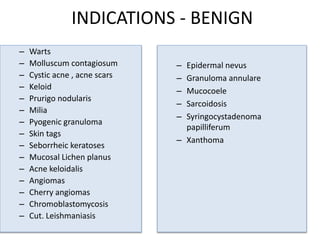
INDICATIONS - BENIGN
– Warts
– Molluscum contagiosum
– Cystic acne , acne scars
– Keloid
– Prurigo nodularis
– Milia
– Pyogenic granuloma
– Skin tags
– Seborrheic keratoses
– Mucosal Lichen planus
– Acne keloidalis
– Angiomas
– Cherry angiomas
– Chromoblastomycosis
– Cut. Leishmaniasis
– Epidermal nevus
– Granuloma annulare
– Mucocoele
– Sarcoidosis
– Syringocystadenoma
papilliferum
– Xanthoma
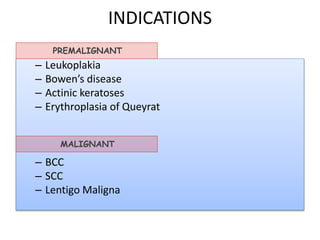
INDICATIONS
– Leukoplakia
– Bowen’s disease
– Actinic keratoses
– Erythroplasia of Queyrat
– BCC
– SCC
– Lentigo Maligna
PREMALIGNANT
MALIGNANT
CONTRAINDICATIONS
• Agammaglobulinemia
• Cold intolerance
• Cold urticaria
• Cryoglobulinemia
• Raynaud’s disease
• Collagen Vascular diseases
• Multiple myeloma
• Absence of accurate diagnosis
• Melanoma
DEFINATIONS
• TARGET AREA: Extent of the lesions both peripherally
and in depth
• FREEZE TIME : Elapsed time from the start to the end
of the freeze cycle
• COMPLETE THAW TIME: Elapsed time from stopping
the cold application until the lesion is thawed.
• HALO-THAW TIME-elapsed time from stopping cold
application until thaw reaches area where cold was
applied
PRE-PROCEDURE
• Biopsy to confirm the diagnosis(Malignant ,
premalignant lesions.)
• Photographs
• HIV, VDRL screening , if required
• Informed and written consent
• Analgesics may be given 1-2 hrs before procedure
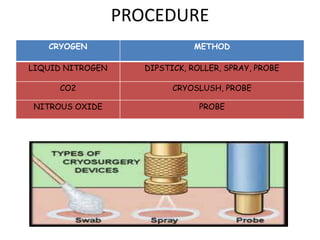
PROCEDURE
CRYOGEN METHOD
LIQUID NITROGEN DIPSTICK, ROLLER, SPRAY, PROBE
CO2 CRYOSLUSH, PROBE
NITROUS OXIDE PROBE
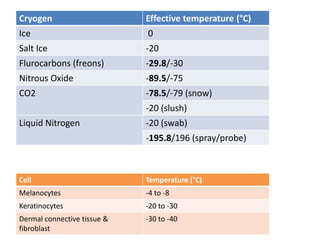
Cryogen Effective temperature (°C)
Ice 0
Salt Ice -20
Flurocarbons (freons) -29.8/-30
Nitrous Oxide -89.5/-75
CO2 -78.5/-79 (snow)
-20 (slush)
Liquid Nitrogen -20 (swab)
-195.8/196 (spray/probe)
Cell Temperature (°C)
Melanocytes -4 to -8
Keratinocytes -20 to -30
Dermal connective tissue &
fibroblast
-30 to -40
LIQUID NITROGEN
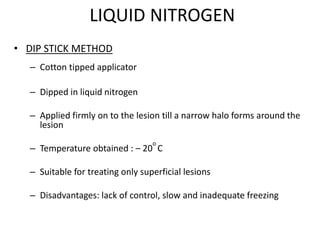
• DIP STICK METHOD
– Cotton tipped applicator
– Dipped in liquid nitrogen
– Applied firmly on to the lesion till a narrow halo forms around the
lesion
– Temperature obtained : – 20
o
C
– Suitable for treating only superficial lesions
– Disadvantages: lack of control, slow and inadequate freezing
LIQUID NITROGEN
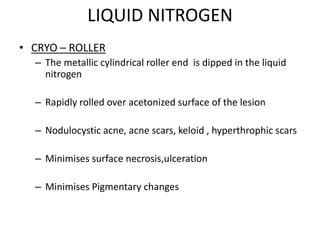
• CRYO – ROLLER
– The metallic cylindrical roller end is dipped in the liquid
nitrogen
– Rapidly rolled over acetonized surface of the lesion
– Nodulocystic acne, acne scars, keloid , hyperthrophic scars
– Minimises surface necrosis,ulceration
– Minimises Pigmentary changes
LIQUID NITROGEN
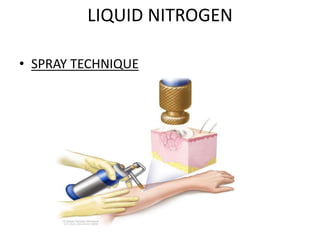
• SPRAY TECHNIQUE
SPRAY TECHNIQUE
– Cryo spray is filled upto 2 inches from the brim.
– Wait for 3-4 mins for the pressure to build up
– Anaesthesia – if required
– Mark the periphery of the lesion
– Rim of normal skin to be included: benign: 1- 2 mm, premalignant: 3-
5mm , malignant 5-10 mm
– Spray tip held 1 cm away from the lesion and steady spray is
directed at the lesion
– Ice field extends upto marked periphery
SPRAY TECHNIQUE
– The ice ball is maintained for the required time
– Lesion allowed to thaw slowly ( usually X2 freeze
time)
– Repeat freeze thaw cycle if indicated.
– Skin to be palpated to confirm disappearance of
ice ball from tissue.
TYPES OF SPRAY TECNIQUES
Depending upon shape and size of lesion being frozen
• Spot freeze technique
– Useful for treating lesions < 2 cm ( ice field upto 2 cm)
– Maximum depth of adequate ice formation in the centre of
the lesion is 0.5 to 0.6 cm and the temperture attained is -
400C to – 600 C
– If lesion > 2 cm in diameter then overlapping 2 cm diameter
circles treated separately.
• Paint Brush Technique
– Spraying started at lateral point of lesion & done back and
forth – horizontally or vertically.
– Useful for irregular and larger lesions
TYPES OF SPRAY TECNIQUES
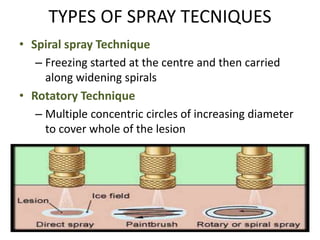
• Spiral spray Technique
– Freezing started at the centre and then carried
along widening spirals
• Rotatory Technique
– Multiple concentric circles of increasing diameter
to cover whole of the lesion
SPRAY TECHNIQUE USING
CONES/CYLINDERS
• Also known as RESTRICTED SPRAY TECHNIQUE
• Advantages:
– Spray is concentrated
– Lateral spread is restricted
– Gives a rapid rate of freezing – more destructive
– Useful at site like eyelids/ inner canthi where lateral
spread has to be restricted
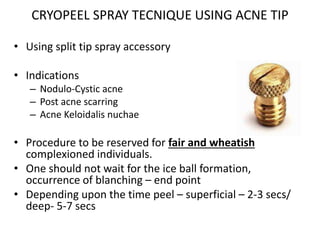
CRYOPEEL SPRAY TECNIQUE USING ACNE TIP
• Using split tip spray accessory
• Indications
– Nodulo-Cystic acne
– Post acne scarring
– Acne Keloidalis nuchae
• Procedure to be reserved for fair and wheatish
complexioned individuals.
• One should not wait for the ice ball formation,
occurrence of blanching – end point
• Depending upon the time peel – superficial – 2-3 secs/
deep- 5-7 secs
PROCEDURE
• Written informed consent
• Marking – Skin surface is divided into segmental
squares of 4 cm2 each.
• Pt in upright position – eyeglasses/ plastic apron.
• Special acne spray tip attachment ( slit like opening)
used – each square sequentially sprayed in paint brush
or shaving razor method for 2-7 sec
• Slight feathering done at the submandibular margin
POST PROCEDURE
• Severe edema on 2nd day with blistering ( 2-3 days)
which gradually subsides with crusting and peeling.
• Calamine lotion 2-3 days
• Emollients during crusting phase
• Anti inflammatory medications X 5 days
• Sun protection X 6-8 wks
• Ct. anti acne treatment
• S/E – erythema, hyper/hypo/depigmentation, burns,
scarring
• Minimum gap of 8-12 weeks between two sessions if
required
CRYOPROBE TECHNIQUE
• Liquid nitrogen circulated to cool the tip of the
cryoprobe
• Cryoprobe then applied to the lesion
• Freezing by conduction
• Slower than spray technique
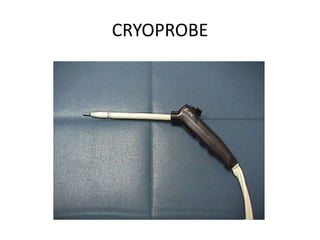
CRYOPROBE
METHOD
– Spray Unit is filled with liquid nitrogen, lesion is
marked, LA if required.
– Probe suitable for the lesion – 3/4th size of the lesion,
different shapes- pointed, flat, rounded.
– Surgical gel applied onto the lesion ( for hydration and
better probe contact)
– Probe applied- adheres to skin within 5-6 secs.
METHOD
– Probe retracted from the skin to protect surrounding
tissues.
– Depending upon the depth required pressure is applied.
– Adequacy of freeze checked –by extent of rim of normal
tissue frozen
– Probe is allowed to thaw before removal from treatment
site.
– Repeat cycle if required after adequate thawing of the
lesion.
INTRALESIONAL TECHNIQUE
• Passing long metallic cryoprobe needles
through the deeper portion of bulky lesion.
• Spraying of LN2 through the needle- resolution
of lesion.
• Avoids normal tissue destruction as seen with
spray / cryoprobe technique
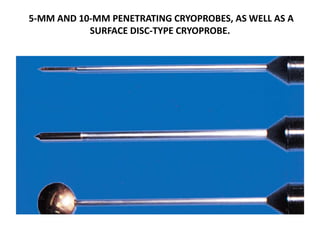
5-MM AND 10-MM PENETRATING CRYOPROBES, AS WELL AS A
SURFACE DISC-TYPE CRYOPROBE.
CRYOSLUSH WITH LIQUID NITROGEN
• Indications-nodulocystic acne,acne scarring
• A square gauze piece held with a long artery
forceps dipped in LN2.
• Acetone is applied and then gauze is applied for
2-10 seconds
• Superficial peeling is achieved due to epidermal
necrosis which causes desquamation of
comedones,resolution of inflammatory papules
NITROUS OXIDE
• Cryoprobe technique
• Cryoprobe attached to a nitrous oxide
cylinder
CARBON DIOXIDE
• Cryoprobe technique
• Cryoslush Technique
CRYOSLUSH TECHNIQUE
– Using CO2 crystals along with acetone with/
without precipitated sulphur and / or alcohol for
superficial peeling of skin - desquamation of
comedones, resolution of papules, pustules,
nodulocystic acne – causes avoidance /
improvement in superficial acne scars.
– Effective Skin temp achieved – 200 C
CRYOSLUSH TECHNIQUE
• Acetone
– Dissolves sebum, allows easy slippage of CO2
crystals over face ( avoids cryoinjury)
• Precipitated Sulphur
– Antibacterial and superficial keratolytic
• Ethyl Alcohol
– Dissolves sebum, allows easy slippage of CO2
crystals over face ( avoids cryoinjury)
EQUIPMENTS
• CO2 Cylinder
• Copper tubing
• Chamois leather bag
INDICATIONS
• Cystic and Nodular acne
• Post acne scarring
• Acne Keloidalis nuchae
PROCEDURE
• Written and informed consent
• Pt. in supine position
• Collect solid ice in chamois bag from CO2 cylinder by
holding it tightly enclosing the end of copper tubing
attached to cylinder
• Crush it in a bowl with few drops of acetone to form a
paste
• Applied with a gauze ball/ glass rod sequentially to
cover the entire face.
• End point – blanching of the skin
• Duration –ranges from 2-10 sec. depends upon severity
and complexion (less duration for dark complexioned
individuals)
• Immediately on application frosting and blanching
appears f/by erythema. Peeling in 2-4 days.
POST PROCEDURE
• Calamine lotion to be applied for 2-3 days for
faster desquamation.
• Sun protection X 1 week
• Continue medical therapy for acne
• S/E
– Hyper/ hypopigmentation
LN2 cryoroller - ACNE
 It lowers surface temp to -196 0 c
 Its superficial depth peeling action causes desquamation,
reduces inflammation – faster resolution of acne
 Remodels the dermal collagen – to improve existing scars
 Rapid movement of roller ensures short contact time , &
hence complications like hyperpigmentation and scarring
avoided /minimized.
• Indications-
1. Nodulo cystic acne (grade- 3 ,4)
2. Acne scars(atrophic , rolled on, superficial box scars)
• Contraindications-
Deep box scars and ice-pick scars
• Procedure-
 Pt in supine position with head elevated at 45 0
 Pour LN2 into thermacol cup, dip cylindrical metalic end
of roller into it.
 Roller rapidly rolled over face sequentially, covering one
unit at a time, with uniform pressure.
 Minimum pressure over bony promineces
 Feathering done at sub mandibular borders, hairline.
 Precaution taken to keep skin surface always
moist with acetone (assistant instructed to apply
acetone to segment just prior to rolling)
 Severely inflammed lesions treated second time.
 Base of individual scar t/t with cotton swab
dipped in LN2 & pressed against base for 1-2 sec.
 Post procedure-
 Calamine lotion for 2-3 days,sun protection,
medical therapy for acne continued with short
course of anti inflammatory drugs.
 Schedule- every 2-3 wks till complete resolution
of inflammed lesions.
Hypertrophic scars & Keloids
• LN2 CRYOSPRAY
• LN2 CRYOPROBE
• LN2 CRYOROLLER-
• Useful for flat surfaced keloid with height 0.5 to 1cm.
• There is direct cell destruction along with vascular stasis causes
tissue necrosis and sloughing
• Profound effect on collagen,fibroblasts resulting in collagen
remodelling
• Healing occurs in 3-4 wks wth reduction in tissue mass
 LN2 INTRALESIONAL CRYO- Hypertrophic
Scars and large bulky keloids with ht more
than 1cm.
 involves passing multiple needles midway
thro the lesion & inducing cryo injury at a
depth, thus sparing surface.
 useful for debulking large lesion.
• Freeze time of 30 sec required & repeat after
1mnth interval, until flattening of lesions.
Viral infections
 Warts –
• Liquid nitrogen is used to deep freeze the wart tissue.
• With liquid nitrogen applied to the wart, the water in the cells
expands, thus exploding the infected tissue.
• The exploded cells can no longer hide the human papilloma virus
from the body's immune system.
• The immune system then works to destroy the virus particles.
• Using spray technique most common d/t its quick convenient use.
 Response is variable & depends on the size of the wart and the
degree of hyperkeratosis. Several treatment sessions typically are
required, and the overall success rate is approximately 75 %
 To avoid hypopigmentation, small flat warts may be treated with
a light spray technique.
 Paring of warts before cryo improved cure rates for plantar
warts.
 Deep plantar or palmar warts present challenges, because pain
may limit the patient’s tolerance of freezing.
 However, favorable cure rates have been reported for initial
pretreatment with keratolytics (salicylic acid)
 Cryosurgery has been found to be effective in the management
of condyloma acuminatum, particularly when treatment with
podophyllin has failed.
• Molluscum contagiosum
Lesion is amenable to cryosurgery, if indicated.Applying liquid
nitrogen spray for a few seconds until the surface of the
umbilicated papule turns white usually is adequate.
MALIGNANT LESIONS
• Temperature monitoring is useful while treating skin malignancies.
• Single thermocouple needle for small lesions and 2-3 needles for
bigger tumors.
• TECHNIQUE
– Informed and written consent.
– Mark margins with 5-10 mm excess.
– Local Anesthesia injected
– Thermocouple needle inserted
– Open Spray/ Restricted spray/ cryoprobe method
MALIGNANT LESIONS
– Freezing done upto 5-10 mm of surrounding area
– Freezing continued till a temp -500 C is reached which
indicates necrosis of all malignant cells
– Freeze time 1 ½ mins with a thaw time of 3 mins.
– Second freeze thaw cycle is then carried out, after 3-5
min.
– When freezing tumors in ear, one should freeze till the
ice frost is seen on the other side of the ear.
– Tumors on the eyelids can be frozen after protecting
the eye with a plastic eye retractor.
BCC
• Several studies reported treating BCC with cryo- cure rates
between 95 -99%
• The cryogen produces cellular damage by intra and extra cellular
ice crystal formation, vascular stasis and local electrolyte
imbalance.Collagen fibres, cartilage and bone are resistant to
damage by cryogen which enables healing and allows selective
destruction of tumors overlying bone or cartilage
• The advantages are it is a simple office procedure, cost effective
and can be used in those with medical risk for surgery.
• Disadvantages include prolonged healing time, depigmentation
and scarring.
• Recurrences usually occur during first 2 years after treatment.
• In a recent study Kuflik and Gage treated recurrent BCCs ranging
in size from 0.6 to 4.4 cms with cryotherapy and found it to be
effective and the results comparable with other methods of
treatment.
Lentigo Maligna
• Effective modality d/t sensitivity of melanocytes to cold.
• A clinical margin of 5mm drawn around visible borders
• Treated with double freeze- thaw cycle of 30-60 sec.
• Adv- effective & avoidance of large surgical scars
• Disadv- inability to assess complete destruction of lesion &
As no tissue obtained for definitive confirmation of cancer
removal – chance for recurrence of melanoma.
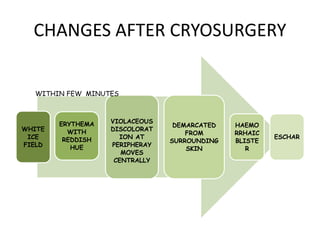
CHANGES AFTER CRYOSURGERY
WHITE
ICE
FIELD
ERYTHEMA
WITH
REDDISH
HUE
VIOLACEOUS
DISCOLORAT
ION AT
PERIPHERAY
MOVES
CENTRALLY
DEMARCATED
FROM
SURROUNDING
SKIN
HAEMO
RRHAIC
BLISTE
R
ESCHAR
WITHIN FEW MINUTES
POST PROCEDURE CARE
• BENIGN
– Medications
– Dressing – topical antibiotic, drain blister with sterile needle
– f/u after 15 days to assess the lesion
– Procedure can be repeated after 3 weeks if required
• MALIGNANT
– Medications
– Dressing: steroid + antibiotic
– Course of wound – dry black adherent crust appears after 10-
14 days, falls of after about a week ;upto a month- pink scar
– f/u – weekly till crust falls off ( 4-6 weeks) ; every 3-6 mths for
4-6 yrs for recurrence
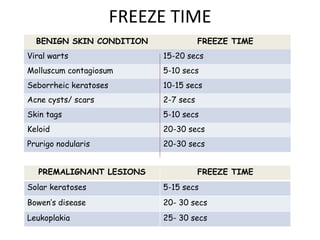
FREEZE TIME
BENIGN SKIN CONDITION FREEZE TIME
Viral warts 15-20 secs
Molluscum contagiosum 5-10 secs
Seborrheic keratoses 10-15 secs
Acne cysts/ scars 2-7 secs
Skin tags 5-10 secs
Keloid 20-30 secs
Prurigo nodularis 20-30 secs
PREMALIGNANT LESIONS FREEZE TIME
Solar keratoses 5-15 secs
Bowen’s disease 20- 30 secs
Leukoplakia 25- 30 secs
FREEZE TIME
• MALIGNANT LESIONS
– Using HPE – depth of the tumor ascertained
– Minimum two 30 secs freeze-thaw cycles with a 5
min thaw between each freeze.
– Depth and adequacy of freeze – thermocouple
needles.
COMPLICATIONS
• IMMEDIATE
– Pain, Headache
– Edema, blister formation
– Syncope, febrile reaction
• DELAYED
– Post operative infection
- Hypertrophic granulation tissue
formation
Temporary
– Hyperpigmentation
– Milia
– Hypertrophic scars
– Arthralgia
– Nerve damage
– Paraesthesia
• DELAYED ( permanent)
– Hypo or depigmentation
– Atrophy
– Cicatricial alopecia
– Ectropion
– Notching of eyelids
ADVANTAGES
• Simple,safe, cost effective procedure
• OPD procedure – no need for hospitalisation
• Can b used alone / combined with other surgical modalities
(curretage, paring.)
• Cure rates are high in properly selected cases
• Palliative therapy for inoperable tumors
• Excellent cosmetic results
• No general anaesthesia; local anaesthesia optional
• Useful in pregnancy
• For patients who are fearful of undergoing surgery
• For poor surgical risk patients
• All ages can be treated – also pts. at poor risk for surgery.
• Useful in HIV individual – being a no touch technique.
DISADVANTAGES
• Discomfort like stinging, burning/ pain
• Multiple sittings may be required
• Hyper/ hypo/ depigmentation – dark
complexioned individuals.
• Availability may be a problem in small towns
Cryotherapy

Cryotherapy

  • 1.
  • 2.
    Cryotherapy • Indications • Contraindications •Techniques • Post procedure care • Complications • Advantages & disadvantages
  • 3.
    INDICATIONS - BENIGN –Warts – Molluscum contagiosum – Cystic acne , acne scars – Keloid – Prurigo nodularis – Milia – Pyogenic granuloma – Skin tags – Seborrheic keratoses – Mucosal Lichen planus – Acne keloidalis – Angiomas – Cherry angiomas – Chromoblastomycosis – Cut. Leishmaniasis – Epidermal nevus – Granuloma annulare – Mucocoele – Sarcoidosis – Syringocystadenoma papilliferum – Xanthoma
  • 4.
    INDICATIONS – Leukoplakia – Bowen’sdisease – Actinic keratoses – Erythroplasia of Queyrat – BCC – SCC – Lentigo Maligna PREMALIGNANT MALIGNANT
  • 5.
    CONTRAINDICATIONS • Agammaglobulinemia • Coldintolerance • Cold urticaria • Cryoglobulinemia • Raynaud’s disease • Collagen Vascular diseases • Multiple myeloma • Absence of accurate diagnosis • Melanoma
  • 6.
    DEFINATIONS • TARGET AREA:Extent of the lesions both peripherally and in depth • FREEZE TIME : Elapsed time from the start to the end of the freeze cycle • COMPLETE THAW TIME: Elapsed time from stopping the cold application until the lesion is thawed. • HALO-THAW TIME-elapsed time from stopping cold application until thaw reaches area where cold was applied
  • 7.
    PRE-PROCEDURE • Biopsy toconfirm the diagnosis(Malignant , premalignant lesions.) • Photographs • HIV, VDRL screening , if required • Informed and written consent • Analgesics may be given 1-2 hrs before procedure
  • 8.
    PROCEDURE CRYOGEN METHOD LIQUID NITROGENDIPSTICK, ROLLER, SPRAY, PROBE CO2 CRYOSLUSH, PROBE NITROUS OXIDE PROBE
  • 9.
    Cryogen Effective temperature(°C) Ice 0 Salt Ice -20 Flurocarbons (freons) -29.8/-30 Nitrous Oxide -89.5/-75 CO2 -78.5/-79 (snow) -20 (slush) Liquid Nitrogen -20 (swab) -195.8/196 (spray/probe) Cell Temperature (°C) Melanocytes -4 to -8 Keratinocytes -20 to -30 Dermal connective tissue & fibroblast -30 to -40
  • 10.
    LIQUID NITROGEN • DIPSTICK METHOD – Cotton tipped applicator – Dipped in liquid nitrogen – Applied firmly on to the lesion till a narrow halo forms around the lesion – Temperature obtained : – 20 o C – Suitable for treating only superficial lesions – Disadvantages: lack of control, slow and inadequate freezing
  • 11.
    LIQUID NITROGEN • CRYO– ROLLER – The metallic cylindrical roller end is dipped in the liquid nitrogen – Rapidly rolled over acetonized surface of the lesion – Nodulocystic acne, acne scars, keloid , hyperthrophic scars – Minimises surface necrosis,ulceration – Minimises Pigmentary changes
  • 12.
  • 13.
    SPRAY TECHNIQUE – Cryospray is filled upto 2 inches from the brim. – Wait for 3-4 mins for the pressure to build up – Anaesthesia – if required – Mark the periphery of the lesion – Rim of normal skin to be included: benign: 1- 2 mm, premalignant: 3- 5mm , malignant 5-10 mm – Spray tip held 1 cm away from the lesion and steady spray is directed at the lesion – Ice field extends upto marked periphery
  • 14.
    SPRAY TECHNIQUE – Theice ball is maintained for the required time – Lesion allowed to thaw slowly ( usually X2 freeze time) – Repeat freeze thaw cycle if indicated. – Skin to be palpated to confirm disappearance of ice ball from tissue.
  • 15.
    TYPES OF SPRAYTECNIQUES Depending upon shape and size of lesion being frozen • Spot freeze technique – Useful for treating lesions < 2 cm ( ice field upto 2 cm) – Maximum depth of adequate ice formation in the centre of the lesion is 0.5 to 0.6 cm and the temperture attained is - 400C to – 600 C – If lesion > 2 cm in diameter then overlapping 2 cm diameter circles treated separately. • Paint Brush Technique – Spraying started at lateral point of lesion & done back and forth – horizontally or vertically. – Useful for irregular and larger lesions
  • 16.
    TYPES OF SPRAYTECNIQUES • Spiral spray Technique – Freezing started at the centre and then carried along widening spirals • Rotatory Technique – Multiple concentric circles of increasing diameter to cover whole of the lesion
  • 17.
    SPRAY TECHNIQUE USING CONES/CYLINDERS •Also known as RESTRICTED SPRAY TECHNIQUE • Advantages: – Spray is concentrated – Lateral spread is restricted – Gives a rapid rate of freezing – more destructive – Useful at site like eyelids/ inner canthi where lateral spread has to be restricted
  • 18.
    CRYOPEEL SPRAY TECNIQUEUSING ACNE TIP • Using split tip spray accessory • Indications – Nodulo-Cystic acne – Post acne scarring – Acne Keloidalis nuchae • Procedure to be reserved for fair and wheatish complexioned individuals. • One should not wait for the ice ball formation, occurrence of blanching – end point • Depending upon the time peel – superficial – 2-3 secs/ deep- 5-7 secs
  • 19.
    PROCEDURE • Written informedconsent • Marking – Skin surface is divided into segmental squares of 4 cm2 each. • Pt in upright position – eyeglasses/ plastic apron. • Special acne spray tip attachment ( slit like opening) used – each square sequentially sprayed in paint brush or shaving razor method for 2-7 sec • Slight feathering done at the submandibular margin
  • 20.
    POST PROCEDURE • Severeedema on 2nd day with blistering ( 2-3 days) which gradually subsides with crusting and peeling. • Calamine lotion 2-3 days • Emollients during crusting phase • Anti inflammatory medications X 5 days • Sun protection X 6-8 wks • Ct. anti acne treatment • S/E – erythema, hyper/hypo/depigmentation, burns, scarring • Minimum gap of 8-12 weeks between two sessions if required
  • 21.
    CRYOPROBE TECHNIQUE • Liquidnitrogen circulated to cool the tip of the cryoprobe • Cryoprobe then applied to the lesion • Freezing by conduction • Slower than spray technique
  • 22.
  • 23.
    METHOD – Spray Unitis filled with liquid nitrogen, lesion is marked, LA if required. – Probe suitable for the lesion – 3/4th size of the lesion, different shapes- pointed, flat, rounded. – Surgical gel applied onto the lesion ( for hydration and better probe contact) – Probe applied- adheres to skin within 5-6 secs.
  • 24.
    METHOD – Probe retractedfrom the skin to protect surrounding tissues. – Depending upon the depth required pressure is applied. – Adequacy of freeze checked –by extent of rim of normal tissue frozen – Probe is allowed to thaw before removal from treatment site. – Repeat cycle if required after adequate thawing of the lesion.
  • 25.
    INTRALESIONAL TECHNIQUE • Passinglong metallic cryoprobe needles through the deeper portion of bulky lesion. • Spraying of LN2 through the needle- resolution of lesion. • Avoids normal tissue destruction as seen with spray / cryoprobe technique
  • 26.
    5-MM AND 10-MMPENETRATING CRYOPROBES, AS WELL AS A SURFACE DISC-TYPE CRYOPROBE.
  • 27.
    CRYOSLUSH WITH LIQUIDNITROGEN • Indications-nodulocystic acne,acne scarring • A square gauze piece held with a long artery forceps dipped in LN2. • Acetone is applied and then gauze is applied for 2-10 seconds • Superficial peeling is achieved due to epidermal necrosis which causes desquamation of comedones,resolution of inflammatory papules
  • 28.
    NITROUS OXIDE • Cryoprobetechnique • Cryoprobe attached to a nitrous oxide cylinder CARBON DIOXIDE • Cryoprobe technique • Cryoslush Technique
  • 29.
    CRYOSLUSH TECHNIQUE – UsingCO2 crystals along with acetone with/ without precipitated sulphur and / or alcohol for superficial peeling of skin - desquamation of comedones, resolution of papules, pustules, nodulocystic acne – causes avoidance / improvement in superficial acne scars. – Effective Skin temp achieved – 200 C
  • 30.
    CRYOSLUSH TECHNIQUE • Acetone –Dissolves sebum, allows easy slippage of CO2 crystals over face ( avoids cryoinjury) • Precipitated Sulphur – Antibacterial and superficial keratolytic • Ethyl Alcohol – Dissolves sebum, allows easy slippage of CO2 crystals over face ( avoids cryoinjury)
  • 31.
    EQUIPMENTS • CO2 Cylinder •Copper tubing • Chamois leather bag
  • 32.
    INDICATIONS • Cystic andNodular acne • Post acne scarring • Acne Keloidalis nuchae
  • 33.
    PROCEDURE • Written andinformed consent • Pt. in supine position • Collect solid ice in chamois bag from CO2 cylinder by holding it tightly enclosing the end of copper tubing attached to cylinder • Crush it in a bowl with few drops of acetone to form a paste • Applied with a gauze ball/ glass rod sequentially to cover the entire face. • End point – blanching of the skin • Duration –ranges from 2-10 sec. depends upon severity and complexion (less duration for dark complexioned individuals) • Immediately on application frosting and blanching appears f/by erythema. Peeling in 2-4 days.
  • 34.
    POST PROCEDURE • Calaminelotion to be applied for 2-3 days for faster desquamation. • Sun protection X 1 week • Continue medical therapy for acne • S/E – Hyper/ hypopigmentation
  • 35.
    LN2 cryoroller -ACNE  It lowers surface temp to -196 0 c  Its superficial depth peeling action causes desquamation, reduces inflammation – faster resolution of acne  Remodels the dermal collagen – to improve existing scars  Rapid movement of roller ensures short contact time , & hence complications like hyperpigmentation and scarring avoided /minimized.
  • 36.
    • Indications- 1. Nodulocystic acne (grade- 3 ,4) 2. Acne scars(atrophic , rolled on, superficial box scars) • Contraindications- Deep box scars and ice-pick scars • Procedure-  Pt in supine position with head elevated at 45 0  Pour LN2 into thermacol cup, dip cylindrical metalic end of roller into it.  Roller rapidly rolled over face sequentially, covering one unit at a time, with uniform pressure.  Minimum pressure over bony promineces  Feathering done at sub mandibular borders, hairline.
  • 37.
     Precaution takento keep skin surface always moist with acetone (assistant instructed to apply acetone to segment just prior to rolling)  Severely inflammed lesions treated second time.  Base of individual scar t/t with cotton swab dipped in LN2 & pressed against base for 1-2 sec.  Post procedure-  Calamine lotion for 2-3 days,sun protection, medical therapy for acne continued with short course of anti inflammatory drugs.  Schedule- every 2-3 wks till complete resolution of inflammed lesions.
  • 38.
    Hypertrophic scars &Keloids • LN2 CRYOSPRAY • LN2 CRYOPROBE • LN2 CRYOROLLER- • Useful for flat surfaced keloid with height 0.5 to 1cm. • There is direct cell destruction along with vascular stasis causes tissue necrosis and sloughing • Profound effect on collagen,fibroblasts resulting in collagen remodelling • Healing occurs in 3-4 wks wth reduction in tissue mass
  • 39.
     LN2 INTRALESIONALCRYO- Hypertrophic Scars and large bulky keloids with ht more than 1cm.  involves passing multiple needles midway thro the lesion & inducing cryo injury at a depth, thus sparing surface.  useful for debulking large lesion. • Freeze time of 30 sec required & repeat after 1mnth interval, until flattening of lesions.
  • 40.
    Viral infections  Warts– • Liquid nitrogen is used to deep freeze the wart tissue. • With liquid nitrogen applied to the wart, the water in the cells expands, thus exploding the infected tissue. • The exploded cells can no longer hide the human papilloma virus from the body's immune system. • The immune system then works to destroy the virus particles. • Using spray technique most common d/t its quick convenient use.  Response is variable & depends on the size of the wart and the degree of hyperkeratosis. Several treatment sessions typically are required, and the overall success rate is approximately 75 %
  • 41.
     To avoidhypopigmentation, small flat warts may be treated with a light spray technique.  Paring of warts before cryo improved cure rates for plantar warts.  Deep plantar or palmar warts present challenges, because pain may limit the patient’s tolerance of freezing.  However, favorable cure rates have been reported for initial pretreatment with keratolytics (salicylic acid)  Cryosurgery has been found to be effective in the management of condyloma acuminatum, particularly when treatment with podophyllin has failed. • Molluscum contagiosum Lesion is amenable to cryosurgery, if indicated.Applying liquid nitrogen spray for a few seconds until the surface of the umbilicated papule turns white usually is adequate.
  • 42.
    MALIGNANT LESIONS • Temperaturemonitoring is useful while treating skin malignancies. • Single thermocouple needle for small lesions and 2-3 needles for bigger tumors. • TECHNIQUE – Informed and written consent. – Mark margins with 5-10 mm excess. – Local Anesthesia injected – Thermocouple needle inserted – Open Spray/ Restricted spray/ cryoprobe method
  • 43.
    MALIGNANT LESIONS – Freezingdone upto 5-10 mm of surrounding area – Freezing continued till a temp -500 C is reached which indicates necrosis of all malignant cells – Freeze time 1 ½ mins with a thaw time of 3 mins. – Second freeze thaw cycle is then carried out, after 3-5 min. – When freezing tumors in ear, one should freeze till the ice frost is seen on the other side of the ear. – Tumors on the eyelids can be frozen after protecting the eye with a plastic eye retractor.
  • 44.
    BCC • Several studiesreported treating BCC with cryo- cure rates between 95 -99% • The cryogen produces cellular damage by intra and extra cellular ice crystal formation, vascular stasis and local electrolyte imbalance.Collagen fibres, cartilage and bone are resistant to damage by cryogen which enables healing and allows selective destruction of tumors overlying bone or cartilage • The advantages are it is a simple office procedure, cost effective and can be used in those with medical risk for surgery. • Disadvantages include prolonged healing time, depigmentation and scarring. • Recurrences usually occur during first 2 years after treatment. • In a recent study Kuflik and Gage treated recurrent BCCs ranging in size from 0.6 to 4.4 cms with cryotherapy and found it to be effective and the results comparable with other methods of treatment.
  • 45.
    Lentigo Maligna • Effectivemodality d/t sensitivity of melanocytes to cold. • A clinical margin of 5mm drawn around visible borders • Treated with double freeze- thaw cycle of 30-60 sec. • Adv- effective & avoidance of large surgical scars • Disadv- inability to assess complete destruction of lesion & As no tissue obtained for definitive confirmation of cancer removal – chance for recurrence of melanoma.
  • 46.
    CHANGES AFTER CRYOSURGERY WHITE ICE FIELD ERYTHEMA WITH REDDISH HUE VIOLACEOUS DISCOLORAT IONAT PERIPHERAY MOVES CENTRALLY DEMARCATED FROM SURROUNDING SKIN HAEMO RRHAIC BLISTE R ESCHAR WITHIN FEW MINUTES
  • 47.
    POST PROCEDURE CARE •BENIGN – Medications – Dressing – topical antibiotic, drain blister with sterile needle – f/u after 15 days to assess the lesion – Procedure can be repeated after 3 weeks if required • MALIGNANT – Medications – Dressing: steroid + antibiotic – Course of wound – dry black adherent crust appears after 10- 14 days, falls of after about a week ;upto a month- pink scar – f/u – weekly till crust falls off ( 4-6 weeks) ; every 3-6 mths for 4-6 yrs for recurrence
  • 48.
    FREEZE TIME BENIGN SKINCONDITION FREEZE TIME Viral warts 15-20 secs Molluscum contagiosum 5-10 secs Seborrheic keratoses 10-15 secs Acne cysts/ scars 2-7 secs Skin tags 5-10 secs Keloid 20-30 secs Prurigo nodularis 20-30 secs PREMALIGNANT LESIONS FREEZE TIME Solar keratoses 5-15 secs Bowen’s disease 20- 30 secs Leukoplakia 25- 30 secs
  • 49.
    FREEZE TIME • MALIGNANTLESIONS – Using HPE – depth of the tumor ascertained – Minimum two 30 secs freeze-thaw cycles with a 5 min thaw between each freeze. – Depth and adequacy of freeze – thermocouple needles.
  • 50.
    COMPLICATIONS • IMMEDIATE – Pain,Headache – Edema, blister formation – Syncope, febrile reaction • DELAYED – Post operative infection - Hypertrophic granulation tissue formation Temporary – Hyperpigmentation – Milia – Hypertrophic scars – Arthralgia – Nerve damage – Paraesthesia • DELAYED ( permanent) – Hypo or depigmentation – Atrophy – Cicatricial alopecia – Ectropion – Notching of eyelids
  • 51.
    ADVANTAGES • Simple,safe, costeffective procedure • OPD procedure – no need for hospitalisation • Can b used alone / combined with other surgical modalities (curretage, paring.) • Cure rates are high in properly selected cases • Palliative therapy for inoperable tumors • Excellent cosmetic results • No general anaesthesia; local anaesthesia optional • Useful in pregnancy • For patients who are fearful of undergoing surgery • For poor surgical risk patients • All ages can be treated – also pts. at poor risk for surgery. • Useful in HIV individual – being a no touch technique.
  • 52.
    DISADVANTAGES • Discomfort likestinging, burning/ pain • Multiple sittings may be required • Hyper/ hypo/ depigmentation – dark complexioned individuals. • Availability may be a problem in small towns