Intermolecular FORCESPRESENTED BY PRATIBHA KOHLIDEPARTMENT OF CHEMISTRY, DELHI PUBLIC SCHOOL, RK PURAM
Why do some solids dissolve in water but others do not?
What happens when noble gases liquefy?
Why are some substances gases at room temperature, but others are liquid or solid?  The answers lie in………Intermolecular Forces
Intermolecular forces may be attractive or repulsive.Johannes D van der Waals, Dutch, was the first to postulate intermolecular forces in developing a theory to account for properties of real gases.
van der Waals forces includeLondon forces
Dipole - dipole forces
 Dipole - induced dipole forcesOther intermolecular forces are Ion - dipole interactions
 Ion - induced dipole interactions
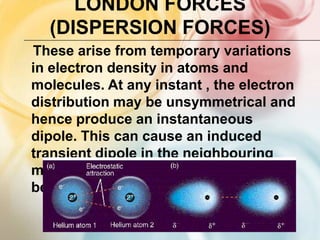
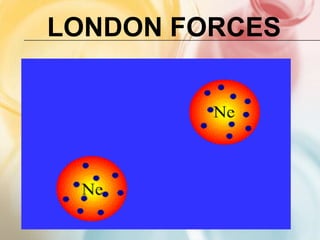
Hydrogen BondingLondon Forces (Dispersion Forces)These arise from temporary variations in electron density in atoms and molecules. At any instant , the electron distribution may be unsymmetrical and hence produce an instantaneous dipole. This can cause an induced transient dipole in the neighbouring molecule and cause the molecules to be attracted.
London forces
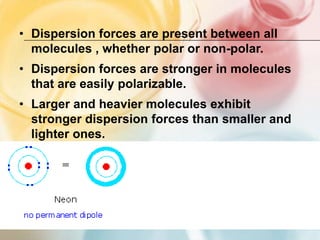
Dispersion forces are present between all molecules , whether polar or non-polar.Dispersion forces are stronger in molecules that are easily polarizable.Larger and heavier molecules exhibit stronger dispersion forces than smaller and lighter ones.
Shapes of molecules affect magnitude of dispersion forces The cylindrical shape of n-pentane has greater surface area .Hence, n-pentane has greater London forces .The spherical shape of neo-pentane has lesser surface area. So, it has lesser London attractive forces.
Dipole-dipole forces(Keesom Forces)These forces arise due to interaction between oppositely charged ends of polar molecules. Greater the dipole moment of molecules , greater are the forces of attraction.
DIPOLE-DIPOLE   FORCES
Dipole-induced dipole forcesThese operate between polar molecules having permanent dipole and the molecules having no permanent dipole.The polar molecule induces a dipole in the neighbouring non-polar molecule.The interaction energy depends onDipole moment of polar molecule
Polarisability of nonpolar molecule Oxygen gas can dissolve in water because the permanent dipole in water can induce a dipole in oxygen molecules.
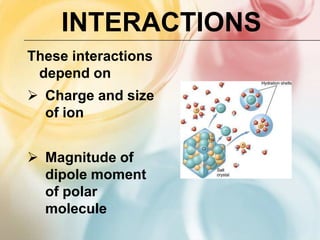
Non-polar iodine dissolves in polar ethanol due to dipole-induced dipole forces.Ion –dipole InteractionsThese interactions depend on Charge and size of ion
Magnitude of dipole moment of polar molecule
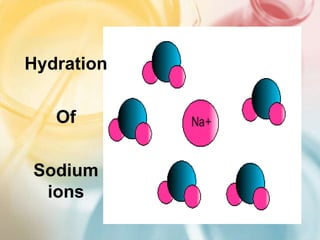
Size of polar moleculeHydrationOf Sodium ions
Hydration of Chloride Ions
Hydrogen BONDINGIt is an electrostatic force of attraction that exists between covalently bonded hydrogen atom of one molecule and the electronegative atom of another molecule.
It is represented by a dotted line - - - .Conditions for Hydrogen Bond formationA hydrogen atom attached to a relatively electronegative atom is a hydrogen bond donor. This electronegative atom is usually fluorine, oxygen, or nitrogen. An electronegative atom such as fluorine, oxygen, or nitrogen is a hydrogen bond acceptor, regardless of whether it is bonded to a hydrogen atom or not.
    INTERMOLECULAR HYDROGEN BONDIt is formed between two different molecules of the same or different substances, eg.
Hydrogen bond between molecules of ammonia
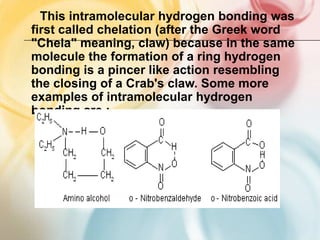
Hydrogen bond between molecules of water and alcoholINTRAMOLECULARHYDROGEN BONDIt is formed between the hydrogen atom and a highly electronegative atom present in different bonds within the same molecule, eg.
    o-salicylaldehyde
     o- nitrobenzoic acidAssociation of water molecules
HYDROGEN FLUORIDE In the solid state , hydrogen fluoride consists of long zig-zag chains of molecules associated together by hydrogen bonding. Hence, hydrogen fluoride molecule can also be represented as (HF)n. However, in gaseous or liquid state , the chain becomes linear.
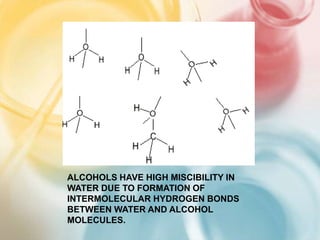
Alcohols have high miscibility in water due to formation of intermolecular hydrogen bonds between water and alcohol molecules.
Higher melting and boiling pointsDramatically higher boiling points of NH3, H2O, and HF compared to the heavier analogues PH3, H2S, and HCl.

Intermolecular forces

  • 1.
    Intermolecular FORCESPRESENTED BYPRATIBHA KOHLIDEPARTMENT OF CHEMISTRY, DELHI PUBLIC SCHOOL, RK PURAM
  • 2.
    Why do somesolids dissolve in water but others do not?
  • 3.
    What happens whennoble gases liquefy?
  • 4.
    Why are somesubstances gases at room temperature, but others are liquid or solid? The answers lie in………Intermolecular Forces
  • 5.
    Intermolecular forces maybe attractive or repulsive.Johannes D van der Waals, Dutch, was the first to postulate intermolecular forces in developing a theory to account for properties of real gases.
  • 6.
    van der Waalsforces includeLondon forces
  • 7.
  • 8.
    Dipole -induced dipole forcesOther intermolecular forces are Ion - dipole interactions
  • 9.
    Ion -induced dipole interactions
  • 10.
    Hydrogen BondingLondon Forces(Dispersion Forces)These arise from temporary variations in electron density in atoms and molecules. At any instant , the electron distribution may be unsymmetrical and hence produce an instantaneous dipole. This can cause an induced transient dipole in the neighbouring molecule and cause the molecules to be attracted.
  • 11.
  • 12.
    Dispersion forces arepresent between all molecules , whether polar or non-polar.Dispersion forces are stronger in molecules that are easily polarizable.Larger and heavier molecules exhibit stronger dispersion forces than smaller and lighter ones.
  • 13.
    Shapes of moleculesaffect magnitude of dispersion forces The cylindrical shape of n-pentane has greater surface area .Hence, n-pentane has greater London forces .The spherical shape of neo-pentane has lesser surface area. So, it has lesser London attractive forces.
  • 14.
    Dipole-dipole forces(Keesom Forces)Theseforces arise due to interaction between oppositely charged ends of polar molecules. Greater the dipole moment of molecules , greater are the forces of attraction.
  • 15.
  • 16.
    Dipole-induced dipole forcesTheseoperate between polar molecules having permanent dipole and the molecules having no permanent dipole.The polar molecule induces a dipole in the neighbouring non-polar molecule.The interaction energy depends onDipole moment of polar molecule
  • 17.
    Polarisability of nonpolarmolecule Oxygen gas can dissolve in water because the permanent dipole in water can induce a dipole in oxygen molecules.
  • 18.
    Non-polar iodine dissolvesin polar ethanol due to dipole-induced dipole forces.Ion –dipole InteractionsThese interactions depend on Charge and size of ion
  • 19.
    Magnitude of dipolemoment of polar molecule
  • 20.
    Size of polarmoleculeHydrationOf Sodium ions
  • 21.
  • 22.
    Hydrogen BONDINGIt isan electrostatic force of attraction that exists between covalently bonded hydrogen atom of one molecule and the electronegative atom of another molecule.
  • 23.
    It is representedby a dotted line - - - .Conditions for Hydrogen Bond formationA hydrogen atom attached to a relatively electronegative atom is a hydrogen bond donor. This electronegative atom is usually fluorine, oxygen, or nitrogen. An electronegative atom such as fluorine, oxygen, or nitrogen is a hydrogen bond acceptor, regardless of whether it is bonded to a hydrogen atom or not.
  • 24.
    INTERMOLECULAR HYDROGEN BONDIt is formed between two different molecules of the same or different substances, eg.
  • 25.
    Hydrogen bond betweenmolecules of ammonia
  • 26.
    Hydrogen bond betweenmolecules of water and alcoholINTRAMOLECULARHYDROGEN BONDIt is formed between the hydrogen atom and a highly electronegative atom present in different bonds within the same molecule, eg.
  • 27.
    o-salicylaldehyde
  • 28.
    o- nitrobenzoic acidAssociation of water molecules
  • 29.
    HYDROGEN FLUORIDE Inthe solid state , hydrogen fluoride consists of long zig-zag chains of molecules associated together by hydrogen bonding. Hence, hydrogen fluoride molecule can also be represented as (HF)n. However, in gaseous or liquid state , the chain becomes linear.
  • 30.
    Alcohols have highmiscibility in water due to formation of intermolecular hydrogen bonds between water and alcohol molecules.
  • 31.
    Higher melting andboiling pointsDramatically higher boiling points of NH3, H2O, and HF compared to the heavier analogues PH3, H2S, and HCl.