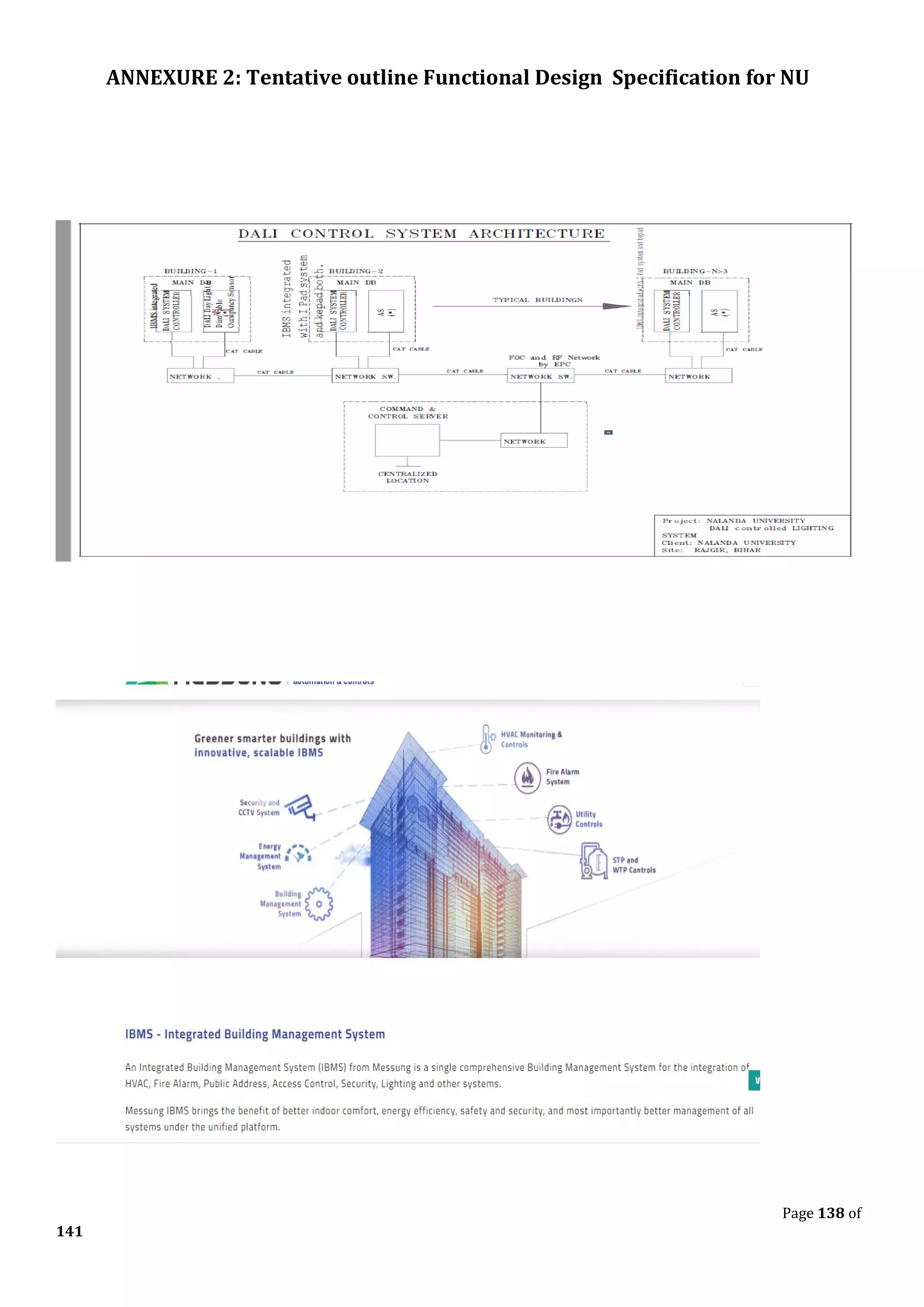
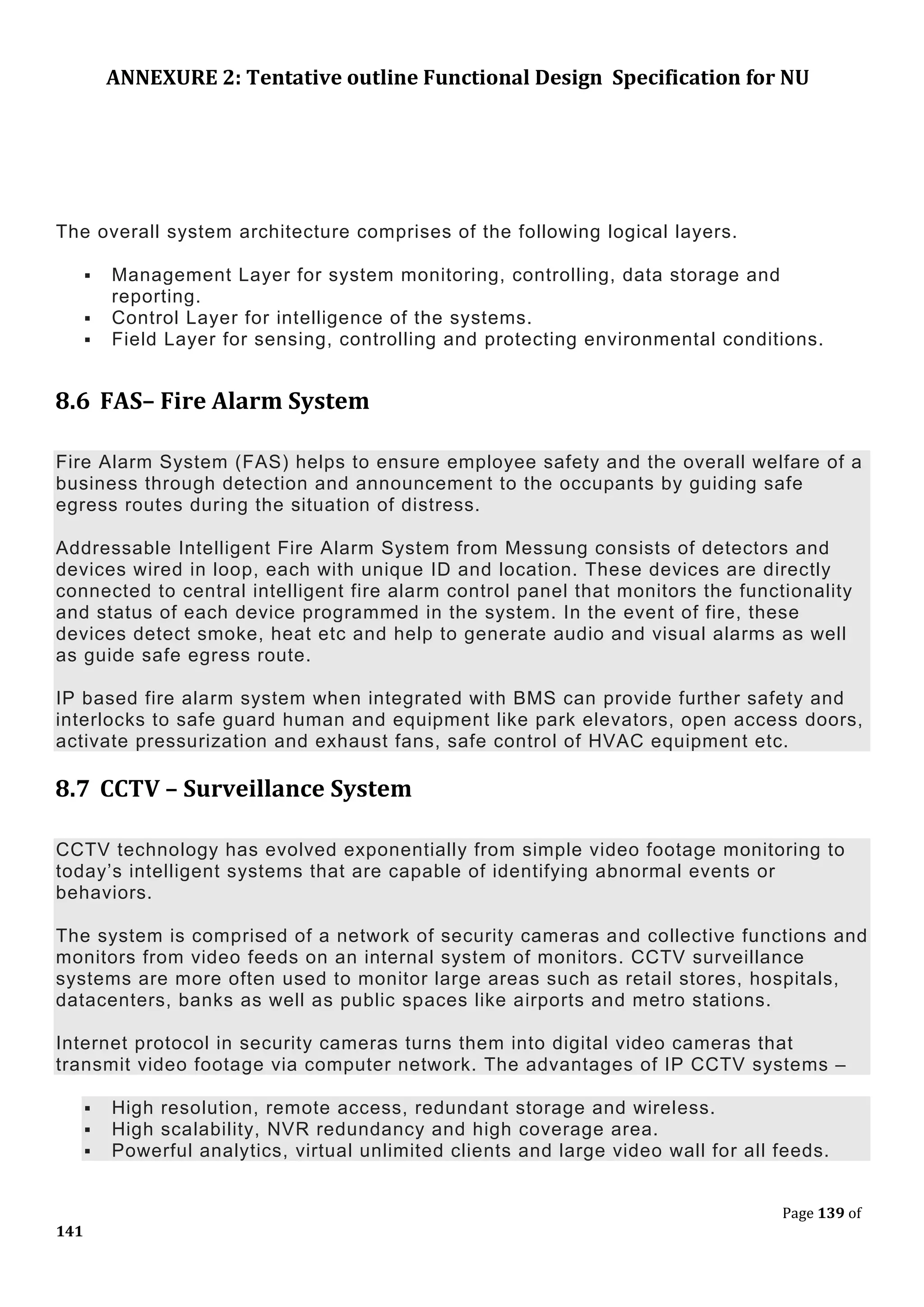
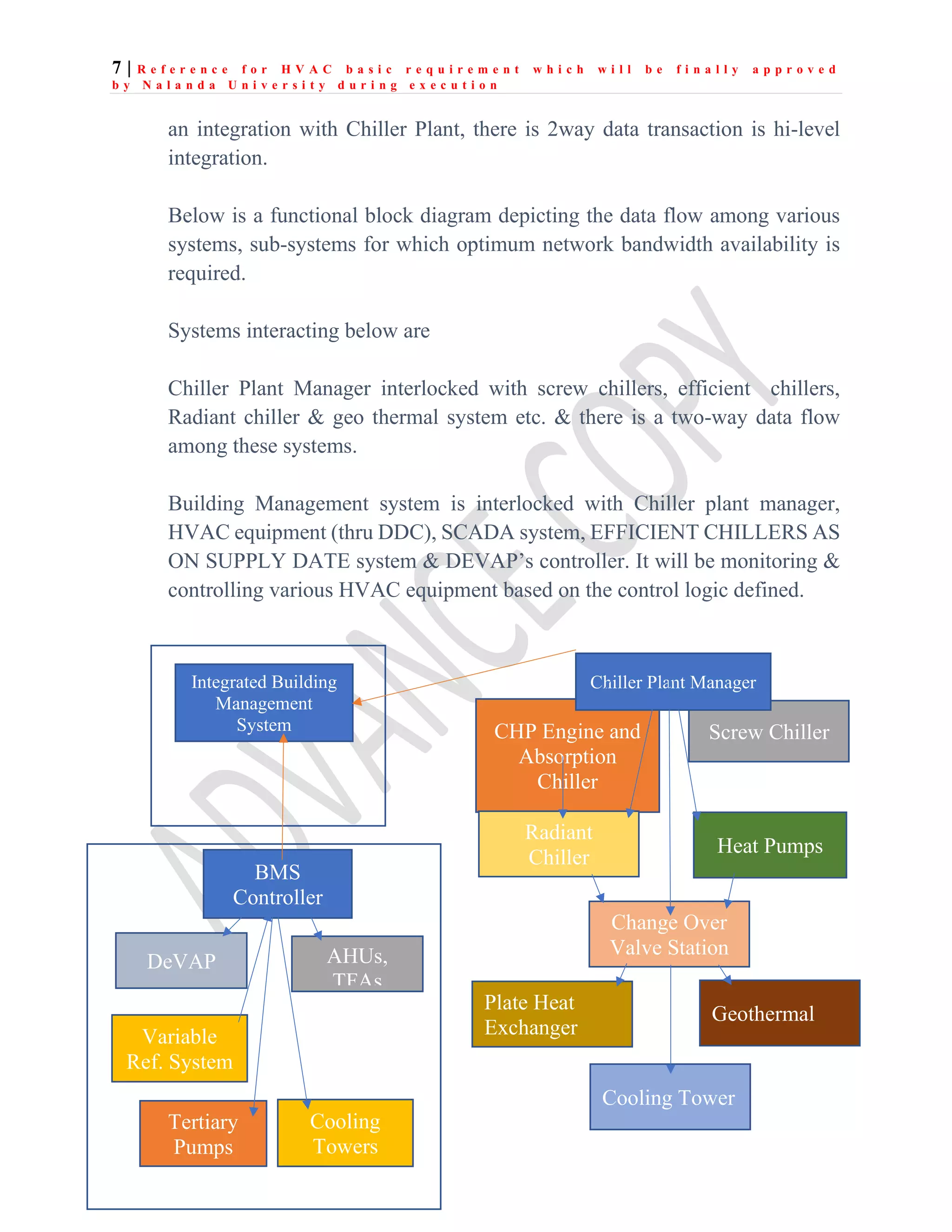
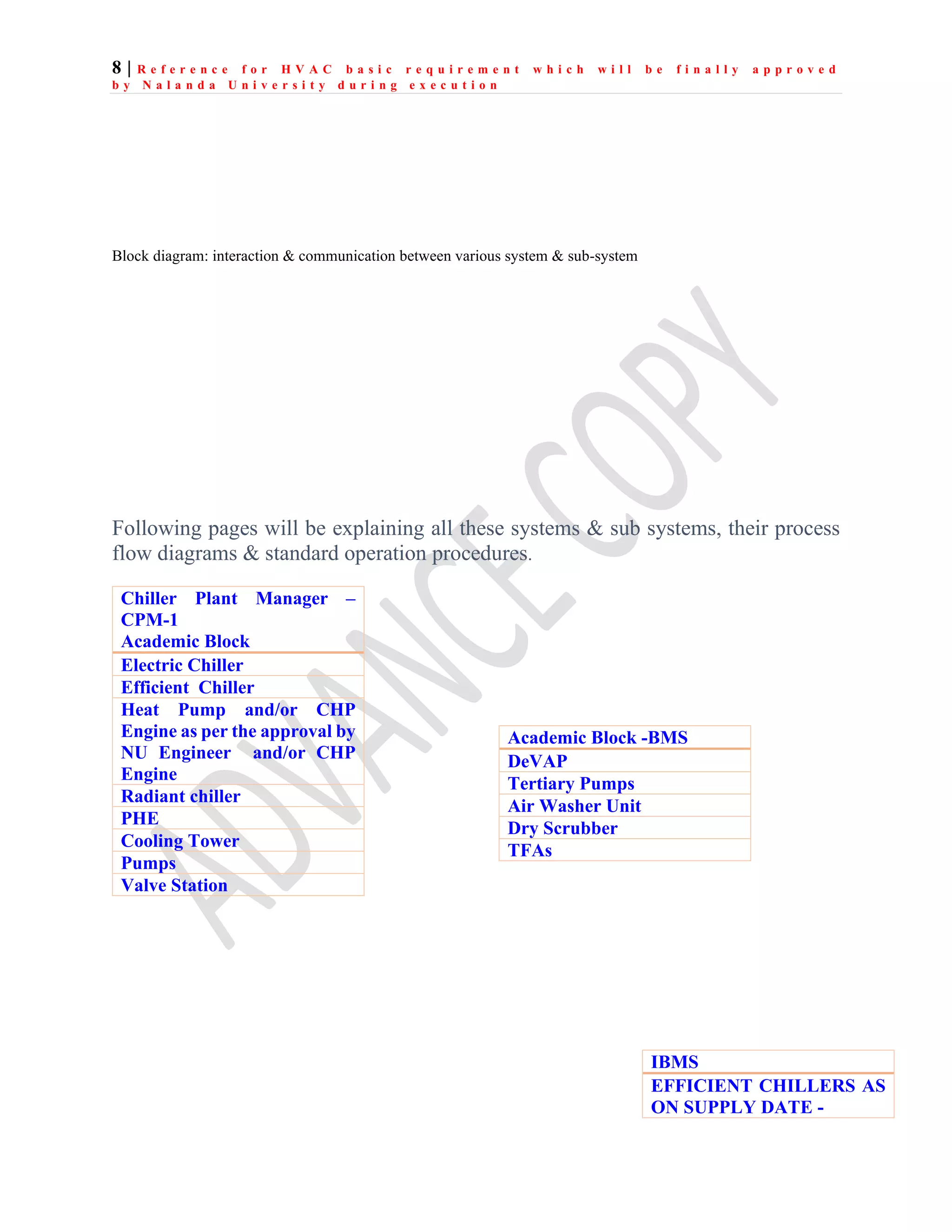
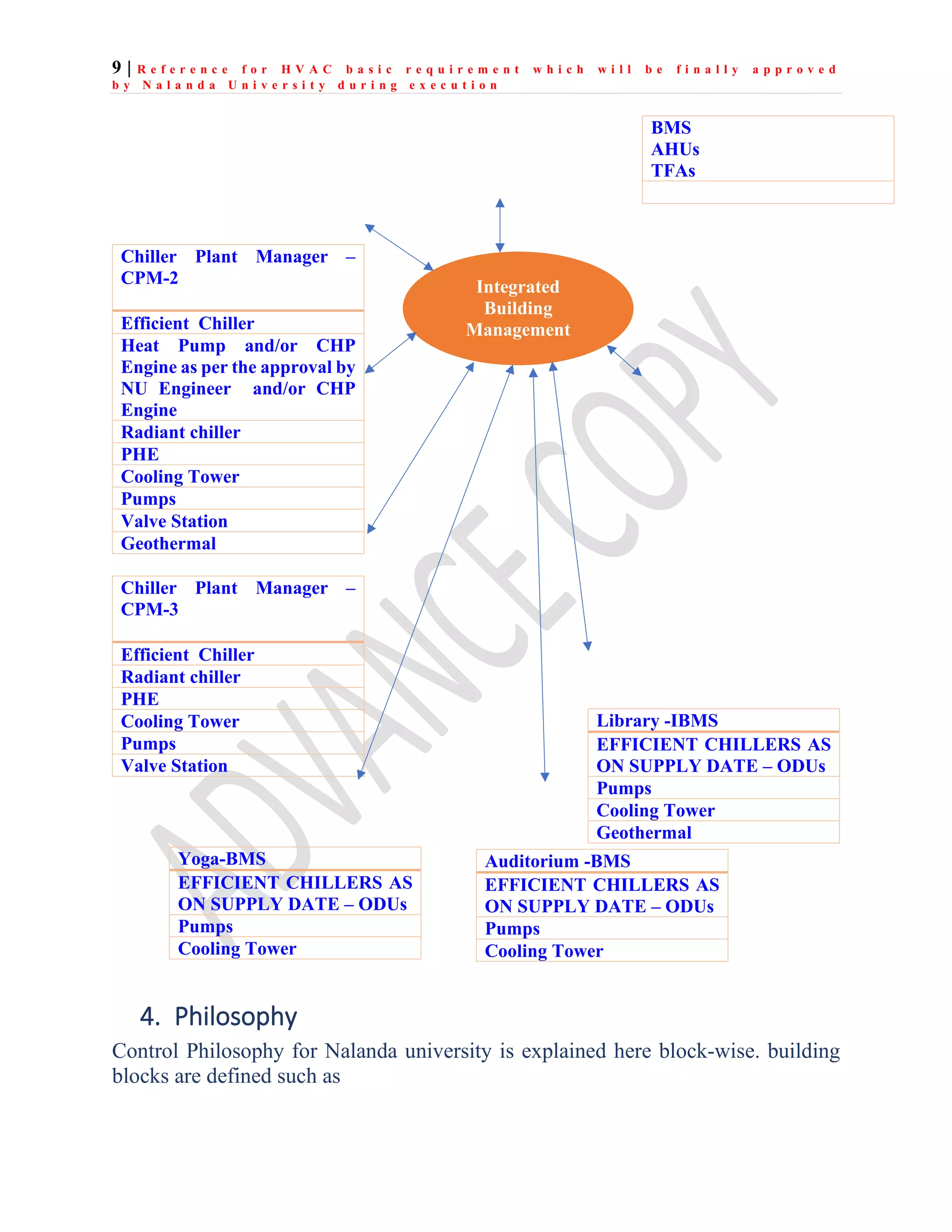
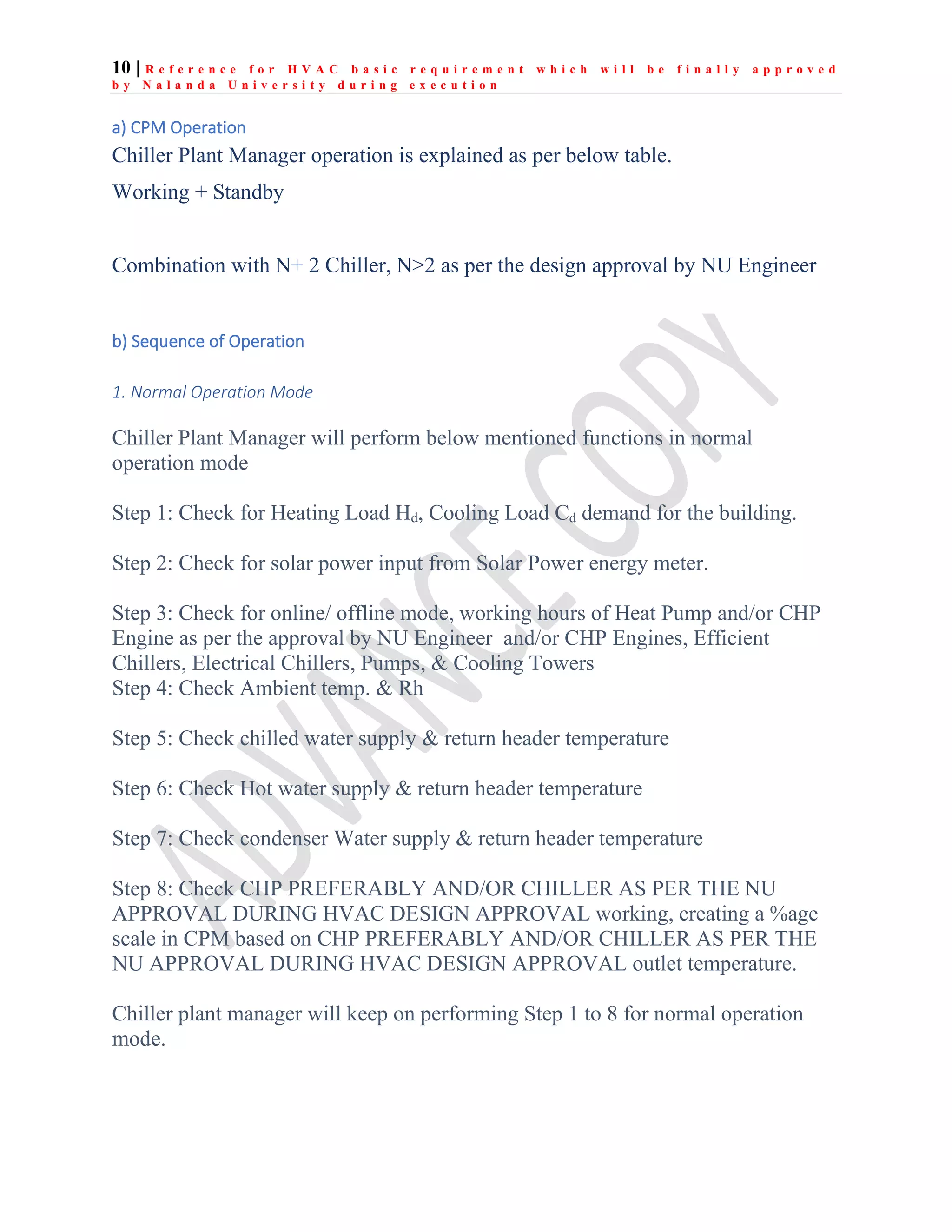
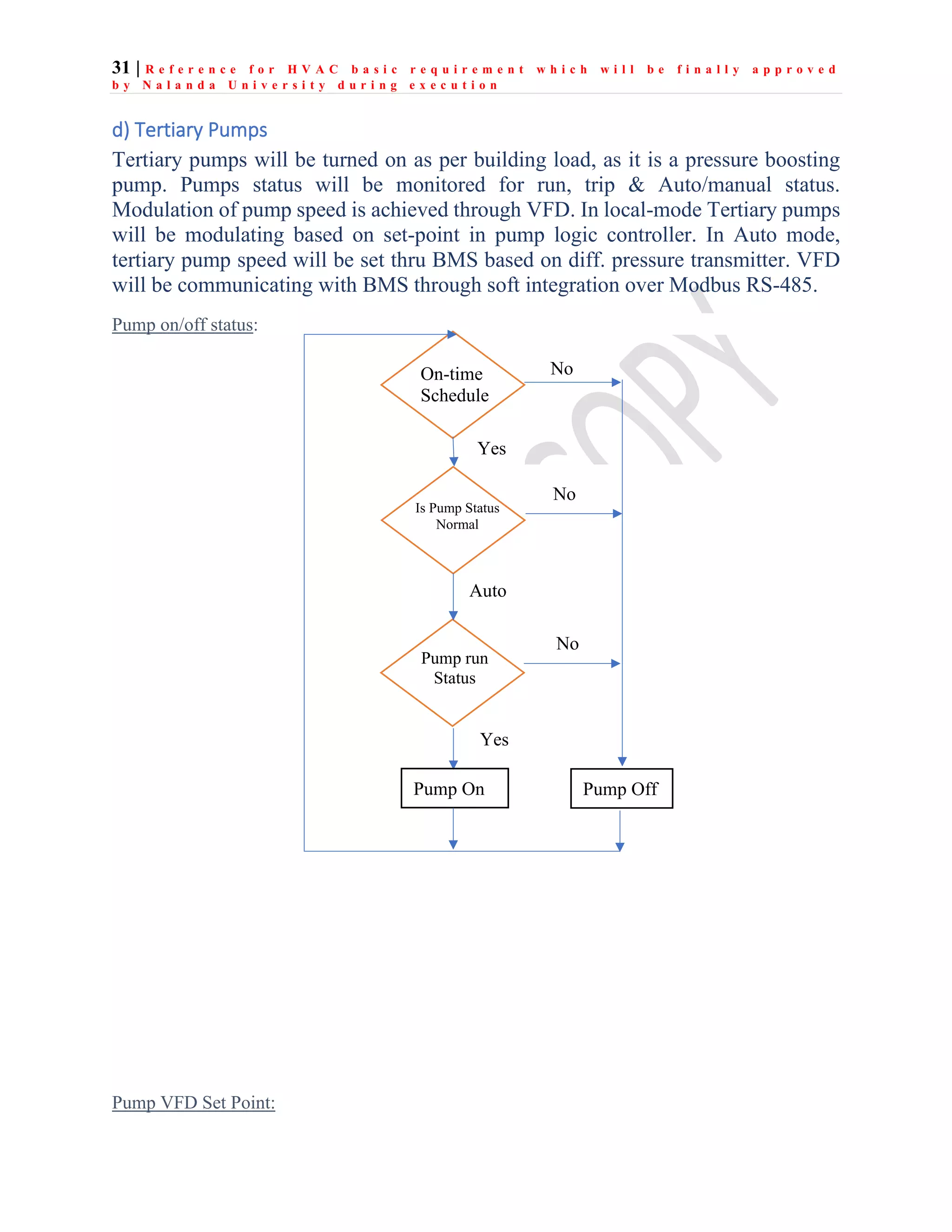
Smart Integrated
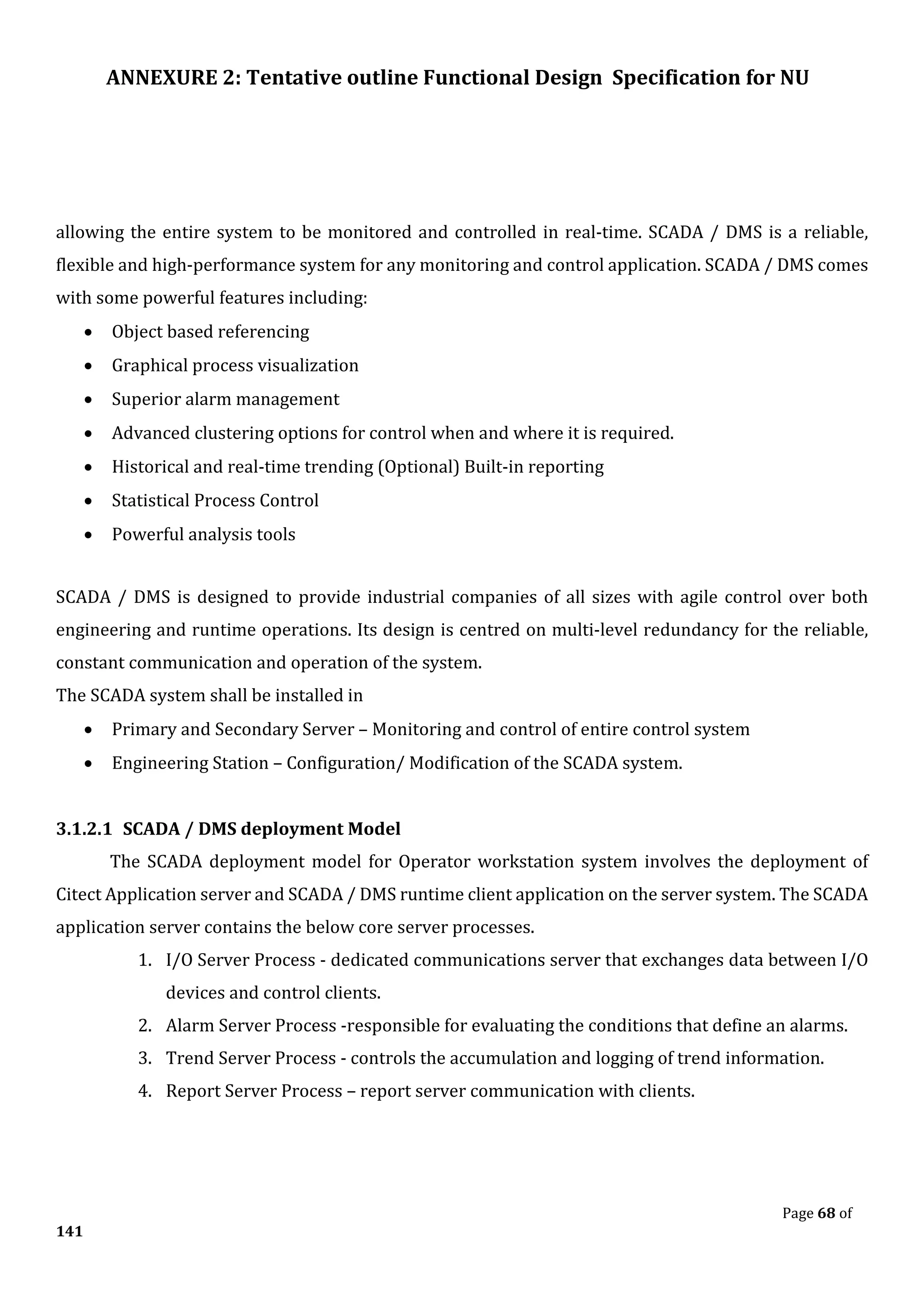
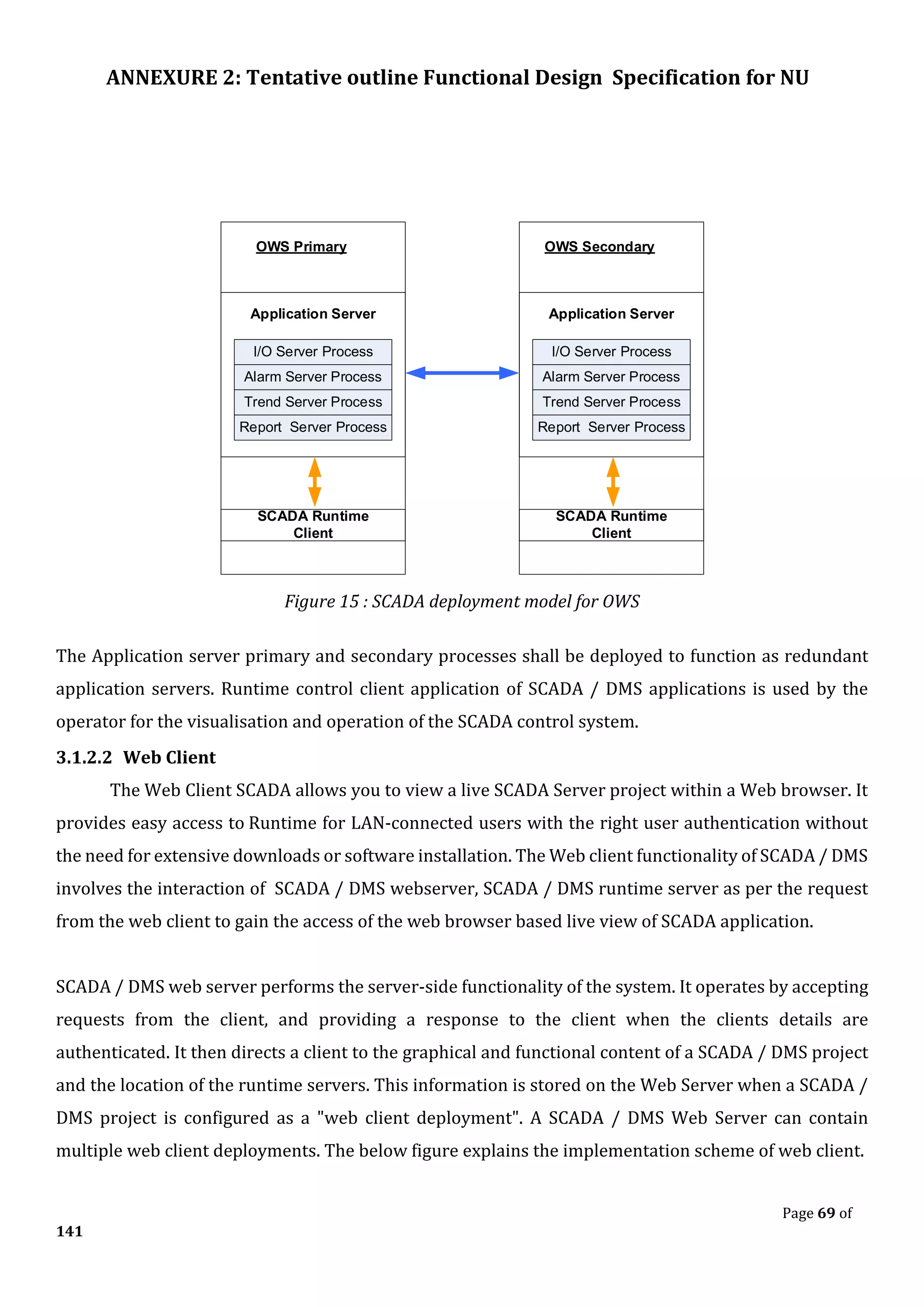
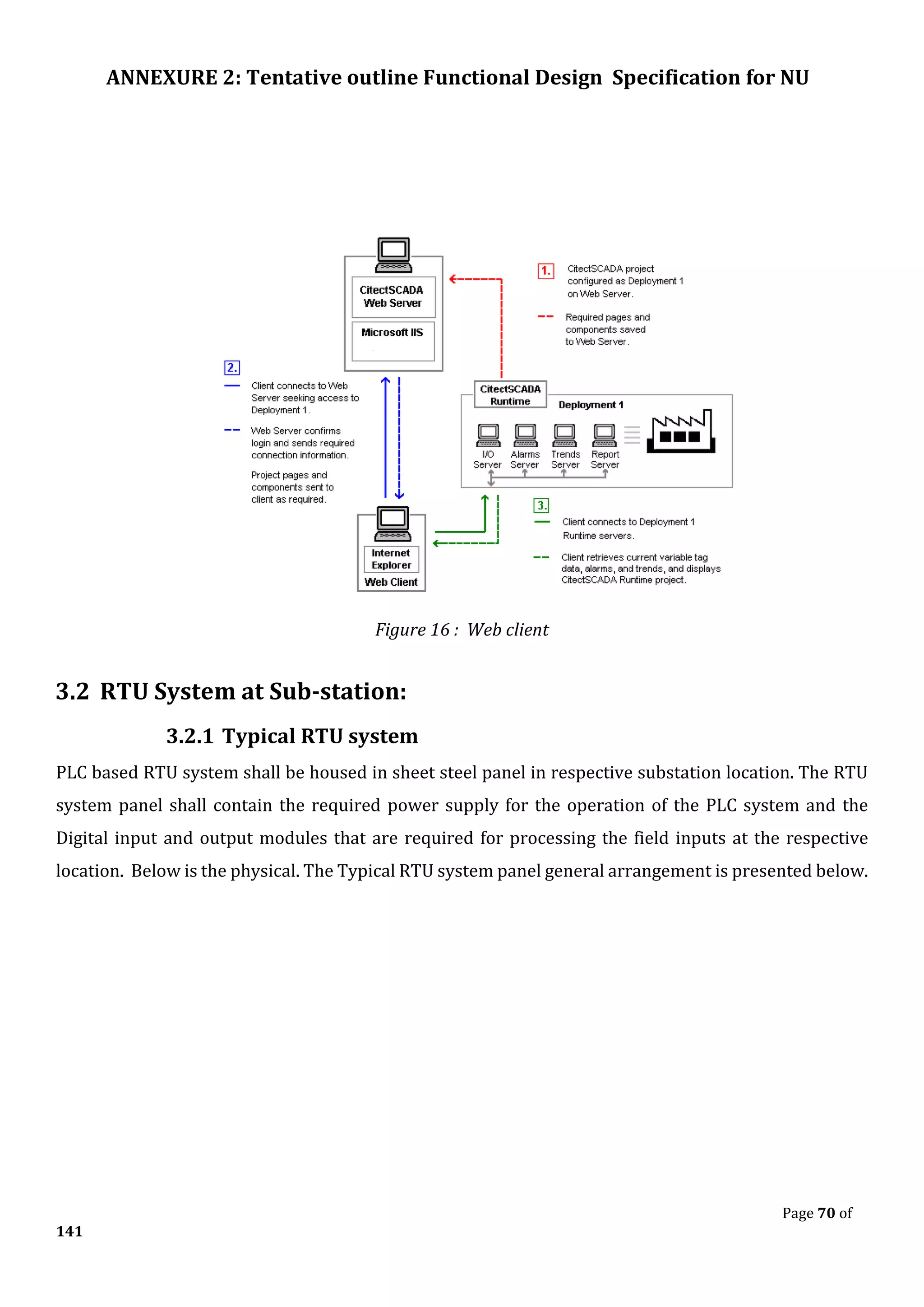
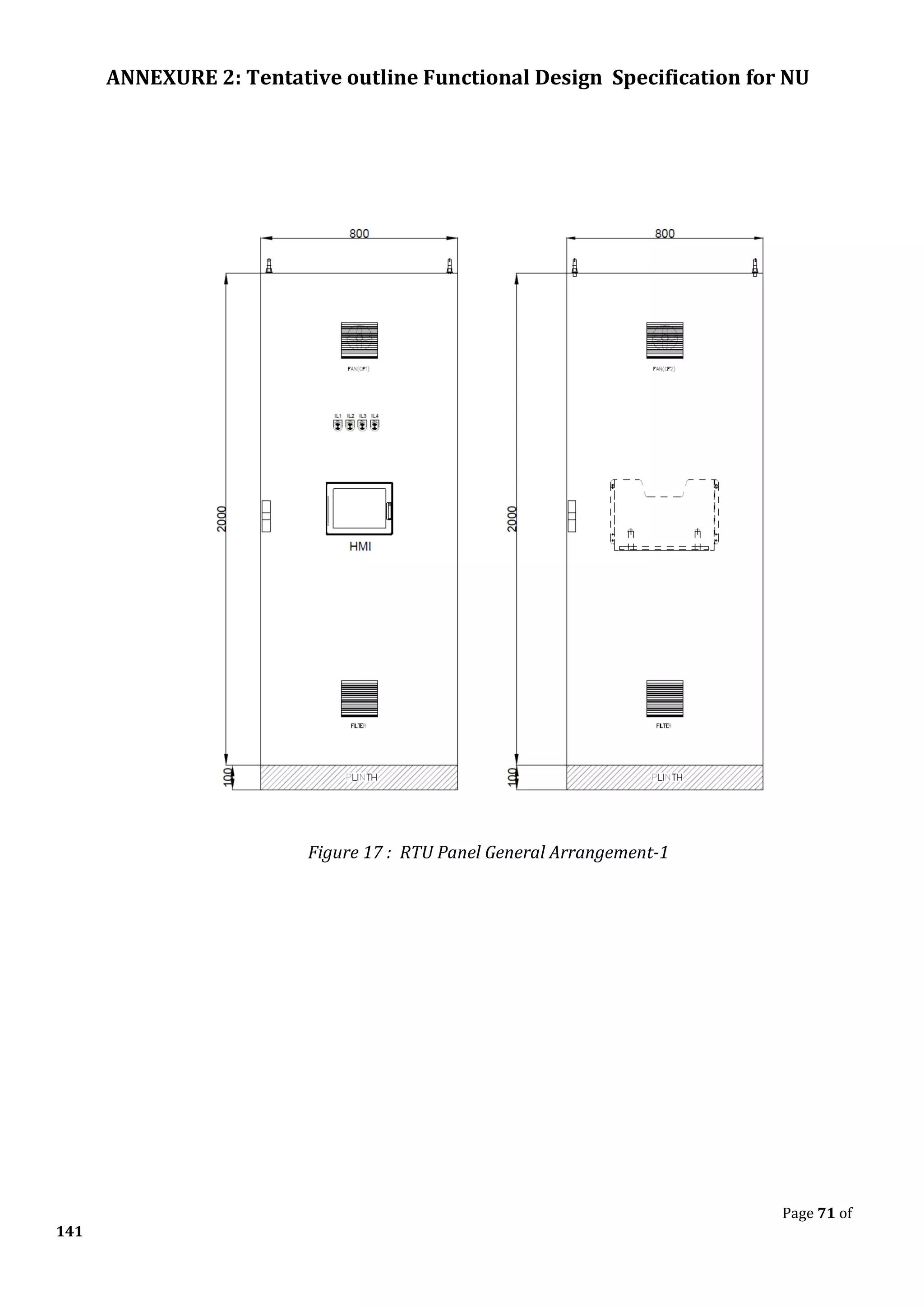
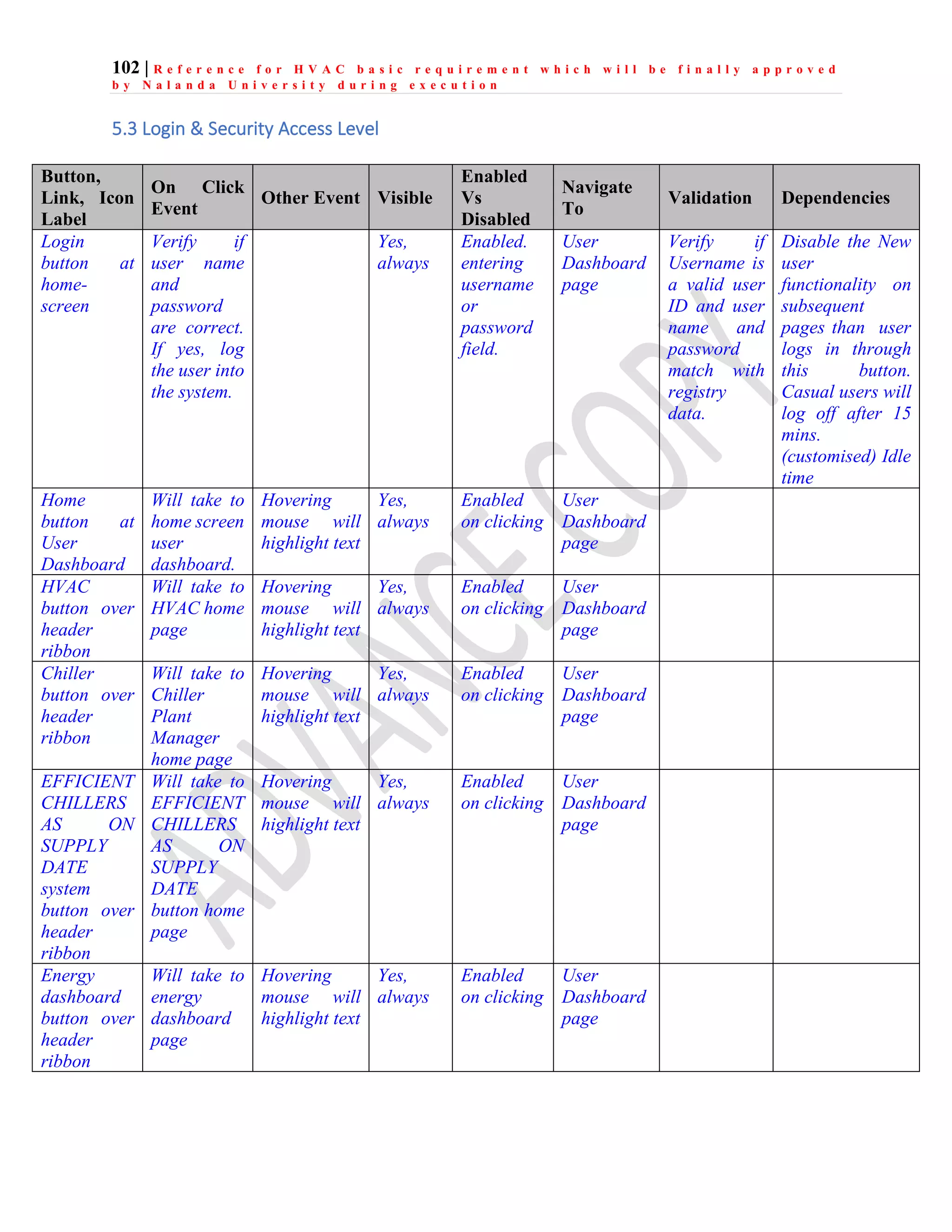
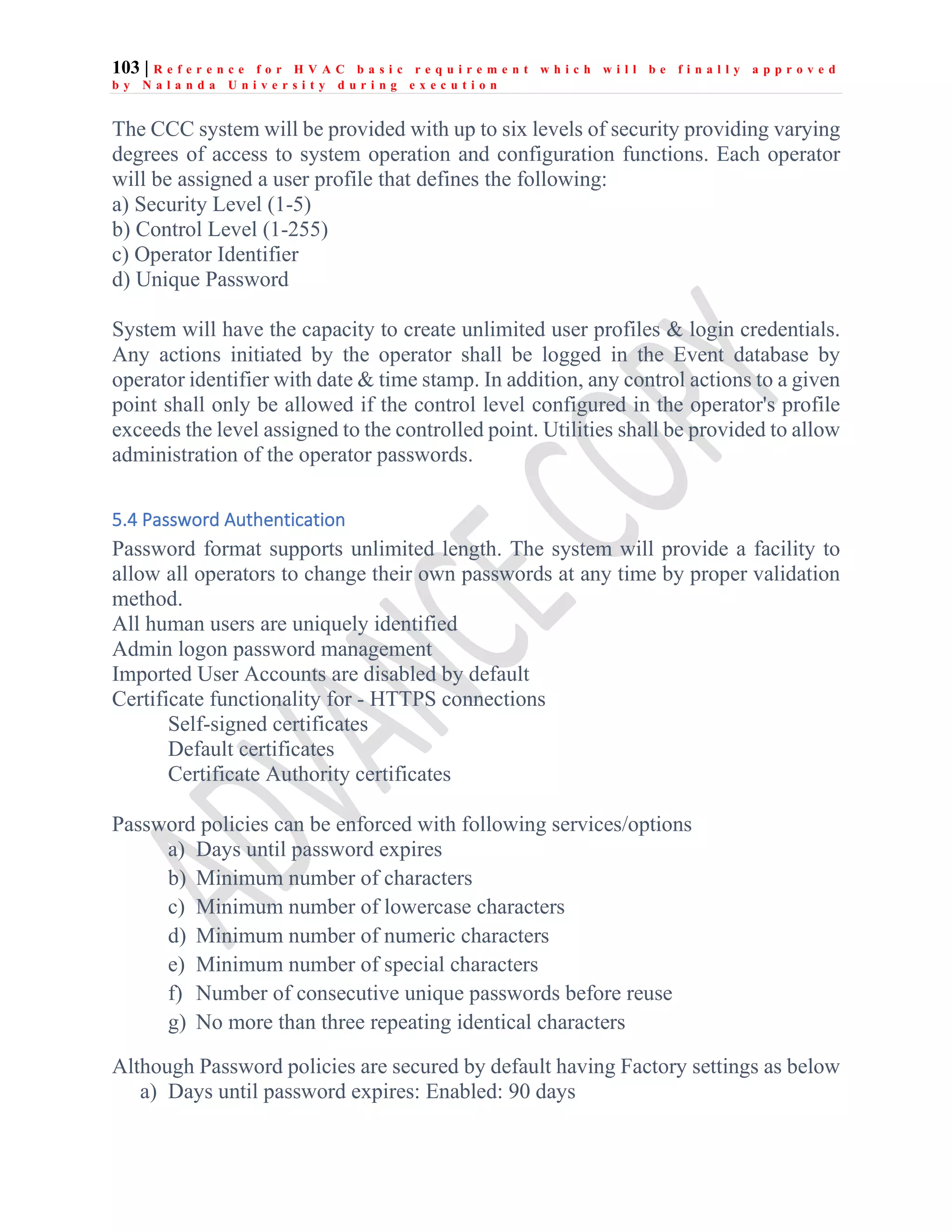
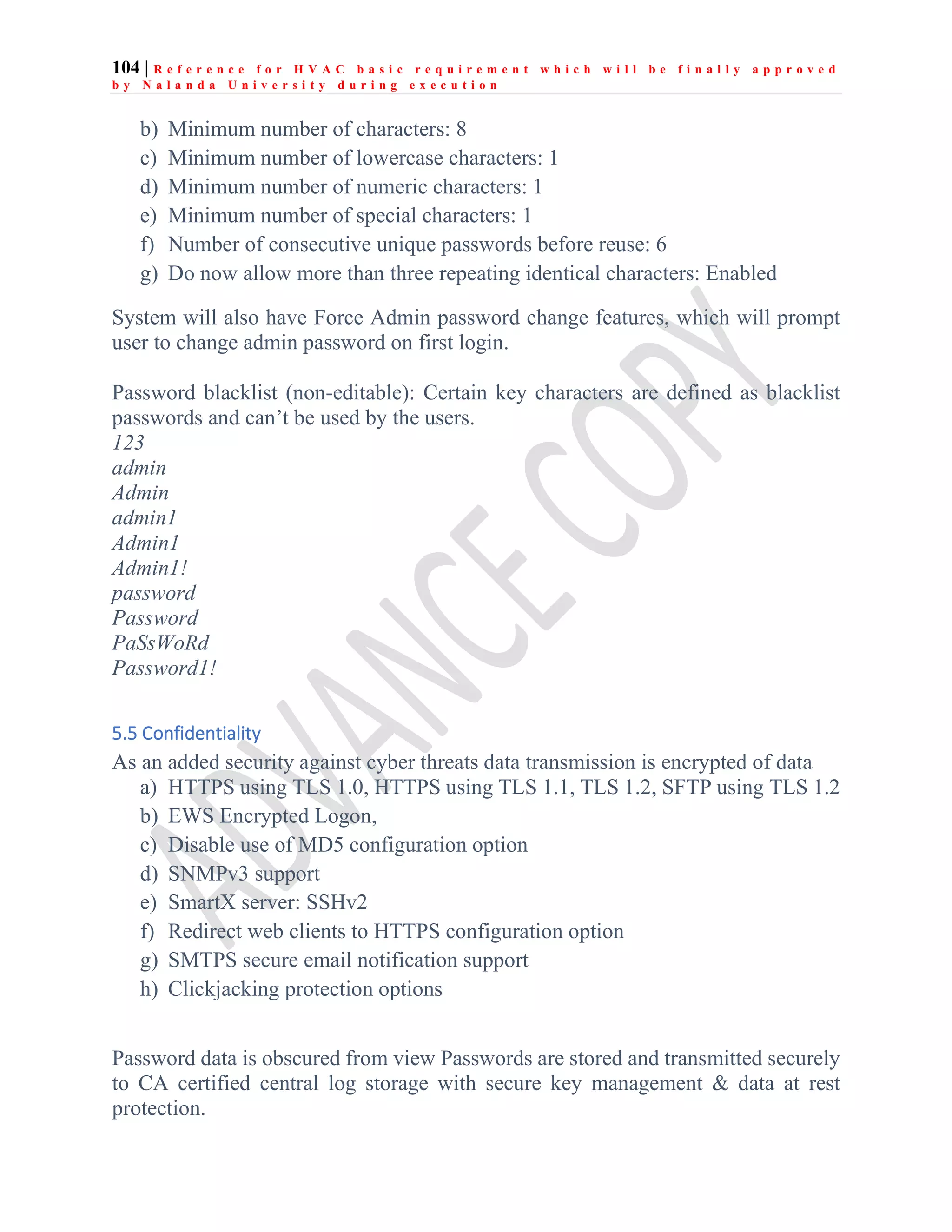
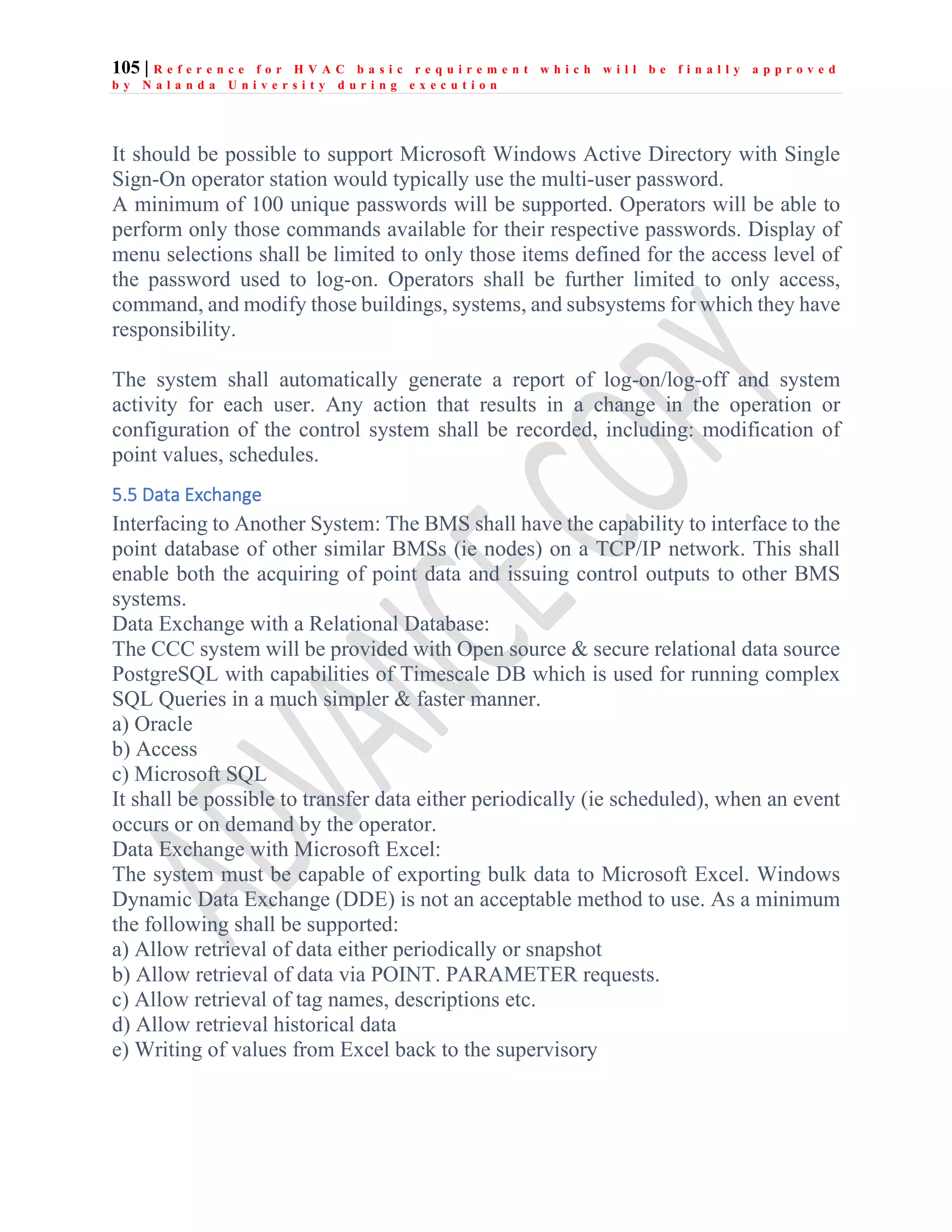
Building Management
Systems (Smart IBMS)
For Nalanda University
Annexure 2 ,
Pre-Bid Reply of EPC Tender
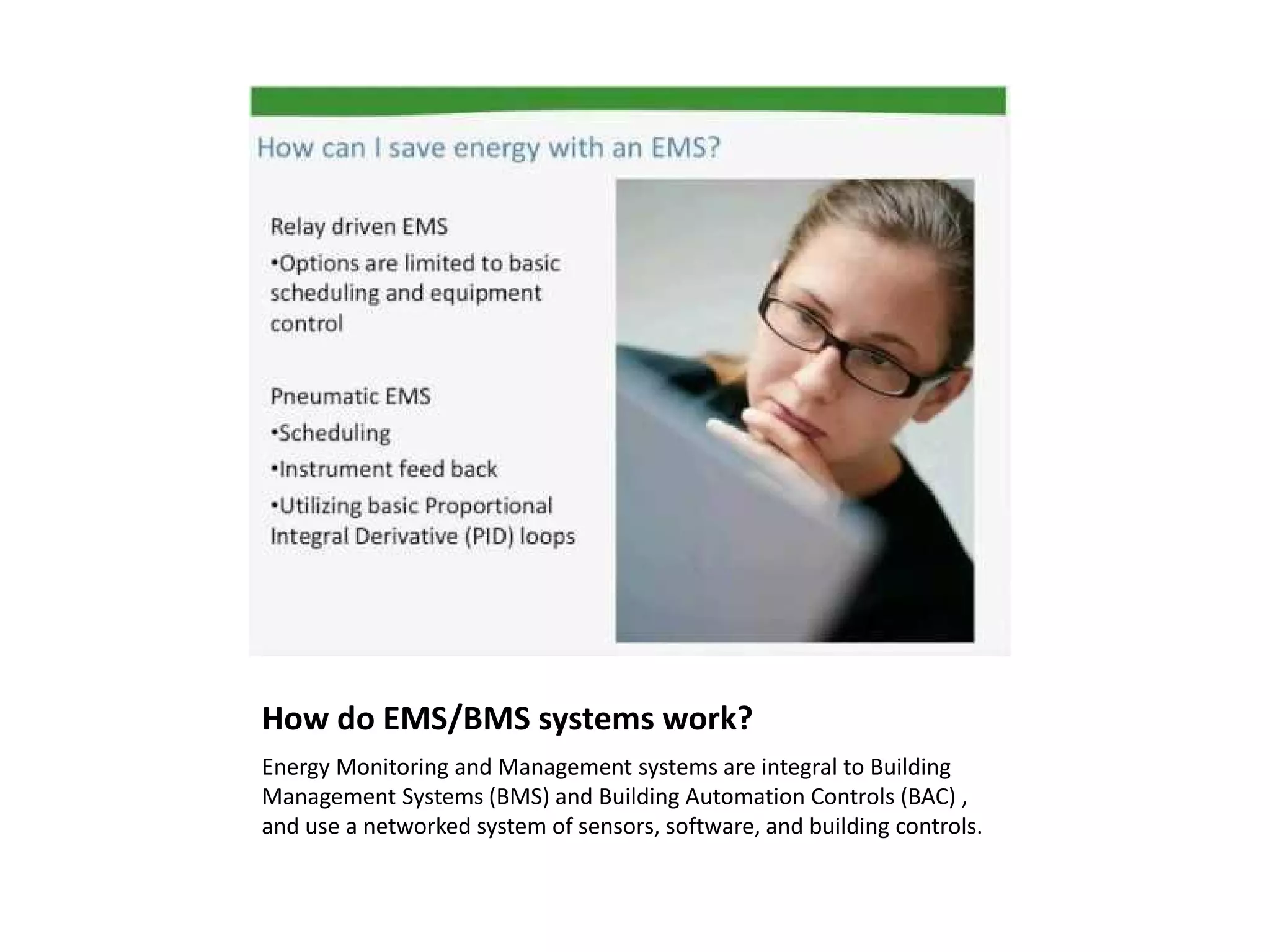
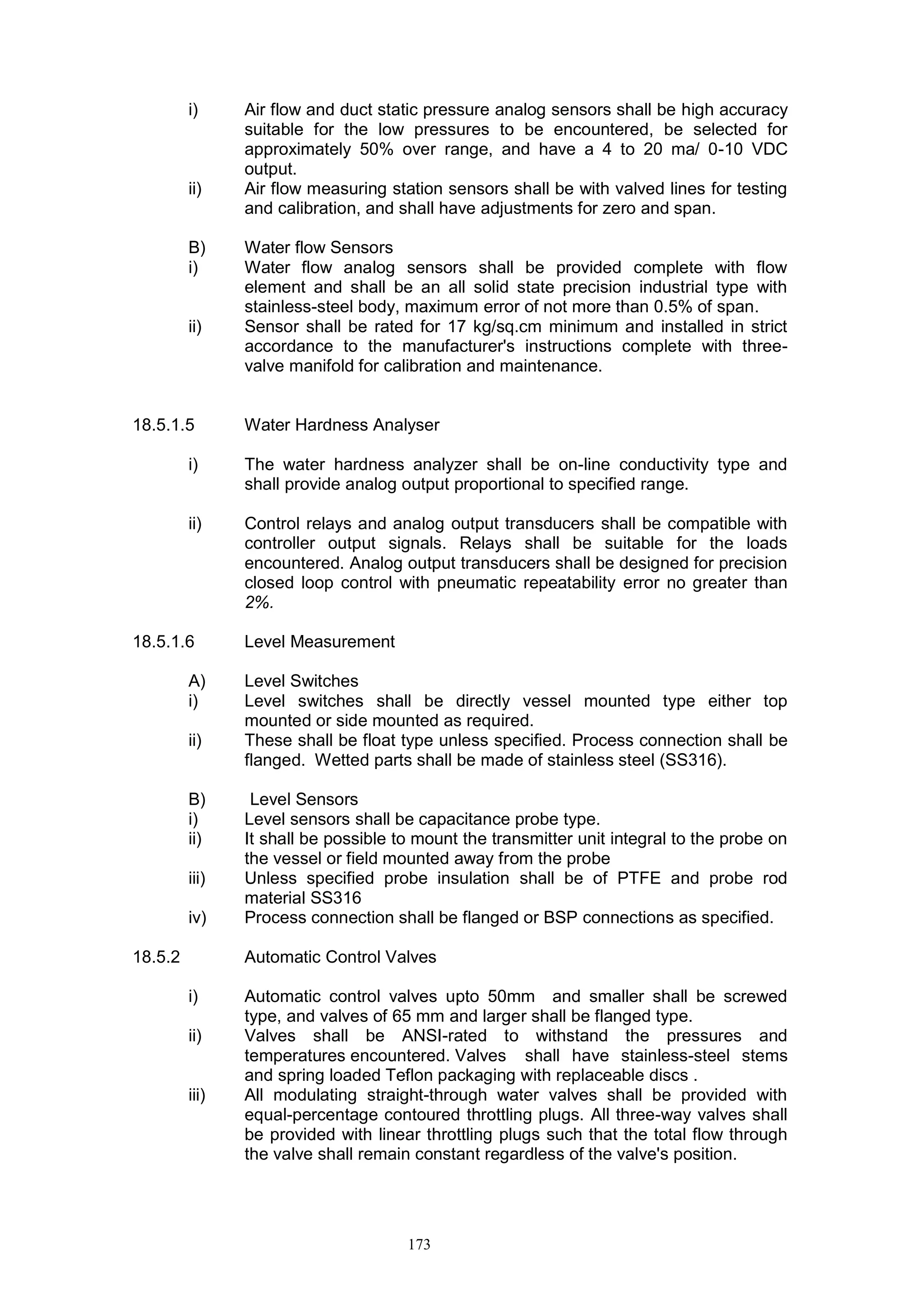
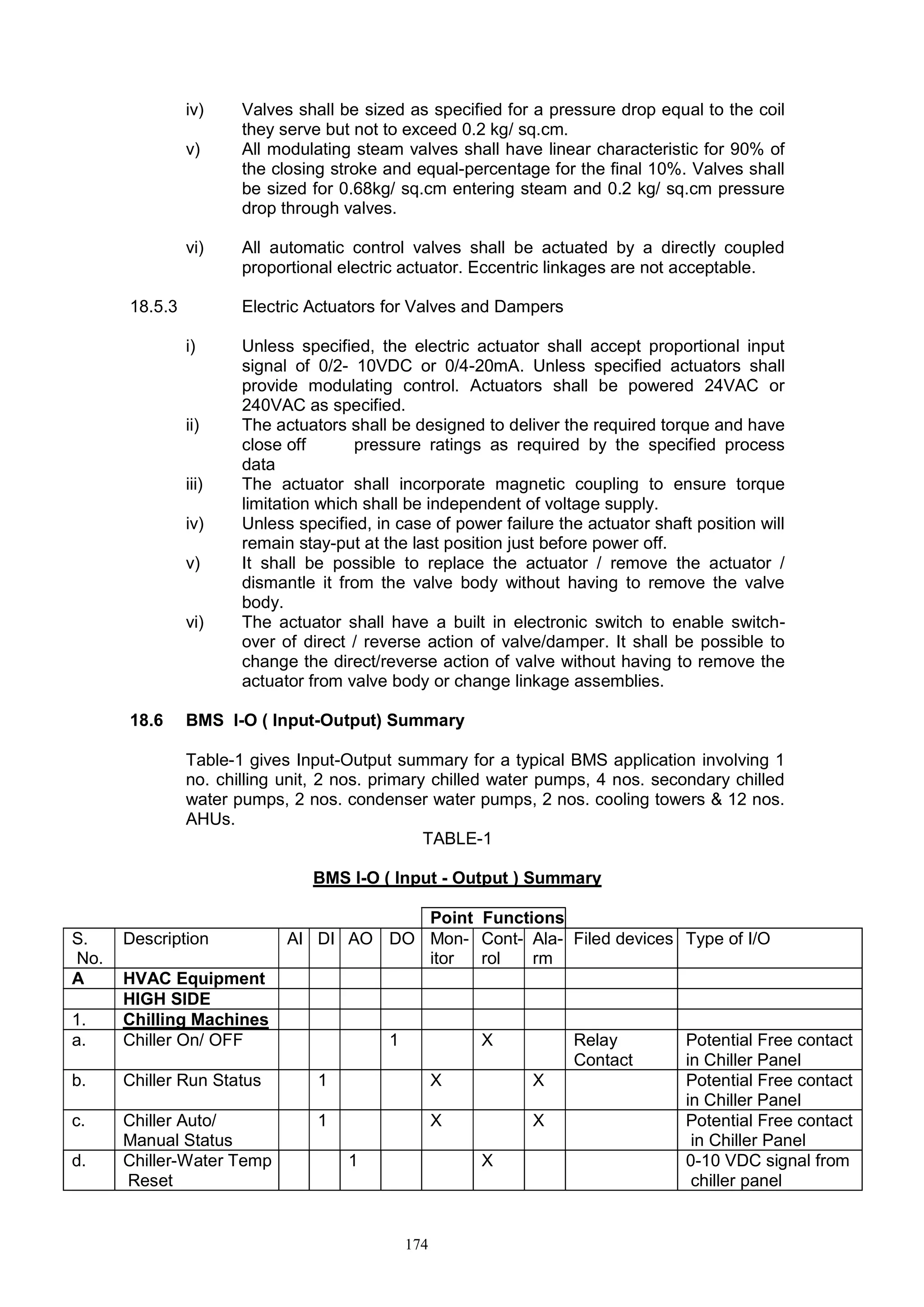
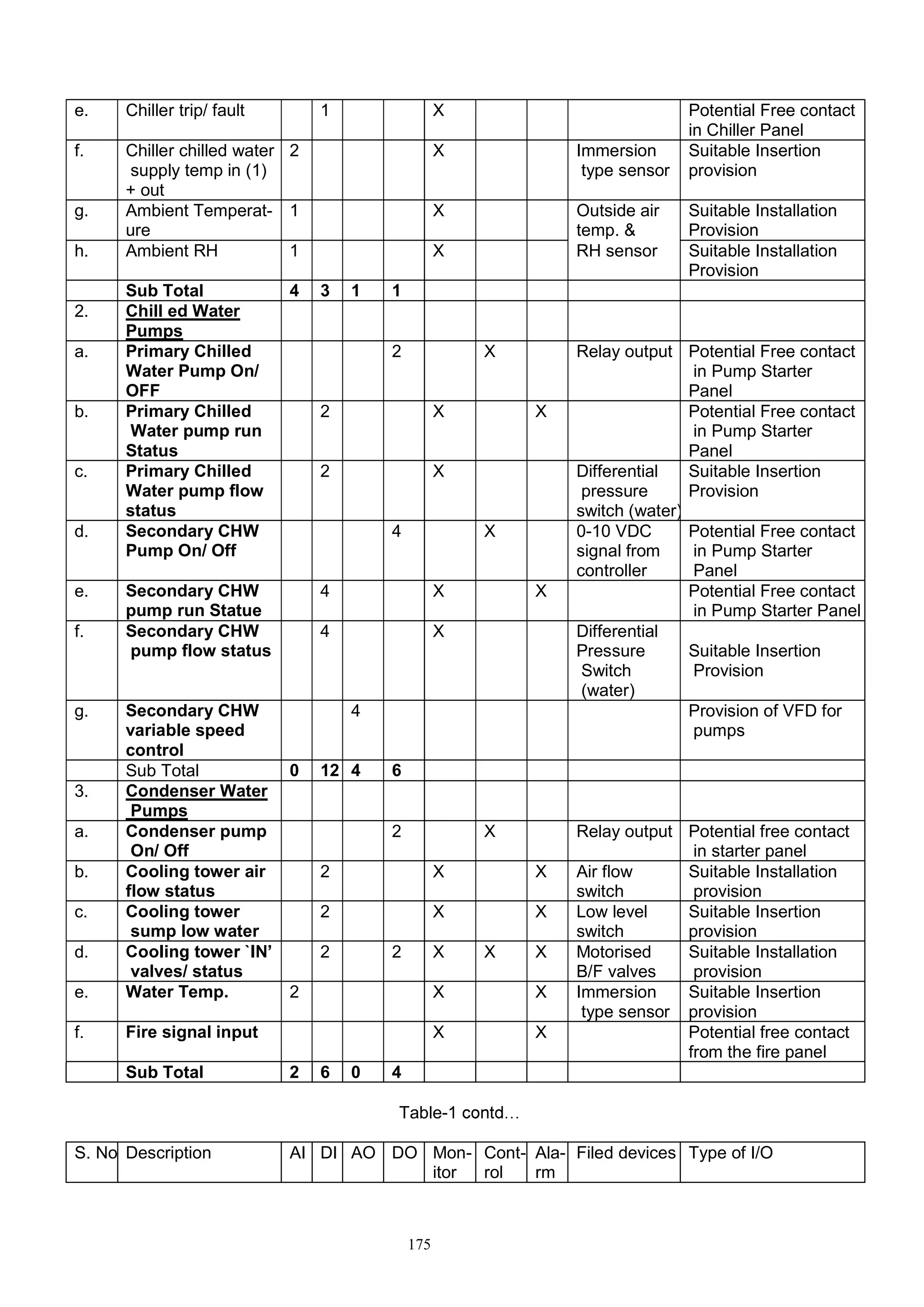
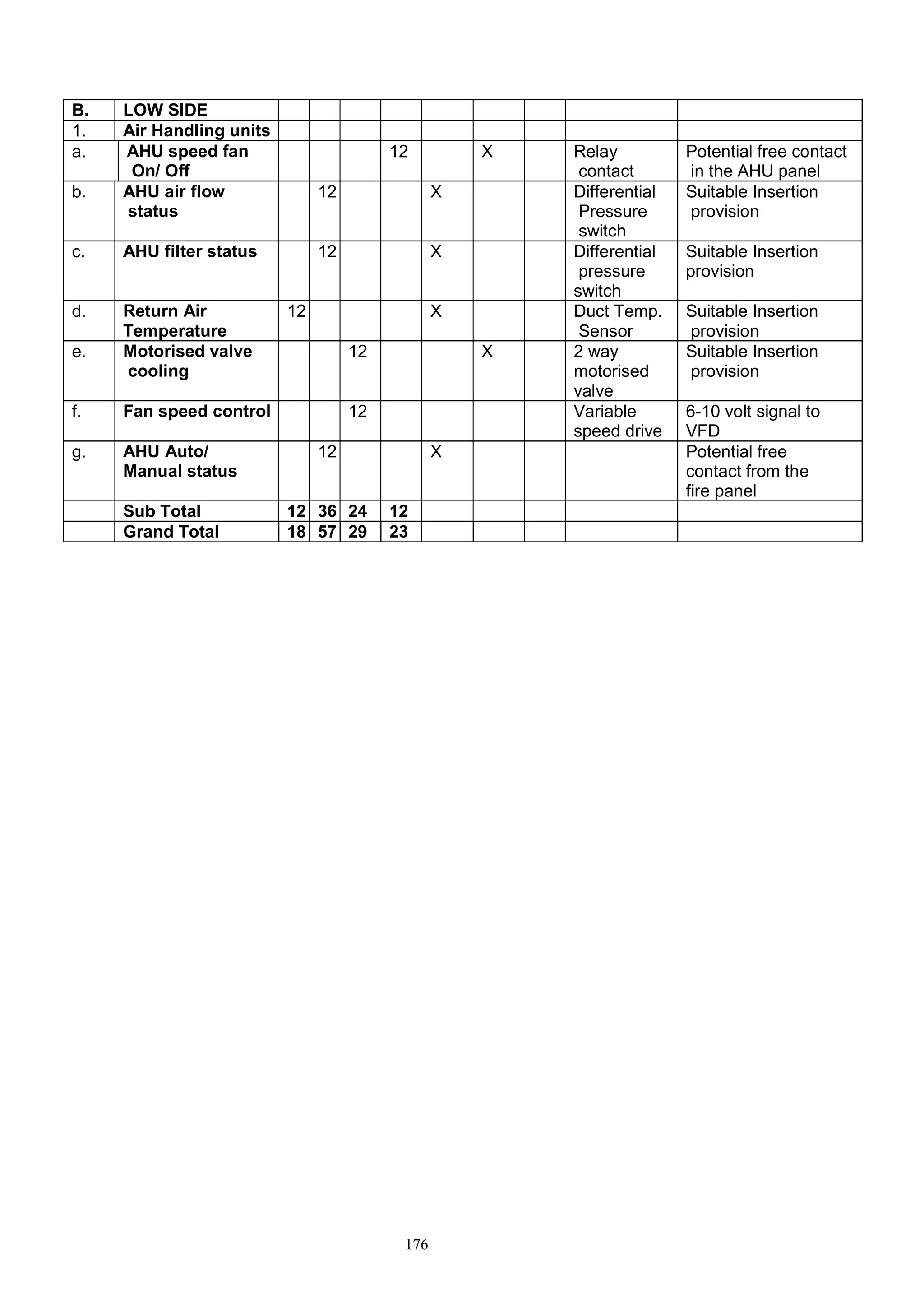
How do EMS/BMS systems work?
Energy Monitoring and Management systems are integral to Building
Management Systems (BMS) and Building Automation Controls (BAC) ,
and use a networked system of sensors, software, and building controls.
Building Automation Systems and the
Environment – Profits for Stakeholders
The combination of energy management and building
controls provides owners and occupants with benefits
beyond economic savings, reductions in energy as a
resource as well as emissions as a consequence
What is BMS?
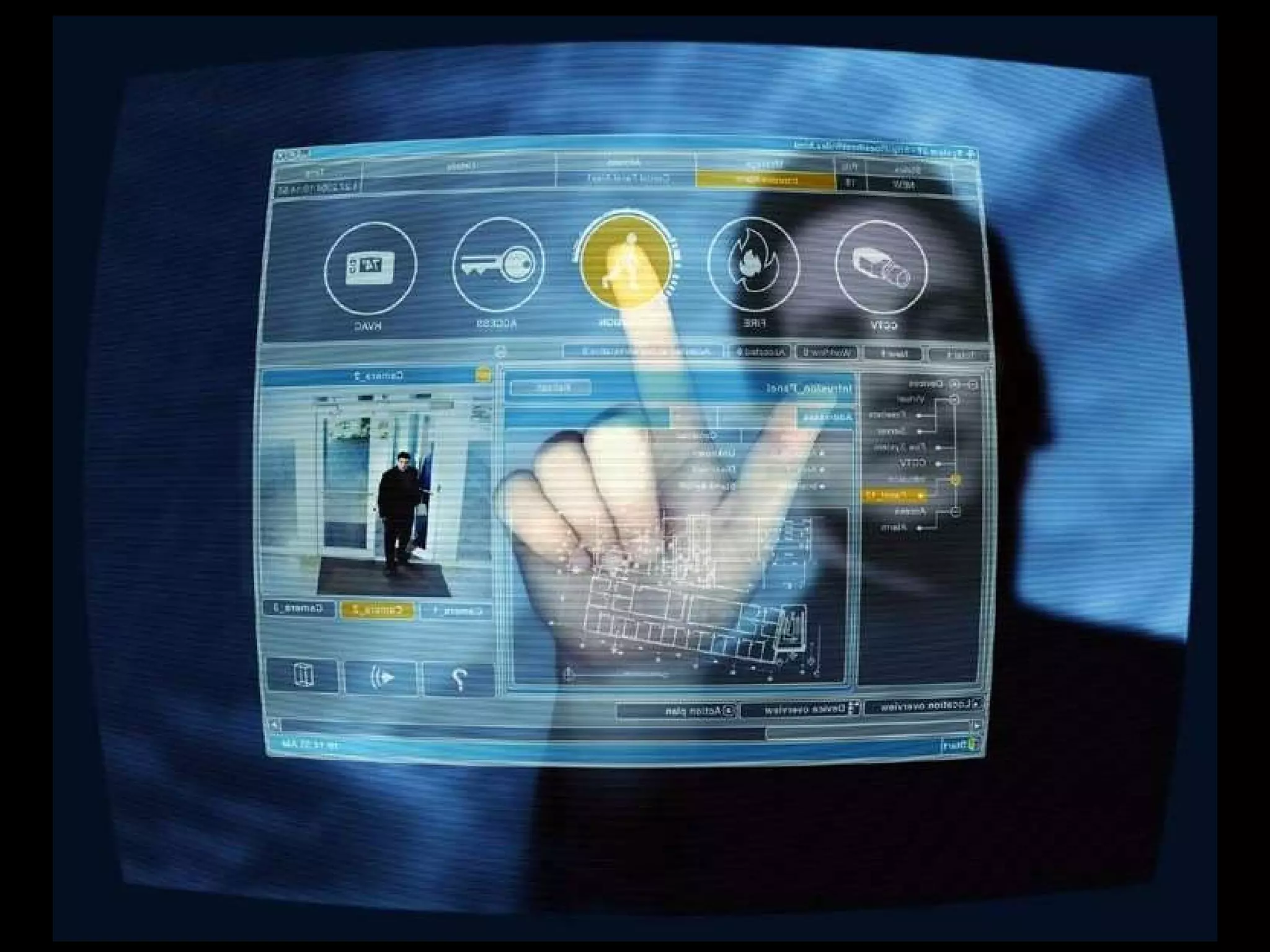
A Building Management System (BMS) is a
computer-based control system installed in
buildings that controls and monitors the
building’s mechanical and electrical equipment
such as ventilation, lighting, power systems, fire
systems, and security systems.
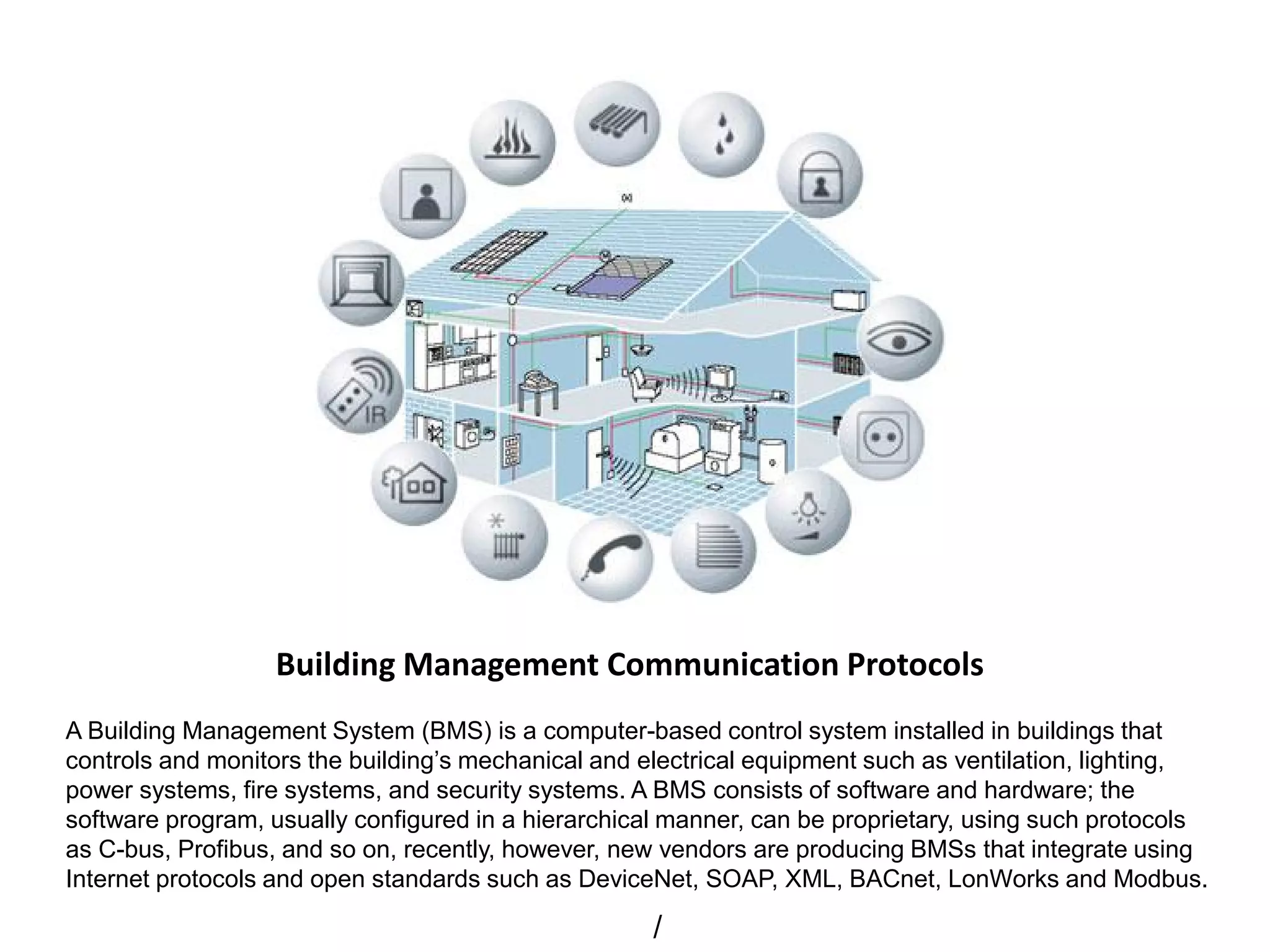
Building Management Communication Protocols
A Building Management System (BMS) is a computer-based control system installed in buildings that
controls and monitors the building’s mechanical and electrical equipment such as ventilation, lighting,
power systems, fire systems, and security systems. A BMS consists of software and hardware; the
software program, usually configured in a hierarchical manner, can be proprietary, using such protocols
as C-bus, Profibus, and so on, recently, however, new vendors are producing BMSs that integrate using
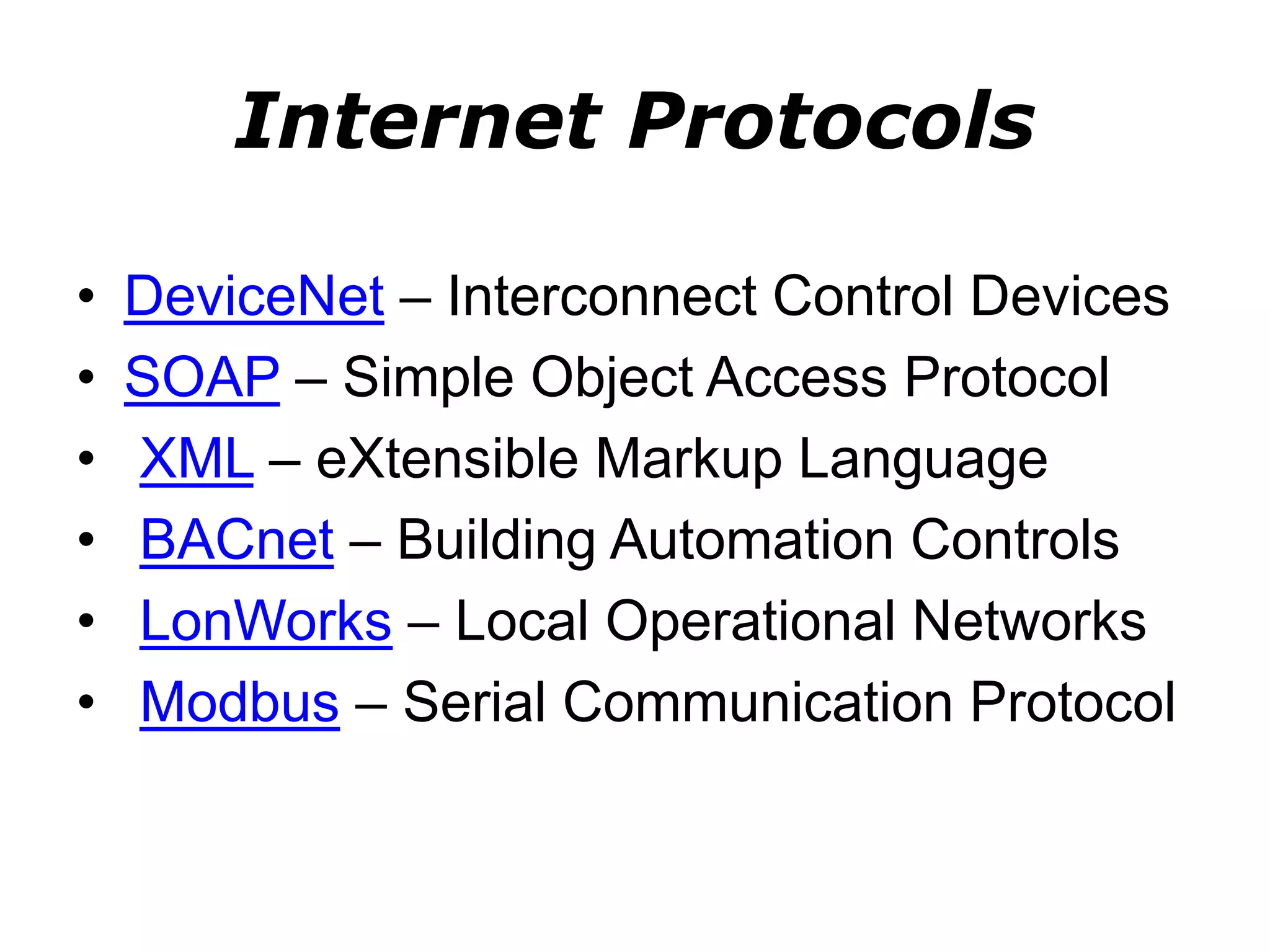
Internet protocols and open standards such as DeviceNet, SOAP, XML, BACnet, LonWorks and Modbus.
/
BMS Characteristics
• A BMS is most common in a large building.
• Its core function is to manage the environment within the
building and may control temperature, carbon dioxide
levels and humidity within a building.
• BMS systems are linked to access control (turnstiles and
access doors controlling who is allowed access and
egress to the building) or other security systems such as
closed-circuit television (CCTV) and motion detectors.
• Fire alarm systems and elevators are also sometimes
linked to a BMS
Functions of Building
Management Systems
To create a central computer controlled
method which has three basic functions:
• Controlling
• Monitoring
• Optimizing
• Event List Display and Scheduler System
the building’s facilities, mechanical and
electrical equipments for comfort, safety
and efficiency.
A BMS system normally comprises
• Power systems
• Smart Illumination system
• Electric power control system
• Heating,Ventilation and Air-conditioning HVAC System
• Security and observation system
• Magnetic card and access system
• Fire alarm system
• Lifts, elevators etc.
• Plumbing system
• Burglar alarms
• Other engineering systems
• Trace Heating
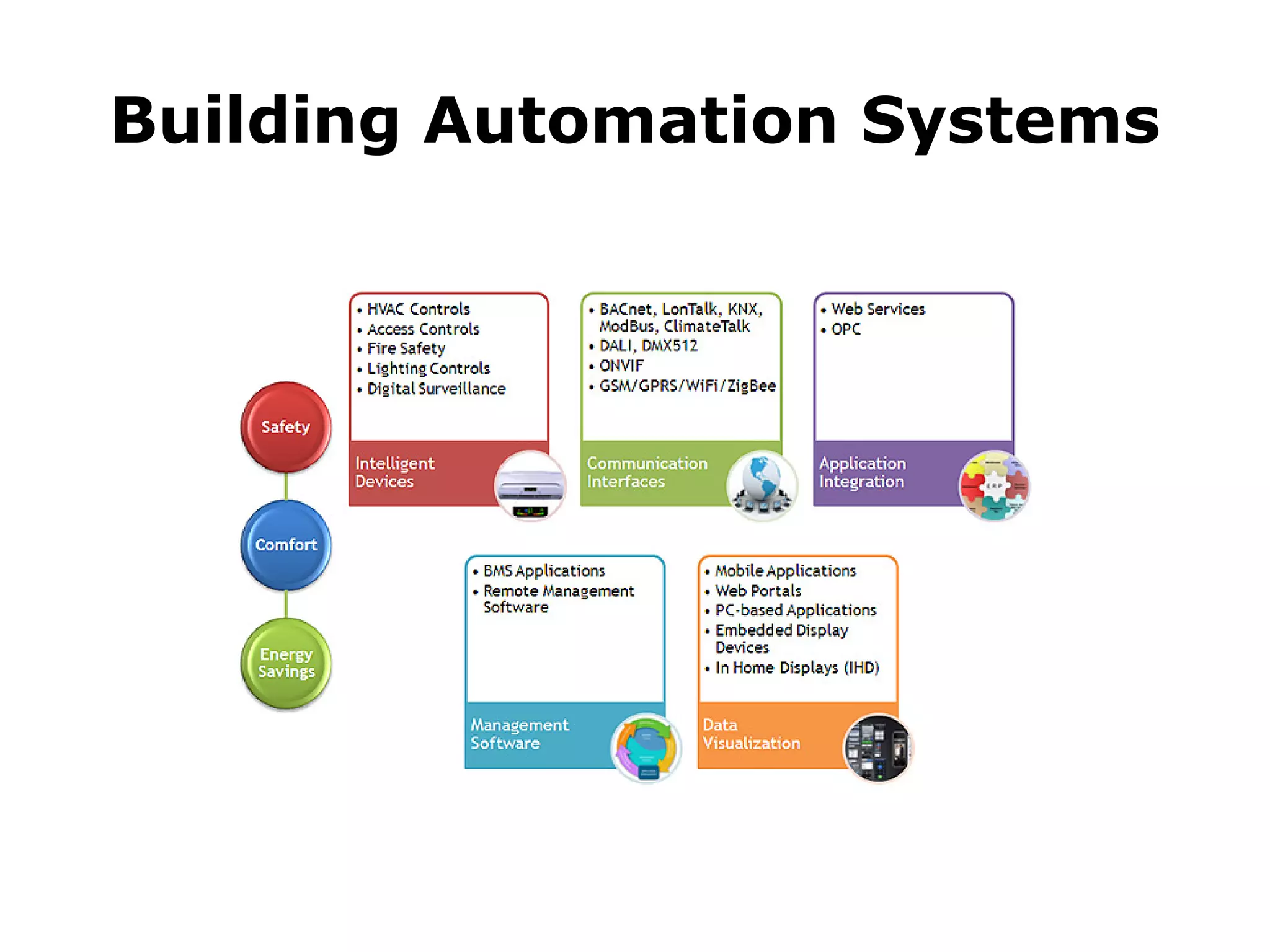
Building Automation Systems
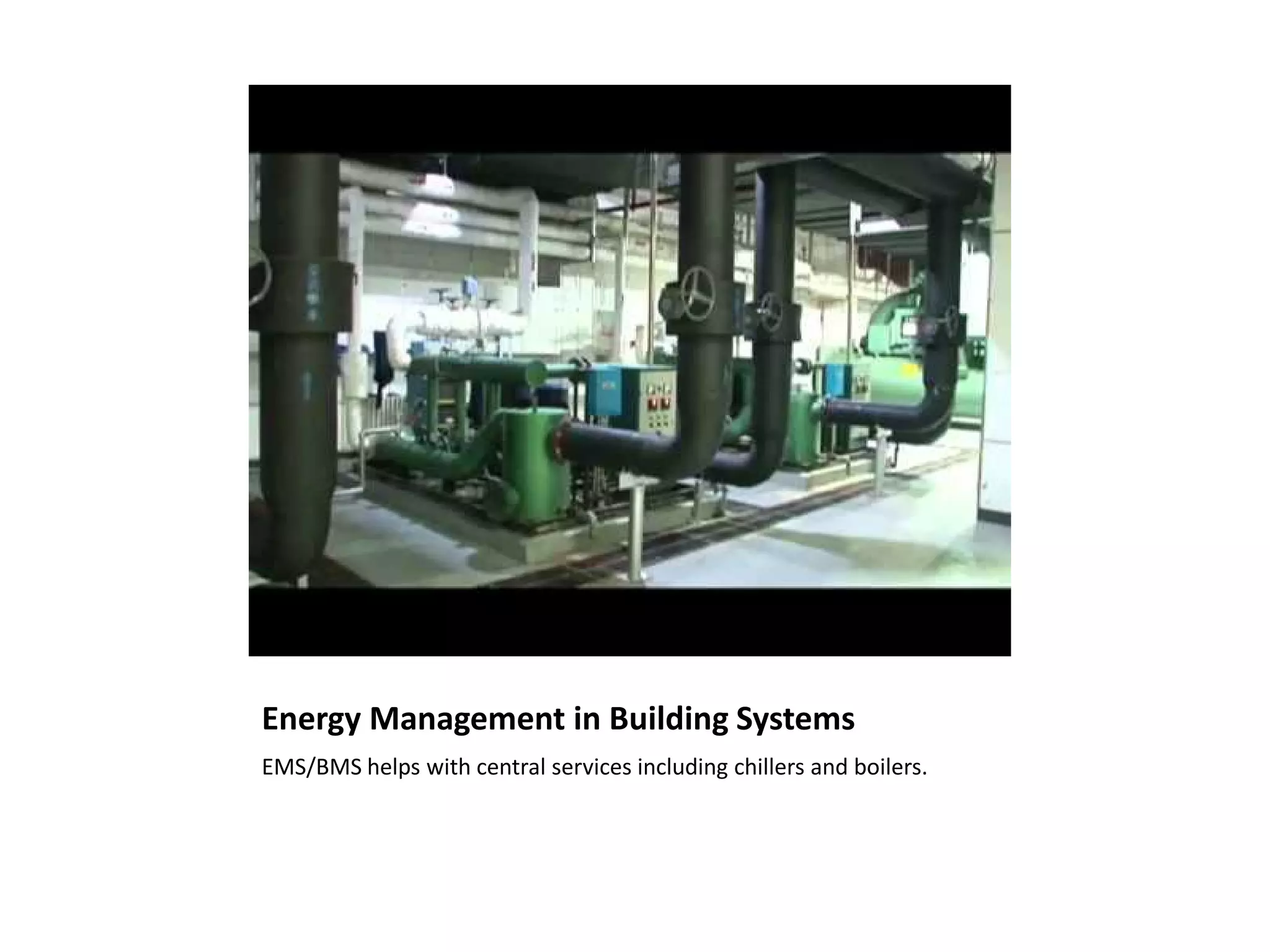
Energy Management in Building Systems
EMS/BMS helps with central services including chillers and boilers.
Building Automation Ref
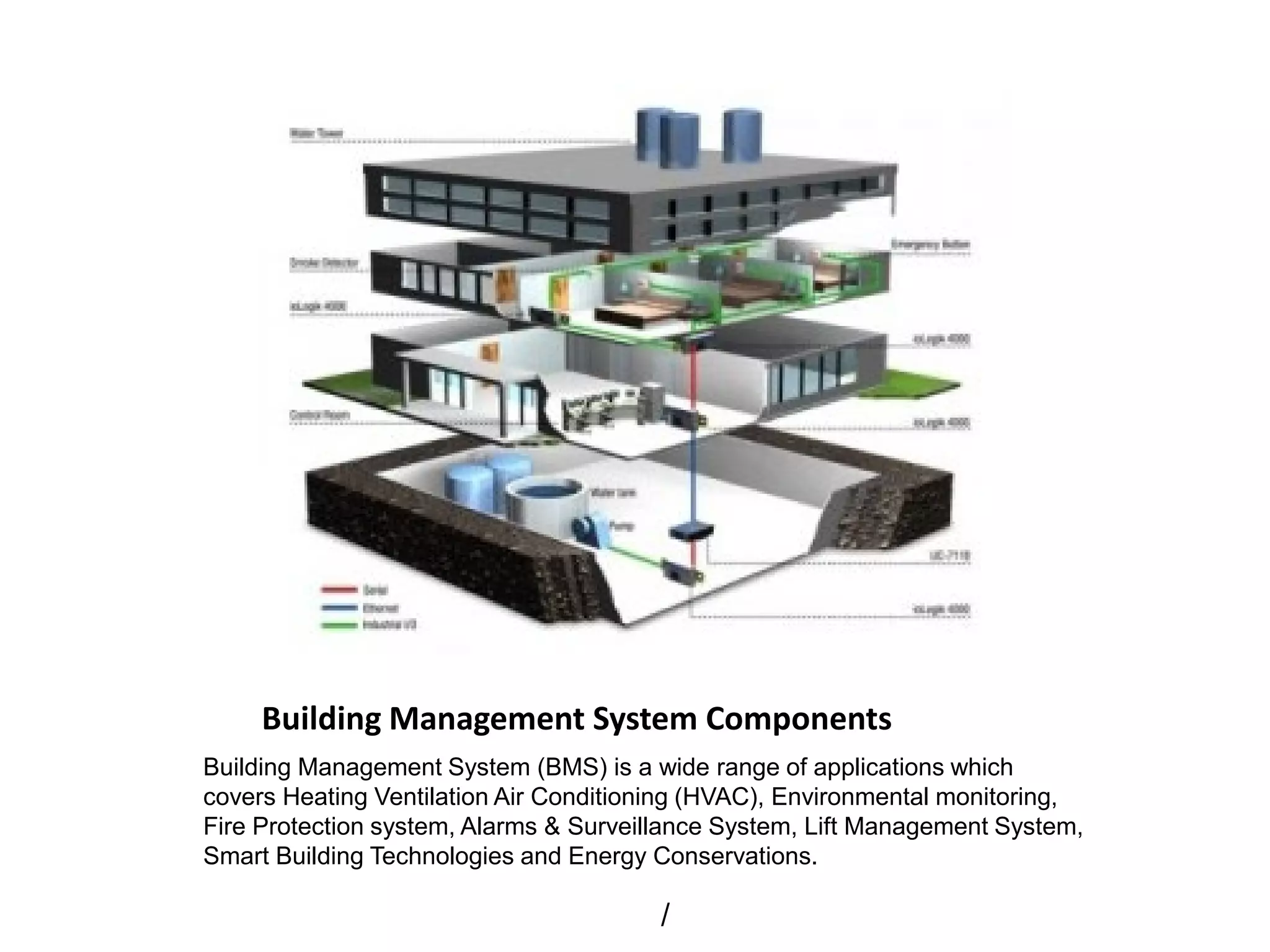
Building Management System Components
Building Management System (BMS) is a wide range of applications which
covers Heating Ventilation Air Conditioning (HVAC), Environmental monitoring,
Fire Protection system, Alarms & Surveillance System, Lift Management System,
Smart Building Technologies and Energy Conservations.
/
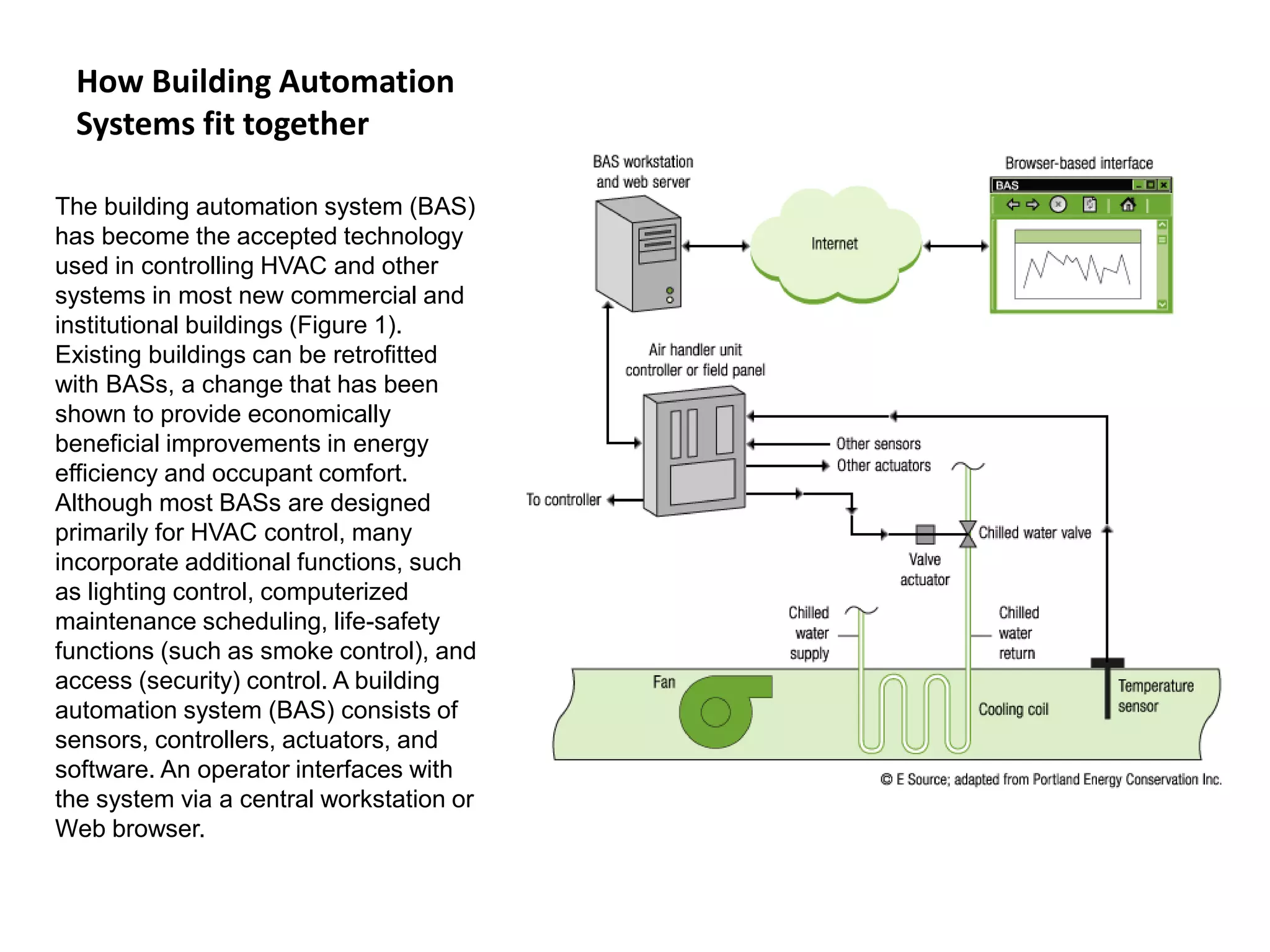
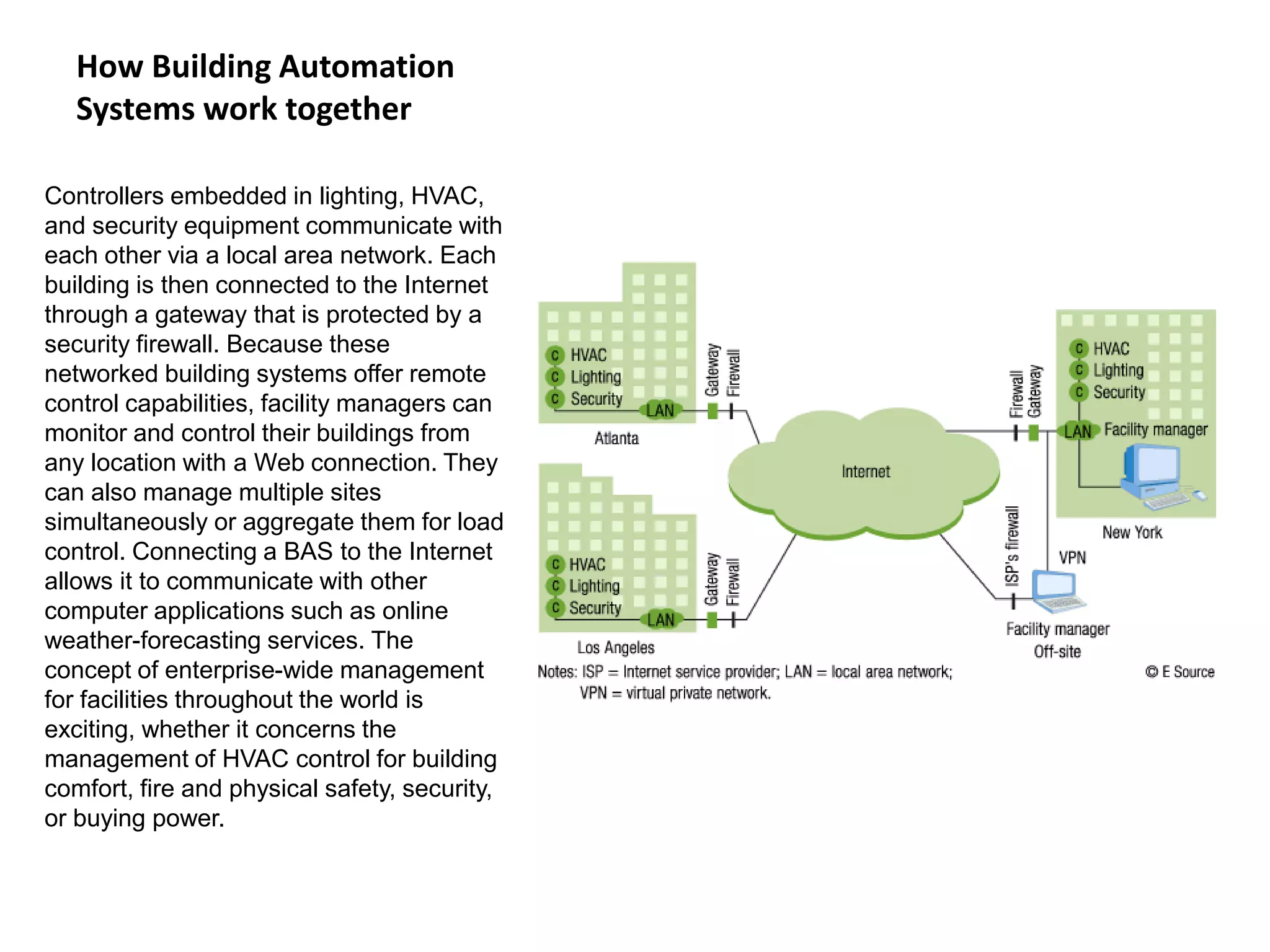
How Building Automation
Systems fit together
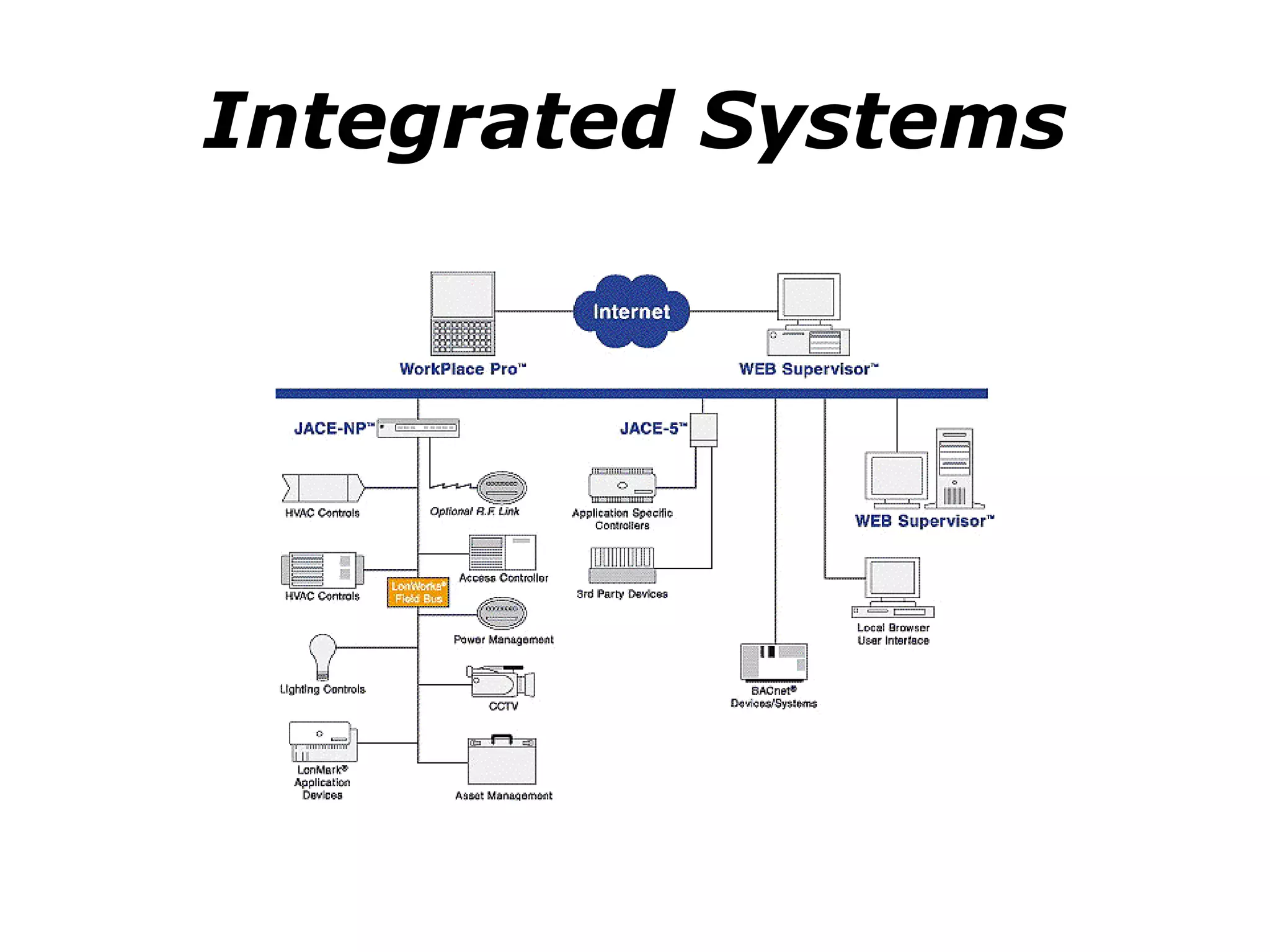
The building automation system (BAS)
has become the accepted technology
used in controlling HVAC and other
systems in most new commercial and
institutional buildings (Figure 1).
Existing buildings can be retrofitted
with BASs, a change that has been
shown to provide economically
beneficial improvements in energy
efficiency and occupant comfort.
Although most BASs are designed
primarily for HVAC control, many
incorporate additional functions, such
as lighting control, computerized
maintenance scheduling, life-safety
functions (such as smoke control), and
access (security) control. A building
automation system (BAS) consists of
sensors, controllers, actuators, and
software. An operator interfaces with
the system via a central workstation or
Web browser.
How Building Automation
Systems work together
Controllers embedded in lighting, HVAC,
and security equipment communicate with
each other via a local area network. Each
building is then connected to the Internet
through a gateway that is protected by a
security firewall. Because these
networked building systems offer remote
control capabilities, facility managers can
monitor and control their buildings from
any location with a Web connection. They
can also manage multiple sites
simultaneously or aggregate them for load
control. Connecting a BAS to the Internet
allows it to communicate with other
computer applications such as online
weather-forecasting services. The
concept of enterprise-wide management
for facilities throughout the world is
exciting, whether it concerns the
management of HVAC control for building
comfort, fire and physical safety, security,
or buying power.
Security Systems
• It is a multi level security system.(physical
security).
• They have access control.
• All the employees are provided with
access cards.
• The CCtv’s are placed at all the gates and
these are monitored at the reception.
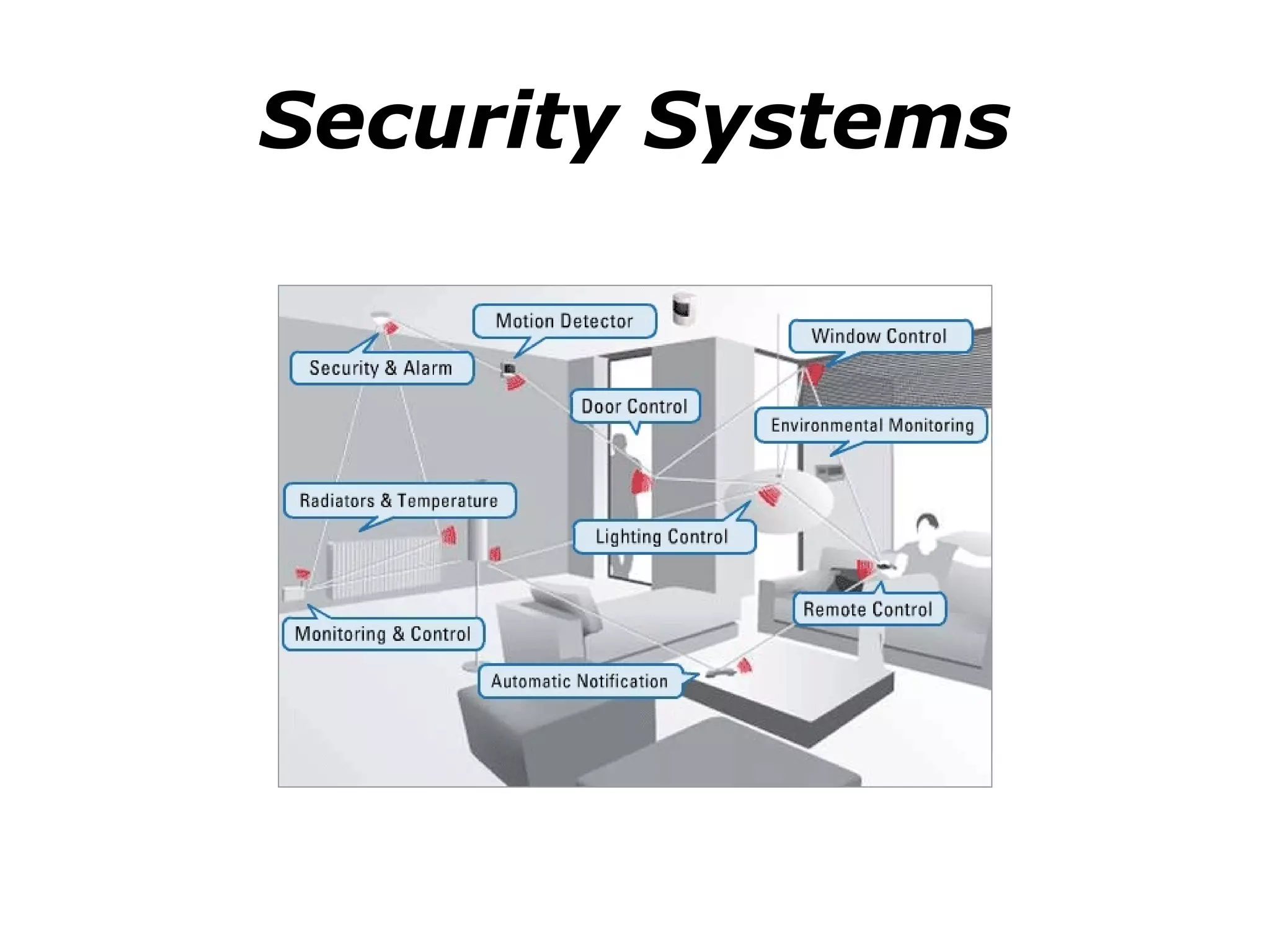
Security Systems
Integrated Fire Alarm
Systems
• . Each room has a fire alarm which detect the smoke. It
is also provided with the sprinkler system.
• These sprinklers will not be in server room
• The fire extinguishers will be different in server room. A
mock fire drill is conducted every month.
• Fire extinguishers are placed every corners and 10m at
suitable accessible place as per fire norms
Integrated Air Conditioning with sensor based exhausts and oxygen
monitoring sytem
o The air chillers which are placed at the top
of the building d cool air to the A.H.U(Air
Handling Units ) which are provided at all
the levels.
o There are “N”, N>4 A.H.U’s in each level.
o The cool air is distributed to the entire level
from the A.H.U’s.
o CHP Integrated system
Server Room
• This is the main part in an IT room in which
all the data is stored.
• This room cannot be accessed by everyone.
It has a passcode and access card to enter.
• 18 degrees is maintained in the rooms
through Precession Air Conditions with
redundant System to ensure 24x7 and 5 start
data center guidelines.
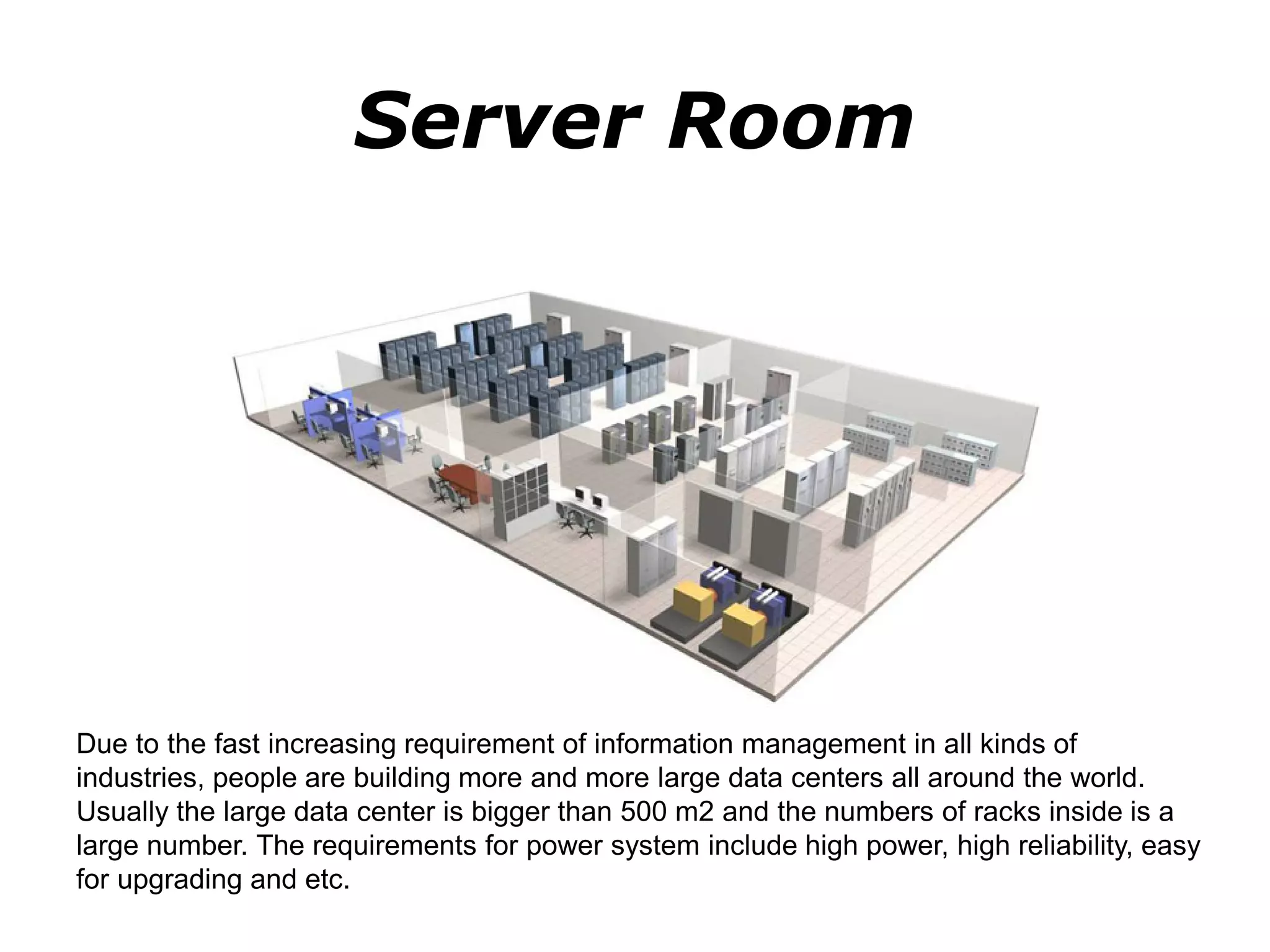
Server Room
Due to the fast increasing requirement of information management in all kinds of
industries, people are building more and more large data centers all around the world.
Usually the large data center is bigger than 500 m2 and the numbers of racks inside is a
large number. The requirements for power system include high power, high reliability, easy
for upgrading and etc.
Integarted Power
Systems
o The main power comes from the electricity
board.
o Automatic switch on and off generators
systems – if one failed the other works.
o The main power will be sent to UPS (which
has 120 min backup).
o Each cabin has 5 power sockets
o Microgrid Controller System
Integrated Systems
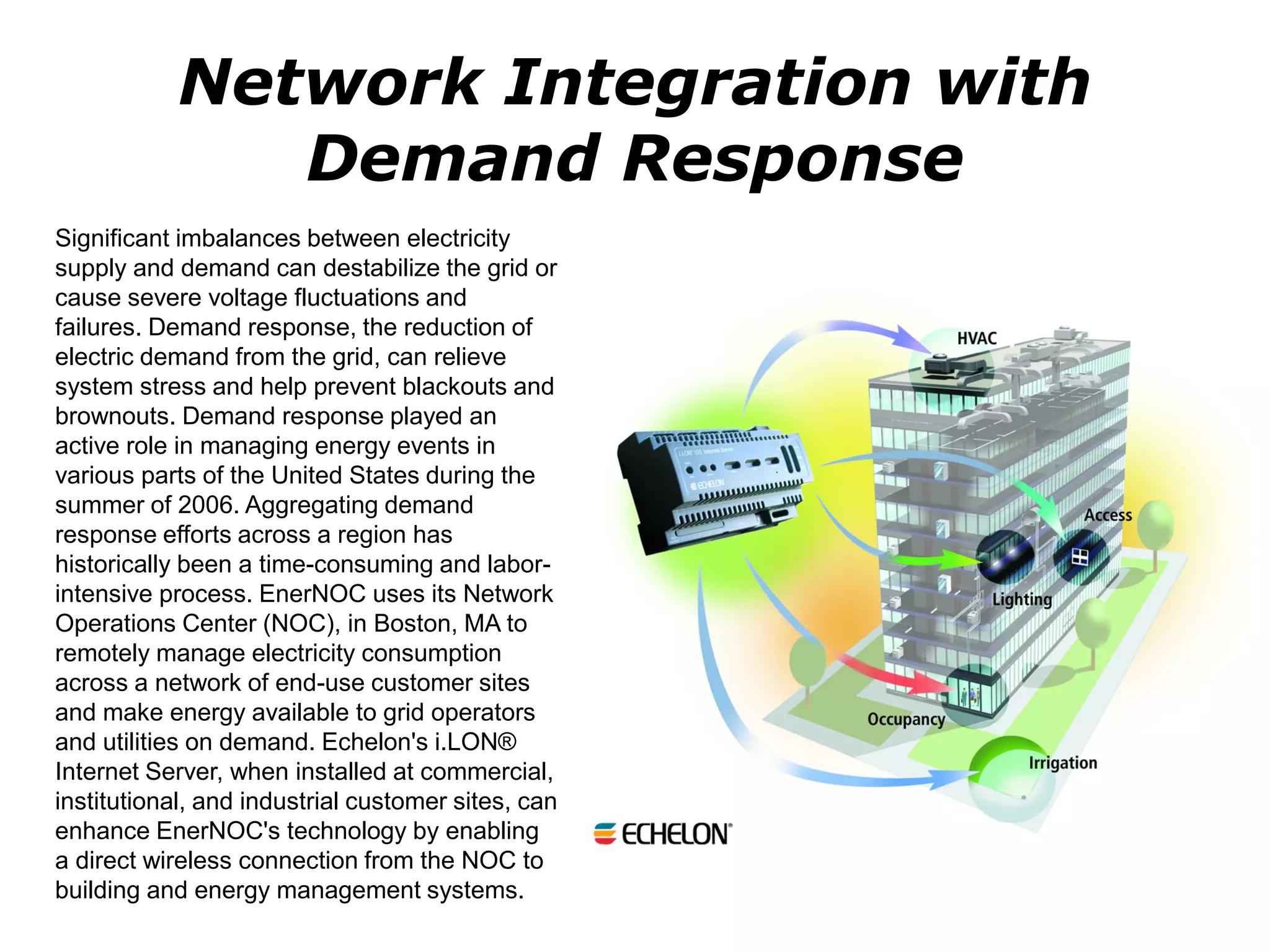
Significant imbalances between electricity
supply and demand can destabilize the grid or
cause severe voltage fluctuations and
failures. Demand response, the reduction of
electric demand from the grid, can relieve
system stress and help prevent blackouts and
brownouts. Demand response played an
active role in managing energy events in
various parts of the United States during the
summer of 2006. Aggregating demand
response efforts across a region has
historically been a time-consuming and labor-
intensive process. EnerNOC uses its Network
Operations Center (NOC), in Boston, MA to
remotely manage electricity consumption
across a network of end-use customer sites
and make energy available to grid operators
and utilities on demand. Echelon's i.LON®
Internet Server, when installed at commercial,
institutional, and industrial customer sites, can
enhance EnerNOC's technology by enabling
a direct wireless connection from the NOC to
building and energy management systems.
Network Integration with
Demand Response
Internet Protocols
• DeviceNet – Interconnect Control Devices
• SOAP – Simple Object Access Protocol
• XML – eXtensible Markup Language
• BACnet – Building Automation Controls
• LonWorks – Local Operational Networks
• Modbus – Serial Communication Protocol
LonWorks
LonWorks (local operation network) is a
networking platform specifically created to address
the needs of control applications. The platform is
built on a protocol created by Echelon Corporation
for networking devices over media such as twisted
pair, powerlines, fiber optics, and RF. It is used for
the automation of various functions within buildings
such as lighting and HVAC; see Intelligent building.
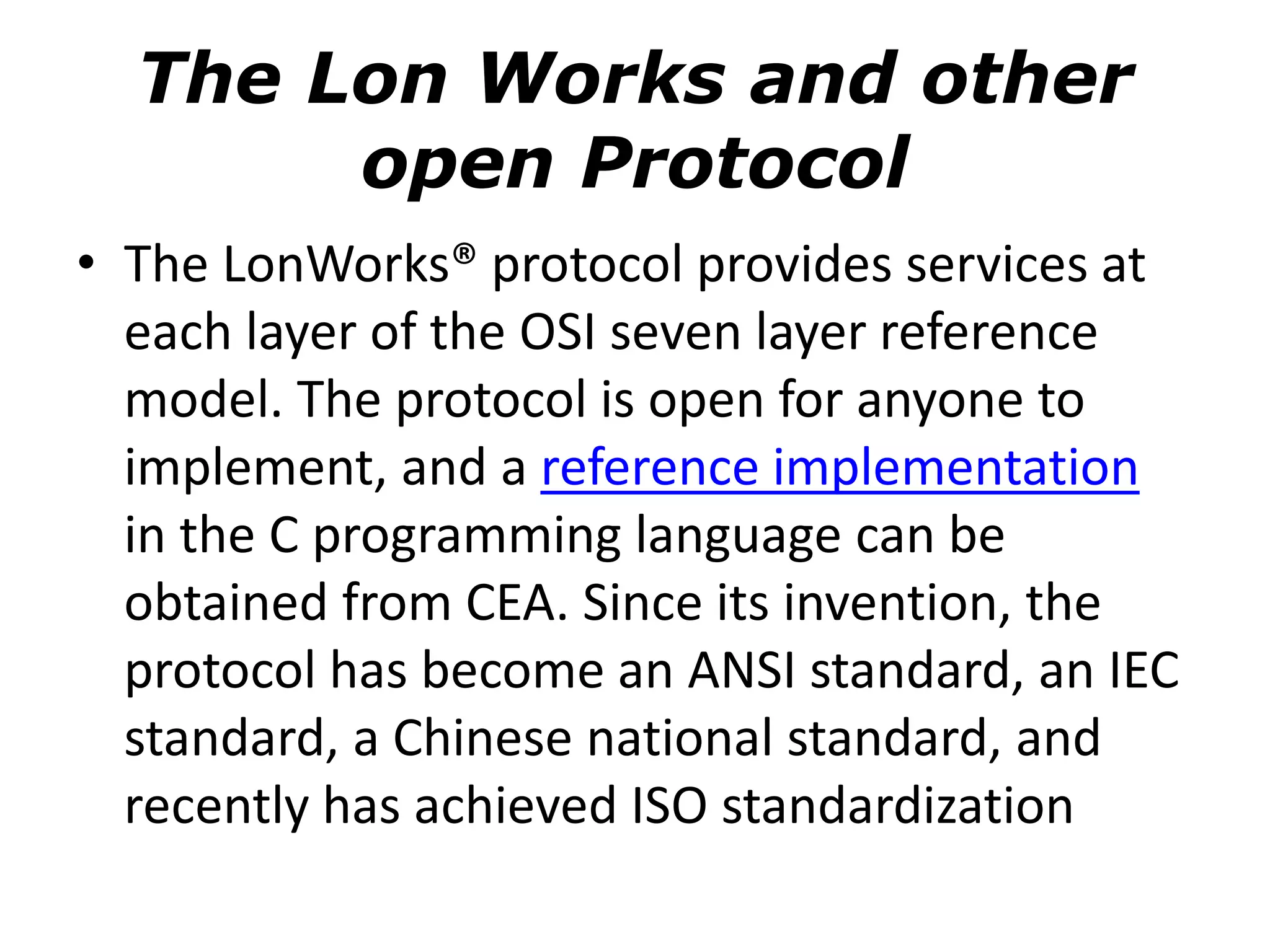
The Lon Works and other
open Protocol
• The LonWorks® protocol provides services at
each layer of the OSI seven layer reference
model. The protocol is open for anyone to
implement, and a reference implementation
in the C programming language can be
obtained from CEA. Since its invention, the
protocol has become an ANSI standard, an IEC
standard, a Chinese national standard, and
recently has achieved ISO standardization
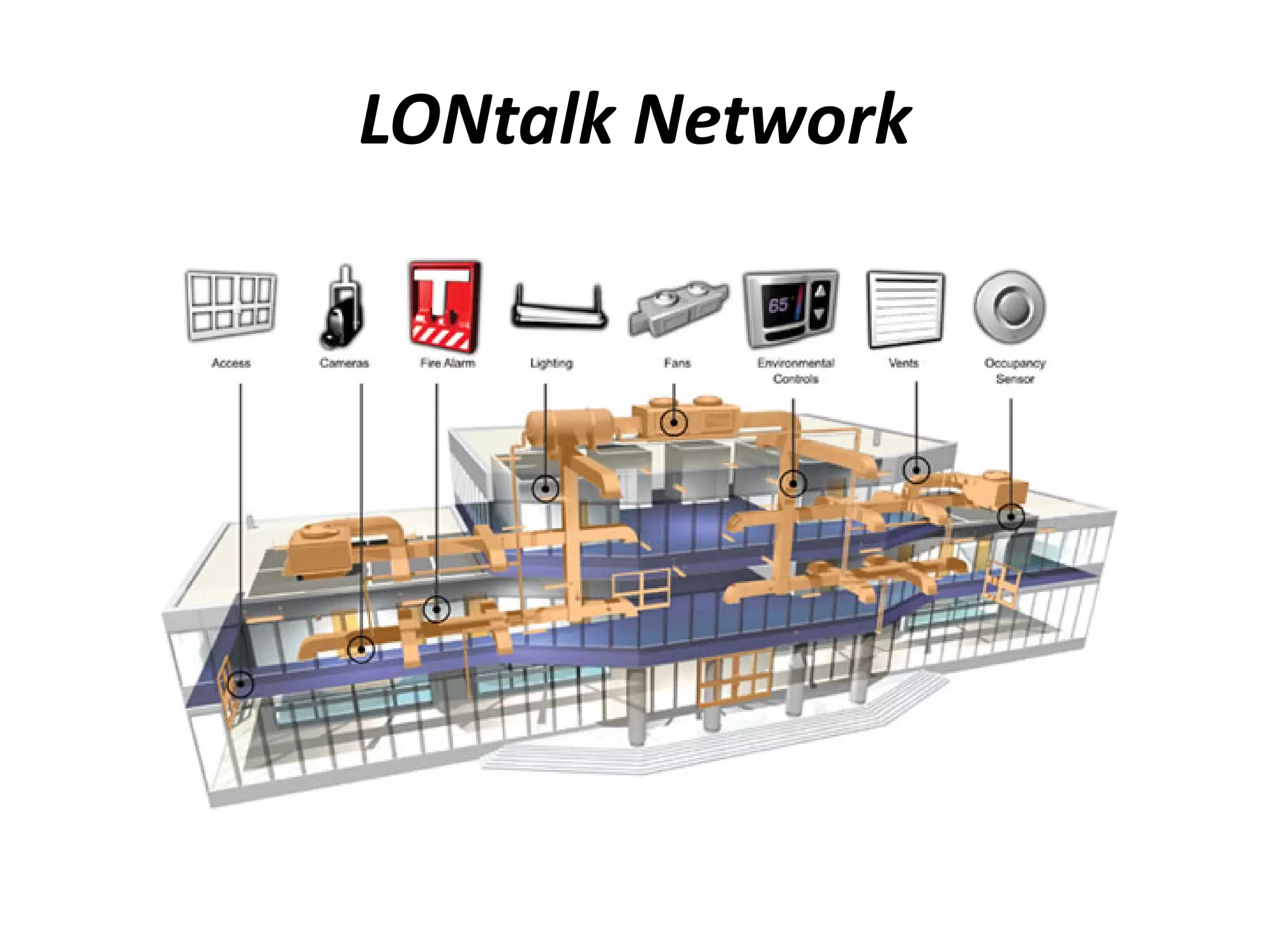
LONtalk Network
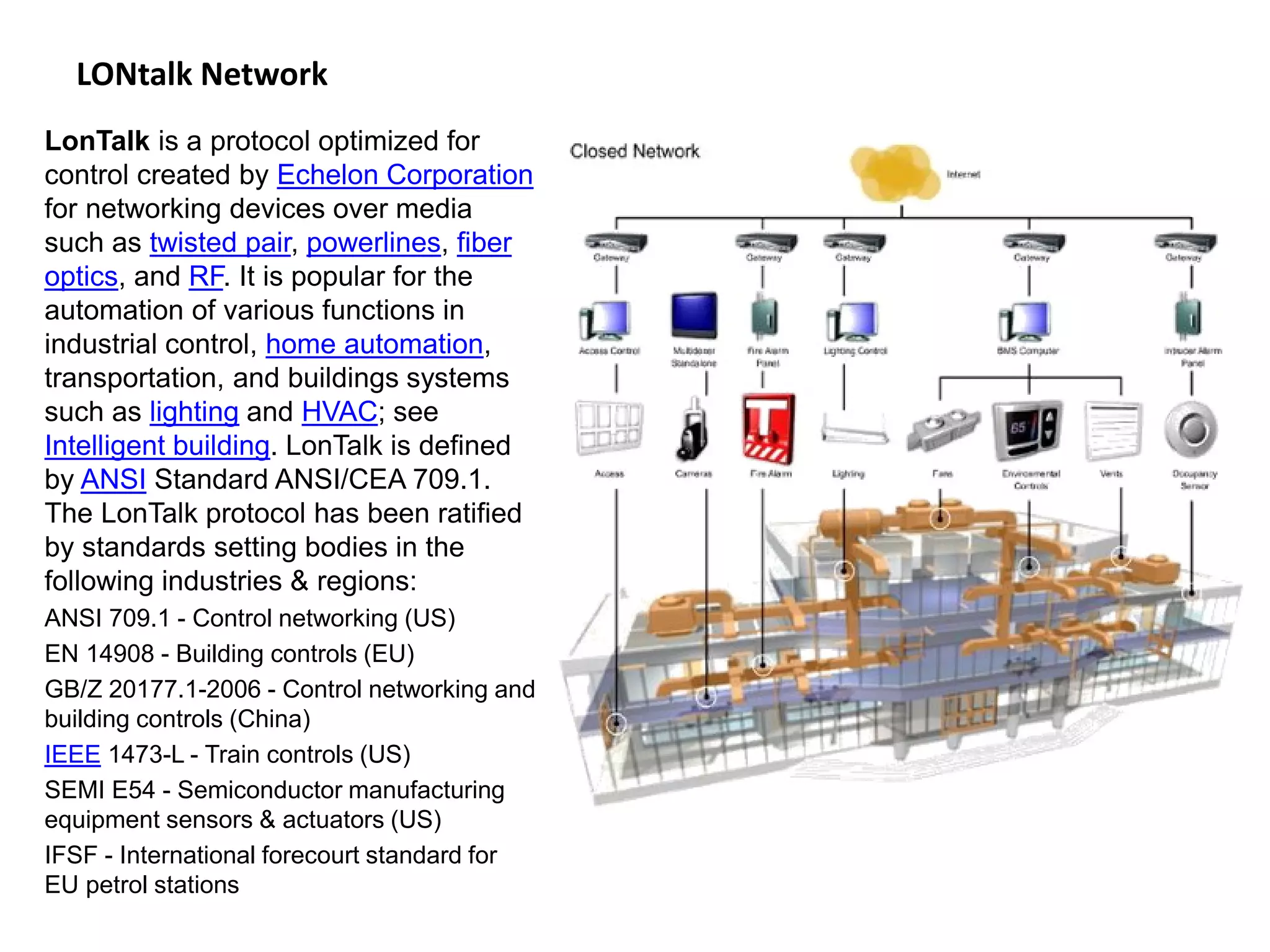
LONtalk Network
LonTalk is a protocol optimized for
control created by Echelon Corporation
for networking devices over media
such as twisted pair, powerlines, fiber
optics, and RF. It is popular for the
automation of various functions in
industrial control, home automation,
transportation, and buildings systems
such as lighting and HVAC; see
Intelligent building. LonTalk is defined
by ANSI Standard ANSI/CEA 709.1.
The LonTalk protocol has been ratified
by standards setting bodies in the
following industries & regions:
ANSI 709.1 - Control networking (US)
EN 14908 - Building controls (EU)
GB/Z 20177.1-2006 - Control networking and
building controls (China)
IEEE 1473-L - Train controls (US)
SEMI E54 - Semiconductor manufacturing
equipment sensors & actuators (US)
IFSF - International forecourt standard for
EU petrol stations
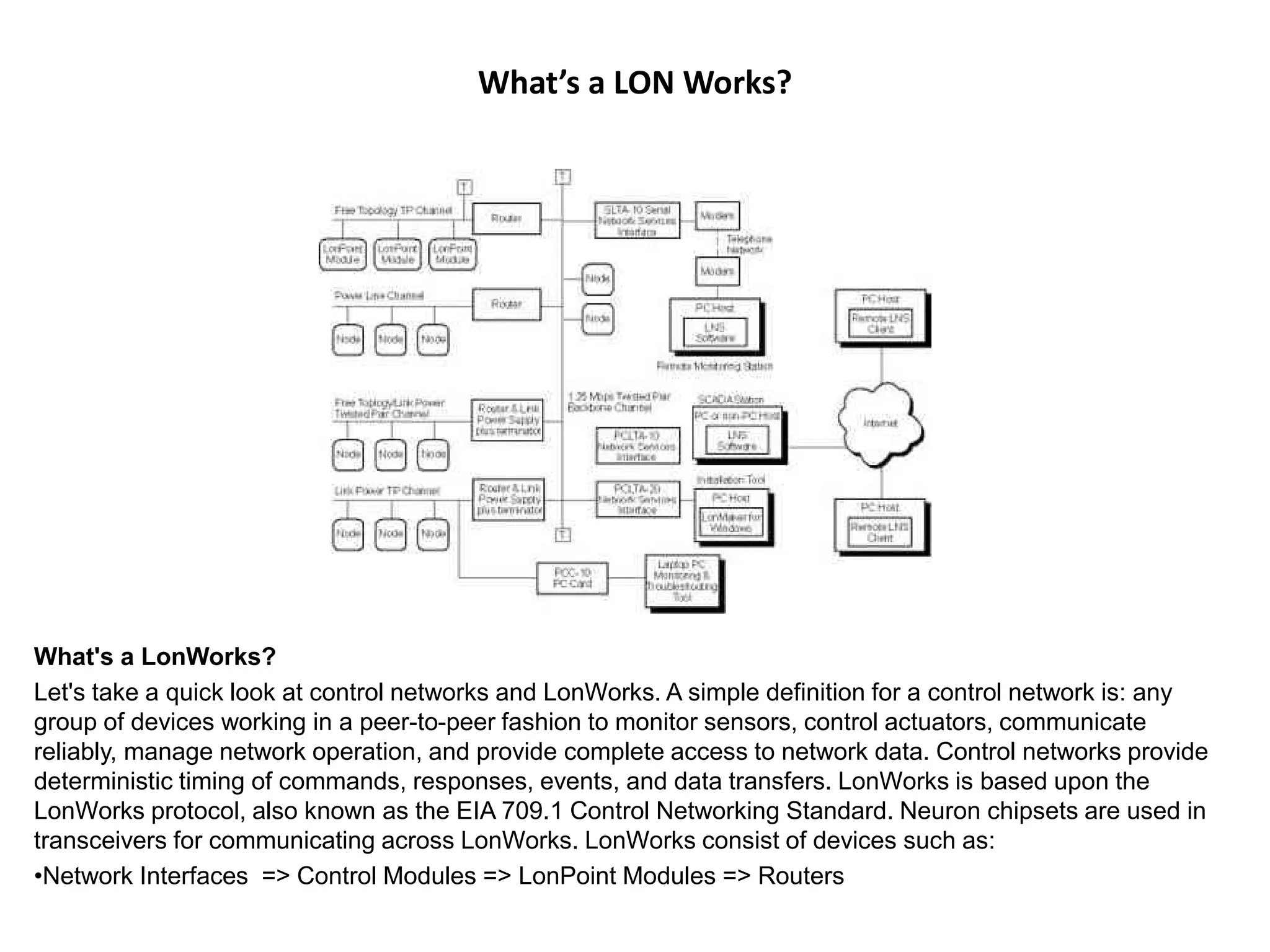
What’s a LON Works?
What's a LonWorks?
Let's take a quick look at control networks and LonWorks. A simple definition for a control network is: any
group of devices working in a peer-to-peer fashion to monitor sensors, control actuators, communicate
reliably, manage network operation, and provide complete access to network data. Control networks provide
deterministic timing of commands, responses, events, and data transfers. LonWorks is based upon the
LonWorks protocol, also known as the EIA 709.1 Control Networking Standard. Neuron chipsets are used in
transceivers for communicating across LonWorks. LonWorks consist of devices such as:
•Network Interfaces => Control Modules => LonPoint Modules => Routers
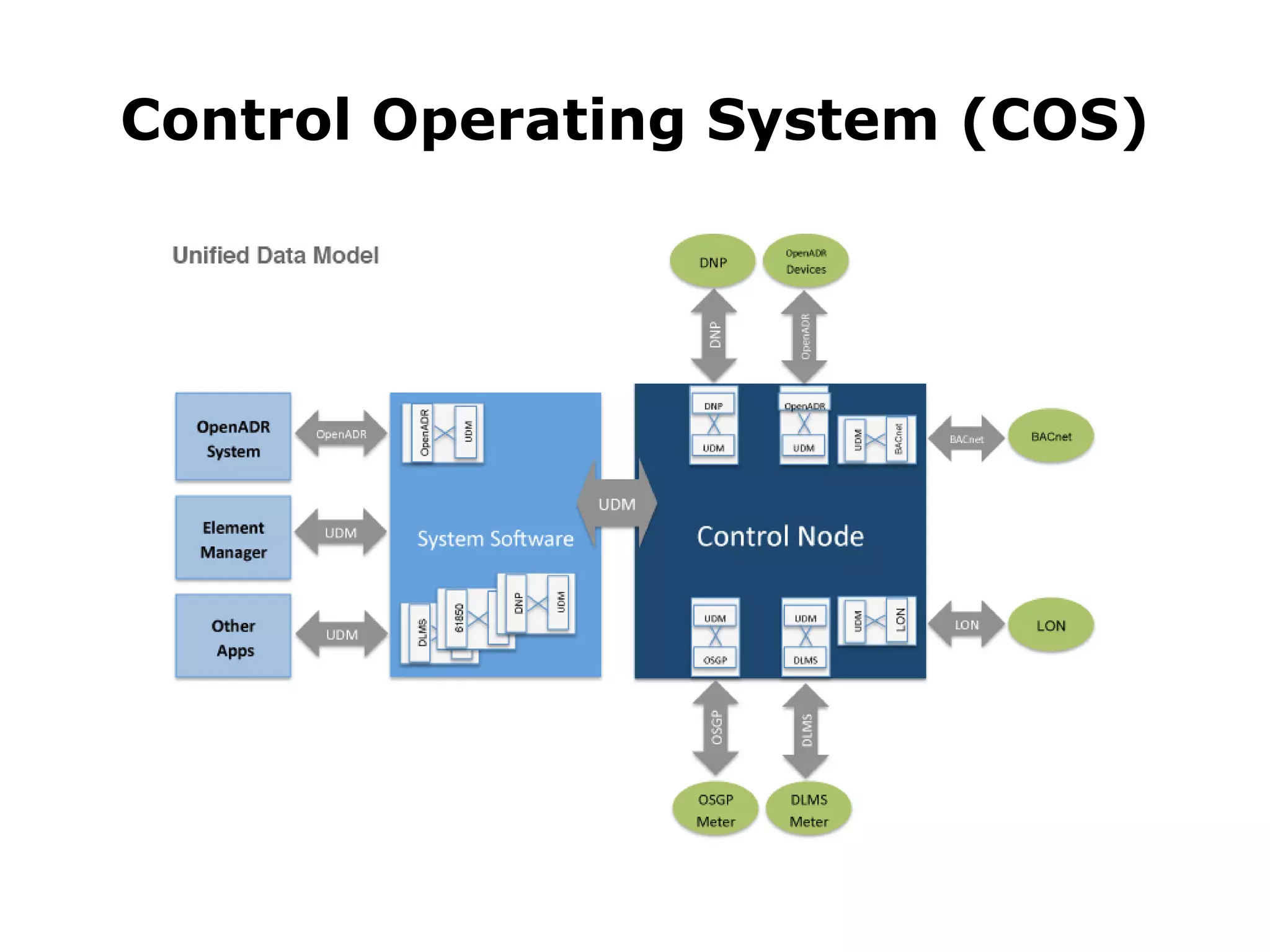
Control Operating System (COS)
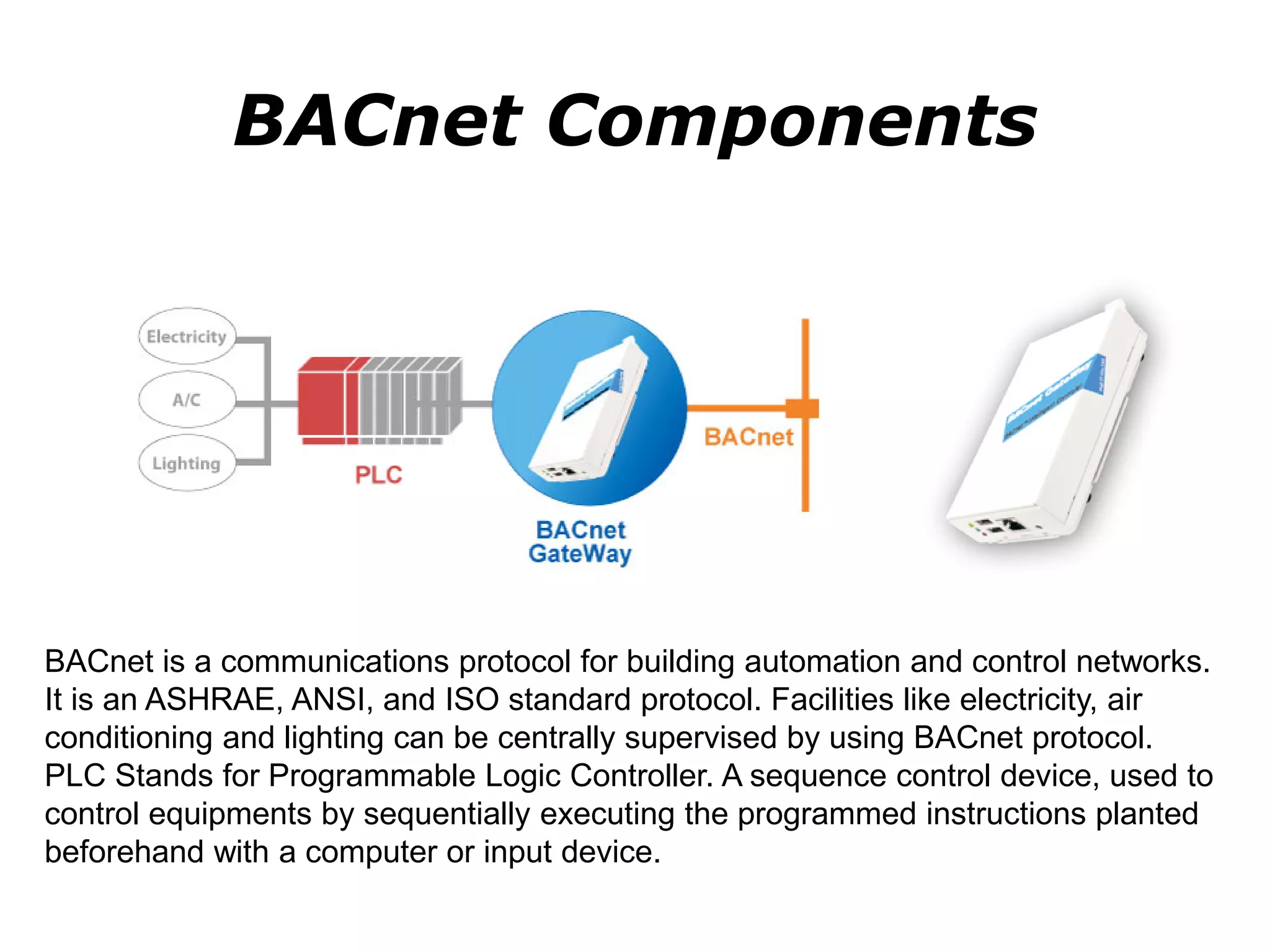
BACnet Components
BACnet is a communications protocol for building automation and control networks.
It is an ASHRAE, ANSI, and ISO standard protocol. Facilities like electricity, air
conditioning and lighting can be centrally supervised by using BACnet protocol.
PLC Stands for Programmable Logic Controller. A sequence control device, used to
control equipments by sequentially executing the programmed instructions planted
beforehand with a computer or input device.
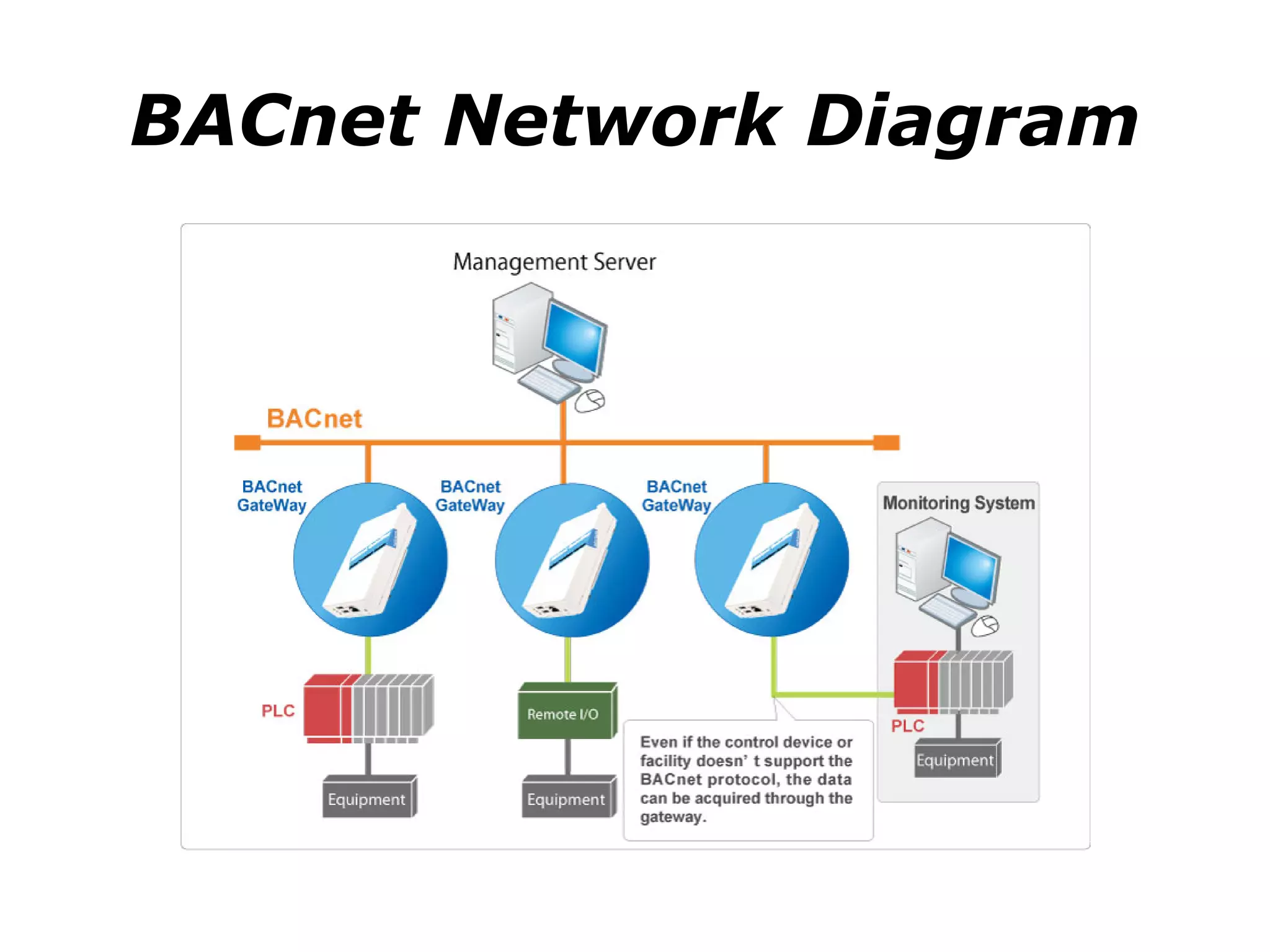
BACnet Network Diagram
Modbus
Modbus is a serial communications protocol published by Modicon in 1979 for
use with its programmable logic controllers (PLCs). Simple and robust, it has
since become a de facto standard communication protocol, and it is now
amongst the most commonly available means of connecting industrial electronic
devices. The main reasons for the extensive use of Modbus in the industrial
environment are:
• It has been developed with industrial applications in mind
• It is openly published and royalty-free
• It is easy to deploy and maintain
• It moves raw bits or words without placing many restrictions on vendors
Modbus allows for communication between many (approximately 240) devices
connected to the same network, for example a system that measures
temperature and humidity and communicates the results to a computer. Modbus
is often used to connect a supervisory computer with a remote terminal unit
(RTU) in supervisory control and data acquisition (SCADA) systems.
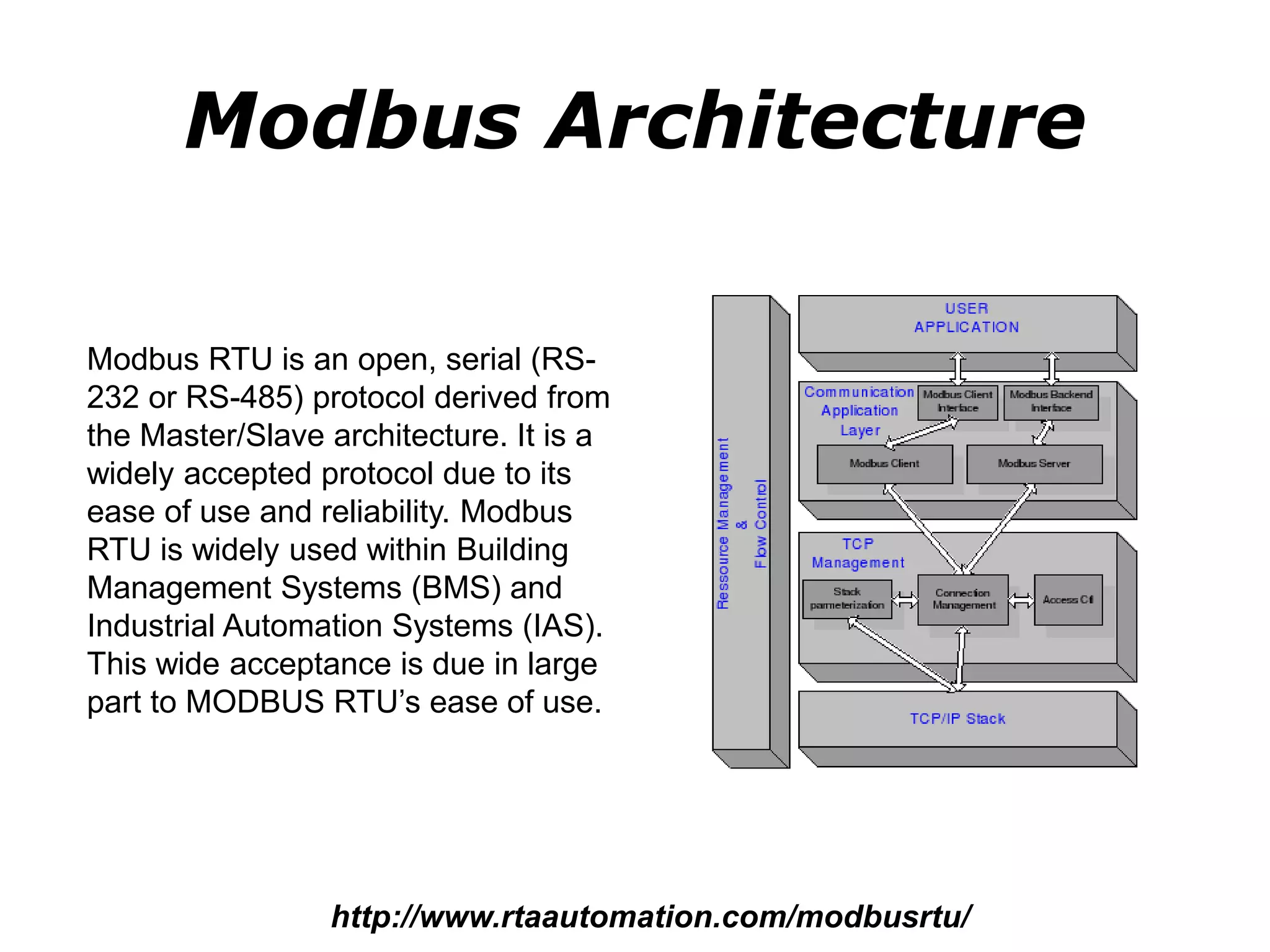
Modbus Architecture
Modbus RTU is an open, serial (RS-
232 or RS-485) protocol derived from
the Master/Slave architecture. It is a
widely accepted protocol due to its
ease of use and reliability. Modbus
RTU is widely used within Building
Management Systems (BMS) and
Industrial Automation Systems (IAS).
This wide acceptance is due in large
part to MODBUS RTU’s ease of use.
http://www.rtaautomation.com/modbusrtu/
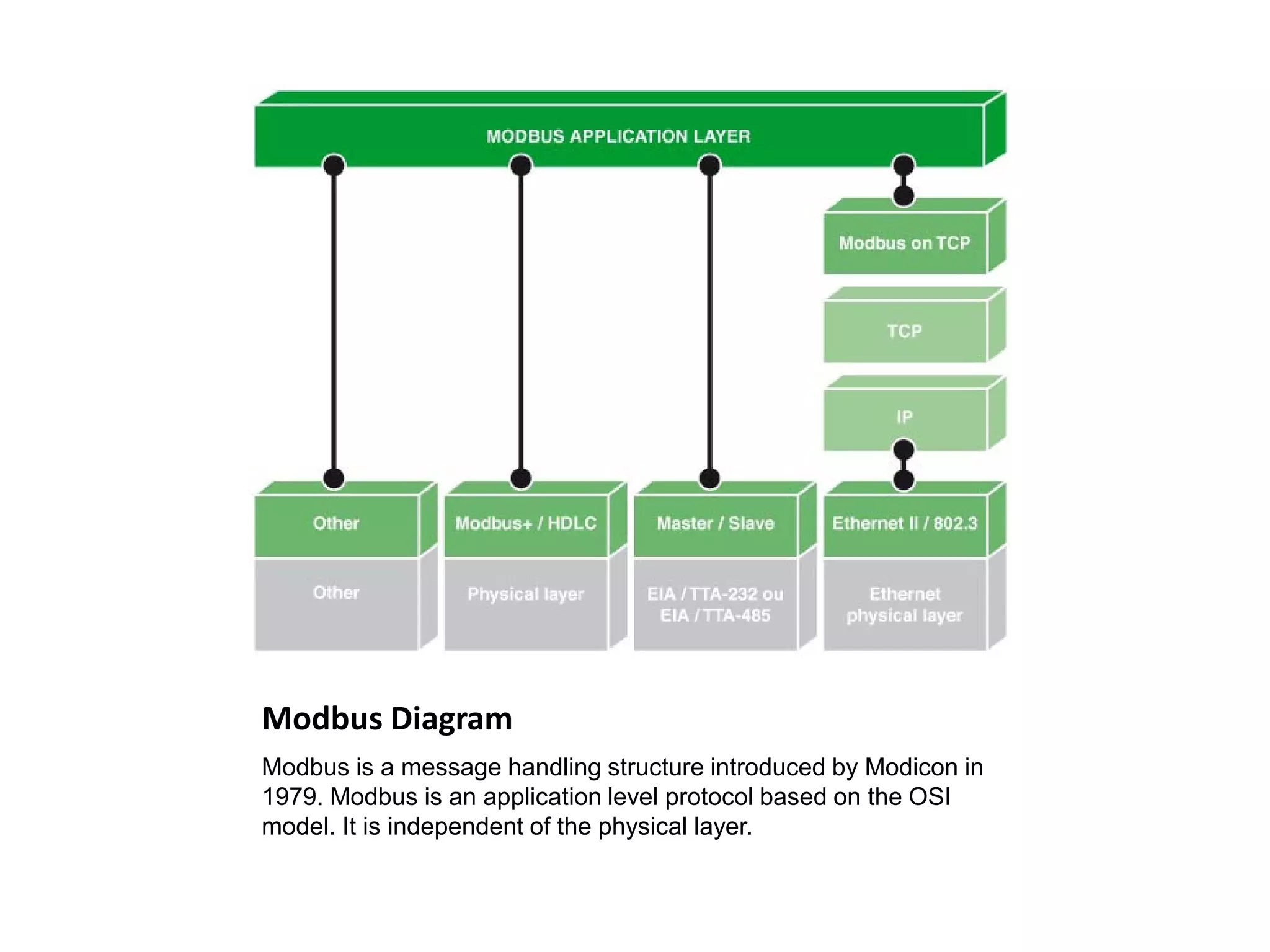
Modbus Diagram
Modbus is a message handling structure introduced by Modicon in
1979. Modbus is an application level protocol based on the OSI
model. It is independent of the physical layer.
Summary
• Building Automation Systems help keep
buildings operating at higher efficiency
• Also provide for security and comfort
• EMS/BMS ensure that energy is not being used
at the wrong time / or when not needed
• EMS/BMS can be integrated with DEMS to
provide Automated Demand Response (ADR)
• MicroGrid Controller System
Annexure -2
DRAFT and BASIC /Tentative
Functional Design Specification for
automation and integration of
various services in Net-zero
Campus of Nalanda University.
EPC Main Contractor- Design and seek approval from NU
Project Name: Electrical SCADA System for Nalanda University
Project Description: Integrated Centralized SCADA and automation
outline requirement
ANNEXURE 2: Tentative outline Functional Design Specification for NU
Page 1 of
141
Table of Contents
1 Introduction and General information.......................................................................................................................9
1.1 Introduction.............................................................................................................................................................9
1.2 Existing System ......................................................................................................................................................9
1.3 Generic System Architecture .........................................................................................................................11
1.4 Proposed SCADA/DMS System .....................................................................................................................12
1.5 Broad Role Definition of SIA...........................................................................................................................12
1.6 Reference Documents.......................................................................................................................................12
1.7 Abbreviations.......................................................................................................................................................13
1.8 Standard.................................................................................................................................................................15
2 SCADA Functions.............................................................................................................................................................16
2.1 General Requirements......................................................................................................................................16
2.2 Design Requirements........................................................................................................................................19
2.2.1 SCADA/DMS Function Access ...................................................................................................................19
2.2.2 Critical / Non-Critical Function ................................................................................................................22
2.3 SCADA Function..................................................................................................................................................25
2.3.1 Data Acquisition .............................................................................................................................................26
2.3.2 Time Synchronization of RTU ...................................................................................................................28
2.3.3 Data Exchange.................................................................................................................................................29
2.3.4 Data Processing...............................................................................................................................................30
2.3.5 Continuous Real-time Data storage & playback.................................................................................42
2.3.6 Sequence of Events Data .............................................................................................................................43
2.3.7 SCADA Language ............................................................................................................................................45
2.3.8 Supervisory Control......................................................................................................................................45
ANNEXURE 2: Tentative outline Functional Design Specification for NU
Page 2 of
141
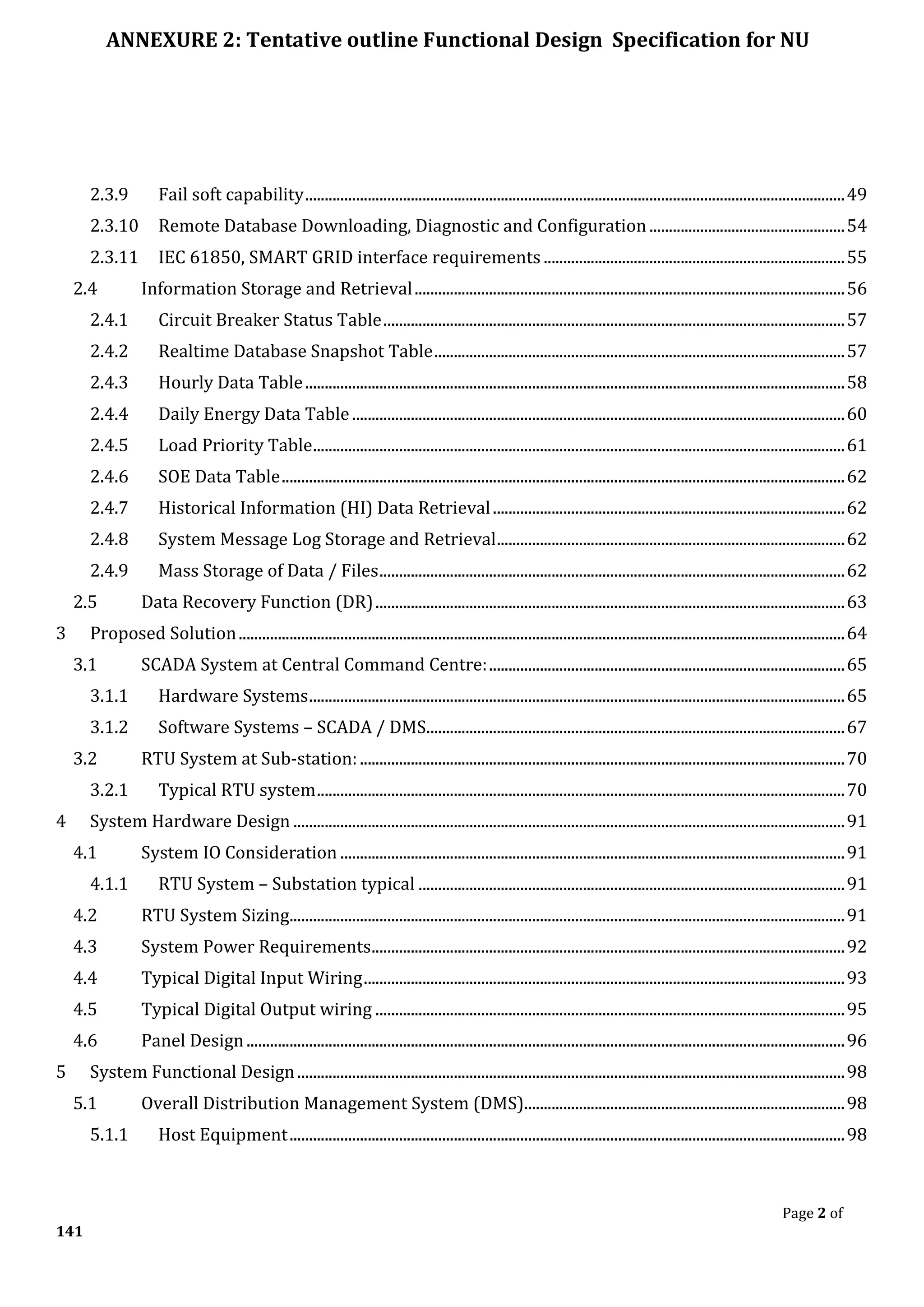
2.3.9 Fail soft capability..........................................................................................................................................49
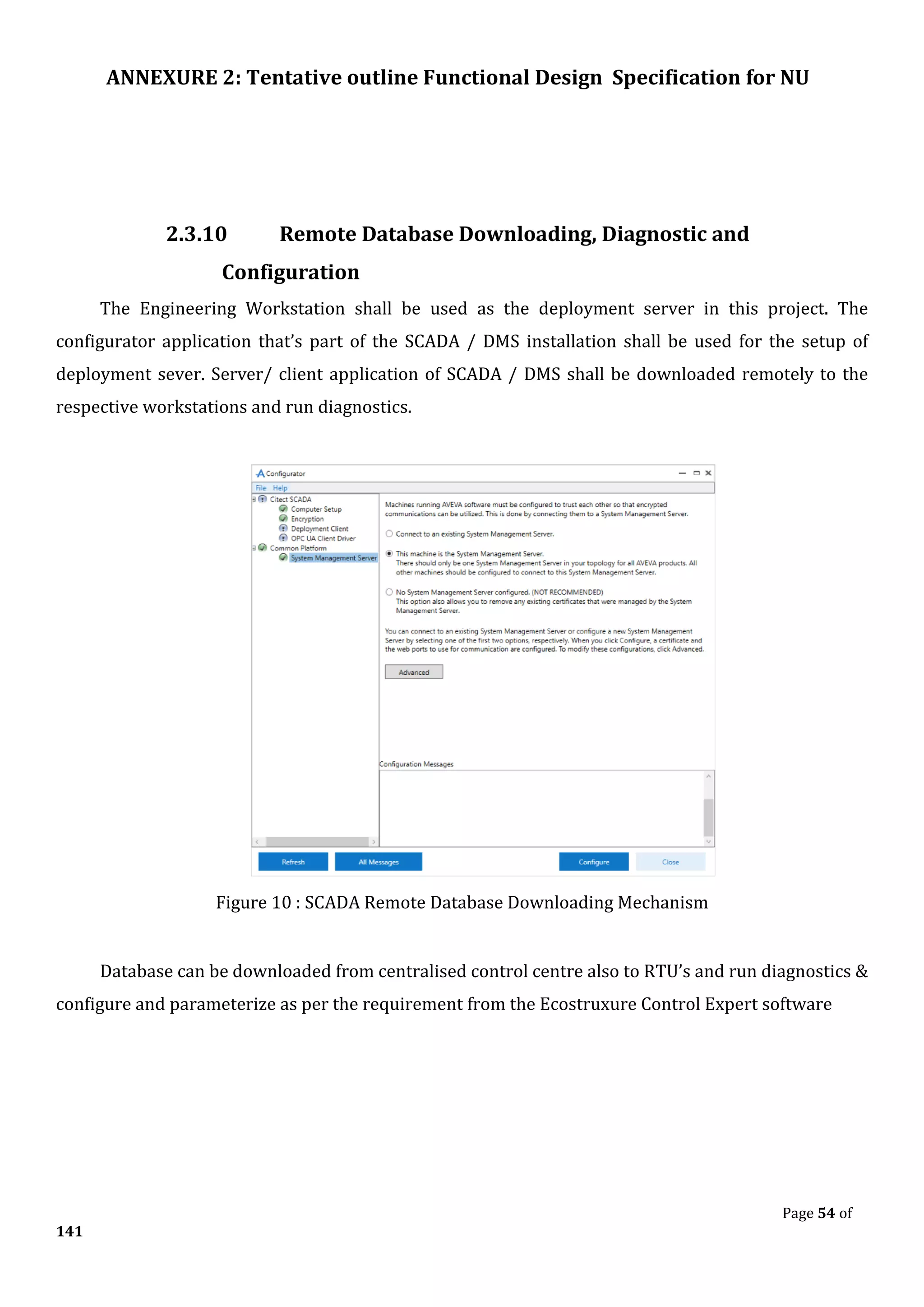
2.3.10 Remote Database Downloading, Diagnostic and Configuration ..................................................54
2.3.11 IEC 61850, SMART GRID interface requirements .............................................................................55
2.4 Information Storage and Retrieval..............................................................................................................56
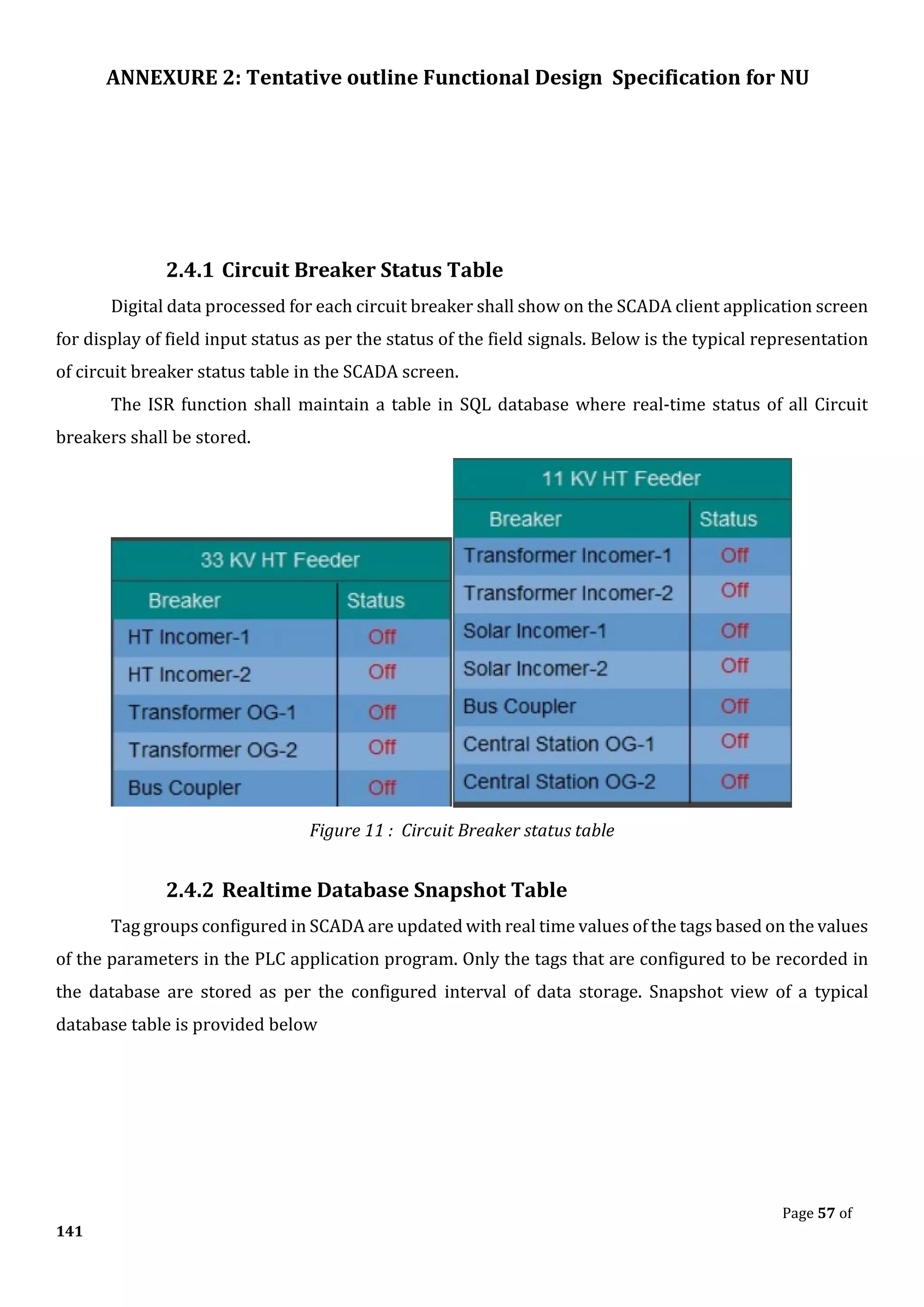
2.4.1 Circuit Breaker Status Table......................................................................................................................57
2.4.2 Realtime Database Snapshot Table.........................................................................................................57
2.4.3 Hourly Data Table..........................................................................................................................................58
2.4.4 Daily Energy Data Table..............................................................................................................................60
2.4.5 Load Priority Table........................................................................................................................................61
2.4.6 SOE Data Table................................................................................................................................................62
2.4.7 Historical Information (HI) Data Retrieval..........................................................................................62
2.4.8 System Message Log Storage and Retrieval.........................................................................................62
2.4.9 Mass Storage of Data / Files.......................................................................................................................62
2.5 Data Recovery Function (DR)........................................................................................................................63
3 Proposed Solution...........................................................................................................................................................64
3.1 SCADA System at Central Command Centre:...........................................................................................65
3.1.1 Hardware Systems.........................................................................................................................................65
3.1.2 Software Systems – SCADA / DMS...........................................................................................................67
3.2 RTU System at Sub-station:............................................................................................................................70
3.2.1 Typical RTU system.......................................................................................................................................70
4 System Hardware Design .............................................................................................................................................91
4.1 System IO Consideration .................................................................................................................................91
4.1.1 RTU System – Substation typical .............................................................................................................91
4.2 RTU System Sizing..............................................................................................................................................91
4.3 System Power Requirements.........................................................................................................................92
4.4 Typical Digital Input Wiring...........................................................................................................................93
4.5 Typical Digital Output wiring ........................................................................................................................95
4.6 Panel Design.........................................................................................................................................................96
5 System Functional Design............................................................................................................................................98
5.1 Overall Distribution Management System (DMS)..................................................................................98
5.1.1 Host Equipment..............................................................................................................................................98
ANNEXURE 2: Tentative outline Functional Design Specification for NU
Page 3 of
141
5.1.2 Communication infrastructure.................................................................................................................98
5.1.3 Feeder Terminal Units devices for operations...................................................................................99
5.1.4 Database Central SCADA Servers- ...........................................................................................................99
5.2 Central & Local Distribution Management System (LDMS)...............................................................99
5.3 Load Management System........................................................................................................................... 100
5.4 SLDC...................................................................................................................................................................... 101
5.5 Resident Energy Billing Module................................................................................................................. 102
5.6 Weather Monitoring System....................................................................................................................... 102
5.7 Microgrid ............................................................................................................................................................ 105
5.8 Network Redundancy.................................................................................................................................... 107
5.9 Disaster Recovery System............................................................................................................................ 107
6 System Interfaces ......................................................................................................................................................... 107
6.1 Multifunction meter Interface Specification......................................................................................... 107
6.1.1 Protocols and Interface Demarcation Diagram............................................................................... 108
6.1.2 Communication Protocols of MFM....................................................................................................... 108
6.1.3 IO Description of MFM .............................................................................................................................. 109
6.2 Intelligent Electronic Device (IED)........................................................................................................... 110
6.2.1 Protocols and Interface Demarcation Diagram............................................................................... 110
6.3 Existing System ................................................................................................................................................ 111
6.4 Diesel Generator Set....................................................................................................................................... 113
6.5 Solar Control System...................................................................................................................................... 113
6.6 SLDC...................................................................................................................................................................... 114
6.7 Water Management system......................................................................................................................... 115
6.8 Resident Billing Module................................................................................................................................ 116
6.9 Interface with GIS............................................................................................................................................ 117
7 User Interface Requirements................................................................................................................................... 118
7.1 General Requirements................................................................................................................................... 118
7.2 System User....................................................................................................................................................... 118
7.2.1 Operator Level.............................................................................................................................................. 119
7.2.2 Engineer Level.............................................................................................................................................. 119
7.2.3 Manager Level.............................................................................................................................................. 119
ANNEXURE 2: Tentative outline Functional Design Specification for NU
Page 4 of
141
7.2.4 Maintenance Level...................................................................................................................................... 119
7.2.5 Guest Level..................................................................................................................................................... 120
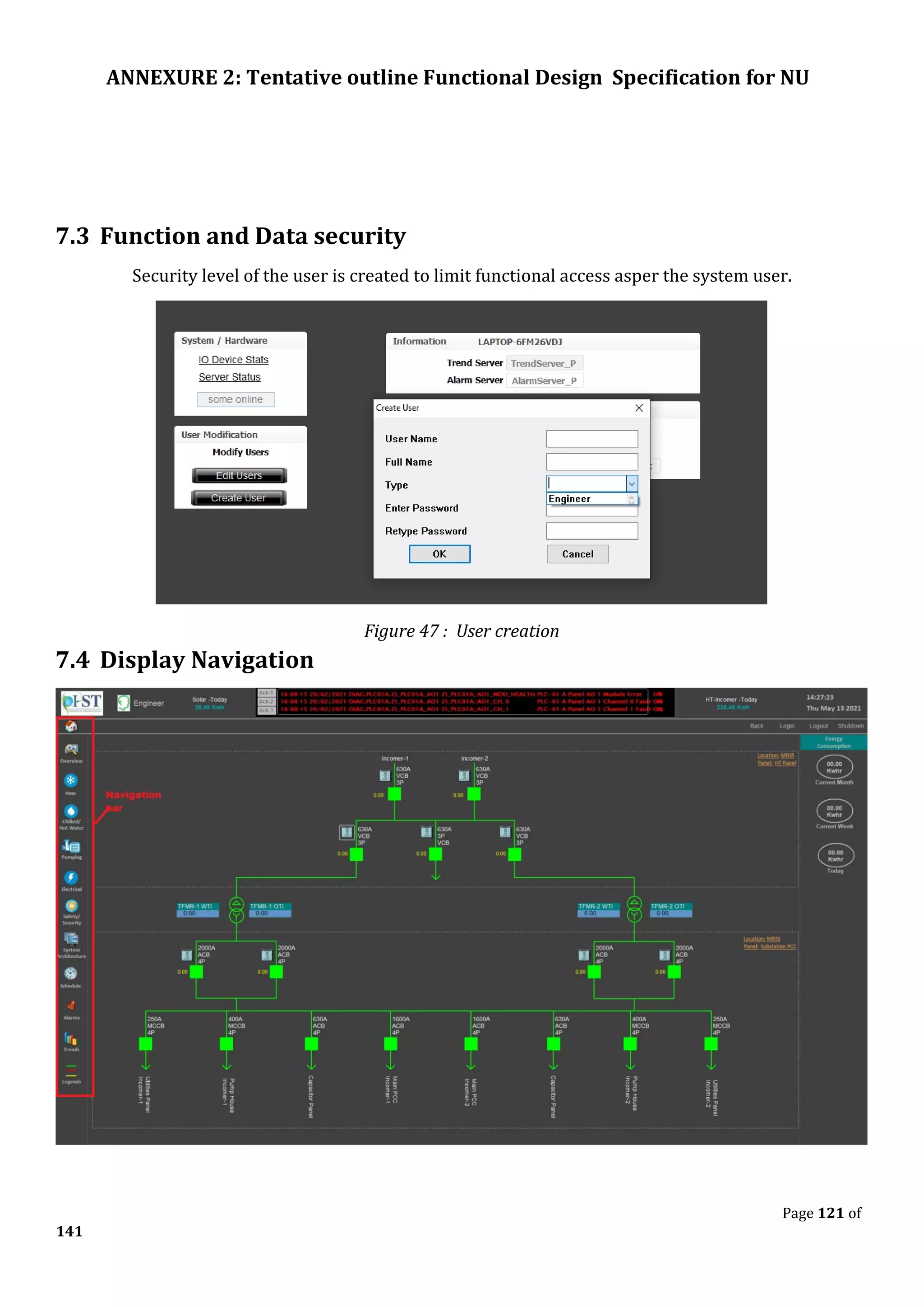
7.3 Function and Data security.......................................................................................................................... 121
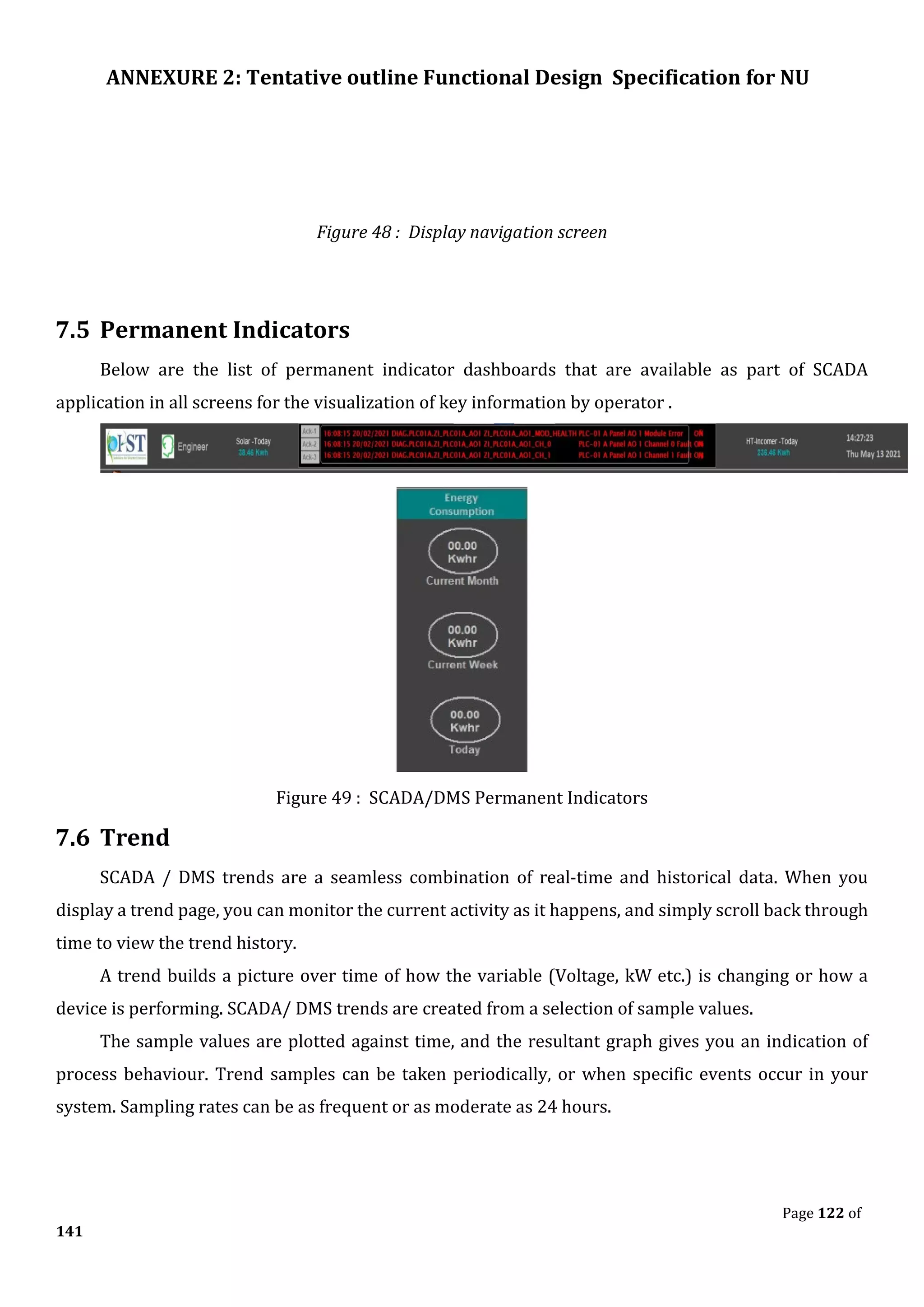
7.4 Display Navigation.......................................................................................................................................... 121
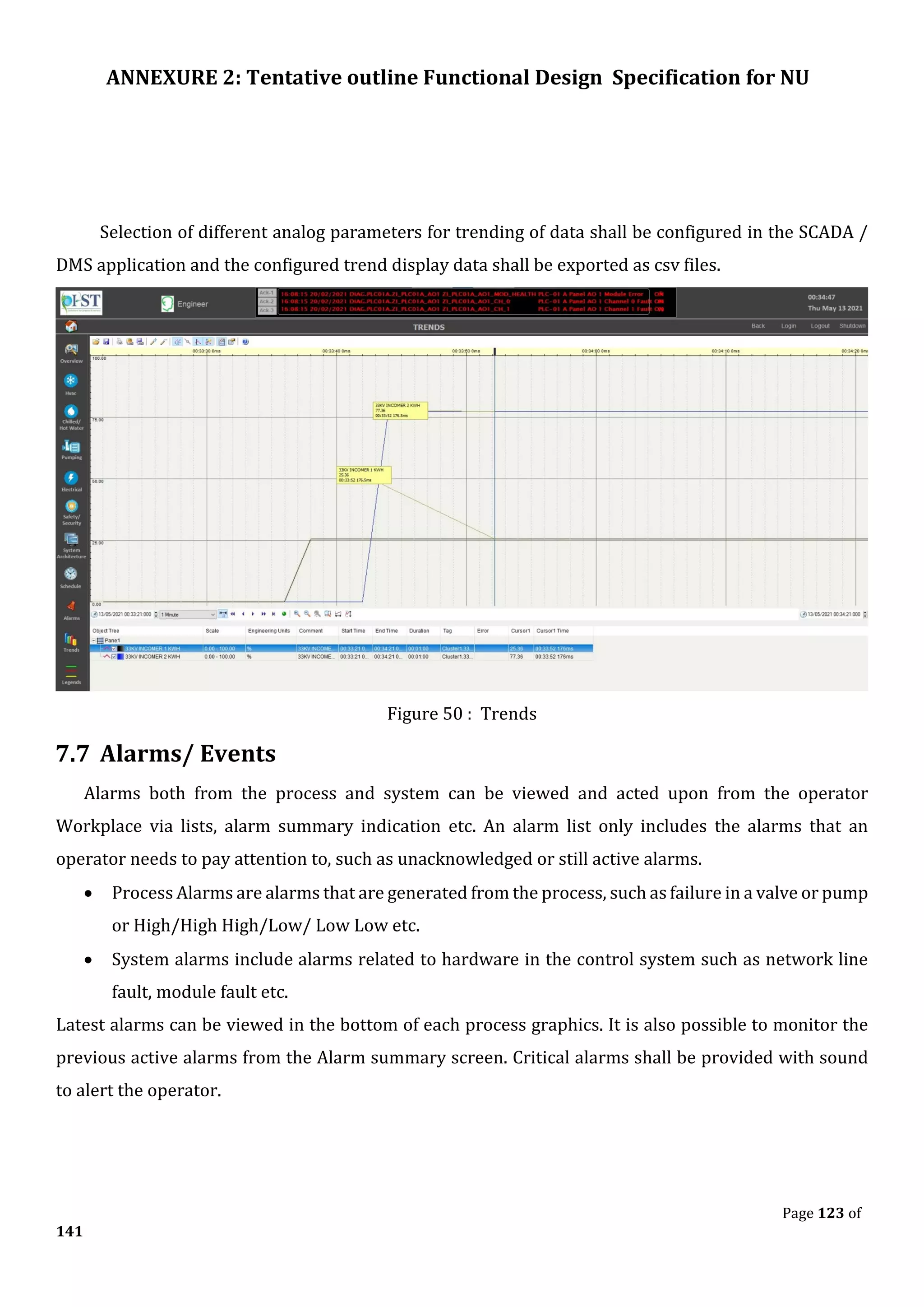
7.5 Permanent Indicators.................................................................................................................................... 122
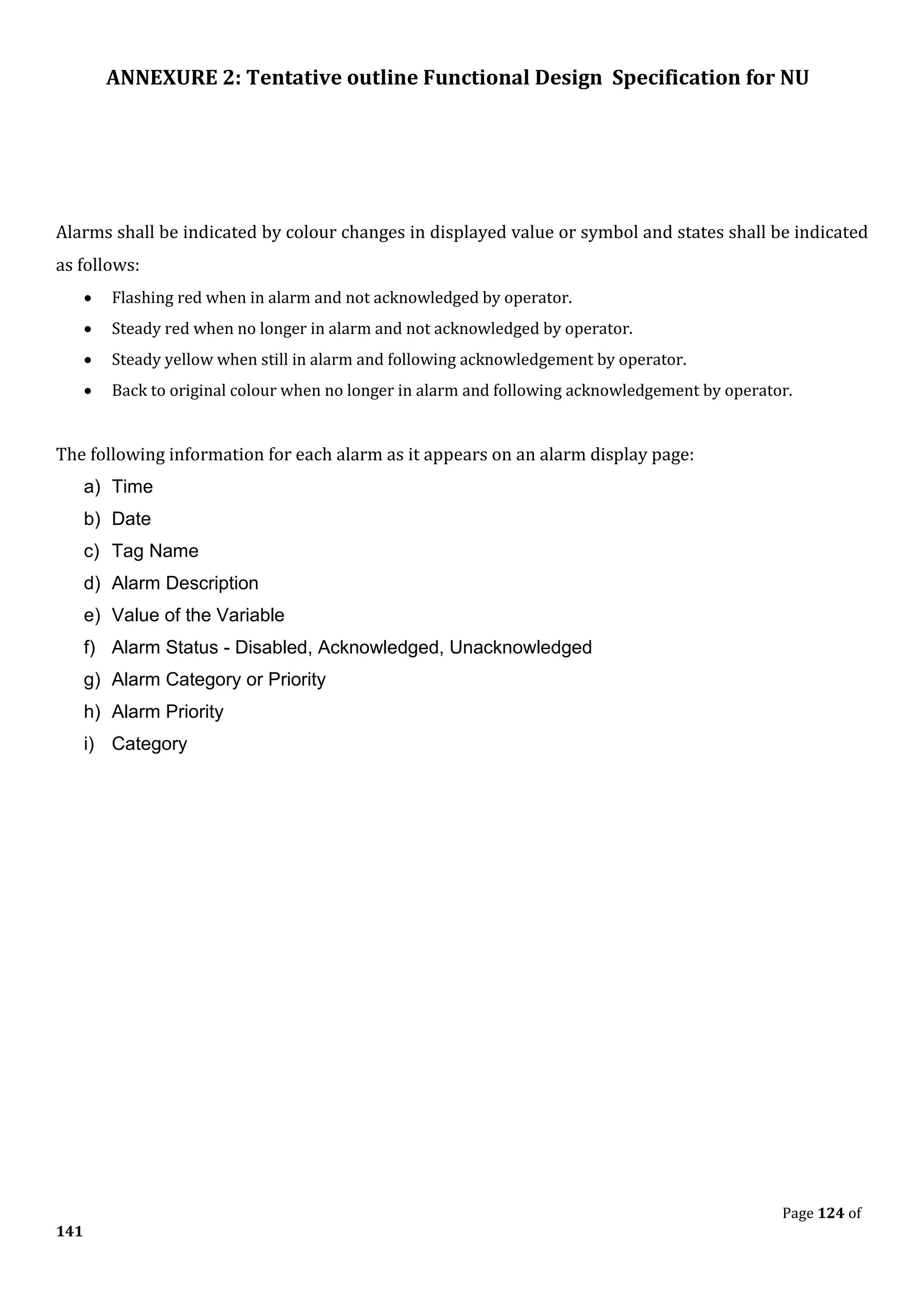
7.6 Trend.................................................................................................................................................................... 122
7.7 Alarms/ Events................................................................................................................................................. 123
7.8 Computer system configuration and monitoring displays.............................................................. 126
7.9 System Diagnostics and Monitoring......................................................................................................... 127
7.10 Sample Process Screens................................................................................................................................ 128
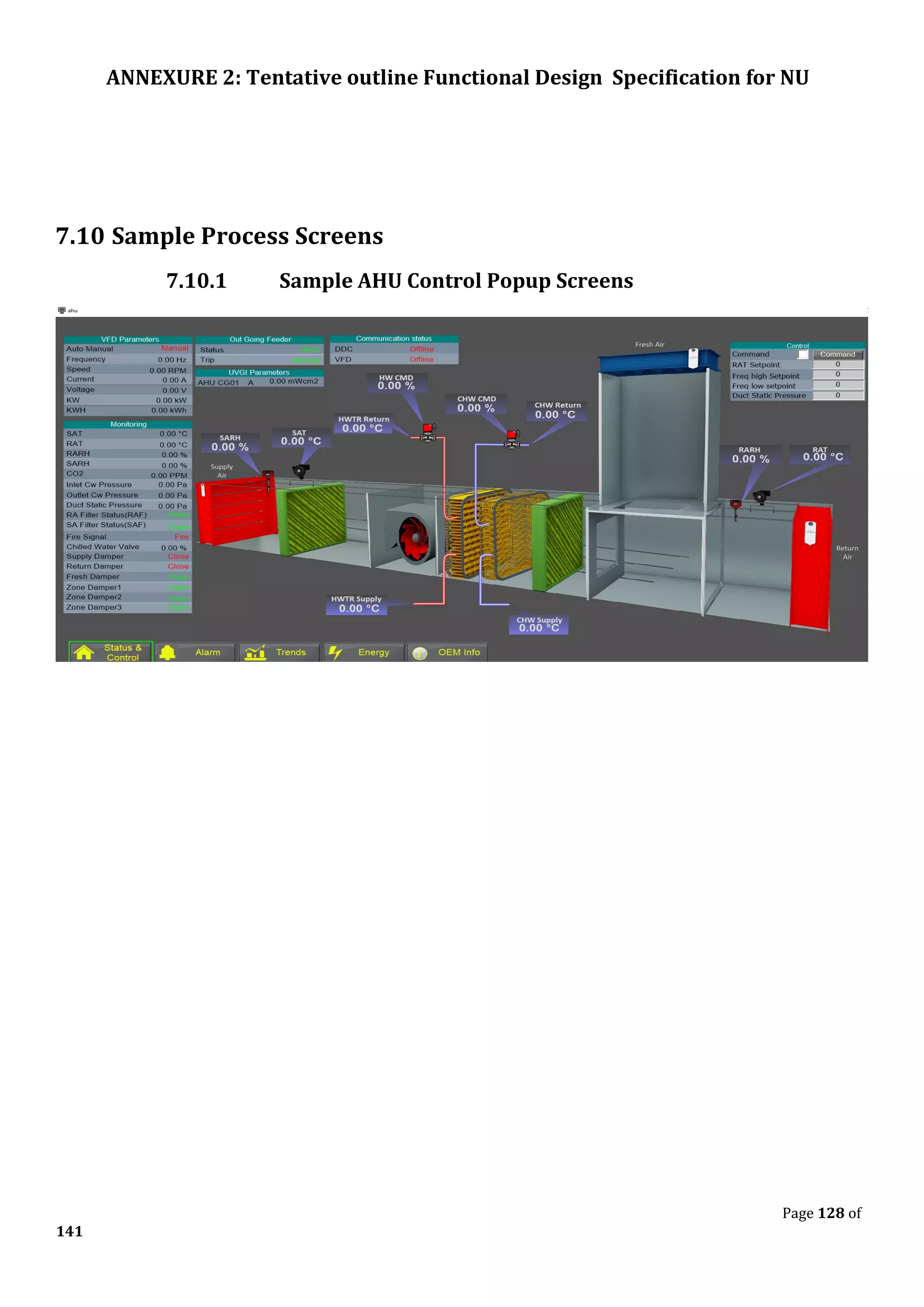
7.10.1 Sample AHU Control Popup Screens ................................................................................................... 128
8 Testing and Documentation ..................................................................................................................................... 129
8.1 Type Testing (Not Applicable for RTU Panel)...................................................................................... 129
8.2 Internal Functional testing .......................................................................................................................... 129
8.3 Factory Acceptance test (FAT)................................................................................................................... 129
8.3.1 Hardware Integration Test...................................................................................................................... 130
8.3.2 Functional Performance........................................................................................................................... 133
8.3.3 Continuous operation Test (48 hours)............................................................................................... 134
8.4 Site Acceptance Test (SAT).......................................................................................................................... 134
8.4.1 End to End test............................................................................................................................................. 134
8.4.2 System Availability Test ( 360 hours)................................................................................................. 135
9 Annexure.......................................................................................................................................................................... 136
9.1 Annexure – 1: System Architecture.......................................................................................................... 136
ANNEXURE 2: Tentative outline Functional Design Specification for NU
Page 5 of
141
List of Tables
Table 1: Reference Documents ...........................................................................................................................................13
Table 2 : List of Abbreviations.............................................................................................................................................13
Table 3: Applicable standards.............................................................................................................................................15
Table 4: OWS System HW Specification ..........................................................................................................................29
Table 5: EWS System HW Specification...........................................................................................................................29
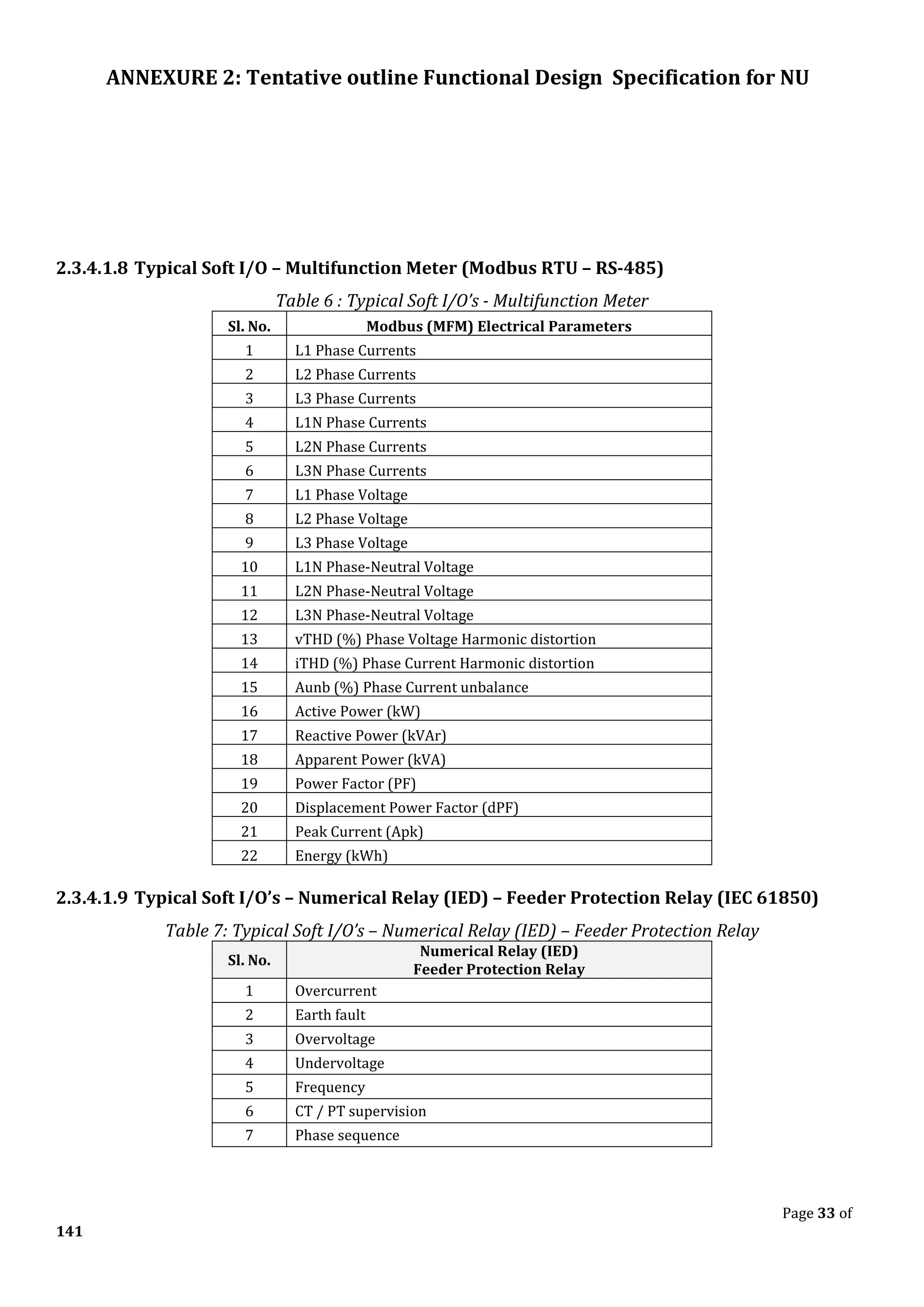
Table 6 : Typical Soft I/O’s - Multifunction Meter .......................................................................................................33
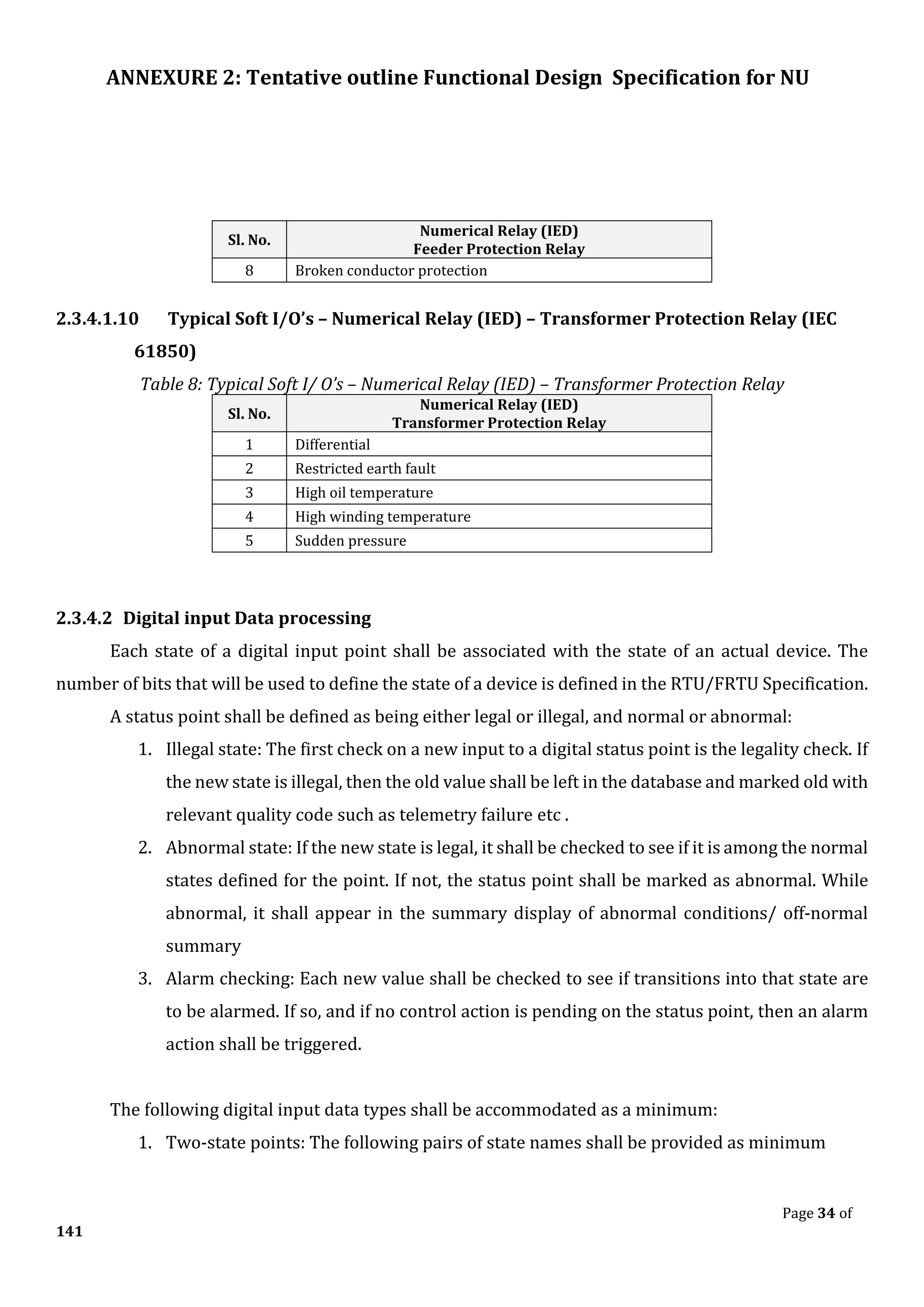
Table 7: Typical Soft I/O’s – Numerical Relay (IED) – Feeder Protection Relay .............................................33
Table 8: Typical Soft I/ O’s – Numerical Relay (IED) – Transformer Protection Relay ................................34
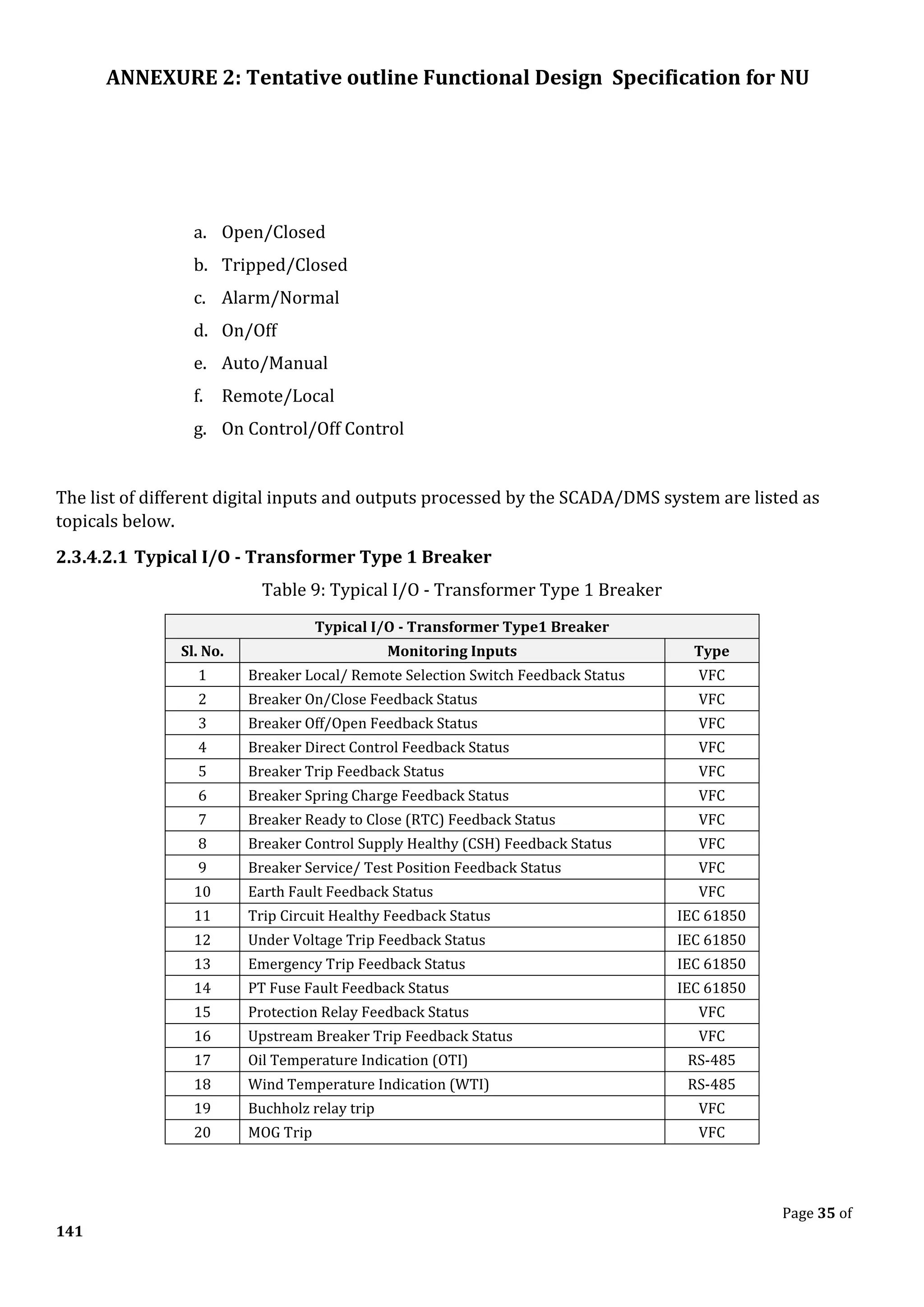
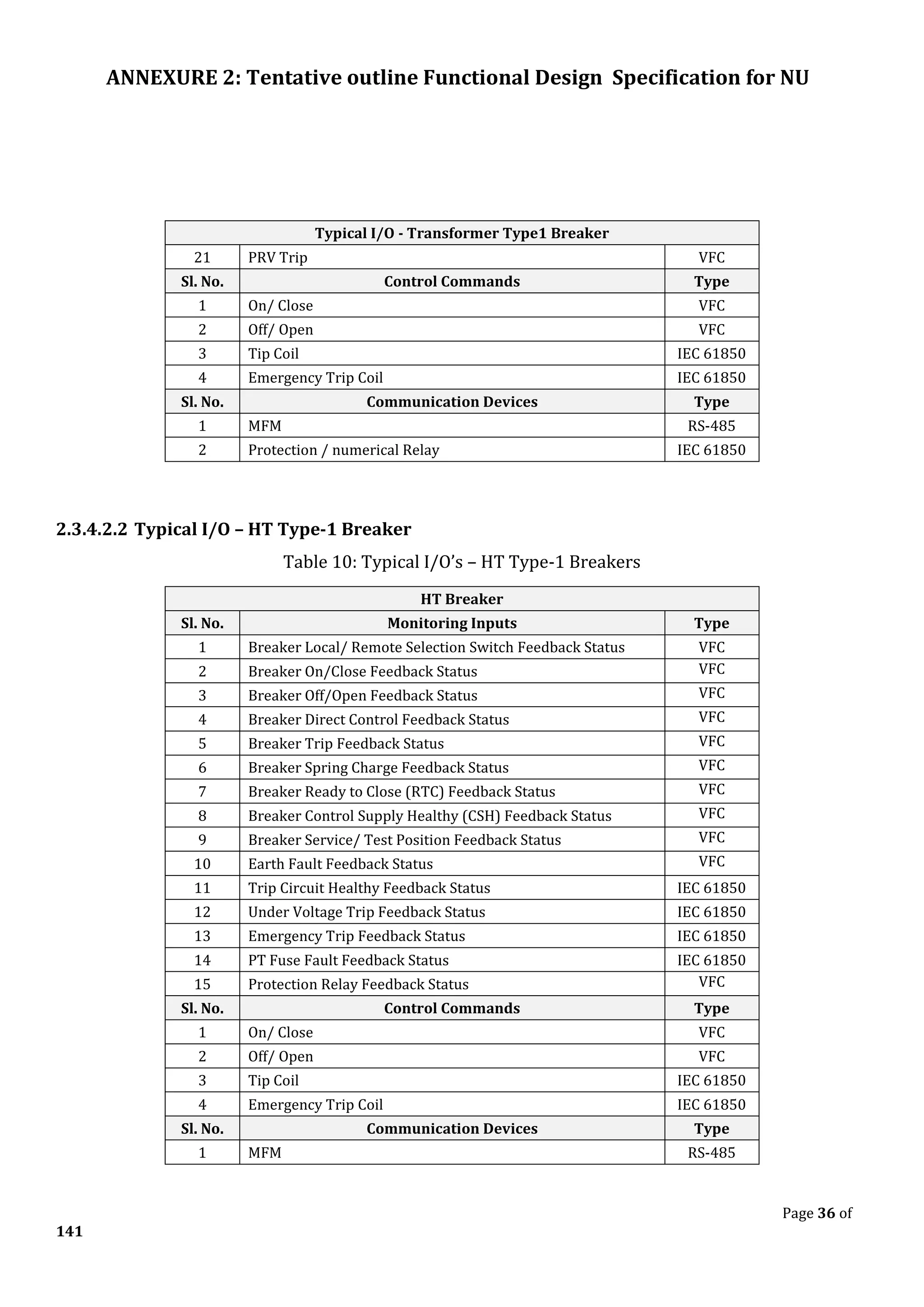
Table 9: Typical I/O - Transformer Type 1 Breaker...................................................................................................35
Table 10: Typical I/O’s – HT Type-1 Breakers..............................................................................................................36
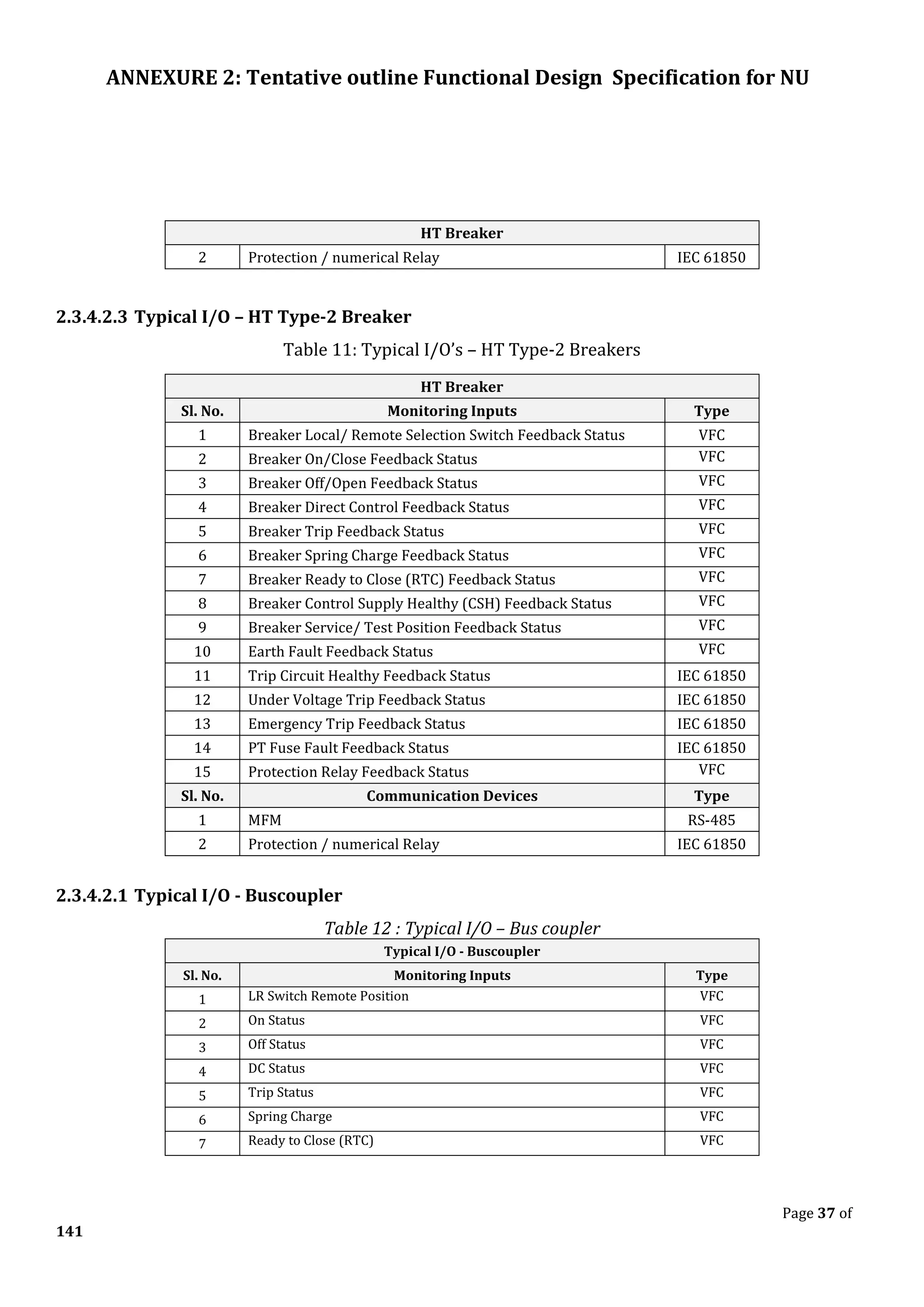
Table 11: Typical I/O’s – HT Type-2 Breakers..............................................................................................................37
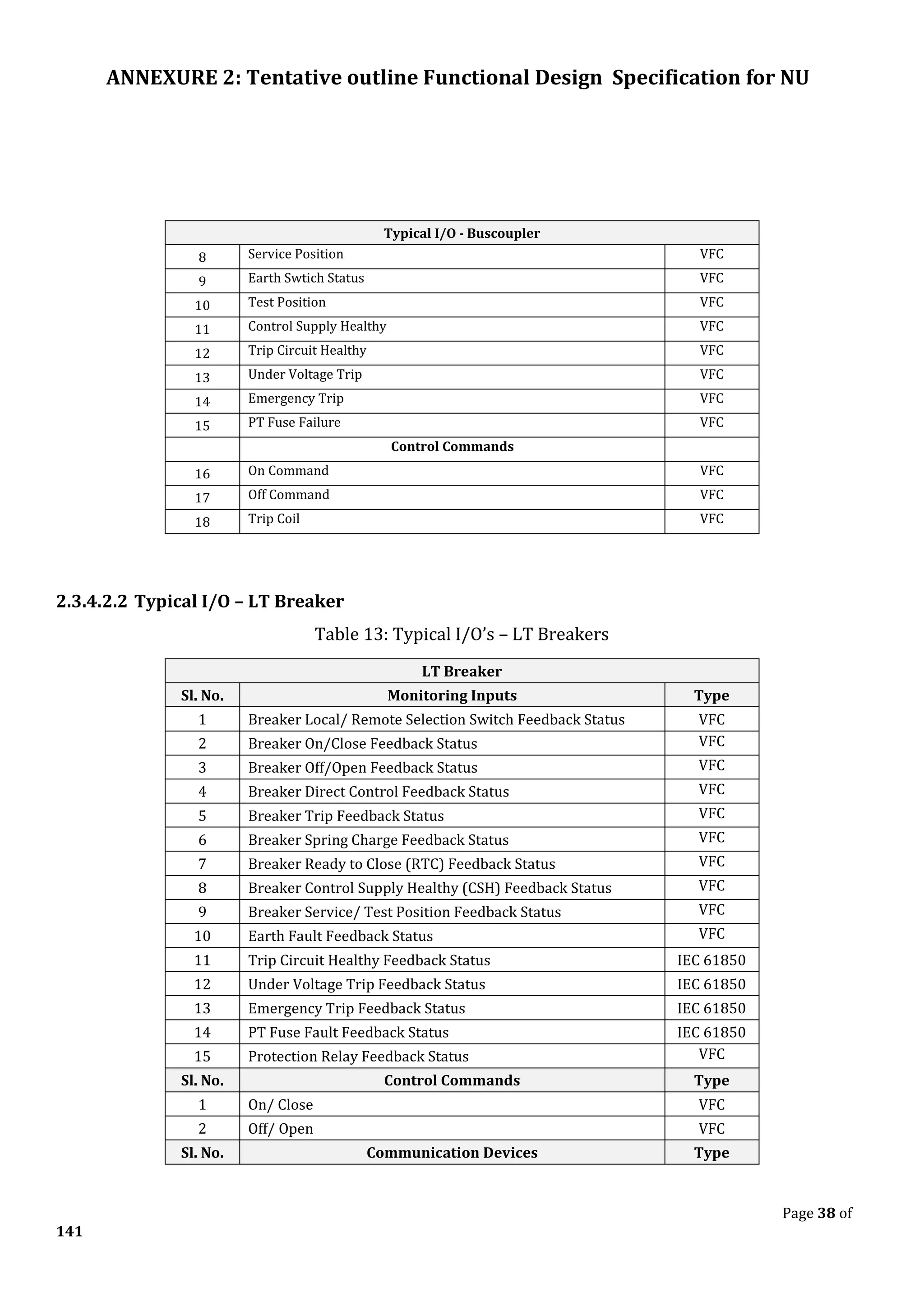
Table 12 : Typical I/O – Bus coupler.................................................................................................................................37
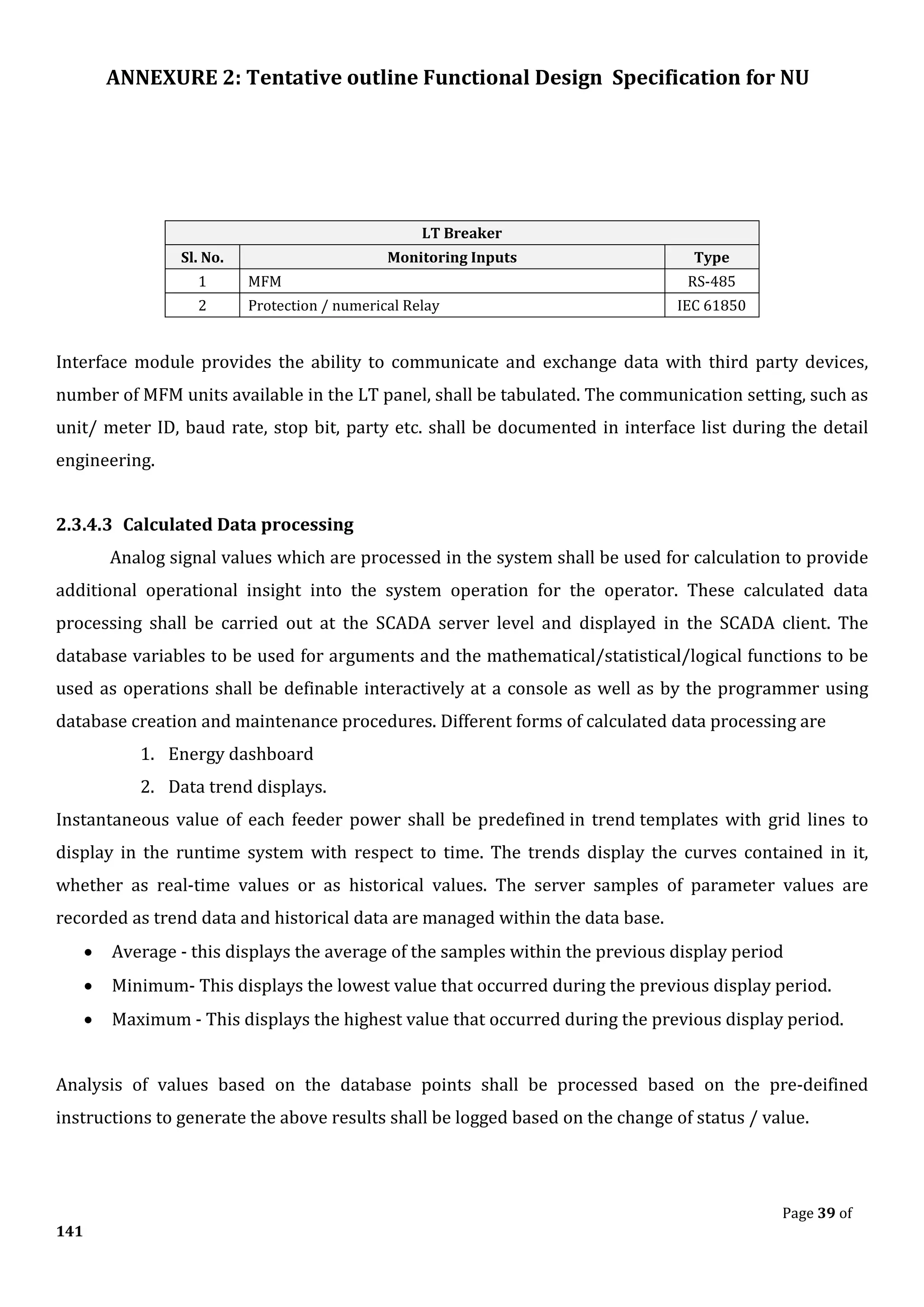
Table 13: Typical I/O’s – LT Breakers..............................................................................................................................38
Table 14: Permissive interlocks .........................................................................................................................................48
Table 15: OWS System HW Specification........................................................................................................................65
Table 16: EWS System HW Specification........................................................................................................................65
Table 17 : Technical Specification of Wi-Fi Adaptor/Bridge...................................................................................86
Table 18: Soft I/ O’s – Numerical Relay (IED) – Transformer Protection Relay..............................................91
Table 19: System Power calculation.................................................................................................................................92
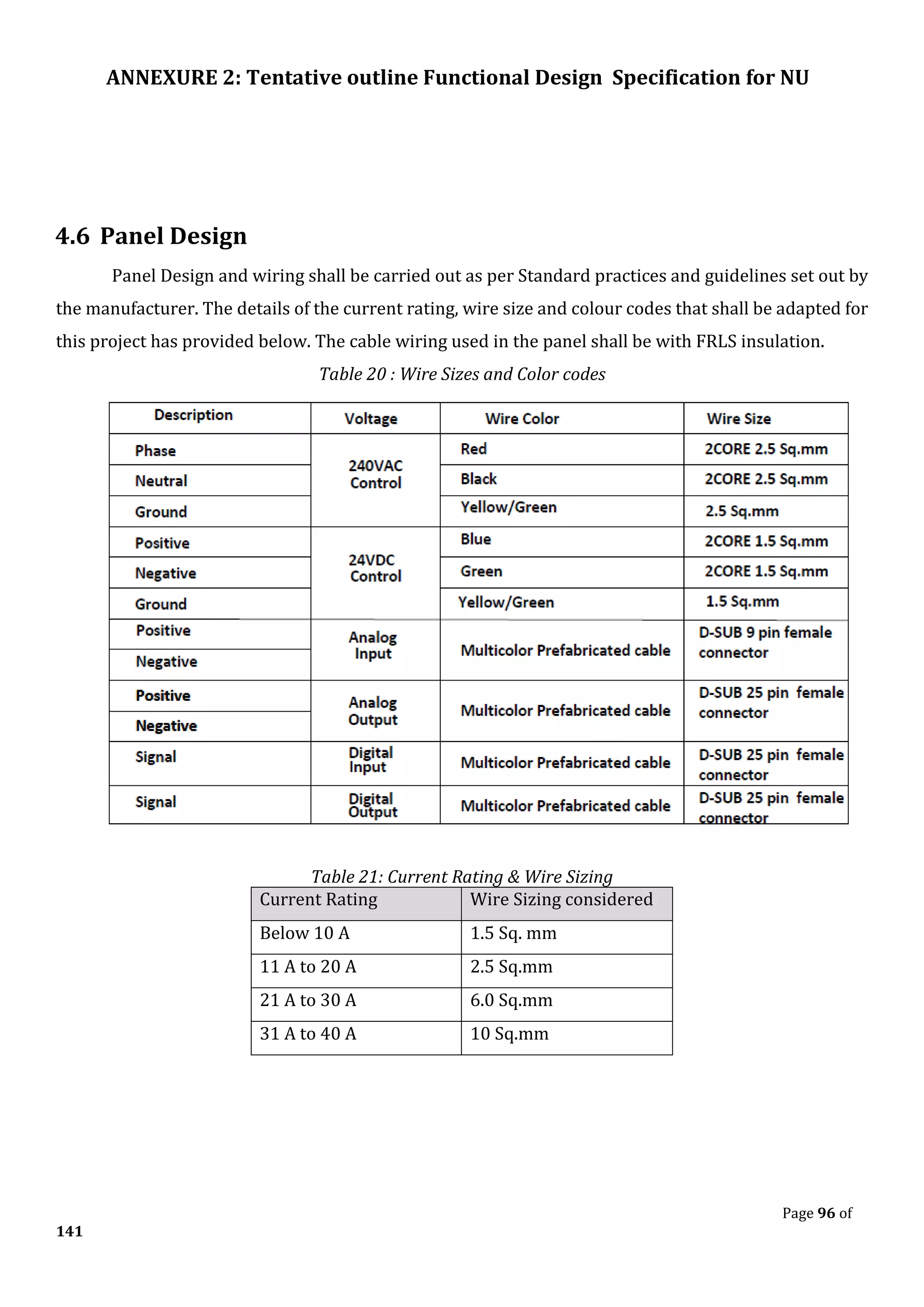
Table 20 : Wire Sizes and Color codes..............................................................................................................................96
Table 21: Current Rating & Wire Sizing...........................................................................................................................96
Table 22 : Weather Monitoring System Parameters ............................................................................................... 103
Table 23: Modbus Communication setting.................................................................................................................. 108
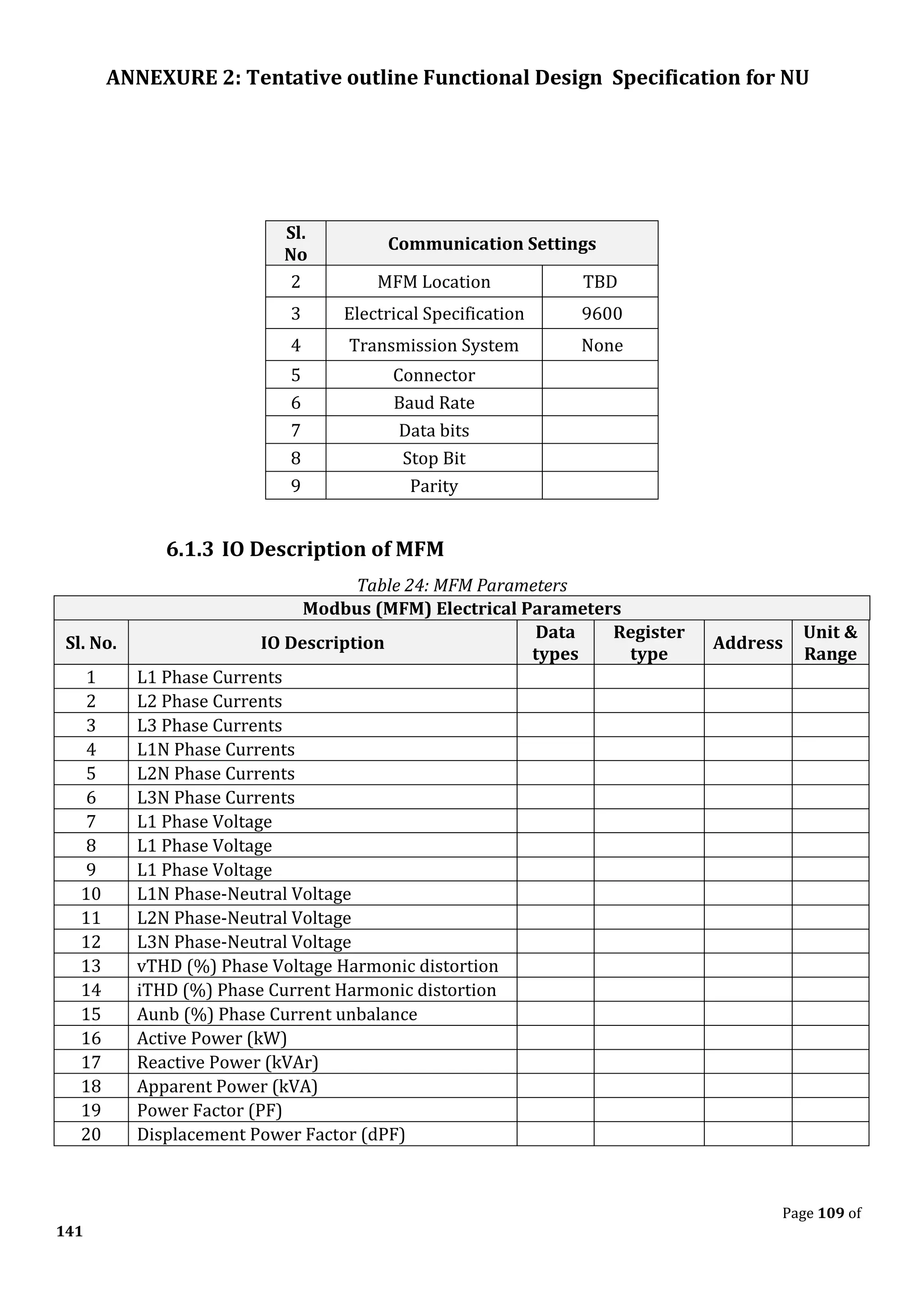
Table 24: MFM Parameters ............................................................................................................................................... 109
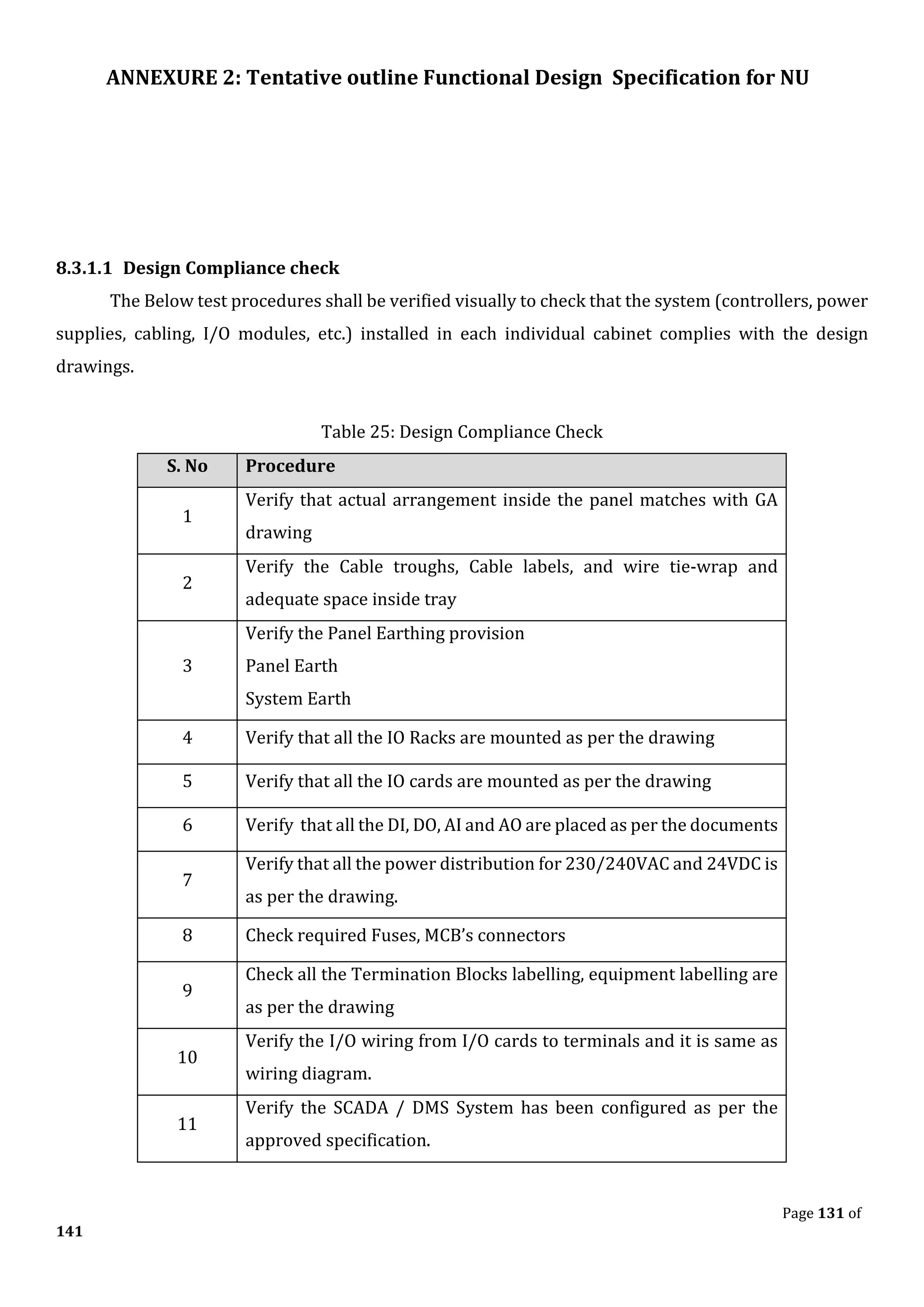
Table 25: Design Compliance Check.............................................................................................................................. 131
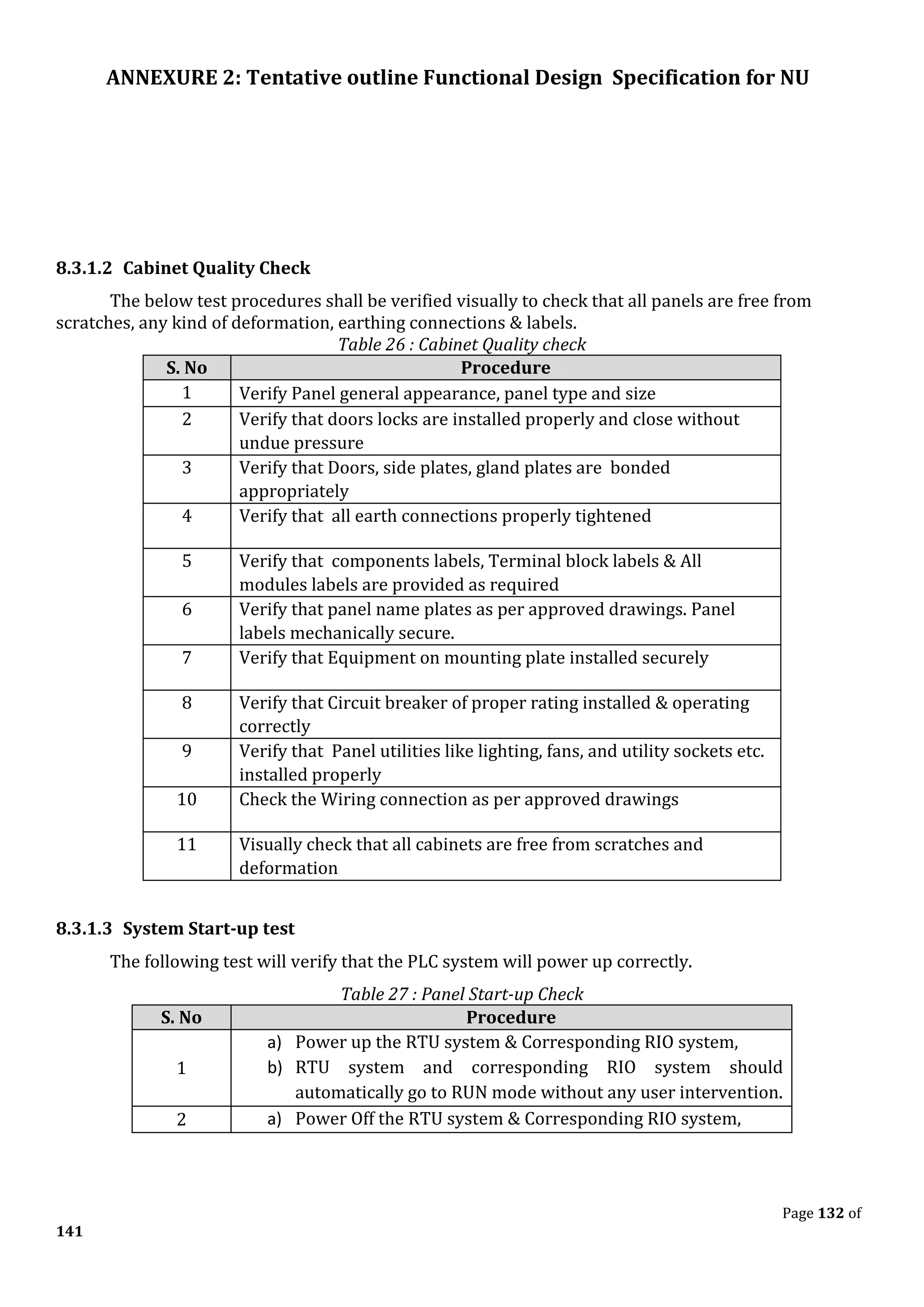
Table 26 : Cabinet Quality check ..................................................................................................................................... 132
Table 27 : Panel Start-up Check....................................................................................................................................... 132
List of Figures
Figure 1: Generic System Architecture...............................................................................................................................11
Figure 2 : Communication Block Diagram......................................................................................................................21
Figure 3 : Sample communication architecture ...........................................................................................................26
Figure 4 : Time synchronization scheme........................................................................................................................28
Figure 5 : IO server operation of SCADA/DMS system..............................................................................................43
Figure 6 : Seamless dataflow of SCADA/DMS system................................................................................................45
Figure 7 : Control Inhibit Tag operation of SCADA/DMS system..........................................................................47
ANNEXURE 2: Tentative outline Functional Design Specification for NU
Page 6 of
141
Figure 8 : SCADA/DMS Fail-soft Capability....................................................................................................................51
Figure 9 : PLC Redundant Architecture...........................................................................................................................53
Figure 10 : SCADA Remote Database Downloading Mechanism...........................................................................54
Figure 11 : Circuit Breaker status table..........................................................................................................................57
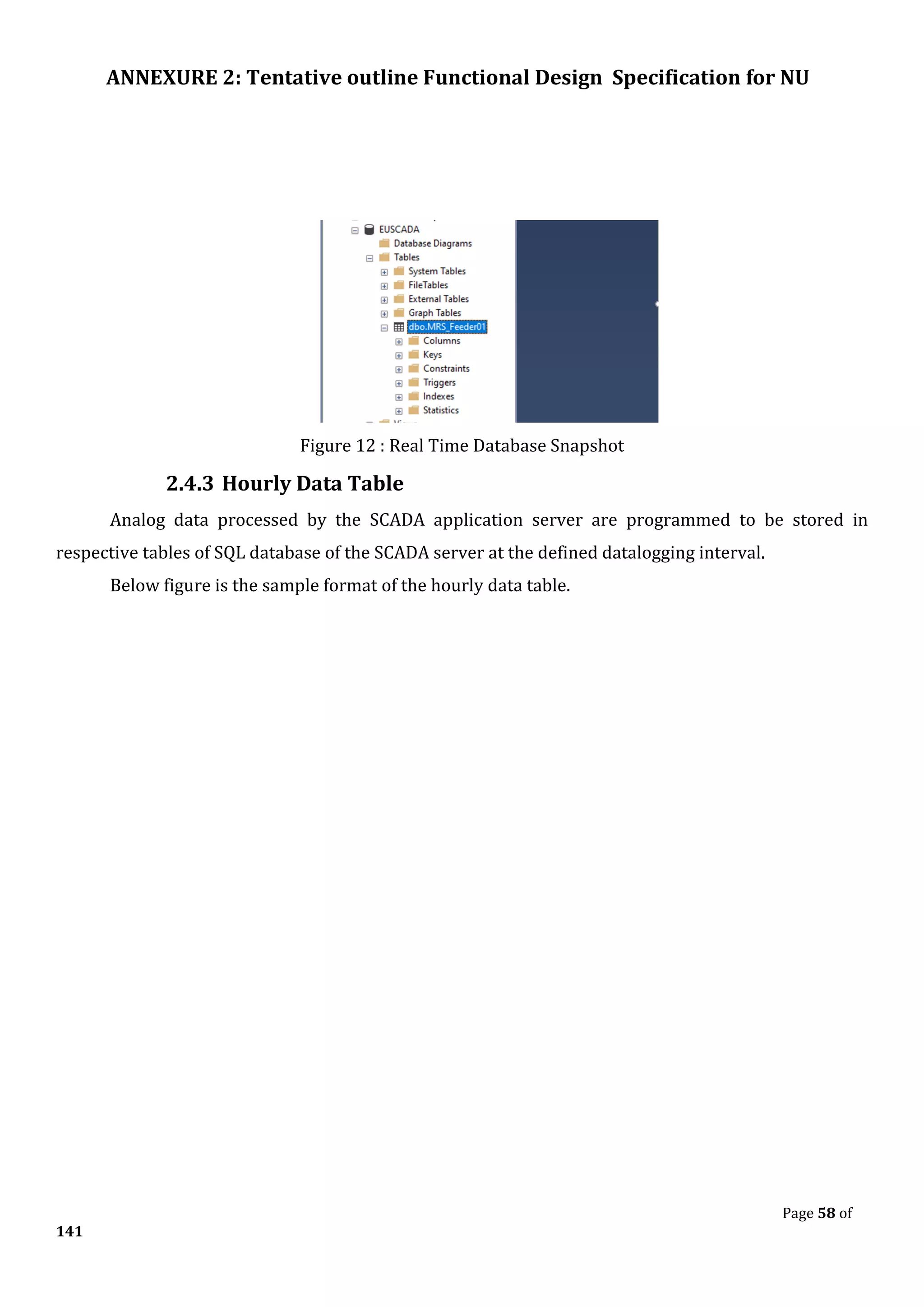
Figure 12 : Real Time Database Snapshot ......................................................................................................................58
Figure 13 : Hourly Report data Snapshot .......................................................................................................................59
Figure 14 : Daily Report data Snapshot...........................................................................................................................61
Figure 15 : SCADA deployment model for OWS...........................................................................................................69
Figure 16 : Web client............................................................................................................................................................70
Figure 17 : RTU Panel General Arrangement-1...........................................................................................................71
ANNEXURE 2: Tentative outline Functional Design Specification for NU
Page 7 of
141
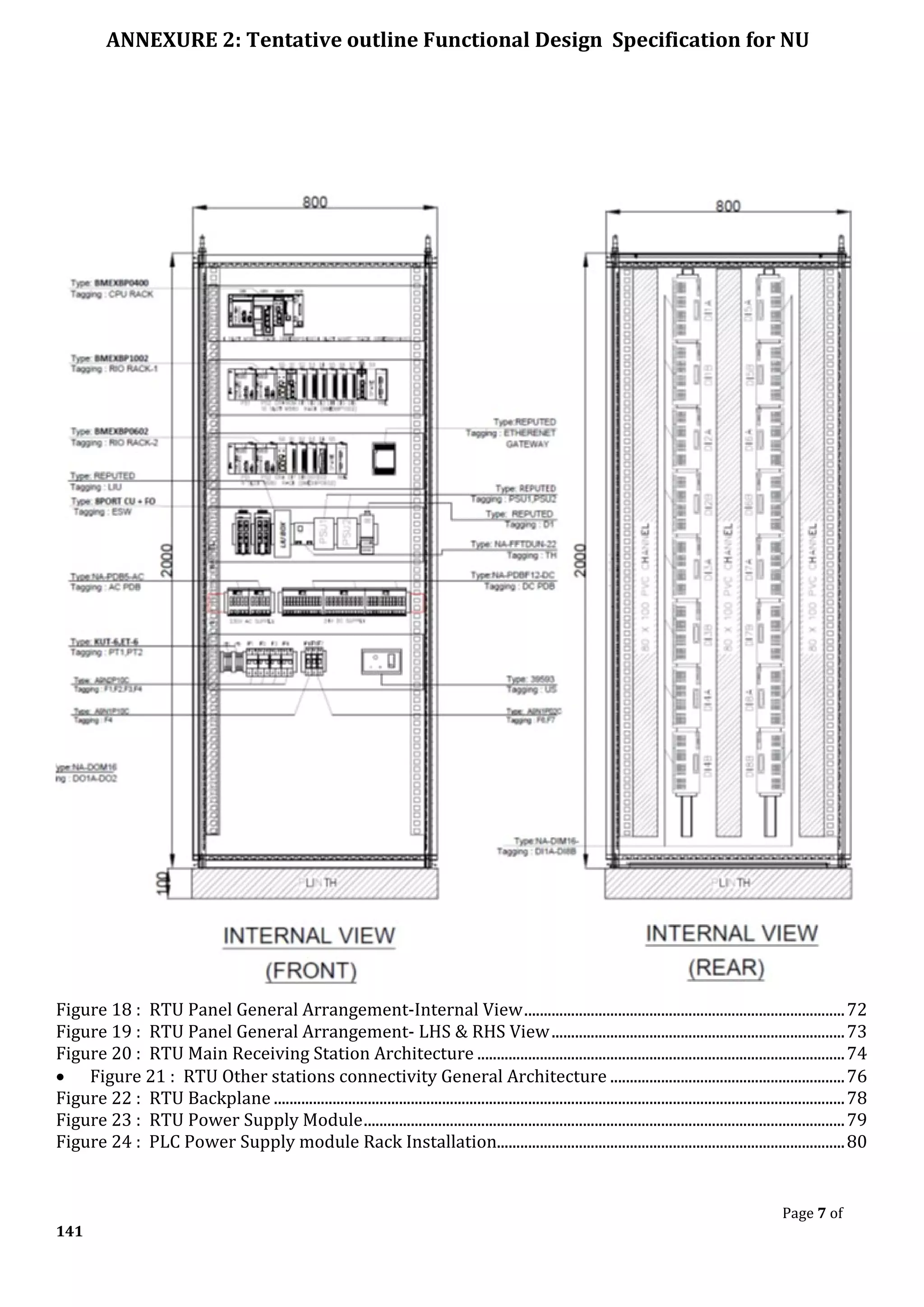
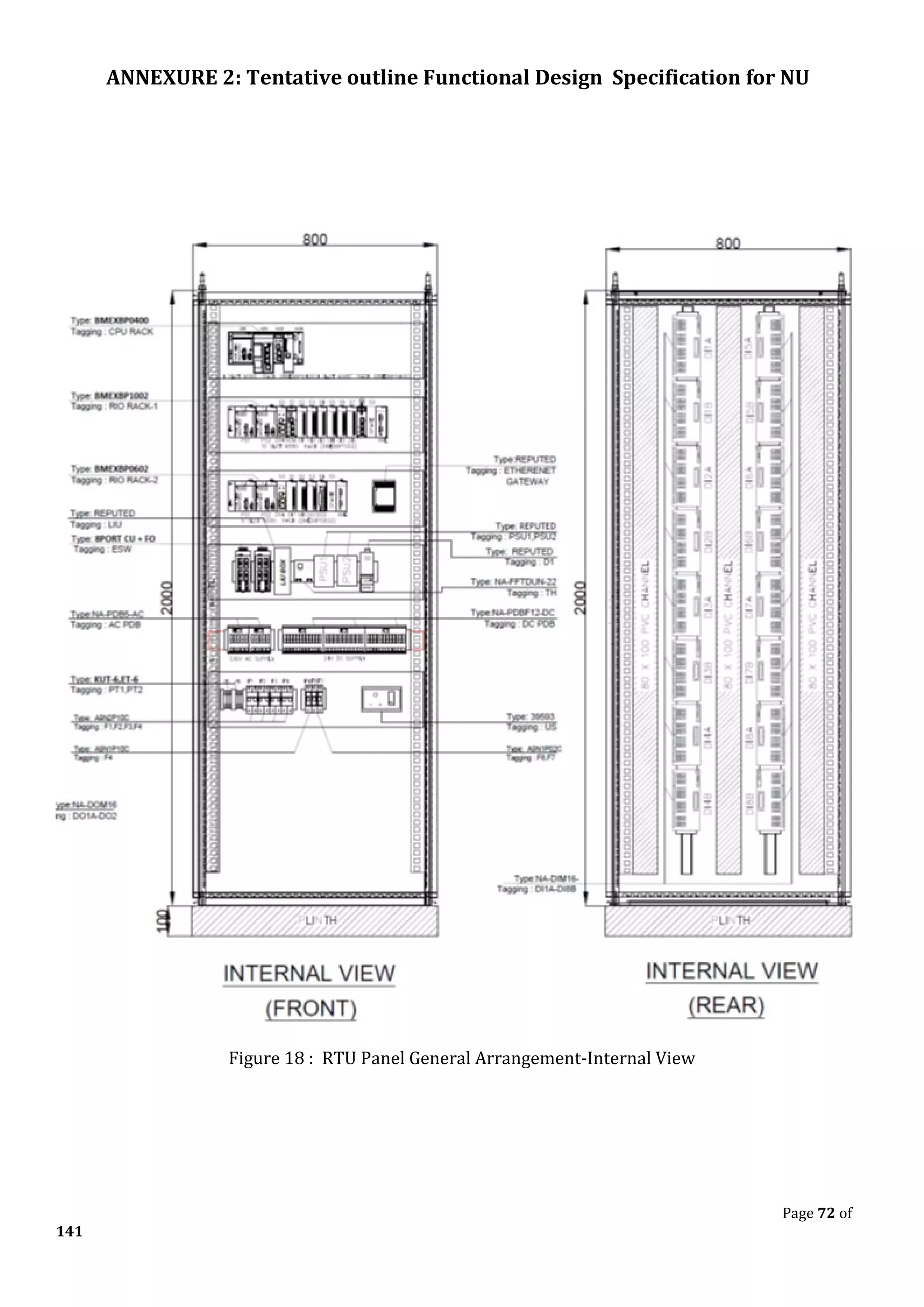
Figure 18 : RTU Panel General Arrangement-Internal View..................................................................................72
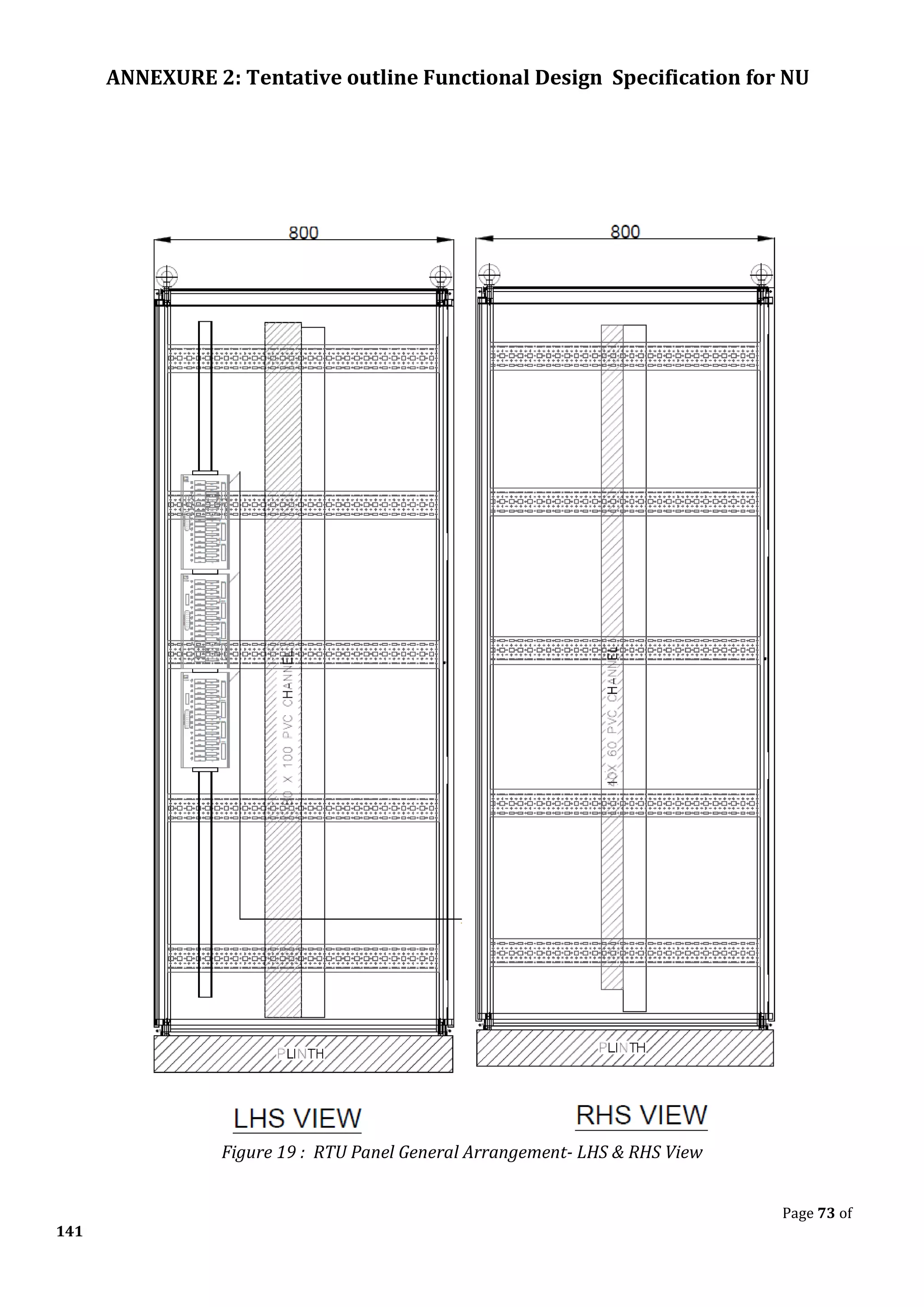
Figure 19 : RTU Panel General Arrangement- LHS & RHS View...........................................................................73
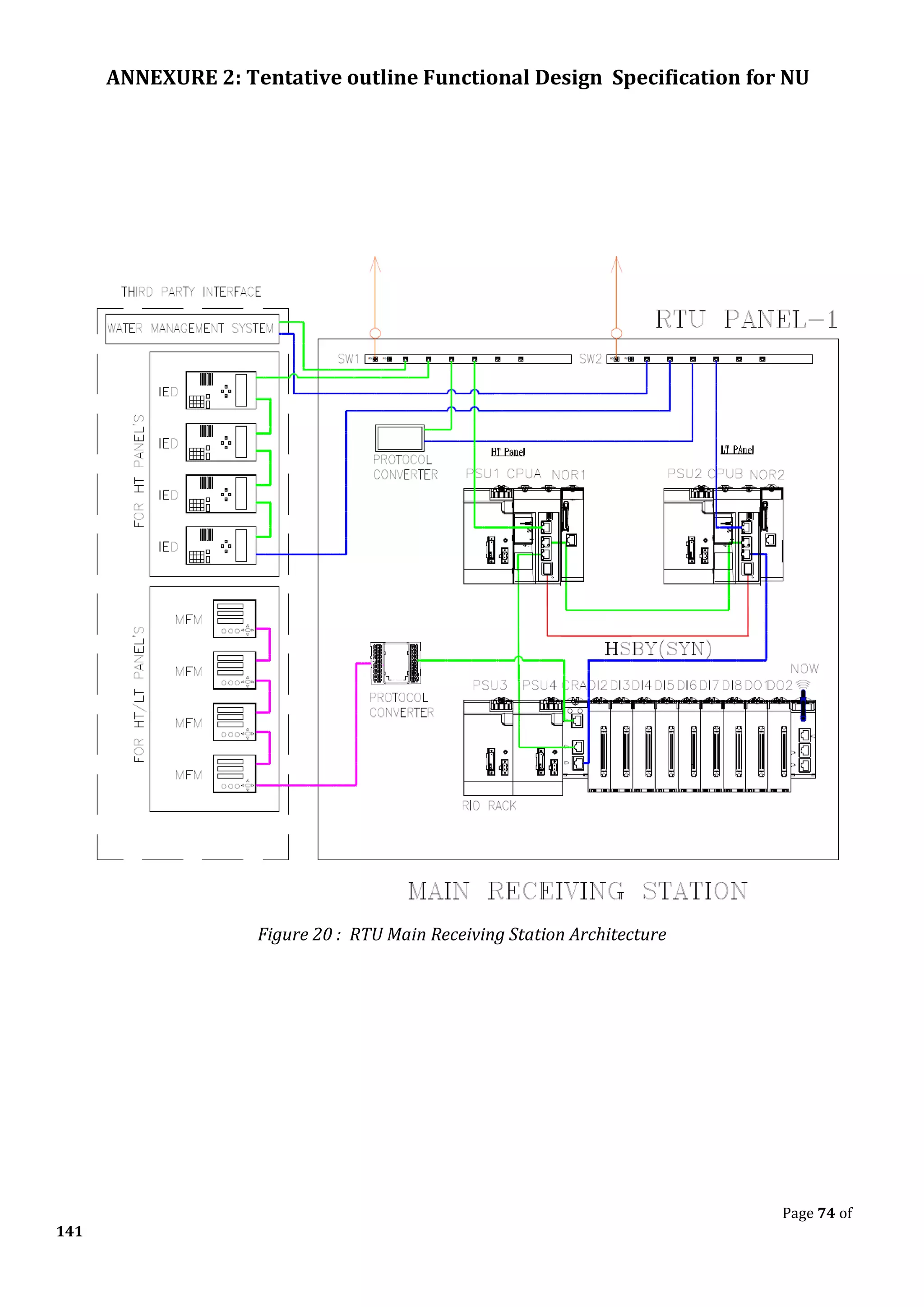
Figure 20 : RTU Main Receiving Station Architecture ..............................................................................................74
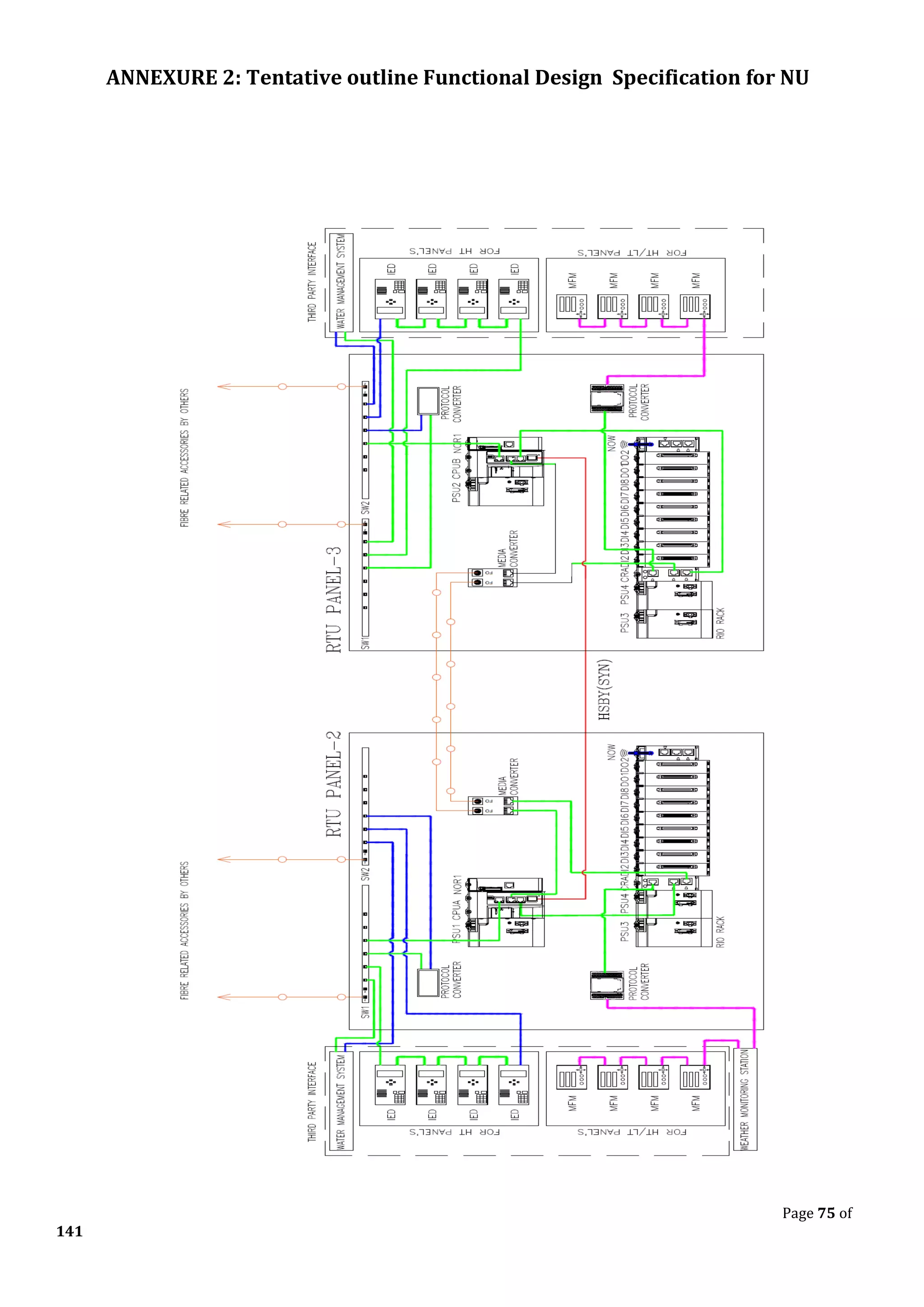
• Figure 21 : RTU Other stations connectivity General Architecture ............................................................76
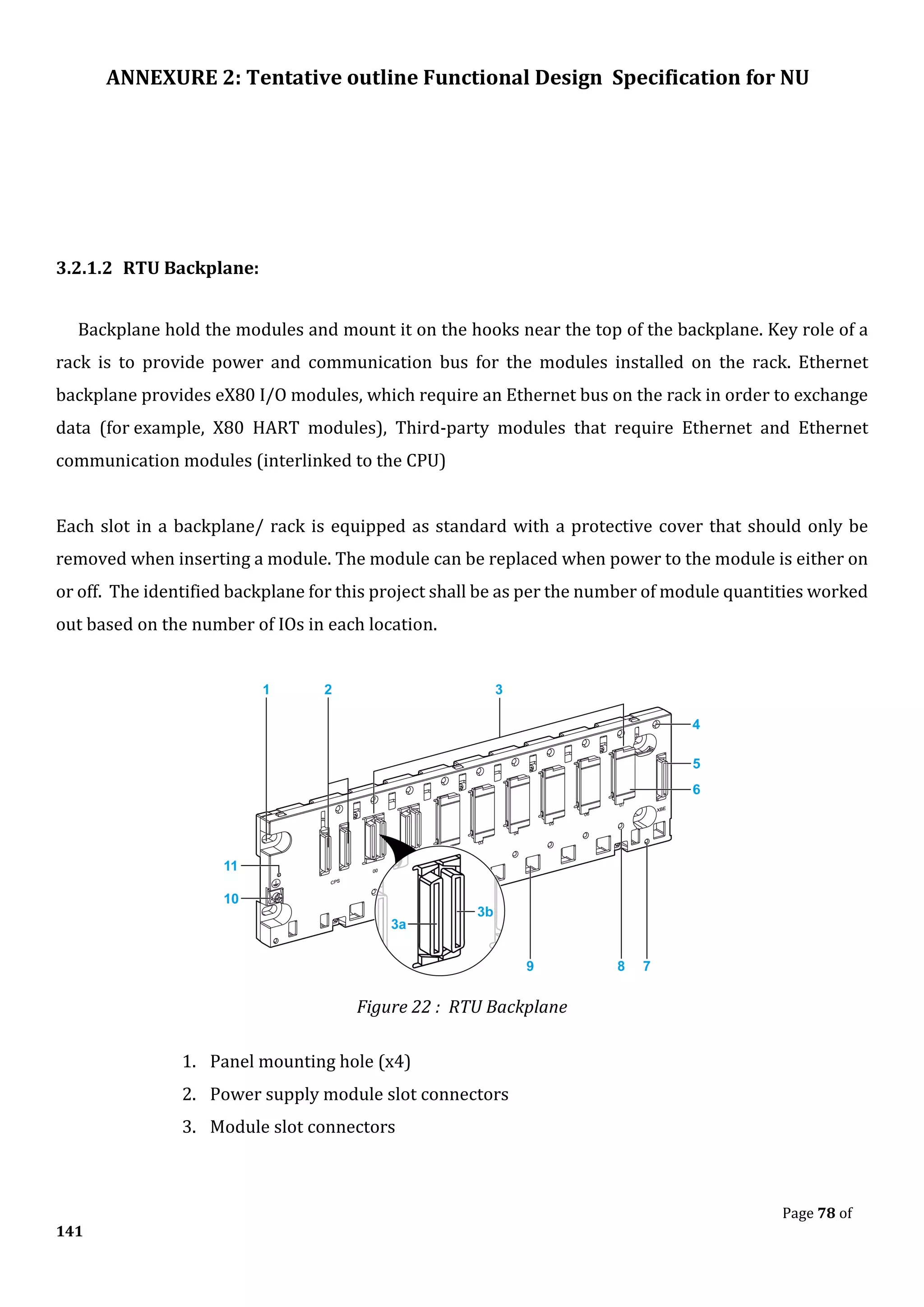
Figure 22 : RTU Backplane ..................................................................................................................................................78
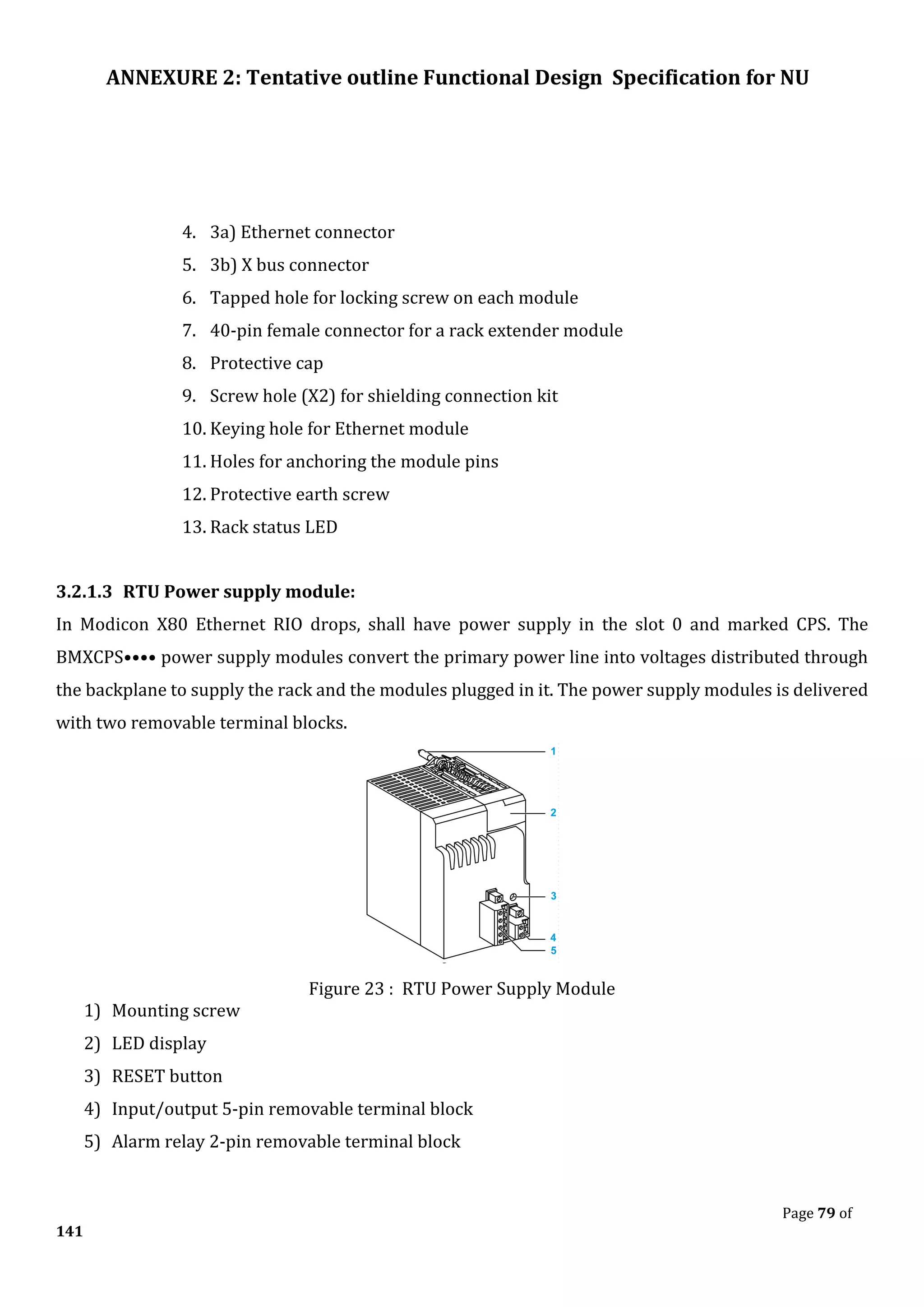
Figure 23 : RTU Power Supply Module...........................................................................................................................79
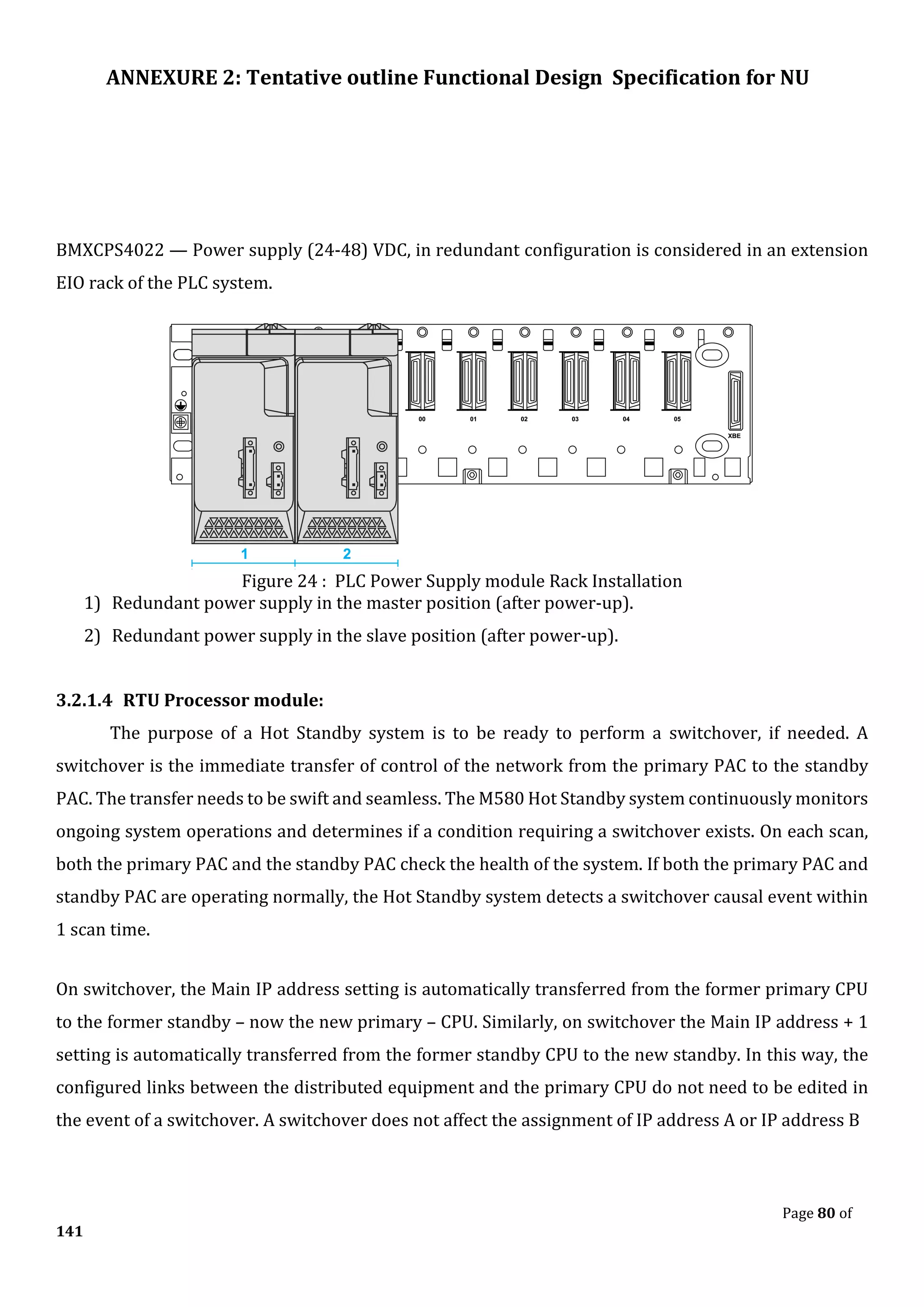
Figure 24 : PLC Power Supply module Rack Installation.........................................................................................80
ANNEXURE 2: Tentative outline Functional Design Specification for NU
Page 8 of
141
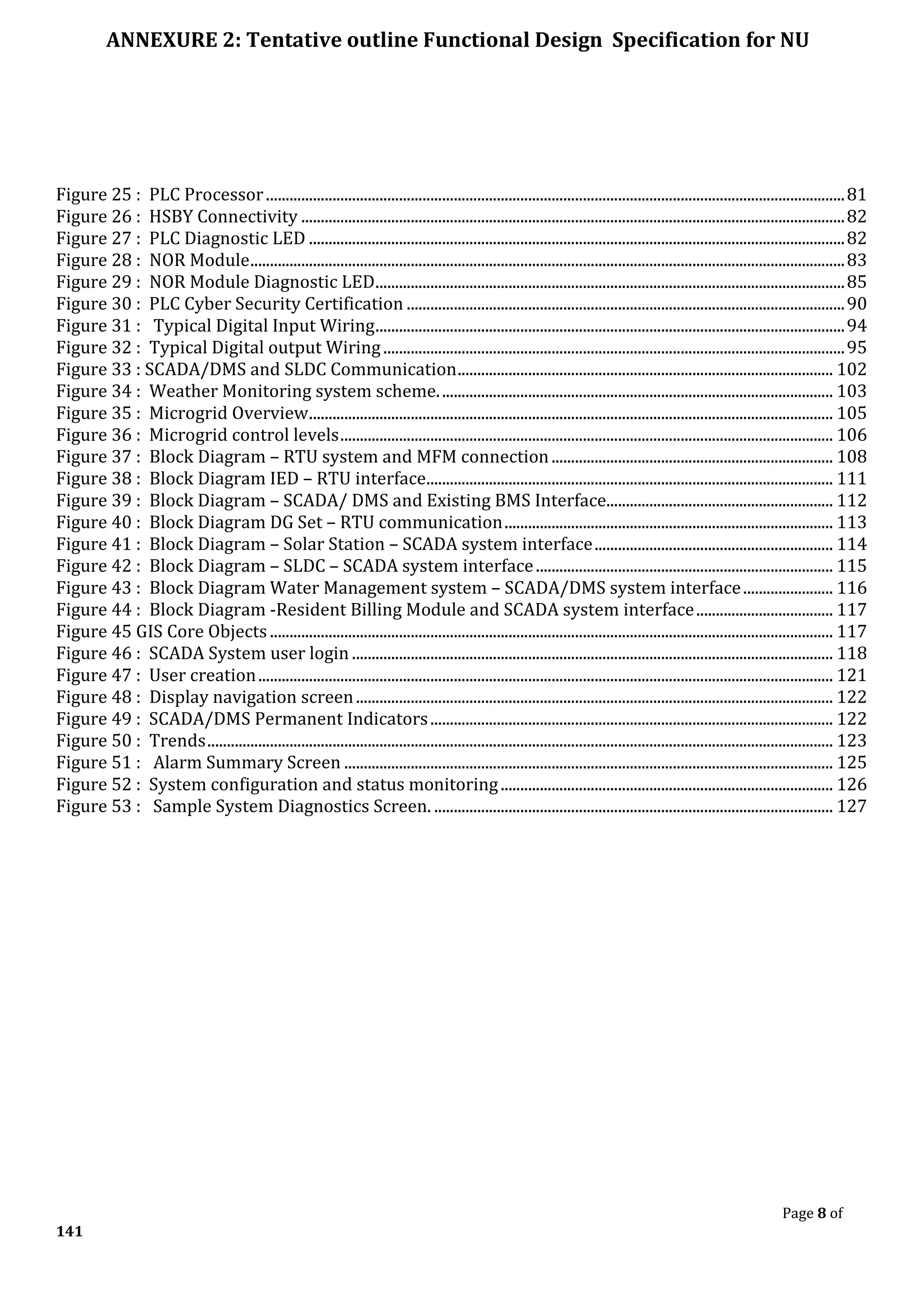
Figure 25 : PLC Processor....................................................................................................................................................81
Figure 26 : HSBY Connectivity ...........................................................................................................................................82
Figure 27 : PLC Diagnostic LED .........................................................................................................................................82
Figure 28 : NOR Module........................................................................................................................................................83
Figure 29 : NOR Module Diagnostic LED........................................................................................................................85
Figure 30 : PLC Cyber Security Certification ................................................................................................................90
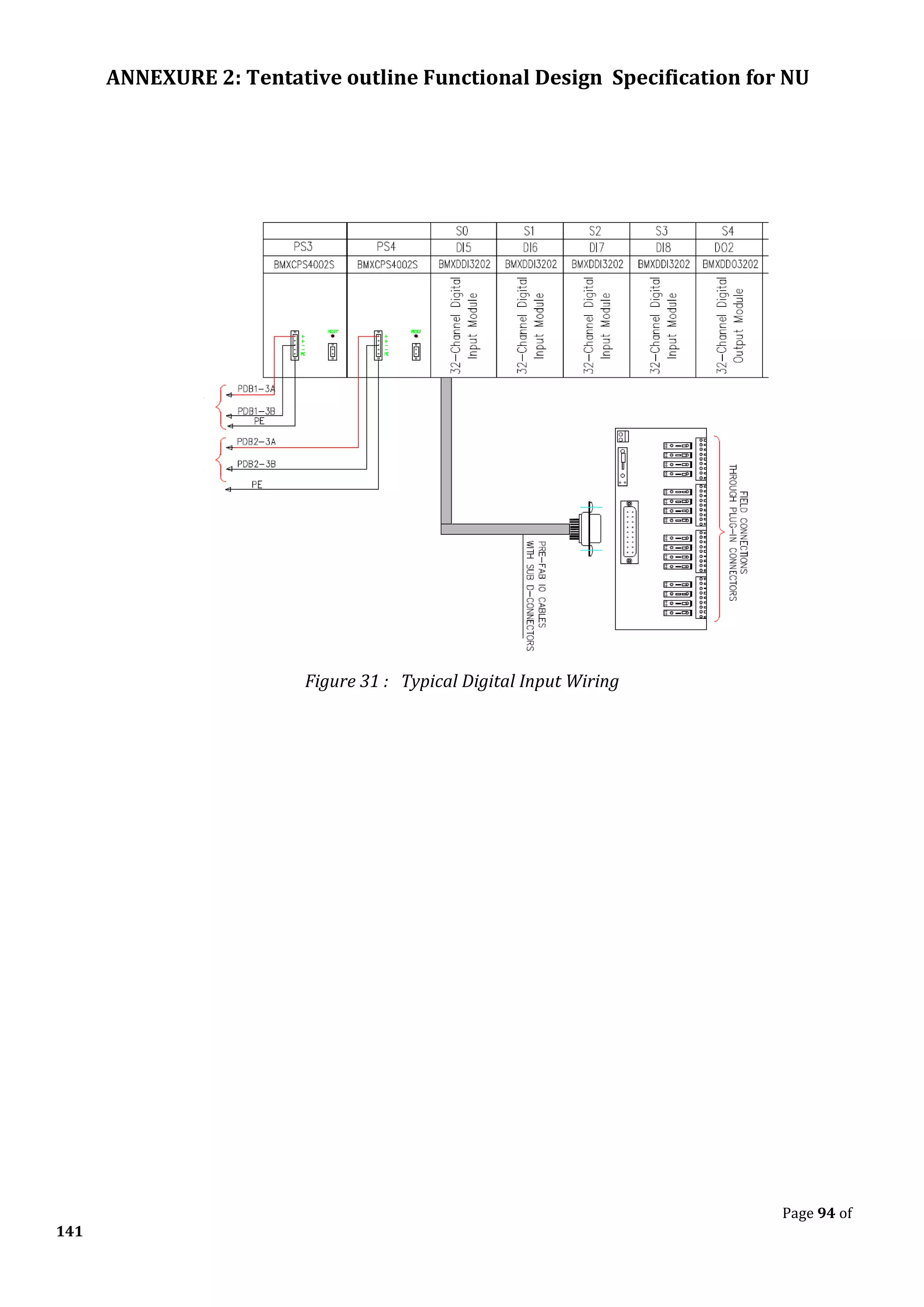
Figure 31 : Typical Digital Input Wiring........................................................................................................................94
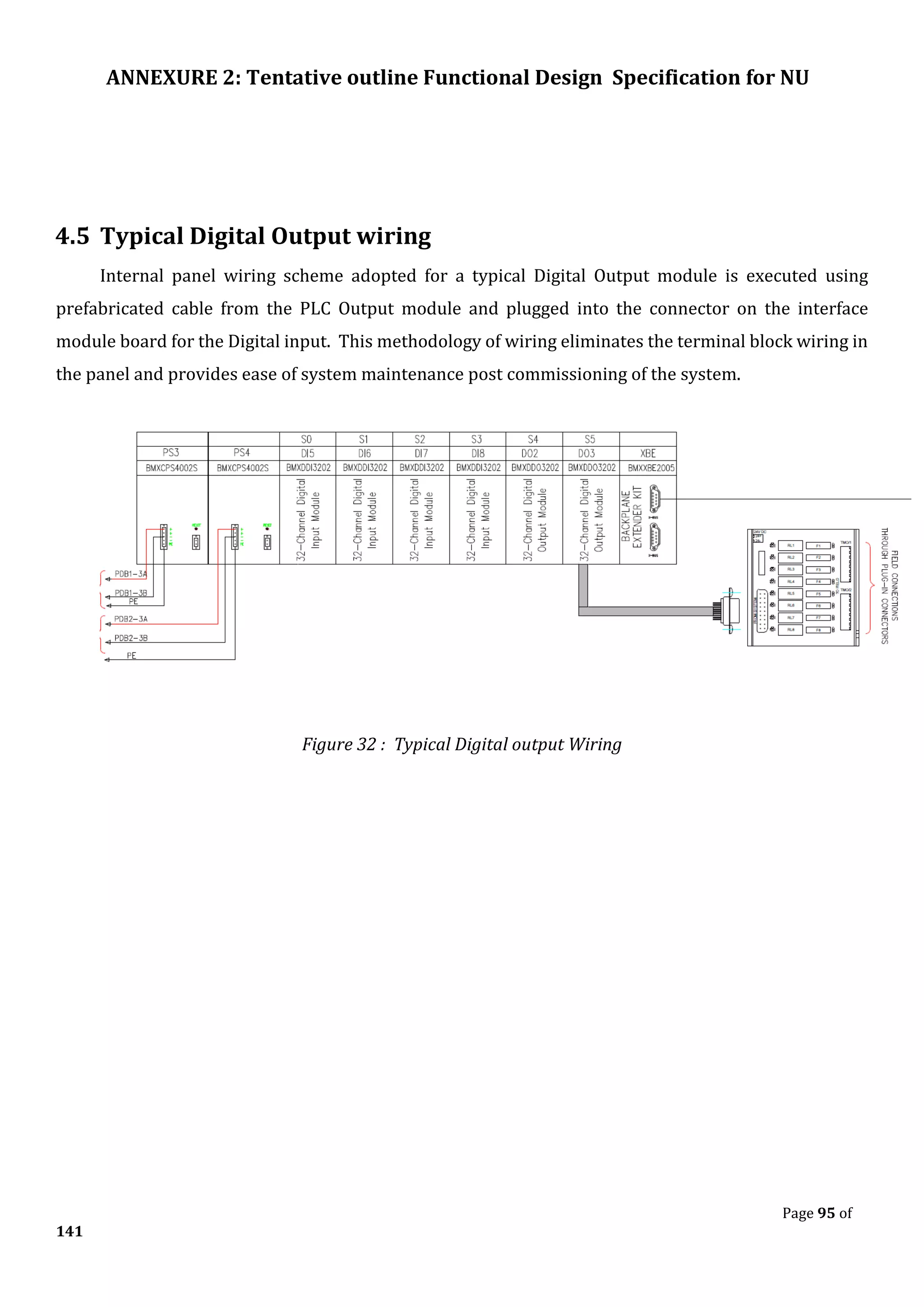
Figure 32 : Typical Digital output Wiring......................................................................................................................95
Figure 33 : SCADA/DMS and SLDC Communication................................................................................................ 102
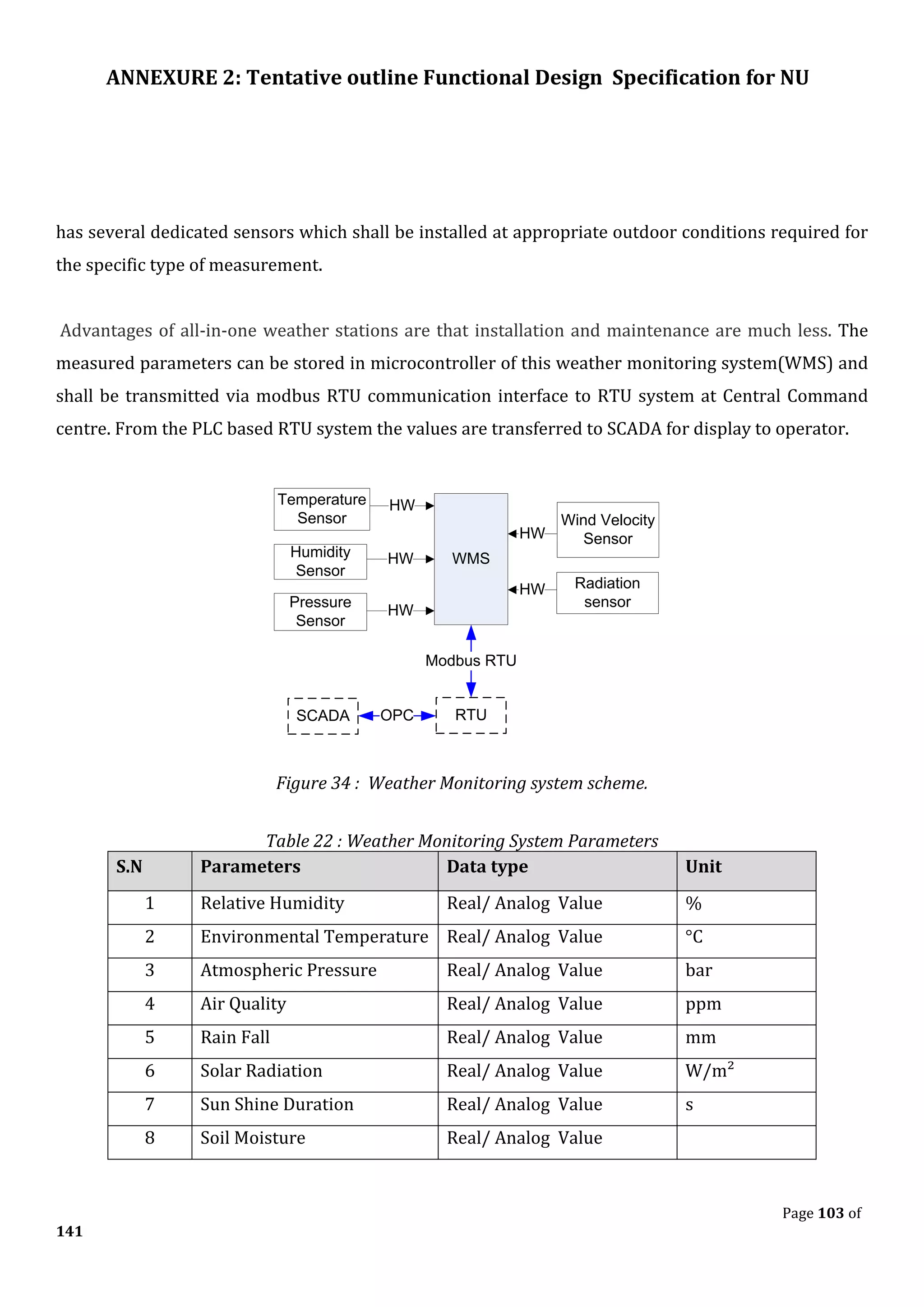
Figure 34 : Weather Monitoring system scheme..................................................................................................... 103
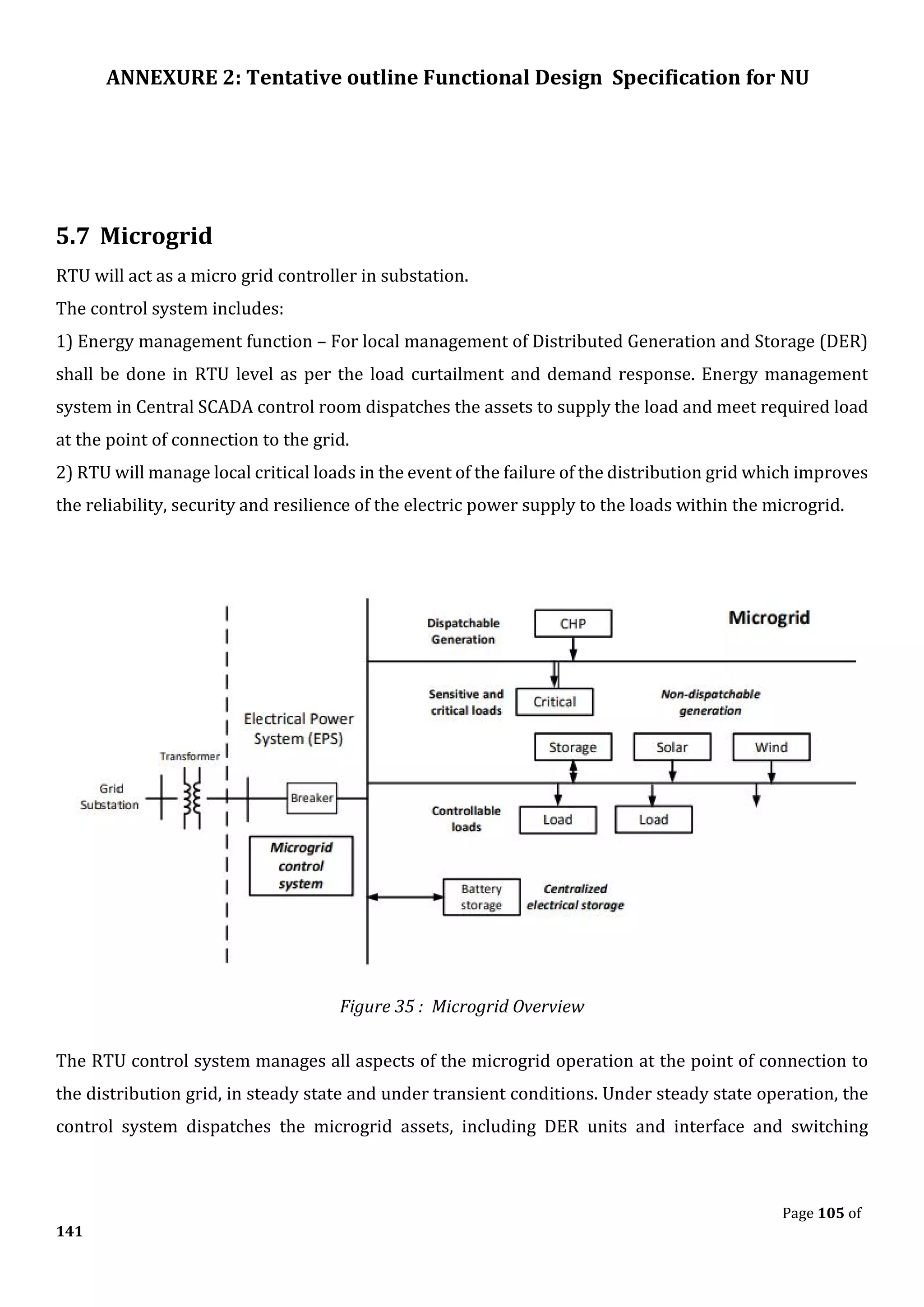
Figure 35 : Microgrid Overview...................................................................................................................................... 105
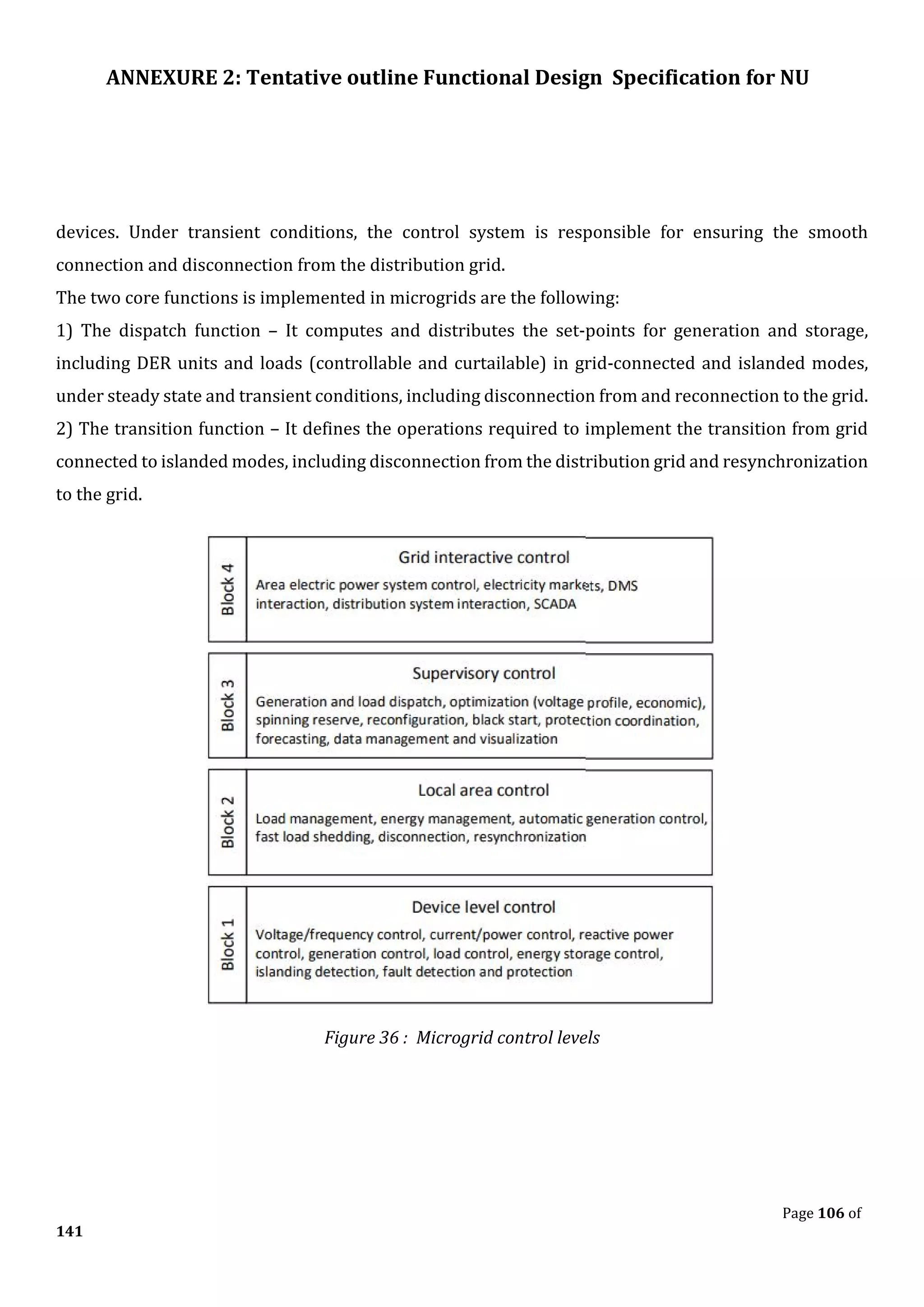
Figure 36 : Microgrid control levels.............................................................................................................................. 106
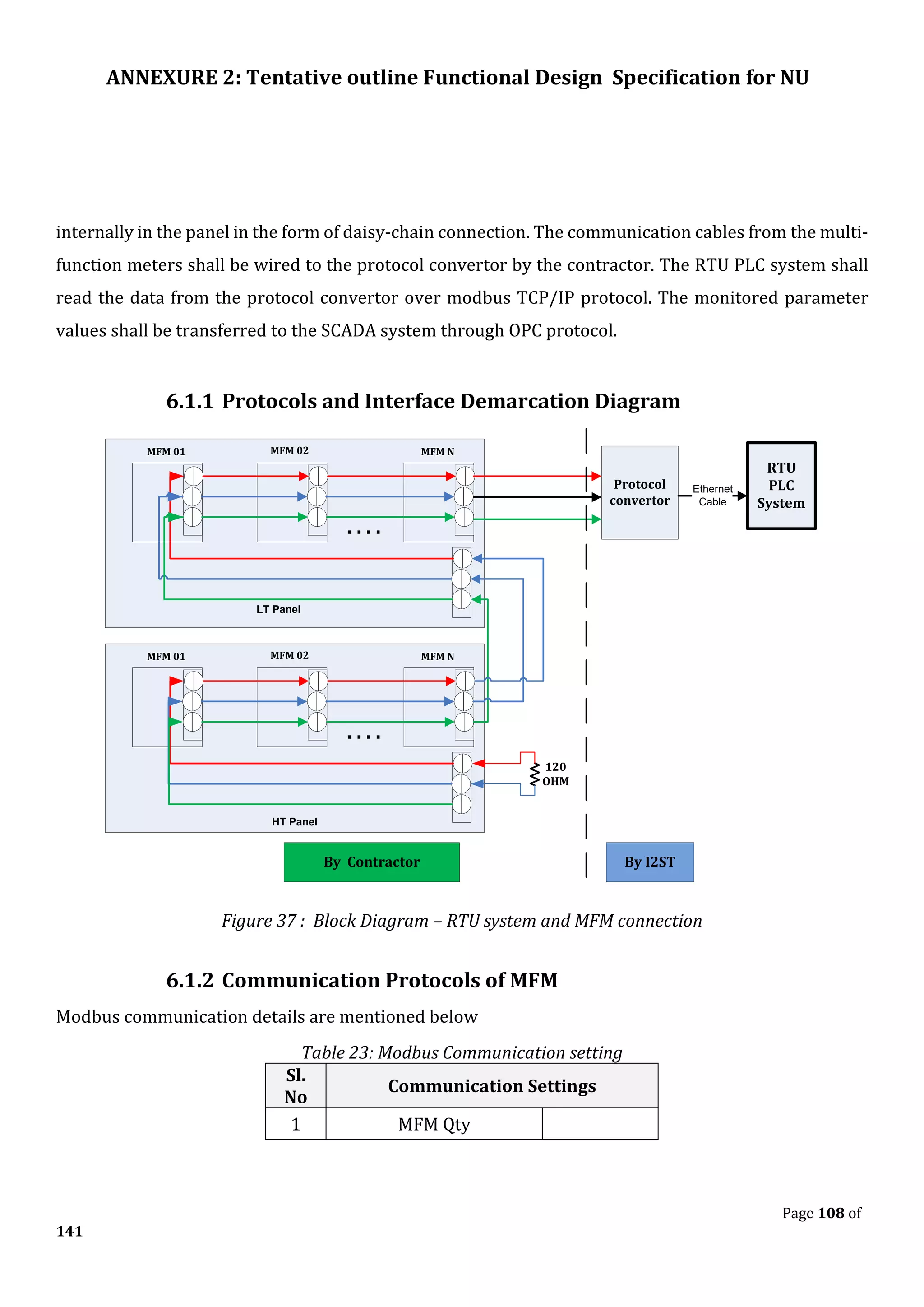
Figure 37 : Block Diagram – RTU system and MFM connection........................................................................ 108
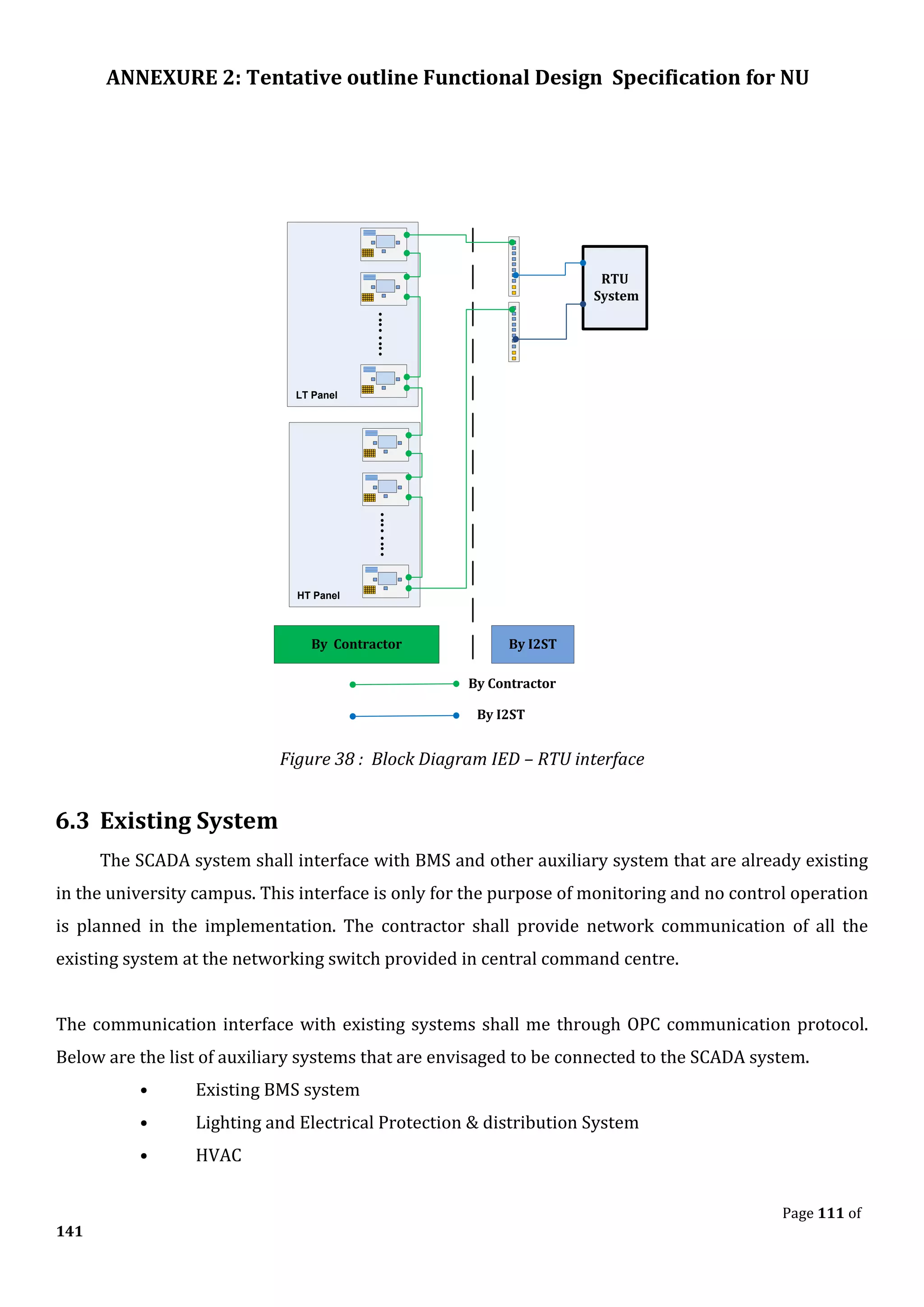
Figure 38 : Block Diagram IED – RTU interface........................................................................................................ 111
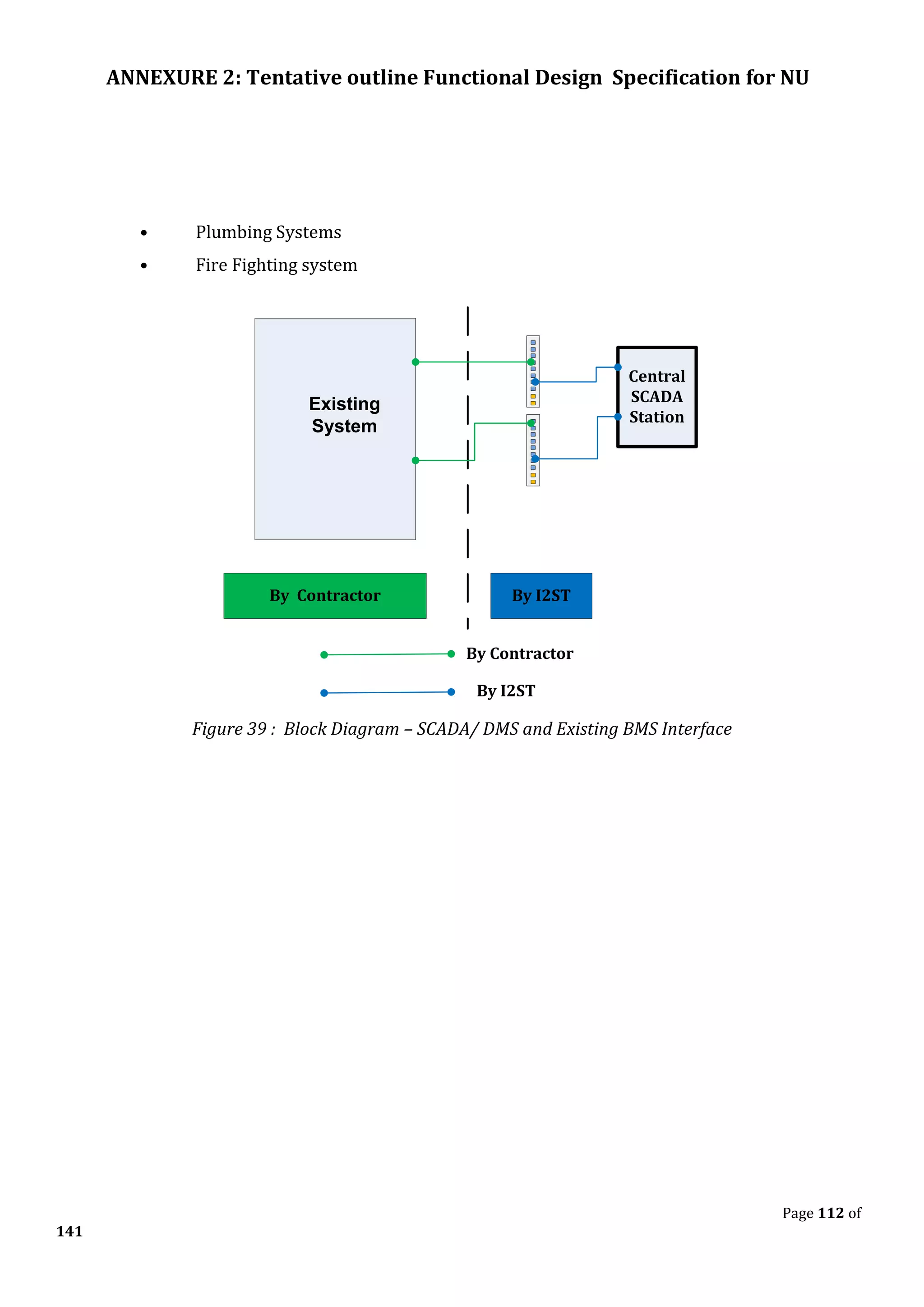
Figure 39 : Block Diagram – SCADA/ DMS and Existing BMS Interface.......................................................... 112
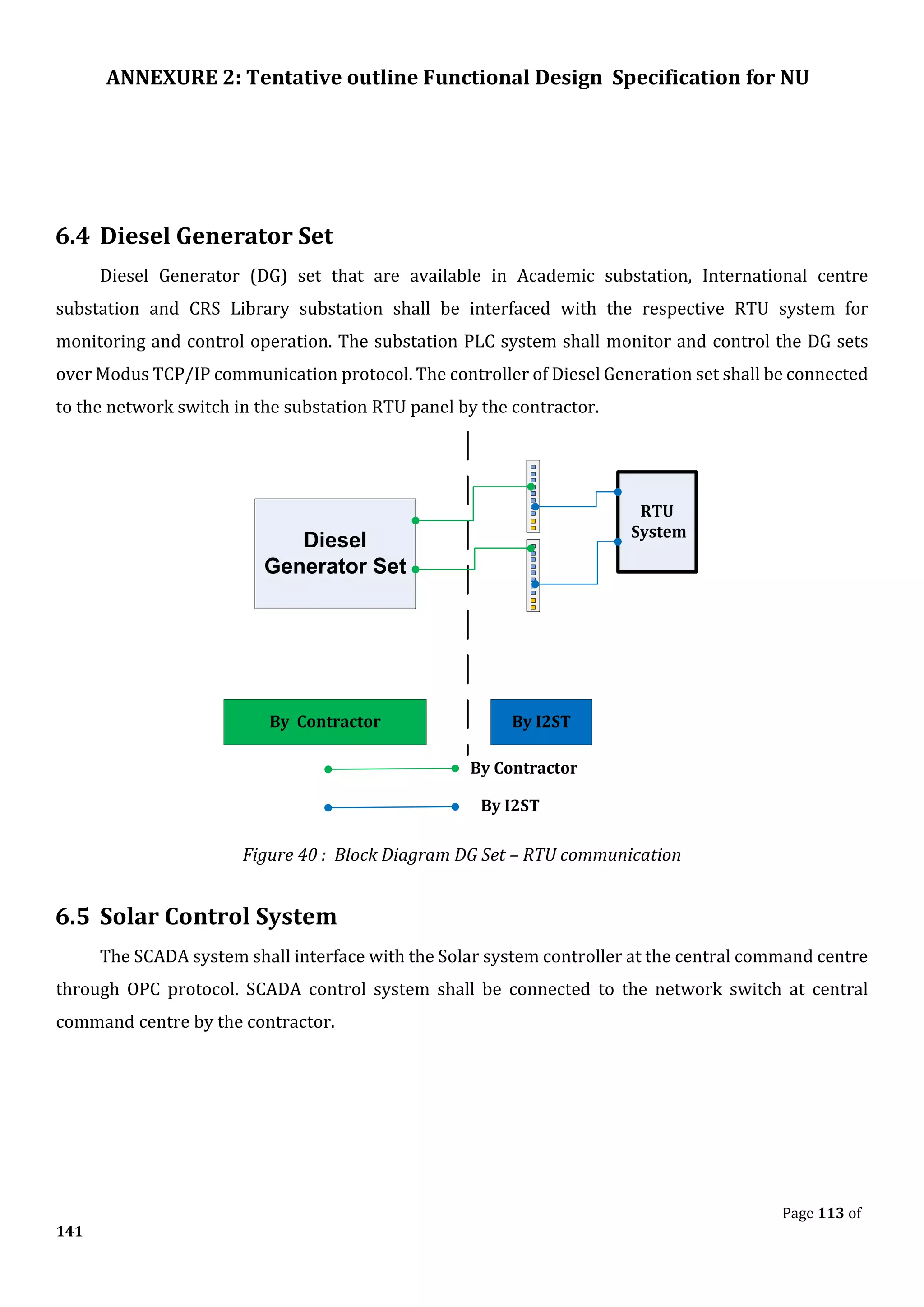
Figure 40 : Block Diagram DG Set – RTU communication.................................................................................... 113
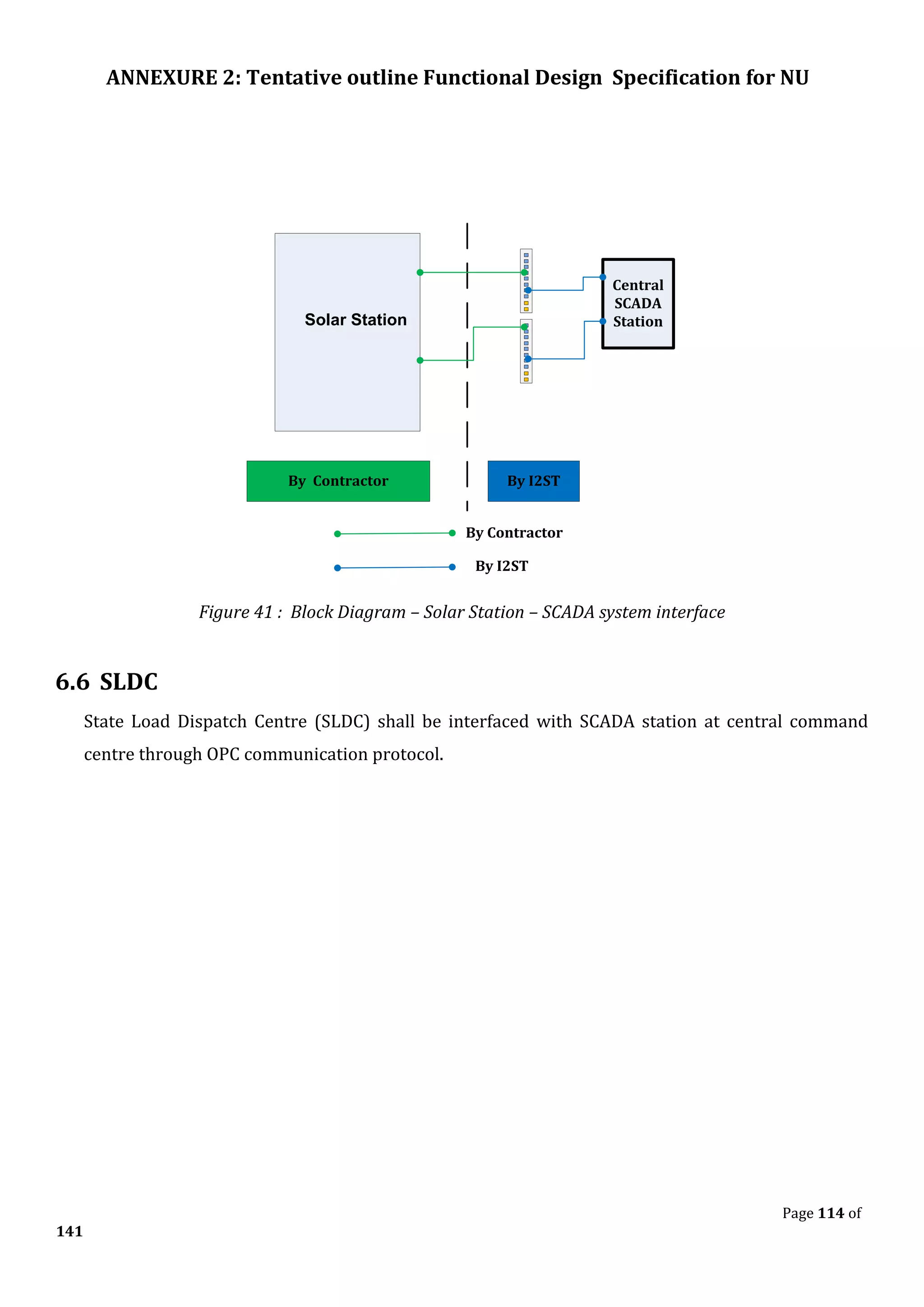
Figure 41 : Block Diagram – Solar Station – SCADA system interface............................................................. 114
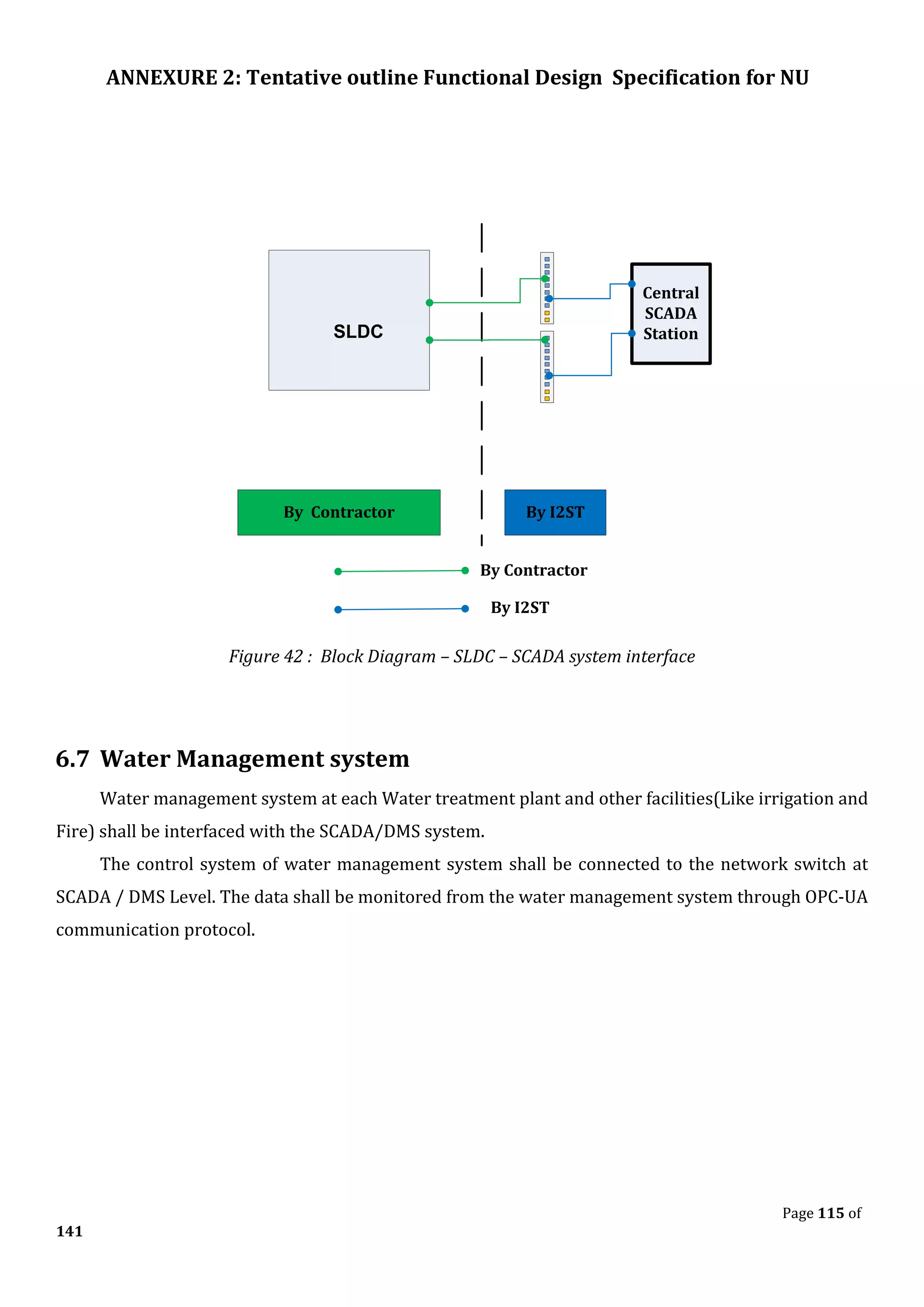
Figure 42 : Block Diagram – SLDC – SCADA system interface............................................................................ 115
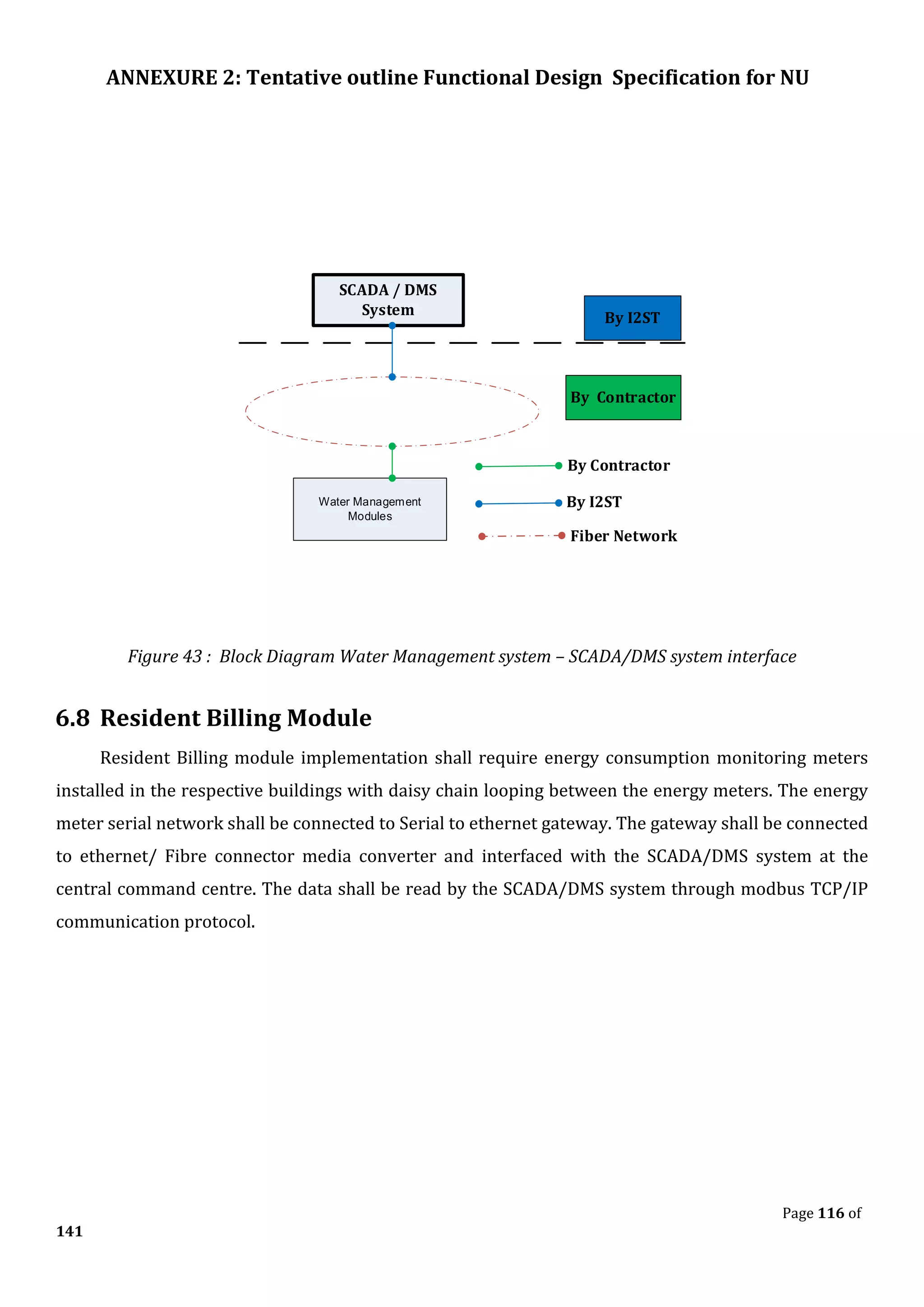
Figure 43 : Block Diagram Water Management system – SCADA/DMS system interface....................... 116
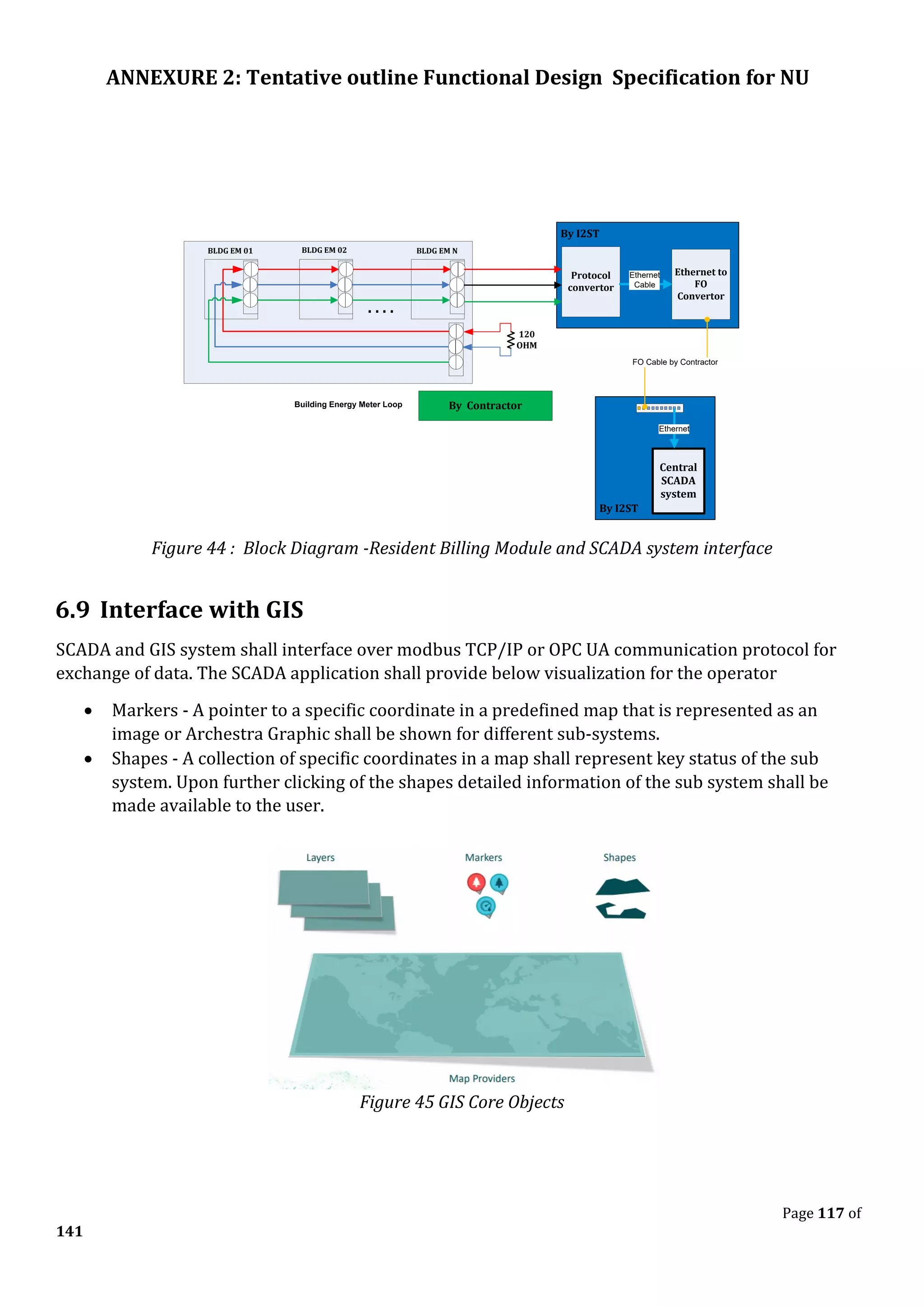
Figure 44 : Block Diagram -Resident Billing Module and SCADA system interface................................... 117
Figure 45 GIS Core Objects................................................................................................................................................ 117
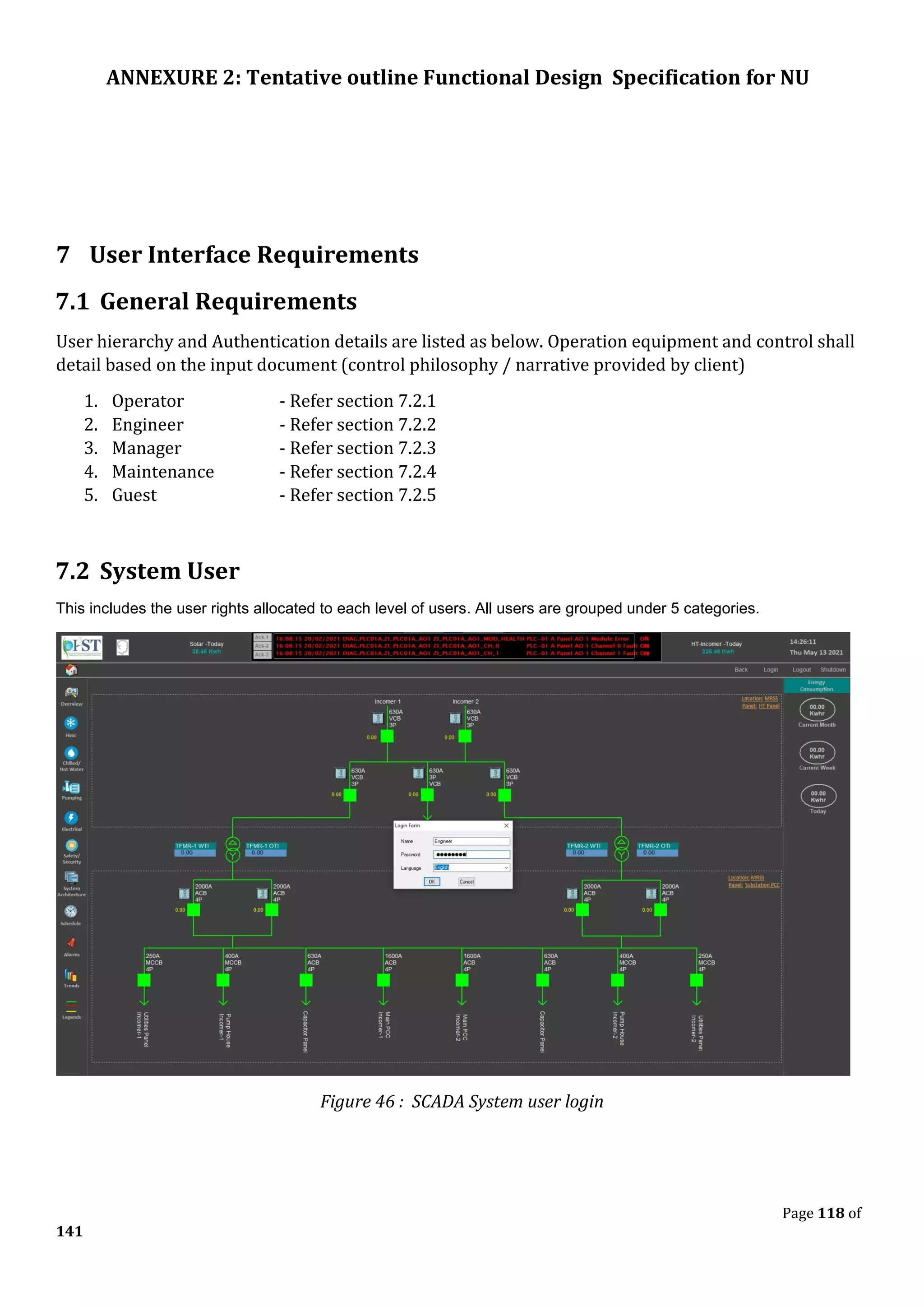
Figure 46 : SCADA System user login ........................................................................................................................... 118
Figure 47 : User creation................................................................................................................................................... 121
Figure 48 : Display navigation screen.......................................................................................................................... 122
Figure 49 : SCADA/DMS Permanent Indicators....................................................................................................... 122
Figure 50 : Trends................................................................................................................................................................ 123
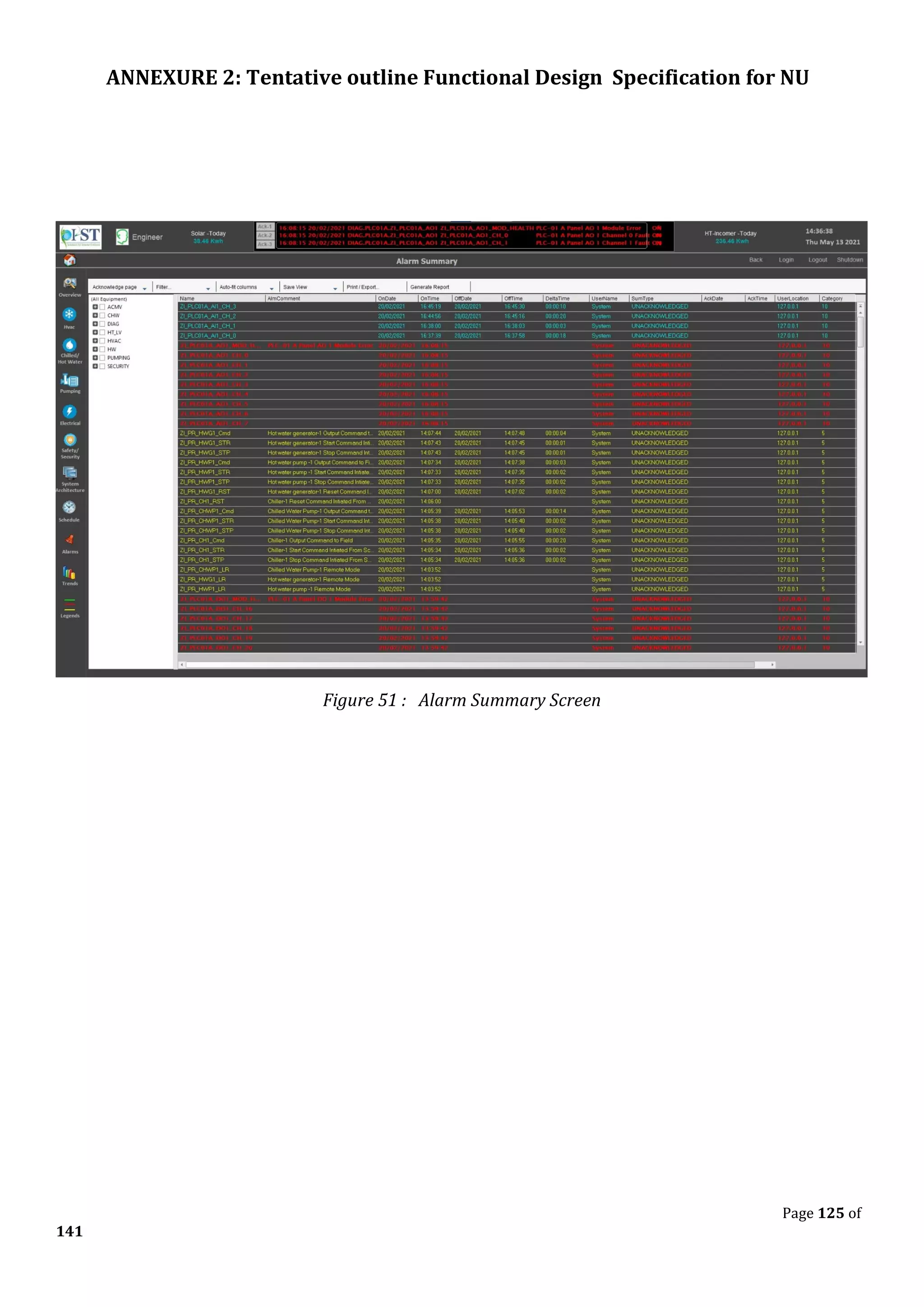
Figure 51 : Alarm Summary Screen ............................................................................................................................. 125
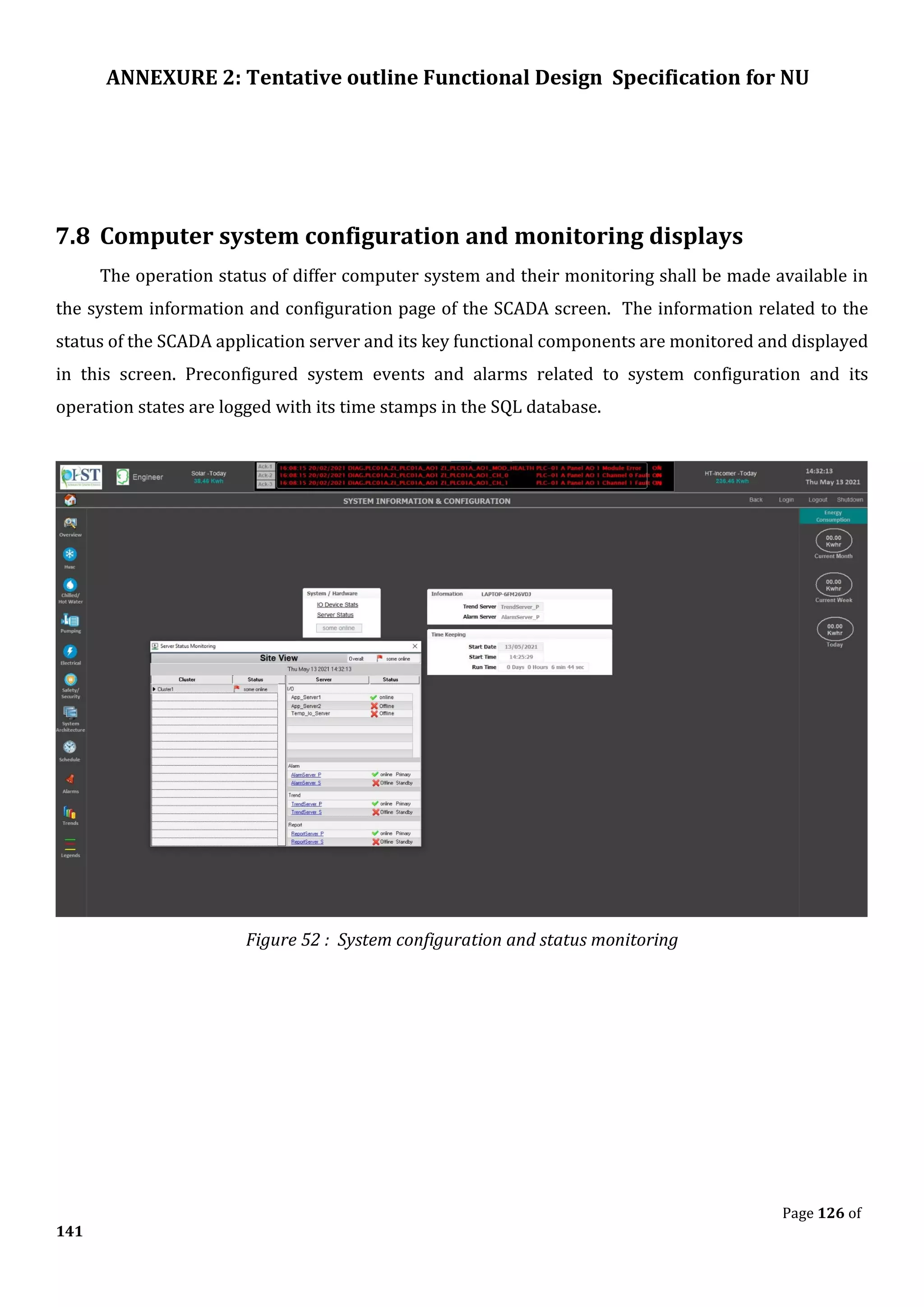
Figure 52 : System configuration and status monitoring..................................................................................... 126
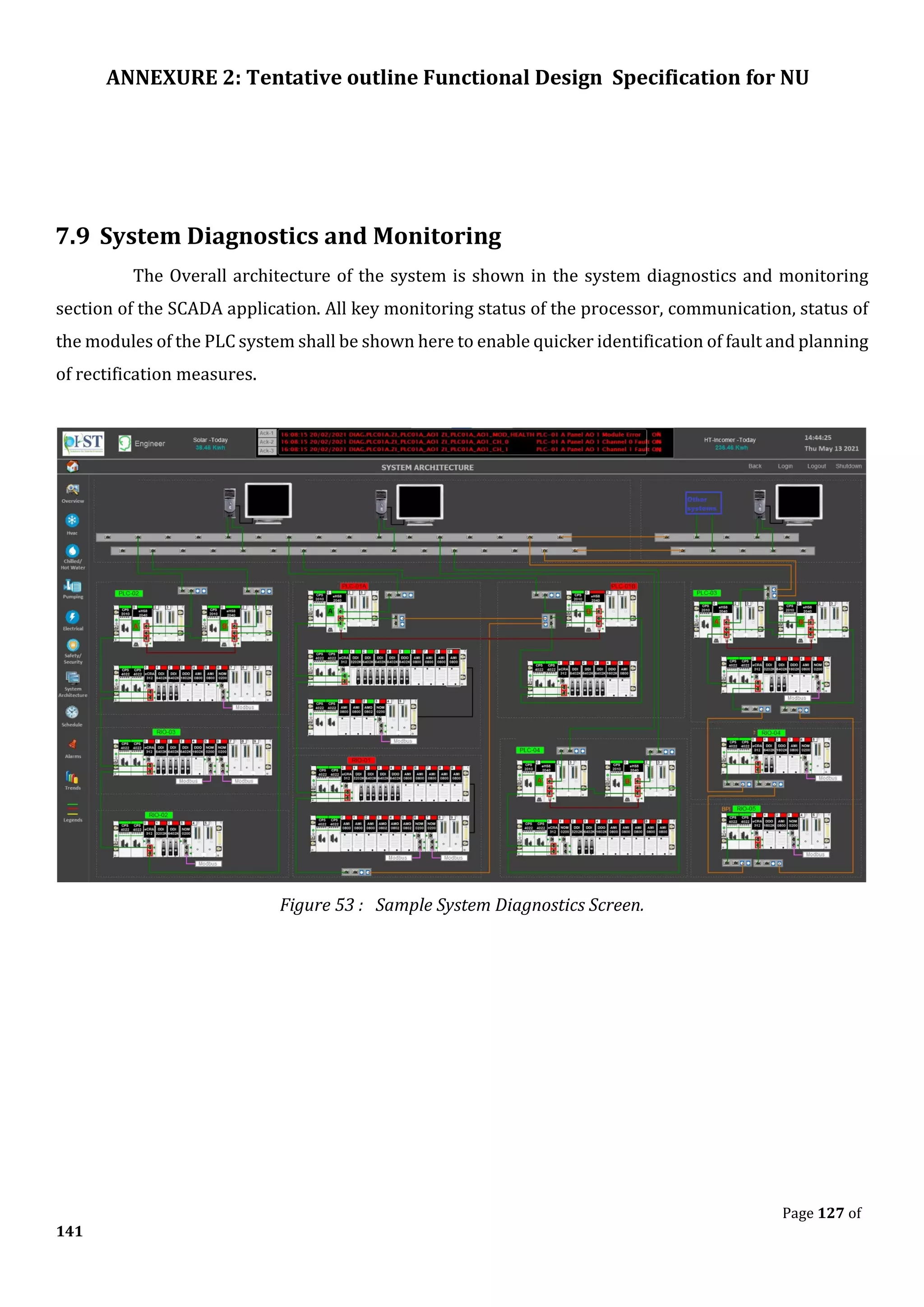
Figure 53 : Sample System Diagnostics Screen. ...................................................................................................... 127
ANNEXURE 2: Tentative outline Functional Design Specification for NU
Page 9 of
141
1 Introduction and General information
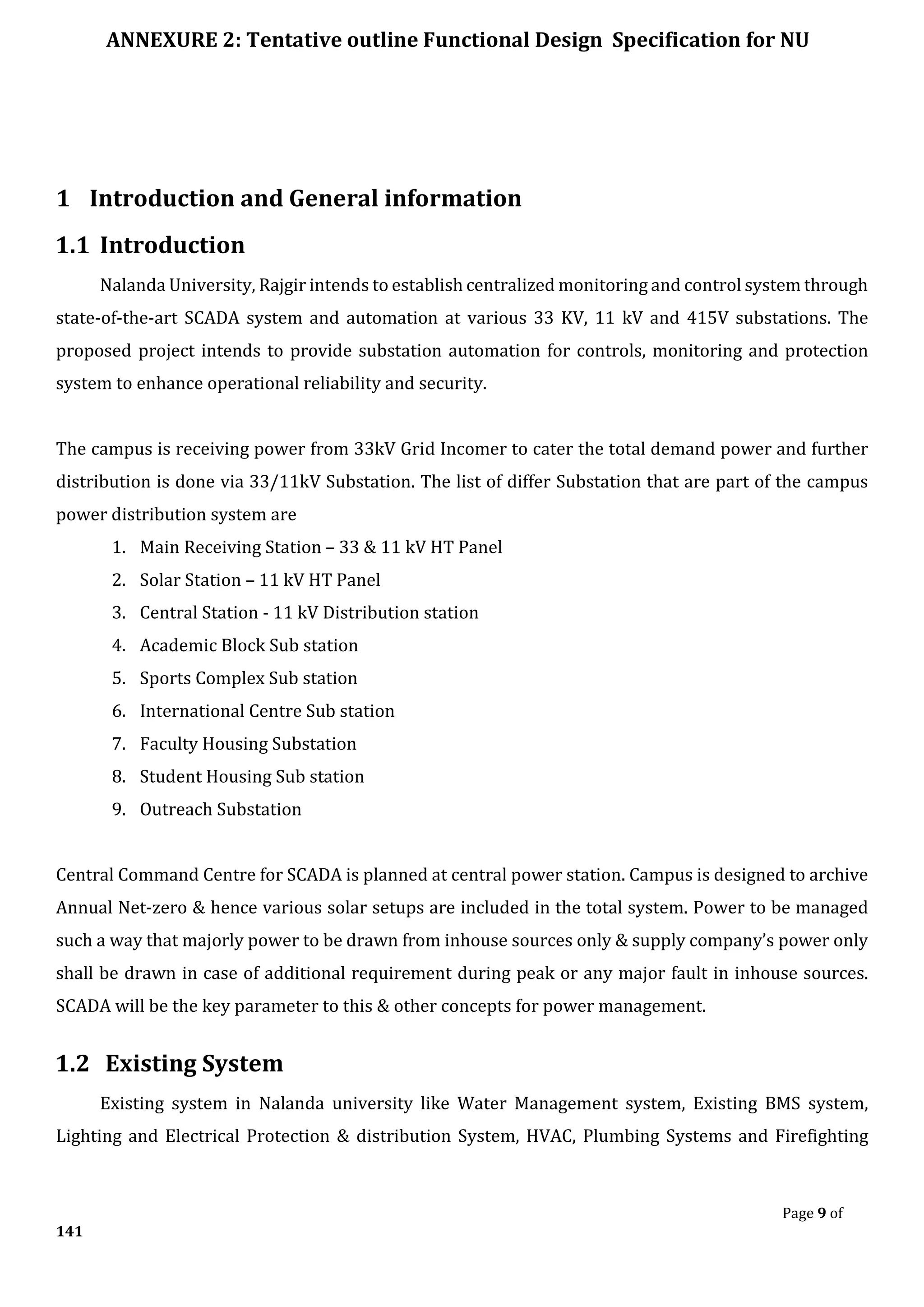
1.1 Introduction
Nalanda University, Rajgir intends to establish centralized monitoring and control system through
state-of-the-art SCADA system and automation at various 33 KV, 11 kV and 415V substations. The
proposed project intends to provide substation automation for controls, monitoring and protection
system to enhance operational reliability and security.
The campus is receiving power from 33kV Grid Incomer to cater the total demand power and further
distribution is done via 33/11kV Substation. The list of differ Substation that are part of the campus
power distribution system are
1. Main Receiving Station – 33 & 11 kV HT Panel
2. Solar Station – 11 kV HT Panel
3. Central Station - 11 kV Distribution station
4. Academic Block Sub station
5. Sports Complex Sub station
6. International Centre Sub station
7. Faculty Housing Substation
8. Student Housing Sub station
9. Outreach Substation
Central Command Centre for SCADA is planned at central power station. Campus is designed to archive
Annual Net-zero & hence various solar setups are included in the total system. Power to be managed
such a way that majorly power to be drawn from inhouse sources only & supply company’s power only
shall be drawn in case of additional requirement during peak or any major fault in inhouse sources.
SCADA will be the key parameter to this & other concepts for power management.
1.2 Existing System
Existing system in Nalanda university like Water Management system, Existing BMS system,
Lighting and Electrical Protection & distribution System, HVAC, Plumbing Systems and Firefighting
ANNEXURE 2: Tentative outline Functional Design Specification for NU
Page 10 of
141
system shall be interfaced with SCADA/DMS system through communication for the purpose of status
monitoring.
I2ST_031521018_FDS_R01 Page 11 of 141
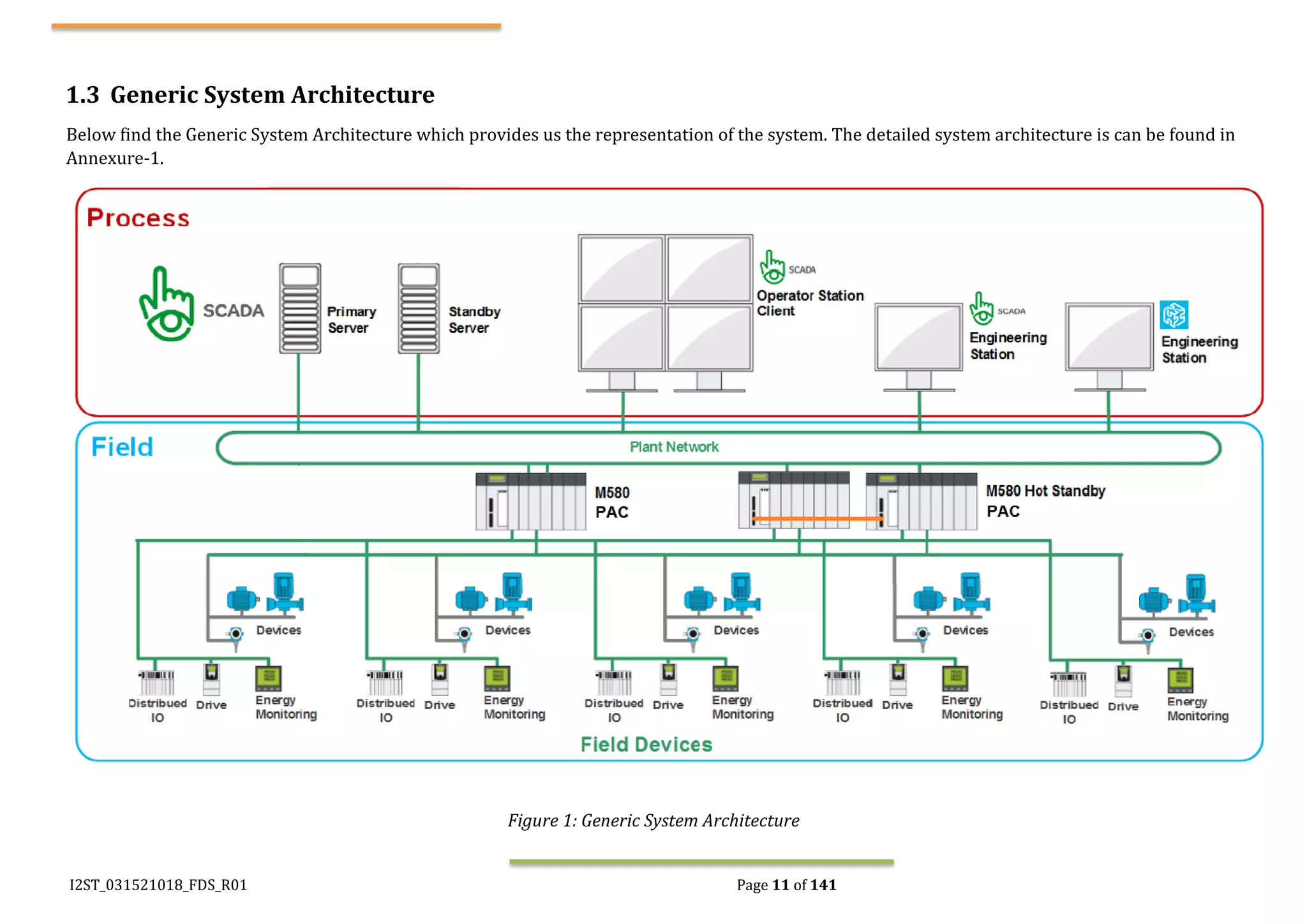
1.3 Generic System Architecture
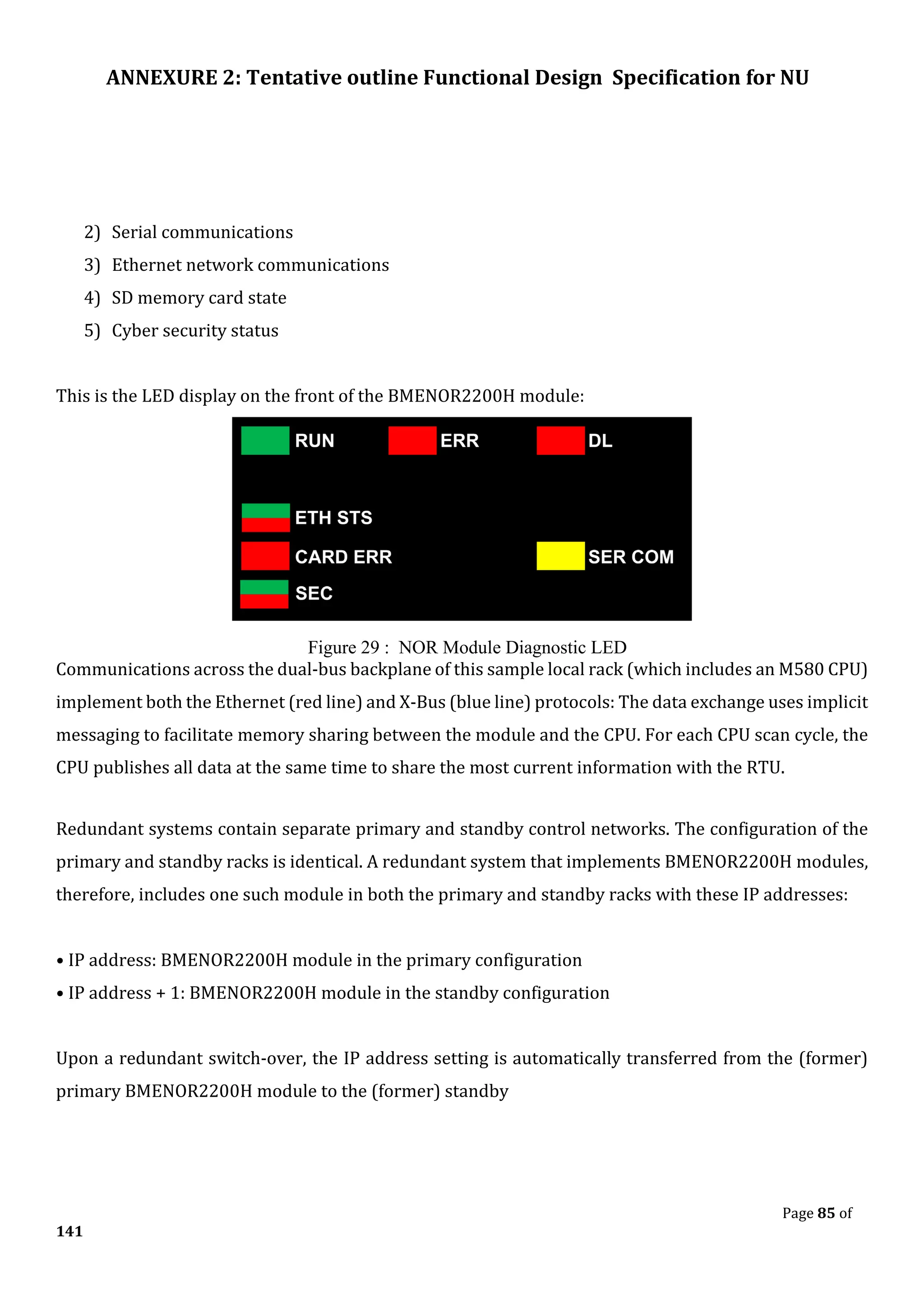
Below find the Generic System Architecture which provides us the representation of the system. The detailed system architecture is can be found in
Annexure-1.
Figure 1: Generic System Architecture
Functional Design Specification
Project: Electrical SCADA for Nalanda University
Package 4B
I2ST_031521018_FDS_R01 Page 12 of 141
1.4 Proposed SCADA/DMS System
The proposed solution consists of a redundant central SCADA/DMS system at central command
centre location connected to the PLC based RTU system at substation level. M580 based Hot Standby
PLC is considered in substation to control and monitor the High Side electrical works, each substation
having the HMI for local level control in case of communication failure from central SCADA.
Proposed PLC system in Substation having the facility to store the data for 1 month by using the
Schneider NOR modules in local level, PLC communication is established with central SCADA in 2 Ways:-
1. Hardwired – Redundant Fibre based network.
2. RTU is integrated with Modems for wireless communication in case of fibre communication
failure.
In SCADA, we are using 2 Nos. of Operator Workstation servers in redundant configuration along
with 5 Nos. of web clients, for future expansion our system is designed and capable up to – 100%
additional tags. One Engineering workstation is provided.
1.5 Broad Role Definition of SIA
The SCADA/DMS Implementation Agency (SIA) in coordination with Employer (as per the
requirement to be given in the detailed Tender specification) shall carry out field survey, design
,engineering, supply, installation, testing & commissioning of SCADA/DMS software applications,
hardware (including PCs, Servers, Routers, Switches, VPS, RTU, Multi-function Transducers (MFTs),
Communication equipment, Auxiliary power supply etc), software (including operating system,
databases, etc.), network (LAN, ), etc. Integration with existing /under implementation IT system & any
other defined system interface which are defined in the Tender specification.
1.6 Reference Documents
This document is best understood with the listed documents available, and they will be referenced
to in this document text when relevant.
ANNEXURE 2: Tentative outline Functional Design Specification for NU
Page 13 of
141
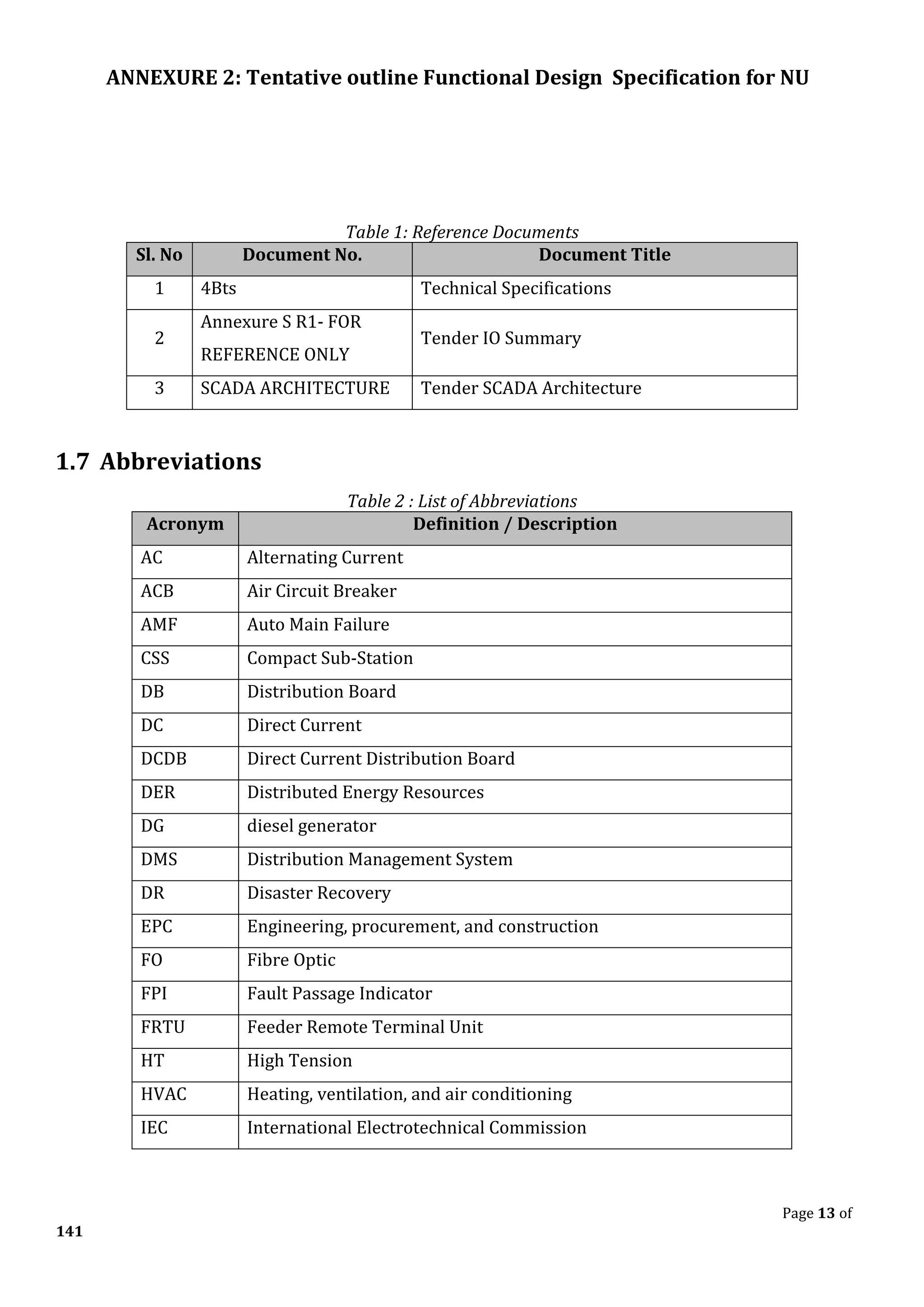
Table 1: Reference Documents
Sl. No Document No. Document Title
1 4Bts Technical Specifications
2
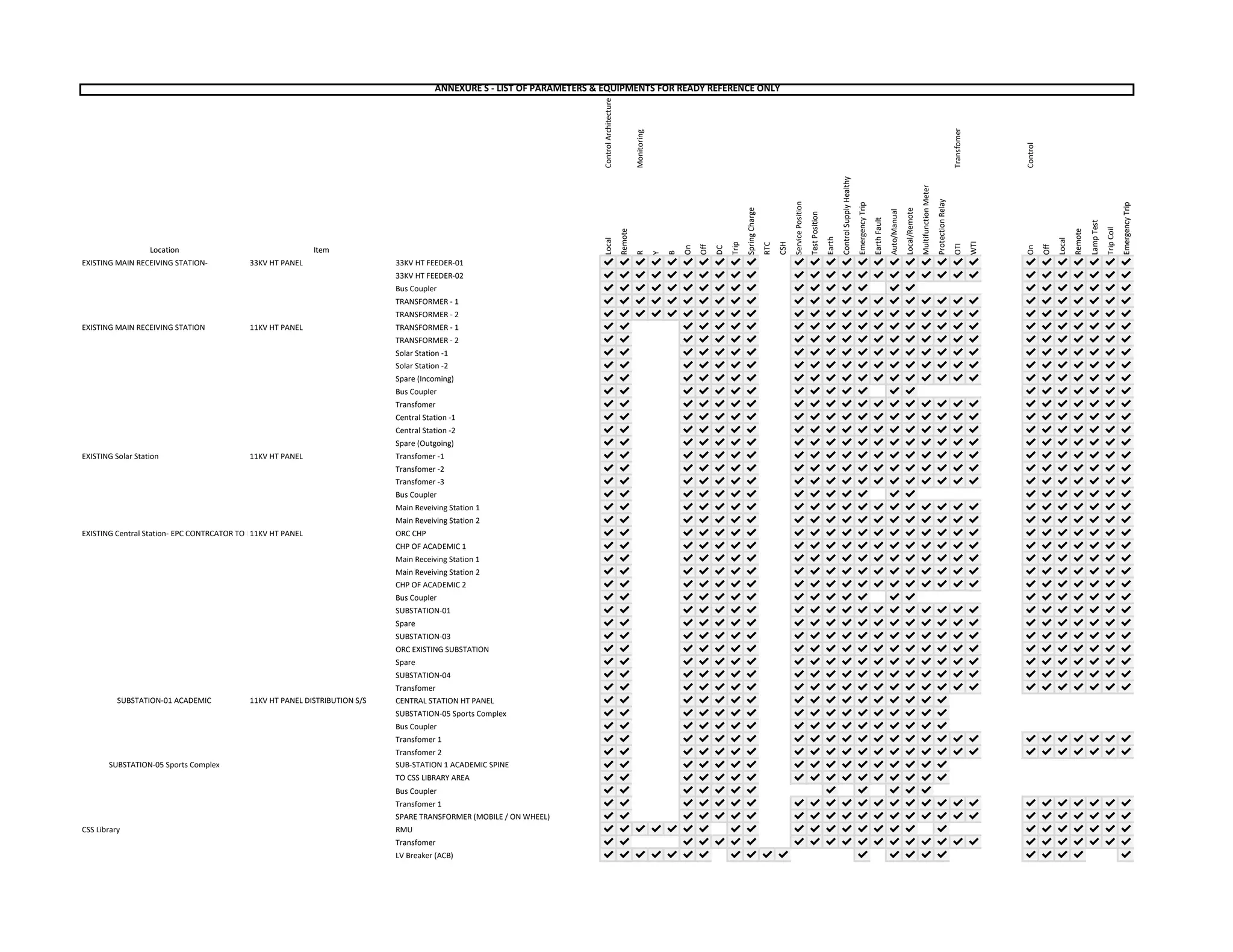
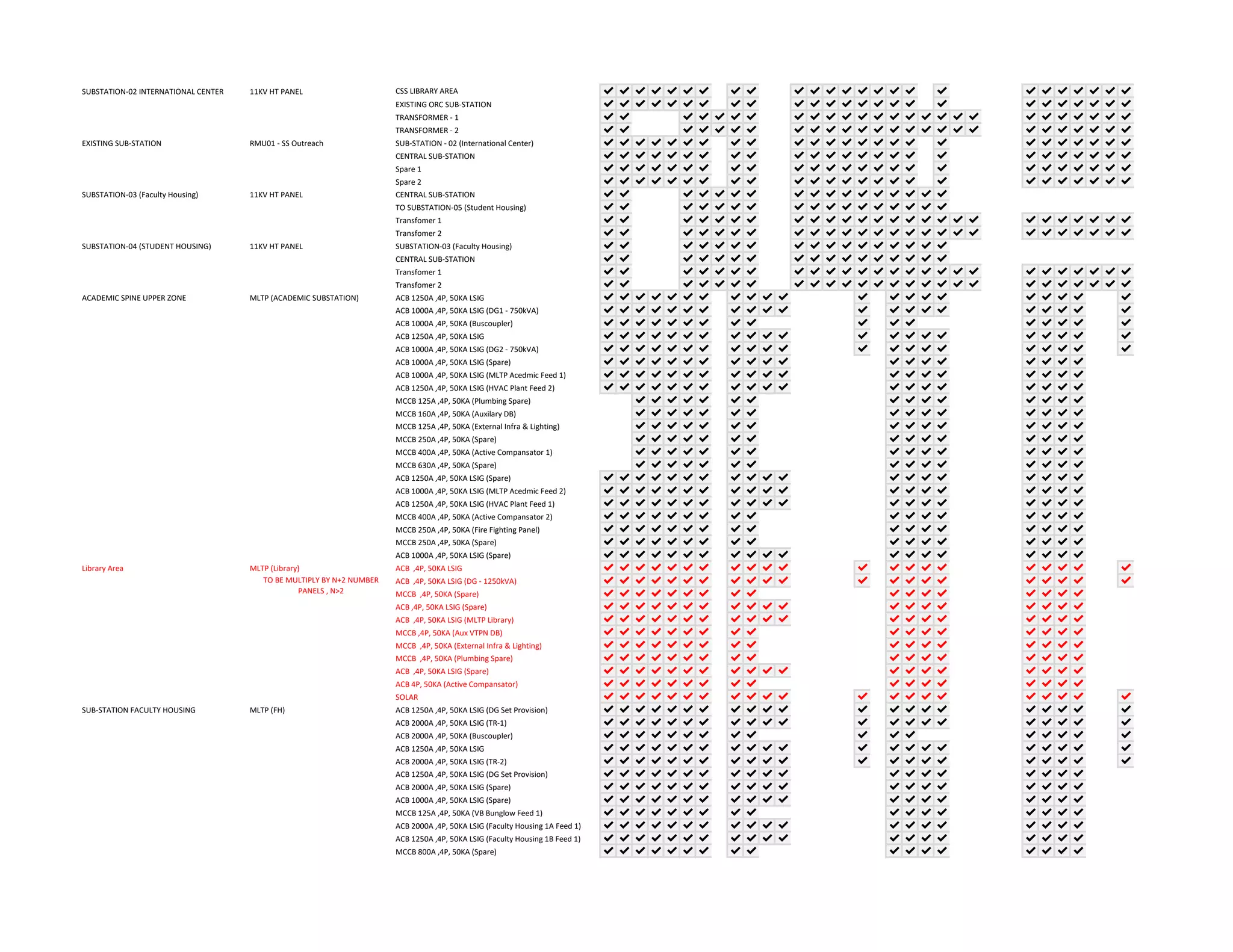
Annexure S R1- FOR
REFERENCE ONLY
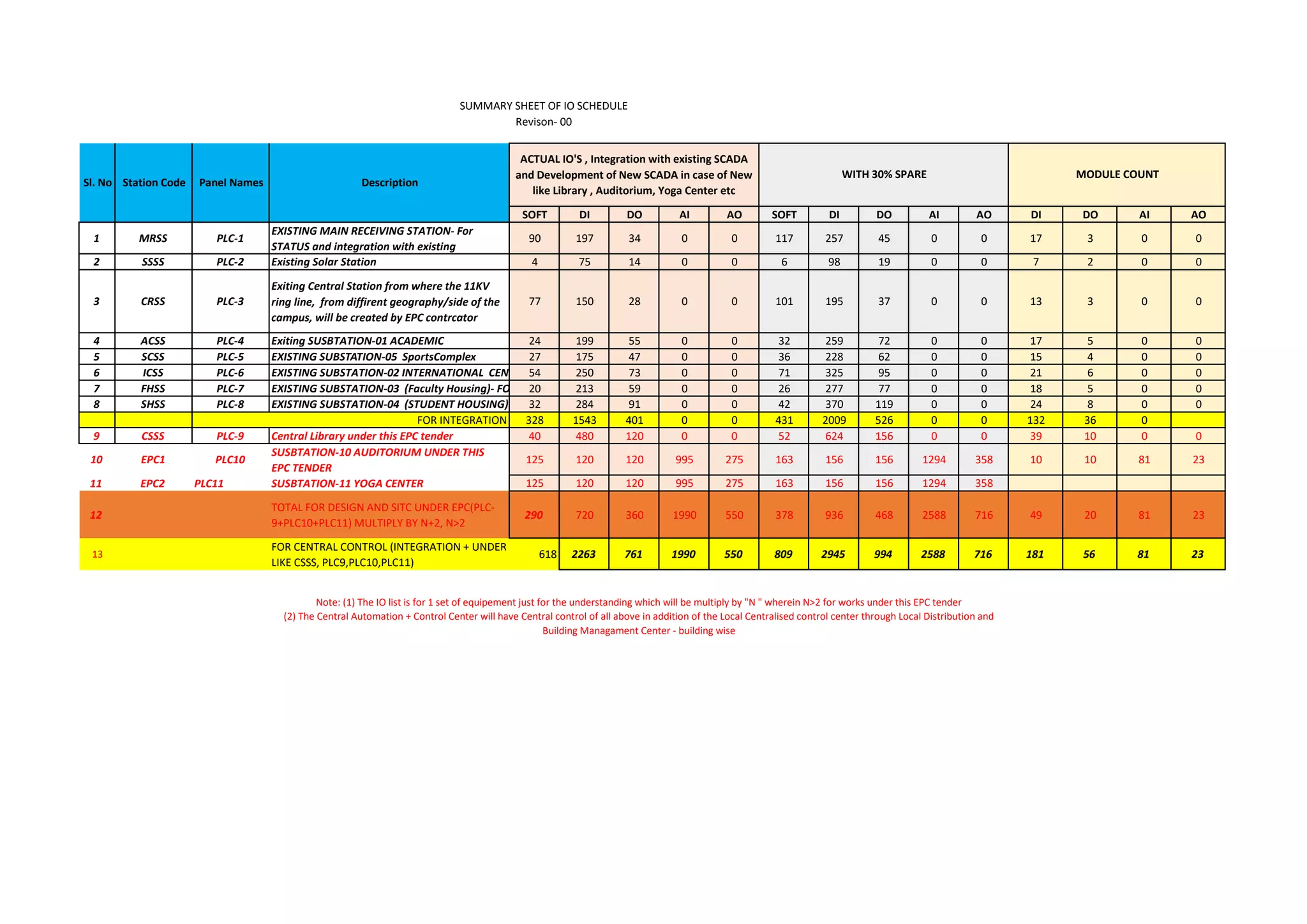
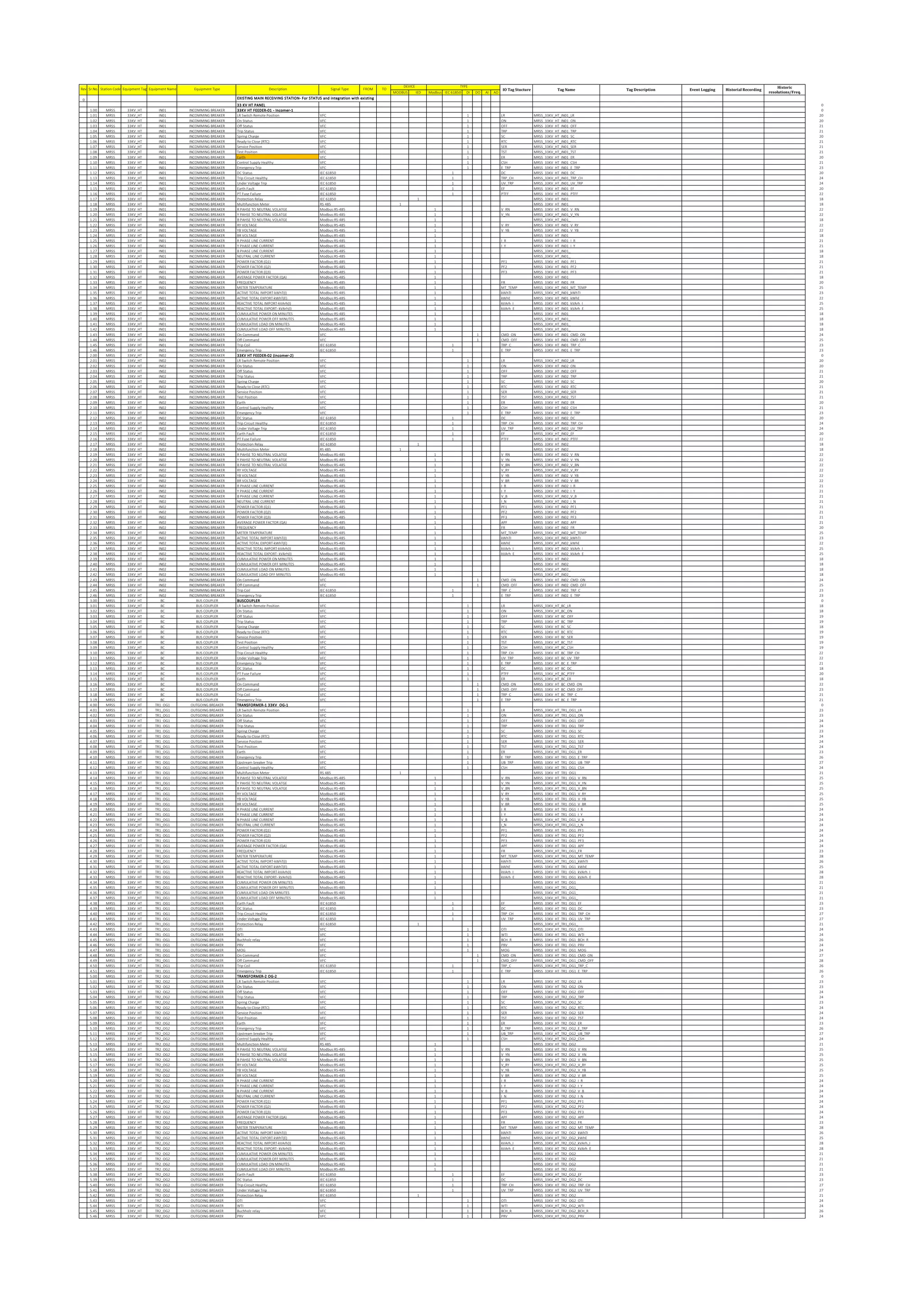
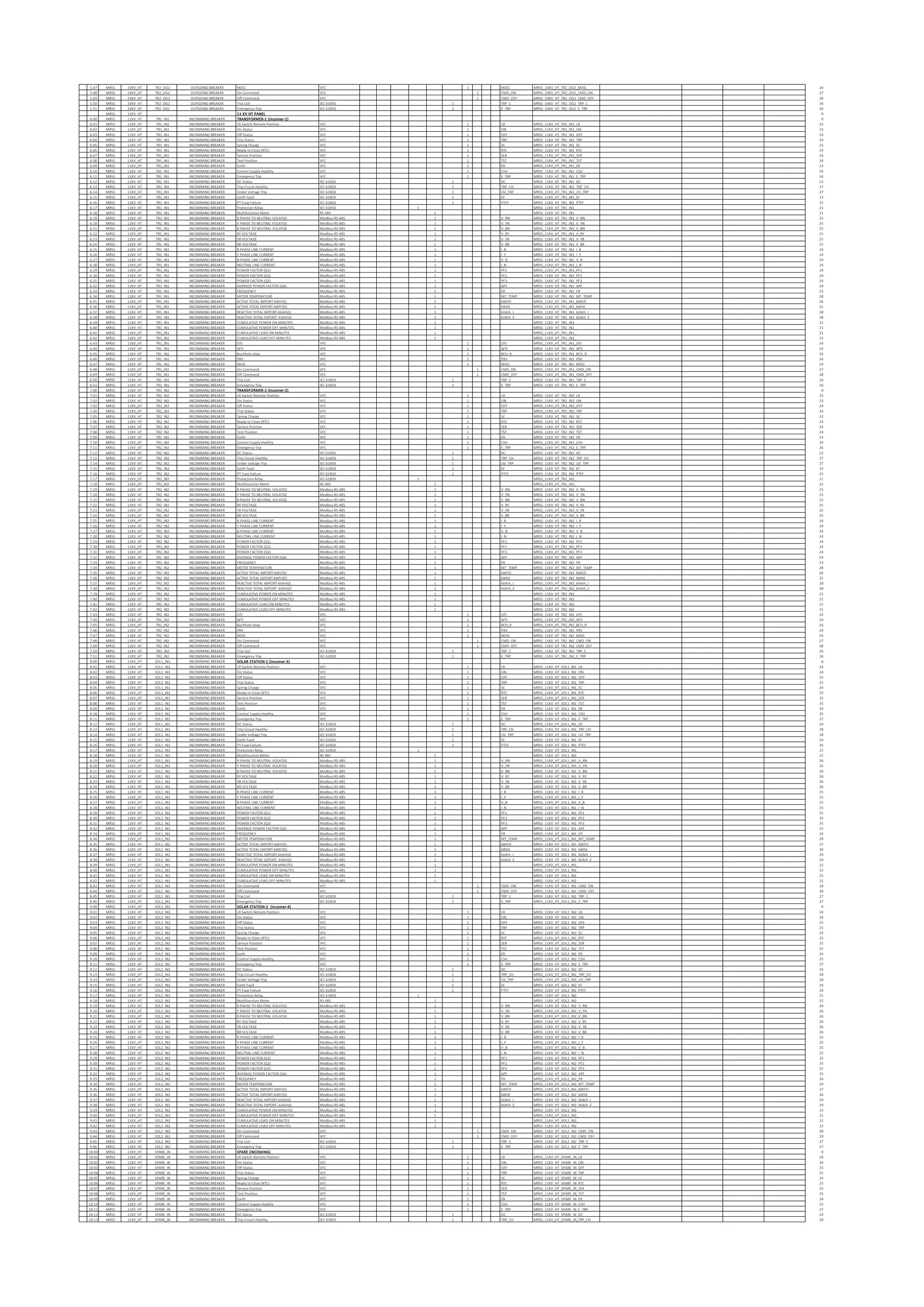
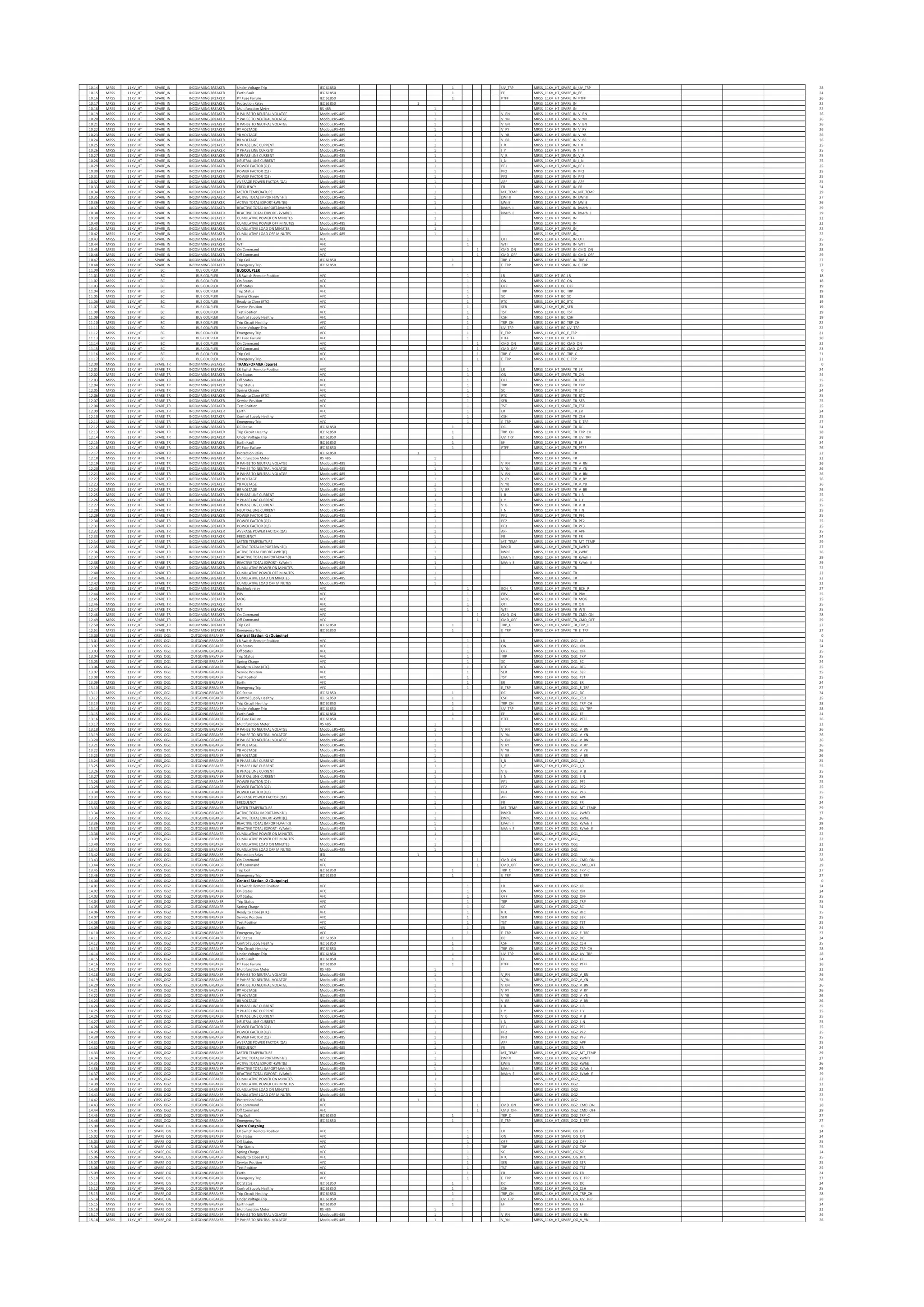
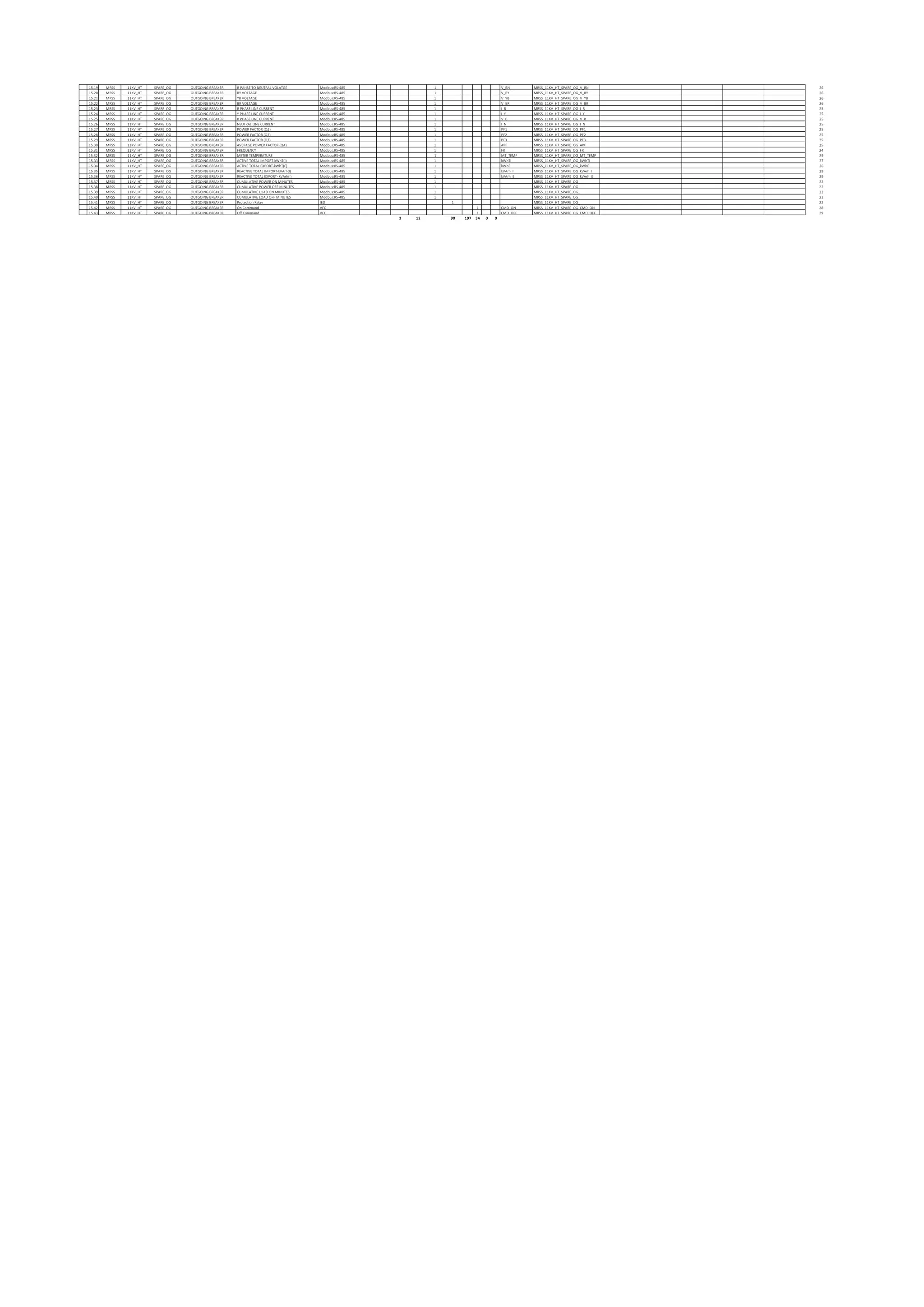
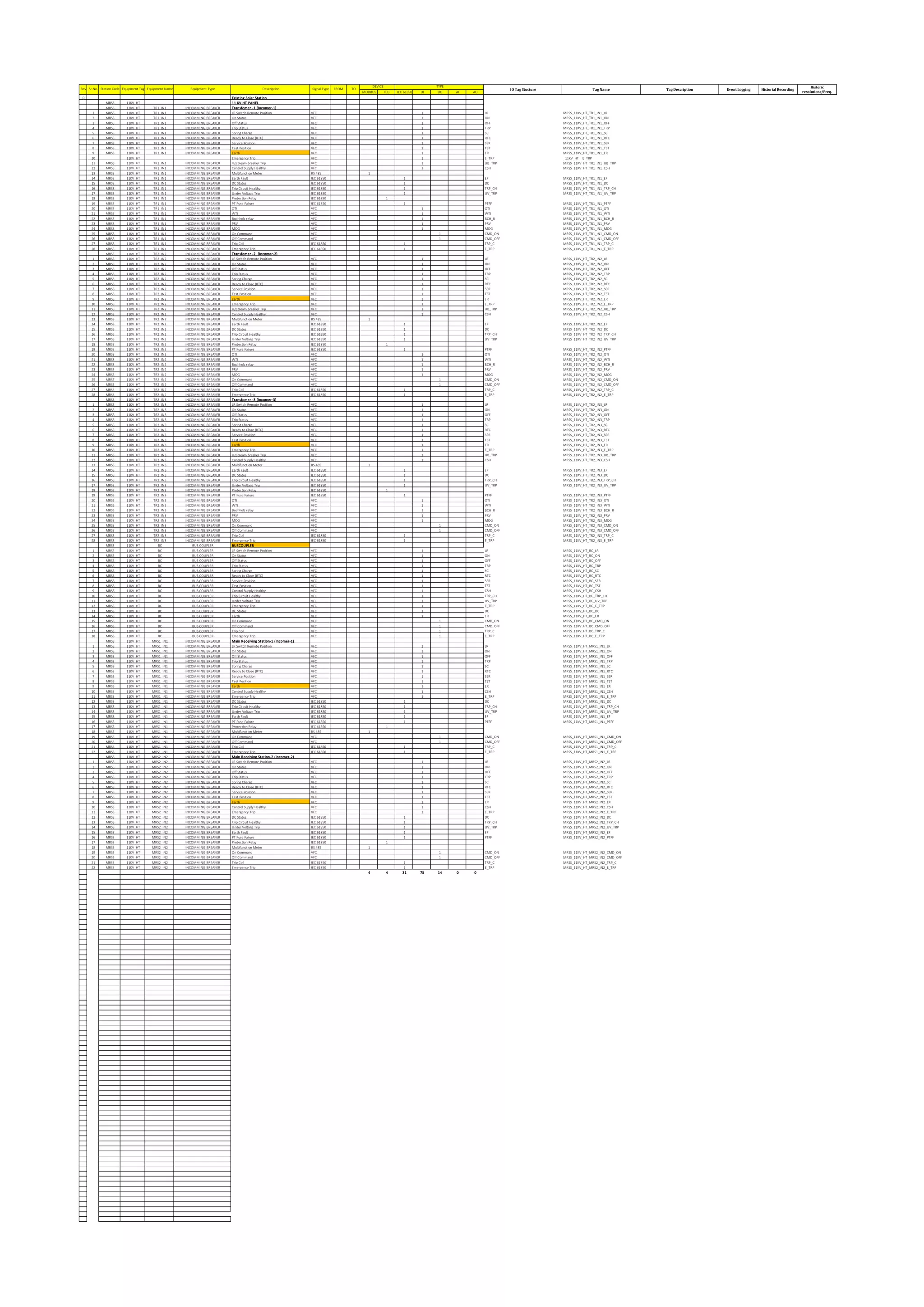
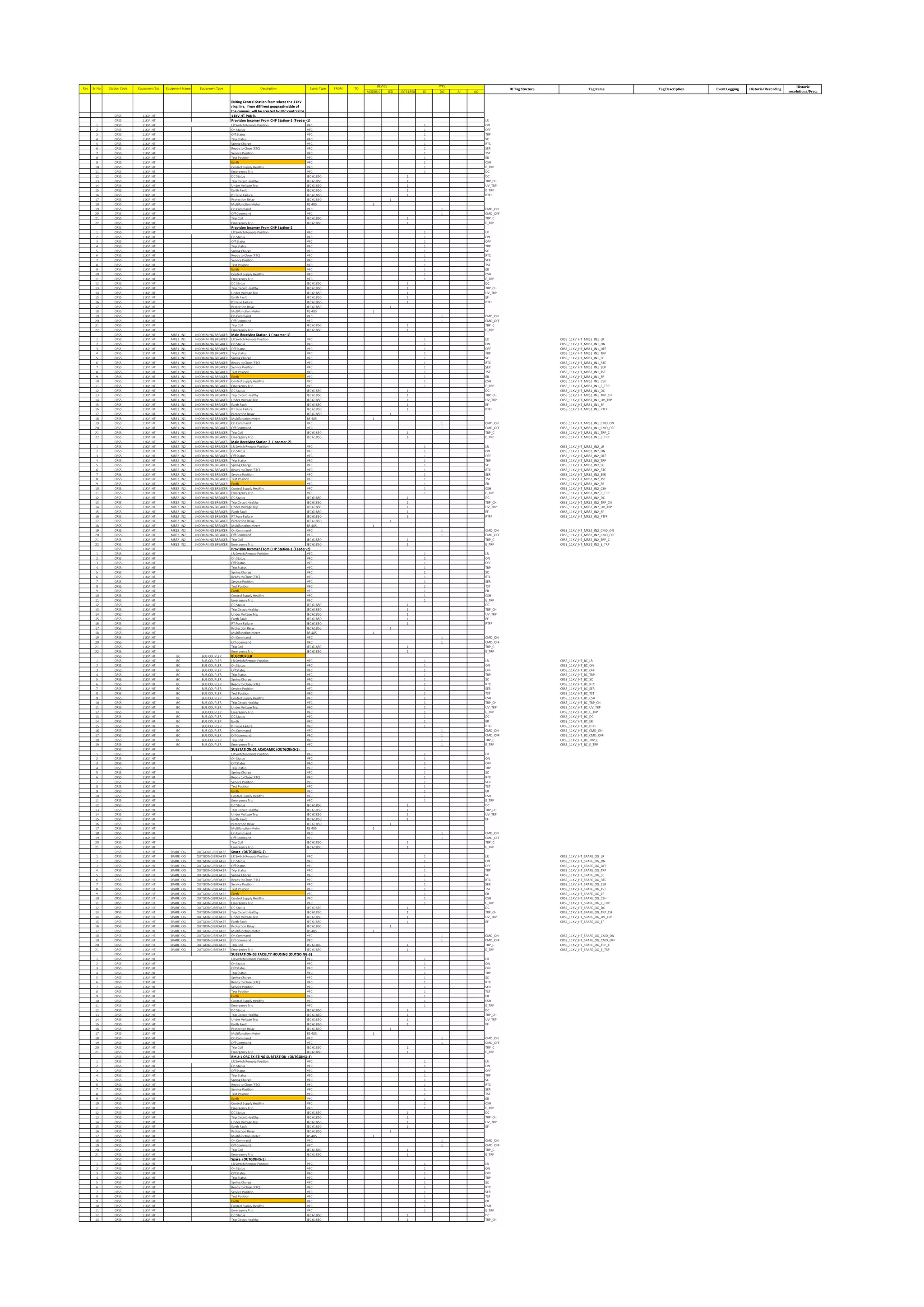
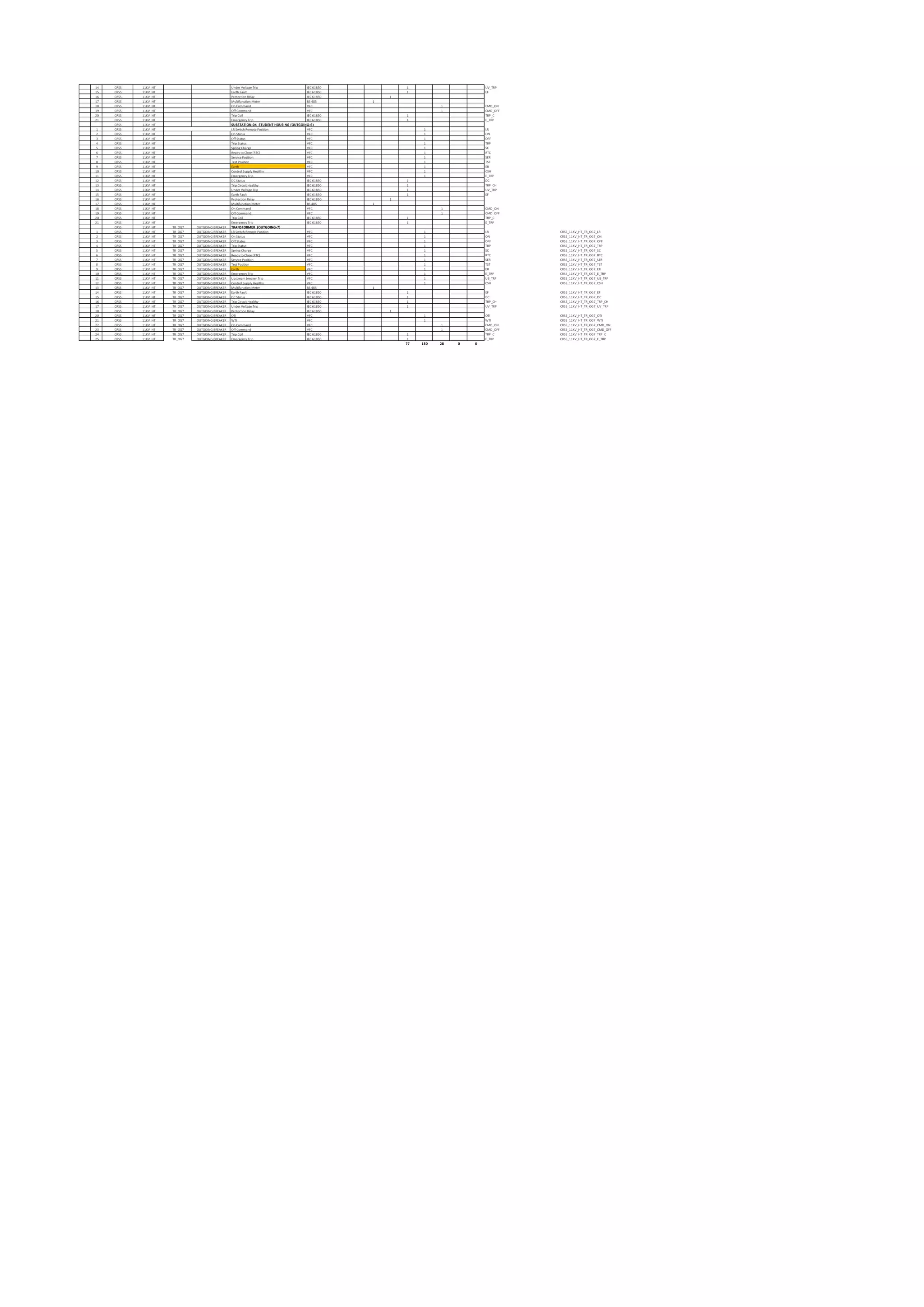
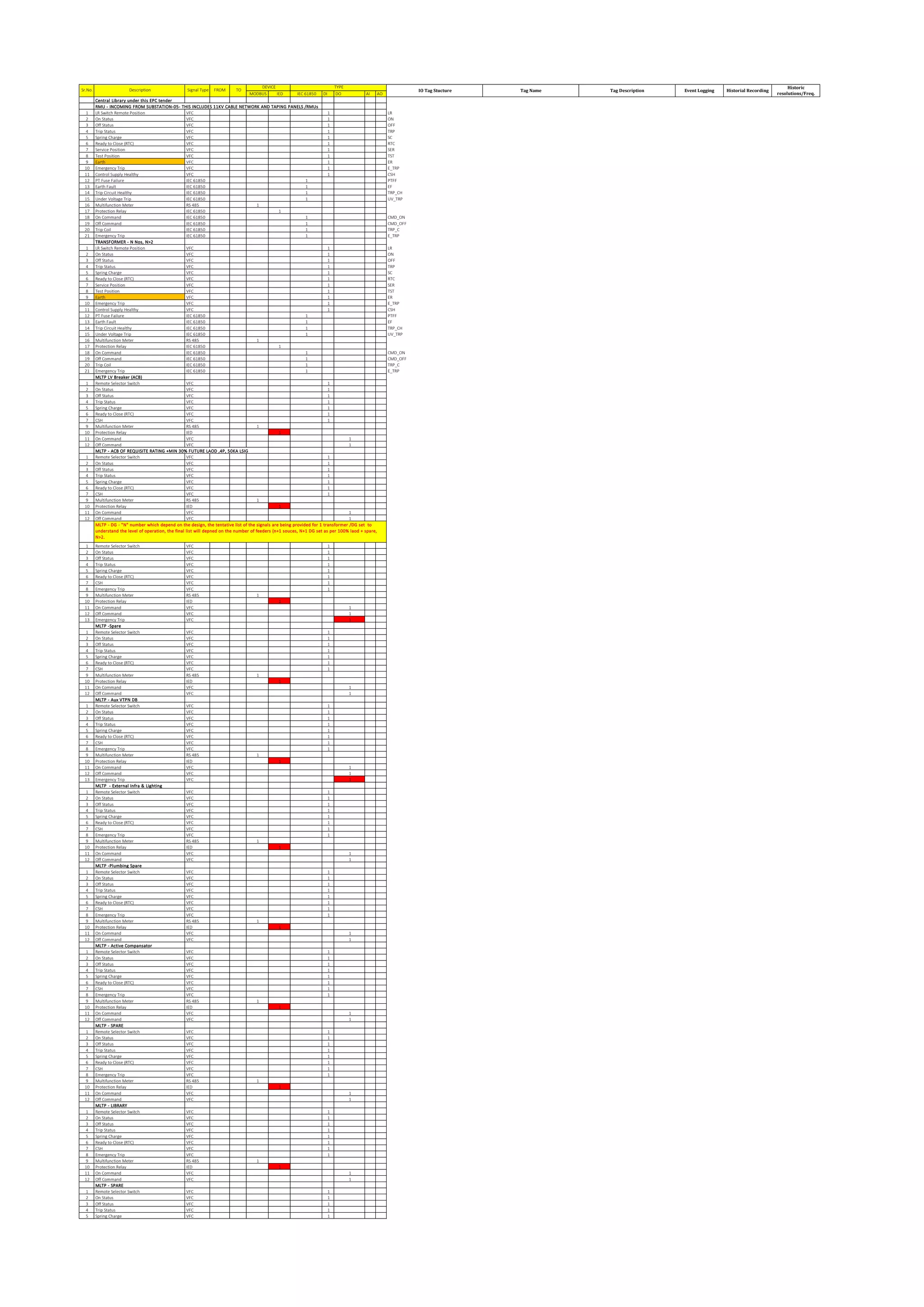
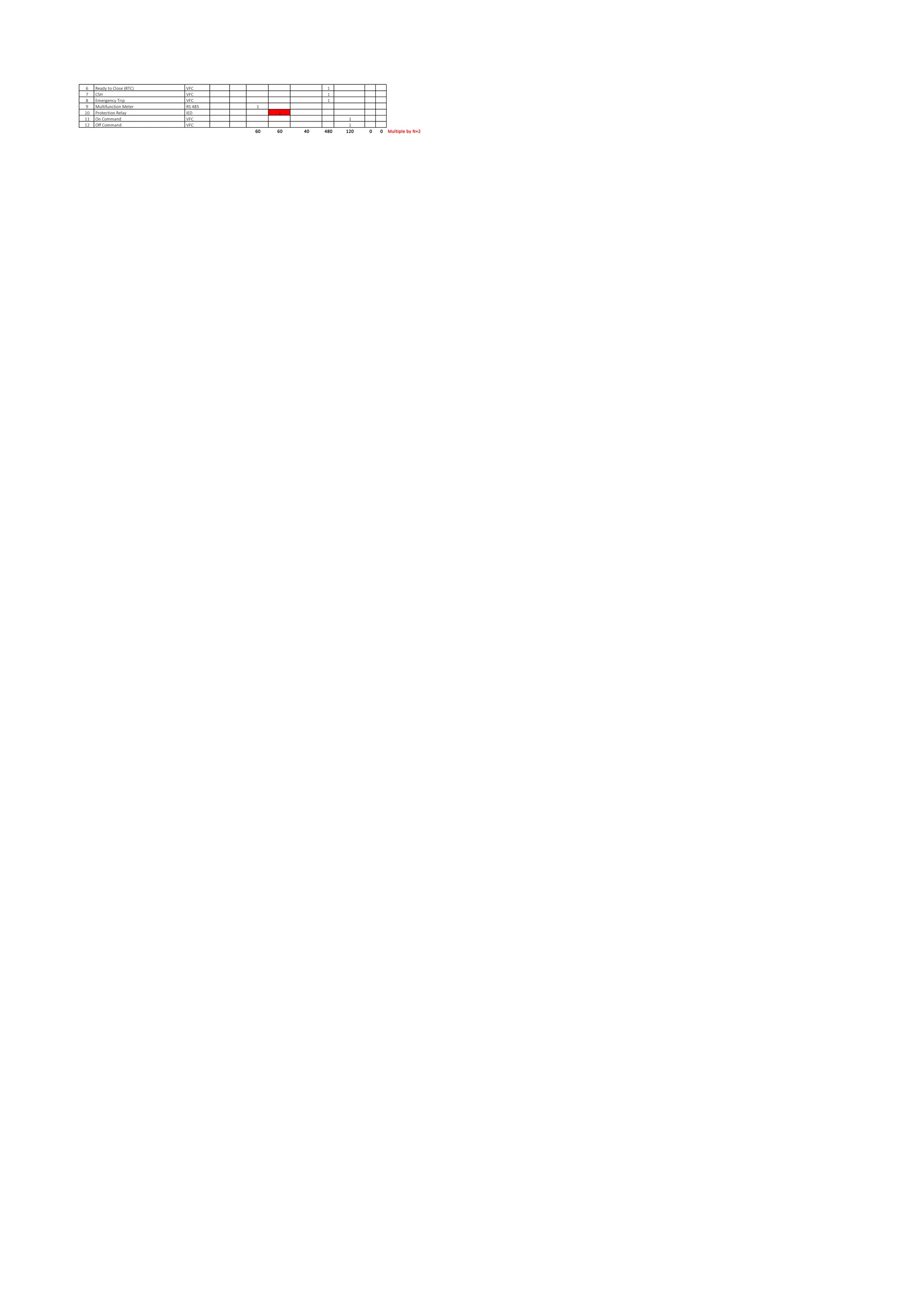
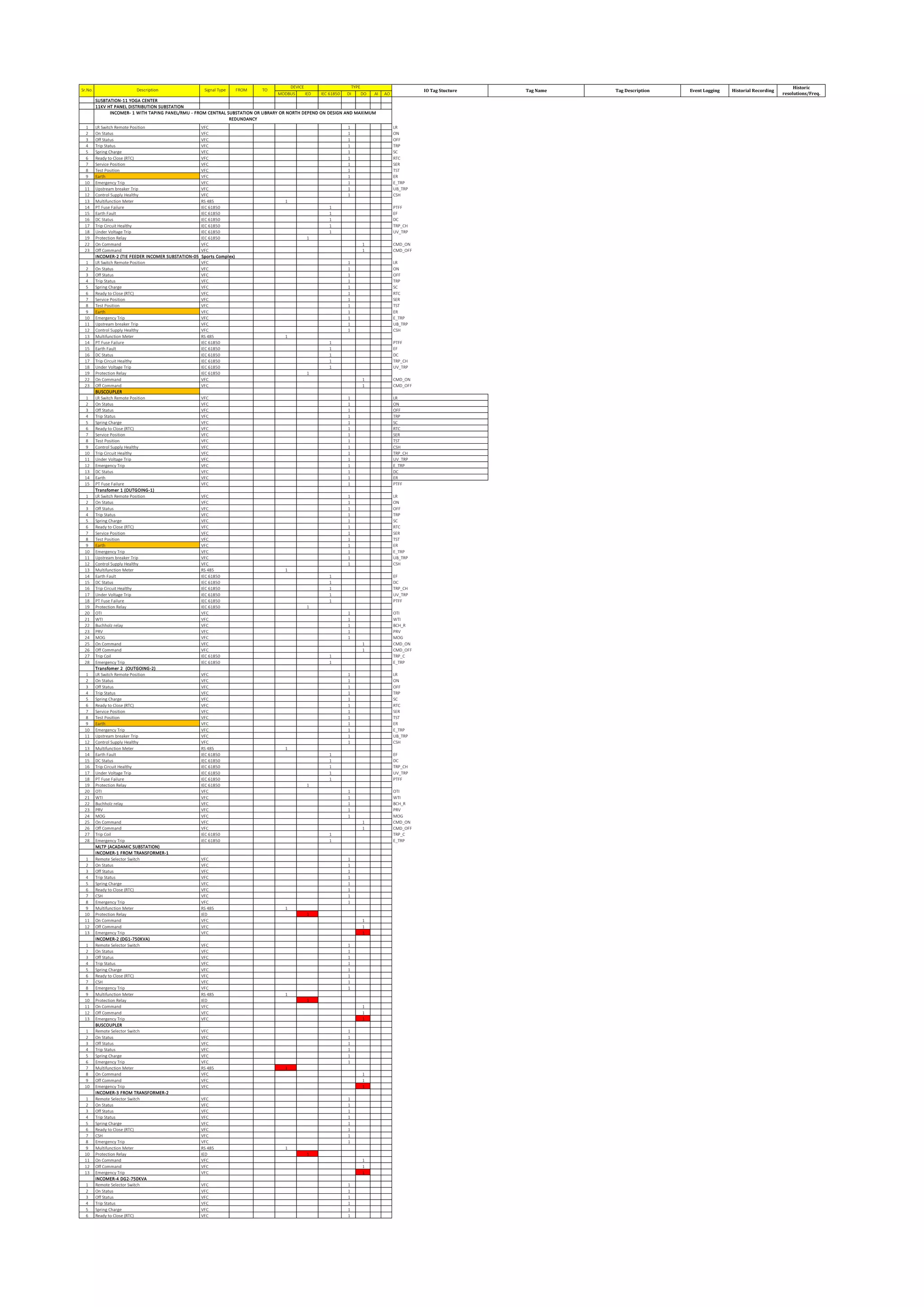
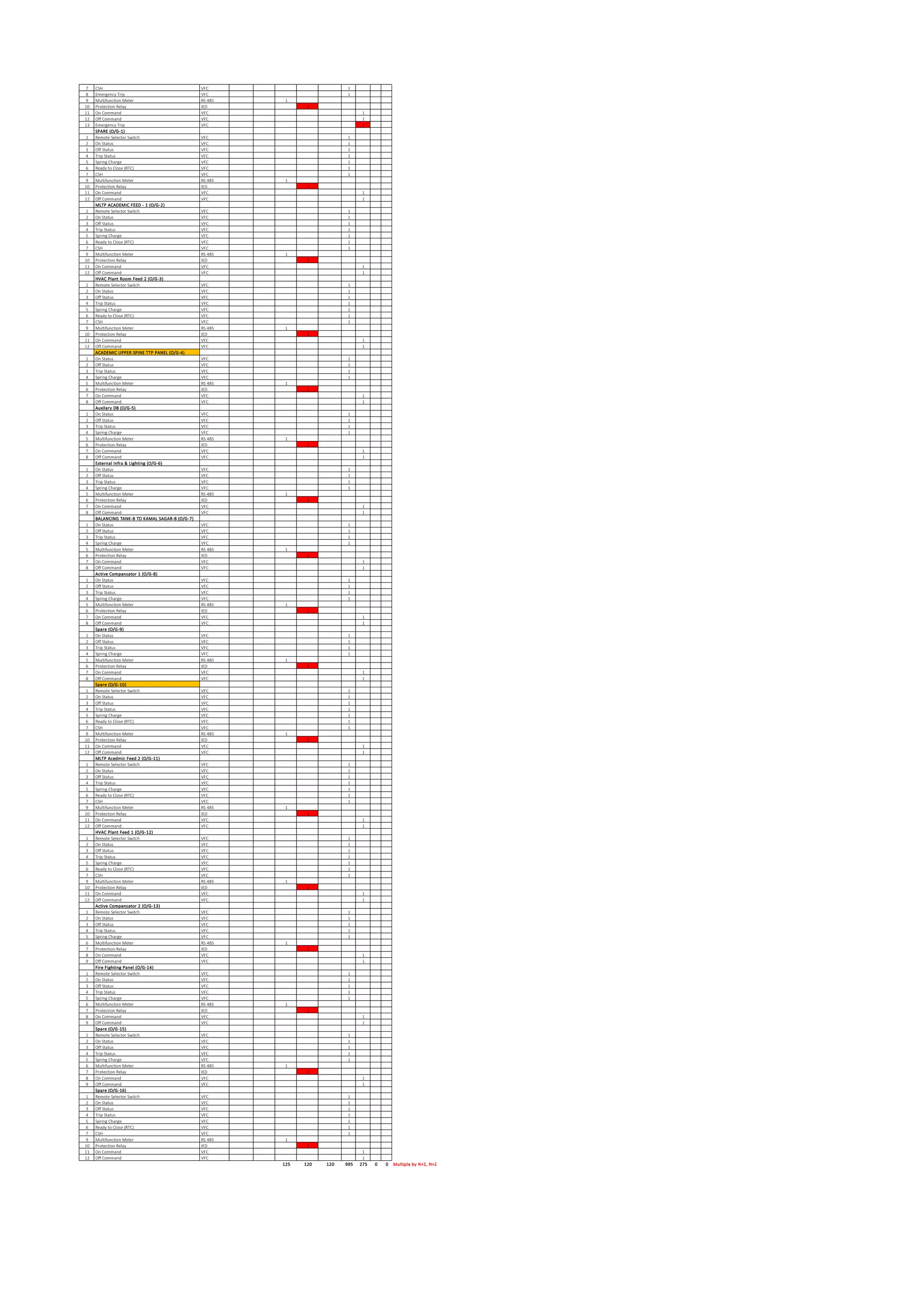
Tender IO Summary
3 SCADA ARCHITECTURE Tender SCADA Architecture
1.7 Abbreviations
Table 2 : List of Abbreviations
Acronym Definition / Description
AC Alternating Current
ACB Air Circuit Breaker
AMF Auto Main Failure
CSS Compact Sub-Station
DB Distribution Board
DC Direct Current
DCDB Direct Current Distribution Board
DER Distributed Energy Resources
DG diesel generator
DMS Distribution Management System
DR Disaster Recovery
EPC Engineering, procurement, and construction
FO Fibre Optic
FPI Fault Passage Indicator
FRTU Feeder Remote Terminal Unit
HT High Tension
HVAC Heating, ventilation, and air conditioning
IEC International Electrotechnical Commission
ANNEXURE 2: Tentative outline Functional Design Specification for NU
Page 14 of
141
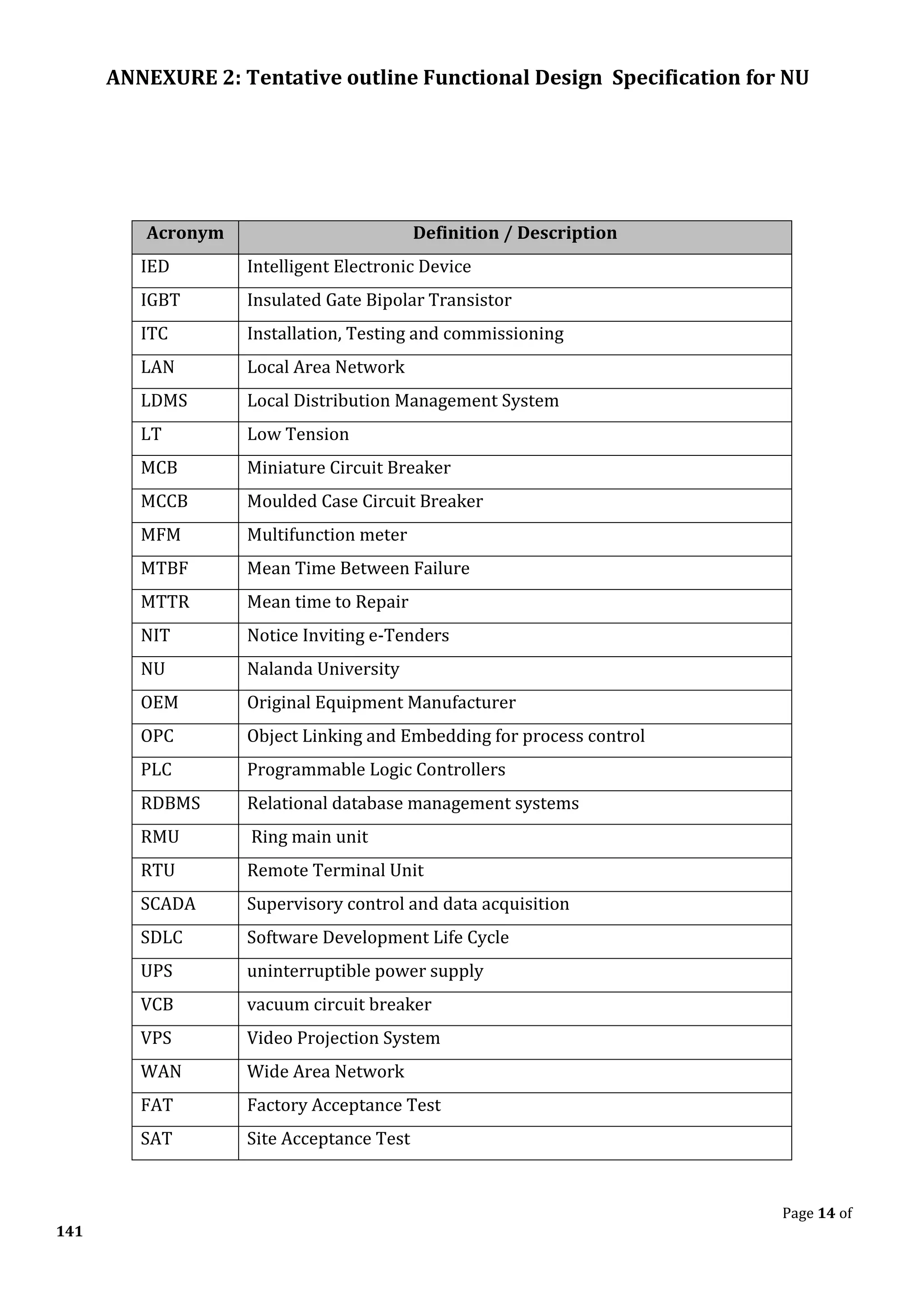
Acronym Definition / Description
IED Intelligent Electronic Device
IGBT Insulated Gate Bipolar Transistor
ITC Installation, Testing and commissioning
LAN Local Area Network
LDMS Local Distribution Management System
LT Low Tension
MCB Miniature Circuit Breaker
MCCB Moulded Case Circuit Breaker
MFM Multifunction meter
MTBF Mean Time Between Failure
MTTR Mean time to Repair
NIT Notice Inviting e-Tenders
NU Nalanda University
OEM Original Equipment Manufacturer
OPC Object Linking and Embedding for process control
PLC Programmable Logic Controllers
RDBMS Relational database management systems
RMU Ring main unit
RTU Remote Terminal Unit
SCADA Supervisory control and data acquisition
SDLC Software Development Life Cycle
UPS uninterruptible power supply
VCB vacuum circuit breaker
VPS Video Projection System
WAN Wide Area Network
FAT Factory Acceptance Test
SAT Site Acceptance Test
ANNEXURE 2: Tentative outline Functional Design Specification for NU
Page 15 of
141
1.8 Standard
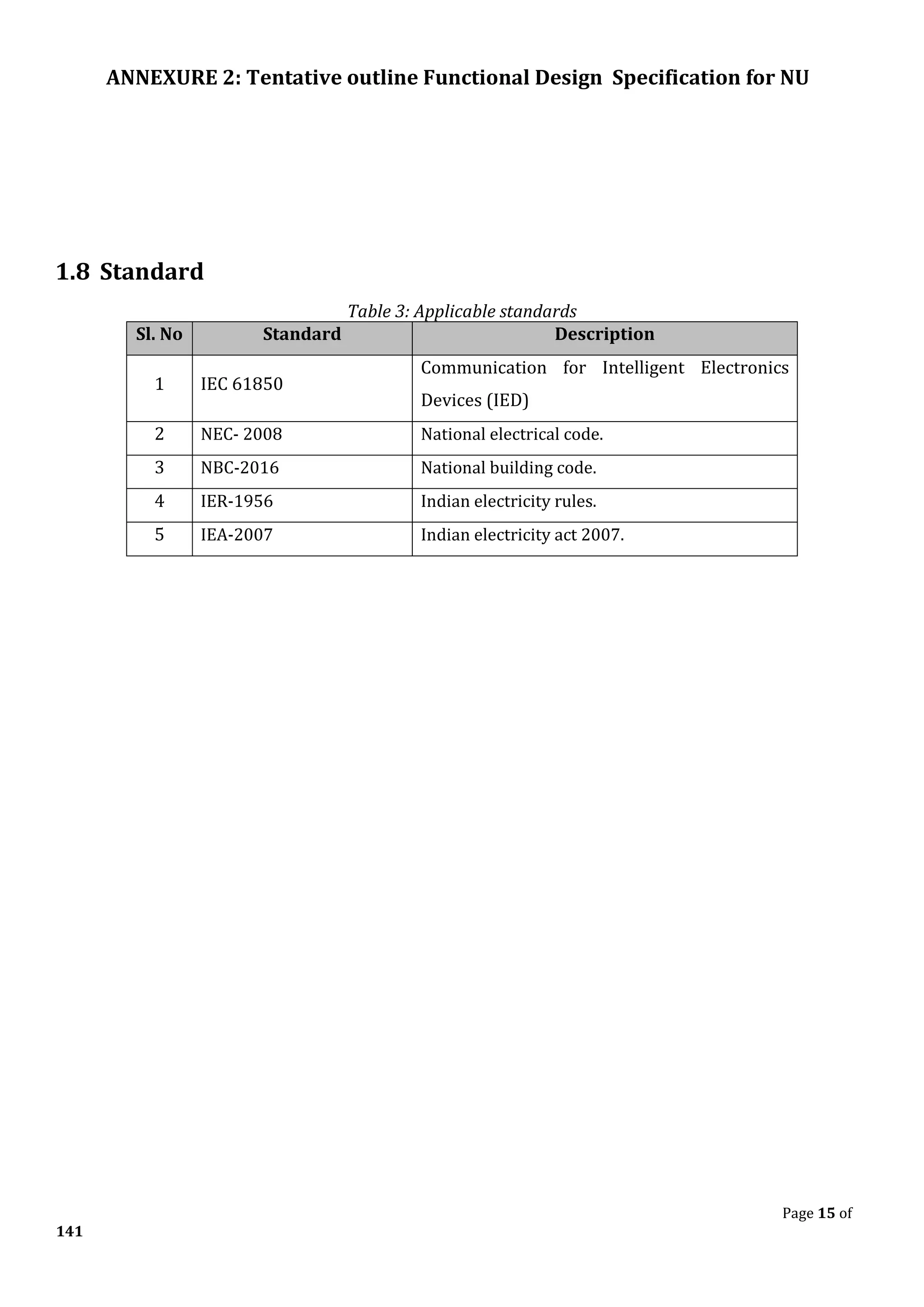
Table 3: Applicable standards
Sl. No Standard Description
1 IEC 61850
Communication for Intelligent Electronics
Devices (IED)
2 NEC- 2008 National electrical code.
3 NBC-2016 National building code.
4 IER-1956 Indian electricity rules.
5 IEA-2007 Indian electricity act 2007.
ANNEXURE 2: Tentative outline Functional Design Specification for NU
Page 16 of
141
2 SCADA Functions
2.1 General Requirements
List of major Modules of SCADA/DMS system as per the technical specifications.
1. SCADA –Control Centre (Centralized for all end /remotely installed equipment operation,
monitoring and control as well)
2. LDMS-Local Distribution Management System –with both way connectivity and control a.
SCADA-Control Centre and b. Local sub-station level also
3. Overall Distribution Management and Control System -DMS
4. Load management System (Balanced and Unbalances, Critical and Non-Critical, DG set
synchronization as a backup power and fuel monitoring system)
5. Weather monitoring system
6. Substation, feeder, area and building wise energy audit system along with the Billing Module for
at least 1000 residents. The communicable meter for reading through RTU/SWITECS of the
resident shall be provided and installed by the University.
7. Micro-grid Module
8. SLDC module
9. SCADA-Control Centre (with wall size display, server (main server OPC type so that various
modules will be integrated without any gateway), Engineering station/engineering laptop,
Monitor console –as per the design confirmation)
10. Disaster Recovery/Data recovery System - A data backup server with storage space at cloud for
five years shall be maintained. The required internet services with dedicated bandwidth for
cloud connectivity shall be provided by the University.
11. Water management modules.
12. This scope of the contractor includes all the equipment’s, hardware, software and services
covered under supply, installation and commissioning of centralized SCADA with LDMS
substations level, minimum 5 no’s authorized access through cloud & Wi-Fi access plus
Substation Automation system including control & monitoring and other related aspects of
substation operations for efficient and trouble-free operation
ANNEXURE 2: Tentative outline Functional Design Specification for NU
Page 17 of
141
Conceptually Electrical distribution system is segregated into following major parts
1. Lighting, Electrical protection and distribution system.
2. HVAC
3. Plumbing System
4. Fire Fighting System
A Central power station on 11 KV level which will be a central command centre for electrical
power distribution. The SCADA centre will be a part of this Central location.
To cater the total demand of the campus, 33KV will be received to the campus and further
distribution takes place via 33 / 11 KV Central Sub-station.
There are 6 source sub-stations as listed below
1. Main Receiving Sub-station (33 KV & 11 KV)
2. Central Power Station
3. Solar Plant 1 Sub-station
4. Solar Plant 2 Sub-station (In Future – Ph II)
5. CHP Plant 1 Sub-station (In Future)
6. CHP Plant 2 Sub-station (In Future – Ph II)
Different load connected is distributed on 11 KV by Ring main system as listed below. Phase I
development is
1. Academic Sub-station
2. International Centre Sub-station
3. Sports Area Sub-station
4. Student Housing Sub-station
ANNEXURE 2: Tentative outline Functional Design Specification for NU
Page 18 of
141
5. Faculty Housing Sub-station
6. Outreach Sub-station
7. Library area Compact Sub-station
8. Expansion of Academic area Sub-station (In future – Ph II)
9. Expansion of Student Housing Sub-station (In future – Ph II)
10. Expansion of Faculty Housing Sub-station (In Future – Ph II)
Above listed Substations are having following major equipment’s
1. 33 & or 11 KV HT Panels
2. 33/11 KV & or 11/415 KV Transformers & RMU
3. 415 Volts LT Panels
4. UPS & Battery Setup for Sub-stations
5. 415 Volt DG Sets
SCADA shall also be integrated with third party equipment’s / systems:
1. Water Storage & other plumbing drainage stations
2. Fire Fighting Pump room stations
3. Solar Farms
4. Roof top Solar setups
5. BMS (Integration / duplication of data on SCADA monitoring system)
During normal operation non-critical system with run over solar power supply. Once total load of
non-critical system will be greater than solar system capacity then operator / Auto-System will give on
command from central SCADA to close incoming 33KV HT breaker panel. During emergency when solar
and grid supply will fail operator / Auto-System will give start command to DG from central SCADA.
ANNEXURE 2: Tentative outline Functional Design Specification for NU
Page 19 of
141
2.2 Design Requirements
The software will be working on an 64-bit architecture platform All the variable parameters of
SCADA/DMS applications, which require adjustment from time-to-time, shall be defined in the database
and shall be adjustable by system personnel.
The adjustments made to parameters by the user or programmer will become effective without
any requirement of or recompile programs or regenerate all or portions of the database.
The software has been defined with user function w.r.t accessibility. There is different user
category as detailed in “section 7.2 User Interface Requirements”. The function can be classified as
below. All such actions shall be recorded as events in the event log.
1. Single-user function
For a single-user function, the user with access to the function must relinquish access to it before
access can be granted to another user.
2. Multi-user function
For a multi-user function any number of users, up to the maximum designated for the function,
may have access to the function simultaneously.
2.2.1 SCADA/DMS Function Access
Supervisory Control And Data Acquisition (SCADA) system is the heart of Distribution
Management System (DMS) architecture.
Central SCADA Control System should have all the infrastructure elements to support the multifaceted
nature of distribution automation in 9 Nos. of Substations and the higher-level applications of a DMS. A
Distribution SCADA system’s primary function is in support of distribution operations over the
redundant network of fibre as well the telemetry operation, alarming, event recording, and remote
control of field equipment.
The main elements of a DMS system are:
1. Host equipment.
2. Communication infrastructure (network and serial communications).
ANNEXURE 2: Tentative outline Functional Design Specification for NU
Page 20 of
141
3. Feeder Terminal Units devices for operations.
2.2.1.1 Host Equipment
The essential element of a distribution SCADA in proposed solution:-
1. Host servers (redundant servers with backup/failover capability).
2. Communication front-end nodes (network based).
3. Full graphics user interfaces.
4. Database Central SCADA Server
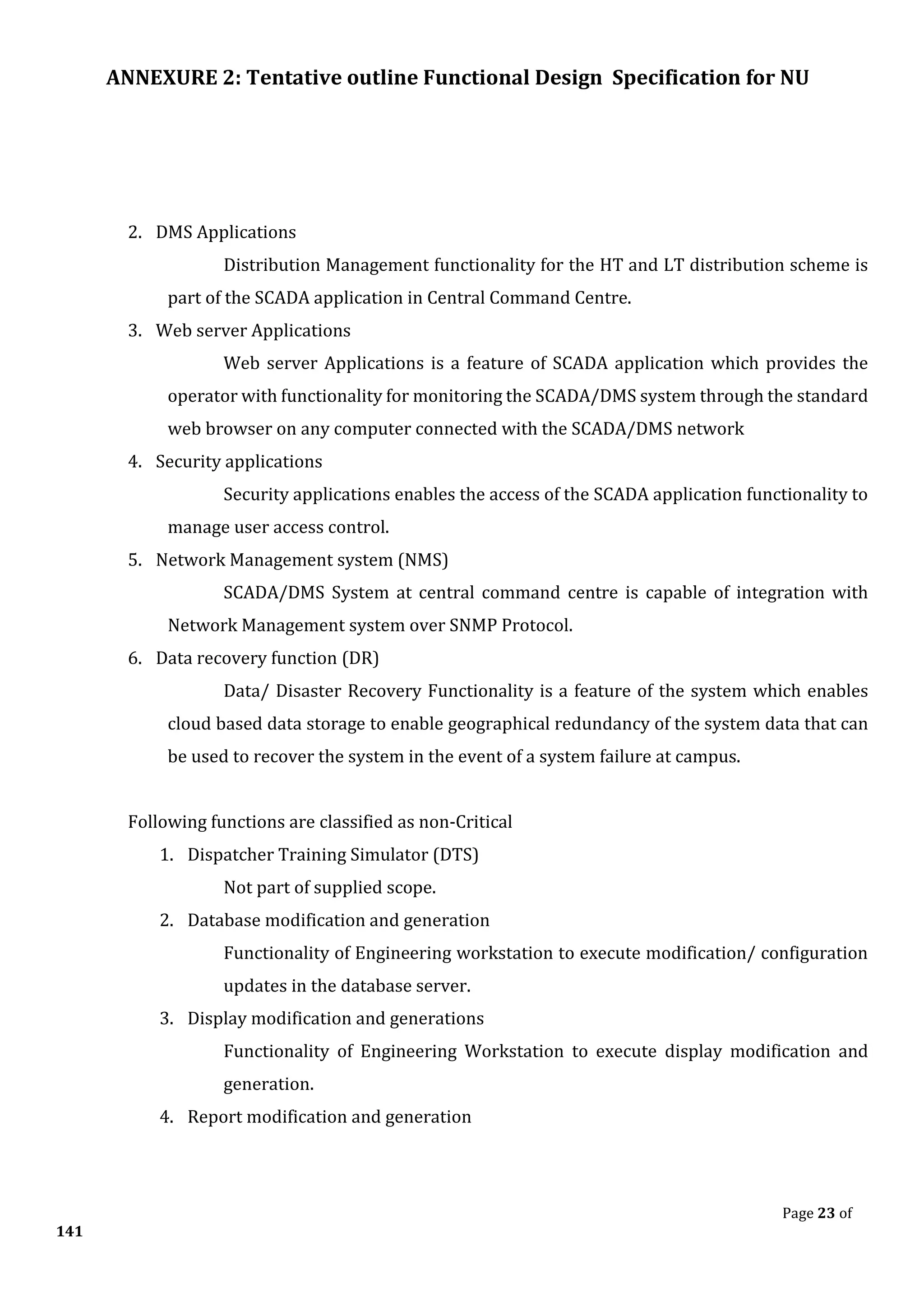
2.2.1.2 Communication infrastructure
The SCADA / DMS is connected with the Sub-Station equipment via following protocols over the
fibre backbone as primary communication interface and wireless network as secondary
communication interface.
1. For LDMS / PLC : The data will be transmit over the Modbus TCP/IP protocol
from the PLCs at Sub-station to SCADA / DMS
2. For MFT’s : The data will be transmitted over Modbus RTU Protocol to
PLC’s at Sub-station.
3. For DR & third-Party Systems : The data will be transmitted over OPC-UA
4. Existing System(like BMS etc.,) : The data will be transmitted over OPC-UA
5. For IT Systems : The data will be transmitted over OPC-UA
ANNEXURE 2: Tentative outline Functional Design Specification for NU
Page 21 of
141
Nalanda ESCADA – Communication Block
Diagram
Sub Station
Central Control Centre
SCADA/DMS Server
(Primary + Secondary)
Cloud
Cloud Storage
ADO/ODBC, RDBMS
Replication Methods
SLDC
SOLAR Control
System
BMS System
OPC UA
OPC UA
OPC UA
LDMS/ PLC
Modbus TCP/IP
Campus Wifi
Modbus RTU
MFT
IEC 61850
IED
Other Campus
Locations
Energy Meters for Billing
Fibre Media
Fibre Media
Figure 2 : Communication Block Diagram
ANNEXURE 2: Tentative outline Functional Design Specification for NU
Page 22 of
141
2.2.1.3 Feeder Terminal Units devices for operations
RTU’s are the main components of the distribution automation system to control and monitor
the feeder terminal units, which meet specific operating and data gathering requirements. Each field
devices provides the data for the system operations, includes fault detection, captures planning data
and records power quality information.
2.2.1.4 Database Central SCADA Servers-
For archival of historical power system values, SCADA automatically compiles and delivers
information for the 9 Nos. of Substation to a central control centre. This system sends digitized
information in real time, and it also automatically compiles backlogs of all collected data for the analysis.
This will be done over SQL database.
Collecting data from the distributed substations from the feeder terminal units allows to detect
potential problems before they affect your workflow. RTUs will send the gathered information to
central control centre.
2.2.2 Critical / Non-Critical Function
System is classified as Critical or as Non-Critical. All critical functions are redundant w.r.t
hardware and software so that no single hardware & /software failure will interrupt the availability of
the functions.
The proposed solution consists of a redundant central SCADA/DMS system at central command
centre location connected to the PLC based RTU system at substation level. M580 based Hot Standby
PLC is considered in substation to control and monitor the High Side electrical works, each substation
having the HMI for local level control in case of communication failure from central SCADA.
Generally following are classified as Critical functions
1. SCADA Applications
SCADA application at central command centre executes data acquisition from PLC
system and enables execution of all control and monitoring activities.
ANNEXURE 2: Tentative outline Functional Design Specification for NU
Page 23 of
141
2. DMS Applications
Distribution Management functionality for the HT and LT distribution scheme is
part of the SCADA application in Central Command Centre.
3. Web server Applications
Web server Applications is a feature of SCADA application which provides the
operator with functionality for monitoring the SCADA/DMS system through the standard
web browser on any computer connected with the SCADA/DMS network
4. Security applications
Security applications enables the access of the SCADA application functionality to
manage user access control.
5. Network Management system (NMS)
SCADA/DMS System at central command centre is capable of integration with
Network Management system over SNMP Protocol.
6. Data recovery function (DR)
Data/ Disaster Recovery Functionality is a feature of the system which enables
cloud based data storage to enable geographical redundancy of the system data that can
be used to recover the system in the event of a system failure at campus.
Following functions are classified as non-Critical
1. Dispatcher Training Simulator (DTS)
Not part of supplied scope.
2. Database modification and generation
Functionality of Engineering workstation to execute modification/ configuration
updates in the database server.
3. Display modification and generations
Functionality of Engineering Workstation to execute display modification and
generation.
4. Report modification and generation
ANNEXURE 2: Tentative outline Functional Design Specification for NU
Page 24 of
141
Functionality of SCADA/DMS system to generate required reports as required by
the operator.
ANNEXURE 2: Tentative outline Functional Design Specification for NU
Page 25 of
141
2.3 SCADA Function
All input data and parameters, entered by an user or collected due to polling, shall be checked
for reasonability and rejected if they are unreasonable. All intermediate and final results shall be
checked to prevent unreasonable data from being propagated or displayed to the user.
When an unreasonable input data or results are detected, diagnostic messages, clearly describing
the problem, shall be generated. All programs and all computer systems shall continue to operate in the
presence of unreasonable data.
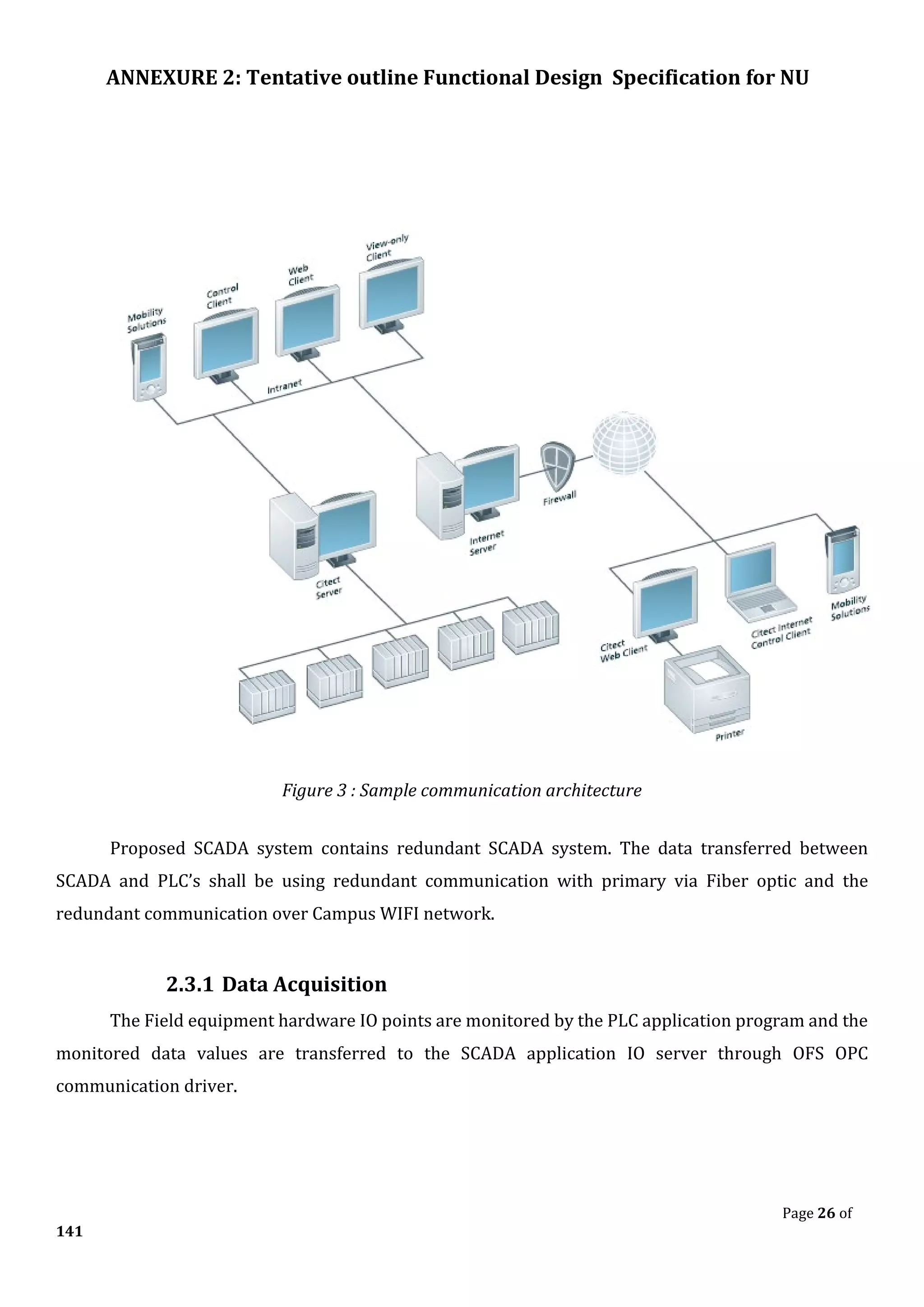
Below is the sample representation of the overall connectivity of the system. The SCADA / DMS
System is connected to multiple PLC based RTUs. SCADA / DMS / DMS provides two levels of clients. A
Control Client has the complete functionality of the application to view any screen and read and write
any variable controlled through the SCADA system. This makes the Control Client the perfect tool for
operators. A View-only Client is able to view all information within the SCADA system but is unable to
write to any variable or execute code to communicate with another server. This makes the View-only
Client perfect for upper management, process optimisation or causal users of the control system. Read-
only access is also available via a Control Client using project security.
Both levels of SCADA / DMS clients are used to display control system information. Within the
control room, the complete SCADA / DMS client application is installed onto a machine. These machines
are dedicated to running the control system and an application interface provides the maximum
viewable space for visualisation and the fastest possible response.
Web Clients allow users outside the control room to access control system data in real time. The
Web Client is a completely functional client with an identical interface to the dedicated Control Clients
(displayed within a web page), which requires zero maintenance. The client controls and project are
downloaded from the website and project updates will automatically be synchronised with the Web
Clients.
ANNEXURE 2: Tentative outline Functional Design Specification for NU
Page 26 of
141
Figure 3 : Sample communication architecture
Proposed SCADA system contains redundant SCADA system. The data transferred between
SCADA and PLC’s shall be using redundant communication with primary via Fiber optic and the
redundant communication over Campus WIFI network.
2.3.1 Data Acquisition
The Field equipment hardware IO points are monitored by the PLC application program and the
monitored data values are transferred to the SCADA application IO server through OFS OPC
communication driver.
ANNEXURE 2: Tentative outline Functional Design Specification for NU
Page 27 of
141
2.3.1.1 Polling Method
Digital status data from Sub-stations will be updated and displayed on real time within 3 seconds.
Digital status data shall have higher priority than the Analog data. The system shall have dead band for
data by exception.
Different polling methods implemented as part of the SCADA/DMS system are:
1. Cyclic polling method is adopted for scanning of hardwired input and output status as per
the PLC program scan time in milliseconds. The scan time of the application shall be derived
with finalization of detailed application design and simulation testing during the execution
of Factory Acceptance Testing.
2. Cyclic polling method for analog data read as soft points shall be scanned at a sampling rate
in seconds defined application program. The sampling rate shall be such that the required
storage rate of 2 minutes interval shall be implemented.
3. Calculated energy values shall be collected by cyclic polling method for OPC tag groups shall
be defined at the OFS OPC communication drivers of the SCADA IO servers such that the
measured values in the PLC system at the substation level shall be updated for the operator
in 3 seconds.
2.3.1.2 Telemetry Failure
SCADA/DMS system shall interface with the PLC based RTU system at substation level through
redundant fibre network as the primary method of communication. In case of fibre network
communication failure, the campus Wi-Fi wireless network shall be used for data transfer. At each Sub
station location, PLC based RTU system contains a wireless interface module as part of the system which
will establish the communication with campus wireless network provided by the customer.
The SCADA IO server shall accept the data from the PLC system at substation level through the
IP address of the wireless interface module when communication link fails over the fibre-based
network. Communication over fibre network shall be the primary mode of communication, hence
SCADA/DMS system shall switch to communication over the fibre network once the media is available.
ANNEXURE 2: Tentative outline Functional Design Specification for NU
Page 28 of
141
If data is not received from PLC after a user-adjustable number of retries, each affected point in
the SCADA system shall be marked with a ‘telemetry failure quality code’ and an alarm shall be
generated. Quality codes shall be detailed during detailed design specification.
The following modes of data acquisition are supported:
1. Enable: When CHPS/SOLARS SS/ LDMS/VCBS/RMUS/RTU/FRTU/FPI is enabled, the
data is scanned in normal fashion and control command execution is allowed.
2. Disable: When GENERATORS/ LDMS/RTU/FRTU/FPI is disabled, the data scanning &
control execution is disabled. This is equivalent to” delete from scan “of complete PLC.
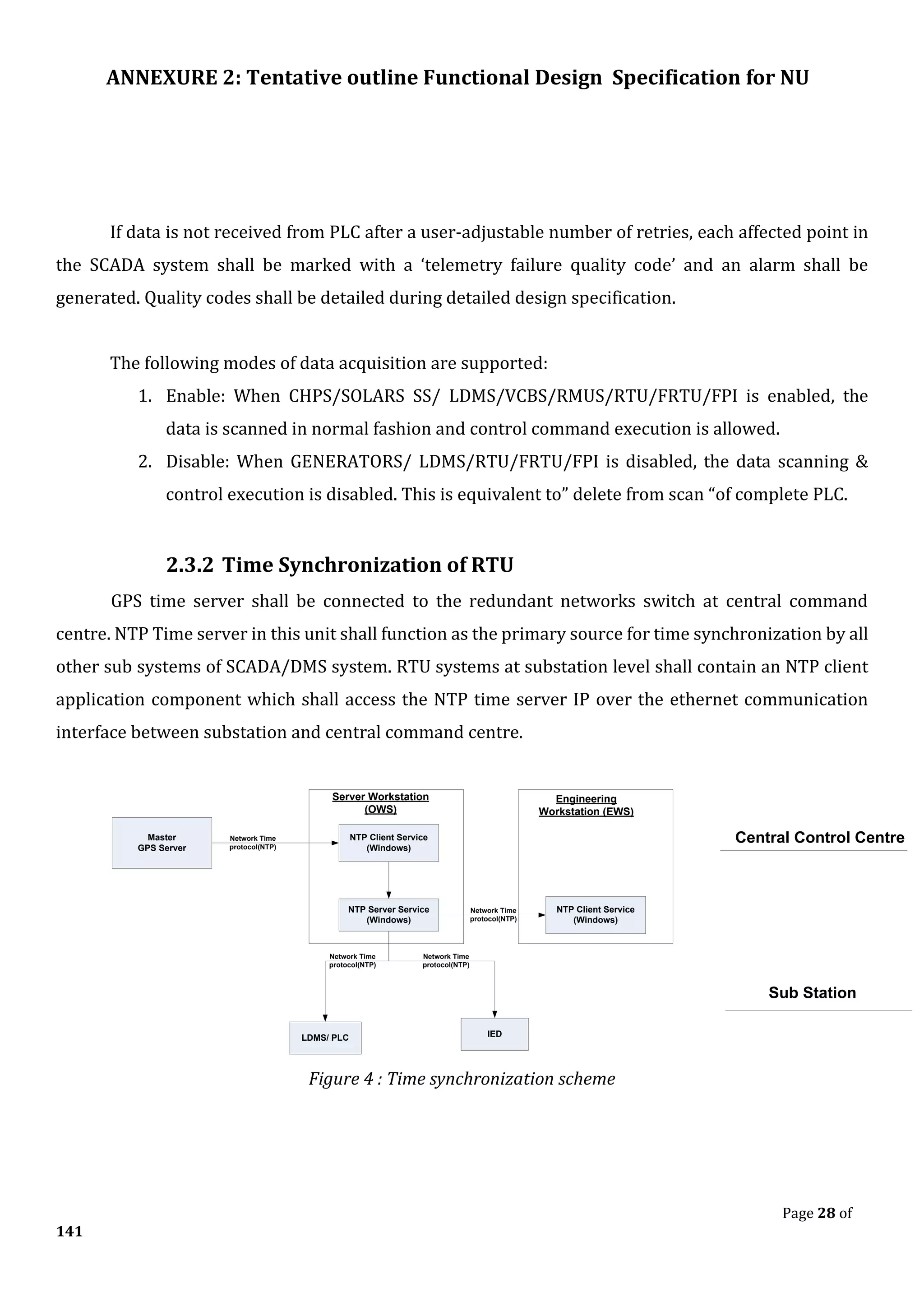
2.3.2 Time Synchronization of RTU
GPS time server shall be connected to the redundant networks switch at central command
centre. NTP Time server in this unit shall function as the primary source for time synchronization by all
other sub systems of SCADA/DMS system. RTU systems at substation level shall contain an NTP client
application component which shall access the NTP time server IP over the ethernet communication
interface between substation and central command centre.
Sub Station
Central Control Centre
Master
GPS Server
NTP Client Service
(Windows)
NTP Server Service
(Windows)
LDMS/ PLC IED
Network Time
protocol(NTP)
Network Time
protocol(NTP)
Network Time
protocol(NTP)
Server Workstation
(OWS)
Engineering
Workstation (EWS)
NTP Client Service
(Windows)
Network Time
protocol(NTP)
Figure 4 : Time synchronization scheme
ANNEXURE 2: Tentative outline Functional Design Specification for NU
Page 29 of
141
2.3.3 Data Exchange
2.3.3.1 SCADA/DMS system with IT
The different IT systems that are part of SCADA/DMS system at central command centre are
connected to the managed switch installed. The managed switch at this level shall be integrated as part
of the campus IT network for connection of Web client and cloud-based disaster recovery system.
The Data Centre, DR Centre and Customer Care Centre under IT System, shall exchange data with
the ISR System, using OPC-UA , ADO/ODBC , RDBMS replication methods.
2.3.3.1.1 Operator Workstations (OWS)
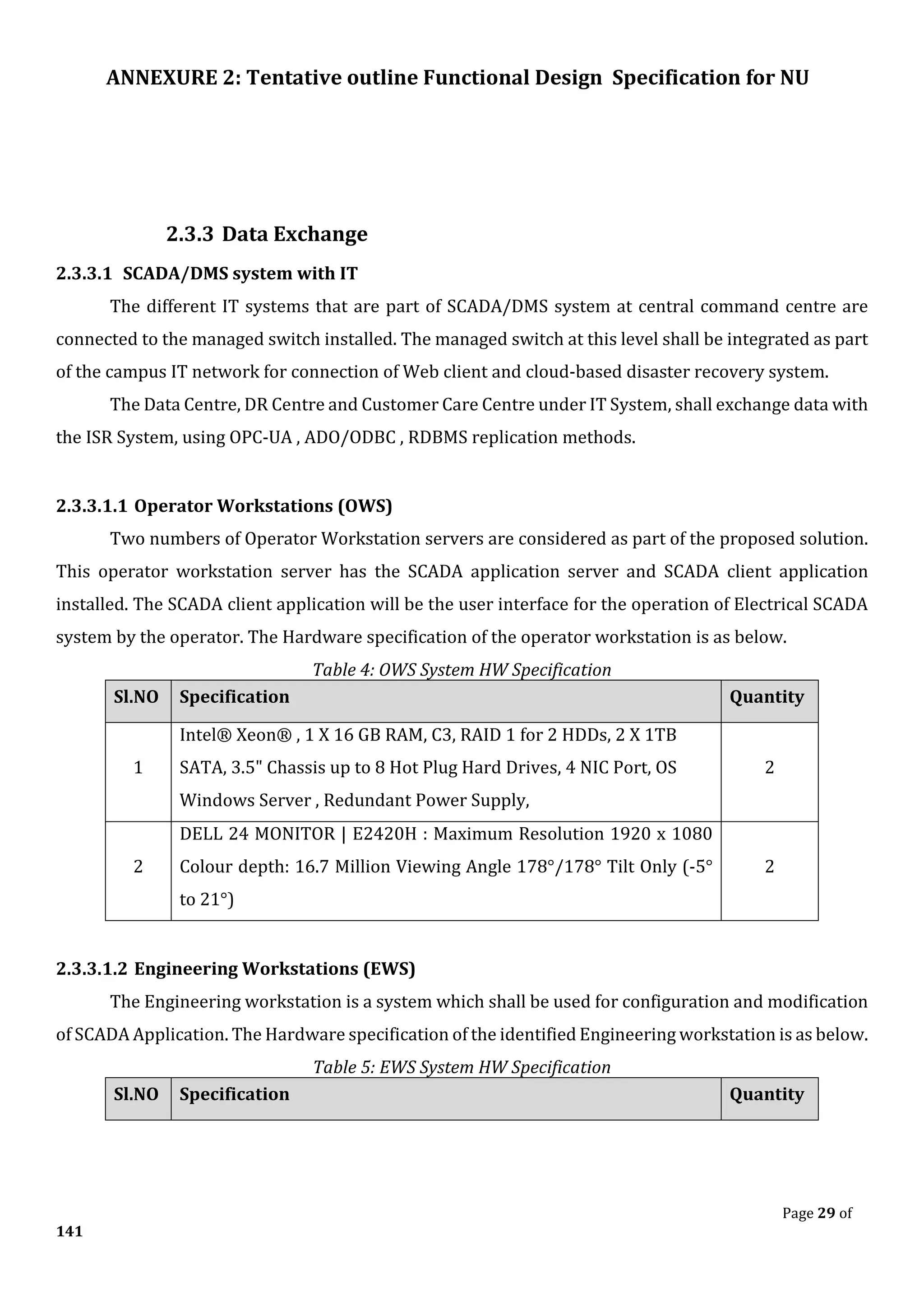
Two numbers of Operator Workstation servers are considered as part of the proposed solution.
This operator workstation server has the SCADA application server and SCADA client application
installed. The SCADA client application will be the user interface for the operation of Electrical SCADA
system by the operator. The Hardware specification of the operator workstation is as below.
Table 4: OWS System HW Specification
Sl.NO Specification Quantity
1
Intel® Xeon® , 1 X 16 GB RAM, C3, RAID 1 for 2 HDDs, 2 X 1TB
SATA, 3.5" Chassis up to 8 Hot Plug Hard Drives, 4 NIC Port, OS
Windows Server , Redundant Power Supply,
2
2
DELL 24 MONITOR | E2420H : Maximum Resolution 1920 x 1080
Colour depth: 16.7 Million Viewing Angle 178°/178° Tilt Only (-5°
to 21°)
2
2.3.3.1.2 Engineering Workstations (EWS)
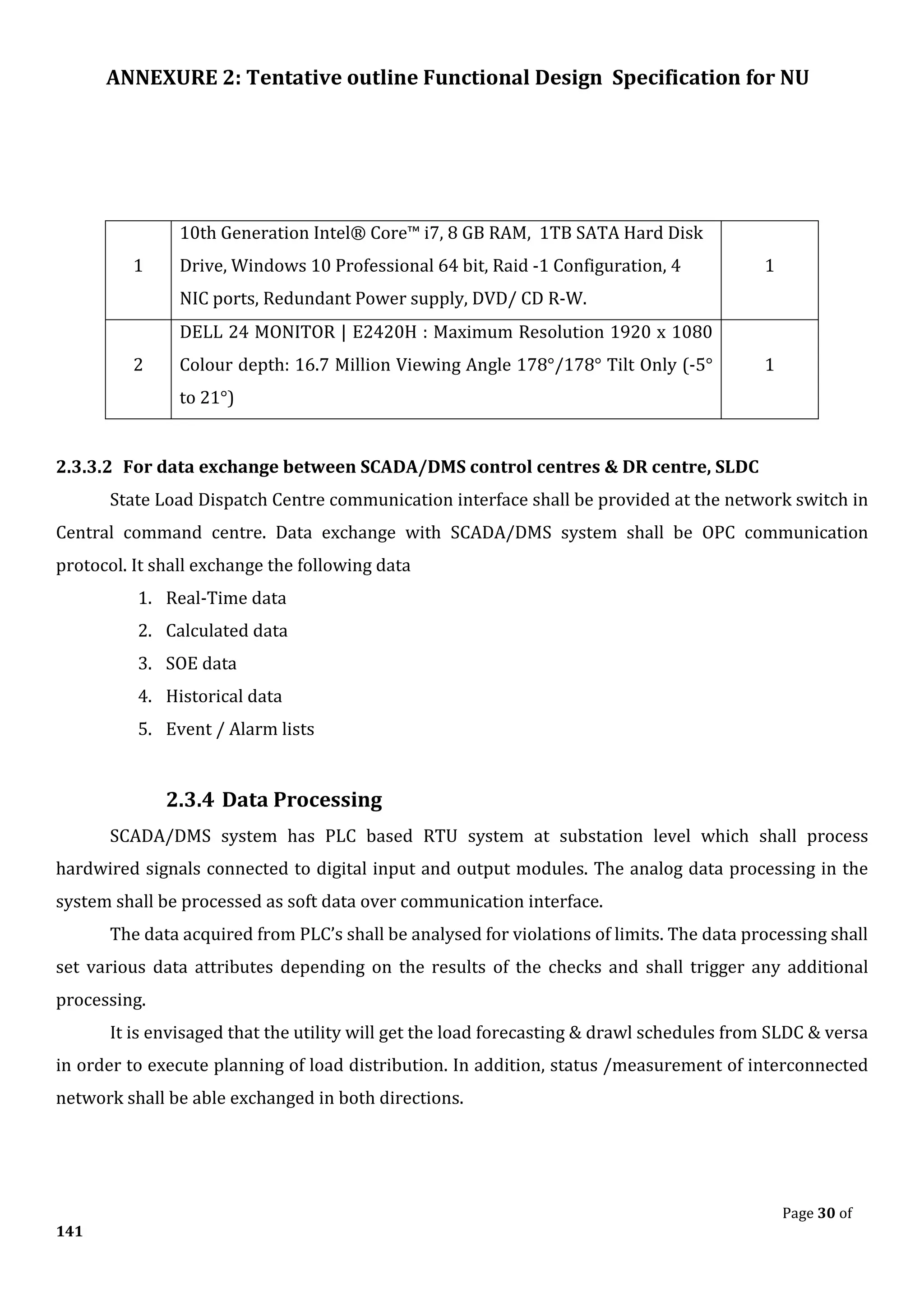
The Engineering workstation is a system which shall be used for configuration and modification
of SCADA Application. The Hardware specification of the identified Engineering workstation is as below.
Table 5: EWS System HW Specification
Sl.NO Specification Quantity
ANNEXURE 2: Tentative outline Functional Design Specification for NU
Page 30 of
141
1
10th Generation Intel® Core™ i7, 8 GB RAM, 1TB SATA Hard Disk
Drive, Windows 10 Professional 64 bit, Raid -1 Configuration, 4
NIC ports, Redundant Power supply, DVD/ CD R-W.
1
2
DELL 24 MONITOR | E2420H : Maximum Resolution 1920 x 1080
Colour depth: 16.7 Million Viewing Angle 178°/178° Tilt Only (-5°
to 21°)
1
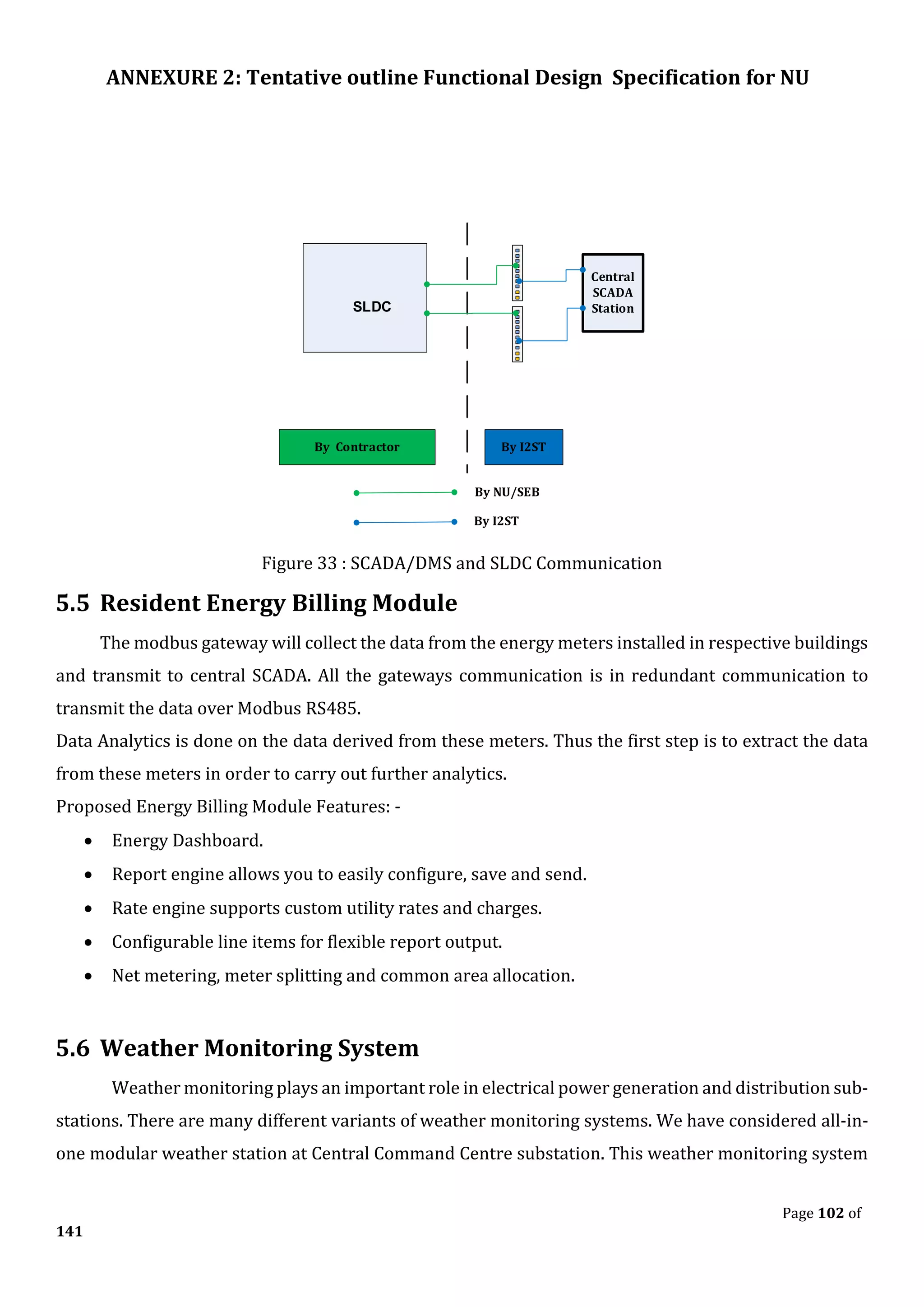
2.3.3.2 For data exchange between SCADA/DMS control centres & DR centre, SLDC
State Load Dispatch Centre communication interface shall be provided at the network switch in
Central command centre. Data exchange with SCADA/DMS system shall be OPC communication
protocol. It shall exchange the following data
1. Real-Time data
2. Calculated data
3. SOE data
4. Historical data
5. Event / Alarm lists
2.3.4 Data Processing
SCADA/DMS system has PLC based RTU system at substation level which shall process
hardwired signals connected to digital input and output modules. The analog data processing in the
system shall be processed as soft data over communication interface.
The data acquired from PLC’s shall be analysed for violations of limits. The data processing shall
set various data attributes depending on the results of the checks and shall trigger any additional
processing.
It is envisaged that the utility will get the load forecasting & drawl schedules from SLDC & versa
in order to execute planning of load distribution. In addition, status /measurement of interconnected
network shall be able exchanged in both directions.
ANNEXURE 2: Tentative outline Functional Design Specification for NU
Page 31 of
141
Data processing involves a value which has been converted to internal form and analyzed for
violations of limits. The data processing shall set various data attributes depending on the results of the
checks and shall trigger any additional processing or calculation.
The SCADA system shall have capability to accept data from the following sources:
1. Real-time data received from control centres /IT system (data centre, customer care, DR
centre and PLCs etc)
2. Calculated data
3. Manually entered data
4. Sequence of events data
5. Alternate data sources
2.3.4.1.1 Analog Data processing
Analog data processing shall be performed according to the requirements listed below.
2.3.4.1.2 Zero dead band processing
SCADA/DMS system shall process each analog input for dead band zone processing. The
acquired value, if falls between the dead band range around zero then it shall be considered as clamped
zero value else the actual value shall be considered.
2.3.4.1.3 Reasonability Limit Check
All analog values shall be compared against defined high and low reasonability limits. The
comparisons shall be performed at the scan rates of the analog values. An alarm shall be generated
when a reasonability limit violation is detected. The last valid value of the variable shall be maintained
in the database and marked with a quality code indicating the ‘reasonability limit violation’. When data
returns to a reasonable value, the new value shall be accepted and a return-to-normal message shall be
generated.
2.3.4.1.4 Limit Monitoring
The limits will represent increasing levels of concern and shall be named as "Operational",
"Alarm" and "Emergency" limits. These three limits shall be set within the boundaries of reasonability
ANNEXURE 2: Tentative outline Functional Design Specification for NU
Page 32 of
141
limit. Emergency limit shall be assigned as audible alarm. All telemetered and calculated analog point
shall be compared against above sets of high and low limits each time the value is scanned or calculated.
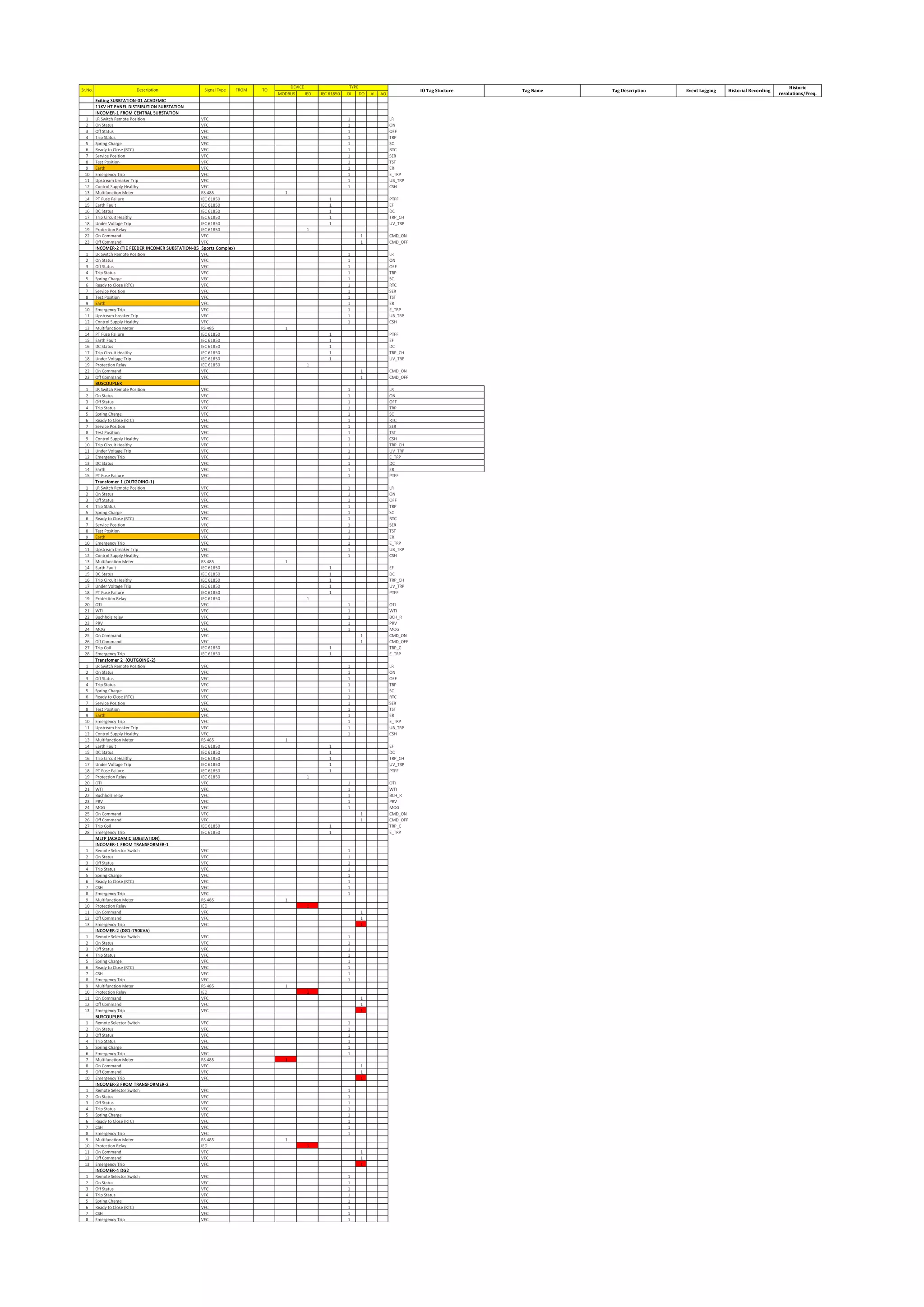
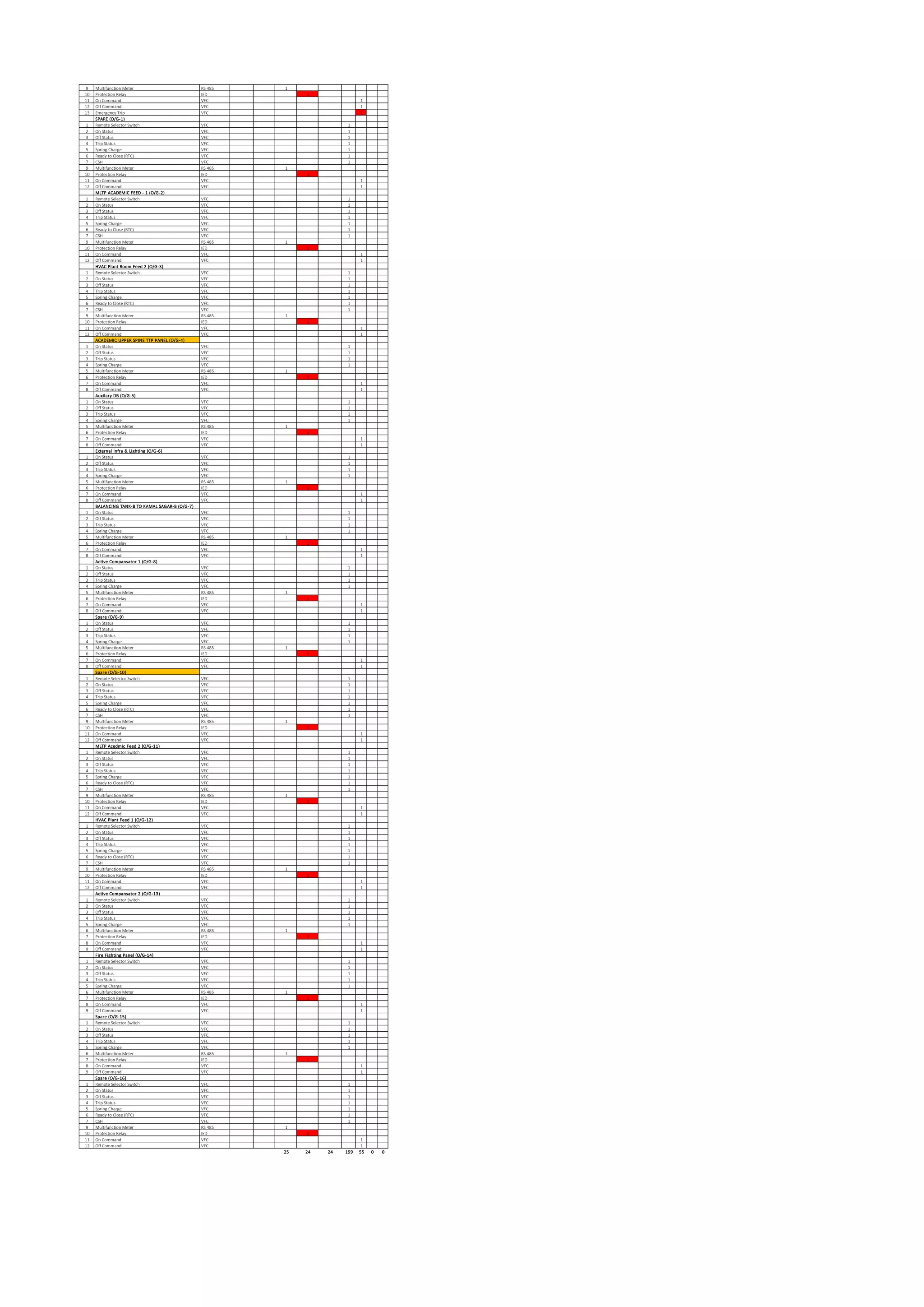
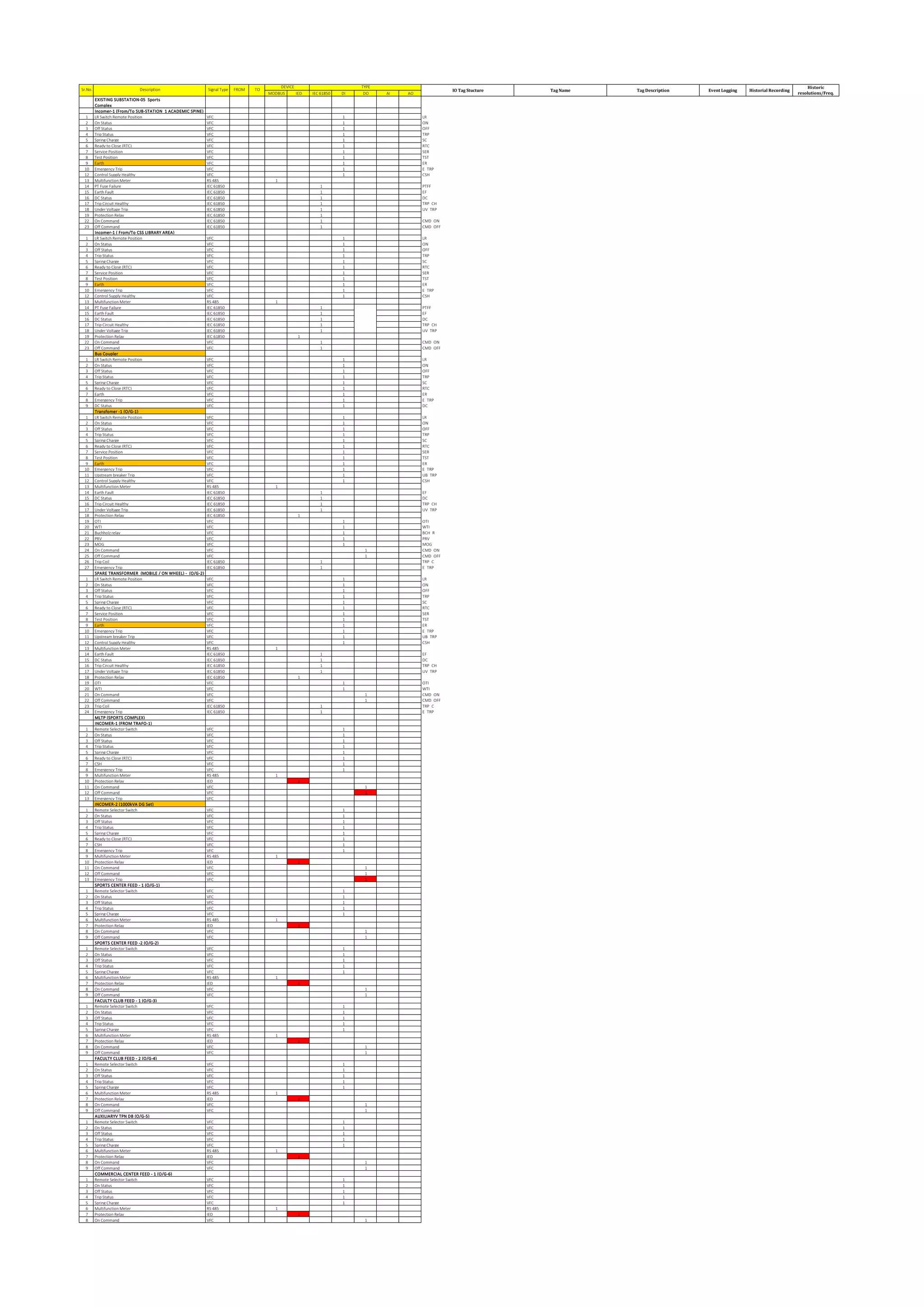
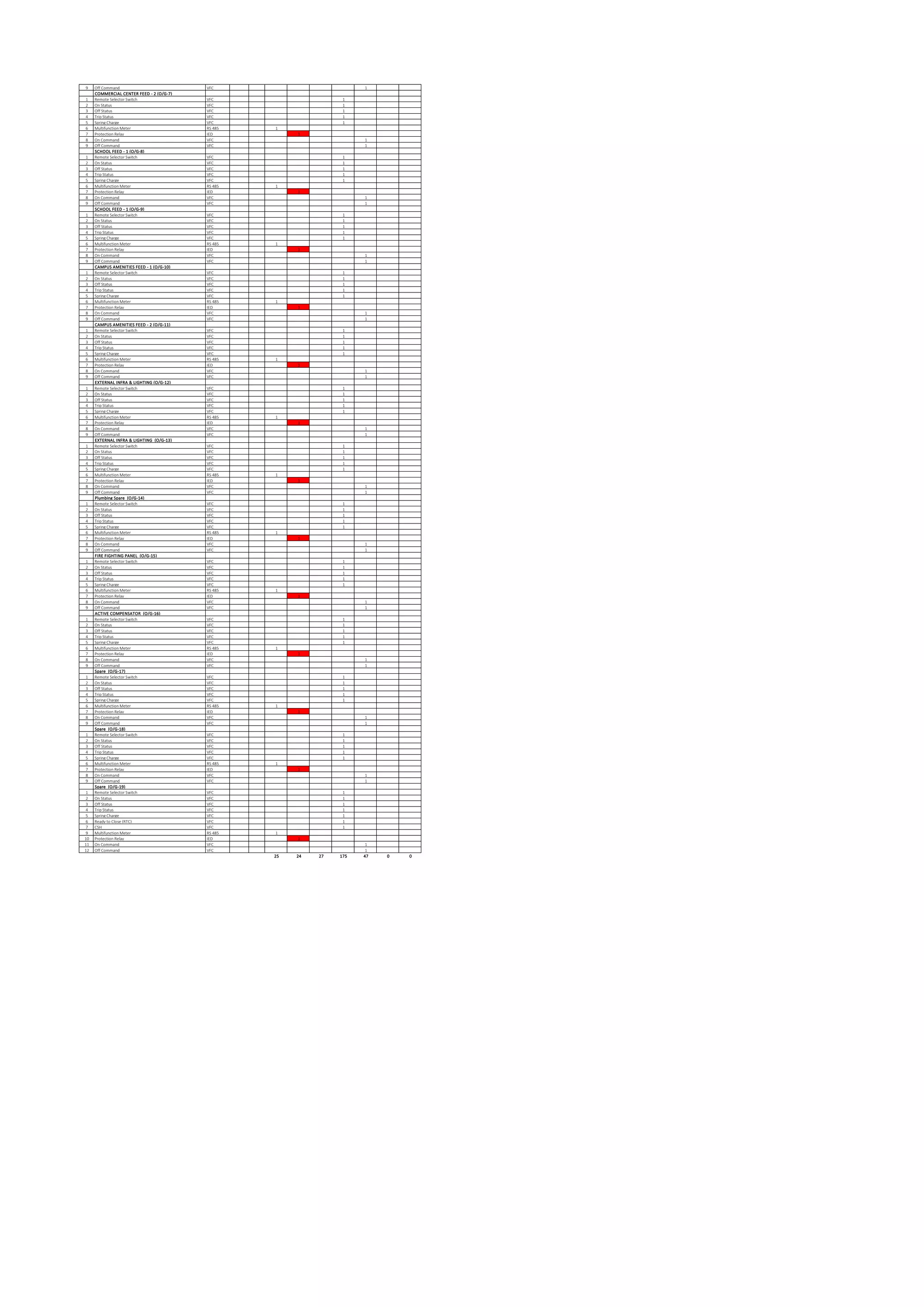
Whenever a monitored point crosses a limit in the undesirable direction a limit violation alarm message
shall be generated.
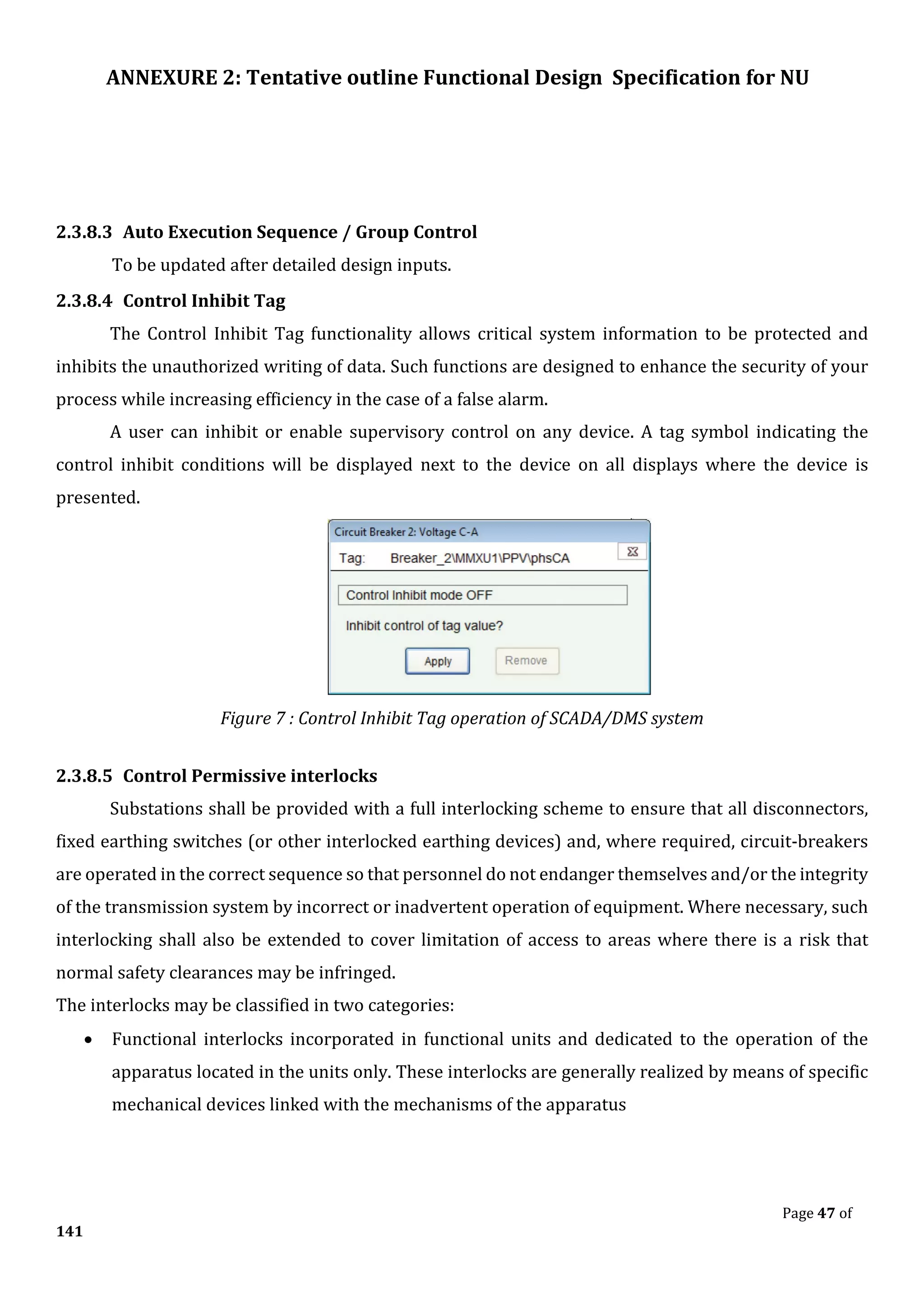
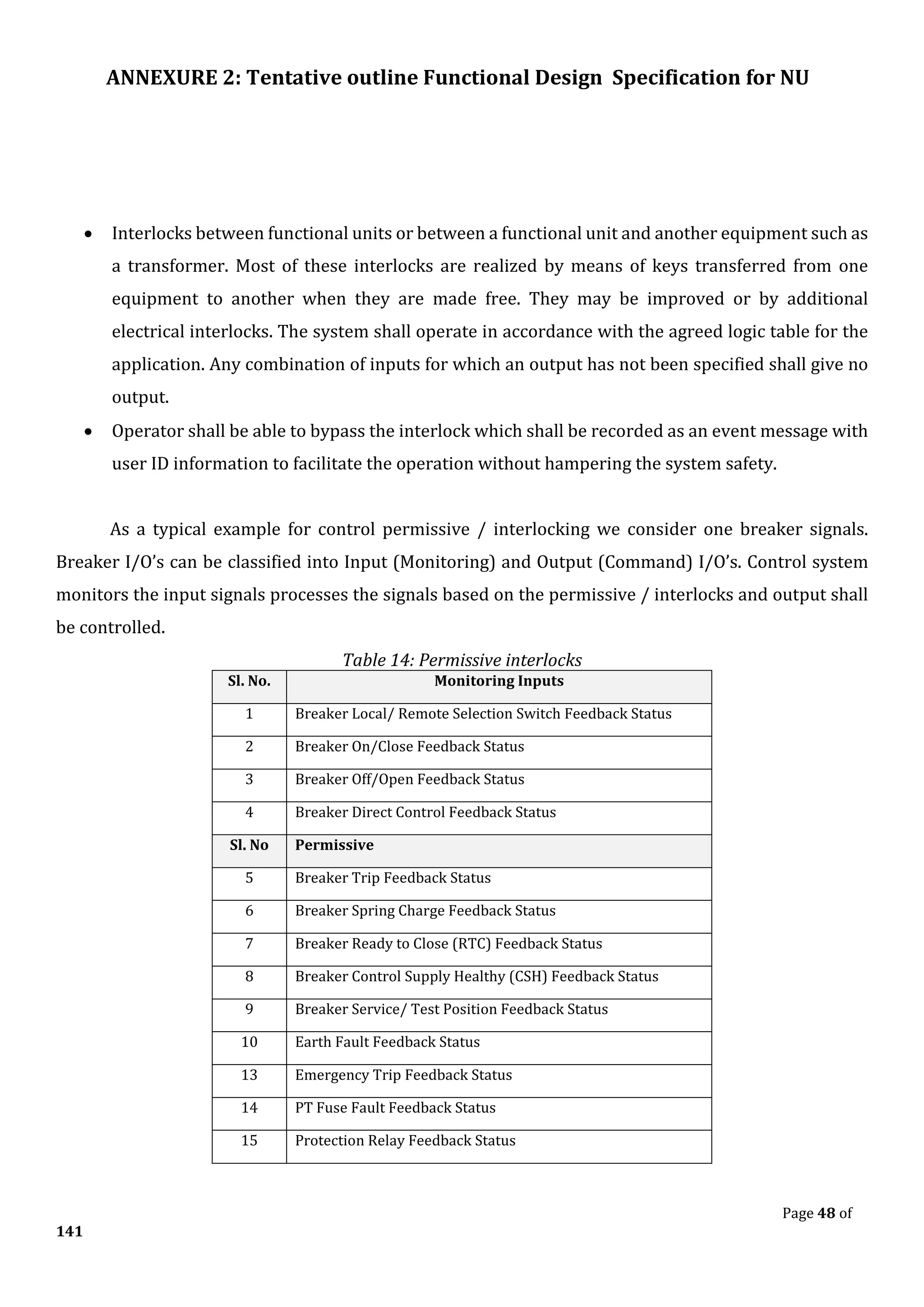
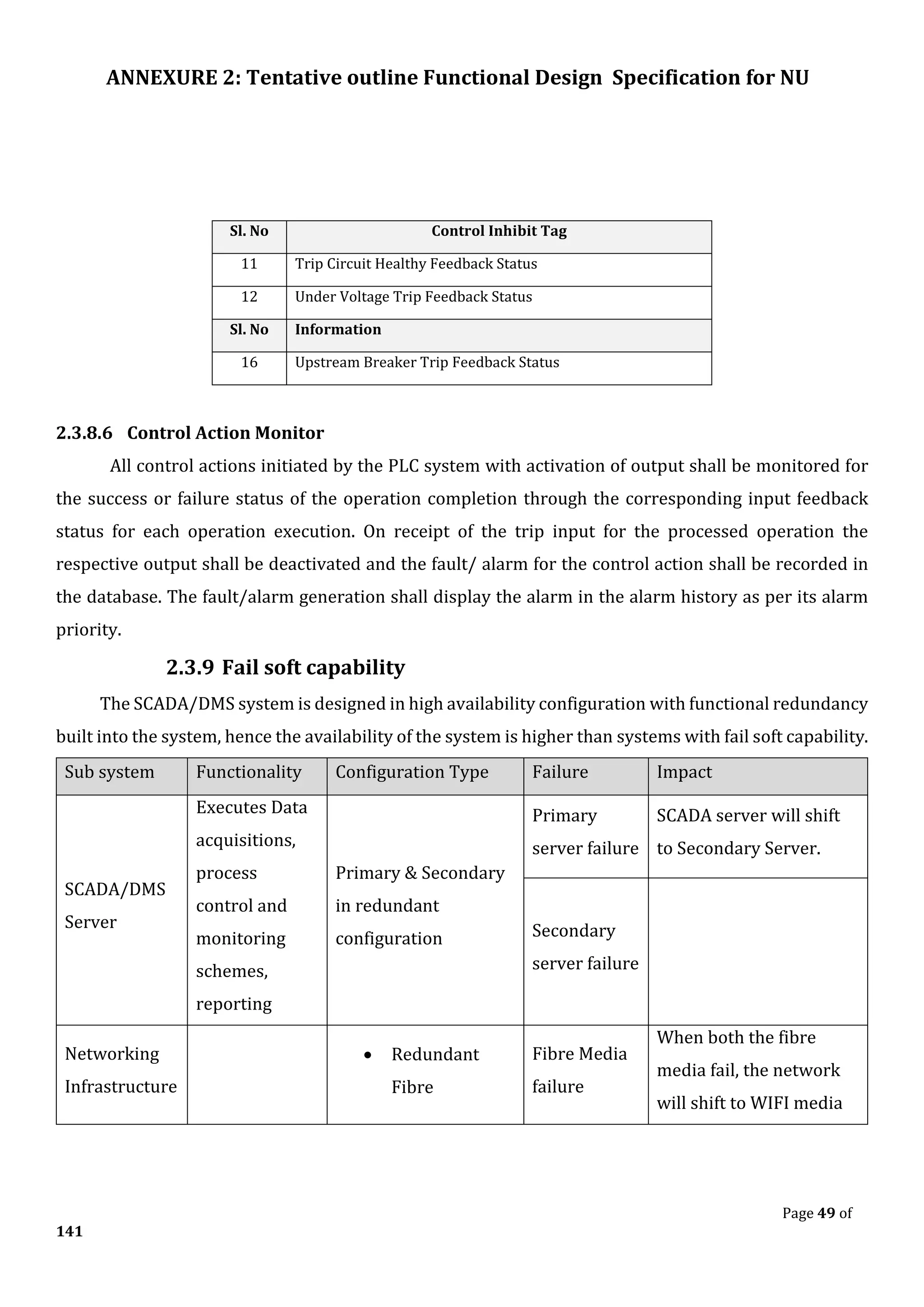
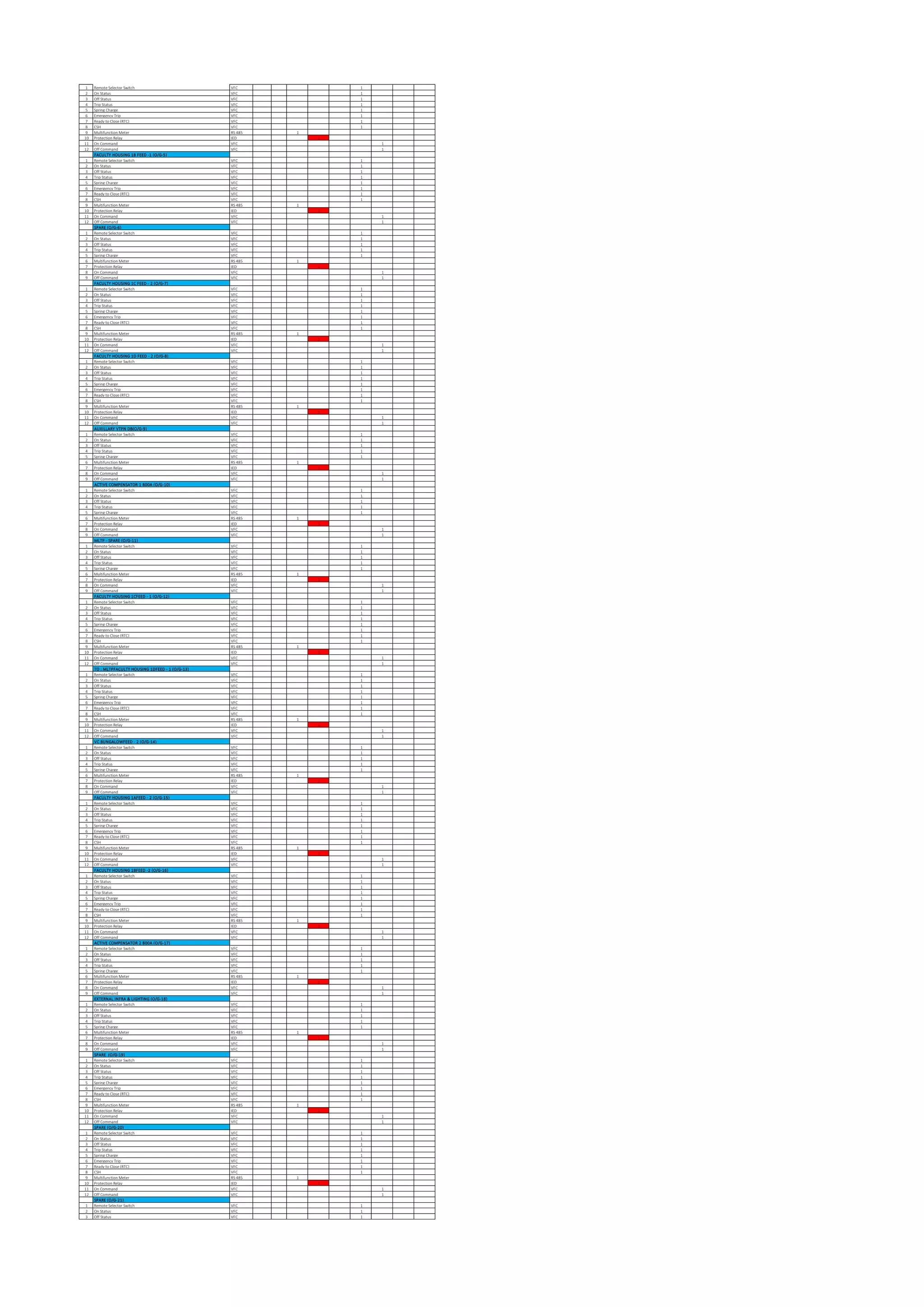
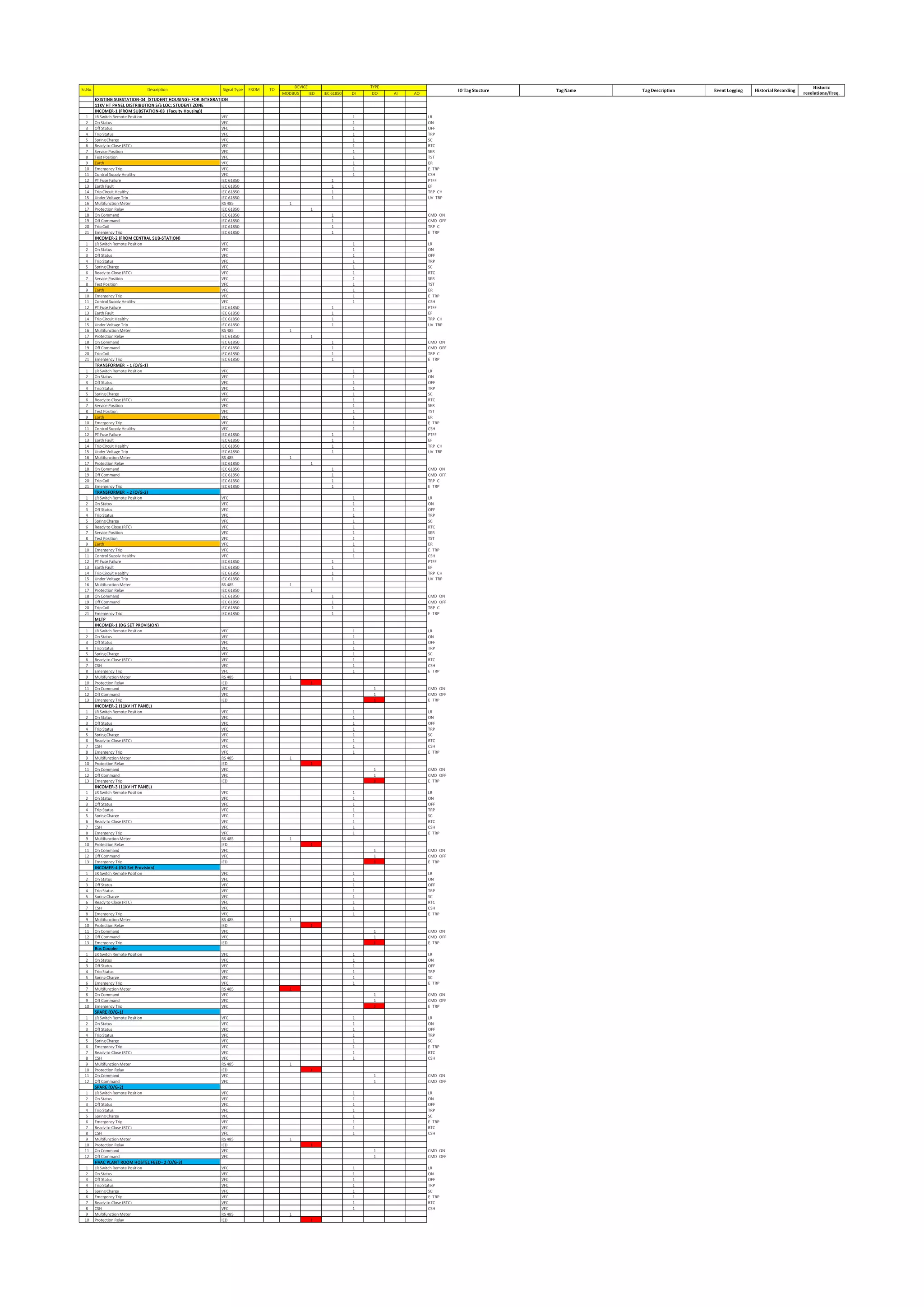
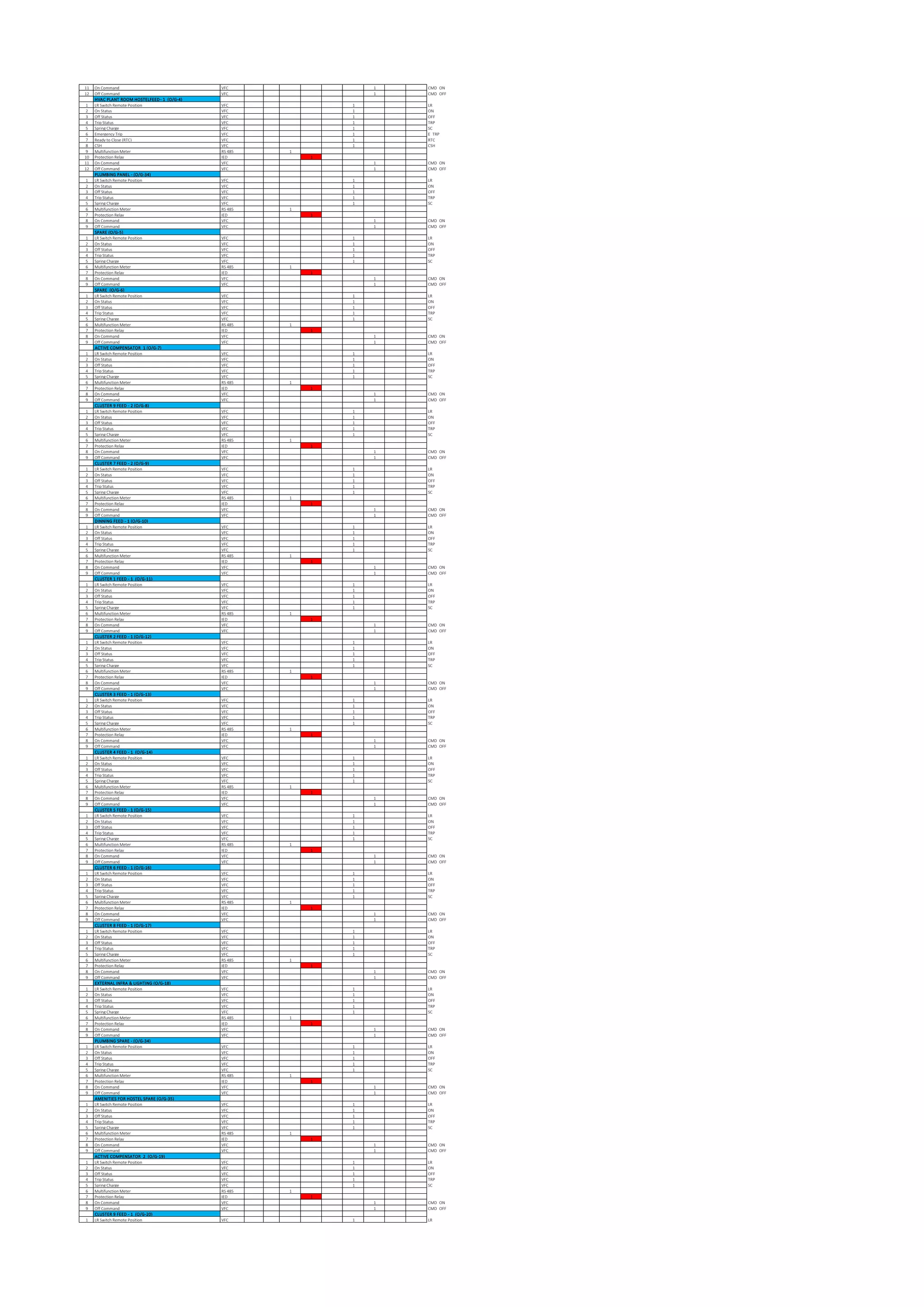
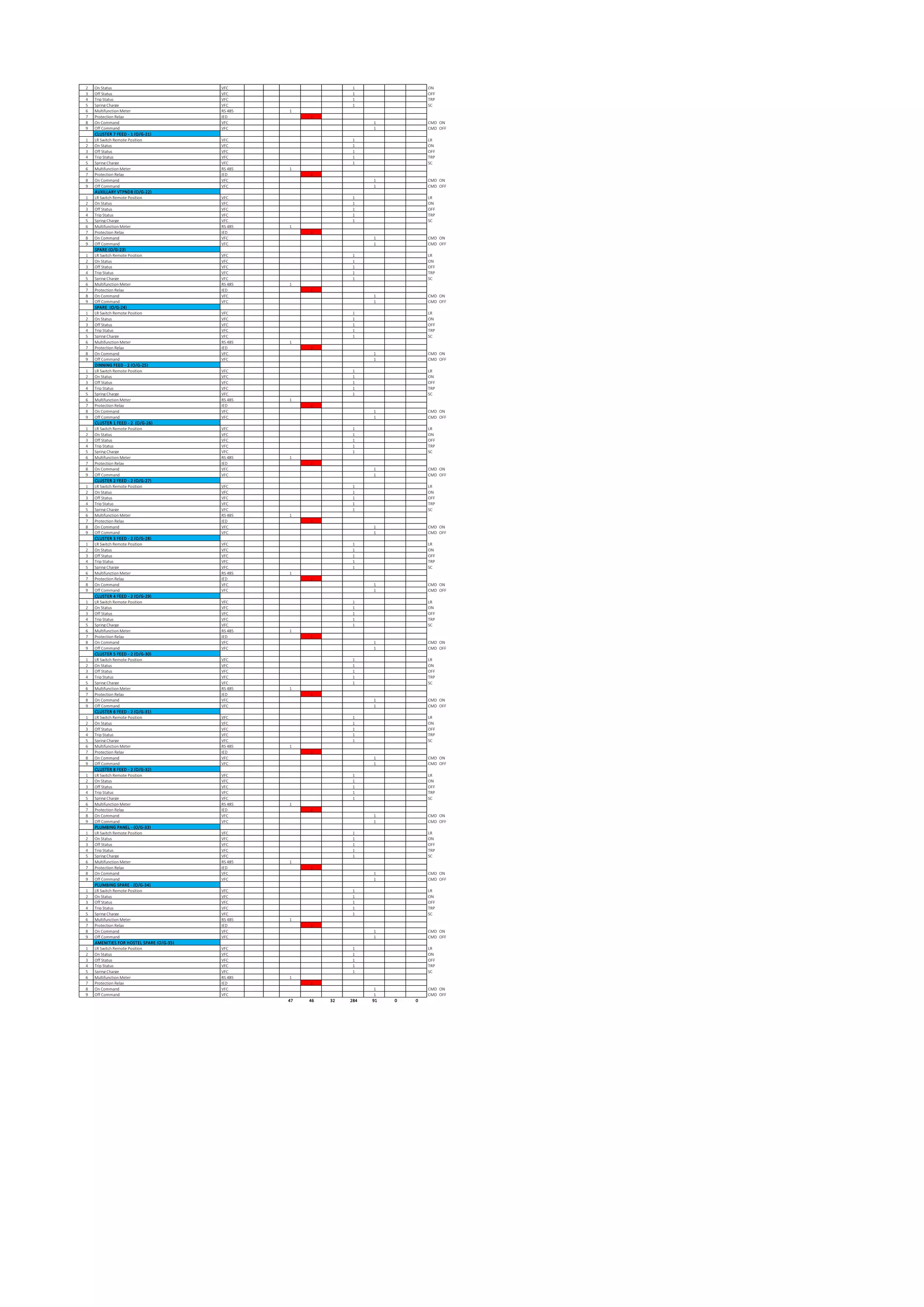
Whenever a monitored point crosses a limit an alarm message shall be generated. All limit
monitoring shall preclude annunciation of multiple alarms when a value oscillates about an alarm limit
by utilizing a programmer-adjustable alarm dead-band for each point.
The authorized user shall be able to temporarily override any of the above limits (which are in
use) by entering a new value. When the authorized user overrides a limit, it shall be marked with a ’limit
override quality code’ on all displays. The override value shall be recognized, and any display log
containing the value of the overridden limit shall include it as such. An override value shall be used
instead of the permanent value until the user removes the override condition or system is re-initialised.
Any change in alarm states resulting from a change in limit value shall be reported. The limit shall be
finalise & approved for implementation.
2.3.4.1.5 Rate of change /Gradient
All telemetered and calculated analog points shall be also processed for rate of change of /
Gradient processing, if defined that point for such processing in the database. An Alarm for overshoot
& event message for return to normal shall be generated.
2.3.4.1.6 Sign Conventions
The sign conventions for the display, data entry and reporting of active and reactive power flow
shall be used universally by all SCADA/DMS functions. All imports to bus bars shall be represented with
+ sign and all exports from bus bars shall be with –ve sign.
2.3.4.1.7 Accumulator Processing
Storing accumulator history shall be provided with a method in which that stores data only once
per hour and in other method that stores data each time new data enters the system.
The Typical Analog signals processed in SCADA/DMS system are as listed below
ANNEXURE 2: Tentative outline Functional Design Specification for NU
Page 33 of
141
2.3.4.1.8 Typical Soft I/O – Multifunction Meter (Modbus RTU – RS-485)
Table 6 : Typical Soft I/O’s - Multifunction Meter
Sl. No. Modbus (MFM) Electrical Parameters
1 L1 Phase Currents
2 L2 Phase Currents
3 L3 Phase Currents
4 L1N Phase Currents
5 L2N Phase Currents
6 L3N Phase Currents
7 L1 Phase Voltage
8 L2 Phase Voltage
9 L3 Phase Voltage
10 L1N Phase-Neutral Voltage
11 L2N Phase-Neutral Voltage
12 L3N Phase-Neutral Voltage
13 vTHD (%) Phase Voltage Harmonic distortion
14 iTHD (%) Phase Current Harmonic distortion
15 Aunb (%) Phase Current unbalance
16 Active Power (kW)
17 Reactive Power (kVAr)
18 Apparent Power (kVA)
19 Power Factor (PF)
20 Displacement Power Factor (dPF)
21 Peak Current (Apk)
22 Energy (kWh)
2.3.4.1.9 Typical Soft I/O’s – Numerical Relay (IED) – Feeder Protection Relay (IEC 61850)
Table 7: Typical Soft I/O’s – Numerical Relay (IED) – Feeder Protection Relay
Sl. No.
Numerical Relay (IED)
Feeder Protection Relay
1 Overcurrent
2 Earth fault
3 Overvoltage
4 Undervoltage
5 Frequency
6 CT / PT supervision
7 Phase sequence
ANNEXURE 2: Tentative outline Functional Design Specification for NU
Page 34 of
141
Sl. No.
Numerical Relay (IED)
Feeder Protection Relay
8 Broken conductor protection
2.3.4.1.10 Typical Soft I/O’s – Numerical Relay (IED) – Transformer Protection Relay (IEC
61850)
Table 8: Typical Soft I/ O’s – Numerical Relay (IED) – Transformer Protection Relay
Sl. No.
Numerical Relay (IED)
Transformer Protection Relay
1 Differential
2 Restricted earth fault
3 High oil temperature
4 High winding temperature
5 Sudden pressure
2.3.4.2 Digital input Data processing
Each state of a digital input point shall be associated with the state of an actual device. The
number of bits that will be used to define the state of a device is defined in the RTU/FRTU Specification.
A status point shall be defined as being either legal or illegal, and normal or abnormal:
1. Illegal state: The first check on a new input to a digital status point is the legality check. If
the new state is illegal, then the old value shall be left in the database and marked old with
relevant quality code such as telemetry failure etc .
2. Abnormal state: If the new state is legal, it shall be checked to see if it is among the normal
states defined for the point. If not, the status point shall be marked as abnormal. While
abnormal, it shall appear in the summary display of abnormal conditions/ off-normal
summary
3. Alarm checking: Each new value shall be checked to see if transitions into that state are
to be alarmed. If so, and if no control action is pending on the status point, then an alarm
action shall be triggered.
The following digital input data types shall be accommodated as a minimum:
1. Two-state points: The following pairs of state names shall be provided as minimum
ANNEXURE 2: Tentative outline Functional Design Specification for NU
Page 35 of
141
a. Open/Closed
b. Tripped/Closed
c. Alarm/Normal
d. On/Off
e. Auto/Manual
f. Remote/Local
g. On Control/Off Control
The list of different digital inputs and outputs processed by the SCADA/DMS system are listed as
topicals below.
2.3.4.2.1 Typical I/O - Transformer Type 1 Breaker
Table 9: Typical I/O - Transformer Type 1 Breaker
Typical I/O - Transformer Type1 Breaker
Sl. No. Monitoring Inputs Type
1 Breaker Local/ Remote Selection Switch Feedback Status VFC
2 Breaker On/Close Feedback Status VFC
3 Breaker Off/Open Feedback Status VFC
4 Breaker Direct Control Feedback Status VFC
5 Breaker Trip Feedback Status VFC
6 Breaker Spring Charge Feedback Status VFC
7 Breaker Ready to Close (RTC) Feedback Status VFC
8 Breaker Control Supply Healthy (CSH) Feedback Status VFC
9 Breaker Service/ Test Position Feedback Status VFC
10 Earth Fault Feedback Status VFC
11 Trip Circuit Healthy Feedback Status IEC 61850
12 Under Voltage Trip Feedback Status IEC 61850
13 Emergency Trip Feedback Status IEC 61850
14 PT Fuse Fault Feedback Status IEC 61850
15 Protection Relay Feedback Status VFC
16 Upstream Breaker Trip Feedback Status VFC
17 Oil Temperature Indication (OTI) RS-485
18 Wind Temperature Indication (WTI) RS-485
19 Buchholz relay trip VFC
20 MOG Trip VFC
ANNEXURE 2: Tentative outline Functional Design Specification for NU
Page 36 of
141
Typical I/O - Transformer Type1 Breaker
21 PRV Trip VFC
Sl. No. Control Commands Type
1 On/ Close VFC
2 Off/ Open VFC
3 Tip Coil IEC 61850
4 Emergency Trip Coil IEC 61850
Sl. No. Communication Devices Type
1 MFM RS-485
2 Protection / numerical Relay IEC 61850
2.3.4.2.2 Typical I/O – HT Type-1 Breaker
Table 10: Typical I/O’s – HT Type-1 Breakers
HT Breaker
Sl. No. Monitoring Inputs Type
1 Breaker Local/ Remote Selection Switch Feedback Status VFC
2 Breaker On/Close Feedback Status VFC
3 Breaker Off/Open Feedback Status VFC
4 Breaker Direct Control Feedback Status VFC
5 Breaker Trip Feedback Status VFC
6 Breaker Spring Charge Feedback Status VFC
7 Breaker Ready to Close (RTC) Feedback Status VFC
8 Breaker Control Supply Healthy (CSH) Feedback Status VFC
9 Breaker Service/ Test Position Feedback Status VFC
10 Earth Fault Feedback Status VFC
11 Trip Circuit Healthy Feedback Status IEC 61850
12 Under Voltage Trip Feedback Status IEC 61850
13 Emergency Trip Feedback Status IEC 61850
14 PT Fuse Fault Feedback Status IEC 61850
15 Protection Relay Feedback Status VFC
Sl. No. Control Commands Type
1 On/ Close VFC
2 Off/ Open VFC
3 Tip Coil IEC 61850
4 Emergency Trip Coil IEC 61850
Sl. No. Communication Devices Type
1 MFM RS-485
ANNEXURE 2: Tentative outline Functional Design Specification for NU
Page 37 of
141
HT Breaker
2 Protection / numerical Relay IEC 61850
2.3.4.2.3 Typical I/O – HT Type-2 Breaker
Table 11: Typical I/O’s – HT Type-2 Breakers
HT Breaker
Sl. No. Monitoring Inputs Type
1 Breaker Local/ Remote Selection Switch Feedback Status VFC
2 Breaker On/Close Feedback Status VFC
3 Breaker Off/Open Feedback Status VFC
4 Breaker Direct Control Feedback Status VFC
5 Breaker Trip Feedback Status VFC
6 Breaker Spring Charge Feedback Status VFC
7 Breaker Ready to Close (RTC) Feedback Status VFC
8 Breaker Control Supply Healthy (CSH) Feedback Status VFC
9 Breaker Service/ Test Position Feedback Status VFC
10 Earth Fault Feedback Status VFC
11 Trip Circuit Healthy Feedback Status IEC 61850
12 Under Voltage Trip Feedback Status IEC 61850
13 Emergency Trip Feedback Status IEC 61850
14 PT Fuse Fault Feedback Status IEC 61850
15 Protection Relay Feedback Status VFC
Sl. No. Communication Devices Type
1 MFM RS-485
2 Protection / numerical Relay IEC 61850
2.3.4.2.1 Typical I/O - Buscoupler
Table 12 : Typical I/O – Bus coupler
Typical I/O - Buscoupler
Sl. No. Monitoring Inputs Type
1 LR Switch Remote Position VFC
2 On Status VFC
3 Off Status VFC
4 DC Status VFC
5 Trip Status VFC
6 Spring Charge VFC
7 Ready to Close (RTC) VFC
ANNEXURE 2: Tentative outline Functional Design Specification for NU
Page 38 of
141
Typical I/O - Buscoupler
8 Service Position VFC
9 Earth Swtich Status VFC
10 Test Position VFC
11 Control Supply Healthy VFC
12 Trip Circuit Healthy VFC
13 Under Voltage Trip VFC
14 Emergency Trip VFC
15 PT Fuse Failure VFC
Control Commands
16 On Command VFC
17 Off Command VFC
18 Trip Coil VFC
2.3.4.2.2 Typical I/O – LT Breaker
Table 13: Typical I/O’s – LT Breakers
LT Breaker
Sl. No. Monitoring Inputs Type
1 Breaker Local/ Remote Selection Switch Feedback Status VFC
2 Breaker On/Close Feedback Status VFC
3 Breaker Off/Open Feedback Status VFC
4 Breaker Direct Control Feedback Status VFC
5 Breaker Trip Feedback Status VFC
6 Breaker Spring Charge Feedback Status VFC
7 Breaker Ready to Close (RTC) Feedback Status VFC
8 Breaker Control Supply Healthy (CSH) Feedback Status VFC
9 Breaker Service/ Test Position Feedback Status VFC
10 Earth Fault Feedback Status VFC
11 Trip Circuit Healthy Feedback Status IEC 61850
12 Under Voltage Trip Feedback Status IEC 61850
13 Emergency Trip Feedback Status IEC 61850
14 PT Fuse Fault Feedback Status IEC 61850
15 Protection Relay Feedback Status VFC
Sl. No. Control Commands Type
1 On/ Close VFC
2 Off/ Open VFC
Sl. No. Communication Devices Type
ANNEXURE 2: Tentative outline Functional Design Specification for NU
Page 39 of
141
LT Breaker
Sl. No. Monitoring Inputs Type
1 MFM RS-485
2 Protection / numerical Relay IEC 61850
Interface module provides the ability to communicate and exchange data with third party devices,
number of MFM units available in the LT panel, shall be tabulated. The communication setting, such as
unit/ meter ID, baud rate, stop bit, party etc. shall be documented in interface list during the detail
engineering.
2.3.4.3 Calculated Data processing
Analog signal values which are processed in the system shall be used for calculation to provide
additional operational insight into the system operation for the operator. These calculated data
processing shall be carried out at the SCADA server level and displayed in the SCADA client. The
database variables to be used for arguments and the mathematical/statistical/logical functions to be
used as operations shall be definable interactively at a console as well as by the programmer using
database creation and maintenance procedures. Different forms of calculated data processing are
1. Energy dashboard
2. Data trend displays.
Instantaneous value of each feeder power shall be predefined in trend templates with grid lines to
display in the runtime system with respect to time. The trends display the curves contained in it,
whether as real-time values or as historical values. The server samples of parameter values are
recorded as trend data and historical data are managed within the data base.
• Average - this displays the average of the samples within the previous display period
• Minimum- This displays the lowest value that occurred during the previous display period.
• Maximum - This displays the highest value that occurred during the previous display period.
Analysis of values based on the database points shall be processed based on the pre-deifined
instructions to generate the above results shall be logged based on the change of status / value.
ANNEXURE 2: Tentative outline Functional Design Specification for NU
Page 40 of
141
2.3.4.4 Substation Topology processing
The campus is receiving power from 33kV Grid Incomer to cater the total demand power and
further distribution is done via 33/11kV Substation. This function shall be capable of analysing the
open/closed status of switching devices, such as breakers and disconnectors, in order to define the
configuration of the substation for display. The energization of lines, transformers, bus sections and
generating units shall be determined so that the associated displays may correctly show the status of
these power system elements. The configuration shall be re-evaluated and updated whenever a
switching device status change is detected.
The list of differ Substation that are part of the campus power distribution system are
1. Main Receiving Station – 33 & 11 kV HT Panel
2. Solar Station – 11 kV HT Panel
3. Central Station - 11 kV Distribution station
4. Academic Block Sub station
5. Sports Complex Sub station
6. International Centre Sub station
7. Faculty Housing Substation
8. Student Housing Sub station
9. Outreach Substation
2.3.4.4.1 Main Receiving Station
Inputs and outputs that are part of 33 kV HT and LT panel in Main Receiving Station are
processed by M850 PLC based PLC system. This PLC system acts as the local control in case of
communication failure from the SCADA system. The RTU panel which houses the PLC system also
contains the HMI for operator interface during local operation.
2.3.4.4.2 Substation Group 1
The Inputs and outputs of Central station and Academic Block substation are processing by the
M580 PLC system in high availability ethernet ring connection topology. The primary CPU rack is made
available in Central substation and secondary CPU racks of the system is set up in the Academic Block
ANNEXURE 2: Tentative outline Functional Design Specification for NU
Page 41 of
141
Substation. The contractor shall provide dedicated fibre-based communication between the PLC CPU
racks and RIO racks to form the ring connection topology.
2.3.4.4.3 Substation Group 2
The Inputs and outputs of International convention centre and Faculty Housing substation are
processing by the M580 PLC system in high availability ethernet ring connection topology. The primary
CPU rack is made available in International convention centre substation and secondary CPU racks of
the system is set up in the Faculty Housing Substation. The contractor shall provide dedicated fibre-
based communication between the PLC CPU racks and RIO racks to form the ring connection topology.
2.3.4.4.4 Substation Group 3
The Inputs and outputs of Outreach Substation and Solar station substation are processing by
the M580 PLC system in high availability ethernet ring connection topology. The primary CPU rack is
made available in International Outreach Substation substation and secondary CPU racks of the system
is set up in the Solar station Substation. The contractor shall provide dedicated fibre-based
communication between the PLC CPU racks and RIO racks to form the ring connection topology.
2.3.4.4.5 Substation Group 4
Sports Complex and Student Hostel
The Inputs and outputs of Sports Complex and Student Hostel substation are processing by the
M580 PLC system in high availability ethernet ring connection topology. The primary CPU rack is made
available in International Sports Complex substation and secondary CPU racks of the system is set up
in the Student Hostel Substation. The contractor shall provide dedicated fibre-based communication
between the PLC CPU racks and RIO racks to form the ring connection topology.
2.3.4.5 Alternate Source of Data
The data processed through fibre network media shall be the primary source of data for processing by
the SCADA/DMS system. In the event of non-availability of primary data source (fibre network) then
the data from alternate source (through the wireless communication infrastructure) shall be
considered. Once Primary source is healthy, it shall switch back to primary source.
ANNEXURE 2: Tentative outline Functional Design Specification for NU
Page 42 of
141
2.3.4.6 Quality control
The Quality of the Data read over the OPC-UA interface between the SCADA/ DMS and the PLC
system is monitored by the communication which is used for this project implementation. The
communication driver provides below quality control parameters to decide on the communication link
healthiness to switch between Fibre based wired and alternative campus Wi-Fi medium for
connectivity. Details related to Quality control shall be provided in detailed design specification.
SCADA/DMS provides real-time data quality and status information. The ‘quality’ of the data is
available to the operators, allowing for better informed processing decisions. Each tag data point
contains properties that provides the data values along with the associated quality and time stamp of
the data change. This allows each client access to not only the data, but also to information about when
and how the data was collected from the field.
Having the validated last known data values provides with a clearer picture of the situation when
a field communication has failed. Understanding the age and accuracy of the data assists other control
system calculations.
Each variable tag represents information as a collection of data quality and timestamp elements.
Operators can be informed about the value of each real-time tag, along with the last time the value
changed and the quality status. The tag data has a time stamp for when the data value and the quality
last changed. Data quality is split into three groups - good, bad and uncertain - with more detail available
to provide additional analysis.
The detailed quality codes / indications shall be discussed with the customer during the software
design and implementation phase. Distinct symbols / shapes / color will be used after approval of
employer.
2.3.5 Continuous Real-time Data storage & playback
The SCADA / DMS server has several server components which executes specific functions as
part of the SCADA sever system. IO server is a part of SCADA server which shall continuously poll for
ANNEXURE 2: Tentative outline Functional Design Specification for NU
Page 43 of
141
data from the connected PLC based RTU system at substation level. This instantaneous data processed
by the IO sever is used for display in the SCADA client for operator visualization.
The data gathered by the IO server is stored in Historical database in the form of SQL database.
Each analog data shall be stored at data interval of 2 minutes into the database. The events and alarms
shall also be stored in the SQL database along with their timestamp.
The report process of the server shall be used for playback of stored historical data in the form
of trends for analog data and in the form of tabular grid for events/ alarms that has been stored in to
the database.
I/O Server Process
Alarm Server Process
Trend Server Process
Report Server Process
Citect Application
Server
Citect SCADA
Runtime Client
OFS-OPC
PLC system at
substation
Figure 5 : IO server operation of SCADA/DMS system
2.3.6 Sequence of Events Data
Timestamped Sequence of events data are created at SCADA server based on configured conditions
for different events and alarms and minimum of 1000 events can be stored in the SOE buffer. These
data are recorded in the form of timestamped events in the SQL database for retrieval in the form of
tabular reports at later stage. The Alarm scan time is a feature of the alarm server which indicates the
minimum time between alarm transition of a single tag. The default Alarm scan time rate is set to 500
ANNEXURE 2: Tentative outline Functional Design Specification for NU
Page 44 of
141
ms and the same shall be adjusted for optimal system loading such that the event of change shall be
updated on the operator screen within 2 seconds as defined in the tender specification.
ANNEXURE 2: Tentative outline Functional Design Specification for NU
Page 45 of
141
2.3.7 SCADA Language
The development and configuration of SCADA / DMS application screens shall be through the
engineering environment of SCADA / DMS. As applications have particular requirements, SCADA / DMS
provides you with the flexibility and power of two programming languages: Cicode and CitectVBA. Both
languages can be used to extend available data to fields within your system configuration.
Figure 6 : Seamless dataflow of SCADA/DMS system
The application development for M580 PLC RTU system shall be carried Control Expert
Engineering Tool which is compliant to IEC 61131 programming standard. Of the different languages
supported in the M580 PLC system the logic development shall be carried out in the form of function
blocks and structured text.
2.3.8 Supervisory Control
SCADA Software design shall have the feature of Input change by the operator and user input
data verification, interlock and sequence of operation based on the control Narrative.
Any user command from SCADA(Setpoint, Alarm Limits, Manual/ Maintenance Control / Reset
Acknowledge/ Enable / Disable) shall have confirmation from operator, with confirmation popup for
ANNEXURE 2: Tentative outline Functional Design Specification for NU
Page 46 of
141
command acknowledgement and warning message shall be displayed when it detects irrelevant inputs
and sequence.
Sequence / individual / Group command based on the priority, system healthiness and delay
time , shall be initiated from SCADA
After selecting a point, the user does not execute the control action within a programmer-
adjustable time-out period, or if the user performs any action other than completing the control action,
the selection shall be cancelled and the user be informed. If the communication to the RTU /FRTU is not
available, the control command shall be rejected and shall not remain in queue.
2.3.8.1 Digital status control
Successful completion of the control request shall be recorded as an event. Failures to complete
shall be handled as specified in UI section. Control requests shall be cancelled and the selection of the
point shall be terminated when the user cancels a request, does not perform the next step of the control
procedure within the selection time-out period from the previous step of the procedure, or the request
is rejected.
2.3.8.1.1 Breakers
The inputs and outputs that are to be monitored and controlled for the breaker are defined in
section Data Processing
2.3.8.1.2 Active Compensator
The data will be monitored over modbus serial. Details to be updated after detailed design
inputs.
2.3.8.1.3 Tap Changing Transformers
The analog data monitored over modbus serial for transformer are Oil Temperature Indicator
(OTI) and Winding Temperature Indicator (WTI). In the case of oil transformer Buchholz relay trip,
MOV trip and PRG trip inputs are additional inputs that are monitored by SCADA/DMS system.
2.3.8.2 Set point Control
Any user setpoint command from SCADA shall have confirmation from operator, with
confirmation popup for command acknowledgement and warning message shall be displayed when it
detects irrelevant inputs and sequence. Further details to be updated after detailed design inputs.
ANNEXURE 2: Tentative outline Functional Design Specification for NU
Page 47 of
141
2.3.8.3 Auto Execution Sequence / Group Control
To be updated after detailed design inputs.
2.3.8.4 Control Inhibit Tag
The Control Inhibit Tag functionality allows critical system information to be protected and
inhibits the unauthorized writing of data. Such functions are designed to enhance the security of your
process while increasing efficiency in the case of a false alarm.
A user can inhibit or enable supervisory control on any device. A tag symbol indicating the
control inhibit conditions will be displayed next to the device on all displays where the device is
presented.
Figure 7 : Control Inhibit Tag operation of SCADA/DMS system
2.3.8.5 Control Permissive interlocks
Substations shall be provided with a full interlocking scheme to ensure that all disconnectors,
fixed earthing switches (or other interlocked earthing devices) and, where required, circuit-breakers
are operated in the correct sequence so that personnel do not endanger themselves and/or the integrity
of the transmission system by incorrect or inadvertent operation of equipment. Where necessary, such
interlocking shall also be extended to cover limitation of access to areas where there is a risk that
normal safety clearances may be infringed.
The interlocks may be classified in two categories:
• Functional interlocks incorporated in functional units and dedicated to the operation of the
apparatus located in the units only. These interlocks are generally realized by means of specific
mechanical devices linked with the mechanisms of the apparatus
ANNEXURE 2: Tentative outline Functional Design Specification for NU
Page 48 of
141
• Interlocks between functional units or between a functional unit and another equipment such as
a transformer. Most of these interlocks are realized by means of keys transferred from one
equipment to another when they are made free. They may be improved or by additional
electrical interlocks. The system shall operate in accordance with the agreed logic table for the
application. Any combination of inputs for which an output has not been specified shall give no
output.
• Operator shall be able to bypass the interlock which shall be recorded as an event message with
user ID information to facilitate the operation without hampering the system safety.
As a typical example for control permissive / interlocking we consider one breaker signals.
Breaker I/O’s can be classified into Input (Monitoring) and Output (Command) I/O’s. Control system
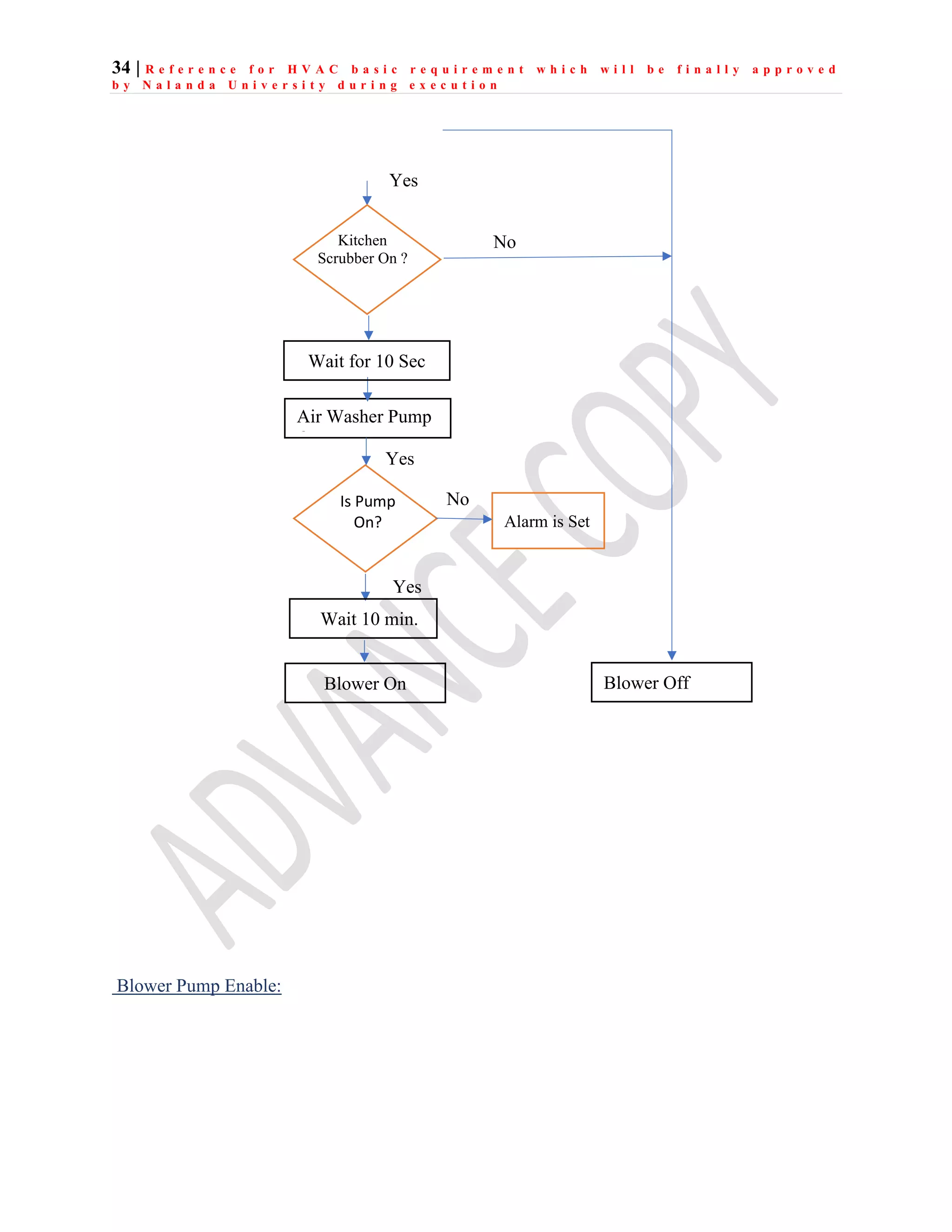
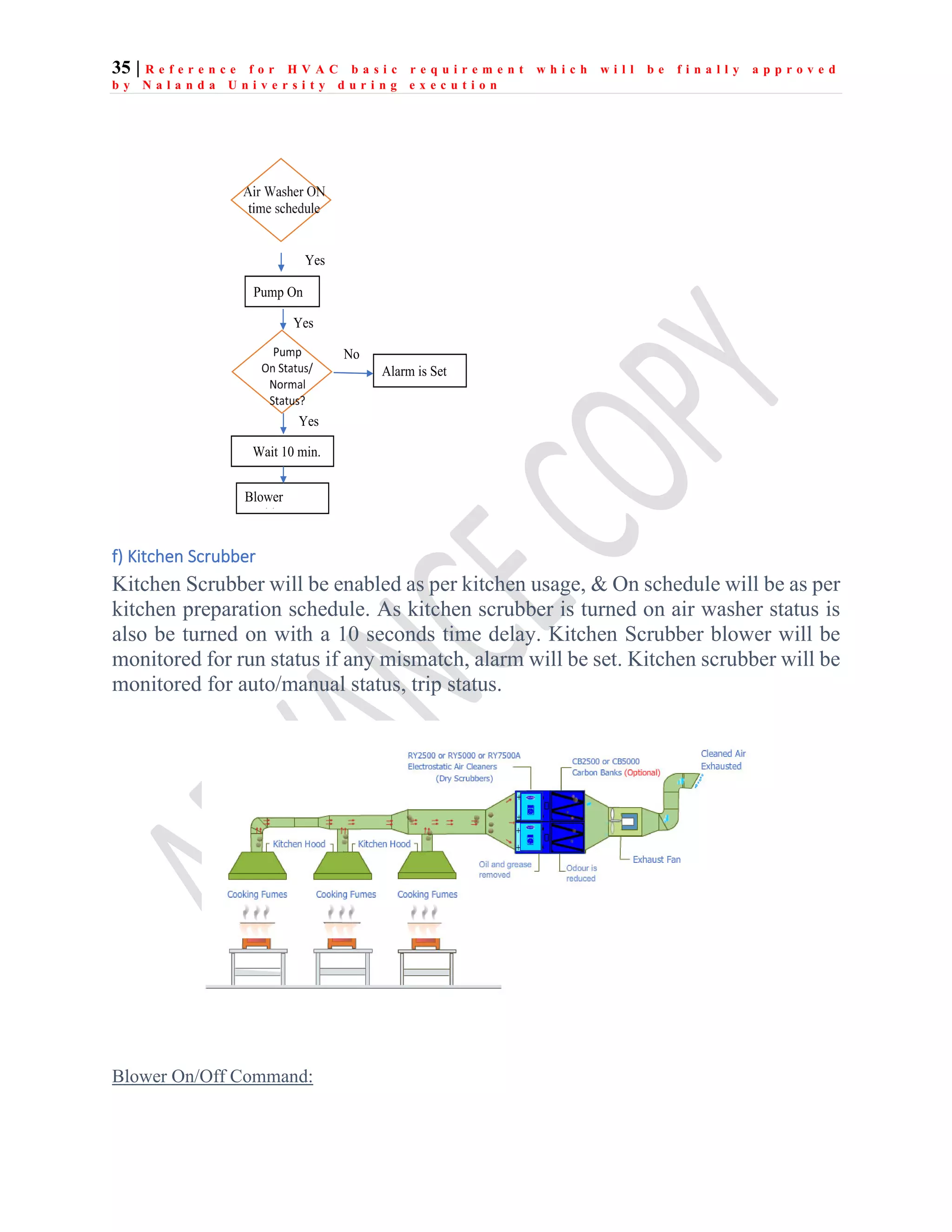
monitors the input signals processes the signals based on the permissive / interlocks and output shall
be controlled.
Table 14: Permissive interlocks
Sl. No. Monitoring Inputs
1 Breaker Local/ Remote Selection Switch Feedback Status
2 Breaker On/Close Feedback Status
3 Breaker Off/Open Feedback Status
4 Breaker Direct Control Feedback Status
Sl. No Permissive
5 Breaker Trip Feedback Status
6 Breaker Spring Charge Feedback Status
7 Breaker Ready to Close (RTC) Feedback Status
8 Breaker Control Supply Healthy (CSH) Feedback Status
9 Breaker Service/ Test Position Feedback Status
10 Earth Fault Feedback Status
13 Emergency Trip Feedback Status
14 PT Fuse Fault Feedback Status
15 Protection Relay Feedback Status
ANNEXURE 2: Tentative outline Functional Design Specification for NU
Page 49 of
141
Sl. No Control Inhibit Tag
11 Trip Circuit Healthy Feedback Status
12 Under Voltage Trip Feedback Status
Sl. No Information
16 Upstream Breaker Trip Feedback Status
2.3.8.6 Control Action Monitor
All control actions initiated by the PLC system with activation of output shall be monitored for
the success or failure status of the operation completion through the corresponding input feedback
status for each operation execution. On receipt of the trip input for the processed operation the
respective output shall be deactivated and the fault/ alarm for the control action shall be recorded in
the database. The fault/alarm generation shall display the alarm in the alarm history as per its alarm
priority.
2.3.9 Fail soft capability
The SCADA/DMS system is designed in high availability configuration with functional redundancy
built into the system, hence the availability of the system is higher than systems with fail soft capability.
Sub system Functionality Configuration Type Failure Impact
SCADA/DMS
Server
Executes Data
acquisitions,
process
control and
monitoring
schemes,
reporting
Primary & Secondary
in redundant
configuration
Primary
server failure
SCADA server will shift
to Secondary Server.
Secondary
server failure
Networking
Infrastructure
• Redundant
Fibre
Fibre Media
failure
When both the fibre
media fail, the network
will shift to WIFI media
ANNEXURE 2: Tentative outline Functional Design Specification for NU
Page 50 of
141
Sub system Functionality Configuration Type Failure Impact
communication
ring
• WIFI Media
will be backup
to redundant
Fibre media
Wifi media
failure
LDMS/ PLC
System
CPU A & CPU B in
redundant
configuration
PLC CPU A
PLC CPU B
The different functional redundancy units built into the system are as below
2.3.9.1 SCADA / DMS
If the primary server isn't operating normally, control and monitoring of the system is lost. the ability
of a single device to influence the system as a whole is minimized as we have a primary and standby
Server in your system where the standby Server will assume operations in case the primary Server
becomes inoperative.
The redundancy is provided as follows:
• By using a redundant data path from the server, we maintain the communication.
• If communications with either the primary server or standby server be disconnected, the
device is still accessible.
ANNEXURE 2: Tentative outline Functional Design Specification for NU
Page 51 of
141
Figure 8 : SCADA/DMS Fail-soft Capability
2.3.9.2 PLC based RTU with functionally redundant PLC rack
2.3.9.2.1 Operation Philosophy
The proposed redundant system provides bump-less transfer of I/O control from Primary PLC
to Standby PLC upon the failure of Primary PLC without using any relay circuits. Each PLC has a
customized program for redundancy programmed into its user logic, which communicates status
information between the two PLC processors and exchanges the state RAM.
The data exchanges between the two redundant processors (Primary and Standby), are using a
very high-speed link of 1 Gbps/100 Mbps. In case standby PLC senses that Primary has failed, it will
force the changeover irrespective of how Primary sees itself. This avoids total reliance on processor
self-diagnostics for changeover.
ANNEXURE 2: Tentative outline Functional Design Specification for NU
Page 52 of
141
Primary PLC runs the application by scanning user logic and operating distributed I/Os. At the
end every program scan the Primary PLC sends input/output data and internal data tables to the
standby PLC, so that in the event of changeover two processors will have the same data.
2.3.9.2.2 Changeover
The automatic changeover time of control from one PLC to the other PLC includes time required
following events:
• Failure Detection
• Time to confirm failure.
• Time to confirm availability of the standby system.
• Time to switch over
• Time to confirm success of switching over.
The Standby is ready to assume control within one scan if Master fails. Master & Standby states
are switch-able. Each Processor can be put into the Master state, but to do this the other must be in
standby state. If a fault occur in the Master processor, control will be transferred to standby processor
in maximum 500ms.During the changeover, PLC outputs are maintained in their last state until they
come under control of the standby processer. Faulty data is sent workstation for reporting the
processor failure. The system shall now recognize earlier standby processor as Master processor.
The below figure represents the following
1. Primary Rack with CPU
2. Standby Rack with CPU
3. Redundant Communication over Fibre with SCADA / DMS
4. Hot Standby Communication Link
5. RIO Main Ring
6. (e)X80 RIO Drop
ANNEXURE 2: Tentative outline Functional Design Specification for NU
Page 53 of
141
Figure 9 : PLC Redundant Architecture
ANNEXURE 2: Tentative outline Functional Design Specification for NU
Page 54 of
141
2.3.10 Remote Database Downloading, Diagnostic and
Configuration
The Engineering Workstation shall be used as the deployment server in this project. The
configurator application that’s part of the SCADA / DMS installation shall be used for the setup of
deployment sever. Server/ client application of SCADA / DMS shall be downloaded remotely to the
respective workstations and run diagnostics.
Figure 10 : SCADA Remote Database Downloading Mechanism
Database can be downloaded from centralised control centre also to RTU’s and run diagnostics &
configure and parameterize as per the requirement from the Ecostruxure Control Expert software
ANNEXURE 2: Tentative outline Functional Design Specification for NU
Page 55 of
141
2.3.11 IEC 61850, SMART GRID interface requirements
PLC based RTU system of the sub station shall function as the Micro grid controller with
implementation of the required control functionalities along with IEC 61850 communication interface
with the Numerical relay (IED) for monitoring and control operation.
ANNEXURE 2: Tentative outline Functional Design Specification for NU
Page 56 of
141
2.4 Information Storage and Retrieval
Information Storage and Retrieval (ISR) function shall allow collection of data from real-time
SCADA/DMS system and storing it periodically in a Relational database management system (RDBMS)
database as historical information (HI) data
The data shall be retrieved for analysis, display, trending and report generation. All stored data
shall be accessible for a time period.
Configuration data is stored in a Microsoft SQL database. The configuration manager creates a
registration to this database and reads and writes the configuration data to and from this database. The
Backup and Restore utility can be used to manage the storage of all configuration data to a file for use
at a later time.
Historical data is collected from the SCADA and OPC production data and stored in the Microsoft
SQL database when the SQL data service is running. This database is separate from the
configuration database and can therefore be run on a separate machine and maintained separately.
There are two modes of data acquisition. The default is real-time acquisition, whereby the data source
is polled every poll period (default setting: one second). If the variable’s value has changed by more
than the dead band, then a new sample with the data service’s timestamp will be logged to the historian
database.
The other mode is trend data acquisition. This mode is used for data collection from scheduled
I/O devices such as Remote Terminal Units (RTU). However, it can also be used where it is preferable
to request data from the trend server rather than from the SCADA system’s I/O server. RTU devices
periodically update the SCADA system with their data. In this mode, the historian data service requests
the trend data from the SCADA system every xx minutes by default. If there are changes since the last
known good sample, data from the trend system is logged to the historian database. This mode only
applies to SCADA data sources and not to OPC data sources. Alarm data is requested by default every
five minutes and changes will be logged to the historian database. OPC data sources have an update rate
which can be set per data source or per tag. This is similar to the poll period for SCADA data sources.
However, since OPC uses a “publish and subscribe” model, it sets the minimum period in which the
historian data service is notified of changes.
ANNEXURE 2: Tentative outline Functional Design Specification for NU
Page 57 of
141
2.4.1 Circuit Breaker Status Table
Digital data processed for each circuit breaker shall show on the SCADA client application screen
for display of field input status as per the status of the field signals. Below is the typical representation
of circuit breaker status table in the SCADA screen.
The ISR function shall maintain a table in SQL database where real-time status of all Circuit
breakers shall be stored.
Figure 11 : Circuit Breaker status table
2.4.2 Realtime Database Snapshot Table
Tag groups configured in SCADA are updated with real time values of the tags based on the values
of the parameters in the PLC application program. Only the tags that are configured to be recorded in
the database are stored as per the configured interval of data storage. Snapshot view of a typical
database table is provided below
ANNEXURE 2: Tentative outline Functional Design Specification for NU
Page 58 of
141
Figure 12 : Real Time Database Snapshot
2.4.3 Hourly Data Table
Analog data processed by the SCADA application server are programmed to be stored in
respective tables of SQL database of the SCADA server at the defined datalogging interval.
Below figure is the sample format of the hourly data table.
ANNEXURE 2: Tentative outline Functional Design Specification for NU
Page 59 of
141
Figure 13 : Hourly Report data Snapshot
Hourly data tables shall be created on daily basis. Such daily tables for two months duration shall
be stored on memory. Hourly data table for the previous month shall be backed up to Magnetic tape by
the user on monthly basis.
2.4.3.1 Missed Hourly Data storage
PLC system at substation level has the event recording module which shall recode the monitoring
analog value parameters in its module memory. This local storage acts as second level of data recording
which can be retrieved by the SCADA system after a communication disaster recovery.
ANNEXURE 2: Tentative outline Functional Design Specification for NU
Page 60 of
141
2.4.3.2 Hourly Data calculation
Computation of Hourly data is calculated as view table in the SQL database in which the Hourly
data for consumption is calculated. When required to be displayed to the operator or to be generated
as report the view table from the SQL database shall be queried to display the hourly consumption data.
The following calculations shall be provided:
1. Addition, subtraction, multiplication, and division
2. Summation of an hourly value
3. Maximum and minimum of a value
4. Average of a value
2.4.4 Daily Energy Data Table
Computation of daily energy data is calculated as view table in the SQL database in which the
daily data for consumption is calculated. When required to be displayed to the operator or to be
generated as report the view table from the SQL database shall be queried to display the hourly
consumption data.
ANNEXURE 2: Tentative outline Functional Design Specification for NU
Page 61 of
141
Figure 14 : Daily Report data Snapshot
Daily energy data table shall store daily energy values for each feeder on hourly / daily basis.
This stored data shall be exchanged with the Billing system in Data centre & DR on daily basis or on
demand. Daily Energy data table for the previous month shall be backed up to Magnetic tape by the user
on monthly basis.
2.4.5 Load Priority Table
Load priority table containing information such as breaker name, Breaker load and and Load
priority of each Breaker shall be stored. The load priority details shall be designed and have an feature
to be modified by the operator.
Load priority table shall be designed and updated after detailed design inputs.
ANNEXURE 2: Tentative outline Functional Design Specification for NU
Page 62 of
141
2.4.6 SOE Data Table
Events generated by SCADA application server, in non-volatile memory of numerical relay and
module memory of PLC system shall be stored in the events table of SQL database server for complete
distribution system. This event shall be queried for generation of Sequence of events for the purpose
of report generation. There shall be feature to sort the table by Time, Date, Substation name/ device
name etc. using SQL commands which shall be designed and updated after detailed design inputs. This
table shall be made on daily basis. The data stored shall be backed up to Magnetic tape by the user on
daily / monthly basis.
2.4.7 Historical Information (HI) Data Retrieval
Historical information like alarm and events are stored in the events tables of the SQL server
along with the time stamp and the details of the event. Other monitoring data of the respective
equipment’s shall be stored in the respective tables of the SQL database for this project. When required
for the retrieval of the historical data, depending on the availability the data records shall be queried
from the primary server database or secondary server database to generate the required data in tabular
form on the SCADA client GUI or in the form of report.
2.4.8 System Message Log Storage and Retrieval
System event message logs like user logged in, logged out, redundancy failure, synchronization
successful., etc are system event messages which are created with timestamps on the SQL sever
database. The events are stored in the system events table of the SQL database with the timestamps.
When retrieval request is given by the user, the data are queried from the system events table and
displayed as view table or as reports.
2.4.9 Mass Storage of Data / Files
Mass storage of data or files can be carried out in the Operator workstation system and the
Engineering workstation system using windows copy and paste functionality. The access to unused USB
port of the server and engineering PC shall be disabled after hardening of the systems. Transfer of data
can be carried out using the DVD/CD writer in the Engineering workstation.
ANNEXURE 2: Tentative outline Functional Design Specification for NU
Page 63 of
141
2.5 Data Recovery Function (DR)
The application data of SCADA/DMS system is backed up in the form a SQL database in the server.
The SQL sever backup of the primary and secondary database are maintained by the SCADA primary
and secondary application server. For the purpose of data recovery, a local copy of the SQL database
and cloud-based SQL server database is maintained from which the data recovery function shall be
executed when initiated from the SCADA sever application.
Cloud-based SQL server database shall store one year backup with data i.e. system build ups shall
be available of each area separately so that the same can be utilised upon setting up newer system after
disaster.
All logs, data model etc & necessary interfaces that are essential for complete system build up shall be
stored at DR centre. All requisite data which is build the system from scratch shall be transferred to
DR.
ANNEXURE 2: Tentative outline Functional Design Specification for NU
Page 64 of
141
3 Proposed Solution
The proposed system for Electrical SCADA system for this project shall be categorized as below.
1. SCADA system at Central Command Centre:
The Central Command centre which is envisaged central operation and control location shall
contain the below key sub systems.
a. Redundant Operator Workstation server (OWS): This server workstations containing
both SCADA / DMS application server and SCADA / DMS client application deployed
in primary and secondary configuration. The Key components of the SCADA
Application server are I/O server, Alarms Server, Reports Server and Trend Server.
SCADA client application is the operator user interface for process visualization and
control for the operator.
b. Engineering Workstation (EWS) – This workstation shall be used as the engineering
Node for SCADA and PLC systems of the project.
c. Video Display Unit – Matrix Display unit (2 x 3) for concurrent display of SCADA
Display screens
d. GPS Time Synchronization system – Central GPS Timer server present in this location
shall be used for time synchronization of other sub systems of SCADA and PLC RTU
system.
e. Networking Interfaces: Networking setup with Managed Network switches and
firewall for other sub systems interconnection and Campus IT infrastructure for
internet connectivity to cloud-based Database recovery system.
2. RTU system at Sub-stations.
Typical PLC based RTU system at each sub- station shall be housed inside an enclosed panel
with following key sub systems.
a. M580 Hot standby PLC system: This system contains CPU Rack and RIO racks. The
Digital input and output modules are housed as part of the RIO Racks.
ANNEXURE 2: Tentative outline Functional Design Specification for NU
Page 65 of
141
b. Networking Interfaces: Managed switch compliant to IEC 61850 and other network
accessories for connectivity to Fibre network medium and Wireless – Wi-Fi
connectivity.
3.1 SCADA System at Central Command Centre:
3.1.1 Hardware Systems
3.1.1.1 Operator Workstations (OWS)
Two numbers of Operator Workstation servers are considered as part of the proposed solution.
This operator workstation server has the SCADA application server and SCADA client application
installed. The SCADA client application will be the user interface for the operation of Electrical SCADA
system by the operator. The Hardware specification of the operator workstation is as below.
Table 15: OWS System HW Specification
Sl.NO Specification Quantity
1
Intel® Xeon® , 1 X 16 GB RAM, C3, RAID 1 for 2 HDDs, 2 X 1TB
SATA, 3.5" Chassis up to 8 Hot Plug Hard Drives, 4 NIC Port, OS
Windows Server , Redundant Power Supply,
2
2
DELL 24 MONITOR | E2420H : Maximum Resolution 1920 x 1080
Colour depth: 16.7 Million Viewing Angle 178°/178° Tilt Only (-5°
to 21°)
2
3.1.1.2 Engineering Workstations (EWS)
The Engineering workstation is a system which shall be used for configuration and modification
of SCADA Application. The Hardware specification of the identified Engineering workstation is as below.
Table 16: EWS System HW Specification
Sl.NO Specification Quantity
1
10th Generation Intel® Core™ i7, 8 GB RAM, 1TB SATA Hard Disk
Drive, Windows 10 Professional 64 bit, Raid -1 Configuration, 4
NIC ports, Redundant Power supply, DVD/ CD R-W.
1
ANNEXURE 2: Tentative outline Functional Design Specification for NU
Page 66 of
141
2
DELL 24 MONITOR | E2420H : Maximum Resolution 1920 x 1080
Colour depth: 16.7 Million Viewing Angle 178°/178° Tilt Only (-5°
to 21°)
1
3.1.1.3 GPS Time server
For time synchronization of all devices of the system, a GPS time server is provided at central
Command centre. The time synchronization takes place over Network Time Protocol (NTP), which has
been designed to provide accurate time synchronization over Ethernet networks.
3.1.1.4 Video Display Wall
Wall Display unit provided at Central Command Centre consists
a. Video Display Wall of 70 inch size
b. Supporting a resolution of 1920 x 1080 pixel
c. Lifetime of 80,000 Hours
d. Video wall controller and Software for processing 2 display inputs
3.1.1.5 Networking switch
Redundant managed network switch which shall be compliant with IEC 61850 based
communication with IED devices is considered in Central Command Centre. This switch shall have
uplink connectivity with redundant fibre network and enable below planned network connections.
1. SCADA Operator workstation (OWS) and Engineering workstation shall be connected to
this switch.
2. GPS Time server shall be connected to this switch.
3. Display wall controller shall be connected to this switch.
4. Campus IT network shall be connected this switch for web client access by the end user.
5. Internet access from campus and connectivity to Cloud based disaster recovery system.
6. Solar control system and Existing BMS system shall be connected to this network switch.
7. State Load Dispatch Centre (SLDC) interface connection shall be from this network
switch.
ANNEXURE 2: Tentative outline Functional Design Specification for NU
Page 67 of
141
8. The protocol convertors of the building energy monitoring meters shall be connected to
this switch.
3.1.1.6 UPS
Redundant 2KVA UPS shall be supplied to support SCADA Hardware system located at MRS
control centre. UPS shall be of single phase with following specifications.
Sl. No Description Ratting Remarks
1 Input Voltage 230 VAC
2 Input Frequency 50Hz ± 0.1Hz
3 Nominal Output Voltage 220VAC / 230VAC / 240VAC ± 1%
4 Output Frequency 50Hz ± 0.1Hz
5 SCADA Integration RS-232 / RS-485
3.1.2 Software Systems – SCADA / DMS
SCADA / DMS is a Supervisory Control and Data Acquisition (SCADA) solution that is used to
manage, monitor and control the process parameters in this project. SCADA / DMS software
applications and suites from Schneider Electric give you the ability to see, measure, and manage
Efficient Enterprise across buildings, industrial plants, and data centres, resulting in significant savings
on capital and operational expenses - without sacrificing business continuity and performance. SCADA
/ DMS software enables you to manage efficiency from shop floor to top floor, across three levels of
your business: Enterprise, Operations, and Control.
The graphics, controls, configuration data and programming associated with a SCADA / DMS
installation is configured and implemented through projects in the system. A project acts as a digital
representation of the production facility that is deployed in tandem with the plant infrastructure,
ANNEXURE 2: Tentative outline Functional Design Specification for NU
Page 68 of
141
allowing the entire system to be monitored and controlled in real-time. SCADA / DMS is a reliable,
flexible and high-performance system for any monitoring and control application. SCADA / DMS comes
with some powerful features including:
• Object based referencing
• Graphical process visualization
• Superior alarm management
• Advanced clustering options for control when and where it is required.
• Historical and real-time trending (Optional) Built-in reporting
• Statistical Process Control
• Powerful analysis tools
SCADA / DMS is designed to provide industrial companies of all sizes with agile control over both
engineering and runtime operations. Its design is centred on multi-level redundancy for the reliable,
constant communication and operation of the system.
The SCADA system shall be installed in
• Primary and Secondary Server – Monitoring and control of entire control system
• Engineering Station – Configuration/ Modification of the SCADA system.
3.1.2.1 SCADA / DMS deployment Model
The SCADA deployment model for Operator workstation system involves the deployment of
Citect Application server and SCADA / DMS runtime client application on the server system. The SCADA
application server contains the below core server processes.
1. I/O Server Process - dedicated communications server that exchanges data between I/O
devices and control clients.
2. Alarm Server Process -responsible for evaluating the conditions that define an alarms.
3. Trend Server Process - controls the accumulation and logging of trend information.
4. Report Server Process – report server communication with clients.
ANNEXURE 2: Tentative outline Functional Design Specification for NU
Page 69 of
141
I/O Server Process
Alarm Server Process
Trend Server Process
Report Server Process
Application Server
SCADA Runtime
Client
OWS Primary
I/O Server Process
Alarm Server Process
Trend Server Process
Report Server Process
Application Server
SCADA Runtime
Client
OWS Secondary
Figure 15 : SCADA deployment model for OWS
The Application server primary and secondary processes shall be deployed to function as redundant
application servers. Runtime control client application of SCADA / DMS applications is used by the
operator for the visualisation and operation of the SCADA control system.
3.1.2.2 Web Client
The Web Client SCADA allows you to view a live SCADA Server project within a Web browser. It
provides easy access to Runtime for LAN-connected users with the right user authentication without
the need for extensive downloads or software installation. The Web client functionality of SCADA / DMS
involves the interaction of SCADA / DMS webserver, SCADA / DMS runtime server as per the request
from the web client to gain the access of the web browser based live view of SCADA application.
SCADA / DMS web server performs the server-side functionality of the system. It operates by accepting
requests from the client, and providing a response to the client when the clients details are
authenticated. It then directs a client to the graphical and functional content of a SCADA / DMS project
and the location of the runtime servers. This information is stored on the Web Server when a SCADA /
DMS project is configured as a "web client deployment". A SCADA / DMS Web Server can contain
multiple web client deployments. The below figure explains the implementation scheme of web client.
ANNEXURE 2: Tentative outline Functional Design Specification for NU
Page 70 of
141
Figure 16 : Web client
3.2 RTU System at Sub-station:
3.2.1 Typical RTU system
PLC based RTU system shall be housed in sheet steel panel in respective substation location. The RTU
system panel shall contain the required power supply for the operation of the PLC system and the
Digital input and output modules that are required for processing the field inputs at the respective
location. Below is the physical. The Typical RTU system panel general arrangement is presented below.
ANNEXURE 2: Tentative outline Functional Design Specification for NU
Page 71 of
141
Figure 17 : RTU Panel General Arrangement-1
ANNEXURE 2: Tentative outline Functional Design Specification for NU
Page 72 of
141
Figure 18 : RTU Panel General Arrangement-Internal View
ANNEXURE 2: Tentative outline Functional Design Specification for NU
Page 73 of
141
Figure 19 : RTU Panel General Arrangement- LHS & RHS View
ANNEXURE 2: Tentative outline Functional Design Specification for NU
Page 74 of
141
Figure 20 : RTU Main Receiving Station Architecture
ANNEXURE 2: Tentative outline Functional Design Specification for NU
Page 75 of
141
ANNEXURE 2: Tentative outline Functional Design Specification for NU
Page 76 of
141
Figure 21 : RTU Other stations connectivity General Architecture
ANNEXURE 2: Tentative outline Functional Design Specification for NU
Page 77 of
141
3.2.1.1 RTU Panel
The RTU panel specification considered for this project are as specified below
Sl.No Specification
1 Dimension in mm 800 x 800 x 2000 ( l x b x h)
2 Plinth in mm 100 mm
3 Material Sheet Steel
4 IP rating IP 54
5 Access Front and Rear access
6 Front Door Thickness 2.0 mm
7 Rear Door Thickness 1.5 mm
8 Gland plate thickness 2 mm
9 Cable entry Bottom
10 Door Single door in front & rear
Sl.NO Location/ Sub station DIMENSSION (in MM) Qty
1 MAIN RECEIVING STATION IP 54 panel, 800x800x2000 (w x b x l) 1
2 Solar Station IP 54 panel, 800x800x2000 (w x b x l) 1
3 Central Station IP 54 panel, 800x800x2000 (w x b x l) 1
4 ACADEMIC SUSBTATION-01 IP 54 panel, 800x800x2000 (w x b x l) 1
5 Sports Complex SUBSTATION-05 IP 54 panel, 800x800x2000 (w x b x l) 1
6
SUBSTATION-02 INTERNATIONAL
CENTER
IP 54 panel, 800x800x2000 (w x b x l) 1
7 SUBSTATION-03(Faculty Housing) IP 54 panel, 800x800x2000 (w x b x l) 1

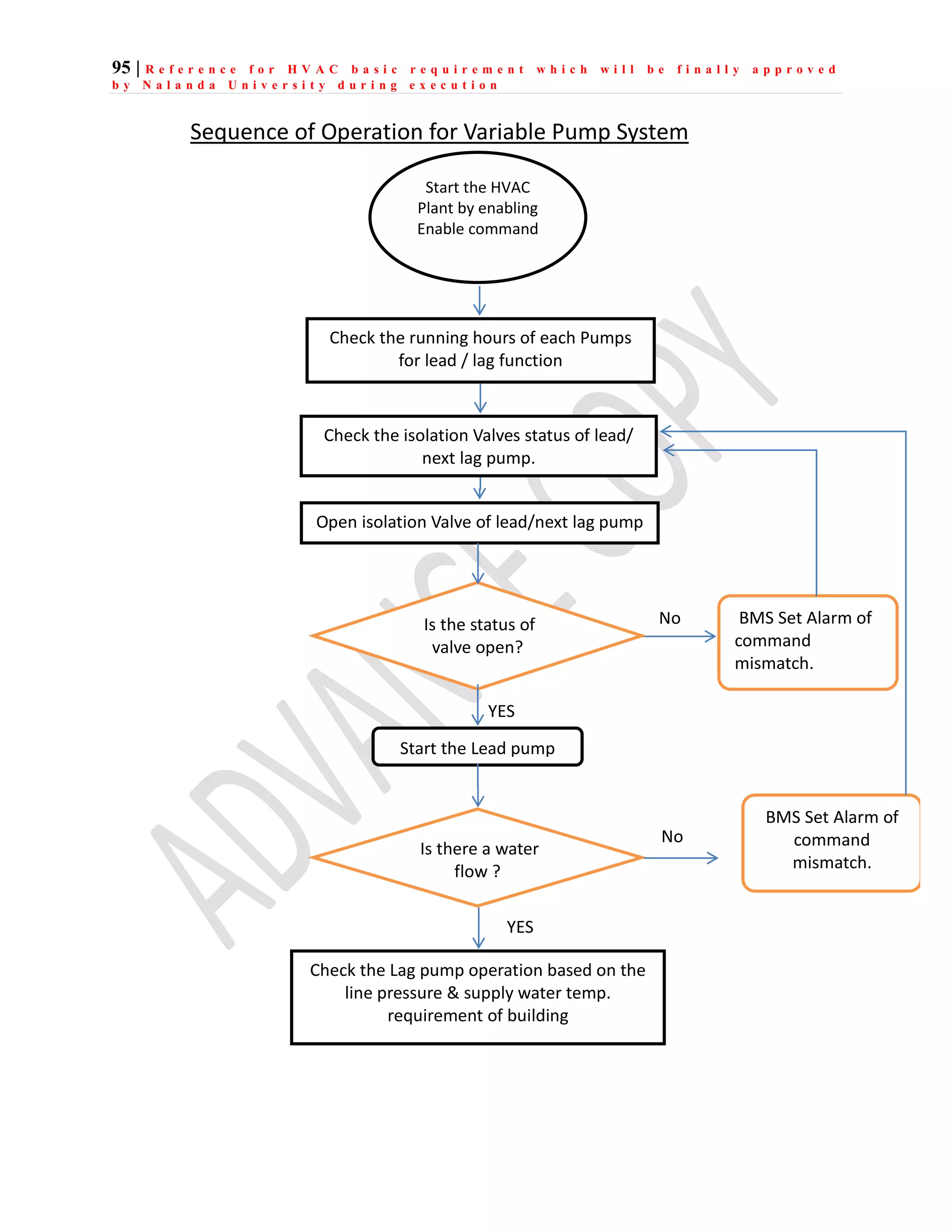
8 SUBSTATION-04 (STUDENT HOUSING) IP 54 panel, 800x800x2000 (w x b x l) 1
9 Outreach Substation IP 54 panel, 800x800x2000 (w x b x l) 1
ANNEXURE 2: Tentative outline Functional Design Specification for NU
Page 78 of
141
3.2.1.2 RTU Backplane:
Backplane hold the modules and mount it on the hooks near the top of the backplane. Key role of a
rack is to provide power and communication bus for the modules installed on the rack. Ethernet
backplane provides eX80 I/O modules, which require an Ethernet bus on the rack in order to exchange
data (for example, X80 HART modules), Third-party modules that require Ethernet and Ethernet
communication modules (interlinked to the CPU)
Each slot in a backplane/ rack is equipped as standard with a protective cover that should only be
removed when inserting a module. The module can be replaced when power to the module is either on
or off. The identified backplane for this project shall be as per the number of module quantities worked
out based on the number of IOs in each location.
Figure 22 : RTU Backplane
1. Panel mounting hole (x4)
2. Power supply module slot connectors
3. Module slot connectors
ANNEXURE 2: Tentative outline Functional Design Specification for NU
Page 79 of
141
4. 3a) Ethernet connector
5. 3b) X bus connector
6. Tapped hole for locking screw on each module
7. 40-pin female connector for a rack extender module
8. Protective cap
9. Screw hole (X2) for shielding connection kit
10. Keying hole for Ethernet module
11. Holes for anchoring the module pins
12. Protective earth screw
13. Rack status LED
3.2.1.3 RTU Power supply module:
In Modicon X80 Ethernet RIO drops, shall have power supply in the slot 0 and marked CPS. The
BMXCPS•••• power supply modules convert the primary power line into voltages distributed through
the backplane to supply the rack and the modules plugged in it. The power supply modules is delivered
with two removable terminal blocks.
Figure 23 : RTU Power Supply Module
1) Mounting screw
2) LED display
3) RESET button
4) Input/output 5-pin removable terminal block
5) Alarm relay 2-pin removable terminal block
ANNEXURE 2: Tentative outline Functional Design Specification for NU
Page 80 of
141
BMXCPS4022 — Power supply (24-48) VDC, in redundant configuration is considered in an extension
EIO rack of the PLC system.
Figure 24 : PLC Power Supply module Rack Installation
1) Redundant power supply in the master position (after power-up).
2) Redundant power supply in the slave position (after power-up).
3.2.1.4 RTU Processor module:
The purpose of a Hot Standby system is to be ready to perform a switchover, if needed. A
switchover is the immediate transfer of control of the network from the primary PAC to the standby
PAC. The transfer needs to be swift and seamless. The M580 Hot Standby system continuously monitors
ongoing system operations and determines if a condition requiring a switchover exists. On each scan,
both the primary PAC and the standby PAC check the health of the system. If both the primary PAC and
standby PAC are operating normally, the Hot Standby system detects a switchover causal event within
1 scan time.
On switchover, the Main IP address setting is automatically transferred from the former primary CPU
to the former standby – now the new primary – CPU. Similarly, on switchover the Main IP address + 1
setting is automatically transferred from the former standby CPU to the new standby. In this way, the
configured links between the distributed equipment and the primary CPU do not need to be edited in
the event of a switchover. A switchover does not affect the assignment of IP address A or IP address B
ANNEXURE 2: Tentative outline Functional Design Specification for NU
Page 81 of
141
The Hot Standby CPUs perform two periodic data exchanges:
1) Before each MAST cycle, the primary CPU transmits to the standby CPU application variables,
system status and I/O data.
2) Periodically, both CPUs exchange the content
Each CPU module includes one SFP socket, to which you can connect either a fibre optic or a copper
transceiver. Hot Standby PACs, no I/O modules are supported in the local rack. M580 Hot Standby
system, the primary CPU and the standby CPU operate their own system timers, which are not
automatically synchronized. Because both the primary CPU and the standby CPU share a common
configuration, both can be configured to perform as NTP client or NTP server. When the NTP client
function is enabled in a Hot Standby system, the primary CPU and the standby CPU independently
receive time settings from a designated NTP server.
Figure 25 : PLC Processor
The front of the module is on the left. The back of the module is on the right:
1) LED diagnostic display panel
2) Mini-B USB port for module configuration via PC running Control Expert
3) RJ45 Ethernet service port connector
4) RJ45 connectors that together serve as a dual port to the Ethernet network
5) SFP socket for copper or fibre-optic Hot Standby link connection
6) Hot Standby status link LED
ANNEXURE 2: Tentative outline Functional Design Specification for NU
Page 82 of
141
7) SD memory card slot
8) A/B/Clear rotary selector switch, used to designate the PAC as either PAC A or PAC B, or to clear
the existing Control Expert application
Figure 26 : HSBY Connectivity
1) Hot Standby fibre optic link between CPU A and CPU B
2) Ethernet RIO main ring
The front face of a BMEH582040 Hot Standby CPU presents the following LED panel, which you can use
to diagnose the state of the M580 Hot Standby system.
Figure 27 : PLC Diagnostic LED
ANNEXURE 2: Tentative outline Functional Design Specification for NU
Page 83 of
141
3.2.1.5 RTU Advanced NOR Module
The module provides telemetry protocol connection availability in complex M580 configurations
through the Modbus TCP communication protocol. The advanced RTU module has enhanced cyber
security features and better performance than the BMXNOR0200H module, including telemetry
protocol connection availability and several Ethernet-based services.
Make connections to the BMENOR2200H module with a cable:
1) Upstream connection: Connect the module to a SCADA system through the DNP3 or IEC 60870-
5-104 protocol. (A Modbus TCP connection is another option.)
2) Downstream connection: Connect the module to remote server devices and stations through the
DNP3 or IEC 60870-5-104 protocol.
Figure 28 : NOR Module
1) LED array
2) MAC address
3) Memory card slot
4) Serial port
5) Dual-bus backplane connector
6) Rotary switch
Rotary Switch:
ANNEXURE 2: Tentative outline Functional Design Specification for NU
Page 84 of
141
A three-position rotary switch is located on the back of the module. Set this switch to configure a cyber-
security operating mode for the module: Install the module on a local Ethernet backplane in a Modicon
M580 system and access to a Modicon M580 network through the external ports of the CPU and Main
Features and Functionality as below
1) Cyber security enhancements:
◦ Secure boot
◦ Firmware signing and integrity check
◦ Secure firmware upgrade
◦ HTTPS-based Web pages
◦ RBAC
◦ TLS for RTU protocols
◦ Password complexity
◦ Secure mode selection
◦ DNP3 secure authentication version 2 & 5
◦ secure Hot Standby communication between modules
2) High data throughput capacity when the module acts as an RTU server (transmits 4,000
events/second to client devices)
3) Exclusive data exchange bandwidth for each module installed on the same rack
4) Maximum of 150,000 RTU events stored in module buffer
The module LED indicators are located on the front of the BMENOR2200H module. The LEDs provide
information on:
1) Module status (run, error, downloading)
ANNEXURE 2: Tentative outline Functional Design Specification for NU
Page 85 of
141
2) Serial communications
3) Ethernet network communications
4) SD memory card state
5) Cyber security status
This is the LED display on the front of the BMENOR2200H module:
Figure 29 : NOR Module Diagnostic LED
Communications across the dual-bus backplane of this sample local rack (which includes an M580 CPU)
implement both the Ethernet (red line) and X-Bus (blue line) protocols: The data exchange uses implicit
messaging to facilitate memory sharing between the module and the CPU. For each CPU scan cycle, the
CPU publishes all data at the same time to share the most current information with the RTU.
Redundant systems contain separate primary and standby control networks. The configuration of the
primary and standby racks is identical. A redundant system that implements BMENOR2200H modules,
therefore, includes one such module in both the primary and standby racks with these IP addresses:
• IP address: BMENOR2200H module in the primary configuration
• IP address + 1: BMENOR2200H module in the standby configuration
Upon a redundant switch-over, the IP address setting is automatically transferred from the (former)
primary BMENOR2200H module to the (former) standby
ANNEXURE 2: Tentative outline Functional Design Specification for NU
Page 86 of
141
3.2.1.6 RTU Wireless Adaptor/ Bridge Module
PMXNOW0300 – is a wireless adaptor/ bridge is used for communication using campus Wi-Fi network
in case of communication failure with the FO communication network.
Table 17 : Technical Specification of Wi-Fi Adaptor/Bridge
Sl.NO Feature Specification
1 Number of channels
13 conforming to IEEE 802.11b/g
8 conforming to IEEE 802.11a
11 conforming to IEEE 802.11h
2 Transmission frequency 5.4 GHz,2.4 GHz,5 GHz
3 Encryption protocol
WEP
WPA-PSK
WPA2-PSK
RADIUS conforming to IEEE 802.11x
MAC addresses filtering
SSID broadcast control
ANNEXURE 2: Tentative outline Functional Design Specification for NU
Page 87 of
141
Sl.NO Feature Specification
4 Transmission rate <= 108 Mbps
5 Maximum sensing distance 150 m
3.2.1.7 RTU – Ethernet Remote adapter module
BMECRA31210 - Adapter module in an (e)X80 EIO drop can be installed only in slot 0 (directly
to the right of the power supply) in the main rack of the drop. An RIO drop is connected to the daisy-
chain loop on which the Ethernet RIO network resides. Each remote drop contains one BMECRA31210
adapter module. Each rack in a remote drop contains its own power supply module. Modicon M580
delivers a remarkably high level of computing power for increasingly data-intensive processes and
Cyber-security certified (Achilles Level 2).
The maximum distance between drops is 100 m and Each EIO drop contains one adapter module. Main
rack is one with an address of 0 and a CPU or communication adapter module (CRA) in slot 0 or 1. An
extension rack is not a main rack. The CPU can make a diagnostic request of redundant power supplies
on the local rack and, via a communications adapter (CRA), of redundant power supplies on a remote
rack.
1) LED display
2) Rotary switches
3) Service port (ETH 1)
4) Device network port (ETH 2)
5) Device network port (ETH 3)
ANNEXURE 2: Tentative outline Functional Design Specification for NU
Page 88 of
141
3.2.1.8 RTU – Digital Input Module
The BMX DDI 3202 K module is a 24 VDC, fast blow fuse of 0.5A discrete module connected via a
20-pin terminal block. This module has 16 input channels that operate on alternating current. The
BMX DDI 3202K module is fitted with a removable 40-pin terminal block for the connection of sixteen
input channels.
These modules have:
• 3 module status LEDs: RUN - ERR - I/O
• 32 channel status LEDs
3.2.1.9 RTU – Digital Output Module
The BMX DDO 3202 module is a 24 VDC or 24...240 VAC, fast blow fuse of 12 A for each 8-channel
group discrete module connected via a 40-pin terminal block. Its 16 non-isolated relay output channels
operate either on alternating current or direct current.
ANNEXURE 2: Tentative outline Functional Design Specification for NU
Page 89 of
141
These modules have:
• 3 module status LEDs: RUN - ERR - I/O
• 32 channel status LEDs
3.2.1.10 Networking switch in RTU panel
Redundant managed network switch which shall be compliant with IEC 61850 based
communication with IED devices is considered in each RTU Panel. This switch shall have uplink
connectivity with redundant fibre network and enable below planned network connections.
1) Connection of the CPU Module communication ports
2) Connection of Water Management system interface
3) Connection of IEDs of the sub station
ANNEXURE 2: Tentative outline Functional Design Specification for NU
Page 91 of
141
4 System Hardware Design
4.1 System IO Consideration
4.1.1 RTU System – Substation typical
The following electrical equipment’s shall be monitored/ control at the substations from RTU system.
Graphical view and SLD shall be depicted in the HMI, provides operator interface at local.
1) Transformer (Type1: Indoor)
2) Transformer (Type2: Outdoor)
3) Incomer Breaker
4) Bus Coupler Breaker
5) Outgoing Breaker
6) RMU
7) Feeder ACB
8) Feeder MCCB
The following are the typical hardwired IO for the typical electrical equipment and shall be hardwired
/ soft-interfaced to RTU remote IO modules.
4.2 RTU System Sizing
As per the typical equipment I/O and the comparison of the Single line Diagram of the power
system the signal count estimation has been carried out to arrive at the overall RTU system sizing as
listed below. Detailed IO List can be found in annexure -2
Table 18: Soft I/ O’s – Numerical Relay (IED) – Transformer Protection Relay
Location/ Sub station
Signal Count - Design Estimation
Signal Count - Design
Estimation (30% SPARE)
MODULE
Count -
Design
DI DO AI AO SOFT DI DO AI AO SOFT
DI-
32
DO-
32
MAIN RECEIVING STATION 192 34 0 0 514 250 45 0 0 669 8 2
Solar Station 69 14 0 0 186 90 19 0 0 242 3 1
Central Station 150 28 0 0 360 195 37 0 0 468 7 2
ACADEMIC SUSBTATION-01 194 55 0 0 784 253 72 0 0 1020 8 3
Sports Complex SUBSTATION-05 169 47 0 0 786 220 62 0 0 1022 7 2
ANNEXURE 2: Tentative outline Functional Design Specification for NU
Page 92 of
141
SUBSTATION-02 INTERNATIONAL CENTER 245 69 0 0 786 319 90 0 0 1022 10 3
SUBSTATION-03 (Faculty Housing) 218 61 0 0 920 284 80 0 0 1196 9 3
SUBSTATION-04 (STUDENT HOUSING) 293 95 0 0 1446 381 124 0 0 1880 12 4
Outreach Substation 96 24 0 0 382 125 32 0 0 497 4 1
1626 427 0 0 6164 2117 561 0 0 8016 68 21
NOTE :
32 CHANNEL DI CARD
32 CHANNEL D0 CARD
4.3 System Power Requirements
Table 19: System Power calculation
24V DC Load Calculation (Typical RTU PANEL)
Sl.No DESCRIPTION MAKE Qty
CURRENT
(A)
TOTAL
CURRENT
(A)
1 Power Supply Module DC For PLC Rack SE 2 1.65 3.30
2 Power Supply Module DC For RIO Rack SE 2 1.9 3.80
3 Panel Indication Lamp SE 2 0.027 0.05
4 32 Channel DI Module SE 11 0.064 0.70
5 32 Channel DO Module SE 2 0.704 1.41
6 Ethernet Switch ATOP 2 0.63 1.26
7 HMI SE 1 0.625 0.63
TOTAL CURRENT 11.15
TOTAL CURRENT & POWER REQUIRED @
24VDC POWER SUPPLY UNIT
11.15 A
267.624
VA (DC)
TOTAL CURRENT & POWER REQUIRED @
24VDC POWER SUPPLY WITH 50% FOR
FUTURE
16.73 A
401.436
VA (DC)
Power Supply - SMPS Selection (Typical RTU PANEL)
1
CONSIDERING MAXIMUM POWER INPUT 240
VAC/ OUTPUT 24V DC OF 20 A (480 W) SMPS
6.00 A 1440.00 VA (AC)
240V AC Load Calculation (Non-UPS) - Typical RTU PANEL
ANNEXURE 2: Tentative outline Functional Design Specification for NU
Page 93 of
141
Sl.No DESCRIPTION MAKE Qty
CURRENT
(A)
TOTAL
CURRENT
(A)
1 Tube light Philips 2 0.075 0.15
2 FAN Rexnord 2 0.15 0.30
3 Utility Socket Anchor 1 5 5.00
4 Panel Indication Lamp SE 1 0.02 0.02
TOTAL CURRENT 5.47
TOTAL CURRENT & POWER REQUIRED @
240 VAC POWER SUPPLY UNIT
5.47 A 1312.8 VA (AC)
TOTAL CURRENT & POWER REQUIRED @
240 VAC POWER SUPPLY WITH 50% FOR
FUTURE
8.21 A 1969.2 VA (AC)
Load IN KVA
Total UPS Load Required (AC) 1.44
Total Non-UPS Load Required (AC) 1.97
Note:
1 Required One UPS Feeder
2 Required One Raw Power Feeder
4.4 Typical Digital Input Wiring
Internal panel wiring scheme adopted for a typical Digital Input module is executed using
prefabricated cable from the PLC Input module and plugged into the connector on the interface module
board for the Digital input. This methodology of wiring eliminates the terminal block wiring in the panel
and provides ease of system maintenance post commissioning of the system.
ANNEXURE 2: Tentative outline Functional Design Specification for NU
Page 94 of
141
Figure 31 : Typical Digital Input Wiring
ANNEXURE 2: Tentative outline Functional Design Specification for NU
Page 95 of
141
4.5 Typical Digital Output wiring
Internal panel wiring scheme adopted for a typical Digital Output module is executed using
prefabricated cable from the PLC Output module and plugged into the connector on the interface
module board for the Digital input. This methodology of wiring eliminates the terminal block wiring in
the panel and provides ease of system maintenance post commissioning of the system.
Figure 32 : Typical Digital output Wiring
ANNEXURE 2: Tentative outline Functional Design Specification for NU
Page 96 of
141
4.6 Panel Design
Panel Design and wiring shall be carried out as per Standard practices and guidelines set out by
the manufacturer. The details of the current rating, wire size and colour codes that shall be adapted for
this project has provided below. The cable wiring used in the panel shall be with FRLS insulation.
Table 20 : Wire Sizes and Color codes
Table 21: Current Rating & Wire Sizing
Current Rating Wire Sizing considered
Below 10 A 1.5 Sq. mm
11 A to 20 A 2.5 Sq.mm
21 A to 30 A 6.0 Sq.mm
31 A to 40 A 10 Sq.mm
ANNEXURE 2: Tentative outline Functional Design Specification for NU
Page 97 of
141
ANNEXURE 2: Tentative outline Functional Design Specification for NU
Page 98 of
141
5 System Functional Design
5.1 Overall Distribution Management System (DMS)
Supervisory Control And Data Acquisition (SCADA) system is the heart of Distribution
Management System (DMS) architecture.
Control System Central SCADA system should have all the infrastructure elements to support the
multifaceted nature of distribution automation in 9 Nos. of Substations and the higher level applications
of a DMS. A Distribution SCADA system’s primary function is in support of distribution operations over
the redundant network of fibre as well the telemetry operation, alarming, event recording, and remote
control of field equipment.
The main elements of a DMS system are:
4. Host equipment.
5. Communication infrastructure (network and serial communications).
6. Feeder Terminal Units devices for operations.
5.1.1 Host Equipment
The essential element of a distribution SCADA in proposed solution:-
5. Host servers (redundant servers with backup/failover capability).
6. Communication front-end nodes (network based).
7. Full graphics user interfaces.
8. Database Central SCADA Server
9.
5.1.2 Communication infrastructure
The DMS is connected with the distributed substations RTU over the fibre backbone and wireless
network as well.
The data will be transmit over the Modbus TCP/IP protocol from the distributed RTUs, The distributed
IO modules are connected to a data concentrating unit placed in each substation to communicates with
the central SCADA computer system
ANNEXURE 2: Tentative outline Functional Design Specification for NU
Page 99 of
141
5.1.3 Feeder Terminal Units devices for operations
RTU’s are the main components of the distribution automation system to control and monitor
the feeder terminal units, which meet specific operating and data gathering requirements. Each field
devices provides the data for the system operations, includes fault detection, captures planning data
and records power quality information.
5.1.4 Database Central SCADA Servers-
For archival of historical power system values, SCADA automatically compiles and delivers
information for the 9 Nos. of Substation to a central control centre. This system sends digitized
information in real time, and it also automatically compiles backlogs of all collected data for the analysis.
This will be done over SQL database.
Collecting data from the distributed substations from the feeder terminal units allows to detect
potential problems before they affect your workflow. RTUs will send the gathered information to
central control centre.
5.2 Central & Local Distribution Management System (LDMS)
In first level of local distribution management system, the Supervisory Control and Data
Acquisition (SCADA) system acquiring, and analysing information obtained from the devices placed on
the electrical substation. SCADA system monitor and control the input-output points of each substation
over the Modbus TCP/IP protocol. All the 9 Substation connected to central SCADA system.
The Central SCADA system is used both at the distribution and the transmission level. The Collected
data from all the 9 Nos. of Substation viewed on the 2 Nos. of Operator Workstations located at the
central SCADA where it is used for controlling and monitoring the various grid element. SCADA system
ANNEXURE 2: Tentative outline Functional Design Specification for NU
Page 100 of
141
enables monitoring of the status of switches, protection relays, and detecting the occurrence of faults
at feeder terminal units.
In Proposed solution there is 2 level of controls-
1. Master Station- Located in Central SCADA Room
2. Remote Units- 9 Nos. in distributed location.
The master stations is equipped with local area network, workstation, servers and video wall while the
remote stations having the remote terminal units (RTUs), a local Distribution monitoring system
(LDMS) with HMI.
In local substation level each substation shall also have HMI with SCADA application connected with
RTUs over Modbus the TCP/IP to control, monitor and data storage as well for one month in case of any
communication breakup between the central SCADA and field RTUs.
RTU is a microprocessor-based electronic device that acquires data from feeder terminal units and
transmits it to the control centre. RTU will collect data from metering and other equipment and
calculate the values for desired grid parameters such as voltage, current, reactive power, etc. An LDMS
or HMI presents processed data to the substation operator. It is linked to the SCADA system’s databases
and software programs to provide trending, diagnostic data and management information to the
substation operator.
A SCADA system also consists of a fault passage indicator, a device which provides visual or remote
indication of a fault in the electric power system. Further, a SCADA system having dedicated and reliable
communication systems between various field devices and the master station.
5.3 Load Management System
NU building have following power sources for building equipment operation: -
ANNEXURE 2: Tentative outline Functional Design Specification for NU
Page 101 of
141
1. Solar Power Supply.
2. CHP power supply
3. State Load Dispatch Centre (From Grid).
4. DG Power Supply.
During normal operation non-critical system with run over solar power supply. Once total load of non-
critical system will be greater than solar system capacity then operator / Auto-System will give on
command from central SCADA to close incoming 33KV HT breaker panel. During emergency when solar
and grid supply will fail operator / Auto-System will give start command to DG from central SCADAs.
Central SCADA workstation display healthy status along with other essential data of UPS system.
Methodology of Load Management System to control and monitor the substation in NIT:-
• Control total system average demand to pre-defined load targets by switching of load groups.
• Control demand at Points of Supply independent of pre-defined load targets.
• Monitor several sources of demand input and fail-over to secondary inputs should the primary
inputs fail.
• Timetable switching of load groups.
• Assign priorities to load groups for shedding and restoring.
• Share the total time off for a set period between all load groups of a similar priority.
• Automatic fail-over of load groups to a manual control after a set number of unsuccessful
attempts at control.
• Provide operator displays that allow for complete monitoring and control of the Load
Management system.
5.4 SLDC
State Load Dispatch Centre (SLDC) shall be interfaced with SCADA station at central command
centre through OPC communication protocol.
ANNEXURE 2: Tentative outline Functional Design Specification for NU
Page 102 of
141
Central
SCADA
Station
By Contractor By I2ST
SLDC
By I2ST
By NU/SEB
Figure 33 : SCADA/DMS and SLDC Communication
5.5 Resident Energy Billing Module
The modbus gateway will collect the data from the energy meters installed in respective buildings
and transmit to central SCADA. All the gateways communication is in redundant communication to
transmit the data over Modbus RS485.
Data Analytics is done on the data derived from these meters. Thus the first step is to extract the data
from these meters in order to carry out further analytics.
Proposed Energy Billing Module Features: -
• Energy Dashboard.
• Report engine allows you to easily configure, save and send.
• Rate engine supports custom utility rates and charges.
• Configurable line items for flexible report output.
• Net metering, meter splitting and common area allocation.
5.6 Weather Monitoring System
Weather monitoring plays an important role in electrical power generation and distribution sub-
stations. There are many different variants of weather monitoring systems. We have considered all-in-
one modular weather station at Central Command Centre substation. This weather monitoring system
ANNEXURE 2: Tentative outline Functional Design Specification for NU
Page 103 of
141
has several dedicated sensors which shall be installed at appropriate outdoor conditions required for
the specific type of measurement.
Advantages of all-in-one weather stations are that installation and maintenance are much less. The
measured parameters can be stored in microcontroller of this weather monitoring system(WMS) and
shall be transmitted via modbus RTU communication interface to RTU system at Central Command
centre. From the PLC based RTU system the values are transferred to SCADA for display to operator.
WMS
RTU
Modbus RTU
Temperature
Sensor
HW
Humidity
Sensor
Pressure
Sensor
Wind Velocity
Sensor
Radiation
sensor
HW
HW
HW
HW
SCADA
Modbus RTU
OPC
Figure 34 : Weather Monitoring system scheme.
Table 22 : Weather Monitoring System Parameters
S.N Parameters Data type Unit
1 Relative Humidity Real/ Analog Value %
2 Environmental Temperature Real/ Analog Value °C
3 Atmospheric Pressure Real/ Analog Value bar
4 Air Quality Real/ Analog Value ppm
5 Rain Fall Real/ Analog Value mm
6 Solar Radiation Real/ Analog Value W/m²
7 Sun Shine Duration Real/ Analog Value s
8 Soil Moisture Real/ Analog Value
ANNEXURE 2: Tentative outline Functional Design Specification for NU
Page 104 of
141
S.N Parameters Data type Unit
9 Soil Temperature Real/ Analog Value °C
10 Wind Velocity Real/ Analog Value m/s
11 Wind Direction Real/ Analog Value
ANNEXURE 2: Tentative outline Functional Design Specification for NU
Page 105 of
141
5.7 Microgrid
RTU will act as a micro grid controller in substation.
The control system includes:
1) Energy management function – For local management of Distributed Generation and Storage (DER)
shall be done in RTU level as per the load curtailment and demand response. Energy management
system in Central SCADA control room dispatches the assets to supply the load and meet required load
at the point of connection to the grid.
2) RTU will manage local critical loads in the event of the failure of the distribution grid which improves
the reliability, security and resilience of the electric power supply to the loads within the microgrid.
Figure 35 : Microgrid Overview
The RTU control system manages all aspects of the microgrid operation at the point of connection to
the distribution grid, in steady state and under transient conditions. Under steady state operation, the
control system dispatches the microgrid assets, including DER units and interface and switching
ANNEXURE 2: Tentative outline Functional Design Specification for NU
Page 106 of
141
devices. Under transient conditions, the control system is responsible for ensuring the smooth
connection and disconnection from the distribution grid.
The two core functions is implemented in microgrids are the following:
1) The dispatch function – It computes and distributes the set-points for generation and storage,
including DER units and loads (controllable and curtailable) in grid-connected and islanded modes,
under steady state and transient conditions, including disconnection from and reconnection to the grid.
2) The transition function – It defines the operations required to implement the transition from grid
connected to islanded modes, including disconnection from the distribution grid and resynchronization
to the grid.
Figure 36 : Microgrid control levels
ANNEXURE 2: Tentative outline Functional Design Specification for NU
Page 107 of
141
5.8 Network Redundancy
Nalanda University campus SCADA and Local system communicates primarily on physical FO
ethernet ring for inter substation communication, however in case, if there is a failure of this physical
network (of any station/complete) due to any highly unlikely reason then we still have a backup mode
of communication.
This communication is done via wireless WIFI bridge installed at substations which in turn are sending
the data to main control centre where SCADA systems are connected to the network infrastructure
which maintains the campus Wi-Fi infrastructure. The local RTUs cum data concentrator will
communicate to control centre via OPC protocol. For this Ethernet WIFI bridge will be mounted in the
local SCADA substation.
5.9 Disaster Recovery System
The primary SCADA server application data are maintained in the form of SQL database. Replication
of the primary SQL database in the secondary sever is created through redundancy configuration. The
SQL database in primary and secondary sever acts as the first level of disaster recovery mechanism.
Through the internet connection provided by the university the a tier two replication of the primary
SQL database shall be maintained over the Cloud platform maintained by I2ST.
6 System Interfaces
Electrical SCADA system shall interface with several other sub systems with predefined
communication protocol as defined in the technical specification section C of . This section provides the
detailed interface specifications of the SCADA system with other sub systems.
6.1 Multifunction meter Interface Specification
Multi-Function Meters (MFM) which are present in different LT and HT panels in each substation
shall be monitored by the RTU system for the electrical parameters. These MFM meters shall be wired
ANNEXURE 2: Tentative outline Functional Design Specification for NU
Page 108 of
141
internally in the panel in the form of daisy-chain connection. The communication cables from the multi-
function meters shall be wired to the protocol convertor by the contractor. The RTU PLC system shall
read the data from the protocol convertor over modbus TCP/IP protocol. The monitored parameter
values shall be transferred to the SCADA system through OPC protocol.
6.1.1 Protocols and Interface Demarcation Diagram
RTU
PLC
System
Protocol
convertor
120
OHM
MFM 01 MFM 02 MFM N
. . . .
MFM 01 MFM 02 MFM N
. . . .
By Contractor By I2ST
Ethernet
Cable
LT Panel
HT Panel
Figure 37 : Block Diagram – RTU system and MFM connection
6.1.2 Communication Protocols of MFM
Modbus communication details are mentioned below
Table 23: Modbus Communication setting
Sl.
No
Communication Settings
1 MFM Qty
ANNEXURE 2: Tentative outline Functional Design Specification for NU
Page 109 of
141
Sl.
No
Communication Settings
2 MFM Location TBD
3 Electrical Specification 9600
4 Transmission System None
5 Connector
6 Baud Rate
7 Data bits
8 Stop Bit
9 Parity
6.1.3 IO Description of MFM
Table 24: MFM Parameters
Modbus (MFM) Electrical Parameters
Sl. No. IO Description
Data
types
Register
type
Address
Unit &
Range
1 L1 Phase Currents
2 L2 Phase Currents
3 L3 Phase Currents
4 L1N Phase Currents
5 L2N Phase Currents
6 L3N Phase Currents
7 L1 Phase Voltage
8 L1 Phase Voltage
9 L1 Phase Voltage
10 L1N Phase-Neutral Voltage
11 L2N Phase-Neutral Voltage
12 L3N Phase-Neutral Voltage
13 vTHD (%) Phase Voltage Harmonic distortion
14 iTHD (%) Phase Current Harmonic distortion
15 Aunb (%) Phase Current unbalance
16 Active Power (kW)
17 Reactive Power (kVAr)
18 Apparent Power (kVA)
19 Power Factor (PF)
20 Displacement Power Factor (dPF)
ANNEXURE 2: Tentative outline Functional Design Specification for NU
Page 110 of
141
Modbus (MFM) Electrical Parameters
Sl. No. IO Description
Data
types
Register
type
Address
Unit &
Range
21 Peak Current (Apk)
22 Energy (kWh)
6.2 Intelligent Electronic Device (IED)
The RTU panel has network switches that support IED communication based on IEC 61580
protocol. The contractor shall execute internal looping of the IED devices in the electrical panels and
connect these devices to the RTU panel network switches. The SCADA system shall monitor the
electrical parameters of the IED and the internal events recorded in the IED devices. The SCADA system
shall transfer the data from IED memory buffer through ftp protocol.
6.2.1 Protocols and Interface Demarcation Diagram
ANNEXURE 2: Tentative outline Functional Design Specification for NU
Page 111 of
141
RTU
System
By Contractor By I2ST
LT Panel
HT Panel
By I2ST
By Contractor
Figure 38 : Block Diagram IED – RTU interface
6.3 Existing System
The SCADA system shall interface with BMS and other auxiliary system that are already existing
in the university campus. This interface is only for the purpose of monitoring and no control operation
is planned in the implementation. The contractor shall provide network communication of all the
existing system at the networking switch provided in central command centre.
The communication interface with existing systems shall me through OPC communication protocol.
Below are the list of auxiliary systems that are envisaged to be connected to the SCADA system.
• Existing BMS system
• Lighting and Electrical Protection & distribution System
• HVAC
ANNEXURE 2: Tentative outline Functional Design Specification for NU
Page 112 of
141
• Plumbing Systems
• Fire Fighting system
Central
SCADA
Station
By Contractor By I2ST
Existing
System
By I2ST
By Contractor
Figure 39 : Block Diagram – SCADA/ DMS and Existing BMS Interface
ANNEXURE 2: Tentative outline Functional Design Specification for NU
Page 113 of
141
6.4 Diesel Generator Set
Diesel Generator (DG) set that are available in Academic substation, International centre
substation and CRS Library substation shall be interfaced with the respective RTU system for
monitoring and control operation. The substation PLC system shall monitor and control the DG sets
over Modus TCP/IP communication protocol. The controller of Diesel Generation set shall be connected
to the network switch in the substation RTU panel by the contractor.
RTU
System
By Contractor By I2ST
Diesel
Generator Set
By I2ST
By Contractor
Figure 40 : Block Diagram DG Set – RTU communication
6.5 Solar Control System
The SCADA system shall interface with the Solar system controller at the central command centre
through OPC protocol. SCADA control system shall be connected to the network switch at central
command centre by the contractor.
ANNEXURE 2: Tentative outline Functional Design Specification for NU
Page 114 of
141
Central
SCADA
Station
By Contractor By I2ST
Solar Station
By I2ST
By Contractor
Figure 41 : Block Diagram – Solar Station – SCADA system interface
6.6 SLDC
State Load Dispatch Centre (SLDC) shall be interfaced with SCADA station at central command
centre through OPC communication protocol.
ANNEXURE 2: Tentative outline Functional Design Specification for NU
Page 115 of
141
Central
SCADA
Station
By Contractor By I2ST
SLDC
By I2ST
By Contractor
Figure 42 : Block Diagram – SLDC – SCADA system interface
6.7 Water Management system
Water management system at each Water treatment plant and other facilities(Like irrigation and
Fire) shall be interfaced with the SCADA/DMS system.
The control system of water management system shall be connected to the network switch at
SCADA / DMS Level. The data shall be monitored from the water management system through OPC-UA
communication protocol.
ANNEXURE 2: Tentative outline Functional Design Specification for NU
Page 116 of
141
Figure 43 : Block Diagram Water Management system – SCADA/DMS system interface
6.8 Resident Billing Module
Resident Billing module implementation shall require energy consumption monitoring meters
installed in the respective buildings with daisy chain looping between the energy meters. The energy
meter serial network shall be connected to Serial to ethernet gateway. The gateway shall be connected
to ethernet/ Fibre connector media converter and interfaced with the SCADA/DMS system at the
central command centre. The data shall be read by the SCADA/DMS system through modbus TCP/IP
communication protocol.
Water Management
Modules
SCADA / DMS
System
By Contractor
By I2ST
By I2ST
By Contractor
Fiber Network
ANNEXURE 2: Tentative outline Functional Design Specification for NU
Page 117 of
141
By I2ST
By I2ST
Central
SCADA
system
Protocol
convertor
120
OHM
BLDG EM 01 BLDG EM 02 BLDG EM N
. . . .
By Contractor
Ethernet
Cable
Building Energy Meter Loop
Ethernet to
FO
Convertor
FO Cable by Contractor
Ethernet
Figure 44 : Block Diagram -Resident Billing Module and SCADA system interface
6.9 Interface with GIS
SCADA and GIS system shall interface over modbus TCP/IP or OPC UA communication protocol for
exchange of data. The SCADA application shall provide below visualization for the operator
• Markers - A pointer to a specific coordinate in a predefined map that is represented as an
image or Archestra Graphic shall be shown for different sub-systems.
• Shapes - A collection of specific coordinates in a map shall represent key status of the sub
system. Upon further clicking of the shapes detailed information of the sub system shall be
made available to the user.
Figure 45 GIS Core Objects
ANNEXURE 2: Tentative outline Functional Design Specification for NU
Page 118 of
141
7 User Interface Requirements
7.1 General Requirements
User hierarchy and Authentication details are listed as below. Operation equipment and control shall
detail based on the input document (control philosophy / narrative provided by client)
1. Operator - Refer section 7.2.1
2. Engineer - Refer section 7.2.2
3. Manager - Refer section 7.2.3
4. Maintenance - Refer section 7.2.4
5. Guest - Refer section 7.2.5
7.2 System User
This includes the user rights allocated to each level of users. All users are grouped under 5 categories.
Figure 46 : SCADA System user login
ANNEXURE 2: Tentative outline Functional Design Specification for NU
Page 119 of
141
7.2.1 Operator Level
This level of security shall permit the following:
• General monitoring of process
• Equipment On/Off operation
• Fault Acknowledge and alarm
• Enter data on Reports
7.2.2 Engineer Level
This level of security shall permit the following:
• All functions detailed in operator’s level
• Alarm and process set points change.
• Shutdown Scada.
• Change programs
• Modify graphics and control functions
• Configuration of I/O points/database (including changing tag numbers)
• Modification of existing graphics
• Data amendment
7.2.3 Manager Level
This level of security shall permit the following:
• All functions detailed in operator’s and engineer level
• Alarm and process set points change.
• Re-configure System Architecture.
• User Access Modification.
7.2.4 Maintenance Level
This level of security shall permit the following:
• All functions detailed in operator’s level
• Alarm and process set points change.
• Shutdown Scada.
• Change programs
ANNEXURE 2: Tentative outline Functional Design Specification for NU
Page 120 of
141
• Modify graphics and control functions
7.2.5 Guest Level
This level of security shall permit the following:
• Monitoring of all the SCADA Screens and permitted data
ANNEXURE 2: Tentative outline Functional Design Specification for NU
Page 121 of
141
7.3 Function and Data security
Security level of the user is created to limit functional access asper the system user.
Figure 47 : User creation
7.4 Display Navigation
ANNEXURE 2: Tentative outline Functional Design Specification for NU
Page 122 of
141
Figure 48 : Display navigation screen
7.5 Permanent Indicators
Below are the list of permanent indicator dashboards that are available as part of SCADA
application in all screens for the visualization of key information by operator .
Figure 49 : SCADA/DMS Permanent Indicators
7.6 Trend
SCADA / DMS trends are a seamless combination of real-time and historical data. When you
display a trend page, you can monitor the current activity as it happens, and simply scroll back through
time to view the trend history.
A trend builds a picture over time of how the variable (Voltage, kW etc.) is changing or how a
device is performing. SCADA/ DMS trends are created from a selection of sample values.
The sample values are plotted against time, and the resultant graph gives you an indication of
process behaviour. Trend samples can be taken periodically, or when specific events occur in your
system. Sampling rates can be as frequent or as moderate as 24 hours.
ANNEXURE 2: Tentative outline Functional Design Specification for NU
Page 123 of
141
Selection of different analog parameters for trending of data shall be configured in the SCADA /
DMS application and the configured trend display data shall be exported as csv files.
Figure 50 : Trends
7.7 Alarms/ Events
Alarms both from the process and system can be viewed and acted upon from the operator
Workplace via lists, alarm summary indication etc. An alarm list only includes the alarms that an
operator needs to pay attention to, such as unacknowledged or still active alarms.
• Process Alarms are alarms that are generated from the process, such as failure in a valve or pump
or High/High High/Low/ Low Low etc.
• System alarms include alarms related to hardware in the control system such as network line
fault, module fault etc.
Latest alarms can be viewed in the bottom of each process graphics. It is also possible to monitor the
previous active alarms from the Alarm summary screen. Critical alarms shall be provided with sound
to alert the operator.
ANNEXURE 2: Tentative outline Functional Design Specification for NU
Page 124 of
141
Alarms shall be indicated by colour changes in displayed value or symbol and states shall be indicated
as follows:
• Flashing red when in alarm and not acknowledged by operator.
• Steady red when no longer in alarm and not acknowledged by operator.
• Steady yellow when still in alarm and following acknowledgement by operator.
• Back to original colour when no longer in alarm and following acknowledgement by operator.
The following information for each alarm as it appears on an alarm display page:
a) Time
b) Date
c) Tag Name
d) Alarm Description
e) Value of the Variable
f) Alarm Status - Disabled, Acknowledged, Unacknowledged
g) Alarm Category or Priority
h) Alarm Priority
i) Category
ANNEXURE 2: Tentative outline Functional Design Specification for NU
Page 125 of
141
Figure 51 : Alarm Summary Screen
ANNEXURE 2: Tentative outline Functional Design Specification for NU
Page 126 of
141
7.8 Computer system configuration and monitoring displays
The operation status of differ computer system and their monitoring shall be made available in
the system information and configuration page of the SCADA screen. The information related to the
status of the SCADA application server and its key functional components are monitored and displayed
in this screen. Preconfigured system events and alarms related to system configuration and its
operation states are logged with its time stamps in the SQL database.
Figure 52 : System configuration and status monitoring
ANNEXURE 2: Tentative outline Functional Design Specification for NU
Page 127 of
141
7.9 System Diagnostics and Monitoring
The Overall architecture of the system is shown in the system diagnostics and monitoring
section of the SCADA application. All key monitoring status of the processor, communication, status of
the modules of the PLC system shall be shown here to enable quicker identification of fault and planning
of rectification measures.
Figure 53 : Sample System Diagnostics Screen.
ANNEXURE 2: Tentative outline Functional Design Specification for NU
Page 128 of
141
7.10 Sample Process Screens
7.10.1 Sample AHU Control Popup Screens
ANNEXURE 2: Tentative outline Functional Design Specification for NU
Page 129 of
141
8 Testing and Documentation
The testing and testability of the components parts of the Hardware / Software systems will be as
described in the following section.
In summary, the systems will be subject to stage manufacturing checks, Internal functional testing,
Factory Acceptance Test (FAT), Site Acceptance Test (SAT).
Upon successful completion and acceptance of FAT, Panel’s will be shifted to site and stored at the
storage facility provided by customer. The supplied panel’s will be installed, tested, and commissioned
before subjected to SAT.
8.1 Type Testing (Not Applicable for RTU Panel)
8.2 Internal Functional testing
Prior to inviting, the client to perform the FAT, I2ST will perform pre-testing of the systems by applying
and performing the approved client FAT document.
Solution to any comments will be provided by the responsible engineer and implemented by
technicians. On completion of any remedial work, the affected area will be subjected to a retest to the
satisfaction of the responsible engineer. When all points have been resolved, the client will be invited
to attend an FAT.
8.3 Factory Acceptance test (FAT)
The activities that are scheduled to take place during the Factory Acceptance Test are as follows:
• Hardware Integration Test.
• General Arrangement & Layout checks.
• Communication check between PLC &HMI.
• I/O checks.
ANNEXURE 2: Tentative outline Functional Design Specification for NU
Page 130 of
141
• HMI graphics and animation and functions check.
The FAT will be documented to verify that the system has been tested to the extent possible before
shipping to the installation at site.
Each complete unit shall undergo FAT. The list of Routine tests to be performed in the factory as per
FAT Plan
The FAT will be carried out in the presence of the client at designated premises at I2ST Bangalore. The
client will be furnished with a copy of FAT procedure and an Inspection comments sheet. Any fault or
deviations from the inspection discovered during the tests will be recorded on an inspection comments
sheet.
Solution to any comments will be provided by the responsible engineer and implemented by the
technicians. On completion of any remedial work, the affected area will be subjected to a retest to the
satisfaction of the client. When all points have been resolved, the FAT will be deemed to have been
successfully completed.
8.3.1 Hardware Integration Test
The following are the checks to be performed under hardware Integration Test:
1. Design Compliance Check
2. Cabinet Quality Check
3. BOM Check
4. Cabinet Power supply Check
5. RTU Controller Configuration Check
6. RTU Power on Check
7. RTU Start-up Check
8. SCADA/DMS Hardware check
9. SCADA/DMS Start-up check
10. SCADA/DMS and RTU Integration and communication test
ANNEXURE 2: Tentative outline Functional Design Specification for NU
Page 131 of
141
8.3.1.1 Design Compliance check
The Below test procedures shall be verified visually to check that the system (controllers, power
supplies, cabling, I/O modules, etc.) installed in each individual cabinet complies with the design
drawings.
Table 25: Design Compliance Check
S. No Procedure
1
Verify that actual arrangement inside the panel matches with GA
drawing
2
Verify the Cable troughs, Cable labels, and wire tie-wrap and
adequate space inside tray
3
Verify the Panel Earthing provision
Panel Earth
System Earth
4 Verify that all the IO Racks are mounted as per the drawing
5 Verify that all the IO cards are mounted as per the drawing
6 Verify that all the DI, DO, AI and AO are placed as per the documents
7
Verify that all the power distribution for 230/240VAC and 24VDC is
as per the drawing.
8 Check required Fuses, MCB’s connectors
9
Check all the Termination Blocks labelling, equipment labelling are
as per the drawing
10
Verify the I/O wiring from I/O cards to terminals and it is same as
wiring diagram.
11
Verify the SCADA / DMS System has been configured as per the
approved specification.
ANNEXURE 2: Tentative outline Functional Design Specification for NU
Page 132 of
141
8.3.1.2 Cabinet Quality Check
The below test procedures shall be verified visually to check that all panels are free from
scratches, any kind of deformation, earthing connections & labels.
Table 26 : Cabinet Quality check
S. No Procedure
1 Verify Panel general appearance, panel type and size
2 Verify that doors locks are installed properly and close without
undue pressure
3 Verify that Doors, side plates, gland plates are bonded
appropriately
4 Verify that all earth connections properly tightened
5 Verify that components labels, Terminal block labels & All
modules labels are provided as required
6 Verify that panel name plates as per approved drawings. Panel
labels mechanically secure.
7 Verify that Equipment on mounting plate installed securely
8 Verify that Circuit breaker of proper rating installed & operating
correctly
9 Verify that Panel utilities like lighting, fans, and utility sockets etc.
installed properly
10 Check the Wiring connection as per approved drawings
11 Visually check that all cabinets are free from scratches and
deformation
8.3.1.3 System Start-up test
The following test will verify that the PLC system will power up correctly.
Table 27 : Panel Start-up Check
S. No Procedure
1
a) Power up the RTU system & Corresponding RIO system,
b) RTU system and corresponding RIO system should
automatically go to RUN mode without any user intervention.
2 a) Power Off the RTU system & Corresponding RIO system,
ANNEXURE 2: Tentative outline Functional Design Specification for NU
Page 133 of
141
b) RTU system and corresponding RIO system should
automatically go to Off mode without any user intervention.
3
a) Power up the SCADA / DMS system & Corresponding system,
and related components
8.3.2 Functional Performance
The functional performance test shall verify all features of the SCADA/DMS hardware and
software. As a minimum, the following tests shall be included in the functional performance test:
a) Test the communication between SCADA / DMS system and RTU (minimum one station) to
demonstrate the communication.
b) Test the functionality of the system with third party communication simulation over OPC /
Modbus TCP/IP
c) Testing of the proper functioning of all SCADA/DMS & other software application software in
line with the approved functions.
d) Simulation of field inputs (through RTU) from test panels that allow sample inputs to be varied
over the entire input range
e) Verification of RTU communication Protocol OPC etc
f) Verification of compliance of supporting interfaces such as
g) Verification of Data Integration from SCADA/DMS system other systems viz OPC
h) Verification of data exchange with other systems
i) Verification of interoperability profile of all profiles of all protocols being used.
j) Verification of RTU communication interfaces
k) Verification of LAN and WAN interfaces with other computer systems
l) Testing of all user interface functions, including random tests to verify correct database linkages
m) Simulation of hardware failures and input power failures to verify the reaction of the system to
processor and device failure
n) Demonstration of all features of the database, display, and report generation and all other
software maintenance features on both the primary and backup servers. Online database editing
shall also be tested on primary server.
o) Demonstration of the software utilities, libraries, and development tools.
p) Verification that the SCADA/DMS computer system meets or exceeds employer's performance
requirements (as per table for peak & normal loading in section 8Verification of Design
parameters as mentioned in section 8 & wherever defined in the specification.
q) Verification of Development system
ANNEXURE 2: Tentative outline Functional Design Specification for NU
Page 134 of
141
8.3.3 Continuous operation Test (48 hours)
The stability of the SCADA/DMS hardware and software after the functional performance test
has been successfully completed. During the test, SCADA/DMS functions shall run concurrently and all
Contractor supplied equipment shall operate for a continuous 48 (forty eight) hour period with
simulated exchange with other interconnected system viz. IT system etc.
The activities to be tested shall include database, display, configuration changes, switching off of a
primary server and the execution of any function During the tests, uncommanded functional restarts or
server/device failovers are not allowed; in case the problems are observed , M/s I2ST shall rectify the
problem and repeat the test.
8.4 Site Acceptance Test (SAT)
1. Field Tests
After RTU panel installation, interface cabling with RMU panels/Termination boxes, communication
panel and interface cabling with field & communication equipment, the Contractor shall carry out the
field-testing. The list of field tests for RTU as per SAT Plan
2. Availability Tests
After field testing, RTU shall exhibit a 99% availability during test period. Availability tests shall be
performed along with SCADA. The FRTU shall be considered available only when all its functionality
and hardware is operational. The non-available period due to external factors such as failure of
communication link etc., shall be treated as hold-time & availability test duration shall be extended by
such hold time.
8.4.1 End to End test
The End-to-End test shall verify all features of the SCADA/DMS hardware and software. The following
tests shall be included in the performance test:
a) Test the communication between SCADA / DMS system and RTU.
ANNEXURE 2: Tentative outline Functional Design Specification for NU
Page 135 of
141
b) Test the functionality of the system with third party communication over OPC / Modbus TCP/IP
c) Testing of the proper functioning of all SCADA/DMS & other software application software in
line with the approved functions.
d) Field inputs (through RTU) from panels that allow sample inputs to be varied over the entire
input range
e) Verification of RTU communication Protocol OPC etc
f) Verification of compliance of supporting interfaces such as
g) Verification of Data Integration from SCADA/DMS system other systems viz OPC
h) Verification of data exchange with other systems
i) Verification of interoperability profile of all profiles of all protocols being used.
j) Verification of RTU communication interfaces
k) Verification of LAN and WAN interfaces with other computer systems
l) Testing of all user interface functions, including random tests to verify correct database linkages
m) Demonstration of all features of the database, display, and report generation and all other
software maintenance features on both the primary and backup servers. Online database editing
shall also be tested on primary server.
n) Demonstration of the software utilities, libraries, and development tools.
o) Verification that the SCADA/DMS computer system meets or exceeds employer's performance
requirements (as per table for peak & normal loading.
8.4.2 System Availability Test (360 hours)
The stability of the SCADA/DMS hardware and software after the End-to-End test has been
successfully completed. During the test, SCADA/DMS functions shall run concurrently and all
Contractor supplied equipment shall operate for a continuous 360-hour period with simulated
exchange with other interconnected system viz. IT system etc.
The activities to be tested shall include database, display, configuration changes, switching off of a
primary server and the execution of any function During the tests, uncommanded functional restarts or
server/device failovers are not allowed; in case the problems are observed, M/s I2ST shall rectify the
problem and repeat the test.
ANNEXURE 2: Tentative outline Functional Design Specification for NU
Page 136 of
141
8.4.3 System Architecture- to be designed by ECP contractor as per
the Net-Zero Campus Requirement which will be further
reviewed and approved by NU.
8.5 DALI System for automatic Lighting control and monitoring system
–
Design Supply, Store, Shifting, Installation, Testing & Commissioning of following DALI based lighting
control system including required all misc accessories & supporting items. Components are given below
(Note for all DALI related items: This includes providing system architecture for approval as per OEM
system requirement; the successful bidder has to co-ordinate for DALI system installation with existing
contractor concerned at the site and in case of any fail, the successful bidder of this DALI system will be
sole responsible for its execution without any extra cost.) All equipment’s shall have 50% spare capacity
for future usage.
Design Supply, Store, Shifting, Installation, Testing & Commissioning of DIN Rail Infusion Controller.
Ethernet enabled / Plug-and-play design / adequate RS-232 ports / RS-485 ports / 120 low voltage stations
/ Clips on 35mm DIN rail / Built-in USB port / SD Memory Card /Extremely fast processor /Runs on
upgradeable internal software. Should have in built access over internet for trouble shooting, maintenance,
firmware upgrades and updates. Adequate size of factory fabricated lockable enclosure to house
Controller & all other required hardware like power supply, gateway etc shall be included in this item,
having double door & at least IP43 rating.
Design Supply, Store, Shifting, Installation, Testing & Commissioning of suitable range Power Supply unit DIN rail
mount / Convection cooling / Maximum station integration (atleast 120 wireline and 60 Ethernet bus stations).
Design Supply, Store, Shifting, Installation, Testing & Commissioning of Dali Gateway to hook up the local DALI
network on IP for further connectivity to central server via OFC ring. Clips on to a 35-mm DIN rail Max. Dali : 64
Ballast.
Supply, Store, Shifting, Installation, Testing & Commissioning of Station bus cable. Two conductors / Free topology
/ No polarity / Max 90pF/m and approx. Diameter 1.5mm²
Design Supply, Store, Shifting, Installation, Testing & Commissioning of KNX cable as reuired to connect DALI
controllers to key pad sensors etc made of Copper, bare class1 conductor with PVC Insulation, twisted cores in star
quads PVC outer sheath, rated voltage 300 V, testing voltage 4000V, Insulation resistance shall be ≥ 100 MΩ/km,
8X Bending radius fixed & Min. bending radius moved as 15X Working temp fixed min/max [C] : -30°C up to +70 &
Working temp moved min/mac [C] : -5°C up to +50 Burning behavior shall be as per: VDE 0482-332-1-2/IEC 60332-
1: flame-retardant and self extinguishing.
Makes shall be from Hager, Lapp, Helu Kable / equi
ANNEXURE 2: Tentative outline Functional Design Specification for NU
Page 137 of
141
Design Supply, Store, Shifting, Installation, Testing & Commissioning of KNX Connected Motion Cum Day Light
Sensor as required to facilitate energy saving with DALI system. It shall be Multi Combination Sensor including
Motion detection with Light Level Sensing and built-in IR Receiver, Flush Mount, 360 Degrees, shall have Light and
PIR sensitivity adjustment, Dual detection element inside to minimise false triggering. Internal Light Sensor infinitely
adjustable from approx. 10 to 2000 Lux. The Sensor may be ceiling mounted or wall mounted as required at site.
Design Supply, Store, Shifting, Installation, Testing & Commissioning of KNX Connected Decorative Automation
Keypads as required to facilitate operations/controlling/scene control with DALI system. It shall have Integrated bus
coupling unit, Push buttons with 8 operations, Labelling field, Should have scene retrieval, scene saving ,disable
function, made of good industrial Plastic material & having KNX bus connecting terminal as required.
Colours shall be white or black as per requirement provided by architect / site in charge. This shall include cost of
back box & face plate as required with all accessories.
Design Supply, Store, Shifting, Installation, Testing & Commissioning of Intelligent Supervisory Level Network
Controller which shall interconnect the DALI System Network Server with the Centralised Software. It shall be Din
Rail mounted, Microprocessor based (at least 32 Bit), 4GB Flash Memory, 128 MB SD RAM, communication
interface cards, etc.
The Unit should have 02 Nos. RS485 Ports which can be configured for BACNET / MODBUS Devices for Software
Integration. The Unit should have 01 Nos.LON Ports for LON Devices Integration. Unit shall have built-in USB Ports
(USB-A & USB-B), BTL Certified and UL Listed (All Certificates should be provided). shall include Supervised Power
Supply of the same Make. Shall be provided with lockable MS Cabinet or similar arrangement as required.
Design Supply, Store, Shifting, Installation, Testing & Commissioning of Central DALI Command centre & centralised
server to connect all DALI controller / automation servers speeded in the campus at various buildings & to enable
controlling & monitoring of all the DALI controlled fixtures from a central location. All required software, hardware,
accessories, license, cloud storage, interconnectivity (except main back bone as OFC throughout the campus),
screens, UPS, to be included in this item. Configuration of server shall be such a way that 100% redundant system
shall be made available during fault or maintenance instance. This item includes training to be provided to client's
O&M team.
The GUI Based system software supplied shall be suitable for real time and distributed processing under Local Area
Network (LAN) environment. The software shall be structured and modular with high degree of isolation between
program modules for system integrity. The Software shall support minimum 10,000 IO Points or as per the EIC
approval for Hardware as well as Software. The Software should be Client Server based that should have built-in 5
Client Licences for 5 Nos. Network Concurrent User.
Minimum 25% expansion capability shall be provided for the system.
Note: This item and complete system shall have the capacity to command, review etc. of the DALI system considered
in the non-residential blocks. necessary hardware, software, accessories, connecting links shall be covered in this
item.
ANNEXURE 2: Tentative outline Functional Design Specification for NU
Page 138 of
141
ANNEXURE 2: Tentative outline Functional Design Specification for NU
Page 139 of
141
The overall system architecture comprises of the following logical layers.
 Management Layer for system monitoring, controlling, data storage and
reporting.
 Control Layer for intelligence of the systems.
 Field Layer for sensing, controlling and protecting environmental conditions.
8.6 FAS– Fire Alarm System
Fire Alarm System (FAS) helps to ensure employee safety and the overall welfare of a
business through detection and announcement to the occupants by guiding safe
egress routes during the situation of distress.
Addressable Intelligent Fire Alarm System from Messung consists of detectors and
devices wired in loop, each with unique ID and location. These devices are directly
connected to central intelligent fire alarm control panel that monitors the functionality
and status of each device programmed in the system. In the event of fire, these
devices detect smoke, heat etc and help to generate audio and visual alarms as well
as guide safe egress route.
IP based fire alarm system when integrated with BMS can provide further safety and
interlocks to safe guard human and equipment like park elevators, open access doors,
activate pressurization and exhaust fans, safe control of HVAC equipment etc.
8.7 CCTV – Surveillance System
CCTV technology has evolved exponentially from simple video footage monitoring to
today’s intelligent systems that are capable of identifying abnormal events or
behaviors.
The system is comprised of a network of security cameras and collective functions and
monitors from video feeds on an internal system of monitors. CCTV surveillance
systems are more often used to monitor large areas such as retail stores, hospitals,
datacenters, banks as well as public spaces like airports and metro stations.
Internet protocol in security cameras turns them into digital video cameras that
transmit video footage via computer network. The advantages of IP CCTV systems –
 High resolution, remote access, redundant storage and wireless.
 High scalability, NVR redundancy and high coverage area.
 Powerful analytics, virtual unlimited clients and large video wall for all feeds.
ANNEXURE 2: Tentative outline Functional Design Specification for NU
Page 140 of
141
8.8 ACS – Access Control System
Modern Access Control System (ACS) helps to protect people and assets by
controlling access to work area through smart systems. It allows access to legitimate
visitors and also records their movements.
The smart system consists of smart cards cum readers, biometric identification, face
recognition, methodology along with access control software. It is possible to integrate
access control system seamlessly with CCTV, fire alarm, Intruder alarm and
employee’s time and attendance systems. Some of the advantage of seamless
integrated systems are –
 Open security doors in the event of fire.
 Record CCTV footage in case of burglar alarm or intruder alarm.
 Generate report on personnel tracking.
8.9 Public Address System
Public Address System (PAS) plays an important role in safe management of
buildings. The voice messages guide the occupants what to do in case of emergency.
People are most likely to follow the voice command to take the correct action during
an evacuation.
PAS from Messung is an advanced IP based system consisting of digital controllers/
router, powerful mixing amplifiers, stylish call stations and different type of high-
quality speakers. It provides flexibility to interface standard music player and dry
contacts from other systems like fire alarm. Touch screen graphical user interface
manages complete system.
8.10 Other Systems
Some of the important subsystems of an IBMS required specially for some of the
applications like datacenter, large document storage, etc. are as below.
 Water Leak Detection System
 VESDA System
 Rodent Repellant System
 Gas Suppression System
1 | R e f e r e n c e f o r H V A C b a s i c r e q u i r e m e n t w h i c h w i l l b e f i n a l l y a p p r o v e d
b y N a l a n d a U n i v e r s i t y d u r i n g e x e c u t i o n
A
Draft and Tentative Functional Design Specification
for Building Management System & its integration with various
system
Client: Nalanda University at Rajgir, Bihar
The actual Combinations, Functioning and Logics will depend on the
design approval by the NU. This is just for the level of Automation
understanding.
2 | R e f e r e n c e f o r H V A C b a s i c r e q u i r e m e n t w h i c h w i l l b e f i n a l l y a p p r o v e d
b y N a l a n d a U n i v e r s i t y d u r i n g e x e c u t i o n
Table of Contents
1. Introduction ............................................................................................................................. 4
1.1 Purpose of the document ................................................................................................... 5
1.2 Project Scope.................................................................................................................... 6
1.3 Risks and Assumptions ..................................................................................................... 6
2. System/ Solution Overview ....................................................................................................... 6
4. Philosophy............................................................................................................................... 9
a) CPM Operation.................................................................................................................. 10
b) Sequence of Operation ...................................................................................................... 10
c) Desiccant Enhanced Evaporative Air-conditioning System.............................................. 27
d) Tertiary Pumps .................................................................................................................. 31
e) Air Washer......................................................................................................................... 32
f) Kitchen Scrubber ............................................................................................................... 35
g) Electrical Panel.................................................................................................................. 37
a) CPM Operation.................................................................................................................. 39
b) Sequence of Operation ...................................................................................................... 40
c) Air Handling Unit (with VFD drive)................................................................................. 61
d) Treated Fresh Air .............................................................................................................. 63
e) Air Handling Unit with HRW ........................................................................................... 68
3.2.1 Library Block ............................................................................................................... 71
a) CPM Operation- to seek operation approval from NU ..................................................... 71
b) Air Washer ........................................................................................................................ 77
c) Kitchen Scrubber............................................................................................................... 80
d) Electrical Panel.................................................................................................................. 82
3.3 Residential Block ............................................................................................................ 83
3.3.1 Yoga /library Block..................................................................................................... 83
a) HVAC Plant Operation...................................................................................................... 83
b) Tertiary Pumps .................................................................................................................. 87
3.3.2 Librarys Block.............................................................................................................. 89
3 | R e f e r e n c e f o r H V A C b a s i c r e q u i r e m e n t w h i c h w i l l b e f i n a l l y a p p r o v e d
b y N a l a n d a U n i v e r s i t y d u r i n g e x e c u t i o n
a) HVAC Plant Operation...................................................................................................... 89
b) Tertiary Pumps .................................................................................................................. 92
3 93
b) Tertiary Pumps .................................................................................................................. 96
5. Functional Specifications.......................................................................................................... 98
5.1 Use Case.......................................................................................................................... 98
5.2 Button, links, Icons........................................................................................................ 101
5.3 Login & Security Access Level..................................................................................... 102
5.4 Password Authentication............................................................................................... 103
5.5 Confidentiality............................................................................................................... 104
5.5 Data Exchange............................................................................................................... 105
6. System Configurations............................................................................................................ 106
6.1 Reporting Requirements................................................................................................ 106
6.2 Alarm Management....................................................................................................... 106
6.3 Alarm Handling Sequence............................................................................................. 107
6.4 Alarm Filtering.............................................................................................................. 107
6.5 BMS Alarms Table........................................................................................................ 107
7. Integration Requirements........................................................................................................ 109
7.1 Point to Point Checkout................................................................................................. 109
7.2 Controller and Workstation Checkout........................................................................... 110
7.3 Integration Protocols ..................................................................................................... 110
7.4 Protocol Integration Architecture.................................................................................. 111
8. Graphic user interface............................................................................................................. 112
8.1 Home page..................................................................................................................... 112
: Chiller Plant Manager Functional Sequence (All Season Day & Night both – 24x7 time)
112
: CPM (Academic Spine) - Schematic layout with sensor.................................................. 113
: CPM - Schematic layout with sensor................................................................................ 114
: Alarm Checklist (for review) ........................................................................................... 115
Radiant and others chiller and/or CHP integrated absorption chiller Yearly Load Profile 118
CPM IO summary as per requirement and NU approval .................................................... 119
4 | R e f e r e n c e f o r H V A C b a s i c r e q u i r e m e n t w h i c h w i l l b e f i n a l l y a p p r o v e d
b y N a l a n d a U n i v e r s i t y d u r i n g e x e c u t i o n
Glossary: ..................................................................................................................................... 120
1. Introduction
Nalanda University located in Rajgir, Bihar was founded back in 5 BC, and was one
of the World’s first university, where more than 10000 students & scholars will
studied at the same time. Nalanda as name itself mean ‘Place of higher learning’
was once visited by Gautam Buddha and was one of monasteries for Buddha
disciples. It was built during Mauryan empire & then further developed by Gupta
dynasty. During those days it attracted students from China, Greece & Persia.
Nalanda University has a magnificent history it carries with itself.
Building Management system for which this document is intended, are to be
installed across the campus locations & will share information using Network
backbone across the campus. The system planning & automation is planned in such
a way so that there is a low carbon emission & utilization of system is at its optimum
level.
Complete campus buildings are planned in such a way that, it is easier for modular
and phase wise implementation of all the system which can further be integrated to
share data & information among themselves.
5 | R e f e r e n c e f o r H V A C b a s i c r e q u i r e m e n t w h i c h w i l l b e f i n a l l y a p p r o v e d
b y N a l a n d a U n i v e r s i t y d u r i n g e x e c u t i o n
1.1 Purpose of the document
The purpose of this document is to introduce with all the major components &
system proposed/ to be implemented to achieve a sustainable & low emission
system for air conditioning across the campus. This document is created with a sole
purpose of defining the schema of operations of all the systems when they start
working in conjunction. The FDS document will also throw some light on the data
information flow, data integrity & data security among all the system to attain the
desired results & interdependence of various stakeholders.
6 | R e f e r e n c e f o r H V A C b a s i c r e q u i r e m e n t w h i c h w i l l b e f i n a l l y a p p r o v e d
b y N a l a n d a U n i v e r s i t y d u r i n g e x e c u t i o n
This document shall be treated for future reference of the operation of complete
system. It is an attempt to include certain use cases & process flow diagrams for
systems such as Chiller Plant Manager, EFFICIENT CHILLERS AS ON SUPPLY DATE
system, Building management system etc.
1.2 Project Scope
Project Scope for this document can be defined as providing complete scheme for
the control & automation of the Air conditioning system which included Chiller
plant manager, CHP Engines, HVAC field equipment such as DeVAP, AHUs, TFAs
etc., Radiant chiller, Geo-thermal system & its interconnection with Building
management system. The scope will also define the control logics to be defined for
the optimum utilization of system with an aim to have low carbon emission &
achieve sustainable solution.
1.3 Risks and Assumptions
Following assumptions are made & considered to provide the required system
performance.
1. All systems are required to function as per the design requirement.
2. Through FOC and RF as redundancy both together / parallel at a time for each
and individual system
3. Power supply to all EFFICIENT CHILLERS AS ON SUPPLY DATE ODU
is available, depending on the critical scheme of SCADA system.
2. System/ Solution Overview
System proposed for the Nalanda University is a network of various sub-
system interacting, communicating among themselves at various level. We
have classified these as lo-level (only monitoring & no control) & Hi-level
Integration (monitoring, control, customization). For-Example while taking
data from a Variable refrigerant system we are doing Lo-level integration
whereas we are just monitoring & collecting data from ODUs & IDUs. While
7 | R e f e r e n c e f o r H V A C b a s i c r e q u i r e m e n t w h i c h w i l l b e f i n a l l y a p p r o v e d
b y N a l a n d a U n i v e r s i t y d u r i n g e x e c u t i o n
an integration with Chiller Plant, there is 2way data transaction is hi-level
integration.
Below is a functional block diagram depicting the data flow among various
systems, sub-systems for which optimum network bandwidth availability is
required.
Systems interacting below are
Chiller Plant Manager interlocked with screw chillers, efficient chillers,
Radiant chiller & geo thermal system etc. & there is a two-way data flow
among these systems.
Building Management system is interlocked with Chiller plant manager,
HVAC equipment (thru DDC), SCADA system, EFFICIENT CHILLERS AS
ON SUPPLY DATE system & DEVAP’s controller. It will be monitoring &
controlling various HVAC equipment based on the control logic defined.
CHP Engine and
Absorption
Chiller
Screw Chiller
Radiant
Chiller
Change Over
Valve Station
Heat Pumps
Chiller Plant Manager
AHUs,
TFAs
DeVAP
Tertiary
Pumps
Cooling
Towers
Variable
Ref. System
Plate Heat
Exchanger
Geothermal
Cooling Tower
BMS
Controller
Integrated Building
Management
System
8 | R e f e r e n c e f o r H V A C b a s i c r e q u i r e m e n t w h i c h w i l l b e f i n a l l y a p p r o v e d
b y N a l a n d a U n i v e r s i t y d u r i n g e x e c u t i o n
Block diagram: interaction & communication between various system & sub-system
Following pages will be explaining all these systems & sub systems, their process
flow diagrams & standard operation procedures.
Chiller Plant Manager –
CPM-1
Academic Block
Electric Chiller
Efficient Chiller
Heat Pump and/or CHP
Engine as per the approval by
NU Engineer and/or CHP
Engine
Radiant chiller
PHE
Cooling Tower
Pumps
Valve Station
Academic Block -BMS
DeVAP
Tertiary Pumps
Air Washer Unit
Dry Scrubber
TFAs
IBMS
EFFICIENT CHILLERS AS
ON SUPPLY DATE -
9 | R e f e r e n c e f o r H V A C b a s i c r e q u i r e m e n t w h i c h w i l l b e f i n a l l y a p p r o v e d
b y N a l a n d a U n i v e r s i t y d u r i n g e x e c u t i o n
Chiller Plant Manager –
CPM-2
Efficient Chiller
Heat Pump and/or CHP
Engine as per the approval by
NU Engineer and/or CHP
Engine
Radiant chiller
PHE
Cooling Tower
Pumps
Valve Station
Geothermal
Chiller Plant Manager –
CPM-3
Efficient Chiller
Radiant chiller
PHE
Cooling Tower
Pumps
Valve Station
4. Philosophy
Control Philosophy for Nalanda university is explained here block-wise. building
blocks are defined such as
BMS
AHUs
TFAs
Library -IBMS
EFFICIENT CHILLERS AS
ON SUPPLY DATE – ODUs
Pumps
Cooling Tower
Geothermal
Yoga-BMS
EFFICIENT CHILLERS AS
ON SUPPLY DATE – ODUs
Pumps
Cooling Tower
Auditorium -BMS
EFFICIENT CHILLERS AS
ON SUPPLY DATE – ODUs
Pumps
Cooling Tower
Integrated
Building
Management
10 | R e f e r e n c e f o r H V A C b a s i c r e q u i r e m e n t w h i c h w i l l b e f i n a l l y a p p r o v e d
b y N a l a n d a U n i v e r s i t y d u r i n g e x e c u t i o n
a) CPM Operation
Chiller Plant Manager operation is explained as per below table.
Working + Standby
Combination with N+ 2 Chiller, N>2 as per the design approval by NU Engineer
b) Sequence of Operation
1. Normal Operation Mode
Chiller Plant Manager will perform below mentioned functions in normal
operation mode
Step 1: Check for Heating Load Hd, Cooling Load Cd demand for the building.
Step 2: Check for solar power input from Solar Power energy meter.
Step 3: Check for online/ offline mode, working hours of Heat Pump and/or CHP
Engine as per the approval by NU Engineer and/or CHP Engines, Efficient
Chillers, Electrical Chillers, Pumps, & Cooling Towers
Step 4: Check Ambient temp. & Rh
Step 5: Check chilled water supply & return header temperature
Step 6: Check Hot water supply & return header temperature
Step 7: Check condenser Water supply & return header temperature
Step 8: Check CHP PREFERABLY AND/OR CHILLER AS PER THE NU
APPROVAL DURING HVAC DESIGN APPROVAL working, creating a %age
scale in CPM based on CHP PREFERABLY AND/OR CHILLER AS PER THE
NU APPROVAL DURING HVAC DESIGN APPROVAL outlet temperature.
Chiller plant manager will keep on performing Step 1 to 8 for normal operation
mode.
11 | R e f e r e n c e f o r H V A C b a s i c r e q u i r e m e n t w h i c h w i l l b e f i n a l l y a p p r o v e d
b y N a l a n d a U n i v e r s i t y d u r i n g e x e c u t i o n
2. Summer & Monsoon operation (Daytime)
During summer & Monsoon season, CPM will perform below mentioned functions
sequentially
Step 1: CPM will check for isolation valve status for heating & cooling side for
lead Heat Pump and/or CHP Engine as per the approval by NU Engineer and/or
CHP Engine.
Step 2: Open Isolation valve for heating & cooling side for lead Heat Pump and/or
CHP Engine as per the approval by NU Engineer and/or CHP Engine to connect it
with heating circuit & cooling circuit.
Step 3: Start PS-05 Lead pump after checking working hours & lead/lag function
Step 4: Start PS-06 Lead pump after checking working hours & lead/lag function
Step 5: Check water flow status at Heat Pump and/or CHP Engine as per the
approval by NU Engineer and/or CHP Engine
Step 6: Start PS-02 lead pump after checking working hours & lead/lag function
Step 7: Start PS-03 lead pump after checking working hours & lead/lag function
Step 8: Check Water flow status in chilled water circuit.
Step 9: Check condition Is Cooing Load Cd demand less than available free cooling
CHP?
If yes,
Step 9.1: Check working hours & lead/lag function of Heat Pump and/or
CHP Engine as per the approval by NU Engineer and/or CHP Engines.
Step 9.2: Check condition Is Heating demand load Hd is less than 532 KW?
If yes,
12 | R e f e r e n c e f o r H V A C b a s i c r e q u i r e m e n t w h i c h w i l l b e f i n a l l y a p p r o v e d
b y N a l a n d a U n i v e r s i t y d u r i n g e x e c u t i o n
Step 9.2.1: Run Lead Heat Pump and/or CHP Engine as per the
approval by NU Engineer and/or CHP Engine
If no,
Step 9.2.2: Check condition Is Heating demand Hd is less than 1062
KW
If yes,
Step 9.2.2.1: Run 2nd
/ Lag-1 Heat Pump and/or CHP
Engine as per the approval by NU Engineer and/or CHP Engine
If no,
Step 9.2.2.2: Run 2nd
& 3rd
/ Lag-1 & Lag-2 Heat Pump
and/or CHP Engine as per the approval by NU Engineer and/or CHP Engine
If no,
Step 9.3: Check condition, is Cooling demand load Cd = Free available
Cooling.
If yes,
Step 9.3.1: Go to step 9.2
If no,
Go to next step.
Step 10: Check condition, Is CHP PREFERABLY AND/OR CHILLER AS PER
THE NU APPROVAL DURING HVAC DESIGN APPROVAL Radiant chiller
fully charged?
If no,
Step 10.1: Check condition, Is Available Solar Power PSOL is greater than
13 | R e f e r e n c e f o r H V A C b a s i c r e q u i r e m e n t w h i c h w i l l b e f i n a l l y a p p r o v e d
b y N a l a n d a U n i v e r s i t y d u r i n g e x e c u t i o n
required Radiant chiller working power PCHP PREFERABLY AND/OR
CHILLER AS PER THE NU APPROVAL DURING HVAC DESIGN APPROVAL?
If yes,
Start Radiant chiller working.
Note: Radiant chiller monthly Working/disworking profile is attached as
annexure.
If no,
Start Partial Radiant chiller working.
If yes,
Go to next step.
Step 11: Open 3-way motorised Valves MV1 & MV2 to isolate Efficient chiller &
start flow through Plate type heat exchanger.
Step 12: Check condition, Is Cooling load demand Cd greater than free cooling CHP
& available Radiant chiller Tonnage CCHP PREFERABLY AND/OR CHILLER AS PER
THE NU APPROVAL DURING HVAC DESIGN APPROVAL.
If no,
Step 12.1: Start Radiant chiller disworking.
If yes,
Go to next step
Step 13: Start Electrical Chiller Sequence.
Step 14: Check working hours for Electrical Chillers for lead/lag function.
Step 15: Check chilled water Primary pumping system (PS-01) & Secondary
Pumping system (PS-03) status
14 | R e f e r e n c e f o r H V A C b a s i c r e q u i r e m e n t w h i c h w i l l b e f i n a l l y a p p r o v e d
b y N a l a n d a U n i v e r s i t y d u r i n g e x e c u t i o n
Step 16: Check condenser pumping system (PS-04) status
Step 17: Check lead chiller isolation valves status
Step 18: Open lead chiller isolation valves
Step 19: Run lead chilled water pumps, condenser pumps
Step 20: Check chiller water & Condenser water flow status
Step 21: Monitor Condenser water supply & return water temperature
Step 22: Start Cooling Tower sequence.
Step 23: Start & run lead Electrical Chiller
Step 24: Check condition, Is Cooling load demand greater than 540 TR?
If yes,
Step 24.1: Start lag chiller sequence.
If no,
Step 24.2: Go to Step 23.
3. Summer & Monsoon operation (Night time)
Below are the steps based on which CPM will initiate Night-time function.
Step 1: CPM will initiate night time schedule profile.
Step 2: Check Electrical chillers, Pumps status & start Turn-off staging sequence.
Step 3: Check condenser pumps, Cooling tower status & start Cooling tower,
Condenser pump Turn-off staging sequence.
15 | R e f e r e n c e f o r H V A C b a s i c r e q u i r e m e n t w h i c h w i l l b e f i n a l l y a p p r o v e d
b y N a l a n d a U n i v e r s i t y d u r i n g e x e c u t i o n
Step 4: Check Efficient Chiller status, & start turn-off staging sequence & isolation
valves.
Step 5: Close Isolation valves MV1, MV2 for Efficient chiller to isolate the Efficient
Chiller from CHP PREFERABLY AND/OR CHILLER AS PER THE NU
APPROVAL DURING HVAC DESIGN APPROVAL working circuit.
Step 6: Start CHP PREFERABLY AND/OR CHILLER AS PER THE NU
APPROVAL DURING HVAC DESIGN APPROVAL disworking mode through
PHE.
Step 7: Based on flow requirement & line pressure variation, CPM keep on
modulating Variable Chilled water pumping system PS-01, & Variable
Secondary pumping system PS-03.
16 | R e f e r e n c e f o r H V A C b a s i c r e q u i r e m e n t w h i c h w i l l b e f i n a l l y a p p r o v e d
b y N a l a n d a U n i v e r s i t y d u r i n g e x e c u t i o n
CPM Sequence of Operation for chiller Night profile
Start the CPM by
enabling CPM
Enable command
Night Time
Start condenser pumps turn off sequence. (Check isolation
valves & condenser pump status. Turn off condenser pump
sequence, close isolation valves sequentially
Start Brine chillers turn off staging sequence. (Turn off
Brine chillers, Then close brine chiller isolation valves
Close Isolation Valves MV1 & MV2 to isolate
Brine Chillers from TESS circuit & connect TESS
to Plate type Heat Exchangers.
Start TESS discharging mode through
Plate type heat exchangers
Primary variable Brine pump system PS01 & keep on
varying speed & stage lead/lag function, as per cooling
load requirement based on PHE outlet temp.
Check Electrical chillers running status, Primary pump system PS-02
status. Start condenser pumps turn off sequence. (Check isolation
valves & pump status. Start Turn off chillers & close isolation valves
sequentially
Secondary variable pump system PS03, keep
on varying speed, as per line Pressure variation
17 | R e f e r e n c e f o r H V A C b a s i c r e q u i r e m e n t w h i c h w i l l b e f i n a l l y a p p r o v e d
b y N a l a n d a U n i v e r s i t y d u r i n g e x e c u t i o n
Sequence of Operation for Variable Primary Pump System
(PS01, PS02, PS05)
Start the CPM by
enabling CPM
Enable command
Start the Lead pump
Check the Lag pump operation based on the
line pressure & flow requirement of chiller
and the Secondary pumps flow requirement
Check the isolation Valves status of lead/
next lag pump.
Is the status of
valve open?
CPM Set Alarm of
command
mismatch.
No
YES
Check the running hours of each Primary
Pumps for lead / lag function
Open isolation Valve of lead/next lag pump
Is Water flow OK?
YES
CPM Set Alarm of
command mismatch.
No
18 | R e f e r e n c e f o r H V A C b a s i c r e q u i r e m e n t w h i c h w i l l b e f i n a l l y a p p r o v e d
b y N a l a n d a U n i v e r s i t y d u r i n g e x e c u t i o n
Sequence of Operation for Variable Secondary Pump System
(PS03, PS06)
Start the CPM by
enabling CPM
Enable command
Start the Lead pump
Check the Lag pump operation based on the
line pressure & flow requirement and
demand load of building
Check the isolation Valves status of lead/
next lag pump.
Is the status of
valve open?
CPM Set Alarm of
command
mismatch.
No
YES
Check the running hours of each
Secondary Pumps for lead / lag function
Open isolation Valve of lead/next lag pump
Is there a water
flow ?
YES
CPM Set Alarm of
command
mismatch.
19 | R e f e r e n c e f o r H V A C b a s i c r e q u i r e m e n t w h i c h w i l l b e f i n a l l y a p p r o v e d
b y N a l a n d a U n i v e r s i t y d u r i n g e x e c u t i o n
Sequence of Operation for Condenser pump PS04
Start the CPM by
enabling CPM
Enable command
CPM starts & Run the Lead pump
Check if condenser return water temp > 32 deg C
CPM start to open the motorized Valves of screw /Brine
chiller. Like condenser outlet valves
CPM check the status
of valve open/close
CPM Starts the
other chiller set
valve/heat water
pump valve
NO
YES
CPM check the running hours of each
Condenser Pumps for lead / lag function
Is Return temp > 32
deg C?
Start Next/ Lag pump
YES
NO
20 | R e f e r e n c e f o r H V A C b a s i c r e q u i r e m e n t w h i c h w i l l b e f i n a l l y a p p r o v e d
b y N a l a n d a U n i v e r s i t y d u r i n g e x e c u t i o n
Sequence of Operation for Cooling Tower
Start the CPM by enabling
CPM Enable command
depending on the heat
rejection from from brine,
electric chiller & heat pump
Check Cooling Tower return water temp., set point =
32 degC
Start & Run Lead CT Fan Switch
Open the motorized Valves of screw /Brine chiller/heat
water pump, condenser outlet valves at chiller/ cooling
tower valves
Is isolation valve
the status Open?
CPM set command
mismatch alarm.
NO
YES
Check the running hours of each Cooling
tower for lead / lag function
Is the CT return
temp > 32 deg C?
Keep All CT
OFF
NO
YES
Start Lag CT Fan
Is CT Return temp
> 32 deg C?
YES
NO
21 | R e f e r e n c e f o r H V A C b a s i c r e q u i r e m e n t w h i c h w i l l b e f i n a l l y a p p r o v e d
b y N a l a n d a U n i v e r s i t y d u r i n g e x e c u t i o n
Summer & Monsoon Season
Sequence of operation for water to water heat pump
Start the CPM by
enabling CPM
Enable command /
Check no. of Heat Pumps available / check working
hours & Total capacity available in for lead/lag
function
Check the lead heat pump isolation valves
open close status
Open isolation Valves of Lead heat pump both
Evaporator & condenser side
Are isolation valves
heating side & cooling
side open?
CPM sets
command
mismatch alarm
NO
Check Primary Pumps PS05 & Secondary
Pumps PS06 status as per Pump operation
YES
Check Water flow status
Is there water
flow in the line?
CPM sets command
mismatch alarm and
start next pump
NO
22 | R e f e r e n c e f o r H V A C b a s i c r e q u i r e m e n t w h i c h w i l l b e f i n a l l y a p p r o v e d
b y N a l a n d a U n i v e r s i t y d u r i n g e x e c u t i o n
1) Off Sequence:-
Start & Run Lead Heat pump
YES
Start Next Lag1 heat pump sequence,
checking isolation valve status, start
based on Cooling load demand
Is Cd > CHP?
YES
NO
CPM Verify the Header temperature
and Set point
Start Off Sequence
CPM Turn Off Lag equipment
Is Temp <
Set point?
No
No
23 | R e f e r e n c e f o r H V A C b a s i c r e q u i r e m e n t w h i c h w i l l b e f i n a l l y a p p r o v e d
b y N a l a n d a U n i v e r s i t y d u r i n g e x e c u t i o n
Start Sequence
Sequence of operation for water to water heat Pump in
Winter Season
Start the CPM by
enabling CPM
Enable command /
Check no. of Heat Pumps available / check working
hours & Total capacity available in for lead/lag
function
Check the lead heat pump isolation valves
status
Check Isolation Valve MV3 & MV4 status
Open Isolation Valve MV3 & MV4 to connect
condenser side of Heat Pumps to main circuit
Check Isolation Valve MV5 & MV6 to connect
condenser side of Heat Pumps to main circuit
Is MV3 &
MV4 Open?
Set Command
mismatch alarm
NO
YES
Open Isolation Valve MV5 & MV6 to connect Evaporator
side of Heat Pumps to Cooling Tower Circuit
Is MV3 &
MV4 Open?
Set Command
mismatch alarm
NO
24 | R e f e r e n c e f o r H V A C b a s i c r e q u i r e m e n t w h i c h w i l l b e f i n a l l y a p p r o v e d
b y N a l a n d a U n i v e r s i t y d u r i n g e x e c u t i o n
CPM Stage Down Sequence for Chiller
CPM Check the demand Load Cd
CPM Switch Off the LAG Screw Chiller
Yes
No
Is Cooling load demand Cd > Chp
available free cooling + CTESS
Available thermal storage TR +
Lead Chiller Tonnage Ce.?
CPM Will keep on
running Lead & Lag
both chillers
CPM Switch Off the Lead Screw Chiller
NO
YES
Is Cooling load demand Cd > Chp
available free cooling + CTESS
Available thermal storage TR ?
CPM Check the demand Load Cd
CPM Will keep on
running Lead
Electrical chiller
25 | R e f e r e n c e f o r H V A C b a s i c r e q u i r e m e n t w h i c h w i l l b e f i n a l l y a p p r o v e d
b y N a l a n d a U n i v e r s i t y d u r i n g e x e c u t i o n
4. Winter operation
Step 1: Open 3-way motorised valve MV3 & MV4 to connect Heat Pump and/or
CHP Engine as per the approval by NU Engineer and/or CHP Engines heating
side to chilled water circuit & isolate DEVAP Hot Water Circuit for
regeneration.
Step 2: Open 3-way motorised valves MV5 & MV6 to Heat Pump and/or CHP
Engine as per the approval by NU Engineer and/or CHP Engines cooling side to
Condenser/ Cooling tower circuit & isolate Chilled water circuit.
Step 3: Check working hours for lead/lag functions of water to water Heat Pump
and/or CHP Engine as per the approval by NU Engineer and/or CHP Engines.
Step 4: Check Isolation valves status of lead Heat Pump and/or CHP Engine as per
the approval by NU Engineer and/or CHP Engine.
Step 5: Open both heating side & cooling side isolation valves for Heat Pump
and/or CHP Engine as per the approval by NU Engineer and/or CHP Engines.
Step 6: Start PS-05 lead hot water pump after checking running hours & lead lag
function.
Step 7: Start PS-06 lead hot water pump after checking running hours & lead lag
function.
Step 8: Check Hot Water flow status
Step 9: Check working Hours, Lead/ lag function for Cooling towers, condenser
pumps.
Step 10: Run lead cooling tower
Step 11: Check condition, Is cooling tower return temp. is greater than 12 deg.C
If yes,
Step 11.1: Start next lag cooling tower
If no,
26 | R e f e r e n c e f o r H V A C b a s i c r e q u i r e m e n t w h i c h w i l l b e f i n a l l y a p p r o v e d
b y N a l a n d a U n i v e r s i t y d u r i n g e x e c u t i o n
Step 11.2: Go to step 10.
Step 12: Check lead/lag Heat Pump and/or CHP Engine as per the approval by NU
Engineer and/or CHP Engines
Step 13: Check condition, Is heat load demand Hd is less than 532 KW?
If yes,
Step 13.1: Start Lead chiller
If no,
Step 13.2: Check condition, Is Heat load demand Hd is less than 1062 KW?
If yes,
Step 13.2.1: Start 2nd
/ LAG Heat Pump and/or CHP Engine as per the
approval by NU Engineer and/or CHP Engine sequence
If no,
Step 13.2.2: Start 3rd
/ LAG Heat Pump and/or CHP Engine as per the
approval by NU Engineer and/or CHP Engine sequence
27 | R e f e r e n c e f o r H V A C b a s i c r e q u i r e m e n t w h i c h w i l l b e f i n a l l y a p p r o v e d
b y N a l a n d a U n i v e r s i t y d u r i n g e x e c u t i o n
c) Desiccant Enhanced Evaporative Air-conditioning System
DEVAP air conditioning unit recovers the heat from the room exhaust/ return air to
pre cool the entering fresh air through the heat recovery wheel. Desiccant wheel has
been introduced to remove the humidity from the incoming air thus trim cooling to
generate the required cooling effect. Hot water from Heat Pump and/or CHP Engine
as per the approval by NU Engineer and/or CHP Engine is circulated through these
units to heat up the desiccant wheel of regeneration, hence improving the efficiency
of the system. All the latent load brought by outside air is removed at the source &
also air is supplied at a low dew point to take care of internal latent load.
This equipment shall take the latent load of the indoor along with the fresh air load.
1. DEVAP Program
Components: Controlled By Metric Set Point
Supply air Fan EC Fan Control through
PLC & BMS through
Modbus
Fixed speed
%
As per unit air flow
Reactivation air Fan As per unit air flow
Exhaust air Fan As per unit air flow
Enthalpy wheel motor
Fixed speed
Desiccant wheel motor
Fixed speed
modulating valve 1,2,3 Temperature Sensor ºC Set point on HMI as well as on BMS
Temperature transmitter
Return air
Temp Transmitter ºC Display actual readings
Humidity Transmitter
Return air
Fixed speed % Display actual readings
Temperature transmitter
Outside Air
Temperature Sensor ºC Display actual readings
Humidity Transmitter
outside air
Temp Transmitter % Display actual readings
Humidity transmitter
supply air
RH transmitter % Display actual readings
Temperature transmitter
supply air
Temp Transmitter ºC Display actual readings
Temperature transmitter
pre-cooling coil
Temp Transmitter ºC Display actual readings
Temperature transmitter
post-cooling coil
Temp Transmitter ºC Display actual readings
Temperature transmitter
Heating coil
Temp Transmitter ºC Display actual readings
28 | R e f e r e n c e f o r H V A C b a s i c r e q u i r e m e n t w h i c h w i l l b e f i n a l l y a p p r o v e d
b y N a l a n d a U n i v e r s i t y d u r i n g e x e c u t i o n
Pre-Filter DP Switches-1,2,3 Set point on DP Switch
Desiccant wheel Proximity switch Display rotation alarm if wheel not rotate
Enthalpy wheel Proximity switch Display rotation alarm if wheel not rotate
2. DEVAP Operational Sequence
Is Wheel rotating?
Monitor Proximity
sensor for wheel rotation
No
Yes
Auto mode
Start
Start Supply Fan
Start Exhaust Fan
Return Air Fan
Start Enthalpy Wheel
motor
Start Desiccant Wheel
motor
29 | R e f e r e n c e f o r H V A C b a s i c r e q u i r e m e n t w h i c h w i l l b e f i n a l l y a p p r o v e d
b y N a l a n d a U n i v e r s i t y d u r i n g e x e c u t i o n
3. DEVAP Alarm Sequence
In case of supply air fan fault supply air fan will off and the alarm pops up on HMI
and BMS both.
In case of Exhaust air fan fault, Exhaust air fan will off and the alarm pops up on
HMI and BMS both.
In case of Return air fan fault, Return air fan will off and the alarm pops up on HMI
and BMS both.
Supply pre filter of differential pressure switch alarm, the alarm pops up on HMI
and BMS both.
Supply air fan section door limit switch fault, the alarm pops up on HMI and BMS
both.
Return air fan section door limit switch fault, the alarm pops up on HMI and BMS
both.
Exhaust air fan section door limit switch fault, the alarm pops up on HMI and BMS
both.
Enthalpy wheel overload fault, the alarm pops up on HMI and BMS both.
Desiccant wheel overload fault, the alarm pops up on HMI and BMS both.
Emergency switch for auto cut of the power of circuit.
Enthalpy wheel rotation fault, the alarm pops up on HMI and BMS both
Desiccant wheel rotation fault, the alarm pops up on HMI and BMS both
Set Alarm after 3 mins.
30 | R e f e r e n c e f o r H V A C b a s i c r e q u i r e m e n t w h i c h w i l l b e f i n a l l y a p p r o v e d
b y N a l a n d a U n i v e r s i t y d u r i n g e x e c u t i o n
4. DEVAP Working Parameters
31 | R e f e r e n c e f o r H V A C b a s i c r e q u i r e m e n t w h i c h w i l l b e f i n a l l y a p p r o v e d
b y N a l a n d a U n i v e r s i t y d u r i n g e x e c u t i o n
d) Tertiary Pumps
Tertiary pumps will be turned on as per building load, as it is a pressure boosting
pump. Pumps status will be monitored for run, trip & Auto/manual status.
Modulation of pump speed is achieved through VFD. In local-mode Tertiary pumps
will be modulating based on set-point in pump logic controller. In Auto mode,
tertiary pump speed will be set thru BMS based on diff. pressure transmitter. VFD
will be communicating with BMS through soft integration over Modbus RS-485.
Pump on/off status:
Pump VFD Set Point:
On-time
Schedule
Pump run
Status
Pump Off
Is Pump Status
Normal
No
Auto
Yes
Pump On
Yes
No
No
32 | R e f e r e n c e f o r H V A C b a s i c r e q u i r e m e n t w h i c h w i l l b e f i n a l l y a p p r o v e d
b y N a l a n d a U n i v e r s i t y d u r i n g e x e c u t i o n
e) Air Washer
Air washer is used for conditioning of air. As shown in Fig, in an air washer air
comes in direct contact with a spray of water and there will be an exchange of heat
and mass (water vapor) between air and water.
Air Washer units will be turned on based on On-time schedule & kitchen scrubber
on status with a delay of 10 seconds. Air washer unit is monitored for run status &
if command mismatch then alarm will be set. auto/manual status for blower & pumps
will be monitored. Pump will be turned on & after a delay time of 10 mins, Air
washer blower is turned on. Pump ‘on’ status will be monitored, if any mismatch an
alarm will be raised.
Pump mode
VFD auto modulation as
per Set point in VFD
VFD Set Point
VFD
default S.P.
VFD Speed
modulation
Yes
No
Remote
Local
33 | R e f e r e n c e f o r H V A C b a s i c r e q u i r e m e n t w h i c h w i l l b e f i n a l l y a p p r o v e d
b y N a l a n d a U n i v e r s i t y d u r i n g e x e c u t i o n
Blower On/Off status:
Blower On/Off Command:
No
Yes
No
On-time
Schedule
Blower Run
Status
Blower Trip
Status
Yes
Yes
No
Blower is off
Blower is on
Air Washer
ON time
schedule?
No
34 | R e f e r e n c e f o r H V A C b a s i c r e q u i r e m e n t w h i c h w i l l b e f i n a l l y a p p r o v e d
b y N a l a n d a U n i v e r s i t y d u r i n g e x e c u t i o n
Blower Pump Enable:
Air Washer Pump
O
Is Pump
On?
Yes
Yes
Alarm is Set
No
Yes
Wait 10 min.
Blower On Blower Off
Kitchen
Scrubber On ?
No
Wait for 10 Sec
35 | R e f e r e n c e f o r H V A C b a s i c r e q u i r e m e n t w h i c h w i l l b e f i n a l l y a p p r o v e d
b y N a l a n d a U n i v e r s i t y d u r i n g e x e c u t i o n
f) Kitchen Scrubber
Kitchen Scrubber will be enabled as per kitchen usage, & On schedule will be as per
kitchen preparation schedule. As kitchen scrubber is turned on air washer status is
also be turned on with a 10 seconds time delay. Kitchen Scrubber blower will be
monitored for run status if any mismatch, alarm will be set. Kitchen scrubber will be
monitored for auto/manual status, trip status.
Blower On/Off Command:
Pump On
Yes
Wait 10 min.
Blower
E bl
Yes
Yes
Alarm is Set
No
36 | R e f e r e n c e f o r H V A C b a s i c r e q u i r e m e n t w h i c h w i l l b e f i n a l l y a p p r o v e d
b y N a l a n d a U n i v e r s i t y d u r i n g e x e c u t i o n
Kitchen
Scrubber
ON time
schedule?
Is
Auto mode
enabled?
Yes
Yes
Alarm is Set
No
Yes
Check Normal/ trip
status.
Start Scrubber
Blower
Blower Off
No
No
Check Auto/ Manual
status
Is
Kitchen Scrubber
status
Normal?
Wait for 10 sec.
Send On status to
interlinked Air
Washer
Manual
Operation
mode is Set
37 | R e f e r e n c e f o r H V A C b a s i c r e q u i r e m e n t w h i c h w i l l b e f i n a l l y a p p r o v e d
b y N a l a n d a U n i v e r s i t y d u r i n g e x e c u t i o n
g) Electrical Panel
For electrical Panel, incoming breaker on/off status, trip status is being monitored.
Outgoing breaker on/off status & trip status is also monitored. If trip then an alarm
pop-up is raised at BMS.
Other parameters such as Incoming Voltage, incoming current, power factor &
KWH will be monitored on soft integration from panel
Breaker
On Status?
Breaker
Normal/Trip
Yes
No
Breaker Off
Breaker On
Alarm is set
Normal
Trip
38 | R e f e r e n c e f o r H V A C b a s i c r e q u i r e m e n t w h i c h w i l l b e f i n a l l y a p p r o v e d
b y N a l a n d a U n i v e r s i t y d u r i n g e x e c u t i o n
There is a combination of absorption , CHP Engine Geo-thermal system & cooling
tower, with Plate type heat exchangers & 3-way diverting valve stations for taking
condenser side heat rejection from Heat Pump and/or CHP Engine as per the
approval by NU Engineer and/or CHP Engine, efficient chiller & EFFICIENT
CHILLERS AS ON SUPPLY DATE ODU. Efficient Chiller will be used to charge
Radiant chiller during day time, that will be used during night time for Amenities air
conditioning.
During day time Heat Pump and/or CHP Engine as per the approval by NU Engineer
and/or CHP Engine will be working & chilled water on evaporator side will be used
for Amenities air conditioning. Condenser side hot water will be transferred to PHE
for Geothermal and cooling tower based on load profile. EFFICIENT CHILLERS
AS ON SUPPLY DATE ODUs heat rejection will also be done through Plate type
heat exchanger.
There will be modulating valves on supply line for water circulation among Heat
Pump and/or CHP Engine as per the approval by NU Engineer and/or CHP Engines
& Geothermal & Cooling tower, which will operate based on supply water temp.
Winter operation with Water to Water Heat Pump and/or CHP Engine as per the
approval by NU Engineer and/or CHP Engine:
39 | R e f e r e n c e f o r H V A C b a s i c r e q u i r e m e n t w h i c h w i l l b e f i n a l l y a p p r o v e d
b y N a l a n d a U n i v e r s i t y d u r i n g e x e c u t i o n
During winter season, hot water produced from Heat Pump and/or CHP Engine as
per the approval by NU Engineer and/or CHP Engine on condenser side, will be
transferred to Amenities block for winter heating through change-over valve station,
between Heat Pump and/or CHP Engine as per the approval by NU Engineer and/or
CHP Engine condenser line & PHE-1 (connected towards Radiant chiller) supply/
return line. Chiller water available at Heat Pump and/or CHP Engine as per the
approval by NU Engineer, the evaporator side will be transferred to Geothermal &
cooling tower for heat gain. After heat gain the water at 12 deg. C will be supplied
to ODUs for further EFFICIENT CHILLERS AS ON SUPPLY DATE heat gain.
a) CPM Operation
Chiller plant manager operation is explained as per below table.
Logic approval as per the design combination
Sr.
No.
Mode Heat
Pump
and/or
CHP
Engine
as per
the
approval
by NU
Engineer
and/or
CHP
Engine
Chiller Radiant
chiller
Heat rejection from
Heat Pump and/or
CHP Engine as per the
approval by NU
Engineer and/or CHP
Engine
A Daytime Working Working Working Working
1) Summer/Monsoon Working Working Working Working
2) Winter Working Working Working Working
Working Working Working Working
B Night time Working Working Working Working
1) Summer/
Monsoon
Working Working Working Working
2) Winter Working Working Working Working
40 | R e f e r e n c e f o r H V A C b a s i c r e q u i r e m e n t w h i c h w i l l b e f i n a l l y a p p r o v e d
b y N a l a n d a U n i v e r s i t y d u r i n g e x e c u t i o n
b) Sequence of Operation
1. Normal Mode Operation
Chiller Plant Manager will perform below mentioned functions sequentially
Step 1: Check for Heating Load Hd, Cooling Load Cd demand for the building.
Step 2: Check for solar power input from Solar Power energy meter.
Step 3: Check for online/ offline mode, working hours of Heat Pump and/or CHP
Engine as per the approval by NU Engineer and/or CHP Engines, Efficient
Chillers, Pumps & Cooling Towers
Step 4: Check Ambient Temp. & Rh
Step 5: Check chilled water Supply & Return header temperature
Step 6: Check Hot water Supply & Return header temperature
Step 7: Check condenser Water supply & return header temperature
Step 8: Check Geothermal working time schedule
Step 9: Check Geothermal Inlet & outlet Water temperature
Step 10: Check CHP PREFERABLY AND/OR CHILLER AS PER THE NU
APPROVAL DURING HVAC DESIGN APPROVAL working, creating a %age
scale in CPM based on CHP PREFERABLY AND/OR CHILLER AS PER THE
NU APPROVAL DURING HVAC DESIGN APPROVAL outlet temperature.
41 | R e f e r e n c e f o r H V A C b a s i c r e q u i r e m e n t w h i c h w i l l b e f i n a l l y a p p r o v e d
b y N a l a n d a U n i v e r s i t y d u r i n g e x e c u t i o n
Chiller plant manager will keep on performing Step 1 to 9 for normal operation
mode.
2. Summer & Monsoon operation (Day time)
During summer & Monsoon season, CPM will perform below mentioned functions
sequentially
Step 1: CPM will check for isolation valve status for heating & cooling side for
lead Heat Pump and/or CHP Engine as per the approval by NU Engineer and/or
CHP Engine.
Step 2: Open Isolation valve for heating & cooling side for lead Heat Pump and/or
CHP Engine as per the approval by NU Engineer and/or CHP Engine to connect it
with heating circuit & cooling circuit.
Step 3: Check PS-06 Lead/lag function after checking working hours.
Step 4: Check Valve MV5 & MV6 open/close status.
Step 5: Open isolation Valve MV5 & MV6 to connect Heat Pump and/or CHP
Engine as per the approval by NU Engineer and/or CHP Engine evaporator side to
PS04 &
PS03 variable pumping systems.
Step 6: Check Valve MV7 & MV8 open/close status.
Step 7: Open isolation Valve MV7 & MV8 to connect Heat Pump and/or CHP
Engine as per the approval by NU Engineer and/or CHP Engine condenser side to
PS08 &
Geothermal, Cooling Tower circuit through PHE.
42 | R e f e r e n c e f o r H V A C b a s i c r e q u i r e m e n t w h i c h w i l l b e f i n a l l y a p p r o v e d
b y N a l a n d a U n i v e r s i t y d u r i n g e x e c u t i o n
Step 8: Check PS-03 & PS-04 lead/lag function after checking working hours.
Step 9: Check PS-08 lead/lag function after checking working hours.
Step 10: Start PS-08 lead pump.
Step 11: Check PHE inlet & outlet water temp.
Step 12: Check PS-07 Lead/lag function after checking working hours.
Step 13: Start PS-07 lead pump.
Step 14: Check isolation Valve MV13 status
Step 15: Open on/off Valve MV13 to connect Geothermal with PHE
Step 16: Check PS-06 Lead/lag function after checking working hours.
Step 17: Start PS-06 lead pump.
Step 16: Check Geothermal inlet & outlet water temp.
Step 17: Check condition, Is PHE inlet temp. > 31 deg. C ?
If yes,
Step 17.1: Modulate valve MV14 to connect Cooling tower to PHE circuit.
Step 17.2: Check Cooling Towers lead/lag function after checking working
hours.
Step 17.2: Start Lead Cooling Towers.
Step 17.3: Check Condition, Is PHE inlet temp. > 31 deg. C?
If yes,
Start Lag Cooling Tower
43 | R e f e r e n c e f o r H V A C b a s i c r e q u i r e m e n t w h i c h w i l l b e f i n a l l y a p p r o v e d
b y N a l a n d a U n i v e r s i t y d u r i n g e x e c u t i o n
If no,
Keep on running Lead Cooling Tower
If no,
Keep on running Geothermal with PHE.
Step 11: Start PS03 & PS-04 lead pump.
Step 12: Check Water flow status at lead Heat Pump and/or CHP Engine as per the
approval by NU Engineer and/or CHP Engine.
Step 13: Check Cooling load demand Cd.
Step 13: Check condition Is Cooing Load Cd demand less than 55 TR?
If yes,
Step 9.1: Start running Lead Heat Pump and/or CHP Engine as per the
approval by NU Engineer and/or CHP Engine
If no,
Step 9.2 Check Condition, Is Cooing Load Cd demand greater than 55 TR?
If yes,
Step 9.2.1 Start Lag Heat Pump and/or CHP Engine as per the
approval by NU Engineer and/or CHP Engine Sequence.
Step 9.2.2 Check isolation valves HPV status for lag Heat Pump
and/or CHP Engine as per the approval by NU Engineer and/or CHP Engine.
Step 9.2.3 Open isolation valves HPV for lag Heat Pump and/or CHP
Engine as per the approval by NU Engineer and/or CHP Engine.
Step 9.2.4 Check flow status at evaporator side.
Step 9.2.5 Check flow status at condenser side.
44 | R e f e r e n c e f o r H V A C b a s i c r e q u i r e m e n t w h i c h w i l l b e f i n a l l y a p p r o v e d
b y N a l a n d a U n i v e r s i t y d u r i n g e x e c u t i o n
Step 9.2.6 Start lag Heat Pump and/or CHP Engine as per the approval
by NU Engineer and/or CHP Engine.
If no,
Keep on running lead Heat Pump and/or CHP Engine as per the
approval by NU Engineer and/or CHP Engine.
Step 10: Check Psol availability.
Step 11: Check Condition is Psol > PCHP PREFERABLY AND/OR CHILLER AS PER THE NU
APPROVAL DURING HVAC DESIGN APPROVAL ?
If no,
Step 11.1: Check condition is CHP PREFERABLY AND/OR CHILLER AS
PER THE NU APPROVAL DURING HVAC DESIGN APPROVAL fully
charged?
If no,
Start Partial CHP PREFERABLY AND/OR CHILLER AS PER THE
NU APPROVAL DURING HVAC DESIGN APPROVAL working.
If yes,
Direct available Power to utility.
If yes,
Step 11.2 Check condition is CHP PREFERABLY AND/OR CHILLER AS
PER THE NU APPROVAL DURING HVAC DESIGN APPROVAL fully
charged?
If yes,
Direct available Power to utility.
If no,
45 | R e f e r e n c e f o r H V A C b a s i c r e q u i r e m e n t w h i c h w i l l b e f i n a l l y a p p r o v e d
b y N a l a n d a U n i v e r s i t y d u r i n g e x e c u t i o n
Step 11.1.1 Start CHP PREFERABLY AND/OR CHILLER AS PER
THE NU APPROVAL DURING HVAC DESIGN APPROVAL Working
mode.
Step 11.1.2 Check isolation valves MV1 & MV2 status.
Step 11.1.3 Open isolation valves to connect Efficient chillers circuit
Step 11.1.4 Check Lead/Lag function of efficient pump PS05.
Step 11.1.5 Check isolation valve status of lead PS05 pump.
Step 11.1.6 Open isolation valves of lead pump.
Step 11.1.7 Check 2-way isolation valve status MV11 & MV12.
Step 11.1.8 Open 2-way isolation valve MV11 & MV12.
Step 11.1.9 Start PS05 lead pump.
Step 11.1.10 Check flow status.
Step 11.1.11 Check lead/lag function of Efficient chiller after
checking working
Hours.
Step 11.1.12 Check isolation valves of lead efficient chiller.
Step 11.1.13 Open isolation valve of lead efficient chiller.
Step 11.1.14 Check water flow status.
Step 11.1.15 Start Lead Efficient Chiller.
Step 12: CPM will continuously check Geothermal outlet temperature.
46 | R e f e r e n c e f o r H V A C b a s i c r e q u i r e m e n t w h i c h w i l l b e f i n a l l y a p p r o v e d
b y N a l a n d a U n i v e r s i t y d u r i n g e x e c u t i o n
3. Summer & Monsoon Operation (Night time)
During Summer & Monsoon season Night time, CPM will perform below
mentioned functions sequentially.
Step 1: CPM will check isolation valves MV3 & MV4 status.
Step 2: CPM will perform Heat Pump and/or CHP Engine as per the approval by
NU Engineer and/or CHP Engines stage down sequence.
Step 3: Stop running lag Heat Pump and/or CHP Engine as per the approval by NU
Engineer and/or CHP Engine.
Step 4: Isolate lag Heat Pump and/or CHP Engine as per the approval by NU
Engineer and/or CHP Engine by closing isolation valves.
Step 5: Check flow status at lag Heat Pump and/or CHP Engine as per the approval
by NU Engineer and/or CHP Engine.
47 | R e f e r e n c e f o r H V A C b a s i c r e q u i r e m e n t w h i c h w i l l b e f i n a l l y a p p r o v e d
b y N a l a n d a U n i v e r s i t y d u r i n g e x e c u t i o n
Step 6: Stop running lead Heat Pump and/or CHP Engine as per the approval by
NU Engineer and/or CHP Engine.
Step 7: Isolate lead Heat Pump and/or CHP Engine as per the approval by NU
Engineer and/or CHP Engine by closing isolation valves.
Step 8: Check flow status at lead Heat Pump and/or CHP Engine as per the
approval by NU Engineer and/or CHP Engine
Step 9: Check isolation valves for Lag PS03, PS04 pumps.
Step 10: Stop running Lag PS03, PS04 pumps.
Step 11: Isolate Lead PS03, PS04 pumps.
Step 12: Operate Isolation valves MV3 & MV4 to connect Plate type heat
exchanger to main
chilled water circuit.
Step 13: Check Isolation valve status MV1 & MV2.
Step 14: Open valves MV1 & MV2 to connect Radiant chiller to Pump PS05
through Plate type
heat exchanger.
Step 15: Check Lead/Lag function for PS05, after checking working hours.
Step 16: Check isolation valve status for PS05 Lead Pump.
Step 17: Open isolation valve status for PS05 Lead Pump.
Step 18: Start running PS05 Lead Pump.
Step 19: Check PHE outlet temperature.
Step 20: Check condition, Is PHE outlet temp. > 7 deg. C
If yes,
Start PS05 lag pump sequence
48 | R e f e r e n c e f o r H V A C b a s i c r e q u i r e m e n t w h i c h w i l l b e f i n a l l y a p p r o v e d
b y N a l a n d a U n i v e r s i t y d u r i n g e x e c u t i o n
If no,
Keep on running PS05 lead pump
4. Winter Season Operation
During Winter Season, CPM will perform below mentioned functions sequentially.
Step 1: CPM will check for isolation valve status for heating & cooling side for
lead Heat Pump and/or CHP Engine as per the approval by NU Engineer
and/or CHP Engine.
Step 2: Check MV5 & MV6 3-way diverting valves status.
Step 3: Operate MV5 & MV6 3-way diverting valves to connect Heat Pump and/or
CHP Engine as per the approval by NU Engineer and/or CHP Engine
evaporator side to Cooling Tower circuit through Plate type heat
49 | R e f e r e n c e f o r H V A C b a s i c r e q u i r e m e n t w h i c h w i l l b e f i n a l l y a p p r o v e d
b y N a l a n d a U n i v e r s i t y d u r i n g e x e c u t i o n
exchanger.
Step 4: Check MV7 & MV8 3-way diverting valves status.
Step 5: Operate MV7 & MV8 3-way diverting valves to connect Heat Pump and/or
CHP Engine as per the approval by NU Engineer and/or CHP Engine
condenser side to Main Water circuit.
Step 6: Check MV3 & MV4 3-way diverting valves status.
Step 7: Operate MV3 & MV4 3-way diverting valves to connect Heat Pump and/or
CHP Engine as per the approval by NU Engineer and/or CHP Engine
condenser side to Main water circuit.
Step 8: Check lead/lag function of PS08 PHE pump station after checking working
Hours.
Step 9: Check PS08 isolation valves status for lead pump.
Step 10: Open PS08 isolation valves for lead pump.
Step 11: Start PS08 Lead pump.
Step 12: Check flow status at lead PS08 pump
Step 13: Check lead/lag function of PS02 Primary Pump station after checking
working Hours.
Step 14: Check PS02 isolation valves status for lead pump.
Step 15: Open PS02 isolation valves for lead pump.
Step 16: Start PS02 Lead pump
Step 17: Check flow status at lead PS02 pump
Step 18: Check lead/lag function of PS01 Secondary Pump station after checking
working Hours.
Step 19: Check PS01 isolation valves status for lead pump.
50 | R e f e r e n c e f o r H V A C b a s i c r e q u i r e m e n t w h i c h w i l l b e f i n a l l y a p p r o v e d
b y N a l a n d a U n i v e r s i t y d u r i n g e x e c u t i o n
Step 20: Open PS01 isolation valves for lead pump.
Step 21: Start PS01 Lead pump
Step 22: Check flow status at lead PS01 pump
Step 23: Start Lead Heat Pump and/or CHP Engine as per the approval by NU
Engineer and/or CHP Engine.
Step 15: Check condition, is Heating load demand Hd > lead Heat Pump and/or
CHP Engine as per the approval by NU Engineer and/or CHP Engine Total
tonnage
If yes,
Step 15.1: Start lag Heat Pump and/or CHP Engine as per the approval by
NU Engineer and/or CHP Engine sequence.
Step 15.2: Check lag Heat Pump and/or CHP Engine as per the approval by
NU Engineer and/or CHP Engine isolation valves status of both condenser &
evaporator Side.
Step 15.3: Open lag Heat Pump and/or CHP Engine as per the approval by
NU Engineer and/or CHP Engine isolation valves for both condenser &
evaporator side.
Step 15.4: Start Lag Heat Pump and/or CHP Engine as per the approval by
NU Engineer and/or CHP Engine.
If no,
Keep on running Lead Heat Pump and/or CHP Engine as per the approval by
NU Engineer and/or CHP Engine.
51 | R e f e r e n c e f o r H V A C b a s i c r e q u i r e m e n t w h i c h w i l l b e f i n a l l y a p p r o v e d
b y N a l a n d a U n i v e r s i t y d u r i n g e x e c u t i o n
Sequence of Operation for Variable Secondary Pump System
(PS02, PS04)
Start the CPM by
enabling CPM
Enable command
Start the Lead pump
Check the Lag pump operation based on the
line pressure & flow requirement and
demand load of building
Check the isolation Valves status of lead/
next lag pump.
Is the status of
valve open?
CPM Set Alarm of
command
mismatch.
No
YES
Check the running hours of each
Secondary Pumps for lead / lag function
Open isolation Valve of lead/next lag pump
Is there a water
flow ?
YES
CPM Set Alarm of
command
mismatch.
No
52 | R e f e r e n c e f o r H V A C b a s i c r e q u i r e m e n t w h i c h w i l l b e f i n a l l y a p p r o v e d
b y N a l a n d a U n i v e r s i t y d u r i n g e x e c u t i o n
Sequence of Operation for Condenser pump PS08
Start the CPM by
enabling CPM
Enable command
CPM starts & Run the Lead pump
Check if condenser return water temp > 32 deg C
CPM start to open the motorized Valves of condenser
outlet valves
Is the status of valve
open ?
CPM Starts the
other chiller set
valve/heat water
pump valve
No
YES
CPM check the running hours of each
Condenser Pumps for lead / lag function
Is Return temp > 32
deg C?
Start Next/ Lag pump
YES
NO
53 | R e f e r e n c e f o r H V A C b a s i c r e q u i r e m e n t w h i c h w i l l b e f i n a l l y a p p r o v e d
b y N a l a n d a U n i v e r s i t y d u r i n g e x e c u t i o n
Sequence of Operation for PHE pump PS07
Start the CPM by
enabling CPM
Enable command
CPM starts & Run the Lead pump
Check if PHE inlet water temp > 31 deg C
CPM start to open the motorized Valves of condenser
outlet valves
Is the status of valve
open ?
CPM Starts the
other chiller set
valve/heat water
pump valve
No
YES
CPM check the running hours of each PHE
Pumps for lead / lag function
Is PHE inlet temp > 31
deg C?
Start Next/ Lag pump
YES
NO
54 | R e f e r e n c e f o r H V A C b a s i c r e q u i r e m e n t w h i c h w i l l b e f i n a l l y a p p r o v e d
b y N a l a n d a U n i v e r s i t y d u r i n g e x e c u t i o n
Sequence of Operation for Cooling Tower
Start the CPM by enabling
CPM Enable command
Start & Run Lead CT Fan Switch
Open the modulating Valves M2V01 of
cooling tower Circuit as per PID.
Is modulating valve
the Opening?
CPM set command
mismatch alarm.
NO
YES
Check the running hours of each Cooling
tower for lead / lag function
Keep All Cooling
Tower OFF
NO
YES
Start Lag CT Fan
Is CT Return temp
> 31 deg C?
YES
NO
Is Geothermal outlet
temp. >31 deg C?
Is CT Return temp
> 31 deg C?
55 | R e f e r e n c e f o r H V A C b a s i c r e q u i r e m e n t w h i c h w i l l b e f i n a l l y a p p r o v e d
b y N a l a n d a U n i v e r s i t y d u r i n g e x e c u t i o n
Sequence of Operation for Heat Pumps (MV05 & MV06)
Summer & Monsoon / Winter Season
Start the CPM by
enabling CPM Enable
command
CPM checks for
Season schedule
Winter
CPM open the three-way valves
(MV5 & MV6). Valve will connect
Evaporator side to main chilled
water circuit.
CPM open the three-way
valves (MV5 & MV6). Valve
will connect condenser side
to main water circuit.
Summer &
Monsoon
56 | R e f e r e n c e f o r H V A C b a s i c r e q u i r e m e n t w h i c h w i l l b e f i n a l l y a p p r o v e d
b y N a l a n d a U n i v e r s i t y d u r i n g e x e c u t i o n
Summer & Monsoon Season
Sequence of operation for water to water heat pump
Start the CPM by
enabling CPM
Enable command /
Check no. of Heat Pumps available / check working
hours & Total capacity available in for lead/lag
function
Check the lead heat pump isolation valves
open close status
Open isolation Valves of Lead heat pump both
Evaporator & condenser side
Are isolation valves
heating side & cooling
side open?
CPM sets
command
mismatch alarm
NO
Check Primary Pumps PS03 & Secondary
Pumps PS04 status as per Pump operation
YES
Check Water flow status
Is there water
flow in the line?
CPM sets command
mismatch alarm and
start next pump
NO
57 | R e f e r e n c e f o r H V A C b a s i c r e q u i r e m e n t w h i c h w i l l b e f i n a l l y a p p r o v e d
b y N a l a n d a U n i v e r s i t y d u r i n g e x e c u t i o n
1) Off Sequence:-
Start & Run Lead Heat pump
YES
Start Lag heat pump sequence, checking
isolation valve status, start based on
Cooling load demand
Is Cd > 55TR?
YES
NO
CPM Checks Cooling load demand Cd
Is Cd < 55 TR ?
Stop running Lag heat pump & close
isolation valve
YES
NO Keep on running Lead
& Lag heat pump
Is day time
Schedule?
Turn off All running heat pump
NO
YES
58 | R e f e r e n c e f o r H V A C b a s i c r e q u i r e m e n t w h i c h w i l l b e f i n a l l y a p p r o v e d
b y N a l a n d a U n i v e r s i t y d u r i n g e x e c u t i o n
Start Sequence
Sequence of operation for water to water heat Pump in Winter Season
Start the CPM by
enabling CPM
Enable command
Check no. of Heat Pumps available / check working
hours & Total capacity available in for lead/lag function
Check the lead heat pump isolation valves status
Check Isolation Valve MV7 & MV8 status
Open Isolation Valve MV7 & MV8 to connect
condenser side of Heat Pumps to main circuit
Check Isolation Valve MV5 & MV6 status
Is MV7 & MV8
Open?
Set Command
mismatch alarm
NO
YES
Open Isolation Valve MV5 & MV6 to connect Evaporator
side of Heat Pumps to Cooling Tower Circuit
Is MV5 &
MV6 Open?
Set Command
mismatch alarm
NO
Check Isolation Valve MV3 & MV4 status
Open Isolation Valve MV3 & MV4 to connect Evaporator
side of Heat Pumps to Cooling Tower Circuit
Is MV3 & MV4
Open?
Set Command
mismatch alarm
59 | R e f e r e n c e f o r H V A C b a s i c r e q u i r e m e n t w h i c h w i l l b e f i n a l l y a p p r o v e d
b y N a l a n d a U n i v e r s i t y d u r i n g e x e c u t i o n
Check Condenser Pumps PS08 working hours for
lead/lag function & Run Condenser Pump Sequence
Is flow status
OK?
Start & Run Lead Heat pump
YES
Start Lag heat pump sequence, checking
isolation valve status, start based on
Cooling load demand
Is Hd > demand
load
YES
NO
NO Set Alarm for
command
mismatch
Open lead Heat Pumps HPV isolation valves
Check PHE return temp.
Start Lead Cooling Tower
Is PHE ret.
Temp. < 12 deg
YES
Start Next Cooling Tower return temp.
Is CT ret. Temp.
< 12deg C?
Maintain CT &
Geothermal Operation
No
60 | R e f e r e n c e f o r H V A C b a s i c r e q u i r e m e n t w h i c h w i l l b e f i n a l l y a p p r o v e d
b y N a l a n d a U n i v e r s i t y d u r i n g e x e c u t i o n
1) Stage Down Sequence
CPM Checks heating load demand Hd
Is Hd > 55 TR ?
Keep on running Lead & Lag heat pump
No
Yes Stop running Lag heat
pump & close isolation
valve
CPM start Stage
down Sequence
61 | R e f e r e n c e f o r H V A C b a s i c r e q u i r e m e n t w h i c h w i l l b e f i n a l l y a p p r o v e d
b y N a l a n d a U n i v e r s i t y d u r i n g e x e c u t i o n
c) Air Handling Unit (with VFD drive)
SEQUENCE OF OPERATION
System Off:
System On/Off command:
The system is interlocked with Enable Command. The Dynamic Balancing cum
control valve is interlocked with the supply fan status. When the supply fan status is
off, the cooling valve is modulated to close position. When the System Enable is set
to disable, the control system will be disabled.
Fan Control:
The Supply Fan Command is set to ON, BMS checks for Fan auto/manual status &
Fan trip status. fan is turned on and status is turned to on once DP switch sends fan
on status signal.
Supply Air Temperature Control:
When the supply fan status is on, Control Valve starts modulating to maintain the
Supply Air Temperature (SA-T) at set point (SA-TSP). If the Supply Air
Temperature exceeds the set-point then the valve shall be proportionally opened, and
the reverse action shall take place when the temperature falls below the set point.
Return Air Temperature Control:
As the supply fan status is on, modulation of VFD is used to maintain the Return Air
Temperature (RA-T) at set point (RA-TSP). If the Return Air Temperature exceeds
the set-point then the VFD shall be operated proportionally to increase fan speed,
and the reverse action shall take place when the temperature falls below the set point.
Alarm indication:
An alarm advisory is raised when any of the following occur:
1) Supply Air Temperature, Return Air Temperature is out of the set limits.
2) An alarm advisory is raised if there is a mismatch between the fan command and
the fan status for more than 1 minute.
62 | R e f e r e n c e f o r H V A C b a s i c r e q u i r e m e n t w h i c h w i l l b e f i n a l l y a p p r o v e d
b y N a l a n d a U n i v e r s i t y d u r i n g e x e c u t i o n
FLOW CHART- TEMPERATURE CONTROL
63 | R e f e r e n c e f o r H V A C b a s i c r e q u i r e m e n t w h i c h w i l l b e f i n a l l y a p p r o v e d
b y N a l a n d a U n i v e r s i t y d u r i n g e x e c u t i o n
d) Treated Fresh Air
64 | R e f e r e n c e f o r H V A C b a s i c r e q u i r e m e n t w h i c h w i l l b e f i n a l l y a p p r o v e d
b y N a l a n d a U n i v e r s i t y d u r i n g e x e c u t i o n
System On/Off Control:
The system is interlocked with System Enable (SF-EN), TFA Auto/Man Status (SF-
AM), TFA Trip Status (SFF) and High Static Shutdown (HSS-S). Control valve and
Supply Fan VFD are interlocked with the supply fan status. When the supply fan
status is off, the cooling valve is driven closed and supply fan speed driven to 0%.
When the System Enable is set to disable or TFA is in Manual mode, or the supply
fan trip, or the high static shutdown is on, the control system will be disabled.
Fan Control:
The Supply Fan Command is set to ON when the System Enable is set to Enable,
AHU is in Auto mode and the supply Fan is not tripped and high static shutdown is
off. Supply fan is turned off when the system is disabled.
Supply Air Temperature Control:
When the supply fan status is on, Control Valve starts modulating to maintain the
Supply Air Temperature (SA-T) at set point (SA-TSP). If the Supply Air
Temperature exceeds the set-point then the valve shall be proportionally opened, and
the reverse action shall take place when the temperature falls below the set point.
Return Air Temperature control:
When the supply fan status (SF-S) is on, VFD is modulated to maintain the Return
Air Temperature (RA-T) at Set point (RA-TSP). If the Return Air Temperature
exceeds the set-point then the VFD Speed shall be proportionally increase Fan speed
and the reverse action shall take place when the Return Air temperature falls below
the set point.
Alarm indication:
An alarm advisory is raised when any of the following occur:
65 | R e f e r e n c e f o r H V A C b a s i c r e q u i r e m e n t w h i c h w i l l b e f i n a l l y a p p r o v e d
b y N a l a n d a U n i v e r s i t y d u r i n g e x e c u t i o n
1) If there is a mismatch between the fan command and the fan status for more
than 1 minute.
2) Supply Air Temperature, Return air Temperature is out of the set limits.
3) If there is a mismatch between the VFD command and the VFD feedback
status.
4) If there is a mismatch between the Control Valve command and feedback.
Below is the process control flow diagram for the Treated Fresh Air Unit
66 | R e f e r e n c e f o r H V A C b a s i c r e q u i r e m e n t w h i c h w i l l b e f i n a l l y a p p r o v e d
b y N a l a n d a U n i v e r s i t y d u r i n g e x e c u t i o n
Flow Charts-Commands & Alarms
FLOW CHARTS- TEMPERATURE & STATIC PRESSURE CONTROL
67 | R e f e r e n c e f o r H V A C b a s i c r e q u i r e m e n t w h i c h w i l l b e f i n a l l y a p p r o v e d
b y N a l a n d a U n i v e r s i t y d u r i n g e x e c u t i o n
68 | R e f e r e n c e f o r H V A C b a s i c r e q u i r e m e n t w h i c h w i l l b e f i n a l l y a p p r o v e d
b y N a l a n d a U n i v e r s i t y d u r i n g e x e c u t i o n
e) Air Handling Unit with HRW
System On/Off command:
The system is interlocked with Enable Command. The Dynamic Balancing cum
control valve is interlocked with the supply fan status. When the supply fan status is
off, the cooling valve is modulated to close position. When the System Enable is set
to disable, the control system will be disabled.
Fan Control:
The Supply Fan Command is set to ON, BMS checks for Fan auto/manual status &
Fan trip status. fan is turned on and status is turned to on once DP switch sends fan
on status signal.
Supply Air Temperature Control:
When the supply fan status is on, Control Valve starts modulating to maintain the
Supply Air Temperature (SA-T) at set point (SA-TSP). If the Supply Air
Temperature exceeds the set-point then the valve shall be proportionally opened, and
the reverse action shall take place when the temperature falls below the set point.
Return Air Temperature Control:
As the supply fan status is on, modulation of VFD is used to maintain the Return Air
Temperature (RA-T) at set point (RA-TSP). If the Return Air Temperature exceeds
the set-point then the VFD shall be operated proportionally to increase fan speed,
and the reverse action shall take place when the temperature falls below the set point.
Humidity Wheel Command:
Humidity wheel is turned on & status is monitored using proximity sensor.
Alarm indication:
An alarm advisory is raised when any of the following occur:
69 | R e f e r e n c e f o r H V A C b a s i c r e q u i r e m e n t w h i c h w i l l b e f i n a l l y a p p r o v e d
b y N a l a n d a U n i v e r s i t y d u r i n g e x e c u t i o n
1) 1) If there is a mismatch between the fan command and the fan status for more
than 1 minute.
2) Supply Air Temperature, Return air Temperature is out of the set limits.
3) If there is a mismatch between the VFD command and the VFD feedback
status.
4) If there is a mismatch between the Control Valve command and feedback.
FLOW CHARTS- TEMPERATURE CONTROL
70 | R e f e r e n c e f o r H V A C b a s i c r e q u i r e m e n t w h i c h w i l l b e f i n a l l y a p p r o v e d
b y N a l a n d a U n i v e r s i t y d u r i n g e x e c u t i o n
71 | R e f e r e n c e f o r H V A C b a s i c r e q u i r e m e n t w h i c h w i l l b e f i n a l l y a p p r o v e d
b y N a l a n d a U n i v e r s i t y d u r i n g e x e c u t i o n
3.2.1 Library Block
Library Block CPM consist of Efficient Chillers, Plate type Heat Exchanger &
Radiant chiller & Cooling Tower. Efficient Chiller will be used to charge Radiant
chiller.
Cooling tower, with Plate type heat exchangers is used for taking condenser side
heat rejection from Efficient Chiller. Efficient Chiller will be used to charge Radiant
chiller during day time. Radiant chiller once fully charged will be used during day
time during Kitchen/Dining schedule for Breakfast, Lunch, Hi-tea etc. The Schdule
will be provided by Nalanda University administration. Between day time running
hours, Radiant chiller will be charged again for night time to be discharged during
dinner time.
a) CPM Operation- to seek operation approval from NU
Chiller plant manager operation is explained as per below table.
Sr. No. Mode Heat Pump
and/or CHP
Engine as
per the
approval by
NU
Engineer
and/or CHP
Engine
Efficient Chiller Radiant chiller
A Daytime
1) Summer/Monsoon Working Working in Working
mode
Working/ Disworking
72 | R e f e r e n c e f o r H V A C b a s i c r e q u i r e m e n t w h i c h w i l l b e f i n a l l y a p p r o v e d
b y N a l a n d a U n i v e r s i t y d u r i n g e x e c u t i o n
1. Normal Operation Mode
Chiller Plant Manager will Perform below steps for normal operation mode:
Step 1: Check for Heating Load Hd, Cooling Load Cd demand for the building.
Step 2: Check for solar power input from Solar Power energy meter.
Step 3: Check for online/ offline mode, working hours of Heat Pump and/or CHP
Engine as per the approval by NU Engineer and/or CHP Engine, Efficient Chillers,
Pumps, & Cooling Towers
Step 4: Check Ambient temp. & Rh
Step 5: Check chilled water supply & return header temperature
Step 7: Check condenser Water supply & return header temperature
Step 8: Check CHP PREFERABLY AND/OR CHILLER AS PER THE NU
APPROVAL DURING HVAC DESIGN APPROVAL working, creating a %age
scale in CPM based on CHP PREFERABLY AND/OR CHILLER AS PER THE
NU APPROVAL DURING HVAC DESIGN APPROVAL outlet
temperature.
2.All Season operation (Day time)
During day time, CPM will perform below mentioned functions sequentially.
2) Winter - - -
B Night time Working Working
1) Summer/ Monsoon - Disworking
2) Winter - - -
73 | R e f e r e n c e f o r H V A C b a s i c r e q u i r e m e n t w h i c h w i l l b e f i n a l l y a p p r o v e d
b y N a l a n d a U n i v e r s i t y d u r i n g e x e c u t i o n
Step 1: Check solar power input
Step 2: Check isolation Valve status for Heat Pump and/or CHP Engine as per the
approval by NU Engineer and/or CHP Engines
Step 3: Open Heat Pump and/or CHP Engine as per the approval by NU Engineer
and/or CHP Engine isolation valves
Step 4: Check for pump lead/lag function of hot water pumps
Step 5: Start lead hot water pump & check for water flow status
Step 6: CPM start Heat Pump and/or CHP Engine as per the approval by NU
Engineer and/or CHP Engine.
Step 7: Check condition, is Cooling demand Cd > CHP ?
If No,
Step 7.1 Keep on running Heat Pump and/or CHP Engine as per the
approval by NU Engineer and/or CHP Engine
If Yes,
Step 7.2: Start CHP PREFERABLY AND/OR CHILLER AS PER THE NU
APPROVAL DURING HVAC DESIGN APPROVAL sequence
Step 8: Check Condition, is CHP PREFERABLY AND/OR CHILLER AS PER
THE NU APPROVAL DURING HVAC DESIGN APPROVAL fully charged?
If yes,
Step 8.1: Check Condition, is daytime kitchen run schedule on?
If yes,
Step 8.1.1: Start CHP PREFERABLY AND/OR CHILLER AS PER
THE NU APPROVAL DURING HVAC DESIGN APPROVAL Disworking
Sequence.
74 | R e f e r e n c e f o r H V A C b a s i c r e q u i r e m e n t w h i c h w i l l b e f i n a l l y a p p r o v e d
b y N a l a n d a U n i v e r s i t y d u r i n g e x e c u t i o n
Step 8.1.2: Check Lead & Lag Efficient Chillers run status
Step 8.1.3: Stop running Lead & Lag Efficient Chillers
Step 8.1.4: Check MV01 & MV02 isolation valve status
Step 8.1.5: Operate MV01 & MV02 isolation valve to isolate efficient
chillers & connect CHP PREFERABLY AND/OR
CHILLER AS PER THE NU APPROVAL DURING HVAC
DESIGN APPROVAL to PHE.
Step 8.1.6: Close isolation valves for lead & lag chillers
Step 8.1.7: Check Lead/Lag pump PS04 after checking working hours
Step 8.1.8: Open Lead PS04 pump isolation valves
Step 8.1.9: Check Lead/Lag pump PS05 after checking working hours
Step 8.1.10: Open Lead PS05 pump isolation valves
Step 8.1.11: Start Lead pump PS04
Step 8.1.12: Check flow status
Step 8.1.13: Start Lead pump PS05
Step 8.1.14: Check flow status
If no,
Step 8.2 Check condition, Is Available Power Supply Psol > PCHP PREFERABLY
AND/OR CHILLER AS PER THE NU APPROVAL DURING HVAC DESIGN APPROVAL
If no,
Step 8.2.1: Start CHP PREFERABLY AND/OR CHILLER AS PER
THE NU APPROVAL DURING HVAC DESIGN APPROVAL Partial working.
75 | R e f e r e n c e f o r H V A C b a s i c r e q u i r e m e n t w h i c h w i l l b e f i n a l l y a p p r o v e d
b y N a l a n d a U n i v e r s i t y d u r i n g e x e c u t i o n
If yes,
Step 8.2.2: Check Lead/ Lag function of Efficient Chiller after
checking working hours
Step 8.2.3: Check Isolation Valve MV01 & MV02 status
Step 8.2.4: Operate Isolation Valve MV01 & MV02 to
Connect CHP PREFERABLY AND/OR CHILLER AS
PER THE NU APPROVAL DURING HVAC DESIGN APPROVAL & PS01
Step 8.2.5: Check Lead/Lag function of Pump PS01
Step 8.2.6: Open Lead PS01 isolation valves
Step 8.2.7: Check Lead/Lag function of Pump PS02
Step 8.2.8: Open Lead PS02 isolation valves
Step 8.2.9: Open Lead Efficient Chiller isolation valves
Step 8.2.10: Start Lead Pump PS01
Step 8.2.11: Check Flow status
Step 8.2.12: Start Lead Pump PS02
Step 8.2.13: Check Flow status
Step 8.2.14: Start Lead Efficient Chiller
Step 8.2.15: Check Condition, is CHP PREFERABLY AND/OR
CHILLER AS PER THE NU APPROVAL DURING HVAC DESIGN
APPROVAL Out temp > 0 deg. C
If yes,
Step 8.2.15.1: Start Lag Chiller
If no,
76 | R e f e r e n c e f o r H V A C b a s i c r e q u i r e m e n t w h i c h w i l l b e f i n a l l y a p p r o v e d
b y N a l a n d a U n i v e r s i t y d u r i n g e x e c u t i o n
Step 8.2.15.2: Keep on running Lead Chiller
Step 8.3 Check Condition, is CT outlet temp.> 32 deg.
If yes,
Step 8.3.1: Check Lead/Lag function of Cooling towers after checking
Working hours.
Step 8.3.2: Start Lead Cooling Tower
Step 8.3.3: Check condition, is CT outlet temp > 32 deg. C?
If yes,
Step 8.3.3.1: Start lag cooling Tower
If no,
Step 8.3.3.2: keep on running lead Cooling Tower.
If no,
Step 8.3.4: Keep all Cooling Tower Fan Off.
3.All Season operation (Night time)
During night time, CPM will perform below mentioned functions sequentially.
Step 1: Check Lead/ Lag function of Efficient Chiller after checking working
hours
Step 2: Check Isolation Valve MV01 & MV02 status
Step 3: Operate Isolation Valve MV01 & MV02 to connect CHP PREFERABLY
AND/OR CHILLER AS PER THE NU APPROVAL DURING HVAC DESIGN
APPROVAL & PS01
77 | R e f e r e n c e f o r H V A C b a s i c r e q u i r e m e n t w h i c h w i l l b e f i n a l l y a p p r o v e d
b y N a l a n d a U n i v e r s i t y d u r i n g e x e c u t i o n
Step 4: Check Lead/Lag function of Pump PS01
Step 5: Open Lead PS01 isolation valves
Step 6: Check Lead/Lag function of Pump PS02
Step 7: Open Lead PS02 isolation valves
Step 8: Open Lead Efficient Chiller isolation valves
Step 9: Start Lead Pump PS01
Step 10: Check Flow status
Step 11: Start Lead Pump PS02
Step 12: Check Flow status
Step 13: Start Lead Efficient Chiller
Step 14: Check Condition, is CHP PREFERABLY AND/OR CHILLER AS PER
THE NU APPROVAL DURING HVAC DESIGN APPROVAL Out temp > 0 deg.
C
b) Air Washer
Air washer is used for conditioning of air. As shown in Fig, in an air washer air
comes in direct contact with a spray of water and there will be an exchange of heat
and mass (water vapor) between air and water.
78 | R e f e r e n c e f o r H V A C b a s i c r e q u i r e m e n t w h i c h w i l l b e f i n a l l y a p p r o v e d
b y N a l a n d a U n i v e r s i t y d u r i n g e x e c u t i o n
Air Washer units will be turned on based on On-time schedule & kitchen scrubber
on status with a delay of 10 seconds. Air washer unit is monitored for run status &
if command mismatch then alarm will be set. auto/manual status for blower & pumps
will be monitored. Pump will be turned on & after a delay time of 10 mins, Air
washer blower is turned on. Pump ‘on’ status will be monitored, if any mismatch an
alarm will be raised.
Blower On/Off status:
No
No
On-time
Schedule
Blower Run
Status
Blower Trip
Status
Yes
Yes
No
Blower is off
Blower is on
79 | R e f e r e n c e f o r H V A C b a s i c r e q u i r e m e n t w h i c h w i l l b e f i n a l l y a p p r o v e d
b y N a l a n d a U n i v e r s i t y d u r i n g e x e c u t i o n
Blower On/Off Command:
Yes
Air Washer
ON time
schedule?
Air Washer Pump
O
Is Pump
On?
Yes
Yes
Alarm is Set
No
Yes
Wait 10 min.
No
Kitchen
Scrubber On ?
No
Wait for 10 Sec
80 | R e f e r e n c e f o r H V A C b a s i c r e q u i r e m e n t w h i c h w i l l b e f i n a l l y a p p r o v e d
b y N a l a n d a U n i v e r s i t y d u r i n g e x e c u t i o n
Blower Pump Enable:
c) Kitchen Scrubber
Kitchen Scrubber will be enabled as per kitchen usage, & On schedule will be as per
kitchen preparation schedule. As kitchen scrubber is turned on air washer status is
also be turned on with a 10 seconds time delay. Kitchen Scrubber blower will be
monitored for run status if any mismatch, alarm will be set. Kitchen scrubber will be
monitored for auto/manual status, trip status.
Pump On
Yes
Wait 10 min.
Blower
bl
Yes
Yes
Alarm is Set
No
Blower On Blower Off
81 | R e f e r e n c e f o r H V A C b a s i c r e q u i r e m e n t w h i c h w i l l b e f i n a l l y a p p r o v e d
b y N a l a n d a U n i v e r s i t y d u r i n g e x e c u t i o n
Blower On/Off Command:
Kitchen
Scrubber
ON time
schedule?
Is
Auto mode
enabled?
Yes
Yes
Alarm is Set
No
Yes
Check Normal/ trip
status.
Start Scrubber
Blower
No
No
Check Auto/ Manual
status
Is
Kitchen Scrubber
status
Normal?
82 | R e f e r e n c e f o r H V A C b a s i c r e q u i r e m e n t w h i c h w i l l b e f i n a l l y a p p r o v e d
b y N a l a n d a U n i v e r s i t y d u r i n g e x e c u t i o n
d) Electrical Panel
For electrical Panel, incoming breaker on/off status, trip status is being monitored.
Outgoing breaker on/off status & trip status is also monitored. If trip then an alarm
pop-up is raised at BMS.
Other parameters such as Incoming Voltage, incoming current, power factor &
KWH will be monitored on soft integration from panel
Breaker
On Status?
Breaker
Normal/Trip
Yes
No
Breaker Off
Breaker On
Alarm is set
Normal
Trip
Blower Off
Wait for 10 sec.
Send On status to
interlinked Air
Washer
83 | R e f e r e n c e f o r H V A C b a s i c r e q u i r e m e n t w h i c h w i l l b e f i n a l l y a p p r o v e d
b y N a l a n d a U n i v e r s i t y d u r i n g e x e c u t i o n
3.3 Residential Block
Residential Block consist of three blocks namely Student Yogas, Librarys & Library.
Each flat in Student Yogas has one unit of Indoor unit (IDU), which is connected to
a EFFICIENT CHILLERS AS ON SUPPLY DATE Outdoor unit (ODU). All the
HVAC and each components along with centrally located HVAC plant, HVAC
Plant for Yoga comprises of Plate type heat exchangers, Cooling Towers &
Geothermal loop will function from respective units in circulation and automatic
drives.
3.3.1 Yoga /library Block
Yoga Block HVAC Plant for circulating cooling water to ODUs is centrally located.
Geothermal loop is used initially for circulating 31 deg. C to the Plate type heat
exchanger. As the heat load increases, water circulation demand also increases. As
water outlet water temp. from Geothermal surpass 31 deg. C, Valve M2V01 will
modulate to connect cooling towers into the circuit.
a) HVAC Plant Operation
HVAC Plant will follow below sequence of operation:
Step 1: Check for online/ offline mode, working hours of Pumps & Cooling Towers
Step 2: Check supply & return header water temperature
Step 3: Check Cooling Tower Water supply & return header temperature
Step 4: Check Geothermal supply & return water temperature
Step 5: Check, is PHE Supply water temp. > 31 deg. C?
If no,
84 | R e f e r e n c e f o r H V A C b a s i c r e q u i r e m e n t w h i c h w i l l b e f i n a l l y a p p r o v e d
b y N a l a n d a U n i v e r s i t y d u r i n g e x e c u t i o n
Keep on circulating water through Geothermal.
If yes,
Step 5.1: Start Modulating M2V01 to circulate water through Cooling Tower.
Step 5.2: Start Cooling Tower sequence.
85 | R e f e r e n c e f o r H V A C b a s i c r e q u i r e m e n t w h i c h w i l l b e f i n a l l y a p p r o v e d
b y N a l a n d a U n i v e r s i t y d u r i n g e x e c u t i o n
Sequence of Operation for Cooling Tower
Start the HVAC Plant by
Enable command
Start & Run Lead CT Fan Switch
Open the modulating Valves M2V01 of
cooling tower Circuit as per PID.
Is modulating valve
the Opening?
BMS set command
mismatch alarm.
NO
YES
Check the running hours of each Cooling
tower for lead / lag function
Keep All Cooling
Tower OFF
NO
YES
Start Lag CT Fan
Is CT Return temp
> 31 deg C?
YES
NO
Is Geothermal outlet
temp. >31 deg C?
Is CT Return temp
> 31 deg C?
86 | R e f e r e n c e f o r H V A C b a s i c r e q u i r e m e n t w h i c h w i l l b e f i n a l l y a p p r o v e d
b y N a l a n d a U n i v e r s i t y d u r i n g e x e c u t i o n
Sequence of Operation for Variable Secondary Pump System
Start the CPM by
enabling CPM
Enable command
Start the Lead pump
Check the Lag pump operation based on the
line pressure & flow requirement and
demand load of building
Check the isolation Valves status of lead/
next lag pump.
Is the status of
valve open?
Set Alarm of
command
mismatch.
No
YES
Check the running hours of each
Secondary Pumps for lead / lag function
Open isolation Valve of lead/next lag pump
Is there a water
flow ?
YES
CPM Set Alarm of
command
mismatch.
87 | R e f e r e n c e f o r H V A C b a s i c r e q u i r e m e n t w h i c h w i l l b e f i n a l l y a p p r o v e d
b y N a l a n d a U n i v e r s i t y d u r i n g e x e c u t i o n
b) Tertiary Pumps
Tertiary pumps will be turned on as per building load, as it is a pressure boosting
pump. Pumps status will be monitored for run, trip & Auto/manual status.
Modulation of pump speed is achieved through VFD. In local-mode Tertiary pumps
will be modulating based on set-point in pump logic controller. In Auto mode,
tertiary pump speed will be set thru BMS based on diff. pressure transmitter. VFD
will be communicating with BMS through soft integration over Modbus RS-485.
Pump on/off status:
Pump VFD Set Point:
On-time
Schedule
Pump run
Status
Pump Off
Is Pump Status
Normal
No
Auto
Yes
Pump On
Yes
No
No
88 | R e f e r e n c e f o r H V A C b a s i c r e q u i r e m e n t w h i c h w i l l b e f i n a l l y a p p r o v e d
b y N a l a n d a U n i v e r s i t y d u r i n g e x e c u t i o n
Pump mode
VFD auto modulation as
per Set point in VFD
VFD Set Point
VFD
default S.P.
VFD Speed
modulation
Yes
No
Remote
Local
89 | R e f e r e n c e f o r H V A C b a s i c r e q u i r e m e n t w h i c h w i l l b e f i n a l l y a p p r o v e d
b y N a l a n d a U n i v e r s i t y d u r i n g e x e c u t i o n
3.3.2 Librarys Block
Library Block consists of clusters of building for residential purpose of faculties,
visiting dignitaries & University inviworking. There are 3 types of Librarys i.e. Type
Type1B, Type 2 & Type 3. Type 1B will be installed with 6 nos. 1.5 TR FCUs, while
Type 2 will have 5 nos. 1.5 TR FCUs & Type 3 with 4 nos. 1.5 TR FCUs. All the
FCUs are connected to ODUs at the terrace & each wing will have 4 nos. 6 TR Out
door units. In total there are 136 nos. of water-cooled Outdoor unit (ODU) installed
within Library Block.
Cooling water to ODUs will be circulated from centrally located HVAC Plant.
HVAC Plant will have PHE, Cooling Tower which will supply water at 32 deg. C
from the Plate type heat exchanger to ODUs.
There are Tertiary pumps in between provided to maintain required water flow to
ODU.
a) HVAC Plant Operation
HVAC Plant will follow below sequence of operation:
Step 1: Check for online/ offline mode, working hours of Pumps & Cooling Towers
Step 2: Check supply & return header water temperature
Step 3: Check Cooling Tower Water supply & return header temperature
Step 4: Check, if ODU Supply water temp. > 32 deg. C
If no,
Keep on running Lead cooling tower.
If yes,
Start Lag cooling tower.
90 | R e f e r e n c e f o r H V A C b a s i c r e q u i r e m e n t w h i c h w i l l b e f i n a l l y a p p r o v e d
b y N a l a n d a U n i v e r s i t y d u r i n g e x e c u t i o n
Sequence of Operation for Variable Pump System
Start the HVAC
Plant by enabling
Enable command
Start the Lead pump
Check the Lag pump operation based on the
line pressure & supply water temp.
requirement of building
Check the isolation Valves status of lead/
next lag pump.
Is the status of
valve open?
BMS Set Alarm of
command
mismatch.
No
YES
Check the running hours of each Pumps
for lead / lag function
Open isolation Valve of lead/next lag pump
Is there a water
flow ?
YES
BMS Set Alarm of
command
mismatch.
No
91 | R e f e r e n c e f o r H V A C b a s i c r e q u i r e m e n t w h i c h w i l l b e f i n a l l y a p p r o v e d
b y N a l a n d a U n i v e r s i t y d u r i n g e x e c u t i o n
Sequence of Operation for Cooling Tower
Start HVAC Plant by Enable
command
Start & Run Lead CT Fan Switch
YES
Check the running hours of each Cooling
tower for lead / lag function
Keep All Cooling
Tower OFF
NO
YES
Start Lag CT Fan
Is CT Return temp
> 32 deg C?
YES
NO
Is CT Return temp
> 32 deg C?
92 | R e f e r e n c e f o r H V A C b a s i c r e q u i r e m e n t w h i c h w i l l b e f i n a l l y a p p r o v e d
b y N a l a n d a U n i v e r s i t y d u r i n g e x e c u t i o n
b) Tertiary Pumps
Tertiary pumps will be turned on as per building load, as it is a pressure boosting
pump. Pumps status will be monitored for run, trip & Auto/manual status.
Modulation of pump speed is achieved through VFD. In local-mode Tertiary pumps
will be modulating based on set-point in pump logic controller. In Auto mode,
tertiary pump speed will be set thru BMS based on diff. pressure transmitter. VFD
will be communicating with BMS through soft integration over Modbus RS-485.
Pump on/off status:
Pump VFD Set Point:
On-time
Schedule
Pump run
Status
Pump Off
Is Pump Status
Normal
No
Auto
Yes
Pump On
Yes
No
No
93 | R e f e r e n c e f o r H V A C b a s i c r e q u i r e m e n t w h i c h w i l l b e f i n a l l y a p p r o v e d
b y N a l a n d a U n i v e r s i t y d u r i n g e x e c u t i o n
3
Pump mode
VFD auto modulation as
per Set point in VFD
VFD Set Point
VFD
default S.P.
VFD Speed
modulation
Yes
No
Remote
Local
94 | R e f e r e n c e f o r H V A C b a s i c r e q u i r e m e n t w h i c h w i l l b e f i n a l l y a p p r o v e d
b y N a l a n d a U n i v e r s i t y d u r i n g e x e c u t i o n
95 | R e f e r e n c e f o r H V A C b a s i c r e q u i r e m e n t w h i c h w i l l b e f i n a l l y a p p r o v e d
b y N a l a n d a U n i v e r s i t y d u r i n g e x e c u t i o n
Sequence of Operation for Variable Pump System
Start the HVAC
Plant by enabling
Enable command
Start the Lead pump
Check the Lag pump operation based on the
line pressure & supply water temp.
requirement of building
Check the isolation Valves status of lead/
next lag pump.
Is the status of
valve open?
BMS Set Alarm of
command
mismatch.
No
YES
Check the running hours of each Pumps
for lead / lag function
Open isolation Valve of lead/next lag pump
Is there a water
flow ?
YES
BMS Set Alarm of
command
mismatch.
No
96 | R e f e r e n c e f o r H V A C b a s i c r e q u i r e m e n t w h i c h w i l l b e f i n a l l y a p p r o v e d
b y N a l a n d a U n i v e r s i t y d u r i n g e x e c u t i o n
Sequence of Operation for Cooling Tower
Start HVAC Plant by Enable
command
Start & Run Lead CT Fan Switch
YES
Check the running hours of each Cooling
tower for lead / lag function
Keep All Cooling
Tower OFF
NO
YES
Start Lag CT Fan
Is CT Return temp
> 32 deg C?
YES
NO
Is CT Return temp
> 32 deg C?
b) Tertiary Pumps
Tertiary pumps will be turned on as per building load, as it is a pressure boosting
pump. Pumps status will be monitored for run, trip & Auto/manual status.
97 | R e f e r e n c e f o r H V A C b a s i c r e q u i r e m e n t w h i c h w i l l b e f i n a l l y a p p r o v e d
b y N a l a n d a U n i v e r s i t y d u r i n g e x e c u t i o n
Modulation of pump speed is achieved through VFD. In local-mode Tertiary pumps
will be modulating based on set-point in pump logic controller. In Auto mode,
tertiary pump speed will be set thru BMS based on diff. pressure transmitter. VFD
will be communicating with BMS through soft integration over Modbus RS-485.
Pump on/off status:
Pump VFD Set Point:
On-time
Schedule
Pump run
Status
Pump Off
Is Pump Status
Normal
No
Auto
Yes
Pump On
Yes
No
No
Pump mode
VFD auto modulation as
per Set point in VFD
Local
98 | R e f e r e n c e f o r H V A C b a s i c r e q u i r e m e n t w h i c h w i l l b e f i n a l l y a p p r o v e d
b y N a l a n d a U n i v e r s i t y d u r i n g e x e c u t i o n
5. Functional Specifications
5.1 Use Case
VFD Set Point
VFD
default S.P.
VFD Speed
modulation
Yes
No
Remote
99 | R e f e r e n c e f o r H V A C b a s i c r e q u i r e m e n t w h i c h w i l l b e f i n a l l y a p p r o v e d
b y N a l a n d a U n i v e r s i t y d u r i n g e x e c u t i o n
User Case 01 Cooling Towers & Geothermal interlock switching for School &
Yoga block (Cricket & Stadium Geothermal works)
Primary Actor(s) Geothermal system is working & condenser supply temp. is less than
32 deg C
Stakeholders and
Interest
Geothermal System, Chiller Plant system, BMS
Trigger Condenser supply water temp. > 32 deg. C
Pre-conditions Geothermal system is used for condenser water cooling cycle. Chiller
Plant Manager will operate valve manifold & stage Cooling Tower
sequence. Water distribution between cooling tower and Geothermal
will be in ratio of 60%:40% in full load condition.
Post-conditions Cooling Towers as per load condition will start operating.
Geothermal system will keep on operating.
Main Success
Scenario
1. Geothermal System – ON (if not in Cool-off period)
2. Cooling Tower staging ON
3. Condenser supply temp. is monitored
4. Water temp is maintained <= 32 deg C.
Extensions If CT-1 not operational, then CT-2 is made operational.
If optimum temp. is not achieved next CT is initiated. Geo Thermal
System has a cool off period/regeneration time and will be isolated
from the condenser water circuit during cool of period.
Priority Geothermal System is turned on initially & will take precedence
Special
Requirements
Etc as per the NU
Engineer
User Case 02 For Cooling Towers
100 | R e f e r e n c e f o r H V A C b a s i c r e q u i r e m e n t w h i c h w i l l b e f i n a l l y a p p r o v e d
b y N a l a n d a U n i v e r s i t y d u r i n g e x e c u t i o n
Primary Actor(s) Screw Chiller & Cooling Tower
Stakeholders and
Interest
Screw Chiller & Cooling Tower, Chiller Plant system, BMS
Trigger When CPM will enable lead Screw chiller staging.
Pre-conditions Screw Chiller will be enabled.
Post-conditions Screw Chiller is operational, Cooling Towers is operational. And
Condenser pump will keep on operating.
Main Success
Scenario
1. Screw chiller – ON
2. Cooling Tower staging ON
3. Condenser supply temp. is monitored
4. Water temp is maintained <= 32 deg C.
Extensions If CT-1 not operational, then CT-2 is made operational
If SET TEMP. is not achieved next CT is initiated.
Priority CPM has enabled Screw Chiller.
Special
Requirements
Etc as per the NU
Engineer
User Case 03
Efficient Chillers Operation
Primary Actor(s) Solar Energy, Efficient Chillers, Radiant chiller.
101 | R e f e r e n c e f o r H V A C b a s i c r e q u i r e m e n t w h i c h w i l l b e f i n a l l y a p p r o v e d
b y N a l a n d a U n i v e r s i t y d u r i n g e x e c u t i o n
Stakeholders and
Interest
Efficient Chiller, Radiant chiller, Solar Energy, Chiller Plant System,
BMS
Trigger Day Schedule, Solar Energy Availability, Radiant chiller outlet temp
is gtr than 0 deg.C.
Pre-conditions Solar Energy Availability at CPM, CPM will start Efficient Chiller
stage up sequence, and start working Radiant chiller.
Post-conditions Efficient chillers are operational Radiant chiller in Working Mode.
Main Success
Scenario
1. Lead, Lag Efficient Chillers – ON
2. Radiant chiller – Working Mode
Extensions If Lead efficient chiller offline or fault then, next online available
chiller is enabled
Priority
Special
Requirements
Etc as per the NU
Engineer
User Case 04 For Screw Chiller Operation
Primary Actor(s) Screw Chiller, Condenser Pump, Cooling Tower.
Stakeholders and
Interest
Screw Chiller, Chiller Plant system, BMS
Trigger 1. 540>Consumption load < 813TR,
2. Day time
Pre-conditions CPM will Enable Chiller Stage up sequence.
Post-conditions Screw Chiller will operate, Condenser pump & Cooling Towers as per
load condition will start operating.
Main Success
Scenario
1. Lead Screw Chiller-ON
2. Cooling Tower staging- ON
3. Condenser Pump-ON
Extensions If Lead Screw Chiller is not operational, then next lead Screw Chiller
is made operational
Priority
Special
Requirements
Etc as per the NU
Engineer
5.2 Button, links, Icons
As per NU approval
102 | R e f e r e n c e f o r H V A C b a s i c r e q u i r e m e n t w h i c h w i l l b e f i n a l l y a p p r o v e d
b y N a l a n d a U n i v e r s i t y d u r i n g e x e c u t i o n
5.3 Login & Security Access Level
Button,
Link, Icon
Label
On Click
Event
Other Event Visible
Enabled
Vs
Disabled
Navigate
To
Validation Dependencies
Login
button at
home-
screen
Verify if
user name
and
password
are correct.
If yes, log
the user into
the system.
Yes,
always
Enabled.
entering
username
or
password
field.
User
Dashboard
page
Verify if
Username is
a valid user
ID and user
name and
password
match with
registry
data.
Disable the New
user
functionality on
subsequent
pages than user
logs in through
this button.
Casual users will
log off after 15
mins.
(customised) Idle
time
Home
button at
User
Dashboard
Will take to
home screen
user
dashboard.
Hovering
mouse will
highlight text
Yes,
always
Enabled
on clicking
User
Dashboard
page
HVAC
button over
header
ribbon
Will take to
HVAC home
page
Hovering
mouse will
highlight text
Yes,
always
Enabled
on clicking
User
Dashboard
page
Chiller
button over
header
ribbon
Will take to
Chiller
Plant
Manager
home page
Hovering
mouse will
highlight text
Yes,
always
Enabled
on clicking
User
Dashboard
page
EFFICIENT
CHILLERS
AS ON
SUPPLY
DATE
system
button over
header
ribbon
Will take to
EFFICIENT
CHILLERS
AS ON
SUPPLY
DATE
button home
page
Hovering
mouse will
highlight text
Yes,
always
Enabled
on clicking
User
Dashboard
page
Energy
dashboard
button over
header
ribbon
Will take to
energy
dashboard
page
Hovering
mouse will
highlight text
Yes,
always
Enabled
on clicking
User
Dashboard
page
103 | R e f e r e n c e f o r H V A C b a s i c r e q u i r e m e n t w h i c h w i l l b e f i n a l l y a p p r o v e d
b y N a l a n d a U n i v e r s i t y d u r i n g e x e c u t i o n
The CCC system will be provided with up to six levels of security providing varying
degrees of access to system operation and configuration functions. Each operator
will be assigned a user profile that defines the following:
a) Security Level (1-5)
b) Control Level (1-255)
c) Operator Identifier
d) Unique Password
System will have the capacity to create unlimited user profiles & login credentials.
Any actions initiated by the operator shall be logged in the Event database by
operator identifier with date & time stamp. In addition, any control actions to a given
point shall only be allowed if the control level configured in the operator's profile
exceeds the level assigned to the controlled point. Utilities shall be provided to allow
administration of the operator passwords.
5.4 Password Authentication
Password format supports unlimited length. The system will provide a facility to
allow all operators to change their own passwords at any time by proper validation
method.
All human users are uniquely identified
Admin logon password management
Imported User Accounts are disabled by default
Certificate functionality for - HTTPS connections
Self-signed certificates
Default certificates
Certificate Authority certificates
Password policies can be enforced with following services/options
a) Days until password expires
b) Minimum number of characters
c) Minimum number of lowercase characters
d) Minimum number of numeric characters
e) Minimum number of special characters
f) Number of consecutive unique passwords before reuse
g) No more than three repeating identical characters
Although Password policies are secured by default having Factory settings as below
a) Days until password expires: Enabled: 90 days
104 | R e f e r e n c e f o r H V A C b a s i c r e q u i r e m e n t w h i c h w i l l b e f i n a l l y a p p r o v e d
b y N a l a n d a U n i v e r s i t y d u r i n g e x e c u t i o n
b) Minimum number of characters: 8
c) Minimum number of lowercase characters: 1
d) Minimum number of numeric characters: 1
e) Minimum number of special characters: 1
f) Number of consecutive unique passwords before reuse: 6
g) Do now allow more than three repeating identical characters: Enabled
System will also have Force Admin password change features, which will prompt
user to change admin password on first login.
Password blacklist (non-editable): Certain key characters are defined as blacklist
passwords and can’t be used by the users.
123
admin
Admin
admin1
Admin1
Admin1!
password
Password
PaSsWoRd
Password1!
5.5 Confidentiality
As an added security against cyber threats data transmission is encrypted of data
a) HTTPS using TLS 1.0, HTTPS using TLS 1.1, TLS 1.2, SFTP using TLS 1.2
b) EWS Encrypted Logon,
c) Disable use of MD5 configuration option
d) SNMPv3 support
e) SmartX server: SSHv2
f) Redirect web clients to HTTPS configuration option
g) SMTPS secure email notification support
h) Clickjacking protection options
Password data is obscured from view Passwords are stored and transmitted securely
to CA certified central log storage with secure key management & data at rest
protection.
105 | R e f e r e n c e f o r H V A C b a s i c r e q u i r e m e n t w h i c h w i l l b e f i n a l l y a p p r o v e d
b y N a l a n d a U n i v e r s i t y d u r i n g e x e c u t i o n
It should be possible to support Microsoft Windows Active Directory with Single
Sign-On operator station would typically use the multi-user password.
A minimum of 100 unique passwords will be supported. Operators will be able to
perform only those commands available for their respective passwords. Display of
menu selections shall be limited to only those items defined for the access level of
the password used to log-on. Operators shall be further limited to only access,
command, and modify those buildings, systems, and subsystems for which they have
responsibility.
The system shall automatically generate a report of log-on/log-off and system
activity for each user. Any action that results in a change in the operation or
configuration of the control system shall be recorded, including: modification of
point values, schedules.
5.5 Data Exchange
Interfacing to Another System: The BMS shall have the capability to interface to the
point database of other similar BMSs (ie nodes) on a TCP/IP network. This shall
enable both the acquiring of point data and issuing control outputs to other BMS
systems.
Data Exchange with a Relational Database:
The CCC system will be provided with Open source & secure relational data source
PostgreSQL with capabilities of Timescale DB which is used for running complex
SQL Queries in a much simpler & faster manner.
a) Oracle
b) Access
c) Microsoft SQL
It shall be possible to transfer data either periodically (ie scheduled), when an event
occurs or on demand by the operator.
Data Exchange with Microsoft Excel:
The system must be capable of exporting bulk data to Microsoft Excel. Windows
Dynamic Data Exchange (DDE) is not an acceptable method to use. As a minimum
the following shall be supported:
a) Allow retrieval of data either periodically or snapshot
b) Allow retrieval of data via POINT. PARAMETER requests.
c) Allow retrieval of tag names, descriptions etc.
d) Allow retrieval historical data
e) Writing of values from Excel back to the supervisory
106 | R e f e r e n c e f o r H V A C b a s i c r e q u i r e m e n t w h i c h w i l l b e f i n a l l y a p p r o v e d
b y N a l a n d a U n i v e r s i t y d u r i n g e x e c u t i o n
6. System Configurations
6.1 Reporting Requirements
BMS system shall produce monthly report for the system generated alarms, TR load
consumption for the month, hourly ambient Temperature & relative humidity data.
Reports shall, at a minimum, be able to provide:
1. Trend comparison data
2. Alarm status and prevalence information
3. Energy Consumption data
4. System user data
6.2 Alarm Management
Through the browser interface, a live alarm viewer identical to the alarm viewer on
the Administration and Programming workstation is presented, if the user’s
password allows it. Users will receive alarms, silence alarms, and acknowledge
alarms through a browser. If desired, specific operator text can be added to the
alarm record before acknowledgement, attachments are viewable, and alarm
checklists are available.
For each system point, alarms can be created based on high/low limits or in
comparison to other point values. All alarms are tested on each scan of the NSC
and can result in the display of one or more alarm messages or reports. There is no
limit to the number of alarms that can be created for any point Alarms can be
configured to be generated based upon a single system condition or multiple
system conditions.
Alarms will be generated based on an evaluation of the alarm conditions and can
be presented to the user in a fully configurable order, by priority, by time, by
category, etc. These configurable alarm views will be presented to a user upon
logging into the system regardless of whether the log in takes place at a
WorkStation or a Webstation.
The alarm management system supports the ability to create and select cause and
action notes to be selected and associated with an alarm event. Checklists are
possible in order to present to an operator a suggested mode of troubleshooting.
When acknowledging an alarm, it is possible to assign it to a user of the system
107 | R e f e r e n c e f o r H V A C b a s i c r e q u i r e m e n t w h i c h w i l l b e f i n a l l y a p p r o v e d
b y N a l a n d a U n i v e r s i t y d u r i n g e x e c u t i o n
such that the user is notified of the assignment and is made responsible for the
alarm resolution.
6.3 Alarm Handling Sequence
All alarms reported to the BMS front end supervisor have 3 priorities as detailed
below:-
Alarm
Category
Priority Description
Low 100
Maintenance level alarms. No immediate risk to plant or
personnel. (Dirty filter is an example)
High 50
Alarms that need to be attended to during day shift. Left
unattended this could pose a risk to plant operation.
Urgent 10
Immediate risk to plant operation or personnel. Loss of
life support systems or conditions required for clinical
purposes.
6.4 Alarm Filtering
The Alarm Summary will be able to be filter the alarms displayed to the operator.
The filtering criteria will be as per below criterion:
1. Individual Priorities (i.e. Urgent, High, Low)
2. Ranked Priorities (i.e. Urgent only, Urgent & High only, Urgent, High & Low)
3. Unacknowledged Alarms only
4. Individual Areas only
6.5 BMS Alarms Table
BMS Alarms as detailed below:-
Item Alarm Description Low Limit
Set point
High Limit
Set point
Alarm
Type
Alarm
Priority
Alarm Message Returned to Normal
Message
1.
Supply Air Temperature
Alarm
Setpoint
-2°C
Not
Applicable
Software 100
Supply Air Temperature
Alarm Low Limit
Supply Air Temperature
Alarm Return to Normal
108 | R e f e r e n c e f o r H V A C b a s i c r e q u i r e m e n t w h i c h w i l l b e f i n a l l y a p p r o v e d
b y N a l a n d a U n i v e r s i t y d u r i n g e x e c u t i o n
Item Alarm Description Low Limit
Set point
High Limit
Set point
Alarm
Type
Alarm
Priority
Alarm Message Returned to Normal
Message
2.
Supply Air Temperature
Alarm
Not
Applicable
Setpoint
+2°C
Software 100
Supply Air Temperature
Alarm High Limit
Supply Air Temperature
Alarm Return to Normal
3.
Supply Air Temperature
Sensor Fail Alarm
Open
Circuit
Open
Circuit
Software 100
Supply Air Temperature
Sensor Fail Alarm Is In
Alarm
Supply Air Temperature
Sensor Fail Alarm Return
to Normal
4.
Cooling Coil Temperature
Sensor Alarm
Setpoint
-1°C
Not
Applicable
Software 100
Cooling Coil
Temperature Sensor
Alarm Low Limit
Cooling Coil
Temperature Sensor
Alarm Return to Normal
5.
Cooling Coil Temperature
Sensor Alarm
Not
Applicable
Setpoint
+1°C
Software 100
Cooling Coil
Temperature Sensor
Alarm High Limit
Cooling Coil
Temperature Sensor
Alarm Return to Normal
6.
Cooling Coil Temperature
Sensor Fail Alarm
Open
Circuit
Open
Circuit
Software 100
Cooling Coil
Temperature Sensor Fail
Alarm Is In Alarm
Cooling Coil
Temperature Sensor Fail
Alarm Return to Normal
7. Fire Alarm Status Alarm
Not
Applicable
Not
Applicable
Digital 10
Fire Alarm Status Alarm
Is In Alarm
Fire Alarm Status Alarm
Return to Normal
8. Low Temperature Alarm
Setpoint
-1°C
Not
Applicable
Digital 50
Low Temperature Alarm
Is In Alarm
Low Temperature Alarm
Return to Normal
9.
Supply Air Filter Status
Alarm
Not
Applicable
Not
Applicable
Digital 100
Supply Air Filter Status
Alarm Is In Alarm
Supply Air Filter Status
Alarm Return to Normal
10. Control Panel Normal/ Trip
Status Alarm
Not
Applicable
Not
Applicable
Digital 50
Control Panel
Normal/Trip Switch
Status Alarm Is In Alarm
Control Panel Normal/trip
Switch Status Alarm
Return to Normal
11.
Return Air Temperature
Sensor Fail Alarm
Open
Circuit
Open
Circuit
Software 100
Return Air Temperature
Sensor Fail Alarm Is In
Alarm
Return Air Temperature
Sensor Fail Alarm Return
to Normal
12.
Supply Fan Status Fail Off
Alarm
Not
Applicable
Not
Applicable
Digital 50
Supply Fan Status Fail
Off Alarm Is In Alarm
Supply Fan Status Fail
Off Alarm Return to
Normal
13.
Supply Fan Status Fail Off
Alarm
Not
Applicable
Not
Applicable
Digital 50
Supply Fan Status Fail Off
Alarm Is In Alarm
Supply Fan Status Fail Off
Alarm Return to Normal
14.
Return Air/Exhaust Air Filter
Status Alarm
Not
Applicable
Not
Applicable
Digital 100
Return Air/Exhaust Air
Filter Status Alarm Is In
Alarm
Return Air/ Exhaust air
Filter Status Alarm Return
to Normal
15. DX Unit Fault Alarm
Not
Applicable
Not
Applicable
Digital 100
DX Unit Fault Alarm Is In
Alarm
DX Unit Fault Alarm
Return to Normal
16.
Supply Air Fan Command
Forced by Operator Alarm
Not
Applicable
Not
Applicable
Digital 100
Supply Air Fan Command
Forced by Operator Alarm
Is In Alarm
Supply Air Fan Command
Forced by Operator Alarm
Return to Normal
17.
Return Air Fan Command
Forced by Operator Alarm
Not
Applicable
Not
Applicable
Digital 100
Return Air Fan Command
Forced by Operator Alarm
Is In Alarm
Return Air Fan Command
Forced by Operator Alarm
Return to Normal
18. DEVAP Fan Failed On Alarm
Not
Applicable
Not
Applicable
Software 100
Fan Failed ON Alarm Is In
Alarm
Fan Failed On Alarm
Return to Normal
19.
Return Fan Status Fail Off
Alarm
Not
Applicable
Not
Applicable
Digital 50
Return Fan Status Fail Off
Alarm Is In Alarm
Return Fan Status Fail Off
Alarm Return to Normal
20.
Return Fan 02 Status Fail Off
Alarm
Not
Applicable
Not
Applicable
Digital 50
Return Fan 02 Status Fail
Off Alarm Is In Alarm
Return Fan 02 Status Fail
Off Alarm Return to
Normal
21.
Supply Air Fan Command
Forced by Operator Alarm
Not
Applicable
Not
Applicable
Digital 100
Supply Air Fan Command
Forced by Operator Alarm
Is In Alarm
Supply Air Fan Command
Forced by Operator Alarm
Return to Normal
22.
Fire Damper Failed To Close
Alarm
Not
Applicable
Not
Applicable
Software 100
Fire Damper Failed To
Close Alarm Is In Alarm
Fire Damper Failed To
Close Alarm Return to
Normal
109 | R e f e r e n c e f o r H V A C b a s i c r e q u i r e m e n t w h i c h w i l l b e f i n a l l y a p p r o v e d
b y N a l a n d a U n i v e r s i t y d u r i n g e x e c u t i o n
Item Alarm Description Low Limit
Set point
High Limit
Set point
Alarm
Type
Alarm
Priority
Alarm Message Returned to Normal
Message
23.
Fresh Air Damper Failed To
Close Alarm
Not
Applicable
Not
Applicable
Software 100
Fresh air Damper Failed To
Close Alarm Is In Alarm
Fresh air Damper Failed To
Close Alarm Return to
Normal
24.
Air Washer Pump fail status
Not
Applicable
Not
Applicable
Software 50
Air Washer Pump failed to
Start. Alarm is in Alarm
Air Washer Pump failed to
Start. Alarm Return to
Alarm
25. Kitchen Scrubber Fan Fail to
start status
Not
Applicable
Not
Applicable
Digital 100
Kitchen Scrubber Fan
Failed On Alarm Is In
Alarm
Kitchen Scrubber Fan
Failed On Alarm Return to
Normal
26. TFA with HRW Supply air
Temperature Low Alarm
Setpoint -
2°C
Not
Applicable
Software 100
TFA with HRW supply air
temp low Alarm is in
Alarm
TFA with HRW supply air
temp low Alarm Return to
Normal
27. TFA with HRW Supply air
Temperature High Alarm
Not
Applicable
Setpoint
+2°C
Software 100
TFA with HRW supply air
temp low Alarm is in
Alarm
TFA with HRW supply air
temp low Alarm Return to
Normal
28.
TFA with HRW filter chocked
Not
Applicable
Not
Applicable
Digital 100
TFA with HRW supply air
temp low Alarm is in
Alarm
TFA with HRW supply air
temp low Alarm Return to
Normal
7. Integration Requirements
7.1 Point to Point Checkout
Each I/O device (both field mounted as well as those located in FIPs shall be
inspected and verified for proper installation and functionality. A checkout
sheet itemizing each device shall be filled out, dated and approved by the
Project Manager for submission to the owner or owner’s representative.
110 | R e f e r e n c e f o r H V A C b a s i c r e q u i r e m e n t w h i c h w i l l b e f i n a l l y a p p r o v e d
b y N a l a n d a U n i v e r s i t y d u r i n g e x e c u t i o n
7.2 Controller and Workstation Checkout
A field checkout of all controllers and frontend equipment (computers,
printers, modems, etc.) shall be conducted to verify proper operation of both
hardware and software. A checkout sheet itemizing each device and a
description of the associated tests shall be prepared and submitted to the
owner or owner’s representative by the completion of the project.
Control loops will be exercised by inducing a setpoint shift of at least 10%
and observing whether the system successfully returns the process variable
to setpoint. Record all test results and attach to the Test Results Sheet.
Test each alarm as mentioned in alarm handling sequence and validate that
the system generates the appropriate alarm message, that the message
appears at all prescribed destinations (workstations or printers), and that any
other related actions occur as defined (i.e. graphic panels are invoked,
reports are generated, etc.). Submit a Test Results Sheet to the owner.
Perform an operational test of each unique graphic display and report to
verify that the item exists, that the appearance and content are correct, and
that any special features work as intended. Submit a Test Results Sheet to
the owner. Perform an operational test of each third-party interface that has
been included as part of the automation system. Verify that all points are
properly polled, that alarms have been configured, and that any associated
graphics and reports have been completed. If the interface involves a file
transfer over Ethernet, test any logic that controls the transmission of the
file, and verify the content of the specified information.
7.3 Integration Protocols
Below is the table of Communication protocols over which IBMS will be
communicating with other systems
Sr. No. Equipment/ Systems
Communication
Protocol
Communication Bus
1. Chiller Plant Manager BACNet TCP/IP
111 | R e f e r e n c e f o r H V A C b a s i c r e q u i r e m e n t w h i c h w i l l b e f i n a l l y a p p r o v e d
b y N a l a n d a U n i v e r s i t y d u r i n g e x e c u t i o n
2. Variable Refrigerant
System – Outdoor unit
BACNet TCP/IP
3. Variable Frequency
Drives
Modbus RS-485
4. Variable Air Volume
System
BACNet TCP/IP
5. Variable Secondary
Pumping System
Modbus RS-485
6. Diesel Gensets Modbus TCP/IP
7. UPS Modbus RS-485
8. Hydropneumatic Pumps
PLC
Modbus RS-485
9. Lifts Modbus RS-485
10. Fire Alarm System BACNet TCP/IP
11. DEVAP Modbus RS-485
7.4 Protocol Integration Architecture
All the required systems are communicating over open protocol such as
TCP/IP communication bus is established using CAT6/CAT6A cables, while
RS-485 communication bus is established using 2 core x 1.5 mm2
, shielded
ATC cable. Ethernet TCP/IP bus has limit of up to 90 mtrs, after that it either
requires a repeater or router to boost the signal, while an RS-485
communication bus can run up to 1200 mtrs. All RS-485 communication
buses within a block will run need to be connected to a FRTU converter which
can convert the communication protocol to IP bus, which then can be
connected to network switch. Below is the Communication protocols
integration architecture over which CCC will be communicating with other
systems
Modbus
Device
Modbus
Device
Modbus
Device
ELV Room Command & Control
Centre Room
Network Switch
(in University Scope)
Network Switch
(in University Scope)
Modbus device
located in Field
RS-485
Communicatio
n Bus
Ethernet
TCP/IP Bus
Optical Fiber Cable and RF
both
(in EPC contractor Scope)
112 | R e f e r e n c e f o r H V A C b a s i c r e q u i r e m e n t w h i c h w i l l b e f i n a l l y a p p r o v e d
b y N a l a n d a U n i v e r s i t y d u r i n g e x e c u t i o n
Fig: Modbus over RS-485 communication protocol integration
Fig: BACNet over IP communication protocol integration
8. Graphic user interface
Specimen for the Graphical user interface for Building management system
8.1 Home page
: Chiller Plant Manager Functional Sequence (All Season
Day & Night both – 24x7 time)
BACNet I/P
Device
BACNet I/P
Device
BACNet I/P
Device
ELV Room Command & Control Centre Room,
central server – blade server with
high defination and fast configuation
Network Switch
(in University Scope)
Network Switch
(in University Scope)
BACNet I/P
device located
in Field
BACNet I/P
Communication
Bus Ethernet
TCP/IP Bus Optical Fiber Cable and RF
both
(in EPC contractor Scope)
Ethernet
TCP/IP Bus
113 | R e f e r e n c e f o r H V A C b a s i c r e q u i r e m e n t w h i c h w i l l b e f i n a l l y a p p r o v e d
b y N a l a n d a U n i v e r s i t y d u r i n g e x e c u t i o n
: CPM (Academic Spine) - Schematic layout with sensor
114 | R e f e r e n c e f o r H V A C b a s i c r e q u i r e m e n t w h i c h w i l l b e f i n a l l y a p p r o v e d
b y N a l a n d a U n i v e r s i t y d u r i n g e x e c u t i o n
: CPM - Schematic layout with sensor
115 | R e f e r e n c e f o r H V A C b a s i c r e q u i r e m e n t w h i c h w i l l b e f i n a l l y a p p r o v e d
b y N a l a n d a U n i v e r s i t y d u r i n g e x e c u t i o n
: Alarm Checklist (for review)
Identifier Alarm Condition & Action steps Checkbox
Alarm-001 Chilled Water Supply High temp Alarm
Action
1 Check Power to the chiller
2 Check that Chilled Water Mixing Valve is operational
3 Call technician for the Central Plant - call Person: Contact No. 98XXXXXXX
Alarm-002 Supply Air Temperature Alarm
Action
1 Check Temperature sensor installation
2 Re-install temperature sensor
3 Check signal status at BMS
Alarm-003 Supply Air Temperature Sensor Fail Alarm
Action
1 Check if sensor is broken.
2 Check Sensor connection is OK
3 Reinstall new sensor in the position
4 If Problem persist, Please call Person: Contact no. 98XXXXXXX
Alarm-004 Cooling Coil Temperature Sensor Alarm
Action
1 Check Temperature sensor installation
2 Re-install temperature sensor after servicing
3 Check signal status at BMS
Alarm-005 Cooling Coil Temperature Sensor Fail Alarm
Action
1 Check if sensor is broken.
2 Check Sensor connection is OK
3 Reinstall new sensor in the position
4 If Problem persist, Please call Person: Contact no. 98XXXXXXX
Alarm-006 Supply Air Static Pressure Alarm
Action
116 | R e f e r e n c e f o r H V A C b a s i c r e q u i r e m e n t w h i c h w i l l b e f i n a l l y a p p r o v e d
b y N a l a n d a U n i v e r s i t y d u r i n g e x e c u t i o n
1 Check Temperature sensor installation
2 Re-install temperature sensor after servicing
3 Check signal status at BMS
Alarm-007 Return Air Temperature Sensor Fail Alarm
Action
1 Check if sensor is broken.
2 Check Sensor connection is OK
3 Reinstall new sensor in the position
4 If Problem persist, Please call Person: Contact no. 98XXXXXXX
Alarm-008 Supply Fan Status Fail Off Alarm
Action
1 Check Fan motor Cable termination is OK.
2 Check DP Switch connection is OK.
3 If Problem persist, Please call Person: Contact no. 98XXXXXXX
Alarm-009 Fresh Air Damper Failed To Open/Close Alarm
Action
1 Check Damper Cable termination is OK.
2 Check Limit Switch connection is OK.
3 If Problem persist, Please call Person: Contact no. 98XXXXXXX
Alarm-010 Air Washer Pump fail status
Action
1 Check Pump motor Cable termination is OK.
2 If Problem persist, Please call Person: Contact no. 98XXXXXXX
Alarm-011 Kitchen Scrubber Fan Fail to start status
Action
1 Check Fan motor Cable termination is OK.
2 If Problem persist, Please call Person: Contact no. 98XXXXXXX
Alarm-012 TFA with HRW Supply air Temperature
Action
1 Check Temperature sensor installation
2 Re-install temperature sensor after servicing
3 Check signal status at BMS
Alarm-011 Air filter clogged Alarm
Action
1 Check DP switch installation
117 | R e f e r e n c e f o r H V A C b a s i c r e q u i r e m e n t w h i c h w i l l b e f i n a l l y a p p r o v e d
b y N a l a n d a U n i v e r s i t y d u r i n g e x e c u t i o n
2 Check filter condition & clean
3 Check filter status at BMS
118 | R e f e r e n c e f o r H V A C b a s i c r e q u i r e m e n t w h i c h w i l l b e f i n a l l y a p p r o v e d
b y N a l a n d a U n i v e r s i t y d u r i n g e x e c u t i o n
Radiant and others chiller and/or CHP integrated
absorption chiller Yearly Load Profile
119 | R e f e r e n c e f o r H V A C b a s i c r e q u i r e m e n t w h i c h w i l l b e f i n a l l y a p p r o v e d
b y N a l a n d a U n i v e r s i t y d u r i n g e x e c u t i o n
CPM IO summary as per requirement and NU approval
Minimum as per the CPWD confirming to the site requirement for fully
automation and IBMS
120 | R e f e r e n c e f o r H V A C b a s i c r e q u i r e m e n t w h i c h w i l l b e f i n a l l y a p p r o v e d
b y N a l a n d a U n i v e r s i t y d u r i n g e x e c u t i o n
Glossary:
Terms Definition
DEVAP: Desiccant Enhanced Evaporative air conditioning system
EFFICIENT
CHILLERS AS
As per the BEE and Supper Building with maximum COP
121 | R e f e r e n c e f o r H V A C b a s i c r e q u i r e m e n t w h i c h w i l l b e f i n a l l y a p p r o v e d
b y N a l a n d a U n i v e r s i t y d u r i n g e x e c u t i o n
ON SUPPLY
DATE:
VFD: Variable Frequency Drives
CPM: Chiller Plant Manager
BMS: Building Management System
PP: Primary Pumps
SP: Secondary Pumps
SA-T: Supply Air Temperature
RA-T: Return Air Temperature
Amb-T: Ambient temperature
Amb-rh: Ambient relative humidity
NSC: Network Supervisory Controller
FIP: Field Installed Panels
MV: Motorised Butterfly Valves for changeover
PHE: Plate type Heat exchanger
CHP
PREFERABLY
AND/OR
CHILLER AS
PER THE NU
APPROVAL
DURING
HVAC
DESIGN
APPROVAL:
Combined heat and Power Engine
M2V: Modulating 2-way Valve
CCC: Command & Control Center
FRTU: Field Remote Terminal Unit
FCU: Fan Coil Unit
PROVISION OF ALTERNATE
WIRELESS NETWORK
For BMS Communication
EXISTING WIRED NETWORK
WITH OFC
LIU
BMS PC
(LAN CABLE)
LIU
MEDIA
CONVERTER
L2 N/W SWITCH
DDC - A
LIU
MEDIA
CONVERTER
DDC - B
LIU
MEDIA
CONVERTER
DDC - C
MEDIA
CONVERTER
L2 N/W SWITCH L2 N/W SWITCH
L2 N/W SWITCH
(LAN CABLE)
(LAN CABLE)
(LAN CABLE)
(LAN CABLE)
(LAN CABLE)
(LAN CABLE)
(PATCH CORD) (PATCH CORD) (PATCH CORD)
(OFC)
(OFC)
(OFC)
(LAN CABLE)
(PATCH CORD)
Main Control
Room
Building-01 Building-02 Building-03
WIRELESS NETWORK
STATION-1
STATION-2
STATION-3
L2 N/W SWITCH
ACCESS
POINT
BMS PC
(LAN CABLE)
(LAN CABLE)
(LAN CABLE)
(LAN CABLE)
(LAN CABLE)
(LAN CABLE)
DDC -A
DDC - B
DDC - C
(LAN CABLE)
(LAN CABLE)
L2 N/W SWITCH
L2 N/W SWITCH
L2 N/W SWITCH
Building-01
Building-02
Building-03
Main Control
Room
Tentative BOQ For Wireless Network:
1. Antenna for station 1/2/3- 5 Nos.
2. Antenna for Access Point-5 Nos.
Note:
1. For BMS Communication on OFC a separate OFC (12core through HDD, 1 Pair) should be
used.
2. This OFC Pair will transfer BMS data from separate L2 Switch/above. No other system
should be connected to this L2 Switch.
3. If other system will be connected, we need to calculate required bandwidth.
4. For that selection of antenna (for station & Access point) will be changed accordingly.
5. It will be an alternate wireless (RF) network & will work on Line of Sight (LoS).
168
CHAPTER-18
BUILDING MANAGEMENT SYSTEM
18.1 SCOPE
The Building Management System (BMS) to be provided shall perform the
following general functions:
i) Building Management and Control
ii) Monitoring and Control of Controllers, Remote Devices and
Programmable Logic Controllers
iii) Operator Interface
iv) Video display integration
v) Data collection, Historization , Alarm Management & Trending
vi) Report Generation
vii) Network Integration
viii) Data exchange and integration with a diverse range of other computing
and facilities systems using industry standard techniques.
The scope of BMS here is for Air-conditioning applications only. It should be
expanded type to connect it with other building services in future. The BMS
software and supervising should have the capability to expand the system at
least upto 50% of the present capability.
18.2 SYSTEM ARCHITECTURE
The system offered shall be completely modular in structure and freely expandable at
any stage with 3 level architecture
i) The Management Level
ii) The Automation Level
iii) The Field Level
Each level of the system shall operate independently of the next level up.
The system shall fully be consistent with the latest industry standards, operating on
Windows 2000 or Windows NT or later, allowing the user to make full use of the
features provided with these operating systems.
To provide maximum flexibility and to respond to changes in the building use, the
system offered shall support the use of BACnet, LON, Profibus and Ethernet TCP/IP
communication technologies.
All plant and equipment requiring control and / or monitoring functions shall be fitted
with all necessary interfacing equipment readable by the BMS network.
18.2.1 The Management Level
The management level and operation of the plant shall include process visualization,
data analysis, and exchange of data. At the management level, it shall be possible for
communication to flow in all directions, across networks and via direct connections.
The management level of the system shall consist of one and shall be capable of
handling more management station PCs and the associated software modules. The
total number of management station PCs shall be as described elsewhere in the
specifications.
169
18.2.2 The Automation Level
The level at which the actual processing takes place based on the logic written on the
DDC. The processes are carried out at the DDC controllers for stand-alone control of
all plant.
18.2.3 The Field Level
Individual room controllers for autonomous room by room comfort control, based
on application specific logic written on the controllers.
18.3 INTERFACE AND INTEGRATION
18.3.1 Maintenance Management
i) Integrated
The system shall provide an integrated Maintenance Management
function. The Maintenance Management function shall use specified
breakdown alarms, equipment run hours or analog values from the
BMS.
ii) Third Party
The system shall be capable of integrating with external maintenance
systems such as MS Excel, MS Access. This integration shall consist of
transferring specified breakdown alarms and equipment run hours from
the BMS to the external maintenance system.
18.4 DIGITAL CONTROLLERS
18.4.1 General
Digital Control Processors / Direct Digital Controller (DDC) shall be as
specified with capacity to accommodate input/ output (I/O) points required for
the application plus spare points specified.
Each DDC will be a truly standalone controller with its own Input-Output
capacity, control logic capability, time programming and energy management
capabilities. All field equipment including the sensing element (inputs) and
control elements (outputs) would be wired to the respective DDC. It shall be
possible to hook up a DDC to a Portable Operator Terminal (POT) to enable
monitoring and control of the DDC.
DDC shall be designed for complex DDC and energy management
applications, true peer-to-peer communications with other DDC and with the
Central Operator Stations. The DDC will be networked on a truly distributed
intelligence concept where each DDC shall be a self-sustained intelligent
device capable of all its functionality's without dependence on other devices
18.4.2 DDC Hardware:
170
i) Digital Control Processors (DDC) shall be 16 bit microprocessor types
with Electrical Erasable Program Read Only Memory (EEPROM) based
Operating System (OS) and shall use EEPROM or flash memory for all
data file and control programs (DDC Programs) and using RAM only for
operating data.
ii) Each DDC shall have Nickel cadmium Lithium battery to support
complete operation of the RAM for unto 30 days in the event of a power
failure to the DDC. A low battery voltage status will generate an alarm
condition.
iii) DDC shall have internal real-time clocks with 30-day battery backup
power. All time-based controls (time scheduling, integrations and other
real-time based controls) shall be performed with this real-time resident
clock. Clock synchronization of the DDC on the whole bus will be
automatic
DDC using clocks generated by software or timers for clocking shall not
be accepted.
iv) The battery backup power shall support the real-time clock. Upon
power restoration all clocks shall synchronize automatically.
v) The DDC's shall be capable of supporting 8 to 48 I/Os preferably in a
combination of 8 AI (Analog input), 2 DI(Digital input), 4 AO(Analog
output), 2 DO(Digital output) with minimum of 10% spares of each type
per DDC.
vi) The DDC would be dedicated standalone in nature and would be
placed near the instrument they are controlling to reduce the installation
and wiring cost.
vii) Analogue input support of the following minimum types shall be
provided:
0/4-20mA
0-10 volts
0-5 volts
0/2-10 volts
Resistance signals (Pt3000, Pt1000, Pt100, Ni1000)
viii) Digital Inputs type shall be, but not limited to the following types:
Normally open discrete contacts
Normally closed discrete contacts
18.4.3 DDC POT functionality shall be as follows:
i) There will be an electrical socket/port in every DDC for accessing the
data points and real time information via a portable plug-in type
Portable Operator Terminal (POT).
a) The POT shall not have any EEPROM and shall not require any
programming.
b) The POT will plug into the DDC for its power and data. The POT
which are not plugged in to the DDC but are hard wired from the
171
Interface unit, PC station or any other device shall not be
acceptable.
ii) The connection of the POT to a controller shall not affect normal
operation of the controller or the bus communication in any way.
iii) The connection of the POT to any controller on a bus shall provide
display access to all controllers on the bus. Each DDC shall have
provision for plugging of the POT.
iv) It shall be possible for the POT to be connected to any controller on the
bus to view and control any point on any other controller on the bus
under password protected menus. POTs in which only a predefined
number & set of points are available shall not be accepted.
v) A failure of any DDC on the bus, Interface unit or Central PC station or
any other device of the system shall not affect the operation of the
POT.
Systems in which the POT is connected to only a single interface
master port and hard wired to other controllers are not acceptable.
vi) Use of a POT at DDC shall allow the user to display software
information and via password control, modify DDC software.
vii) All displays on the POT shall be in English language text and data
points shall have customised descriptions as per application
requirement.
viii) The POT shall be equipped with a multiple lines (with minimum of 4
lines of 20 characters each) backlit alphanumeric LCD display and a
control keypad. The keypad would include Command keys, data entry
keys and cursor control keys
ix) Access shall be through self-prompting menus with cursor controls for
moving through the menus. Menu selection would be with arrow key
controls for moving to next/previous menu and to step forward backward
within a menu
18.5 FIELD DEVICES
18.5.1 Electronic Data Inputs and Outputs
Input/output sensors and devices shall be matched to the requirements of the
respective connected controller panel for accurate, noise-free signal input/
output. Control input response shall be high sensitivity and matched to the loop
gain requirements for precise and responsive control.
18.5.1.1 Temperature Sensors
172
Temperature sensors shall be Resistance Temperature Detector types of
Pt3000, Pt1000, Pt100 or Ni1000. These shall be two wire type sensors and
shall conform to following:
i) Space temperature sensors shall be wall/surface mounted and shall be
provided with blank commercial type looking covers
ii) Duct temperature sensors shall be rigid stem or averaging type as
specified and shall be suitable for duct installation
iii) Immersion temperature sensors shall be provided with matching
Stainless steel thermo- well of lengths as specified.
iv) Outdoor air temperature sensors shall have weatherproof enclosures
and shall be directly wall/surface mounted
v) Outside air, return air, discharge air, return air, space and well sensors
shall have + 0.55 degrees C accuracy between 0 degree and 100
degree C.
18.5.1.2 Relative Humidity Sensors :
i) Relative humidity sensors shall be capacitance type with an effective
sensing range of 10% to 90% .
ii) Accuracy shall be +/-5% or better
iii) Duct mounted humidity sensors shall be provided with a sampling
chamber. Wall mounted sensors shall be provided with covers identical
to temperature sensors. Sensor housing shall plug into the base such
that the same can be easily removed without disturbing the wiring.
18.5.1.3 Differential and Static Pressure Switches
A. Differential pressure switches-air :
i) They shall have field adjustable set-point capability for the specified
range.
ii) They shall provide a built-in switching differential at the set-point over
the specified range.
iii) Switches shall be piped to fan discharge except where fans operate at
less than 25mm WC(water column), they shall be piped across the fan.
iv) Maximum pressure rating shall be at least 300 mm WC.
v) The electrical contacts shall provide dry contacts as specified and shall
be rated for at least 300V A pilot duty @ 240V AC
B) Differential pressure switches-water :
i) Switches shall be adjustable differential pressure type as specified in
the sequence of operation or data point summary.
ii) Devices shall be 10 kg/ sq.cm rated except chilled water flow switches
shall be provided with totally sealed vapor tight switch enclosure on 20
kg/sq.cm body.
iii) Differential pressure switches shall have valved manifold for servicing.
iv) The electrical contacts shall provide dry contacts as specified and shall
be rated for at least 300V A pilot duty @ 240V AC.
18.5.1.4 Differential Pressure Sensors
A) Air Flow / Pressure sensors
173
i) Air flow and duct static pressure analog sensors shall be high accuracy
suitable for the low pressures to be encountered, be selected for
approximately 50% over range, and have a 4 to 20 ma/ 0-10 VDC
output.
ii) Air flow measuring station sensors shall be with valved lines for testing
and calibration, and shall have adjustments for zero and span.
B) Water flow Sensors
i) Water flow analog sensors shall be provided complete with flow
element and shall be an all solid state precision industrial type with
stainless-steel body, maximum error of not more than 0.5% of span.
ii) Sensor shall be rated for 17 kg/sq.cm minimum and installed in strict
accordance to the manufacturer's instructions complete with three-
valve manifold for calibration and maintenance.
18.5.1.5 Water Hardness Analyser
i) The water hardness analyzer shall be on-line conductivity type and
shall provide analog output proportional to specified range.
ii) Control relays and analog output transducers shall be compatible with
controller output signals. Relays shall be suitable for the loads
encountered. Analog output transducers shall be designed for precision
closed loop control with pneumatic repeatability error no greater than
2%.
18.5.1.6 Level Measurement
A) Level Switches
i) Level switches shall be directly vessel mounted type either top
mounted or side mounted as required.
ii) These shall be float type unless specified. Process connection shall be
flanged. Wetted parts shall be made of stainless steel (SS316).
B) Level Sensors
i) Level sensors shall be capacitance probe type.
ii) It shall be possible to mount the transmitter unit integral to the probe on
the vessel or field mounted away from the probe
iii) Unless specified probe insulation shall be of PTFE and probe rod
material SS316
iv) Process connection shall be flanged or BSP connections as specified.
18.5.2 Automatic Control Valves
i) Automatic control valves upto 50mm and smaller shall be screwed
type, and valves of 65 mm and larger shall be flanged type.
ii) Valves shall be ANSI-rated to withstand the pressures and
temperatures encountered. Valves shall have stainless-steel stems
and spring loaded Teflon packaging with replaceable discs .
iii) All modulating straight-through water valves shall be provided with
equal-percentage contoured throttling plugs. All three-way valves shall
be provided with linear throttling plugs such that the total flow through
the valve shall remain constant regardless of the valve's position.
174
iv) Valves shall be sized as specified for a pressure drop equal to the coil
they serve but not to exceed 0.2 kg/ sq.cm.
v) All modulating steam valves shall have linear characteristic for 90% of
the closing stroke and equal-percentage for the final 10%. Valves shall
be sized for 0.68kg/ sq.cm entering steam and 0.2 kg/ sq.cm pressure
drop through valves.
vi) All automatic control valves shall be actuated by a directly coupled
proportional electric actuator. Eccentric linkages are not acceptable.
18.5.3 Electric Actuators for Valves and Dampers
i) Unless specified, the electric actuator shall accept proportional input
signal of 0/2- 10VDC or 0/4-20mA. Unless specified actuators shall
provide modulating control. Actuators shall be powered 24VAC or
240VAC as specified.
ii) The actuators shall be designed to deliver the required torque and have
close off pressure ratings as required by the specified process
data
iii) The actuator shall incorporate magnetic coupling to ensure torque
limitation which shall be independent of voltage supply.
iv) Unless specified, in case of power failure the actuator shaft position will
remain stay-put at the last position just before power off.
v) It shall be possible to replace the actuator / remove the actuator /
dismantle it from the valve body without having to remove the valve
body.
vi) The actuator shall have a built in electronic switch to enable switch-
over of direct / reverse action of valve/damper. It shall be possible to
change the direct/reverse action of valve without having to remove the
actuator from valve body or change linkage assemblies.
18.6 BMS I-O ( Input-Output) Summary
Table-1 gives Input-Output summary for a typical BMS application involving 1
no. chilling unit, 2 nos. primary chilled water pumps, 4 nos. secondary chilled
water pumps, 2 nos. condenser water pumps, 2 nos. cooling towers & 12 nos.
AHUs.
TABLE-1
BMS I-O ( Input - Output ) Summary
Point Functions
S.
No.
Description AI DI AO DO Mon-
itor
Cont-
rol
Ala-
rm
Filed devices Type of I/O
A HVAC Equipment
HIGH SIDE
1. Chilling Machines
a. Chiller On/ OFF 1 X Relay
Contact
Potential Free contact
in Chiller Panel
b. Chiller Run Status 1 X X Potential Free contact
in Chiller Panel
c. Chiller Auto/
Manual Status
1 X X Potential Free contact
in Chiller Panel
d. Chiller-Water Temp
Reset
1 X 0-10 VDC signal from
chiller panel
175
e. Chiller trip/ fault 1 X Potential Free contact
in Chiller Panel
f. Chiller chilled water
supply temp in (1)
+ out
2 X Immersion
type sensor
Suitable Insertion
provision
g. Ambient Temperat-
ure
1 X Outside air
temp. &
Suitable Installation
Provision
h. Ambient RH 1 X RH sensor Suitable Installation
Provision
Sub Total 4 3 1 1
2. Chill ed Water
Pumps
a. Primary Chilled
Water Pump On/
OFF
2 X Relay output Potential Free contact
in Pump Starter
Panel
b. Primary Chilled
Water pump run
Status
2 X X Potential Free contact
in Pump Starter
Panel
c. Primary Chilled
Water pump flow
status
2 X Differential
pressure
switch (water)
Suitable Insertion
Provision
d. Secondary CHW
Pump On/ Off
4 X 0-10 VDC
signal from
controller
Potential Free contact
in Pump Starter
Panel
e. Secondary CHW
pump run Statue
4 X X Potential Free contact
in Pump Starter Panel
f. Secondary CHW
pump flow status
4 X Differential
Pressure
Switch
(water)
Suitable Insertion
Provision
g. Secondary CHW
variable speed
control
4 Provision of VFD for
pumps
Sub Total 0 12 4 6
3. Condenser Water
Pumps
a. Condenser pump
On/ Off
2 X Relay output Potential free contact
in starter panel
b. Cooling tower air
flow status
2 X X Air flow
switch
Suitable Installation
provision
c. Cooling tower
sump low water
2 X X Low level
switch
Suitable Insertion
provision
d.
valves/ status
2 2 X X X Motorised
B/F valves
Suitable Installation
provision
e. Water Temp. 2 X X Immersion
type sensor
Suitable Insertion
provision
f. Fire signal input X X Potential free contact
from the fire panel
Sub Total 2 6 0 4
Table-
S. No. Description AI DI AO DO Mon-
itor
Cont-
rol
Ala-
rm
Filed devices Type of I/O
176
B. LOW SIDE
1. Air Handling units
a. AHU speed fan
On/ Off
12 X Relay
contact
Potential free contact
in the AHU panel
b. AHU air flow
status
12 X Differential
Pressure
switch
Suitable Insertion
provision
c. AHU filter status 12 X Differential
pressure
switch
Suitable Insertion
provision
d. Return Air
Temperature
12 X Duct Temp.
Sensor
Suitable Insertion
provision
e. Motorised valve
cooling
12 X 2 way
motorised
valve
Suitable Insertion
provision
f. Fan speed control 12 Variable
speed drive
6-10 volt signal to
VFD
g. AHU Auto/
Manual status
12 X Potential free
contact from the
fire panel
Sub Total 12 36 24 12
Grand Total 18 57 29 23
SOFT DI DO AI AO SOFT DI DO AI AO DI DO AI AO
1 MRSS PLC-1
EXISTING MAIN RECEIVING STATION- For
STATUS and integration with existing
90 197 34 0 0 117 257 45 0 0 17 3 0 0
2 SSSS PLC-2 Existing Solar Station 4 75 14 0 0 6 98 19 0 0 7 2 0 0
3 CRSS PLC-3
Exiting Central Station from where the 11KV
ring line, from diffirent geography/side of the
campus, will be created by EPC contrcator
77 150 28 0 0 101 195 37 0 0 13 3 0 0
4 ACSS PLC-4 Exiting SUSBTATION-01 ACADEMIC 24 199 55 0 0 32 259 72 0 0 17 5 0 0
5 SCSS PLC-5 EXISTING SUBSTATION-05 SportsComplex 27 175 47 0 0 36 228 62 0 0 15 4 0 0
6 ICSS PLC-6 EXISTING SUBSTATION-02 INTERNATIONAL CEN 54 250 73 0 0 71 325 95 0 0 21 6 0 0
7 FHSS PLC-7 EXISTING SUBSTATION-03 (Faculty Housing)- FO 20 213 59 0 0 26 277 77 0 0 18 5 0 0
8 SHSS PLC-8 EXISTING SUBSTATION-04 (STUDENT HOUSING) 32 284 91 0 0 42 370 119 0 0 24 8 0 0
FOR INTEGRATION 328 1543 401 0 0 431 2009 526 0 0 132 36 0
9 CSSS PLC-9 Central Library under this EPC tender 40 480 120 0 0 52 624 156 0 0 39 10 0 0
10 EPC1 PLC10
SUSBTATION-10 AUDITORIUM UNDER THIS
EPC TENDER
125 120 120 995 275 163 156 156 1294 358 10 10 81 23
11 EPC2 PLC11 SUSBTATION-11 YOGA CENTER 125 120 120 995 275 163 156 156 1294 358
12
TOTAL FOR DESIGN AND SITC UNDER EPC(PLC-
9+PLC10+PLC11) MULTIPLY BY N+2, N>2
290 720 360 1990 550 378 936 468 2588 716 49 20 81 23
13
FOR CENTRAL CONTROL (INTEGRATION + UNDER
LIKE CSSS, PLC9,PLC10,PLC11)
618 2263 761 1990 550 809 2945 994 2588 716 181 56 81 23
Note: (1) The IO list is for 1 set of equipement just for the understanding which will be multiply by "N " wherein N>2 for works under this EPC tender
(2) The Central Automation + Control Center will have Central control of all above in addition of the Local Centralised control center through Local Distribution and
Building Managament Center - building wise
Description
Station Code Panel Names
SUMMARY SHEET OF IO SCHEDULE
Revison- 00
ACTUAL IO'S , Integration with existing SCADA
and Development of New SCADA in case of New
like Library , Auditorium, Yoga Center etc
WITH 30% SPARE MODULE COUNT
Sl. No
MODBUS IED Modbus IEC 61850 DI DO AI AO
0 EXISTING MAIN RECEIVING STATION- For STATUS and integration with existing
33 KV HT PANEL 0
1.00 MRSS 33KV_HT IN01 INCOMMING BREAKER 33KV HT FEEDER-01 - Incomer-1 0
1.01 MRSS 33KV_HT IN01 INCOMMING BREAKER LR Switch Remote Position VFC 1 LR MRSS_33KV_HT_IN01_LR 20
1.02 MRSS 33KV_HT IN01 INCOMMING BREAKER On Status VFC 1 ON MRSS_33KV_HT_IN01_ON 20
1.03 MRSS 33KV_HT IN01 INCOMMING BREAKER Off Status VFC 1 OFF MRSS_33KV_HT_IN01_OFF 21
1.04 MRSS 33KV_HT IN01 INCOMMING BREAKER Trip Status VFC 1 TRP MRSS_33KV_HT_IN01_TRP 21
1.05 MRSS 33KV_HT IN01 INCOMMING BREAKER Spring Charge VFC 1 SC MRSS_33KV_HT_IN01_SC 20
1.06 MRSS 33KV_HT IN01 INCOMMING BREAKER Ready to Close (RTC) VFC 1 RTC MRSS_33KV_HT_IN01_RTC 21
1.07 MRSS 33KV_HT IN01 INCOMMING BREAKER Service Position VFC 1 SER MRSS_33KV_HT_IN01_SER 21
1.08 MRSS 33KV_HT IN01 INCOMMING BREAKER Test Position VFC 1 TST MRSS_33KV_HT_IN01_TST 21
1.09 MRSS 33KV_HT IN01 INCOMMING BREAKER Earth VFC 1 ER MRSS_33KV_HT_IN01_ER 20
1.10 MRSS 33KV_HT IN01 INCOMMING BREAKER Control Supply Healthy VFC 1 CSH MRSS_33KV_HT_IN01_CSH 21
1.11 MRSS 33KV_HT IN01 INCOMMING BREAKER Emergency Trip VFC 1 E_TRP MRSS_33KV_HT_IN01_E_TRP 23
1.12 MRSS 33KV_HT IN01 INCOMMING BREAKER DC Status IEC 61850 1 DC MRSS_33KV_HT_IN01_DC 20
1.13 MRSS 33KV_HT IN01 INCOMMING BREAKER Trip Circuit Healthy IEC 61850 1 TRP_CH MRSS_33KV_HT_IN01_TRP_CH 24
1.14 MRSS 33KV_HT IN01 INCOMMING BREAKER Under Voltage Trip IEC 61850 1 UV_TRP MRSS_33KV_HT_IN01_UV_TRP 24
1.15 MRSS 33KV_HT IN01 INCOMMING BREAKER Earth Fault IEC 61850 1 EF MRSS_33KV_HT_IN01_EF 20
1.16 MRSS 33KV_HT IN01 INCOMMING BREAKER PT Fuse Failure IEC 61850 1 PTFF MRSS_33KV_HT_IN01_PTFF 22
1.17 MRSS 33KV_HT IN01 INCOMMING BREAKER Protection Relay IEC 61850 1 MRSS_33KV_HT_IN01_ 18
1.18 MRSS 33KV_HT IN01 INCOMMING BREAKER Multifunction Meter RS 485 1 MRSS_33KV_HT_IN01_ 18
1.19 MRSS 33KV_HT IN01 INCOMMING BREAKER R PAHSE TO NEUTRAL VOLATGE Modbus:RS-485 1 V_RN MRSS_33KV_HT_IN01_V_RN 22
1.20 MRSS 33KV_HT IN01 INCOMMING BREAKER Y PAHSE TO NEUTRAL VOLATGE Modbus:RS-485 1 V_YN MRSS_33KV_HT_IN01_V_YN 22
1.21 MRSS 33KV_HT IN01 INCOMMING BREAKER B PAHSE TO NEUTRAL VOLATGE Modbus:RS-485 1 MRSS_33KV_HT_IN01_ 18
1.22 MRSS 33KV_HT IN01 INCOMMING BREAKER RY VOLTAGE Modbus:RS-485 1 V_RY MRSS_33KV_HT_IN01_V_RY 22
1.23 MRSS 33KV_HT IN01 INCOMMING BREAKER YB VOLTAGE Modbus:RS-485 1 V_YB MRSS_33KV_HT_IN01_V_YB 22
1.24 MRSS 33KV_HT IN01 INCOMMING BREAKER BR VOLTAGE Modbus:RS-485 1 MRSS_33KV_HT_IN01_ 18
1.25 MRSS 33KV_HT IN01 INCOMMING BREAKER R PHASE LINE CURRENT Modbus:RS-485 1 I_R MRSS_33KV_HT_IN01_I_R 21
1.26 MRSS 33KV_HT IN01 INCOMMING BREAKER Y PHASE LINE CURRENT Modbus:RS-485 1 I_Y MRSS_33KV_HT_IN01_I_Y 21
1.27 MRSS 33KV_HT IN01 INCOMMING BREAKER B PHASE LINE CURRENT Modbus:RS-485 1 MRSS_33KV_HT_IN01_ 18
1.28 MRSS 33KV_HT IN01 INCOMMING BREAKER NEUTRAL LINE CURRENT Modbus:RS-485 1 MRSS_33KV_HT_IN01_ 18
1.29 MRSS 33KV_HT IN01 INCOMMING BREAKER POWER FACTOR (Q1) Modbus:RS-485 1 PF1 MRSS_33KV_HT_IN01_PF1 21
1.30 MRSS 33KV_HT IN01 INCOMMING BREAKER POWER FACTOR (Q2) Modbus:RS-485 1 PF2 MRSS_33KV_HT_IN01_PF2 21
1.31 MRSS 33KV_HT IN01 INCOMMING BREAKER POWER FACTOR (Q3) Modbus:RS-485 1 PF3 MRSS_33KV_HT_IN01_PF3 21
1.32 MRSS 33KV_HT IN01 INCOMMING BREAKER AVERAGE POWER FACTOR (QA) Modbus:RS-485 1 MRSS_33KV_HT_IN01_ 18
1.33 MRSS 33KV_HT IN01 INCOMMING BREAKER FREQUENCY Modbus:RS-485 1 FR MRSS_33KV_HT_IN01_FR 20
1.34 MRSS 33KV_HT IN01 INCOMMING BREAKER METER TEMPERATURE Modbus:RS-485 1 MT_TEMP MRSS_33KV_HT_IN01_MT_TEMP 25
1.35 MRSS 33KV_HT IN01 INCOMMING BREAKER ACTIVE TOTAL IMPORT-kWhT(I) Modbus:RS-485 1 kWhTI MRSS_33KV_HT_IN01_kWhTI 23
1.36 MRSS 33KV_HT IN01 INCOMMING BREAKER ACTIVE TOTAL EXPORT-kWhT(E) Modbus:RS-485 1 kWhE MRSS_33KV_HT_IN01_kWhE 22
1.37 MRSS 33KV_HT IN01 INCOMMING BREAKER REACTIVE TOTAL IMPORT-kVArh(I) Modbus:RS-485 1 kVArh_I MRSS_33KV_HT_IN01_kVArh_I 25
1.38 MRSS 33KV_HT IN01 INCOMMING BREAKER REACTIVE TOTAL EXPORT- kVArh(I) Modbus:RS-485 1 kVArh_E MRSS_33KV_HT_IN01_kVArh_E 25
1.39 MRSS 33KV_HT IN01 INCOMMING BREAKER CUMULATIVE POWER ON MINUTES Modbus:RS-485 1 MRSS_33KV_HT_IN01_ 18
1.40 MRSS 33KV_HT IN01 INCOMMING BREAKER CUMULATIVE POWER OFF MINUTES Modbus:RS-485 1 MRSS_33KV_HT_IN01_ 18
1.41 MRSS 33KV_HT IN01 INCOMMING BREAKER CUMULATIVE LOAD ON MINUTES Modbus:RS-485 1 MRSS_33KV_HT_IN01_ 18
1.42 MRSS 33KV_HT IN01 INCOMMING BREAKER CUMULATIVE LOAD OFF MINUTES Modbus:RS-485 1 MRSS_33KV_HT_IN01_ 18
1.43 MRSS 33KV_HT IN01 INCOMMING BREAKER On Command VFC 1 CMD_ON MRSS_33KV_HT_IN01_CMD_ON 24
1.44 MRSS 33KV_HT IN01 INCOMMING BREAKER Off Command VFC 1 CMD_OFF MRSS_33KV_HT_IN01_CMD_OFF 25
1.45 MRSS 33KV_HT IN01 INCOMMING BREAKER Trip Coil IEC 61850 1 TRP_C MRSS_33KV_HT_IN01_TRP_C 23
1.46 MRSS 33KV_HT IN01 INCOMMING BREAKER Emergency Trip IEC 61850 1 E_TRP MRSS_33KV_HT_IN01_E_TRP 23
2.00 MRSS 33KV_HT IN02 INCOMMING BREAKER 33KV HT FEEDER-02 (incomer-2) 0
2.01 MRSS 33KV_HT IN02 INCOMMING BREAKER LR Switch Remote Position VFC 1 LR MRSS_33KV_HT_IN02_LR 20
2.02 MRSS 33KV_HT IN02 INCOMMING BREAKER On Status VFC 1 ON MRSS_33KV_HT_IN02_ON 20
2.03 MRSS 33KV_HT IN02 INCOMMING BREAKER Off Status VFC 1 OFF MRSS_33KV_HT_IN02_OFF 21
2.04 MRSS 33KV_HT IN02 INCOMMING BREAKER Trip Status VFC 1 TRP MRSS_33KV_HT_IN02_TRP 21
2.05 MRSS 33KV_HT IN02 INCOMMING BREAKER Spring Charge VFC 1 SC MRSS_33KV_HT_IN02_SC 20
2.06 MRSS 33KV_HT IN02 INCOMMING BREAKER Ready to Close (RTC) VFC 1 RTC MRSS_33KV_HT_IN02_RTC 21
2.07 MRSS 33KV_HT IN02 INCOMMING BREAKER Service Position VFC 1 SER MRSS_33KV_HT_IN02_SER 21
2.08 MRSS 33KV_HT IN02 INCOMMING BREAKER Test Position VFC 1 TST MRSS_33KV_HT_IN02_TST 21
2.09 MRSS 33KV_HT IN02 INCOMMING BREAKER Earth VFC 1 ER MRSS_33KV_HT_IN02_ER 20
2.10 MRSS 33KV_HT IN02 INCOMMING BREAKER Control Supply Healthy VFC 1 CSH MRSS_33KV_HT_IN02_CSH 21
2.11 MRSS 33KV_HT IN02 INCOMMING BREAKER Emergency Trip VFC 1 E_TRP MRSS_33KV_HT_IN02_E_TRP 23
2.12 MRSS 33KV_HT IN02 INCOMMING BREAKER DC Status IEC 61850 1 DC MRSS_33KV_HT_IN02_DC 20
2.13 MRSS 33KV_HT IN02 INCOMMING BREAKER Trip Circuit Healthy IEC 61850 1 TRP_CH MRSS_33KV_HT_IN02_TRP_CH 24
2.14 MRSS 33KV_HT IN02 INCOMMING BREAKER Under Voltage Trip IEC 61850 1 UV_TRP MRSS_33KV_HT_IN02_UV_TRP 24
2.15 MRSS 33KV_HT IN02 INCOMMING BREAKER Earth Fault IEC 61850 1 EF MRSS_33KV_HT_IN02_EF 20
2.16 MRSS 33KV_HT IN02 INCOMMING BREAKER PT Fuse Failure IEC 61850 1 PTFF MRSS_33KV_HT_IN02_PTFF 22
2.17 MRSS 33KV_HT IN02 INCOMMING BREAKER Protection Relay IEC 61850 1 MRSS_33KV_HT_IN02_ 18
2.18 MRSS 33KV_HT IN02 INCOMMING BREAKER Multifunction Meter RS 485 1 MRSS_33KV_HT_IN02_ 18
2.19 MRSS 33KV_HT IN02 INCOMMING BREAKER R PAHSE TO NEUTRAL VOLATGE Modbus:RS-485 1 V_RN MRSS_33KV_HT_IN02_V_RN 22
2.20 MRSS 33KV_HT IN02 INCOMMING BREAKER Y PAHSE TO NEUTRAL VOLATGE Modbus:RS-485 1 V_YN MRSS_33KV_HT_IN02_V_YN 22
2.21 MRSS 33KV_HT IN02 INCOMMING BREAKER B PAHSE TO NEUTRAL VOLATGE Modbus:RS-485 1 V_BN MRSS_33KV_HT_IN02_V_BN 22
2.22 MRSS 33KV_HT IN02 INCOMMING BREAKER RY VOLTAGE Modbus:RS-485 1 V_RY MRSS_33KV_HT_IN02_V_RY 22
2.23 MRSS 33KV_HT IN02 INCOMMING BREAKER YB VOLTAGE Modbus:RS-485 1 V_YB MRSS_33KV_HT_IN02_V_YB 22
2.24 MRSS 33KV_HT IN02 INCOMMING BREAKER BR VOLTAGE Modbus:RS-485 1 V_BR MRSS_33KV_HT_IN02_V_BR 22
2.25 MRSS 33KV_HT IN02 INCOMMING BREAKER R PHASE LINE CURRENT Modbus:RS-485 1 I_R MRSS_33KV_HT_IN02_I_R 21
2.26 MRSS 33KV_HT IN02 INCOMMING BREAKER Y PHASE LINE CURRENT Modbus:RS-485 1 I_Y MRSS_33KV_HT_IN02_I_Y 21
2.27 MRSS 33KV_HT IN02 INCOMMING BREAKER B PHASE LINE CURRENT Modbus:RS-485 1 V_B MRSS_33KV_HT_IN02_V_B 21
2.28 MRSS 33KV_HT IN02 INCOMMING BREAKER NEUTRAL LINE CURRENT Modbus:RS-485 1 I_N MRSS_33KV_HT_IN02_I_N 21
2.29 MRSS 33KV_HT IN02 INCOMMING BREAKER POWER FACTOR (Q1) Modbus:RS-485 1 PF1 MRSS_33KV_HT_IN02_PF1 21
2.30 MRSS 33KV_HT IN02 INCOMMING BREAKER POWER FACTOR (Q2) Modbus:RS-485 1 PF2 MRSS_33KV_HT_IN02_PF2 21
2.31 MRSS 33KV_HT IN02 INCOMMING BREAKER POWER FACTOR (Q3) Modbus:RS-485 1 PF3 MRSS_33KV_HT_IN02_PF3 21
2.32 MRSS 33KV_HT IN02 INCOMMING BREAKER AVERAGE POWER FACTOR (QA) Modbus:RS-485 1 APF MRSS_33KV_HT_IN02_APF 21
2.33 MRSS 33KV_HT IN02 INCOMMING BREAKER FREQUENCY Modbus:RS-485 1 FR MRSS_33KV_HT_IN02_FR 20
2.34 MRSS 33KV_HT IN02 INCOMMING BREAKER METER TEMPERATURE Modbus:RS-485 1 MT_TEMP MRSS_33KV_HT_IN02_MT_TEMP 25
2.35 MRSS 33KV_HT IN02 INCOMMING BREAKER ACTIVE TOTAL IMPORT-kWhT(I) Modbus:RS-485 1 kWhTI MRSS_33KV_HT_IN02_kWhTI 23
2.36 MRSS 33KV_HT IN02 INCOMMING BREAKER ACTIVE TOTAL EXPORT-kWhT(E) Modbus:RS-485 1 kWhE MRSS_33KV_HT_IN02_kWhE 22
2.37 MRSS 33KV_HT IN02 INCOMMING BREAKER REACTIVE TOTAL IMPORT-kVArh(I) Modbus:RS-485 1 kVArh_I MRSS_33KV_HT_IN02_kVArh_I 25
2.38 MRSS 33KV_HT IN02 INCOMMING BREAKER REACTIVE TOTAL EXPORT- kVArh(I) Modbus:RS-485 1 kVArh_E MRSS_33KV_HT_IN02_kVArh_E 25
2.39 MRSS 33KV_HT IN02 INCOMMING BREAKER CUMULATIVE POWER ON MINUTES Modbus:RS-485 1 MRSS_33KV_HT_IN02_ 18
2.40 MRSS 33KV_HT IN02 INCOMMING BREAKER CUMULATIVE POWER OFF MINUTES Modbus:RS-485 1 MRSS_33KV_HT_IN02_ 18
2.41 MRSS 33KV_HT IN02 INCOMMING BREAKER CUMULATIVE LOAD ON MINUTES Modbus:RS-485 1 MRSS_33KV_HT_IN02_ 18
2.42 MRSS 33KV_HT IN02 INCOMMING BREAKER CUMULATIVE LOAD OFF MINUTES Modbus:RS-485 1 MRSS_33KV_HT_IN02_ 18
2.43 MRSS 33KV_HT IN02 INCOMMING BREAKER On Command VFC 1 CMD_ON MRSS_33KV_HT_IN02_CMD_ON 24
2.44 MRSS 33KV_HT IN02 INCOMMING BREAKER Off Command VFC 1 CMD_OFF MRSS_33KV_HT_IN02_CMD_OFF 25
2.45 MRSS 33KV_HT IN02 INCOMMING BREAKER Trip Coil IEC 61850 1 TRP_C MRSS_33KV_HT_IN02_TRP_C 23
2.46 MRSS 33KV_HT IN02 INCOMMING BREAKER Emergency Trip IEC 61850 1 E_TRP MRSS_33KV_HT_IN02_E_TRP 23
3.00 MRSS 33KV_HT BC BUS COUPLER BUSCOUPLER 0
3.01 MRSS 33KV_HT BC BUS COUPLER LR Switch Remote Position VFC 1 LR MRSS_33KV_HT_BC_LR 18
3.02 MRSS 33KV_HT BC BUS COUPLER On Status VFC 1 ON MRSS_33KV_HT_BC_ON 18
3.03 MRSS 33KV_HT BC BUS COUPLER Off Status VFC 1 OFF MRSS_33KV_HT_BC_OFF 19
3.04 MRSS 33KV_HT BC BUS COUPLER Trip Status VFC 1 TRP MRSS_33KV_HT_BC_TRP 19
3.05 MRSS 33KV_HT BC BUS COUPLER Spring Charge VFC 1 SC MRSS_33KV_HT_BC_SC 18
3.06 MRSS 33KV_HT BC BUS COUPLER Ready to Close (RTC) VFC 1 RTC MRSS_33KV_HT_BC_RTC 19
3.07 MRSS 33KV_HT BC BUS COUPLER Service Position VFC 1 SER MRSS_33KV_HT_BC_SER 19
3.08 MRSS 33KV_HT BC BUS COUPLER Test Position VFC 1 TST MRSS_33KV_HT_BC_TST 19
3.09 MRSS 33KV_HT BC BUS COUPLER Control Supply Healthy VFC 1 CSH MRSS_33KV_HT_BC_CSH 19
3.10 MRSS 33KV_HT BC BUS COUPLER Trip Circuit Healthy VFC 1 TRP_CH MRSS_33KV_HT_BC_TRP_CH 22
3.11 MRSS 33KV_HT BC BUS COUPLER Under Voltage Trip VFC 1 UV_TRP MRSS_33KV_HT_BC_UV_TRP 22
3.12 MRSS 33KV_HT BC BUS COUPLER Emergency Trip VFC 1 E_TRP MRSS_33KV_HT_BC_E_TRP 21
3.13 MRSS 33KV_HT BC BUS COUPLER DC Status VFC 1 DC MRSS_33KV_HT_BC_DC 18
3.14 MRSS 33KV_HT BC BUS COUPLER PT Fuse Failure VFC 1 PTFF MRSS_33KV_HT_BC_PTFF 20
3.15 MRSS 33KV_HT BC BUS COUPLER Earth VFC 1 ER MRSS_33KV_HT_BC_ER 18
3.16 MRSS 33KV_HT BC BUS COUPLER On Command VFC 1 CMD_ON MRSS_33KV_HT_BC_CMD_ON 22
3.17 MRSS 33KV_HT BC BUS COUPLER Off Command VFC 1 CMD_OFF MRSS_33KV_HT_BC_CMD_OFF 23
3.18 MRSS 33KV_HT BC BUS COUPLER Trip Coil VFC 1 TRP_C MRSS_33KV_HT_BC_TRP_C 21
3.19 MRSS 33KV_HT BC BUS COUPLER Emergency Trip VFC 1 E_TRP MRSS_33KV_HT_BC_E_TRP 21
4.00 MRSS 33KV_HT TR1_OG1 OUTGOING BREAKER TRANSFORMER-1 33KV OG-1 0
4.01 MRSS 33KV_HT TR1_OG1 OUTGOING BREAKER LR Switch Remote Position VFC 1 LR MRSS_33KV_HT_TR1_OG1_LR 23
4.02 MRSS 33KV_HT TR1_OG1 OUTGOING BREAKER On Status VFC 1 ON MRSS_33KV_HT_TR1_OG1_ON 23
4.03 MRSS 33KV_HT TR1_OG1 OUTGOING BREAKER Off Status VFC 1 OFF MRSS_33KV_HT_TR1_OG1_OFF 24
4.04 MRSS 33KV_HT TR1_OG1 OUTGOING BREAKER Trip Status VFC 1 TRP MRSS_33KV_HT_TR1_OG1_TRP 24
4.05 MRSS 33KV_HT TR1_OG1 OUTGOING BREAKER Spring Charge VFC 1 SC MRSS_33KV_HT_TR1_OG1_SC 23
4.06 MRSS 33KV_HT TR1_OG1 OUTGOING BREAKER Ready to Close (RTC) VFC 1 RTC MRSS_33KV_HT_TR1_OG1_RTC 24
4.07 MRSS 33KV_HT TR1_OG1 OUTGOING BREAKER Service Position VFC 1 SER MRSS_33KV_HT_TR1_OG1_SER 24
4.08 MRSS 33KV_HT TR1_OG1 OUTGOING BREAKER Test Position VFC 1 TST MRSS_33KV_HT_TR1_OG1_TST 24
4.09 MRSS 33KV_HT TR1_OG1 OUTGOING BREAKER Earth VFC 1 ER MRSS_33KV_HT_TR1_OG1_ER 23
4.10 MRSS 33KV_HT TR1_OG1 OUTGOING BREAKER Emergency Trip VFC 1 E_TRP MRSS_33KV_HT_TR1_OG1_E_TRP 26
4.11 MRSS 33KV_HT TR1_OG1 OUTGOING BREAKER Upstream breaker Trip VFC 1 UB_TRP MRSS_33KV_HT_TR1_OG1_UB_TRP 27
4.12 MRSS 33KV_HT TR1_OG1 OUTGOING BREAKER Control Supply Healthy VFC 1 CSH MRSS_33KV_HT_TR1_OG1_CSH 24
4.13 MRSS 33KV_HT TR1_OG1 OUTGOING BREAKER Multifunction Meter RS 485 1 MRSS_33KV_HT_TR1_OG1_ 21
4.14 MRSS 33KV_HT TR1_OG1 OUTGOING BREAKER R PAHSE TO NEUTRAL VOLATGE Modbus:RS-485 1 V_RN MRSS_33KV_HT_TR1_OG1_V_RN 25
4.15 MRSS 33KV_HT TR1_OG1 OUTGOING BREAKER Y PAHSE TO NEUTRAL VOLATGE Modbus:RS-485 1 V_YN MRSS_33KV_HT_TR1_OG1_V_YN 25
4.16 MRSS 33KV_HT TR1_OG1 OUTGOING BREAKER B PAHSE TO NEUTRAL VOLATGE Modbus:RS-485 1 V_BN MRSS_33KV_HT_TR1_OG1_V_BN 25
4.17 MRSS 33KV_HT TR1_OG1 OUTGOING BREAKER RY VOLTAGE Modbus:RS-485 1 V_RY MRSS_33KV_HT_TR1_OG1_V_RY 25
4.18 MRSS 33KV_HT TR1_OG1 OUTGOING BREAKER YB VOLTAGE Modbus:RS-485 1 V_YB MRSS_33KV_HT_TR1_OG1_V_YB 25
4.19 MRSS 33KV_HT TR1_OG1 OUTGOING BREAKER BR VOLTAGE Modbus:RS-485 1 V_BR MRSS_33KV_HT_TR1_OG1_V_BR 25
4.20 MRSS 33KV_HT TR1_OG1 OUTGOING BREAKER R PHASE LINE CURRENT Modbus:RS-485 1 I_R MRSS_33KV_HT_TR1_OG1_I_R 24
4.21 MRSS 33KV_HT TR1_OG1 OUTGOING BREAKER Y PHASE LINE CURRENT Modbus:RS-485 1 I_Y MRSS_33KV_HT_TR1_OG1_I_Y 24
4.22 MRSS 33KV_HT TR1_OG1 OUTGOING BREAKER B PHASE LINE CURRENT Modbus:RS-485 1 V_B MRSS_33KV_HT_TR1_OG1_V_B 24
4.23 MRSS 33KV_HT TR1_OG1 OUTGOING BREAKER NEUTRAL LINE CURRENT Modbus:RS-485 1 I_N MRSS_33KV_HT_TR1_OG1_I_N 24
4.24 MRSS 33KV_HT TR1_OG1 OUTGOING BREAKER POWER FACTOR (Q1) Modbus:RS-485 1 PF1 MRSS_33KV_HT_TR1_OG1_PF1 24
4.25 MRSS 33KV_HT TR1_OG1 OUTGOING BREAKER POWER FACTOR (Q2) Modbus:RS-485 1 PF2 MRSS_33KV_HT_TR1_OG1_PF2 24
4.26 MRSS 33KV_HT TR1_OG1 OUTGOING BREAKER POWER FACTOR (Q3) Modbus:RS-485 1 PF3 MRSS_33KV_HT_TR1_OG1_PF3 24
4.27 MRSS 33KV_HT TR1_OG1 OUTGOING BREAKER AVERAGE POWER FACTOR (QA) Modbus:RS-485 1 APF MRSS_33KV_HT_TR1_OG1_APF 24
4.28 MRSS 33KV_HT TR1_OG1 OUTGOING BREAKER FREQUENCY Modbus:RS-485 1 FR MRSS_33KV_HT_TR1_OG1_FR 23
4.29 MRSS 33KV_HT TR1_OG1 OUTGOING BREAKER METER TEMPERATURE Modbus:RS-485 1 MT_TEMP MRSS_33KV_HT_TR1_OG1_MT_TEMP 28
4.30 MRSS 33KV_HT TR1_OG1 OUTGOING BREAKER ACTIVE TOTAL IMPORT-kWhT(I) Modbus:RS-485 1 kWhTI MRSS_33KV_HT_TR1_OG1_kWhTI 26
4.31 MRSS 33KV_HT TR1_OG1 OUTGOING BREAKER ACTIVE TOTAL EXPORT-kWhT(E) Modbus:RS-485 1 kWhE MRSS_33KV_HT_TR1_OG1_kWhE 25
4.32 MRSS 33KV_HT TR1_OG1 OUTGOING BREAKER REACTIVE TOTAL IMPORT-kVArh(I) Modbus:RS-485 1 kVArh_I MRSS_33KV_HT_TR1_OG1_kVArh_I 28
4.33 MRSS 33KV_HT TR1_OG1 OUTGOING BREAKER REACTIVE TOTAL EXPORT- kVArh(I) Modbus:RS-485 1 kVArh_E MRSS_33KV_HT_TR1_OG1_kVArh_E 28
4.34 MRSS 33KV_HT TR1_OG1 OUTGOING BREAKER CUMULATIVE POWER ON MINUTES Modbus:RS-485 1 MRSS_33KV_HT_TR1_OG1_ 21
4.35 MRSS 33KV_HT TR1_OG1 OUTGOING BREAKER CUMULATIVE POWER OFF MINUTES Modbus:RS-485 1 MRSS_33KV_HT_TR1_OG1_ 21
4.36 MRSS 33KV_HT TR1_OG1 OUTGOING BREAKER CUMULATIVE LOAD ON MINUTES Modbus:RS-485 1 MRSS_33KV_HT_TR1_OG1_ 21
4.37 MRSS 33KV_HT TR1_OG1 OUTGOING BREAKER CUMULATIVE LOAD OFF MINUTES Modbus:RS-485 1 MRSS_33KV_HT_TR1_OG1_ 21
4.38 MRSS 33KV_HT TR1_OG1 OUTGOING BREAKER Earth Fault IEC 61850 1 EF MRSS_33KV_HT_TR1_OG1_EF 23
4.39 MRSS 33KV_HT TR1_OG1 OUTGOING BREAKER DC Status IEC 61850 1 DC MRSS_33KV_HT_TR1_OG1_DC 23
4.40 MRSS 33KV_HT TR1_OG1 OUTGOING BREAKER Trip Circuit Healthy IEC 61850 1 TRP_CH MRSS_33KV_HT_TR1_OG1_TRP_CH 27
4.41 MRSS 33KV_HT TR1_OG1 OUTGOING BREAKER Under Voltage Trip IEC 61850 1 UV_TRP MRSS_33KV_HT_TR1_OG1_UV_TRP 27
4.42 MRSS 33KV_HT TR1_OG1 OUTGOING BREAKER Protection Relay IEC 61850 1 MRSS_33KV_HT_TR1_OG1_ 21
4.43 MRSS 33KV_HT TR1_OG1 OUTGOING BREAKER OTI VFC 1 OTI MRSS_33KV_HT_TR1_OG1_OTI 24
4.44 MRSS 33KV_HT TR1_OG1 OUTGOING BREAKER WTI VFC 1 WTI MRSS_33KV_HT_TR1_OG1_WTI 24
4.45 MRSS 33KV_HT TR1_OG1 OUTGOING BREAKER Buchholz relay VFC 1 BCH_R MRSS_33KV_HT_TR1_OG1_BCH_R 26
4.46 MRSS 33KV_HT TR1_OG1 OUTGOING BREAKER PRV VFC 1 PRV MRSS_33KV_HT_TR1_OG1_PRV 24
4.47 MRSS 33KV_HT TR1_OG1 OUTGOING BREAKER MOG VFC 1 MOG MRSS_33KV_HT_TR1_OG1_MOG 24
4.48 MRSS 33KV_HT TR1_OG1 OUTGOING BREAKER On Command VFC 1 CMD_ON MRSS_33KV_HT_TR1_OG1_CMD_ON 27
4.49 MRSS 33KV_HT TR1_OG1 OUTGOING BREAKER Off Command VFC 1 CMD_OFF MRSS_33KV_HT_TR1_OG1_CMD_OFF 28
4.50 MRSS 33KV_HT TR1_OG1 OUTGOING BREAKER Trip Coil IEC 61850 1 TRP_C MRSS_33KV_HT_TR1_OG1_TRP_C 26
4.51 MRSS 33KV_HT TR1_OG1 OUTGOING BREAKER Emergency Trip IEC 61850 1 E_TRP MRSS_33KV_HT_TR1_OG1_E_TRP 26
5.00 MRSS 33KV_HT TR2_OG2 OUTGOING BREAKER TRANSFORMER-2 OG-2 0
5.01 MRSS 33KV_HT TR2_OG2 OUTGOING BREAKER LR Switch Remote Position VFC 1 LR MRSS_33KV_HT_TR2_OG2_LR 23
5.02 MRSS 33KV_HT TR2_OG2 OUTGOING BREAKER On Status VFC 1 ON MRSS_33KV_HT_TR2_OG2_ON 23
5.03 MRSS 33KV_HT TR2_OG2 OUTGOING BREAKER Off Status VFC 1 OFF MRSS_33KV_HT_TR2_OG2_OFF 24
5.04 MRSS 33KV_HT TR2_OG2 OUTGOING BREAKER Trip Status VFC 1 TRP MRSS_33KV_HT_TR2_OG2_TRP 24
5.05 MRSS 33KV_HT TR2_OG2 OUTGOING BREAKER Spring Charge VFC 1 SC MRSS_33KV_HT_TR2_OG2_SC 23
5.06 MRSS 33KV_HT TR2_OG2 OUTGOING BREAKER Ready to Close (RTC) VFC 1 RTC MRSS_33KV_HT_TR2_OG2_RTC 24
5.07 MRSS 33KV_HT TR2_OG2 OUTGOING BREAKER Service Position VFC 1 SER MRSS_33KV_HT_TR2_OG2_SER 24
5.08 MRSS 33KV_HT TR2_OG2 OUTGOING BREAKER Test Position VFC 1 TST MRSS_33KV_HT_TR2_OG2_TST 24
5.09 MRSS 33KV_HT TR2_OG2 OUTGOING BREAKER Earth VFC 1 ER MRSS_33KV_HT_TR2_OG2_ER 23
5.10 MRSS 33KV_HT TR2_OG2 OUTGOING BREAKER Emergency Trip VFC 1 E_TRP MRSS_33KV_HT_TR2_OG2_E_TRP 26
5.11 MRSS 33KV_HT TR2_OG2 OUTGOING BREAKER Upstream breaker Trip VFC 1 UB_TRP MRSS_33KV_HT_TR2_OG2_UB_TRP 27
5.12 MRSS 33KV_HT TR2_OG2 OUTGOING BREAKER Control Supply Healthy VFC 1 CSH MRSS_33KV_HT_TR2_OG2_CSH 24
5.13 MRSS 33KV_HT TR2_OG2 OUTGOING BREAKER Multifunction Meter RS 485 1 MRSS_33KV_HT_TR2_OG2_ 21
5.14 MRSS 33KV_HT TR2_OG2 OUTGOING BREAKER R PAHSE TO NEUTRAL VOLATGE Modbus:RS-485 1 V_RN MRSS_33KV_HT_TR2_OG2_V_RN 25
5.15 MRSS 33KV_HT TR2_OG2 OUTGOING BREAKER Y PAHSE TO NEUTRAL VOLATGE Modbus:RS-485 1 V_YN MRSS_33KV_HT_TR2_OG2_V_YN 25
5.16 MRSS 33KV_HT TR2_OG2 OUTGOING BREAKER B PAHSE TO NEUTRAL VOLATGE Modbus:RS-485 1 V_BN MRSS_33KV_HT_TR2_OG2_V_BN 25
5.17 MRSS 33KV_HT TR2_OG2 OUTGOING BREAKER RY VOLTAGE Modbus:RS-485 1 V_RY MRSS_33KV_HT_TR2_OG2_V_RY 25
5.18 MRSS 33KV_HT TR2_OG2 OUTGOING BREAKER YB VOLTAGE Modbus:RS-485 1 V_YB MRSS_33KV_HT_TR2_OG2_V_YB 25
5.19 MRSS 33KV_HT TR2_OG2 OUTGOING BREAKER BR VOLTAGE Modbus:RS-485 1 V_BR MRSS_33KV_HT_TR2_OG2_V_BR 25
5.20 MRSS 33KV_HT TR2_OG2 OUTGOING BREAKER R PHASE LINE CURRENT Modbus:RS-485 1 I_R MRSS_33KV_HT_TR2_OG2_I_R 24
5.21 MRSS 33KV_HT TR2_OG2 OUTGOING BREAKER Y PHASE LINE CURRENT Modbus:RS-485 1 I_Y MRSS_33KV_HT_TR2_OG2_I_Y 24
5.22 MRSS 33KV_HT TR2_OG2 OUTGOING BREAKER B PHASE LINE CURRENT Modbus:RS-485 1 V_B MRSS_33KV_HT_TR2_OG2_V_B 24
5.23 MRSS 33KV_HT TR2_OG2 OUTGOING BREAKER NEUTRAL LINE CURRENT Modbus:RS-485 1 I_N MRSS_33KV_HT_TR2_OG2_I_N 24
5.24 MRSS 33KV_HT TR2_OG2 OUTGOING BREAKER POWER FACTOR (Q1) Modbus:RS-485 1 PF1 MRSS_33KV_HT_TR2_OG2_PF1 24
5.25 MRSS 33KV_HT TR2_OG2 OUTGOING BREAKER POWER FACTOR (Q2) Modbus:RS-485 1 PF2 MRSS_33KV_HT_TR2_OG2_PF2 24
5.26 MRSS 33KV_HT TR2_OG2 OUTGOING BREAKER POWER FACTOR (Q3) Modbus:RS-485 1 PF3 MRSS_33KV_HT_TR2_OG2_PF3 24
5.27 MRSS 33KV_HT TR2_OG2 OUTGOING BREAKER AVERAGE POWER FACTOR (QA) Modbus:RS-485 1 APF MRSS_33KV_HT_TR2_OG2_APF 24
5.28 MRSS 33KV_HT TR2_OG2 OUTGOING BREAKER FREQUENCY Modbus:RS-485 1 FR MRSS_33KV_HT_TR2_OG2_FR 23
5.29 MRSS 33KV_HT TR2_OG2 OUTGOING BREAKER METER TEMPERATURE Modbus:RS-485 1 MT_TEMP MRSS_33KV_HT_TR2_OG2_MT_TEMP 28
5.30 MRSS 33KV_HT TR2_OG2 OUTGOING BREAKER ACTIVE TOTAL IMPORT-kWhT(I) Modbus:RS-485 1 kWhTI MRSS_33KV_HT_TR2_OG2_kWhTI 26
5.31 MRSS 33KV_HT TR2_OG2 OUTGOING BREAKER ACTIVE TOTAL EXPORT-kWhT(E) Modbus:RS-485 1 kWhE MRSS_33KV_HT_TR2_OG2_kWhE 25
5.32 MRSS 33KV_HT TR2_OG2 OUTGOING BREAKER REACTIVE TOTAL IMPORT-kVArh(I) Modbus:RS-485 1 kVArh_I MRSS_33KV_HT_TR2_OG2_kVArh_I 28
5.33 MRSS 33KV_HT TR2_OG2 OUTGOING BREAKER REACTIVE TOTAL EXPORT- kVArh(I) Modbus:RS-485 1 kVArh_E MRSS_33KV_HT_TR2_OG2_kVArh_E 28
5.34 MRSS 33KV_HT TR2_OG2 OUTGOING BREAKER CUMULATIVE POWER ON MINUTES Modbus:RS-485 1 MRSS_33KV_HT_TR2_OG2_ 21
5.35 MRSS 33KV_HT TR2_OG2 OUTGOING BREAKER CUMULATIVE POWER OFF MINUTES Modbus:RS-485 1 MRSS_33KV_HT_TR2_OG2_ 21
5.36 MRSS 33KV_HT TR2_OG2 OUTGOING BREAKER CUMULATIVE LOAD ON MINUTES Modbus:RS-485 1 MRSS_33KV_HT_TR2_OG2_ 21
5.37 MRSS 33KV_HT TR2_OG2 OUTGOING BREAKER CUMULATIVE LOAD OFF MINUTES Modbus:RS-485 1 MRSS_33KV_HT_TR2_OG2_ 21
5.38 MRSS 33KV_HT TR2_OG2 OUTGOING BREAKER Earth Fault IEC 61850 1 EF MRSS_33KV_HT_TR2_OG2_EF 23
5.39 MRSS 33KV_HT TR2_OG2 OUTGOING BREAKER DC Status IEC 61850 1 DC MRSS_33KV_HT_TR2_OG2_DC 23
5.40 MRSS 33KV_HT TR2_OG2 OUTGOING BREAKER Trip Circuit Healthy IEC 61850 1 TRP_CH MRSS_33KV_HT_TR2_OG2_TRP_CH 27
5.41 MRSS 33KV_HT TR2_OG2 OUTGOING BREAKER Under Voltage Trip IEC 61850 1 UV_TRP MRSS_33KV_HT_TR2_OG2_UV_TRP 27
5.42 MRSS 33KV_HT TR2_OG2 OUTGOING BREAKER Protection Relay IEC 61850 1 MRSS_33KV_HT_TR2_OG2_ 21
5.43 MRSS 33KV_HT TR2_OG2 OUTGOING BREAKER OTI VFC 1 OTI MRSS_33KV_HT_TR2_OG2_OTI 24
5.44 MRSS 33KV_HT TR2_OG2 OUTGOING BREAKER WTI VFC 1 WTI MRSS_33KV_HT_TR2_OG2_WTI 24
5.45 MRSS 33KV_HT TR2_OG2 OUTGOING BREAKER Buchholz relay VFC 1 BCH_R MRSS_33KV_HT_TR2_OG2_BCH_R 26
5.46 MRSS 33KV_HT TR2_OG2 OUTGOING BREAKER PRV VFC 1 PRV MRSS_33KV_HT_TR2_OG2_PRV 24
Description Signal Type FROM TO
DEVICE
Rev Station Code Equipment Tag Equipment Name Equipment Type
Sr.No. Historic
resolutions/Freq.
TYPE
IO Tag Stucture Tag Name Tag Description Event Logging Historial Recording
5.47 MRSS 33KV_HT TR2_OG2 OUTGOING BREAKER MOG VFC 1 MOG MRSS_33KV_HT_TR2_OG2_MOG 24
5.48 MRSS 33KV_HT TR2_OG2 OUTGOING BREAKER On Command VFC 1 CMD_ON MRSS_33KV_HT_TR2_OG2_CMD_ON 27
5.49 MRSS 33KV_HT TR2_OG2 OUTGOING BREAKER Off Command VFC 1 CMD_OFF MRSS_33KV_HT_TR2_OG2_CMD_OFF 28
5.50 MRSS 33KV_HT TR2_OG2 OUTGOING BREAKER Trip Coil IEC 61850 1 TRP_C MRSS_33KV_HT_TR2_OG2_TRP_C 26
5.51 MRSS 33KV_HT TR2_OG2 OUTGOING BREAKER Emergency Trip IEC 61850 1 E_TRP MRSS_33KV_HT_TR2_OG2_E_TRP 26
MRSS 11KV_HT 11 KV HT PANEL 0
6.00 MRSS 11KV_HT TR1_IN1 INCOMMING BREAKER TRANSFORMER-1 (Incomer-1) 0
6.01 MRSS 11KV_HT TR1_IN1 INCOMMING BREAKER LR Switch Remote Position VFC 1 LR MRSS_11KV_HT_TR1_IN1_LR 23
6.02 MRSS 11KV_HT TR1_IN1 INCOMMING BREAKER On Status VFC 1 ON MRSS_11KV_HT_TR1_IN1_ON 23
6.03 MRSS 11KV_HT TR1_IN1 INCOMMING BREAKER Off Status VFC 1 OFF MRSS_11KV_HT_TR1_IN1_OFF 24
6.04 MRSS 11KV_HT TR1_IN1 INCOMMING BREAKER Trip Status VFC 1 TRP MRSS_11KV_HT_TR1_IN1_TRP 24
6.05 MRSS 11KV_HT TR1_IN1 INCOMMING BREAKER Spring Charge VFC 1 SC MRSS_11KV_HT_TR1_IN1_SC 23
6.06 MRSS 11KV_HT TR1_IN1 INCOMMING BREAKER Ready to Close (RTC) VFC 1 RTC MRSS_11KV_HT_TR1_IN1_RTC 24
6.07 MRSS 11KV_HT TR1_IN1 INCOMMING BREAKER Service Position VFC 1 SER MRSS_11KV_HT_TR1_IN1_SER 24
6.08 MRSS 11KV_HT TR1_IN1 INCOMMING BREAKER Test Position VFC 1 TST MRSS_11KV_HT_TR1_IN1_TST 24
6.09 MRSS 11KV_HT TR1_IN1 INCOMMING BREAKER Earth VFC 1 ER MRSS_11KV_HT_TR1_IN1_ER 23
6.10 MRSS 11KV_HT TR1_IN1 INCOMMING BREAKER Control Supply Healthy VFC 1 CSH MRSS_11KV_HT_TR1_IN1_CSH 24
6.11 MRSS 11KV_HT TR1_IN1 INCOMMING BREAKER Emergency Trip VFC 1 E_TRP MRSS_11KV_HT_TR1_IN1_E_TRP 26
6.12 MRSS 11KV_HT TR1_IN1 INCOMMING BREAKER DC Status IEC 61850 1 DC MRSS_11KV_HT_TR1_IN1_DC 23
6.13 MRSS 11KV_HT TR1_IN1 INCOMMING BREAKER Trip Circuit Healthy IEC 61850 1 TRP_CH MRSS_11KV_HT_TR1_IN1_TRP_CH 27
6.14 MRSS 11KV_HT TR1_IN1 INCOMMING BREAKER Under Voltage Trip IEC 61850 1 UV_TRP MRSS_11KV_HT_TR1_IN1_UV_TRP 27
6.15 MRSS 11KV_HT TR1_IN1 INCOMMING BREAKER Earth Fault IEC 61850 1 EF MRSS_11KV_HT_TR1_IN1_EF 23
6.16 MRSS 11KV_HT TR1_IN1 INCOMMING BREAKER PT Fuse Failure IEC 61850 1 PTFF MRSS_11KV_HT_TR1_IN1_PTFF 25
6.17 MRSS 11KV_HT TR1_IN1 INCOMMING BREAKER Protection Relay IEC 61850 1 MRSS_11KV_HT_TR1_IN1_ 21
6.18 MRSS 11KV_HT TR1_IN1 INCOMMING BREAKER Multifunction Meter RS 485 1 MRSS_11KV_HT_TR1_IN1_ 21
6.19 MRSS 11KV_HT TR1_IN1 INCOMMING BREAKER R PAHSE TO NEUTRAL VOLATGE Modbus:RS-485 1 V_RN MRSS_11KV_HT_TR1_IN1_V_RN 25
6.20 MRSS 11KV_HT TR1_IN1 INCOMMING BREAKER Y PAHSE TO NEUTRAL VOLATGE Modbus:RS-485 1 V_YN MRSS_11KV_HT_TR1_IN1_V_YN 25
6.21 MRSS 11KV_HT TR1_IN1 INCOMMING BREAKER B PAHSE TO NEUTRAL VOLATGE Modbus:RS-485 1 V_BN MRSS_11KV_HT_TR1_IN1_V_BN 25
6.22 MRSS 11KV_HT TR1_IN1 INCOMMING BREAKER RY VOLTAGE Modbus:RS-485 1 V_RY MRSS_11KV_HT_TR1_IN1_V_RY 25
6.23 MRSS 11KV_HT TR1_IN1 INCOMMING BREAKER YB VOLTAGE Modbus:RS-485 1 V_YB MRSS_11KV_HT_TR1_IN1_V_YB 25
6.24 MRSS 11KV_HT TR1_IN1 INCOMMING BREAKER BR VOLTAGE Modbus:RS-485 1 V_BR MRSS_11KV_HT_TR1_IN1_V_BR 25
6.25 MRSS 11KV_HT TR1_IN1 INCOMMING BREAKER R PHASE LINE CURRENT Modbus:RS-485 1 I_R MRSS_11KV_HT_TR1_IN1_I_R 24
6.26 MRSS 11KV_HT TR1_IN1 INCOMMING BREAKER Y PHASE LINE CURRENT Modbus:RS-485 1 I_Y MRSS_11KV_HT_TR1_IN1_I_Y 24
6.27 MRSS 11KV_HT TR1_IN1 INCOMMING BREAKER B PHASE LINE CURRENT Modbus:RS-485 1 V_B MRSS_11KV_HT_TR1_IN1_V_B 24
6.28 MRSS 11KV_HT TR1_IN1 INCOMMING BREAKER NEUTRAL LINE CURRENT Modbus:RS-485 1 I_N MRSS_11KV_HT_TR1_IN1_I_N 24
6.29 MRSS 11KV_HT TR1_IN1 INCOMMING BREAKER POWER FACTOR (Q1) Modbus:RS-485 1 PF1 MRSS_11KV_HT_TR1_IN1_PF1 24
6.30 MRSS 11KV_HT TR1_IN1 INCOMMING BREAKER POWER FACTOR (Q2) Modbus:RS-485 1 PF2 MRSS_11KV_HT_TR1_IN1_PF2 24
6.31 MRSS 11KV_HT TR1_IN1 INCOMMING BREAKER POWER FACTOR (Q3) Modbus:RS-485 1 PF3 MRSS_11KV_HT_TR1_IN1_PF3 24
6.32 MRSS 11KV_HT TR1_IN1 INCOMMING BREAKER AVERAGE POWER FACTOR (QA) Modbus:RS-485 1 APF MRSS_11KV_HT_TR1_IN1_APF 24
6.33 MRSS 11KV_HT TR1_IN1 INCOMMING BREAKER FREQUENCY Modbus:RS-485 1 FR MRSS_11KV_HT_TR1_IN1_FR 23
6.34 MRSS 11KV_HT TR1_IN1 INCOMMING BREAKER METER TEMPERATURE Modbus:RS-485 1 MT_TEMP MRSS_11KV_HT_TR1_IN1_MT_TEMP 28
6.35 MRSS 11KV_HT TR1_IN1 INCOMMING BREAKER ACTIVE TOTAL IMPORT-kWhT(I) Modbus:RS-485 1 kWhTI MRSS_11KV_HT_TR1_IN1_kWhTI 26
6.36 MRSS 11KV_HT TR1_IN1 INCOMMING BREAKER ACTIVE TOTAL EXPORT-kWhT(E) Modbus:RS-485 1 kWhE MRSS_11KV_HT_TR1_IN1_kWhE 25
6.37 MRSS 11KV_HT TR1_IN1 INCOMMING BREAKER REACTIVE TOTAL IMPORT-kVArh(I) Modbus:RS-485 1 kVArh_I MRSS_11KV_HT_TR1_IN1_kVArh_I 28
6.38 MRSS 11KV_HT TR1_IN1 INCOMMING BREAKER REACTIVE TOTAL EXPORT- kVArh(I) Modbus:RS-485 1 kVArh_E MRSS_11KV_HT_TR1_IN1_kVArh_E 28
6.39 MRSS 11KV_HT TR1_IN1 INCOMMING BREAKER CUMULATIVE POWER ON MINUTES Modbus:RS-485 1 MRSS_11KV_HT_TR1_IN1_ 21
6.40 MRSS 11KV_HT TR1_IN1 INCOMMING BREAKER CUMULATIVE POWER OFF MINUTES Modbus:RS-485 1 MRSS_11KV_HT_TR1_IN1_ 21
6.41 MRSS 11KV_HT TR1_IN1 INCOMMING BREAKER CUMULATIVE LOAD ON MINUTES Modbus:RS-485 1 MRSS_11KV_HT_TR1_IN1_ 21
6.42 MRSS 11KV_HT TR1_IN1 INCOMMING BREAKER CUMULATIVE LOAD OFF MINUTES Modbus:RS-485 1 MRSS_11KV_HT_TR1_IN1_ 21
6.43 MRSS 11KV_HT TR1_IN1 INCOMMING BREAKER OTI VFC 1 OTI MRSS_11KV_HT_TR1_IN1_OTI 24
6.44 MRSS 11KV_HT TR1_IN1 INCOMMING BREAKER WTI VFC 1 WTI MRSS_11KV_HT_TR1_IN1_WTI 24
6.45 MRSS 11KV_HT TR1_IN1 INCOMMING BREAKER Buchholz relay VFC 1 BCH_R MRSS_11KV_HT_TR1_IN1_BCH_R 26
6.46 MRSS 11KV_HT TR1_IN1 INCOMMING BREAKER PRV VFC 1 PRV MRSS_11KV_HT_TR1_IN1_PRV 24
6.47 MRSS 11KV_HT TR1_IN1 INCOMMING BREAKER MOG VFC 1 MOG MRSS_11KV_HT_TR1_IN1_MOG 24
6.48 MRSS 11KV_HT TR1_IN1 INCOMMING BREAKER On Command VFC 1 CMD_ON MRSS_11KV_HT_TR1_IN1_CMD_ON 27
6.49 MRSS 11KV_HT TR1_IN1 INCOMMING BREAKER Off Command VFC 1 CMD_OFF MRSS_11KV_HT_TR1_IN1_CMD_OFF 28
6.50 MRSS 11KV_HT TR1_IN1 INCOMMING BREAKER Trip Coil IEC 61850 1 TRP_C MRSS_11KV_HT_TR1_IN1_TRP_C 26
6.51 MRSS 11KV_HT TR1_IN1 INCOMMING BREAKER Emergency Trip IEC 61850 1 E_TRP MRSS_11KV_HT_TR1_IN1_E_TRP 26
7.00 MRSS 11KV_HT TR2_IN2 INCOMMING BREAKER TRANSFORMER-2 (Incomer-2) 0
7.01 MRSS 11KV_HT TR2_IN2 INCOMMING BREAKER LR Switch Remote Position VFC 1 LR MRSS_11KV_HT_TR2_IN2_LR 23
7.02 MRSS 11KV_HT TR2_IN2 INCOMMING BREAKER On Status VFC 1 ON MRSS_11KV_HT_TR2_IN2_ON 23
7.03 MRSS 11KV_HT TR2_IN2 INCOMMING BREAKER Off Status VFC 1 OFF MRSS_11KV_HT_TR2_IN2_OFF 24
7.04 MRSS 11KV_HT TR2_IN2 INCOMMING BREAKER Trip Status VFC 1 TRP MRSS_11KV_HT_TR2_IN2_TRP 24
7.05 MRSS 11KV_HT TR2_IN2 INCOMMING BREAKER Spring Charge VFC 1 SC MRSS_11KV_HT_TR2_IN2_SC 23
7.06 MRSS 11KV_HT TR2_IN2 INCOMMING BREAKER Ready to Close (RTC) VFC 1 RTC MRSS_11KV_HT_TR2_IN2_RTC 24
7.07 MRSS 11KV_HT TR2_IN2 INCOMMING BREAKER Service Position VFC 1 SER MRSS_11KV_HT_TR2_IN2_SER 24
7.08 MRSS 11KV_HT TR2_IN2 INCOMMING BREAKER Test Position VFC 1 TST MRSS_11KV_HT_TR2_IN2_TST 24
7.09 MRSS 11KV_HT TR2_IN2 INCOMMING BREAKER Earth VFC 1 ER MRSS_11KV_HT_TR2_IN2_ER 23
7.10 MRSS 11KV_HT TR2_IN2 INCOMMING BREAKER Control Supply Healthy VFC 1 CSH MRSS_11KV_HT_TR2_IN2_CSH 24
7.11 MRSS 11KV_HT TR2_IN2 INCOMMING BREAKER Emergency Trip VFC 1 E_TRP MRSS_11KV_HT_TR2_IN2_E_TRP 26
7.12 MRSS 11KV_HT TR2_IN2 INCOMMING BREAKER DC Status IEC 61850 1 DC MRSS_11KV_HT_TR2_IN2_DC 23
7.13 MRSS 11KV_HT TR2_IN2 INCOMMING BREAKER Trip Circuit Healthy IEC 61850 1 TRP_CH MRSS_11KV_HT_TR2_IN2_TRP_CH 27
7.14 MRSS 11KV_HT TR2_IN2 INCOMMING BREAKER Under Voltage Trip IEC 61850 1 UV_TRP MRSS_11KV_HT_TR2_IN2_UV_TRP 27
7.15 MRSS 11KV_HT TR2_IN2 INCOMMING BREAKER Earth Fault IEC 61850 1 EF MRSS_11KV_HT_TR2_IN2_EF 23
7.16 MRSS 11KV_HT TR2_IN2 INCOMMING BREAKER PT Fuse Failure IEC 61850 1 PTFF MRSS_11KV_HT_TR2_IN2_PTFF 25
7.17 MRSS 11KV_HT TR2_IN2 INCOMMING BREAKER Protection Relay IEC 61850 1 MRSS_11KV_HT_TR2_IN2_ 21
7.18 MRSS 11KV_HT TR2_IN2 INCOMMING BREAKER Multifunction Meter RS 485 1 MRSS_11KV_HT_TR2_IN2_ 21
7.19 MRSS 11KV_HT TR2_IN2 INCOMMING BREAKER R PAHSE TO NEUTRAL VOLATGE Modbus:RS-485 1 V_RN MRSS_11KV_HT_TR2_IN2_V_RN 25
7.20 MRSS 11KV_HT TR2_IN2 INCOMMING BREAKER Y PAHSE TO NEUTRAL VOLATGE Modbus:RS-485 1 V_YN MRSS_11KV_HT_TR2_IN2_V_YN 25
7.21 MRSS 11KV_HT TR2_IN2 INCOMMING BREAKER B PAHSE TO NEUTRAL VOLATGE Modbus:RS-485 1 V_BN MRSS_11KV_HT_TR2_IN2_V_BN 25
7.22 MRSS 11KV_HT TR2_IN2 INCOMMING BREAKER RY VOLTAGE Modbus:RS-485 1 V_RY MRSS_11KV_HT_TR2_IN2_V_RY 25
7.23 MRSS 11KV_HT TR2_IN2 INCOMMING BREAKER YB VOLTAGE Modbus:RS-485 1 V_YB MRSS_11KV_HT_TR2_IN2_V_YB 25
7.24 MRSS 11KV_HT TR2_IN2 INCOMMING BREAKER BR VOLTAGE Modbus:RS-485 1 V_BR MRSS_11KV_HT_TR2_IN2_V_BR 25
7.25 MRSS 11KV_HT TR2_IN2 INCOMMING BREAKER R PHASE LINE CURRENT Modbus:RS-485 1 I_R MRSS_11KV_HT_TR2_IN2_I_R 24
7.26 MRSS 11KV_HT TR2_IN2 INCOMMING BREAKER Y PHASE LINE CURRENT Modbus:RS-485 1 I_Y MRSS_11KV_HT_TR2_IN2_I_Y 24
7.27 MRSS 11KV_HT TR2_IN2 INCOMMING BREAKER B PHASE LINE CURRENT Modbus:RS-485 1 V_B MRSS_11KV_HT_TR2_IN2_V_B 24
7.28 MRSS 11KV_HT TR2_IN2 INCOMMING BREAKER NEUTRAL LINE CURRENT Modbus:RS-485 1 I_N MRSS_11KV_HT_TR2_IN2_I_N 24
7.29 MRSS 11KV_HT TR2_IN2 INCOMMING BREAKER POWER FACTOR (Q1) Modbus:RS-485 1 PF1 MRSS_11KV_HT_TR2_IN2_PF1 24
7.30 MRSS 11KV_HT TR2_IN2 INCOMMING BREAKER POWER FACTOR (Q2) Modbus:RS-485 1 PF2 MRSS_11KV_HT_TR2_IN2_PF2 24
7.31 MRSS 11KV_HT TR2_IN2 INCOMMING BREAKER POWER FACTOR (Q3) Modbus:RS-485 1 PF3 MRSS_11KV_HT_TR2_IN2_PF3 24
7.32 MRSS 11KV_HT TR2_IN2 INCOMMING BREAKER AVERAGE POWER FACTOR (QA) Modbus:RS-485 1 APF MRSS_11KV_HT_TR2_IN2_APF 24
7.33 MRSS 11KV_HT TR2_IN2 INCOMMING BREAKER FREQUENCY Modbus:RS-485 1 FR MRSS_11KV_HT_TR2_IN2_FR 23
7.34 MRSS 11KV_HT TR2_IN2 INCOMMING BREAKER METER TEMPERATURE Modbus:RS-485 1 MT_TEMP MRSS_11KV_HT_TR2_IN2_MT_TEMP 28
7.35 MRSS 11KV_HT TR2_IN2 INCOMMING BREAKER ACTIVE TOTAL IMPORT-kWhT(I) Modbus:RS-485 1 kWhTI MRSS_11KV_HT_TR2_IN2_kWhTI 26
7.36 MRSS 11KV_HT TR2_IN2 INCOMMING BREAKER ACTIVE TOTAL EXPORT-kWhT(E) Modbus:RS-485 1 kWhE MRSS_11KV_HT_TR2_IN2_kWhE 25
7.37 MRSS 11KV_HT TR2_IN2 INCOMMING BREAKER REACTIVE TOTAL IMPORT-kVArh(I) Modbus:RS-485 1 kVArh_I MRSS_11KV_HT_TR2_IN2_kVArh_I 28
7.38 MRSS 11KV_HT TR2_IN2 INCOMMING BREAKER REACTIVE TOTAL EXPORT- kVArh(I) Modbus:RS-485 1 kVArh_E MRSS_11KV_HT_TR2_IN2_kVArh_E 28
7.39 MRSS 11KV_HT TR2_IN2 INCOMMING BREAKER CUMULATIVE POWER ON MINUTES Modbus:RS-485 1 MRSS_11KV_HT_TR2_IN2_ 21
7.40 MRSS 11KV_HT TR2_IN2 INCOMMING BREAKER CUMULATIVE POWER OFF MINUTES Modbus:RS-485 1 MRSS_11KV_HT_TR2_IN2_ 21
7.41 MRSS 11KV_HT TR2_IN2 INCOMMING BREAKER CUMULATIVE LOAD ON MINUTES Modbus:RS-485 1 MRSS_11KV_HT_TR2_IN2_ 21
7.42 MRSS 11KV_HT TR2_IN2 INCOMMING BREAKER CUMULATIVE LOAD OFF MINUTES Modbus:RS-485 1 MRSS_11KV_HT_TR2_IN2_ 21
7.43 MRSS 11KV_HT TR2_IN2 INCOMMING BREAKER OTI VFC 1 OTI MRSS_11KV_HT_TR2_IN2_OTI 24
7.44 MRSS 11KV_HT TR2_IN2 INCOMMING BREAKER WTI VFC 1 WTI MRSS_11KV_HT_TR2_IN2_WTI 24
7.45 MRSS 11KV_HT TR2_IN2 INCOMMING BREAKER Buchholz relay VFC 1 BCH_R MRSS_11KV_HT_TR2_IN2_BCH_R 26
7.46 MRSS 11KV_HT TR2_IN2 INCOMMING BREAKER PRV VFC 1 PRV MRSS_11KV_HT_TR2_IN2_PRV 24
7.47 MRSS 11KV_HT TR2_IN2 INCOMMING BREAKER MOG VFC 1 MOG MRSS_11KV_HT_TR2_IN2_MOG 24
7.48 MRSS 11KV_HT TR2_IN2 INCOMMING BREAKER On Command VFC 1 CMD_ON MRSS_11KV_HT_TR2_IN2_CMD_ON 27
7.49 MRSS 11KV_HT TR2_IN2 INCOMMING BREAKER Off Command VFC 1 CMD_OFF MRSS_11KV_HT_TR2_IN2_CMD_OFF 28
7.50 MRSS 11KV_HT TR2_IN2 INCOMMING BREAKER Trip Coil IEC 61850 1 TRP_C MRSS_11KV_HT_TR2_IN2_TRP_C 26
7.51 MRSS 11KV_HT TR2_IN2 INCOMMING BREAKER Emergency Trip IEC 61850 1 E_TRP MRSS_11KV_HT_TR2_IN2_E_TRP 26
8.00 MRSS 11KV_HT SOL1_IN1 INCOMMING BREAKER SOLAR STATION-1 (Incomer-3) 0
8.01 MRSS 11KV_HT SOL1_IN1 INCOMMING BREAKER LR Switch Remote Position VFC 1 LR MRSS_11KV_HT_SOL1_IN1_LR 24
8.02 MRSS 11KV_HT SOL1_IN1 INCOMMING BREAKER On Status VFC 1 ON MRSS_11KV_HT_SOL1_IN1_ON 24
8.03 MRSS 11KV_HT SOL1_IN1 INCOMMING BREAKER Off Status VFC 1 OFF MRSS_11KV_HT_SOL1_IN1_OFF 25
8.04 MRSS 11KV_HT SOL1_IN1 INCOMMING BREAKER Trip Status VFC 1 TRP MRSS_11KV_HT_SOL1_IN1_TRP 25
8.05 MRSS 11KV_HT SOL1_IN1 INCOMMING BREAKER Spring Charge VFC 1 SC MRSS_11KV_HT_SOL1_IN1_SC 24
8.06 MRSS 11KV_HT SOL1_IN1 INCOMMING BREAKER Ready to Close (RTC) VFC 1 RTC MRSS_11KV_HT_SOL1_IN1_RTC 25
8.07 MRSS 11KV_HT SOL1_IN1 INCOMMING BREAKER Service Position VFC 1 SER MRSS_11KV_HT_SOL1_IN1_SER 25
8.08 MRSS 11KV_HT SOL1_IN1 INCOMMING BREAKER Test Position VFC 1 TST MRSS_11KV_HT_SOL1_IN1_TST 25
8.09 MRSS 11KV_HT SOL1_IN1 INCOMMING BREAKER Earth VFC 1 ER MRSS_11KV_HT_SOL1_IN1_ER 24
8.10 MRSS 11KV_HT SOL1_IN1 INCOMMING BREAKER Control Supply Healthy VFC 1 CSH MRSS_11KV_HT_SOL1_IN1_CSH 25
8.11 MRSS 11KV_HT SOL1_IN1 INCOMMING BREAKER Emergency Trip VFC 1 E_TRP MRSS_11KV_HT_SOL1_IN1_E_TRP 27
8.12 MRSS 11KV_HT SOL1_IN1 INCOMMING BREAKER DC Status IEC 61850 1 DC MRSS_11KV_HT_SOL1_IN1_DC 24
8.13 MRSS 11KV_HT SOL1_IN1 INCOMMING BREAKER Trip Circuit Healthy IEC 61850 1 TRP_CH MRSS_11KV_HT_SOL1_IN1_TRP_CH 28
8.14 MRSS 11KV_HT SOL1_IN1 INCOMMING BREAKER Under Voltage Trip IEC 61850 1 UV_TRP MRSS_11KV_HT_SOL1_IN1_UV_TRP 28
8.15 MRSS 11KV_HT SOL1_IN1 INCOMMING BREAKER Earth Fault IEC 61850 1 EF MRSS_11KV_HT_SOL1_IN1_EF 24
8.16 MRSS 11KV_HT SOL1_IN1 INCOMMING BREAKER PT Fuse Failure IEC 61850 1 PTFF MRSS_11KV_HT_SOL1_IN1_PTFF 26
8.17 MRSS 11KV_HT SOL1_IN1 INCOMMING BREAKER Protection Relay IEC 61850 1 MRSS_11KV_HT_SOL1_IN1_ 22
8.18 MRSS 11KV_HT SOL1_IN1 INCOMMING BREAKER Multifunction Meter RS 485 1 MRSS_11KV_HT_SOL1_IN1_ 22
8.19 MRSS 11KV_HT SOL1_IN1 INCOMMING BREAKER R PAHSE TO NEUTRAL VOLATGE Modbus:RS-485 1 V_RN MRSS_11KV_HT_SOL1_IN1_V_RN 26
8.20 MRSS 11KV_HT SOL1_IN1 INCOMMING BREAKER Y PAHSE TO NEUTRAL VOLATGE Modbus:RS-485 1 V_YN MRSS_11KV_HT_SOL1_IN1_V_YN 26
8.21 MRSS 11KV_HT SOL1_IN1 INCOMMING BREAKER B PAHSE TO NEUTRAL VOLATGE Modbus:RS-485 1 V_BN MRSS_11KV_HT_SOL1_IN1_V_BN 26
8.22 MRSS 11KV_HT SOL1_IN1 INCOMMING BREAKER RY VOLTAGE Modbus:RS-485 1 V_RY MRSS_11KV_HT_SOL1_IN1_V_RY 26
8.23 MRSS 11KV_HT SOL1_IN1 INCOMMING BREAKER YB VOLTAGE Modbus:RS-485 1 V_YB MRSS_11KV_HT_SOL1_IN1_V_YB 26
8.24 MRSS 11KV_HT SOL1_IN1 INCOMMING BREAKER BR VOLTAGE Modbus:RS-485 1 V_BR MRSS_11KV_HT_SOL1_IN1_V_BR 26
8.25 MRSS 11KV_HT SOL1_IN1 INCOMMING BREAKER R PHASE LINE CURRENT Modbus:RS-485 1 I_R MRSS_11KV_HT_SOL1_IN1_I_R 25
8.26 MRSS 11KV_HT SOL1_IN1 INCOMMING BREAKER Y PHASE LINE CURRENT Modbus:RS-485 1 I_Y MRSS_11KV_HT_SOL1_IN1_I_Y 25
8.27 MRSS 11KV_HT SOL1_IN1 INCOMMING BREAKER B PHASE LINE CURRENT Modbus:RS-485 1 V_B MRSS_11KV_HT_SOL1_IN1_V_B 25
8.28 MRSS 11KV_HT SOL1_IN1 INCOMMING BREAKER NEUTRAL LINE CURRENT Modbus:RS-485 1 I_N MRSS_11KV_HT_SOL1_IN1_I_N 25
8.29 MRSS 11KV_HT SOL1_IN1 INCOMMING BREAKER POWER FACTOR (Q1) Modbus:RS-485 1 PF1 MRSS_11KV_HT_SOL1_IN1_PF1 25
8.30 MRSS 11KV_HT SOL1_IN1 INCOMMING BREAKER POWER FACTOR (Q2) Modbus:RS-485 1 PF2 MRSS_11KV_HT_SOL1_IN1_PF2 25
8.31 MRSS 11KV_HT SOL1_IN1 INCOMMING BREAKER POWER FACTOR (Q3) Modbus:RS-485 1 PF3 MRSS_11KV_HT_SOL1_IN1_PF3 25
8.32 MRSS 11KV_HT SOL1_IN1 INCOMMING BREAKER AVERAGE POWER FACTOR (QA) Modbus:RS-485 1 APF MRSS_11KV_HT_SOL1_IN1_APF 25
8.33 MRSS 11KV_HT SOL1_IN1 INCOMMING BREAKER FREQUENCY Modbus:RS-485 1 FR MRSS_11KV_HT_SOL1_IN1_FR 24
8.34 MRSS 11KV_HT SOL1_IN1 INCOMMING BREAKER METER TEMPERATURE Modbus:RS-485 1 MT_TEMP MRSS_11KV_HT_SOL1_IN1_MT_TEMP 29
8.35 MRSS 11KV_HT SOL1_IN1 INCOMMING BREAKER ACTIVE TOTAL IMPORT-kWhT(I) Modbus:RS-485 1 kWhTI MRSS_11KV_HT_SOL1_IN1_kWhTI 27
8.36 MRSS 11KV_HT SOL1_IN1 INCOMMING BREAKER ACTIVE TOTAL EXPORT-kWhT(E) Modbus:RS-485 1 kWhE MRSS_11KV_HT_SOL1_IN1_kWhE 26
8.37 MRSS 11KV_HT SOL1_IN1 INCOMMING BREAKER REACTIVE TOTAL IMPORT-kVArh(I) Modbus:RS-485 1 kVArh_I MRSS_11KV_HT_SOL1_IN1_kVArh_I 29
8.38 MRSS 11KV_HT SOL1_IN1 INCOMMING BREAKER REACTIVE TOTAL EXPORT- kVArh(I) Modbus:RS-485 1 kVArh_E MRSS_11KV_HT_SOL1_IN1_kVArh_E 29
8.39 MRSS 11KV_HT SOL1_IN1 INCOMMING BREAKER CUMULATIVE POWER ON MINUTES Modbus:RS-485 1 MRSS_11KV_HT_SOL1_IN1_ 22
8.40 MRSS 11KV_HT SOL1_IN1 INCOMMING BREAKER CUMULATIVE POWER OFF MINUTES Modbus:RS-485 1 MRSS_11KV_HT_SOL1_IN1_ 22
8.41 MRSS 11KV_HT SOL1_IN1 INCOMMING BREAKER CUMULATIVE LOAD ON MINUTES Modbus:RS-485 1 MRSS_11KV_HT_SOL1_IN1_ 22
8.42 MRSS 11KV_HT SOL1_IN1 INCOMMING BREAKER CUMULATIVE LOAD OFF MINUTES Modbus:RS-485 1 MRSS_11KV_HT_SOL1_IN1_ 22
8.43 MRSS 11KV_HT SOL1_IN1 INCOMMING BREAKER On Command VFC 1 CMD_ON MRSS_11KV_HT_SOL1_IN1_CMD_ON 28
8.44 MRSS 11KV_HT SOL1_IN1 INCOMMING BREAKER Off Command VFC 1 CMD_OFF MRSS_11KV_HT_SOL1_IN1_CMD_OFF 29
8.45 MRSS 11KV_HT SOL1_IN1 INCOMMING BREAKER Trip Coil IEC 61850 1 TRP_C MRSS_11KV_HT_SOL1_IN1_TRP_C 27
8.46 MRSS 11KV_HT SOL1_IN1 INCOMMING BREAKER Emergency Trip IEC 61850 1 E_TRP MRSS_11KV_HT_SOL1_IN1_E_TRP 27
9.00 MRSS 11KV_HT SOL2_IN2 INCOMMING BREAKER SOLAR STATION-2 (Incomer-4) 0
9.01 MRSS 11KV_HT SOL2_IN2 INCOMMING BREAKER LR Switch Remote Position VFC 1 LR MRSS_11KV_HT_SOL2_IN2_LR 24
9.02 MRSS 11KV_HT SOL2_IN2 INCOMMING BREAKER On Status VFC 1 ON MRSS_11KV_HT_SOL2_IN2_ON 24
9.03 MRSS 11KV_HT SOL2_IN2 INCOMMING BREAKER Off Status VFC 1 OFF MRSS_11KV_HT_SOL2_IN2_OFF 25
9.04 MRSS 11KV_HT SOL2_IN2 INCOMMING BREAKER Trip Status VFC 1 TRP MRSS_11KV_HT_SOL2_IN2_TRP 25
9.05 MRSS 11KV_HT SOL2_IN2 INCOMMING BREAKER Spring Charge VFC 1 SC MRSS_11KV_HT_SOL2_IN2_SC 24
9.06 MRSS 11KV_HT SOL2_IN2 INCOMMING BREAKER Ready to Close (RTC) VFC 1 RTC MRSS_11KV_HT_SOL2_IN2_RTC 25
9.07 MRSS 11KV_HT SOL2_IN2 INCOMMING BREAKER Service Position VFC 1 SER MRSS_11KV_HT_SOL2_IN2_SER 25
9.08 MRSS 11KV_HT SOL2_IN2 INCOMMING BREAKER Test Position VFC 1 TST MRSS_11KV_HT_SOL2_IN2_TST 25
9.09 MRSS 11KV_HT SOL2_IN2 INCOMMING BREAKER Earth VFC 1 ER MRSS_11KV_HT_SOL2_IN2_ER 24
9.10 MRSS 11KV_HT SOL2_IN2 INCOMMING BREAKER Control Supply Healthy VFC 1 CSH MRSS_11KV_HT_SOL2_IN2_CSH 25
9.11 MRSS 11KV_HT SOL2_IN2 INCOMMING BREAKER Emergency Trip VFC 1 E_TRP MRSS_11KV_HT_SOL2_IN2_E_TRP 27
9.12 MRSS 11KV_HT SOL2_IN2 INCOMMING BREAKER DC Status IEC 61850 1 DC MRSS_11KV_HT_SOL2_IN2_DC 24
9.13 MRSS 11KV_HT SOL2_IN2 INCOMMING BREAKER Trip Circuit Healthy IEC 61850 1 TRP_CH MRSS_11KV_HT_SOL2_IN2_TRP_CH 28
9.14 MRSS 11KV_HT SOL2_IN2 INCOMMING BREAKER Under Voltage Trip IEC 61850 1 UV_TRP MRSS_11KV_HT_SOL2_IN2_UV_TRP 28
9.15 MRSS 11KV_HT SOL2_IN2 INCOMMING BREAKER Earth Fault IEC 61850 1 EF MRSS_11KV_HT_SOL2_IN2_EF 24
9.16 MRSS 11KV_HT SOL2_IN2 INCOMMING BREAKER PT Fuse Failure IEC 61850 1 PTFF MRSS_11KV_HT_SOL2_IN2_PTFF 26
9.17 MRSS 11KV_HT SOL2_IN2 INCOMMING BREAKER Protection Relay IEC 61850 1 MRSS_11KV_HT_SOL2_IN2_ 22
9.18 MRSS 11KV_HT SOL2_IN2 INCOMMING BREAKER Multifunction Meter RS 485 1 MRSS_11KV_HT_SOL2_IN2_ 22
9.19 MRSS 11KV_HT SOL2_IN2 INCOMMING BREAKER R PAHSE TO NEUTRAL VOLATGE Modbus:RS-485 1 V_RN MRSS_11KV_HT_SOL2_IN2_V_RN 26
9.20 MRSS 11KV_HT SOL2_IN2 INCOMMING BREAKER Y PAHSE TO NEUTRAL VOLATGE Modbus:RS-485 1 V_YN MRSS_11KV_HT_SOL2_IN2_V_YN 26
9.21 MRSS 11KV_HT SOL2_IN2 INCOMMING BREAKER B PAHSE TO NEUTRAL VOLATGE Modbus:RS-485 1 V_BN MRSS_11KV_HT_SOL2_IN2_V_BN 26
9.22 MRSS 11KV_HT SOL2_IN2 INCOMMING BREAKER RY VOLTAGE Modbus:RS-485 1 V_RY MRSS_11KV_HT_SOL2_IN2_V_RY 26
9.23 MRSS 11KV_HT SOL2_IN2 INCOMMING BREAKER YB VOLTAGE Modbus:RS-485 1 V_YB MRSS_11KV_HT_SOL2_IN2_V_YB 26
9.24 MRSS 11KV_HT SOL2_IN2 INCOMMING BREAKER BR VOLTAGE Modbus:RS-485 1 V_BR MRSS_11KV_HT_SOL2_IN2_V_BR 26
9.25 MRSS 11KV_HT SOL2_IN2 INCOMMING BREAKER R PHASE LINE CURRENT Modbus:RS-485 1 I_R MRSS_11KV_HT_SOL2_IN2_I_R 25
9.26 MRSS 11KV_HT SOL2_IN2 INCOMMING BREAKER Y PHASE LINE CURRENT Modbus:RS-485 1 I_Y MRSS_11KV_HT_SOL2_IN2_I_Y 25
9.27 MRSS 11KV_HT SOL2_IN2 INCOMMING BREAKER B PHASE LINE CURRENT Modbus:RS-485 1 V_B MRSS_11KV_HT_SOL2_IN2_V_B 25
9.28 MRSS 11KV_HT SOL2_IN2 INCOMMING BREAKER NEUTRAL LINE CURRENT Modbus:RS-485 1 I_N MRSS_11KV_HT_SOL2_IN2_I_N 25
9.29 MRSS 11KV_HT SOL2_IN2 INCOMMING BREAKER POWER FACTOR (Q1) Modbus:RS-485 1 PF1 MRSS_11KV_HT_SOL2_IN2_PF1 25
9.30 MRSS 11KV_HT SOL2_IN2 INCOMMING BREAKER POWER FACTOR (Q2) Modbus:RS-485 1 PF2 MRSS_11KV_HT_SOL2_IN2_PF2 25
9.31 MRSS 11KV_HT SOL2_IN2 INCOMMING BREAKER POWER FACTOR (Q3) Modbus:RS-485 1 PF3 MRSS_11KV_HT_SOL2_IN2_PF3 25
9.32 MRSS 11KV_HT SOL2_IN2 INCOMMING BREAKER AVERAGE POWER FACTOR (QA) Modbus:RS-485 1 APF MRSS_11KV_HT_SOL2_IN2_APF 25
9.33 MRSS 11KV_HT SOL2_IN2 INCOMMING BREAKER FREQUENCY Modbus:RS-485 1 FR MRSS_11KV_HT_SOL2_IN2_FR 24
9.34 MRSS 11KV_HT SOL2_IN2 INCOMMING BREAKER METER TEMPERATURE Modbus:RS-485 1 MT_TEMP MRSS_11KV_HT_SOL2_IN2_MT_TEMP 29
9.35 MRSS 11KV_HT SOL2_IN2 INCOMMING BREAKER ACTIVE TOTAL IMPORT-kWhT(I) Modbus:RS-485 1 kWhTI MRSS_11KV_HT_SOL2_IN2_kWhTI 27
9.36 MRSS 11KV_HT SOL2_IN2 INCOMMING BREAKER ACTIVE TOTAL EXPORT-kWhT(E) Modbus:RS-485 1 kWhE MRSS_11KV_HT_SOL2_IN2_kWhE 26
9.37 MRSS 11KV_HT SOL2_IN2 INCOMMING BREAKER REACTIVE TOTAL IMPORT-kVArh(I) Modbus:RS-485 1 kVArh_I MRSS_11KV_HT_SOL2_IN2_kVArh_I 29
9.38 MRSS 11KV_HT SOL2_IN2 INCOMMING BREAKER REACTIVE TOTAL EXPORT- kVArh(I) Modbus:RS-485 1 kVArh_E MRSS_11KV_HT_SOL2_IN2_kVArh_E 29
9.39 MRSS 11KV_HT SOL2_IN2 INCOMMING BREAKER CUMULATIVE POWER ON MINUTES Modbus:RS-485 1 MRSS_11KV_HT_SOL2_IN2_ 22
9.40 MRSS 11KV_HT SOL2_IN2 INCOMMING BREAKER CUMULATIVE POWER OFF MINUTES Modbus:RS-485 1 MRSS_11KV_HT_SOL2_IN2_ 22
9.41 MRSS 11KV_HT SOL2_IN2 INCOMMING BREAKER CUMULATIVE LOAD ON MINUTES Modbus:RS-485 1 MRSS_11KV_HT_SOL2_IN2_ 22
9.42 MRSS 11KV_HT SOL2_IN2 INCOMMING BREAKER CUMULATIVE LOAD OFF MINUTES Modbus:RS-485 1 MRSS_11KV_HT_SOL2_IN2_ 22
9.43 MRSS 11KV_HT SOL2_IN2 INCOMMING BREAKER On Command VFC 1 CMD_ON MRSS_11KV_HT_SOL2_IN2_CMD_ON 28
9.44 MRSS 11KV_HT SOL2_IN2 INCOMMING BREAKER Off Command VFC 1 CMD_OFF MRSS_11KV_HT_SOL2_IN2_CMD_OFF 29
9.45 MRSS 11KV_HT SOL2_IN2 INCOMMING BREAKER Trip Coil IEC 61850 1 TRP_C MRSS_11KV_HT_SOL2_IN2_TRP_C 27
9.46 MRSS 11KV_HT SOL2_IN2 INCOMMING BREAKER Emergency Trip IEC 61850 1 E_TRP MRSS_11KV_HT_SOL2_IN2_E_TRP 27
10.00 MRSS 11KV_HT SPARE_IN INCOMMING BREAKER SPARE (INCOMING) 0
10.01 MRSS 11KV_HT SPARE_IN INCOMMING BREAKER LR Switch Remote Position VFC 1 LR MRSS_11KV_HT_SPARE_IN_LR 24
10.02 MRSS 11KV_HT SPARE_IN INCOMMING BREAKER On Status VFC 1 ON MRSS_11KV_HT_SPARE_IN_ON 24
10.03 MRSS 11KV_HT SPARE_IN INCOMMING BREAKER Off Status VFC 1 OFF MRSS_11KV_HT_SPARE_IN_OFF 25
10.04 MRSS 11KV_HT SPARE_IN INCOMMING BREAKER Trip Status VFC 1 TRP MRSS_11KV_HT_SPARE_IN_TRP 25
10.05 MRSS 11KV_HT SPARE_IN INCOMMING BREAKER Spring Charge VFC 1 SC MRSS_11KV_HT_SPARE_IN_SC 24
10.06 MRSS 11KV_HT SPARE_IN INCOMMING BREAKER Ready to Close (RTC) VFC 1 RTC MRSS_11KV_HT_SPARE_IN_RTC 25
10.07 MRSS 11KV_HT SPARE_IN INCOMMING BREAKER Service Position VFC 1 SER MRSS_11KV_HT_SPARE_IN_SER 25
10.08 MRSS 11KV_HT SPARE_IN INCOMMING BREAKER Test Position VFC 1 TST MRSS_11KV_HT_SPARE_IN_TST 25
10.09 MRSS 11KV_HT SPARE_IN INCOMMING BREAKER Earth VFC 1 ER MRSS_11KV_HT_SPARE_IN_ER 24
10.10 MRSS 11KV_HT SPARE_IN INCOMMING BREAKER Control Supply Healthy VFC 1 CSH MRSS_11KV_HT_SPARE_IN_CSH 25
10.11 MRSS 11KV_HT SPARE_IN INCOMMING BREAKER Emergency Trip VFC 1 E_TRP MRSS_11KV_HT_SPARE_IN_E_TRP 27
10.12 MRSS 11KV_HT SPARE_IN INCOMMING BREAKER DC Status IEC 61850 1 DC MRSS_11KV_HT_SPARE_IN_DC 24
10.13 MRSS 11KV_HT SPARE_IN INCOMMING BREAKER Trip Circuit Healthy IEC 61850 1 TRP_CH MRSS_11KV_HT_SPARE_IN_TRP_CH 28
10.14 MRSS 11KV_HT SPARE_IN INCOMMING BREAKER Under Voltage Trip IEC 61850 1 UV_TRP MRSS_11KV_HT_SPARE_IN_UV_TRP 28
10.15 MRSS 11KV_HT SPARE_IN INCOMMING BREAKER Earth Fault IEC 61850 1 EF MRSS_11KV_HT_SPARE_IN_EF 24
10.16 MRSS 11KV_HT SPARE_IN INCOMMING BREAKER PT Fuse Failure IEC 61850 1 PTFF MRSS_11KV_HT_SPARE_IN_PTFF 26
10.17 MRSS 11KV_HT SPARE_IN INCOMMING BREAKER Protection Relay IEC 61850 1 MRSS_11KV_HT_SPARE_IN_ 22
10.18 MRSS 11KV_HT SPARE_IN INCOMMING BREAKER Multifunction Meter RS 485 1 MRSS_11KV_HT_SPARE_IN_ 22
10.19 MRSS 11KV_HT SPARE_IN INCOMMING BREAKER R PAHSE TO NEUTRAL VOLATGE Modbus:RS-485 1 V_RN MRSS_11KV_HT_SPARE_IN_V_RN 26
10.20 MRSS 11KV_HT SPARE_IN INCOMMING BREAKER Y PAHSE TO NEUTRAL VOLATGE Modbus:RS-485 1 V_YN MRSS_11KV_HT_SPARE_IN_V_YN 26
10.21 MRSS 11KV_HT SPARE_IN INCOMMING BREAKER B PAHSE TO NEUTRAL VOLATGE Modbus:RS-485 1 V_BN MRSS_11KV_HT_SPARE_IN_V_BN 26
10.22 MRSS 11KV_HT SPARE_IN INCOMMING BREAKER RY VOLTAGE Modbus:RS-485 1 V_RY MRSS_11KV_HT_SPARE_IN_V_RY 26
10.23 MRSS 11KV_HT SPARE_IN INCOMMING BREAKER YB VOLTAGE Modbus:RS-485 1 V_YB MRSS_11KV_HT_SPARE_IN_V_YB 26
10.24 MRSS 11KV_HT SPARE_IN INCOMMING BREAKER BR VOLTAGE Modbus:RS-485 1 V_BR MRSS_11KV_HT_SPARE_IN_V_BR 26
10.25 MRSS 11KV_HT SPARE_IN INCOMMING BREAKER R PHASE LINE CURRENT Modbus:RS-485 1 I_R MRSS_11KV_HT_SPARE_IN_I_R 25
10.26 MRSS 11KV_HT SPARE_IN INCOMMING BREAKER Y PHASE LINE CURRENT Modbus:RS-485 1 I_Y MRSS_11KV_HT_SPARE_IN_I_Y 25
10.27 MRSS 11KV_HT SPARE_IN INCOMMING BREAKER B PHASE LINE CURRENT Modbus:RS-485 1 V_B MRSS_11KV_HT_SPARE_IN_V_B 25
10.28 MRSS 11KV_HT SPARE_IN INCOMMING BREAKER NEUTRAL LINE CURRENT Modbus:RS-485 1 I_N MRSS_11KV_HT_SPARE_IN_I_N 25
10.29 MRSS 11KV_HT SPARE_IN INCOMMING BREAKER POWER FACTOR (Q1) Modbus:RS-485 1 PF1 MRSS_11KV_HT_SPARE_IN_PF1 25
10.30 MRSS 11KV_HT SPARE_IN INCOMMING BREAKER POWER FACTOR (Q2) Modbus:RS-485 1 PF2 MRSS_11KV_HT_SPARE_IN_PF2 25
10.31 MRSS 11KV_HT SPARE_IN INCOMMING BREAKER POWER FACTOR (Q3) Modbus:RS-485 1 PF3 MRSS_11KV_HT_SPARE_IN_PF3 25
10.32 MRSS 11KV_HT SPARE_IN INCOMMING BREAKER AVERAGE POWER FACTOR (QA) Modbus:RS-485 1 APF MRSS_11KV_HT_SPARE_IN_APF 25
10.33 MRSS 11KV_HT SPARE_IN INCOMMING BREAKER FREQUENCY Modbus:RS-485 1 FR MRSS_11KV_HT_SPARE_IN_FR 24
10.34 MRSS 11KV_HT SPARE_IN INCOMMING BREAKER METER TEMPERATURE Modbus:RS-485 1 MT_TEMP MRSS_11KV_HT_SPARE_IN_MT_TEMP 29
10.35 MRSS 11KV_HT SPARE_IN INCOMMING BREAKER ACTIVE TOTAL IMPORT-kWhT(I) Modbus:RS-485 1 kWhTI MRSS_11KV_HT_SPARE_IN_kWhTI 27
10.36 MRSS 11KV_HT SPARE_IN INCOMMING BREAKER ACTIVE TOTAL EXPORT-kWhT(E) Modbus:RS-485 1 kWhE MRSS_11KV_HT_SPARE_IN_kWhE 26
10.37 MRSS 11KV_HT SPARE_IN INCOMMING BREAKER REACTIVE TOTAL IMPORT-kVArh(I) Modbus:RS-485 1 kVArh_I MRSS_11KV_HT_SPARE_IN_kVArh_I 29
10.38 MRSS 11KV_HT SPARE_IN INCOMMING BREAKER REACTIVE TOTAL EXPORT- kVArh(I) Modbus:RS-485 1 kVArh_E MRSS_11KV_HT_SPARE_IN_kVArh_E 29
10.39 MRSS 11KV_HT SPARE_IN INCOMMING BREAKER CUMULATIVE POWER ON MINUTES Modbus:RS-485 1 MRSS_11KV_HT_SPARE_IN_ 22
10.40 MRSS 11KV_HT SPARE_IN INCOMMING BREAKER CUMULATIVE POWER OFF MINUTES Modbus:RS-485 1 MRSS_11KV_HT_SPARE_IN_ 22
10.41 MRSS 11KV_HT SPARE_IN INCOMMING BREAKER CUMULATIVE LOAD ON MINUTES Modbus:RS-485 1 MRSS_11KV_HT_SPARE_IN_ 22
10.42 MRSS 11KV_HT SPARE_IN INCOMMING BREAKER CUMULATIVE LOAD OFF MINUTES Modbus:RS-485 1 MRSS_11KV_HT_SPARE_IN_ 22
10.43 MRSS 11KV_HT SPARE_IN INCOMMING BREAKER OTI VFC 1 OTI MRSS_11KV_HT_SPARE_IN_OTI 25
10.44 MRSS 11KV_HT SPARE_IN INCOMMING BREAKER WTI VFC 1 WTI MRSS_11KV_HT_SPARE_IN_WTI 25
10.45 MRSS 11KV_HT SPARE_IN INCOMMING BREAKER On Command VFC 1 CMD_ON MRSS_11KV_HT_SPARE_IN_CMD_ON 28
10.46 MRSS 11KV_HT SPARE_IN INCOMMING BREAKER Off Command VFC 1 CMD_OFF MRSS_11KV_HT_SPARE_IN_CMD_OFF 29
10.47 MRSS 11KV_HT SPARE_IN INCOMMING BREAKER Trip Coil IEC 61850 1 TRP_C MRSS_11KV_HT_SPARE_IN_TRP_C 27
10.48 MRSS 11KV_HT SPARE_IN INCOMMING BREAKER Emergency Trip IEC 61850 1 E_TRP MRSS_11KV_HT_SPARE_IN_E_TRP 27
11.00 MRSS 11KV_HT BC BUS COUPLER BUSCOUPLER 0
11.01 MRSS 11KV_HT BC BUS COUPLER LR Switch Remote Position VFC 1 LR MRSS_11KV_HT_BC_LR 18
11.02 MRSS 11KV_HT BC BUS COUPLER On Status VFC 1 ON MRSS_11KV_HT_BC_ON 18
11.03 MRSS 11KV_HT BC BUS COUPLER Off Status VFC 1 OFF MRSS_11KV_HT_BC_OFF 19
11.04 MRSS 11KV_HT BC BUS COUPLER Trip Status VFC 1 TRP MRSS_11KV_HT_BC_TRP 19
11.05 MRSS 11KV_HT BC BUS COUPLER Spring Charge VFC 1 SC MRSS_11KV_HT_BC_SC 18
11.06 MRSS 11KV_HT BC BUS COUPLER Ready to Close (RTC) VFC 1 RTC MRSS_11KV_HT_BC_RTC 19
11.07 MRSS 11KV_HT BC BUS COUPLER Service Position VFC 1 SER MRSS_11KV_HT_BC_SER 19
11.08 MRSS 11KV_HT BC BUS COUPLER Test Position VFC 1 TST MRSS_11KV_HT_BC_TST 19
11.09 MRSS 11KV_HT BC BUS COUPLER Control Supply Healthy VFC 1 CSH MRSS_11KV_HT_BC_CSH 19
11.10 MRSS 11KV_HT BC BUS COUPLER Trip Circuit Healthy VFC 1 TRP_CH MRSS_11KV_HT_BC_TRP_CH 22
11.11 MRSS 11KV_HT BC BUS COUPLER Under Voltage Trip VFC 1 UV_TRP MRSS_11KV_HT_BC_UV_TRP 22
11.12 MRSS 11KV_HT BC BUS COUPLER Emergency Trip VFC 1 E_TRP MRSS_11KV_HT_BC_E_TRP 21
11.13 MRSS 11KV_HT BC BUS COUPLER PT Fuse Failure VFC 1 PTFF MRSS_11KV_HT_BC_PTFF 20
11.14 MRSS 11KV_HT BC BUS COUPLER On Command VFC 1 CMD_ON MRSS_11KV_HT_BC_CMD_ON 22
11.15 MRSS 11KV_HT BC BUS COUPLER Off Command VFC 1 CMD_OFF MRSS_11KV_HT_BC_CMD_OFF 23
11.16 MRSS 11KV_HT BC BUS COUPLER Trip Coil VFC 1 TRP_C MRSS_11KV_HT_BC_TRP_C 21
11.17 MRSS 11KV_HT BC BUS COUPLER Emergency Trip VFC 1 E_TRP MRSS_11KV_HT_BC_E_TRP 21
12.00 MRSS 11KV_HT SPARE_TR INCOMMING BREAKER TRANSFORMER (Spare) 0
12.01 MRSS 11KV_HT SPARE_TR INCOMMING BREAKER LR Switch Remote Position VFC 1 LR MRSS_11KV_HT_SPARE_TR_LR 24
12.02 MRSS 11KV_HT SPARE_TR INCOMMING BREAKER On Status VFC 1 ON MRSS_11KV_HT_SPARE_TR_ON 24
12.03 MRSS 11KV_HT SPARE_TR INCOMMING BREAKER Off Status VFC 1 OFF MRSS_11KV_HT_SPARE_TR_OFF 25
12.04 MRSS 11KV_HT SPARE_TR INCOMMING BREAKER Trip Status VFC 1 TRP MRSS_11KV_HT_SPARE_TR_TRP 25
12.05 MRSS 11KV_HT SPARE_TR INCOMMING BREAKER Spring Charge VFC 1 SC MRSS_11KV_HT_SPARE_TR_SC 24
12.06 MRSS 11KV_HT SPARE_TR INCOMMING BREAKER Ready to Close (RTC) VFC 1 RTC MRSS_11KV_HT_SPARE_TR_RTC 25
12.07 MRSS 11KV_HT SPARE_TR INCOMMING BREAKER Service Position VFC 1 SER MRSS_11KV_HT_SPARE_TR_SER 25
12.08 MRSS 11KV_HT SPARE_TR INCOMMING BREAKER Test Position VFC 1 TST MRSS_11KV_HT_SPARE_TR_TST 25
12.09 MRSS 11KV_HT SPARE_TR INCOMMING BREAKER Earth VFC 1 ER MRSS_11KV_HT_SPARE_TR_ER 24
12.10 MRSS 11KV_HT SPARE_TR INCOMMING BREAKER Control Supply Healthy VFC 1 CSH MRSS_11KV_HT_SPARE_TR_CSH 25
12.11 MRSS 11KV_HT SPARE_TR INCOMMING BREAKER Emergency Trip VFC 1 E_TRP MRSS_11KV_HT_SPARE_TR_E_TRP 27
12.12 MRSS 11KV_HT SPARE_TR INCOMMING BREAKER DC Status IEC 61850 1 DC MRSS_11KV_HT_SPARE_TR_DC 24
12.13 MRSS 11KV_HT SPARE_TR INCOMMING BREAKER Trip Circuit Healthy IEC 61850 1 TRP_CH MRSS_11KV_HT_SPARE_TR_TRP_CH 28
12.14 MRSS 11KV_HT SPARE_TR INCOMMING BREAKER Under Voltage Trip IEC 61850 1 UV_TRP MRSS_11KV_HT_SPARE_TR_UV_TRP 28
12.15 MRSS 11KV_HT SPARE_TR INCOMMING BREAKER Earth Fault IEC 61850 1 EF MRSS_11KV_HT_SPARE_TR_EF 24
12.16 MRSS 11KV_HT SPARE_TR INCOMMING BREAKER PT Fuse Failure IEC 61850 1 PTFF MRSS_11KV_HT_SPARE_TR_PTFF 26
12.17 MRSS 11KV_HT SPARE_TR INCOMMING BREAKER Protection Relay IEC 61850 1 MRSS_11KV_HT_SPARE_TR_ 22
12.18 MRSS 11KV_HT SPARE_TR INCOMMING BREAKER Multifunction Meter RS 485 1 MRSS_11KV_HT_SPARE_TR_ 22
12.19 MRSS 11KV_HT SPARE_TR INCOMMING BREAKER R PAHSE TO NEUTRAL VOLATGE Modbus:RS-485 1 V_RN MRSS_11KV_HT_SPARE_TR_V_RN 26
12.20 MRSS 11KV_HT SPARE_TR INCOMMING BREAKER Y PAHSE TO NEUTRAL VOLATGE Modbus:RS-485 1 V_YN MRSS_11KV_HT_SPARE_TR_V_YN 26
12.21 MRSS 11KV_HT SPARE_TR INCOMMING BREAKER B PAHSE TO NEUTRAL VOLATGE Modbus:RS-485 1 V_BN MRSS_11KV_HT_SPARE_TR_V_BN 26
12.22 MRSS 11KV_HT SPARE_TR INCOMMING BREAKER RY VOLTAGE Modbus:RS-485 1 V_RY MRSS_11KV_HT_SPARE_TR_V_RY 26
12.23 MRSS 11KV_HT SPARE_TR INCOMMING BREAKER YB VOLTAGE Modbus:RS-485 1 V_YB MRSS_11KV_HT_SPARE_TR_V_YB 26
12.24 MRSS 11KV_HT SPARE_TR INCOMMING BREAKER BR VOLTAGE Modbus:RS-485 1 V_BR MRSS_11KV_HT_SPARE_TR_V_BR 26
12.25 MRSS 11KV_HT SPARE_TR INCOMMING BREAKER R PHASE LINE CURRENT Modbus:RS-485 1 I_R MRSS_11KV_HT_SPARE_TR_I_R 25
12.26 MRSS 11KV_HT SPARE_TR INCOMMING BREAKER Y PHASE LINE CURRENT Modbus:RS-485 1 I_Y MRSS_11KV_HT_SPARE_TR_I_Y 25
12.27 MRSS 11KV_HT SPARE_TR INCOMMING BREAKER B PHASE LINE CURRENT Modbus:RS-485 1 V_B MRSS_11KV_HT_SPARE_TR_V_B 25
12.28 MRSS 11KV_HT SPARE_TR INCOMMING BREAKER NEUTRAL LINE CURRENT Modbus:RS-485 1 I_N MRSS_11KV_HT_SPARE_TR_I_N 25
12.29 MRSS 11KV_HT SPARE_TR INCOMMING BREAKER POWER FACTOR (Q1) Modbus:RS-485 1 PF1 MRSS_11KV_HT_SPARE_TR_PF1 25
12.30 MRSS 11KV_HT SPARE_TR INCOMMING BREAKER POWER FACTOR (Q2) Modbus:RS-485 1 PF2 MRSS_11KV_HT_SPARE_TR_PF2 25
12.31 MRSS 11KV_HT SPARE_TR INCOMMING BREAKER POWER FACTOR (Q3) Modbus:RS-485 1 PF3 MRSS_11KV_HT_SPARE_TR_PF3 25
12.32 MRSS 11KV_HT SPARE_TR INCOMMING BREAKER AVERAGE POWER FACTOR (QA) Modbus:RS-485 1 APF MRSS_11KV_HT_SPARE_TR_APF 25
12.33 MRSS 11KV_HT SPARE_TR INCOMMING BREAKER FREQUENCY Modbus:RS-485 1 FR MRSS_11KV_HT_SPARE_TR_FR 24
12.34 MRSS 11KV_HT SPARE_TR INCOMMING BREAKER METER TEMPERATURE Modbus:RS-485 1 MT_TEMP MRSS_11KV_HT_SPARE_TR_MT_TEMP 29
12.35 MRSS 11KV_HT SPARE_TR INCOMMING BREAKER ACTIVE TOTAL IMPORT-kWhT(I) Modbus:RS-485 1 kWhTI MRSS_11KV_HT_SPARE_TR_kWhTI 27
12.36 MRSS 11KV_HT SPARE_TR INCOMMING BREAKER ACTIVE TOTAL EXPORT-kWhT(E) Modbus:RS-485 1 kWhE MRSS_11KV_HT_SPARE_TR_kWhE 26
12.37 MRSS 11KV_HT SPARE_TR INCOMMING BREAKER REACTIVE TOTAL IMPORT-kVArh(I) Modbus:RS-485 1 kVArh_I MRSS_11KV_HT_SPARE_TR_kVArh_I 29
12.38 MRSS 11KV_HT SPARE_TR INCOMMING BREAKER REACTIVE TOTAL EXPORT- kVArh(I) Modbus:RS-485 1 kVArh_E MRSS_11KV_HT_SPARE_TR_kVArh_E 29
12.39 MRSS 11KV_HT SPARE_TR INCOMMING BREAKER CUMULATIVE POWER ON MINUTES Modbus:RS-485 1 MRSS_11KV_HT_SPARE_TR_ 22
12.40 MRSS 11KV_HT SPARE_TR INCOMMING BREAKER CUMULATIVE POWER OFF MINUTES Modbus:RS-485 1 MRSS_11KV_HT_SPARE_TR_ 22
12.41 MRSS 11KV_HT SPARE_TR INCOMMING BREAKER CUMULATIVE LOAD ON MINUTES Modbus:RS-485 1 MRSS_11KV_HT_SPARE_TR_ 22
12.42 MRSS 11KV_HT SPARE_TR INCOMMING BREAKER CUMULATIVE LOAD OFF MINUTES Modbus:RS-485 1 MRSS_11KV_HT_SPARE_TR_ 22
12.43 MRSS 11KV_HT SPARE_TR INCOMMING BREAKER Buchholz relay VFC 1 BCH_R MRSS_11KV_HT_SPARE_TR_BCH_R 27
12.44 MRSS 11KV_HT SPARE_TR INCOMMING BREAKER PRV VFC 1 PRV MRSS_11KV_HT_SPARE_TR_PRV 25
12.45 MRSS 11KV_HT SPARE_TR INCOMMING BREAKER MOG VFC 1 MOG MRSS_11KV_HT_SPARE_TR_MOG 25
12.46 MRSS 11KV_HT SPARE_TR INCOMMING BREAKER OTI VFC 1 OTI MRSS_11KV_HT_SPARE_TR_OTI 25
12.47 MRSS 11KV_HT SPARE_TR INCOMMING BREAKER WTI VFC 1 WTI MRSS_11KV_HT_SPARE_TR_WTI 25
12.48 MRSS 11KV_HT SPARE_TR INCOMMING BREAKER On Command VFC 1 CMD_ON MRSS_11KV_HT_SPARE_TR_CMD_ON 28
12.49 MRSS 11KV_HT SPARE_TR INCOMMING BREAKER Off Command VFC 1 CMD_OFF MRSS_11KV_HT_SPARE_TR_CMD_OFF 29
12.50 MRSS 11KV_HT SPARE_TR INCOMMING BREAKER Trip Coil IEC 61850 1 TRP_C MRSS_11KV_HT_SPARE_TR_TRP_C 27
12.51 MRSS 11KV_HT SPARE_TR INCOMMING BREAKER Emergency Trip IEC 61850 1 E_TRP MRSS_11KV_HT_SPARE_TR_E_TRP 27
13.00 MRSS 11KV_HT CRSS_OG1 OUTGOING BREAKER Central Station -1 (Outgoing) 0
13.01 MRSS 11KV_HT CRSS_OG1 OUTGOING BREAKER LR Switch Remote Position VFC 1 LR MRSS_11KV_HT_CRSS_OG1_LR 24
13.02 MRSS 11KV_HT CRSS_OG1 OUTGOING BREAKER On Status VFC 1 ON MRSS_11KV_HT_CRSS_OG1_ON 24
13.03 MRSS 11KV_HT CRSS_OG1 OUTGOING BREAKER Off Status VFC 1 OFF MRSS_11KV_HT_CRSS_OG1_OFF 25
13.04 MRSS 11KV_HT CRSS_OG1 OUTGOING BREAKER Trip Status VFC 1 TRP MRSS_11KV_HT_CRSS_OG1_TRP 25
13.05 MRSS 11KV_HT CRSS_OG1 OUTGOING BREAKER Spring Charge VFC 1 SC MRSS_11KV_HT_CRSS_OG1_SC 24
13.06 MRSS 11KV_HT CRSS_OG1 OUTGOING BREAKER Ready to Close (RTC) VFC 1 RTC MRSS_11KV_HT_CRSS_OG1_RTC 25
13.07 MRSS 11KV_HT CRSS_OG1 OUTGOING BREAKER Service Position VFC 1 SER MRSS_11KV_HT_CRSS_OG1_SER 25
13.08 MRSS 11KV_HT CRSS_OG1 OUTGOING BREAKER Test Position VFC 1 TST MRSS_11KV_HT_CRSS_OG1_TST 25
13.09 MRSS 11KV_HT CRSS_OG1 OUTGOING BREAKER Earth VFC 1 ER MRSS_11KV_HT_CRSS_OG1_ER 24
13.10 MRSS 11KV_HT CRSS_OG1 OUTGOING BREAKER Emergency Trip VFC 1 E_TRP MRSS_11KV_HT_CRSS_OG1_E_TRP 27
13.11 MRSS 11KV_HT CRSS_OG1 OUTGOING BREAKER DC Status IEC 61850 1 DC MRSS_11KV_HT_CRSS_OG1_DC 24
13.12 MRSS 11KV_HT CRSS_OG1 OUTGOING BREAKER Control Supply Healthy IEC 61850 1 CSH MRSS_11KV_HT_CRSS_OG1_CSH 25
13.13 MRSS 11KV_HT CRSS_OG1 OUTGOING BREAKER Trip Circuit Healthy IEC 61850 1 TRP_CH MRSS_11KV_HT_CRSS_OG1_TRP_CH 28
13.14 MRSS 11KV_HT CRSS_OG1 OUTGOING BREAKER Under Voltage Trip IEC 61850 1 UV_TRP MRSS_11KV_HT_CRSS_OG1_UV_TRP 28
13.15 MRSS 11KV_HT CRSS_OG1 OUTGOING BREAKER Earth Fault IEC 61850 1 EF MRSS_11KV_HT_CRSS_OG1_EF 24
13.16 MRSS 11KV_HT CRSS_OG1 OUTGOING BREAKER PT Fuse Failure IEC 61850 1 PTFF MRSS_11KV_HT_CRSS_OG1_PTFF 26
13.17 MRSS 11KV_HT CRSS_OG1 OUTGOING BREAKER Multifunction Meter RS 485 1 MRSS_11KV_HT_CRSS_OG1_ 22
13.18 MRSS 11KV_HT CRSS_OG1 OUTGOING BREAKER R PAHSE TO NEUTRAL VOLATGE Modbus:RS-485 1 V_RN MRSS_11KV_HT_CRSS_OG1_V_RN 26
13.19 MRSS 11KV_HT CRSS_OG1 OUTGOING BREAKER Y PAHSE TO NEUTRAL VOLATGE Modbus:RS-485 1 V_YN MRSS_11KV_HT_CRSS_OG1_V_YN 26
13.20 MRSS 11KV_HT CRSS_OG1 OUTGOING BREAKER B PAHSE TO NEUTRAL VOLATGE Modbus:RS-485 1 V_BN MRSS_11KV_HT_CRSS_OG1_V_BN 26
13.21 MRSS 11KV_HT CRSS_OG1 OUTGOING BREAKER RY VOLTAGE Modbus:RS-485 1 V_RY MRSS_11KV_HT_CRSS_OG1_V_RY 26
13.22 MRSS 11KV_HT CRSS_OG1 OUTGOING BREAKER YB VOLTAGE Modbus:RS-485 1 V_YB MRSS_11KV_HT_CRSS_OG1_V_YB 26
13.23 MRSS 11KV_HT CRSS_OG1 OUTGOING BREAKER BR VOLTAGE Modbus:RS-485 1 V_BR MRSS_11KV_HT_CRSS_OG1_V_BR 26
13.24 MRSS 11KV_HT CRSS_OG1 OUTGOING BREAKER R PHASE LINE CURRENT Modbus:RS-485 1 I_R MRSS_11KV_HT_CRSS_OG1_I_R 25
13.25 MRSS 11KV_HT CRSS_OG1 OUTGOING BREAKER Y PHASE LINE CURRENT Modbus:RS-485 1 I_Y MRSS_11KV_HT_CRSS_OG1_I_Y 25
13.26 MRSS 11KV_HT CRSS_OG1 OUTGOING BREAKER B PHASE LINE CURRENT Modbus:RS-485 1 V_B MRSS_11KV_HT_CRSS_OG1_V_B 25
13.27 MRSS 11KV_HT CRSS_OG1 OUTGOING BREAKER NEUTRAL LINE CURRENT Modbus:RS-485 1 I_N MRSS_11KV_HT_CRSS_OG1_I_N 25
13.28 MRSS 11KV_HT CRSS_OG1 OUTGOING BREAKER POWER FACTOR (Q1) Modbus:RS-485 1 PF1 MRSS_11KV_HT_CRSS_OG1_PF1 25
13.29 MRSS 11KV_HT CRSS_OG1 OUTGOING BREAKER POWER FACTOR (Q2) Modbus:RS-485 1 PF2 MRSS_11KV_HT_CRSS_OG1_PF2 25
13.30 MRSS 11KV_HT CRSS_OG1 OUTGOING BREAKER POWER FACTOR (Q3) Modbus:RS-485 1 PF3 MRSS_11KV_HT_CRSS_OG1_PF3 25
13.31 MRSS 11KV_HT CRSS_OG1 OUTGOING BREAKER AVERAGE POWER FACTOR (QA) Modbus:RS-485 1 APF MRSS_11KV_HT_CRSS_OG1_APF 25
13.32 MRSS 11KV_HT CRSS_OG1 OUTGOING BREAKER FREQUENCY Modbus:RS-485 1 FR MRSS_11KV_HT_CRSS_OG1_FR 24
13.33 MRSS 11KV_HT CRSS_OG1 OUTGOING BREAKER METER TEMPERATURE Modbus:RS-485 1 MT_TEMP MRSS_11KV_HT_CRSS_OG1_MT_TEMP 29
13.34 MRSS 11KV_HT CRSS_OG1 OUTGOING BREAKER ACTIVE TOTAL IMPORT-kWhT(I) Modbus:RS-485 1 kWhTI MRSS_11KV_HT_CRSS_OG1_kWhTI 27
13.35 MRSS 11KV_HT CRSS_OG1 OUTGOING BREAKER ACTIVE TOTAL EXPORT-kWhT(E) Modbus:RS-485 1 kWhE MRSS_11KV_HT_CRSS_OG1_kWhE 26
13.36 MRSS 11KV_HT CRSS_OG1 OUTGOING BREAKER REACTIVE TOTAL IMPORT-kVArh(I) Modbus:RS-485 1 kVArh_I MRSS_11KV_HT_CRSS_OG1_kVArh_I 29
13.37 MRSS 11KV_HT CRSS_OG1 OUTGOING BREAKER REACTIVE TOTAL EXPORT- kVArh(I) Modbus:RS-485 1 kVArh_E MRSS_11KV_HT_CRSS_OG1_kVArh_E 29
13.38 MRSS 11KV_HT CRSS_OG1 OUTGOING BREAKER CUMULATIVE POWER ON MINUTES Modbus:RS-485 1 MRSS_11KV_HT_CRSS_OG1_ 22
13.39 MRSS 11KV_HT CRSS_OG1 OUTGOING BREAKER CUMULATIVE POWER OFF MINUTES Modbus:RS-485 1 MRSS_11KV_HT_CRSS_OG1_ 22
13.40 MRSS 11KV_HT CRSS_OG1 OUTGOING BREAKER CUMULATIVE LOAD ON MINUTES Modbus:RS-485 1 MRSS_11KV_HT_CRSS_OG1_ 22
13.41 MRSS 11KV_HT CRSS_OG1 OUTGOING BREAKER CUMULATIVE LOAD OFF MINUTES Modbus:RS-485 1 MRSS_11KV_HT_CRSS_OG1_ 22
13.42 MRSS 11KV_HT CRSS_OG1 OUTGOING BREAKER Protection Relay IED 1 MRSS_11KV_HT_CRSS_OG1_ 22
13.43 MRSS 11KV_HT CRSS_OG1 OUTGOING BREAKER On Command VFC 1 CMD_ON MRSS_11KV_HT_CRSS_OG1_CMD_ON 28
13.44 MRSS 11KV_HT CRSS_OG1 OUTGOING BREAKER Off Command VFC 1 CMD_OFF MRSS_11KV_HT_CRSS_OG1_CMD_OFF 29
13.45 MRSS 11KV_HT CRSS_OG1 OUTGOING BREAKER Trip Coil IEC 61850 1 TRP_C MRSS_11KV_HT_CRSS_OG1_TRP_C 27
13.46 MRSS 11KV_HT CRSS_OG1 OUTGOING BREAKER Emergency Trip IEC 61850 1 E_TRP MRSS_11KV_HT_CRSS_OG1_E_TRP 27
14.00 MRSS 11KV_HT CRSS_OG2 OUTGOING BREAKER Central Station -2 (Outgoing) 0
14.01 MRSS 11KV_HT CRSS_OG2 OUTGOING BREAKER LR Switch Remote Position VFC 1 LR MRSS_11KV_HT_CRSS_OG2_LR 24
14.02 MRSS 11KV_HT CRSS_OG2 OUTGOING BREAKER On Status VFC 1 ON MRSS_11KV_HT_CRSS_OG2_ON 24
14.03 MRSS 11KV_HT CRSS_OG2 OUTGOING BREAKER Off Status VFC 1 OFF MRSS_11KV_HT_CRSS_OG2_OFF 25
14.04 MRSS 11KV_HT CRSS_OG2 OUTGOING BREAKER Trip Status VFC 1 TRP MRSS_11KV_HT_CRSS_OG2_TRP 25
14.05 MRSS 11KV_HT CRSS_OG2 OUTGOING BREAKER Spring Charge VFC 1 SC MRSS_11KV_HT_CRSS_OG2_SC 24
14.06 MRSS 11KV_HT CRSS_OG2 OUTGOING BREAKER Ready to Close (RTC) VFC 1 RTC MRSS_11KV_HT_CRSS_OG2_RTC 25
14.07 MRSS 11KV_HT CRSS_OG2 OUTGOING BREAKER Service Position VFC 1 SER MRSS_11KV_HT_CRSS_OG2_SER 25
14.08 MRSS 11KV_HT CRSS_OG2 OUTGOING BREAKER Test Position VFC 1 TST MRSS_11KV_HT_CRSS_OG2_TST 25
14.09 MRSS 11KV_HT CRSS_OG2 OUTGOING BREAKER Earth VFC 1 ER MRSS_11KV_HT_CRSS_OG2_ER 24
14.10 MRSS 11KV_HT CRSS_OG2 OUTGOING BREAKER Emergency Trip VFC 1 E_TRP MRSS_11KV_HT_CRSS_OG2_E_TRP 27
14.11 MRSS 11KV_HT CRSS_OG2 OUTGOING BREAKER DC Status IEC 61850 1 DC MRSS_11KV_HT_CRSS_OG2_DC 24
14.12 MRSS 11KV_HT CRSS_OG2 OUTGOING BREAKER Control Supply Healthy IEC 61850 1 CSH MRSS_11KV_HT_CRSS_OG2_CSH 25
14.13 MRSS 11KV_HT CRSS_OG2 OUTGOING BREAKER Trip Circuit Healthy IEC 61850 1 TRP_CH MRSS_11KV_HT_CRSS_OG2_TRP_CH 28
14.14 MRSS 11KV_HT CRSS_OG2 OUTGOING BREAKER Under Voltage Trip IEC 61850 1 UV_TRP MRSS_11KV_HT_CRSS_OG2_UV_TRP 28
14.15 MRSS 11KV_HT CRSS_OG2 OUTGOING BREAKER Earth Fault IEC 61850 1 EF MRSS_11KV_HT_CRSS_OG2_EF 24
14.16 MRSS 11KV_HT CRSS_OG2 OUTGOING BREAKER PT Fuse Failure IEC 61850 1 PTFF MRSS_11KV_HT_CRSS_OG2_PTFF 26
14.17 MRSS 11KV_HT CRSS_OG2 OUTGOING BREAKER Multifunction Meter RS 485 1 MRSS_11KV_HT_CRSS_OG2_ 22
14.18 MRSS 11KV_HT CRSS_OG2 OUTGOING BREAKER R PAHSE TO NEUTRAL VOLATGE Modbus:RS-485 1 V_RN MRSS_11KV_HT_CRSS_OG2_V_RN 26
14.19 MRSS 11KV_HT CRSS_OG2 OUTGOING BREAKER Y PAHSE TO NEUTRAL VOLATGE Modbus:RS-485 1 V_YN MRSS_11KV_HT_CRSS_OG2_V_YN 26
14.20 MRSS 11KV_HT CRSS_OG2 OUTGOING BREAKER B PAHSE TO NEUTRAL VOLATGE Modbus:RS-485 1 V_BN MRSS_11KV_HT_CRSS_OG2_V_BN 26
14.21 MRSS 11KV_HT CRSS_OG2 OUTGOING BREAKER RY VOLTAGE Modbus:RS-485 1 V_RY MRSS_11KV_HT_CRSS_OG2_V_RY 26
14.22 MRSS 11KV_HT CRSS_OG2 OUTGOING BREAKER YB VOLTAGE Modbus:RS-485 1 V_YB MRSS_11KV_HT_CRSS_OG2_V_YB 26
14.23 MRSS 11KV_HT CRSS_OG2 OUTGOING BREAKER BR VOLTAGE Modbus:RS-485 1 V_BR MRSS_11KV_HT_CRSS_OG2_V_BR 26
14.24 MRSS 11KV_HT CRSS_OG2 OUTGOING BREAKER R PHASE LINE CURRENT Modbus:RS-485 1 I_R MRSS_11KV_HT_CRSS_OG2_I_R 25
14.25 MRSS 11KV_HT CRSS_OG2 OUTGOING BREAKER Y PHASE LINE CURRENT Modbus:RS-485 1 I_Y MRSS_11KV_HT_CRSS_OG2_I_Y 25
14.26 MRSS 11KV_HT CRSS_OG2 OUTGOING BREAKER B PHASE LINE CURRENT Modbus:RS-485 1 V_B MRSS_11KV_HT_CRSS_OG2_V_B 25
14.27 MRSS 11KV_HT CRSS_OG2 OUTGOING BREAKER NEUTRAL LINE CURRENT Modbus:RS-485 1 I_N MRSS_11KV_HT_CRSS_OG2_I_N 25
14.28 MRSS 11KV_HT CRSS_OG2 OUTGOING BREAKER POWER FACTOR (Q1) Modbus:RS-485 1 PF1 MRSS_11KV_HT_CRSS_OG2_PF1 25
14.29 MRSS 11KV_HT CRSS_OG2 OUTGOING BREAKER POWER FACTOR (Q2) Modbus:RS-485 1 PF2 MRSS_11KV_HT_CRSS_OG2_PF2 25
14.30 MRSS 11KV_HT CRSS_OG2 OUTGOING BREAKER POWER FACTOR (Q3) Modbus:RS-485 1 PF3 MRSS_11KV_HT_CRSS_OG2_PF3 25
14.31 MRSS 11KV_HT CRSS_OG2 OUTGOING BREAKER AVERAGE POWER FACTOR (QA) Modbus:RS-485 1 APF MRSS_11KV_HT_CRSS_OG2_APF 25
14.32 MRSS 11KV_HT CRSS_OG2 OUTGOING BREAKER FREQUENCY Modbus:RS-485 1 FR MRSS_11KV_HT_CRSS_OG2_FR 24
14.33 MRSS 11KV_HT CRSS_OG2 OUTGOING BREAKER METER TEMPERATURE Modbus:RS-485 1 MT_TEMP MRSS_11KV_HT_CRSS_OG2_MT_TEMP 29
14.34 MRSS 11KV_HT CRSS_OG2 OUTGOING BREAKER ACTIVE TOTAL IMPORT-kWhT(I) Modbus:RS-485 1 kWhTI MRSS_11KV_HT_CRSS_OG2_kWhTI 27
14.35 MRSS 11KV_HT CRSS_OG2 OUTGOING BREAKER ACTIVE TOTAL EXPORT-kWhT(E) Modbus:RS-485 1 kWhE MRSS_11KV_HT_CRSS_OG2_kWhE 26
14.36 MRSS 11KV_HT CRSS_OG2 OUTGOING BREAKER REACTIVE TOTAL IMPORT-kVArh(I) Modbus:RS-485 1 kVArh_I MRSS_11KV_HT_CRSS_OG2_kVArh_I 29
14.37 MRSS 11KV_HT CRSS_OG2 OUTGOING BREAKER REACTIVE TOTAL EXPORT- kVArh(I) Modbus:RS-485 1 kVArh_E MRSS_11KV_HT_CRSS_OG2_kVArh_E 29
14.38 MRSS 11KV_HT CRSS_OG2 OUTGOING BREAKER CUMULATIVE POWER ON MINUTES Modbus:RS-485 1 MRSS_11KV_HT_CRSS_OG2_ 22
14.39 MRSS 11KV_HT CRSS_OG2 OUTGOING BREAKER CUMULATIVE POWER OFF MINUTES Modbus:RS-485 1 MRSS_11KV_HT_CRSS_OG2_ 22
14.40 MRSS 11KV_HT CRSS_OG2 OUTGOING BREAKER CUMULATIVE LOAD ON MINUTES Modbus:RS-485 1 MRSS_11KV_HT_CRSS_OG2_ 22
14.41 MRSS 11KV_HT CRSS_OG2 OUTGOING BREAKER CUMULATIVE LOAD OFF MINUTES Modbus:RS-485 1 MRSS_11KV_HT_CRSS_OG2_ 22
14.42 MRSS 11KV_HT CRSS_OG2 OUTGOING BREAKER Protection Relay IED 1 MRSS_11KV_HT_CRSS_OG2_ 22
14.43 MRSS 11KV_HT CRSS_OG2 OUTGOING BREAKER On Command VFC 1 CMD_ON MRSS_11KV_HT_CRSS_OG2_CMD_ON 28
14.44 MRSS 11KV_HT CRSS_OG2 OUTGOING BREAKER Off Command VFC 1 CMD_OFF MRSS_11KV_HT_CRSS_OG2_CMD_OFF 29
14.45 MRSS 11KV_HT CRSS_OG2 OUTGOING BREAKER Trip Coil IEC 61850 1 TRP_C MRSS_11KV_HT_CRSS_OG2_TRP_C 27
14.46 MRSS 11KV_HT CRSS_OG2 OUTGOING BREAKER Emergency Trip IEC 61850 1 E_TRP MRSS_11KV_HT_CRSS_OG2_E_TRP 27
15.00 MRSS 11KV_HT SPARE_OG OUTGOING BREAKER Spare Outgoing 0
15.01 MRSS 11KV_HT SPARE_OG OUTGOING BREAKER LR Switch Remote Position VFC 1 LR MRSS_11KV_HT_SPARE_OG_LR 24
15.02 MRSS 11KV_HT SPARE_OG OUTGOING BREAKER On Status VFC 1 ON MRSS_11KV_HT_SPARE_OG_ON 24
15.03 MRSS 11KV_HT SPARE_OG OUTGOING BREAKER Off Status VFC 1 OFF MRSS_11KV_HT_SPARE_OG_OFF 25
15.04 MRSS 11KV_HT SPARE_OG OUTGOING BREAKER Trip Status VFC 1 TRP MRSS_11KV_HT_SPARE_OG_TRP 25
15.05 MRSS 11KV_HT SPARE_OG OUTGOING BREAKER Spring Charge VFC 1 SC MRSS_11KV_HT_SPARE_OG_SC 24
15.06 MRSS 11KV_HT SPARE_OG OUTGOING BREAKER Ready to Close (RTC) VFC 1 RTC MRSS_11KV_HT_SPARE_OG_RTC 25
15.07 MRSS 11KV_HT SPARE_OG OUTGOING BREAKER Service Position VFC 1 SER MRSS_11KV_HT_SPARE_OG_SER 25
15.08 MRSS 11KV_HT SPARE_OG OUTGOING BREAKER Test Position VFC 1 TST MRSS_11KV_HT_SPARE_OG_TST 25
15.09 MRSS 11KV_HT SPARE_OG OUTGOING BREAKER Earth VFC 1 ER MRSS_11KV_HT_SPARE_OG_ER 24
15.10 MRSS 11KV_HT SPARE_OG OUTGOING BREAKER Emergency Trip VFC 1 E_TRP MRSS_11KV_HT_SPARE_OG_E_TRP 27
15.11 MRSS 11KV_HT SPARE_OG OUTGOING BREAKER DC Status IEC 61850 1 DC MRSS_11KV_HT_SPARE_OG_DC 24
15.12 MRSS 11KV_HT SPARE_OG OUTGOING BREAKER Control Supply Healthy IEC 61850 1 CSH MRSS_11KV_HT_SPARE_OG_CSH 25
15.13 MRSS 11KV_HT SPARE_OG OUTGOING BREAKER Trip Circuit Healthy IEC 61850 1 TRP_CH MRSS_11KV_HT_SPARE_OG_TRP_CH 28
15.14 MRSS 11KV_HT SPARE_OG OUTGOING BREAKER Under Voltage Trip IEC 61850 1 UV_TRP MRSS_11KV_HT_SPARE_OG_UV_TRP 28
15.15 MRSS 11KV_HT SPARE_OG OUTGOING BREAKER Earth Fault IEC 61850 1 EF MRSS_11KV_HT_SPARE_OG_EF 24
15.16 MRSS 11KV_HT SPARE_OG OUTGOING BREAKER Multifunction Meter RS 485 1 MRSS_11KV_HT_SPARE_OG_ 22
15.17 MRSS 11KV_HT SPARE_OG OUTGOING BREAKER R PAHSE TO NEUTRAL VOLATGE Modbus:RS-485 1 V_RN MRSS_11KV_HT_SPARE_OG_V_RN 26
15.18 MRSS 11KV_HT SPARE_OG OUTGOING BREAKER Y PAHSE TO NEUTRAL VOLATGE Modbus:RS-485 1 V_YN MRSS_11KV_HT_SPARE_OG_V_YN 26
15.19 MRSS 11KV_HT SPARE_OG OUTGOING BREAKER B PAHSE TO NEUTRAL VOLATGE Modbus:RS-485 1 V_BN MRSS_11KV_HT_SPARE_OG_V_BN 26
15.20 MRSS 11KV_HT SPARE_OG OUTGOING BREAKER RY VOLTAGE Modbus:RS-485 1 V_RY MRSS_11KV_HT_SPARE_OG_V_RY 26
15.21 MRSS 11KV_HT SPARE_OG OUTGOING BREAKER YB VOLTAGE Modbus:RS-485 1 V_YB MRSS_11KV_HT_SPARE_OG_V_YB 26
15.22 MRSS 11KV_HT SPARE_OG OUTGOING BREAKER BR VOLTAGE Modbus:RS-485 1 V_BR MRSS_11KV_HT_SPARE_OG_V_BR 26
15.23 MRSS 11KV_HT SPARE_OG OUTGOING BREAKER R PHASE LINE CURRENT Modbus:RS-485 1 I_R MRSS_11KV_HT_SPARE_OG_I_R 25
15.24 MRSS 11KV_HT SPARE_OG OUTGOING BREAKER Y PHASE LINE CURRENT Modbus:RS-485 1 I_Y MRSS_11KV_HT_SPARE_OG_I_Y 25
15.25 MRSS 11KV_HT SPARE_OG OUTGOING BREAKER B PHASE LINE CURRENT Modbus:RS-485 1 V_B MRSS_11KV_HT_SPARE_OG_V_B 25
15.26 MRSS 11KV_HT SPARE_OG OUTGOING BREAKER NEUTRAL LINE CURRENT Modbus:RS-485 1 I_N MRSS_11KV_HT_SPARE_OG_I_N 25
15.27 MRSS 11KV_HT SPARE_OG OUTGOING BREAKER POWER FACTOR (Q1) Modbus:RS-485 1 PF1 MRSS_11KV_HT_SPARE_OG_PF1 25
15.28 MRSS 11KV_HT SPARE_OG OUTGOING BREAKER POWER FACTOR (Q2) Modbus:RS-485 1 PF2 MRSS_11KV_HT_SPARE_OG_PF2 25
15.29 MRSS 11KV_HT SPARE_OG OUTGOING BREAKER POWER FACTOR (Q3) Modbus:RS-485 1 PF3 MRSS_11KV_HT_SPARE_OG_PF3 25
15.30 MRSS 11KV_HT SPARE_OG OUTGOING BREAKER AVERAGE POWER FACTOR (QA) Modbus:RS-485 1 APF MRSS_11KV_HT_SPARE_OG_APF 25
15.31 MRSS 11KV_HT SPARE_OG OUTGOING BREAKER FREQUENCY Modbus:RS-485 1 FR MRSS_11KV_HT_SPARE_OG_FR 24
15.32 MRSS 11KV_HT SPARE_OG OUTGOING BREAKER METER TEMPERATURE Modbus:RS-485 1 MT_TEMP MRSS_11KV_HT_SPARE_OG_MT_TEMP 29
15.33 MRSS 11KV_HT SPARE_OG OUTGOING BREAKER ACTIVE TOTAL IMPORT-kWhT(I) Modbus:RS-485 1 kWhTI MRSS_11KV_HT_SPARE_OG_kWhTI 27
15.34 MRSS 11KV_HT SPARE_OG OUTGOING BREAKER ACTIVE TOTAL EXPORT-kWhT(E) Modbus:RS-485 1 kWhE MRSS_11KV_HT_SPARE_OG_kWhE 26
15.35 MRSS 11KV_HT SPARE_OG OUTGOING BREAKER REACTIVE TOTAL IMPORT-kVArh(I) Modbus:RS-485 1 kVArh_I MRSS_11KV_HT_SPARE_OG_kVArh_I 29
15.36 MRSS 11KV_HT SPARE_OG OUTGOING BREAKER REACTIVE TOTAL EXPORT- kVArh(I) Modbus:RS-485 1 kVArh_E MRSS_11KV_HT_SPARE_OG_kVArh_E 29
15.37 MRSS 11KV_HT SPARE_OG OUTGOING BREAKER CUMULATIVE POWER ON MINUTES Modbus:RS-485 1 MRSS_11KV_HT_SPARE_OG_ 22
15.38 MRSS 11KV_HT SPARE_OG OUTGOING BREAKER CUMULATIVE POWER OFF MINUTES Modbus:RS-485 1 MRSS_11KV_HT_SPARE_OG_ 22
15.39 MRSS 11KV_HT SPARE_OG OUTGOING BREAKER CUMULATIVE LOAD ON MINUTES Modbus:RS-485 1 MRSS_11KV_HT_SPARE_OG_ 22
15.40 MRSS 11KV_HT SPARE_OG OUTGOING BREAKER CUMULATIVE LOAD OFF MINUTES Modbus:RS-485 1 MRSS_11KV_HT_SPARE_OG_ 22
15.41 MRSS 11KV_HT SPARE_OG OUTGOING BREAKER Protection Relay IED 1 MRSS_11KV_HT_SPARE_OG_ 22
15.42 MRSS 11KV_HT SPARE_OG OUTGOING BREAKER On Command VFC 1 CMD_ON MRSS_11KV_HT_SPARE_OG_CMD_ON 28
15.43 MRSS 11KV_HT SPARE_OG OUTGOING BREAKER Off Command VFC 1 CMD_OFF MRSS_11KV_HT_SPARE_OG_CMD_OFF 29
3 12 90 197 34 0 0
MODBUS IED IEC 61850 DI DO AI AO
0 Existing Solar Station
MRSS 11KV_HT 11 KV HT PANEL
MRSS 11KV_HT TR1_IN1 INCOMMING BREAKER Transfomer -1 (Incomer-1)
1 MRSS 11KV_HT TR1_IN1 INCOMMING BREAKER LR Switch Remote Position VFC 1 LR MRSS_11KV_HT_TR1_IN1_LR
2 MRSS 11KV_HT TR1_IN1 INCOMMING BREAKER On Status VFC 1 ON MRSS_11KV_HT_TR1_IN1_ON
3 MRSS 11KV_HT TR1_IN1 INCOMMING BREAKER Off Status VFC 1 OFF MRSS_11KV_HT_TR1_IN1_OFF
4 MRSS 11KV_HT TR1_IN1 INCOMMING BREAKER Trip Status VFC 1 TRP MRSS_11KV_HT_TR1_IN1_TRP
5 MRSS 11KV_HT TR1_IN1 INCOMMING BREAKER Spring Charge VFC 1 SC MRSS_11KV_HT_TR1_IN1_SC
6 MRSS 11KV_HT TR1_IN1 INCOMMING BREAKER Ready to Close (RTC) VFC 1 RTC MRSS_11KV_HT_TR1_IN1_RTC
7 MRSS 11KV_HT TR1_IN1 INCOMMING BREAKER Service Position VFC 1 SER MRSS_11KV_HT_TR1_IN1_SER
8 MRSS 11KV_HT TR1_IN1 INCOMMING BREAKER Test Position VFC 1 TST MRSS_11KV_HT_TR1_IN1_TST
9 MRSS 11KV_HT TR1_IN1 INCOMMING BREAKER Earth VFC 1 ER MRSS_11KV_HT_TR1_IN1_ER
10 11KV_HT Emergency Trip VFC 1 E_TRP _11KV_HT__E_TRP
11 MRSS 11KV_HT TR1_IN1 INCOMMING BREAKER Upstream breaker Trip VFC 1 UB_TRP MRSS_11KV_HT_TR1_IN1_UB_TRP
12 MRSS 11KV_HT TR1_IN1 INCOMMING BREAKER Control Supply Healthy VFC 1 CSH MRSS_11KV_HT_TR1_IN1_CSH
13 MRSS 11KV_HT TR1_IN1 INCOMMING BREAKER Multifunction Meter RS 485 1
14 MRSS 11KV_HT TR1_IN1 INCOMMING BREAKER Earth Fault IEC 61850 1 EF MRSS_11KV_HT_TR1_IN1_EF
15 MRSS 11KV_HT TR1_IN1 INCOMMING BREAKER DC Status IEC 61850 1 DC MRSS_11KV_HT_TR1_IN1_DC
16 MRSS 11KV_HT TR1_IN1 INCOMMING BREAKER Trip Circuit Healthy IEC 61850 1 TRP_CH MRSS_11KV_HT_TR1_IN1_TRP_CH
17 MRSS 11KV_HT TR1_IN1 INCOMMING BREAKER Under Voltage Trip IEC 61850 1 UV_TRP MRSS_11KV_HT_TR1_IN1_UV_TRP
18 MRSS 11KV_HT TR1_IN1 INCOMMING BREAKER Protection Relay IEC 61850 1
19 MRSS 11KV_HT TR1_IN1 INCOMMING BREAKER PT Fuse Failure IEC 61850 1 PTFF MRSS_11KV_HT_TR1_IN1_PTFF
20 MRSS 11KV_HT TR1_IN1 INCOMMING BREAKER OTI VFC 1 OTI MRSS_11KV_HT_TR1_IN1_OTI
21 MRSS 11KV_HT TR1_IN1 INCOMMING BREAKER WTI VFC 1 WTI MRSS_11KV_HT_TR1_IN1_WTI
22 MRSS 11KV_HT TR1_IN1 INCOMMING BREAKER Buchholz relay VFC 1 BCH_R MRSS_11KV_HT_TR1_IN1_BCH_R
23 MRSS 11KV_HT TR1_IN1 INCOMMING BREAKER PRV VFC 1 PRV MRSS_11KV_HT_TR1_IN1_PRV
24 MRSS 11KV_HT TR1_IN1 INCOMMING BREAKER MOG VFC 1 MOG MRSS_11KV_HT_TR1_IN1_MOG
25 MRSS 11KV_HT TR1_IN1 INCOMMING BREAKER On Command VFC 1 CMD_ON MRSS_11KV_HT_TR1_IN1_CMD_ON
26 MRSS 11KV_HT TR1_IN1 INCOMMING BREAKER Off Command VFC 1 CMD_OFF MRSS_11KV_HT_TR1_IN1_CMD_OFF
27 MRSS 11KV_HT TR1_IN1 INCOMMING BREAKER Trip Coil IEC 61850 1 TRP_C MRSS_11KV_HT_TR1_IN1_TRP_C
28 MRSS 11KV_HT TR1_IN1 INCOMMING BREAKER Emergency Trip IEC 61850 1 E_TRP MRSS_11KV_HT_TR1_IN1_E_TRP
MRSS 11KV_HT TR2_IN2 INCOMMING BREAKER Transfomer -2 (Incomer-2)
1 MRSS 11KV_HT TR2_IN2 INCOMMING BREAKER LR Switch Remote Position VFC 1 LR MRSS_11KV_HT_TR2_IN2_LR
2 MRSS 11KV_HT TR2_IN2 INCOMMING BREAKER On Status VFC 1 ON MRSS_11KV_HT_TR2_IN2_ON
3 MRSS 11KV_HT TR2_IN2 INCOMMING BREAKER Off Status VFC 1 OFF MRSS_11KV_HT_TR2_IN2_OFF
4 MRSS 11KV_HT TR2_IN2 INCOMMING BREAKER Trip Status VFC 1 TRP MRSS_11KV_HT_TR2_IN2_TRP
5 MRSS 11KV_HT TR2_IN2 INCOMMING BREAKER Spring Charge VFC 1 SC MRSS_11KV_HT_TR2_IN2_SC
6 MRSS 11KV_HT TR2_IN2 INCOMMING BREAKER Ready to Close (RTC) VFC 1 RTC MRSS_11KV_HT_TR2_IN2_RTC
7 MRSS 11KV_HT TR2_IN2 INCOMMING BREAKER Service Position VFC 1 SER MRSS_11KV_HT_TR2_IN2_SER
8 MRSS 11KV_HT TR2_IN2 INCOMMING BREAKER Test Position VFC 1 TST MRSS_11KV_HT_TR2_IN2_TST
9 MRSS 11KV_HT TR2_IN2 INCOMMING BREAKER Earth VFC 1 ER MRSS_11KV_HT_TR2_IN2_ER
10 MRSS 11KV_HT TR2_IN2 INCOMMING BREAKER Emergency Trip VFC 1 E_TRP MRSS_11KV_HT_TR2_IN2_E_TRP
11 MRSS 11KV_HT TR2_IN2 INCOMMING BREAKER Upstream breaker Trip VFC 1 UB_TRP MRSS_11KV_HT_TR2_IN2_UB_TRP
12 MRSS 11KV_HT TR2_IN2 INCOMMING BREAKER Control Supply Healthy VFC 1 CSH MRSS_11KV_HT_TR2_IN2_CSH
13 MRSS 11KV_HT TR2_IN2 INCOMMING BREAKER Multifunction Meter RS 485 1
14 MRSS 11KV_HT TR2_IN2 INCOMMING BREAKER Earth Fault IEC 61850 1 EF MRSS_11KV_HT_TR2_IN2_EF
15 MRSS 11KV_HT TR2_IN2 INCOMMING BREAKER DC Status IEC 61850 1 DC MRSS_11KV_HT_TR2_IN2_DC
16 MRSS 11KV_HT TR2_IN2 INCOMMING BREAKER Trip Circuit Healthy IEC 61850 1 TRP_CH MRSS_11KV_HT_TR2_IN2_TRP_CH
17 MRSS 11KV_HT TR2_IN2 INCOMMING BREAKER Under Voltage Trip IEC 61850 1 UV_TRP MRSS_11KV_HT_TR2_IN2_UV_TRP
18 MRSS 11KV_HT TR2_IN2 INCOMMING BREAKER Protection Relay IEC 61850 1
19 MRSS 11KV_HT TR2_IN2 INCOMMING BREAKER PT Fuse Failure IEC 61850 1 PTFF MRSS_11KV_HT_TR2_IN2_PTFF
20 MRSS 11KV_HT TR2_IN2 INCOMMING BREAKER OTI VFC 1 OTI MRSS_11KV_HT_TR2_IN2_OTI
21 MRSS 11KV_HT TR2_IN2 INCOMMING BREAKER WTI VFC 1 WTI MRSS_11KV_HT_TR2_IN2_WTI
22 MRSS 11KV_HT TR2_IN2 INCOMMING BREAKER Buchholz relay VFC 1 BCH_R MRSS_11KV_HT_TR2_IN2_BCH_R
23 MRSS 11KV_HT TR2_IN2 INCOMMING BREAKER PRV VFC 1 PRV MRSS_11KV_HT_TR2_IN2_PRV
24 MRSS 11KV_HT TR2_IN2 INCOMMING BREAKER MOG VFC 1 MOG MRSS_11KV_HT_TR2_IN2_MOG
25 MRSS 11KV_HT TR2_IN2 INCOMMING BREAKER On Command VFC 1 CMD_ON MRSS_11KV_HT_TR2_IN2_CMD_ON
26 MRSS 11KV_HT TR2_IN2 INCOMMING BREAKER Off Command VFC 1 CMD_OFF MRSS_11KV_HT_TR2_IN2_CMD_OFF
27 MRSS 11KV_HT TR2_IN2 INCOMMING BREAKER Trip Coil IEC 61850 1 TRP_C MRSS_11KV_HT_TR2_IN2_TRP_C
28 MRSS 11KV_HT TR2_IN2 INCOMMING BREAKER Emergency Trip IEC 61850 1 E_TRP MRSS_11KV_HT_TR2_IN2_E_TRP
MRSS 11KV_HT TR2_IN3 INCOMMING BREAKER Transfomer -3 (Incomer-3)
1 MRSS 11KV_HT TR2_IN3 INCOMMING BREAKER LR Switch Remote Position VFC 1 LR MRSS_11KV_HT_TR2_IN3_LR
2 MRSS 11KV_HT TR2_IN3 INCOMMING BREAKER On Status VFC 1 ON MRSS_11KV_HT_TR2_IN3_ON
3 MRSS 11KV_HT TR2_IN3 INCOMMING BREAKER Off Status VFC 1 OFF MRSS_11KV_HT_TR2_IN3_OFF
4 MRSS 11KV_HT TR2_IN3 INCOMMING BREAKER Trip Status VFC 1 TRP MRSS_11KV_HT_TR2_IN3_TRP
5 MRSS 11KV_HT TR2_IN3 INCOMMING BREAKER Spring Charge VFC 1 SC MRSS_11KV_HT_TR2_IN3_SC
6 MRSS 11KV_HT TR2_IN3 INCOMMING BREAKER Ready to Close (RTC) VFC 1 RTC MRSS_11KV_HT_TR2_IN3_RTC
7 MRSS 11KV_HT TR2_IN3 INCOMMING BREAKER Service Position VFC 1 SER MRSS_11KV_HT_TR2_IN3_SER
8 MRSS 11KV_HT TR2_IN3 INCOMMING BREAKER Test Position VFC 1 TST MRSS_11KV_HT_TR2_IN3_TST
9 MRSS 11KV_HT TR2_IN3 INCOMMING BREAKER Earth VFC 1 ER MRSS_11KV_HT_TR2_IN3_ER
10 MRSS 11KV_HT TR2_IN3 INCOMMING BREAKER Emergency Trip VFC 1 E_TRP MRSS_11KV_HT_TR2_IN3_E_TRP
11 MRSS 11KV_HT TR2_IN3 INCOMMING BREAKER Upstream breaker Trip VFC 1 UB_TRP MRSS_11KV_HT_TR2_IN3_UB_TRP
12 MRSS 11KV_HT TR2_IN3 INCOMMING BREAKER Control Supply Healthy VFC 1 CSH MRSS_11KV_HT_TR2_IN3_CSH
13 MRSS 11KV_HT TR2_IN3 INCOMMING BREAKER Multifunction Meter RS 485 1
14 MRSS 11KV_HT TR2_IN3 INCOMMING BREAKER Earth Fault IEC 61850 1 EF MRSS_11KV_HT_TR2_IN3_EF
15 MRSS 11KV_HT TR2_IN3 INCOMMING BREAKER DC Status IEC 61850 1 DC MRSS_11KV_HT_TR2_IN3_DC
16 MRSS 11KV_HT TR2_IN3 INCOMMING BREAKER Trip Circuit Healthy IEC 61850 1 TRP_CH MRSS_11KV_HT_TR2_IN3_TRP_CH
17 MRSS 11KV_HT TR2_IN3 INCOMMING BREAKER Under Voltage Trip IEC 61850 1 UV_TRP MRSS_11KV_HT_TR2_IN3_UV_TRP
18 MRSS 11KV_HT TR2_IN3 INCOMMING BREAKER Protection Relay IEC 61850 1
19 MRSS 11KV_HT TR2_IN3 INCOMMING BREAKER PT Fuse Failure IEC 61850 1 PTFF MRSS_11KV_HT_TR2_IN3_PTFF
20 MRSS 11KV_HT TR2_IN3 INCOMMING BREAKER OTI VFC 1 OTI MRSS_11KV_HT_TR2_IN3_OTI
21 MRSS 11KV_HT TR2_IN3 INCOMMING BREAKER WTI VFC 1 WTI MRSS_11KV_HT_TR2_IN3_WTI
22 MRSS 11KV_HT TR2_IN3 INCOMMING BREAKER Buchholz relay VFC 1 BCH_R MRSS_11KV_HT_TR2_IN3_BCH_R
23 MRSS 11KV_HT TR2_IN3 INCOMMING BREAKER PRV VFC 1 PRV MRSS_11KV_HT_TR2_IN3_PRV
24 MRSS 11KV_HT TR2_IN3 INCOMMING BREAKER MOG VFC 1 MOG MRSS_11KV_HT_TR2_IN3_MOG
25 MRSS 11KV_HT TR2_IN3 INCOMMING BREAKER On Command VFC 1 CMD_ON MRSS_11KV_HT_TR2_IN3_CMD_ON
26 MRSS 11KV_HT TR2_IN3 INCOMMING BREAKER Off Command VFC 1 CMD_OFF MRSS_11KV_HT_TR2_IN3_CMD_OFF
27 MRSS 11KV_HT TR2_IN3 INCOMMING BREAKER Trip Coil IEC 61850 1 TRP_C MRSS_11KV_HT_TR2_IN3_TRP_C
28 MRSS 11KV_HT TR2_IN3 INCOMMING BREAKER Emergency Trip IEC 61850 1 E_TRP MRSS_11KV_HT_TR2_IN3_E_TRP
MRSS 11KV_HT BC BUS COUPLER BUSCOUPLER
1 MRSS 11KV_HT BC BUS COUPLER LR Switch Remote Position VFC 1 LR MRSS_11KV_HT_BC_LR
2 MRSS 11KV_HT BC BUS COUPLER On Status VFC 1 ON MRSS_11KV_HT_BC_ON
3 MRSS 11KV_HT BC BUS COUPLER Off Status VFC 1 OFF MRSS_11KV_HT_BC_OFF
4 MRSS 11KV_HT BC BUS COUPLER Trip Status VFC 1 TRP MRSS_11KV_HT_BC_TRP
5 MRSS 11KV_HT BC BUS COUPLER Spring Charge VFC 1 SC MRSS_11KV_HT_BC_SC
6 MRSS 11KV_HT BC BUS COUPLER Ready to Close (RTC) VFC 1 RTC MRSS_11KV_HT_BC_RTC
7 MRSS 11KV_HT BC BUS COUPLER Service Position VFC 1 SER MRSS_11KV_HT_BC_SER
8 MRSS 11KV_HT BC BUS COUPLER Test Position VFC 1 TST MRSS_11KV_HT_BC_TST
9 MRSS 11KV_HT BC BUS COUPLER Control Supply Healthy VFC 1 CSH MRSS_11KV_HT_BC_CSH
10 MRSS 11KV_HT BC BUS COUPLER Trip Circuit Healthy VFC 1 TRP_CH MRSS_11KV_HT_BC_TRP_CH
11 MRSS 11KV_HT BC BUS COUPLER Under Voltage Trip VFC 1 UV_TRP MRSS_11KV_HT_BC_UV_TRP
12 MRSS 11KV_HT BC BUS COUPLER Emergency Trip VFC 1 E_TRP MRSS_11KV_HT_BC_E_TRP
13 MRSS 11KV_HT BC BUS COUPLER DC Status VFC 1 DC MRSS_11KV_HT_BC_DC
14 MRSS 11KV_HT BC BUS COUPLER Earth VFC 1 ER MRSS_11KV_HT_BC_ER
15 MRSS 11KV_HT BC BUS COUPLER On Command VFC 1 CMD_ON MRSS_11KV_HT_BC_CMD_ON
16 MRSS 11KV_HT BC BUS COUPLER Off Command VFC 1 CMD_OFF MRSS_11KV_HT_BC_CMD_OFF
17 MRSS 11KV_HT BC BUS COUPLER Trip Coil VFC 1 TRP_C MRSS_11KV_HT_BC_TRP_C
18 MRSS 11KV_HT BC BUS COUPLER Emergency Trip VFC 1 E_TRP MRSS_11KV_HT_BC_E_TRP
MRSS 11KV_HT MRS1_IN1 INCOMMING BREAKER Main Receiving Station-1 (Incomer-1)
1 MRSS 11KV_HT MRS1_IN1 INCOMMING BREAKER LR Switch Remote Position VFC 1 LR MRSS_11KV_HT_MRS1_IN1_LR
2 MRSS 11KV_HT MRS1_IN1 INCOMMING BREAKER On Status VFC 1 ON MRSS_11KV_HT_MRS1_IN1_ON
3 MRSS 11KV_HT MRS1_IN1 INCOMMING BREAKER Off Status VFC 1 OFF MRSS_11KV_HT_MRS1_IN1_OFF
4 MRSS 11KV_HT MRS1_IN1 INCOMMING BREAKER Trip Status VFC 1 TRP MRSS_11KV_HT_MRS1_IN1_TRP
5 MRSS 11KV_HT MRS1_IN1 INCOMMING BREAKER Spring Charge VFC 1 SC MRSS_11KV_HT_MRS1_IN1_SC
6 MRSS 11KV_HT MRS1_IN1 INCOMMING BREAKER Ready to Close (RTC) VFC 1 RTC MRSS_11KV_HT_MRS1_IN1_RTC
7 MRSS 11KV_HT MRS1_IN1 INCOMMING BREAKER Service Position VFC 1 SER MRSS_11KV_HT_MRS1_IN1_SER
8 MRSS 11KV_HT MRS1_IN1 INCOMMING BREAKER Test Position VFC 1 TST MRSS_11KV_HT_MRS1_IN1_TST
9 MRSS 11KV_HT MRS1_IN1 INCOMMING BREAKER Earth VFC 1 ER MRSS_11KV_HT_MRS1_IN1_ER
10 MRSS 11KV_HT MRS1_IN1 INCOMMING BREAKER Control Supply Healthy VFC 1 CSH MRSS_11KV_HT_MRS1_IN1_CSH
11 MRSS 11KV_HT MRS1_IN1 INCOMMING BREAKER Emergency Trip VFC 1 E_TRP MRSS_11KV_HT_MRS1_IN1_E_TRP
12 MRSS 11KV_HT MRS1_IN1 INCOMMING BREAKER DC Status IEC 61850 1 DC MRSS_11KV_HT_MRS1_IN1_DC
13 MRSS 11KV_HT MRS1_IN1 INCOMMING BREAKER Trip Circuit Healthy IEC 61850 1 TRP_CH MRSS_11KV_HT_MRS1_IN1_TRP_CH
14 MRSS 11KV_HT MRS1_IN1 INCOMMING BREAKER Under Voltage Trip IEC 61850 1 UV_TRP MRSS_11KV_HT_MRS1_IN1_UV_TRP
15 MRSS 11KV_HT MRS1_IN1 INCOMMING BREAKER Earth Fault IEC 61850 1 EF MRSS_11KV_HT_MRS1_IN1_EF
16 MRSS 11KV_HT MRS1_IN1 INCOMMING BREAKER PT Fuse Failure IEC 61850 1 PTFF MRSS_11KV_HT_MRS1_IN1_PTFF
17 MRSS 11KV_HT MRS1_IN1 INCOMMING BREAKER Protection Relay IEC 61850 1
18 MRSS 11KV_HT MRS1_IN1 INCOMMING BREAKER Multifunction Meter RS 485 1
19 MRSS 11KV_HT MRS1_IN1 INCOMMING BREAKER On Command VFC 1 CMD_ON MRSS_11KV_HT_MRS1_IN1_CMD_ON
20 MRSS 11KV_HT MRS1_IN1 INCOMMING BREAKER Off Command VFC 1 CMD_OFF MRSS_11KV_HT_MRS1_IN1_CMD_OFF
21 MRSS 11KV_HT MRS1_IN1 INCOMMING BREAKER Trip Coil IEC 61850 1 TRP_C MRSS_11KV_HT_MRS1_IN1_TRP_C
22 MRSS 11KV_HT MRS1_IN1 INCOMMING BREAKER Emergency Trip IEC 61850 1 E_TRP MRSS_11KV_HT_MRS1_IN1_E_TRP
MRSS 11KV_HT MRS2_IN2 INCOMMING BREAKER Main Receiving Station-2 (Incomer-2)
1 MRSS 11KV_HT MRS2_IN2 INCOMMING BREAKER LR Switch Remote Position VFC 1 LR MRSS_11KV_HT_MRS2_IN2_LR
2 MRSS 11KV_HT MRS2_IN2 INCOMMING BREAKER On Status VFC 1 ON MRSS_11KV_HT_MRS2_IN2_ON
3 MRSS 11KV_HT MRS2_IN2 INCOMMING BREAKER Off Status VFC 1 OFF MRSS_11KV_HT_MRS2_IN2_OFF
4 MRSS 11KV_HT MRS2_IN2 INCOMMING BREAKER Trip Status VFC 1 TRP MRSS_11KV_HT_MRS2_IN2_TRP
5 MRSS 11KV_HT MRS2_IN2 INCOMMING BREAKER Spring Charge VFC 1 SC MRSS_11KV_HT_MRS2_IN2_SC
6 MRSS 11KV_HT MRS2_IN2 INCOMMING BREAKER Ready to Close (RTC) VFC 1 RTC MRSS_11KV_HT_MRS2_IN2_RTC
7 MRSS 11KV_HT MRS2_IN2 INCOMMING BREAKER Service Position VFC 1 SER MRSS_11KV_HT_MRS2_IN2_SER
8 MRSS 11KV_HT MRS2_IN2 INCOMMING BREAKER Test Position VFC 1 TST MRSS_11KV_HT_MRS2_IN2_TST
9 MRSS 11KV_HT MRS2_IN2 INCOMMING BREAKER Earth VFC 1 ER MRSS_11KV_HT_MRS2_IN2_ER
10 MRSS 11KV_HT MRS2_IN2 INCOMMING BREAKER Control Supply Healthy VFC 1 CSH MRSS_11KV_HT_MRS2_IN2_CSH
11 MRSS 11KV_HT MRS2_IN2 INCOMMING BREAKER Emergency Trip VFC 1 E_TRP MRSS_11KV_HT_MRS2_IN2_E_TRP
12 MRSS 11KV_HT MRS2_IN2 INCOMMING BREAKER DC Status IEC 61850 1 DC MRSS_11KV_HT_MRS2_IN2_DC
13 MRSS 11KV_HT MRS2_IN2 INCOMMING BREAKER Trip Circuit Healthy IEC 61850 1 TRP_CH MRSS_11KV_HT_MRS2_IN2_TRP_CH
14 MRSS 11KV_HT MRS2_IN2 INCOMMING BREAKER Under Voltage Trip IEC 61850 1 UV_TRP MRSS_11KV_HT_MRS2_IN2_UV_TRP
15 MRSS 11KV_HT MRS2_IN2 INCOMMING BREAKER Earth Fault IEC 61850 1 EF MRSS_11KV_HT_MRS2_IN2_EF
16 MRSS 11KV_HT MRS2_IN2 INCOMMING BREAKER PT Fuse Failure IEC 61850 1 PTFF MRSS_11KV_HT_MRS2_IN2_PTFF
17 MRSS 11KV_HT MRS2_IN2 INCOMMING BREAKER Protection Relay IEC 61850 1
18 MRSS 11KV_HT MRS2_IN2 INCOMMING BREAKER Multifunction Meter RS 485 1
19 MRSS 11KV_HT MRS2_IN2 INCOMMING BREAKER On Command VFC 1 CMD_ON MRSS_11KV_HT_MRS2_IN2_CMD_ON
20 MRSS 11KV_HT MRS2_IN2 INCOMMING BREAKER Off Command VFC 1 CMD_OFF MRSS_11KV_HT_MRS2_IN2_CMD_OFF
21 MRSS 11KV_HT MRS2_IN2 INCOMMING BREAKER Trip Coil IEC 61850 1 TRP_C MRSS_11KV_HT_MRS2_IN2_TRP_C
22 MRSS 11KV_HT MRS2_IN2 INCOMMING BREAKER Emergency Trip IEC 61850 1 E_TRP MRSS_11KV_HT_MRS2_IN2_E_TRP
4 4 31 75 14 0 0
Equipment Tag Equipment Name Equipment Type Historial Recording
Historic
resolutions/Freq.
Rev IO Tag Stucture Tag Name Tag Description Event Logging
DEVICE TYPE
Sr.No. Description Signal Type FROM TO
Station Code
MODBUS IED IEC 61850 DI DO AI AO
Exiting Central Station from where the 11KV
ring line, from diffirent geography/side of
the campus, will be created by EPC contrcator
CRSS 11KV_HT 11KV HT PANEL
CRSS 11KV_HT Provision Incomer From CHP Station-1 (Feeder-1) LR
1 CRSS 11KV_HT LR Switch Remote Position VFC 1 ON
2 CRSS 11KV_HT On Status VFC 1 OFF
3 CRSS 11KV_HT Off Status VFC 1 TRP
4 CRSS 11KV_HT Trip Status VFC 1 SC
5 CRSS 11KV_HT Spring Charge VFC 1 RTC
6 CRSS 11KV_HT Ready to Close (RTC) VFC 1 SER
7 CRSS 11KV_HT Service Position VFC 1 TST
8 CRSS 11KV_HT Test Position VFC 1 ER
9 CRSS 11KV_HT Earth VFC 1 CSH
10 CRSS 11KV_HT Control Supply Healthy VFC 1 E_TRP
11 CRSS 11KV_HT Emergency Trip VFC 1 DC
12 CRSS 11KV_HT DC Status IEC 61850 1 DC
13 CRSS 11KV_HT Trip Circuit Healthy IEC 61850 1 TRP_CH
14 CRSS 11KV_HT Under Voltage Trip IEC 61850 1 UV_TRP
15 CRSS 11KV_HT Earth Fault IEC 61850 1 E_TRP
16 CRSS 11KV_HT PT Fuse Failure IEC 61850 1 PTFF
17 CRSS 11KV_HT Protection Relay IEC 61850 1
18 CRSS 11KV_HT Multifunction Meter RS 485 1
19 CRSS 11KV_HT On Command VFC 1 CMD_ON
20 CRSS 11KV_HT Off Command VFC 1 CMD_OFF
21 CRSS 11KV_HT Trip Coil IEC 61850 1 TRP_C
22 CRSS 11KV_HT Emergency Trip IEC 61850 1 E_TRP
CRSS 11KV_HT Provision Incomer From CHP Station-2
1 CRSS 11KV_HT LR Switch Remote Position VFC 1 LR
2 CRSS 11KV_HT On Status VFC 1 ON
3 CRSS 11KV_HT Off Status VFC 1 OFF
4 CRSS 11KV_HT Trip Status VFC 1 TRP
5 CRSS 11KV_HT Spring Charge VFC 1 SC
6 CRSS 11KV_HT Ready to Close (RTC) VFC 1 RTC
7 CRSS 11KV_HT Service Position VFC 1 SER
8 CRSS 11KV_HT Test Position VFC 1 TST
9 CRSS 11KV_HT Earth VFC 1 ER
10 CRSS 11KV_HT Control Supply Healthy VFC 1 CSH
11 CRSS 11KV_HT Emergency Trip VFC 1 E_TRP
12 CRSS 11KV_HT DC Status IEC 61850 1 DC
13 CRSS 11KV_HT Trip Circuit Healthy IEC 61850 1 TRP_CH
14 CRSS 11KV_HT Under Voltage Trip IEC 61850 1 UV_TRP
15 CRSS 11KV_HT Earth Fault IEC 61850 1 EF
16 CRSS 11KV_HT PT Fuse Failure IEC 61850 1 PTFF
17 CRSS 11KV_HT Protection Relay IEC 61850 1
18 CRSS 11KV_HT Multifunction Meter RS 485 1
19 CRSS 11KV_HT On Command VFC 1 CMD_ON
20 CRSS 11KV_HT Off Command VFC 1 CMD_OFF
21 CRSS 11KV_HT Trip Coil IEC 61850 1 TRP_C
22 CRSS 11KV_HT Emergency Trip IEC 61850 1 E_TRP
CRSS 11KV_HT MRS1_IN1 INCOMMING BREAKER Main Receiving Station 1 (Incomer-1)
1 CRSS 11KV_HT MRS1_IN1 INCOMMING BREAKER LR Switch Remote Position VFC 1 LR CRSS_11KV_HT_MRS1_IN1_LR
2 CRSS 11KV_HT MRS1_IN1 INCOMMING BREAKER On Status VFC 1 ON CRSS_11KV_HT_MRS1_IN1_ON
3 CRSS 11KV_HT MRS1_IN1 INCOMMING BREAKER Off Status VFC 1 OFF CRSS_11KV_HT_MRS1_IN1_OFF
4 CRSS 11KV_HT MRS1_IN1 INCOMMING BREAKER Trip Status VFC 1 TRP CRSS_11KV_HT_MRS1_IN1_TRP
5 CRSS 11KV_HT MRS1_IN1 INCOMMING BREAKER Spring Charge VFC 1 SC CRSS_11KV_HT_MRS1_IN1_SC
6 CRSS 11KV_HT MRS1_IN1 INCOMMING BREAKER Ready to Close (RTC) VFC 1 RTC CRSS_11KV_HT_MRS1_IN1_RTC
7 CRSS 11KV_HT MRS1_IN1 INCOMMING BREAKER Service Position VFC 1 SER CRSS_11KV_HT_MRS1_IN1_SER
8 CRSS 11KV_HT MRS1_IN1 INCOMMING BREAKER Test Position VFC 1 TST CRSS_11KV_HT_MRS1_IN1_TST
9 CRSS 11KV_HT MRS1_IN1 INCOMMING BREAKER Earth VFC 1 ER CRSS_11KV_HT_MRS1_IN1_ER
10 CRSS 11KV_HT MRS1_IN1 INCOMMING BREAKER Control Supply Healthy VFC 1 CSH CRSS_11KV_HT_MRS1_IN1_CSH
11 CRSS 11KV_HT MRS1_IN1 INCOMMING BREAKER Emergency Trip VFC 1 E_TRP CRSS_11KV_HT_MRS1_IN1_E_TRP
12 CRSS 11KV_HT MRS1_IN1 INCOMMING BREAKER DC Status IEC 61850 1 DC CRSS_11KV_HT_MRS1_IN1_DC
13 CRSS 11KV_HT MRS1_IN1 INCOMMING BREAKER Trip Circuit Healthy IEC 61850 1 TRP_CH CRSS_11KV_HT_MRS1_IN1_TRP_CH
14 CRSS 11KV_HT MRS1_IN1 INCOMMING BREAKER Under Voltage Trip IEC 61850 1 UV_TRP CRSS_11KV_HT_MRS1_IN1_UV_TRP
15 CRSS 11KV_HT MRS1_IN1 INCOMMING BREAKER Earth Fault IEC 61850 1 EF CRSS_11KV_HT_MRS1_IN1_EF
16 CRSS 11KV_HT MRS1_IN1 INCOMMING BREAKER PT Fuse Failure IEC 61850 1 PTFF CRSS_11KV_HT_MRS1_IN1_PTFF
17 CRSS 11KV_HT MRS1_IN1 INCOMMING BREAKER Protection Relay IEC 61850 1
18 CRSS 11KV_HT MRS1_IN1 INCOMMING BREAKER Multifunction Meter RS 485 1
19 CRSS 11KV_HT MRS1_IN1 INCOMMING BREAKER On Command VFC 1 CMD_ON CRSS_11KV_HT_MRS1_IN1_CMD_ON
20 CRSS 11KV_HT MRS1_IN1 INCOMMING BREAKER Off Command VFC 1 CMD_OFF CRSS_11KV_HT_MRS1_IN1_CMD_OFF
21 CRSS 11KV_HT MRS1_IN1 INCOMMING BREAKER Trip Coil IEC 61850 1 TRP_C CRSS_11KV_HT_MRS1_IN1_TRP_C
22 CRSS 11KV_HT MRS1_IN1 INCOMMING BREAKER Emergency Trip IEC 61850 1 E_TRP CRSS_11KV_HT_MRS1_IN1_E_TRP
CRSS 11KV_HT MRS2_IN2 INCOMMING BREAKER Main Receiving Station 2 (Incomer-2)
1 CRSS 11KV_HT MRS2_IN2 INCOMMING BREAKER LR Switch Remote Position VFC 1 LR CRSS_11KV_HT_MRS2_IN2_LR
2 CRSS 11KV_HT MRS2_IN2 INCOMMING BREAKER On Status VFC 1 ON CRSS_11KV_HT_MRS2_IN2_ON
3 CRSS 11KV_HT MRS2_IN2 INCOMMING BREAKER Off Status VFC 1 OFF CRSS_11KV_HT_MRS2_IN2_OFF
4 CRSS 11KV_HT MRS2_IN2 INCOMMING BREAKER Trip Status VFC 1 TRP CRSS_11KV_HT_MRS2_IN2_TRP
5 CRSS 11KV_HT MRS2_IN2 INCOMMING BREAKER Spring Charge VFC 1 SC CRSS_11KV_HT_MRS2_IN2_SC
6 CRSS 11KV_HT MRS2_IN2 INCOMMING BREAKER Ready to Close (RTC) VFC 1 RTC CRSS_11KV_HT_MRS2_IN2_RTC
7 CRSS 11KV_HT MRS2_IN2 INCOMMING BREAKER Service Position VFC 1 SER CRSS_11KV_HT_MRS2_IN2_SER
8 CRSS 11KV_HT MRS2_IN2 INCOMMING BREAKER Test Position VFC 1 TST CRSS_11KV_HT_MRS2_IN2_TST
9 CRSS 11KV_HT MRS2_IN2 INCOMMING BREAKER Earth VFC 1 ER CRSS_11KV_HT_MRS2_IN2_ER
10 CRSS 11KV_HT MRS2_IN2 INCOMMING BREAKER Control Supply Healthy VFC 1 CSH CRSS_11KV_HT_MRS2_IN2_CSH
11 CRSS 11KV_HT MRS2_IN2 INCOMMING BREAKER Emergency Trip VFC 1 E_TRP CRSS_11KV_HT_MRS2_IN2_E_TRP
12 CRSS 11KV_HT MRS2_IN2 INCOMMING BREAKER DC Status IEC 61850 1 DC CRSS_11KV_HT_MRS2_IN2_DC
13 CRSS 11KV_HT MRS2_IN2 INCOMMING BREAKER Trip Circuit Healthy IEC 61850 1 TRP_CH CRSS_11KV_HT_MRS2_IN2_TRP_CH
14 CRSS 11KV_HT MRS2_IN2 INCOMMING BREAKER Under Voltage Trip IEC 61850 1 UV_TRP CRSS_11KV_HT_MRS2_IN2_UV_TRP
15 CRSS 11KV_HT MRS2_IN2 INCOMMING BREAKER Earth Fault IEC 61850 1 EF CRSS_11KV_HT_MRS2_IN2_EF
16 CRSS 11KV_HT MRS2_IN2 INCOMMING BREAKER PT Fuse Failure IEC 61850 1 PTFF CRSS_11KV_HT_MRS2_IN2_PTFF
17 CRSS 11KV_HT MRS2_IN2 INCOMMING BREAKER Protection Relay IEC 61850 1
18 CRSS 11KV_HT MRS2_IN2 INCOMMING BREAKER Multifunction Meter RS 485 1
19 CRSS 11KV_HT MRS2_IN2 INCOMMING BREAKER On Command VFC 1 CMD_ON CRSS_11KV_HT_MRS2_IN2_CMD_ON
20 CRSS 11KV_HT MRS2_IN2 INCOMMING BREAKER Off Command VFC 1 CMD_OFF CRSS_11KV_HT_MRS2_IN2_CMD_OFF
21 CRSS 11KV_HT MRS2_IN2 INCOMMING BREAKER Trip Coil IEC 61850 1 TRP_C CRSS_11KV_HT_MRS2_IN2_TRP_C
22 CRSS 11KV_HT MRS2_IN2 INCOMMING BREAKER Emergency Trip IEC 61850 1 E_TRP CRSS_11KV_HT_MRS2_IN2_E_TRP
CRSS 11KV_HT Provision Incomer From CHP Station-1 (Feeder-2)
1 CRSS 11KV_HT LR Switch Remote Position VFC 1 LR
2 CRSS 11KV_HT On Status VFC 1 ON
3 CRSS 11KV_HT Off Status VFC 1 OFF
4 CRSS 11KV_HT Trip Status VFC 1 TRP
5 CRSS 11KV_HT Spring Charge VFC 1 SC
6 CRSS 11KV_HT Ready to Close (RTC) VFC 1 RTC
7 CRSS 11KV_HT Service Position VFC 1 SER
8 CRSS 11KV_HT Test Position VFC 1 TST
9 CRSS 11KV_HT Earth VFC 1 ER
10 CRSS 11KV_HT Control Supply Healthy VFC 1 CSH
11 CRSS 11KV_HT Emergency Trip VFC 1 E_TRP
12 CRSS 11KV_HT DC Status IEC 61850 1 DC
13 CRSS 11KV_HT Trip Circuit Healthy IEC 61850 1 TRP_CH
14 CRSS 11KV_HT Under Voltage Trip IEC 61850 1 UV_TRP
15 CRSS 11KV_HT Earth Fault IEC 61850 1 EF
16 CRSS 11KV_HT PT Fuse Failure IEC 61850 1 PTFF
17 CRSS 11KV_HT Protection Relay IEC 61850 1
18 CRSS 11KV_HT Multifunction Meter RS 485 1
19 CRSS 11KV_HT On Command VFC 1 CMD_ON
20 CRSS 11KV_HT Off Command VFC 1 CMD_OFF
21 CRSS 11KV_HT Trip Coil IEC 61850 1 TRP_C
22 CRSS 11KV_HT Emergency Trip IEC 61850 1 E_TRP
CRSS 11KV_HT BC BUS COUPLER BUSCOUPLER
1 CRSS 11KV_HT BC BUS COUPLER LR Switch Remote Position VFC 1 LR CRSS_11KV_HT_BC_LR
2 CRSS 11KV_HT BC BUS COUPLER On Status VFC 1 ON CRSS_11KV_HT_BC_ON
3 CRSS 11KV_HT BC BUS COUPLER Off Status VFC 1 OFF CRSS_11KV_HT_BC_OFF
4 CRSS 11KV_HT BC BUS COUPLER Trip Status VFC 1 TRP CRSS_11KV_HT_BC_TRP
5 CRSS 11KV_HT BC BUS COUPLER Spring Charge VFC 1 SC CRSS_11KV_HT_BC_SC
6 CRSS 11KV_HT BC BUS COUPLER Ready to Close (RTC) VFC 1 RTC CRSS_11KV_HT_BC_RTC
7 CRSS 11KV_HT BC BUS COUPLER Service Position VFC 1 SER CRSS_11KV_HT_BC_SER
8 CRSS 11KV_HT BC BUS COUPLER Test Position VFC 1 TST CRSS_11KV_HT_BC_TST
9 CRSS 11KV_HT BC BUS COUPLER Control Supply Healthy VFC 1 CSH CRSS_11KV_HT_BC_CSH
10 CRSS 11KV_HT BC BUS COUPLER Trip Circuit Healthy VFC 1 TRP_CH CRSS_11KV_HT_BC_TRP_CH
11 CRSS 11KV_HT BC BUS COUPLER Under Voltage Trip VFC 1 UV_TRP CRSS_11KV_HT_BC_UV_TRP
12 CRSS 11KV_HT BC BUS COUPLER Emergency Trip VFC 1 E_TRP CRSS_11KV_HT_BC_E_TRP
13 CRSS 11KV_HT BC BUS COUPLER DC Status VFC 1 DC CRSS_11KV_HT_BC_DC
14 CRSS 11KV_HT BC BUS COUPLER Earth VFC 1 ER CRSS_11KV_HT_BC_ER
15 CRSS 11KV_HT BC BUS COUPLER PT Fuse Failure VFC 1 PTFF CRSS_11KV_HT_BC_PTFF
16 CRSS 11KV_HT BC BUS COUPLER On Command VFC 1 CMD_ON CRSS_11KV_HT_BC_CMD_ON
17 CRSS 11KV_HT BC BUS COUPLER Off Command VFC 1 CMD_OFF CRSS_11KV_HT_BC_CMD_OFF
18 CRSS 11KV_HT BC BUS COUPLER Trip Coil VFC 1 TRP_C CRSS_11KV_HT_BC_TRP_C
19 CRSS 11KV_HT BC BUS COUPLER Emergency Trip VFC 1 E_TRP CRSS_11KV_HT_BC_E_TRP
CRSS 11KV_HT SUBSTATION-01 ACADAMIC (OUTGOING-1)
1 CRSS 11KV_HT LR Switch Remote Position VFC 1 LR
2 CRSS 11KV_HT On Status VFC 1 ON
3 CRSS 11KV_HT Off Status VFC 1 OFF
4 CRSS 11KV_HT Trip Status VFC 1 TRP
5 CRSS 11KV_HT Spring Charge VFC 1 SC
6 CRSS 11KV_HT Ready to Close (RTC) VFC 1 RTC
7 CRSS 11KV_HT Service Position VFC 1 SER
8 CRSS 11KV_HT Test Position VFC 1 TST
9 CRSS 11KV_HT Earth VFC 1 ER
10 CRSS 11KV_HT Control Supply Healthy VFC 1 CSH
11 CRSS 11KV_HT Emergency Trip VFC 1 E_TRP
12 CRSS 11KV_HT DC Status IEC 61850 1 DC
13 CRSS 11KV_HT Trip Circuit Healthy IEC 61850 1 TRP_CH
14 CRSS 11KV_HT Under Voltage Trip IEC 61850 1 UV_TRP
15 CRSS 11KV_HT Earth Fault IEC 61850 1 EF
16 CRSS 11KV_HT Protection Relay IEC 61850 1
17 CRSS 11KV_HT Multifunction Meter RS 485 1
18 CRSS 11KV_HT On Command VFC 1 CMD_ON
19 CRSS 11KV_HT Off Command VFC 1 CMD_OFF
20 CRSS 11KV_HT Trip Coil IEC 61850 1 TRP_C
21 CRSS 11KV_HT Emergency Trip IEC 61850 1 E_TRP
CRSS 11KV_HT SPARE_OG OUTGOING BREAKER Spare (OUTGOING-2)
1 CRSS 11KV_HT SPARE_OG OUTGOING BREAKER LR Switch Remote Position VFC 1 LR CRSS_11KV_HT_SPARE_OG_LR
2 CRSS 11KV_HT SPARE_OG OUTGOING BREAKER On Status VFC 1 ON CRSS_11KV_HT_SPARE_OG_ON
3 CRSS 11KV_HT SPARE_OG OUTGOING BREAKER Off Status VFC 1 OFF CRSS_11KV_HT_SPARE_OG_OFF
4 CRSS 11KV_HT SPARE_OG OUTGOING BREAKER Trip Status VFC 1 TRP CRSS_11KV_HT_SPARE_OG_TRP
5 CRSS 11KV_HT SPARE_OG OUTGOING BREAKER Spring Charge VFC 1 SC CRSS_11KV_HT_SPARE_OG_SC
6 CRSS 11KV_HT SPARE_OG OUTGOING BREAKER Ready to Close (RTC) VFC 1 RTC CRSS_11KV_HT_SPARE_OG_RTC
7 CRSS 11KV_HT SPARE_OG OUTGOING BREAKER Service Position VFC 1 SER CRSS_11KV_HT_SPARE_OG_SER
8 CRSS 11KV_HT SPARE_OG OUTGOING BREAKER Test Position VFC 1 TST CRSS_11KV_HT_SPARE_OG_TST
9 CRSS 11KV_HT SPARE_OG OUTGOING BREAKER Earth VFC 1 ER CRSS_11KV_HT_SPARE_OG_ER
10 CRSS 11KV_HT SPARE_OG OUTGOING BREAKER Control Supply Healthy VFC 1 CSH CRSS_11KV_HT_SPARE_OG_CSH
11 CRSS 11KV_HT SPARE_OG OUTGOING BREAKER Emergency Trip VFC 1 E_TRP CRSS_11KV_HT_SPARE_OG_E_TRP
12 CRSS 11KV_HT SPARE_OG OUTGOING BREAKER DC Status IEC 61850 1 DC CRSS_11KV_HT_SPARE_OG_DC
13 CRSS 11KV_HT SPARE_OG OUTGOING BREAKER Trip Circuit Healthy IEC 61850 1 TRP_CH CRSS_11KV_HT_SPARE_OG_TRP_CH
14 CRSS 11KV_HT SPARE_OG OUTGOING BREAKER Under Voltage Trip IEC 61850 1 UV_TRP CRSS_11KV_HT_SPARE_OG_UV_TRP
15 CRSS 11KV_HT SPARE_OG OUTGOING BREAKER Earth Fault IEC 61850 1 EF CRSS_11KV_HT_SPARE_OG_EF
16 CRSS 11KV_HT SPARE_OG OUTGOING BREAKER Protection Relay IEC 61850 1
17 CRSS 11KV_HT SPARE_OG OUTGOING BREAKER Multifunction Meter RS 485 1
18 CRSS 11KV_HT SPARE_OG OUTGOING BREAKER On Command VFC 1 CMD_ON CRSS_11KV_HT_SPARE_OG_CMD_ON
19 CRSS 11KV_HT SPARE_OG OUTGOING BREAKER Off Command VFC 1 CMD_OFF CRSS_11KV_HT_SPARE_OG_CMD_OFF
20 CRSS 11KV_HT SPARE_OG OUTGOING BREAKER Trip Coil IEC 61850 1 TRP_C CRSS_11KV_HT_SPARE_OG_TRP_C
21 CRSS 11KV_HT SPARE_OG OUTGOING BREAKER Emergency Trip IEC 61850 1 E_TRP CRSS_11KV_HT_SPARE_OG_E_TRP
CRSS 11KV_HT SUBSTATION-03 FACULTY HOUSING (OUTGOING-3)
1 CRSS 11KV_HT LR Switch Remote Position VFC 1 LR
2 CRSS 11KV_HT On Status VFC 1 ON
3 CRSS 11KV_HT Off Status VFC 1 OFF
4 CRSS 11KV_HT Trip Status VFC 1 TRP
5 CRSS 11KV_HT Spring Charge VFC 1 SC
6 CRSS 11KV_HT Ready to Close (RTC) VFC 1 RTC
7 CRSS 11KV_HT Service Position VFC 1 SER
8 CRSS 11KV_HT Test Position VFC 1 TST
9 CRSS 11KV_HT Earth VFC 1 ER
10 CRSS 11KV_HT Control Supply Healthy VFC 1 CSH
11 CRSS 11KV_HT Emergency Trip VFC 1 E_TRP
12 CRSS 11KV_HT DC Status IEC 61850 1 DC
13 CRSS 11KV_HT Trip Circuit Healthy IEC 61850 1 TRP_CH
14 CRSS 11KV_HT Under Voltage Trip IEC 61850 1 UV_TRP
15 CRSS 11KV_HT Earth Fault IEC 61850 1 EF
16 CRSS 11KV_HT Protection Relay IEC 61850 1
17 CRSS 11KV_HT Multifunction Meter RS 485 1
18 CRSS 11KV_HT On Command VFC 1 CMD_ON
19 CRSS 11KV_HT Off Command VFC 1 CMD_OFF
20 CRSS 11KV_HT Trip Coil IEC 61850 1 TRP_C
21 CRSS 11KV_HT Emergency Trip IEC 61850 1 E_TRP
CRSS 11KV_HT RMU-1 ORC EXISTING SUBSTATION (OUTGOING-4)
1 CRSS 11KV_HT LR Switch Remote Position VFC 1 LR
2 CRSS 11KV_HT On Status VFC 1 ON
3 CRSS 11KV_HT Off Status VFC 1 OFF
4 CRSS 11KV_HT Trip Status VFC 1 TRP
5 CRSS 11KV_HT Spring Charge VFC 1 SC
6 CRSS 11KV_HT Ready to Close (RTC) VFC 1 RTC
7 CRSS 11KV_HT Service Position VFC 1 SER
8 CRSS 11KV_HT Test Position VFC 1 TST
9 CRSS 11KV_HT Earth VFC 1 ER
10 CRSS 11KV_HT Control Supply Healthy VFC 1 CSH
11 CRSS 11KV_HT Emergency Trip VFC 1 E_TRP
12 CRSS 11KV_HT DC Status IEC 61850 1 DC
13 CRSS 11KV_HT Trip Circuit Healthy IEC 61850 1 TRP_CH
14 CRSS 11KV_HT Under Voltage Trip IEC 61850 1 UV_TRP
15 CRSS 11KV_HT Earth Fault IEC 61850 1 EF
16 CRSS 11KV_HT Protection Relay IEC 61850 1
17 CRSS 11KV_HT Multifunction Meter RS 485 1
18 CRSS 11KV_HT On Command VFC 1 CMD_ON
19 CRSS 11KV_HT Off Command VFC 1 CMD_OFF
20 CRSS 11KV_HT Trip Coil IEC 61850 1 TRP_C
21 CRSS 11KV_HT Emergency Trip IEC 61850 1 E_TRP
CRSS 11KV_HT Spare (OUTGOING-5)
1 CRSS 11KV_HT LR Switch Remote Position VFC 1 LR
2 CRSS 11KV_HT On Status VFC 1 ON
3 CRSS 11KV_HT Off Status VFC 1 OFF
4 CRSS 11KV_HT Trip Status VFC 1 TRP
5 CRSS 11KV_HT Spring Charge VFC 1 SC
6 CRSS 11KV_HT Ready to Close (RTC) VFC 1 RTC
7 CRSS 11KV_HT Service Position VFC 1 SER
8 CRSS 11KV_HT Test Position VFC 1 TST
9 CRSS 11KV_HT Earth VFC 1 ER
10 CRSS 11KV_HT Control Supply Healthy VFC 1 CSH
11 CRSS 11KV_HT Emergency Trip VFC 1 E_TRP
12 CRSS 11KV_HT DC Status IEC 61850 1 DC
13 CRSS 11KV_HT Trip Circuit Healthy IEC 61850 1 TRP_CH
TO
DEVICE
Rev Sr.No. Historic
resolutions/Freq.
Station Code Equipment Tag Equipment Name Equipment Type IO Tag Stucture Tag Name Tag Description Event Logging Historial Recording
TYPE
Description Signal Type FROM
14 CRSS 11KV_HT Under Voltage Trip IEC 61850 1 UV_TRP
15 CRSS 11KV_HT Earth Fault IEC 61850 1 EF
16 CRSS 11KV_HT Protection Relay IEC 61850 1
17 CRSS 11KV_HT Multifunction Meter RS 485 1
18 CRSS 11KV_HT On Command VFC 1 CMD_ON
19 CRSS 11KV_HT Off Command VFC 1 CMD_OFF
20 CRSS 11KV_HT Trip Coil IEC 61850 1 TRP_C
21 CRSS 11KV_HT Emergency Trip IEC 61850 1 E_TRP
CRSS 11KV_HT SUBSTATION-04 STUDENT HOUSING (OUTGOING-6)
1 CRSS 11KV_HT LR Switch Remote Position VFC 1 LR
2 CRSS 11KV_HT On Status VFC 1 ON
3 CRSS 11KV_HT Off Status VFC 1 OFF
4 CRSS 11KV_HT Trip Status VFC 1 TRP
5 CRSS 11KV_HT Spring Charge VFC 1 SC
6 CRSS 11KV_HT Ready to Close (RTC) VFC 1 RTC
7 CRSS 11KV_HT Service Position VFC 1 SER
8 CRSS 11KV_HT Test Position VFC 1 TST
9 CRSS 11KV_HT Earth VFC 1 ER
10 CRSS 11KV_HT Control Supply Healthy VFC 1 CSH
11 CRSS 11KV_HT Emergency Trip VFC 1 E_TRP
12 CRSS 11KV_HT DC Status IEC 61850 1 DC
13 CRSS 11KV_HT Trip Circuit Healthy IEC 61850 1 TRP_CH
14 CRSS 11KV_HT Under Voltage Trip IEC 61850 1 UV_TRP
15 CRSS 11KV_HT Earth Fault IEC 61850 1 EF
16 CRSS 11KV_HT Protection Relay IEC 61850 1
17 CRSS 11KV_HT Multifunction Meter RS 485 1
18 CRSS 11KV_HT On Command VFC 1 CMD_ON
19 CRSS 11KV_HT Off Command VFC 1 CMD_OFF
20 CRSS 11KV_HT Trip Coil IEC 61850 1 TRP_C
21 CRSS 11KV_HT Emergency Trip IEC 61850 1 E_TRP
CRSS 11KV_HT TR_OG7 OUTGOING BREAKER TRANSFORMER (OUTGOING-7)
1 CRSS 11KV_HT TR_OG7 OUTGOING BREAKER LR Switch Remote Position VFC 1 LR CRSS_11KV_HT_TR_OG7_LR
2 CRSS 11KV_HT TR_OG7 OUTGOING BREAKER On Status VFC 1 ON CRSS_11KV_HT_TR_OG7_ON
3 CRSS 11KV_HT TR_OG7 OUTGOING BREAKER Off Status VFC 1 OFF CRSS_11KV_HT_TR_OG7_OFF
4 CRSS 11KV_HT TR_OG7 OUTGOING BREAKER Trip Status VFC 1 TRP CRSS_11KV_HT_TR_OG7_TRP
5 CRSS 11KV_HT TR_OG7 OUTGOING BREAKER Spring Charge VFC 1 SC CRSS_11KV_HT_TR_OG7_SC
6 CRSS 11KV_HT TR_OG7 OUTGOING BREAKER Ready to Close (RTC) VFC 1 RTC CRSS_11KV_HT_TR_OG7_RTC
7 CRSS 11KV_HT TR_OG7 OUTGOING BREAKER Service Position VFC 1 SER CRSS_11KV_HT_TR_OG7_SER
8 CRSS 11KV_HT TR_OG7 OUTGOING BREAKER Test Position VFC 1 TST CRSS_11KV_HT_TR_OG7_TST
9 CRSS 11KV_HT TR_OG7 OUTGOING BREAKER Earth VFC 1 ER CRSS_11KV_HT_TR_OG7_ER
10 CRSS 11KV_HT TR_OG7 OUTGOING BREAKER Emergency Trip VFC 1 E_TRP CRSS_11KV_HT_TR_OG7_E_TRP
11 CRSS 11KV_HT TR_OG7 OUTGOING BREAKER Upstream breaker Trip VFC 1 UB_TRP CRSS_11KV_HT_TR_OG7_UB_TRP
12 CRSS 11KV_HT TR_OG7 OUTGOING BREAKER Control Supply Healthy VFC 1 CSH CRSS_11KV_HT_TR_OG7_CSH
13 CRSS 11KV_HT TR_OG7 OUTGOING BREAKER Multifunction Meter RS 485 1
14 CRSS 11KV_HT TR_OG7 OUTGOING BREAKER Earth Fault IEC 61850 1 EF CRSS_11KV_HT_TR_OG7_EF
15 CRSS 11KV_HT TR_OG7 OUTGOING BREAKER DC Status IEC 61850 1 DC CRSS_11KV_HT_TR_OG7_DC
16 CRSS 11KV_HT TR_OG7 OUTGOING BREAKER Trip Circuit Healthy IEC 61850 1 TRP_CH CRSS_11KV_HT_TR_OG7_TRP_CH
17 CRSS 11KV_HT TR_OG7 OUTGOING BREAKER Under Voltage Trip IEC 61850 1 UV_TRP CRSS_11KV_HT_TR_OG7_UV_TRP
18 CRSS 11KV_HT TR_OG7 OUTGOING BREAKER Protection Relay IEC 61850 1
20 CRSS 11KV_HT TR_OG7 OUTGOING BREAKER OTI VFC 1 OTI CRSS_11KV_HT_TR_OG7_OTI
21 CRSS 11KV_HT TR_OG7 OUTGOING BREAKER WTI VFC 1 WTI CRSS_11KV_HT_TR_OG7_WTI
22 CRSS 11KV_HT TR_OG7 OUTGOING BREAKER On Command VFC 1 CMD_ON CRSS_11KV_HT_TR_OG7_CMD_ON
23 CRSS 11KV_HT TR_OG7 OUTGOING BREAKER Off Command VFC 1 CMD_OFF CRSS_11KV_HT_TR_OG7_CMD_OFF
24 CRSS 11KV_HT TR_OG7 OUTGOING BREAKER Trip Coil IEC 61850 1 TRP_C CRSS_11KV_HT_TR_OG7_TRP_C
25 CRSS 11KV_HT TR_OG7 OUTGOING BREAKER Emergency Trip IEC 61850 1 E_TRP CRSS_11KV_HT_TR_OG7_E_TRP
77 150 28 0 0
MODBUS IED IEC 61850 DI DO AI AO
Exiting SUSBTATION-01 ACADEMIC
11KV HT PANEL DISTRIBUTION SUBSTATION
INCOMER-1 FROM CENTRAL SUBSTATION
1 LR Switch Remote Position VFC 1 LR
2 On Status VFC 1 ON
3 Off Status VFC 1 OFF
4 Trip Status VFC 1 TRP
5 Spring Charge VFC 1 SC
6 Ready to Close (RTC) VFC 1 RTC
7 Service Position VFC 1 SER
8 Test Position VFC 1 TST
9 Earth VFC 1 ER
10 Emergency Trip VFC 1 E_TRP
11 Upstream breaker Trip VFC 1 UB_TRP
12 Control Supply Healthy VFC 1 CSH
13 Multifunction Meter RS 485 1
14 PT Fuse Failure IEC 61850 1 PTFF
15 Earth Fault IEC 61850 1 EF
16 DC Status IEC 61850 1 DC
17 Trip Circuit Healthy IEC 61850 1 TRP_CH
18 Under Voltage Trip IEC 61850 1 UV_TRP
19 Protection Relay IEC 61850 1
22 On Command VFC 1 CMD_ON
23 Off Command VFC 1 CMD_OFF
INCOMER-2 (TIE FEEDER INCOMER SUBSTATION-05 Sports Complex)
1 LR Switch Remote Position VFC 1 LR
2 On Status VFC 1 ON
3 Off Status VFC 1 OFF
4 Trip Status VFC 1 TRP
5 Spring Charge VFC 1 SC
6 Ready to Close (RTC) VFC 1 RTC
7 Service Position VFC 1 SER
8 Test Position VFC 1 TST
9 Earth VFC 1 ER
10 Emergency Trip VFC 1 E_TRP
11 Upstream breaker Trip VFC 1 UB_TRP
12 Control Supply Healthy VFC 1 CSH
13 Multifunction Meter RS 485 1
14 PT Fuse Failure IEC 61850 1 PTFF
15 Earth Fault IEC 61850 1 EF
16 DC Status IEC 61850 1 DC
17 Trip Circuit Healthy IEC 61850 1 TRP_CH
18 Under Voltage Trip IEC 61850 1 UV_TRP
19 Protection Relay IEC 61850 1
22 On Command VFC 1 CMD_ON
23 Off Command VFC 1 CMD_OFF
BUSCOUPLER
1 LR Switch Remote Position VFC 1 LR
2 On Status VFC 1 ON
3 Off Status VFC 1 OFF
4 Trip Status VFC 1 TRP
5 Spring Charge VFC 1 SC
6 Ready to Close (RTC) VFC 1 RTC
7 Service Position VFC 1 SER
8 Test Position VFC 1 TST
9 Control Supply Healthy VFC 1 CSH
10 Trip Circuit Healthy VFC 1 TRP_CH
11 Under Voltage Trip VFC 1 UV_TRP
12 Emergency Trip VFC 1 E_TRP
13 DC Status VFC 1 DC
14 Earth VFC 1 ER
15 PT Fuse Failure VFC 1 PTFF
Transfomer 1 (OUTGOING-1)
1 LR Switch Remote Position VFC 1 LR
2 On Status VFC 1 ON
3 Off Status VFC 1 OFF
4 Trip Status VFC 1 TRP
5 Spring Charge VFC 1 SC
6 Ready to Close (RTC) VFC 1 RTC
7 Service Position VFC 1 SER
8 Test Position VFC 1 TST
9 Earth VFC 1 ER
10 Emergency Trip VFC 1 E_TRP
11 Upstream breaker Trip VFC 1 UB_TRP
12 Control Supply Healthy VFC 1 CSH
13 Multifunction Meter RS 485 1
14 Earth Fault IEC 61850 1 EF
15 DC Status IEC 61850 1 DC
16 Trip Circuit Healthy IEC 61850 1 TRP_CH
17 Under Voltage Trip IEC 61850 1 UV_TRP
18 PT Fuse Failure IEC 61850 1 PTFF
19 Protection Relay IEC 61850 1
20 OTI VFC 1 OTI
21 WTI VFC 1 WTI
22 Buchholz relay VFC 1 BCH_R
23 PRV VFC 1 PRV
24 MOG VFC 1 MOG
25 On Command VFC 1 CMD_ON
26 Off Command VFC 1 CMD_OFF
27 Trip Coil IEC 61850 1 TRP_C
28 Emergency Trip IEC 61850 1 E_TRP
Transfomer 2 (OUTGOING-2)
1 LR Switch Remote Position VFC 1 LR
2 On Status VFC 1 ON
3 Off Status VFC 1 OFF
4 Trip Status VFC 1 TRP
5 Spring Charge VFC 1 SC
6 Ready to Close (RTC) VFC 1 RTC
7 Service Position VFC 1 SER
8 Test Position VFC 1 TST
9 Earth VFC 1 ER
10 Emergency Trip VFC 1 E_TRP
11 Upstream breaker Trip VFC 1 UB_TRP
12 Control Supply Healthy VFC 1 CSH
13 Multifunction Meter RS 485 1
14 Earth Fault IEC 61850 1 EF
15 DC Status IEC 61850 1 DC
16 Trip Circuit Healthy IEC 61850 1 TRP_CH
17 Under Voltage Trip IEC 61850 1 UV_TRP
18 PT Fuse Failure IEC 61850 1 PTFF
19 Protection Relay IEC 61850 1
20 OTI VFC 1 OTI
21 WTI VFC 1 WTI
22 Buchholz relay VFC 1 BCH_R
23 PRV VFC 1 PRV
24 MOG VFC 1 MOG
25 On Command VFC 1 CMD_ON
26 Off Command VFC 1 CMD_OFF
27 Trip Coil IEC 61850 1 TRP_C
28 Emergency Trip IEC 61850 1 E_TRP
MLTP (ACADAMIC SUBSTATION)
INCOMER-1 FROM TRANSFORMER-1
1 Remote Selector Switch VFC 1
2 On Status VFC 1
3 Off Status VFC 1
4 Trip Status VFC 1
5 Spring Charge VFC 1
6 Ready to Close (RTC) VFC 1
7 CSH VFC 1
8 Emergency Trip VFC 1
9 Multifunction Meter RS 485 1
10 Protection Relay IED 1
11 On Command VFC 1
12 Off Command VFC 1
13 Emergency Trip VFC 1
INCOMER-2 (DG1-750KVA)
1 Remote Selector Switch VFC 1
2 On Status VFC 1
3 Off Status VFC 1
4 Trip Status VFC 1
5 Spring Charge VFC 1
6 Ready to Close (RTC) VFC 1
7 CSH VFC 1
8 Emergency Trip VFC 1
9 Multifunction Meter RS 485 1
10 Protection Relay IED 1
11 On Command VFC 1
12 Off Command VFC 1
13 Emergency Trip VFC 1
BUSCOUPLER
1 Remote Selector Switch VFC 1
2 On Status VFC 1
3 Off Status VFC 1
4 Trip Status VFC 1
5 Spring Charge VFC 1
6 Emergency Trip VFC 1
7 Multifunction Meter RS 485 1
8 On Command VFC 1
9 Off Command VFC 1
10 Emergency Trip VFC 1
INCOMER-3 FROM TRANSFORMER-2
1 Remote Selector Switch VFC 1
2 On Status VFC 1
3 Off Status VFC 1
4 Trip Status VFC 1
5 Spring Charge VFC 1
6 Ready to Close (RTC) VFC 1
7 CSH VFC 1
8 Emergency Trip VFC 1
9 Multifunction Meter RS 485 1
10 Protection Relay IED 1
11 On Command VFC 1
12 Off Command VFC 1
13 Emergency Trip VFC 1
INCOMER-4 DG2
1 Remote Selector Switch VFC 1
2 On Status VFC 1
3 Off Status VFC 1
4 Trip Status VFC 1
5 Spring Charge VFC 1
6 Ready to Close (RTC) VFC 1
7 CSH VFC 1
8 Emergency Trip VFC 1
DEVICE TYPE
Sr.No. Description Signal Type FROM TO Historic
resolutions/Freq.
IO Tag Stucture Tag Name Tag Description Event Logging Historial Recording
9 Multifunction Meter RS 485 1
10 Protection Relay IED 1
11 On Command VFC 1
12 Off Command VFC 1
13 Emergency Trip VFC 1
SPARE (O/G-1)
1 Remote Selector Switch VFC 1
2 On Status VFC 1
3 Off Status VFC 1
4 Trip Status VFC 1
5 Spring Charge VFC 1
6 Ready to Close (RTC) VFC 1
7 CSH VFC 1
9 Multifunction Meter RS 485 1
10 Protection Relay IED 1
11 On Command VFC 1
12 Off Command VFC 1
MLTP ACADEMIC FEED - 1 (O/G-2)
1 Remote Selector Switch VFC 1
2 On Status VFC 1
3 Off Status VFC 1
4 Trip Status VFC 1
5 Spring Charge VFC 1
6 Ready to Close (RTC) VFC 1
7 CSH VFC 1
9 Multifunction Meter RS 485 1
10 Protection Relay IED 1
11 On Command VFC 1
12 Off Command VFC 1
HVAC Plant Room Feed 2 (O/G-3)
1 Remote Selector Switch VFC 1
2 On Status VFC 1
3 Off Status VFC 1
4 Trip Status VFC 1
5 Spring Charge VFC 1
6 Ready to Close (RTC) VFC 1
7 CSH VFC 1
9 Multifunction Meter RS 485 1
10 Protection Relay IED 1
11 On Command VFC 1
12 Off Command VFC 1
ACADEMIC UPPER SPINE TTP PANEL (O/G-4)
1 On Status VFC 1
2 Off Status VFC 1
3 Trip Status VFC 1
4 Spring Charge VFC 1
5 Multifunction Meter RS 485 1
6 Protection Relay IED 1
7 On Command VFC 1
8 Off Command VFC 1
Auxilary DB (O/G-5)
1 On Status VFC 1
2 Off Status VFC 1
3 Trip Status VFC 1
4 Spring Charge VFC 1
5 Multifunction Meter RS 485 1
6 Protection Relay IED 1
7 On Command VFC 1
8 Off Command VFC 1
External Infra & Lighting (O/G-6)
1 On Status VFC 1
2 Off Status VFC 1
3 Trip Status VFC 1
4 Spring Charge VFC 1
5 Multifunction Meter RS 485 1
6 Protection Relay IED 1
7 On Command VFC 1
8 Off Command VFC 1
BALANCING TANK-B TO KAMAL SAGAR-B (O/G-7)
1 On Status VFC 1
2 Off Status VFC 1
3 Trip Status VFC 1
4 Spring Charge VFC 1
5 Multifunction Meter RS 485 1
6 Protection Relay IED 1
7 On Command VFC 1
8 Off Command VFC 1
Active Compansator 1 (O/G-8)
1 On Status VFC 1
2 Off Status VFC 1
3 Trip Status VFC 1
4 Spring Charge VFC 1
5 Multifunction Meter RS 485 1
6 Protection Relay IED 1
7 On Command VFC 1
8 Off Command VFC 1
Spare (O/G-9)
1 On Status VFC 1
2 Off Status VFC 1
3 Trip Status VFC 1
4 Spring Charge VFC 1
5 Multifunction Meter RS 485 1
6 Protection Relay IED 1
7 On Command VFC 1
8 Off Command VFC 1
Spare (O/G-10)
1 Remote Selector Switch VFC 1
2 On Status VFC 1
3 Off Status VFC 1
4 Trip Status VFC 1
5 Spring Charge VFC 1
6 Ready to Close (RTC) VFC 1
7 CSH VFC 1
9 Multifunction Meter RS 485 1
10 Protection Relay IED 1
11 On Command VFC 1
12 Off Command VFC 1
MLTP Acedmic Feed 2 (O/G-11)
1 Remote Selector Switch VFC 1
2 On Status VFC 1
3 Off Status VFC 1
4 Trip Status VFC 1
5 Spring Charge VFC 1
6 Ready to Close (RTC) VFC 1
7 CSH VFC 1
9 Multifunction Meter RS 485 1
10 Protection Relay IED 1
11 On Command VFC 1
12 Off Command VFC 1
HVAC Plant Feed 1 (O/G-12)
1 Remote Selector Switch VFC 1
2 On Status VFC 1
3 Off Status VFC 1
4 Trip Status VFC 1
5 Spring Charge VFC 1
6 Ready to Close (RTC) VFC 1
7 CSH VFC 1
9 Multifunction Meter RS 485 1
10 Protection Relay IED 1
11 On Command VFC 1
12 Off Command VFC 1
Active Compansator 2 (O/G-13)
1 Remote Selector Switch VFC 1
2 On Status VFC 1
3 Off Status VFC 1
4 Trip Status VFC 1
5 Spring Charge VFC 1
6 Multifunction Meter RS 485 1
7 Protection Relay IED 1
8 On Command VFC 1
9 Off Command VFC 1
Fire Fighting Panel (O/G-14)
1 Remote Selector Switch VFC 1
2 On Status VFC 1
3 Off Status VFC 1
4 Trip Status VFC 1
5 Spring Charge VFC 1
6 Multifunction Meter RS 485 1
7 Protection Relay IED 1
8 On Command VFC 1
9 Off Command VFC 1
Spare (O/G-15)
1 Remote Selector Switch VFC 1
2 On Status VFC 1
3 Off Status VFC 1
4 Trip Status VFC 1
5 Spring Charge VFC 1
6 Multifunction Meter RS 485 1
7 Protection Relay IED 1
8 On Command VFC 1
9 Off Command VFC 1
Spare (O/G-16)
1 Remote Selector Switch VFC 1
2 On Status VFC 1
3 Off Status VFC 1
4 Trip Status VFC 1
5 Spring Charge VFC 1
6 Ready to Close (RTC) VFC 1
7 CSH VFC 1
9 Multifunction Meter RS 485 1
10 Protection Relay IED 1
11 On Command VFC 1
12 Off Command VFC 1
25 24 24 199 55 0 0
MODBUS IED IEC 61850 DI DO AI AO
EXISTING SUBSTATION-05 Sports
Complex
Incomer-1 (From/To SUB-STATION 1 ACADEMIC SPINE)
1 LR Switch Remote Position VFC 1 LR
2 On Status VFC 1 ON
3 Off Status VFC 1 OFF
4 Trip Status VFC 1 TRP
5 Spring Charge VFC 1 SC
6 Ready to Close (RTC) VFC 1 RTC
7 Service Position VFC 1 SER
8 Test Position VFC 1 TST
9 Earth VFC 1 ER
10 Emergency Trip VFC 1 E TRP
12 Control Supply Healthy VFC 1 CSH
13 Multifunction Meter RS 485 1
14 PT Fuse Failure IEC 61850 1 PTFF
15 Earth Fault IEC 61850 1 EF
16 DC Status IEC 61850 1 DC
17 Trip Circuit Healthy IEC 61850 1 TRP CH
18 Under Voltage Trip IEC 61850 1 UV TRP
19 Protection Relay IEC 61850 1
22 On Command IEC 61850 1 CMD ON
23 Off Command IEC 61850 1 CMD OFF
Incomer-1 ( From/To CSS LIBRARY AREA)
1 LR Switch Remote Position VFC 1 LR
2 On Status VFC 1 ON
3 Off Status VFC 1 OFF
4 Trip Status VFC 1 TRP
5 Spring Charge VFC 1 SC
6 Ready to Close (RTC) VFC 1 RTC
7 Service Position VFC 1 SER
8 Test Position VFC 1 TST
9 Earth VFC 1 ER
10 Emergency Trip VFC 1 E TRP
12 Control Supply Healthy VFC 1 CSH
13 Multifunction Meter RS 485 1
14 PT Fuse Failure IEC 61850 1 PTFF
15 Earth Fault IEC 61850 1 EF
16 DC Status IEC 61850 1 DC
17 Trip Circuit Healthy IEC 61850 1 TRP CH
18 Under Voltage Trip IEC 61850 1 UV TRP
19 Protection Relay IEC 61850 1
22 On Command VFC 1 CMD ON
23 Off Command VFC 1 CMD OFF
Bus Coupler
1 LR Switch Remote Position VFC 1 LR
2 On Status VFC 1 ON
3 Off Status VFC 1 OFF
4 Trip Status VFC 1 TRP
5 Spring Charge VFC 1 SC
6 Ready to Close (RTC) VFC 1 RTC
7 Earth VFC 1 ER
8 Emergency Trip VFC 1 E TRP
9 DC Status VFC 1 DC
Transfomer -1 (O/G-1)
1 LR Switch Remote Position VFC 1 LR
2 On Status VFC 1 ON
3 Off Status VFC 1 OFF
4 Trip Status VFC 1 TRP
5 Spring Charge VFC 1 SC
6 Ready to Close (RTC) VFC 1 RTC
7 Service Position VFC 1 SER
8 Test Position VFC 1 TST
9 Earth VFC 1 ER
10 Emergency Trip VFC 1 E TRP
11 Upstream breaker Trip VFC 1 UB TRP
12 Control Supply Healthy VFC 1 CSH
13 Multifunction Meter RS 485 1
14 Earth Fault IEC 61850 1 EF
15 DC Status IEC 61850 1 DC
16 Trip Circuit Healthy IEC 61850 1 TRP CH
17 Under Voltage Trip IEC 61850 1 UV TRP
18 Protection Relay IEC 61850 1
19 OTI VFC 1 OTI
20 WTI VFC 1 WTI
21 Buchholz relay VFC 1 BCH R
22 PRV VFC 1 PRV
23 MOG VFC 1 MOG
24 On Command VFC 1 CMD ON
25 Off Command VFC 1 CMD OFF
26 Trip Coil IEC 61850 1 TRP C
27 Emergency Trip IEC 61850 1 E TRP
SPARE TRANSFORMER (MOBILE / ON WHEEL) - (O/G-2)
1 LR Switch Remote Position VFC 1 LR
2 On Status VFC 1 ON
3 Off Status VFC 1 OFF
4 Trip Status VFC 1 TRP
5 Spring Charge VFC 1 SC
6 Ready to Close (RTC) VFC 1 RTC
7 Service Position VFC 1 SER
8 Test Position VFC 1 TST
9 Earth VFC 1 ER
10 Emergency Trip VFC 1 E TRP
11 Upstream breaker Trip VFC 1 UB TRP
12 Control Supply Healthy VFC 1 CSH
13 Multifunction Meter RS 485 1
14 Earth Fault IEC 61850 1 EF
15 DC Status IEC 61850 1 DC
16 Trip Circuit Healthy IEC 61850 1 TRP CH
17 Under Voltage Trip IEC 61850 1 UV TRP
18 Protection Relay IEC 61850 1
19 OTI VFC 1 OTI
20 WTI VFC 1 WTI
21 On Command VFC 1 CMD ON
22 Off Command VFC 1 CMD OFF
23 Trip Coil IEC 61850 1 TRP C
24 Emergency Trip IEC 61850 1 E TRP
MLTP (SPORTS COMPLEX)
INCOMER-1 (FROM TRAFO-1)
1 Remote Selector Switch VFC 1
2 On Status VFC 1
3 Off Status VFC 1
4 Trip Status VFC 1
5 Spring Charge VFC 1
6 Ready to Close (RTC) VFC 1
7 CSH VFC 1
8 Emergency Trip VFC 1
9 Multifunction Meter RS 485 1
10 Protection Relay IED 1
11 On Command VFC 1
12 Off Command VFC 1
13 Emergency Trip VFC
INCOMER-2 (1000kVA DG Set)
1 Remote Selector Switch VFC 1
2 On Status VFC 1
3 Off Status VFC 1
4 Trip Status VFC 1
5 Spring Charge VFC 1
6 Ready to Close (RTC) VFC 1
7 CSH VFC 1
8 Emergency Trip VFC 1
9 Multifunction Meter RS 485 1
10 Protection Relay IED 1
11 On Command VFC 1
12 Off Command VFC 1
13 Emergency Trip VFC 1
SPORTS CENTER FEED - 1 (O/G-1)
1 Remote Selector Switch VFC 1
2 On Status VFC 1
3 Off Status VFC 1
4 Trip Status VFC 1
5 Spring Charge VFC 1
6 Multifunction Meter RS 485 1
7 Protection Relay IED 1
8 On Command VFC 1
9 Off Command VFC 1
SPORTS CENTER FEED -2 (O/G-2)
1 Remote Selector Switch VFC 1
2 On Status VFC 1
3 Off Status VFC 1
4 Trip Status VFC 1
5 Spring Charge VFC 1
6 Multifunction Meter RS 485 1
7 Protection Relay IED 1
8 On Command VFC 1
9 Off Command VFC 1
FACULTY CLUB FEED - 1 (O/G-3)
1 Remote Selector Switch VFC 1
2 On Status VFC 1
3 Off Status VFC 1
4 Trip Status VFC 1
5 Spring Charge VFC 1
6 Multifunction Meter RS 485 1
7 Protection Relay IED 1
8 On Command VFC 1
9 Off Command VFC 1
FACULTY CLUB FEED - 2 (O/G-4)
1 Remote Selector Switch VFC 1
2 On Status VFC 1
3 Off Status VFC 1
4 Trip Status VFC 1
5 Spring Charge VFC 1
6 Multifunction Meter RS 485 1
7 Protection Relay IED 1
8 On Command VFC 1
9 Off Command VFC 1
AUXILIARYV TPN DB (O/G-5)
1 Remote Selector Switch VFC 1
2 On Status VFC 1
3 Off Status VFC 1
4 Trip Status VFC 1
5 Spring Charge VFC 1
6 Multifunction Meter RS 485 1
7 Protection Relay IED 1
8 On Command VFC 1
9 Off Command VFC 1
COMMERCIAL CENTER FEED - 1 (O/G-6)
1 Remote Selector Switch VFC 1
2 On Status VFC 1
3 Off Status VFC 1
4 Trip Status VFC 1
5 Spring Charge VFC 1
6 Multifunction Meter RS 485 1
7 Protection Relay IED 1
8 On Command VFC 1
TYPE
Sr.No. Description Signal Type FROM TO
DEVICE Historic
resolutions/Freq.
IO Tag Stucture Tag Name Tag Description Event Logging Historial Recording
9 Off Command VFC 1
COMMERCIAL CENTER FEED - 2 (O/G-7)
1 Remote Selector Switch VFC 1
2 On Status VFC 1
3 Off Status VFC 1
4 Trip Status VFC 1
5 Spring Charge VFC 1
6 Multifunction Meter RS 485 1
7 Protection Relay IED 1
8 On Command VFC 1
9 Off Command VFC 1
SCHOOL FEED - 1 (O/G-8)
1 Remote Selector Switch VFC 1
2 On Status VFC 1
3 Off Status VFC 1
4 Trip Status VFC 1
5 Spring Charge VFC 1
6 Multifunction Meter RS 485 1
7 Protection Relay IED 1
8 On Command VFC 1
9 Off Command VFC 1
SCHOOL FEED - 1 (O/G-9)
1 Remote Selector Switch VFC 1
2 On Status VFC 1
3 Off Status VFC 1
4 Trip Status VFC 1
5 Spring Charge VFC 1
6 Multifunction Meter RS 485 1
7 Protection Relay IED 1
8 On Command VFC 1
9 Off Command VFC 1
CAMPUS AMENITIES FEED - 1 (O/G-10)
1 Remote Selector Switch VFC 1
2 On Status VFC 1
3 Off Status VFC 1
4 Trip Status VFC 1
5 Spring Charge VFC 1
6 Multifunction Meter RS 485 1
7 Protection Relay IED 1
8 On Command VFC 1
9 Off Command VFC 1
CAMPUS AMENITIES FEED - 2 (O/G-11)
1 Remote Selector Switch VFC 1
2 On Status VFC 1
3 Off Status VFC 1
4 Trip Status VFC 1
5 Spring Charge VFC 1
6 Multifunction Meter RS 485 1
7 Protection Relay IED 1
8 On Command VFC 1
9 Off Command VFC 1
EXTERNAL INFRA & LIGHTING (O/G-12)
1 Remote Selector Switch VFC 1
2 On Status VFC 1
3 Off Status VFC 1
4 Trip Status VFC 1
5 Spring Charge VFC 1
6 Multifunction Meter RS 485 1
7 Protection Relay IED 1
8 On Command VFC 1
9 Off Command VFC 1
EXTERNAL INFRA & LIGHTING (O/G-13)
1 Remote Selector Switch VFC 1
2 On Status VFC 1
3 Off Status VFC 1
4 Trip Status VFC 1
5 Spring Charge VFC 1
6 Multifunction Meter RS 485 1
7 Protection Relay IED 1
8 On Command VFC 1
9 Off Command VFC 1
Plumbing Spare (O/G-14)
1 Remote Selector Switch VFC 1
2 On Status VFC 1
3 Off Status VFC 1
4 Trip Status VFC 1
5 Spring Charge VFC 1
6 Multifunction Meter RS 485 1
7 Protection Relay IED 1
8 On Command VFC 1
9 Off Command VFC 1
FIRE FIGHTING PANEL (O/G-15)
1 Remote Selector Switch VFC 1
2 On Status VFC 1
3 Off Status VFC 1
4 Trip Status VFC 1
5 Spring Charge VFC 1
6 Multifunction Meter RS 485 1
7 Protection Relay IED 1
8 On Command VFC 1
9 Off Command VFC 1
ACTIVE COMPENSATOR (O/G-16)
1 Remote Selector Switch VFC 1
2 On Status VFC 1
3 Off Status VFC 1
4 Trip Status VFC 1
5 Spring Charge VFC 1
6 Multifunction Meter RS 485 1
7 Protection Relay IED 1
8 On Command VFC 1
9 Off Command VFC 1
Spare (O/G-17)
1 Remote Selector Switch VFC 1
2 On Status VFC 1
3 Off Status VFC 1
4 Trip Status VFC 1
5 Spring Charge VFC 1
6 Multifunction Meter RS 485 1
7 Protection Relay IED 1
8 On Command VFC 1
9 Off Command VFC 1
Spare (O/G-18)
1 Remote Selector Switch VFC 1
2 On Status VFC 1
3 Off Status VFC 1
4 Trip Status VFC 1
5 Spring Charge VFC 1
6 Multifunction Meter RS 485 1
7 Protection Relay IED 1
8 On Command VFC 1
9 Off Command VFC 1
Spare (O/G-19)
1 Remote Selector Switch VFC 1
2 On Status VFC 1
3 Off Status VFC 1
4 Trip Status VFC 1
5 Spring Charge VFC 1
6 Ready to Close (RTC) VFC 1
7 CSH VFC 1
9 Multifunction Meter RS 485 1
10 Protection Relay IED 1
11 On Command VFC 1
12 Off Command VFC 1
25 24 27 175 47 0 0
MODBUS IED IEC 61850 DI DO AI AO
EXISTING SUBSTATION-02 INTERNATIONAL CENTER or south
11KV HT PANEL DISTRIBUTION S/S
LOC:INTERNATIONAL CENTER ZONE
1 LR Switch Remote Position VFC 1 LR
2 On Status VFC 1 ON
3 Off Status VFC 1 OFF
4 Trip Status VFC 1 TRP
5 Spring Charge VFC 1 SC
6 Ready to Close (RTC) VFC 1 RTC
7 Service Position VFC 1 SER
8 Test Position VFC 1 TST
9 Earth VFC 1 ER
10 Emergency Trip VFC 1 E TRP
11 Control Supply Healthy VFC 1 CSH
12 PT Fuse Failure IEC 61850 1 PTFF
13 Earth Fault IEC 61850 1 EF
14 Trip Circuit Healthy IEC 61850 1 TRP CH
15 Under Voltage Trip IEC 61850 1 UV TRP
16 Multifunction Meter RS 485 1
17 Protection Relay IEC 61850 1
18 On Command IEC 61850 1 CMD ON
19 Off Command IEC 61850 1 CMD OFF
20 Trip Coil IEC 61850 1 TRP C
21 Emergency Trip IEC 61850 1 E TRP
INCOMER-2 (FROM/TO EXISTING ORC SUB-STATION)
1 LR Switch Remote Position VFC 1 LR
2 On Status VFC 1 ON
3 Off Status VFC 1 OFF
4 Trip Status VFC 1 TRP
5 Spring Charge VFC 1 SC
6 Ready to Close (RTC) VFC 1 RTC
7 Service Position VFC 1 SER
8 Test Position VFC 1 TST
9 Earth VFC 1 ER
10 Emergency Trip VFC 1 E TRP
11 Control Supply Healthy VFC 1 CSH
12 PT Fuse Failure IEC 61850 1 PTFF
13 Earth Fault IEC 61850 1 EF
14 Trip Circuit Healthy IEC 61850 1 TRP CH
15 Under Voltage Trip IEC 61850 1 UV TRP
16 Multifunction Meter RS 485 1
17 Protection Relay IEC 61850 1
18 On Command IEC 61850 1 CMD ON
19 Off Command IEC 61850 1 CMD OFF
20 Trip Coil IEC 61850 1 TRP C
21 Emergency Trip IEC 61850 1 E TRP
TRANSFORMER - 1 (O/G-1)
1 LR Switch Remote Position VFC 1 LR
2 On Status VFC 1 ON
3 Off Status VFC 1 OFF
4 Trip Status VFC 1 TRP
5 Spring Charge VFC 1 SC
6 Ready to Close (RTC) VFC 1 RTC
7 Service Position VFC 1 SER
8 Test Position VFC 1 TST
9 Earth VFC 1 ER
10 Emergency Trip VFC 1 E TRP
11 Upstream breaker Trip VFC 1 UB TRP
12 Control Supply Healthy VFC 1 CSH
13 Multifunction Meter RS 485 1
14 Earth Fault IEC 61850 1 EF
15 DC Status IEC 61850 1 DC
16 Trip Circuit Healthy IEC 61850 1 TRP CH
17 Under Voltage Trip IEC 61850 1 UV TRP
18 Protection Relay IEC 61850 1
19 OTI VFC 1 OTI
20 WTI VFC 1 WTI
24 On Command VFC 1 CMD ON
25 Off Command VFC 1 CMD OFF
26 Trip Coil IEC 61850 1 TRP C
27 Emergency Trip IEC 61850 1 E TRP
TRANSFORMER - 2 (O/G-2)
1 LR Switch Remote Position VFC 1 LR
2 On Status VFC 1 ON
3 Off Status VFC 1 OFF
4 Trip Status VFC 1 TRP
5 Spring Charge VFC 1 SC
6 Ready to Close (RTC) VFC 1 RTC
7 Service Position VFC 1 SER
8 Test Position VFC 1 TST
9 Earth VFC 1 ER
10 Emergency Trip VFC 1 E TRP
11 Upstream breaker Trip VFC 1 UB TRP
12 Control Supply Healthy VFC 1 CSH
13 Multifunction Meter RS 485 1
14 Earth Fault IEC 61850 1 EF
15 DC Status IEC 61850 1 DC
16 Trip Circuit Healthy IEC 61850 1 TRP CH
17 Under Voltage Trip IEC 61850 1 UV TRP
18 Protection Relay IEC 61850 1
19 OTI VFC 1 OTI
20 WTI VFC 1 WTI
21 On Command VFC 1 CMD ON
22 Off Command VFC 1 CMD OFF
23 Trip Coil IEC 61850 1 TRP C
24 Emergency Trip IEC 61850 1 E TRP
CSS LIBRARY - RMU
RMU01 - SS OUTREACH SUB-STATION - 02 (International Center)
1 LR Switch Remote Position VFC 1 LR
2 On Status VFC 1 ON
3 Off Status VFC 1 OFF
4 Trip Status VFC 1 TRP
5 Spring Charge VFC 1 SC
6 Ready to Close (RTC) VFC 1 RTC
7 Service Position VFC 1 SER
8 Test Position VFC 1 TST
9 Earth VFC 1 ER
10 Emergency Trip VFC 1 E TRP
11 Control Supply Healthy VFC 1 CSH
12 Earth Fault IEC 61850 1 PTFF
13 PT Fuse Failure IEC 61850 1 EF
14 Trip Circuit Healthy IEC 61850 1 TRP CH
15 Under Voltage Trip IEC 61850 1 UV TRP
16 Protection Relay IEC 61850 1
17 On Command VFC 1 CMD ON
18 Off Command VFC 1 CMD OFF
19 Trip Coil IEC 61850 1 TRP C
20 Emergency Trip IEC 61850 1 E TRP
RMU01 - SS OUTREACH CENTRAL SUB-STATION
1 LR Switch Remote Position VFC 1 LR
2 On Status VFC 1 ON
3 Off Status VFC 1 OFF
4 Trip Status VFC 1 TRP
5 Spring Charge VFC 1 SC
6 Ready to Close (RTC) VFC 1 RTC
7 Service Position VFC 1 SER
8 Test Position VFC 1 TST
9 Earth VFC 1 ER
10 Emergency Trip VFC 1 E TRP
11 Control Supply Healthy VFC 1 CSH
12 Earth Fault IEC 61850 1 PTFF
13 PT Fuse Failure IEC 61850 1 EF
14 Trip Circuit Healthy IEC 61850 1 TRP CH
15 Under Voltage Trip IEC 61850 1 UV TRP
16 Protection Relay IEC 61850 1
17 On Command VFC 1 CMD ON
18 Off Command VFC 1 CMD OFF
19 Trip Coil IEC 61850 1 TRP C
20 Emergency Trip IEC 61850 1 E TRP
RMU01 - SS OUTREACH Spare 1
1 LR Switch Remote Position VFC 1 LR
2 On Status VFC 1 ON
3 Off Status VFC 1 OFF
4 Trip Status VFC 1 TRP
5 Spring Charge VFC 1 SC
6 Ready to Close (RTC) VFC 1 RTC
7 Service Position VFC 1 SER
8 Test Position VFC 1 TST
9 Earth VFC 1 ER
10 Emergency Trip VFC 1 E TRP
11 Control Supply Healthy VFC 1 CSH
12 Earth Fault IEC 61850 1 PTFF
13 PT Fuse Failure IEC 61850 1 EF
14 Trip Circuit Healthy IEC 61850 1 TRP CH
15 Under Voltage Trip IEC 61850 1 UV TRP
16 Protection Relay IEC 61850 1
17 On Command VFC 1 CMD ON
18 Off Command VFC 1 CMD OFF
19 Trip Coil IEC 61850 1 TRP C
20 Emergency Trip IEC 61850 1 E TRP
RMU01 - SS OUTREACH Spare 2
1 LR Switch Remote Position VFC 1 LR
2 On Status VFC 1 ON
3 Off Status VFC 1 OFF
4 Trip Status VFC 1 TRP
5 Spring Charge VFC 1 SC
6 Ready to Close (RTC) VFC 1 RTC
7 Service Position VFC 1 SER
8 Test Position VFC 1 TST
9 Earth VFC 1 ER
10 Emergency Trip VFC 1 E TRP
11 Control Supply Healthy VFC 1 CSH
12 Earth Fault IEC 61850 1 PTFF
INCOMER-1 (FROM/TO CSS LIBRARY)- INCOMER 11kv CABLE LINE TO BE LAID BY EPC CONTRCATOR TO COMPLETE THE RING NETWORK
TYPE
Sr.No. Description Signal Type FROM TO
DEVICE Historic
resolutions/Freq.
IO Tag Stucture Tag Name Tag Description Event Logging Historial Recording
13 PT Fuse Failure IEC 61850 1 EF
14 Trip Circuit Healthy IEC 61850 1 TRP CH
15 Under Voltage Trip IEC 61850 1 UV TRP
16 Protection Relay IEC 61850 1
17 On Command VFC 1 CMD ON
18 Off Command VFC 1 CMD OFF
19 Trip Coil IEC 61850 1 TRP C
20 Emergency Trip IEC 61850 1 E TRP
MLTP (IC & CI)LOC: SUB-STATION INTERNATIONAL CENTER RUNNING LOAD: 655 KW
INCOMER-1 (FROM TRAFO-1)
1 Remote Selector Switch VFC 1
2 On Status VFC 1
3 Off Status VFC 1
4 Trip Status VFC 1
5 Spring Charge VFC 1
6 Ready to Close (RTC) VFC 1
7 CSH VFC 1
8 Emergency Trip VFC 1
9 Multifunction Meter RS 485 1
10 Protection Relay IED 1
11 On Command VFC 1
12 Off Command VFC 1
13 Emergency Trip VFC 1
INCOMER-2 SUB-STATION INTERNATIONAL CENTER 1000kVA DG-1
1 Remote Selector Switch VFC 1
2 On Status VFC 1
3 Off Status VFC 1
4 Trip Status VFC 1
5 Spring Charge VFC 1
6 Ready to Close (RTC) VFC 1
7 CSH VFC 1
8 Emergency Trip VFC 1
9 Multifunction Meter RS 485 1
10 Protection Relay IED 1
11 On Command VFC 1
12 Off Command VFC 1
13 Emergency Trip VFC 1
INCOMER-3- SUB-STATION INTERNATIONAL CENTER ACB 1250A ,4P, 50KA LSIG
1 Remote Selector Switch VFC 1
2 On Status VFC 1
3 Off Status VFC 1
4 Trip Status VFC 1
5 Spring Charge VFC 1
6 Ready to Close (RTC) VFC 1
7 CSH VFC 1
8 Emergency Trip VFC 1
9 Multifunction Meter RS 485 1
10 Protection Relay IED 1
11 On Command VFC 1
12 Off Command VFC 1
13 Emergency Trip VFC 1
INCOMER-4-SUB-STATION INTERNATIONAL CENTER 1000kVA DG-2
1 Remote Selector Switch VFC 1
2 On Status VFC 1
3 Off Status VFC 1
4 Trip Status VFC 1
5 Spring Charge VFC 1
6 Ready to Close (RTC) VFC 1
7 CSH VFC 1
8 Emergency Trip VFC 1
9 Multifunction Meter RS 485 1
10 Protection Relay IED 1
11 On Command VFC 1
12 Off Command VFC 1
13 Emergency Trip VFC 1
SUB-STATION INTERNATIONAL CENTER ACB 1250A ,4P, 50KA LSIG (SPARE)
1 Remote Selector Switch VFC 1
2 On Status VFC 1
3 Off Status VFC 1
4 Trip Status VFC 1
5 Spring Charge VFC 1
6 Multifunction Meter RS 485 1
7 Protection Relay IED 1
8 On Command VFC 1
9 Off Command VFC 1
SUB-STATION INTERNATIONAL CENTER ACB 1250A ,4P, 50KA LSIG (SPARE)
1 Remote Selector Switch VFC 1
2 On Status VFC 1
3 Off Status VFC 1
4 Trip Status VFC 1
5 Spring Charge VFC 1
6 Multifunction Meter RS 485 1
7 Protection Relay IED 1
8 On Command VFC 1
9 Off Command VFC 1
Bus Coupler
1 Remote Selector Switch VFC 1
2 On Status VFC 1
3 Off Status VFC 1
4 Trip Status VFC 1
5 Spring Charge VFC 1
6 Emergency Trip VFC 1
7 Multifunction Meter RS 485 1
8 On Command VFC 1
9 Off Command VFC 1
10 Emergency Trip VFC 1
Spare - (O/G-1)
1 Remote Selector Switch VFC 1
2 On Status VFC 1
3 Off Status VFC 1
4 Trip Status VFC 1
5 Spring Charge VFC 1
6 Multifunction Meter RS 485 1
7 Protection Relay IED 1
8 On Command VFC 1
9 Off Command VFC 1
INTERNATIONAL CENTER FEED - 1 (O/G-2)
1 Remote Selector Switch VFC 1
2 On Status VFC 1
3 Off Status VFC 1
4 Trip Status VFC 1
5 Spring Charge VFC 1
6 Multifunction Meter RS 485 1
7 Protection Relay IED 1
8 On Command VFC 1
9 Off Command VFC 1
ADMINISTRATIVE BLOCK FEED - 2 (O/G-3)
1 Remote Selector Switch VFC 1
2 On Status VFC 1
3 Off Status VFC 1
4 Trip Status VFC 1
5 Spring Charge VFC 1
6 Multifunction Meter RS 485 1
7 Protection Relay IED 1
8 On Command VFC 1
9 Off Command VFC 1
CAMPUS IN FEED - 1 (O/G-4)
1 Remote Selector Switch VFC 1
2 On Status VFC 1
3 Off Status VFC 1
4 Trip Status VFC 1
5 Spring Charge VFC 1
6 Multifunction Meter RS 485 1
7 Protection Relay IED 1
8 On Command VFC 1
9 Off Command VFC 1
AUDITORIUM FEED - 2 (O/G-5)
1 Remote Selector Switch VFC 1
2 On Status VFC 1
3 Off Status VFC 1
4 Trip Status VFC 1
5 Spring Charge VFC 1
6 Multifunction Meter RS 485 1
7 Protection Relay IED 1
8 On Command VFC 1
9 Off Command VFC 1
AUXILLARY VTPNDB (O/G-6)
1 Remote Selector Switch VFC 1
2 On Status VFC 1
3 Off Status VFC 1
4 Trip Status VFC 1
5 Spring Charge VFC 1
6 Multifunction Meter RS 485 1
7 Protection Relay IED 1
8 On Command VFC 1
9 Off Command VFC 1
COMMUNICATION CENTER FEED - 1 (O/G-7)
1 Remote Selector Switch VFC 1
2 On Status VFC 1
3 Off Status VFC 1
4 Trip Status VFC 1
5 Spring Charge VFC 1
6 Multifunction Meter RS 485 1
7 Protection Relay IED 1
8 On Command VFC 1
9 Off Command VFC 1
Spare - (O/G-8)
1 Remote Selector Switch VFC 1
2 On Status VFC 1
3 Off Status VFC 1
4 Trip Status VFC 1
5 Spring Charge VFC 1
6 Multifunction Meter RS 485 1
7 Protection Relay IED 1
8 On Command VFC 1
9 Off Command VFC 1
ACTIVE COMPENSATOR 1 (O/G-9)
1 Remote Selector Switch VFC 1
2 On Status VFC 1
3 Off Status VFC 1
4 Trip Status VFC 1
5 Spring Charge VFC 1
6 Multifunction Meter RS 485 1
7 Protection Relay IED 1
8 On Command VFC 1
9 Off Command VFC 1
ADMINISTRATIVE BLOCK FEED - 1 (O/G-10)
1 Remote Selector Switch VFC 1
2 On Status VFC 1
3 Off Status VFC 1
4 Trip Status VFC 1
5 Spring Charge VFC 1
6 Multifunction Meter RS 485 1
7 Protection Relay IED 1
8 On Command VFC 1
9 Off Command VFC 1
INTERNATIONAL CENTER FEED - 2 (O/G-11)
1 Remote Selector Switch VFC 1
2 On Status VFC 1
3 Off Status VFC 1
4 Trip Status VFC 1
5 Spring Charge VFC 1
6 Multifunction Meter RS 485 1
7 Protection Relay IED 1
8 On Command VFC 1
9 Off Command VFC 1
AUDITORIUM FEED - 1 (O/G-12)
1 Remote Selector Switch VFC 1
2 On Status VFC 1
3 Off Status VFC 1
4 Trip Status VFC 1
5 Spring Charge VFC 1
6 Multifunction Meter RS 485 1
7 Protection Relay IED 1
8 On Command VFC 1
9 Off Command VFC 1
CAMPUS IN FEED - 2 (O/G-13)
1 Remote Selector Switch VFC 1
2 On Status VFC 1
3 Off Status VFC 1
4 Trip Status VFC 1
5 Spring Charge VFC 1
6 Multifunction Meter RS 485 1
7 Protection Relay IED 1
8 On Command VFC 1
9 Off Command VFC 1
EXTERNAL INFRA & LIGHTING (O/G-14)
1 Remote Selector Switch VFC 1
2 On Status VFC 1
3 Off Status VFC 1
4 Trip Status VFC 1
5 Spring Charge VFC 1
6 Multifunction Meter RS 485 1
7 Protection Relay IED 1
8 On Command VFC 1
9 Off Command VFC 1
PLUMBING (O/G-15)
1 Remote Selector Switch VFC 1
2 On Status VFC 1
3 Off Status VFC 1
4 Trip Status VFC 1
5 Spring Charge VFC 1
6 Multifunction Meter RS 485 1
7 Protection Relay IED 1
8 On Command VFC 1
9 Off Command VFC 1
ACTIVE COMPENSATOR 2 (O/G-16)
1 Remote Selector Switch VFC 1
2 On Status VFC 1
3 Off Status VFC 1
4 Trip Status VFC 1
5 Spring Charge VFC 1
6 Multifunction Meter RS 485 1
7 Protection Relay IED 1
8 On Command VFC 1
9 Off Command VFC 1
Spare (O/G-17)
1 Remote Selector Switch VFC 1
2 On Status VFC 1
3 Off Status VFC 1
4 Trip Status VFC 1
5 Spring Charge VFC 1
6 Multifunction Meter RS 485 1
7 Protection Relay IED 1
8 On Command VFC 1
9 Off Command VFC 1
COMMUNICATION CENTER FEED - 2 (O/G-18)
1 Remote Selector Switch VFC 1
2 On Status VFC 1
3 Off Status VFC 1
4 Trip Status VFC 1
5 Spring Charge VFC 1
6 Multifunction Meter RS 485 1
7 Protection Relay IED 1
8 On Command VFC 1
9 Off Command VFC 1
Spare (O/G-19)
1 Remote Selector Switch VFC 1
2 On Status VFC 1
3 Off Status VFC 1
4 Trip Status VFC 1
5 Spring Charge VFC 1
6 Multifunction Meter RS 485 1
7 Protection Relay IED 1
8 On Command VFC 1
9 Off Command VFC 1
Spare (O/G-20)
1 Remote Selector Switch VFC 1
2 On Status VFC 1
3 Off Status VFC 1
4 Trip Status VFC 1
5 Spring Charge VFC 1
6 Multifunction Meter RS 485 1
7 Protection Relay IED 1
8 On Command VFC 1
9 Off Command VFC 1
Spare (O/G-21)
1 Remote Selector Switch VFC 1
2 On Status VFC 1
3 Off Status VFC 1
4 Trip Status VFC 1
5 Spring Charge VFC 1
6 Emergency Trip VFC 1
7 Ready to Close (RTC) VFC 1
8 CSH VFC 1
9 Multifunction Meter RS 485 1
10 Protection Relay IED 1
11 On Command VFC 1
12 Off Command VFC 1
32 33 54 250 73 0 0
MODBUS IED IEC 61850 DI DO AI AO
EXISTING SUBSTATION-03 (Faculty Housing)- FOR INTEGRATION
11KV HT PANEL DISTRIBUTION S/S LOC: FACULTY HOUSING ZONE
INCOMER-1 (FROM CENTRAL SUBSTATION)
1 LR Switch Remote Position VFC 1 LR
2 On Status VFC 1 ON
3 Off Status VFC 1 OFF
4 Trip Status VFC 1 TRP
5 Spring Charge VFC 1 SC
6 Ready to Close (RTC) VFC 1 RTC
7 Service Position VFC 1 SER
8 Test Position VFC 1 TST
9 Earth VFC 1 ER
10 Emergency Trip VFC 1 E TRP
11 Control Supply Healthy VFC 1 CSH
12 PT Fuse Failure IEC 61850 1 PTFF
13 Earth Fault IEC 61850 1 EF
14 Trip Circuit Healthy IEC 61850 1 TRP CH
15 Under Voltage Trip IEC 61850 1 UV TRP
16 Multifunction Meter RS 485 1
17 Protection Relay IEC 61850 1
18 On Command IEC 61850 1 CMD ON
19 Off Command IEC 61850 1 CMD OFF
20 Trip Coil IEC 61850 1 TRP C
21 Emergency Trip IEC 61850 1 E TRP
INCOMER-1 (FROM/TO SUBSTATION-05 - Student Housing)
1 LR Switch Remote Position VFC 1 LR
2 On Status VFC 1 ON
3 Off Status VFC 1 OFF
4 Trip Status VFC 1 TRP
5 Spring Charge VFC 1 SC
6 Ready to Close (RTC) VFC 1 RTC
7 Service Position VFC 1 SER
8 Test Position VFC 1 TST
9 Earth VFC 1 ER
10 Emergency Trip VFC 1 E TRP
11 Control Supply Healthy VFC 1 CSH
12 PT Fuse Failure IEC 61850 1 PTFF
13 Earth Fault IEC 61850 1 EF
14 Trip Circuit Healthy IEC 61850 1 TRP CH
15 Under Voltage Trip IEC 61850 1 UV TRP
16 Multifunction Meter RS 485 1
17 Protection Relay IEC 61850 1
18 On Command IEC 61850 1 CMD ON
19 Off Command IEC 61850 1 CMD OFF
20 Trip Coil IEC 61850 1 TRP C
21 Emergency Trip IEC 61850 1 E TRP
TRANSFORMER - 1 (O/G-1)
1 LR Switch Remote Position VFC 1 LR
2 On Status VFC 1 ON
3 Off Status VFC 1 OFF
4 Trip Status VFC 1 TRP
5 Spring Charge VFC 1 SC
6 Ready to Close (RTC) VFC 1 RTC
7 Service Position VFC 1 SER
8 Test Position VFC 1 TST
9 Earth VFC 1 ER
10 Emergency Trip VFC 1 E TRP
11 Upstream breaker Trip VFC 1 UB TRP
12 Control Supply Healthy VFC 1 CSH
13 Multifunction Meter RS 485 1
14 Earth Fault IEC 61850 1 EF
15 DC Status IEC 61850 1 DC
16 Trip Circuit Healthy IEC 61850 1 TRP CH
17 Under Voltage Trip IEC 61850 1 UV TRP
18 Protection Relay IEC 61850 1
19 OTI VFC 1 OTI
20 WTI VFC 1 WTI
24 On Command VFC 1 CMD ON
25 Off Command VFC 1 CMD OFF
26 Trip Coil IEC 61850 1 TRP C
27 Emergency Trip IEC 61850 1 E TRP
TRANSFORMER - 2 (O/G-2)
1 LR Switch Remote Position VFC 1 LR
2 On Status VFC 1 ON
3 Off Status VFC 1 OFF
4 Trip Status VFC 1 TRP
5 Spring Charge VFC 1 SC
6 Ready to Close (RTC) VFC 1 RTC
7 Service Position VFC 1 SER
8 Test Position VFC 1 TST
9 Earth VFC 1 ER
10 Emergency Trip VFC 1 E TRP
11 Upstream breaker Trip VFC 1 UB TRP
12 Control Supply Healthy VFC 1 CSH
13 Multifunction Meter RS 485 1
14 Earth Fault IEC 61850 1 EF
15 DC Status IEC 61850 1 DC
16 Trip Circuit Healthy IEC 61850 1 TRP CH
17 Under Voltage Trip IEC 61850 1 UV TRP
18 Protection Relay IEC 61850 1
19 OTI VFC 1 OTI
20 WTI VFC 1 WTI
24 On Command VFC 1 CMD ON
25 Off Command VFC 1 CMD OFF
26 Trip Coil IEC 61850 1 TRP C
27 Emergency Trip IEC 61850 1 E TRP
MLTP - SUB-STATION FACULTY HOUSING RUNNING LOAD: 1845 KW
INCOMER-1 (DG SET PROVISION)
1 Remote Selector Switch VFC 1
2 On Status VFC 1
3 Off Status VFC 1
4 Trip Status VFC 1
5 Spring Charge VFC 1
6 Ready to Close (RTC) VFC 1
7 CSH VFC 1
8 Emergency Trip VFC 1
9 Multifunction Meter RS 485 1
10 Protection Relay IED 1
11 On Command VFC 1
12 Off Command VFC 1
13 Emergency Trip IED 1
INCOMER-2 (FROM TRAFO-1)
1 Remote Selector Switch VFC 1
2 On Status VFC 1
3 Off Status VFC 1
4 Trip Status VFC 1
5 Spring Charge VFC 1
6 Ready to Close (RTC) VFC 1
7 CSH VFC 1
8 Emergency Trip VFC 1
9 Multifunction Meter RS 485 1
10 Protection Relay IED 1
11 On Command VFC 1
12 Off Command VFC 1
13 Emergency Trip VFC 1
INCOMER-3 (FROM TRAFO-2)
1 Remote Selector Switch VFC 1
2 On Status VFC 1
3 Off Status VFC 1
4 Trip Status VFC 1
5 Spring Charge VFC 1
6 Ready to Close (RTC) VFC 1
7 CSH VFC 1
8 Emergency Trip VFC 1
9 Multifunction Meter RS 485 1
10 Protection Relay IED 1
11 On Command VFC 1
12 Off Command VFC 1
13 Emergency Trip VFC 1
INCOMER-4 (DG SET PROVISION)
1 Remote Selector Switch VFC 1
2 On Status VFC 1
3 Off Status VFC 1
4 Trip Status VFC 1
5 Spring Charge VFC 1
6 Ready to Close (RTC) VFC 1
7 CSH VFC 1
8 Emergency Trip VFC 1
9 Multifunction Meter RS 485 1
10 Protection Relay IED 1
11 On Command VFC 1
12 Off Command VFC 1
13 Emergency Trip VFC 1
Bus Coupler
1 Remote Selector Switch VFC 1
2 On Status VFC 1
3 Off Status VFC 1
4 Trip Status VFC 1
5 Spring Charge VFC 1
6 Emergency Trip VFC 1
7 Multifunction Meter RS 485 1
8 On Command VFC 1
9 Off Command VFC 1
10 Emergency Trip VFC 1
SPARE (O/G-1)
1 Remote Selector Switch VFC 1
2 On Status VFC 1
3 Off Status VFC 1
4 Trip Status VFC 1
5 Spring Charge VFC 1
6 Emergency Trip VFC 1
7 Ready to Close (RTC) VFC 1
8 CSH VFC 1
9 Multifunction Meter RS 485 1
10 Protection Relay IED 1
11 On Command VFC 1
12 Off Command VFC 1
SPARE (O/G-2)
1 Remote Selector Switch VFC 1
2 On Status VFC 1
3 Off Status VFC 1
4 Trip Status VFC 1
5 Spring Charge VFC 1
6 Emergency Trip VFC 1
7 Ready to Close (RTC) VFC 1
8 CSH VFC 1
9 Multifunction Meter RS 485 1
10 Protection Relay IED 1
11 On Command VFC 1
12 Off Command VFC 1
VC BUNGALOW FEED - 1 (O/G-3)
1 Remote Selector Switch VFC 1
2 On Status VFC 1
3 Off Status VFC 1
4 Trip Status VFC 1
5 Spring Charge VFC 1
6 Multifunction Meter RS 485 1
7 Protection Relay IED 1
8 On Command VFC 1
9 Off Command VFC 1
FACULTY HOUSING 1AFEED - 1 (O/G-4)
TYPE
Sr.No. Description Signal Type FROM TO
DEVICE Historic
resolutions/Freq.
IO Tag Stucture Tag Name Tag Description Event Logging Historial Recording
1 Remote Selector Switch VFC 1
2 On Status VFC 1
3 Off Status VFC 1
4 Trip Status VFC 1
5 Spring Charge VFC 1
6 Emergency Trip VFC 1
7 Ready to Close (RTC) VFC 1
8 CSH VFC 1
9 Multifunction Meter RS 485 1
10 Protection Relay IED 1
11 On Command VFC 1
12 Off Command VFC 1
FACULTY HOUSING 1B FEED -1 (O/G-5)
1 Remote Selector Switch VFC 1
2 On Status VFC 1
3 Off Status VFC 1
4 Trip Status VFC 1
5 Spring Charge VFC 1
6 Emergency Trip VFC 1
7 Ready to Close (RTC) VFC 1
8 CSH VFC 1
9 Multifunction Meter RS 485 1
10 Protection Relay IED 1
11 On Command VFC 1
12 Off Command VFC 1
SPARE (O/G-6)
1 Remote Selector Switch VFC 1
2 On Status VFC 1
3 Off Status VFC 1
4 Trip Status VFC 1
5 Spring Charge VFC 1
6 Multifunction Meter RS 485 1
7 Protection Relay IED 1
8 On Command VFC 1
9 Off Command VFC 1
FACULTY HOUSING 1C FEED - 2 (O/G-7)
1 Remote Selector Switch VFC 1
2 On Status VFC 1
3 Off Status VFC 1
4 Trip Status VFC 1
5 Spring Charge VFC 1
6 Emergency Trip VFC 1
7 Ready to Close (RTC) VFC 1
8 CSH VFC 1
9 Multifunction Meter RS 485 1
10 Protection Relay IED 1
11 On Command VFC 1
12 Off Command VFC 1
FACULTY HOUSING 1D FEED - 2 (O/G-8)
1 Remote Selector Switch VFC 1
2 On Status VFC 1
3 Off Status VFC 1
4 Trip Status VFC 1
5 Spring Charge VFC 1
6 Emergency Trip VFC 1
7 Ready to Close (RTC) VFC 1
8 CSH VFC 1
9 Multifunction Meter RS 485 1
10 Protection Relay IED 1
11 On Command VFC 1
12 Off Command VFC 1
AUXILLARY VTPN DB(O/G-9)
1 Remote Selector Switch VFC 1
2 On Status VFC 1
3 Off Status VFC 1
4 Trip Status VFC 1
5 Spring Charge VFC 1
6 Multifunction Meter RS 485 1
7 Protection Relay IED 1
8 On Command VFC 1
9 Off Command VFC 1
ACTIVE COMPENSATOR 1 800A (O/G-10)
1 Remote Selector Switch VFC 1
2 On Status VFC 1
3 Off Status VFC 1
4 Trip Status VFC 1
5 Spring Charge VFC 1
6 Multifunction Meter RS 485 1
7 Protection Relay IED 1
8 On Command VFC 1
9 Off Command VFC 1
MLTP - SPARE (O/G-11)
1 Remote Selector Switch VFC 1
2 On Status VFC 1
3 Off Status VFC 1
4 Trip Status VFC 1
5 Spring Charge VFC 1
6 Multifunction Meter RS 485 1
7 Protection Relay IED 1
8 On Command VFC 1
9 Off Command VFC 1
FACULTY HOUSING 1CFEED - 1 (O/G-12)
1 Remote Selector Switch VFC 1
2 On Status VFC 1
3 Off Status VFC 1
4 Trip Status VFC 1
5 Spring Charge VFC 1
6 Emergency Trip VFC 1
7 Ready to Close (RTC) VFC 1
8 CSH VFC 1
9 Multifunction Meter RS 485 1
10 Protection Relay IED 1
11 On Command VFC 1
12 Off Command VFC 1
TO : MLTPFACULTY HOUSING 1DFEED - 1 (O/G-13)
1 Remote Selector Switch VFC 1
2 On Status VFC 1
3 Off Status VFC 1
4 Trip Status VFC 1
5 Spring Charge VFC 1
6 Emergency Trip VFC 1
7 Ready to Close (RTC) VFC 1
8 CSH VFC 1
9 Multifunction Meter RS 485 1
10 Protection Relay IED 1
11 On Command VFC 1
12 Off Command VFC 1
VC BUNGALOWFEED - 2 (O/G-14)
1 Remote Selector Switch VFC 1
2 On Status VFC 1
3 Off Status VFC 1
4 Trip Status VFC 1
5 Spring Charge VFC 1
6 Multifunction Meter RS 485 1
7 Protection Relay IED 1
8 On Command VFC 1
9 Off Command VFC 1
FACULTY HOUSING 1AFEED - 2 (O/G-15)
1 Remote Selector Switch VFC 1
2 On Status VFC 1
3 Off Status VFC 1
4 Trip Status VFC 1
5 Spring Charge VFC 1
6 Emergency Trip VFC 1
7 Ready to Close (RTC) VFC 1
8 CSH VFC 1
9 Multifunction Meter RS 485 1
10 Protection Relay IED 1
11 On Command VFC 1
12 Off Command VFC 1
FACULTY HOUSING 1BFEED -2 (O/G-16)
1 Remote Selector Switch VFC 1
2 On Status VFC 1
3 Off Status VFC 1
4 Trip Status VFC 1
5 Spring Charge VFC 1
6 Emergency Trip VFC 1
7 Ready to Close (RTC) VFC 1
8 CSH VFC 1
9 Multifunction Meter RS 485 1
10 Protection Relay IED 1
11 On Command VFC 1
12 Off Command VFC 1
ACTIVE COMPENSATOR 2 800A (O/G-17)
1 Remote Selector Switch VFC 1
2 On Status VFC 1
3 Off Status VFC 1
4 Trip Status VFC 1
5 Spring Charge VFC 1
6 Multifunction Meter RS 485 1
7 Protection Relay IED 1
8 On Command VFC 1
9 Off Command VFC 1
EXTERNAL INFRA & LIGHTING (O/G-18)
1 Remote Selector Switch VFC 1
2 On Status VFC 1
3 Off Status VFC 1
4 Trip Status VFC 1
5 Spring Charge VFC 1
6 Multifunction Meter RS 485 1
7 Protection Relay IED 1
8 On Command VFC 1
9 Off Command VFC 1
SPARE (O/G-19)
1 Remote Selector Switch VFC 1
2 On Status VFC 1
3 Off Status VFC 1
4 Trip Status VFC 1
5 Spring Charge VFC 1
6 Emergency Trip VFC 1
7 Ready to Close (RTC) VFC 1
8 CSH VFC 1
9 Multifunction Meter RS 485 1
10 Protection Relay IED 1
11 On Command VFC 1
12 Off Command VFC 1
SPARE (O/G-20)
1 Remote Selector Switch VFC 1
2 On Status VFC 1
3 Off Status VFC 1
4 Trip Status VFC 1
5 Spring Charge VFC 1
6 Emergency Trip VFC 1
7 Ready to Close (RTC) VFC 1
8 CSH VFC 1
9 Multifunction Meter RS 485 1
10 Protection Relay IED 1
11 On Command VFC 1
12 Off Command VFC 1
SPARE (O/G-21)
1 Remote Selector Switch VFC 1
2 On Status VFC 1
3 Off Status VFC 1
4 Trip Status VFC 1
5 Spring Charge VFC 1
6 Multifunction Meter RS 485 1
7 Protection Relay IED 1
8 On Command VFC 1
9 Off Command VFC 1
30 27 20 213 59 0 0
MODBUS IED IEC 61850 DI DO AI AO
EXISTING SUBSTATION-04 (STUDENT HOUSING)- FOR INTEGRATION
11KV HT PANEL DISTRIBUTION S/S LOC: STUDENT ZONE
INCOMER-1 (FROM SUBSTATION-03 (Faculty Housing))
1 LR Switch Remote Position VFC 1 LR
2 On Status VFC 1 ON
3 Off Status VFC 1 OFF
4 Trip Status VFC 1 TRP
5 Spring Charge VFC 1 SC
6 Ready to Close (RTC) VFC 1 RTC
7 Service Position VFC 1 SER
8 Test Position VFC 1 TST
9 Earth VFC 1 ER
10 Emergency Trip VFC 1 E TRP
11 Control Supply Healthy VFC 1 CSH
12 PT Fuse Failure IEC 61850 1 PTFF
13 Earth Fault IEC 61850 1 EF
14 Trip Circuit Healthy IEC 61850 1 TRP CH
15 Under Voltage Trip IEC 61850 1 UV TRP
16 Multifunction Meter RS 485 1
17 Protection Relay IEC 61850 1
18 On Command IEC 61850 1 CMD ON
19 Off Command IEC 61850 1 CMD OFF
20 Trip Coil IEC 61850 1 TRP C
21 Emergency Trip IEC 61850 1 E TRP
INCOMER-2 (FROM CENTRAL SUB-STATION)
1 LR Switch Remote Position VFC 1 LR
2 On Status VFC 1 ON
3 Off Status VFC 1 OFF
4 Trip Status VFC 1 TRP
5 Spring Charge VFC 1 SC
6 Ready to Close (RTC) VFC 1 RTC
7 Service Position VFC 1 SER
8 Test Position VFC 1 TST
9 Earth VFC 1 ER
10 Emergency Trip VFC 1 E TRP
11 Control Supply Healthy VFC 1 CSH
12 PT Fuse Failure IEC 61850 1 PTFF
13 Earth Fault IEC 61850 1 EF
14 Trip Circuit Healthy IEC 61850 1 TRP CH
15 Under Voltage Trip IEC 61850 1 UV TRP
16 Multifunction Meter RS 485 1
17 Protection Relay IEC 61850 1
18 On Command IEC 61850 1 CMD ON
19 Off Command IEC 61850 1 CMD OFF
20 Trip Coil IEC 61850 1 TRP C
21 Emergency Trip IEC 61850 1 E TRP
TRANSFORMER - 1 (O/G-1)
1 LR Switch Remote Position VFC 1 LR
2 On Status VFC 1 ON
3 Off Status VFC 1 OFF
4 Trip Status VFC 1 TRP
5 Spring Charge VFC 1 SC
6 Ready to Close (RTC) VFC 1 RTC
7 Service Position VFC 1 SER
8 Test Position VFC 1 TST
9 Earth VFC 1 ER
10 Emergency Trip VFC 1 E TRP
11 Control Supply Healthy VFC 1 CSH
12 PT Fuse Failure IEC 61850 1 PTFF
13 Earth Fault IEC 61850 1 EF
14 Trip Circuit Healthy IEC 61850 1 TRP CH
15 Under Voltage Trip IEC 61850 1 UV TRP
16 Multifunction Meter RS 485 1
17 Protection Relay IEC 61850 1
18 On Command IEC 61850 1 CMD ON
19 Off Command IEC 61850 1 CMD OFF
20 Trip Coil IEC 61850 1 TRP C
21 Emergency Trip IEC 61850 1 E TRP
TRANSFORMER - 2 (O/G-2)
1 LR Switch Remote Position VFC 1 LR
2 On Status VFC 1 ON
3 Off Status VFC 1 OFF
4 Trip Status VFC 1 TRP
5 Spring Charge VFC 1 SC
6 Ready to Close (RTC) VFC 1 RTC
7 Service Position VFC 1 SER
8 Test Position VFC 1 TST
9 Earth VFC 1 ER
10 Emergency Trip VFC 1 E TRP
11 Control Supply Healthy VFC 1 CSH
12 PT Fuse Failure IEC 61850 1 PTFF
13 Earth Fault IEC 61850 1 EF
14 Trip Circuit Healthy IEC 61850 1 TRP CH
15 Under Voltage Trip IEC 61850 1 UV TRP
16 Multifunction Meter RS 485 1
17 Protection Relay IEC 61850 1
18 On Command IEC 61850 1 CMD ON
19 Off Command IEC 61850 1 CMD OFF
20 Trip Coil IEC 61850 1 TRP C
21 Emergency Trip IEC 61850 1 E TRP
MLTP
INCOMER-1 (DG SET PROVISION)
1 LR Switch Remote Position VFC 1 LR
2 On Status VFC 1 ON
3 Off Status VFC 1 OFF
4 Trip Status VFC 1 TRP
5 Spring Charge VFC 1 SC
6 Ready to Close (RTC) VFC 1 RTC
7 CSH VFC 1 CSH
8 Emergency Trip VFC 1 E TRP
9 Multifunction Meter RS 485 1
10 Protection Relay IED 1
11 On Command VFC 1 CMD ON
12 Off Command VFC 1 CMD OFF
13 Emergency Trip IED 1 E TRP
INCOMER-2 (11KV HT PANEL)
1 LR Switch Remote Position VFC 1 LR
2 On Status VFC 1 ON
3 Off Status VFC 1 OFF
4 Trip Status VFC 1 TRP
5 Spring Charge VFC 1 SC
6 Ready to Close (RTC) VFC 1 RTC
7 CSH VFC 1 CSH
8 Emergency Trip VFC 1 E TRP
9 Multifunction Meter RS 485 1
10 Protection Relay IED 1
11 On Command VFC 1 CMD ON
12 Off Command VFC 1 CMD OFF
13 Emergency Trip IED 1 E TRP
INCOMER-3 (11KV HT PANEL)
1 LR Switch Remote Position VFC 1 LR
2 On Status VFC 1 ON
3 Off Status VFC 1 OFF
4 Trip Status VFC 1 TRP
5 Spring Charge VFC 1 SC
6 Ready to Close (RTC) VFC 1 RTC
7 CSH VFC 1 CSH
8 Emergency Trip VFC 1 E TRP
9 Multifunction Meter RS 485 1
10 Protection Relay IED 1
11 On Command VFC 1 CMD ON
12 Off Command VFC 1 CMD OFF
13 Emergency Trip IED 1 E TRP
INCOMER-4 (DG Set Provision)
1 LR Switch Remote Position VFC 1 LR
2 On Status VFC 1 ON
3 Off Status VFC 1 OFF
4 Trip Status VFC 1 TRP
5 Spring Charge VFC 1 SC
6 Ready to Close (RTC) VFC 1 RTC
7 CSH VFC 1 CSH
8 Emergency Trip VFC 1 E TRP
9 Multifunction Meter RS 485 1
10 Protection Relay IED 1
11 On Command VFC 1 CMD ON
12 Off Command VFC 1 CMD OFF
13 Emergency Trip IED 1 E TRP
Bus Coupler
1 LR Switch Remote Position VFC 1 LR
2 On Status VFC 1 ON
3 Off Status VFC 1 OFF
4 Trip Status VFC 1 TRP
5 Spring Charge VFC 1 SC
6 Emergency Trip VFC 1 E TRP
7 Multifunction Meter RS 485 1
8 On Command VFC 1 CMD ON
9 Off Command VFC 1 CMD OFF
10 Emergency Trip VFC 1 E TRP
SPARE (O/G-1)
1 LR Switch Remote Position VFC 1 LR
2 On Status VFC 1 ON
3 Off Status VFC 1 OFF
4 Trip Status VFC 1 TRP
5 Spring Charge VFC 1 SC
6 Emergency Trip VFC 1 E TRP
7 Ready to Close (RTC) VFC 1 RTC
8 CSH VFC 1 CSH
9 Multifunction Meter RS 485 1
10 Protection Relay IED 1
11 On Command VFC 1 CMD ON
12 Off Command VFC 1 CMD OFF
SPARE (O/G-2)
1 LR Switch Remote Position VFC 1 LR
2 On Status VFC 1 ON
3 Off Status VFC 1 OFF
4 Trip Status VFC 1 TRP
5 Spring Charge VFC 1 SC
6 Emergency Trip VFC 1 E TRP
7 Ready to Close (RTC) VFC 1 RTC
8 CSH VFC 1 CSH
9 Multifunction Meter RS 485 1
10 Protection Relay IED 1
11 On Command VFC 1 CMD ON
12 Off Command VFC 1 CMD OFF
HVAC PLANT ROOM HOSTEL FEED- 2 (O/G-3)
1 LR Switch Remote Position VFC 1 LR
2 On Status VFC 1 ON
3 Off Status VFC 1 OFF
4 Trip Status VFC 1 TRP
5 Spring Charge VFC 1 SC
6 Emergency Trip VFC 1 E TRP
7 Ready to Close (RTC) VFC 1 RTC
8 CSH VFC 1 CSH
9 Multifunction Meter RS 485 1
10 Protection Relay IED 1
TYPE
Sr.No. Description Signal Type FROM TO
DEVICE Historic
resolutions/Freq.
IO Tag Stucture Tag Name Tag Description Event Logging Historial Recording
11 On Command VFC 1 CMD ON
12 Off Command VFC 1 CMD OFF
HVAC PLANT ROOM HOSTELFEED- 1 (O/G-4)
1 LR Switch Remote Position VFC 1 LR
2 On Status VFC 1 ON
3 Off Status VFC 1 OFF
4 Trip Status VFC 1 TRP
5 Spring Charge VFC 1 SC
6 Emergency Trip VFC 1 E TRP
7 Ready to Close (RTC) VFC 1 RTC
8 CSH VFC 1 CSH
9 Multifunction Meter RS 485 1
10 Protection Relay IED 1
11 On Command VFC 1 CMD ON
12 Off Command VFC 1 CMD OFF
PLUMBING PANEL - (O/G-34)
1 LR Switch Remote Position VFC 1 LR
2 On Status VFC 1 ON
3 Off Status VFC 1 OFF
4 Trip Status VFC 1 TRP
5 Spring Charge VFC 1 SC
6 Multifunction Meter RS 485 1
7 Protection Relay IED 1
8 On Command VFC 1 CMD ON
9 Off Command VFC 1 CMD OFF
SPARE (O/G-5)
1 LR Switch Remote Position VFC 1 LR
2 On Status VFC 1 ON
3 Off Status VFC 1 OFF
4 Trip Status VFC 1 TRP
5 Spring Charge VFC 1 SC
6 Multifunction Meter RS 485 1
7 Protection Relay IED 1
8 On Command VFC 1 CMD ON
9 Off Command VFC 1 CMD OFF
SPARE (O/G-6)
1 LR Switch Remote Position VFC 1 LR
2 On Status VFC 1 ON
3 Off Status VFC 1 OFF
4 Trip Status VFC 1 TRP
5 Spring Charge VFC 1 SC
6 Multifunction Meter RS 485 1
7 Protection Relay IED 1
8 On Command VFC 1 CMD ON
9 Off Command VFC 1 CMD OFF
ACTIVE COMPENSATOR 1 (O/G-7)
1 LR Switch Remote Position VFC 1 LR
2 On Status VFC 1 ON
3 Off Status VFC 1 OFF
4 Trip Status VFC 1 TRP
5 Spring Charge VFC 1 SC
6 Multifunction Meter RS 485 1
7 Protection Relay IED 1
8 On Command VFC 1 CMD ON
9 Off Command VFC 1 CMD OFF
CLUSTER 9 FEED - 2 (O/G-8)
1 LR Switch Remote Position VFC 1 LR
2 On Status VFC 1 ON
3 Off Status VFC 1 OFF
4 Trip Status VFC 1 TRP
5 Spring Charge VFC 1 SC
6 Multifunction Meter RS 485 1
7 Protection Relay IED 1
8 On Command VFC 1 CMD ON
9 Off Command VFC 1 CMD OFF
CLUSTER 7 FEED - 2 (O/G-9)
1 LR Switch Remote Position VFC 1 LR
2 On Status VFC 1 ON
3 Off Status VFC 1 OFF
4 Trip Status VFC 1 TRP
5 Spring Charge VFC 1 SC
6 Multifunction Meter RS 485 1
7 Protection Relay IED 1
8 On Command VFC 1 CMD ON
9 Off Command VFC 1 CMD OFF
DINNING FEED - 1 (O/G-10)
1 LR Switch Remote Position VFC 1 LR
2 On Status VFC 1 ON
3 Off Status VFC 1 OFF
4 Trip Status VFC 1 TRP
5 Spring Charge VFC 1 SC
6 Multifunction Meter RS 485 1
7 Protection Relay IED 1
8 On Command VFC 1 CMD ON
9 Off Command VFC 1 CMD OFF
CLUSTER 1 FEED - 1 (O/G-11)
1 LR Switch Remote Position VFC 1 LR
2 On Status VFC 1 ON
3 Off Status VFC 1 OFF
4 Trip Status VFC 1 TRP
5 Spring Charge VFC 1 SC
6 Multifunction Meter RS 485 1
7 Protection Relay IED 1
8 On Command VFC 1 CMD ON
9 Off Command VFC 1 CMD OFF
CLUSTER 2 FEED - 1 (O/G-12)
1 LR Switch Remote Position VFC 1 LR
2 On Status VFC 1 ON
3 Off Status VFC 1 OFF
4 Trip Status VFC 1 TRP
5 Spring Charge VFC 1 SC
6 Multifunction Meter RS 485 1
7 Protection Relay IED 1
8 On Command VFC 1 CMD ON
9 Off Command VFC 1 CMD OFF
CLUSTER 3 FEED - 1 (O/G-13)
1 LR Switch Remote Position VFC 1 LR
2 On Status VFC 1 ON
3 Off Status VFC 1 OFF
4 Trip Status VFC 1 TRP
5 Spring Charge VFC 1 SC
6 Multifunction Meter RS 485 1
7 Protection Relay IED 1
8 On Command VFC 1 CMD ON
9 Off Command VFC 1 CMD OFF
CLUSTER 4 FEED - 1 (O/G-14)
1 LR Switch Remote Position VFC 1 LR
2 On Status VFC 1 ON
3 Off Status VFC 1 OFF
4 Trip Status VFC 1 TRP
5 Spring Charge VFC 1 SC
6 Multifunction Meter RS 485 1
7 Protection Relay IED 1
8 On Command VFC 1 CMD ON
9 Off Command VFC 1 CMD OFF
CLUSTER 5 FEED - 1 (O/G-15)
1 LR Switch Remote Position VFC 1 LR
2 On Status VFC 1 ON
3 Off Status VFC 1 OFF
4 Trip Status VFC 1 TRP
5 Spring Charge VFC 1 SC
6 Multifunction Meter RS 485 1
7 Protection Relay IED 1
8 On Command VFC 1 CMD ON
9 Off Command VFC 1 CMD OFF
CLUSTER 6 FEED - 1 (O/G-16)
1 LR Switch Remote Position VFC 1 LR
2 On Status VFC 1 ON
3 Off Status VFC 1 OFF
4 Trip Status VFC 1 TRP
5 Spring Charge VFC 1 SC
6 Multifunction Meter RS 485 1
7 Protection Relay IED 1
8 On Command VFC 1 CMD ON
9 Off Command VFC 1 CMD OFF
CLUSTER 8 FEED - 1 (O/G-17)
1 LR Switch Remote Position VFC 1 LR
2 On Status VFC 1 ON
3 Off Status VFC 1 OFF
4 Trip Status VFC 1 TRP
5 Spring Charge VFC 1 SC
6 Multifunction Meter RS 485 1
7 Protection Relay IED 1
8 On Command VFC 1 CMD ON
9 Off Command VFC 1 CMD OFF
EXTERNAL INFRA & LIGHTING (O/G-18)
1 LR Switch Remote Position VFC 1 LR
2 On Status VFC 1 ON
3 Off Status VFC 1 OFF
4 Trip Status VFC 1 TRP
5 Spring Charge VFC 1 SC
6 Multifunction Meter RS 485 1
7 Protection Relay IED 1
8 On Command VFC 1 CMD ON
9 Off Command VFC 1 CMD OFF
PLUMBING SPARE - (O/G-34)
1 LR Switch Remote Position VFC 1 LR
2 On Status VFC 1 ON
3 Off Status VFC 1 OFF
4 Trip Status VFC 1 TRP
5 Spring Charge VFC 1 SC
6 Multifunction Meter RS 485 1
7 Protection Relay IED 1
8 On Command VFC 1 CMD ON
9 Off Command VFC 1 CMD OFF
AMENITIES FOR HOSTEL SPARE (O/G-35)
1 LR Switch Remote Position VFC 1 LR
2 On Status VFC 1 ON
3 Off Status VFC 1 OFF
4 Trip Status VFC 1 TRP
5 Spring Charge VFC 1 SC
6 Multifunction Meter RS 485 1
7 Protection Relay IED 1
8 On Command VFC 1 CMD ON
9 Off Command VFC 1 CMD OFF
ACTIVE COMPENSATOR 2 (O/G-19)
1 LR Switch Remote Position VFC 1 LR
2 On Status VFC 1 ON
3 Off Status VFC 1 OFF
4 Trip Status VFC 1 TRP
5 Spring Charge VFC 1 SC
6 Multifunction Meter RS 485 1
7 Protection Relay IED 1
8 On Command VFC 1 CMD ON
9 Off Command VFC 1 CMD OFF
CLUSTER 9 FEED - 1 (O/G-20)
1 LR Switch Remote Position VFC 1 LR
2 On Status VFC 1 ON
3 Off Status VFC 1 OFF
4 Trip Status VFC 1 TRP
5 Spring Charge VFC 1 SC
6 Multifunction Meter RS 485 1
7 Protection Relay IED 1
8 On Command VFC 1 CMD ON
9 Off Command VFC 1 CMD OFF
CLUSTER 7 FEED - 1 (O/G-21)
1 LR Switch Remote Position VFC 1 LR
2 On Status VFC 1 ON
3 Off Status VFC 1 OFF
4 Trip Status VFC 1 TRP
5 Spring Charge VFC 1 SC
6 Multifunction Meter RS 485 1
7 Protection Relay IED 1
8 On Command VFC 1 CMD ON
9 Off Command VFC 1 CMD OFF
AUXILLARY VTPNDB (O/G-22)
1 LR Switch Remote Position VFC 1 LR
2 On Status VFC 1 ON
3 Off Status VFC 1 OFF
4 Trip Status VFC 1 TRP
5 Spring Charge VFC 1 SC
6 Multifunction Meter RS 485 1
7 Protection Relay IED 1
8 On Command VFC 1 CMD ON
9 Off Command VFC 1 CMD OFF
SPARE (O/G-23)
1 LR Switch Remote Position VFC 1 LR
2 On Status VFC 1 ON
3 Off Status VFC 1 OFF
4 Trip Status VFC 1 TRP
5 Spring Charge VFC 1 SC
6 Multifunction Meter RS 485 1
7 Protection Relay IED 1
8 On Command VFC 1 CMD ON
9 Off Command VFC 1 CMD OFF
SPARE (O/G-24)
1 LR Switch Remote Position VFC 1 LR
2 On Status VFC 1 ON
3 Off Status VFC 1 OFF
4 Trip Status VFC 1 TRP
5 Spring Charge VFC 1 SC
6 Multifunction Meter RS 485 1
7 Protection Relay IED 1
8 On Command VFC 1 CMD ON
9 Off Command VFC 1 CMD OFF
DINNING FEED - 2 (O/G-25)
1 LR Switch Remote Position VFC 1 LR
2 On Status VFC 1 ON
3 Off Status VFC 1 OFF
4 Trip Status VFC 1 TRP
5 Spring Charge VFC 1 SC
6 Multifunction Meter RS 485 1
7 Protection Relay IED 1
8 On Command VFC 1 CMD ON
9 Off Command VFC 1 CMD OFF
CLUSTER 1 FEED - 2 (O/G-26)
1 LR Switch Remote Position VFC 1 LR
2 On Status VFC 1 ON
3 Off Status VFC 1 OFF
4 Trip Status VFC 1 TRP
5 Spring Charge VFC 1 SC
6 Multifunction Meter RS 485 1
7 Protection Relay IED 1
8 On Command VFC 1 CMD ON
9 Off Command VFC 1 CMD OFF
CLUSTER 2 FEED - 2 (O/G-27)
1 LR Switch Remote Position VFC 1 LR
2 On Status VFC 1 ON
3 Off Status VFC 1 OFF
4 Trip Status VFC 1 TRP
5 Spring Charge VFC 1 SC
6 Multifunction Meter RS 485 1
7 Protection Relay IED 1
8 On Command VFC 1 CMD ON
9 Off Command VFC 1 CMD OFF
CLUSTER 3 FEED - 2 (O/G-28)
1 LR Switch Remote Position VFC 1 LR
2 On Status VFC 1 ON
3 Off Status VFC 1 OFF
4 Trip Status VFC 1 TRP
5 Spring Charge VFC 1 SC
6 Multifunction Meter RS 485 1
7 Protection Relay IED 1
8 On Command VFC 1 CMD ON
9 Off Command VFC 1 CMD OFF
CLUSTER 4 FEED - 2 (O/G-29)
1 LR Switch Remote Position VFC 1 LR
2 On Status VFC 1 ON
3 Off Status VFC 1 OFF
4 Trip Status VFC 1 TRP
5 Spring Charge VFC 1 SC
6 Multifunction Meter RS 485 1
7 Protection Relay IED 1
8 On Command VFC 1 CMD ON
9 Off Command VFC 1 CMD OFF
CLUSTER 5 FEED - 2 (O/G-30)
1 LR Switch Remote Position VFC 1 LR
2 On Status VFC 1 ON
3 Off Status VFC 1 OFF
4 Trip Status VFC 1 TRP
5 Spring Charge VFC 1 SC
6 Multifunction Meter RS 485 1
7 Protection Relay IED 1
8 On Command VFC 1 CMD ON
9 Off Command VFC 1 CMD OFF
CLUSTER 6 FEED - 2 (O/G-31)
1 LR Switch Remote Position VFC 1 LR
2 On Status VFC 1 ON
3 Off Status VFC 1 OFF
4 Trip Status VFC 1 TRP
5 Spring Charge VFC 1 SC
6 Multifunction Meter RS 485 1
7 Protection Relay IED 1
8 On Command VFC 1 CMD ON
9 Off Command VFC 1 CMD OFF
CLUSTER 8 FEED - 2 (O/G-32)
1 LR Switch Remote Position VFC 1 LR
2 On Status VFC 1 ON
3 Off Status VFC 1 OFF
4 Trip Status VFC 1 TRP
5 Spring Charge VFC 1 SC
6 Multifunction Meter RS 485 1
7 Protection Relay IED 1
8 On Command VFC 1 CMD ON
9 Off Command VFC 1 CMD OFF
PLUMBING PANEL - (O/G-33)
1 LR Switch Remote Position VFC 1 LR
2 On Status VFC 1 ON
3 Off Status VFC 1 OFF
4 Trip Status VFC 1 TRP
5 Spring Charge VFC 1 SC
6 Multifunction Meter RS 485 1
7 Protection Relay IED 1
8 On Command VFC 1 CMD ON
9 Off Command VFC 1 CMD OFF
PLUMBING SPARE - (O/G-34)
1 LR Switch Remote Position VFC 1 LR
2 On Status VFC 1 ON
3 Off Status VFC 1 OFF
4 Trip Status VFC 1 TRP
5 Spring Charge VFC 1 SC
6 Multifunction Meter RS 485 1
7 Protection Relay IED 1
8 On Command VFC 1 CMD ON
9 Off Command VFC 1 CMD OFF
AMENITIES FOR HOSTEL SPARE (O/G-35)
1 LR Switch Remote Position VFC 1 LR
2 On Status VFC 1 ON
3 Off Status VFC 1 OFF
4 Trip Status VFC 1 TRP
5 Spring Charge VFC 1 SC
6 Multifunction Meter RS 485 1
7 Protection Relay IED 1
8 On Command VFC 1 CMD ON
9 Off Command VFC 1 CMD OFF
47 46 32 284 91 0 0
MODBUS IED IEC 61850 DI DO AI AO
Central Library under this EPC tender
RMU - INCOMING FROM SUBSTATION-05- THIS INCLUDES 11KV CABLE NETWORK AND TAPING PANELS /RMUs
1 LR Switch Remote Position VFC 1 LR
2 On Status VFC 1 ON
3 Off Status VFC 1 OFF
4 Trip Status VFC 1 TRP
5 Spring Charge VFC 1 SC
6 Ready to Close (RTC) VFC 1 RTC
7 Service Position VFC 1 SER
8 Test Position VFC 1 TST
9 Earth VFC 1 ER
10 Emergency Trip VFC 1 E_TRP
11 Control Supply Healthy VFC 1 CSH
12 PT Fuse Failure IEC 61850 1 PTFF
13 Earth Fault IEC 61850 1 EF
14 Trip Circuit Healthy IEC 61850 1 TRP_CH
15 Under Voltage Trip IEC 61850 1 UV_TRP
16 Multifunction Meter RS 485 1
17 Protection Relay IEC 61850 1
18 On Command IEC 61850 1 CMD_ON
19 Off Command IEC 61850 1 CMD_OFF
20 Trip Coil IEC 61850 1 TRP_C
21 Emergency Trip IEC 61850 1 E_TRP
TRANSFORMER - N Nos, N>2
1 LR Switch Remote Position VFC 1 LR
2 On Status VFC 1 ON
3 Off Status VFC 1 OFF
4 Trip Status VFC 1 TRP
5 Spring Charge VFC 1 SC
6 Ready to Close (RTC) VFC 1 RTC
7 Service Position VFC 1 SER
8 Test Position VFC 1 TST
9 Earth VFC 1 ER
10 Emergency Trip VFC 1 E_TRP
11 Control Supply Healthy VFC 1 CSH
12 PT Fuse Failure IEC 61850 1 PTFF
13 Earth Fault IEC 61850 1 EF
14 Trip Circuit Healthy IEC 61850 1 TRP_CH
15 Under Voltage Trip IEC 61850 1 UV_TRP
16 Multifunction Meter RS 485 1
17 Protection Relay IEC 61850 1
18 On Command IEC 61850 1 CMD_ON
19 Off Command IEC 61850 1 CMD_OFF
20 Trip Coil IEC 61850 1 TRP_C
21 Emergency Trip IEC 61850 1 E_TRP
MLTP LV Breaker (ACB)
1 Remote Selector Switch VFC 1
2 On Status VFC 1
3 Off Status VFC 1
4 Trip Status VFC 1
5 Spring Charge VFC 1
6 Ready to Close (RTC) VFC 1
7 CSH VFC 1
9 Multifunction Meter RS 485 1
10 Protection Relay IED 1
11 On Command VFC 1
12 Off Command VFC 1
MLTP - ACB OF REQUISITE RATING +MIN 30% FUTURE LAOD ,4P, 50KA LSIG
1 Remote Selector Switch VFC 1
2 On Status VFC 1
3 Off Status VFC 1
4 Trip Status VFC 1
5 Spring Charge VFC 1
6 Ready to Close (RTC) VFC 1
7 CSH VFC 1
9 Multifunction Meter RS 485 1
10 Protection Relay IED 1
11 On Command VFC 1
12 Off Command VFC 1
1 Remote Selector Switch VFC 1
2 On Status VFC 1
3 Off Status VFC 1
4 Trip Status VFC 1
5 Spring Charge VFC 1
6 Ready to Close (RTC) VFC 1
7 CSH VFC 1
8 Emergency Trip VFC 1
9 Multifunction Meter RS 485 1
10 Protection Relay IED 1
11 On Command VFC 1
12 Off Command VFC 1
13 Emergency Trip VFC 1
MLTP -Spare
1 Remote Selector Switch VFC 1
2 On Status VFC 1
3 Off Status VFC 1
4 Trip Status VFC 1
5 Spring Charge VFC 1
6 Ready to Close (RTC) VFC 1
7 CSH VFC 1
9 Multifunction Meter RS 485 1
10 Protection Relay IED 1
11 On Command VFC 1
12 Off Command VFC 1
MLTP - Aux VTPN DB
1 Remote Selector Switch VFC 1
2 On Status VFC 1
3 Off Status VFC 1
4 Trip Status VFC 1
5 Spring Charge VFC 1
6 Ready to Close (RTC) VFC 1
7 CSH VFC 1
8 Emergency Trip VFC 1
9 Multifunction Meter RS 485 1
10 Protection Relay IED 1
11 On Command VFC 1
12 Off Command VFC 1
13 Emergency Trip VFC 1
MLTP - External Infra & Lighting
1 Remote Selector Switch VFC 1
2 On Status VFC 1
3 Off Status VFC 1
4 Trip Status VFC 1
5 Spring Charge VFC 1
6 Ready to Close (RTC) VFC 1
7 CSH VFC 1
8 Emergency Trip VFC 1
9 Multifunction Meter RS 485 1
10 Protection Relay IED 1
11 On Command VFC 1
12 Off Command VFC 1
MLTP -Plumbing Spare
1 Remote Selector Switch VFC 1
2 On Status VFC 1
3 Off Status VFC 1
4 Trip Status VFC 1
5 Spring Charge VFC 1
6 Ready to Close (RTC) VFC 1
7 CSH VFC 1
8 Emergency Trip VFC 1
9 Multifunction Meter RS 485 1
10 Protection Relay IED 1
11 On Command VFC 1
12 Off Command VFC 1
MLTP - Active Compansator
1 Remote Selector Switch VFC 1
2 On Status VFC 1
3 Off Status VFC 1
4 Trip Status VFC 1
5 Spring Charge VFC 1
6 Ready to Close (RTC) VFC 1
7 CSH VFC 1
8 Emergency Trip VFC 1
9 Multifunction Meter RS 485 1
10 Protection Relay IED 1
11 On Command VFC 1
12 Off Command VFC 1
MLTP - SPARE
1 Remote Selector Switch VFC 1
2 On Status VFC 1
3 Off Status VFC 1
4 Trip Status VFC 1
5 Spring Charge VFC 1
6 Ready to Close (RTC) VFC 1
7 CSH VFC 1
8 Emergency Trip VFC 1
9 Multifunction Meter RS 485 1
10 Protection Relay IED 1
11 On Command VFC 1
12 Off Command VFC 1
MLTP - LIBRARY
1 Remote Selector Switch VFC 1
2 On Status VFC 1
3 Off Status VFC 1
4 Trip Status VFC 1
5 Spring Charge VFC 1
6 Ready to Close (RTC) VFC 1
7 CSH VFC 1
8 Emergency Trip VFC 1
9 Multifunction Meter RS 485 1
10 Protection Relay IED 1
11 On Command VFC 1
12 Off Command VFC 1
MLTP - SPARE
1 Remote Selector Switch VFC 1
2 On Status VFC 1
3 Off Status VFC 1
4 Trip Status VFC 1
5 Spring Charge VFC 1
MLTP - DG - "N" number which depend on the design, the tentative list of the signals are being provided for 1 transformer /DG set to
understand the level of operation, the final list will depned on the number of feeders (n+1 souces, N+1 DG set as per 100% laod + spare,
N>2.
TYPE
Sr.No. Description Signal Type FROM TO
DEVICE Historic
resolutions/Freq.
IO Tag Stucture Tag Name Tag Description Event Logging Historial Recording
6 Ready to Close (RTC) VFC 1
7 CSH VFC 1
8 Emergency Trip VFC 1
9 Multifunction Meter RS 485 1
10 Protection Relay IED 1
11 On Command VFC 1
12 Off Command VFC 1
60 60 40 480 120 0 0 Multiple by N+2
MODBUS IED IEC 61850 DI DO AI AO
SUSBTATION-11 YOGA CENTER
11KV HT PANEL DISTRIBUTION SUBSTATION
1 LR Switch Remote Position VFC 1 LR
2 On Status VFC 1 ON
3 Off Status VFC 1 OFF
4 Trip Status VFC 1 TRP
5 Spring Charge VFC 1 SC
6 Ready to Close (RTC) VFC 1 RTC
7 Service Position VFC 1 SER
8 Test Position VFC 1 TST
9 Earth VFC 1 ER
10 Emergency Trip VFC 1 E_TRP
11 Upstream breaker Trip VFC 1 UB_TRP
12 Control Supply Healthy VFC 1 CSH
13 Multifunction Meter RS 485 1
14 PT Fuse Failure IEC 61850 1 PTFF
15 Earth Fault IEC 61850 1 EF
16 DC Status IEC 61850 1 DC
17 Trip Circuit Healthy IEC 61850 1 TRP_CH
18 Under Voltage Trip IEC 61850 1 UV_TRP
19 Protection Relay IEC 61850 1
22 On Command VFC 1 CMD_ON
23 Off Command VFC 1 CMD_OFF
INCOMER-2 (TIE FEEDER INCOMER SUBSTATION-05 Sports Complex)
1 LR Switch Remote Position VFC 1 LR
2 On Status VFC 1 ON
3 Off Status VFC 1 OFF
4 Trip Status VFC 1 TRP
5 Spring Charge VFC 1 SC
6 Ready to Close (RTC) VFC 1 RTC
7 Service Position VFC 1 SER
8 Test Position VFC 1 TST
9 Earth VFC 1 ER
10 Emergency Trip VFC 1 E_TRP
11 Upstream breaker Trip VFC 1 UB_TRP
12 Control Supply Healthy VFC 1 CSH
13 Multifunction Meter RS 485 1
14 PT Fuse Failure IEC 61850 1 PTFF
15 Earth Fault IEC 61850 1 EF
16 DC Status IEC 61850 1 DC
17 Trip Circuit Healthy IEC 61850 1 TRP_CH
18 Under Voltage Trip IEC 61850 1 UV_TRP
19 Protection Relay IEC 61850 1
22 On Command VFC 1 CMD_ON
23 Off Command VFC 1 CMD_OFF
BUSCOUPLER
1 LR Switch Remote Position VFC 1 LR
2 On Status VFC 1 ON
3 Off Status VFC 1 OFF
4 Trip Status VFC 1 TRP
5 Spring Charge VFC 1 SC
6 Ready to Close (RTC) VFC 1 RTC
7 Service Position VFC 1 SER
8 Test Position VFC 1 TST
9 Control Supply Healthy VFC 1 CSH
10 Trip Circuit Healthy VFC 1 TRP_CH
11 Under Voltage Trip VFC 1 UV_TRP
12 Emergency Trip VFC 1 E_TRP
13 DC Status VFC 1 DC
14 Earth VFC 1 ER
15 PT Fuse Failure VFC 1 PTFF
Transfomer 1 (OUTGOING-1)
1 LR Switch Remote Position VFC 1 LR
2 On Status VFC 1 ON
3 Off Status VFC 1 OFF
4 Trip Status VFC 1 TRP
5 Spring Charge VFC 1 SC
6 Ready to Close (RTC) VFC 1 RTC
7 Service Position VFC 1 SER
8 Test Position VFC 1 TST
9 Earth VFC 1 ER
10 Emergency Trip VFC 1 E_TRP
11 Upstream breaker Trip VFC 1 UB_TRP
12 Control Supply Healthy VFC 1 CSH
13 Multifunction Meter RS 485 1
14 Earth Fault IEC 61850 1 EF
15 DC Status IEC 61850 1 DC
16 Trip Circuit Healthy IEC 61850 1 TRP_CH
17 Under Voltage Trip IEC 61850 1 UV_TRP
18 PT Fuse Failure IEC 61850 1 PTFF
19 Protection Relay IEC 61850 1
20 OTI VFC 1 OTI
21 WTI VFC 1 WTI
22 Buchholz relay VFC 1 BCH_R
23 PRV VFC 1 PRV
24 MOG VFC 1 MOG
25 On Command VFC 1 CMD_ON
26 Off Command VFC 1 CMD_OFF
27 Trip Coil IEC 61850 1 TRP_C
28 Emergency Trip IEC 61850 1 E_TRP
Transfomer 2 (OUTGOING-2)
1 LR Switch Remote Position VFC 1 LR
2 On Status VFC 1 ON
3 Off Status VFC 1 OFF
4 Trip Status VFC 1 TRP
5 Spring Charge VFC 1 SC
6 Ready to Close (RTC) VFC 1 RTC
7 Service Position VFC 1 SER
8 Test Position VFC 1 TST
9 Earth VFC 1 ER
10 Emergency Trip VFC 1 E_TRP
11 Upstream breaker Trip VFC 1 UB_TRP
12 Control Supply Healthy VFC 1 CSH
13 Multifunction Meter RS 485 1
14 Earth Fault IEC 61850 1 EF
15 DC Status IEC 61850 1 DC
16 Trip Circuit Healthy IEC 61850 1 TRP_CH
17 Under Voltage Trip IEC 61850 1 UV_TRP
18 PT Fuse Failure IEC 61850 1 PTFF
19 Protection Relay IEC 61850 1
20 OTI VFC 1 OTI
21 WTI VFC 1 WTI
22 Buchholz relay VFC 1 BCH_R
23 PRV VFC 1 PRV
24 MOG VFC 1 MOG
25 On Command VFC 1 CMD_ON
26 Off Command VFC 1 CMD_OFF
27 Trip Coil IEC 61850 1 TRP_C
28 Emergency Trip IEC 61850 1 E_TRP
MLTP (ACADAMIC SUBSTATION)
INCOMER-1 FROM TRANSFORMER-1
1 Remote Selector Switch VFC 1
2 On Status VFC 1
3 Off Status VFC 1
4 Trip Status VFC 1
5 Spring Charge VFC 1
6 Ready to Close (RTC) VFC 1
7 CSH VFC 1
8 Emergency Trip VFC 1
9 Multifunction Meter RS 485 1
10 Protection Relay IED 1
11 On Command VFC 1
12 Off Command VFC 1
13 Emergency Trip VFC 1
INCOMER-2 (DG1-750KVA)
1 Remote Selector Switch VFC 1
2 On Status VFC 1
3 Off Status VFC 1
4 Trip Status VFC 1
5 Spring Charge VFC 1
6 Ready to Close (RTC) VFC 1
7 CSH VFC 1
8 Emergency Trip VFC 1
9 Multifunction Meter RS 485 1
10 Protection Relay IED 1
11 On Command VFC 1
12 Off Command VFC 1
13 Emergency Trip VFC 1
BUSCOUPLER
1 Remote Selector Switch VFC 1
2 On Status VFC 1
3 Off Status VFC 1
4 Trip Status VFC 1
5 Spring Charge VFC 1
6 Emergency Trip VFC 1
7 Multifunction Meter RS 485 1
8 On Command VFC 1
9 Off Command VFC 1
10 Emergency Trip VFC 1
INCOMER-3 FROM TRANSFORMER-2
1 Remote Selector Switch VFC 1
2 On Status VFC 1
3 Off Status VFC 1
4 Trip Status VFC 1
5 Spring Charge VFC 1
6 Ready to Close (RTC) VFC 1
7 CSH VFC 1
8 Emergency Trip VFC 1
9 Multifunction Meter RS 485 1
10 Protection Relay IED 1
11 On Command VFC 1
12 Off Command VFC 1
13 Emergency Trip VFC 1
INCOMER-4 DG2-750KVA
1 Remote Selector Switch VFC 1
2 On Status VFC 1
3 Off Status VFC 1
4 Trip Status VFC 1
5 Spring Charge VFC 1
6 Ready to Close (RTC) VFC 1
Historic
resolutions/Freq.
INCOMER- 1 WITH TAPING PANEL/RMU - FROM CENTRAL SUBSTATION OR LIBRARY OR NORTH DEPEND ON DESIGN AND MAXIMUM
REDUNDANCY
TYPE
IO Tag Stucture Tag Name Tag Description Event Logging Historial Recording
Sr.No. Description Signal Type FROM TO
DEVICE
7 CSH VFC 1
8 Emergency Trip VFC 1
9 Multifunction Meter RS 485 1
10 Protection Relay IED 1
11 On Command VFC 1
12 Off Command VFC 1
13 Emergency Trip VFC 1
SPARE (O/G-1)
1 Remote Selector Switch VFC 1
2 On Status VFC 1
3 Off Status VFC 1
4 Trip Status VFC 1
5 Spring Charge VFC 1
6 Ready to Close (RTC) VFC 1
7 CSH VFC 1
9 Multifunction Meter RS 485 1
10 Protection Relay IED 1
11 On Command VFC 1
12 Off Command VFC 1
MLTP ACADEMIC FEED - 1 (O/G-2)
1 Remote Selector Switch VFC 1
2 On Status VFC 1
3 Off Status VFC 1
4 Trip Status VFC 1
5 Spring Charge VFC 1
6 Ready to Close (RTC) VFC 1
7 CSH VFC 1
9 Multifunction Meter RS 485 1
10 Protection Relay IED 1
11 On Command VFC 1
12 Off Command VFC 1
HVAC Plant Room Feed 2 (O/G-3)
1 Remote Selector Switch VFC 1
2 On Status VFC 1
3 Off Status VFC 1
4 Trip Status VFC 1
5 Spring Charge VFC 1
6 Ready to Close (RTC) VFC 1
7 CSH VFC 1
9 Multifunction Meter RS 485 1
10 Protection Relay IED 1
11 On Command VFC 1
12 Off Command VFC 1
ACADEMIC UPPER SPINE TTP PANEL (O/G-4)
1 On Status VFC 1
2 Off Status VFC 1
3 Trip Status VFC 1
4 Spring Charge VFC 1
5 Multifunction Meter RS 485 1
6 Protection Relay IED 1
7 On Command VFC 1
8 Off Command VFC 1
Auxilary DB (O/G-5)
1 On Status VFC 1
2 Off Status VFC 1
3 Trip Status VFC 1
4 Spring Charge VFC 1
5 Multifunction Meter RS 485 1
6 Protection Relay IED 1
7 On Command VFC 1
8 Off Command VFC 1
External Infra & Lighting (O/G-6)
1 On Status VFC 1
2 Off Status VFC 1
3 Trip Status VFC 1
4 Spring Charge VFC 1
5 Multifunction Meter RS 485 1
6 Protection Relay IED 1
7 On Command VFC 1
8 Off Command VFC 1
BALANCING TANK-B TO KAMAL SAGAR-B (O/G-7)
1 On Status VFC 1
2 Off Status VFC 1
3 Trip Status VFC 1
4 Spring Charge VFC 1
5 Multifunction Meter RS 485 1
6 Protection Relay IED 1
7 On Command VFC 1
8 Off Command VFC 1
Active Compansator 1 (O/G-8)
1 On Status VFC 1
2 Off Status VFC 1
3 Trip Status VFC 1
4 Spring Charge VFC 1
5 Multifunction Meter RS 485 1
6 Protection Relay IED 1
7 On Command VFC 1
8 Off Command VFC 1
Spare (O/G-9)
1 On Status VFC 1
2 Off Status VFC 1
3 Trip Status VFC 1
4 Spring Charge VFC 1
5 Multifunction Meter RS 485 1
6 Protection Relay IED 1
7 On Command VFC 1
8 Off Command VFC 1
Spare (O/G-10)
1 Remote Selector Switch VFC 1
2 On Status VFC 1
3 Off Status VFC 1
4 Trip Status VFC 1
5 Spring Charge VFC 1
6 Ready to Close (RTC) VFC 1
7 CSH VFC 1
9 Multifunction Meter RS 485 1
10 Protection Relay IED 1
11 On Command VFC 1
12 Off Command VFC 1
MLTP Acedmic Feed 2 (O/G-11)
1 Remote Selector Switch VFC 1
2 On Status VFC 1
3 Off Status VFC 1
4 Trip Status VFC 1
5 Spring Charge VFC 1
6 Ready to Close (RTC) VFC 1
7 CSH VFC 1
9 Multifunction Meter RS 485 1
10 Protection Relay IED 1
11 On Command VFC 1
12 Off Command VFC 1
HVAC Plant Feed 1 (O/G-12)
1 Remote Selector Switch VFC 1
2 On Status VFC 1
3 Off Status VFC 1
4 Trip Status VFC 1
5 Spring Charge VFC 1
6 Ready to Close (RTC) VFC 1
7 CSH VFC 1
9 Multifunction Meter RS 485 1
10 Protection Relay IED 1
11 On Command VFC 1
12 Off Command VFC 1
Active Compansator 2 (O/G-13)
1 Remote Selector Switch VFC 1
2 On Status VFC 1
3 Off Status VFC 1
4 Trip Status VFC 1
5 Spring Charge VFC 1
6 Multifunction Meter RS 485 1
7 Protection Relay IED 1
8 On Command VFC 1
9 Off Command VFC 1
Fire Fighting Panel (O/G-14)
1 Remote Selector Switch VFC 1
2 On Status VFC 1
3 Off Status VFC 1
4 Trip Status VFC 1
5 Spring Charge VFC 1
6 Multifunction Meter RS 485 1
7 Protection Relay IED 1
8 On Command VFC 1
9 Off Command VFC 1
Spare (O/G-15)
1 Remote Selector Switch VFC 1
2 On Status VFC 1
3 Off Status VFC 1
4 Trip Status VFC 1
5 Spring Charge VFC 1
6 Multifunction Meter RS 485 1
7 Protection Relay IED 1
8 On Command VFC 1
9 Off Command VFC 1
Spare (O/G-16)
1 Remote Selector Switch VFC 1
2 On Status VFC 1
3 Off Status VFC 1
4 Trip Status VFC 1
5 Spring Charge VFC 1
6 Ready to Close (RTC) VFC 1
7 CSH VFC 1
9 Multifunction Meter RS 485 1
10 Protection Relay IED 1
11 On Command VFC 1
12 Off Command VFC 1
125 120 120 995 275 0 0 Multiple by N+2, N>2
MODBUS IED IEC 61850 DI DO AI AO
SUSBTATION-10 AUDITORIUM UNDER THIS EPC TENDER
11KV HT PANEL DISTRIBUTION SUBSTATION
1 LR Switch Remote Position VFC 1 LR
2 On Status VFC 1 ON
3 Off Status VFC 1 OFF
4 Trip Status VFC 1 TRP
5 Spring Charge VFC 1 SC
6 Ready to Close (RTC) VFC 1 RTC
7 Service Position VFC 1 SER
8 Test Position VFC 1 TST
9 Earth VFC 1 ER
10 Emergency Trip VFC 1 E_TRP
11 Upstream breaker Trip VFC 1 UB_TRP
12 Control Supply Healthy VFC 1 CSH
13 Multifunction Meter RS 485 1
14 PT Fuse Failure IEC 61850 1 PTFF
15 Earth Fault IEC 61850 1 EF
16 DC Status IEC 61850 1 DC
17 Trip Circuit Healthy IEC 61850 1 TRP_CH
18 Under Voltage Trip IEC 61850 1 UV_TRP
19 Protection Relay IEC 61850 1
22 On Command VFC 1 CMD_ON
23 Off Command VFC 1 CMD_OFF
INCOMER-2 WITH TAPING PANEL /RMU (LIBRARY AND /OR YOGA OR NORTH OR SOUTH DEPEND ON DESIGN AND MAXIMUM REDUNDANCY)
1 LR Switch Remote Position VFC 1 LR
2 On Status VFC 1 ON
3 Off Status VFC 1 OFF
4 Trip Status VFC 1 TRP
5 Spring Charge VFC 1 SC
6 Ready to Close (RTC) VFC 1 RTC
7 Service Position VFC 1 SER
8 Test Position VFC 1 TST
9 Earth VFC 1 ER
10 Emergency Trip VFC 1 E_TRP
11 Upstream breaker Trip VFC 1 UB_TRP
12 Control Supply Healthy VFC 1 CSH
13 Multifunction Meter RS 485 1
14 PT Fuse Failure IEC 61850 1 PTFF
15 Earth Fault IEC 61850 1 EF
16 DC Status IEC 61850 1 DC
17 Trip Circuit Healthy IEC 61850 1 TRP_CH
18 Under Voltage Trip IEC 61850 1 UV_TRP
19 Protection Relay IEC 61850 1
22 On Command VFC 1 CMD_ON
23 Off Command VFC 1 CMD_OFF
BUSCOUPLER
1 LR Switch Remote Position VFC 1 LR
2 On Status VFC 1 ON
3 Off Status VFC 1 OFF
4 Trip Status VFC 1 TRP
5 Spring Charge VFC 1 SC
6 Ready to Close (RTC) VFC 1 RTC
7 Service Position VFC 1 SER
8 Test Position VFC 1 TST
9 Control Supply Healthy VFC 1 CSH
10 Trip Circuit Healthy VFC 1 TRP_CH
11 Under Voltage Trip VFC 1 UV_TRP
12 Emergency Trip VFC 1 E_TRP
13 DC Status VFC 1 DC
14 Earth VFC 1 ER
15 PT Fuse Failure VFC 1 PTFF
Transfomer 1 (OUTGOING-1)
1 LR Switch Remote Position VFC 1 LR
2 On Status VFC 1 ON
3 Off Status VFC 1 OFF
4 Trip Status VFC 1 TRP
5 Spring Charge VFC 1 SC
6 Ready to Close (RTC) VFC 1 RTC
7 Service Position VFC 1 SER
8 Test Position VFC 1 TST
9 Earth VFC 1 ER
10 Emergency Trip VFC 1 E_TRP
11 Upstream breaker Trip VFC 1 UB_TRP
12 Control Supply Healthy VFC 1 CSH
13 Multifunction Meter RS 485 1
14 Earth Fault IEC 61850 1 EF
15 DC Status IEC 61850 1 DC
16 Trip Circuit Healthy IEC 61850 1 TRP_CH
17 Under Voltage Trip IEC 61850 1 UV_TRP
18 PT Fuse Failure IEC 61850 1 PTFF
19 Protection Relay IEC 61850 1
20 OTI VFC 1 OTI
21 WTI VFC 1 WTI
22 Buchholz relay VFC 1 BCH_R
23 PRV VFC 1 PRV
24 MOG VFC 1 MOG
25 On Command VFC 1 CMD_ON
26 Off Command VFC 1 CMD_OFF
27 Trip Coil IEC 61850 1 TRP_C
28 Emergency Trip IEC 61850 1 E_TRP
Transfomer 2 (OUTGOING-2)
1 LR Switch Remote Position VFC 1 LR
2 On Status VFC 1 ON
3 Off Status VFC 1 OFF
4 Trip Status VFC 1 TRP
5 Spring Charge VFC 1 SC
6 Ready to Close (RTC) VFC 1 RTC
7 Service Position VFC 1 SER
8 Test Position VFC 1 TST
9 Earth VFC 1 ER
10 Emergency Trip VFC 1 E_TRP
11 Upstream breaker Trip VFC 1 UB_TRP
12 Control Supply Healthy VFC 1 CSH
13 Multifunction Meter RS 485 1
14 Earth Fault IEC 61850 1 EF
15 DC Status IEC 61850 1 DC
16 Trip Circuit Healthy IEC 61850 1 TRP_CH
17 Under Voltage Trip IEC 61850 1 UV_TRP
18 PT Fuse Failure IEC 61850 1 PTFF
19 Protection Relay IEC 61850 1
20 OTI VFC 1 OTI
21 WTI VFC 1 WTI
22 Buchholz relay VFC 1 BCH_R
23 PRV VFC 1 PRV
24 MOG VFC 1 MOG
25 On Command VFC 1 CMD_ON
26 Off Command VFC 1 CMD_OFF
27 Trip Coil IEC 61850 1 TRP_C
28 Emergency Trip IEC 61850 1 E_TRP
MLTP (ACADAMIC SUBSTATION)
INCOMER-1 FROM TRANSFORMER-1
1 Remote Selector Switch VFC 1
2 On Status VFC 1
3 Off Status VFC 1
4 Trip Status VFC 1
5 Spring Charge VFC 1
6 Ready to Close (RTC) VFC 1
7 CSH VFC 1
8 Emergency Trip VFC 1
9 Multifunction Meter RS 485 1
10 Protection Relay IED 1
11 On Command VFC 1
12 Off Command VFC 1
13 Emergency Trip VFC 1
INCOMER-2 (DG1)
1 Remote Selector Switch VFC 1
2 On Status VFC 1
3 Off Status VFC 1
4 Trip Status VFC 1
5 Spring Charge VFC 1
6 Ready to Close (RTC) VFC 1
7 CSH VFC 1
8 Emergency Trip VFC 1
9 Multifunction Meter RS 485 1
10 Protection Relay IED 1
11 On Command VFC 1
12 Off Command VFC 1
13 Emergency Trip VFC 1
BUSCOUPLER
1 Remote Selector Switch VFC 1
2 On Status VFC 1
3 Off Status VFC 1
4 Trip Status VFC 1
5 Spring Charge VFC 1
6 Emergency Trip VFC 1
7 Multifunction Meter RS 485 1
8 On Command VFC 1
9 Off Command VFC 1
10 Emergency Trip VFC 1
INCOMER-3 FROM TRANSFORMER-2
1 Remote Selector Switch VFC 1
2 On Status VFC 1
3 Off Status VFC 1
4 Trip Status VFC 1
5 Spring Charge VFC 1
6 Ready to Close (RTC) VFC 1
7 CSH VFC 1
8 Emergency Trip VFC 1
9 Multifunction Meter RS 485 1
10 Protection Relay IED 1
11 On Command VFC 1
12 Off Command VFC 1
13 Emergency Trip VFC 1
INCOMER-4 DG2-
1 Remote Selector Switch VFC 1
2 On Status VFC 1
3 Off Status VFC 1
4 Trip Status VFC 1
5 Spring Charge VFC 1
6 Ready to Close (RTC) VFC 1
Historic
resolutions/Freq.
INCOMER- 1 WITH TAPING PANEL/RMU - FROM CENTRAL SUBSTATION OR LIBRARY OR NORTH DEPEND ON DESIGN AND MAXIMUM REDUNDANCY
TYPE
IO Tag Stucture Tag Name Tag Description Event Logging Historial Recording
Sr.No. Description Signal Type FROM TO
DEVICE
7 CSH VFC 1
8 Emergency Trip VFC 1
9 Multifunction Meter RS 485 1
10 Protection Relay IED 1
11 On Command VFC 1
12 Off Command VFC 1
13 Emergency Trip VFC 1
SPARE (O/G-1)
1 Remote Selector Switch VFC 1
2 On Status VFC 1
3 Off Status VFC 1
4 Trip Status VFC 1
5 Spring Charge VFC 1
6 Ready to Close (RTC) VFC 1
7 CSH VFC 1
9 Multifunction Meter RS 485 1
10 Protection Relay IED 1
11 On Command VFC 1
12 Off Command VFC 1
MLTP ACADEMIC FEED - 1 (O/G-2)
1 Remote Selector Switch VFC 1
2 On Status VFC 1
3 Off Status VFC 1
4 Trip Status VFC 1
5 Spring Charge VFC 1
6 Ready to Close (RTC) VFC 1
7 CSH VFC 1
9 Multifunction Meter RS 485 1
10 Protection Relay IED 1
11 On Command VFC 1
12 Off Command VFC 1
HVAC Plant Room Feed 2 (O/G-3)
1 Remote Selector Switch VFC 1
2 On Status VFC 1
3 Off Status VFC 1
4 Trip Status VFC 1
5 Spring Charge VFC 1
6 Ready to Close (RTC) VFC 1
7 CSH VFC 1
9 Multifunction Meter RS 485 1
10 Protection Relay IED 1
11 On Command VFC 1
12 Off Command VFC 1
ACADEMIC UPPER SPINE TTP PANEL (O/G-4)
1 On Status VFC 1
2 Off Status VFC 1
3 Trip Status VFC 1
4 Spring Charge VFC 1
5 Multifunction Meter RS 485 1
6 Protection Relay IED 1
7 On Command VFC 1
8 Off Command VFC 1
Auxilary DB (O/G-5)
1 On Status VFC 1
2 Off Status VFC 1
3 Trip Status VFC 1
4 Spring Charge VFC 1
5 Multifunction Meter RS 485 1
6 Protection Relay IED 1
7 On Command VFC 1
8 Off Command VFC 1
External Infra & Lighting (O/G-6)
1 On Status VFC 1
2 Off Status VFC 1
3 Trip Status VFC 1
4 Spring Charge VFC 1
5 Multifunction Meter RS 485 1
6 Protection Relay IED 1
7 On Command VFC 1
8 Off Command VFC 1
BALANCING TANK-B TO KAMAL SAGAR-B (O/G-7)
1 On Status VFC 1
2 Off Status VFC 1
3 Trip Status VFC 1
4 Spring Charge VFC 1
5 Multifunction Meter RS 485 1
6 Protection Relay IED 1
7 On Command VFC 1
8 Off Command VFC 1
Active Compansator 1 (O/G-8)
1 On Status VFC 1
2 Off Status VFC 1
3 Trip Status VFC 1
4 Spring Charge VFC 1
5 Multifunction Meter RS 485 1
6 Protection Relay IED 1
7 On Command VFC 1
8 Off Command VFC 1
Spare (O/G-9)
1 On Status VFC 1
2 Off Status VFC 1
3 Trip Status VFC 1
4 Spring Charge VFC 1
5 Multifunction Meter RS 485 1
6 Protection Relay IED 1
7 On Command VFC 1
8 Off Command VFC 1
Spare (O/G-10)
1 Remote Selector Switch VFC 1
2 On Status VFC 1
3 Off Status VFC 1
4 Trip Status VFC 1
5 Spring Charge VFC 1
6 Ready to Close (RTC) VFC 1
7 CSH VFC 1
9 Multifunction Meter RS 485 1
10 Protection Relay IED 1
11 On Command VFC 1
12 Off Command VFC 1
MLTP Acedmic Feed 2 (O/G-11)
1 Remote Selector Switch VFC 1
2 On Status VFC 1
3 Off Status VFC 1
4 Trip Status VFC 1
5 Spring Charge VFC 1
6 Ready to Close (RTC) VFC 1
7 CSH VFC 1
9 Multifunction Meter RS 485 1
10 Protection Relay IED 1
11 On Command VFC 1
12 Off Command VFC 1
HVAC Plant Feed 1 (O/G-12)
1 Remote Selector Switch VFC 1
2 On Status VFC 1
3 Off Status VFC 1
4 Trip Status VFC 1
5 Spring Charge VFC 1
6 Ready to Close (RTC) VFC 1
7 CSH VFC 1
9 Multifunction Meter RS 485 1
10 Protection Relay IED 1
11 On Command VFC 1
12 Off Command VFC 1
Active Compansator 2 (O/G-13)
1 Remote Selector Switch VFC 1
2 On Status VFC 1
3 Off Status VFC 1
4 Trip Status VFC 1
5 Spring Charge VFC 1
6 Multifunction Meter RS 485 1
7 Protection Relay IED 1
8 On Command VFC 1
9 Off Command VFC 1
Fire Fighting Panel (O/G-14)
1 Remote Selector Switch VFC 1
2 On Status VFC 1
3 Off Status VFC 1
4 Trip Status VFC 1
5 Spring Charge VFC 1
6 Multifunction Meter RS 485 1
7 Protection Relay IED 1
8 On Command VFC 1
9 Off Command VFC 1
Spare (O/G-15)
1 Remote Selector Switch VFC 1
2 On Status VFC 1
3 Off Status VFC 1
4 Trip Status VFC 1
5 Spring Charge VFC 1
6 Multifunction Meter RS 485 1
7 Protection Relay IED 1
8 On Command VFC 1
9 Off Command VFC 1
Spare (O/G-16)
1 Remote Selector Switch VFC 1
2 On Status VFC 1
3 Off Status VFC 1
4 Trip Status VFC 1
5 Spring Charge VFC 1
6 Ready to Close (RTC) VFC 1
7 CSH VFC 1
9 Multifunction Meter RS 485 1
10 Protection Relay IED 1
11 On Command VFC 1
12 Off Command VFC 1
125 120 120 995 275 0 0 Multiple by N+2, N>2
Control
Architecture
Monitoring
Transfomer
Control
Location Item
Local
Remote
R
Y
B
On
Off
DC
Trip
Spring
Charge
RTC
CSH
Service
Position
Test
Position
Earth
Control
Supply
Healthy
Emergency
Trip
Earth
Fault
Auto/Manual
Local/Remote
Multifunction
Meter
Protection
Relay
OTI
WTI
On
Off
Local
Remote
Lamp
Test
Trip
Coil
Emergency
Trip
EXISTING MAIN RECEIVING STATION- 33KV HT PANEL 33KV HT FEEDER-01 ✔ ✔ ✔ ✔ ✔ ✔ ✔ ✔ ✔ ✔ ✔ ✔ ✔ ✔ ✔ ✔ ✔ ✔ ✔ ✔ ✔ ✔ ✔ ✔ ✔ ✔ ✔ ✔ ✔
33KV HT FEEDER-02 ✔ ✔ ✔ ✔ ✔ ✔ ✔ ✔ ✔ ✔ ✔ ✔ ✔ ✔ ✔ ✔ ✔ ✔ ✔ ✔ ✔ ✔ ✔ ✔ ✔ ✔ ✔ ✔ ✔
Bus Coupler ✔ ✔ ✔ ✔ ✔ ✔ ✔ ✔ ✔ ✔ ✔ ✔ ✔ ✔ ✔ ✔ ✔ ✔ ✔ ✔ ✔ ✔ ✔ ✔
TRANSFORMER - 1 ✔ ✔ ✔ ✔ ✔ ✔ ✔ ✔ ✔ ✔ ✔ ✔ ✔ ✔ ✔ ✔ ✔ ✔ ✔ ✔ ✔ ✔ ✔ ✔ ✔ ✔ ✔ ✔ ✔
TRANSFORMER - 2 ✔ ✔ ✔ ✔ ✔ ✔ ✔ ✔ ✔ ✔ ✔ ✔ ✔ ✔ ✔ ✔ ✔ ✔ ✔ ✔ ✔ ✔ ✔ ✔ ✔ ✔ ✔ ✔ ✔
EXISTING MAIN RECEIVING STATION 11KV HT PANEL TRANSFORMER - 1 ✔ ✔ ✔ ✔ ✔ ✔ ✔ ✔ ✔ ✔ ✔ ✔ ✔ ✔ ✔ ✔ ✔ ✔ ✔ ✔ ✔ ✔ ✔ ✔ ✔ ✔
TRANSFORMER - 2 ✔ ✔ ✔ ✔ ✔ ✔ ✔ ✔ ✔ ✔ ✔ ✔ ✔ ✔ ✔ ✔ ✔ ✔ ✔ ✔ ✔ ✔ ✔ ✔ ✔ ✔
Solar Station -1 ✔ ✔ ✔ ✔ ✔ ✔ ✔ ✔ ✔ ✔ ✔ ✔ ✔ ✔ ✔ ✔ ✔ ✔ ✔ ✔ ✔ ✔ ✔ ✔ ✔ ✔
Solar Station -2 ✔ ✔ ✔ ✔ ✔ ✔ ✔ ✔ ✔ ✔ ✔ ✔ ✔ ✔ ✔ ✔ ✔ ✔ ✔ ✔ ✔ ✔ ✔ ✔ ✔ ✔
Spare (Incoming) ✔ ✔ ✔ ✔ ✔ ✔ ✔ ✔ ✔ ✔ ✔ ✔ ✔ ✔ ✔ ✔ ✔ ✔ ✔ ✔ ✔ ✔ ✔ ✔ ✔ ✔
Bus Coupler ✔ ✔ ✔ ✔ ✔ ✔ ✔ ✔ ✔ ✔ ✔ ✔ ✔ ✔ ✔ ✔ ✔ ✔ ✔ ✔ ✔
Transfomer ✔ ✔ ✔ ✔ ✔ ✔ ✔ ✔ ✔ ✔ ✔ ✔ ✔ ✔ ✔ ✔ ✔ ✔ ✔ ✔ ✔ ✔ ✔ ✔ ✔ ✔
Central Station -1 ✔ ✔ ✔ ✔ ✔ ✔ ✔ ✔ ✔ ✔ ✔ ✔ ✔ ✔ ✔ ✔ ✔ ✔ ✔ ✔ ✔ ✔ ✔ ✔ ✔ ✔
Central Station -2 ✔ ✔ ✔ ✔ ✔ ✔ ✔ ✔ ✔ ✔ ✔ ✔ ✔ ✔ ✔ ✔ ✔ ✔ ✔ ✔ ✔ ✔ ✔ ✔ ✔ ✔
Spare (Outgoing) ✔ ✔ ✔ ✔ ✔ ✔ ✔ ✔ ✔ ✔ ✔ ✔ ✔ ✔ ✔ ✔ ✔ ✔ ✔ ✔ ✔ ✔ ✔ ✔ ✔ ✔
EXISTING Solar Station 11KV HT PANEL Transfomer -1 ✔ ✔ ✔ ✔ ✔ ✔ ✔ ✔ ✔ ✔ ✔ ✔ ✔ ✔ ✔ ✔ ✔ ✔ ✔ ✔ ✔ ✔ ✔ ✔ ✔ ✔
Transfomer -2 ✔ ✔ ✔ ✔ ✔ ✔ ✔ ✔ ✔ ✔ ✔ ✔ ✔ ✔ ✔ ✔ ✔ ✔ ✔ ✔ ✔ ✔ ✔ ✔ ✔ ✔
Transfomer -3 ✔ ✔ ✔ ✔ ✔ ✔ ✔ ✔ ✔ ✔ ✔ ✔ ✔ ✔ ✔ ✔ ✔ ✔ ✔ ✔ ✔ ✔ ✔ ✔ ✔ ✔
Bus Coupler ✔ ✔ ✔ ✔ ✔ ✔ ✔ ✔ ✔ ✔ ✔ ✔ ✔ ✔ ✔ ✔ ✔ ✔ ✔ ✔ ✔
Main Reveiving Station 1 ✔ ✔ ✔ ✔ ✔ ✔ ✔ ✔ ✔ ✔ ✔ ✔ ✔ ✔ ✔ ✔ ✔ ✔ ✔ ✔ ✔ ✔ ✔ ✔ ✔ ✔
Main Reveiving Station 2 ✔ ✔ ✔ ✔ ✔ ✔ ✔ ✔ ✔ ✔ ✔ ✔ ✔ ✔ ✔ ✔ ✔ ✔ ✔ ✔ ✔ ✔ ✔ ✔ ✔ ✔
EXISTING Central Station- EPC CONTRCATOR TO I11KV HT PANEL ORC CHP ✔ ✔ ✔ ✔ ✔ ✔ ✔ ✔ ✔ ✔ ✔ ✔ ✔ ✔ ✔ ✔ ✔ ✔ ✔ ✔ ✔ ✔ ✔ ✔ ✔ ✔
CHP OF ACADEMIC 1 ✔ ✔ ✔ ✔ ✔ ✔ ✔ ✔ ✔ ✔ ✔ ✔ ✔ ✔ ✔ ✔ ✔ ✔ ✔ ✔ ✔ ✔ ✔ ✔ ✔ ✔
Main Receiving Station 1 ✔ ✔ ✔ ✔ ✔ ✔ ✔ ✔ ✔ ✔ ✔ ✔ ✔ ✔ ✔ ✔ ✔ ✔ ✔ ✔ ✔ ✔ ✔ ✔ ✔ ✔
Main Reveiving Station 2 ✔ ✔ ✔ ✔ ✔ ✔ ✔ ✔ ✔ ✔ ✔ ✔ ✔ ✔ ✔ ✔ ✔ ✔ ✔ ✔ ✔ ✔ ✔ ✔ ✔ ✔
CHP OF ACADEMIC 2 ✔ ✔ ✔ ✔ ✔ ✔ ✔ ✔ ✔ ✔ ✔ ✔ ✔ ✔ ✔ ✔ ✔ ✔ ✔ ✔ ✔ ✔ ✔ ✔ ✔ ✔
Bus Coupler ✔ ✔ ✔ ✔ ✔ ✔ ✔ ✔ ✔ ✔ ✔ ✔ ✔ ✔ ✔ ✔ ✔ ✔ ✔ ✔ ✔
SUBSTATION-01 ✔ ✔ ✔ ✔ ✔ ✔ ✔ ✔ ✔ ✔ ✔ ✔ ✔ ✔ ✔ ✔ ✔ ✔ ✔ ✔ ✔ ✔ ✔ ✔ ✔ ✔
Spare ✔ ✔ ✔ ✔ ✔ ✔ ✔ ✔ ✔ ✔ ✔ ✔ ✔ ✔ ✔ ✔ ✔ ✔ ✔ ✔ ✔ ✔ ✔ ✔ ✔ ✔
SUBSTATION-03 ✔ ✔ ✔ ✔ ✔ ✔ ✔ ✔ ✔ ✔ ✔ ✔ ✔ ✔ ✔ ✔ ✔ ✔ ✔ ✔ ✔ ✔ ✔ ✔ ✔ ✔
ORC EXISTING SUBSTATION ✔ ✔ ✔ ✔ ✔ ✔ ✔ ✔ ✔ ✔ ✔ ✔ ✔ ✔ ✔ ✔ ✔ ✔ ✔ ✔ ✔ ✔ ✔ ✔ ✔ ✔
Spare ✔ ✔ ✔ ✔ ✔ ✔ ✔ ✔ ✔ ✔ ✔ ✔ ✔ ✔ ✔ ✔ ✔ ✔ ✔ ✔ ✔ ✔ ✔ ✔ ✔ ✔
SUBSTATION-04 ✔ ✔ ✔ ✔ ✔ ✔ ✔ ✔ ✔ ✔ ✔ ✔ ✔ ✔ ✔ ✔ ✔ ✔ ✔ ✔ ✔ ✔ ✔ ✔ ✔ ✔
Transfomer ✔ ✔ ✔ ✔ ✔ ✔ ✔ ✔ ✔ ✔ ✔ ✔ ✔ ✔ ✔ ✔ ✔ ✔ ✔ ✔ ✔ ✔ ✔ ✔ ✔ ✔
SUBSTATION-01 ACADEMIC 11KV HT PANEL DISTRIBUTION S/S CENTRAL STATION HT PANEL ✔ ✔ ✔ ✔ ✔ ✔ ✔ ✔ ✔ ✔ ✔ ✔ ✔ ✔ ✔ ✔ ✔
SUBSTATION-05 Sports Complex ✔ ✔ ✔ ✔ ✔ ✔ ✔ ✔ ✔ ✔ ✔ ✔ ✔ ✔ ✔ ✔ ✔
Bus Coupler ✔ ✔ ✔ ✔ ✔ ✔ ✔ ✔ ✔ ✔ ✔ ✔ ✔ ✔ ✔ ✔ ✔
Transfomer 1 ✔ ✔ ✔ ✔ ✔ ✔ ✔ ✔ ✔ ✔ ✔ ✔ ✔ ✔ ✔ ✔ ✔ ✔ ✔ ✔ ✔ ✔ ✔ ✔ ✔ ✔
Transfomer 2 ✔ ✔ ✔ ✔ ✔ ✔ ✔ ✔ ✔ ✔ ✔ ✔ ✔ ✔ ✔ ✔ ✔ ✔ ✔ ✔ ✔ ✔ ✔ ✔ ✔ ✔
SUBSTATION-05 Sports Complex SUB-STATION 1 ACADEMIC SPINE ✔ ✔ ✔ ✔ ✔ ✔ ✔ ✔ ✔ ✔ ✔ ✔ ✔ ✔ ✔ ✔ ✔
TO CSS LIBRARY AREA ✔ ✔ ✔ ✔ ✔ ✔ ✔ ✔ ✔ ✔ ✔ ✔ ✔ ✔ ✔ ✔ ✔
Bus Coupler ✔ ✔ ✔ ✔ ✔ ✔ ✔ ✔ ✔ ✔ ✔ ✔
Transfomer 1 ✔ ✔ ✔ ✔ ✔ ✔ ✔ ✔ ✔ ✔ ✔ ✔ ✔ ✔ ✔ ✔ ✔ ✔ ✔ ✔ ✔ ✔ ✔ ✔ ✔ ✔
SPARE TRANSFORMER (MOBILE / ON WHEEL) ✔ ✔ ✔ ✔ ✔ ✔ ✔ ✔ ✔ ✔ ✔ ✔ ✔ ✔ ✔ ✔ ✔ ✔ ✔ ✔ ✔ ✔ ✔ ✔ ✔ ✔
CSS Library RMU ✔ ✔ ✔ ✔ ✔ ✔ ✔ ✔ ✔ ✔ ✔ ✔ ✔ ✔ ✔ ✔ ✔ ✔ ✔ ✔ ✔ ✔ ✔ ✔ ✔
Transfomer ✔ ✔ ✔ ✔ ✔ ✔ ✔ ✔ ✔ ✔ ✔ ✔ ✔ ✔ ✔ ✔ ✔ ✔ ✔ ✔ ✔ ✔ ✔ ✔ ✔ ✔
LV Breaker (ACB) ✔ ✔ ✔ ✔ ✔ ✔ ✔ ✔ ✔ ✔ ✔ ✔ ✔ ✔ ✔ ✔ ✔ ✔ ✔ ✔ ✔
ANNEXURE S - LIST OF PARAMETERS & EQUIPMENTS FOR READY REFERENCE ONLY
SUBSTATION-02 INTERNATIONAL CENTER 11KV HT PANEL CSS LIBRARY AREA ✔ ✔ ✔ ✔ ✔ ✔ ✔ ✔ ✔ ✔ ✔ ✔ ✔ ✔ ✔ ✔ ✔ ✔ ✔ ✔ ✔ ✔ ✔ ✔ ✔
EXISTING ORC SUB-STATION ✔ ✔ ✔ ✔ ✔ ✔ ✔ ✔ ✔ ✔ ✔ ✔ ✔ ✔ ✔ ✔ ✔ ✔ ✔ ✔ ✔ ✔ ✔ ✔ ✔
TRANSFORMER - 1 ✔ ✔ ✔ ✔ ✔ ✔ ✔ ✔ ✔ ✔ ✔ ✔ ✔ ✔ ✔ ✔ ✔ ✔ ✔ ✔ ✔ ✔ ✔ ✔ ✔ ✔
TRANSFORMER - 2 ✔ ✔ ✔ ✔ ✔ ✔ ✔ ✔ ✔ ✔ ✔ ✔ ✔ ✔ ✔ ✔ ✔ ✔ ✔ ✔ ✔ ✔ ✔ ✔ ✔ ✔
EXISTING SUB-STATION RMU01 - SS Outreach SUB-STATION - 02 (International Center) ✔ ✔ ✔ ✔ ✔ ✔ ✔ ✔ ✔ ✔ ✔ ✔ ✔ ✔ ✔ ✔ ✔ ✔ ✔ ✔ ✔ ✔ ✔ ✔ ✔
CENTRAL SUB-STATION ✔ ✔ ✔ ✔ ✔ ✔ ✔ ✔ ✔ ✔ ✔ ✔ ✔ ✔ ✔ ✔ ✔ ✔ ✔ ✔ ✔ ✔ ✔ ✔ ✔
Spare 1 ✔ ✔ ✔ ✔ ✔ ✔ ✔ ✔ ✔ ✔ ✔ ✔ ✔ ✔ ✔ ✔ ✔ ✔ ✔ ✔ ✔ ✔ ✔ ✔ ✔
Spare 2 ✔ ✔ ✔ ✔ ✔ ✔ ✔ ✔ ✔ ✔ ✔ ✔ ✔ ✔ ✔ ✔ ✔ ✔ ✔ ✔ ✔ ✔ ✔ ✔ ✔
SUBSTATION-03 (Faculty Housing) 11KV HT PANEL CENTRAL SUB-STATION ✔ ✔ ✔ ✔ ✔ ✔ ✔ ✔ ✔ ✔ ✔ ✔ ✔ ✔ ✔ ✔ ✔
TO SUBSTATION-05 (Student Housing) ✔ ✔ ✔ ✔ ✔ ✔ ✔ ✔ ✔ ✔ ✔ ✔ ✔ ✔ ✔ ✔ ✔
Transfomer 1 ✔ ✔ ✔ ✔ ✔ ✔ ✔ ✔ ✔ ✔ ✔ ✔ ✔ ✔ ✔ ✔ ✔ ✔ ✔ ✔ ✔ ✔ ✔ ✔ ✔ ✔
Transfomer 2 ✔ ✔ ✔ ✔ ✔ ✔ ✔ ✔ ✔ ✔ ✔ ✔ ✔ ✔ ✔ ✔ ✔ ✔ ✔ ✔ ✔ ✔ ✔ ✔ ✔ ✔
SUBSTATION-04 (STUDENT HOUSING) 11KV HT PANEL SUBSTATION-03 (Faculty Housing) ✔ ✔ ✔ ✔ ✔ ✔ ✔ ✔ ✔ ✔ ✔ ✔ ✔ ✔ ✔ ✔ ✔
CENTRAL SUB-STATION ✔ ✔ ✔ ✔ ✔ ✔ ✔ ✔ ✔ ✔ ✔ ✔ ✔ ✔ ✔ ✔ ✔
Transfomer 1 ✔ ✔ ✔ ✔ ✔ ✔ ✔ ✔ ✔ ✔ ✔ ✔ ✔ ✔ ✔ ✔ ✔ ✔ ✔ ✔ ✔ ✔ ✔ ✔ ✔ ✔
Transfomer 2 ✔ ✔ ✔ ✔ ✔ ✔ ✔ ✔ ✔ ✔ ✔ ✔ ✔ ✔ ✔ ✔ ✔ ✔ ✔ ✔ ✔ ✔ ✔ ✔ ✔ ✔
ACADEMIC SPINE UPPER ZONE MLTP (ACADEMIC SUBSTATION) ACB 1250A ,4P, 50KA LSIG ✔ ✔ ✔ ✔ ✔ ✔ ✔ ✔ ✔ ✔ ✔ ✔ ✔ ✔ ✔ ✔ ✔ ✔ ✔ ✔ ✔
ACB 1000A ,4P, 50KA LSIG (DG1 - 750kVA) ✔ ✔ ✔ ✔ ✔ ✔ ✔ ✔ ✔ ✔ ✔ ✔ ✔ ✔ ✔ ✔ ✔ ✔ ✔ ✔ ✔
ACB 1000A ,4P, 50KA (Buscoupler) ✔ ✔ ✔ ✔ ✔ ✔ ✔ ✔ ✔ ✔ ✔ ✔ ✔ ✔ ✔ ✔ ✔
ACB 1250A ,4P, 50KA LSIG ✔ ✔ ✔ ✔ ✔ ✔ ✔ ✔ ✔ ✔ ✔ ✔ ✔ ✔ ✔ ✔ ✔ ✔ ✔ ✔ ✔
ACB 1000A ,4P, 50KA LSIG (DG2 - 750kVA) ✔ ✔ ✔ ✔ ✔ ✔ ✔ ✔ ✔ ✔ ✔ ✔ ✔ ✔ ✔ ✔ ✔ ✔ ✔ ✔ ✔
ACB 1000A ,4P, 50KA LSIG (Spare) ✔ ✔ ✔ ✔ ✔ ✔ ✔ ✔ ✔ ✔ ✔ ✔ ✔ ✔ ✔ ✔ ✔ ✔ ✔
ACB 1000A ,4P, 50KA LSIG (MLTP Acedmic Feed 1) ✔ ✔ ✔ ✔ ✔ ✔ ✔ ✔ ✔ ✔ ✔ ✔ ✔ ✔ ✔ ✔ ✔ ✔ ✔
ACB 1250A ,4P, 50KA LSIG (HVAC Plant Feed 2) ✔ ✔ ✔ ✔ ✔ ✔ ✔ ✔ ✔ ✔ ✔ ✔ ✔ ✔ ✔ ✔ ✔ ✔ ✔
MCCB 125A ,4P, 50KA (Plumbing Spare) ✔ ✔ ✔ ✔ ✔ ✔ ✔ ✔ ✔ ✔ ✔ ✔ ✔ ✔ ✔
MCCB 160A ,4P, 50KA (Auxilary DB) ✔ ✔ ✔ ✔ ✔ ✔ ✔ ✔ ✔ ✔ ✔ ✔ ✔ ✔ ✔
MCCB 125A ,4P, 50KA (External Infra & Lighting) ✔ ✔ ✔ ✔ ✔ ✔ ✔ ✔ ✔ ✔ ✔ ✔ ✔ ✔ ✔
MCCB 250A ,4P, 50KA (Spare) ✔ ✔ ✔ ✔ ✔ ✔ ✔ ✔ ✔ ✔ ✔ ✔ ✔ ✔ ✔
MCCB 400A ,4P, 50KA (Active Compansator 1) ✔ ✔ ✔ ✔ ✔ ✔ ✔ ✔ ✔ ✔ ✔ ✔ ✔ ✔ ✔
MCCB 630A ,4P, 50KA (Spare) ✔ ✔ ✔ ✔ ✔ ✔ ✔ ✔ ✔ ✔ ✔ ✔ ✔ ✔ ✔
ACB 1250A ,4P, 50KA LSIG (Spare) ✔ ✔ ✔ ✔ ✔ ✔ ✔ ✔ ✔ ✔ ✔ ✔ ✔ ✔ ✔ ✔ ✔ ✔ ✔
ACB 1000A ,4P, 50KA LSIG (MLTP Acedmic Feed 2) ✔ ✔ ✔ ✔ ✔ ✔ ✔ ✔ ✔ ✔ ✔ ✔ ✔ ✔ ✔ ✔ ✔ ✔ ✔
ACB 1250A ,4P, 50KA LSIG (HVAC Plant Feed 1) ✔ ✔ ✔ ✔ ✔ ✔ ✔ ✔ ✔ ✔ ✔ ✔ ✔ ✔ ✔ ✔ ✔ ✔ ✔
MCCB 400A ,4P, 50KA (Active Compansator 2) ✔ ✔ ✔ ✔ ✔ ✔ ✔ ✔ ✔ ✔ ✔ ✔ ✔ ✔ ✔ ✔ ✔
MCCB 250A ,4P, 50KA (Fire Fighting Panel) ✔ ✔ ✔ ✔ ✔ ✔ ✔ ✔ ✔ ✔ ✔ ✔ ✔ ✔ ✔ ✔ ✔
MCCB 250A ,4P, 50KA (Spare) ✔ ✔ ✔ ✔ ✔ ✔ ✔ ✔ ✔ ✔ ✔ ✔ ✔ ✔ ✔ ✔ ✔
ACB 1000A ,4P, 50KA LSIG (Spare) ✔ ✔ ✔ ✔ ✔ ✔ ✔ ✔ ✔ ✔ ✔ ✔ ✔ ✔ ✔ ✔ ✔ ✔ ✔
Library Area MLTP (Library) ACB ,4P, 50KA LSIG ✔ ✔ ✔ ✔ ✔ ✔ ✔ ✔ ✔ ✔ ✔ ✔ ✔ ✔ ✔ ✔ ✔ ✔ ✔ ✔ ✔
ACB ,4P, 50KA LSIG (DG - 1250kVA) ✔ ✔ ✔ ✔ ✔ ✔ ✔ ✔ ✔ ✔ ✔ ✔ ✔ ✔ ✔ ✔ ✔ ✔ ✔ ✔ ✔
MCCB ,4P, 50KA (Spare) ✔ ✔ ✔ ✔ ✔ ✔ ✔ ✔ ✔ ✔ ✔ ✔ ✔ ✔ ✔ ✔ ✔
ACB ,4P, 50KA LSIG (Spare) ✔ ✔ ✔ ✔ ✔ ✔ ✔ ✔ ✔ ✔ ✔ ✔ ✔ ✔ ✔ ✔ ✔ ✔ ✔
ACB ,4P, 50KA LSIG (MLTP Library) ✔ ✔ ✔ ✔ ✔ ✔ ✔ ✔ ✔ ✔ ✔ ✔ ✔ ✔ ✔ ✔ ✔ ✔ ✔
MCCB ,4P, 50KA (Aux VTPN DB) ✔ ✔ ✔ ✔ ✔ ✔ ✔ ✔ ✔ ✔ ✔ ✔ ✔ ✔ ✔ ✔ ✔
MCCB ,4P, 50KA (External Infra & Lighting) ✔ ✔ ✔ ✔ ✔ ✔ ✔ ✔ ✔ ✔ ✔ ✔ ✔ ✔ ✔ ✔ ✔
MCCB ,4P, 50KA (Plumbing Spare) ✔ ✔ ✔ ✔ ✔ ✔ ✔ ✔ ✔ ✔ ✔ ✔ ✔ ✔ ✔ ✔ ✔
ACB ,4P, 50KA LSIG (Spare) ✔ ✔ ✔ ✔ ✔ ✔ ✔ ✔ ✔ ✔ ✔ ✔ ✔ ✔ ✔ ✔ ✔ ✔ ✔
ACB 4P, 50KA (Active Compansator) ✔ ✔ ✔ ✔ ✔ ✔ ✔ ✔ ✔ ✔ ✔ ✔ ✔ ✔ ✔ ✔ ✔
SOLAR ✔ ✔ ✔ ✔ ✔ ✔ ✔ ✔ ✔ ✔ ✔ ✔ ✔ ✔ ✔ ✔ ✔ ✔ ✔ ✔ ✔
SUB-STATION FACULTY HOUSING MLTP (FH) ACB 1250A ,4P, 50KA LSIG (DG Set Provision) ✔ ✔ ✔ ✔ ✔ ✔ ✔ ✔ ✔ ✔ ✔ ✔ ✔ ✔ ✔ ✔ ✔ ✔ ✔ ✔ ✔
ACB 2000A ,4P, 50KA LSIG (TR-1) ✔ ✔ ✔ ✔ ✔ ✔ ✔ ✔ ✔ ✔ ✔ ✔ ✔ ✔ ✔ ✔ ✔ ✔ ✔ ✔ ✔
ACB 2000A ,4P, 50KA (Buscoupler) ✔ ✔ ✔ ✔ ✔ ✔ ✔ ✔ ✔ ✔ ✔ ✔ ✔ ✔ ✔ ✔ ✔
ACB 1250A ,4P, 50KA LSIG ✔ ✔ ✔ ✔ ✔ ✔ ✔ ✔ ✔ ✔ ✔ ✔ ✔ ✔ ✔ ✔ ✔ ✔ ✔ ✔ ✔
ACB 2000A ,4P, 50KA LSIG (TR-2) ✔ ✔ ✔ ✔ ✔ ✔ ✔ ✔ ✔ ✔ ✔ ✔ ✔ ✔ ✔ ✔ ✔ ✔ ✔ ✔ ✔
ACB 1250A ,4P, 50KA LSIG (DG Set Provision) ✔ ✔ ✔ ✔ ✔ ✔ ✔ ✔ ✔ ✔ ✔ ✔ ✔ ✔ ✔ ✔ ✔ ✔ ✔
ACB 2000A ,4P, 50KA LSIG (Spare) ✔ ✔ ✔ ✔ ✔ ✔ ✔ ✔ ✔ ✔ ✔ ✔ ✔ ✔ ✔ ✔ ✔ ✔ ✔
ACB 1000A ,4P, 50KA LSIG (Spare) ✔ ✔ ✔ ✔ ✔ ✔ ✔ ✔ ✔ ✔ ✔ ✔ ✔ ✔ ✔ ✔ ✔ ✔ ✔
MCCB 125A ,4P, 50KA (VB Bunglow Feed 1) ✔ ✔ ✔ ✔ ✔ ✔ ✔ ✔ ✔ ✔ ✔ ✔ ✔ ✔ ✔ ✔ ✔
ACB 2000A ,4P, 50KA LSIG (Faculty Housing 1A Feed 1) ✔ ✔ ✔ ✔ ✔ ✔ ✔ ✔ ✔ ✔ ✔ ✔ ✔ ✔ ✔ ✔ ✔ ✔ ✔
ACB 1250A ,4P, 50KA LSIG (Faculty Housing 1B Feed 1) ✔ ✔ ✔ ✔ ✔ ✔ ✔ ✔ ✔ ✔ ✔ ✔ ✔ ✔ ✔ ✔ ✔ ✔ ✔
MCCB 800A ,4P, 50KA (Spare) ✔ ✔ ✔ ✔ ✔ ✔ ✔ ✔ ✔ ✔ ✔ ✔ ✔ ✔ ✔ ✔ ✔
TO BE MULTIPLY BY N+2 NUMBER
PANELS , N>2
ACB 1600A ,4P, 50KA LSIG (Faculty Housing 1C Feed 2) ✔ ✔ ✔ ✔ ✔ ✔ ✔ ✔ ✔ ✔ ✔ ✔ ✔ ✔ ✔ ✔ ✔ ✔ ✔
ACB 1600A ,4P, 50KA LSIG (Faculty Housing 1D Feed 2) ✔ ✔ ✔ ✔ ✔ ✔ ✔ ✔ ✔ ✔ ✔ ✔ ✔ ✔ ✔ ✔ ✔ ✔ ✔
MCCB 125A ,4P, 50KA (Plumbing Spare) ✔ ✔ ✔ ✔ ✔ ✔ ✔ ✔ ✔ ✔ ✔ ✔ ✔ ✔ ✔ ✔ ✔
MCCB 800A ,4P, 50KA (Active Compansator 1) ✔ ✔ ✔ ✔ ✔ ✔ ✔ ✔ ✔ ✔ ✔ ✔ ✔ ✔ ✔ ✔ ✔
MCCB 160A ,4P, 50KA (Aux VTPN DB) ✔ ✔ ✔ ✔ ✔ ✔ ✔ ✔ ✔ ✔ ✔ ✔ ✔ ✔ ✔ ✔ ✔
ACB 1600A ,4P, 50KA LSIG (Faculty Housing 1C Feed 1) ✔ ✔ ✔ ✔ ✔ ✔ ✔ ✔ ✔ ✔ ✔ ✔ ✔ ✔ ✔ ✔ ✔ ✔ ✔
ACB 1600A ,4P, 50KA LSIG (Faculty Housing 1D Feed 1) ✔ ✔ ✔ ✔ ✔ ✔ ✔ ✔ ✔ ✔ ✔ ✔ ✔ ✔ ✔ ✔ ✔ ✔ ✔
MCCB 125A ,4P, 50KA (VB Bunglow Feed 2) ✔ ✔ ✔ ✔ ✔ ✔ ✔ ✔ ✔ ✔ ✔ ✔ ✔ ✔ ✔ ✔ ✔
ACB 2000A ,4P, 50KA LSIG (Faculty Housing 1A Feed 2) ✔ ✔ ✔ ✔ ✔ ✔ ✔ ✔ ✔ ✔ ✔ ✔ ✔ ✔ ✔ ✔ ✔ ✔ ✔
ACB 1250A ,4P, 50KA LSIG (Faculty Housing 1B Feed 2) ✔ ✔ ✔ ✔ ✔ ✔ ✔ ✔ ✔ ✔ ✔ ✔ ✔ ✔ ✔ ✔ ✔ ✔ ✔
MCCB 800A ,4P, 50KA (Active Compansator 2) ✔ ✔ ✔ ✔ ✔ ✔ ✔ ✔ ✔ ✔ ✔ ✔ ✔ ✔ ✔ ✔ ✔
MCCB 250A ,4P, 50KA (Spare) ✔ ✔ ✔ ✔ ✔ ✔ ✔ ✔ ✔ ✔ ✔ ✔ ✔ ✔ ✔ ✔ ✔
ACB 2000A ,4P, 50KA LSIG (Spare) ✔ ✔ ✔ ✔ ✔ ✔ ✔ ✔ ✔ ✔ ✔ ✔ ✔ ✔ ✔ ✔ ✔ ✔ ✔
ACB 1000A ,4P, 50KA LSIG (Spare) ✔ ✔ ✔ ✔ ✔ ✔ ✔ ✔ ✔ ✔ ✔ ✔ ✔ ✔ ✔ ✔ ✔ ✔ ✔
SUB-STATION SPORTS COMPLEX MLTP (SPORTS COMPLEX) ACB 1250A ,4P, 50KA LSIG ✔ ✔ ✔ ✔ ✔ ✔ ✔ ✔ ✔ ✔ ✔ ✔ ✔ ✔ ✔ ✔ ✔ ✔ ✔ ✔ ✔
ACB 1600A ,4P, 50KA LSIG (1000kVA DG Set) ✔ ✔ ✔ ✔ ✔ ✔ ✔ ✔ ✔ ✔ ✔ ✔ ✔ ✔ ✔ ✔ ✔ ✔ ✔ ✔ ✔
ACB 1250A ,4P, 50KA LSIG (Faculty Housing 1B Feed 2) ✔ ✔ ✔ ✔ ✔ ✔ ✔ ✔ ✔ ✔ ✔ ✔ ✔ ✔ ✔ ✔ ✔ ✔ ✔ ✔ ✔
MCCB 400A ,4P, 50KA (SPORTS CENTER FEED - 1) ✔ ✔ ✔ ✔ ✔ ✔ ✔ ✔ ✔ ✔ ✔ ✔ ✔ ✔ ✔ ✔ ✔
MCCB 400A ,4P, 50KA (SPORTS CENTER FEED - 2) ✔ ✔ ✔ ✔ ✔ ✔ ✔ ✔ ✔ ✔ ✔ ✔ ✔ ✔ ✔ ✔ ✔
MCCB 400A ,4P, 50KA (FACULTY CLUB FEED - 1) ✔ ✔ ✔ ✔ ✔ ✔ ✔ ✔ ✔ ✔ ✔ ✔ ✔ ✔ ✔ ✔ ✔
MCCB 400A ,4P, 50KA (FACULTY CLUB FEED - 2) ✔ ✔ ✔ ✔ ✔ ✔ ✔ ✔ ✔ ✔ ✔ ✔ ✔ ✔ ✔ ✔ ✔
MCCB 160A ,4P, 50KA (Auxilary VTPN DB) ✔ ✔ ✔ ✔ ✔ ✔ ✔ ✔ ✔ ✔ ✔ ✔ ✔ ✔ ✔ ✔ ✔
MCCB 250A ,4P, 50KA (COMMERCIAL CENTER FEED - 1) ✔ ✔ ✔ ✔ ✔ ✔ ✔ ✔ ✔ ✔ ✔ ✔ ✔ ✔ ✔ ✔ ✔
MCCB 250A ,4P, 50KA (COMMERCIAL CENTER FEED - 2) ✔ ✔ ✔ ✔ ✔ ✔ ✔ ✔ ✔ ✔ ✔ ✔ ✔ ✔ ✔ ✔ ✔
MCCB 400A ,4P, 50KA (SCHOOL FEED - 1) ✔ ✔ ✔ ✔ ✔ ✔ ✔ ✔ ✔ ✔ ✔ ✔ ✔ ✔ ✔ ✔ ✔
MCCB 400A ,4P, 50KA (SCHOOL FEED - 2) ✔ ✔ ✔ ✔ ✔ ✔ ✔ ✔ ✔ ✔ ✔ ✔ ✔ ✔ ✔ ✔ ✔
MCCB 400A ,4P, 50KA (CAMPUS AMENITIES FEED - 1) ✔ ✔ ✔ ✔ ✔ ✔ ✔ ✔ ✔ ✔ ✔ ✔ ✔ ✔ ✔ ✔ ✔
MCCB 400A ,4P, 50KA (CAMPUS AMENITIES FEED - 2) ✔ ✔ ✔ ✔ ✔ ✔ ✔ ✔ ✔ ✔ ✔ ✔ ✔ ✔ ✔ ✔ ✔
MCCB 125A ,4P, 50KA (EXTERNAL INFRA & LIGHTING) ✔ ✔ ✔ ✔ ✔ ✔ ✔ ✔ ✔ ✔ ✔ ✔ ✔ ✔ ✔ ✔ ✔
MCCB 125A ,4P, 50KA (Plumbing Spare) ✔ ✔ ✔ ✔ ✔ ✔ ✔ ✔ ✔ ✔ ✔ ✔ ✔ ✔ ✔ ✔ ✔
MCCB 160A ,4P, 50KA (FIRE FIGHTING PANEL) ✔ ✔ ✔ ✔ ✔ ✔ ✔ ✔ ✔ ✔ ✔ ✔ ✔ ✔ ✔ ✔ ✔
MCCB 400A ,4P, 50KA (ACTIVE COMPENSATOR) ✔ ✔ ✔ ✔ ✔ ✔ ✔ ✔ ✔ ✔ ✔ ✔ ✔ ✔ ✔ ✔ ✔
MCCB 400A ,4P, 50KA (Spare) ✔ ✔ ✔ ✔ ✔ ✔ ✔ ✔ ✔ ✔ ✔ ✔ ✔ ✔ ✔ ✔ ✔
ACB 1000A ,4P, 50KA LSIG (Spare) ✔ ✔ ✔ ✔ ✔ ✔ ✔ ✔ ✔ ✔ ✔ ✔ ✔ ✔ ✔ ✔ ✔ ✔ ✔
MLTP (IC & CI)
SUB-STATION INTERNATIONAL CENTER
ACB 1250A ,4P, 50KA LSIG
✔ ✔ ✔ ✔ ✔ ✔ ✔ ✔ ✔ ✔ ✔ ✔ ✔ ✔ ✔ ✔ ✔ ✔ ✔ ✔ ✔
ACB 1600A ,4P, 50KA LSIG (1000kVA DG-1) ✔ ✔ ✔ ✔ ✔ ✔ ✔ ✔ ✔ ✔ ✔ ✔ ✔ ✔ ✔ ✔ ✔ ✔ ✔ ✔ ✔
ACB 1250A ,4P, 50KA (Buscoupler) ✔ ✔ ✔ ✔ ✔ ✔ ✔ ✔ ✔ ✔ ✔ ✔ ✔ ✔ ✔ ✔ ✔
ACB 1250A ,4P, 50KA LSIG ✔ ✔ ✔ ✔ ✔ ✔ ✔ ✔ ✔ ✔ ✔ ✔ ✔ ✔ ✔ ✔ ✔ ✔ ✔ ✔ ✔
ACB 1600A ,4P, 50KA LSIG (1000kVA DG-2) ✔ ✔ ✔ ✔ ✔ ✔ ✔ ✔ ✔ ✔ ✔ ✔ ✔ ✔ ✔ ✔ ✔ ✔ ✔ ✔ ✔
MCCB 630A ,4P, 50KA (Spare) ✔ ✔ ✔ ✔ ✔ ✔ ✔ ✔ ✔ ✔ ✔ ✔ ✔ ✔ ✔ ✔ ✔
ACB 1000A ,4P, 50KA LSIG (Spare) ✔ ✔ ✔ ✔ ✔ ✔ ✔ ✔ ✔ ✔ ✔ ✔ ✔ ✔ ✔ ✔ ✔ ✔ ✔ ✔ ✔
MCCB 630A ,4P, 50KA (INTERNATIONAL CENTER FEED - 1) ✔ ✔ ✔ ✔ ✔ ✔ ✔ ✔ ✔ ✔ ✔ ✔ ✔ ✔ ✔ ✔ ✔
MCCB 630A ,4P, 50KA (ADMINISTRATIVE BLOCK FEED - 2) ✔ ✔ ✔ ✔ ✔ ✔ ✔ ✔ ✔ ✔ ✔ ✔ ✔ ✔ ✔ ✔ ✔
MCCB 630A ,4P, 50KA (CAMPUS IN FEED - 1) ✔ ✔ ✔ ✔ ✔ ✔ ✔ ✔ ✔ ✔ ✔ ✔ ✔ ✔ ✔ ✔ ✔
MCCB 630A ,4P, 50KA (AUDITORIUM FEED - 2) ✔ ✔ ✔ ✔ ✔ ✔ ✔ ✔ ✔ ✔ ✔ ✔ ✔ ✔ ✔ ✔ ✔
MCCB 160A ,4P, 50KA (AUXILLARY VTPNDB) ✔ ✔ ✔ ✔ ✔ ✔ ✔ ✔ ✔ ✔ ✔ ✔ ✔ ✔ ✔ ✔ ✔
MCCB 400A ,4P, 50KA (COMMUNICATION CENTER FEED - 1) ✔ ✔ ✔ ✔ ✔ ✔ ✔ ✔ ✔ ✔ ✔ ✔ ✔ ✔ ✔ ✔ ✔
MCCB 630A ,4P, 50KA (Spare) ✔ ✔ ✔ ✔ ✔ ✔ ✔ ✔ ✔ ✔ ✔ ✔ ✔ ✔ ✔ ✔ ✔
MCCB 400A ,4P, 50KA (ACTIVE COMPENSATOR 1) ✔ ✔ ✔ ✔ ✔ ✔ ✔ ✔ ✔ ✔ ✔ ✔ ✔ ✔ ✔ ✔ ✔
MCCB 630A ,4P, 50KA (ADMINISTRATIVE BLOCK FEED - 1) ✔ ✔ ✔ ✔ ✔ ✔ ✔ ✔ ✔ ✔ ✔ ✔ ✔ ✔ ✔ ✔ ✔
MCCB 630A ,4P, 50KA (INTERNATIONAL CENTER FEED - 2) ✔ ✔ ✔ ✔ ✔ ✔ ✔ ✔ ✔ ✔ ✔ ✔ ✔ ✔ ✔ ✔ ✔
MCCB 630A ,4P, 50KA (AUDITORIUM FEED - 1) ✔ ✔ ✔ ✔ ✔ ✔ ✔ ✔ ✔ ✔ ✔ ✔ ✔ ✔ ✔ ✔ ✔
MCCB 630A ,4P, 50KA (CAMPUS IN FEED - 2) ✔ ✔ ✔ ✔ ✔ ✔ ✔ ✔ ✔ ✔ ✔ ✔ ✔ ✔ ✔ ✔ ✔
MCCB 125A ,4P, 50KA (EXTERNAL INFRA & LIGHTING) ✔ ✔ ✔ ✔ ✔ ✔ ✔ ✔ ✔ ✔ ✔ ✔ ✔ ✔ ✔ ✔ ✔
MCCB 125A ,4P, 50KA (PLUMBING) ✔ ✔ ✔ ✔ ✔ ✔ ✔ ✔ ✔ ✔ ✔ ✔ ✔ ✔ ✔ ✔ ✔
MCCB 400A ,4P, 50KA (ACTIVE COMPENSATOR 2) ✔ ✔ ✔ ✔ ✔ ✔ ✔ ✔ ✔ ✔ ✔ ✔ ✔ ✔ ✔ ✔ ✔
MCCB 630A ,4P, 50KA (Spare) ✔ ✔ ✔ ✔ ✔ ✔ ✔ ✔ ✔ ✔ ✔ ✔ ✔ ✔ ✔ ✔ ✔
MCCB 400A ,4P, 50KA (COMMUNICATION CENTER FEED - 2) ✔ ✔ ✔ ✔ ✔ ✔ ✔ ✔ ✔ ✔ ✔ ✔ ✔ ✔ ✔ ✔ ✔
ACB 1000A ,4P, 50KA LSIG (Spare) ✔ ✔ ✔ ✔ ✔ ✔ ✔ ✔ ✔ ✔ ✔ ✔ ✔ ✔ ✔ ✔ ✔ ✔ ✔ ✔ ✔
MCCB 630A ,4P, 50KA (Spare) ✔ ✔ ✔ ✔ ✔ ✔ ✔ ✔ ✔ ✔ ✔ ✔ ✔ ✔ ✔ ✔ ✔
SUB-STATION STUDENT Hostel MLTP (SH) ACB 1250A ,4P, 50KA LSIG (DG Set Provision) ✔ ✔ ✔ ✔ ✔ ✔ ✔ ✔ ✔ ✔ ✔ ✔ ✔ ✔ ✔ ✔ ✔ ✔ ✔ ✔ ✔
ACB 2000A ,4P, 50KA LSIG ✔ ✔ ✔ ✔ ✔ ✔ ✔ ✔ ✔ ✔ ✔ ✔ ✔ ✔ ✔ ✔ ✔ ✔ ✔ ✔ ✔
ACB 2000A ,4P, 50KA (Buscoupler) ✔ ✔ ✔ ✔ ✔ ✔ ✔ ✔ ✔ ✔ ✔ ✔ ✔ ✔ ✔ ✔ ✔
ACB 2000A ,4P, 50KA LSIG ✔ ✔ ✔ ✔ ✔ ✔ ✔ ✔ ✔ ✔ ✔ ✔ ✔ ✔ ✔ ✔ ✔ ✔ ✔ ✔ ✔
ACB 1250A ,4P, 50KA LSIG (DG Set Provision) ✔ ✔ ✔ ✔ ✔ ✔ ✔ ✔ ✔ ✔ ✔ ✔ ✔ ✔ ✔ ✔ ✔ ✔ ✔ ✔ ✔
ACB 1600A ,4P, 50KA LSIG (Spare) ✔ ✔ ✔ ✔ ✔ ✔ ✔ ✔ ✔ ✔ ✔ ✔ ✔ ✔ ✔ ✔ ✔ ✔ ✔ ✔ ✔
ACB 1000A ,4P, 50KA LSIG (Spare) ✔ ✔ ✔ ✔ ✔ ✔ ✔ ✔ ✔ ✔ ✔ ✔ ✔ ✔ ✔ ✔ ✔ ✔ ✔ ✔ ✔
MCCB 800A ,4P, 50KA (ACTIVE COMPENSATOR 1) ✔ ✔ ✔ ✔ ✔ ✔ ✔ ✔ ✔ ✔ ✔ ✔ ✔ ✔ ✔ ✔ ✔
ACB 1250A ,4P, 50KA LSIG (HVAC PLANT ROOM HOSTEL
FEED - 2)
✔ ✔ ✔ ✔ ✔ ✔ ✔ ✔ ✔ ✔ ✔ ✔ ✔ ✔ ✔ ✔ ✔ ✔ ✔ ✔ ✔
MCCB 630A ,4P, 50KA (CLUSTER 9 FEED - 2) ✔ ✔ ✔ ✔ ✔ ✔ ✔ ✔ ✔ ✔ ✔ ✔ ✔ ✔ ✔ ✔ ✔
MCCB 250A ,4P, 50KA (CLUSTER 7 FEED - 2) ✔ ✔ ✔ ✔ ✔ ✔ ✔ ✔ ✔ ✔ ✔ ✔ ✔ ✔ ✔ ✔ ✔
MCCB 630A ,4P, 50KA (DINNING FEED - 1) ✔ ✔ ✔ ✔ ✔ ✔ ✔ ✔ ✔ ✔ ✔ ✔ ✔ ✔ ✔ ✔ ✔
MCCB 250A ,4P, 50KA (CLUSTER 1 FEED - 1) ✔ ✔ ✔ ✔ ✔ ✔ ✔ ✔ ✔ ✔ ✔ ✔ ✔ ✔ ✔ ✔ ✔
MCCB 250A ,4P, 50KA (CLUSTER 2 FEED - 1) ✔ ✔ ✔ ✔ ✔ ✔ ✔ ✔ ✔ ✔ ✔ ✔ ✔ ✔ ✔ ✔ ✔
MCCB 250A ,4P, 50KA (CLUSTER 3 FEED - 1) ✔ ✔ ✔ ✔ ✔ ✔ ✔ ✔ ✔ ✔ ✔ ✔ ✔ ✔ ✔ ✔ ✔
MCCB 250A ,4P, 50KA (CLUSTER 4 FEED - 1) ✔ ✔ ✔ ✔ ✔ ✔ ✔ ✔ ✔ ✔ ✔ ✔ ✔ ✔ ✔ ✔ ✔
MCCB 250A ,4P, 50KA (CLUSTER 5 FEED - 1) ✔ ✔ ✔ ✔ ✔ ✔ ✔ ✔ ✔ ✔ ✔ ✔ ✔ ✔ ✔ ✔ ✔
MCCB 250A ,4P, 50KA (CLUSTER 6 FEED - 1) ✔ ✔ ✔ ✔ ✔ ✔ ✔ ✔ ✔ ✔ ✔ ✔ ✔ ✔ ✔ ✔ ✔
MCCB 250A ,4P, 50KA (CLUSTER 8 FEED - 1) ✔ ✔ ✔ ✔ ✔ ✔ ✔ ✔ ✔ ✔ ✔ ✔ ✔ ✔ ✔ ✔ ✔
MCCB 125A ,4P, 50KA (EXTERNAL INFRA & LIGHTING) ✔ ✔ ✔ ✔ ✔ ✔ ✔ ✔ ✔ ✔ ✔ ✔ ✔ ✔ ✔ ✔ ✔
MCCB 125A ,4P, 50KA (PLUMBING SPARE) ✔ ✔ ✔ ✔ ✔ ✔ ✔ ✔ ✔ ✔ ✔ ✔ ✔ ✔ ✔ ✔ ✔
MCCB 125A ,4P, 50KA (AMENITIES FOR HOSTEL SPARE) ✔ ✔ ✔ ✔ ✔ ✔ ✔ ✔ ✔ ✔ ✔ ✔ ✔ ✔ ✔ ✔ ✔
ACB 1600A ,4P, 50KA LSIG (HVAC PLANT ROOM HOSTEL
FEED - 1)
✔ ✔ ✔ ✔ ✔ ✔ ✔ ✔ ✔ ✔ ✔ ✔ ✔ ✔ ✔ ✔ ✔ ✔ ✔ ✔ ✔
MCCB 800A ,4P, 50KA (ACTIVE COMPENSATOR 2) ✔ ✔ ✔ ✔ ✔ ✔ ✔ ✔ ✔ ✔ ✔ ✔ ✔ ✔ ✔ ✔ ✔
MCCB 630A ,4P, 50KA (CLUSTER 9 FEED - 1) ✔ ✔ ✔ ✔ ✔ ✔ ✔ ✔ ✔ ✔ ✔ ✔ ✔ ✔ ✔ ✔ ✔
MCCB 250A ,4P, 50KA (CLUSTER 7 FEED - 1) ✔ ✔ ✔ ✔ ✔ ✔ ✔ ✔ ✔ ✔ ✔ ✔ ✔ ✔ ✔ ✔ ✔
MCCB 160A ,4P, 50KA (AUXILLARY VTPNDB) ✔ ✔ ✔ ✔ ✔ ✔ ✔ ✔ ✔ ✔ ✔ ✔ ✔ ✔ ✔ ✔ ✔
ACB 1600A ,4P, 50KA LSIG (HVAC PLANT ROOM HOSTEL
FEED - 2)
✔ ✔ ✔ ✔ ✔ ✔ ✔ ✔ ✔ ✔ ✔ ✔ ✔ ✔ ✔ ✔ ✔ ✔ ✔ ✔ ✔
MCCB 630A ,4P, 50KA (Spare) ✔ ✔ ✔ ✔ ✔ ✔ ✔ ✔ ✔ ✔ ✔ ✔ ✔ ✔ ✔ ✔ ✔
MCCB 250A ,4P, 50KA (Spare) ✔ ✔ ✔ ✔ ✔ ✔ ✔ ✔ ✔ ✔ ✔ ✔ ✔ ✔ ✔ ✔ ✔
ACB 1600A ,4P, 50KA LSIG (Spare) ✔ ✔ ✔ ✔ ✔ ✔ ✔ ✔ ✔ ✔ ✔ ✔ ✔ ✔ ✔ ✔ ✔ ✔ ✔ ✔ ✔
MCCB 630A ,4P, 50KA (DINNING FEED - 2) ✔ ✔ ✔ ✔ ✔ ✔ ✔ ✔ ✔ ✔ ✔ ✔ ✔ ✔ ✔ ✔ ✔
MCCB 250A ,4P, 50KA (CLUSTER 1 FEED - 2) ✔ ✔ ✔ ✔ ✔ ✔ ✔ ✔ ✔ ✔ ✔ ✔ ✔ ✔ ✔ ✔ ✔
MCCB 250A ,4P, 50KA (CLUSTER 2 FEED - 2) ✔ ✔ ✔ ✔ ✔ ✔ ✔ ✔ ✔ ✔ ✔ ✔ ✔ ✔ ✔ ✔ ✔
MCCB 250A ,4P, 50KA (CLUSTER 3 FEED - 2) ✔ ✔ ✔ ✔ ✔ ✔ ✔ ✔ ✔ ✔ ✔ ✔ ✔ ✔ ✔ ✔ ✔
MCCB 250A ,4P, 50KA (CLUSTER 4 FEED - 2) ✔ ✔ ✔ ✔ ✔ ✔ ✔ ✔ ✔ ✔ ✔ ✔ ✔ ✔ ✔ ✔ ✔
MCCB 250A ,4P, 50KA (CLUSTER 5 FEED - 2) ✔ ✔ ✔ ✔ ✔ ✔ ✔ ✔ ✔ ✔ ✔ ✔ ✔ ✔ ✔ ✔ ✔
MCCB 250A ,4P, 50KA (CLUSTER 6 FEED - 2) ✔ ✔ ✔ ✔ ✔ ✔ ✔ ✔ ✔ ✔ ✔ ✔ ✔ ✔ ✔ ✔ ✔
MCCB 250A ,4P, 50KA (CLUSTER 8 FEED - 2) ✔ ✔ ✔ ✔ ✔ ✔ ✔ ✔ ✔ ✔ ✔ ✔ ✔ ✔ ✔ ✔ ✔
ACB 1600A ,4P, 50KA LSIG (Spare) ✔ ✔ ✔ ✔ ✔ ✔ ✔ ✔ ✔ ✔ ✔ ✔ ✔ ✔ ✔ ✔ ✔ ✔ ✔ ✔ ✔
AUDITORIUM UNDER EPC TENDER MLTP (AUDITORIUM) ACB ,4P, 50KA LSIG ✔ ✔ ✔ ✔ ✔ ✔ ✔ ✔ ✔ ✔ ✔ ✔ ✔ ✔ ✔ ✔ ✔ ✔ ✔ ✔ ✔
ACB ,4P, 50KA LSIG (DG - 1250kVA) ✔ ✔ ✔ ✔ ✔ ✔ ✔ ✔ ✔ ✔ ✔ ✔ ✔ ✔ ✔ ✔ ✔ ✔ ✔ ✔ ✔
MCCB ,4P, 50KA (Spare) ✔ ✔ ✔ ✔ ✔ ✔ ✔ ✔ ✔ ✔ ✔ ✔ ✔ ✔ ✔ ✔ ✔
ACB ,4P, 50KA LSIG (Spare) ✔ ✔ ✔ ✔ ✔ ✔ ✔ ✔ ✔ ✔ ✔ ✔ ✔ ✔ ✔ ✔ ✔ ✔ ✔
ACB ,4P, 50KA LSIG (MLTP Library) ✔ ✔ ✔ ✔ ✔ ✔ ✔ ✔ ✔ ✔ ✔ ✔ ✔ ✔ ✔ ✔ ✔ ✔ ✔
MCCB ,4P, 50KA (Aux VTPN DB) ✔ ✔ ✔ ✔ ✔ ✔ ✔ ✔ ✔ ✔ ✔ ✔ ✔ ✔ ✔ ✔ ✔
MCCB ,4P, 50KA (External Infra & Lighting) ✔ ✔ ✔ ✔ ✔ ✔ ✔ ✔ ✔ ✔ ✔ ✔ ✔ ✔ ✔ ✔ ✔
MCCB ,4P, 50KA (Plumbing Spare) ✔ ✔ ✔ ✔ ✔ ✔ ✔ ✔ ✔ ✔ ✔ ✔ ✔ ✔ ✔ ✔ ✔
ACB ,4P, 50KA LSIG (Spare) ✔ ✔ ✔ ✔ ✔ ✔ ✔ ✔ ✔ ✔ ✔ ✔ ✔ ✔ ✔ ✔ ✔ ✔ ✔
ACB 4P, 50KA (Active Compansator) ✔ ✔ ✔ ✔ ✔ ✔ ✔ ✔ ✔ ✔ ✔ ✔ ✔ ✔ ✔ ✔ ✔
SOLAR ✔ ✔ ✔ ✔ ✔ ✔ ✔ ✔ ✔ ✔ ✔ ✔ ✔ ✔ ✔ ✔ ✔ ✔ ✔ ✔ ✔
YOGA UNDER EPC TENDER MLTP (YOGA) ACB ,4P, 50KA LSIG ✔ ✔ ✔ ✔ ✔ ✔ ✔ ✔ ✔ ✔ ✔ ✔ ✔ ✔ ✔ ✔ ✔ ✔ ✔ ✔ ✔
TO BE MULTIPLY BY N+2 NUMBER
PANELS , N>2
ACB ,4P, 50KA LSIG (DG - 1250kVA) ✔ ✔ ✔ ✔ ✔ ✔ ✔ ✔ ✔ ✔ ✔ ✔ ✔ ✔ ✔ ✔ ✔ ✔ ✔ ✔ ✔
MCCB ,4P, 50KA (Spare) ✔ ✔ ✔ ✔ ✔ ✔ ✔ ✔ ✔ ✔ ✔ ✔ ✔ ✔ ✔ ✔ ✔
ACB ,4P, 50KA LSIG (Spare) ✔ ✔ ✔ ✔ ✔ ✔ ✔ ✔ ✔ ✔ ✔ ✔ ✔ ✔ ✔ ✔ ✔ ✔ ✔
ACB ,4P, 50KA LSIG (MLTP Library) ✔ ✔ ✔ ✔ ✔ ✔ ✔ ✔ ✔ ✔ ✔ ✔ ✔ ✔ ✔ ✔ ✔ ✔ ✔
MCCB ,4P, 50KA (Aux VTPN DB) ✔ ✔ ✔ ✔ ✔ ✔ ✔ ✔ ✔ ✔ ✔ ✔ ✔ ✔ ✔ ✔ ✔
MCCB ,4P, 50KA (External Infra & Lighting) ✔ ✔ ✔ ✔ ✔ ✔ ✔ ✔ ✔ ✔ ✔ ✔ ✔ ✔ ✔ ✔ ✔
MCCB ,4P, 50KA (Plumbing Spare) ✔ ✔ ✔ ✔ ✔ ✔ ✔ ✔ ✔ ✔ ✔ ✔ ✔ ✔ ✔ ✔ ✔
ACB ,4P, 50KA LSIG (Spare) ✔ ✔ ✔ ✔ ✔ ✔ ✔ ✔ ✔ ✔ ✔ ✔ ✔ ✔ ✔ ✔ ✔ ✔ ✔
ACB 4P, 50KA (Active Compansator) ✔ ✔ ✔ ✔ ✔ ✔ ✔ ✔ ✔ ✔ ✔ ✔ ✔ ✔ ✔ ✔ ✔
SOLAR ✔ ✔ ✔ ✔ ✔ ✔ ✔ ✔ ✔ ✔ ✔ ✔ ✔ ✔ ✔ ✔ ✔ ✔ ✔ ✔ ✔
TO BE MULTIPLY BY N+2 NUMBER
PANELS , N>2
Note: (1) The IO list is for 1 set of equipement just for the understanding which will be multiply by "N " wherein N>2 for works under this EPC tender
(2) The Central Automation + Control Center will have Central control of all above in addition of the Local Centralised control center through Local
Distribution and Building Managament Center - building wise
Schedule
Device
VCB O Control & Status O Control & Status * Not Applicable * Not Applicable * Not Applicable
Metering @ Monitoring @ Monitoring @ Monitoring @ Monitoring * Not Applicable
Relay # Monitoring & Status # Monitoring & Status * Not Applicable # Monitoring & Status * Not Applicable
RMU O Control & Status O Control & Status * Not Applicable O Control & Status * Not Applicable
ACB * Not Applicable * Not Applicable ✔
Control, Monitoring
& Status
✔
Control, Monitoring
& Status
* Not Applicable
MCCB * Not Applicable * Not Applicable ✔
Control, Monitoring
& Status
* Not Applicable * Not Applicable
Transfomer * Not Applicable * Not Applicable * Not Applicable # Monitoring & Status # Monitoring & Status
Transfomer
33kV Panel 11kV Panel MLTP CSS
-
- ⚑ Local & Remote
-
- ⚑ Local & Remote
-
- ⚑ Local & Remote
-
- ⚑ Local & Remote
-
-
⚑ Local & Remote
⚑ Local & Remote
-
- ⚑ Local & Remote
Operation Choice

IO-Summary-for-IBMS-Service.pdf

  • 1.
    Smart Integrated Building Management Systems(Smart IBMS) For Nalanda University Annexure 2 , Pre-Bid Reply of EPC Tender
  • 2.
    How do EMS/BMSsystems work? Energy Monitoring and Management systems are integral to Building Management Systems (BMS) and Building Automation Controls (BAC) , and use a networked system of sensors, software, and building controls.
  • 3.
    Building Automation Systemsand the Environment – Profits for Stakeholders The combination of energy management and building controls provides owners and occupants with benefits beyond economic savings, reductions in energy as a resource as well as emissions as a consequence
  • 4.
    What is BMS? ABuilding Management System (BMS) is a computer-based control system installed in buildings that controls and monitors the building’s mechanical and electrical equipment such as ventilation, lighting, power systems, fire systems, and security systems.
  • 6.
    Building Management CommunicationProtocols A Building Management System (BMS) is a computer-based control system installed in buildings that controls and monitors the building’s mechanical and electrical equipment such as ventilation, lighting, power systems, fire systems, and security systems. A BMS consists of software and hardware; the software program, usually configured in a hierarchical manner, can be proprietary, using such protocols as C-bus, Profibus, and so on, recently, however, new vendors are producing BMSs that integrate using Internet protocols and open standards such as DeviceNet, SOAP, XML, BACnet, LonWorks and Modbus. /
  • 7.
    BMS Characteristics • ABMS is most common in a large building. • Its core function is to manage the environment within the building and may control temperature, carbon dioxide levels and humidity within a building. • BMS systems are linked to access control (turnstiles and access doors controlling who is allowed access and egress to the building) or other security systems such as closed-circuit television (CCTV) and motion detectors. • Fire alarm systems and elevators are also sometimes linked to a BMS
  • 8.
    Functions of Building ManagementSystems To create a central computer controlled method which has three basic functions: • Controlling • Monitoring • Optimizing • Event List Display and Scheduler System the building’s facilities, mechanical and electrical equipments for comfort, safety and efficiency.
  • 9.
    A BMS systemnormally comprises • Power systems • Smart Illumination system • Electric power control system • Heating,Ventilation and Air-conditioning HVAC System • Security and observation system • Magnetic card and access system • Fire alarm system • Lifts, elevators etc. • Plumbing system • Burglar alarms • Other engineering systems • Trace Heating
  • 10.
  • 11.
    Energy Management inBuilding Systems EMS/BMS helps with central services including chillers and boilers.
  • 12.
  • 13.
    Building Management SystemComponents Building Management System (BMS) is a wide range of applications which covers Heating Ventilation Air Conditioning (HVAC), Environmental monitoring, Fire Protection system, Alarms & Surveillance System, Lift Management System, Smart Building Technologies and Energy Conservations. /
  • 14.
    How Building Automation Systemsfit together The building automation system (BAS) has become the accepted technology used in controlling HVAC and other systems in most new commercial and institutional buildings (Figure 1). Existing buildings can be retrofitted with BASs, a change that has been shown to provide economically beneficial improvements in energy efficiency and occupant comfort. Although most BASs are designed primarily for HVAC control, many incorporate additional functions, such as lighting control, computerized maintenance scheduling, life-safety functions (such as smoke control), and access (security) control. A building automation system (BAS) consists of sensors, controllers, actuators, and software. An operator interfaces with the system via a central workstation or Web browser.
  • 15.
    How Building Automation Systemswork together Controllers embedded in lighting, HVAC, and security equipment communicate with each other via a local area network. Each building is then connected to the Internet through a gateway that is protected by a security firewall. Because these networked building systems offer remote control capabilities, facility managers can monitor and control their buildings from any location with a Web connection. They can also manage multiple sites simultaneously or aggregate them for load control. Connecting a BAS to the Internet allows it to communicate with other computer applications such as online weather-forecasting services. The concept of enterprise-wide management for facilities throughout the world is exciting, whether it concerns the management of HVAC control for building comfort, fire and physical safety, security, or buying power.
  • 16.
    Security Systems • Itis a multi level security system.(physical security). • They have access control. • All the employees are provided with access cards. • The CCtv’s are placed at all the gates and these are monitored at the reception.
  • 17.
  • 18.
    Integrated Fire Alarm Systems •. Each room has a fire alarm which detect the smoke. It is also provided with the sprinkler system. • These sprinklers will not be in server room • The fire extinguishers will be different in server room. A mock fire drill is conducted every month. • Fire extinguishers are placed every corners and 10m at suitable accessible place as per fire norms
  • 19.
    Integrated Air Conditioningwith sensor based exhausts and oxygen monitoring sytem o The air chillers which are placed at the top of the building d cool air to the A.H.U(Air Handling Units ) which are provided at all the levels. o There are “N”, N>4 A.H.U’s in each level. o The cool air is distributed to the entire level from the A.H.U’s. o CHP Integrated system
  • 20.
    Server Room • Thisis the main part in an IT room in which all the data is stored. • This room cannot be accessed by everyone. It has a passcode and access card to enter. • 18 degrees is maintained in the rooms through Precession Air Conditions with redundant System to ensure 24x7 and 5 start data center guidelines.
  • 21.
    Server Room Due tothe fast increasing requirement of information management in all kinds of industries, people are building more and more large data centers all around the world. Usually the large data center is bigger than 500 m2 and the numbers of racks inside is a large number. The requirements for power system include high power, high reliability, easy for upgrading and etc.
  • 22.
    Integarted Power Systems o Themain power comes from the electricity board. o Automatic switch on and off generators systems – if one failed the other works. o The main power will be sent to UPS (which has 120 min backup). o Each cabin has 5 power sockets o Microgrid Controller System
  • 23.
  • 24.
    Significant imbalances betweenelectricity supply and demand can destabilize the grid or cause severe voltage fluctuations and failures. Demand response, the reduction of electric demand from the grid, can relieve system stress and help prevent blackouts and brownouts. Demand response played an active role in managing energy events in various parts of the United States during the summer of 2006. Aggregating demand response efforts across a region has historically been a time-consuming and labor- intensive process. EnerNOC uses its Network Operations Center (NOC), in Boston, MA to remotely manage electricity consumption across a network of end-use customer sites and make energy available to grid operators and utilities on demand. Echelon's i.LON® Internet Server, when installed at commercial, institutional, and industrial customer sites, can enhance EnerNOC's technology by enabling a direct wireless connection from the NOC to building and energy management systems. Network Integration with Demand Response
  • 25.
    Internet Protocols • DeviceNet– Interconnect Control Devices • SOAP – Simple Object Access Protocol • XML – eXtensible Markup Language • BACnet – Building Automation Controls • LonWorks – Local Operational Networks • Modbus – Serial Communication Protocol
  • 26.
    LonWorks LonWorks (local operationnetwork) is a networking platform specifically created to address the needs of control applications. The platform is built on a protocol created by Echelon Corporation for networking devices over media such as twisted pair, powerlines, fiber optics, and RF. It is used for the automation of various functions within buildings such as lighting and HVAC; see Intelligent building.
  • 27.
    The Lon Worksand other open Protocol • The LonWorks® protocol provides services at each layer of the OSI seven layer reference model. The protocol is open for anyone to implement, and a reference implementation in the C programming language can be obtained from CEA. Since its invention, the protocol has become an ANSI standard, an IEC standard, a Chinese national standard, and recently has achieved ISO standardization
  • 28.
  • 29.
    LONtalk Network LonTalk isa protocol optimized for control created by Echelon Corporation for networking devices over media such as twisted pair, powerlines, fiber optics, and RF. It is popular for the automation of various functions in industrial control, home automation, transportation, and buildings systems such as lighting and HVAC; see Intelligent building. LonTalk is defined by ANSI Standard ANSI/CEA 709.1. The LonTalk protocol has been ratified by standards setting bodies in the following industries & regions: ANSI 709.1 - Control networking (US) EN 14908 - Building controls (EU) GB/Z 20177.1-2006 - Control networking and building controls (China) IEEE 1473-L - Train controls (US) SEMI E54 - Semiconductor manufacturing equipment sensors & actuators (US) IFSF - International forecourt standard for EU petrol stations
  • 30.
    What’s a LONWorks? What's a LonWorks? Let's take a quick look at control networks and LonWorks. A simple definition for a control network is: any group of devices working in a peer-to-peer fashion to monitor sensors, control actuators, communicate reliably, manage network operation, and provide complete access to network data. Control networks provide deterministic timing of commands, responses, events, and data transfers. LonWorks is based upon the LonWorks protocol, also known as the EIA 709.1 Control Networking Standard. Neuron chipsets are used in transceivers for communicating across LonWorks. LonWorks consist of devices such as: •Network Interfaces => Control Modules => LonPoint Modules => Routers
  • 31.
  • 32.
    BACnet Components BACnet isa communications protocol for building automation and control networks. It is an ASHRAE, ANSI, and ISO standard protocol. Facilities like electricity, air conditioning and lighting can be centrally supervised by using BACnet protocol. PLC Stands for Programmable Logic Controller. A sequence control device, used to control equipments by sequentially executing the programmed instructions planted beforehand with a computer or input device.
  • 33.
  • 34.
    Modbus Modbus is aserial communications protocol published by Modicon in 1979 for use with its programmable logic controllers (PLCs). Simple and robust, it has since become a de facto standard communication protocol, and it is now amongst the most commonly available means of connecting industrial electronic devices. The main reasons for the extensive use of Modbus in the industrial environment are: • It has been developed with industrial applications in mind • It is openly published and royalty-free • It is easy to deploy and maintain • It moves raw bits or words without placing many restrictions on vendors Modbus allows for communication between many (approximately 240) devices connected to the same network, for example a system that measures temperature and humidity and communicates the results to a computer. Modbus is often used to connect a supervisory computer with a remote terminal unit (RTU) in supervisory control and data acquisition (SCADA) systems.
  • 35.
    Modbus Architecture Modbus RTUis an open, serial (RS- 232 or RS-485) protocol derived from the Master/Slave architecture. It is a widely accepted protocol due to its ease of use and reliability. Modbus RTU is widely used within Building Management Systems (BMS) and Industrial Automation Systems (IAS). This wide acceptance is due in large part to MODBUS RTU’s ease of use. http://www.rtaautomation.com/modbusrtu/
  • 36.
    Modbus Diagram Modbus isa message handling structure introduced by Modicon in 1979. Modbus is an application level protocol based on the OSI model. It is independent of the physical layer.
  • 37.
    Summary • Building AutomationSystems help keep buildings operating at higher efficiency • Also provide for security and comfort • EMS/BMS ensure that energy is not being used at the wrong time / or when not needed • EMS/BMS can be integrated with DEMS to provide Automated Demand Response (ADR) • MicroGrid Controller System
  • 38.
    Annexure -2 DRAFT andBASIC /Tentative Functional Design Specification for automation and integration of various services in Net-zero Campus of Nalanda University. EPC Main Contractor- Design and seek approval from NU Project Name: Electrical SCADA System for Nalanda University Project Description: Integrated Centralized SCADA and automation outline requirement
  • 39.
    ANNEXURE 2: Tentativeoutline Functional Design Specification for NU Page 1 of 141 Table of Contents 1 Introduction and General information.......................................................................................................................9 1.1 Introduction.............................................................................................................................................................9 1.2 Existing System ......................................................................................................................................................9 1.3 Generic System Architecture .........................................................................................................................11 1.4 Proposed SCADA/DMS System .....................................................................................................................12 1.5 Broad Role Definition of SIA...........................................................................................................................12 1.6 Reference Documents.......................................................................................................................................12 1.7 Abbreviations.......................................................................................................................................................13 1.8 Standard.................................................................................................................................................................15 2 SCADA Functions.............................................................................................................................................................16 2.1 General Requirements......................................................................................................................................16 2.2 Design Requirements........................................................................................................................................19 2.2.1 SCADA/DMS Function Access ...................................................................................................................19 2.2.2 Critical / Non-Critical Function ................................................................................................................22 2.3 SCADA Function..................................................................................................................................................25 2.3.1 Data Acquisition .............................................................................................................................................26 2.3.2 Time Synchronization of RTU ...................................................................................................................28 2.3.3 Data Exchange.................................................................................................................................................29 2.3.4 Data Processing...............................................................................................................................................30 2.3.5 Continuous Real-time Data storage & playback.................................................................................42 2.3.6 Sequence of Events Data .............................................................................................................................43 2.3.7 SCADA Language ............................................................................................................................................45 2.3.8 Supervisory Control......................................................................................................................................45
  • 40.
    ANNEXURE 2: Tentativeoutline Functional Design Specification for NU Page 2 of 141 2.3.9 Fail soft capability..........................................................................................................................................49 2.3.10 Remote Database Downloading, Diagnostic and Configuration ..................................................54 2.3.11 IEC 61850, SMART GRID interface requirements .............................................................................55 2.4 Information Storage and Retrieval..............................................................................................................56 2.4.1 Circuit Breaker Status Table......................................................................................................................57 2.4.2 Realtime Database Snapshot Table.........................................................................................................57 2.4.3 Hourly Data Table..........................................................................................................................................58 2.4.4 Daily Energy Data Table..............................................................................................................................60 2.4.5 Load Priority Table........................................................................................................................................61 2.4.6 SOE Data Table................................................................................................................................................62 2.4.7 Historical Information (HI) Data Retrieval..........................................................................................62 2.4.8 System Message Log Storage and Retrieval.........................................................................................62 2.4.9 Mass Storage of Data / Files.......................................................................................................................62 2.5 Data Recovery Function (DR)........................................................................................................................63 3 Proposed Solution...........................................................................................................................................................64 3.1 SCADA System at Central Command Centre:...........................................................................................65 3.1.1 Hardware Systems.........................................................................................................................................65 3.1.2 Software Systems – SCADA / DMS...........................................................................................................67 3.2 RTU System at Sub-station:............................................................................................................................70 3.2.1 Typical RTU system.......................................................................................................................................70 4 System Hardware Design .............................................................................................................................................91 4.1 System IO Consideration .................................................................................................................................91 4.1.1 RTU System – Substation typical .............................................................................................................91 4.2 RTU System Sizing..............................................................................................................................................91 4.3 System Power Requirements.........................................................................................................................92 4.4 Typical Digital Input Wiring...........................................................................................................................93 4.5 Typical Digital Output wiring ........................................................................................................................95 4.6 Panel Design.........................................................................................................................................................96 5 System Functional Design............................................................................................................................................98 5.1 Overall Distribution Management System (DMS)..................................................................................98 5.1.1 Host Equipment..............................................................................................................................................98
  • 41.
    ANNEXURE 2: Tentativeoutline Functional Design Specification for NU Page 3 of 141 5.1.2 Communication infrastructure.................................................................................................................98 5.1.3 Feeder Terminal Units devices for operations...................................................................................99 5.1.4 Database Central SCADA Servers- ...........................................................................................................99 5.2 Central & Local Distribution Management System (LDMS)...............................................................99 5.3 Load Management System........................................................................................................................... 100 5.4 SLDC...................................................................................................................................................................... 101 5.5 Resident Energy Billing Module................................................................................................................. 102 5.6 Weather Monitoring System....................................................................................................................... 102 5.7 Microgrid ............................................................................................................................................................ 105 5.8 Network Redundancy.................................................................................................................................... 107 5.9 Disaster Recovery System............................................................................................................................ 107 6 System Interfaces ......................................................................................................................................................... 107 6.1 Multifunction meter Interface Specification......................................................................................... 107 6.1.1 Protocols and Interface Demarcation Diagram............................................................................... 108 6.1.2 Communication Protocols of MFM....................................................................................................... 108 6.1.3 IO Description of MFM .............................................................................................................................. 109 6.2 Intelligent Electronic Device (IED)........................................................................................................... 110 6.2.1 Protocols and Interface Demarcation Diagram............................................................................... 110 6.3 Existing System ................................................................................................................................................ 111 6.4 Diesel Generator Set....................................................................................................................................... 113 6.5 Solar Control System...................................................................................................................................... 113 6.6 SLDC...................................................................................................................................................................... 114 6.7 Water Management system......................................................................................................................... 115 6.8 Resident Billing Module................................................................................................................................ 116 6.9 Interface with GIS............................................................................................................................................ 117 7 User Interface Requirements................................................................................................................................... 118 7.1 General Requirements................................................................................................................................... 118 7.2 System User....................................................................................................................................................... 118 7.2.1 Operator Level.............................................................................................................................................. 119 7.2.2 Engineer Level.............................................................................................................................................. 119 7.2.3 Manager Level.............................................................................................................................................. 119
  • 42.
    ANNEXURE 2: Tentativeoutline Functional Design Specification for NU Page 4 of 141 7.2.4 Maintenance Level...................................................................................................................................... 119 7.2.5 Guest Level..................................................................................................................................................... 120 7.3 Function and Data security.......................................................................................................................... 121 7.4 Display Navigation.......................................................................................................................................... 121 7.5 Permanent Indicators.................................................................................................................................... 122 7.6 Trend.................................................................................................................................................................... 122 7.7 Alarms/ Events................................................................................................................................................. 123 7.8 Computer system configuration and monitoring displays.............................................................. 126 7.9 System Diagnostics and Monitoring......................................................................................................... 127 7.10 Sample Process Screens................................................................................................................................ 128 7.10.1 Sample AHU Control Popup Screens ................................................................................................... 128 8 Testing and Documentation ..................................................................................................................................... 129 8.1 Type Testing (Not Applicable for RTU Panel)...................................................................................... 129 8.2 Internal Functional testing .......................................................................................................................... 129 8.3 Factory Acceptance test (FAT)................................................................................................................... 129 8.3.1 Hardware Integration Test...................................................................................................................... 130 8.3.2 Functional Performance........................................................................................................................... 133 8.3.3 Continuous operation Test (48 hours)............................................................................................... 134 8.4 Site Acceptance Test (SAT).......................................................................................................................... 134 8.4.1 End to End test............................................................................................................................................. 134 8.4.2 System Availability Test ( 360 hours)................................................................................................. 135 9 Annexure.......................................................................................................................................................................... 136 9.1 Annexure – 1: System Architecture.......................................................................................................... 136
  • 43.
    ANNEXURE 2: Tentativeoutline Functional Design Specification for NU Page 5 of 141 List of Tables Table 1: Reference Documents ...........................................................................................................................................13 Table 2 : List of Abbreviations.............................................................................................................................................13 Table 3: Applicable standards.............................................................................................................................................15 Table 4: OWS System HW Specification ..........................................................................................................................29 Table 5: EWS System HW Specification...........................................................................................................................29 Table 6 : Typical Soft I/O’s - Multifunction Meter .......................................................................................................33 Table 7: Typical Soft I/O’s – Numerical Relay (IED) – Feeder Protection Relay .............................................33 Table 8: Typical Soft I/ O’s – Numerical Relay (IED) – Transformer Protection Relay ................................34 Table 9: Typical I/O - Transformer Type 1 Breaker...................................................................................................35 Table 10: Typical I/O’s – HT Type-1 Breakers..............................................................................................................36 Table 11: Typical I/O’s – HT Type-2 Breakers..............................................................................................................37 Table 12 : Typical I/O – Bus coupler.................................................................................................................................37 Table 13: Typical I/O’s – LT Breakers..............................................................................................................................38 Table 14: Permissive interlocks .........................................................................................................................................48 Table 15: OWS System HW Specification........................................................................................................................65 Table 16: EWS System HW Specification........................................................................................................................65 Table 17 : Technical Specification of Wi-Fi Adaptor/Bridge...................................................................................86 Table 18: Soft I/ O’s – Numerical Relay (IED) – Transformer Protection Relay..............................................91 Table 19: System Power calculation.................................................................................................................................92 Table 20 : Wire Sizes and Color codes..............................................................................................................................96 Table 21: Current Rating & Wire Sizing...........................................................................................................................96 Table 22 : Weather Monitoring System Parameters ............................................................................................... 103 Table 23: Modbus Communication setting.................................................................................................................. 108 Table 24: MFM Parameters ............................................................................................................................................... 109 Table 25: Design Compliance Check.............................................................................................................................. 131 Table 26 : Cabinet Quality check ..................................................................................................................................... 132 Table 27 : Panel Start-up Check....................................................................................................................................... 132 List of Figures Figure 1: Generic System Architecture...............................................................................................................................11 Figure 2 : Communication Block Diagram......................................................................................................................21 Figure 3 : Sample communication architecture ...........................................................................................................26 Figure 4 : Time synchronization scheme........................................................................................................................28 Figure 5 : IO server operation of SCADA/DMS system..............................................................................................43 Figure 6 : Seamless dataflow of SCADA/DMS system................................................................................................45 Figure 7 : Control Inhibit Tag operation of SCADA/DMS system..........................................................................47
  • 44.
    ANNEXURE 2: Tentativeoutline Functional Design Specification for NU Page 6 of 141 Figure 8 : SCADA/DMS Fail-soft Capability....................................................................................................................51 Figure 9 : PLC Redundant Architecture...........................................................................................................................53 Figure 10 : SCADA Remote Database Downloading Mechanism...........................................................................54 Figure 11 : Circuit Breaker status table..........................................................................................................................57 Figure 12 : Real Time Database Snapshot ......................................................................................................................58 Figure 13 : Hourly Report data Snapshot .......................................................................................................................59 Figure 14 : Daily Report data Snapshot...........................................................................................................................61 Figure 15 : SCADA deployment model for OWS...........................................................................................................69 Figure 16 : Web client............................................................................................................................................................70 Figure 17 : RTU Panel General Arrangement-1...........................................................................................................71
  • 45.
    ANNEXURE 2: Tentativeoutline Functional Design Specification for NU Page 7 of 141 Figure 18 : RTU Panel General Arrangement-Internal View..................................................................................72 Figure 19 : RTU Panel General Arrangement- LHS & RHS View...........................................................................73 Figure 20 : RTU Main Receiving Station Architecture ..............................................................................................74 • Figure 21 : RTU Other stations connectivity General Architecture ............................................................76 Figure 22 : RTU Backplane ..................................................................................................................................................78 Figure 23 : RTU Power Supply Module...........................................................................................................................79 Figure 24 : PLC Power Supply module Rack Installation.........................................................................................80
  • 46.
    ANNEXURE 2: Tentativeoutline Functional Design Specification for NU Page 8 of 141 Figure 25 : PLC Processor....................................................................................................................................................81 Figure 26 : HSBY Connectivity ...........................................................................................................................................82 Figure 27 : PLC Diagnostic LED .........................................................................................................................................82 Figure 28 : NOR Module........................................................................................................................................................83 Figure 29 : NOR Module Diagnostic LED........................................................................................................................85 Figure 30 : PLC Cyber Security Certification ................................................................................................................90 Figure 31 : Typical Digital Input Wiring........................................................................................................................94 Figure 32 : Typical Digital output Wiring......................................................................................................................95 Figure 33 : SCADA/DMS and SLDC Communication................................................................................................ 102 Figure 34 : Weather Monitoring system scheme..................................................................................................... 103 Figure 35 : Microgrid Overview...................................................................................................................................... 105 Figure 36 : Microgrid control levels.............................................................................................................................. 106 Figure 37 : Block Diagram – RTU system and MFM connection........................................................................ 108 Figure 38 : Block Diagram IED – RTU interface........................................................................................................ 111 Figure 39 : Block Diagram – SCADA/ DMS and Existing BMS Interface.......................................................... 112 Figure 40 : Block Diagram DG Set – RTU communication.................................................................................... 113 Figure 41 : Block Diagram – Solar Station – SCADA system interface............................................................. 114 Figure 42 : Block Diagram – SLDC – SCADA system interface............................................................................ 115 Figure 43 : Block Diagram Water Management system – SCADA/DMS system interface....................... 116 Figure 44 : Block Diagram -Resident Billing Module and SCADA system interface................................... 117 Figure 45 GIS Core Objects................................................................................................................................................ 117 Figure 46 : SCADA System user login ........................................................................................................................... 118 Figure 47 : User creation................................................................................................................................................... 121 Figure 48 : Display navigation screen.......................................................................................................................... 122 Figure 49 : SCADA/DMS Permanent Indicators....................................................................................................... 122 Figure 50 : Trends................................................................................................................................................................ 123 Figure 51 : Alarm Summary Screen ............................................................................................................................. 125 Figure 52 : System configuration and status monitoring..................................................................................... 126 Figure 53 : Sample System Diagnostics Screen. ...................................................................................................... 127
  • 47.
    ANNEXURE 2: Tentativeoutline Functional Design Specification for NU Page 9 of 141 1 Introduction and General information 1.1 Introduction Nalanda University, Rajgir intends to establish centralized monitoring and control system through state-of-the-art SCADA system and automation at various 33 KV, 11 kV and 415V substations. The proposed project intends to provide substation automation for controls, monitoring and protection system to enhance operational reliability and security. The campus is receiving power from 33kV Grid Incomer to cater the total demand power and further distribution is done via 33/11kV Substation. The list of differ Substation that are part of the campus power distribution system are 1. Main Receiving Station – 33 & 11 kV HT Panel 2. Solar Station – 11 kV HT Panel 3. Central Station - 11 kV Distribution station 4. Academic Block Sub station 5. Sports Complex Sub station 6. International Centre Sub station 7. Faculty Housing Substation 8. Student Housing Sub station 9. Outreach Substation Central Command Centre for SCADA is planned at central power station. Campus is designed to archive Annual Net-zero & hence various solar setups are included in the total system. Power to be managed such a way that majorly power to be drawn from inhouse sources only & supply company’s power only shall be drawn in case of additional requirement during peak or any major fault in inhouse sources. SCADA will be the key parameter to this & other concepts for power management. 1.2 Existing System Existing system in Nalanda university like Water Management system, Existing BMS system, Lighting and Electrical Protection & distribution System, HVAC, Plumbing Systems and Firefighting
  • 48.
    ANNEXURE 2: Tentativeoutline Functional Design Specification for NU Page 10 of 141 system shall be interfaced with SCADA/DMS system through communication for the purpose of status monitoring.
  • 49.
    I2ST_031521018_FDS_R01 Page 11of 141 1.3 Generic System Architecture Below find the Generic System Architecture which provides us the representation of the system. The detailed system architecture is can be found in Annexure-1. Figure 1: Generic System Architecture
  • 50.
    Functional Design Specification Project:Electrical SCADA for Nalanda University Package 4B I2ST_031521018_FDS_R01 Page 12 of 141 1.4 Proposed SCADA/DMS System The proposed solution consists of a redundant central SCADA/DMS system at central command centre location connected to the PLC based RTU system at substation level. M580 based Hot Standby PLC is considered in substation to control and monitor the High Side electrical works, each substation having the HMI for local level control in case of communication failure from central SCADA. Proposed PLC system in Substation having the facility to store the data for 1 month by using the Schneider NOR modules in local level, PLC communication is established with central SCADA in 2 Ways:- 1. Hardwired – Redundant Fibre based network. 2. RTU is integrated with Modems for wireless communication in case of fibre communication failure. In SCADA, we are using 2 Nos. of Operator Workstation servers in redundant configuration along with 5 Nos. of web clients, for future expansion our system is designed and capable up to – 100% additional tags. One Engineering workstation is provided. 1.5 Broad Role Definition of SIA The SCADA/DMS Implementation Agency (SIA) in coordination with Employer (as per the requirement to be given in the detailed Tender specification) shall carry out field survey, design ,engineering, supply, installation, testing & commissioning of SCADA/DMS software applications, hardware (including PCs, Servers, Routers, Switches, VPS, RTU, Multi-function Transducers (MFTs), Communication equipment, Auxiliary power supply etc), software (including operating system, databases, etc.), network (LAN, ), etc. Integration with existing /under implementation IT system & any other defined system interface which are defined in the Tender specification. 1.6 Reference Documents This document is best understood with the listed documents available, and they will be referenced to in this document text when relevant.
  • 51.
    ANNEXURE 2: Tentativeoutline Functional Design Specification for NU Page 13 of 141 Table 1: Reference Documents Sl. No Document No. Document Title 1 4Bts Technical Specifications 2 Annexure S R1- FOR REFERENCE ONLY Tender IO Summary 3 SCADA ARCHITECTURE Tender SCADA Architecture 1.7 Abbreviations Table 2 : List of Abbreviations Acronym Definition / Description AC Alternating Current ACB Air Circuit Breaker AMF Auto Main Failure CSS Compact Sub-Station DB Distribution Board DC Direct Current DCDB Direct Current Distribution Board DER Distributed Energy Resources DG diesel generator DMS Distribution Management System DR Disaster Recovery EPC Engineering, procurement, and construction FO Fibre Optic FPI Fault Passage Indicator FRTU Feeder Remote Terminal Unit HT High Tension HVAC Heating, ventilation, and air conditioning IEC International Electrotechnical Commission
  • 52.
    ANNEXURE 2: Tentativeoutline Functional Design Specification for NU Page 14 of 141 Acronym Definition / Description IED Intelligent Electronic Device IGBT Insulated Gate Bipolar Transistor ITC Installation, Testing and commissioning LAN Local Area Network LDMS Local Distribution Management System LT Low Tension MCB Miniature Circuit Breaker MCCB Moulded Case Circuit Breaker MFM Multifunction meter MTBF Mean Time Between Failure MTTR Mean time to Repair NIT Notice Inviting e-Tenders NU Nalanda University OEM Original Equipment Manufacturer OPC Object Linking and Embedding for process control PLC Programmable Logic Controllers RDBMS Relational database management systems RMU Ring main unit RTU Remote Terminal Unit SCADA Supervisory control and data acquisition SDLC Software Development Life Cycle UPS uninterruptible power supply VCB vacuum circuit breaker VPS Video Projection System WAN Wide Area Network FAT Factory Acceptance Test SAT Site Acceptance Test
  • 53.
    ANNEXURE 2: Tentativeoutline Functional Design Specification for NU Page 15 of 141 1.8 Standard Table 3: Applicable standards Sl. No Standard Description 1 IEC 61850 Communication for Intelligent Electronics Devices (IED) 2 NEC- 2008 National electrical code. 3 NBC-2016 National building code. 4 IER-1956 Indian electricity rules. 5 IEA-2007 Indian electricity act 2007.
  • 54.
    ANNEXURE 2: Tentativeoutline Functional Design Specification for NU Page 16 of 141 2 SCADA Functions 2.1 General Requirements List of major Modules of SCADA/DMS system as per the technical specifications. 1. SCADA –Control Centre (Centralized for all end /remotely installed equipment operation, monitoring and control as well) 2. LDMS-Local Distribution Management System –with both way connectivity and control a. SCADA-Control Centre and b. Local sub-station level also 3. Overall Distribution Management and Control System -DMS 4. Load management System (Balanced and Unbalances, Critical and Non-Critical, DG set synchronization as a backup power and fuel monitoring system) 5. Weather monitoring system 6. Substation, feeder, area and building wise energy audit system along with the Billing Module for at least 1000 residents. The communicable meter for reading through RTU/SWITECS of the resident shall be provided and installed by the University. 7. Micro-grid Module 8. SLDC module 9. SCADA-Control Centre (with wall size display, server (main server OPC type so that various modules will be integrated without any gateway), Engineering station/engineering laptop, Monitor console –as per the design confirmation) 10. Disaster Recovery/Data recovery System - A data backup server with storage space at cloud for five years shall be maintained. The required internet services with dedicated bandwidth for cloud connectivity shall be provided by the University. 11. Water management modules. 12. This scope of the contractor includes all the equipment’s, hardware, software and services covered under supply, installation and commissioning of centralized SCADA with LDMS substations level, minimum 5 no’s authorized access through cloud & Wi-Fi access plus Substation Automation system including control & monitoring and other related aspects of substation operations for efficient and trouble-free operation
  • 55.
    ANNEXURE 2: Tentativeoutline Functional Design Specification for NU Page 17 of 141 Conceptually Electrical distribution system is segregated into following major parts 1. Lighting, Electrical protection and distribution system. 2. HVAC 3. Plumbing System 4. Fire Fighting System A Central power station on 11 KV level which will be a central command centre for electrical power distribution. The SCADA centre will be a part of this Central location. To cater the total demand of the campus, 33KV will be received to the campus and further distribution takes place via 33 / 11 KV Central Sub-station. There are 6 source sub-stations as listed below 1. Main Receiving Sub-station (33 KV & 11 KV) 2. Central Power Station 3. Solar Plant 1 Sub-station 4. Solar Plant 2 Sub-station (In Future – Ph II) 5. CHP Plant 1 Sub-station (In Future) 6. CHP Plant 2 Sub-station (In Future – Ph II) Different load connected is distributed on 11 KV by Ring main system as listed below. Phase I development is 1. Academic Sub-station 2. International Centre Sub-station 3. Sports Area Sub-station 4. Student Housing Sub-station
  • 56.
    ANNEXURE 2: Tentativeoutline Functional Design Specification for NU Page 18 of 141 5. Faculty Housing Sub-station 6. Outreach Sub-station 7. Library area Compact Sub-station 8. Expansion of Academic area Sub-station (In future – Ph II) 9. Expansion of Student Housing Sub-station (In future – Ph II) 10. Expansion of Faculty Housing Sub-station (In Future – Ph II) Above listed Substations are having following major equipment’s 1. 33 & or 11 KV HT Panels 2. 33/11 KV & or 11/415 KV Transformers & RMU 3. 415 Volts LT Panels 4. UPS & Battery Setup for Sub-stations 5. 415 Volt DG Sets SCADA shall also be integrated with third party equipment’s / systems: 1. Water Storage & other plumbing drainage stations 2. Fire Fighting Pump room stations 3. Solar Farms 4. Roof top Solar setups 5. BMS (Integration / duplication of data on SCADA monitoring system) During normal operation non-critical system with run over solar power supply. Once total load of non-critical system will be greater than solar system capacity then operator / Auto-System will give on command from central SCADA to close incoming 33KV HT breaker panel. During emergency when solar and grid supply will fail operator / Auto-System will give start command to DG from central SCADA.
  • 57.
    ANNEXURE 2: Tentativeoutline Functional Design Specification for NU Page 19 of 141 2.2 Design Requirements The software will be working on an 64-bit architecture platform All the variable parameters of SCADA/DMS applications, which require adjustment from time-to-time, shall be defined in the database and shall be adjustable by system personnel. The adjustments made to parameters by the user or programmer will become effective without any requirement of or recompile programs or regenerate all or portions of the database. The software has been defined with user function w.r.t accessibility. There is different user category as detailed in “section 7.2 User Interface Requirements”. The function can be classified as below. All such actions shall be recorded as events in the event log. 1. Single-user function For a single-user function, the user with access to the function must relinquish access to it before access can be granted to another user. 2. Multi-user function For a multi-user function any number of users, up to the maximum designated for the function, may have access to the function simultaneously. 2.2.1 SCADA/DMS Function Access Supervisory Control And Data Acquisition (SCADA) system is the heart of Distribution Management System (DMS) architecture. Central SCADA Control System should have all the infrastructure elements to support the multifaceted nature of distribution automation in 9 Nos. of Substations and the higher-level applications of a DMS. A Distribution SCADA system’s primary function is in support of distribution operations over the redundant network of fibre as well the telemetry operation, alarming, event recording, and remote control of field equipment. The main elements of a DMS system are: 1. Host equipment. 2. Communication infrastructure (network and serial communications).
  • 58.
    ANNEXURE 2: Tentativeoutline Functional Design Specification for NU Page 20 of 141 3. Feeder Terminal Units devices for operations. 2.2.1.1 Host Equipment The essential element of a distribution SCADA in proposed solution:- 1. Host servers (redundant servers with backup/failover capability). 2. Communication front-end nodes (network based). 3. Full graphics user interfaces. 4. Database Central SCADA Server 2.2.1.2 Communication infrastructure The SCADA / DMS is connected with the Sub-Station equipment via following protocols over the fibre backbone as primary communication interface and wireless network as secondary communication interface. 1. For LDMS / PLC : The data will be transmit over the Modbus TCP/IP protocol from the PLCs at Sub-station to SCADA / DMS 2. For MFT’s : The data will be transmitted over Modbus RTU Protocol to PLC’s at Sub-station. 3. For DR & third-Party Systems : The data will be transmitted over OPC-UA 4. Existing System(like BMS etc.,) : The data will be transmitted over OPC-UA 5. For IT Systems : The data will be transmitted over OPC-UA
  • 59.
    ANNEXURE 2: Tentativeoutline Functional Design Specification for NU Page 21 of 141 Nalanda ESCADA – Communication Block Diagram Sub Station Central Control Centre SCADA/DMS Server (Primary + Secondary) Cloud Cloud Storage ADO/ODBC, RDBMS Replication Methods SLDC SOLAR Control System BMS System OPC UA OPC UA OPC UA LDMS/ PLC Modbus TCP/IP Campus Wifi Modbus RTU MFT IEC 61850 IED Other Campus Locations Energy Meters for Billing Fibre Media Fibre Media Figure 2 : Communication Block Diagram
  • 60.
    ANNEXURE 2: Tentativeoutline Functional Design Specification for NU Page 22 of 141 2.2.1.3 Feeder Terminal Units devices for operations RTU’s are the main components of the distribution automation system to control and monitor the feeder terminal units, which meet specific operating and data gathering requirements. Each field devices provides the data for the system operations, includes fault detection, captures planning data and records power quality information. 2.2.1.4 Database Central SCADA Servers- For archival of historical power system values, SCADA automatically compiles and delivers information for the 9 Nos. of Substation to a central control centre. This system sends digitized information in real time, and it also automatically compiles backlogs of all collected data for the analysis. This will be done over SQL database. Collecting data from the distributed substations from the feeder terminal units allows to detect potential problems before they affect your workflow. RTUs will send the gathered information to central control centre. 2.2.2 Critical / Non-Critical Function System is classified as Critical or as Non-Critical. All critical functions are redundant w.r.t hardware and software so that no single hardware & /software failure will interrupt the availability of the functions. The proposed solution consists of a redundant central SCADA/DMS system at central command centre location connected to the PLC based RTU system at substation level. M580 based Hot Standby PLC is considered in substation to control and monitor the High Side electrical works, each substation having the HMI for local level control in case of communication failure from central SCADA. Generally following are classified as Critical functions 1. SCADA Applications SCADA application at central command centre executes data acquisition from PLC system and enables execution of all control and monitoring activities.
  • 61.
    ANNEXURE 2: Tentativeoutline Functional Design Specification for NU Page 23 of 141 2. DMS Applications Distribution Management functionality for the HT and LT distribution scheme is part of the SCADA application in Central Command Centre. 3. Web server Applications Web server Applications is a feature of SCADA application which provides the operator with functionality for monitoring the SCADA/DMS system through the standard web browser on any computer connected with the SCADA/DMS network 4. Security applications Security applications enables the access of the SCADA application functionality to manage user access control. 5. Network Management system (NMS) SCADA/DMS System at central command centre is capable of integration with Network Management system over SNMP Protocol. 6. Data recovery function (DR) Data/ Disaster Recovery Functionality is a feature of the system which enables cloud based data storage to enable geographical redundancy of the system data that can be used to recover the system in the event of a system failure at campus. Following functions are classified as non-Critical 1. Dispatcher Training Simulator (DTS) Not part of supplied scope. 2. Database modification and generation Functionality of Engineering workstation to execute modification/ configuration updates in the database server. 3. Display modification and generations Functionality of Engineering Workstation to execute display modification and generation. 4. Report modification and generation
  • 62.
    ANNEXURE 2: Tentativeoutline Functional Design Specification for NU Page 24 of 141 Functionality of SCADA/DMS system to generate required reports as required by the operator.
  • 63.
    ANNEXURE 2: Tentativeoutline Functional Design Specification for NU Page 25 of 141 2.3 SCADA Function All input data and parameters, entered by an user or collected due to polling, shall be checked for reasonability and rejected if they are unreasonable. All intermediate and final results shall be checked to prevent unreasonable data from being propagated or displayed to the user. When an unreasonable input data or results are detected, diagnostic messages, clearly describing the problem, shall be generated. All programs and all computer systems shall continue to operate in the presence of unreasonable data. Below is the sample representation of the overall connectivity of the system. The SCADA / DMS System is connected to multiple PLC based RTUs. SCADA / DMS / DMS provides two levels of clients. A Control Client has the complete functionality of the application to view any screen and read and write any variable controlled through the SCADA system. This makes the Control Client the perfect tool for operators. A View-only Client is able to view all information within the SCADA system but is unable to write to any variable or execute code to communicate with another server. This makes the View-only Client perfect for upper management, process optimisation or causal users of the control system. Read- only access is also available via a Control Client using project security. Both levels of SCADA / DMS clients are used to display control system information. Within the control room, the complete SCADA / DMS client application is installed onto a machine. These machines are dedicated to running the control system and an application interface provides the maximum viewable space for visualisation and the fastest possible response. Web Clients allow users outside the control room to access control system data in real time. The Web Client is a completely functional client with an identical interface to the dedicated Control Clients (displayed within a web page), which requires zero maintenance. The client controls and project are downloaded from the website and project updates will automatically be synchronised with the Web Clients.
  • 64.
    ANNEXURE 2: Tentativeoutline Functional Design Specification for NU Page 26 of 141 Figure 3 : Sample communication architecture Proposed SCADA system contains redundant SCADA system. The data transferred between SCADA and PLC’s shall be using redundant communication with primary via Fiber optic and the redundant communication over Campus WIFI network. 2.3.1 Data Acquisition The Field equipment hardware IO points are monitored by the PLC application program and the monitored data values are transferred to the SCADA application IO server through OFS OPC communication driver.
  • 65.
    ANNEXURE 2: Tentativeoutline Functional Design Specification for NU Page 27 of 141 2.3.1.1 Polling Method Digital status data from Sub-stations will be updated and displayed on real time within 3 seconds. Digital status data shall have higher priority than the Analog data. The system shall have dead band for data by exception. Different polling methods implemented as part of the SCADA/DMS system are: 1. Cyclic polling method is adopted for scanning of hardwired input and output status as per the PLC program scan time in milliseconds. The scan time of the application shall be derived with finalization of detailed application design and simulation testing during the execution of Factory Acceptance Testing. 2. Cyclic polling method for analog data read as soft points shall be scanned at a sampling rate in seconds defined application program. The sampling rate shall be such that the required storage rate of 2 minutes interval shall be implemented. 3. Calculated energy values shall be collected by cyclic polling method for OPC tag groups shall be defined at the OFS OPC communication drivers of the SCADA IO servers such that the measured values in the PLC system at the substation level shall be updated for the operator in 3 seconds. 2.3.1.2 Telemetry Failure SCADA/DMS system shall interface with the PLC based RTU system at substation level through redundant fibre network as the primary method of communication. In case of fibre network communication failure, the campus Wi-Fi wireless network shall be used for data transfer. At each Sub station location, PLC based RTU system contains a wireless interface module as part of the system which will establish the communication with campus wireless network provided by the customer. The SCADA IO server shall accept the data from the PLC system at substation level through the IP address of the wireless interface module when communication link fails over the fibre-based network. Communication over fibre network shall be the primary mode of communication, hence SCADA/DMS system shall switch to communication over the fibre network once the media is available.
  • 66.
    ANNEXURE 2: Tentativeoutline Functional Design Specification for NU Page 28 of 141 If data is not received from PLC after a user-adjustable number of retries, each affected point in the SCADA system shall be marked with a ‘telemetry failure quality code’ and an alarm shall be generated. Quality codes shall be detailed during detailed design specification. The following modes of data acquisition are supported: 1. Enable: When CHPS/SOLARS SS/ LDMS/VCBS/RMUS/RTU/FRTU/FPI is enabled, the data is scanned in normal fashion and control command execution is allowed. 2. Disable: When GENERATORS/ LDMS/RTU/FRTU/FPI is disabled, the data scanning & control execution is disabled. This is equivalent to” delete from scan “of complete PLC. 2.3.2 Time Synchronization of RTU GPS time server shall be connected to the redundant networks switch at central command centre. NTP Time server in this unit shall function as the primary source for time synchronization by all other sub systems of SCADA/DMS system. RTU systems at substation level shall contain an NTP client application component which shall access the NTP time server IP over the ethernet communication interface between substation and central command centre. Sub Station Central Control Centre Master GPS Server NTP Client Service (Windows) NTP Server Service (Windows) LDMS/ PLC IED Network Time protocol(NTP) Network Time protocol(NTP) Network Time protocol(NTP) Server Workstation (OWS) Engineering Workstation (EWS) NTP Client Service (Windows) Network Time protocol(NTP) Figure 4 : Time synchronization scheme
  • 67.
    ANNEXURE 2: Tentativeoutline Functional Design Specification for NU Page 29 of 141 2.3.3 Data Exchange 2.3.3.1 SCADA/DMS system with IT The different IT systems that are part of SCADA/DMS system at central command centre are connected to the managed switch installed. The managed switch at this level shall be integrated as part of the campus IT network for connection of Web client and cloud-based disaster recovery system. The Data Centre, DR Centre and Customer Care Centre under IT System, shall exchange data with the ISR System, using OPC-UA , ADO/ODBC , RDBMS replication methods. 2.3.3.1.1 Operator Workstations (OWS) Two numbers of Operator Workstation servers are considered as part of the proposed solution. This operator workstation server has the SCADA application server and SCADA client application installed. The SCADA client application will be the user interface for the operation of Electrical SCADA system by the operator. The Hardware specification of the operator workstation is as below. Table 4: OWS System HW Specification Sl.NO Specification Quantity 1 Intel® Xeon® , 1 X 16 GB RAM, C3, RAID 1 for 2 HDDs, 2 X 1TB SATA, 3.5" Chassis up to 8 Hot Plug Hard Drives, 4 NIC Port, OS Windows Server , Redundant Power Supply, 2 2 DELL 24 MONITOR | E2420H : Maximum Resolution 1920 x 1080 Colour depth: 16.7 Million Viewing Angle 178°/178° Tilt Only (-5° to 21°) 2 2.3.3.1.2 Engineering Workstations (EWS) The Engineering workstation is a system which shall be used for configuration and modification of SCADA Application. The Hardware specification of the identified Engineering workstation is as below. Table 5: EWS System HW Specification Sl.NO Specification Quantity
  • 68.
    ANNEXURE 2: Tentativeoutline Functional Design Specification for NU Page 30 of 141 1 10th Generation Intel® Core™ i7, 8 GB RAM, 1TB SATA Hard Disk Drive, Windows 10 Professional 64 bit, Raid -1 Configuration, 4 NIC ports, Redundant Power supply, DVD/ CD R-W. 1 2 DELL 24 MONITOR | E2420H : Maximum Resolution 1920 x 1080 Colour depth: 16.7 Million Viewing Angle 178°/178° Tilt Only (-5° to 21°) 1 2.3.3.2 For data exchange between SCADA/DMS control centres & DR centre, SLDC State Load Dispatch Centre communication interface shall be provided at the network switch in Central command centre. Data exchange with SCADA/DMS system shall be OPC communication protocol. It shall exchange the following data 1. Real-Time data 2. Calculated data 3. SOE data 4. Historical data 5. Event / Alarm lists 2.3.4 Data Processing SCADA/DMS system has PLC based RTU system at substation level which shall process hardwired signals connected to digital input and output modules. The analog data processing in the system shall be processed as soft data over communication interface. The data acquired from PLC’s shall be analysed for violations of limits. The data processing shall set various data attributes depending on the results of the checks and shall trigger any additional processing. It is envisaged that the utility will get the load forecasting & drawl schedules from SLDC & versa in order to execute planning of load distribution. In addition, status /measurement of interconnected network shall be able exchanged in both directions.
  • 69.
    ANNEXURE 2: Tentativeoutline Functional Design Specification for NU Page 31 of 141 Data processing involves a value which has been converted to internal form and analyzed for violations of limits. The data processing shall set various data attributes depending on the results of the checks and shall trigger any additional processing or calculation. The SCADA system shall have capability to accept data from the following sources: 1. Real-time data received from control centres /IT system (data centre, customer care, DR centre and PLCs etc) 2. Calculated data 3. Manually entered data 4. Sequence of events data 5. Alternate data sources 2.3.4.1.1 Analog Data processing Analog data processing shall be performed according to the requirements listed below. 2.3.4.1.2 Zero dead band processing SCADA/DMS system shall process each analog input for dead band zone processing. The acquired value, if falls between the dead band range around zero then it shall be considered as clamped zero value else the actual value shall be considered. 2.3.4.1.3 Reasonability Limit Check All analog values shall be compared against defined high and low reasonability limits. The comparisons shall be performed at the scan rates of the analog values. An alarm shall be generated when a reasonability limit violation is detected. The last valid value of the variable shall be maintained in the database and marked with a quality code indicating the ‘reasonability limit violation’. When data returns to a reasonable value, the new value shall be accepted and a return-to-normal message shall be generated. 2.3.4.1.4 Limit Monitoring The limits will represent increasing levels of concern and shall be named as "Operational", "Alarm" and "Emergency" limits. These three limits shall be set within the boundaries of reasonability
  • 70.
    ANNEXURE 2: Tentativeoutline Functional Design Specification for NU Page 32 of 141 limit. Emergency limit shall be assigned as audible alarm. All telemetered and calculated analog point shall be compared against above sets of high and low limits each time the value is scanned or calculated. Whenever a monitored point crosses a limit in the undesirable direction a limit violation alarm message shall be generated. Whenever a monitored point crosses a limit an alarm message shall be generated. All limit monitoring shall preclude annunciation of multiple alarms when a value oscillates about an alarm limit by utilizing a programmer-adjustable alarm dead-band for each point. The authorized user shall be able to temporarily override any of the above limits (which are in use) by entering a new value. When the authorized user overrides a limit, it shall be marked with a ’limit override quality code’ on all displays. The override value shall be recognized, and any display log containing the value of the overridden limit shall include it as such. An override value shall be used instead of the permanent value until the user removes the override condition or system is re-initialised. Any change in alarm states resulting from a change in limit value shall be reported. The limit shall be finalise & approved for implementation. 2.3.4.1.5 Rate of change /Gradient All telemetered and calculated analog points shall be also processed for rate of change of / Gradient processing, if defined that point for such processing in the database. An Alarm for overshoot & event message for return to normal shall be generated. 2.3.4.1.6 Sign Conventions The sign conventions for the display, data entry and reporting of active and reactive power flow shall be used universally by all SCADA/DMS functions. All imports to bus bars shall be represented with + sign and all exports from bus bars shall be with –ve sign. 2.3.4.1.7 Accumulator Processing Storing accumulator history shall be provided with a method in which that stores data only once per hour and in other method that stores data each time new data enters the system. The Typical Analog signals processed in SCADA/DMS system are as listed below
  • 71.
    ANNEXURE 2: Tentativeoutline Functional Design Specification for NU Page 33 of 141 2.3.4.1.8 Typical Soft I/O – Multifunction Meter (Modbus RTU – RS-485) Table 6 : Typical Soft I/O’s - Multifunction Meter Sl. No. Modbus (MFM) Electrical Parameters 1 L1 Phase Currents 2 L2 Phase Currents 3 L3 Phase Currents 4 L1N Phase Currents 5 L2N Phase Currents 6 L3N Phase Currents 7 L1 Phase Voltage 8 L2 Phase Voltage 9 L3 Phase Voltage 10 L1N Phase-Neutral Voltage 11 L2N Phase-Neutral Voltage 12 L3N Phase-Neutral Voltage 13 vTHD (%) Phase Voltage Harmonic distortion 14 iTHD (%) Phase Current Harmonic distortion 15 Aunb (%) Phase Current unbalance 16 Active Power (kW) 17 Reactive Power (kVAr) 18 Apparent Power (kVA) 19 Power Factor (PF) 20 Displacement Power Factor (dPF) 21 Peak Current (Apk) 22 Energy (kWh) 2.3.4.1.9 Typical Soft I/O’s – Numerical Relay (IED) – Feeder Protection Relay (IEC 61850) Table 7: Typical Soft I/O’s – Numerical Relay (IED) – Feeder Protection Relay Sl. No. Numerical Relay (IED) Feeder Protection Relay 1 Overcurrent 2 Earth fault 3 Overvoltage 4 Undervoltage 5 Frequency 6 CT / PT supervision 7 Phase sequence
  • 72.
    ANNEXURE 2: Tentativeoutline Functional Design Specification for NU Page 34 of 141 Sl. No. Numerical Relay (IED) Feeder Protection Relay 8 Broken conductor protection 2.3.4.1.10 Typical Soft I/O’s – Numerical Relay (IED) – Transformer Protection Relay (IEC 61850) Table 8: Typical Soft I/ O’s – Numerical Relay (IED) – Transformer Protection Relay Sl. No. Numerical Relay (IED) Transformer Protection Relay 1 Differential 2 Restricted earth fault 3 High oil temperature 4 High winding temperature 5 Sudden pressure 2.3.4.2 Digital input Data processing Each state of a digital input point shall be associated with the state of an actual device. The number of bits that will be used to define the state of a device is defined in the RTU/FRTU Specification. A status point shall be defined as being either legal or illegal, and normal or abnormal: 1. Illegal state: The first check on a new input to a digital status point is the legality check. If the new state is illegal, then the old value shall be left in the database and marked old with relevant quality code such as telemetry failure etc . 2. Abnormal state: If the new state is legal, it shall be checked to see if it is among the normal states defined for the point. If not, the status point shall be marked as abnormal. While abnormal, it shall appear in the summary display of abnormal conditions/ off-normal summary 3. Alarm checking: Each new value shall be checked to see if transitions into that state are to be alarmed. If so, and if no control action is pending on the status point, then an alarm action shall be triggered. The following digital input data types shall be accommodated as a minimum: 1. Two-state points: The following pairs of state names shall be provided as minimum
  • 73.
    ANNEXURE 2: Tentativeoutline Functional Design Specification for NU Page 35 of 141 a. Open/Closed b. Tripped/Closed c. Alarm/Normal d. On/Off e. Auto/Manual f. Remote/Local g. On Control/Off Control The list of different digital inputs and outputs processed by the SCADA/DMS system are listed as topicals below. 2.3.4.2.1 Typical I/O - Transformer Type 1 Breaker Table 9: Typical I/O - Transformer Type 1 Breaker Typical I/O - Transformer Type1 Breaker Sl. No. Monitoring Inputs Type 1 Breaker Local/ Remote Selection Switch Feedback Status VFC 2 Breaker On/Close Feedback Status VFC 3 Breaker Off/Open Feedback Status VFC 4 Breaker Direct Control Feedback Status VFC 5 Breaker Trip Feedback Status VFC 6 Breaker Spring Charge Feedback Status VFC 7 Breaker Ready to Close (RTC) Feedback Status VFC 8 Breaker Control Supply Healthy (CSH) Feedback Status VFC 9 Breaker Service/ Test Position Feedback Status VFC 10 Earth Fault Feedback Status VFC 11 Trip Circuit Healthy Feedback Status IEC 61850 12 Under Voltage Trip Feedback Status IEC 61850 13 Emergency Trip Feedback Status IEC 61850 14 PT Fuse Fault Feedback Status IEC 61850 15 Protection Relay Feedback Status VFC 16 Upstream Breaker Trip Feedback Status VFC 17 Oil Temperature Indication (OTI) RS-485 18 Wind Temperature Indication (WTI) RS-485 19 Buchholz relay trip VFC 20 MOG Trip VFC
  • 74.
    ANNEXURE 2: Tentativeoutline Functional Design Specification for NU Page 36 of 141 Typical I/O - Transformer Type1 Breaker 21 PRV Trip VFC Sl. No. Control Commands Type 1 On/ Close VFC 2 Off/ Open VFC 3 Tip Coil IEC 61850 4 Emergency Trip Coil IEC 61850 Sl. No. Communication Devices Type 1 MFM RS-485 2 Protection / numerical Relay IEC 61850 2.3.4.2.2 Typical I/O – HT Type-1 Breaker Table 10: Typical I/O’s – HT Type-1 Breakers HT Breaker Sl. No. Monitoring Inputs Type 1 Breaker Local/ Remote Selection Switch Feedback Status VFC 2 Breaker On/Close Feedback Status VFC 3 Breaker Off/Open Feedback Status VFC 4 Breaker Direct Control Feedback Status VFC 5 Breaker Trip Feedback Status VFC 6 Breaker Spring Charge Feedback Status VFC 7 Breaker Ready to Close (RTC) Feedback Status VFC 8 Breaker Control Supply Healthy (CSH) Feedback Status VFC 9 Breaker Service/ Test Position Feedback Status VFC 10 Earth Fault Feedback Status VFC 11 Trip Circuit Healthy Feedback Status IEC 61850 12 Under Voltage Trip Feedback Status IEC 61850 13 Emergency Trip Feedback Status IEC 61850 14 PT Fuse Fault Feedback Status IEC 61850 15 Protection Relay Feedback Status VFC Sl. No. Control Commands Type 1 On/ Close VFC 2 Off/ Open VFC 3 Tip Coil IEC 61850 4 Emergency Trip Coil IEC 61850 Sl. No. Communication Devices Type 1 MFM RS-485
  • 75.
    ANNEXURE 2: Tentativeoutline Functional Design Specification for NU Page 37 of 141 HT Breaker 2 Protection / numerical Relay IEC 61850 2.3.4.2.3 Typical I/O – HT Type-2 Breaker Table 11: Typical I/O’s – HT Type-2 Breakers HT Breaker Sl. No. Monitoring Inputs Type 1 Breaker Local/ Remote Selection Switch Feedback Status VFC 2 Breaker On/Close Feedback Status VFC 3 Breaker Off/Open Feedback Status VFC 4 Breaker Direct Control Feedback Status VFC 5 Breaker Trip Feedback Status VFC 6 Breaker Spring Charge Feedback Status VFC 7 Breaker Ready to Close (RTC) Feedback Status VFC 8 Breaker Control Supply Healthy (CSH) Feedback Status VFC 9 Breaker Service/ Test Position Feedback Status VFC 10 Earth Fault Feedback Status VFC 11 Trip Circuit Healthy Feedback Status IEC 61850 12 Under Voltage Trip Feedback Status IEC 61850 13 Emergency Trip Feedback Status IEC 61850 14 PT Fuse Fault Feedback Status IEC 61850 15 Protection Relay Feedback Status VFC Sl. No. Communication Devices Type 1 MFM RS-485 2 Protection / numerical Relay IEC 61850 2.3.4.2.1 Typical I/O - Buscoupler Table 12 : Typical I/O – Bus coupler Typical I/O - Buscoupler Sl. No. Monitoring Inputs Type 1 LR Switch Remote Position VFC 2 On Status VFC 3 Off Status VFC 4 DC Status VFC 5 Trip Status VFC 6 Spring Charge VFC 7 Ready to Close (RTC) VFC
  • 76.
    ANNEXURE 2: Tentativeoutline Functional Design Specification for NU Page 38 of 141 Typical I/O - Buscoupler 8 Service Position VFC 9 Earth Swtich Status VFC 10 Test Position VFC 11 Control Supply Healthy VFC 12 Trip Circuit Healthy VFC 13 Under Voltage Trip VFC 14 Emergency Trip VFC 15 PT Fuse Failure VFC Control Commands 16 On Command VFC 17 Off Command VFC 18 Trip Coil VFC 2.3.4.2.2 Typical I/O – LT Breaker Table 13: Typical I/O’s – LT Breakers LT Breaker Sl. No. Monitoring Inputs Type 1 Breaker Local/ Remote Selection Switch Feedback Status VFC 2 Breaker On/Close Feedback Status VFC 3 Breaker Off/Open Feedback Status VFC 4 Breaker Direct Control Feedback Status VFC 5 Breaker Trip Feedback Status VFC 6 Breaker Spring Charge Feedback Status VFC 7 Breaker Ready to Close (RTC) Feedback Status VFC 8 Breaker Control Supply Healthy (CSH) Feedback Status VFC 9 Breaker Service/ Test Position Feedback Status VFC 10 Earth Fault Feedback Status VFC 11 Trip Circuit Healthy Feedback Status IEC 61850 12 Under Voltage Trip Feedback Status IEC 61850 13 Emergency Trip Feedback Status IEC 61850 14 PT Fuse Fault Feedback Status IEC 61850 15 Protection Relay Feedback Status VFC Sl. No. Control Commands Type 1 On/ Close VFC 2 Off/ Open VFC Sl. No. Communication Devices Type
  • 77.
    ANNEXURE 2: Tentativeoutline Functional Design Specification for NU Page 39 of 141 LT Breaker Sl. No. Monitoring Inputs Type 1 MFM RS-485 2 Protection / numerical Relay IEC 61850 Interface module provides the ability to communicate and exchange data with third party devices, number of MFM units available in the LT panel, shall be tabulated. The communication setting, such as unit/ meter ID, baud rate, stop bit, party etc. shall be documented in interface list during the detail engineering. 2.3.4.3 Calculated Data processing Analog signal values which are processed in the system shall be used for calculation to provide additional operational insight into the system operation for the operator. These calculated data processing shall be carried out at the SCADA server level and displayed in the SCADA client. The database variables to be used for arguments and the mathematical/statistical/logical functions to be used as operations shall be definable interactively at a console as well as by the programmer using database creation and maintenance procedures. Different forms of calculated data processing are 1. Energy dashboard 2. Data trend displays. Instantaneous value of each feeder power shall be predefined in trend templates with grid lines to display in the runtime system with respect to time. The trends display the curves contained in it, whether as real-time values or as historical values. The server samples of parameter values are recorded as trend data and historical data are managed within the data base. • Average - this displays the average of the samples within the previous display period • Minimum- This displays the lowest value that occurred during the previous display period. • Maximum - This displays the highest value that occurred during the previous display period. Analysis of values based on the database points shall be processed based on the pre-deifined instructions to generate the above results shall be logged based on the change of status / value.
  • 78.
    ANNEXURE 2: Tentativeoutline Functional Design Specification for NU Page 40 of 141 2.3.4.4 Substation Topology processing The campus is receiving power from 33kV Grid Incomer to cater the total demand power and further distribution is done via 33/11kV Substation. This function shall be capable of analysing the open/closed status of switching devices, such as breakers and disconnectors, in order to define the configuration of the substation for display. The energization of lines, transformers, bus sections and generating units shall be determined so that the associated displays may correctly show the status of these power system elements. The configuration shall be re-evaluated and updated whenever a switching device status change is detected. The list of differ Substation that are part of the campus power distribution system are 1. Main Receiving Station – 33 & 11 kV HT Panel 2. Solar Station – 11 kV HT Panel 3. Central Station - 11 kV Distribution station 4. Academic Block Sub station 5. Sports Complex Sub station 6. International Centre Sub station 7. Faculty Housing Substation 8. Student Housing Sub station 9. Outreach Substation 2.3.4.4.1 Main Receiving Station Inputs and outputs that are part of 33 kV HT and LT panel in Main Receiving Station are processed by M850 PLC based PLC system. This PLC system acts as the local control in case of communication failure from the SCADA system. The RTU panel which houses the PLC system also contains the HMI for operator interface during local operation. 2.3.4.4.2 Substation Group 1 The Inputs and outputs of Central station and Academic Block substation are processing by the M580 PLC system in high availability ethernet ring connection topology. The primary CPU rack is made available in Central substation and secondary CPU racks of the system is set up in the Academic Block
  • 79.
    ANNEXURE 2: Tentativeoutline Functional Design Specification for NU Page 41 of 141 Substation. The contractor shall provide dedicated fibre-based communication between the PLC CPU racks and RIO racks to form the ring connection topology. 2.3.4.4.3 Substation Group 2 The Inputs and outputs of International convention centre and Faculty Housing substation are processing by the M580 PLC system in high availability ethernet ring connection topology. The primary CPU rack is made available in International convention centre substation and secondary CPU racks of the system is set up in the Faculty Housing Substation. The contractor shall provide dedicated fibre- based communication between the PLC CPU racks and RIO racks to form the ring connection topology. 2.3.4.4.4 Substation Group 3 The Inputs and outputs of Outreach Substation and Solar station substation are processing by the M580 PLC system in high availability ethernet ring connection topology. The primary CPU rack is made available in International Outreach Substation substation and secondary CPU racks of the system is set up in the Solar station Substation. The contractor shall provide dedicated fibre-based communication between the PLC CPU racks and RIO racks to form the ring connection topology. 2.3.4.4.5 Substation Group 4 Sports Complex and Student Hostel The Inputs and outputs of Sports Complex and Student Hostel substation are processing by the M580 PLC system in high availability ethernet ring connection topology. The primary CPU rack is made available in International Sports Complex substation and secondary CPU racks of the system is set up in the Student Hostel Substation. The contractor shall provide dedicated fibre-based communication between the PLC CPU racks and RIO racks to form the ring connection topology. 2.3.4.5 Alternate Source of Data The data processed through fibre network media shall be the primary source of data for processing by the SCADA/DMS system. In the event of non-availability of primary data source (fibre network) then the data from alternate source (through the wireless communication infrastructure) shall be considered. Once Primary source is healthy, it shall switch back to primary source.
  • 80.
    ANNEXURE 2: Tentativeoutline Functional Design Specification for NU Page 42 of 141 2.3.4.6 Quality control The Quality of the Data read over the OPC-UA interface between the SCADA/ DMS and the PLC system is monitored by the communication which is used for this project implementation. The communication driver provides below quality control parameters to decide on the communication link healthiness to switch between Fibre based wired and alternative campus Wi-Fi medium for connectivity. Details related to Quality control shall be provided in detailed design specification. SCADA/DMS provides real-time data quality and status information. The ‘quality’ of the data is available to the operators, allowing for better informed processing decisions. Each tag data point contains properties that provides the data values along with the associated quality and time stamp of the data change. This allows each client access to not only the data, but also to information about when and how the data was collected from the field. Having the validated last known data values provides with a clearer picture of the situation when a field communication has failed. Understanding the age and accuracy of the data assists other control system calculations. Each variable tag represents information as a collection of data quality and timestamp elements. Operators can be informed about the value of each real-time tag, along with the last time the value changed and the quality status. The tag data has a time stamp for when the data value and the quality last changed. Data quality is split into three groups - good, bad and uncertain - with more detail available to provide additional analysis. The detailed quality codes / indications shall be discussed with the customer during the software design and implementation phase. Distinct symbols / shapes / color will be used after approval of employer. 2.3.5 Continuous Real-time Data storage & playback The SCADA / DMS server has several server components which executes specific functions as part of the SCADA sever system. IO server is a part of SCADA server which shall continuously poll for
  • 81.
    ANNEXURE 2: Tentativeoutline Functional Design Specification for NU Page 43 of 141 data from the connected PLC based RTU system at substation level. This instantaneous data processed by the IO sever is used for display in the SCADA client for operator visualization. The data gathered by the IO server is stored in Historical database in the form of SQL database. Each analog data shall be stored at data interval of 2 minutes into the database. The events and alarms shall also be stored in the SQL database along with their timestamp. The report process of the server shall be used for playback of stored historical data in the form of trends for analog data and in the form of tabular grid for events/ alarms that has been stored in to the database. I/O Server Process Alarm Server Process Trend Server Process Report Server Process Citect Application Server Citect SCADA Runtime Client OFS-OPC PLC system at substation Figure 5 : IO server operation of SCADA/DMS system 2.3.6 Sequence of Events Data Timestamped Sequence of events data are created at SCADA server based on configured conditions for different events and alarms and minimum of 1000 events can be stored in the SOE buffer. These data are recorded in the form of timestamped events in the SQL database for retrieval in the form of tabular reports at later stage. The Alarm scan time is a feature of the alarm server which indicates the minimum time between alarm transition of a single tag. The default Alarm scan time rate is set to 500
  • 82.
    ANNEXURE 2: Tentativeoutline Functional Design Specification for NU Page 44 of 141 ms and the same shall be adjusted for optimal system loading such that the event of change shall be updated on the operator screen within 2 seconds as defined in the tender specification.
  • 83.
    ANNEXURE 2: Tentativeoutline Functional Design Specification for NU Page 45 of 141 2.3.7 SCADA Language The development and configuration of SCADA / DMS application screens shall be through the engineering environment of SCADA / DMS. As applications have particular requirements, SCADA / DMS provides you with the flexibility and power of two programming languages: Cicode and CitectVBA. Both languages can be used to extend available data to fields within your system configuration. Figure 6 : Seamless dataflow of SCADA/DMS system The application development for M580 PLC RTU system shall be carried Control Expert Engineering Tool which is compliant to IEC 61131 programming standard. Of the different languages supported in the M580 PLC system the logic development shall be carried out in the form of function blocks and structured text. 2.3.8 Supervisory Control SCADA Software design shall have the feature of Input change by the operator and user input data verification, interlock and sequence of operation based on the control Narrative. Any user command from SCADA(Setpoint, Alarm Limits, Manual/ Maintenance Control / Reset Acknowledge/ Enable / Disable) shall have confirmation from operator, with confirmation popup for
  • 84.
    ANNEXURE 2: Tentativeoutline Functional Design Specification for NU Page 46 of 141 command acknowledgement and warning message shall be displayed when it detects irrelevant inputs and sequence. Sequence / individual / Group command based on the priority, system healthiness and delay time , shall be initiated from SCADA After selecting a point, the user does not execute the control action within a programmer- adjustable time-out period, or if the user performs any action other than completing the control action, the selection shall be cancelled and the user be informed. If the communication to the RTU /FRTU is not available, the control command shall be rejected and shall not remain in queue. 2.3.8.1 Digital status control Successful completion of the control request shall be recorded as an event. Failures to complete shall be handled as specified in UI section. Control requests shall be cancelled and the selection of the point shall be terminated when the user cancels a request, does not perform the next step of the control procedure within the selection time-out period from the previous step of the procedure, or the request is rejected. 2.3.8.1.1 Breakers The inputs and outputs that are to be monitored and controlled for the breaker are defined in section Data Processing 2.3.8.1.2 Active Compensator The data will be monitored over modbus serial. Details to be updated after detailed design inputs. 2.3.8.1.3 Tap Changing Transformers The analog data monitored over modbus serial for transformer are Oil Temperature Indicator (OTI) and Winding Temperature Indicator (WTI). In the case of oil transformer Buchholz relay trip, MOV trip and PRG trip inputs are additional inputs that are monitored by SCADA/DMS system. 2.3.8.2 Set point Control Any user setpoint command from SCADA shall have confirmation from operator, with confirmation popup for command acknowledgement and warning message shall be displayed when it detects irrelevant inputs and sequence. Further details to be updated after detailed design inputs.
  • 85.
    ANNEXURE 2: Tentativeoutline Functional Design Specification for NU Page 47 of 141 2.3.8.3 Auto Execution Sequence / Group Control To be updated after detailed design inputs. 2.3.8.4 Control Inhibit Tag The Control Inhibit Tag functionality allows critical system information to be protected and inhibits the unauthorized writing of data. Such functions are designed to enhance the security of your process while increasing efficiency in the case of a false alarm. A user can inhibit or enable supervisory control on any device. A tag symbol indicating the control inhibit conditions will be displayed next to the device on all displays where the device is presented. Figure 7 : Control Inhibit Tag operation of SCADA/DMS system 2.3.8.5 Control Permissive interlocks Substations shall be provided with a full interlocking scheme to ensure that all disconnectors, fixed earthing switches (or other interlocked earthing devices) and, where required, circuit-breakers are operated in the correct sequence so that personnel do not endanger themselves and/or the integrity of the transmission system by incorrect or inadvertent operation of equipment. Where necessary, such interlocking shall also be extended to cover limitation of access to areas where there is a risk that normal safety clearances may be infringed. The interlocks may be classified in two categories: • Functional interlocks incorporated in functional units and dedicated to the operation of the apparatus located in the units only. These interlocks are generally realized by means of specific mechanical devices linked with the mechanisms of the apparatus
  • 86.
    ANNEXURE 2: Tentativeoutline Functional Design Specification for NU Page 48 of 141 • Interlocks between functional units or between a functional unit and another equipment such as a transformer. Most of these interlocks are realized by means of keys transferred from one equipment to another when they are made free. They may be improved or by additional electrical interlocks. The system shall operate in accordance with the agreed logic table for the application. Any combination of inputs for which an output has not been specified shall give no output. • Operator shall be able to bypass the interlock which shall be recorded as an event message with user ID information to facilitate the operation without hampering the system safety. As a typical example for control permissive / interlocking we consider one breaker signals. Breaker I/O’s can be classified into Input (Monitoring) and Output (Command) I/O’s. Control system monitors the input signals processes the signals based on the permissive / interlocks and output shall be controlled. Table 14: Permissive interlocks Sl. No. Monitoring Inputs 1 Breaker Local/ Remote Selection Switch Feedback Status 2 Breaker On/Close Feedback Status 3 Breaker Off/Open Feedback Status 4 Breaker Direct Control Feedback Status Sl. No Permissive 5 Breaker Trip Feedback Status 6 Breaker Spring Charge Feedback Status 7 Breaker Ready to Close (RTC) Feedback Status 8 Breaker Control Supply Healthy (CSH) Feedback Status 9 Breaker Service/ Test Position Feedback Status 10 Earth Fault Feedback Status 13 Emergency Trip Feedback Status 14 PT Fuse Fault Feedback Status 15 Protection Relay Feedback Status
  • 87.
    ANNEXURE 2: Tentativeoutline Functional Design Specification for NU Page 49 of 141 Sl. No Control Inhibit Tag 11 Trip Circuit Healthy Feedback Status 12 Under Voltage Trip Feedback Status Sl. No Information 16 Upstream Breaker Trip Feedback Status 2.3.8.6 Control Action Monitor All control actions initiated by the PLC system with activation of output shall be monitored for the success or failure status of the operation completion through the corresponding input feedback status for each operation execution. On receipt of the trip input for the processed operation the respective output shall be deactivated and the fault/ alarm for the control action shall be recorded in the database. The fault/alarm generation shall display the alarm in the alarm history as per its alarm priority. 2.3.9 Fail soft capability The SCADA/DMS system is designed in high availability configuration with functional redundancy built into the system, hence the availability of the system is higher than systems with fail soft capability. Sub system Functionality Configuration Type Failure Impact SCADA/DMS Server Executes Data acquisitions, process control and monitoring schemes, reporting Primary & Secondary in redundant configuration Primary server failure SCADA server will shift to Secondary Server. Secondary server failure Networking Infrastructure • Redundant Fibre Fibre Media failure When both the fibre media fail, the network will shift to WIFI media
  • 88.
    ANNEXURE 2: Tentativeoutline Functional Design Specification for NU Page 50 of 141 Sub system Functionality Configuration Type Failure Impact communication ring • WIFI Media will be backup to redundant Fibre media Wifi media failure LDMS/ PLC System CPU A & CPU B in redundant configuration PLC CPU A PLC CPU B The different functional redundancy units built into the system are as below 2.3.9.1 SCADA / DMS If the primary server isn't operating normally, control and monitoring of the system is lost. the ability of a single device to influence the system as a whole is minimized as we have a primary and standby Server in your system where the standby Server will assume operations in case the primary Server becomes inoperative. The redundancy is provided as follows: • By using a redundant data path from the server, we maintain the communication. • If communications with either the primary server or standby server be disconnected, the device is still accessible.
  • 89.
    ANNEXURE 2: Tentativeoutline Functional Design Specification for NU Page 51 of 141 Figure 8 : SCADA/DMS Fail-soft Capability 2.3.9.2 PLC based RTU with functionally redundant PLC rack 2.3.9.2.1 Operation Philosophy The proposed redundant system provides bump-less transfer of I/O control from Primary PLC to Standby PLC upon the failure of Primary PLC without using any relay circuits. Each PLC has a customized program for redundancy programmed into its user logic, which communicates status information between the two PLC processors and exchanges the state RAM. The data exchanges between the two redundant processors (Primary and Standby), are using a very high-speed link of 1 Gbps/100 Mbps. In case standby PLC senses that Primary has failed, it will force the changeover irrespective of how Primary sees itself. This avoids total reliance on processor self-diagnostics for changeover.
  • 90.
    ANNEXURE 2: Tentativeoutline Functional Design Specification for NU Page 52 of 141 Primary PLC runs the application by scanning user logic and operating distributed I/Os. At the end every program scan the Primary PLC sends input/output data and internal data tables to the standby PLC, so that in the event of changeover two processors will have the same data. 2.3.9.2.2 Changeover The automatic changeover time of control from one PLC to the other PLC includes time required following events: • Failure Detection • Time to confirm failure. • Time to confirm availability of the standby system. • Time to switch over • Time to confirm success of switching over. The Standby is ready to assume control within one scan if Master fails. Master & Standby states are switch-able. Each Processor can be put into the Master state, but to do this the other must be in standby state. If a fault occur in the Master processor, control will be transferred to standby processor in maximum 500ms.During the changeover, PLC outputs are maintained in their last state until they come under control of the standby processer. Faulty data is sent workstation for reporting the processor failure. The system shall now recognize earlier standby processor as Master processor. The below figure represents the following 1. Primary Rack with CPU 2. Standby Rack with CPU 3. Redundant Communication over Fibre with SCADA / DMS 4. Hot Standby Communication Link 5. RIO Main Ring 6. (e)X80 RIO Drop
  • 91.
    ANNEXURE 2: Tentativeoutline Functional Design Specification for NU Page 53 of 141 Figure 9 : PLC Redundant Architecture
  • 92.
    ANNEXURE 2: Tentativeoutline Functional Design Specification for NU Page 54 of 141 2.3.10 Remote Database Downloading, Diagnostic and Configuration The Engineering Workstation shall be used as the deployment server in this project. The configurator application that’s part of the SCADA / DMS installation shall be used for the setup of deployment sever. Server/ client application of SCADA / DMS shall be downloaded remotely to the respective workstations and run diagnostics. Figure 10 : SCADA Remote Database Downloading Mechanism Database can be downloaded from centralised control centre also to RTU’s and run diagnostics & configure and parameterize as per the requirement from the Ecostruxure Control Expert software
  • 93.
    ANNEXURE 2: Tentativeoutline Functional Design Specification for NU Page 55 of 141 2.3.11 IEC 61850, SMART GRID interface requirements PLC based RTU system of the sub station shall function as the Micro grid controller with implementation of the required control functionalities along with IEC 61850 communication interface with the Numerical relay (IED) for monitoring and control operation.
  • 94.
    ANNEXURE 2: Tentativeoutline Functional Design Specification for NU Page 56 of 141 2.4 Information Storage and Retrieval Information Storage and Retrieval (ISR) function shall allow collection of data from real-time SCADA/DMS system and storing it periodically in a Relational database management system (RDBMS) database as historical information (HI) data The data shall be retrieved for analysis, display, trending and report generation. All stored data shall be accessible for a time period. Configuration data is stored in a Microsoft SQL database. The configuration manager creates a registration to this database and reads and writes the configuration data to and from this database. The Backup and Restore utility can be used to manage the storage of all configuration data to a file for use at a later time. Historical data is collected from the SCADA and OPC production data and stored in the Microsoft SQL database when the SQL data service is running. This database is separate from the configuration database and can therefore be run on a separate machine and maintained separately. There are two modes of data acquisition. The default is real-time acquisition, whereby the data source is polled every poll period (default setting: one second). If the variable’s value has changed by more than the dead band, then a new sample with the data service’s timestamp will be logged to the historian database. The other mode is trend data acquisition. This mode is used for data collection from scheduled I/O devices such as Remote Terminal Units (RTU). However, it can also be used where it is preferable to request data from the trend server rather than from the SCADA system’s I/O server. RTU devices periodically update the SCADA system with their data. In this mode, the historian data service requests the trend data from the SCADA system every xx minutes by default. If there are changes since the last known good sample, data from the trend system is logged to the historian database. This mode only applies to SCADA data sources and not to OPC data sources. Alarm data is requested by default every five minutes and changes will be logged to the historian database. OPC data sources have an update rate which can be set per data source or per tag. This is similar to the poll period for SCADA data sources. However, since OPC uses a “publish and subscribe” model, it sets the minimum period in which the historian data service is notified of changes.
  • 95.
    ANNEXURE 2: Tentativeoutline Functional Design Specification for NU Page 57 of 141 2.4.1 Circuit Breaker Status Table Digital data processed for each circuit breaker shall show on the SCADA client application screen for display of field input status as per the status of the field signals. Below is the typical representation of circuit breaker status table in the SCADA screen. The ISR function shall maintain a table in SQL database where real-time status of all Circuit breakers shall be stored. Figure 11 : Circuit Breaker status table 2.4.2 Realtime Database Snapshot Table Tag groups configured in SCADA are updated with real time values of the tags based on the values of the parameters in the PLC application program. Only the tags that are configured to be recorded in the database are stored as per the configured interval of data storage. Snapshot view of a typical database table is provided below
  • 96.
    ANNEXURE 2: Tentativeoutline Functional Design Specification for NU Page 58 of 141 Figure 12 : Real Time Database Snapshot 2.4.3 Hourly Data Table Analog data processed by the SCADA application server are programmed to be stored in respective tables of SQL database of the SCADA server at the defined datalogging interval. Below figure is the sample format of the hourly data table.
  • 97.
    ANNEXURE 2: Tentativeoutline Functional Design Specification for NU Page 59 of 141 Figure 13 : Hourly Report data Snapshot Hourly data tables shall be created on daily basis. Such daily tables for two months duration shall be stored on memory. Hourly data table for the previous month shall be backed up to Magnetic tape by the user on monthly basis. 2.4.3.1 Missed Hourly Data storage PLC system at substation level has the event recording module which shall recode the monitoring analog value parameters in its module memory. This local storage acts as second level of data recording which can be retrieved by the SCADA system after a communication disaster recovery.
  • 98.
    ANNEXURE 2: Tentativeoutline Functional Design Specification for NU Page 60 of 141 2.4.3.2 Hourly Data calculation Computation of Hourly data is calculated as view table in the SQL database in which the Hourly data for consumption is calculated. When required to be displayed to the operator or to be generated as report the view table from the SQL database shall be queried to display the hourly consumption data. The following calculations shall be provided: 1. Addition, subtraction, multiplication, and division 2. Summation of an hourly value 3. Maximum and minimum of a value 4. Average of a value 2.4.4 Daily Energy Data Table Computation of daily energy data is calculated as view table in the SQL database in which the daily data for consumption is calculated. When required to be displayed to the operator or to be generated as report the view table from the SQL database shall be queried to display the hourly consumption data.
  • 99.
    ANNEXURE 2: Tentativeoutline Functional Design Specification for NU Page 61 of 141 Figure 14 : Daily Report data Snapshot Daily energy data table shall store daily energy values for each feeder on hourly / daily basis. This stored data shall be exchanged with the Billing system in Data centre & DR on daily basis or on demand. Daily Energy data table for the previous month shall be backed up to Magnetic tape by the user on monthly basis. 2.4.5 Load Priority Table Load priority table containing information such as breaker name, Breaker load and and Load priority of each Breaker shall be stored. The load priority details shall be designed and have an feature to be modified by the operator. Load priority table shall be designed and updated after detailed design inputs.
  • 100.
    ANNEXURE 2: Tentativeoutline Functional Design Specification for NU Page 62 of 141 2.4.6 SOE Data Table Events generated by SCADA application server, in non-volatile memory of numerical relay and module memory of PLC system shall be stored in the events table of SQL database server for complete distribution system. This event shall be queried for generation of Sequence of events for the purpose of report generation. There shall be feature to sort the table by Time, Date, Substation name/ device name etc. using SQL commands which shall be designed and updated after detailed design inputs. This table shall be made on daily basis. The data stored shall be backed up to Magnetic tape by the user on daily / monthly basis. 2.4.7 Historical Information (HI) Data Retrieval Historical information like alarm and events are stored in the events tables of the SQL server along with the time stamp and the details of the event. Other monitoring data of the respective equipment’s shall be stored in the respective tables of the SQL database for this project. When required for the retrieval of the historical data, depending on the availability the data records shall be queried from the primary server database or secondary server database to generate the required data in tabular form on the SCADA client GUI or in the form of report. 2.4.8 System Message Log Storage and Retrieval System event message logs like user logged in, logged out, redundancy failure, synchronization successful., etc are system event messages which are created with timestamps on the SQL sever database. The events are stored in the system events table of the SQL database with the timestamps. When retrieval request is given by the user, the data are queried from the system events table and displayed as view table or as reports. 2.4.9 Mass Storage of Data / Files Mass storage of data or files can be carried out in the Operator workstation system and the Engineering workstation system using windows copy and paste functionality. The access to unused USB port of the server and engineering PC shall be disabled after hardening of the systems. Transfer of data can be carried out using the DVD/CD writer in the Engineering workstation.
  • 101.
    ANNEXURE 2: Tentativeoutline Functional Design Specification for NU Page 63 of 141 2.5 Data Recovery Function (DR) The application data of SCADA/DMS system is backed up in the form a SQL database in the server. The SQL sever backup of the primary and secondary database are maintained by the SCADA primary and secondary application server. For the purpose of data recovery, a local copy of the SQL database and cloud-based SQL server database is maintained from which the data recovery function shall be executed when initiated from the SCADA sever application. Cloud-based SQL server database shall store one year backup with data i.e. system build ups shall be available of each area separately so that the same can be utilised upon setting up newer system after disaster. All logs, data model etc & necessary interfaces that are essential for complete system build up shall be stored at DR centre. All requisite data which is build the system from scratch shall be transferred to DR.
  • 102.
    ANNEXURE 2: Tentativeoutline Functional Design Specification for NU Page 64 of 141 3 Proposed Solution The proposed system for Electrical SCADA system for this project shall be categorized as below. 1. SCADA system at Central Command Centre: The Central Command centre which is envisaged central operation and control location shall contain the below key sub systems. a. Redundant Operator Workstation server (OWS): This server workstations containing both SCADA / DMS application server and SCADA / DMS client application deployed in primary and secondary configuration. The Key components of the SCADA Application server are I/O server, Alarms Server, Reports Server and Trend Server. SCADA client application is the operator user interface for process visualization and control for the operator. b. Engineering Workstation (EWS) – This workstation shall be used as the engineering Node for SCADA and PLC systems of the project. c. Video Display Unit – Matrix Display unit (2 x 3) for concurrent display of SCADA Display screens d. GPS Time Synchronization system – Central GPS Timer server present in this location shall be used for time synchronization of other sub systems of SCADA and PLC RTU system. e. Networking Interfaces: Networking setup with Managed Network switches and firewall for other sub systems interconnection and Campus IT infrastructure for internet connectivity to cloud-based Database recovery system. 2. RTU system at Sub-stations. Typical PLC based RTU system at each sub- station shall be housed inside an enclosed panel with following key sub systems. a. M580 Hot standby PLC system: This system contains CPU Rack and RIO racks. The Digital input and output modules are housed as part of the RIO Racks.
  • 103.
    ANNEXURE 2: Tentativeoutline Functional Design Specification for NU Page 65 of 141 b. Networking Interfaces: Managed switch compliant to IEC 61850 and other network accessories for connectivity to Fibre network medium and Wireless – Wi-Fi connectivity. 3.1 SCADA System at Central Command Centre: 3.1.1 Hardware Systems 3.1.1.1 Operator Workstations (OWS) Two numbers of Operator Workstation servers are considered as part of the proposed solution. This operator workstation server has the SCADA application server and SCADA client application installed. The SCADA client application will be the user interface for the operation of Electrical SCADA system by the operator. The Hardware specification of the operator workstation is as below. Table 15: OWS System HW Specification Sl.NO Specification Quantity 1 Intel® Xeon® , 1 X 16 GB RAM, C3, RAID 1 for 2 HDDs, 2 X 1TB SATA, 3.5" Chassis up to 8 Hot Plug Hard Drives, 4 NIC Port, OS Windows Server , Redundant Power Supply, 2 2 DELL 24 MONITOR | E2420H : Maximum Resolution 1920 x 1080 Colour depth: 16.7 Million Viewing Angle 178°/178° Tilt Only (-5° to 21°) 2 3.1.1.2 Engineering Workstations (EWS) The Engineering workstation is a system which shall be used for configuration and modification of SCADA Application. The Hardware specification of the identified Engineering workstation is as below. Table 16: EWS System HW Specification Sl.NO Specification Quantity 1 10th Generation Intel® Core™ i7, 8 GB RAM, 1TB SATA Hard Disk Drive, Windows 10 Professional 64 bit, Raid -1 Configuration, 4 NIC ports, Redundant Power supply, DVD/ CD R-W. 1
  • 104.
    ANNEXURE 2: Tentativeoutline Functional Design Specification for NU Page 66 of 141 2 DELL 24 MONITOR | E2420H : Maximum Resolution 1920 x 1080 Colour depth: 16.7 Million Viewing Angle 178°/178° Tilt Only (-5° to 21°) 1 3.1.1.3 GPS Time server For time synchronization of all devices of the system, a GPS time server is provided at central Command centre. The time synchronization takes place over Network Time Protocol (NTP), which has been designed to provide accurate time synchronization over Ethernet networks. 3.1.1.4 Video Display Wall Wall Display unit provided at Central Command Centre consists a. Video Display Wall of 70 inch size b. Supporting a resolution of 1920 x 1080 pixel c. Lifetime of 80,000 Hours d. Video wall controller and Software for processing 2 display inputs 3.1.1.5 Networking switch Redundant managed network switch which shall be compliant with IEC 61850 based communication with IED devices is considered in Central Command Centre. This switch shall have uplink connectivity with redundant fibre network and enable below planned network connections. 1. SCADA Operator workstation (OWS) and Engineering workstation shall be connected to this switch. 2. GPS Time server shall be connected to this switch. 3. Display wall controller shall be connected to this switch. 4. Campus IT network shall be connected this switch for web client access by the end user. 5. Internet access from campus and connectivity to Cloud based disaster recovery system. 6. Solar control system and Existing BMS system shall be connected to this network switch. 7. State Load Dispatch Centre (SLDC) interface connection shall be from this network switch.
  • 105.
    ANNEXURE 2: Tentativeoutline Functional Design Specification for NU Page 67 of 141 8. The protocol convertors of the building energy monitoring meters shall be connected to this switch. 3.1.1.6 UPS Redundant 2KVA UPS shall be supplied to support SCADA Hardware system located at MRS control centre. UPS shall be of single phase with following specifications. Sl. No Description Ratting Remarks 1 Input Voltage 230 VAC 2 Input Frequency 50Hz ± 0.1Hz 3 Nominal Output Voltage 220VAC / 230VAC / 240VAC ± 1% 4 Output Frequency 50Hz ± 0.1Hz 5 SCADA Integration RS-232 / RS-485 3.1.2 Software Systems – SCADA / DMS SCADA / DMS is a Supervisory Control and Data Acquisition (SCADA) solution that is used to manage, monitor and control the process parameters in this project. SCADA / DMS software applications and suites from Schneider Electric give you the ability to see, measure, and manage Efficient Enterprise across buildings, industrial plants, and data centres, resulting in significant savings on capital and operational expenses - without sacrificing business continuity and performance. SCADA / DMS software enables you to manage efficiency from shop floor to top floor, across three levels of your business: Enterprise, Operations, and Control. The graphics, controls, configuration data and programming associated with a SCADA / DMS installation is configured and implemented through projects in the system. A project acts as a digital representation of the production facility that is deployed in tandem with the plant infrastructure,
  • 106.
    ANNEXURE 2: Tentativeoutline Functional Design Specification for NU Page 68 of 141 allowing the entire system to be monitored and controlled in real-time. SCADA / DMS is a reliable, flexible and high-performance system for any monitoring and control application. SCADA / DMS comes with some powerful features including: • Object based referencing • Graphical process visualization • Superior alarm management • Advanced clustering options for control when and where it is required. • Historical and real-time trending (Optional) Built-in reporting • Statistical Process Control • Powerful analysis tools SCADA / DMS is designed to provide industrial companies of all sizes with agile control over both engineering and runtime operations. Its design is centred on multi-level redundancy for the reliable, constant communication and operation of the system. The SCADA system shall be installed in • Primary and Secondary Server – Monitoring and control of entire control system • Engineering Station – Configuration/ Modification of the SCADA system. 3.1.2.1 SCADA / DMS deployment Model The SCADA deployment model for Operator workstation system involves the deployment of Citect Application server and SCADA / DMS runtime client application on the server system. The SCADA application server contains the below core server processes. 1. I/O Server Process - dedicated communications server that exchanges data between I/O devices and control clients. 2. Alarm Server Process -responsible for evaluating the conditions that define an alarms. 3. Trend Server Process - controls the accumulation and logging of trend information. 4. Report Server Process – report server communication with clients.
  • 107.
    ANNEXURE 2: Tentativeoutline Functional Design Specification for NU Page 69 of 141 I/O Server Process Alarm Server Process Trend Server Process Report Server Process Application Server SCADA Runtime Client OWS Primary I/O Server Process Alarm Server Process Trend Server Process Report Server Process Application Server SCADA Runtime Client OWS Secondary Figure 15 : SCADA deployment model for OWS The Application server primary and secondary processes shall be deployed to function as redundant application servers. Runtime control client application of SCADA / DMS applications is used by the operator for the visualisation and operation of the SCADA control system. 3.1.2.2 Web Client The Web Client SCADA allows you to view a live SCADA Server project within a Web browser. It provides easy access to Runtime for LAN-connected users with the right user authentication without the need for extensive downloads or software installation. The Web client functionality of SCADA / DMS involves the interaction of SCADA / DMS webserver, SCADA / DMS runtime server as per the request from the web client to gain the access of the web browser based live view of SCADA application. SCADA / DMS web server performs the server-side functionality of the system. It operates by accepting requests from the client, and providing a response to the client when the clients details are authenticated. It then directs a client to the graphical and functional content of a SCADA / DMS project and the location of the runtime servers. This information is stored on the Web Server when a SCADA / DMS project is configured as a "web client deployment". A SCADA / DMS Web Server can contain multiple web client deployments. The below figure explains the implementation scheme of web client.
  • 108.
    ANNEXURE 2: Tentativeoutline Functional Design Specification for NU Page 70 of 141 Figure 16 : Web client 3.2 RTU System at Sub-station: 3.2.1 Typical RTU system PLC based RTU system shall be housed in sheet steel panel in respective substation location. The RTU system panel shall contain the required power supply for the operation of the PLC system and the Digital input and output modules that are required for processing the field inputs at the respective location. Below is the physical. The Typical RTU system panel general arrangement is presented below.
  • 109.
    ANNEXURE 2: Tentativeoutline Functional Design Specification for NU Page 71 of 141 Figure 17 : RTU Panel General Arrangement-1
  • 110.
    ANNEXURE 2: Tentativeoutline Functional Design Specification for NU Page 72 of 141 Figure 18 : RTU Panel General Arrangement-Internal View
  • 111.
    ANNEXURE 2: Tentativeoutline Functional Design Specification for NU Page 73 of 141 Figure 19 : RTU Panel General Arrangement- LHS & RHS View
  • 112.
    ANNEXURE 2: Tentativeoutline Functional Design Specification for NU Page 74 of 141 Figure 20 : RTU Main Receiving Station Architecture
  • 113.
    ANNEXURE 2: Tentativeoutline Functional Design Specification for NU Page 75 of 141
  • 114.
    ANNEXURE 2: Tentativeoutline Functional Design Specification for NU Page 76 of 141 Figure 21 : RTU Other stations connectivity General Architecture
  • 115.
    ANNEXURE 2: Tentativeoutline Functional Design Specification for NU Page 77 of 141 3.2.1.1 RTU Panel The RTU panel specification considered for this project are as specified below Sl.No Specification 1 Dimension in mm 800 x 800 x 2000 ( l x b x h) 2 Plinth in mm 100 mm 3 Material Sheet Steel 4 IP rating IP 54 5 Access Front and Rear access 6 Front Door Thickness 2.0 mm 7 Rear Door Thickness 1.5 mm 8 Gland plate thickness 2 mm 9 Cable entry Bottom 10 Door Single door in front & rear Sl.NO Location/ Sub station DIMENSSION (in MM) Qty 1 MAIN RECEIVING STATION IP 54 panel, 800x800x2000 (w x b x l) 1 2 Solar Station IP 54 panel, 800x800x2000 (w x b x l) 1 3 Central Station IP 54 panel, 800x800x2000 (w x b x l) 1 4 ACADEMIC SUSBTATION-01 IP 54 panel, 800x800x2000 (w x b x l) 1 5 Sports Complex SUBSTATION-05 IP 54 panel, 800x800x2000 (w x b x l) 1 6 SUBSTATION-02 INTERNATIONAL CENTER IP 54 panel, 800x800x2000 (w x b x l) 1 7 SUBSTATION-03(Faculty Housing) IP 54 panel, 800x800x2000 (w x b x l) 1 8 SUBSTATION-04 (STUDENT HOUSING) IP 54 panel, 800x800x2000 (w x b x l) 1 9 Outreach Substation IP 54 panel, 800x800x2000 (w x b x l) 1
  • 116.
    ANNEXURE 2: Tentativeoutline Functional Design Specification for NU Page 78 of 141 3.2.1.2 RTU Backplane: Backplane hold the modules and mount it on the hooks near the top of the backplane. Key role of a rack is to provide power and communication bus for the modules installed on the rack. Ethernet backplane provides eX80 I/O modules, which require an Ethernet bus on the rack in order to exchange data (for example, X80 HART modules), Third-party modules that require Ethernet and Ethernet communication modules (interlinked to the CPU) Each slot in a backplane/ rack is equipped as standard with a protective cover that should only be removed when inserting a module. The module can be replaced when power to the module is either on or off. The identified backplane for this project shall be as per the number of module quantities worked out based on the number of IOs in each location. Figure 22 : RTU Backplane 1. Panel mounting hole (x4) 2. Power supply module slot connectors 3. Module slot connectors
  • 117.
    ANNEXURE 2: Tentativeoutline Functional Design Specification for NU Page 79 of 141 4. 3a) Ethernet connector 5. 3b) X bus connector 6. Tapped hole for locking screw on each module 7. 40-pin female connector for a rack extender module 8. Protective cap 9. Screw hole (X2) for shielding connection kit 10. Keying hole for Ethernet module 11. Holes for anchoring the module pins 12. Protective earth screw 13. Rack status LED 3.2.1.3 RTU Power supply module: In Modicon X80 Ethernet RIO drops, shall have power supply in the slot 0 and marked CPS. The BMXCPS•••• power supply modules convert the primary power line into voltages distributed through the backplane to supply the rack and the modules plugged in it. The power supply modules is delivered with two removable terminal blocks. Figure 23 : RTU Power Supply Module 1) Mounting screw 2) LED display 3) RESET button 4) Input/output 5-pin removable terminal block 5) Alarm relay 2-pin removable terminal block
  • 118.
    ANNEXURE 2: Tentativeoutline Functional Design Specification for NU Page 80 of 141 BMXCPS4022 — Power supply (24-48) VDC, in redundant configuration is considered in an extension EIO rack of the PLC system. Figure 24 : PLC Power Supply module Rack Installation 1) Redundant power supply in the master position (after power-up). 2) Redundant power supply in the slave position (after power-up). 3.2.1.4 RTU Processor module: The purpose of a Hot Standby system is to be ready to perform a switchover, if needed. A switchover is the immediate transfer of control of the network from the primary PAC to the standby PAC. The transfer needs to be swift and seamless. The M580 Hot Standby system continuously monitors ongoing system operations and determines if a condition requiring a switchover exists. On each scan, both the primary PAC and the standby PAC check the health of the system. If both the primary PAC and standby PAC are operating normally, the Hot Standby system detects a switchover causal event within 1 scan time. On switchover, the Main IP address setting is automatically transferred from the former primary CPU to the former standby – now the new primary – CPU. Similarly, on switchover the Main IP address + 1 setting is automatically transferred from the former standby CPU to the new standby. In this way, the configured links between the distributed equipment and the primary CPU do not need to be edited in the event of a switchover. A switchover does not affect the assignment of IP address A or IP address B
  • 119.
    ANNEXURE 2: Tentativeoutline Functional Design Specification for NU Page 81 of 141 The Hot Standby CPUs perform two periodic data exchanges: 1) Before each MAST cycle, the primary CPU transmits to the standby CPU application variables, system status and I/O data. 2) Periodically, both CPUs exchange the content Each CPU module includes one SFP socket, to which you can connect either a fibre optic or a copper transceiver. Hot Standby PACs, no I/O modules are supported in the local rack. M580 Hot Standby system, the primary CPU and the standby CPU operate their own system timers, which are not automatically synchronized. Because both the primary CPU and the standby CPU share a common configuration, both can be configured to perform as NTP client or NTP server. When the NTP client function is enabled in a Hot Standby system, the primary CPU and the standby CPU independently receive time settings from a designated NTP server. Figure 25 : PLC Processor The front of the module is on the left. The back of the module is on the right: 1) LED diagnostic display panel 2) Mini-B USB port for module configuration via PC running Control Expert 3) RJ45 Ethernet service port connector 4) RJ45 connectors that together serve as a dual port to the Ethernet network 5) SFP socket for copper or fibre-optic Hot Standby link connection 6) Hot Standby status link LED
  • 120.
    ANNEXURE 2: Tentativeoutline Functional Design Specification for NU Page 82 of 141 7) SD memory card slot 8) A/B/Clear rotary selector switch, used to designate the PAC as either PAC A or PAC B, or to clear the existing Control Expert application Figure 26 : HSBY Connectivity 1) Hot Standby fibre optic link between CPU A and CPU B 2) Ethernet RIO main ring The front face of a BMEH582040 Hot Standby CPU presents the following LED panel, which you can use to diagnose the state of the M580 Hot Standby system. Figure 27 : PLC Diagnostic LED
  • 121.
    ANNEXURE 2: Tentativeoutline Functional Design Specification for NU Page 83 of 141 3.2.1.5 RTU Advanced NOR Module The module provides telemetry protocol connection availability in complex M580 configurations through the Modbus TCP communication protocol. The advanced RTU module has enhanced cyber security features and better performance than the BMXNOR0200H module, including telemetry protocol connection availability and several Ethernet-based services. Make connections to the BMENOR2200H module with a cable: 1) Upstream connection: Connect the module to a SCADA system through the DNP3 or IEC 60870- 5-104 protocol. (A Modbus TCP connection is another option.) 2) Downstream connection: Connect the module to remote server devices and stations through the DNP3 or IEC 60870-5-104 protocol. Figure 28 : NOR Module 1) LED array 2) MAC address 3) Memory card slot 4) Serial port 5) Dual-bus backplane connector 6) Rotary switch Rotary Switch:
  • 122.
    ANNEXURE 2: Tentativeoutline Functional Design Specification for NU Page 84 of 141 A three-position rotary switch is located on the back of the module. Set this switch to configure a cyber- security operating mode for the module: Install the module on a local Ethernet backplane in a Modicon M580 system and access to a Modicon M580 network through the external ports of the CPU and Main Features and Functionality as below 1) Cyber security enhancements: ◦ Secure boot ◦ Firmware signing and integrity check ◦ Secure firmware upgrade ◦ HTTPS-based Web pages ◦ RBAC ◦ TLS for RTU protocols ◦ Password complexity ◦ Secure mode selection ◦ DNP3 secure authentication version 2 & 5 ◦ secure Hot Standby communication between modules 2) High data throughput capacity when the module acts as an RTU server (transmits 4,000 events/second to client devices) 3) Exclusive data exchange bandwidth for each module installed on the same rack 4) Maximum of 150,000 RTU events stored in module buffer The module LED indicators are located on the front of the BMENOR2200H module. The LEDs provide information on: 1) Module status (run, error, downloading)
  • 123.
    ANNEXURE 2: Tentativeoutline Functional Design Specification for NU Page 85 of 141 2) Serial communications 3) Ethernet network communications 4) SD memory card state 5) Cyber security status This is the LED display on the front of the BMENOR2200H module: Figure 29 : NOR Module Diagnostic LED Communications across the dual-bus backplane of this sample local rack (which includes an M580 CPU) implement both the Ethernet (red line) and X-Bus (blue line) protocols: The data exchange uses implicit messaging to facilitate memory sharing between the module and the CPU. For each CPU scan cycle, the CPU publishes all data at the same time to share the most current information with the RTU. Redundant systems contain separate primary and standby control networks. The configuration of the primary and standby racks is identical. A redundant system that implements BMENOR2200H modules, therefore, includes one such module in both the primary and standby racks with these IP addresses: • IP address: BMENOR2200H module in the primary configuration • IP address + 1: BMENOR2200H module in the standby configuration Upon a redundant switch-over, the IP address setting is automatically transferred from the (former) primary BMENOR2200H module to the (former) standby
  • 124.
    ANNEXURE 2: Tentativeoutline Functional Design Specification for NU Page 86 of 141 3.2.1.6 RTU Wireless Adaptor/ Bridge Module PMXNOW0300 – is a wireless adaptor/ bridge is used for communication using campus Wi-Fi network in case of communication failure with the FO communication network. Table 17 : Technical Specification of Wi-Fi Adaptor/Bridge Sl.NO Feature Specification 1 Number of channels 13 conforming to IEEE 802.11b/g 8 conforming to IEEE 802.11a 11 conforming to IEEE 802.11h 2 Transmission frequency 5.4 GHz,2.4 GHz,5 GHz 3 Encryption protocol WEP WPA-PSK WPA2-PSK RADIUS conforming to IEEE 802.11x MAC addresses filtering SSID broadcast control
  • 125.
    ANNEXURE 2: Tentativeoutline Functional Design Specification for NU Page 87 of 141 Sl.NO Feature Specification 4 Transmission rate <= 108 Mbps 5 Maximum sensing distance 150 m 3.2.1.7 RTU – Ethernet Remote adapter module BMECRA31210 - Adapter module in an (e)X80 EIO drop can be installed only in slot 0 (directly to the right of the power supply) in the main rack of the drop. An RIO drop is connected to the daisy- chain loop on which the Ethernet RIO network resides. Each remote drop contains one BMECRA31210 adapter module. Each rack in a remote drop contains its own power supply module. Modicon M580 delivers a remarkably high level of computing power for increasingly data-intensive processes and Cyber-security certified (Achilles Level 2). The maximum distance between drops is 100 m and Each EIO drop contains one adapter module. Main rack is one with an address of 0 and a CPU or communication adapter module (CRA) in slot 0 or 1. An extension rack is not a main rack. The CPU can make a diagnostic request of redundant power supplies on the local rack and, via a communications adapter (CRA), of redundant power supplies on a remote rack. 1) LED display 2) Rotary switches 3) Service port (ETH 1) 4) Device network port (ETH 2) 5) Device network port (ETH 3)
  • 126.
    ANNEXURE 2: Tentativeoutline Functional Design Specification for NU Page 88 of 141 3.2.1.8 RTU – Digital Input Module The BMX DDI 3202 K module is a 24 VDC, fast blow fuse of 0.5A discrete module connected via a 20-pin terminal block. This module has 16 input channels that operate on alternating current. The BMX DDI 3202K module is fitted with a removable 40-pin terminal block for the connection of sixteen input channels. These modules have: • 3 module status LEDs: RUN - ERR - I/O • 32 channel status LEDs 3.2.1.9 RTU – Digital Output Module The BMX DDO 3202 module is a 24 VDC or 24...240 VAC, fast blow fuse of 12 A for each 8-channel group discrete module connected via a 40-pin terminal block. Its 16 non-isolated relay output channels operate either on alternating current or direct current.
  • 127.
    ANNEXURE 2: Tentativeoutline Functional Design Specification for NU Page 89 of 141 These modules have: • 3 module status LEDs: RUN - ERR - I/O • 32 channel status LEDs 3.2.1.10 Networking switch in RTU panel Redundant managed network switch which shall be compliant with IEC 61850 based communication with IED devices is considered in each RTU Panel. This switch shall have uplink connectivity with redundant fibre network and enable below planned network connections. 1) Connection of the CPU Module communication ports 2) Connection of Water Management system interface 3) Connection of IEDs of the sub station
  • 128.
    ANNEXURE 2: Tentativeoutline Functional Design Specification for NU Page 91 of 141 4 System Hardware Design 4.1 System IO Consideration 4.1.1 RTU System – Substation typical The following electrical equipment’s shall be monitored/ control at the substations from RTU system. Graphical view and SLD shall be depicted in the HMI, provides operator interface at local. 1) Transformer (Type1: Indoor) 2) Transformer (Type2: Outdoor) 3) Incomer Breaker 4) Bus Coupler Breaker 5) Outgoing Breaker 6) RMU 7) Feeder ACB 8) Feeder MCCB The following are the typical hardwired IO for the typical electrical equipment and shall be hardwired / soft-interfaced to RTU remote IO modules. 4.2 RTU System Sizing As per the typical equipment I/O and the comparison of the Single line Diagram of the power system the signal count estimation has been carried out to arrive at the overall RTU system sizing as listed below. Detailed IO List can be found in annexure -2 Table 18: Soft I/ O’s – Numerical Relay (IED) – Transformer Protection Relay Location/ Sub station Signal Count - Design Estimation Signal Count - Design Estimation (30% SPARE) MODULE Count - Design DI DO AI AO SOFT DI DO AI AO SOFT DI- 32 DO- 32 MAIN RECEIVING STATION 192 34 0 0 514 250 45 0 0 669 8 2 Solar Station 69 14 0 0 186 90 19 0 0 242 3 1 Central Station 150 28 0 0 360 195 37 0 0 468 7 2 ACADEMIC SUSBTATION-01 194 55 0 0 784 253 72 0 0 1020 8 3 Sports Complex SUBSTATION-05 169 47 0 0 786 220 62 0 0 1022 7 2
  • 129.
    ANNEXURE 2: Tentativeoutline Functional Design Specification for NU Page 92 of 141 SUBSTATION-02 INTERNATIONAL CENTER 245 69 0 0 786 319 90 0 0 1022 10 3 SUBSTATION-03 (Faculty Housing) 218 61 0 0 920 284 80 0 0 1196 9 3 SUBSTATION-04 (STUDENT HOUSING) 293 95 0 0 1446 381 124 0 0 1880 12 4 Outreach Substation 96 24 0 0 382 125 32 0 0 497 4 1 1626 427 0 0 6164 2117 561 0 0 8016 68 21 NOTE : 32 CHANNEL DI CARD 32 CHANNEL D0 CARD 4.3 System Power Requirements Table 19: System Power calculation 24V DC Load Calculation (Typical RTU PANEL) Sl.No DESCRIPTION MAKE Qty CURRENT (A) TOTAL CURRENT (A) 1 Power Supply Module DC For PLC Rack SE 2 1.65 3.30 2 Power Supply Module DC For RIO Rack SE 2 1.9 3.80 3 Panel Indication Lamp SE 2 0.027 0.05 4 32 Channel DI Module SE 11 0.064 0.70 5 32 Channel DO Module SE 2 0.704 1.41 6 Ethernet Switch ATOP 2 0.63 1.26 7 HMI SE 1 0.625 0.63 TOTAL CURRENT 11.15 TOTAL CURRENT & POWER REQUIRED @ 24VDC POWER SUPPLY UNIT 11.15 A 267.624 VA (DC) TOTAL CURRENT & POWER REQUIRED @ 24VDC POWER SUPPLY WITH 50% FOR FUTURE 16.73 A 401.436 VA (DC) Power Supply - SMPS Selection (Typical RTU PANEL) 1 CONSIDERING MAXIMUM POWER INPUT 240 VAC/ OUTPUT 24V DC OF 20 A (480 W) SMPS 6.00 A 1440.00 VA (AC) 240V AC Load Calculation (Non-UPS) - Typical RTU PANEL
  • 130.
    ANNEXURE 2: Tentativeoutline Functional Design Specification for NU Page 93 of 141 Sl.No DESCRIPTION MAKE Qty CURRENT (A) TOTAL CURRENT (A) 1 Tube light Philips 2 0.075 0.15 2 FAN Rexnord 2 0.15 0.30 3 Utility Socket Anchor 1 5 5.00 4 Panel Indication Lamp SE 1 0.02 0.02 TOTAL CURRENT 5.47 TOTAL CURRENT & POWER REQUIRED @ 240 VAC POWER SUPPLY UNIT 5.47 A 1312.8 VA (AC) TOTAL CURRENT & POWER REQUIRED @ 240 VAC POWER SUPPLY WITH 50% FOR FUTURE 8.21 A 1969.2 VA (AC) Load IN KVA Total UPS Load Required (AC) 1.44 Total Non-UPS Load Required (AC) 1.97 Note: 1 Required One UPS Feeder 2 Required One Raw Power Feeder 4.4 Typical Digital Input Wiring Internal panel wiring scheme adopted for a typical Digital Input module is executed using prefabricated cable from the PLC Input module and plugged into the connector on the interface module board for the Digital input. This methodology of wiring eliminates the terminal block wiring in the panel and provides ease of system maintenance post commissioning of the system.
  • 131.
    ANNEXURE 2: Tentativeoutline Functional Design Specification for NU Page 94 of 141 Figure 31 : Typical Digital Input Wiring
  • 132.
    ANNEXURE 2: Tentativeoutline Functional Design Specification for NU Page 95 of 141 4.5 Typical Digital Output wiring Internal panel wiring scheme adopted for a typical Digital Output module is executed using prefabricated cable from the PLC Output module and plugged into the connector on the interface module board for the Digital input. This methodology of wiring eliminates the terminal block wiring in the panel and provides ease of system maintenance post commissioning of the system. Figure 32 : Typical Digital output Wiring
  • 133.
    ANNEXURE 2: Tentativeoutline Functional Design Specification for NU Page 96 of 141 4.6 Panel Design Panel Design and wiring shall be carried out as per Standard practices and guidelines set out by the manufacturer. The details of the current rating, wire size and colour codes that shall be adapted for this project has provided below. The cable wiring used in the panel shall be with FRLS insulation. Table 20 : Wire Sizes and Color codes Table 21: Current Rating & Wire Sizing Current Rating Wire Sizing considered Below 10 A 1.5 Sq. mm 11 A to 20 A 2.5 Sq.mm 21 A to 30 A 6.0 Sq.mm 31 A to 40 A 10 Sq.mm
  • 134.
    ANNEXURE 2: Tentativeoutline Functional Design Specification for NU Page 97 of 141
  • 135.
    ANNEXURE 2: Tentativeoutline Functional Design Specification for NU Page 98 of 141 5 System Functional Design 5.1 Overall Distribution Management System (DMS) Supervisory Control And Data Acquisition (SCADA) system is the heart of Distribution Management System (DMS) architecture. Control System Central SCADA system should have all the infrastructure elements to support the multifaceted nature of distribution automation in 9 Nos. of Substations and the higher level applications of a DMS. A Distribution SCADA system’s primary function is in support of distribution operations over the redundant network of fibre as well the telemetry operation, alarming, event recording, and remote control of field equipment. The main elements of a DMS system are: 4. Host equipment. 5. Communication infrastructure (network and serial communications). 6. Feeder Terminal Units devices for operations. 5.1.1 Host Equipment The essential element of a distribution SCADA in proposed solution:- 5. Host servers (redundant servers with backup/failover capability). 6. Communication front-end nodes (network based). 7. Full graphics user interfaces. 8. Database Central SCADA Server 9. 5.1.2 Communication infrastructure The DMS is connected with the distributed substations RTU over the fibre backbone and wireless network as well. The data will be transmit over the Modbus TCP/IP protocol from the distributed RTUs, The distributed IO modules are connected to a data concentrating unit placed in each substation to communicates with the central SCADA computer system
  • 136.
    ANNEXURE 2: Tentativeoutline Functional Design Specification for NU Page 99 of 141 5.1.3 Feeder Terminal Units devices for operations RTU’s are the main components of the distribution automation system to control and monitor the feeder terminal units, which meet specific operating and data gathering requirements. Each field devices provides the data for the system operations, includes fault detection, captures planning data and records power quality information. 5.1.4 Database Central SCADA Servers- For archival of historical power system values, SCADA automatically compiles and delivers information for the 9 Nos. of Substation to a central control centre. This system sends digitized information in real time, and it also automatically compiles backlogs of all collected data for the analysis. This will be done over SQL database. Collecting data from the distributed substations from the feeder terminal units allows to detect potential problems before they affect your workflow. RTUs will send the gathered information to central control centre. 5.2 Central & Local Distribution Management System (LDMS) In first level of local distribution management system, the Supervisory Control and Data Acquisition (SCADA) system acquiring, and analysing information obtained from the devices placed on the electrical substation. SCADA system monitor and control the input-output points of each substation over the Modbus TCP/IP protocol. All the 9 Substation connected to central SCADA system. The Central SCADA system is used both at the distribution and the transmission level. The Collected data from all the 9 Nos. of Substation viewed on the 2 Nos. of Operator Workstations located at the central SCADA where it is used for controlling and monitoring the various grid element. SCADA system
  • 137.
    ANNEXURE 2: Tentativeoutline Functional Design Specification for NU Page 100 of 141 enables monitoring of the status of switches, protection relays, and detecting the occurrence of faults at feeder terminal units. In Proposed solution there is 2 level of controls- 1. Master Station- Located in Central SCADA Room 2. Remote Units- 9 Nos. in distributed location. The master stations is equipped with local area network, workstation, servers and video wall while the remote stations having the remote terminal units (RTUs), a local Distribution monitoring system (LDMS) with HMI. In local substation level each substation shall also have HMI with SCADA application connected with RTUs over Modbus the TCP/IP to control, monitor and data storage as well for one month in case of any communication breakup between the central SCADA and field RTUs. RTU is a microprocessor-based electronic device that acquires data from feeder terminal units and transmits it to the control centre. RTU will collect data from metering and other equipment and calculate the values for desired grid parameters such as voltage, current, reactive power, etc. An LDMS or HMI presents processed data to the substation operator. It is linked to the SCADA system’s databases and software programs to provide trending, diagnostic data and management information to the substation operator. A SCADA system also consists of a fault passage indicator, a device which provides visual or remote indication of a fault in the electric power system. Further, a SCADA system having dedicated and reliable communication systems between various field devices and the master station. 5.3 Load Management System NU building have following power sources for building equipment operation: -
  • 138.
    ANNEXURE 2: Tentativeoutline Functional Design Specification for NU Page 101 of 141 1. Solar Power Supply. 2. CHP power supply 3. State Load Dispatch Centre (From Grid). 4. DG Power Supply. During normal operation non-critical system with run over solar power supply. Once total load of non- critical system will be greater than solar system capacity then operator / Auto-System will give on command from central SCADA to close incoming 33KV HT breaker panel. During emergency when solar and grid supply will fail operator / Auto-System will give start command to DG from central SCADAs. Central SCADA workstation display healthy status along with other essential data of UPS system. Methodology of Load Management System to control and monitor the substation in NIT:- • Control total system average demand to pre-defined load targets by switching of load groups. • Control demand at Points of Supply independent of pre-defined load targets. • Monitor several sources of demand input and fail-over to secondary inputs should the primary inputs fail. • Timetable switching of load groups. • Assign priorities to load groups for shedding and restoring. • Share the total time off for a set period between all load groups of a similar priority. • Automatic fail-over of load groups to a manual control after a set number of unsuccessful attempts at control. • Provide operator displays that allow for complete monitoring and control of the Load Management system. 5.4 SLDC State Load Dispatch Centre (SLDC) shall be interfaced with SCADA station at central command centre through OPC communication protocol.
  • 139.
    ANNEXURE 2: Tentativeoutline Functional Design Specification for NU Page 102 of 141 Central SCADA Station By Contractor By I2ST SLDC By I2ST By NU/SEB Figure 33 : SCADA/DMS and SLDC Communication 5.5 Resident Energy Billing Module The modbus gateway will collect the data from the energy meters installed in respective buildings and transmit to central SCADA. All the gateways communication is in redundant communication to transmit the data over Modbus RS485. Data Analytics is done on the data derived from these meters. Thus the first step is to extract the data from these meters in order to carry out further analytics. Proposed Energy Billing Module Features: - • Energy Dashboard. • Report engine allows you to easily configure, save and send. • Rate engine supports custom utility rates and charges. • Configurable line items for flexible report output. • Net metering, meter splitting and common area allocation. 5.6 Weather Monitoring System Weather monitoring plays an important role in electrical power generation and distribution sub- stations. There are many different variants of weather monitoring systems. We have considered all-in- one modular weather station at Central Command Centre substation. This weather monitoring system
  • 140.
    ANNEXURE 2: Tentativeoutline Functional Design Specification for NU Page 103 of 141 has several dedicated sensors which shall be installed at appropriate outdoor conditions required for the specific type of measurement. Advantages of all-in-one weather stations are that installation and maintenance are much less. The measured parameters can be stored in microcontroller of this weather monitoring system(WMS) and shall be transmitted via modbus RTU communication interface to RTU system at Central Command centre. From the PLC based RTU system the values are transferred to SCADA for display to operator. WMS RTU Modbus RTU Temperature Sensor HW Humidity Sensor Pressure Sensor Wind Velocity Sensor Radiation sensor HW HW HW HW SCADA Modbus RTU OPC Figure 34 : Weather Monitoring system scheme. Table 22 : Weather Monitoring System Parameters S.N Parameters Data type Unit 1 Relative Humidity Real/ Analog Value % 2 Environmental Temperature Real/ Analog Value °C 3 Atmospheric Pressure Real/ Analog Value bar 4 Air Quality Real/ Analog Value ppm 5 Rain Fall Real/ Analog Value mm 6 Solar Radiation Real/ Analog Value W/m² 7 Sun Shine Duration Real/ Analog Value s 8 Soil Moisture Real/ Analog Value
  • 141.
    ANNEXURE 2: Tentativeoutline Functional Design Specification for NU Page 104 of 141 S.N Parameters Data type Unit 9 Soil Temperature Real/ Analog Value °C 10 Wind Velocity Real/ Analog Value m/s 11 Wind Direction Real/ Analog Value
  • 142.
    ANNEXURE 2: Tentativeoutline Functional Design Specification for NU Page 105 of 141 5.7 Microgrid RTU will act as a micro grid controller in substation. The control system includes: 1) Energy management function – For local management of Distributed Generation and Storage (DER) shall be done in RTU level as per the load curtailment and demand response. Energy management system in Central SCADA control room dispatches the assets to supply the load and meet required load at the point of connection to the grid. 2) RTU will manage local critical loads in the event of the failure of the distribution grid which improves the reliability, security and resilience of the electric power supply to the loads within the microgrid. Figure 35 : Microgrid Overview The RTU control system manages all aspects of the microgrid operation at the point of connection to the distribution grid, in steady state and under transient conditions. Under steady state operation, the control system dispatches the microgrid assets, including DER units and interface and switching
  • 143.
    ANNEXURE 2: Tentativeoutline Functional Design Specification for NU Page 106 of 141 devices. Under transient conditions, the control system is responsible for ensuring the smooth connection and disconnection from the distribution grid. The two core functions is implemented in microgrids are the following: 1) The dispatch function – It computes and distributes the set-points for generation and storage, including DER units and loads (controllable and curtailable) in grid-connected and islanded modes, under steady state and transient conditions, including disconnection from and reconnection to the grid. 2) The transition function – It defines the operations required to implement the transition from grid connected to islanded modes, including disconnection from the distribution grid and resynchronization to the grid. Figure 36 : Microgrid control levels
  • 144.
    ANNEXURE 2: Tentativeoutline Functional Design Specification for NU Page 107 of 141 5.8 Network Redundancy Nalanda University campus SCADA and Local system communicates primarily on physical FO ethernet ring for inter substation communication, however in case, if there is a failure of this physical network (of any station/complete) due to any highly unlikely reason then we still have a backup mode of communication. This communication is done via wireless WIFI bridge installed at substations which in turn are sending the data to main control centre where SCADA systems are connected to the network infrastructure which maintains the campus Wi-Fi infrastructure. The local RTUs cum data concentrator will communicate to control centre via OPC protocol. For this Ethernet WIFI bridge will be mounted in the local SCADA substation. 5.9 Disaster Recovery System The primary SCADA server application data are maintained in the form of SQL database. Replication of the primary SQL database in the secondary sever is created through redundancy configuration. The SQL database in primary and secondary sever acts as the first level of disaster recovery mechanism. Through the internet connection provided by the university the a tier two replication of the primary SQL database shall be maintained over the Cloud platform maintained by I2ST. 6 System Interfaces Electrical SCADA system shall interface with several other sub systems with predefined communication protocol as defined in the technical specification section C of . This section provides the detailed interface specifications of the SCADA system with other sub systems. 6.1 Multifunction meter Interface Specification Multi-Function Meters (MFM) which are present in different LT and HT panels in each substation shall be monitored by the RTU system for the electrical parameters. These MFM meters shall be wired
  • 145.
    ANNEXURE 2: Tentativeoutline Functional Design Specification for NU Page 108 of 141 internally in the panel in the form of daisy-chain connection. The communication cables from the multi- function meters shall be wired to the protocol convertor by the contractor. The RTU PLC system shall read the data from the protocol convertor over modbus TCP/IP protocol. The monitored parameter values shall be transferred to the SCADA system through OPC protocol. 6.1.1 Protocols and Interface Demarcation Diagram RTU PLC System Protocol convertor 120 OHM MFM 01 MFM 02 MFM N . . . . MFM 01 MFM 02 MFM N . . . . By Contractor By I2ST Ethernet Cable LT Panel HT Panel Figure 37 : Block Diagram – RTU system and MFM connection 6.1.2 Communication Protocols of MFM Modbus communication details are mentioned below Table 23: Modbus Communication setting Sl. No Communication Settings 1 MFM Qty
  • 146.
    ANNEXURE 2: Tentativeoutline Functional Design Specification for NU Page 109 of 141 Sl. No Communication Settings 2 MFM Location TBD 3 Electrical Specification 9600 4 Transmission System None 5 Connector 6 Baud Rate 7 Data bits 8 Stop Bit 9 Parity 6.1.3 IO Description of MFM Table 24: MFM Parameters Modbus (MFM) Electrical Parameters Sl. No. IO Description Data types Register type Address Unit & Range 1 L1 Phase Currents 2 L2 Phase Currents 3 L3 Phase Currents 4 L1N Phase Currents 5 L2N Phase Currents 6 L3N Phase Currents 7 L1 Phase Voltage 8 L1 Phase Voltage 9 L1 Phase Voltage 10 L1N Phase-Neutral Voltage 11 L2N Phase-Neutral Voltage 12 L3N Phase-Neutral Voltage 13 vTHD (%) Phase Voltage Harmonic distortion 14 iTHD (%) Phase Current Harmonic distortion 15 Aunb (%) Phase Current unbalance 16 Active Power (kW) 17 Reactive Power (kVAr) 18 Apparent Power (kVA) 19 Power Factor (PF) 20 Displacement Power Factor (dPF)
  • 147.
    ANNEXURE 2: Tentativeoutline Functional Design Specification for NU Page 110 of 141 Modbus (MFM) Electrical Parameters Sl. No. IO Description Data types Register type Address Unit & Range 21 Peak Current (Apk) 22 Energy (kWh) 6.2 Intelligent Electronic Device (IED) The RTU panel has network switches that support IED communication based on IEC 61580 protocol. The contractor shall execute internal looping of the IED devices in the electrical panels and connect these devices to the RTU panel network switches. The SCADA system shall monitor the electrical parameters of the IED and the internal events recorded in the IED devices. The SCADA system shall transfer the data from IED memory buffer through ftp protocol. 6.2.1 Protocols and Interface Demarcation Diagram
  • 148.
    ANNEXURE 2: Tentativeoutline Functional Design Specification for NU Page 111 of 141 RTU System By Contractor By I2ST LT Panel HT Panel By I2ST By Contractor Figure 38 : Block Diagram IED – RTU interface 6.3 Existing System The SCADA system shall interface with BMS and other auxiliary system that are already existing in the university campus. This interface is only for the purpose of monitoring and no control operation is planned in the implementation. The contractor shall provide network communication of all the existing system at the networking switch provided in central command centre. The communication interface with existing systems shall me through OPC communication protocol. Below are the list of auxiliary systems that are envisaged to be connected to the SCADA system. • Existing BMS system • Lighting and Electrical Protection & distribution System • HVAC
  • 149.
    ANNEXURE 2: Tentativeoutline Functional Design Specification for NU Page 112 of 141 • Plumbing Systems • Fire Fighting system Central SCADA Station By Contractor By I2ST Existing System By I2ST By Contractor Figure 39 : Block Diagram – SCADA/ DMS and Existing BMS Interface
  • 150.
    ANNEXURE 2: Tentativeoutline Functional Design Specification for NU Page 113 of 141 6.4 Diesel Generator Set Diesel Generator (DG) set that are available in Academic substation, International centre substation and CRS Library substation shall be interfaced with the respective RTU system for monitoring and control operation. The substation PLC system shall monitor and control the DG sets over Modus TCP/IP communication protocol. The controller of Diesel Generation set shall be connected to the network switch in the substation RTU panel by the contractor. RTU System By Contractor By I2ST Diesel Generator Set By I2ST By Contractor Figure 40 : Block Diagram DG Set – RTU communication 6.5 Solar Control System The SCADA system shall interface with the Solar system controller at the central command centre through OPC protocol. SCADA control system shall be connected to the network switch at central command centre by the contractor.
  • 151.
    ANNEXURE 2: Tentativeoutline Functional Design Specification for NU Page 114 of 141 Central SCADA Station By Contractor By I2ST Solar Station By I2ST By Contractor Figure 41 : Block Diagram – Solar Station – SCADA system interface 6.6 SLDC State Load Dispatch Centre (SLDC) shall be interfaced with SCADA station at central command centre through OPC communication protocol.
  • 152.
    ANNEXURE 2: Tentativeoutline Functional Design Specification for NU Page 115 of 141 Central SCADA Station By Contractor By I2ST SLDC By I2ST By Contractor Figure 42 : Block Diagram – SLDC – SCADA system interface 6.7 Water Management system Water management system at each Water treatment plant and other facilities(Like irrigation and Fire) shall be interfaced with the SCADA/DMS system. The control system of water management system shall be connected to the network switch at SCADA / DMS Level. The data shall be monitored from the water management system through OPC-UA communication protocol.
  • 153.
    ANNEXURE 2: Tentativeoutline Functional Design Specification for NU Page 116 of 141 Figure 43 : Block Diagram Water Management system – SCADA/DMS system interface 6.8 Resident Billing Module Resident Billing module implementation shall require energy consumption monitoring meters installed in the respective buildings with daisy chain looping between the energy meters. The energy meter serial network shall be connected to Serial to ethernet gateway. The gateway shall be connected to ethernet/ Fibre connector media converter and interfaced with the SCADA/DMS system at the central command centre. The data shall be read by the SCADA/DMS system through modbus TCP/IP communication protocol. Water Management Modules SCADA / DMS System By Contractor By I2ST By I2ST By Contractor Fiber Network
  • 154.
    ANNEXURE 2: Tentativeoutline Functional Design Specification for NU Page 117 of 141 By I2ST By I2ST Central SCADA system Protocol convertor 120 OHM BLDG EM 01 BLDG EM 02 BLDG EM N . . . . By Contractor Ethernet Cable Building Energy Meter Loop Ethernet to FO Convertor FO Cable by Contractor Ethernet Figure 44 : Block Diagram -Resident Billing Module and SCADA system interface 6.9 Interface with GIS SCADA and GIS system shall interface over modbus TCP/IP or OPC UA communication protocol for exchange of data. The SCADA application shall provide below visualization for the operator • Markers - A pointer to a specific coordinate in a predefined map that is represented as an image or Archestra Graphic shall be shown for different sub-systems. • Shapes - A collection of specific coordinates in a map shall represent key status of the sub system. Upon further clicking of the shapes detailed information of the sub system shall be made available to the user. Figure 45 GIS Core Objects
  • 155.
    ANNEXURE 2: Tentativeoutline Functional Design Specification for NU Page 118 of 141 7 User Interface Requirements 7.1 General Requirements User hierarchy and Authentication details are listed as below. Operation equipment and control shall detail based on the input document (control philosophy / narrative provided by client) 1. Operator - Refer section 7.2.1 2. Engineer - Refer section 7.2.2 3. Manager - Refer section 7.2.3 4. Maintenance - Refer section 7.2.4 5. Guest - Refer section 7.2.5 7.2 System User This includes the user rights allocated to each level of users. All users are grouped under 5 categories. Figure 46 : SCADA System user login
  • 156.
    ANNEXURE 2: Tentativeoutline Functional Design Specification for NU Page 119 of 141 7.2.1 Operator Level This level of security shall permit the following: • General monitoring of process • Equipment On/Off operation • Fault Acknowledge and alarm • Enter data on Reports 7.2.2 Engineer Level This level of security shall permit the following: • All functions detailed in operator’s level • Alarm and process set points change. • Shutdown Scada. • Change programs • Modify graphics and control functions • Configuration of I/O points/database (including changing tag numbers) • Modification of existing graphics • Data amendment 7.2.3 Manager Level This level of security shall permit the following: • All functions detailed in operator’s and engineer level • Alarm and process set points change. • Re-configure System Architecture. • User Access Modification. 7.2.4 Maintenance Level This level of security shall permit the following: • All functions detailed in operator’s level • Alarm and process set points change. • Shutdown Scada. • Change programs
  • 157.
    ANNEXURE 2: Tentativeoutline Functional Design Specification for NU Page 120 of 141 • Modify graphics and control functions 7.2.5 Guest Level This level of security shall permit the following: • Monitoring of all the SCADA Screens and permitted data
  • 158.
    ANNEXURE 2: Tentativeoutline Functional Design Specification for NU Page 121 of 141 7.3 Function and Data security Security level of the user is created to limit functional access asper the system user. Figure 47 : User creation 7.4 Display Navigation
  • 159.
    ANNEXURE 2: Tentativeoutline Functional Design Specification for NU Page 122 of 141 Figure 48 : Display navigation screen 7.5 Permanent Indicators Below are the list of permanent indicator dashboards that are available as part of SCADA application in all screens for the visualization of key information by operator . Figure 49 : SCADA/DMS Permanent Indicators 7.6 Trend SCADA / DMS trends are a seamless combination of real-time and historical data. When you display a trend page, you can monitor the current activity as it happens, and simply scroll back through time to view the trend history. A trend builds a picture over time of how the variable (Voltage, kW etc.) is changing or how a device is performing. SCADA/ DMS trends are created from a selection of sample values. The sample values are plotted against time, and the resultant graph gives you an indication of process behaviour. Trend samples can be taken periodically, or when specific events occur in your system. Sampling rates can be as frequent or as moderate as 24 hours.
  • 160.
    ANNEXURE 2: Tentativeoutline Functional Design Specification for NU Page 123 of 141 Selection of different analog parameters for trending of data shall be configured in the SCADA / DMS application and the configured trend display data shall be exported as csv files. Figure 50 : Trends 7.7 Alarms/ Events Alarms both from the process and system can be viewed and acted upon from the operator Workplace via lists, alarm summary indication etc. An alarm list only includes the alarms that an operator needs to pay attention to, such as unacknowledged or still active alarms. • Process Alarms are alarms that are generated from the process, such as failure in a valve or pump or High/High High/Low/ Low Low etc. • System alarms include alarms related to hardware in the control system such as network line fault, module fault etc. Latest alarms can be viewed in the bottom of each process graphics. It is also possible to monitor the previous active alarms from the Alarm summary screen. Critical alarms shall be provided with sound to alert the operator.
  • 161.
    ANNEXURE 2: Tentativeoutline Functional Design Specification for NU Page 124 of 141 Alarms shall be indicated by colour changes in displayed value or symbol and states shall be indicated as follows: • Flashing red when in alarm and not acknowledged by operator. • Steady red when no longer in alarm and not acknowledged by operator. • Steady yellow when still in alarm and following acknowledgement by operator. • Back to original colour when no longer in alarm and following acknowledgement by operator. The following information for each alarm as it appears on an alarm display page: a) Time b) Date c) Tag Name d) Alarm Description e) Value of the Variable f) Alarm Status - Disabled, Acknowledged, Unacknowledged g) Alarm Category or Priority h) Alarm Priority i) Category
  • 162.
    ANNEXURE 2: Tentativeoutline Functional Design Specification for NU Page 125 of 141 Figure 51 : Alarm Summary Screen
  • 163.
    ANNEXURE 2: Tentativeoutline Functional Design Specification for NU Page 126 of 141 7.8 Computer system configuration and monitoring displays The operation status of differ computer system and their monitoring shall be made available in the system information and configuration page of the SCADA screen. The information related to the status of the SCADA application server and its key functional components are monitored and displayed in this screen. Preconfigured system events and alarms related to system configuration and its operation states are logged with its time stamps in the SQL database. Figure 52 : System configuration and status monitoring
  • 164.
    ANNEXURE 2: Tentativeoutline Functional Design Specification for NU Page 127 of 141 7.9 System Diagnostics and Monitoring The Overall architecture of the system is shown in the system diagnostics and monitoring section of the SCADA application. All key monitoring status of the processor, communication, status of the modules of the PLC system shall be shown here to enable quicker identification of fault and planning of rectification measures. Figure 53 : Sample System Diagnostics Screen.
  • 165.
    ANNEXURE 2: Tentativeoutline Functional Design Specification for NU Page 128 of 141 7.10 Sample Process Screens 7.10.1 Sample AHU Control Popup Screens
  • 166.
    ANNEXURE 2: Tentativeoutline Functional Design Specification for NU Page 129 of 141 8 Testing and Documentation The testing and testability of the components parts of the Hardware / Software systems will be as described in the following section. In summary, the systems will be subject to stage manufacturing checks, Internal functional testing, Factory Acceptance Test (FAT), Site Acceptance Test (SAT). Upon successful completion and acceptance of FAT, Panel’s will be shifted to site and stored at the storage facility provided by customer. The supplied panel’s will be installed, tested, and commissioned before subjected to SAT. 8.1 Type Testing (Not Applicable for RTU Panel) 8.2 Internal Functional testing Prior to inviting, the client to perform the FAT, I2ST will perform pre-testing of the systems by applying and performing the approved client FAT document. Solution to any comments will be provided by the responsible engineer and implemented by technicians. On completion of any remedial work, the affected area will be subjected to a retest to the satisfaction of the responsible engineer. When all points have been resolved, the client will be invited to attend an FAT. 8.3 Factory Acceptance test (FAT) The activities that are scheduled to take place during the Factory Acceptance Test are as follows: • Hardware Integration Test. • General Arrangement & Layout checks. • Communication check between PLC &HMI. • I/O checks.
  • 167.
    ANNEXURE 2: Tentativeoutline Functional Design Specification for NU Page 130 of 141 • HMI graphics and animation and functions check. The FAT will be documented to verify that the system has been tested to the extent possible before shipping to the installation at site. Each complete unit shall undergo FAT. The list of Routine tests to be performed in the factory as per FAT Plan The FAT will be carried out in the presence of the client at designated premises at I2ST Bangalore. The client will be furnished with a copy of FAT procedure and an Inspection comments sheet. Any fault or deviations from the inspection discovered during the tests will be recorded on an inspection comments sheet. Solution to any comments will be provided by the responsible engineer and implemented by the technicians. On completion of any remedial work, the affected area will be subjected to a retest to the satisfaction of the client. When all points have been resolved, the FAT will be deemed to have been successfully completed. 8.3.1 Hardware Integration Test The following are the checks to be performed under hardware Integration Test: 1. Design Compliance Check 2. Cabinet Quality Check 3. BOM Check 4. Cabinet Power supply Check 5. RTU Controller Configuration Check 6. RTU Power on Check 7. RTU Start-up Check 8. SCADA/DMS Hardware check 9. SCADA/DMS Start-up check 10. SCADA/DMS and RTU Integration and communication test
  • 168.
    ANNEXURE 2: Tentativeoutline Functional Design Specification for NU Page 131 of 141 8.3.1.1 Design Compliance check The Below test procedures shall be verified visually to check that the system (controllers, power supplies, cabling, I/O modules, etc.) installed in each individual cabinet complies with the design drawings. Table 25: Design Compliance Check S. No Procedure 1 Verify that actual arrangement inside the panel matches with GA drawing 2 Verify the Cable troughs, Cable labels, and wire tie-wrap and adequate space inside tray 3 Verify the Panel Earthing provision Panel Earth System Earth 4 Verify that all the IO Racks are mounted as per the drawing 5 Verify that all the IO cards are mounted as per the drawing 6 Verify that all the DI, DO, AI and AO are placed as per the documents 7 Verify that all the power distribution for 230/240VAC and 24VDC is as per the drawing. 8 Check required Fuses, MCB’s connectors 9 Check all the Termination Blocks labelling, equipment labelling are as per the drawing 10 Verify the I/O wiring from I/O cards to terminals and it is same as wiring diagram. 11 Verify the SCADA / DMS System has been configured as per the approved specification.
  • 169.
    ANNEXURE 2: Tentativeoutline Functional Design Specification for NU Page 132 of 141 8.3.1.2 Cabinet Quality Check The below test procedures shall be verified visually to check that all panels are free from scratches, any kind of deformation, earthing connections & labels. Table 26 : Cabinet Quality check S. No Procedure 1 Verify Panel general appearance, panel type and size 2 Verify that doors locks are installed properly and close without undue pressure 3 Verify that Doors, side plates, gland plates are bonded appropriately 4 Verify that all earth connections properly tightened 5 Verify that components labels, Terminal block labels & All modules labels are provided as required 6 Verify that panel name plates as per approved drawings. Panel labels mechanically secure. 7 Verify that Equipment on mounting plate installed securely 8 Verify that Circuit breaker of proper rating installed & operating correctly 9 Verify that Panel utilities like lighting, fans, and utility sockets etc. installed properly 10 Check the Wiring connection as per approved drawings 11 Visually check that all cabinets are free from scratches and deformation 8.3.1.3 System Start-up test The following test will verify that the PLC system will power up correctly. Table 27 : Panel Start-up Check S. No Procedure 1 a) Power up the RTU system & Corresponding RIO system, b) RTU system and corresponding RIO system should automatically go to RUN mode without any user intervention. 2 a) Power Off the RTU system & Corresponding RIO system,
  • 170.
    ANNEXURE 2: Tentativeoutline Functional Design Specification for NU Page 133 of 141 b) RTU system and corresponding RIO system should automatically go to Off mode without any user intervention. 3 a) Power up the SCADA / DMS system & Corresponding system, and related components 8.3.2 Functional Performance The functional performance test shall verify all features of the SCADA/DMS hardware and software. As a minimum, the following tests shall be included in the functional performance test: a) Test the communication between SCADA / DMS system and RTU (minimum one station) to demonstrate the communication. b) Test the functionality of the system with third party communication simulation over OPC / Modbus TCP/IP c) Testing of the proper functioning of all SCADA/DMS & other software application software in line with the approved functions. d) Simulation of field inputs (through RTU) from test panels that allow sample inputs to be varied over the entire input range e) Verification of RTU communication Protocol OPC etc f) Verification of compliance of supporting interfaces such as g) Verification of Data Integration from SCADA/DMS system other systems viz OPC h) Verification of data exchange with other systems i) Verification of interoperability profile of all profiles of all protocols being used. j) Verification of RTU communication interfaces k) Verification of LAN and WAN interfaces with other computer systems l) Testing of all user interface functions, including random tests to verify correct database linkages m) Simulation of hardware failures and input power failures to verify the reaction of the system to processor and device failure n) Demonstration of all features of the database, display, and report generation and all other software maintenance features on both the primary and backup servers. Online database editing shall also be tested on primary server. o) Demonstration of the software utilities, libraries, and development tools. p) Verification that the SCADA/DMS computer system meets or exceeds employer's performance requirements (as per table for peak & normal loading in section 8Verification of Design parameters as mentioned in section 8 & wherever defined in the specification. q) Verification of Development system
  • 171.
    ANNEXURE 2: Tentativeoutline Functional Design Specification for NU Page 134 of 141 8.3.3 Continuous operation Test (48 hours) The stability of the SCADA/DMS hardware and software after the functional performance test has been successfully completed. During the test, SCADA/DMS functions shall run concurrently and all Contractor supplied equipment shall operate for a continuous 48 (forty eight) hour period with simulated exchange with other interconnected system viz. IT system etc. The activities to be tested shall include database, display, configuration changes, switching off of a primary server and the execution of any function During the tests, uncommanded functional restarts or server/device failovers are not allowed; in case the problems are observed , M/s I2ST shall rectify the problem and repeat the test. 8.4 Site Acceptance Test (SAT) 1. Field Tests After RTU panel installation, interface cabling with RMU panels/Termination boxes, communication panel and interface cabling with field & communication equipment, the Contractor shall carry out the field-testing. The list of field tests for RTU as per SAT Plan 2. Availability Tests After field testing, RTU shall exhibit a 99% availability during test period. Availability tests shall be performed along with SCADA. The FRTU shall be considered available only when all its functionality and hardware is operational. The non-available period due to external factors such as failure of communication link etc., shall be treated as hold-time & availability test duration shall be extended by such hold time. 8.4.1 End to End test The End-to-End test shall verify all features of the SCADA/DMS hardware and software. The following tests shall be included in the performance test: a) Test the communication between SCADA / DMS system and RTU.
  • 172.
    ANNEXURE 2: Tentativeoutline Functional Design Specification for NU Page 135 of 141 b) Test the functionality of the system with third party communication over OPC / Modbus TCP/IP c) Testing of the proper functioning of all SCADA/DMS & other software application software in line with the approved functions. d) Field inputs (through RTU) from panels that allow sample inputs to be varied over the entire input range e) Verification of RTU communication Protocol OPC etc f) Verification of compliance of supporting interfaces such as g) Verification of Data Integration from SCADA/DMS system other systems viz OPC h) Verification of data exchange with other systems i) Verification of interoperability profile of all profiles of all protocols being used. j) Verification of RTU communication interfaces k) Verification of LAN and WAN interfaces with other computer systems l) Testing of all user interface functions, including random tests to verify correct database linkages m) Demonstration of all features of the database, display, and report generation and all other software maintenance features on both the primary and backup servers. Online database editing shall also be tested on primary server. n) Demonstration of the software utilities, libraries, and development tools. o) Verification that the SCADA/DMS computer system meets or exceeds employer's performance requirements (as per table for peak & normal loading. 8.4.2 System Availability Test (360 hours) The stability of the SCADA/DMS hardware and software after the End-to-End test has been successfully completed. During the test, SCADA/DMS functions shall run concurrently and all Contractor supplied equipment shall operate for a continuous 360-hour period with simulated exchange with other interconnected system viz. IT system etc. The activities to be tested shall include database, display, configuration changes, switching off of a primary server and the execution of any function During the tests, uncommanded functional restarts or server/device failovers are not allowed; in case the problems are observed, M/s I2ST shall rectify the problem and repeat the test.
  • 173.
    ANNEXURE 2: Tentativeoutline Functional Design Specification for NU Page 136 of 141 8.4.3 System Architecture- to be designed by ECP contractor as per the Net-Zero Campus Requirement which will be further reviewed and approved by NU. 8.5 DALI System for automatic Lighting control and monitoring system – Design Supply, Store, Shifting, Installation, Testing & Commissioning of following DALI based lighting control system including required all misc accessories & supporting items. Components are given below (Note for all DALI related items: This includes providing system architecture for approval as per OEM system requirement; the successful bidder has to co-ordinate for DALI system installation with existing contractor concerned at the site and in case of any fail, the successful bidder of this DALI system will be sole responsible for its execution without any extra cost.) All equipment’s shall have 50% spare capacity for future usage. Design Supply, Store, Shifting, Installation, Testing & Commissioning of DIN Rail Infusion Controller. Ethernet enabled / Plug-and-play design / adequate RS-232 ports / RS-485 ports / 120 low voltage stations / Clips on 35mm DIN rail / Built-in USB port / SD Memory Card /Extremely fast processor /Runs on upgradeable internal software. Should have in built access over internet for trouble shooting, maintenance, firmware upgrades and updates. Adequate size of factory fabricated lockable enclosure to house Controller & all other required hardware like power supply, gateway etc shall be included in this item, having double door & at least IP43 rating. Design Supply, Store, Shifting, Installation, Testing & Commissioning of suitable range Power Supply unit DIN rail mount / Convection cooling / Maximum station integration (atleast 120 wireline and 60 Ethernet bus stations). Design Supply, Store, Shifting, Installation, Testing & Commissioning of Dali Gateway to hook up the local DALI network on IP for further connectivity to central server via OFC ring. Clips on to a 35-mm DIN rail Max. Dali : 64 Ballast. Supply, Store, Shifting, Installation, Testing & Commissioning of Station bus cable. Two conductors / Free topology / No polarity / Max 90pF/m and approx. Diameter 1.5mm² Design Supply, Store, Shifting, Installation, Testing & Commissioning of KNX cable as reuired to connect DALI controllers to key pad sensors etc made of Copper, bare class1 conductor with PVC Insulation, twisted cores in star quads PVC outer sheath, rated voltage 300 V, testing voltage 4000V, Insulation resistance shall be ≥ 100 MΩ/km, 8X Bending radius fixed & Min. bending radius moved as 15X Working temp fixed min/max [C] : -30°C up to +70 & Working temp moved min/mac [C] : -5°C up to +50 Burning behavior shall be as per: VDE 0482-332-1-2/IEC 60332- 1: flame-retardant and self extinguishing. Makes shall be from Hager, Lapp, Helu Kable / equi
  • 174.
    ANNEXURE 2: Tentativeoutline Functional Design Specification for NU Page 137 of 141 Design Supply, Store, Shifting, Installation, Testing & Commissioning of KNX Connected Motion Cum Day Light Sensor as required to facilitate energy saving with DALI system. It shall be Multi Combination Sensor including Motion detection with Light Level Sensing and built-in IR Receiver, Flush Mount, 360 Degrees, shall have Light and PIR sensitivity adjustment, Dual detection element inside to minimise false triggering. Internal Light Sensor infinitely adjustable from approx. 10 to 2000 Lux. The Sensor may be ceiling mounted or wall mounted as required at site. Design Supply, Store, Shifting, Installation, Testing & Commissioning of KNX Connected Decorative Automation Keypads as required to facilitate operations/controlling/scene control with DALI system. It shall have Integrated bus coupling unit, Push buttons with 8 operations, Labelling field, Should have scene retrieval, scene saving ,disable function, made of good industrial Plastic material & having KNX bus connecting terminal as required. Colours shall be white or black as per requirement provided by architect / site in charge. This shall include cost of back box & face plate as required with all accessories. Design Supply, Store, Shifting, Installation, Testing & Commissioning of Intelligent Supervisory Level Network Controller which shall interconnect the DALI System Network Server with the Centralised Software. It shall be Din Rail mounted, Microprocessor based (at least 32 Bit), 4GB Flash Memory, 128 MB SD RAM, communication interface cards, etc. The Unit should have 02 Nos. RS485 Ports which can be configured for BACNET / MODBUS Devices for Software Integration. The Unit should have 01 Nos.LON Ports for LON Devices Integration. Unit shall have built-in USB Ports (USB-A & USB-B), BTL Certified and UL Listed (All Certificates should be provided). shall include Supervised Power Supply of the same Make. Shall be provided with lockable MS Cabinet or similar arrangement as required. Design Supply, Store, Shifting, Installation, Testing & Commissioning of Central DALI Command centre & centralised server to connect all DALI controller / automation servers speeded in the campus at various buildings & to enable controlling & monitoring of all the DALI controlled fixtures from a central location. All required software, hardware, accessories, license, cloud storage, interconnectivity (except main back bone as OFC throughout the campus), screens, UPS, to be included in this item. Configuration of server shall be such a way that 100% redundant system shall be made available during fault or maintenance instance. This item includes training to be provided to client's O&M team. The GUI Based system software supplied shall be suitable for real time and distributed processing under Local Area Network (LAN) environment. The software shall be structured and modular with high degree of isolation between program modules for system integrity. The Software shall support minimum 10,000 IO Points or as per the EIC approval for Hardware as well as Software. The Software should be Client Server based that should have built-in 5 Client Licences for 5 Nos. Network Concurrent User. Minimum 25% expansion capability shall be provided for the system. Note: This item and complete system shall have the capacity to command, review etc. of the DALI system considered in the non-residential blocks. necessary hardware, software, accessories, connecting links shall be covered in this item.
  • 175.
    ANNEXURE 2: Tentativeoutline Functional Design Specification for NU Page 138 of 141
  • 176.
    ANNEXURE 2: Tentativeoutline Functional Design Specification for NU Page 139 of 141 The overall system architecture comprises of the following logical layers.  Management Layer for system monitoring, controlling, data storage and reporting.  Control Layer for intelligence of the systems.  Field Layer for sensing, controlling and protecting environmental conditions. 8.6 FAS– Fire Alarm System Fire Alarm System (FAS) helps to ensure employee safety and the overall welfare of a business through detection and announcement to the occupants by guiding safe egress routes during the situation of distress. Addressable Intelligent Fire Alarm System from Messung consists of detectors and devices wired in loop, each with unique ID and location. These devices are directly connected to central intelligent fire alarm control panel that monitors the functionality and status of each device programmed in the system. In the event of fire, these devices detect smoke, heat etc and help to generate audio and visual alarms as well as guide safe egress route. IP based fire alarm system when integrated with BMS can provide further safety and interlocks to safe guard human and equipment like park elevators, open access doors, activate pressurization and exhaust fans, safe control of HVAC equipment etc. 8.7 CCTV – Surveillance System CCTV technology has evolved exponentially from simple video footage monitoring to today’s intelligent systems that are capable of identifying abnormal events or behaviors. The system is comprised of a network of security cameras and collective functions and monitors from video feeds on an internal system of monitors. CCTV surveillance systems are more often used to monitor large areas such as retail stores, hospitals, datacenters, banks as well as public spaces like airports and metro stations. Internet protocol in security cameras turns them into digital video cameras that transmit video footage via computer network. The advantages of IP CCTV systems –  High resolution, remote access, redundant storage and wireless.  High scalability, NVR redundancy and high coverage area.  Powerful analytics, virtual unlimited clients and large video wall for all feeds.
  • 177.
    ANNEXURE 2: Tentativeoutline Functional Design Specification for NU Page 140 of 141 8.8 ACS – Access Control System Modern Access Control System (ACS) helps to protect people and assets by controlling access to work area through smart systems. It allows access to legitimate visitors and also records their movements. The smart system consists of smart cards cum readers, biometric identification, face recognition, methodology along with access control software. It is possible to integrate access control system seamlessly with CCTV, fire alarm, Intruder alarm and employee’s time and attendance systems. Some of the advantage of seamless integrated systems are –  Open security doors in the event of fire.  Record CCTV footage in case of burglar alarm or intruder alarm.  Generate report on personnel tracking. 8.9 Public Address System Public Address System (PAS) plays an important role in safe management of buildings. The voice messages guide the occupants what to do in case of emergency. People are most likely to follow the voice command to take the correct action during an evacuation. PAS from Messung is an advanced IP based system consisting of digital controllers/ router, powerful mixing amplifiers, stylish call stations and different type of high- quality speakers. It provides flexibility to interface standard music player and dry contacts from other systems like fire alarm. Touch screen graphical user interface manages complete system. 8.10 Other Systems Some of the important subsystems of an IBMS required specially for some of the applications like datacenter, large document storage, etc. are as below.  Water Leak Detection System  VESDA System  Rodent Repellant System  Gas Suppression System
  • 178.
    1 | Re f e r e n c e f o r H V A C b a s i c r e q u i r e m e n t w h i c h w i l l b e f i n a l l y a p p r o v e d b y N a l a n d a U n i v e r s i t y d u r i n g e x e c u t i o n A Draft and Tentative Functional Design Specification for Building Management System & its integration with various system Client: Nalanda University at Rajgir, Bihar The actual Combinations, Functioning and Logics will depend on the design approval by the NU. This is just for the level of Automation understanding.
  • 179.
    2 | Re f e r e n c e f o r H V A C b a s i c r e q u i r e m e n t w h i c h w i l l b e f i n a l l y a p p r o v e d b y N a l a n d a U n i v e r s i t y d u r i n g e x e c u t i o n Table of Contents 1. Introduction ............................................................................................................................. 4 1.1 Purpose of the document ................................................................................................... 5 1.2 Project Scope.................................................................................................................... 6 1.3 Risks and Assumptions ..................................................................................................... 6 2. System/ Solution Overview ....................................................................................................... 6 4. Philosophy............................................................................................................................... 9 a) CPM Operation.................................................................................................................. 10 b) Sequence of Operation ...................................................................................................... 10 c) Desiccant Enhanced Evaporative Air-conditioning System.............................................. 27 d) Tertiary Pumps .................................................................................................................. 31 e) Air Washer......................................................................................................................... 32 f) Kitchen Scrubber ............................................................................................................... 35 g) Electrical Panel.................................................................................................................. 37 a) CPM Operation.................................................................................................................. 39 b) Sequence of Operation ...................................................................................................... 40 c) Air Handling Unit (with VFD drive)................................................................................. 61 d) Treated Fresh Air .............................................................................................................. 63 e) Air Handling Unit with HRW ........................................................................................... 68 3.2.1 Library Block ............................................................................................................... 71 a) CPM Operation- to seek operation approval from NU ..................................................... 71 b) Air Washer ........................................................................................................................ 77 c) Kitchen Scrubber............................................................................................................... 80 d) Electrical Panel.................................................................................................................. 82 3.3 Residential Block ............................................................................................................ 83 3.3.1 Yoga /library Block..................................................................................................... 83 a) HVAC Plant Operation...................................................................................................... 83 b) Tertiary Pumps .................................................................................................................. 87 3.3.2 Librarys Block.............................................................................................................. 89
  • 180.
    3 | Re f e r e n c e f o r H V A C b a s i c r e q u i r e m e n t w h i c h w i l l b e f i n a l l y a p p r o v e d b y N a l a n d a U n i v e r s i t y d u r i n g e x e c u t i o n a) HVAC Plant Operation...................................................................................................... 89 b) Tertiary Pumps .................................................................................................................. 92 3 93 b) Tertiary Pumps .................................................................................................................. 96 5. Functional Specifications.......................................................................................................... 98 5.1 Use Case.......................................................................................................................... 98 5.2 Button, links, Icons........................................................................................................ 101 5.3 Login & Security Access Level..................................................................................... 102 5.4 Password Authentication............................................................................................... 103 5.5 Confidentiality............................................................................................................... 104 5.5 Data Exchange............................................................................................................... 105 6. System Configurations............................................................................................................ 106 6.1 Reporting Requirements................................................................................................ 106 6.2 Alarm Management....................................................................................................... 106 6.3 Alarm Handling Sequence............................................................................................. 107 6.4 Alarm Filtering.............................................................................................................. 107 6.5 BMS Alarms Table........................................................................................................ 107 7. Integration Requirements........................................................................................................ 109 7.1 Point to Point Checkout................................................................................................. 109 7.2 Controller and Workstation Checkout........................................................................... 110 7.3 Integration Protocols ..................................................................................................... 110 7.4 Protocol Integration Architecture.................................................................................. 111 8. Graphic user interface............................................................................................................. 112 8.1 Home page..................................................................................................................... 112 : Chiller Plant Manager Functional Sequence (All Season Day & Night both – 24x7 time) 112 : CPM (Academic Spine) - Schematic layout with sensor.................................................. 113 : CPM - Schematic layout with sensor................................................................................ 114 : Alarm Checklist (for review) ........................................................................................... 115 Radiant and others chiller and/or CHP integrated absorption chiller Yearly Load Profile 118 CPM IO summary as per requirement and NU approval .................................................... 119
  • 181.
    4 | Re f e r e n c e f o r H V A C b a s i c r e q u i r e m e n t w h i c h w i l l b e f i n a l l y a p p r o v e d b y N a l a n d a U n i v e r s i t y d u r i n g e x e c u t i o n Glossary: ..................................................................................................................................... 120 1. Introduction Nalanda University located in Rajgir, Bihar was founded back in 5 BC, and was one of the World’s first university, where more than 10000 students & scholars will studied at the same time. Nalanda as name itself mean ‘Place of higher learning’ was once visited by Gautam Buddha and was one of monasteries for Buddha disciples. It was built during Mauryan empire & then further developed by Gupta dynasty. During those days it attracted students from China, Greece & Persia. Nalanda University has a magnificent history it carries with itself. Building Management system for which this document is intended, are to be installed across the campus locations & will share information using Network backbone across the campus. The system planning & automation is planned in such a way so that there is a low carbon emission & utilization of system is at its optimum level. Complete campus buildings are planned in such a way that, it is easier for modular and phase wise implementation of all the system which can further be integrated to share data & information among themselves.
  • 182.
    5 | Re f e r e n c e f o r H V A C b a s i c r e q u i r e m e n t w h i c h w i l l b e f i n a l l y a p p r o v e d b y N a l a n d a U n i v e r s i t y d u r i n g e x e c u t i o n 1.1 Purpose of the document The purpose of this document is to introduce with all the major components & system proposed/ to be implemented to achieve a sustainable & low emission system for air conditioning across the campus. This document is created with a sole purpose of defining the schema of operations of all the systems when they start working in conjunction. The FDS document will also throw some light on the data information flow, data integrity & data security among all the system to attain the desired results & interdependence of various stakeholders.
  • 183.
    6 | Re f e r e n c e f o r H V A C b a s i c r e q u i r e m e n t w h i c h w i l l b e f i n a l l y a p p r o v e d b y N a l a n d a U n i v e r s i t y d u r i n g e x e c u t i o n This document shall be treated for future reference of the operation of complete system. It is an attempt to include certain use cases & process flow diagrams for systems such as Chiller Plant Manager, EFFICIENT CHILLERS AS ON SUPPLY DATE system, Building management system etc. 1.2 Project Scope Project Scope for this document can be defined as providing complete scheme for the control & automation of the Air conditioning system which included Chiller plant manager, CHP Engines, HVAC field equipment such as DeVAP, AHUs, TFAs etc., Radiant chiller, Geo-thermal system & its interconnection with Building management system. The scope will also define the control logics to be defined for the optimum utilization of system with an aim to have low carbon emission & achieve sustainable solution. 1.3 Risks and Assumptions Following assumptions are made & considered to provide the required system performance. 1. All systems are required to function as per the design requirement. 2. Through FOC and RF as redundancy both together / parallel at a time for each and individual system 3. Power supply to all EFFICIENT CHILLERS AS ON SUPPLY DATE ODU is available, depending on the critical scheme of SCADA system. 2. System/ Solution Overview System proposed for the Nalanda University is a network of various sub- system interacting, communicating among themselves at various level. We have classified these as lo-level (only monitoring & no control) & Hi-level Integration (monitoring, control, customization). For-Example while taking data from a Variable refrigerant system we are doing Lo-level integration whereas we are just monitoring & collecting data from ODUs & IDUs. While
  • 184.
    7 | Re f e r e n c e f o r H V A C b a s i c r e q u i r e m e n t w h i c h w i l l b e f i n a l l y a p p r o v e d b y N a l a n d a U n i v e r s i t y d u r i n g e x e c u t i o n an integration with Chiller Plant, there is 2way data transaction is hi-level integration. Below is a functional block diagram depicting the data flow among various systems, sub-systems for which optimum network bandwidth availability is required. Systems interacting below are Chiller Plant Manager interlocked with screw chillers, efficient chillers, Radiant chiller & geo thermal system etc. & there is a two-way data flow among these systems. Building Management system is interlocked with Chiller plant manager, HVAC equipment (thru DDC), SCADA system, EFFICIENT CHILLERS AS ON SUPPLY DATE system & DEVAP’s controller. It will be monitoring & controlling various HVAC equipment based on the control logic defined. CHP Engine and Absorption Chiller Screw Chiller Radiant Chiller Change Over Valve Station Heat Pumps Chiller Plant Manager AHUs, TFAs DeVAP Tertiary Pumps Cooling Towers Variable Ref. System Plate Heat Exchanger Geothermal Cooling Tower BMS Controller Integrated Building Management System
  • 185.
    8 | Re f e r e n c e f o r H V A C b a s i c r e q u i r e m e n t w h i c h w i l l b e f i n a l l y a p p r o v e d b y N a l a n d a U n i v e r s i t y d u r i n g e x e c u t i o n Block diagram: interaction & communication between various system & sub-system Following pages will be explaining all these systems & sub systems, their process flow diagrams & standard operation procedures. Chiller Plant Manager – CPM-1 Academic Block Electric Chiller Efficient Chiller Heat Pump and/or CHP Engine as per the approval by NU Engineer and/or CHP Engine Radiant chiller PHE Cooling Tower Pumps Valve Station Academic Block -BMS DeVAP Tertiary Pumps Air Washer Unit Dry Scrubber TFAs IBMS EFFICIENT CHILLERS AS ON SUPPLY DATE -
  • 186.
    9 | Re f e r e n c e f o r H V A C b a s i c r e q u i r e m e n t w h i c h w i l l b e f i n a l l y a p p r o v e d b y N a l a n d a U n i v e r s i t y d u r i n g e x e c u t i o n Chiller Plant Manager – CPM-2 Efficient Chiller Heat Pump and/or CHP Engine as per the approval by NU Engineer and/or CHP Engine Radiant chiller PHE Cooling Tower Pumps Valve Station Geothermal Chiller Plant Manager – CPM-3 Efficient Chiller Radiant chiller PHE Cooling Tower Pumps Valve Station 4. Philosophy Control Philosophy for Nalanda university is explained here block-wise. building blocks are defined such as BMS AHUs TFAs Library -IBMS EFFICIENT CHILLERS AS ON SUPPLY DATE – ODUs Pumps Cooling Tower Geothermal Yoga-BMS EFFICIENT CHILLERS AS ON SUPPLY DATE – ODUs Pumps Cooling Tower Auditorium -BMS EFFICIENT CHILLERS AS ON SUPPLY DATE – ODUs Pumps Cooling Tower Integrated Building Management
  • 187.
    10 | Re f e r e n c e f o r H V A C b a s i c r e q u i r e m e n t w h i c h w i l l b e f i n a l l y a p p r o v e d b y N a l a n d a U n i v e r s i t y d u r i n g e x e c u t i o n a) CPM Operation Chiller Plant Manager operation is explained as per below table. Working + Standby Combination with N+ 2 Chiller, N>2 as per the design approval by NU Engineer b) Sequence of Operation 1. Normal Operation Mode Chiller Plant Manager will perform below mentioned functions in normal operation mode Step 1: Check for Heating Load Hd, Cooling Load Cd demand for the building. Step 2: Check for solar power input from Solar Power energy meter. Step 3: Check for online/ offline mode, working hours of Heat Pump and/or CHP Engine as per the approval by NU Engineer and/or CHP Engines, Efficient Chillers, Electrical Chillers, Pumps, & Cooling Towers Step 4: Check Ambient temp. & Rh Step 5: Check chilled water supply & return header temperature Step 6: Check Hot water supply & return header temperature Step 7: Check condenser Water supply & return header temperature Step 8: Check CHP PREFERABLY AND/OR CHILLER AS PER THE NU APPROVAL DURING HVAC DESIGN APPROVAL working, creating a %age scale in CPM based on CHP PREFERABLY AND/OR CHILLER AS PER THE NU APPROVAL DURING HVAC DESIGN APPROVAL outlet temperature. Chiller plant manager will keep on performing Step 1 to 8 for normal operation mode.
  • 188.
    11 | Re f e r e n c e f o r H V A C b a s i c r e q u i r e m e n t w h i c h w i l l b e f i n a l l y a p p r o v e d b y N a l a n d a U n i v e r s i t y d u r i n g e x e c u t i o n 2. Summer & Monsoon operation (Daytime) During summer & Monsoon season, CPM will perform below mentioned functions sequentially Step 1: CPM will check for isolation valve status for heating & cooling side for lead Heat Pump and/or CHP Engine as per the approval by NU Engineer and/or CHP Engine. Step 2: Open Isolation valve for heating & cooling side for lead Heat Pump and/or CHP Engine as per the approval by NU Engineer and/or CHP Engine to connect it with heating circuit & cooling circuit. Step 3: Start PS-05 Lead pump after checking working hours & lead/lag function Step 4: Start PS-06 Lead pump after checking working hours & lead/lag function Step 5: Check water flow status at Heat Pump and/or CHP Engine as per the approval by NU Engineer and/or CHP Engine Step 6: Start PS-02 lead pump after checking working hours & lead/lag function Step 7: Start PS-03 lead pump after checking working hours & lead/lag function Step 8: Check Water flow status in chilled water circuit. Step 9: Check condition Is Cooing Load Cd demand less than available free cooling CHP? If yes, Step 9.1: Check working hours & lead/lag function of Heat Pump and/or CHP Engine as per the approval by NU Engineer and/or CHP Engines. Step 9.2: Check condition Is Heating demand load Hd is less than 532 KW? If yes,
  • 189.
    12 | Re f e r e n c e f o r H V A C b a s i c r e q u i r e m e n t w h i c h w i l l b e f i n a l l y a p p r o v e d b y N a l a n d a U n i v e r s i t y d u r i n g e x e c u t i o n Step 9.2.1: Run Lead Heat Pump and/or CHP Engine as per the approval by NU Engineer and/or CHP Engine If no, Step 9.2.2: Check condition Is Heating demand Hd is less than 1062 KW If yes, Step 9.2.2.1: Run 2nd / Lag-1 Heat Pump and/or CHP Engine as per the approval by NU Engineer and/or CHP Engine If no, Step 9.2.2.2: Run 2nd & 3rd / Lag-1 & Lag-2 Heat Pump and/or CHP Engine as per the approval by NU Engineer and/or CHP Engine If no, Step 9.3: Check condition, is Cooling demand load Cd = Free available Cooling. If yes, Step 9.3.1: Go to step 9.2 If no, Go to next step. Step 10: Check condition, Is CHP PREFERABLY AND/OR CHILLER AS PER THE NU APPROVAL DURING HVAC DESIGN APPROVAL Radiant chiller fully charged? If no, Step 10.1: Check condition, Is Available Solar Power PSOL is greater than
  • 190.
    13 | Re f e r e n c e f o r H V A C b a s i c r e q u i r e m e n t w h i c h w i l l b e f i n a l l y a p p r o v e d b y N a l a n d a U n i v e r s i t y d u r i n g e x e c u t i o n required Radiant chiller working power PCHP PREFERABLY AND/OR CHILLER AS PER THE NU APPROVAL DURING HVAC DESIGN APPROVAL? If yes, Start Radiant chiller working. Note: Radiant chiller monthly Working/disworking profile is attached as annexure. If no, Start Partial Radiant chiller working. If yes, Go to next step. Step 11: Open 3-way motorised Valves MV1 & MV2 to isolate Efficient chiller & start flow through Plate type heat exchanger. Step 12: Check condition, Is Cooling load demand Cd greater than free cooling CHP & available Radiant chiller Tonnage CCHP PREFERABLY AND/OR CHILLER AS PER THE NU APPROVAL DURING HVAC DESIGN APPROVAL. If no, Step 12.1: Start Radiant chiller disworking. If yes, Go to next step Step 13: Start Electrical Chiller Sequence. Step 14: Check working hours for Electrical Chillers for lead/lag function. Step 15: Check chilled water Primary pumping system (PS-01) & Secondary Pumping system (PS-03) status
  • 191.
    14 | Re f e r e n c e f o r H V A C b a s i c r e q u i r e m e n t w h i c h w i l l b e f i n a l l y a p p r o v e d b y N a l a n d a U n i v e r s i t y d u r i n g e x e c u t i o n Step 16: Check condenser pumping system (PS-04) status Step 17: Check lead chiller isolation valves status Step 18: Open lead chiller isolation valves Step 19: Run lead chilled water pumps, condenser pumps Step 20: Check chiller water & Condenser water flow status Step 21: Monitor Condenser water supply & return water temperature Step 22: Start Cooling Tower sequence. Step 23: Start & run lead Electrical Chiller Step 24: Check condition, Is Cooling load demand greater than 540 TR? If yes, Step 24.1: Start lag chiller sequence. If no, Step 24.2: Go to Step 23. 3. Summer & Monsoon operation (Night time) Below are the steps based on which CPM will initiate Night-time function. Step 1: CPM will initiate night time schedule profile. Step 2: Check Electrical chillers, Pumps status & start Turn-off staging sequence. Step 3: Check condenser pumps, Cooling tower status & start Cooling tower, Condenser pump Turn-off staging sequence.
  • 192.
    15 | Re f e r e n c e f o r H V A C b a s i c r e q u i r e m e n t w h i c h w i l l b e f i n a l l y a p p r o v e d b y N a l a n d a U n i v e r s i t y d u r i n g e x e c u t i o n Step 4: Check Efficient Chiller status, & start turn-off staging sequence & isolation valves. Step 5: Close Isolation valves MV1, MV2 for Efficient chiller to isolate the Efficient Chiller from CHP PREFERABLY AND/OR CHILLER AS PER THE NU APPROVAL DURING HVAC DESIGN APPROVAL working circuit. Step 6: Start CHP PREFERABLY AND/OR CHILLER AS PER THE NU APPROVAL DURING HVAC DESIGN APPROVAL disworking mode through PHE. Step 7: Based on flow requirement & line pressure variation, CPM keep on modulating Variable Chilled water pumping system PS-01, & Variable Secondary pumping system PS-03.
  • 193.
    16 | Re f e r e n c e f o r H V A C b a s i c r e q u i r e m e n t w h i c h w i l l b e f i n a l l y a p p r o v e d b y N a l a n d a U n i v e r s i t y d u r i n g e x e c u t i o n CPM Sequence of Operation for chiller Night profile Start the CPM by enabling CPM Enable command Night Time Start condenser pumps turn off sequence. (Check isolation valves & condenser pump status. Turn off condenser pump sequence, close isolation valves sequentially Start Brine chillers turn off staging sequence. (Turn off Brine chillers, Then close brine chiller isolation valves Close Isolation Valves MV1 & MV2 to isolate Brine Chillers from TESS circuit & connect TESS to Plate type Heat Exchangers. Start TESS discharging mode through Plate type heat exchangers Primary variable Brine pump system PS01 & keep on varying speed & stage lead/lag function, as per cooling load requirement based on PHE outlet temp. Check Electrical chillers running status, Primary pump system PS-02 status. Start condenser pumps turn off sequence. (Check isolation valves & pump status. Start Turn off chillers & close isolation valves sequentially Secondary variable pump system PS03, keep on varying speed, as per line Pressure variation
  • 194.
    17 | Re f e r e n c e f o r H V A C b a s i c r e q u i r e m e n t w h i c h w i l l b e f i n a l l y a p p r o v e d b y N a l a n d a U n i v e r s i t y d u r i n g e x e c u t i o n Sequence of Operation for Variable Primary Pump System (PS01, PS02, PS05) Start the CPM by enabling CPM Enable command Start the Lead pump Check the Lag pump operation based on the line pressure & flow requirement of chiller and the Secondary pumps flow requirement Check the isolation Valves status of lead/ next lag pump. Is the status of valve open? CPM Set Alarm of command mismatch. No YES Check the running hours of each Primary Pumps for lead / lag function Open isolation Valve of lead/next lag pump Is Water flow OK? YES CPM Set Alarm of command mismatch. No
  • 195.
    18 | Re f e r e n c e f o r H V A C b a s i c r e q u i r e m e n t w h i c h w i l l b e f i n a l l y a p p r o v e d b y N a l a n d a U n i v e r s i t y d u r i n g e x e c u t i o n Sequence of Operation for Variable Secondary Pump System (PS03, PS06) Start the CPM by enabling CPM Enable command Start the Lead pump Check the Lag pump operation based on the line pressure & flow requirement and demand load of building Check the isolation Valves status of lead/ next lag pump. Is the status of valve open? CPM Set Alarm of command mismatch. No YES Check the running hours of each Secondary Pumps for lead / lag function Open isolation Valve of lead/next lag pump Is there a water flow ? YES CPM Set Alarm of command mismatch.
  • 196.
    19 | Re f e r e n c e f o r H V A C b a s i c r e q u i r e m e n t w h i c h w i l l b e f i n a l l y a p p r o v e d b y N a l a n d a U n i v e r s i t y d u r i n g e x e c u t i o n Sequence of Operation for Condenser pump PS04 Start the CPM by enabling CPM Enable command CPM starts & Run the Lead pump Check if condenser return water temp > 32 deg C CPM start to open the motorized Valves of screw /Brine chiller. Like condenser outlet valves CPM check the status of valve open/close CPM Starts the other chiller set valve/heat water pump valve NO YES CPM check the running hours of each Condenser Pumps for lead / lag function Is Return temp > 32 deg C? Start Next/ Lag pump YES NO
  • 197.
    20 | Re f e r e n c e f o r H V A C b a s i c r e q u i r e m e n t w h i c h w i l l b e f i n a l l y a p p r o v e d b y N a l a n d a U n i v e r s i t y d u r i n g e x e c u t i o n Sequence of Operation for Cooling Tower Start the CPM by enabling CPM Enable command depending on the heat rejection from from brine, electric chiller & heat pump Check Cooling Tower return water temp., set point = 32 degC Start & Run Lead CT Fan Switch Open the motorized Valves of screw /Brine chiller/heat water pump, condenser outlet valves at chiller/ cooling tower valves Is isolation valve the status Open? CPM set command mismatch alarm. NO YES Check the running hours of each Cooling tower for lead / lag function Is the CT return temp > 32 deg C? Keep All CT OFF NO YES Start Lag CT Fan Is CT Return temp > 32 deg C? YES NO
  • 198.
    21 | Re f e r e n c e f o r H V A C b a s i c r e q u i r e m e n t w h i c h w i l l b e f i n a l l y a p p r o v e d b y N a l a n d a U n i v e r s i t y d u r i n g e x e c u t i o n Summer & Monsoon Season Sequence of operation for water to water heat pump Start the CPM by enabling CPM Enable command / Check no. of Heat Pumps available / check working hours & Total capacity available in for lead/lag function Check the lead heat pump isolation valves open close status Open isolation Valves of Lead heat pump both Evaporator & condenser side Are isolation valves heating side & cooling side open? CPM sets command mismatch alarm NO Check Primary Pumps PS05 & Secondary Pumps PS06 status as per Pump operation YES Check Water flow status Is there water flow in the line? CPM sets command mismatch alarm and start next pump NO
  • 199.
    22 | Re f e r e n c e f o r H V A C b a s i c r e q u i r e m e n t w h i c h w i l l b e f i n a l l y a p p r o v e d b y N a l a n d a U n i v e r s i t y d u r i n g e x e c u t i o n 1) Off Sequence:- Start & Run Lead Heat pump YES Start Next Lag1 heat pump sequence, checking isolation valve status, start based on Cooling load demand Is Cd > CHP? YES NO CPM Verify the Header temperature and Set point Start Off Sequence CPM Turn Off Lag equipment Is Temp < Set point? No No
  • 200.
    23 | Re f e r e n c e f o r H V A C b a s i c r e q u i r e m e n t w h i c h w i l l b e f i n a l l y a p p r o v e d b y N a l a n d a U n i v e r s i t y d u r i n g e x e c u t i o n Start Sequence Sequence of operation for water to water heat Pump in Winter Season Start the CPM by enabling CPM Enable command / Check no. of Heat Pumps available / check working hours & Total capacity available in for lead/lag function Check the lead heat pump isolation valves status Check Isolation Valve MV3 & MV4 status Open Isolation Valve MV3 & MV4 to connect condenser side of Heat Pumps to main circuit Check Isolation Valve MV5 & MV6 to connect condenser side of Heat Pumps to main circuit Is MV3 & MV4 Open? Set Command mismatch alarm NO YES Open Isolation Valve MV5 & MV6 to connect Evaporator side of Heat Pumps to Cooling Tower Circuit Is MV3 & MV4 Open? Set Command mismatch alarm NO
  • 201.
    24 | Re f e r e n c e f o r H V A C b a s i c r e q u i r e m e n t w h i c h w i l l b e f i n a l l y a p p r o v e d b y N a l a n d a U n i v e r s i t y d u r i n g e x e c u t i o n CPM Stage Down Sequence for Chiller CPM Check the demand Load Cd CPM Switch Off the LAG Screw Chiller Yes No Is Cooling load demand Cd > Chp available free cooling + CTESS Available thermal storage TR + Lead Chiller Tonnage Ce.? CPM Will keep on running Lead & Lag both chillers CPM Switch Off the Lead Screw Chiller NO YES Is Cooling load demand Cd > Chp available free cooling + CTESS Available thermal storage TR ? CPM Check the demand Load Cd CPM Will keep on running Lead Electrical chiller
  • 202.
    25 | Re f e r e n c e f o r H V A C b a s i c r e q u i r e m e n t w h i c h w i l l b e f i n a l l y a p p r o v e d b y N a l a n d a U n i v e r s i t y d u r i n g e x e c u t i o n 4. Winter operation Step 1: Open 3-way motorised valve MV3 & MV4 to connect Heat Pump and/or CHP Engine as per the approval by NU Engineer and/or CHP Engines heating side to chilled water circuit & isolate DEVAP Hot Water Circuit for regeneration. Step 2: Open 3-way motorised valves MV5 & MV6 to Heat Pump and/or CHP Engine as per the approval by NU Engineer and/or CHP Engines cooling side to Condenser/ Cooling tower circuit & isolate Chilled water circuit. Step 3: Check working hours for lead/lag functions of water to water Heat Pump and/or CHP Engine as per the approval by NU Engineer and/or CHP Engines. Step 4: Check Isolation valves status of lead Heat Pump and/or CHP Engine as per the approval by NU Engineer and/or CHP Engine. Step 5: Open both heating side & cooling side isolation valves for Heat Pump and/or CHP Engine as per the approval by NU Engineer and/or CHP Engines. Step 6: Start PS-05 lead hot water pump after checking running hours & lead lag function. Step 7: Start PS-06 lead hot water pump after checking running hours & lead lag function. Step 8: Check Hot Water flow status Step 9: Check working Hours, Lead/ lag function for Cooling towers, condenser pumps. Step 10: Run lead cooling tower Step 11: Check condition, Is cooling tower return temp. is greater than 12 deg.C If yes, Step 11.1: Start next lag cooling tower If no,
  • 203.
    26 | Re f e r e n c e f o r H V A C b a s i c r e q u i r e m e n t w h i c h w i l l b e f i n a l l y a p p r o v e d b y N a l a n d a U n i v e r s i t y d u r i n g e x e c u t i o n Step 11.2: Go to step 10. Step 12: Check lead/lag Heat Pump and/or CHP Engine as per the approval by NU Engineer and/or CHP Engines Step 13: Check condition, Is heat load demand Hd is less than 532 KW? If yes, Step 13.1: Start Lead chiller If no, Step 13.2: Check condition, Is Heat load demand Hd is less than 1062 KW? If yes, Step 13.2.1: Start 2nd / LAG Heat Pump and/or CHP Engine as per the approval by NU Engineer and/or CHP Engine sequence If no, Step 13.2.2: Start 3rd / LAG Heat Pump and/or CHP Engine as per the approval by NU Engineer and/or CHP Engine sequence
  • 204.
    27 | Re f e r e n c e f o r H V A C b a s i c r e q u i r e m e n t w h i c h w i l l b e f i n a l l y a p p r o v e d b y N a l a n d a U n i v e r s i t y d u r i n g e x e c u t i o n c) Desiccant Enhanced Evaporative Air-conditioning System DEVAP air conditioning unit recovers the heat from the room exhaust/ return air to pre cool the entering fresh air through the heat recovery wheel. Desiccant wheel has been introduced to remove the humidity from the incoming air thus trim cooling to generate the required cooling effect. Hot water from Heat Pump and/or CHP Engine as per the approval by NU Engineer and/or CHP Engine is circulated through these units to heat up the desiccant wheel of regeneration, hence improving the efficiency of the system. All the latent load brought by outside air is removed at the source & also air is supplied at a low dew point to take care of internal latent load. This equipment shall take the latent load of the indoor along with the fresh air load. 1. DEVAP Program Components: Controlled By Metric Set Point Supply air Fan EC Fan Control through PLC & BMS through Modbus Fixed speed % As per unit air flow Reactivation air Fan As per unit air flow Exhaust air Fan As per unit air flow Enthalpy wheel motor Fixed speed Desiccant wheel motor Fixed speed modulating valve 1,2,3 Temperature Sensor ºC Set point on HMI as well as on BMS Temperature transmitter Return air Temp Transmitter ºC Display actual readings Humidity Transmitter Return air Fixed speed % Display actual readings Temperature transmitter Outside Air Temperature Sensor ºC Display actual readings Humidity Transmitter outside air Temp Transmitter % Display actual readings Humidity transmitter supply air RH transmitter % Display actual readings Temperature transmitter supply air Temp Transmitter ºC Display actual readings Temperature transmitter pre-cooling coil Temp Transmitter ºC Display actual readings Temperature transmitter post-cooling coil Temp Transmitter ºC Display actual readings Temperature transmitter Heating coil Temp Transmitter ºC Display actual readings
  • 205.
    28 | Re f e r e n c e f o r H V A C b a s i c r e q u i r e m e n t w h i c h w i l l b e f i n a l l y a p p r o v e d b y N a l a n d a U n i v e r s i t y d u r i n g e x e c u t i o n Pre-Filter DP Switches-1,2,3 Set point on DP Switch Desiccant wheel Proximity switch Display rotation alarm if wheel not rotate Enthalpy wheel Proximity switch Display rotation alarm if wheel not rotate 2. DEVAP Operational Sequence Is Wheel rotating? Monitor Proximity sensor for wheel rotation No Yes Auto mode Start Start Supply Fan Start Exhaust Fan Return Air Fan Start Enthalpy Wheel motor Start Desiccant Wheel motor
  • 206.
    29 | Re f e r e n c e f o r H V A C b a s i c r e q u i r e m e n t w h i c h w i l l b e f i n a l l y a p p r o v e d b y N a l a n d a U n i v e r s i t y d u r i n g e x e c u t i o n 3. DEVAP Alarm Sequence In case of supply air fan fault supply air fan will off and the alarm pops up on HMI and BMS both. In case of Exhaust air fan fault, Exhaust air fan will off and the alarm pops up on HMI and BMS both. In case of Return air fan fault, Return air fan will off and the alarm pops up on HMI and BMS both. Supply pre filter of differential pressure switch alarm, the alarm pops up on HMI and BMS both. Supply air fan section door limit switch fault, the alarm pops up on HMI and BMS both. Return air fan section door limit switch fault, the alarm pops up on HMI and BMS both. Exhaust air fan section door limit switch fault, the alarm pops up on HMI and BMS both. Enthalpy wheel overload fault, the alarm pops up on HMI and BMS both. Desiccant wheel overload fault, the alarm pops up on HMI and BMS both. Emergency switch for auto cut of the power of circuit. Enthalpy wheel rotation fault, the alarm pops up on HMI and BMS both Desiccant wheel rotation fault, the alarm pops up on HMI and BMS both Set Alarm after 3 mins.
  • 207.
    30 | Re f e r e n c e f o r H V A C b a s i c r e q u i r e m e n t w h i c h w i l l b e f i n a l l y a p p r o v e d b y N a l a n d a U n i v e r s i t y d u r i n g e x e c u t i o n 4. DEVAP Working Parameters
  • 208.
    31 | Re f e r e n c e f o r H V A C b a s i c r e q u i r e m e n t w h i c h w i l l b e f i n a l l y a p p r o v e d b y N a l a n d a U n i v e r s i t y d u r i n g e x e c u t i o n d) Tertiary Pumps Tertiary pumps will be turned on as per building load, as it is a pressure boosting pump. Pumps status will be monitored for run, trip & Auto/manual status. Modulation of pump speed is achieved through VFD. In local-mode Tertiary pumps will be modulating based on set-point in pump logic controller. In Auto mode, tertiary pump speed will be set thru BMS based on diff. pressure transmitter. VFD will be communicating with BMS through soft integration over Modbus RS-485. Pump on/off status: Pump VFD Set Point: On-time Schedule Pump run Status Pump Off Is Pump Status Normal No Auto Yes Pump On Yes No No
  • 209.
    32 | Re f e r e n c e f o r H V A C b a s i c r e q u i r e m e n t w h i c h w i l l b e f i n a l l y a p p r o v e d b y N a l a n d a U n i v e r s i t y d u r i n g e x e c u t i o n e) Air Washer Air washer is used for conditioning of air. As shown in Fig, in an air washer air comes in direct contact with a spray of water and there will be an exchange of heat and mass (water vapor) between air and water. Air Washer units will be turned on based on On-time schedule & kitchen scrubber on status with a delay of 10 seconds. Air washer unit is monitored for run status & if command mismatch then alarm will be set. auto/manual status for blower & pumps will be monitored. Pump will be turned on & after a delay time of 10 mins, Air washer blower is turned on. Pump ‘on’ status will be monitored, if any mismatch an alarm will be raised. Pump mode VFD auto modulation as per Set point in VFD VFD Set Point VFD default S.P. VFD Speed modulation Yes No Remote Local
  • 210.
    33 | Re f e r e n c e f o r H V A C b a s i c r e q u i r e m e n t w h i c h w i l l b e f i n a l l y a p p r o v e d b y N a l a n d a U n i v e r s i t y d u r i n g e x e c u t i o n Blower On/Off status: Blower On/Off Command: No Yes No On-time Schedule Blower Run Status Blower Trip Status Yes Yes No Blower is off Blower is on Air Washer ON time schedule? No
  • 211.
    34 | Re f e r e n c e f o r H V A C b a s i c r e q u i r e m e n t w h i c h w i l l b e f i n a l l y a p p r o v e d b y N a l a n d a U n i v e r s i t y d u r i n g e x e c u t i o n Blower Pump Enable: Air Washer Pump O Is Pump On? Yes Yes Alarm is Set No Yes Wait 10 min. Blower On Blower Off Kitchen Scrubber On ? No Wait for 10 Sec
  • 212.
    35 | Re f e r e n c e f o r H V A C b a s i c r e q u i r e m e n t w h i c h w i l l b e f i n a l l y a p p r o v e d b y N a l a n d a U n i v e r s i t y d u r i n g e x e c u t i o n f) Kitchen Scrubber Kitchen Scrubber will be enabled as per kitchen usage, & On schedule will be as per kitchen preparation schedule. As kitchen scrubber is turned on air washer status is also be turned on with a 10 seconds time delay. Kitchen Scrubber blower will be monitored for run status if any mismatch, alarm will be set. Kitchen scrubber will be monitored for auto/manual status, trip status. Blower On/Off Command: Pump On Yes Wait 10 min. Blower E bl Yes Yes Alarm is Set No
  • 213.
    36 | Re f e r e n c e f o r H V A C b a s i c r e q u i r e m e n t w h i c h w i l l b e f i n a l l y a p p r o v e d b y N a l a n d a U n i v e r s i t y d u r i n g e x e c u t i o n Kitchen Scrubber ON time schedule? Is Auto mode enabled? Yes Yes Alarm is Set No Yes Check Normal/ trip status. Start Scrubber Blower Blower Off No No Check Auto/ Manual status Is Kitchen Scrubber status Normal? Wait for 10 sec. Send On status to interlinked Air Washer Manual Operation mode is Set
  • 214.
    37 | Re f e r e n c e f o r H V A C b a s i c r e q u i r e m e n t w h i c h w i l l b e f i n a l l y a p p r o v e d b y N a l a n d a U n i v e r s i t y d u r i n g e x e c u t i o n g) Electrical Panel For electrical Panel, incoming breaker on/off status, trip status is being monitored. Outgoing breaker on/off status & trip status is also monitored. If trip then an alarm pop-up is raised at BMS. Other parameters such as Incoming Voltage, incoming current, power factor & KWH will be monitored on soft integration from panel Breaker On Status? Breaker Normal/Trip Yes No Breaker Off Breaker On Alarm is set Normal Trip
  • 215.
    38 | Re f e r e n c e f o r H V A C b a s i c r e q u i r e m e n t w h i c h w i l l b e f i n a l l y a p p r o v e d b y N a l a n d a U n i v e r s i t y d u r i n g e x e c u t i o n There is a combination of absorption , CHP Engine Geo-thermal system & cooling tower, with Plate type heat exchangers & 3-way diverting valve stations for taking condenser side heat rejection from Heat Pump and/or CHP Engine as per the approval by NU Engineer and/or CHP Engine, efficient chiller & EFFICIENT CHILLERS AS ON SUPPLY DATE ODU. Efficient Chiller will be used to charge Radiant chiller during day time, that will be used during night time for Amenities air conditioning. During day time Heat Pump and/or CHP Engine as per the approval by NU Engineer and/or CHP Engine will be working & chilled water on evaporator side will be used for Amenities air conditioning. Condenser side hot water will be transferred to PHE for Geothermal and cooling tower based on load profile. EFFICIENT CHILLERS AS ON SUPPLY DATE ODUs heat rejection will also be done through Plate type heat exchanger. There will be modulating valves on supply line for water circulation among Heat Pump and/or CHP Engine as per the approval by NU Engineer and/or CHP Engines & Geothermal & Cooling tower, which will operate based on supply water temp. Winter operation with Water to Water Heat Pump and/or CHP Engine as per the approval by NU Engineer and/or CHP Engine:
  • 216.
    39 | Re f e r e n c e f o r H V A C b a s i c r e q u i r e m e n t w h i c h w i l l b e f i n a l l y a p p r o v e d b y N a l a n d a U n i v e r s i t y d u r i n g e x e c u t i o n During winter season, hot water produced from Heat Pump and/or CHP Engine as per the approval by NU Engineer and/or CHP Engine on condenser side, will be transferred to Amenities block for winter heating through change-over valve station, between Heat Pump and/or CHP Engine as per the approval by NU Engineer and/or CHP Engine condenser line & PHE-1 (connected towards Radiant chiller) supply/ return line. Chiller water available at Heat Pump and/or CHP Engine as per the approval by NU Engineer, the evaporator side will be transferred to Geothermal & cooling tower for heat gain. After heat gain the water at 12 deg. C will be supplied to ODUs for further EFFICIENT CHILLERS AS ON SUPPLY DATE heat gain. a) CPM Operation Chiller plant manager operation is explained as per below table. Logic approval as per the design combination Sr. No. Mode Heat Pump and/or CHP Engine as per the approval by NU Engineer and/or CHP Engine Chiller Radiant chiller Heat rejection from Heat Pump and/or CHP Engine as per the approval by NU Engineer and/or CHP Engine A Daytime Working Working Working Working 1) Summer/Monsoon Working Working Working Working 2) Winter Working Working Working Working Working Working Working Working B Night time Working Working Working Working 1) Summer/ Monsoon Working Working Working Working 2) Winter Working Working Working Working
  • 217.
    40 | Re f e r e n c e f o r H V A C b a s i c r e q u i r e m e n t w h i c h w i l l b e f i n a l l y a p p r o v e d b y N a l a n d a U n i v e r s i t y d u r i n g e x e c u t i o n b) Sequence of Operation 1. Normal Mode Operation Chiller Plant Manager will perform below mentioned functions sequentially Step 1: Check for Heating Load Hd, Cooling Load Cd demand for the building. Step 2: Check for solar power input from Solar Power energy meter. Step 3: Check for online/ offline mode, working hours of Heat Pump and/or CHP Engine as per the approval by NU Engineer and/or CHP Engines, Efficient Chillers, Pumps & Cooling Towers Step 4: Check Ambient Temp. & Rh Step 5: Check chilled water Supply & Return header temperature Step 6: Check Hot water Supply & Return header temperature Step 7: Check condenser Water supply & return header temperature Step 8: Check Geothermal working time schedule Step 9: Check Geothermal Inlet & outlet Water temperature Step 10: Check CHP PREFERABLY AND/OR CHILLER AS PER THE NU APPROVAL DURING HVAC DESIGN APPROVAL working, creating a %age scale in CPM based on CHP PREFERABLY AND/OR CHILLER AS PER THE NU APPROVAL DURING HVAC DESIGN APPROVAL outlet temperature.
  • 218.
    41 | Re f e r e n c e f o r H V A C b a s i c r e q u i r e m e n t w h i c h w i l l b e f i n a l l y a p p r o v e d b y N a l a n d a U n i v e r s i t y d u r i n g e x e c u t i o n Chiller plant manager will keep on performing Step 1 to 9 for normal operation mode. 2. Summer & Monsoon operation (Day time) During summer & Monsoon season, CPM will perform below mentioned functions sequentially Step 1: CPM will check for isolation valve status for heating & cooling side for lead Heat Pump and/or CHP Engine as per the approval by NU Engineer and/or CHP Engine. Step 2: Open Isolation valve for heating & cooling side for lead Heat Pump and/or CHP Engine as per the approval by NU Engineer and/or CHP Engine to connect it with heating circuit & cooling circuit. Step 3: Check PS-06 Lead/lag function after checking working hours. Step 4: Check Valve MV5 & MV6 open/close status. Step 5: Open isolation Valve MV5 & MV6 to connect Heat Pump and/or CHP Engine as per the approval by NU Engineer and/or CHP Engine evaporator side to PS04 & PS03 variable pumping systems. Step 6: Check Valve MV7 & MV8 open/close status. Step 7: Open isolation Valve MV7 & MV8 to connect Heat Pump and/or CHP Engine as per the approval by NU Engineer and/or CHP Engine condenser side to PS08 & Geothermal, Cooling Tower circuit through PHE.
  • 219.
    42 | Re f e r e n c e f o r H V A C b a s i c r e q u i r e m e n t w h i c h w i l l b e f i n a l l y a p p r o v e d b y N a l a n d a U n i v e r s i t y d u r i n g e x e c u t i o n Step 8: Check PS-03 & PS-04 lead/lag function after checking working hours. Step 9: Check PS-08 lead/lag function after checking working hours. Step 10: Start PS-08 lead pump. Step 11: Check PHE inlet & outlet water temp. Step 12: Check PS-07 Lead/lag function after checking working hours. Step 13: Start PS-07 lead pump. Step 14: Check isolation Valve MV13 status Step 15: Open on/off Valve MV13 to connect Geothermal with PHE Step 16: Check PS-06 Lead/lag function after checking working hours. Step 17: Start PS-06 lead pump. Step 16: Check Geothermal inlet & outlet water temp. Step 17: Check condition, Is PHE inlet temp. > 31 deg. C ? If yes, Step 17.1: Modulate valve MV14 to connect Cooling tower to PHE circuit. Step 17.2: Check Cooling Towers lead/lag function after checking working hours. Step 17.2: Start Lead Cooling Towers. Step 17.3: Check Condition, Is PHE inlet temp. > 31 deg. C? If yes, Start Lag Cooling Tower
  • 220.
    43 | Re f e r e n c e f o r H V A C b a s i c r e q u i r e m e n t w h i c h w i l l b e f i n a l l y a p p r o v e d b y N a l a n d a U n i v e r s i t y d u r i n g e x e c u t i o n If no, Keep on running Lead Cooling Tower If no, Keep on running Geothermal with PHE. Step 11: Start PS03 & PS-04 lead pump. Step 12: Check Water flow status at lead Heat Pump and/or CHP Engine as per the approval by NU Engineer and/or CHP Engine. Step 13: Check Cooling load demand Cd. Step 13: Check condition Is Cooing Load Cd demand less than 55 TR? If yes, Step 9.1: Start running Lead Heat Pump and/or CHP Engine as per the approval by NU Engineer and/or CHP Engine If no, Step 9.2 Check Condition, Is Cooing Load Cd demand greater than 55 TR? If yes, Step 9.2.1 Start Lag Heat Pump and/or CHP Engine as per the approval by NU Engineer and/or CHP Engine Sequence. Step 9.2.2 Check isolation valves HPV status for lag Heat Pump and/or CHP Engine as per the approval by NU Engineer and/or CHP Engine. Step 9.2.3 Open isolation valves HPV for lag Heat Pump and/or CHP Engine as per the approval by NU Engineer and/or CHP Engine. Step 9.2.4 Check flow status at evaporator side. Step 9.2.5 Check flow status at condenser side.
  • 221.
    44 | Re f e r e n c e f o r H V A C b a s i c r e q u i r e m e n t w h i c h w i l l b e f i n a l l y a p p r o v e d b y N a l a n d a U n i v e r s i t y d u r i n g e x e c u t i o n Step 9.2.6 Start lag Heat Pump and/or CHP Engine as per the approval by NU Engineer and/or CHP Engine. If no, Keep on running lead Heat Pump and/or CHP Engine as per the approval by NU Engineer and/or CHP Engine. Step 10: Check Psol availability. Step 11: Check Condition is Psol > PCHP PREFERABLY AND/OR CHILLER AS PER THE NU APPROVAL DURING HVAC DESIGN APPROVAL ? If no, Step 11.1: Check condition is CHP PREFERABLY AND/OR CHILLER AS PER THE NU APPROVAL DURING HVAC DESIGN APPROVAL fully charged? If no, Start Partial CHP PREFERABLY AND/OR CHILLER AS PER THE NU APPROVAL DURING HVAC DESIGN APPROVAL working. If yes, Direct available Power to utility. If yes, Step 11.2 Check condition is CHP PREFERABLY AND/OR CHILLER AS PER THE NU APPROVAL DURING HVAC DESIGN APPROVAL fully charged? If yes, Direct available Power to utility. If no,
  • 222.
    45 | Re f e r e n c e f o r H V A C b a s i c r e q u i r e m e n t w h i c h w i l l b e f i n a l l y a p p r o v e d b y N a l a n d a U n i v e r s i t y d u r i n g e x e c u t i o n Step 11.1.1 Start CHP PREFERABLY AND/OR CHILLER AS PER THE NU APPROVAL DURING HVAC DESIGN APPROVAL Working mode. Step 11.1.2 Check isolation valves MV1 & MV2 status. Step 11.1.3 Open isolation valves to connect Efficient chillers circuit Step 11.1.4 Check Lead/Lag function of efficient pump PS05. Step 11.1.5 Check isolation valve status of lead PS05 pump. Step 11.1.6 Open isolation valves of lead pump. Step 11.1.7 Check 2-way isolation valve status MV11 & MV12. Step 11.1.8 Open 2-way isolation valve MV11 & MV12. Step 11.1.9 Start PS05 lead pump. Step 11.1.10 Check flow status. Step 11.1.11 Check lead/lag function of Efficient chiller after checking working Hours. Step 11.1.12 Check isolation valves of lead efficient chiller. Step 11.1.13 Open isolation valve of lead efficient chiller. Step 11.1.14 Check water flow status. Step 11.1.15 Start Lead Efficient Chiller. Step 12: CPM will continuously check Geothermal outlet temperature.
  • 223.
    46 | Re f e r e n c e f o r H V A C b a s i c r e q u i r e m e n t w h i c h w i l l b e f i n a l l y a p p r o v e d b y N a l a n d a U n i v e r s i t y d u r i n g e x e c u t i o n 3. Summer & Monsoon Operation (Night time) During Summer & Monsoon season Night time, CPM will perform below mentioned functions sequentially. Step 1: CPM will check isolation valves MV3 & MV4 status. Step 2: CPM will perform Heat Pump and/or CHP Engine as per the approval by NU Engineer and/or CHP Engines stage down sequence. Step 3: Stop running lag Heat Pump and/or CHP Engine as per the approval by NU Engineer and/or CHP Engine. Step 4: Isolate lag Heat Pump and/or CHP Engine as per the approval by NU Engineer and/or CHP Engine by closing isolation valves. Step 5: Check flow status at lag Heat Pump and/or CHP Engine as per the approval by NU Engineer and/or CHP Engine.
  • 224.
    47 | Re f e r e n c e f o r H V A C b a s i c r e q u i r e m e n t w h i c h w i l l b e f i n a l l y a p p r o v e d b y N a l a n d a U n i v e r s i t y d u r i n g e x e c u t i o n Step 6: Stop running lead Heat Pump and/or CHP Engine as per the approval by NU Engineer and/or CHP Engine. Step 7: Isolate lead Heat Pump and/or CHP Engine as per the approval by NU Engineer and/or CHP Engine by closing isolation valves. Step 8: Check flow status at lead Heat Pump and/or CHP Engine as per the approval by NU Engineer and/or CHP Engine Step 9: Check isolation valves for Lag PS03, PS04 pumps. Step 10: Stop running Lag PS03, PS04 pumps. Step 11: Isolate Lead PS03, PS04 pumps. Step 12: Operate Isolation valves MV3 & MV4 to connect Plate type heat exchanger to main chilled water circuit. Step 13: Check Isolation valve status MV1 & MV2. Step 14: Open valves MV1 & MV2 to connect Radiant chiller to Pump PS05 through Plate type heat exchanger. Step 15: Check Lead/Lag function for PS05, after checking working hours. Step 16: Check isolation valve status for PS05 Lead Pump. Step 17: Open isolation valve status for PS05 Lead Pump. Step 18: Start running PS05 Lead Pump. Step 19: Check PHE outlet temperature. Step 20: Check condition, Is PHE outlet temp. > 7 deg. C If yes, Start PS05 lag pump sequence
  • 225.
    48 | Re f e r e n c e f o r H V A C b a s i c r e q u i r e m e n t w h i c h w i l l b e f i n a l l y a p p r o v e d b y N a l a n d a U n i v e r s i t y d u r i n g e x e c u t i o n If no, Keep on running PS05 lead pump 4. Winter Season Operation During Winter Season, CPM will perform below mentioned functions sequentially. Step 1: CPM will check for isolation valve status for heating & cooling side for lead Heat Pump and/or CHP Engine as per the approval by NU Engineer and/or CHP Engine. Step 2: Check MV5 & MV6 3-way diverting valves status. Step 3: Operate MV5 & MV6 3-way diverting valves to connect Heat Pump and/or CHP Engine as per the approval by NU Engineer and/or CHP Engine evaporator side to Cooling Tower circuit through Plate type heat
  • 226.
    49 | Re f e r e n c e f o r H V A C b a s i c r e q u i r e m e n t w h i c h w i l l b e f i n a l l y a p p r o v e d b y N a l a n d a U n i v e r s i t y d u r i n g e x e c u t i o n exchanger. Step 4: Check MV7 & MV8 3-way diverting valves status. Step 5: Operate MV7 & MV8 3-way diverting valves to connect Heat Pump and/or CHP Engine as per the approval by NU Engineer and/or CHP Engine condenser side to Main Water circuit. Step 6: Check MV3 & MV4 3-way diverting valves status. Step 7: Operate MV3 & MV4 3-way diverting valves to connect Heat Pump and/or CHP Engine as per the approval by NU Engineer and/or CHP Engine condenser side to Main water circuit. Step 8: Check lead/lag function of PS08 PHE pump station after checking working Hours. Step 9: Check PS08 isolation valves status for lead pump. Step 10: Open PS08 isolation valves for lead pump. Step 11: Start PS08 Lead pump. Step 12: Check flow status at lead PS08 pump Step 13: Check lead/lag function of PS02 Primary Pump station after checking working Hours. Step 14: Check PS02 isolation valves status for lead pump. Step 15: Open PS02 isolation valves for lead pump. Step 16: Start PS02 Lead pump Step 17: Check flow status at lead PS02 pump Step 18: Check lead/lag function of PS01 Secondary Pump station after checking working Hours. Step 19: Check PS01 isolation valves status for lead pump.
  • 227.
    50 | Re f e r e n c e f o r H V A C b a s i c r e q u i r e m e n t w h i c h w i l l b e f i n a l l y a p p r o v e d b y N a l a n d a U n i v e r s i t y d u r i n g e x e c u t i o n Step 20: Open PS01 isolation valves for lead pump. Step 21: Start PS01 Lead pump Step 22: Check flow status at lead PS01 pump Step 23: Start Lead Heat Pump and/or CHP Engine as per the approval by NU Engineer and/or CHP Engine. Step 15: Check condition, is Heating load demand Hd > lead Heat Pump and/or CHP Engine as per the approval by NU Engineer and/or CHP Engine Total tonnage If yes, Step 15.1: Start lag Heat Pump and/or CHP Engine as per the approval by NU Engineer and/or CHP Engine sequence. Step 15.2: Check lag Heat Pump and/or CHP Engine as per the approval by NU Engineer and/or CHP Engine isolation valves status of both condenser & evaporator Side. Step 15.3: Open lag Heat Pump and/or CHP Engine as per the approval by NU Engineer and/or CHP Engine isolation valves for both condenser & evaporator side. Step 15.4: Start Lag Heat Pump and/or CHP Engine as per the approval by NU Engineer and/or CHP Engine. If no, Keep on running Lead Heat Pump and/or CHP Engine as per the approval by NU Engineer and/or CHP Engine.
  • 228.
    51 | Re f e r e n c e f o r H V A C b a s i c r e q u i r e m e n t w h i c h w i l l b e f i n a l l y a p p r o v e d b y N a l a n d a U n i v e r s i t y d u r i n g e x e c u t i o n Sequence of Operation for Variable Secondary Pump System (PS02, PS04) Start the CPM by enabling CPM Enable command Start the Lead pump Check the Lag pump operation based on the line pressure & flow requirement and demand load of building Check the isolation Valves status of lead/ next lag pump. Is the status of valve open? CPM Set Alarm of command mismatch. No YES Check the running hours of each Secondary Pumps for lead / lag function Open isolation Valve of lead/next lag pump Is there a water flow ? YES CPM Set Alarm of command mismatch. No
  • 229.
    52 | Re f e r e n c e f o r H V A C b a s i c r e q u i r e m e n t w h i c h w i l l b e f i n a l l y a p p r o v e d b y N a l a n d a U n i v e r s i t y d u r i n g e x e c u t i o n Sequence of Operation for Condenser pump PS08 Start the CPM by enabling CPM Enable command CPM starts & Run the Lead pump Check if condenser return water temp > 32 deg C CPM start to open the motorized Valves of condenser outlet valves Is the status of valve open ? CPM Starts the other chiller set valve/heat water pump valve No YES CPM check the running hours of each Condenser Pumps for lead / lag function Is Return temp > 32 deg C? Start Next/ Lag pump YES NO
  • 230.
    53 | Re f e r e n c e f o r H V A C b a s i c r e q u i r e m e n t w h i c h w i l l b e f i n a l l y a p p r o v e d b y N a l a n d a U n i v e r s i t y d u r i n g e x e c u t i o n Sequence of Operation for PHE pump PS07 Start the CPM by enabling CPM Enable command CPM starts & Run the Lead pump Check if PHE inlet water temp > 31 deg C CPM start to open the motorized Valves of condenser outlet valves Is the status of valve open ? CPM Starts the other chiller set valve/heat water pump valve No YES CPM check the running hours of each PHE Pumps for lead / lag function Is PHE inlet temp > 31 deg C? Start Next/ Lag pump YES NO
  • 231.
    54 | Re f e r e n c e f o r H V A C b a s i c r e q u i r e m e n t w h i c h w i l l b e f i n a l l y a p p r o v e d b y N a l a n d a U n i v e r s i t y d u r i n g e x e c u t i o n Sequence of Operation for Cooling Tower Start the CPM by enabling CPM Enable command Start & Run Lead CT Fan Switch Open the modulating Valves M2V01 of cooling tower Circuit as per PID. Is modulating valve the Opening? CPM set command mismatch alarm. NO YES Check the running hours of each Cooling tower for lead / lag function Keep All Cooling Tower OFF NO YES Start Lag CT Fan Is CT Return temp > 31 deg C? YES NO Is Geothermal outlet temp. >31 deg C? Is CT Return temp > 31 deg C?
  • 232.
    55 | Re f e r e n c e f o r H V A C b a s i c r e q u i r e m e n t w h i c h w i l l b e f i n a l l y a p p r o v e d b y N a l a n d a U n i v e r s i t y d u r i n g e x e c u t i o n Sequence of Operation for Heat Pumps (MV05 & MV06) Summer & Monsoon / Winter Season Start the CPM by enabling CPM Enable command CPM checks for Season schedule Winter CPM open the three-way valves (MV5 & MV6). Valve will connect Evaporator side to main chilled water circuit. CPM open the three-way valves (MV5 & MV6). Valve will connect condenser side to main water circuit. Summer & Monsoon
  • 233.
    56 | Re f e r e n c e f o r H V A C b a s i c r e q u i r e m e n t w h i c h w i l l b e f i n a l l y a p p r o v e d b y N a l a n d a U n i v e r s i t y d u r i n g e x e c u t i o n Summer & Monsoon Season Sequence of operation for water to water heat pump Start the CPM by enabling CPM Enable command / Check no. of Heat Pumps available / check working hours & Total capacity available in for lead/lag function Check the lead heat pump isolation valves open close status Open isolation Valves of Lead heat pump both Evaporator & condenser side Are isolation valves heating side & cooling side open? CPM sets command mismatch alarm NO Check Primary Pumps PS03 & Secondary Pumps PS04 status as per Pump operation YES Check Water flow status Is there water flow in the line? CPM sets command mismatch alarm and start next pump NO
  • 234.
    57 | Re f e r e n c e f o r H V A C b a s i c r e q u i r e m e n t w h i c h w i l l b e f i n a l l y a p p r o v e d b y N a l a n d a U n i v e r s i t y d u r i n g e x e c u t i o n 1) Off Sequence:- Start & Run Lead Heat pump YES Start Lag heat pump sequence, checking isolation valve status, start based on Cooling load demand Is Cd > 55TR? YES NO CPM Checks Cooling load demand Cd Is Cd < 55 TR ? Stop running Lag heat pump & close isolation valve YES NO Keep on running Lead & Lag heat pump Is day time Schedule? Turn off All running heat pump NO YES
  • 235.
    58 | Re f e r e n c e f o r H V A C b a s i c r e q u i r e m e n t w h i c h w i l l b e f i n a l l y a p p r o v e d b y N a l a n d a U n i v e r s i t y d u r i n g e x e c u t i o n Start Sequence Sequence of operation for water to water heat Pump in Winter Season Start the CPM by enabling CPM Enable command Check no. of Heat Pumps available / check working hours & Total capacity available in for lead/lag function Check the lead heat pump isolation valves status Check Isolation Valve MV7 & MV8 status Open Isolation Valve MV7 & MV8 to connect condenser side of Heat Pumps to main circuit Check Isolation Valve MV5 & MV6 status Is MV7 & MV8 Open? Set Command mismatch alarm NO YES Open Isolation Valve MV5 & MV6 to connect Evaporator side of Heat Pumps to Cooling Tower Circuit Is MV5 & MV6 Open? Set Command mismatch alarm NO Check Isolation Valve MV3 & MV4 status Open Isolation Valve MV3 & MV4 to connect Evaporator side of Heat Pumps to Cooling Tower Circuit Is MV3 & MV4 Open? Set Command mismatch alarm
  • 236.
    59 | Re f e r e n c e f o r H V A C b a s i c r e q u i r e m e n t w h i c h w i l l b e f i n a l l y a p p r o v e d b y N a l a n d a U n i v e r s i t y d u r i n g e x e c u t i o n Check Condenser Pumps PS08 working hours for lead/lag function & Run Condenser Pump Sequence Is flow status OK? Start & Run Lead Heat pump YES Start Lag heat pump sequence, checking isolation valve status, start based on Cooling load demand Is Hd > demand load YES NO NO Set Alarm for command mismatch Open lead Heat Pumps HPV isolation valves Check PHE return temp. Start Lead Cooling Tower Is PHE ret. Temp. < 12 deg YES Start Next Cooling Tower return temp. Is CT ret. Temp. < 12deg C? Maintain CT & Geothermal Operation No
  • 237.
    60 | Re f e r e n c e f o r H V A C b a s i c r e q u i r e m e n t w h i c h w i l l b e f i n a l l y a p p r o v e d b y N a l a n d a U n i v e r s i t y d u r i n g e x e c u t i o n 1) Stage Down Sequence CPM Checks heating load demand Hd Is Hd > 55 TR ? Keep on running Lead & Lag heat pump No Yes Stop running Lag heat pump & close isolation valve CPM start Stage down Sequence
  • 238.
    61 | Re f e r e n c e f o r H V A C b a s i c r e q u i r e m e n t w h i c h w i l l b e f i n a l l y a p p r o v e d b y N a l a n d a U n i v e r s i t y d u r i n g e x e c u t i o n c) Air Handling Unit (with VFD drive) SEQUENCE OF OPERATION System Off: System On/Off command: The system is interlocked with Enable Command. The Dynamic Balancing cum control valve is interlocked with the supply fan status. When the supply fan status is off, the cooling valve is modulated to close position. When the System Enable is set to disable, the control system will be disabled. Fan Control: The Supply Fan Command is set to ON, BMS checks for Fan auto/manual status & Fan trip status. fan is turned on and status is turned to on once DP switch sends fan on status signal. Supply Air Temperature Control: When the supply fan status is on, Control Valve starts modulating to maintain the Supply Air Temperature (SA-T) at set point (SA-TSP). If the Supply Air Temperature exceeds the set-point then the valve shall be proportionally opened, and the reverse action shall take place when the temperature falls below the set point. Return Air Temperature Control: As the supply fan status is on, modulation of VFD is used to maintain the Return Air Temperature (RA-T) at set point (RA-TSP). If the Return Air Temperature exceeds the set-point then the VFD shall be operated proportionally to increase fan speed, and the reverse action shall take place when the temperature falls below the set point. Alarm indication: An alarm advisory is raised when any of the following occur: 1) Supply Air Temperature, Return Air Temperature is out of the set limits. 2) An alarm advisory is raised if there is a mismatch between the fan command and the fan status for more than 1 minute.
  • 239.
    62 | Re f e r e n c e f o r H V A C b a s i c r e q u i r e m e n t w h i c h w i l l b e f i n a l l y a p p r o v e d b y N a l a n d a U n i v e r s i t y d u r i n g e x e c u t i o n FLOW CHART- TEMPERATURE CONTROL
  • 240.
    63 | Re f e r e n c e f o r H V A C b a s i c r e q u i r e m e n t w h i c h w i l l b e f i n a l l y a p p r o v e d b y N a l a n d a U n i v e r s i t y d u r i n g e x e c u t i o n d) Treated Fresh Air
  • 241.
    64 | Re f e r e n c e f o r H V A C b a s i c r e q u i r e m e n t w h i c h w i l l b e f i n a l l y a p p r o v e d b y N a l a n d a U n i v e r s i t y d u r i n g e x e c u t i o n System On/Off Control: The system is interlocked with System Enable (SF-EN), TFA Auto/Man Status (SF- AM), TFA Trip Status (SFF) and High Static Shutdown (HSS-S). Control valve and Supply Fan VFD are interlocked with the supply fan status. When the supply fan status is off, the cooling valve is driven closed and supply fan speed driven to 0%. When the System Enable is set to disable or TFA is in Manual mode, or the supply fan trip, or the high static shutdown is on, the control system will be disabled. Fan Control: The Supply Fan Command is set to ON when the System Enable is set to Enable, AHU is in Auto mode and the supply Fan is not tripped and high static shutdown is off. Supply fan is turned off when the system is disabled. Supply Air Temperature Control: When the supply fan status is on, Control Valve starts modulating to maintain the Supply Air Temperature (SA-T) at set point (SA-TSP). If the Supply Air Temperature exceeds the set-point then the valve shall be proportionally opened, and the reverse action shall take place when the temperature falls below the set point. Return Air Temperature control: When the supply fan status (SF-S) is on, VFD is modulated to maintain the Return Air Temperature (RA-T) at Set point (RA-TSP). If the Return Air Temperature exceeds the set-point then the VFD Speed shall be proportionally increase Fan speed and the reverse action shall take place when the Return Air temperature falls below the set point. Alarm indication: An alarm advisory is raised when any of the following occur:
  • 242.
    65 | Re f e r e n c e f o r H V A C b a s i c r e q u i r e m e n t w h i c h w i l l b e f i n a l l y a p p r o v e d b y N a l a n d a U n i v e r s i t y d u r i n g e x e c u t i o n 1) If there is a mismatch between the fan command and the fan status for more than 1 minute. 2) Supply Air Temperature, Return air Temperature is out of the set limits. 3) If there is a mismatch between the VFD command and the VFD feedback status. 4) If there is a mismatch between the Control Valve command and feedback. Below is the process control flow diagram for the Treated Fresh Air Unit
  • 243.
    66 | Re f e r e n c e f o r H V A C b a s i c r e q u i r e m e n t w h i c h w i l l b e f i n a l l y a p p r o v e d b y N a l a n d a U n i v e r s i t y d u r i n g e x e c u t i o n Flow Charts-Commands & Alarms FLOW CHARTS- TEMPERATURE & STATIC PRESSURE CONTROL
  • 244.
    67 | Re f e r e n c e f o r H V A C b a s i c r e q u i r e m e n t w h i c h w i l l b e f i n a l l y a p p r o v e d b y N a l a n d a U n i v e r s i t y d u r i n g e x e c u t i o n
  • 245.
    68 | Re f e r e n c e f o r H V A C b a s i c r e q u i r e m e n t w h i c h w i l l b e f i n a l l y a p p r o v e d b y N a l a n d a U n i v e r s i t y d u r i n g e x e c u t i o n e) Air Handling Unit with HRW System On/Off command: The system is interlocked with Enable Command. The Dynamic Balancing cum control valve is interlocked with the supply fan status. When the supply fan status is off, the cooling valve is modulated to close position. When the System Enable is set to disable, the control system will be disabled. Fan Control: The Supply Fan Command is set to ON, BMS checks for Fan auto/manual status & Fan trip status. fan is turned on and status is turned to on once DP switch sends fan on status signal. Supply Air Temperature Control: When the supply fan status is on, Control Valve starts modulating to maintain the Supply Air Temperature (SA-T) at set point (SA-TSP). If the Supply Air Temperature exceeds the set-point then the valve shall be proportionally opened, and the reverse action shall take place when the temperature falls below the set point. Return Air Temperature Control: As the supply fan status is on, modulation of VFD is used to maintain the Return Air Temperature (RA-T) at set point (RA-TSP). If the Return Air Temperature exceeds the set-point then the VFD shall be operated proportionally to increase fan speed, and the reverse action shall take place when the temperature falls below the set point. Humidity Wheel Command: Humidity wheel is turned on & status is monitored using proximity sensor. Alarm indication: An alarm advisory is raised when any of the following occur:
  • 246.
    69 | Re f e r e n c e f o r H V A C b a s i c r e q u i r e m e n t w h i c h w i l l b e f i n a l l y a p p r o v e d b y N a l a n d a U n i v e r s i t y d u r i n g e x e c u t i o n 1) 1) If there is a mismatch between the fan command and the fan status for more than 1 minute. 2) Supply Air Temperature, Return air Temperature is out of the set limits. 3) If there is a mismatch between the VFD command and the VFD feedback status. 4) If there is a mismatch between the Control Valve command and feedback. FLOW CHARTS- TEMPERATURE CONTROL
  • 247.
    70 | Re f e r e n c e f o r H V A C b a s i c r e q u i r e m e n t w h i c h w i l l b e f i n a l l y a p p r o v e d b y N a l a n d a U n i v e r s i t y d u r i n g e x e c u t i o n
  • 248.
    71 | Re f e r e n c e f o r H V A C b a s i c r e q u i r e m e n t w h i c h w i l l b e f i n a l l y a p p r o v e d b y N a l a n d a U n i v e r s i t y d u r i n g e x e c u t i o n 3.2.1 Library Block Library Block CPM consist of Efficient Chillers, Plate type Heat Exchanger & Radiant chiller & Cooling Tower. Efficient Chiller will be used to charge Radiant chiller. Cooling tower, with Plate type heat exchangers is used for taking condenser side heat rejection from Efficient Chiller. Efficient Chiller will be used to charge Radiant chiller during day time. Radiant chiller once fully charged will be used during day time during Kitchen/Dining schedule for Breakfast, Lunch, Hi-tea etc. The Schdule will be provided by Nalanda University administration. Between day time running hours, Radiant chiller will be charged again for night time to be discharged during dinner time. a) CPM Operation- to seek operation approval from NU Chiller plant manager operation is explained as per below table. Sr. No. Mode Heat Pump and/or CHP Engine as per the approval by NU Engineer and/or CHP Engine Efficient Chiller Radiant chiller A Daytime 1) Summer/Monsoon Working Working in Working mode Working/ Disworking
  • 249.
    72 | Re f e r e n c e f o r H V A C b a s i c r e q u i r e m e n t w h i c h w i l l b e f i n a l l y a p p r o v e d b y N a l a n d a U n i v e r s i t y d u r i n g e x e c u t i o n 1. Normal Operation Mode Chiller Plant Manager will Perform below steps for normal operation mode: Step 1: Check for Heating Load Hd, Cooling Load Cd demand for the building. Step 2: Check for solar power input from Solar Power energy meter. Step 3: Check for online/ offline mode, working hours of Heat Pump and/or CHP Engine as per the approval by NU Engineer and/or CHP Engine, Efficient Chillers, Pumps, & Cooling Towers Step 4: Check Ambient temp. & Rh Step 5: Check chilled water supply & return header temperature Step 7: Check condenser Water supply & return header temperature Step 8: Check CHP PREFERABLY AND/OR CHILLER AS PER THE NU APPROVAL DURING HVAC DESIGN APPROVAL working, creating a %age scale in CPM based on CHP PREFERABLY AND/OR CHILLER AS PER THE NU APPROVAL DURING HVAC DESIGN APPROVAL outlet temperature. 2.All Season operation (Day time) During day time, CPM will perform below mentioned functions sequentially. 2) Winter - - - B Night time Working Working 1) Summer/ Monsoon - Disworking 2) Winter - - -
  • 250.
    73 | Re f e r e n c e f o r H V A C b a s i c r e q u i r e m e n t w h i c h w i l l b e f i n a l l y a p p r o v e d b y N a l a n d a U n i v e r s i t y d u r i n g e x e c u t i o n Step 1: Check solar power input Step 2: Check isolation Valve status for Heat Pump and/or CHP Engine as per the approval by NU Engineer and/or CHP Engines Step 3: Open Heat Pump and/or CHP Engine as per the approval by NU Engineer and/or CHP Engine isolation valves Step 4: Check for pump lead/lag function of hot water pumps Step 5: Start lead hot water pump & check for water flow status Step 6: CPM start Heat Pump and/or CHP Engine as per the approval by NU Engineer and/or CHP Engine. Step 7: Check condition, is Cooling demand Cd > CHP ? If No, Step 7.1 Keep on running Heat Pump and/or CHP Engine as per the approval by NU Engineer and/or CHP Engine If Yes, Step 7.2: Start CHP PREFERABLY AND/OR CHILLER AS PER THE NU APPROVAL DURING HVAC DESIGN APPROVAL sequence Step 8: Check Condition, is CHP PREFERABLY AND/OR CHILLER AS PER THE NU APPROVAL DURING HVAC DESIGN APPROVAL fully charged? If yes, Step 8.1: Check Condition, is daytime kitchen run schedule on? If yes, Step 8.1.1: Start CHP PREFERABLY AND/OR CHILLER AS PER THE NU APPROVAL DURING HVAC DESIGN APPROVAL Disworking Sequence.
  • 251.
    74 | Re f e r e n c e f o r H V A C b a s i c r e q u i r e m e n t w h i c h w i l l b e f i n a l l y a p p r o v e d b y N a l a n d a U n i v e r s i t y d u r i n g e x e c u t i o n Step 8.1.2: Check Lead & Lag Efficient Chillers run status Step 8.1.3: Stop running Lead & Lag Efficient Chillers Step 8.1.4: Check MV01 & MV02 isolation valve status Step 8.1.5: Operate MV01 & MV02 isolation valve to isolate efficient chillers & connect CHP PREFERABLY AND/OR CHILLER AS PER THE NU APPROVAL DURING HVAC DESIGN APPROVAL to PHE. Step 8.1.6: Close isolation valves for lead & lag chillers Step 8.1.7: Check Lead/Lag pump PS04 after checking working hours Step 8.1.8: Open Lead PS04 pump isolation valves Step 8.1.9: Check Lead/Lag pump PS05 after checking working hours Step 8.1.10: Open Lead PS05 pump isolation valves Step 8.1.11: Start Lead pump PS04 Step 8.1.12: Check flow status Step 8.1.13: Start Lead pump PS05 Step 8.1.14: Check flow status If no, Step 8.2 Check condition, Is Available Power Supply Psol > PCHP PREFERABLY AND/OR CHILLER AS PER THE NU APPROVAL DURING HVAC DESIGN APPROVAL If no, Step 8.2.1: Start CHP PREFERABLY AND/OR CHILLER AS PER THE NU APPROVAL DURING HVAC DESIGN APPROVAL Partial working.
  • 252.
    75 | Re f e r e n c e f o r H V A C b a s i c r e q u i r e m e n t w h i c h w i l l b e f i n a l l y a p p r o v e d b y N a l a n d a U n i v e r s i t y d u r i n g e x e c u t i o n If yes, Step 8.2.2: Check Lead/ Lag function of Efficient Chiller after checking working hours Step 8.2.3: Check Isolation Valve MV01 & MV02 status Step 8.2.4: Operate Isolation Valve MV01 & MV02 to Connect CHP PREFERABLY AND/OR CHILLER AS PER THE NU APPROVAL DURING HVAC DESIGN APPROVAL & PS01 Step 8.2.5: Check Lead/Lag function of Pump PS01 Step 8.2.6: Open Lead PS01 isolation valves Step 8.2.7: Check Lead/Lag function of Pump PS02 Step 8.2.8: Open Lead PS02 isolation valves Step 8.2.9: Open Lead Efficient Chiller isolation valves Step 8.2.10: Start Lead Pump PS01 Step 8.2.11: Check Flow status Step 8.2.12: Start Lead Pump PS02 Step 8.2.13: Check Flow status Step 8.2.14: Start Lead Efficient Chiller Step 8.2.15: Check Condition, is CHP PREFERABLY AND/OR CHILLER AS PER THE NU APPROVAL DURING HVAC DESIGN APPROVAL Out temp > 0 deg. C If yes, Step 8.2.15.1: Start Lag Chiller If no,
  • 253.
    76 | Re f e r e n c e f o r H V A C b a s i c r e q u i r e m e n t w h i c h w i l l b e f i n a l l y a p p r o v e d b y N a l a n d a U n i v e r s i t y d u r i n g e x e c u t i o n Step 8.2.15.2: Keep on running Lead Chiller Step 8.3 Check Condition, is CT outlet temp.> 32 deg. If yes, Step 8.3.1: Check Lead/Lag function of Cooling towers after checking Working hours. Step 8.3.2: Start Lead Cooling Tower Step 8.3.3: Check condition, is CT outlet temp > 32 deg. C? If yes, Step 8.3.3.1: Start lag cooling Tower If no, Step 8.3.3.2: keep on running lead Cooling Tower. If no, Step 8.3.4: Keep all Cooling Tower Fan Off. 3.All Season operation (Night time) During night time, CPM will perform below mentioned functions sequentially. Step 1: Check Lead/ Lag function of Efficient Chiller after checking working hours Step 2: Check Isolation Valve MV01 & MV02 status Step 3: Operate Isolation Valve MV01 & MV02 to connect CHP PREFERABLY AND/OR CHILLER AS PER THE NU APPROVAL DURING HVAC DESIGN APPROVAL & PS01
  • 254.
    77 | Re f e r e n c e f o r H V A C b a s i c r e q u i r e m e n t w h i c h w i l l b e f i n a l l y a p p r o v e d b y N a l a n d a U n i v e r s i t y d u r i n g e x e c u t i o n Step 4: Check Lead/Lag function of Pump PS01 Step 5: Open Lead PS01 isolation valves Step 6: Check Lead/Lag function of Pump PS02 Step 7: Open Lead PS02 isolation valves Step 8: Open Lead Efficient Chiller isolation valves Step 9: Start Lead Pump PS01 Step 10: Check Flow status Step 11: Start Lead Pump PS02 Step 12: Check Flow status Step 13: Start Lead Efficient Chiller Step 14: Check Condition, is CHP PREFERABLY AND/OR CHILLER AS PER THE NU APPROVAL DURING HVAC DESIGN APPROVAL Out temp > 0 deg. C b) Air Washer Air washer is used for conditioning of air. As shown in Fig, in an air washer air comes in direct contact with a spray of water and there will be an exchange of heat and mass (water vapor) between air and water.
  • 255.
    78 | Re f e r e n c e f o r H V A C b a s i c r e q u i r e m e n t w h i c h w i l l b e f i n a l l y a p p r o v e d b y N a l a n d a U n i v e r s i t y d u r i n g e x e c u t i o n Air Washer units will be turned on based on On-time schedule & kitchen scrubber on status with a delay of 10 seconds. Air washer unit is monitored for run status & if command mismatch then alarm will be set. auto/manual status for blower & pumps will be monitored. Pump will be turned on & after a delay time of 10 mins, Air washer blower is turned on. Pump ‘on’ status will be monitored, if any mismatch an alarm will be raised. Blower On/Off status: No No On-time Schedule Blower Run Status Blower Trip Status Yes Yes No Blower is off Blower is on
  • 256.
    79 | Re f e r e n c e f o r H V A C b a s i c r e q u i r e m e n t w h i c h w i l l b e f i n a l l y a p p r o v e d b y N a l a n d a U n i v e r s i t y d u r i n g e x e c u t i o n Blower On/Off Command: Yes Air Washer ON time schedule? Air Washer Pump O Is Pump On? Yes Yes Alarm is Set No Yes Wait 10 min. No Kitchen Scrubber On ? No Wait for 10 Sec
  • 257.
    80 | Re f e r e n c e f o r H V A C b a s i c r e q u i r e m e n t w h i c h w i l l b e f i n a l l y a p p r o v e d b y N a l a n d a U n i v e r s i t y d u r i n g e x e c u t i o n Blower Pump Enable: c) Kitchen Scrubber Kitchen Scrubber will be enabled as per kitchen usage, & On schedule will be as per kitchen preparation schedule. As kitchen scrubber is turned on air washer status is also be turned on with a 10 seconds time delay. Kitchen Scrubber blower will be monitored for run status if any mismatch, alarm will be set. Kitchen scrubber will be monitored for auto/manual status, trip status. Pump On Yes Wait 10 min. Blower bl Yes Yes Alarm is Set No Blower On Blower Off
  • 258.
    81 | Re f e r e n c e f o r H V A C b a s i c r e q u i r e m e n t w h i c h w i l l b e f i n a l l y a p p r o v e d b y N a l a n d a U n i v e r s i t y d u r i n g e x e c u t i o n Blower On/Off Command: Kitchen Scrubber ON time schedule? Is Auto mode enabled? Yes Yes Alarm is Set No Yes Check Normal/ trip status. Start Scrubber Blower No No Check Auto/ Manual status Is Kitchen Scrubber status Normal?
  • 259.
    82 | Re f e r e n c e f o r H V A C b a s i c r e q u i r e m e n t w h i c h w i l l b e f i n a l l y a p p r o v e d b y N a l a n d a U n i v e r s i t y d u r i n g e x e c u t i o n d) Electrical Panel For electrical Panel, incoming breaker on/off status, trip status is being monitored. Outgoing breaker on/off status & trip status is also monitored. If trip then an alarm pop-up is raised at BMS. Other parameters such as Incoming Voltage, incoming current, power factor & KWH will be monitored on soft integration from panel Breaker On Status? Breaker Normal/Trip Yes No Breaker Off Breaker On Alarm is set Normal Trip Blower Off Wait for 10 sec. Send On status to interlinked Air Washer
  • 260.
    83 | Re f e r e n c e f o r H V A C b a s i c r e q u i r e m e n t w h i c h w i l l b e f i n a l l y a p p r o v e d b y N a l a n d a U n i v e r s i t y d u r i n g e x e c u t i o n 3.3 Residential Block Residential Block consist of three blocks namely Student Yogas, Librarys & Library. Each flat in Student Yogas has one unit of Indoor unit (IDU), which is connected to a EFFICIENT CHILLERS AS ON SUPPLY DATE Outdoor unit (ODU). All the HVAC and each components along with centrally located HVAC plant, HVAC Plant for Yoga comprises of Plate type heat exchangers, Cooling Towers & Geothermal loop will function from respective units in circulation and automatic drives. 3.3.1 Yoga /library Block Yoga Block HVAC Plant for circulating cooling water to ODUs is centrally located. Geothermal loop is used initially for circulating 31 deg. C to the Plate type heat exchanger. As the heat load increases, water circulation demand also increases. As water outlet water temp. from Geothermal surpass 31 deg. C, Valve M2V01 will modulate to connect cooling towers into the circuit. a) HVAC Plant Operation HVAC Plant will follow below sequence of operation: Step 1: Check for online/ offline mode, working hours of Pumps & Cooling Towers Step 2: Check supply & return header water temperature Step 3: Check Cooling Tower Water supply & return header temperature Step 4: Check Geothermal supply & return water temperature Step 5: Check, is PHE Supply water temp. > 31 deg. C? If no,
  • 261.
    84 | Re f e r e n c e f o r H V A C b a s i c r e q u i r e m e n t w h i c h w i l l b e f i n a l l y a p p r o v e d b y N a l a n d a U n i v e r s i t y d u r i n g e x e c u t i o n Keep on circulating water through Geothermal. If yes, Step 5.1: Start Modulating M2V01 to circulate water through Cooling Tower. Step 5.2: Start Cooling Tower sequence.
  • 262.
    85 | Re f e r e n c e f o r H V A C b a s i c r e q u i r e m e n t w h i c h w i l l b e f i n a l l y a p p r o v e d b y N a l a n d a U n i v e r s i t y d u r i n g e x e c u t i o n Sequence of Operation for Cooling Tower Start the HVAC Plant by Enable command Start & Run Lead CT Fan Switch Open the modulating Valves M2V01 of cooling tower Circuit as per PID. Is modulating valve the Opening? BMS set command mismatch alarm. NO YES Check the running hours of each Cooling tower for lead / lag function Keep All Cooling Tower OFF NO YES Start Lag CT Fan Is CT Return temp > 31 deg C? YES NO Is Geothermal outlet temp. >31 deg C? Is CT Return temp > 31 deg C?
  • 263.
    86 | Re f e r e n c e f o r H V A C b a s i c r e q u i r e m e n t w h i c h w i l l b e f i n a l l y a p p r o v e d b y N a l a n d a U n i v e r s i t y d u r i n g e x e c u t i o n Sequence of Operation for Variable Secondary Pump System Start the CPM by enabling CPM Enable command Start the Lead pump Check the Lag pump operation based on the line pressure & flow requirement and demand load of building Check the isolation Valves status of lead/ next lag pump. Is the status of valve open? Set Alarm of command mismatch. No YES Check the running hours of each Secondary Pumps for lead / lag function Open isolation Valve of lead/next lag pump Is there a water flow ? YES CPM Set Alarm of command mismatch.
  • 264.
    87 | Re f e r e n c e f o r H V A C b a s i c r e q u i r e m e n t w h i c h w i l l b e f i n a l l y a p p r o v e d b y N a l a n d a U n i v e r s i t y d u r i n g e x e c u t i o n b) Tertiary Pumps Tertiary pumps will be turned on as per building load, as it is a pressure boosting pump. Pumps status will be monitored for run, trip & Auto/manual status. Modulation of pump speed is achieved through VFD. In local-mode Tertiary pumps will be modulating based on set-point in pump logic controller. In Auto mode, tertiary pump speed will be set thru BMS based on diff. pressure transmitter. VFD will be communicating with BMS through soft integration over Modbus RS-485. Pump on/off status: Pump VFD Set Point: On-time Schedule Pump run Status Pump Off Is Pump Status Normal No Auto Yes Pump On Yes No No
  • 265.
    88 | Re f e r e n c e f o r H V A C b a s i c r e q u i r e m e n t w h i c h w i l l b e f i n a l l y a p p r o v e d b y N a l a n d a U n i v e r s i t y d u r i n g e x e c u t i o n Pump mode VFD auto modulation as per Set point in VFD VFD Set Point VFD default S.P. VFD Speed modulation Yes No Remote Local
  • 266.
    89 | Re f e r e n c e f o r H V A C b a s i c r e q u i r e m e n t w h i c h w i l l b e f i n a l l y a p p r o v e d b y N a l a n d a U n i v e r s i t y d u r i n g e x e c u t i o n 3.3.2 Librarys Block Library Block consists of clusters of building for residential purpose of faculties, visiting dignitaries & University inviworking. There are 3 types of Librarys i.e. Type Type1B, Type 2 & Type 3. Type 1B will be installed with 6 nos. 1.5 TR FCUs, while Type 2 will have 5 nos. 1.5 TR FCUs & Type 3 with 4 nos. 1.5 TR FCUs. All the FCUs are connected to ODUs at the terrace & each wing will have 4 nos. 6 TR Out door units. In total there are 136 nos. of water-cooled Outdoor unit (ODU) installed within Library Block. Cooling water to ODUs will be circulated from centrally located HVAC Plant. HVAC Plant will have PHE, Cooling Tower which will supply water at 32 deg. C from the Plate type heat exchanger to ODUs. There are Tertiary pumps in between provided to maintain required water flow to ODU. a) HVAC Plant Operation HVAC Plant will follow below sequence of operation: Step 1: Check for online/ offline mode, working hours of Pumps & Cooling Towers Step 2: Check supply & return header water temperature Step 3: Check Cooling Tower Water supply & return header temperature Step 4: Check, if ODU Supply water temp. > 32 deg. C If no, Keep on running Lead cooling tower. If yes, Start Lag cooling tower.
  • 267.
    90 | Re f e r e n c e f o r H V A C b a s i c r e q u i r e m e n t w h i c h w i l l b e f i n a l l y a p p r o v e d b y N a l a n d a U n i v e r s i t y d u r i n g e x e c u t i o n Sequence of Operation for Variable Pump System Start the HVAC Plant by enabling Enable command Start the Lead pump Check the Lag pump operation based on the line pressure & supply water temp. requirement of building Check the isolation Valves status of lead/ next lag pump. Is the status of valve open? BMS Set Alarm of command mismatch. No YES Check the running hours of each Pumps for lead / lag function Open isolation Valve of lead/next lag pump Is there a water flow ? YES BMS Set Alarm of command mismatch. No
  • 268.
    91 | Re f e r e n c e f o r H V A C b a s i c r e q u i r e m e n t w h i c h w i l l b e f i n a l l y a p p r o v e d b y N a l a n d a U n i v e r s i t y d u r i n g e x e c u t i o n Sequence of Operation for Cooling Tower Start HVAC Plant by Enable command Start & Run Lead CT Fan Switch YES Check the running hours of each Cooling tower for lead / lag function Keep All Cooling Tower OFF NO YES Start Lag CT Fan Is CT Return temp > 32 deg C? YES NO Is CT Return temp > 32 deg C?
  • 269.
    92 | Re f e r e n c e f o r H V A C b a s i c r e q u i r e m e n t w h i c h w i l l b e f i n a l l y a p p r o v e d b y N a l a n d a U n i v e r s i t y d u r i n g e x e c u t i o n b) Tertiary Pumps Tertiary pumps will be turned on as per building load, as it is a pressure boosting pump. Pumps status will be monitored for run, trip & Auto/manual status. Modulation of pump speed is achieved through VFD. In local-mode Tertiary pumps will be modulating based on set-point in pump logic controller. In Auto mode, tertiary pump speed will be set thru BMS based on diff. pressure transmitter. VFD will be communicating with BMS through soft integration over Modbus RS-485. Pump on/off status: Pump VFD Set Point: On-time Schedule Pump run Status Pump Off Is Pump Status Normal No Auto Yes Pump On Yes No No
  • 270.
    93 | Re f e r e n c e f o r H V A C b a s i c r e q u i r e m e n t w h i c h w i l l b e f i n a l l y a p p r o v e d b y N a l a n d a U n i v e r s i t y d u r i n g e x e c u t i o n 3 Pump mode VFD auto modulation as per Set point in VFD VFD Set Point VFD default S.P. VFD Speed modulation Yes No Remote Local
  • 271.
    94 | Re f e r e n c e f o r H V A C b a s i c r e q u i r e m e n t w h i c h w i l l b e f i n a l l y a p p r o v e d b y N a l a n d a U n i v e r s i t y d u r i n g e x e c u t i o n
  • 272.
    95 | Re f e r e n c e f o r H V A C b a s i c r e q u i r e m e n t w h i c h w i l l b e f i n a l l y a p p r o v e d b y N a l a n d a U n i v e r s i t y d u r i n g e x e c u t i o n Sequence of Operation for Variable Pump System Start the HVAC Plant by enabling Enable command Start the Lead pump Check the Lag pump operation based on the line pressure & supply water temp. requirement of building Check the isolation Valves status of lead/ next lag pump. Is the status of valve open? BMS Set Alarm of command mismatch. No YES Check the running hours of each Pumps for lead / lag function Open isolation Valve of lead/next lag pump Is there a water flow ? YES BMS Set Alarm of command mismatch. No
  • 273.
    96 | Re f e r e n c e f o r H V A C b a s i c r e q u i r e m e n t w h i c h w i l l b e f i n a l l y a p p r o v e d b y N a l a n d a U n i v e r s i t y d u r i n g e x e c u t i o n Sequence of Operation for Cooling Tower Start HVAC Plant by Enable command Start & Run Lead CT Fan Switch YES Check the running hours of each Cooling tower for lead / lag function Keep All Cooling Tower OFF NO YES Start Lag CT Fan Is CT Return temp > 32 deg C? YES NO Is CT Return temp > 32 deg C? b) Tertiary Pumps Tertiary pumps will be turned on as per building load, as it is a pressure boosting pump. Pumps status will be monitored for run, trip & Auto/manual status.
  • 274.
    97 | Re f e r e n c e f o r H V A C b a s i c r e q u i r e m e n t w h i c h w i l l b e f i n a l l y a p p r o v e d b y N a l a n d a U n i v e r s i t y d u r i n g e x e c u t i o n Modulation of pump speed is achieved through VFD. In local-mode Tertiary pumps will be modulating based on set-point in pump logic controller. In Auto mode, tertiary pump speed will be set thru BMS based on diff. pressure transmitter. VFD will be communicating with BMS through soft integration over Modbus RS-485. Pump on/off status: Pump VFD Set Point: On-time Schedule Pump run Status Pump Off Is Pump Status Normal No Auto Yes Pump On Yes No No Pump mode VFD auto modulation as per Set point in VFD Local
  • 275.
    98 | Re f e r e n c e f o r H V A C b a s i c r e q u i r e m e n t w h i c h w i l l b e f i n a l l y a p p r o v e d b y N a l a n d a U n i v e r s i t y d u r i n g e x e c u t i o n 5. Functional Specifications 5.1 Use Case VFD Set Point VFD default S.P. VFD Speed modulation Yes No Remote
  • 276.
    99 | Re f e r e n c e f o r H V A C b a s i c r e q u i r e m e n t w h i c h w i l l b e f i n a l l y a p p r o v e d b y N a l a n d a U n i v e r s i t y d u r i n g e x e c u t i o n User Case 01 Cooling Towers & Geothermal interlock switching for School & Yoga block (Cricket & Stadium Geothermal works) Primary Actor(s) Geothermal system is working & condenser supply temp. is less than 32 deg C Stakeholders and Interest Geothermal System, Chiller Plant system, BMS Trigger Condenser supply water temp. > 32 deg. C Pre-conditions Geothermal system is used for condenser water cooling cycle. Chiller Plant Manager will operate valve manifold & stage Cooling Tower sequence. Water distribution between cooling tower and Geothermal will be in ratio of 60%:40% in full load condition. Post-conditions Cooling Towers as per load condition will start operating. Geothermal system will keep on operating. Main Success Scenario 1. Geothermal System – ON (if not in Cool-off period) 2. Cooling Tower staging ON 3. Condenser supply temp. is monitored 4. Water temp is maintained <= 32 deg C. Extensions If CT-1 not operational, then CT-2 is made operational. If optimum temp. is not achieved next CT is initiated. Geo Thermal System has a cool off period/regeneration time and will be isolated from the condenser water circuit during cool of period. Priority Geothermal System is turned on initially & will take precedence Special Requirements Etc as per the NU Engineer User Case 02 For Cooling Towers
  • 277.
    100 | Re f e r e n c e f o r H V A C b a s i c r e q u i r e m e n t w h i c h w i l l b e f i n a l l y a p p r o v e d b y N a l a n d a U n i v e r s i t y d u r i n g e x e c u t i o n Primary Actor(s) Screw Chiller & Cooling Tower Stakeholders and Interest Screw Chiller & Cooling Tower, Chiller Plant system, BMS Trigger When CPM will enable lead Screw chiller staging. Pre-conditions Screw Chiller will be enabled. Post-conditions Screw Chiller is operational, Cooling Towers is operational. And Condenser pump will keep on operating. Main Success Scenario 1. Screw chiller – ON 2. Cooling Tower staging ON 3. Condenser supply temp. is monitored 4. Water temp is maintained <= 32 deg C. Extensions If CT-1 not operational, then CT-2 is made operational If SET TEMP. is not achieved next CT is initiated. Priority CPM has enabled Screw Chiller. Special Requirements Etc as per the NU Engineer User Case 03 Efficient Chillers Operation Primary Actor(s) Solar Energy, Efficient Chillers, Radiant chiller.
  • 278.
    101 | Re f e r e n c e f o r H V A C b a s i c r e q u i r e m e n t w h i c h w i l l b e f i n a l l y a p p r o v e d b y N a l a n d a U n i v e r s i t y d u r i n g e x e c u t i o n Stakeholders and Interest Efficient Chiller, Radiant chiller, Solar Energy, Chiller Plant System, BMS Trigger Day Schedule, Solar Energy Availability, Radiant chiller outlet temp is gtr than 0 deg.C. Pre-conditions Solar Energy Availability at CPM, CPM will start Efficient Chiller stage up sequence, and start working Radiant chiller. Post-conditions Efficient chillers are operational Radiant chiller in Working Mode. Main Success Scenario 1. Lead, Lag Efficient Chillers – ON 2. Radiant chiller – Working Mode Extensions If Lead efficient chiller offline or fault then, next online available chiller is enabled Priority Special Requirements Etc as per the NU Engineer User Case 04 For Screw Chiller Operation Primary Actor(s) Screw Chiller, Condenser Pump, Cooling Tower. Stakeholders and Interest Screw Chiller, Chiller Plant system, BMS Trigger 1. 540>Consumption load < 813TR, 2. Day time Pre-conditions CPM will Enable Chiller Stage up sequence. Post-conditions Screw Chiller will operate, Condenser pump & Cooling Towers as per load condition will start operating. Main Success Scenario 1. Lead Screw Chiller-ON 2. Cooling Tower staging- ON 3. Condenser Pump-ON Extensions If Lead Screw Chiller is not operational, then next lead Screw Chiller is made operational Priority Special Requirements Etc as per the NU Engineer 5.2 Button, links, Icons As per NU approval
  • 279.
    102 | Re f e r e n c e f o r H V A C b a s i c r e q u i r e m e n t w h i c h w i l l b e f i n a l l y a p p r o v e d b y N a l a n d a U n i v e r s i t y d u r i n g e x e c u t i o n 5.3 Login & Security Access Level Button, Link, Icon Label On Click Event Other Event Visible Enabled Vs Disabled Navigate To Validation Dependencies Login button at home- screen Verify if user name and password are correct. If yes, log the user into the system. Yes, always Enabled. entering username or password field. User Dashboard page Verify if Username is a valid user ID and user name and password match with registry data. Disable the New user functionality on subsequent pages than user logs in through this button. Casual users will log off after 15 mins. (customised) Idle time Home button at User Dashboard Will take to home screen user dashboard. Hovering mouse will highlight text Yes, always Enabled on clicking User Dashboard page HVAC button over header ribbon Will take to HVAC home page Hovering mouse will highlight text Yes, always Enabled on clicking User Dashboard page Chiller button over header ribbon Will take to Chiller Plant Manager home page Hovering mouse will highlight text Yes, always Enabled on clicking User Dashboard page EFFICIENT CHILLERS AS ON SUPPLY DATE system button over header ribbon Will take to EFFICIENT CHILLERS AS ON SUPPLY DATE button home page Hovering mouse will highlight text Yes, always Enabled on clicking User Dashboard page Energy dashboard button over header ribbon Will take to energy dashboard page Hovering mouse will highlight text Yes, always Enabled on clicking User Dashboard page
  • 280.
    103 | Re f e r e n c e f o r H V A C b a s i c r e q u i r e m e n t w h i c h w i l l b e f i n a l l y a p p r o v e d b y N a l a n d a U n i v e r s i t y d u r i n g e x e c u t i o n The CCC system will be provided with up to six levels of security providing varying degrees of access to system operation and configuration functions. Each operator will be assigned a user profile that defines the following: a) Security Level (1-5) b) Control Level (1-255) c) Operator Identifier d) Unique Password System will have the capacity to create unlimited user profiles & login credentials. Any actions initiated by the operator shall be logged in the Event database by operator identifier with date & time stamp. In addition, any control actions to a given point shall only be allowed if the control level configured in the operator's profile exceeds the level assigned to the controlled point. Utilities shall be provided to allow administration of the operator passwords. 5.4 Password Authentication Password format supports unlimited length. The system will provide a facility to allow all operators to change their own passwords at any time by proper validation method. All human users are uniquely identified Admin logon password management Imported User Accounts are disabled by default Certificate functionality for - HTTPS connections Self-signed certificates Default certificates Certificate Authority certificates Password policies can be enforced with following services/options a) Days until password expires b) Minimum number of characters c) Minimum number of lowercase characters d) Minimum number of numeric characters e) Minimum number of special characters f) Number of consecutive unique passwords before reuse g) No more than three repeating identical characters Although Password policies are secured by default having Factory settings as below a) Days until password expires: Enabled: 90 days
  • 281.
    104 | Re f e r e n c e f o r H V A C b a s i c r e q u i r e m e n t w h i c h w i l l b e f i n a l l y a p p r o v e d b y N a l a n d a U n i v e r s i t y d u r i n g e x e c u t i o n b) Minimum number of characters: 8 c) Minimum number of lowercase characters: 1 d) Minimum number of numeric characters: 1 e) Minimum number of special characters: 1 f) Number of consecutive unique passwords before reuse: 6 g) Do now allow more than three repeating identical characters: Enabled System will also have Force Admin password change features, which will prompt user to change admin password on first login. Password blacklist (non-editable): Certain key characters are defined as blacklist passwords and can’t be used by the users. 123 admin Admin admin1 Admin1 Admin1! password Password PaSsWoRd Password1! 5.5 Confidentiality As an added security against cyber threats data transmission is encrypted of data a) HTTPS using TLS 1.0, HTTPS using TLS 1.1, TLS 1.2, SFTP using TLS 1.2 b) EWS Encrypted Logon, c) Disable use of MD5 configuration option d) SNMPv3 support e) SmartX server: SSHv2 f) Redirect web clients to HTTPS configuration option g) SMTPS secure email notification support h) Clickjacking protection options Password data is obscured from view Passwords are stored and transmitted securely to CA certified central log storage with secure key management & data at rest protection.
  • 282.
    105 | Re f e r e n c e f o r H V A C b a s i c r e q u i r e m e n t w h i c h w i l l b e f i n a l l y a p p r o v e d b y N a l a n d a U n i v e r s i t y d u r i n g e x e c u t i o n It should be possible to support Microsoft Windows Active Directory with Single Sign-On operator station would typically use the multi-user password. A minimum of 100 unique passwords will be supported. Operators will be able to perform only those commands available for their respective passwords. Display of menu selections shall be limited to only those items defined for the access level of the password used to log-on. Operators shall be further limited to only access, command, and modify those buildings, systems, and subsystems for which they have responsibility. The system shall automatically generate a report of log-on/log-off and system activity for each user. Any action that results in a change in the operation or configuration of the control system shall be recorded, including: modification of point values, schedules. 5.5 Data Exchange Interfacing to Another System: The BMS shall have the capability to interface to the point database of other similar BMSs (ie nodes) on a TCP/IP network. This shall enable both the acquiring of point data and issuing control outputs to other BMS systems. Data Exchange with a Relational Database: The CCC system will be provided with Open source & secure relational data source PostgreSQL with capabilities of Timescale DB which is used for running complex SQL Queries in a much simpler & faster manner. a) Oracle b) Access c) Microsoft SQL It shall be possible to transfer data either periodically (ie scheduled), when an event occurs or on demand by the operator. Data Exchange with Microsoft Excel: The system must be capable of exporting bulk data to Microsoft Excel. Windows Dynamic Data Exchange (DDE) is not an acceptable method to use. As a minimum the following shall be supported: a) Allow retrieval of data either periodically or snapshot b) Allow retrieval of data via POINT. PARAMETER requests. c) Allow retrieval of tag names, descriptions etc. d) Allow retrieval historical data e) Writing of values from Excel back to the supervisory
  • 283.
    106 | Re f e r e n c e f o r H V A C b a s i c r e q u i r e m e n t w h i c h w i l l b e f i n a l l y a p p r o v e d b y N a l a n d a U n i v e r s i t y d u r i n g e x e c u t i o n 6. System Configurations 6.1 Reporting Requirements BMS system shall produce monthly report for the system generated alarms, TR load consumption for the month, hourly ambient Temperature & relative humidity data. Reports shall, at a minimum, be able to provide: 1. Trend comparison data 2. Alarm status and prevalence information 3. Energy Consumption data 4. System user data 6.2 Alarm Management Through the browser interface, a live alarm viewer identical to the alarm viewer on the Administration and Programming workstation is presented, if the user’s password allows it. Users will receive alarms, silence alarms, and acknowledge alarms through a browser. If desired, specific operator text can be added to the alarm record before acknowledgement, attachments are viewable, and alarm checklists are available. For each system point, alarms can be created based on high/low limits or in comparison to other point values. All alarms are tested on each scan of the NSC and can result in the display of one or more alarm messages or reports. There is no limit to the number of alarms that can be created for any point Alarms can be configured to be generated based upon a single system condition or multiple system conditions. Alarms will be generated based on an evaluation of the alarm conditions and can be presented to the user in a fully configurable order, by priority, by time, by category, etc. These configurable alarm views will be presented to a user upon logging into the system regardless of whether the log in takes place at a WorkStation or a Webstation. The alarm management system supports the ability to create and select cause and action notes to be selected and associated with an alarm event. Checklists are possible in order to present to an operator a suggested mode of troubleshooting. When acknowledging an alarm, it is possible to assign it to a user of the system
  • 284.
    107 | Re f e r e n c e f o r H V A C b a s i c r e q u i r e m e n t w h i c h w i l l b e f i n a l l y a p p r o v e d b y N a l a n d a U n i v e r s i t y d u r i n g e x e c u t i o n such that the user is notified of the assignment and is made responsible for the alarm resolution. 6.3 Alarm Handling Sequence All alarms reported to the BMS front end supervisor have 3 priorities as detailed below:- Alarm Category Priority Description Low 100 Maintenance level alarms. No immediate risk to plant or personnel. (Dirty filter is an example) High 50 Alarms that need to be attended to during day shift. Left unattended this could pose a risk to plant operation. Urgent 10 Immediate risk to plant operation or personnel. Loss of life support systems or conditions required for clinical purposes. 6.4 Alarm Filtering The Alarm Summary will be able to be filter the alarms displayed to the operator. The filtering criteria will be as per below criterion: 1. Individual Priorities (i.e. Urgent, High, Low) 2. Ranked Priorities (i.e. Urgent only, Urgent & High only, Urgent, High & Low) 3. Unacknowledged Alarms only 4. Individual Areas only 6.5 BMS Alarms Table BMS Alarms as detailed below:- Item Alarm Description Low Limit Set point High Limit Set point Alarm Type Alarm Priority Alarm Message Returned to Normal Message 1. Supply Air Temperature Alarm Setpoint -2°C Not Applicable Software 100 Supply Air Temperature Alarm Low Limit Supply Air Temperature Alarm Return to Normal
  • 285.
    108 | Re f e r e n c e f o r H V A C b a s i c r e q u i r e m e n t w h i c h w i l l b e f i n a l l y a p p r o v e d b y N a l a n d a U n i v e r s i t y d u r i n g e x e c u t i o n Item Alarm Description Low Limit Set point High Limit Set point Alarm Type Alarm Priority Alarm Message Returned to Normal Message 2. Supply Air Temperature Alarm Not Applicable Setpoint +2°C Software 100 Supply Air Temperature Alarm High Limit Supply Air Temperature Alarm Return to Normal 3. Supply Air Temperature Sensor Fail Alarm Open Circuit Open Circuit Software 100 Supply Air Temperature Sensor Fail Alarm Is In Alarm Supply Air Temperature Sensor Fail Alarm Return to Normal 4. Cooling Coil Temperature Sensor Alarm Setpoint -1°C Not Applicable Software 100 Cooling Coil Temperature Sensor Alarm Low Limit Cooling Coil Temperature Sensor Alarm Return to Normal 5. Cooling Coil Temperature Sensor Alarm Not Applicable Setpoint +1°C Software 100 Cooling Coil Temperature Sensor Alarm High Limit Cooling Coil Temperature Sensor Alarm Return to Normal 6. Cooling Coil Temperature Sensor Fail Alarm Open Circuit Open Circuit Software 100 Cooling Coil Temperature Sensor Fail Alarm Is In Alarm Cooling Coil Temperature Sensor Fail Alarm Return to Normal 7. Fire Alarm Status Alarm Not Applicable Not Applicable Digital 10 Fire Alarm Status Alarm Is In Alarm Fire Alarm Status Alarm Return to Normal 8. Low Temperature Alarm Setpoint -1°C Not Applicable Digital 50 Low Temperature Alarm Is In Alarm Low Temperature Alarm Return to Normal 9. Supply Air Filter Status Alarm Not Applicable Not Applicable Digital 100 Supply Air Filter Status Alarm Is In Alarm Supply Air Filter Status Alarm Return to Normal 10. Control Panel Normal/ Trip Status Alarm Not Applicable Not Applicable Digital 50 Control Panel Normal/Trip Switch Status Alarm Is In Alarm Control Panel Normal/trip Switch Status Alarm Return to Normal 11. Return Air Temperature Sensor Fail Alarm Open Circuit Open Circuit Software 100 Return Air Temperature Sensor Fail Alarm Is In Alarm Return Air Temperature Sensor Fail Alarm Return to Normal 12. Supply Fan Status Fail Off Alarm Not Applicable Not Applicable Digital 50 Supply Fan Status Fail Off Alarm Is In Alarm Supply Fan Status Fail Off Alarm Return to Normal 13. Supply Fan Status Fail Off Alarm Not Applicable Not Applicable Digital 50 Supply Fan Status Fail Off Alarm Is In Alarm Supply Fan Status Fail Off Alarm Return to Normal 14. Return Air/Exhaust Air Filter Status Alarm Not Applicable Not Applicable Digital 100 Return Air/Exhaust Air Filter Status Alarm Is In Alarm Return Air/ Exhaust air Filter Status Alarm Return to Normal 15. DX Unit Fault Alarm Not Applicable Not Applicable Digital 100 DX Unit Fault Alarm Is In Alarm DX Unit Fault Alarm Return to Normal 16. Supply Air Fan Command Forced by Operator Alarm Not Applicable Not Applicable Digital 100 Supply Air Fan Command Forced by Operator Alarm Is In Alarm Supply Air Fan Command Forced by Operator Alarm Return to Normal 17. Return Air Fan Command Forced by Operator Alarm Not Applicable Not Applicable Digital 100 Return Air Fan Command Forced by Operator Alarm Is In Alarm Return Air Fan Command Forced by Operator Alarm Return to Normal 18. DEVAP Fan Failed On Alarm Not Applicable Not Applicable Software 100 Fan Failed ON Alarm Is In Alarm Fan Failed On Alarm Return to Normal 19. Return Fan Status Fail Off Alarm Not Applicable Not Applicable Digital 50 Return Fan Status Fail Off Alarm Is In Alarm Return Fan Status Fail Off Alarm Return to Normal 20. Return Fan 02 Status Fail Off Alarm Not Applicable Not Applicable Digital 50 Return Fan 02 Status Fail Off Alarm Is In Alarm Return Fan 02 Status Fail Off Alarm Return to Normal 21. Supply Air Fan Command Forced by Operator Alarm Not Applicable Not Applicable Digital 100 Supply Air Fan Command Forced by Operator Alarm Is In Alarm Supply Air Fan Command Forced by Operator Alarm Return to Normal 22. Fire Damper Failed To Close Alarm Not Applicable Not Applicable Software 100 Fire Damper Failed To Close Alarm Is In Alarm Fire Damper Failed To Close Alarm Return to Normal
  • 286.
    109 | Re f e r e n c e f o r H V A C b a s i c r e q u i r e m e n t w h i c h w i l l b e f i n a l l y a p p r o v e d b y N a l a n d a U n i v e r s i t y d u r i n g e x e c u t i o n Item Alarm Description Low Limit Set point High Limit Set point Alarm Type Alarm Priority Alarm Message Returned to Normal Message 23. Fresh Air Damper Failed To Close Alarm Not Applicable Not Applicable Software 100 Fresh air Damper Failed To Close Alarm Is In Alarm Fresh air Damper Failed To Close Alarm Return to Normal 24. Air Washer Pump fail status Not Applicable Not Applicable Software 50 Air Washer Pump failed to Start. Alarm is in Alarm Air Washer Pump failed to Start. Alarm Return to Alarm 25. Kitchen Scrubber Fan Fail to start status Not Applicable Not Applicable Digital 100 Kitchen Scrubber Fan Failed On Alarm Is In Alarm Kitchen Scrubber Fan Failed On Alarm Return to Normal 26. TFA with HRW Supply air Temperature Low Alarm Setpoint - 2°C Not Applicable Software 100 TFA with HRW supply air temp low Alarm is in Alarm TFA with HRW supply air temp low Alarm Return to Normal 27. TFA with HRW Supply air Temperature High Alarm Not Applicable Setpoint +2°C Software 100 TFA with HRW supply air temp low Alarm is in Alarm TFA with HRW supply air temp low Alarm Return to Normal 28. TFA with HRW filter chocked Not Applicable Not Applicable Digital 100 TFA with HRW supply air temp low Alarm is in Alarm TFA with HRW supply air temp low Alarm Return to Normal 7. Integration Requirements 7.1 Point to Point Checkout Each I/O device (both field mounted as well as those located in FIPs shall be inspected and verified for proper installation and functionality. A checkout sheet itemizing each device shall be filled out, dated and approved by the Project Manager for submission to the owner or owner’s representative.
  • 287.
    110 | Re f e r e n c e f o r H V A C b a s i c r e q u i r e m e n t w h i c h w i l l b e f i n a l l y a p p r o v e d b y N a l a n d a U n i v e r s i t y d u r i n g e x e c u t i o n 7.2 Controller and Workstation Checkout A field checkout of all controllers and frontend equipment (computers, printers, modems, etc.) shall be conducted to verify proper operation of both hardware and software. A checkout sheet itemizing each device and a description of the associated tests shall be prepared and submitted to the owner or owner’s representative by the completion of the project. Control loops will be exercised by inducing a setpoint shift of at least 10% and observing whether the system successfully returns the process variable to setpoint. Record all test results and attach to the Test Results Sheet. Test each alarm as mentioned in alarm handling sequence and validate that the system generates the appropriate alarm message, that the message appears at all prescribed destinations (workstations or printers), and that any other related actions occur as defined (i.e. graphic panels are invoked, reports are generated, etc.). Submit a Test Results Sheet to the owner. Perform an operational test of each unique graphic display and report to verify that the item exists, that the appearance and content are correct, and that any special features work as intended. Submit a Test Results Sheet to the owner. Perform an operational test of each third-party interface that has been included as part of the automation system. Verify that all points are properly polled, that alarms have been configured, and that any associated graphics and reports have been completed. If the interface involves a file transfer over Ethernet, test any logic that controls the transmission of the file, and verify the content of the specified information. 7.3 Integration Protocols Below is the table of Communication protocols over which IBMS will be communicating with other systems Sr. No. Equipment/ Systems Communication Protocol Communication Bus 1. Chiller Plant Manager BACNet TCP/IP
  • 288.
    111 | Re f e r e n c e f o r H V A C b a s i c r e q u i r e m e n t w h i c h w i l l b e f i n a l l y a p p r o v e d b y N a l a n d a U n i v e r s i t y d u r i n g e x e c u t i o n 2. Variable Refrigerant System – Outdoor unit BACNet TCP/IP 3. Variable Frequency Drives Modbus RS-485 4. Variable Air Volume System BACNet TCP/IP 5. Variable Secondary Pumping System Modbus RS-485 6. Diesel Gensets Modbus TCP/IP 7. UPS Modbus RS-485 8. Hydropneumatic Pumps PLC Modbus RS-485 9. Lifts Modbus RS-485 10. Fire Alarm System BACNet TCP/IP 11. DEVAP Modbus RS-485 7.4 Protocol Integration Architecture All the required systems are communicating over open protocol such as TCP/IP communication bus is established using CAT6/CAT6A cables, while RS-485 communication bus is established using 2 core x 1.5 mm2 , shielded ATC cable. Ethernet TCP/IP bus has limit of up to 90 mtrs, after that it either requires a repeater or router to boost the signal, while an RS-485 communication bus can run up to 1200 mtrs. All RS-485 communication buses within a block will run need to be connected to a FRTU converter which can convert the communication protocol to IP bus, which then can be connected to network switch. Below is the Communication protocols integration architecture over which CCC will be communicating with other systems Modbus Device Modbus Device Modbus Device ELV Room Command & Control Centre Room Network Switch (in University Scope) Network Switch (in University Scope) Modbus device located in Field RS-485 Communicatio n Bus Ethernet TCP/IP Bus Optical Fiber Cable and RF both (in EPC contractor Scope)
  • 289.
    112 | Re f e r e n c e f o r H V A C b a s i c r e q u i r e m e n t w h i c h w i l l b e f i n a l l y a p p r o v e d b y N a l a n d a U n i v e r s i t y d u r i n g e x e c u t i o n Fig: Modbus over RS-485 communication protocol integration Fig: BACNet over IP communication protocol integration 8. Graphic user interface Specimen for the Graphical user interface for Building management system 8.1 Home page : Chiller Plant Manager Functional Sequence (All Season Day & Night both – 24x7 time) BACNet I/P Device BACNet I/P Device BACNet I/P Device ELV Room Command & Control Centre Room, central server – blade server with high defination and fast configuation Network Switch (in University Scope) Network Switch (in University Scope) BACNet I/P device located in Field BACNet I/P Communication Bus Ethernet TCP/IP Bus Optical Fiber Cable and RF both (in EPC contractor Scope) Ethernet TCP/IP Bus
  • 290.
    113 | Re f e r e n c e f o r H V A C b a s i c r e q u i r e m e n t w h i c h w i l l b e f i n a l l y a p p r o v e d b y N a l a n d a U n i v e r s i t y d u r i n g e x e c u t i o n : CPM (Academic Spine) - Schematic layout with sensor
  • 291.
    114 | Re f e r e n c e f o r H V A C b a s i c r e q u i r e m e n t w h i c h w i l l b e f i n a l l y a p p r o v e d b y N a l a n d a U n i v e r s i t y d u r i n g e x e c u t i o n : CPM - Schematic layout with sensor
  • 292.
    115 | Re f e r e n c e f o r H V A C b a s i c r e q u i r e m e n t w h i c h w i l l b e f i n a l l y a p p r o v e d b y N a l a n d a U n i v e r s i t y d u r i n g e x e c u t i o n : Alarm Checklist (for review) Identifier Alarm Condition & Action steps Checkbox Alarm-001 Chilled Water Supply High temp Alarm Action 1 Check Power to the chiller 2 Check that Chilled Water Mixing Valve is operational 3 Call technician for the Central Plant - call Person: Contact No. 98XXXXXXX Alarm-002 Supply Air Temperature Alarm Action 1 Check Temperature sensor installation 2 Re-install temperature sensor 3 Check signal status at BMS Alarm-003 Supply Air Temperature Sensor Fail Alarm Action 1 Check if sensor is broken. 2 Check Sensor connection is OK 3 Reinstall new sensor in the position 4 If Problem persist, Please call Person: Contact no. 98XXXXXXX Alarm-004 Cooling Coil Temperature Sensor Alarm Action 1 Check Temperature sensor installation 2 Re-install temperature sensor after servicing 3 Check signal status at BMS Alarm-005 Cooling Coil Temperature Sensor Fail Alarm Action 1 Check if sensor is broken. 2 Check Sensor connection is OK 3 Reinstall new sensor in the position 4 If Problem persist, Please call Person: Contact no. 98XXXXXXX Alarm-006 Supply Air Static Pressure Alarm Action
  • 293.
    116 | Re f e r e n c e f o r H V A C b a s i c r e q u i r e m e n t w h i c h w i l l b e f i n a l l y a p p r o v e d b y N a l a n d a U n i v e r s i t y d u r i n g e x e c u t i o n 1 Check Temperature sensor installation 2 Re-install temperature sensor after servicing 3 Check signal status at BMS Alarm-007 Return Air Temperature Sensor Fail Alarm Action 1 Check if sensor is broken. 2 Check Sensor connection is OK 3 Reinstall new sensor in the position 4 If Problem persist, Please call Person: Contact no. 98XXXXXXX Alarm-008 Supply Fan Status Fail Off Alarm Action 1 Check Fan motor Cable termination is OK. 2 Check DP Switch connection is OK. 3 If Problem persist, Please call Person: Contact no. 98XXXXXXX Alarm-009 Fresh Air Damper Failed To Open/Close Alarm Action 1 Check Damper Cable termination is OK. 2 Check Limit Switch connection is OK. 3 If Problem persist, Please call Person: Contact no. 98XXXXXXX Alarm-010 Air Washer Pump fail status Action 1 Check Pump motor Cable termination is OK. 2 If Problem persist, Please call Person: Contact no. 98XXXXXXX Alarm-011 Kitchen Scrubber Fan Fail to start status Action 1 Check Fan motor Cable termination is OK. 2 If Problem persist, Please call Person: Contact no. 98XXXXXXX Alarm-012 TFA with HRW Supply air Temperature Action 1 Check Temperature sensor installation 2 Re-install temperature sensor after servicing 3 Check signal status at BMS Alarm-011 Air filter clogged Alarm Action 1 Check DP switch installation
  • 294.
    117 | Re f e r e n c e f o r H V A C b a s i c r e q u i r e m e n t w h i c h w i l l b e f i n a l l y a p p r o v e d b y N a l a n d a U n i v e r s i t y d u r i n g e x e c u t i o n 2 Check filter condition & clean 3 Check filter status at BMS
  • 295.
    118 | Re f e r e n c e f o r H V A C b a s i c r e q u i r e m e n t w h i c h w i l l b e f i n a l l y a p p r o v e d b y N a l a n d a U n i v e r s i t y d u r i n g e x e c u t i o n Radiant and others chiller and/or CHP integrated absorption chiller Yearly Load Profile
  • 296.
    119 | Re f e r e n c e f o r H V A C b a s i c r e q u i r e m e n t w h i c h w i l l b e f i n a l l y a p p r o v e d b y N a l a n d a U n i v e r s i t y d u r i n g e x e c u t i o n CPM IO summary as per requirement and NU approval Minimum as per the CPWD confirming to the site requirement for fully automation and IBMS
  • 297.
    120 | Re f e r e n c e f o r H V A C b a s i c r e q u i r e m e n t w h i c h w i l l b e f i n a l l y a p p r o v e d b y N a l a n d a U n i v e r s i t y d u r i n g e x e c u t i o n Glossary: Terms Definition DEVAP: Desiccant Enhanced Evaporative air conditioning system EFFICIENT CHILLERS AS As per the BEE and Supper Building with maximum COP
  • 298.
    121 | Re f e r e n c e f o r H V A C b a s i c r e q u i r e m e n t w h i c h w i l l b e f i n a l l y a p p r o v e d b y N a l a n d a U n i v e r s i t y d u r i n g e x e c u t i o n ON SUPPLY DATE: VFD: Variable Frequency Drives CPM: Chiller Plant Manager BMS: Building Management System PP: Primary Pumps SP: Secondary Pumps SA-T: Supply Air Temperature RA-T: Return Air Temperature Amb-T: Ambient temperature Amb-rh: Ambient relative humidity NSC: Network Supervisory Controller FIP: Field Installed Panels MV: Motorised Butterfly Valves for changeover PHE: Plate type Heat exchanger CHP PREFERABLY AND/OR CHILLER AS PER THE NU APPROVAL DURING HVAC DESIGN APPROVAL: Combined heat and Power Engine M2V: Modulating 2-way Valve CCC: Command & Control Center FRTU: Field Remote Terminal Unit FCU: Fan Coil Unit
  • 299.
    PROVISION OF ALTERNATE WIRELESSNETWORK For BMS Communication
  • 300.
  • 301.
    LIU BMS PC (LAN CABLE) LIU MEDIA CONVERTER L2N/W SWITCH DDC - A LIU MEDIA CONVERTER DDC - B LIU MEDIA CONVERTER DDC - C MEDIA CONVERTER L2 N/W SWITCH L2 N/W SWITCH L2 N/W SWITCH (LAN CABLE) (LAN CABLE) (LAN CABLE) (LAN CABLE) (LAN CABLE) (LAN CABLE) (PATCH CORD) (PATCH CORD) (PATCH CORD) (OFC) (OFC) (OFC) (LAN CABLE) (PATCH CORD) Main Control Room Building-01 Building-02 Building-03
  • 302.
  • 303.
    STATION-1 STATION-2 STATION-3 L2 N/W SWITCH ACCESS POINT BMSPC (LAN CABLE) (LAN CABLE) (LAN CABLE) (LAN CABLE) (LAN CABLE) (LAN CABLE) DDC -A DDC - B DDC - C (LAN CABLE) (LAN CABLE) L2 N/W SWITCH L2 N/W SWITCH L2 N/W SWITCH Building-01 Building-02 Building-03 Main Control Room
  • 304.
    Tentative BOQ ForWireless Network: 1. Antenna for station 1/2/3- 5 Nos. 2. Antenna for Access Point-5 Nos.
  • 305.
    Note: 1. For BMSCommunication on OFC a separate OFC (12core through HDD, 1 Pair) should be used. 2. This OFC Pair will transfer BMS data from separate L2 Switch/above. No other system should be connected to this L2 Switch. 3. If other system will be connected, we need to calculate required bandwidth. 4. For that selection of antenna (for station & Access point) will be changed accordingly. 5. It will be an alternate wireless (RF) network & will work on Line of Sight (LoS).
  • 306.
    168 CHAPTER-18 BUILDING MANAGEMENT SYSTEM 18.1SCOPE The Building Management System (BMS) to be provided shall perform the following general functions: i) Building Management and Control ii) Monitoring and Control of Controllers, Remote Devices and Programmable Logic Controllers iii) Operator Interface iv) Video display integration v) Data collection, Historization , Alarm Management & Trending vi) Report Generation vii) Network Integration viii) Data exchange and integration with a diverse range of other computing and facilities systems using industry standard techniques. The scope of BMS here is for Air-conditioning applications only. It should be expanded type to connect it with other building services in future. The BMS software and supervising should have the capability to expand the system at least upto 50% of the present capability. 18.2 SYSTEM ARCHITECTURE The system offered shall be completely modular in structure and freely expandable at any stage with 3 level architecture i) The Management Level ii) The Automation Level iii) The Field Level Each level of the system shall operate independently of the next level up. The system shall fully be consistent with the latest industry standards, operating on Windows 2000 or Windows NT or later, allowing the user to make full use of the features provided with these operating systems. To provide maximum flexibility and to respond to changes in the building use, the system offered shall support the use of BACnet, LON, Profibus and Ethernet TCP/IP communication technologies. All plant and equipment requiring control and / or monitoring functions shall be fitted with all necessary interfacing equipment readable by the BMS network. 18.2.1 The Management Level The management level and operation of the plant shall include process visualization, data analysis, and exchange of data. At the management level, it shall be possible for communication to flow in all directions, across networks and via direct connections. The management level of the system shall consist of one and shall be capable of handling more management station PCs and the associated software modules. The total number of management station PCs shall be as described elsewhere in the specifications.
  • 307.
    169 18.2.2 The AutomationLevel The level at which the actual processing takes place based on the logic written on the DDC. The processes are carried out at the DDC controllers for stand-alone control of all plant. 18.2.3 The Field Level Individual room controllers for autonomous room by room comfort control, based on application specific logic written on the controllers. 18.3 INTERFACE AND INTEGRATION 18.3.1 Maintenance Management i) Integrated The system shall provide an integrated Maintenance Management function. The Maintenance Management function shall use specified breakdown alarms, equipment run hours or analog values from the BMS. ii) Third Party The system shall be capable of integrating with external maintenance systems such as MS Excel, MS Access. This integration shall consist of transferring specified breakdown alarms and equipment run hours from the BMS to the external maintenance system. 18.4 DIGITAL CONTROLLERS 18.4.1 General Digital Control Processors / Direct Digital Controller (DDC) shall be as specified with capacity to accommodate input/ output (I/O) points required for the application plus spare points specified. Each DDC will be a truly standalone controller with its own Input-Output capacity, control logic capability, time programming and energy management capabilities. All field equipment including the sensing element (inputs) and control elements (outputs) would be wired to the respective DDC. It shall be possible to hook up a DDC to a Portable Operator Terminal (POT) to enable monitoring and control of the DDC. DDC shall be designed for complex DDC and energy management applications, true peer-to-peer communications with other DDC and with the Central Operator Stations. The DDC will be networked on a truly distributed intelligence concept where each DDC shall be a self-sustained intelligent device capable of all its functionality's without dependence on other devices 18.4.2 DDC Hardware:
  • 308.
    170 i) Digital ControlProcessors (DDC) shall be 16 bit microprocessor types with Electrical Erasable Program Read Only Memory (EEPROM) based Operating System (OS) and shall use EEPROM or flash memory for all data file and control programs (DDC Programs) and using RAM only for operating data. ii) Each DDC shall have Nickel cadmium Lithium battery to support complete operation of the RAM for unto 30 days in the event of a power failure to the DDC. A low battery voltage status will generate an alarm condition. iii) DDC shall have internal real-time clocks with 30-day battery backup power. All time-based controls (time scheduling, integrations and other real-time based controls) shall be performed with this real-time resident clock. Clock synchronization of the DDC on the whole bus will be automatic DDC using clocks generated by software or timers for clocking shall not be accepted. iv) The battery backup power shall support the real-time clock. Upon power restoration all clocks shall synchronize automatically. v) The DDC's shall be capable of supporting 8 to 48 I/Os preferably in a combination of 8 AI (Analog input), 2 DI(Digital input), 4 AO(Analog output), 2 DO(Digital output) with minimum of 10% spares of each type per DDC. vi) The DDC would be dedicated standalone in nature and would be placed near the instrument they are controlling to reduce the installation and wiring cost. vii) Analogue input support of the following minimum types shall be provided: 0/4-20mA 0-10 volts 0-5 volts 0/2-10 volts Resistance signals (Pt3000, Pt1000, Pt100, Ni1000) viii) Digital Inputs type shall be, but not limited to the following types: Normally open discrete contacts Normally closed discrete contacts 18.4.3 DDC POT functionality shall be as follows: i) There will be an electrical socket/port in every DDC for accessing the data points and real time information via a portable plug-in type Portable Operator Terminal (POT). a) The POT shall not have any EEPROM and shall not require any programming. b) The POT will plug into the DDC for its power and data. The POT which are not plugged in to the DDC but are hard wired from the
  • 309.
    171 Interface unit, PCstation or any other device shall not be acceptable. ii) The connection of the POT to a controller shall not affect normal operation of the controller or the bus communication in any way. iii) The connection of the POT to any controller on a bus shall provide display access to all controllers on the bus. Each DDC shall have provision for plugging of the POT. iv) It shall be possible for the POT to be connected to any controller on the bus to view and control any point on any other controller on the bus under password protected menus. POTs in which only a predefined number & set of points are available shall not be accepted. v) A failure of any DDC on the bus, Interface unit or Central PC station or any other device of the system shall not affect the operation of the POT. Systems in which the POT is connected to only a single interface master port and hard wired to other controllers are not acceptable. vi) Use of a POT at DDC shall allow the user to display software information and via password control, modify DDC software. vii) All displays on the POT shall be in English language text and data points shall have customised descriptions as per application requirement. viii) The POT shall be equipped with a multiple lines (with minimum of 4 lines of 20 characters each) backlit alphanumeric LCD display and a control keypad. The keypad would include Command keys, data entry keys and cursor control keys ix) Access shall be through self-prompting menus with cursor controls for moving through the menus. Menu selection would be with arrow key controls for moving to next/previous menu and to step forward backward within a menu 18.5 FIELD DEVICES 18.5.1 Electronic Data Inputs and Outputs Input/output sensors and devices shall be matched to the requirements of the respective connected controller panel for accurate, noise-free signal input/ output. Control input response shall be high sensitivity and matched to the loop gain requirements for precise and responsive control. 18.5.1.1 Temperature Sensors
  • 310.
    172 Temperature sensors shallbe Resistance Temperature Detector types of Pt3000, Pt1000, Pt100 or Ni1000. These shall be two wire type sensors and shall conform to following: i) Space temperature sensors shall be wall/surface mounted and shall be provided with blank commercial type looking covers ii) Duct temperature sensors shall be rigid stem or averaging type as specified and shall be suitable for duct installation iii) Immersion temperature sensors shall be provided with matching Stainless steel thermo- well of lengths as specified. iv) Outdoor air temperature sensors shall have weatherproof enclosures and shall be directly wall/surface mounted v) Outside air, return air, discharge air, return air, space and well sensors shall have + 0.55 degrees C accuracy between 0 degree and 100 degree C. 18.5.1.2 Relative Humidity Sensors : i) Relative humidity sensors shall be capacitance type with an effective sensing range of 10% to 90% . ii) Accuracy shall be +/-5% or better iii) Duct mounted humidity sensors shall be provided with a sampling chamber. Wall mounted sensors shall be provided with covers identical to temperature sensors. Sensor housing shall plug into the base such that the same can be easily removed without disturbing the wiring. 18.5.1.3 Differential and Static Pressure Switches A. Differential pressure switches-air : i) They shall have field adjustable set-point capability for the specified range. ii) They shall provide a built-in switching differential at the set-point over the specified range. iii) Switches shall be piped to fan discharge except where fans operate at less than 25mm WC(water column), they shall be piped across the fan. iv) Maximum pressure rating shall be at least 300 mm WC. v) The electrical contacts shall provide dry contacts as specified and shall be rated for at least 300V A pilot duty @ 240V AC B) Differential pressure switches-water : i) Switches shall be adjustable differential pressure type as specified in the sequence of operation or data point summary. ii) Devices shall be 10 kg/ sq.cm rated except chilled water flow switches shall be provided with totally sealed vapor tight switch enclosure on 20 kg/sq.cm body. iii) Differential pressure switches shall have valved manifold for servicing. iv) The electrical contacts shall provide dry contacts as specified and shall be rated for at least 300V A pilot duty @ 240V AC. 18.5.1.4 Differential Pressure Sensors A) Air Flow / Pressure sensors
  • 311.
    173 i) Air flowand duct static pressure analog sensors shall be high accuracy suitable for the low pressures to be encountered, be selected for approximately 50% over range, and have a 4 to 20 ma/ 0-10 VDC output. ii) Air flow measuring station sensors shall be with valved lines for testing and calibration, and shall have adjustments for zero and span. B) Water flow Sensors i) Water flow analog sensors shall be provided complete with flow element and shall be an all solid state precision industrial type with stainless-steel body, maximum error of not more than 0.5% of span. ii) Sensor shall be rated for 17 kg/sq.cm minimum and installed in strict accordance to the manufacturer's instructions complete with three- valve manifold for calibration and maintenance. 18.5.1.5 Water Hardness Analyser i) The water hardness analyzer shall be on-line conductivity type and shall provide analog output proportional to specified range. ii) Control relays and analog output transducers shall be compatible with controller output signals. Relays shall be suitable for the loads encountered. Analog output transducers shall be designed for precision closed loop control with pneumatic repeatability error no greater than 2%. 18.5.1.6 Level Measurement A) Level Switches i) Level switches shall be directly vessel mounted type either top mounted or side mounted as required. ii) These shall be float type unless specified. Process connection shall be flanged. Wetted parts shall be made of stainless steel (SS316). B) Level Sensors i) Level sensors shall be capacitance probe type. ii) It shall be possible to mount the transmitter unit integral to the probe on the vessel or field mounted away from the probe iii) Unless specified probe insulation shall be of PTFE and probe rod material SS316 iv) Process connection shall be flanged or BSP connections as specified. 18.5.2 Automatic Control Valves i) Automatic control valves upto 50mm and smaller shall be screwed type, and valves of 65 mm and larger shall be flanged type. ii) Valves shall be ANSI-rated to withstand the pressures and temperatures encountered. Valves shall have stainless-steel stems and spring loaded Teflon packaging with replaceable discs . iii) All modulating straight-through water valves shall be provided with equal-percentage contoured throttling plugs. All three-way valves shall be provided with linear throttling plugs such that the total flow through the valve shall remain constant regardless of the valve's position.
  • 312.
    174 iv) Valves shallbe sized as specified for a pressure drop equal to the coil they serve but not to exceed 0.2 kg/ sq.cm. v) All modulating steam valves shall have linear characteristic for 90% of the closing stroke and equal-percentage for the final 10%. Valves shall be sized for 0.68kg/ sq.cm entering steam and 0.2 kg/ sq.cm pressure drop through valves. vi) All automatic control valves shall be actuated by a directly coupled proportional electric actuator. Eccentric linkages are not acceptable. 18.5.3 Electric Actuators for Valves and Dampers i) Unless specified, the electric actuator shall accept proportional input signal of 0/2- 10VDC or 0/4-20mA. Unless specified actuators shall provide modulating control. Actuators shall be powered 24VAC or 240VAC as specified. ii) The actuators shall be designed to deliver the required torque and have close off pressure ratings as required by the specified process data iii) The actuator shall incorporate magnetic coupling to ensure torque limitation which shall be independent of voltage supply. iv) Unless specified, in case of power failure the actuator shaft position will remain stay-put at the last position just before power off. v) It shall be possible to replace the actuator / remove the actuator / dismantle it from the valve body without having to remove the valve body. vi) The actuator shall have a built in electronic switch to enable switch- over of direct / reverse action of valve/damper. It shall be possible to change the direct/reverse action of valve without having to remove the actuator from valve body or change linkage assemblies. 18.6 BMS I-O ( Input-Output) Summary Table-1 gives Input-Output summary for a typical BMS application involving 1 no. chilling unit, 2 nos. primary chilled water pumps, 4 nos. secondary chilled water pumps, 2 nos. condenser water pumps, 2 nos. cooling towers & 12 nos. AHUs. TABLE-1 BMS I-O ( Input - Output ) Summary Point Functions S. No. Description AI DI AO DO Mon- itor Cont- rol Ala- rm Filed devices Type of I/O A HVAC Equipment HIGH SIDE 1. Chilling Machines a. Chiller On/ OFF 1 X Relay Contact Potential Free contact in Chiller Panel b. Chiller Run Status 1 X X Potential Free contact in Chiller Panel c. Chiller Auto/ Manual Status 1 X X Potential Free contact in Chiller Panel d. Chiller-Water Temp Reset 1 X 0-10 VDC signal from chiller panel
  • 313.
    175 e. Chiller trip/fault 1 X Potential Free contact in Chiller Panel f. Chiller chilled water supply temp in (1) + out 2 X Immersion type sensor Suitable Insertion provision g. Ambient Temperat- ure 1 X Outside air temp. & Suitable Installation Provision h. Ambient RH 1 X RH sensor Suitable Installation Provision Sub Total 4 3 1 1 2. Chill ed Water Pumps a. Primary Chilled Water Pump On/ OFF 2 X Relay output Potential Free contact in Pump Starter Panel b. Primary Chilled Water pump run Status 2 X X Potential Free contact in Pump Starter Panel c. Primary Chilled Water pump flow status 2 X Differential pressure switch (water) Suitable Insertion Provision d. Secondary CHW Pump On/ Off 4 X 0-10 VDC signal from controller Potential Free contact in Pump Starter Panel e. Secondary CHW pump run Statue 4 X X Potential Free contact in Pump Starter Panel f. Secondary CHW pump flow status 4 X Differential Pressure Switch (water) Suitable Insertion Provision g. Secondary CHW variable speed control 4 Provision of VFD for pumps Sub Total 0 12 4 6 3. Condenser Water Pumps a. Condenser pump On/ Off 2 X Relay output Potential free contact in starter panel b. Cooling tower air flow status 2 X X Air flow switch Suitable Installation provision c. Cooling tower sump low water 2 X X Low level switch Suitable Insertion provision d. valves/ status 2 2 X X X Motorised B/F valves Suitable Installation provision e. Water Temp. 2 X X Immersion type sensor Suitable Insertion provision f. Fire signal input X X Potential free contact from the fire panel Sub Total 2 6 0 4 Table- S. No. Description AI DI AO DO Mon- itor Cont- rol Ala- rm Filed devices Type of I/O
  • 314.
    176 B. LOW SIDE 1.Air Handling units a. AHU speed fan On/ Off 12 X Relay contact Potential free contact in the AHU panel b. AHU air flow status 12 X Differential Pressure switch Suitable Insertion provision c. AHU filter status 12 X Differential pressure switch Suitable Insertion provision d. Return Air Temperature 12 X Duct Temp. Sensor Suitable Insertion provision e. Motorised valve cooling 12 X 2 way motorised valve Suitable Insertion provision f. Fan speed control 12 Variable speed drive 6-10 volt signal to VFD g. AHU Auto/ Manual status 12 X Potential free contact from the fire panel Sub Total 12 36 24 12 Grand Total 18 57 29 23
  • 315.
    SOFT DI DOAI AO SOFT DI DO AI AO DI DO AI AO 1 MRSS PLC-1 EXISTING MAIN RECEIVING STATION- For STATUS and integration with existing 90 197 34 0 0 117 257 45 0 0 17 3 0 0 2 SSSS PLC-2 Existing Solar Station 4 75 14 0 0 6 98 19 0 0 7 2 0 0 3 CRSS PLC-3 Exiting Central Station from where the 11KV ring line, from diffirent geography/side of the campus, will be created by EPC contrcator 77 150 28 0 0 101 195 37 0 0 13 3 0 0 4 ACSS PLC-4 Exiting SUSBTATION-01 ACADEMIC 24 199 55 0 0 32 259 72 0 0 17 5 0 0 5 SCSS PLC-5 EXISTING SUBSTATION-05 SportsComplex 27 175 47 0 0 36 228 62 0 0 15 4 0 0 6 ICSS PLC-6 EXISTING SUBSTATION-02 INTERNATIONAL CEN 54 250 73 0 0 71 325 95 0 0 21 6 0 0 7 FHSS PLC-7 EXISTING SUBSTATION-03 (Faculty Housing)- FO 20 213 59 0 0 26 277 77 0 0 18 5 0 0 8 SHSS PLC-8 EXISTING SUBSTATION-04 (STUDENT HOUSING) 32 284 91 0 0 42 370 119 0 0 24 8 0 0 FOR INTEGRATION 328 1543 401 0 0 431 2009 526 0 0 132 36 0 9 CSSS PLC-9 Central Library under this EPC tender 40 480 120 0 0 52 624 156 0 0 39 10 0 0 10 EPC1 PLC10 SUSBTATION-10 AUDITORIUM UNDER THIS EPC TENDER 125 120 120 995 275 163 156 156 1294 358 10 10 81 23 11 EPC2 PLC11 SUSBTATION-11 YOGA CENTER 125 120 120 995 275 163 156 156 1294 358 12 TOTAL FOR DESIGN AND SITC UNDER EPC(PLC- 9+PLC10+PLC11) MULTIPLY BY N+2, N>2 290 720 360 1990 550 378 936 468 2588 716 49 20 81 23 13 FOR CENTRAL CONTROL (INTEGRATION + UNDER LIKE CSSS, PLC9,PLC10,PLC11) 618 2263 761 1990 550 809 2945 994 2588 716 181 56 81 23 Note: (1) The IO list is for 1 set of equipement just for the understanding which will be multiply by "N " wherein N>2 for works under this EPC tender (2) The Central Automation + Control Center will have Central control of all above in addition of the Local Centralised control center through Local Distribution and Building Managament Center - building wise Description Station Code Panel Names SUMMARY SHEET OF IO SCHEDULE Revison- 00 ACTUAL IO'S , Integration with existing SCADA and Development of New SCADA in case of New like Library , Auditorium, Yoga Center etc WITH 30% SPARE MODULE COUNT Sl. No
  • 316.
    MODBUS IED ModbusIEC 61850 DI DO AI AO 0 EXISTING MAIN RECEIVING STATION- For STATUS and integration with existing 33 KV HT PANEL 0 1.00 MRSS 33KV_HT IN01 INCOMMING BREAKER 33KV HT FEEDER-01 - Incomer-1 0 1.01 MRSS 33KV_HT IN01 INCOMMING BREAKER LR Switch Remote Position VFC 1 LR MRSS_33KV_HT_IN01_LR 20 1.02 MRSS 33KV_HT IN01 INCOMMING BREAKER On Status VFC 1 ON MRSS_33KV_HT_IN01_ON 20 1.03 MRSS 33KV_HT IN01 INCOMMING BREAKER Off Status VFC 1 OFF MRSS_33KV_HT_IN01_OFF 21 1.04 MRSS 33KV_HT IN01 INCOMMING BREAKER Trip Status VFC 1 TRP MRSS_33KV_HT_IN01_TRP 21 1.05 MRSS 33KV_HT IN01 INCOMMING BREAKER Spring Charge VFC 1 SC MRSS_33KV_HT_IN01_SC 20 1.06 MRSS 33KV_HT IN01 INCOMMING BREAKER Ready to Close (RTC) VFC 1 RTC MRSS_33KV_HT_IN01_RTC 21 1.07 MRSS 33KV_HT IN01 INCOMMING BREAKER Service Position VFC 1 SER MRSS_33KV_HT_IN01_SER 21 1.08 MRSS 33KV_HT IN01 INCOMMING BREAKER Test Position VFC 1 TST MRSS_33KV_HT_IN01_TST 21 1.09 MRSS 33KV_HT IN01 INCOMMING BREAKER Earth VFC 1 ER MRSS_33KV_HT_IN01_ER 20 1.10 MRSS 33KV_HT IN01 INCOMMING BREAKER Control Supply Healthy VFC 1 CSH MRSS_33KV_HT_IN01_CSH 21 1.11 MRSS 33KV_HT IN01 INCOMMING BREAKER Emergency Trip VFC 1 E_TRP MRSS_33KV_HT_IN01_E_TRP 23 1.12 MRSS 33KV_HT IN01 INCOMMING BREAKER DC Status IEC 61850 1 DC MRSS_33KV_HT_IN01_DC 20 1.13 MRSS 33KV_HT IN01 INCOMMING BREAKER Trip Circuit Healthy IEC 61850 1 TRP_CH MRSS_33KV_HT_IN01_TRP_CH 24 1.14 MRSS 33KV_HT IN01 INCOMMING BREAKER Under Voltage Trip IEC 61850 1 UV_TRP MRSS_33KV_HT_IN01_UV_TRP 24 1.15 MRSS 33KV_HT IN01 INCOMMING BREAKER Earth Fault IEC 61850 1 EF MRSS_33KV_HT_IN01_EF 20 1.16 MRSS 33KV_HT IN01 INCOMMING BREAKER PT Fuse Failure IEC 61850 1 PTFF MRSS_33KV_HT_IN01_PTFF 22 1.17 MRSS 33KV_HT IN01 INCOMMING BREAKER Protection Relay IEC 61850 1 MRSS_33KV_HT_IN01_ 18 1.18 MRSS 33KV_HT IN01 INCOMMING BREAKER Multifunction Meter RS 485 1 MRSS_33KV_HT_IN01_ 18 1.19 MRSS 33KV_HT IN01 INCOMMING BREAKER R PAHSE TO NEUTRAL VOLATGE Modbus:RS-485 1 V_RN MRSS_33KV_HT_IN01_V_RN 22 1.20 MRSS 33KV_HT IN01 INCOMMING BREAKER Y PAHSE TO NEUTRAL VOLATGE Modbus:RS-485 1 V_YN MRSS_33KV_HT_IN01_V_YN 22 1.21 MRSS 33KV_HT IN01 INCOMMING BREAKER B PAHSE TO NEUTRAL VOLATGE Modbus:RS-485 1 MRSS_33KV_HT_IN01_ 18 1.22 MRSS 33KV_HT IN01 INCOMMING BREAKER RY VOLTAGE Modbus:RS-485 1 V_RY MRSS_33KV_HT_IN01_V_RY 22 1.23 MRSS 33KV_HT IN01 INCOMMING BREAKER YB VOLTAGE Modbus:RS-485 1 V_YB MRSS_33KV_HT_IN01_V_YB 22 1.24 MRSS 33KV_HT IN01 INCOMMING BREAKER BR VOLTAGE Modbus:RS-485 1 MRSS_33KV_HT_IN01_ 18 1.25 MRSS 33KV_HT IN01 INCOMMING BREAKER R PHASE LINE CURRENT Modbus:RS-485 1 I_R MRSS_33KV_HT_IN01_I_R 21 1.26 MRSS 33KV_HT IN01 INCOMMING BREAKER Y PHASE LINE CURRENT Modbus:RS-485 1 I_Y MRSS_33KV_HT_IN01_I_Y 21 1.27 MRSS 33KV_HT IN01 INCOMMING BREAKER B PHASE LINE CURRENT Modbus:RS-485 1 MRSS_33KV_HT_IN01_ 18 1.28 MRSS 33KV_HT IN01 INCOMMING BREAKER NEUTRAL LINE CURRENT Modbus:RS-485 1 MRSS_33KV_HT_IN01_ 18 1.29 MRSS 33KV_HT IN01 INCOMMING BREAKER POWER FACTOR (Q1) Modbus:RS-485 1 PF1 MRSS_33KV_HT_IN01_PF1 21 1.30 MRSS 33KV_HT IN01 INCOMMING BREAKER POWER FACTOR (Q2) Modbus:RS-485 1 PF2 MRSS_33KV_HT_IN01_PF2 21 1.31 MRSS 33KV_HT IN01 INCOMMING BREAKER POWER FACTOR (Q3) Modbus:RS-485 1 PF3 MRSS_33KV_HT_IN01_PF3 21 1.32 MRSS 33KV_HT IN01 INCOMMING BREAKER AVERAGE POWER FACTOR (QA) Modbus:RS-485 1 MRSS_33KV_HT_IN01_ 18 1.33 MRSS 33KV_HT IN01 INCOMMING BREAKER FREQUENCY Modbus:RS-485 1 FR MRSS_33KV_HT_IN01_FR 20 1.34 MRSS 33KV_HT IN01 INCOMMING BREAKER METER TEMPERATURE Modbus:RS-485 1 MT_TEMP MRSS_33KV_HT_IN01_MT_TEMP 25 1.35 MRSS 33KV_HT IN01 INCOMMING BREAKER ACTIVE TOTAL IMPORT-kWhT(I) Modbus:RS-485 1 kWhTI MRSS_33KV_HT_IN01_kWhTI 23 1.36 MRSS 33KV_HT IN01 INCOMMING BREAKER ACTIVE TOTAL EXPORT-kWhT(E) Modbus:RS-485 1 kWhE MRSS_33KV_HT_IN01_kWhE 22 1.37 MRSS 33KV_HT IN01 INCOMMING BREAKER REACTIVE TOTAL IMPORT-kVArh(I) Modbus:RS-485 1 kVArh_I MRSS_33KV_HT_IN01_kVArh_I 25 1.38 MRSS 33KV_HT IN01 INCOMMING BREAKER REACTIVE TOTAL EXPORT- kVArh(I) Modbus:RS-485 1 kVArh_E MRSS_33KV_HT_IN01_kVArh_E 25 1.39 MRSS 33KV_HT IN01 INCOMMING BREAKER CUMULATIVE POWER ON MINUTES Modbus:RS-485 1 MRSS_33KV_HT_IN01_ 18 1.40 MRSS 33KV_HT IN01 INCOMMING BREAKER CUMULATIVE POWER OFF MINUTES Modbus:RS-485 1 MRSS_33KV_HT_IN01_ 18 1.41 MRSS 33KV_HT IN01 INCOMMING BREAKER CUMULATIVE LOAD ON MINUTES Modbus:RS-485 1 MRSS_33KV_HT_IN01_ 18 1.42 MRSS 33KV_HT IN01 INCOMMING BREAKER CUMULATIVE LOAD OFF MINUTES Modbus:RS-485 1 MRSS_33KV_HT_IN01_ 18 1.43 MRSS 33KV_HT IN01 INCOMMING BREAKER On Command VFC 1 CMD_ON MRSS_33KV_HT_IN01_CMD_ON 24 1.44 MRSS 33KV_HT IN01 INCOMMING BREAKER Off Command VFC 1 CMD_OFF MRSS_33KV_HT_IN01_CMD_OFF 25 1.45 MRSS 33KV_HT IN01 INCOMMING BREAKER Trip Coil IEC 61850 1 TRP_C MRSS_33KV_HT_IN01_TRP_C 23 1.46 MRSS 33KV_HT IN01 INCOMMING BREAKER Emergency Trip IEC 61850 1 E_TRP MRSS_33KV_HT_IN01_E_TRP 23 2.00 MRSS 33KV_HT IN02 INCOMMING BREAKER 33KV HT FEEDER-02 (incomer-2) 0 2.01 MRSS 33KV_HT IN02 INCOMMING BREAKER LR Switch Remote Position VFC 1 LR MRSS_33KV_HT_IN02_LR 20 2.02 MRSS 33KV_HT IN02 INCOMMING BREAKER On Status VFC 1 ON MRSS_33KV_HT_IN02_ON 20 2.03 MRSS 33KV_HT IN02 INCOMMING BREAKER Off Status VFC 1 OFF MRSS_33KV_HT_IN02_OFF 21 2.04 MRSS 33KV_HT IN02 INCOMMING BREAKER Trip Status VFC 1 TRP MRSS_33KV_HT_IN02_TRP 21 2.05 MRSS 33KV_HT IN02 INCOMMING BREAKER Spring Charge VFC 1 SC MRSS_33KV_HT_IN02_SC 20 2.06 MRSS 33KV_HT IN02 INCOMMING BREAKER Ready to Close (RTC) VFC 1 RTC MRSS_33KV_HT_IN02_RTC 21 2.07 MRSS 33KV_HT IN02 INCOMMING BREAKER Service Position VFC 1 SER MRSS_33KV_HT_IN02_SER 21 2.08 MRSS 33KV_HT IN02 INCOMMING BREAKER Test Position VFC 1 TST MRSS_33KV_HT_IN02_TST 21 2.09 MRSS 33KV_HT IN02 INCOMMING BREAKER Earth VFC 1 ER MRSS_33KV_HT_IN02_ER 20 2.10 MRSS 33KV_HT IN02 INCOMMING BREAKER Control Supply Healthy VFC 1 CSH MRSS_33KV_HT_IN02_CSH 21 2.11 MRSS 33KV_HT IN02 INCOMMING BREAKER Emergency Trip VFC 1 E_TRP MRSS_33KV_HT_IN02_E_TRP 23 2.12 MRSS 33KV_HT IN02 INCOMMING BREAKER DC Status IEC 61850 1 DC MRSS_33KV_HT_IN02_DC 20 2.13 MRSS 33KV_HT IN02 INCOMMING BREAKER Trip Circuit Healthy IEC 61850 1 TRP_CH MRSS_33KV_HT_IN02_TRP_CH 24 2.14 MRSS 33KV_HT IN02 INCOMMING BREAKER Under Voltage Trip IEC 61850 1 UV_TRP MRSS_33KV_HT_IN02_UV_TRP 24 2.15 MRSS 33KV_HT IN02 INCOMMING BREAKER Earth Fault IEC 61850 1 EF MRSS_33KV_HT_IN02_EF 20 2.16 MRSS 33KV_HT IN02 INCOMMING BREAKER PT Fuse Failure IEC 61850 1 PTFF MRSS_33KV_HT_IN02_PTFF 22 2.17 MRSS 33KV_HT IN02 INCOMMING BREAKER Protection Relay IEC 61850 1 MRSS_33KV_HT_IN02_ 18 2.18 MRSS 33KV_HT IN02 INCOMMING BREAKER Multifunction Meter RS 485 1 MRSS_33KV_HT_IN02_ 18 2.19 MRSS 33KV_HT IN02 INCOMMING BREAKER R PAHSE TO NEUTRAL VOLATGE Modbus:RS-485 1 V_RN MRSS_33KV_HT_IN02_V_RN 22 2.20 MRSS 33KV_HT IN02 INCOMMING BREAKER Y PAHSE TO NEUTRAL VOLATGE Modbus:RS-485 1 V_YN MRSS_33KV_HT_IN02_V_YN 22 2.21 MRSS 33KV_HT IN02 INCOMMING BREAKER B PAHSE TO NEUTRAL VOLATGE Modbus:RS-485 1 V_BN MRSS_33KV_HT_IN02_V_BN 22 2.22 MRSS 33KV_HT IN02 INCOMMING BREAKER RY VOLTAGE Modbus:RS-485 1 V_RY MRSS_33KV_HT_IN02_V_RY 22 2.23 MRSS 33KV_HT IN02 INCOMMING BREAKER YB VOLTAGE Modbus:RS-485 1 V_YB MRSS_33KV_HT_IN02_V_YB 22 2.24 MRSS 33KV_HT IN02 INCOMMING BREAKER BR VOLTAGE Modbus:RS-485 1 V_BR MRSS_33KV_HT_IN02_V_BR 22 2.25 MRSS 33KV_HT IN02 INCOMMING BREAKER R PHASE LINE CURRENT Modbus:RS-485 1 I_R MRSS_33KV_HT_IN02_I_R 21 2.26 MRSS 33KV_HT IN02 INCOMMING BREAKER Y PHASE LINE CURRENT Modbus:RS-485 1 I_Y MRSS_33KV_HT_IN02_I_Y 21 2.27 MRSS 33KV_HT IN02 INCOMMING BREAKER B PHASE LINE CURRENT Modbus:RS-485 1 V_B MRSS_33KV_HT_IN02_V_B 21 2.28 MRSS 33KV_HT IN02 INCOMMING BREAKER NEUTRAL LINE CURRENT Modbus:RS-485 1 I_N MRSS_33KV_HT_IN02_I_N 21 2.29 MRSS 33KV_HT IN02 INCOMMING BREAKER POWER FACTOR (Q1) Modbus:RS-485 1 PF1 MRSS_33KV_HT_IN02_PF1 21 2.30 MRSS 33KV_HT IN02 INCOMMING BREAKER POWER FACTOR (Q2) Modbus:RS-485 1 PF2 MRSS_33KV_HT_IN02_PF2 21 2.31 MRSS 33KV_HT IN02 INCOMMING BREAKER POWER FACTOR (Q3) Modbus:RS-485 1 PF3 MRSS_33KV_HT_IN02_PF3 21 2.32 MRSS 33KV_HT IN02 INCOMMING BREAKER AVERAGE POWER FACTOR (QA) Modbus:RS-485 1 APF MRSS_33KV_HT_IN02_APF 21 2.33 MRSS 33KV_HT IN02 INCOMMING BREAKER FREQUENCY Modbus:RS-485 1 FR MRSS_33KV_HT_IN02_FR 20 2.34 MRSS 33KV_HT IN02 INCOMMING BREAKER METER TEMPERATURE Modbus:RS-485 1 MT_TEMP MRSS_33KV_HT_IN02_MT_TEMP 25 2.35 MRSS 33KV_HT IN02 INCOMMING BREAKER ACTIVE TOTAL IMPORT-kWhT(I) Modbus:RS-485 1 kWhTI MRSS_33KV_HT_IN02_kWhTI 23 2.36 MRSS 33KV_HT IN02 INCOMMING BREAKER ACTIVE TOTAL EXPORT-kWhT(E) Modbus:RS-485 1 kWhE MRSS_33KV_HT_IN02_kWhE 22 2.37 MRSS 33KV_HT IN02 INCOMMING BREAKER REACTIVE TOTAL IMPORT-kVArh(I) Modbus:RS-485 1 kVArh_I MRSS_33KV_HT_IN02_kVArh_I 25 2.38 MRSS 33KV_HT IN02 INCOMMING BREAKER REACTIVE TOTAL EXPORT- kVArh(I) Modbus:RS-485 1 kVArh_E MRSS_33KV_HT_IN02_kVArh_E 25 2.39 MRSS 33KV_HT IN02 INCOMMING BREAKER CUMULATIVE POWER ON MINUTES Modbus:RS-485 1 MRSS_33KV_HT_IN02_ 18 2.40 MRSS 33KV_HT IN02 INCOMMING BREAKER CUMULATIVE POWER OFF MINUTES Modbus:RS-485 1 MRSS_33KV_HT_IN02_ 18 2.41 MRSS 33KV_HT IN02 INCOMMING BREAKER CUMULATIVE LOAD ON MINUTES Modbus:RS-485 1 MRSS_33KV_HT_IN02_ 18 2.42 MRSS 33KV_HT IN02 INCOMMING BREAKER CUMULATIVE LOAD OFF MINUTES Modbus:RS-485 1 MRSS_33KV_HT_IN02_ 18 2.43 MRSS 33KV_HT IN02 INCOMMING BREAKER On Command VFC 1 CMD_ON MRSS_33KV_HT_IN02_CMD_ON 24 2.44 MRSS 33KV_HT IN02 INCOMMING BREAKER Off Command VFC 1 CMD_OFF MRSS_33KV_HT_IN02_CMD_OFF 25 2.45 MRSS 33KV_HT IN02 INCOMMING BREAKER Trip Coil IEC 61850 1 TRP_C MRSS_33KV_HT_IN02_TRP_C 23 2.46 MRSS 33KV_HT IN02 INCOMMING BREAKER Emergency Trip IEC 61850 1 E_TRP MRSS_33KV_HT_IN02_E_TRP 23 3.00 MRSS 33KV_HT BC BUS COUPLER BUSCOUPLER 0 3.01 MRSS 33KV_HT BC BUS COUPLER LR Switch Remote Position VFC 1 LR MRSS_33KV_HT_BC_LR 18 3.02 MRSS 33KV_HT BC BUS COUPLER On Status VFC 1 ON MRSS_33KV_HT_BC_ON 18 3.03 MRSS 33KV_HT BC BUS COUPLER Off Status VFC 1 OFF MRSS_33KV_HT_BC_OFF 19 3.04 MRSS 33KV_HT BC BUS COUPLER Trip Status VFC 1 TRP MRSS_33KV_HT_BC_TRP 19 3.05 MRSS 33KV_HT BC BUS COUPLER Spring Charge VFC 1 SC MRSS_33KV_HT_BC_SC 18 3.06 MRSS 33KV_HT BC BUS COUPLER Ready to Close (RTC) VFC 1 RTC MRSS_33KV_HT_BC_RTC 19 3.07 MRSS 33KV_HT BC BUS COUPLER Service Position VFC 1 SER MRSS_33KV_HT_BC_SER 19 3.08 MRSS 33KV_HT BC BUS COUPLER Test Position VFC 1 TST MRSS_33KV_HT_BC_TST 19 3.09 MRSS 33KV_HT BC BUS COUPLER Control Supply Healthy VFC 1 CSH MRSS_33KV_HT_BC_CSH 19 3.10 MRSS 33KV_HT BC BUS COUPLER Trip Circuit Healthy VFC 1 TRP_CH MRSS_33KV_HT_BC_TRP_CH 22 3.11 MRSS 33KV_HT BC BUS COUPLER Under Voltage Trip VFC 1 UV_TRP MRSS_33KV_HT_BC_UV_TRP 22 3.12 MRSS 33KV_HT BC BUS COUPLER Emergency Trip VFC 1 E_TRP MRSS_33KV_HT_BC_E_TRP 21 3.13 MRSS 33KV_HT BC BUS COUPLER DC Status VFC 1 DC MRSS_33KV_HT_BC_DC 18 3.14 MRSS 33KV_HT BC BUS COUPLER PT Fuse Failure VFC 1 PTFF MRSS_33KV_HT_BC_PTFF 20 3.15 MRSS 33KV_HT BC BUS COUPLER Earth VFC 1 ER MRSS_33KV_HT_BC_ER 18 3.16 MRSS 33KV_HT BC BUS COUPLER On Command VFC 1 CMD_ON MRSS_33KV_HT_BC_CMD_ON 22 3.17 MRSS 33KV_HT BC BUS COUPLER Off Command VFC 1 CMD_OFF MRSS_33KV_HT_BC_CMD_OFF 23 3.18 MRSS 33KV_HT BC BUS COUPLER Trip Coil VFC 1 TRP_C MRSS_33KV_HT_BC_TRP_C 21 3.19 MRSS 33KV_HT BC BUS COUPLER Emergency Trip VFC 1 E_TRP MRSS_33KV_HT_BC_E_TRP 21 4.00 MRSS 33KV_HT TR1_OG1 OUTGOING BREAKER TRANSFORMER-1 33KV OG-1 0 4.01 MRSS 33KV_HT TR1_OG1 OUTGOING BREAKER LR Switch Remote Position VFC 1 LR MRSS_33KV_HT_TR1_OG1_LR 23 4.02 MRSS 33KV_HT TR1_OG1 OUTGOING BREAKER On Status VFC 1 ON MRSS_33KV_HT_TR1_OG1_ON 23 4.03 MRSS 33KV_HT TR1_OG1 OUTGOING BREAKER Off Status VFC 1 OFF MRSS_33KV_HT_TR1_OG1_OFF 24 4.04 MRSS 33KV_HT TR1_OG1 OUTGOING BREAKER Trip Status VFC 1 TRP MRSS_33KV_HT_TR1_OG1_TRP 24 4.05 MRSS 33KV_HT TR1_OG1 OUTGOING BREAKER Spring Charge VFC 1 SC MRSS_33KV_HT_TR1_OG1_SC 23 4.06 MRSS 33KV_HT TR1_OG1 OUTGOING BREAKER Ready to Close (RTC) VFC 1 RTC MRSS_33KV_HT_TR1_OG1_RTC 24 4.07 MRSS 33KV_HT TR1_OG1 OUTGOING BREAKER Service Position VFC 1 SER MRSS_33KV_HT_TR1_OG1_SER 24 4.08 MRSS 33KV_HT TR1_OG1 OUTGOING BREAKER Test Position VFC 1 TST MRSS_33KV_HT_TR1_OG1_TST 24 4.09 MRSS 33KV_HT TR1_OG1 OUTGOING BREAKER Earth VFC 1 ER MRSS_33KV_HT_TR1_OG1_ER 23 4.10 MRSS 33KV_HT TR1_OG1 OUTGOING BREAKER Emergency Trip VFC 1 E_TRP MRSS_33KV_HT_TR1_OG1_E_TRP 26 4.11 MRSS 33KV_HT TR1_OG1 OUTGOING BREAKER Upstream breaker Trip VFC 1 UB_TRP MRSS_33KV_HT_TR1_OG1_UB_TRP 27 4.12 MRSS 33KV_HT TR1_OG1 OUTGOING BREAKER Control Supply Healthy VFC 1 CSH MRSS_33KV_HT_TR1_OG1_CSH 24 4.13 MRSS 33KV_HT TR1_OG1 OUTGOING BREAKER Multifunction Meter RS 485 1 MRSS_33KV_HT_TR1_OG1_ 21 4.14 MRSS 33KV_HT TR1_OG1 OUTGOING BREAKER R PAHSE TO NEUTRAL VOLATGE Modbus:RS-485 1 V_RN MRSS_33KV_HT_TR1_OG1_V_RN 25 4.15 MRSS 33KV_HT TR1_OG1 OUTGOING BREAKER Y PAHSE TO NEUTRAL VOLATGE Modbus:RS-485 1 V_YN MRSS_33KV_HT_TR1_OG1_V_YN 25 4.16 MRSS 33KV_HT TR1_OG1 OUTGOING BREAKER B PAHSE TO NEUTRAL VOLATGE Modbus:RS-485 1 V_BN MRSS_33KV_HT_TR1_OG1_V_BN 25 4.17 MRSS 33KV_HT TR1_OG1 OUTGOING BREAKER RY VOLTAGE Modbus:RS-485 1 V_RY MRSS_33KV_HT_TR1_OG1_V_RY 25 4.18 MRSS 33KV_HT TR1_OG1 OUTGOING BREAKER YB VOLTAGE Modbus:RS-485 1 V_YB MRSS_33KV_HT_TR1_OG1_V_YB 25 4.19 MRSS 33KV_HT TR1_OG1 OUTGOING BREAKER BR VOLTAGE Modbus:RS-485 1 V_BR MRSS_33KV_HT_TR1_OG1_V_BR 25 4.20 MRSS 33KV_HT TR1_OG1 OUTGOING BREAKER R PHASE LINE CURRENT Modbus:RS-485 1 I_R MRSS_33KV_HT_TR1_OG1_I_R 24 4.21 MRSS 33KV_HT TR1_OG1 OUTGOING BREAKER Y PHASE LINE CURRENT Modbus:RS-485 1 I_Y MRSS_33KV_HT_TR1_OG1_I_Y 24 4.22 MRSS 33KV_HT TR1_OG1 OUTGOING BREAKER B PHASE LINE CURRENT Modbus:RS-485 1 V_B MRSS_33KV_HT_TR1_OG1_V_B 24 4.23 MRSS 33KV_HT TR1_OG1 OUTGOING BREAKER NEUTRAL LINE CURRENT Modbus:RS-485 1 I_N MRSS_33KV_HT_TR1_OG1_I_N 24 4.24 MRSS 33KV_HT TR1_OG1 OUTGOING BREAKER POWER FACTOR (Q1) Modbus:RS-485 1 PF1 MRSS_33KV_HT_TR1_OG1_PF1 24 4.25 MRSS 33KV_HT TR1_OG1 OUTGOING BREAKER POWER FACTOR (Q2) Modbus:RS-485 1 PF2 MRSS_33KV_HT_TR1_OG1_PF2 24 4.26 MRSS 33KV_HT TR1_OG1 OUTGOING BREAKER POWER FACTOR (Q3) Modbus:RS-485 1 PF3 MRSS_33KV_HT_TR1_OG1_PF3 24 4.27 MRSS 33KV_HT TR1_OG1 OUTGOING BREAKER AVERAGE POWER FACTOR (QA) Modbus:RS-485 1 APF MRSS_33KV_HT_TR1_OG1_APF 24 4.28 MRSS 33KV_HT TR1_OG1 OUTGOING BREAKER FREQUENCY Modbus:RS-485 1 FR MRSS_33KV_HT_TR1_OG1_FR 23 4.29 MRSS 33KV_HT TR1_OG1 OUTGOING BREAKER METER TEMPERATURE Modbus:RS-485 1 MT_TEMP MRSS_33KV_HT_TR1_OG1_MT_TEMP 28 4.30 MRSS 33KV_HT TR1_OG1 OUTGOING BREAKER ACTIVE TOTAL IMPORT-kWhT(I) Modbus:RS-485 1 kWhTI MRSS_33KV_HT_TR1_OG1_kWhTI 26 4.31 MRSS 33KV_HT TR1_OG1 OUTGOING BREAKER ACTIVE TOTAL EXPORT-kWhT(E) Modbus:RS-485 1 kWhE MRSS_33KV_HT_TR1_OG1_kWhE 25 4.32 MRSS 33KV_HT TR1_OG1 OUTGOING BREAKER REACTIVE TOTAL IMPORT-kVArh(I) Modbus:RS-485 1 kVArh_I MRSS_33KV_HT_TR1_OG1_kVArh_I 28 4.33 MRSS 33KV_HT TR1_OG1 OUTGOING BREAKER REACTIVE TOTAL EXPORT- kVArh(I) Modbus:RS-485 1 kVArh_E MRSS_33KV_HT_TR1_OG1_kVArh_E 28 4.34 MRSS 33KV_HT TR1_OG1 OUTGOING BREAKER CUMULATIVE POWER ON MINUTES Modbus:RS-485 1 MRSS_33KV_HT_TR1_OG1_ 21 4.35 MRSS 33KV_HT TR1_OG1 OUTGOING BREAKER CUMULATIVE POWER OFF MINUTES Modbus:RS-485 1 MRSS_33KV_HT_TR1_OG1_ 21 4.36 MRSS 33KV_HT TR1_OG1 OUTGOING BREAKER CUMULATIVE LOAD ON MINUTES Modbus:RS-485 1 MRSS_33KV_HT_TR1_OG1_ 21 4.37 MRSS 33KV_HT TR1_OG1 OUTGOING BREAKER CUMULATIVE LOAD OFF MINUTES Modbus:RS-485 1 MRSS_33KV_HT_TR1_OG1_ 21 4.38 MRSS 33KV_HT TR1_OG1 OUTGOING BREAKER Earth Fault IEC 61850 1 EF MRSS_33KV_HT_TR1_OG1_EF 23 4.39 MRSS 33KV_HT TR1_OG1 OUTGOING BREAKER DC Status IEC 61850 1 DC MRSS_33KV_HT_TR1_OG1_DC 23 4.40 MRSS 33KV_HT TR1_OG1 OUTGOING BREAKER Trip Circuit Healthy IEC 61850 1 TRP_CH MRSS_33KV_HT_TR1_OG1_TRP_CH 27 4.41 MRSS 33KV_HT TR1_OG1 OUTGOING BREAKER Under Voltage Trip IEC 61850 1 UV_TRP MRSS_33KV_HT_TR1_OG1_UV_TRP 27 4.42 MRSS 33KV_HT TR1_OG1 OUTGOING BREAKER Protection Relay IEC 61850 1 MRSS_33KV_HT_TR1_OG1_ 21 4.43 MRSS 33KV_HT TR1_OG1 OUTGOING BREAKER OTI VFC 1 OTI MRSS_33KV_HT_TR1_OG1_OTI 24 4.44 MRSS 33KV_HT TR1_OG1 OUTGOING BREAKER WTI VFC 1 WTI MRSS_33KV_HT_TR1_OG1_WTI 24 4.45 MRSS 33KV_HT TR1_OG1 OUTGOING BREAKER Buchholz relay VFC 1 BCH_R MRSS_33KV_HT_TR1_OG1_BCH_R 26 4.46 MRSS 33KV_HT TR1_OG1 OUTGOING BREAKER PRV VFC 1 PRV MRSS_33KV_HT_TR1_OG1_PRV 24 4.47 MRSS 33KV_HT TR1_OG1 OUTGOING BREAKER MOG VFC 1 MOG MRSS_33KV_HT_TR1_OG1_MOG 24 4.48 MRSS 33KV_HT TR1_OG1 OUTGOING BREAKER On Command VFC 1 CMD_ON MRSS_33KV_HT_TR1_OG1_CMD_ON 27 4.49 MRSS 33KV_HT TR1_OG1 OUTGOING BREAKER Off Command VFC 1 CMD_OFF MRSS_33KV_HT_TR1_OG1_CMD_OFF 28 4.50 MRSS 33KV_HT TR1_OG1 OUTGOING BREAKER Trip Coil IEC 61850 1 TRP_C MRSS_33KV_HT_TR1_OG1_TRP_C 26 4.51 MRSS 33KV_HT TR1_OG1 OUTGOING BREAKER Emergency Trip IEC 61850 1 E_TRP MRSS_33KV_HT_TR1_OG1_E_TRP 26 5.00 MRSS 33KV_HT TR2_OG2 OUTGOING BREAKER TRANSFORMER-2 OG-2 0 5.01 MRSS 33KV_HT TR2_OG2 OUTGOING BREAKER LR Switch Remote Position VFC 1 LR MRSS_33KV_HT_TR2_OG2_LR 23 5.02 MRSS 33KV_HT TR2_OG2 OUTGOING BREAKER On Status VFC 1 ON MRSS_33KV_HT_TR2_OG2_ON 23 5.03 MRSS 33KV_HT TR2_OG2 OUTGOING BREAKER Off Status VFC 1 OFF MRSS_33KV_HT_TR2_OG2_OFF 24 5.04 MRSS 33KV_HT TR2_OG2 OUTGOING BREAKER Trip Status VFC 1 TRP MRSS_33KV_HT_TR2_OG2_TRP 24 5.05 MRSS 33KV_HT TR2_OG2 OUTGOING BREAKER Spring Charge VFC 1 SC MRSS_33KV_HT_TR2_OG2_SC 23 5.06 MRSS 33KV_HT TR2_OG2 OUTGOING BREAKER Ready to Close (RTC) VFC 1 RTC MRSS_33KV_HT_TR2_OG2_RTC 24 5.07 MRSS 33KV_HT TR2_OG2 OUTGOING BREAKER Service Position VFC 1 SER MRSS_33KV_HT_TR2_OG2_SER 24 5.08 MRSS 33KV_HT TR2_OG2 OUTGOING BREAKER Test Position VFC 1 TST MRSS_33KV_HT_TR2_OG2_TST 24 5.09 MRSS 33KV_HT TR2_OG2 OUTGOING BREAKER Earth VFC 1 ER MRSS_33KV_HT_TR2_OG2_ER 23 5.10 MRSS 33KV_HT TR2_OG2 OUTGOING BREAKER Emergency Trip VFC 1 E_TRP MRSS_33KV_HT_TR2_OG2_E_TRP 26 5.11 MRSS 33KV_HT TR2_OG2 OUTGOING BREAKER Upstream breaker Trip VFC 1 UB_TRP MRSS_33KV_HT_TR2_OG2_UB_TRP 27 5.12 MRSS 33KV_HT TR2_OG2 OUTGOING BREAKER Control Supply Healthy VFC 1 CSH MRSS_33KV_HT_TR2_OG2_CSH 24 5.13 MRSS 33KV_HT TR2_OG2 OUTGOING BREAKER Multifunction Meter RS 485 1 MRSS_33KV_HT_TR2_OG2_ 21 5.14 MRSS 33KV_HT TR2_OG2 OUTGOING BREAKER R PAHSE TO NEUTRAL VOLATGE Modbus:RS-485 1 V_RN MRSS_33KV_HT_TR2_OG2_V_RN 25 5.15 MRSS 33KV_HT TR2_OG2 OUTGOING BREAKER Y PAHSE TO NEUTRAL VOLATGE Modbus:RS-485 1 V_YN MRSS_33KV_HT_TR2_OG2_V_YN 25 5.16 MRSS 33KV_HT TR2_OG2 OUTGOING BREAKER B PAHSE TO NEUTRAL VOLATGE Modbus:RS-485 1 V_BN MRSS_33KV_HT_TR2_OG2_V_BN 25 5.17 MRSS 33KV_HT TR2_OG2 OUTGOING BREAKER RY VOLTAGE Modbus:RS-485 1 V_RY MRSS_33KV_HT_TR2_OG2_V_RY 25 5.18 MRSS 33KV_HT TR2_OG2 OUTGOING BREAKER YB VOLTAGE Modbus:RS-485 1 V_YB MRSS_33KV_HT_TR2_OG2_V_YB 25 5.19 MRSS 33KV_HT TR2_OG2 OUTGOING BREAKER BR VOLTAGE Modbus:RS-485 1 V_BR MRSS_33KV_HT_TR2_OG2_V_BR 25 5.20 MRSS 33KV_HT TR2_OG2 OUTGOING BREAKER R PHASE LINE CURRENT Modbus:RS-485 1 I_R MRSS_33KV_HT_TR2_OG2_I_R 24 5.21 MRSS 33KV_HT TR2_OG2 OUTGOING BREAKER Y PHASE LINE CURRENT Modbus:RS-485 1 I_Y MRSS_33KV_HT_TR2_OG2_I_Y 24 5.22 MRSS 33KV_HT TR2_OG2 OUTGOING BREAKER B PHASE LINE CURRENT Modbus:RS-485 1 V_B MRSS_33KV_HT_TR2_OG2_V_B 24 5.23 MRSS 33KV_HT TR2_OG2 OUTGOING BREAKER NEUTRAL LINE CURRENT Modbus:RS-485 1 I_N MRSS_33KV_HT_TR2_OG2_I_N 24 5.24 MRSS 33KV_HT TR2_OG2 OUTGOING BREAKER POWER FACTOR (Q1) Modbus:RS-485 1 PF1 MRSS_33KV_HT_TR2_OG2_PF1 24 5.25 MRSS 33KV_HT TR2_OG2 OUTGOING BREAKER POWER FACTOR (Q2) Modbus:RS-485 1 PF2 MRSS_33KV_HT_TR2_OG2_PF2 24 5.26 MRSS 33KV_HT TR2_OG2 OUTGOING BREAKER POWER FACTOR (Q3) Modbus:RS-485 1 PF3 MRSS_33KV_HT_TR2_OG2_PF3 24 5.27 MRSS 33KV_HT TR2_OG2 OUTGOING BREAKER AVERAGE POWER FACTOR (QA) Modbus:RS-485 1 APF MRSS_33KV_HT_TR2_OG2_APF 24 5.28 MRSS 33KV_HT TR2_OG2 OUTGOING BREAKER FREQUENCY Modbus:RS-485 1 FR MRSS_33KV_HT_TR2_OG2_FR 23 5.29 MRSS 33KV_HT TR2_OG2 OUTGOING BREAKER METER TEMPERATURE Modbus:RS-485 1 MT_TEMP MRSS_33KV_HT_TR2_OG2_MT_TEMP 28 5.30 MRSS 33KV_HT TR2_OG2 OUTGOING BREAKER ACTIVE TOTAL IMPORT-kWhT(I) Modbus:RS-485 1 kWhTI MRSS_33KV_HT_TR2_OG2_kWhTI 26 5.31 MRSS 33KV_HT TR2_OG2 OUTGOING BREAKER ACTIVE TOTAL EXPORT-kWhT(E) Modbus:RS-485 1 kWhE MRSS_33KV_HT_TR2_OG2_kWhE 25 5.32 MRSS 33KV_HT TR2_OG2 OUTGOING BREAKER REACTIVE TOTAL IMPORT-kVArh(I) Modbus:RS-485 1 kVArh_I MRSS_33KV_HT_TR2_OG2_kVArh_I 28 5.33 MRSS 33KV_HT TR2_OG2 OUTGOING BREAKER REACTIVE TOTAL EXPORT- kVArh(I) Modbus:RS-485 1 kVArh_E MRSS_33KV_HT_TR2_OG2_kVArh_E 28 5.34 MRSS 33KV_HT TR2_OG2 OUTGOING BREAKER CUMULATIVE POWER ON MINUTES Modbus:RS-485 1 MRSS_33KV_HT_TR2_OG2_ 21 5.35 MRSS 33KV_HT TR2_OG2 OUTGOING BREAKER CUMULATIVE POWER OFF MINUTES Modbus:RS-485 1 MRSS_33KV_HT_TR2_OG2_ 21 5.36 MRSS 33KV_HT TR2_OG2 OUTGOING BREAKER CUMULATIVE LOAD ON MINUTES Modbus:RS-485 1 MRSS_33KV_HT_TR2_OG2_ 21 5.37 MRSS 33KV_HT TR2_OG2 OUTGOING BREAKER CUMULATIVE LOAD OFF MINUTES Modbus:RS-485 1 MRSS_33KV_HT_TR2_OG2_ 21 5.38 MRSS 33KV_HT TR2_OG2 OUTGOING BREAKER Earth Fault IEC 61850 1 EF MRSS_33KV_HT_TR2_OG2_EF 23 5.39 MRSS 33KV_HT TR2_OG2 OUTGOING BREAKER DC Status IEC 61850 1 DC MRSS_33KV_HT_TR2_OG2_DC 23 5.40 MRSS 33KV_HT TR2_OG2 OUTGOING BREAKER Trip Circuit Healthy IEC 61850 1 TRP_CH MRSS_33KV_HT_TR2_OG2_TRP_CH 27 5.41 MRSS 33KV_HT TR2_OG2 OUTGOING BREAKER Under Voltage Trip IEC 61850 1 UV_TRP MRSS_33KV_HT_TR2_OG2_UV_TRP 27 5.42 MRSS 33KV_HT TR2_OG2 OUTGOING BREAKER Protection Relay IEC 61850 1 MRSS_33KV_HT_TR2_OG2_ 21 5.43 MRSS 33KV_HT TR2_OG2 OUTGOING BREAKER OTI VFC 1 OTI MRSS_33KV_HT_TR2_OG2_OTI 24 5.44 MRSS 33KV_HT TR2_OG2 OUTGOING BREAKER WTI VFC 1 WTI MRSS_33KV_HT_TR2_OG2_WTI 24 5.45 MRSS 33KV_HT TR2_OG2 OUTGOING BREAKER Buchholz relay VFC 1 BCH_R MRSS_33KV_HT_TR2_OG2_BCH_R 26 5.46 MRSS 33KV_HT TR2_OG2 OUTGOING BREAKER PRV VFC 1 PRV MRSS_33KV_HT_TR2_OG2_PRV 24 Description Signal Type FROM TO DEVICE Rev Station Code Equipment Tag Equipment Name Equipment Type Sr.No. Historic resolutions/Freq. TYPE IO Tag Stucture Tag Name Tag Description Event Logging Historial Recording
  • 317.
    5.47 MRSS 33KV_HTTR2_OG2 OUTGOING BREAKER MOG VFC 1 MOG MRSS_33KV_HT_TR2_OG2_MOG 24 5.48 MRSS 33KV_HT TR2_OG2 OUTGOING BREAKER On Command VFC 1 CMD_ON MRSS_33KV_HT_TR2_OG2_CMD_ON 27 5.49 MRSS 33KV_HT TR2_OG2 OUTGOING BREAKER Off Command VFC 1 CMD_OFF MRSS_33KV_HT_TR2_OG2_CMD_OFF 28 5.50 MRSS 33KV_HT TR2_OG2 OUTGOING BREAKER Trip Coil IEC 61850 1 TRP_C MRSS_33KV_HT_TR2_OG2_TRP_C 26 5.51 MRSS 33KV_HT TR2_OG2 OUTGOING BREAKER Emergency Trip IEC 61850 1 E_TRP MRSS_33KV_HT_TR2_OG2_E_TRP 26 MRSS 11KV_HT 11 KV HT PANEL 0 6.00 MRSS 11KV_HT TR1_IN1 INCOMMING BREAKER TRANSFORMER-1 (Incomer-1) 0 6.01 MRSS 11KV_HT TR1_IN1 INCOMMING BREAKER LR Switch Remote Position VFC 1 LR MRSS_11KV_HT_TR1_IN1_LR 23 6.02 MRSS 11KV_HT TR1_IN1 INCOMMING BREAKER On Status VFC 1 ON MRSS_11KV_HT_TR1_IN1_ON 23 6.03 MRSS 11KV_HT TR1_IN1 INCOMMING BREAKER Off Status VFC 1 OFF MRSS_11KV_HT_TR1_IN1_OFF 24 6.04 MRSS 11KV_HT TR1_IN1 INCOMMING BREAKER Trip Status VFC 1 TRP MRSS_11KV_HT_TR1_IN1_TRP 24 6.05 MRSS 11KV_HT TR1_IN1 INCOMMING BREAKER Spring Charge VFC 1 SC MRSS_11KV_HT_TR1_IN1_SC 23 6.06 MRSS 11KV_HT TR1_IN1 INCOMMING BREAKER Ready to Close (RTC) VFC 1 RTC MRSS_11KV_HT_TR1_IN1_RTC 24 6.07 MRSS 11KV_HT TR1_IN1 INCOMMING BREAKER Service Position VFC 1 SER MRSS_11KV_HT_TR1_IN1_SER 24 6.08 MRSS 11KV_HT TR1_IN1 INCOMMING BREAKER Test Position VFC 1 TST MRSS_11KV_HT_TR1_IN1_TST 24 6.09 MRSS 11KV_HT TR1_IN1 INCOMMING BREAKER Earth VFC 1 ER MRSS_11KV_HT_TR1_IN1_ER 23 6.10 MRSS 11KV_HT TR1_IN1 INCOMMING BREAKER Control Supply Healthy VFC 1 CSH MRSS_11KV_HT_TR1_IN1_CSH 24 6.11 MRSS 11KV_HT TR1_IN1 INCOMMING BREAKER Emergency Trip VFC 1 E_TRP MRSS_11KV_HT_TR1_IN1_E_TRP 26 6.12 MRSS 11KV_HT TR1_IN1 INCOMMING BREAKER DC Status IEC 61850 1 DC MRSS_11KV_HT_TR1_IN1_DC 23 6.13 MRSS 11KV_HT TR1_IN1 INCOMMING BREAKER Trip Circuit Healthy IEC 61850 1 TRP_CH MRSS_11KV_HT_TR1_IN1_TRP_CH 27 6.14 MRSS 11KV_HT TR1_IN1 INCOMMING BREAKER Under Voltage Trip IEC 61850 1 UV_TRP MRSS_11KV_HT_TR1_IN1_UV_TRP 27 6.15 MRSS 11KV_HT TR1_IN1 INCOMMING BREAKER Earth Fault IEC 61850 1 EF MRSS_11KV_HT_TR1_IN1_EF 23 6.16 MRSS 11KV_HT TR1_IN1 INCOMMING BREAKER PT Fuse Failure IEC 61850 1 PTFF MRSS_11KV_HT_TR1_IN1_PTFF 25 6.17 MRSS 11KV_HT TR1_IN1 INCOMMING BREAKER Protection Relay IEC 61850 1 MRSS_11KV_HT_TR1_IN1_ 21 6.18 MRSS 11KV_HT TR1_IN1 INCOMMING BREAKER Multifunction Meter RS 485 1 MRSS_11KV_HT_TR1_IN1_ 21 6.19 MRSS 11KV_HT TR1_IN1 INCOMMING BREAKER R PAHSE TO NEUTRAL VOLATGE Modbus:RS-485 1 V_RN MRSS_11KV_HT_TR1_IN1_V_RN 25 6.20 MRSS 11KV_HT TR1_IN1 INCOMMING BREAKER Y PAHSE TO NEUTRAL VOLATGE Modbus:RS-485 1 V_YN MRSS_11KV_HT_TR1_IN1_V_YN 25 6.21 MRSS 11KV_HT TR1_IN1 INCOMMING BREAKER B PAHSE TO NEUTRAL VOLATGE Modbus:RS-485 1 V_BN MRSS_11KV_HT_TR1_IN1_V_BN 25 6.22 MRSS 11KV_HT TR1_IN1 INCOMMING BREAKER RY VOLTAGE Modbus:RS-485 1 V_RY MRSS_11KV_HT_TR1_IN1_V_RY 25 6.23 MRSS 11KV_HT TR1_IN1 INCOMMING BREAKER YB VOLTAGE Modbus:RS-485 1 V_YB MRSS_11KV_HT_TR1_IN1_V_YB 25 6.24 MRSS 11KV_HT TR1_IN1 INCOMMING BREAKER BR VOLTAGE Modbus:RS-485 1 V_BR MRSS_11KV_HT_TR1_IN1_V_BR 25 6.25 MRSS 11KV_HT TR1_IN1 INCOMMING BREAKER R PHASE LINE CURRENT Modbus:RS-485 1 I_R MRSS_11KV_HT_TR1_IN1_I_R 24 6.26 MRSS 11KV_HT TR1_IN1 INCOMMING BREAKER Y PHASE LINE CURRENT Modbus:RS-485 1 I_Y MRSS_11KV_HT_TR1_IN1_I_Y 24 6.27 MRSS 11KV_HT TR1_IN1 INCOMMING BREAKER B PHASE LINE CURRENT Modbus:RS-485 1 V_B MRSS_11KV_HT_TR1_IN1_V_B 24 6.28 MRSS 11KV_HT TR1_IN1 INCOMMING BREAKER NEUTRAL LINE CURRENT Modbus:RS-485 1 I_N MRSS_11KV_HT_TR1_IN1_I_N 24 6.29 MRSS 11KV_HT TR1_IN1 INCOMMING BREAKER POWER FACTOR (Q1) Modbus:RS-485 1 PF1 MRSS_11KV_HT_TR1_IN1_PF1 24 6.30 MRSS 11KV_HT TR1_IN1 INCOMMING BREAKER POWER FACTOR (Q2) Modbus:RS-485 1 PF2 MRSS_11KV_HT_TR1_IN1_PF2 24 6.31 MRSS 11KV_HT TR1_IN1 INCOMMING BREAKER POWER FACTOR (Q3) Modbus:RS-485 1 PF3 MRSS_11KV_HT_TR1_IN1_PF3 24 6.32 MRSS 11KV_HT TR1_IN1 INCOMMING BREAKER AVERAGE POWER FACTOR (QA) Modbus:RS-485 1 APF MRSS_11KV_HT_TR1_IN1_APF 24 6.33 MRSS 11KV_HT TR1_IN1 INCOMMING BREAKER FREQUENCY Modbus:RS-485 1 FR MRSS_11KV_HT_TR1_IN1_FR 23 6.34 MRSS 11KV_HT TR1_IN1 INCOMMING BREAKER METER TEMPERATURE Modbus:RS-485 1 MT_TEMP MRSS_11KV_HT_TR1_IN1_MT_TEMP 28 6.35 MRSS 11KV_HT TR1_IN1 INCOMMING BREAKER ACTIVE TOTAL IMPORT-kWhT(I) Modbus:RS-485 1 kWhTI MRSS_11KV_HT_TR1_IN1_kWhTI 26 6.36 MRSS 11KV_HT TR1_IN1 INCOMMING BREAKER ACTIVE TOTAL EXPORT-kWhT(E) Modbus:RS-485 1 kWhE MRSS_11KV_HT_TR1_IN1_kWhE 25 6.37 MRSS 11KV_HT TR1_IN1 INCOMMING BREAKER REACTIVE TOTAL IMPORT-kVArh(I) Modbus:RS-485 1 kVArh_I MRSS_11KV_HT_TR1_IN1_kVArh_I 28 6.38 MRSS 11KV_HT TR1_IN1 INCOMMING BREAKER REACTIVE TOTAL EXPORT- kVArh(I) Modbus:RS-485 1 kVArh_E MRSS_11KV_HT_TR1_IN1_kVArh_E 28 6.39 MRSS 11KV_HT TR1_IN1 INCOMMING BREAKER CUMULATIVE POWER ON MINUTES Modbus:RS-485 1 MRSS_11KV_HT_TR1_IN1_ 21 6.40 MRSS 11KV_HT TR1_IN1 INCOMMING BREAKER CUMULATIVE POWER OFF MINUTES Modbus:RS-485 1 MRSS_11KV_HT_TR1_IN1_ 21 6.41 MRSS 11KV_HT TR1_IN1 INCOMMING BREAKER CUMULATIVE LOAD ON MINUTES Modbus:RS-485 1 MRSS_11KV_HT_TR1_IN1_ 21 6.42 MRSS 11KV_HT TR1_IN1 INCOMMING BREAKER CUMULATIVE LOAD OFF MINUTES Modbus:RS-485 1 MRSS_11KV_HT_TR1_IN1_ 21 6.43 MRSS 11KV_HT TR1_IN1 INCOMMING BREAKER OTI VFC 1 OTI MRSS_11KV_HT_TR1_IN1_OTI 24 6.44 MRSS 11KV_HT TR1_IN1 INCOMMING BREAKER WTI VFC 1 WTI MRSS_11KV_HT_TR1_IN1_WTI 24 6.45 MRSS 11KV_HT TR1_IN1 INCOMMING BREAKER Buchholz relay VFC 1 BCH_R MRSS_11KV_HT_TR1_IN1_BCH_R 26 6.46 MRSS 11KV_HT TR1_IN1 INCOMMING BREAKER PRV VFC 1 PRV MRSS_11KV_HT_TR1_IN1_PRV 24 6.47 MRSS 11KV_HT TR1_IN1 INCOMMING BREAKER MOG VFC 1 MOG MRSS_11KV_HT_TR1_IN1_MOG 24 6.48 MRSS 11KV_HT TR1_IN1 INCOMMING BREAKER On Command VFC 1 CMD_ON MRSS_11KV_HT_TR1_IN1_CMD_ON 27 6.49 MRSS 11KV_HT TR1_IN1 INCOMMING BREAKER Off Command VFC 1 CMD_OFF MRSS_11KV_HT_TR1_IN1_CMD_OFF 28 6.50 MRSS 11KV_HT TR1_IN1 INCOMMING BREAKER Trip Coil IEC 61850 1 TRP_C MRSS_11KV_HT_TR1_IN1_TRP_C 26 6.51 MRSS 11KV_HT TR1_IN1 INCOMMING BREAKER Emergency Trip IEC 61850 1 E_TRP MRSS_11KV_HT_TR1_IN1_E_TRP 26 7.00 MRSS 11KV_HT TR2_IN2 INCOMMING BREAKER TRANSFORMER-2 (Incomer-2) 0 7.01 MRSS 11KV_HT TR2_IN2 INCOMMING BREAKER LR Switch Remote Position VFC 1 LR MRSS_11KV_HT_TR2_IN2_LR 23 7.02 MRSS 11KV_HT TR2_IN2 INCOMMING BREAKER On Status VFC 1 ON MRSS_11KV_HT_TR2_IN2_ON 23 7.03 MRSS 11KV_HT TR2_IN2 INCOMMING BREAKER Off Status VFC 1 OFF MRSS_11KV_HT_TR2_IN2_OFF 24 7.04 MRSS 11KV_HT TR2_IN2 INCOMMING BREAKER Trip Status VFC 1 TRP MRSS_11KV_HT_TR2_IN2_TRP 24 7.05 MRSS 11KV_HT TR2_IN2 INCOMMING BREAKER Spring Charge VFC 1 SC MRSS_11KV_HT_TR2_IN2_SC 23 7.06 MRSS 11KV_HT TR2_IN2 INCOMMING BREAKER Ready to Close (RTC) VFC 1 RTC MRSS_11KV_HT_TR2_IN2_RTC 24 7.07 MRSS 11KV_HT TR2_IN2 INCOMMING BREAKER Service Position VFC 1 SER MRSS_11KV_HT_TR2_IN2_SER 24 7.08 MRSS 11KV_HT TR2_IN2 INCOMMING BREAKER Test Position VFC 1 TST MRSS_11KV_HT_TR2_IN2_TST 24 7.09 MRSS 11KV_HT TR2_IN2 INCOMMING BREAKER Earth VFC 1 ER MRSS_11KV_HT_TR2_IN2_ER 23 7.10 MRSS 11KV_HT TR2_IN2 INCOMMING BREAKER Control Supply Healthy VFC 1 CSH MRSS_11KV_HT_TR2_IN2_CSH 24 7.11 MRSS 11KV_HT TR2_IN2 INCOMMING BREAKER Emergency Trip VFC 1 E_TRP MRSS_11KV_HT_TR2_IN2_E_TRP 26 7.12 MRSS 11KV_HT TR2_IN2 INCOMMING BREAKER DC Status IEC 61850 1 DC MRSS_11KV_HT_TR2_IN2_DC 23 7.13 MRSS 11KV_HT TR2_IN2 INCOMMING BREAKER Trip Circuit Healthy IEC 61850 1 TRP_CH MRSS_11KV_HT_TR2_IN2_TRP_CH 27 7.14 MRSS 11KV_HT TR2_IN2 INCOMMING BREAKER Under Voltage Trip IEC 61850 1 UV_TRP MRSS_11KV_HT_TR2_IN2_UV_TRP 27 7.15 MRSS 11KV_HT TR2_IN2 INCOMMING BREAKER Earth Fault IEC 61850 1 EF MRSS_11KV_HT_TR2_IN2_EF 23 7.16 MRSS 11KV_HT TR2_IN2 INCOMMING BREAKER PT Fuse Failure IEC 61850 1 PTFF MRSS_11KV_HT_TR2_IN2_PTFF 25 7.17 MRSS 11KV_HT TR2_IN2 INCOMMING BREAKER Protection Relay IEC 61850 1 MRSS_11KV_HT_TR2_IN2_ 21 7.18 MRSS 11KV_HT TR2_IN2 INCOMMING BREAKER Multifunction Meter RS 485 1 MRSS_11KV_HT_TR2_IN2_ 21 7.19 MRSS 11KV_HT TR2_IN2 INCOMMING BREAKER R PAHSE TO NEUTRAL VOLATGE Modbus:RS-485 1 V_RN MRSS_11KV_HT_TR2_IN2_V_RN 25 7.20 MRSS 11KV_HT TR2_IN2 INCOMMING BREAKER Y PAHSE TO NEUTRAL VOLATGE Modbus:RS-485 1 V_YN MRSS_11KV_HT_TR2_IN2_V_YN 25 7.21 MRSS 11KV_HT TR2_IN2 INCOMMING BREAKER B PAHSE TO NEUTRAL VOLATGE Modbus:RS-485 1 V_BN MRSS_11KV_HT_TR2_IN2_V_BN 25 7.22 MRSS 11KV_HT TR2_IN2 INCOMMING BREAKER RY VOLTAGE Modbus:RS-485 1 V_RY MRSS_11KV_HT_TR2_IN2_V_RY 25 7.23 MRSS 11KV_HT TR2_IN2 INCOMMING BREAKER YB VOLTAGE Modbus:RS-485 1 V_YB MRSS_11KV_HT_TR2_IN2_V_YB 25 7.24 MRSS 11KV_HT TR2_IN2 INCOMMING BREAKER BR VOLTAGE Modbus:RS-485 1 V_BR MRSS_11KV_HT_TR2_IN2_V_BR 25 7.25 MRSS 11KV_HT TR2_IN2 INCOMMING BREAKER R PHASE LINE CURRENT Modbus:RS-485 1 I_R MRSS_11KV_HT_TR2_IN2_I_R 24 7.26 MRSS 11KV_HT TR2_IN2 INCOMMING BREAKER Y PHASE LINE CURRENT Modbus:RS-485 1 I_Y MRSS_11KV_HT_TR2_IN2_I_Y 24 7.27 MRSS 11KV_HT TR2_IN2 INCOMMING BREAKER B PHASE LINE CURRENT Modbus:RS-485 1 V_B MRSS_11KV_HT_TR2_IN2_V_B 24 7.28 MRSS 11KV_HT TR2_IN2 INCOMMING BREAKER NEUTRAL LINE CURRENT Modbus:RS-485 1 I_N MRSS_11KV_HT_TR2_IN2_I_N 24 7.29 MRSS 11KV_HT TR2_IN2 INCOMMING BREAKER POWER FACTOR (Q1) Modbus:RS-485 1 PF1 MRSS_11KV_HT_TR2_IN2_PF1 24 7.30 MRSS 11KV_HT TR2_IN2 INCOMMING BREAKER POWER FACTOR (Q2) Modbus:RS-485 1 PF2 MRSS_11KV_HT_TR2_IN2_PF2 24 7.31 MRSS 11KV_HT TR2_IN2 INCOMMING BREAKER POWER FACTOR (Q3) Modbus:RS-485 1 PF3 MRSS_11KV_HT_TR2_IN2_PF3 24 7.32 MRSS 11KV_HT TR2_IN2 INCOMMING BREAKER AVERAGE POWER FACTOR (QA) Modbus:RS-485 1 APF MRSS_11KV_HT_TR2_IN2_APF 24 7.33 MRSS 11KV_HT TR2_IN2 INCOMMING BREAKER FREQUENCY Modbus:RS-485 1 FR MRSS_11KV_HT_TR2_IN2_FR 23 7.34 MRSS 11KV_HT TR2_IN2 INCOMMING BREAKER METER TEMPERATURE Modbus:RS-485 1 MT_TEMP MRSS_11KV_HT_TR2_IN2_MT_TEMP 28 7.35 MRSS 11KV_HT TR2_IN2 INCOMMING BREAKER ACTIVE TOTAL IMPORT-kWhT(I) Modbus:RS-485 1 kWhTI MRSS_11KV_HT_TR2_IN2_kWhTI 26 7.36 MRSS 11KV_HT TR2_IN2 INCOMMING BREAKER ACTIVE TOTAL EXPORT-kWhT(E) Modbus:RS-485 1 kWhE MRSS_11KV_HT_TR2_IN2_kWhE 25 7.37 MRSS 11KV_HT TR2_IN2 INCOMMING BREAKER REACTIVE TOTAL IMPORT-kVArh(I) Modbus:RS-485 1 kVArh_I MRSS_11KV_HT_TR2_IN2_kVArh_I 28 7.38 MRSS 11KV_HT TR2_IN2 INCOMMING BREAKER REACTIVE TOTAL EXPORT- kVArh(I) Modbus:RS-485 1 kVArh_E MRSS_11KV_HT_TR2_IN2_kVArh_E 28 7.39 MRSS 11KV_HT TR2_IN2 INCOMMING BREAKER CUMULATIVE POWER ON MINUTES Modbus:RS-485 1 MRSS_11KV_HT_TR2_IN2_ 21 7.40 MRSS 11KV_HT TR2_IN2 INCOMMING BREAKER CUMULATIVE POWER OFF MINUTES Modbus:RS-485 1 MRSS_11KV_HT_TR2_IN2_ 21 7.41 MRSS 11KV_HT TR2_IN2 INCOMMING BREAKER CUMULATIVE LOAD ON MINUTES Modbus:RS-485 1 MRSS_11KV_HT_TR2_IN2_ 21 7.42 MRSS 11KV_HT TR2_IN2 INCOMMING BREAKER CUMULATIVE LOAD OFF MINUTES Modbus:RS-485 1 MRSS_11KV_HT_TR2_IN2_ 21 7.43 MRSS 11KV_HT TR2_IN2 INCOMMING BREAKER OTI VFC 1 OTI MRSS_11KV_HT_TR2_IN2_OTI 24 7.44 MRSS 11KV_HT TR2_IN2 INCOMMING BREAKER WTI VFC 1 WTI MRSS_11KV_HT_TR2_IN2_WTI 24 7.45 MRSS 11KV_HT TR2_IN2 INCOMMING BREAKER Buchholz relay VFC 1 BCH_R MRSS_11KV_HT_TR2_IN2_BCH_R 26 7.46 MRSS 11KV_HT TR2_IN2 INCOMMING BREAKER PRV VFC 1 PRV MRSS_11KV_HT_TR2_IN2_PRV 24 7.47 MRSS 11KV_HT TR2_IN2 INCOMMING BREAKER MOG VFC 1 MOG MRSS_11KV_HT_TR2_IN2_MOG 24 7.48 MRSS 11KV_HT TR2_IN2 INCOMMING BREAKER On Command VFC 1 CMD_ON MRSS_11KV_HT_TR2_IN2_CMD_ON 27 7.49 MRSS 11KV_HT TR2_IN2 INCOMMING BREAKER Off Command VFC 1 CMD_OFF MRSS_11KV_HT_TR2_IN2_CMD_OFF 28 7.50 MRSS 11KV_HT TR2_IN2 INCOMMING BREAKER Trip Coil IEC 61850 1 TRP_C MRSS_11KV_HT_TR2_IN2_TRP_C 26 7.51 MRSS 11KV_HT TR2_IN2 INCOMMING BREAKER Emergency Trip IEC 61850 1 E_TRP MRSS_11KV_HT_TR2_IN2_E_TRP 26 8.00 MRSS 11KV_HT SOL1_IN1 INCOMMING BREAKER SOLAR STATION-1 (Incomer-3) 0 8.01 MRSS 11KV_HT SOL1_IN1 INCOMMING BREAKER LR Switch Remote Position VFC 1 LR MRSS_11KV_HT_SOL1_IN1_LR 24 8.02 MRSS 11KV_HT SOL1_IN1 INCOMMING BREAKER On Status VFC 1 ON MRSS_11KV_HT_SOL1_IN1_ON 24 8.03 MRSS 11KV_HT SOL1_IN1 INCOMMING BREAKER Off Status VFC 1 OFF MRSS_11KV_HT_SOL1_IN1_OFF 25 8.04 MRSS 11KV_HT SOL1_IN1 INCOMMING BREAKER Trip Status VFC 1 TRP MRSS_11KV_HT_SOL1_IN1_TRP 25 8.05 MRSS 11KV_HT SOL1_IN1 INCOMMING BREAKER Spring Charge VFC 1 SC MRSS_11KV_HT_SOL1_IN1_SC 24 8.06 MRSS 11KV_HT SOL1_IN1 INCOMMING BREAKER Ready to Close (RTC) VFC 1 RTC MRSS_11KV_HT_SOL1_IN1_RTC 25 8.07 MRSS 11KV_HT SOL1_IN1 INCOMMING BREAKER Service Position VFC 1 SER MRSS_11KV_HT_SOL1_IN1_SER 25 8.08 MRSS 11KV_HT SOL1_IN1 INCOMMING BREAKER Test Position VFC 1 TST MRSS_11KV_HT_SOL1_IN1_TST 25 8.09 MRSS 11KV_HT SOL1_IN1 INCOMMING BREAKER Earth VFC 1 ER MRSS_11KV_HT_SOL1_IN1_ER 24 8.10 MRSS 11KV_HT SOL1_IN1 INCOMMING BREAKER Control Supply Healthy VFC 1 CSH MRSS_11KV_HT_SOL1_IN1_CSH 25 8.11 MRSS 11KV_HT SOL1_IN1 INCOMMING BREAKER Emergency Trip VFC 1 E_TRP MRSS_11KV_HT_SOL1_IN1_E_TRP 27 8.12 MRSS 11KV_HT SOL1_IN1 INCOMMING BREAKER DC Status IEC 61850 1 DC MRSS_11KV_HT_SOL1_IN1_DC 24 8.13 MRSS 11KV_HT SOL1_IN1 INCOMMING BREAKER Trip Circuit Healthy IEC 61850 1 TRP_CH MRSS_11KV_HT_SOL1_IN1_TRP_CH 28 8.14 MRSS 11KV_HT SOL1_IN1 INCOMMING BREAKER Under Voltage Trip IEC 61850 1 UV_TRP MRSS_11KV_HT_SOL1_IN1_UV_TRP 28 8.15 MRSS 11KV_HT SOL1_IN1 INCOMMING BREAKER Earth Fault IEC 61850 1 EF MRSS_11KV_HT_SOL1_IN1_EF 24 8.16 MRSS 11KV_HT SOL1_IN1 INCOMMING BREAKER PT Fuse Failure IEC 61850 1 PTFF MRSS_11KV_HT_SOL1_IN1_PTFF 26 8.17 MRSS 11KV_HT SOL1_IN1 INCOMMING BREAKER Protection Relay IEC 61850 1 MRSS_11KV_HT_SOL1_IN1_ 22 8.18 MRSS 11KV_HT SOL1_IN1 INCOMMING BREAKER Multifunction Meter RS 485 1 MRSS_11KV_HT_SOL1_IN1_ 22 8.19 MRSS 11KV_HT SOL1_IN1 INCOMMING BREAKER R PAHSE TO NEUTRAL VOLATGE Modbus:RS-485 1 V_RN MRSS_11KV_HT_SOL1_IN1_V_RN 26 8.20 MRSS 11KV_HT SOL1_IN1 INCOMMING BREAKER Y PAHSE TO NEUTRAL VOLATGE Modbus:RS-485 1 V_YN MRSS_11KV_HT_SOL1_IN1_V_YN 26 8.21 MRSS 11KV_HT SOL1_IN1 INCOMMING BREAKER B PAHSE TO NEUTRAL VOLATGE Modbus:RS-485 1 V_BN MRSS_11KV_HT_SOL1_IN1_V_BN 26 8.22 MRSS 11KV_HT SOL1_IN1 INCOMMING BREAKER RY VOLTAGE Modbus:RS-485 1 V_RY MRSS_11KV_HT_SOL1_IN1_V_RY 26 8.23 MRSS 11KV_HT SOL1_IN1 INCOMMING BREAKER YB VOLTAGE Modbus:RS-485 1 V_YB MRSS_11KV_HT_SOL1_IN1_V_YB 26 8.24 MRSS 11KV_HT SOL1_IN1 INCOMMING BREAKER BR VOLTAGE Modbus:RS-485 1 V_BR MRSS_11KV_HT_SOL1_IN1_V_BR 26 8.25 MRSS 11KV_HT SOL1_IN1 INCOMMING BREAKER R PHASE LINE CURRENT Modbus:RS-485 1 I_R MRSS_11KV_HT_SOL1_IN1_I_R 25 8.26 MRSS 11KV_HT SOL1_IN1 INCOMMING BREAKER Y PHASE LINE CURRENT Modbus:RS-485 1 I_Y MRSS_11KV_HT_SOL1_IN1_I_Y 25 8.27 MRSS 11KV_HT SOL1_IN1 INCOMMING BREAKER B PHASE LINE CURRENT Modbus:RS-485 1 V_B MRSS_11KV_HT_SOL1_IN1_V_B 25 8.28 MRSS 11KV_HT SOL1_IN1 INCOMMING BREAKER NEUTRAL LINE CURRENT Modbus:RS-485 1 I_N MRSS_11KV_HT_SOL1_IN1_I_N 25 8.29 MRSS 11KV_HT SOL1_IN1 INCOMMING BREAKER POWER FACTOR (Q1) Modbus:RS-485 1 PF1 MRSS_11KV_HT_SOL1_IN1_PF1 25 8.30 MRSS 11KV_HT SOL1_IN1 INCOMMING BREAKER POWER FACTOR (Q2) Modbus:RS-485 1 PF2 MRSS_11KV_HT_SOL1_IN1_PF2 25 8.31 MRSS 11KV_HT SOL1_IN1 INCOMMING BREAKER POWER FACTOR (Q3) Modbus:RS-485 1 PF3 MRSS_11KV_HT_SOL1_IN1_PF3 25 8.32 MRSS 11KV_HT SOL1_IN1 INCOMMING BREAKER AVERAGE POWER FACTOR (QA) Modbus:RS-485 1 APF MRSS_11KV_HT_SOL1_IN1_APF 25 8.33 MRSS 11KV_HT SOL1_IN1 INCOMMING BREAKER FREQUENCY Modbus:RS-485 1 FR MRSS_11KV_HT_SOL1_IN1_FR 24 8.34 MRSS 11KV_HT SOL1_IN1 INCOMMING BREAKER METER TEMPERATURE Modbus:RS-485 1 MT_TEMP MRSS_11KV_HT_SOL1_IN1_MT_TEMP 29 8.35 MRSS 11KV_HT SOL1_IN1 INCOMMING BREAKER ACTIVE TOTAL IMPORT-kWhT(I) Modbus:RS-485 1 kWhTI MRSS_11KV_HT_SOL1_IN1_kWhTI 27 8.36 MRSS 11KV_HT SOL1_IN1 INCOMMING BREAKER ACTIVE TOTAL EXPORT-kWhT(E) Modbus:RS-485 1 kWhE MRSS_11KV_HT_SOL1_IN1_kWhE 26 8.37 MRSS 11KV_HT SOL1_IN1 INCOMMING BREAKER REACTIVE TOTAL IMPORT-kVArh(I) Modbus:RS-485 1 kVArh_I MRSS_11KV_HT_SOL1_IN1_kVArh_I 29 8.38 MRSS 11KV_HT SOL1_IN1 INCOMMING BREAKER REACTIVE TOTAL EXPORT- kVArh(I) Modbus:RS-485 1 kVArh_E MRSS_11KV_HT_SOL1_IN1_kVArh_E 29 8.39 MRSS 11KV_HT SOL1_IN1 INCOMMING BREAKER CUMULATIVE POWER ON MINUTES Modbus:RS-485 1 MRSS_11KV_HT_SOL1_IN1_ 22 8.40 MRSS 11KV_HT SOL1_IN1 INCOMMING BREAKER CUMULATIVE POWER OFF MINUTES Modbus:RS-485 1 MRSS_11KV_HT_SOL1_IN1_ 22 8.41 MRSS 11KV_HT SOL1_IN1 INCOMMING BREAKER CUMULATIVE LOAD ON MINUTES Modbus:RS-485 1 MRSS_11KV_HT_SOL1_IN1_ 22 8.42 MRSS 11KV_HT SOL1_IN1 INCOMMING BREAKER CUMULATIVE LOAD OFF MINUTES Modbus:RS-485 1 MRSS_11KV_HT_SOL1_IN1_ 22 8.43 MRSS 11KV_HT SOL1_IN1 INCOMMING BREAKER On Command VFC 1 CMD_ON MRSS_11KV_HT_SOL1_IN1_CMD_ON 28 8.44 MRSS 11KV_HT SOL1_IN1 INCOMMING BREAKER Off Command VFC 1 CMD_OFF MRSS_11KV_HT_SOL1_IN1_CMD_OFF 29 8.45 MRSS 11KV_HT SOL1_IN1 INCOMMING BREAKER Trip Coil IEC 61850 1 TRP_C MRSS_11KV_HT_SOL1_IN1_TRP_C 27 8.46 MRSS 11KV_HT SOL1_IN1 INCOMMING BREAKER Emergency Trip IEC 61850 1 E_TRP MRSS_11KV_HT_SOL1_IN1_E_TRP 27 9.00 MRSS 11KV_HT SOL2_IN2 INCOMMING BREAKER SOLAR STATION-2 (Incomer-4) 0 9.01 MRSS 11KV_HT SOL2_IN2 INCOMMING BREAKER LR Switch Remote Position VFC 1 LR MRSS_11KV_HT_SOL2_IN2_LR 24 9.02 MRSS 11KV_HT SOL2_IN2 INCOMMING BREAKER On Status VFC 1 ON MRSS_11KV_HT_SOL2_IN2_ON 24 9.03 MRSS 11KV_HT SOL2_IN2 INCOMMING BREAKER Off Status VFC 1 OFF MRSS_11KV_HT_SOL2_IN2_OFF 25 9.04 MRSS 11KV_HT SOL2_IN2 INCOMMING BREAKER Trip Status VFC 1 TRP MRSS_11KV_HT_SOL2_IN2_TRP 25 9.05 MRSS 11KV_HT SOL2_IN2 INCOMMING BREAKER Spring Charge VFC 1 SC MRSS_11KV_HT_SOL2_IN2_SC 24 9.06 MRSS 11KV_HT SOL2_IN2 INCOMMING BREAKER Ready to Close (RTC) VFC 1 RTC MRSS_11KV_HT_SOL2_IN2_RTC 25 9.07 MRSS 11KV_HT SOL2_IN2 INCOMMING BREAKER Service Position VFC 1 SER MRSS_11KV_HT_SOL2_IN2_SER 25 9.08 MRSS 11KV_HT SOL2_IN2 INCOMMING BREAKER Test Position VFC 1 TST MRSS_11KV_HT_SOL2_IN2_TST 25 9.09 MRSS 11KV_HT SOL2_IN2 INCOMMING BREAKER Earth VFC 1 ER MRSS_11KV_HT_SOL2_IN2_ER 24 9.10 MRSS 11KV_HT SOL2_IN2 INCOMMING BREAKER Control Supply Healthy VFC 1 CSH MRSS_11KV_HT_SOL2_IN2_CSH 25 9.11 MRSS 11KV_HT SOL2_IN2 INCOMMING BREAKER Emergency Trip VFC 1 E_TRP MRSS_11KV_HT_SOL2_IN2_E_TRP 27 9.12 MRSS 11KV_HT SOL2_IN2 INCOMMING BREAKER DC Status IEC 61850 1 DC MRSS_11KV_HT_SOL2_IN2_DC 24 9.13 MRSS 11KV_HT SOL2_IN2 INCOMMING BREAKER Trip Circuit Healthy IEC 61850 1 TRP_CH MRSS_11KV_HT_SOL2_IN2_TRP_CH 28 9.14 MRSS 11KV_HT SOL2_IN2 INCOMMING BREAKER Under Voltage Trip IEC 61850 1 UV_TRP MRSS_11KV_HT_SOL2_IN2_UV_TRP 28 9.15 MRSS 11KV_HT SOL2_IN2 INCOMMING BREAKER Earth Fault IEC 61850 1 EF MRSS_11KV_HT_SOL2_IN2_EF 24 9.16 MRSS 11KV_HT SOL2_IN2 INCOMMING BREAKER PT Fuse Failure IEC 61850 1 PTFF MRSS_11KV_HT_SOL2_IN2_PTFF 26 9.17 MRSS 11KV_HT SOL2_IN2 INCOMMING BREAKER Protection Relay IEC 61850 1 MRSS_11KV_HT_SOL2_IN2_ 22 9.18 MRSS 11KV_HT SOL2_IN2 INCOMMING BREAKER Multifunction Meter RS 485 1 MRSS_11KV_HT_SOL2_IN2_ 22 9.19 MRSS 11KV_HT SOL2_IN2 INCOMMING BREAKER R PAHSE TO NEUTRAL VOLATGE Modbus:RS-485 1 V_RN MRSS_11KV_HT_SOL2_IN2_V_RN 26 9.20 MRSS 11KV_HT SOL2_IN2 INCOMMING BREAKER Y PAHSE TO NEUTRAL VOLATGE Modbus:RS-485 1 V_YN MRSS_11KV_HT_SOL2_IN2_V_YN 26 9.21 MRSS 11KV_HT SOL2_IN2 INCOMMING BREAKER B PAHSE TO NEUTRAL VOLATGE Modbus:RS-485 1 V_BN MRSS_11KV_HT_SOL2_IN2_V_BN 26 9.22 MRSS 11KV_HT SOL2_IN2 INCOMMING BREAKER RY VOLTAGE Modbus:RS-485 1 V_RY MRSS_11KV_HT_SOL2_IN2_V_RY 26 9.23 MRSS 11KV_HT SOL2_IN2 INCOMMING BREAKER YB VOLTAGE Modbus:RS-485 1 V_YB MRSS_11KV_HT_SOL2_IN2_V_YB 26 9.24 MRSS 11KV_HT SOL2_IN2 INCOMMING BREAKER BR VOLTAGE Modbus:RS-485 1 V_BR MRSS_11KV_HT_SOL2_IN2_V_BR 26 9.25 MRSS 11KV_HT SOL2_IN2 INCOMMING BREAKER R PHASE LINE CURRENT Modbus:RS-485 1 I_R MRSS_11KV_HT_SOL2_IN2_I_R 25 9.26 MRSS 11KV_HT SOL2_IN2 INCOMMING BREAKER Y PHASE LINE CURRENT Modbus:RS-485 1 I_Y MRSS_11KV_HT_SOL2_IN2_I_Y 25 9.27 MRSS 11KV_HT SOL2_IN2 INCOMMING BREAKER B PHASE LINE CURRENT Modbus:RS-485 1 V_B MRSS_11KV_HT_SOL2_IN2_V_B 25 9.28 MRSS 11KV_HT SOL2_IN2 INCOMMING BREAKER NEUTRAL LINE CURRENT Modbus:RS-485 1 I_N MRSS_11KV_HT_SOL2_IN2_I_N 25 9.29 MRSS 11KV_HT SOL2_IN2 INCOMMING BREAKER POWER FACTOR (Q1) Modbus:RS-485 1 PF1 MRSS_11KV_HT_SOL2_IN2_PF1 25 9.30 MRSS 11KV_HT SOL2_IN2 INCOMMING BREAKER POWER FACTOR (Q2) Modbus:RS-485 1 PF2 MRSS_11KV_HT_SOL2_IN2_PF2 25 9.31 MRSS 11KV_HT SOL2_IN2 INCOMMING BREAKER POWER FACTOR (Q3) Modbus:RS-485 1 PF3 MRSS_11KV_HT_SOL2_IN2_PF3 25 9.32 MRSS 11KV_HT SOL2_IN2 INCOMMING BREAKER AVERAGE POWER FACTOR (QA) Modbus:RS-485 1 APF MRSS_11KV_HT_SOL2_IN2_APF 25 9.33 MRSS 11KV_HT SOL2_IN2 INCOMMING BREAKER FREQUENCY Modbus:RS-485 1 FR MRSS_11KV_HT_SOL2_IN2_FR 24 9.34 MRSS 11KV_HT SOL2_IN2 INCOMMING BREAKER METER TEMPERATURE Modbus:RS-485 1 MT_TEMP MRSS_11KV_HT_SOL2_IN2_MT_TEMP 29 9.35 MRSS 11KV_HT SOL2_IN2 INCOMMING BREAKER ACTIVE TOTAL IMPORT-kWhT(I) Modbus:RS-485 1 kWhTI MRSS_11KV_HT_SOL2_IN2_kWhTI 27 9.36 MRSS 11KV_HT SOL2_IN2 INCOMMING BREAKER ACTIVE TOTAL EXPORT-kWhT(E) Modbus:RS-485 1 kWhE MRSS_11KV_HT_SOL2_IN2_kWhE 26 9.37 MRSS 11KV_HT SOL2_IN2 INCOMMING BREAKER REACTIVE TOTAL IMPORT-kVArh(I) Modbus:RS-485 1 kVArh_I MRSS_11KV_HT_SOL2_IN2_kVArh_I 29 9.38 MRSS 11KV_HT SOL2_IN2 INCOMMING BREAKER REACTIVE TOTAL EXPORT- kVArh(I) Modbus:RS-485 1 kVArh_E MRSS_11KV_HT_SOL2_IN2_kVArh_E 29 9.39 MRSS 11KV_HT SOL2_IN2 INCOMMING BREAKER CUMULATIVE POWER ON MINUTES Modbus:RS-485 1 MRSS_11KV_HT_SOL2_IN2_ 22 9.40 MRSS 11KV_HT SOL2_IN2 INCOMMING BREAKER CUMULATIVE POWER OFF MINUTES Modbus:RS-485 1 MRSS_11KV_HT_SOL2_IN2_ 22 9.41 MRSS 11KV_HT SOL2_IN2 INCOMMING BREAKER CUMULATIVE LOAD ON MINUTES Modbus:RS-485 1 MRSS_11KV_HT_SOL2_IN2_ 22 9.42 MRSS 11KV_HT SOL2_IN2 INCOMMING BREAKER CUMULATIVE LOAD OFF MINUTES Modbus:RS-485 1 MRSS_11KV_HT_SOL2_IN2_ 22 9.43 MRSS 11KV_HT SOL2_IN2 INCOMMING BREAKER On Command VFC 1 CMD_ON MRSS_11KV_HT_SOL2_IN2_CMD_ON 28 9.44 MRSS 11KV_HT SOL2_IN2 INCOMMING BREAKER Off Command VFC 1 CMD_OFF MRSS_11KV_HT_SOL2_IN2_CMD_OFF 29 9.45 MRSS 11KV_HT SOL2_IN2 INCOMMING BREAKER Trip Coil IEC 61850 1 TRP_C MRSS_11KV_HT_SOL2_IN2_TRP_C 27 9.46 MRSS 11KV_HT SOL2_IN2 INCOMMING BREAKER Emergency Trip IEC 61850 1 E_TRP MRSS_11KV_HT_SOL2_IN2_E_TRP 27 10.00 MRSS 11KV_HT SPARE_IN INCOMMING BREAKER SPARE (INCOMING) 0 10.01 MRSS 11KV_HT SPARE_IN INCOMMING BREAKER LR Switch Remote Position VFC 1 LR MRSS_11KV_HT_SPARE_IN_LR 24 10.02 MRSS 11KV_HT SPARE_IN INCOMMING BREAKER On Status VFC 1 ON MRSS_11KV_HT_SPARE_IN_ON 24 10.03 MRSS 11KV_HT SPARE_IN INCOMMING BREAKER Off Status VFC 1 OFF MRSS_11KV_HT_SPARE_IN_OFF 25 10.04 MRSS 11KV_HT SPARE_IN INCOMMING BREAKER Trip Status VFC 1 TRP MRSS_11KV_HT_SPARE_IN_TRP 25 10.05 MRSS 11KV_HT SPARE_IN INCOMMING BREAKER Spring Charge VFC 1 SC MRSS_11KV_HT_SPARE_IN_SC 24 10.06 MRSS 11KV_HT SPARE_IN INCOMMING BREAKER Ready to Close (RTC) VFC 1 RTC MRSS_11KV_HT_SPARE_IN_RTC 25 10.07 MRSS 11KV_HT SPARE_IN INCOMMING BREAKER Service Position VFC 1 SER MRSS_11KV_HT_SPARE_IN_SER 25 10.08 MRSS 11KV_HT SPARE_IN INCOMMING BREAKER Test Position VFC 1 TST MRSS_11KV_HT_SPARE_IN_TST 25 10.09 MRSS 11KV_HT SPARE_IN INCOMMING BREAKER Earth VFC 1 ER MRSS_11KV_HT_SPARE_IN_ER 24 10.10 MRSS 11KV_HT SPARE_IN INCOMMING BREAKER Control Supply Healthy VFC 1 CSH MRSS_11KV_HT_SPARE_IN_CSH 25 10.11 MRSS 11KV_HT SPARE_IN INCOMMING BREAKER Emergency Trip VFC 1 E_TRP MRSS_11KV_HT_SPARE_IN_E_TRP 27 10.12 MRSS 11KV_HT SPARE_IN INCOMMING BREAKER DC Status IEC 61850 1 DC MRSS_11KV_HT_SPARE_IN_DC 24 10.13 MRSS 11KV_HT SPARE_IN INCOMMING BREAKER Trip Circuit Healthy IEC 61850 1 TRP_CH MRSS_11KV_HT_SPARE_IN_TRP_CH 28
  • 318.
    10.14 MRSS 11KV_HTSPARE_IN INCOMMING BREAKER Under Voltage Trip IEC 61850 1 UV_TRP MRSS_11KV_HT_SPARE_IN_UV_TRP 28 10.15 MRSS 11KV_HT SPARE_IN INCOMMING BREAKER Earth Fault IEC 61850 1 EF MRSS_11KV_HT_SPARE_IN_EF 24 10.16 MRSS 11KV_HT SPARE_IN INCOMMING BREAKER PT Fuse Failure IEC 61850 1 PTFF MRSS_11KV_HT_SPARE_IN_PTFF 26 10.17 MRSS 11KV_HT SPARE_IN INCOMMING BREAKER Protection Relay IEC 61850 1 MRSS_11KV_HT_SPARE_IN_ 22 10.18 MRSS 11KV_HT SPARE_IN INCOMMING BREAKER Multifunction Meter RS 485 1 MRSS_11KV_HT_SPARE_IN_ 22 10.19 MRSS 11KV_HT SPARE_IN INCOMMING BREAKER R PAHSE TO NEUTRAL VOLATGE Modbus:RS-485 1 V_RN MRSS_11KV_HT_SPARE_IN_V_RN 26 10.20 MRSS 11KV_HT SPARE_IN INCOMMING BREAKER Y PAHSE TO NEUTRAL VOLATGE Modbus:RS-485 1 V_YN MRSS_11KV_HT_SPARE_IN_V_YN 26 10.21 MRSS 11KV_HT SPARE_IN INCOMMING BREAKER B PAHSE TO NEUTRAL VOLATGE Modbus:RS-485 1 V_BN MRSS_11KV_HT_SPARE_IN_V_BN 26 10.22 MRSS 11KV_HT SPARE_IN INCOMMING BREAKER RY VOLTAGE Modbus:RS-485 1 V_RY MRSS_11KV_HT_SPARE_IN_V_RY 26 10.23 MRSS 11KV_HT SPARE_IN INCOMMING BREAKER YB VOLTAGE Modbus:RS-485 1 V_YB MRSS_11KV_HT_SPARE_IN_V_YB 26 10.24 MRSS 11KV_HT SPARE_IN INCOMMING BREAKER BR VOLTAGE Modbus:RS-485 1 V_BR MRSS_11KV_HT_SPARE_IN_V_BR 26 10.25 MRSS 11KV_HT SPARE_IN INCOMMING BREAKER R PHASE LINE CURRENT Modbus:RS-485 1 I_R MRSS_11KV_HT_SPARE_IN_I_R 25 10.26 MRSS 11KV_HT SPARE_IN INCOMMING BREAKER Y PHASE LINE CURRENT Modbus:RS-485 1 I_Y MRSS_11KV_HT_SPARE_IN_I_Y 25 10.27 MRSS 11KV_HT SPARE_IN INCOMMING BREAKER B PHASE LINE CURRENT Modbus:RS-485 1 V_B MRSS_11KV_HT_SPARE_IN_V_B 25 10.28 MRSS 11KV_HT SPARE_IN INCOMMING BREAKER NEUTRAL LINE CURRENT Modbus:RS-485 1 I_N MRSS_11KV_HT_SPARE_IN_I_N 25 10.29 MRSS 11KV_HT SPARE_IN INCOMMING BREAKER POWER FACTOR (Q1) Modbus:RS-485 1 PF1 MRSS_11KV_HT_SPARE_IN_PF1 25 10.30 MRSS 11KV_HT SPARE_IN INCOMMING BREAKER POWER FACTOR (Q2) Modbus:RS-485 1 PF2 MRSS_11KV_HT_SPARE_IN_PF2 25 10.31 MRSS 11KV_HT SPARE_IN INCOMMING BREAKER POWER FACTOR (Q3) Modbus:RS-485 1 PF3 MRSS_11KV_HT_SPARE_IN_PF3 25 10.32 MRSS 11KV_HT SPARE_IN INCOMMING BREAKER AVERAGE POWER FACTOR (QA) Modbus:RS-485 1 APF MRSS_11KV_HT_SPARE_IN_APF 25 10.33 MRSS 11KV_HT SPARE_IN INCOMMING BREAKER FREQUENCY Modbus:RS-485 1 FR MRSS_11KV_HT_SPARE_IN_FR 24 10.34 MRSS 11KV_HT SPARE_IN INCOMMING BREAKER METER TEMPERATURE Modbus:RS-485 1 MT_TEMP MRSS_11KV_HT_SPARE_IN_MT_TEMP 29 10.35 MRSS 11KV_HT SPARE_IN INCOMMING BREAKER ACTIVE TOTAL IMPORT-kWhT(I) Modbus:RS-485 1 kWhTI MRSS_11KV_HT_SPARE_IN_kWhTI 27 10.36 MRSS 11KV_HT SPARE_IN INCOMMING BREAKER ACTIVE TOTAL EXPORT-kWhT(E) Modbus:RS-485 1 kWhE MRSS_11KV_HT_SPARE_IN_kWhE 26 10.37 MRSS 11KV_HT SPARE_IN INCOMMING BREAKER REACTIVE TOTAL IMPORT-kVArh(I) Modbus:RS-485 1 kVArh_I MRSS_11KV_HT_SPARE_IN_kVArh_I 29 10.38 MRSS 11KV_HT SPARE_IN INCOMMING BREAKER REACTIVE TOTAL EXPORT- kVArh(I) Modbus:RS-485 1 kVArh_E MRSS_11KV_HT_SPARE_IN_kVArh_E 29 10.39 MRSS 11KV_HT SPARE_IN INCOMMING BREAKER CUMULATIVE POWER ON MINUTES Modbus:RS-485 1 MRSS_11KV_HT_SPARE_IN_ 22 10.40 MRSS 11KV_HT SPARE_IN INCOMMING BREAKER CUMULATIVE POWER OFF MINUTES Modbus:RS-485 1 MRSS_11KV_HT_SPARE_IN_ 22 10.41 MRSS 11KV_HT SPARE_IN INCOMMING BREAKER CUMULATIVE LOAD ON MINUTES Modbus:RS-485 1 MRSS_11KV_HT_SPARE_IN_ 22 10.42 MRSS 11KV_HT SPARE_IN INCOMMING BREAKER CUMULATIVE LOAD OFF MINUTES Modbus:RS-485 1 MRSS_11KV_HT_SPARE_IN_ 22 10.43 MRSS 11KV_HT SPARE_IN INCOMMING BREAKER OTI VFC 1 OTI MRSS_11KV_HT_SPARE_IN_OTI 25 10.44 MRSS 11KV_HT SPARE_IN INCOMMING BREAKER WTI VFC 1 WTI MRSS_11KV_HT_SPARE_IN_WTI 25 10.45 MRSS 11KV_HT SPARE_IN INCOMMING BREAKER On Command VFC 1 CMD_ON MRSS_11KV_HT_SPARE_IN_CMD_ON 28 10.46 MRSS 11KV_HT SPARE_IN INCOMMING BREAKER Off Command VFC 1 CMD_OFF MRSS_11KV_HT_SPARE_IN_CMD_OFF 29 10.47 MRSS 11KV_HT SPARE_IN INCOMMING BREAKER Trip Coil IEC 61850 1 TRP_C MRSS_11KV_HT_SPARE_IN_TRP_C 27 10.48 MRSS 11KV_HT SPARE_IN INCOMMING BREAKER Emergency Trip IEC 61850 1 E_TRP MRSS_11KV_HT_SPARE_IN_E_TRP 27 11.00 MRSS 11KV_HT BC BUS COUPLER BUSCOUPLER 0 11.01 MRSS 11KV_HT BC BUS COUPLER LR Switch Remote Position VFC 1 LR MRSS_11KV_HT_BC_LR 18 11.02 MRSS 11KV_HT BC BUS COUPLER On Status VFC 1 ON MRSS_11KV_HT_BC_ON 18 11.03 MRSS 11KV_HT BC BUS COUPLER Off Status VFC 1 OFF MRSS_11KV_HT_BC_OFF 19 11.04 MRSS 11KV_HT BC BUS COUPLER Trip Status VFC 1 TRP MRSS_11KV_HT_BC_TRP 19 11.05 MRSS 11KV_HT BC BUS COUPLER Spring Charge VFC 1 SC MRSS_11KV_HT_BC_SC 18 11.06 MRSS 11KV_HT BC BUS COUPLER Ready to Close (RTC) VFC 1 RTC MRSS_11KV_HT_BC_RTC 19 11.07 MRSS 11KV_HT BC BUS COUPLER Service Position VFC 1 SER MRSS_11KV_HT_BC_SER 19 11.08 MRSS 11KV_HT BC BUS COUPLER Test Position VFC 1 TST MRSS_11KV_HT_BC_TST 19 11.09 MRSS 11KV_HT BC BUS COUPLER Control Supply Healthy VFC 1 CSH MRSS_11KV_HT_BC_CSH 19 11.10 MRSS 11KV_HT BC BUS COUPLER Trip Circuit Healthy VFC 1 TRP_CH MRSS_11KV_HT_BC_TRP_CH 22 11.11 MRSS 11KV_HT BC BUS COUPLER Under Voltage Trip VFC 1 UV_TRP MRSS_11KV_HT_BC_UV_TRP 22 11.12 MRSS 11KV_HT BC BUS COUPLER Emergency Trip VFC 1 E_TRP MRSS_11KV_HT_BC_E_TRP 21 11.13 MRSS 11KV_HT BC BUS COUPLER PT Fuse Failure VFC 1 PTFF MRSS_11KV_HT_BC_PTFF 20 11.14 MRSS 11KV_HT BC BUS COUPLER On Command VFC 1 CMD_ON MRSS_11KV_HT_BC_CMD_ON 22 11.15 MRSS 11KV_HT BC BUS COUPLER Off Command VFC 1 CMD_OFF MRSS_11KV_HT_BC_CMD_OFF 23 11.16 MRSS 11KV_HT BC BUS COUPLER Trip Coil VFC 1 TRP_C MRSS_11KV_HT_BC_TRP_C 21 11.17 MRSS 11KV_HT BC BUS COUPLER Emergency Trip VFC 1 E_TRP MRSS_11KV_HT_BC_E_TRP 21 12.00 MRSS 11KV_HT SPARE_TR INCOMMING BREAKER TRANSFORMER (Spare) 0 12.01 MRSS 11KV_HT SPARE_TR INCOMMING BREAKER LR Switch Remote Position VFC 1 LR MRSS_11KV_HT_SPARE_TR_LR 24 12.02 MRSS 11KV_HT SPARE_TR INCOMMING BREAKER On Status VFC 1 ON MRSS_11KV_HT_SPARE_TR_ON 24 12.03 MRSS 11KV_HT SPARE_TR INCOMMING BREAKER Off Status VFC 1 OFF MRSS_11KV_HT_SPARE_TR_OFF 25 12.04 MRSS 11KV_HT SPARE_TR INCOMMING BREAKER Trip Status VFC 1 TRP MRSS_11KV_HT_SPARE_TR_TRP 25 12.05 MRSS 11KV_HT SPARE_TR INCOMMING BREAKER Spring Charge VFC 1 SC MRSS_11KV_HT_SPARE_TR_SC 24 12.06 MRSS 11KV_HT SPARE_TR INCOMMING BREAKER Ready to Close (RTC) VFC 1 RTC MRSS_11KV_HT_SPARE_TR_RTC 25 12.07 MRSS 11KV_HT SPARE_TR INCOMMING BREAKER Service Position VFC 1 SER MRSS_11KV_HT_SPARE_TR_SER 25 12.08 MRSS 11KV_HT SPARE_TR INCOMMING BREAKER Test Position VFC 1 TST MRSS_11KV_HT_SPARE_TR_TST 25 12.09 MRSS 11KV_HT SPARE_TR INCOMMING BREAKER Earth VFC 1 ER MRSS_11KV_HT_SPARE_TR_ER 24 12.10 MRSS 11KV_HT SPARE_TR INCOMMING BREAKER Control Supply Healthy VFC 1 CSH MRSS_11KV_HT_SPARE_TR_CSH 25 12.11 MRSS 11KV_HT SPARE_TR INCOMMING BREAKER Emergency Trip VFC 1 E_TRP MRSS_11KV_HT_SPARE_TR_E_TRP 27 12.12 MRSS 11KV_HT SPARE_TR INCOMMING BREAKER DC Status IEC 61850 1 DC MRSS_11KV_HT_SPARE_TR_DC 24 12.13 MRSS 11KV_HT SPARE_TR INCOMMING BREAKER Trip Circuit Healthy IEC 61850 1 TRP_CH MRSS_11KV_HT_SPARE_TR_TRP_CH 28 12.14 MRSS 11KV_HT SPARE_TR INCOMMING BREAKER Under Voltage Trip IEC 61850 1 UV_TRP MRSS_11KV_HT_SPARE_TR_UV_TRP 28 12.15 MRSS 11KV_HT SPARE_TR INCOMMING BREAKER Earth Fault IEC 61850 1 EF MRSS_11KV_HT_SPARE_TR_EF 24 12.16 MRSS 11KV_HT SPARE_TR INCOMMING BREAKER PT Fuse Failure IEC 61850 1 PTFF MRSS_11KV_HT_SPARE_TR_PTFF 26 12.17 MRSS 11KV_HT SPARE_TR INCOMMING BREAKER Protection Relay IEC 61850 1 MRSS_11KV_HT_SPARE_TR_ 22 12.18 MRSS 11KV_HT SPARE_TR INCOMMING BREAKER Multifunction Meter RS 485 1 MRSS_11KV_HT_SPARE_TR_ 22 12.19 MRSS 11KV_HT SPARE_TR INCOMMING BREAKER R PAHSE TO NEUTRAL VOLATGE Modbus:RS-485 1 V_RN MRSS_11KV_HT_SPARE_TR_V_RN 26 12.20 MRSS 11KV_HT SPARE_TR INCOMMING BREAKER Y PAHSE TO NEUTRAL VOLATGE Modbus:RS-485 1 V_YN MRSS_11KV_HT_SPARE_TR_V_YN 26 12.21 MRSS 11KV_HT SPARE_TR INCOMMING BREAKER B PAHSE TO NEUTRAL VOLATGE Modbus:RS-485 1 V_BN MRSS_11KV_HT_SPARE_TR_V_BN 26 12.22 MRSS 11KV_HT SPARE_TR INCOMMING BREAKER RY VOLTAGE Modbus:RS-485 1 V_RY MRSS_11KV_HT_SPARE_TR_V_RY 26 12.23 MRSS 11KV_HT SPARE_TR INCOMMING BREAKER YB VOLTAGE Modbus:RS-485 1 V_YB MRSS_11KV_HT_SPARE_TR_V_YB 26 12.24 MRSS 11KV_HT SPARE_TR INCOMMING BREAKER BR VOLTAGE Modbus:RS-485 1 V_BR MRSS_11KV_HT_SPARE_TR_V_BR 26 12.25 MRSS 11KV_HT SPARE_TR INCOMMING BREAKER R PHASE LINE CURRENT Modbus:RS-485 1 I_R MRSS_11KV_HT_SPARE_TR_I_R 25 12.26 MRSS 11KV_HT SPARE_TR INCOMMING BREAKER Y PHASE LINE CURRENT Modbus:RS-485 1 I_Y MRSS_11KV_HT_SPARE_TR_I_Y 25 12.27 MRSS 11KV_HT SPARE_TR INCOMMING BREAKER B PHASE LINE CURRENT Modbus:RS-485 1 V_B MRSS_11KV_HT_SPARE_TR_V_B 25 12.28 MRSS 11KV_HT SPARE_TR INCOMMING BREAKER NEUTRAL LINE CURRENT Modbus:RS-485 1 I_N MRSS_11KV_HT_SPARE_TR_I_N 25 12.29 MRSS 11KV_HT SPARE_TR INCOMMING BREAKER POWER FACTOR (Q1) Modbus:RS-485 1 PF1 MRSS_11KV_HT_SPARE_TR_PF1 25 12.30 MRSS 11KV_HT SPARE_TR INCOMMING BREAKER POWER FACTOR (Q2) Modbus:RS-485 1 PF2 MRSS_11KV_HT_SPARE_TR_PF2 25 12.31 MRSS 11KV_HT SPARE_TR INCOMMING BREAKER POWER FACTOR (Q3) Modbus:RS-485 1 PF3 MRSS_11KV_HT_SPARE_TR_PF3 25 12.32 MRSS 11KV_HT SPARE_TR INCOMMING BREAKER AVERAGE POWER FACTOR (QA) Modbus:RS-485 1 APF MRSS_11KV_HT_SPARE_TR_APF 25 12.33 MRSS 11KV_HT SPARE_TR INCOMMING BREAKER FREQUENCY Modbus:RS-485 1 FR MRSS_11KV_HT_SPARE_TR_FR 24 12.34 MRSS 11KV_HT SPARE_TR INCOMMING BREAKER METER TEMPERATURE Modbus:RS-485 1 MT_TEMP MRSS_11KV_HT_SPARE_TR_MT_TEMP 29 12.35 MRSS 11KV_HT SPARE_TR INCOMMING BREAKER ACTIVE TOTAL IMPORT-kWhT(I) Modbus:RS-485 1 kWhTI MRSS_11KV_HT_SPARE_TR_kWhTI 27 12.36 MRSS 11KV_HT SPARE_TR INCOMMING BREAKER ACTIVE TOTAL EXPORT-kWhT(E) Modbus:RS-485 1 kWhE MRSS_11KV_HT_SPARE_TR_kWhE 26 12.37 MRSS 11KV_HT SPARE_TR INCOMMING BREAKER REACTIVE TOTAL IMPORT-kVArh(I) Modbus:RS-485 1 kVArh_I MRSS_11KV_HT_SPARE_TR_kVArh_I 29 12.38 MRSS 11KV_HT SPARE_TR INCOMMING BREAKER REACTIVE TOTAL EXPORT- kVArh(I) Modbus:RS-485 1 kVArh_E MRSS_11KV_HT_SPARE_TR_kVArh_E 29 12.39 MRSS 11KV_HT SPARE_TR INCOMMING BREAKER CUMULATIVE POWER ON MINUTES Modbus:RS-485 1 MRSS_11KV_HT_SPARE_TR_ 22 12.40 MRSS 11KV_HT SPARE_TR INCOMMING BREAKER CUMULATIVE POWER OFF MINUTES Modbus:RS-485 1 MRSS_11KV_HT_SPARE_TR_ 22 12.41 MRSS 11KV_HT SPARE_TR INCOMMING BREAKER CUMULATIVE LOAD ON MINUTES Modbus:RS-485 1 MRSS_11KV_HT_SPARE_TR_ 22 12.42 MRSS 11KV_HT SPARE_TR INCOMMING BREAKER CUMULATIVE LOAD OFF MINUTES Modbus:RS-485 1 MRSS_11KV_HT_SPARE_TR_ 22 12.43 MRSS 11KV_HT SPARE_TR INCOMMING BREAKER Buchholz relay VFC 1 BCH_R MRSS_11KV_HT_SPARE_TR_BCH_R 27 12.44 MRSS 11KV_HT SPARE_TR INCOMMING BREAKER PRV VFC 1 PRV MRSS_11KV_HT_SPARE_TR_PRV 25 12.45 MRSS 11KV_HT SPARE_TR INCOMMING BREAKER MOG VFC 1 MOG MRSS_11KV_HT_SPARE_TR_MOG 25 12.46 MRSS 11KV_HT SPARE_TR INCOMMING BREAKER OTI VFC 1 OTI MRSS_11KV_HT_SPARE_TR_OTI 25 12.47 MRSS 11KV_HT SPARE_TR INCOMMING BREAKER WTI VFC 1 WTI MRSS_11KV_HT_SPARE_TR_WTI 25 12.48 MRSS 11KV_HT SPARE_TR INCOMMING BREAKER On Command VFC 1 CMD_ON MRSS_11KV_HT_SPARE_TR_CMD_ON 28 12.49 MRSS 11KV_HT SPARE_TR INCOMMING BREAKER Off Command VFC 1 CMD_OFF MRSS_11KV_HT_SPARE_TR_CMD_OFF 29 12.50 MRSS 11KV_HT SPARE_TR INCOMMING BREAKER Trip Coil IEC 61850 1 TRP_C MRSS_11KV_HT_SPARE_TR_TRP_C 27 12.51 MRSS 11KV_HT SPARE_TR INCOMMING BREAKER Emergency Trip IEC 61850 1 E_TRP MRSS_11KV_HT_SPARE_TR_E_TRP 27 13.00 MRSS 11KV_HT CRSS_OG1 OUTGOING BREAKER Central Station -1 (Outgoing) 0 13.01 MRSS 11KV_HT CRSS_OG1 OUTGOING BREAKER LR Switch Remote Position VFC 1 LR MRSS_11KV_HT_CRSS_OG1_LR 24 13.02 MRSS 11KV_HT CRSS_OG1 OUTGOING BREAKER On Status VFC 1 ON MRSS_11KV_HT_CRSS_OG1_ON 24 13.03 MRSS 11KV_HT CRSS_OG1 OUTGOING BREAKER Off Status VFC 1 OFF MRSS_11KV_HT_CRSS_OG1_OFF 25 13.04 MRSS 11KV_HT CRSS_OG1 OUTGOING BREAKER Trip Status VFC 1 TRP MRSS_11KV_HT_CRSS_OG1_TRP 25 13.05 MRSS 11KV_HT CRSS_OG1 OUTGOING BREAKER Spring Charge VFC 1 SC MRSS_11KV_HT_CRSS_OG1_SC 24 13.06 MRSS 11KV_HT CRSS_OG1 OUTGOING BREAKER Ready to Close (RTC) VFC 1 RTC MRSS_11KV_HT_CRSS_OG1_RTC 25 13.07 MRSS 11KV_HT CRSS_OG1 OUTGOING BREAKER Service Position VFC 1 SER MRSS_11KV_HT_CRSS_OG1_SER 25 13.08 MRSS 11KV_HT CRSS_OG1 OUTGOING BREAKER Test Position VFC 1 TST MRSS_11KV_HT_CRSS_OG1_TST 25 13.09 MRSS 11KV_HT CRSS_OG1 OUTGOING BREAKER Earth VFC 1 ER MRSS_11KV_HT_CRSS_OG1_ER 24 13.10 MRSS 11KV_HT CRSS_OG1 OUTGOING BREAKER Emergency Trip VFC 1 E_TRP MRSS_11KV_HT_CRSS_OG1_E_TRP 27 13.11 MRSS 11KV_HT CRSS_OG1 OUTGOING BREAKER DC Status IEC 61850 1 DC MRSS_11KV_HT_CRSS_OG1_DC 24 13.12 MRSS 11KV_HT CRSS_OG1 OUTGOING BREAKER Control Supply Healthy IEC 61850 1 CSH MRSS_11KV_HT_CRSS_OG1_CSH 25 13.13 MRSS 11KV_HT CRSS_OG1 OUTGOING BREAKER Trip Circuit Healthy IEC 61850 1 TRP_CH MRSS_11KV_HT_CRSS_OG1_TRP_CH 28 13.14 MRSS 11KV_HT CRSS_OG1 OUTGOING BREAKER Under Voltage Trip IEC 61850 1 UV_TRP MRSS_11KV_HT_CRSS_OG1_UV_TRP 28 13.15 MRSS 11KV_HT CRSS_OG1 OUTGOING BREAKER Earth Fault IEC 61850 1 EF MRSS_11KV_HT_CRSS_OG1_EF 24 13.16 MRSS 11KV_HT CRSS_OG1 OUTGOING BREAKER PT Fuse Failure IEC 61850 1 PTFF MRSS_11KV_HT_CRSS_OG1_PTFF 26 13.17 MRSS 11KV_HT CRSS_OG1 OUTGOING BREAKER Multifunction Meter RS 485 1 MRSS_11KV_HT_CRSS_OG1_ 22 13.18 MRSS 11KV_HT CRSS_OG1 OUTGOING BREAKER R PAHSE TO NEUTRAL VOLATGE Modbus:RS-485 1 V_RN MRSS_11KV_HT_CRSS_OG1_V_RN 26 13.19 MRSS 11KV_HT CRSS_OG1 OUTGOING BREAKER Y PAHSE TO NEUTRAL VOLATGE Modbus:RS-485 1 V_YN MRSS_11KV_HT_CRSS_OG1_V_YN 26 13.20 MRSS 11KV_HT CRSS_OG1 OUTGOING BREAKER B PAHSE TO NEUTRAL VOLATGE Modbus:RS-485 1 V_BN MRSS_11KV_HT_CRSS_OG1_V_BN 26 13.21 MRSS 11KV_HT CRSS_OG1 OUTGOING BREAKER RY VOLTAGE Modbus:RS-485 1 V_RY MRSS_11KV_HT_CRSS_OG1_V_RY 26 13.22 MRSS 11KV_HT CRSS_OG1 OUTGOING BREAKER YB VOLTAGE Modbus:RS-485 1 V_YB MRSS_11KV_HT_CRSS_OG1_V_YB 26 13.23 MRSS 11KV_HT CRSS_OG1 OUTGOING BREAKER BR VOLTAGE Modbus:RS-485 1 V_BR MRSS_11KV_HT_CRSS_OG1_V_BR 26 13.24 MRSS 11KV_HT CRSS_OG1 OUTGOING BREAKER R PHASE LINE CURRENT Modbus:RS-485 1 I_R MRSS_11KV_HT_CRSS_OG1_I_R 25 13.25 MRSS 11KV_HT CRSS_OG1 OUTGOING BREAKER Y PHASE LINE CURRENT Modbus:RS-485 1 I_Y MRSS_11KV_HT_CRSS_OG1_I_Y 25 13.26 MRSS 11KV_HT CRSS_OG1 OUTGOING BREAKER B PHASE LINE CURRENT Modbus:RS-485 1 V_B MRSS_11KV_HT_CRSS_OG1_V_B 25 13.27 MRSS 11KV_HT CRSS_OG1 OUTGOING BREAKER NEUTRAL LINE CURRENT Modbus:RS-485 1 I_N MRSS_11KV_HT_CRSS_OG1_I_N 25 13.28 MRSS 11KV_HT CRSS_OG1 OUTGOING BREAKER POWER FACTOR (Q1) Modbus:RS-485 1 PF1 MRSS_11KV_HT_CRSS_OG1_PF1 25 13.29 MRSS 11KV_HT CRSS_OG1 OUTGOING BREAKER POWER FACTOR (Q2) Modbus:RS-485 1 PF2 MRSS_11KV_HT_CRSS_OG1_PF2 25 13.30 MRSS 11KV_HT CRSS_OG1 OUTGOING BREAKER POWER FACTOR (Q3) Modbus:RS-485 1 PF3 MRSS_11KV_HT_CRSS_OG1_PF3 25 13.31 MRSS 11KV_HT CRSS_OG1 OUTGOING BREAKER AVERAGE POWER FACTOR (QA) Modbus:RS-485 1 APF MRSS_11KV_HT_CRSS_OG1_APF 25 13.32 MRSS 11KV_HT CRSS_OG1 OUTGOING BREAKER FREQUENCY Modbus:RS-485 1 FR MRSS_11KV_HT_CRSS_OG1_FR 24 13.33 MRSS 11KV_HT CRSS_OG1 OUTGOING BREAKER METER TEMPERATURE Modbus:RS-485 1 MT_TEMP MRSS_11KV_HT_CRSS_OG1_MT_TEMP 29 13.34 MRSS 11KV_HT CRSS_OG1 OUTGOING BREAKER ACTIVE TOTAL IMPORT-kWhT(I) Modbus:RS-485 1 kWhTI MRSS_11KV_HT_CRSS_OG1_kWhTI 27 13.35 MRSS 11KV_HT CRSS_OG1 OUTGOING BREAKER ACTIVE TOTAL EXPORT-kWhT(E) Modbus:RS-485 1 kWhE MRSS_11KV_HT_CRSS_OG1_kWhE 26 13.36 MRSS 11KV_HT CRSS_OG1 OUTGOING BREAKER REACTIVE TOTAL IMPORT-kVArh(I) Modbus:RS-485 1 kVArh_I MRSS_11KV_HT_CRSS_OG1_kVArh_I 29 13.37 MRSS 11KV_HT CRSS_OG1 OUTGOING BREAKER REACTIVE TOTAL EXPORT- kVArh(I) Modbus:RS-485 1 kVArh_E MRSS_11KV_HT_CRSS_OG1_kVArh_E 29 13.38 MRSS 11KV_HT CRSS_OG1 OUTGOING BREAKER CUMULATIVE POWER ON MINUTES Modbus:RS-485 1 MRSS_11KV_HT_CRSS_OG1_ 22 13.39 MRSS 11KV_HT CRSS_OG1 OUTGOING BREAKER CUMULATIVE POWER OFF MINUTES Modbus:RS-485 1 MRSS_11KV_HT_CRSS_OG1_ 22 13.40 MRSS 11KV_HT CRSS_OG1 OUTGOING BREAKER CUMULATIVE LOAD ON MINUTES Modbus:RS-485 1 MRSS_11KV_HT_CRSS_OG1_ 22 13.41 MRSS 11KV_HT CRSS_OG1 OUTGOING BREAKER CUMULATIVE LOAD OFF MINUTES Modbus:RS-485 1 MRSS_11KV_HT_CRSS_OG1_ 22 13.42 MRSS 11KV_HT CRSS_OG1 OUTGOING BREAKER Protection Relay IED 1 MRSS_11KV_HT_CRSS_OG1_ 22 13.43 MRSS 11KV_HT CRSS_OG1 OUTGOING BREAKER On Command VFC 1 CMD_ON MRSS_11KV_HT_CRSS_OG1_CMD_ON 28 13.44 MRSS 11KV_HT CRSS_OG1 OUTGOING BREAKER Off Command VFC 1 CMD_OFF MRSS_11KV_HT_CRSS_OG1_CMD_OFF 29 13.45 MRSS 11KV_HT CRSS_OG1 OUTGOING BREAKER Trip Coil IEC 61850 1 TRP_C MRSS_11KV_HT_CRSS_OG1_TRP_C 27 13.46 MRSS 11KV_HT CRSS_OG1 OUTGOING BREAKER Emergency Trip IEC 61850 1 E_TRP MRSS_11KV_HT_CRSS_OG1_E_TRP 27 14.00 MRSS 11KV_HT CRSS_OG2 OUTGOING BREAKER Central Station -2 (Outgoing) 0 14.01 MRSS 11KV_HT CRSS_OG2 OUTGOING BREAKER LR Switch Remote Position VFC 1 LR MRSS_11KV_HT_CRSS_OG2_LR 24 14.02 MRSS 11KV_HT CRSS_OG2 OUTGOING BREAKER On Status VFC 1 ON MRSS_11KV_HT_CRSS_OG2_ON 24 14.03 MRSS 11KV_HT CRSS_OG2 OUTGOING BREAKER Off Status VFC 1 OFF MRSS_11KV_HT_CRSS_OG2_OFF 25 14.04 MRSS 11KV_HT CRSS_OG2 OUTGOING BREAKER Trip Status VFC 1 TRP MRSS_11KV_HT_CRSS_OG2_TRP 25 14.05 MRSS 11KV_HT CRSS_OG2 OUTGOING BREAKER Spring Charge VFC 1 SC MRSS_11KV_HT_CRSS_OG2_SC 24 14.06 MRSS 11KV_HT CRSS_OG2 OUTGOING BREAKER Ready to Close (RTC) VFC 1 RTC MRSS_11KV_HT_CRSS_OG2_RTC 25 14.07 MRSS 11KV_HT CRSS_OG2 OUTGOING BREAKER Service Position VFC 1 SER MRSS_11KV_HT_CRSS_OG2_SER 25 14.08 MRSS 11KV_HT CRSS_OG2 OUTGOING BREAKER Test Position VFC 1 TST MRSS_11KV_HT_CRSS_OG2_TST 25 14.09 MRSS 11KV_HT CRSS_OG2 OUTGOING BREAKER Earth VFC 1 ER MRSS_11KV_HT_CRSS_OG2_ER 24 14.10 MRSS 11KV_HT CRSS_OG2 OUTGOING BREAKER Emergency Trip VFC 1 E_TRP MRSS_11KV_HT_CRSS_OG2_E_TRP 27 14.11 MRSS 11KV_HT CRSS_OG2 OUTGOING BREAKER DC Status IEC 61850 1 DC MRSS_11KV_HT_CRSS_OG2_DC 24 14.12 MRSS 11KV_HT CRSS_OG2 OUTGOING BREAKER Control Supply Healthy IEC 61850 1 CSH MRSS_11KV_HT_CRSS_OG2_CSH 25 14.13 MRSS 11KV_HT CRSS_OG2 OUTGOING BREAKER Trip Circuit Healthy IEC 61850 1 TRP_CH MRSS_11KV_HT_CRSS_OG2_TRP_CH 28 14.14 MRSS 11KV_HT CRSS_OG2 OUTGOING BREAKER Under Voltage Trip IEC 61850 1 UV_TRP MRSS_11KV_HT_CRSS_OG2_UV_TRP 28 14.15 MRSS 11KV_HT CRSS_OG2 OUTGOING BREAKER Earth Fault IEC 61850 1 EF MRSS_11KV_HT_CRSS_OG2_EF 24 14.16 MRSS 11KV_HT CRSS_OG2 OUTGOING BREAKER PT Fuse Failure IEC 61850 1 PTFF MRSS_11KV_HT_CRSS_OG2_PTFF 26 14.17 MRSS 11KV_HT CRSS_OG2 OUTGOING BREAKER Multifunction Meter RS 485 1 MRSS_11KV_HT_CRSS_OG2_ 22 14.18 MRSS 11KV_HT CRSS_OG2 OUTGOING BREAKER R PAHSE TO NEUTRAL VOLATGE Modbus:RS-485 1 V_RN MRSS_11KV_HT_CRSS_OG2_V_RN 26 14.19 MRSS 11KV_HT CRSS_OG2 OUTGOING BREAKER Y PAHSE TO NEUTRAL VOLATGE Modbus:RS-485 1 V_YN MRSS_11KV_HT_CRSS_OG2_V_YN 26 14.20 MRSS 11KV_HT CRSS_OG2 OUTGOING BREAKER B PAHSE TO NEUTRAL VOLATGE Modbus:RS-485 1 V_BN MRSS_11KV_HT_CRSS_OG2_V_BN 26 14.21 MRSS 11KV_HT CRSS_OG2 OUTGOING BREAKER RY VOLTAGE Modbus:RS-485 1 V_RY MRSS_11KV_HT_CRSS_OG2_V_RY 26 14.22 MRSS 11KV_HT CRSS_OG2 OUTGOING BREAKER YB VOLTAGE Modbus:RS-485 1 V_YB MRSS_11KV_HT_CRSS_OG2_V_YB 26 14.23 MRSS 11KV_HT CRSS_OG2 OUTGOING BREAKER BR VOLTAGE Modbus:RS-485 1 V_BR MRSS_11KV_HT_CRSS_OG2_V_BR 26 14.24 MRSS 11KV_HT CRSS_OG2 OUTGOING BREAKER R PHASE LINE CURRENT Modbus:RS-485 1 I_R MRSS_11KV_HT_CRSS_OG2_I_R 25 14.25 MRSS 11KV_HT CRSS_OG2 OUTGOING BREAKER Y PHASE LINE CURRENT Modbus:RS-485 1 I_Y MRSS_11KV_HT_CRSS_OG2_I_Y 25 14.26 MRSS 11KV_HT CRSS_OG2 OUTGOING BREAKER B PHASE LINE CURRENT Modbus:RS-485 1 V_B MRSS_11KV_HT_CRSS_OG2_V_B 25 14.27 MRSS 11KV_HT CRSS_OG2 OUTGOING BREAKER NEUTRAL LINE CURRENT Modbus:RS-485 1 I_N MRSS_11KV_HT_CRSS_OG2_I_N 25 14.28 MRSS 11KV_HT CRSS_OG2 OUTGOING BREAKER POWER FACTOR (Q1) Modbus:RS-485 1 PF1 MRSS_11KV_HT_CRSS_OG2_PF1 25 14.29 MRSS 11KV_HT CRSS_OG2 OUTGOING BREAKER POWER FACTOR (Q2) Modbus:RS-485 1 PF2 MRSS_11KV_HT_CRSS_OG2_PF2 25 14.30 MRSS 11KV_HT CRSS_OG2 OUTGOING BREAKER POWER FACTOR (Q3) Modbus:RS-485 1 PF3 MRSS_11KV_HT_CRSS_OG2_PF3 25 14.31 MRSS 11KV_HT CRSS_OG2 OUTGOING BREAKER AVERAGE POWER FACTOR (QA) Modbus:RS-485 1 APF MRSS_11KV_HT_CRSS_OG2_APF 25 14.32 MRSS 11KV_HT CRSS_OG2 OUTGOING BREAKER FREQUENCY Modbus:RS-485 1 FR MRSS_11KV_HT_CRSS_OG2_FR 24 14.33 MRSS 11KV_HT CRSS_OG2 OUTGOING BREAKER METER TEMPERATURE Modbus:RS-485 1 MT_TEMP MRSS_11KV_HT_CRSS_OG2_MT_TEMP 29 14.34 MRSS 11KV_HT CRSS_OG2 OUTGOING BREAKER ACTIVE TOTAL IMPORT-kWhT(I) Modbus:RS-485 1 kWhTI MRSS_11KV_HT_CRSS_OG2_kWhTI 27 14.35 MRSS 11KV_HT CRSS_OG2 OUTGOING BREAKER ACTIVE TOTAL EXPORT-kWhT(E) Modbus:RS-485 1 kWhE MRSS_11KV_HT_CRSS_OG2_kWhE 26 14.36 MRSS 11KV_HT CRSS_OG2 OUTGOING BREAKER REACTIVE TOTAL IMPORT-kVArh(I) Modbus:RS-485 1 kVArh_I MRSS_11KV_HT_CRSS_OG2_kVArh_I 29 14.37 MRSS 11KV_HT CRSS_OG2 OUTGOING BREAKER REACTIVE TOTAL EXPORT- kVArh(I) Modbus:RS-485 1 kVArh_E MRSS_11KV_HT_CRSS_OG2_kVArh_E 29 14.38 MRSS 11KV_HT CRSS_OG2 OUTGOING BREAKER CUMULATIVE POWER ON MINUTES Modbus:RS-485 1 MRSS_11KV_HT_CRSS_OG2_ 22 14.39 MRSS 11KV_HT CRSS_OG2 OUTGOING BREAKER CUMULATIVE POWER OFF MINUTES Modbus:RS-485 1 MRSS_11KV_HT_CRSS_OG2_ 22 14.40 MRSS 11KV_HT CRSS_OG2 OUTGOING BREAKER CUMULATIVE LOAD ON MINUTES Modbus:RS-485 1 MRSS_11KV_HT_CRSS_OG2_ 22 14.41 MRSS 11KV_HT CRSS_OG2 OUTGOING BREAKER CUMULATIVE LOAD OFF MINUTES Modbus:RS-485 1 MRSS_11KV_HT_CRSS_OG2_ 22 14.42 MRSS 11KV_HT CRSS_OG2 OUTGOING BREAKER Protection Relay IED 1 MRSS_11KV_HT_CRSS_OG2_ 22 14.43 MRSS 11KV_HT CRSS_OG2 OUTGOING BREAKER On Command VFC 1 CMD_ON MRSS_11KV_HT_CRSS_OG2_CMD_ON 28 14.44 MRSS 11KV_HT CRSS_OG2 OUTGOING BREAKER Off Command VFC 1 CMD_OFF MRSS_11KV_HT_CRSS_OG2_CMD_OFF 29 14.45 MRSS 11KV_HT CRSS_OG2 OUTGOING BREAKER Trip Coil IEC 61850 1 TRP_C MRSS_11KV_HT_CRSS_OG2_TRP_C 27 14.46 MRSS 11KV_HT CRSS_OG2 OUTGOING BREAKER Emergency Trip IEC 61850 1 E_TRP MRSS_11KV_HT_CRSS_OG2_E_TRP 27 15.00 MRSS 11KV_HT SPARE_OG OUTGOING BREAKER Spare Outgoing 0 15.01 MRSS 11KV_HT SPARE_OG OUTGOING BREAKER LR Switch Remote Position VFC 1 LR MRSS_11KV_HT_SPARE_OG_LR 24 15.02 MRSS 11KV_HT SPARE_OG OUTGOING BREAKER On Status VFC 1 ON MRSS_11KV_HT_SPARE_OG_ON 24 15.03 MRSS 11KV_HT SPARE_OG OUTGOING BREAKER Off Status VFC 1 OFF MRSS_11KV_HT_SPARE_OG_OFF 25 15.04 MRSS 11KV_HT SPARE_OG OUTGOING BREAKER Trip Status VFC 1 TRP MRSS_11KV_HT_SPARE_OG_TRP 25 15.05 MRSS 11KV_HT SPARE_OG OUTGOING BREAKER Spring Charge VFC 1 SC MRSS_11KV_HT_SPARE_OG_SC 24 15.06 MRSS 11KV_HT SPARE_OG OUTGOING BREAKER Ready to Close (RTC) VFC 1 RTC MRSS_11KV_HT_SPARE_OG_RTC 25 15.07 MRSS 11KV_HT SPARE_OG OUTGOING BREAKER Service Position VFC 1 SER MRSS_11KV_HT_SPARE_OG_SER 25 15.08 MRSS 11KV_HT SPARE_OG OUTGOING BREAKER Test Position VFC 1 TST MRSS_11KV_HT_SPARE_OG_TST 25 15.09 MRSS 11KV_HT SPARE_OG OUTGOING BREAKER Earth VFC 1 ER MRSS_11KV_HT_SPARE_OG_ER 24 15.10 MRSS 11KV_HT SPARE_OG OUTGOING BREAKER Emergency Trip VFC 1 E_TRP MRSS_11KV_HT_SPARE_OG_E_TRP 27 15.11 MRSS 11KV_HT SPARE_OG OUTGOING BREAKER DC Status IEC 61850 1 DC MRSS_11KV_HT_SPARE_OG_DC 24 15.12 MRSS 11KV_HT SPARE_OG OUTGOING BREAKER Control Supply Healthy IEC 61850 1 CSH MRSS_11KV_HT_SPARE_OG_CSH 25 15.13 MRSS 11KV_HT SPARE_OG OUTGOING BREAKER Trip Circuit Healthy IEC 61850 1 TRP_CH MRSS_11KV_HT_SPARE_OG_TRP_CH 28 15.14 MRSS 11KV_HT SPARE_OG OUTGOING BREAKER Under Voltage Trip IEC 61850 1 UV_TRP MRSS_11KV_HT_SPARE_OG_UV_TRP 28 15.15 MRSS 11KV_HT SPARE_OG OUTGOING BREAKER Earth Fault IEC 61850 1 EF MRSS_11KV_HT_SPARE_OG_EF 24 15.16 MRSS 11KV_HT SPARE_OG OUTGOING BREAKER Multifunction Meter RS 485 1 MRSS_11KV_HT_SPARE_OG_ 22 15.17 MRSS 11KV_HT SPARE_OG OUTGOING BREAKER R PAHSE TO NEUTRAL VOLATGE Modbus:RS-485 1 V_RN MRSS_11KV_HT_SPARE_OG_V_RN 26 15.18 MRSS 11KV_HT SPARE_OG OUTGOING BREAKER Y PAHSE TO NEUTRAL VOLATGE Modbus:RS-485 1 V_YN MRSS_11KV_HT_SPARE_OG_V_YN 26
  • 319.
    15.19 MRSS 11KV_HTSPARE_OG OUTGOING BREAKER B PAHSE TO NEUTRAL VOLATGE Modbus:RS-485 1 V_BN MRSS_11KV_HT_SPARE_OG_V_BN 26 15.20 MRSS 11KV_HT SPARE_OG OUTGOING BREAKER RY VOLTAGE Modbus:RS-485 1 V_RY MRSS_11KV_HT_SPARE_OG_V_RY 26 15.21 MRSS 11KV_HT SPARE_OG OUTGOING BREAKER YB VOLTAGE Modbus:RS-485 1 V_YB MRSS_11KV_HT_SPARE_OG_V_YB 26 15.22 MRSS 11KV_HT SPARE_OG OUTGOING BREAKER BR VOLTAGE Modbus:RS-485 1 V_BR MRSS_11KV_HT_SPARE_OG_V_BR 26 15.23 MRSS 11KV_HT SPARE_OG OUTGOING BREAKER R PHASE LINE CURRENT Modbus:RS-485 1 I_R MRSS_11KV_HT_SPARE_OG_I_R 25 15.24 MRSS 11KV_HT SPARE_OG OUTGOING BREAKER Y PHASE LINE CURRENT Modbus:RS-485 1 I_Y MRSS_11KV_HT_SPARE_OG_I_Y 25 15.25 MRSS 11KV_HT SPARE_OG OUTGOING BREAKER B PHASE LINE CURRENT Modbus:RS-485 1 V_B MRSS_11KV_HT_SPARE_OG_V_B 25 15.26 MRSS 11KV_HT SPARE_OG OUTGOING BREAKER NEUTRAL LINE CURRENT Modbus:RS-485 1 I_N MRSS_11KV_HT_SPARE_OG_I_N 25 15.27 MRSS 11KV_HT SPARE_OG OUTGOING BREAKER POWER FACTOR (Q1) Modbus:RS-485 1 PF1 MRSS_11KV_HT_SPARE_OG_PF1 25 15.28 MRSS 11KV_HT SPARE_OG OUTGOING BREAKER POWER FACTOR (Q2) Modbus:RS-485 1 PF2 MRSS_11KV_HT_SPARE_OG_PF2 25 15.29 MRSS 11KV_HT SPARE_OG OUTGOING BREAKER POWER FACTOR (Q3) Modbus:RS-485 1 PF3 MRSS_11KV_HT_SPARE_OG_PF3 25 15.30 MRSS 11KV_HT SPARE_OG OUTGOING BREAKER AVERAGE POWER FACTOR (QA) Modbus:RS-485 1 APF MRSS_11KV_HT_SPARE_OG_APF 25 15.31 MRSS 11KV_HT SPARE_OG OUTGOING BREAKER FREQUENCY Modbus:RS-485 1 FR MRSS_11KV_HT_SPARE_OG_FR 24 15.32 MRSS 11KV_HT SPARE_OG OUTGOING BREAKER METER TEMPERATURE Modbus:RS-485 1 MT_TEMP MRSS_11KV_HT_SPARE_OG_MT_TEMP 29 15.33 MRSS 11KV_HT SPARE_OG OUTGOING BREAKER ACTIVE TOTAL IMPORT-kWhT(I) Modbus:RS-485 1 kWhTI MRSS_11KV_HT_SPARE_OG_kWhTI 27 15.34 MRSS 11KV_HT SPARE_OG OUTGOING BREAKER ACTIVE TOTAL EXPORT-kWhT(E) Modbus:RS-485 1 kWhE MRSS_11KV_HT_SPARE_OG_kWhE 26 15.35 MRSS 11KV_HT SPARE_OG OUTGOING BREAKER REACTIVE TOTAL IMPORT-kVArh(I) Modbus:RS-485 1 kVArh_I MRSS_11KV_HT_SPARE_OG_kVArh_I 29 15.36 MRSS 11KV_HT SPARE_OG OUTGOING BREAKER REACTIVE TOTAL EXPORT- kVArh(I) Modbus:RS-485 1 kVArh_E MRSS_11KV_HT_SPARE_OG_kVArh_E 29 15.37 MRSS 11KV_HT SPARE_OG OUTGOING BREAKER CUMULATIVE POWER ON MINUTES Modbus:RS-485 1 MRSS_11KV_HT_SPARE_OG_ 22 15.38 MRSS 11KV_HT SPARE_OG OUTGOING BREAKER CUMULATIVE POWER OFF MINUTES Modbus:RS-485 1 MRSS_11KV_HT_SPARE_OG_ 22 15.39 MRSS 11KV_HT SPARE_OG OUTGOING BREAKER CUMULATIVE LOAD ON MINUTES Modbus:RS-485 1 MRSS_11KV_HT_SPARE_OG_ 22 15.40 MRSS 11KV_HT SPARE_OG OUTGOING BREAKER CUMULATIVE LOAD OFF MINUTES Modbus:RS-485 1 MRSS_11KV_HT_SPARE_OG_ 22 15.41 MRSS 11KV_HT SPARE_OG OUTGOING BREAKER Protection Relay IED 1 MRSS_11KV_HT_SPARE_OG_ 22 15.42 MRSS 11KV_HT SPARE_OG OUTGOING BREAKER On Command VFC 1 CMD_ON MRSS_11KV_HT_SPARE_OG_CMD_ON 28 15.43 MRSS 11KV_HT SPARE_OG OUTGOING BREAKER Off Command VFC 1 CMD_OFF MRSS_11KV_HT_SPARE_OG_CMD_OFF 29 3 12 90 197 34 0 0
  • 320.
    MODBUS IED IEC61850 DI DO AI AO 0 Existing Solar Station MRSS 11KV_HT 11 KV HT PANEL MRSS 11KV_HT TR1_IN1 INCOMMING BREAKER Transfomer -1 (Incomer-1) 1 MRSS 11KV_HT TR1_IN1 INCOMMING BREAKER LR Switch Remote Position VFC 1 LR MRSS_11KV_HT_TR1_IN1_LR 2 MRSS 11KV_HT TR1_IN1 INCOMMING BREAKER On Status VFC 1 ON MRSS_11KV_HT_TR1_IN1_ON 3 MRSS 11KV_HT TR1_IN1 INCOMMING BREAKER Off Status VFC 1 OFF MRSS_11KV_HT_TR1_IN1_OFF 4 MRSS 11KV_HT TR1_IN1 INCOMMING BREAKER Trip Status VFC 1 TRP MRSS_11KV_HT_TR1_IN1_TRP 5 MRSS 11KV_HT TR1_IN1 INCOMMING BREAKER Spring Charge VFC 1 SC MRSS_11KV_HT_TR1_IN1_SC 6 MRSS 11KV_HT TR1_IN1 INCOMMING BREAKER Ready to Close (RTC) VFC 1 RTC MRSS_11KV_HT_TR1_IN1_RTC 7 MRSS 11KV_HT TR1_IN1 INCOMMING BREAKER Service Position VFC 1 SER MRSS_11KV_HT_TR1_IN1_SER 8 MRSS 11KV_HT TR1_IN1 INCOMMING BREAKER Test Position VFC 1 TST MRSS_11KV_HT_TR1_IN1_TST 9 MRSS 11KV_HT TR1_IN1 INCOMMING BREAKER Earth VFC 1 ER MRSS_11KV_HT_TR1_IN1_ER 10 11KV_HT Emergency Trip VFC 1 E_TRP _11KV_HT__E_TRP 11 MRSS 11KV_HT TR1_IN1 INCOMMING BREAKER Upstream breaker Trip VFC 1 UB_TRP MRSS_11KV_HT_TR1_IN1_UB_TRP 12 MRSS 11KV_HT TR1_IN1 INCOMMING BREAKER Control Supply Healthy VFC 1 CSH MRSS_11KV_HT_TR1_IN1_CSH 13 MRSS 11KV_HT TR1_IN1 INCOMMING BREAKER Multifunction Meter RS 485 1 14 MRSS 11KV_HT TR1_IN1 INCOMMING BREAKER Earth Fault IEC 61850 1 EF MRSS_11KV_HT_TR1_IN1_EF 15 MRSS 11KV_HT TR1_IN1 INCOMMING BREAKER DC Status IEC 61850 1 DC MRSS_11KV_HT_TR1_IN1_DC 16 MRSS 11KV_HT TR1_IN1 INCOMMING BREAKER Trip Circuit Healthy IEC 61850 1 TRP_CH MRSS_11KV_HT_TR1_IN1_TRP_CH 17 MRSS 11KV_HT TR1_IN1 INCOMMING BREAKER Under Voltage Trip IEC 61850 1 UV_TRP MRSS_11KV_HT_TR1_IN1_UV_TRP 18 MRSS 11KV_HT TR1_IN1 INCOMMING BREAKER Protection Relay IEC 61850 1 19 MRSS 11KV_HT TR1_IN1 INCOMMING BREAKER PT Fuse Failure IEC 61850 1 PTFF MRSS_11KV_HT_TR1_IN1_PTFF 20 MRSS 11KV_HT TR1_IN1 INCOMMING BREAKER OTI VFC 1 OTI MRSS_11KV_HT_TR1_IN1_OTI 21 MRSS 11KV_HT TR1_IN1 INCOMMING BREAKER WTI VFC 1 WTI MRSS_11KV_HT_TR1_IN1_WTI 22 MRSS 11KV_HT TR1_IN1 INCOMMING BREAKER Buchholz relay VFC 1 BCH_R MRSS_11KV_HT_TR1_IN1_BCH_R 23 MRSS 11KV_HT TR1_IN1 INCOMMING BREAKER PRV VFC 1 PRV MRSS_11KV_HT_TR1_IN1_PRV 24 MRSS 11KV_HT TR1_IN1 INCOMMING BREAKER MOG VFC 1 MOG MRSS_11KV_HT_TR1_IN1_MOG 25 MRSS 11KV_HT TR1_IN1 INCOMMING BREAKER On Command VFC 1 CMD_ON MRSS_11KV_HT_TR1_IN1_CMD_ON 26 MRSS 11KV_HT TR1_IN1 INCOMMING BREAKER Off Command VFC 1 CMD_OFF MRSS_11KV_HT_TR1_IN1_CMD_OFF 27 MRSS 11KV_HT TR1_IN1 INCOMMING BREAKER Trip Coil IEC 61850 1 TRP_C MRSS_11KV_HT_TR1_IN1_TRP_C 28 MRSS 11KV_HT TR1_IN1 INCOMMING BREAKER Emergency Trip IEC 61850 1 E_TRP MRSS_11KV_HT_TR1_IN1_E_TRP MRSS 11KV_HT TR2_IN2 INCOMMING BREAKER Transfomer -2 (Incomer-2) 1 MRSS 11KV_HT TR2_IN2 INCOMMING BREAKER LR Switch Remote Position VFC 1 LR MRSS_11KV_HT_TR2_IN2_LR 2 MRSS 11KV_HT TR2_IN2 INCOMMING BREAKER On Status VFC 1 ON MRSS_11KV_HT_TR2_IN2_ON 3 MRSS 11KV_HT TR2_IN2 INCOMMING BREAKER Off Status VFC 1 OFF MRSS_11KV_HT_TR2_IN2_OFF 4 MRSS 11KV_HT TR2_IN2 INCOMMING BREAKER Trip Status VFC 1 TRP MRSS_11KV_HT_TR2_IN2_TRP 5 MRSS 11KV_HT TR2_IN2 INCOMMING BREAKER Spring Charge VFC 1 SC MRSS_11KV_HT_TR2_IN2_SC 6 MRSS 11KV_HT TR2_IN2 INCOMMING BREAKER Ready to Close (RTC) VFC 1 RTC MRSS_11KV_HT_TR2_IN2_RTC 7 MRSS 11KV_HT TR2_IN2 INCOMMING BREAKER Service Position VFC 1 SER MRSS_11KV_HT_TR2_IN2_SER 8 MRSS 11KV_HT TR2_IN2 INCOMMING BREAKER Test Position VFC 1 TST MRSS_11KV_HT_TR2_IN2_TST 9 MRSS 11KV_HT TR2_IN2 INCOMMING BREAKER Earth VFC 1 ER MRSS_11KV_HT_TR2_IN2_ER 10 MRSS 11KV_HT TR2_IN2 INCOMMING BREAKER Emergency Trip VFC 1 E_TRP MRSS_11KV_HT_TR2_IN2_E_TRP 11 MRSS 11KV_HT TR2_IN2 INCOMMING BREAKER Upstream breaker Trip VFC 1 UB_TRP MRSS_11KV_HT_TR2_IN2_UB_TRP 12 MRSS 11KV_HT TR2_IN2 INCOMMING BREAKER Control Supply Healthy VFC 1 CSH MRSS_11KV_HT_TR2_IN2_CSH 13 MRSS 11KV_HT TR2_IN2 INCOMMING BREAKER Multifunction Meter RS 485 1 14 MRSS 11KV_HT TR2_IN2 INCOMMING BREAKER Earth Fault IEC 61850 1 EF MRSS_11KV_HT_TR2_IN2_EF 15 MRSS 11KV_HT TR2_IN2 INCOMMING BREAKER DC Status IEC 61850 1 DC MRSS_11KV_HT_TR2_IN2_DC 16 MRSS 11KV_HT TR2_IN2 INCOMMING BREAKER Trip Circuit Healthy IEC 61850 1 TRP_CH MRSS_11KV_HT_TR2_IN2_TRP_CH 17 MRSS 11KV_HT TR2_IN2 INCOMMING BREAKER Under Voltage Trip IEC 61850 1 UV_TRP MRSS_11KV_HT_TR2_IN2_UV_TRP 18 MRSS 11KV_HT TR2_IN2 INCOMMING BREAKER Protection Relay IEC 61850 1 19 MRSS 11KV_HT TR2_IN2 INCOMMING BREAKER PT Fuse Failure IEC 61850 1 PTFF MRSS_11KV_HT_TR2_IN2_PTFF 20 MRSS 11KV_HT TR2_IN2 INCOMMING BREAKER OTI VFC 1 OTI MRSS_11KV_HT_TR2_IN2_OTI 21 MRSS 11KV_HT TR2_IN2 INCOMMING BREAKER WTI VFC 1 WTI MRSS_11KV_HT_TR2_IN2_WTI 22 MRSS 11KV_HT TR2_IN2 INCOMMING BREAKER Buchholz relay VFC 1 BCH_R MRSS_11KV_HT_TR2_IN2_BCH_R 23 MRSS 11KV_HT TR2_IN2 INCOMMING BREAKER PRV VFC 1 PRV MRSS_11KV_HT_TR2_IN2_PRV 24 MRSS 11KV_HT TR2_IN2 INCOMMING BREAKER MOG VFC 1 MOG MRSS_11KV_HT_TR2_IN2_MOG 25 MRSS 11KV_HT TR2_IN2 INCOMMING BREAKER On Command VFC 1 CMD_ON MRSS_11KV_HT_TR2_IN2_CMD_ON 26 MRSS 11KV_HT TR2_IN2 INCOMMING BREAKER Off Command VFC 1 CMD_OFF MRSS_11KV_HT_TR2_IN2_CMD_OFF 27 MRSS 11KV_HT TR2_IN2 INCOMMING BREAKER Trip Coil IEC 61850 1 TRP_C MRSS_11KV_HT_TR2_IN2_TRP_C 28 MRSS 11KV_HT TR2_IN2 INCOMMING BREAKER Emergency Trip IEC 61850 1 E_TRP MRSS_11KV_HT_TR2_IN2_E_TRP MRSS 11KV_HT TR2_IN3 INCOMMING BREAKER Transfomer -3 (Incomer-3) 1 MRSS 11KV_HT TR2_IN3 INCOMMING BREAKER LR Switch Remote Position VFC 1 LR MRSS_11KV_HT_TR2_IN3_LR 2 MRSS 11KV_HT TR2_IN3 INCOMMING BREAKER On Status VFC 1 ON MRSS_11KV_HT_TR2_IN3_ON 3 MRSS 11KV_HT TR2_IN3 INCOMMING BREAKER Off Status VFC 1 OFF MRSS_11KV_HT_TR2_IN3_OFF 4 MRSS 11KV_HT TR2_IN3 INCOMMING BREAKER Trip Status VFC 1 TRP MRSS_11KV_HT_TR2_IN3_TRP 5 MRSS 11KV_HT TR2_IN3 INCOMMING BREAKER Spring Charge VFC 1 SC MRSS_11KV_HT_TR2_IN3_SC 6 MRSS 11KV_HT TR2_IN3 INCOMMING BREAKER Ready to Close (RTC) VFC 1 RTC MRSS_11KV_HT_TR2_IN3_RTC 7 MRSS 11KV_HT TR2_IN3 INCOMMING BREAKER Service Position VFC 1 SER MRSS_11KV_HT_TR2_IN3_SER 8 MRSS 11KV_HT TR2_IN3 INCOMMING BREAKER Test Position VFC 1 TST MRSS_11KV_HT_TR2_IN3_TST 9 MRSS 11KV_HT TR2_IN3 INCOMMING BREAKER Earth VFC 1 ER MRSS_11KV_HT_TR2_IN3_ER 10 MRSS 11KV_HT TR2_IN3 INCOMMING BREAKER Emergency Trip VFC 1 E_TRP MRSS_11KV_HT_TR2_IN3_E_TRP 11 MRSS 11KV_HT TR2_IN3 INCOMMING BREAKER Upstream breaker Trip VFC 1 UB_TRP MRSS_11KV_HT_TR2_IN3_UB_TRP 12 MRSS 11KV_HT TR2_IN3 INCOMMING BREAKER Control Supply Healthy VFC 1 CSH MRSS_11KV_HT_TR2_IN3_CSH 13 MRSS 11KV_HT TR2_IN3 INCOMMING BREAKER Multifunction Meter RS 485 1 14 MRSS 11KV_HT TR2_IN3 INCOMMING BREAKER Earth Fault IEC 61850 1 EF MRSS_11KV_HT_TR2_IN3_EF 15 MRSS 11KV_HT TR2_IN3 INCOMMING BREAKER DC Status IEC 61850 1 DC MRSS_11KV_HT_TR2_IN3_DC 16 MRSS 11KV_HT TR2_IN3 INCOMMING BREAKER Trip Circuit Healthy IEC 61850 1 TRP_CH MRSS_11KV_HT_TR2_IN3_TRP_CH 17 MRSS 11KV_HT TR2_IN3 INCOMMING BREAKER Under Voltage Trip IEC 61850 1 UV_TRP MRSS_11KV_HT_TR2_IN3_UV_TRP 18 MRSS 11KV_HT TR2_IN3 INCOMMING BREAKER Protection Relay IEC 61850 1 19 MRSS 11KV_HT TR2_IN3 INCOMMING BREAKER PT Fuse Failure IEC 61850 1 PTFF MRSS_11KV_HT_TR2_IN3_PTFF 20 MRSS 11KV_HT TR2_IN3 INCOMMING BREAKER OTI VFC 1 OTI MRSS_11KV_HT_TR2_IN3_OTI 21 MRSS 11KV_HT TR2_IN3 INCOMMING BREAKER WTI VFC 1 WTI MRSS_11KV_HT_TR2_IN3_WTI 22 MRSS 11KV_HT TR2_IN3 INCOMMING BREAKER Buchholz relay VFC 1 BCH_R MRSS_11KV_HT_TR2_IN3_BCH_R 23 MRSS 11KV_HT TR2_IN3 INCOMMING BREAKER PRV VFC 1 PRV MRSS_11KV_HT_TR2_IN3_PRV 24 MRSS 11KV_HT TR2_IN3 INCOMMING BREAKER MOG VFC 1 MOG MRSS_11KV_HT_TR2_IN3_MOG 25 MRSS 11KV_HT TR2_IN3 INCOMMING BREAKER On Command VFC 1 CMD_ON MRSS_11KV_HT_TR2_IN3_CMD_ON 26 MRSS 11KV_HT TR2_IN3 INCOMMING BREAKER Off Command VFC 1 CMD_OFF MRSS_11KV_HT_TR2_IN3_CMD_OFF 27 MRSS 11KV_HT TR2_IN3 INCOMMING BREAKER Trip Coil IEC 61850 1 TRP_C MRSS_11KV_HT_TR2_IN3_TRP_C 28 MRSS 11KV_HT TR2_IN3 INCOMMING BREAKER Emergency Trip IEC 61850 1 E_TRP MRSS_11KV_HT_TR2_IN3_E_TRP MRSS 11KV_HT BC BUS COUPLER BUSCOUPLER 1 MRSS 11KV_HT BC BUS COUPLER LR Switch Remote Position VFC 1 LR MRSS_11KV_HT_BC_LR 2 MRSS 11KV_HT BC BUS COUPLER On Status VFC 1 ON MRSS_11KV_HT_BC_ON 3 MRSS 11KV_HT BC BUS COUPLER Off Status VFC 1 OFF MRSS_11KV_HT_BC_OFF 4 MRSS 11KV_HT BC BUS COUPLER Trip Status VFC 1 TRP MRSS_11KV_HT_BC_TRP 5 MRSS 11KV_HT BC BUS COUPLER Spring Charge VFC 1 SC MRSS_11KV_HT_BC_SC 6 MRSS 11KV_HT BC BUS COUPLER Ready to Close (RTC) VFC 1 RTC MRSS_11KV_HT_BC_RTC 7 MRSS 11KV_HT BC BUS COUPLER Service Position VFC 1 SER MRSS_11KV_HT_BC_SER 8 MRSS 11KV_HT BC BUS COUPLER Test Position VFC 1 TST MRSS_11KV_HT_BC_TST 9 MRSS 11KV_HT BC BUS COUPLER Control Supply Healthy VFC 1 CSH MRSS_11KV_HT_BC_CSH 10 MRSS 11KV_HT BC BUS COUPLER Trip Circuit Healthy VFC 1 TRP_CH MRSS_11KV_HT_BC_TRP_CH 11 MRSS 11KV_HT BC BUS COUPLER Under Voltage Trip VFC 1 UV_TRP MRSS_11KV_HT_BC_UV_TRP 12 MRSS 11KV_HT BC BUS COUPLER Emergency Trip VFC 1 E_TRP MRSS_11KV_HT_BC_E_TRP 13 MRSS 11KV_HT BC BUS COUPLER DC Status VFC 1 DC MRSS_11KV_HT_BC_DC 14 MRSS 11KV_HT BC BUS COUPLER Earth VFC 1 ER MRSS_11KV_HT_BC_ER 15 MRSS 11KV_HT BC BUS COUPLER On Command VFC 1 CMD_ON MRSS_11KV_HT_BC_CMD_ON 16 MRSS 11KV_HT BC BUS COUPLER Off Command VFC 1 CMD_OFF MRSS_11KV_HT_BC_CMD_OFF 17 MRSS 11KV_HT BC BUS COUPLER Trip Coil VFC 1 TRP_C MRSS_11KV_HT_BC_TRP_C 18 MRSS 11KV_HT BC BUS COUPLER Emergency Trip VFC 1 E_TRP MRSS_11KV_HT_BC_E_TRP MRSS 11KV_HT MRS1_IN1 INCOMMING BREAKER Main Receiving Station-1 (Incomer-1) 1 MRSS 11KV_HT MRS1_IN1 INCOMMING BREAKER LR Switch Remote Position VFC 1 LR MRSS_11KV_HT_MRS1_IN1_LR 2 MRSS 11KV_HT MRS1_IN1 INCOMMING BREAKER On Status VFC 1 ON MRSS_11KV_HT_MRS1_IN1_ON 3 MRSS 11KV_HT MRS1_IN1 INCOMMING BREAKER Off Status VFC 1 OFF MRSS_11KV_HT_MRS1_IN1_OFF 4 MRSS 11KV_HT MRS1_IN1 INCOMMING BREAKER Trip Status VFC 1 TRP MRSS_11KV_HT_MRS1_IN1_TRP 5 MRSS 11KV_HT MRS1_IN1 INCOMMING BREAKER Spring Charge VFC 1 SC MRSS_11KV_HT_MRS1_IN1_SC 6 MRSS 11KV_HT MRS1_IN1 INCOMMING BREAKER Ready to Close (RTC) VFC 1 RTC MRSS_11KV_HT_MRS1_IN1_RTC 7 MRSS 11KV_HT MRS1_IN1 INCOMMING BREAKER Service Position VFC 1 SER MRSS_11KV_HT_MRS1_IN1_SER 8 MRSS 11KV_HT MRS1_IN1 INCOMMING BREAKER Test Position VFC 1 TST MRSS_11KV_HT_MRS1_IN1_TST 9 MRSS 11KV_HT MRS1_IN1 INCOMMING BREAKER Earth VFC 1 ER MRSS_11KV_HT_MRS1_IN1_ER 10 MRSS 11KV_HT MRS1_IN1 INCOMMING BREAKER Control Supply Healthy VFC 1 CSH MRSS_11KV_HT_MRS1_IN1_CSH 11 MRSS 11KV_HT MRS1_IN1 INCOMMING BREAKER Emergency Trip VFC 1 E_TRP MRSS_11KV_HT_MRS1_IN1_E_TRP 12 MRSS 11KV_HT MRS1_IN1 INCOMMING BREAKER DC Status IEC 61850 1 DC MRSS_11KV_HT_MRS1_IN1_DC 13 MRSS 11KV_HT MRS1_IN1 INCOMMING BREAKER Trip Circuit Healthy IEC 61850 1 TRP_CH MRSS_11KV_HT_MRS1_IN1_TRP_CH 14 MRSS 11KV_HT MRS1_IN1 INCOMMING BREAKER Under Voltage Trip IEC 61850 1 UV_TRP MRSS_11KV_HT_MRS1_IN1_UV_TRP 15 MRSS 11KV_HT MRS1_IN1 INCOMMING BREAKER Earth Fault IEC 61850 1 EF MRSS_11KV_HT_MRS1_IN1_EF 16 MRSS 11KV_HT MRS1_IN1 INCOMMING BREAKER PT Fuse Failure IEC 61850 1 PTFF MRSS_11KV_HT_MRS1_IN1_PTFF 17 MRSS 11KV_HT MRS1_IN1 INCOMMING BREAKER Protection Relay IEC 61850 1 18 MRSS 11KV_HT MRS1_IN1 INCOMMING BREAKER Multifunction Meter RS 485 1 19 MRSS 11KV_HT MRS1_IN1 INCOMMING BREAKER On Command VFC 1 CMD_ON MRSS_11KV_HT_MRS1_IN1_CMD_ON 20 MRSS 11KV_HT MRS1_IN1 INCOMMING BREAKER Off Command VFC 1 CMD_OFF MRSS_11KV_HT_MRS1_IN1_CMD_OFF 21 MRSS 11KV_HT MRS1_IN1 INCOMMING BREAKER Trip Coil IEC 61850 1 TRP_C MRSS_11KV_HT_MRS1_IN1_TRP_C 22 MRSS 11KV_HT MRS1_IN1 INCOMMING BREAKER Emergency Trip IEC 61850 1 E_TRP MRSS_11KV_HT_MRS1_IN1_E_TRP MRSS 11KV_HT MRS2_IN2 INCOMMING BREAKER Main Receiving Station-2 (Incomer-2) 1 MRSS 11KV_HT MRS2_IN2 INCOMMING BREAKER LR Switch Remote Position VFC 1 LR MRSS_11KV_HT_MRS2_IN2_LR 2 MRSS 11KV_HT MRS2_IN2 INCOMMING BREAKER On Status VFC 1 ON MRSS_11KV_HT_MRS2_IN2_ON 3 MRSS 11KV_HT MRS2_IN2 INCOMMING BREAKER Off Status VFC 1 OFF MRSS_11KV_HT_MRS2_IN2_OFF 4 MRSS 11KV_HT MRS2_IN2 INCOMMING BREAKER Trip Status VFC 1 TRP MRSS_11KV_HT_MRS2_IN2_TRP 5 MRSS 11KV_HT MRS2_IN2 INCOMMING BREAKER Spring Charge VFC 1 SC MRSS_11KV_HT_MRS2_IN2_SC 6 MRSS 11KV_HT MRS2_IN2 INCOMMING BREAKER Ready to Close (RTC) VFC 1 RTC MRSS_11KV_HT_MRS2_IN2_RTC 7 MRSS 11KV_HT MRS2_IN2 INCOMMING BREAKER Service Position VFC 1 SER MRSS_11KV_HT_MRS2_IN2_SER 8 MRSS 11KV_HT MRS2_IN2 INCOMMING BREAKER Test Position VFC 1 TST MRSS_11KV_HT_MRS2_IN2_TST 9 MRSS 11KV_HT MRS2_IN2 INCOMMING BREAKER Earth VFC 1 ER MRSS_11KV_HT_MRS2_IN2_ER 10 MRSS 11KV_HT MRS2_IN2 INCOMMING BREAKER Control Supply Healthy VFC 1 CSH MRSS_11KV_HT_MRS2_IN2_CSH 11 MRSS 11KV_HT MRS2_IN2 INCOMMING BREAKER Emergency Trip VFC 1 E_TRP MRSS_11KV_HT_MRS2_IN2_E_TRP 12 MRSS 11KV_HT MRS2_IN2 INCOMMING BREAKER DC Status IEC 61850 1 DC MRSS_11KV_HT_MRS2_IN2_DC 13 MRSS 11KV_HT MRS2_IN2 INCOMMING BREAKER Trip Circuit Healthy IEC 61850 1 TRP_CH MRSS_11KV_HT_MRS2_IN2_TRP_CH 14 MRSS 11KV_HT MRS2_IN2 INCOMMING BREAKER Under Voltage Trip IEC 61850 1 UV_TRP MRSS_11KV_HT_MRS2_IN2_UV_TRP 15 MRSS 11KV_HT MRS2_IN2 INCOMMING BREAKER Earth Fault IEC 61850 1 EF MRSS_11KV_HT_MRS2_IN2_EF 16 MRSS 11KV_HT MRS2_IN2 INCOMMING BREAKER PT Fuse Failure IEC 61850 1 PTFF MRSS_11KV_HT_MRS2_IN2_PTFF 17 MRSS 11KV_HT MRS2_IN2 INCOMMING BREAKER Protection Relay IEC 61850 1 18 MRSS 11KV_HT MRS2_IN2 INCOMMING BREAKER Multifunction Meter RS 485 1 19 MRSS 11KV_HT MRS2_IN2 INCOMMING BREAKER On Command VFC 1 CMD_ON MRSS_11KV_HT_MRS2_IN2_CMD_ON 20 MRSS 11KV_HT MRS2_IN2 INCOMMING BREAKER Off Command VFC 1 CMD_OFF MRSS_11KV_HT_MRS2_IN2_CMD_OFF 21 MRSS 11KV_HT MRS2_IN2 INCOMMING BREAKER Trip Coil IEC 61850 1 TRP_C MRSS_11KV_HT_MRS2_IN2_TRP_C 22 MRSS 11KV_HT MRS2_IN2 INCOMMING BREAKER Emergency Trip IEC 61850 1 E_TRP MRSS_11KV_HT_MRS2_IN2_E_TRP 4 4 31 75 14 0 0 Equipment Tag Equipment Name Equipment Type Historial Recording Historic resolutions/Freq. Rev IO Tag Stucture Tag Name Tag Description Event Logging DEVICE TYPE Sr.No. Description Signal Type FROM TO Station Code
  • 321.
    MODBUS IED IEC61850 DI DO AI AO Exiting Central Station from where the 11KV ring line, from diffirent geography/side of the campus, will be created by EPC contrcator CRSS 11KV_HT 11KV HT PANEL CRSS 11KV_HT Provision Incomer From CHP Station-1 (Feeder-1) LR 1 CRSS 11KV_HT LR Switch Remote Position VFC 1 ON 2 CRSS 11KV_HT On Status VFC 1 OFF 3 CRSS 11KV_HT Off Status VFC 1 TRP 4 CRSS 11KV_HT Trip Status VFC 1 SC 5 CRSS 11KV_HT Spring Charge VFC 1 RTC 6 CRSS 11KV_HT Ready to Close (RTC) VFC 1 SER 7 CRSS 11KV_HT Service Position VFC 1 TST 8 CRSS 11KV_HT Test Position VFC 1 ER 9 CRSS 11KV_HT Earth VFC 1 CSH 10 CRSS 11KV_HT Control Supply Healthy VFC 1 E_TRP 11 CRSS 11KV_HT Emergency Trip VFC 1 DC 12 CRSS 11KV_HT DC Status IEC 61850 1 DC 13 CRSS 11KV_HT Trip Circuit Healthy IEC 61850 1 TRP_CH 14 CRSS 11KV_HT Under Voltage Trip IEC 61850 1 UV_TRP 15 CRSS 11KV_HT Earth Fault IEC 61850 1 E_TRP 16 CRSS 11KV_HT PT Fuse Failure IEC 61850 1 PTFF 17 CRSS 11KV_HT Protection Relay IEC 61850 1 18 CRSS 11KV_HT Multifunction Meter RS 485 1 19 CRSS 11KV_HT On Command VFC 1 CMD_ON 20 CRSS 11KV_HT Off Command VFC 1 CMD_OFF 21 CRSS 11KV_HT Trip Coil IEC 61850 1 TRP_C 22 CRSS 11KV_HT Emergency Trip IEC 61850 1 E_TRP CRSS 11KV_HT Provision Incomer From CHP Station-2 1 CRSS 11KV_HT LR Switch Remote Position VFC 1 LR 2 CRSS 11KV_HT On Status VFC 1 ON 3 CRSS 11KV_HT Off Status VFC 1 OFF 4 CRSS 11KV_HT Trip Status VFC 1 TRP 5 CRSS 11KV_HT Spring Charge VFC 1 SC 6 CRSS 11KV_HT Ready to Close (RTC) VFC 1 RTC 7 CRSS 11KV_HT Service Position VFC 1 SER 8 CRSS 11KV_HT Test Position VFC 1 TST 9 CRSS 11KV_HT Earth VFC 1 ER 10 CRSS 11KV_HT Control Supply Healthy VFC 1 CSH 11 CRSS 11KV_HT Emergency Trip VFC 1 E_TRP 12 CRSS 11KV_HT DC Status IEC 61850 1 DC 13 CRSS 11KV_HT Trip Circuit Healthy IEC 61850 1 TRP_CH 14 CRSS 11KV_HT Under Voltage Trip IEC 61850 1 UV_TRP 15 CRSS 11KV_HT Earth Fault IEC 61850 1 EF 16 CRSS 11KV_HT PT Fuse Failure IEC 61850 1 PTFF 17 CRSS 11KV_HT Protection Relay IEC 61850 1 18 CRSS 11KV_HT Multifunction Meter RS 485 1 19 CRSS 11KV_HT On Command VFC 1 CMD_ON 20 CRSS 11KV_HT Off Command VFC 1 CMD_OFF 21 CRSS 11KV_HT Trip Coil IEC 61850 1 TRP_C 22 CRSS 11KV_HT Emergency Trip IEC 61850 1 E_TRP CRSS 11KV_HT MRS1_IN1 INCOMMING BREAKER Main Receiving Station 1 (Incomer-1) 1 CRSS 11KV_HT MRS1_IN1 INCOMMING BREAKER LR Switch Remote Position VFC 1 LR CRSS_11KV_HT_MRS1_IN1_LR 2 CRSS 11KV_HT MRS1_IN1 INCOMMING BREAKER On Status VFC 1 ON CRSS_11KV_HT_MRS1_IN1_ON 3 CRSS 11KV_HT MRS1_IN1 INCOMMING BREAKER Off Status VFC 1 OFF CRSS_11KV_HT_MRS1_IN1_OFF 4 CRSS 11KV_HT MRS1_IN1 INCOMMING BREAKER Trip Status VFC 1 TRP CRSS_11KV_HT_MRS1_IN1_TRP 5 CRSS 11KV_HT MRS1_IN1 INCOMMING BREAKER Spring Charge VFC 1 SC CRSS_11KV_HT_MRS1_IN1_SC 6 CRSS 11KV_HT MRS1_IN1 INCOMMING BREAKER Ready to Close (RTC) VFC 1 RTC CRSS_11KV_HT_MRS1_IN1_RTC 7 CRSS 11KV_HT MRS1_IN1 INCOMMING BREAKER Service Position VFC 1 SER CRSS_11KV_HT_MRS1_IN1_SER 8 CRSS 11KV_HT MRS1_IN1 INCOMMING BREAKER Test Position VFC 1 TST CRSS_11KV_HT_MRS1_IN1_TST 9 CRSS 11KV_HT MRS1_IN1 INCOMMING BREAKER Earth VFC 1 ER CRSS_11KV_HT_MRS1_IN1_ER 10 CRSS 11KV_HT MRS1_IN1 INCOMMING BREAKER Control Supply Healthy VFC 1 CSH CRSS_11KV_HT_MRS1_IN1_CSH 11 CRSS 11KV_HT MRS1_IN1 INCOMMING BREAKER Emergency Trip VFC 1 E_TRP CRSS_11KV_HT_MRS1_IN1_E_TRP 12 CRSS 11KV_HT MRS1_IN1 INCOMMING BREAKER DC Status IEC 61850 1 DC CRSS_11KV_HT_MRS1_IN1_DC 13 CRSS 11KV_HT MRS1_IN1 INCOMMING BREAKER Trip Circuit Healthy IEC 61850 1 TRP_CH CRSS_11KV_HT_MRS1_IN1_TRP_CH 14 CRSS 11KV_HT MRS1_IN1 INCOMMING BREAKER Under Voltage Trip IEC 61850 1 UV_TRP CRSS_11KV_HT_MRS1_IN1_UV_TRP 15 CRSS 11KV_HT MRS1_IN1 INCOMMING BREAKER Earth Fault IEC 61850 1 EF CRSS_11KV_HT_MRS1_IN1_EF 16 CRSS 11KV_HT MRS1_IN1 INCOMMING BREAKER PT Fuse Failure IEC 61850 1 PTFF CRSS_11KV_HT_MRS1_IN1_PTFF 17 CRSS 11KV_HT MRS1_IN1 INCOMMING BREAKER Protection Relay IEC 61850 1 18 CRSS 11KV_HT MRS1_IN1 INCOMMING BREAKER Multifunction Meter RS 485 1 19 CRSS 11KV_HT MRS1_IN1 INCOMMING BREAKER On Command VFC 1 CMD_ON CRSS_11KV_HT_MRS1_IN1_CMD_ON 20 CRSS 11KV_HT MRS1_IN1 INCOMMING BREAKER Off Command VFC 1 CMD_OFF CRSS_11KV_HT_MRS1_IN1_CMD_OFF 21 CRSS 11KV_HT MRS1_IN1 INCOMMING BREAKER Trip Coil IEC 61850 1 TRP_C CRSS_11KV_HT_MRS1_IN1_TRP_C 22 CRSS 11KV_HT MRS1_IN1 INCOMMING BREAKER Emergency Trip IEC 61850 1 E_TRP CRSS_11KV_HT_MRS1_IN1_E_TRP CRSS 11KV_HT MRS2_IN2 INCOMMING BREAKER Main Receiving Station 2 (Incomer-2) 1 CRSS 11KV_HT MRS2_IN2 INCOMMING BREAKER LR Switch Remote Position VFC 1 LR CRSS_11KV_HT_MRS2_IN2_LR 2 CRSS 11KV_HT MRS2_IN2 INCOMMING BREAKER On Status VFC 1 ON CRSS_11KV_HT_MRS2_IN2_ON 3 CRSS 11KV_HT MRS2_IN2 INCOMMING BREAKER Off Status VFC 1 OFF CRSS_11KV_HT_MRS2_IN2_OFF 4 CRSS 11KV_HT MRS2_IN2 INCOMMING BREAKER Trip Status VFC 1 TRP CRSS_11KV_HT_MRS2_IN2_TRP 5 CRSS 11KV_HT MRS2_IN2 INCOMMING BREAKER Spring Charge VFC 1 SC CRSS_11KV_HT_MRS2_IN2_SC 6 CRSS 11KV_HT MRS2_IN2 INCOMMING BREAKER Ready to Close (RTC) VFC 1 RTC CRSS_11KV_HT_MRS2_IN2_RTC 7 CRSS 11KV_HT MRS2_IN2 INCOMMING BREAKER Service Position VFC 1 SER CRSS_11KV_HT_MRS2_IN2_SER 8 CRSS 11KV_HT MRS2_IN2 INCOMMING BREAKER Test Position VFC 1 TST CRSS_11KV_HT_MRS2_IN2_TST 9 CRSS 11KV_HT MRS2_IN2 INCOMMING BREAKER Earth VFC 1 ER CRSS_11KV_HT_MRS2_IN2_ER 10 CRSS 11KV_HT MRS2_IN2 INCOMMING BREAKER Control Supply Healthy VFC 1 CSH CRSS_11KV_HT_MRS2_IN2_CSH 11 CRSS 11KV_HT MRS2_IN2 INCOMMING BREAKER Emergency Trip VFC 1 E_TRP CRSS_11KV_HT_MRS2_IN2_E_TRP 12 CRSS 11KV_HT MRS2_IN2 INCOMMING BREAKER DC Status IEC 61850 1 DC CRSS_11KV_HT_MRS2_IN2_DC 13 CRSS 11KV_HT MRS2_IN2 INCOMMING BREAKER Trip Circuit Healthy IEC 61850 1 TRP_CH CRSS_11KV_HT_MRS2_IN2_TRP_CH 14 CRSS 11KV_HT MRS2_IN2 INCOMMING BREAKER Under Voltage Trip IEC 61850 1 UV_TRP CRSS_11KV_HT_MRS2_IN2_UV_TRP 15 CRSS 11KV_HT MRS2_IN2 INCOMMING BREAKER Earth Fault IEC 61850 1 EF CRSS_11KV_HT_MRS2_IN2_EF 16 CRSS 11KV_HT MRS2_IN2 INCOMMING BREAKER PT Fuse Failure IEC 61850 1 PTFF CRSS_11KV_HT_MRS2_IN2_PTFF 17 CRSS 11KV_HT MRS2_IN2 INCOMMING BREAKER Protection Relay IEC 61850 1 18 CRSS 11KV_HT MRS2_IN2 INCOMMING BREAKER Multifunction Meter RS 485 1 19 CRSS 11KV_HT MRS2_IN2 INCOMMING BREAKER On Command VFC 1 CMD_ON CRSS_11KV_HT_MRS2_IN2_CMD_ON 20 CRSS 11KV_HT MRS2_IN2 INCOMMING BREAKER Off Command VFC 1 CMD_OFF CRSS_11KV_HT_MRS2_IN2_CMD_OFF 21 CRSS 11KV_HT MRS2_IN2 INCOMMING BREAKER Trip Coil IEC 61850 1 TRP_C CRSS_11KV_HT_MRS2_IN2_TRP_C 22 CRSS 11KV_HT MRS2_IN2 INCOMMING BREAKER Emergency Trip IEC 61850 1 E_TRP CRSS_11KV_HT_MRS2_IN2_E_TRP CRSS 11KV_HT Provision Incomer From CHP Station-1 (Feeder-2) 1 CRSS 11KV_HT LR Switch Remote Position VFC 1 LR 2 CRSS 11KV_HT On Status VFC 1 ON 3 CRSS 11KV_HT Off Status VFC 1 OFF 4 CRSS 11KV_HT Trip Status VFC 1 TRP 5 CRSS 11KV_HT Spring Charge VFC 1 SC 6 CRSS 11KV_HT Ready to Close (RTC) VFC 1 RTC 7 CRSS 11KV_HT Service Position VFC 1 SER 8 CRSS 11KV_HT Test Position VFC 1 TST 9 CRSS 11KV_HT Earth VFC 1 ER 10 CRSS 11KV_HT Control Supply Healthy VFC 1 CSH 11 CRSS 11KV_HT Emergency Trip VFC 1 E_TRP 12 CRSS 11KV_HT DC Status IEC 61850 1 DC 13 CRSS 11KV_HT Trip Circuit Healthy IEC 61850 1 TRP_CH 14 CRSS 11KV_HT Under Voltage Trip IEC 61850 1 UV_TRP 15 CRSS 11KV_HT Earth Fault IEC 61850 1 EF 16 CRSS 11KV_HT PT Fuse Failure IEC 61850 1 PTFF 17 CRSS 11KV_HT Protection Relay IEC 61850 1 18 CRSS 11KV_HT Multifunction Meter RS 485 1 19 CRSS 11KV_HT On Command VFC 1 CMD_ON 20 CRSS 11KV_HT Off Command VFC 1 CMD_OFF 21 CRSS 11KV_HT Trip Coil IEC 61850 1 TRP_C 22 CRSS 11KV_HT Emergency Trip IEC 61850 1 E_TRP CRSS 11KV_HT BC BUS COUPLER BUSCOUPLER 1 CRSS 11KV_HT BC BUS COUPLER LR Switch Remote Position VFC 1 LR CRSS_11KV_HT_BC_LR 2 CRSS 11KV_HT BC BUS COUPLER On Status VFC 1 ON CRSS_11KV_HT_BC_ON 3 CRSS 11KV_HT BC BUS COUPLER Off Status VFC 1 OFF CRSS_11KV_HT_BC_OFF 4 CRSS 11KV_HT BC BUS COUPLER Trip Status VFC 1 TRP CRSS_11KV_HT_BC_TRP 5 CRSS 11KV_HT BC BUS COUPLER Spring Charge VFC 1 SC CRSS_11KV_HT_BC_SC 6 CRSS 11KV_HT BC BUS COUPLER Ready to Close (RTC) VFC 1 RTC CRSS_11KV_HT_BC_RTC 7 CRSS 11KV_HT BC BUS COUPLER Service Position VFC 1 SER CRSS_11KV_HT_BC_SER 8 CRSS 11KV_HT BC BUS COUPLER Test Position VFC 1 TST CRSS_11KV_HT_BC_TST 9 CRSS 11KV_HT BC BUS COUPLER Control Supply Healthy VFC 1 CSH CRSS_11KV_HT_BC_CSH 10 CRSS 11KV_HT BC BUS COUPLER Trip Circuit Healthy VFC 1 TRP_CH CRSS_11KV_HT_BC_TRP_CH 11 CRSS 11KV_HT BC BUS COUPLER Under Voltage Trip VFC 1 UV_TRP CRSS_11KV_HT_BC_UV_TRP 12 CRSS 11KV_HT BC BUS COUPLER Emergency Trip VFC 1 E_TRP CRSS_11KV_HT_BC_E_TRP 13 CRSS 11KV_HT BC BUS COUPLER DC Status VFC 1 DC CRSS_11KV_HT_BC_DC 14 CRSS 11KV_HT BC BUS COUPLER Earth VFC 1 ER CRSS_11KV_HT_BC_ER 15 CRSS 11KV_HT BC BUS COUPLER PT Fuse Failure VFC 1 PTFF CRSS_11KV_HT_BC_PTFF 16 CRSS 11KV_HT BC BUS COUPLER On Command VFC 1 CMD_ON CRSS_11KV_HT_BC_CMD_ON 17 CRSS 11KV_HT BC BUS COUPLER Off Command VFC 1 CMD_OFF CRSS_11KV_HT_BC_CMD_OFF 18 CRSS 11KV_HT BC BUS COUPLER Trip Coil VFC 1 TRP_C CRSS_11KV_HT_BC_TRP_C 19 CRSS 11KV_HT BC BUS COUPLER Emergency Trip VFC 1 E_TRP CRSS_11KV_HT_BC_E_TRP CRSS 11KV_HT SUBSTATION-01 ACADAMIC (OUTGOING-1) 1 CRSS 11KV_HT LR Switch Remote Position VFC 1 LR 2 CRSS 11KV_HT On Status VFC 1 ON 3 CRSS 11KV_HT Off Status VFC 1 OFF 4 CRSS 11KV_HT Trip Status VFC 1 TRP 5 CRSS 11KV_HT Spring Charge VFC 1 SC 6 CRSS 11KV_HT Ready to Close (RTC) VFC 1 RTC 7 CRSS 11KV_HT Service Position VFC 1 SER 8 CRSS 11KV_HT Test Position VFC 1 TST 9 CRSS 11KV_HT Earth VFC 1 ER 10 CRSS 11KV_HT Control Supply Healthy VFC 1 CSH 11 CRSS 11KV_HT Emergency Trip VFC 1 E_TRP 12 CRSS 11KV_HT DC Status IEC 61850 1 DC 13 CRSS 11KV_HT Trip Circuit Healthy IEC 61850 1 TRP_CH 14 CRSS 11KV_HT Under Voltage Trip IEC 61850 1 UV_TRP 15 CRSS 11KV_HT Earth Fault IEC 61850 1 EF 16 CRSS 11KV_HT Protection Relay IEC 61850 1 17 CRSS 11KV_HT Multifunction Meter RS 485 1 18 CRSS 11KV_HT On Command VFC 1 CMD_ON 19 CRSS 11KV_HT Off Command VFC 1 CMD_OFF 20 CRSS 11KV_HT Trip Coil IEC 61850 1 TRP_C 21 CRSS 11KV_HT Emergency Trip IEC 61850 1 E_TRP CRSS 11KV_HT SPARE_OG OUTGOING BREAKER Spare (OUTGOING-2) 1 CRSS 11KV_HT SPARE_OG OUTGOING BREAKER LR Switch Remote Position VFC 1 LR CRSS_11KV_HT_SPARE_OG_LR 2 CRSS 11KV_HT SPARE_OG OUTGOING BREAKER On Status VFC 1 ON CRSS_11KV_HT_SPARE_OG_ON 3 CRSS 11KV_HT SPARE_OG OUTGOING BREAKER Off Status VFC 1 OFF CRSS_11KV_HT_SPARE_OG_OFF 4 CRSS 11KV_HT SPARE_OG OUTGOING BREAKER Trip Status VFC 1 TRP CRSS_11KV_HT_SPARE_OG_TRP 5 CRSS 11KV_HT SPARE_OG OUTGOING BREAKER Spring Charge VFC 1 SC CRSS_11KV_HT_SPARE_OG_SC 6 CRSS 11KV_HT SPARE_OG OUTGOING BREAKER Ready to Close (RTC) VFC 1 RTC CRSS_11KV_HT_SPARE_OG_RTC 7 CRSS 11KV_HT SPARE_OG OUTGOING BREAKER Service Position VFC 1 SER CRSS_11KV_HT_SPARE_OG_SER 8 CRSS 11KV_HT SPARE_OG OUTGOING BREAKER Test Position VFC 1 TST CRSS_11KV_HT_SPARE_OG_TST 9 CRSS 11KV_HT SPARE_OG OUTGOING BREAKER Earth VFC 1 ER CRSS_11KV_HT_SPARE_OG_ER 10 CRSS 11KV_HT SPARE_OG OUTGOING BREAKER Control Supply Healthy VFC 1 CSH CRSS_11KV_HT_SPARE_OG_CSH 11 CRSS 11KV_HT SPARE_OG OUTGOING BREAKER Emergency Trip VFC 1 E_TRP CRSS_11KV_HT_SPARE_OG_E_TRP 12 CRSS 11KV_HT SPARE_OG OUTGOING BREAKER DC Status IEC 61850 1 DC CRSS_11KV_HT_SPARE_OG_DC 13 CRSS 11KV_HT SPARE_OG OUTGOING BREAKER Trip Circuit Healthy IEC 61850 1 TRP_CH CRSS_11KV_HT_SPARE_OG_TRP_CH 14 CRSS 11KV_HT SPARE_OG OUTGOING BREAKER Under Voltage Trip IEC 61850 1 UV_TRP CRSS_11KV_HT_SPARE_OG_UV_TRP 15 CRSS 11KV_HT SPARE_OG OUTGOING BREAKER Earth Fault IEC 61850 1 EF CRSS_11KV_HT_SPARE_OG_EF 16 CRSS 11KV_HT SPARE_OG OUTGOING BREAKER Protection Relay IEC 61850 1 17 CRSS 11KV_HT SPARE_OG OUTGOING BREAKER Multifunction Meter RS 485 1 18 CRSS 11KV_HT SPARE_OG OUTGOING BREAKER On Command VFC 1 CMD_ON CRSS_11KV_HT_SPARE_OG_CMD_ON 19 CRSS 11KV_HT SPARE_OG OUTGOING BREAKER Off Command VFC 1 CMD_OFF CRSS_11KV_HT_SPARE_OG_CMD_OFF 20 CRSS 11KV_HT SPARE_OG OUTGOING BREAKER Trip Coil IEC 61850 1 TRP_C CRSS_11KV_HT_SPARE_OG_TRP_C 21 CRSS 11KV_HT SPARE_OG OUTGOING BREAKER Emergency Trip IEC 61850 1 E_TRP CRSS_11KV_HT_SPARE_OG_E_TRP CRSS 11KV_HT SUBSTATION-03 FACULTY HOUSING (OUTGOING-3) 1 CRSS 11KV_HT LR Switch Remote Position VFC 1 LR 2 CRSS 11KV_HT On Status VFC 1 ON 3 CRSS 11KV_HT Off Status VFC 1 OFF 4 CRSS 11KV_HT Trip Status VFC 1 TRP 5 CRSS 11KV_HT Spring Charge VFC 1 SC 6 CRSS 11KV_HT Ready to Close (RTC) VFC 1 RTC 7 CRSS 11KV_HT Service Position VFC 1 SER 8 CRSS 11KV_HT Test Position VFC 1 TST 9 CRSS 11KV_HT Earth VFC 1 ER 10 CRSS 11KV_HT Control Supply Healthy VFC 1 CSH 11 CRSS 11KV_HT Emergency Trip VFC 1 E_TRP 12 CRSS 11KV_HT DC Status IEC 61850 1 DC 13 CRSS 11KV_HT Trip Circuit Healthy IEC 61850 1 TRP_CH 14 CRSS 11KV_HT Under Voltage Trip IEC 61850 1 UV_TRP 15 CRSS 11KV_HT Earth Fault IEC 61850 1 EF 16 CRSS 11KV_HT Protection Relay IEC 61850 1 17 CRSS 11KV_HT Multifunction Meter RS 485 1 18 CRSS 11KV_HT On Command VFC 1 CMD_ON 19 CRSS 11KV_HT Off Command VFC 1 CMD_OFF 20 CRSS 11KV_HT Trip Coil IEC 61850 1 TRP_C 21 CRSS 11KV_HT Emergency Trip IEC 61850 1 E_TRP CRSS 11KV_HT RMU-1 ORC EXISTING SUBSTATION (OUTGOING-4) 1 CRSS 11KV_HT LR Switch Remote Position VFC 1 LR 2 CRSS 11KV_HT On Status VFC 1 ON 3 CRSS 11KV_HT Off Status VFC 1 OFF 4 CRSS 11KV_HT Trip Status VFC 1 TRP 5 CRSS 11KV_HT Spring Charge VFC 1 SC 6 CRSS 11KV_HT Ready to Close (RTC) VFC 1 RTC 7 CRSS 11KV_HT Service Position VFC 1 SER 8 CRSS 11KV_HT Test Position VFC 1 TST 9 CRSS 11KV_HT Earth VFC 1 ER 10 CRSS 11KV_HT Control Supply Healthy VFC 1 CSH 11 CRSS 11KV_HT Emergency Trip VFC 1 E_TRP 12 CRSS 11KV_HT DC Status IEC 61850 1 DC 13 CRSS 11KV_HT Trip Circuit Healthy IEC 61850 1 TRP_CH 14 CRSS 11KV_HT Under Voltage Trip IEC 61850 1 UV_TRP 15 CRSS 11KV_HT Earth Fault IEC 61850 1 EF 16 CRSS 11KV_HT Protection Relay IEC 61850 1 17 CRSS 11KV_HT Multifunction Meter RS 485 1 18 CRSS 11KV_HT On Command VFC 1 CMD_ON 19 CRSS 11KV_HT Off Command VFC 1 CMD_OFF 20 CRSS 11KV_HT Trip Coil IEC 61850 1 TRP_C 21 CRSS 11KV_HT Emergency Trip IEC 61850 1 E_TRP CRSS 11KV_HT Spare (OUTGOING-5) 1 CRSS 11KV_HT LR Switch Remote Position VFC 1 LR 2 CRSS 11KV_HT On Status VFC 1 ON 3 CRSS 11KV_HT Off Status VFC 1 OFF 4 CRSS 11KV_HT Trip Status VFC 1 TRP 5 CRSS 11KV_HT Spring Charge VFC 1 SC 6 CRSS 11KV_HT Ready to Close (RTC) VFC 1 RTC 7 CRSS 11KV_HT Service Position VFC 1 SER 8 CRSS 11KV_HT Test Position VFC 1 TST 9 CRSS 11KV_HT Earth VFC 1 ER 10 CRSS 11KV_HT Control Supply Healthy VFC 1 CSH 11 CRSS 11KV_HT Emergency Trip VFC 1 E_TRP 12 CRSS 11KV_HT DC Status IEC 61850 1 DC 13 CRSS 11KV_HT Trip Circuit Healthy IEC 61850 1 TRP_CH TO DEVICE Rev Sr.No. Historic resolutions/Freq. Station Code Equipment Tag Equipment Name Equipment Type IO Tag Stucture Tag Name Tag Description Event Logging Historial Recording TYPE Description Signal Type FROM
  • 322.
    14 CRSS 11KV_HTUnder Voltage Trip IEC 61850 1 UV_TRP 15 CRSS 11KV_HT Earth Fault IEC 61850 1 EF 16 CRSS 11KV_HT Protection Relay IEC 61850 1 17 CRSS 11KV_HT Multifunction Meter RS 485 1 18 CRSS 11KV_HT On Command VFC 1 CMD_ON 19 CRSS 11KV_HT Off Command VFC 1 CMD_OFF 20 CRSS 11KV_HT Trip Coil IEC 61850 1 TRP_C 21 CRSS 11KV_HT Emergency Trip IEC 61850 1 E_TRP CRSS 11KV_HT SUBSTATION-04 STUDENT HOUSING (OUTGOING-6) 1 CRSS 11KV_HT LR Switch Remote Position VFC 1 LR 2 CRSS 11KV_HT On Status VFC 1 ON 3 CRSS 11KV_HT Off Status VFC 1 OFF 4 CRSS 11KV_HT Trip Status VFC 1 TRP 5 CRSS 11KV_HT Spring Charge VFC 1 SC 6 CRSS 11KV_HT Ready to Close (RTC) VFC 1 RTC 7 CRSS 11KV_HT Service Position VFC 1 SER 8 CRSS 11KV_HT Test Position VFC 1 TST 9 CRSS 11KV_HT Earth VFC 1 ER 10 CRSS 11KV_HT Control Supply Healthy VFC 1 CSH 11 CRSS 11KV_HT Emergency Trip VFC 1 E_TRP 12 CRSS 11KV_HT DC Status IEC 61850 1 DC 13 CRSS 11KV_HT Trip Circuit Healthy IEC 61850 1 TRP_CH 14 CRSS 11KV_HT Under Voltage Trip IEC 61850 1 UV_TRP 15 CRSS 11KV_HT Earth Fault IEC 61850 1 EF 16 CRSS 11KV_HT Protection Relay IEC 61850 1 17 CRSS 11KV_HT Multifunction Meter RS 485 1 18 CRSS 11KV_HT On Command VFC 1 CMD_ON 19 CRSS 11KV_HT Off Command VFC 1 CMD_OFF 20 CRSS 11KV_HT Trip Coil IEC 61850 1 TRP_C 21 CRSS 11KV_HT Emergency Trip IEC 61850 1 E_TRP CRSS 11KV_HT TR_OG7 OUTGOING BREAKER TRANSFORMER (OUTGOING-7) 1 CRSS 11KV_HT TR_OG7 OUTGOING BREAKER LR Switch Remote Position VFC 1 LR CRSS_11KV_HT_TR_OG7_LR 2 CRSS 11KV_HT TR_OG7 OUTGOING BREAKER On Status VFC 1 ON CRSS_11KV_HT_TR_OG7_ON 3 CRSS 11KV_HT TR_OG7 OUTGOING BREAKER Off Status VFC 1 OFF CRSS_11KV_HT_TR_OG7_OFF 4 CRSS 11KV_HT TR_OG7 OUTGOING BREAKER Trip Status VFC 1 TRP CRSS_11KV_HT_TR_OG7_TRP 5 CRSS 11KV_HT TR_OG7 OUTGOING BREAKER Spring Charge VFC 1 SC CRSS_11KV_HT_TR_OG7_SC 6 CRSS 11KV_HT TR_OG7 OUTGOING BREAKER Ready to Close (RTC) VFC 1 RTC CRSS_11KV_HT_TR_OG7_RTC 7 CRSS 11KV_HT TR_OG7 OUTGOING BREAKER Service Position VFC 1 SER CRSS_11KV_HT_TR_OG7_SER 8 CRSS 11KV_HT TR_OG7 OUTGOING BREAKER Test Position VFC 1 TST CRSS_11KV_HT_TR_OG7_TST 9 CRSS 11KV_HT TR_OG7 OUTGOING BREAKER Earth VFC 1 ER CRSS_11KV_HT_TR_OG7_ER 10 CRSS 11KV_HT TR_OG7 OUTGOING BREAKER Emergency Trip VFC 1 E_TRP CRSS_11KV_HT_TR_OG7_E_TRP 11 CRSS 11KV_HT TR_OG7 OUTGOING BREAKER Upstream breaker Trip VFC 1 UB_TRP CRSS_11KV_HT_TR_OG7_UB_TRP 12 CRSS 11KV_HT TR_OG7 OUTGOING BREAKER Control Supply Healthy VFC 1 CSH CRSS_11KV_HT_TR_OG7_CSH 13 CRSS 11KV_HT TR_OG7 OUTGOING BREAKER Multifunction Meter RS 485 1 14 CRSS 11KV_HT TR_OG7 OUTGOING BREAKER Earth Fault IEC 61850 1 EF CRSS_11KV_HT_TR_OG7_EF 15 CRSS 11KV_HT TR_OG7 OUTGOING BREAKER DC Status IEC 61850 1 DC CRSS_11KV_HT_TR_OG7_DC 16 CRSS 11KV_HT TR_OG7 OUTGOING BREAKER Trip Circuit Healthy IEC 61850 1 TRP_CH CRSS_11KV_HT_TR_OG7_TRP_CH 17 CRSS 11KV_HT TR_OG7 OUTGOING BREAKER Under Voltage Trip IEC 61850 1 UV_TRP CRSS_11KV_HT_TR_OG7_UV_TRP 18 CRSS 11KV_HT TR_OG7 OUTGOING BREAKER Protection Relay IEC 61850 1 20 CRSS 11KV_HT TR_OG7 OUTGOING BREAKER OTI VFC 1 OTI CRSS_11KV_HT_TR_OG7_OTI 21 CRSS 11KV_HT TR_OG7 OUTGOING BREAKER WTI VFC 1 WTI CRSS_11KV_HT_TR_OG7_WTI 22 CRSS 11KV_HT TR_OG7 OUTGOING BREAKER On Command VFC 1 CMD_ON CRSS_11KV_HT_TR_OG7_CMD_ON 23 CRSS 11KV_HT TR_OG7 OUTGOING BREAKER Off Command VFC 1 CMD_OFF CRSS_11KV_HT_TR_OG7_CMD_OFF 24 CRSS 11KV_HT TR_OG7 OUTGOING BREAKER Trip Coil IEC 61850 1 TRP_C CRSS_11KV_HT_TR_OG7_TRP_C 25 CRSS 11KV_HT TR_OG7 OUTGOING BREAKER Emergency Trip IEC 61850 1 E_TRP CRSS_11KV_HT_TR_OG7_E_TRP 77 150 28 0 0
  • 323.
    MODBUS IED IEC61850 DI DO AI AO Exiting SUSBTATION-01 ACADEMIC 11KV HT PANEL DISTRIBUTION SUBSTATION INCOMER-1 FROM CENTRAL SUBSTATION 1 LR Switch Remote Position VFC 1 LR 2 On Status VFC 1 ON 3 Off Status VFC 1 OFF 4 Trip Status VFC 1 TRP 5 Spring Charge VFC 1 SC 6 Ready to Close (RTC) VFC 1 RTC 7 Service Position VFC 1 SER 8 Test Position VFC 1 TST 9 Earth VFC 1 ER 10 Emergency Trip VFC 1 E_TRP 11 Upstream breaker Trip VFC 1 UB_TRP 12 Control Supply Healthy VFC 1 CSH 13 Multifunction Meter RS 485 1 14 PT Fuse Failure IEC 61850 1 PTFF 15 Earth Fault IEC 61850 1 EF 16 DC Status IEC 61850 1 DC 17 Trip Circuit Healthy IEC 61850 1 TRP_CH 18 Under Voltage Trip IEC 61850 1 UV_TRP 19 Protection Relay IEC 61850 1 22 On Command VFC 1 CMD_ON 23 Off Command VFC 1 CMD_OFF INCOMER-2 (TIE FEEDER INCOMER SUBSTATION-05 Sports Complex) 1 LR Switch Remote Position VFC 1 LR 2 On Status VFC 1 ON 3 Off Status VFC 1 OFF 4 Trip Status VFC 1 TRP 5 Spring Charge VFC 1 SC 6 Ready to Close (RTC) VFC 1 RTC 7 Service Position VFC 1 SER 8 Test Position VFC 1 TST 9 Earth VFC 1 ER 10 Emergency Trip VFC 1 E_TRP 11 Upstream breaker Trip VFC 1 UB_TRP 12 Control Supply Healthy VFC 1 CSH 13 Multifunction Meter RS 485 1 14 PT Fuse Failure IEC 61850 1 PTFF 15 Earth Fault IEC 61850 1 EF 16 DC Status IEC 61850 1 DC 17 Trip Circuit Healthy IEC 61850 1 TRP_CH 18 Under Voltage Trip IEC 61850 1 UV_TRP 19 Protection Relay IEC 61850 1 22 On Command VFC 1 CMD_ON 23 Off Command VFC 1 CMD_OFF BUSCOUPLER 1 LR Switch Remote Position VFC 1 LR 2 On Status VFC 1 ON 3 Off Status VFC 1 OFF 4 Trip Status VFC 1 TRP 5 Spring Charge VFC 1 SC 6 Ready to Close (RTC) VFC 1 RTC 7 Service Position VFC 1 SER 8 Test Position VFC 1 TST 9 Control Supply Healthy VFC 1 CSH 10 Trip Circuit Healthy VFC 1 TRP_CH 11 Under Voltage Trip VFC 1 UV_TRP 12 Emergency Trip VFC 1 E_TRP 13 DC Status VFC 1 DC 14 Earth VFC 1 ER 15 PT Fuse Failure VFC 1 PTFF Transfomer 1 (OUTGOING-1) 1 LR Switch Remote Position VFC 1 LR 2 On Status VFC 1 ON 3 Off Status VFC 1 OFF 4 Trip Status VFC 1 TRP 5 Spring Charge VFC 1 SC 6 Ready to Close (RTC) VFC 1 RTC 7 Service Position VFC 1 SER 8 Test Position VFC 1 TST 9 Earth VFC 1 ER 10 Emergency Trip VFC 1 E_TRP 11 Upstream breaker Trip VFC 1 UB_TRP 12 Control Supply Healthy VFC 1 CSH 13 Multifunction Meter RS 485 1 14 Earth Fault IEC 61850 1 EF 15 DC Status IEC 61850 1 DC 16 Trip Circuit Healthy IEC 61850 1 TRP_CH 17 Under Voltage Trip IEC 61850 1 UV_TRP 18 PT Fuse Failure IEC 61850 1 PTFF 19 Protection Relay IEC 61850 1 20 OTI VFC 1 OTI 21 WTI VFC 1 WTI 22 Buchholz relay VFC 1 BCH_R 23 PRV VFC 1 PRV 24 MOG VFC 1 MOG 25 On Command VFC 1 CMD_ON 26 Off Command VFC 1 CMD_OFF 27 Trip Coil IEC 61850 1 TRP_C 28 Emergency Trip IEC 61850 1 E_TRP Transfomer 2 (OUTGOING-2) 1 LR Switch Remote Position VFC 1 LR 2 On Status VFC 1 ON 3 Off Status VFC 1 OFF 4 Trip Status VFC 1 TRP 5 Spring Charge VFC 1 SC 6 Ready to Close (RTC) VFC 1 RTC 7 Service Position VFC 1 SER 8 Test Position VFC 1 TST 9 Earth VFC 1 ER 10 Emergency Trip VFC 1 E_TRP 11 Upstream breaker Trip VFC 1 UB_TRP 12 Control Supply Healthy VFC 1 CSH 13 Multifunction Meter RS 485 1 14 Earth Fault IEC 61850 1 EF 15 DC Status IEC 61850 1 DC 16 Trip Circuit Healthy IEC 61850 1 TRP_CH 17 Under Voltage Trip IEC 61850 1 UV_TRP 18 PT Fuse Failure IEC 61850 1 PTFF 19 Protection Relay IEC 61850 1 20 OTI VFC 1 OTI 21 WTI VFC 1 WTI 22 Buchholz relay VFC 1 BCH_R 23 PRV VFC 1 PRV 24 MOG VFC 1 MOG 25 On Command VFC 1 CMD_ON 26 Off Command VFC 1 CMD_OFF 27 Trip Coil IEC 61850 1 TRP_C 28 Emergency Trip IEC 61850 1 E_TRP MLTP (ACADAMIC SUBSTATION) INCOMER-1 FROM TRANSFORMER-1 1 Remote Selector Switch VFC 1 2 On Status VFC 1 3 Off Status VFC 1 4 Trip Status VFC 1 5 Spring Charge VFC 1 6 Ready to Close (RTC) VFC 1 7 CSH VFC 1 8 Emergency Trip VFC 1 9 Multifunction Meter RS 485 1 10 Protection Relay IED 1 11 On Command VFC 1 12 Off Command VFC 1 13 Emergency Trip VFC 1 INCOMER-2 (DG1-750KVA) 1 Remote Selector Switch VFC 1 2 On Status VFC 1 3 Off Status VFC 1 4 Trip Status VFC 1 5 Spring Charge VFC 1 6 Ready to Close (RTC) VFC 1 7 CSH VFC 1 8 Emergency Trip VFC 1 9 Multifunction Meter RS 485 1 10 Protection Relay IED 1 11 On Command VFC 1 12 Off Command VFC 1 13 Emergency Trip VFC 1 BUSCOUPLER 1 Remote Selector Switch VFC 1 2 On Status VFC 1 3 Off Status VFC 1 4 Trip Status VFC 1 5 Spring Charge VFC 1 6 Emergency Trip VFC 1 7 Multifunction Meter RS 485 1 8 On Command VFC 1 9 Off Command VFC 1 10 Emergency Trip VFC 1 INCOMER-3 FROM TRANSFORMER-2 1 Remote Selector Switch VFC 1 2 On Status VFC 1 3 Off Status VFC 1 4 Trip Status VFC 1 5 Spring Charge VFC 1 6 Ready to Close (RTC) VFC 1 7 CSH VFC 1 8 Emergency Trip VFC 1 9 Multifunction Meter RS 485 1 10 Protection Relay IED 1 11 On Command VFC 1 12 Off Command VFC 1 13 Emergency Trip VFC 1 INCOMER-4 DG2 1 Remote Selector Switch VFC 1 2 On Status VFC 1 3 Off Status VFC 1 4 Trip Status VFC 1 5 Spring Charge VFC 1 6 Ready to Close (RTC) VFC 1 7 CSH VFC 1 8 Emergency Trip VFC 1 DEVICE TYPE Sr.No. Description Signal Type FROM TO Historic resolutions/Freq. IO Tag Stucture Tag Name Tag Description Event Logging Historial Recording
  • 324.
    9 Multifunction MeterRS 485 1 10 Protection Relay IED 1 11 On Command VFC 1 12 Off Command VFC 1 13 Emergency Trip VFC 1 SPARE (O/G-1) 1 Remote Selector Switch VFC 1 2 On Status VFC 1 3 Off Status VFC 1 4 Trip Status VFC 1 5 Spring Charge VFC 1 6 Ready to Close (RTC) VFC 1 7 CSH VFC 1 9 Multifunction Meter RS 485 1 10 Protection Relay IED 1 11 On Command VFC 1 12 Off Command VFC 1 MLTP ACADEMIC FEED - 1 (O/G-2) 1 Remote Selector Switch VFC 1 2 On Status VFC 1 3 Off Status VFC 1 4 Trip Status VFC 1 5 Spring Charge VFC 1 6 Ready to Close (RTC) VFC 1 7 CSH VFC 1 9 Multifunction Meter RS 485 1 10 Protection Relay IED 1 11 On Command VFC 1 12 Off Command VFC 1 HVAC Plant Room Feed 2 (O/G-3) 1 Remote Selector Switch VFC 1 2 On Status VFC 1 3 Off Status VFC 1 4 Trip Status VFC 1 5 Spring Charge VFC 1 6 Ready to Close (RTC) VFC 1 7 CSH VFC 1 9 Multifunction Meter RS 485 1 10 Protection Relay IED 1 11 On Command VFC 1 12 Off Command VFC 1 ACADEMIC UPPER SPINE TTP PANEL (O/G-4) 1 On Status VFC 1 2 Off Status VFC 1 3 Trip Status VFC 1 4 Spring Charge VFC 1 5 Multifunction Meter RS 485 1 6 Protection Relay IED 1 7 On Command VFC 1 8 Off Command VFC 1 Auxilary DB (O/G-5) 1 On Status VFC 1 2 Off Status VFC 1 3 Trip Status VFC 1 4 Spring Charge VFC 1 5 Multifunction Meter RS 485 1 6 Protection Relay IED 1 7 On Command VFC 1 8 Off Command VFC 1 External Infra & Lighting (O/G-6) 1 On Status VFC 1 2 Off Status VFC 1 3 Trip Status VFC 1 4 Spring Charge VFC 1 5 Multifunction Meter RS 485 1 6 Protection Relay IED 1 7 On Command VFC 1 8 Off Command VFC 1 BALANCING TANK-B TO KAMAL SAGAR-B (O/G-7) 1 On Status VFC 1 2 Off Status VFC 1 3 Trip Status VFC 1 4 Spring Charge VFC 1 5 Multifunction Meter RS 485 1 6 Protection Relay IED 1 7 On Command VFC 1 8 Off Command VFC 1 Active Compansator 1 (O/G-8) 1 On Status VFC 1 2 Off Status VFC 1 3 Trip Status VFC 1 4 Spring Charge VFC 1 5 Multifunction Meter RS 485 1 6 Protection Relay IED 1 7 On Command VFC 1 8 Off Command VFC 1 Spare (O/G-9) 1 On Status VFC 1 2 Off Status VFC 1 3 Trip Status VFC 1 4 Spring Charge VFC 1 5 Multifunction Meter RS 485 1 6 Protection Relay IED 1 7 On Command VFC 1 8 Off Command VFC 1 Spare (O/G-10) 1 Remote Selector Switch VFC 1 2 On Status VFC 1 3 Off Status VFC 1 4 Trip Status VFC 1 5 Spring Charge VFC 1 6 Ready to Close (RTC) VFC 1 7 CSH VFC 1 9 Multifunction Meter RS 485 1 10 Protection Relay IED 1 11 On Command VFC 1 12 Off Command VFC 1 MLTP Acedmic Feed 2 (O/G-11) 1 Remote Selector Switch VFC 1 2 On Status VFC 1 3 Off Status VFC 1 4 Trip Status VFC 1 5 Spring Charge VFC 1 6 Ready to Close (RTC) VFC 1 7 CSH VFC 1 9 Multifunction Meter RS 485 1 10 Protection Relay IED 1 11 On Command VFC 1 12 Off Command VFC 1 HVAC Plant Feed 1 (O/G-12) 1 Remote Selector Switch VFC 1 2 On Status VFC 1 3 Off Status VFC 1 4 Trip Status VFC 1 5 Spring Charge VFC 1 6 Ready to Close (RTC) VFC 1 7 CSH VFC 1 9 Multifunction Meter RS 485 1 10 Protection Relay IED 1 11 On Command VFC 1 12 Off Command VFC 1 Active Compansator 2 (O/G-13) 1 Remote Selector Switch VFC 1 2 On Status VFC 1 3 Off Status VFC 1 4 Trip Status VFC 1 5 Spring Charge VFC 1 6 Multifunction Meter RS 485 1 7 Protection Relay IED 1 8 On Command VFC 1 9 Off Command VFC 1 Fire Fighting Panel (O/G-14) 1 Remote Selector Switch VFC 1 2 On Status VFC 1 3 Off Status VFC 1 4 Trip Status VFC 1 5 Spring Charge VFC 1 6 Multifunction Meter RS 485 1 7 Protection Relay IED 1 8 On Command VFC 1 9 Off Command VFC 1 Spare (O/G-15) 1 Remote Selector Switch VFC 1 2 On Status VFC 1 3 Off Status VFC 1 4 Trip Status VFC 1 5 Spring Charge VFC 1 6 Multifunction Meter RS 485 1 7 Protection Relay IED 1 8 On Command VFC 1 9 Off Command VFC 1 Spare (O/G-16) 1 Remote Selector Switch VFC 1 2 On Status VFC 1 3 Off Status VFC 1 4 Trip Status VFC 1 5 Spring Charge VFC 1 6 Ready to Close (RTC) VFC 1 7 CSH VFC 1 9 Multifunction Meter RS 485 1 10 Protection Relay IED 1 11 On Command VFC 1 12 Off Command VFC 1 25 24 24 199 55 0 0
  • 325.
    MODBUS IED IEC61850 DI DO AI AO EXISTING SUBSTATION-05 Sports Complex Incomer-1 (From/To SUB-STATION 1 ACADEMIC SPINE) 1 LR Switch Remote Position VFC 1 LR 2 On Status VFC 1 ON 3 Off Status VFC 1 OFF 4 Trip Status VFC 1 TRP 5 Spring Charge VFC 1 SC 6 Ready to Close (RTC) VFC 1 RTC 7 Service Position VFC 1 SER 8 Test Position VFC 1 TST 9 Earth VFC 1 ER 10 Emergency Trip VFC 1 E TRP 12 Control Supply Healthy VFC 1 CSH 13 Multifunction Meter RS 485 1 14 PT Fuse Failure IEC 61850 1 PTFF 15 Earth Fault IEC 61850 1 EF 16 DC Status IEC 61850 1 DC 17 Trip Circuit Healthy IEC 61850 1 TRP CH 18 Under Voltage Trip IEC 61850 1 UV TRP 19 Protection Relay IEC 61850 1 22 On Command IEC 61850 1 CMD ON 23 Off Command IEC 61850 1 CMD OFF Incomer-1 ( From/To CSS LIBRARY AREA) 1 LR Switch Remote Position VFC 1 LR 2 On Status VFC 1 ON 3 Off Status VFC 1 OFF 4 Trip Status VFC 1 TRP 5 Spring Charge VFC 1 SC 6 Ready to Close (RTC) VFC 1 RTC 7 Service Position VFC 1 SER 8 Test Position VFC 1 TST 9 Earth VFC 1 ER 10 Emergency Trip VFC 1 E TRP 12 Control Supply Healthy VFC 1 CSH 13 Multifunction Meter RS 485 1 14 PT Fuse Failure IEC 61850 1 PTFF 15 Earth Fault IEC 61850 1 EF 16 DC Status IEC 61850 1 DC 17 Trip Circuit Healthy IEC 61850 1 TRP CH 18 Under Voltage Trip IEC 61850 1 UV TRP 19 Protection Relay IEC 61850 1 22 On Command VFC 1 CMD ON 23 Off Command VFC 1 CMD OFF Bus Coupler 1 LR Switch Remote Position VFC 1 LR 2 On Status VFC 1 ON 3 Off Status VFC 1 OFF 4 Trip Status VFC 1 TRP 5 Spring Charge VFC 1 SC 6 Ready to Close (RTC) VFC 1 RTC 7 Earth VFC 1 ER 8 Emergency Trip VFC 1 E TRP 9 DC Status VFC 1 DC Transfomer -1 (O/G-1) 1 LR Switch Remote Position VFC 1 LR 2 On Status VFC 1 ON 3 Off Status VFC 1 OFF 4 Trip Status VFC 1 TRP 5 Spring Charge VFC 1 SC 6 Ready to Close (RTC) VFC 1 RTC 7 Service Position VFC 1 SER 8 Test Position VFC 1 TST 9 Earth VFC 1 ER 10 Emergency Trip VFC 1 E TRP 11 Upstream breaker Trip VFC 1 UB TRP 12 Control Supply Healthy VFC 1 CSH 13 Multifunction Meter RS 485 1 14 Earth Fault IEC 61850 1 EF 15 DC Status IEC 61850 1 DC 16 Trip Circuit Healthy IEC 61850 1 TRP CH 17 Under Voltage Trip IEC 61850 1 UV TRP 18 Protection Relay IEC 61850 1 19 OTI VFC 1 OTI 20 WTI VFC 1 WTI 21 Buchholz relay VFC 1 BCH R 22 PRV VFC 1 PRV 23 MOG VFC 1 MOG 24 On Command VFC 1 CMD ON 25 Off Command VFC 1 CMD OFF 26 Trip Coil IEC 61850 1 TRP C 27 Emergency Trip IEC 61850 1 E TRP SPARE TRANSFORMER (MOBILE / ON WHEEL) - (O/G-2) 1 LR Switch Remote Position VFC 1 LR 2 On Status VFC 1 ON 3 Off Status VFC 1 OFF 4 Trip Status VFC 1 TRP 5 Spring Charge VFC 1 SC 6 Ready to Close (RTC) VFC 1 RTC 7 Service Position VFC 1 SER 8 Test Position VFC 1 TST 9 Earth VFC 1 ER 10 Emergency Trip VFC 1 E TRP 11 Upstream breaker Trip VFC 1 UB TRP 12 Control Supply Healthy VFC 1 CSH 13 Multifunction Meter RS 485 1 14 Earth Fault IEC 61850 1 EF 15 DC Status IEC 61850 1 DC 16 Trip Circuit Healthy IEC 61850 1 TRP CH 17 Under Voltage Trip IEC 61850 1 UV TRP 18 Protection Relay IEC 61850 1 19 OTI VFC 1 OTI 20 WTI VFC 1 WTI 21 On Command VFC 1 CMD ON 22 Off Command VFC 1 CMD OFF 23 Trip Coil IEC 61850 1 TRP C 24 Emergency Trip IEC 61850 1 E TRP MLTP (SPORTS COMPLEX) INCOMER-1 (FROM TRAFO-1) 1 Remote Selector Switch VFC 1 2 On Status VFC 1 3 Off Status VFC 1 4 Trip Status VFC 1 5 Spring Charge VFC 1 6 Ready to Close (RTC) VFC 1 7 CSH VFC 1 8 Emergency Trip VFC 1 9 Multifunction Meter RS 485 1 10 Protection Relay IED 1 11 On Command VFC 1 12 Off Command VFC 1 13 Emergency Trip VFC INCOMER-2 (1000kVA DG Set) 1 Remote Selector Switch VFC 1 2 On Status VFC 1 3 Off Status VFC 1 4 Trip Status VFC 1 5 Spring Charge VFC 1 6 Ready to Close (RTC) VFC 1 7 CSH VFC 1 8 Emergency Trip VFC 1 9 Multifunction Meter RS 485 1 10 Protection Relay IED 1 11 On Command VFC 1 12 Off Command VFC 1 13 Emergency Trip VFC 1 SPORTS CENTER FEED - 1 (O/G-1) 1 Remote Selector Switch VFC 1 2 On Status VFC 1 3 Off Status VFC 1 4 Trip Status VFC 1 5 Spring Charge VFC 1 6 Multifunction Meter RS 485 1 7 Protection Relay IED 1 8 On Command VFC 1 9 Off Command VFC 1 SPORTS CENTER FEED -2 (O/G-2) 1 Remote Selector Switch VFC 1 2 On Status VFC 1 3 Off Status VFC 1 4 Trip Status VFC 1 5 Spring Charge VFC 1 6 Multifunction Meter RS 485 1 7 Protection Relay IED 1 8 On Command VFC 1 9 Off Command VFC 1 FACULTY CLUB FEED - 1 (O/G-3) 1 Remote Selector Switch VFC 1 2 On Status VFC 1 3 Off Status VFC 1 4 Trip Status VFC 1 5 Spring Charge VFC 1 6 Multifunction Meter RS 485 1 7 Protection Relay IED 1 8 On Command VFC 1 9 Off Command VFC 1 FACULTY CLUB FEED - 2 (O/G-4) 1 Remote Selector Switch VFC 1 2 On Status VFC 1 3 Off Status VFC 1 4 Trip Status VFC 1 5 Spring Charge VFC 1 6 Multifunction Meter RS 485 1 7 Protection Relay IED 1 8 On Command VFC 1 9 Off Command VFC 1 AUXILIARYV TPN DB (O/G-5) 1 Remote Selector Switch VFC 1 2 On Status VFC 1 3 Off Status VFC 1 4 Trip Status VFC 1 5 Spring Charge VFC 1 6 Multifunction Meter RS 485 1 7 Protection Relay IED 1 8 On Command VFC 1 9 Off Command VFC 1 COMMERCIAL CENTER FEED - 1 (O/G-6) 1 Remote Selector Switch VFC 1 2 On Status VFC 1 3 Off Status VFC 1 4 Trip Status VFC 1 5 Spring Charge VFC 1 6 Multifunction Meter RS 485 1 7 Protection Relay IED 1 8 On Command VFC 1 TYPE Sr.No. Description Signal Type FROM TO DEVICE Historic resolutions/Freq. IO Tag Stucture Tag Name Tag Description Event Logging Historial Recording
  • 326.
    9 Off CommandVFC 1 COMMERCIAL CENTER FEED - 2 (O/G-7) 1 Remote Selector Switch VFC 1 2 On Status VFC 1 3 Off Status VFC 1 4 Trip Status VFC 1 5 Spring Charge VFC 1 6 Multifunction Meter RS 485 1 7 Protection Relay IED 1 8 On Command VFC 1 9 Off Command VFC 1 SCHOOL FEED - 1 (O/G-8) 1 Remote Selector Switch VFC 1 2 On Status VFC 1 3 Off Status VFC 1 4 Trip Status VFC 1 5 Spring Charge VFC 1 6 Multifunction Meter RS 485 1 7 Protection Relay IED 1 8 On Command VFC 1 9 Off Command VFC 1 SCHOOL FEED - 1 (O/G-9) 1 Remote Selector Switch VFC 1 2 On Status VFC 1 3 Off Status VFC 1 4 Trip Status VFC 1 5 Spring Charge VFC 1 6 Multifunction Meter RS 485 1 7 Protection Relay IED 1 8 On Command VFC 1 9 Off Command VFC 1 CAMPUS AMENITIES FEED - 1 (O/G-10) 1 Remote Selector Switch VFC 1 2 On Status VFC 1 3 Off Status VFC 1 4 Trip Status VFC 1 5 Spring Charge VFC 1 6 Multifunction Meter RS 485 1 7 Protection Relay IED 1 8 On Command VFC 1 9 Off Command VFC 1 CAMPUS AMENITIES FEED - 2 (O/G-11) 1 Remote Selector Switch VFC 1 2 On Status VFC 1 3 Off Status VFC 1 4 Trip Status VFC 1 5 Spring Charge VFC 1 6 Multifunction Meter RS 485 1 7 Protection Relay IED 1 8 On Command VFC 1 9 Off Command VFC 1 EXTERNAL INFRA & LIGHTING (O/G-12) 1 Remote Selector Switch VFC 1 2 On Status VFC 1 3 Off Status VFC 1 4 Trip Status VFC 1 5 Spring Charge VFC 1 6 Multifunction Meter RS 485 1 7 Protection Relay IED 1 8 On Command VFC 1 9 Off Command VFC 1 EXTERNAL INFRA & LIGHTING (O/G-13) 1 Remote Selector Switch VFC 1 2 On Status VFC 1 3 Off Status VFC 1 4 Trip Status VFC 1 5 Spring Charge VFC 1 6 Multifunction Meter RS 485 1 7 Protection Relay IED 1 8 On Command VFC 1 9 Off Command VFC 1 Plumbing Spare (O/G-14) 1 Remote Selector Switch VFC 1 2 On Status VFC 1 3 Off Status VFC 1 4 Trip Status VFC 1 5 Spring Charge VFC 1 6 Multifunction Meter RS 485 1 7 Protection Relay IED 1 8 On Command VFC 1 9 Off Command VFC 1 FIRE FIGHTING PANEL (O/G-15) 1 Remote Selector Switch VFC 1 2 On Status VFC 1 3 Off Status VFC 1 4 Trip Status VFC 1 5 Spring Charge VFC 1 6 Multifunction Meter RS 485 1 7 Protection Relay IED 1 8 On Command VFC 1 9 Off Command VFC 1 ACTIVE COMPENSATOR (O/G-16) 1 Remote Selector Switch VFC 1 2 On Status VFC 1 3 Off Status VFC 1 4 Trip Status VFC 1 5 Spring Charge VFC 1 6 Multifunction Meter RS 485 1 7 Protection Relay IED 1 8 On Command VFC 1 9 Off Command VFC 1 Spare (O/G-17) 1 Remote Selector Switch VFC 1 2 On Status VFC 1 3 Off Status VFC 1 4 Trip Status VFC 1 5 Spring Charge VFC 1 6 Multifunction Meter RS 485 1 7 Protection Relay IED 1 8 On Command VFC 1 9 Off Command VFC 1 Spare (O/G-18) 1 Remote Selector Switch VFC 1 2 On Status VFC 1 3 Off Status VFC 1 4 Trip Status VFC 1 5 Spring Charge VFC 1 6 Multifunction Meter RS 485 1 7 Protection Relay IED 1 8 On Command VFC 1 9 Off Command VFC 1 Spare (O/G-19) 1 Remote Selector Switch VFC 1 2 On Status VFC 1 3 Off Status VFC 1 4 Trip Status VFC 1 5 Spring Charge VFC 1 6 Ready to Close (RTC) VFC 1 7 CSH VFC 1 9 Multifunction Meter RS 485 1 10 Protection Relay IED 1 11 On Command VFC 1 12 Off Command VFC 1 25 24 27 175 47 0 0
  • 327.
    MODBUS IED IEC61850 DI DO AI AO EXISTING SUBSTATION-02 INTERNATIONAL CENTER or south 11KV HT PANEL DISTRIBUTION S/S LOC:INTERNATIONAL CENTER ZONE 1 LR Switch Remote Position VFC 1 LR 2 On Status VFC 1 ON 3 Off Status VFC 1 OFF 4 Trip Status VFC 1 TRP 5 Spring Charge VFC 1 SC 6 Ready to Close (RTC) VFC 1 RTC 7 Service Position VFC 1 SER 8 Test Position VFC 1 TST 9 Earth VFC 1 ER 10 Emergency Trip VFC 1 E TRP 11 Control Supply Healthy VFC 1 CSH 12 PT Fuse Failure IEC 61850 1 PTFF 13 Earth Fault IEC 61850 1 EF 14 Trip Circuit Healthy IEC 61850 1 TRP CH 15 Under Voltage Trip IEC 61850 1 UV TRP 16 Multifunction Meter RS 485 1 17 Protection Relay IEC 61850 1 18 On Command IEC 61850 1 CMD ON 19 Off Command IEC 61850 1 CMD OFF 20 Trip Coil IEC 61850 1 TRP C 21 Emergency Trip IEC 61850 1 E TRP INCOMER-2 (FROM/TO EXISTING ORC SUB-STATION) 1 LR Switch Remote Position VFC 1 LR 2 On Status VFC 1 ON 3 Off Status VFC 1 OFF 4 Trip Status VFC 1 TRP 5 Spring Charge VFC 1 SC 6 Ready to Close (RTC) VFC 1 RTC 7 Service Position VFC 1 SER 8 Test Position VFC 1 TST 9 Earth VFC 1 ER 10 Emergency Trip VFC 1 E TRP 11 Control Supply Healthy VFC 1 CSH 12 PT Fuse Failure IEC 61850 1 PTFF 13 Earth Fault IEC 61850 1 EF 14 Trip Circuit Healthy IEC 61850 1 TRP CH 15 Under Voltage Trip IEC 61850 1 UV TRP 16 Multifunction Meter RS 485 1 17 Protection Relay IEC 61850 1 18 On Command IEC 61850 1 CMD ON 19 Off Command IEC 61850 1 CMD OFF 20 Trip Coil IEC 61850 1 TRP C 21 Emergency Trip IEC 61850 1 E TRP TRANSFORMER - 1 (O/G-1) 1 LR Switch Remote Position VFC 1 LR 2 On Status VFC 1 ON 3 Off Status VFC 1 OFF 4 Trip Status VFC 1 TRP 5 Spring Charge VFC 1 SC 6 Ready to Close (RTC) VFC 1 RTC 7 Service Position VFC 1 SER 8 Test Position VFC 1 TST 9 Earth VFC 1 ER 10 Emergency Trip VFC 1 E TRP 11 Upstream breaker Trip VFC 1 UB TRP 12 Control Supply Healthy VFC 1 CSH 13 Multifunction Meter RS 485 1 14 Earth Fault IEC 61850 1 EF 15 DC Status IEC 61850 1 DC 16 Trip Circuit Healthy IEC 61850 1 TRP CH 17 Under Voltage Trip IEC 61850 1 UV TRP 18 Protection Relay IEC 61850 1 19 OTI VFC 1 OTI 20 WTI VFC 1 WTI 24 On Command VFC 1 CMD ON 25 Off Command VFC 1 CMD OFF 26 Trip Coil IEC 61850 1 TRP C 27 Emergency Trip IEC 61850 1 E TRP TRANSFORMER - 2 (O/G-2) 1 LR Switch Remote Position VFC 1 LR 2 On Status VFC 1 ON 3 Off Status VFC 1 OFF 4 Trip Status VFC 1 TRP 5 Spring Charge VFC 1 SC 6 Ready to Close (RTC) VFC 1 RTC 7 Service Position VFC 1 SER 8 Test Position VFC 1 TST 9 Earth VFC 1 ER 10 Emergency Trip VFC 1 E TRP 11 Upstream breaker Trip VFC 1 UB TRP 12 Control Supply Healthy VFC 1 CSH 13 Multifunction Meter RS 485 1 14 Earth Fault IEC 61850 1 EF 15 DC Status IEC 61850 1 DC 16 Trip Circuit Healthy IEC 61850 1 TRP CH 17 Under Voltage Trip IEC 61850 1 UV TRP 18 Protection Relay IEC 61850 1 19 OTI VFC 1 OTI 20 WTI VFC 1 WTI 21 On Command VFC 1 CMD ON 22 Off Command VFC 1 CMD OFF 23 Trip Coil IEC 61850 1 TRP C 24 Emergency Trip IEC 61850 1 E TRP CSS LIBRARY - RMU RMU01 - SS OUTREACH SUB-STATION - 02 (International Center) 1 LR Switch Remote Position VFC 1 LR 2 On Status VFC 1 ON 3 Off Status VFC 1 OFF 4 Trip Status VFC 1 TRP 5 Spring Charge VFC 1 SC 6 Ready to Close (RTC) VFC 1 RTC 7 Service Position VFC 1 SER 8 Test Position VFC 1 TST 9 Earth VFC 1 ER 10 Emergency Trip VFC 1 E TRP 11 Control Supply Healthy VFC 1 CSH 12 Earth Fault IEC 61850 1 PTFF 13 PT Fuse Failure IEC 61850 1 EF 14 Trip Circuit Healthy IEC 61850 1 TRP CH 15 Under Voltage Trip IEC 61850 1 UV TRP 16 Protection Relay IEC 61850 1 17 On Command VFC 1 CMD ON 18 Off Command VFC 1 CMD OFF 19 Trip Coil IEC 61850 1 TRP C 20 Emergency Trip IEC 61850 1 E TRP RMU01 - SS OUTREACH CENTRAL SUB-STATION 1 LR Switch Remote Position VFC 1 LR 2 On Status VFC 1 ON 3 Off Status VFC 1 OFF 4 Trip Status VFC 1 TRP 5 Spring Charge VFC 1 SC 6 Ready to Close (RTC) VFC 1 RTC 7 Service Position VFC 1 SER 8 Test Position VFC 1 TST 9 Earth VFC 1 ER 10 Emergency Trip VFC 1 E TRP 11 Control Supply Healthy VFC 1 CSH 12 Earth Fault IEC 61850 1 PTFF 13 PT Fuse Failure IEC 61850 1 EF 14 Trip Circuit Healthy IEC 61850 1 TRP CH 15 Under Voltage Trip IEC 61850 1 UV TRP 16 Protection Relay IEC 61850 1 17 On Command VFC 1 CMD ON 18 Off Command VFC 1 CMD OFF 19 Trip Coil IEC 61850 1 TRP C 20 Emergency Trip IEC 61850 1 E TRP RMU01 - SS OUTREACH Spare 1 1 LR Switch Remote Position VFC 1 LR 2 On Status VFC 1 ON 3 Off Status VFC 1 OFF 4 Trip Status VFC 1 TRP 5 Spring Charge VFC 1 SC 6 Ready to Close (RTC) VFC 1 RTC 7 Service Position VFC 1 SER 8 Test Position VFC 1 TST 9 Earth VFC 1 ER 10 Emergency Trip VFC 1 E TRP 11 Control Supply Healthy VFC 1 CSH 12 Earth Fault IEC 61850 1 PTFF 13 PT Fuse Failure IEC 61850 1 EF 14 Trip Circuit Healthy IEC 61850 1 TRP CH 15 Under Voltage Trip IEC 61850 1 UV TRP 16 Protection Relay IEC 61850 1 17 On Command VFC 1 CMD ON 18 Off Command VFC 1 CMD OFF 19 Trip Coil IEC 61850 1 TRP C 20 Emergency Trip IEC 61850 1 E TRP RMU01 - SS OUTREACH Spare 2 1 LR Switch Remote Position VFC 1 LR 2 On Status VFC 1 ON 3 Off Status VFC 1 OFF 4 Trip Status VFC 1 TRP 5 Spring Charge VFC 1 SC 6 Ready to Close (RTC) VFC 1 RTC 7 Service Position VFC 1 SER 8 Test Position VFC 1 TST 9 Earth VFC 1 ER 10 Emergency Trip VFC 1 E TRP 11 Control Supply Healthy VFC 1 CSH 12 Earth Fault IEC 61850 1 PTFF INCOMER-1 (FROM/TO CSS LIBRARY)- INCOMER 11kv CABLE LINE TO BE LAID BY EPC CONTRCATOR TO COMPLETE THE RING NETWORK TYPE Sr.No. Description Signal Type FROM TO DEVICE Historic resolutions/Freq. IO Tag Stucture Tag Name Tag Description Event Logging Historial Recording
  • 328.
    13 PT FuseFailure IEC 61850 1 EF 14 Trip Circuit Healthy IEC 61850 1 TRP CH 15 Under Voltage Trip IEC 61850 1 UV TRP 16 Protection Relay IEC 61850 1 17 On Command VFC 1 CMD ON 18 Off Command VFC 1 CMD OFF 19 Trip Coil IEC 61850 1 TRP C 20 Emergency Trip IEC 61850 1 E TRP MLTP (IC & CI)LOC: SUB-STATION INTERNATIONAL CENTER RUNNING LOAD: 655 KW INCOMER-1 (FROM TRAFO-1) 1 Remote Selector Switch VFC 1 2 On Status VFC 1 3 Off Status VFC 1 4 Trip Status VFC 1 5 Spring Charge VFC 1 6 Ready to Close (RTC) VFC 1 7 CSH VFC 1 8 Emergency Trip VFC 1 9 Multifunction Meter RS 485 1 10 Protection Relay IED 1 11 On Command VFC 1 12 Off Command VFC 1 13 Emergency Trip VFC 1 INCOMER-2 SUB-STATION INTERNATIONAL CENTER 1000kVA DG-1 1 Remote Selector Switch VFC 1 2 On Status VFC 1 3 Off Status VFC 1 4 Trip Status VFC 1 5 Spring Charge VFC 1 6 Ready to Close (RTC) VFC 1 7 CSH VFC 1 8 Emergency Trip VFC 1 9 Multifunction Meter RS 485 1 10 Protection Relay IED 1 11 On Command VFC 1 12 Off Command VFC 1 13 Emergency Trip VFC 1 INCOMER-3- SUB-STATION INTERNATIONAL CENTER ACB 1250A ,4P, 50KA LSIG 1 Remote Selector Switch VFC 1 2 On Status VFC 1 3 Off Status VFC 1 4 Trip Status VFC 1 5 Spring Charge VFC 1 6 Ready to Close (RTC) VFC 1 7 CSH VFC 1 8 Emergency Trip VFC 1 9 Multifunction Meter RS 485 1 10 Protection Relay IED 1 11 On Command VFC 1 12 Off Command VFC 1 13 Emergency Trip VFC 1 INCOMER-4-SUB-STATION INTERNATIONAL CENTER 1000kVA DG-2 1 Remote Selector Switch VFC 1 2 On Status VFC 1 3 Off Status VFC 1 4 Trip Status VFC 1 5 Spring Charge VFC 1 6 Ready to Close (RTC) VFC 1 7 CSH VFC 1 8 Emergency Trip VFC 1 9 Multifunction Meter RS 485 1 10 Protection Relay IED 1 11 On Command VFC 1 12 Off Command VFC 1 13 Emergency Trip VFC 1 SUB-STATION INTERNATIONAL CENTER ACB 1250A ,4P, 50KA LSIG (SPARE) 1 Remote Selector Switch VFC 1 2 On Status VFC 1 3 Off Status VFC 1 4 Trip Status VFC 1 5 Spring Charge VFC 1 6 Multifunction Meter RS 485 1 7 Protection Relay IED 1 8 On Command VFC 1 9 Off Command VFC 1 SUB-STATION INTERNATIONAL CENTER ACB 1250A ,4P, 50KA LSIG (SPARE) 1 Remote Selector Switch VFC 1 2 On Status VFC 1 3 Off Status VFC 1 4 Trip Status VFC 1 5 Spring Charge VFC 1 6 Multifunction Meter RS 485 1 7 Protection Relay IED 1 8 On Command VFC 1 9 Off Command VFC 1 Bus Coupler 1 Remote Selector Switch VFC 1 2 On Status VFC 1 3 Off Status VFC 1 4 Trip Status VFC 1 5 Spring Charge VFC 1 6 Emergency Trip VFC 1 7 Multifunction Meter RS 485 1 8 On Command VFC 1 9 Off Command VFC 1 10 Emergency Trip VFC 1 Spare - (O/G-1) 1 Remote Selector Switch VFC 1 2 On Status VFC 1 3 Off Status VFC 1 4 Trip Status VFC 1 5 Spring Charge VFC 1 6 Multifunction Meter RS 485 1 7 Protection Relay IED 1 8 On Command VFC 1 9 Off Command VFC 1 INTERNATIONAL CENTER FEED - 1 (O/G-2) 1 Remote Selector Switch VFC 1 2 On Status VFC 1 3 Off Status VFC 1 4 Trip Status VFC 1 5 Spring Charge VFC 1 6 Multifunction Meter RS 485 1 7 Protection Relay IED 1 8 On Command VFC 1 9 Off Command VFC 1 ADMINISTRATIVE BLOCK FEED - 2 (O/G-3) 1 Remote Selector Switch VFC 1 2 On Status VFC 1 3 Off Status VFC 1 4 Trip Status VFC 1 5 Spring Charge VFC 1 6 Multifunction Meter RS 485 1 7 Protection Relay IED 1 8 On Command VFC 1 9 Off Command VFC 1 CAMPUS IN FEED - 1 (O/G-4) 1 Remote Selector Switch VFC 1 2 On Status VFC 1 3 Off Status VFC 1 4 Trip Status VFC 1 5 Spring Charge VFC 1 6 Multifunction Meter RS 485 1 7 Protection Relay IED 1 8 On Command VFC 1 9 Off Command VFC 1 AUDITORIUM FEED - 2 (O/G-5) 1 Remote Selector Switch VFC 1 2 On Status VFC 1 3 Off Status VFC 1 4 Trip Status VFC 1 5 Spring Charge VFC 1 6 Multifunction Meter RS 485 1 7 Protection Relay IED 1 8 On Command VFC 1 9 Off Command VFC 1 AUXILLARY VTPNDB (O/G-6) 1 Remote Selector Switch VFC 1 2 On Status VFC 1 3 Off Status VFC 1 4 Trip Status VFC 1 5 Spring Charge VFC 1 6 Multifunction Meter RS 485 1 7 Protection Relay IED 1 8 On Command VFC 1 9 Off Command VFC 1 COMMUNICATION CENTER FEED - 1 (O/G-7) 1 Remote Selector Switch VFC 1 2 On Status VFC 1 3 Off Status VFC 1 4 Trip Status VFC 1 5 Spring Charge VFC 1 6 Multifunction Meter RS 485 1 7 Protection Relay IED 1 8 On Command VFC 1 9 Off Command VFC 1 Spare - (O/G-8) 1 Remote Selector Switch VFC 1 2 On Status VFC 1 3 Off Status VFC 1 4 Trip Status VFC 1 5 Spring Charge VFC 1 6 Multifunction Meter RS 485 1 7 Protection Relay IED 1 8 On Command VFC 1 9 Off Command VFC 1 ACTIVE COMPENSATOR 1 (O/G-9) 1 Remote Selector Switch VFC 1 2 On Status VFC 1
  • 329.
    3 Off StatusVFC 1 4 Trip Status VFC 1 5 Spring Charge VFC 1 6 Multifunction Meter RS 485 1 7 Protection Relay IED 1 8 On Command VFC 1 9 Off Command VFC 1 ADMINISTRATIVE BLOCK FEED - 1 (O/G-10) 1 Remote Selector Switch VFC 1 2 On Status VFC 1 3 Off Status VFC 1 4 Trip Status VFC 1 5 Spring Charge VFC 1 6 Multifunction Meter RS 485 1 7 Protection Relay IED 1 8 On Command VFC 1 9 Off Command VFC 1 INTERNATIONAL CENTER FEED - 2 (O/G-11) 1 Remote Selector Switch VFC 1 2 On Status VFC 1 3 Off Status VFC 1 4 Trip Status VFC 1 5 Spring Charge VFC 1 6 Multifunction Meter RS 485 1 7 Protection Relay IED 1 8 On Command VFC 1 9 Off Command VFC 1 AUDITORIUM FEED - 1 (O/G-12) 1 Remote Selector Switch VFC 1 2 On Status VFC 1 3 Off Status VFC 1 4 Trip Status VFC 1 5 Spring Charge VFC 1 6 Multifunction Meter RS 485 1 7 Protection Relay IED 1 8 On Command VFC 1 9 Off Command VFC 1 CAMPUS IN FEED - 2 (O/G-13) 1 Remote Selector Switch VFC 1 2 On Status VFC 1 3 Off Status VFC 1 4 Trip Status VFC 1 5 Spring Charge VFC 1 6 Multifunction Meter RS 485 1 7 Protection Relay IED 1 8 On Command VFC 1 9 Off Command VFC 1 EXTERNAL INFRA & LIGHTING (O/G-14) 1 Remote Selector Switch VFC 1 2 On Status VFC 1 3 Off Status VFC 1 4 Trip Status VFC 1 5 Spring Charge VFC 1 6 Multifunction Meter RS 485 1 7 Protection Relay IED 1 8 On Command VFC 1 9 Off Command VFC 1 PLUMBING (O/G-15) 1 Remote Selector Switch VFC 1 2 On Status VFC 1 3 Off Status VFC 1 4 Trip Status VFC 1 5 Spring Charge VFC 1 6 Multifunction Meter RS 485 1 7 Protection Relay IED 1 8 On Command VFC 1 9 Off Command VFC 1 ACTIVE COMPENSATOR 2 (O/G-16) 1 Remote Selector Switch VFC 1 2 On Status VFC 1 3 Off Status VFC 1 4 Trip Status VFC 1 5 Spring Charge VFC 1 6 Multifunction Meter RS 485 1 7 Protection Relay IED 1 8 On Command VFC 1 9 Off Command VFC 1 Spare (O/G-17) 1 Remote Selector Switch VFC 1 2 On Status VFC 1 3 Off Status VFC 1 4 Trip Status VFC 1 5 Spring Charge VFC 1 6 Multifunction Meter RS 485 1 7 Protection Relay IED 1 8 On Command VFC 1 9 Off Command VFC 1 COMMUNICATION CENTER FEED - 2 (O/G-18) 1 Remote Selector Switch VFC 1 2 On Status VFC 1 3 Off Status VFC 1 4 Trip Status VFC 1 5 Spring Charge VFC 1 6 Multifunction Meter RS 485 1 7 Protection Relay IED 1 8 On Command VFC 1 9 Off Command VFC 1 Spare (O/G-19) 1 Remote Selector Switch VFC 1 2 On Status VFC 1 3 Off Status VFC 1 4 Trip Status VFC 1 5 Spring Charge VFC 1 6 Multifunction Meter RS 485 1 7 Protection Relay IED 1 8 On Command VFC 1 9 Off Command VFC 1 Spare (O/G-20) 1 Remote Selector Switch VFC 1 2 On Status VFC 1 3 Off Status VFC 1 4 Trip Status VFC 1 5 Spring Charge VFC 1 6 Multifunction Meter RS 485 1 7 Protection Relay IED 1 8 On Command VFC 1 9 Off Command VFC 1 Spare (O/G-21) 1 Remote Selector Switch VFC 1 2 On Status VFC 1 3 Off Status VFC 1 4 Trip Status VFC 1 5 Spring Charge VFC 1 6 Emergency Trip VFC 1 7 Ready to Close (RTC) VFC 1 8 CSH VFC 1 9 Multifunction Meter RS 485 1 10 Protection Relay IED 1 11 On Command VFC 1 12 Off Command VFC 1 32 33 54 250 73 0 0
  • 330.
    MODBUS IED IEC61850 DI DO AI AO EXISTING SUBSTATION-03 (Faculty Housing)- FOR INTEGRATION 11KV HT PANEL DISTRIBUTION S/S LOC: FACULTY HOUSING ZONE INCOMER-1 (FROM CENTRAL SUBSTATION) 1 LR Switch Remote Position VFC 1 LR 2 On Status VFC 1 ON 3 Off Status VFC 1 OFF 4 Trip Status VFC 1 TRP 5 Spring Charge VFC 1 SC 6 Ready to Close (RTC) VFC 1 RTC 7 Service Position VFC 1 SER 8 Test Position VFC 1 TST 9 Earth VFC 1 ER 10 Emergency Trip VFC 1 E TRP 11 Control Supply Healthy VFC 1 CSH 12 PT Fuse Failure IEC 61850 1 PTFF 13 Earth Fault IEC 61850 1 EF 14 Trip Circuit Healthy IEC 61850 1 TRP CH 15 Under Voltage Trip IEC 61850 1 UV TRP 16 Multifunction Meter RS 485 1 17 Protection Relay IEC 61850 1 18 On Command IEC 61850 1 CMD ON 19 Off Command IEC 61850 1 CMD OFF 20 Trip Coil IEC 61850 1 TRP C 21 Emergency Trip IEC 61850 1 E TRP INCOMER-1 (FROM/TO SUBSTATION-05 - Student Housing) 1 LR Switch Remote Position VFC 1 LR 2 On Status VFC 1 ON 3 Off Status VFC 1 OFF 4 Trip Status VFC 1 TRP 5 Spring Charge VFC 1 SC 6 Ready to Close (RTC) VFC 1 RTC 7 Service Position VFC 1 SER 8 Test Position VFC 1 TST 9 Earth VFC 1 ER 10 Emergency Trip VFC 1 E TRP 11 Control Supply Healthy VFC 1 CSH 12 PT Fuse Failure IEC 61850 1 PTFF 13 Earth Fault IEC 61850 1 EF 14 Trip Circuit Healthy IEC 61850 1 TRP CH 15 Under Voltage Trip IEC 61850 1 UV TRP 16 Multifunction Meter RS 485 1 17 Protection Relay IEC 61850 1 18 On Command IEC 61850 1 CMD ON 19 Off Command IEC 61850 1 CMD OFF 20 Trip Coil IEC 61850 1 TRP C 21 Emergency Trip IEC 61850 1 E TRP TRANSFORMER - 1 (O/G-1) 1 LR Switch Remote Position VFC 1 LR 2 On Status VFC 1 ON 3 Off Status VFC 1 OFF 4 Trip Status VFC 1 TRP 5 Spring Charge VFC 1 SC 6 Ready to Close (RTC) VFC 1 RTC 7 Service Position VFC 1 SER 8 Test Position VFC 1 TST 9 Earth VFC 1 ER 10 Emergency Trip VFC 1 E TRP 11 Upstream breaker Trip VFC 1 UB TRP 12 Control Supply Healthy VFC 1 CSH 13 Multifunction Meter RS 485 1 14 Earth Fault IEC 61850 1 EF 15 DC Status IEC 61850 1 DC 16 Trip Circuit Healthy IEC 61850 1 TRP CH 17 Under Voltage Trip IEC 61850 1 UV TRP 18 Protection Relay IEC 61850 1 19 OTI VFC 1 OTI 20 WTI VFC 1 WTI 24 On Command VFC 1 CMD ON 25 Off Command VFC 1 CMD OFF 26 Trip Coil IEC 61850 1 TRP C 27 Emergency Trip IEC 61850 1 E TRP TRANSFORMER - 2 (O/G-2) 1 LR Switch Remote Position VFC 1 LR 2 On Status VFC 1 ON 3 Off Status VFC 1 OFF 4 Trip Status VFC 1 TRP 5 Spring Charge VFC 1 SC 6 Ready to Close (RTC) VFC 1 RTC 7 Service Position VFC 1 SER 8 Test Position VFC 1 TST 9 Earth VFC 1 ER 10 Emergency Trip VFC 1 E TRP 11 Upstream breaker Trip VFC 1 UB TRP 12 Control Supply Healthy VFC 1 CSH 13 Multifunction Meter RS 485 1 14 Earth Fault IEC 61850 1 EF 15 DC Status IEC 61850 1 DC 16 Trip Circuit Healthy IEC 61850 1 TRP CH 17 Under Voltage Trip IEC 61850 1 UV TRP 18 Protection Relay IEC 61850 1 19 OTI VFC 1 OTI 20 WTI VFC 1 WTI 24 On Command VFC 1 CMD ON 25 Off Command VFC 1 CMD OFF 26 Trip Coil IEC 61850 1 TRP C 27 Emergency Trip IEC 61850 1 E TRP MLTP - SUB-STATION FACULTY HOUSING RUNNING LOAD: 1845 KW INCOMER-1 (DG SET PROVISION) 1 Remote Selector Switch VFC 1 2 On Status VFC 1 3 Off Status VFC 1 4 Trip Status VFC 1 5 Spring Charge VFC 1 6 Ready to Close (RTC) VFC 1 7 CSH VFC 1 8 Emergency Trip VFC 1 9 Multifunction Meter RS 485 1 10 Protection Relay IED 1 11 On Command VFC 1 12 Off Command VFC 1 13 Emergency Trip IED 1 INCOMER-2 (FROM TRAFO-1) 1 Remote Selector Switch VFC 1 2 On Status VFC 1 3 Off Status VFC 1 4 Trip Status VFC 1 5 Spring Charge VFC 1 6 Ready to Close (RTC) VFC 1 7 CSH VFC 1 8 Emergency Trip VFC 1 9 Multifunction Meter RS 485 1 10 Protection Relay IED 1 11 On Command VFC 1 12 Off Command VFC 1 13 Emergency Trip VFC 1 INCOMER-3 (FROM TRAFO-2) 1 Remote Selector Switch VFC 1 2 On Status VFC 1 3 Off Status VFC 1 4 Trip Status VFC 1 5 Spring Charge VFC 1 6 Ready to Close (RTC) VFC 1 7 CSH VFC 1 8 Emergency Trip VFC 1 9 Multifunction Meter RS 485 1 10 Protection Relay IED 1 11 On Command VFC 1 12 Off Command VFC 1 13 Emergency Trip VFC 1 INCOMER-4 (DG SET PROVISION) 1 Remote Selector Switch VFC 1 2 On Status VFC 1 3 Off Status VFC 1 4 Trip Status VFC 1 5 Spring Charge VFC 1 6 Ready to Close (RTC) VFC 1 7 CSH VFC 1 8 Emergency Trip VFC 1 9 Multifunction Meter RS 485 1 10 Protection Relay IED 1 11 On Command VFC 1 12 Off Command VFC 1 13 Emergency Trip VFC 1 Bus Coupler 1 Remote Selector Switch VFC 1 2 On Status VFC 1 3 Off Status VFC 1 4 Trip Status VFC 1 5 Spring Charge VFC 1 6 Emergency Trip VFC 1 7 Multifunction Meter RS 485 1 8 On Command VFC 1 9 Off Command VFC 1 10 Emergency Trip VFC 1 SPARE (O/G-1) 1 Remote Selector Switch VFC 1 2 On Status VFC 1 3 Off Status VFC 1 4 Trip Status VFC 1 5 Spring Charge VFC 1 6 Emergency Trip VFC 1 7 Ready to Close (RTC) VFC 1 8 CSH VFC 1 9 Multifunction Meter RS 485 1 10 Protection Relay IED 1 11 On Command VFC 1 12 Off Command VFC 1 SPARE (O/G-2) 1 Remote Selector Switch VFC 1 2 On Status VFC 1 3 Off Status VFC 1 4 Trip Status VFC 1 5 Spring Charge VFC 1 6 Emergency Trip VFC 1 7 Ready to Close (RTC) VFC 1 8 CSH VFC 1 9 Multifunction Meter RS 485 1 10 Protection Relay IED 1 11 On Command VFC 1 12 Off Command VFC 1 VC BUNGALOW FEED - 1 (O/G-3) 1 Remote Selector Switch VFC 1 2 On Status VFC 1 3 Off Status VFC 1 4 Trip Status VFC 1 5 Spring Charge VFC 1 6 Multifunction Meter RS 485 1 7 Protection Relay IED 1 8 On Command VFC 1 9 Off Command VFC 1 FACULTY HOUSING 1AFEED - 1 (O/G-4) TYPE Sr.No. Description Signal Type FROM TO DEVICE Historic resolutions/Freq. IO Tag Stucture Tag Name Tag Description Event Logging Historial Recording
  • 331.
    1 Remote SelectorSwitch VFC 1 2 On Status VFC 1 3 Off Status VFC 1 4 Trip Status VFC 1 5 Spring Charge VFC 1 6 Emergency Trip VFC 1 7 Ready to Close (RTC) VFC 1 8 CSH VFC 1 9 Multifunction Meter RS 485 1 10 Protection Relay IED 1 11 On Command VFC 1 12 Off Command VFC 1 FACULTY HOUSING 1B FEED -1 (O/G-5) 1 Remote Selector Switch VFC 1 2 On Status VFC 1 3 Off Status VFC 1 4 Trip Status VFC 1 5 Spring Charge VFC 1 6 Emergency Trip VFC 1 7 Ready to Close (RTC) VFC 1 8 CSH VFC 1 9 Multifunction Meter RS 485 1 10 Protection Relay IED 1 11 On Command VFC 1 12 Off Command VFC 1 SPARE (O/G-6) 1 Remote Selector Switch VFC 1 2 On Status VFC 1 3 Off Status VFC 1 4 Trip Status VFC 1 5 Spring Charge VFC 1 6 Multifunction Meter RS 485 1 7 Protection Relay IED 1 8 On Command VFC 1 9 Off Command VFC 1 FACULTY HOUSING 1C FEED - 2 (O/G-7) 1 Remote Selector Switch VFC 1 2 On Status VFC 1 3 Off Status VFC 1 4 Trip Status VFC 1 5 Spring Charge VFC 1 6 Emergency Trip VFC 1 7 Ready to Close (RTC) VFC 1 8 CSH VFC 1 9 Multifunction Meter RS 485 1 10 Protection Relay IED 1 11 On Command VFC 1 12 Off Command VFC 1 FACULTY HOUSING 1D FEED - 2 (O/G-8) 1 Remote Selector Switch VFC 1 2 On Status VFC 1 3 Off Status VFC 1 4 Trip Status VFC 1 5 Spring Charge VFC 1 6 Emergency Trip VFC 1 7 Ready to Close (RTC) VFC 1 8 CSH VFC 1 9 Multifunction Meter RS 485 1 10 Protection Relay IED 1 11 On Command VFC 1 12 Off Command VFC 1 AUXILLARY VTPN DB(O/G-9) 1 Remote Selector Switch VFC 1 2 On Status VFC 1 3 Off Status VFC 1 4 Trip Status VFC 1 5 Spring Charge VFC 1 6 Multifunction Meter RS 485 1 7 Protection Relay IED 1 8 On Command VFC 1 9 Off Command VFC 1 ACTIVE COMPENSATOR 1 800A (O/G-10) 1 Remote Selector Switch VFC 1 2 On Status VFC 1 3 Off Status VFC 1 4 Trip Status VFC 1 5 Spring Charge VFC 1 6 Multifunction Meter RS 485 1 7 Protection Relay IED 1 8 On Command VFC 1 9 Off Command VFC 1 MLTP - SPARE (O/G-11) 1 Remote Selector Switch VFC 1 2 On Status VFC 1 3 Off Status VFC 1 4 Trip Status VFC 1 5 Spring Charge VFC 1 6 Multifunction Meter RS 485 1 7 Protection Relay IED 1 8 On Command VFC 1 9 Off Command VFC 1 FACULTY HOUSING 1CFEED - 1 (O/G-12) 1 Remote Selector Switch VFC 1 2 On Status VFC 1 3 Off Status VFC 1 4 Trip Status VFC 1 5 Spring Charge VFC 1 6 Emergency Trip VFC 1 7 Ready to Close (RTC) VFC 1 8 CSH VFC 1 9 Multifunction Meter RS 485 1 10 Protection Relay IED 1 11 On Command VFC 1 12 Off Command VFC 1 TO : MLTPFACULTY HOUSING 1DFEED - 1 (O/G-13) 1 Remote Selector Switch VFC 1 2 On Status VFC 1 3 Off Status VFC 1 4 Trip Status VFC 1 5 Spring Charge VFC 1 6 Emergency Trip VFC 1 7 Ready to Close (RTC) VFC 1 8 CSH VFC 1 9 Multifunction Meter RS 485 1 10 Protection Relay IED 1 11 On Command VFC 1 12 Off Command VFC 1 VC BUNGALOWFEED - 2 (O/G-14) 1 Remote Selector Switch VFC 1 2 On Status VFC 1 3 Off Status VFC 1 4 Trip Status VFC 1 5 Spring Charge VFC 1 6 Multifunction Meter RS 485 1 7 Protection Relay IED 1 8 On Command VFC 1 9 Off Command VFC 1 FACULTY HOUSING 1AFEED - 2 (O/G-15) 1 Remote Selector Switch VFC 1 2 On Status VFC 1 3 Off Status VFC 1 4 Trip Status VFC 1 5 Spring Charge VFC 1 6 Emergency Trip VFC 1 7 Ready to Close (RTC) VFC 1 8 CSH VFC 1 9 Multifunction Meter RS 485 1 10 Protection Relay IED 1 11 On Command VFC 1 12 Off Command VFC 1 FACULTY HOUSING 1BFEED -2 (O/G-16) 1 Remote Selector Switch VFC 1 2 On Status VFC 1 3 Off Status VFC 1 4 Trip Status VFC 1 5 Spring Charge VFC 1 6 Emergency Trip VFC 1 7 Ready to Close (RTC) VFC 1 8 CSH VFC 1 9 Multifunction Meter RS 485 1 10 Protection Relay IED 1 11 On Command VFC 1 12 Off Command VFC 1 ACTIVE COMPENSATOR 2 800A (O/G-17) 1 Remote Selector Switch VFC 1 2 On Status VFC 1 3 Off Status VFC 1 4 Trip Status VFC 1 5 Spring Charge VFC 1 6 Multifunction Meter RS 485 1 7 Protection Relay IED 1 8 On Command VFC 1 9 Off Command VFC 1 EXTERNAL INFRA & LIGHTING (O/G-18) 1 Remote Selector Switch VFC 1 2 On Status VFC 1 3 Off Status VFC 1 4 Trip Status VFC 1 5 Spring Charge VFC 1 6 Multifunction Meter RS 485 1 7 Protection Relay IED 1 8 On Command VFC 1 9 Off Command VFC 1 SPARE (O/G-19) 1 Remote Selector Switch VFC 1 2 On Status VFC 1 3 Off Status VFC 1 4 Trip Status VFC 1 5 Spring Charge VFC 1 6 Emergency Trip VFC 1 7 Ready to Close (RTC) VFC 1 8 CSH VFC 1 9 Multifunction Meter RS 485 1 10 Protection Relay IED 1 11 On Command VFC 1 12 Off Command VFC 1 SPARE (O/G-20) 1 Remote Selector Switch VFC 1 2 On Status VFC 1 3 Off Status VFC 1 4 Trip Status VFC 1 5 Spring Charge VFC 1 6 Emergency Trip VFC 1 7 Ready to Close (RTC) VFC 1 8 CSH VFC 1 9 Multifunction Meter RS 485 1 10 Protection Relay IED 1 11 On Command VFC 1 12 Off Command VFC 1 SPARE (O/G-21) 1 Remote Selector Switch VFC 1 2 On Status VFC 1 3 Off Status VFC 1
  • 332.
    4 Trip StatusVFC 1 5 Spring Charge VFC 1 6 Multifunction Meter RS 485 1 7 Protection Relay IED 1 8 On Command VFC 1 9 Off Command VFC 1 30 27 20 213 59 0 0
  • 333.
    MODBUS IED IEC61850 DI DO AI AO EXISTING SUBSTATION-04 (STUDENT HOUSING)- FOR INTEGRATION 11KV HT PANEL DISTRIBUTION S/S LOC: STUDENT ZONE INCOMER-1 (FROM SUBSTATION-03 (Faculty Housing)) 1 LR Switch Remote Position VFC 1 LR 2 On Status VFC 1 ON 3 Off Status VFC 1 OFF 4 Trip Status VFC 1 TRP 5 Spring Charge VFC 1 SC 6 Ready to Close (RTC) VFC 1 RTC 7 Service Position VFC 1 SER 8 Test Position VFC 1 TST 9 Earth VFC 1 ER 10 Emergency Trip VFC 1 E TRP 11 Control Supply Healthy VFC 1 CSH 12 PT Fuse Failure IEC 61850 1 PTFF 13 Earth Fault IEC 61850 1 EF 14 Trip Circuit Healthy IEC 61850 1 TRP CH 15 Under Voltage Trip IEC 61850 1 UV TRP 16 Multifunction Meter RS 485 1 17 Protection Relay IEC 61850 1 18 On Command IEC 61850 1 CMD ON 19 Off Command IEC 61850 1 CMD OFF 20 Trip Coil IEC 61850 1 TRP C 21 Emergency Trip IEC 61850 1 E TRP INCOMER-2 (FROM CENTRAL SUB-STATION) 1 LR Switch Remote Position VFC 1 LR 2 On Status VFC 1 ON 3 Off Status VFC 1 OFF 4 Trip Status VFC 1 TRP 5 Spring Charge VFC 1 SC 6 Ready to Close (RTC) VFC 1 RTC 7 Service Position VFC 1 SER 8 Test Position VFC 1 TST 9 Earth VFC 1 ER 10 Emergency Trip VFC 1 E TRP 11 Control Supply Healthy VFC 1 CSH 12 PT Fuse Failure IEC 61850 1 PTFF 13 Earth Fault IEC 61850 1 EF 14 Trip Circuit Healthy IEC 61850 1 TRP CH 15 Under Voltage Trip IEC 61850 1 UV TRP 16 Multifunction Meter RS 485 1 17 Protection Relay IEC 61850 1 18 On Command IEC 61850 1 CMD ON 19 Off Command IEC 61850 1 CMD OFF 20 Trip Coil IEC 61850 1 TRP C 21 Emergency Trip IEC 61850 1 E TRP TRANSFORMER - 1 (O/G-1) 1 LR Switch Remote Position VFC 1 LR 2 On Status VFC 1 ON 3 Off Status VFC 1 OFF 4 Trip Status VFC 1 TRP 5 Spring Charge VFC 1 SC 6 Ready to Close (RTC) VFC 1 RTC 7 Service Position VFC 1 SER 8 Test Position VFC 1 TST 9 Earth VFC 1 ER 10 Emergency Trip VFC 1 E TRP 11 Control Supply Healthy VFC 1 CSH 12 PT Fuse Failure IEC 61850 1 PTFF 13 Earth Fault IEC 61850 1 EF 14 Trip Circuit Healthy IEC 61850 1 TRP CH 15 Under Voltage Trip IEC 61850 1 UV TRP 16 Multifunction Meter RS 485 1 17 Protection Relay IEC 61850 1 18 On Command IEC 61850 1 CMD ON 19 Off Command IEC 61850 1 CMD OFF 20 Trip Coil IEC 61850 1 TRP C 21 Emergency Trip IEC 61850 1 E TRP TRANSFORMER - 2 (O/G-2) 1 LR Switch Remote Position VFC 1 LR 2 On Status VFC 1 ON 3 Off Status VFC 1 OFF 4 Trip Status VFC 1 TRP 5 Spring Charge VFC 1 SC 6 Ready to Close (RTC) VFC 1 RTC 7 Service Position VFC 1 SER 8 Test Position VFC 1 TST 9 Earth VFC 1 ER 10 Emergency Trip VFC 1 E TRP 11 Control Supply Healthy VFC 1 CSH 12 PT Fuse Failure IEC 61850 1 PTFF 13 Earth Fault IEC 61850 1 EF 14 Trip Circuit Healthy IEC 61850 1 TRP CH 15 Under Voltage Trip IEC 61850 1 UV TRP 16 Multifunction Meter RS 485 1 17 Protection Relay IEC 61850 1 18 On Command IEC 61850 1 CMD ON 19 Off Command IEC 61850 1 CMD OFF 20 Trip Coil IEC 61850 1 TRP C 21 Emergency Trip IEC 61850 1 E TRP MLTP INCOMER-1 (DG SET PROVISION) 1 LR Switch Remote Position VFC 1 LR 2 On Status VFC 1 ON 3 Off Status VFC 1 OFF 4 Trip Status VFC 1 TRP 5 Spring Charge VFC 1 SC 6 Ready to Close (RTC) VFC 1 RTC 7 CSH VFC 1 CSH 8 Emergency Trip VFC 1 E TRP 9 Multifunction Meter RS 485 1 10 Protection Relay IED 1 11 On Command VFC 1 CMD ON 12 Off Command VFC 1 CMD OFF 13 Emergency Trip IED 1 E TRP INCOMER-2 (11KV HT PANEL) 1 LR Switch Remote Position VFC 1 LR 2 On Status VFC 1 ON 3 Off Status VFC 1 OFF 4 Trip Status VFC 1 TRP 5 Spring Charge VFC 1 SC 6 Ready to Close (RTC) VFC 1 RTC 7 CSH VFC 1 CSH 8 Emergency Trip VFC 1 E TRP 9 Multifunction Meter RS 485 1 10 Protection Relay IED 1 11 On Command VFC 1 CMD ON 12 Off Command VFC 1 CMD OFF 13 Emergency Trip IED 1 E TRP INCOMER-3 (11KV HT PANEL) 1 LR Switch Remote Position VFC 1 LR 2 On Status VFC 1 ON 3 Off Status VFC 1 OFF 4 Trip Status VFC 1 TRP 5 Spring Charge VFC 1 SC 6 Ready to Close (RTC) VFC 1 RTC 7 CSH VFC 1 CSH 8 Emergency Trip VFC 1 E TRP 9 Multifunction Meter RS 485 1 10 Protection Relay IED 1 11 On Command VFC 1 CMD ON 12 Off Command VFC 1 CMD OFF 13 Emergency Trip IED 1 E TRP INCOMER-4 (DG Set Provision) 1 LR Switch Remote Position VFC 1 LR 2 On Status VFC 1 ON 3 Off Status VFC 1 OFF 4 Trip Status VFC 1 TRP 5 Spring Charge VFC 1 SC 6 Ready to Close (RTC) VFC 1 RTC 7 CSH VFC 1 CSH 8 Emergency Trip VFC 1 E TRP 9 Multifunction Meter RS 485 1 10 Protection Relay IED 1 11 On Command VFC 1 CMD ON 12 Off Command VFC 1 CMD OFF 13 Emergency Trip IED 1 E TRP Bus Coupler 1 LR Switch Remote Position VFC 1 LR 2 On Status VFC 1 ON 3 Off Status VFC 1 OFF 4 Trip Status VFC 1 TRP 5 Spring Charge VFC 1 SC 6 Emergency Trip VFC 1 E TRP 7 Multifunction Meter RS 485 1 8 On Command VFC 1 CMD ON 9 Off Command VFC 1 CMD OFF 10 Emergency Trip VFC 1 E TRP SPARE (O/G-1) 1 LR Switch Remote Position VFC 1 LR 2 On Status VFC 1 ON 3 Off Status VFC 1 OFF 4 Trip Status VFC 1 TRP 5 Spring Charge VFC 1 SC 6 Emergency Trip VFC 1 E TRP 7 Ready to Close (RTC) VFC 1 RTC 8 CSH VFC 1 CSH 9 Multifunction Meter RS 485 1 10 Protection Relay IED 1 11 On Command VFC 1 CMD ON 12 Off Command VFC 1 CMD OFF SPARE (O/G-2) 1 LR Switch Remote Position VFC 1 LR 2 On Status VFC 1 ON 3 Off Status VFC 1 OFF 4 Trip Status VFC 1 TRP 5 Spring Charge VFC 1 SC 6 Emergency Trip VFC 1 E TRP 7 Ready to Close (RTC) VFC 1 RTC 8 CSH VFC 1 CSH 9 Multifunction Meter RS 485 1 10 Protection Relay IED 1 11 On Command VFC 1 CMD ON 12 Off Command VFC 1 CMD OFF HVAC PLANT ROOM HOSTEL FEED- 2 (O/G-3) 1 LR Switch Remote Position VFC 1 LR 2 On Status VFC 1 ON 3 Off Status VFC 1 OFF 4 Trip Status VFC 1 TRP 5 Spring Charge VFC 1 SC 6 Emergency Trip VFC 1 E TRP 7 Ready to Close (RTC) VFC 1 RTC 8 CSH VFC 1 CSH 9 Multifunction Meter RS 485 1 10 Protection Relay IED 1 TYPE Sr.No. Description Signal Type FROM TO DEVICE Historic resolutions/Freq. IO Tag Stucture Tag Name Tag Description Event Logging Historial Recording
  • 334.
    11 On CommandVFC 1 CMD ON 12 Off Command VFC 1 CMD OFF HVAC PLANT ROOM HOSTELFEED- 1 (O/G-4) 1 LR Switch Remote Position VFC 1 LR 2 On Status VFC 1 ON 3 Off Status VFC 1 OFF 4 Trip Status VFC 1 TRP 5 Spring Charge VFC 1 SC 6 Emergency Trip VFC 1 E TRP 7 Ready to Close (RTC) VFC 1 RTC 8 CSH VFC 1 CSH 9 Multifunction Meter RS 485 1 10 Protection Relay IED 1 11 On Command VFC 1 CMD ON 12 Off Command VFC 1 CMD OFF PLUMBING PANEL - (O/G-34) 1 LR Switch Remote Position VFC 1 LR 2 On Status VFC 1 ON 3 Off Status VFC 1 OFF 4 Trip Status VFC 1 TRP 5 Spring Charge VFC 1 SC 6 Multifunction Meter RS 485 1 7 Protection Relay IED 1 8 On Command VFC 1 CMD ON 9 Off Command VFC 1 CMD OFF SPARE (O/G-5) 1 LR Switch Remote Position VFC 1 LR 2 On Status VFC 1 ON 3 Off Status VFC 1 OFF 4 Trip Status VFC 1 TRP 5 Spring Charge VFC 1 SC 6 Multifunction Meter RS 485 1 7 Protection Relay IED 1 8 On Command VFC 1 CMD ON 9 Off Command VFC 1 CMD OFF SPARE (O/G-6) 1 LR Switch Remote Position VFC 1 LR 2 On Status VFC 1 ON 3 Off Status VFC 1 OFF 4 Trip Status VFC 1 TRP 5 Spring Charge VFC 1 SC 6 Multifunction Meter RS 485 1 7 Protection Relay IED 1 8 On Command VFC 1 CMD ON 9 Off Command VFC 1 CMD OFF ACTIVE COMPENSATOR 1 (O/G-7) 1 LR Switch Remote Position VFC 1 LR 2 On Status VFC 1 ON 3 Off Status VFC 1 OFF 4 Trip Status VFC 1 TRP 5 Spring Charge VFC 1 SC 6 Multifunction Meter RS 485 1 7 Protection Relay IED 1 8 On Command VFC 1 CMD ON 9 Off Command VFC 1 CMD OFF CLUSTER 9 FEED - 2 (O/G-8) 1 LR Switch Remote Position VFC 1 LR 2 On Status VFC 1 ON 3 Off Status VFC 1 OFF 4 Trip Status VFC 1 TRP 5 Spring Charge VFC 1 SC 6 Multifunction Meter RS 485 1 7 Protection Relay IED 1 8 On Command VFC 1 CMD ON 9 Off Command VFC 1 CMD OFF CLUSTER 7 FEED - 2 (O/G-9) 1 LR Switch Remote Position VFC 1 LR 2 On Status VFC 1 ON 3 Off Status VFC 1 OFF 4 Trip Status VFC 1 TRP 5 Spring Charge VFC 1 SC 6 Multifunction Meter RS 485 1 7 Protection Relay IED 1 8 On Command VFC 1 CMD ON 9 Off Command VFC 1 CMD OFF DINNING FEED - 1 (O/G-10) 1 LR Switch Remote Position VFC 1 LR 2 On Status VFC 1 ON 3 Off Status VFC 1 OFF 4 Trip Status VFC 1 TRP 5 Spring Charge VFC 1 SC 6 Multifunction Meter RS 485 1 7 Protection Relay IED 1 8 On Command VFC 1 CMD ON 9 Off Command VFC 1 CMD OFF CLUSTER 1 FEED - 1 (O/G-11) 1 LR Switch Remote Position VFC 1 LR 2 On Status VFC 1 ON 3 Off Status VFC 1 OFF 4 Trip Status VFC 1 TRP 5 Spring Charge VFC 1 SC 6 Multifunction Meter RS 485 1 7 Protection Relay IED 1 8 On Command VFC 1 CMD ON 9 Off Command VFC 1 CMD OFF CLUSTER 2 FEED - 1 (O/G-12) 1 LR Switch Remote Position VFC 1 LR 2 On Status VFC 1 ON 3 Off Status VFC 1 OFF 4 Trip Status VFC 1 TRP 5 Spring Charge VFC 1 SC 6 Multifunction Meter RS 485 1 7 Protection Relay IED 1 8 On Command VFC 1 CMD ON 9 Off Command VFC 1 CMD OFF CLUSTER 3 FEED - 1 (O/G-13) 1 LR Switch Remote Position VFC 1 LR 2 On Status VFC 1 ON 3 Off Status VFC 1 OFF 4 Trip Status VFC 1 TRP 5 Spring Charge VFC 1 SC 6 Multifunction Meter RS 485 1 7 Protection Relay IED 1 8 On Command VFC 1 CMD ON 9 Off Command VFC 1 CMD OFF CLUSTER 4 FEED - 1 (O/G-14) 1 LR Switch Remote Position VFC 1 LR 2 On Status VFC 1 ON 3 Off Status VFC 1 OFF 4 Trip Status VFC 1 TRP 5 Spring Charge VFC 1 SC 6 Multifunction Meter RS 485 1 7 Protection Relay IED 1 8 On Command VFC 1 CMD ON 9 Off Command VFC 1 CMD OFF CLUSTER 5 FEED - 1 (O/G-15) 1 LR Switch Remote Position VFC 1 LR 2 On Status VFC 1 ON 3 Off Status VFC 1 OFF 4 Trip Status VFC 1 TRP 5 Spring Charge VFC 1 SC 6 Multifunction Meter RS 485 1 7 Protection Relay IED 1 8 On Command VFC 1 CMD ON 9 Off Command VFC 1 CMD OFF CLUSTER 6 FEED - 1 (O/G-16) 1 LR Switch Remote Position VFC 1 LR 2 On Status VFC 1 ON 3 Off Status VFC 1 OFF 4 Trip Status VFC 1 TRP 5 Spring Charge VFC 1 SC 6 Multifunction Meter RS 485 1 7 Protection Relay IED 1 8 On Command VFC 1 CMD ON 9 Off Command VFC 1 CMD OFF CLUSTER 8 FEED - 1 (O/G-17) 1 LR Switch Remote Position VFC 1 LR 2 On Status VFC 1 ON 3 Off Status VFC 1 OFF 4 Trip Status VFC 1 TRP 5 Spring Charge VFC 1 SC 6 Multifunction Meter RS 485 1 7 Protection Relay IED 1 8 On Command VFC 1 CMD ON 9 Off Command VFC 1 CMD OFF EXTERNAL INFRA & LIGHTING (O/G-18) 1 LR Switch Remote Position VFC 1 LR 2 On Status VFC 1 ON 3 Off Status VFC 1 OFF 4 Trip Status VFC 1 TRP 5 Spring Charge VFC 1 SC 6 Multifunction Meter RS 485 1 7 Protection Relay IED 1 8 On Command VFC 1 CMD ON 9 Off Command VFC 1 CMD OFF PLUMBING SPARE - (O/G-34) 1 LR Switch Remote Position VFC 1 LR 2 On Status VFC 1 ON 3 Off Status VFC 1 OFF 4 Trip Status VFC 1 TRP 5 Spring Charge VFC 1 SC 6 Multifunction Meter RS 485 1 7 Protection Relay IED 1 8 On Command VFC 1 CMD ON 9 Off Command VFC 1 CMD OFF AMENITIES FOR HOSTEL SPARE (O/G-35) 1 LR Switch Remote Position VFC 1 LR 2 On Status VFC 1 ON 3 Off Status VFC 1 OFF 4 Trip Status VFC 1 TRP 5 Spring Charge VFC 1 SC 6 Multifunction Meter RS 485 1 7 Protection Relay IED 1 8 On Command VFC 1 CMD ON 9 Off Command VFC 1 CMD OFF ACTIVE COMPENSATOR 2 (O/G-19) 1 LR Switch Remote Position VFC 1 LR 2 On Status VFC 1 ON 3 Off Status VFC 1 OFF 4 Trip Status VFC 1 TRP 5 Spring Charge VFC 1 SC 6 Multifunction Meter RS 485 1 7 Protection Relay IED 1 8 On Command VFC 1 CMD ON 9 Off Command VFC 1 CMD OFF CLUSTER 9 FEED - 1 (O/G-20) 1 LR Switch Remote Position VFC 1 LR
  • 335.
    2 On StatusVFC 1 ON 3 Off Status VFC 1 OFF 4 Trip Status VFC 1 TRP 5 Spring Charge VFC 1 SC 6 Multifunction Meter RS 485 1 7 Protection Relay IED 1 8 On Command VFC 1 CMD ON 9 Off Command VFC 1 CMD OFF CLUSTER 7 FEED - 1 (O/G-21) 1 LR Switch Remote Position VFC 1 LR 2 On Status VFC 1 ON 3 Off Status VFC 1 OFF 4 Trip Status VFC 1 TRP 5 Spring Charge VFC 1 SC 6 Multifunction Meter RS 485 1 7 Protection Relay IED 1 8 On Command VFC 1 CMD ON 9 Off Command VFC 1 CMD OFF AUXILLARY VTPNDB (O/G-22) 1 LR Switch Remote Position VFC 1 LR 2 On Status VFC 1 ON 3 Off Status VFC 1 OFF 4 Trip Status VFC 1 TRP 5 Spring Charge VFC 1 SC 6 Multifunction Meter RS 485 1 7 Protection Relay IED 1 8 On Command VFC 1 CMD ON 9 Off Command VFC 1 CMD OFF SPARE (O/G-23) 1 LR Switch Remote Position VFC 1 LR 2 On Status VFC 1 ON 3 Off Status VFC 1 OFF 4 Trip Status VFC 1 TRP 5 Spring Charge VFC 1 SC 6 Multifunction Meter RS 485 1 7 Protection Relay IED 1 8 On Command VFC 1 CMD ON 9 Off Command VFC 1 CMD OFF SPARE (O/G-24) 1 LR Switch Remote Position VFC 1 LR 2 On Status VFC 1 ON 3 Off Status VFC 1 OFF 4 Trip Status VFC 1 TRP 5 Spring Charge VFC 1 SC 6 Multifunction Meter RS 485 1 7 Protection Relay IED 1 8 On Command VFC 1 CMD ON 9 Off Command VFC 1 CMD OFF DINNING FEED - 2 (O/G-25) 1 LR Switch Remote Position VFC 1 LR 2 On Status VFC 1 ON 3 Off Status VFC 1 OFF 4 Trip Status VFC 1 TRP 5 Spring Charge VFC 1 SC 6 Multifunction Meter RS 485 1 7 Protection Relay IED 1 8 On Command VFC 1 CMD ON 9 Off Command VFC 1 CMD OFF CLUSTER 1 FEED - 2 (O/G-26) 1 LR Switch Remote Position VFC 1 LR 2 On Status VFC 1 ON 3 Off Status VFC 1 OFF 4 Trip Status VFC 1 TRP 5 Spring Charge VFC 1 SC 6 Multifunction Meter RS 485 1 7 Protection Relay IED 1 8 On Command VFC 1 CMD ON 9 Off Command VFC 1 CMD OFF CLUSTER 2 FEED - 2 (O/G-27) 1 LR Switch Remote Position VFC 1 LR 2 On Status VFC 1 ON 3 Off Status VFC 1 OFF 4 Trip Status VFC 1 TRP 5 Spring Charge VFC 1 SC 6 Multifunction Meter RS 485 1 7 Protection Relay IED 1 8 On Command VFC 1 CMD ON 9 Off Command VFC 1 CMD OFF CLUSTER 3 FEED - 2 (O/G-28) 1 LR Switch Remote Position VFC 1 LR 2 On Status VFC 1 ON 3 Off Status VFC 1 OFF 4 Trip Status VFC 1 TRP 5 Spring Charge VFC 1 SC 6 Multifunction Meter RS 485 1 7 Protection Relay IED 1 8 On Command VFC 1 CMD ON 9 Off Command VFC 1 CMD OFF CLUSTER 4 FEED - 2 (O/G-29) 1 LR Switch Remote Position VFC 1 LR 2 On Status VFC 1 ON 3 Off Status VFC 1 OFF 4 Trip Status VFC 1 TRP 5 Spring Charge VFC 1 SC 6 Multifunction Meter RS 485 1 7 Protection Relay IED 1 8 On Command VFC 1 CMD ON 9 Off Command VFC 1 CMD OFF CLUSTER 5 FEED - 2 (O/G-30) 1 LR Switch Remote Position VFC 1 LR 2 On Status VFC 1 ON 3 Off Status VFC 1 OFF 4 Trip Status VFC 1 TRP 5 Spring Charge VFC 1 SC 6 Multifunction Meter RS 485 1 7 Protection Relay IED 1 8 On Command VFC 1 CMD ON 9 Off Command VFC 1 CMD OFF CLUSTER 6 FEED - 2 (O/G-31) 1 LR Switch Remote Position VFC 1 LR 2 On Status VFC 1 ON 3 Off Status VFC 1 OFF 4 Trip Status VFC 1 TRP 5 Spring Charge VFC 1 SC 6 Multifunction Meter RS 485 1 7 Protection Relay IED 1 8 On Command VFC 1 CMD ON 9 Off Command VFC 1 CMD OFF CLUSTER 8 FEED - 2 (O/G-32) 1 LR Switch Remote Position VFC 1 LR 2 On Status VFC 1 ON 3 Off Status VFC 1 OFF 4 Trip Status VFC 1 TRP 5 Spring Charge VFC 1 SC 6 Multifunction Meter RS 485 1 7 Protection Relay IED 1 8 On Command VFC 1 CMD ON 9 Off Command VFC 1 CMD OFF PLUMBING PANEL - (O/G-33) 1 LR Switch Remote Position VFC 1 LR 2 On Status VFC 1 ON 3 Off Status VFC 1 OFF 4 Trip Status VFC 1 TRP 5 Spring Charge VFC 1 SC 6 Multifunction Meter RS 485 1 7 Protection Relay IED 1 8 On Command VFC 1 CMD ON 9 Off Command VFC 1 CMD OFF PLUMBING SPARE - (O/G-34) 1 LR Switch Remote Position VFC 1 LR 2 On Status VFC 1 ON 3 Off Status VFC 1 OFF 4 Trip Status VFC 1 TRP 5 Spring Charge VFC 1 SC 6 Multifunction Meter RS 485 1 7 Protection Relay IED 1 8 On Command VFC 1 CMD ON 9 Off Command VFC 1 CMD OFF AMENITIES FOR HOSTEL SPARE (O/G-35) 1 LR Switch Remote Position VFC 1 LR 2 On Status VFC 1 ON 3 Off Status VFC 1 OFF 4 Trip Status VFC 1 TRP 5 Spring Charge VFC 1 SC 6 Multifunction Meter RS 485 1 7 Protection Relay IED 1 8 On Command VFC 1 CMD ON 9 Off Command VFC 1 CMD OFF 47 46 32 284 91 0 0
  • 336.
    MODBUS IED IEC61850 DI DO AI AO Central Library under this EPC tender RMU - INCOMING FROM SUBSTATION-05- THIS INCLUDES 11KV CABLE NETWORK AND TAPING PANELS /RMUs 1 LR Switch Remote Position VFC 1 LR 2 On Status VFC 1 ON 3 Off Status VFC 1 OFF 4 Trip Status VFC 1 TRP 5 Spring Charge VFC 1 SC 6 Ready to Close (RTC) VFC 1 RTC 7 Service Position VFC 1 SER 8 Test Position VFC 1 TST 9 Earth VFC 1 ER 10 Emergency Trip VFC 1 E_TRP 11 Control Supply Healthy VFC 1 CSH 12 PT Fuse Failure IEC 61850 1 PTFF 13 Earth Fault IEC 61850 1 EF 14 Trip Circuit Healthy IEC 61850 1 TRP_CH 15 Under Voltage Trip IEC 61850 1 UV_TRP 16 Multifunction Meter RS 485 1 17 Protection Relay IEC 61850 1 18 On Command IEC 61850 1 CMD_ON 19 Off Command IEC 61850 1 CMD_OFF 20 Trip Coil IEC 61850 1 TRP_C 21 Emergency Trip IEC 61850 1 E_TRP TRANSFORMER - N Nos, N>2 1 LR Switch Remote Position VFC 1 LR 2 On Status VFC 1 ON 3 Off Status VFC 1 OFF 4 Trip Status VFC 1 TRP 5 Spring Charge VFC 1 SC 6 Ready to Close (RTC) VFC 1 RTC 7 Service Position VFC 1 SER 8 Test Position VFC 1 TST 9 Earth VFC 1 ER 10 Emergency Trip VFC 1 E_TRP 11 Control Supply Healthy VFC 1 CSH 12 PT Fuse Failure IEC 61850 1 PTFF 13 Earth Fault IEC 61850 1 EF 14 Trip Circuit Healthy IEC 61850 1 TRP_CH 15 Under Voltage Trip IEC 61850 1 UV_TRP 16 Multifunction Meter RS 485 1 17 Protection Relay IEC 61850 1 18 On Command IEC 61850 1 CMD_ON 19 Off Command IEC 61850 1 CMD_OFF 20 Trip Coil IEC 61850 1 TRP_C 21 Emergency Trip IEC 61850 1 E_TRP MLTP LV Breaker (ACB) 1 Remote Selector Switch VFC 1 2 On Status VFC 1 3 Off Status VFC 1 4 Trip Status VFC 1 5 Spring Charge VFC 1 6 Ready to Close (RTC) VFC 1 7 CSH VFC 1 9 Multifunction Meter RS 485 1 10 Protection Relay IED 1 11 On Command VFC 1 12 Off Command VFC 1 MLTP - ACB OF REQUISITE RATING +MIN 30% FUTURE LAOD ,4P, 50KA LSIG 1 Remote Selector Switch VFC 1 2 On Status VFC 1 3 Off Status VFC 1 4 Trip Status VFC 1 5 Spring Charge VFC 1 6 Ready to Close (RTC) VFC 1 7 CSH VFC 1 9 Multifunction Meter RS 485 1 10 Protection Relay IED 1 11 On Command VFC 1 12 Off Command VFC 1 1 Remote Selector Switch VFC 1 2 On Status VFC 1 3 Off Status VFC 1 4 Trip Status VFC 1 5 Spring Charge VFC 1 6 Ready to Close (RTC) VFC 1 7 CSH VFC 1 8 Emergency Trip VFC 1 9 Multifunction Meter RS 485 1 10 Protection Relay IED 1 11 On Command VFC 1 12 Off Command VFC 1 13 Emergency Trip VFC 1 MLTP -Spare 1 Remote Selector Switch VFC 1 2 On Status VFC 1 3 Off Status VFC 1 4 Trip Status VFC 1 5 Spring Charge VFC 1 6 Ready to Close (RTC) VFC 1 7 CSH VFC 1 9 Multifunction Meter RS 485 1 10 Protection Relay IED 1 11 On Command VFC 1 12 Off Command VFC 1 MLTP - Aux VTPN DB 1 Remote Selector Switch VFC 1 2 On Status VFC 1 3 Off Status VFC 1 4 Trip Status VFC 1 5 Spring Charge VFC 1 6 Ready to Close (RTC) VFC 1 7 CSH VFC 1 8 Emergency Trip VFC 1 9 Multifunction Meter RS 485 1 10 Protection Relay IED 1 11 On Command VFC 1 12 Off Command VFC 1 13 Emergency Trip VFC 1 MLTP - External Infra & Lighting 1 Remote Selector Switch VFC 1 2 On Status VFC 1 3 Off Status VFC 1 4 Trip Status VFC 1 5 Spring Charge VFC 1 6 Ready to Close (RTC) VFC 1 7 CSH VFC 1 8 Emergency Trip VFC 1 9 Multifunction Meter RS 485 1 10 Protection Relay IED 1 11 On Command VFC 1 12 Off Command VFC 1 MLTP -Plumbing Spare 1 Remote Selector Switch VFC 1 2 On Status VFC 1 3 Off Status VFC 1 4 Trip Status VFC 1 5 Spring Charge VFC 1 6 Ready to Close (RTC) VFC 1 7 CSH VFC 1 8 Emergency Trip VFC 1 9 Multifunction Meter RS 485 1 10 Protection Relay IED 1 11 On Command VFC 1 12 Off Command VFC 1 MLTP - Active Compansator 1 Remote Selector Switch VFC 1 2 On Status VFC 1 3 Off Status VFC 1 4 Trip Status VFC 1 5 Spring Charge VFC 1 6 Ready to Close (RTC) VFC 1 7 CSH VFC 1 8 Emergency Trip VFC 1 9 Multifunction Meter RS 485 1 10 Protection Relay IED 1 11 On Command VFC 1 12 Off Command VFC 1 MLTP - SPARE 1 Remote Selector Switch VFC 1 2 On Status VFC 1 3 Off Status VFC 1 4 Trip Status VFC 1 5 Spring Charge VFC 1 6 Ready to Close (RTC) VFC 1 7 CSH VFC 1 8 Emergency Trip VFC 1 9 Multifunction Meter RS 485 1 10 Protection Relay IED 1 11 On Command VFC 1 12 Off Command VFC 1 MLTP - LIBRARY 1 Remote Selector Switch VFC 1 2 On Status VFC 1 3 Off Status VFC 1 4 Trip Status VFC 1 5 Spring Charge VFC 1 6 Ready to Close (RTC) VFC 1 7 CSH VFC 1 8 Emergency Trip VFC 1 9 Multifunction Meter RS 485 1 10 Protection Relay IED 1 11 On Command VFC 1 12 Off Command VFC 1 MLTP - SPARE 1 Remote Selector Switch VFC 1 2 On Status VFC 1 3 Off Status VFC 1 4 Trip Status VFC 1 5 Spring Charge VFC 1 MLTP - DG - "N" number which depend on the design, the tentative list of the signals are being provided for 1 transformer /DG set to understand the level of operation, the final list will depned on the number of feeders (n+1 souces, N+1 DG set as per 100% laod + spare, N>2. TYPE Sr.No. Description Signal Type FROM TO DEVICE Historic resolutions/Freq. IO Tag Stucture Tag Name Tag Description Event Logging Historial Recording
  • 337.
    6 Ready toClose (RTC) VFC 1 7 CSH VFC 1 8 Emergency Trip VFC 1 9 Multifunction Meter RS 485 1 10 Protection Relay IED 1 11 On Command VFC 1 12 Off Command VFC 1 60 60 40 480 120 0 0 Multiple by N+2
  • 338.
    MODBUS IED IEC61850 DI DO AI AO SUSBTATION-11 YOGA CENTER 11KV HT PANEL DISTRIBUTION SUBSTATION 1 LR Switch Remote Position VFC 1 LR 2 On Status VFC 1 ON 3 Off Status VFC 1 OFF 4 Trip Status VFC 1 TRP 5 Spring Charge VFC 1 SC 6 Ready to Close (RTC) VFC 1 RTC 7 Service Position VFC 1 SER 8 Test Position VFC 1 TST 9 Earth VFC 1 ER 10 Emergency Trip VFC 1 E_TRP 11 Upstream breaker Trip VFC 1 UB_TRP 12 Control Supply Healthy VFC 1 CSH 13 Multifunction Meter RS 485 1 14 PT Fuse Failure IEC 61850 1 PTFF 15 Earth Fault IEC 61850 1 EF 16 DC Status IEC 61850 1 DC 17 Trip Circuit Healthy IEC 61850 1 TRP_CH 18 Under Voltage Trip IEC 61850 1 UV_TRP 19 Protection Relay IEC 61850 1 22 On Command VFC 1 CMD_ON 23 Off Command VFC 1 CMD_OFF INCOMER-2 (TIE FEEDER INCOMER SUBSTATION-05 Sports Complex) 1 LR Switch Remote Position VFC 1 LR 2 On Status VFC 1 ON 3 Off Status VFC 1 OFF 4 Trip Status VFC 1 TRP 5 Spring Charge VFC 1 SC 6 Ready to Close (RTC) VFC 1 RTC 7 Service Position VFC 1 SER 8 Test Position VFC 1 TST 9 Earth VFC 1 ER 10 Emergency Trip VFC 1 E_TRP 11 Upstream breaker Trip VFC 1 UB_TRP 12 Control Supply Healthy VFC 1 CSH 13 Multifunction Meter RS 485 1 14 PT Fuse Failure IEC 61850 1 PTFF 15 Earth Fault IEC 61850 1 EF 16 DC Status IEC 61850 1 DC 17 Trip Circuit Healthy IEC 61850 1 TRP_CH 18 Under Voltage Trip IEC 61850 1 UV_TRP 19 Protection Relay IEC 61850 1 22 On Command VFC 1 CMD_ON 23 Off Command VFC 1 CMD_OFF BUSCOUPLER 1 LR Switch Remote Position VFC 1 LR 2 On Status VFC 1 ON 3 Off Status VFC 1 OFF 4 Trip Status VFC 1 TRP 5 Spring Charge VFC 1 SC 6 Ready to Close (RTC) VFC 1 RTC 7 Service Position VFC 1 SER 8 Test Position VFC 1 TST 9 Control Supply Healthy VFC 1 CSH 10 Trip Circuit Healthy VFC 1 TRP_CH 11 Under Voltage Trip VFC 1 UV_TRP 12 Emergency Trip VFC 1 E_TRP 13 DC Status VFC 1 DC 14 Earth VFC 1 ER 15 PT Fuse Failure VFC 1 PTFF Transfomer 1 (OUTGOING-1) 1 LR Switch Remote Position VFC 1 LR 2 On Status VFC 1 ON 3 Off Status VFC 1 OFF 4 Trip Status VFC 1 TRP 5 Spring Charge VFC 1 SC 6 Ready to Close (RTC) VFC 1 RTC 7 Service Position VFC 1 SER 8 Test Position VFC 1 TST 9 Earth VFC 1 ER 10 Emergency Trip VFC 1 E_TRP 11 Upstream breaker Trip VFC 1 UB_TRP 12 Control Supply Healthy VFC 1 CSH 13 Multifunction Meter RS 485 1 14 Earth Fault IEC 61850 1 EF 15 DC Status IEC 61850 1 DC 16 Trip Circuit Healthy IEC 61850 1 TRP_CH 17 Under Voltage Trip IEC 61850 1 UV_TRP 18 PT Fuse Failure IEC 61850 1 PTFF 19 Protection Relay IEC 61850 1 20 OTI VFC 1 OTI 21 WTI VFC 1 WTI 22 Buchholz relay VFC 1 BCH_R 23 PRV VFC 1 PRV 24 MOG VFC 1 MOG 25 On Command VFC 1 CMD_ON 26 Off Command VFC 1 CMD_OFF 27 Trip Coil IEC 61850 1 TRP_C 28 Emergency Trip IEC 61850 1 E_TRP Transfomer 2 (OUTGOING-2) 1 LR Switch Remote Position VFC 1 LR 2 On Status VFC 1 ON 3 Off Status VFC 1 OFF 4 Trip Status VFC 1 TRP 5 Spring Charge VFC 1 SC 6 Ready to Close (RTC) VFC 1 RTC 7 Service Position VFC 1 SER 8 Test Position VFC 1 TST 9 Earth VFC 1 ER 10 Emergency Trip VFC 1 E_TRP 11 Upstream breaker Trip VFC 1 UB_TRP 12 Control Supply Healthy VFC 1 CSH 13 Multifunction Meter RS 485 1 14 Earth Fault IEC 61850 1 EF 15 DC Status IEC 61850 1 DC 16 Trip Circuit Healthy IEC 61850 1 TRP_CH 17 Under Voltage Trip IEC 61850 1 UV_TRP 18 PT Fuse Failure IEC 61850 1 PTFF 19 Protection Relay IEC 61850 1 20 OTI VFC 1 OTI 21 WTI VFC 1 WTI 22 Buchholz relay VFC 1 BCH_R 23 PRV VFC 1 PRV 24 MOG VFC 1 MOG 25 On Command VFC 1 CMD_ON 26 Off Command VFC 1 CMD_OFF 27 Trip Coil IEC 61850 1 TRP_C 28 Emergency Trip IEC 61850 1 E_TRP MLTP (ACADAMIC SUBSTATION) INCOMER-1 FROM TRANSFORMER-1 1 Remote Selector Switch VFC 1 2 On Status VFC 1 3 Off Status VFC 1 4 Trip Status VFC 1 5 Spring Charge VFC 1 6 Ready to Close (RTC) VFC 1 7 CSH VFC 1 8 Emergency Trip VFC 1 9 Multifunction Meter RS 485 1 10 Protection Relay IED 1 11 On Command VFC 1 12 Off Command VFC 1 13 Emergency Trip VFC 1 INCOMER-2 (DG1-750KVA) 1 Remote Selector Switch VFC 1 2 On Status VFC 1 3 Off Status VFC 1 4 Trip Status VFC 1 5 Spring Charge VFC 1 6 Ready to Close (RTC) VFC 1 7 CSH VFC 1 8 Emergency Trip VFC 1 9 Multifunction Meter RS 485 1 10 Protection Relay IED 1 11 On Command VFC 1 12 Off Command VFC 1 13 Emergency Trip VFC 1 BUSCOUPLER 1 Remote Selector Switch VFC 1 2 On Status VFC 1 3 Off Status VFC 1 4 Trip Status VFC 1 5 Spring Charge VFC 1 6 Emergency Trip VFC 1 7 Multifunction Meter RS 485 1 8 On Command VFC 1 9 Off Command VFC 1 10 Emergency Trip VFC 1 INCOMER-3 FROM TRANSFORMER-2 1 Remote Selector Switch VFC 1 2 On Status VFC 1 3 Off Status VFC 1 4 Trip Status VFC 1 5 Spring Charge VFC 1 6 Ready to Close (RTC) VFC 1 7 CSH VFC 1 8 Emergency Trip VFC 1 9 Multifunction Meter RS 485 1 10 Protection Relay IED 1 11 On Command VFC 1 12 Off Command VFC 1 13 Emergency Trip VFC 1 INCOMER-4 DG2-750KVA 1 Remote Selector Switch VFC 1 2 On Status VFC 1 3 Off Status VFC 1 4 Trip Status VFC 1 5 Spring Charge VFC 1 6 Ready to Close (RTC) VFC 1 Historic resolutions/Freq. INCOMER- 1 WITH TAPING PANEL/RMU - FROM CENTRAL SUBSTATION OR LIBRARY OR NORTH DEPEND ON DESIGN AND MAXIMUM REDUNDANCY TYPE IO Tag Stucture Tag Name Tag Description Event Logging Historial Recording Sr.No. Description Signal Type FROM TO DEVICE
  • 339.
    7 CSH VFC1 8 Emergency Trip VFC 1 9 Multifunction Meter RS 485 1 10 Protection Relay IED 1 11 On Command VFC 1 12 Off Command VFC 1 13 Emergency Trip VFC 1 SPARE (O/G-1) 1 Remote Selector Switch VFC 1 2 On Status VFC 1 3 Off Status VFC 1 4 Trip Status VFC 1 5 Spring Charge VFC 1 6 Ready to Close (RTC) VFC 1 7 CSH VFC 1 9 Multifunction Meter RS 485 1 10 Protection Relay IED 1 11 On Command VFC 1 12 Off Command VFC 1 MLTP ACADEMIC FEED - 1 (O/G-2) 1 Remote Selector Switch VFC 1 2 On Status VFC 1 3 Off Status VFC 1 4 Trip Status VFC 1 5 Spring Charge VFC 1 6 Ready to Close (RTC) VFC 1 7 CSH VFC 1 9 Multifunction Meter RS 485 1 10 Protection Relay IED 1 11 On Command VFC 1 12 Off Command VFC 1 HVAC Plant Room Feed 2 (O/G-3) 1 Remote Selector Switch VFC 1 2 On Status VFC 1 3 Off Status VFC 1 4 Trip Status VFC 1 5 Spring Charge VFC 1 6 Ready to Close (RTC) VFC 1 7 CSH VFC 1 9 Multifunction Meter RS 485 1 10 Protection Relay IED 1 11 On Command VFC 1 12 Off Command VFC 1 ACADEMIC UPPER SPINE TTP PANEL (O/G-4) 1 On Status VFC 1 2 Off Status VFC 1 3 Trip Status VFC 1 4 Spring Charge VFC 1 5 Multifunction Meter RS 485 1 6 Protection Relay IED 1 7 On Command VFC 1 8 Off Command VFC 1 Auxilary DB (O/G-5) 1 On Status VFC 1 2 Off Status VFC 1 3 Trip Status VFC 1 4 Spring Charge VFC 1 5 Multifunction Meter RS 485 1 6 Protection Relay IED 1 7 On Command VFC 1 8 Off Command VFC 1 External Infra & Lighting (O/G-6) 1 On Status VFC 1 2 Off Status VFC 1 3 Trip Status VFC 1 4 Spring Charge VFC 1 5 Multifunction Meter RS 485 1 6 Protection Relay IED 1 7 On Command VFC 1 8 Off Command VFC 1 BALANCING TANK-B TO KAMAL SAGAR-B (O/G-7) 1 On Status VFC 1 2 Off Status VFC 1 3 Trip Status VFC 1 4 Spring Charge VFC 1 5 Multifunction Meter RS 485 1 6 Protection Relay IED 1 7 On Command VFC 1 8 Off Command VFC 1 Active Compansator 1 (O/G-8) 1 On Status VFC 1 2 Off Status VFC 1 3 Trip Status VFC 1 4 Spring Charge VFC 1 5 Multifunction Meter RS 485 1 6 Protection Relay IED 1 7 On Command VFC 1 8 Off Command VFC 1 Spare (O/G-9) 1 On Status VFC 1 2 Off Status VFC 1 3 Trip Status VFC 1 4 Spring Charge VFC 1 5 Multifunction Meter RS 485 1 6 Protection Relay IED 1 7 On Command VFC 1 8 Off Command VFC 1 Spare (O/G-10) 1 Remote Selector Switch VFC 1 2 On Status VFC 1 3 Off Status VFC 1 4 Trip Status VFC 1 5 Spring Charge VFC 1 6 Ready to Close (RTC) VFC 1 7 CSH VFC 1 9 Multifunction Meter RS 485 1 10 Protection Relay IED 1 11 On Command VFC 1 12 Off Command VFC 1 MLTP Acedmic Feed 2 (O/G-11) 1 Remote Selector Switch VFC 1 2 On Status VFC 1 3 Off Status VFC 1 4 Trip Status VFC 1 5 Spring Charge VFC 1 6 Ready to Close (RTC) VFC 1 7 CSH VFC 1 9 Multifunction Meter RS 485 1 10 Protection Relay IED 1 11 On Command VFC 1 12 Off Command VFC 1 HVAC Plant Feed 1 (O/G-12) 1 Remote Selector Switch VFC 1 2 On Status VFC 1 3 Off Status VFC 1 4 Trip Status VFC 1 5 Spring Charge VFC 1 6 Ready to Close (RTC) VFC 1 7 CSH VFC 1 9 Multifunction Meter RS 485 1 10 Protection Relay IED 1 11 On Command VFC 1 12 Off Command VFC 1 Active Compansator 2 (O/G-13) 1 Remote Selector Switch VFC 1 2 On Status VFC 1 3 Off Status VFC 1 4 Trip Status VFC 1 5 Spring Charge VFC 1 6 Multifunction Meter RS 485 1 7 Protection Relay IED 1 8 On Command VFC 1 9 Off Command VFC 1 Fire Fighting Panel (O/G-14) 1 Remote Selector Switch VFC 1 2 On Status VFC 1 3 Off Status VFC 1 4 Trip Status VFC 1 5 Spring Charge VFC 1 6 Multifunction Meter RS 485 1 7 Protection Relay IED 1 8 On Command VFC 1 9 Off Command VFC 1 Spare (O/G-15) 1 Remote Selector Switch VFC 1 2 On Status VFC 1 3 Off Status VFC 1 4 Trip Status VFC 1 5 Spring Charge VFC 1 6 Multifunction Meter RS 485 1 7 Protection Relay IED 1 8 On Command VFC 1 9 Off Command VFC 1 Spare (O/G-16) 1 Remote Selector Switch VFC 1 2 On Status VFC 1 3 Off Status VFC 1 4 Trip Status VFC 1 5 Spring Charge VFC 1 6 Ready to Close (RTC) VFC 1 7 CSH VFC 1 9 Multifunction Meter RS 485 1 10 Protection Relay IED 1 11 On Command VFC 1 12 Off Command VFC 1 125 120 120 995 275 0 0 Multiple by N+2, N>2
  • 340.
    MODBUS IED IEC61850 DI DO AI AO SUSBTATION-10 AUDITORIUM UNDER THIS EPC TENDER 11KV HT PANEL DISTRIBUTION SUBSTATION 1 LR Switch Remote Position VFC 1 LR 2 On Status VFC 1 ON 3 Off Status VFC 1 OFF 4 Trip Status VFC 1 TRP 5 Spring Charge VFC 1 SC 6 Ready to Close (RTC) VFC 1 RTC 7 Service Position VFC 1 SER 8 Test Position VFC 1 TST 9 Earth VFC 1 ER 10 Emergency Trip VFC 1 E_TRP 11 Upstream breaker Trip VFC 1 UB_TRP 12 Control Supply Healthy VFC 1 CSH 13 Multifunction Meter RS 485 1 14 PT Fuse Failure IEC 61850 1 PTFF 15 Earth Fault IEC 61850 1 EF 16 DC Status IEC 61850 1 DC 17 Trip Circuit Healthy IEC 61850 1 TRP_CH 18 Under Voltage Trip IEC 61850 1 UV_TRP 19 Protection Relay IEC 61850 1 22 On Command VFC 1 CMD_ON 23 Off Command VFC 1 CMD_OFF INCOMER-2 WITH TAPING PANEL /RMU (LIBRARY AND /OR YOGA OR NORTH OR SOUTH DEPEND ON DESIGN AND MAXIMUM REDUNDANCY) 1 LR Switch Remote Position VFC 1 LR 2 On Status VFC 1 ON 3 Off Status VFC 1 OFF 4 Trip Status VFC 1 TRP 5 Spring Charge VFC 1 SC 6 Ready to Close (RTC) VFC 1 RTC 7 Service Position VFC 1 SER 8 Test Position VFC 1 TST 9 Earth VFC 1 ER 10 Emergency Trip VFC 1 E_TRP 11 Upstream breaker Trip VFC 1 UB_TRP 12 Control Supply Healthy VFC 1 CSH 13 Multifunction Meter RS 485 1 14 PT Fuse Failure IEC 61850 1 PTFF 15 Earth Fault IEC 61850 1 EF 16 DC Status IEC 61850 1 DC 17 Trip Circuit Healthy IEC 61850 1 TRP_CH 18 Under Voltage Trip IEC 61850 1 UV_TRP 19 Protection Relay IEC 61850 1 22 On Command VFC 1 CMD_ON 23 Off Command VFC 1 CMD_OFF BUSCOUPLER 1 LR Switch Remote Position VFC 1 LR 2 On Status VFC 1 ON 3 Off Status VFC 1 OFF 4 Trip Status VFC 1 TRP 5 Spring Charge VFC 1 SC 6 Ready to Close (RTC) VFC 1 RTC 7 Service Position VFC 1 SER 8 Test Position VFC 1 TST 9 Control Supply Healthy VFC 1 CSH 10 Trip Circuit Healthy VFC 1 TRP_CH 11 Under Voltage Trip VFC 1 UV_TRP 12 Emergency Trip VFC 1 E_TRP 13 DC Status VFC 1 DC 14 Earth VFC 1 ER 15 PT Fuse Failure VFC 1 PTFF Transfomer 1 (OUTGOING-1) 1 LR Switch Remote Position VFC 1 LR 2 On Status VFC 1 ON 3 Off Status VFC 1 OFF 4 Trip Status VFC 1 TRP 5 Spring Charge VFC 1 SC 6 Ready to Close (RTC) VFC 1 RTC 7 Service Position VFC 1 SER 8 Test Position VFC 1 TST 9 Earth VFC 1 ER 10 Emergency Trip VFC 1 E_TRP 11 Upstream breaker Trip VFC 1 UB_TRP 12 Control Supply Healthy VFC 1 CSH 13 Multifunction Meter RS 485 1 14 Earth Fault IEC 61850 1 EF 15 DC Status IEC 61850 1 DC 16 Trip Circuit Healthy IEC 61850 1 TRP_CH 17 Under Voltage Trip IEC 61850 1 UV_TRP 18 PT Fuse Failure IEC 61850 1 PTFF 19 Protection Relay IEC 61850 1 20 OTI VFC 1 OTI 21 WTI VFC 1 WTI 22 Buchholz relay VFC 1 BCH_R 23 PRV VFC 1 PRV 24 MOG VFC 1 MOG 25 On Command VFC 1 CMD_ON 26 Off Command VFC 1 CMD_OFF 27 Trip Coil IEC 61850 1 TRP_C 28 Emergency Trip IEC 61850 1 E_TRP Transfomer 2 (OUTGOING-2) 1 LR Switch Remote Position VFC 1 LR 2 On Status VFC 1 ON 3 Off Status VFC 1 OFF 4 Trip Status VFC 1 TRP 5 Spring Charge VFC 1 SC 6 Ready to Close (RTC) VFC 1 RTC 7 Service Position VFC 1 SER 8 Test Position VFC 1 TST 9 Earth VFC 1 ER 10 Emergency Trip VFC 1 E_TRP 11 Upstream breaker Trip VFC 1 UB_TRP 12 Control Supply Healthy VFC 1 CSH 13 Multifunction Meter RS 485 1 14 Earth Fault IEC 61850 1 EF 15 DC Status IEC 61850 1 DC 16 Trip Circuit Healthy IEC 61850 1 TRP_CH 17 Under Voltage Trip IEC 61850 1 UV_TRP 18 PT Fuse Failure IEC 61850 1 PTFF 19 Protection Relay IEC 61850 1 20 OTI VFC 1 OTI 21 WTI VFC 1 WTI 22 Buchholz relay VFC 1 BCH_R 23 PRV VFC 1 PRV 24 MOG VFC 1 MOG 25 On Command VFC 1 CMD_ON 26 Off Command VFC 1 CMD_OFF 27 Trip Coil IEC 61850 1 TRP_C 28 Emergency Trip IEC 61850 1 E_TRP MLTP (ACADAMIC SUBSTATION) INCOMER-1 FROM TRANSFORMER-1 1 Remote Selector Switch VFC 1 2 On Status VFC 1 3 Off Status VFC 1 4 Trip Status VFC 1 5 Spring Charge VFC 1 6 Ready to Close (RTC) VFC 1 7 CSH VFC 1 8 Emergency Trip VFC 1 9 Multifunction Meter RS 485 1 10 Protection Relay IED 1 11 On Command VFC 1 12 Off Command VFC 1 13 Emergency Trip VFC 1 INCOMER-2 (DG1) 1 Remote Selector Switch VFC 1 2 On Status VFC 1 3 Off Status VFC 1 4 Trip Status VFC 1 5 Spring Charge VFC 1 6 Ready to Close (RTC) VFC 1 7 CSH VFC 1 8 Emergency Trip VFC 1 9 Multifunction Meter RS 485 1 10 Protection Relay IED 1 11 On Command VFC 1 12 Off Command VFC 1 13 Emergency Trip VFC 1 BUSCOUPLER 1 Remote Selector Switch VFC 1 2 On Status VFC 1 3 Off Status VFC 1 4 Trip Status VFC 1 5 Spring Charge VFC 1 6 Emergency Trip VFC 1 7 Multifunction Meter RS 485 1 8 On Command VFC 1 9 Off Command VFC 1 10 Emergency Trip VFC 1 INCOMER-3 FROM TRANSFORMER-2 1 Remote Selector Switch VFC 1 2 On Status VFC 1 3 Off Status VFC 1 4 Trip Status VFC 1 5 Spring Charge VFC 1 6 Ready to Close (RTC) VFC 1 7 CSH VFC 1 8 Emergency Trip VFC 1 9 Multifunction Meter RS 485 1 10 Protection Relay IED 1 11 On Command VFC 1 12 Off Command VFC 1 13 Emergency Trip VFC 1 INCOMER-4 DG2- 1 Remote Selector Switch VFC 1 2 On Status VFC 1 3 Off Status VFC 1 4 Trip Status VFC 1 5 Spring Charge VFC 1 6 Ready to Close (RTC) VFC 1 Historic resolutions/Freq. INCOMER- 1 WITH TAPING PANEL/RMU - FROM CENTRAL SUBSTATION OR LIBRARY OR NORTH DEPEND ON DESIGN AND MAXIMUM REDUNDANCY TYPE IO Tag Stucture Tag Name Tag Description Event Logging Historial Recording Sr.No. Description Signal Type FROM TO DEVICE
  • 341.
    7 CSH VFC1 8 Emergency Trip VFC 1 9 Multifunction Meter RS 485 1 10 Protection Relay IED 1 11 On Command VFC 1 12 Off Command VFC 1 13 Emergency Trip VFC 1 SPARE (O/G-1) 1 Remote Selector Switch VFC 1 2 On Status VFC 1 3 Off Status VFC 1 4 Trip Status VFC 1 5 Spring Charge VFC 1 6 Ready to Close (RTC) VFC 1 7 CSH VFC 1 9 Multifunction Meter RS 485 1 10 Protection Relay IED 1 11 On Command VFC 1 12 Off Command VFC 1 MLTP ACADEMIC FEED - 1 (O/G-2) 1 Remote Selector Switch VFC 1 2 On Status VFC 1 3 Off Status VFC 1 4 Trip Status VFC 1 5 Spring Charge VFC 1 6 Ready to Close (RTC) VFC 1 7 CSH VFC 1 9 Multifunction Meter RS 485 1 10 Protection Relay IED 1 11 On Command VFC 1 12 Off Command VFC 1 HVAC Plant Room Feed 2 (O/G-3) 1 Remote Selector Switch VFC 1 2 On Status VFC 1 3 Off Status VFC 1 4 Trip Status VFC 1 5 Spring Charge VFC 1 6 Ready to Close (RTC) VFC 1 7 CSH VFC 1 9 Multifunction Meter RS 485 1 10 Protection Relay IED 1 11 On Command VFC 1 12 Off Command VFC 1 ACADEMIC UPPER SPINE TTP PANEL (O/G-4) 1 On Status VFC 1 2 Off Status VFC 1 3 Trip Status VFC 1 4 Spring Charge VFC 1 5 Multifunction Meter RS 485 1 6 Protection Relay IED 1 7 On Command VFC 1 8 Off Command VFC 1 Auxilary DB (O/G-5) 1 On Status VFC 1 2 Off Status VFC 1 3 Trip Status VFC 1 4 Spring Charge VFC 1 5 Multifunction Meter RS 485 1 6 Protection Relay IED 1 7 On Command VFC 1 8 Off Command VFC 1 External Infra & Lighting (O/G-6) 1 On Status VFC 1 2 Off Status VFC 1 3 Trip Status VFC 1 4 Spring Charge VFC 1 5 Multifunction Meter RS 485 1 6 Protection Relay IED 1 7 On Command VFC 1 8 Off Command VFC 1 BALANCING TANK-B TO KAMAL SAGAR-B (O/G-7) 1 On Status VFC 1 2 Off Status VFC 1 3 Trip Status VFC 1 4 Spring Charge VFC 1 5 Multifunction Meter RS 485 1 6 Protection Relay IED 1 7 On Command VFC 1 8 Off Command VFC 1 Active Compansator 1 (O/G-8) 1 On Status VFC 1 2 Off Status VFC 1 3 Trip Status VFC 1 4 Spring Charge VFC 1 5 Multifunction Meter RS 485 1 6 Protection Relay IED 1 7 On Command VFC 1 8 Off Command VFC 1 Spare (O/G-9) 1 On Status VFC 1 2 Off Status VFC 1 3 Trip Status VFC 1 4 Spring Charge VFC 1 5 Multifunction Meter RS 485 1 6 Protection Relay IED 1 7 On Command VFC 1 8 Off Command VFC 1 Spare (O/G-10) 1 Remote Selector Switch VFC 1 2 On Status VFC 1 3 Off Status VFC 1 4 Trip Status VFC 1 5 Spring Charge VFC 1 6 Ready to Close (RTC) VFC 1 7 CSH VFC 1 9 Multifunction Meter RS 485 1 10 Protection Relay IED 1 11 On Command VFC 1 12 Off Command VFC 1 MLTP Acedmic Feed 2 (O/G-11) 1 Remote Selector Switch VFC 1 2 On Status VFC 1 3 Off Status VFC 1 4 Trip Status VFC 1 5 Spring Charge VFC 1 6 Ready to Close (RTC) VFC 1 7 CSH VFC 1 9 Multifunction Meter RS 485 1 10 Protection Relay IED 1 11 On Command VFC 1 12 Off Command VFC 1 HVAC Plant Feed 1 (O/G-12) 1 Remote Selector Switch VFC 1 2 On Status VFC 1 3 Off Status VFC 1 4 Trip Status VFC 1 5 Spring Charge VFC 1 6 Ready to Close (RTC) VFC 1 7 CSH VFC 1 9 Multifunction Meter RS 485 1 10 Protection Relay IED 1 11 On Command VFC 1 12 Off Command VFC 1 Active Compansator 2 (O/G-13) 1 Remote Selector Switch VFC 1 2 On Status VFC 1 3 Off Status VFC 1 4 Trip Status VFC 1 5 Spring Charge VFC 1 6 Multifunction Meter RS 485 1 7 Protection Relay IED 1 8 On Command VFC 1 9 Off Command VFC 1 Fire Fighting Panel (O/G-14) 1 Remote Selector Switch VFC 1 2 On Status VFC 1 3 Off Status VFC 1 4 Trip Status VFC 1 5 Spring Charge VFC 1 6 Multifunction Meter RS 485 1 7 Protection Relay IED 1 8 On Command VFC 1 9 Off Command VFC 1 Spare (O/G-15) 1 Remote Selector Switch VFC 1 2 On Status VFC 1 3 Off Status VFC 1 4 Trip Status VFC 1 5 Spring Charge VFC 1 6 Multifunction Meter RS 485 1 7 Protection Relay IED 1 8 On Command VFC 1 9 Off Command VFC 1 Spare (O/G-16) 1 Remote Selector Switch VFC 1 2 On Status VFC 1 3 Off Status VFC 1 4 Trip Status VFC 1 5 Spring Charge VFC 1 6 Ready to Close (RTC) VFC 1 7 CSH VFC 1 9 Multifunction Meter RS 485 1 10 Protection Relay IED 1 11 On Command VFC 1 12 Off Command VFC 1 125 120 120 995 275 0 0 Multiple by N+2, N>2
  • 342.
    Control Architecture Monitoring Transfomer Control Location Item Local Remote R Y B On Off DC Trip Spring Charge RTC CSH Service Position Test Position Earth Control Supply Healthy Emergency Trip Earth Fault Auto/Manual Local/Remote Multifunction Meter Protection Relay OTI WTI On Off Local Remote Lamp Test Trip Coil Emergency Trip EXISTING MAINRECEIVING STATION- 33KV HT PANEL 33KV HT FEEDER-01 ✔ ✔ ✔ ✔ ✔ ✔ ✔ ✔ ✔ ✔ ✔ ✔ ✔ ✔ ✔ ✔ ✔ ✔ ✔ ✔ ✔ ✔ ✔ ✔ ✔ ✔ ✔ ✔ ✔ 33KV HT FEEDER-02 ✔ ✔ ✔ ✔ ✔ ✔ ✔ ✔ ✔ ✔ ✔ ✔ ✔ ✔ ✔ ✔ ✔ ✔ ✔ ✔ ✔ ✔ ✔ ✔ ✔ ✔ ✔ ✔ ✔ Bus Coupler ✔ ✔ ✔ ✔ ✔ ✔ ✔ ✔ ✔ ✔ ✔ ✔ ✔ ✔ ✔ ✔ ✔ ✔ ✔ ✔ ✔ ✔ ✔ ✔ TRANSFORMER - 1 ✔ ✔ ✔ ✔ ✔ ✔ ✔ ✔ ✔ ✔ ✔ ✔ ✔ ✔ ✔ ✔ ✔ ✔ ✔ ✔ ✔ ✔ ✔ ✔ ✔ ✔ ✔ ✔ ✔ TRANSFORMER - 2 ✔ ✔ ✔ ✔ ✔ ✔ ✔ ✔ ✔ ✔ ✔ ✔ ✔ ✔ ✔ ✔ ✔ ✔ ✔ ✔ ✔ ✔ ✔ ✔ ✔ ✔ ✔ ✔ ✔ EXISTING MAIN RECEIVING STATION 11KV HT PANEL TRANSFORMER - 1 ✔ ✔ ✔ ✔ ✔ ✔ ✔ ✔ ✔ ✔ ✔ ✔ ✔ ✔ ✔ ✔ ✔ ✔ ✔ ✔ ✔ ✔ ✔ ✔ ✔ ✔ TRANSFORMER - 2 ✔ ✔ ✔ ✔ ✔ ✔ ✔ ✔ ✔ ✔ ✔ ✔ ✔ ✔ ✔ ✔ ✔ ✔ ✔ ✔ ✔ ✔ ✔ ✔ ✔ ✔ Solar Station -1 ✔ ✔ ✔ ✔ ✔ ✔ ✔ ✔ ✔ ✔ ✔ ✔ ✔ ✔ ✔ ✔ ✔ ✔ ✔ ✔ ✔ ✔ ✔ ✔ ✔ ✔ Solar Station -2 ✔ ✔ ✔ ✔ ✔ ✔ ✔ ✔ ✔ ✔ ✔ ✔ ✔ ✔ ✔ ✔ ✔ ✔ ✔ ✔ ✔ ✔ ✔ ✔ ✔ ✔ Spare (Incoming) ✔ ✔ ✔ ✔ ✔ ✔ ✔ ✔ ✔ ✔ ✔ ✔ ✔ ✔ ✔ ✔ ✔ ✔ ✔ ✔ ✔ ✔ ✔ ✔ ✔ ✔ Bus Coupler ✔ ✔ ✔ ✔ ✔ ✔ ✔ ✔ ✔ ✔ ✔ ✔ ✔ ✔ ✔ ✔ ✔ ✔ ✔ ✔ ✔ Transfomer ✔ ✔ ✔ ✔ ✔ ✔ ✔ ✔ ✔ ✔ ✔ ✔ ✔ ✔ ✔ ✔ ✔ ✔ ✔ ✔ ✔ ✔ ✔ ✔ ✔ ✔ Central Station -1 ✔ ✔ ✔ ✔ ✔ ✔ ✔ ✔ ✔ ✔ ✔ ✔ ✔ ✔ ✔ ✔ ✔ ✔ ✔ ✔ ✔ ✔ ✔ ✔ ✔ ✔ Central Station -2 ✔ ✔ ✔ ✔ ✔ ✔ ✔ ✔ ✔ ✔ ✔ ✔ ✔ ✔ ✔ ✔ ✔ ✔ ✔ ✔ ✔ ✔ ✔ ✔ ✔ ✔ Spare (Outgoing) ✔ ✔ ✔ ✔ ✔ ✔ ✔ ✔ ✔ ✔ ✔ ✔ ✔ ✔ ✔ ✔ ✔ ✔ ✔ ✔ ✔ ✔ ✔ ✔ ✔ ✔ EXISTING Solar Station 11KV HT PANEL Transfomer -1 ✔ ✔ ✔ ✔ ✔ ✔ ✔ ✔ ✔ ✔ ✔ ✔ ✔ ✔ ✔ ✔ ✔ ✔ ✔ ✔ ✔ ✔ ✔ ✔ ✔ ✔ Transfomer -2 ✔ ✔ ✔ ✔ ✔ ✔ ✔ ✔ ✔ ✔ ✔ ✔ ✔ ✔ ✔ ✔ ✔ ✔ ✔ ✔ ✔ ✔ ✔ ✔ ✔ ✔ Transfomer -3 ✔ ✔ ✔ ✔ ✔ ✔ ✔ ✔ ✔ ✔ ✔ ✔ ✔ ✔ ✔ ✔ ✔ ✔ ✔ ✔ ✔ ✔ ✔ ✔ ✔ ✔ Bus Coupler ✔ ✔ ✔ ✔ ✔ ✔ ✔ ✔ ✔ ✔ ✔ ✔ ✔ ✔ ✔ ✔ ✔ ✔ ✔ ✔ ✔ Main Reveiving Station 1 ✔ ✔ ✔ ✔ ✔ ✔ ✔ ✔ ✔ ✔ ✔ ✔ ✔ ✔ ✔ ✔ ✔ ✔ ✔ ✔ ✔ ✔ ✔ ✔ ✔ ✔ Main Reveiving Station 2 ✔ ✔ ✔ ✔ ✔ ✔ ✔ ✔ ✔ ✔ ✔ ✔ ✔ ✔ ✔ ✔ ✔ ✔ ✔ ✔ ✔ ✔ ✔ ✔ ✔ ✔ EXISTING Central Station- EPC CONTRCATOR TO I11KV HT PANEL ORC CHP ✔ ✔ ✔ ✔ ✔ ✔ ✔ ✔ ✔ ✔ ✔ ✔ ✔ ✔ ✔ ✔ ✔ ✔ ✔ ✔ ✔ ✔ ✔ ✔ ✔ ✔ CHP OF ACADEMIC 1 ✔ ✔ ✔ ✔ ✔ ✔ ✔ ✔ ✔ ✔ ✔ ✔ ✔ ✔ ✔ ✔ ✔ ✔ ✔ ✔ ✔ ✔ ✔ ✔ ✔ ✔ Main Receiving Station 1 ✔ ✔ ✔ ✔ ✔ ✔ ✔ ✔ ✔ ✔ ✔ ✔ ✔ ✔ ✔ ✔ ✔ ✔ ✔ ✔ ✔ ✔ ✔ ✔ ✔ ✔ Main Reveiving Station 2 ✔ ✔ ✔ ✔ ✔ ✔ ✔ ✔ ✔ ✔ ✔ ✔ ✔ ✔ ✔ ✔ ✔ ✔ ✔ ✔ ✔ ✔ ✔ ✔ ✔ ✔ CHP OF ACADEMIC 2 ✔ ✔ ✔ ✔ ✔ ✔ ✔ ✔ ✔ ✔ ✔ ✔ ✔ ✔ ✔ ✔ ✔ ✔ ✔ ✔ ✔ ✔ ✔ ✔ ✔ ✔ Bus Coupler ✔ ✔ ✔ ✔ ✔ ✔ ✔ ✔ ✔ ✔ ✔ ✔ ✔ ✔ ✔ ✔ ✔ ✔ ✔ ✔ ✔ SUBSTATION-01 ✔ ✔ ✔ ✔ ✔ ✔ ✔ ✔ ✔ ✔ ✔ ✔ ✔ ✔ ✔ ✔ ✔ ✔ ✔ ✔ ✔ ✔ ✔ ✔ ✔ ✔ Spare ✔ ✔ ✔ ✔ ✔ ✔ ✔ ✔ ✔ ✔ ✔ ✔ ✔ ✔ ✔ ✔ ✔ ✔ ✔ ✔ ✔ ✔ ✔ ✔ ✔ ✔ SUBSTATION-03 ✔ ✔ ✔ ✔ ✔ ✔ ✔ ✔ ✔ ✔ ✔ ✔ ✔ ✔ ✔ ✔ ✔ ✔ ✔ ✔ ✔ ✔ ✔ ✔ ✔ ✔ ORC EXISTING SUBSTATION ✔ ✔ ✔ ✔ ✔ ✔ ✔ ✔ ✔ ✔ ✔ ✔ ✔ ✔ ✔ ✔ ✔ ✔ ✔ ✔ ✔ ✔ ✔ ✔ ✔ ✔ Spare ✔ ✔ ✔ ✔ ✔ ✔ ✔ ✔ ✔ ✔ ✔ ✔ ✔ ✔ ✔ ✔ ✔ ✔ ✔ ✔ ✔ ✔ ✔ ✔ ✔ ✔ SUBSTATION-04 ✔ ✔ ✔ ✔ ✔ ✔ ✔ ✔ ✔ ✔ ✔ ✔ ✔ ✔ ✔ ✔ ✔ ✔ ✔ ✔ ✔ ✔ ✔ ✔ ✔ ✔ Transfomer ✔ ✔ ✔ ✔ ✔ ✔ ✔ ✔ ✔ ✔ ✔ ✔ ✔ ✔ ✔ ✔ ✔ ✔ ✔ ✔ ✔ ✔ ✔ ✔ ✔ ✔ SUBSTATION-01 ACADEMIC 11KV HT PANEL DISTRIBUTION S/S CENTRAL STATION HT PANEL ✔ ✔ ✔ ✔ ✔ ✔ ✔ ✔ ✔ ✔ ✔ ✔ ✔ ✔ ✔ ✔ ✔ SUBSTATION-05 Sports Complex ✔ ✔ ✔ ✔ ✔ ✔ ✔ ✔ ✔ ✔ ✔ ✔ ✔ ✔ ✔ ✔ ✔ Bus Coupler ✔ ✔ ✔ ✔ ✔ ✔ ✔ ✔ ✔ ✔ ✔ ✔ ✔ ✔ ✔ ✔ ✔ Transfomer 1 ✔ ✔ ✔ ✔ ✔ ✔ ✔ ✔ ✔ ✔ ✔ ✔ ✔ ✔ ✔ ✔ ✔ ✔ ✔ ✔ ✔ ✔ ✔ ✔ ✔ ✔ Transfomer 2 ✔ ✔ ✔ ✔ ✔ ✔ ✔ ✔ ✔ ✔ ✔ ✔ ✔ ✔ ✔ ✔ ✔ ✔ ✔ ✔ ✔ ✔ ✔ ✔ ✔ ✔ SUBSTATION-05 Sports Complex SUB-STATION 1 ACADEMIC SPINE ✔ ✔ ✔ ✔ ✔ ✔ ✔ ✔ ✔ ✔ ✔ ✔ ✔ ✔ ✔ ✔ ✔ TO CSS LIBRARY AREA ✔ ✔ ✔ ✔ ✔ ✔ ✔ ✔ ✔ ✔ ✔ ✔ ✔ ✔ ✔ ✔ ✔ Bus Coupler ✔ ✔ ✔ ✔ ✔ ✔ ✔ ✔ ✔ ✔ ✔ ✔ Transfomer 1 ✔ ✔ ✔ ✔ ✔ ✔ ✔ ✔ ✔ ✔ ✔ ✔ ✔ ✔ ✔ ✔ ✔ ✔ ✔ ✔ ✔ ✔ ✔ ✔ ✔ ✔ SPARE TRANSFORMER (MOBILE / ON WHEEL) ✔ ✔ ✔ ✔ ✔ ✔ ✔ ✔ ✔ ✔ ✔ ✔ ✔ ✔ ✔ ✔ ✔ ✔ ✔ ✔ ✔ ✔ ✔ ✔ ✔ ✔ CSS Library RMU ✔ ✔ ✔ ✔ ✔ ✔ ✔ ✔ ✔ ✔ ✔ ✔ ✔ ✔ ✔ ✔ ✔ ✔ ✔ ✔ ✔ ✔ ✔ ✔ ✔ Transfomer ✔ ✔ ✔ ✔ ✔ ✔ ✔ ✔ ✔ ✔ ✔ ✔ ✔ ✔ ✔ ✔ ✔ ✔ ✔ ✔ ✔ ✔ ✔ ✔ ✔ ✔ LV Breaker (ACB) ✔ ✔ ✔ ✔ ✔ ✔ ✔ ✔ ✔ ✔ ✔ ✔ ✔ ✔ ✔ ✔ ✔ ✔ ✔ ✔ ✔ ANNEXURE S - LIST OF PARAMETERS & EQUIPMENTS FOR READY REFERENCE ONLY
  • 343.
    SUBSTATION-02 INTERNATIONAL CENTER11KV HT PANEL CSS LIBRARY AREA ✔ ✔ ✔ ✔ ✔ ✔ ✔ ✔ ✔ ✔ ✔ ✔ ✔ ✔ ✔ ✔ ✔ ✔ ✔ ✔ ✔ ✔ ✔ ✔ ✔ EXISTING ORC SUB-STATION ✔ ✔ ✔ ✔ ✔ ✔ ✔ ✔ ✔ ✔ ✔ ✔ ✔ ✔ ✔ ✔ ✔ ✔ ✔ ✔ ✔ ✔ ✔ ✔ ✔ TRANSFORMER - 1 ✔ ✔ ✔ ✔ ✔ ✔ ✔ ✔ ✔ ✔ ✔ ✔ ✔ ✔ ✔ ✔ ✔ ✔ ✔ ✔ ✔ ✔ ✔ ✔ ✔ ✔ TRANSFORMER - 2 ✔ ✔ ✔ ✔ ✔ ✔ ✔ ✔ ✔ ✔ ✔ ✔ ✔ ✔ ✔ ✔ ✔ ✔ ✔ ✔ ✔ ✔ ✔ ✔ ✔ ✔ EXISTING SUB-STATION RMU01 - SS Outreach SUB-STATION - 02 (International Center) ✔ ✔ ✔ ✔ ✔ ✔ ✔ ✔ ✔ ✔ ✔ ✔ ✔ ✔ ✔ ✔ ✔ ✔ ✔ ✔ ✔ ✔ ✔ ✔ ✔ CENTRAL SUB-STATION ✔ ✔ ✔ ✔ ✔ ✔ ✔ ✔ ✔ ✔ ✔ ✔ ✔ ✔ ✔ ✔ ✔ ✔ ✔ ✔ ✔ ✔ ✔ ✔ ✔ Spare 1 ✔ ✔ ✔ ✔ ✔ ✔ ✔ ✔ ✔ ✔ ✔ ✔ ✔ ✔ ✔ ✔ ✔ ✔ ✔ ✔ ✔ ✔ ✔ ✔ ✔ Spare 2 ✔ ✔ ✔ ✔ ✔ ✔ ✔ ✔ ✔ ✔ ✔ ✔ ✔ ✔ ✔ ✔ ✔ ✔ ✔ ✔ ✔ ✔ ✔ ✔ ✔ SUBSTATION-03 (Faculty Housing) 11KV HT PANEL CENTRAL SUB-STATION ✔ ✔ ✔ ✔ ✔ ✔ ✔ ✔ ✔ ✔ ✔ ✔ ✔ ✔ ✔ ✔ ✔ TO SUBSTATION-05 (Student Housing) ✔ ✔ ✔ ✔ ✔ ✔ ✔ ✔ ✔ ✔ ✔ ✔ ✔ ✔ ✔ ✔ ✔ Transfomer 1 ✔ ✔ ✔ ✔ ✔ ✔ ✔ ✔ ✔ ✔ ✔ ✔ ✔ ✔ ✔ ✔ ✔ ✔ ✔ ✔ ✔ ✔ ✔ ✔ ✔ ✔ Transfomer 2 ✔ ✔ ✔ ✔ ✔ ✔ ✔ ✔ ✔ ✔ ✔ ✔ ✔ ✔ ✔ ✔ ✔ ✔ ✔ ✔ ✔ ✔ ✔ ✔ ✔ ✔ SUBSTATION-04 (STUDENT HOUSING) 11KV HT PANEL SUBSTATION-03 (Faculty Housing) ✔ ✔ ✔ ✔ ✔ ✔ ✔ ✔ ✔ ✔ ✔ ✔ ✔ ✔ ✔ ✔ ✔ CENTRAL SUB-STATION ✔ ✔ ✔ ✔ ✔ ✔ ✔ ✔ ✔ ✔ ✔ ✔ ✔ ✔ ✔ ✔ ✔ Transfomer 1 ✔ ✔ ✔ ✔ ✔ ✔ ✔ ✔ ✔ ✔ ✔ ✔ ✔ ✔ ✔ ✔ ✔ ✔ ✔ ✔ ✔ ✔ ✔ ✔ ✔ ✔ Transfomer 2 ✔ ✔ ✔ ✔ ✔ ✔ ✔ ✔ ✔ ✔ ✔ ✔ ✔ ✔ ✔ ✔ ✔ ✔ ✔ ✔ ✔ ✔ ✔ ✔ ✔ ✔ ACADEMIC SPINE UPPER ZONE MLTP (ACADEMIC SUBSTATION) ACB 1250A ,4P, 50KA LSIG ✔ ✔ ✔ ✔ ✔ ✔ ✔ ✔ ✔ ✔ ✔ ✔ ✔ ✔ ✔ ✔ ✔ ✔ ✔ ✔ ✔ ACB 1000A ,4P, 50KA LSIG (DG1 - 750kVA) ✔ ✔ ✔ ✔ ✔ ✔ ✔ ✔ ✔ ✔ ✔ ✔ ✔ ✔ ✔ ✔ ✔ ✔ ✔ ✔ ✔ ACB 1000A ,4P, 50KA (Buscoupler) ✔ ✔ ✔ ✔ ✔ ✔ ✔ ✔ ✔ ✔ ✔ ✔ ✔ ✔ ✔ ✔ ✔ ACB 1250A ,4P, 50KA LSIG ✔ ✔ ✔ ✔ ✔ ✔ ✔ ✔ ✔ ✔ ✔ ✔ ✔ ✔ ✔ ✔ ✔ ✔ ✔ ✔ ✔ ACB 1000A ,4P, 50KA LSIG (DG2 - 750kVA) ✔ ✔ ✔ ✔ ✔ ✔ ✔ ✔ ✔ ✔ ✔ ✔ ✔ ✔ ✔ ✔ ✔ ✔ ✔ ✔ ✔ ACB 1000A ,4P, 50KA LSIG (Spare) ✔ ✔ ✔ ✔ ✔ ✔ ✔ ✔ ✔ ✔ ✔ ✔ ✔ ✔ ✔ ✔ ✔ ✔ ✔ ACB 1000A ,4P, 50KA LSIG (MLTP Acedmic Feed 1) ✔ ✔ ✔ ✔ ✔ ✔ ✔ ✔ ✔ ✔ ✔ ✔ ✔ ✔ ✔ ✔ ✔ ✔ ✔ ACB 1250A ,4P, 50KA LSIG (HVAC Plant Feed 2) ✔ ✔ ✔ ✔ ✔ ✔ ✔ ✔ ✔ ✔ ✔ ✔ ✔ ✔ ✔ ✔ ✔ ✔ ✔ MCCB 125A ,4P, 50KA (Plumbing Spare) ✔ ✔ ✔ ✔ ✔ ✔ ✔ ✔ ✔ ✔ ✔ ✔ ✔ ✔ ✔ MCCB 160A ,4P, 50KA (Auxilary DB) ✔ ✔ ✔ ✔ ✔ ✔ ✔ ✔ ✔ ✔ ✔ ✔ ✔ ✔ ✔ MCCB 125A ,4P, 50KA (External Infra & Lighting) ✔ ✔ ✔ ✔ ✔ ✔ ✔ ✔ ✔ ✔ ✔ ✔ ✔ ✔ ✔ MCCB 250A ,4P, 50KA (Spare) ✔ ✔ ✔ ✔ ✔ ✔ ✔ ✔ ✔ ✔ ✔ ✔ ✔ ✔ ✔ MCCB 400A ,4P, 50KA (Active Compansator 1) ✔ ✔ ✔ ✔ ✔ ✔ ✔ ✔ ✔ ✔ ✔ ✔ ✔ ✔ ✔ MCCB 630A ,4P, 50KA (Spare) ✔ ✔ ✔ ✔ ✔ ✔ ✔ ✔ ✔ ✔ ✔ ✔ ✔ ✔ ✔ ACB 1250A ,4P, 50KA LSIG (Spare) ✔ ✔ ✔ ✔ ✔ ✔ ✔ ✔ ✔ ✔ ✔ ✔ ✔ ✔ ✔ ✔ ✔ ✔ ✔ ACB 1000A ,4P, 50KA LSIG (MLTP Acedmic Feed 2) ✔ ✔ ✔ ✔ ✔ ✔ ✔ ✔ ✔ ✔ ✔ ✔ ✔ ✔ ✔ ✔ ✔ ✔ ✔ ACB 1250A ,4P, 50KA LSIG (HVAC Plant Feed 1) ✔ ✔ ✔ ✔ ✔ ✔ ✔ ✔ ✔ ✔ ✔ ✔ ✔ ✔ ✔ ✔ ✔ ✔ ✔ MCCB 400A ,4P, 50KA (Active Compansator 2) ✔ ✔ ✔ ✔ ✔ ✔ ✔ ✔ ✔ ✔ ✔ ✔ ✔ ✔ ✔ ✔ ✔ MCCB 250A ,4P, 50KA (Fire Fighting Panel) ✔ ✔ ✔ ✔ ✔ ✔ ✔ ✔ ✔ ✔ ✔ ✔ ✔ ✔ ✔ ✔ ✔ MCCB 250A ,4P, 50KA (Spare) ✔ ✔ ✔ ✔ ✔ ✔ ✔ ✔ ✔ ✔ ✔ ✔ ✔ ✔ ✔ ✔ ✔ ACB 1000A ,4P, 50KA LSIG (Spare) ✔ ✔ ✔ ✔ ✔ ✔ ✔ ✔ ✔ ✔ ✔ ✔ ✔ ✔ ✔ ✔ ✔ ✔ ✔ Library Area MLTP (Library) ACB ,4P, 50KA LSIG ✔ ✔ ✔ ✔ ✔ ✔ ✔ ✔ ✔ ✔ ✔ ✔ ✔ ✔ ✔ ✔ ✔ ✔ ✔ ✔ ✔ ACB ,4P, 50KA LSIG (DG - 1250kVA) ✔ ✔ ✔ ✔ ✔ ✔ ✔ ✔ ✔ ✔ ✔ ✔ ✔ ✔ ✔ ✔ ✔ ✔ ✔ ✔ ✔ MCCB ,4P, 50KA (Spare) ✔ ✔ ✔ ✔ ✔ ✔ ✔ ✔ ✔ ✔ ✔ ✔ ✔ ✔ ✔ ✔ ✔ ACB ,4P, 50KA LSIG (Spare) ✔ ✔ ✔ ✔ ✔ ✔ ✔ ✔ ✔ ✔ ✔ ✔ ✔ ✔ ✔ ✔ ✔ ✔ ✔ ACB ,4P, 50KA LSIG (MLTP Library) ✔ ✔ ✔ ✔ ✔ ✔ ✔ ✔ ✔ ✔ ✔ ✔ ✔ ✔ ✔ ✔ ✔ ✔ ✔ MCCB ,4P, 50KA (Aux VTPN DB) ✔ ✔ ✔ ✔ ✔ ✔ ✔ ✔ ✔ ✔ ✔ ✔ ✔ ✔ ✔ ✔ ✔ MCCB ,4P, 50KA (External Infra & Lighting) ✔ ✔ ✔ ✔ ✔ ✔ ✔ ✔ ✔ ✔ ✔ ✔ ✔ ✔ ✔ ✔ ✔ MCCB ,4P, 50KA (Plumbing Spare) ✔ ✔ ✔ ✔ ✔ ✔ ✔ ✔ ✔ ✔ ✔ ✔ ✔ ✔ ✔ ✔ ✔ ACB ,4P, 50KA LSIG (Spare) ✔ ✔ ✔ ✔ ✔ ✔ ✔ ✔ ✔ ✔ ✔ ✔ ✔ ✔ ✔ ✔ ✔ ✔ ✔ ACB 4P, 50KA (Active Compansator) ✔ ✔ ✔ ✔ ✔ ✔ ✔ ✔ ✔ ✔ ✔ ✔ ✔ ✔ ✔ ✔ ✔ SOLAR ✔ ✔ ✔ ✔ ✔ ✔ ✔ ✔ ✔ ✔ ✔ ✔ ✔ ✔ ✔ ✔ ✔ ✔ ✔ ✔ ✔ SUB-STATION FACULTY HOUSING MLTP (FH) ACB 1250A ,4P, 50KA LSIG (DG Set Provision) ✔ ✔ ✔ ✔ ✔ ✔ ✔ ✔ ✔ ✔ ✔ ✔ ✔ ✔ ✔ ✔ ✔ ✔ ✔ ✔ ✔ ACB 2000A ,4P, 50KA LSIG (TR-1) ✔ ✔ ✔ ✔ ✔ ✔ ✔ ✔ ✔ ✔ ✔ ✔ ✔ ✔ ✔ ✔ ✔ ✔ ✔ ✔ ✔ ACB 2000A ,4P, 50KA (Buscoupler) ✔ ✔ ✔ ✔ ✔ ✔ ✔ ✔ ✔ ✔ ✔ ✔ ✔ ✔ ✔ ✔ ✔ ACB 1250A ,4P, 50KA LSIG ✔ ✔ ✔ ✔ ✔ ✔ ✔ ✔ ✔ ✔ ✔ ✔ ✔ ✔ ✔ ✔ ✔ ✔ ✔ ✔ ✔ ACB 2000A ,4P, 50KA LSIG (TR-2) ✔ ✔ ✔ ✔ ✔ ✔ ✔ ✔ ✔ ✔ ✔ ✔ ✔ ✔ ✔ ✔ ✔ ✔ ✔ ✔ ✔ ACB 1250A ,4P, 50KA LSIG (DG Set Provision) ✔ ✔ ✔ ✔ ✔ ✔ ✔ ✔ ✔ ✔ ✔ ✔ ✔ ✔ ✔ ✔ ✔ ✔ ✔ ACB 2000A ,4P, 50KA LSIG (Spare) ✔ ✔ ✔ ✔ ✔ ✔ ✔ ✔ ✔ ✔ ✔ ✔ ✔ ✔ ✔ ✔ ✔ ✔ ✔ ACB 1000A ,4P, 50KA LSIG (Spare) ✔ ✔ ✔ ✔ ✔ ✔ ✔ ✔ ✔ ✔ ✔ ✔ ✔ ✔ ✔ ✔ ✔ ✔ ✔ MCCB 125A ,4P, 50KA (VB Bunglow Feed 1) ✔ ✔ ✔ ✔ ✔ ✔ ✔ ✔ ✔ ✔ ✔ ✔ ✔ ✔ ✔ ✔ ✔ ACB 2000A ,4P, 50KA LSIG (Faculty Housing 1A Feed 1) ✔ ✔ ✔ ✔ ✔ ✔ ✔ ✔ ✔ ✔ ✔ ✔ ✔ ✔ ✔ ✔ ✔ ✔ ✔ ACB 1250A ,4P, 50KA LSIG (Faculty Housing 1B Feed 1) ✔ ✔ ✔ ✔ ✔ ✔ ✔ ✔ ✔ ✔ ✔ ✔ ✔ ✔ ✔ ✔ ✔ ✔ ✔ MCCB 800A ,4P, 50KA (Spare) ✔ ✔ ✔ ✔ ✔ ✔ ✔ ✔ ✔ ✔ ✔ ✔ ✔ ✔ ✔ ✔ ✔ TO BE MULTIPLY BY N+2 NUMBER PANELS , N>2
  • 344.
    ACB 1600A ,4P,50KA LSIG (Faculty Housing 1C Feed 2) ✔ ✔ ✔ ✔ ✔ ✔ ✔ ✔ ✔ ✔ ✔ ✔ ✔ ✔ ✔ ✔ ✔ ✔ ✔ ACB 1600A ,4P, 50KA LSIG (Faculty Housing 1D Feed 2) ✔ ✔ ✔ ✔ ✔ ✔ ✔ ✔ ✔ ✔ ✔ ✔ ✔ ✔ ✔ ✔ ✔ ✔ ✔ MCCB 125A ,4P, 50KA (Plumbing Spare) ✔ ✔ ✔ ✔ ✔ ✔ ✔ ✔ ✔ ✔ ✔ ✔ ✔ ✔ ✔ ✔ ✔ MCCB 800A ,4P, 50KA (Active Compansator 1) ✔ ✔ ✔ ✔ ✔ ✔ ✔ ✔ ✔ ✔ ✔ ✔ ✔ ✔ ✔ ✔ ✔ MCCB 160A ,4P, 50KA (Aux VTPN DB) ✔ ✔ ✔ ✔ ✔ ✔ ✔ ✔ ✔ ✔ ✔ ✔ ✔ ✔ ✔ ✔ ✔ ACB 1600A ,4P, 50KA LSIG (Faculty Housing 1C Feed 1) ✔ ✔ ✔ ✔ ✔ ✔ ✔ ✔ ✔ ✔ ✔ ✔ ✔ ✔ ✔ ✔ ✔ ✔ ✔ ACB 1600A ,4P, 50KA LSIG (Faculty Housing 1D Feed 1) ✔ ✔ ✔ ✔ ✔ ✔ ✔ ✔ ✔ ✔ ✔ ✔ ✔ ✔ ✔ ✔ ✔ ✔ ✔ MCCB 125A ,4P, 50KA (VB Bunglow Feed 2) ✔ ✔ ✔ ✔ ✔ ✔ ✔ ✔ ✔ ✔ ✔ ✔ ✔ ✔ ✔ ✔ ✔ ACB 2000A ,4P, 50KA LSIG (Faculty Housing 1A Feed 2) ✔ ✔ ✔ ✔ ✔ ✔ ✔ ✔ ✔ ✔ ✔ ✔ ✔ ✔ ✔ ✔ ✔ ✔ ✔ ACB 1250A ,4P, 50KA LSIG (Faculty Housing 1B Feed 2) ✔ ✔ ✔ ✔ ✔ ✔ ✔ ✔ ✔ ✔ ✔ ✔ ✔ ✔ ✔ ✔ ✔ ✔ ✔ MCCB 800A ,4P, 50KA (Active Compansator 2) ✔ ✔ ✔ ✔ ✔ ✔ ✔ ✔ ✔ ✔ ✔ ✔ ✔ ✔ ✔ ✔ ✔ MCCB 250A ,4P, 50KA (Spare) ✔ ✔ ✔ ✔ ✔ ✔ ✔ ✔ ✔ ✔ ✔ ✔ ✔ ✔ ✔ ✔ ✔ ACB 2000A ,4P, 50KA LSIG (Spare) ✔ ✔ ✔ ✔ ✔ ✔ ✔ ✔ ✔ ✔ ✔ ✔ ✔ ✔ ✔ ✔ ✔ ✔ ✔ ACB 1000A ,4P, 50KA LSIG (Spare) ✔ ✔ ✔ ✔ ✔ ✔ ✔ ✔ ✔ ✔ ✔ ✔ ✔ ✔ ✔ ✔ ✔ ✔ ✔ SUB-STATION SPORTS COMPLEX MLTP (SPORTS COMPLEX) ACB 1250A ,4P, 50KA LSIG ✔ ✔ ✔ ✔ ✔ ✔ ✔ ✔ ✔ ✔ ✔ ✔ ✔ ✔ ✔ ✔ ✔ ✔ ✔ ✔ ✔ ACB 1600A ,4P, 50KA LSIG (1000kVA DG Set) ✔ ✔ ✔ ✔ ✔ ✔ ✔ ✔ ✔ ✔ ✔ ✔ ✔ ✔ ✔ ✔ ✔ ✔ ✔ ✔ ✔ ACB 1250A ,4P, 50KA LSIG (Faculty Housing 1B Feed 2) ✔ ✔ ✔ ✔ ✔ ✔ ✔ ✔ ✔ ✔ ✔ ✔ ✔ ✔ ✔ ✔ ✔ ✔ ✔ ✔ ✔ MCCB 400A ,4P, 50KA (SPORTS CENTER FEED - 1) ✔ ✔ ✔ ✔ ✔ ✔ ✔ ✔ ✔ ✔ ✔ ✔ ✔ ✔ ✔ ✔ ✔ MCCB 400A ,4P, 50KA (SPORTS CENTER FEED - 2) ✔ ✔ ✔ ✔ ✔ ✔ ✔ ✔ ✔ ✔ ✔ ✔ ✔ ✔ ✔ ✔ ✔ MCCB 400A ,4P, 50KA (FACULTY CLUB FEED - 1) ✔ ✔ ✔ ✔ ✔ ✔ ✔ ✔ ✔ ✔ ✔ ✔ ✔ ✔ ✔ ✔ ✔ MCCB 400A ,4P, 50KA (FACULTY CLUB FEED - 2) ✔ ✔ ✔ ✔ ✔ ✔ ✔ ✔ ✔ ✔ ✔ ✔ ✔ ✔ ✔ ✔ ✔ MCCB 160A ,4P, 50KA (Auxilary VTPN DB) ✔ ✔ ✔ ✔ ✔ ✔ ✔ ✔ ✔ ✔ ✔ ✔ ✔ ✔ ✔ ✔ ✔ MCCB 250A ,4P, 50KA (COMMERCIAL CENTER FEED - 1) ✔ ✔ ✔ ✔ ✔ ✔ ✔ ✔ ✔ ✔ ✔ ✔ ✔ ✔ ✔ ✔ ✔ MCCB 250A ,4P, 50KA (COMMERCIAL CENTER FEED - 2) ✔ ✔ ✔ ✔ ✔ ✔ ✔ ✔ ✔ ✔ ✔ ✔ ✔ ✔ ✔ ✔ ✔ MCCB 400A ,4P, 50KA (SCHOOL FEED - 1) ✔ ✔ ✔ ✔ ✔ ✔ ✔ ✔ ✔ ✔ ✔ ✔ ✔ ✔ ✔ ✔ ✔ MCCB 400A ,4P, 50KA (SCHOOL FEED - 2) ✔ ✔ ✔ ✔ ✔ ✔ ✔ ✔ ✔ ✔ ✔ ✔ ✔ ✔ ✔ ✔ ✔ MCCB 400A ,4P, 50KA (CAMPUS AMENITIES FEED - 1) ✔ ✔ ✔ ✔ ✔ ✔ ✔ ✔ ✔ ✔ ✔ ✔ ✔ ✔ ✔ ✔ ✔ MCCB 400A ,4P, 50KA (CAMPUS AMENITIES FEED - 2) ✔ ✔ ✔ ✔ ✔ ✔ ✔ ✔ ✔ ✔ ✔ ✔ ✔ ✔ ✔ ✔ ✔ MCCB 125A ,4P, 50KA (EXTERNAL INFRA & LIGHTING) ✔ ✔ ✔ ✔ ✔ ✔ ✔ ✔ ✔ ✔ ✔ ✔ ✔ ✔ ✔ ✔ ✔ MCCB 125A ,4P, 50KA (Plumbing Spare) ✔ ✔ ✔ ✔ ✔ ✔ ✔ ✔ ✔ ✔ ✔ ✔ ✔ ✔ ✔ ✔ ✔ MCCB 160A ,4P, 50KA (FIRE FIGHTING PANEL) ✔ ✔ ✔ ✔ ✔ ✔ ✔ ✔ ✔ ✔ ✔ ✔ ✔ ✔ ✔ ✔ ✔ MCCB 400A ,4P, 50KA (ACTIVE COMPENSATOR) ✔ ✔ ✔ ✔ ✔ ✔ ✔ ✔ ✔ ✔ ✔ ✔ ✔ ✔ ✔ ✔ ✔ MCCB 400A ,4P, 50KA (Spare) ✔ ✔ ✔ ✔ ✔ ✔ ✔ ✔ ✔ ✔ ✔ ✔ ✔ ✔ ✔ ✔ ✔ MCCB 400A ,4P, 50KA (Spare) ✔ ✔ ✔ ✔ ✔ ✔ ✔ ✔ ✔ ✔ ✔ ✔ ✔ ✔ ✔ ✔ ✔ ACB 1000A ,4P, 50KA LSIG (Spare) ✔ ✔ ✔ ✔ ✔ ✔ ✔ ✔ ✔ ✔ ✔ ✔ ✔ ✔ ✔ ✔ ✔ ✔ ✔ MLTP (IC & CI) SUB-STATION INTERNATIONAL CENTER ACB 1250A ,4P, 50KA LSIG ✔ ✔ ✔ ✔ ✔ ✔ ✔ ✔ ✔ ✔ ✔ ✔ ✔ ✔ ✔ ✔ ✔ ✔ ✔ ✔ ✔ ACB 1600A ,4P, 50KA LSIG (1000kVA DG-1) ✔ ✔ ✔ ✔ ✔ ✔ ✔ ✔ ✔ ✔ ✔ ✔ ✔ ✔ ✔ ✔ ✔ ✔ ✔ ✔ ✔ ACB 1250A ,4P, 50KA (Buscoupler) ✔ ✔ ✔ ✔ ✔ ✔ ✔ ✔ ✔ ✔ ✔ ✔ ✔ ✔ ✔ ✔ ✔ ACB 1250A ,4P, 50KA LSIG ✔ ✔ ✔ ✔ ✔ ✔ ✔ ✔ ✔ ✔ ✔ ✔ ✔ ✔ ✔ ✔ ✔ ✔ ✔ ✔ ✔ ACB 1600A ,4P, 50KA LSIG (1000kVA DG-2) ✔ ✔ ✔ ✔ ✔ ✔ ✔ ✔ ✔ ✔ ✔ ✔ ✔ ✔ ✔ ✔ ✔ ✔ ✔ ✔ ✔ MCCB 630A ,4P, 50KA (Spare) ✔ ✔ ✔ ✔ ✔ ✔ ✔ ✔ ✔ ✔ ✔ ✔ ✔ ✔ ✔ ✔ ✔ ACB 1000A ,4P, 50KA LSIG (Spare) ✔ ✔ ✔ ✔ ✔ ✔ ✔ ✔ ✔ ✔ ✔ ✔ ✔ ✔ ✔ ✔ ✔ ✔ ✔ ✔ ✔ MCCB 630A ,4P, 50KA (INTERNATIONAL CENTER FEED - 1) ✔ ✔ ✔ ✔ ✔ ✔ ✔ ✔ ✔ ✔ ✔ ✔ ✔ ✔ ✔ ✔ ✔ MCCB 630A ,4P, 50KA (ADMINISTRATIVE BLOCK FEED - 2) ✔ ✔ ✔ ✔ ✔ ✔ ✔ ✔ ✔ ✔ ✔ ✔ ✔ ✔ ✔ ✔ ✔ MCCB 630A ,4P, 50KA (CAMPUS IN FEED - 1) ✔ ✔ ✔ ✔ ✔ ✔ ✔ ✔ ✔ ✔ ✔ ✔ ✔ ✔ ✔ ✔ ✔ MCCB 630A ,4P, 50KA (AUDITORIUM FEED - 2) ✔ ✔ ✔ ✔ ✔ ✔ ✔ ✔ ✔ ✔ ✔ ✔ ✔ ✔ ✔ ✔ ✔ MCCB 160A ,4P, 50KA (AUXILLARY VTPNDB) ✔ ✔ ✔ ✔ ✔ ✔ ✔ ✔ ✔ ✔ ✔ ✔ ✔ ✔ ✔ ✔ ✔ MCCB 400A ,4P, 50KA (COMMUNICATION CENTER FEED - 1) ✔ ✔ ✔ ✔ ✔ ✔ ✔ ✔ ✔ ✔ ✔ ✔ ✔ ✔ ✔ ✔ ✔ MCCB 630A ,4P, 50KA (Spare) ✔ ✔ ✔ ✔ ✔ ✔ ✔ ✔ ✔ ✔ ✔ ✔ ✔ ✔ ✔ ✔ ✔ MCCB 400A ,4P, 50KA (ACTIVE COMPENSATOR 1) ✔ ✔ ✔ ✔ ✔ ✔ ✔ ✔ ✔ ✔ ✔ ✔ ✔ ✔ ✔ ✔ ✔ MCCB 630A ,4P, 50KA (ADMINISTRATIVE BLOCK FEED - 1) ✔ ✔ ✔ ✔ ✔ ✔ ✔ ✔ ✔ ✔ ✔ ✔ ✔ ✔ ✔ ✔ ✔ MCCB 630A ,4P, 50KA (INTERNATIONAL CENTER FEED - 2) ✔ ✔ ✔ ✔ ✔ ✔ ✔ ✔ ✔ ✔ ✔ ✔ ✔ ✔ ✔ ✔ ✔ MCCB 630A ,4P, 50KA (AUDITORIUM FEED - 1) ✔ ✔ ✔ ✔ ✔ ✔ ✔ ✔ ✔ ✔ ✔ ✔ ✔ ✔ ✔ ✔ ✔ MCCB 630A ,4P, 50KA (CAMPUS IN FEED - 2) ✔ ✔ ✔ ✔ ✔ ✔ ✔ ✔ ✔ ✔ ✔ ✔ ✔ ✔ ✔ ✔ ✔ MCCB 125A ,4P, 50KA (EXTERNAL INFRA & LIGHTING) ✔ ✔ ✔ ✔ ✔ ✔ ✔ ✔ ✔ ✔ ✔ ✔ ✔ ✔ ✔ ✔ ✔ MCCB 125A ,4P, 50KA (PLUMBING) ✔ ✔ ✔ ✔ ✔ ✔ ✔ ✔ ✔ ✔ ✔ ✔ ✔ ✔ ✔ ✔ ✔ MCCB 400A ,4P, 50KA (ACTIVE COMPENSATOR 2) ✔ ✔ ✔ ✔ ✔ ✔ ✔ ✔ ✔ ✔ ✔ ✔ ✔ ✔ ✔ ✔ ✔ MCCB 630A ,4P, 50KA (Spare) ✔ ✔ ✔ ✔ ✔ ✔ ✔ ✔ ✔ ✔ ✔ ✔ ✔ ✔ ✔ ✔ ✔ MCCB 400A ,4P, 50KA (COMMUNICATION CENTER FEED - 2) ✔ ✔ ✔ ✔ ✔ ✔ ✔ ✔ ✔ ✔ ✔ ✔ ✔ ✔ ✔ ✔ ✔
  • 345.
    ACB 1000A ,4P,50KA LSIG (Spare) ✔ ✔ ✔ ✔ ✔ ✔ ✔ ✔ ✔ ✔ ✔ ✔ ✔ ✔ ✔ ✔ ✔ ✔ ✔ ✔ ✔ MCCB 630A ,4P, 50KA (Spare) ✔ ✔ ✔ ✔ ✔ ✔ ✔ ✔ ✔ ✔ ✔ ✔ ✔ ✔ ✔ ✔ ✔ SUB-STATION STUDENT Hostel MLTP (SH) ACB 1250A ,4P, 50KA LSIG (DG Set Provision) ✔ ✔ ✔ ✔ ✔ ✔ ✔ ✔ ✔ ✔ ✔ ✔ ✔ ✔ ✔ ✔ ✔ ✔ ✔ ✔ ✔ ACB 2000A ,4P, 50KA LSIG ✔ ✔ ✔ ✔ ✔ ✔ ✔ ✔ ✔ ✔ ✔ ✔ ✔ ✔ ✔ ✔ ✔ ✔ ✔ ✔ ✔ ACB 2000A ,4P, 50KA (Buscoupler) ✔ ✔ ✔ ✔ ✔ ✔ ✔ ✔ ✔ ✔ ✔ ✔ ✔ ✔ ✔ ✔ ✔ ACB 2000A ,4P, 50KA LSIG ✔ ✔ ✔ ✔ ✔ ✔ ✔ ✔ ✔ ✔ ✔ ✔ ✔ ✔ ✔ ✔ ✔ ✔ ✔ ✔ ✔ ACB 1250A ,4P, 50KA LSIG (DG Set Provision) ✔ ✔ ✔ ✔ ✔ ✔ ✔ ✔ ✔ ✔ ✔ ✔ ✔ ✔ ✔ ✔ ✔ ✔ ✔ ✔ ✔ ACB 1600A ,4P, 50KA LSIG (Spare) ✔ ✔ ✔ ✔ ✔ ✔ ✔ ✔ ✔ ✔ ✔ ✔ ✔ ✔ ✔ ✔ ✔ ✔ ✔ ✔ ✔ ACB 1000A ,4P, 50KA LSIG (Spare) ✔ ✔ ✔ ✔ ✔ ✔ ✔ ✔ ✔ ✔ ✔ ✔ ✔ ✔ ✔ ✔ ✔ ✔ ✔ ✔ ✔ MCCB 800A ,4P, 50KA (ACTIVE COMPENSATOR 1) ✔ ✔ ✔ ✔ ✔ ✔ ✔ ✔ ✔ ✔ ✔ ✔ ✔ ✔ ✔ ✔ ✔ ACB 1250A ,4P, 50KA LSIG (HVAC PLANT ROOM HOSTEL FEED - 2) ✔ ✔ ✔ ✔ ✔ ✔ ✔ ✔ ✔ ✔ ✔ ✔ ✔ ✔ ✔ ✔ ✔ ✔ ✔ ✔ ✔ MCCB 630A ,4P, 50KA (CLUSTER 9 FEED - 2) ✔ ✔ ✔ ✔ ✔ ✔ ✔ ✔ ✔ ✔ ✔ ✔ ✔ ✔ ✔ ✔ ✔ MCCB 250A ,4P, 50KA (CLUSTER 7 FEED - 2) ✔ ✔ ✔ ✔ ✔ ✔ ✔ ✔ ✔ ✔ ✔ ✔ ✔ ✔ ✔ ✔ ✔ MCCB 630A ,4P, 50KA (DINNING FEED - 1) ✔ ✔ ✔ ✔ ✔ ✔ ✔ ✔ ✔ ✔ ✔ ✔ ✔ ✔ ✔ ✔ ✔ MCCB 250A ,4P, 50KA (CLUSTER 1 FEED - 1) ✔ ✔ ✔ ✔ ✔ ✔ ✔ ✔ ✔ ✔ ✔ ✔ ✔ ✔ ✔ ✔ ✔ MCCB 250A ,4P, 50KA (CLUSTER 2 FEED - 1) ✔ ✔ ✔ ✔ ✔ ✔ ✔ ✔ ✔ ✔ ✔ ✔ ✔ ✔ ✔ ✔ ✔ MCCB 250A ,4P, 50KA (CLUSTER 3 FEED - 1) ✔ ✔ ✔ ✔ ✔ ✔ ✔ ✔ ✔ ✔ ✔ ✔ ✔ ✔ ✔ ✔ ✔ MCCB 250A ,4P, 50KA (CLUSTER 4 FEED - 1) ✔ ✔ ✔ ✔ ✔ ✔ ✔ ✔ ✔ ✔ ✔ ✔ ✔ ✔ ✔ ✔ ✔ MCCB 250A ,4P, 50KA (CLUSTER 5 FEED - 1) ✔ ✔ ✔ ✔ ✔ ✔ ✔ ✔ ✔ ✔ ✔ ✔ ✔ ✔ ✔ ✔ ✔ MCCB 250A ,4P, 50KA (CLUSTER 6 FEED - 1) ✔ ✔ ✔ ✔ ✔ ✔ ✔ ✔ ✔ ✔ ✔ ✔ ✔ ✔ ✔ ✔ ✔ MCCB 250A ,4P, 50KA (CLUSTER 8 FEED - 1) ✔ ✔ ✔ ✔ ✔ ✔ ✔ ✔ ✔ ✔ ✔ ✔ ✔ ✔ ✔ ✔ ✔ MCCB 125A ,4P, 50KA (EXTERNAL INFRA & LIGHTING) ✔ ✔ ✔ ✔ ✔ ✔ ✔ ✔ ✔ ✔ ✔ ✔ ✔ ✔ ✔ ✔ ✔ MCCB 125A ,4P, 50KA (PLUMBING SPARE) ✔ ✔ ✔ ✔ ✔ ✔ ✔ ✔ ✔ ✔ ✔ ✔ ✔ ✔ ✔ ✔ ✔ MCCB 125A ,4P, 50KA (AMENITIES FOR HOSTEL SPARE) ✔ ✔ ✔ ✔ ✔ ✔ ✔ ✔ ✔ ✔ ✔ ✔ ✔ ✔ ✔ ✔ ✔ ACB 1600A ,4P, 50KA LSIG (HVAC PLANT ROOM HOSTEL FEED - 1) ✔ ✔ ✔ ✔ ✔ ✔ ✔ ✔ ✔ ✔ ✔ ✔ ✔ ✔ ✔ ✔ ✔ ✔ ✔ ✔ ✔ MCCB 800A ,4P, 50KA (ACTIVE COMPENSATOR 2) ✔ ✔ ✔ ✔ ✔ ✔ ✔ ✔ ✔ ✔ ✔ ✔ ✔ ✔ ✔ ✔ ✔ MCCB 630A ,4P, 50KA (CLUSTER 9 FEED - 1) ✔ ✔ ✔ ✔ ✔ ✔ ✔ ✔ ✔ ✔ ✔ ✔ ✔ ✔ ✔ ✔ ✔ MCCB 250A ,4P, 50KA (CLUSTER 7 FEED - 1) ✔ ✔ ✔ ✔ ✔ ✔ ✔ ✔ ✔ ✔ ✔ ✔ ✔ ✔ ✔ ✔ ✔ MCCB 160A ,4P, 50KA (AUXILLARY VTPNDB) ✔ ✔ ✔ ✔ ✔ ✔ ✔ ✔ ✔ ✔ ✔ ✔ ✔ ✔ ✔ ✔ ✔ ACB 1600A ,4P, 50KA LSIG (HVAC PLANT ROOM HOSTEL FEED - 2) ✔ ✔ ✔ ✔ ✔ ✔ ✔ ✔ ✔ ✔ ✔ ✔ ✔ ✔ ✔ ✔ ✔ ✔ ✔ ✔ ✔ MCCB 630A ,4P, 50KA (Spare) ✔ ✔ ✔ ✔ ✔ ✔ ✔ ✔ ✔ ✔ ✔ ✔ ✔ ✔ ✔ ✔ ✔ MCCB 250A ,4P, 50KA (Spare) ✔ ✔ ✔ ✔ ✔ ✔ ✔ ✔ ✔ ✔ ✔ ✔ ✔ ✔ ✔ ✔ ✔ ACB 1600A ,4P, 50KA LSIG (Spare) ✔ ✔ ✔ ✔ ✔ ✔ ✔ ✔ ✔ ✔ ✔ ✔ ✔ ✔ ✔ ✔ ✔ ✔ ✔ ✔ ✔ MCCB 630A ,4P, 50KA (DINNING FEED - 2) ✔ ✔ ✔ ✔ ✔ ✔ ✔ ✔ ✔ ✔ ✔ ✔ ✔ ✔ ✔ ✔ ✔ MCCB 250A ,4P, 50KA (CLUSTER 1 FEED - 2) ✔ ✔ ✔ ✔ ✔ ✔ ✔ ✔ ✔ ✔ ✔ ✔ ✔ ✔ ✔ ✔ ✔ MCCB 250A ,4P, 50KA (CLUSTER 2 FEED - 2) ✔ ✔ ✔ ✔ ✔ ✔ ✔ ✔ ✔ ✔ ✔ ✔ ✔ ✔ ✔ ✔ ✔ MCCB 250A ,4P, 50KA (CLUSTER 3 FEED - 2) ✔ ✔ ✔ ✔ ✔ ✔ ✔ ✔ ✔ ✔ ✔ ✔ ✔ ✔ ✔ ✔ ✔ MCCB 250A ,4P, 50KA (CLUSTER 4 FEED - 2) ✔ ✔ ✔ ✔ ✔ ✔ ✔ ✔ ✔ ✔ ✔ ✔ ✔ ✔ ✔ ✔ ✔ MCCB 250A ,4P, 50KA (CLUSTER 5 FEED - 2) ✔ ✔ ✔ ✔ ✔ ✔ ✔ ✔ ✔ ✔ ✔ ✔ ✔ ✔ ✔ ✔ ✔ MCCB 250A ,4P, 50KA (CLUSTER 6 FEED - 2) ✔ ✔ ✔ ✔ ✔ ✔ ✔ ✔ ✔ ✔ ✔ ✔ ✔ ✔ ✔ ✔ ✔ MCCB 250A ,4P, 50KA (CLUSTER 8 FEED - 2) ✔ ✔ ✔ ✔ ✔ ✔ ✔ ✔ ✔ ✔ ✔ ✔ ✔ ✔ ✔ ✔ ✔ ACB 1600A ,4P, 50KA LSIG (Spare) ✔ ✔ ✔ ✔ ✔ ✔ ✔ ✔ ✔ ✔ ✔ ✔ ✔ ✔ ✔ ✔ ✔ ✔ ✔ ✔ ✔ AUDITORIUM UNDER EPC TENDER MLTP (AUDITORIUM) ACB ,4P, 50KA LSIG ✔ ✔ ✔ ✔ ✔ ✔ ✔ ✔ ✔ ✔ ✔ ✔ ✔ ✔ ✔ ✔ ✔ ✔ ✔ ✔ ✔ ACB ,4P, 50KA LSIG (DG - 1250kVA) ✔ ✔ ✔ ✔ ✔ ✔ ✔ ✔ ✔ ✔ ✔ ✔ ✔ ✔ ✔ ✔ ✔ ✔ ✔ ✔ ✔ MCCB ,4P, 50KA (Spare) ✔ ✔ ✔ ✔ ✔ ✔ ✔ ✔ ✔ ✔ ✔ ✔ ✔ ✔ ✔ ✔ ✔ ACB ,4P, 50KA LSIG (Spare) ✔ ✔ ✔ ✔ ✔ ✔ ✔ ✔ ✔ ✔ ✔ ✔ ✔ ✔ ✔ ✔ ✔ ✔ ✔ ACB ,4P, 50KA LSIG (MLTP Library) ✔ ✔ ✔ ✔ ✔ ✔ ✔ ✔ ✔ ✔ ✔ ✔ ✔ ✔ ✔ ✔ ✔ ✔ ✔ MCCB ,4P, 50KA (Aux VTPN DB) ✔ ✔ ✔ ✔ ✔ ✔ ✔ ✔ ✔ ✔ ✔ ✔ ✔ ✔ ✔ ✔ ✔ MCCB ,4P, 50KA (External Infra & Lighting) ✔ ✔ ✔ ✔ ✔ ✔ ✔ ✔ ✔ ✔ ✔ ✔ ✔ ✔ ✔ ✔ ✔ MCCB ,4P, 50KA (Plumbing Spare) ✔ ✔ ✔ ✔ ✔ ✔ ✔ ✔ ✔ ✔ ✔ ✔ ✔ ✔ ✔ ✔ ✔ ACB ,4P, 50KA LSIG (Spare) ✔ ✔ ✔ ✔ ✔ ✔ ✔ ✔ ✔ ✔ ✔ ✔ ✔ ✔ ✔ ✔ ✔ ✔ ✔ ACB 4P, 50KA (Active Compansator) ✔ ✔ ✔ ✔ ✔ ✔ ✔ ✔ ✔ ✔ ✔ ✔ ✔ ✔ ✔ ✔ ✔ SOLAR ✔ ✔ ✔ ✔ ✔ ✔ ✔ ✔ ✔ ✔ ✔ ✔ ✔ ✔ ✔ ✔ ✔ ✔ ✔ ✔ ✔ YOGA UNDER EPC TENDER MLTP (YOGA) ACB ,4P, 50KA LSIG ✔ ✔ ✔ ✔ ✔ ✔ ✔ ✔ ✔ ✔ ✔ ✔ ✔ ✔ ✔ ✔ ✔ ✔ ✔ ✔ ✔ TO BE MULTIPLY BY N+2 NUMBER PANELS , N>2
  • 346.
    ACB ,4P, 50KALSIG (DG - 1250kVA) ✔ ✔ ✔ ✔ ✔ ✔ ✔ ✔ ✔ ✔ ✔ ✔ ✔ ✔ ✔ ✔ ✔ ✔ ✔ ✔ ✔ MCCB ,4P, 50KA (Spare) ✔ ✔ ✔ ✔ ✔ ✔ ✔ ✔ ✔ ✔ ✔ ✔ ✔ ✔ ✔ ✔ ✔ ACB ,4P, 50KA LSIG (Spare) ✔ ✔ ✔ ✔ ✔ ✔ ✔ ✔ ✔ ✔ ✔ ✔ ✔ ✔ ✔ ✔ ✔ ✔ ✔ ACB ,4P, 50KA LSIG (MLTP Library) ✔ ✔ ✔ ✔ ✔ ✔ ✔ ✔ ✔ ✔ ✔ ✔ ✔ ✔ ✔ ✔ ✔ ✔ ✔ MCCB ,4P, 50KA (Aux VTPN DB) ✔ ✔ ✔ ✔ ✔ ✔ ✔ ✔ ✔ ✔ ✔ ✔ ✔ ✔ ✔ ✔ ✔ MCCB ,4P, 50KA (External Infra & Lighting) ✔ ✔ ✔ ✔ ✔ ✔ ✔ ✔ ✔ ✔ ✔ ✔ ✔ ✔ ✔ ✔ ✔ MCCB ,4P, 50KA (Plumbing Spare) ✔ ✔ ✔ ✔ ✔ ✔ ✔ ✔ ✔ ✔ ✔ ✔ ✔ ✔ ✔ ✔ ✔ ACB ,4P, 50KA LSIG (Spare) ✔ ✔ ✔ ✔ ✔ ✔ ✔ ✔ ✔ ✔ ✔ ✔ ✔ ✔ ✔ ✔ ✔ ✔ ✔ ACB 4P, 50KA (Active Compansator) ✔ ✔ ✔ ✔ ✔ ✔ ✔ ✔ ✔ ✔ ✔ ✔ ✔ ✔ ✔ ✔ ✔ SOLAR ✔ ✔ ✔ ✔ ✔ ✔ ✔ ✔ ✔ ✔ ✔ ✔ ✔ ✔ ✔ ✔ ✔ ✔ ✔ ✔ ✔ TO BE MULTIPLY BY N+2 NUMBER PANELS , N>2 Note: (1) The IO list is for 1 set of equipement just for the understanding which will be multiply by "N " wherein N>2 for works under this EPC tender (2) The Central Automation + Control Center will have Central control of all above in addition of the Local Centralised control center through Local Distribution and Building Managament Center - building wise
  • 347.
    Schedule Device VCB O Control& Status O Control & Status * Not Applicable * Not Applicable * Not Applicable Metering @ Monitoring @ Monitoring @ Monitoring @ Monitoring * Not Applicable Relay # Monitoring & Status # Monitoring & Status * Not Applicable # Monitoring & Status * Not Applicable RMU O Control & Status O Control & Status * Not Applicable O Control & Status * Not Applicable ACB * Not Applicable * Not Applicable ✔ Control, Monitoring & Status ✔ Control, Monitoring & Status * Not Applicable MCCB * Not Applicable * Not Applicable ✔ Control, Monitoring & Status * Not Applicable * Not Applicable Transfomer * Not Applicable * Not Applicable * Not Applicable # Monitoring & Status # Monitoring & Status Transfomer 33kV Panel 11kV Panel MLTP CSS
  • 348.
    - - ⚑ Local& Remote - - ⚑ Local & Remote - - ⚑ Local & Remote - - ⚑ Local & Remote - - ⚑ Local & Remote ⚑ Local & Remote - - ⚑ Local & Remote Operation Choice