SMART HOME TECHNOLOGIES USING
VISIBLE LIGHT COMMUNICATION
By,
D.JOTHISRI
3rd year, B.Tech (IT)
Mailam engineering college
.
OVERVIEW
 Introduction.
 Smart Homes
 Existing Technology.
 Drawbacks of existing technology.
 Proposed technology.
 Components.
 Advantages.
 Conclusion.
INTRODUCTION
 Technology is triggering a change in the way we live, the
desire we pursue and expectations of what is possible.
 smart home has so much attention and is a promising
technology for increased comfort, safety and security.
 With smart home technologies, household items, such
as lamps, and locks, are becoming connected wirelessly
and smarter.
SMART HOMES
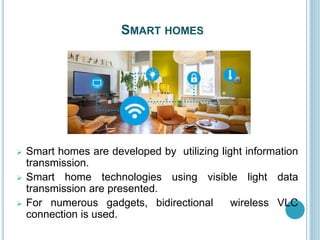
 Smart homes are developed by utilizing light information
transmission.
 Smart home technologies using visible light data
transmission are presented.
 For numerous gadgets, bidirectional wireless VLC
connection is used.
EXISTING TECHNOLOGY
 The Existing technology used in home automation is X10
house electric wiring.
 X10 is a communication protocol for home automation to
construct the smart home
 X10 sends 120 kHz radio frequency of digital information
onto a home's existing electric wiring to programmable
outlets or switches.
DRAWBACKS OF EXISTING TECHNOLOGY
 X10 was not always fully reliable.
 Signals would be lost and, in some cases, signals
wouldn't cross circuits that were wired on different
circuits.
 X10 was initially a one-way technology, so while smart
devices can take commands, they cannot send data back
to a central network.
 A Two-way X10 devices became available, albeit at a
higher cost.
PROPOSED TECHNOLOGY
 The proposed technology is named as Smart Home
Technologies using Visible Light Communication.
 Sensors are installed over all devices in a typical room,
together with the control unit.
 This control unit will provide instructions to devices
and/or notify the remote or home user.
 The users will be able to receive the notification on a
mobile device via the VLC downlink or wireless
networks.
VISIBLE LIGHT COMMUNICATION
 Visible light communication (VLC) is a data
communications technology which uses visible light
between 400 and 800 THz.
 VLC is a subset of optical wireless communications
technologies.
 VLC can be used as a communications medium for
ubiquitous computing, light-producing devices.
ARCHITECTURAL DESIGN OF SMART HOME
 A home or building equipped with specially designed and
structured wiring .
 These components are used to enable appliances to
remotely control or program an array of automated home
electronic devices by entering a single command refers
to a smart home.
 It refers to the use of computer and information
technology to control home appliances and features.
 Home automation is adopted for reasons of ease,
security and energy efficiency .
DESIGN OF SMART HOME
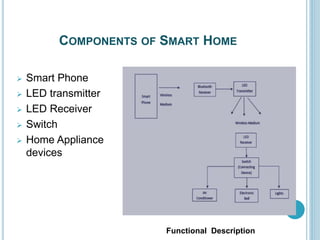
Architecture of Smart Home system
COMPONENTS OF SMART HOME
 Smart Phone
 LED transmitter
 LED Receiver
 Switch
 Home Appliance
devices
Functional Description
DESCRIPTION
SMART PHONE
 A smartphone is a handheld personal computer with a
mobile operating system and an integrated cellular
network connection for voice , SMS and Internet data
communication.
 They are able to run a variety of software components,
known as “apps”.
LED TRANSMITTER AND RECEIVER
 A LED transmitter is an electronic circuit which
transforms electric power from a battery or
electrical mains into alternating current.
 A power supply circuit to transform the input
electrical power to the higher voltages needed to
produce the required power output.
HOME APPLIANCE DEVICES
 Home Appliances are the devices used for the
home domestic usage such as
Washing Machine.
Smart TV.
Refrigerator.
ADVANTAGES
Convenience
 Convenience is one of the biggest reasons that
people build and purchase smart homes.
Security
 Smart homes include advanced security systems
with cameras, motion sensors and a link to the
local police station or a private security company.
Efficiency
 Smart homes offer enhanced energy-efficiency.
Lights can shut off automatically when no one is
in a room when not in use.
CONCLUSION
 Smart homes are also beneficial for the elderly, providing
monitoring that can help seniors to remain at home
comfortably and safely, rather than moving to a nursing
home or requiring 24/7 home care.
 Home automation also helps consumers improve
efficiency.
 smart home technologies are most beneficial than
conventional homes.

Smart home

  • 1.
    SMART HOME TECHNOLOGIESUSING VISIBLE LIGHT COMMUNICATION By, D.JOTHISRI 3rd year, B.Tech (IT) Mailam engineering college .
  • 2.
    OVERVIEW  Introduction.  SmartHomes  Existing Technology.  Drawbacks of existing technology.  Proposed technology.  Components.  Advantages.  Conclusion.
  • 3.
    INTRODUCTION  Technology istriggering a change in the way we live, the desire we pursue and expectations of what is possible.  smart home has so much attention and is a promising technology for increased comfort, safety and security.  With smart home technologies, household items, such as lamps, and locks, are becoming connected wirelessly and smarter.
  • 4.
    SMART HOMES  Smarthomes are developed by utilizing light information transmission.  Smart home technologies using visible light data transmission are presented.  For numerous gadgets, bidirectional wireless VLC connection is used.
  • 5.
    EXISTING TECHNOLOGY  TheExisting technology used in home automation is X10 house electric wiring.  X10 is a communication protocol for home automation to construct the smart home  X10 sends 120 kHz radio frequency of digital information onto a home's existing electric wiring to programmable outlets or switches.
  • 6.
    DRAWBACKS OF EXISTINGTECHNOLOGY  X10 was not always fully reliable.  Signals would be lost and, in some cases, signals wouldn't cross circuits that were wired on different circuits.  X10 was initially a one-way technology, so while smart devices can take commands, they cannot send data back to a central network.  A Two-way X10 devices became available, albeit at a higher cost.
  • 7.
    PROPOSED TECHNOLOGY  Theproposed technology is named as Smart Home Technologies using Visible Light Communication.  Sensors are installed over all devices in a typical room, together with the control unit.  This control unit will provide instructions to devices and/or notify the remote or home user.  The users will be able to receive the notification on a mobile device via the VLC downlink or wireless networks.
  • 8.
    VISIBLE LIGHT COMMUNICATION Visible light communication (VLC) is a data communications technology which uses visible light between 400 and 800 THz.  VLC is a subset of optical wireless communications technologies.  VLC can be used as a communications medium for ubiquitous computing, light-producing devices.
  • 9.
    ARCHITECTURAL DESIGN OFSMART HOME  A home or building equipped with specially designed and structured wiring .  These components are used to enable appliances to remotely control or program an array of automated home electronic devices by entering a single command refers to a smart home.  It refers to the use of computer and information technology to control home appliances and features.  Home automation is adopted for reasons of ease, security and energy efficiency .
  • 10.
    DESIGN OF SMARTHOME Architecture of Smart Home system
  • 11.
    COMPONENTS OF SMARTHOME  Smart Phone  LED transmitter  LED Receiver  Switch  Home Appliance devices Functional Description
  • 12.
    DESCRIPTION SMART PHONE  Asmartphone is a handheld personal computer with a mobile operating system and an integrated cellular network connection for voice , SMS and Internet data communication.  They are able to run a variety of software components, known as “apps”.
  • 13.
    LED TRANSMITTER ANDRECEIVER  A LED transmitter is an electronic circuit which transforms electric power from a battery or electrical mains into alternating current.  A power supply circuit to transform the input electrical power to the higher voltages needed to produce the required power output.
  • 14.
    HOME APPLIANCE DEVICES Home Appliances are the devices used for the home domestic usage such as Washing Machine. Smart TV. Refrigerator.
  • 15.
    ADVANTAGES Convenience  Convenience isone of the biggest reasons that people build and purchase smart homes. Security  Smart homes include advanced security systems with cameras, motion sensors and a link to the local police station or a private security company. Efficiency  Smart homes offer enhanced energy-efficiency. Lights can shut off automatically when no one is in a room when not in use.
  • 16.
    CONCLUSION  Smart homesare also beneficial for the elderly, providing monitoring that can help seniors to remain at home comfortably and safely, rather than moving to a nursing home or requiring 24/7 home care.  Home automation also helps consumers improve efficiency.  smart home technologies are most beneficial than conventional homes.