SMART HOME
«energy efficiency»
Abdullah Topçu
Mechanical Engineer
Index
• What is a smart home?
• Smart home’s features
• Smart home’s appliances
• Research smart home’s appliances viewpoint of energy
efficiency
• How do we save energy?
• Renewable energy for smart homes?
• An example for a energy efficient smart home
What is a «Smart Home»
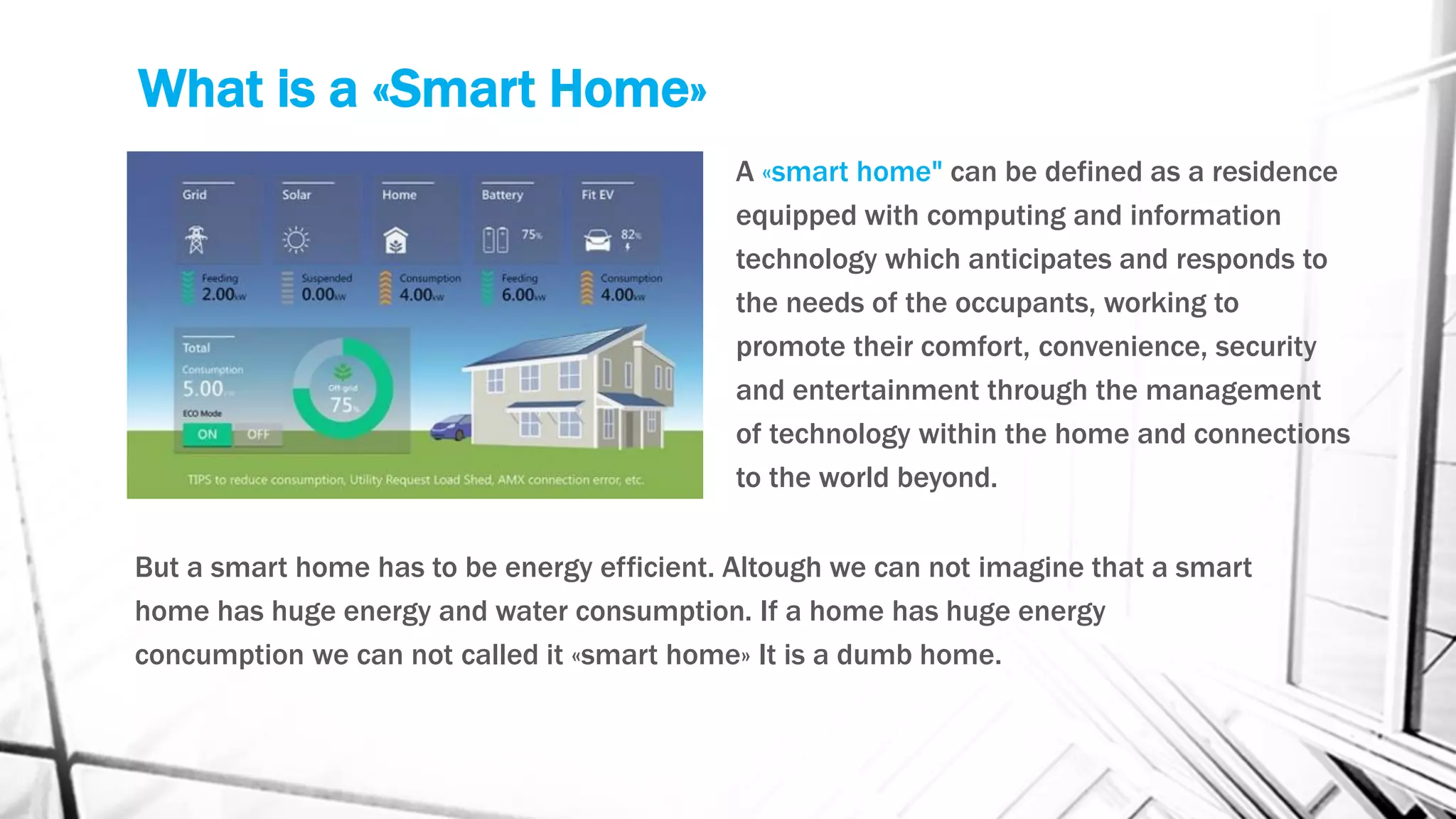
A «smart home" can be defined as a residence
equipped with computing and information
technology which anticipates and responds to
the needs of the occupants, working to
promote their comfort, convenience, security
and entertainment through the management
of technology within the home and connections
to the world beyond.
But a smart home has to be energy efficient. Altough we can not imagine that a smart
home has huge energy and water consumption. If a home has huge energy
concumption we can not called it «smart home» It is a dumb home.
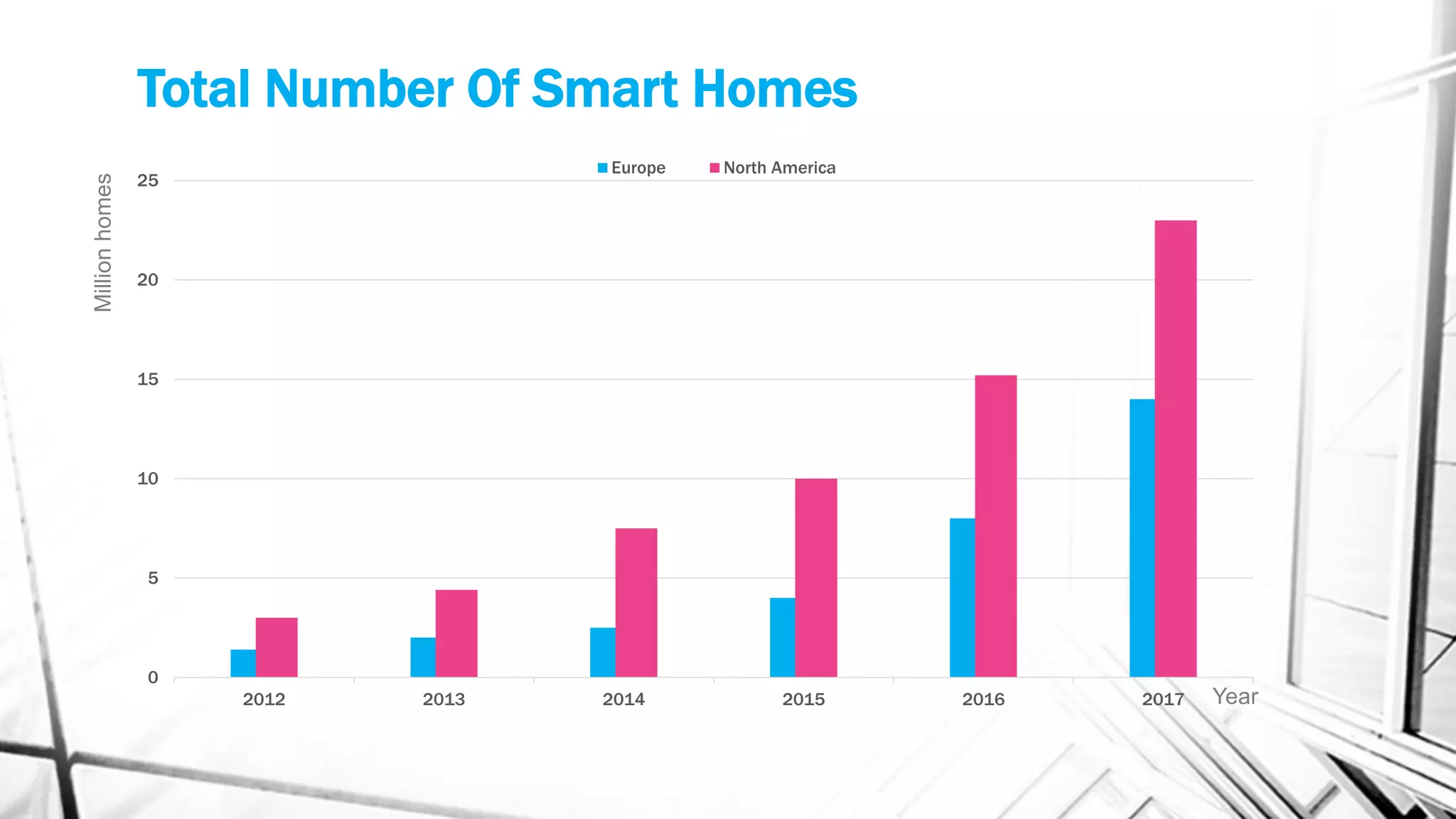
Total Number Of Smart Homes
0
5
10
15
20
25
2012 2013 2014 2015 2016 2017
Europe North America
Millionhomes
Year
What kind of properties does a smart
home have?
• The internet of things
• It keeps track of your preferences
• Devices are automated
• It can be remotely accessed and
contolled
• Effective feedback systems
• Ease of Access
• Low energy consumption
• Energy sustainable
Smart home appliances’ features
We use a lot of appliances and equipments in our smart
homes. We use network appliances and sensors. All of them
use electricity. And we install many smart devices at home.
Smart TV, refrigerator, owen, lightings, bathtub, sinks,
faucets, cameras, shutters, hvac equipments, security
equipments, smart phones etc. All of them use electiricity
and they help the smart grid sytem while comminicate each
other. A main computer operate all of these appliances. All of
these appliances use electricity. All of these ought to be low
energy consumption. If they use elecetricity too much, we pay
so much money for bills. So these appliances convert to
smart home but if we look from the viewpoint of energy
efficiency the home is dumb. Because none of smart home
spend money too much.
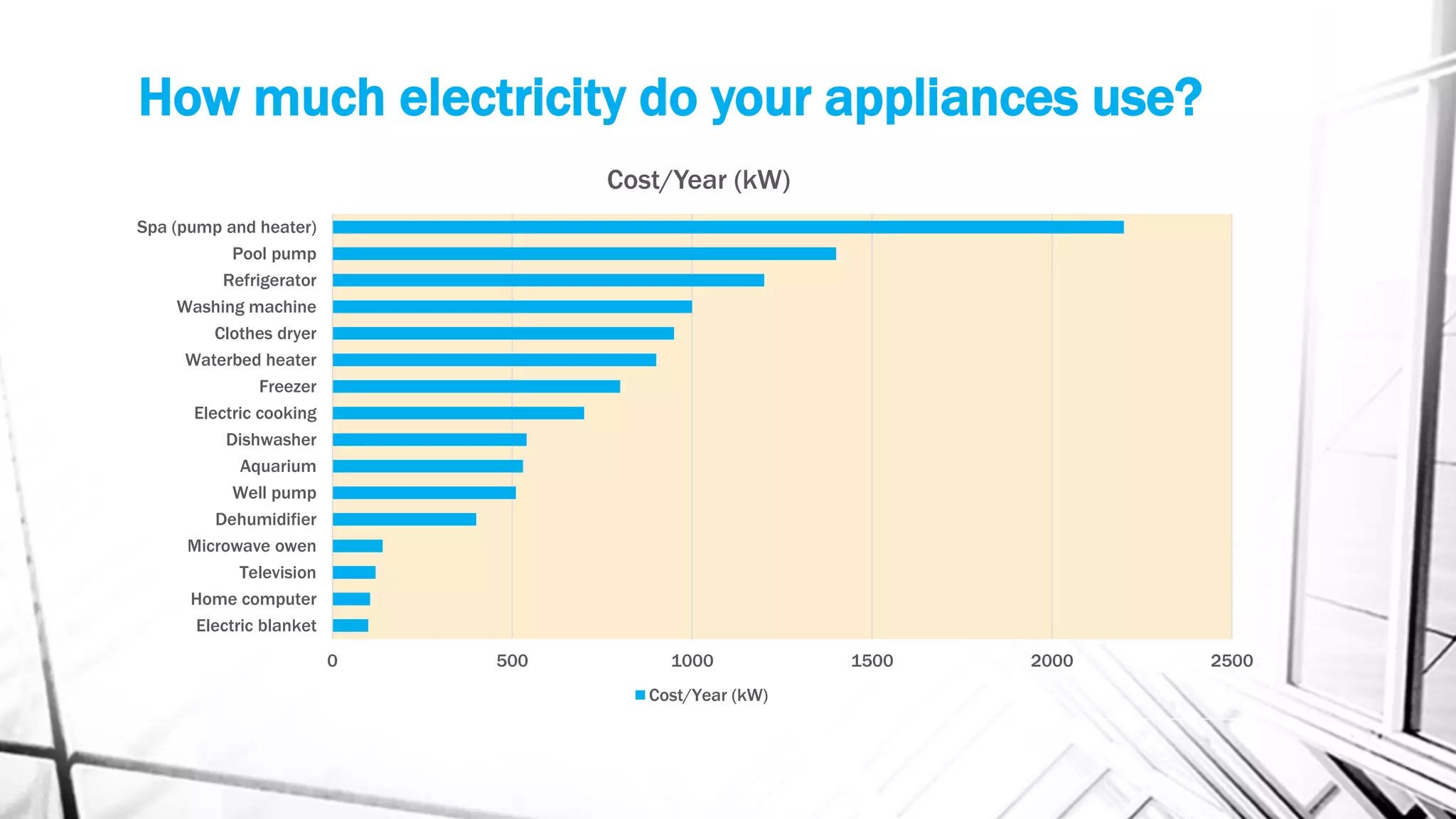
How much electricity do your appliances use?
0 500 1000 1500 2000 2500
Electric blanket
Home computer
Television
Microwave owen
Dehumidifier
Well pump
Aquarium
Dishwasher
Electric cooking
Freezer
Waterbed heater
Clothes dryer
Washing machine
Refrigerator
Pool pump
Spa (pump and heater)
Cost/Year (kW)
Cost/Year (kW)
Kitchen equipments
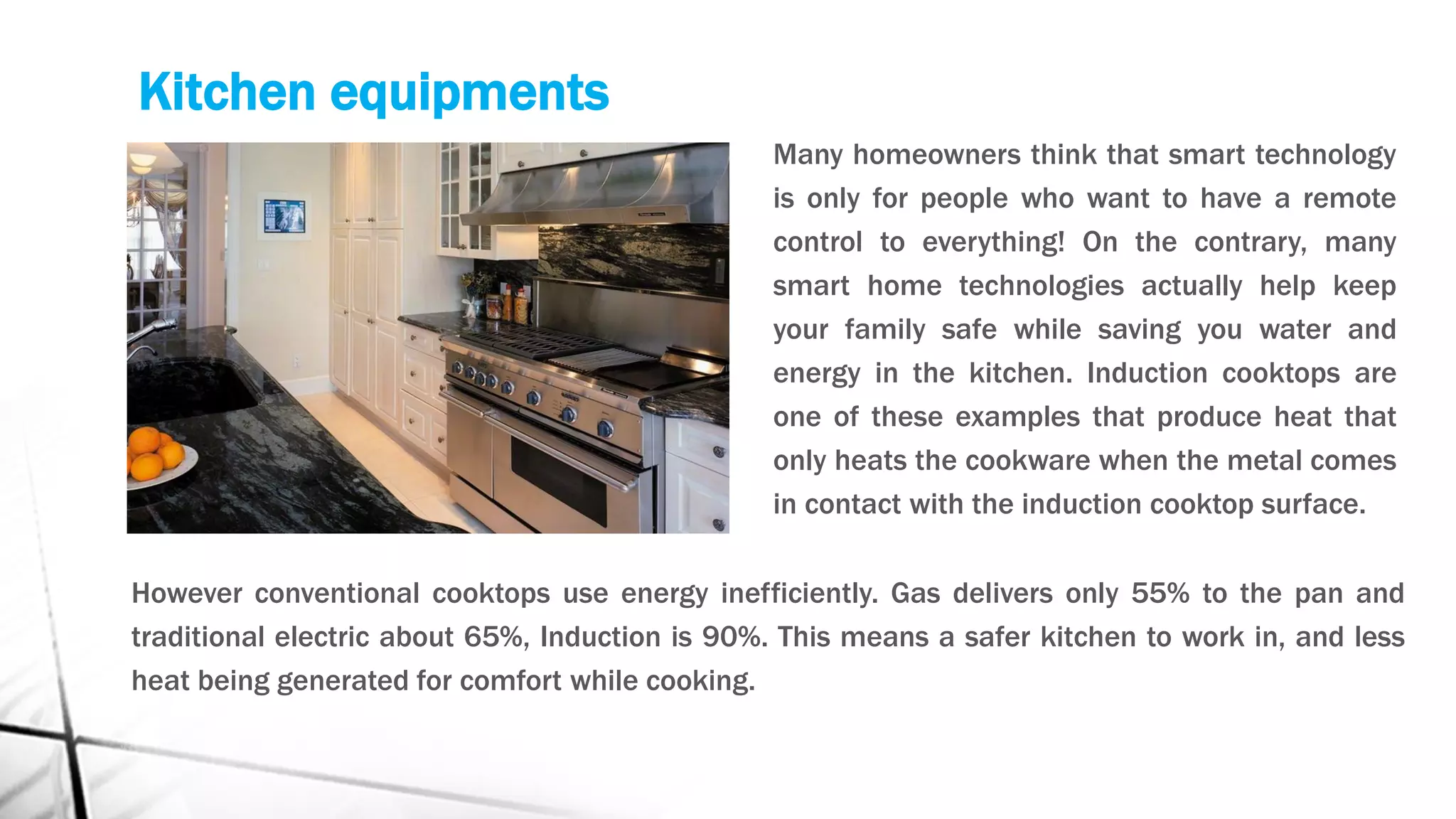
Many homeowners think that smart technology
is only for people who want to have a remote
control to everything! On the contrary, many
smart home technologies actually help keep
your family safe while saving you water and
energy in the kitchen. Induction cooktops are
one of these examples that produce heat that
only heats the cookware when the metal comes
in contact with the induction cooktop surface.
However conventional cooktops use energy inefficiently. Gas delivers only 55% to the pan and
traditional electric about 65%, Induction is 90%. This means a safer kitchen to work in, and less
heat being generated for comfort while cooking.
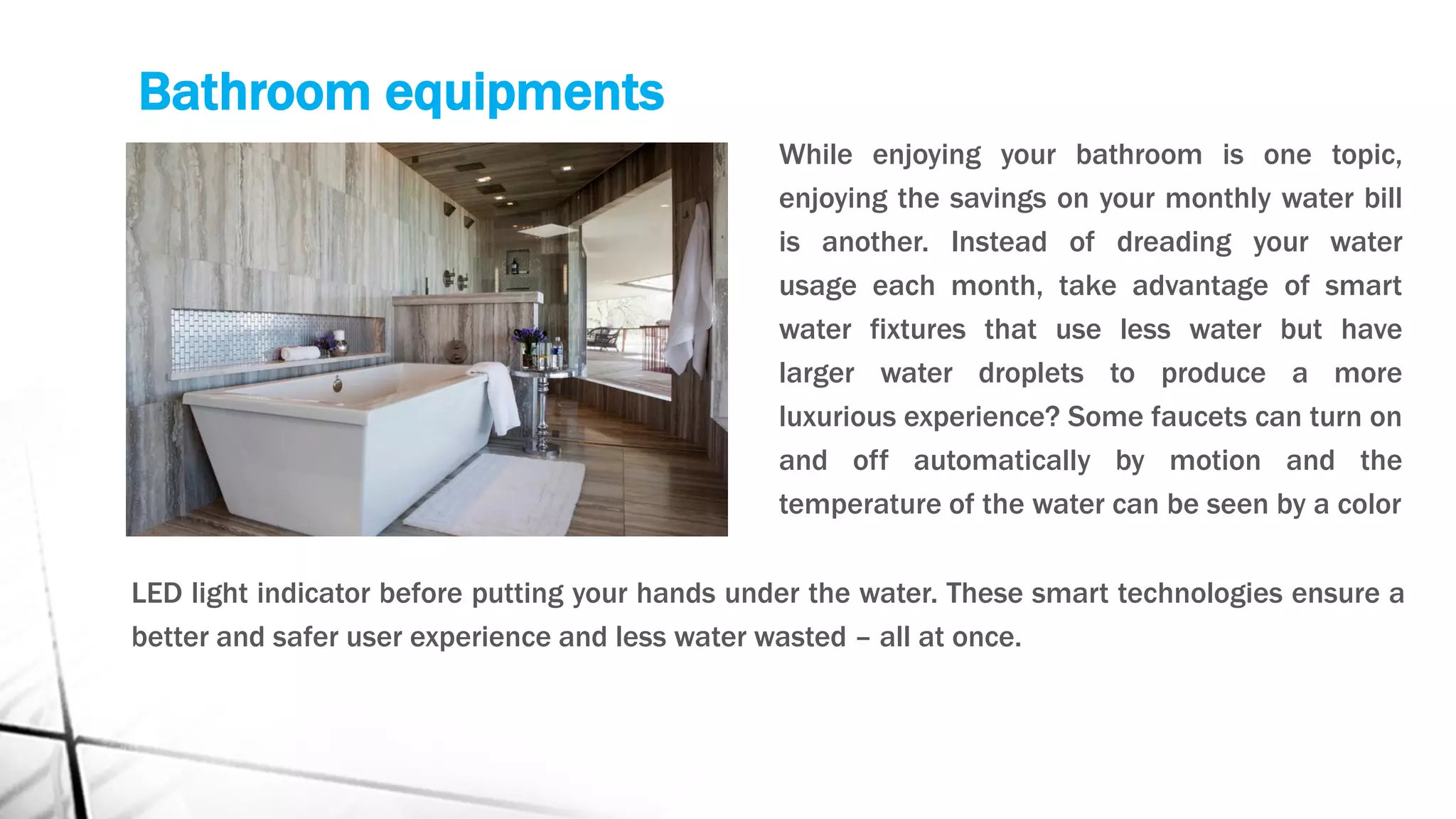
Bathroom equipments
While enjoying your bathroom is one topic,
enjoying the savings on your monthly water bill
is another. Instead of dreading your water
usage each month, take advantage of smart
water fixtures that use less water but have
larger water droplets to produce a more
luxurious experience? Some faucets can turn on
and off automatically by motion and the
temperature of the water can be seen by a color
LED light indicator before putting your hands under the water. These smart technologies ensure a
better and safer user experience and less water wasted – all at once.
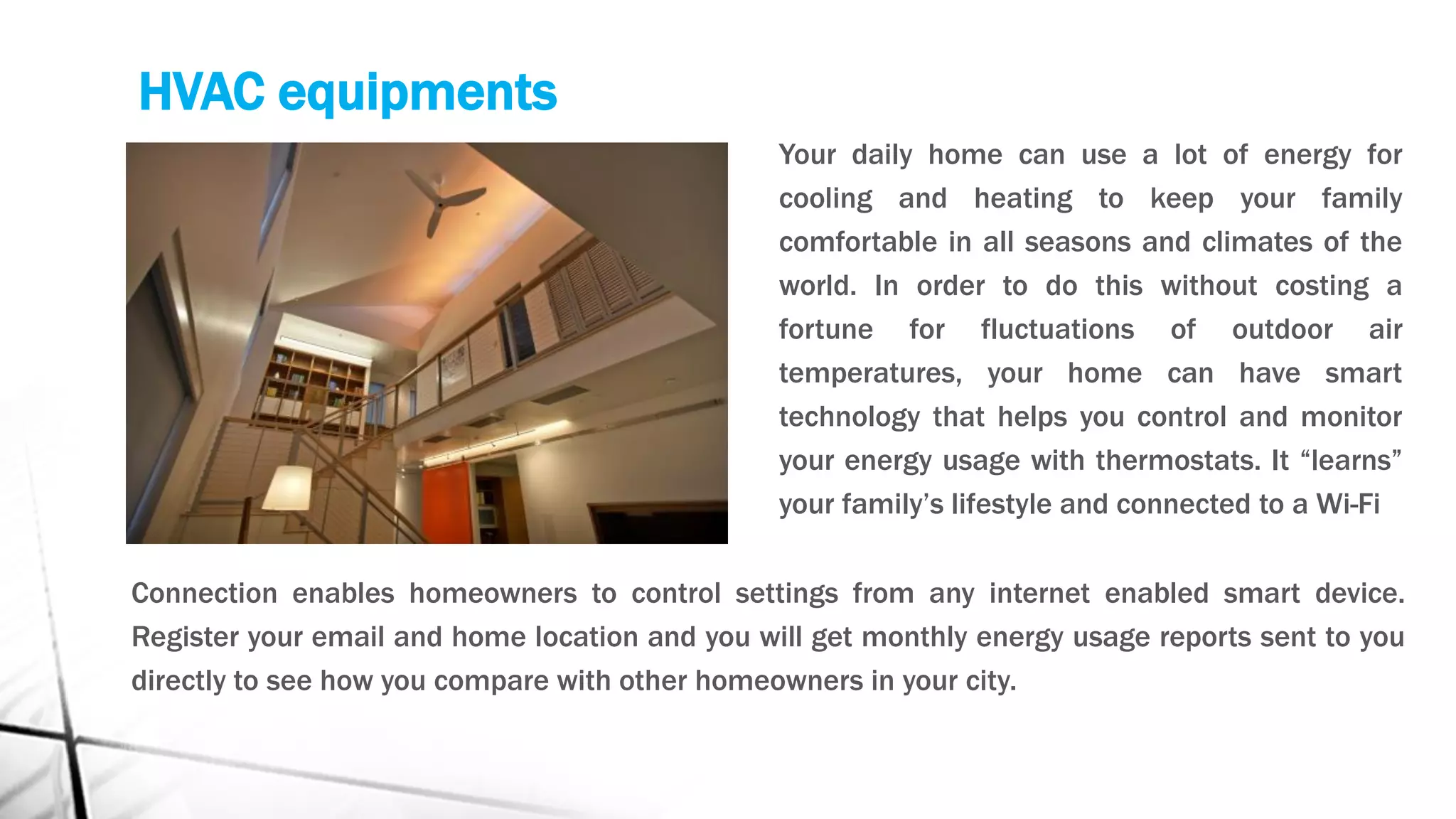
HVAC equipments
Your daily home can use a lot of energy for
cooling and heating to keep your family
comfortable in all seasons and climates of the
world. In order to do this without costing a
fortune for fluctuations of outdoor air
temperatures, your home can have smart
technology that helps you control and monitor
your energy usage with thermostats. It “learns”
your family’s lifestyle and connected to a Wi-Fi
Connection enables homeowners to control settings from any internet enabled smart device.
Register your email and home location and you will get monthly energy usage reports sent to you
directly to see how you compare with other homeowners in your city.
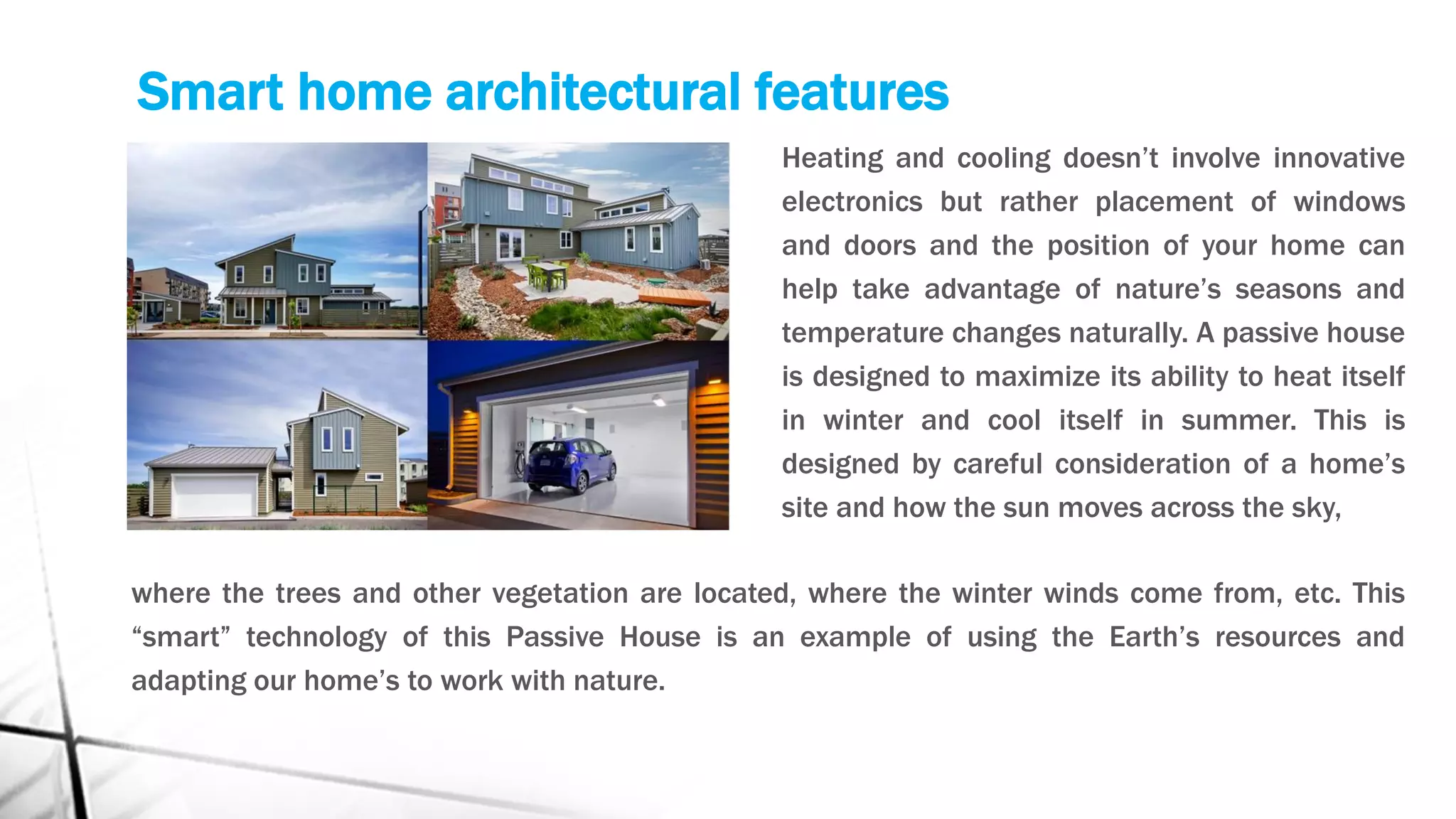
Smart home architectural features
Heating and cooling doesn’t involve innovative
electronics but rather placement of windows
and doors and the position of your home can
help take advantage of nature’s seasons and
temperature changes naturally. A passive house
is designed to maximize its ability to heat itself
in winter and cool itself in summer. This is
designed by careful consideration of a home’s
site and how the sun moves across the sky,
where the trees and other vegetation are located, where the winter winds come from, etc. This
“smart” technology of this Passive House is an example of using the Earth’s resources and
adapting our home’s to work with nature.
How do we save energy?
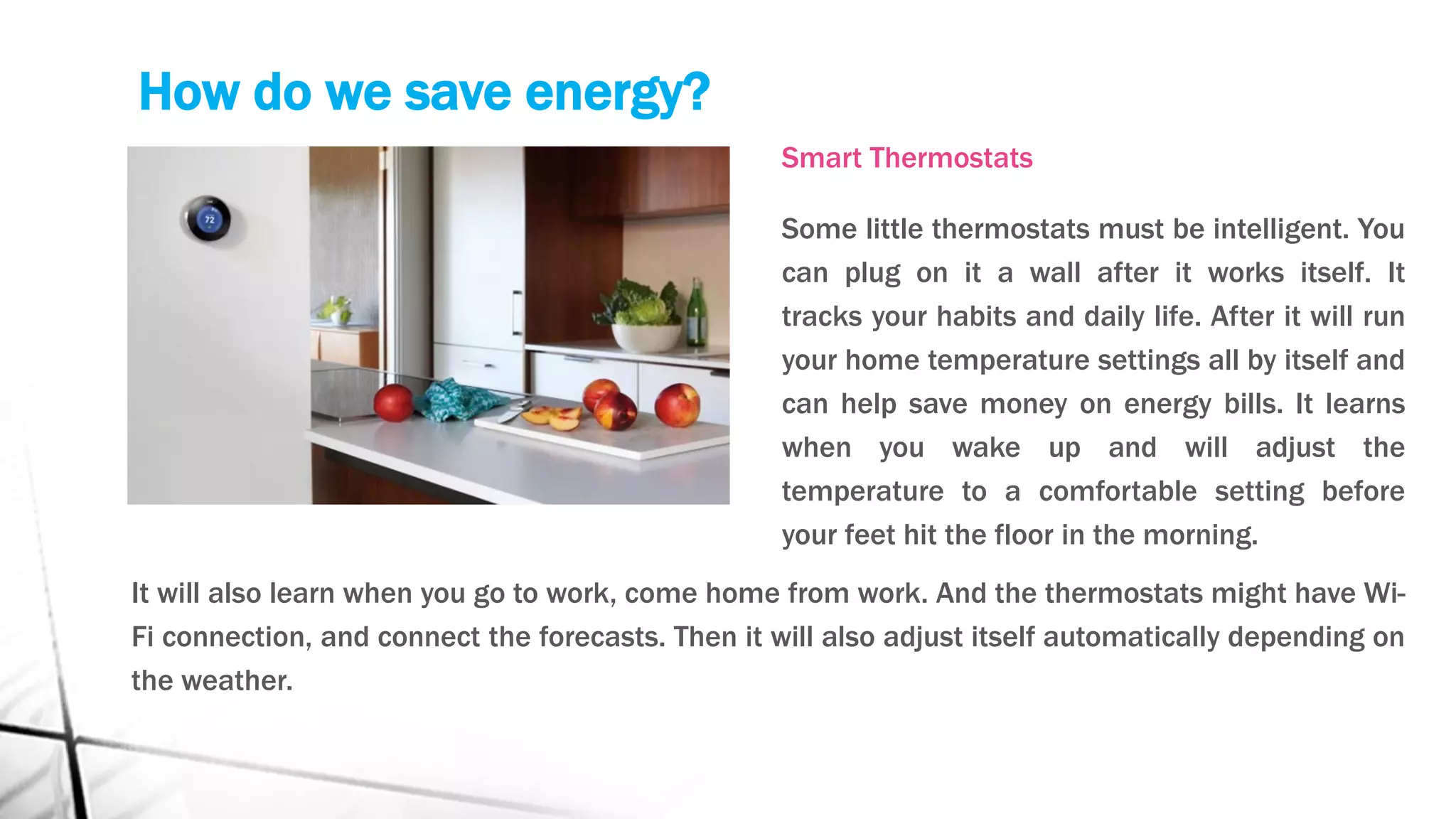
Smart Thermostats
Some little thermostats must be intelligent. You
can plug on it a wall after it works itself. It
tracks your habits and daily life. After it will run
your home temperature settings all by itself and
can help save money on energy bills. It learns
when you wake up and will adjust the
temperature to a comfortable setting before
your feet hit the floor in the morning.
It will also learn when you go to work, come home from work. And the thermostats might have Wi-
Fi connection, and connect the forecasts. Then it will also adjust itself automatically depending on
the weather.
How do we save energy?
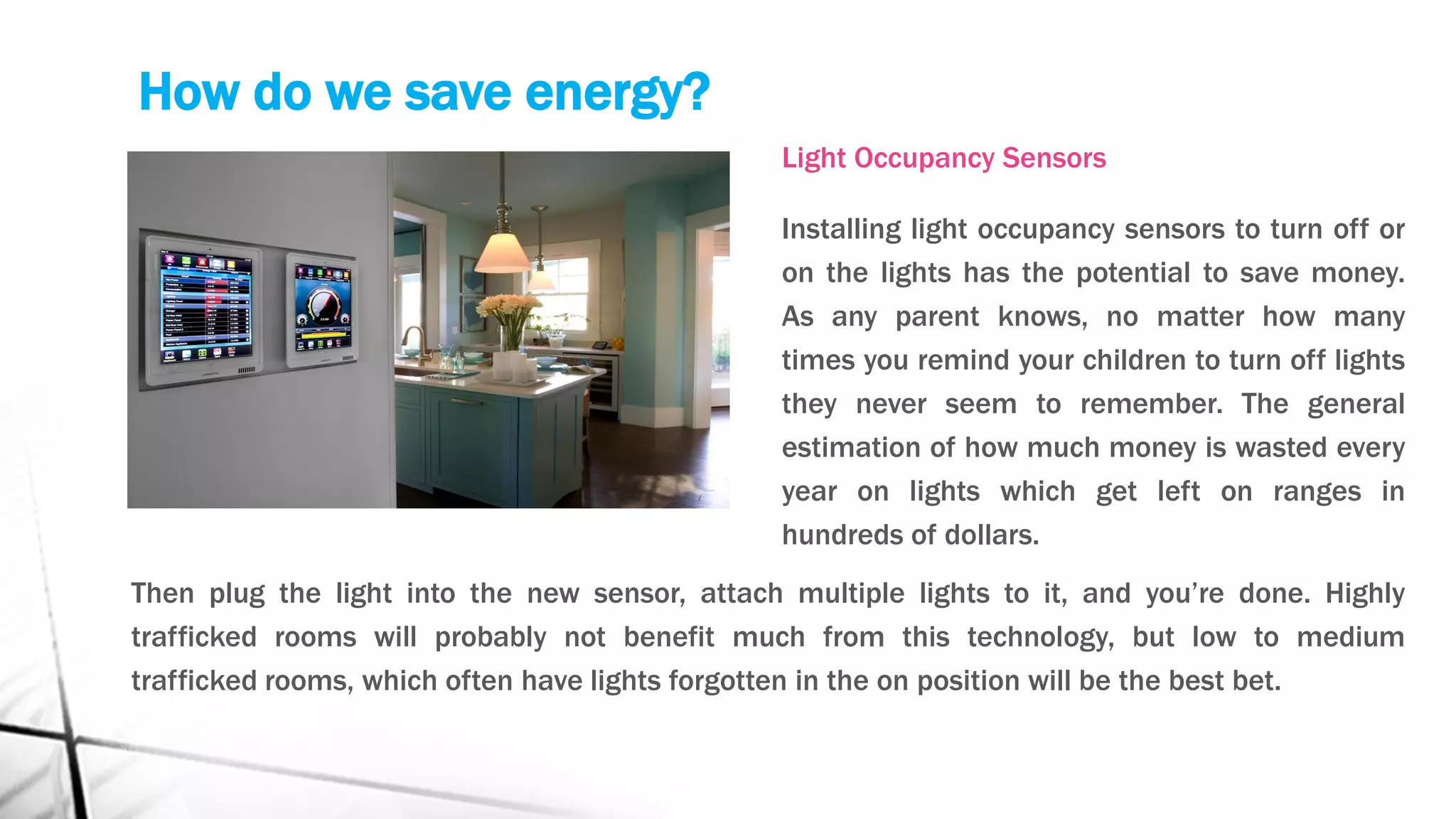
Light Occupancy Sensors
Installing light occupancy sensors to turn off or
on the lights has the potential to save money.
As any parent knows, no matter how many
times you remind your children to turn off lights
they never seem to remember. The general
estimation of how much money is wasted every
year on lights which get left on ranges in
hundreds of dollars.
Then plug the light into the new sensor, attach multiple lights to it, and you’re done. Highly
trafficked rooms will probably not benefit much from this technology, but low to medium
trafficked rooms, which often have lights forgotten in the on position will be the best bet.
How do we save energy?
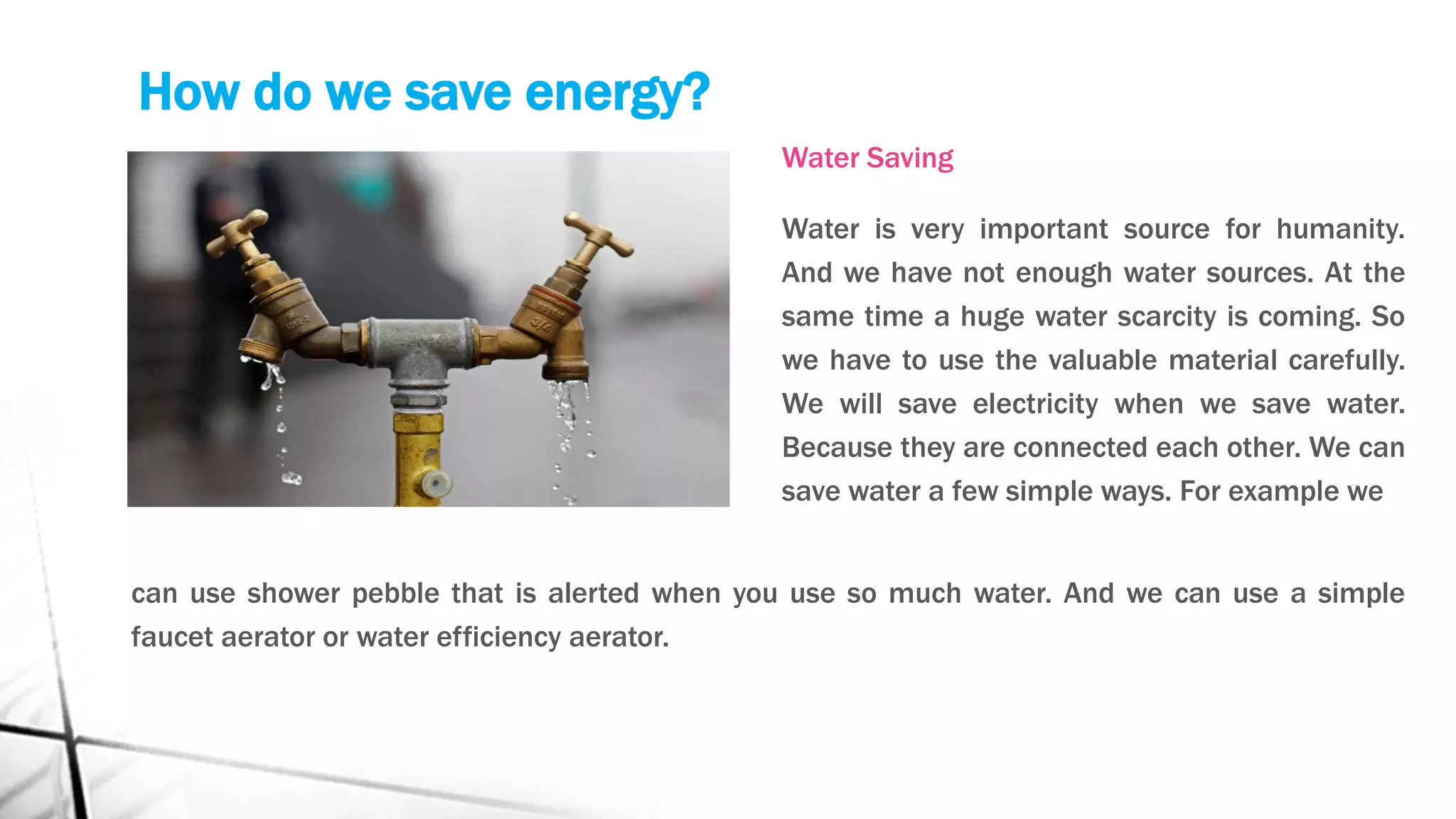
Water Saving
Water is very important source for humanity.
And we have not enough water sources. At the
same time a huge water scarcity is coming. So
we have to use the valuable material carefully.
We will save electricity when we save water.
Because they are connected each other. We can
save water a few simple ways. For example we
can use shower pebble that is alerted when you use so much water. And we can use a simple
faucet aerator or water efficiency aerator.
How do we save energy?
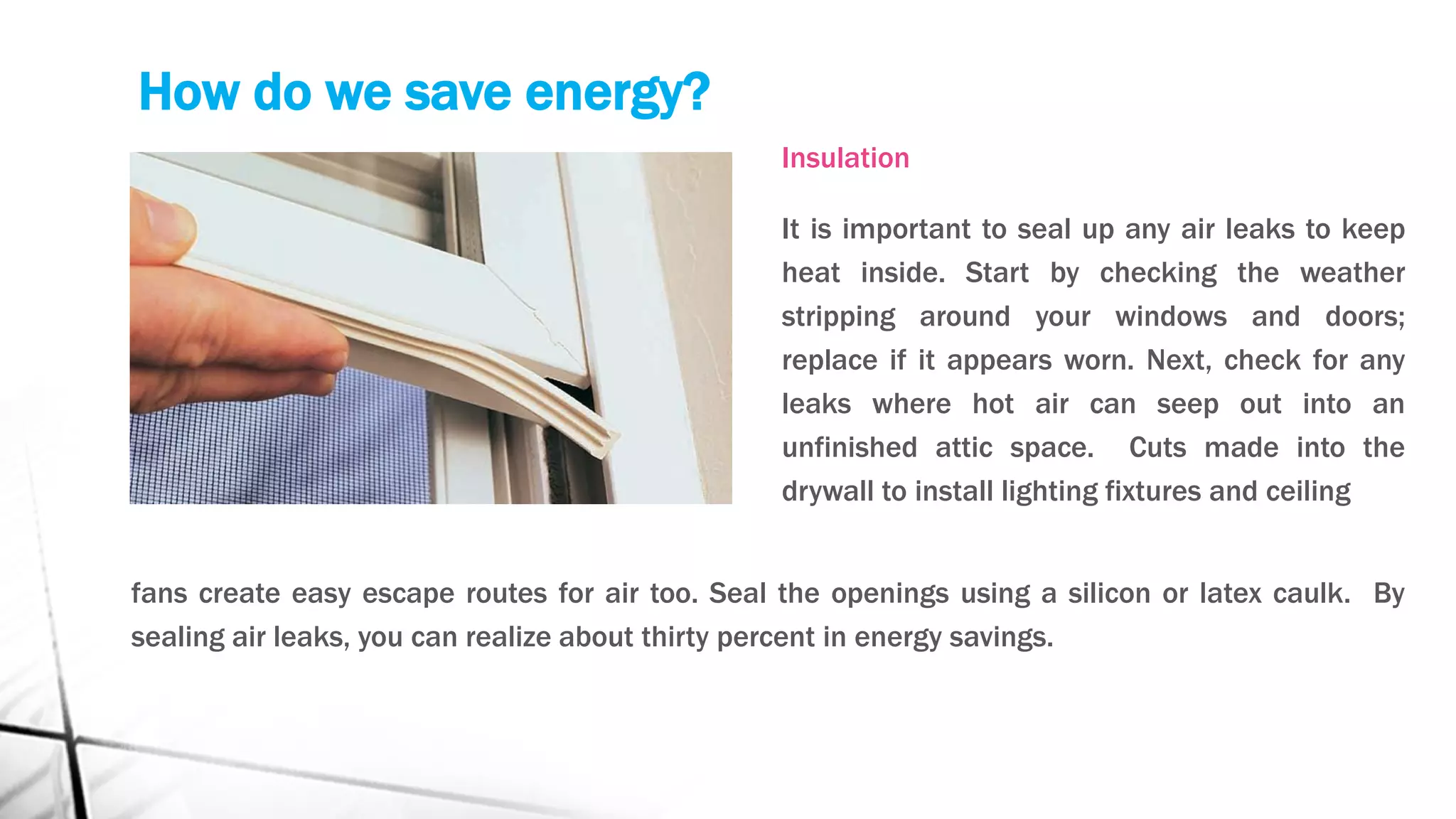
Insulation
It is important to seal up any air leaks to keep
heat inside. Start by checking the weather
stripping around your windows and doors;
replace if it appears worn. Next, check for any
leaks where hot air can seep out into an
unfinished attic space. Cuts made into the
drywall to install lighting fixtures and ceiling
fans create easy escape routes for air too. Seal the openings using a silicon or latex caulk. By
sealing air leaks, you can realize about thirty percent in energy savings.
How do we save energy?
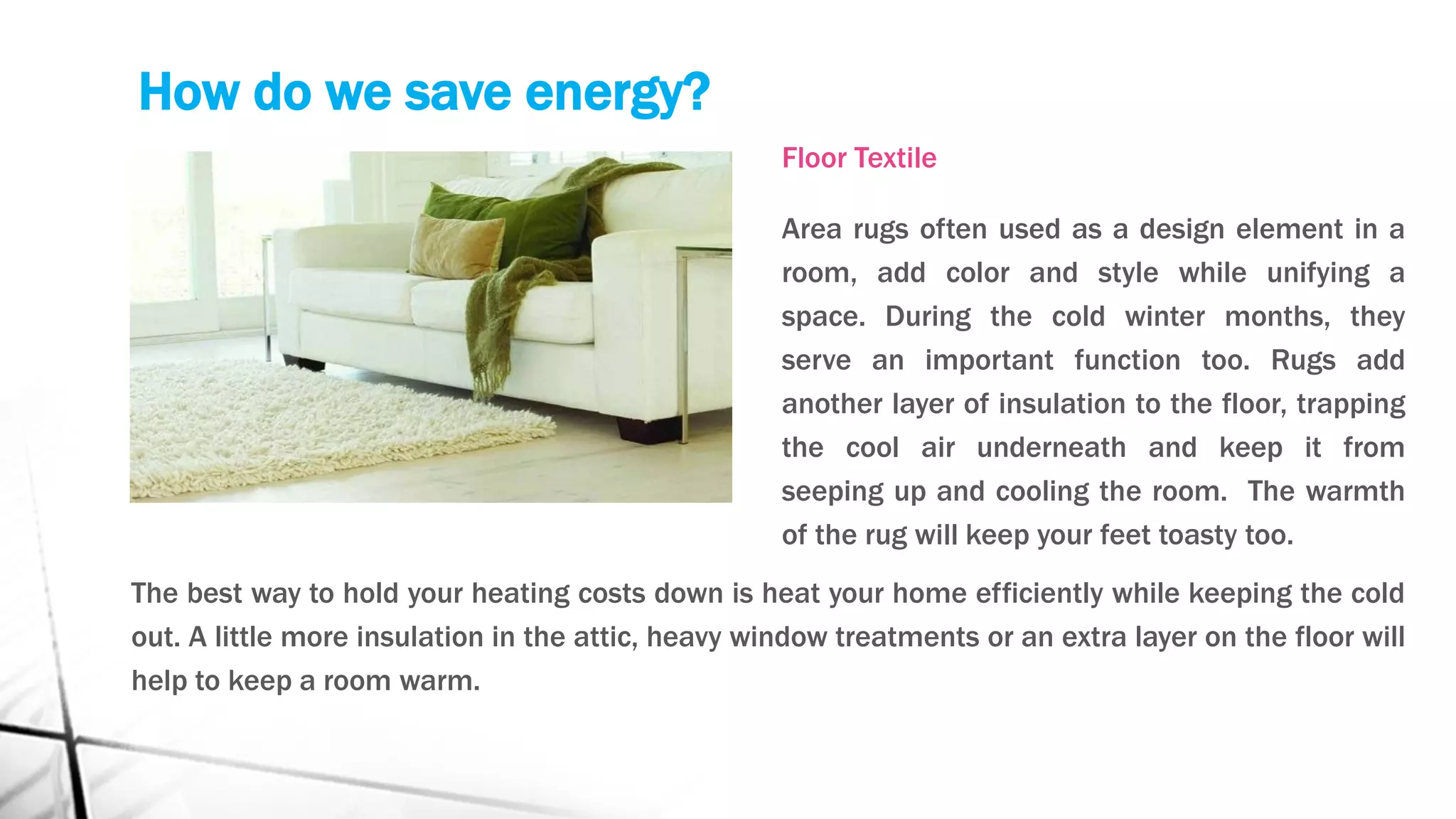
Floor Textile
Area rugs often used as a design element in a
room, add color and style while unifying a
space. During the cold winter months, they
serve an important function too. Rugs add
another layer of insulation to the floor, trapping
the cool air underneath and keep it from
seeping up and cooling the room. The warmth
of the rug will keep your feet toasty too.
The best way to hold your heating costs down is heat your home efficiently while keeping the cold
out. A little more insulation in the attic, heavy window treatments or an extra layer on the floor will
help to keep a room warm.
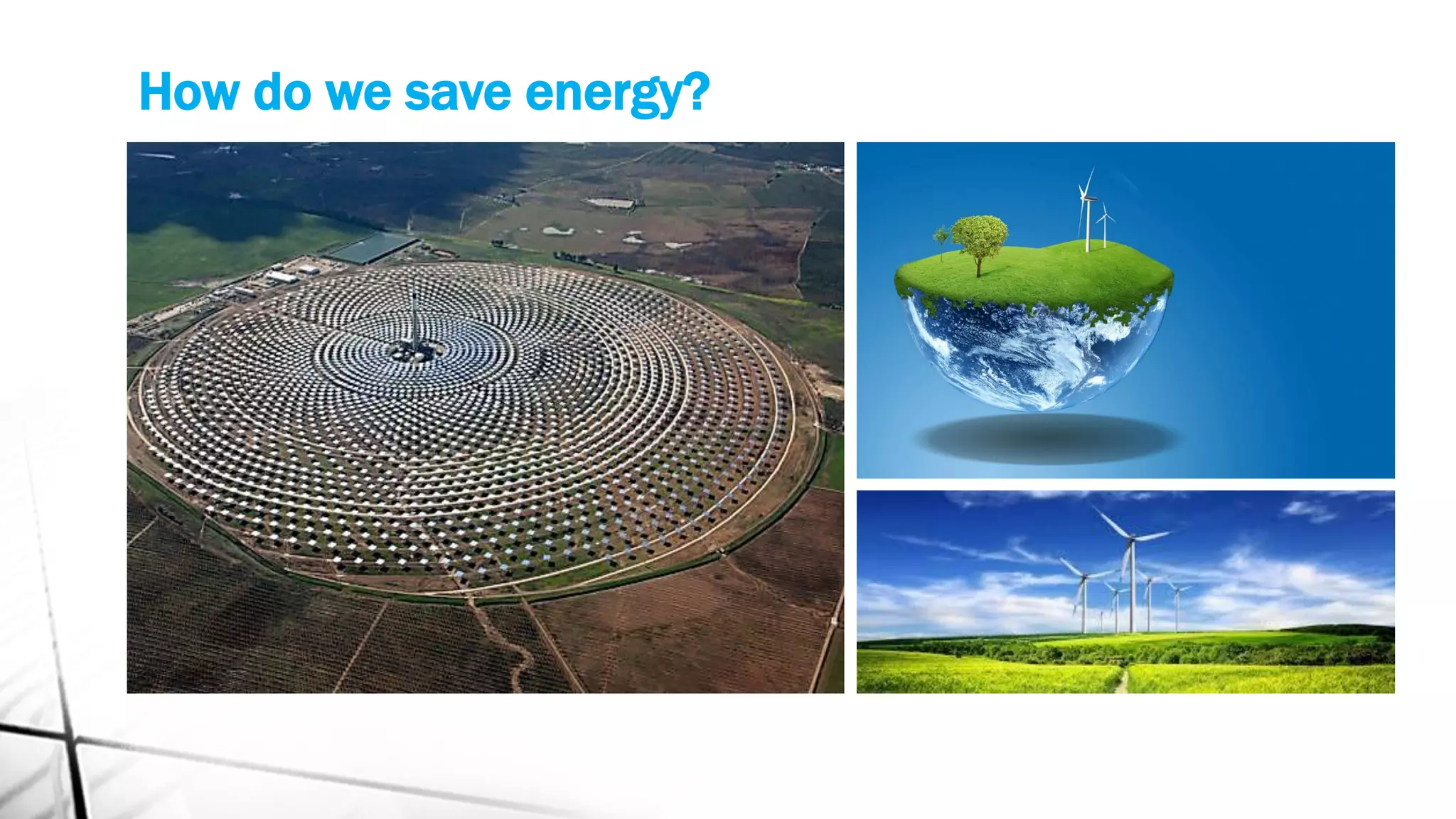
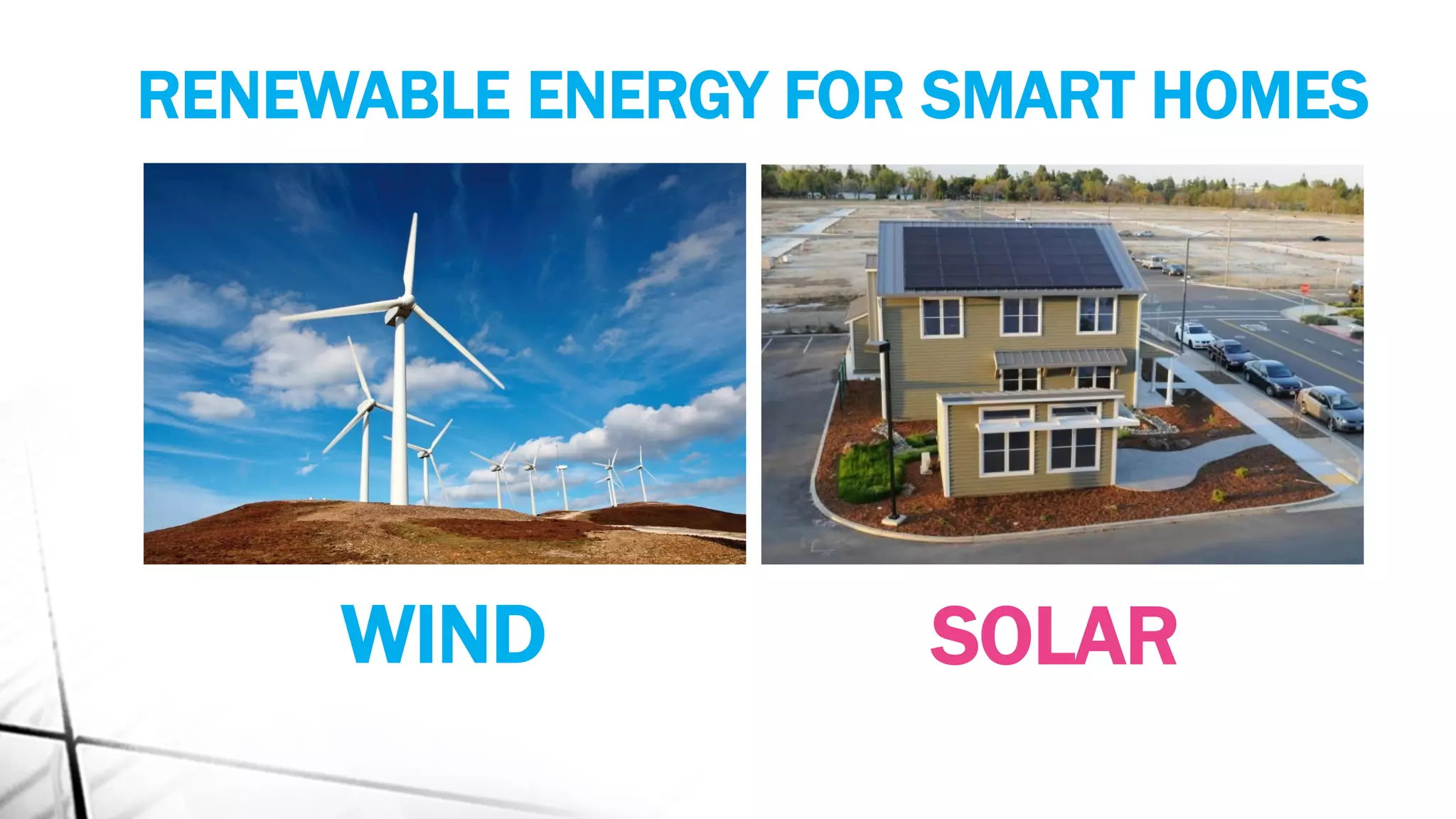
RENEWABLE ENERGY FOR SMART HOMES
WIND SOLAR
Solar energy in Smart Homes
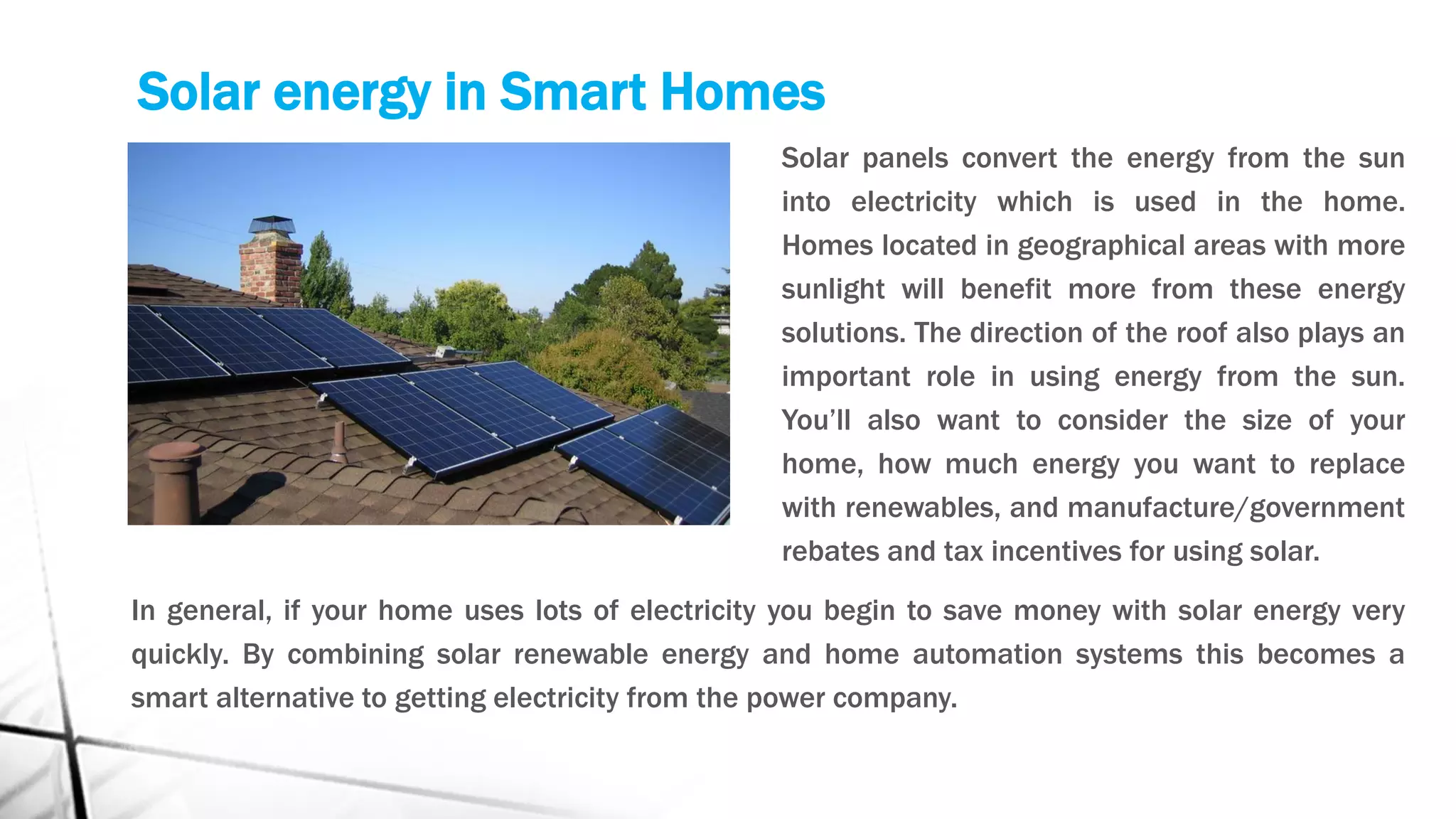
Solar panels convert the energy from the sun
into electricity which is used in the home.
Homes located in geographical areas with more
sunlight will benefit more from these energy
solutions. The direction of the roof also plays an
important role in using energy from the sun.
You’ll also want to consider the size of your
home, how much energy you want to replace
with renewables, and manufacture/government
rebates and tax incentives for using solar.
In general, if your home uses lots of electricity you begin to save money with solar energy very
quickly. By combining solar renewable energy and home automation systems this becomes a
smart alternative to getting electricity from the power company.
Wind energy in Smart Homes
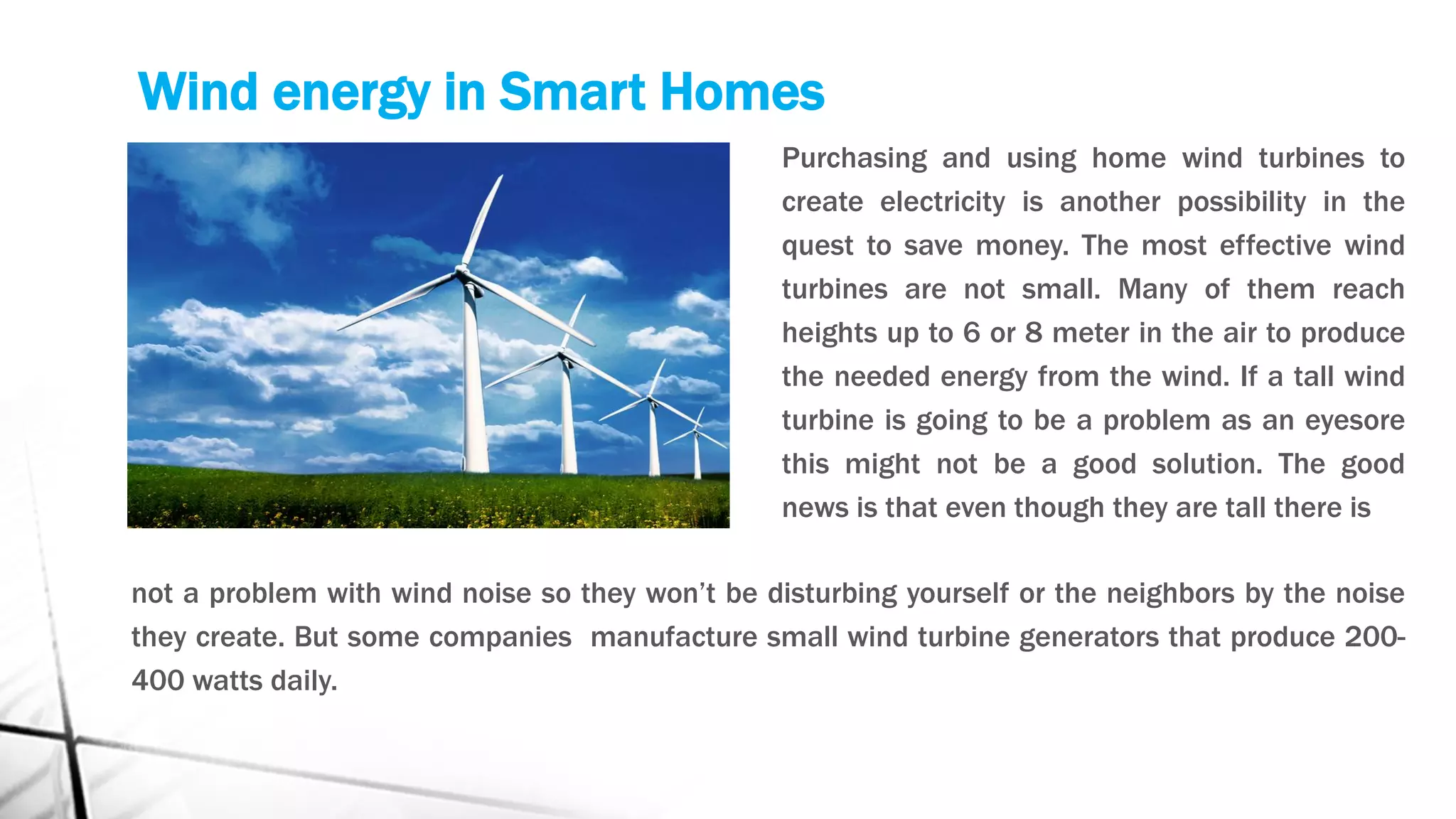
Purchasing and using home wind turbines to
create electricity is another possibility in the
quest to save money. The most effective wind
turbines are not small. Many of them reach
heights up to 6 or 8 meter in the air to produce
the needed energy from the wind. If a tall wind
turbine is going to be a problem as an eyesore
this might not be a good solution. The good
news is that even though they are tall there is
not a problem with wind noise so they won’t be disturbing yourself or the neighbors by the noise
they create. But some companies manufacture small wind turbine generators that produce 200-
400 watts daily.
An example for a Energy Efficient Smart Home
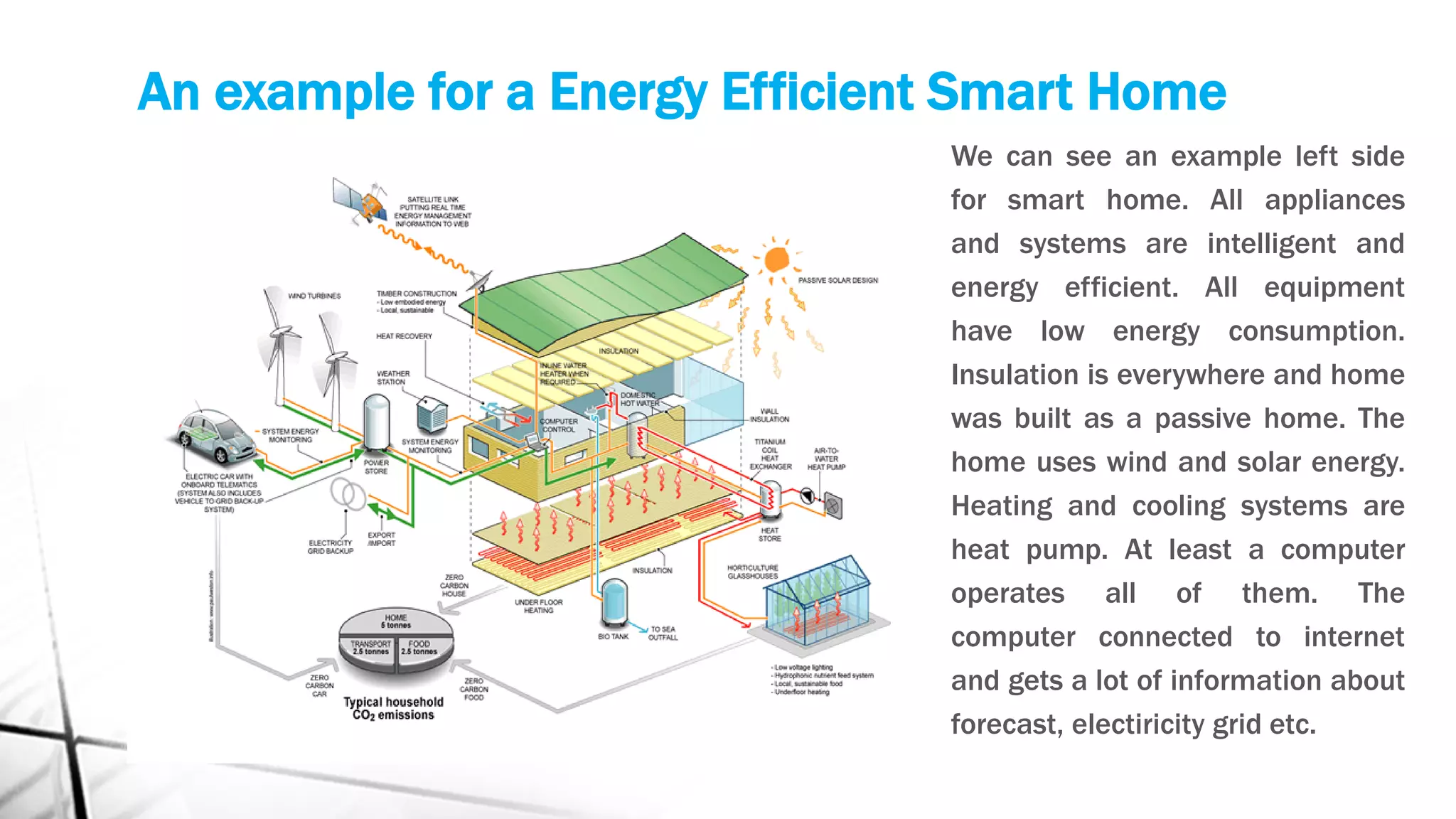
We can see an example left side
for smart home. All appliances
and systems are intelligent and
energy efficient. All equipment
have low energy consumption.
Insulation is everywhere and home
was built as a passive home. The
home uses wind and solar energy.
Heating and cooling systems are
heat pump. At least a computer
operates all of them. The
computer connected to internet
and gets a lot of information about
forecast, electiricity grid etc.
References
[1] Inside the Smart Home, Richard Harper, 2003
[2] The Energy-Smart House, From the editors of Fine Homebuildings, 2011
[3] Freshome, Design and Architecture, http://freshome.com
[4] Honda Smart Homes, http://www.hondasmarthome.com
[5] Enerji Enstitüsü, http://enerjienstitusu.com
[6] Property News, http://www.privateproperty.com.ng

Smart Home EEF

  • 1.
  • 2.
    Index • What isa smart home? • Smart home’s features • Smart home’s appliances • Research smart home’s appliances viewpoint of energy efficiency • How do we save energy? • Renewable energy for smart homes? • An example for a energy efficient smart home
  • 3.
    What is a«Smart Home» A «smart home" can be defined as a residence equipped with computing and information technology which anticipates and responds to the needs of the occupants, working to promote their comfort, convenience, security and entertainment through the management of technology within the home and connections to the world beyond. But a smart home has to be energy efficient. Altough we can not imagine that a smart home has huge energy and water consumption. If a home has huge energy concumption we can not called it «smart home» It is a dumb home.
  • 4.
    Total Number OfSmart Homes 0 5 10 15 20 25 2012 2013 2014 2015 2016 2017 Europe North America Millionhomes Year
  • 5.
    What kind ofproperties does a smart home have? • The internet of things • It keeps track of your preferences • Devices are automated • It can be remotely accessed and contolled • Effective feedback systems • Ease of Access • Low energy consumption • Energy sustainable
  • 6.
    Smart home appliances’features We use a lot of appliances and equipments in our smart homes. We use network appliances and sensors. All of them use electricity. And we install many smart devices at home. Smart TV, refrigerator, owen, lightings, bathtub, sinks, faucets, cameras, shutters, hvac equipments, security equipments, smart phones etc. All of them use electiricity and they help the smart grid sytem while comminicate each other. A main computer operate all of these appliances. All of these appliances use electricity. All of these ought to be low energy consumption. If they use elecetricity too much, we pay so much money for bills. So these appliances convert to smart home but if we look from the viewpoint of energy efficiency the home is dumb. Because none of smart home spend money too much.
  • 7.
    How much electricitydo your appliances use? 0 500 1000 1500 2000 2500 Electric blanket Home computer Television Microwave owen Dehumidifier Well pump Aquarium Dishwasher Electric cooking Freezer Waterbed heater Clothes dryer Washing machine Refrigerator Pool pump Spa (pump and heater) Cost/Year (kW) Cost/Year (kW)
  • 8.
    Kitchen equipments Many homeownersthink that smart technology is only for people who want to have a remote control to everything! On the contrary, many smart home technologies actually help keep your family safe while saving you water and energy in the kitchen. Induction cooktops are one of these examples that produce heat that only heats the cookware when the metal comes in contact with the induction cooktop surface. However conventional cooktops use energy inefficiently. Gas delivers only 55% to the pan and traditional electric about 65%, Induction is 90%. This means a safer kitchen to work in, and less heat being generated for comfort while cooking.
  • 9.
    Bathroom equipments While enjoyingyour bathroom is one topic, enjoying the savings on your monthly water bill is another. Instead of dreading your water usage each month, take advantage of smart water fixtures that use less water but have larger water droplets to produce a more luxurious experience? Some faucets can turn on and off automatically by motion and the temperature of the water can be seen by a color LED light indicator before putting your hands under the water. These smart technologies ensure a better and safer user experience and less water wasted – all at once.
  • 10.
    HVAC equipments Your dailyhome can use a lot of energy for cooling and heating to keep your family comfortable in all seasons and climates of the world. In order to do this without costing a fortune for fluctuations of outdoor air temperatures, your home can have smart technology that helps you control and monitor your energy usage with thermostats. It “learns” your family’s lifestyle and connected to a Wi-Fi Connection enables homeowners to control settings from any internet enabled smart device. Register your email and home location and you will get monthly energy usage reports sent to you directly to see how you compare with other homeowners in your city.
  • 11.
    Smart home architecturalfeatures Heating and cooling doesn’t involve innovative electronics but rather placement of windows and doors and the position of your home can help take advantage of nature’s seasons and temperature changes naturally. A passive house is designed to maximize its ability to heat itself in winter and cool itself in summer. This is designed by careful consideration of a home’s site and how the sun moves across the sky, where the trees and other vegetation are located, where the winter winds come from, etc. This “smart” technology of this Passive House is an example of using the Earth’s resources and adapting our home’s to work with nature.
  • 12.
    How do wesave energy?
  • 13.
    How do wesave energy? Smart Thermostats Some little thermostats must be intelligent. You can plug on it a wall after it works itself. It tracks your habits and daily life. After it will run your home temperature settings all by itself and can help save money on energy bills. It learns when you wake up and will adjust the temperature to a comfortable setting before your feet hit the floor in the morning. It will also learn when you go to work, come home from work. And the thermostats might have Wi- Fi connection, and connect the forecasts. Then it will also adjust itself automatically depending on the weather.
  • 14.
    How do wesave energy? Light Occupancy Sensors Installing light occupancy sensors to turn off or on the lights has the potential to save money. As any parent knows, no matter how many times you remind your children to turn off lights they never seem to remember. The general estimation of how much money is wasted every year on lights which get left on ranges in hundreds of dollars. Then plug the light into the new sensor, attach multiple lights to it, and you’re done. Highly trafficked rooms will probably not benefit much from this technology, but low to medium trafficked rooms, which often have lights forgotten in the on position will be the best bet.
  • 15.
    How do wesave energy? Water Saving Water is very important source for humanity. And we have not enough water sources. At the same time a huge water scarcity is coming. So we have to use the valuable material carefully. We will save electricity when we save water. Because they are connected each other. We can save water a few simple ways. For example we can use shower pebble that is alerted when you use so much water. And we can use a simple faucet aerator or water efficiency aerator.
  • 16.
    How do wesave energy? Insulation It is important to seal up any air leaks to keep heat inside. Start by checking the weather stripping around your windows and doors; replace if it appears worn. Next, check for any leaks where hot air can seep out into an unfinished attic space. Cuts made into the drywall to install lighting fixtures and ceiling fans create easy escape routes for air too. Seal the openings using a silicon or latex caulk. By sealing air leaks, you can realize about thirty percent in energy savings.
  • 17.
    How do wesave energy? Floor Textile Area rugs often used as a design element in a room, add color and style while unifying a space. During the cold winter months, they serve an important function too. Rugs add another layer of insulation to the floor, trapping the cool air underneath and keep it from seeping up and cooling the room. The warmth of the rug will keep your feet toasty too. The best way to hold your heating costs down is heat your home efficiently while keeping the cold out. A little more insulation in the attic, heavy window treatments or an extra layer on the floor will help to keep a room warm.
  • 18.
    RENEWABLE ENERGY FORSMART HOMES WIND SOLAR
  • 19.
    Solar energy inSmart Homes Solar panels convert the energy from the sun into electricity which is used in the home. Homes located in geographical areas with more sunlight will benefit more from these energy solutions. The direction of the roof also plays an important role in using energy from the sun. You’ll also want to consider the size of your home, how much energy you want to replace with renewables, and manufacture/government rebates and tax incentives for using solar. In general, if your home uses lots of electricity you begin to save money with solar energy very quickly. By combining solar renewable energy and home automation systems this becomes a smart alternative to getting electricity from the power company.
  • 20.
    Wind energy inSmart Homes Purchasing and using home wind turbines to create electricity is another possibility in the quest to save money. The most effective wind turbines are not small. Many of them reach heights up to 6 or 8 meter in the air to produce the needed energy from the wind. If a tall wind turbine is going to be a problem as an eyesore this might not be a good solution. The good news is that even though they are tall there is not a problem with wind noise so they won’t be disturbing yourself or the neighbors by the noise they create. But some companies manufacture small wind turbine generators that produce 200- 400 watts daily.
  • 21.
    An example fora Energy Efficient Smart Home We can see an example left side for smart home. All appliances and systems are intelligent and energy efficient. All equipment have low energy consumption. Insulation is everywhere and home was built as a passive home. The home uses wind and solar energy. Heating and cooling systems are heat pump. At least a computer operates all of them. The computer connected to internet and gets a lot of information about forecast, electiricity grid etc.
  • 22.
    References [1] Inside theSmart Home, Richard Harper, 2003 [2] The Energy-Smart House, From the editors of Fine Homebuildings, 2011 [3] Freshome, Design and Architecture, http://freshome.com [4] Honda Smart Homes, http://www.hondasmarthome.com [5] Enerji Enstitüsü, http://enerjienstitusu.com [6] Property News, http://www.privateproperty.com.ng