A SEMINAR ON
Rocks As Construction Material
Contents
Introduction
Properties of Building Stones
Types of Building Stones
1. Granite
2. Dolerite
3. Basalts
4. Sandstone
5. Limestone
6. Marbles
7. Laterites
8. Slate
9. Soapstone
Conclusion
Reference
Rocks are aggregate of minerals. Rocks are quarried
larger for used as building stones for constructing
Buildings, Dams, Bridges, Monuments and
Memorials etc…
 Since 12000 Years rocks are using for Building
shelters.
 Hence building stones should have quality and
strength to sustain stress and strain exerted by
engineering structure.
Colour
Mineral Composition
Texture
Porosity
Permeability
Resistance, Abrasion & Weathering
Heat Resistance
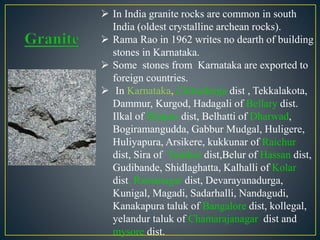
 In India granite rocks are common in south
India (oldest crystalline archean rocks).
 Rama Rao in 1962 writes no dearth of building
stones in Karnataka.
 Some stones from Karnataka are exported to
foreign countries.
 In Karnataka, Chitradurga dist , Tekkalakota,
Dammur, Kurgod, Hadagali of Bellary dist.
Ilkal of Bijapur dist, Belhatti of Dharwad,
Bogiramangudda, Gabbur Mudgal, Huligere,
Huliyapura, Arsikere, kukkunar of Raichur
dist, Sira of Tumkur dist,Belur of Hassan dist,
Gudibande, Shidlaghatta, Kalhalli of Kolar
dist, Ramanagar dist, Devarayanadurga,
Kunigal, Magadi, Sadarhalli, Nandagudi,
Kanakapura taluk of Bangalore dist, kollegal,
yelandur taluk of Chamarajanagar dist and
mysore dist.
In Tamil Nadu it occurs as charnockite (hypersthene granite).
 Tomb of Job Charnock was first identified this rock. Hence
named after charnock.It is found in abundance in Nilgiris of
T.N, Eastern and western Ghats.
It occurs in northern parts Assam, Rupavati, Anrelipranth,
Bedia and Khamba dist of Gujarat, Bilaspur and Raigarh dist
of Madhya Pradesh. Ganjam and Mayurbhanj dist of Orissa,
Jhansi dist of U.P.
Vidhana Soudha, Bangalore Stone Chariot, Hampi.
Vivekananda
Statue,Kanyakumari. Mahabalipuram,Tamil Nadu.
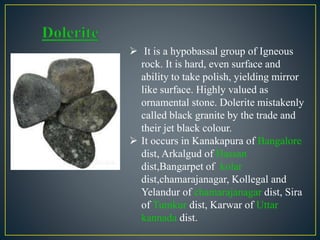
 It is a hypobassal group of Igneous
rock. It is hard, even surface and
ability to take polish, yielding mirror
like surface. Highly valued as
ornamental stone. Dolerite mistakenly
called black granite by the trade and
their jet black colour.
 It occurs in Kanakapura of Bangalore
dist, Arkalgud of Hassan
dist,Bangarpet of kolar
dist,chamarajanagar, Kollegal and
Yelandur of chamarajanagar dist, Sira
of Tumkur dist, Karwar of Uttar
kannada dist.
Vietnam War Monument,U.S.A
 It is a volcanic group of Igneous
rock. It is used in northern dist.
In Karnataka like Belgaum,
Bijapur, Bidar and Gulburga .
Some of the forts of Bidar and
Bijapur built out of Basalt.
Basalts are serves as excellent
road metal but they are not
usually preferred for building
purposes because of their dark
and dull colours.
Gateway of India,
Mumbai.
Bidar Fort, Karnataka
 It is a sedimentary rock, splitting
along parallel to bedding. Composed
essentially of quartz grains cemented
by siliceous, calcareous, felspathic or
ferruginous cementing matter. Fine
grained and uniform textured best
suitable for building purpose,.
 In India excellent quality of
Sandstone are found in several state.
The Vindhyan Sandstone and
Sandstone. Vindhyan Sandstone are
uppermost vindhyan age are known
excellent building stone, due to their
regular bedded formation uniform
grain size. In northern and western
India vindhyan Sandstone are used as
building stone.
Guntur, West Godavari ,Warangal dist of Andhra Pradesh.
Cherrapunji of Assam, Mizoram, Shahabad dist of Bihar, Kutch
and Zalawad, Sabarakantha dist of Gujarat.
Another variety of Sandstone of great beauty and durability,
obtained from upper Gondwana rocks in Orissa ( occur in the
bank of Mahanadi river).
In Karnataka it as occur in Belgaum, Bijapur and Gulbarga.
Bilaspur, Damoh, Indore, Nimar, Raigarh, Rewa, Saugar, Satna
and Shahadol dist of M.P. Ambala dist of Haryana, Patiala of
Punjab and Simla of Himachal Pradesh. Bharatpur, Bikaner,
Jaipur, Jodhpur, kota and Udaipur dist of Rajasthan.
Red Fort, Delhi
Puri Jagannath
Temple, Konark
Badami Caves,Bagalkot
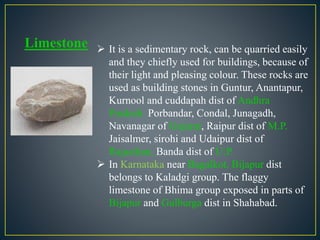
Limestone  It is a sedimentary rock, can be quarried easily
and they chiefly used for buildings, because of
their light and pleasing colour. These rocks are
used as building stones in Guntur, Anantapur,
Kurnool and cuddapah dist of Andhra
Pradesh. Porbandar, Condal, Junagadh,
Navanagar of Gujarat, Raipur dist of M.P.
Jaisalmer, sirohi and Udaipur dist of
Rajasthan, Banda dist of U.P.
 In Karnataka near Bagalkot, Bijapur dist
belongs to Kaladgi group. The flaggy
limestone of Bhima group exposed in parts of
Bijapur and Gulburga dist in Shahabad.
Dwarka Temple,
Gujarat
Durga Temple,
Bagalkot
 It is a metamorphic rock .The crystalline
Limestone and Marbles of Rajasthan
belongs to Archeans. They are known as
Makrana Marble. Makrana Marbles
quarried in Jaipur. This is the best Marbles
in India.
 In India Visakhapatnam, Khammamm,
Guntur dist of Andhra Pradesh.
Banaskantha and Broach dist of Gujarat.
 Large quantities of white Marbles are found
in gorge of Narmada river close to Jabalpur
town of M.P.
 Coimbatore, Ramanathapuram and Madurai
dist of T.N, Nagaur, Alwar, Jaipur,
Jaisalmer, Pali, Sirohi dist of Rajasthan,
Dehra Dun, Mirzapur dist of U.P.
 The world best supplies of Marble come
from Carrara in Italy.
Victoria Memorial Hall, Kolkata
Taj Mahal ,Agra
Makrana Marble
 The name given to a mottled red or brown
coloured coriaceous rock with a vermicular
structure near the surface. These are found
variety of rocks which are subjected to
tropical and subtropical weathering. It is
essentially hydrated oxides of Fe and Al.
Laterites cuts into bricks and blocks when
freshly quarried, when it is exposed to air,
it becomes hard.
 In India Laterites found in coastal tracts of
Kerala, Nellore dist of Andhra Pradesh and
Ratnagiri dist of Maharashtra, Puri and
Sambalpur dist of Orissa, Midnapur dist of
West Bengal.
 In Karnataka largely found in Malnad dist
and coastal region.
used for building purpose.
 It is a metamorphic rock. It
can be split evenly into thin
layers. It is used for roofing
and paving in buildings.
 Slates are quarried in india
near Dharmashala in
Kangra dist of Himachal
Pradesh, Monghyar in Bihar
and Markapur on the
Nellore- Kurnool border of
A.P.
Slate Roof
Slate Paving
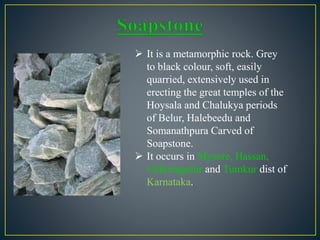
 It is a metamorphic rock. Grey
to black colour, soft, easily
quarried, extensively used in
erecting the great temples of the
Hoysala and Chalukya periods
of Belur, Halebeedu and
Somanathpura Carved of
Soapstone.
 It occurs in Mysore, Hassan,
Chikmagalur and Tumkur dist of
Karnataka.
Chennakesava Temple,
Somanathapura,Mysore
Belur Temple, Hassan
 The crushed stones are used in recent year for construction of
buildings, small size are used in roads, paved road.
 Some of the igneous, sedimentary and metamorphic rocks we can
make crushed stone.
The buildings and ornamental stones are a
part of our culture and civilization.
Permeable rocks are considered harm full
because they cause seepage of water.
Durability of rock is directly related to its
mineral composition & texture.
The weak minerals such as Mica, Calcite
Chlorite, Talc, Pyrite, Magnetite, Clay
minerals are not durable.
India’s annual production of ornamental
stones more than 600 crores of rupees.
D.N.Wadia (1926) Geology of India,1st &2nd Edition , Tata
McGrow-Hill Publishing Company Limited,(pp.452-457)
 S.Krishnaswamy (1979) India`s Mineral Resources ,2nd Edition
Published by Mohan Primlani ,Oxford & IBH Publishing Co..
New Delhi, (pp.559-580)
K.M. Bangar (1995) Principles of Engineering Geology,1st Edition
Published by Nem Chand Jain ,Delhi,(pp.358-362)
Websites
http://en.wikipedia.org/building stone.
http://geology.utah.gov/geo_guides/slc_bldg_stones/pi60pg1.htm

Rocks as construction material

  • 1.
    A SEMINAR ON RocksAs Construction Material
  • 2.
    Contents Introduction Properties of BuildingStones Types of Building Stones 1. Granite 2. Dolerite 3. Basalts 4. Sandstone 5. Limestone 6. Marbles 7. Laterites 8. Slate 9. Soapstone Conclusion Reference
  • 3.
    Rocks are aggregateof minerals. Rocks are quarried larger for used as building stones for constructing Buildings, Dams, Bridges, Monuments and Memorials etc…  Since 12000 Years rocks are using for Building shelters.  Hence building stones should have quality and strength to sustain stress and strain exerted by engineering structure.
  • 4.
  • 5.
     In Indiagranite rocks are common in south India (oldest crystalline archean rocks).  Rama Rao in 1962 writes no dearth of building stones in Karnataka.  Some stones from Karnataka are exported to foreign countries.  In Karnataka, Chitradurga dist , Tekkalakota, Dammur, Kurgod, Hadagali of Bellary dist. Ilkal of Bijapur dist, Belhatti of Dharwad, Bogiramangudda, Gabbur Mudgal, Huligere, Huliyapura, Arsikere, kukkunar of Raichur dist, Sira of Tumkur dist,Belur of Hassan dist, Gudibande, Shidlaghatta, Kalhalli of Kolar dist, Ramanagar dist, Devarayanadurga, Kunigal, Magadi, Sadarhalli, Nandagudi, Kanakapura taluk of Bangalore dist, kollegal, yelandur taluk of Chamarajanagar dist and mysore dist.
  • 6.
    In Tamil Naduit occurs as charnockite (hypersthene granite).  Tomb of Job Charnock was first identified this rock. Hence named after charnock.It is found in abundance in Nilgiris of T.N, Eastern and western Ghats. It occurs in northern parts Assam, Rupavati, Anrelipranth, Bedia and Khamba dist of Gujarat, Bilaspur and Raigarh dist of Madhya Pradesh. Ganjam and Mayurbhanj dist of Orissa, Jhansi dist of U.P.
  • 7.
    Vidhana Soudha, BangaloreStone Chariot, Hampi. Vivekananda Statue,Kanyakumari. Mahabalipuram,Tamil Nadu.
  • 8.
     It isa hypobassal group of Igneous rock. It is hard, even surface and ability to take polish, yielding mirror like surface. Highly valued as ornamental stone. Dolerite mistakenly called black granite by the trade and their jet black colour.  It occurs in Kanakapura of Bangalore dist, Arkalgud of Hassan dist,Bangarpet of kolar dist,chamarajanagar, Kollegal and Yelandur of chamarajanagar dist, Sira of Tumkur dist, Karwar of Uttar kannada dist.
  • 9.
  • 10.
     It isa volcanic group of Igneous rock. It is used in northern dist. In Karnataka like Belgaum, Bijapur, Bidar and Gulburga . Some of the forts of Bidar and Bijapur built out of Basalt. Basalts are serves as excellent road metal but they are not usually preferred for building purposes because of their dark and dull colours.
  • 11.
  • 12.
     It isa sedimentary rock, splitting along parallel to bedding. Composed essentially of quartz grains cemented by siliceous, calcareous, felspathic or ferruginous cementing matter. Fine grained and uniform textured best suitable for building purpose,.  In India excellent quality of Sandstone are found in several state. The Vindhyan Sandstone and Sandstone. Vindhyan Sandstone are uppermost vindhyan age are known excellent building stone, due to their regular bedded formation uniform grain size. In northern and western India vindhyan Sandstone are used as building stone.
  • 13.
    Guntur, West Godavari,Warangal dist of Andhra Pradesh. Cherrapunji of Assam, Mizoram, Shahabad dist of Bihar, Kutch and Zalawad, Sabarakantha dist of Gujarat. Another variety of Sandstone of great beauty and durability, obtained from upper Gondwana rocks in Orissa ( occur in the bank of Mahanadi river). In Karnataka it as occur in Belgaum, Bijapur and Gulbarga. Bilaspur, Damoh, Indore, Nimar, Raigarh, Rewa, Saugar, Satna and Shahadol dist of M.P. Ambala dist of Haryana, Patiala of Punjab and Simla of Himachal Pradesh. Bharatpur, Bikaner, Jaipur, Jodhpur, kota and Udaipur dist of Rajasthan.
  • 14.
    Red Fort, Delhi PuriJagannath Temple, Konark Badami Caves,Bagalkot
  • 15.
    Limestone  Itis a sedimentary rock, can be quarried easily and they chiefly used for buildings, because of their light and pleasing colour. These rocks are used as building stones in Guntur, Anantapur, Kurnool and cuddapah dist of Andhra Pradesh. Porbandar, Condal, Junagadh, Navanagar of Gujarat, Raipur dist of M.P. Jaisalmer, sirohi and Udaipur dist of Rajasthan, Banda dist of U.P.  In Karnataka near Bagalkot, Bijapur dist belongs to Kaladgi group. The flaggy limestone of Bhima group exposed in parts of Bijapur and Gulburga dist in Shahabad.
  • 16.
  • 17.
     It isa metamorphic rock .The crystalline Limestone and Marbles of Rajasthan belongs to Archeans. They are known as Makrana Marble. Makrana Marbles quarried in Jaipur. This is the best Marbles in India.  In India Visakhapatnam, Khammamm, Guntur dist of Andhra Pradesh. Banaskantha and Broach dist of Gujarat.  Large quantities of white Marbles are found in gorge of Narmada river close to Jabalpur town of M.P.  Coimbatore, Ramanathapuram and Madurai dist of T.N, Nagaur, Alwar, Jaipur, Jaisalmer, Pali, Sirohi dist of Rajasthan, Dehra Dun, Mirzapur dist of U.P.  The world best supplies of Marble come from Carrara in Italy.
  • 18.
    Victoria Memorial Hall,Kolkata Taj Mahal ,Agra Makrana Marble
  • 19.
     The namegiven to a mottled red or brown coloured coriaceous rock with a vermicular structure near the surface. These are found variety of rocks which are subjected to tropical and subtropical weathering. It is essentially hydrated oxides of Fe and Al. Laterites cuts into bricks and blocks when freshly quarried, when it is exposed to air, it becomes hard.  In India Laterites found in coastal tracts of Kerala, Nellore dist of Andhra Pradesh and Ratnagiri dist of Maharashtra, Puri and Sambalpur dist of Orissa, Midnapur dist of West Bengal.  In Karnataka largely found in Malnad dist and coastal region. used for building purpose.
  • 20.
     It isa metamorphic rock. It can be split evenly into thin layers. It is used for roofing and paving in buildings.  Slates are quarried in india near Dharmashala in Kangra dist of Himachal Pradesh, Monghyar in Bihar and Markapur on the Nellore- Kurnool border of A.P.
  • 21.
  • 22.
     It isa metamorphic rock. Grey to black colour, soft, easily quarried, extensively used in erecting the great temples of the Hoysala and Chalukya periods of Belur, Halebeedu and Somanathpura Carved of Soapstone.  It occurs in Mysore, Hassan, Chikmagalur and Tumkur dist of Karnataka.
  • 23.
  • 24.
     The crushedstones are used in recent year for construction of buildings, small size are used in roads, paved road.  Some of the igneous, sedimentary and metamorphic rocks we can make crushed stone.
  • 25.
    The buildings andornamental stones are a part of our culture and civilization. Permeable rocks are considered harm full because they cause seepage of water. Durability of rock is directly related to its mineral composition & texture. The weak minerals such as Mica, Calcite Chlorite, Talc, Pyrite, Magnetite, Clay minerals are not durable. India’s annual production of ornamental stones more than 600 crores of rupees.
  • 26.
    D.N.Wadia (1926) Geologyof India,1st &2nd Edition , Tata McGrow-Hill Publishing Company Limited,(pp.452-457)  S.Krishnaswamy (1979) India`s Mineral Resources ,2nd Edition Published by Mohan Primlani ,Oxford & IBH Publishing Co.. New Delhi, (pp.559-580) K.M. Bangar (1995) Principles of Engineering Geology,1st Edition Published by Nem Chand Jain ,Delhi,(pp.358-362) Websites http://en.wikipedia.org/building stone. http://geology.utah.gov/geo_guides/slc_bldg_stones/pi60pg1.htm