Defining the ProjectDefining the ProjectDefining the ProjectDefining the Project
Step 1: Defining the Project Scope
Step 2: Establishing Project Priorities
Step 3: Creating the Work Breakdown Structure
Step 4: Integrating the WBS with the
Organization
Step 5: Coding the WBS for the Information
System
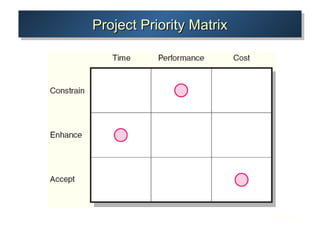
Step 1: Defining the Project ScopeStep 1: Defining the Project ScopeStep 1: Defining the Project ScopeStep 1: Defining the Project Scope
• Project Scope
–A definition of the end result or mission of the project
—a product or service for the client/customer—in
specific, tangible, and measurable terms.
• Purpose of the Scope Statement
–To clearly define the deliverable(s) for the end user.
–To focus the project on successful completion of its
goals.
–To be used by the project owner and participants as a
planning tool and for measuring project success.
Project Scope ChecklistProject Scope ChecklistProject Scope ChecklistProject Scope Checklist
1. Project objective
2. Deliverables
3. Milestones
4. Technical requirements
5. Limits and exclusions
6. Reviews with customer
Project Scope: Terms and DefinitionsProject Scope: Terms and DefinitionsProject Scope: Terms and DefinitionsProject Scope: Terms and Definitions
• Scope Statements
–Also called statements of work (SOW)
• Project Charter
–Can contain an expanded version of scope statement
–A document authorizing the project manager to initiate
and lead the project.
• Project Creep
–The tendency for the project scope to expand over
time due to changing requirements, specifications, and
priorities.
Step 2: Establishing Project PrioritiesStep 2: Establishing Project PrioritiesStep 2: Establishing Project PrioritiesStep 2: Establishing Project Priorities
• Causes of Project Trade-offs
–Shifts in the relative importance of criterions related to
cost, time, and performance parameters
• Budget–Cost
• Schedule–Time
• Performance–Scope
• Managing the Priorities of Project Trade-offs
–Constrain: a parameter is a fixed requirement.
–Enhance: optimizing a parameter over others.
–Accept: reducing (or not meeting) a parameter
requirement.
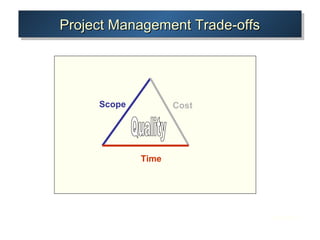
Project Management Trade-offsProject Management Trade-offsProject Management Trade-offsProject Management Trade-offs
FIGURE 4.1
CostScope
Time
Project Priority MatrixProject Priority MatrixProject Priority MatrixProject Priority Matrix
FIGURE 4.2
Step 3: Creating the WorkStep 3: Creating the Work
Breakdown StructureBreakdown Structure
Step 3: Creating the WorkStep 3: Creating the Work
Breakdown StructureBreakdown Structure
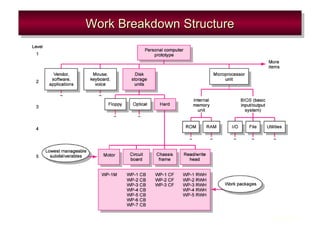
• Work Breakdown Structure (WBS)
–An hierarchical outline (map) that identifies the
products and work elements involved in a project.
–Defines the relationship of the final deliverable (the
project) to its subdeliverables, and in turn, their
relationships to work packages.
–Best suited for design and build projects that have
tangible outcomes rather than process-oriented
projects.
How WBS Helps the Project ManagerHow WBS Helps the Project ManagerHow WBS Helps the Project ManagerHow WBS Helps the Project Manager
• WBS
–Facilitates evaluation of cost, time, and technical
performance of the organization on a project.
–Provides management with information appropriate to
each organizational level.
–Helps in the development of the organization
breakdown structure (OBS). which assigns project
responsibilities to organizational units and individuals
–Helps manage plan, schedule, and budget.
–Defines communication channels and assists in
coordinating the various project elements.
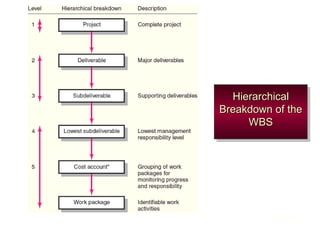
HierarchicalHierarchical
Breakdown of theBreakdown of the
WBSWBS
HierarchicalHierarchical
Breakdown of theBreakdown of the
WBSWBS
FIGURE 4.3
Work Breakdown StructureWork Breakdown StructureWork Breakdown StructureWork Breakdown Structure
FIGURE 4.4
Work PackagesWork PackagesWork PackagesWork Packages
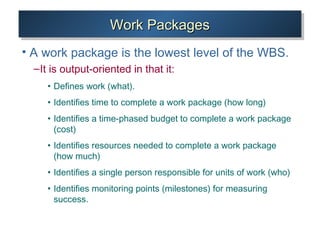
• A work package is the lowest level of the WBS.
–It is output-oriented in that it:
• Defines work (what).
• Identifies time to complete a work package (how long)
• Identifies a time-phased budget to complete a work package
(cost)
• Identifies resources needed to complete a work package
(how much)
• Identifies a single person responsible for units of work (who)
• Identifies monitoring points (milestones) for measuring
success.
Step 4: Integrating the WBSStep 4: Integrating the WBS
with the Organizationwith the Organization
Step 4: Integrating the WBSStep 4: Integrating the WBS
with the Organizationwith the Organization
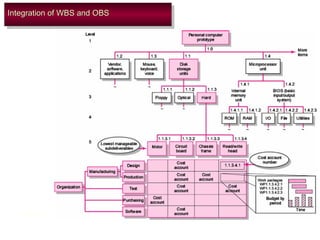
• Organizational Breakdown Structure (OBS)
–Depicts how the firm is organized to discharge its work
responsibility for a project.
• Provides a framework to summarize organization work unit
performance.
• Identifies organization units responsible for work packages.
• Ties the organizational units to cost control accounts.
FIGURE 4.5
Integration of WBS and OBSIntegration of WBS and OBSIntegration of WBS and OBSIntegration of WBS and OBS
Step 5: Coding the WBSStep 5: Coding the WBS
for the Information Systemfor the Information System
Step 5: Coding the WBSStep 5: Coding the WBS
for the Information Systemfor the Information System
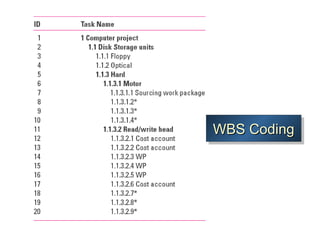
• WBS Coding System
–Defines:
• Levels and elements of the WBS
• Organization elements
• Work packages
• Budget and cost information
–Allows reports to be consolidated
at any level in the organization
structure
WBS CodingWBS CodingWBS CodingWBS Coding
Project Roll-upProject Roll-upProject Roll-upProject Roll-up
• Cost Account
–The intersection of the WBS and the OBS that is a
budgetary control point for work packages.
–Used to provide a roll-up (summation) of costs
incurred over time by a work package across
organization units and levels, and by deliverables.
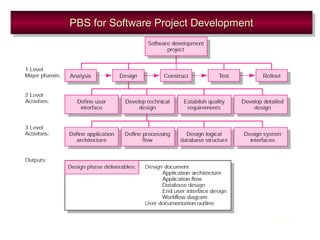
Process Breakdown StructureProcess Breakdown StructureProcess Breakdown StructureProcess Breakdown Structure
• Process-Oriented Projects
–Are driven by performance requirements in which the
final outcome is the product of a series of steps of
phases in which one phase affects the next phase.
• Process Breakdown Structure (PBS)
–Defines deliverables as outputs required to move to
the next phase .
–Checklists for managing PBS:
• Deliverables needed to exit one phase and begin the next.
• Quality checkpoints for complete and accurate deliverables.
• Sign-offs by responsible stakeholders to monitor progress.
PBS for Software Project DevelopmentPBS for Software Project DevelopmentPBS for Software Project DevelopmentPBS for Software Project Development
FIGURE 4.8
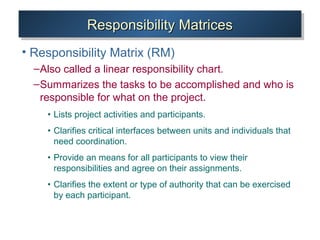
Responsibility MatricesResponsibility MatricesResponsibility MatricesResponsibility Matrices
• Responsibility Matrix (RM)
–Also called a linear responsibility chart.
–Summarizes the tasks to be accomplished and who is
responsible for what on the project.
• Lists project activities and participants.
• Clarifies critical interfaces between units and individuals that
need coordination.
• Provide an means for all participants to view their
responsibilities and agree on their assignments.
• Clarifies the extent or type of authority that can be exercised
by each participant.
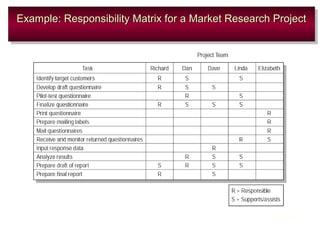
Example: Responsibility Matrix for a Market Research ProjectExample: Responsibility Matrix for a Market Research ProjectExample: Responsibility Matrix for a Market Research ProjectExample: Responsibility Matrix for a Market Research Project
FIGURE 4.9
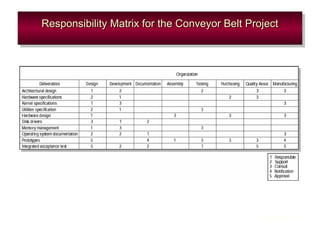
Responsibility Matrix for the Conveyor Belt ProjectResponsibility Matrix for the Conveyor Belt ProjectResponsibility Matrix for the Conveyor Belt ProjectResponsibility Matrix for the Conveyor Belt Project
FIGURE 4.10

Chap 4 Defining A Project

  • 1.
    Defining the ProjectDefiningthe ProjectDefining the ProjectDefining the Project
  • 2.
    Defining the ProjectDefiningthe ProjectDefining the ProjectDefining the Project Step 1: Defining the Project Scope Step 2: Establishing Project Priorities Step 3: Creating the Work Breakdown Structure Step 4: Integrating the WBS with the Organization Step 5: Coding the WBS for the Information System
  • 3.
    Step 1: Definingthe Project ScopeStep 1: Defining the Project ScopeStep 1: Defining the Project ScopeStep 1: Defining the Project Scope • Project Scope –A definition of the end result or mission of the project —a product or service for the client/customer—in specific, tangible, and measurable terms. • Purpose of the Scope Statement –To clearly define the deliverable(s) for the end user. –To focus the project on successful completion of its goals. –To be used by the project owner and participants as a planning tool and for measuring project success.
  • 4.
    Project Scope ChecklistProjectScope ChecklistProject Scope ChecklistProject Scope Checklist 1. Project objective 2. Deliverables 3. Milestones 4. Technical requirements 5. Limits and exclusions 6. Reviews with customer
  • 5.
    Project Scope: Termsand DefinitionsProject Scope: Terms and DefinitionsProject Scope: Terms and DefinitionsProject Scope: Terms and Definitions • Scope Statements –Also called statements of work (SOW) • Project Charter –Can contain an expanded version of scope statement –A document authorizing the project manager to initiate and lead the project. • Project Creep –The tendency for the project scope to expand over time due to changing requirements, specifications, and priorities.
  • 6.
    Step 2: EstablishingProject PrioritiesStep 2: Establishing Project PrioritiesStep 2: Establishing Project PrioritiesStep 2: Establishing Project Priorities • Causes of Project Trade-offs –Shifts in the relative importance of criterions related to cost, time, and performance parameters • Budget–Cost • Schedule–Time • Performance–Scope • Managing the Priorities of Project Trade-offs –Constrain: a parameter is a fixed requirement. –Enhance: optimizing a parameter over others. –Accept: reducing (or not meeting) a parameter requirement.
  • 7.
    Project Management Trade-offsProjectManagement Trade-offsProject Management Trade-offsProject Management Trade-offs FIGURE 4.1 CostScope Time
  • 8.
    Project Priority MatrixProjectPriority MatrixProject Priority MatrixProject Priority Matrix FIGURE 4.2
  • 9.
    Step 3: Creatingthe WorkStep 3: Creating the Work Breakdown StructureBreakdown Structure Step 3: Creating the WorkStep 3: Creating the Work Breakdown StructureBreakdown Structure • Work Breakdown Structure (WBS) –An hierarchical outline (map) that identifies the products and work elements involved in a project. –Defines the relationship of the final deliverable (the project) to its subdeliverables, and in turn, their relationships to work packages. –Best suited for design and build projects that have tangible outcomes rather than process-oriented projects.
  • 10.
    How WBS Helpsthe Project ManagerHow WBS Helps the Project ManagerHow WBS Helps the Project ManagerHow WBS Helps the Project Manager • WBS –Facilitates evaluation of cost, time, and technical performance of the organization on a project. –Provides management with information appropriate to each organizational level. –Helps in the development of the organization breakdown structure (OBS). which assigns project responsibilities to organizational units and individuals –Helps manage plan, schedule, and budget. –Defines communication channels and assists in coordinating the various project elements.
  • 11.
    HierarchicalHierarchical Breakdown of theBreakdownof the WBSWBS HierarchicalHierarchical Breakdown of theBreakdown of the WBSWBS FIGURE 4.3
  • 12.
    Work Breakdown StructureWorkBreakdown StructureWork Breakdown StructureWork Breakdown Structure FIGURE 4.4
  • 13.
    Work PackagesWork PackagesWorkPackagesWork Packages • A work package is the lowest level of the WBS. –It is output-oriented in that it: • Defines work (what). • Identifies time to complete a work package (how long) • Identifies a time-phased budget to complete a work package (cost) • Identifies resources needed to complete a work package (how much) • Identifies a single person responsible for units of work (who) • Identifies monitoring points (milestones) for measuring success.
  • 14.
    Step 4: Integratingthe WBSStep 4: Integrating the WBS with the Organizationwith the Organization Step 4: Integrating the WBSStep 4: Integrating the WBS with the Organizationwith the Organization • Organizational Breakdown Structure (OBS) –Depicts how the firm is organized to discharge its work responsibility for a project. • Provides a framework to summarize organization work unit performance. • Identifies organization units responsible for work packages. • Ties the organizational units to cost control accounts.
  • 15.
    FIGURE 4.5 Integration ofWBS and OBSIntegration of WBS and OBSIntegration of WBS and OBSIntegration of WBS and OBS
  • 16.
    Step 5: Codingthe WBSStep 5: Coding the WBS for the Information Systemfor the Information System Step 5: Coding the WBSStep 5: Coding the WBS for the Information Systemfor the Information System • WBS Coding System –Defines: • Levels and elements of the WBS • Organization elements • Work packages • Budget and cost information –Allows reports to be consolidated at any level in the organization structure
  • 17.
    WBS CodingWBS CodingWBSCodingWBS Coding
  • 18.
    Project Roll-upProject Roll-upProjectRoll-upProject Roll-up • Cost Account –The intersection of the WBS and the OBS that is a budgetary control point for work packages. –Used to provide a roll-up (summation) of costs incurred over time by a work package across organization units and levels, and by deliverables.
  • 19.
    Process Breakdown StructureProcessBreakdown StructureProcess Breakdown StructureProcess Breakdown Structure • Process-Oriented Projects –Are driven by performance requirements in which the final outcome is the product of a series of steps of phases in which one phase affects the next phase. • Process Breakdown Structure (PBS) –Defines deliverables as outputs required to move to the next phase . –Checklists for managing PBS: • Deliverables needed to exit one phase and begin the next. • Quality checkpoints for complete and accurate deliverables. • Sign-offs by responsible stakeholders to monitor progress.
  • 20.
    PBS for SoftwareProject DevelopmentPBS for Software Project DevelopmentPBS for Software Project DevelopmentPBS for Software Project Development FIGURE 4.8
  • 21.
    Responsibility MatricesResponsibility MatricesResponsibilityMatricesResponsibility Matrices • Responsibility Matrix (RM) –Also called a linear responsibility chart. –Summarizes the tasks to be accomplished and who is responsible for what on the project. • Lists project activities and participants. • Clarifies critical interfaces between units and individuals that need coordination. • Provide an means for all participants to view their responsibilities and agree on their assignments. • Clarifies the extent or type of authority that can be exercised by each participant.
  • 22.
    Example: Responsibility Matrixfor a Market Research ProjectExample: Responsibility Matrix for a Market Research ProjectExample: Responsibility Matrix for a Market Research ProjectExample: Responsibility Matrix for a Market Research Project FIGURE 4.9
  • 23.
    Responsibility Matrix forthe Conveyor Belt ProjectResponsibility Matrix for the Conveyor Belt ProjectResponsibility Matrix for the Conveyor Belt ProjectResponsibility Matrix for the Conveyor Belt Project FIGURE 4.10

Editor's Notes

  • #8 Quality is the area. In order to maintain the quality, you may have to sacrifice cost and/or time in order to meet unchecked scope creep This makes more sense if you draw the triangle as I did, with each of the 3 components as a side, so if shorten 1 side, have to lengthen another (realistically, 2) to enclose the same area (although technically have to take the inverse of scope) Cost- can be resources (hiring more people or subcontracting out, or buying finished products instead of making them)
  • #9 Don’t have to have 1 in each, but is the most typical. Don’t make mistake of having all be enhance. Typically need to have at least 1 accept. Typical to have 1-enhance, cost if nothing else.
  • #12 Is pretty straightforward
  • #13 Graphically sometimes a pain- BIOS I/O is the same level as R/W head for HD, but you can’t tell
  • #16 Hmmm- have to decide if want to show this- is really busy and confusing. Note how the level 4 items sometimes appear on row 4 others on row 5
  • #21 Note- Friends at a software company were still using WBS, and it’s still the gold standard on PMI tests.
  • #23 Usually Tasks are presented in order of execution Better have an R (and typically only 1) at each row. Not all tasks require an S. Who looks like they have the key roll on the project? (Richard) Who looks like the quant-head? (Dan) Who looks like the entry-level analyst, who may be being groomed for one of the other rolls? (Dave) Who appears to be serving more as administrative assistance? (The women, alas)