PRESENTED BY:
PRASHANT DAGAR
PRATEEK CHHAJER
IIHMR UNIVERSITY, JAIPUR
*Semi solid pharmaceutical system comprise a body of
product ,which when applied to skin or accessible mucous
membranes tends to allevate or treat a pathological
condition or other protection against harmful environment.
GENERAL PROPERTIES OF SEMISOLIDS
Physical properties
a) Smooth texture
b) Elegant in appearence
c) Non dehydrating
d) Non gritty
e) Non greasy and non
staining
f) Non hygroscopic
Physiological properties
a) Non irritating
b) Do not alter membrane
function
c) Miscible with skin
secretion
1. OINTMENTS-
Ointments are homogenous, translucent, viscous, semi
solid preparation intended for external application to
skin or mucous membranes. Ointment may be medicated
or not.
Uses
*Emollient
*Application for active ingredients to the skin
*Occulsive
2. CREAMS
*Viscous semi solid emulsion with opaque appearance as
Contrasted with translucent ointments
*Consistency depends on whether the
cream is W/O or O/W
W/O Creams O/W Creams
Contain lipophyllic
emulsifying agent
Contains O/W emulsifying
agent
Used as emollient or as
cleansing agent
O/W creams are elegant
drug delivery system
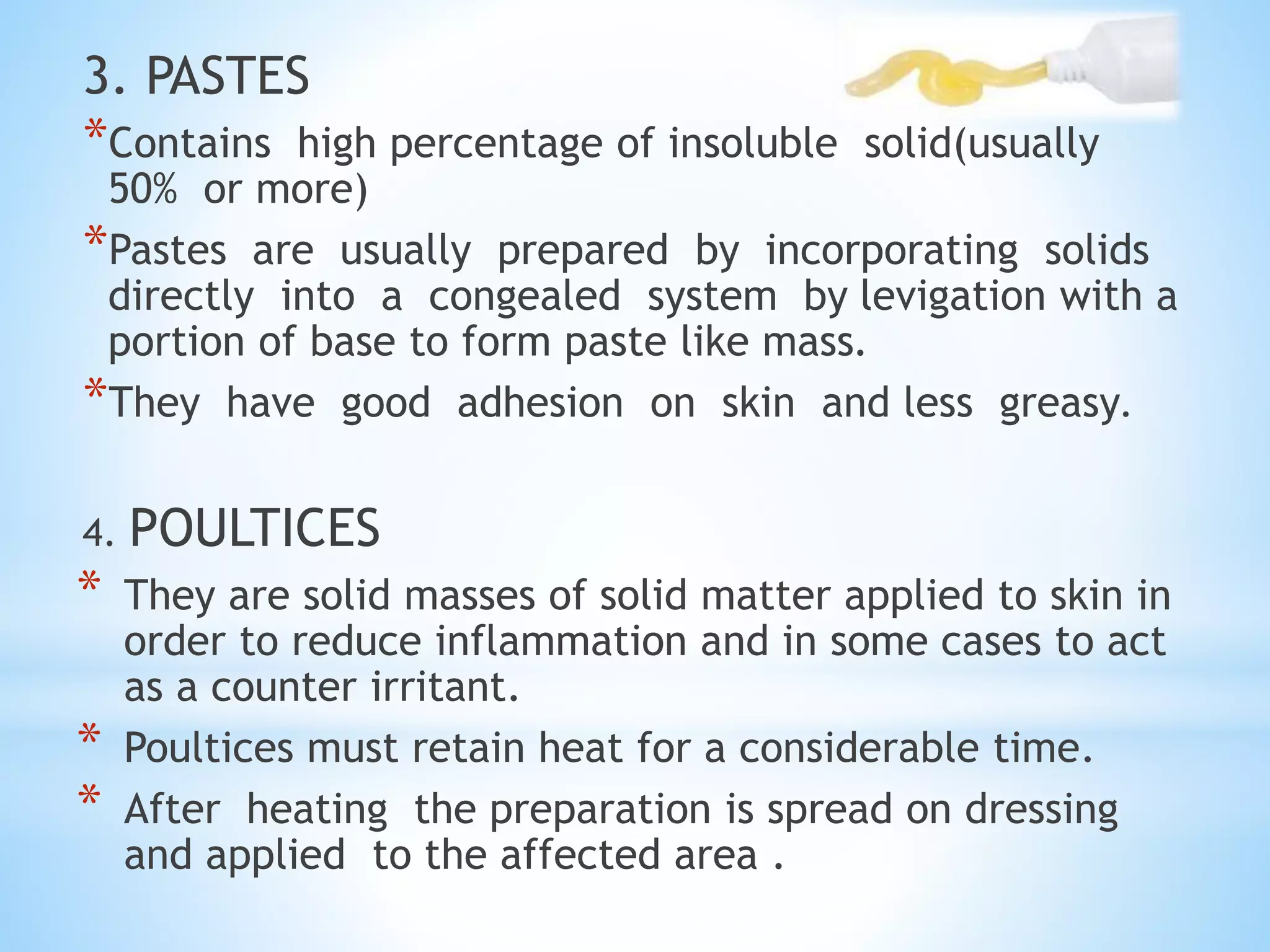
3. PASTES
*Contains high percentage of insoluble solid(usually
50% or more)
*Pastes are usually prepared by incorporating solids
directly into a congealed system by levigation with a
portion of base to form paste like mass.
*They have good adhesion on skin and less greasy.
4. POULTICES
* They are solid masses of solid matter applied to skin in
order to reduce inflammation and in some cases to act
as a counter irritant.
* Poultices must retain heat for a considerable time.
* After heating the preparation is spread on dressing
and applied to the affected area .
5. GELS & JELLIES
* Gels are semi solid system in which liquid
phase is constrained With a 3-d polymeric
matrix having a high degree of physical Or
chemical cross linking
* Gels are aqueous colloidal system of
hydrated forms of insoluble medicaments.
* Jellies are transparent or translucent non
greasy semisolid and contain more water than
gels.
* Used for medication, lubrication and carrier
for spermicidal agents to be used intra
vaginally with diaphargm.
Active pharmaceutical
ingredients
Bases
Preservatives
Humectants
Anti oxidants
Emulsifier
Gelling agent
Permeation enhancer
Buffers
Base should be:
 Compatible with skin ph and drug
 Inert ,non irritating and non sensitizing
 Good solvent and/or emulsifying agent
 Emollient , protective , non greasy and easily removable
 Release medicaments easily at the site of administration
 Pharmaceutical elegant and possess good stability.
Ingredients for semi solid :
SEMI SOLID BASES
It is one of the most important ingredient used in the
formulation of semisolid dosage form
Ointments base do not merely acts as the carrier of the
medicaments, but they also control the extent of absorption
of medicaments incorporated with them
BASES
OLEAGINOUS
BASE
ABSORBTION
BASE
EMULSION
BASE
WATER
SOLUBLE
BASE
SIZE REDUCTION
LEVIGATION
MIXING WITH BASE
SPATULATION OR TRITURATION
MIXING BASE TO PRODUCE FINAL
WEIGHT
HOMOGENIZATION
FILLING
TRITURATION METHOD FUSION METHOD
Evaluation of
ointments
Penetration
Rate of release of
medicaments
Absorption of
medicaments
into blood stream
Irritant effect
*Penetration-A weighed quantity of ointment is rubbed over skin for a
given period of time and unabsorbed ointment is collected and weighed.
The differences in weights represent the amount absorbed.
*Rate of release of medicament-To assess rate of release of
medicament, small amount of the ointment can be placed on the surface of
nutrient agar contained in a Petri dish or alternately in a small cup cut in the
agar surface.
If the medicament is bactericidal the agar plate is previously seeded with a
suitable organism like S.aureus. After a suitable period of incubation, the
zone of inhibition is measured and correlated with the rate of release.
*Absorption of medicament into blood stream
The ointment should be evaluated for the rate of absorption of drug into the
blood stream. This test can be run in-vivo only.
Definite amount of ointments should be rubbed through the skin. Under
standard conditions and medicaments are estimated in the blood plasma or
urine.
*Irritant Effect
The irritant effect can be judged to a certain extent by injecting the ointment
into thigh muscles and under the abdominal skin of rats. Reaction are noted at
intervals of 24,48,72 and 96 hours. Lesions on cornea, iris, conjunctiva are
used for judging the irritancy to the eyes. Presence of patches on the skin
within 2 weeks indicate irritancy to pressing skin.
Evaluation of
cream
Rheology
Sensitivity
Biological
testing
Rheology
Rheology is very important as these creams are marketed in tubes or containers.
The rheology or viscosity should remain constant. As these products are
normally non-Newtonian in nature, the viscosity can be measured using
viscometers used for such liquids.
Sensitivity
As various types of ingredients are used with occasional use of antiseptics
hormones etc. there is a possibility of sensitization or photosensitization of the
skin. This should be tested before hand. This test is normally done by patch
test on and can be either open or occlusive. The test sample is applied along
with a standard market product at different places and effect is compared after
a period of time.
Evaluation of paste
Abrasiveness
Particle size
Rheology
pH of the product
Foaming character
Abrasiveness- measure of amount of solid medicament
present per unit of paste.
Particle size- This can be determined by microscopic
study of the particles or other means.
Rheology -Rheology is very important as these are
marketed in tubes or containers. The rheology or viscosity
should remain constant. As these products are normally non-
Newtonian in nature, the viscosity can be measured using
viscometers used for such liquids.
pH of product- pH of the dispersion of 10% of the
product in water is determined by pH meter.
Foaming character- This test is specially required
for foam-forming tooth pastes or tooth pastes or tooth
powers. Especially amount of product can be mixed with
specific amount of and water to be shaken. The foam thus
formed is studies for its nature, stability, washability.
Evaluation of gel
Drug content
Homogeneity of drug
content
Measurement of pH
Viscosity
Spreadability
Extrudability
Drug content -1gm of gel was accurately weighed in a 50ml
of volumetric flask to which 20ml purified water was added with
continuous shaking. Volume was adjusted with a mixture of 10%
methanol in water. Absorbance of the solution with the blank was
measured at 360nm using UV-spectrophotometer.
Homogeneity of drug content -For homogeneity of drug
contents, six tubes were taken randomly and assayed for the drug
content as stated above.
Measurement of pH -The pH of gels were determined by
digital pH meter. One gram of gel was dissolved in 100ml of
distilled water and stored at 4°C for two hours.
Viscosity -Brookfield viscometer is used for determination of
viscosity. Gels were filled in jar and spindle was lowered
perpendicularly taking care that spindle do not touch bottom of the
jar. The spindle was rotated in the gel at increasing shear rates 0.5, 1,
2.5 and 5rpm. At each speed, the corresponding dial reading was
noted.
Spreadability- A modified apparatus consisting of two glass slides
containing gel in between with the lower slide fixed to a wooden plate
and the upper one attached to a balance by a hook was used to
determine spreadability.
Extrudability - A simple method was adopted for determination
of extrudability in terms of weight in grams required to extrude a
0.5cm ribbon of gel in 10 seconds from the collapsible tube.
Semi solid dosage forms

Semi solid dosage forms

  • 1.
    PRESENTED BY: PRASHANT DAGAR PRATEEKCHHAJER IIHMR UNIVERSITY, JAIPUR
  • 2.
    *Semi solid pharmaceuticalsystem comprise a body of product ,which when applied to skin or accessible mucous membranes tends to allevate or treat a pathological condition or other protection against harmful environment. GENERAL PROPERTIES OF SEMISOLIDS Physical properties a) Smooth texture b) Elegant in appearence c) Non dehydrating d) Non gritty e) Non greasy and non staining f) Non hygroscopic Physiological properties a) Non irritating b) Do not alter membrane function c) Miscible with skin secretion
  • 3.
    1. OINTMENTS- Ointments arehomogenous, translucent, viscous, semi solid preparation intended for external application to skin or mucous membranes. Ointment may be medicated or not. Uses *Emollient *Application for active ingredients to the skin *Occulsive
  • 4.
    2. CREAMS *Viscous semisolid emulsion with opaque appearance as Contrasted with translucent ointments *Consistency depends on whether the cream is W/O or O/W W/O Creams O/W Creams Contain lipophyllic emulsifying agent Contains O/W emulsifying agent Used as emollient or as cleansing agent O/W creams are elegant drug delivery system
  • 5.
    3. PASTES *Contains highpercentage of insoluble solid(usually 50% or more) *Pastes are usually prepared by incorporating solids directly into a congealed system by levigation with a portion of base to form paste like mass. *They have good adhesion on skin and less greasy. 4. POULTICES * They are solid masses of solid matter applied to skin in order to reduce inflammation and in some cases to act as a counter irritant. * Poultices must retain heat for a considerable time. * After heating the preparation is spread on dressing and applied to the affected area .
  • 6.
    5. GELS &JELLIES * Gels are semi solid system in which liquid phase is constrained With a 3-d polymeric matrix having a high degree of physical Or chemical cross linking * Gels are aqueous colloidal system of hydrated forms of insoluble medicaments. * Jellies are transparent or translucent non greasy semisolid and contain more water than gels. * Used for medication, lubrication and carrier for spermicidal agents to be used intra vaginally with diaphargm.
  • 7.
    Active pharmaceutical ingredients Bases Preservatives Humectants Anti oxidants Emulsifier Gellingagent Permeation enhancer Buffers Base should be:  Compatible with skin ph and drug  Inert ,non irritating and non sensitizing  Good solvent and/or emulsifying agent  Emollient , protective , non greasy and easily removable  Release medicaments easily at the site of administration  Pharmaceutical elegant and possess good stability. Ingredients for semi solid :
  • 8.
    SEMI SOLID BASES Itis one of the most important ingredient used in the formulation of semisolid dosage form Ointments base do not merely acts as the carrier of the medicaments, but they also control the extent of absorption of medicaments incorporated with them BASES OLEAGINOUS BASE ABSORBTION BASE EMULSION BASE WATER SOLUBLE BASE
  • 9.
    SIZE REDUCTION LEVIGATION MIXING WITHBASE SPATULATION OR TRITURATION MIXING BASE TO PRODUCE FINAL WEIGHT HOMOGENIZATION FILLING TRITURATION METHOD FUSION METHOD
  • 10.
    Evaluation of ointments Penetration Rate ofrelease of medicaments Absorption of medicaments into blood stream Irritant effect
  • 11.
    *Penetration-A weighed quantityof ointment is rubbed over skin for a given period of time and unabsorbed ointment is collected and weighed. The differences in weights represent the amount absorbed. *Rate of release of medicament-To assess rate of release of medicament, small amount of the ointment can be placed on the surface of nutrient agar contained in a Petri dish or alternately in a small cup cut in the agar surface. If the medicament is bactericidal the agar plate is previously seeded with a suitable organism like S.aureus. After a suitable period of incubation, the zone of inhibition is measured and correlated with the rate of release.
  • 12.
    *Absorption of medicamentinto blood stream The ointment should be evaluated for the rate of absorption of drug into the blood stream. This test can be run in-vivo only. Definite amount of ointments should be rubbed through the skin. Under standard conditions and medicaments are estimated in the blood plasma or urine. *Irritant Effect The irritant effect can be judged to a certain extent by injecting the ointment into thigh muscles and under the abdominal skin of rats. Reaction are noted at intervals of 24,48,72 and 96 hours. Lesions on cornea, iris, conjunctiva are used for judging the irritancy to the eyes. Presence of patches on the skin within 2 weeks indicate irritancy to pressing skin.
  • 13.
  • 14.
    Rheology Rheology is veryimportant as these creams are marketed in tubes or containers. The rheology or viscosity should remain constant. As these products are normally non-Newtonian in nature, the viscosity can be measured using viscometers used for such liquids. Sensitivity As various types of ingredients are used with occasional use of antiseptics hormones etc. there is a possibility of sensitization or photosensitization of the skin. This should be tested before hand. This test is normally done by patch test on and can be either open or occlusive. The test sample is applied along with a standard market product at different places and effect is compared after a period of time.
  • 15.
    Evaluation of paste Abrasiveness Particlesize Rheology pH of the product Foaming character
  • 16.
    Abrasiveness- measure ofamount of solid medicament present per unit of paste. Particle size- This can be determined by microscopic study of the particles or other means. Rheology -Rheology is very important as these are marketed in tubes or containers. The rheology or viscosity should remain constant. As these products are normally non- Newtonian in nature, the viscosity can be measured using viscometers used for such liquids.
  • 17.
    pH of product-pH of the dispersion of 10% of the product in water is determined by pH meter. Foaming character- This test is specially required for foam-forming tooth pastes or tooth pastes or tooth powers. Especially amount of product can be mixed with specific amount of and water to be shaken. The foam thus formed is studies for its nature, stability, washability.
  • 18.
    Evaluation of gel Drugcontent Homogeneity of drug content Measurement of pH Viscosity Spreadability Extrudability
  • 19.
    Drug content -1gmof gel was accurately weighed in a 50ml of volumetric flask to which 20ml purified water was added with continuous shaking. Volume was adjusted with a mixture of 10% methanol in water. Absorbance of the solution with the blank was measured at 360nm using UV-spectrophotometer. Homogeneity of drug content -For homogeneity of drug contents, six tubes were taken randomly and assayed for the drug content as stated above. Measurement of pH -The pH of gels were determined by digital pH meter. One gram of gel was dissolved in 100ml of distilled water and stored at 4°C for two hours.
  • 20.
    Viscosity -Brookfield viscometeris used for determination of viscosity. Gels were filled in jar and spindle was lowered perpendicularly taking care that spindle do not touch bottom of the jar. The spindle was rotated in the gel at increasing shear rates 0.5, 1, 2.5 and 5rpm. At each speed, the corresponding dial reading was noted. Spreadability- A modified apparatus consisting of two glass slides containing gel in between with the lower slide fixed to a wooden plate and the upper one attached to a balance by a hook was used to determine spreadability. Extrudability - A simple method was adopted for determination of extrudability in terms of weight in grams required to extrude a 0.5cm ribbon of gel in 10 seconds from the collapsible tube.