Semisolid Dosage forms.
                 fo ms
                          By
                 Prof. Dr. V. A. Dole.
                    Joint Director
    Centre For Postgraduate studies & Research.
                H. O. D. Rasashastra
     Tilak Ayurved Mahavidyalaya Pune 411011,


                                                  1
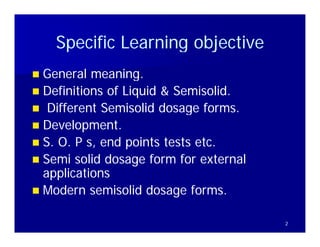
Specific Learning objective
 General meaning.
 Definitions of Liquid & Semisolid.
 Different Semisolid dosage forms
                              forms.
 Development.
 S O P s, end points tests etc.
  S. O.        d i t t t t
 Semi solid dosage form for external
  applications
   ppli tion
 Modern semisolid dosage forms.

                                        2
General meaning & Definition.
                      Definition
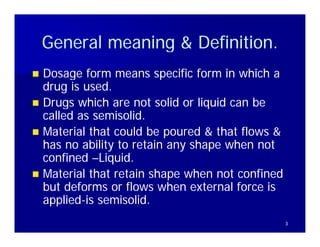
 Dosage form means specific form in which a
  drug is used.
 Drugs which are not solid or liquid can be
      g                           q
  called as semisolid.
 Material that could be poured & that flows &
  has no ability to retain any shape when not
  confined –Liquid.
 M t i l that retain shape when not confined
  Material th t t i h           h     t    fi d
  but deforms or flows when external force is
  applied- semisolid
  applied-is semisolid.
                                                  3
Available semisolid forms.
                        forms
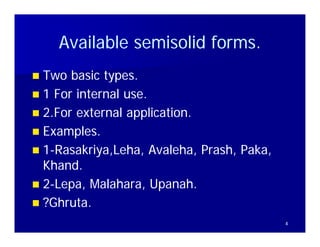
 Two basic types
             types.
 1 For internal use.
2F
  2.For external application.
           t    l     li ti
 Examples.
 1-Rasakriya,Leha, Avaleha, Prash, Paka,
                      Avaleha, Prash, Paka,
  Khand.
  Khand.
 2-Lepa, Malahara, Upanah.
           Malahara, Upanah.
 ?Ghruta.
   Ghruta.
                                              4
Definitions & N
    D fi iti      Nomenclature
                        l t
 Definition of Leha, Avaleha, & Rasakriya is
                Leha, Avaleha,
  same & given in one verse.
 Practically presence of sugar or jagary &
  consistency of finished product form base
  of the nomenclature.
         nomenclature
 No hard and fast rule.
 Examples.


                                                5
Development.
             Development
 Need to invent new dosage forms
                               forms.
 Short shelf life.
 Diffi lt in consumption.
  Difficulty i          ti
 Taste, dose etc.
 Causative factors for short shelf life-
                                    life-
 Moisture,Microbes,Herbal contents
  Moisture Microbes Herbal
 How objectives could be achieved ?


                                            6
The standard operating procedure
            Rasakriya.
            Rasakriya.
                ki
 Aim is to form such a drug which has
  longer shelf life & is consumed by licking.
 Water content is reduced by heating
  decoction till desired consistency is
  obtained
  obtained.
 In some traditions powder form is
  obtained and used.
    bt i d d         d
 Should be stored in air tight container.

                                                7
S.O.P.s
        S O P s Of Leha,etc.
                   Leha,etc
                   Leha etc.
 Reheating of decoction, addition of sugar
  or jagary and mixing herbal powders.
                                powders
 Heating expressed juice, addition of sugar
  and herbal powders.
              powders
 Heating fruit pulp, addition of sugar and
  herbal powders.
 Heating after addition of sugar/ jagary for
  specific time decides desired consistency.
 Examples.

                                                8
End points, Tests etc.
           points        etc
 These are facts which indicate good
  quality of the product.
 End points are to be observed during
  production.
T t t d t
  Tests to determine good quality are
                   i      d    lit
  performed on finished product.
 Examples.


                                         9
Laboratory tests
                        tests.
   Viscosity.
    Viscosity

   Sugar
    S

   Presence of Microbes.


                                 10
Semisolid dosage forms for external
        applications-- Lepa
        applications--
            li i
1 Main constituent is ground in a suitable
  medium or fine powder is thoroughly
  mixed
2 Water, Cows’ urine, Decoctions, juices
  etc are used as media
  etc.are         media.
3 Action enhances during drying.
4 Not applied over open wounds.
5 Cold or hot, Pradeha or p
             ,            pralepa.
                          pralepa.
                               p
                                             11
Malahara
 Two main constituents.
            constituents
 Base and very fine powder.
 Oil Ghee, Butter, wax, or th i
  Oil, Gh   B tt            their
  combinations can be used as base.
 Powder is intimately mixed.drug applied
  over wounds and bandaged.
 Oil or Ghee help in spreading the drug.


                                            12
Upanaha.
                Upanaha.
 Meant for local fomentation.
                     fomentation
 Flour of Wheat etc, drug like Turmeric
  powder,
  powder oil and water are boiled together
  to form semisolid dough. Kept over a
  suitably thick cloth, bandaged over spot.
                  cloth                spot
 Action lasts till temperature is maintained..


                                              13
Common entities.
                 entities
 Modes of action are transcutanious
                       transcutanious.
 Oil/ Ghee play important role.
 Li it d indications presently.
  Limited i di ti            tl
 Can modern techniques help in
  standardization?


                                         14
Semisolid Dosage forms used in
          Modern Medicine.
              d      di i
 Most are for external application like
  ointment, liniment, paste gel creams etc.
 Dosage form akin to Avaleha is confection
                                   confection.
 Tonics of past were in this form.
 Science Governing their consistencies is
  called Rheology.
         Rheology.
 Study of flow or deformation of semisolids
  under stress.
                                             15
Ointment.
                Ointment
 Fluid hydrocarbons meshed in matrix of
  higher melting solid hydrocarbons.
 Prepared by melting the compounds
  togather.
  togather.
 Abilit to cling to the surface of application
  Ability t li t th         f     f    li ti
  for reasonable duration before washed out
  or worn out.t
 Siktha taila is ointment as per this
  definition.
                                              16
Pastes and creams etc
                        etc.
 Pastes are type of ointment containing
  high percentage of insoluble materials.
 They form a barrier of protective nature
                                     nature.
 Creams are semisolid emulsions with
  opaque appearance.
 Gels are liquid states constrained inside
  the three dimensional polymeric
  compounds.

                                               17
Modes of actions
 Per cutanious absorption through folicular
  way and by diffusion.
 Physico-chemical properties of the
  Physico-
  constituents
 Th ‘ Vyavayi ’
  The V        i ’property ofoils or Gh
                        t f il       Ghee
 Condition of the skin.


                                               18
Conclusions
 Different semisolid dosage forms for internal
  as well as external uses were studied with
  their developments and s.o p.s ,end points
  tests etc.
 Semisolid dosage forms from Modern
  Medicine were seen with their scientific base.
 Can principles of Rheology be applied for
  Ayurvedic semisolid dosage forms?


                                               19
Thank you!!

              20

Semisolid dosage forms

  • 1.
    Semisolid Dosage forms. fo ms By Prof. Dr. V. A. Dole. Joint Director Centre For Postgraduate studies & Research. H. O. D. Rasashastra Tilak Ayurved Mahavidyalaya Pune 411011, 1
  • 2.
    Specific Learning objective General meaning.  Definitions of Liquid & Semisolid.  Different Semisolid dosage forms forms.  Development.  S O P s, end points tests etc. S. O. d i t t t t  Semi solid dosage form for external applications ppli tion  Modern semisolid dosage forms. 2
  • 3.
    General meaning &Definition. Definition  Dosage form means specific form in which a drug is used.  Drugs which are not solid or liquid can be g q called as semisolid.  Material that could be poured & that flows & has no ability to retain any shape when not confined –Liquid.  M t i l that retain shape when not confined Material th t t i h h t fi d but deforms or flows when external force is applied- semisolid applied-is semisolid. 3
  • 4.
    Available semisolid forms. forms  Two basic types types.  1 For internal use. 2F 2.For external application. t l li ti  Examples.  1-Rasakriya,Leha, Avaleha, Prash, Paka, Avaleha, Prash, Paka, Khand. Khand.  2-Lepa, Malahara, Upanah. Malahara, Upanah.  ?Ghruta. Ghruta. 4
  • 5.
    Definitions & N D fi iti Nomenclature l t  Definition of Leha, Avaleha, & Rasakriya is Leha, Avaleha, same & given in one verse.  Practically presence of sugar or jagary & consistency of finished product form base of the nomenclature. nomenclature  No hard and fast rule.  Examples. 5
  • 6.
    Development. Development  Need to invent new dosage forms forms.  Short shelf life.  Diffi lt in consumption. Difficulty i ti  Taste, dose etc.  Causative factors for short shelf life- life-  Moisture,Microbes,Herbal contents Moisture Microbes Herbal  How objectives could be achieved ? 6
  • 7.
    The standard operatingprocedure Rasakriya. Rasakriya. ki  Aim is to form such a drug which has longer shelf life & is consumed by licking.  Water content is reduced by heating decoction till desired consistency is obtained obtained.  In some traditions powder form is obtained and used. bt i d d d  Should be stored in air tight container. 7
  • 8.
    S.O.P.s S O P s Of Leha,etc. Leha,etc Leha etc.  Reheating of decoction, addition of sugar or jagary and mixing herbal powders. powders  Heating expressed juice, addition of sugar and herbal powders. powders  Heating fruit pulp, addition of sugar and herbal powders.  Heating after addition of sugar/ jagary for specific time decides desired consistency.  Examples. 8
  • 9.
    End points, Testsetc. points etc  These are facts which indicate good quality of the product.  End points are to be observed during production. T t t d t Tests to determine good quality are i d lit performed on finished product.  Examples. 9
  • 10.
    Laboratory tests tests.  Viscosity. Viscosity  Sugar S  Presence of Microbes. 10
  • 11.
    Semisolid dosage formsfor external applications-- Lepa applications-- li i 1 Main constituent is ground in a suitable medium or fine powder is thoroughly mixed 2 Water, Cows’ urine, Decoctions, juices etc are used as media etc.are media. 3 Action enhances during drying. 4 Not applied over open wounds. 5 Cold or hot, Pradeha or p , pralepa. pralepa. p 11
  • 12.
    Malahara  Two mainconstituents. constituents  Base and very fine powder.  Oil Ghee, Butter, wax, or th i Oil, Gh B tt their combinations can be used as base.  Powder is intimately mixed.drug applied over wounds and bandaged.  Oil or Ghee help in spreading the drug. 12
  • 13.
    Upanaha. Upanaha.  Meant for local fomentation. fomentation  Flour of Wheat etc, drug like Turmeric powder, powder oil and water are boiled together to form semisolid dough. Kept over a suitably thick cloth, bandaged over spot. cloth spot  Action lasts till temperature is maintained.. 13
  • 14.
    Common entities. entities  Modes of action are transcutanious transcutanious.  Oil/ Ghee play important role.  Li it d indications presently. Limited i di ti tl  Can modern techniques help in standardization? 14
  • 15.
    Semisolid Dosage formsused in Modern Medicine. d di i  Most are for external application like ointment, liniment, paste gel creams etc.  Dosage form akin to Avaleha is confection confection.  Tonics of past were in this form.  Science Governing their consistencies is called Rheology. Rheology.  Study of flow or deformation of semisolids under stress. 15
  • 16.
    Ointment. Ointment  Fluid hydrocarbons meshed in matrix of higher melting solid hydrocarbons.  Prepared by melting the compounds togather. togather.  Abilit to cling to the surface of application Ability t li t th f f li ti for reasonable duration before washed out or worn out.t  Siktha taila is ointment as per this definition. 16
  • 17.
    Pastes and creamsetc etc.  Pastes are type of ointment containing high percentage of insoluble materials.  They form a barrier of protective nature nature.  Creams are semisolid emulsions with opaque appearance.  Gels are liquid states constrained inside the three dimensional polymeric compounds. 17
  • 18.
    Modes of actions Per cutanious absorption through folicular way and by diffusion.  Physico-chemical properties of the Physico- constituents  Th ‘ Vyavayi ’ The V i ’property ofoils or Gh t f il Ghee  Condition of the skin. 18
  • 19.
    Conclusions  Different semisoliddosage forms for internal as well as external uses were studied with their developments and s.o p.s ,end points tests etc.  Semisolid dosage forms from Modern Medicine were seen with their scientific base.  Can principles of Rheology be applied for Ayurvedic semisolid dosage forms? 19
  • 20.