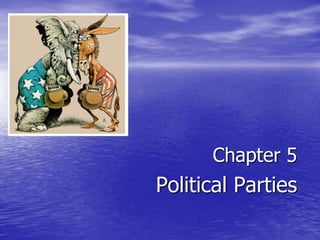
Chapter 5
Political Parties
   Political Parties are a vital link between the
    people and their government.
   “A party of order or stability, and a party of
      progress or reform, are both necessary
    elements of a healthy state of political life.”
                   ~ John Stuart Mill
   Major Party- a group of persons who seek to
    control government through the winning of
    elections and the holding of public office(s).
    ◦ Republicans
    ◦ Democrats
   Minor Party- one of the many political parties
    without wide voter support.
    ◦ Green Party
    ◦ Prohibition Party
   Where in a typical political election, two major
    parties dominate American politics.
   A number of factors explain why America has
    had and continues to have a two-party
    system.
   Framers of the Constitution were opposed to
    political parties.
    ◦ Federalist No. 10: One can either destroy the
      factions, or somehow, control its outcomes.
    ◦ Bi-partisan system still follows Madison’s “multiple”
      faction government.
    ◦ Federalist No. 14: “Big Tent” involves inviting
      multiple factions/spheres of thought into the Big
      Tent
    ◦ A means of controlling the “mob mentality”
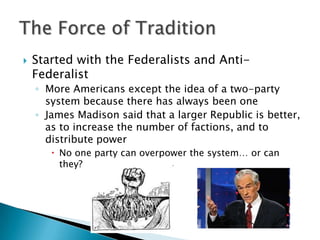
   Started with the Federalists and Anti-
    Federalist
    ◦ More Americans except the idea of a two-party
      system because there has always been one
    ◦ James Madison said that a larger Republic is better,
      as to increase the number of factions, and to
      distribute power
        No one party can overpower the system… or can
         they?
   Single-member districts: Electoral process in
    which one person is chosen by the voters for
    each elected office
   Plurality: The winning candidate who receives
    a the largest number of votes cast for an
    office
    ◦ The plurality does NOT have to be the majority
   Bipartisan: The two major political parties find
    common ground and work Together
   The American people over time have shared
    many of the same ideals, same basic
    principles, and same patterns of belief
   Pluralistic Society: One consisting of several
    distinct cultures and groups
    ◦ The United States is the “melting pot” of the world

   Federalist Paper No. 55
    ◦ Argues that a smaller assembly is better for the
      country. More likely to get things RATIFIED
    ◦ However, this is contradictory to the People’s Voice
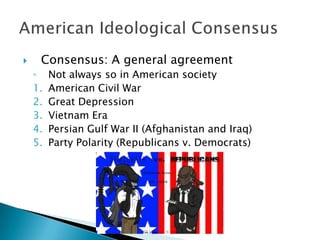
    Consensus: A general agreement
    ◦    Not always so in American society
    1.   American Civil War
    2.   Great Depression
    3.   Vietnam Era
    4.   Persian Gulf War II (Afghanistan and Iraq)
    5.   Party Polarity (Republicans v. Democrats)
   A system in which several major and many
    lesser parties exist, seriously compete for,
    and actually win public office(s).
   Based around particular interests, including:
    ◦   Economic class
    ◦   Religious beliefs
    ◦   Sectional attachment
    ◦   Political ideology
   Creates a broader and more diverse
    representation of electorates.
   Coalition- a temporary alliance of several
    groups who come together to form a working
    majority and so to control a government.
   Allows for multiparty arrangements to take
    power.
    ◦ Western European democracies have been plagued
      by multiparty systems
    ◦ Example: Italy
   Americans have shunned the multiparty
    system
   A political system in which only one party
    exists.
   Falls under a dictatorship in many nations.
   Within the United States, a modified one-
    party system is prevalent in certain regions of
    the country.
   Post Civil War Elections:
    ◦ Republican party = New England & Midwest
    ◦ Democrats = South
   Federalist No. 10 & 51
   Both majority and minority factions are
    brought up, and Madison believes that the
    majority factions are the most dangerous.
   Using the liberties of citizens can bring down
    a Democracy.
   Factions- conflicting groups
   After the ratification of the U.S. Constitution:
    ◦ The Federalist- led by Alexander Hamilton, the
      larger party had pushed for a stronger central
      government.
    ◦ Policies appealed toward the nation’s financial,
      manufacturing, and commercial interests.
    ◦ The Democratic-Republicans- led by Thomas
      Jefferson and James Madison, were more
      sympathetic toward the “common man” and favored
      a more limited government with property owners
      being a priority
   Election of 1800
    ◦ “The Great Revolution” signified the transfer of
      political powers from one political party to another
    ◦ The incumbent Federalist president, John Adams,
      was defeated by Republican Thomas Jefferson
      Incumbent- current office holder
   Since then, there have been 4 major periods
    of political party dominance.
   Era of the Democrats (1800-1860)
   Although called Republicans, the Democratic-
    Republicans can be compared to the
    Democratic Party of today.
   Ran unopposed in national politics up to
    1830.
    ◦ Split up into factions with the introduction of the
      Andrew Jackson administration
    ◦ National Republicans (Whigs) vs. Democrats
   Era of the Republicans (1860-1932)
   Republican dominance started in 1860 with
    the election of President Lincoln.
   Only political party to jump from 3rd party to
    major party status
   Electorate- the people eligible to vote.
   Sectionalism- the devotion toward interests
    of one section of the country or population
   The New Democratic Era (1932-1968)
   The Great Depression brought the election of
    a new American leader, FDR
   Democrats held the national government up
    to the Vietnam War
    ◦ Richard Nixon’s second attempt for the presidency
      proved successful for a short-term Republican
      reign
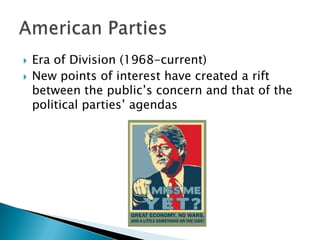
   Era of Division (1968-current)
   New points of interest have created a rift
    between the public’s concern and that of the
    political parties’ agendas
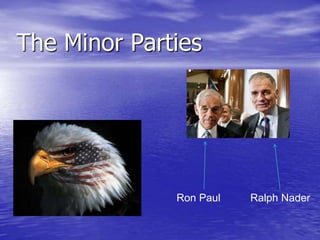
The Minor Parties


              Ron Paul   Ralph Nader
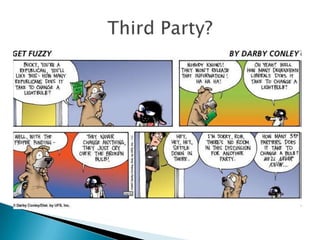
   There are MANY neglected third parties that
    field a presidential candidate
    ◦   Constitution Party
    ◦   Green Party of the U.S.
    ◦   Communist Party
    ◦   Libertarian Party
    ◦   America First Party
    ◦   Freedom Socialist Party
    ◦   Reform Party
    ◦   Prohibition Party
    ◦   American Nazi Party
    ◦   And Many More…
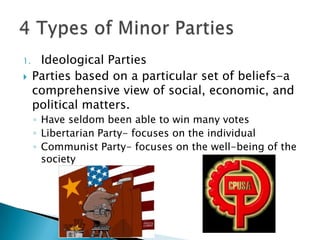
1.    Ideological Parties
    Parties based on a particular set of beliefs-a
     comprehensive view of social, economic, and
     political matters.
     ◦ Have seldom been able to win many votes
     ◦ Libertarian Party- focuses on the individual
     ◦ Communist Party- focuses on the well-being of the
       society
2.    Single-Issue Parties
    Parties that focus on only one public-policy
     matter
     ◦ Most of these parties fade into history, with the
       issue they stood for.
     ◦ The two major parties may address their key issue,
       as one of their own.
     ◦ Usually found in the minor party name.
       Prohibition Party (Founded 1869)
       U.S. Marijuana Party (Founded 2002)
3.    Economic Protest Parties
    Parties rooted in periods of economic
     discontent.
     ◦ There is no clear-cut ideological base
     ◦ A disgust toward the two major parties
       Occupy Wall Street
     ◦ Most often, they have been sectional parties
       Drawing strength from the South & West
     ◦ Greenback Party (1876-1884)
     ◦ Populist Party (1890s)
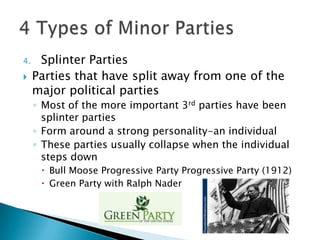
4.    Splinter Parties
    Parties that have split away from one of the
     major political parties
     ◦ Most of the more important 3rd parties have been
       splinter parties
     ◦ Form around a strong personality-an individual
     ◦ These parties usually collapse when the individual
       steps down
       Bull Moose Progressive Party Progressive Party (1912)
       Green Party with Ralph Nader
   Third-party candidacy can act as a “spoiler
    role” in a close election.
    ◦ Theodore Roosevelt’s Bull Moose Party took away
      votes from the Republican candidate in the 1912
      election
   Minor parties act as the critics and innovators
    for political issues
http://www.youtube.com/watch?v=2dd2-
OAgn8Q&feature=related
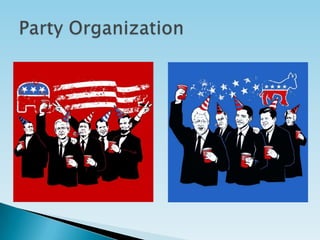
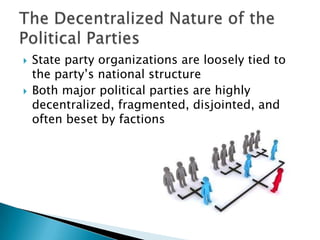
   State party organizations are loosely tied to
    the party’s national structure
   Both major political parties are highly
    decentralized, fragmented, disjointed, and
    often beset by factions
 Each major American political party builds its
  structure from four basic elements:
1. The National Convention
2. The National Committee
3. The National Chairperson
4. The Congressional Campaign
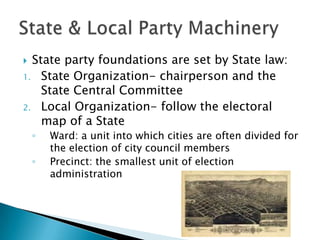
 State party foundations are set by State law:
1. State Organization- chairperson and the
    State Central Committee
2. Local Organization- follow the electoral
    map of a State
    ◦   Ward: a unit into which cities are often divided for
        the election of city council members
    ◦   Precinct: the smallest unit of election
        administration
1.    The party organization
     ◦ Party’s leaders, activists, and all those who
       contribute [time, money, and skills]
2.    The party in the electorate
     ◦ Appealing to the party’s loyalists
     ◦ They call themselves party members
3.    The party in government
     ◦ Party’s officeholders
   Americans (for the most part) have excepted
    the necessity for political parties in our
    country
   However, these same people believe that
    political parties need to be controlled and
    regulated
    ◦ Limited Government
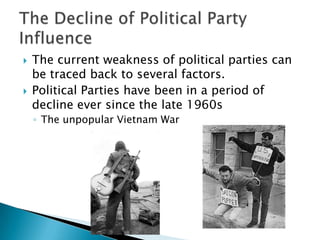
   The current weakness of political parties can
    be traced back to several factors.
   Political Parties have been in a period of
    decline ever since the late 1960s
    ◦ The unpopular Vietnam War
1.    Sharp drop in number of voters who classify
      themselves as Republican or Democrat
     ◦ Rise in Independents/Minor Parties
2.    Split-Ticket Voting: voting for candidates of
      different parties for different offices at the
      same election
     ◦ A true system with bipartisan behaviors
3.       Making parties more “open” to internal
         conflict
4.       Changes in technology
        Changes in media and campaigning
5.       Growth of single-issue organizations in our
         politics
     ◦    Putting previous concerns and focusing on one
          issue
     ◦    Currently the (world) economy
   One-Party System      Split-ticket Voting
   Plurality             Incumbent
   Factions              Major Party
   Partisanship          Electorate
   Two-Party System      Splinter Parties
   Multiparty            Sectionalism
   Bipartisan            Coalition

Chapter 5 political parties

  • 1.
  • 2.
    Political Parties are a vital link between the people and their government.
  • 3.
    “A party of order or stability, and a party of progress or reform, are both necessary elements of a healthy state of political life.” ~ John Stuart Mill
  • 4.
    Major Party- a group of persons who seek to control government through the winning of elections and the holding of public office(s). ◦ Republicans ◦ Democrats  Minor Party- one of the many political parties without wide voter support. ◦ Green Party ◦ Prohibition Party
  • 5.
    Where in a typical political election, two major parties dominate American politics.  A number of factors explain why America has had and continues to have a two-party system.
  • 6.
    Framers of the Constitution were opposed to political parties. ◦ Federalist No. 10: One can either destroy the factions, or somehow, control its outcomes. ◦ Bi-partisan system still follows Madison’s “multiple” faction government. ◦ Federalist No. 14: “Big Tent” involves inviting multiple factions/spheres of thought into the Big Tent ◦ A means of controlling the “mob mentality”
  • 7.
    Started with the Federalists and Anti- Federalist ◦ More Americans except the idea of a two-party system because there has always been one ◦ James Madison said that a larger Republic is better, as to increase the number of factions, and to distribute power  No one party can overpower the system… or can they?
  • 8.
    Single-member districts: Electoral process in which one person is chosen by the voters for each elected office  Plurality: The winning candidate who receives a the largest number of votes cast for an office ◦ The plurality does NOT have to be the majority  Bipartisan: The two major political parties find common ground and work Together
  • 9.
    The American people over time have shared many of the same ideals, same basic principles, and same patterns of belief  Pluralistic Society: One consisting of several distinct cultures and groups ◦ The United States is the “melting pot” of the world  Federalist Paper No. 55 ◦ Argues that a smaller assembly is better for the country. More likely to get things RATIFIED ◦ However, this is contradictory to the People’s Voice
  • 10.
    Consensus: A general agreement ◦ Not always so in American society 1. American Civil War 2. Great Depression 3. Vietnam Era 4. Persian Gulf War II (Afghanistan and Iraq) 5. Party Polarity (Republicans v. Democrats)
  • 12.
    A system in which several major and many lesser parties exist, seriously compete for, and actually win public office(s).  Based around particular interests, including: ◦ Economic class ◦ Religious beliefs ◦ Sectional attachment ◦ Political ideology  Creates a broader and more diverse representation of electorates.
  • 13.
    Coalition- a temporary alliance of several groups who come together to form a working majority and so to control a government.  Allows for multiparty arrangements to take power. ◦ Western European democracies have been plagued by multiparty systems ◦ Example: Italy  Americans have shunned the multiparty system
  • 14.
    A political system in which only one party exists.  Falls under a dictatorship in many nations.  Within the United States, a modified one- party system is prevalent in certain regions of the country.  Post Civil War Elections: ◦ Republican party = New England & Midwest ◦ Democrats = South
  • 15.
    Federalist No. 10 & 51  Both majority and minority factions are brought up, and Madison believes that the majority factions are the most dangerous.  Using the liberties of citizens can bring down a Democracy.  Factions- conflicting groups
  • 16.
    After the ratification of the U.S. Constitution: ◦ The Federalist- led by Alexander Hamilton, the larger party had pushed for a stronger central government. ◦ Policies appealed toward the nation’s financial, manufacturing, and commercial interests. ◦ The Democratic-Republicans- led by Thomas Jefferson and James Madison, were more sympathetic toward the “common man” and favored a more limited government with property owners being a priority
  • 17.
    Election of 1800 ◦ “The Great Revolution” signified the transfer of political powers from one political party to another ◦ The incumbent Federalist president, John Adams, was defeated by Republican Thomas Jefferson  Incumbent- current office holder  Since then, there have been 4 major periods of political party dominance.
  • 18.
    Era of the Democrats (1800-1860)  Although called Republicans, the Democratic- Republicans can be compared to the Democratic Party of today.  Ran unopposed in national politics up to 1830. ◦ Split up into factions with the introduction of the Andrew Jackson administration ◦ National Republicans (Whigs) vs. Democrats
  • 19.
    Era of the Republicans (1860-1932)  Republican dominance started in 1860 with the election of President Lincoln.  Only political party to jump from 3rd party to major party status  Electorate- the people eligible to vote.  Sectionalism- the devotion toward interests of one section of the country or population
  • 20.
    The New Democratic Era (1932-1968)  The Great Depression brought the election of a new American leader, FDR  Democrats held the national government up to the Vietnam War ◦ Richard Nixon’s second attempt for the presidency proved successful for a short-term Republican reign
  • 21.
    Era of Division (1968-current)  New points of interest have created a rift between the public’s concern and that of the political parties’ agendas
  • 22.
    The Minor Parties Ron Paul Ralph Nader
  • 23.
    There are MANY neglected third parties that field a presidential candidate ◦ Constitution Party ◦ Green Party of the U.S. ◦ Communist Party ◦ Libertarian Party ◦ America First Party ◦ Freedom Socialist Party ◦ Reform Party ◦ Prohibition Party ◦ American Nazi Party ◦ And Many More…
  • 24.
    1. Ideological Parties  Parties based on a particular set of beliefs-a comprehensive view of social, economic, and political matters. ◦ Have seldom been able to win many votes ◦ Libertarian Party- focuses on the individual ◦ Communist Party- focuses on the well-being of the society
  • 25.
    2. Single-Issue Parties  Parties that focus on only one public-policy matter ◦ Most of these parties fade into history, with the issue they stood for. ◦ The two major parties may address their key issue, as one of their own. ◦ Usually found in the minor party name.  Prohibition Party (Founded 1869)  U.S. Marijuana Party (Founded 2002)
  • 26.
    3. Economic Protest Parties  Parties rooted in periods of economic discontent. ◦ There is no clear-cut ideological base ◦ A disgust toward the two major parties  Occupy Wall Street ◦ Most often, they have been sectional parties  Drawing strength from the South & West ◦ Greenback Party (1876-1884) ◦ Populist Party (1890s)
  • 27.
    4. Splinter Parties  Parties that have split away from one of the major political parties ◦ Most of the more important 3rd parties have been splinter parties ◦ Form around a strong personality-an individual ◦ These parties usually collapse when the individual steps down  Bull Moose Progressive Party Progressive Party (1912)  Green Party with Ralph Nader
  • 28.
    Third-party candidacy can act as a “spoiler role” in a close election. ◦ Theodore Roosevelt’s Bull Moose Party took away votes from the Republican candidate in the 1912 election  Minor parties act as the critics and innovators for political issues
  • 29.
  • 31.
    State party organizations are loosely tied to the party’s national structure  Both major political parties are highly decentralized, fragmented, disjointed, and often beset by factions
  • 32.
     Each majorAmerican political party builds its structure from four basic elements: 1. The National Convention 2. The National Committee 3. The National Chairperson 4. The Congressional Campaign
  • 33.
     State partyfoundations are set by State law: 1. State Organization- chairperson and the State Central Committee 2. Local Organization- follow the electoral map of a State ◦ Ward: a unit into which cities are often divided for the election of city council members ◦ Precinct: the smallest unit of election administration
  • 34.
    1. The party organization ◦ Party’s leaders, activists, and all those who contribute [time, money, and skills] 2. The party in the electorate ◦ Appealing to the party’s loyalists ◦ They call themselves party members 3. The party in government ◦ Party’s officeholders
  • 35.
    Americans (for the most part) have excepted the necessity for political parties in our country  However, these same people believe that political parties need to be controlled and regulated ◦ Limited Government
  • 36.
    The current weakness of political parties can be traced back to several factors.  Political Parties have been in a period of decline ever since the late 1960s ◦ The unpopular Vietnam War
  • 37.
    1. Sharp drop in number of voters who classify themselves as Republican or Democrat ◦ Rise in Independents/Minor Parties 2. Split-Ticket Voting: voting for candidates of different parties for different offices at the same election ◦ A true system with bipartisan behaviors
  • 38.
    3. Making parties more “open” to internal conflict 4. Changes in technology  Changes in media and campaigning 5. Growth of single-issue organizations in our politics ◦ Putting previous concerns and focusing on one issue ◦ Currently the (world) economy
  • 39.
    One-Party System  Split-ticket Voting  Plurality  Incumbent  Factions  Major Party  Partisanship  Electorate  Two-Party System  Splinter Parties  Multiparty  Sectionalism  Bipartisan  Coalition