Viral Exanthems
Medical Student Core Curriculum
in Dermatology
Last updated March 16, 2011
1
Goals and Objectives
 The purpose of this module is to help medical students
develop a clinical approach to the evaluation and initial
management of patients presenting with typical viral
exanthems.
 By completing this module, the learner will be able to:
• Recognize morbilliform eruption as a prototype for viral
exanthems
• Describe classic presentations of distinctive pediatric viral
exanthems
• Provide counseling for parents of children with typical viral
exanthems
2
Definitions
 Exanthem (exanthema)
• A rash that appears abruptly and affects
several areas of the skin simultaneously
• Greek origin “exanthema” which means “a
breaking out”
 Enanthem (enanthema)
• An eruption upon a mucous membrane
3
Viral Exanthems
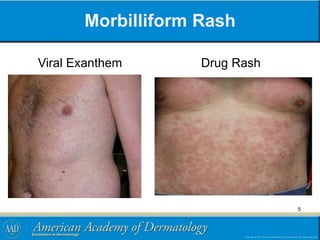
 Commonly described as “morbilliform” which
means “composed of erythematous macules
and papules that resemble a measles rash.”
 Viral exanthems can be difficult to distinguish
from a drug eruption. However, viral exanthems
are more common in children, and drug
eruptions tend to be more common in adults. A
thorough history will aid in the diagnosis.
4
Morbilliform Rash
Viral Exanthem Drug Rash
5
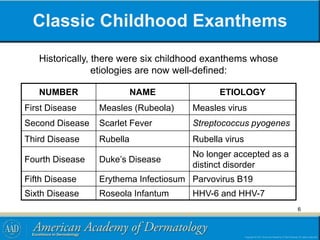
Classic Childhood Exanthems
Historically, there were six childhood exanthems whose
etiologies are now well-defined:
NUMBER NAME ETIOLOGY
First Disease Measles (Rubeola) Measles virus
Second Disease Scarlet Fever Streptococcus pyogenes
Third Disease Rubella Rubella virus
Fourth Disease Duke’s Disease
No longer accepted as a
distinct disorder
Fifth Disease Erythema Infectiosum Parvovirus B19
Sixth Disease Roseola Infantum HHV-6 and HHV-7
6
Case One
Ana Haydon
7
Case One: History
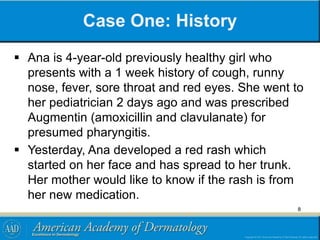
 Ana is 4-year-old previously healthy girl who
presents with a 1 week history of cough, runny
nose, fever, sore throat and red eyes. She went to
her pediatrician 2 days ago and was prescribed
Augmentin (amoxicillin and clavulanate) for
presumed pharyngitis.
 Yesterday, Ana developed a red rash which
started on her face and has spread to her trunk.
Her mother would like to know if the rash is from
her new medication.
8
History Continued
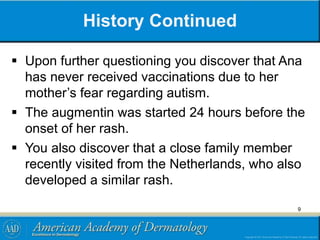
 Upon further questioning you discover that Ana
has never received vaccinations due to her
mother’s fear regarding autism.
 The augmentin was started 24 hours before the
onset of her rash.
 You also discover that a close family member
recently visited from the Netherlands, who also
developed a similar rash.
9
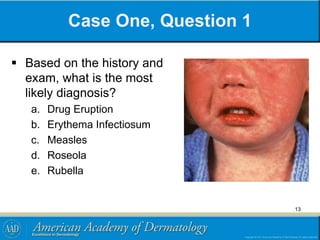
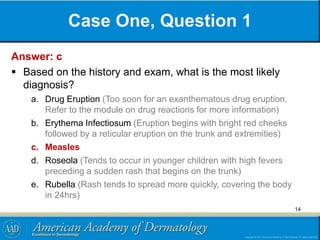
Case One: Skin Exam
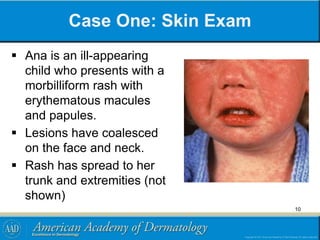
 Ana is an ill-appearing
child who presents with a
morbilliform rash with
erythematous macules
and papules.
 Lesions have coalesced
on the face and neck.
 Rash has spread to her
trunk and extremities (not
shown)
10
Exam Continued
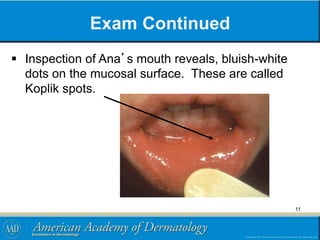
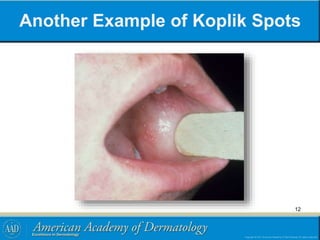
 Inspection of Ana’s mouth reveals, bluish-white
dots on the mucosal surface. These are called
Koplik spots.
11
Another Example of Koplik Spots
12
Case One, Question 1
 Based on the history and
exam, what is the most
likely diagnosis?
a. Drug Eruption
b. Erythema Infectiosum
c. Measles
d. Roseola
e. Rubella
13
Case One, Question 1
Answer: c
 Based on the history and exam, what is the most likely
diagnosis?
a. Drug Eruption (Too soon for an exanthematous drug eruption.
Refer to the module on drug reactions for more information)
b. Erythema Infectiosum (Eruption begins with bright red cheeks
followed by a reticular eruption on the trunk and extremities)
c. Measles
d. Roseola (Tends to occur in younger children with high fevers
preceding a sudden rash that begins on the trunk)
e. Rubella (Rash tends to spread more quickly, covering the body
in 24hrs)
14
Measles (Rubeola)
 Measles is a viral disease
 Spread by respiratory droplets
 Incubation period tends to be 8-12 days from
exposure to onset of symptoms
 Patients are contagious from 1-2 days before onset
of symptoms (3-5 days before the rash) to 4 days
after appearance of the rash
 Immunocompromised patients can be contagious
for the duration of the illness
15
Measles (Rubeola)
 Most common in children 3-5 years old
 Incidence of measles has decreased substantially
where measles vaccination has been instituted
 Most cases of measles in the United States are
imported with spread to unvaccinated individuals
 Measles is still common in many developing countries
(parts of Africa and Asia) and outbreaks repeatedly
occur in communities who do not accept vaccinations
(e.g. religious community in Netherlands)
16
Measles: Clinical Presentation
 Prodrome: Fever, Malaise, Conjunctivitis, Cough,
Coryza*, Koplik spots
 Exanthem: Erythematous macules and papules
begin on the face and spread cephalocaudally and
centrifugally (by the 3rd day, the whole body is
involved).
 Recovery: Clinical improvement begins within 2
days of appearance of the rash. The rash tends to
fade after 3-4 days and will last around 6-7 days.
*Coryza: “head cold” with nasal congestion, rhinorrhea, sore throat
17
Diagnosis
 Measles is a distinct clinical syndrome with the presence of
high fever, Koplik spots, characteristic conjunctivitis, upper
respiratory symptoms, and typical exanthem.
 All cases of suspected measles should be serologically
confirmed and reported immediately to the local or state
health department without waiting for results of diagnostic
tests.
 Testing includes:
• Serology: Anti-measles IgM and IgG, isolation of measles virus or
identification of measles RNA
• Histologic evaluation of skin lesions or respiratory secretions may
show syncytial keratinocytic giant cells
18
Case One, Question 2
 Which of the following statements about the
treatment of measles is correct?
a. No specific antiviral therapy is recommended for
immunocompetent patients with measles.
b. Prevention of the spread of measles depends on
prompt immunization of people at risk for exposure or
people already exposed who cannot provide
documentation of measles immunity
c. Recommend supportive care with antipyretics, fluids,
and rest.
d. All of the above
19
Case One, Question 2
Answer: d
 Which of the following statements about the treatment
of measles is correct?
a. No specific antiviral therapy is recommended for
immunocompetent patients with measles.
b. Prevention of the spread of measles depends on prompt
immunization of people at risk for exposure or people
already exposed who cannot provide documentation of
measles immunity
c. Recommend supportive care with antipyretics, fluids,
and rest.
d. All of the above
20
Management
 Uncomplicated measles is self-limiting, lasting 10 to
12 days.
 Treatment in the majority of cases is supportive
(antipyretics, fluids).
 Malnutrition, immunosuppression, poor health, and
inadequate supportive care can worsen the prognosis
in any patient. In developing nations, measles is a
major cause of infant mortality.
 Vitamin A supplementation has shown to be of benefit
in the treatment of measles.
21
Complications
 Groups at increased risk for complications of measles
include immunocompromised hosts, pregnant
women, malnourished individuals, and persons at
extremes of age
 Most common complications include otitis media,
pneumonia, laryngotracheobronchitis (croup), and
diarrhea. Hepatitis, thrombocytopenia, and
encephalitis occur less commonly.
 Pneumonia is the most common fatal complication of
measles in children and the most common
complication overall in adults.
22
Case Two
Ms. Kylie Hinkle
23
Case Two: History
 Kylie Hinkle is 24-year-old woman who presents to
your dermatology clinic with a red rash. She has
been feeling unwell for the last 6 days with fever,
myalgias, cough and sore throat. She also reports
some tender lymph nodes on her neck. She has
taken ibuprofen for the myalgias and fever, which
has helped.
 A rash started on her face yesterday and is now
spreading to her neck and trunk.
24
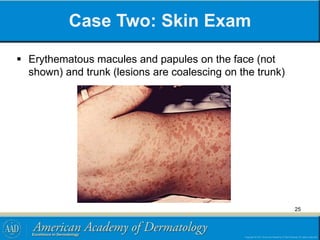
Case Two: Skin Exam
 Erythematous macules and papules on the face (not
shown) and trunk (lesions are coalescing on the trunk)
25
History Continued
 Upon further questioning you discover that
Ms. Hinkle has never received the MMR
(Measles, Mumps, Rubella) vaccine.
26
Case Two, Question 1
 Based on the history and skin exam, what
is the most likely diagnosis?
a. Drug Eruption
b. Erythema Infectiosum
c. Measles
d. Roseola
e. Rubella
27
Case Two, Question 1
Answer: e
 Based on the history and skin exam, what is the most likely
diagnosis?
a. Drug Eruption (Less likely, but should get more information
about NSAID use.)
b. Erythema Infectiosum (More common in children. Eruption
begins with bright red cheeks followed by a reticular eruption
on the trunk and extremities.)
c. Measles (Rash tends to spread over a period of days, not in
24 hours like this case.)
d. Roseola (Occurs in young children with high fevers preceding
a sudden rash that begins on the trunk.)
e. Rubella
28
Rubella
 Rubella is a viral disease
 Synonym: German measles, “3-day measles”
 Spread through direct or droplet contact from
nasopharyngeal secretions
 Infected individuals shed virus up to one week
before and two weeks after onset of disease
 Appearance of the rash typically occurs 14-17
days after exposure
29
Epidemiology
 Outbreaks occur most frequently in late
winter and early spring
 School-age children, adolescents, and
young adults most often develop the
disease
 The incidence of rubella has dramatically
decreased with routine vaccination
30
Rubella: Clinical Presentation
 Many cases of non-congenital rubella are subclinical
 Prodrome: low-grade fever, headache, sore throat,
conjunctivitis, rhinorrhea, cough and
lymphadenopathy. Symptoms often resolve with
appearance of the rash.
 Exanthem: pruritic, pink to red macules and papules
which begin on face and spread to neck, trunk, and
extremities over 24 hours
 Enanthem: 20% with petechial lesions on soft
palate and uvula (Forchheimer's sign)
31
Clinical Course
 Adults tend to have more prodromal symptoms and
complications (although rare) compared to children
 Arthritis sometimes accompanies exanthem (more
common in teenagers and adult women)
 Rash begins to disappear in 2-3 days and clears the
head and neck first
 Encephalitis and thrombocytopenia are potential
complications
 Other rare complications include: peripheral neuritis,
optic neuritis, myocarditis, pericarditis, hepatitis, orchitis,
and hemolytic anemia
32
Case Two, Question 2
 Based on clinical presentation, you suspect rubella
and recommend supportive treatment. What else
would you like to know about Kylie?
a. Any sick contacts
b. Have you been in close contact with any pregnant
women or immunocompromised individuals?
c. What vaccines have you had?
d. What was the date of your last period? Could you be
pregnant?
e. All of the above
33
Case Two, Question 2
Answer: e
 What else would you like to know about Kylie?
a. Any sick contacts (Identification of infected or exposed
individuals will help control the potential outbreak)
b. Have you been in close contact with any pregnant women or
immunocompromised individuals? (Important to identify these
at risk individuals)
c. What vaccines have you had? (An important part of her health
history)
d. What was the date of your last period? (All women of child-
bearing age with suspected rubella should be screened for
pregnancy)
e. All of the above
34
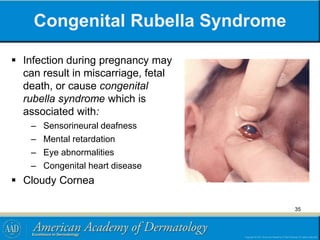
Congenital Rubella Syndrome
 Infection during pregnancy may
can result in miscarriage, fetal
death, or cause congenital
rubella syndrome which is
associated with:
– Sensorineural deafness
– Mental retardation
– Eye abnormalities
– Congenital heart disease
 Cloudy Cornea
35
Evaluation and Treatment
 Diagnosis is usually made using serology to detect
rubella-specific IgM antibody or to document a 4-fold
rise in antibody titer in acute and convalescent-
phase serum
 As with measles, rubella cases should be reported to
local health departments
 Treatment consists of supportive care
 Control measures for rubella includes droplet
precautions and exclusion from school or child care
for seven days after the onset of the rash
36
Case Three
Keith Walters
37
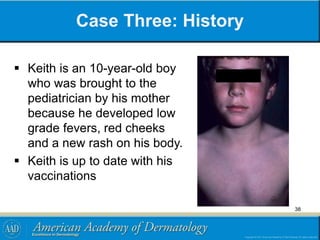
Case Three: History
 Keith is an 10-year-old boy
who was brought to the
pediatrician by his mother
because he developed low
grade fevers, red cheeks
and a new rash on his body.
 Keith is up to date with his
vaccinations
38
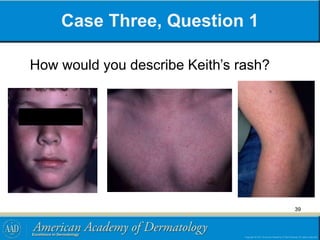
Case Three, Question 1
How would you describe Keith’s rash?
39
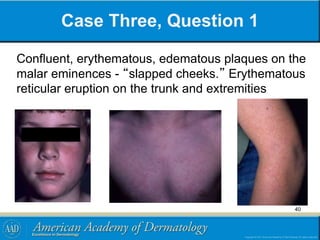
Case Three, Question 1
Confluent, erythematous, edematous plaques on the
malar eminences - “slapped cheeks.” Erythematous
reticular eruption on the trunk and extremities
40
Case Three, Question 2
 Based on the history and skin exam, what
is the most likely diagnosis?
a. Drug Eruption
b. Erythema Infectiosum
c. Measles
d. Roseola
e. Rubella
41
Case Three, Question 2
Answer: b
 Based on the history and skin exam, what is the most
likely diagnosis?
a. Drug Eruption (No exposure to medications)
b. Erythema Infectiosum
c. Measles (Children with measles tend to appear more ill;
Keith has been vaccinated)
d. Roseola (Tends to occur in younger children with high fevers
preceding a sudden rash that begins on the trunk)
e. Rubella (Keith has been vaccinated; exanthem usually starts
with erythematous macules and papules on the face)
42
Parvovirus B19
 There are many clinical presentations
associated with B19 infection (ranging from
benign to life-threatening).
 Most infections are asymptomatic and
unrecognized
 We will focus on Erythema Infectiosum, the
most common clinical presentation.
43
Diagnosis: Erythema Infectiosum
 Synonyms: Fifth disease
 Caused by Parvovirus B19
 Modes of transmission include contact with
respiratory tract secretions, percutaneous exposure
to blood or blood products, and vertical transmission
from mother to fetus
 Estimated incubation period from exposure to onset
of rash usually between 1-2 weeks
 Individuals with erythema infectiosum are most
infectious before onset of the rash
44
Epidemiology
 Most common in children 4-10 yrs old, but can affect all
ages
 Tends to occur in epidemics, especially associated with
school outbreaks in the late winter and early spring
 Secondary spread among susceptible household members
is common, with infection occurring in ~ 50% of susceptible
contacts
 Serologic studies show increasing prevalence of antibodies
with age
• In most communities, ~ 50% of young adults and often more than
90% of elderly people are seropositive
45
Erythema Infectiosum: Clinical
Presentation
 Prodrome: low-grade fever, malaise, headache,
pruritus, coryza, myalgias, joint pain (more
common in adult women)
 Exanthem: Begins with bright red cheeks
(“slapped cheeks”) and as the facial rash fades
over 1-4 days, a symmetric, erythematous,
reticular (lacelike) eruption appears on trunk and
extremities
 Eruption usually lasts 5-9 days
46
Diagnosis
 Detection of serum parvovirus B19-
specific IgM antibody is the preferred
diagnostic test
 Positive IgM test result indicates that
infection probably occurred within the
previous 2 to 4 months
47
Case Three, Question 3
 His mother states that his older brother has a rash
mostly involving the hands and feet. Do you think
he has parvovirus?
a. No, because his older brother is likely already immune
from previous exposure
b. No, because household transmission is rare
c. No, because the brother does not have a “slapped
cheek” facial rash
d. Yes, he probably has papulopurpuric gloves-and-socks
syndrome
48
Case Three, Question 3
Answer: d
His mother states that his older brother has a rash
mostly involving the hands and feet. Do you think he
has parvovirus?
a. No, because his older brother is likely already immune
from previous exposure
b. No, because household transmission is rare
c. No, because the brother does not have a “slapped
cheek” facial rash
d. Yes, he probably has papulopurpuric gloves-and-
socks syndrome
49
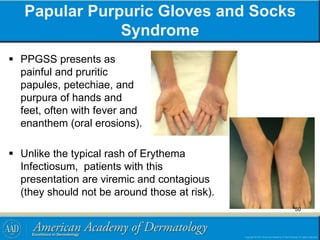
Papular Purpuric Gloves and Socks
Syndrome
 PPGSS presents as
painful and pruritic
papules, petechiae, and
purpura of hands and
feet, often with fever and
enanthem (oral erosions).
 Unlike the typical rash of Erythema
Infectiosum, patients with this
presentation are viremic and contagious
(they should not be around those at risk).
50
Parvovirus B19: Special
Considerations
 Pregnancy
• Infection occurring during pregnancy can cause hydrops fetalis*,
intrauterine growth retardation, pleural and pericardial effusions,
and death. The risk of fetal death is between 2% and 6.5% when
infection occurs during pregnancy.
 Immunodeficiency
• Can cause chronic erythroid hypoplasia with severe anemia
 Chronic hemolytic anemias
• B19 is the most common cause of transient aplastic crisis in
patients with chronic hemolytic anemias (i.e. sickle cell disease)
*Hydrops fetalis: a condition in the fetus characterized by an accumulation of fluid, or
edema, in at least two fetal compartments 51
Treatment
 There is no specific treatment for
uncomplicated parvovirus B19 infection
 Supportive therapy for relief of fatigue, malaise,
pruritus, and arthralgia may be needed
 Generally resolves after 5-10 days, but can
reoccur for months upon exposure to sunlight,
hot temperature, exercise, bathing, and stress
52
Case Four
Caleb
53
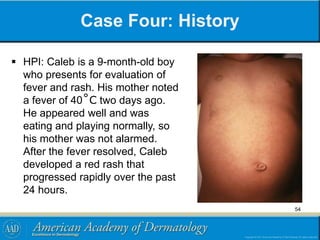
Case Four: History
 HPI: Caleb is a 9-month-old boy
who presents for evaluation of
fever and rash. His mother noted
a fever of 40˚C two days ago.
He appeared well and was
eating and playing normally, so
his mother was not alarmed.
After the fever resolved, Caleb
developed a red rash that
progressed rapidly over the past
24 hours.
54
Case Four, Question 1
 Based on Caleb’s history and exam, what
is the most likely diagnosis?
a. Drug Eruption
b. Erythema Infectiosum
c. Measles
d. Roseola
e. Rubella
55
Case Four, Question 1
Answer: d
 Based on Caleb’s history and exam, what
is the most likely diagnosis?
a. Drug Eruption
b. Erythema Infectiosum
c. Measles
d. Roseola
e. Rubella
56
Roseola Infantum
 Synonyms: Exanthema subitum, Sixth disease
 Caused by Human Herpesvirus 6 (HHV-6) and
less commonly Human Herpesvirus 7 (HHV-7)
 Mode of transmission unknown (possibly from
nasopharyngeal secretions)
 Children 6 months – 4 years
 Most common exanthem before age 2
 No vaccine; infection results in immunity
57
HHV-6
 HHV-6 infection in children results in:
• Subclinical infection
• Acute febrile illness without rash
• Exanthema subitum
 Seroprevalence of HHV-6 in the adult population is
greater than 95%
 Reactivation in immunocompromised hosts may
cause significant morbidity
 Reactivation of HHV-6 with drug exposure can lead
to drug-induced hypersensitivity syndrome (DIHS)
58
Roseola Infantum: Clinical
Presentation
 Infection with HHV-6 results in an acute febrile illness,
lasting approximately 3 to 7 days, and can be followed by
the characteristic rash of roseola (in ~ 20% of infected
children)
 Prodrome: High fever (39-40°C), palpebral edema,
cervical lymphadenopathy, mild upper respiratory
symptoms. Child appears well. As fever subsides,
exanthem appears (“exanthema subitum” means “sudden
rash”).
 Exanthem: pink macules and papules surrounded by white
halos. Begins on trunk, spreads to neck and proximal
extremities. 59
Prognosis and Treatment
 Usually benign and self-limiting
 HHV-6 is known to cause febrile seizure
in children with infection, often without a
rash
 Treatment may be necessary for atypical
cases with complications and in
immunosuppressed patients
60
Take Home Points
 Exanthems are rashes that occur abruptly and affect
multiple areas of the skin simultaneously.
 Morbilliform means “composed of erythematous
macules and papules that resemble a measles rash.”
 Distinct viral exanthems are seen in measles, rubella,
erythema infectiosum, and roseola infantum.
 Careful history taking and physical exam help
establish the diagnosis.
 In the case of measles and rubella, clinical diagnosis
should be serologically confirmed and reported.
61
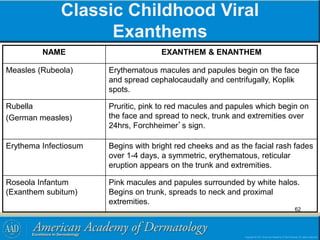
Classic Childhood Viral
Exanthems
NAME EXANTHEM & ENANTHEM
Measles (Rubeola) Erythematous macules and papules begin on the face
and spread cephalocaudally and centrifugally, Koplik
spots.
Rubella
(German measles)
Pruritic, pink to red macules and papules which begin on
the face and spread to neck, trunk and extremities over
24hrs, Forchheimer’s sign.
Erythema Infectiosum Begins with bright red cheeks and as the facial rash fades
over 1-4 days, a symmetric, erythematous, reticular
eruption appears on the trunk and extremities.
Roseola Infantum
(Exanthem subitum)
Pink macules and papules surrounded by white halos.
Begins on trunk, spreads to neck and proximal
extremities.
62
Acknowledgements
 This module was developed by the American Academy
of Dermatology Medical Student Core Curriculum
Workgroup from 2008-2012.
 Primary authors: Laura S. Huff, MD; Cory A. Dunnick,
MD, FAAD
 Contributor: Sarah D. Cipriano, MD, MPH
 Peer reviewers: Anna L. Bruckner, MD, FAAD; Brandon
D. Newell, MD; Timothy G. Berger, MD, FAAD
 Revisions and editing: Sarah D. Cipriano, MD, MPH,
Jillian W. Wong. Last revised March 2011.
63
References
 American Academy of Pediatrics. In: Pickering LK, Baker CJ,
Kimberlin DW, Long SS, eds. Red Book: 2009 Report of the
Committee on Infectious Diseases. 28th ed. Elk Grove Village, IL:
American Academy of Pediatrics; 2009:[online]
 Barinaga J, Skolnik P. Epidemiology and transmission of measles.
In: UpToDate, Basow, DS (Ed), UpToDate, Waltham, MA, 2010.
 Barinaga J, Skolnik P. Clinical presentation and diagnosis of
measles. In: UpToDate, Basow, DS (Ed), UpToDate, Waltham, MA,
2010.
 Bialecki C, Feder HM, Grant-Kels JM. The six classic childhood
exanthems: A review and update. J Am Acad Dermatol. 1989; 21:
891-903.
64
References
 Belazarian Leah, Lorenzo Mayra E, Pace Nicole C, Sweeney Susan
M, Wiss Karen M, "Chapter 192. Exanthematous Viral Diseases"
(Chapter). Wolff K, Goldsmith LA, Katz SI, Gilchrest B, Paller AS,
Leffell DJ: Fitzpatrick's Dermatology in General Medicine, 7e:
http://www.accessmedicine.com/content.aspx?aID=2997277.
 Folster-Holst R, Kreth HW. Viral exanthems in childhood – infectious
(direct) exanthems. Part 1: Classic exanthems. Journal of the
German Society of Dermatology. 2009; 7:309-316.
 Jordan J. Clinical manifestations and pathogenesis of human
parvovirus B19 infection. In: UpToDate, Basow, DS (Ed), UpToDate,
Waltham, MA, 2010.
 Scott LA, Stone MS. Viral exanthems. Dermatology Online Journal.
2003; 9(3):4.
65

Viral exanthems-module

  • 1.
    Viral Exanthems Medical StudentCore Curriculum in Dermatology Last updated March 16, 2011 1
  • 2.
    Goals and Objectives The purpose of this module is to help medical students develop a clinical approach to the evaluation and initial management of patients presenting with typical viral exanthems.  By completing this module, the learner will be able to: • Recognize morbilliform eruption as a prototype for viral exanthems • Describe classic presentations of distinctive pediatric viral exanthems • Provide counseling for parents of children with typical viral exanthems 2
  • 3.
    Definitions  Exanthem (exanthema) •A rash that appears abruptly and affects several areas of the skin simultaneously • Greek origin “exanthema” which means “a breaking out”  Enanthem (enanthema) • An eruption upon a mucous membrane 3
  • 4.
    Viral Exanthems  Commonlydescribed as “morbilliform” which means “composed of erythematous macules and papules that resemble a measles rash.”  Viral exanthems can be difficult to distinguish from a drug eruption. However, viral exanthems are more common in children, and drug eruptions tend to be more common in adults. A thorough history will aid in the diagnosis. 4
  • 5.
  • 6.
    Classic Childhood Exanthems Historically,there were six childhood exanthems whose etiologies are now well-defined: NUMBER NAME ETIOLOGY First Disease Measles (Rubeola) Measles virus Second Disease Scarlet Fever Streptococcus pyogenes Third Disease Rubella Rubella virus Fourth Disease Duke’s Disease No longer accepted as a distinct disorder Fifth Disease Erythema Infectiosum Parvovirus B19 Sixth Disease Roseola Infantum HHV-6 and HHV-7 6
  • 7.
  • 8.
    Case One: History Ana is 4-year-old previously healthy girl who presents with a 1 week history of cough, runny nose, fever, sore throat and red eyes. She went to her pediatrician 2 days ago and was prescribed Augmentin (amoxicillin and clavulanate) for presumed pharyngitis.  Yesterday, Ana developed a red rash which started on her face and has spread to her trunk. Her mother would like to know if the rash is from her new medication. 8
  • 9.
    History Continued  Uponfurther questioning you discover that Ana has never received vaccinations due to her mother’s fear regarding autism.  The augmentin was started 24 hours before the onset of her rash.  You also discover that a close family member recently visited from the Netherlands, who also developed a similar rash. 9
  • 10.
    Case One: SkinExam  Ana is an ill-appearing child who presents with a morbilliform rash with erythematous macules and papules.  Lesions have coalesced on the face and neck.  Rash has spread to her trunk and extremities (not shown) 10
  • 11.
    Exam Continued  Inspectionof Ana’s mouth reveals, bluish-white dots on the mucosal surface. These are called Koplik spots. 11
  • 12.
    Another Example ofKoplik Spots 12
  • 13.
    Case One, Question1  Based on the history and exam, what is the most likely diagnosis? a. Drug Eruption b. Erythema Infectiosum c. Measles d. Roseola e. Rubella 13
  • 14.
    Case One, Question1 Answer: c  Based on the history and exam, what is the most likely diagnosis? a. Drug Eruption (Too soon for an exanthematous drug eruption. Refer to the module on drug reactions for more information) b. Erythema Infectiosum (Eruption begins with bright red cheeks followed by a reticular eruption on the trunk and extremities) c. Measles d. Roseola (Tends to occur in younger children with high fevers preceding a sudden rash that begins on the trunk) e. Rubella (Rash tends to spread more quickly, covering the body in 24hrs) 14
  • 15.
    Measles (Rubeola)  Measlesis a viral disease  Spread by respiratory droplets  Incubation period tends to be 8-12 days from exposure to onset of symptoms  Patients are contagious from 1-2 days before onset of symptoms (3-5 days before the rash) to 4 days after appearance of the rash  Immunocompromised patients can be contagious for the duration of the illness 15
  • 16.
    Measles (Rubeola)  Mostcommon in children 3-5 years old  Incidence of measles has decreased substantially where measles vaccination has been instituted  Most cases of measles in the United States are imported with spread to unvaccinated individuals  Measles is still common in many developing countries (parts of Africa and Asia) and outbreaks repeatedly occur in communities who do not accept vaccinations (e.g. religious community in Netherlands) 16
  • 17.
    Measles: Clinical Presentation Prodrome: Fever, Malaise, Conjunctivitis, Cough, Coryza*, Koplik spots  Exanthem: Erythematous macules and papules begin on the face and spread cephalocaudally and centrifugally (by the 3rd day, the whole body is involved).  Recovery: Clinical improvement begins within 2 days of appearance of the rash. The rash tends to fade after 3-4 days and will last around 6-7 days. *Coryza: “head cold” with nasal congestion, rhinorrhea, sore throat 17
  • 18.
    Diagnosis  Measles isa distinct clinical syndrome with the presence of high fever, Koplik spots, characteristic conjunctivitis, upper respiratory symptoms, and typical exanthem.  All cases of suspected measles should be serologically confirmed and reported immediately to the local or state health department without waiting for results of diagnostic tests.  Testing includes: • Serology: Anti-measles IgM and IgG, isolation of measles virus or identification of measles RNA • Histologic evaluation of skin lesions or respiratory secretions may show syncytial keratinocytic giant cells 18
  • 19.
    Case One, Question2  Which of the following statements about the treatment of measles is correct? a. No specific antiviral therapy is recommended for immunocompetent patients with measles. b. Prevention of the spread of measles depends on prompt immunization of people at risk for exposure or people already exposed who cannot provide documentation of measles immunity c. Recommend supportive care with antipyretics, fluids, and rest. d. All of the above 19
  • 20.
    Case One, Question2 Answer: d  Which of the following statements about the treatment of measles is correct? a. No specific antiviral therapy is recommended for immunocompetent patients with measles. b. Prevention of the spread of measles depends on prompt immunization of people at risk for exposure or people already exposed who cannot provide documentation of measles immunity c. Recommend supportive care with antipyretics, fluids, and rest. d. All of the above 20
  • 21.
    Management  Uncomplicated measlesis self-limiting, lasting 10 to 12 days.  Treatment in the majority of cases is supportive (antipyretics, fluids).  Malnutrition, immunosuppression, poor health, and inadequate supportive care can worsen the prognosis in any patient. In developing nations, measles is a major cause of infant mortality.  Vitamin A supplementation has shown to be of benefit in the treatment of measles. 21
  • 22.
    Complications  Groups atincreased risk for complications of measles include immunocompromised hosts, pregnant women, malnourished individuals, and persons at extremes of age  Most common complications include otitis media, pneumonia, laryngotracheobronchitis (croup), and diarrhea. Hepatitis, thrombocytopenia, and encephalitis occur less commonly.  Pneumonia is the most common fatal complication of measles in children and the most common complication overall in adults. 22
  • 23.
  • 24.
    Case Two: History Kylie Hinkle is 24-year-old woman who presents to your dermatology clinic with a red rash. She has been feeling unwell for the last 6 days with fever, myalgias, cough and sore throat. She also reports some tender lymph nodes on her neck. She has taken ibuprofen for the myalgias and fever, which has helped.  A rash started on her face yesterday and is now spreading to her neck and trunk. 24
  • 25.
    Case Two: SkinExam  Erythematous macules and papules on the face (not shown) and trunk (lesions are coalescing on the trunk) 25
  • 26.
    History Continued  Uponfurther questioning you discover that Ms. Hinkle has never received the MMR (Measles, Mumps, Rubella) vaccine. 26
  • 27.
    Case Two, Question1  Based on the history and skin exam, what is the most likely diagnosis? a. Drug Eruption b. Erythema Infectiosum c. Measles d. Roseola e. Rubella 27
  • 28.
    Case Two, Question1 Answer: e  Based on the history and skin exam, what is the most likely diagnosis? a. Drug Eruption (Less likely, but should get more information about NSAID use.) b. Erythema Infectiosum (More common in children. Eruption begins with bright red cheeks followed by a reticular eruption on the trunk and extremities.) c. Measles (Rash tends to spread over a period of days, not in 24 hours like this case.) d. Roseola (Occurs in young children with high fevers preceding a sudden rash that begins on the trunk.) e. Rubella 28
  • 29.
    Rubella  Rubella isa viral disease  Synonym: German measles, “3-day measles”  Spread through direct or droplet contact from nasopharyngeal secretions  Infected individuals shed virus up to one week before and two weeks after onset of disease  Appearance of the rash typically occurs 14-17 days after exposure 29
  • 30.
    Epidemiology  Outbreaks occurmost frequently in late winter and early spring  School-age children, adolescents, and young adults most often develop the disease  The incidence of rubella has dramatically decreased with routine vaccination 30
  • 31.
    Rubella: Clinical Presentation Many cases of non-congenital rubella are subclinical  Prodrome: low-grade fever, headache, sore throat, conjunctivitis, rhinorrhea, cough and lymphadenopathy. Symptoms often resolve with appearance of the rash.  Exanthem: pruritic, pink to red macules and papules which begin on face and spread to neck, trunk, and extremities over 24 hours  Enanthem: 20% with petechial lesions on soft palate and uvula (Forchheimer's sign) 31
  • 32.
    Clinical Course  Adultstend to have more prodromal symptoms and complications (although rare) compared to children  Arthritis sometimes accompanies exanthem (more common in teenagers and adult women)  Rash begins to disappear in 2-3 days and clears the head and neck first  Encephalitis and thrombocytopenia are potential complications  Other rare complications include: peripheral neuritis, optic neuritis, myocarditis, pericarditis, hepatitis, orchitis, and hemolytic anemia 32
  • 33.
    Case Two, Question2  Based on clinical presentation, you suspect rubella and recommend supportive treatment. What else would you like to know about Kylie? a. Any sick contacts b. Have you been in close contact with any pregnant women or immunocompromised individuals? c. What vaccines have you had? d. What was the date of your last period? Could you be pregnant? e. All of the above 33
  • 34.
    Case Two, Question2 Answer: e  What else would you like to know about Kylie? a. Any sick contacts (Identification of infected or exposed individuals will help control the potential outbreak) b. Have you been in close contact with any pregnant women or immunocompromised individuals? (Important to identify these at risk individuals) c. What vaccines have you had? (An important part of her health history) d. What was the date of your last period? (All women of child- bearing age with suspected rubella should be screened for pregnancy) e. All of the above 34
  • 35.
    Congenital Rubella Syndrome Infection during pregnancy may can result in miscarriage, fetal death, or cause congenital rubella syndrome which is associated with: – Sensorineural deafness – Mental retardation – Eye abnormalities – Congenital heart disease  Cloudy Cornea 35
  • 36.
    Evaluation and Treatment Diagnosis is usually made using serology to detect rubella-specific IgM antibody or to document a 4-fold rise in antibody titer in acute and convalescent- phase serum  As with measles, rubella cases should be reported to local health departments  Treatment consists of supportive care  Control measures for rubella includes droplet precautions and exclusion from school or child care for seven days after the onset of the rash 36
  • 37.
  • 38.
    Case Three: History Keith is an 10-year-old boy who was brought to the pediatrician by his mother because he developed low grade fevers, red cheeks and a new rash on his body.  Keith is up to date with his vaccinations 38
  • 39.
    Case Three, Question1 How would you describe Keith’s rash? 39
  • 40.
    Case Three, Question1 Confluent, erythematous, edematous plaques on the malar eminences - “slapped cheeks.” Erythematous reticular eruption on the trunk and extremities 40
  • 41.
    Case Three, Question2  Based on the history and skin exam, what is the most likely diagnosis? a. Drug Eruption b. Erythema Infectiosum c. Measles d. Roseola e. Rubella 41
  • 42.
    Case Three, Question2 Answer: b  Based on the history and skin exam, what is the most likely diagnosis? a. Drug Eruption (No exposure to medications) b. Erythema Infectiosum c. Measles (Children with measles tend to appear more ill; Keith has been vaccinated) d. Roseola (Tends to occur in younger children with high fevers preceding a sudden rash that begins on the trunk) e. Rubella (Keith has been vaccinated; exanthem usually starts with erythematous macules and papules on the face) 42
  • 43.
    Parvovirus B19  Thereare many clinical presentations associated with B19 infection (ranging from benign to life-threatening).  Most infections are asymptomatic and unrecognized  We will focus on Erythema Infectiosum, the most common clinical presentation. 43
  • 44.
    Diagnosis: Erythema Infectiosum Synonyms: Fifth disease  Caused by Parvovirus B19  Modes of transmission include contact with respiratory tract secretions, percutaneous exposure to blood or blood products, and vertical transmission from mother to fetus  Estimated incubation period from exposure to onset of rash usually between 1-2 weeks  Individuals with erythema infectiosum are most infectious before onset of the rash 44
  • 45.
    Epidemiology  Most commonin children 4-10 yrs old, but can affect all ages  Tends to occur in epidemics, especially associated with school outbreaks in the late winter and early spring  Secondary spread among susceptible household members is common, with infection occurring in ~ 50% of susceptible contacts  Serologic studies show increasing prevalence of antibodies with age • In most communities, ~ 50% of young adults and often more than 90% of elderly people are seropositive 45
  • 46.
    Erythema Infectiosum: Clinical Presentation Prodrome: low-grade fever, malaise, headache, pruritus, coryza, myalgias, joint pain (more common in adult women)  Exanthem: Begins with bright red cheeks (“slapped cheeks”) and as the facial rash fades over 1-4 days, a symmetric, erythematous, reticular (lacelike) eruption appears on trunk and extremities  Eruption usually lasts 5-9 days 46
  • 47.
    Diagnosis  Detection ofserum parvovirus B19- specific IgM antibody is the preferred diagnostic test  Positive IgM test result indicates that infection probably occurred within the previous 2 to 4 months 47
  • 48.
    Case Three, Question3  His mother states that his older brother has a rash mostly involving the hands and feet. Do you think he has parvovirus? a. No, because his older brother is likely already immune from previous exposure b. No, because household transmission is rare c. No, because the brother does not have a “slapped cheek” facial rash d. Yes, he probably has papulopurpuric gloves-and-socks syndrome 48
  • 49.
    Case Three, Question3 Answer: d His mother states that his older brother has a rash mostly involving the hands and feet. Do you think he has parvovirus? a. No, because his older brother is likely already immune from previous exposure b. No, because household transmission is rare c. No, because the brother does not have a “slapped cheek” facial rash d. Yes, he probably has papulopurpuric gloves-and- socks syndrome 49
  • 50.
    Papular Purpuric Glovesand Socks Syndrome  PPGSS presents as painful and pruritic papules, petechiae, and purpura of hands and feet, often with fever and enanthem (oral erosions).  Unlike the typical rash of Erythema Infectiosum, patients with this presentation are viremic and contagious (they should not be around those at risk). 50
  • 51.
    Parvovirus B19: Special Considerations Pregnancy • Infection occurring during pregnancy can cause hydrops fetalis*, intrauterine growth retardation, pleural and pericardial effusions, and death. The risk of fetal death is between 2% and 6.5% when infection occurs during pregnancy.  Immunodeficiency • Can cause chronic erythroid hypoplasia with severe anemia  Chronic hemolytic anemias • B19 is the most common cause of transient aplastic crisis in patients with chronic hemolytic anemias (i.e. sickle cell disease) *Hydrops fetalis: a condition in the fetus characterized by an accumulation of fluid, or edema, in at least two fetal compartments 51
  • 52.
    Treatment  There isno specific treatment for uncomplicated parvovirus B19 infection  Supportive therapy for relief of fatigue, malaise, pruritus, and arthralgia may be needed  Generally resolves after 5-10 days, but can reoccur for months upon exposure to sunlight, hot temperature, exercise, bathing, and stress 52
  • 53.
  • 54.
    Case Four: History HPI: Caleb is a 9-month-old boy who presents for evaluation of fever and rash. His mother noted a fever of 40˚C two days ago. He appeared well and was eating and playing normally, so his mother was not alarmed. After the fever resolved, Caleb developed a red rash that progressed rapidly over the past 24 hours. 54
  • 55.
    Case Four, Question1  Based on Caleb’s history and exam, what is the most likely diagnosis? a. Drug Eruption b. Erythema Infectiosum c. Measles d. Roseola e. Rubella 55
  • 56.
    Case Four, Question1 Answer: d  Based on Caleb’s history and exam, what is the most likely diagnosis? a. Drug Eruption b. Erythema Infectiosum c. Measles d. Roseola e. Rubella 56
  • 57.
    Roseola Infantum  Synonyms:Exanthema subitum, Sixth disease  Caused by Human Herpesvirus 6 (HHV-6) and less commonly Human Herpesvirus 7 (HHV-7)  Mode of transmission unknown (possibly from nasopharyngeal secretions)  Children 6 months – 4 years  Most common exanthem before age 2  No vaccine; infection results in immunity 57
  • 58.
    HHV-6  HHV-6 infectionin children results in: • Subclinical infection • Acute febrile illness without rash • Exanthema subitum  Seroprevalence of HHV-6 in the adult population is greater than 95%  Reactivation in immunocompromised hosts may cause significant morbidity  Reactivation of HHV-6 with drug exposure can lead to drug-induced hypersensitivity syndrome (DIHS) 58
  • 59.
    Roseola Infantum: Clinical Presentation Infection with HHV-6 results in an acute febrile illness, lasting approximately 3 to 7 days, and can be followed by the characteristic rash of roseola (in ~ 20% of infected children)  Prodrome: High fever (39-40°C), palpebral edema, cervical lymphadenopathy, mild upper respiratory symptoms. Child appears well. As fever subsides, exanthem appears (“exanthema subitum” means “sudden rash”).  Exanthem: pink macules and papules surrounded by white halos. Begins on trunk, spreads to neck and proximal extremities. 59
  • 60.
    Prognosis and Treatment Usually benign and self-limiting  HHV-6 is known to cause febrile seizure in children with infection, often without a rash  Treatment may be necessary for atypical cases with complications and in immunosuppressed patients 60
  • 61.
    Take Home Points Exanthems are rashes that occur abruptly and affect multiple areas of the skin simultaneously.  Morbilliform means “composed of erythematous macules and papules that resemble a measles rash.”  Distinct viral exanthems are seen in measles, rubella, erythema infectiosum, and roseola infantum.  Careful history taking and physical exam help establish the diagnosis.  In the case of measles and rubella, clinical diagnosis should be serologically confirmed and reported. 61
  • 62.
    Classic Childhood Viral Exanthems NAMEEXANTHEM & ENANTHEM Measles (Rubeola) Erythematous macules and papules begin on the face and spread cephalocaudally and centrifugally, Koplik spots. Rubella (German measles) Pruritic, pink to red macules and papules which begin on the face and spread to neck, trunk and extremities over 24hrs, Forchheimer’s sign. Erythema Infectiosum Begins with bright red cheeks and as the facial rash fades over 1-4 days, a symmetric, erythematous, reticular eruption appears on the trunk and extremities. Roseola Infantum (Exanthem subitum) Pink macules and papules surrounded by white halos. Begins on trunk, spreads to neck and proximal extremities. 62
  • 63.
    Acknowledgements  This modulewas developed by the American Academy of Dermatology Medical Student Core Curriculum Workgroup from 2008-2012.  Primary authors: Laura S. Huff, MD; Cory A. Dunnick, MD, FAAD  Contributor: Sarah D. Cipriano, MD, MPH  Peer reviewers: Anna L. Bruckner, MD, FAAD; Brandon D. Newell, MD; Timothy G. Berger, MD, FAAD  Revisions and editing: Sarah D. Cipriano, MD, MPH, Jillian W. Wong. Last revised March 2011. 63
  • 64.
    References  American Academyof Pediatrics. In: Pickering LK, Baker CJ, Kimberlin DW, Long SS, eds. Red Book: 2009 Report of the Committee on Infectious Diseases. 28th ed. Elk Grove Village, IL: American Academy of Pediatrics; 2009:[online]  Barinaga J, Skolnik P. Epidemiology and transmission of measles. In: UpToDate, Basow, DS (Ed), UpToDate, Waltham, MA, 2010.  Barinaga J, Skolnik P. Clinical presentation and diagnosis of measles. In: UpToDate, Basow, DS (Ed), UpToDate, Waltham, MA, 2010.  Bialecki C, Feder HM, Grant-Kels JM. The six classic childhood exanthems: A review and update. J Am Acad Dermatol. 1989; 21: 891-903. 64
  • 65.
    References  Belazarian Leah,Lorenzo Mayra E, Pace Nicole C, Sweeney Susan M, Wiss Karen M, "Chapter 192. Exanthematous Viral Diseases" (Chapter). Wolff K, Goldsmith LA, Katz SI, Gilchrest B, Paller AS, Leffell DJ: Fitzpatrick's Dermatology in General Medicine, 7e: http://www.accessmedicine.com/content.aspx?aID=2997277.  Folster-Holst R, Kreth HW. Viral exanthems in childhood – infectious (direct) exanthems. Part 1: Classic exanthems. Journal of the German Society of Dermatology. 2009; 7:309-316.  Jordan J. Clinical manifestations and pathogenesis of human parvovirus B19 infection. In: UpToDate, Basow, DS (Ed), UpToDate, Waltham, MA, 2010.  Scott LA, Stone MS. Viral exanthems. Dermatology Online Journal. 2003; 9(3):4. 65

Editor's Notes

  • #11 SDC: could use better picture