2015-08-24 • San Jose
Paco Nathan, @pacoid

Director, O’Reilly Learning
Data Science Reinvents Learning?
Beyond Gutenberg and Erasmus
meetup.com/SF-Bay-ACM/events/221693508/
2
Some Background…
• O’Reilly Learning: you may only hear about us in 

a few instances, if we do our job well; ACM is a great
forum for this discussion
• prior: built-out the community evangelism and training
program for Apache Spark at Databricks
• prior: led Data teams for several years, working on 

large-scale ML apps in industry, including: one of the
largest Hadoop instances running in AWS (2008); 

one of the first 100% AWS system architectures (2006)
• …
• ancient prior: Stanford CSD teaching fellowship (1984-86,
Alice Supton, Stuart Reges) peer-teaching CS course
which later became Residential Computing
WWSVD?
4
Intro
Quite candidly, the one common catch phrase 

in SiliconValley that I find most terrifying:
“It’s like Uber, for ___”
5
Intro
Ostensibly that leads to a question, how might 

an “Uber for Education” look?
6
Intro
Ostensibly that leads to a question, how might 

an “Uber for Education” look?
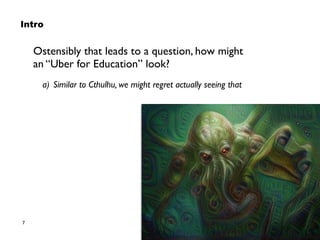
a) Similar to Cthulhu, we might regret actually seeing that
7
Intro
Ostensibly that leads to a question, how might 

an “Uber for Education” look?
a) Similar to Cthulhu, we might regret actually seeing that
8
Intro
Ostensibly that leads to a question, how might 

an “Uber for Education” look?
a) Similar to Cthulhu, we might regret actually seeing that
b) Would we really need that anywho?
9
Intro
Ostensibly that leads to a question, how might 

an “Uber for Education” look?
a) Similar to Cthulhu, we might regret actually seeing that
b) Would we really need that anywho?
c) Uber itself might not take that approach …
10
Intro
Ostensibly that leads to a question, how might 

an “Uber for Education” look?
a) Similar to Cthulhu, we might regret actually seeing that
b) Would we really need that anywho?
c) Uber itself might not take that approach …
Perhaps “Uber for Learning” might be somewhat

more apt?
In any case, what comes after Books,
Kindle, MOOCs?
11
Some Definitions…
“Learning”
ergo…
“Education”
ergo…
“School”
“Learning”
ergo…
“Education”
ergo…
“School”
X
12
Some Definitions…
Schools are great to have…
If you need a school, pick a 

good one and go
To be clear, we’re not a school
13
Some Definitions…
Even the best schools these days question

what they will become in 5-10 years
Not-so-best schools are perhaps questioning 

much more than that
14
Some Definitions…
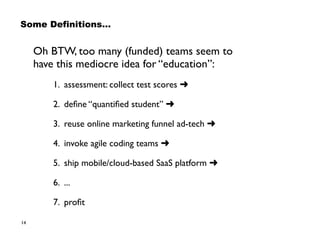
Oh BTW, too many (funded) teams seem to 

have this mediocre idea for “education”:
1. assessment: collect test scores ➜
2. define “quantified student” ➜
3. reuse online marketing funnel ad-tech ➜
4. invoke agile coding teams ➜
5. ship mobile/cloud-based SaaS platform ➜
6. ...
7. profit
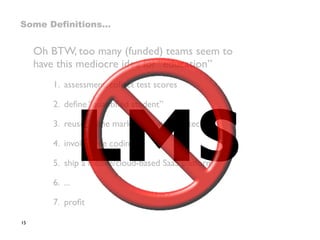
Oh BTW, too many (funded) teams seem to
have this mediocre idea for “education”
1. assessment: collect test scores
2. define “quantified student”
3. reuse online marketing funnel ad-tech
4. invoke agile coding
5. ship a mobile/cloud-based SaaS platform
6. ...
7. profit
15
Some Definitions…
LMS
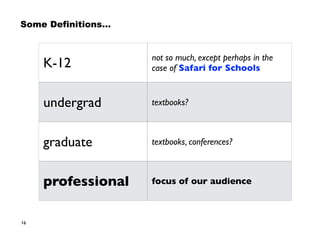
K-12 not so much, except perhaps in the
case of Safari for Schools
undergrad textbooks?
graduate textbooks, conferences?
professional focus of our audience
16
Some Definitions…
17
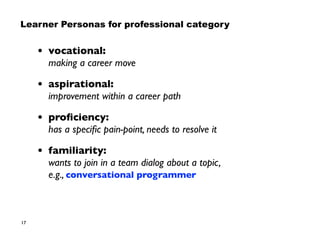
• vocational: 

making a career move
• aspirational: 

improvement within a career path
• proficiency: 

has a specific pain-point, needs to resolve it
• familiarity: 

wants to join in a team dialog about a topic, 

e.g., conversational programmer
Learner Personas for professional category
What about MOOCs?
19
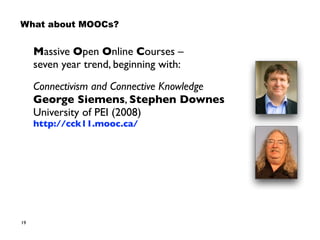
What about MOOCs?
Massive Open Online Courses – 

seven year trend, beginning with:
Connectivism and Connective Knowledge

George Siemens, Stephen Downes

University of PEI (2008)

http://cck11.mooc.ca/
20
What about MOOCs?
21
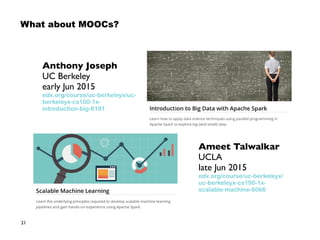
What about MOOCs?
Anthony Joseph

UC Berkeley
early Jun 2015
edx.org/course/uc-berkeleyx/uc-
berkeleyx-cs100-1x-
introduction-big-6181
Ameet Talwalkar

UCLA
late Jun 2015
edx.org/course/uc-berkeleyx/
uc-berkeleyx-cs190-1x-
scalable-machine-6066
22
What about MOOCs?
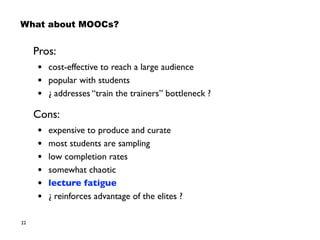
Pros:
• cost-effective to reach a large audience
• popular with students
• ¿ addresses “train the trainers” bottleneck ?
Cons:
• expensive to produce and curate
• most students are sampling
• low completion rates
• somewhat chaotic
• lecture fatigue
• ¿ reinforces advantage of the elites ?
23
What about MOOCs?
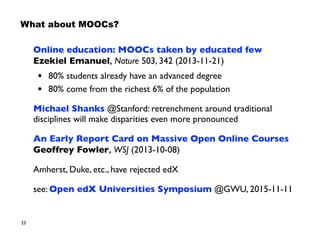
Online education: MOOCs taken by educated few

Ezekiel Emanuel, Nature 503, 342 (2013-11-21)
• 80% students already have an advanced degree
• 80% come from the richest 6% of the population
Michael Shanks @Stanford: retrenchment around traditional
disciplines will make disparities even more pronounced
An Early Report Card on Massive Open Online Courses

Geoffrey Fowler, WSJ (2013-10-08)
Amherst, Duke, etc., have rejected edX
see: Open edX Universities Symposium @GWU, 2015-11-11
24
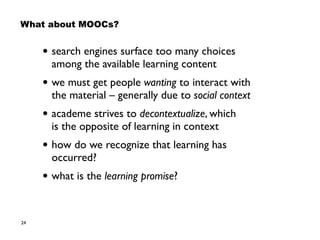
• search engines surface too many choices 

among the available learning content
• we must get people wanting to interact with
the material – generally due to social context
• academe strives to decontextualize, which 

is the opposite of learning in context
• how do we recognize that learning has
occurred?
• what is the learning promise?
What about MOOCs?
Examples for Consideration
26
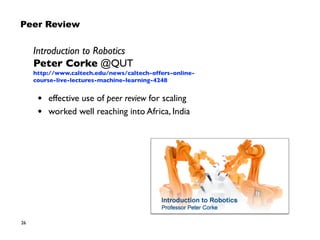
Introduction to Robotics
Peter Corke @QUT
https://moocs.qut.edu.au/learn/introduction-to-
robotics-august-2015
• effective use of peer review for scaling
• worked well reaching into Africa, India
Peer Review
27
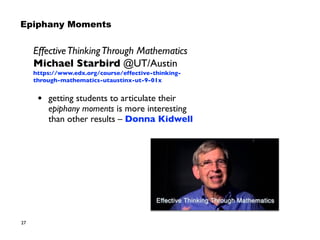
EffectiveThinkingThrough Mathematics
Michael Starbird @UT/Austin
https://www.edx.org/course/effective-thinking-
through-mathematics-utaustinx-ut-9-01x
• getting students to articulate their
epiphany moments is more interesting 

than other results – Donna Kidwell
Epiphany Moments
28
Caltech Offers Online Course with 

Live Lectures in Machine Learning
Yaser Abu-Mostafa (2012-03-30)
http://www.caltech.edu/news/caltech-offers-online-
course-live-lectures-machine-learning-4248
• significant improvement through the use
of “flipped” a.k.a. inverted classrooms
Inverted Classrooms
29
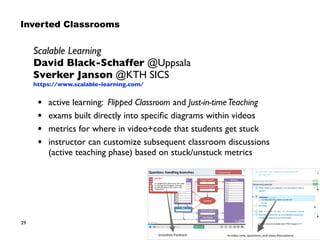
Scalable Learning

David Black-Schaffer @Uppsala

Sverker Janson @KTH SICS
https://www.scalable-learning.com/
• active learning: Flipped Classroom and Just-in-timeTeaching
• exams built directly into specific diagrams within videos
• metrics for where in video+code that students get stuck
• instructor can customize subsequent classroom discussions 

(active teaching phase) based on stuck/unstuck metrics
Inverted Classrooms
30
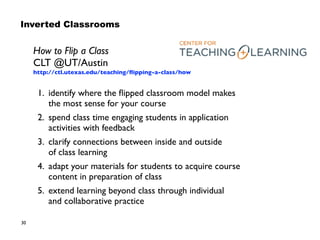
How to Flip a Class 

CLT @UT/Austin

http://ctl.utexas.edu/teaching/flipping-a-class/how
1. identify where the flipped classroom model makes 

the most sense for your course
2. spend class time engaging students in application
activities with feedback
3. clarify connections between inside and outside 

of class learning
4. adapt your materials for students to acquire course
content in preparation of class
5. extend learning beyond class through individual 

and collaborative practice
Inverted Classrooms
31
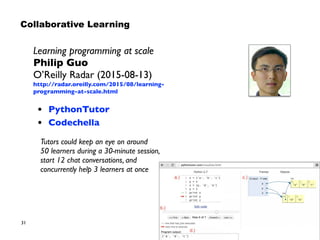
Learning programming at scale
Philip Guo 

O’Reilly Radar (2015-08-13)
http://radar.oreilly.com/2015/08/learning-
programming-at-scale.html
• PythonTutor
• Codechella
Tutors could keep an eye on around 

50 learners during a 30-minute session, 

start 12 chat conversations, and 

concurrently help 3 learners at once
Collaborative Learning
32
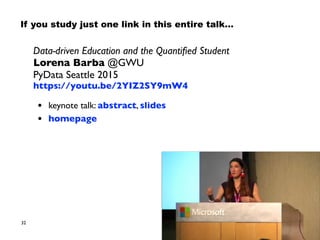
Data-driven Education and the Quantified Student
Lorena Barba @GWU
PyData Seattle 2015
https://youtu.be/2YIZ2SY9mW4
• keynote talk: abstract, slides
• homepage
If you study just one link in this entire talk…
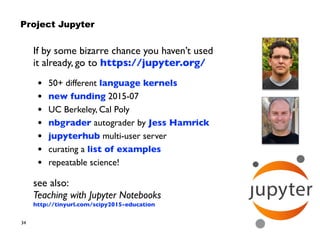
Project Jupyter
34
If by some bizarre chance you haven’t used 

it already, go to https://jupyter.org/
• 50+ different language kernels
• new funding 2015-07
• UC Berkeley, Cal Poly
• nbgrader autograder by Jess Hamrick
• jupyterhub multi-user server
• curating a list of examples
• repeatable science!
see also:

Teaching with Jupyter Notebooks

http://tinyurl.com/scipy2015-education
Project Jupyter
35
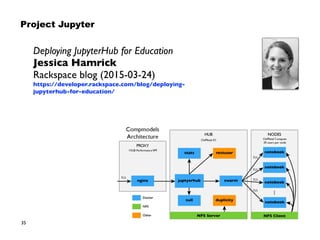
Deploying JupyterHub for Education

Jessica Hamrick

Rackspace blog (2015-03-24)

https://developer.rackspace.com/blog/deploying-
jupyterhub-for-education/
Project Jupyter
36
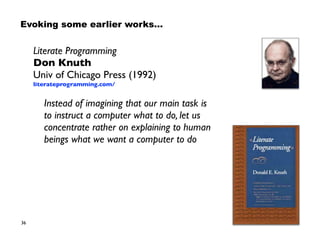
Literate Programming

Don Knuth

Univ of Chicago Press (1992)

literateprogramming.com/
Instead of imagining that our main task is 

to instruct a computer what to do, let us

concentrate rather on explaining to human

beings what we want a computer to do
Evoking some earlier works…
37
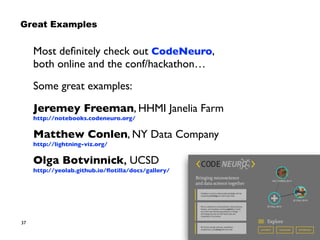
Most definitely check out CodeNeuro,
both online and the conf/hackathon…
Some great examples:
Jeremey Freeman, HHMI Janelia Farm

http://notebooks.codeneuro.org/
Matthew Conlen, NY Data Company

http://lightning-viz.org/
Olga Botvinnick, UCSD

http://yeolab.github.io/flotilla/docs/gallery/
Great Examples
38
http://mybinder.org/
turn a GitHub repo into a collection 

of interactive notebooks powered by
Jupyter and Kubernetes
Launch Vehicles
Jupyter, Thebe, Atlas, Docker
40
Embracing Jupyter Notebooks at O'Reilly

Andrew Odewahn

O’Reilly Media (2015-05-07)
https://beta.oreilly.com/ideas/jupyter-at-oreilly
O’Reilly Media is using our Atlas platform 

to make Jupyter Notebooks a first class
authoring environment for our publishing
program
Jupyter, Thebe, Atlas, Docker, etc.
Content Toolchain
41
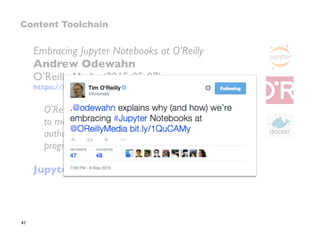
Embracing Jupyter Notebooks at O'Reilly
Andrew Odewahn
O’Reilly Media (2015-05-07)
https://beta.oreilly.com/ideas/jupyter-at-oreilly
O’Reilly Media is using our Atlas platform
to make Jupyter Notebooks a first class
authoring environment for our publishing
program
Jupyter
Content Toolchain
42
On Demand Analytic and Learning Environments with Jupyter

Kyle Kelley, Andrew Odewahn

lambdaops.com/jupyter-environments-odsc2015/
Exploring a couple themes, in particular:
• computational narratives
- exploratory data analysis
- software development/collaboration
- API exploration
- technical papers
- reports, exec dashboards
• code-as-media
- Thebe project, etc.
Content Toolchain
43
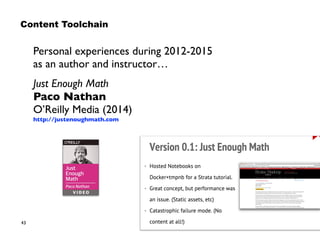
Personal experiences during 2012-2015 

as an author and instructor…
Just Enough Math

Paco Nathan

O’Reilly Media (2014)

http://justenoughmath.com
Content Toolchain
44
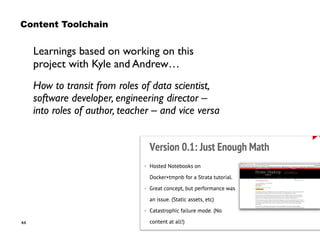
Learnings based on working on this
project with Kyle and Andrew…
How to transit from roles of data scientist,
software developer, engineering director – 

into roles of author, teacher – and vice versa
Content Toolchain
45
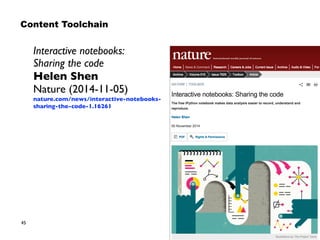
Interactive notebooks: 

Sharing the code
Helen Shen
Nature (2014-11-05)
nature.com/news/interactive-notebooks-
sharing-the-code-1.16261
Content Toolchain
46
Content Toolchain
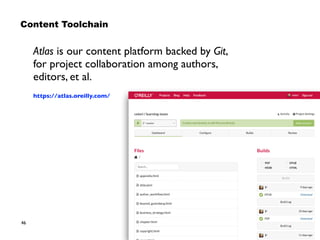
Atlas is our content platform backed by Git,
for project collaboration among authors,
editors, et al.
https://atlas.oreilly.com/
47
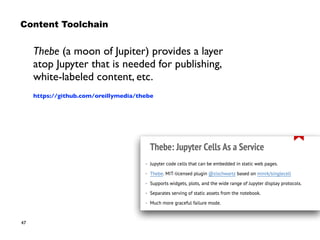
Content Toolchain
Thebe (a moon of Jupiter) provides a layer
atop Jupyter that is needed for publishing,
white-labeled content, etc.
https://github.com/oreillymedia/thebe
48
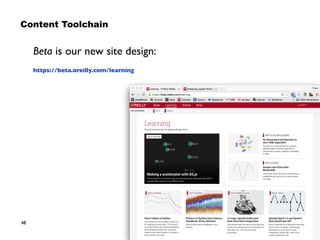
Content Toolchain
Beta is our new site design:
https://beta.oreilly.com/learning
49
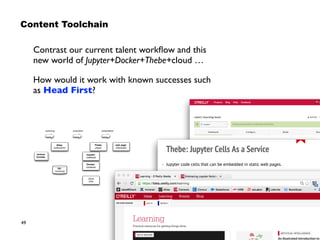
Content Toolchain
Contrast our current talent workflow and this 

new world of Jupyter+Docker+Thebe+cloud …
How would it work with known successes such 

as Head First?
production presentation
Thebe:
player
Jupyter:
notebook
Docker:
container
web page:
interaction
Git:
versioning
Atlas:
publications
various
formats
authoring
cloud
infra
Does Science begin with
Phenomenology?
51
Audience Patterns for Learning: ad-hoc
52
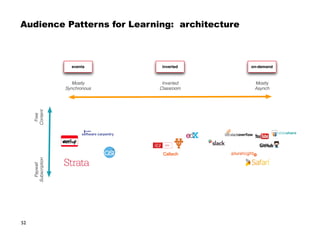
Audience Patterns for Learning: architecture
events inverted on-demand
Mostly
Synchronous
Mostly
Asynch
Inverted
Classroom
Paywall
Subscription
Free
Content
53
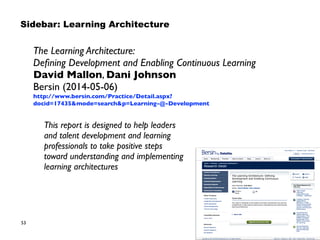
The Learning Architecture:
Defining Development and Enabling Continuous Learning
David Mallon, Dani Johnson
Bersin (2014-05-06)
http://www.bersin.com/Practice/Detail.aspx?
docid=17435&mode=search&p=Learning-@-Development
This report is designed to help leaders 

and talent development and learning 

professionals to take positive steps 

toward understanding and implementing 

learning architectures
Sidebar: Learning Architecture
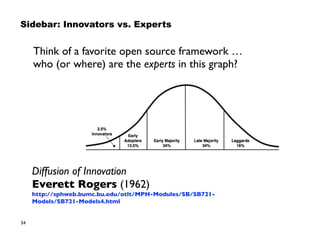
Think of a favorite open source framework …
who (or where) are the experts in this graph?
Sidebar: Innovators vs. Experts
Diffusion of Innovation

Everett Rogers (1962)

http://sphweb.bumc.bu.edu/otlt/MPH-Modules/SB/SB721-
Models/SB721-Models4.html
54
55
Building Blocks
In software engineering, we rarely hand a 

developer the spec for some app and say 

“Start from scratch, then come back when
you’re done.” Instead:
• focus on MVP
• leverage APIs, libraries, microservices, etc.
• iterate on small, incremental changes
• this allows for TDD, CI, etc.
• plus, customer experiments ➜ data science
Compare/contrast that with how publishers
approach authors, speakers, instructors?
56
Building Blocks
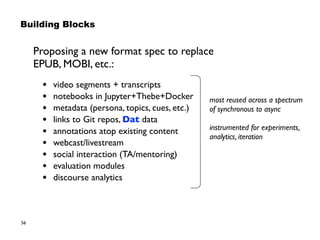
Proposing a new format spec to replace 

EPUB, MOBI, etc.:
• video segments + transcripts
• notebooks in Jupyter+Thebe+Docker
• metadata (persona, topics, cues, etc.)
• links to Git repos, Dat data
• annotations atop existing content
• webcast/livestream
• social interaction (TA/mentoring)
• evaluation modules
• discourse analytics
most reused across a spectrum
of synchronous to async
instrumented for experiments,
analytics, iteration
57
total
newbie
good
overview
Do you have sufficient familiarity with the topic?
utterly
confused
familiar
territory
Can you build on familiarity with a related topic?
must get
unstuck
send pull
request
Do you have necessary proficiency in the topic?
learner
topic
experience
concise
topic
inter-
disciplinary
How many boundaries must you span to achieve structural literacy for this topic?
want to
for myself
have to
for my job
What is your primary motivation to learn this topic?
bleeding
edge
COBOL 2020
Where are you on the "diffusion of innovation" curve w.r.t. the topic?
on-
demand
major
event
How high is the transaction cost for the experience delivered to you?
"go read
the code"
full-team
participation
Does the learning experience immerse you within a diverse, supportive social context?
Dimensional Reduction
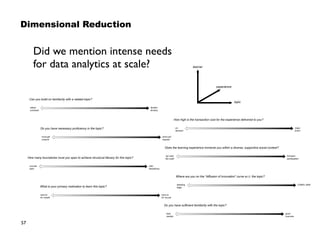
Did we mention intense needs 

for data analytics at scale?
58
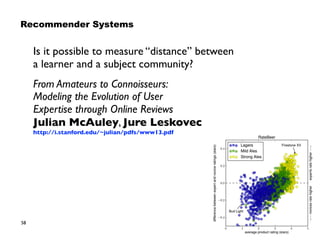
Is it possible to measure “distance” between 

a learner and a subject community?
From Amateurs to Connoisseurs:

Modeling the Evolution of User 

Expertise through Online Reviews

Julian McAuley, Jure Leskovec

http://i.stanford.edu/~julian/pdfs/www13.pdf
Recommender Systems
59
Back to “Uber for Learning” – approaching from a learner
(audience) perspective, generally within a social context
Given that:
• books aren’t used by learners as much anymore
• experts don’t have time to write books anymore
If we can:
• fit learners’ needs to topics w.r.t. subject communities, 

based on their S-curve positions
• personalize lectures for learners’ pain-points
• reuse containerized building blocks
Imagine the extent to which our current data science 

tooling and techniques can be leveraged?
Summary
60
PS: If you are interested in opportunities 

to write, speak, teach, mentor, code, etc., 

based on these approaches, let us know
Get Involved!
Thank You!
and
Stay Tuned…
presenter:
Just Enough Math
O’Reilly (2014)
justenoughmath.com
monthly newsletter for updates, 

events, conf summaries, etc.:
liber118.com/pxn/

Data Science Reinvents Learning?

  • 1.
    2015-08-24 • SanJose Paco Nathan, @pacoid
 Director, O’Reilly Learning Data Science Reinvents Learning? Beyond Gutenberg and Erasmus meetup.com/SF-Bay-ACM/events/221693508/
  • 2.
    2 Some Background… • O’ReillyLearning: you may only hear about us in 
 a few instances, if we do our job well; ACM is a great forum for this discussion • prior: built-out the community evangelism and training program for Apache Spark at Databricks • prior: led Data teams for several years, working on 
 large-scale ML apps in industry, including: one of the largest Hadoop instances running in AWS (2008); 
 one of the first 100% AWS system architectures (2006) • … • ancient prior: Stanford CSD teaching fellowship (1984-86, Alice Supton, Stuart Reges) peer-teaching CS course which later became Residential Computing
  • 3.
  • 4.
    4 Intro Quite candidly, theone common catch phrase 
 in SiliconValley that I find most terrifying: “It’s like Uber, for ___”
  • 5.
    5 Intro Ostensibly that leadsto a question, how might 
 an “Uber for Education” look?
  • 6.
    6 Intro Ostensibly that leadsto a question, how might 
 an “Uber for Education” look? a) Similar to Cthulhu, we might regret actually seeing that
  • 7.
    7 Intro Ostensibly that leadsto a question, how might 
 an “Uber for Education” look? a) Similar to Cthulhu, we might regret actually seeing that
  • 8.
    8 Intro Ostensibly that leadsto a question, how might 
 an “Uber for Education” look? a) Similar to Cthulhu, we might regret actually seeing that b) Would we really need that anywho?
  • 9.
    9 Intro Ostensibly that leadsto a question, how might 
 an “Uber for Education” look? a) Similar to Cthulhu, we might regret actually seeing that b) Would we really need that anywho? c) Uber itself might not take that approach …
  • 10.
    10 Intro Ostensibly that leadsto a question, how might 
 an “Uber for Education” look? a) Similar to Cthulhu, we might regret actually seeing that b) Would we really need that anywho? c) Uber itself might not take that approach … Perhaps “Uber for Learning” might be somewhat
 more apt? In any case, what comes after Books, Kindle, MOOCs?
  • 11.
  • 12.
    “Learning” ergo… “Education” ergo… “School” X 12 Some Definitions… Schools aregreat to have… If you need a school, pick a 
 good one and go To be clear, we’re not a school
  • 13.
    13 Some Definitions… Even thebest schools these days question
 what they will become in 5-10 years Not-so-best schools are perhaps questioning 
 much more than that
  • 14.
    14 Some Definitions… Oh BTW,too many (funded) teams seem to 
 have this mediocre idea for “education”: 1. assessment: collect test scores ➜ 2. define “quantified student” ➜ 3. reuse online marketing funnel ad-tech ➜ 4. invoke agile coding teams ➜ 5. ship mobile/cloud-based SaaS platform ➜ 6. ... 7. profit
  • 15.
    Oh BTW, toomany (funded) teams seem to have this mediocre idea for “education” 1. assessment: collect test scores 2. define “quantified student” 3. reuse online marketing funnel ad-tech 4. invoke agile coding 5. ship a mobile/cloud-based SaaS platform 6. ... 7. profit 15 Some Definitions… LMS
  • 16.
    K-12 not somuch, except perhaps in the case of Safari for Schools undergrad textbooks? graduate textbooks, conferences? professional focus of our audience 16 Some Definitions…
  • 17.
    17 • vocational: 
 makinga career move • aspirational: 
 improvement within a career path • proficiency: 
 has a specific pain-point, needs to resolve it • familiarity: 
 wants to join in a team dialog about a topic, 
 e.g., conversational programmer Learner Personas for professional category
  • 18.
  • 19.
    19 What about MOOCs? MassiveOpen Online Courses – 
 seven year trend, beginning with: Connectivism and Connective Knowledge
 George Siemens, Stephen Downes
 University of PEI (2008)
 http://cck11.mooc.ca/
  • 20.
  • 21.
    21 What about MOOCs? AnthonyJoseph
 UC Berkeley early Jun 2015 edx.org/course/uc-berkeleyx/uc- berkeleyx-cs100-1x- introduction-big-6181 Ameet Talwalkar
 UCLA late Jun 2015 edx.org/course/uc-berkeleyx/ uc-berkeleyx-cs190-1x- scalable-machine-6066
  • 22.
    22 What about MOOCs? Pros: •cost-effective to reach a large audience • popular with students • ¿ addresses “train the trainers” bottleneck ? Cons: • expensive to produce and curate • most students are sampling • low completion rates • somewhat chaotic • lecture fatigue • ¿ reinforces advantage of the elites ?
  • 23.
    23 What about MOOCs? Onlineeducation: MOOCs taken by educated few
 Ezekiel Emanuel, Nature 503, 342 (2013-11-21) • 80% students already have an advanced degree • 80% come from the richest 6% of the population Michael Shanks @Stanford: retrenchment around traditional disciplines will make disparities even more pronounced An Early Report Card on Massive Open Online Courses
 Geoffrey Fowler, WSJ (2013-10-08) Amherst, Duke, etc., have rejected edX see: Open edX Universities Symposium @GWU, 2015-11-11
  • 24.
    24 • search enginessurface too many choices 
 among the available learning content • we must get people wanting to interact with the material – generally due to social context • academe strives to decontextualize, which 
 is the opposite of learning in context • how do we recognize that learning has occurred? • what is the learning promise? What about MOOCs?
  • 25.
  • 26.
    26 Introduction to Robotics PeterCorke @QUT https://moocs.qut.edu.au/learn/introduction-to- robotics-august-2015 • effective use of peer review for scaling • worked well reaching into Africa, India Peer Review
  • 27.
    27 EffectiveThinkingThrough Mathematics Michael Starbird@UT/Austin https://www.edx.org/course/effective-thinking- through-mathematics-utaustinx-ut-9-01x • getting students to articulate their epiphany moments is more interesting 
 than other results – Donna Kidwell Epiphany Moments
  • 28.
    28 Caltech Offers OnlineCourse with 
 Live Lectures in Machine Learning Yaser Abu-Mostafa (2012-03-30) http://www.caltech.edu/news/caltech-offers-online- course-live-lectures-machine-learning-4248 • significant improvement through the use of “flipped” a.k.a. inverted classrooms Inverted Classrooms
  • 29.
    29 Scalable Learning
 David Black-Schaffer@Uppsala
 Sverker Janson @KTH SICS https://www.scalable-learning.com/ • active learning: Flipped Classroom and Just-in-timeTeaching • exams built directly into specific diagrams within videos • metrics for where in video+code that students get stuck • instructor can customize subsequent classroom discussions 
 (active teaching phase) based on stuck/unstuck metrics Inverted Classrooms
  • 30.
    30 How to Flipa Class 
 CLT @UT/Austin
 http://ctl.utexas.edu/teaching/flipping-a-class/how 1. identify where the flipped classroom model makes 
 the most sense for your course 2. spend class time engaging students in application activities with feedback 3. clarify connections between inside and outside 
 of class learning 4. adapt your materials for students to acquire course content in preparation of class 5. extend learning beyond class through individual 
 and collaborative practice Inverted Classrooms
  • 31.
    31 Learning programming atscale Philip Guo 
 O’Reilly Radar (2015-08-13) http://radar.oreilly.com/2015/08/learning- programming-at-scale.html • PythonTutor • Codechella Tutors could keep an eye on around 
 50 learners during a 30-minute session, 
 start 12 chat conversations, and 
 concurrently help 3 learners at once Collaborative Learning
  • 32.
    32 Data-driven Education andthe Quantified Student Lorena Barba @GWU PyData Seattle 2015 https://youtu.be/2YIZ2SY9mW4 • keynote talk: abstract, slides • homepage If you study just one link in this entire talk…
  • 33.
  • 34.
    34 If by somebizarre chance you haven’t used 
 it already, go to https://jupyter.org/ • 50+ different language kernels • new funding 2015-07 • UC Berkeley, Cal Poly • nbgrader autograder by Jess Hamrick • jupyterhub multi-user server • curating a list of examples • repeatable science! see also:
 Teaching with Jupyter Notebooks
 http://tinyurl.com/scipy2015-education Project Jupyter
  • 35.
    35 Deploying JupyterHub forEducation
 Jessica Hamrick
 Rackspace blog (2015-03-24)
 https://developer.rackspace.com/blog/deploying- jupyterhub-for-education/ Project Jupyter
  • 36.
    36 Literate Programming
 Don Knuth
 Univof Chicago Press (1992)
 literateprogramming.com/ Instead of imagining that our main task is 
 to instruct a computer what to do, let us
 concentrate rather on explaining to human
 beings what we want a computer to do Evoking some earlier works…
  • 37.
    37 Most definitely checkout CodeNeuro, both online and the conf/hackathon… Some great examples: Jeremey Freeman, HHMI Janelia Farm
 http://notebooks.codeneuro.org/ Matthew Conlen, NY Data Company
 http://lightning-viz.org/ Olga Botvinnick, UCSD
 http://yeolab.github.io/flotilla/docs/gallery/ Great Examples
  • 38.
    38 http://mybinder.org/ turn a GitHubrepo into a collection 
 of interactive notebooks powered by Jupyter and Kubernetes Launch Vehicles
  • 39.
  • 40.
    40 Embracing Jupyter Notebooksat O'Reilly
 Andrew Odewahn
 O’Reilly Media (2015-05-07) https://beta.oreilly.com/ideas/jupyter-at-oreilly O’Reilly Media is using our Atlas platform 
 to make Jupyter Notebooks a first class authoring environment for our publishing program Jupyter, Thebe, Atlas, Docker, etc. Content Toolchain
  • 41.
    41 Embracing Jupyter Notebooksat O'Reilly Andrew Odewahn O’Reilly Media (2015-05-07) https://beta.oreilly.com/ideas/jupyter-at-oreilly O’Reilly Media is using our Atlas platform to make Jupyter Notebooks a first class authoring environment for our publishing program Jupyter Content Toolchain
  • 42.
    42 On Demand Analyticand Learning Environments with Jupyter
 Kyle Kelley, Andrew Odewahn
 lambdaops.com/jupyter-environments-odsc2015/ Exploring a couple themes, in particular: • computational narratives - exploratory data analysis - software development/collaboration - API exploration - technical papers - reports, exec dashboards • code-as-media - Thebe project, etc. Content Toolchain
  • 43.
    43 Personal experiences during2012-2015 
 as an author and instructor… Just Enough Math
 Paco Nathan
 O’Reilly Media (2014)
 http://justenoughmath.com Content Toolchain
  • 44.
    44 Learnings based onworking on this project with Kyle and Andrew… How to transit from roles of data scientist, software developer, engineering director – 
 into roles of author, teacher – and vice versa Content Toolchain
  • 45.
    45 Interactive notebooks: 
 Sharingthe code Helen Shen Nature (2014-11-05) nature.com/news/interactive-notebooks- sharing-the-code-1.16261 Content Toolchain
  • 46.
    46 Content Toolchain Atlas isour content platform backed by Git, for project collaboration among authors, editors, et al. https://atlas.oreilly.com/
  • 47.
    47 Content Toolchain Thebe (amoon of Jupiter) provides a layer atop Jupyter that is needed for publishing, white-labeled content, etc. https://github.com/oreillymedia/thebe
  • 48.
    48 Content Toolchain Beta isour new site design: https://beta.oreilly.com/learning
  • 49.
    49 Content Toolchain Contrast ourcurrent talent workflow and this 
 new world of Jupyter+Docker+Thebe+cloud … How would it work with known successes such 
 as Head First? production presentation Thebe: player Jupyter: notebook Docker: container web page: interaction Git: versioning Atlas: publications various formats authoring cloud infra
  • 50.
    Does Science beginwith Phenomenology?
  • 51.
    51 Audience Patterns forLearning: ad-hoc
  • 52.
    52 Audience Patterns forLearning: architecture events inverted on-demand Mostly Synchronous Mostly Asynch Inverted Classroom Paywall Subscription Free Content
  • 53.
    53 The Learning Architecture: DefiningDevelopment and Enabling Continuous Learning David Mallon, Dani Johnson Bersin (2014-05-06) http://www.bersin.com/Practice/Detail.aspx? docid=17435&mode=search&p=Learning-@-Development This report is designed to help leaders 
 and talent development and learning 
 professionals to take positive steps 
 toward understanding and implementing 
 learning architectures Sidebar: Learning Architecture
  • 54.
    Think of afavorite open source framework … who (or where) are the experts in this graph? Sidebar: Innovators vs. Experts Diffusion of Innovation
 Everett Rogers (1962)
 http://sphweb.bumc.bu.edu/otlt/MPH-Modules/SB/SB721- Models/SB721-Models4.html 54
  • 55.
    55 Building Blocks In softwareengineering, we rarely hand a 
 developer the spec for some app and say 
 “Start from scratch, then come back when you’re done.” Instead: • focus on MVP • leverage APIs, libraries, microservices, etc. • iterate on small, incremental changes • this allows for TDD, CI, etc. • plus, customer experiments ➜ data science Compare/contrast that with how publishers approach authors, speakers, instructors?
  • 56.
    56 Building Blocks Proposing anew format spec to replace 
 EPUB, MOBI, etc.: • video segments + transcripts • notebooks in Jupyter+Thebe+Docker • metadata (persona, topics, cues, etc.) • links to Git repos, Dat data • annotations atop existing content • webcast/livestream • social interaction (TA/mentoring) • evaluation modules • discourse analytics most reused across a spectrum of synchronous to async instrumented for experiments, analytics, iteration
  • 57.
    57 total newbie good overview Do you havesufficient familiarity with the topic? utterly confused familiar territory Can you build on familiarity with a related topic? must get unstuck send pull request Do you have necessary proficiency in the topic? learner topic experience concise topic inter- disciplinary How many boundaries must you span to achieve structural literacy for this topic? want to for myself have to for my job What is your primary motivation to learn this topic? bleeding edge COBOL 2020 Where are you on the "diffusion of innovation" curve w.r.t. the topic? on- demand major event How high is the transaction cost for the experience delivered to you? "go read the code" full-team participation Does the learning experience immerse you within a diverse, supportive social context? Dimensional Reduction Did we mention intense needs 
 for data analytics at scale?
  • 58.
    58 Is it possibleto measure “distance” between 
 a learner and a subject community? From Amateurs to Connoisseurs:
 Modeling the Evolution of User 
 Expertise through Online Reviews
 Julian McAuley, Jure Leskovec
 http://i.stanford.edu/~julian/pdfs/www13.pdf Recommender Systems
  • 59.
    59 Back to “Uberfor Learning” – approaching from a learner (audience) perspective, generally within a social context Given that: • books aren’t used by learners as much anymore • experts don’t have time to write books anymore If we can: • fit learners’ needs to topics w.r.t. subject communities, 
 based on their S-curve positions • personalize lectures for learners’ pain-points • reuse containerized building blocks Imagine the extent to which our current data science 
 tooling and techniques can be leveraged? Summary
  • 60.
    60 PS: If youare interested in opportunities 
 to write, speak, teach, mentor, code, etc., 
 based on these approaches, let us know Get Involved!
  • 61.
  • 62.
    presenter: Just Enough Math O’Reilly(2014) justenoughmath.com monthly newsletter for updates, 
 events, conf summaries, etc.: liber118.com/pxn/