Tetherless World Constellation 
Watson: an academic 
perspective 
Jim Hendler 
Tetherless World Professor of Computer, Web and Cognitive Sciences 
Director, The Rensselaer Institute for Data Exploration and Applications 
Rensselaer Polytechnic Institute 
http://www.cs.rpi.edu/~hendler 
@jahendler (twitter)
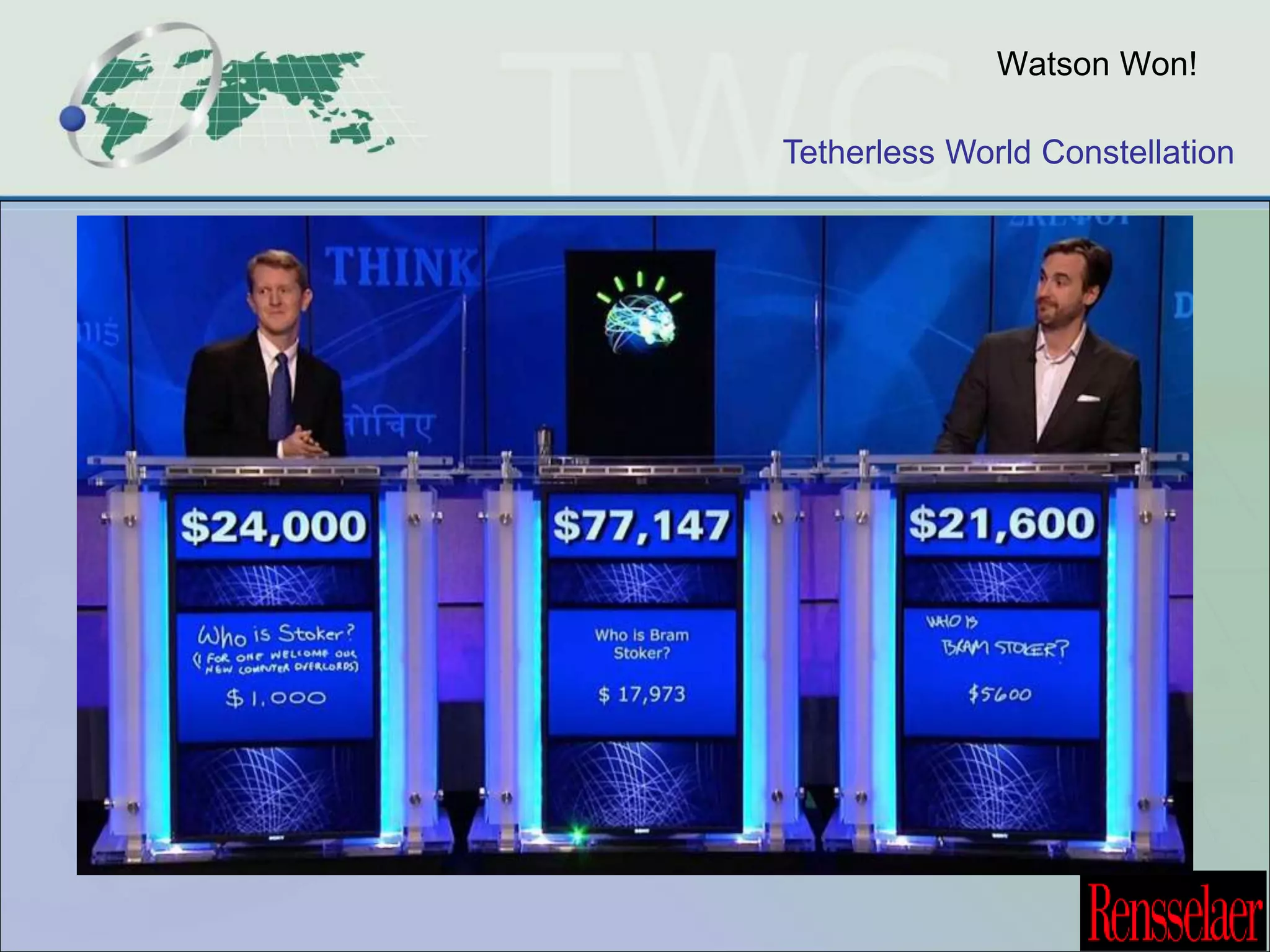
Watson Won! 
Tetherless World Constellation
What is the SCIENCE that Watson informs 
Tetherless World Constellation 
• As a researcher the question isn't 
just “what else can it do,” it’s what 
can we learn from it 
– and do better 
• That is “Why did Watson win?” 
– is it a bag of tricks that plays Jeopardy 
• or does enterprise search 
– or does it expose something 
fundamental about computing?
Why did Watson win? 
Tetherless World Constellation 
• From a research perspective Watson 
is interesting in a number of ways 
– because of the underlying “cognitive pipeline” 
– as a different approach to memory-based 
reasoning 
– as a model of (some aspects) of human 
cognition 
– as the validation of a fundamental AI paradigm 
• and thus a contribution to the 
fundamentals of computing
Why did Watson win? 
Tetherless World Constellation 
• From a research perspective Watson 
is interesting in a number of ways 
– because of the underlying “cognitive pipeline” 
– as a different approach to memory-based 
reasoning 
– as a model of (some aspects) of human 
cognition 
– as the validation of a fundamental AI paradigm 
• and thus a contribution to the 
fundamentals of computing
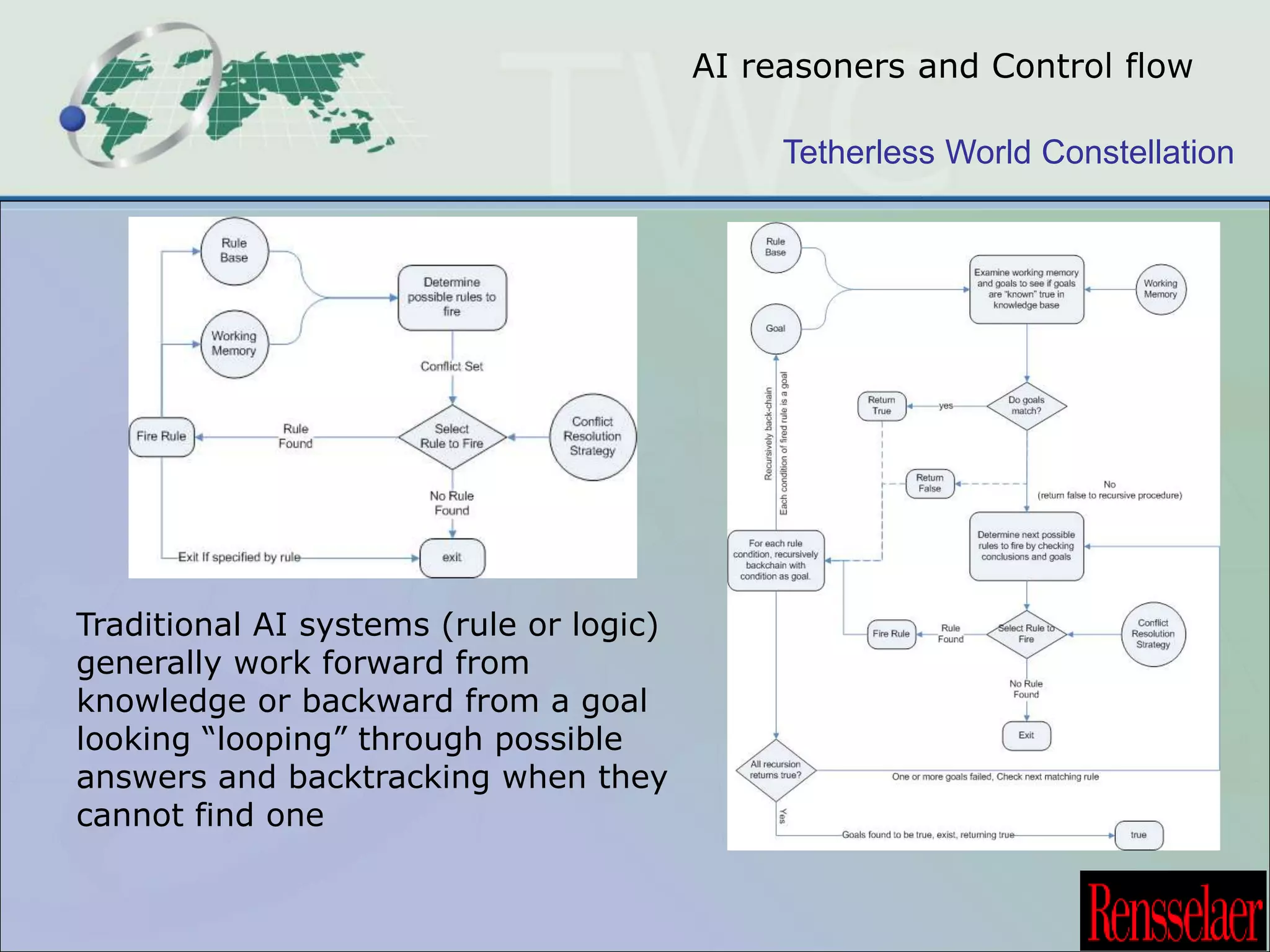
AI reasoners and Control flow 
Tetherless World Constellation 
Traditional AI systems (rule or logic) 
generally work forward from 
knowledge or backward from a goal 
looking “looping” through possible 
answers and backtracking when they 
cannot find one
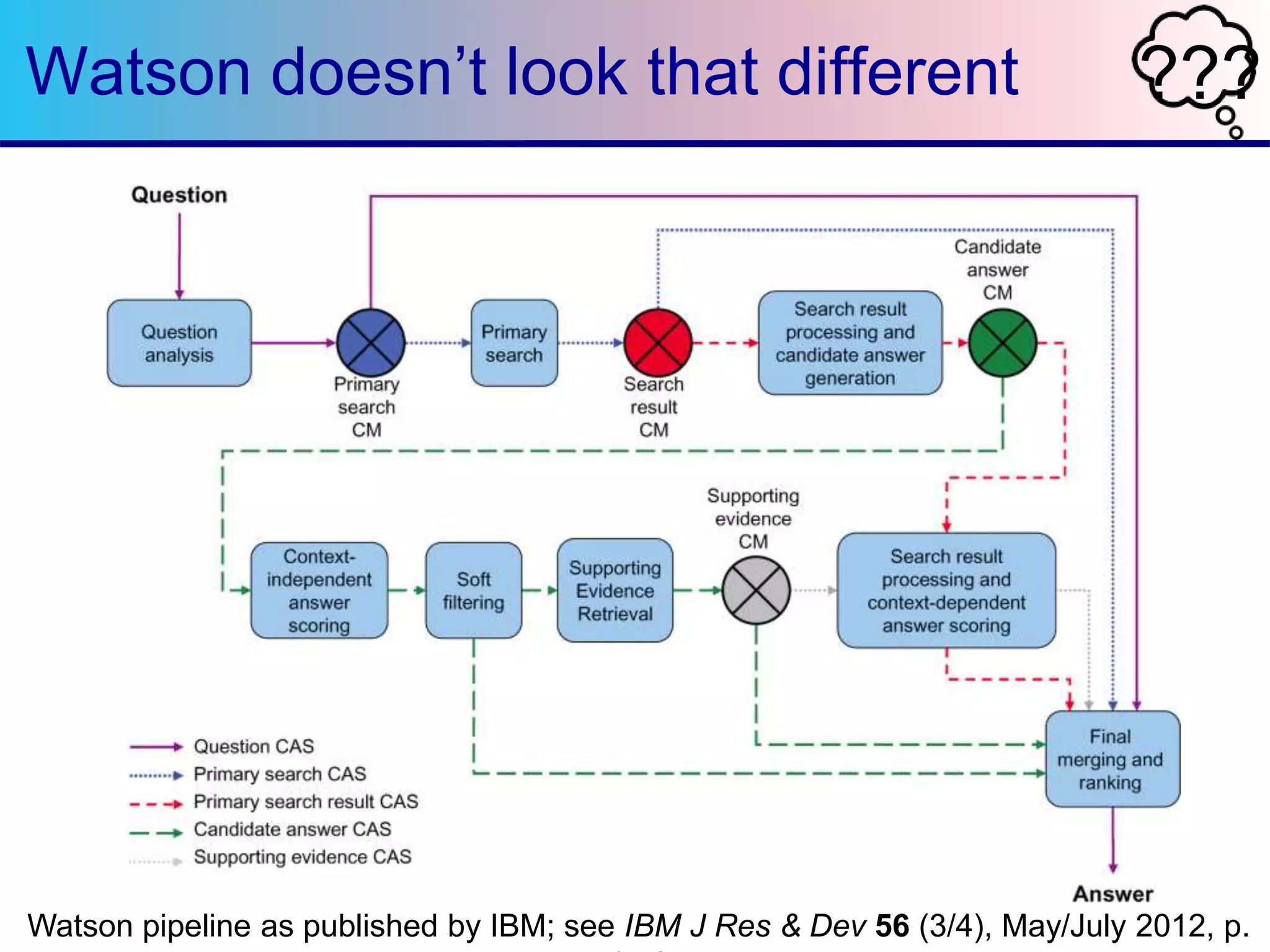
Watson doesn’t look that different ??? 
Watson pipeline as published by IBM; see IBM J Res & Dev 56 (3/4), May/July 2012, p. 
15:2
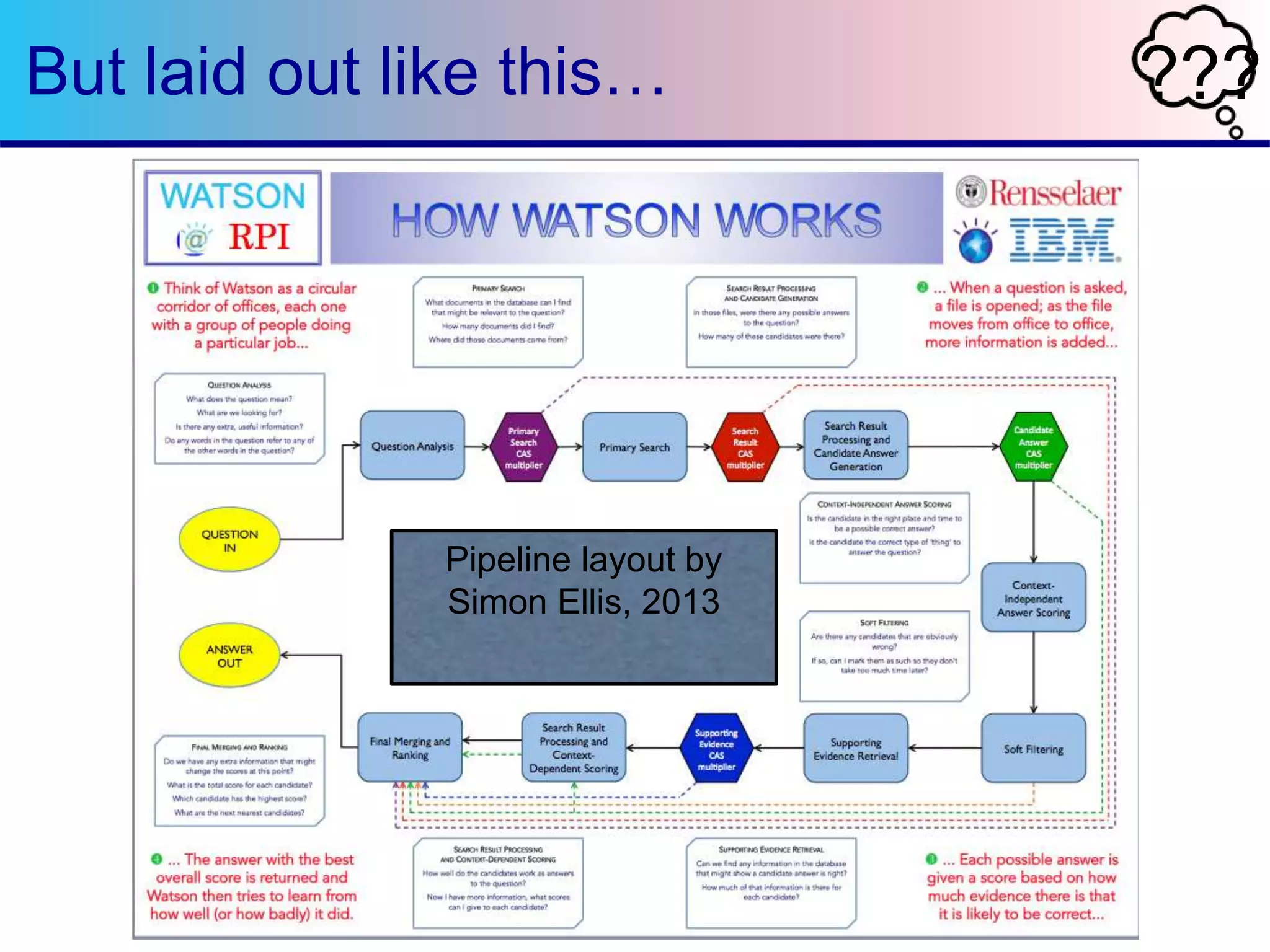
But laid out like this… ??? 
Pipeline layout by 
Simon Ellis, 2013
The Watson Pipeline 
Tetherless World Constellation 
• Consider many candidate answers in parallel 
– evaluate them all 
• Avoid loops 
– control structure straight-forward basically “feed forward 
only” 
• a couple of special exceptions for some kinds of Jeopardy 
questions 
• some differences in newer Watson Q/A, but still the 
essential structure 
• This loop can be embedded in a “set of 
questions” graph 
– Differential diagnosis (eg. Watson paths) 
– Watson as Advisor (RPI work) 
– …
Why did Watson win? 
Tetherless World Constellation 
• From a research perspective Watson 
is interesting in a number of ways 
– because of the underlying “cognitive pipeline” 
– as a different approach to memory-based 
reasoning 
– as a model of (some aspects) of human 
cognition 
– as the validation of a fundamental AI paradigm 
• and thus a contribution to the 
fundamentals of computing
Modern AI 
Tetherless World Constellation 
• The Watson program is already a breakthrough 
technology in AI. For many years it had been 
largely assumed that for a computer to go 
beyond search and really be able to perform 
complex human language tasks it needed to do 
one of two things: either it would 
“understand” the texts using some kind of 
deep “knowledge representation,” or it 
would have a complex statistical model 
based on millions of texts. 
from Watson goes to college: How the world’s smartest PC will 
revolutionize AI, GigaOm, 3/2/2013
In contrast 
Tetherless World Constellation 
• Watson used very little of either of these. Rather, 
it uses a lot of memory and clever ways of pulling 
texts from that memory. Thus, Watson 
demonstrated what some in AI had 
conjectured, but to date been unable to 
prove: that intelligence is tied to an ability 
to appropriately find relevant information in 
a very large memory. 
from Watson goes to college: How the world’s smartest PC will 
revolutionize AI, GigaOm, 3/2/2013
in the interest of time 
Tetherless World Constellation 
• [Several hours of boring blather in 
academic jargon about the 
importance of the above] deleted 
– Trust me, this is really important! 
• provides the “third leg” needed for AI
Why did Watson win? 
Tetherless World Constellation 
• From a research perspective Watson 
is interesting in a number of ways 
– because of the underlying “cognitive pipeline” 
– as a different approach to memory-based 
reasoning 
– as a model of (some aspects) of human 
cognition 
– as the validation of a fundamental AI paradigm 
• and thus a contribution to the 
fundamentals of computing
Is Watson cognitive? ??? 
“The computer’s techniques for unraveling Jeopardy! clues sounded 
just like mine. That machine zeroes in on key words in a clue, then 
combs its memory (in Watson’s case, a 15-terabyte data bank of 
human knowledge) for clusters of associations with those words. It 
rigorously checks the top hits against all the contextual information it 
can muster: the category name; the kind of answer being sought; the 
time, place, and gender hinted at in the clue; and so on. And when it 
feels ‘sure’ enough, it decides to buzz. This is all an instant, intuitive 
process for a human Jeopardy! player, but I felt convinced that under 
the hood my brain was doing more or less the same thing.” 
— Ken Jennings
Is Ken right? 
Tetherless World Constellation 
• Q: How does Watson fare as a 
complete cognitive model? 
• A: Poorly 
– no conversational ability 
– no concept of self 
– no deeper reasoning 
(Watson’s critics harp on these) 
• Q: But, how does Watson fare as a 
model of question answering?
But… much better when compared to “memory” 
models 
Tetherless World Constellation 
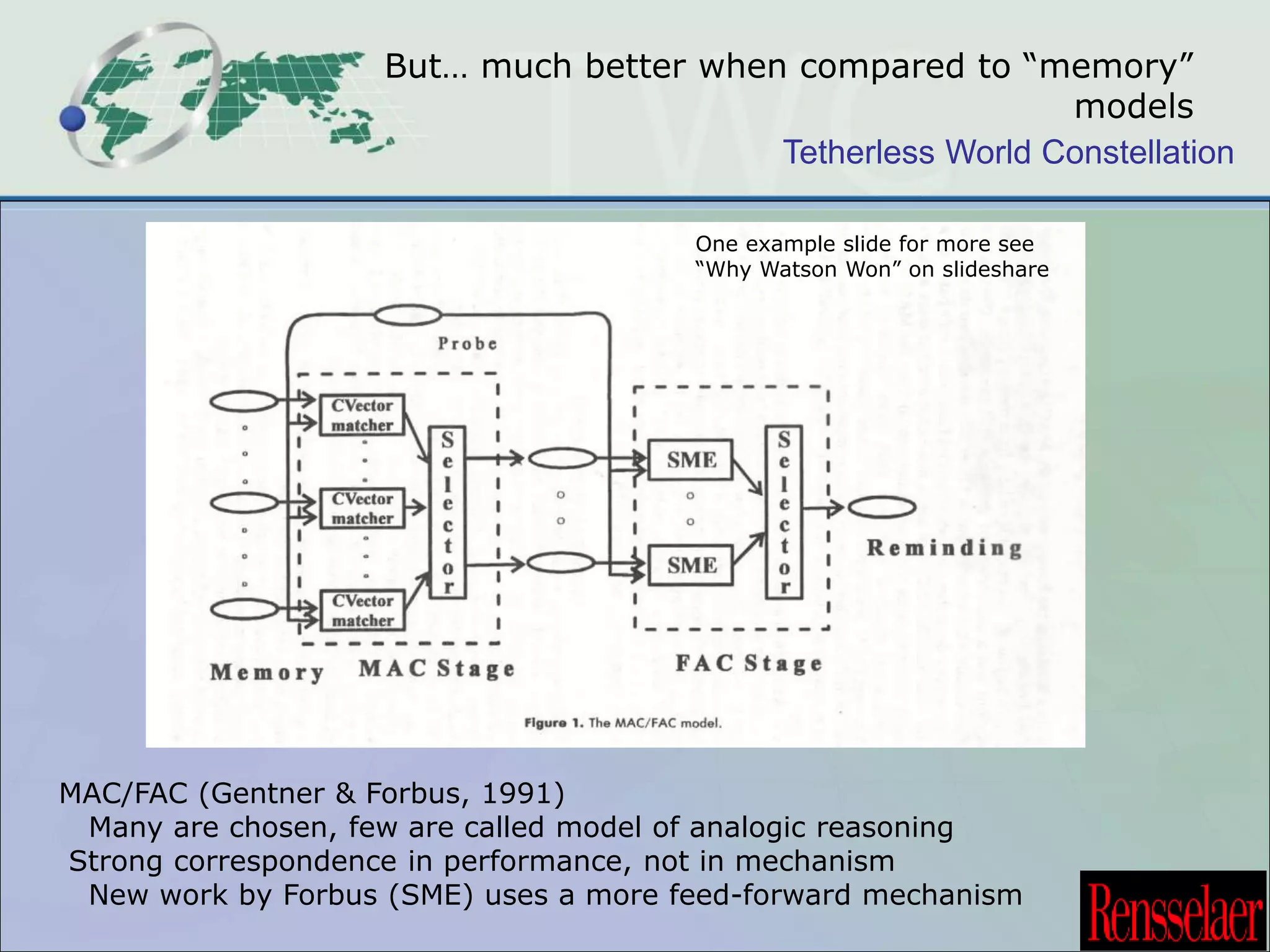
MAC/FAC (Gentner & Forbus, 1991) 
One example slide for more see 
“Why Watson Won” on slideshare 
Many are chosen, few are called model of analogic reasoning 
Strong correspondence in performance, not in mechanism 
New work by Forbus (SME) uses a more feed-forward mechanism
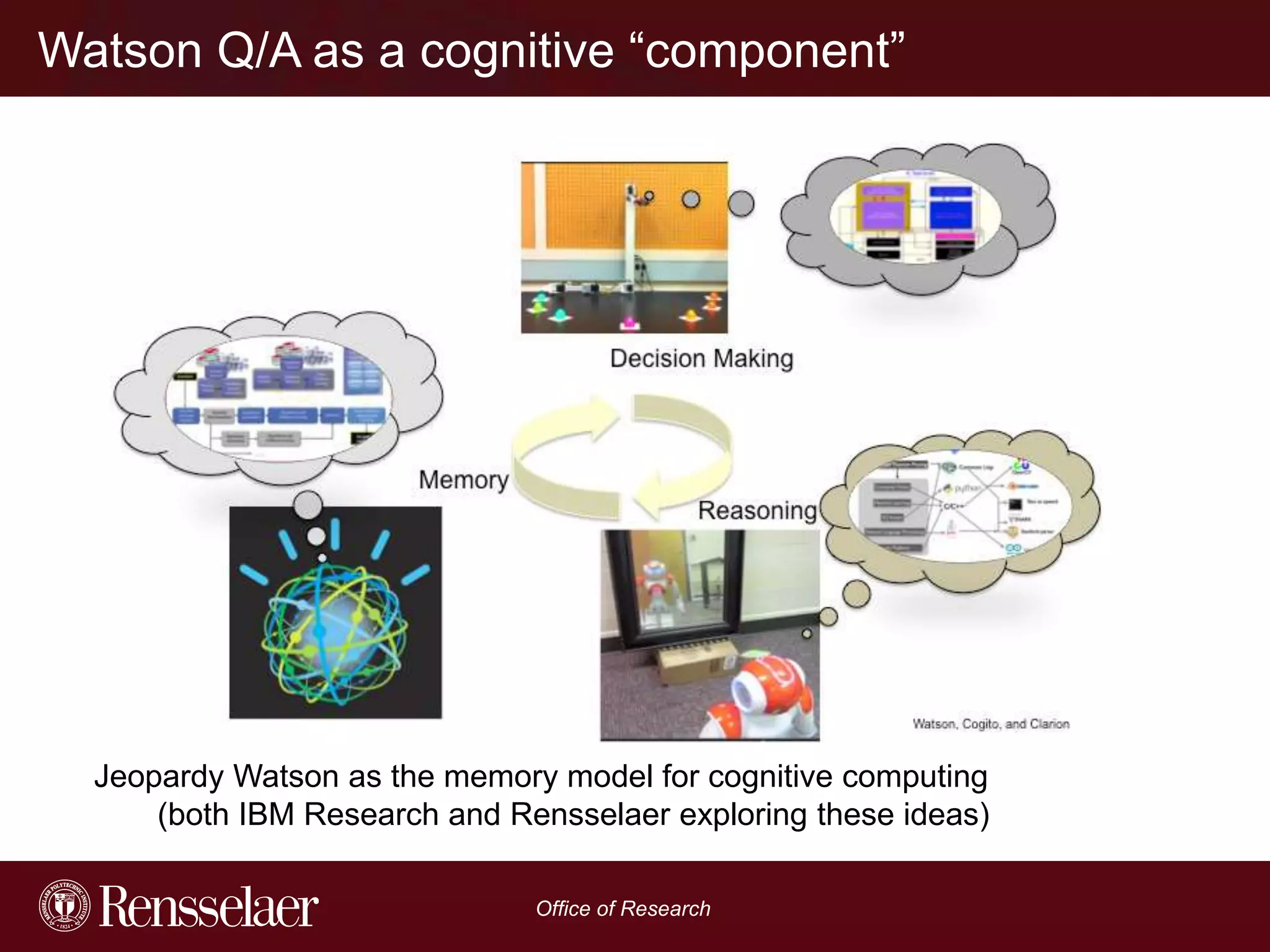
Watson Q/A as a cognitive “component” 
Jeopardy Watson as the memory model for cognitive computing 
(both IBM Research and Rensselaer exploring these ideas) 
Office of Research
Why did Watson win? 
Tetherless World Constellation 
• From a research perspective Watson 
is interesting in a number of ways 
– because of the underlying “cognitive pipeline” 
– as a different approach to memory-based 
reasoning 
– as a model of (some aspects) of human 
cognition 
– as the validation of a fundamental AI paradigm 
• and thus a contribution to the 
fundamentals of computing
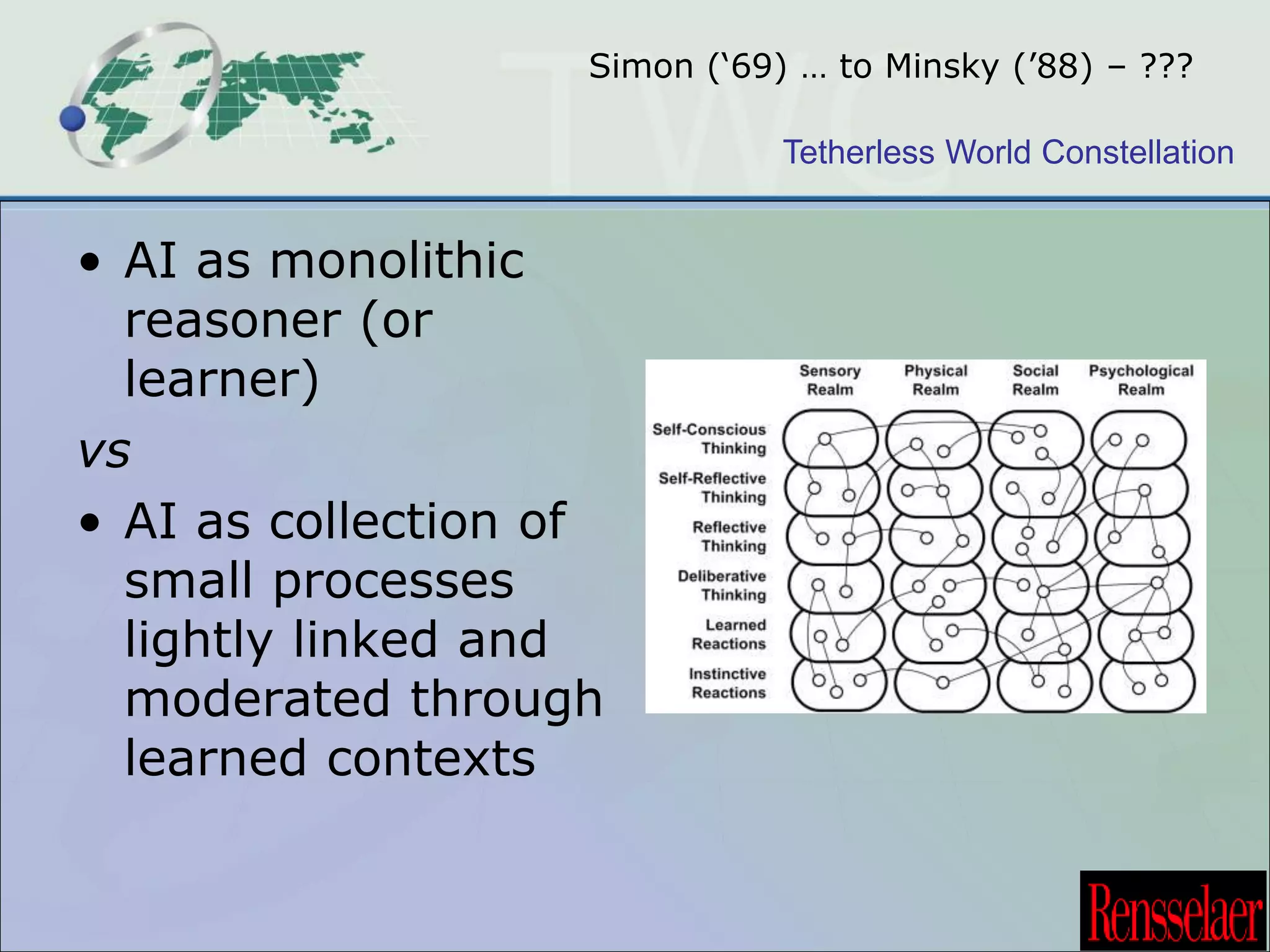
Simon (‘69) … to Minsky (’88) – ??? 
Tetherless World Constellation 
• AI as monolithic 
reasoner (or 
learner) 
vs 
• AI as collection of 
small processes 
lightly linked and 
moderated through 
learned contexts
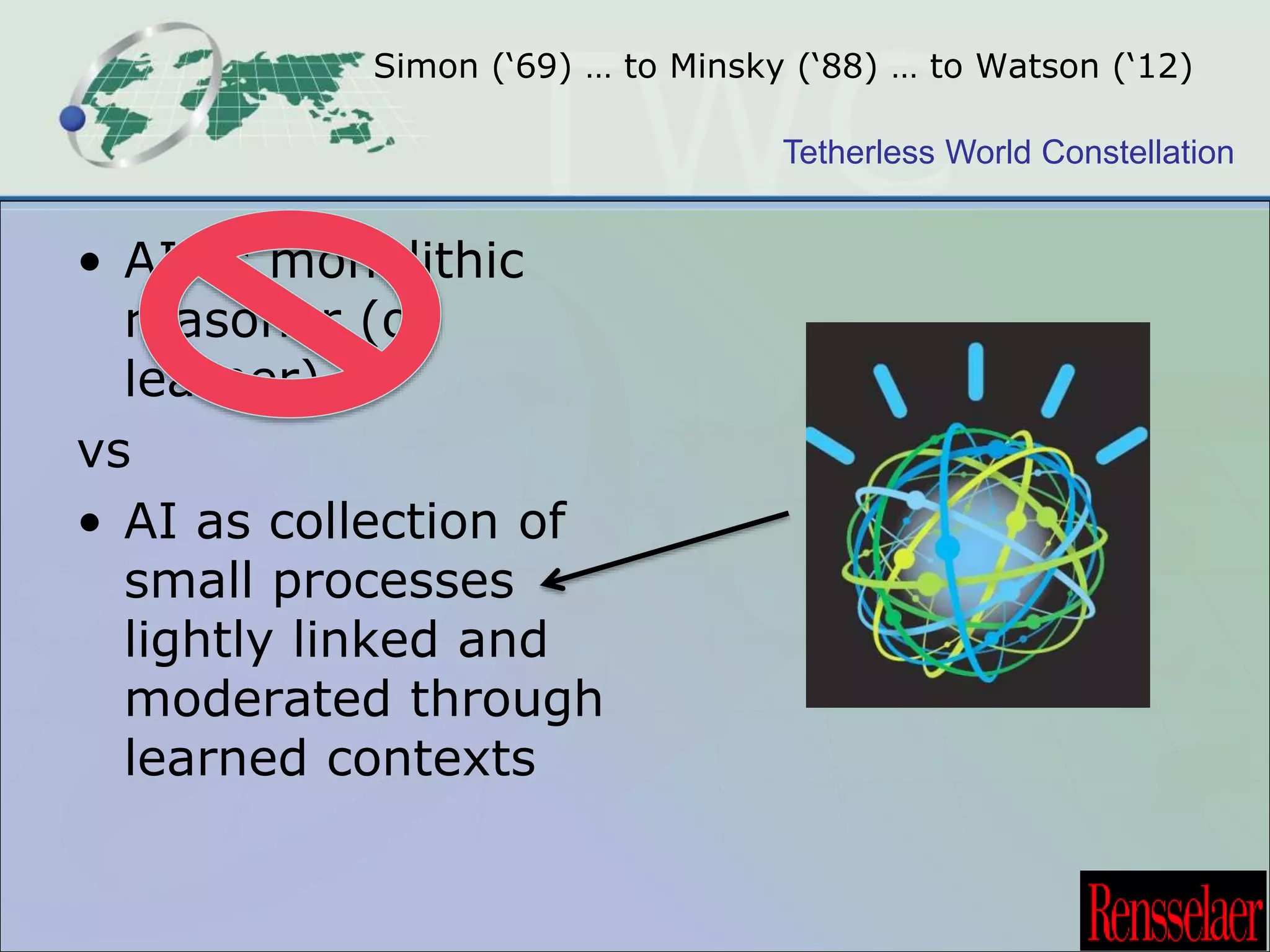
Simon (‘69) … to Minsky (‘88) … to Watson (‘12) 
Tetherless World Constellation 
• AI as monolithic 
reasoner (or 
learner) 
vs 
• AI as collection of 
small processes 
lightly linked and 
moderated through 
learned contexts
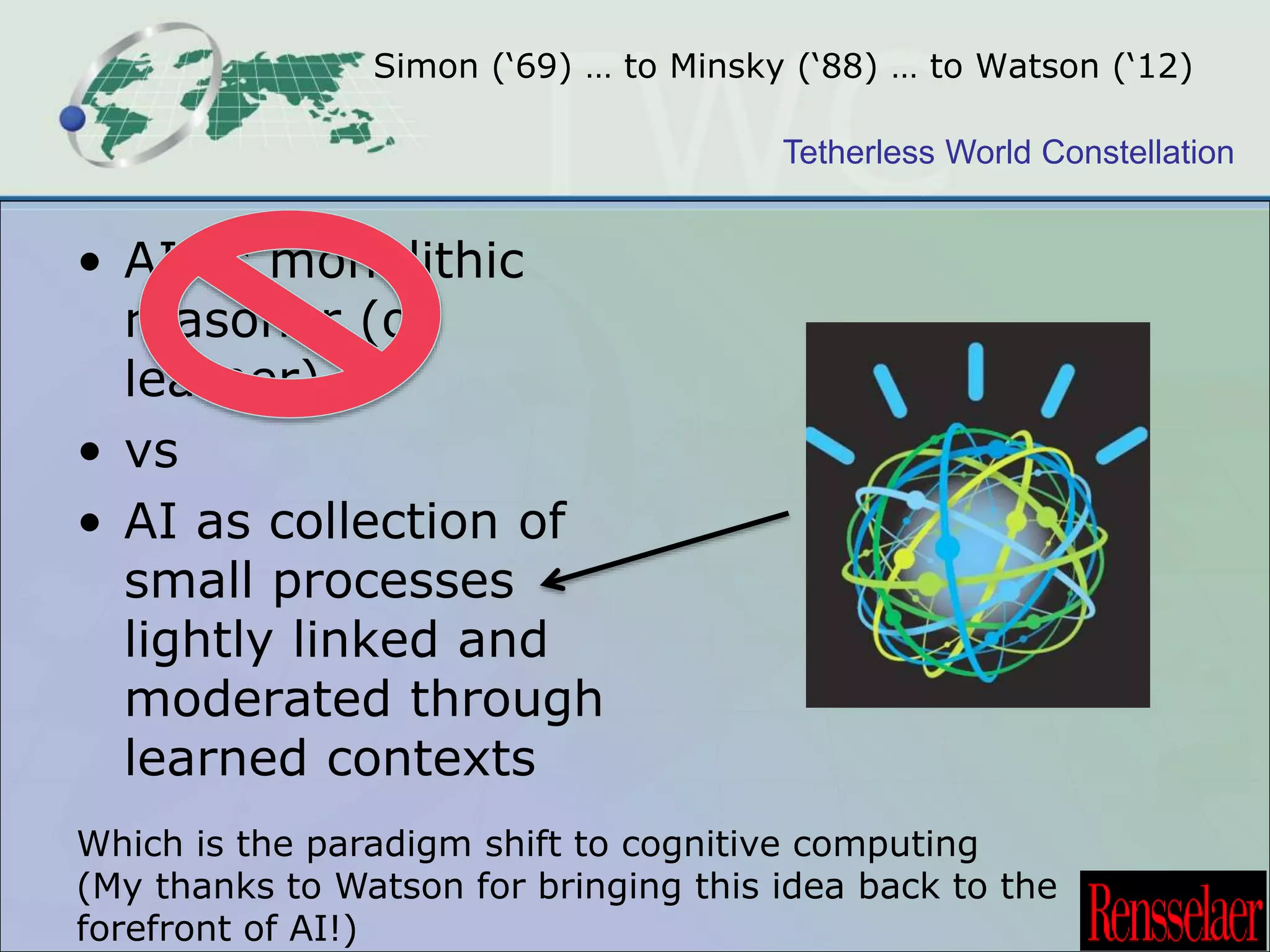
Simon (‘69) … to Minsky (‘88) … to Watson (‘12) 
Tetherless World Constellation 
• AI as monolithic 
reasoner (or 
learner) 
• vs 
• AI as collection of 
small processes 
lightly linked and 
moderated through 
learned contexts 
Which is the paradigm shift to cognitive computing 
(My thanks to Watson for bringing this idea back to the 
forefront of AI!)
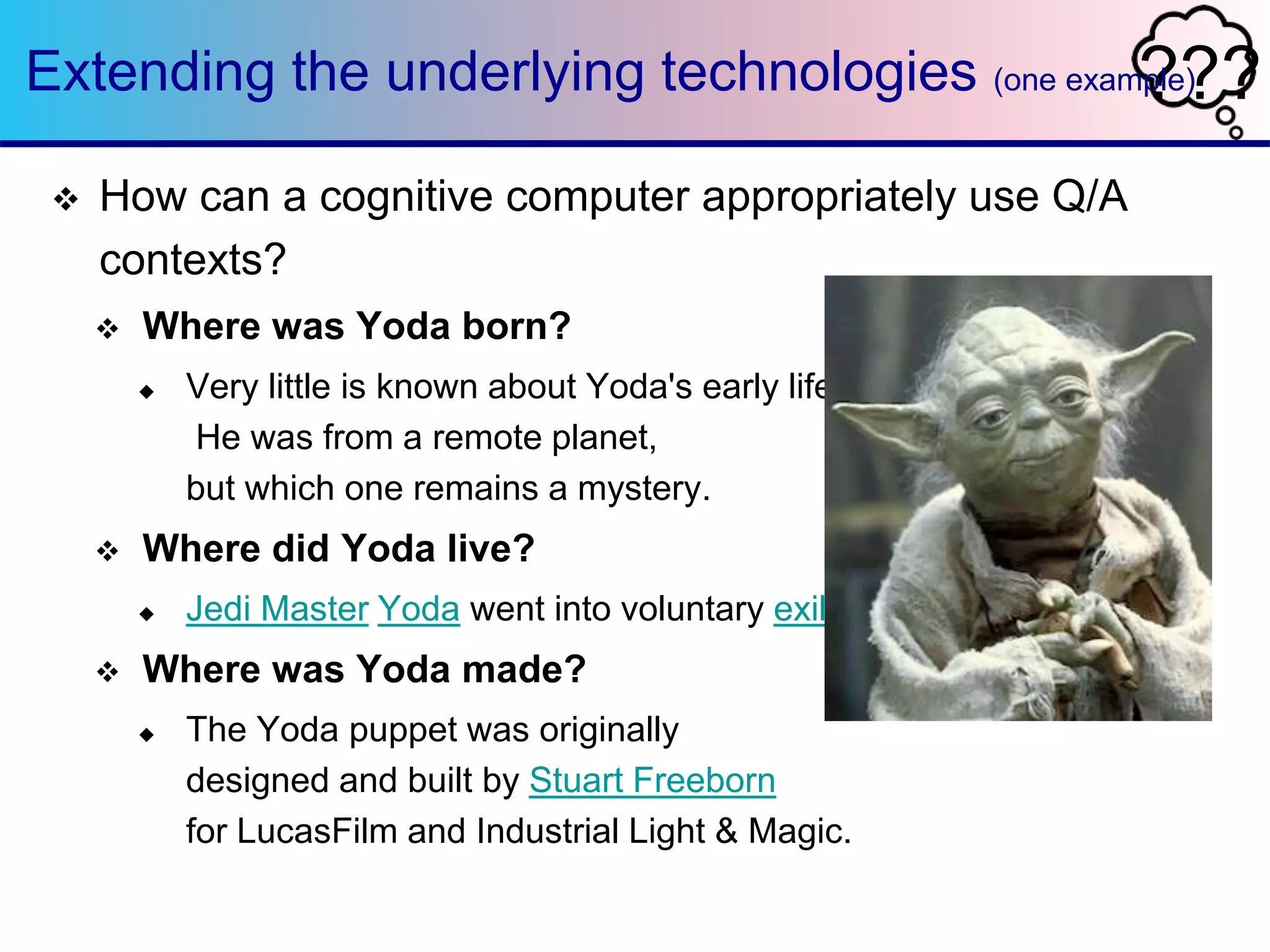
Extending the underlying technologies (one exam?ple?) ? 
 How can a cognitive computer appropriately use Q/A 
contexts? 
 Where was Yoda born? 
 Very little is known about Yoda's early life. 
He was from a remote planet, 
but which one remains a mystery. 
 Where did Yoda live? 
 Jedi Master Yoda went into voluntary exile on Dagobah 
 Where was Yoda made? 
 The Yoda puppet was originally 
designed and built by Stuart Freeborn 
for LucasFilm and Industrial Light & Magic.
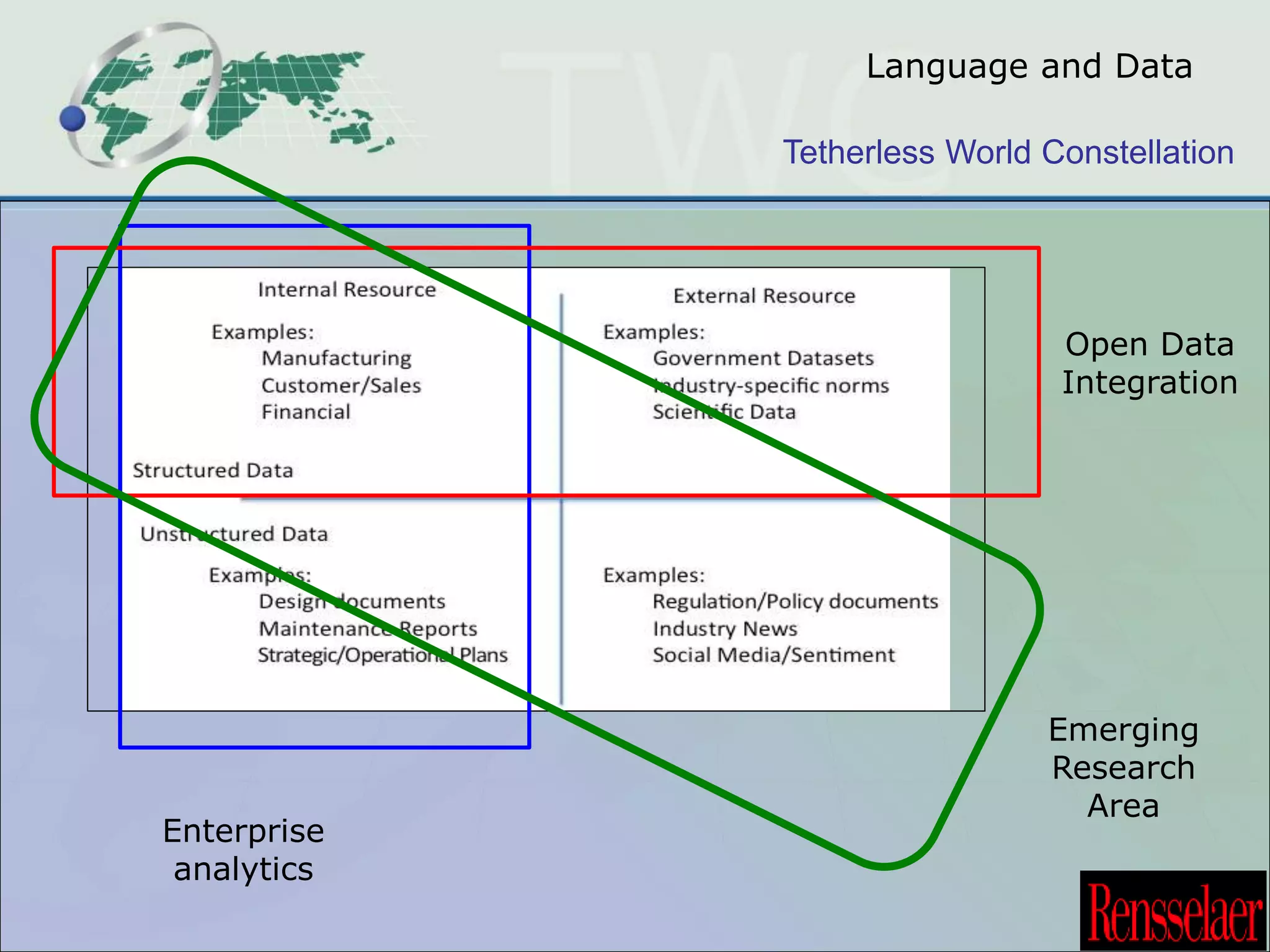
Language and Data 
Tetherless World Constellation 
Enterprise 
analytics 
Open Data 
Integration 
Emerging 
Research 
Area
And stay tuned for… 
Tetherless World Constellation 
• Applying Watson’s approach to other 
AI areas 
–Game Playing 
• Games with combinatorics that make chess 
look tiny (Simon Ellis, thesis in progress) 
– Planning and Plan Recognition 
• Using cognitive computing in planning and 
decision support 
– Scientific Discovery 
• Hypothesis creation and scoring 
– …
Conclusion 
Tetherless World Constellation 
• Watson is a big deal 
– Demonstrates a different way of parallelizing reasoning 
– Makes it impossible to ignore memory-based approaches 
– Opens an approach to cognitive modeling of memory 
– Relevates the many-modules approach to AI 
– Must change the way we think about, and teach, AI. 
• Cognitive Computing opens up many exciting 
research areas 
– Integrating new language models 
– Data and language integration between the enterprise 
and the Open Web 
– Applying the new paradigm to many other areas of AI 
systems
Questions? 
Tetherless World Constellation

Watson: An Academic's Perspective

  • 1.
    Tetherless World Constellation Watson: an academic perspective Jim Hendler Tetherless World Professor of Computer, Web and Cognitive Sciences Director, The Rensselaer Institute for Data Exploration and Applications Rensselaer Polytechnic Institute http://www.cs.rpi.edu/~hendler @jahendler (twitter)
  • 2.
    Watson Won! TetherlessWorld Constellation
  • 4.
    What is theSCIENCE that Watson informs Tetherless World Constellation • As a researcher the question isn't just “what else can it do,” it’s what can we learn from it – and do better • That is “Why did Watson win?” – is it a bag of tricks that plays Jeopardy • or does enterprise search – or does it expose something fundamental about computing?
  • 5.
    Why did Watsonwin? Tetherless World Constellation • From a research perspective Watson is interesting in a number of ways – because of the underlying “cognitive pipeline” – as a different approach to memory-based reasoning – as a model of (some aspects) of human cognition – as the validation of a fundamental AI paradigm • and thus a contribution to the fundamentals of computing
  • 6.
    Why did Watsonwin? Tetherless World Constellation • From a research perspective Watson is interesting in a number of ways – because of the underlying “cognitive pipeline” – as a different approach to memory-based reasoning – as a model of (some aspects) of human cognition – as the validation of a fundamental AI paradigm • and thus a contribution to the fundamentals of computing
  • 7.
    AI reasoners andControl flow Tetherless World Constellation Traditional AI systems (rule or logic) generally work forward from knowledge or backward from a goal looking “looping” through possible answers and backtracking when they cannot find one
  • 8.
    Watson doesn’t lookthat different ??? Watson pipeline as published by IBM; see IBM J Res & Dev 56 (3/4), May/July 2012, p. 15:2
  • 9.
    But laid outlike this… ??? Pipeline layout by Simon Ellis, 2013
  • 10.
    The Watson Pipeline Tetherless World Constellation • Consider many candidate answers in parallel – evaluate them all • Avoid loops – control structure straight-forward basically “feed forward only” • a couple of special exceptions for some kinds of Jeopardy questions • some differences in newer Watson Q/A, but still the essential structure • This loop can be embedded in a “set of questions” graph – Differential diagnosis (eg. Watson paths) – Watson as Advisor (RPI work) – …
  • 11.
    Why did Watsonwin? Tetherless World Constellation • From a research perspective Watson is interesting in a number of ways – because of the underlying “cognitive pipeline” – as a different approach to memory-based reasoning – as a model of (some aspects) of human cognition – as the validation of a fundamental AI paradigm • and thus a contribution to the fundamentals of computing
  • 12.
    Modern AI TetherlessWorld Constellation • The Watson program is already a breakthrough technology in AI. For many years it had been largely assumed that for a computer to go beyond search and really be able to perform complex human language tasks it needed to do one of two things: either it would “understand” the texts using some kind of deep “knowledge representation,” or it would have a complex statistical model based on millions of texts. from Watson goes to college: How the world’s smartest PC will revolutionize AI, GigaOm, 3/2/2013
  • 13.
    In contrast TetherlessWorld Constellation • Watson used very little of either of these. Rather, it uses a lot of memory and clever ways of pulling texts from that memory. Thus, Watson demonstrated what some in AI had conjectured, but to date been unable to prove: that intelligence is tied to an ability to appropriately find relevant information in a very large memory. from Watson goes to college: How the world’s smartest PC will revolutionize AI, GigaOm, 3/2/2013
  • 14.
    in the interestof time Tetherless World Constellation • [Several hours of boring blather in academic jargon about the importance of the above] deleted – Trust me, this is really important! • provides the “third leg” needed for AI
  • 15.
    Why did Watsonwin? Tetherless World Constellation • From a research perspective Watson is interesting in a number of ways – because of the underlying “cognitive pipeline” – as a different approach to memory-based reasoning – as a model of (some aspects) of human cognition – as the validation of a fundamental AI paradigm • and thus a contribution to the fundamentals of computing
  • 16.
    Is Watson cognitive???? “The computer’s techniques for unraveling Jeopardy! clues sounded just like mine. That machine zeroes in on key words in a clue, then combs its memory (in Watson’s case, a 15-terabyte data bank of human knowledge) for clusters of associations with those words. It rigorously checks the top hits against all the contextual information it can muster: the category name; the kind of answer being sought; the time, place, and gender hinted at in the clue; and so on. And when it feels ‘sure’ enough, it decides to buzz. This is all an instant, intuitive process for a human Jeopardy! player, but I felt convinced that under the hood my brain was doing more or less the same thing.” — Ken Jennings
  • 17.
    Is Ken right? Tetherless World Constellation • Q: How does Watson fare as a complete cognitive model? • A: Poorly – no conversational ability – no concept of self – no deeper reasoning (Watson’s critics harp on these) • Q: But, how does Watson fare as a model of question answering?
  • 18.
    But… much betterwhen compared to “memory” models Tetherless World Constellation MAC/FAC (Gentner & Forbus, 1991) One example slide for more see “Why Watson Won” on slideshare Many are chosen, few are called model of analogic reasoning Strong correspondence in performance, not in mechanism New work by Forbus (SME) uses a more feed-forward mechanism
  • 19.
    Watson Q/A asa cognitive “component” Jeopardy Watson as the memory model for cognitive computing (both IBM Research and Rensselaer exploring these ideas) Office of Research
  • 20.
    Why did Watsonwin? Tetherless World Constellation • From a research perspective Watson is interesting in a number of ways – because of the underlying “cognitive pipeline” – as a different approach to memory-based reasoning – as a model of (some aspects) of human cognition – as the validation of a fundamental AI paradigm • and thus a contribution to the fundamentals of computing
  • 21.
    Simon (‘69) …to Minsky (’88) – ??? Tetherless World Constellation • AI as monolithic reasoner (or learner) vs • AI as collection of small processes lightly linked and moderated through learned contexts
  • 22.
    Simon (‘69) …to Minsky (‘88) … to Watson (‘12) Tetherless World Constellation • AI as monolithic reasoner (or learner) vs • AI as collection of small processes lightly linked and moderated through learned contexts
  • 23.
    Simon (‘69) …to Minsky (‘88) … to Watson (‘12) Tetherless World Constellation • AI as monolithic reasoner (or learner) • vs • AI as collection of small processes lightly linked and moderated through learned contexts Which is the paradigm shift to cognitive computing (My thanks to Watson for bringing this idea back to the forefront of AI!)
  • 24.
    Extending the underlyingtechnologies (one exam?ple?) ?  How can a cognitive computer appropriately use Q/A contexts?  Where was Yoda born?  Very little is known about Yoda's early life. He was from a remote planet, but which one remains a mystery.  Where did Yoda live?  Jedi Master Yoda went into voluntary exile on Dagobah  Where was Yoda made?  The Yoda puppet was originally designed and built by Stuart Freeborn for LucasFilm and Industrial Light & Magic.
  • 25.
    Language and Data Tetherless World Constellation Enterprise analytics Open Data Integration Emerging Research Area
  • 26.
    And stay tunedfor… Tetherless World Constellation • Applying Watson’s approach to other AI areas –Game Playing • Games with combinatorics that make chess look tiny (Simon Ellis, thesis in progress) – Planning and Plan Recognition • Using cognitive computing in planning and decision support – Scientific Discovery • Hypothesis creation and scoring – …
  • 27.
    Conclusion Tetherless WorldConstellation • Watson is a big deal – Demonstrates a different way of parallelizing reasoning – Makes it impossible to ignore memory-based approaches – Opens an approach to cognitive modeling of memory – Relevates the many-modules approach to AI – Must change the way we think about, and teach, AI. • Cognitive Computing opens up many exciting research areas – Integrating new language models – Data and language integration between the enterprise and the Open Web – Applying the new paradigm to many other areas of AI systems
  • 28.