Machinery guarding What do I 
need to know to get it right ?
Training Bio 
Tony Catterson 
• Manager Pilz NZ 
• CMSE---- (Certified Machinery 
Safety Expert Tuv Nord). 
• Electronics technician 
Pilz 
• German based world leader in 
Machinery safety. 
• Offering training in machine 
guarding standards in New zealand 
for 12 years 
2
3
4
 Worksafe Actual findings--- inspections 
Generally, new machinery was guarded whilst old machinery 
typically lacked guarding and interlocks. There is an issue with 
employers purchasing machinery marked CE from Europe 
believing it to comply with AS/4024, when this is not always 
the case. AS/4024 became a joint NZ Australian Standard 
(AS/NZS4024 2014) on 30 June. 
There was clear message from Inspectors that many employers 
did not understand their responsibilities under the Health and 
Safety in Employment Act (1992) and did not understand the 
hazard identification and hazard management process. This is 
truer of small-medium sized enterprises than of large 
businesses. 
On a positive note, Inspectors reported businesses are thirsty 
for knowledge, are trying to do their best, and don’t have an 
issue with making improvements. 
5
 Worksafe inspection ‘blitz’ 
Overall Inspectors made 62 workplace assessments during the 
two week testing period. Resulting from the 62 assessments 
114 notices were issued, which comprised: 
90 improvement notices 
19 prohibition notices 
5 written warnings. 
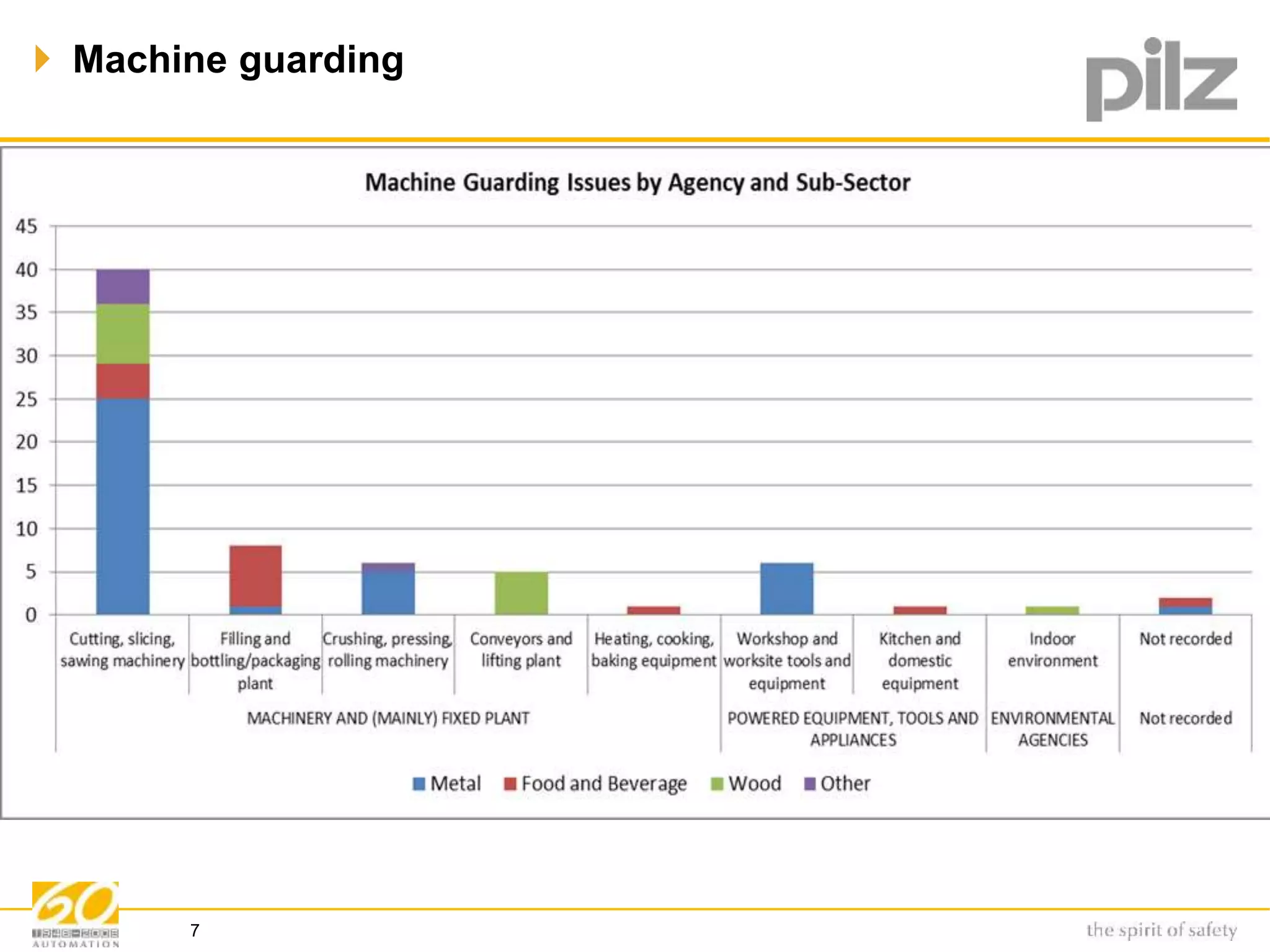
Metal manufacturing made up 37% of visits and 45% of notices. 
It had the highest number of notices issued per visit at 2.3 per 
assessment. Wood manufacturing made up 25% of visits and 
20% of notices whilst Food and Beverage manufacturing 
made up 24% of visits and 21 % of notices issued. 
6
 Machine guarding 
7
 Sources of Health & Safety Information 
8 
Must 
Do 
Should 
Do
 Standards Introduction 
What are Standards? 
Standards are published 
documents setting out 
specifications and procedures 
designed to ensure products, 
services and systems are safe, 
reliable and consistently perform 
the way they were intended to. 
They establish a common 
language which defines quality and 
safety criteria. 
9
 Standards Introduction 
Standards & Law 
Standards Australia and Standards New Zealand are not part of 
government, they do not make laws or regulations. 
Australian and New Zealand Standards are not legal documents 
but many, because of their rigour, are called up into legislation 
(Acts and Regulations) by government and become mandatory 
(e.g. AS/NZS 3000). 
Standards are also often incorporated into legal contracts. In these 
circumstances compliance with standards is necessary to comply 
with contract law. 
Codes of Practice in many cases make reference to standards. 
This however does not make them law or mandatory to follow. 
Technical Standards should only be used if it provides an 
equivalent or higher standard of work health and safety than the 
Codes of Practice. 
10
 Standards Introduction 
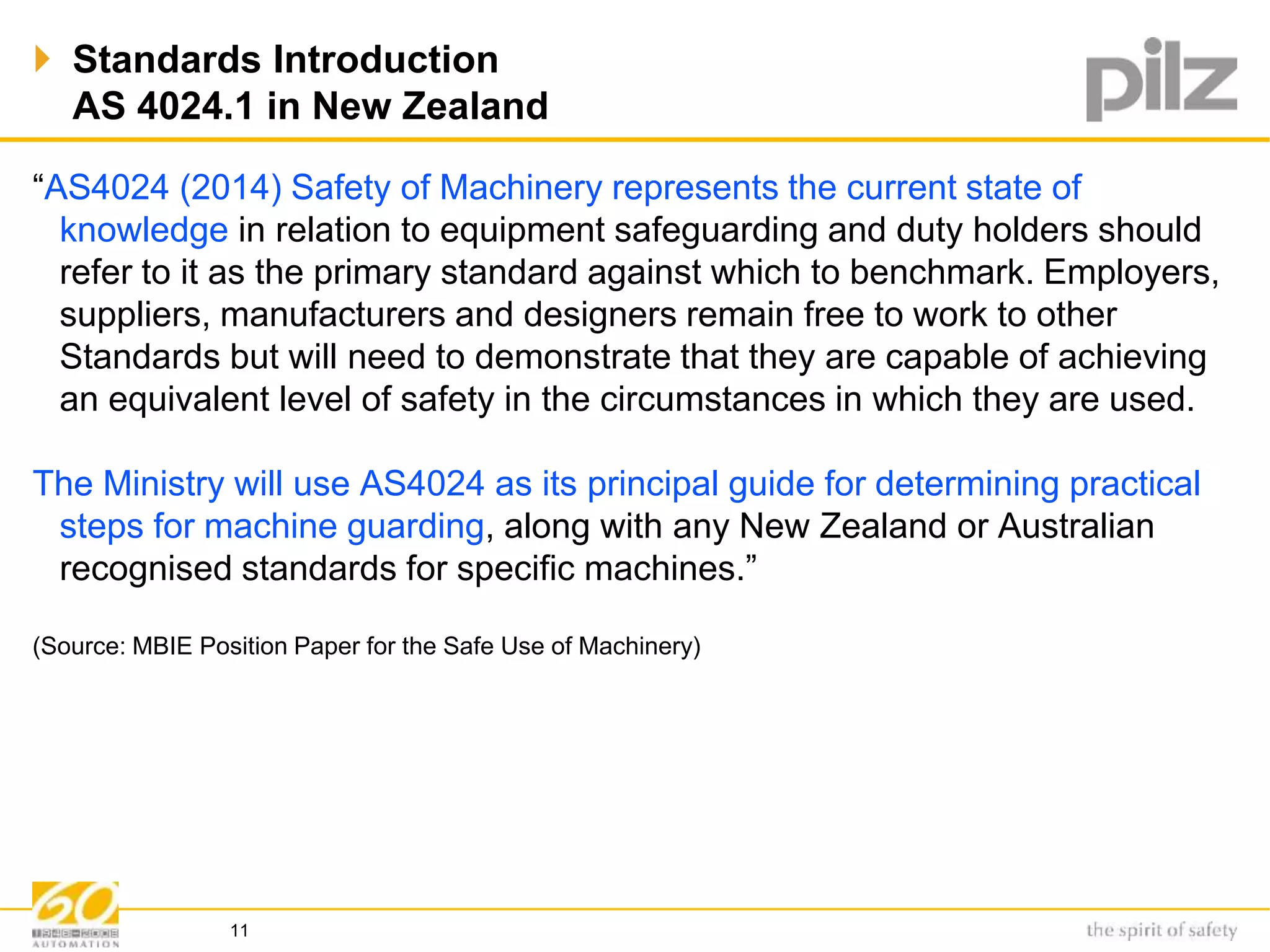
AS 4024.1 in New Zealand 
“AS4024 (2014) Safety of Machinery represents the current state of 
knowledge in relation to equipment safeguarding and duty holders should 
refer to it as the primary standard against which to benchmark. Employers, 
suppliers, manufacturers and designers remain free to work to other 
Standards but will need to demonstrate that they are capable of achieving 
an equivalent level of safety in the circumstances in which they are used. 
The Ministry will use AS4024 as its principal guide for determining practical 
steps for machine guarding, along with any New Zealand or Australian 
recognised standards for specific machines.” 
(Source: MBIE Position Paper for the Safe Use of Machinery) 
11
 Standards Introduction 
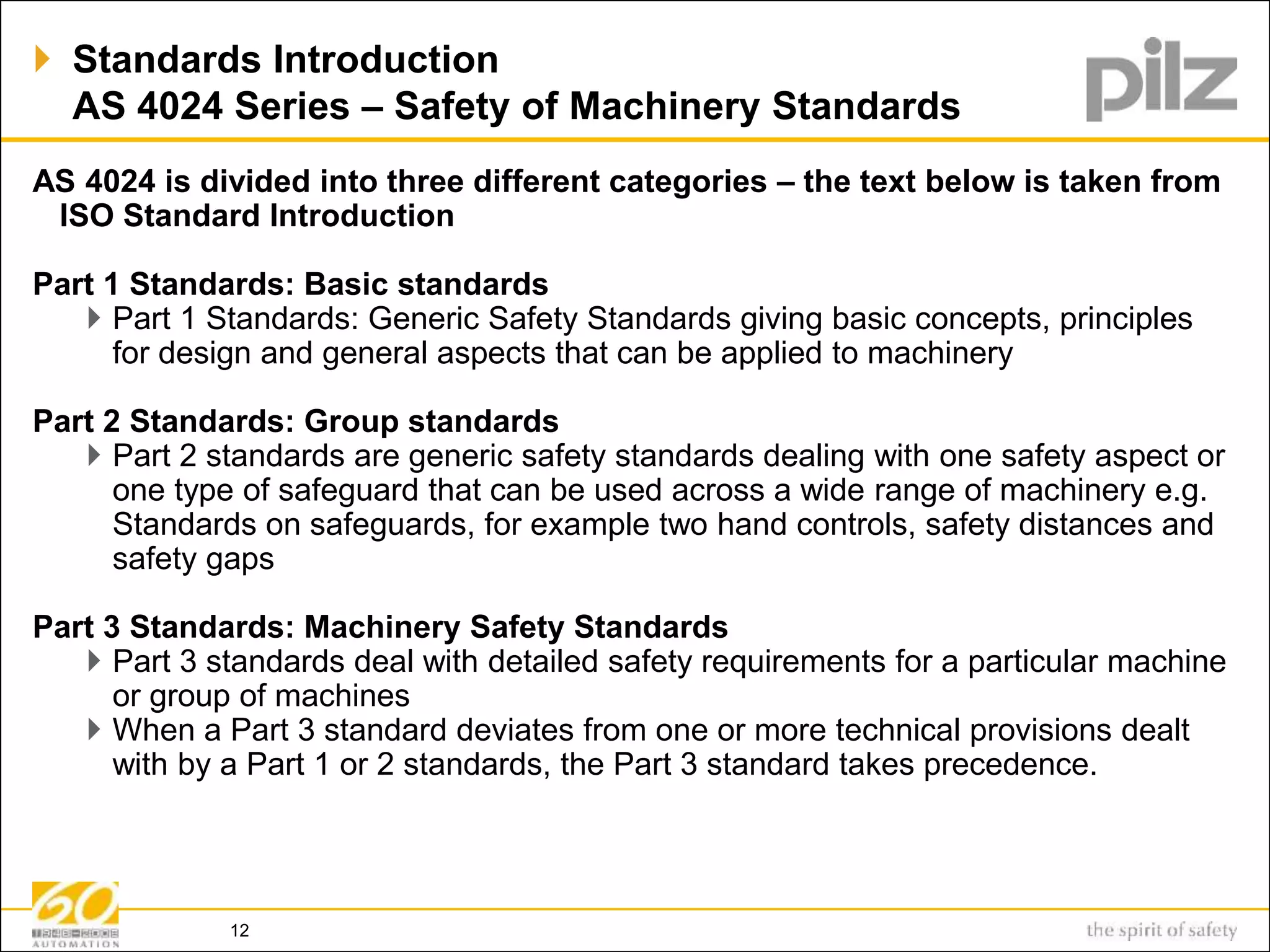
AS 4024 Series – Safety of Machinery Standards 
AS 4024 is divided into three different categories – the text below is taken from 
ISO Standard Introduction 
Part 1 Standards: Basic standards 
 Part 1 Standards: Generic Safety Standards giving basic concepts, principles 
for design and general aspects that can be applied to machinery 
Part 2 Standards: Group standards 
 Part 2 standards are generic safety standards dealing with one safety aspect or 
one type of safeguard that can be used across a wide range of machinery e.g. 
Standards on safeguards, for example two hand controls, safety distances and 
safety gaps 
Part 3 Standards: Machinery Safety Standards 
 Part 3 standards deal with detailed safety requirements for a particular machine 
or group of machines 
 When a Part 3 standard deviates from one or more technical provisions dealt 
with by a Part 1 or 2 standards, the Part 3 standard takes precedence. 
12
 Standards Introduction 
Subdivision of Machinery Standards 
Part 1 Standards 
Part 2 Standards 
Part 3 Standards 
13 
26 International Standards 
Safety Principles 
Design Parameters 
Ergonomics 
Technical Support 
Standards 
AS 4024.2601 Two hand Controls 
AS 4024.2801 Approach Speeds 
Machine Specific Standards 
AS 4024.3001 Mechanical Power Presses 
AS 4024.3002 Hydraulic Power Presses 
AS 4024.3101 Milling Machines 
AS 4024.3301 Industrial Robots 
AS 1755 – Conveyors (to become an AS4024.3600 series standard in future)
 Relevant Machinery Standards 
AS 4024.1201, 1202 & 1301 – Risk Assessment 
AS 4024.1201, 1202 & 1301: Safety 
of Machinery - General principles 
for design – Risk assessment and 
risk reduction 
 These standards provides 
guidance on the risk 
assessment process and 
provides general principles 
intended to be used to meet the 
risk reduction objectives 
14
 Risk Estimation methods – 5X5 
Example. A matrix for determining the level of risk. 
Likelihood 
Consequence 
1 insignificant 2 minor 3 moderate 4 major 5 catastrophic 
A v.likely Medium High High Extreme Extreme 
B likely Medium Medium High High Extreme 
C moderate Low Medium High High High 
D unlikely Low Low Medium Medium High 
E rare Low Low Medium Medium High 
(Source. AS/NZ 4360-2004 Risk Management) 
15
 Risk Estimation 
Example. Risk ranking. 
Risk Level Required action 
Low 
Presenting very little risk. 
Continuously review existing measures. 
Medium 
Containing hazards that require control measures. 
Specify management responsibility and action dates. 
High 
Containing hazards that require control measures to be implemented urgently. 
Should be reduced as soon as possible. 
Extreme Continued operation is unacceptable. 
16
 Risk Estimation Methods - Nomogram 
17 
Residual Risk 
by admin & 
ppe 
Reduce probability by design
 Relevant Machinery Standards 
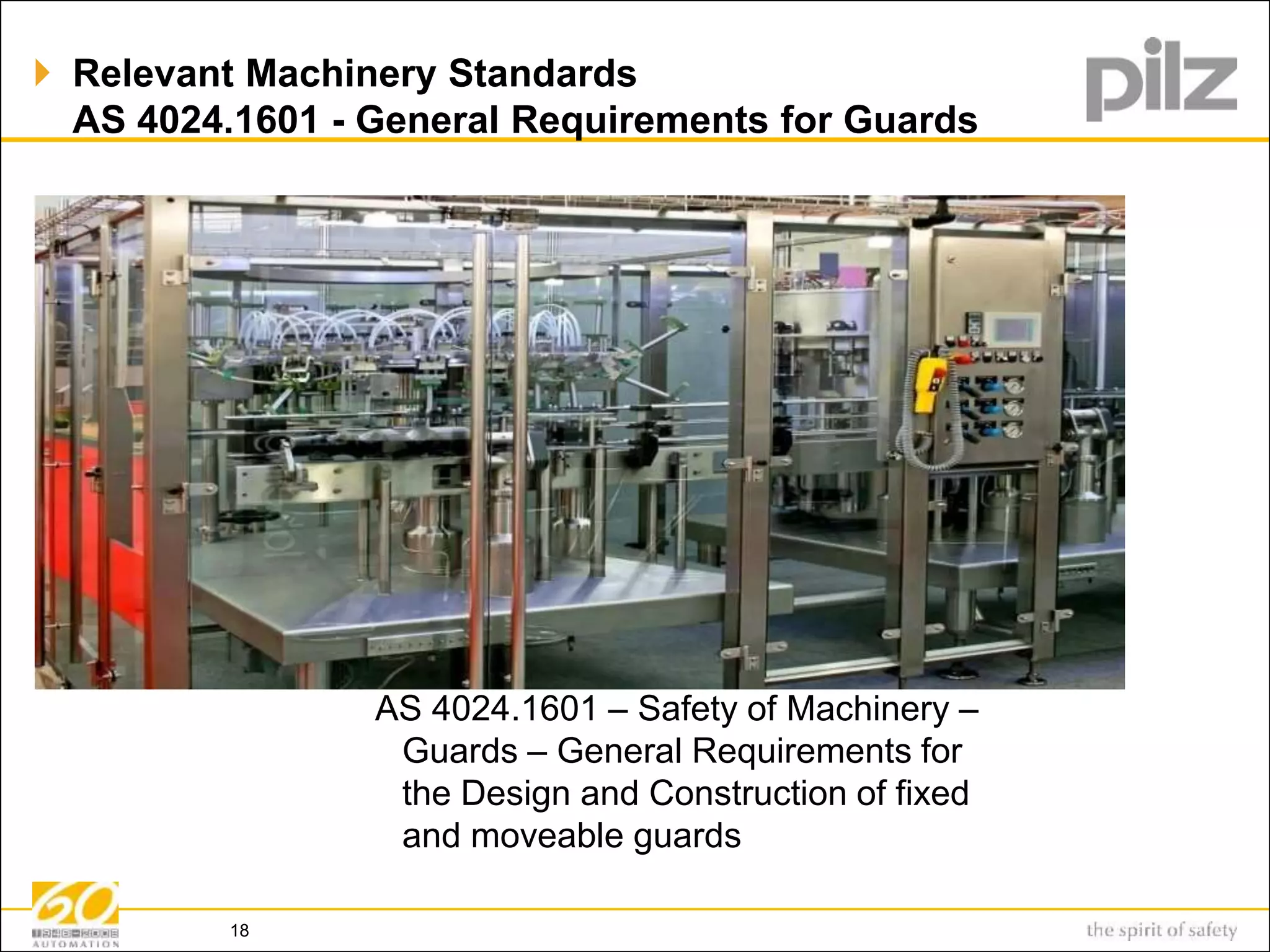
AS 4024.1601 - General Requirements for Guards 
AS 4024.1601 – Safety of Machinery – 
Guards – General Requirements for 
the Design and Construction of fixed 
and moveable guards 
18
 Relevant Machinery Standards 
AS 4024.1801 & 1802 - Safety Distances 
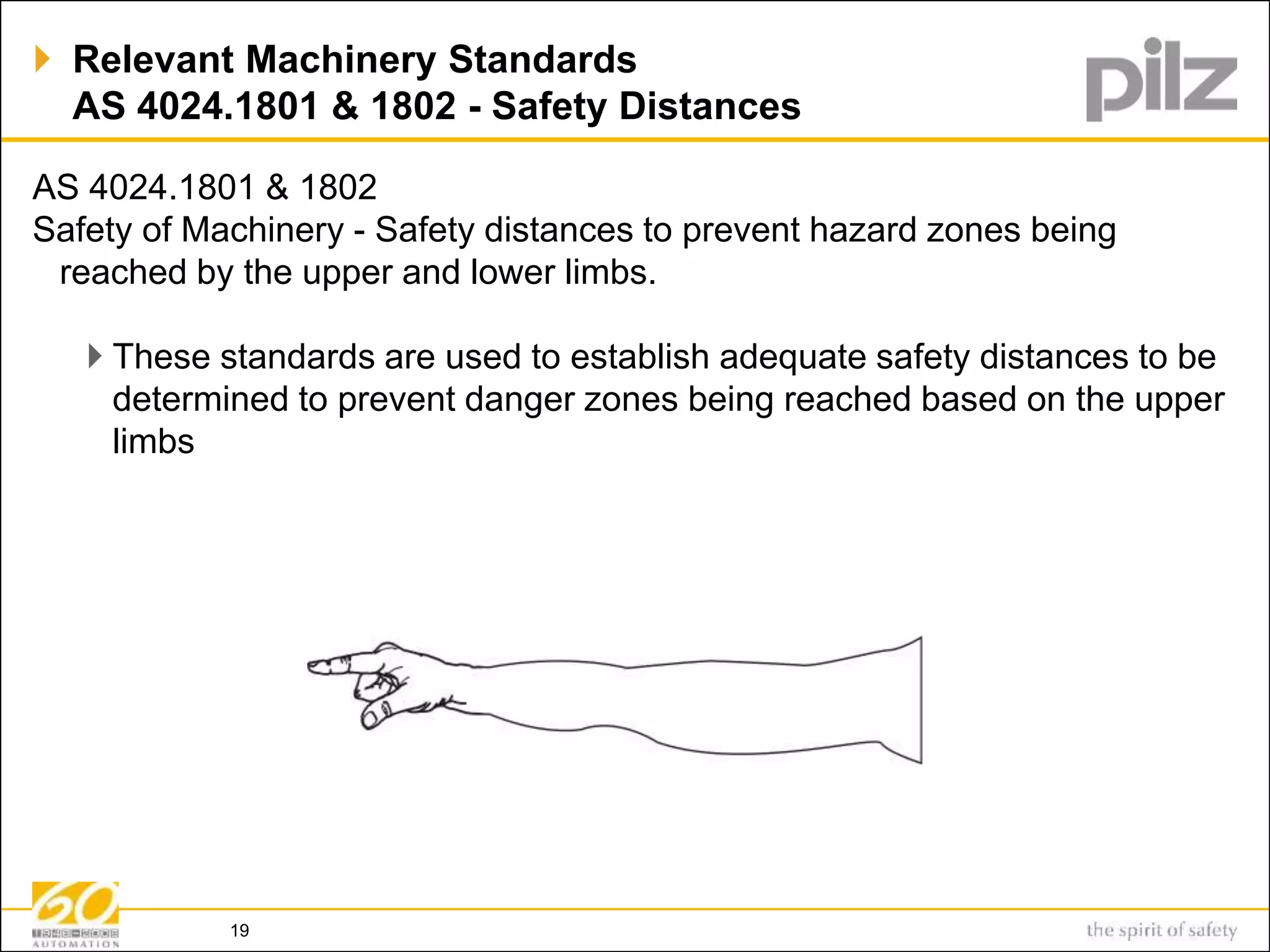
AS 4024.1801 & 1802 
Safety of Machinery - Safety distances to prevent hazard zones being 
reached by the upper and lower limbs. 
 These standards are used to establish adequate safety distances to be 
determined to prevent danger zones being reached based on the upper 
limbs 
19
 AS 4024.1801 Safety distances to prevent upper 
limbs access 
Reaching upwards 
Potential consequence INSIGNIFICANT or MINOR 
• Height of the danger zone 2500 mm or more 
Potential consequence DISASTROUS, MAJOR or 
MODERATE 
“Significant hazard” 
• Height of the danger zone 2700 mm or more 
20 
Danger Zone 
Height of 
danger 
zone 
Note: If the height of the danger zone can not be achieved then 
guarding shall be put in place.
 AS 4024.1801 Safety distances to prevent upper 
limbs access 
(a) Height of the danger zone. 
(b) Height of the protective structure 
(c) Horizontal distance to the danger zone 
The gap under the distance guard (e) should be a 
maximum of 180 mm to prevent access 
21 
Danger 
Zone (a) 
(b) 
(c) 
(e) 
Reaching over protective structure 
Note: If the danger zone can be reached from the gap under the 
protective structure (e), then the size of the opening needs to be 
reduced according to the severity of the risk .
 AS 4024.1801 Safety distances to prevent upper 
limbs access 
Potential consequence MODERATE, MAJOR & DISASTROUS (High risk) 
22 
Height of protective structure (b) 
1,000 1,200 1,400 1,600 1,800 2,000 2,200 2,400 2,500 
Height of danger zone (a) 
2,600 900 800 700 600 600 500 400 300 100 
2,400 1,100 1,000 900 800 700 600 400 300 100 
2,200 1,300 1,200 1,000 900 800 600 400 300 
- 
2,000 1,400 1,300 1,100 900 800 600 400 
- - 
1,800 1,500 1,400 1,000 900 800 800 
- - - 
1,600 1,500 1,400 1,000 900 800 500 
- - - 
1,400 1,500 1,400 1,000 900 800 
- - - - 
1,200 1,500 1,400 1,000 900 700 
- - - - 
1,000 1,500 1,400 1,000 800 
- - - - - 
800 1,500 1,300 900 600 
- 
Horizontal distance 
to danger zone (c ) 
- 
600 1,400 1,300 800 
- - - 
400 1,400 1,200 400 
- - - 
200 1,200 900 
- - - - - - - 
- 
1,100 500 
- - - - - - - 
Danger 
Zone (a) 
(b) 
(c)
 AS 4024.1801 Safety distances to prevent upper 
limbs access 
23 
Examples of safe mesh guarding 
Mesh 
guard 
30 mm Hazard 
120 mm (Minimum) 
50 mm 
Hazard 
Mesh 
guard 
850 mm (Minimum) 
Reaching through protective structure
 AS 4024.1802 Safety distances to prevent lower 
limbs access 
Maximum size of gap to prevent whole body access 
24 
240 mm 
(Max) 
Square 
240 mm 
(Max) 
180 mm 
(Max) 
Round Slot 
240 mm 
(Max)
 Relevant Machinery Standards 
AS 4024.1501 & 1502 
Safety Related Parts of Control Systems 
AS/NZ 4024.1501 - Safety related parts of control systems: General 
Principles for Design 
AS/NZ 4024.1502– Safety related parts of control systems: Validation 
AS/NZ 4024. 1503 : Current Alternative Standard for safety related control 
systems which incorporates Performance levels.(IEC 13849-1) 
25
 Relevant Machinery Standards 
AS 4024.1-1501 - Safety Related Parts of Control Systems 
 Identify the hazards on the 
respective machine 
 Assess risk parameters S, F, P in 
accordance with Appendix C 
 Determine the required performance 
Category 
 Confirm the category architecture is 
achieved 
26
 Specifications of categories 
27 
Assessment guidance 
Possible categories which 
may require additional 
measures 
Preferred categories for 
reference points 
Measures which can be 
over-dimensioned for the 
relevant risk 
CATEGORY of control system 
S 
1 
S 
2 
F1 
F2 
B 1 2 3 4 
P 
1 
P 
2 
P 
1 
P 
2 
STEP 1: Assess the potential SEVERITY of Injury 
The potential severity of an injury is evaluated by considering the extent of injuries that a 
person may suffer due to the control system fault(s). 
Potential severity 
factor 
Assessment guidance 
S1 
Slight injuries may result with consequences that are normally reversible (e.g. The 
person fully recovers after a period of time and/or medical treatment) 
S2 
Serious injuries that are normally not revisable (e.g. Loss of body function, 
amputation, permanent disability and fatality).
 Specifications of categories 
28 
Assessment guidance 
Possible categories which 
may require additional 
measures 
Preferred categories for 
reference points 
Measures which can be 
over-dimensioned for the 
relevant risk 
CATEGORY of control system 
S 
1 
S 
2 
F1 
F2 
B 1 2 3 4 
P 
1 
P 
2 
P 
1 
P 
2 
STEP 2: Assess the FREQUENCY and/or duration of exposure to the hazard 
The frequency and/or duration of exposure to the hazard is evaluated by considering the period of time that 
a person is exposed to a hazard in relation to the total period of time in which the equipment is in use. 
Factor Assessment guidance 
F1 
A person is seldom to quite often, and/or short exposure time. 
E.g. A person operating the machine is only exposed to the hazard when machine 
is blocked or when a tool change is required. 
F2 
A person is frequently or continuously exposed to the hazard. 
E.g. A machine operator is exposed to the hazard when ever the machine is in 
operation.
 Specifications of categories 
29 
29 
Assessment guidance 
Possible categories which 
may require additional 
measures 
Preferred categories for 
reference points 
Measures which can be 
over-dimensioned for the 
relevant risk 
CATEGORY of control system 
S 
1 
S 
2 
F1 
F2 
B 1 2 3 4 
P 
1 
P 
2 
P 
1 
P 
2 
Step 3: Possibility of avoiding the hazard 
Whether the hazard can be recognised by physical characteristics or only be technical means such as 
indicators; 
Operation with or without supervision; 
Operation by experts or non-professionals; 
The speed with which the hazard arises; 
Possibilities for hazard avoidance, and 
Practical safety experience relating to the process. 
Potential severity 
factor 
Assessment guidance 
P1 Possible under specific conditions 
P2 Nearly impossible
 EN ISO 13849 
Procedure 
Risk 
Assessment 
Design SRP/CS 
Machine Limits 
Hazard Identification 
Assess Risk, Plr 
SRS, PLr definition 
System Architecture 
Detail Design 
Design Evaluation 
System Implementation 
Principles, Fault List 
Planning 
Validation 
Information 
Analysis 
Testing 
Determine the required performance level PLr using 
the risk parameters 
30
 Relevant Machinery Standards 
AS 4024.1602 - Interlocking Devices 
AS 4024.1602 - Safety of machinery - Interlocking devices associated with 
guards - Principles for design and selection 
 Gives principles for the design and selection of interlocking devices 
associated with guards 
31
 Safety Devices 
The main types of input devices are: 
• Emergency stops – 
buttons and lanyards 
• Interlocking Devices 
• Light Curtains 
• Safety Mats 
• Two Hand Control 
Devices 
• Safety Scanners 
• Mechanical Trips 
• Hold to Run Devices 
• Key Exchange Systems 
• Camera Systems 
32
 Safety switches 
 Mechanical safety switches 
 Prevent premature operator access via increased extraction 
force 
 Used to interlock the safety gate until hazardous production 
processes are complete 
 Magnetic safety switches 
 Non-contact 
 Economic ,hard to defeat 
 For a high safety category, where there is heavy soiling and 
where strict hygiene regulations are in place 
 Coded safety switches 
 5 directions of activation 
 Long switching distance 
 Can be series wired and still meet Cat 4
 Relevant Machinery Standards 
AS 4024.1803 & AS 4024.1604 
AS 4024.1803 - Safety of 
machinery - Minimum gaps to 
avoid crushing parts of the 
human body 
Gives data for calculation of 
safe gaps between moving 
parts etc 
AS 4024.1604 - Safety of 
machinery - Emergency Stop - 
Principles for design 
34
 Relevant Machinery Standards 
Part 3 Standards 
Product Specific Part 3 
“Product Standards” 
AS 4024.3001- Mechanical 
power presses 
AS 4024.3002- Hydraulic 
power presses 
AS 4024.3101- Milling 
machines 
AS 4024.3301- Industrial 
robots 
AS 1755 – Conveyor safety 
requirements (Soon to be 
replaced with AS 4024.3600 
series) 35
 What does “All Practical Steps” mean? 
“All practicable steps” is defined in the Health 
and Safety in Employment Act 1992. 
Briefly, it means doing what is reasonably able 
to be done in the circumstances, taking into 
account: 
• The severity of any injury or harm to health 
which may occur; 
• The degree of risk or probability of that injury 
or harm occurring; 
• How much is known about the hazard and the 
ways of eliminating, reducing or controlling it; 
and 
• The availability, effectiveness and cost of the 
possible safeguards. 
Risk 
Assessment 
Codes of Practice, 
Standards, 
Guidance Notes, 
Latest Industry 
Practice etc. 
Cost
 Standards and Legislation 
 The Department of Labour 
consider compliance with AS/NZ 
4024.1-2014 as meeting all 
practicable steps. 
 Non compliance with a relevant 
standard will very likely be used 
as evidence that a product 
contravenes the legal obligation to 
make a product safe. 
 Standards are typically not 
mandatory, but system standards 
are used to demonstrate 
conformance with legislation. 
37
 New Guidance on Machinery Safety 
The Best Practice Guidelines for the Safe Use of 
Machinery outlines the hazards associated with 
machinery use in the workplace, potential injuries, and 
how best to control these hazards. It gives guidance 
to duty holders on how to safely use machinery to 
comply with their duties and obligations under the 
Health and Safety in Employment Act 1992 (HSE Act) 
and the Health and Safety in Employment Regulations 
1995 (HSE Regulations). 
It provides guidance on: 
•Designing out hazards 
•Identify, assess and control hazards 
•Hazard and risk assessment 
•Hierarchy of controls 
•Machinery hazard controls 
•Machinery guarding for specific plant 
•Design and construction of machinery and guards 
•Responsibilities and duties for machinery 
38
Thank you for your attention. 
Questions ? 
39

Machine guarding

  • 1.
    Machinery guarding Whatdo I need to know to get it right ?
  • 2.
    Training Bio TonyCatterson • Manager Pilz NZ • CMSE---- (Certified Machinery Safety Expert Tuv Nord). • Electronics technician Pilz • German based world leader in Machinery safety. • Offering training in machine guarding standards in New zealand for 12 years 2
  • 3.
  • 4.
  • 5.
     Worksafe Actualfindings--- inspections Generally, new machinery was guarded whilst old machinery typically lacked guarding and interlocks. There is an issue with employers purchasing machinery marked CE from Europe believing it to comply with AS/4024, when this is not always the case. AS/4024 became a joint NZ Australian Standard (AS/NZS4024 2014) on 30 June. There was clear message from Inspectors that many employers did not understand their responsibilities under the Health and Safety in Employment Act (1992) and did not understand the hazard identification and hazard management process. This is truer of small-medium sized enterprises than of large businesses. On a positive note, Inspectors reported businesses are thirsty for knowledge, are trying to do their best, and don’t have an issue with making improvements. 5
  • 6.
     Worksafe inspection‘blitz’ Overall Inspectors made 62 workplace assessments during the two week testing period. Resulting from the 62 assessments 114 notices were issued, which comprised: 90 improvement notices 19 prohibition notices 5 written warnings. Metal manufacturing made up 37% of visits and 45% of notices. It had the highest number of notices issued per visit at 2.3 per assessment. Wood manufacturing made up 25% of visits and 20% of notices whilst Food and Beverage manufacturing made up 24% of visits and 21 % of notices issued. 6
  • 7.
  • 8.
     Sources ofHealth & Safety Information 8 Must Do Should Do
  • 9.
     Standards Introduction What are Standards? Standards are published documents setting out specifications and procedures designed to ensure products, services and systems are safe, reliable and consistently perform the way they were intended to. They establish a common language which defines quality and safety criteria. 9
  • 10.
     Standards Introduction Standards & Law Standards Australia and Standards New Zealand are not part of government, they do not make laws or regulations. Australian and New Zealand Standards are not legal documents but many, because of their rigour, are called up into legislation (Acts and Regulations) by government and become mandatory (e.g. AS/NZS 3000). Standards are also often incorporated into legal contracts. In these circumstances compliance with standards is necessary to comply with contract law. Codes of Practice in many cases make reference to standards. This however does not make them law or mandatory to follow. Technical Standards should only be used if it provides an equivalent or higher standard of work health and safety than the Codes of Practice. 10
  • 11.
     Standards Introduction AS 4024.1 in New Zealand “AS4024 (2014) Safety of Machinery represents the current state of knowledge in relation to equipment safeguarding and duty holders should refer to it as the primary standard against which to benchmark. Employers, suppliers, manufacturers and designers remain free to work to other Standards but will need to demonstrate that they are capable of achieving an equivalent level of safety in the circumstances in which they are used. The Ministry will use AS4024 as its principal guide for determining practical steps for machine guarding, along with any New Zealand or Australian recognised standards for specific machines.” (Source: MBIE Position Paper for the Safe Use of Machinery) 11
  • 12.
     Standards Introduction AS 4024 Series – Safety of Machinery Standards AS 4024 is divided into three different categories – the text below is taken from ISO Standard Introduction Part 1 Standards: Basic standards  Part 1 Standards: Generic Safety Standards giving basic concepts, principles for design and general aspects that can be applied to machinery Part 2 Standards: Group standards  Part 2 standards are generic safety standards dealing with one safety aspect or one type of safeguard that can be used across a wide range of machinery e.g. Standards on safeguards, for example two hand controls, safety distances and safety gaps Part 3 Standards: Machinery Safety Standards  Part 3 standards deal with detailed safety requirements for a particular machine or group of machines  When a Part 3 standard deviates from one or more technical provisions dealt with by a Part 1 or 2 standards, the Part 3 standard takes precedence. 12
  • 13.
     Standards Introduction Subdivision of Machinery Standards Part 1 Standards Part 2 Standards Part 3 Standards 13 26 International Standards Safety Principles Design Parameters Ergonomics Technical Support Standards AS 4024.2601 Two hand Controls AS 4024.2801 Approach Speeds Machine Specific Standards AS 4024.3001 Mechanical Power Presses AS 4024.3002 Hydraulic Power Presses AS 4024.3101 Milling Machines AS 4024.3301 Industrial Robots AS 1755 – Conveyors (to become an AS4024.3600 series standard in future)
  • 14.
     Relevant MachineryStandards AS 4024.1201, 1202 & 1301 – Risk Assessment AS 4024.1201, 1202 & 1301: Safety of Machinery - General principles for design – Risk assessment and risk reduction  These standards provides guidance on the risk assessment process and provides general principles intended to be used to meet the risk reduction objectives 14
  • 15.
     Risk Estimationmethods – 5X5 Example. A matrix for determining the level of risk. Likelihood Consequence 1 insignificant 2 minor 3 moderate 4 major 5 catastrophic A v.likely Medium High High Extreme Extreme B likely Medium Medium High High Extreme C moderate Low Medium High High High D unlikely Low Low Medium Medium High E rare Low Low Medium Medium High (Source. AS/NZ 4360-2004 Risk Management) 15
  • 16.
     Risk Estimation Example. Risk ranking. Risk Level Required action Low Presenting very little risk. Continuously review existing measures. Medium Containing hazards that require control measures. Specify management responsibility and action dates. High Containing hazards that require control measures to be implemented urgently. Should be reduced as soon as possible. Extreme Continued operation is unacceptable. 16
  • 17.
     Risk EstimationMethods - Nomogram 17 Residual Risk by admin & ppe Reduce probability by design
  • 18.
     Relevant MachineryStandards AS 4024.1601 - General Requirements for Guards AS 4024.1601 – Safety of Machinery – Guards – General Requirements for the Design and Construction of fixed and moveable guards 18
  • 19.
     Relevant MachineryStandards AS 4024.1801 & 1802 - Safety Distances AS 4024.1801 & 1802 Safety of Machinery - Safety distances to prevent hazard zones being reached by the upper and lower limbs.  These standards are used to establish adequate safety distances to be determined to prevent danger zones being reached based on the upper limbs 19
  • 20.
     AS 4024.1801Safety distances to prevent upper limbs access Reaching upwards Potential consequence INSIGNIFICANT or MINOR • Height of the danger zone 2500 mm or more Potential consequence DISASTROUS, MAJOR or MODERATE “Significant hazard” • Height of the danger zone 2700 mm or more 20 Danger Zone Height of danger zone Note: If the height of the danger zone can not be achieved then guarding shall be put in place.
  • 21.
     AS 4024.1801Safety distances to prevent upper limbs access (a) Height of the danger zone. (b) Height of the protective structure (c) Horizontal distance to the danger zone The gap under the distance guard (e) should be a maximum of 180 mm to prevent access 21 Danger Zone (a) (b) (c) (e) Reaching over protective structure Note: If the danger zone can be reached from the gap under the protective structure (e), then the size of the opening needs to be reduced according to the severity of the risk .
  • 22.
     AS 4024.1801Safety distances to prevent upper limbs access Potential consequence MODERATE, MAJOR & DISASTROUS (High risk) 22 Height of protective structure (b) 1,000 1,200 1,400 1,600 1,800 2,000 2,200 2,400 2,500 Height of danger zone (a) 2,600 900 800 700 600 600 500 400 300 100 2,400 1,100 1,000 900 800 700 600 400 300 100 2,200 1,300 1,200 1,000 900 800 600 400 300 - 2,000 1,400 1,300 1,100 900 800 600 400 - - 1,800 1,500 1,400 1,000 900 800 800 - - - 1,600 1,500 1,400 1,000 900 800 500 - - - 1,400 1,500 1,400 1,000 900 800 - - - - 1,200 1,500 1,400 1,000 900 700 - - - - 1,000 1,500 1,400 1,000 800 - - - - - 800 1,500 1,300 900 600 - Horizontal distance to danger zone (c ) - 600 1,400 1,300 800 - - - 400 1,400 1,200 400 - - - 200 1,200 900 - - - - - - - - 1,100 500 - - - - - - - Danger Zone (a) (b) (c)
  • 23.
     AS 4024.1801Safety distances to prevent upper limbs access 23 Examples of safe mesh guarding Mesh guard 30 mm Hazard 120 mm (Minimum) 50 mm Hazard Mesh guard 850 mm (Minimum) Reaching through protective structure
  • 24.
     AS 4024.1802Safety distances to prevent lower limbs access Maximum size of gap to prevent whole body access 24 240 mm (Max) Square 240 mm (Max) 180 mm (Max) Round Slot 240 mm (Max)
  • 25.
     Relevant MachineryStandards AS 4024.1501 & 1502 Safety Related Parts of Control Systems AS/NZ 4024.1501 - Safety related parts of control systems: General Principles for Design AS/NZ 4024.1502– Safety related parts of control systems: Validation AS/NZ 4024. 1503 : Current Alternative Standard for safety related control systems which incorporates Performance levels.(IEC 13849-1) 25
  • 26.
     Relevant MachineryStandards AS 4024.1-1501 - Safety Related Parts of Control Systems  Identify the hazards on the respective machine  Assess risk parameters S, F, P in accordance with Appendix C  Determine the required performance Category  Confirm the category architecture is achieved 26
  • 27.
     Specifications ofcategories 27 Assessment guidance Possible categories which may require additional measures Preferred categories for reference points Measures which can be over-dimensioned for the relevant risk CATEGORY of control system S 1 S 2 F1 F2 B 1 2 3 4 P 1 P 2 P 1 P 2 STEP 1: Assess the potential SEVERITY of Injury The potential severity of an injury is evaluated by considering the extent of injuries that a person may suffer due to the control system fault(s). Potential severity factor Assessment guidance S1 Slight injuries may result with consequences that are normally reversible (e.g. The person fully recovers after a period of time and/or medical treatment) S2 Serious injuries that are normally not revisable (e.g. Loss of body function, amputation, permanent disability and fatality).
  • 28.
     Specifications ofcategories 28 Assessment guidance Possible categories which may require additional measures Preferred categories for reference points Measures which can be over-dimensioned for the relevant risk CATEGORY of control system S 1 S 2 F1 F2 B 1 2 3 4 P 1 P 2 P 1 P 2 STEP 2: Assess the FREQUENCY and/or duration of exposure to the hazard The frequency and/or duration of exposure to the hazard is evaluated by considering the period of time that a person is exposed to a hazard in relation to the total period of time in which the equipment is in use. Factor Assessment guidance F1 A person is seldom to quite often, and/or short exposure time. E.g. A person operating the machine is only exposed to the hazard when machine is blocked or when a tool change is required. F2 A person is frequently or continuously exposed to the hazard. E.g. A machine operator is exposed to the hazard when ever the machine is in operation.
  • 29.
     Specifications ofcategories 29 29 Assessment guidance Possible categories which may require additional measures Preferred categories for reference points Measures which can be over-dimensioned for the relevant risk CATEGORY of control system S 1 S 2 F1 F2 B 1 2 3 4 P 1 P 2 P 1 P 2 Step 3: Possibility of avoiding the hazard Whether the hazard can be recognised by physical characteristics or only be technical means such as indicators; Operation with or without supervision; Operation by experts or non-professionals; The speed with which the hazard arises; Possibilities for hazard avoidance, and Practical safety experience relating to the process. Potential severity factor Assessment guidance P1 Possible under specific conditions P2 Nearly impossible
  • 30.
     EN ISO13849 Procedure Risk Assessment Design SRP/CS Machine Limits Hazard Identification Assess Risk, Plr SRS, PLr definition System Architecture Detail Design Design Evaluation System Implementation Principles, Fault List Planning Validation Information Analysis Testing Determine the required performance level PLr using the risk parameters 30
  • 31.
     Relevant MachineryStandards AS 4024.1602 - Interlocking Devices AS 4024.1602 - Safety of machinery - Interlocking devices associated with guards - Principles for design and selection  Gives principles for the design and selection of interlocking devices associated with guards 31
  • 32.
     Safety Devices The main types of input devices are: • Emergency stops – buttons and lanyards • Interlocking Devices • Light Curtains • Safety Mats • Two Hand Control Devices • Safety Scanners • Mechanical Trips • Hold to Run Devices • Key Exchange Systems • Camera Systems 32
  • 33.
     Safety switches  Mechanical safety switches  Prevent premature operator access via increased extraction force  Used to interlock the safety gate until hazardous production processes are complete  Magnetic safety switches  Non-contact  Economic ,hard to defeat  For a high safety category, where there is heavy soiling and where strict hygiene regulations are in place  Coded safety switches  5 directions of activation  Long switching distance  Can be series wired and still meet Cat 4
  • 34.
     Relevant MachineryStandards AS 4024.1803 & AS 4024.1604 AS 4024.1803 - Safety of machinery - Minimum gaps to avoid crushing parts of the human body Gives data for calculation of safe gaps between moving parts etc AS 4024.1604 - Safety of machinery - Emergency Stop - Principles for design 34
  • 35.
     Relevant MachineryStandards Part 3 Standards Product Specific Part 3 “Product Standards” AS 4024.3001- Mechanical power presses AS 4024.3002- Hydraulic power presses AS 4024.3101- Milling machines AS 4024.3301- Industrial robots AS 1755 – Conveyor safety requirements (Soon to be replaced with AS 4024.3600 series) 35
  • 36.
     What does“All Practical Steps” mean? “All practicable steps” is defined in the Health and Safety in Employment Act 1992. Briefly, it means doing what is reasonably able to be done in the circumstances, taking into account: • The severity of any injury or harm to health which may occur; • The degree of risk or probability of that injury or harm occurring; • How much is known about the hazard and the ways of eliminating, reducing or controlling it; and • The availability, effectiveness and cost of the possible safeguards. Risk Assessment Codes of Practice, Standards, Guidance Notes, Latest Industry Practice etc. Cost
  • 37.
     Standards andLegislation  The Department of Labour consider compliance with AS/NZ 4024.1-2014 as meeting all practicable steps.  Non compliance with a relevant standard will very likely be used as evidence that a product contravenes the legal obligation to make a product safe.  Standards are typically not mandatory, but system standards are used to demonstrate conformance with legislation. 37
  • 38.
     New Guidanceon Machinery Safety The Best Practice Guidelines for the Safe Use of Machinery outlines the hazards associated with machinery use in the workplace, potential injuries, and how best to control these hazards. It gives guidance to duty holders on how to safely use machinery to comply with their duties and obligations under the Health and Safety in Employment Act 1992 (HSE Act) and the Health and Safety in Employment Regulations 1995 (HSE Regulations). It provides guidance on: •Designing out hazards •Identify, assess and control hazards •Hazard and risk assessment •Hierarchy of controls •Machinery hazard controls •Machinery guarding for specific plant •Design and construction of machinery and guards •Responsibilities and duties for machinery 38
  • 39.
    Thank you foryour attention. Questions ? 39