Radial Symmetry in Art, Math, and Science
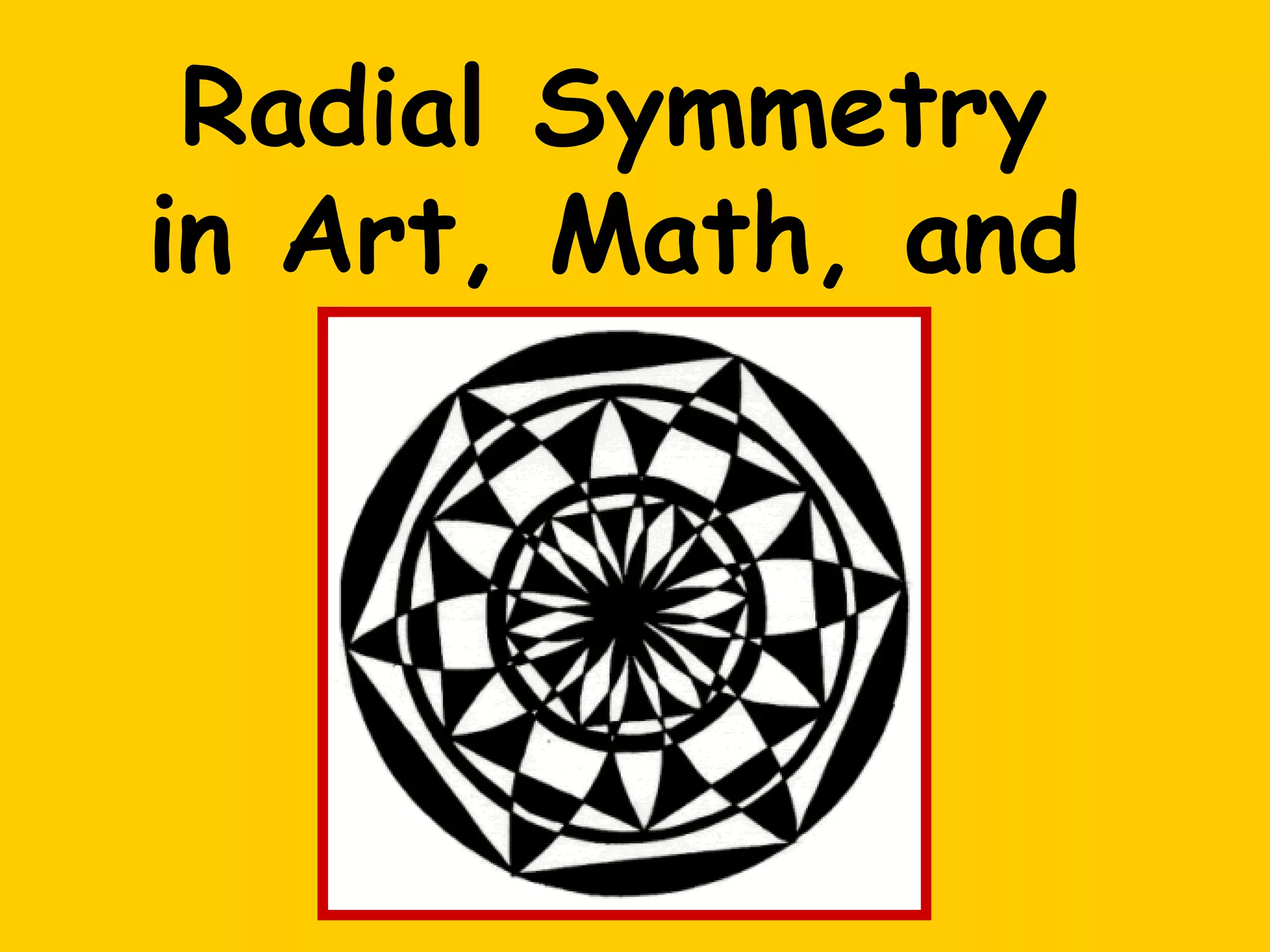
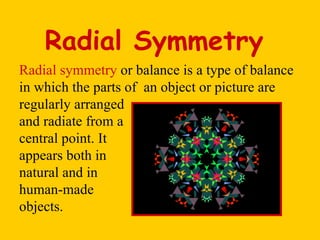
Radial Symmetry Radial symmetry  or balance is a type of balance in which the parts of  an object or picture are regularly arranged  and radiate from a  central point. It  appears both in  natural and in  human-made  objects.
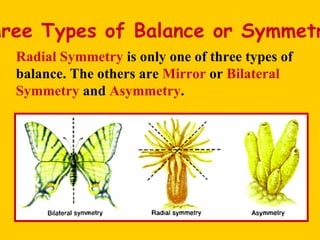
Three Types of Balance or Symmetry Radial Symmetry  is only one of three types of balance. The others are  Mirror  or  Bilateral Symmetry  and  Asymmetry .
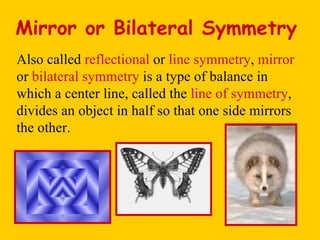
Mirror or Bilateral Symmetry Also called  reflectional  or  line symmetry ,  mirror  or  bilateral symmetry  is a type of balance in which a center line, called the  line of symmetry , divides an object in half so that one side mirrors the other.
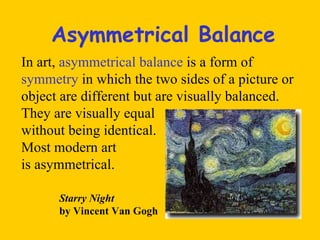
Asymmetrical Balance In art,  asymmetrical balance  is a form of  symmetry  in which the two sides of a picture or object are different but are visually balanced. They are visually equal  without being identical.  Most modern art  is asymmetrical. Starry Night  by Vincent Van Gogh
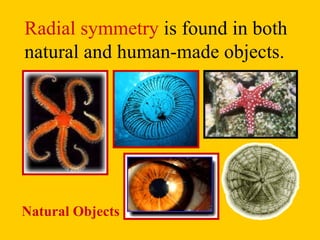
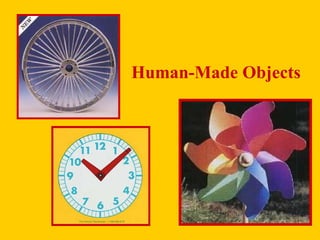
Radial symmetry  is found in both natural and human-made objects. Natural Objects
Human-Made Objects
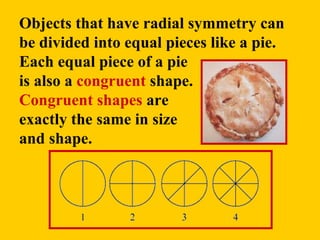
Objects that have radial symmetry can be divided into equal pieces like a pie. Each equal piece of a pie  is also a  congruent  shape.  Congruent shapes  are  exactly the same in size  and shape.
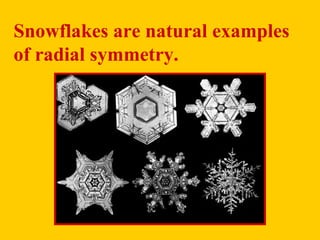
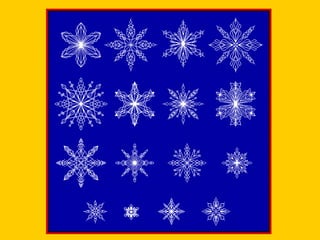
Snowflakes are natural examples  of radial symmetry.
 
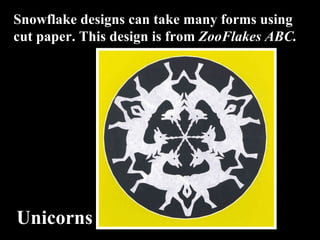
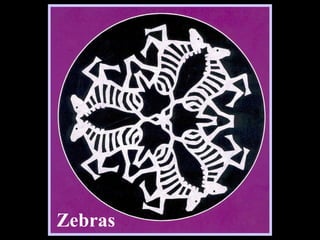
Snowflake designs can take many forms using cut paper. This design is from  ZooFlakes ABC. Unicorns
Kangaroos
Zebras
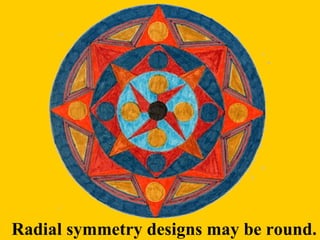
mendi  Radial symmetry designs may be round.
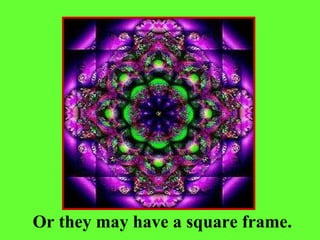
Or they may have a square frame.
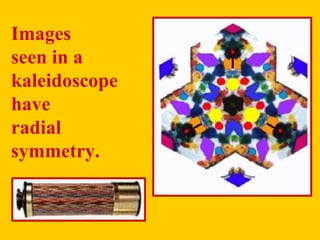
Images  seen in a kaleidoscope  have radial  symmetry.
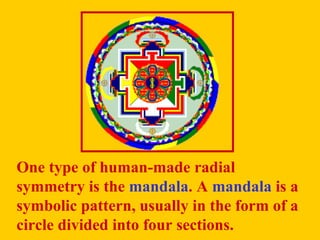
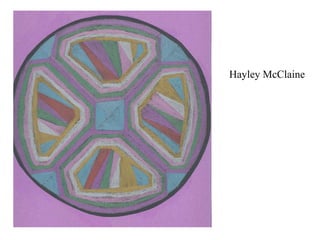
One type of human-made radial symmetry is the  mandala . A  mandala  is a symbolic pattern, usually in the form of a circle divided into four sections.
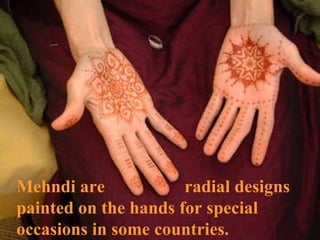
Mehndi are  radial designs painted on the hands for special occasions in some countries.
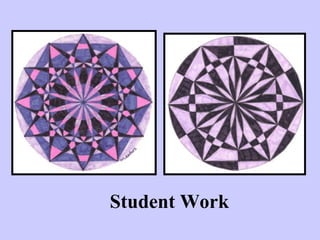
Student Work
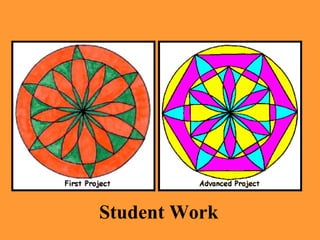
Student Work
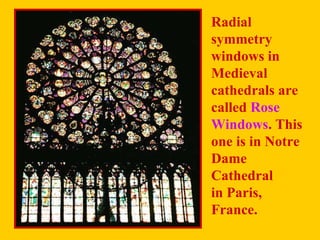
Radial symmetry windows in Medieval cathedrals are  called  Rose  Windows . This one is in Notre  Dame Cathedral  in Paris, France.
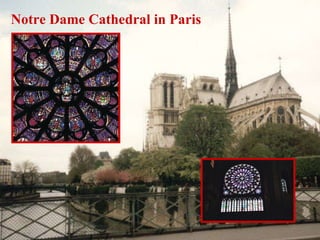
Notre Dame Cathedral in Paris
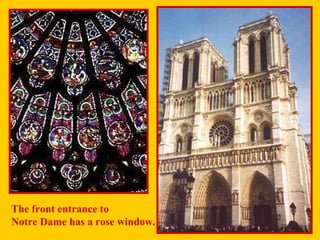
The front entrance to  Notre Dame has a rose window.
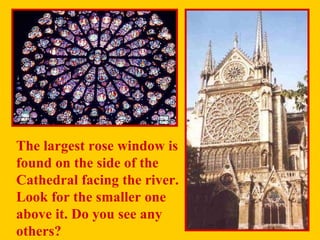
The largest rose window is  found on the side of the Cathedral facing the river.  Look for the smaller one  above it. Do you see any  others?
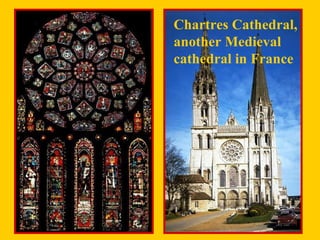
Chartres Cathedral, another Medieval cathedral in France
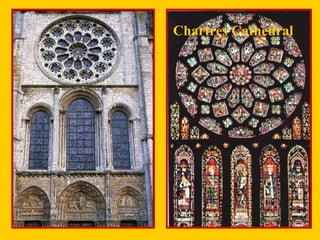
Chartres Cathedral
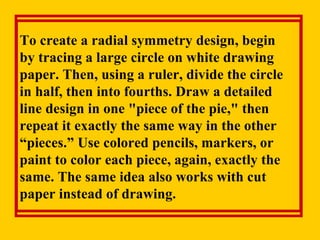
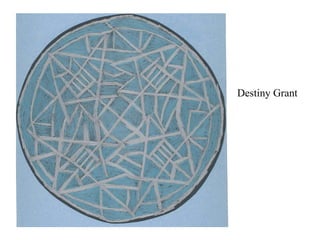
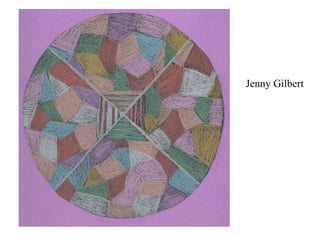
To create a radial symmetry design, begin  by tracing a large circle on white drawing paper. Then, using a ruler, divide the circle in half, then into fourths. Draw a detailed line design in one "piece of the pie," then repeat it exactly the same way in the other “pieces.” Use colored pencils, markers, or paint to color each piece, again, exactly the same. The same idea also works with cut paper instead of drawing.
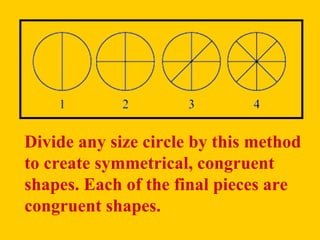
Divide any size circle by this method to create symmetrical, congruent shapes. Each of the final pieces are congruent shapes.
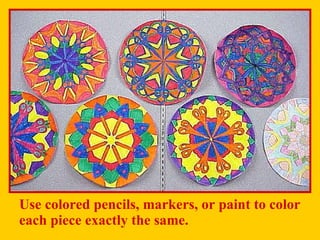
Use colored pencils, markers, or paint to color each piece exactly the same.
Rebecca 5 th  grade
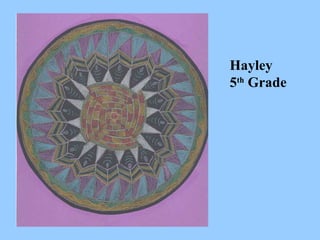
Hayley 5 th  Grade
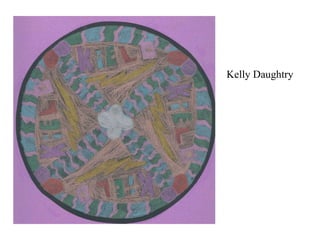
Kelly Daughtry
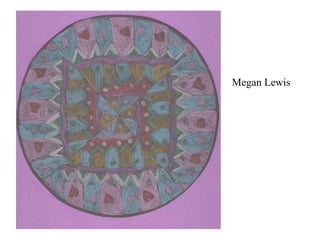
Megan Lewis
Hayley McClaine
Destiny Grant
Jenny Gilbert
TEKS:   Geometry and spatial reasoning.  The student recognizes  congruence  and  symmetry .  The student is expected to: (A) identify congruent shapes; (B) create shapes with lines of symmetry using concrete models and technology; and (C) identify lines of symmetry in shapes.

Radial symmetry

  • 1.
    Radial Symmetry inArt, Math, and Science
  • 2.
    Radial Symmetry Radialsymmetry or balance is a type of balance in which the parts of an object or picture are regularly arranged and radiate from a central point. It appears both in natural and in human-made objects.
  • 3.
    Three Types ofBalance or Symmetry Radial Symmetry is only one of three types of balance. The others are Mirror or Bilateral Symmetry and Asymmetry .
  • 4.
    Mirror or BilateralSymmetry Also called reflectional or line symmetry , mirror or bilateral symmetry is a type of balance in which a center line, called the line of symmetry , divides an object in half so that one side mirrors the other.
  • 5.
    Asymmetrical Balance Inart, asymmetrical balance is a form of symmetry in which the two sides of a picture or object are different but are visually balanced. They are visually equal without being identical. Most modern art is asymmetrical. Starry Night by Vincent Van Gogh
  • 6.
    Radial symmetry is found in both natural and human-made objects. Natural Objects
  • 7.
  • 8.
    Objects that haveradial symmetry can be divided into equal pieces like a pie. Each equal piece of a pie is also a congruent shape. Congruent shapes are exactly the same in size and shape.
  • 9.
    Snowflakes are naturalexamples of radial symmetry.
  • 10.
  • 11.
    Snowflake designs cantake many forms using cut paper. This design is from ZooFlakes ABC. Unicorns
  • 12.
  • 13.
  • 14.
    mendi Radialsymmetry designs may be round.
  • 15.
    Or they mayhave a square frame.
  • 16.
    Images seenin a kaleidoscope have radial symmetry.
  • 17.
    One type ofhuman-made radial symmetry is the mandala . A mandala is a symbolic pattern, usually in the form of a circle divided into four sections.
  • 18.
    Mehndi are radial designs painted on the hands for special occasions in some countries.
  • 19.
  • 20.
  • 21.
    Radial symmetry windowsin Medieval cathedrals are called Rose Windows . This one is in Notre Dame Cathedral in Paris, France.
  • 22.
  • 23.
    The front entranceto Notre Dame has a rose window.
  • 24.
    The largest rosewindow is found on the side of the Cathedral facing the river. Look for the smaller one above it. Do you see any others?
  • 25.
    Chartres Cathedral, anotherMedieval cathedral in France
  • 26.
  • 27.
    To create aradial symmetry design, begin by tracing a large circle on white drawing paper. Then, using a ruler, divide the circle in half, then into fourths. Draw a detailed line design in one "piece of the pie," then repeat it exactly the same way in the other “pieces.” Use colored pencils, markers, or paint to color each piece, again, exactly the same. The same idea also works with cut paper instead of drawing.
  • 28.
    Divide any sizecircle by this method to create symmetrical, congruent shapes. Each of the final pieces are congruent shapes.
  • 29.
    Use colored pencils,markers, or paint to color each piece exactly the same.
  • 30.
  • 31.
  • 32.
  • 33.
  • 34.
  • 35.
  • 36.
  • 37.
    TEKS: Geometry and spatial reasoning. The student recognizes congruence and symmetry . The student is expected to: (A) identify congruent shapes; (B) create shapes with lines of symmetry using concrete models and technology; and (C) identify lines of symmetry in shapes.