Inorganic Growth : Is It The Right Strategic
Move For Indian Businesses

Presented by:
Nupur Bhardwaj
Introduction
• Today, the business environment is rapidly changing
with respect to:
– Competition
– Products
– People
– Process of manufacture
– Markets
– Customers
– Technology.
• Companies are expected to beat competitors and
innovate in order to continuously maximize
shareholder value.
• Since 1991 Indian industries have been increasingly
exposed to both domestic and international
competition.
• Indian corporate sector has been forced to
restructure, reengineer to be competitive and deliver
value to stakeholders.
• Indian companies have adopted organic and
inorganic strategies to enhance value for their
shareholders.
Inorganic Growth
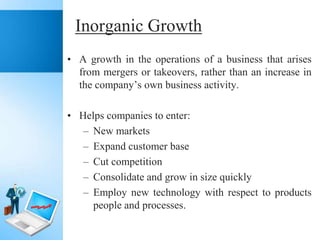
• A growth in the operations of a business that arises
from mergers or takeovers, rather than an increase in
the company’s own business activity.
• Helps companies to enter:
– New markets
– Expand customer base
– Cut competition
– Consolidate and grow in size quickly
– Employ new technology with respect to products
people and processes.
Difference
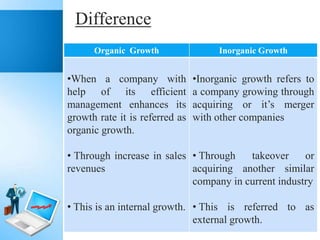
Organic Growth

Inorganic Growth

•When a company with
help of its efficient
management enhances its
growth rate it is referred as
organic growth.

•Inorganic growth refers to
a company growing through
acquiring or it’s merger
with other companies

takeover
or
• Through increase in sales • Through
revenues
acquiring another similar
company in current industry

• This is an internal growth. • This is referred to as
external growth.
Inorganic Growth Strategy
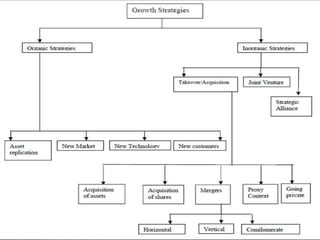
• The strategy of inorganic growth takes place by:
– Takeover
– Merger and Acquisitions
– Spinoffs
– Joint Venture
– Integration.
Takeover
• A takeover is the purchase of one company by the
another company. The term refers to the acquisition
of a public company whose shares are listed on a
stock exchange.
• Types of Takeover:
– Friendly Takeover
– Hostile Takeover
– Reverse Takeover
Merger and Acquisition
• Mergers and acquisitions is an aspect of corporate
strategy that is dealing with the buying, selling,
dividing and combining of different companies and
similar entities without creating a subsidiary
• Types of Mergers and Acquisition:
– Horizontal
– Vertical
– Co-generic
– Conglomerate
Spin-Off
• It is a corporate action where a company “splits off”
sections of itself as a separate business. The new
company takes assets, intellectual property,
technology, and/or existing products from the parent
organization.
Integration
• Integration generally means combining parts of a
company so that they work together or form a whole.
Joint Venture
• A joint venture takes place when two parties come
together to take on one project. In this type of project,
both parties are equally invested in the project in
terms of money, time, and effort to build on the
original concept.
Advantages of Inorganic Growth
• Can occur more quickly than organic growth
• Firms can benefit from a greater pool of skills and
experience
• Customers, sales, assets and market position are
acquired immediately
• Reduces competition
Disadvantages of Inorganic Growth
• More expensive than organic growth
• Difficult to combine different organisational cultures
and management styles
• Possibility of diseconomies of scale
• Greater risk

• Difficult to control
Wipro
• In 2005, Wipro acquired the consumer products and
lighting business of Yardley and Unza Holdings.
• In 2006, Wipro acquired cMango Inc., a US based
Technology Infrastructure Consulting firm.
• Wipro struck a deal with Saraware Oy, a leading
provider of design and engineering services to
telecoms companies, for Euro 25
• In 2007, Wipro entered into a agreement to acquire
Oki Techno Centre Singapore Pte Ltd (OTCS).
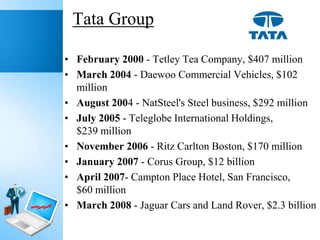
Tata Group
• February 2000 - Tetley Tea Company, $407 million
• March 2004 - Daewoo Commercial Vehicles, $102
million
• August 2004 - NatSteel's Steel business, $292 million
• July 2005 - Teleglobe International Holdings,
$239 million
• November 2006 - Ritz Carlton Boston, $170 million
• January 2007 - Corus Group, $12 billion
• April 2007- Campton Place Hotel, San Francisco,
$60 million
• March 2008 - Jaguar Cars and Land Rover, $2.3 billion
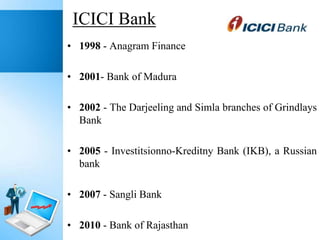
ICICI Bank
• 1998 - Anagram Finance
• 2001- Bank of Madura
• 2002 - The Darjeeling and Simla branches of Grindlays
Bank
• 2005 - Investitsionno-Kreditny Bank (IKB), a Russian
bank

• 2007 - Sangli Bank
• 2010 - Bank of Rajasthan
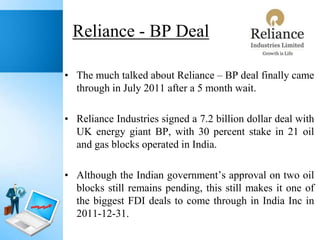
Reliance - BP Deal
• The much talked about Reliance – BP deal finally came
through in July 2011 after a 5 month wait.
• Reliance Industries signed a 7.2 billion dollar deal with
UK energy giant BP, with 30 percent stake in 21 oil
and gas blocks operated in India.
• Although the Indian government’s approval on two oil
blocks still remains pending, this still makes it one of
the biggest FDI deals to come through in India Inc in
2011-12-31.
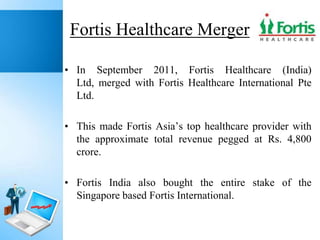
Fortis Healthcare Merger
• In September 2011, Fortis Healthcare (India)
Ltd, merged with Fortis Healthcare International Pte
Ltd.
• This made Fortis Asia’s top healthcare provider with
the approximate total revenue pegged at Rs. 4,800
crore.
• Fortis India also bought the entire stake of the
Singapore based Fortis International.
Essar-Vodafone
• In March 2011, the Vodafone Group announced that
it would buy 33 percent stake in its Indian joint
venture
• This was for about 5 billion dollars after the Essar
Group sold its holding and exited Vodafone.
• Healthcare giant Piramal Group too, bought about 5.5
percent in the Indian arm of Vodafone for about 640
million dollars.
iGate – Patni Computers
• In May 2011, IT firm iGate completed its
acquisition of its midsized rival Patni Computers for
an estimated 1.2 billion dollars.
• For iGate, the main aim of this acquisition was to
increase its revenue, vertical capability and customer
base.
• iGate now holds an approximate stake of 82.5 percent
in Patni computers, now called iGate Patni.
Aditya Birla Group
• In June 2011, the Aditya Birla Group announced its
completion of acquiring US based Columbian
Chemicals.
• Columbian Chemicals is a 100 year old carbon black
maker company for an estimated 875 million dollars.
• This will make the Aditya Birla Group one of the
largest carbon black maker companies in the world,
doubling its production capacity instantly.
Mahindra & Mahindra
• In March 2011, Mahindra acquired a 70 percent
stake in ailing South Korean auto maker Ssangyong
Motor Company Limited (SYMC)
•

This deal was for a total of 463 million dollars.

• This acquisition will see the Korean company’s
flagship SUV models, the Rexton II and the Korando
C foray into the Indian market.
Is it the right strategic move
for Indian businesses?
• Yes, inorganic growth is the right strategic move for
Indian businesses.
• Inorganic growth strategies are regarded as important
engines that help companies to enter new markets,
expand customer base, cut competition, consolidate
and grow in size quickly, employ new technology
with respect to products, people and processes.

• Thus the inorganic strategies are regarded by
companies as fast track strategies for growth and
unlocking of value to shareholders.
Thank You

Inorganic Growth - Is it the right strategy ?

  • 1.
    Inorganic Growth :Is It The Right Strategic Move For Indian Businesses Presented by: Nupur Bhardwaj
  • 2.
    Introduction • Today, thebusiness environment is rapidly changing with respect to: – Competition – Products – People – Process of manufacture – Markets – Customers – Technology. • Companies are expected to beat competitors and innovate in order to continuously maximize shareholder value.
  • 3.
    • Since 1991Indian industries have been increasingly exposed to both domestic and international competition. • Indian corporate sector has been forced to restructure, reengineer to be competitive and deliver value to stakeholders. • Indian companies have adopted organic and inorganic strategies to enhance value for their shareholders.
  • 5.
    Inorganic Growth • Agrowth in the operations of a business that arises from mergers or takeovers, rather than an increase in the company’s own business activity. • Helps companies to enter: – New markets – Expand customer base – Cut competition – Consolidate and grow in size quickly – Employ new technology with respect to products people and processes.
  • 6.
    Difference Organic Growth Inorganic Growth •Whena company with help of its efficient management enhances its growth rate it is referred as organic growth. •Inorganic growth refers to a company growing through acquiring or it’s merger with other companies takeover or • Through increase in sales • Through revenues acquiring another similar company in current industry • This is an internal growth. • This is referred to as external growth.
  • 7.
    Inorganic Growth Strategy •The strategy of inorganic growth takes place by: – Takeover – Merger and Acquisitions – Spinoffs – Joint Venture – Integration.
  • 8.
    Takeover • A takeoveris the purchase of one company by the another company. The term refers to the acquisition of a public company whose shares are listed on a stock exchange. • Types of Takeover: – Friendly Takeover – Hostile Takeover – Reverse Takeover
  • 9.
    Merger and Acquisition •Mergers and acquisitions is an aspect of corporate strategy that is dealing with the buying, selling, dividing and combining of different companies and similar entities without creating a subsidiary • Types of Mergers and Acquisition: – Horizontal – Vertical – Co-generic – Conglomerate
  • 10.
    Spin-Off • It isa corporate action where a company “splits off” sections of itself as a separate business. The new company takes assets, intellectual property, technology, and/or existing products from the parent organization.
  • 11.
    Integration • Integration generallymeans combining parts of a company so that they work together or form a whole.
  • 12.
    Joint Venture • Ajoint venture takes place when two parties come together to take on one project. In this type of project, both parties are equally invested in the project in terms of money, time, and effort to build on the original concept.
  • 13.
    Advantages of InorganicGrowth • Can occur more quickly than organic growth • Firms can benefit from a greater pool of skills and experience • Customers, sales, assets and market position are acquired immediately • Reduces competition
  • 14.
    Disadvantages of InorganicGrowth • More expensive than organic growth • Difficult to combine different organisational cultures and management styles • Possibility of diseconomies of scale • Greater risk • Difficult to control
  • 15.
    Wipro • In 2005,Wipro acquired the consumer products and lighting business of Yardley and Unza Holdings. • In 2006, Wipro acquired cMango Inc., a US based Technology Infrastructure Consulting firm. • Wipro struck a deal with Saraware Oy, a leading provider of design and engineering services to telecoms companies, for Euro 25 • In 2007, Wipro entered into a agreement to acquire Oki Techno Centre Singapore Pte Ltd (OTCS).
  • 16.
    Tata Group • February2000 - Tetley Tea Company, $407 million • March 2004 - Daewoo Commercial Vehicles, $102 million • August 2004 - NatSteel's Steel business, $292 million • July 2005 - Teleglobe International Holdings, $239 million • November 2006 - Ritz Carlton Boston, $170 million • January 2007 - Corus Group, $12 billion • April 2007- Campton Place Hotel, San Francisco, $60 million • March 2008 - Jaguar Cars and Land Rover, $2.3 billion
  • 17.
    ICICI Bank • 1998- Anagram Finance • 2001- Bank of Madura • 2002 - The Darjeeling and Simla branches of Grindlays Bank • 2005 - Investitsionno-Kreditny Bank (IKB), a Russian bank • 2007 - Sangli Bank • 2010 - Bank of Rajasthan
  • 18.
    Reliance - BPDeal • The much talked about Reliance – BP deal finally came through in July 2011 after a 5 month wait. • Reliance Industries signed a 7.2 billion dollar deal with UK energy giant BP, with 30 percent stake in 21 oil and gas blocks operated in India. • Although the Indian government’s approval on two oil blocks still remains pending, this still makes it one of the biggest FDI deals to come through in India Inc in 2011-12-31.
  • 19.
    Fortis Healthcare Merger •In September 2011, Fortis Healthcare (India) Ltd, merged with Fortis Healthcare International Pte Ltd. • This made Fortis Asia’s top healthcare provider with the approximate total revenue pegged at Rs. 4,800 crore. • Fortis India also bought the entire stake of the Singapore based Fortis International.
  • 20.
    Essar-Vodafone • In March2011, the Vodafone Group announced that it would buy 33 percent stake in its Indian joint venture • This was for about 5 billion dollars after the Essar Group sold its holding and exited Vodafone. • Healthcare giant Piramal Group too, bought about 5.5 percent in the Indian arm of Vodafone for about 640 million dollars.
  • 21.
    iGate – PatniComputers • In May 2011, IT firm iGate completed its acquisition of its midsized rival Patni Computers for an estimated 1.2 billion dollars. • For iGate, the main aim of this acquisition was to increase its revenue, vertical capability and customer base. • iGate now holds an approximate stake of 82.5 percent in Patni computers, now called iGate Patni.
  • 22.
    Aditya Birla Group •In June 2011, the Aditya Birla Group announced its completion of acquiring US based Columbian Chemicals. • Columbian Chemicals is a 100 year old carbon black maker company for an estimated 875 million dollars. • This will make the Aditya Birla Group one of the largest carbon black maker companies in the world, doubling its production capacity instantly.
  • 23.
    Mahindra & Mahindra •In March 2011, Mahindra acquired a 70 percent stake in ailing South Korean auto maker Ssangyong Motor Company Limited (SYMC) • This deal was for a total of 463 million dollars. • This acquisition will see the Korean company’s flagship SUV models, the Rexton II and the Korando C foray into the Indian market.
  • 24.
    Is it theright strategic move for Indian businesses? • Yes, inorganic growth is the right strategic move for Indian businesses. • Inorganic growth strategies are regarded as important engines that help companies to enter new markets, expand customer base, cut competition, consolidate and grow in size quickly, employ new technology with respect to products, people and processes. • Thus the inorganic strategies are regarded by companies as fast track strategies for growth and unlocking of value to shareholders.
  • 25.