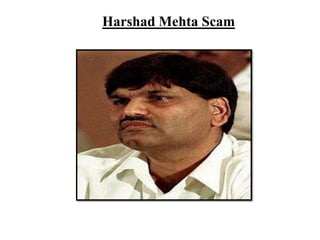
Harshad Mehta Scam
• Used to buy stock at rock bottom prices and then
push it up

• Self-made man
• Media Savvy

• Used to buy stock at rock bottom prices and then push
it up

Ketan Parekh

Harshad Mehta

Comparative Analysis of Both Scams

• Hailed from the family of stock-brokers
• Shied away from media

• Banks involved in the scam

• Banks involved in the scam

• Instruments misused were Ready Forward Deal
and Bank Receipts

• Instruments misused were Pay Order and Circular
Trading

• Promoters of Companies were involved

• Promoters of Companies were involved

• Operated through close network of brokers

• Had wider network of brokers

• Foreign banks like Citibank, Standard Chartered
and ANZ Grindlays were involved

• FIIs like Credit Suisse, First Boston and JM Morgan
Stanley were involved

• SBI suffered Rs. 600 cr loss

• Bank of India suffered Rs. 130 cr loss

• Played with “Old Economy” stocks

• Played with “New Economy” stocks

• Scam occurred inspite of presence of SEBI

• Scam occurred inspite of presence of SEBI

Sources: http://flame.org.in/knowledgecenter/scam.aspx
Impact on Stock Markets and Indian Economy
● The immediate impact of these scams were
sharp fall in the share prices and indices
● Post Harshad Mehta Scam, markets lost Rs.
0.1mn crore loss in market capitalisation
● The Government’s liberalization policies came
under severe criticism
● Subsequently, these policies were put on hold
for a while

● SEBI, the securities market regulator,
postponed sanctioning of private sector mutual
funds
● The entry of much talked about foreign
pension funds and mutual funds became the
remotest possibility
● The Euro-issues planned by many
Cos. Were delayed
Sources: http://www.slideshare.net/

Indian
Measures taken by SEBI against scams
● Securities and Exchange Board of India (SEBI) was established in April ’88
● Established with an objective of protecting the rights of small investors and
regulating and developing the stock market in India
● Post Mehta Scam in 1992, the GoI passed “SEBI Act 1992” and conferred statutory
powers to it
Measures post Mehta Scam
• Suspended brokers acting as Directors and other office bearers of BSE, for alleged insider trading
• Imposed an additional 10% volatility margin on A Group shares as well as margins on ALBM and BLESS Schemes
• Imposed volatility margins on net outstanding sale positions of FIIs, financial institutions, banks and mutual funds
• Banned naked short sales in March 2001
• Reduced the gross exposure limit for brokers to 10 times the base capital for NSE and 15 times for other stock exchanges
• Rolling settlements system made compulsory
• Allowed banks to offer collateralized lending only through BSE & NSE, to increase liquidity
• Launched trade guarantee fund to guarantee all transactions
Measures post KP Scam
• Trading cycle was cut short from a week to a day
• The carry-forward system in stock trading called ‘BADLA’ was banned
•

Introduced forward trading in the form of exchange-traded derivatives

• Withdrew broker control over stock exchanges
Action Taken By SEBI
● While Mehta scam empowered SEBI to regulate markets more effectively, several
other scams forced it to ensure that markets operate transparently and efficiently
● However, post Mehta scam, several scams came to light, casting doubt on the
efficiency of SEBI as a regulatory body
● Although many reforms are introduced by SEBI, there remains significant lapses in
the law implementation and enforcement
● Certain areas wherein SEBI needs to think upon and take action
includes:
─ Bear/Bull Cartels
─ Insider Trading
─ Circular Trading
─ Uniform settlement cycle
● A few actions taken by SEBI were criticized of it being clueless about its
supervisory duties
● Its high time that market regulators implement appropriate measures else the
ghost from past will continue haunting the Indian bourses
Thank You

Harshad mehta & Ketan Parekh Scam

  • 1.
  • 19.
    • Used tobuy stock at rock bottom prices and then push it up • Self-made man • Media Savvy • Used to buy stock at rock bottom prices and then push it up Ketan Parekh Harshad Mehta Comparative Analysis of Both Scams • Hailed from the family of stock-brokers • Shied away from media • Banks involved in the scam • Banks involved in the scam • Instruments misused were Ready Forward Deal and Bank Receipts • Instruments misused were Pay Order and Circular Trading • Promoters of Companies were involved • Promoters of Companies were involved • Operated through close network of brokers • Had wider network of brokers • Foreign banks like Citibank, Standard Chartered and ANZ Grindlays were involved • FIIs like Credit Suisse, First Boston and JM Morgan Stanley were involved • SBI suffered Rs. 600 cr loss • Bank of India suffered Rs. 130 cr loss • Played with “Old Economy” stocks • Played with “New Economy” stocks • Scam occurred inspite of presence of SEBI • Scam occurred inspite of presence of SEBI Sources: http://flame.org.in/knowledgecenter/scam.aspx
  • 20.
    Impact on StockMarkets and Indian Economy ● The immediate impact of these scams were sharp fall in the share prices and indices ● Post Harshad Mehta Scam, markets lost Rs. 0.1mn crore loss in market capitalisation ● The Government’s liberalization policies came under severe criticism ● Subsequently, these policies were put on hold for a while ● SEBI, the securities market regulator, postponed sanctioning of private sector mutual funds ● The entry of much talked about foreign pension funds and mutual funds became the remotest possibility ● The Euro-issues planned by many Cos. Were delayed Sources: http://www.slideshare.net/ Indian
  • 21.
    Measures taken bySEBI against scams ● Securities and Exchange Board of India (SEBI) was established in April ’88 ● Established with an objective of protecting the rights of small investors and regulating and developing the stock market in India ● Post Mehta Scam in 1992, the GoI passed “SEBI Act 1992” and conferred statutory powers to it Measures post Mehta Scam • Suspended brokers acting as Directors and other office bearers of BSE, for alleged insider trading • Imposed an additional 10% volatility margin on A Group shares as well as margins on ALBM and BLESS Schemes • Imposed volatility margins on net outstanding sale positions of FIIs, financial institutions, banks and mutual funds • Banned naked short sales in March 2001 • Reduced the gross exposure limit for brokers to 10 times the base capital for NSE and 15 times for other stock exchanges • Rolling settlements system made compulsory • Allowed banks to offer collateralized lending only through BSE & NSE, to increase liquidity • Launched trade guarantee fund to guarantee all transactions
  • 22.
    Measures post KPScam • Trading cycle was cut short from a week to a day • The carry-forward system in stock trading called ‘BADLA’ was banned • Introduced forward trading in the form of exchange-traded derivatives • Withdrew broker control over stock exchanges
  • 23.
    Action Taken BySEBI ● While Mehta scam empowered SEBI to regulate markets more effectively, several other scams forced it to ensure that markets operate transparently and efficiently ● However, post Mehta scam, several scams came to light, casting doubt on the efficiency of SEBI as a regulatory body ● Although many reforms are introduced by SEBI, there remains significant lapses in the law implementation and enforcement ● Certain areas wherein SEBI needs to think upon and take action includes: ─ Bear/Bull Cartels ─ Insider Trading ─ Circular Trading ─ Uniform settlement cycle ● A few actions taken by SEBI were criticized of it being clueless about its supervisory duties ● Its high time that market regulators implement appropriate measures else the ghost from past will continue haunting the Indian bourses
  • 24.