+
How to Track your Students with End
of the Year Data
By Noble Newman
Noble Newman Education
Noble Newman Entrepreneurship
+
Why do we look at the
student data?
n  While you may have not gotten into education to analyze
various spreadsheets, determining student progress is a
process in which teachers gather evidence to evaluate how
students are progressing on the continuum of their annual
learning goals.
n  Having this information within your arsenal will not only
allow you to shape your lesson plans, but also how to hone
and develop the strengths of your students each and
everyday.
+
What else can the data do
for us?
n  In addition to lesson planning, gathering strong analytical
evidence on student learning can play a vital need in
determining the effectiveness of past instructions.
n  This provides an outlet for educators to reflect and strategize
various ways in which they can modify upcoming lessons for
the betterment and support of the students’ need.
+
Remember it is your
Responsibility
n  While your first initial job is to deliver the need and interest of
your students, you have to understand that tracking is your
responsibility.
n  Any educator who is not tracking the growth and development of
their students is providing them an injustice to their education.
n  While tracking student progress may not be an end all in itself, it
is a vital tool in monitoring the performance of student outcome.
n  It propels academic growth by academically identifying
students strengths and weaknesses and highlights various goals
within the academic calendar
n  In addition, it provides strategic decisions about future lesson
plans and differentiated instructions for student mastery and
learning.
+
So how do I track my
student’s growth?
+
Phase One: Know your
Curriculum
n  While there will always be an ever-evolving development
within the academic curriculum, it is your responsibility as an
educator to understand the standards and objectives for each
lesson.
n  Make sure you have an internal understanding of the goals
and objectives your students should hit for each standard
n  Take for example mathematics.
n  Wrong Understanding: Students will be able to tackle word
problems.
n  Right Understanding: Students will be able to do basic and
foundational arithmetic and Algebra problems .
n  Students will be able to find the answer to unknown various
through ‘three’ different methods.
+
Phase One: Know your
Curriculum
n  In addition, consider whether tracking will take place at the
course, unit, and/or lesson level. Also, consider whether
tracking will be done at the class level or for individual
students.
n  Understanding these level of breakdowns will allow you to
identify the right tracking system that can best optimize
student learning and student gains.
+
Tracking System
+
Phase Two: Implement
Tracking System
n  When creating your tracking system, try utilizing your school’s
system into your process. If you feel like you can utilize a
different system, be sure to note how it can be translated to your
coaches and administrators.
n  In addition, try looking at other existing tracking systems online
through Google search.
n  With the growth of technology, there are a plethora of student tracking
systems out there.
n  You want to make sure your system can work for both your students
and yourself.
n  Lastly should be organized by objective, concept, skill, and unit,
with a student expectation and goal in mind.
n  Utilize previous student data from their most recent state standardize
examination as a starting point.
+
Phase Two: Implement
Tracking System
n  Tailor the tracking system to reflect your style and students’
interests.
n  First and foremost, make sure you can utilize this system as a
way for you to analyze and track student growth. ***
n  Make sure this is also meaningful and translatable to the
students. If your students are unaware of the tracking process
or apathetic about the system in general, that is a problem.
n  To invest your students into this process, make sure it is
carefully explained. In addition, provide individual goals for
student achievement. Lastly, be consistent with bringing this
to their attention.
+
Phase Two: Implement
Tracking System
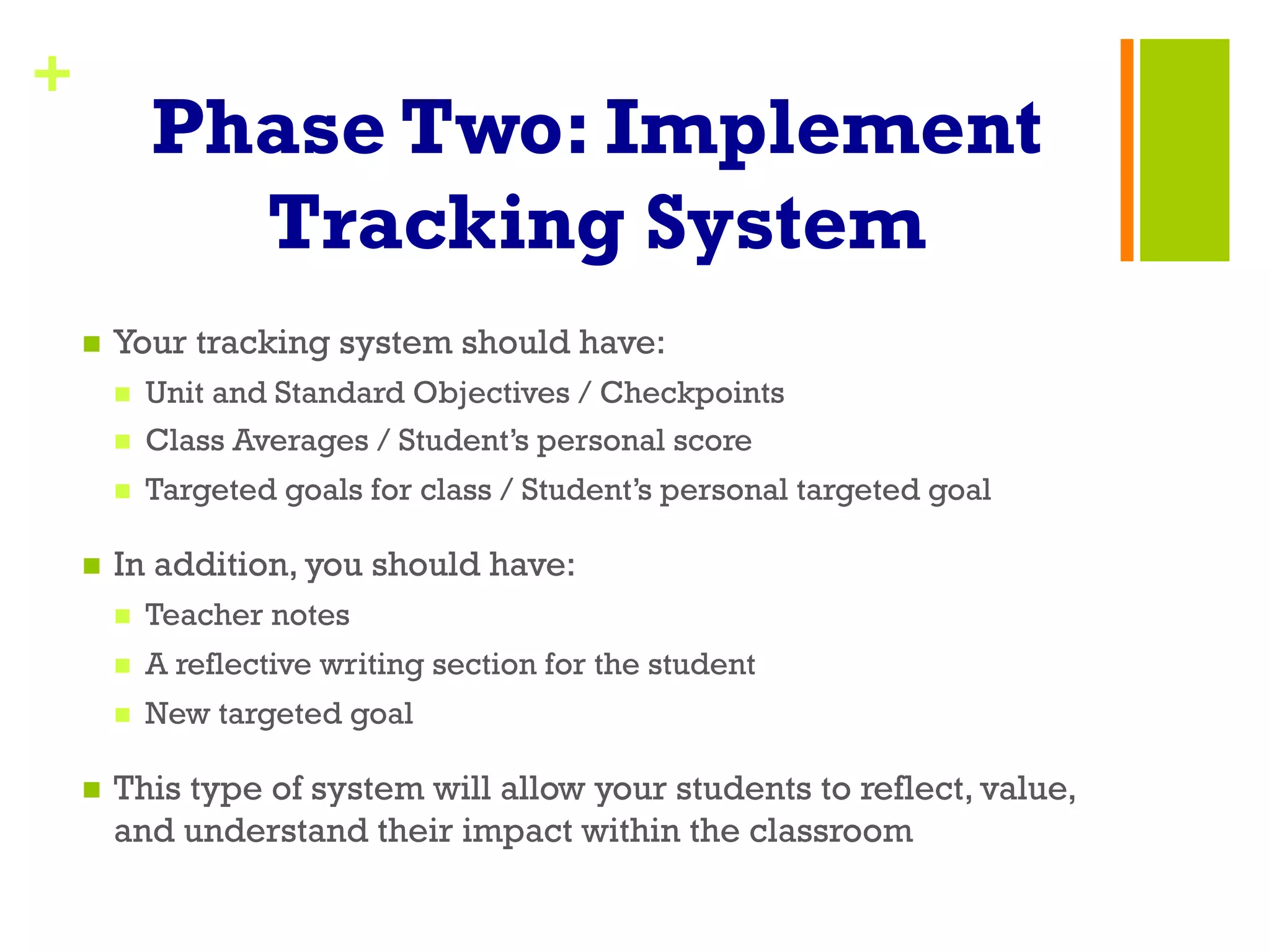
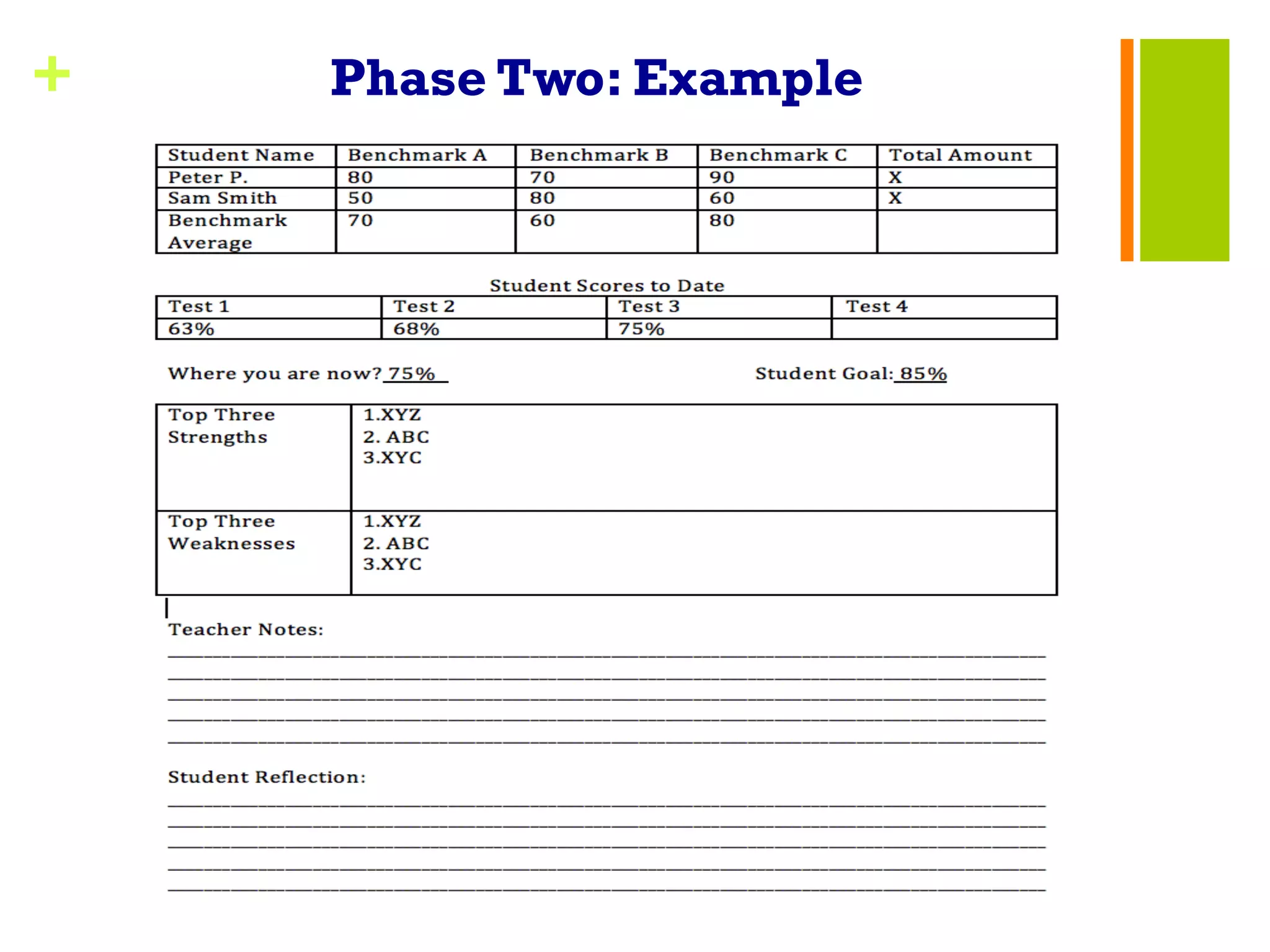
n  Your tracking system should have:
n  Unit and Standard Objectives / Checkpoints
n  Class Averages / Student’s personal score
n  Targeted goals for class / Student’s personal targeted goal
n  In addition, you should have:
n  Teacher notes
n  A reflective writing section for the student
n  New targeted goal
n  This type of system will allow your students to reflect, value,
and understand their impact within the classroom
+ Phase Two: Example
+
Teacher Meetings
+
Phase Three: Implement
Tracking System
n  Make sure you spend a time to talk and discuss your findings
and student results with each individual student.
n  One way to do this is through Differentiated Instruction time.
n  Another can be through Quiet Reading where you can go
through each individual student data.
n  The most important thing is to of course meet with each student
and share that information with them.
+
To Learn More
n  If you would like to learn more about other teacher tips or
education policy and reform news, please visit the following
sites:
n  Noble Newman Education
n  Noble Newman Career
n  Noble Newman Entrepreneurship

How to Track your students with End of the Year Data by Noble Newman

  • 1.
    + How to Trackyour Students with End of the Year Data By Noble Newman Noble Newman Education Noble Newman Entrepreneurship
  • 2.
    + Why do welook at the student data? n  While you may have not gotten into education to analyze various spreadsheets, determining student progress is a process in which teachers gather evidence to evaluate how students are progressing on the continuum of their annual learning goals. n  Having this information within your arsenal will not only allow you to shape your lesson plans, but also how to hone and develop the strengths of your students each and everyday.
  • 3.
    + What else canthe data do for us? n  In addition to lesson planning, gathering strong analytical evidence on student learning can play a vital need in determining the effectiveness of past instructions. n  This provides an outlet for educators to reflect and strategize various ways in which they can modify upcoming lessons for the betterment and support of the students’ need.
  • 4.
    + Remember it isyour Responsibility n  While your first initial job is to deliver the need and interest of your students, you have to understand that tracking is your responsibility. n  Any educator who is not tracking the growth and development of their students is providing them an injustice to their education. n  While tracking student progress may not be an end all in itself, it is a vital tool in monitoring the performance of student outcome. n  It propels academic growth by academically identifying students strengths and weaknesses and highlights various goals within the academic calendar n  In addition, it provides strategic decisions about future lesson plans and differentiated instructions for student mastery and learning.
  • 5.
    + So how doI track my student’s growth?
  • 6.
    + Phase One: Knowyour Curriculum n  While there will always be an ever-evolving development within the academic curriculum, it is your responsibility as an educator to understand the standards and objectives for each lesson. n  Make sure you have an internal understanding of the goals and objectives your students should hit for each standard n  Take for example mathematics. n  Wrong Understanding: Students will be able to tackle word problems. n  Right Understanding: Students will be able to do basic and foundational arithmetic and Algebra problems . n  Students will be able to find the answer to unknown various through ‘three’ different methods.
  • 7.
    + Phase One: Knowyour Curriculum n  In addition, consider whether tracking will take place at the course, unit, and/or lesson level. Also, consider whether tracking will be done at the class level or for individual students. n  Understanding these level of breakdowns will allow you to identify the right tracking system that can best optimize student learning and student gains.
  • 8.
  • 9.
    + Phase Two: Implement TrackingSystem n  When creating your tracking system, try utilizing your school’s system into your process. If you feel like you can utilize a different system, be sure to note how it can be translated to your coaches and administrators. n  In addition, try looking at other existing tracking systems online through Google search. n  With the growth of technology, there are a plethora of student tracking systems out there. n  You want to make sure your system can work for both your students and yourself. n  Lastly should be organized by objective, concept, skill, and unit, with a student expectation and goal in mind. n  Utilize previous student data from their most recent state standardize examination as a starting point.
  • 10.
    + Phase Two: Implement TrackingSystem n  Tailor the tracking system to reflect your style and students’ interests. n  First and foremost, make sure you can utilize this system as a way for you to analyze and track student growth. *** n  Make sure this is also meaningful and translatable to the students. If your students are unaware of the tracking process or apathetic about the system in general, that is a problem. n  To invest your students into this process, make sure it is carefully explained. In addition, provide individual goals for student achievement. Lastly, be consistent with bringing this to their attention.
  • 11.
    + Phase Two: Implement TrackingSystem n  Your tracking system should have: n  Unit and Standard Objectives / Checkpoints n  Class Averages / Student’s personal score n  Targeted goals for class / Student’s personal targeted goal n  In addition, you should have: n  Teacher notes n  A reflective writing section for the student n  New targeted goal n  This type of system will allow your students to reflect, value, and understand their impact within the classroom
  • 12.
    + Phase Two:Example
  • 13.
  • 14.
    + Phase Three: Implement TrackingSystem n  Make sure you spend a time to talk and discuss your findings and student results with each individual student. n  One way to do this is through Differentiated Instruction time. n  Another can be through Quiet Reading where you can go through each individual student data. n  The most important thing is to of course meet with each student and share that information with them.
  • 15.
    + To Learn More n If you would like to learn more about other teacher tips or education policy and reform news, please visit the following sites: n  Noble Newman Education n  Noble Newman Career n  Noble Newman Entrepreneurship